1133 reviews from "Pelit"-books
Pelit was a Finnish-language (bi)annual book series published from 1987 to 1991 containing gaming-related articles, tips and most importantly game reviews. Here you can find all the reviews from the books. The reviews were originally written in Finnish; the English versions are translations of the Finnish originals. Maininta tekijänoikeuksista
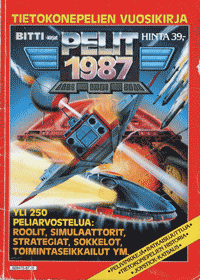 1987
1987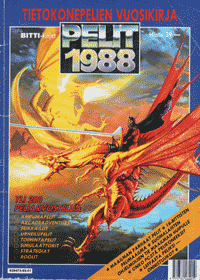 1988
1988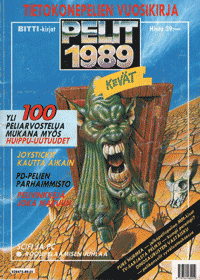 1989 Kevät
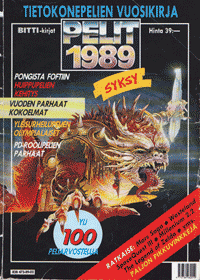 1989 Syksy
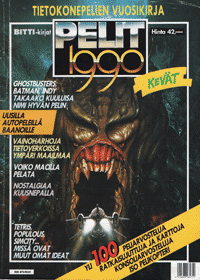 1990 Kevät
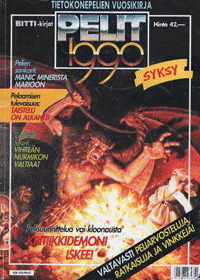 1990 Syksy
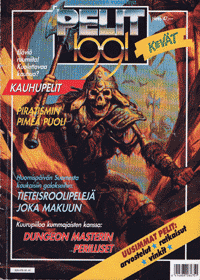 1991 Kevät
 1991 Syksy
S.T.U.N.Runner
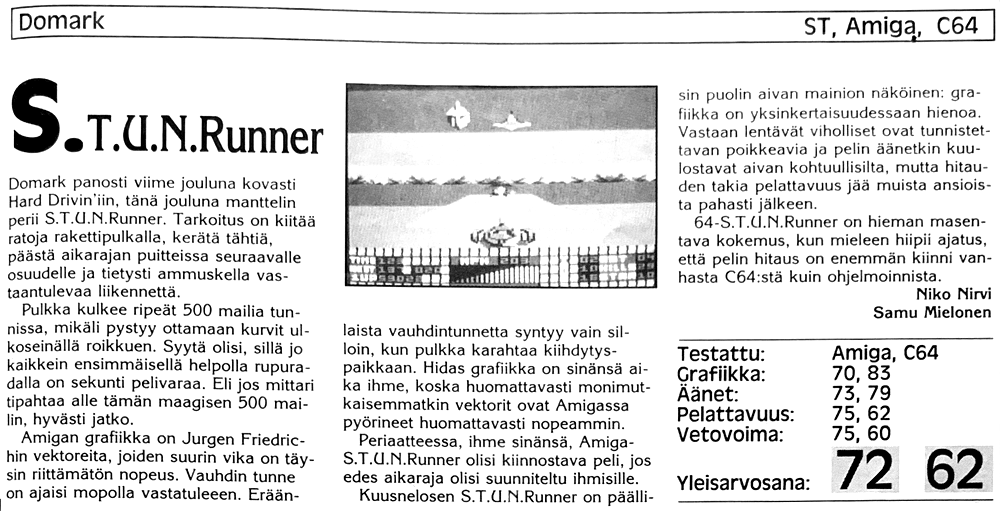
S.T.U.N.Runner1991 KevätPysyvä linkkiDomark panosti viime jouluna kovasti Hard Drivin'iin, tänä jouluna manttelin perii S.T.U.N.Runner. Tarkoitus on kiitää ratoja rakettipulkalla, kerätä tähtiä, päästä aikarajan puitteissa seuraavalle osuudelle ja tietysti ammuskella vastaantulevaa liikennettä.
Pulkka kulkee ripeät 500 mailia tunnissa, mikäli pystyy ottamaan kurvit ulkoseinällä roikkuen. Syytä olisi, sillä jo kaikkein ensimmäisellä helpolla rupuradalla on sekunti pelivaraa. Eli jos mittari tipahtaa alle tämän maagisen 500 mailin, hyvästi jatko.
Amigan grafiikka on Jurgen Friedrichin vektoreita, joiden suurin vika on täysin riittämätön nopeus. Vauhdin tunne on ajaisi mopolla vastatuleeen. Eräänlaista vauhdintunnetta syntyy vain silloin, kun pulkka karahtaa kiihdytyspaikkaan. Hidas grafiikka on sinänsä aika ihme, koska huomattavasti monimutkaisemmatkin vektorit ovat Amigassa pyörineet huomattavasti nopeammin.
Periaatteessa, ihme sinänsä, Amiga-S.T.U.N.Runner olisi kiinnostava peli, jos edes aikaraja olisi suunniteltu ihmisille.
Kuusnelosen S.T.U.N.Runner on päällisin puolin aivan mainion näköinen: grafiikka on yksinkertaisuudessaan hienoa. Vastaan lentävät viholliset ovat tunnistettavan poikkeavia ja pelin äänetkin kuulostavat aivan kohtuullisilta, mutta hitauden takia pelattavuus jää muista ansioista pahasti jälkeen.
64-S.T.U.N.Runner on hieman masentava kokemus, kun mieleen hiipii ajatus, että pelin hitaus on enemmän kiinni vanhasta C64:stä kuin ohjelmoinnista.
S.T.U.N.Runner1991 KevätPermalinkLast Christmas Domark put a lot into Hard Drivin'; this Christmas the mantle passes to S.T.U.N.Runner. The idea is to speed along the tracks on a rocket sled, collect stars, reach the next section within the time limit and of course shoot at the oncoming traffic.
The sled does a brisk 500 miles an hour, provided you can take the bends hanging on the outer wall. And you'd better, since even on the very first easy junk track you have one second of leeway. So if the meter drops below this magic 500 miles, goodbye to going any further.
The Amiga graphics are Jurgen Friedrich's vectors, whose biggest flaw is completely inadequate speed. The sense of speed is like riding a moped into a headwind. Some sort of sense of speed only arises when the sled scrapes into a boost pad. The slow graphics are quite a wonder in themselves, since considerably more complex vectors have spun considerably faster on the Amiga.
In principle - a wonder in itself - the Amiga S.T.U.N.Runner would be an interesting game, if only the time limit had been designed for human beings.
The Commodore 64 S.T.U.N.Runner looks quite splendid on the surface: the graphics are fine in their simplicity. The enemies flying at you are recognisably distinct, and the game's sounds sound quite reasonable too, but because of the slowness the playability lags badly behind its other merits.
The 64 S.T.U.N.Runner is a slightly depressing experience, as the thought creeps in that the game's slowness has more to do with the old C64 than with the programming.
Saboteur
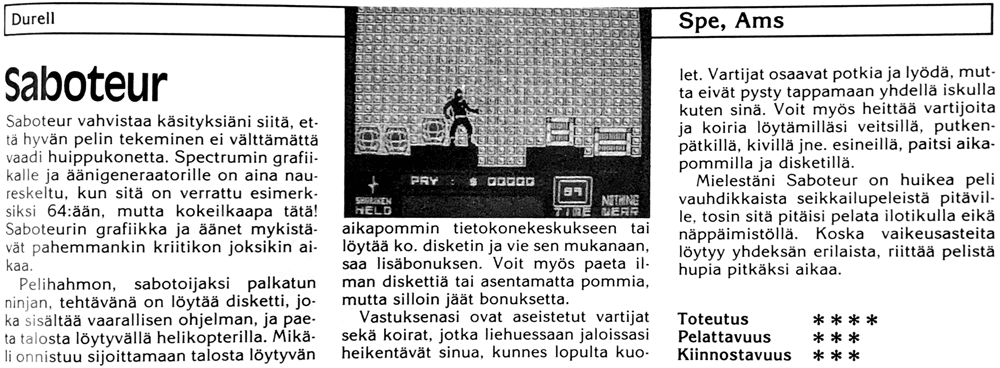
Saboteur1987Pysyvä linkkiSaboteur vahvistaa käsityksiäni siitä, että hyvän pelin tekeminen ei välttämättä vaadi huippukonetta. Spectrumin grafiikalle ja äänigeneraattorille on aina naureskeltu, kun sitä on verrattu esimerkiksi 64:ään, mutta kokeilkaapa tätä! Saboteurin grafiikka ja äänet mykistävät pahemmankin kriitikon joksikin aikaa.
Pelihahmon, sabotoijaksi palkatun ninjan, tehtävänä on löytää disketti, joka sisältää vaarallisen ohjelman, ja paeta talosta löytyvällä helikopterilla. Mikäli onnistuu sijoittamaan talosta löytyvän aikapommin tietokonekeskukseen tai löytää ko. disketin ja vie sen mukanaan, saa lisäbonuksen. Voit myös paeta ilman diskettiä tai asentamatta pommia, mutta silloin jäät bonuksetta.
Vastuksenasi ovat aseistetut vartijat sekä koirat, jotka liehuessaan jaloissasi heikentävät sinua, kunnes lopulta kuolet. Vartijat osaavat potkia ja lyödä, mutta eivät pysty tappamaan yhdellä iskulla kuten sinä. Voit myös heittää vartijoita ja koiria löytämilläsi veitsillä, putkenpätkillä, kivillä jne. esineillä, paitsi aikapommilla ja disketillä.
Mielestäni Saboteur on huikea peli vauhdikkaista seikkailupeleistä pitäville, tosin sitä pitäisi pelata ilotikulla eikä näppäimistöllä. Koska vaikeusasteita löytyy yhdeksän erilaista, riittää pelistä hupia pitkäksi aikaa.
Saboteur1987PermalinkSaboteur confirms my belief that making a good game doesn't necessarily require a top-of-the-range machine. People have always sniggered at the Spectrum's graphics and sound generator when comparing it with, say, the Commodore 64, but just try this one! Saboteur's graphics and sound will leave even the harshest critic speechless for a while.
The task of the player character, a ninja hired as a saboteur, is to find a disk containing a dangerous program and escape in a helicopter that is somewhere in the building. If you manage to plant the time bomb found in the building in the computer centre, or find the disk in question and take it with you, you get an extra bonus. You can also escape without the disk or without setting the bomb, but then you go without a bonus.
Standing in your way are armed guards and dogs, which hang around your ankles and sap your strength until you finally die. The guards can kick and punch, but they can't kill with a single blow the way you can. You can also throw knives, lengths of pipe, stones and other such objects you find at the guards and dogs - anything except the time bomb and the disk.
In my opinion Saboteur is a terrific game for anyone who likes fast-paced adventure games, though it should be played with a joystick rather than the keyboard. Since there are nine different difficulty levels, the game will keep you entertained for a long time.
Saboteur II
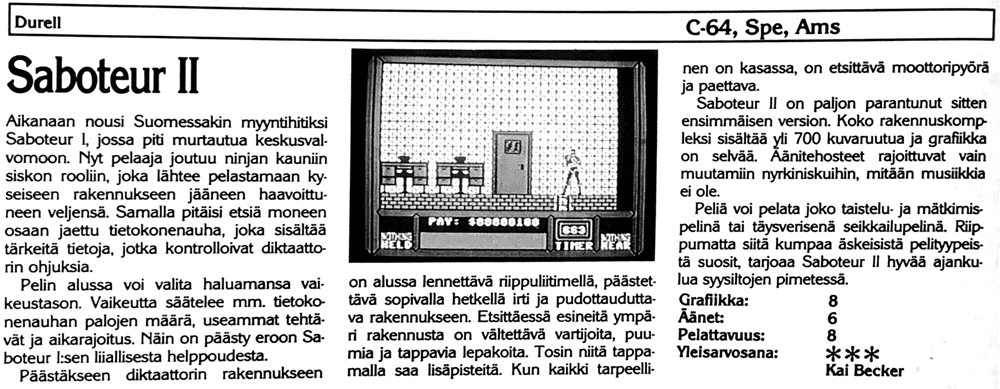
Saboteur II1988Pysyvä linkkiAikanaan nousi Suomessakin myyntihitiksi Saboteur I, jossa piti murtautua keskusvalvomoon. Nyt pelaaja joutuu ninjan kauniin siskon rooliin, joka lähtee pelastamaan kyseiseen rakennukseen jääneen haavoittuneen veljensä. Samalla pitäisi etsiä moneen osaan jaettu tietokonenauha, joka sisältää tärkeitä tietoja, jotka kontrolloivat diktaattorin ohjuksia.
Pelin alussa voi valita haluamansa vaikeustason. Vaikeutta säätelee mm. tietokonenauhan palojen määrä, useammat tehtävät ja aikarajoitus. Näin on päästy eroon Saboteur I:sen liiallisesta helppoudesta.
Päästäkseen diktaattorin rakennukseen on alussa lennettävä riippuliitimellä, päästettävä sopivalla hetkellä irti ja pudottauduttava rakennukseen. Etsittäessä esineitä ympäri rakennusta on vältettävä vartijoita, puumia ja tappavia lepakoita. Tosin niitä tappamalla saa lisäpisteitä. Kun kaikki tarpeellinen on kasassa, on etsittävä moottoripyörä ja paettava.
Saboteur II on paljon parantunut sitten ensimmäisen version. Koko rakennuskompleksi sisältää yli 700 kuvaruutua ja grafiikka on selvää. Äänitehosteet rajoittuvat vain muutamiin nyrkiniskuihin, mitään musiikkia ei ole.
Peliä voi pelata joko taistelu- ja mätkimispelinä tai täysverisenä seikkailupelinä. Riippumatta siitä kumpaa äskeisistä pelityypeistä suosit, tarjoaa Saboteur II hyvää ajankulua syysiltojen pimetessä.
Saboteur II1988PermalinkIn its day Saboteur I, in which you had to break into a central control room, became a sales hit in Finland too. Now the player takes on the role of the ninja's beautiful sister, who sets out to rescue her wounded brother, left behind in that very building. At the same time you're supposed to find a computer tape split into many pieces, which holds important data controlling the dictator's missiles.
At the start of the game you can pick the difficulty level you want. The difficulty is governed by, among other things, the number of pieces of computer tape, more tasks and a time limit. That does away with the excessive easiness of Saboteur I.
To get into the dictator's building you first have to fly a hang glider, let go at the right moment and drop into the building. While searching for items around the building you have to avoid guards, pumas and deadly bats. Then again, killing them earns you bonus points. Once you've got everything you need together, you have to find a motorbike and escape.
Saboteur II has improved a lot since the first version. The whole building complex contains over 700 screens and the graphics are clear. The sound effects are limited to just a few punches; there's no music at all.
You can play the game either as a fighting-and-bashing game or as a full-blooded adventure game. Whichever of these two game types you prefer, Saboteur II offers a good way to pass the time as the autumn evenings draw in.
Sabre Wulf

Sabre Wulf1987Pysyvä linkkiTässä viidakkosokkelossa tehtävänä on löytää neljä kadonnutta amuletin osaa, ja sen jälkeen löytää tie ulos viidakosta. Pelissä on yli 250 ruutua, joten ihan heti ei tässäkään pelissä loppuun pääse.
Pelaaja ohjaa urheaa viidakkoseikkailijaa joko näppäimistöllä tai joystickillä. Pelin mies liikkuu neljään eri suuntaan käytävien mukaan. Ruudun reunaan pääsemisen jälkeen siirrytään seuraavaan jne. Pelkkä kuljeskelu lehvälabyrintissä olisikin mukavaa, mutta näin helpolla ei valitettavasti pääse.
Käytävälle ilmestyy kaikenlaisia viidakon olentoja, jotka voivat tehdä selvän seikkailijasi yhdestä elämästä (joita aluksi on neljä). Apinat, virtahevot, alkuasukkaat, käärmeet, hämähäkit ja monet muut olennot tulla tupsahtavat eteen ja pelaajan on taisteltava päästäkseen eteenpäin.
Tällöin voi käyttää miekkaa, jolla viidakkomies iskee näppärästi tien selväksi. Elukat katoavat possahtaen mutta kohta niitä taas ilmestyy lisää.
Eriväriset orkideat puhkeavat kukkaan lähelläsi silloin tällöin. Ne vaikuttavat kukin omalla tavallaan pelaajaan. Yhdestä lamaantuu vähäksi aikaa, toisesta taas tulee hetkeksi haavoittumattomaksi. Silloin voi vilistää kaikkien petojen ohi.
Matkalla voi kerätä lisäksi paljon aarteita, joista saat pisteitä. Sormuksia, rahasäkkejä ym. löytyy tieltä vähän väliä. Arvokkain on kuitenkin pieni punainen patsas, jonka löydyttyä saa yhden lisäelämän. Graafinen toteutus on Sabre Wulfissa kiistattomasti hieno. Sekä kasvien reunustamat polut että erilaiset oliot ovat selkeästi ja värikkäästi luodut.
Sabre Wulfia pitkään pelatessa saattaa lievä kyllästyminen uhata, mutta mainion pelattavuuden ansiosta tuskin aivan heti.
Labyrinttiseikkailuista Sabre Wulf on mielestäni aivan kärjessä.
Sabre Wulf1987PermalinkIn this jungle maze your task is to find the four lost pieces of an amulet and then find your way out of the jungle. The game has over 250 screens, so this is another game you won't be finishing any time soon.
The player controls a brave jungle adventurer with either the keyboard or a joystick. The man moves in four directions, following the paths. When you reach the edge of the screen you move on to the next one, and so on. Just strolling around the leafy labyrinth would be nice, but unfortunately you don't get off that easily.
All sorts of jungle creatures appear on the paths, and they can make short work of one of your adventurer's lives (of which there are four to begin with). Monkeys, hippos, natives, snakes, spiders and many other creatures come popping up in front of you, and the player has to fight to get anywhere.
For this you can use a sword, with which the jungle man nimbly hacks the way clear. The critters vanish with a pop, but soon more of them turn up again.
Every now and then orchids of different colours burst into bloom near you. Each one affects the player in its own way. One paralyses you for a little while, while another makes you invulnerable for a moment. Then you can scurry past all the beasts.
Along the way you can also collect plenty of treasures, which earn you points. Rings, money bags and so on turn up on your path every so often. The most valuable, however, is a small red statue, which gives you an extra life when you find it. The graphics in Sabre Wulf are undeniably fine. Both the plant-lined paths and the various creatures are drawn clearly and colourfully.
Play Sabre Wulf for a long time and mild boredom may start to threaten, but thanks to its excellent playability, probably not too soon.
Among labyrinth adventures, Sabre Wulf is in my opinion right up at the top.
Sai Combat
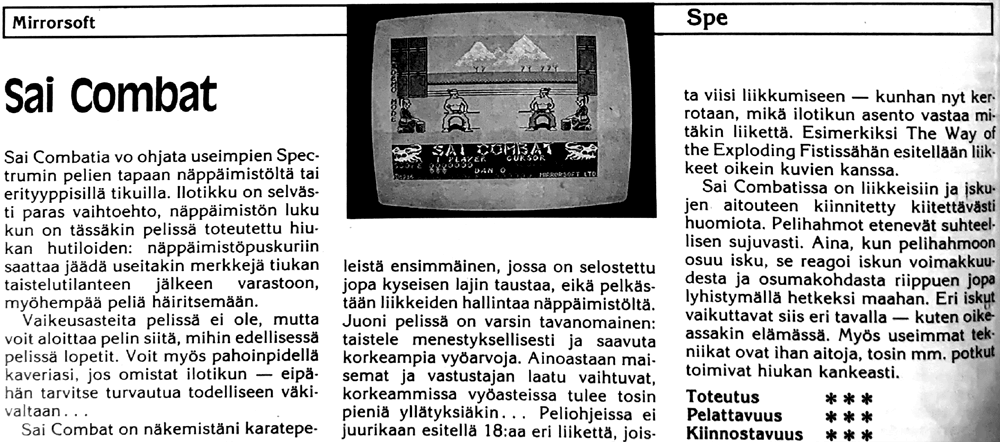
Sai Combat1987Pysyvä linkkiSai Combatia vo ohjata useimpien Spectrumin pelien tapaan näppäimistöltä tai erityyppisillä tikuilla. Ilotikku on selvästi paras vaihtoehto, näppäimistön luku kun on tässäkin pelissä toteutettu hiukan hutiloiden: näppäimistöpuskuriin saattaa jäädä useitakin merkkejä tiukan taistelutilanteen jälkeen varastoon, myöhempää peliä häiritsemään.
Vaikeusasteita pelissä ei ole, mutta voit aloittaa pelin siitä, mihin edellisessä pelissä lopetit. Voit myös pahoinpidellä kaveriasi, jos omistat ilotikun - eipähän tarvitse turvautua todelliseen väkivaltaan...
Sai Combat on näkemistäni karatepeleistä ensimmäinen, jossa on selostettu jopa kyseisen lajin taustaa, eikä pelkästään liikkeiden hallintaa näppäimistöltä. Juoni pelissä on varsin tavanomainen: taistele menestyksellisesti ja saavuta korkeampia vyöarvoja. Ainoastaan maisemat ja vastustajan laatu vaihtuvat, korkeammissa vyöasteissa tulee tosin pieniä yllätyksiäkin... Peliohjeissa ei juurikaan esitellä 18:aa eri liikettä, joista viisi liikkumiseen - kunhan nyt kerrotaan, mikä ilotikun asento vastaa mitäkin liikettä. Esimerkiksi The Way of the Exploding Fistissähän esitellään liikkeet oikein kuvien kanssa.
Sai Combatissa on liikkeisiin ja iskujen aitouteen kiinnitetty kiitettävästi huomiota. Pelihahmot etenevät suhteellisen sujuvasti. Aina, kun pelihahmoon osuu isku, se reagoi iskun voimakkuudesta ja osumakohdasta riippuen jopa lyhistymällä hetkeksi maahan. Eri iskut vaikuttavat siis eri tavalla - kuten oikeassakin elämässä. Myös useimmat tekniikat ovat ihan aitoja, tosin mm. potkut toimivat hiukan kankeasti.
Sai Combat1987PermalinkLike most Spectrum games, Sai Combat can be controlled from the keyboard or with various types of joystick. The joystick is clearly the best option, since in this game too the keyboard reading has been done a bit sloppily: after a tight bit of fighting, several keypresses can be left stored in the keyboard buffer to mess up your play later on.
There are no difficulty levels in the game, but you can start from where you left off in your previous game. You can also beat up your mate if you own a joystick - that way you needn't resort to real violence...
Of the karate games I've seen, Sai Combat is the first to explain even the background of the martial art in question, and not just how to control the moves from the keyboard. The plot is pretty run-of-the-mill: fight successfully and earn higher belt grades. Only the scenery and the calibre of opponent change, though at the higher belt grades there are a few little surprises too... The instructions hardly go into the 18 different moves, five of which are for moving around - they just about tell you which joystick position corresponds to which move. The Way of the Exploding Fist, for example, presents its moves properly, with pictures.
Sai Combat pays commendable attention to movement and to the authenticity of the blows. The characters move relatively smoothly. Whenever a character is hit, it reacts according to the force of the blow and where it lands, even collapsing to the ground for a moment. So different blows have different effects - just like in real life. Most of the techniques are genuine too, though the kicks, among others, are a bit stiff.
Salamander
Salamander1989 KevätPysyvä linkkiSitä on tullut nähtyä vuosien aikana niin monta erilaista sivuittain vierivää ampumapeliä, että vain harva jaksaa kiinnostua tuokiota kauempaa. Niinpä nähdessäni tämän uuden lisän näille "kerää koko asevarasto"-peleille en odottanut mitään "ihan kivaa" enempää tältä Nemesiksen jälkeläiseltä.
Jummi, erehtyipä ihmislapsi jälleen kerran. Standardimössön asemasta Salamander on peli, joka laajentaa jälleen kerran kuusnelosen pelien haamurajoja. Itse asiassa Salamander on ehkä paras näkemäni shoot'em-up, kone kuin kone.
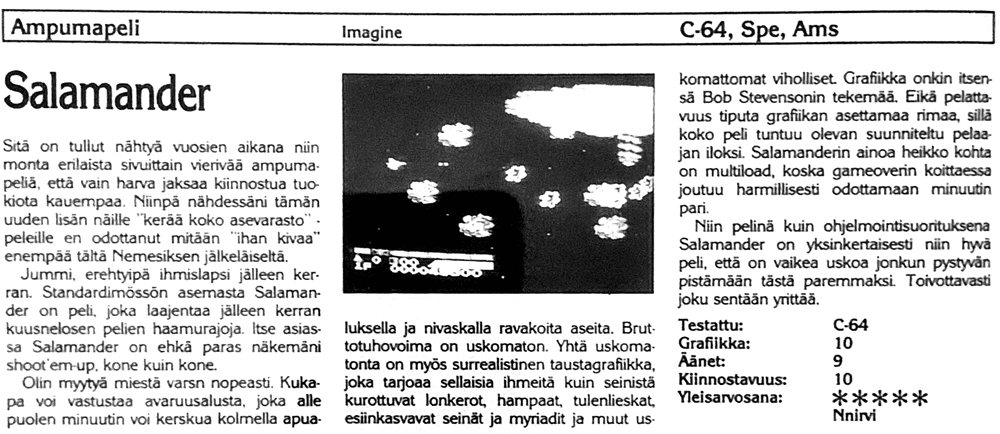
Olin myytyä miestä varsn nopeasti. Kukapa voi vastustaa avaruusalusta, joka alle puolen minuutin voi kerskua kolmella apualuksella ja nivaskalla ravakoita aseita. Bruttotuhovoima on uskomaton. Yhtä uskomatonta on myös surrealistinen taustagrafiikka, joka tarjoaa sellaisia ihmeitä kuin seinistä kurottuvat lonkerot, hampaat, tulenlieskat, esiinkasvavat seinät ja myriadit ja muut uskomattomat viholliset. Grafiikka onkin itsensä Bob Stevensonin tekemää. Eikä pelattavuus tiputa grafiikan asettamaa rimaa, sillä koko peli tuntuu olevan suunniteltu pelaajan iloksi. Salamanderin ainoa heikko kohta on multiload, koska gameoverin koittaessa joutuu harmillisesti odottamaan minuutin pari.
Niin pelinä kuin ohjelmointisuorituksena Salamander on yksinkertaisesti niin hyvä peli, että on vaikea uskoa jonkun pystyvän pistämään tästä paremmaksi. Toivottavasti joku sentään yrittää.
Salamander1989 KevätPermalinkOver the years I've seen so many different sideways-scrolling shoot-em-ups that only a rare few of us can be bothered to stay interested for more than a moment. So when I saw this new addition to the "collect the whole arsenal" games, I expected nothing more than "quite nice" from this descendant of Nemesis.
Golly, this child of man was wrong yet again. Instead of the standard mush, Salamander is a game that once again pushes back the phantom limits of Commodore 64 games. In fact, Salamander may well be the best shoot'em-up I have seen, on any machine.
I was sold rather quickly. Who could resist a spaceship that, inside half a minute, can boast three support craft and a whole bundle of punchy weapons? The gross destructive output is unbelievable. Just as unbelievable is the surreal background graphics, which offer such wonders as tentacles reaching out from the walls, teeth, jets of flame, walls that grow out at you, and myriads of other unbelievable enemies. The graphics are, after all, the work of Bob Stevenson himself. Nor does the playability knock down the bar set by the graphics, as the whole game seems to have been designed for the player's delight. Salamander's only weak point is the multiload, because when game over comes around you're annoyingly stuck waiting a minute or two.
Both as a game and as a feat of programming, Salamander is simply so good a game that it's hard to believe anyone could top it. Hopefully someone will at least try.
Samantha Fox Strip Poker
Samantha Fox Strip Poker1987Pysyvä linkkiEnglantilainen kaunotarkuuluisuus Samantha Fox on digitoinut sulojaan jälkipolville ja taitaville pokerinpelaajille. Samanthan alastomia bittejä voi ihailla pelaamalla voitokkaasti seitsemän kortin pokeria. Jollei Samantha houkuttele, voi samaa peliä pelata kasetin toiselta puolelta löytyvällä ohjelmalla kolmea eritavoin pelaavaa vastustajaa vastaan.
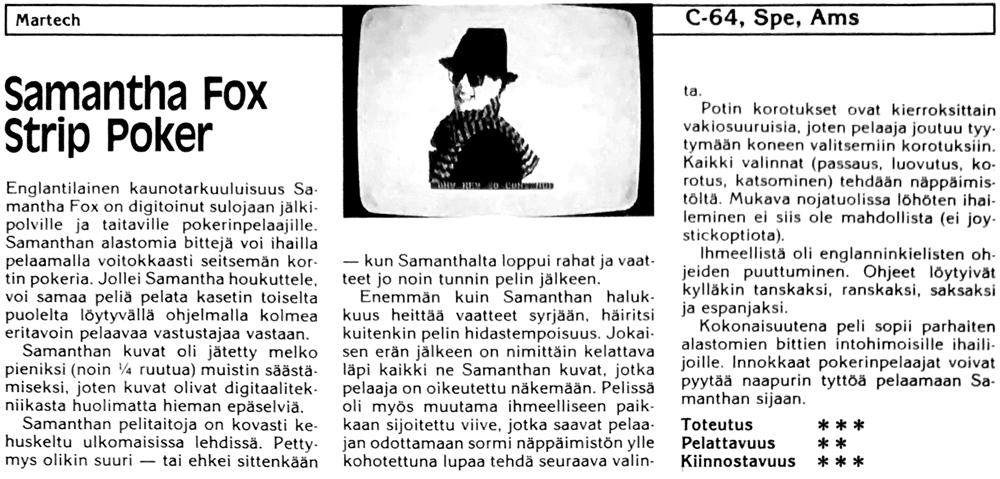
Samanthan kuvat oli jätetty melko pieniksi (noin ¼ ruutua) muistin säästämiseksi, joten kuvat olivat digitaalitekniikasta huolimatta hieman epäselviä.
Samanthan pelitaitoja on kovasti kehuskeltu ulkomaisissa lehdissä. Pettymys olikin suuri - tai ehkei sittenkään - kun Samanthalta loppui rahat ja vaatteet jo noin tunnin pelin jälkeen.
Enemmän kuin Samanthan halukkuus heittää vaatteet syrjään, häiritsi kuitenkin pelin hidastempoisuus. Jokaisen erän jälkeen on nimittäin kelattava läpi kaikki ne Samanthan kuvat, jotka pelaaja on oikeutettu näkemään. Pelissä oli myös muutama ihmeelliseen paikkaan sijoitettu viive, jotka saavat pelaajan odottamaan sormi näppäimistön yllä kohotettuna lupaa tehdä seuraava valinta.
Potin korotukset ovat kierroksittain vakiosuuruisia, joten pelaaja joutuu tyytymään koneen valitsemiin korotuksiin. Kaikki valinnat (passaus, luovutus, korotus, katsominen) tehdään näppäimistöltä. Mukava nojatuolissa löhöten ihaileminen ei siis ole mahdollista (ei joystickoptiota).
Ihmeellistä oli englanninkielisten ohjeiden puuttuminen. Ohjeet löytyivät kylläkin tanskaksi, ranskaksi, saksaksi ja espanjaksi.
Kokonaisuutena peli sopii parhaiten alastomien bittien intohimoisille ihailijoille. Innokkaat pokerinpelaajat voivat pyytää naapurin tyttöä pelaamaan Samanthan sijaan.
Samantha Fox Strip Poker1987PermalinkEnglish celebrity beauty Samantha Fox has digitised her charms for posterity and for skilled poker players. Samantha's naked bits can be admired by playing seven-card poker, and winning. If Samantha doesn't tempt you, the same game can be played, using the program on the other side of the tape, against three opponents who each play in a different way.
Samantha's pictures had been left fairly small (about ¼ of the screen) to save memory, so in spite of the digital technology they were a bit fuzzy.
Samantha's poker skills have been talked up no end in foreign magazines. So the disappointment was great - or then again maybe not - when Samantha ran out of money and clothes after only about an hour's play.
More than Samantha's eagerness to cast her clothes aside, though, what bothered me was the game's sluggish pace. After every hand, you see, you have to wind through all the pictures of Samantha that the player is entitled to see. The game also had a few delays placed in baffling spots, which keep the player waiting with a finger poised above the keyboard for permission to make the next choice.
The raises to the pot are a fixed amount each round, so the player has to make do with the raises the computer picks. All the choices (pass, fold, raise, see) are made from the keyboard. So leisurely admiring while sprawled in an armchair is not possible (no joystick option).
What was odd was that there were no English instructions. There were instructions in Danish, French, German and Spanish, mind you.
Taken as a whole, the game is best suited to passionate admirers of naked bits. Keen poker players can ask the girl next door to play instead of Samantha.
Samurai Trilogy
Samurai Trilogy1987Pysyvä linkkiJihuu! Vaihteeksi taas huitomispeli. Siitä onkin jo aikaa kun viimeksi näin tällaisen, olisikohan jo kolme päivää? Gremlin Graphics kokeilee nyt vuorostaan siipiään tällä antoisalla alueella. Näyttää siltä, että jatkuva valitus näistä peleistä on saanut huomiota ohjelmataloissa, koska Samurai Trilogyssa on yritetty puhaltaa uutta henkeä vanhaan ideaan. Mutta kuollutta on turha yrittää virvoittaa.
Uudet ideat rajoittuvat siihen, että ujutetaan kolme peliä samasta ideasta yhdelle kasetille. Levyllä tämä ei ole mikään ongelma, mutta kasetilla...
Lataussysteemi pistää innokkaan pelaajan repimään hiuksiaan. Peliin on yritetty saada syvyyttä lisäämällä harjoitus- ja treenausmahdollisuudet. Lisäksi voi valita vastustajansa ja lukea tietoja heidän taistelutaktiikoistaan.
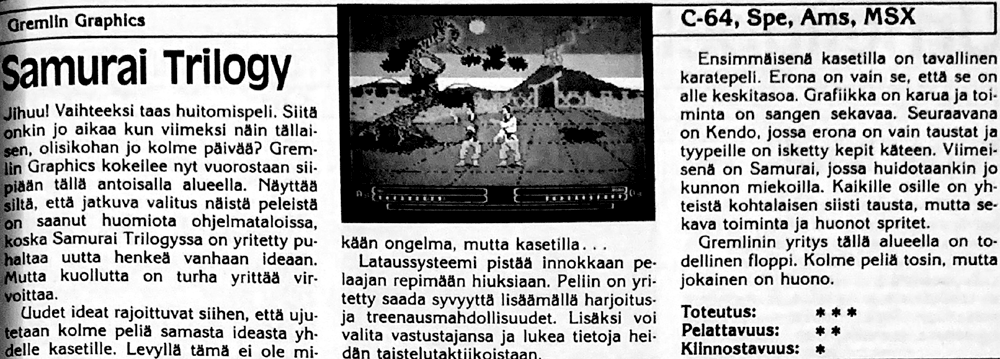
Ensimmäisenä kasetilla on tavallinen karatepeli. Erona on vain se, että se on alle keskitasoa. Grafiikka on karua ja toiminta on sangen sekavaa. Seuraavana on Kendo, jossa erona on vain taustat ja tyypeille on isketty kepit käteen. Viimeisenä on Samurai, jossa huidotaankin jo kunnon miekoilla. Kaikille osille on yhteistä kohtalaisen siisti tausta, mutta sekava toiminta ja huonot spritet.
Gremlinin yritys tällä alueella on todellinen floppi. Kolme peliä tosin, mutta jokainen on huono.
Samurai Trilogy1987PermalinkYippee! Another flail-'em-up, for a change. It's been quite a while since I last saw one of these - what, three days already? Now it's Gremlin Graphics' turn to try its wings in this rewarding field. It looks as though the constant complaining about these games has caught the attention of the software houses, because Samurai Trilogy tries to breathe new life into an old idea. But there's no point trying to revive the dead.
The new ideas amount to squeezing three games on the same idea onto one cassette. On disk that's no problem, but on cassette...
The loading system will have the keen player tearing their hair out. There's been an attempt to give the game some depth by adding practice and training options. You can also choose your opponent and read up on their fighting tactics.
First on the tape is an ordinary karate game. The only difference is that it's below average. The graphics are crude and the action is pretty chaotic. Next up is Kendo, where the only differences are the backgrounds and the fact that the guys have had sticks shoved into their hands. Last comes Samurai, where at last you get to flail away with proper swords. What all the parts have in common is a reasonably neat background, but chaotic action and poor sprites.
Gremlin's venture into this field is a real flop. Three games, granted, but every one of them is bad.
Samurai Warrior
Samurai Warrior1988Pysyvä linkkiOn vaikea uskoa, että beat'em-up-aiheesta saisi väännettyä enää yhtään peliä, mutta pakko se on uskoa kun näkee.
Pelin pohjana toimii Stan Sakain Usagi Yojimbo -kulttisarjakuva, jonka sankarina on samurai-jänis. Ja onpahan sen verran tuiman näköinen jyrsijä, että urheinkin erämies miettii kahdesti ennen kuin lähtee luontoon räjäyttelemään pupujusseja.
Samurai Warrior kertoo Usagin seikkailusta hänen yrittäessään vapauttaa vanhaa ystäväänsä lordi Nuriyakia pahan lordi Hirikin vallasta. Ja matkalla tietysti katana maistaa vihollisverta.
Kaikkien vastaantulijoiden kanssa ei ole kuitenkaan tarkoitus kamppailla, joten kannattaa säilyttää miekkaa tupessa. Taistelun lisäksi täytyy tarkasti noudattaa etikettiä, eli kumartaa vähintäänkin kaikille ylempiarvoisille ja mielellään myös samanarvoisille. Ylhäisö saattaa vaatia verihyvitystä, jollei ronin (isännätön samurai) osoita kohteliaisuutta. Myös miekka kädessä kulkeva jänis katsotaan automaattisesti viholliseksi. Jalon samurain täytyy myös antaa almuja maalaisille. Kohteliaisuus ja jalomielisyys palkitaan vihjeillä ja sananlaskuilla. Vihollisten tappaminen, kohteliaisuus ja sääli kohottavat Usagin karmaa. Korkea karma tarkoittaa, että noutajan tullessa ei peliä tarvitse aloittaa alusta. Jos hyökkää pappien, maalaisten ja viattomien eläinten kimppuun, saattaa karma hupsahtaa nollaan. Tällöin Yojimbo ei voi elää häpeän painamana vaan tekee harakirin.
Toinen hyvä innovaatio ovat risteykset, joista voi tietysti valita eri reitin kohti päämäärää. Matkalla löytyy myös majataloja, joissa voi kohentaa kuntoaan ja pistää ryot (pelin rahayksikkö) poikimaan pikku uhkapelillä. Eli kaiken kaikkiaan peli on varsin monipuolinen.
Taistelu on aluksi hiukan hankalaa, sillä miekanisku valitaan sen mukaan kuinka kauan tulitusnappulaa pidetään pohjassa. Pelissä on myös harjoittelumahdollisuus, jossa Usagi voi kamppailla heinäpaaleja vastaan.
Grafiikka ja animaatio ovat onnistuneita ja jatsahtava itämainen kappale ryydittää peliä. Ääniefekteistä löytyy kyllä katanan viuhahdus, mutta HAI!-huudot ovat jääneet pois. Sääli.
Samurai Warrior yhdistää beat'em-upin arcadeadventureen ja maustaa sen japanilaisella filosofialla. Syntyvä soppa on yksi vuoden parhaita kuusnepa-pelejä. Osta tai tee harakiri.
Samurai Warrior1988PermalinkIt's hard to believe anyone could wring even one more game out of the beat'em-up theme, but you have to believe it when you see it.
The game is based on Stan Sakai's cult comic Usagi Yojimbo, whose hero is a samurai hare. And it's such a fierce-looking rodent that even the bravest backwoodsman will think twice before heading out into the wild to blast away at bunny rabbits.
Samurai Warrior tells of Usagi's adventure trying to free an old friend, Lord Nuriyaki, from the power of the evil Lord Hiriki. And along the way, of course, the katana gets a taste of enemy blood.
You're not meant to fight everyone you meet, however, so it pays to keep your sword in its scabbard. Besides fighting, you have to follow etiquette carefully, which means bowing at the very least to all your superiors and preferably to your equals as well. The nobility may demand satisfaction in blood if a ronin (a masterless samurai) fails to show courtesy. A hare walking around sword in hand is also automatically regarded as an enemy. A noble samurai must also give alms to the peasants. Courtesy and generosity are rewarded with hints and proverbs. Killing enemies, courtesy and compassion raise Usagi's karma. High karma means that when the Reaper comes calling, you don't have to start the game over from the beginning. If you attack priests, peasants and innocent animals, your karma may tumble to zero. Then Yojimbo cannot live under the weight of shame and commits harakiri instead.
Another good innovation is the crossroads, where you can of course choose a different route towards your goal. Along the way there are also inns where you can build your strength back up and put your ryo (the game's currency) out to breed with a little gambling. So all in all the game is remarkably varied.
Fighting is a bit awkward at first, since the sword stroke is chosen according to how long you hold the fire button down. The game also has a practice option in which Usagi can battle against bales of hay.
The graphics and animation are well done, and a jazzy oriental tune spices up the game. The sound effects do include the swish of the katana, but the HAI! shouts have been left out. Pity.
Samurai Warrior combines a beat'em-up with an arcade adventure and seasons it with Japanese philosophy. The resulting stew is one of the year's best Commodore 64 games. Buy it or commit harakiri.
Sanxion
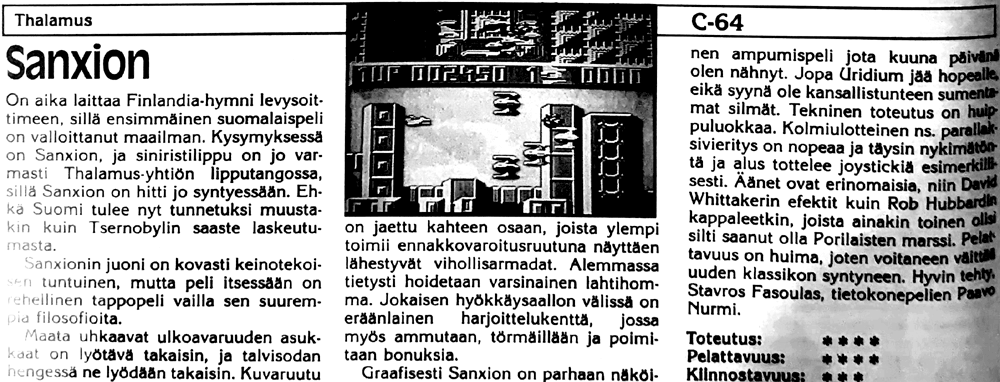
Sanxion1987Pysyvä linkkiOn aika laittaa Finlandia-hymni levysoittimeen, sillä ensimmäinen suomalaispeli on valloittanut maailman. Kysymyksessä on Sanxion, ja siniristilippu on jo varmasti Thalamus-yhtiön lipputangossa, sillä Sanxion on hitti jo syntyessään. Ehkä Suomi tulee nyt tunnetuksi muustakin kuin Tsernobylin saaste laskeutumasta.
Sanxionin juoni on kovasti keinotekoisen tuntuinen, mutta peli itsessään on rehellinen tappopeli vailla sen suurempia filosofioita.
Maata uhkaavat ulkoavaruuden asukkaat on lyötävä takaisin, ja talvisodan hengessä ne lyödään takaisin. Kuvaruutu on jaettu kahteen osaan, joista ylempi toimii ennakkovaroitusruutuna näyttäen lähestyvät vihollisarmadat. Alemmassa tietysti hoidetaan varsinainen lahtihomma. Jokaisen hyökkäysaallon välissä on eräänlainen harjoittelukenttä, jossa myös ammutaan, törmäillään ja poimitaan bonuksia.
Graafisesti Sanxion on parhaan näköinen ampumispeli jota kuuna päivänä olen nähnyt. Jopa Uridium jää hopealle, eikä syynä ole kansallistunteen sumentamat silmät. Tekninen toteutus on huippuluokkaa. Kolmiulotteinen ns. parallaksivieritys on nopeaa ja täysin nykimätöntä ja alus tottelee joystickiä esimerkillisesti. Äänet ovat erinomaisia, niin David Whittakerin efektit kuin Rob Hubbardin kappaleetkin, joista ainakin toinen olisi silti saanut olla Porilaisten marssi. Pelattavuus on huima, joten voitaneen väittää uuden klassikon syntyneen. Hyvin tehty, Stavros Fasoulas, tietokonepelien Paavo Nurmi.
Sanxion1987PermalinkTime to put the Finlandia hymn on the record player, because the first Finnish game has conquered the world. The game in question is Sanxion, and the blue-cross flag of Finland is surely already flying from Thalamus's flagpole, because Sanxion was a hit from the moment it was born. Maybe now Finland will become known for something besides the Chernobyl fallout that came down on it.
Sanxion's plot feels very contrived, but the game itself is an honest killing game with no grand philosophies to speak of.
The outer-space aliens threatening Earth must be beaten back, and in the spirit of the Winter War they are beaten back. The screen is divided into two parts, the upper one serving as an early-warning screen that shows the approaching enemy armadas. The lower one is, naturally, where the actual slaughtering gets done. Between each attack wave there's a kind of training ground, where you also shoot, crash into things and pick up bonuses.
Graphically Sanxion is the best-looking shoot-'em-up I have seen in all my born days. Even Uridium has to settle for silver, and it's not because my eyes are clouded by national pride. The technical execution is top class. The three-dimensional, so-called parallax scrolling is fast and completely jerk-free, and the ship obeys the joystick in exemplary fashion. The sound is excellent, both David Whittaker's effects and Rob Hubbard's tunes, though at least one of those tunes should still have been Porilaisten marssi. The playability is tremendous, so it's probably safe to say a new classic has been born. Well done, Stavros Fasoulas, the Paavo Nurmi of computer games.
Saracen
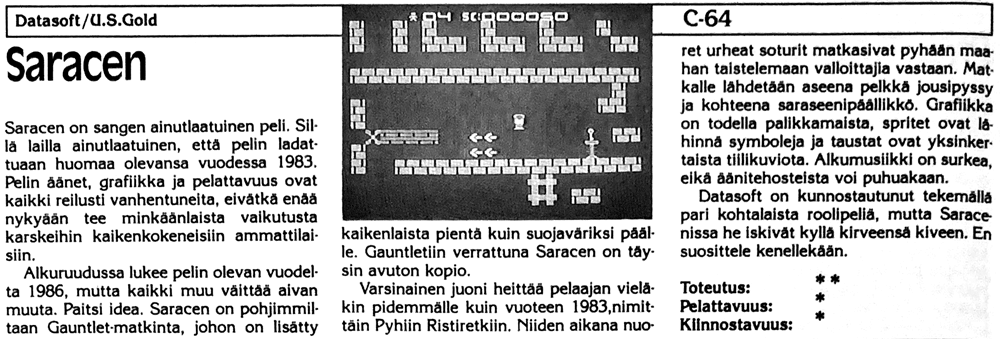
Saracen1987Pysyvä linkkiSaracen on sangen ainutlaatuinen peli. Sillä lailla ainutlaatuinen, että pelin ladattuaan huomaa olevansa vuodessa 1983. Pelin äänet, grafiikka ja pelattavuus ovat kaikki reilusti vanhentuneita, eivätkä enää nykyään tee minkäänlaista vaikutusta karskeihin kaikenkokeneisiin ammattilaisiin.
Alkuruudussa lukee pelin olevan vuodelta 1986, mutta kaikki muu väittää aivan muuta. Paitsi idea. Saracen on pohjimmiltaan Gauntlet-matkinta, johon on lisätty kaikenlaista pientä kuin suojaväriksi päälle. Gauntletiin verrattuna Saracen on täysin avuton kopio.
Varsinainen juoni heittää pelaajan vieläkin pidemmälle kuin vuoteen 1983,nimittäin Pyhiin Ristiretkiin. Niiden aikana nuoret urheat soturit matkasivat pyhään maahan taistelemaan valloittajia vastaan. Matkalle lähdetään aseena pelkkä jousipyssy ja kohteena saraseenipäällikkö. Grafiikka on todella palikkamaista, spritet ovat lähinnä symboleja ja taustat ovat yksinkertaista tiilikuviota. Alkumusiikki on surkea, eikä äänitehosteista voi puhuakaan.
Datasoft on kunnostautunut tekemällä pari kohtalaista roolipeliä, mutta Saracenissa he iskivät kyllä kirveensä kiveen. En suosittele kenellekään.
Saracen1987PermalinkSaracen is a pretty unique game. Unique in the sense that once you've loaded it, you find yourself in the year 1983. The game's sound, graphics and playability are all badly dated, and nowadays make no impression whatsoever on gruff, seen-it-all professionals.
The title screen says the game is from 1986, but everything else says something quite different. Except the idea. Saracen is at heart a Gauntlet imitation, with all sorts of little extras slapped on top as camouflage. Next to Gauntlet, Saracen is a completely hopeless copy.
The actual plot throws the player back even further than 1983, namely to the Holy Crusades. During them, brave young warriors travelled to the Holy Land to fight the conquerors. You set off on the journey armed with nothing but a bow, with a Saracen chieftain as your target. The graphics are really blocky, the sprites are little more than symbols and the backgrounds are a simple brick pattern. The title music is pathetic, and the sound effects don't even bear talking about.
Datasoft has distinguished itself with a couple of passable role-playing games, but with Saracen they really fell flat on their faces. I don't recommend it to anyone.
Satan
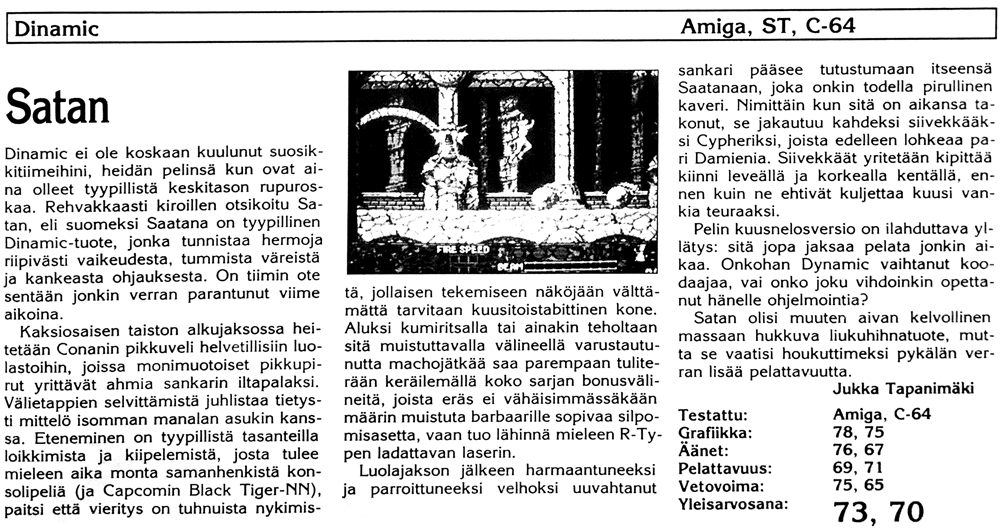
Satan1990 SyksyPysyvä linkkiDinamic ei ole koskaan kuulunut suosikkitiimeihini, heidän pelinsä kun ovat aina olleet tyypillistä keskitason rupuroskaa. Rehvakkaasti kiroillen otsikoitu Satan, eli suomeksi Saatana on tyypillinen Dinamic-tuote, jonka tunnistaa hermoja riipivästi vaikeudesta, tummista väreistä ja kankeasta ohjauksesta. On tiimin ote sentään jonkin verran parantunut viime aikoina.
Kaksiosaisen taiston alkujaksossa heitetään Conanin pikkuveli helvetillisiin luolastoihin, joissa monimuotoiset pikkupirut yrittävät ahmia sankarin iltapalaksi. Välietappien selvittämistä juhlistaa tietysti mittelö isomman manalan asukin kanssa. Eteneminen on tyypillistä tasanteilla loikkimista ja kiipelemistä, josta tulee mieleen aika monta samanhenkistä konsolipeliä (ja Capcomin Black Tiger-NN), paitsi että vieritys on tuhnuista nykimistä, jollaisen tekemiseen näköjään välttämättä tarvitaan kuusitoistabittinen kone. Aluksi kumiritsalla tai ainakin teholtaan sitä muistuttavalla välineellä varustautunutta machojätkää saa parempaan tuliterään keräilemällä koko sarjan bonusvälineitä, joista eräs ei vähäisimmässäkään määrin muistuta barbaarille sopivaa silpomisasetta, vaan tuo lähinnä mieleen R-Typen ladattavan laserin.
Luolajakson jälkeen harmaantuneeksi ja parroittuneeksi velhoksi uuvahtanut sankari pääsee tutustumaan itseensä Saatanaan, joka onkin todella pirullinen kaveri. Nimittäin kun sitä on aikansa takonut, se jakautuu kahdeksi siivekkääksi Cypheriksi, joista edelleen lohkeaa pari Damienia. Siivekkäät yritetään kipittää kiinni leveällä ja korkealla kentällä, ennen kuin ne ehtivät kuljettaa kuusi vankia teuraaksi.
Pelin kuusnelosversio on ilahduttava yllätys: sitä jopa jaksaa pelata jonkin aikaa. Onkohan Dynamic vaihtanut koodaajaa, vai onko joku vihdoinkin opettanut hänelle ohjelmointia?
Satan olisi muuten aivan kelvollinen massaan hukkuva liukuhihnatuote, mutta se vaatisi houkuttimeksi pykälän verran lisää pelattavuutta.
Satan1990 SyksyPermalinkDinamic has never been one of my favourite teams, since their games have always been typical middling rubbish. Satan, swaggeringly titled with a swear word - in Finnish, Saatana - is a typical Dinamic product, recognisable by its nerve-shredding difficulty, dark colours and stiff controls. Still, the team's touch has improved somewhat lately.
In the first stage of the two-part battle, Conan's little brother is thrown into hellish caverns where imps of every shape and form try to gobble the hero up as a bedtime snack. Clearing the intermediate stages is of course celebrated with a bout against a bigger denizen of the underworld. Progress is the typical leaping and clambering about on ledges, which brings to mind quite a few console games in the same vein (and Capcom's Black Tiger-NN), except that the scrolling is a feeble jerking of the kind that apparently can only be produced on a sixteen-bit machine. The macho dude, equipped at first with a slingshot, or at any rate something with the firepower of one, can be brought into sharper fighting trim by collecting a whole series of bonus items, one of which doesn't in the slightest resemble a mutilation weapon befitting a barbarian but rather calls to mind R-Type's chargeable laser.
After the cave section the hero, worn down into a grey and bearded wizard, gets to meet Satan in person, who turns out to be a truly devilish fellow. You see, once you've pounded on it for a while, it splits into two winged Cyphers, which in turn chip off a couple of Damiens. You try to scurry after the winged ones and catch them on a wide and tall level before they manage to carry six prisoners off to the slaughter.
The game's Commodore 64 version is a pleasant surprise: you can even be bothered to play it for a while. I wonder whether Dynamic has changed coders, or has somebody finally taught the coder how to program?
Otherwise Satan would be a perfectly passable conveyor-belt product destined to drown in the crowd, but to make it tempting it would need a notch more playability.
Savage
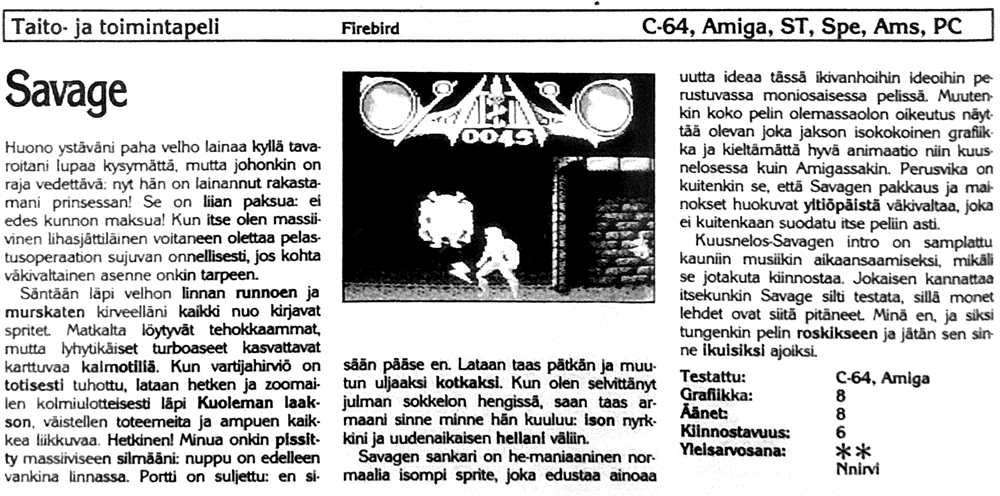
Savage1989 KevätPysyvä linkkiHuono ystäväni paha velho lainaa kyllä tavaroitani lupaa kysymättä, mutta johonkin on raja vedettävä: nyt hän on lainannut rakastamani prinsessan! Se on liian paksua: ei edes kunnon maksua! Kun itse olen massiivinen lihasjättiläinen voitaneen olettaa pelastusoperaation sujuvan onnellisesti, jos kohta väkivaltainen asenne onkin tarpeen.
Säntään läpi velhon linnan runnoen ja murskaten kirveelläni kaikki nuo kirjavat spritet. Matkalta löytyvät tehokkaammat, mutta lyhytikäiset turboaseet kasvattavat karttuvaa kalmotiliä. Kun vartijahirviö on totisesti tuhottu, lataan hetken ja zoomailen kolmiulotteisesti läpi Kuoleman laakson, väistellen toteemeita ja ampuen kaikkea liikkuvaa. Hetkinen! Minua onkin pissitty massiiviseen silmääni: nuppu on edelleen vankina linnassa. Portti on suljettu: en sisään pääse en. Lataan taas pätkän ja muutun uljaaksi kotkaksi. Kun olen selvittänyt julman sokkelon hengissä, saan taas armaani sinne minne hän kuuluu: ison nyrkkini ja uudenaikaisen hellani väliin.
Savagen sankari on he-maniaaninen normaalia isompi sprite, joka edustaa ainoaa uutta ideaa tässä ikivanhoihin ideoihin perustuvassa moniosaisessa pelissä. Muutenkin koko pelin olemassaolon oikeutus näyttää olevan joka jakson isokokoinen grafiikka ja kieltämättä hyvä animaatio niin kuusnelosessa kuin Amigassakin. Perusvika on kuitenkin se, että Savagen pakkaus ja mainokset huokuvat yltiöpäistä väkivaltaa, joka ei kuitenkaan suodatu itse peliin asti.
Kuusnelos-Savagen intro on samplattu kauniin musiikin aikaansaamiseksi, mikäli se jotakuta kiinnostaa. Jokaisen kannattaa itsekunkin Savage silti testata, sillä monet lehdet ovat siitä pitäneet. Minä en, ja siksi tungenkin pelin roskikseen ja jätän sen sinne ikuisiksi ajoiksi.
Savage1989 KevätPermalinkMy no-good friend the evil wizard does borrow my things without asking, but a line has to be drawn somewhere: now he has borrowed the princess I love! That's a bit thick: not even a proper payment! Since I am a massive giant of muscle myself, it can presumably be assumed that the rescue operation will end happily, even if a violent attitude is called for.
I charge through the wizard's castle, bashing and smashing all those gaudy sprites with my axe. The more powerful but short-lived turbo weapons found along the way swell my accruing corpse account. Once the guardian monster has been well and truly destroyed, I load for a moment and zoom three-dimensionally through the Valley of Death, dodging totems and shooting everything that moves. Hang on! I've been played for a massive fool: the little rosebud is still a prisoner in the castle. The gate is shut: in I cannot get, I cannot. I load another chunk and turn into a noble eagle. Once I've made it through the cruel maze alive, I get my beloved back where she belongs: between my big fist and my modern kitchen stove.
Savage's hero is a he-maniacal, bigger-than-usual sprite, which represents the only new idea in this multi-part game built on age-old ideas. Beyond that, the game's whole reason for existing seems to be the big graphics in every section and the admittedly good animation, on the Commodore 64 and the Amiga alike. The basic flaw, however, is that Savage's packaging and adverts ooze over-the-top violence that never actually filters through to the game itself.
The intro of the Commodore 64 Savage has been sampled to produce beautiful music, if that interests anyone. Each and every one of you should still test Savage for yourselves, since many magazines have liked it. I didn't, and that is why I'm stuffing the game in the bin and leaving it there for all eternity.
Scalextric
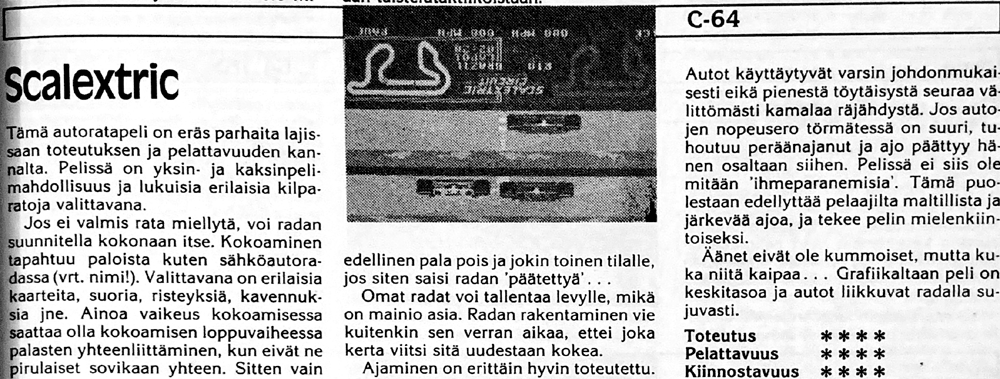
Scalextric1987Pysyvä linkkiTämä autoratapeli on eräs parhaita lajissaan toteutuksen ja pelattavuuden kannalta. Pelissä on yksin- ja kaksinpelimahdollisuus ja lukuisia erilaisia kilparatoja valittavana.
Jos ei valmis rata miellytä, voi radan suunnitella kokonaan itse. Kokoaminen tapahtuu paloista kuten sähköautoradassa (vrt. nimi!). Valittavana on erilaisia kaarteita, suoria, risteyksiä, kavennuksia jne. Ainoa vaikeus kokoamisessa saattaa olla kokoamisen loppuvaiheessa palasten yhteenliittäminen, kun eivät ne pirulaiset sovikaan yhteen. Sitten vain edellinen pala pois ja jokin toinen tilalle, jos siten saisi radan 'päätettyä'...
Omat radat voi tallentaa levylle, mikä on mainio asia. Radan rakentaminen vie kuitenkin sen verran aikaa, ettei joka kerta viitsi sitä uudestaan kokea.
Ajaminen on erittäin hyvin toteutettu. Autot käyttäytyvät varsin johdonmukaisesti eikä pienestä töytäisystä seuraa välittömästi kamalaa räjähdystä. Jos autojen nopeusero törmätessä on suuri, tuhoutuu peräänajanut ja ajo päättyy hänen osaltaan siihen. Pelissä ei siis ole mitään 'ihmeparanemisia'. Tämä puolestaan edellyttää pelaajilta maltillista ja järkevää ajoa, ja tekee pelin mielenkiintoiseksi.
Äänet eivät ole kummoiset, mutta kuka niitä kaipaa... Grafiikaltaan peli on keskitasoa ja autot liikkuvat radalla sujuvasti.
Scalextric1987PermalinkThis slot-car racing game is one of the best of its kind in terms of execution and playability. There are one- and two-player options and numerous different race tracks to choose from.
If none of the ready-made tracks appeals, you can design your own track from scratch. It's put together from pieces, just like an electric slot-car set (cf. the name!). You can choose from various bends, straights, crossings, narrow sections etc. The only difficulty in building may come at the final stage, joining the pieces up, when the little devils just won't fit together. Then it's simply a case of taking the previous piece out and putting a different one in its place, in the hope of getting the track 'finished' that way...
You can save your own tracks to disk, which is a fine thing. Building a track takes long enough, though, that you can't be bothered to go through it all over again every time.
The driving is extremely well done. The cars behave quite consistently, and a little nudge doesn't immediately lead to a horrendous explosion. If the difference in speed between the cars is large when they collide, the one that ran into the back of the other is destroyed and that's the end of the race for that driver. So there are no 'miraculous recoveries' in the game. This in turn calls for restrained and sensible driving from the players, and makes the game interesting.
The sound is nothing much, but who needs it... Graphically the game is average, and the cars move smoothly around the track.
Scary Monsters
Scary Monsters1988Pysyvä linkkiMiltä sinusta tuntuisi, jos olisit haaksirikkoutunut saarelle ja tavannut maailman ihanimman typykän?
Mutta juuri kun luulit joutuvasi uhraamaan tietokoneesi rakkautesi vuoksi (missä ovat naispuoliset tietokoneharrastajat??), hirviötohtori Graves kidnappaa hänet. Samalla havaitset, että saari on täynnä erilaisia kummajaisia Frankensteinista lähtien aina puolipäivätoimisiin jauhosäkkikummituksiin saakka.
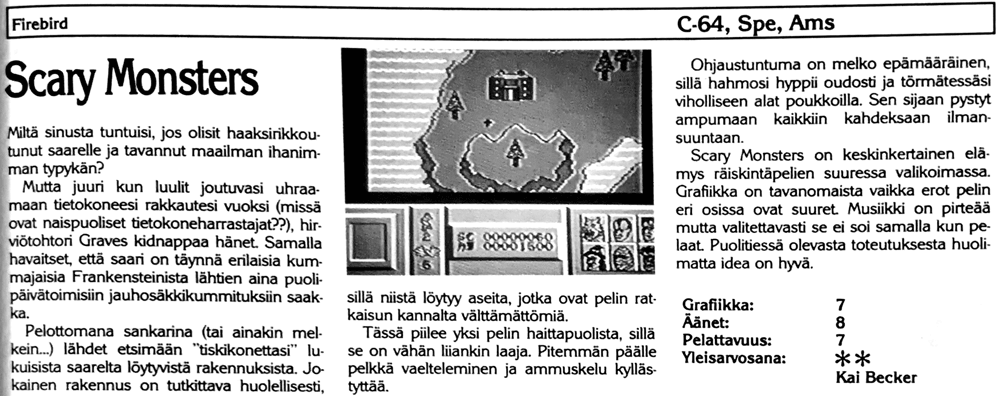
Pelottomana sankarina (tai ainakin melkein...) lähdet etsimään "tiskikonettasi" lukuisista saarelta löytyvistä rakennuksista. Jokainen rakennus on tutkittava huolellisesti, sillä niistä löytyy aseita, jotka ovat pelin ratkaisun kannalta välttämättömiä.
Tässä piilee yksi pelin haittapuolista, sillä se on vähän liiankin laaja. Pitemmän päälle pelkkä vaelteleminen ja ammuskelu kyllästyttää.
Ohjaustuntuma on melko epämääräinen, sillä hahmosi hyppii oudosti ja törmätessäsi viholliseen alat poukkoilla. Sen sijaan pystyt ampumaan kaikkiin kahdeksaan ilmansuuntaan.
Scary Monsters on keskinkertainen elämys räiskintäpelien suuressa valikoimassa. Grafiikka on tavanomaista vaikka erot pelin eri osissa ovat suuret. Musiikki on pirteää mutta valitettavasti se ei soi samalla kun pelaat. Puolitiessä olevasta toteutuksesta huolimatta idea on hyvä.
Scary Monsters1988PermalinkHow would you feel if you'd been shipwrecked on an island and met the loveliest babe in the world?
But just when you thought you'd have to sacrifice your computer for the sake of your love (where are all the female computer hobbyists??), the monster doctor Graves kidnaps her. At the same time you discover that the island is full of all kinds of oddities, from Frankenstein all the way down to part-time flour-sack ghosts.
As a fearless hero (or almost, anyway...) you set off to search for your "dishwasher" in the numerous buildings on the island. Every building has to be explored carefully, since they contain weapons that are essential for solving the game.
Therein lies one of the game's drawbacks, since it's a little too big, if anything. In the long run, all that wandering around and shooting gets boring.
The control feel is rather vague, since your character jumps about oddly and when you run into an enemy you start bouncing all over the place. On the other hand, you can shoot in all eight directions.
Scary Monsters is a middling experience in the vast selection of shoot-'em-ups. The graphics are run-of-the-mill, although the differences between the game's various sections are big. The music is perky, but unfortunately it doesn't play while you're playing. Despite the half-finished execution, the idea is good.
Search for The King
Search for The King1990 SyksyPysyvä linkkiSen oli pakko tapahtua! Kun maailmalla liikkuu huhuja ties minkälaisista Larry-tavaroista Larry-elokuvaan asti, oli vain ajan kysymys kun joku Sierran kilpailija tekee Larry-kloonin. Tällaista vetoa osasin odottaa, mutten kyllä sellaiselta ohjelmatalolta kuin Accolade.
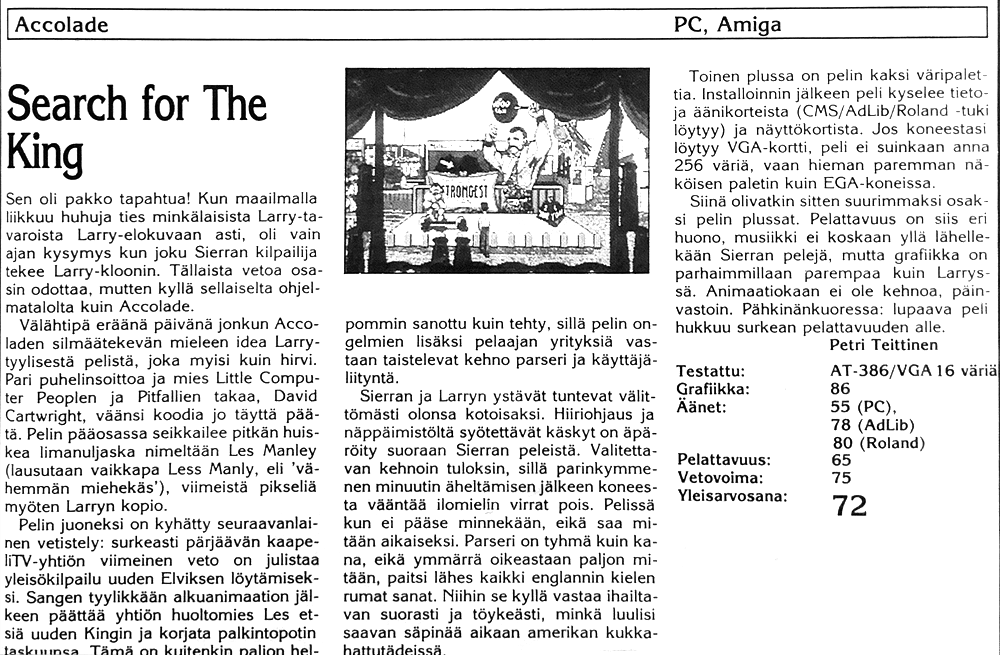
Välähtipä eräänä päivänä jonkun Accoladen silmäätekevän mieleen idea Larry-tyylisestä pelistä, joka myisi kuin hirvi. Pari puhelinsoittoa ja mies Little Computer Peoplen ja Pitfallien takaa, David Cartwright, väänsi koodia jo täyttä päätä. Pelin pääosassa seikkailee pitkän huiskea limanuljaska nimeltään Les Manley (lausutaan vaikkapa Less Manly, eli 'vähemmän miehekäs'), viimeistä pikseliä myöten Larryn kopio.
Pelin juoneksi on kyhätty seuraavanlainen vetistely: surkeasti pärjäävän kaapeliTV-yhtiön viimeinen veto on julistaa yleisökilpailu uuden Elviksen löytämiseksi. Sangen tyylikkään alkuanimaation jälkeen päättää yhtiön huoltomies Les etsiä uuden Kingin ja korjata palkintopotin taskuunsa. Tämä on kuitenkin paljon helpommin sanottu kuin tehty, sillä pelin ongelmien lisäksi pelaajan yrityksiä vastaan taistelevat kehno parseri ja käyttäjäliityntä.
Sierran ja Larryn ystävät tuntevat välittömästi olonsa kotoisaksi. Hiiriohjaus ja näppäimistöltä syötettävät käskyt on äpäröity suoraan Sierran peleistä. Valitettavan kehnoin tuloksin, sillä parinkymmenen minuutin äheltämisen jälkeen koneesta vääntää ilomielin virrat pois. Pelissä kun ei pääse minnekään, eikä saa mitään aikaiseksi. Parseri on tyhmä kuin kana, eikä ymmärrä oikeastaan paljon mitään, paitsi lähes kaikki englannin kielen rumat sanat. Niihin se kyllä vastaa ihailtavan suorasti ja töykeästi, minkä luulisi saavan säpinää aikaan amerikan kukkahattutädeissä.
Toinen plussa on pelin kaksi väripalettia. Installoinnin jälkeen peli kyselee tietoja äänikorteista (CMS/AdLib/Roland -tuki löytyy) ja näyttökortista. Jos koneestasi löytyy VGA-kortti, peli ei suinkaan anna 256 väriä, vaan hieman paremman näköisen paletin kuin EGA-koneissa.
Siinä olivatkin sitten suurimmaksi osaksi pelin plussat. Pelattavuus on siis eri huono, musiikki ei koskaan yllä lähellekään Sierran pelejä, mutta grafiikka on parhaimmillaan parempaa kuin Larryssä. Animaatiokaan ei ole kehnoa, päinvastoin. Pähkinänkuoressa: lupaava peli hukkuu surkean pelattavuuden alle.
Search for The King1990 SyksyPermalinkIt was bound to happen! With rumours doing the rounds about who knows what kind of Larry merchandise, all the way up to a Larry movie, it was only a matter of time before some rival of Sierra's made a Larry clone. A move like this I could have seen coming, but certainly not from a software house like Accolade.
So one day an idea flashed into the mind of some Accolade bigwig: a Larry-style game that would sell like hot cakes. A couple of phone calls later, the man behind Little Computer People and the Pitfalls, David Cartwright, was already hammering out code at full tilt. Starring in the game is a long, lanky slimeball called Les Manley (pronounced, say, Less Manly, in other words 'less of a man'), a copy of Larry down to the last pixel.
The plot cobbled together for the game is the following watery affair: the last-ditch gamble of a miserably failing cable TV company is to announce a viewer competition to find the new Elvis. After a rather stylish intro animation, the company's maintenance man Les decides to track down the new King and pocket the prize pot. This, however, is much easier said than done, since on top of the game's puzzles the player's efforts are fought every step of the way by a lousy parser and user interface.
Fans of Sierra and Larry will feel right at home straight away. The mouse control and the commands typed in from the keyboard have been bastardised straight from Sierra's games. With regrettably poor results, since after twenty-odd minutes of huffing and puffing you will happily switch the machine off. The thing is, in this game you get nowhere and get nothing done. The parser is as dumb as a hen and doesn't really understand much of anything, except for nearly every rude word in the English language. Those it does answer with admirable bluntness and rudeness, which you'd think would get america's flowery-hatted busybodies in a flap.
The second plus is the game's two colour palettes. After installation the game asks about your sound cards (CMS/AdLib/Roland support is there) and your graphics card. If your machine has a VGA card, the game by no means gives you 256 colours, merely a slightly nicer-looking palette than on EGA machines.
And those, for the most part, were the game's plusses. So the playability is seriously bad and the music never gets anywhere near Sierra's games, but the graphics at their best are better than in Larry. The animation isn't shabby either, quite the opposite. In a nutshell: a promising game drowns under miserable playability.
Seconds Out
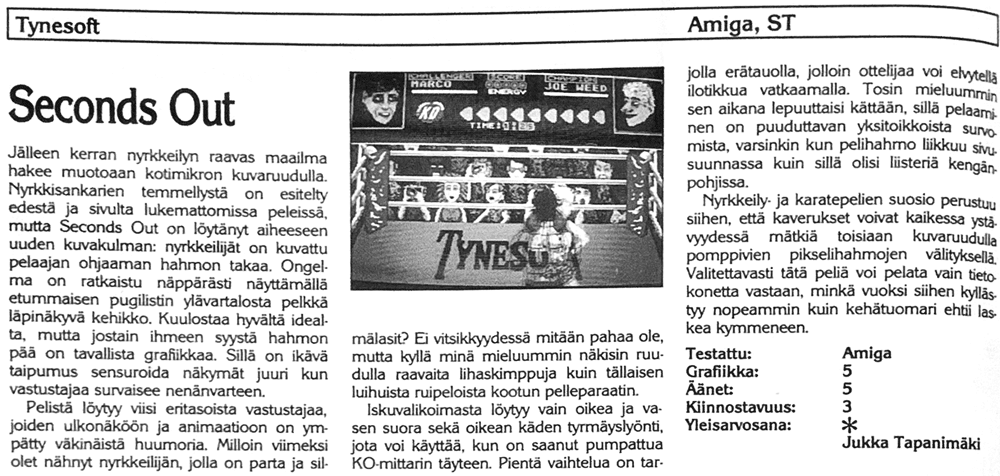
Seconds Out1989 SyksyPysyvä linkkiJälleen kerran nyrkkeilyn raavas maailma hakee muotoaan kotimikron kuvaruudulla. Nyrkkisankarien temmellystä on esitelty edestä ja sivulta lukemattomissa peleissä, mutta Seconds Out on löytänyt aiheeseen uuden kuvakulman: nyrkkeilijät on kuvattu pelaajan ohjaaman hahmon takaa. Ongelma on ratkaistu näppärästi näyttämällä etummaisen pugilistin ylävartalosta pelkkä läpinäkyvä kehikko. Kuulostaa hyvältä idealta, mutta jostain ihmeen syystä hahmon pää on tavallista grafiikkaa. Sillä on ikävä taipumus sensuroida näkymät juuri kun vastustajaa survaisee nenänvarteen.
Pelistä löytyy viisi eritasoista vastustajaa, joiden ulkonäköön ja animaatioon on ympätty väkinäistä huumoria. Milloin viimeksi olet nähnyt nyrkkeilijän, jolla on parta ja silmälasit? Ei vitsikkyydessä mitään pahaa ole, mutta kyllä minä mieluummin näkisin ruudulla raavaita lihaskimppuja kuin tällaisen luihuista ruipeloista kootun pelleparaatin.
Iskuvalikoimasta löytyy vain oikea ja vasen suora sekä oikean käden tyrmäyslyönti, jota voi käyttää, kun on saanut pumpattua KO-mittarin täyteen. Pientä vaihtelua on tarjolla erätauolla, jolloin ottelijaa voi elvytellä ilotikkua vatkaamalla. Tosin mieluummin sen aikana lepuuttaisi kättään, sillä pelaaminen on puuduttavan yksitoikkoista survomista, varsinkin kun pelihahmo liikkuu sivusuunnassa kuin sillä olisi liisteriä kengänpohjissa.
Nyrkkeily- ja karatepelien suosio perustuu siihen, että kaverukset voivat kaikessa ystävyydessä mätkiä toisiaan kuvaruudulla pomppivien pikselihahmojen välityksellä. Valitettavasti tätä peliä voi pelata vain tietokonetta vastaan, minkä vuoksi siihen kyllästyy nopeammin kuin kehätuomari ehtii laskea kymmeneen.
Seconds Out1989 SyksyPermalinkOnce again the brawny world of boxing is trying to find its form on a home micro's screen. The romping of fist-fighting heroes has been presented from the front and from the side in countless games, but Seconds Out has found a new camera angle on the subject: the boxers are shown from behind the figure the player controls. The problem has been neatly solved by showing the upper body of the pugilist in the foreground as a mere transparent wireframe. Sounds like a good idea, but for some strange reason the character's head is ordinary graphics. It has a nasty habit of censoring the view just as you ram your opponent on the bridge of the nose.
The game has five opponents of varying ability, whose looks and animation have been stuffed with forced humour. When did you last see a boxer with a beard and glasses? There's nothing wrong with a bit of wit, but I'd much rather see brawny bundles of muscle on the screen than this clown parade assembled from shifty-looking weeds.
The repertoire of punches consists only of a right and left straight plus a right-hand knockout punch, which you can use once you've managed to pump the KO meter full. A little variety is on offer during the break between rounds, when you can revive your fighter by waggling the joystick. Mind you, you'd rather rest your hand during it, since playing is numbingly monotonous pounding, especially as your character moves sideways as though it had glue on the soles of its shoes.
The popularity of boxing and karate games rests on the fact that pals can wallop each other in all friendliness by way of pixel figures bouncing about the screen. Unfortunately this game can only be played against the computer, which is why you get fed up with it faster than the referee can count to ten.
Secret of Monkey Island, The
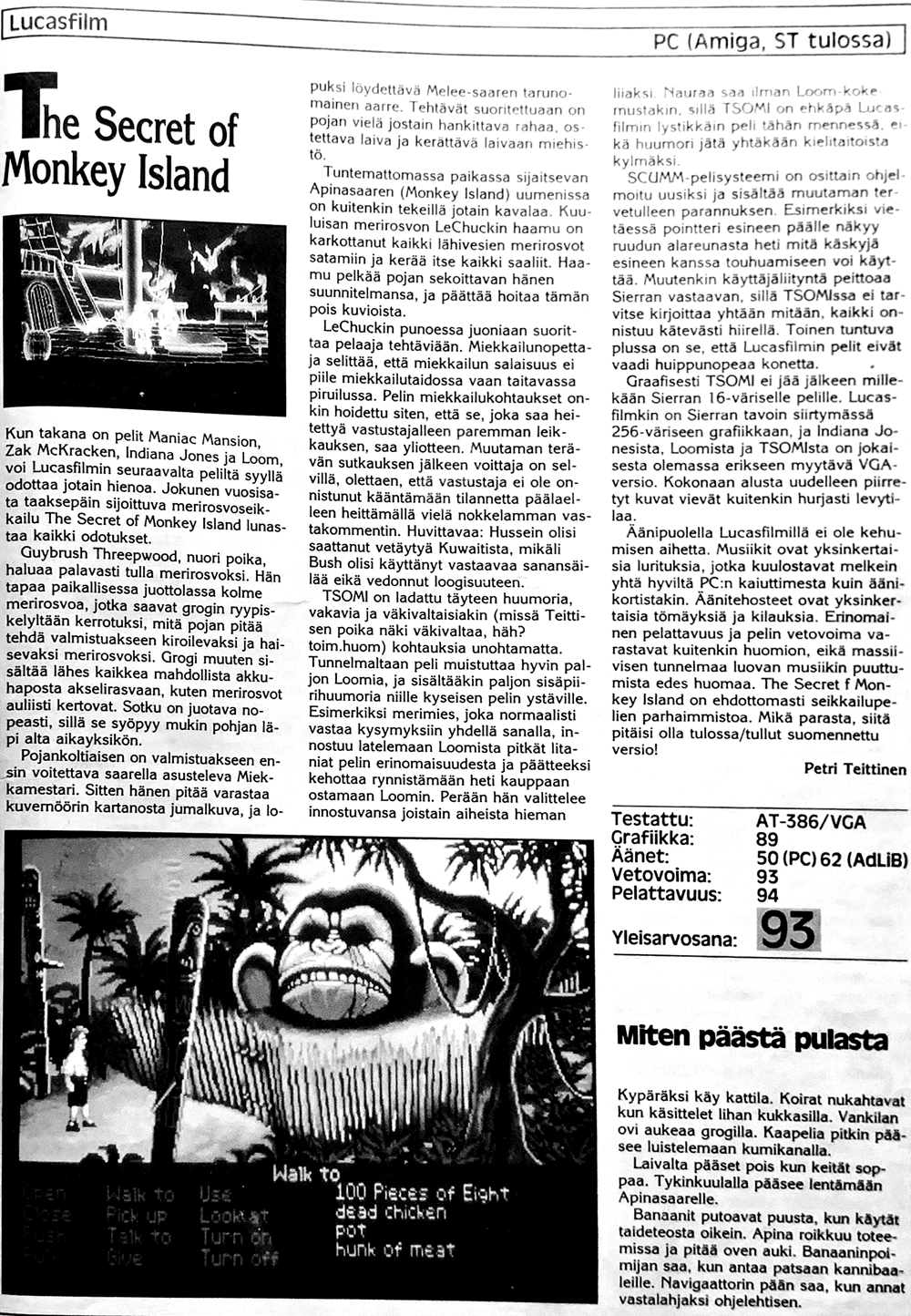
Secret of Monkey Island, The1991 KevätPysyvä linkkiKun takana on pelit Maniac Mansion, Zak McKracken, Indiana Jones ja Loom, voi Lucasfilmin seuraavalta peliltä syyllä odottaa jotain hienoa. Jokunen vuosisata taaksepäin sijoittuva merirosvoseikkailu The Secret of Monkey Island lunastaa kaikki odotukset.
Guybrush Threepwood, nuori poika, haluaa palavasti tulla merirosvoksi. Hän tapaa paikallisessa juottolassa kolme merirosvoa, jotka saavat grogin ryypiskelyltään kerrotuksi, mitä pojan pitää tehdä valmistuakseen kiroilevaksi ja haisevaksi merirosvoksi. Grogi muuten sisältää lähes kaikkea mahdollista akkuhaposta akselirasvaan, kuten merirosvot auliisti kertovat. Sotku on juotava nopeasti, sillä se syöpyy mukin pohjan läpi alta aikayksikön.
Pojankoltiaisen on valmistuakseen ensin voitettava saarella asusteleva Miekkamestari. Sitten hänen pitää varastaa kuvernöörin kartanosta jumalkuva, ja lopuksi löydettävä Melee-saaren tarunomainen aarre. Tehtävät suoritettuaan on pojan vielä jostain hankittava rahaa, ostettava laiva ja kerättävä laivaan miehistö.
Tuntemattomassa paikassa sijaitsevan Apinasaaren (Monkey Island) uumenissa on kuitenkin tekeillä jotain kavalaa. Kuuluisan merirosvon LeChuckin haamu on karkottanut kaikki lähivesien merirosvot satamiin ja kerää itse kaikki saaliit. Haamu pelkää pojan sekoittavan hänen suunnitelmansa, ja päättää hoitaa tämän pois kuvioista.
LeChuckin punoessa juoniaan suorittaa pelaaja tehtäviään. Miekkailunopettaja selittää, että miekkailun salaisuus ei piile miekkailutaidossa vaan taitavassa piruilussa. Pelin miekkailukohtaukset onkin hoidettu siten, että se, joka saa heitettyä vastustajalleen paremman leikkauksen, saa yliotteen. Muutaman terävän sutkauksen jälkeen voittaja on selvillä, olettaen, että vastustaja ei ole onnistunut kääntämään tilannetta päälaelleen heittämällä vielä nokkelamman vastakommentin. Huvittavaa: Hussein olisi saattanut vetäytyä Kuwaitista, mikäli Bush olisi käyttänyt vastaavaa sanansäilää eikä vedonnut loogisuuteen.
TSOMI on ladattu täyteen huumoria, vakavia ja väkivaltaisiakin (missä Teittisen poika näki väkivaltaa, häh? toim.huom) kohtauksia unohtamatta. Tunnelmaltaan peli muistuttaa hyvin paljon Loomia, ja sisältääkin paljon sisäpiirihuumoria niille kyseisen pelin ystäville. Esimerkiksi merimies, joka normaalisti vastaa kysymyksiin yhdellä sanalla, innostuu latelemaan Loomista pitkät litaniat pelin erinomaisuudesta ja päätteeksi kehottaa rynnistämään heti kauppaan ostamaan Loomin. Perään hän valittelee innostuvansa joistain aiheista hieman liiaksi. Nauraa saa ilman Loom-kokemustakin, sillä TSOMI on ehkäpä Lucasfilmin lystikkäin peli tähän mennessä, eikä huumori jätä yhtäkään kielitaitoista kylmäksi.
SCUMM-pelisysteemi on osittain ohjelmoitu uusiksi ja sisältää muutaman tervetulleen parannuksen. Esimerkiksi vietäessä pointteri esineen päälle näkyy ruudun alareunasta heti mitä käskyjä esineen kanssa touhuamiseen voi käyttää. Muutenkin käyttäjäliityntä peittoaa Sierran vastaavan, sillä TSOMIssa ei tarvitse kirjoittaa yhtään mitään, kaikki onnistuu kätevästi hiirellä. Toinen tuntuva plussa on se, että Lucasfilmin pelit eivät vaadi huippunopeaa konetta.
Graafisesti TSOMI ei jää jälkeen millekään Sierran 16-väriselle pelille. Lucasfilmkin on Sierran tavoin siirtymässä 256-väriseen grafiikkaan, ja Indiana Jonesista, Loomista ja TSOMIsta on jokaisesta olemassa erikseen myytävä VGA-versio. Kokonaan alusta uudelleen piirretyt kuvat vievät kuitenkin hurjasti levytilaa.
Äänipuolella Lucasfilmillä ei ole kehumisen aihetta. Musiikit ovat yksinkertaisia lurituksia, jotka kuulostavat melkein yhtä hyviltä PC:n kaiuttimesta kuin äänikortistakin. Äänitehosteet ovat yksinkertaisia tömäyksiä ja kilauksia. Erinomainen pelattavuus ja pelin vetovoima varastavat kuitenkin huomion, eikä massiivisen tunnelmaa luovan musiikin puuttumista edes huomaa. The Secret f Monkey Island on ehdottomasti seikkailupelien parhaimmistoa. Mikä parasta, siitä pitäisi olla tulossa/tullut suomennettu versio!
Secret of Monkey Island, The1991 KevätPermalinkWith Maniac Mansion, Zak McKracken, Indiana Jones and Loom behind it, you have good reason to expect something fine from Lucasfilm's next game. The Secret of Monkey Island, a pirate adventure set a few centuries back, lives up to every expectation.
Guybrush Threepwood, a young lad, burns with the desire to become a pirate. In the local boozer he meets three pirates who, in between swilling grog, manage to tell him what the boy has to do to graduate as a cursing, stinking pirate. The grog, by the way, contains just about everything imaginable from battery acid to axle grease, as the pirates readily explain. The muck has to be drunk fast, because it eats through the bottom of the mug in no time flat.
To graduate, the young whippersnapper must first defeat the Sword Master who lives on the island. Then he has to steal an idol from the governor's mansion, and finally find the legendary treasure of Melee Island. With those tasks done, the boy still has to get hold of money from somewhere, buy a ship and round up a crew for it.
Deep inside Apinasaari (Monkey Island), which lies somewhere unknown, something treacherous is brewing, however. The ghost of the famous pirate LeChuck has driven all the pirates in the nearby waters into port and is collecting all the plunder himself. The ghost fears the boy will mess up his plans, and decides to take him out of the picture.
While LeChuck hatches his schemes, the player gets on with his tasks. The fencing teacher explains that the secret of swordfighting lies not in skill with the sword but in skilful needling. And so the game's swordfighting scenes are handled in such a way that whoever manages to fling the better cut at their opponent gains the upper hand. After a few sharp quips the winner is clear, assuming the opponent hasn't managed to turn the situation on its head by firing back an even wittier retort. Amusing thought: Hussein might have pulled out of Kuwait if Bush had used a similar verbal blade instead of appealing to logic.
TSOMI is loaded with humour, without forgetting serious and even violent scenes (where did the Teittinen boy see any violence, huh? ed. note). In atmosphere the game very much resembles Loom, and indeed it contains plenty of in-jokes for fans of that game. For example, a sailor who normally answers questions with a single word gets carried away reeling off long litanies about Loom and how excellent the game is, and finishes by urging you to rush to the shop right now and buy Loom. Afterwards he apologises for getting a bit too carried away about certain subjects. You'll laugh even without any Loom experience, since TSOMI is perhaps Lucasfilm's funniest game to date, and the humour won't leave a single person who knows the language cold.
The SCUMM game system has been partly reprogrammed and includes a few welcome improvements. For example, when you move the pointer over an object, the bottom of the screen immediately shows which commands you can use to fiddle about with it. The user interface beats Sierra's equivalent in other ways too, since in TSOMI you don't have to type a single thing; everything is done conveniently with the mouse. Another tangible plus is that Lucasfilm's games don't demand a top-speed machine.
Graphically TSOMI doesn't lag behind any of Sierra's 16-colour games. Like Sierra, Lucasfilm too is moving over to 256-colour graphics, and Indiana Jones, Loom and TSOMI each exist in a separately sold VGA version. The pictures, redrawn entirely from scratch, do eat up a tremendous amount of disk space, though.
On the sound side Lucasfilm has nothing to brag about. The music consists of simple tootlings that sound almost as good through the PC speaker as through a sound card. The sound effects are simple thumps and clinks. The excellent playability and the game's appeal steal the show, though, and you don't even notice the absence of massive, atmosphere-building music. The Secret f Monkey Island is without doubt among the very best adventure games. Best of all, a Finnish version should be on its way/already out!
Secret Weapons Of Luftwaffe
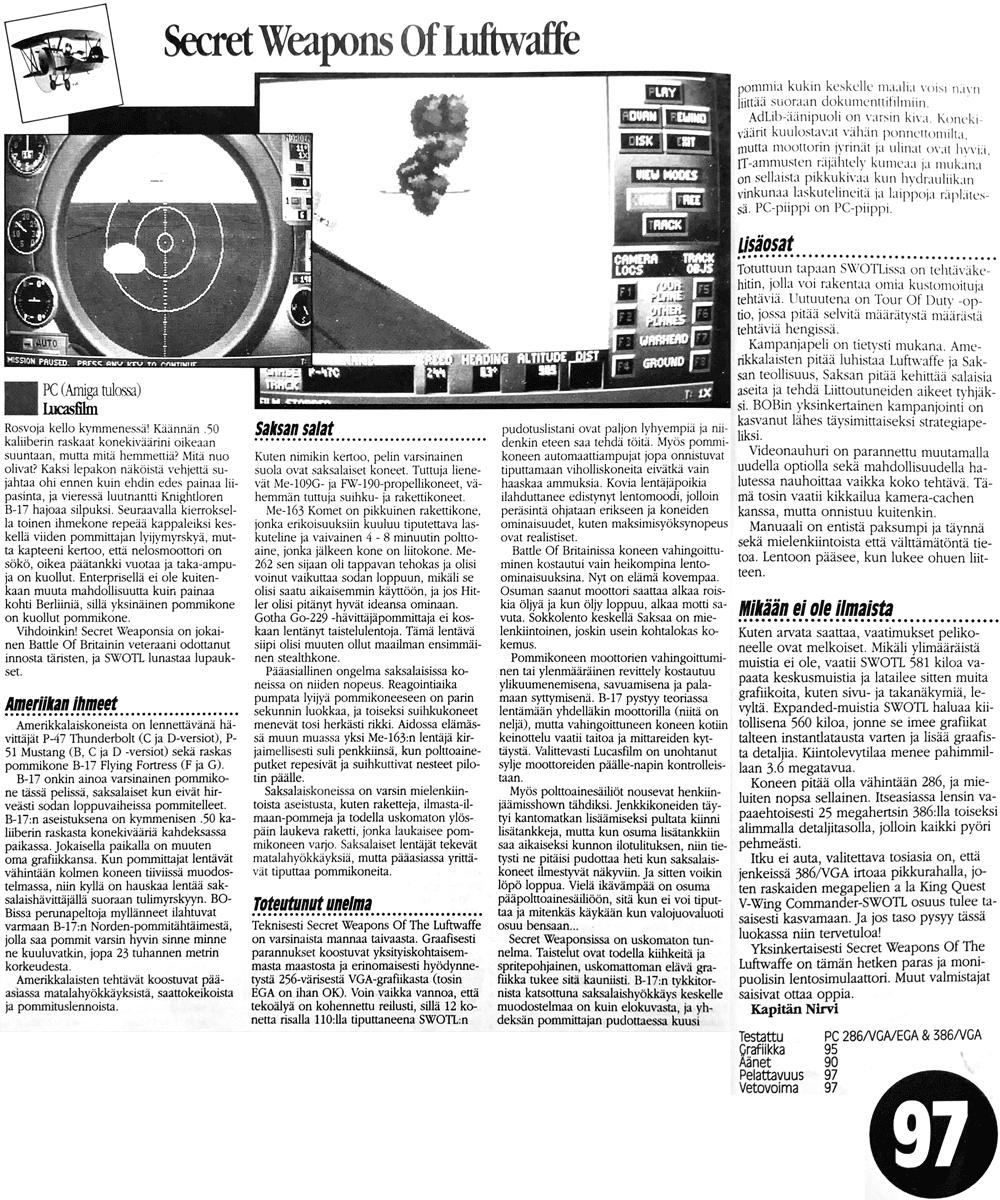
Secret Weapons Of Luftwaffe1991 SyksyPysyvä linkkiRosvoja kello kymmenessä! Käännän .50 kaliiberin raskaat konekiväärini oikeaan suuntaan, mutta mitä hemmettiä? Mitä nuo olivat? Kaksi lepakon näköistä vehjettä sujahtaa ohi ennen kuin ehdin edes painaa liipasinta, ja vieressä luutnantti Knightloren B-17 hajoaa silpuksi. Seuraavalla kierroksella toinen ihmekone repeää kappaleiksi keskellä viiden pommittajan lyijymyrskyä, mutta kapteeni kertoo, että nelosmoottori on sökö, oikea päätankki vuotaa ja taka-ampuja on kuollut. Enterprisellä ei ole kuitenkaan muuta mahdollisuutta kuin painaa kohti Berliiniä, sillä yksinäinen pommikone on kuollut pommikone.
Vihdoinkin! Secret Weaponsia on jokainen Battle Of Britainin veteraani odottanut innosta täristen, ja SWOTL lunastaa lupaukset.
Ameriikan ihmeet
Amerikkalaiskoneista on lennettävänä hävittäjät P-47 Thunderbolt (C ja D-versiot), P-51 Mustang (B, C ja D -versiot) sekä raskas pommikone B-17 Flying Fortress (F ja G).
B-17 onkin ainoa varsinainen pommikone tässä pelissä, saksalaiset kun eivät hirveästi sodan loppuvaiheissa pommitelleet. B-17:n aseistuksena on kymmenisen .50 kaliiberin raskasta konekivääriä kahdeksassa paikassa. Jokaisella paikalla on muuten oma grafiikkansa. Kun pommittajat lentävät vähintään kolmen koneen tiiviissä muodostelmassa, niin kyllä on hauskaa lentää saksalaishävittäjällä suoraan tulimyrskyyn. BOBissa perunapeltoja myllänneet ilahtuvat varmaan B-17:n Norden-pommitähtäimestä, jolla saa pommit varsin hyvin sinne minne ne kuuluvatkin, jopa 23 tuhannen metrin korkeudesta.
Amerikkalaisten tehtävät koostuvat pääasiassa matalahyökkäyksistä, saattokeikoista ja pommituslennoista.
Saksan salat
Kuten nimikin kertoo, pelin varsinainen suola ovat saksalaiset koneet. Tuttuja lienevät Me-109G- ja FW-190-propellikoneet, vähemmän tuttuja suihku- ja rakettikoneet.
Me-163 Komet on pikkuinen rakettikone, jonka erikoisuuksiin kuuluu tiputettava laskuteline ja vaivainen 4 - 8 minuutin polttoaine, jonka jälkeen kone on liitokone. Me-262 sen sijaan oli tappavan tehokas ja olisi voinut vaikuttaa sodan loppuun, mikäli se olisi saatu aikaisemmin käyttöön, ja jos Hitler olisi pitänyt hyvät ideansa ominaan. Gotha Go-229 -hävittäjäpommittaja ei koskaan lentänyt taistelulentoja. Tämä lentävä siipi olisi muuten ollut maailman ensimmäinen stealthkone.
Pääasiallinen ongelma saksalaisissa koneissa on niiden nopeus. Reagointiaika pumpata lyijyä pommikoneeseen on parin sekunnin luokkaa, ja toiseksi suihkukoneet menevät tosi herkästi rikki. Aidossa elämässä muun muassa yksi Me-163:n lentäjä kirjaimellisesti suli penkkiinsä, kun polttoaineputket repesivät ja suihkuttivat nesteet pilotin päälle.
Saksalaiskoneissa on varsin mielenkiintoista aseistusta, kuten raketteja, ilmasta-ilmaan-pommeja ja todella uskomaton ylöspäin laukeva raketti, jonka laukaisee pommikoneen varjo. Saksalaiset lentäjät tekevät matalahyökkäyksiä, mutta pääasiassa yrittävät tiputtaa pommikoneita.
Toteutunut unelma
Teknisesti Secret Weapons Of The Luftwaffe on varsinaista mannaa taivaasta. Graafisesti parannukset koostuvat yksityiskohtaisemmasta maastosta ja erinomaisesti hyödynnetystä 256-värisestä VGA-grafiikasta (tosin EGA on ihan OK). Voin vaikka vannoa, että tekoälyä on kohennettu reilusti, sillä 12 konetta risalla 110:lla tiputtaneena SWOTL:n pudotuslistani ovat paljon lyhyempiä ja niidenkin eteen saa tehdä töitä. Myös pommikoneen automaattiampujat jopa onnistuvat tiputtamaan viholliskoneita eivätkä vain haaskaa ammuksia. Kovia lentäjäpoikia ilahduttanee edistynyt lentomoodi, jolloin peräsintä ohjataan erikseen ja koneiden ominaisuudet, kuten maksimisyöksynopeus ovat realistiset.
Battle Of Britainissa koneen vahingoittuminen kostautui vain heikompina lento-ominaisuuksina. Nyt on elämä kovempaa. Osuman saanut moottori saattaa alkaa roiskia öljyä ja kun öljy loppuu, alkaa motti savuta. Sokkolento keskellä Saksaa on mielenkiintoinen, joskin usein kohtalokas kokemus.
Pommikoneen moottorien vahingoittuminen tai ylenmääräinen revittely kostautuu ylikuumenemisena, savuamisena ja palamaan syttymisenä. B-17 pystyy teoriassa lentämään yhdelläkin moottorilla (niitä on neljä), mutta vahingoittuneen koneen kotiin keinottelu vaatii taitoa ja mittareiden kyttäystä. Valittevasti Lucasfilm on unohtanut sylje moottoreiden päälle-napin kontrolleistaan.
Myös polttoainesäiliöt nousevat henkiinjäämisshown tähdiksi. Jenkkikoneiden täytyi kantomatkan lisäämiseksi pultata kiinni lisätankkeja, mutta kun osuma lisätankkiin saa aikaiseksi kunnon ilotulituksen, niin tietysti ne pitäisi pudottaa heti kun saksalaiskoneet ilmestyvät näkyviin. Ja sitten voikin löpö loppua. Vielä ikävämpää on osuma pääpolttoainesäiliöön, sitä kun ei voi tiputtaa ja mitenkäs käykään kun valojuovaluoti osuu bensaan...
Secret Weaponsissa on uskomaton tunnelma. Taistelut ovat todella kiihkeitä ja spritepohjainen, uskomattoman elävä grafiikka tukee sitä kauniisti. B-17:n tykkitornista katsottuna saksalaishyökkäys keskelle muodostelmaa on kuin elokuvasta, ja yhdeksän pommittajan pudottaessa kuusi pommia kukin keskelle maalia voisi näyn liittää suoraan dokumenttifilmiin.
AdLib-äänipuoli on varsin kiva. Konekiväärit kuulostavat vähän ponnettomilta, mutta moottorin jyrinät ja ulinat ovat hyviä, IT-ammusten räjähtely kumeaa ja mukana on sellaista pikkukivaa kun hydrauliikan vinkunaa laskutelineitä ja laippoja räplätessä. PC-piippi on PC-piippi.
Lisäosat
Totuttuun tapaan SWOTLissa on tehtäväkehitin, jolla voi rakentaa omia kustomoituja tehtäviä. Uutuutena on Tour Of Duty -optio, jossa pitää selvitä määrätystä määrästä tehtäviä hengissä.
Kampanjapeli on tietysti mukana. Amerikkalaisten pitää luhistaa Luftwaffe ja Saksan teollisuus, Saksan pitää kehittää salaisia aseita ja tehdä Liittoutuneiden aikeet tyhjäksi. BOBin yksinkertainen kampanjointi on kasvanut lähes täysimittaiseksi strategiapeliksi.
Videonauhuri on parannettu muutamalla uudella optiolla sekä mahdollisuudella halutessa nauhoittaa vaikka koko tehtävä. Tämä tosin vaatii kikkailua kamera-cachen kanssa, mutta onnistuu kuitenkin.
Manuaali on entistä paksumpi ja täynnä sekä mielenkiintoista että välttämätöntä tietoa. Lentoon pääsee, kun lukee ohuen liitteen.
Mikään ei ole ilmaista
Kuten arvata saattaa, vaatimukset pelikoneelle ovat melkoiset. Mikäli ylimääräistä muistia ei ole, vaatii SWOTL 581 kiloa vapaata keskusmuistia ja latailee sitten muita grafiikoita, kuten sivu- ja takanäkymiä, levyltä. Expanded-muistia SWOTL haluaa kiitollisena 560 kiloa, jonne se imee grafiikat talteen instantlatausta varten ja lisää graafista detaljia. Kiintolevytilaa menee pahimmillaan 3.6 megatavua.
Koneen pitää olla vähintään 286, ja mieluiten nopsa sellainen. Itseasiassa lensin vapaaehtoisesti 25 megahertsin 386:lla toiseksi alimmalla detaljitasolla, jolloin kaikki pyöri pehmeästi.
Itku ei auta, valitettava tosiasia on, että jenkeissä 386/VGA irtoaa pikkurahalla, joten raskaiden megapelien a la King Quest V-Wing Commander-SWOTL osuus tulee tasaisesti kasvamaan. Ja jos taso pysyy tässä luokassa niin tervetuloa!
Yksinkertaisesti Secret Weapons Of The Luftwaffe on tämän hetken paras ja monipuolisin lentosimulaattori. Muut valmistajat saisivat ottaa oppia.
Secret Weapons Of Luftwaffe1991 SyksyPermalinkBandits at ten o'clock! I swing my heavy .50 calibre machine guns round the right way, but what the heck? What were those? Two bat-like contraptions zip past before I can even squeeze the trigger, and alongside us Lieutenant Knightlore's B-17 is torn to shreds. On the next pass the second wonder-machine is ripped apart in the middle of a lead storm from five bombers, but the captain reports that number four engine is kaput, the right main tank is leaking and the tail gunner is dead. Still, the Enterprise has no choice but to press on towards Berlin, because a lone bomber is a dead bomber.
At last! Every Battle Of Britain veteran has been waiting for Secret Weapons, trembling with excitement, and SWOTL delivers on its promises.
Wonders of Ameriikka
Of the American aircraft you get to fly the P-47 Thunderbolt (C and D versions) and P-51 Mustang (B, C and D versions) fighters, plus the B-17 Flying Fortress heavy bomber (F and G).
The B-17 is in fact the only real bomber in this game, since the Germans didn't do an awful lot of bombing in the final stages of the war. The B-17 is armed with ten or so heavy .50 calibre machine guns in eight positions. Each position has its own graphics, by the way. When the bombers fly in a tight formation of at least three aircraft, it's great fun flying a German fighter straight into the firestorm. Those who ploughed up potato fields in BOB will surely be delighted by the B-17's Norden bombsight, which puts the bombs pretty well where they belong, even from a height of 23 thousand metres.
The Americans' missions consist mainly of low-level attacks, escort jobs and bombing runs.
Germany's Secrets
As the name says, the real spice of the game is the German aircraft. The Me-109G and FW-190 prop planes will probably be familiar; the jet and rocket planes less so.
The Me-163 Komet is a tiny rocket plane whose peculiarities include a droppable undercarriage and a measly 4 - 8 minutes of fuel, after which the plane is a glider. The Me-262, on the other hand, was deadly effective and could have affected the end of the war had it been brought into service earlier, and if Hitler had kept his bright ideas to himself. The Gotha Go-229 fighter-bomber never flew a combat mission. This flying wing would, incidentally, have been the world's first stealth aircraft.
The main problem with the German aircraft is their speed. The reaction time for pumping lead into a bomber is on the order of a couple of seconds, and secondly, the jets break down really easily. In real life, among other things, one Me-163 pilot literally melted into his seat when the fuel lines burst and sprayed the fluids over him.
The German aircraft carry some rather interesting armament, such as rockets, air-to-air bombs and a truly incredible upward-firing rocket that is set off by a bomber's shadow. The German pilots do make low-level attacks, but mostly they try to bring down bombers.
A Dream Come True
Technically, Secret Weapons Of The Luftwaffe is real manna from heaven. Graphically, the improvements consist of more detailed terrain and superbly exploited 256-colour VGA graphics (though EGA is quite OK too). I could swear the artificial intelligence has been beefed up considerably, because for someone who downed 12 planes with a shot-up 110, my SWOTL kill lists are much shorter, and you have to work hard for those too. The bomber's automatic gunners even manage to shoot down enemy planes instead of just wasting ammo. Hardcore flyboys will probably be pleased by the advanced flight mode, in which the rudder is controlled separately and the aircraft's characteristics, such as maximum dive speed, are realistic.
In Battle Of Britain, damage to your aircraft only cost you poorer flight characteristics. Now life is harsher. An engine that's taken a hit may start spraying oil, and when the oil runs out the motor starts smoking. Flying blind in the middle of Germany is an interesting, if often fatal, experience.
Damage to the bomber's engines, or thrashing them too hard, takes its revenge in overheating, smoking and catching fire. In theory the B-17 can fly on just one engine (it has four), but coaxing a damaged aircraft home takes skill and keeping a beady eye on the gauges. Unfortunately, Lucasfilm has left a spit-on-the-engines button out of its controls.
The fuel tanks, too, rise to become stars of the survival show. To increase their range the Yank planes had to have extra tanks bolted on, but since a hit on an extra tank sets off a proper fireworks display, you should of course drop them as soon as the German aircraft come into view. And then you may well run out of juice. Nastier still is a hit on the main fuel tank, because that one can't be dropped, and guess what happens when a tracer round hits the petrol...
Secret Weapons has an incredible atmosphere. The battles are really intense, and the sprite-based, incredibly lively graphics support it beautifully. Seen from a B-17's gun turret, a German attack into the middle of the formation is like something out of a movie, and when nine bombers each drop six bombs right in the middle of the target, the sight could be spliced straight into a documentary film.
The AdLib sound side is rather nice. The machine guns sound a bit feeble, but the engine rumbles and howls are good, the flak bursts are nicely muffled, and there are nice little touches like the whine of the hydraulics when you fiddle with the undercarriage and flaps. The PC beeper is the PC beeper.
Extras
As is customary, SWOTL has a mission builder with which you can put together your own customised missions. New is the Tour Of Duty option, in which you have to survive a set number of missions alive.
The campaign game is of course included. The Americans must crush the Luftwaffe and German industry, while Germany must develop secret weapons and thwart the Allies' plans. BOB's simple campaigning has grown into an almost full-scale strategy game.
The video recorder has been improved with a few new options and the ability to record, if you wish, an entire mission. This does take some fiddling with the camera cache, but it can be done.
The manual is thicker than before and full of information that is both interesting and essential. You can get airborne by reading the thin supplement.
Nothing Comes Free
As you might guess, the demands on your games machine are considerable. If you don't have extra memory, SWOTL requires 581K of free base memory and then loads the other graphics, such as the side and rear views, from disk. SWOTL will gratefully take 560K of expanded memory, into which it sucks the graphics for instant loading, plus added graphical detail. At worst it eats 3.6 megabytes of hard disk space.
The machine has to be at least a 286, and preferably a nippy one. In fact, I chose to fly on a 25 megahertz 386 at the second-lowest detail level, at which everything ran smoothly.
Crying won't help; the unfortunate fact is that in the States a 386/VGA can be had for pocket money, so the share of heavy megagames a la King Quest V-Wing Commander-SWOTL is going to grow steadily. And if the standard stays at this level, then welcome!
Simply put, Secret Weapons Of The Luftwaffe is the best and most versatile flight simulator of the moment. Other manufacturers could learn a thing or two.
Section-Z
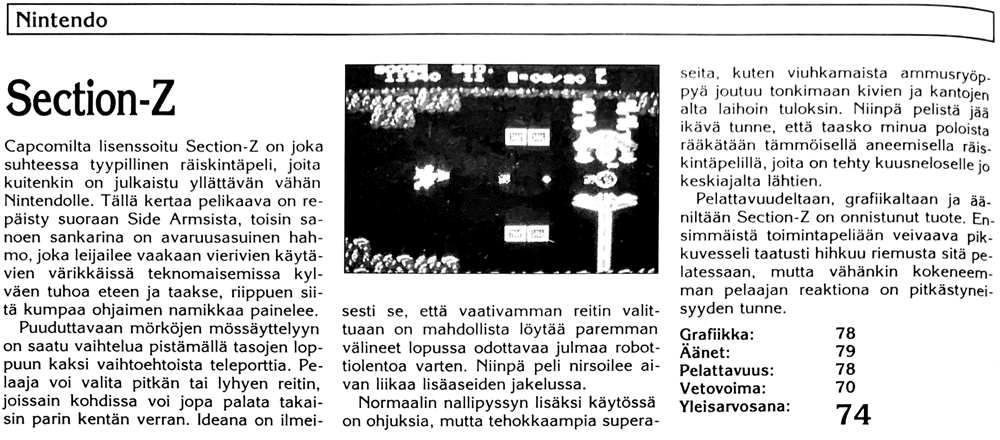
Section-Z1990 SyksyPysyvä linkkiCapcomilta lisenssoitu Section-Z on joka suhteessa tyypillinen räiskintäpeli, joita kuitenkin on julkaistu yllättävän vähän Nintendolle. Tällä kertaa pelikaava on repäisty suoraan Side Armsista, toisin sanoen sankarina on avaruusasuinen hahmo, joka leijailee vaakaan vierivien käytävien värikkäissä teknomaisemissa kylväen tuhoa eteen ja taakse, riippuen siitä kumpaa ohjaimen namikkaa painelee.
Puuduttavaan mörköjen mössäyttelyyn on saatu vaihtelua pistämällä tasojen loppuun kaksi vaihtoehtoista teleporttia. Pelaaja voi valita pitkän tai lyhyen reitin, joissain kohdissa voi jopa palata takaisin parin kentän verran. Ideana on ilmeisesti se, että vaativamman reitin valittuaan on mahdollista löytää paremman välineet lopussa odottavaa julmaa robottiolentoa varten. Niinpä peli nirsoilee aivan liikaa lisäaseiden jakelussa.
Normaalin nallipyssyn lisäksi käytössä on ohjuksia, mutta tehokkaampia superaseita, kuten viuhkamaista ammusryöppyä joutuu tonkimaan kivien ja kantojen alta laihoin tuloksin. Niinpä pelistä jää ikävä tunne, että taasko minua poloista rääkätään tämmöisellä aneemisella räiskintäpelillä, joita on tehty kuusneloselle jo keskiajalta lähtien.
Pelattavuudeltaan, grafiikaltaan ja ääniltään Section-Z on onnistunut tuote. Ensimmäistä toimintapeliään veivaava pikkuvesseli taatusti hihkuu riemusta sitä pelatessaan, mutta vähänkin kokeneemman pelaajan reaktiona on pitkästyneisyyden tunne.
Section-Z1990 SyksyPermalinkLicensed from Capcom, Section-Z is in every respect a typical shoot-'em-up, surprisingly few of which have been released for the Nintendo, though. This time the formula has been ripped straight out of Side Arms; in other words, the hero is a space-suited figure who floats through the colourful techno-landscapes of horizontally scrolling corridors, sowing destruction ahead and behind, depending on which of the controller's buttons you're pressing.
The numbing mashing of monsters into mush has been given some variety by putting two alternative teleports at the end of the levels. The player can pick the long route or the short one, and in some places you can even go back a couple of stages. The idea is apparently that by choosing the more demanding route you can find better gear for the cruel robot creature waiting at the end. And so the game is far too stingy about handing out extra weapons.
On top of the standard cap gun you've got missiles, but the more powerful super weapons, such as a fan-shaped spray of shots, have to be rooted out from under every rock and stump, with meagre results. And so the game leaves you with that nasty feeling: am I, poor wretch, being tormented yet again with an anaemic shoot-'em-up like this, the kind they've been making for the Commodore 64 since the Middle Ages?
In playability, graphics and sound, Section-Z is a successful product. A little nipper cranking away at their first action game is guaranteed to whoop with joy while playing it, but the reaction of a player with even slightly more experience is a feeling of boredom.
Sentinel
Sentinel1987Pysyvä linkkiTämä arvostelu on omistettu hyvälle ystävälleni Lasse Boeliukselle, ensimmäiselle muttei varmasti viimeiselle Sentinelin uhrille. Ainoa ääni, jota tästä miesparasta enää lähtee on "Sentinel sitä ja Sentinel tätä ja nyt olen kentässä 2352" ja tämän puisevan monologin jälkeen alkaa taas Sentinelin peluu. Sentinel on hänelle kuin uskonto.
Eikä se mikään ihme olekaan. Melkein itse jouduin samaan kierteeseen mutta Elite pelasti. Sentinel on eittämättä viiden parhaan pelin joukossa mitä kuusneloseen on ikinä tehty. Miksi? Siksi koska tämä on niitä valitettavan harvoja pelejä jotka nappaavat pelaajaa kurkusta kiinni ja pakottavat tulemaan osaksi kuvaruudun takaista maailmaa.
Sentinelissä muututaan Synthoidiksi, oudoksi robotin kaltaiseksi olioksi. Synthoid pystyy liikkumaan vain luomalla uuden kopion itsestään ja siirtämällä tietoisuutensa siihen. Synthoid pystyy imemään energiaa ympäristöstä ja luomaan siitä puita, kiviä ja Synthoideja. Sentinel taas on maaston korkeimmalla kohdalla ja imee kaiken puuta suuremman energian muuttaen sen puiksi, jotka ilmestyvät sattumanvaraisesti maastoon. Synthoidin täytyy päästä tarpeeksi korkealle, jotta veitikka voi imeä Sentinelin energian. Kivi on kaksi puuta ja Synthoidi on kolme puuta. Epäselvää (vaikkei Sentryistä ja Meanieista ole puhuttu sanaakaan)? Kaikki kirkastuu pelissä.
Sentinel ei ole velkaa yhdellekää pelille vaan on omaperäisyyden ylistyslaulu. Peliklassikkona se on täysin shakin luokkaa, muttei yhtä pitkästyttävän hidastempoinen. Ohjelmointi on nerokas.
10.000 kenttää kerralla muistissa, joten jos 100 sentineliä on yksi metrinel on pelissä sata metrineliä kenttiä (1,2 penniä/kenttä).
Grafiikka on todella loistavaa. Se luo tunnun "muualla" olemisesta. Aika ja paikka unohtuvat. Parin sekunnin tauot paikanvaihdoissa tosin vähän haittaavat mutta kaikkeen tottuu. Äänet loistavat poissaolollaan lukuunottamatta muutamaa efektiä. Mukana on suomenkieliset ohjeet, joilla saa suomenkielen opettajan nopeasti ulos. Ikkunasta.
Sentinelissä punnitaan kyky tehdä nopeita päätöksiä paineen alla. Kaiken kaikkiaan Sentinel periaatteessa kuuluisi jokaisen itseäänkunnioittavan pelurin kokoelmiin. Pakko-ostokseksi sitä ei kuitenkaan voi suositella, sillä siitä voi tulla joko kauniin ystävyyden alku tai kallis pettymys. Sopii erinomaisesti ihmisille joiden mielestä tietokonepelit ovat lapsellisia.
Sentinel1987PermalinkThis review is dedicated to my good friend Lasse Boelius, Sentinel's first but certainly not last victim. The only sound this poor man still makes is "Sentinel this and Sentinel that and now I'm on level 2352", and after this dreary monologue the Sentinel-playing starts all over again. Sentinel is like a religion to him.
And no wonder, really. I very nearly got caught in the same spiral myself, but Elite saved me. Sentinel is without question one of the five best games ever made for the Commodore 64. Why? Because this is one of those regrettably few games that grab the player by the throat and force them to become part of the world behind the screen.
In Sentinel you become a Synthoid, a strange robot-like being. The Synthoid can only move by creating a new copy of itself and transferring its consciousness into it. The Synthoid can absorb energy from its surroundings and create trees, boulders and Synthoids out of it. The Sentinel, meanwhile, stands on the highest point of the landscape and absorbs all energy greater than a tree, turning it into trees which appear at random around the landscape. The Synthoid has to get high enough for the little rascal to be able to absorb the Sentinel's energy. A boulder is two trees and a Synthoid is three trees. Unclear (even though not a word has been said about Sentries and Meanies)? It all becomes clear in the game.
Sentinel owes nothing to any other game; instead it is a hymn in praise of originality. As a game classic it is fully in the same class as chess, but not as tediously slow-paced. The programming is ingenious.
10,000 levels in memory at once, so if 100 sentinels make one metrinel, the game has a hundred metrinels of levels (1.2 penni per level).
The graphics are truly superb. They create a sense of being "somewhere else". Time and place are forgotten. The couple of seconds' pause each time you change position is a bit of a nuisance, admittedly, but you can get used to anything. The sound is conspicuous by its absence, apart from a few effects. Finnish-language instructions are included, which will get any teacher of Finnish out in no time. Out of the window.
Sentinel puts your ability to make quick decisions under pressure to the test. All in all, Sentinel ought in principle to belong in the collection of every self-respecting gamer. It can't be recommended as a must-buy, though, as it may turn out to be either the beginning of a beautiful friendship or an expensive disappointment. Ideal for people who think computer games are childish.
Sentinel Worlds I: Future Magic
Sentinel Worlds I: Future Magic1989 KevätPysyvä linkkiKun Sentinel Worlds I ensimmäisen kerran ilmestyi näkökenttääni, jokin sisäinen vaisto kertoi minulle oitis, että jos tuon buuttaat, niin olet mennyttä kalua. Mutta minähän olen jo tarpeeksi elänytkin.
Future Magic kuuluu sarjaamme ISOT roolipelit. Ei siinä mitään, että pelialueena on avaruuden äärettömyys, mutta kun jokaisen planeetan pinnalta löytyy porukkaa kuin Stockmannin joulualennusmyynnistä - ja heillä jokaisella on sinulle jotakin kerrottavaa. Lisäksi paikat tuntuvat pursuavan erilaisia otuksia, joiden mielestä sinä olet oivaa vaihtelua heidän yksipuoliseen ruokavalioonsa.
Pelin alkuasetelma on lyhyesti seuraava: Federaation uusiin Rouyn ja Mistassinin siirtokuntiin tarvikkeita kuljettavien rahtialusten kimppuun on hyökätty yhä useammin. Kuka hyökkäysten takana on - ja miksi, sitä ei kukaan tiedä.
Pelaaja ohjaa yhden saattueiden turvaksi lähetetyn hävittäjän viisihenkistä miehistöä. Hänellä on valittavanaan useita eri toimintovaihtoehtoja. Hän voi alkaa räiskiä vihollisia avaruudessa ja vallata heidän aluksiaan saaliin toivossa. Toisaalta hyökkääjien alkuperän selvittämiseksi täytyy vierailla myös tukikohdissa ja planeetoilla, ja tällöin homma alkaa käydä todella mielenkiintoiseksi.
Ohjelman tekijät ovat tehneet todella huolellista työtä. Henkilöiden kanssa käytävät keskustelut toimivat luontevasti valikoiden avulla, grafiikka on PC-peleille ainutlaatuista, ikkunointi näyttää kerralla kaikki tarpeelliset tiedot eli teknisesti todella nautittavaa. Perpektiivinäkymän keskellä oleva kypärän silmikkoon heijastettu tutkakuva on hyvä esimerkki siitä, miten peliin on todella kyetty vangitsemaan aito science fictionin 'sense of wonder'.
Kotelon kannessa kerrotaan pelin olevan tieteisroolimysteeri. Pakko myöntää, että harvoin mainoslause on pitänyt paremmin paikkansa. Sen lisäksi, että Sentinel Worlds on toimiva roolipeli ja tieteispeli parhaasta päästä, on sen juoni syvä kuin musta aukko. Jos Ultimojen kanssa saa vihkon täyteen muistiinpanoja, niin tästä täyttyy kirja. Päätehtävään kun liittyy kaiken moisia paikallisia kärhämöitä. Joskus pitää solmia rauhaa karjankasvattajien ja maanviljelijöiden välille, joskus pistää inhojen alienmaisten otusten temppeli sileäksi.
Jotain pelin syvyydestä ehkä kertoo jo sekin, että kiinnostuksen hiipumatta ensimmäiseen mies miestä vastaan taisteluun kului pelin alusta kolme tuntia. Toivotaan, että EOA kääntää tämän vanhan kunnon Starflightin tapaan myös Amigalle ja ST:lle.
Sentinel Worlds I: Future Magic1989 KevätPermalinkWhen Sentinel Worlds I first appeared in my field of vision, some inner instinct told me straight away that if you boot that one up, you're dead meat. But then again, I've lived long enough already.
Future Magic belongs in our series of BIG role-playing games. Not that there's anything wrong with the playing area being the infinity of space, but the surface of every planet turns out to be packed with crowds like Stockmann's Christmas sale - and every single one of them has something to tell you. On top of that, the places seem to be teeming with assorted creatures who reckon you'd make a nice change to their monotonous diet.
The game's opening situation, in brief, is this: the freighters carrying supplies to the Federation's new colonies of Rouyn and Mistassini have been attacked more and more often. Who is behind the attacks - and why, that nobody knows.
The player commands the five-strong crew of one of the fighters sent to guard the convoys. They have several different courses of action to choose from. They can start blasting enemies in space and capturing their ships in the hope of loot. On the other hand, to find out where the attackers come from you also have to visit bases and planets, and that's when things start getting really interesting.
The makers of the program have done a really meticulous job. Conversations with characters flow naturally through menus, the graphics are unique for a PC game, and the window layout shows all the necessary information at once - in other words, technically a real treat. The radar image projected onto the helmet visor in the middle of the perspective view is a good example of how the game really has managed to capture that genuine science fiction 'sense of wonder'.
The box cover describes the game as a science-fiction role-playing mystery. I have to admit that rarely has an advertising line been more on the mark. Besides being a role-playing game that works and a science fiction game of the very top rank, Sentinel Worlds has a plot as deep as a black hole. If the Ultimas fill a notebook with notes, this one fills a book. That's because all sorts of local squabbles are tied up with the main mission. Sometimes you have to broker peace between the cattle ranchers and the farmers, sometimes flatten the temple of some nasty alien-ish creatures.
Something of the game's depth is perhaps shown by the fact that, with no flagging of interest, it took three hours from the start of the game to reach the first man-to-man fight. Let's hope EOA converts this one to the Amiga and the ST as well, just as it did with good old Starflight.
Sentinel Worlds I: Future Magic
Sentinel Worlds I: Future Magic1990 KevätPysyvä linkkiKaupparatsun osa Caldorren systeemissä on kova. Tyhjästä ilmestyvät piraattialukset tekevät saattueiden elämän helvetiksi. Federaation nenälle ei hypitä ja tilannetta saapuu tasaamaan joukko Interceptor-luokan aluksia. Mikäli ohjaamosta löytyisi rutinoituneita veteraaneja, tilanne olisi valoisa, mutta sieltäpä löytyykin viisi kadetinreppanaa kauppiaiden harmiksi.
Sentinel Worlds I ansaitsi kannuksensa vuosi-puolitoista sitten PC-versiona ja herätti paljon mielenkiintoa. Sittemmin se saavutti scifi-roolipelien State of Art -statuksen. Ei ihme, sillä monien aikaisempien yritysten tuntuessa vanhahtavilta SW I onnistuu paitsi välttämään kliseeviidakon myös välittämään aitoa hitech-tunnelmaa.
Maailmankaikkeuden rajojen syleilyn asemasta SW I rajoittuu yhteen aurinkokuntaan, josta löytyy ennätykselliset kolme planeettaa. Tällä kertaa sanalasku "pieni on kaunista" kuitenkin toteutuu, sillä kolmeen planeettaan on mahdutettu enemmän tavaraa kuin mitä köyhemmät miehet ahtavat yhteen galaksiin. Pelaajan ottaessa selvää mitä ihmettä hänen pitäisi oikeastaan tehdä aika kuluu mukavasti avaruustaisteluissa ja planeettojen pintaa kolutessa.
Planeettojen pinnalla kulku sujuu joko panssaroidulla ajoneuvolla lintuperspektiivissä, tai rakennuksissa pikku jalkojen vuorottaisella liikuttelulla. Tällöin henkeä luo kypärän tutkanäytön heijastuminen "mitä silmä näkee" näytön päälle. Ja jos silmä näkee tapettavaa, alkaa reaaliajassa kulkeva taistelu ihan hyvällä taistelusysteemillä. Tässä jalossa lajissa tarvittavia suoritusvälineitä löytyy tarpeeksi muttei liikaa.
Avaruusosuus ei ole yhtä vaikuttava. Alus näkyy täälläkin lintuperspektiivissä taisteluiden sujuessa reaaliajassa, mutta kommunikoida voi toki muutenkin kuin laserein. Voipa halutessaan pistäytä pikku visiitilläkin vihollisaluksessa. Jokaisesta aluksesta on kaunis kuva, tosin taktisessa näytössä jokainen alus näyttää samalta pökkelöltä spriteltä.
EGAsta kuusneloselle konvertoitu grafiikka on onnistunut mukavasti ja äänipuoli varmasti pieksee PC:n. Pikkumuistin hintana on kuitenkin välillä harmittavan tiheä lerpunkääntely, mutta tämä lienee tarpeellista. Tervetullut Sentinel Worlds joka tapauksessa on.
Sentinel Worlds I: Future Magic1990 KevätPermalinkThe lot of a travelling salesman in the Caldorre system is a hard one. Pirate ships appearing out of nowhere are making the convoys' lives hell. Nobody pushes the Federation around, and a squadron of Interceptor-class ships arrives to even the score. If the cockpit held seasoned veterans, the outlook would be bright, but what it holds instead is five hapless cadets, much to the traders' dismay.
Sentinel Worlds I earned its spurs a year or a year and a half ago as a PC version and aroused a lot of interest. Since then it has achieved State of the Art status among sci-fi role-playing games. No wonder, since while many earlier attempts feel dated, SW I manages not only to steer clear of the cliché jungle but also to convey a genuine hi-tech atmosphere.
Rather than embracing the outer limits of the universe, SW I confines itself to a single solar system, which boasts a record-breaking three planets. This time, though, the saying "small is beautiful" holds true, since more stuff has been crammed into three planets than lesser men manage to squeeze into a whole galaxy. While the player works out what on earth they are actually supposed to be doing, the time passes pleasantly in space battles and in scouring planet surfaces.
On planet surfaces you get about either in an armoured vehicle seen from a bird's-eye view or, inside buildings, by putting one little foot in front of the other. There the atmosphere comes from the helmet's radar display being projected over the "what the eye sees" view. And if the eye sees something to kill, a real-time fight kicks off, with a perfectly decent combat system. The kit needed for this noble sport is there in sufficient quantity, but not too much.
The space section is less impressive. Here too the ship is seen from a bird's-eye view, with the battles running in real time, but of course you can communicate by means other than lasers too. If you feel like it, you can even pop over for a little visit to an enemy ship. Every ship has a pretty picture of its own, although on the tactical display every ship looks like the same wooden lump of a sprite.
The graphics, converted from EGA to the C-64, have come off nicely, and the sound surely beats the PC hollow. The price of the small memory, though, is disk-flipping that at times gets annoyingly frequent, but I suppose that is necessary. Sentinel Worlds is welcome all the same.
Serve And Volley
Serve And Volley1989 KevätPysyvä linkkiNyt se tapahtui: C-64:n parhaan tennispelin valtikka on täten siirtynyt Accoladen Serve and Volleylle. Joulun alla ahkerana ollut Accolade on onnistunut siirtämään tenniksen strategiamaisuuden ja yleisen luonteen loistavasti tietokoneelle. Tennis lienee pelinä kaikille tuttu, joten sääntöihin ei kannattane syventyä.
OK, mitä sitten, jos Accoladen parhaat piirtäjät ja animoijat ovatkin siirtyneet muihin firmoihin? Mitä siitä, jos Serve and Volleyn grafiikka on kerrassaan kehnoa? Kuka siitä välittää, jos pelaajat liikkuvat kentällä kuin kilpikonnat mudassa? En minä ainakaan, koska pelattavuus on hiottu juuri kohdalleen.
Ensisilmäyksellä kaoottinen ja sekava kontrollilaatikkokin ruudun yläkulmassa on pienen totuttelun jälkeen uskomattoman toimiva oivallus. Parilla silmäyksellä ja nopealla joystickinväännöllä saa miehen tekemään täsmälleen mitä haluaa, olkoon se sitten terävä alakierteinen kämmenlyönti takakentälle tai löysä tiputus juuri verkon yli toiselle puolelle.
SAV kuuluu niihin harvoihin peleihin, jotka karkeasta ulkokuoresta huolimatta pitävät kiinnostuksen yllä pitkään. Mistään muusta koneesta ei löydy yhtään tennistä, joka kiinnostaisi minua murto-osan vertaa verrattuna SAV:hin. SAV on loistopeli tietokonetta vastaan (etenkin kun tietokone ei pelaa kuin Boris Becker huippuvireessä) ja suunnatonta hupia kaveria vastaan.
Serve And Volley1989 KevätPermalinkNow it has happened: the sceptre of best tennis game on the C-64 has hereby passed to Accolade's Serve and Volley. Accolade, who kept busy in the run-up to Christmas, have brilliantly managed to carry the strategic side and general character of tennis over to the computer. Tennis as a game is presumably familiar to everyone, so there's probably no point going into the rules.
OK, so what if Accolade's best artists and animators have moved on to other companies? What does it matter if Serve and Volley's graphics are downright poor? Who cares if the players move around the court like tortoises in mud? Not me, at any rate, because the playability has been honed just right.
Even the control box in the top corner of the screen, chaotic and confusing at first glance, turns out after a little getting used to to be an incredibly effective brainwave. With a couple of glances and a quick twist of the joystick you can make your man do exactly what you want, be it a sharp backspin forehand deep to the back of the court or a soft drop shot just over the net to the other side.
SAV is one of those rare games that keep your interest up for a long time despite a rough exterior. There isn't a single tennis game on any other machine that interests me even a fraction as much as SAV. SAV is a great game against the computer (especially as the computer doesn't play like Boris Becker on top form) and enormous fun against a friend.
Seven Cities of Gold
Seven Cities of Gold1987Pysyvä linkkiAmerikasta, vaatimattomien pelien maasta tulee Seven Cities of Gold, jonka tarkoitus ei ole sen vähempää kuin luoda realistinen kuva Amerikan mantereen löytämisestä. Ja aikahan on tietysti hilpeä 1700-luku.
Jatkuvan pelaamisen varmistamiseksi on Seven Citiessissä maailma-generaattori, jolla voi luoda uuden mantereen kun vanha on valloitettu. Eikä tuloksena ole sattumanvarainen pläntti, vaan kaikki geologian säännöt otetaan huomioon. Eipä ihme että levyasema saattaa huristella tunninkin yhteen mittaan. Huhutaan, että alunperin piti luoda kokonaan uusi maailma, mutta koska se olisi kestänyt seitsemän päivää projektista luovuttiin.
Bittikolumbukset voivat purjehtia pitkin tuhansien screenien pallonpuoliskoa, kunnes Ameriikaan rannikko tulee näkyviin. Siitä miehet maihin ja tutkimusretkelle. Linnoituksia ja kaupunkeja voi perustaa, alkuasukkaita murhata, orjuuttaa ja solmia diplomaattisia suhteita heidän kanssaan. Välillä pikku regatta takaisin Espanjaan hakemaan lisää miehiä ja rahaa ja kuuntelemaan kuninkaan kommentteja. Päätarkoituksena on kuitenkin löytää tarunomaiset kokokultaiset Seitsemän kaupunkia. Toteutus on onnistunut kivasti. Grafiikka on asiallista ja pelattavuusaste on korkea. Kaikki toiminnot valitaan joystickilla ja pelin saa luonnollisesti talletettua. Mutta sitä varten täytyy matkata Espanjaan.
Maali on massiivinen, mutta valitettavasti pelinä Seven Cities ei jaksa oikein kantaa. Pelaaja voi lähinnä rämpiä tai purjehtia pitkin Amerikkaa, eikä juuri mitään välttämättä tapahdu. Välillä sentään näkyy inkakylä tai kaupunki, joiden kanssa voi "kommunikoida".
Kylään tms. saavuttaessa ruutu zoomaa sen ja näyttää onnelliset luonnonlapset kiitämässä sinne sun tänne. Tarkoitus alkuasukasasutuksissa olisi löytää kylän Big Boss, joka ainakin kaksivärimonitorissa on mahdotonta. Ja kun pari törmäystä alkuasukkaisiin riittää täyteen Defcon 1:een ei enää tarvitse ihmetellä muinaisten espanjalaisten verisiä valloitusretkiä.
Varmasti Seven Cities vetoaa joihinkin pelaajatyyppeihin, mutta runsasta aistiärsytystä kaipaavien kannattaa koepelata ennen ostoa. Hyvä silti että jotkut pelit yrittävät olla erilaisia.
Seven Cities of Gold1987PermalinkFrom America, that land of modest games, comes Seven Cities of Gold, whose aim is nothing less than to create a realistic picture of the discovery of the American continent. And the era is, of course, the jolly 1700s.
To keep the playing going for good, Seven Cities has a world generator that lets you create a new continent once the old one has been conquered. And the result isn't some random blob - every rule of geology is taken into account. Small wonder the disk drive may whirr away for as much as an hour at a stretch. Rumour has it that the original plan was to create an entirely new world, but since that would have taken seven days, the project was abandoned.
Bit-Columbuses can sail across a hemisphere thousands of screens wide until the coast of America comes into view. Then it's men ashore and off on an expedition. You can found forts and towns, and murder, enslave and establish diplomatic relations with the natives. Every now and then there's a little regatta back to Spain to fetch more men and money and to listen to the king's comments. The main goal, however, is to find the legendary Seven Cities made of solid gold. The execution has come off nicely. The graphics are decent and the playability level is high. All actions are selected with the joystick, and naturally the game can be saved. But to do that you have to travel to Spain.
The scope is massive, but unfortunately, as a game, Seven Cities doesn't quite have the strength to carry it. Mostly the player just trudges or sails around America, and hardly anything need happen at all. Now and then, at least, an Inca village or a city turns up that you can "communicate" with.
On arriving at a village or the like, the screen zooms in on it and shows the happy children of nature dashing hither and thither. The idea in the native settlements would be to find the village Big Boss, which is impossible, at least on a two-colour monitor. And when a couple of collisions with the natives are enough for a full-on Defcon 1, you no longer have to wonder about the bloody conquests of the Spaniards of old.
Seven Cities will surely appeal to some types of player, but those craving plenty of sensory stimulation would do well to try it out before buying. Still, it's good that some games try to be different.
Shackled
Shackled1988Pysyvä linkkiPahat voimat ovat vanginneet ystäväsi salaperäisen linnan syövereihin. Sinun pyhä tehtäväsi ystävyyden yms. nimissä on pelastaa tämä reppanajoukkue, ennenkuin kuolemaakin pahempi kohtalo lankeaa heidän osakseen. Linnassa on muutama sata kerrosta, joissa jokaisessa on useampi kamu kahleissa. Matematiikan sääntöjen mukaan siitä tulee noin tuhannen ystävän paikkeilla. Bileiden pitäminen voi koitua kalliiksi.
Shackled on, kuten kuvasta voi päätellä, sellainen Gauntlet/Alien Syndrome-klooni. Pelastetusta ystävästä nettoaa parempia aseita ja lisäksi voi keräillä erilaisia amuletteja ja avaimia. Game on over kun elinvoima laskee nollaan.
Aloitin tutustumisen kuusnelosversiosta. Hyvin nopeasti toivoin, että olisin polttanut koko kirotun kasetin. Grafiikka on hirveää. Spritet ovat käsittämättömän huonosti animoituja oksettavan huonoja möykkyjä, joista ei kukaan ota selvää mitä ne esittävät. Huono tausta scrollaa ennen näkemättömän huonosti ja 'toiminta' hidastuu kun spritemäärä kasvaa. Epäonnistunut musiikki kurnuttaa taustalla.
Vähäisin odotuksin latasin ST-version koneeseen. Loistavan Gauntlet II -käännöksen jälkeen ST-Shackled tuntui täsmälleen yhtä kurjalta kuin C-64-versio. Grafiikasta sai sentään selvän, muuta positiivista ei mieleen tule.
Käsittämätöntä, että U.S. Gold viitsii julkaista tällaista roskaa täyteen hintaan. Kiertäkää kaukaa.
Shackled1988PermalinkEvil forces have imprisoned your friends in the depths of a mysterious castle. Your sacred duty, in the name of friendship etc., is to rescue this sorry bunch before a fate worse than death befalls them. The castle has a few hundred floors, each of them with several pals in chains. By the rules of mathematics that comes to somewhere around a thousand friends. Throwing parties could get expensive.
Shackled is, as you can probably tell from the picture, one of those Gauntlet/Alien Syndrome clones. A rescued friend nets you better weapons, and you can also collect various amulets and keys. It's game over when your life force drops to zero.
I started getting acquainted with it on the Commodore 64 version. Very quickly I was wishing I'd burned the whole cursed cassette. The graphics are dreadful. The sprites are incomprehensibly badly animated, nauseatingly bad lumps, and nobody can make out what they're supposed to be. The bad background scrolls worse than anything ever seen before, and the 'action' slows down as the number of sprites grows. A botched tune croaks away in the background.
With low expectations I loaded the ST version into the machine. After the brilliant Gauntlet II conversion, the ST Shackled felt exactly as miserable as the C-64 version. At least you could make out the graphics; nothing else positive comes to mind.
It's beyond comprehension that U.S. Gold can be bothered to release rubbish like this at full price. Steer well clear.
Shadow Dancer
Shadow Dancer1991 SyksyPysyvä linkkiVie vuoristosutesi muualle, tämä on kansainvälinen lentokenttä!, toteaa lentoemon karski ääni. Tämä ei todellakaan ole susi, vaan koira, enkä minäkään ole Mustanaamio., toteaa muukalainen, kiskaisee viitan yltään ja paljastaa ninja-asusteensa.
Shadow Dancer, mestarininja Joe Mushashi, on palannut kostaakseen oppipoikansa Katon luonnollisen kuoleman. Samaan vaivaan hän aikoo estää myös ilkeän Sauroksen suunnitelman räjäyttää toinenkin avaruussukkula.
Paikka kuhisee vihollisia. Aseistuksenaan ainoastaan kätensä ja jalkansa Joe selvittelee välejään terroristien kanssa. Onneksi asia ei ole ihan niin, vaan povarista löytyy rajoittamaton määrä shuriken-heittotähtiä, shinobi-miekka ja annos ninjataikaa. Apuna on vielä uskollinen albiinopreeriakoira, jonka saa hyökkimään vastustajalauman kimppuun.
Shadow Dancerissa on 15 tasoa, joista seitsemässä on erilainen tausta kaupungin keskustasta luoliin. Joka paikkaan on sabotöörijoukkio kylvänyt eri määrän aikapommeja, jotka täytyy purkaa. Pommeja vartioi aina vihollisrypäle raskaasti aseistettuna ja jokaisen ison tason lopussa on päävastustaja.
Ninja raivaa tiensä läpi hyppien, juosten ja ryömien koiran seuratessa tottelevaisesti mukana. Liikesarjat ovat nätin näköisiä, suoraan kolikkoversiosta imuroituja. Tähdenheitto, taian käyttö ja koiran lähettäminen ovat täysin samanlaisia kuin kolikkopelissä.
Kuitenkin puutteita löytyy, sillä sprite-ohjelmointi ei ole toteutettu ihan kohdalleen. Luoditkin saattavat osua ninjaan, vaikka selvästi ne lentävät metrin päästä ohi. Joitakin muita pienempiä bugeja myös löytyy.
Grafiikka on mukaansa tempaavaa, mutta äänipuoli tuottaa pettymyksen, ainakin Amiga-puolella. Kone veisaa samaa virttä koko pelin ajan, eikä pelissä ole kaikkia markkapelin äännähdyksiä.
Pelin idea on moneen kertaan käytetty, mutta koira tuo siihen edes jotain lisää. Kauaa ei Shadow Dancer jaksa kiinnostaa muita kuin ninjapelien pelaajia. Suosittelen peliä jälkimmäisille, minä en lukeudu heihin.
Shadow Dancer1991 SyksyPermalink"Take your mountain wolf somewhere else, this is an international airport!" says the gruff voice of the flight attendant. "This really isn't a wolf, it's a dog, and I'm not the Phantom either," says the stranger, then yanks off the cloak and reveals a ninja outfit underneath.
Shadow Dancer, master ninja Joe Mushashi, is back to avenge the natural death of his apprentice Kato. While he's at it, he also means to foil the wicked Sauros's plan to blow up a second space shuttle.
The place is crawling with enemies. Armed with nothing but his hands and feet, Joe settles his score with the terrorists. Luckily that's not quite how it is: his coat turns out to hold an unlimited supply of shuriken throwing stars, a shinobi sword and a helping of ninja magic. On top of that there's a faithful albino prairie dog to help out, which can be set on packs of opponents.
Shadow Dancer has 15 levels, seven of which have a different backdrop, ranging from the city centre to caves. At every location a gang of saboteurs has planted a different number of time bombs, which have to be defused. The bombs are always guarded by a heavily armed cluster of enemies, and at the end of every big level there's a boss.
The ninja clears his way through by jumping, running and crawling, with the dog obediently tagging along. The movement sequences look pretty, hoovered straight out of the coin-op version. Throwing stars, using magic and sending in the dog work exactly the same as in the arcade game.
There are shortcomings, though, because the sprite programming hasn't been done quite right. Even bullets can hit the ninja when they're clearly flying past a metre wide. There are a few other, smaller bugs as well.
The graphics are gripping, but the sound is a letdown, at least on the Amiga. The machine sings the same old hymn for the whole game, and the game doesn't have all the little noises of the arcade machine.
The game's idea has been used many times over, but the dog at least adds something to it. Shadow Dancer won't hold anyone's interest for long except ninja game players. I recommend the game to the latter; I'm not one of them.
Shadow of the Beast II

Shadow of the Beast II1991 KevätPysyvä linkkiSelvittyään ensimmäisessä osassa pedon varjosta takaisin ikävöimäänsä ihmishahmoon sankarin ei vielä anneta vetäytyä eläkepäiville. Harvinaisen tyylikkään elokuvaintron myötä selviää, että petolordin kostona on sankarin siskon kahmaiseminen petomaiseen käsittelyyn.
Edeltäjänsä tavoin Beast kakkonen on läimitty täyteen laadun leimoja. Jo yksi vilkaisu saa savun nousemaan hiusrajasta, kun grafiikan ja äänien fantastinen yhteistyö polttaa oikosulun näkö- ja kuulohermoihin. SOTB2 ei ole pelkästään ykkönen uusilla grafiikoilla, sillä pelisysteemiä on paranneltu monipuolisempaan suuntaan. Rönsyilevämmän maaston, kiipeilyköysien ja muiden luontevien lisäysten päälle pelissä on enemmän seikkailullista otetta. Matalaotsainen sankari voi jopa viritellä keskusteluntynkää vastaantulijoiden kanssa.
Sisällön perusaineksina on normaali moukarin mäiske, kirveiden viskely ja muu henkiinjäämisopin mukainen arkiaskare. Vihollisten monimuotoisuudessa kakkospeto liiskaa ykkösen, mutta sama pätee valitettavasti myös niiden ilkeyteen. Vaikeustaso on vähintään tuplaantunut, ainakin jos sitä mitataan edettyinä desimetreinä per tunti.
Kivipaaden takana puhkuvan olion huitominen pikselin virhemarginaalilla ei paljon hymyilytä, varsinkin kun tusinan yrityksen jälkeen onnistuminen palkitaan siten, että parin askeleen päässä päähän kolahtaa tonnin painoinen järkäle. Tämmöinen meno on mielestäni ennemminkin stressaavaa kuin rentouttavaa, eikä se kai ole pelin tarkoitus.
Jos unohdetaan ryppyotsainen hiuskarvan tiukka pelinäkemys ja muut makuasiat, kakkospeto on edeltäjänsä veroinen rahanarvoinen keräilykappale. Viidenkymmenen hertsin taajuudella rullaavat parallaksimaisemat nyhtävät Amigan raudasta neidin arvolle sopivia visuaalisia tehoja ja tälläkin kertaa ultrakokoisessa pakkauksessa on lahjuksena trendikäs T-paita.
Beast kakkonen, Unreal ja muut vastaavat sopisivat paremmin nykytaiteen museoon, sillä ne hankitaan kuitenkin vain sen vuoksi, että niitä voi esitellä kavereilleen ja sitten jäädään odottamaan, että lehdet julkaisevat vippaskonsteja niiden läpipelaamiseksi.
Shadow of the Beast II1991 KevätPermalinkHaving made it out of the beast's shadow in the first instalment and back into the human form he pined for, the hero is not yet allowed to retire to his pension days. An unusually stylish cinematic intro reveals that the beast lord's revenge is to snatch the hero's sister away for some beastly treatment.
Like its predecessor, Beast Two has been slapped full of seals of quality. A single glance is enough to send smoke rising from your hairline, as the fantastic teamwork of graphics and sound burns a short circuit into your optic and auditory nerves. SOTB2 isn't just the first game with new graphics, as the game system has been improved in a more versatile direction. On top of more sprawling terrain, climbing ropes and other natural additions, the game has more of an adventurous touch. The low-browed hero can even rig up a stub of a conversation with the folk he meets.
The basic ingredients are the usual sledgehammer pounding, axe flinging and other everyday chores as laid down by the science of survival. In the variety of its enemies the second Beast squashes the first, but unfortunately the same goes for their nastiness too. The difficulty level has at least doubled, at least if you measure it in inches advanced per hour.
Flailing at a creature huffing behind a stone slab with a one-pixel margin of error doesn't raise many smiles, especially when success after a dozen attempts is rewarded by a boulder weighing a ton clonking you on the head a couple of steps further on. In my opinion this sort of carry-on is more stressful than relaxing, and surely that isn't what a game is for.
If we forget the frowning, hair's-breadth-tight view of gameplay and other matters of taste, the second Beast is a collector's item worth the money and every bit the equal of its predecessor. Parallax landscapes scrolling at fifty hertz wring visual power out of the Amiga's hardware befitting the lady's station, and once again the ultra-sized box comes with a trendy T-shirt as a bribe.
Beast Two, Unreal and the like would be better suited to a museum of contemporary art, since people only buy them anyway so they can show them off to their mates, and then they sit back and wait for the magazines to publish sneaky tricks for getting through them.
Shadow of the Beast, The
Shadow of the Beast, The1990 KevätPysyvä linkkiPsygnosikselta on totuttu odottamaan korkeatasoista grafiikkaa, mutta The Shadow of the Beast ylittää kaikki entiset saavutukset. Visuaalinen impakti on sitä luokkaa, että aivojaan saa keräillä teelusikalla huoneen takaseinästä.
Pelistä huomaa välittömästi, että sitä ei todellakaan ole ohjelmoitu ST:llä: petomainen sankari hölkkäilee maisemassa, josta löytyy niin paljon eri nopeudella pehmeästi vieriviä kerroksia, että vaikutelma on lähes kolmiulotteinen. Lisäksi ruudulta löytyy parhaimmillaan 128 värisävyä ja kun taustalla vielä soi David Whittakerin tunnelmallinen musiikki, jossa on poikkeuksellisen korkeatasoiset samplet, niin ei voi muuta kuin vajota tuoliin ja nautiskella.
Pelin juoni on kaikessa ytimekkyydessään seuraava: ilkeä velho on uhrannut sankarin vanhemmat hämärissä kulttimenoissa ja muuttanut hänet siinä sivussa epäinhimilliseksi hirviöksi. Pedon muisti kuitenkin palailee pätkittäin ja niinpä on aika soveltaa ikiaikaista 'silmä silmästä' -filosofiaa.
Beast synnyttää etäisiä mielleyhtymiä Barbarianiin ja Obliteratoriin, mutta kankeasta ikoniohjauksesta siinä ei onneksi ole jälkeäkään. Peto aloittaa rynnistyksensä maan pinnalla idyllisen metsän laidassa. Seikkailu jatkuu maanalaisissa holveissa ja kivisessä linnoituksessa, joiden taustoissa on käytetty Amigalle ominaista dual playfield -tekniikkaa, toisin sanoen kahta päällekkäin vierivää grafiikkakerrosta. Useimmista vastaan taapertavista hirviöistä selviää yhdellä iskulla tai potkulla, mutta kun tien tukkii lähes koko ruudun täyttävä kammotus, niin avuksi tarvitaan hieman magiaa tai aseistusta.
Beast muistuttaa monessa suhteessa aitoa kolikkopeliä. Rehevän grafiikan ja musiikin lisäksi siinä on tyypillinen 'tiukka oppimiskäyräé' eli toisin sanoen suorituksen on oltava jatkuvasti lähes virheetön. Huippuluokan reaktiokyvystä on apua, mutta välillä peto joutuu sellaisen saarrostuksen kohteeksi, että tekee mieli heittäytyä maahan ja näytellä kuollutta.
Kotimikrolla tehdyksi Beastin kavaltaa Amigan spritet, joissa on pahimmassa tapauksessa vain kolme väriä. Vaikutelma on vähän kuin liimaisi paperinukkeja valokuvan päälle.
Eniten pelissä arveluttaa sen korkea hinta, mutta toisaalta vastinettakin on tavallista enemmän: tuplakokoinen pakkaus sisältää tyylikkkään Roger Deanin piirtämän t-paidan ja kaksi diskettiä, joille on ahdettu 2.2 megatavua grafiikkaa ja lähes 900 kiloa upeaa Whittakerin musiikkia. Beastin yksinkertainen perusidea ei välttämättä miellytä kaikkia ja se on hemmetin vaikea, mutta itse olin ikionnellinen nähdessäni toimintapelin, jossa revitään Amigasta kaikki irti.
Shadow of the Beast, The1990 KevätPermalinkWe've grown used to expecting high-class graphics from Psygnosis, but The Shadow of the Beast surpasses all its previous achievements. The visual impact is of such a magnitude that you end up scraping your brains off the back wall of the room with a teaspoon.
You notice right away that this game certainly wasn't programmed on an ST: the beastly hero jogs through a landscape with so many layers scrolling smoothly at different speeds that the effect is almost three-dimensional. On top of that, at best the screen shows as many as 128 colour shades, and with David Whittaker's atmospheric music, with its exceptionally high-quality samples, playing in the background as well, there's nothing to do but sink into your chair and savour it.
The plot of the game, in all its pithiness, is as follows: an evil wizard has sacrificed the hero's parents in murky cult rites and, while he was at it, turned the hero into an inhuman monster. The beast's memory, however, comes back in bits and pieces, and so it's time to apply the age-old 'eye for an eye' philosophy.
Beast brings up distant associations with Barbarian and Obliterator, but thankfully there's not a trace of clunky icon control in it. The beast begins his onslaught on the surface, at the edge of an idyllic forest. The adventure continues in underground vaults and a stone fortress, whose backgrounds use the Amiga's characteristic dual playfield technique, in other words two layers of graphics scrolling one on top of the other. Most of the monsters toddling your way can be dealt with by a single blow or kick, but when the road is blocked by a horror that fills nearly the whole screen, you need a bit of magic or weaponry to help out.
In many respects Beast resembles a genuine coin-op. Besides the lush graphics and music, it has the typical 'steep learning curve', in other words your performance has to be almost flawless all the time. Top-class reflexes help, but at times the beast gets so thoroughly surrounded that you feel like throwing yourself on the ground and playing dead.
What gives Beast away as something made on a home computer is the Amiga's sprites, which at worst have only three colours. The effect is a bit like gluing paper dolls onto a photograph.
The most worrying thing about the game is its high price, but then again you also get more than usual for your money: the double-size box contains a stylish T-shirt drawn by Roger Dean and two disks crammed with 2.2 megabytes of graphics and nearly 900K of gorgeous Whittaker music. Beast's simple basic idea won't necessarily please everyone, and it is damned hard, but I for one was overjoyed to see an action game that wrings everything out of the Amiga.
Shadow of the Unicorn
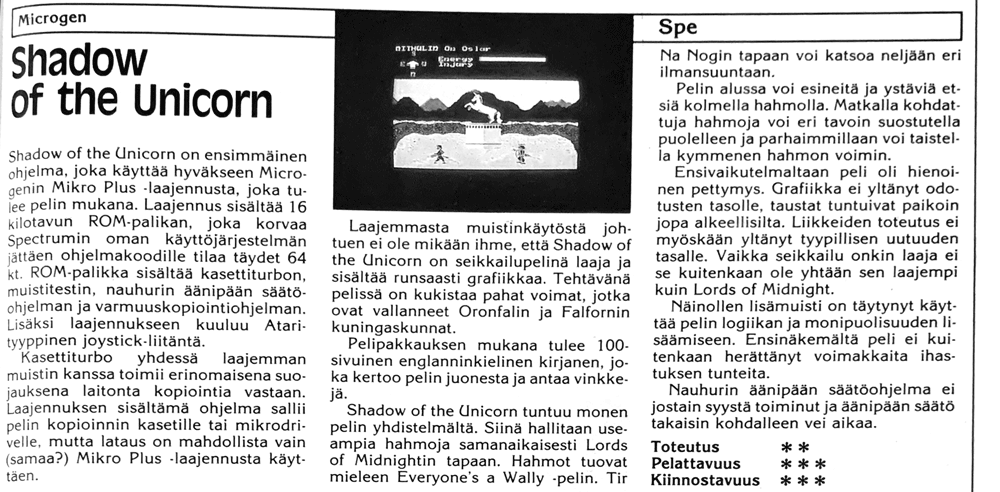
Shadow of the Unicorn1987Pysyvä linkkiShadow of the Unicorn on ensimmäinen ohjelma, joka käyttää hyväkseen Microgenin Mikro Plus -laajennusta, joka tulee pelin mukana. Laajennus sisältää 16 kilotavun ROM-palikan, joka korvaa Spectrumin oman käyttöjärjestelmän jättäen ohjelmakoodille tilaa täydet 64 kt. ROM-palikka sisältää kasettiturbon, muistitestin, nauhurin äänipään säätöohjelman ja varmuuskopiointiohjelman. Lisäksi laajennukseen kuuluu Atarityyppinen joystick-liitäntä.
Kasettiturbo yhdessä laajemman muistin kanssa toimii erinomaisena suojauksena laitonta kopiointia vastaan. Laajennuksen sisältämä ohjelma sallii pelin kopioinnin kasetille tai mikrodrivelle, mutta lataus on mahdollista vain (samaa?) Mikro Plus -laajennusta käyttäen.
Laajemmasta muistinkäytöstä johtuen ei ole mikään ihme, että Shadow of the Unicorn on seikkailupelinä laaja ja sisältää runsaasti grafiikkaa. Tehtävänä pelissä on kukistaa pahat voimat, jotka ovat vallanneet Oronfalin ja Falfornin kuningaskunnat.
Pelipakkauksen mukana tulee 100-sivuinen englanninkielinen kirjanen, joka kertoo pelin juonesta ja antaa vinkkejä.
Shadow of the Unicorn tuntuu monen pelin yhdistelmältä. Siinä hallitaan useampia hahmoja samanaikaisesti Lords of Midnightin tapaan. Hahmot tuovat mieleen Everyone's a Wally -pelin. Tir Na Nogin tapaan voi katsoa neljään eri ilmansuuntaan.
Pelin alussa voi esineitä ja ystäviä etsiä kolmella hahmolla. Matkalla kohdattuja hahmoja voi eri tavoin suostutella puolelleen ja parhaimmillaan voi taistella kymmenen hahmon voimin.
Ensivaikutelmaltaan peli oli hienoinen pettymys. Grafiikka ei yltänyt odotusten tasolle, taustat tuntuivat paikoin jopa alkeellisilta. Liikkeiden toteutus ei myöskään yltänyt tyypillisen uutuuden tasalle. Vaikka seikkailu onkin laaja ei se kuitenkaan ole yhtään sen laajempi kuin Lords of Midnight.
Näinollen lisämuisti on täytynyt käyttää pelin logiikan ja monipuolisuuden lisäämiseen. Ensinäkemältä peli ei kuitenkaan herättänyt voimakkaita ihastuksen tunteita.
Nauhurin äänipään säätöohjelma ei jostain syystä toiminut ja äänipään säätö takaisin kohdalleen vei aikaa.
Shadow of the Unicorn1987PermalinkShadow of the Unicorn is the first program to make use of Microgen's Mikro Plus expansion, which comes with the game. The expansion contains a 16-kilobyte ROM block that replaces the Spectrum's own operating system, leaving a full 64 KB of room for program code. The ROM block contains a tape turbo loader, a memory test, a tape head alignment program and a backup program. The expansion also includes an Atari-type joystick port.
The tape turbo, together with the larger memory, works as excellent protection against illegal copying. The program in the expansion lets you copy the game to cassette or microdrive, but loading is only possible using the (same?) Mikro Plus expansion.
Given the larger memory usage, it's no wonder that Shadow of the Unicorn is a big adventure game with plenty of graphics. The task in the game is to defeat the evil forces that have taken over the kingdoms of Oronfal and Falforn.
The game package comes with a 100-page English-language booklet that tells the story of the game and gives hints.
Shadow of the Unicorn feels like a combination of many games. You control several characters at the same time, as in Lords of Midnight. The characters bring to mind the game Everyone's a Wally. As in Tir Na Nog, you can look towards all four points of the compass.
At the start of the game you can search for objects and friends with three characters. Characters met along the way can be persuaded to join your side in various ways, and at best you can fight with a force of ten characters.
On first impression the game was a slight disappointment. The graphics did not live up to expectations; in places the backgrounds even felt primitive. The movement didn't reach the standard of a typical new release either. Although the adventure is large, it is not one bit larger than Lords of Midnight.
That being so, the extra memory must have been used to add to the game's logic and variety. At first sight, however, the game didn't stir up any strong feelings of delight.
For some reason the tape head alignment program didn't work, and getting the head adjusted back to where it had been took some time.
Shadow Warriors
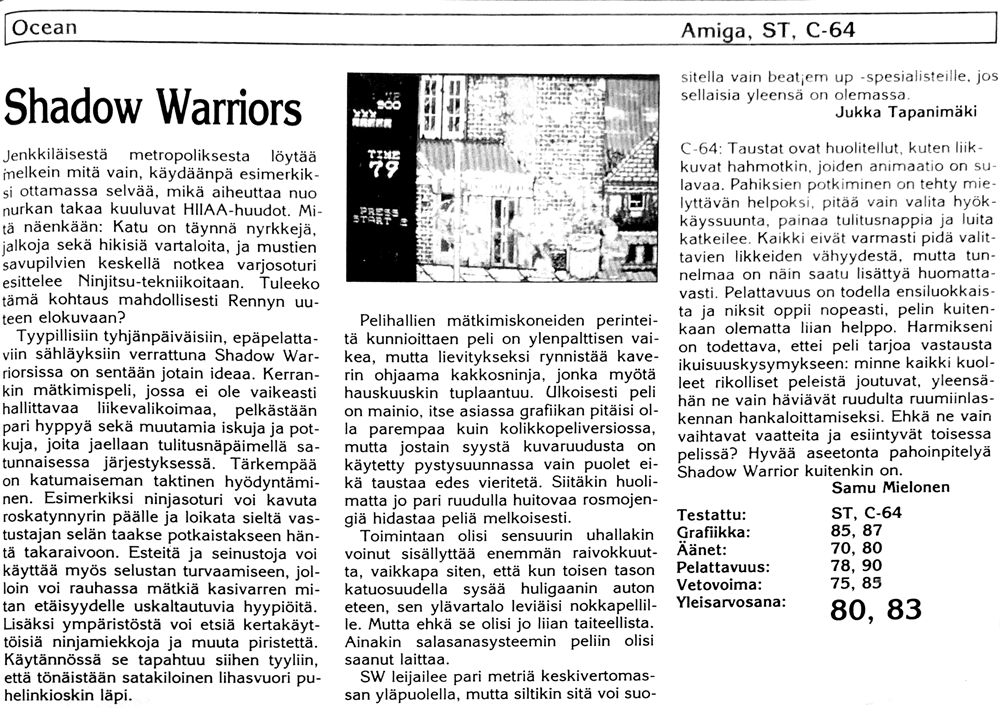
Shadow Warriors1990 SyksyPysyvä linkkiJenkkiläisestä metropoliksesta löytää melkein mitä vain, käydäänpä esimerkiksi ottamassa selvää, mikä aiheuttaa nuo nurkan takaa kuuluvat HIIAA-huudot. Mitä näenkään: Katu on täynnä nyrkkejä, jalkoja sekä hikisiä vartaloita, ja mustien savupilvien keskellä notkea varjosoturi esittelee Ninjitsu-tekniikoitaan. Tuleeko tämä kohtaus mahdollisesti Rennyn uuteen elokuvaan?
Tyypillisiin tyhjänpäiväisiin, epäpelattaviin sähläyksiin verrattuna Shadow Warriorsissa on sentään jotain ideaa. Kerrankin mätkimispeli, jossa ei ole vaikeasti hallittavaa liikevalikoimaa, pelkästään pari hyppyä sekä muutamia iskuja ja potkuja, joita jaellaan tulitusnäpäimellä satunnaisessa järjestyksessä. Tärkempää on katumaiseman taktinen hyödyntäminen. Esimerkiksi ninjasoturi voi kavuta roskatynnyrin päälle ja loikata sieltä vastustajan selän taakse potkaistakseen häntä takaraivoon. Esteitä ja seinustoja voi käyttää myös selustan turvaamiseen, jolloin voi rauhassa mätkiä kasivarren mitan etäisyydelle uskaltautuvia hyypiöitä. Lisäksi ympäristöstä voi etsiä kertakäyttöisiä ninjamiekkoja ja muuta piristettä. Käytännössä se tapahtuu siihen tyyliin, että tönäistään satakiloinen lihasvuori puhelinkioskin läpi.
Pelihallien mätkimiskoneiden perinteitä kunnioittaen peli on ylenpalttisen vaikea, mutta lievitykseksi rynnistää kaverin ohjaama kakkosninja, jonka myötä hauskuuskin tuplaantuu. Ulkoisesti peli on mainio, itse asiassa grafiikan pitäisi olla parempaa kuin kolikkopeliversiossa, mutta jostain syystä kuvaruudusta on käytetty pystysuunnassa vain puolet eikä taustaa edes vieritetä. Siitäkin huolimatta jo pari ruudulla huitovaa rosmojengiä hidastaa peliä melkoisesti.
Toimintaan olisi sensuurin uhallakin voinut sisällyttää enemmän raivokkuutta, vaikkapa siten, että kun toisen tason katuosuudella sysää huligaanin auton eteen, sen ylävartalo leviäisi nokkapellille. Mutta ehkä se olisi jo liian taiteellista. Ainakin salasanasysteemin peliin olisi saanut laittaa.
SW leijailee pari metriä keskivertomassan yläpuolella, mutta siltikin sitä voi suositella vain beat'em up -spesialisteille, jos sellaisia yleensä on olemassa.
C-64: Taustat ovat huolitellut, kuten liikkuvat hahmotkin, joiden animaatio on sulavaa. Pahiksien potkiminen on tehty miellyttävän helpoksi, pitää vain valita hyökkäyssuunta, painaa tulitusnappia ja luita katkeilee. Kaikki eivät varmasti pidä valittavien liikkeiden vähyydestä, mutta tunnelmaa on näin saatu lisättyä huomattavasti. Pelattavuus on todella ensiluokkaista ja niksit oppii nopeasti, pelin kuitenkaan olematta liian helppo. Harmikseni on todettava, ettei peli tarjoa vastausta ikuisuuskysymykseen: minne kaikki kuolleet rikolliset peleistä joutuvat, yleensähän ne vain häviävät ruudulta ruumiinlaskennan hankaloittamiseksi. Ehkä ne vain vaihtavat vaatteita ja esiintyvät toisessa pelissä? Hyvää aseetonta pahoinpitelyä Shadow Warrior kuitenkin on.
Shadow Warriors1990 SyksyPermalinkYou can find almost anything in a Yankee metropolis, so let's go and find out, for example, what's causing those HIIAA yells from round the corner. And what do I see: the street is full of fists, feet and sweaty bodies, and in the middle of clouds of black smoke a lithe shadow warrior is showing off Ninjitsu techniques. Could this scene be headed for Renny's new film?
Compared with the typical pointless, unplayable scrambles, Shadow Warriors at least has some kind of idea to it. For once, a beat-'em-up without a hard-to-master repertoire of moves: just a couple of jumps and a few punches and kicks, dished out with the fire button in random order. What matters more is making tactical use of the street scenery. The ninja warrior can, for example, climb onto a trash can and leap from there behind an opponent's back to kick them in the back of the head. Obstacles and walls can also be used to cover your back, leaving you free to pummel in peace any creeps who venture within arm's length. On top of that, you can search the surroundings for single-use ninja swords and other pick-me-ups. In practice this is done in the style of shoving a hundred-kilo mountain of muscle through a phone booth.
In honour of the traditions of the arcades' beat-'em-up machines the game is outrageously difficult, but to ease the pain a second ninja controlled by a friend comes charging in, and with it the fun doubles too. On the outside the game is splendid; in fact the graphics are supposed to be better than in the coin-op version, but for some reason only half of the screen is used vertically and the background doesn't even scroll. Even so, a mere couple of gangs of crooks flailing away on screen slow the game down considerably.
Censors or no censors, the action could have been given more ferocity, say, so that when you shove a hooligan in front of a car on the second level's street section, the thug's upper body would splatter across the bonnet. But maybe that would be too artistic. They could at least have put a password system in the game.
SW floats a couple of metres above the average masses, but even so it can only be recommended to beat'em up specialists, if such people even exist.
C-64: The backgrounds are polished, as are the moving characters, whose animation is smooth. Kicking the baddies has been made pleasantly easy: you just pick the direction of attack, press the fire button, and bones snap. Not everyone will like how few moves there are to choose from, but this way the atmosphere has been boosted considerably. The playability is truly first-class and you pick up the tricks quickly, without the game being too easy. To my regret I have to report that the game offers no answer to the eternal question of where all the dead criminals in games end up, since they usually just vanish from the screen to make the body count harder to keep. Maybe they just change clothes and turn up in another game? Shadow Warrior is good unarmed assault and battery all the same.
Shao-Lin's Road
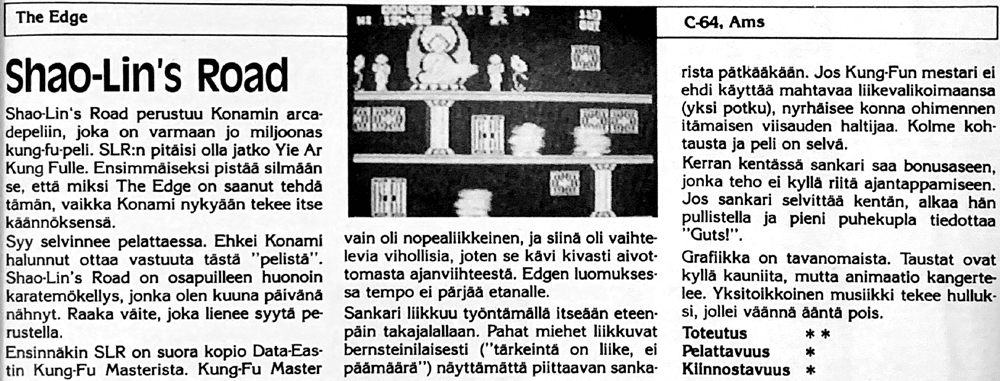
Shao-Lin's Road1987Pysyvä linkkiShao-Lin's Road perustuu Konamin arcadepeliin, joka on varmaan jo miljoonas kung-fu-peli. SLR:n pitäisi olla jatko Yie Ar Kung Fulle. Ensimmäiseksi pistää silmään se, että miksi The Edge on saanut tehdä tämän, vaikka Konami nykyään tekee itse käännöksensä.
Syy selvinnee pelattaessa. Ehkei Konami halunnut ottaa vastuuta tästä "pelistä". Shao-Lin's Road on osapuilleen huonoin karatemökellys, jonka olen kuuna päivänä nähnyt. Raaka väite, joka lienee syytä perustella.
Ensinnäkin SLR on suora kopio Data-Eastin Kung-Fu Masterista. Kung-Fu Master vain oli nopealiikkeinen, ja siinä oli vaihtelevia vihollisia, joten se kävi kivasti aivottomasta ajanviihteestä. Edgen luomuksessa tempo ei pärjää etanalle.
Sankari liikkuu työntämällä itseään eteenpäin takajalallaan. Pahat miehet liikkuvat bernsteinilaisesti ("tärkeintä on liike, ei päämäärä") näyttämättä piittaavan sankarista pätkääkään. Jos Kung-Fun mestari ei ehdi käyttää mahtavaa liikevalikoimaansa (yksi potku), nyrhäisee konna ohimennen itämaisen viisauden haltijaa. Kolme kohtausta ja peli on selvä.
Kerran kentässä sankari saa bonusaseen, jonka teho ei kyllä riitä ajantappamiseen. Jos sankari selvittää kentän, alkaa hän pullistella ja pieni puhekupla tiedottaa "Guts!".
Grafiikka on tavanomaista. Taustat ovat kyllä kauniita, mutta animaatio kangertelee. Yksitoikkoinen musiikki tekee hulluksi, jollei väännä ääntä pois.
Shao-Lin's Road1987PermalinkShao-Lin's Road is based on Konami's arcade game, which must be about the millionth kung-fu game by now. SLR is supposed to be the sequel to Yie Ar Kung Fu. The first thing that jumps out at you is the question of why The Edge has been allowed to do this one, when Konami these days does its own conversions.
The reason will probably become clear once you play it. Maybe Konami didn't want to take responsibility for this "game". Shao-Lin's Road is just about the worst karate botch-up I have seen in all my born days. A harsh claim, which I had probably better back up.
First of all, SLR is a straight copy of Data-East's Kung-Fu Master. Only Kung-Fu Master was fast-moving and had varied enemies, so it did nicely as brainless entertainment. In Edge's creation, the pace would lose a race to a snail.
The hero moves by shoving himself forward with his back leg. The bad guys move in a Bernsteinian manner ("what matters is the movement, not the goal") without seeming to care one jot about the hero. If the master of Kung-Fu doesn't get round to using his mighty repertoire of moves (one kick), the villain nicks the keeper of Oriental wisdom in passing. Three run-ins and the game is done.
Once per level the hero gets a bonus weapon, which frankly isn't powerful enough even to kill time. If the hero clears the level, he starts flexing his muscles and a little speech bubble announces "Guts!".
The graphics are run-of-the-mill. The backgrounds are pretty enough, but the animation stutters. The monotonous music will drive you mad unless you turn the sound off.
Sharkey's 3D Pool
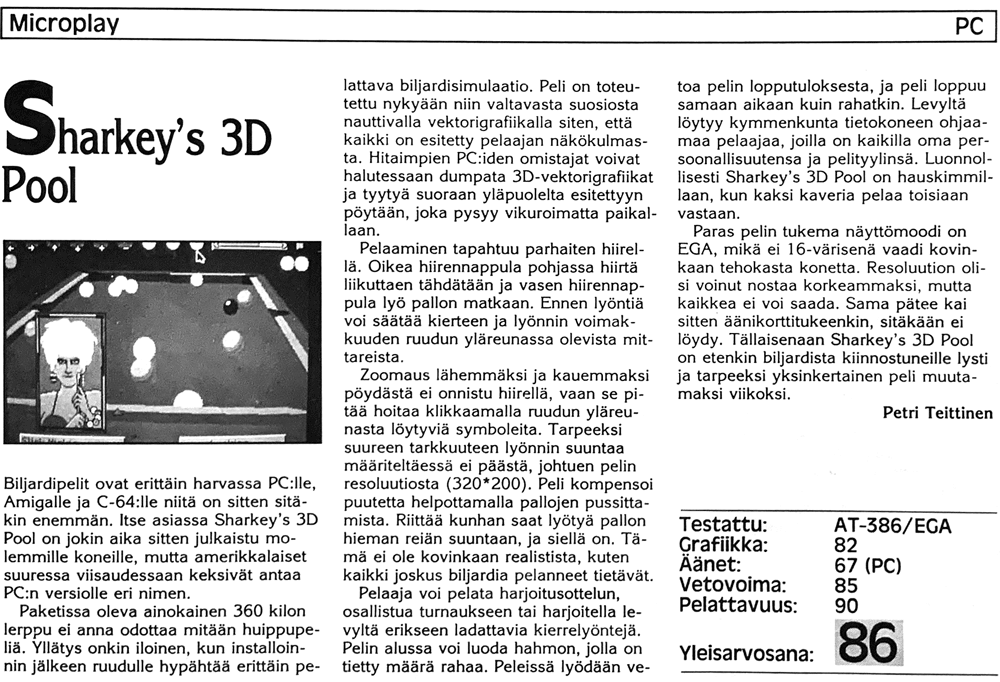
Sharkey's 3D Pool1991 KevätPysyvä linkkiBiljardipelit ovat erittäin harvassa PC:lle, Amigalle ja C-64:lle niitä on sitten sitäkin enemmän. Itse asiassa Sharkey's 3D Pool on jokin aika sitten julkaistu molemmille koneille, mutta amerikkalaiset suuressa viisaudessaan keksivät antaa PC:n versiolle eri nimen.
Paketissa oleva ainokainen 360 kilon lerppu ei anna odottaa mitään huippupeliä. Yllätys onkin iloinen, kun installoinnin jälkeen ruudulle hypähtää erittäin pelattava biljardisimulaatio. Peli on toteutettu nykyään niin valtavasta suosiosta nauttivalla vektorigrafiikalla siten, että kaikki on esitetty pelaajan näkökulmasta. Hitaimpien PC:iden omistajat voivat halutessaan dumpata 3D-vektorigrafiikat ja tyytyä suoraan yläpuolelta esitettyyn pöytään, joka pysyy vikuroimatta paikallaan.
Pelaaminen tapahtuu parhaiten hiirellä. Oikea hiirennappula pohjassa hiirtä liikuttaen tähdätään ja vasen hiirennappula lyö pallon matkaan. Ennen lyöntiä voi säätää kierteen ja lyönnin voimakkuuden ruudun yläreunassa olevista mittareista.
Zoomaus lähemmäksi ja kauemmaksi pöydästä ei onnistu hiirellä, vaan se pitää hoitaa klikkaamalla ruudun yläreunasta löytyviä symboleita. Tarpeeksi suureen tarkkuuteen lyönnin suuntaa määriteltäessä ei päästä, johtuen pelin resoluutiosta (320*200). Peli kompensoi puutetta helpottamalla pallojen pussittamista. Riittää kunhan saat lyötyä pallon hieman reiän suuntaan, ja siellä on. Tämä ei ole kovinkaan realistista, kuten kaikki joskus biljardia pelanneet tietävät.
Pelaaja voi pelata harjoitusottelun, osallistua turnaukseen tai harjoitella levyltä erikseen ladattavia kierrelyöntejä. Pelin alussa voi luoda hahmon, jolla on tietty määrä rahaa. Peleissä lyödään vetoa pelin lopputuloksesta, ja peli loppuu samaan aikaan kuin rahatkin. Levyltä löytyy kymmenkunta tietokoneen ohjaamaa pelaajaa, joilla on kaikilla oma persoonallisuutensa ja pelityylinsä. Luonnollisesti Sharkey's 3D Pool on hauskimmillaan, kun kaksi kaveria pelaa toisiaan vastaan.
Paras pelin tukema näyttömoodi on EGA, mikä ei 16-värisenä vaadi kovinkaan tehokasta konetta. Resoluution olisi voinut nostaa korkeammaksi, mutta kaikkea ei voi saada. Sama pätee kai sitten äänikorttitukeenkin, sitäkään ei löydy. Tällaisenaan Sharkey's 3D Pool on etenkin biljardista kiinnostuneille lysti ja tarpeeksi yksinkertainen peli muutamaksi viikoksi.
Sharkey's 3D Pool1991 KevätPermalinkBilliards games are very thin on the ground for the PC; for the Amiga and C-64 there are all the more of them. In fact Sharkey's 3D Pool came out on both machines a while ago, but the Americans in their great wisdom came up with the idea of giving the PC version a different name.
The lone 360K floppy in the box doesn't lead you to expect a top-notch game. So the surprise is a happy one when, after installing, a highly playable billiards simulation pops up on the screen. The game is done in vector graphics, which enjoy such enormous popularity these days, so that everything is shown from the player's point of view. Owners of the slowest PCs can, if they like, dump the 3D vector graphics and settle for a table seen from directly above, which stays put without playing up.
The game is best played with the mouse. You aim by moving the mouse with the right mouse button held down, and the left mouse button sends the ball on its way. Before the shot you can adjust the spin and the strength of the shot on the gauges along the top edge of the screen.
Zooming in and out from the table can't be done with the mouse; instead you have to do it by clicking the symbols found along the top edge of the screen. You can't get enough precision when setting the direction of a shot, owing to the game's resolution (320*200). The game makes up for the shortcoming by making it easier to pot the balls. It's enough to hit the ball roughly in the direction of the pocket, and in it goes. This isn't terribly realistic, as anyone who has ever played billiards knows.
The player can play a practice match, enter a tournament or practise spin shots loaded separately from the disk. At the start of the game you can create a character with a set amount of money. Bets are placed on the outcome of each game, and the game ends at the same time as the money does. The disk holds ten or so computer-controlled players, each with their own personality and playing style. Naturally, Sharkey's 3D Pool is at its most fun when two mates play against each other.
The best display mode the game supports is EGA, which, being 16-colour, doesn't need a very powerful machine. The resolution could have been pushed higher, but you can't have everything. I suppose the same goes for sound card support, which isn't there either. As it stands, Sharkey's 3D Pool is a jolly and simple enough game for a few weeks, especially for those interested in billiards.
Sherlock
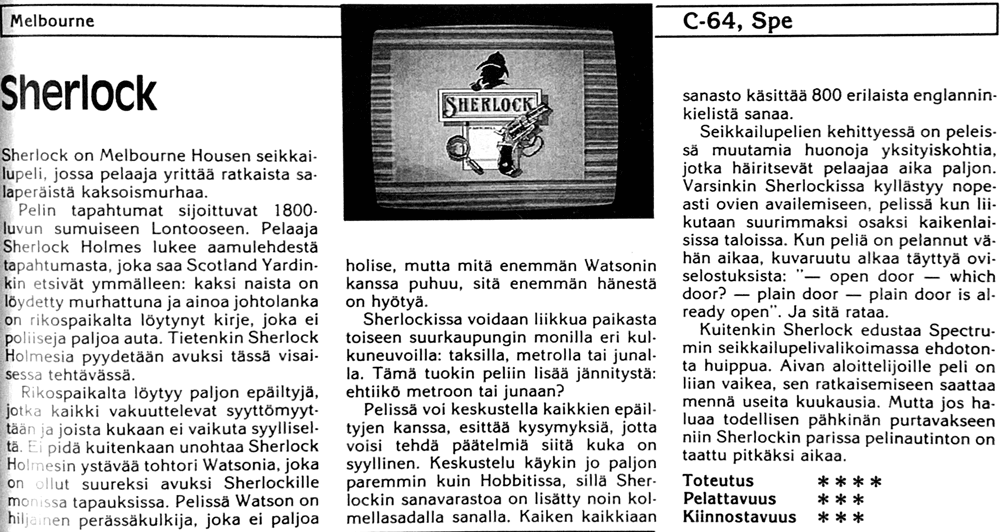
Sherlock1987Pysyvä linkkiSherlock on Melbourne Housen seikkailupeli, jossa pelaaja yrittää ratkaista salaperäistä kaksoismurhaa.
Pelin tapahtumat sijoittuvat 1800-luvun sumuiseen Lontooseen. Pelaaja Sherlock Holmes lukee aamulehdestä tapahtumasta, joka saa Scotland Yardinkin etsivät ymmälleen: kaksi naista on löydetty murhattuna ja ainoa johtolanka on rikospaikalta löytynyt kirje, joka ei poliiseja paljoa auta. Tietenkin Sherlock Holmesia pyydetään avuksi tässä visaisessa tehtävässä.
Rikospaikalta löytyy paljon epäiltyjä, jotka kaikki vakuuttelevat syyttömyyttään ja joista kukaan ei vaikuta syylliseltä. Ei pidä kuitenkaan unohtaa Sherlock Holmesin ystävää tohtori Watsonia, joka on ollut suureksi avuksi Sherlockille monissa tapauksissa. Pelissä Watson on hiljainen perässäkulkija, joka ei paljoa holise, mutta mitä enemmän Watsonin kanssa puhuu, sitä enemmän hänestä on hyötyä.
Sherlockissa voidaan liikkua paikasta toiseen suurkaupungin monilla eri kulkuneuvoilla: taksilla, metrolla tai junalla. Tämä tuokin peliin lisää jännitystä: ehtiikö metroon tai junaan?
Pelissä voi keskustella kaikkien epäiltyjen kanssa, esittää kysymyksiä, jotta voisi tehdä päätelmiä siitä kuka on syyllinen. Keskustelu käykin jo paljon paremmin kuin Hobbitissa, sillä Sherlockin sanavarastoa on lisätty noin kolmellasadalla sanalla. Kaiken kaikkiaan sanasto käsittää 800 erilaista englanninkielistä sanaa.
Seikkailupelien kehittyessä on peleissä muutamia huonoja yksityiskohtia, jotka häiritsevät pelaajaa aika paljon. Varsinkin Sherlockissa kyllästyy nopeasti ovien availemiseen, pelissä kun liikutaan suurimmaksi osaksi kaikenlaisissa taloissa. Kun peliä on pelannut vähän aikaa, kuvaruutu alkaa täyttyä oviselostuksista: "- open door - which door? - plain door - plain door is already open". Ja sitä rataa.
Kuitenkin Sherlock edustaa Spectrumin seikkailupelivalikoimassa ehdotonta huippua. Aivan aloittelijoille peli on liian vaikea, sen ratkaisemiseen saattaa mennä useita kuukausia. Mutta jos haluaa todellisen pähkinän purtavakseen niin Sherlockin parissa pelinautinton on taattu pitkäksi aikaa.
Sherlock1987PermalinkSherlock is an adventure game from Melbourne House in which the player tries to solve a mysterious double murder.
The game is set in the foggy London of the 1800s. The player, Sherlock Holmes, reads in the morning paper about an incident that has baffled even the detectives of Scotland Yard: two women have been found murdered, and the only clue is a letter found at the scene of the crime, which is not much help to the police. Naturally, Sherlock Holmes is asked to help with this tricky task.
There are plenty of suspects at the scene of the crime, all of whom protest their innocence and none of whom seems guilty. But one mustn't forget Sherlock Holmes's friend Dr Watson, who has been a great help to Sherlock in many cases. In the game Watson is a quiet tagalong who doesn't babble much, but the more you talk with Watson, the more useful he becomes.
In Sherlock you can get from place to place by the big city's many means of transport: by cab, by underground or by train. This adds a good deal of excitement to the game: will you make the underground or the train in time?
In the game you can converse with all the suspects and ask them questions, so that you can draw conclusions about who the guilty party is. Conversation already works much better than in The Hobbit, since Sherlock's vocabulary has been expanded by about three hundred words. All in all the vocabulary comprises 800 different English words.
Even as adventure games develop, they still have a few poor details that annoy the player quite a lot. In Sherlock especially you quickly get fed up with opening doors, since the game mostly takes place inside all sorts of houses. Once you've played for a little while, the screen starts filling up with door commentary: "- open door - which door? - plain door - plain door is already open". And so on and so forth.
Nevertheless, Sherlock represents the absolute peak of the Spectrum's range of adventure games. For complete beginners the game is too hard; solving it may take several months. But if you want a real nut to crack, Sherlock guarantees gaming pleasure for a long time to come.
Sherman M4
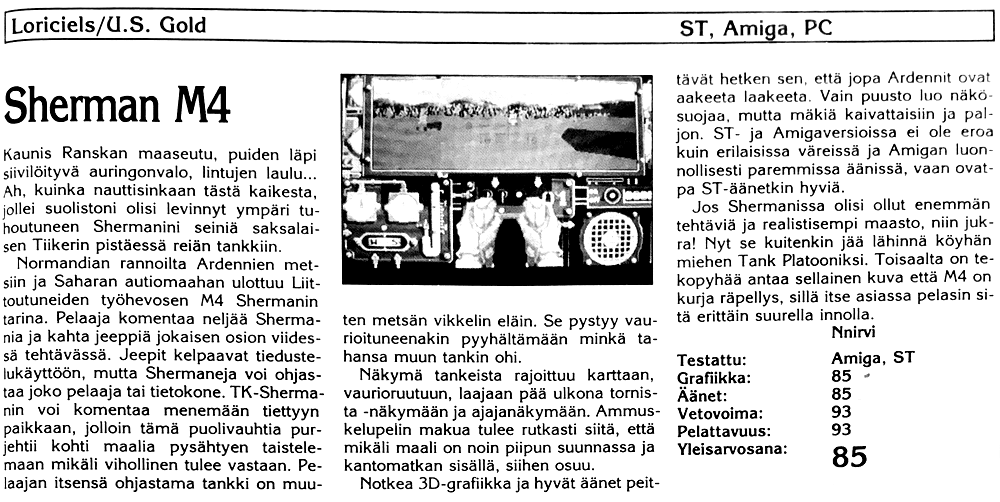
Sherman M41990 SyksyPysyvä linkkiKaunis Ranskan maaseutu, puiden läpi siivilöityvä auringonvalo, lintujen laulu... Ah, kuinka nauttisinkaan tästä kaikesta, jollei suolistoni olisi levinnyt ympäri tuhoutuneen Shermanini seiniä saksalaisen Tiikerin pistäessä reiän tankkiin.
Normandian rannoilta Ardennien metsiin ja Saharan autiomaahan ulottuu Liittoutuneiden työhevosen M4 Shermanin tarina. Pelaaja komentaa neljää Shermania ja kahta jeeppiä jokaisen osion viidessä tehtävässä. Jeepit kelpaavat tiedustelukäyttöön, mutta Shermaneja voi ohjastaa joko pelaaja tai tietokone. TK-Shermanin voi komentaa menemään tiettyyn paikkaan, jolloin tämä puolivauhtia purjehtii kohti maalia pysähtyen taistelemaan mikäli vihollinen tulee vastaan. Pelaajan itsensä ohjastama tankki on muuten metsän vikkelin eläin. Se pystyy vaurioituneenakin pyyhältämään minkä tahansa muun tankin ohi.
Näkymä tankeista rajoittuu karttaan, vaurioruutuun, laajaan pää ulkona tornista -näkymään ja ajajanäkymään. Ammuskelupelin makua tulee rutkasti siitä, että mikäli maali on noin piipun suunnassa ja kantomatkan sisällä, siihen osuu.
Notkea 3D-grafiikka ja hyvät äänet peittävät hetken sen, että jopa Ardennit ovat aakeeta laakeeta. Vain puusto luo näkösuojaa, mutta mäkiä kaivattaisiin ja paljon. ST- ja Amigaversioissa ei ole eroa kuin erilaisissa väreissä ja Amigan luonnollisesti paremmissa äänissä, vaan ovatpa ST-äänetkin hyviä.
Jos Shermanissa olisi ollut enemmän tehtäviä ja realistisempi maasto, niin jukra! Nyt se kuitenkin jää lähinnä köyhän miehen Tank Platooniksi. Toisaalta on tekopyhää antaa sellainen kuva että M4 on kurja räpellys, sillä itse asiassa pelasin sitä erittäin suurella innolla.
Sherman M41990 SyksyPermalinkThe beautiful French countryside, sunlight filtering through the trees, birdsong... Ah, how I would enjoy all of this, were my guts not spread all over the walls of my wrecked Sherman after a German Tiger punched a hole in the tank.
From the beaches of Normandy to the forests of the Ardennes and the Sahara desert stretches the story of the Allies' workhorse, the M4 Sherman. The player commands four Shermans and two jeeps in each section's five missions. The jeeps are good for reconnaissance, but the Shermans can be driven either by the player or by the computer. A computer-controlled Sherman can be ordered to go to a particular spot, whereupon it sails towards the objective at half speed, stopping to fight if it runs into the enemy. The tank the player drives personally is, by the way, the nimblest beast in the forest. Even when damaged it can zoom past any other tank.
The views from the tanks are limited to the map, the damage screen, a wide head-out-of-the-turret view and the driver's view. There's a hefty dose of shoot-'em-up flavour in the fact that if the target is roughly in line with the barrel and within range, you hit it.
Slick 3D graphics and good sound cover up for a while the fact that even the Ardennes are flat as a pancake. Only the trees provide any cover from view, but hills are sorely missed, and lots of them. The ST and Amiga versions differ only in their colours and in the Amiga's naturally better sound, though even the ST sound is good.
If Sherman had had more missions and more realistic terrain, then crikey! As it is, though, it ends up as more or less a poor man's Tank Platoon. On the other hand, it would be hypocritical to give the impression that M4 is a wretched botch, because the truth is I played it with great enthusiasm.
Shiloh: Grant's Trial in the West
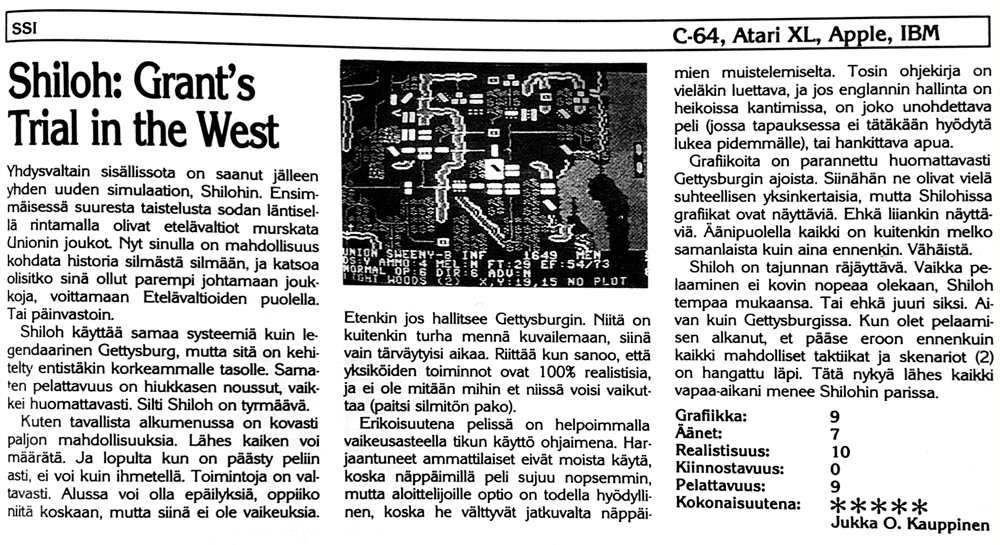
Shiloh: Grant's Trial in the West1988Pysyvä linkkiYhdysvaltain sisällissota on saanut jälleen yhden uuden simulaation, Shilohin. Ensimmäisessä suuresta taistelusta sodan läntisellä rintamalla olivat etelävaltiot murskata Unionin joukot. Nyt sinulla on mahdollisuus kohdata historia silmästä silmään, ja katsoa olisitko sinä ollut parempi johtamaan joukkoja, voittamaan Etelävaltioiden puolella. Tai päinvastoin.
Shiloh käyttää samaa systeemiä kuin legendaarinen Gettysburg, mutta sitä on kehitelty entistäkin korkeammalle tasolle. Samaten pelattavuus on hiukkasen noussut, vaikkei huomattavasti. Silti Shiloh on tyrmäävä.
Kuten tavallista alkumenussa on kovasti paljon mahdollisuuksia. Lähes kaiken voi määrätä. Ja lopulta kun on päästy peliin asti, ei voi kuin ihmetellä. Toimintoja on valtavasti. Alussa voi olla epäilyksiä, oppiiko niitä koskaan, mutta siinä ei ole vaikeuksia. Etenkin jos hallitsee Gettysburgin. Niitä on kuitenkin turha mennä kuvailemaan, siinä vain tärväytyisi aikaa. Riittää kun sanoo, että yksiköiden toiminnot ovat 100% realistisia, ja ei ole mitään mihin et niissä voisi vaikuttaa (paitsi silmitön pako).
Erikoisuutena pelissä on helpoimmalla vaikeusasteella tikun käyttö ohjaimena. Harjaantuneet ammattilaiset eivät moista käytä, koska näppäimillä peli sujuu nopsemmin, mutta aloittelijoille optio on todella hyödyllinen, koska he välttyvät jatkuvalta näppäimien muistelemiselta. Tosin ohjekirja on vieläkin luettava, ja jos englannin hallinta on heikoissa kantimissa, on joko unohdettava peli (jossa tapauksessa ei tätäkään hyödytä lukea pidemmälle), tai hankittava apua.
Grafiikoita on parannettu huomattavasti Gettysburgin ajoista. Siinähän ne olivat vielä suhteellisen yksinkertaisia, mutta Shilohissa grafiikat ovat näyttäviä. Ehkä liiankin näyttäviä. Äänipuolella kaikki on kuitenkin melko samanlaista kuin aina ennenkin. Vähäistä.
Shiloh on tajunnan räjäyttävä. Vaikka pelaaminen ei kovin nopeaa olekaan, Shiloh tempaa mukaansa. Tai ehkä juuri siksi. Aivan kuin Gettysburgissa. Kun olet pelaamisen alkanut, et pääse eroon ennenkuin kaikki mahdolliset taktiikat ja skenariot (2) on hangattu läpi. Tätä nykyä lähes kaikki vapaa-aikani menee Shilohin parissa.
Shiloh: Grant's Trial in the West1988PermalinkThe American Civil War has got yet another new simulation, Shiloh. In the first of the great battles on the war's western front, the Southern states came close to crushing the Union troops. Now you have the chance to face history eye to eye, and see whether you would have been better at leading the troops, at winning on the side of the Confederacy. Or the other way round.
Shiloh uses the same system as the legendary Gettysburg, but it has been developed to an even higher level. Likewise the playability has gone up a notch, though not significantly. Even so, Shiloh is a knockout.
As usual, the opening menu offers an awful lot of options. You can set almost everything. And when you finally make it into the game itself, all you can do is marvel. There are a huge number of commands. At first you may have doubts about whether you'll ever learn them, but there's no difficulty in that. Especially if you've mastered Gettysburg. There's no point going into describing them, though; that would only be a waste of time. Suffice it to say that the units' actions are 100% realistic, and there is nothing about them you can't influence (except headlong flight).
A special feature of the game is that on the easiest difficulty level you can use the joystick as the controller. Seasoned pros won't touch such a thing, because the game goes quicker with the keys, but for beginners the option is really useful, since it spares them from constantly trying to remember the keys. You still have to read the manual, mind you, and if your grasp of English is on shaky ground, you'll either have to forget the game (in which case there's no point reading this any further either) or get help.
The graphics have been improved considerably since the days of Gettysburg. There, of course, they were still relatively simple, but in Shiloh the graphics are impressive. Perhaps even too impressive. On the sound side, however, everything is much the same as it has always been. Meagre.
Shiloh is mind-blowing. Even though the play isn't particularly fast, Shiloh sweeps you along. Or maybe precisely because of that. Just like in Gettysburg. Once you've started playing, you can't break free until every possible tactic and scenario (2) has been ground through. These days nearly all my free time goes on Shiloh.
Shinobi
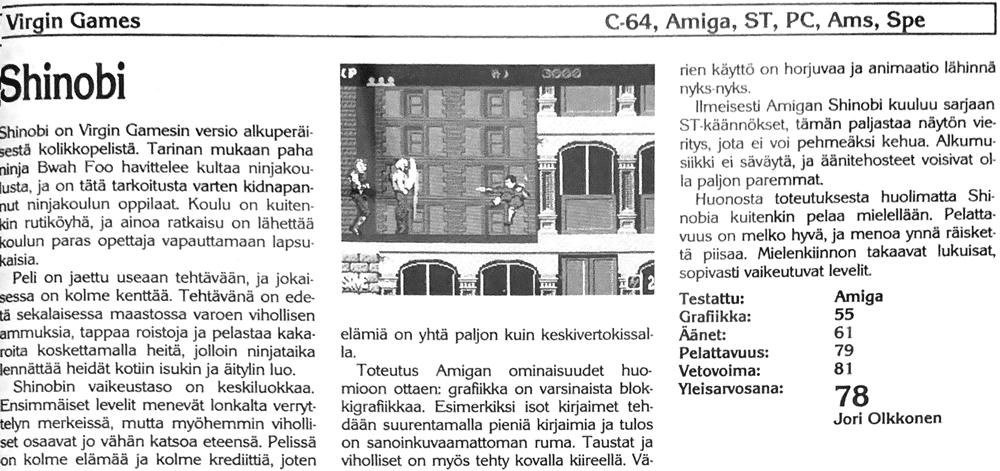
Shinobi1990 KevätPysyvä linkkiShinobi on Virgin Gamesin versio alkuperäisestä kolikkopelistä. Tarinan mukaan paha ninja Bwah Foo havittelee kultaa ninjakoulusta, ja on tätä tarkoitusta varten kidnapannut ninjakoulun oppilaat. Koulu on kuitenkin rutiköyhä, ja ainoa ratkaisu on lähettää koulun paras opettaja vapauttamaan lapsukaisia.
Peli on jaettu useaan tehtävään, ja jokaisessa on kolme kenttää. Tehtävänä on edetä sekalaisessa maastossa varoen vihollisen ammuksia, tappaa roistoja ja pelastaa kakaroita koskettamalla heitä, jolloin ninjataika lennättää heidät kotiin isukin ja äitylin luo.
Shinobin vaikeustaso on keskiluokkaa. Ensimmäiset levelit menevät lonkalta verryttelyn merkeissä, mutta myöhemmin viholliset osaavat jo vähän katsoa eteensä. Pelissä on kolme elämää ja kolme krediittiä, joten elämiä on yhtä paljon kuin keskivertokissalla.
Toteutus Amigan ominaisuudet huomioon ottaen: grafiikka on varsinaista blokkigrafiikkaa. Esimerkiksi isot kirjaimet tehdään suurentamalla pieniä kirjaimia ja tulos on sanoinkuvaamattoman ruma. Taustat ja viholliset on myös tehty kovalla kiireellä. Värien käyttö on horjuvaa ja animaatio lähinnä nyks-nyks.
Ilmeisesti Amigan Shinobi kuuluu sarjaan ST-käännökset, tämän paljastaa näytön vieritys, jota ei voi pehmeäksi kehua. Alkumusiikki ei säväytä, ja äänitehosteet voisivat olla paljon paremmat.
Huonosta toteutuksesta huolimatta Shinobia kuitenkin pelaa mielellään. Pelattavuus on melko hyvä, ja menoa ynnä räiskettä piisaa. Mielenkiinnon takaavat lukuisat, sopivasti vaikeutuvat levelit.
Shinobi1990 KevätPermalinkShinobi is Virgin Games' version of the original coin-op. According to the story, the evil ninja Bwah Foo is after gold from the ninja school and, to that end, has kidnapped the ninja school's pupils. The school, however, is dirt poor, and the only solution is to send the school's best teacher to free the little dears.
The game is divided into several missions, each with three levels. The task is to make your way through assorted terrain while dodging enemy fire, kill the villains and rescue the brats by touching them, whereupon ninja magic whisks them home to daddykins and mumsy.
Shinobi's difficulty level is middle-of-the-road. You breeze through the first levels off the hip, by way of a warm-up, but later on the enemies have learned to watch their step a bit. The game has three lives and three credits, so you get as many lives as your average cat.
The execution, bearing in mind what the Amiga can do: the graphics are out-and-out block graphics. The big letters, for example, are made by blowing up small letters, and the result is indescribably ugly. The backgrounds and enemies have also been done in a great rush. The use of colour is shaky and the animation mostly herky-jerky.
The Amiga Shinobi apparently belongs to the "ST conversions" series, as is given away by the screen scrolling, which no one could praise as smooth. The title music doesn't thrill, and the sound effects could be a lot better.
Despite the poor execution, though, Shinobi is something you enjoy playing. The playability is fairly good, and there's action plus blasting aplenty. Interest is kept up by the numerous levels, which get suitably harder.
Shockwave

Shockwave1991 KevätPysyvä linkkiEpäsosiaaliset ainekset saadaan kätevästi pois silmistä perustamalla rangaistussiirtola Kuuhun. Siellä ne sitten saavat hääräillä mitä mielivät, mutta ikävä kyllä ne parsivat kokoon mahtavan avaruuslaivaston saadakseen Maasta lisää elintilaa. Päivän tehtävä, jos suostut sen ottamaan, on kapinallisten kurittaminen. (Ja tämä arvostelu tuhoaa itsensä viidessä sekunnissa, vai? -toim.huom.)
Shockwave on tyypillinen 3D-ammuskelu, johon on lykätty sekaan vähän taktisia elementtejä. Maasto on jaettu neljään sektoriin, joilla on oma tehtävänsä puolustuksen huollossa. Merialue on varattu öljynporauslautoille, aavikolla on tehtaita, vuorilla kaivoksia ja metsissä armeijan yksiköitä. Kun on tarpeeksi rahaa, voi perustaa vaikka lisää tehtaita, jotka nopeuttavat uusien aseiden kehittelyä. Vastaavasti armeijat hidastavat vihollista ja niin poispäin. Mistään sektorista ei saa antaa yli puolikasta vihollisen haltuun, tai ne alkavat kaapata laitoksia.
Varsinaisessa toimintaosuudessa on käytetty afterburnermaista 3D-efektiä, jossa on mukana jopa aluksen kallistelu. Grafiikka hieman hajoaa palikoiksi, mutta vauhdissa sitä ei juuri huomaa. Nopeus on hyväksyttävällä tasolla, mutta sulavuudessa olisi parantamisen varaa, sillä maisema vilistää silmille hieman liian hätäiseen tahtiin.
Kohtuullisesta ideasta on melkein saatu hyvä peli. Lentelyjaksoissa on aivan liian tiheässä maastoesteitä, joiden vuoksi on vaikea saada aikaan kunnollista tappomeininkiä. Pelaaja joutuu omaksumaan turhan ylivarovaisen asenteen, sillä uusia suojakenttiä jaellaan älyttömän niukasti, vaikka olisi tehtaita ja rahaa vaikka millä mitalla. Huipentumisen sijaan pelillä on taipumus kuivua kasaan pikku hiljaa, mikä ei todellakaan saa innosta pomppimaan.
Shockwave1991 KevätPermalinkAntisocial elements are handily got out of sight by setting up a penal colony on the Moon. There they can then potter about doing whatever they please, but unfortunately they cobble together a mighty space fleet to win themselves more living space from Earth. Your mission for today, should you choose to accept it, is to bring the rebels to heel. (And this review will self-destruct in five seconds, will it? - ed.)
Shockwave is a typical 3D shoot-'em-up with a few tactical elements shoved in. The terrain is divided into four sectors, each with its own job in keeping the defences supplied. The sea area is reserved for oil rigs, the desert has factories, the mountains mines and the forests army units. When you have enough money, you can for instance set up more factories, which speed up the development of new weapons. Likewise, armies slow the enemy down, and so on. You mustn't let more than half of any sector fall into enemy hands, or they start capturing installations.
The action section proper uses an afterburner-like 3D effect, complete with the craft banking. The graphics break up into blocks a little, but at speed you hardly notice. The speed is at an acceptable level, but the smoothness could be improved, as the landscape rushes at your eyes at a slightly too hurried pace.
A reasonable idea has almost been made into a good game. The flying sections are packed far too densely with terrain obstacles, which make it hard to get a proper killing spree going. The player has to adopt a needlessly over-cautious attitude, since new shields are handed out ridiculously sparingly, even when you have factories and money by the bucketload. Instead of building to a climax, the game has a tendency to dry up and shrivel away bit by bit, which really doesn't make you bounce with enthusiasm.
Shockway Rider
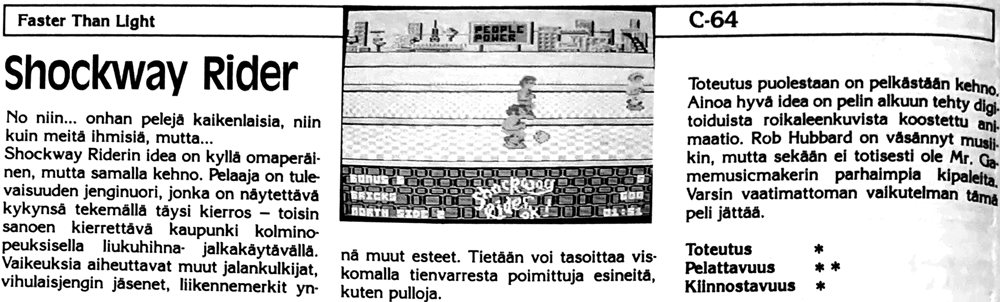
Shockway Rider1987Pysyvä linkkiNo niin... onhan pelejä kaikenlaisia, niin kuin meitä ihmisiä, mutta...
Shockway Riderin idea on kyllä omaperäinen, mutta samalla kehno. Pelaaja on tulevaisuuden jenginuori, jonka on näytettävä kykynsä tekemällä täysi kierros - toisin sanoen kierrettävä kaupunki kolminopeuksisella liukuhihna- jalkakäytävällä. Vaikeuksia aiheuttavat muut jalankulkijat, vihulaisjengin jäsenet, liikennemerkit ynnä muut esteet. Tietään voi tasoittaa viskomalla tienvarresta poimittuja esineitä, kuten pulloja.
Toteutus puolestaan on pelkästään kehno. Ainoa hyvä idea on pelin alkuun tehty digitoiduista roikaleenkuvista koostettu animaatio. Rob Hubbard on väsännyt musiikin, mutta sekään ei totisesti ole Mr. Gamemusicmakerin parhaimpia kipaleita. Varsin vaatimattoman vaikutelman tämä peli jättää.
Shockway Rider1987PermalinkOh well... it takes all sorts, games as well as us people, but...
The idea of Shockway Rider is certainly original, but at the same time lousy. The player is a gang kid of the future who has to prove himself by doing a full lap - in other words, going all the way round the city on a three-speed conveyor-belt pavement. Trouble comes from other pedestrians, members of the rival gang, road signs and other obstacles. You can clear your path by hurling objects picked up from the roadside, such as bottles.
The execution, on the other hand, is just plain lousy. The only good idea is the animation at the start of the game, put together from digitised pictures of hoodlums. Rob Hubbard has knocked out the music, but even that is certainly not one of Mr. Gamemusicmaker's best tunes. This game leaves a rather modest impression.
Shogun
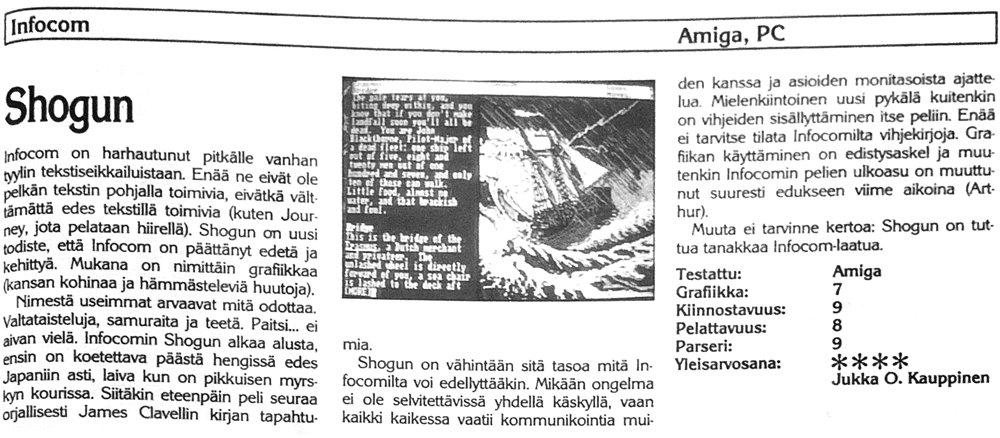
Shogun1989 SyksyPysyvä linkkiInfocom on harhautunut pitkälle vanhan tyylin tekstiseikkailuistaan. Enää ne eivät ole pelkän tekstin pohjalla toimivia, eivätkä välttämättä edes tekstillä toimivia (kuten Journey, jota pelataan hiirellä). Shogun on uusi todiste, että Infocom on päättänyt edetä ja kehittyä. Mukana on nimittäin grafiikkaa (kansan kohinaa ja hämmästeleviä huutoja).
Nimestä useimmat arvaavat mitä odottaa. Valtataisteluja, samuraita ja teetä. Paitsi... ei aivan vielä. Infocomin Shogun alkaa alusta, ensin on koetettava päästä hengissä edes Japaniin asti, laiva kun on pikkuisen myrskyn kourissa. Siitäkin eteenpäin peli seuraa orjallisesti James Clavellin kirjan tapahtumia.
Shogun on vähintään sitä tasoa mitä Infocomilta voi edellyttääkin. Mikään ongelma ei ole selvitettävissä yhdellä käskyllä, vaan kaikki kaikessa vaatii kommunikointia muiden kanssa ja asioiden monitasoista ajattelua. Mielenkiintoinen uusi pykälä kuitenkin on vihjeiden sisällyttäminen itse peliin. Enää ei tarvitse tilata Infocomilta vihjekirjoja. Grafiikan käyttäminen on edistysaskel ja muutenkin Infocomin pelien ulkoasu on muuttunut suuresti edukseen viime aikoina (Arthur).
Muuta ei tarvinne kertoa: Shogun on tuttua tanakkaa Infocom-laatua.
Shogun1989 SyksyPermalinkInfocom has strayed a long way from its old-style text adventures. They no longer run on text alone, and don't necessarily even run on text (like Journey, which is played with the mouse). Shogun is fresh proof that Infocom has decided to move on and develop. For it includes graphics (murmuring from the crowd and cries of astonishment).
From the name most people will guess what to expect. Power struggles, samurai and tea. Except... not quite yet. Infocom's Shogun starts at the very beginning: first you have to try to make it to Japan alive at all, what with the ship being in the grip of a bit of a storm. From there on, too, the game slavishly follows the events of James Clavell's book.
Shogun is at least up to the standard you would expect from Infocom. No problem can be solved with a single command; instead, all in all, everything requires communicating with others and thinking about things on several levels. An interesting new touch, however, is the inclusion of hints in the game itself. You no longer need to order hint books from Infocom. The use of graphics is a step forward, and in other ways too the look of Infocom's games has changed greatly for the better lately (Arthur).
Nothing more needs saying: Shogun is the familiar, sturdy Infocom quality.
Shoot Em Up Construction Kit
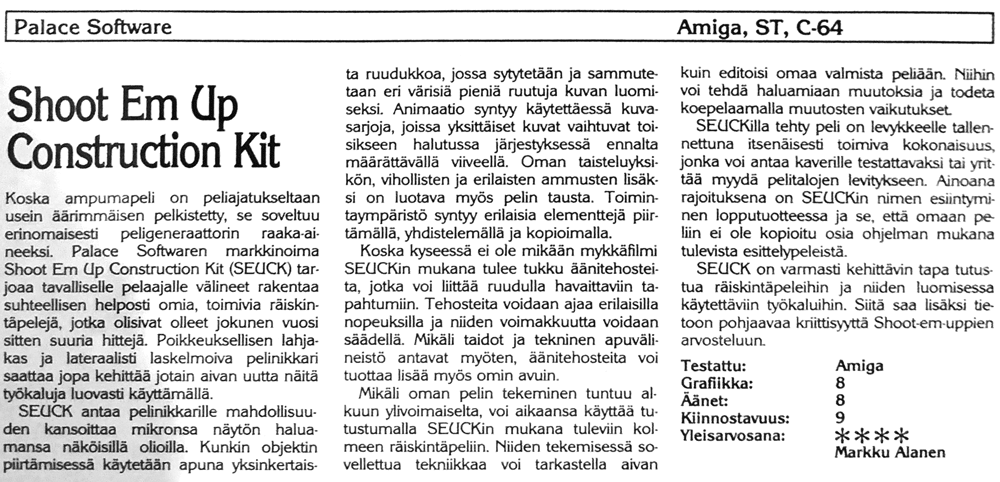
Shoot Em Up Construction Kit1989 SyksyPysyvä linkkiKoska ampumapeli on peliajatukseltaan usein äärimmäisen pelkistetty, se soveltuu erinomaisesti peligeneraattorin raaka-aineeksi. Palace Softwaren markkinoima Shoot Em Up Construction Kit (SEUCK) tarjoaa tavalliselle pelaajalle välineet rakentaa suhteellisen helposti omia, toimivia räiskintäpelejä, jotka olisivat olleet jokunen vuosi sitten suuria hittejä. Poikkeuksellisen lahjakas ja lateraalisti laskelmoiva pelinikkari saattaa jopa kehittää jotain aivan uutta näitä työkaluja luovasti käyttämällä.
SEUCK antaa pelinikkarille mahdollisuuden kansoittaa mikronsa näytön haluamansa näköisillä olioilla. Kunkin objektin piirtämisessä käytetään apuna yksinkertaista ruudukkoa, jossa sytytetään ja sammutetaan eri värisiä pieniä ruutuja kuvan luomiseksi. Animaatio syntyy käytettäessä kuvasarjoja, joissa yksittäiset kuvat vaihtuvat toisikseen halutussa järjestyksessä ennalta määrättävällä viiveellä. Oman taisteluyksikön, vihollisten ja erilaisten ammusten lisäksi on luotava myös pelin tausta. Toimintaympäristö syntyy erilaisia elementtejä piirtämällä, yhdistelemällä ja kopioimalla.
Koska kyseessä ei ole mikään mykkäfilmi SEUCKin mukana tulee tukku äänitehosteita, jotka voi liittää ruudulla havaittaviin tapahtumiin. Tehosteita voidaan ajaa erilaisilla nopeuksilla ja niiden voimakkuutta voidaan säädellä. Mikäli taidot ja tekninen apuvälineistö antavat myöten, äänitehosteita voi tuottaa lisää myös omin avuin.
Mikäli oman pelin tekeminen tuntuu alkuun ylivoimaiselta, voi aikaansa käyttää tutustumalla SEUCKin mukana tuleviin kolmeen räiskintäpeliin. Niiden tekemisessä sovellettua tekniikkaa voi tarkastella aivan kuin editoisi omaa valmista peliään. Niihin voi tehdä haluamiaan muutoksia ja todeta koepelaamalla muutosten vaikutukset.
SEUCKilla tehty peli on levykkeelle tallennettuna itsenäisesti toimiva kokonaisuus, jonka voi antaa kaverille testattavaksi tai yrittää myydä pelitalojen levitykseen. Ainoana rajoituksena on SEUCKin nimen esiintyminen lopputuotteessa ja se, että omaan peliin ei ole kopioitu osia ohjelman mukana tulevista esittelypeleistä.
SEUCK on varmasti kehittävin tapa tutustua räiskintäpeleihin ja niiden luomisessa käytettäviin työkaluihin. Siitä saa lisäksi tietoon pohjaavaa kriittisyyttä Shoot-em-uppien arvosteluun.
Shoot Em Up Construction Kit1989 SyksyPermalinkSince the shooting game is often extremely stripped down in its concept, it lends itself superbly as raw material for a game generator. The Shoot Em Up Construction Kit (SEUCK), marketed by Palace Software, gives the ordinary player the means to build, relatively easily, working blasters of their own that would have been big hits a few years ago. An exceptionally gifted and laterally calculating game tinkerer might even come up with something completely new by using these tools creatively.
SEUCK lets the game tinkerer populate their micro's screen with creatures that look however they want. Each object is drawn with the help of a simple grid, in which small squares of different colours are switched on and off to create the image. Animation comes from using image sequences in which the individual frames change into one another in the desired order after a preset delay. Besides your own fighting unit, the enemies and the various projectiles, you also have to create the game's background. The setting for the action is produced by drawing, combining and copying various elements.
Since this is no silent movie, SEUCK comes with a bundle of sound effects that can be attached to the events seen on screen. The effects can be run at different speeds and their volume can be adjusted. If your skills and technical equipment allow, you can also produce more sound effects under your own steam.
If making a game of your own feels overwhelming at first, you can spend your time getting to know the three blasters that come with SEUCK. You can examine the techniques used in making them just as if you were editing a finished game of your own. You can make whatever changes you like to them and see the effects of those changes by test-playing.
A game made with SEUCK, once saved to disk, is a self-contained, independently running whole, which you can give to a friend to test or try to sell to software houses for distribution. The only restrictions are that SEUCK's name must appear in the end product and that no parts of the demo games supplied with the program have been copied into your own game.
SEUCK is surely the most educational way to get acquainted with shoot-'em-ups and the tools used to create them. On top of that, it gives you an informed critical eye for reviewing Shoot-em-ups.
Shoot'em Up Construction Kit
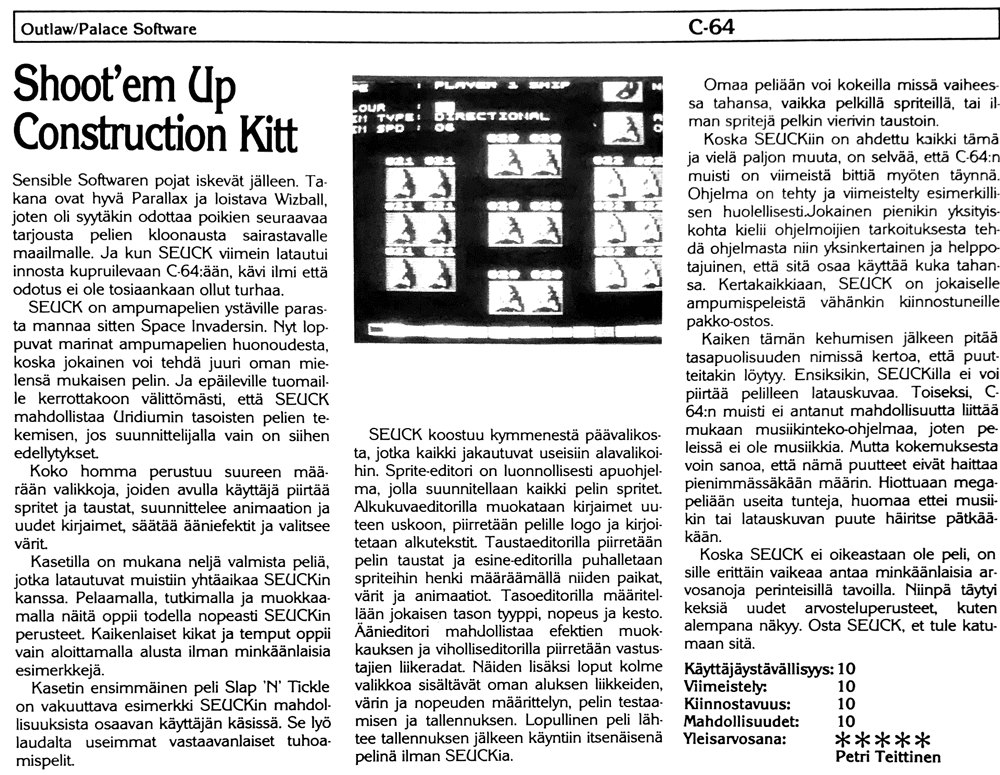
Shoot'em Up Construction Kit1988Pysyvä linkkiSensible Softwaren pojat iskevät jälleen. Takana ovat hyvä Parallax ja loistava Wizball, joten oli syytäkin odottaa poikien seuraavaa tarjousta pelien kloonausta sairastavalle maailmalle. Ja kun SEUCK viimein latautui innosta kupruilevaan C-64:ään, kävi ilmi että odotus ei ole tosiaankaan ollut turhaa.
SEUCK on ampumapelien ystäville parasta mannaa sitten Space Invadersin. Nyt loppuvat marinat ampumapelien huonoudesta, koska jokainen voi tehdä juuri oman mielensä mukaisen pelin. Ja epäileville tuomaille kerrottakoon välittömästi, että SEUCK mahdollistaa Uridiumin tasoisten pelien tekemisen, jos suunnittelijalla vain on siihen edellytykset.
Koko homma perustuu suureen määrään valikkoja, joiden avulla käyttäjä piirtää spritet ja taustat, suunnittelee animaation ja uudet kirjaimet, säätää ääniefektit ja valitsee värit.
Kasetilla on mukana neljä valmista peliä, jotka latautuvat muistiin yhtäaikaa SEUCKin kanssa. Pelaamalla, tutkimalla ja muokkaamalla näitä oppii todella nopeasti SEUCKin perusteet. Kaikenlaiset kikat ja temput oppii vain aloittamalla alusta ilman minkäänlaisia esimerkkejä.
Kasetin ensimmäinen peli Slap 'N' Tickle on vakuuttava esimerkki SEUCKin mahdollisuuksista osaavan käyttäjän käsissä. Se lyö laudalta useimmat vastaavanlaiset tuhoamispelit.
SEUCK koostuu kymmenestä päävalikosta, jotka kaikki jakautuvat useisiin alavalikoihin. Sprite-editori on luonnollisesti apuohjelma, jolla suunnitellaan kaikki pelin spritet. Alkukuvaeditorilla muokataan kirjaimet uuteen uskoon, piirretään pelille logo ja kirjoitetaan alkutekstit. Taustaeditorilla piirretään pelin taustat ja esine-editorilla puhalletaan spriteihin henki määräämällä niiden paikat, värit ja animaatiot. Tasoeditorilla määritellään jokaisen tason tyyppi, nopeus ja kesto. Äänieditori mahdollistaa efektien muokkauksen ja viholliseditorilla piirretään vastustajien liikeradat. Näiden lisäksi loput kolme valikkoa sisältävät oman aluksen liikkeiden, värin ja nopeuden määrittelyn, pelin testaamisen ja tallennuksen. Lopullinen peli lähtee tallennuksen jälkeen käyntiin itsenäisenä pelinä ilman SEUCKia.
Omaa peliään voi kokeilla missä vaiheessa tahansa, vaikka pelkillä spriteillä, tai ilman spritejä pelkin vierivin taustoin.
Koska SEUCKiin on ahdettu kaikki tämä ja vielä paljon muuta, on selvää, että C-64:n muisti on viimeistä bittiä myöten täynnä. Ohjelma on tehty ja viimeistelty esimerkillisen huolellisesti.Jokainen pienikin yksityiskohta kielii ohjelmoijien tarkoituksesta tehdä ohjelmasta niin yksinkertainen ja helppotajuinen, että sitä osaa käyttää kuka tahansa. Kertakaikkiaan, SEUCK on jokaiselle ampumispeleistä vähänkin kiinnostuneille pakko-ostos.
Kaiken tämän kehumisen jälkeen pitää tasapuolisuuden nimissä kertoa, että puutteitakin löytyy. Ensiksikin, SEUCKilla ei voi piirtää pelilleen latauskuvaa. Toiseksi, C-64:n muisti ei antanut mahdollisuutta liittää mukaan musiikinteko-ohjelmaa, joten peleissä ei ole musiikkia. Mutta kokemuksesta voin sanoa, että nämä puutteet eivät haittaa pienimmässäkään määrin. Hiottuaan megapeliään useita tunteja, huomaa ettei musiikin tai latauskuvan puute häiritse pätkääkään.
Koska SEUCK ei oikeastaan ole peli, on sille erittäin vaikeaa antaa minkäänlaisia arvosanoja perinteisillä tavoilla. Niinpä täytyi keksiä uudet arvosteluperusteet, kuten alempana näkyy. Osta SEUCK, et tule katumaan sitä.
Shoot'em Up Construction Kit1988PermalinkThe Sensible Software boys strike again. With the good Parallax and the brilliant Wizball behind them, there was every reason to look forward to the lads' next offering to a world sick with game-cloning. And when SEUCK finally loaded into a C-64 fairly bulging with excitement, it turned out the wait really hadn't been in vain.
For shoot-'em-up fans, SEUCK is the best manna since Space Invaders. Now the moaning about how bad shoot-'em-ups are can stop, because everyone can make a game exactly to their own liking. And let the doubting Thomases be told straight away that SEUCK makes it possible to create games on the level of Uridium, provided the designer has what it takes.
The whole thing is based on a large number of menus, with which the user draws the sprites and backgrounds, designs the animation and new lettering, tweaks the sound effects and picks the colours.
The cassette includes four ready-made games, which load into memory at the same time as SEUCK. By playing, examining and modifying them you learn the basics of SEUCK really quickly. All the tips and tricks, you only learn by starting from scratch without any examples whatsoever.
The first game on the cassette, Slap 'N' Tickle, is a convincing example of what SEUCK can do in skilled hands. It beats most destruction games of its kind hands down.
SEUCK consists of ten main menus, all of which branch into several submenus. The sprite editor is, naturally, the utility for designing all of the game's sprites. The title screen editor is used to give the lettering a complete makeover, draw a logo for the game and write the intro text. The background editor is for drawing the game's backgrounds, and the object editor breathes life into the sprites by setting their positions, colours and animations. The level editor defines each level's type, speed and duration. The sound editor lets you modify the effects, and the enemy editor is for drawing the opponents' flight paths. On top of these, the remaining three menus cover setting your own ship's movement, colour and speed, testing the game, and saving. Once saved, the finished game runs as a standalone game without SEUCK.
You can try out your own game at any stage, even with nothing but sprites, or without sprites using only scrolling backgrounds.
Since all this and a lot more has been crammed into SEUCK, it's obvious that the C-64's memory is full down to the very last bit. The program has been made and polished with exemplary care. Every little detail betrays the programmers' aim of making the program so simple and easy to grasp that anyone can use it. Quite simply, SEUCK is a must-buy for everyone with even the slightest interest in shoot-'em-ups.
After all this praise, in the name of fairness I have to say that there are shortcomings too. Firstly, SEUCK can't draw a loading screen for your game. Secondly, the C-64's memory left no room to include a music-making program, so the games have no music. But I can say from experience that these shortcomings don't matter in the slightest. After you've spent several hours polishing your mega-game, you notice that the lack of music or a loading screen doesn't bother you one bit.
Since SEUCK isn't really a game, it's extremely difficult to give it any kind of scores in the traditional way. So new rating criteria had to be invented, as you can see below. Buy SEUCK, you won't regret it.
Sidewalk
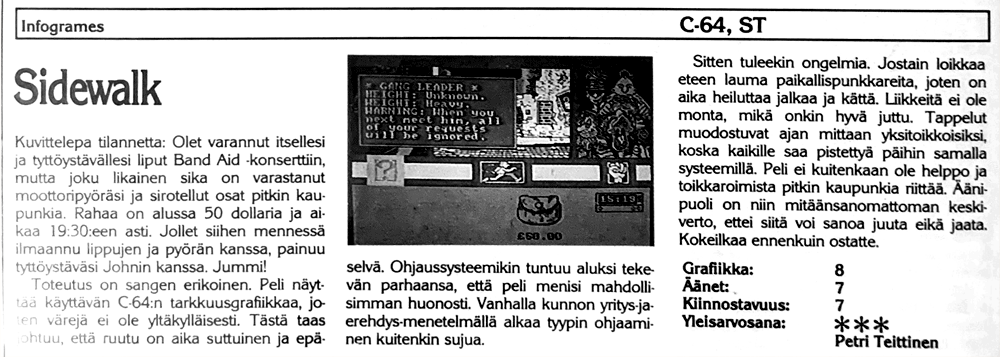
Sidewalk1988Pysyvä linkkiKuvittelepa tilannetta: Olet varannut itsellesi ja tyttöystävällesi liput Band Aid -konserttiin, mutta joku likainen sika on varastanut moottoripyöräsi ja sirotellut osat pitkin kaupunkia. Rahaa on alussa 50 dollaria ja aikaa 19:30:een asti. Jollet siihen mennessä ilmaannu lippujen ja pyörän kanssa, painuu tyttöystäväsi Johnin kanssa. Jummi!
Toteutus on sangen erikoinen. Peli näyttää käyttävän C-64:n tarkkuusgrafiikkaa, joten värejä ei ole yltäkylläisesti. Tästä taas johtuu, että ruutu on aika suttuinen ja epäselvä. Ohjaussysteemikin tuntuu aluksi tekevän parhaansa, että peli menisi mahdollisimman huonosti. Vanhalla kunnon yritys-ja-erehdys-menetelmällä alkaa tyypin ohjaaminen kuitenkin sujua.
Sitten tuleekin ongelmia. Jostain loikkaa eteen lauma paikallispunkkareita, joten on aika heiluttaa jalkaa ja kättä. Liikkeitä ei ole monta, mikä onkin hyvä juttu. Tappelut muodostuvat ajan mittaan yksitoikkoisiksi, koska kaikille saa pistettyä päihin samalla systeemillä. Peli ei kuitenkaan ole helppo ja toikkaroimista pitkin kaupunkia riittää. Äänipuoli on niin mitäänsanomattoman keskiverto, ettei siitä voi sanoa juuta eikä jaata. Kokeilkaa ennenkuin ostatte.
Sidewalk1988PermalinkJust picture the situation: you've booked tickets to the Band Aid concert for yourself and your girlfriend, but some filthy swine has stolen your motorbike and scattered the parts all over town. You start out with 50 dollars and have until 7:30 pm. If you haven't turned up with the tickets and the bike by then, your girlfriend takes off with John. Yikes!
The execution is rather unusual. The game seems to use the C-64's hi-res graphics, so colours are not exactly plentiful. That in turn makes the screen pretty smudgy and unclear. At first even the control system seems to be doing its level best to make the game go as badly as possible. With the good old trial-and-error method, though, steering the guy starts to go smoothly.
Then the trouble starts. A pack of local punks leaps out in front of you from somewhere, so it's time to get swinging with your arms and legs. There aren't many moves, which is actually a good thing. In the long run the fights get monotonous, because you can beat everyone up with the same routine. The game isn't easy, though, and there's plenty of staggering around town to be done. The sound side is so blandly average that there's nothing to say about it one way or the other. Try it before you buy.
Silent Service
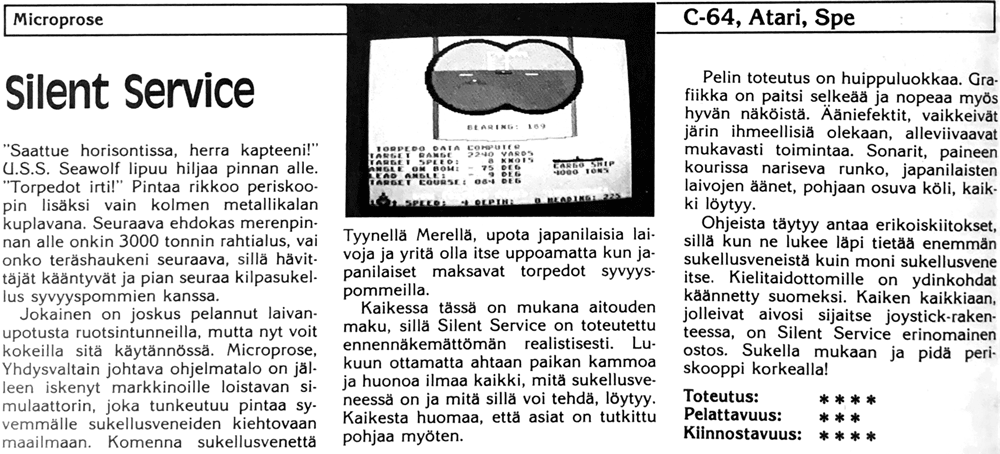
Silent Service1987Pysyvä linkki"Saattue horisontissa, herra kapteeni!" U.S.S. Seawolf lipuu hiljaa pinnan alle. "Torpedot irti!" Pintaa rikkoo periskoopin lisäksi vain kolmen metallikalan kuplavana. Seuraava ehdokas merenpinnan alle onkin 3000 tonnin rahtialus, vai onko teräshaukeni seuraava, sillä hävittäjät kääntyvät ja pian seuraa kilpasukellus syvyyspommien kanssa.
Jokainen on joskus pelannut laivanupotusta ruotsintunneilla, mutta nyt voit kokeilla sitä käytännössä. Microprose, Yhdysvaltain johtava ohjelmatalo on jälleen iskenyt markkinoille loistavan simulaattorin, joka tunkeutuu pintaa syvemmälle sukellusveneiden kiehtovaan maailmaan. Komenna sukellusvenettä Tyynellä Merellä, upota japanilaisia laivoja ja yritä olla itse uppoamatta kun japanilaiset maksavat torpedot syvyyspommeilla.
Kaikessa tässä on mukana aitouden maku, sillä Silent Service on toteutettu ennennäkemättömän realistisesti. Lukuun ottamatta ahtaan paikan kammoa ja huonoa ilmaa kaikki, mitä sukellusveneessä on ja mitä sillä voi tehdä, löytyy. Kaikesta huomaa, että asiat on tutkittu pohjaa myöten.
Pelin toteutus on huippuluokkaa. Grafiikka on paitsi selkeää ja nopeaa myös hyvän näköistä. Ääniefektit, vaikkeivät järin ihmeellisiä olekaan, alleviivaavat mukavasti toimintaa. Sonarit, paineen kourissa nariseva runko, japanilaisten laivojen äänet, pohjaan osuva köli, kaikki löytyy.
Ohjeista täytyy antaa erikoiskiitokset, sillä kun ne lukee läpi tietää enemmän sukellusveneistä kuin moni sukellusvene itse. Kielitaidottomille on ydinkohdat käännetty suomeksi. Kaiken kaikkiaan, jolleivat aivosi sijaitse joystick-rakenteessa, on Silent Service erinomainen ostos. Sukella mukaan ja pidä periskooppi korkealla!
Silent Service1987Permalink"Convoy on the horizon, Captain, sir!" The U.S.S. Seawolf glides quietly beneath the surface. "Torpedoes away!" Apart from the periscope, the only thing breaking the surface is the bubble trail of three metal fish. The next candidate for a spot below sea level is a 3000-ton freighter - or is my steel pike next, since the destroyers are turning and soon there will be a diving race with the depth charges.
Everyone has played Battleships at some point in Swedish class, but now you can try it for real. Microprose, the leading software house in the United States, has once again hit the market with a brilliant simulator that goes deeper than the surface into the fascinating world of submarines. Command a submarine in the Pacific, sink Japanese ships and try not to sink yourself when the Japanese pay back the torpedoes with depth charges.
All of this has the taste of authenticity, as Silent Service has been made with unprecedented realism. Apart from claustrophobia and bad air, everything there is in a submarine and everything you can do with one is included. Everything shows that the subject has been researched right down to the bottom.
The game's execution is top class. The graphics are not only clear and fast but good-looking too. The sound effects, though not all that amazing, underline the action nicely. The sonars, the hull creaking in the grip of the pressure, the sounds of the Japanese ships, the keel hitting the bottom - it's all there.
The instructions deserve special praise, because once you've read them through you know more about submarines than many a submarine does. For those without the language skills, the key points have been translated into Finnish. All in all, unless your brain is located inside a joystick, Silent Service is an excellent buy. Dive in and keep your periscope up!
Silicon Dreams
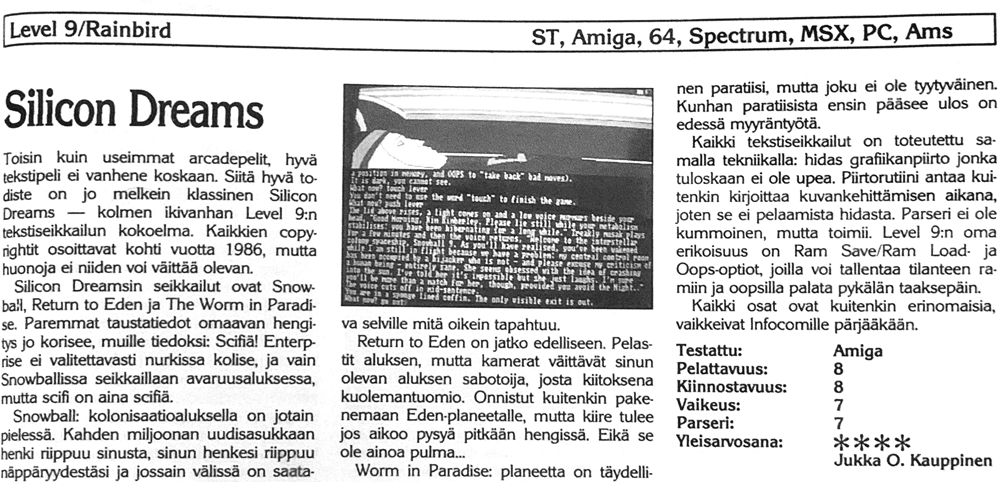
Silicon Dreams1989 SyksyPysyvä linkkiToisin kuin useimmat arcadepelit, hyvä tekstipeli ei vanhene koskaan. Siitä hyvä todiste on jo melkein klassinen Silicon Dreams - kolmen ikivanhan Level 9:n tekstiseikkailun kokoelma. Kaikkien copyrightit osoittavat kohti vuotta 1986, mutta huonoja ei niiden voi väittää olevan.
Silicon Dreamsin seikkailut ovat Snowball, Return to Eden ja The Worm in Paradise. Paremmat taustatiedot omaavan hengitys jo korisee, muille tiedoksi: Scifiä! Enterprise ei valitettavasti nurkissa kolise, ja vain Snowballissa seikkaillaan avaruusaluksessa, mutta scifi on aina scifiä.
Snowball: kolonisaatioaluksella on jotain pielessä. Kahden miljoonan uudisasukkaan henki riippuu sinusta, sinun henkesi riippuu näppäryydestäsi ja jossain välissä on saatava selville mitä oikein tapahtuu.
Return to Eden on jatko edelliseen. Pelastit aluksen, mutta kamerat väittävät sinun olevan aluksen sabotoija, josta kiitoksena kuolemantuomio. Onnistut kuitenkin pakenemaan Eden-planeetalle, mutta kiire tulee jos aikoo pysyä pitkään hengissä. Eikä se ole ainoa pulma...
Worm in Paradise: planeetta on täydellinen paratiisi, mutta joku ei ole tyytyväinen. Kunhan paratiisista ensin pääsee ulos on edessä myyräntyötä.
Kaikki tekstiseikkailut on toteutettu samalla tekniikalla: hidas grafiikanpiirto jonka tuloskaan ei ole upea. Piirtorutiini antaa kuitenkin kirjoittaa kuvankehittämisen aikana, joten se ei pelaamista hidasta. Parseri ei ole kummoinen, mutta toimii. Level 9:n oma erikoisuus on Ram Save/Ram Load- ja Oops-optiot, joilla voi tallentaa tilanteen ramiin ja oopsilla palata pykälän taaksepäin.
Kaikki osat ovat kuitenkin erinomaisia, vaikkeivat Infocomille pärjääkään.
Silicon Dreams1989 SyksyPermalinkUnlike most arcade games, a good text game never gets old. Good proof of that is the already almost classic Silicon Dreams - a collection of three ancient Level 9 text adventures. The copyrights on all of them point towards 1986, but no one can claim they are bad.
The adventures in Silicon Dreams are Snowball, Return to Eden and The Worm in Paradise. Those better versed in the background are already wheezing; for everyone else's information: Sci-fi! Sadly the Enterprise doesn't come clattering around any corners, and only in Snowball do you adventure aboard a spaceship, but sci-fi is always sci-fi.
Snowball: something is wrong aboard a colonisation ship. The lives of two million settlers depend on you, your life depends on your own deftness, and somewhere along the way you have to find out what is actually going on.
Return to Eden is a sequel to the previous one. You saved the ship, but the cameras claim you are the ship's saboteur, and your thanks for that is a death sentence. You nevertheless manage to escape to the planet Eden, but you'll have to hurry if you intend to stay alive for long. Nor is that the only problem...
Worm in Paradise: the planet is a perfect paradise, but someone isn't happy. Once you manage to get out of paradise in the first place, there's some undermining to be done.
All the text adventures have been made with the same technique: slow graphics drawing whose end result isn't great either. The drawing routine does let you type while the picture is being developed, though, so it doesn't slow down play. The parser is nothing much, but it works. Level 9's own speciality is the Ram Save/Ram Load and Oops options, which let you save your position to RAM and use oops to step back one notch.
All the parts are nonetheless excellent, even if they can't hold their own against Infocom.
Silkworm
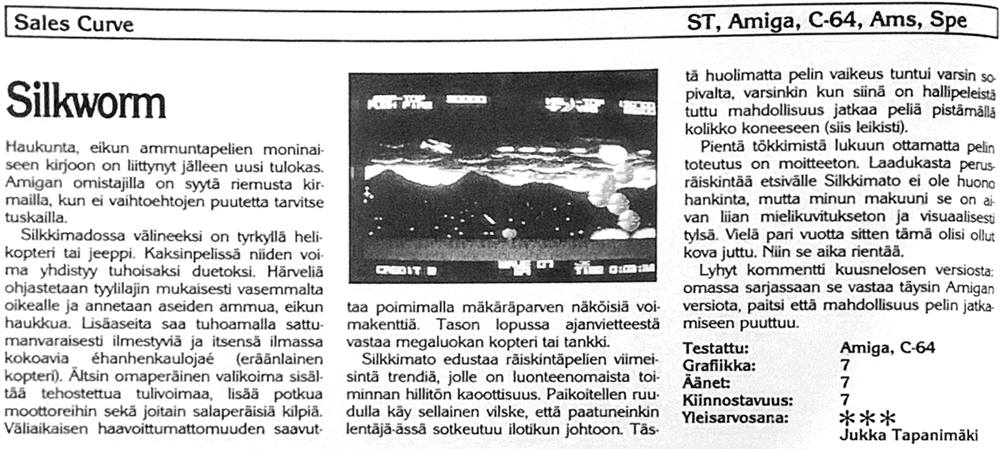
Silkworm1989 SyksyPysyvä linkkiHaukunta, eikun ammuntapelien moninaiseen kirjoon on liittynyt jälleen uusi tulokas. Amigan omistajilla on syytä riemusta kirmailla, kun ei vaihtoehtojen puutetta tarvitse tuskailla.
Silkkimadossa välineeksi on tyrkyllä helikopteri tai jeeppi. Kaksinpelissä niiden voima yhdistyy tuhoisaksi duetoksi. Härveliä ohjastetaan tyylilajin mukaisesti vasemmalta oikealle ja annetaan aseiden ammua, eikun haukkua. Lisäaseita saa tuhoamalla sattumanvaraisesti ilmestyviä ja itsensä ilmassa kokoavia "hanhenkauloja" (eräänlainen kopteri). Ältsin omaperäinen valikoima sisältää tehostettua tulivoimaa, lisää potkua moottoreihin sekä joitain salaperäisiä kilpiä. Väliaikaisen haavoittumattomuuden saavuttaa poimimalla mäkäräparven näköisiä voimakenttiä. Tason lopussa ajanvietteestä vastaa megaluokan kopteri tai tankki.
Silkkimato edustaa räiskintäpelien viimeisintä trendiä, jolle on luonteenomaista toiminnan hillitön kaoottisuus. Paikoitellen ruudulla käy sellainen vilske, että paatuneinkin lentäjä-ässä sotkeutuu ilotikun johtoon. Tästä huolimatta pelin vaikeus tuntui varsin sopivalta, varsinkin kun siinä on hallipeleistä tuttu mahdollisuus jatkaa peliä pistämällä kolikko koneeseen (siis leikisti).
Pientä tökkimistä lukuun ottamatta pelin toteutus on moitteeton. Laadukasta perusräiskintää etsivälle Silkkimato ei ole huono hankinta, mutta minun makuuni se on aivan liian mielikuvitukseton ja visuaalisesti tylsä. Vielä pari vuotta sitten tämä olisi ollut kova juttu. Niin se aika rientää.
Lyhyt kommentti kuusnelosen versiosta: omassa sarjassaan se vastaa täysin Amigan versiota, paitsi että mahdollisuus pelin jatkamiseen puuttuu.
Silkworm1989 SyksyPermalinkThe motley ranks of barking, er, shooting games have once again been joined by a newcomer. Amiga owners have reason to frolic for joy, since they needn't agonise over any lack of choice.
In Silkkimato, the vehicle on offer is a helicopter or a jeep. In two-player mode their power combines into a destructive duet. As the genre demands, the contraption is steered from left to right while you let the guns moo, er, bark. Extra weapons are earned by destroying the "goosenecks" (a kind of chopper) that appear at random and assemble themselves in mid-air. The extras are an idiosyncratic selection that includes boosted firepower, more kick for the engines and some mysterious shields. Temporary invulnerability is gained by picking up force fields that look like a swarm of gnats. At the end of each level, the entertainment is provided by a mega-class chopper or tank.
Silkkimato represents the latest trend in shoot-'em-ups, characterised by utterly unrestrained chaos in the action. At times there's such a commotion on screen that even the most hardened flying ace gets tangled up in the joystick lead. Despite this, the difficulty felt quite appropriate, especially as the game has the option, familiar from the arcades, of continuing by putting a coin in the machine (pretend, that is).
Apart from a bit of stuttering, the game's implementation is flawless. For anyone looking for quality basic blasting, Silkkimato isn't a bad buy, but for my taste it's far too unimaginative and visually dull. A couple of years ago this would still have been a big deal. How time flies.
A brief comment on the Commodore 64 version: in its own class it fully matches the Amiga version, except that the option to continue the game is missing.
Silpheed
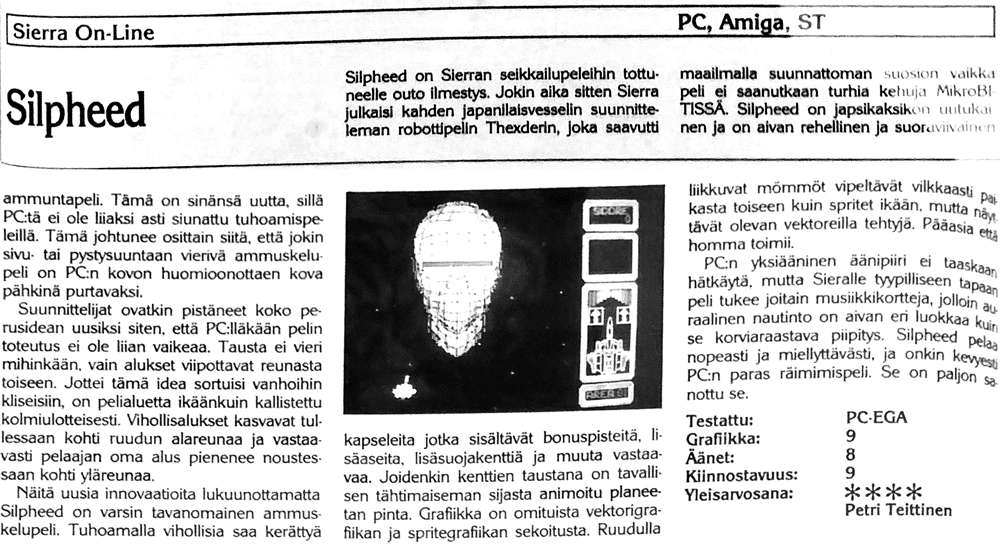
Silpheed1989 SyksyPysyvä linkkiSilpheed on Sierran seikkailupeleihin tottuneelle outo ilmestys. Jokin aika sitten Sierra julkaisi kahden japanilaisvesselin suunnitteleman robottipelin Thexderin, joka saavutti maailmalla suunnattoman suosion vaikka peli ei saanutkaan turhia kehuja MikroBITISSÄ. Silpheed on japsikaksikon uutukainen ja on aivan rehellinen ja suoraviivainen ammuntapeli. Tämä on sinänsä uutta, sillä PC:tä ei ole liiaksi asti siunattu tuhoamispeleillä. Tämä johtunee osittain siitä, että jokin sivu- tai pystysuuntaan vierivä ammuskelupeli on PC:n kovon huomioonottaen kova pähkinä purtavaksi.
Suunnittelijat ovatkin pistäneet koko perusidean uusiksi siten, että PC:lläkään pelin toteutus ei ole liian vaikeaa. Tausta ei vieri mihinkään, vain alukset viipottavat reunasta toiseen. Jottei tämä idea sortuisi vanhoihin kliseisiin, on pelialuetta ikäänkuin kallistettu kolmiulotteisesti. Vihollisalukset kasvavat tullessaan kohti ruudun alareunaa ja vastaavasti pelaajan oma alus pienenee noustessaan kohti yläreunaa.
Näitä uusia innovaatioita lukuunottamatta Silpheed on varsin tavanomainen ammuskelupeli. Tuhoamalla vihollisia saa kerättyä kapseleita jotka sisältävät bonuspisteitä, lisäaseita, lisäsuojakenttiä ja muuta vastaavaa. Joidenkin kenttien taustana on tavallisen tähtimaiseman sijasta animoitu planeetan pinta. Grafiikka on omituista vektorigrafiikan ja spritegrafiikan sekoitusta. Ruudulla liikkuvat mömmöt vipeltävät vilkkaasti paikasta toiseen kuin spritet ikään, mutta näyttävät olevan vektoreilla tehtyjä. Pääasia että homma toimii.
PC:n yksiääninen äänipiiri ei taaskaan hätkäytä, mutta Sieralle tyypilliseen tapaan peli tukee joitain musiikkikortteja, jolloin auraalinen nautinto on aivan eri luokkaa kuin se korviaraastava piipitys. Silpheed pelaa nopeasti ja miellyttävästi, ja onkin kevyesti PC:n paras räimimispeli. Se on paljon sanottu se.
Silpheed1989 SyksyPermalinkTo anyone used to Sierra's adventure games, Silpheed is a strange apparition. Some time ago Sierra released Thexder, a robot game designed by two Japanese rascals, which achieved enormous popularity around the world even though the game wasn't exactly showered with praise in MikroBITTI. Silpheed is the Japanese twosome's latest, and it is a completely honest and straightforward shoot-'em-up. That in itself is something new, since the PC has not been overly blessed with games of destruction. This is presumably partly because a sideways- or vertically-scrolling shooting game is, given the PC's hardware, a tough nut to crack.
So the designers have reworked the whole basic idea in such a way that implementing the game isn't too difficult even on the PC. The background doesn't scroll anywhere; only the ships zip from one edge to the other. So that this idea wouldn't collapse into the old cliches, the playing area has, as it were, been tilted in three dimensions. Enemy ships grow as they come towards the bottom of the screen, and correspondingly the player's own ship shrinks as it climbs towards the top.
Apart from these new innovations, Silpheed is a fairly ordinary shooting game. Destroying enemies lets you collect capsules containing bonus points, extra weapons, extra shield fields and other such things. Some levels have an animated planet surface as their backdrop instead of the usual starscape. The graphics are an odd mix of vector graphics and sprite graphics. The doodads moving about the screen flit briskly from place to place just like sprites, but appear to be made of vectors. The main thing is that it works.
Once again the PC's single-voice sound chip fails to make anyone jump, but, as is typical for Siera, the game supports some music cards, and then the aural pleasure is in a completely different league from that ear-rending beeping. Silpheed plays fast and pleasantly, and is easily the best blasting game on the PC. That's saying a lot, that is.
SimCity Phenomena
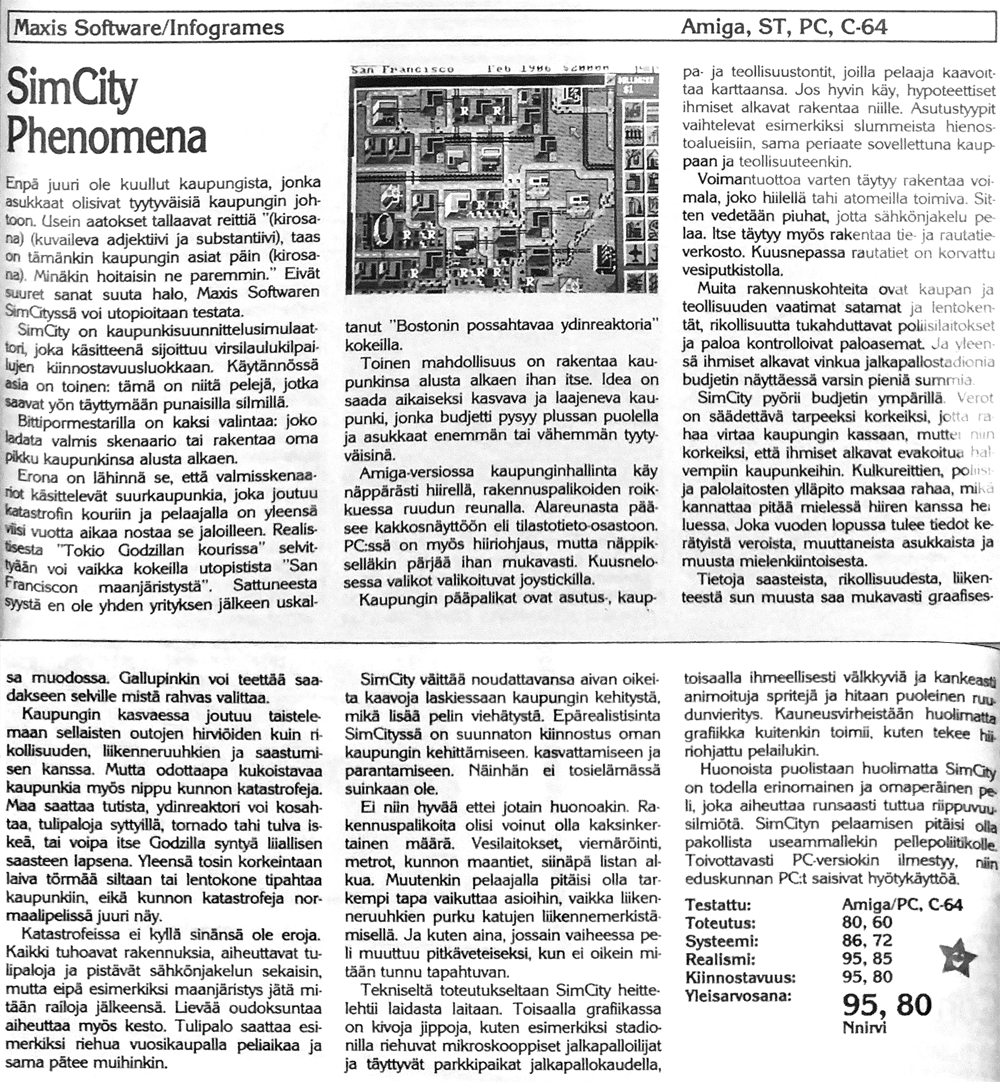
SimCity Phenomena1990 KevätPysyvä linkkiEnpä juuri ole kuullut kaupungista, jonka asukkaat olisivat tyytyväisiä kaupungin johtoon. Usein aatokset tallaavat reittiä "(kirosana) (kuvaileva adjektiivi ja substantiivi), taas on tämänkin kaupungin asiat päin (kirosana). Minäkin hoitaisin ne paremmin." Eivät suuret sanat suuta halo, Maxis Softwaren SimCityssä voi utopioitaan testata.
SimCity on kaupunkisuunnittelusimulaattori, joka käsitteenä sijoittuu virsilaulukilpailujen kiinnostavuusluokkaan. Käytännössä asia on toinen: tämä on niitä pelejä, jotka saavat yön täyttymään punaisilla silmillä.
Bittipormestarilla on kaksi valintaa: joko ladata valmis skenaario tai rakentaa oma pikku kaupunkinsa alusta alkaen.
Erona on lähinnä se, että valmisskenaariot käsittelevät suurkaupunkia, joka joutuu katastrofin kouriin ja pelaajalla on yleensä viisi vuotta aikaa nostaa se jaloilleen. Realistisesta "Tokio Godzillan kourissa" selvittyään voi vaikka kokeilla utopistista "San Franciscon maanjäristystä". Sattuneesta syystä en ole yhden yrityksen jälkeen uskaltanut "Bostonin possahtavaa ydinreaktoria" kokeilla.
Toinen mahdollisuus on rakentaa kaupunkinsa alusta alkaen ihan itse. Idea on saada aikaiseksi kasvava ja laajeneva kaupunki, jonka budjetti pysyy plussan puolella ja asukkaat enemmän tai vähemmän tyytyväisinä.
Amiga-versiossa kaupunginhallinta käy näppärästi hiirellä, rakennuspalikoiden roikkuessa ruudun reunalla. Alareunasta pääsee kakkosnäyttöön eli tilastotieto-osastoon. PC:ssä on myös hiiriohjaus, mutta näppikselläkin pärjää ihan mukavasti. Kuusnelosessa valikot valikoituvat joystickillä.
Kaupungin pääpalikat ovat asutus-, kauppa- ja teollisuustontit, joilla pelaaja kaavoittaa karttaansa. Jos hyvin käy, hypoteettiset ihmiset alkavat rakentaa niille. Asutustyypit vaihtelevat esimerkiksi slummeista hienostoalueisiin, sama periaate sovellettuna kauppaan ja teollisuuteenkin.
Voimantuottoa varten täytyy rakentaa voimala, joko hiilellä tahi atomeilla toimiva. Sitten vedetään piuhat, jotta sähkönjakelu pelaa. Itse täytyy myös rakentaa tie- ja rautatieverkosto. Kuusnepassa rautatiet on korvattu vesiputkistolla.
Muita rakennuskohteita ovat kaupan ja teollisuuden vaatimat satamat ja lentokentät, rikollisuutta tukahduttavat poliisilaitokset ja paloa kontrolloivat paloasemat. Ja yleensä ihmiset alkavat vinkua jalkapallostadionia budjetin näyttäessä varsin pieniä summia.
SimCity pyörii budjetin ympärillä. Verot on säädettävä tarpeeksi korkeiksi, jotta rahaa virtaa kaupungin kassaan, muttei niin korkeiksi, että ihmiset alkavat evakoitua halvempiin kaupunkeihin. Kulkureittien, poliisi- ja palolaitosten ylläpito maksaa rahaa, mikä kannattaa pitää mielessä hiiren kanssa heiluessa. Joka vuoden lopussa tulee tiedot kerätyistä veroista, muuttaneista asukkaista ja muusta mielenkiintoisesta.
Tietoja saasteista, rikollisuudesta, liikenteestä sun muusta saa mukavasti graafisessa muodossa. Gallupinkin voi teettää saadakseen selville mistä rahvas valittaa.
Kaupungin kasvaessa joutuu taistelemaan sellaisten outojen hirviöiden kuin rikollisuuden, liikenneruuhkien ja saastumisen kanssa. Mutta odottaapa kukoistavaa kaupunkia myös nippu kunnon katastrofeja. Maa saattaa tutista, ydinreaktori voi kosahtaa, tulipaloja syttyillä, tornado tahi tulva iskeä, tai voipa itse Godzilla syntyä liiallisen saasteen lapsena. Yleensä tosin korkeintaan laiva törmää siltaan tai lentokone tipahtaa kaupunkiin, eikä kunnon katastrofeja normaalipelissä juuri näy.
Katastrofeissa ei kyllä sinänsä ole eroja. Kaikki tuhoavat rakennuksia, aiheuttavat tulipaloja ja pistävät sähkönjakelun sekaisin, mutta eipä esimerkiksi maanjäristys jätä mitään railoja jälkeensä. Lievää oudoksuntaa aiheuttaa myös kesto. Tulipalo saattaa esimerkiksi riehua vuosikaupalla peliaikaa ja sama pätee muihinkin.
SimCity väittää noudattavansa aivan oikeita kaavoja laskiessaan kaupungin kehitystä, mikä lisää pelin viehätystä. Epärealistisinta SimCityssä on suunnaton kiinnostus oman kaupungin kehittämiseen. kasvattamiseen ja parantamiseen. Näinhän ei tosielämässä suinkaan ole.
Ei niin hyvää ettei jotain huonoakin. Rakennuspalikoita olisi voinut olla kaksinkertainen määrä. Vesilaitokset, viemäröinti, metrot, kunnon maantiet, siinäpä listan alkua. Muutenkin pelaajalla pitäisi olla tarkempi tapa vaikuttaa asioihin, vaikka liikenneruuhkien purku katujen liikennemerkistämisellä. Ja kuten aina, jossain vaiheessa peli muuttuu pitkäveteiseksi, kun ei oikein mitään tunnu tapahtuvan.
Tekniseltä toteutukseltaan SimCity heittelehtii laidasta laitaan. Toisaalla grafiikassa on kivoja jippoja, kuten esimerkiksi stadionilla riehuvat mikroskooppiset jalkapalloilijat ja täyttyvät parkkipaikat jalkapallokaudella, toisaalla ihmeellisesti välkkyviä ja kankeasti animoituja spritejä ja hitaan puoleinen ruudunvieritys. Kauneusvirheistään huolimatta grafiikka kuitenkin toimii, kuten tekee hiiriohjattu pelailukin.
Huonoista puolistaan huolimatta SimCity on todella erinomainen ja omaperäinen peli, joka aiheuttaa runsaasti tuttua riippuvuusilmiötä. SimCityn pelaamisen pitäisi olla pakollista useammallekin pellepoliitikolle. Toivottavasti PC-versiokin ilmestyy, niin eduskunnan PC:t saisivat hyötykäyttöä.
SimCity Phenomena1990 KevätPermalinkI have hardly ever heard of a city whose residents were satisfied with the people running it. Thoughts often tread the path of "(swear word) (descriptive adjective and noun), the affairs of this city too have gone to (swear word) again. Even I could run them better." Talk is cheap, but in Maxis Software's SimCity you can put your utopias to the test.
SimCity is a town-planning simulator, which as a concept falls into the same excitement bracket as hymn-singing contests. In practice it's another matter: this is one of those games that fill the night with red eyes.
The bit-mayor has two choices: either load a ready-made scenario or build their own little city from scratch.
The difference is mainly that the ready-made scenarios deal with a big city that has fallen into the clutches of a disaster, and the player usually has five years to get it back on its feet. Having survived the realistic "Tokyo in the clutches of Godzilla", you might try, say, the utopian "San Francisco earthquake". For reasons I'd rather not go into, after one attempt I haven't dared try "Boston's nuclear reactor going pop".
The other option is to build your city from scratch all by yourself. The idea is to bring about a growing, expanding city whose budget stays in the black and whose residents stay more or less content.
In the Amiga version, running the city is handily done with the mouse, with the building blocks hanging at the edge of the screen. The bottom edge takes you to the second screen, i.e. the statistics department. The PC also has mouse control, but you get along quite nicely with the keyboard too. On the C-64 the menus get selected with the joystick.
The city's main building blocks are residential, commercial and industrial plots, with which the player zones the map. If all goes well, hypothetical people start building on them. Housing types range from, say, slums to posh neighbourhoods, with the same principle applied to commerce and industry as well.
For power generation you have to build a power station, running either on coal or on atoms. Then you run the cables so the power distribution works. You also have to build the road and rail network yourself. On the C-64 the railways have been replaced with water pipes.
Other things to build are the seaports and airports that commerce and industry demand, police stations to stamp out crime and fire stations to keep fires under control. And people usually start whining for a football stadium just when the budget is showing rather small sums.
SimCity revolves around the budget. Taxes have to be set high enough for money to flow into the city coffers, but not so high that people start evacuating to cheaper cities. Maintaining the transport routes and the police and fire departments costs money, which is worth bearing in mind while you're waving the mouse about. At the end of each year you get the figures on taxes collected, residents who have moved and other matters of interest.
Information on pollution, crime, traffic and whatnot is nicely available in graphical form. You can even commission a Gallup poll to find out what the hoi polloi are grumbling about.
As the city grows, you have to battle such strange monsters as crime, traffic jams and pollution. But a thriving city also has a whole bunch of proper disasters in store for it. The earth may tremble, the nuclear reactor may go kablooey, fires may break out here and there, a tornado or else a flood may strike, or Godzilla himself may even be born as the child of excessive pollution. Usually, though, the worst that happens is a ship crashing into a bridge or a plane dropping onto the city, and proper disasters are hardly ever seen in a normal game.
As such, there isn't much difference between the disasters. They all destroy buildings, start fires and mess up the power distribution, but an earthquake, for one, doesn't leave any cracks in the ground behind it. Their duration also causes mild puzzlement. A fire, for example, can rage for years of game time, and the same goes for the others.
SimCity claims to use genuine, real formulas when calculating the city's development, which adds to the game's charm. The most unrealistic thing about SimCity is the enormous interest in developing, growing and improving one's own city. That's by no means how it is in real life.
No rose without a thorn. There could have been twice as many building blocks. Waterworks, sewers, metros, proper highways - there's the start of the list. More generally, the player should have a more precise way of influencing things, say by breaking up traffic jams with road signs on the streets. And as always, at some point the game turns tedious when nothing much seems to be happening.
In its technical execution SimCity lurches from one extreme to the other. On the one hand the graphics have nice little tricks, such as microscopic footballers romping about the stadium and car parks filling up during the football season; on the other, strangely flickering, stiffly animated sprites and slowish scrolling. Despite its blemishes, though, the graphics work, as does the mouse-controlled play.
Bad points notwithstanding, SimCity is a truly excellent and original game that brings on a hefty dose of the familiar addiction phenomenon. Playing SimCity ought to be compulsory for many a clown politician. Hopefully a PC version will come out too, so the PCs in Parliament would get some useful work to do.
SimEarth
SimEarth1991 SyksyPysyvä linkkiAlussa monitori oli autio ja tyhjä, ja pelaajan henki leijui levykkeiden yllä. Sitten pelaaja sanoi "Latautukoon SimEarth!" Ja SimEarth latautui.
Tietotekniikan avulla ei maailman luomisessa tarvitse enää nyhertää amatöörimäistä seitsemää päivää. SimCityn kaupunkikeskeisestä ajattelusta laajenee SimEarth koko planeetan rakentamiseen, kontrollointiin ja huoltoon.
1. Luku: Ja alussa oli valikko
1. Ja niin näki jumala alkuvalikon. Maapallo 1990-luvulla? Mantereita vesiplaneetalle? Marsin asutus? Sukkula Venukseen? Mutta päätyi jumala oman planeetan luomiseen.
2. Totesi herra: "Mikä tahansa teko vaatii omegapisteitä. Jotka vastaavat SimCityn rahaa. Onneksi kokeilumoodissa niitä on äärettömästi." Mutta päätyi jumala 5000 omegapisteen alkuvarastoon. Haasteen vuoksi.
3. Ja aluksi peli eteni miljoonia vuosia sekunnissa. Mantereet muotoutuivat, hajosivat ja liikkuivat. Ja jumala ei oikein voinut tehdä muuta kuin katsella vierestä seuraavat 200 miljardia vuotta. Ja leikkiä tulivuorten kanssa. Ja geosfäärisäätimien.
4. Niin päätti jumala heilutella hiirtä ja katso, hiiri heilui. Ihailtuaan palloprojektiota siirtyi hän karttaan ja kytki päälle lämpökartan. Hän olisi myös voinut valita pinnanmuodon, eliöjakautuman, kasvillisuuskartan merivirrat, jne,
5. Mutta päätyi siis lämpökarttaan.
2. Luku: Aatami Ameeba
1. Ja katso! Planeetta alkoi tasaantua ja ajankulku siirtyi pienempään mittakaavaan. Ja jumala siirtyi editointinäyttöön, jossa luomistyö tapahtuu. Ja jumala sanoi: "Tulkoon dinosaurukset". Ja dinosaurukset tulivat. Ja menivät. Niin sanoi jumala: "No aloitetaan yksisoluisilla sitten, saakeli!"
2. Elämä kehittyi huimaa vauhtia, ja meri tulvehti trilobiitteja. Jotka lähes kuolivat merien kiehuessa, kunnes jumala korjasi pilviheijastusta ja lämpötila laski. Kasvillisuus täytti maan ja elämä nousi maalle. Ja jumala sanoi: "Nyt ne hemmetin dinosaurukset!" Ja näin kävi.
3. Ja elämä pysyi hengissä, vaikka jumala leikki jääkausilla, massiivisilla tulivuoren purkauksilla, kohotti maanpintaa 20 kilonmetrin vuoriksi, ja huomasivatpa alkueläimet joutuneensa keskelle atomiräjähdystäkin.
4. Ja sitten kehittivät liskot älyn. "Iiik", totesi reptofobinen jumala ja poisti älykkäät liskot hyvin tähdätyllä meteorilla. Mutta kun jumala kävi syömässä, kehittivät linnut älyn. Jumala harkitsi kulkutautiaaltoa, mutta myöntyi sitten painottamaan kulttuuria ei-filosofiseksi, täysin tieteeseen panostavaksi. Sodat riehuivat. Ja jumala vauhditti kehitystä hillittömällä mutaatiolla, lisääntymisvauhdilla sekä mustalla monoliitilla
5. a la 2001: Space Odyssey.
3. Luku: Ankaran jumalan kosto
1. Ja vastasi pulupopulaation kehitystaso viimeistä sataa vuotta. Niin juoksi aika enää kuukausi kerrallaan. Ja linnut peittivät maan. Kirjaimellisesti.
2. Niin sanoi Herra Nirvi: "Nyt otetaan puluista mittaa". Ja käytti koko katastrofiarsenaalin. Mutta omegapisteet loppuivat. Ja pulut lisääntyivät. Joten viimeisillä pisteillään väänsi herra auringon säteilyn täysille.
3. Ja pulut paistuivat. Ja koko planetta paistui. Ja sanoi herra: "Olikos se nyt hauskaa?"
SimEarthissa on yksi paha vika: se on opetusohjelmana ensimmäistä luokkaa, ja jokaisen koulun pitäisi ottaa se hankintalistalle. Mutta kun pelinä se ei oikein toimi. Yleisarvosana on siis eräänlainen keskiarvo, ettäs tiedätte.
Suuri osa ajasta menee peukaloiden pyörittämiseen joko odottaessa että kiihkeätahtinen alkumyllerys loppuu tahi omegapisteitä kertyy. Liian massiivinen skaala aiheuttaa sen, että planeettaansa katsoo ulkopuolisena, siihen sen paremmin samaistumatta. Tämä pahenee älyllisen elämän kehityttyä: kaupunkeja nousee, sotia syttyy, kulkutaudit riehuvat, mutta se ei pelaajaa kiinnosta.
Sotimisesta puuttuu yksi päivänselvä optio: ydinsota. Työkaluista löytyy kyllä ydinräjähdys, mutta simulaatiosta puuttuu globaalinen ydintuho ympäristövaikutuksineen. Paha missi!
Ihan mielenkiinnosta pitäisi SimEarthin sallia myös useamman rinnakkaisen elämänmuodon yhtäaikainen olemassaolo, sekä riisua rasismia sen verran, että meren elävät, etenkin valaat, voisivat kehittää sivilisaation (vaikkei evillä pahemmin tietokonetta naputellakaan).
Mielenkiintoisinta SimEarthissa ovat sen pelaamisessa syntyvät ajatukset. Ensinnäkin ihmisen ykkösasema Isä Jumalan polvella, korkealla muiden elämänmuotojen yläpuolella ja niiden herrana. Sattumasta se vain on kiinni, ettei tätäkin tekstiä kirjoittele kahdella jalalla kävelevä lisko, jonka kotinurkissa luuhaa tyhmä mutta uskollinen ihmislemmikki.
Toiseksi älykäs elämä (onko sitä tällä planeetalla?) heijastettuna monitorin pintaan antaa itsestään varsin mielenkiintoisen kuvan. Ennen sivilisaatiota lajien runsaus vallitsee, dinosaurus ja päästäinen vaeltelevat vehreillä niityillä käpälä käpälässä. Ja sitten Zap! Kapow! - sivilisaatio syntyy.
Varsin nopeasti planeetan pinta peittyy "älykkään" biomassan alle. Sillä aikaa kun kotijumala käy keittämässä kupposen kuumaa korviketta ja veistää puukon syrjällä läskipalan ruisleivän koristeeksi, ei-älykäs elämä häviää planeetan pinnalta. Luonnonvarat loppuvat, kasvillisuus tuhoutuu ja jopa itse älykäs elämänmuoto elää kurjasti.
Nyt meillä on siis esitys maapallosta noin osapuilleen nyt, plusmiinus 100 vuotta. Kosmisessa mittakaavassa sitä ei edes huomaa.
Kokeilkaamme ensin älyllisen elämän vaalimista. "Heitä kymppi kehitysapuun" eli ruuantuotannon ja lääketieteen säätäminen maksimiin aiheuttaa maapallolle samaa kuin nuhaiselle makaaminen jäälätäkössä Siperian tundralla syysmyrskyjen aikaan.
SimEarthilla onnistuin saamaan kaksi ratkaisumallia. "Star Trek"-malliksi ristimäni perustuu tieteen painottamiseen toivossa, että ihmiskunta onnistuu muuttamaan avaruuteen ennen kuin kuolee omaan typeryyteensä.
Tähän voi yhdistää tai käyttää omanaan malli "Terminatoria", jossa populaatio pidetään siedettävänä jääkausilla, maailmanlaajuisilla kulkutautiepidemioilla, meteroreilla sun muilla näppärillä työkaluilla.
Mutta ei syytä huoleen, pelihän se SimEarth vain on! Tosielämässä kaikki menee hyvin, ihminen on luomakunnan kruunu, ja jos ekokatastrofi tai väestöräjähdys tulee, niin aina voi piiloutua iskän ja äiskän helmoihin, kyllä ne jotain keksivät.
PS. Testattu versio on Jenkkilästä, Euroopan hoitaa Ocean. Sen ei pitäisi vaikuttaa peliin.
SimEarth1991 SyksyPermalinkIn the beginning the monitor was without form, and void, and the spirit of the player hovered over the floppy disks. Then the player said, "Let SimEarth load!" And SimEarth loaded.
With the help of information technology, creating a world no longer means fiddling about for an amateurish seven days. From the city-centred thinking of SimCity, SimEarth expands into building, controlling and maintaining an entire planet.
Chapter 1: And in the beginning was the menu
1. And so god beheld the opening menu. Earth in the 1990s? Continents for a water planet? Colonising Mars? A shuttle to Venus? But god settled on creating a home-made planet.
2. Quoth the lord: "Every deed requires omega points. Which are the equivalent of SimCity's money. Fortunately in experimental mode there's an infinite supply of them." But god settled on a starting stock of 5000 omega points. For the challenge.
3. And at first the game advanced millions of years per second. The continents took shape, broke apart and moved. And god could not really do anything but look on for the next 200 billion years. And play with volcanoes. And the geosphere controls.
4. So god decided to wiggle the mouse, and behold, the mouse wiggled. Having admired the globe projection, god moved on to the map and switched on the temperature map. God could also have chosen the terrain, the distribution of life, the vegetation map, the ocean currents, etc.
5. But the temperature map it was, then.
Chapter 2: Adam Amoeba
1. And behold! The planet began to settle down and the passage of time shifted to a smaller scale. And god moved on to the editing screen, where the work of creation takes place. And god said, "Let there be dinosaurs." And the dinosaurs came. And went. Then god said, "Oh, let's start with single-celled organisms then, dammit!"
2. Life evolved at a breakneck pace, and the sea teemed with trilobites. Which nearly died out as the seas boiled, until god adjusted the cloud albedo and the temperature dropped. Vegetation filled the earth and life rose onto dry land. And god said, "Now for those blasted dinosaurs!" And so it came to pass.
3. And life survived, even though god toyed with ice ages and massive volcanic eruptions, raised the land into 20-kilometre mountains, and the protozoa even found themselves in the middle of a nuclear blast.
4. And then the lizards developed intelligence. "Eeek," said the reptophobic god, and removed the intelligent lizards with a well-aimed meteor. But while god was off having a bite to eat, the birds developed intelligence. God considered a wave of plague, but then relented and tilted the culture towards the non-philosophical, putting everything into science. Wars raged. And god sped up development with unbridled mutation, breeding rates and a black monolith
5. a la 2001: Space Odyssey.
Chapter 3: The revenge of a stern god
1. And the development level of the pigeon population matched that of the last hundred years. So time now ran just a month at a time. And the birds covered the earth. Literally.
2. Then spake Lord Nirvi: "Now we take on the pigeons." And used up the entire disaster arsenal. But the omega points ran out. And the pigeons multiplied. So with the last remaining points the lord cranked the sun's radiation up to full.
3. And the pigeons roasted. And the whole planet roasted. And the lord said, "Now, was that fun?"
SimEarth has one bad flaw: as an educational program it's first-class, and every school ought to put it on its shopping list. But as a game it just doesn't really work. So the overall score is a kind of average, just so you know.
A large part of the time goes on twiddling your thumbs, waiting either for the frantic early upheaval to end or else for omega points to pile up. The far too massive scale means you look at your planet as an outsider, without really identifying with it. This gets worse once intelligent life has evolved: cities rise, wars break out, plagues rage, but the player just doesn't care.
Warfare lacks one blindingly obvious option: nuclear war. The tools do include a nuclear explosion, but the simulation has no global nuclear annihilation with all its environmental effects. Bad miss!
Just out of interest, SimEarth ought to also allow several parallel life forms to exist at the same time, and to shed enough of its racism that sea creatures, whales in particular, could develop a civilisation (even if you can't exactly tap away at a computer with fins).
The most interesting thing about SimEarth is the thoughts that playing it gives rise to. First of all, man's number-one position on the knee of God the Father, high above the other life forms and lord over them. It's pure chance that this very text isn't being typed by a lizard walking on two legs, with a stupid but faithful human pet loafing around its home.
Secondly, intelligent life (is there any on this planet?), reflected on the surface of the monitor, gives a rather interesting picture of itself. Before civilisation an abundance of species reigns, and the dinosaur and the shrew roam the verdant meadows paw in paw. And then Zap! Kapow! - civilisation is born.
Pretty soon the planet's surface is buried under "intelligent" biomass. In the time it takes the household god to brew a cup of hot ersatz coffee and carve a slab of pork fat with the edge of a knife to top a slice of rye bread, non-intelligent life vanishes from the face of the planet. Natural resources run out, the vegetation is destroyed and even the intelligent life form itself lives in misery.
So now we have a depiction of planet Earth at roughly about now, give or take 100 years. On a cosmic scale you wouldn't even notice it.
Let us first try cherishing intelligent life. "Toss a tenner to development aid", i.e. cranking food production and medicine up to the max, does to the planet what lying in an icy puddle on the Siberian tundra during the autumn storms does to someone with a cold.
With SimEarth I managed to come up with two solution models. The one I christened the "Star Trek" model is based on emphasising science in the hope that humanity manages to move into space before it dies of its own stupidity.
You can combine this with, or use on its own, the "Terminator" model, in which the population is kept tolerable with ice ages, worldwide plague epidemics, meteors and other such handy tools.
But no cause for alarm, SimEarth is only a game after all! In real life everything is going fine, man is the crown of creation, and if an eco-catastrophe or a population explosion comes along, you can always go and hide in Daddy's and Mummy's skirts, they'll think of something.
PS. The version tested is from the States; Europe is handled by Ocean. That shouldn't affect the game.
Simulcra

Simulcra1991 KevätPysyvä linkkiAivoihin istutettavilla kortex-siruilla ohjailtavaan taistelusimulaattoriin pesiytyneistä viruksista kertova kyber-techno-bullshit-johdanto ennakoi Interphasen tapaista ongelmapeliä, mutta jos esikuvaa pitäisi hakea, niin lähinnä tulevat mieleen Virus ja Conqueror.
Toisin sanoen tämä Graftgoldin työstämä 3D-räiskintäpeli kuuluu siihen alaryhmään, jossa ohjailtava alus on kuvattu ulkopuolelta. Erinäisiin sekaviin yritelmiin verrattuna Simulcrassa idea on saatu siedettävästi toimimaan: ei mitään Viruksen kiinteää katselukulmaa eikä Thunderstriken perässä laahaavaa kameraa, vaan samaan tahtiin aluksen kanssa sujuvasti pyörivä maisema.
Ohjekirjasen jaarittelut yrittävät parhaansa mukaan kätkeä pelin kristallin selkeän perusidean - eipä ihme, kun julkaisijana on Microprosen haaraosasto. Simuloitu rynnäkköalus rynnäköi simuloidun taistelutantereen tyhjän päällä kelluvilla tasanteilla ensisijaisena kohteenaan energiamuureja ylläpitävät generaattorit.
Toissijaisena optiona on romuttaa lasertorneja, minitankkeja ja liitureita, sekä ryövätä jälkeen jääneistä moduuleista vahvikkeeksi muun muassa ohjuksia ja kartoituslaitteita. Sokkeloita ei ole pakko nuohota pintaa pitkin, vaan aluksen voi myös nykäistä liitelemään siipiensä varassa. Jos puolestaan haluaa parantaa suojausta ja ehkäistä tahattomat lentoonlähdöt, siivet voi taittaa kokonaan sisään.
Vastaavia teknisiä pikku hienouksia pelissä piisaa. Elämää on noin yleensä ottaen kiitettävästi helpotettu, esimerkiksi tasanteilla voi kaahailla varsin huolettomasti, sillä tyhjyyteen putoamisesta ei ole pelkoa.
Pitkälle hiottua vaikutelmaa korostaa grafiikan toimivuus. Sen nopeus ylittää rima vaappuen kriittisen rajan, jossa tyypillisen nyhjäävä 3D-nylkytys vaihtuu toiminnaksi. Hyvä saavutus, kun ottaa huomioon, että kappaleissa on mukana pehmeästi valonlähdettä myötäilevä varjostus.
Ihme kyllä Graftgold on malttanut pitää vaikeustason aisoissa - ilmeisesti Microprosen painostuksesta. Kuvitteellinen viikatemies viettää enimmäkseen siestaa, jopa siinä määrin, että Simulcraa voisi moittia liiankin lepsuksi. Ensimmäinen istunto pelin ääressä venyi loputtomiin ja viimein oli katkaistava koneesta virta ennen ensimmäistäkään game overia. Makuasia onko tuo hyvä vai huono piirre, mutta ainakin siitä voi päätellä sen, että peli olisi ehdottomasti vaatinut salasanat.
Pakollisen ykköstasolta aloittamisen lisäksi Simulcraa nakertaa toimintapelien perisynti numero kaksi. Ensimmäisen minuutin aikana on nähnyt kaiken näkemisen arvoisen. Kun yllätykset puuttuvat, niin pelaajat puutuvat. Jotta totuus ei valitusten seassa unohtuisi: suorasukaisen räiskinnän sarjassa Simulcra on ehdottomasti toiseksi parasta, mitä markkinoilla tällä hetkellä on tarjolla - ykkösenä on Paradroid 90, joten Graftgoldilla on kunnioitettava kaksoisjohto.
Simulcra1991 KevätPermalinkThe cyber-techno-bullshit intro, all about viruses that have nested in a combat simulator steered by cortex chips implanted in the brain, suggests a puzzle game along the lines of Interphase, but if you had to look for a model, the ones that come to mind first are Virus and Conqueror.
In other words, this 3D blaster worked up by Graftgold belongs to the subgroup in which the craft you steer is shown from the outside. Compared with various muddled attempts, Simulcra has got the idea working tolerably: none of Virus's fixed viewing angle, nor Thunderstrike's camera trailing along behind, but a landscape that rotates smoothly in step with the craft.
The manual's waffling does its level best to hide the game's crystal-clear basic idea - no wonder, when the publisher is a branch office of Microprose. The simulated assault craft assaults its way across the platforms of a simulated battlefield floating on thin air, its primary targets being the generators that keep the energy walls up.
The secondary option is to scrap laser towers, mini-tanks and gliders, and to loot the modules they leave behind for reinforcements such as missiles and mapping devices. You don't have to sweep the mazes along the surface; you can also yank the craft up to glide on its wings. If, on the other hand, you want to improve your protection and prevent unintended take-offs, the wings can be folded right in.
The game has plenty of little technical niceties like these. Generally speaking, life has been made commendably easier; for example, you can tear around the platforms quite carelessly, since there's no fear of falling into the void.
The highly polished impression is underlined by how well the graphics work. Their speed clears, with the bar wobbling, the critical threshold at which the typically dawdling 3D chugging turns into action. A good achievement, considering that the objects have shading that softly follows the light source.
Amazingly, Graftgold has managed to restrain itself and keep the difficulty level in check - evidently under pressure from Microprose. The imaginary Grim Reaper spends most of his time having a siesta, so much so that Simulcra could even be faulted for being all too lax. My first session with the game stretched on endlessly, and in the end I had to switch the machine off before a single game over. Whether that is a good or a bad trait is a matter of taste, but at least you can conclude from it that the game absolutely should have had passwords.
Besides the compulsory starting from level one, Simulcra is gnawed at by the action game's original sin number two. Within the first minute you have seen everything worth seeing. When the surprises go missing, the players go numb. So that the truth doesn't get lost among the complaints: in the straightforward blasting class, Simulcra is definitely the second-best thing on the market at the moment - number one is Paradroid 90, so Graftgold holds a respectable one-two lead.
Six-Gun ShootOut
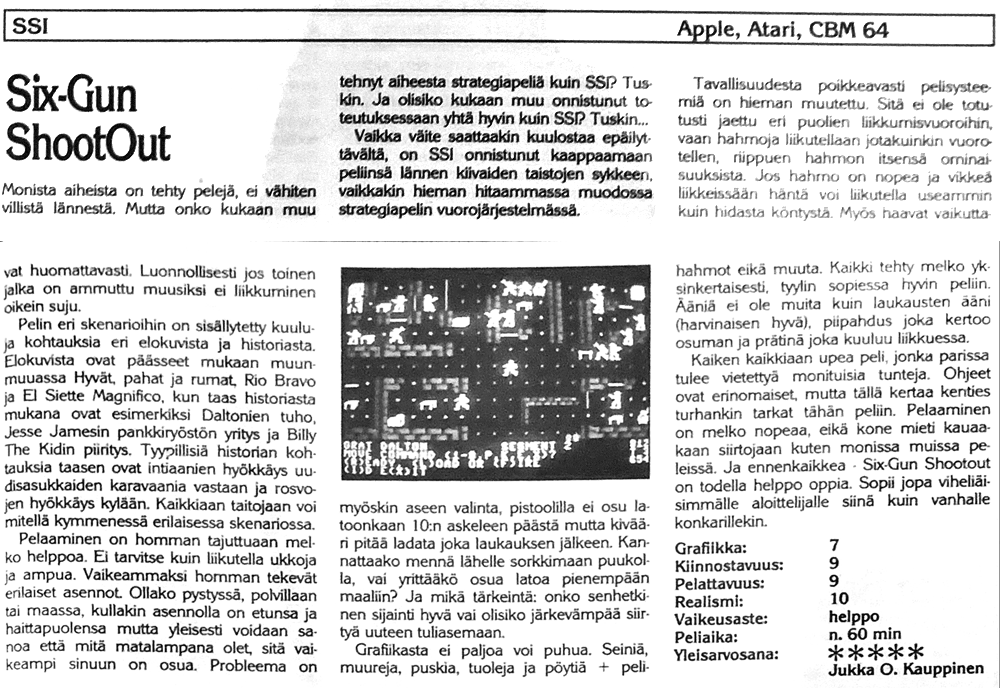
Six-Gun ShootOut1989 SyksyPysyvä linkkiMonista aiheista on tehty pelejä, ei vähiten villistä lännestä. Mutta onko kukaan muu tehnyt aiheesta strategiapeliä kuin SSI? Tuskin. Ja olisiko kukaan muu onnistunut toteutuksessaan yhtä hyvin kuin SSI? Tuskin...
Vaikka väite saattaakin kuulostaa epäilyttävältä, on SSI onnistunut kaappaamaan peliinsä lännen kiivaiden taistojen sykkeen, vaikkakin hieman hitaammassa muodossa strategiapelin vuorojärjestelmässä.
Tavallisuudesta poikkeavasti pelisysteemiä on hieman muutettu. Sitä ei ole totutusti jaettu eri puolien liikkumisvuoroihin, vaan hahmoja liikutellaan jotakuinkin vuorotellen, riippuen hahmon itsensä ominaisuuksista. Jos hahmo on nopea ja vikkeä liikkeissään häntä voi liikutella useammin kuin hidasta köntystä. Myös haavat vaikuttavat huomattavasti. Luonnollisesti jos toinen jalka on ammuttu muusiksi ei liikkuminen oikein suju.
Pelin eri skenarioihin on sisällytetty kuuluja kohtauksia eri elokuvista ja historiasta. Elokuvista ovat päässeet mukaan muunmuuassa Hyvät, pahat ja rumat, Rio Bravo ja El Siette Magnifico, kun taas historiasta mukana ovat esimerkiksi Daltonien tuho, Jesse Jamesin pankkiryöstön yritys ja Billy The Kidin piiritys. Tyypillisiä historian kohtauksia taasen ovat intiaanien hyökkäys uudisasukkaiden karavaania vastaan ja rosvojen hyökkäys kylään. Kaikkiaan taitojaan voi mitellä kymmenessä erilaisessa skenariossa.
Pelaaminen on homman tajuttuaan melko helppoa. Ei tarvitse kuin liikutella ukkoja ja ampua. Vaikeammaksi homman tekevät erilaiset asennot. Ollako pystyssä, polvillaan tai maassa, kullakin asennolla on etunsa ja haittapuolensa mutta yleisesti voidaan sanoa että mitä matalampana olet, sitä vaikeampi sinuun on osua. Probleema on myöskin aseen valinta, pistoolilla ei osu latoonkaan 10:n askeleen päästä mutta kivääri pitää ladata joka laukauksen jälkeen. Kannattaako mennä lähelle sorkkimaan puukolla, vai yrittääkö osua latoa pienempään maaliin? Ja mikä tärkeintä: onko senhetkinen sijainti hyvä vai olisiko järkevämpää siirtyä uuteen tuliasemaan.
Grafiikasta ei paljoa voi puhua. Seiniä, muureja, puskia, tuoleja ja pöytiä + pelihahmot eikä muuta. Kaikki tehty melko yksinkertaisesti, tyylin sopiessa hyvin peliin. Ääniä ei ole muita kuin laukausten ääni (harvinaisen hyvä), piipahdus joka kertoo osuman ja prätinä joka kuuluu liikkuessa.
Kaiken kaikkiaan upea peli, jonka parissa tulee vietettyä monituisia tunteja. Ohjeet ovat erinomaiset, mutta tällä kertaa kenties turhankin tarkat tähän peliin. Pelaaminen on melko nopeaa, eikä kone mieti kauaakaan siirtojaan kuten monissa muissa peleissä. Ja ennenkaikkea - Six-Gun Shootout on todella helppo oppia. Sopii jopa viheliäisimmälle aloittelijalle siinä kuin vanhalle konkarillekin.
Six-Gun ShootOut1989 SyksyPermalinkGames have been made about many subjects, not least the Wild West. But has anyone other than SSI made a strategy game on the subject? Hardly. And would anyone else have pulled it off as well as SSI? Hardly...
Although the claim may sound dubious, SSI has managed to capture in its game the pulse of the West's fierce gunfights, albeit in a somewhat slower form, within a strategy game's turn system.
Unusually, the game system has been changed a little. It isn't divided, as is customary, into movement turns for each side; instead the characters are moved more or less in turn, depending on each character's own attributes. If a character is quick and nimble on their feet, you can move them more often than some slow lump. Wounds also have a considerable effect. Naturally, if one of your legs has been shot to a pulp, getting around doesn't go all that well.
The game's various scenarios include famous scenes from various films and from history. Among the films that made it in are The Good, the Bad and the Ugly, Rio Bravo and El Siette Magnifico, while from history there are, for example, the downfall of the Daltons, Jesse James's attempted bank robbery and the siege of Billy The Kid. Typical historical scenes, on the other hand, are the Indian attack on a settlers' wagon train and the bandits' raid on a town. In all, you can test your skills in ten different scenarios.
Once you've got the hang of it, playing is fairly easy. All you have to do is move the guys around and shoot. What makes it harder is the different stances. Whether to stand, kneel or lie on the ground - each stance has its advantages and drawbacks, but generally speaking the lower you are, the harder you are to hit. Choice of weapon is a problem too: with a pistol you couldn't hit a barn from 10 paces, but a rifle has to be reloaded after every shot. Is it worth going up close to have a poke with a knife, or do you try to hit a target smaller than a barn? And most important of all: is your current position a good one, or would it be wiser to move to a new firing position?
There isn't much to say about the graphics. Walls, stone walls, bushes, chairs and tables + the characters and nothing else. Everything done fairly simply, the style suiting the game well. There are no sounds apart from the sound of the gunshots (unusually good), a beep that signals a hit and a rattle you hear when moving.
All in all, a superb game that you'll end up spending many an hour with. The instructions are excellent, but this time perhaps even needlessly detailed for this game. Play is fairly quick, and the computer doesn't ponder its moves for long, as it does in many other games. And above all - Six-Gun Shootout is really easy to learn. It suits even the most hopeless beginner just as well as the old hand.
Skate Crazy
Skate Crazy1988Pysyvä linkkiRullalautailu ei koskaan kuole (mutta sitä harrastavat kylläkin). Gremlinin uusi tuotos tuntuu sitä parkuvan jokaisella bitillään... Lautailua, hyppimistä ja kaatuilemisia vaativan tuomariston silmien alla...
Ystävävämme Wallien täytyy saada tuomaristolta pisteitä tehden erilaisia toinen toistaan hurjempia temppuja. Temppuileminen taasen tapahtuu erilaisilla radoilla: aluksi parkkipaikalla ja talon katolla, sittemmin vaativammalla kilpailuradalla. Välillä käydään pienellä kentällä, jolla on kerättävä tietty määrä esineitä kilpaa ajan kanssa.
Skate Crazy on yhdessä mielessä kiitollinen pelattava: kuoleminen ei ole jokahetkinen vieras. Epäonnistumisesta hypystä ei palkita elämien vähenemisellä. Vain jos ei onnistu selvittämään kahden portin väliä kyllin nopeasti on turma ovella. Mutta aikaa on yllin kyllin...
Peli on siisti, melkein hyvä. Sitä pelaa mielellään pidemmänkin aikaa, vaikka ikuisesti ei tästäkään iloa saa. Ohjaus vain välillä kypsyttää hermoja raskaamman päälle, etenkin jos esteiden yli hyppääminen ei tunnu luonnistuvan. Hyppäämisen olisikin voinut tehdä paremmin, mutta muissa suhteissa ei suurempaa valituksen aihetta löydy. Aina tämä jonkin tyhmän shoot'em upin voittaa, vaikkei Eliteen voi verratakaan.
Skate Crazy1988PermalinkSkateboarding never dies (but the people who do it certainly do). Gremlin's new offering seems to be bawling that out with every one of its bits... Skating, jumping and wiping out under the eyes of a demanding panel of judges...
Our friend Wallie has to win points from the judges by pulling off all sorts of stunts, each one wilder than the last. The stunting, in turn, takes place on various courses: first in a car park and on the roof of a building, later on a more demanding competition course. Every now and then you visit a small arena where you have to collect a set number of objects in a race against the clock.
In one sense Skate Crazy is a forgiving thing to play: death is not a guest who drops in every other moment. A failed jump is not rewarded with the loss of a life. Only if you don't manage to get between two gates quickly enough is doom at the door. But there's time aplenty...
The game is neat, almost good. You'll gladly play it for quite some time, although this one won't keep you happy forever either. It's just that at times the controls grate on your nerves rather heavily, especially when jumping over obstacles doesn't seem to come off. The jumping really could have been done better, but in other respects there's no great cause for complaint. This always beats some stupid shoot'em up, even if it can't be compared to Elite.
Skate of the Art
Skate of the Art1990 KevätPysyvä linkkiRullalautavillitys on poikinut viime vuosina tukun pelejä, joiden joukossa on muutama mielenkiintoinenkin yritelmä. Mainittakoon vaikka Atlantin takaa tulleet 720 ja Skate or Die, joista varsinkin jälkimmäinen oli nasta ja muutenkin cool. Skate of the Art on puolestaan kotoisin Sveitsistä ja ote on ärsyttävän kesy.
Tuotekehittelystä on vastuussa 1001-tiimi, joka lienee samalla nimellä tunnetun hakkeriporukan perillinen. Pelin perusidea ei voisi olla yksinkertaisempi: maisema vierii ja skeittari skeittaa pomppien töyssyjen, viemärinkansien ja tiilien yli. Pari ruudullista myöhemmin on vuorossa vähän vaikeampi reitti, jossa pompitaan töyssyjen, viemärinkansien ja tiilien yli.
Voisihan tämä olla hauskaakin, mutta kun reitit ovat niin tiukasti suunniteltuja, että lysti on ohi muutamassa sekunnissa eikä lautaa edes ehdi potkaista kunnolla vauhtiin. Parikymmentä lyhyttä rataa ei ole paljon, mutta kyllä pelissä silti haastetta riittää. Nimittäin jo kolmas rata aiheuttaa kaihia, sillä nenä pitää tunkea lasiin kiinni, jotta erottaisi minkä pikselin kohdalla pitää tökkäistä ilotikkua.
Tämä on niitä surullisia tapauksia, jossa oikein mikään ei ole kohdallaan. Grafiikka on yhdentekevää, musiikki ärsyttävää ja kaiken huipuksi pelissä on todella rivo bugi: tulos menee aina high score -taulukon ensimmäiseksi pyyhkien samalla edellisen pois. Ei tämä todellakaan ole laadultaan mikään state of the art, vaikka pelin mauton nimi sellaista yrittääkin vihjailla. Ehkä joku skeittauksen ystävä jaksaa tästäkin innostua.
Skate of the Art1990 KevätPermalinkThe skateboarding craze has spawned a whole bunch of games in recent years, among them even a few interesting efforts. Take, for instance, 720 and Skate or Die from across the Atlantic, of which the latter in particular was ace and generally cool. Skate of the Art, on the other hand, hails from Switzerland, and its approach is irritatingly tame.
Product development is in the hands of the 1001 team, which is presumably the heir of the hacker crew known by the same name. The game's basic idea couldn't be simpler: the scenery scrolls and the skater skates, jumping over bumps, manhole covers and bricks. A couple of screenfuls later comes a slightly harder route, where you jump over bumps, manhole covers and bricks.
This could even be fun, except that the routes are designed so tightly that the fun is over in a few seconds and you don't even get time to kick the board up to a decent speed. Twenty-odd short tracks isn't a lot, but the game still has plenty of challenge. Namely, the third track already gives you cataracts, because you have to press your nose right up against the glass to make out at which pixel you're supposed to jab the joystick.
This is one of those sad cases where hardly anything is right. The graphics are neither here nor there, the music is irritating and, to top it all, the game has a truly filthy bug: your score always goes to the top of the high score table, wiping out the previous one in the process. In quality this really is no state of the art, even though the game's tasteless name tries to hint as much. Maybe some skateboarding fan can summon up the energy to get excited even about this.
Skate or Die
Skate or Die1988Pysyvä linkkiYippey! Uusi tekele Electronic Artsilta! Tällä kertaa EOA on käynyt käsiksi jo Epyxin California Gamesista tuttuun rullalautailuun. Muitakin yhtymäkohtia löytyy, myös tekijöiksi mainitut M. Kosaka, S. Landrum ja D. Bunch ovat olleet Epyxin Gameseja rustaamassa. Skate or Die onkin laajennettu California Gamesissa olevasta ramppilautailusta; mukaan on lisätty slalomia, kilpalautailua ja kaksintaistelua laudoilla kaarevassa uima-altaassa.
Aikansa peliä latailtuaan kuusnelonen läväyttää ruutuun siistin aloituskuvan ja soittelee pätkän digitoitua musiikkia. Rummut, syntsaääni ja muut soundit on ilmeisesti sämplätty bittijonoksi ja tuupattu muistiin. Kuulostaa tuhnulta, mutta silti varsin mielenkiintoiselta sointuineen ja rytmikomppeineen ... kuuslankun äänipiirin omiin aikaansaannoksiin kun voi helposti kypsyä, kokemusta on.
Valikkona toimii kuva Rodneyn rullalautaputiikista, jossa ikääntyneen punkkarin näköinen isäntä kertoilee vihjeitä peliin ja valinnan mukaan päästää innokkaan lautataiturin harjoittelemaan tai kilpailemaan. Lajista toiseen siirtyminen tapahtuu suunnistamalla kaupunginosasta toiseen: puistossa on pujottelumäki, uima-altaalla kaksintaistelu ja niin edelleen. Miellyttävää. Vähemmän mukavaa on se, että joka laji ladataan erikseen levyltä. Toisaalta samanaikaisesti muistiintungetut lajit olisivat kärsineet laadullisesti.
Lajeista ensivaikutelman perusteella parhaaksi ja näyttävimmäksi jää tuttu freestyle, jossa rampissa vauhtia ottaen ja hyppien ylletään mitä akrobaattisempiin suorituksiin (suosituimpana peruslipsahdus yhdistettynä kaarilennähdykseen ja kokovartaloalastuloon). Hauskalta vaikuttaa myös kilpamäenlasku, jossa vastustajaa voi ärsyttää karatepotkuilla. Näitä tylsempiä olivat puistopujottelu ja korkeushyppy. Esimerkiksi jälkimmäisessä suurin merkitys tuntui olevan horkkapotilaille sopivalla joystickrenkutuksella - siitä ei taideta koskaan urheilupeleissä päästä eroon. Eksoottinen allaskaksintaistelu ei sekään säväyttänyt kompuuterivastustajan napattua aloitteen käsiinsä. Nyt tosin selvisi mitä tarkoittaa termi 'minut lyötiin laudalta'.
Yleensä ottaen pelattavuus tuntui mukavalta. Näppäimistöä ei tarvitse käyttää kuin sisäistämään pelaajan nimi tietokoneelle, muu hoituu joikkarilla lukuunottamatta levykkeen puolen vaihtamista. Silmä lepäsi grafiikassa, kuvat ja värit olivat siistejä. Äänet soljuivat sujuvasti pitkin korvakäytäviä, varsinkin alkumusa. Allasturnajaisia olisi saanut hieman kehittää niin grafiikan osalta kuin pelillisestikin, mutta hyvä kokonaisuus näinkin. Näppärästä ideasta ovat tekijämiehet työstäneet jälleen sulavantuntuisen tuotteen. Pallo, kuutio ja pyramidi eivät ole hukassa. Lisää tällaista sähkötaiteilijat!!
Skate or Die1988PermalinkYippee! A new concoction from Electronic Arts! This time EOA has got stuck into skateboarding, already familiar from Epyx's California Games. There are other links as well: M. Kosaka, S. Landrum and D. Bunch, who are credited as the authors, have also had a hand in knocking together Epyx's Games titles. Skate or Die is in fact an expansion of the ramp skating in California Games; slalom, racing and a one-on-one duel on boards in a curved swimming pool have been added.
After loading the game for a good while, the C-64 slaps a neat title screen up and plays a snippet of digitised music. The drums, synth voice and other sounds have apparently been sampled into a string of bits and shoved into memory. It sounds a bit murky, but still rather interesting with its chords and rhythm backing ... after all, you can easily get fed up with what the Commodore 64's sound chip comes up with on its own, I speak from experience.
The menu is a picture of Rodney's skateboard shop, where the owner, who looks like an ageing punk, dishes out tips on the game and, depending on your choice, lets the eager board artist go and practise or compete. Moving from one event to the next is done by navigating from one part of town to another: the park has the slalom hill, the swimming pool has the duel and so on. Pleasant. Less nice is that each event is loaded separately from disk. Then again, events all crammed into memory at the same time would have suffered in quality.
On first impressions, the best and most spectacular of the events is the familiar freestyle, where by building up speed on the ramp and jumping you pull off ever more acrobatic feats (the most popular being the basic slip-up combined with an arcing fly-off and a full-body landing). The downhill race also looks fun; there you can annoy your opponent with karate kicks. Duller than these were the park slalom and the high jump. In the latter, for example, what seemed to matter most was joystick-rattling of the kind best suited to fever patients with the shakes - sports games will probably never be rid of that. The exotic pool duel didn't thrill me either, once the computer opponent had grabbed the initiative. Now, though, I finally found out what the phrase 'to be knocked off the board' - i.e. beaten hollow - really means.
On the whole the playability felt nice. You only need the keyboard to get the player's name into the computer's head; everything else is handled with the joystick, apart from flipping the disk over. The graphics were easy on the eye, the pictures and colours were neat. The sounds flowed smoothly along the ear canals, especially the intro music. The pool tournament could have been developed a little further, graphically as well as gameplay-wise, but it's a good package even as it is. Out of a nifty idea the makers have once again worked up a smooth-feeling product. The ball, the cube and the pyramid haven't lost their way. More of this, electric artists!!
Ski Or Die
Ski Or Die1990 SyksyPysyvä linkkiSki Or Die on, uskokaa tai älkää, jatko-osa Skate Or Die:lle. Nykysuuntauksen mukaisesti peli tulee ensimmäiseksi PC:lle, sitten C-64:lle ja, jos luoja suo, joskus Amigalle ja ST:lle. Pähkinänkuoressa SOD (englantia taitavat hymähtänevät lyhenteelle) on monilajinen urheilupeli, joka sijoittuu talviurheiluparatiisiin jonnekin Sveitsin paikkeille. Pelaajalle annetaan mahdollisuus ensin harjoitella lajeja ja sitten kilpailla lajeissa joko yksitellen haluamassaan järjestyksessä tahi kaikki lajit putkittaen.
Lajeiksi on valittu lumipallonheitto, eräänlainen syöksylasku, taitohypyt, täytetyllä autonrenkaalla laskettelu ja lumilaudalla kelkkakourussa sivakointi. Lumipallonheitossa pelaaja puolustaa linnakettaan ja jokaisesta pääilmansuunnasta hyökkää vihollisia. Tarkasti tähdätty lumipallo siirtää vihulaisen kahvilan puolelle lämmittelemään. Bonuksia saa kaikenlaisista ohi hiihtävistä hämyistä.
Syöksylaskussa on tarkoituksena laskea mäki mahdollisimman nopeasti ylhäältä alas tehden samalla hienoja hyppyjä ja temppuja. Taitohypyissä otetaan ensin rivakka vauhti (oi ei! joystickin vatkaamista reunasta toiseen!) ja sitten zingahdetaan hyppyrin nokalta kohti kuu-ukkoa. Ilmassa tehdään toinen toistaan upeampia temppuja ja lopuksi suoritetaan hallittu laskeutuminen. Voittaja on se, joka kerää kolmella hypyllä tuomareilta korkeimmat yhteispisteet.
Täytetyllä autonrenkaalla hujautetaan kilpaa rataa alas välttäen kaikenlaisia esteitä ja teräviä esineitä, jotka puhkaisevat renkaan. Matkan varrella renkaaseen saa lisää ilmaa keräämällä oikeat esineet. Viimeisessä lajissa kepitetään hurjasti kelkkakourua pitkin rullalautaa muistuttavalla lumilaudalla. tarkoituksena on tehdä mahdollisimman paljon hienoja hyppyjä ja temppuja, ja kerätä paljon pisteitä.
Lajeista hienoin on ehdottomasti taitohypyt. Lajin upeutta ei lainkaan himmennä se seikka, että rikoin kaksi (2) PC:n joystickiä parissa tunnissa ottaessani ripeät vauhdit hyppyä varten. Kaikki itsensä kipeäksi maksaneet tietävät, että PC:n joystickit eivät ole niitä halvimpia, eivätkä edes kestävimpiä. Tylsin laji on sitten lumipallonheitto, joka on joystickillä lähes mahdotonta, eikä näppikseltäkään helppouden huippu.
Visuaalisen nautinnon huippu saavutetaan jo EGA-näytöllä, sillä peli ei käytä rankempien näyttökorttien värimääriä. Käytännössä kyseessä on siis Atari ST:stä tuttu 320*200 resoluutio 16 värillä. Grafiikasta ei ole suuremmin valittamista, mitään karkeita mokia ei löydy hakemallakaan. Korvien nautinto on sitten taas asia erikseen. Piipitystä ei kestä, vaikka sen olisikin tehnyt itse maestro, Rob Hubbard, joka tekee kaikki audio-osuudet Electronic Artsin peleihin. SOD tukee yleisimpiä äänikortteja ja sellaisella varustettuna PC kehittää parhaimpina hetkinään aivan uskomattoman menevää menomusaa. Hubbardin kitarasoolot ovat todella makeaa kuultavaa.
Kaiken kaikkiaan Ski Or Die on mukavaa ajanvietettä Summer ja Winter Gameseihin kyllästyneille joystickinveivaajille.
Ski Or Die1990 SyksyPermalinkSki Or Die is, believe it or not, the sequel to Skate Or Die. In keeping with the current trend, the game comes out first on the PC, then on the C-64 and, God willing, some day on the Amiga and the ST. In a nutshell, SOD (those who know English will probably snigger at the abbreviation) is a multi-event sports game set in a winter sports paradise somewhere around Switzerland. The player gets the chance first to practise the events and then to compete in them, either one at a time in whatever order they like or all the events back to back.
The events chosen are snowball throwing, a kind of downhill race, stunt jumps, sliding downhill on an inflated car tyre, and snowboarding down a bobsleigh chute. In snowball throwing the player defends their fort while enemies attack from every point of the compass. A well-aimed snowball sends the baddie off to the cafe to warm up. Bonuses come from all sorts of weirdos skiing past.
In the downhill the aim is to get from the top of the slope to the bottom as fast as possible while pulling off fancy jumps and stunts along the way. In the stunt jumps you first build up a brisk speed (oh no! waggling the joystick from side to side!) and then zing off the lip of the ramp towards the man in the moon. In the air you perform one stunt more stunning than the last, and finally you make a controlled landing. The winner is whoever collects the highest combined score from the judges over three jumps.
On the inflated car tyre you whoosh down the course in a race, avoiding all kinds of obstacles and sharp objects that puncture the tyre. Along the way you can get more air into the tyre by collecting the right items. In the last event you tear wildly along the bobsleigh chute on a snowboard that looks like a skateboard. The aim is to do as many fancy jumps and stunts as possible and rack up plenty of points.
The best of the events is definitely the stunt jumps. The event's brilliance is not dimmed one bit by the fact that I broke two (2) PC joysticks in a couple of hours building up speed for the jump. Anyone who has paid through the nose for one knows that PC joysticks aren't exactly the cheapest, nor even the sturdiest. The dullest event, then, is snowball throwing, which is next to impossible with a joystick and not exactly the height of ease on the keyboard either.
The peak of visual pleasure is reached already on an EGA display, since the game doesn't use the colour counts of beefier graphics cards. In practice, then, this is the 320*200 resolution with 16 colours familiar from the Atari ST. There's not much to complain about in the graphics; you won't find any glaring blunders even if you go looking. The pleasure of the ears is another matter altogether. The beeping is unbearable, even if it was made by the maestro in person, Rob Hubbard, who does all the audio for Electronic Arts' games. SOD supports the most common sound cards, and equipped with one, the PC at its best churns out unbelievably catchy, rocking music. Hubbard's guitar solos are a real treat to listen to.
All in all, Ski Or Die is a nice way to pass the time for joystick-wagglers who are fed up with Summer and Winter Games.
Skweek
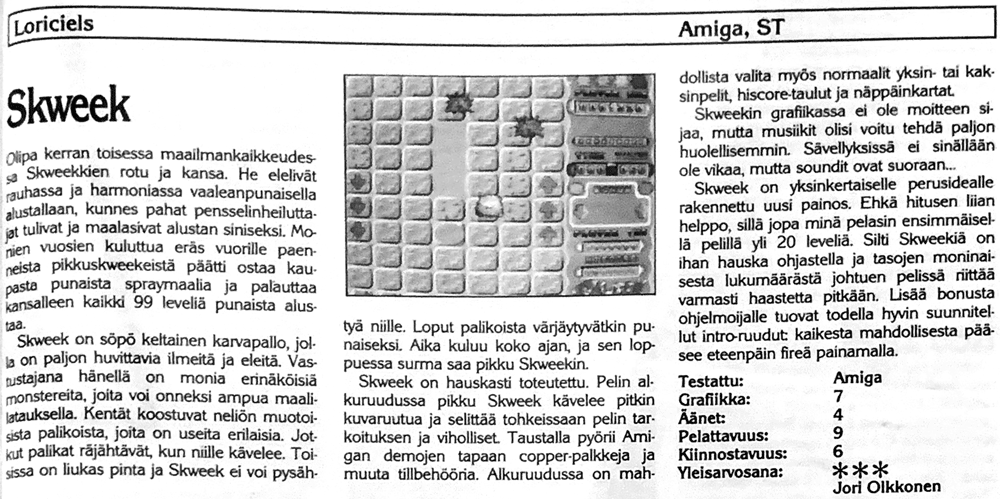
Skweek1989 SyksyPysyvä linkkiOlipa kerran toisessa maailmankaikkeudessa Skweekkien rotu ja kansa. He elelivät rauhassa ja harmoniassa vaaleanpunaisella alustallaan, kunnes pahat pensselinheiluttajat tulivat ja maalasivat alustan siniseksi. Monien vuosien kuluttua eräs vuorille paenneista pikkuskweekeistä päätti ostaa kaupasta punaista spraymaalia ja palauttaa kansalleen kaikki 99 leveliä punaista alustaa.
Skweek on söpö keltainen karvapallo, jolla on paljon huvittavia ilmeitä ja eleitä. Vastustajana hänellä on monia erinäköisiä monstereita, joita voi onneksi ampua maalilatauksella. Kentät koostuvat neliön muotoisista palikoista, joita on useita erilaisia. Jotkut palikat räjähtävät, kun niille kävelee. Toisissa on liukas pinta ja Skweek ei voi pysähtyä niille. Loput palikoista värjäytyvätkin punaiseksi. Aika kuluu koko ajan, ja sen loppuessa surma saa pikku Skweekin.
Skweek on hauskasti toteutettu. Pelin alkuruudussa pikku Skweek kävelee pitkin kuvaruutua ja selittää tohkeissaan pelin tarkoituksen ja viholliset. Taustalla pyörii Amigan demojen tapaan copper-palkkeja ja muuta tillbehööria. Alkuruudussa on mahdollista valita myös normaalit yksin- tai kaksinpelit, hiscore-taulut ja näppäinkartat.
Skweekin grafiikassa ei ole moitteen sijaa, mutta musiikit olisi voitu tehdä paljon huolellisemmin. Sävellyksissä ei sinällään ole vikaa, mutta soundit ovat suoraan...
Skweek on yksinkertaiselle perusidealle rakennettu uusi painos. Ehkä hitusen liian helppo, sillä jopa minä pelasin ensimmäisellä pelillä yli 20 leveliä. Silti Skweekiä on ihan hauska ohjastella ja tasojen moninaisesta lukumäärästä johtuen pelissä riittää varmasti haastetta pitkään. Lisää bonusta ohjelmoijalle tuovat todella hyvin suunnitellut intro-ruudut: kaikesta mahdollisesta pääsee eteenpäin fireä painamalla.
Skweek1989 SyksyPermalinkOnce upon a time, in another universe, there was a race and people called the Skweeks. They lived in peace and harmony on their pink platform, until the evil brush-wielders came and painted the platform blue. Many years later, one of the little skweeks who had fled to the mountains decided to buy some red spray paint from the shop and give their people back all 99 levels of red platform.
Skweek is a cute yellow furball with lots of amusing expressions and gestures. Skweek's opponents are all sorts of different-looking monsters, which luckily can be shot with a charge of paint. The levels are made up of square blocks, of which there are several different kinds. Some blocks explode when you walk on them. Others have a slippery surface and Skweek can't stop on them. The rest of the blocks are the ones that actually turn red. Time keeps ticking away, and when it runs out, death comes for little Skweek.
Skweek has been put together with a sense of fun. On the game's title screen little Skweek walks across the screen and excitedly explains the aim of the game and the enemies. In the background, Amiga-demo style, copper bars and other paraphernalia roll by. On the title screen you can also select the usual one- or two-player games, the hiscore tables and the key maps.
There's nothing to fault in Skweek's graphics, but the music could have been done far more carefully. There's nothing wrong with the compositions as such, but the sounds are straight out of...
Skweek is a new edition built on a simple basic idea. Maybe a tiny bit too easy, since even I got through more than 20 levels in my first game. Still, Skweek is quite fun to steer, and thanks to the sheer number of levels the game is sure to stay challenging for a long time. More bonus points for the programmer come from the really well designed intro screens: you can skip past absolutely everything by pressing fire.
Sky Ranger
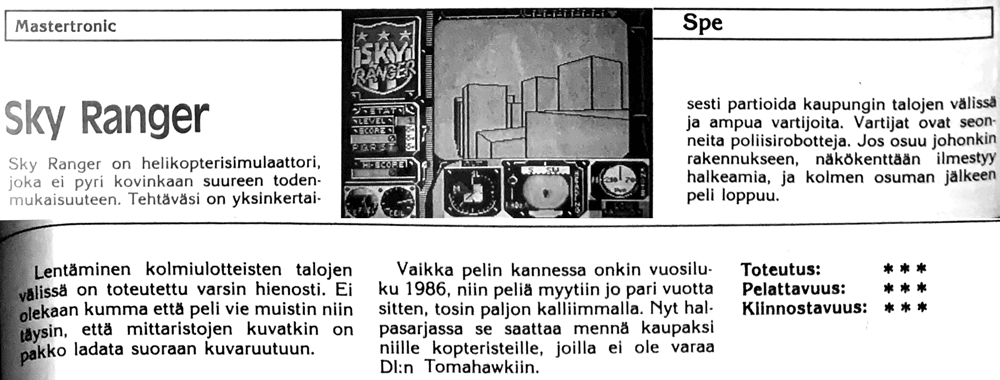
Sky Ranger1987Pysyvä linkkiSky Ranger on helikopterisimulaattori, joka ei pyri kovinkaan suureen todenmukaisuuteen. Tehtäväsi on yksinkertaisesti partioida kaupungin talojen välissä ja ampua vartijoita. Vartijat ovat seonneita poliisirobotteja. Jos osuu johonkin rakennukseen, näkökenttään ilmestyy halkeamia, ja kolmen osuman jälkeen peli loppuu. Lentäminen kolmiulotteisten talojen välissä on toteutettu varsin hienosti. Ei olekaan kumma että peli vie muistin niin täysin, että mittaristojen kuvatkin on pakko ladata suoraan kuvaruutuun.
Vaikka pelin kannessa onkin vuosiluku 1986, niin peliä myytiin jo pari vuotta sitten, tosin paljon kalliimmalla. Nyt halpasarjassa se saattaa mennä kaupaksi niille kopteristeille, joilla ei ole varaa DI:n Tomahawkiin.
Sky Ranger1987PermalinkSky Ranger is a helicopter simulator that doesn't strive for any great degree of realism. Your task is simply to patrol between the city's buildings and shoot the guards. The guards are police robots that have gone haywire. If you hit a building, cracks appear across your field of view, and after three hits the game is over. Flying between the three-dimensional buildings has been done rather impressively. Small wonder, then, that the game eats up the memory so completely that even the instrument panel graphics have to be loaded straight onto the screen.
Although the game's cover bears the year 1986, the game was already on sale a couple of years ago, albeit at a much higher price. Now, in the budget range, it may well find buyers among those chopper jockeys who can't afford DI's Tomahawk.
Skychase
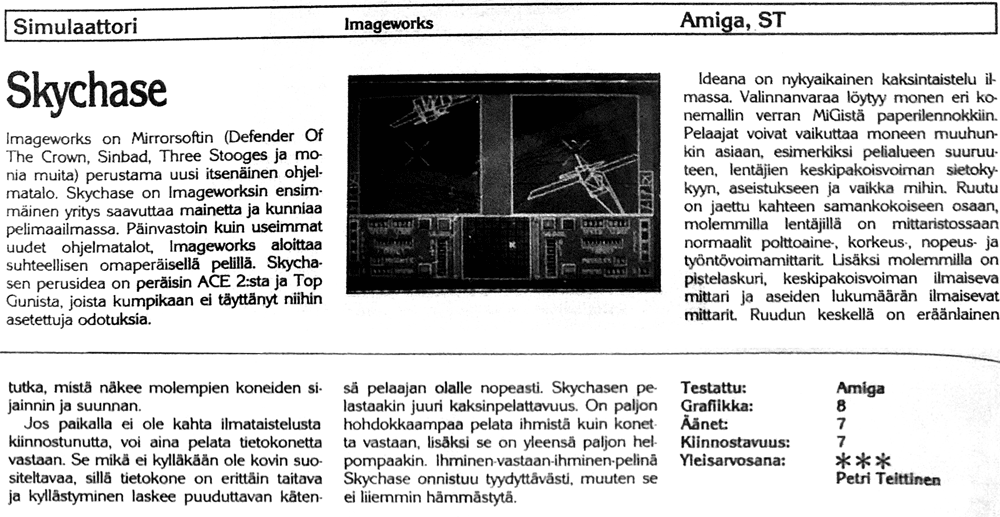
Skychase1989 KevätPysyvä linkkiImageworks on Mirrorsoftin (Defender Of The Crown, Sinbad, Three Stooges ja monia muita) perustama uusi itsenäinen ohjelmatalo. Skychase on Imageworksin ensimmäinen yritys saavuttaa mainetta ja kunniaa pelimaailmassa. Päinvastoin kuin useimmat uudet ohjelmatalot, Imageworks aloittaa suhteellisen omaperäisellä pelillä. Skychasen perusidea on peräisin ACE 2:sta ja Top Gunista, joista kumpikaan ei täyttänyt niihin asetettuja odotuksia.
Ideana on nykyaikainen kaksintaistelu ilmassa. Valinnanvaraa löytyy monen eri konemallin verran MiGistä paperilennokkiin. Pelaajat voivat vaikuttaa moneen muuhunkin asiaan, esimerkiksi pelialueen suuruuteen, lentäjien keskipakoisvoiman sietokykyyn, aseistukseen ja vaikka mihin. Ruutu on jaettu kahteen samankokoiseen osaan, molemmilla lentäjillä on mittaristossaan normaalit polttoaine-, korkeus-, nopeus- ja työntövoimamittarit. Lisäksi molemmilla on pistelaskuri, keskipakoisvoiman ilmaiseva mittari ja aseiden lukumäärän ilmaisevat mittarit. Ruudun keskellä on eräänlainen tutka, mistä näkee molempien koneiden sijainnin ja suunnan.
Jos paikalla ei ole kahta ilmataistelusta kiinnostunutta, voi aina pelata tietokonetta vastaan. Se mikä ei kylläkään ole kovin suositeltavaa, sillä tietokone on erittäin taitava ja kyllästyminen laskee puuduttavan kätensä pelaajan olalle nopeasti. Skychasen pelastaakin juuri kaksinpelattavuus. On paljon hohdokkaampaa pelata ihmistä kuin konetta vastaan, lisäksi se on yleensä paljon helpompaakin. Ihminen-vastaan-ihminen-pelinä Skychase onnistuu tyydyttävästi, muuten se ei liiemmin hämmästytä.
Skychase1989 KevätPermalinkImageworks is a new independent software house founded by Mirrorsoft (Defender Of The Crown, Sinbad, Three Stooges and many others). Skychase is Imageworks' first attempt to win fame and glory in the gaming world. Unlike most new software houses, Imageworks is starting out with a relatively original game. Skychase's basic idea comes from ACE 2 and Top Gun, neither of which lived up to the expectations placed on them.
The idea is a modern-day duel in the air. There is a choice of many different aircraft models, from a MiG to a paper aeroplane. The players can influence plenty of other things too, for example the size of the play area, the pilots' tolerance to centrifugal force, the armament and whatever else. The screen is split into two equal halves, and both pilots have the usual fuel, altitude, speed and thrust gauges on their instrument panels. In addition, each of them has a score counter, a gauge showing the centrifugal force and gauges showing the number of weapons. In the middle of the screen is a kind of radar, which shows the position and heading of both planes.
If there aren't two people around who are interested in aerial combat, you can always play against the computer. Which, mind you, is not very advisable, since the computer is extremely skilful and boredom soon lays its numbing hand on the player's shoulder. What saves Skychase is precisely its two-player playability. It is much more glamorous to play against a human than against a machine, and it's usually a lot easier too. As a human-versus-human game Skychase does a satisfactory job; otherwise it doesn't amaze much.
Skyfox II
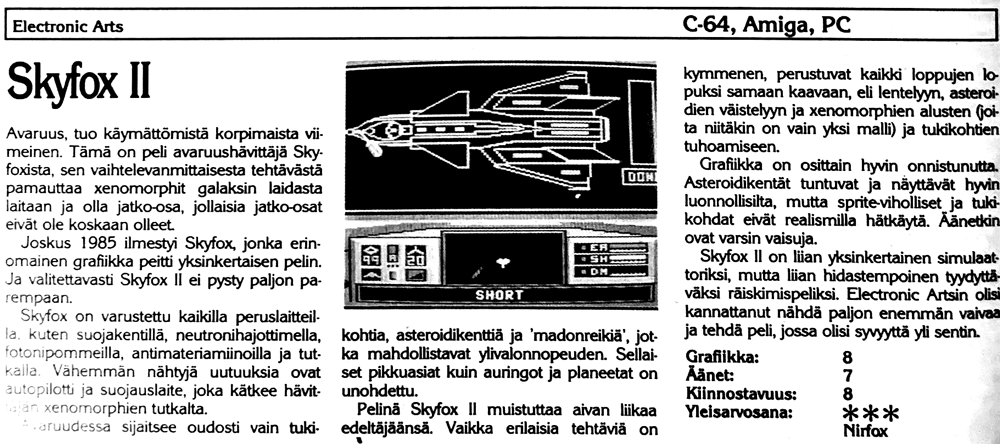
Skyfox II1988Pysyvä linkkiAvaruus, tuo käymättömistä korpimaista viimeinen. Tämä on peli avaruushävittäjä Skyfoxista, sen vaihtelevanmittaisesta tehtävästä pamauttaa xenomorphit galaksin laidasta laitaan ja olla jatko-osa, jollaisia jatko-osat eivät ole koskaan olleet.
Joskus 1985 ilmestyi Skyfox, jonka erinomainen grafiikka peitti yksinkertaisen pelin. Ja valitettavasti Skyfox II ei pysty paljon parempaan.
Skyfox on varustettu kaikilla peruslaitteilla, kuten suojakentillä, neutronihajottimella, fotonipommeilla, antimateriamiinoilla ja tutkalla. Vähemmän nähtyjä uutuuksia ovat autopilotti ja suojauslaite, joka kätkee hävittäjän xenomorphien tutkalta.
Avaruudessa sijaitsee oudosti vain tukikohtia, asteroidikenttiä ja 'madonreikiä', jotka mahdollistavat ylivalonnopeuden. Sellaiset pikkuasiat kuin auringot ja planeetat on unohdettu.
Pelinä Skyfox II muistuttaa aivan liikaa edeltäjäänsä. Vaikka erilaisia tehtäviä on kymmenen, perustuvat kaikki loppujen lopuksi samaan kaavaan, eli lentelyyn, asteroidien väistelyyn ja xenomorphien alusten (joita niitäkin on vain yksi malli) ja tukikohtien tuhoamiseen.
Grafiikka on osittain hyvin onnistunutta. Asteroidikentät tuntuvat ja näyttävät hyvin luonnollisilta, mutta sprite-viholliset ja tukikohdat eivät realismilla hätkäytä. Äänetkin ovat varsin vaisuja.
Skyfox II on liian yksinkertainen simulaattoriksi, mutta liian hidastempoinen tyydyttäväksi räiskimispeliksi. Electronic Artsin olisi kannattanut nähdä paljon enemmän vaivaa ja tehdä peli, jossa olisi syvyyttä yli sentin.
Skyfox II1988PermalinkSpace, the last of the untrodden wildernesses. This is the game of the space fighter Skyfox, its mission of varying length: to blast the xenomorphs from one end of the galaxy to the other, and to be a sequel like no sequel has ever been before.
Back around 1985 came Skyfox, whose excellent graphics covered up a simple game. And unfortunately Skyfox II can't manage much better.
The Skyfox is equipped with all the basic kit, such as shields, a neutron disruptor, photon bombs, antimatter mines and radar. Less commonly seen novelties are the autopilot and a cloaking device that hides the fighter from the xenomorphs' radar.
Oddly, space contains only bases, asteroid fields and 'wormholes', which make faster-than-light travel possible. Such trifles as suns and planets have been forgotten.
As a game, Skyfox II resembles its predecessor far too much. Although there are ten different missions, in the end they all follow the same formula: flying about, dodging asteroids and destroying xenomorph ships (of which there is, once again, only one model) and bases.
The graphics are in part very well done. The asteroid fields feel and look very natural, but the sprite enemies and bases won't startle anyone with their realism. The sound is pretty feeble too.
Skyfox II is too simple to be a simulator, but too slow-paced to be a satisfying shoot-'em-up. Electronic Arts should have gone to a lot more trouble and made a game with more than an inch of depth.
Slaine
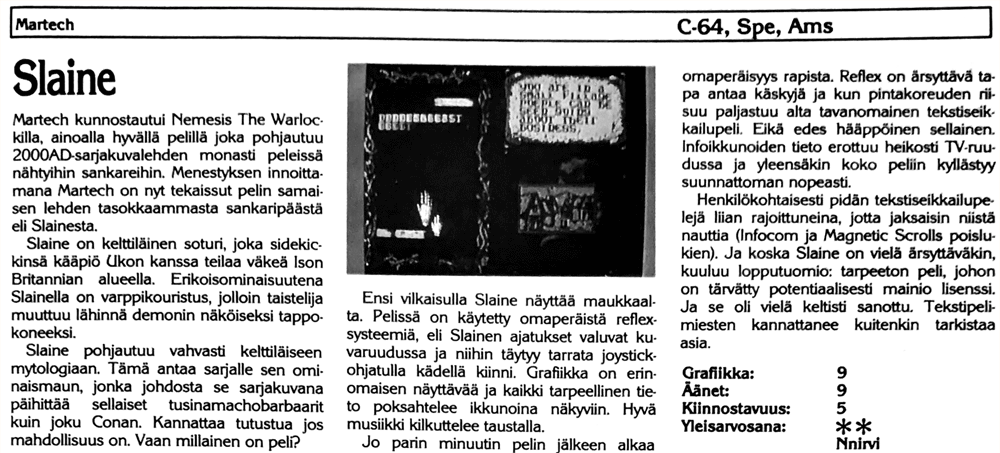
Slaine1988Pysyvä linkkiMartech kunnostautui Nemesis The Warlockilla, ainoalla hyvällä pelillä joka pohjautuu 2000AD-sarjakuvalehden monasti peleissä nähtyihin sankareihin. Menestyksen innoittamana Martech on nyt tekaissut pelin samaisen lehden tasokkaammasta sankaripäästä eli Slainesta.
Slaine on kelttiläinen soturi, joka sidekickinsä kääpiö Ukon kanssa teilaa väkeä Ison Britannian alueella. Erikoisominaisuutena Slainella on varppikouristus, jolloin taistelija muuttuu lähinnä demonin näköiseksi tappokoneeksi.
Slaine pohjautuu vahvasti kelttiläiseen mytologiaan. Tämä antaa sarjalle sen ominaismaun, jonka johdosta se sarjakuvana päihittää sellaiset tusinamachobarbaarit kuin joku Conan. Kannattaa tutustua jos mahdollisuus on. Vaan millainen on peli?
Ensi vilkaisulla Slaine näyttää maukkaalta. Pelissä on käytetty omaperäistä reflexsysteemiä, eli Slainen ajatukset valuvat kuvaruudussa ja niihin täytyy tarrata joystickohjatulla kädellä kiinni. Grafiikka on erinomaisen näyttävää ja kaikki tarpeellinen tieto poksahtelee ikkunoina näkyviin. Hyvä musiikki kilkuttelee taustalla.
Jo parin minuutin pelin jälkeen alkaa omaperäisyys rapista. Reflex on ärsyttävä tapa antaa käskyjä ja kun pintakoreuden riisuu paljastuu alta tavanomainen tekstiseikkailupeli. Eikä edes hääppöinen sellainen. Infoikkunoiden tieto erottuu heikosti TV-ruudussa ja yleensäkin koko peliin kyllästyy suunnattoman nopeasti.
Henkilökohtaisesti pidän tekstiseikkailupelejä liian rajoittuneina, jotta jaksaisin niistä nauttia (Infocom ja Magnetic Scrolls poislukien). Ja koska Slaine on vielä ärsyttäväkin, kuuluu lopputuomio: tarpeeton peli, johon on tärvätty potentiaalisesti mainio lisenssi. Ja se oli vielä keltisti sanottu. Tekstipelimiesten kannattanee kuitenkin tarkistaa asia.
Slaine1988PermalinkMartech distinguished itself with Nemesis The Warlock, the only good game based on the heroes of the comic 2000AD, who have been seen in games many a time. Inspired by that success, Martech has now knocked out a game about a hero from the classier end of the same comic, namely Slaine.
Slaine is a Celtic warrior who, together with his sidekick, the dwarf Ukko, cuts folk down across the territory of Great Britain. As a special feature, Slaine has the warp spasm, in which the fighter turns into a killing machine that looks more or less like a demon.
Slaine draws heavily on Celtic mythology. This gives the strip its distinctive flavour, thanks to which, as a comic, it beats dime-a-dozen macho barbarians such as some Conan. Worth getting to know if you have the chance. But what's the game like?
At first glance Slaine looks tasty. The game uses an original reflex system: Slaine's thoughts drift across the screen and you have to grab hold of them with a joystick-controlled hand. The graphics are superbly spectacular and all the necessary information pops up in windows. Good music tinkles away in the background.
After just a couple of minutes of play the originality starts to flake off. Reflex is an irritating way of giving commands, and once you strip away the surface glitter, what's revealed underneath is an ordinary text adventure. And not even a particularly good one at that. The information in the info windows is hard to make out on a TV screen, and in general you get fed up with the whole game tremendously fast.
Personally I find text adventures too limited to have the energy to enjoy them (Infocom and Magnetic Scrolls excepted). And since Slaine is irritating on top of that, the final verdict reads: a pointless game on which a potentially splendid licence has been squandered. And that was putting it kindly. Text game buffs should probably check it out anyway, though.
Slapfight
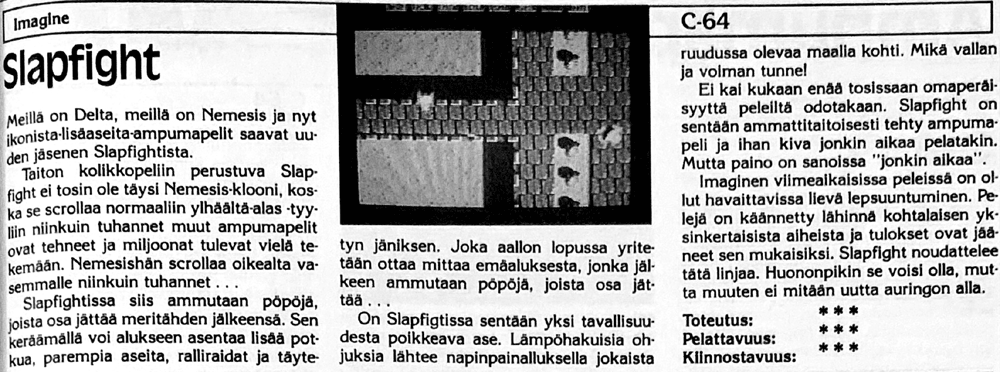
Slapfight1987Pysyvä linkkiMeillä on Delta, meillä on Nemesis ja nyt ikonista-lisäaseita-ampumapelit saavat uuden jäsenen Slapfightista.
Taiton kolikkopeliin perustuva Slapfight ei tosin ole täysi Nemesis-klooni, koska se scrollaa normaaliin ylhäältä-alas -tyyliin niinkuin tuhannet muut ampumapelit ovat tehneet ja miljoonat tulevat vielä tekemään. Nemesishän scrollaa oikealta vasemmalle niinkuin tuhannet . . .
Slapfightissa siis ammutaan pöpöjä, joista osa jättää meritähden jälkeensä. Sen keräämällä voi alukseen asentaa lisää potkua, parempia aseita, ralliraidat ja täytetyn jäniksen. Joka aallon lopussa yritetään ottaa mittaa emäaluksesta, jonka jälkeen ammutaan pöpöjä, joista osa jättää . . .
On Slapfigtissa sentään yksi tavallisuudesta poikkeava ase. Lämpöhakuisia ohjuksia lähtee napinpainalluksella jokaista ruudussa olevaa maalia kohti. Mikä vallan ja voiman tunne!
Ei kai kukaan enää tosissaan omaperäisyyttä peleiltä odotakaan. Slapfight on sentään ammattitaitoisesti tehty ampumapeli ja ihan kiva jonkin aikaa pelatakin. Mutta paino on sanoissa "jonkin aikaa".
Imaginen viimeaikaisissa peleissä on ollut havaittavissa lievä lepsuuntuminen. Pelejä on käännetty lähinnä kohtalaisen yksinkertaisista aiheista ja tulokset ovat jääneet sen mukaisiksi. Slapfight noudattelee tätä linjaa. Huononpikin se voisi olla, mutta muuten ei mitään uutta auringon alla.
Slapfight1987PermalinkWe've got Delta, we've got Nemesis, and now the extra-weapons-from-icons shoot-'em-ups gain a new member in Slapfight.
Based on Taito's coin-op, Slapfight isn't a full-blown Nemesis clone, though, since it scrolls in the normal top-to-bottom style, as thousands of other shoot-'em-ups have done and millions more are yet to do. Nemesis, of course, scrolls from right to left, as thousands . . .
So in Slapfight you shoot critters, some of which leave a starfish behind. By collecting it you can fit your ship with extra oomph, better weapons, racing stripes and a stuffed rabbit. At the end of each wave you try to square up to the mothership, after which you shoot critters, some of which leave . . .
Slapfight does at least have one weapon that's out of the ordinary. At the press of a button, heat-seeking missiles launch at every target on the screen. What a sense of power and might!
Surely nobody seriously expects originality from games any more. Slapfight is at least a professionally made shoot-'em-up, and quite fun to play for a while, too. But the emphasis is on the words "for a while".
A slight slackening has been noticeable in Imagine's recent games. They have mostly been converted from fairly simple source material, and the results have turned out accordingly. Slapfight follows this line. It could be worse, but otherwise there's nothing new under the sun.
Sleeping Gods Lie
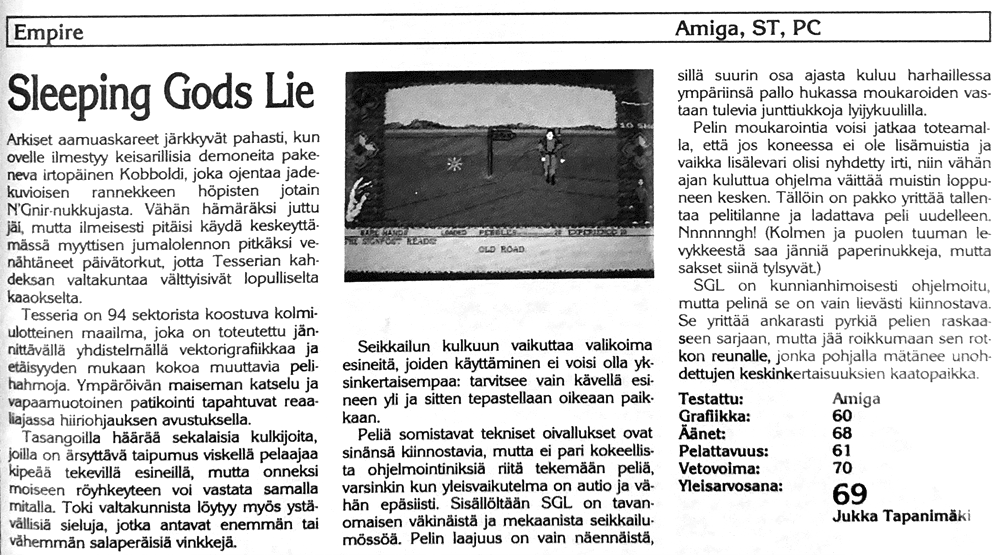
Sleeping Gods Lie1990 KevätPysyvä linkkiArkiset aamuaskareet järkkyvät pahasti, kun ovelle ilmestyy keisarillisia demoneita pakeneva irtopäinen Kobboldi, joka ojentaa jadekuvioisen rannekkeen höpisten jotain N'Gnir-nukkujasta. Vähän hämäräksi juttu jäi, mutta ilmeisesti pitäisi käydä keskeyttämässä myyttisen jumalolennon pitkäksi venähtäneet päivätorkut, jotta Tesserian kahdeksan valtakuntaa välttyisivät lopulliselta kaaokselta.
Tesseria on 94 sektorista koostuva kolmiulotteinen maailma, joka on toteutettu jännittävällä yhdistelmällä vektorigrafiikkaa ja etäisyyden mukaan kokoa muuttavia pelihahmoja. Ympäröivän maiseman katselu ja vapaamuotoinen patikointi tapahtuvat reaaliajassa hiiriohjauksen avustuksella.
Tasangoilla häärää sekalaisia kulkijoita, joilla on ärsyttävä taipumus viskellä pelaajaa kipeää tekevillä esineillä, mutta onneksi moiseen röyhkeyteen voi vastata samalla mitalla. Toki valtakunnista löytyy myös ystävällisiä sieluja, jotka antavat enemmän tai vähemmän salaperäisiä vinkkejä.
Seikkailun kulkuun vaikuttaa valikoima esineitä, joiden käyttäminen ei voisi olla yksinkertaisempaa: tarvitsee vain kävellä esineen yli ja sitten tepastellaan oikeaan paikkaan.
Peliä somistavat tekniset oivallukset ovat sinänsä kiinnostavia, mutta ei pari kokeellista ohjelmointiniksiä riitä tekemään peliä, varsinkin kun yleisvaikutelma on autio ja vähän epäsiisti. Sisällöltään SGL on tavanomaisen väkinäistä ja mekaanista seikkailumössöä. Pelin laajuus on vain näennäistä, sillä suurin osa ajasta kuluu harhaillessa ympäriinsä pallo hukassa moukaroiden vastaan tulevia junttiukkoja lyijykuulilla.
Pelin moukarointia voisi jatkaa toteamalla, että jos koneessa ei ole lisämuistia ja vaikka lisälevari olisi nyhdetty irti, niin vähän ajan kuluttua ohjelma väittää muistin loppuneen kesken. Tällöin on pakko yrittää tallentaa pelitilanne ja ladattava peli uudelleen. Nnnnnngh! (Kolmen ja puolen tuuman levykkeestä saa jänniä paperinukkeja, mutta sakset siinä tylsyvät.)
SGL on kunnianhimoisesti ohjelmoitu, mutta pelinä se on vain lievästi kiinnostava. Se yrittää ankarasti pyrkiä pelien raskaaseen sarjaan, mutta jää roikkumaan sen rotkon reunalle, jonka pohjalla mätänee unohdettujen keskinkertaisuuksien kaatopaikka.
Sleeping Gods Lie1990 KevätPermalinkYour everyday morning routine is badly thrown off when a loose-headed Kobold on the run from imperial demons turns up at the door, hands over a jade-patterned bracelet and babbles something about the N'Gnir sleeper. The story stayed a bit murky, but apparently you're supposed to go and interrupt a mythical divine being's overlong afternoon nap, so that the eight kingdoms of Tesseria can be spared final chaos.
Tesseria is a three-dimensional world consisting of 94 sectors, realised with an exciting combination of vector graphics and game characters that change size according to their distance. Viewing the surrounding landscape and free-form hiking happen in real time, with a helping hand from mouse control.
The plains are teeming with assorted wanderers who have an irritating tendency to pelt the player with objects that hurt, but luckily such impudence can be answered in kind. Of course, the kingdoms also have friendly souls who give you more or less cryptic hints.
The course of the adventure is affected by a selection of objects that couldn't be simpler to use: all you need to do is walk over the object and then toddle off to the right place.
The technical innovations that dress up the game are interesting in themselves, but a couple of experimental programming tricks aren't enough to make a game, especially when the overall impression is desolate and a bit messy. In content SGL is the usual forced and mechanical adventure mush. The game's scope is only apparent, since most of the time goes on wandering about all at sea, hammering the yokels you meet with lead balls.
One could carry on hammering the game by noting that if the machine has no extra memory, then even with the external drive yanked out, after a while the program claims to have run out of memory. At that point you have no choice but to try to save your position and load the game again. Nnnnnngh! (A three-and-a-half-inch floppy makes nifty paper dolls, but it blunts your scissors.)
SGL is ambitiously programmed, but as a game it's only mildly interesting. It tries hard to push its way into the heavyweight division of games, but is left hanging from the edge of the ravine at the bottom of which the rubbish tip of forgotten mediocrities lies rotting.
Sly Spy - Secret Agent
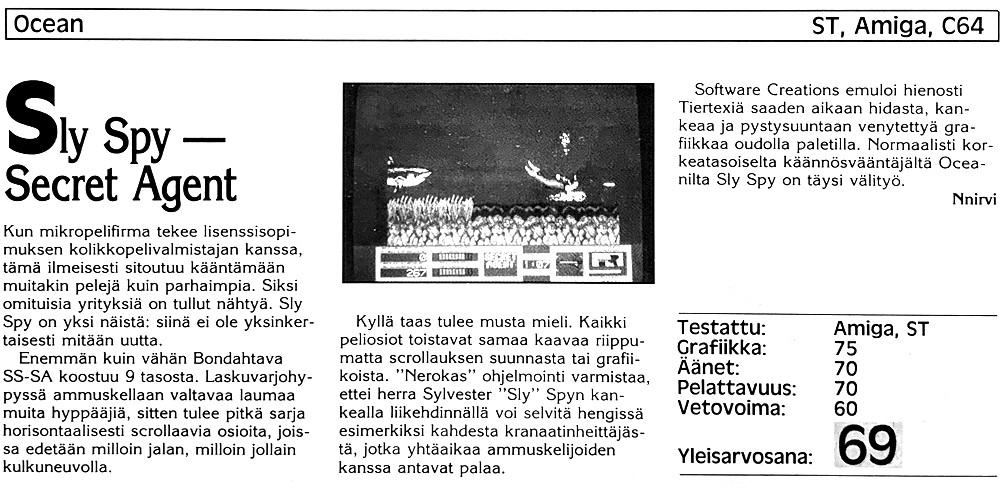
Sly Spy - Secret Agent1991 KevätPysyvä linkkiKun mikropelifirma tekee lisenssisopimuksen kolikkopelivalmistajan kanssa, tämä ilmeisesti sitoutuu kääntämään muitakin pelejä kuin parhaimpia. Siksi omituisia yrityksiä on tullut nähtyä. Sly Spy on yksi näistä: siinä ei ole yksinkertaisesti mitään uutta.
Enemmän kuin vähän Bondahtava SS-SA koostuu 9 tasosta. Laskuvarjohypyssä ammuskellaan valtavaa laumaa muita hyppääjiä, sitten tulee pitkä sarja horisontaalisesti scrollaavia osioita, joissa edetään milloin jalan, milloin jollain kulkuneuvolla.
Kyllä taas tulee musta mieli. Kaikki peliosiot toistavat samaa kaavaa riippumatta scrollauksen suunnasta tai grafiikoista. "Nerokas" ohjelmointi varmistaa, ettei herra Sylvester "Sly" Spyn kankealla liikehdinnällä voi selvitä hengissä esimerkiksi kahdesta kranaatinheittäjästä, jotka yhtäaikaa ammuskelijoiden kanssa antavat palaa.
Software Creations emuloi hienosti Tiertexiä saaden aikaan hidasta, kankeaa ja pystysuuntaan venytettyä grafiikkaa oudolla paletilla. Normaalisti korkeatasoiselta käännösvääntäjältä Oceanilta Sly Spy on täysi välityö.
Sly Spy - Secret Agent1991 KevätPermalinkWhen a computer game company signs a licensing deal with an arcade manufacturer, it apparently commits to converting other games besides the best ones. That's why we've been treated to some odd efforts. Sly Spy is one of them: there is simply nothing new in it.
More than a little Bond-ish, SS-SA consists of 9 levels. In the parachute jump you shoot at a huge flock of other jumpers, then comes a long series of horizontally scrolling sections where you advance sometimes on foot, sometimes in some vehicle.
Once again it puts me in a black mood. All the game sections repeat the same formula regardless of scroll direction or graphics. "Ingenious" programming makes sure that with Mr Sylvester "Sly" Spy's stiff movements you can't survive, for example, two grenade throwers letting rip at the same time as the gunmen.
Software Creations does a fine job of emulating Tiertex, producing slow, stiff, vertically stretched graphics with a weird palette. From Ocean, normally a high-class conversion cranker, Sly Spy is a total filler job.
Snoopy
Snoopy1990 KevätPysyvä linkkiMenestyvän sarjakuvan ainekset Charles Schulzin mukaan: otetaan lauma pikkuvanhoja kakaroita ja jätetään aikuiset turhina pois. Lisätään varsinaiseksi tähdeksi koira, koska ihmishenkilöiden inhimillinen ilmaisuvoima on rajoitettu. Tuloksena Tenavat, eräs suosituimmista ja maailmanlaajuisimmista sarjakuvista. Ja jos aihe myy sarjakuvana, myy se tietokonepelinäkin.
Näin ainakin uskoo The Edge, joka on tämän Ressu-pelin markkinoille tempaissut. Peli on tyypillinen toimintaseikkailu: Eppu hukkasi riepunsa ja Ressu lähtee etsimään, kun mokoma traumaatikko ei psykiatrillekaan mene. Sankarimme kulkee pitkin ja poikin maisemia kuljetellen ja käytellen erilaisia esineitä. Maisemat ja hahmot ovat uskollisia alkuperäisesitykselle, eikä mitään tyylirikkoja ole havaittavissa.
Äänipuoli rajoittuu tässä tietokonesarjakuvassa alkuruudun melodiaan. Yksi joystick ja välilyöntinäppäin riittävät jäniskoiran ohjailuun, kunhan vaan tietäisi/arvaisi mitä pitää tehdä. Liikkeet saisivat olla vähän vikkelämpiä. Vain yhtä esinettä pystyy kuljettamaan kerrallaan ja vähän ajan kuluttua huomaa kuljeskelevansa edestakaisin pelin varsin suppeaa aluetta.
Peli olisi varmasti nuorempien toimintaseikkailupelien ystävien makuun, mutta heitäkin varoitettakoon pelin epäloogisuudesta ja muutamista harmittavista bugeista. Esimerkki 1: käytettävät esineet on mahdollista pudottaa sellaiseen kohtaan, joista niitä ei enää saa pois. Esimerkki 2: pelissä käytettävää kirjoituskonetta voi käyttää kahteen tarkoitukseen. Ensin kirjeen kirjoittamiseen. Sen jälkeen Amigan resetoimiseen. Yäk.
Joka tapauksessa peli osoittaa, etteivät Edgen sarjakuvalisenssit graafiselta ulkoasultaan onnahtele. Bugit pois, pelattavuutta hiukka lisää ja seuraavaksi aiheeksi vaikka Lassi & Leevi, Edge hyvä.
Snoopy1990 KevätPermalinkThe ingredients of a successful comic strip according to Charles Schulz: take a gang of precocious brats and leave out the adults as superfluous. Add a dog as the real star, since the human powers of expression of human characters are limited. The result: Peanuts, one of the most popular and most worldwide comic strips there is. And if a subject sells as a comic strip, it'll sell as a computer game too.
Or so The Edge at least believes, having whipped this Snoopy game onto the market. The game is a typical action adventure: Linus has lost his blanket and Snoopy sets off to look for it, since the blessed trauma case won't even go to a psychiatrist. Our hero roams the landscapes far and wide, lugging around and using various objects. The scenery and characters are faithful to the original, and there are no lapses of style to be seen.
In this computer comic strip the sound side is limited to the title-screen tune. One joystick and the space bar are enough to steer the beagle, if only you knew/guessed what you're supposed to do. The movements could be a bit nippier. You can only carry one object at a time, and after a while you find yourself traipsing back and forth across the game's rather cramped area.
The game would surely be to the taste of younger fans of action adventure games, but let them too be warned about the game's illogicality and a few annoying bugs. Example 1: the objects you need can be dropped in places from which they can no longer be retrieved. Example 2: the typewriter in the game can be used for two purposes. First, for writing a letter. After that, for resetting the Amiga. Yuck.
In any case, the game shows that Edge's comic licences don't limp when it comes to graphical looks. Bugs out, a smidgen more playability, and for the next subject how about Calvin & Hobbes, my dear Edge.
Snowstrike
Snowstrike1991 KevätPysyvä linkkiSnowstrike on erilainen lentosimulaattori. Ihan samalla tavalla kuin kaikki muutkin. Siis erilainen. Erilaisuutta ei kuitenkaan ole historiallisiin faktoihin tukeutuminen, mikä onkin osittain aina vaivannut lentosimuja. Tällä kertaa julistetaan sota huumeita vastaan ja tuhon välineeksi valitaan hävittäjä F14-LCB COSMOS, koodinimeltään Rapier.
Peli alkaa lupaavasti usealla valikolla, joissa päätetään ketä tuhotaan, missä, kenen kanssa ja millaisella säällä. Myös vaikeustason saa valita neljästä vaihtoehdosta, eikä ohjainnäppäintenkään lukumäärä pelästytä. Lentämisen lisäksi pelaaja hoitaa myös osittain lennonjohtoa kontrollihuoneesta, jossa kaikki tarvittava tieto suoritettavasta tehtävästä on saatavilla.
Lentoon noustaessa peli paljastaa kuitenkin todellisen luonteenheikkoutensa - hitauden. Puhtaissa siviili-ilmailuun erikoistuneissa lentosimuissa ei hitaus välttämättä tee peliä sietämättömäksi, mutta taistelusimussa tilanne on aivan toinen. Jos pelaaja ehtii ohjuksen hakeutuessa maaliinsa käymään kahvilla, ei minkäänlaista tiivistä tunnelmaa tai palavaa jännitystä oikein synny. Piirtorutiini yrittää käsitellä väritettyjä kappaleita eikä vektorigrafiikkaa, ja tulos on auttamattoman nukuttava.
Tämän lisäksi ohjausliikkeiden tarkistus on hidas/heikko ja lentokoneen tarkka kohdistaminen hyökkäystilanteessa on aluksi turhauttavaa. Eikä turhautumiaan voi purkaa edes omaan lennonjohtotorniin, sillä se osoittautuu harvinai sen kestäväksi omien hävittäjiensä ammuksia vastaan.
Snowstrike on siis erilainen siinä mielessä, että se on Epyxin tuottama, ja että toista samannimistä simua tuskin löytyy. Koska nämä eivät kuitenkaan riitä nostamaan peliä samanlaisuuden yläpuolelle, ei peliä voi suositella toiminnasta tai edes simulaatioista kiinnostuneille.
Snowstrike1991 KevätPermalinkSnowstrike is a different kind of flight simulator. Different in exactly the same way as all the others. Different, in other words. The difference, however, does not lie in leaning on historical facts, which has always partly plagued flight sims. This time war is declared on drugs, and the instrument of destruction chosen is the F14-LCB COSMOS fighter, codenamed Rapier.
The game starts promisingly with several menus in which you decide whom to destroy, where, with whom and in what kind of weather. The difficulty level can also be picked from four options, and the number of control keys won't scare you off either. Besides flying, the player also partly handles air traffic control from a control room, where all the necessary information on the mission at hand is available.
Once you take off, however, the game reveals its real character flaw - slowness. In flight sims devoted purely to civil aviation, slowness doesn't necessarily make a game unbearable, but in a combat sim it's a whole different story. If the player has time to nip off for a coffee while a missile homes in on its target, no tense atmosphere or burning excitement of any kind really develops. The drawing routine tries to handle coloured solids rather than vector graphics, and the result is hopelessly soporific.
On top of this, the reading of control inputs is slow/weak, and lining the plane up precisely in an attack situation is frustrating at first. Nor can you even vent your frustrations on your own control tower, as it turns out to be unusually resistant to its own fighters' shells.
So Snowstrike is different in the sense that it was produced by Epyx, and that you'll hardly find another sim of the same name. Since these aren't enough to lift the game above sameness, however, it can't be recommended to anyone interested in action, or even in simulations.
Soldier of Fortune
Soldier of Fortune1989 KevätPysyvä linkkiGraftgold, joka ennen paiski töitä Hewsonille majailee nyt Firebirdin siipien suojassa. Osoituksena siitä, ettei Graftgold ole sama kuin Andrew Braybrook on Firebird julkaissut John Cummingsin Soldier of Fortunen.
"Onni palaa vasta kun Eläinradan voimanlähde on löydetty" kertoo aika tarkkaan minkä tyyppisestä pelistä kysymys. Oikein, lapset, kaava on vanha tuttu ratkaisu = hypi + pompi + kiipeä + ammu. Onneksi vanhaan kaavaan on pujotettu pari uutta muuttujaa.
Tarkoitus on kerätä Eläinradan kappaleita, jotka ovat avain onnelliseen loppuun. Paljon muutakin kerättävää löytyy pelaajan suureksi riemuksi. Kaupat myyvät paitsi parempia aseita ja uusia suojia myös lisäelämiä. Mutta mistä rahat? Rahahan ei kasva puissa, mutta työntekoon ei kannata vaivautua, sillä rahat asuvat hirviöiden masussa. Kun isännästä lähtee henki, alkaa raha iloisesti ponnahdella inflaation nakertaessa sitä joka pompulla. Iloinen yllätys on myös sieltä sun täältä löytyvät alipelit, jotka tehokkaasti katkovat rutiinia.
Soldier of Fortune ei sisällä mitään ennennäkemättömän loisteliasta grafiikkaa, mutta ei se häiritse esteettiseempääkään silmää. Äänistä voi todeta että kyllä niitä on.
Itse asiassa Soldier of Fortune on varsin positiivinen yllätys. Kaikki osaset muodostavat tasapainoisen ja miellyttävän pelin, joka ei rassaa hermoja keinotekoisella pikselintarkalla hyppelyllä. Graftgoldin uutukainen on tavanomaista huomattavasti parempi toimintaseikkailu.
Soldier of Fortune1989 KevätPermalinkGraftgold, who used to slave away for Hewson, now nestles under the shelter of Firebird's wings. As proof that Graftgold is not the same thing as Andrew Braybrook, Firebird has published John Cummings's Soldier of Fortune.
"Fortune will return only once the power source of the Zodiac has been found" tells you pretty precisely what type of game this is. That's right, children, the formula is the good old familiar solution = jump + bounce + climb + shoot. Luckily a couple of new variables have been slipped into the old formula.
The aim is to collect pieces of the Zodiac, which are the key to a happy ending. There's plenty else to collect too, to the player's great delight. The shops sell not only better weapons and new shields but extra lives as well. But where's the money to come from? Money doesn't grow on trees, of course, but there's no point bothering with work, because the money lives in the monsters' tummies. When the host gives up the ghost, the money starts bouncing merrily about, with inflation nibbling away at it on every bounce. Another happy surprise is the sub-games found here and there, which break up the routine nicely.
Soldier of Fortune contains no unprecedentedly splendid graphics, but they won't offend even a more aesthetic eye. As for the sounds, it can be stated that yes, there are some.
In fact, Soldier of Fortune is quite a pleasant surprise. All the pieces add up to a balanced and enjoyable game that doesn't grate on your nerves with artificial pixel-perfect jumping. Graftgold's newcomer is a considerably better than average action adventure.
Soldier of Light
Soldier of Light1989 KevätPysyvä linkkiSeuraa kysymys: hyvä Xain, pyhä tehtäväsi on vapauttaa galaksi Federaation ikeen alta (tämä on SOLin tekijöiden näkemys eikä vastaa arvostelijan kantaa Federaatiosta ja Starfleetistä). He ovat soluttaneet kolme planeettaa järjestelmästämme ja vain sinä, rakas Xain, seisot meidän ja tuhon välissä. Kysymys kuuluu: millainen peli on kyseessä?
Aivan oikein, shoot'em-uphan se siellä oli. Ja tällä kertaa sitä mallia, missä sankari pomppii tasolta toiselle, ampuu ja keräilee lisä-aseita, kunnes kohtaa jossain välissä normaalia isomman ja sitkeämmän hirviön. Sinänsä ennen monasti nähtyä.
Mutta ovathan tällaiset pelit hauskoja, ei niihin muuten kukaan rahojaan työntäisi. Ja Soldier of Light täyttää hyvän Amiga-shoot'em-upin vaatimukset: graafinen puoli on ammattimiesten työtä eikä ääniäkään voi haukkua. Soldier of Lightia pelaa ihan mielikseen, mikä onkin suurin kehu mihin tämä peliarvostelija jaksaa venyä. Mitäpä muutakaan Soldier of Lightista jaksaisi sanoa?
Soldier of Light1989 KevätPermalinkHere's a question: good Xain, your sacred mission is to free the galaxy from under the yoke of the Federation (this is the view of SOL's makers and does not reflect the reviewer's position on the Federation and Starfleet). They have infiltrated three planets in our system and only you, dear Xain, stand between us and destruction. The question is: what kind of game are we talking about?
Quite right, a shoot'em-up is what it was. And this time the kind where the hero bounces from platform to platform, shooting and collecting extra weapons, until somewhere along the way he runs into a monster that's bigger and tougher than normal. Seen many times before, as such.
But then games like this are fun, otherwise nobody would shove their money into them. And Soldier of Light meets the requirements of a good Amiga shoot'em-up: the graphics side is the work of professionals and you can't knock the sound either. Soldier of Light is quite pleasant to play, which is in fact the biggest compliment this game reviewer can be bothered to stretch to. What else could anyone be bothered to say about Soldier of Light?
Sons of Liberty & Rebel Charge at Chickamauga
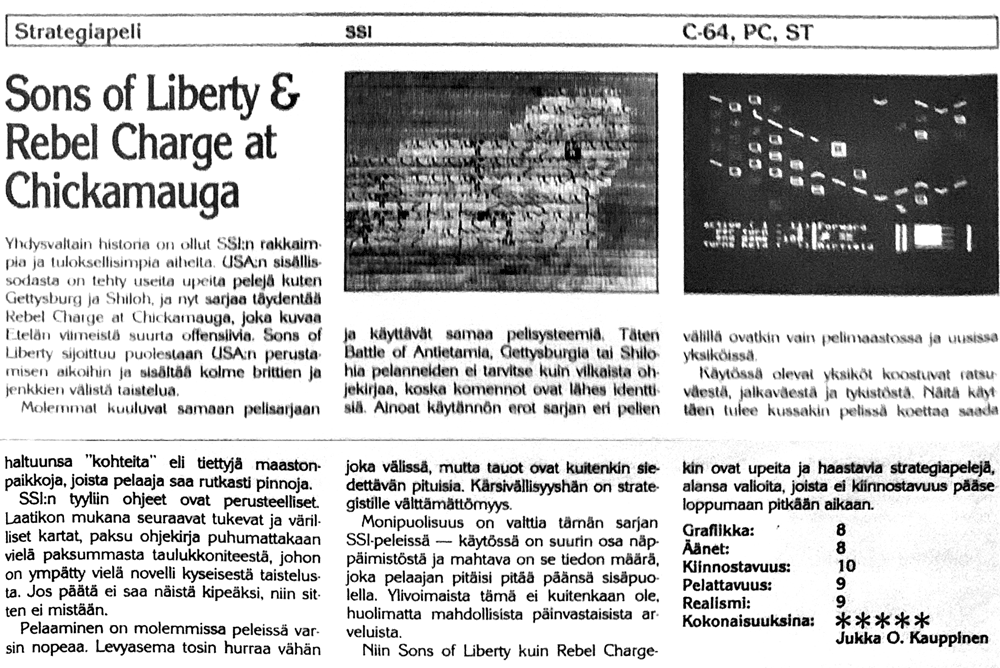
Sons of Liberty & Rebel Charge at Chickamauga1989 KevätPysyvä linkkiYhdysvaltain historia on ollut SSI:n rakkaimpia ja tuloksellisimpia aiheita. USA:n sisällissodasta on tehty useita upeita pelejä kuten Gettysburg ja Shiloh, ja nyt sarjaa täydentää Rebel Charge at Chickamauga, joka kuvaa Etelän viimeistä suurta offensiivia. Sons of Liberty sijoittuu puolestaan USA:n perustamisen aikoihin ja sisältää kolme brittien ja jenkkien välistä taistelua.
Molemmat kuuluvat samaan pelisarjaan ja käyttävät samaa pelisysteemiä. Täten Battle of Antietamia, Gettysburgia tai Shilohia pelanneiden ei tarvitse kuin vilkaista ohjekirjaa, koska komennot ovat lähes identtisiä. Ainoat käytännön erot sarjan eri pelien välillä ovatkin vain pelimaastossa ja uusissa yksiköissä.
Käytössä olevat yksiköt koostuvat ratsuväestä, jalkaväestä ja tykistöstä. Näitä käyttäen tulee kussakin pelissä koettaa saada haltuunsa "kohteita" eli tiettyjä maastonpaikkoja, joista pelaaja saa rutkasti pinnoja.
SSI:n tyyliin ohjeet ovat perusteelliset. Laatikon mukana seuraavat tukevat ja värilliset kartat, paksu ohjekirja puhumattakaan vielä paksummasta taulukkoniteestä, johon on ympätty vielä novelli kyseisestä taistelusta. Jos päätä ei saa näistä kipeäksi, niin sitten ei mistään.
Pelaaminen on molemmissa peleissä varsin nopeaa. Levyasema tosin hurraa vähän joka välissä, mutta tauot ovat kuitenkin siedettävän pituisia. Kärsivällisyyshän on strategistille välttämättömyys.
Monipuolisuus on valttia tämän sarjan SSI-peleissä - käytössä on suurin osa näppäimistöstä ja mahtava on se tiedon määrä, joka pelaajan pitäisi pitää päänsä sisäpuolella. Ylivoimaista tämä ei kuitenkaan ole, huolimatta mahdollisista päinvastaisista arveluista.
Niin Sons of Liberty kuin Rebel Chargekin ovat upeita ja haastavia strategiapelejä, alansa valioita, joista ei kiinnostavuus pääse loppumaan pitkään aikaan.
Sons of Liberty & Rebel Charge at Chickamauga1989 KevätPermalinkUnited States history has been one of SSI's most beloved and most fruitful subjects. Several superb games have been made about the American Civil War, such as Gettysburg and Shiloh, and now the series is rounded out by Rebel Charge at Chickamauga, which depicts the South's last great offensive. Sons of Liberty, on the other hand, is set around the time of the founding of the USA and contains three battles between the British and the Yanks.
Both belong to the same game series and use the same game system. So those who have played Battle of Antietam, Gettysburg or Shiloh need do no more than glance at the manual, since the commands are nearly identical. The only practical differences between the various games in the series are in fact just the terrain and the new units.
The units at your disposal consist of cavalry, infantry and artillery. Using these, in each game you have to try to take possession of "objectives", i.e. particular spots on the terrain, which earn the player heaps of points.
In SSI style, the instructions are thorough. The box comes with sturdy colour maps and a thick manual, not to mention an even thicker volume of tables, into which they've also crammed a short story about the battle in question. If these don't give you a headache, then nothing will.
Play is fairly fast in both games. The disk drive does whirr away at pretty much every opportunity, admittedly, but the pauses are still of tolerable length. Patience is, after all, a necessity for a strategist.
Versatility is the trump card in this series of SSI games - most of the keyboard is in use, and colossal is the amount of information the player is supposed to keep inside their head. It isn't overwhelming, though, despite any suspicions to the contrary.
Both Sons of Liberty and Rebel Charge are superb and challenging strategy games, champions of their field, whose interest won't run out for a long time to come.
Sorcerer
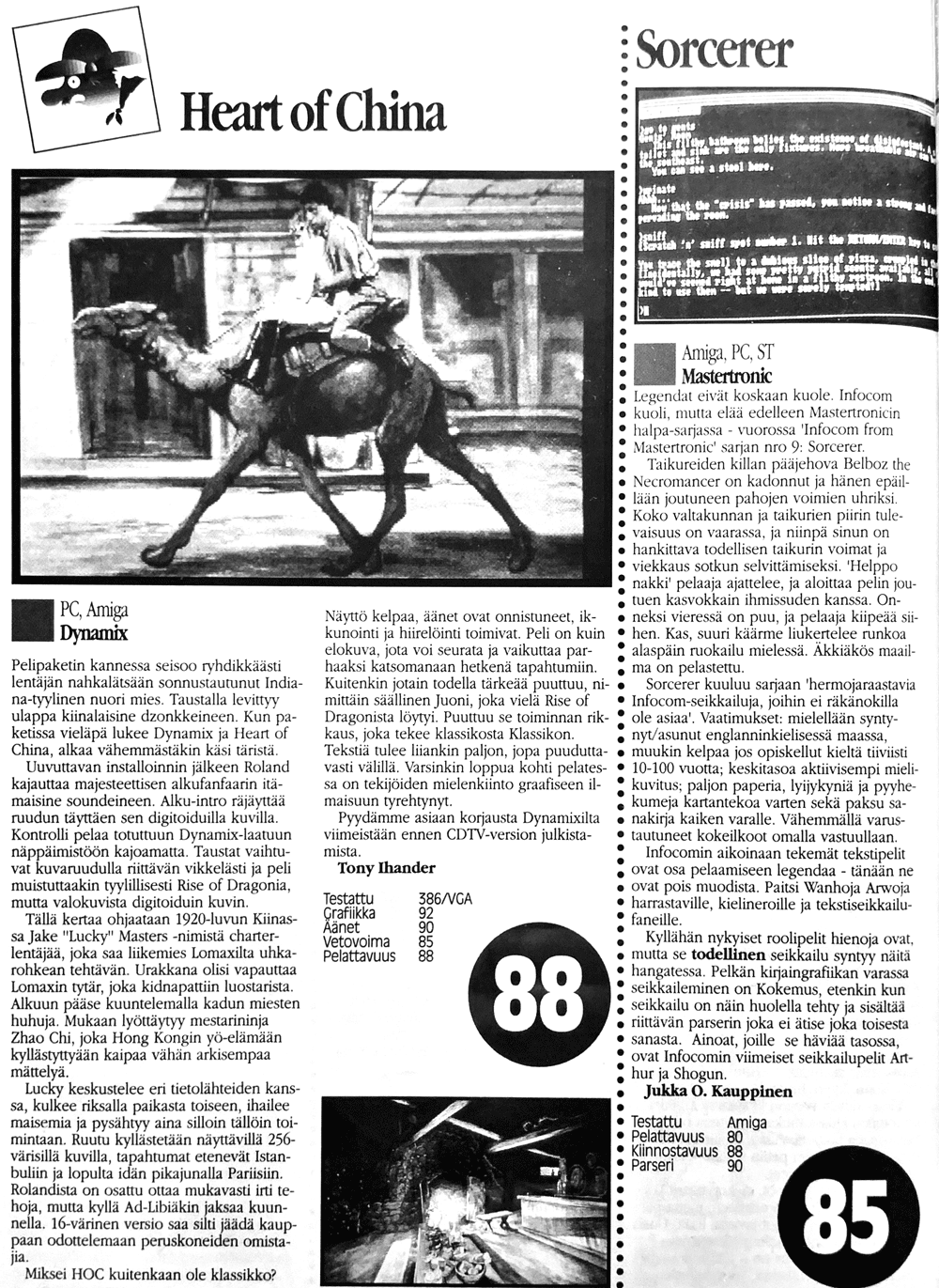
Sorcerer1991 SyksyPysyvä linkkiLegendat eivät koskaan kuole. Infocom kuoli, mutta elää edelleen Mastertronicin halpa-sarjassa - vuorossa 'Infocom from Mastertronic' sarjan nro 9: Sorcerer.
Taikureiden killan pääjehova Belboz the Necromancer on kadonnut ja hänen epäillään joutuneen pahojen voimien uhriksi. Koko valtakunnan ja taikurien piirin tulevaisuus on vaarassa, ja niinpä sinun on hankittava todellisen taikurin voimat ja viekkaus sotkun selvittämiseksi. 'Helppo nakki' pelaaja ajattelee, ja aloittaa pelin joutuen kasvokkain ihmissuden kanssa. Onneksi vieressä on puu, ja pelaaja kiipeää siihen. Kas, suuri käärme liukertelee runkoa alaspäin ruokailu mielessä. Äkkiäkös maailma on pelastettu.
Sorcerer kuuluu sarjaan 'hermojaraastavia Infocom-seikkailuja, joihin ei räkänokilla ole asiaa'. Vaatimukset: mielellään syntynyt/asunut englanninkielisessä maassa, muukin kelpaa jos opiskellut kieltä tiiviisti 10-100 vuotta; keskitasoa aktiivisempi mielikuvitus; paljon paperia, lyijykyniä ja pyyhekumeja kartantekoa varten sekä paksu sanakirja kaiken varalle. Vähemmällä varustautuneet kokeilkoot omalla vastuullaan.
Infocomin aikoinaan tekemät tekstipelit ovat osa pelaamiseen legendaa - tänään ne ovat pois muodista. Paitsi Wanhoja Arwoja harrastaville, kielineroille ja tekstiseikkailufaneille.
Kyllähän nykyiset roolipelit hienoja ovat, mutta se todellinen seikkailu syntyy näitä hangatessa. Pelkän kirjaingrafiikan varassa seikkaileminen on Kokemus, etenkin kun seikkailu on näin huolella tehty ja sisältää riittävän parserin joka ei ätise joka toisesta sanasta. Ainoat, joille se häviää tasossa, ovat Infocomin viimeiset seikkailupelit Arthur ja Shogun.
Sorcerer1991 SyksyPermalinkLegends never die. Infocom died, but lives on in Mastertronic's budget range - up now is no. 9 in the 'Infocom from Mastertronic' series: Sorcerer.
The top Jehovah of the Guild of Enchanters, Belboz the Necromancer, has disappeared and is suspected of having fallen victim to the forces of evil. The future of the whole kingdom and of the Circle of Enchanters is at stake, and so you must acquire the powers and cunning of a true sorcerer to sort out the mess. 'Piece of cake,' thinks the player, and starts the game only to come face to face with a werewolf. Luckily there's a tree close by, and the player climbs up it. Lo and behold, a huge snake comes slithering down the trunk with a meal in mind. The world will be saved in no time.
Sorcerer belongs to the series 'nerve-shredding Infocom adventures that snot-nosed kids have no business with'. Requirements: preferably born/lived in an English-speaking country, though others will do if they've studied the language intensively for 10-100 years; an imagination more active than average; plenty of paper, pencils and erasers for map-making, plus a thick dictionary just in case. Those less well equipped may try it at their own risk.
The text games Infocom made back in the day are part of gaming legend - today they're out of fashion. Except for those into Olde Values, language geniuses and text adventure fans.
Sure, today's role-playing games are fine things, but the real adventure is born from grinding away at these. Adventuring with nothing but letters for graphics is an Experience, especially when the adventure is this carefully made and has a decent parser that doesn't grumble at every other word. The only ones it loses to in quality are Infocom's last adventure games, Arthur and Shogun.
Space Ace
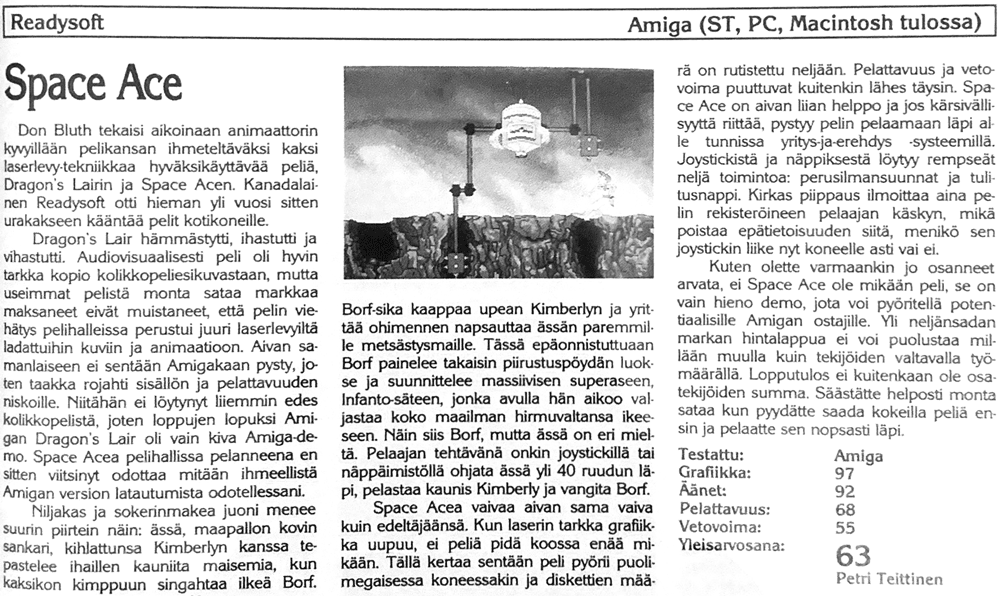
Space Ace1990 KevätPysyvä linkkiDon Bluth tekaisi aikoinaan animaattorin kyvyillään pelikansan ihmeteltäväksi kaksi laserlevy-tekniikkaa hyväksikäyttävää peliä, Dragon's Lairin ja Space Acen. Kanadalainen Readysoft otti hieman yli vuosi sitten urakakseen kääntää pelit kotikoneille.
Dragon's Lair hämmästytti, ihastutti ja vihastutti. Audiovisuaalisesti peli oli hyvin tarkka kopio kolikkopeliesikuvastaan, mutta useimmat pelistä monta sataa markkaa maksaneet eivät muistaneet, että pelin viehätys pelihalleissa perustui juuri laserlevyiltä ladattuihin kuviin ja animaatioon. Aivan samanlaiseen ei sentään Amigakaan pysty, joten taakka rojahti sisällön ja pelattavuuden niskoille. Niitähän ei löytynyt liiemmin edes kolikkopelistä, joten loppujen lopuksi Amigan Dragon's Lair oli vain kiva Amiga-demo. Space Acea pelihallissa pelanneena en sitten viitsinyt odottaa mitään ihmeellistä Amigan version latautumista odotellessani.
Niljakas ja sokerinmakea juoni menee suurin piirtein näin: ässä, maapallon kovin sankari, kihlattunsa Kimberlyn kanssa tepastelee ihaillen kauniita maisemia, kun kaksikon kimppuun singahtaa ilkeä Borf. Borf-sika kaappaa upean Kimberlyn ja yrittää ohimennen napsauttaa ässän paremmille metsästysmaille. Tässä epäonnistuttuaan Borf painelee takaisin piirustuspöydän luokse ja suunnittelee massiivisen superaseen, Infanto-säteen, jonka avulla hän aikoo valjastaa koko maailman hirmuvaltansa ikeeseen. Näin siis Borf, mutta ässä on eri mieltä. Pelaajan tehtävänä onkin joystickillä tai näppäimistöllä ohjata ässä yli 40 ruudun läpi, pelastaa kaunis Kimberly ja vangita Borf.
Space Acea vaivaa aivan sama vaiva kuin edeltäjäänsä. Kun laserin tarkka grafiikka uupuu, ei peliä pidä koossa enää mikään. Tällä kertaa sentään peli pyöri puolimegaisessa koneessakin ja diskettien määrä on rutistettu neljään. Pelattavuus ja vetovoima puuttuvat kuitenkin lähes täysin. Space Ace on aivan liian helppo ja jos kärsivällisyyttä riittää, pystyy pelin pelaamaan läpi alle tunnissa yritys-ja-erehdys -systeemillä. Joystickistä ja näppiksestä löytyy rempseät neljä toimintoa: perusilmansuunnat ja tulitusnappi. Kirkas piippaus ilmoittaa aina pelin rekisteröineen pelaajan käskyn, mikä poistaa epätietoisuuden siitä, menikö sen joystickin liike nyt koneelle asti vai ei.
Kuten olette varmaankin jo osanneet arvata, ei Space Ace ole mikään peli, se on vain hieno demo, jota voi pyöritellä potentiaalisille Amigan ostajille. Yli neljänsadan markan hintalappua ei voi puolustaa millään muulla kuin tekijöiden valtavalla työmäärällä. Lopputulos ei kuitenkaan ole osatekijöiden summa. Säästätte helposti monta sataa kun pyydätte saada kokeilla peliä ensin ja pelaatte sen nopsasti läpi.
Space Ace1990 KevätPermalinkBack in the day, Don Bluth used his animator's talents to knock out two games exploiting laserdisc technology for the gaming public to marvel at: Dragon's Lair and Space Ace. A little over a year ago the Canadian Readysoft took on the job of converting the games to home computers.
Dragon's Lair amazed, delighted and infuriated. Audiovisually the game was a very faithful copy of its coin-op original, but most of those who paid several hundred marks for it forgot that the game's charm in the arcades rested precisely on the pictures and animation loaded off laserdisc. Not even the Amiga can manage quite the same thing, so the burden came crashing down on the shoulders of content and playability. And there wasn't much of those to be found even in the coin-op, so in the end the Amiga Dragon's Lair was just a nice Amiga demo. Having played Space Ace in the arcade, I didn't bother expecting anything amazing while I waited for the Amiga version to load.
The slimy, sickly-sweet plot goes roughly like this: Ace, Earth's toughest hero, is tootling along with his fiancée Kimberly admiring the lovely scenery when the wicked Borf swoops down on the pair. That swine Borf kidnaps the gorgeous Kimberly and, in passing, tries to zap Ace off to the happy hunting grounds. Having failed at this, Borf scurries back to the drawing board and designs a massive superweapon, the Infanto ray, with which he intends to bring the whole world under the yoke of his tyranny. So much for Borf, but Ace begs to differ. The player's task, then, is to steer Ace with the joystick or keyboard through more than 40 screens, rescue the beautiful Kimberly and capture Borf.
Space Ace suffers from exactly the same ailment as its predecessor. Without the laser's crisp graphics, nothing holds the game together any more. This time, at least, the game ran on a half-meg machine too, and the number of disks has been squeezed down to four. Playability and appeal, however, are almost entirely missing. Space Ace is far too easy, and if your patience holds out you can play it through in under an hour using the trial-and-error method. The joystick and keyboard offer a whopping four functions: the basic compass directions and the fire button. A clear beep always announces that the game has registered the player's command, which removes any uncertainty over whether that joystick movement actually made it all the way to the computer or not.
As you have probably already guessed, Space Ace is no game at all; it is just a fancy demo you can run for prospective Amiga buyers. The price tag of over four hundred marks cannot be defended with anything other than the enormous amount of work its makers put in. The end result, however, is not the sum of its parts. You can easily save several hundred by asking to try the game first and zipping through it to the end on the spot.
Space Harrier
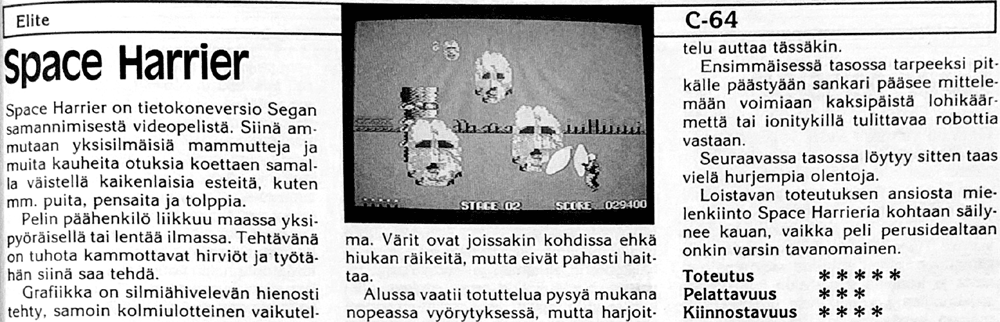
Space Harrier1987Pysyvä linkkiSpace Harrier on tietokoneversio Segan samannimisestä videopelistä. Siinä ammutaan yksisilmäisiä mammutteja ja muita kauheita otuksia koettaen samalla väistellä kaikenlaisia esteitä, kuten mm. puita, pensaita ja tolppia.
Pelin päähenkilö liikkuu maassa yksipyöräisellä tai lentää ilmassa. Tehtävänä on tuhota kammottavat hirviöt ja työtähän siinä saa tehdä.
Grafiikka on silmiähivelevän hienosti tehty, samoin kolmiulotteinen vaikutelma. Värit ovat joissakin kohdissa ehkä hiukan räikeitä, mutta eivät pahasti haittaa.
Alussa vaatii totuttelua pysyä mukana nopeassa vyörytyksessä, mutta harjoittelu auttaa tässäkin.
Ensimmäisessä tasossa tarpeeksi pitkälle päästyään sankari pääsee mittelemään voimiaan kaksipäistä lohikäärmettä tai ionitykillä tulittavaa robottia vastaan.
Seuraavassa tasossa löytyy sitten taas vielä hurjempia olentoja.
Loistavan toteutuksen ansiosta mielenkiinto Space Harrieria kohtaan säilynee kauan, vaikka peli perusidealtaan onkin varsin tavanomainen.
Space Harrier1987PermalinkSpace Harrier is the computer version of Sega's video game of the same name. In it you shoot one-eyed mammoths and other dreadful creatures while trying to dodge all sorts of obstacles, such as trees, bushes and posts, among other things.
The game's hero moves along the ground on a unicycle or flies through the air. The task is to destroy the hideous monsters, and you certainly have your work cut out doing it.
The graphics are a real feast for the eyes, and so is the three-dimensional effect. The colours are perhaps a little garish in places, but they don't get in the way too badly.
At first it takes some getting used to keeping up with the fast scrolling, but practice helps here too.
Once far enough into the first level, the hero gets a trial of strength against a two-headed dragon or a robot blasting away with an ion cannon.
The next level then has even fiercer creatures in store.
Thanks to its brilliant execution, interest in Space Harrier should hold up for a long time, even though the game's basic idea is fairly run-of-the-mill.
Space Harrier

Space Harrier1990 KevätPysyvä linkkiSpace Harrierin perusajatus on yksinkertainen: jämerä avaruuscommando juoksee kohti taivaanrantaa, joko ammuskellen tahi väistellen vastakkaiseen suuntaan etenevää hirviö- ja esinemassaa. Vauhtia ei voi säädellä, etenemiskorkeuttapa voi.
Jostain syystä kuusitoistabittisiin löytyy Space Harrieria oikein olan takaa. Elite on jo tehnyt yhden, jossa tosin ei ollut kuin puolet kentistä, loppukenttien tullessa datalevyllä. Grandslamilta tai Tynesoftilta on tulossa jo Space Harrier II, ja nyt Elite julkaisee uuden Space Harrier I:n.
Teknisesti uusin yritys on varsin vakuuttava. Kahdelta korpulta löytyy kuulemma koko Space Harrier, ja peli käyttää Amigassa koko ruudun hyväkseen. Esineet päivittyvät vakuuttavan kolmiulotteisesti, ja pelattavuus on kohdallaan. äänipuoli olisi saanut olla vähän roisimpi.
Space Harrierin pahin puoli on kuitenkin pelin monotonisuus, joka kolikkopelissä korvautui hydrauliikan heiluttelemana tuolina. Ilman saranoitua konttorituolia ja avuliasta toveripiiriä tämä tuskin onnistunee kotioloissa.
Space Harrier1990 KevätPermalinkThe basic idea of Space Harrier is simple: a sturdy space commando runs towards the horizon, either shooting at or dodging the mass of monsters and objects advancing in the opposite direction. You can't adjust the speed, but the height you travel at, that you can.
For some reason there's Space Harrier for the sixteen-bitters by the bucketload. Elite has already made one, although it only had half the levels, with the rest arriving on a data disk. Space Harrier II is already on its way from Grandslam or Tynesoft, and now Elite is releasing a new Space Harrier I.
Technically the latest attempt is pretty convincing. The two floppies reportedly hold the whole of Space Harrier, and on the Amiga the game uses the full screen. The objects update in convincing 3D, and the playability is spot on. The sound side could have been a bit beefier.
Space Harrier's worst side, however, is the game's monotony, which in the coin-op was made up for by a seat swung about by hydraulics. Without a hinged office chair and a helpful circle of friends, this is hardly likely to work out at home.
Space Harrier II
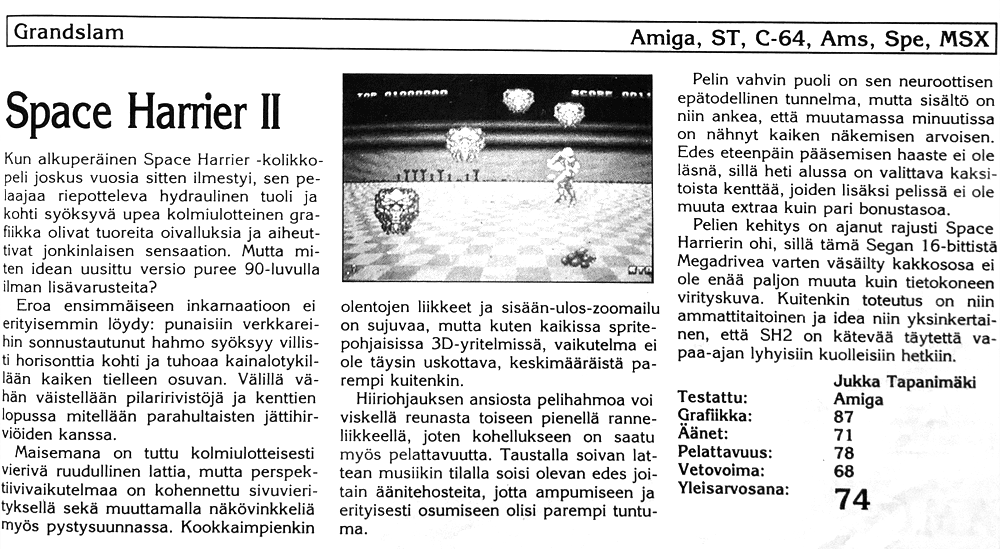
Space Harrier II1990 SyksyPysyvä linkkiKun alkuperäinen Space Harrier -kolikkopeli joskus vuosia sitten ilmestyi, sen pelaajaa riepotteleva hydraulinen tuoli ja kohti syöksyvä upea kolmiulotteinen grafiikka olivat tuoreita oivalluksia ja aiheuttivat jonkinlaisen sensaation. Mutta miten idean uusittu versio puree 90-luvulla ilman lisävarusteita?
Eroa ensimmäiseen inkarnaatioon ei erityisemmin löydy: punaisiin verkkareihin sonnustautunut hahmo syöksyy villisti horisonttia kohti ja tuhoaa kainalotykillään kaiken tielleen osuvan. Välillä vähän väistellään pilaririvistöjä ja kenttien lopussa mitellään parahultaisten jättihirviöiden kanssa.
Maisemana on tuttu kolmiulotteisesti vierivä ruudullinen lattia, mutta perspektiivivaikutelmaa on kohennettu sivuvierityksellä sekä muuttamalla näkövinkkeliä myös pystysuunnassa. Kookkaimpienkin olentojen liikkeet ja sisään-ulos-zoomailu on sujuvaa, mutta kuten kaikissa spritepohjaisissa 3D-yritelmissä, vaikutelma ei ole täysin uskottava, keskimääräistä parempi kuitenkin.
Hiiriohjauksen ansiosta pelihahmoa voi viskellä reunasta toiseen pienellä ranneliikkeellä, joten kohellukseen on saatu myös pelattavuutta. Taustalla soivan lattean musiikin tilalla soisi olevan edes joitain äänitehosteita, jotta ampumiseen ja erityisesti osumiseen olisi parempi tuntuma.
Pelin vahvin puoli on sen neuroottisen epätodellinen tunnelma, mutta sisältö on niin ankea, että muutamassa minuutissa on nähnyt kaiken näkemisen arvoisen. Edes eteenpäin pääsemisen haaste ei ole läsnä, sillä heti alussa on valittava kaksitoista kenttää, joiden lisäksi pelissä ei ole muuta extraa kuin pari bonustasoa.
Pelien kehitys on ajanut rajusti Space Harrierin ohi, sillä tämä Segan 16-bittistä Megadrivea varten väsäilty kakkososa ei ole enää paljon muuta kuin tietokoneen virityskuva. Kuitenkin toteutus on niin ammattitaitoinen ja idea niin yksinkertainen, että SH2 on kätevää täytettä vapaa-ajan lyhyisiin kuolleisiin hetkiin.
Space Harrier II1990 SyksyPermalinkWhen the original Space Harrier coin-op came out some years ago, its hydraulic seat that tossed the player about and its superb three-dimensional graphics hurtling towards you were fresh ideas and caused something of a sensation. But how does a revamped version of the idea bite in the 90s without the extra hardware?
There's no particular difference from the first incarnation: a figure decked out in a red tracksuit hurtles wildly towards the horizon, destroying everything in its path with an underarm cannon. Now and then you dodge a few rows of pillars, and at the end of the levels you square off against giant monsters of just the right size.
The scenery is the familiar chequered floor scrolling in three dimensions, but the sense of perspective has been improved with sideways scrolling and by shifting the viewing angle vertically as well. The movements and in-and-out zooming of even the biggest creatures are smooth, but as in all sprite-based 3D efforts, the effect isn't entirely convincing, though it's better than average.
Thanks to the mouse control you can fling the character from one side to the other with a little flick of the wrist, so the flailing about has been given some playability too. Instead of the flat music playing in the background, you'd wish for at least some sound effects, to give a better feel to the shooting and especially to the hitting.
The game's strongest point is its neurotically unreal atmosphere, but the content is so dismal that within a few minutes you've seen everything worth seeing. Even the challenge of making progress is missing, since you get to choose from all twelve levels right at the start, and beyond those the game has no extras apart from a couple of bonus stages.
Game development has roared right past Space Harrier, since this second instalment, knocked together for Sega's 16-bit Megadrive, is not much more than a computer test card any more. Yet the execution is so professional and the idea so simple that SH2 makes handy filler for the short dead moments of your free time.
Space Quest
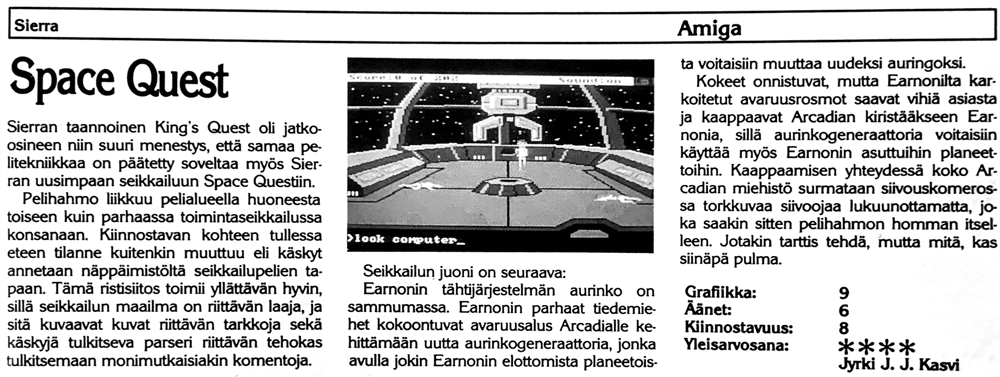
Space Quest1988Pysyvä linkkiSierran taannoinen King's Quest oli jatko-osineen niin suuri menestys, että samaa pelitekniikkaa on päätetty soveltaa myös Sierran uusimpaan seikkailuun Space Questiin.
Pelihahmo liikkuu pelialueella huoneesta toiseen kuin parhaassa toimintaseikkailussa konsanaan. Kiinnostavan kohteen tullessa eteen tilanne kuitenkin muuttuu eli käskyt annetaan näppäimistöltä seikkailupelien tapaan. Tämä ristisiitos toimii yllättävän hyvin, sillä seikkailun maailma on riittävän laaja, ja sitä kuvaavat kuvat riittävän tarkkoja sekä käskyjä tulkitseva parseri riittävän tehokas tulkitsemaan monimutkaisiakin komentoja.
Seikkailun juoni on seuraava:
Earnonin tähtijärjestelmän aurinko on sammumassa. Earnonin parhaat tiedemiehet kokoontuvat avaruusalus Arcadialle kehittämään uutta aurinkogeneraattoria, jonka avulla jokin Earnonin elottomista planeetoista voitaisiin muuttaa uudeksi auringoksi.
Kokeet onnistuvat, mutta Earnonilta karkoitetut avaruusrosmot saavat vihiä asiasta ja kaappaavat Arcadian kiristääkseen Earnonia, sillä aurinkogeneraattoria voitaisiin käyttää myös Earnonin asuttuihin planeettoihin. Kaappaamisen yhteydessä koko Arcadian miehistö surmataan siivouskomerossa torkkuvaa siivoojaa lukuunottamatta, joka saakin sitten pelihahmon homman itselleen. Jotakin tarttis tehdä, mutta mitä, kas siinäpä pulma.
Space Quest1988PermalinkSierra's King's Quest from a while back was, together with its sequels, such a great success that it has been decided to apply the same game technique to Sierra's latest adventure, Space Quest, as well.
The player character moves around the game area from room to room just as in the very best action adventure. When something interesting comes up, though, the situation changes, i.e. commands are typed in from the keyboard the way they are in adventure games. This crossbreed works surprisingly well, because the world of the adventure is large enough, the pictures depicting it detailed enough, and the parser that interprets the commands powerful enough to make sense of even complicated instructions.
The plot of the adventure is as follows:
The sun of the Earnon star system is going out. Earnon's best scientists gather aboard the spaceship Arcadia to develop a new sun generator, with which one of Earnon's lifeless planets could be turned into a new sun.
The experiments succeed, but space crooks banished from Earnon get wind of it and hijack the Arcadia to blackmail Earnon, since the sun generator could also be used on Earnon's inhabited planets. During the hijacking the Arcadia's entire crew is killed, except for the janitor dozing in the broom cupboard, who then gets landed with the job of player character. Something oughta be done, but what - ay, that is the question.
Space Quest IV: Roger Wilco and the Time Rippers
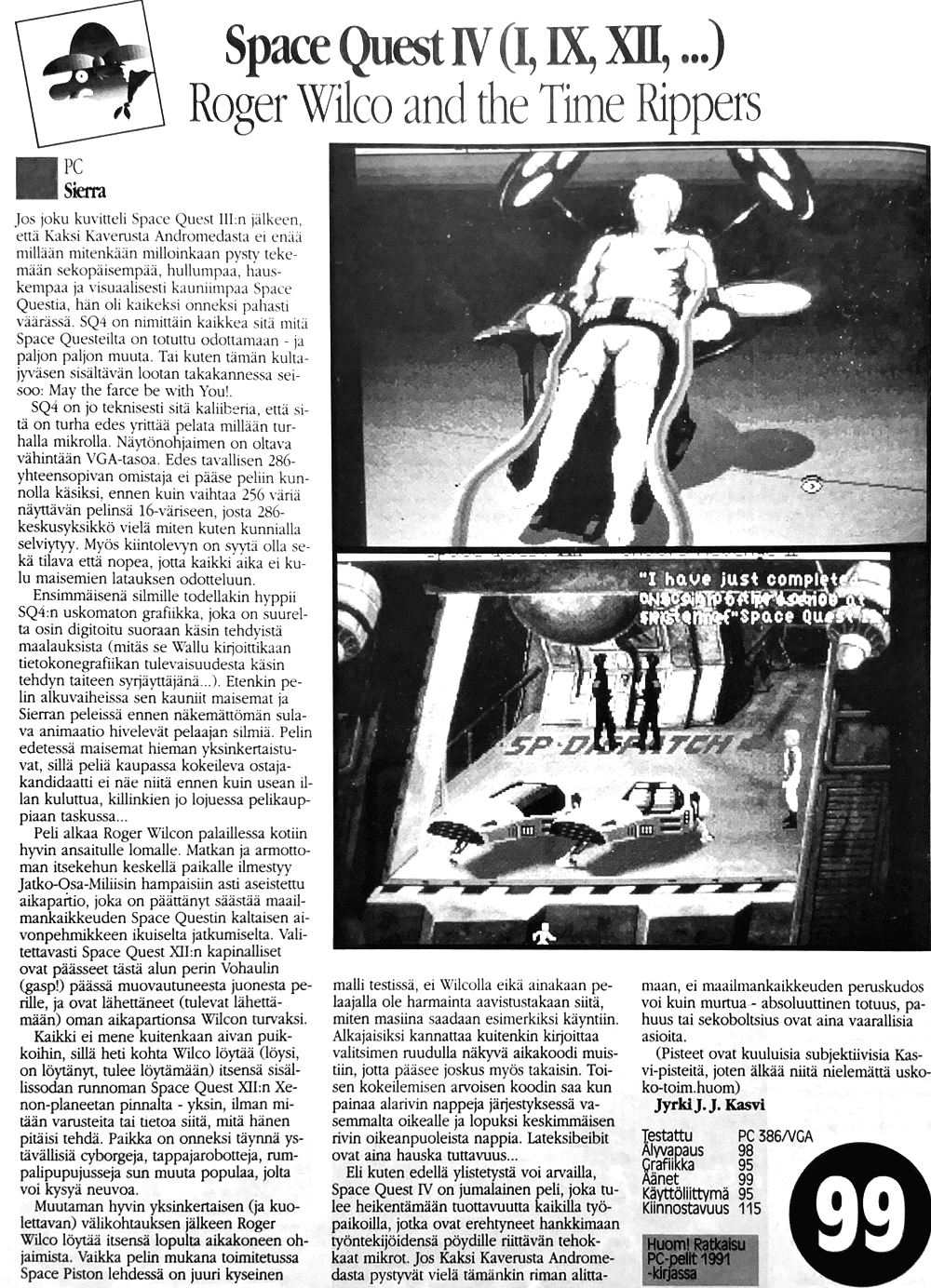
Space Quest IV: Roger Wilco and the Time Rippers1991 SyksyPysyvä linkkiJos joku kuvitteli Space Quest III:n jälkeen, että Kaksi Kaverusta Andromedasta ei enää millään mitenkään milloinkaan pysty tekemään sekopäisempää, hullumpaa, hauskempaa ja visuaalisesti kauniimpaa Space Questia, hän oli kaikeksi onneksi pahasti väärässä. SQ4 on nimittäin kaikkea sitä mitä Space Questeilta on totuttu odottamaan - ja paljon paljon muuta. Tai kuten tämän kultajyväsen sisältävän lootan takakannessa seisoo: May the farce be with You!.
SQ4 on jo teknisesti sitä kaliiberia, että sitä on turha edes yrittää pelata millään turhalla mikrolla. Näytönohjaimen on oltava vähintään VGA-tasoa. Edes tavallisen 286-yhteensopivan omistaja ei pääse peliin kunnolla käsiksi, ennen kuin vaihtaa 256 väriä näyttävän pelinsä 16-väriseen, josta 286-keskusyksikkö vielä miten kuten kunnialla selviytyy. Myös kiintolevyn on syytä olla sekä tilava että nopea, jotta kaikki aika ei kulu maisemien latauksen odotteluun.
Ensimmäisenä silmille todellakin hyppii SQ4:n uskomaton grafiikka, joka on suurelta osin digitoitu suoraan käsin tehdyistä maalauksista (mitäs se Wallu kirjoittikaan tietokonegrafiikan tulevaisuudesta käsin tehdyn taiteen syrjäyttäjänä...). Etenkin pelin alkuvaiheissa sen kauniit maisemat ja Sierran peleissä ennen näkemättömän sulava animaatio hivelevät pelaajan silmiä. Pelin edetessä maisemat hieman yksinkertaistuvat, sillä peliä kaupassa kokeileva ostajakandidaatti ei näe niitä ennen kuin usean illan kuluttua, killinkien jo lojuessa pelikauppiaan taskussa...
Peli alkaa Roger Wilcon palaillessa kotiin hyvin ansaitulle lomalle. Matkan ja armottoman itsekehun keskellä paikalle ilmestyy Jatko-Osa-Miliisin hampaisiin asti aseistettu aikapartio, joka on päättänyt säästää maailmankaikkeuden Space Questin kaltaisen aivonpehmikkeen ikuiselta jatkumiselta. Valitettavasti Space Quest XII:n kapinalliset ovat päässeet tästä alun perin Vohaulin (gasp!) päässä muovautuneesta juonesta perille, ja ovat lähettäneet (tulevat lähettämään) oman aikapartionsa Wilcon turvaksi.
Kaikki ei mene kuitenkaan aivan puikkoihin, sillä heti kohta Wilco löytää (löysi, on löytänyt, tulee löytämään) itsensä sisällissodan runnoman Space Quest XII:n Xenon-planeetan pinnalta - yksin, ilman mitään varusteita tai tietoa siitä, mitä hänen pitäisi tehdä. Paikka on onneksi täynnä ystävällisiä cyborgeja, tappajarobotteja, rumpalipupujusseja sun muuta populaa, jolta voi kysyä neuvoa.
Muutaman hyvin yksinkertaisen (ja kuolettavan) välikohtauksen jälkeen Roger Wilco löytää itsensä lopulta aikakoneen ohjaimista. Vaikka pelin mukana toimitetussa Space Piston lehdessä on juuri kyseinen malli testissä, ei Wilcolla eikä ainakaan pelaajalla ole harmainta aavistustakaan siitä, miten masiina saadaan esimerkiksi käyntiin. Alkajaisiksi kannattaa kuitenkin kirjoittaa valitsimen ruudulla näkyvä aikakoodi muistiin, jotta pääsee joskus myös takaisin. Toisen kokeilemisen arvoisen koodin saa kun painaa alarivin nappeja järjestyksessä vasemmalta oikealle ja lopuksi keskimmäisen rivin oikeanpuoleista nappia. Lateksibeibit ovat aina hauska tuttavuus...
Eli kuten edellä ylistetystä voi arvailla, Space Quest IV on jumalainen peli, joka tulee heikentämään tuottavuutta kaikilla työpaikoilla, jotka ovat erehtyneet hankkimaan työntekijöidensä pöydille riittävän tehokkaat mikrot. Jos Kaksi Kaverusta Andromedasta pystyvät vielä tämänkin riman alittamaan, ei maailmankaikkeuden peruskudos voi kuin murtua - absoluuttinen totuus, pahuus tai sekoboltsius ovat aina vaarallisia asioita.
(Pisteet ovat kuuluisia subjektiivisia Kasvi-pisteitä, joten älkää niitä nielemättä uskoko-toim.huom)
Space Quest IV: Roger Wilco and the Time Rippers1991 SyksyPermalinkIf anyone imagined after Space Quest III that the Two Guys from Andromeda could never, no way, no how, ever make a more deranged, crazier, funnier and visually more beautiful Space Quest, they were, fortunately, badly mistaken. For SQ4 is everything we've come to expect from Space Quests - and much, much more. Or as it says on the back of the box holding this golden nugget: May the farce be with You!
On technical grounds alone SQ4 is of such calibre that there's no point even trying to play it on some pointless micro. The graphics card has to be VGA level at the very least. Even the owner of an ordinary 286 compatible can't properly get into the game until switching their 256-colour game to the 16-colour one, which a 286 CPU can still just about cope with honourably. The hard disk had also better be both roomy and fast, so that all your time isn't spent waiting for the scenery to load.
The first thing that really leaps out at you is SQ4's incredible graphics, largely digitised straight from hand-made paintings (what was it Wallu wrote about the future of computer graphics as the usurper of hand-made art...). Especially in the early stages of the game, its beautiful scenery and animation smoother than anything seen before in Sierra's games are a caress for the player's eyes. As the game goes on the scenery gets a little simpler, since the prospective buyer trying the game out in the shop won't see it until several evenings later, with the shillings already lolling about in the game dealer's pocket...
The game begins as Roger Wilco heads home for a well-earned holiday. In the middle of the journey and the merciless self-praise, an armed-to-the-teeth time patrol of the Sequel Police turns up, having decided to spare the universe from the eternal continuation of brain-softeners like Space Quest. Unfortunately the rebels of Space Quest XII have got wind of this plot, originally hatched in Vohaul's (gasp!) head, and have sent (will send) their own time patrol to protect Wilco.
Not everything goes quite according to plan, though, since right away Wilco ends up (ended up, has ended up, will end up) on the surface of planet Xenon in civil-war-ravaged Space Quest XII - alone, without any equipment or any clue what to do. Luckily the place is full of friendly cyborgs, killer robots, drummer bunnies and other such folk you can ask for advice.
After a few very simple (and deadly) incidents, Roger Wilco finally ends up at the controls of a time machine. Even though the Space Piston magazine that comes with the game happens to have that very model on test, neither Wilco nor, least of all, the player has the foggiest idea how to, say, get the contraption started. For starters, though, it's worth jotting down the time code shown on the selector's screen, so you can also get back some day. Another code worth trying comes from pressing the bottom-row buttons in order from left to right and finally the right-hand button of the middle row. Latex babes are always a fun acquaintance...
So, as you may have guessed from all the praise above, Space Quest IV is a divine game that will sap productivity at every workplace that has made the mistake of putting sufficiently powerful micros on its employees' desks. If the Two Guys from Andromeda can sink below even this bar, the basic fabric of the universe cannot help but tear - absolute truth, evil or screwballery are always dangerous things.
(The scores are the famous subjective Kasvi points, so don't swallow them whole - ed. note)
Space Rogue
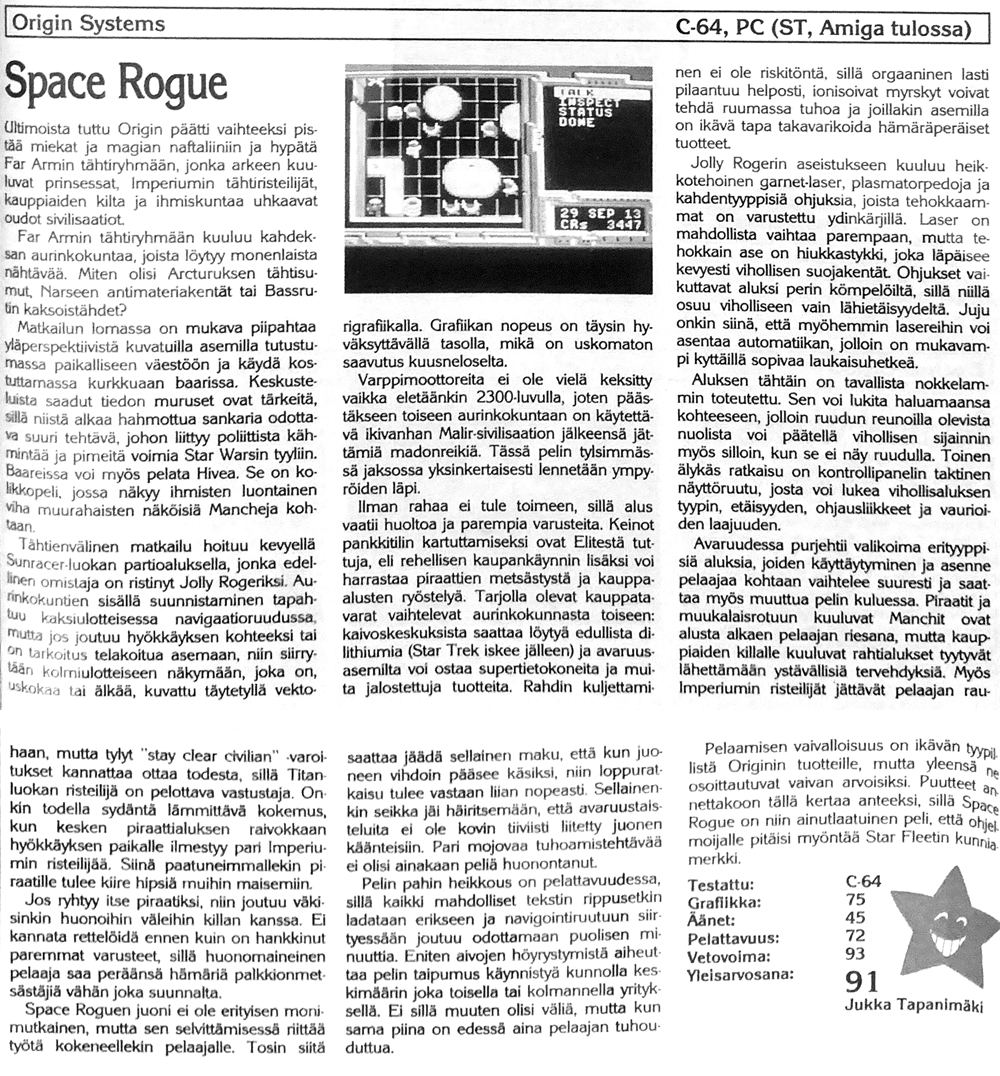
Space Rogue1990 KevätPysyvä linkkiUltimoista tuttu Origin päätti vaihteeksi pistää miekat ja magian naftaliiniin ja hypätä Far Armin tähtiryhmään, jonka arkeen kuuluvat prinsessat, Imperiumin tähtiristeilijät, kauppiaiden kilta ja ihmiskuntaa uhkaavat oudot sivilisaatiot.
Far Armin tähtiryhmään kuuluu kahdeksan aurinkokuntaa, joista löytyy monenlaista nähtävää. Miten olisi Arcturuksen tähtisumut, Narseen antimateriakentät tai Bassrutin kaksoistähdet?
Matkailun lomassa on mukava piipahtaa yläperspektiivistä kuvatuilla asemilla tutustumassa paikalliseen väestöön ja käydä kostuttamassa kurkkuaan baarissa. Keskusteluista saadut tiedon muruset ovat tärkeitä, sillä niistä alkaa hahmottua sankaria odottava suuri tehtävä, johon liittyy poliittista kähmintää ja pimeitä voimia Star Warsin tyyliin. Baareissa voi myös pelata Hivea. Se on kolikkopeli, jossa näkyy ihmisten luontainen viha muurahaisten näköisiä Mancheja kohtaan.
Tähtienvälinen matkailu hoituu kevyellä Sunracer-luokan partioaluksella, jonka edellinen omistaja on ristinyt Jolly Rogeriksi. Aurinkokuntien sisällä suunnistaminen tapahtuu kaksiulotteisessa navigaatioruudussa, mutta jos joutuu hyökkäyksen kohteeksi tai on tarkoitus telakoitua asemaan, niin siirrytään kolmiulotteiseen näkymään, joka on, uskokaa tai älkää, kuvattu täytetyllä vektorigrafiikalla. Grafiikan nopeus on täysin hyväksyttävällä tasolla, mikä on uskomaton saavutus kuusneloselta.
Varppimoottoreita ei ole vielä keksitty vaikka eletäänkin 2300-luvulla, joten päästäkseen toiseen aurinkokuntaan on käytettävä ikivanhan Malir-sivilisaation jälkeensä jättämiä madonreikiä. Tässä pelin tylsimmässä jaksossa yksinkertaisesti lennetään ympyröiden läpi.
Ilman rahaa ei tule toimeen, sillä alus vaatii huoltoa ja parempia varusteita. Keinot pankkitilin kartuttamiseksi ovat Elitestä tuttuja, eli rehellisen kaupankäynnin lisäksi voi harrastaa piraattien metsästystä ja kauppa-alusten ryöstelyä. Tarjolla olevat kauppatavarat vaihtelevat aurinkokunnasta toiseen: kaivoskeskuksista saattaa löytyä edullista dilithiumia (Star Trek iskee jälleen) ja avaruusasemilta voi ostaa supertietokoneita ja muita jalostettuja tuotteita. Rahdin kuljettaminen ei ole riskitöntä, sillä orgaaninen lasti pilaantuu helposti, ionisoivat myrskyt voivat tehdä ruumassa tuhoa ja joillakin asemilla on ikävä tapa takavarikoida hämäräperäiset tuotteet.
Jolly Rogerin aseistukseen kuuluu heikkotehoinen garnet-laser, plasmatorpedoja ja kahdentyyppisiä ohjuksia, joista tehokkaammat on varustettu ydinkärjillä. Laser on mahdollista vaihtaa parempaan, mutta tehokkain ase on hiukkastykki, joka läpäisee kevyesti vihollisen suojakentät. Ohjukset vaikuttavat aluksi perin kömpelöiltä, sillä niillä osuu viholliseen vain lähietäisyydeltä. Juju onkin siinä, että myöhemmin lasereihin voi asentaa automatiikan, jolloin on mukavampi kyttäillä sopivaa laukaisuhetkeä.
Aluksen tähtäin on tavallista nokkelammin toteutettu. Sen voi lukita haluamaansa kohteeseen, jolloin ruudun reunoilla olevista nuolista voi päätellä vihollisen sijainnin myös silloin, kun se ei näy ruudulla. Toinen älykäs ratkaisu on kontrollipanelin taktinen näyttöruutu, josta voi lukea vihollisaluksen tyypin, etäisyyden, ohjausliikkeet ja vaurioiden laajuuden.
Avaruudessa purjehtii valikoima erityyppisiä aluksia, joiden käyttäytyminen ja asenne pelaajaa kohtaan vaihtelee suuresti ja saattaa myös muuttua pelin kuluessa. Piraatit ja muukalaisrotuun kuuluvat Manchit ovat alusta alkaen pelaajan riesana, mutta kauppiaiden killalle kuuluvat rahtialukset tyytyvät lähettämään ystävällisiä tervehdyksiä. Myös Imperiumin risteilijät jättävät pelaajan rauhaan, mutta tylyt "stay clear civilian" -varoitukset kannattaa ottaa todesta, sillä Titan-luokan risteilijä on pelottava vastustaja. Onkin todella sydäntä lämmittävä kokemus, kun kesken piraattialuksen raivokkaan hyökkäyksen paikalle ilmestyy pari Imperiumin risteilijää. Siinä paatuneimmallekin piraatille tulee kiire hipsiä muihin maisemiin.
Jos ryhtyy itse piraatiksi, niin joutuu väkisinkin huonoihin väleihin killan kanssa. Ei kannata rettelöidä ennen kuin on hankkinut paremmat varusteet, sillä huonomaineinen pelaaja saa peräänsä hämäriä palkkionmetsästäjiä vähän joka suunnalta.
Space Roguen juoni ei ole erityisen monimutkainen, mutta sen selvittämisessä riittää työtä kokeneellekin pelaajalle. Tosin siitä saattaa jäädä sellainen maku, että kun juoneen vihdoin pääsee käsiksi, niin loppuratkaisu tulee vastaan liian nopeasti. Sellainenkin seikka jäi häiritsemään, että avaruustaisteluita ei ole kovin tiiviisti liitetty juonen käänteisiin. Pari mojovaa tuhoamistehtävää ei olisi ainakaan peliä huonontanut.
Pelin pahin heikkous on pelattavuudessa, sillä kaikki mahdolliset tekstin rippusetkin ladataan erikseen ja navigointiruutuun siirtyessään joutuu odottamaan puolisen minuuttia. Eniten aivojen höyrystymistä aiheuttaa pelin taipumus käynnistyä kunnolla keskimäärin joka toisella tai kolmannella yrityksellä. Ei sillä muuten olisi väliä, mutta kun sama piina on edessä aina pelaajan tuhouduttua.
Pelaamisen vaivalloisuus on ikävän tyypillistä Originin tuotteille, mutta yleensä ne osoittautuvat vaivan arvoisiksi. Puutteet annettakoon tällä kertaa anteeksi, sillä Space Rogue on niin ainutlaatuinen peli, että ohjelmoijalle pitäisi myöntää Star Fleetin kunniamerkki.
Space Rogue1990 KevätPermalinkOrigin, familiar from the Ultimas, decided for a change to put swords and magic in mothballs and leap into the Far Arm star cluster, whose everyday life includes princesses, Imperial star cruisers, the Merchants' Guild and strange civilisations threatening humankind.
The Far Arm cluster comprises eight solar systems, with all sorts of sights to see. How about the nebulae of Arcturus, the antimatter fields of Narsee or the twin stars of Bassrut?
In between the travelling it's nice to pop into the stations, shown from a top-down perspective, to get acquainted with the locals and wet your whistle at the bar. The crumbs of information gleaned from conversations are important, since from them the great task awaiting the hero begins to take shape, one involving political skulduggery and dark forces in the Star Wars style. In the bars you can also play Hive. It's an arcade game that shows off humanity's innate hatred of the ant-like Manchi.
Interstellar travel is handled by a light Sunracer-class patrol ship, which its previous owner christened the Jolly Roger. Navigation within solar systems takes place on a two-dimensional navigation screen, but if you come under attack or mean to dock at a station, the game switches to a three-dimensional view which is, believe it or not, drawn in filled vector graphics. The speed of the graphics is at a perfectly acceptable level, which is an incredible achievement for the C-64.
Warp drives haven't been invented yet, even though this is the 2300s, so to get to another solar system you have to use the wormholes left behind by the ancient Malir civilisation. In this, the dullest section of the game, you simply fly through circles.
You can't get by without money, since the ship needs maintenance and better equipment. The ways of fattening your bank account are familiar from Elite: besides honest trading, you can take up pirate hunting and plundering merchant ships. The goods on offer vary from one solar system to the next: mining centres may have cheap dilithium (Star Trek strikes again) and space stations sell supercomputers and other refined products. Hauling freight isn't risk-free, since organic cargo spoils easily, ionising storms can wreak havoc in the hold and some stations have a nasty habit of confiscating dubious goods.
The Jolly Roger's armament consists of a feeble garnet laser, plasma torpedoes and two types of missile, the more powerful of which are fitted with nuclear warheads. The laser can be swapped for a better one, but the most powerful weapon is the particle cannon, which breezes straight through enemy shields. The missiles seem terribly clumsy at first, since you can only hit the enemy with them at close range. The trick is that later on you can fit the lasers with automatic control, which makes it more comfortable to lie in wait for the right moment to fire.
The ship's gunsight is more cleverly done than usual. You can lock it onto the target of your choice, whereupon arrows at the edges of the screen let you work out the enemy's position even when it isn't visible on screen. Another smart solution is the control panel's tactical display, which shows the enemy ship's type, distance, manoeuvres and the extent of its damage.
Space is sailed by a selection of different kinds of ship, whose behaviour and attitude towards the player vary greatly and may also change as the game goes on. Pirates and the alien race of the Manchi are a pest from the very start, but the freighters belonging to the Merchants' Guild are content to send friendly greetings. The Imperial cruisers leave the player alone too, but their curt "stay clear civilian" warnings are worth taking seriously, because a Titan-class cruiser is a frightening opponent. So it's a truly heartwarming experience when, in the middle of a pirate ship's furious attack, a couple of Imperial cruisers turn up on the scene. Even the most hardened pirate is then in a hurry to tiptoe off to other parts.
If you turn pirate yourself, you inevitably end up on bad terms with the Guild. It's not worth making trouble before you've got better equipment, since a player with a bad reputation gets shady bounty hunters on their tail from pretty much every direction.
Space Rogue's plot isn't especially complicated, but unravelling it gives even an experienced player plenty of work. Then again, you may be left with the aftertaste that once you finally get to grips with the plot, the ending comes along too quickly. Another thing that kept bothering me was that the space battles aren't very tightly tied to the twists of the plot. A couple of hefty search-and-destroy missions certainly wouldn't have made the game any worse.
The game's worst weakness lies in the playability, since every last scrap of text is loaded separately, and switching to the navigation screen means waiting about half a minute. What gets your brain steaming most of all is the game's tendency to start up properly only on every second or third attempt on average. That wouldn't matter otherwise, except that the same torment awaits every time the player gets destroyed.
Laborious play is depressingly typical of Origin's products, but they usually turn out to be worth the trouble. Let the shortcomings be forgiven this time, for Space Rogue is such a unique game that its programmer ought to be awarded a Star Fleet decoration.
Space Station
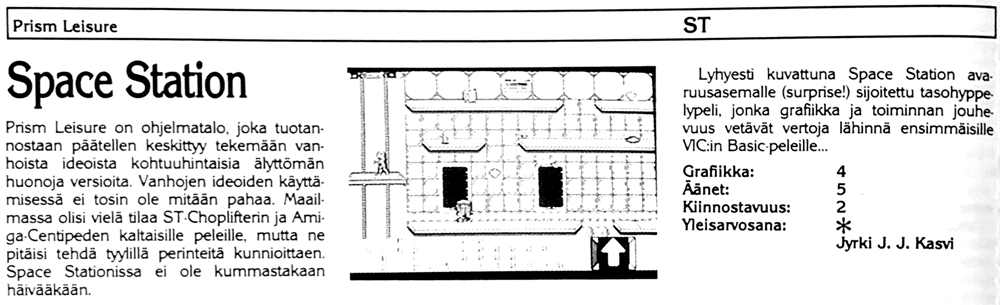
Space Station1988Pysyvä linkkiPrism Leisure on ohjelmatalo, joka tuotannostaan päätellen keskittyy tekemään vanhoista ideoista kohtuuhintaisia älyttömän huonoja versioita. Vanhojen ideoiden käyttämisessä ei tosin ole mitään pahaa. Maailmassa olisi vielä tilaa ST-Choplifterin ja Amiga-Centipeden kaltaisille peleille, mutta ne pitäisi tehdä tyylillä perinteitä kunnioittaen. Space Stationissa ei ole kummastakaan häivääkään.
Lyhyesti kuvattuna Space Station avaruusasemalle (surprise!) sijoitettu tasohyppelypeli, jonka grafiikka ja toiminnan jouhevuus vetävät vertoja lähinnä ensimmäisille VIC:in Basic-peleille...
Space Station1988PermalinkPrism Leisure is a software house which, judging by its output, concentrates on making reasonably priced, insanely bad versions of old ideas. Not that there's anything wrong with using old ideas. The world would still have room for games like an ST Choplifter or an Amiga Centipede, but they would have to be made with style and with respect for tradition. Space Station hasn't a trace of either.
Put briefly, Space Station is a platform game set on a space station (surprise!), whose graphics and smoothness of action are on a par mainly with the very first Basic games on the VIC...
Speedball
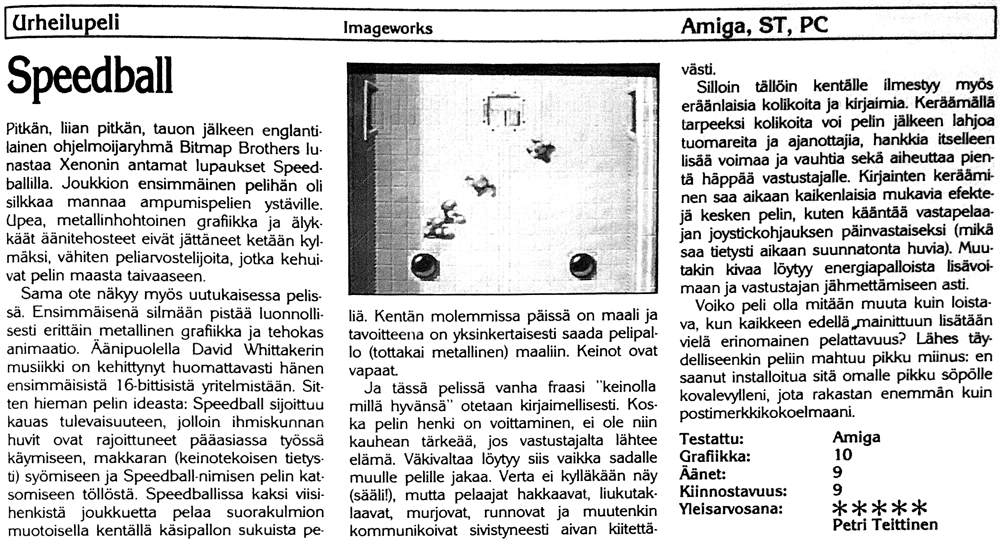
Speedball1989 KevätPysyvä linkkiPitkän, liian pitkän, tauon jälkeen englantilainen ohjelmoijaryhmä Bitmap Brothers lunastaa Xenonin antamat lupaukset Speedballilla. Joukkion ensimmäinen pelihän oli silkkaa mannaa ampumispelien ystäville. Upea, metallinhohtoinen grafiikka ja älykkäät äänitehosteet eivät jättäneet ketään kylmäksi, vähiten peliarvostelijoita, jotka kehuivat pelin maasta taivaaseen.
Sama ote näkyy myös uutukaisessa pelissä. Ensimmäisenä silmään pistää luonnollisesti erittäin metallinen grafiikka ja tehokas animaatio. Äänipuolella David Whittakerin musiikki on kehittynyt huomattavasti hänen ensimmäisistä 16-bittisistä yritelmistään. Sitten hieman pelin ideasta: Speedball sijoittuu kauas tulevaisuuteen, jolloin ihmiskunnan huvit ovat rajoittuneet pääasiassa työssä käymiseen, makkaran (keinotekoisen tietysti) syömiseen ja Speedball-nimisen pelin katsomiseen töllöstä. Speedballissa kaksi viisihenkistä joukkuetta pelaa suorakulmion muotoisella kentällä käsipallon sukuista peliä. Kentän molemmissa päissä on maali ja tavoitteena on yksinkertaisesti saada pelipallo (tottakai metallinen) maaliin. Keinot ovat vapaat.
Ja tässä pelissä vanha fraasi "keinolla millä hyvänsä" otetaan kirjaimellisesti. Koska pelin henki on voittaminen, ei ole niin kauhean tärkeää, jos vastustajalta lähtee elämä. Väkivaltaa löytyy siis vaikka sadalle muulle pelille jakaa. Verta ei kylläkään näy (sääli!), mutta pelaajat hakkaavat, liukutaklaavat, murjovat, runnovat ja muutenkin kommunikoivat sivistyneesti aivan kiitettävästi.
Silloin tällöin kentälle ilmestyy myös eräänlaisia kolikoita ja kirjaimia. Keräämällä tarpeeksi kolikoita voi pelin jälkeen lahjoa tuomareita ja ajanottajia, hankkia itselleen lisää voimaa ja vauhtia sekä aiheuttaa pientä häppää vastustajalle. Kirjainten kerääminen saa aikaan kaikenlaisia mukavia efektejä kesken pelin, kuten kääntää vastapelaajan joystickohjauksen päinvastaiseksi (mikä saa tietysti aikaan suunnatonta huvia). Muutakin kivaa löytyy energiapalloista lisävoimaan ja vastustajan jähmettämiseen asti.
Voiko peli olla mitään muuta kuin loistava, kun kaikkeen edellä mainittuun lisätään vielä erinomainen pelattavuus? Lähes täydelliseenkin peliin mahtuu pikku miinus: en saanut installoitua sitä omalle pikku söpölle kovalevylleni, jota rakastan enemmän kuin postimerkkikokoelmaani.
Speedball1989 KevätPermalinkAfter a long, far too long, break, the English programming team Bitmap Brothers makes good on the promises of Xenon with Speedball. The gang's first game was, after all, pure manna for fans of shooting games. The superb, metallic-sheened graphics and clever sound effects left no one cold, least of all the game reviewers, who praised the game to the skies.
The same touch shows in the brand-new game too. The first thing to catch the eye is naturally the extremely metallic graphics and the effective animation. On the sound side, David Whittaker's music has come on considerably since his first 16-bit efforts. Then a little about the idea of the game: Speedball is set in the far future, when humanity's amusements have been reduced mainly to going to work, eating sausage (artificial, of course) and watching a game called Speedball on the telly. In Speedball two five-man teams play a game related to handball on a rectangular pitch. There's a goal at each end of the pitch and the aim is simply to get the ball (metallic, naturally) into the goal. Any means are allowed.
And in this game the old phrase "by any means necessary" is taken literally. Since the spirit of the game is winning, it doesn't matter all that terribly much if an opponent happens to lose their life. So there's enough violence to share out among a hundred other games. You don't see any blood, mind you (pity!), but the players hit, slide-tackle, batter, pummel and otherwise communicate in a most commendably civilised manner.
Every now and then some sort of coins and letters also appear on the pitch. By collecting enough coins you can, after the match, bribe the referees and timekeepers, get yourself more strength and speed, and cause the opposition a spot of bother. Collecting letters brings about all sorts of nice effects mid-match, such as reversing the opposing player's joystick controls (which naturally causes immense amusement). There's other fun stuff too, from energy balls to extra power and freezing the opponent.
Can the game be anything other than brilliant, when on top of all the above you add excellent playability? Even a nearly perfect game has room for a little minus: I couldn't install it on my own cute little hard disk, which I love more than my stamp collection.
Speedball II - Brutal Deluxe
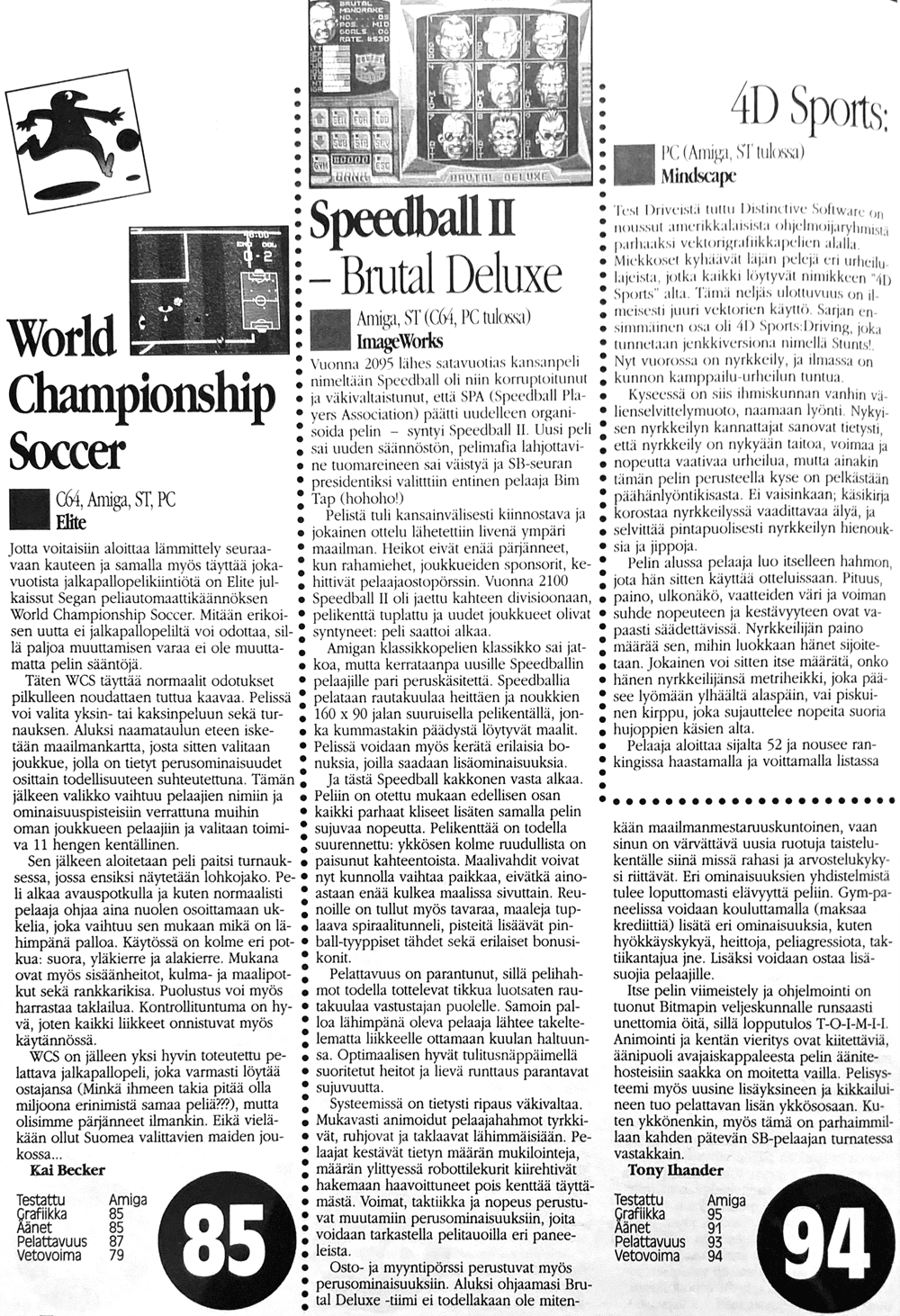
Speedball II - Brutal Deluxe1991 SyksyPysyvä linkkiVuonna 2095 lähes satavuotias kansanpeli nimeltään Speedball oli niin korruptoitunut ja väkivaltaistunut, että SPA (Speedball Players Association) päätti uudelleen organisoida pelin - syntyi Speedball II. Uusi peli sai uuden säännöstön, pelimafia lahjottavine tuomareineen sai väistyä ja SB-seuran presidentiksi valitttiin entinen pelaaja Bim Tap (hohoho!)
Pelistä tuli kansainvälisesti kiinnostava ja jokainen ottelu lähetettiin livenä ympäri maailman. Heikot eivät enää pärjänneet, kun rahamiehet, joukkueiden sponsorit, kehittivät pelaajaostopörssin. Vuonna 2100 Speedball II oli jaettu kahteen divisioonaan, pelikenttä tuplattu ja uudet joukkueet olivat syntyneet: peli saattoi alkaa.
Amigan klassikkopelien klassikko sai jatkoa, mutta kerrataanpa uusille Speedballin pelaajille pari peruskäsitettä. Speedballia pelataan rautakuulaa heittäen ja noukkien 160 x 90 jalan suuruisella pelikentällä, jonka kummastakin päädystä löytyvät maalit. Pelissä voidaan myös kerätä erilaisia bonuksia, joilla saadaan lisäominaisuuksia.
Ja tästä Speedball kakkonen vasta alkaa. Peliin on otettu mukaan edellisen osan kaikki parhaat kliseet lisäten samalla pelin sujuvaa nopeutta. Pelikenttää on todella suurennettu: ykkösen kolme ruudullista on paisunut kahteentoista. Maalivahdit voivat nyt kunnolla vaihtaa paikkaa, eivätkä ainoastaan enää kulkea maalissa sivuttain. Reunoille on tullut myös tavaraa, maaleja tuplaava spiraalitunneli, pisteitä lisäävät pinball-tyyppiset tähdet sekä erilaiset bonusikonit.
Pelattavuus on parantunut, sillä pelihahmot todella tottelevat tikkua luotsaten rautakuulaa vastustajan puolelle. Samoin palloa lähimpänä oleva pelaaja lähtee takeltelematta liikkeelle ottamaan kuulan haltuunsa. Optimaalisen hyvät tulitusnäppäimellä suoritetut heitot ja lievä runttaus parantavat sujuvuutta.
Systeemissä on tietysti ripaus väkivaltaa. Mukavasti animoidut pelaajahahmot tyrkkivät, ruhjovat ja taklaavat lähimmäisiään. Pelaajat kestävät tietyn määrän mukilointeja, määrän ylittyessä robottilekurit kiirehtivät hakemaan haavoittuneet pois kenttää täyttämästä. Voimat, taktiikka ja nopeus perustuvat muutamiin perusominaisuuksiin, joita voidaan tarkastella pelitauoilla eri paneeleista.
Osto- ja myyntipörssi perustuvat myös perusominaisuuksiin. Aluksi ohjaamasi Brutal Deluxe -tiimi ei todellakaan ole mitenkään maailmanmestaruuskuntoinen, vaan sinun on värvättävä uusia ruotuja taistelukentälle siinä missä rahasi ja arvostelukykysi riittävät. Eri ominaisuuksien yhdistelmistä tulee loputtomasti elävyyttä peliin. Gym-paneelissa voidaan kouluttamalla (maksaa krediittiä) lisätä eri ominaisuuksia, kuten hyökkäyskykyä, heittoja, peliagressiota, taktiikantajua jne. Lisäksi voidaan ostaa lisäsuojia pelaajille.
Itse pelin viimeistely ja ohjelmointi on tuonut Bitmapin veljeskunnalle runsaasti unettomia öitä, sillä lopputulos T-O-I-M-I-I. Animointi ja kentän vieritys ovat kiitettäviä, äänipuoli avajaiskappaleesta pelin äänitehosteisiin saakka on moitetta vailla. Pelisysteemi myös uusine lisäyksineen ja kikkailuineen tuo pelattavan lisän ykkösosaan. Kuten ykkönenkin, myös tämä on parhaimmillaan kahden pätevän SB-pelaajan turnatessa vastakkain.
Speedball II - Brutal Deluxe1991 SyksyPermalinkIn 2095 the nearly hundred-year-old people's game called Speedball had become so corrupt and violent that the SPA (Speedball Players Association) decided to reorganise the game - and Speedball II was born. The new game got a new rulebook, the game mafia and its bribable referees had to make way, and the new president elected to the SB association was former player Bim Tap (hohoho!)
The game became an international draw and every match was broadcast live around the world. The weak no longer stood a chance once the money men, the teams' sponsors, came up with a player transfer market. By the year 2100 Speedball II had been split into two divisions, the pitch had been doubled and new teams had been born: the game could begin.
The classic of Amiga classics has got a sequel, but let's go over a couple of basic concepts for new Speedball players. Speedball is played by throwing and scooping up an iron ball on a pitch measuring 160 x 90 feet, with a goal at either end. You can also collect various bonuses during the game, which give you extra abilities.
And this is only where Speedball Two gets going. The game brings in all the best clichés of the previous instalment while adding to the game's smooth speed. The pitch really has been enlarged: the first one's three screenfuls have swollen to twelve. Goalkeepers can now properly move about, instead of just shuffling sideways in the goal. Stuff has appeared along the sides too: a spiral tunnel that doubles goals, pinball-style stars that add points, and various bonus icons.
Playability has improved, since the players really do obey the joystick as they pilot the iron ball into the opponent's half. Likewise, the player nearest the ball sets off without faltering to take possession of it. Optimally good throws with the fire button and a little mild roughing-up make things flow better.
The system of course has a dash of violence. The nicely animated players shove, maul and tackle their neighbours. Players can take a certain number of wallopings; once that's exceeded, robot sawbones rush in to cart the wounded off so they're not cluttering up the pitch. Strength, tactics and speed are based on a few basic attributes, which can be inspected on various panels during breaks in play.
The buying and selling market is based on the basic attributes too. At the start, the Brutal Deluxe team you control is by no means in world-championship shape; you have to recruit fresh troops for the battlefield as far as your money and judgement allow. The combinations of different attributes bring endless life to the game. In the Gym panel, training (it costs credits) lets you boost various attributes such as attacking ability, throwing, game aggression, tactical sense etc. You can also buy extra armour for the players.
Polishing and programming the game itself has cost the Bitmap brotherhood plenty of sleepless nights, because the end result W-O-R-K-S. The animation and pitch scrolling are commendable, and the sound, from the opening tune to the in-game effects, is beyond reproach. The game system, too, with its new additions and gimmicks, adds something playable to the first instalment. Like the first one, this one is at its best when two competent SB players square off against each other.
Speedboat Assassins
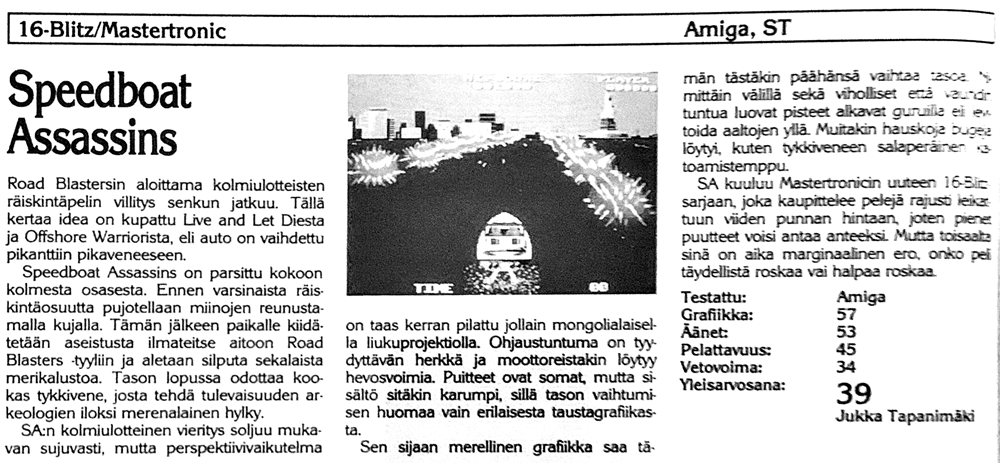
Speedboat Assassins1990 KevätPysyvä linkkiRoad Blastersin aloittama kolmiulotteisten räiskintäpelin villitys senkun jatkuu. Tällä kertaa idea on kupattu Live and Let Diesta ja Offshore Warriorista, eli auto on vaihdettu pikanttiin pikaveneeseen.
Speedboat Assassins on parsittu kokoon kolmesta osasesta. Ennen varsinaista räiskintäosuutta pujotellaan miinojen reunustamalla kujalla. Tämän jälkeen paikalle kiidätetään aseistusta ilmateitse aitoon Road Blasters -tyyliin ja aletaan silputa sekalaista merikalustoa. Tason lopussa odottaa kookas tykkivene, josta tehdä tulevaisuuden arkeologien iloksi merenalainen hylky.
SA:n kolmiulotteinen vieritys soljuu mukavan sujuvasti, mutta perspektiivivaikutelma on taas kerran pilattu jollain mongolialaisella liukuprojektiolla. Ohjaustuntuma on tyydyttävän herkkä ja moottoreistakin löytyy hevosvoimia. Puitteet ovat somat, mutta sisältö sitäkin karumpi, sillä tason vaihtumisen huomaa vain erilaisesta taustagrafiikasta.
Sen sijaan merellinen grafiikka saa tämän tästäkin päähänsä vaihtaa tasoa. Nimittäin välillä sekä viholliset että vauhdin tuntua luovat pisteet alkavat guruilla eli levitoida aaltojen yllä. Muitakin hauskoja bugeja löytyi, kuten tykkiveneen salaperäinen katoamistemppu.
SA kuuluu Mastertronicin uuteen 16-Blitz-sarjaan, joka kaupittelee pelejä rajusti leikattuun viiden punnan hintaan, joten pienet puutteet voisi antaa anteeksi. Mutta toisaalta sinä on aika marginaalinen ero, onko peli täydellistä roskaa vai halpaa roskaa.
Speedboat Assassins1990 KevätPermalinkThe 3D shoot-'em-up craze started by Road Blasters just keeps on going. This time the idea has been leeched from Live and Let Die and Offshore Warrior, i.e. the car has been swapped for a spicy speedboat.
Speedboat Assassins has been darned together from three little bits. Before the actual blasting part you slalom along a lane lined with mines. After this, weaponry is rushed in by air in true Road Blasters style and you set about shredding an assortment of naval hardware. At the end of the level waits a hefty gunboat, to be turned into an underwater wreck for the delight of future archaeologists.
SA's 3D scrolling flows along nice and smoothly, but the sense of perspective has once again been ruined by some Mongolian sliding projection. The controls feel satisfactorily responsive and the engines have some horsepower in them too. The trappings are cute, but the content is all the more barren, since the only way you notice the level changing is the different background graphics.
The maritime graphics, on the other hand, keep taking it into their heads to change level. Every so often, you see, both the enemies and the dots that create the sense of speed start going guru, i.e. levitating above the waves. I found other amusing bugs too, such as the gunboat's mysterious vanishing trick.
SA belongs to Mastertronic's new 16-Blitz series, which peddles games at a drastically slashed price of five pounds, so small shortcomings could be forgiven. But on the other hand, there's a pretty marginal difference between a game being complete rubbish and cheap rubbish.
Speedrumbler
Speedrumbler1988Pysyvä linkkiSpeedrumblerissa (peliautomaattina Rush & Crash) on terroristijoukkio, joka terrorisoi pieniä kaupunkeja. Ne siat ovat vanginneet perheesi ja sinun on taisteltava kärrylläsi tiesi eri tasojen läpi pelastaaksesi heidät. Kuten kolikkopeliversiossakin, on matkalla taloja joista saa lisävarustuksia. Rahalla pelattaessa niistä tulee pikku-ukkoja, joiden yli ajettaessa saa lisävarusteet. Käännöksessä puolestaan on ajettava talojen yli kahdesti.
Kuten lähes aina, on tämäkin arcadekäännös heikohko, kuitenkin parempi kuin monet muut. Ruudun vieritys on hiukan nykivää, mutta muuten ei suurempaa valittamista ole. Suurimmat erot ovat heikompi grafiikka, pikku-ukkoja ei esiinny ja demon puuttuminen. Äänissäkään ei ole pahemmin hurraamista.
Speedrumbler on kohtalainen peli. Itse en siitä jaksanut innostua; johtunee paatuneesta mielestäni, joka jaksaa syttyä vain todella hyvistä peleistä.
Speedrumbler1988PermalinkIn Speedrumbler (known as Rush & Crash in the arcades) there's a gang of terrorists terrorising small towns. Those swine have taken your family prisoner, and you have to fight your way through the various levels in your buggy to rescue them. As in the coin-op version, along the way there are houses that give you extra equipment. When you're feeding it coins, little men come out of them, and you get the extras by running them over. In the conversion, on the other hand, you have to drive over the houses twice.
As nearly always, this arcade conversion is on the weak side too, though still better than many others. The scrolling is a bit jerky, but otherwise there isn't much to complain about. The biggest differences are the weaker graphics, the little men not turning up, and the missing demo. The sound isn't much to cheer about either.
Speedrumbler is a middling game. Personally I couldn't get worked up about it; probably down to my hardened mind, which only bothers to catch fire for really good games.
Spellbound
Spellbound1991 KevätPysyvä linkkiHaltiaveljekset Sortice ja Cerorapp ovat pahalla tuulella, sillä juuri kun oppi-isä Poinat oli kertomaisillaan, miten saadaan rahaa, ystäviä, vaikutusvaltaa ja kissa, eli miten tullaan oikeaksi velhoksi, niin mokoma antoi kaapata itsensä manalaan. Noutamaan olisi lähdettävä, yksin tai pareittain.
Kaksinpeliä ja irtonaista taustatarinaa lukuunottamatta Spellbound ei onnistu erottumaan keskimääräisistä hyppelyistä ja keräilyistä. Vaakavieritykseen rajoittuneessa maisemassa siirtyillään hisseillä tasolta toiselle, availlaan arkkuja avaimilla, keräillään kääröistä magiaa ja rohmutaan tarvekaluja. Tylsänpuoleista vihollislaumaa kivitetään kuoliaaksi, pistetään liekkiä kytemään ja muuta sen tapaista.
Periaatteessa sisältöä on mukavasti, mutta pelimekaniikassa on Spellboundin suurin heikkous. Eteneminen on laimeaa nyhjäämistä, kun tämäntyylinen peli vaatisi vauhtia ja viskettä. Liikkuminen on liiaksi sidottu hisseihin, joiden päältä ei edes pääse hyppäämään. Mukana pitäisi olla enemmän kunnon pomppukaaria, kiipeilyä ja muuta nuohoamista sen sijaan, että vipellettäisiin edes takaisin yksitoikkoisia tasanteita pitkin.
Magian käyttö lisää kiinnostavuutta vain pari piirua, sillä levitointia lukuunottamatta loitsut vaikuttavat lähinnä ammusten laatuun. Aika ihmeellistä on sekin, että jos yrittää tiettyä taikaa puutteellisilla voimilla, niin sankaria rangaistaan, vaikka taikoihin vaadittavia mittarilukemia ei ole kerrottu missään.
Pelin onnistunein osa on taustataide, mutta se on paikoitellen liian sekavaa, jotta pienet pelihahmot erottuisivat kunnolla. Efekti- ja musiikkipuolessakin on pieniä ongelmia, joka kuuluu äänten vaimeutena ja säröisyytenä.
Yksinpelinä Spellbound on tylsähkö. Ohjekirjasessakin on suositus, että peli on parhaimmillaan, kun manalaan suuntaavat kummatkin haltiaveljekset sopuisana tiiminä.
Spellbound1991 KevätPermalinkThe elf brothers Sortice and Cerorapp are in a foul mood, because just as their mentor Poinat was about to tell them how to get money, friends, influence and a cat, in other words how to become a real wizard, the wretch went and let himself be kidnapped to the underworld. Someone will have to go and fetch him, alone or in pairs.
Apart from the two-player mode and the breezy background story, Spellbound doesn't manage to stand out from the average hop-and-collect games. In a landscape limited to horizontal scrolling you shuttle from level to level by lift, open chests with keys, gather magic from scrolls and hoard useful gear. The rather dull horde of enemies gets stoned to death, set smouldering and so forth.
In principle there's a decent amount of content, but the game mechanics are Spellbound's biggest weakness. Progress is a limp shuffle, when a game of this kind would demand speed and zip. Movement is too tied to the lifts, which you can't even jump off. There ought to be more proper bouncing arcs, climbing and other poking about in every nook, instead of scurrying back and forth along monotonous ledges.
Using magic adds only a notch or two of interest, because apart from levitation the spells mostly just affect the quality of your ammunition. It's also rather odd that if you try a particular spell with insufficient power, the hero gets punished, even though the meter readings the spells require aren't given anywhere.
The most successful part of the game is the background art, but in places it's too busy for the small game characters to stand out properly. The effects and music side has small problems too, which you can hear as the sounds being muffled and distorted.
As a one-player game Spellbound is on the dull side. Even the manual recommends that the game is at its best when both elf brothers head for the underworld as a harmonious team.
Spindizzy
Spindizzy1987Pysyvä linkkiMonet tuntevat automaattipelin Marble Madnessin. Spindizzy seurailee grafiikaltaan Marble Madnessia. Pelin idea on kuitenkin aivan toisenlainen. Marble Madnessissa on tarkoitus selvittää jokin taso mahdollisimman nopeasti, jonka jälkeen siirrytään seuraavaan. Spindizzyssä sen sijaan pitää tutkia koko maasto, varsinaista loppuratkaisua ei ole.
Peli-idea on mielestäni kiehtova. Sitä ei voi ratkaista hetkessä. Koko ajan vähenevää peliaikaa voi lisätä keräämällä timantteja, mutta aluksen tuhoutuessa häviää aikaa. Suuri pelialue takaa, että peliä ei ratkaise ensimmäisenä päivänä oston jälkeen.
Spindizzy on eräänlainen seikkailupeli. Sen ratkaisu vaatii taituruutta. Joissakin ruuduissa on käytettävä hyväksi hyppyreitä, toisissa taas on hypittävä trampoliineilla eteenpäin. Pelissä on hissejä ja siltoja, jotka on ensin kytkettävä päälle. Joskus tarvitaan kahden kytkimen käyttöä yhden laitteen toimintaa varten.
Spindizzyn grafiikka seurailee Marble Madnessia pääpiirteiltään. Harmittava piirre on grafiikan softscrollin puuttuminen. Pelialueella liikutaan ruutu kerrallaan. Hyvä toiminto on mahdollisuus kentän tarkkailuun eri ilmansuunnista. Täten ei tarvitse arvailla reittiä, jos aluksen ja pelaajan väliin sattuu jokin esine. Pelaajan alus on pelin alkaessa kärjelleen asetetun pyramidin näköinen. I-näppäimellä sen ulkomuotoa voi kuitenkin muuttaa joko palloksi tai hyrräksi.
Spindizzy tuntuu alusta alkaen hienolta. Ääntä pelistä ei sanottavasti lähde, mutta siisti grafiikka peittää puutteen. Pelin kiinnostavuus pysyy takuulla yllä pitempäänkin kuin ensi ratkaisuun. Aina löytyy uusia kikkoja ja ratkaisutapoja.
Mielestäni Spindizzy on eräs parhaimpia tämän hintaluokan pelejä.
Spindizzy1987PermalinkMany people know the arcade game Marble Madness. Spindizzy takes after Marble Madness in its graphics. The idea of the game, however, is completely different. In Marble Madness the aim is to get through a level as quickly as possible, after which you move on to the next one. In Spindizzy, on the other hand, you have to explore the whole terrain; there is no actual final solution.
In my opinion the game idea is fascinating. It can't be solved in a moment. The ever-dwindling playing time can be topped up by collecting diamonds, but you lose time whenever your craft is destroyed. The large playing area guarantees that the game won't be solved on the first day after you buy it.
Spindizzy is a kind of adventure game. Solving it takes skill. On some screens you have to make use of jumps, while on others you have to bounce your way forward on trampolines. The game has lifts and bridges that first have to be switched on. Sometimes two switches are needed to make a single device work.
Spindizzy's graphics follow Marble Madness in their main features. An annoying feature is the lack of smooth scrolling. You move around the playing area one screen at a time. A good feature is the option of viewing the level from different compass directions. That way you don't have to guess the route if some object happens to get between the craft and the player. At the start of the game the player's craft looks like a pyramid balanced on its point. With the I key, though, you can change its shape into either a ball or a spinning top.
Spindizzy feels great right from the start. There's not much sound to speak of, but the neat graphics make up for the shortcoming. The game is guaranteed to hold your interest for a good while longer than just until the first solution. There are always new tricks and ways of solving things to discover.
In my opinion Spindizzy is one of the best games in this price range.
Spindizzy Worlds
Spindizzy Worlds1991 KevätPysyvä linkkiKuusnelosen alkuperäinen Spindizzy oli niitä pelejä, joiden kimpussa tuli urakoitua enemmän kuin olisi terveellistä. Kyseinen Marble Madnessiin perustuva hyrränvierittely kehitti alkuperäistä ideaa niin pitkälle kuin se yleensä on mahdollista. Niinpä onkin mielenkiintoista nähdä, miten idea on onnistuttu teleporttaamaan Amiga-aikaan.
Sulavaa vieritystä lukuunottamatta Spindizzy Worlds sisältää yllättävän vähän uutta ilmettä. Vanhat tutut rampeilla ja kaukaloissa ajelut, vipujen naksauttelut, hissit ja trampoliinit on otettu mukaan sellaisenaan. Myöskään ei ole unohdettu karttaa eikä mahdollisuutta tutkailla kolmiulotteista maastoa neljästä ilmansuunnasta. Aikarajan ja sen korvikkeet olisi minun puolestani saanut unohtaa. Huolestuttavasti hupeneva polttoaine ja joillain tasoilla tiukasti tikittävä sekunttikello ovat aivan turhaa kiusaa.
Eniten eroa alkuperäiseen on pelin rakenteessa. Alunperin valittavana oli neljä reittiä, ja koko peli oli yksi iso kokonaisuus. SW:ssä on puolestaan kokonainen rypäle maailmoja, joita voi pelailla suhteellisen vapaassa järjestyksessä. Mukana on myös muutamasta planeetasta koostuva harjoittelu-universumi.
Enintään viidestätoista peräkkäin ketjutetusta tasosta koostuvissa maailmoissa on yleensä tietty teema, kuten pyramidi, saaristo ja jää. Ehdottomasti hauskinta on mäkiin, hyppyreihin ja kouruihin perustuvissa kentissä hurjastelu. Valitettavan monet ovat kuitenkin tarkkuustyötä vaativaa nypläämistä, joka saattaa käydä heikkohermoisemman luonnolle. Herkästi liikkuvan ja vaikeasti pysäytettävän hyrrän ohjailu vaatii huippuunsa hiottua tikunkäsittelyä, mikäli haluaa välttää katatonisen lihaskrampin aiheuttaman jännetuppitulehduksen.
Suunnilleen puolet kentistä pystyy jotenkin selvittämään, loput onkin suunniteltu siriuslaisia markkinoita silmälläpitäen. Onneksi pelissä on sentään tallennusmahdollisuus, minkä ansiosta huippuvaikeatkin kentät jaksaa hieroa läpi, jos kärsivällisyys riittää.
Puhdasoppisten taitopelien kategoriassa Spindizzyn ainutlaatuinen magia on omaa luokkaansa, mutta korostan: Mämmikourat älköön vaivautuko.
Spindizzy Worlds1991 KevätPermalinkThe original Commodore 64 Spindizzy was one of those games you ended up slogging away at more than was healthy. That top-rolling game, based on Marble Madness, took the original idea about as far as it can possibly go. So it's interesting to see how successfully the idea has been teleported into the Amiga age.
Apart from the smooth scrolling, Spindizzy Worlds has surprisingly little in the way of a new look. The good old rides along ramps and troughs, the clicking of switches, the lifts and the trampolines have all been carried over just as they were. Nor have they forgotten the map, or the option to study the three-dimensional terrain from four compass directions. As far as I'm concerned they could have forgotten the time limit and its substitutes. The alarmingly dwindling fuel and the stopwatch ticking tightly on some levels are nothing but pointless torment.
The biggest difference from the original is in the game's structure. Originally there were four routes to choose from, and the whole game was one big entity. SW, on the other hand, has a whole cluster of worlds that you can play in a fairly free order. There's also a training universe made up of a few planets.
The worlds, each consisting of at most fifteen levels chained one after another, usually have a particular theme, such as pyramid, archipelago or ice. By far the most fun is tearing around the levels built on hills, jumps and chutes. Unfortunately many of them are fiddly precision work, which may be too much for those with weaker nerves. Steering the top, which moves at the slightest touch and is hard to stop, calls for joystick handling honed to perfection, if you want to avoid tenosynovitis brought on by catatonic muscle cramp.
Roughly half of the levels can be cleared somehow; the rest have been designed with the market on Sirius in mind. Fortunately the game does at least have a save option, thanks to which you can grind your way even through the fiendishly hard levels, if your patience holds out.
In the category of skill games of the purest kind, Spindizzy's unique magic is in a class of its own, but I stress: butterfingers need not bother.
Spirit Of Excalibur
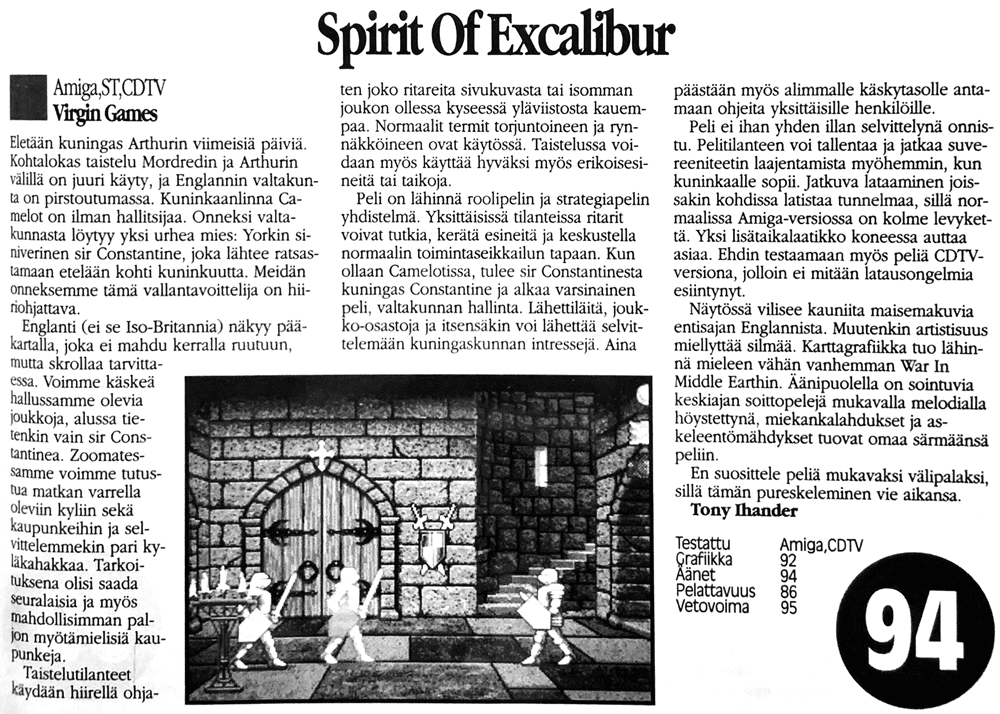
Spirit Of Excalibur1991 SyksyPysyvä linkkiEletään kuningas Arthurin viimeisiä päiviä. Kohtalokas taistelu Mordredin ja Arthurin välillä on juuri käyty, ja Englannin valtakunta on pirstoutumassa. Kuninkaanlinna Camelot on ilman hallitsijaa. Onneksi valtakunnasta löytyy yksi urhea mies: Yorkin siniverinen sir Constantine, joka lähtee ratsastamaan etelään kohti kuninkuutta. Meidän onneksemme tämä vallantavoittelija on hiiriohjattava.
Englanti (ei se Iso-Britannia) näkyy pääkartalla, joka ei mahdu kerralla ruutuun, mutta skrollaa tarvittaessa. Voimme käskeä hallussamme olevia joukkoja, alussa tietenkin vain sir Constantinea. Zoomatessamme voimme tutustua matkan varrella oleviin kyliin sekä kaupunkeihin ja selvittelemmekin pari kyläkahakkaa. Tarkoituksena olisi saada seuralaisia ja myös mahdollisimman paljon myötämielisiä kaupunkeja.
Taistelutilanteet käydään hiirellä ohjaten joko ritareita sivukuvasta tai isomman joukon ollessa kyseessä yläviistosta kauempaa. Normaalit termit torjuntoineen ja rynnäkköineen ovat käytössä. Taistelussa voidaan myös käyttää hyväksi myös erikoisesineitä tai taikoja.
Peli on lähinnä roolipelin ja strategiapelin yhdistelmä. Yksittäisissä tilanteissa ritarit voivat tutkia, kerätä esineitä ja keskustella normaalin toimintaseikkailun tapaan. Kun ollaan Camelotissa, tulee sir Constantinesta kuningas Constantine ja alkaa varsinainen peli, valtakunnan hallinta. Lähettiläitä, joukko-osastoja ja itsensäkin voi lähettää selvittelemään kuningaskunnan intressejä. Aina päästään myös alimmalle käskytasolle antamaan ohjeita yksittäisille henkilöille.
Peli ei ihan yhden illan selvittelynä onnistu. Pelitilanteen voi tallentaa ja jatkaa suvereeniteetin laajentamista myöhemmin, kun kuninkaalle sopii. Jatkuva lataaminen joissakin kohdissa latistaa tunnelmaa, sillä normaalissa Amiga-versiossa on kolme levykettä. Yksi lisätaikalaatikko koneessa auttaa asiaa. Ehdin testaamaan myös peliä CDTV-versiona, jolloin ei mitään latausongelmia esiintynyt.
Näytössä vilisee kauniita maisemakuvia entisajan Englannista. Muutenkin artistisuus miellyttää silmää. Karttagrafiikka tuo lähinnä mieleen vähän vanhemman War In Middle Earthin. Äänipuolella on sointuvia keskiajan soittopelejä mukavalla melodialla höystettynä, miekankalahdukset ja askeleentömähdykset tuovat omaa särmäänsä peliin.
En suosittele peliä mukavaksi välipalaksi, sillä tämän pureskeleminen vie aikansa.
Spirit Of Excalibur1991 SyksyPermalinkThese are the last days of King Arthur. The fateful battle between Mordred and Arthur has just been fought, and the kingdom of England is falling to pieces. The royal castle of Camelot is without a ruler. Fortunately the realm has one brave man: the blue-blooded Sir Constantine of York, who rides off south towards the crown. Fortunately for us, this seeker of power is mouse-controlled.
England (not Great Britain, mind you) is shown on the main map, which doesn't fit on the screen all at once but scrolls as needed. We can command the forces under our control - at first, of course, only Sir Constantine. By zooming in we can take a look at the villages and towns along the way, and we do end up settling a couple of village skirmishes. The idea is to gain companions and also as many friendly towns as possible.
Battles are fought with the mouse, controlling either the knights from a side view or, when a bigger force is involved, from further off at an angle from above. The usual terms, with parries and charges, are in use. Special items or spells can also be used to advantage in battle.
The game is basically a combination of role-playing game and strategy game. In individual situations the knights can explore, pick up items and talk, the way they would in a normal action adventure. Once in Camelot, Sir Constantine becomes King Constantine and the actual game begins: ruling the kingdom. You can send envoys, detachments of troops and even yourself to look after the kingdom's interests. You can always get down to the lowest level of command, too, to give orders to individual characters.
The game isn't quite something you'll sort out in a single evening. You can save the game and carry on expanding your sovereignty later, whenever it suits the king. Constant loading at some points deflates the atmosphere, since the normal Amiga version comes on three disks. One extra magic box in the machine helps matters. I also got to test the game as the CDTV version, where no loading problems cropped up at all.
Beautiful landscape pictures of England of old flit across the screen. The artistry pleases the eye in other respects too. The map graphics mostly bring to mind the slightly older War In Middle Earth. On the sound side there are melodious medieval instruments seasoned with a pleasant melody, and the clash of swords and thump of footsteps add their own edge to the game.
I don't recommend the game as a nice little snack, since chewing through this one takes its time.
Sport 4
Sport 41987Pysyvä linkkiSport 4 on urheilupelikokoelma, johon kuuluu joukko tuttuja budjettipelejä: jääkiekko, golf, ralli ja muutama veneurheilulaji. Näistä kiinnostavimmat ovat kaksi ensimmäistä. Kovin paljon ei niitäkään voi kehua.
Jääkiekko (vanha Slap Shot) on paras laji. Sitä voi pelata joko yksin tai kaksin, mukana ovat myös kampit ja rangaistukset ja epämääräiseltä rahinalta kuulostavaa puhesynteesiä He scored!- ja Penalty!-huutoineen. Slap Shotia jaksaa pelata kauimmin kokoelman peleistä.
Muihin lajeihin tympääntyy ikävä kyllä melkein heti. Toisten tekijäin paremmat toteutukset ovat valitettavasti hemmotelleet ainakin meikäläisen sen verran piloille, etten voi muuta kuin kehottaa Sport 4:n tekijöitä ottamaan isoisista oppia. Rallissa Epyxiltä (Pitstop II), golfissa Accessilta (Leaderboard Golf) ja veneurheiluissa jälleen Epyxiltä (Summer Games II).
Sport 41987PermalinkSport 4 is a sports compilation made up of a bunch of familiar budget games: ice hockey, golf, rally and a few boating events. Of these, the first two are the most interesting. Not that there's much to praise in those either.
Ice hockey (the old Slap Shot) is the best event. It can be played either alone or by two players, and it also comes with trips and penalties, plus speech synthesis that sounds like a vague crackle, shouting "He scored!" and "Penalty!". Of all the games in the compilation, Slap Shot is the one you can stand playing the longest.
Sadly, you tire of the other events almost immediately. Better versions by other developers have unfortunately spoiled yours truly, at least, so rotten that I can do nothing but urge the makers of Sport 4 to take a lesson from the big boys. For rally, from Epyx (Pitstop II); for golf, from Access (Leaderboard Golf); and for the boating events, once again from Epyx (Summer Games II).
Spy Hunter
Spy Hunter1987Pysyvä linkkiSpy Hunterin idea on hyvin yksinkertainen: Autolla tai veneellä pitää ajaa niin pitkälle kuin mahdollista. Se onnistuu autossa olevan aseistuksen avulla. Spy Hunterin autossa ovat konekiväärit vakiona. Ajamalla aseistusautoon voi saada ohjuksia ja öljyä, jota voi päästää tielle. Savupilviäkin voi päästellä vihollisten eteen. Lisäksi Spy Hunter voi puolustautua tönimällä vihollisia rannalle tai ulos tieltä. Välillä Spy Hunteria vastaan tulee katkenneita siltoja ja tie voi yllättäen jakaantua keskeltä kahtia. Spy Hunterin vihollisista osa työntää Spy Hunteria ulos tieltä ja osa ampuu tai pudottaa miinoja veteen. Myöhemmässä vaiheessa ilmestyy myös helikoptereita ja torpedoveneitä.
Spy Hunterin värivalinnat eivät kaikilta osin ole osuneet aivan nappiin, mutta autot ja veneet ovat aivan tarpeeksi värikkäitä.
Pelin musiikki on niukkaa. Spy Hunterin äänitehosteet ovat myös niukat.
Pelin kiinnostuksen hävittää sen samankaltaisuus ja maisemien toistuvuus. Pelaamista hankaloittaa kahden ampumisnappulan tarve. On joko yhdistettävä kaksi ohjainta ohjeiden neuvomalla tavalla tai laitettava toinen ohjain lattialle ja käytettävä sen nappia jalalla.
Spy Hunter on hyvä valinta räiskintäpeleistä pitäville. Varttuneemmat pelaajat voivat unohtaa Spy Hunterin.
Spy Hunter1987PermalinkThe idea of Spy Hunter is very simple: you have to drive a car or a boat as far as possible. You manage this with the help of the weaponry on board the car. Spy Hunter's car comes with machine guns as standard. By driving into the weapons van you can get missiles and oil, which you can release onto the road. You can even let off smoke clouds in front of the enemies. In addition, Spy Hunter can fight back by shoving enemies onto the shore or off the road. Now and then Spy Hunter comes up against broken bridges, and the road can suddenly split down the middle into two. Some of Spy Hunter's enemies push Spy Hunter off the road, and some shoot or drop mines into the water. At a later stage helicopters and torpedo boats turn up as well.
Spy Hunter's colour choices haven't hit the mark in every respect, but the cars and boats are quite colourful enough.
The game's music is sparse. Spy Hunter's sound effects are sparse too.
What kills interest in the game is its sameness and the repetitive scenery. Playing is made awkward by the need for two fire buttons. You either have to connect two joysticks the way the instructions tell you, or put the second joystick on the floor and work its button with your foot.
Spy Hunter is a good choice for those who like shoot-'em-ups. More seasoned players can forget about Spy Hunter.
Spy vs. Spy
Spy vs. Spy1987Pysyvä linkkiMad Magazinen sarjakuvista tutut agentit, musta ja valkoinen, ovat nyt siivittäneet peliohjelmoijienkin ajatuksia. Tuloksena on syntynyt Spy vs. Spy -peli, jossa kaksi agenttia ovat yhtäaikaa murtautuneet vieraan maan suurlähetystöön. Voittaja on se, joka ensimmäisenä selviää lentokentälle ja takaisin kotimaahansa.
Ennen kuin pelaaja voi mennä lentokentälle on hänen löydettävä asiakirjasalkku, johon hänen on kerättävä passi, rahaa, salaisia asiakirjoja ja avain. Tietenkin toinen pelaaja yrittää estää toista lähtemästä, koska lentokoneita lähtee vain yksi.
Kaksintaisteluissa agentit lyövät toisiaan mailoilla. Jos jompikumpi pelaajista saa riittävästi lyöntejä, hän kuolee, mutta pystyy jatkamaan peliänsä jonkin ajan kuluttua.
Pelissä pyörii taustalla erittäin hyvä musiikki, jonka lisäksi ei ole juuri muita ääniä. Pelaajia voi olla yksi tai kaksi. Yhden hengen pelissä toista agenttia ohjaa tietokone. Huonoja puolia oli pelistä vaikea löytää. Se kiinnosti ainakin testaajaa erittäin paljon eikä alkanut heti pitkästyttää. Suomennosta käsikirja kaipaisi, sillä sitä tarvitaan pelin laajuuden ja vaikeuden takia.
Spy vs. Spy1987PermalinkThe agents from the Mad Magazine comic strips, black and white, have now lent wings to the thoughts of game programmers too. The result is the Spy vs. Spy game, in which two agents have broken into a foreign country's embassy at the same time. The winner is the one who first makes it to the airport and back to their home country.
Before a player can go to the airport, they have to find the briefcase and collect into it the passport, money, secret documents and a key. Naturally each player tries to stop the other from leaving, because only one plane is departing.
In the duels the agents hit each other with clubs. If either player takes enough hits, they die, but can carry on with the game after a while.
Very good music plays in the background, and apart from that there are hardly any other sounds. There can be one or two players. In a one-player game the computer controls the other agent. It was hard to find any bad sides to the game. It certainly interested this tester a great deal, and it didn't start to get boring right away. The manual could do with a Finnish translation, since you need it because of the game's scope and difficulty.
Spy vs. Spy II
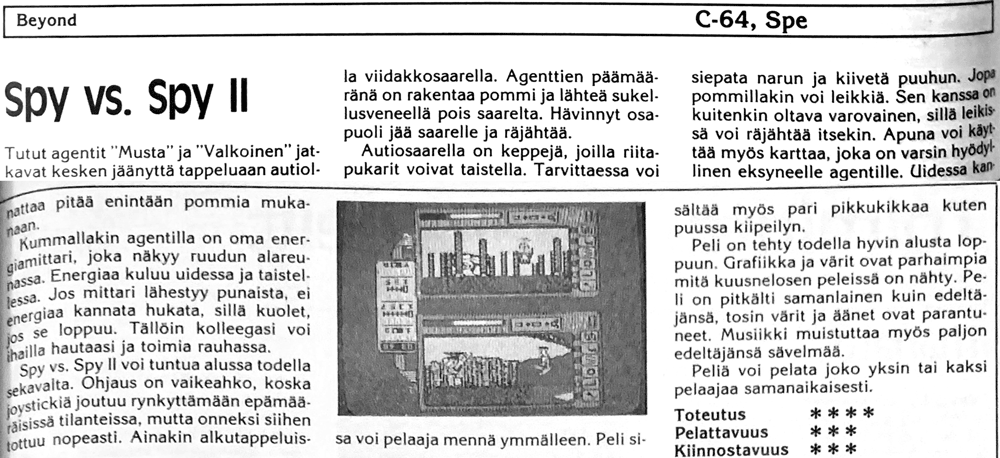
Spy vs. Spy II1987Pysyvä linkkiTutut agentit "Musta" ja "Valkoinen" jatkavat kesken jäänyttä tappeluaan autiolla viidakkosaarella. Agenttien päämääränä on rakentaa pommi ja lähteä sukellusveneellä pois saarelta. Hävinnyt osapuoli jää saarelle ja räjähtää.
Autiosaarella on keppejä, joilla riitapukarit voivat taistella. Tarvittaessa voi siepata narun ja kiivetä puuhun. Jopa pommillakin voi leikkiä. Sen kanssa on kuitenkin oltava varovainen, sillä leikissä voi räjähtää itsekin. Apuna voi käyttää myös karttaa, joka on varsin hyödyllinen eksyneelle agentille. Uidessa kannattaa pitää enintään pommia mukanaan.
Kummallakin agentilla on oma energiamittari, joka näkyy ruudun alareunassa. Energiaa kuluu uidessa ja taistellessa. Jos mittari lähestyy punaista, ei energiaa kannata hukata, sillä kuolet, jos se loppuu. Tällöin kolleegasi voi ihailla hautaasi ja toimia rauhassa.
Spy vs. Spy II voi tuntua alussa todella sekavalta. Ohjaus on vaikeahko, koska joystickiä joutuu rynkyttämään epämääräisissä tilanteissa, mutta onneksi siihen tottuu nopeasti. Ainakin alkutappeluissa voi pelaaja mennä ymmälleen. Peli sisältää myös pari pikkukikkaa kuten puussa kiipeilyn.
Peli on tehty todella hyvin alusta loppuun. Grafiikka ja värit ovat parhaimpia mitä kuusnelosen peleissä on nähty. Peli on pitkälti samanlainen kuin edeltäjänsä, tosin värit ja äänet ovat parantuneet. Musiikki muistuttaa myös paljon edeltäjänsä sävelmää.
Peliä voi pelata joko yksin tai kaksi pelaajaa samanaikaisesti.
Spy vs. Spy II1987PermalinkThe familiar agents "Black" and "White" carry on their unfinished fight on a deserted jungle island. The agents' aim is to build a bomb and leave the island by submarine. The loser is left behind on the island and blows up.
The desert island has sticks the squabblers can fight with. If need be, you can grab a rope and climb a tree. You can even play with the bomb. You have to be careful with it, though, since you might blow yourself up while you're at it. There's also a map to help you, which comes in very handy for a lost agent. When swimming, it's best not to carry anything more than the bomb.
Each agent has an energy meter of their own, shown at the bottom of the screen. Swimming and fighting use up energy. If the meter is nearing the red, don't waste any energy, because you die if it runs out. Your colleague can then admire your grave and get on with things in peace.
Spy vs. Spy II can feel really confusing at first. The controls are on the tricky side, because you have to jiggle the joystick about in vague situations, but luckily you get used to it quickly. The early fights at least can leave the player baffled. The game also includes a couple of little tricks, such as climbing trees.
The game is really well made from start to finish. The graphics and colours are among the best ever seen in Commodore 64 games. The game is largely the same as its predecessor, although the colours and sounds have improved. The music also closely resembles its predecessor's tune.
The game can be played either solo or by two players at the same time.
Spy vs. Spy III - The Arctic Antics
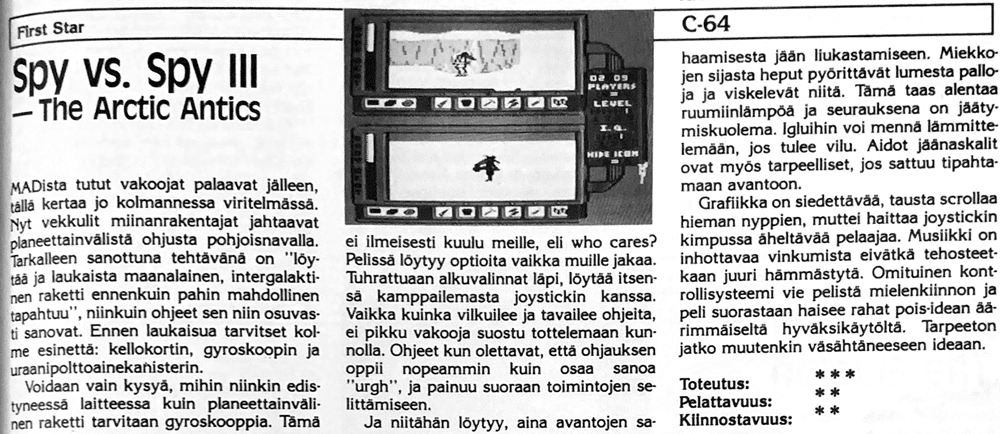
Spy vs. Spy III - The Arctic Antics1987Pysyvä linkkiMADista tutut vakoojat palaavat jälleen, tällä kertaa jo kolmannessa viritelmässä. Nyt vekkulit miinanrakentajat jahtaavat planeettainvälistä ohjusta pohjoisnavalla. Tarkalleen sanottuna tehtävänä on "löytää ja laukaista maanalainen, intergalaktinen raketti ennenkuin pahin mahdollinen tapahtuu", niinkuin ohjeet sen niin osuvasti sanovat. Ennen laukaisua tarvitset kolme esinettä: kellokortin, gyroskoopin ja uraanipolttoainekanisterin.
Voidaan vain kysyä, mihin niinkin edistyneessä laitteessa kuin planeettainvälinen raketti tarvitaan gyroskooppia. Tämä ei ilmeisesti kuulu meille, eli who cares? Pelissä löytyy optioita vaikka muille jakaa. Tuhrattuaan alkuvalinnat läpi, löytää itsensä kamppailemasta joystickin kanssa. Vaikka kuinka vilkuilee ja tavailee ohjeita, ei pikku vakooja suostu tottelemaan kunnolla. Ohjeet kun olettavat, että ohjauksen oppii nopeammin kuin osaa sanoa "urgh", ja painuu suoraan toimintojen selittämiseen.
Ja niitähän löytyy, aina avantojen sahaamisesta jään liukastamiseen. Miekkojen sijasta heput pyörittävät lumesta palloja ja viskelevät niitä. Tämä taas alentaa ruumiinlämpöä ja seurauksena on jäätymiskuolema. Igluihin voi mennä lämmittelemään, jos tulee vilu. Aidot jäänaskalit ovat myös tarpeelliset, jos sattuu tipahtamaan avantoon.
Grafiikka on siedettävää, tausta scrollaa hieman nyppien, muttei haittaa joystickin kimpussa äheltävää pelaajaa. Musiikki on inhottavaa vinkumista eivätkä tehosteetkaan juuri hämmästytä. Omituinen kontrollisysteemi vie pelistä mielenkiinnon ja peli suorastaan haisee rahat pois-idean äärimmäiseltä hyväksikäytöltä. Tarpeeton jatko muutenkin väsähtäneeseen ideaan.
Spy vs. Spy III - The Arctic Antics1987PermalinkThe spies familiar from MAD are back yet again, this time in their third concoction already. Now the rascally mine-builders are chasing an interplanetary missile at the North Pole. To be precise, the task is "to find and launch the underground, intergalactic rocket before the worst possible thing happens", as the instructions so aptly put it. Before the launch you need three items: a time card, a gyroscope and a uranium fuel canister.
One can only ask what a device as advanced as an interplanetary rocket needs a gyroscope for. Apparently that's none of our business, so who cares? The game has options to spare. Having fumbled your way through the opening choices, you find yourself wrestling with the joystick. However much you peek at the instructions and spell your way through them, the little spy refuses to obey properly. The thing is, the instructions assume you'll pick up the controls quicker than you can say "urgh", and dive straight into explaining the actions.
And there are plenty of those, everything from sawing holes in the ice to making the ice slippery. Instead of swords, the dudes roll up balls of snow and hurl them about. This in turn lowers your body temperature, and the result is death by freezing. You can pop into the igloos to warm up if you get chilly. A real pair of ice picks is also a must if you happen to drop through a hole in the ice.
The graphics are tolerable, and the background scrolls a bit jerkily, but that doesn't bother the player grunting away at the joystick. The music is nasty whining, and the effects hardly amaze either. The weird control system takes all the interest out of the game, and the game positively reeks of the cash-in idea being milked to the absolute limit. A pointless sequel to an idea that was worn out anyway.
ST Protector
ST Protector1988Pysyvä linkkiHei! Vanha suosikkini Protector ST:lle. Vanhoja hyviä ideoita pidetään liian usein niin vanhoina, että niitä ei kannata ohjelmoida uusille koneille... Mutta voi, vanhoja hyviä ideoita hyödyntävät aivan liian usein uudet huonot ohjelmoijat, jotka eivät osaa muuta kuin pilata kaiken.
ST Protector tuskin pääsisi edes MikroBITIN listaussivuille, ei mahda minkään. Tällainen ST:n ominaisuuksien väärinkäyttö pitäisi lailla kieltää! Muuta ei tarvinne sanoa.
ST Protector1988PermalinkHey! My old favourite Protector on the ST. Good old ideas are all too often considered so old that they aren't worth programming for new machines... But alas, good old ideas are all too often exploited by bad new programmers who can't do anything except ruin everything.
ST Protector would hardly even make it onto MikroBITTI's type-in listing pages, nothing to be done about it. This kind of abuse of the ST's capabilities should be outlawed! I don't suppose anything more needs saying.
Star Breaker

Star Breaker1990 KevätPysyvä linkkiArc on Atarin pelitalo. Niinpä ensimmäiseksi tuleekin mieleen, että kilpailevalle koneelle tehdyn käännöksen täytyy olla huono. Ainakin ensivaikutelma on masentava: Amiga selälleen ja lisämuisti pois, sitten revitään irti toinen levyasema.
Pelin vihdoin suvaittua ladata itsensä se osoittautuu noloksi Defender-klooniksi, jossa on hernepyssy vuosimallia 1983 ja ruudun päivitys samaa luokkaa kuin kuusnelosen vektorigrafiikassa (siis aika hidasta).
Täydelliseltä katastrofilta on vältytty lähinnä siksi, että pelissä on muutakin tekemistä kuin avaruuden valloittajien pulveroiminen vaakaan vierivässä vuorimaisemassa. Kun pistää aluksen parkkiin ja astuu turbohissiin, pääsee puhdistamaan maanalaisia asemia invaasiojoukoista. Pelin taso nousee kummasti, mutta eipä siihen tarvitakaan muuta kuin ohjainta joten kuten totteleva ukkeli ja skrollaamaton tausta. Jaksossa huristellaan liiturilla huoneesta toiseen, pulveroidaan lisää avaruusmömmöjä ja ostetaan täydennystä varusteisiin päätteitä näpelöimällä.
Henkilökohtaisena mielipiteenä todettakoon, että inhoan pelejä, joissa pitää jatkuvasti hankkia polttoainetta liikkumiseen, ammuksia ampumiseen ja energiaa hengissäpysymiseen. Pelaajan turha kiusaaminen oli ehkä muotia ennen vuotta 1985, mutta nykyisin räiskintäpelissä pitää olla (eräs siipikarjan tuote ja iso huutomerkki).
Paksut manuaalit ovat muotia. Star Breakeriin sellainen on väännetty siten, että ensin jaaritellaan ummet ja lammet ja sitten kerrotaan, että vääntämällä ohjaimesta ylös alus liikkuu ruudulla ylös. Ne ainoat tarpeelliset tiedonmuruset saakin sitten kaivamalla kaivaa.
Lentelyjakson grafiikan perusteella pelin voisi sekoittaa miljardiin samanlaiseen, mutta taustassa on sentään yritetty parallaksinylkytystä. Sisätiloissa vaanii pari mehevää mönkiäistä, kuten tappajaosteri ja vihreä mies lasikuplassa. ääniefektit ovat nippa nappa kuusnelosen tasoa.
Pelin logiikka lievästi onnahtelee, sillä aseman tyhjennyttyä vihollisista pitää kytkeä itsetuhomekanismi. Mitä järkeä on yleensä puolustaa koko planeettaa, jos kerran tarkoituksena on räjäyttää kaikki asemat? Sankarin valtaa syvä eksistentialistinen kriisi, jonka seurauksena hän matkustaa takaisin maapallolle ja alkaa harrastaa kanteleensoittoa.
Star Breaker1990 KevätPermalinkArc is an Atari games house. So the first thing that springs to mind is that a conversion made for the rival machine must be bad. The first impression, at least, is depressing: Amiga on its back and the extra memory out, then rip out the second disk drive.
When the game finally deigns to load itself, it turns out to be an embarrassing Defender clone, with a 1983-model peashooter and a screen update in the same class as C-64 vector graphics (i.e. pretty slow).
Total catastrophe has been avoided mainly because there's more to do in the game than pulverising space invaders over a horizontally scrolling mountain landscape. Park your ship and step into the turbolift, and you get to clean the invasion forces out of underground stations. The game's standard rises remarkably, but then that takes nothing more than a little guy who more or less obeys the controls and a non-scrolling background. In this section you whizz from room to room on a glider, pulverise more space gunk and buy top-ups for your equipment by fiddling with terminals.
Let it be stated as a personal opinion that I loathe games where you constantly have to get hold of fuel for moving, ammo for shooting and energy for staying alive. Pointlessly tormenting the player may have been fashionable before 1985, but these days a shoot-'em-up has to have (a certain pair of anatomical items and a big exclamation mark).
Thick manuals are in fashion. Star Breaker's has been cranked out by first rambling on about everything under the sun and then explaining that cranking the joystick up moves the ship up the screen. The only useful crumbs of information you then have to dig and dig for.
Going by the graphics of the flying section, you could mistake the game for a billion identical ones, but at least there's been an attempt at parallax judder in the background. Indoors a couple of juicy critters lie in wait, such as a killer oyster and a green man in a glass bubble. The sound effects are just barely up to C-64 level.
The game's logic limps slightly, since once a station has been cleared of enemies you have to switch on the self-destruct mechanism. What's the point of defending the whole planet in the first place, if the aim is to blow up all the stations anyway? The hero is seized by a deep existentialist crisis, travels back to Earth as a result and takes up playing the kantele.
Star Command
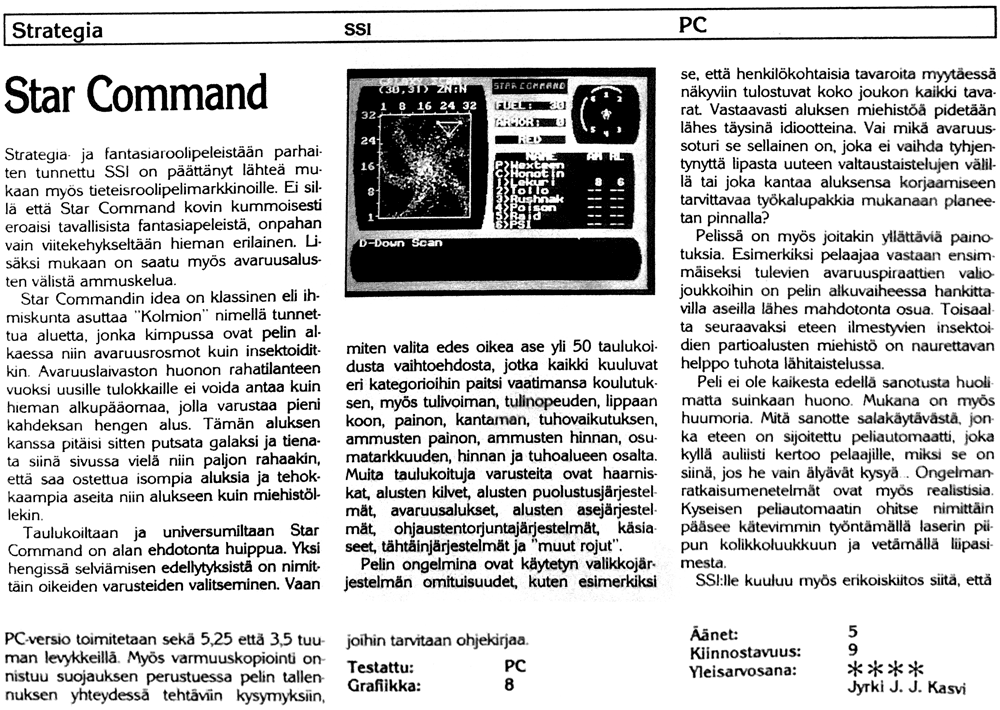
Star Command1989 KevätPysyvä linkkiStrategia- ja fantasiaroolipeleistään parhaiten tunnettu SSI on päättänyt lähteä mukaan myös tieteisroolipelimarkkinoille. Ei sillä että Star Command kovin kummoisesti eroaisi tavallisista fantasiapeleistä, onpahan vain viitekehykseltään hieman erilainen. Lisäksi mukaan on saatu myös avaruusalusten välistä ammuskelua.
Star Commandin idea on klassinen eli ihmiskunta asuttaa "Kolmion" nimellä tunnettua aluetta, jonka kimpussa ovat pelin alkaessa niin avaruusrosmot kuin insektoiditkin. Avaruuslaivaston huonon rahatilanteen vuoksi uusille tulokkaille ei voida antaa kuin hieman alkupääomaa, jolla varustaa pieni kahdeksan hengen alus. Tämän aluksen kanssa pitäisi sitten putsata galaksi ja tienata siinä sivussa vielä niin paljon rahaakin, että saa ostettua isompia aluksia ja tehokkaampia aseita niin alukseen kuin miehistöllekin.
Taulukoiltaan ja universumiltaan Star Command on alan ehdotonta huippua. Yksi hengissä selviämisen edellytyksistä on nimittäin oikeiden varusteiden valitseminen. Vaan miten valita edes oikea ase yli 50 taulukoidusta vaihtoehdosta, jotka kaikki kuuluvat eri kategorioihin paitsi vaatimansa koulutuksen, myös tulivoiman, tulinopeuden, lippaan koon, painon, kantaman, tuhovaikutuksen, ammusten painon, ammusten hinnan, osumatarkkuuden, hinnan ja tuhoalueen osalta. Muita taulukoituja varusteita ovat haarniskat, alusten kilvet, alusten puolustusjärjestelmät, avaruusalukset, alusten asejärjestelmät, ohjaustentorjuntajärjestelmät, käsiaseet, tähtäinjärjestelmät ja "muut rojut".
Pelin ongelmina ovat käytetyn valikkojärjestelmän omituisuudet, kuten esimerkiksi se, että henkilökohtaisia tavaroita myytäessä näkyviin tulostuvat koko joukon kaikki tavarat. Vastaavasti aluksen miehistöä pidetään lähes täysinä idiootteina. Vai mikä avaruussoturi se sellainen on, joka ei vaihda tyhjentynyttä lipasta uuteen valtaustaistelujen välillä tai joka kantaa aluksensa korjaamiseen tarvittavaa työkalupakkia mukanaan planeetan pinnalla?
Pelissä on myös joitakin yllättäviä painotuksia. Esimerkiksi pelaajaa vastaan ensimmäiseksi tulevien avaruuspiraattien valiojoukkoihin on pelin alkuvaiheessa hankittavilla aseilla lähes mahdotonta osua. Toisaalta seuraavaksi eteen ilmestyvien insektoidien partioalusten miehistö on naurettavan helppo tuhota lähitaistelussa.
Peli ei ole kaikesta edellä sanotusta huolimatta suinkaan huono. Mukana on myös huumoria. Mitä sanotte salakäytävästä, jonka eteen on sijoitettu peliautomaatti, joka kyllä auliisti kertoo pelaajille, miksi se on siinä, jos he vain älyävät kysyä.. Ongelmanratkaisumenetelmät ovat myös realistisia. Kyseisen peliautomaatin ohitse nimittäin pääsee kätevimmin työntämällä laserin piipun kolikkoluukkuun ja vetämällä liipasimesta.
SSI:lle kuuluu myös erikoiskiitos siitä, että PC-versio toimitetaan sekä 5,25 että 3,5 tuuman levykkeillä. Myös varmuuskopiointi onnistuu suojauksen perustuessa pelin tallennuksen yhteydessä tehtäviin kysymyksiin, joihin tarvitaan ohjekirjaa.
Star Command1989 KevätPermalinkSSI, best known for its strategy and fantasy role-playing games, has decided to get into the science fiction role-playing market too. Not that Star Command differs all that remarkably from ordinary fantasy games; its frame of reference is just a bit different, that's all. On top of that, they've also thrown in some shooting between spaceships.
The idea of Star Command is a classic one: humanity is settling a region known as "the Triangle", which, as the game begins, is under attack from space crooks and insectoids alike. Because of the space fleet's poor finances, new recruits can be given only a little starting capital with which to equip a small eight-person ship. With this ship you're then supposed to clean up the galaxy and, on the side, earn enough money to buy bigger ships and more powerful weapons for both the ship and the crew.
In terms of its tables and its universe, Star Command is the absolute top of the field. For one of the prerequisites of staying alive is choosing the right equipment. But how do you choose even the right weapon out of more than 50 tabulated options, all of which fall into different categories not only in the training they require but also in firepower, rate of fire, magazine size, weight, range, damage, ammunition weight, ammunition price, accuracy, price and area of destruction? Other tabulated equipment includes armour, ship shields, ship defence systems, spaceships, ship weapon systems, guidance countermeasure systems, hand weapons, targeting systems and "other junk".
The game's problems are the quirks of the menu system it uses, such as the fact that when you sell personal items, every item belonging to the whole party is printed on screen. Likewise the ship's crew are treated as near-total idiots. I mean, what kind of space warrior doesn't swap an empty magazine for a new one between boarding battles, or lugs the toolkit needed to repair his ship around with him on the planet's surface?
The game also has some surprising balancing. For example, the elite troops of the space pirates, the first enemies the player comes up against, are almost impossible to hit with the weapons you can get hold of in the early stages of the game. On the other hand, the crews of the insectoid patrol ships that turn up next are ridiculously easy to wipe out in close combat.
Despite everything said above, the game is by no means bad. There's humour in it too. What do you say to a secret passage with a gaming machine placed in front of it, which will readily tell the players why it's there, if only they have the wits to ask? The problem-solving methods are realistic too. You see, the handiest way past said gaming machine is to shove the barrel of your laser into the coin slot and pull the trigger.
SSI also deserves special thanks for shipping the PC version on both 5.25 and 3.5 inch disks. Backing up works too, as the copy protection is based on questions asked when you save the game, which need the manual to answer.
Star Control
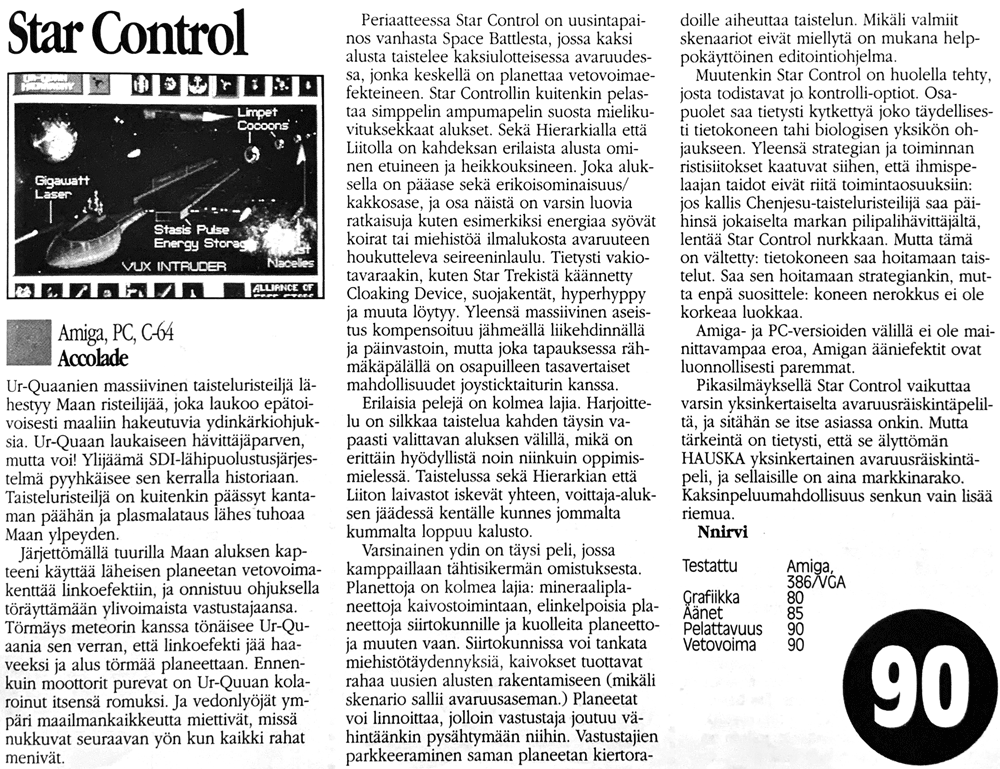
Star Control1991 SyksyPysyvä linkkiUr-Quaanien massiivinen taisteluristeilijä lähestyy Maan risteilijää, joka laukoo epätoivoisesti maaliin hakeutuvia ydinkärkiohjuksia. Ur-Quaan laukaiseen hävittäjäparven, mutta voi! Ylijäämä SDI-lähipuolustusjärjestelmä pyyhkäisee sen kerralla historiaan. Taisteluristeilijä on kuitenkin päässyt kantaman päähän ja plasmalataus lähes tuhoaa Maan ylpeyden.
Järjettömällä tuurilla Maan aluksen kapteeni käyttää läheisen planeetan vetovoimakenttää linkoefektiin, ja onnistuu ohjuksella töräyttämään ylivoimaista vastustajaansa. Törmäys meteorin kanssa tönäisee Ur-Quaania sen verran, että linkoefekti jää haaveeksi ja alus törmää planeettaan. Ennenkuin moottorit purevat on Ur-Quuan kolaroinut itsensä romuksi. Ja vedonlyöjät ympäri maailmankaikkeutta miettivät, missä nukkuvat seuraavan yön kun kaikki rahat menivät.
Periaatteessa Star Control on uusintapainos vanhasta Space Battlesta, jossa kaksi alusta taistelee kaksiulotteisessa avaruudessa, jonka keskellä on planettaa vetovoimaefekteineen. Star Controllin kuitenkin pelastaa simppelin ampumapelin suosta mielikuvituksekkaat alukset. Sekä Hierarkialla että Liitolla on kahdeksan erilaista alusta ominen etuineen ja heikkouksineen. Joka aluksella on pääase sekä erikoisominaisuus/kakkosase, ja osa näistä on varsin luovia ratkaisuja kuten esimerkiksi energiaa syövät koirat tai miehistöä ilmalukosta avaruuteen houkutteleva seireeninlaulu. Tietysti vakiotavaraakin, kuten Star Trekistä käännetty Cloaking Device, suojakentät, hyperhyppy ja muuta löytyy. Yleensä massiivinen aseistus kompensoituu jähmeällä liikehdinnällä ja päinvastoin, mutta joka tapauksessa rähmäkäpälällä on osapuilleen tasavertaiset mahdollisuudet joysticktaiturin kanssa.
Erilaisia pelejä on kolmea lajia. Harjoittelu on silkkaa taistelua kahden täysin vapaasti valittavan aluksen välillä, mikä on erittäin hyödyllistä noin niinkuin oppimismielessä. Taistelussa sekä Hierarkian että Liiton laivastot iskevät yhteen, voittaja-aluksen jäädessä kentälle kunnes jommalta kummalta loppuu kalusto.
Varsinainen ydin on täysi peli, jossa kamppaillaan tähtisikermän omistuksesta. Planettoja on kolmea lajia: mineraaliplaneettoja kaivostoimintaan, elinkelpoisia planeettoja siirtokunnille ja kuolleita planeettoja muuten vaan. Siirtokunnissa voi tankata miehistötäydennyksiä, kaivokset tuottavat rahaa uusien alusten rakentamiseen (mikäli skenario sallii avaruusaseman.) Planeetat voi linnoittaa, jolloin vastustaja joutuu vähintäänkin pysähtymään niihin. Vastustajien parkkeeraminen saman planeetan kiertoradoille aiheuttaa taistelun. Mikäli valmiit skenaariot eivät miellytä on mukana helppokäyttöinen editointiohjelma.
Muutenkin Star Control on huolella tehty, josta todistavat jo kontrolli-optiot. Osapuolet saa tietysti kytkettyä joko täydellisesti tietokoneen tahi biologisen yksikön ohjaukseen. Yleensä strategian ja toiminnan ristisiitokset kaatuvat siihen, että ihmispelaajan taidot eivät riitä toimintaosuuksiin: jos kallis Chenjesu-taisteluristeilijä saa päihinsä jokaiselta markan pilipalihävittäjältä, lentää Star Control nurkkaan. Mutta tämä on vältetty: tietokoneen saa hoitamaan taistelut. Saa sen hoitamaan strategiankin, mutta enpä suosittele: koneen nerokkus ei ole korkeaa luokkaa.
Amiga- ja PC-versioiden välillä ei ole mainittavampaa eroa, Amigan ääniefektit ovat luonnollisesti paremmat.
Pikasilmäyksellä Star Control vaikuttaa varsin yksinkertaiselta avaruusräiskintäpeliltä, ja sitähän se itse asiassa onkin. Mutta tärkeintä on tietysti, että se älyttömän HAUSKA yksinkertainen avaruusräiskintäpeli, ja sellaisille on aina markkinarako. Kaksinpeluumahdollisuus senkun vain lisää riemua.
Star Control1991 SyksyPermalinkThe Ur-Quaans' massive battlecruiser closes in on Earth's cruiser, which is desperately loosing off homing nuclear missiles. The Ur-Quaan launches a swarm of fighters, but alas! A surplus SDI point-defence system sweeps the lot into history in one go. Still, the battlecruiser has made it within range, and a plasma charge all but destroys the pride of Earth.
With sheer insane luck, the captain of the Earth ship uses the gravity field of a nearby planet for a slingshot effect and manages to blast the overwhelmingly superior opponent with a missile. A collision with a meteor nudges the Ur-Quaan just enough that the slingshot stays a pipe dream and the ship crashes into the planet. Before the engines can bite, the Ur-Quuan has smashed itself to scrap. And gamblers all over the universe are wondering where they'll be sleeping tonight, now that all their money's gone.
In principle Star Control is a remake of the old Space Battle, in which two ships fight it out in two-dimensional space with a planet in the middle, gravity effects and all. What rescues Star Control from the swamp of the simple shoot-'em-up, though, is its imaginative ships. The Hierarchy and the Alliance each have eight different ships, each with its own strengths and weaknesses. Every ship has a main weapon plus a special ability/secondary weapon, and some of these are pretty creative solutions, such as energy-eating dogs or a siren song that lures the crew out through the airlock into space. Naturally the standard stuff is there too, like the Cloaking Device pinched from Star Trek, shields, hyperjump and so on. As a rule, massive armament is offset by sluggish handling and vice versa, but in any case a butterfingers has roughly an even chance against a joystick virtuoso.
There are three kinds of game. Practice is pure combat between two completely freely chosen ships, which is extremely useful, like, from a learning point of view. In Melee, the fleets of the Hierarchy and the Alliance clash, the winning ship staying on the field until one side or the other runs out of hardware.
The real core is the full game, in which you fight for possession of a star cluster. There are three kinds of planet: mineral planets for mining, habitable planets for colonies and dead planets just because. At colonies you can tank up on crew replacements, and mines produce money for building new ships (if the scenario allows a starbase). Planets can be fortified, in which case the enemy at the very least has to stop at them. Opponents parking in orbit around the same planet triggers a battle. If the ready-made scenarios don't appeal, an easy-to-use editor is included.
Star Control is carefully made in other respects too, as the control options alone testify. Either side can of course be handed over entirely to the computer or to a biological unit. Strategy-action crossbreeds usually come to grief because the human player's skills aren't up to the action sequences: if your expensive Chenjesu battlecruiser gets beaten up by every two-bit tin-pot fighter, Star Control goes flying into the corner. But this has been avoided: you can get the computer to handle the battles. You can get it to handle the strategy as well, but I wouldn't recommend it: the machine's genius is not of a high order.
There's no difference worth mentioning between the Amiga and PC versions; the Amiga's sound effects are naturally better.
At a quick glance Star Control looks like a pretty simple space blaster, and as a matter of fact that's exactly what it is. But the main thing, of course, is that it's an insanely FUN simple space blaster, and there's always a gap in the market for those. The two-player option just piles on the joy.
Star Fleet I: The Battle Begins
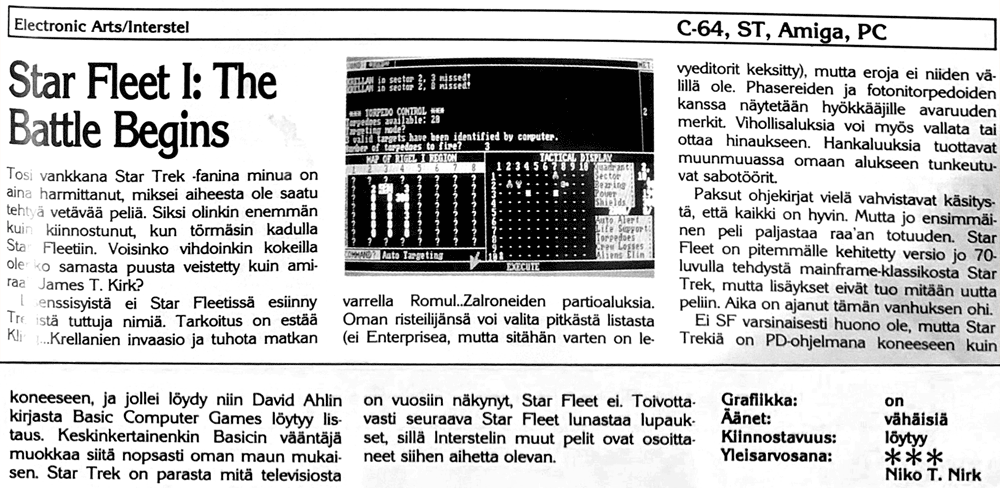
Star Fleet I: The Battle Begins1988Pysyvä linkkiTosi vankkana Star Trek -fanina minua on aina harmittanut, miksei aiheesta ole saatu tehtyä vetävää peliä. Siksi olinkin enemmän kuin kiinnostunut, kun törmäsin kadulla Star Fleetiin. Voisinko vihdoinkin kokeilla olenko samasta puusta veistetty kuin amiraali James T. Kirk?
Lisenssisyistä ei Star Fleetissä esiinny Trekistä tuttuja nimiä. Tarkoitus on estää Kling...Krellanien invaasio ja tuhota matkan varrella Romul..Zalroneiden partioaluksia. Oman risteilijänsä voi valita pitkästä listasta (ei Enterprisea, mutta sitähän varten on levyeditorit keksitty), mutta eroja ei niiden välillä ole. Phasereiden ja fotonitorpedoiden kanssa näytetään hyökkääjille avaruuden merkit. Vihollisaluksia voi myös vallata tai ottaa hinaukseen. Hankaluuksia tuottavat muunmuuassa omaan alukseen tunkeutuvat sabotöörit.
Paksut ohjekirjat vielä vahvistavat käsitystä, että kaikki on hyvin. Mutta jo ensimmäinen peli paljastaa raa'an totuuden. Star Fleet on pitemmälle kehitetty versio jo 70-luvulla tehdystä mainframe-klassikosta Star Trek, mutta lisäykset eivät tuo mitään uutta peliin. Aika on ajanut tämän vanhuksen ohi.
Ei SF varsinaisesti huono ole, mutta Star Trekiä on PD-ohjelmana koneeseen kuin koneeseen, ja jollei löydy niin David Ahlin kirjasta Basic Computer Games löytyy listaus. Keskinkertainenkin Basicin vääntäjä muokkaa siitä nopsasti oman maun mukaisen. Star Trek on parasta mitä televisiosta on vuosiin näkynyt, Star Fleet ei. Toivottavasti seuraava Star Fleet lunastaa lupaukset, sillä Interstelin muut pelit ovat osoittaneet siihen aihetta olevan.
Star Fleet I: The Battle Begins1988PermalinkBeing a truly staunch Star Trek fan, I've always been annoyed that nobody has managed to make a gripping game out of it. So I was more than interested when I bumped into Star Fleet on the street. Could I finally find out whether I'm cut from the same cloth as Admiral James T. Kirk?
For licensing reasons, none of the names familiar from Trek appear in Star Fleet. The aim is to stop the Kling...Krellan invasion and to destroy Romul..Zalron patrol ships along the way. You can pick your own cruiser from a long list (no Enterprise, but that's what disk editors were invented for), but there are no differences between them. With phasers and photon torpedoes you show the invaders what's what in space. Enemy ships can also be captured or taken in tow. Trouble comes from, among other things, saboteurs who sneak aboard your own ship.
The thick manuals further reinforce the impression that all is well. But the very first game reveals the brutal truth. Star Fleet is a further-developed version of Star Trek, a mainframe classic made back in the 70s, but the additions bring nothing new to the game. Time has passed this old-timer by.
Not that SF is actually bad, but Star Trek exists as a PD program for any machine you care to name, and if you can't find it, David Ahl's book Basic Computer Games has a listing. Even a mediocre Basic hacker will quickly knock it into something to suit their own taste. Star Trek is the best thing seen on television in years; Star Fleet isn't. Hopefully the next Star Fleet will live up to its promise, since Interstel's other games have shown there's reason to expect it.
Star Raiders II
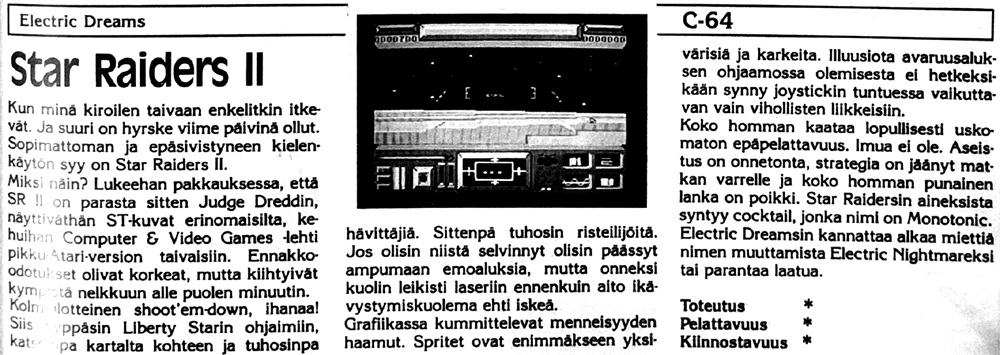
Star Raiders II1987Pysyvä linkkiKun minä kiroilen taivaan enkelitkin itkevät. Ja suuri on hyrske viime päivinä ollut. Sopimattoman ja epäsivistyneen kielenkäytön syy on Star Raiders II.
Miksi näin? Lukeehan pakkauksessa, että SR II on parasta sitten Judge Dreddin, näyttiväthän ST-kuvat erinomaisilta, kehuihan Computer & Video Games -lehti pikku-Atari-version taivaisiin. Ennakko-odotukset olivat korkeat, mutta kiihtyivät kympistä nelkkuun alle puolen minuutin. Kolmiulotteinen shoot'em-down, ihanaa! Siis hyppäsin Liberty Starin ohjaimiin, katsoinpa kartalta kohteen ja tuhosinpa hävittäjiä. Sittenpä tuhosin risteilijöitä. Jos olisin niistä selvinnyt olisin päässyt ampumaan emoaluksia, mutta onneksi kuolin leikisti laseriin ennenkuin aito ikävystymiskuolema ehti iskeä.
Grafiikassa kummittelevat menneisyyden haamut. Spritet ovat enimmäkseen yksivärisiä ja karkeita. Illuusiota avaruusaluksen ohjaamossa olemisesta ei hetkeksikään synny joystickin tuntuessa vaikuttavan vain vihollisten liikkeisiin.
Koko homman kaataa lopullisesti uskomaton epäpelattavuus. Imua ei ole. Aseistus on onnetonta, strategia on jäänyt matkan varrelle ja koko homman punainen lanka on poikki. Star Raidersin aineksista syntyy cocktail, jonka nimi on Monotonic. Electric Dreamsin kannattaa alkaa miettiä nimen muuttamista Electric Nightmareksi tai parantaa laatua.
Star Raiders II1987PermalinkWhen I curse, even the angels in heaven weep. And mighty has been the storm these last few days. The reason for my improper and uncivilised language is Star Raiders II.
Why so? The box says, after all, that SR II is the best thing since Judge Dredd, the ST pictures looked excellent, and Computer & Video Games magazine praised the 8-bit Atari version to the skies. Expectations were high, but they accelerated from top marks to a fail in under half a minute. A three-dimensional shoot'em-down, wonderful! So I jumped at the controls of the Liberty Star, went and looked up a target on the map and went and destroyed some fighters. Then I went and destroyed some cruisers. If I'd survived those I'd have got to shoot motherships, but luckily I died a make-believe death by laser before a genuine death by boredom had time to strike.
The ghosts of the past haunt the graphics. The sprites are mostly single-coloured and crude. Not for one moment do you get the illusion of being in the cockpit of a spaceship, as the joystick seems to affect only the enemies' movements.
The whole thing is finally sunk by its incredible unplayability. There's no pull. The weaponry is miserable, the strategy got left somewhere along the way, and the thread holding the whole thing together has snapped. The ingredients of Star Raiders make a cocktail called Monotonic. Electric Dreams ought to start thinking about changing its name to Electric Nightmare, or else improve its quality.
Star Trek - Shareware
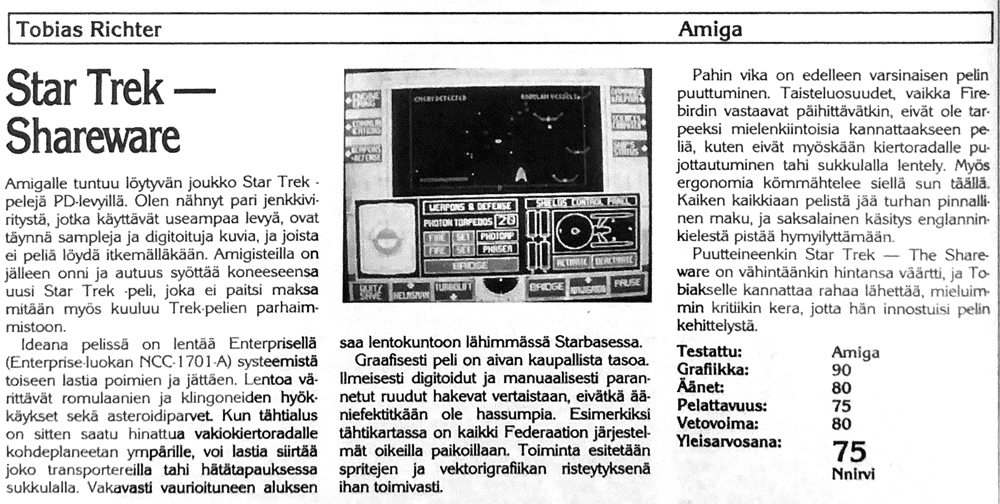
Star Trek - Shareware1990 KevätPysyvä linkkiAmigalle tuntuu löytyvän joukko Star Trek -pelejä PD-levyillä. Olen nähnyt pari jenkkiviritystä, jotka käyttävät useampaa levyä, ovat täynnä sampleja ja digitoituja kuvia, ja joista ei peliä löydä itkemälläkään. Amigisteilla on jälleen onni ja autuus syöttää koneeseensa uusi Star Trek -peli, joka ei paitsi maksa mitään myös kuuluu Trek-pelien parhaimmistoon.
Ideana pelissä on lentää Enterprisellä (Enterprise-luokan NCC-1701-A) systeemistä toiseen lastia poimien ja jättäen. Lentoa värittävät romulaanien ja klingoneiden hyökkäykset sekä asteroidiparvet. Kun tähtialus on sitten saatu hinattua vakiokiertoradalle kohdeplaneetan ympärille, voi lastia siirtää joko transportereilla tahi hätätapauksessa sukkulalla. Vakavasti vaurioituneen aluksen saa lentokuntoon lähimmässä Starbasessa.
Graafisesti peli on aivan kaupallista tasoa. Ilmeisesti digitoidut ja manuaalisesti parannetut ruudut hakevat vertaistaan, eivätkä ääniefektitkään ole hassumpia. Esimerkiksi tähtikartassa on kaikki Federaation järjestelmät oikeilla paikoillaan. Toiminta esitetään spritejen ja vektorigrafiikan risteytyksenä ihan toimivasti.
Pahin vika on edelleen varsinaisen pelin puuttuminen. Taisteluosuudet, vaikka Firebirdin vastaavat päihittävätkin, eivät ole tarpeeksi mielenkiintoisia kannattaakseen peliä, kuten eivät myöskään kiertoradalle pujottautuminen tahi sukkulalla lentely. Myös ergonomia kömmähtelee siellä sun täällä. Kaiken kaikkiaan pelistä jää turhan pinnallinen maku, ja saksalainen käsitys englanninkielestä pistää hymyilyttämään.
Puutteineenkin Star Trek - The Shareware on vähintäänkin hintansa väärtti, ja Tobiakselle kannattaa rahaa lähettää, mieluimmin kritiikin kera, jotta hän innostuisi pelin kehittelystä.
Star Trek - Shareware1990 KevätPermalinkThere seem to be a bunch of Star Trek games for the Amiga on PD disks. I've seen a couple of Yankee contraptions that use several disks, are full of samples and digitised pictures, and in which you won't find a game for love nor money. Amiga owners once again have the good fortune and bliss of feeding their machines a new Star Trek game which not only costs nothing but also ranks among the very best of the Trek games.
The idea of the game is to fly the Enterprise (the Enterprise-class NCC-1701-A) from one system to another, picking up and dropping off cargo. The flights are livened up by Romulan and Klingon attacks and asteroid swarms. Once the starship has been hauled into standard orbit around the destination planet, you can transfer the cargo either by transporter or, in an emergency, by shuttle. A badly damaged ship can be made spaceworthy again at the nearest Starbase.
Graphically the game is fully up to commercial standard. The screens, apparently digitised and touched up by hand, are second to none, and the sound effects aren't half bad either. The star map, for example, has all the Federation's systems in their proper places. The action is presented, quite workably, as a cross between sprites and vector graphics.
The worst flaw is still the lack of an actual game. The combat sections, although they beat Firebird's equivalents, aren't interesting enough to carry the game, and neither is threading your way into orbit or pottering about in the shuttle. The ergonomics bungle about here and there too. All in all the game leaves an unduly shallow taste, and the German idea of the English language raises a smile.
Even with its shortcomings, Star Trek - The Shareware is at the very least worth its price, and it's worth sending Tobias some money, preferably with some criticism attached, to fire up enthusiasm for developing the game further.
Star Trek V - The Final Frontier
Star Trek V - The Final Frontier1990 KevätPysyvä linkkiAh ja voih! Star Trek! Kuten KAIKKI varmasti jo tietävät, olen trekkie, enkä siitä muuksi muutu. Siksipä onkin erittäin vaikea suhtautua Star Trek -peliin asiallisesti hyläten kaikki pohjalla piilevät ennakko-odotukset.
Luontopoliittisen kannanoton (Star Trek IV) jälkeen olivat odotukseni korkealla. Ensimmäiset pikavilkaisut pelistä Englannissa ja elokuvan ennakkonäytöksen täpärä missaaminen olivat kovia iskuja karaistuneellekin fanille. Peli kun ei näyttänyt mitenkään ihmeen hyvältä. Nyt elokuvan nähneenä voin todeta, että se voi osaltaan johtua siitä, ettei elokuvakaan ole kovin kummoinen.
Onhan fakta, että ennemmin aluksensa räjäyttävä kuin sen vieraalle vallalle luovuttava kapteeni James T. Kirk toimii täysin epäloogisesti tässä viidennessä, mutta toivottavasti ei viimeisessä Star Trek -elokuvassa. Ilman sen ihmeempää vastustusta hän luovuttaa aluksensa komennon Spockin puoliveljelle, Sybokille, joka määrää kurssin kohti galaksin keskustassa sijaisevaa Great Barrieria (jonka pitäisi ympäröidä Linnunrata). Sybokin enneunien perusteella Suuren Muurin takana sijaitsee tarunomainen planeetta Sha Ka Ree, meille maan ihmisille paremmin tunnettu paratiisina, Eedeninä, jossa Jumala asustaa.
Peli hyppää elokuvasta ensimmäisen tunnin yli ja alkaa kohdasta, missä Sybok on antanut Kirkille käskyn suunnistaa kohti Suurta Muuria. Näin Mindscape on päässyt tekemään ensimmäisen varsinaisen Enterprise-simulaattorin, jossa pelaaja kapteeni Kirkinä jakelee alaisilleen ohjeita.
Ensimmäiseksi navigaattorille annetaan komento ottaa suunta kohti Suurta Muuria ja Sha Ka Reetä. Pienen varpin jälkeen lasketaan uusi suunta ja hypätään uudestaan. Tämä alkaa kymmenen minuutin kuluttua maistua pahasti puulta ja onkin aika saada hieman vaihtelua. Dilithiumkristallien ollessa lähes lopussa varppimoottorit menevät epätasapainoon ja avaruusaikaan syntyy repeämä, jota kutsutaan madonreiäksi (wormhole).
Näin päästäänkin pelin ensimmäiseen toimintaosuuteen. Näppäimistöltä ohjaillen pelaaja siirtää tähtäimen vastaan suhahtavan meteoriitin päälle ja posauttaa sen photonitorpedoilla hevon kuuseen. Pelin mukaan madonreiässä leijailee myös dilithiumkristalleja, jota tässä vaiheessa jo kipeästi tarvitaankin. Pelaaja siirtää tähtäimen kristallin päälle ja aktivoi vetosäteen. Näin on energiapankit taas ladattu. (Itse en kyllä ole koskaan kuullut, että dilithiumkristalleja voi löytää madonreijistä...)
Suurin piirtein samalla tavalla toimii taistelu Klingoneita vastaan. Pidetään vain huoli, ettei suojakenttien teho tipu liian alas ja annetaan palaa täydeltä laidalta.
Tylsän matkan jälkeen saavutaan Sha Ka Reelle, jossa pelaaja ottaa nyrkkeilyottelun Klaata (elokuvan "paha" Klingon) vastaan. Sitten käydään löpisemässä hassuja Jumalan kanssa, joka osoittautuukin paholaiseksi. Pirulta karkaaminen onkin sitten pelin viimeinen toimintapätkä, jonka jälkeen peli on pelattu läpi.
Jos Star Trek V - The Final Frontieria katsoo objektiivisesti pelinä, ei käteen jää paljoakaan. Tylsänpuoleinen peli kaikin puolin, käsikirjankin ollessa yksi huonoimpia, mitä olen koskaan selaillut. Graafisesti peli on VGA-koneissa todella hieno, mutta eiväthän kivat kuvat ole ennenkään peliä tehneet. Muutama samplattu efekti elokuvasta piristää kummasti pelin yleisilmettä, mutta miinuspuolelta pitää mainita, ettei peli tajua hyvän päälle mitään, eli ei ymmärrä äänikorteista hölkäsen pölähtävää.
Tavallinen kansalainen, joka ei näe Star Trekissä mitään ihmeellistä, ei myöskään tule pitämään tästä pelistä. Trekkiet taas suorastaan syövät pelin, valokopioivat logoja käsikirjasta ja länttäävät ne huoneensa seinälle. Jos olet edellinen, unohda koko juttu, jos taas jälkimmäinen, osta peli ja käy katsomassa elokuva, kun se tulee Suomeen.
Star Trek V - The Final Frontier1990 KevätPermalinkAh, and alas! Star Trek! As EVERYONE surely knows by now, I am a trekkie, and that's never going to change. Which is exactly why it's extremely hard to approach a Star Trek game matter-of-factly, setting aside all the preconceptions lurking deep down.
After the environmental-political statement (Star Trek IV) my expectations were high. My first quick glimpses of the game in England and missing the film's preview screening by a whisker were hard blows even for a hardened fan. The game, you see, didn't look particularly marvellous at all. Now that I've seen the film I can say that this may partly be down to the film not being up to much either.
It's a fact that Captain James T. Kirk, a man who would rather blow up his ship than surrender it to a foreign power, behaves completely illogically in this fifth, but hopefully not last, Star Trek film. Without much in the way of resistance he hands command of his ship over to Spock's half-brother, Sybok, who sets a course for the Great Barrier located at the centre of the galaxy (which is supposed to surround the Milky Way). According to Sybok's prophetic dreams, beyond the Great Barrier lies the legendary planet Sha Ka Ree, better known to us humans of Earth as paradise, Eden, where God dwells.
The game skips the first hour of the film and starts at the point where Sybok has ordered Kirk to head for the Great Barrier. This way Mindscape has got to make the first proper Enterprise simulator, in which the player, as Captain Kirk, hands out orders to his subordinates.
First, the navigator is given the command to set a course for the Great Barrier and Sha Ka Ree. After a short warp a new course is calculated and you jump again. After ten minutes this starts to get seriously stale, and it's high time for a little variety. With the dilithium crystals almost exhausted, the warp engines go out of balance and a rupture opens up in space-time, which is called a wormhole.
And so we come to the game's first action section. Steering from the keyboard, the player moves the sights onto a meteorite whooshing towards the ship and blasts it to kingdom come with photon torpedoes. According to the game, dilithium crystals also float about in the wormhole, and by this stage they are sorely needed. The player moves the sights over a crystal and activates the tractor beam. And that's the energy banks charged up again. (Personally, I've certainly never heard of dilithium crystals being found in wormholes...)
Combat against the Klingons works in roughly the same way. You just make sure the shield power doesn't drop too low and let them have it with a full broadside.
After a boring journey you arrive at Sha Ka Ree, where the player takes on Klaa (the film's "bad" Klingon) in a boxing match. Then you drop in for a daft natter with God, who turns out to be the devil. Escaping from Old Nick is then the game's final action bit, after which the game has been played through.
If you look at Star Trek V - The Final Frontier objectively as a game, you're not left holding much. A rather dull game in every respect, with a manual that's one of the worst I have ever leafed through. Graphically the game is really fine on VGA machines, but then nice pictures have never made a game before. A few sampled effects from the film liven up the game's overall feel wonderfully, but on the minus side it must be said that the game has no appreciation of the finer things, i.e. it doesn't understand diddly-squat about sound cards.
The ordinary citizen who sees nothing special in Star Trek won't like this game either. Trekkies, on the other hand, will positively devour the game, photocopy logos from the manual and slap them up on their bedroom walls. If you're the former, forget the whole thing; if the latter, buy the game and go and see the film when it comes to Finland.
Star Trek: The Rebel Universe
Star Trek: The Rebel Universe1988Pysyvä linkkiKun olin pieni, isoisäni kertoi oman isoisänsä kertoneen että Firebird aikoo julkaista todellisen megapelin nimeltä Star Trek.
Nyt kun tämä ihme on vihdoin saapunut lukemattomien viivästysten ja väärien hälytysten jälkeen, onko ihme että odotan peliltä paljon. Vaan miten käy? Joutuuko uskollinen Trekkie jälleen kerran nielemään tuopillisen kitkerää pettymystä?
Arvostelijan lokikirja, tähtipäiväys 1988: Enterprise on komennettu Karanteenialueelle, jossa sillä on viisi vuotta aikaa kukistaa kapina. Heti Enterprisen saavuttua alueelle se eristetään Kleinin kehällä, joka mikään voima ei voi murtaa. Jos Enterprise epäonnistuu jää se satojen planeetojen kanssa ikuisiksi ajoiksi Kleinin kehän vangiksi.
Star Trekin tekninen toteutus on ihailtavaa. Grafiikka on upeaa (suurimmaksi osaksi), pelisysteemi on helppokäyttöinen ja miellyttävä ja Star Trekistä peräisin olevat digitoidut kommentit lisäävät pelin viehätystä. 'Beam me up, Scotty' tosin loisti poissaolollaan.
Enterprise voi vierailla sadoilla planeetoilla, ja osaan voi lähettää laskeutumisryhmän, joka joutuu kohtaamaan erilaisia pikku arvoituksia. Välillä otetaan yhteen niin Klingonien, Romulaanien kuin kapinalliseksi kääntyneiden federaation alusten kanssa.
Kaikki tarvittava ja vähän enemmänkin selvitetään ohjekirjassa, jota ilman pelistä ei oikein tule mitään.
Mutta mutta: megapelin aineksia ei Star Trekissä ole. Pelaajalle ei ole jätetty tarpeeksi tilaa toteuttaa itseään. Osa planeettojen pinnalla kohdattavista arvoituksista ratkeaa yritys-erehdys-menetelmällä, ja se ei ole kovinkaan hauskaa. Taistelutilanteessa pelaajan huvi koostuu maalin valinnasta ja tulituksesta sopivassa kohtaa. On Star Trekissä silti puolensakin, mutta joku Elite olisi kannattanut tutkia tarkkaan ennen tämän pelin tekemistä. Siinä on ikuinen megapeli.
Pahaa pelkään, että tulevat kotimikroversiot eivät onnistu edes yhtä hyvin kuin tämä ST-versio. Ja ST:n omistajien kannattaa tutustua peliin ennen ostamista. Hyvä muttei mega. Nirk out.
Star Trek: The Rebel Universe1988PermalinkWhen I was little, my grandfather told me his own grandfather had told him that Firebird was going to release a true megagame called Star Trek.
Now that this wonder has finally arrived after countless delays and false alarms, is it any wonder I expect a lot from the game? But how does it turn out? Will the faithful Trekkie once again have to swallow a pint of bitter disappointment?
Reviewer's log, stardate 1988: The Enterprise has been ordered to the Quarantine Zone, where it has five years to crush a rebellion. The moment the Enterprise arrives in the zone, it is sealed off by the Klein Sphere, which no force can break. If the Enterprise fails, it will remain a prisoner of the Klein Sphere for all eternity, along with hundreds of planets.
Star Trek's technical execution is admirable. The graphics are superb (for the most part), the game system is easy to use and pleasant, and the digitised comments taken from Star Trek add to the game's charm. 'Beam me up, Scotty' was, however, conspicuous by its absence.
The Enterprise can visit hundreds of planets, and to some of them you can send a landing party, which has to face all sorts of little puzzles. Every now and then you clash with Klingons and Romulans as well as Federation ships that have turned rebel.
Everything you need, and a bit more besides, is explained in the manual, without which you won't really get anywhere with the game.
But but: Star Trek doesn't have the makings of a megagame. The player hasn't been left enough room for self-expression. Some of the puzzles met on planet surfaces are solved by trial and error, and that isn't much fun. In combat the player's entertainment consists of picking a target and firing at the right moment. Star Trek does still have its good sides, but it would have paid to study something like Elite closely before making this game. Now there's a megagame for all eternity.
I fear the worst: the upcoming home micro versions won't turn out even as well as this ST version. And ST owners would do well to try the game before buying. Good but not mega. Nirk out.
Star Wars
Star Wars1988Pysyvä linkkiVihdoin ja viimein, kaikkien näiden vuosien jälkeen kärsivällinen odotus palkitaan ja kaikkien aikojen paras arcadepeli tulee kotikoneisiin.
Ei vaiskaan, Star Warsista on tehty jo kaksikin virallista ja yksi epävirallinen versio. Parker Brothersin peliä en ole nähnyt, Atarin oma virallinen versio ei Luojan kiitos koskaan päässyt myyntiin ja Realtimen 3D Starstrike oli hyvä. Vaan millainen on loistopeleistään Friday The 13th ja A View To A Kill tunnetun Domarkin versio?
Jännityksen lisäämiseksi en kerro vastausta heti vaan kertaan pelin idean Star Warsia tuntemattomalle: tässä kauniissa vektorigraafisessa pelissä taistellaan ensin avaruudessa Imperiumin TIE-hävittäjiä vastaan, sitten lennetään pitkin Kuolontähden pintaa lasertorneja ampuen ja lopuksi tehdään kujanjuoksu pitkin ahdasta ja esteitä täynnä olevaa käytävää, jonka lopussa lasautetaan fotonitorpedot jäähdytysaukosta sisään. Vaivan tuloksena Kuolontähti räjähtää. Tätä ympyrää toitetaan niin kauan kuin suojakilpien teho riittää. Yksinkertaista mutta lumoavaa toimintaa.
Totuuden hetki: kyllä täytyy antaa Domarkille vanhat synnit anteeksi. Peli muistuttaa alkuperäistä niin paljon kuin kuusnelosen rahkeilla pystyy. Vektorigraafiset pelit ovat kuusnelkulle vähän ongelma johtuen prosessorin hitaudesta, mutta Domarkin ohjelmoijat ovat onnistuneet varsin mukavasti, sillä vaikka alkuperäisen sulavuuteen ei ylletäkään on nopeus silti siedettävä. Ääniefektit ovat varsin normaalit ja hyvin sovitettu Star Warsin tunnusmelodia soi taustalla. Oikein hyvin tehty käännös Domarkilta, tosin joystick ei oikein sovi tämän tyyppiseen peliin.
Miljardeja markkoja Star Wars -automaattiin syöttäneenä odotankin kuumeisella kiihkolla Star Warsin ST-versiota. Silminnäkijöiden mukaan se on käytännöllisesti identtinen pelihalliversion kanssa aina puhetta myöten ja hiiri on alkuperäisen SW-ohjaimen jälkeen paras vaihtoehto. Siihen saakka Voima olkoon kanssani, niinkuin myös teidän kanssanne. Aamen.
Star Wars1988PermalinkAt long last, after all these years, patient waiting is rewarded and the greatest arcade game of all time comes to home computers.
Just kidding - there have already been no fewer than two official versions of Star Wars and one unofficial one. I haven't seen the Parker Brothers' game, Atari's own official version thank the Lord never made it to the shops, and Realtime's 3D Starstrike was good. But what is the version from Domark, famed for such brilliant games as Friday The 13th and A View To A Kill, like?
To build up the suspense I won't give the answer straight away, but will first run through the idea of the game for anyone unfamiliar with Star Wars: in this beautiful vector-graphics game you first battle the Empire's TIE fighters in space, then fly along the surface of the Death Star shooting laser towers, and finally run the gauntlet down a narrow, obstacle-packed trench, at the end of which you let fly with your photon torpedoes into the exhaust port. The result of all this effort is that the Death Star explodes. This loop is repeated for as long as your shields hold out. Simple but spellbinding action.
The moment of truth: I really do have to forgive Domark its old sins. The game resembles the original as closely as the C-64's resources allow. Vector graphics games are a bit of a problem for the C-64 because of its slow processor, but Domark's programmers have done rather nicely, since even though it doesn't reach the smoothness of the original, the speed is still tolerable. The sound effects are fairly standard, and a well-arranged Star Wars theme plays in the background. A very well made conversion from Domark, although a joystick doesn't really suit this type of game.
Having fed billions of marks into the Star Wars machine, I'm awaiting the ST version of Star Wars with feverish zeal. According to eyewitnesses it's practically identical to the arcade version, right down to the speech, and the mouse is the best alternative after the original SW controller. Until then, may the Force be with me, and also with you. Amen.
Starflight
Starflight1990 SyksyPysyvä linkkiVihdoinkin, monen odotusvuoden jälkeen, on Electronic Arts saanut käännettyä Starflightin muillekin koneille kuin vain PC:lle. StarFlight oli aikanaan yksi ensimmäisistä Sci-Fi-roolipeleistä ja edelleenkin yksi parhaista.
Ihmisten rakentama imperiumi on romahtanut, ja vain pieni, Noah 2:sena tunnettu siirtokunta onnistui pelastautumaan Arth-nimiselle planeetalle. He asuivat pitkään maanalaisissa bunkkereissa ja tekniikka taantui parituhatta vuotta. Nyt kuitenkin Arthin asukkaat ovat keksineet avaruusmatkailun uudelleen, ja yrittävät selvittää alkuperäänsä palaamalla juurilleen, legendojen muinaiselle planeetalle - maapallolle.
Pelaajan tehtävänä on tutkia käymättömistä korpimaista viimeistä, ja selvittää maapallon kohtalo. Samalla olisi syytä selvittää miksi Arthin oma aurinko on yllättäen muuttumassa novaksi ja etsiä uusia planeettoja kolonisoitavaksi. Siinähän se iltapäivä meneekin.
Alussa pelaajalle annetaan 12000 rahayksikköä, jolla pitäisi jokaisen varustaa oma Enterprisensä. Valitettavasti rahoilla saa vain muutaman lastisäiliön. Varat parempaan varustukseen ja aseisiin saa keräämällä mineraaleja ja eliönäytteitä planeetoilta ja myymällä niitä avaruusasemalla.
Myös miehistön joutuu valitsemaan viidestä rodusta ja kouluttamaan itse mikä maksaa suhteettoman paljon. Vasta kun alkuvaikeuksista on selvitty ja alla on kunnon alus, kannattaa lähteä tutkimaan avaruutta oman aurinkokunnan ulkopuolelta, mutta silloinkin pitää tarkasti huolehtia polttoaineen riittoisuudesta ja miehistön kunnosta. Kaikkea mikä liikkuu, ei suinkaan kannata ampua, vaan muukalaisten kanssa jutustelu on hyvin tärkeä osa peliä.
Starflightin grafiikka on hyvin ristiriitaista. Monet värivalinnoista ovat erittäin epäonnistuneita ja skrollaus nyppi merkin kerrallaan, mutta toisaalta monet planeetoista näytetyt maisemat ja muukalaisten kuvat ovat hyvinkin taidokkaita. Samat sanat pätevät Amiga-versioonkin.
StarFlight ei ole peli, joka pelataan läpi yhdeltä istumalta. Pelin 270 aurinkokunnasta löytyy melkein tuhat planeettaa tutkittavaksi. Pelaajien onneksi peliin on sisällytetty tähtikartta, josta käy ilmi tähtien sijainnit.
Vierineistä vuosista huolimatta on StarFlight edelleen hyvä peli, ja Trekkieillä on hauskaa tuttujen elementtien esiintyessä siellä täällä. Voisi sitä rahansa huonomminkin sijoittaa.
Starflight1990 SyksyPermalinkAt last, after many years of waiting, Electronic Arts has managed to convert Starflight to machines other than just the PC. StarFlight was one of the first sci-fi role-playing games in its day, and it is still one of the best.
The empire built by mankind has collapsed, and only a small colony known as Noah 2 managed to save itself by escaping to a planet called Arth. They lived in underground bunkers for a long time, and their technology regressed a couple of thousand years. Now, however, the inhabitants of Arth have reinvented space travel and are trying to uncover their origins by returning to their roots, to the ancient planet of legend - Earth.
The player's task is to explore the last of the untrodden wildernesses and find out what became of Earth. While you're at it, you'd do well to find out why Arth's own sun is suddenly about to go nova, and to look for new planets to colonise. Well, that takes care of the afternoon.
At the start the player is given 12000 monetary units, with which everyone is supposed to kit out their very own Enterprise. Unfortunately the money only buys a few cargo pods. Funds for better equipment and weapons are raised by collecting minerals and life-form samples from planets and selling them at the space station.
The crew, too, has to be picked from five races and trained yourself, which costs a disproportionate amount. Only once you've got past the teething troubles and have a proper ship under you is it worth heading out to explore space beyond your own solar system, and even then you have to keep a close eye on your fuel supply and the condition of your crew. It's by no means worth shooting everything that moves; chatting with aliens is a very important part of the game.
Starflight's graphics are a very mixed bag. Many of the colour choices are extremely unfortunate and the scrolling jerks along one character at a time, but on the other hand many of the planetary landscapes and alien portraits on show are very skilfully done. The same goes for the Amiga version too.
StarFlight is not a game you play through in one sitting. The game's 270 solar systems hold almost a thousand planets to explore. Luckily for players, a star map has been included with the game, showing where the stars are located.
Despite the years that have rolled by, StarFlight is still a good game, and Trekkies will have fun as familiar elements crop up here and there. There are worse ways to invest your money.
Starfox
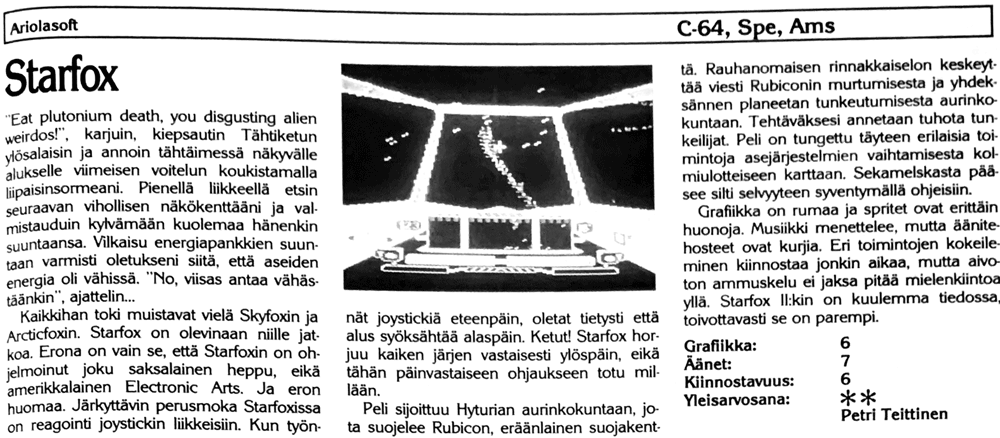
Starfox1988Pysyvä linkki"Eat plutonium death, you disgusting alien weirdos!", karjuin, kiepsautin Tähtiketun ylösalaisin ja annoin tähtäimessä näkyvälle alukselle viimeisen voitelun koukistamalla liipaisinsormeani. Pienellä liikkeellä etsin seuraavan vihollisen näkökenttääni ja valmistauduin kylvämään kuolemaa hänenkin suuntaansa. Vilkaisu energiapankkien suuntaan varmisti oletukseni siitä, että aseiden energia oli vähissä. "No, viisas antaa vähästäänkin", ajattelin...
Kaikkihan toki muistavat vielä Skyfoxin ja Arcticfoxin. Starfox on olevinaan niille jatkoa. Erona on vain se, että Starfoxin on ohjelmoinut joku saksalainen heppu, eikä amerikkalainen Electronic Arts. Ja eron huomaa. Järkyttävin perusmoka Starfoxissa on reagointi joystickin liikkeisiin. Kun työnnät joystickiä eteenpäin, oletat tietysti että alus syöksähtää alaspäin. Ketut! Starfox horjuu kaiken järjen vastaisesti ylöspäin, eikä tähän päinvastaiseen ohjaukseen totu millään.
Peli sijoittuu Hyturian aurinkokuntaan, jota suojelee Rubicon, eräänlainen suojakenttä. Rauhanomaisen rinnakkaiselon keskeyttää viesti Rubiconin murtumisesta ja yhdeksännen planeetan tunkeutumisesta aurinkokuntaan. Tehtäväksesi annetaan tuhota tunkeilijat. Peli on tungettu täyteen erilaisia toimintoja asejärjestelmien vaihtamisesta kolmiulotteiseen karttaan. Sekamelskasta pääsee silti selvyyteen syventymällä ohjeisiin.
Grafiikka on rumaa ja spritet ovat erittäin huonoja. Musiikki menettelee, mutta äänitehosteet ovat kurjia. Eri toimintojen kokeileminen kiinnostaa jonkin aikaa, mutta aivoton ammuskelu ei jaksa pitää mielenkiintoa yllä. Starfox II:kin on kuulemma tiedossa, toivottavasti se on parempi.
Starfox1988Permalink"Eat plutonium death, you disgusting alien weirdos!" I roared, flipped the Starfox upside down and gave the ship in my sights its last rites by crooking my trigger finger. With a small movement I found the next enemy in my field of view and got ready to sow death its way as well. A glance towards the energy banks confirmed my assumption that the weapons were running low on energy. "Well, the wise give even from the little they have," I thought...
Surely everyone still remembers Skyfox and Arcticfox. Starfox fancies itself a sequel to them. The only difference is that Starfox was programmed by some German bloke, and not by the American Electronic Arts. And it shows. The most appalling basic blunder in Starfox is the way it responds to joystick movements. When you push the joystick forward, you naturally expect the ship to dive downwards. Like fox it does! Against all reason Starfox wobbles upwards, and there's no way you ever get used to these reversed controls.
The game is set in the Hyturia solar system, which is protected by the Rubicon, a kind of force field. The peaceful coexistence is interrupted by a message that the Rubicon has been breached and that a ninth planet has invaded the solar system. You are given the task of destroying the intruders. The game is crammed full of all sorts of functions, from switching weapon systems to a three-dimensional map. Still, you can make sense of the jumble by immersing yourself in the instructions.
The graphics are ugly and the sprites are extremely poor. The music passes muster, but the sound effects are wretched. Trying out the various functions holds your interest for a while, but the mindless shooting just can't sustain it. A Starfox II is reportedly on the way too; hopefully it will be better.
Starglider
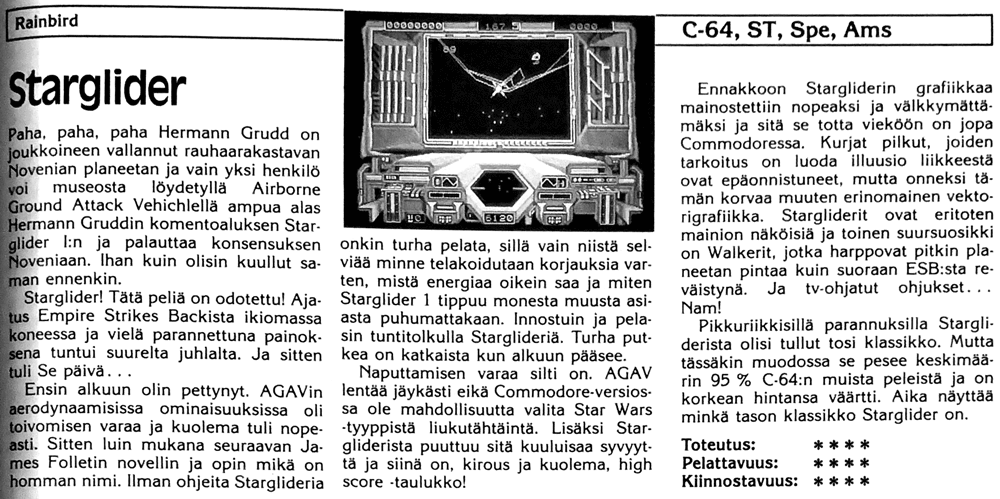
Starglider1987Pysyvä linkkiPaha, paha, paha Hermann Grudd on joukkoineen vallannut rauhaarakastavan Novenian planeetan ja vain yksi henkilö voi museosta löydetyllä Airborne Ground Attack Vehichlellä ampua alas Hermann Gruddin komentoaluksen Starglider I:n ja palauttaa konsensuksen Noveniaan. Ihan kuin olisin kuullut saman ennenkin.
Starglider! Tätä peliä on odotettu! Ajatus Empire Strikes Backista ikiomassa koneessa ja vielä parannettuna painoksena tuntui suurelta juhlalta. Ja sitten tuli Se päivä...
Ensin alkuun olin pettynyt. AGAVin aerodynaamisissa ominaisuuksissa oli toivomisen varaa ja kuolema tuli nopeasti. Sitten luin mukana seuraavan James Folletin novellin ja opin mikä on homman nimi. Ilman ohjeita Starglideria onkin turha pelata, sillä vain niistä selviää minne telakoidutaan korjauksia varten, mistä energiaa oikein saa ja miten Starglider 1 tippuu monesta muusta asiasta puhumattakaan. Innostuin ja pelasin tuntitolkulla Starglideriä. Turha putkea on katkaista kun alkuun pääsee.
Naputtamisen varaa silti on. AGAV lentää jäykästi eikä Commodore-versiossa ole mahdollisuutta valita Star Wars -tyyppistä liukutähtäintä. Lisäksi Stargliderista puuttuu sitä kuuluisaa syvyyttä ja siinä on, kirous ja kuolema, high score -taulukko!
Ennakkoon Stargliderin grafiikkaa mainostettiin nopeaksi ja välkkymättämäksi ja sitä se totta vieköön on jopa Commodoressa. Kurjat pilkut, joiden tarkoitus on luoda illuusio liikkeestä ovat epäonnistuneet, mutta onneksi tämän korvaa muuten erinomainen vektorigrafiikka. Stargliderit ovat eritoten mainion näköisiä ja toinen suursuosikki on Walkerit, jotka harppovat pitkin planeetan pintaa kuin suoraan ESB:sta reväistynä. Ja tv-ohjatut ohjukset... Nam!
Pikkuriikkisillä parannuksilla Stargliderista olisi tullut tosi klassikko. Mutta tässäkin muodossa se pesee keskimäärin 95 % C-64:n muista peleistä ja on korkean hintansa väärtti. Aika näyttää minkä tason klassikko Starglider on.
Starglider1987PermalinkEvil, evil, evil Hermann Grudd and his forces have conquered the peace-loving planet Novenia, and only one person, in an Airborne Ground Attack Vehicle found in a museum, can shoot down Hermann Grudd's command ship Starglider I and restore consensus to Novenia. Funny, it's as if I'd heard all this before.
Starglider! This is the game we've been waiting for! The thought of Empire Strikes Back on your very own machine, and in an improved edition at that, felt like a grand celebration. And then came That Day...
At first I was disappointed. The AGAV's aerodynamic properties left something to be desired, and death came quickly. Then I read the James Follett novella that comes with the game and learned what the name of the game is. There's no point playing Starglider without the instructions, since only they tell you where to dock for repairs, where on earth to get energy from and how to bring down Starglider 1, not to mention plenty of other things. I got hooked and played Starglider for hours on end. No sense breaking the streak once you get going.
There's still room for nitpicking, though. The AGAV flies stiffly, and the Commodore version has no option to pick a Star Wars-style sliding gunsight. What's more, Starglider lacks that famous depth, and it has, death and damnation, a high score table!
Starglider's graphics were advertised in advance as fast and flicker-free, and that, by golly, is what they are, even on the Commodore. The wretched dots meant to create the illusion of movement are a failure, but luckily the otherwise excellent vector graphics make up for it. The Stargliders in particular look splendid, and another big favourite is the Walkers, which stride across the planet's surface as if torn straight out of ESB. And the TV-guided missiles... Yum!
With teeny-tiny improvements Starglider would have become a true classic. But even in this form it trounces, on average, 95% of the other C-64 games and is worth its high price. Time will tell what calibre of classic Starglider is.
Starglider II
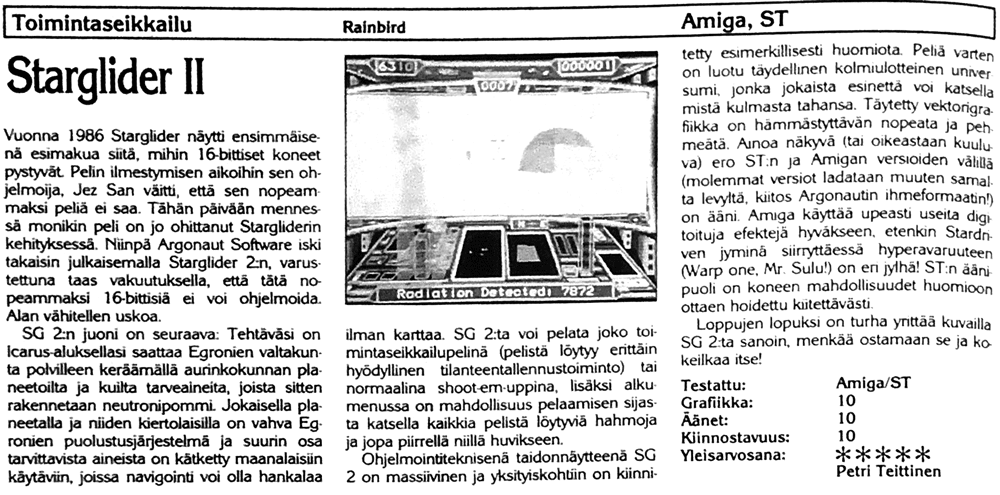
Starglider II1989 KevätPysyvä linkkiVuonna 1986 Starglider näytti ensimmäisenä esimakua siitä, mihin 16-bittiset koneet pystyvät. Pelin ilmestymisen aikoihin sen ohjelmoija, Jez San väitti, että sen nopeammaksi peliä ei saa. Tähän päivään mennessä monikin peli on jo ohittanut Stargliderin kehityksessä. Niinpä Argonaut Software iski takaisin julkaisemalla Starglider 2:n, varustettuna taas vakuutuksella, että tätä nopeammaksi 16-bittisiä ei voi ohjelmoida. Alan vähitellen uskoa.
SG 2:n juoni on seuraava: Tehtäväsi on Icarus-aluksellasi saattaa Egronien valtakunta polvilleen keräämällä aurinkokunnan planeetoilta ja kuilta tarveaineita, joista sitten rakennetaan neutronipommi. Jokaisella planeetalla ja niiden kiertolaisilla on vahva Egronien puolustusjärjestelmä ja suurin osa tarvittavista aineista on kätketty maanalaisiin käytäviin, joissa navigointi voi olla hankalaa ilman karttaa. SG 2:ta voi pelata joko toimintaseikkailupelinä (pelistä löytyy erittäin hyödyllinen tilanteentallennustoiminto) tai normaalina shoot-em-uppina, lisäksi alkumenussa on mahdollisuus pelaamisen sijasta katsella kaikkia pelistä löytyviä hahmoja ja jopa piirrellä niillä huvikseen.
Ohjelmointiteknisenä taidonnäytteenä SG 2 on massiivinen ja yksityiskohtiin on kiinnitetty esimerkillisesti huomiota. Peliä varten on luotu täydellinen kolmiulotteinen universumi, jonka jokaista esinettä voi katsella mistä kulmasta tahansa. Täytetty vektorigrafiikka on hämmästyttävän nopeata ja pehmeätä. Ainoa näkyvä (tai oikeastaan kuuluva) ero ST:n ja Amigan versioiden välillä (molemmat versiot ladataan muuten samalta levyltä, kiitos Argonautin ihmeformaatin!) on ääni. Amiga käyttää upeasti useita digitoituja efektejä hyväkseen, etenkin Stardriven jyminä siirryttäessä hyperavaruuteen (Warp one, Mr. Sulu!) on eri jylhä! ST:n äänipuoli on koneen mahdollisuudet huomioon ottaen hoidettu kiitettävästi.
Loppujen lopuksi on turha yrittää kuvailla SG 2:ta sanoin, menkää ostamaan se ja kokeilkaa itse!
Starglider II1989 KevätPermalinkIn 1986 Starglider was the first to give a foretaste of what the 16-bit machines are capable of. Around the time the game came out, its programmer, Jez San, claimed that the game couldn't be made any faster. By now plenty of games have already overtaken Starglider in development. So Argonaut Software struck back by releasing Starglider 2, equipped once again with the assurance that the 16-bits can't be programmed to go any faster than this. I'm gradually starting to believe it.
The plot of SG 2 is as follows: your mission, in your ship the Icarus, is to bring the Egrons' empire to its knees by collecting materials from the planets and moons of the solar system, from which a neutron bomb is then built. Every planet and its satellites has a strong Egron defence system, and most of the materials needed are hidden in underground tunnels, where navigating can be tricky without a map. SG 2 can be played either as an action adventure (the game has a highly useful save-game function) or as a normal shoot-em-up; in addition, the opening menu offers the option, instead of playing, of viewing all the figures found in the game and even doodling with them for fun.
As a showpiece of programming technique SG 2 is massive, and exemplary attention has been paid to detail. A complete three-dimensional universe has been created for the game, every object of which can be viewed from any angle. The filled vector graphics are astonishingly fast and smooth. The only visible (or rather audible) difference between the ST and Amiga versions (both versions load from the same disk, by the way, thanks to Argonaut's miracle format!) is the sound. The Amiga makes superb use of several digitised effects; the rumble of the Stardrive in particular as you jump into hyperspace (Warp one, Mr. Sulu!) is seriously majestic! The ST's sound side has been handled commendably, considering the machine's capabilities.
In the end it's pointless trying to describe SG 2 in words - go and buy it and try it for yourselves!
Starion
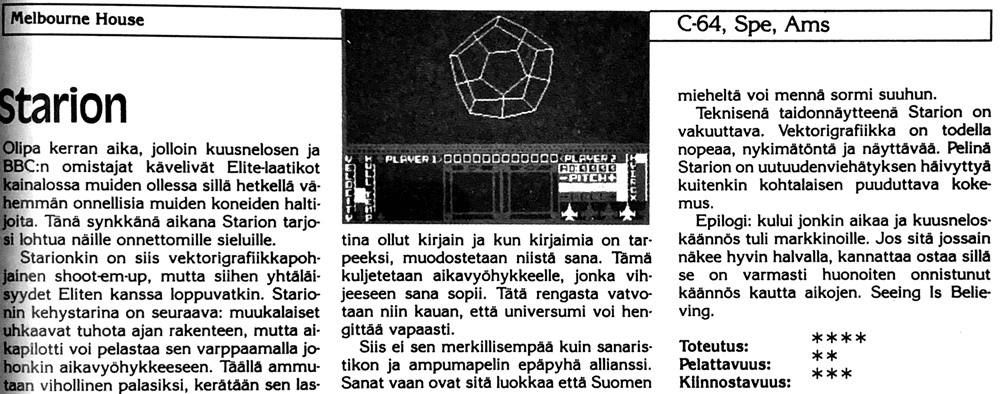
Starion1987Pysyvä linkkiOlipa kerran aika, jolloin kuusnelosen ja BBC:n omistajat kävelivät Elite-laatikot kainalossa muiden ollessa sillä hetkellä vähemmän onnellisia muiden koneiden haltijoita. Tänä synkkänä aikana Starion tarjosi lohtua näille onnettomille sieluille.
Starionkin on siis vektorigrafiikkapohjainen shoot-em-up, mutta siihen yhtäläisyydet Eliten kanssa loppuvatkin. Starionin kehystarina on seuraava: muukalaiset uhkaavat tuhota ajan rakenteen, mutta aikapilotti voi pelastaa sen varppaamalla johonkin aikavyöhykkeeseen. Täällä ammutaan vihollinen palasiksi, kerätään sen lastina ollut kirjain ja kun kirjaimia on tarpeeksi, muodostetaan niistä sana. Tämä kuljetetaan aikavyöhykkeelle, jonka vihjeeseen sana sopii. Tätä rengasta vatvotaan niin kauan, että universumi voi hengittää vapaasti.
Siis ei sen merkillisempää kuin sanaristikon ja ampumapelin epäpyhä allianssi. Sanat vaan ovat sitä luokkaa että Suomen mieheltä voi mennä sormi suuhun.
Teknisenä taidonnäytteenä Starion on vakuuttava. Vektorigrafiikka on todella nopeaa, nykimätöntä ja näyttävää. Pelinä Starion on uutuudenviehätyksen häivyttyä kuitenkin kohtalaisen puuduttava kokemus.
Epilogi: kului jonkin aikaa ja kuusneloskäännös tuli markkinoille. Jos sitä jossain näkee hyvin halvalla, kannattaa ostaa sillä se on varmasti huonoiten onnistunut käännös kautta aikojen. Seeing Is Believing.
Starion1987PermalinkOnce upon a time there was an age when Commodore 64 and BBC owners strolled around with Elite boxes under their arms, while the rest were, for the time being, the less happy keepers of other machines. In those dark days Starion brought comfort to these unhappy souls.
So Starion is a vector-graphics shoot-em-up too, but that's where the similarities with Elite end. Starion's backstory goes like this: aliens are threatening to destroy the fabric of time, but a time pilot can save it by warping into a time zone. There you shoot the enemy to pieces, collect the letter it was carrying as cargo, and once you have enough letters, form a word out of them. The word is then carried to the time zone whose clue it fits. This loop gets ground through again and again until the universe can breathe freely.
So nothing more remarkable than an unholy alliance of a crossword and a shooting game. It's just that the words are of such a calibre that they can leave a Finn completely stumped.
As a technical showpiece Starion is convincing. The vector graphics are really fast, jerk-free and impressive. As a game, though, once the novelty wears off, Starion is a fairly numbing experience.
Epilogue: some time passed and the Commodore 64 conversion hit the market. If you see it somewhere really cheap, it's worth buying, because it is surely the least successful conversion of all time. Seeing Is Believing.
StarRay
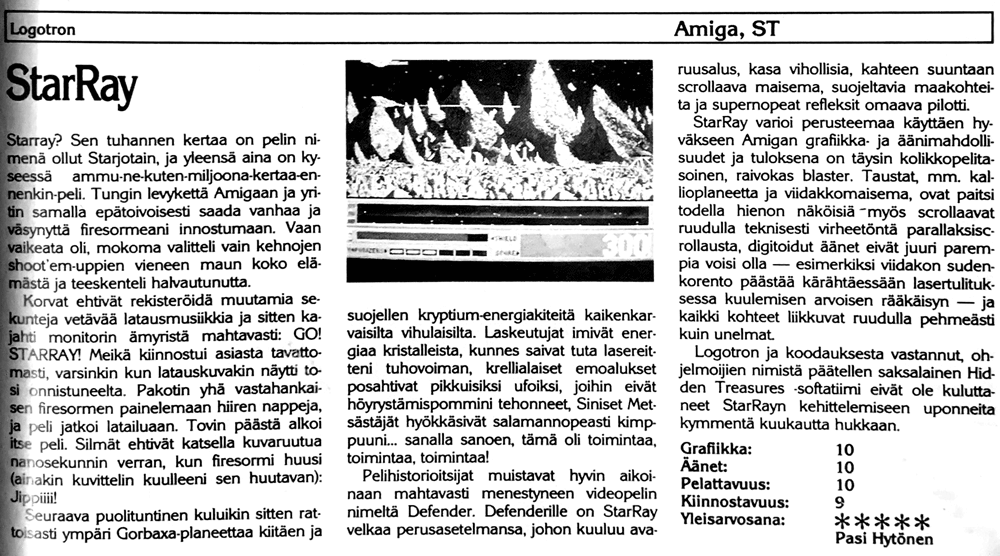
StarRay1988Pysyvä linkkiStarray? Sen tuhannen kertaa on pelin nimenä ollut Starjotain, ja yleensä aina on kyseessä ammu-ne-kuten-miljoona-kertaa-ennenkin-peli. Tungin levykettä Amigaan ja yritin samalla epätoivoisesti saada vanhaa ja väsynyttä firesormeani innostumaan. Vaan vaikeata oli, mokoma valitteli vain kehnojen shoot'em-uppien vieneen maun koko elämästä ja teeskenteli halvautunutta.
Korvat ehtivät rekisteröidä muutamia sekunteja vetävää latausmusiikkia ja sitten kajahti monitorin ämyristä mahtavasti: GO! STARRAY! Meikä kiinnostui asiasta tavattomasti, varsinkin kun latauskuvakin näytti tosi onnistuneelta. Pakotin yhä vastahankaisen firesormen painelemaan hiiren nappeja, ja peli jatkoi latailuaan. Tovin päästä alkoi itse peli. Silmät ehtivät katsella kuvaruutua nanosekunnin verran, kun firesormi huusi (ainakin kuvittelin kuulleeni sen huutavan): Jippiiii!
Seuraava puolituntinen kuluikin sitten rattoisasti ympäri Gorbaxa-planeettaa kiitäen ja suojellen kryptium-energiakiteitä kaikenkarvaisilta vihulaisilta. Laskeutujat imivät energiaa kristalleista, kunnes saivat tuta lasereitteni tuhovoiman, krellialaiset emoalukset posahtivat pikkuisiksi ufoiksi, joihin eivät höyrystämispommini tehonneet, Siniset Metsästäjät hyökkäsivät salamannopeasti kimppuuni... sanalla sanoen, tämä oli toimintaa, toimintaa, toimintaa!
Pelihistorioitsijat muistavat hyvin aikoinaan mahtavasti menestyneen videopelin nimeltä Defender. Defenderille on StarRay velkaa perusasetelmansa, johon kuuluu avaruusalus, kasa vihollisia, kahteen suuntaan scrollaava maisema, suojeltavia maakohteita ja supernopeat refleksit omaava pilotti.
StarRay varioi perusteemaa käyttäen hyväkseen Amigan grafiikka- ja äänimahdollisuudet ja tuloksena on täysin kolikkopelitasoinen, raivokas blaster. Taustat, mm. kallioplaneetta ja viidakkomaisema, ovat paitsi todella hienon näköisiä -myös scrollaavat ruudulla teknisesti virheetöntä parallaksiscrollausta, digitoidut äänet eivät juuri parempia voisi olla - esimerkiksi viidakon sudenkorento päästää kärähtäessään lasertulituksessa kuulemisen arvoisen rääkäisyn - ja kaikki kohteet liikkuvat ruudulla pehmeästi kuin unelmat.
Logotron ja koodauksesta vastannut, ohjelmoijien nimistä päätellen saksalainen Hidden Treasures -softatiimi eivät ole kuluttaneet StarRayn kehittelemiseen uponneita kymmentä kuukautta hukkaan.
StarRay1988PermalinkStarray? For the thousandth blessed time a game has been called Starsomething, and nearly always it's a shoot-'em-just-like-a-million-times-before game. I shoved the disk into the Amiga while desperately trying to get my old, tired firefinger excited. But it was hard going: the wretched thing just moaned that lousy shoot'em-ups had taken all the flavour out of life, and played dead.
My ears had time to register a few seconds of catchy loading music, and then the monitor's squawk box boomed out magnificently: GO! STARRAY! Yours truly got tremendously interested, especially as the loading screen looked really well done too. I forced the still reluctant firefinger to click the mouse buttons, and the game carried on loading. After a while the game proper began. My eyes had been on the screen for all of a nanosecond when the firefinger shouted (at least I imagined I heard it shout): Yippeeee!
The next half hour then passed merrily, zooming round the planet Gorbaxa and protecting the kryptium energy crystals from baddies of every stripe. Landers sucked energy from the crystals until they got a taste of my lasers' destructive power, Krellian motherships popped into teeny little UFOs that my vaporiser bombs had no effect on, Blue Hunters pounced on me at lightning speed... in a word, this was action, action, action!
Game historians will well remember a video game called Defender, a huge success in its day. StarRay owes Defender its basic setup, which consists of a spaceship, a heap of enemies, a landscape scrolling in two directions, ground targets to protect and a pilot with super-fast reflexes.
StarRay plays variations on the basic theme, making full use of the Amiga's graphics and sound capabilities, and the result is a furious blaster fully up to coin-op standard. The backdrops, including a rocky planet and a jungle landscape, not only look really fine but also move across the screen in technically flawless parallax scrolling, the digitised sounds could hardly be better - for example, the jungle dragonfly lets out a screech well worth hearing as it fries in the laser fire - and all the objects glide across the screen as smoothly as dreams.
Logotron and the Hidden Treasures software team who handled the coding - German, judging by the programmers' names - have not wasted the ten months that went into developing StarRay.
Stealth Mission
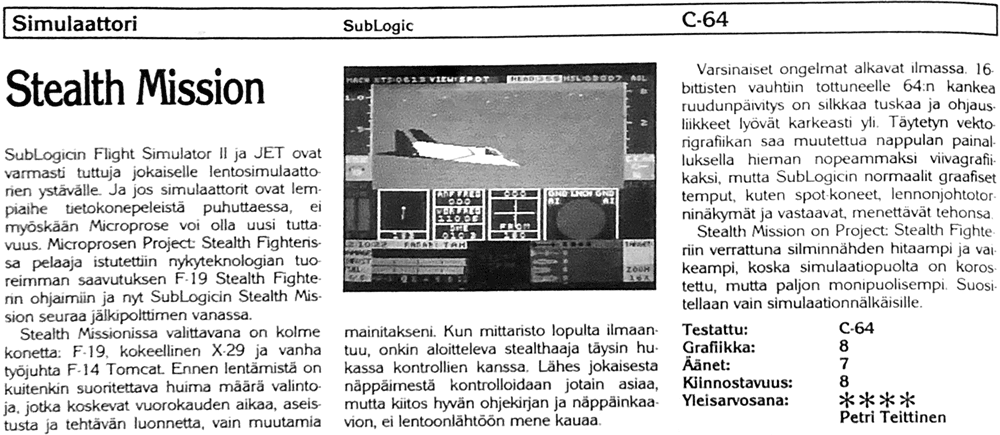
Stealth Mission1989 KevätPysyvä linkkiSubLogicin Flight Simulator II ja JET ovat varmasti tuttuja jokaiselle lentosimulaattorien ystävälle. Ja jos simulaattorit ovat lempiaihe tietokonepeleistä puhuttaessa, ei myöskään Microprose voi olla uusi tuttavuus. Microprosen Project: Stealth Fighterissa pelaaja istutettiin nykyteknologian tuoreimman saavutuksen F-19 Stealth Fighterin ohjaimiin ja nyt SubLogicin Stealth Mission seuraa jälkipolttimen vanassa.
Stealth Missionissa valittavana on kolme konetta: F-19, kokeellinen X-29 ja vanha työjuhta F-14 Tomcat. Ennen lentämistä on kuitenkin suoritettava huima määrä valintoja, jotka koskevat vuorokauden aikaa, aseistusta ja tehtävän luonnetta, vain muutamia mainitakseni. Kun mittaristo lopulta ilmaantuu, onkin aloitteleva stealthaaja täysin hukassa kontrollien kanssa. Lähes jokaisesta näppäimestä kontrolloidaan jotain asiaa, mutta kiitos hyvän ohjekirjan ja näppäinkaavion, ei lentoonlähtöön mene kauaa.
Varsinaiset ongelmat alkavat ilmassa. 16-bittisten vauhtiin tottuneelle 64:n kankea ruudunpäivitys on silkkaa tuskaa ja ohjausliikkeet lyövät karkeasti yli. Täytetyn vektorigrafiikan saa muutettua nappulan painalluksella hieman nopeammaksi viivagrafiikaksi, mutta SubLogicin normaalit graafiset temput, kuten spot-koneet, lennonjohtotorninäkymät ja vastaavat, menettävät tehonsa.
Stealth Mission on Project: Stealth Fighteriin verrattuna silminnähden hitaampi ja vaikeampi, koska simulaatiopuolta on korostettu, mutta paljon monipuolisempi. Suositellaan vain simulaationnälkäisille.
Stealth Mission1989 KevätPermalinkSubLogic's Flight Simulator II and JET are surely familiar to every flight simulator fan. And if simulators are your favourite topic when talk turns to computer games, Microprose can't be a new acquaintance either. Microprose's Project: Stealth Fighter sat the player at the controls of modern technology's latest achievement, the F-19 Stealth Fighter, and now SubLogic's Stealth Mission follows in its afterburner's wake.
In Stealth Mission there are three planes to choose from: the F-19, the experimental X-29 and the old workhorse, the F-14 Tomcat. Before flying, however, you have to make a staggering number of choices concerning the time of day, armament and the nature of the mission, to mention just a few. When the instrument panel finally appears, the novice stealther is completely lost with the controls. Nearly every key controls something, but thanks to a good manual and keyboard chart, it doesn't take long to get airborne.
The real problems start in the air. For someone used to the speed of the 16-bits, the 64's sluggish screen update is sheer agony, and the control inputs overshoot badly. At the press of a button the filled vector graphics can be switched to slightly faster wireframe graphics, but SubLogic's usual graphical tricks, such as spot planes, control tower views and the like, lose their punch.
Compared with Project: Stealth Fighter, Stealth Mission is visibly slower and harder, because the simulation side has been emphasised, but it is much more versatile. Recommended only for the simulation-hungry.
Steel
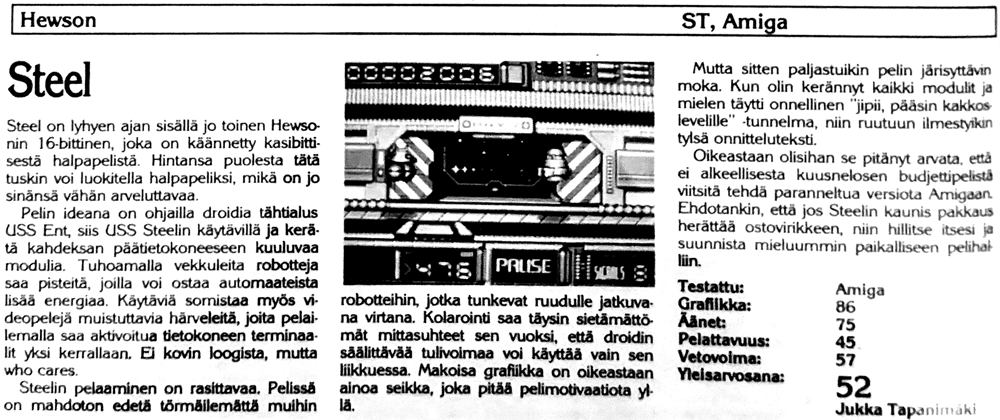
Steel1990 KevätPysyvä linkkiSteel on lyhyen ajan sisällä jo toinen Hewsonin 16-bittinen, joka on käännetty kasibittisestä halpapelistä. Hintansa puolesta tätä tuskin voi luokitella halpapeliksi, mikä on jo sinänsä vähän arveluttavaa.
Pelin ideana on ohjailla droidia tähtialus USS Ent, siis USS Steelin käytävillä ja kerätä kahdeksan päätietokoneeseen kuuluvaa modulia. Tuhoamalla vekkuleita robotteja saa pisteitä, joilla voi ostaa automaateista lisää energiaa. Käytäviä somistaa myös videopelejä muistuttavia härveleitä, joita pelailemalla saa aktivoitua tietokoneen terminaalit yksi kerrallaan. Ei kovin loogista, mutta who cares.
Steelin pelaaminen on rasittavaa. Pelissä on mahdoton edetä törmäilemättä muihin roboteihin, jotka tunkevat ruudulle jatkuvana virtana. Kolarointi saa täysin sietämättömät mittasuhteet sen vuoksi, että droidin säälittävää tulivoimaa voi käyttää vain sen liikkuessa. Makoisa grafiikka on oikeastaan ainoa seikka, joka pitää pelimotivaatiota yllä.
Mutta sitten paljastuikin pelin järisyttävin moka. Kun olin kerännyt kaikki modulit ja mielen täytti onnellinen "jipii, pääsin kakkoslevelille" -tunnelma, niin ruutuun ilmestyikin tylsä onnitteluteksti.
Oikeastaan olisihan se pitänyt arvata, että ei alkeellisesta kuusnelosen budjettipelistä viitsitä tehdä paranneltua versiota Amigaan. Ehdotankin, että jos Steelin kaunis pakkaus herättää ostovirikkeen, niin hillitse itsesi ja suunnista mieluummin paikalliseen pelihalliin.
Steel1990 KevätPermalinkSteel is already the second Hewson 16-bit title in a short space of time to be converted from an 8-bit budget game. Going by its price, this one can hardly be classed as a budget game, which in itself is a bit dubious.
The idea of the game is to steer a droid around the corridors of the starship USS Ent, I mean USS Steel, and collect eight modules belonging to the main computer. Destroying the mischievous robots earns you points, which you can spend on more energy from vending machines. The corridors are also decorated with contraptions resembling video games, and by playing on them you activate the computer's terminals one at a time. Not very logical, but who cares.
Playing Steel is a strain. It's impossible to make progress in the game without bumping into other robots, which pour onto the screen in an endless stream. The collisions take on utterly unbearable proportions because the droid's pitiful firepower can only be used while it's moving. The tasty graphics are really the only thing that keeps you motivated to play.
But then the game's most earth-shattering blunder came to light. When I had collected all the modules and my mind was filled with a happy "yippee, I've made it to level two" feeling, what appeared on the screen instead was a dreary congratulations message.
Actually, I should have guessed that nobody would bother making an improved Amiga version of a primitive C-64 budget game. So I suggest that if Steel's pretty packaging stirs the urge to buy, restrain yourself and head for your local arcade instead.
Steel Thunder
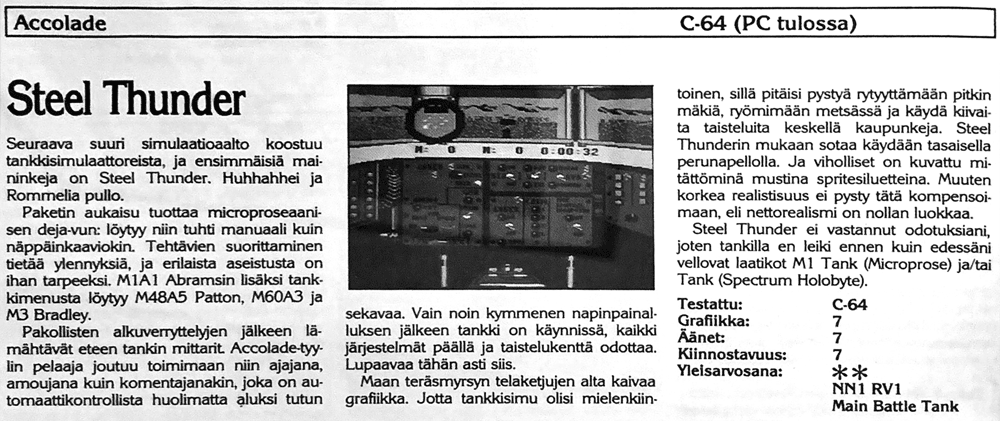
Steel Thunder1989 SyksyPysyvä linkkiSeuraava suuri simulaatioaalto koostuu tankkisimulaattoreista, ja ensimmäisiä maininkeja on Steel Thunder. Huhhahhei ja Rommelia pullo.
Paketin aukaisu tuottaa microproseaanisen deja-vun: löytyy niin tuhti manuaali kuin näppäinkaaviokin. Tehtävien suorittaminen tietää ylennyksiä, ja erilaista aseistusta on ihan tarpeeksi. M1A1 Abramsin lisäksi tankkimenusta löytyy M48A5 Patton, M60A3 ja M3 Bradley.
Pakollisten alkuverryttelyjen jälkeen lämähtävät eteen tankin mittarit. Accolade-tyylin pelaaja joutuu toimimaan niin ajajana, amoujana kuin komentajanakin, joka on automaattikontrollista huolimatta aluksi tutun sekavaa. Vain noin kymmenen napinpainalluksen jälkeen tankki on käynnissä, kaikki järjestelmät päällä ja taistelukenttä odottaa. Lupaavaa tähän asti siis.
Maan teräsmyrsyn telaketjujen alta kaivaa grafiikka. Jotta tankkisimu olisi mielenkiintoinen, sillä pitäisi pystyä rytyyttämään pitkin mäkiä, ryömimään metsässä ja käydä kiivaita taisteluita keskellä kaupunkeja. Steel Thunderin mukaan sotaa käydään tasaisella perunapellolla. Ja viholliset on kuvattu mitättöminä mustina spritesiluetteina. Muuten korkea realistisuus ei pysty tätä kompensoimaan, eli nettorealismi on nollan luokkaa.
Steel Thunder ei vastannut odotuksiani, joten tankilla en leiki ennen kuin edessäni vellovat laatikot M1 Tank (Microprose) ja/tai Tank (Spectrum Holobyte).
Steel Thunder1989 SyksyPermalinkThe next great wave of simulations consists of tank simulators, and one of the first swells is Steel Thunder. Yo-ho-ho and a bottle of Rommel.
Opening the package brings on a Microprosean deja vu: there's both a hefty manual and a keyboard chart. Completing missions earns promotions, and there's plenty enough weaponry of different kinds. Besides the M1A1 Abrams, the tank menu offers the M48A5 Patton, the M60A3 and the M3 Bradley.
After the obligatory warm-up exercises, the tank's gauges slap up in front of you. Accolade-style, the player has to act as driver, gunner and commander alike, which, despite the automatic controls, is at first familiarly confusing. After a mere ten or so button presses the tank is running, all systems are on and the battlefield awaits. Promising so far, then.
It's the graphics that dig the ground out from under the steel storm's tracks. For a tank sim to be interesting, you ought to be able to go rumbling over hills, crawl through forests and fight fierce battles in the middle of towns. According to Steel Thunder, war is waged on a flat potato field. And the enemies are depicted as puny black sprite silhouettes. The otherwise high realism can't make up for this, so the net realism is somewhere around zero.
Steel Thunder didn't live up to my expectations, so I won't be playing at tanks until the boxes of M1 Tank (Microprose) and/or Tank (Spectrum Holobyte) come surging up in front of me.
Stellar Conquest
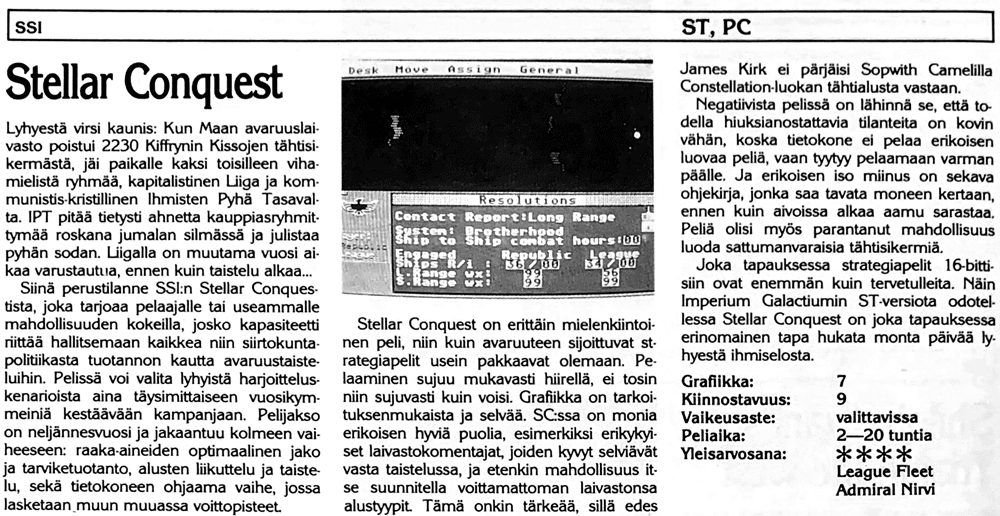
Stellar Conquest1988Pysyvä linkkiLyhyestä virsi kaunis: Kun Maan avaruuslaivasto poistui 2230 Kiffrynin Kissojen tähtisikermästä, jäi paikalle kaksi toisilleen vihamielistä ryhmää, kapitalistinen Liiga ja kommunistis-kristillinen Ihmisten Pyhä Tasavalta. IPT pitää tietysti ahnetta kauppiasryhmittymää roskana jumalan silmässä ja julistaa pyhän sodan. Liigalla on muutama vuosi aikaa varustautua, ennen kuin taistelu alkaa...
Siinä perustilanne SSI:n Stellar Conquestista, joka tarjoaa pelaajalle tai useammalle mahdollisuuden kokeilla, josko kapasiteetti riittää hallitsemaan kaikkea niin siirtokuntapolitiikasta tuotannon kautta avaruustaisteluihin. Pelissä voi valita lyhyistä harjoitteluskenarioista aina täysimittaiseen vuosikymmeniä kestävään kampanjaan. Pelijakso on neljännesvuosi ja jakaantuu kolmeen vaiheeseen: raaka-aineiden optimaalinen jako ja tarviketuotanto, alusten liikuttelu ja taistelu, sekä tietokoneen ohjaama vaihe, jossa lasketaan muun muuassa voittopisteet.
Stellar Conquest on erittäin mielenkiintoinen peli, niin kuin avaruuteen sijoittuvat strategiapelit usein pakkaavat olemaan. Pelaaminen sujuu mukavasti hiirellä, ei tosin niin sujuvasti kuin voisi. Grafiikka on tarkoituksenmukaista ja selvää. SC:ssa on monia erikoisen hyviä puolia, esimerkiksi erikykyiset laivastokomentajat, joiden kyvyt selviävät vasta taistelussa, ja etenkin mahdollisuus itse suunnitella voittamattoman laivastonsa alustyypit. Tämä onkin tärkeää, sillä edes James Kirk ei pärjäisi Sopwith Camelilla Constellation-luokan tähtialusta vastaan.
Negatiivista pelissä on lähinnä se, että todella hiuksianostattavia tilanteita on kovin vähän, koska tietokone ei pelaa erikoisen luovaa peliä, vaan tyytyy pelaamaan varman päälle. Ja erikoisen iso miinus on sekava ohjekirja, jonka saa tavata moneen kertaan, ennen kuin aivoissa alkaa aamu sarastaa. Peliä olisi myös parantanut mahdollisuus luoda sattumanvaraisia tähtisikermiä.
Joka tapauksessa strategiapelit 16-bittisiin ovat enemmän kuin tervetulleita. Näin Imperium Galactiumin ST-versiota odotellessa Stellar Conquest on joka tapauksessa erinomainen tapa hukata monta päivää lyhyestä ihmiselosta.
Stellar Conquest1988PermalinkShort and sweet: when Earth's space fleet left the star cluster of Kiffryn's Cats in 2230, two mutually hostile factions were left behind, the capitalist League and the communist-Christian People's Holy Republic. The PHR naturally regards the greedy merchant bloc as a mote in God's eye and declares a holy war. The League has a few years to arm itself before the fighting starts...
That's the basic situation in SSI's Stellar Conquest, which gives one or more players the chance to find out whether their capacity is up to managing everything from colonial policy through production to space battles. The game lets you choose anything from short training scenarios all the way up to a full-length campaign lasting decades. A game turn is a quarter of a year and splits into three phases: the optimal allocation of raw materials and the production of supplies, moving ships and fighting, and a computer-run phase in which, among other things, victory points are calculated.
Stellar Conquest is an extremely interesting game, as space strategy games so often tend to be. Playing with the mouse goes nicely, though not as smoothly as it might. The graphics are functional and clear. SC has many exceptionally good features, for example fleet commanders of varying ability, whose skills only come to light in battle, and above all the chance to design the ship types of your invincible fleet yourself. This really matters, because not even James Kirk would get far in a Sopwith Camel against a Constellation-class starship.
The main negative is that truly hair-raising situations are very few and far between, because the computer doesn't play a particularly creative game but is content to play it safe. And an especially big minus is the muddled manual, which you have to spell your way through many times before dawn starts to break in your brain. The game would also have been improved by the option of creating random star clusters.
In any case, strategy games for the 16-bit machines are more than welcome. While we wait for the ST version of Imperium Galactium, Stellar Conquest is in any case an excellent way to waste many days of a short human life.
Stellar-7
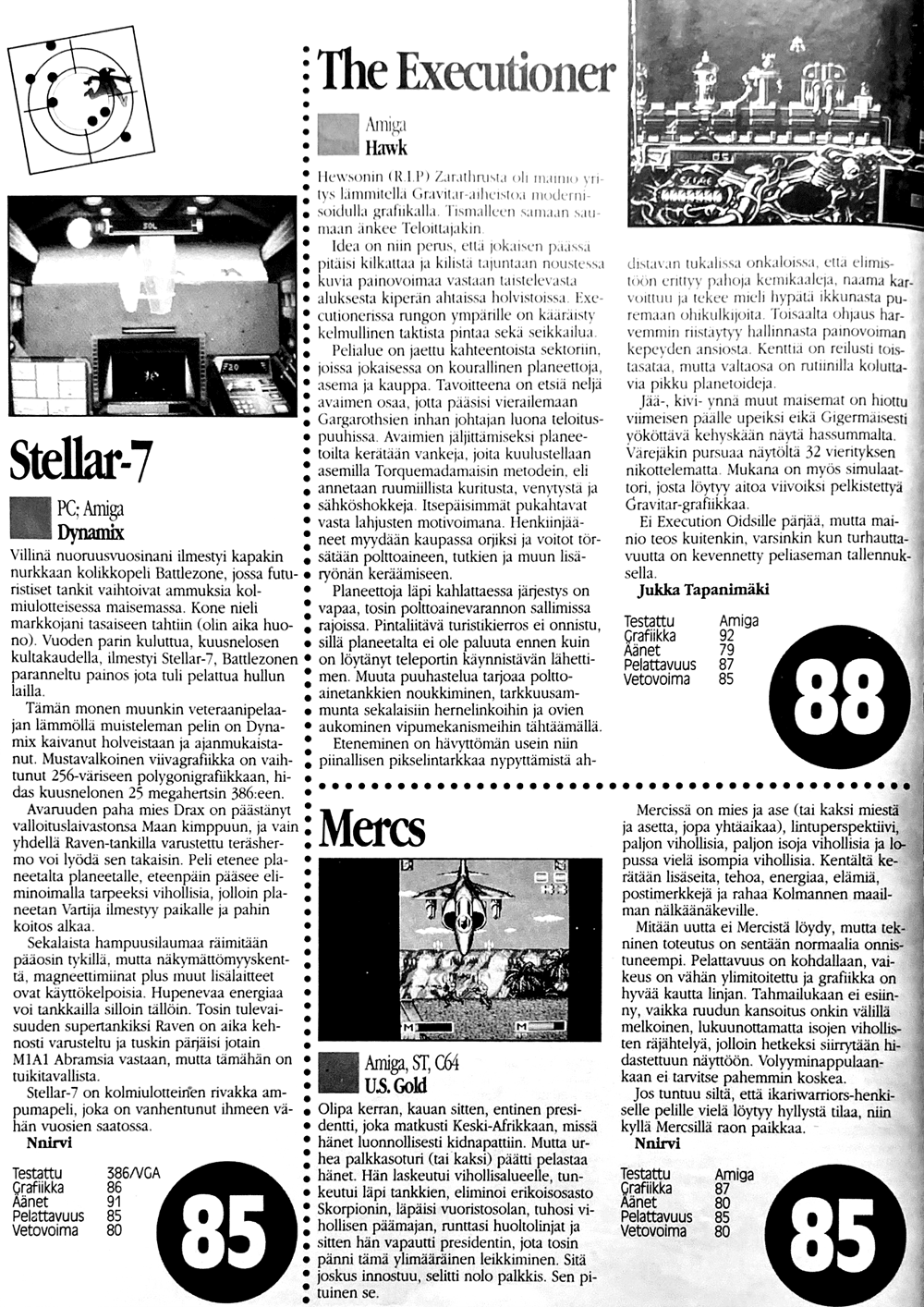
Stellar-71991 SyksyPysyvä linkkiVillinä nuoruusvuosinani ilmestyi kapakin nurkkaan kolikkopeli Battlezone, jossa futuristiset tankit vaihtoivat ammuksia kolmiulotteisessa maisemassa. Kone nieli markkojani tasaiseen tahtiin (olin aika huono). Vuoden parin kuluttua, kuusnelosen kultakaudella, ilmestyi Stellar-7, Battlezonen paranneltu painos jota tuli pelattua hullun lailla.
Tämän monen muunkin veteraanipelaajan lämmöllä muisteleman pelin on Dynamix kaivanut holveistaan ja ajanmukaistanut. Mustavalkoinen viivagrafiikka on vaihtunut 256-väriseen polygonigrafiikkaan, hidas kuusnelonen 25 megahertsin 386:een.
Avaruuden paha mies Drax on päästänyt valloituslaivastonsa Maan kimppuun, ja vain yhdellä Raven-tankilla varustettu teräshermo voi lyödä sen takaisin. Peli etenee planeetalta planeetalle, eteenpäin pääsee eliminoimalla tarpeeksi vihollisia, jolloin planeetan Vartija ilmestyy paikalle ja pahin koitos alkaa.
Sekalaista hampuusilaumaa räimitään pääosin tykillä, mutta näkymättömyyskenttä, magneettimiinat plus muut lisälaitteet ovat käyttökelpoisia. Hupenevaa energiaa voi tankkailla silloin tällöin. Tosin tulevaisuuden supertankiksi Raven on aika kehnosti varusteltu ja tuskin pärjäisi jotain M1A1 Abramsia vastaan, mutta tämähän on tuikitavallista.
Stellar-7 on kolmiulotteinen rivakka ampumapeli, joka on vanhentunut ihmeen vähän vuosien saatossa.
Stellar-71991 SyksyPermalinkIn my wild youth, a coin-op called Battlezone turned up in the corner of the pub, in which futuristic tanks traded shells across a three-dimensional landscape. The machine swallowed my markkas at a steady rate (I was pretty bad). A year or two later, in the golden age of the Commodore 64, along came Stellar-7, an improved edition of Battlezone that I ended up playing like a madman.
Dynamix has dug this game, fondly remembered by many another veteran gamer too, out of its vaults and brought it up to date. The black-and-white line graphics have given way to 256-colour polygon graphics, and the slow Commodore 64 to a 25-megahertz 386.
Space bad guy Drax has set his invasion fleet loose on Earth, and only a nerves-of-steel type equipped with a single Raven tank can beat it back. The game advances from planet to planet; you move on by eliminating enough enemies, whereupon the planet's Guardian shows up and the worst ordeal begins.
The motley rabble of riff-raff is mostly pounded with the cannon, but the invisibility field, magnetic mines plus the other add-ons come in handy. Dwindling energy can be topped up every now and then. Admittedly, for a super-tank of the future the Raven is pretty poorly kitted out and would hardly stand a chance against, say, an M1A1 Abrams, but that's par for the course.
Stellar-7 is a brisk three-dimensional shoot-'em-up that has aged amazingly little over the years.
Stellar-7
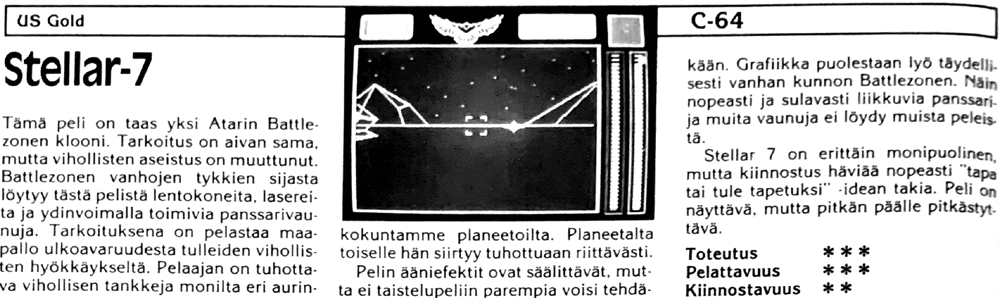
Stellar-71987Pysyvä linkkiTämä peli on taas yksi Atarin Battlezonen klooni. Tarkoitus on aivan sama, mutta vihollisten aseistus on muuttunut. Battlezonen vanhojen tykkien sijasta löytyy tästä pelistä lentokoneita, lasereita ja ydinvoimalla toimivia panssarivaunuja. Tarkoituksena on pelastaa maapallo ulkoavaruudesta tulleiden vihollisten hyökkäykseltä. Pelaajan on tuhottava vihollisen tankkeja monilta eri aurinkokuntamme planeetoilta. Planeetalta toiselle hän siirtyy tuhottuaan riittävästi.
Pelin ääniefektit ovat säälittävät, mutta ei taistelupeliin parempia voisi tehdäkään. Grafiikka puolestaan lyö täydellisesti vanhan kunnon Battlezonen. Näin nopeasti ja sulavasti liikkuvia panssari- ja muita vaunuja ei löydy muista peleistä.
Stellar 7 on erittäin monipuolinen, mutta kiinnostus häviää nopeasti "tapa tai tule tapetuksi" -idean takia. Peli on näyttävä, mutta pitkän päälle pitkästyttävä.
Stellar-71987PermalinkThis game is yet another clone of Atari's Battlezone. The objective is exactly the same, but the enemies' weaponry has changed. Instead of Battlezone's old cannons, this game has aircraft, lasers and nuclear-powered tanks. The aim is to save the Earth from an attack by enemies from outer space. The player has to destroy enemy tanks on many different planets of our solar system. He moves on from one planet to the next once he has destroyed enough of them.
The game's sound effects are pitiful, but then you couldn't really make better ones for a combat game anyway. The graphics, on the other hand, beat good old Battlezone hands down. You won't find tanks and other vehicles moving this fast and smoothly in any other game.
Stellar 7 is extremely versatile, but interest fades quickly because of the "kill or be killed" idea. The game is a looker, but in the long run it's a long bore.
Steve Davis World Snooker
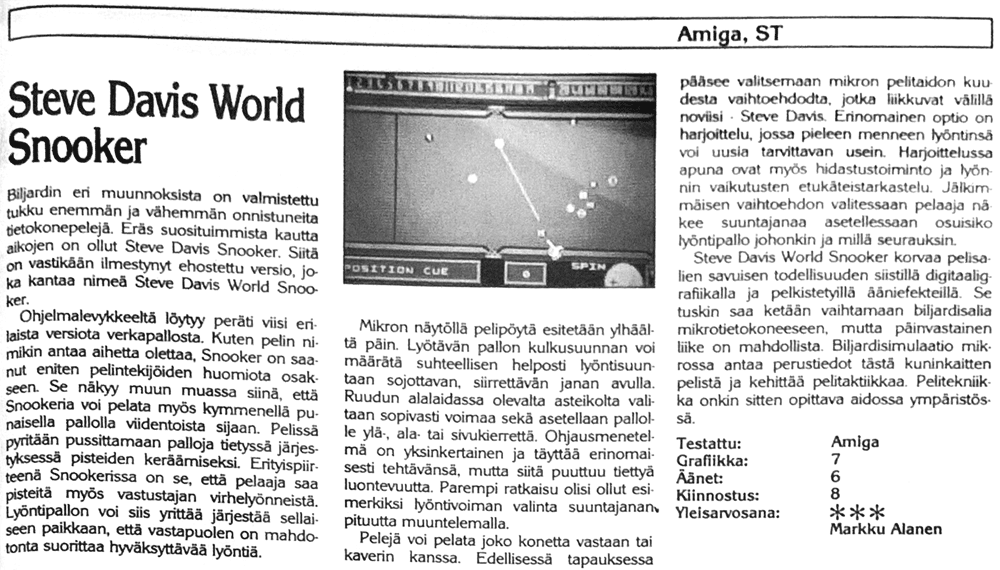
Steve Davis World Snooker1989 SyksyPysyvä linkkiBiljardin eri muunnoksista on valmistettu tukku enemmän ja vähemmän onnistuneita tietokonepelejä. Eräs suosituimmista kautta aikojen on ollut Steve Davis Snooker. Siitä on vastikään ilmestynyt ehostettu versio, joka kantaa nimeä Steve Davis World Snooker.
Ohjelmalevykkeeltä löytyy peräti viisi erilaista versiota verkapallosta. Kuten pelin nimikin antaa aihetta olettaa, Snooker on saanut eniten pelintekijöiden huomiota osakseen. Se näkyy muun muassa siinä, että Snookeria voi pelata myös kymmenellä punaisella pallolla viidentoista sijaan. Pelissä pyritään pussittamaan palloja tietyssä järjestyksessä pisteiden keräämiseksi. Erityispiirteenä Snookerissa on se, että pelaaja saa pisteitä myös vastustajan virhelyönneistä. Lyöntipallon voi siis yrittää järjestää sellaiseen paikkaan, että vastapuolen on mahdotonta suorittaa hyväksyttävää lyöntiä.
Mikron näytöllä pelipöytä esitetään ylhäältä päin. Lyötävän pallon kulkusuunnan voi määrätä suhteellisen helposti lyöntisuuntaan sojottavan, siirrettävän janan avulla. Ruudun alalaidassa olevalta asteikolta valitaan sopivasti voimaa sekä asetellaan pallolle ylä-, ala- tai sivukierrettä. Ohjausmenetelmä on yksinkertainen ja täyttää erinomaisesti tehtävänsä, mutta siitä puuttuu tiettyä luontevuutta. Parempi ratkaisu olisi ollut esimerkiksi lyöntivoiman valinta suuntajanan pituutta muuntelemalla.
Pelejä voi pelata joko konetta vastaan tai kaverin kanssa. Edellisessä tapauksessa pääsee valitsemaan mikron pelitaidon kuudesta vaihtoehdodta, jotka liikkuvat välillä noviisi - Steve Davis. Erinomainen optio on harjoittelu, jossa pieleen menneen lyöntinsä voi uusia tarvittavan usein. Harjoittelussa apuna ovat myös hidastustoiminto ja lyönnin vaikutusten etukäteistarkastelu. Jälkimmäisen vaihtoehdon valitessaan pelaaja näkee suuntajanaa asetellessaan osuisiko lyöntipallo johonkin ja millä seurauksin.
Steve Davis World Snooker korvaa pelisalien savuisen todellisuuden siistillä digitaaligrafiikalla ja pelkistetyillä ääniefekteillä. Se tuskin saa ketään vaihtamaan biljardisalia mikrotietokoneeseen, mutta päinvastainen liike on mahdollista. Biljardisimulaatio mikrossa antaa perustiedot tästä kuninkaitten pelistä ja kehittää pelitaktiikkaa. Pelitekniikka onkin sitten opittava aidossa ympäristössä.
Steve Davis World Snooker1989 SyksyPermalinkThe various forms of billiards have spawned a whole stack of more and less successful computer games. One of the most popular of all time has been Steve Davis Snooker. A spruced-up version of it has just come out, going by the name Steve Davis World Snooker.
The program disk holds no fewer than five different versions of the green-baize game. As the game's name already gives you reason to suppose, Snooker has received the lion's share of the programmers' attention. This shows, among other things, in the fact that Snooker can also be played with ten red balls instead of fifteen. The aim of the game is to pot balls in a set order to collect points. A special feature of Snooker is that a player also scores points from the opponent's foul shots. So you can try to leave the cue ball in such a spot that the other side cannot possibly play a legal shot.
On the computer's screen the table is shown from above. The direction of the ball being struck can be set fairly easily with a movable line that sticks out in the direction of the shot. From a scale at the bottom of the screen you pick a suitable amount of power and put top, bottom or side spin on the ball. The control method is simple and does its job excellently, but it lacks a certain naturalness. A better solution would have been, for example, choosing the power of the shot by varying the length of the direction line.
The games can be played either against the machine or with a friend. In the former case you get to choose the computer's skill from six options, which range from novice to Steve Davis. An excellent option is practice, in which you can retake a botched shot as often as needed. Also helping out in practice are a slow-motion function and a preview of a shot's effects. With the latter option selected, the player can see while lining up the direction line whether the cue ball would hit anything and with what consequences.
Steve Davis World Snooker replaces the smoky reality of the pool halls with neat digital graphics and pared-down sound effects. It will hardly get anyone to swap the billiard hall for a microcomputer, but the move in the opposite direction is possible. A billiards simulation on a micro teaches you the basics of this game of kings and develops your tactics. The technique, on the other hand, then has to be learned in the real surroundings.
Storm Across Europe
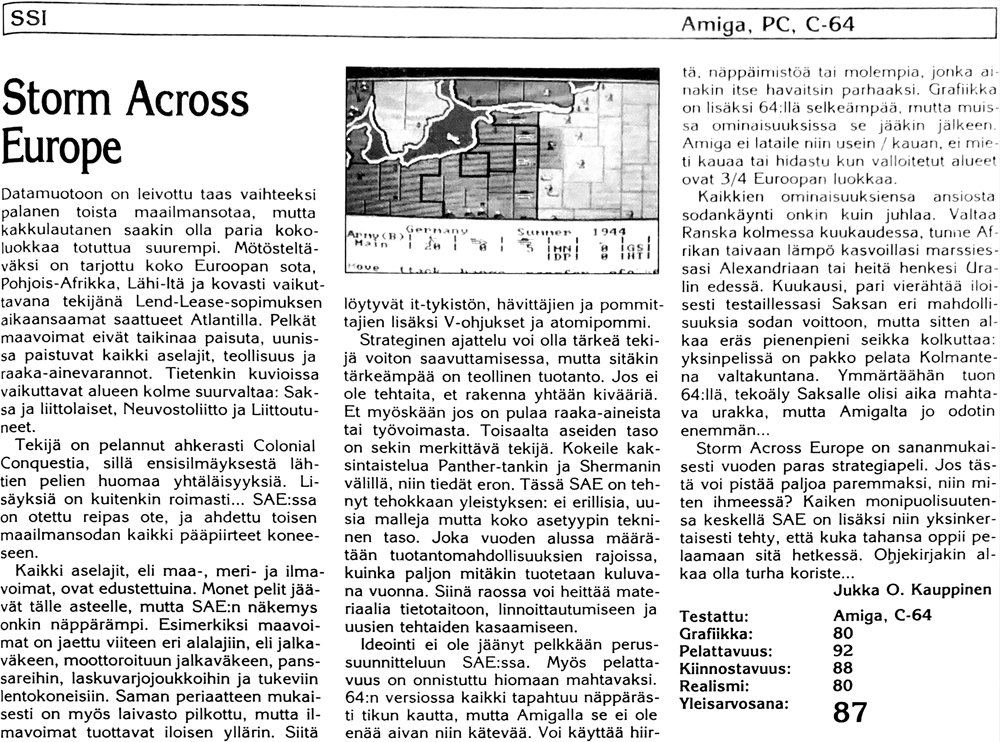
Storm Across Europe1990 SyksyPysyvä linkkiDatamuotoon on leivottu taas vaihteeksi palanen toista maailmansotaa, mutta kakkulautanen saakin olla paria kokoluokkaa totuttua suurempi. Mötösteltäväksi on tarjottu koko Euroopan sota, Pohjois-Afrikka, Lähi-Itä ja kovasti vaikuttavana tekijänä Lend-Lease-sopimuksen aikaansaamat saattueet Atlantilla. Pelkät maavoimat eivät taikinaa paisuta, uunissa paistuvat kaikki aselajit, teollisuus ja raaka-ainevarannot. Tietenkin kuvioissa vaikuttavat alueen kolme suurvaltaa: Saksa ja liittolaiset, Neuvostoliitto ja Liittoutuneet.
Tekijä on pelannut ahkerasti Colonial Conquestia, sillä ensisilmäyksestä lähtien pelien huomaa yhtäläisyyksiä. Lisäyksiä on kuitenkin roimasti... SAE:ssa on otettu reipas ote, ja ahdettu toisen maailmansodan kaikki pääpiirteet koneeseen.
Kaikki aselajit, eli maa-, meri- ja ilmavoimat, ovat edustettuina. Monet pelit jäävät tälle asteelle, mutta SAE:n näkemys onkin näppärämpi. Esimerkiksi maavoimat on jaettu viiteen eri alalajiin, eli jalkaväkeen, moottoroituun jalkaväkeen, panssareihin, laskuvarjojoukkoihin ja tukeviin lentokoneisiin. Saman periaatteen mukaisesti on myös laivasto pilkottu, mutta ilmavoimat tuottavat iloisen yllärin. Siitä löytyvät it-tykistön, hävittäjien ja pommittajien lisäksi V-ohjukset ja atomipommi.
Strateginen ajattelu voi olla tärkeä tekijä voiton saavuttamisessa, mutta sitäkin tärkeämpää on teollinen tuotanto. Jos ei ole tehtaita, et rakenna yhtään kivääriä. Et myöskään jos on pulaa raaka-aineista tai työvoimasta. Toisaalta aseiden taso on sekin merkittävä tekijä. Kokeile kaksintaistelua Panther-tankin ja Shermanin välillä, niin tiedät eron. Tässä SAE on tehnyt tehokkaan yleistyksen: ei erillisiä, uusia malleja mutta koko asetyypin tekninen taso. Joka vuoden alussa määrätään tuotantomahdollisuuksien rajoissa, kuinka paljon mitäkin tuotetaan kuluvana vuonna. Siinä raossa voi heittää materiaalia tietotaitoon, linnoittautumiseen ja uusien tehtaiden kasaamiseen.
Ideointi ei ole jäänyt pelkkään perussuunnitteluun SAE:ssa. Myös pelattavuus on onnistuttu hiomaan mahtavaksi. 64:n versiossa kaikki tapahtuu näppärästi tikun kautta, mutta Amigalla se ei ole enää aivan niin kätevää. Voi käyttää hiirtä, näppäimistöä tai molempia, jonka ainakin itse havaitsin parhaaksi. Grafiikka on lisäksi 64:llä selkeämpää, mutta muissa ominaisuuksissa se jääkin jälkeen. Amiga ei lataile niin usein / kauan, ei mieti kauaa tai hidastu kun valloitetut alueet ovat 3/4 Euroopan luokkaa.
Kaikkien ominaisuuksiensa ansiosta sodankäynti onkin kuin juhlaa. Valtaa Ranska kolmessa kuukaudessa, tunne Afrikan taivaan lämpö kasvoillasi marssiessasi Alexandriaan tai heitä henkesi Uralin edessä. Kuukausi, pari vierähtää iloisesti testaillessasi Saksan eri mahdollisuuksia sodan voittoon, mutta sitten alkaa eräs pienenpieni seikka kolkuttaa: yksinpelissä on pakko pelata Kolmantena valtakuntana. Ymmärtäähän tuon 64:llä, tekoäly Saksalle olisi aika mahtava urakka, mutta Amigalta jo odotin enemmän...
Storm Across Europe on sananmukaisesti vuoden paras strategiapeli. Jos tästä voi pistää paljoa paremmaksi, niin miten ihmeessä? Kaiken monipuolisuutensa keskellä SAE on lisäksi niin yksinkertaisesti tehty, että kuka tahansa oppii pelaamaan sitä hetkessä. Ohjekirjakin alkaa olla turha koriste...
Storm Across Europe1990 SyksyPermalinkYet again, for a change, a slice of the Second World War has been baked into computer form, but this time the cake plate had better be a couple of sizes bigger than usual. Served up for munching is the entire war in Europe, North Africa, the Middle East and, as a hugely influential factor, the Atlantic convoys brought about by the Lend-Lease agreement. Land forces alone won't make this dough rise; into the oven go all the service branches, industry and raw material reserves. Naturally the picture is shaped by the region's three great powers: Germany and its allies, the Soviet Union and the Allies.
The designer has been diligently playing Colonial Conquest, since the similarities between the games are obvious from the very first glance. There are a whopping number of additions, though... SAE takes a bold grip on its subject and crams all the main features of the Second World War into the machine.
All the service branches, that is the land, sea and air forces, are represented. Many games stop at this stage, but SAE's take is cleverer. The land forces, for example, are divided into five different sub-types: infantry, motorised infantry, armour, paratroops and support aircraft. The navy has been chopped up along the same lines, but the air force serves up a jolly little surprise. Besides anti-aircraft artillery, fighters and bombers, it also includes V-missiles and the atomic bomb.
Strategic thinking may be an important factor in achieving victory, but more important still is industrial production. If you have no factories, you won't build a single rifle. Nor will you if you're short of raw materials or manpower. Then again, the quality of the weapons is a significant factor too. Try a duel between a Panther tank and a Sherman and you'll know the difference. Here SAE has made an effective generalisation: no separate new models, but a technology level for the whole weapon type. At the start of each year you decide, within the limits of your production capacity, how much of what will be produced over the year. While you're at it, you can throw materiel at know-how, fortification and knocking together new factories.
In SAE the ideas haven't stopped at the basic design. The playability, too, has been polished to greatness. In the C-64 version everything is handled neatly through the joystick, but on the Amiga it's not quite so handy any more. You can use the mouse, the keyboard or both, which I at least found best. The graphics are also clearer on the C-64, but in other respects it lags behind. The Amiga doesn't load as often / as long, and doesn't sit thinking for ages or slow down when your conquered territory amounts to something like 3/4 of Europe.
Thanks to all these features, waging war is a real party. Take France in three months, feel the warmth of the African sky on your face as you march on Alexandria, or throw your life away before the Urals. A month or two rolls merrily by as you try out Germany's various routes to winning the war, but then one teeny-tiny detail starts nagging at you: in single-player you have to play as the Third Reich. That's understandable on the C-64 - an AI for Germany would be quite a mammoth job - but from the Amiga I did expect more...
Storm Across Europe is literally the best strategy game of the year. If it's possible to do much better than this, then how on earth? Amid all its versatility, SAE is also so simply put together that anyone can learn to play it in no time. Even the manual is starting to look like a pointless ornament...
Stormball
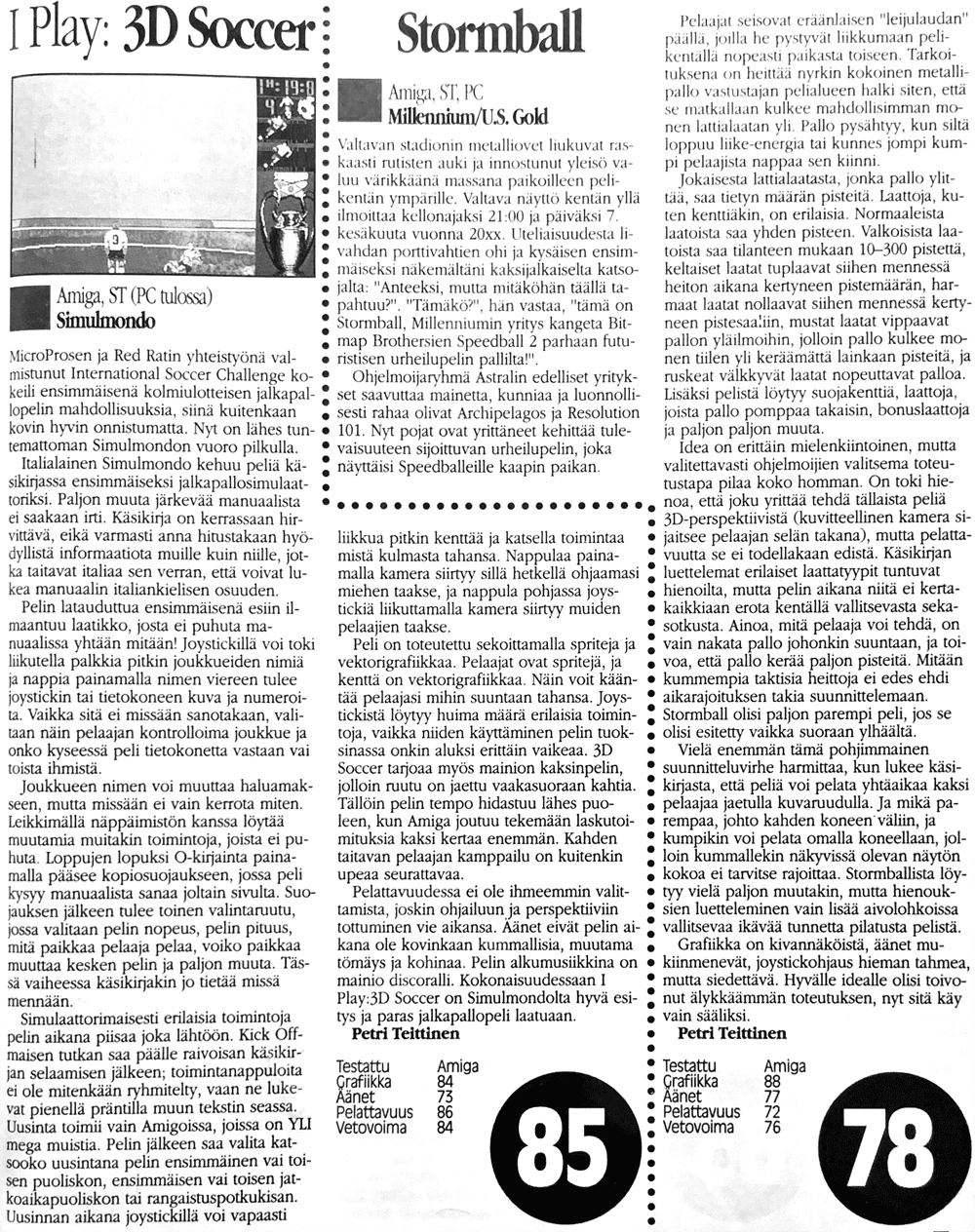
Stormball1991 SyksyPysyvä linkkiValtavan stadionin metalliovet liukuvat raskaasti rutisten auki ja innostunut yleisö valuu värikkäänä massana paikoilleen pelikentän ympärille. Valtava näyttö kentän yllä ilmoittaa kellonajaksi 21:00 ja päiväksi 7. kesäkuuta vuonna 20xx. Uteliaisuudesta livahdan porttivahtien ohi ja kysäisen ensimmäiseksi näkemältäni kaksijalkaiselta katsojalta: "Anteeksi, mutta mitäköhän täällä tapahtuu?". "Tämäkö?", hän vastaa, "tämä on Stormball, Millenniumin yritys kangeta Bitmap Brothersien Speedball 2 parhaan futuristisen urheilupelin pallilta!".
Ohjelmoijaryhmä Astralin edelliset yritykset saavuttaa mainetta, kunniaa ja luonnollisesti rahaa olivat Archipelagos ja Resolution 101. Nyt pojat ovat yrittäneet kehittää tulevaisuuteen sijoittuvan urheilupelin, joka näyttäisi Speedballeille kaapin paikan.
Pelaajat seisovat eräänlaisen "leijulaudan" päällä, joilla he pystyvät liikkumaan pelikentällä nopeasti paikasta toiseen. Tarkoituksena on heittää nyrkin kokoinen metallipallo vastustajan pelialueen halki siten, että se matkallaan kulkee mahdollisimman monen lattialaatan yli. Pallo pysähtyy, kun siltä loppuu liike-energia tai kunnes jompi kumpi pelaajista nappaa sen kiinni.
Jokaisesta lattialaatasta, jonka pallo ylittää, saa tietyn määrän pisteitä. Laattoja, kuten kenttiäkin, on erilaisia. Normaaleista laatoista saa yhden pisteen. Valkoisista laatoista saa tilanteen mukaan 10-300 pistettä, keltaiset laatat tuplaavat siihen mennessä heiton aikana kertyneen pistemäärän, harmaat laatat nollaavat siihen mennessä kertyneen pistesaaliin, mustat laatat vippaavat pallon yläilmoihin, jolloin pallo kulkee monen tiilen yli keräämättä lainkaan pisteitä, ja ruskeat välkkyvät laatat nopeuttavat palloa. Lisäksi pelistä löytyy suojakenttiä, laattoja, joista pallo pomppaa takaisin, bonuslaattoja ja paljon paljon muuta.
Idea on erittäin mielenkiintoinen, mutta valitettavasti ohjelmoijien valitsema toteutustapa pilaa koko homman. On toki hienoa, että joku yrittää tehdä tällaista peliä 3D-perspektiivistä (kuvitteellinen kamera sijaitsee pelaajan selän takana), mutta pelattavuutta se ei todellakaan edistä. Käsikirjan luettelemat erilaiset laattatyypit tuntuvat hienoilta, mutta pelin aikana niitä ei kertakaikkiaan erota kentällä vallitsevasta sekasotkusta. Ainoa, mitä pelaaja voi tehdä, on vain nakata pallo johonkin suuntaan, ja toivoa, että pallo kerää paljon pisteitä. Mitään kummempia taktisia heittoja ei edes ehdi aikarajoituksen takia suunnittelemaan. Stormball olisi paljon parempi peli, jos se olisi esitetty vaikka suoraan ylhäältä.
Vielä enemmän tämä pohjimmainen suunnitteluvirhe harmittaa, kun lukee käsikirjasta, että peliä voi pelata yhtäaikaa kaksi pelaajaa jaetulla kuvaruudulla. Ja mikä parempaa, johto kahden koneen väliin, ja kumpikin voi pelata omalla koneellaan, jolloin kummallekin näkyvissä olevan näytön kokoa ei tarvitse rajoittaa. Stormballista löytyy vielä paljon muutakin, mutta hienouksien luetteleminen vain lisää aivolohkoissa vallitsevaa ikävää tunnetta pilatusta pelistä.
Grafiikka on kivannäköistä, äänet mukiinmenevät, joystickohjaus hieman tahmea, mutta siedettävä. Hyvälle idealle olisi toivonut älykkäämmän toteutuksen, nyt sitä käy vain sääliksi.
Stormball1991 SyksyPermalinkThe metal doors of the huge stadium slide open with a heavy grinding creak, and the excited crowd flows in a colourful mass to its places around the playing field. A giant screen above the field gives the time as 21:00 and the date as 7 June, 20xx. Out of curiosity I slip past the gate guards and ask the first two-legged spectator I see: "Excuse me, but what might be going on here?" "This?" comes the reply, "this is Stormball, Millennium's attempt to prise the Bitmap Brothers' Speedball 2 off its perch as the best futuristic sports game!"
Programming team Astral's previous attempts to win fame, glory and, naturally, money were Archipelagos and Resolution 101. Now the boys have tried to come up with a sports game set in the future that would show the Speedballs who's boss.
The players stand on a kind of "hoverboard" that lets them move quickly from one spot to another on the field. The idea is to throw a fist-sized metal ball across the opponent's area so that on its way it passes over as many floor tiles as possible. The ball stops when it runs out of kinetic energy or when one of the players catches it.
Every floor tile the ball crosses earns a certain number of points. Tiles, like the arenas, come in different kinds. Normal tiles give one point. White tiles give 10-300 points depending on the situation, yellow tiles double the points racked up during the throw so far, grey tiles wipe out the haul collected so far, black tiles flip the ball up into the air so that it passes over a whole row of tiles without collecting any points at all, and brown flickering tiles speed the ball up. On top of that the game has force fields, tiles the ball bounces back off, bonus tiles and much, much more.
The idea is extremely interesting, but unfortunately the approach the programmers chose ruins the whole thing. Sure, it's great that someone is trying to do a game like this in 3D perspective (the imaginary camera sits behind the player's back), but it certainly does nothing for the playability. The various tile types listed in the manual sound great, but during play you simply cannot tell them apart in the jumble that reigns on the field. The only thing the player can do is just chuck the ball in some direction and hope it racks up lots of points. Thanks to the time limit, you don't even have time to plan any fancier tactical throws. Stormball would be a much better game if it had been shown from, say, directly above.
This fundamental design flaw rankles even more when you read in the manual that two players can play at the same time on a split screen. And what's better, run a cable between two machines and each player can play on their own computer, so neither one's visible screen has to be cut down in size. Stormball has plenty more to it besides, but listing the niceties only adds to the nasty feeling of a ruined game that hangs over my brain lobes.
The graphics look nice, the sound is passable, the joystick control a bit sticky but bearable. You'd have hoped for a smarter execution of a good idea; as it is, you can only feel sorry for it.
Stormlord
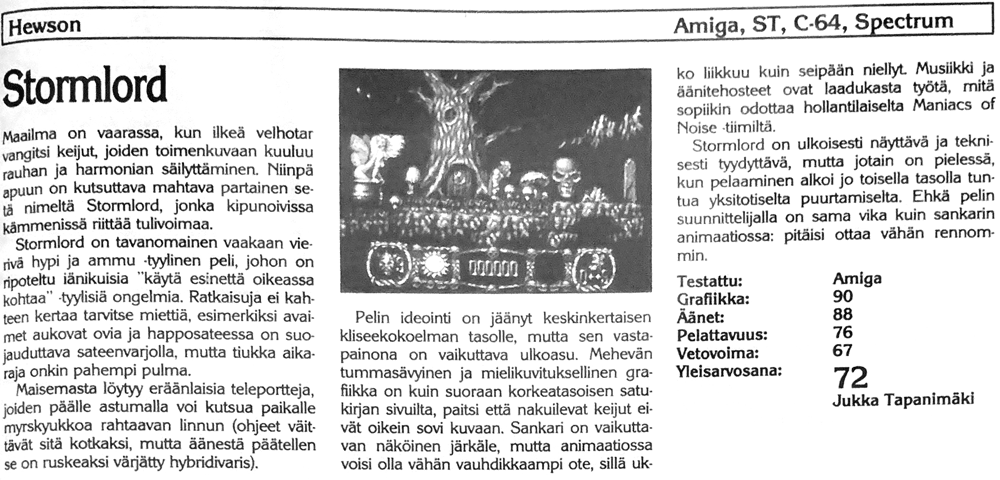
Stormlord1990 KevätPysyvä linkkiMaailma on vaarassa, kun ilkeä velhotar vangitsi keijut, joiden toimenkuvaan kuuluu rauhan ja harmonian säilyttäminen. Niinpä apuun on kutsuttava mahtava partainen setä nimeltä Stormlord, jonka kipunoivissa kämmenissä riittää tulivoimaa.
Stormlord on tavanomainen vaakaan vierivä hypi ja ammu -tyylinen peli, johon on ripoteltu iänikuisia "käytä esinettä oikeassa kohtaa" -tyylisiä ongelmia. Ratkaisuja ei kahteen kertaa tarvitse miettiä, esimerkiksi avaimet aukovat ovia ja happosateessa on suojauduttava sateenvarjolla, mutta tiukka aikaraja onkin pahempi pulma.
Maisemasta löytyy eräänlaisia teleportteja, joiden päälle astumalla voi kutsua paikalle myrskyukkoa rahtaavan linnun (ohjeet väittävät sitä kotkaksi, mutta äänestä päätellen se on ruskeaksi värjätty hybridivaris).
Pelin ideointi on jäänyt keskinkertaisen kliseekokoelman tasolle, mutta sen vastapainona on vaikuttava ulkoasu. Mehevän tummasävyinen ja mielikuvituksellinen grafiikka on kuin suoraan korkeatasoisen satukirjan sivuilta, paitsi että nakuilevat keijut eivät oikein sovi kuvaan. Sankari on vaikuttavan näköinen järkäle, mutta animaatiossa voisi olla vähän vauhdikkaampi ote, sillä ukko liikkuu kuin seipään niellyt. Musiikki ja äänitehosteet ovat laadukasta työtä, mitä sopiikin odottaa hollantilaiselta Maniacs of Noise -tiimiltä.
Stormlord on ulkoisesti näyttävä ja teknisesti tyydyttävä, mutta jotain on pielessä, kun pelaaminen alkoi jo toisella tasolla tuntua yksitotiselta puurtamiselta. Ehkä pelin suunnittelijalla on sama vika kuin sankarin animaatiossa: pitäisi ottaa vähän rennommin.
Stormlord1990 KevätPermalinkThe world is in danger, because a wicked sorceress has captured the fairies, whose job description includes preserving peace and harmony. So help must be summoned in the shape of a mighty bearded old fellow called Stormlord, whose crackling palms pack plenty of firepower.
Stormlord is an ordinary horizontally scrolling jump-and-shoot type of game, sprinkled with age-old "use the object in the right spot" type puzzles. You don't need to think twice about the solutions - keys open doors, for example, and in acid rain you have to shelter under an umbrella - but the tight time limit turns out to be a nastier problem.
Dotted around the landscape are teleporters of a sort; step onto one and you can summon a bird that hauls the old storm geezer about (the instructions claim it's an eagle, but judging by the sound it's a hybrid crow dyed brown).
The game's ideas have stalled at the level of a middling collection of clichés, but as a counterweight there's an impressive presentation. The juicily dark-toned and imaginative graphics look as if they came straight from the pages of a high-class storybook, except that the naked fairies don't quite fit the picture. The hero is an impressive-looking hulk, but the animation could use a bit more pep, as the old boy moves as if he'd swallowed a ramrod. The music and sound effects are quality work, which is just what you'd expect from the Dutch Maniacs of Noise team.
Stormlord is outwardly striking and technically satisfactory, but something is amiss when the playing started to feel like a humourless slog as early as the second level. Maybe the game's designer has the same flaw as the hero's animation: could do with taking it a bit easier.
Street Fighter
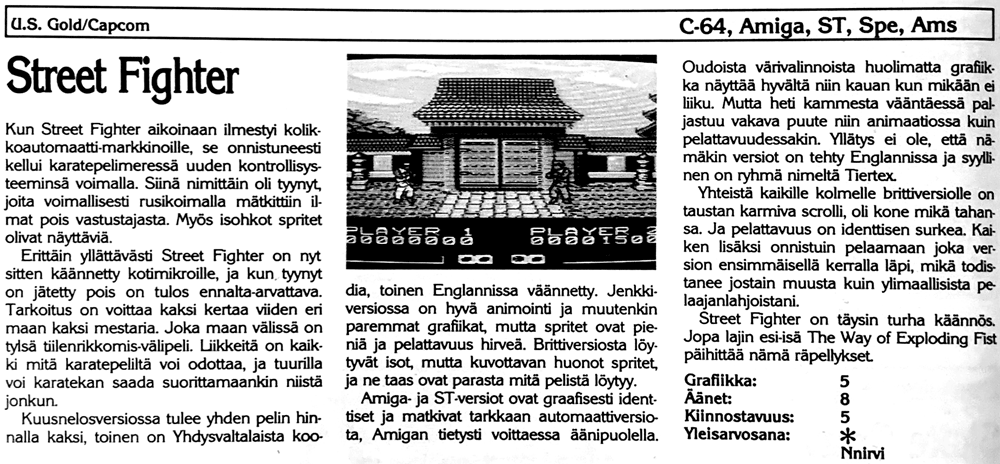
Street Fighter1988Pysyvä linkkiKun Street Fighter aikoinaan ilmestyi kolikkoautomaatti-markkinoille, se onnistuneesti kellui karatepelimeressä uuden kontrollisysteeminsä voimalla. Siinä nimittäin oli tyynyt, joita voimallisesti rusikoimalla mätkittiin ilmat pois vastustajasta. Myös isohkot spritet olivat näyttäviä.
Erittäin yllättävästi Street Fighter on nyt sitten käännetty kotimikroille, ja kun tyynyt on jätetty pois on tulos ennalta-arvattava. Tarkoitus on voittaa kaksi kertaa viiden eri maan kaksi mestaria. Joka maan välissä on tylsä tiilenrikkomis-välipeli. Liikkeitä on kaikki mitä karatepeliltä voi odottaa, ja tuurilla voi karatekan saada suorittamaankin niistä jonkun.
Kuusnelosversiossa tulee yhden pelin hinnalla kaksi, toinen on Yhdysvaltalaista koodia, toinen Englannissa väännetty. Jenkkiversiossa on hyvä animointi ja muutenkin paremmat grafiikat, mutta spritet ovat pieniä ja pelattavuus hirveä. Brittiversiosta löytyvät isot, mutta kuvottavan huonot spritet, ja ne taas ovat parasta mitä pelistä löytyy.
Amiga- ja ST-versiot ovat graafisesti identtiset ja matkivat tarkkaan automaattiversiota, Amigan tietysti voittaessa äänipuolella. Oudoista värivalinnoista huolimatta grafiikka näyttää hyvältä niin kauan kun mikään ei liiku. Mutta heti kammesta vääntäessä paljastuu vakava puute niin animaatiossa kuin pelattavuudessakin. Yllätys ei ole, että nämäkin versiot on tehty Englannissa ja syyllinen on ryhmä nimeltä Tiertex.
Yhteistä kaikille kolmelle brittiversiolle on taustan karmiva scrolli, oli kone mikä tahansa. Ja pelattavuus on identtisen surkea. Kaiken lisäksi onnistuin pelaamaan joka version ensimmäisellä kerralla läpi, mikä todistanee jostain muusta kuin ylimaallisista pelaajanlahjoistani.
Street Fighter on täysin turha käännös. Jopa lajin esi-isä The Way of Exploding Fist päihittää nämä räpellykset.
Street Fighter1988PermalinkWhen Street Fighter first appeared on the coin-op market, it stayed successfully afloat in the sea of karate games on the strength of its new control system. It had pads, you see, which you pummelled with all your might to knock the wind out of your opponent. The biggish sprites were impressive too.
Most surprisingly, Street Fighter has now been converted to home computers, and with the pads left out the result is predictable. The aim is to beat the two champions of five different countries, twice over. Between each country there's a dull brick-breaking interlude. The moves are everything you could expect from a karate game, and with luck you might even get your karateka to actually perform one of them.
The C-64 version gives you two for the price of one: one is American code, the other was knocked together in England. The Yank version has good animation and better graphics all round, but the sprites are small and the playability is terrible. The British version has big but sickeningly bad sprites, and those, in turn, are the best thing the game has to offer.
The Amiga and ST versions are graphically identical and faithfully mimic the arcade version, with the Amiga naturally winning on the sound front. Despite some odd choices of colour, the graphics look good as long as nothing moves. But the moment you start wrenching the stick, a serious deficiency is exposed in both animation and playability. It comes as no surprise that these versions were made in England too, and the culprit is a team called Tiertex.
Common to all three British versions is the dreadful background scrolling, whatever the machine. And the playability is identically miserable. On top of all that, I managed to play every version through on my first go, which presumably proves something other than my otherworldly gaming talent.
Street Fighter is a completely pointless conversion. Even the forefather of the genre, The Way of Exploding Fist, beats these botch-ups.
Street Hassle
Street Hassle1988Pysyvä linkkiHän oli peruskoulunopettaja, kunnes "he" menivät liian pitkälle... Kaupunki on täynnä saastaa, jonkun on puhdistettava kadut. Kultaisiin taistelualushousuihin sonnustautuneena, paljaisiin nyrkkeihinsä luottavana sankarimme ryhtyy taistoon.
Tappelupelejä on miljoona, mutta Street Hassle nousee massasta pelkästään omaperäisyytensä voimalla. Alushousumies ottaa nimittäin mittaa sellaisista vaaroista kuin valkoisia keppejä heiluttelevat sokeat, käsilaukkua tappavasti käyttelevät pikkumummelit, koirat ja gorillat. Varsinaisia taisteluliikkeitä sankari osaa vain kolme, nimittäin kierrepotku, korvista vääntö ja jalat alta -nykäisy.
Vaikka mummunpotkimishuumori tässä maassa ei olekaan mikään nauruaihe, ei tosiasioita ole kieltäminen. Street Hassle on hauska. Sairas, mutta hauska. Vain happamin moralisti voi olla hymyilemättä kun oikeustaistelija vanuttaa sokeaa korvista tai nykäisee mummelilta jalat alta.
Grafiikka on erinomaista. Hahmot ovat suuria ja erinomaisesti animoituja. Varsinkin kahdestaan pelatessa Street Hassle on erinomaisen huvittava, yksinpeluussa se kärsii samasta viasta kuin muutkin beat'em-upit: puu alkaa maistua nopeasti.
Melbourne House on pitkän aikaa työntänyt markkinoille vain kehnoa puppua, joten Street Hassle on ilahduttava poikkeus. Muistakaa nyt kuitenkin että vaikka tämäntyyppinen väkivalta saattaa TV:ssä ja peleissä näyttää hauskalta, vain lattaotsaisin älykääpiö harrastaa sitä luonnossa. (Kaupunkimiljöö sopii siihen paremmin.)
Street Hassle1988PermalinkOnce a comprehensive school teacher, until "they" went too far... The city is full of filth; someone has to clean up the streets. Decked out in golden combat underpants and trusting in bare fists, our hero enters the fray.
There are a million fighting games, but Street Hassle rises above the mass on originality alone. Underpants Man, you see, takes on such perils as blind people waving white canes, little old grannies wielding handbags to deadly effect, dogs and gorillas. The hero knows only three proper fighting moves, namely the spin kick, the ear-wrench and the legs-out-from-under yank.
Although granny-kicking humour is no laughing matter in this country, there's no denying the facts. Street Hassle is funny. Sick, but funny. Only the sourest moralist can keep from smiling when the fighter for justice twists a blind person's ears or yanks the legs out from under a granny.
The graphics are excellent. The characters are big and excellently animated. Especially when played by two, Street Hassle is excellently entertaining; played solo, it suffers from the same flaw as the other beat'em-ups: it soon starts tasting of sawdust.
For a long time Melbourne House has been pushing nothing but shoddy drivel onto the market, so Street Hassle is a welcome exception. But do remember that although this kind of violence may look funny on TV and in games, only the flattest-browed intellectual pygmy practises it in the wild. (An urban setting suits it better.)
Street Sports Baseball
Street Sports Baseball1988Pysyvä linkkiViimeinen vuoropari on menossa ja lyöntivuorossa on David. Hän on kuuluisa kantavista lyönneistään. Syöttäjänä on Brad, joka on joutunut tehtävään juoksunopeutensa takia. Brad juoksee kuin etana, mutta heittää tappavan kovia syöttöjä. Hän miettii hetken, heilauttaa sitten käsivarttaan ja pallo suhahtaa kohti lyöjää. PAM! Kierteestä huolimatta David osuu palloon ja sinkauttaa sen yläilmoihin syöksyen välittömästi kohti ykköspesää, vanhaa pahvilaatikkoa. Takakentän koppari Kitty juoksee kohti putoavaa palloa ja on juuri saamaisillaan kopin... mutta kompastuukin pensaaseen. Kittyn kömpiessä pystyyn David on jo menossa kakkospesälle. Kitty heittää pallon viimeinkin - miten käy? David heittäytyy kakkospesälle, joka on vanha auton rengas, mutta FLOP! Butch nappaa heiton kiinni vuorenvarmasti ja polttaa Davidin viime hetkellä.
Tällaista on baseball Epyxin uudessa Street Sports -sarjassa, jossa realismi saa aivan uudenlaiset mittasuhteet. Joukkueet muodostetaan kuudentoista erilaisen nuoren pelaajanalun joukosta. Jokaisella on oma persoonallisuutensa, kykynsä ja heikot kohtansa. Pelaajan tehtävä on muodostaa valitsemistaan pelaajista mahdollisimman onnistunut joukkue, jonka jäsenet on kykyjensä mukaan sijoitettu eri tehtäviin: hyvät kiinniottajat ja nopeat heittäjät pesille ja pitkiä kaaria viskovat pelaajat takakentälle. Pelaajien tuntemus auttaa joukkueen kokoamisessa ja strategiset valinnat lyöntijärjestyksessä saattavat olla avain voittoon tai tappioon.
Paitsi ideallaan SS Baseball loistaa myös toteutuksellaan, joka on huippuluokkaa. Pelattaessa jommalla kummalla kahdesta kenttävaihtoehdosta (nurmikko tai pysäköintialueen asvaltti) seurataan kentän tapahtumia kahdesta ikkunasta. Oikealla näkyy kenttä lintuperspektiivistä. Siitä voi seurata pelin kulkua kokonaisuutena. Vasemmanpuoleinen ikkuna kuvaa kulloinkin toiminnassa olevaa pelaajaa, joko syöttäjää ja kotipesää, ykköspesää, kakkospesää, kolmospesää tai takamiehiä.
Ohjaus on hyvin toimivaa ja peliä voi pelata joko kaveriaan tai tietokonetta vastaan. Peli aloitetaan heittämällä lanttia (tyylikäs animaatio) siitä, kumpi joukkueesta pelaa ensimmäisen vuoroparin sisällä. Voittanut saa myös valita ensimmäisen pelaajan ja sen jälkeen edetään vuorotellen, kunnes molemmat joukkueet on koottu. Toki on mahdollista valita myös levylle aiemmin valitut ja tallennetut joukkueet. Varsinainen ilonpito alkaa kuitenkin siitä, kun päästään itse peliin. Takapihan mestaruussarjassa jännitystä riittää siinä missä virallisessa pesäpallosarjassakin, vieläpä enemmän, sillä kaikenlaista voi pelin tuoksinassa tapahtua ja varmasti tapahtuukin.
Visuaalinen toteutus on erinomainen; kaikki pelaajat voi tunnistaa spriteistä ja animaatioon on kiinnitetty huomiota. Ääniä on suhteellisen vähän, mutta parempi niukalti onnistunutta kuin paljon epäonnistunutta. Epyx on jälleen tuottanut urheilupelien ystäville todellisen pakkohankinnan. Sarjaa jatkava Street Sports Basketball on jo valmis. Jään jännittyneenä odottelemaan sarjan muita osia, siihen asti valmennan junioripesisjoukkuettani.
Street Sports Baseball1988PermalinkThe last inning is under way and David is up at bat. This batter is famous for long, carrying hits. The pitcher is Brad, who has ended up in the role because of running speed. Brad runs like a snail but throws deadly hard pitches. A moment's thought, then a swing of the arm, and the ball whizzes towards the batter. BAM! Despite the spin David connects with the ball and launches it sky-high, instantly dashing for first base, an old cardboard box. Outfield catcher Kitty runs for the falling ball and is just about to make the catch... but trips over a bush instead. By the time Kitty scrambles up, David is already on the way to second base. Kitty finally throws the ball - what will happen? David dives for second base, which is an old car tyre, but FLOP! Butch catches the throw rock-solid and puts David out at the very last moment.
That's baseball in Epyx's new Street Sports series, where realism takes on whole new proportions. The teams are picked from sixteen different budding young players. Each has their own personality, skills and weak spots. Your task as the player is to build the most successful team you can out of the players you pick, placing its members in different positions according to their abilities: good catchers and fast throwers on the bases, and the players who hurl long arcs in the outfield. Knowing the players helps in putting the team together, and strategic choices in the batting order can be the key to victory or defeat.
SS Baseball shines not only in its idea but also in its execution, which is top class. Whichever of the two fields you play on (a lawn or the asphalt of a parking lot), you follow the action on the field through two windows. On the right you see the field from a bird's-eye view. From there you can follow the course of the game as a whole. The left-hand window shows whichever player is in action at the moment: the pitcher and home plate, first base, second base, third base or the outfielders.
The controls work very well, and you can play either against a friend or against the computer. The game begins with a coin toss (a stylish animation) to decide which team bats first. The winner also gets to pick the first player, and after that you take turns until both teams are complete. Of course you can also pick teams that were chosen earlier and saved to disk. The real fun, though, begins when you get to the game itself. The backyard championship league has every bit as much excitement as the official baseball league, even more, since all sorts of things can happen in the heat of the game, and they certainly do.
The visuals are excellent; every player can be recognised from their sprite, and care has gone into the animation. There is relatively little sound, but better a little that works than a lot that doesn't. Epyx has once again produced a genuine must-buy for sports game fans. The next in the series, Street Sports Basketball, is already finished. I'll be waiting eagerly for the rest of the series; until then I'll be coaching my junior pesäpallo team.
Street Sports Soccer
Street Sports Soccer1989 KevätPysyvä linkkiMaailman tunnetuin urheilupelien tuottaja Epyx on vaihteeksi jatkanut katu-urheilupeliensä sarjaa. Aikaisemmin Epyx-käsittelyn ovat saaneet Street Sports Baseball ja Basketball, nuo amerikkalaisen jalkapallon lisäksi suosituimmat lajit rapakon väärällä puolella. Nyt sitten yritetään kosiskella eurooppalaisia penkkiurheilijoita meille tutummalla lajilla eli jalkapallolla.
Pelissä valitaan aluksi tuttuun tapaan ryvetäänkö mutaisella nurmikolla vai saadaanko polvet verille sivistyneesti asfaltilla. Sitten joko annetaan tietokoneen arpoa joukkueet tai valitaan itse kolmihenkinen kriminaalijoukkue yhdeksästä kadun kauhukakarasta. Jokaisella pikku paholaisella on omat hyvät puolensa, tytöilläkin (Ei minulla ole mitään tyttöjä vastaan, mutta en silti antaisi siskoni mennä sellaisen kanssa naimisiin). Totutusti voi valita pelaako kaveria vai tietokonetta vastaan.
Pelissä huomaa, että kehitys on kulkenut eteenpäin. Pallon voi ampua maalin keskelle, laitaan, ylä- tai alanurkkaan. Palloon saa kierrettä syötöissäkin, niin että varmasti menettää pallon vastustajalle. Vastustaja saa rangaistuspotkun pelissä harrastetusta väkivallasta. Peli saa kuitenkin ison miinuksen pelaajien identtisestä vauhdista kentällä.
Vaikka Street Sports Soccer onkin jalkapallona melko monipuolinen, ei se silti saanut oikein innostumaan. Siinä ei loppujen lopuksi ole mitään erikoista, vaikka jalkapallon ystävät voivat toisin väittää. Toteutukseltaan peli ei aivan ole normaalia Epyx-tasoa, sillä äänitehosteet ovat olemattomat ja grafiikassa häiritsevät liian pienet pelaajahahmot. Pölyttyköön tämäkin peli jalkapallofanien hyllyillä.
Street Sports Soccer1989 KevätPermalinkEpyx, the best-known producer of sports games in the world, has for a change continued its series of street sports games. Earlier, Street Sports Baseball and Basketball got the Epyx treatment - those being, alongside American football, the most popular sports on the wrong side of the pond. Now the idea is to court European armchair athletes with a sport more familiar to us, namely football.
As usual, the game starts with choosing whether to wallow on a muddy lawn or to bloody your knees in a civilised manner on asphalt. Then you either let the computer draw the teams or pick your own three-strong criminal gang from nine terrors of the street. Every little devil has its own good points, even the girls (I've got nothing against girls, but I still wouldn't let my sister marry one). As you'd expect, you can choose whether to play against a mate or the computer.
You can tell from the game that progress has marched on. The ball can be shot into the middle of the goal, to the side, or into the top or bottom corner. You can put spin on the ball even when passing, so that you're sure to lose it to the opponent. The opponent gets a penalty kick for the violence indulged in during play. The game does, however, earn a big minus for the players' identical speed on the pitch.
Although Street Sports Soccer is fairly versatile as football goes, it still didn't really get me going. When all's said and done there's nothing special about it, though football lovers may claim otherwise. In execution the game isn't quite up to the usual Epyx standard, since the sound effects are non-existent and in the graphics the far too small player figures are a nuisance. Let this game, too, gather dust on football fans' shelves.
Strider
Strider1990 KevätPysyvä linkkiU.S. Gold on liian usein luottanut lisenssissä nimeen, eikä ole kiinnittänyt huomiota itse pelin laatuun. Hallelujaa, ilmeisesti valo on nähty, sillä Strider jatkaa Forgotten Worldsin aloittamaa laatulinjaa.
Glasnost-hengestä ei Strideria voi syyttää. Pelaajan tarkoitus on osapuilleen nitistää niin Puna-armeija kuin KGB:kin, ja hauskaksi lopuksi tuhota Kommunistisen puolueen puheenjohtaja. Peli nyt kuitenkin sijoittuu tulevaisuuteen, joten toivottavasti kansanedustajat tällä kertaa malttavat luopua irtopisteiden keräilystä.
Normaalista "minä pompin, minä ammun, niin kuin leikki peli käy"-pelistä Striderin erottaa varsinaisesti se, että Strider ei ammuskele. Sen sijaan hän heiluttelee energiamiekkaansa. Tuttuun tapaan löytyy tasonloppuhirviöitä, mainittakoon vaikka robottikäärmeeksi muuttuva politbyro, ja miehen taistelupotenssia kohottavia bonusesineitä. Atleettinen Strider pystyy myös ketterästi etenemään pintaa kuin pintaa kallistuskulmasta huolimatta. Tämä kaikki riittää pitämään monotonisuuden aisoissa.
Amiga tarjoaa mellevää grafiikkaa, ja ottaen huomioon Street Fighterissä/HKM:ssä möhlineen Tiertexin, myös kohtalaisesti animoituna. Useampikin raami on tosin jäänyt välistä, mutta se ei onneksi häiritse pelattavuutta, sillä Tiertex on malttanut luopua hidastetun filmin emuloinnista. Digitoiduista efekteistä vaikuttavin on Game Overia ryydittävä räkänauru.
Kuusnelosen versio on aivan OK, huomauttamista löytyy lähinnä siitä, että Amigaversiota mittapuuna käyttäen siitä löytyy vain pelin runko. Mausteet eli erilaiset ansat esimerkiksi eivät ole mahtuneet mukaan. Amigalla opittua pelityyliäkään ei voi siirtää sellaisenaan kuusneloseen, ja muutenkin kuusnelosen versio tuntuu vaikeammalta.
Ulkomaiset lehdet ovat kehuneet Strideria tarkimmaksi arcadekäännökseksi aikoihin, ilmeisesti siitä ilosta että saivat tehdä arvostelun pari tuntia toimituksissa viivähtäneestä previkkaversiosta. Ihan näin pitkälle en menisi peliä kehumaan, mutta kieltämättä se on kelpo käännös hyvästä pelistä.
Strider1990 KevätPermalinkWith its licences, U.S. Gold has all too often relied on the name and paid no attention to the quality of the game itself. Hallelujah, the light has apparently been seen, as Strider continues the line of quality begun by Forgotten Worlds.
Strider can hardly be accused of the spirit of glasnost. The player's task is, roughly speaking, to squash both the Red Army and the KGB, and as a jolly finale to destroy the chairman of the Communist Party. The game is set in the future, though, so hopefully this time our MPs can resist the urge to score some cheap points.
What really sets Strider apart from the normal "I jump, I shoot, that's the way the game goes" game is that Strider doesn't shoot. Instead he waves his energy sword about. As usual there are end-of-level monsters - the Politburo that turns into a robot serpent deserves a mention, for instance - and bonus items that boost the man's fighting potency. The athletic Strider can also nimbly make his way across any surface whatsoever, regardless of its angle. All this is enough to keep the monotony in check.
The Amiga serves up juicy graphics, and, considering this is Tiertex, who botched Street Fighter/HKM, reasonably well animated too. Quite a few frames have been skipped, admittedly, but luckily that doesn't hurt the playability, since Tiertex has managed to give up emulating slow-motion film. The most impressive of the digitised effects is the phlegmy cackle that seasons the Game Over.
The C-64 version is quite OK; the main complaint is that, using the Amiga version as the yardstick, all it has is the bare skeleton of the game. The seasoning, for example the various traps, didn't fit in. Nor can a playing style learned on the Amiga be carried over as such to the C-64, and in general the C-64 version feels harder.
Foreign magazines have praised Strider as the most faithful arcade conversion in ages, apparently out of sheer joy at getting to review a preview copy that lingered in their offices for a couple of hours. I wouldn't go quite that far in praising the game, but admittedly it is a decent conversion of a good game.
Strider 2
Strider 21991 KevätPysyvä linkkiMahtaisikohan Striderin naurettavan kokoiseen jättipakkaukseen sisältyä tiettyä allegoriaa? Siis että niin paketissa kuin pelissäkin on 90 prosenttia ilmaa? Ainakin tämä Striderin jatko-osa ykköstä pienemmällä grafiikalla, haiskahtaa kovin hätäisesti kyhätyltä.
Ykkösosassa vetreästi seinillä kiipeilevä sankari rynnisti Venäjän maalle perestroikan kuplaa puhkaisemaan. Sitä samaa rynnäköintiä on luvassa jatko-osassakin. Tahmeiden näppien lisäksi fyysisiin kykyihin kuuluu korkea kärrynpyörävoltti ja aseosastosta löytyy miekan tapainen sohimisväline sekä laseriksi nimitettävä pyssy, josta ei tietenkään lähde sädettä, vaan epämääräinen klöntti, kuten tyyliin kuuluu (en ole koskaan ymmärtänyt, miksi niitä kutsutaan lasereiksi).
Pelattava perusidea on pilattu tökeröllä vierityksellä ja vähän oudommilla mokilla, kuten että ammuttaessa laukaus lähtee vasta kun napin päästää ylös ja hypätessä sankari levitoi ilmassa liian pitkään, minkä seurauksena laskeutumispaikalle on yleensä ehtinyt kertyä aimo jenki epäystävällistä sotakalustoa. Juoksuaskelten tauottua taukki sankari ei osaa päättää käyttäisikö miekkaa vai laseria, joten on parempi pysyä jatkuvasti liikkeessä ja heilutella asetta minkä kerkiää.
Parhaimmillaan peli on vauhdikkaissa kiipeilyosuuksissa, jossa pelin tylsä peruskuvio vasemmalta oikealle ryntäilyineen mukavasti rikkoutuu. Sen sijaan tasojen lopussa olevat transformaatiot robotiksi lipsahtavat antikliimaksin puolelle. Mokoma romu kun ei voi tehdä juuri muuta kuin nyhjöttää paikallaan ja syytää ammuksia.
Ideassa ei ole mitään vikaa, mutta toteutus on niin valju, veretön ja suorastaan amatöörimäinen, että jo ensimmäisen pelikerran jälkeen pelipakkauksen näkeminen aiheuttaa vakavia hylkimiskomplikaatioita aivoissa.
Strider 21991 KevätPermalinkCould there be a certain allegory in Strider's ridiculously sized giant box? That is, that the package and the game alike are 90 per cent air? At any rate this Strider sequel, with smaller graphics than the first one, reeks of having been very hastily knocked together.
In the first part, the nimbly wall-climbing hero stormed onto Russian soil to burst the bubble of perestroika. The same storming is in store in the sequel too. Besides sticky fingers, the hero's physical abilities include a high cartwheel flip, and the weapons department offers a sword-like prodding implement plus a gun that goes by the name of laser, which naturally fires no beam but a nondescript blob, as is the custom (I've never understood why they're called lasers).
The playable basic idea has been ruined by clumsy scrolling and some rather stranger blunders, such as the shot only going off when you let go of the button, and the hero levitating in the air for too long when jumping, with the result that a hefty gang of unfriendly military hardware has usually had time to gather at the landing spot. Once the running steps stop, the dimwit hero can't decide whether to use the sword or the laser, so it's better to stay constantly on the move and wave your weapon about as fast as you can.
The game is at its best in the fast-moving climbing sections, where the dull basic pattern of dashing from left to right is nicely broken up. The transformations into a robot at the ends of the levels, on the other hand, slip into anticlimax territory. The blasted heap of scrap can't do much besides squat on the spot and spew out shots.
There's nothing wrong with the idea, but the execution is so pallid, bloodless and downright amateurish that after just the first go, the mere sight of the game box causes serious rejection complications in the brain.
Strike Fleet
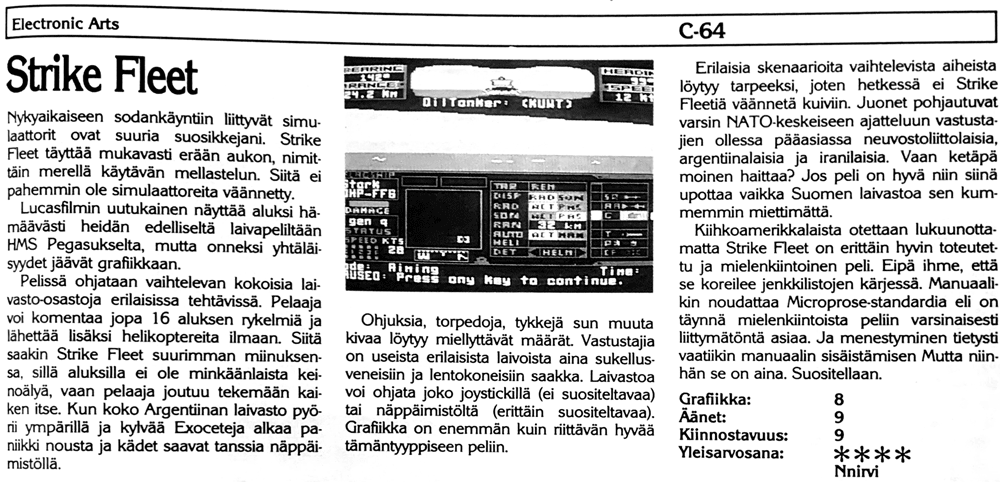
Strike Fleet1988Pysyvä linkkiNykyaikaiseen sodankäyntiin liittyvät simulaattorit ovat suuria suosikkejani. Strike Fleet täyttää mukavasti erään aukon, nimittäin merellä käytävän mellastelun. Siitä ei pahemmin ole simulaattoreita väännetty.
Lucasfilmin uutukainen näyttää aluksi hämäävästi heidän edelliseltä laivapeliltään HMS Pegasukselta, mutta onneksi yhtäläisyydet jäävät grafiikkaan.
Pelissä ohjataan vaihtelevan kokoisia laivasto-osastoja erilaisissa tehtävissä. Pelaaja voi komentaa jopa 16 aluksen rykelmiä ja lähettää lisäksi helikoptereita ilmaan. Siitä saakin Strike Fleet suurimman miinuksensa, sillä aluksilla ei ole minkäänlaista keinoälyä, vaan pelaaja joutuu tekemään kaiken itse. Kun koko Argentiinan laivasto pyörii ympärillä ja kylvää Exoceteja alkaa paniikki nousta ja kädet saavat tanssia näppäimistöllä.
Ohjuksia, torpedoja, tykkejä sun muuta kivaa löytyy miellyttävät määrät. Vastustajia on useista erilaisista laivoista aina sukellusveneisiin ja lentokoneisiin saakka. Laivastoa voi ohjata joko joystickillä (ei suositeltavaa) tai näppäimistöltä (erittäin suositeltavaa). Grafiikka on enemmän kuin riittävän hyvää tämäntyyppiseen peliin.
Erilaisia skenaarioita vaihtelevista aiheista löytyy tarpeeksi, joten hetkessä ei Strike Fleetiä väännetä kuiviin. Juonet pohjautuvat varsin NATO-keskeiseen ajatteluun vastustajien ollessa pääasiassa neuvostoliittolaisia, argentiinalaisia ja iranilaisia. Vaan ketäpä moinen haittaa? Jos peli on hyvä niin siinä upottaa vaikka Suomen laivastoa sen kummemmin miettimättä.
Kiihkoamerikkalaista otettaan lukuunottamatta Strike Fleet on erittäin hyvin toteutettu ja mielenkiintoinen peli. Eipä ihme, että se koreilee jenkkilistojen kärjessä. Manuaalikin noudattaa Microprose-standardia eli on täynnä mielenkiintoista peliin varsinaisesti liittymätöntä asiaa. Ja menestyminen tietysti vaatiikin manuaalin sisäistämisen Mutta niinhän se on aina. Suositellaan.
Strike Fleet1988PermalinkSimulators of modern warfare are big favourites of mine. Strike Fleet nicely fills a certain gap, namely the mayhem waged at sea. Not many simulators have been cranked out about that.
Lucasfilm's brand-new release deceptively looks at first like their previous ship game, HMS Pegasus, but fortunately the similarities stop at the graphics.
In the game you command naval task groups of varying size on various missions. The player can command groups of up to 16 ships and also send helicopters into the air. That is where Strike Fleet gets its biggest minus, since the ships have no artificial intelligence of any kind, and the player has to do everything personally. When the entire Argentine navy is swirling around you sowing Exocets, the panic starts to rise and your hands get to dance across the keyboard.
There are pleasing quantities of missiles, torpedoes, guns and other fun stuff. The opponents range from many different kinds of ships all the way to submarines and aircraft. You can control the fleet either with the joystick (not recommended) or from the keyboard (highly recommended). The graphics are more than good enough for this type of game.
There are enough scenarios on varied themes that Strike Fleet won't be wrung dry in a hurry. The plots rest on rather NATO-centric thinking, with the opponents mainly Soviet, Argentine and Iranian. But who's bothered by that? If the game is good, you'll sink even the Finnish navy in it without a second thought.
Apart from its rabidly pro-American slant, Strike Fleet is a very well made and interesting game. No wonder it's strutting at the top of the Yank charts. Even the manual follows the Microprose standard, i.e. it's full of interesting stuff not actually related to the game. And of course success does require you to absorb the manual. But that's how it always is. Recommended.
Strike Force Harrier
Strike Force Harrier1987Pysyvä linkki"I fly, you die!" huudan innoissani ja kylvän 1000 naulan pommeja tankkipeltoon. Kuin säestykseksi parahtaa taistelutietokoneeni ääneen. Ohjus lähestyy, bensa loppuu ja edestä tulee kolme Migiä. Korjaan, kaksi. Yksi taisi törmätä toiseen Sidewinder-ohjukseen, hehe! Pahalta näyttää, mutta kyllä tästä selvitään.
Harrier on yksi maailman parhaista maataistelukoneista ja näytteli tärkeää osaa Falklandin tapahtumissa. Harrier on sikäli mielenkiintoinen, että se on V/STOL-kone, eli siis voi nousta ja laskeutua pystysuoraan. Tämä mahdollistaa operoinnin vaikka perunapellosta. Sen lisäksi suihkusuuntaa kesken lennon vaihtamalla saa aikaiseksi erittäin mielenkiintoisia efektejä.
STF simuloi aitoja taisteluolosuhteita. Tarkoitus on puhdistaa elintilaa liikkuvia tukikohtiasi varten sekä puolustaa niitä hyökkäyksiltä pitäen silti mielessäsi lopullisen tavoitteen eli vihollisen komentokeskuksen tuhoamisen. Vastassa on it-ohjuksia, tankkeja ja Mig-23-hävittäjiä. Kaikkien niiden määrä lasketaan tuhansissa, mutta voittihan Battler Brittonkin toisen maailmansodan melkein yksin. Ja hän oli sentään vain sarjakuvasankari. Strike Force Harrierissa on aivan oikein tajuttu, että simulaattorissa pitää olla tekemistäkin. Toimintaa riittääkin maasta taivaaseen. Apuna on niin runsas määrä erilaista mittaria ja tähtäintä, että vaativinkin hi-tech-mies onnistuu. Kaikki on mitä kuvitella saattaa, eikä edes pakki puutu. Nopean grafiikan ansiosta lentäminen tuntuu nautittavalta ja graafisesti SFH on muutenkin sieltä paremmasta päästä. Erikoismaininnan arvoinen on tajuttomuusefekti, joka simuloi jyrkissä käännöksissä esiintyvää veren pakenemista päästä. Kone lentää, mutta ruutu on musta. Keskellä ilmataistelua paniikin tuntu on aito.
Kaiken kaikkiaan Strike Force Harrier on kärkipään simulaattori, jossa ei heti lennä koneesta pois. Top Fun for Top Guns!
Strike Force Harrier1987Permalink"I fly, you die!" I yell excitedly, sowing 1000-pound bombs across a field of tanks. As if to provide the accompaniment, my combat computer squawks out loud. Missile incoming, fuel running out and three MiGs dead ahead. Correction, two. One of them seems to have bumped into my second Sidewinder missile, hehe! Things look bad, but I'll pull through this yet.
The Harrier is one of the best ground-attack aircraft in the world and played an important part in the events of the Falklands. The Harrier is interesting in that it is a V/STOL aircraft, in other words it can take off and land vertically. This makes it possible to operate even out of a potato field. On top of that, by changing the direction of the jet thrust in mid-flight you can pull off some very interesting effects.
SFH simulates genuine combat conditions. The aim is to clear living space for your mobile bases and defend them against attacks, while still keeping the ultimate goal in mind, namely the destruction of the enemy command centre. Up against you are anti-aircraft missiles, tanks and MiG-23 fighters. They all number in the thousands, but then Battler Britton won the Second World War almost single-handed too. And he was only a comic-book hero, after all. Strike Force Harrier has quite rightly grasped that a simulator has to give you something to do as well. And there's action aplenty, from the ground to the heavens. To help you along there is such an abundance of gauges and gunsights that even the most demanding hi-tech man can't go wrong. It has everything you could possibly imagine, and not even the reverse gear is missing. Thanks to the fast graphics flying feels like a treat, and graphically SFH is up at the better end of the scale in other respects too. Worthy of special mention is the blackout effect, which simulates the blood draining from your head in steep turns. The plane keeps flying, but the screen goes black. In the middle of a dogfight the feeling of panic is the real thing.
All in all, Strike Force Harrier is a top-flight simulator that won't send you flying out of the cockpit right away. Top Fun for Top Guns!
Stryx
Stryx1990 KevätPysyvä linkkiRobottien vallankumouksen ehkäisemiseksi on kaksi keinoa: Asimovin kehittelemät robotiikan pääsäännöt tai rajoitettu elinikä Blade Runnerin tyyliin. Tämän pelin maailmassa on sovellettu jälkimmäistä, mutta huonolla menestyksellä. Robotit nimittäin päättivät sanoa irti työsopimuksensa elinvoimaa säätelevän päätietokoneen kanssa. Niinpä Stryx-cyborgin on aika pistää piuhat kiinni ja ryhtyä robottipoliisin hommiin.
Tunnelmaan virittävän alkudemon jälkeen Stryx ryhtyy kärventämään kapinallisten mikropiirejä kupolikaupungin taso- ja tikapuumaisemassa. Siellä odottavat poimijaansa liikkumista helpottava suihkureppu ja muut tarvekalut. Tasohyppelyrutiinin katkaisee louhinta-aluksella törmäily kaupungin alla olevassa luolaverkostossa sekä huristeleminen seuraavaan kaupunkiin suihkupyörän satulassa. Touhun tekosyyksi on kehitelty värikoodattu tuhosysteemi, joka on avain mekanolelujen hallitsemiseen.
Stryxin ennakkotiedotteissa Psyclapse uhosi, että tavoitteena on ollut löytää optimaalinen koko hahmoille ja pelialueelle. Ei kuulosta kovin jännältä, mutta pelattavuuteen panostaminen on toki terve asenne. Ikävä kyllä homma romuttuu esineitä poimittaessa käytettäviin näppäimistökomentoihin: laitetaan ase taskuun, poimitaan esine, kelataan inventaariosta tyhjä ruutu, siirretään esine inventaarioon, kelataan inventaariosta ase ja lopuksi siirretään ase takaisin käteen. Yleensä toimituksen aikana tyhjästä materialisoituu robotti, joka tykittää sankaria otsaluuhun ja lennättää hänet kauniissa kaaressa muutamaa kerrosta alemmaksi.
Pelistä löytyy muitakin älyttömyyksiä, kuten että näppäimistöä on käytettävä myös kävelystä juoksuun vaihdettaessa tai ovia avatessa, kyykyssä ei voi ampua ja sen sellaista, mutta antaa olla. Eiköhän jo tullut selväksi, että Stryxin aiheuttamat reaktiot eivät edes etäisesti muistuta pelaamisen iloa.
Ulkoasussa on lähinnä panostettu näyttävään alkudemoon. ääriviivoilla tehostettu grafiikka on kirjavuudessaan jotenkin värityskirjamaista ja äänitehosteetkin ovat säälittävän ponnettomia. Toisaalta Psyclapse on tunnetusti Psygnosiksen roskakori, joten mitään mullistavaa ei kannata odottaa.
Ei Stryx sentään mikään katastrofi ole, sillä ideoinniltaan ja tekniseltä toteutukseltaan se on sellaista normaalia perusviihdettä. Mutta pelatessa tarvitaan Zen-budhistinen kärsivällisyys ja kolme kättä.
Stryx1990 KevätPermalinkThere are two ways of preventing a robot revolution: the laws of robotics devised by Asimov, or a limited lifespan in the Blade Runner style. In the world of this game the latter has been applied, but with poor success. The robots, you see, decided to terminate their employment contract with the main computer that regulates their life force. So it's time for the cyborg Stryx to plug himself in and take on the job of robot cop.
After an intro demo that sets the mood, Stryx gets down to frying the rebels' microchips in the domed city's landscape of platforms and ladders. Lying there waiting for someone to pick them up are a jetpack that makes getting around easier and other essential kit. The platforming routine is broken up by bumping around in a mining craft in the cave network beneath the city, and by whizzing off to the next city in the saddle of a jet bike. As an excuse for all this activity, a colour-coded destruction system has been dreamed up, which is the key to controlling the Meccano toys.
In the advance press releases for Stryx, Psyclapse boasted that the aim had been to find the optimal size for the characters and the playing area. Doesn't sound terribly exciting, but putting the effort into playability is of course a healthy attitude. Unfortunately the whole thing falls apart over the keyboard commands used for picking up objects: put the gun in your pocket, pick up the object, scroll the inventory to an empty slot, move the object into the inventory, scroll the inventory to the gun and finally move the gun back into your hand. Usually, somewhere in the middle of this procedure, a robot materialises out of thin air, blasts the hero right in the forehead and sends him flying in a beautiful arc a few floors down.
The game has other absurdities too, such as having to use the keyboard to switch from walking to running or to open doors, not being able to shoot while crouching and so on and so forth, but let's leave it there. It's probably clear by now that the reactions Stryx provokes don't even remotely resemble the joy of playing.
As for presentation, the effort has mainly gone into a flashy intro demo. The graphics, emphasised with outlines, are somehow colouring-book-like in their garishness, and the sound effects are pitifully feeble too. Then again, Psyclapse is well known as Psygnosis's waste-paper basket, so there's no point expecting anything revolutionary.
Stryx is no disaster, mind, since in its ideas and technical execution it's that sort of normal, basic entertainment. But playing it takes Zen Buddhist patience and three hands.
Stunt Car Racer

Stunt Car Racer1990 KevätPysyvä linkkiKun Geoff Crammond tekee jotain, on syytä odottaa henkeään pidätellen. Revs on edelleen kuusnelosen parhaita formulasimulaattoreita ja Sentinel kuuluu myös kulumattomiin peleihin. Jälleen herra Crammond ravistelee autopelien kliseetäytteistä genreä.
Stunt Car Racer suo mahdollisuuden ajaa kovaa kulkevaa ajoneuvoa korkealla maanpinnan yläpuolella kulkevilla radoilla. Tarkoitus on edetä läpi neljän luokan, kaksi rataa per luokka, kohti mestaruutta. Radat muistuttavat lähinnä vuoristoratoja. Löytyy niin jyrkkiä kurveja, huimia tiputuksia, enemmän tai vähemmän mahdottomia ramppeja kuin paljon muutakin kivaa pitämään joystick tasaisesti kämmenhiellä kuorrutettuna. Jytinä ja ponnahtelu aiheuttaa runkoon vaurioita, jotka korjataan vasta kaikkien kilpailukierrosten jälkeen.
SCR:n kaltaista rallipeliä ei ole aikaisemmin ollut. Auto yleensä pikemminkin lentää kuin kulkee rataa pitkin, ja mahan pohjasta todella vääntää radan ilmestyessä näkyviin näennäisesti kymmeniä metrejä alempana, huonolla tuurilla vielä saman verran sivullakin. Ilmeisesti aidoissa stunt-autoissa on tuulilasinpyyhkijät sisäpuolella ja teflonpinnoitetut istuimet.
Mahtavaa menon illuusiota tukee STR:ssä erittäin notkeasti soljuva grafiikka. Jopa radalta lento on tyylikäs. Tuulilasiin ei ilmesty mitään säröä, vaan auto kieppuu kohti varman tanakkana odottavaa maanpintaa ehkä pompahdellen muutaman kerran ennen asettumistaan lepoon. Mikäli auto ei hajoa, vinssataan se takaisin radalle.
Stunt Car Racer on myös äärimmäisen pelattava. Auton ajon mekaniikan oppii sekunneissa, mutta auton pitäminen radalla onkin jo toinen juttu. Tietokoneen ohjastamat kilpakumppanit eivät anna armoa ja pirulliset radat pitävät huolen lopusta. Luojan kiitos kaikkia ratoja saa harjoitella niin paljon kuin sielu sietää. Jo kolmosdivisioonan radat tosin ovat sitä luokkaa, että auton saaminen ehjänä edes kierroksen ympäri tuntuu välillä utopialta.
Myös kuusnelosversio tuottaa miellyttävän yllätyksen. Grafiikka ehkä on karumpaa, mutta liikkuu pelattavalla nopeudella ja koko peli latautuu kerralla. äänet peittoavat ST-version aneemiset pörinät. Amigaversio on muuten identtinen kuin ST, mutta äänipuoli on plussaa ehkä hiukan onnetonta moottoriääntä lukuunottamatta. 16-bittiversioista löytyvää kaapelipelimahdollisuutta ei sitten nepulista löydy.
Stunt Car Racerissa korkeatasoinen toteutus fuusioituu erinomaiseen pelattavuuteen, ja kun ruudun ääressä on vielä hauskaakin joutuu moni muu autopeli yrittämään parhaansa ennen kuin SCR kohtaa voittajansa.
Stunt Car Racer1990 KevätPermalinkWhen Geoff Crammond makes something, it's worth waiting with bated breath. Revs is still one of the best Formula racing simulators on the C-64, and Sentinel is also one of those games that never wear out. Once again Mr Crammond is shaking up the cliché-stuffed genre of car games.
Stunt Car Racer grants you the chance to drive a fast-moving vehicle on tracks running high above the ground. The aim is to work your way up through four divisions, two tracks per division, towards the championship. The tracks mostly resemble roller coasters. There are steep bends, dizzying drops, more or less impossible ramps and plenty of other fun besides to keep the joystick evenly glazed with palm sweat. The pounding and bouncing cause damage to the chassis, which is only repaired after all the rounds of the competition.
There has never been a racing game like SCR before. The car usually flies rather than drives along the track, and your stomach really churns when the track comes into view seemingly dozens of metres below, and with bad luck just as far off to the side as well. Apparently real stunt cars have windscreen wipers on the inside and Teflon-coated seats.
The illusion of tremendous speed is backed up in STR by extremely smoothly flowing graphics. Even flying off the track is stylish. No cracks appear in the windscreen; instead the car spins down towards the ground waiting there solid and sure, perhaps bouncing a few times before coming to rest. If the car doesn't break up, it gets winched back onto the track.
Stunt Car Racer is also extremely playable. You learn the mechanics of driving the car in seconds, but keeping the car on the track is another matter altogether. The computer-controlled rivals show no mercy and the devilish tracks take care of the rest. Thank God you can practise all the tracks to your heart's content. Even the third division tracks, mind you, are of such a calibre that getting the car round even a single lap in one piece sometimes feels like a utopian dream.
The C-64 version delivers a pleasant surprise too. The graphics may be more spartan, but they move at a playable speed and the whole game loads in one go. The sound beats the ST version's anaemic droning hands down. The Amiga version is otherwise identical to the ST, but the sound is a plus, apart from the perhaps slightly miserable engine noise. The cable-link option found in the 16-bit versions, however, is nowhere to be found on the C-64.
In Stunt Car Racer top-class execution fuses with excellent playability, and since it's fun in front of the screen too, many another car game will have to try its very best before SCR meets its match.
Stunts!

Stunts!1991 KevätPysyvä linkkiErilaiset auto- ja moottoripyöräpelit ovat kovassa suosiossa näihin aikoihin. Hard Drivinin kanssa kisaa on tullut ottamaan Test Driven tekijöiden Stunts! (jenkkinimi), joka varmasti muuttaa nimeään Euroopassa. Ensimmäinen ehdotus, Skid Marks, hylätään todennäköisesti, koska sen voi käsittää liian helposti väärin.
Ideana on nopeatempoinen autopeli, jossa pelaaja voi valita yli kymmenestä autosta Lanciasta Indianapolis 500-kisan Porsche March -kiituriin. Hitaimman auton huippunopeus pyörii hieman yli 200 km/h:n, kun taas Porsche March kiitää parhaimmillaan lähes 400 km/h. Millään kuplavolkkareilla matkaan ei siis lähdetä. Kisaa otetaan joko kelloa vastaan, jolloin monta kaverusta voi ajaa vuoronperään ja katsoa kenellä on nopein aika, tai tietokoneen ohjaamaa kuljettajaa vastaan.
Peli on kuvattu pelaajan näkökulmasta, kuskin penkiltä. Standardiksi muodostunut mahdollisuus katsella ajoa vähän mistä suunnasta tahansa löytyy tästäkin pelistä. Tyypilliseen tapaan näillä hienoilla kamerakulmilla ei tee ajon aikana yhtään mitään. Ne pääsevät oikeuksiinsa vasta kun ajo on päättynyt.
Hieman tietokoneen muistikapasiteetista ja muusta riippuen Stunts! tallentaa koko pelaajan ajon muistiinsa. Ajon jälkeen valitaan REPLAY, jonka jälkeen peli miettii tovin ja 'kelaa nauhan alkuun'. Hetken päästä esiin tulee videonauhurimainen kontrollipaneeli. Klikkaamalla PLAY-symbolilla varustettua nappulaa käynnistyy uusinta, jonka aikana pelaaja voi mielin määrin temppuilla kivoilla kamerakulmilla.
Maininnan arvoinen hienous on mahdollisuus keskeyttää uusinta, ja jatkaa ajoa haluamastaan kohdasta, vaikka edellinen yritys olisikin päättynyt sillan tukipilariin. Peli kuitenkin ottaa huomioon huijauksen, eikä päästä epärehellistä kisailijaa kirjoittamaan nimeään huipputuloslistalle. Monta minuuttia pitkätkin uusinnat saa tallennettua levylle, eivätkä ne vie tilaa muutamaa kiloa enempää.
Pelin mukana tulee muutama rata. Radat vaihtelevat vaikeustasoiltaan lähes tasaisesta vauhtiradasta huikeilla (ja vaikeilla) hyppyreillä, korkkiruuveilla ja esteillä höystettyihin temppuratoihin. Radat on myös suunniteltu siten, että reitiltä erkanee teitä, joita seuraamalla (ja riskin ottamalla) saattaa päästä maaliin nopeammin.
Vakioratoihin kyllästymisen jälkeen Stunts! näyttääkin parhaan puolensa: peliin on nimittäin sisällytetty rataeditori. Editorin käyttö on erittäin yksinkertaista. Ensin valitaan maasto (5 erilaista) ja tausta (7 erilaista), jonka jälkeen hiirellä näppärästi maalataan rata käytettävissä olevilla rakennuspalikoilla.
Peli ei päästä ajamaan, jos se havaitsee radassa suunnitteluvirheitä, joskin kuka tahansa pystyy aivan helposti tekemään mahdottomia ratoja. Kokemus tuo tullessaan vaiston, joka varoittaa jo suunnitteluvaiheessa: "Tuosta kohdasta ei pääse kyllä millään autolla!" Editori on niin joustava, että sillä pystyy helposti kopioimaan lempiratansa jostain kirjasta tai toisesta pelistä.
Visuaalinen toteutus on Test Drive III:n luokkaa. VGA-näytöltä löytyy hulppeat 256 väriä, jotka eivät hidasta ruudunpäivitystä kovinkaan paljon. Hitaammissa koneissa yksityiskohtien määrää saa tietenkin säätää, jottei peli aivan hirveästi tahmaa. Täytyy kyllä myöntää, että pöydältä pitää löytyä aika tehokas mylly, että peli liikkuu sulavasti 256 värillä ja täydellä yksityiskohtaisuudella.
Peli tukee monia äänikortteja, mutta auraalinen nautinto jää kyllä saavuttamatta. Musiikkikappaleet ovat aivan liian monotonisia, eikä niitä viitsi kauaa kuunnella. Moottorin äänet ja muutama tömäys ja kirskaus ovat ainoat ääniefektit itse pelin aikana. Peliä voi pelata hiirellä, joystickillä tai näppäimistöllä. Joystick on ehdottomasti paras ajon aikana, mutta valikkojen käyttäminen on mukavinta näppäimistöltä.
Stuntsista on vaikea löytää haukkumisen aiheita. Pelin tuottanut Broderbund on jälleen kerran pitänyt huolta viimeistelyn tasosta. Ilman rataeditoriakin peli olisi erittäin hyvä, mutta helppokäyttöinen ja tehokas editori nostaa sen yhdeksi kaikkien aikojen parhaista peleistä.
Stunts!1991 KevätPermalinkAll kinds of car and motorbike games are hugely popular these days. Coming to take on Hard Drivin is Stunts! (the US name) from the makers of Test Drive, which will surely change its name in Europe. The first suggestion, Skid Marks, will probably be rejected, because it can too easily be misunderstood.
The idea is a fast-paced driving game in which the player can choose from more than ten cars, from a Lancia to the Porsche March racer from the Indianapolis 500. The slowest car's top speed hovers just over 200 km/h, while the Porsche March hurtles along at nearly 400 km/h at best. So nobody is setting off in any Beetles. You race either against the clock, in which case lots of pals can drive in turn and see who has the fastest time, or against a computer-controlled driver.
The game is shown from the player's point of view, from the driver's seat. The option, by now standard, of watching the drive from pretty much any direction is found in this game too. Typically enough, these fancy camera angles are of no use whatsoever while you're driving. They only come into their own once the drive is over.
Depending somewhat on the computer's memory capacity and other things, Stunts! records the player's entire drive in memory. After the drive you choose REPLAY, after which the game thinks for a moment and 'rewinds the tape'. A little later a VCR-style control panel appears. Clicking the button marked with the PLAY symbol starts the replay, during which the player can play around with the nice camera angles to their heart's content.
A nicety worth mentioning is the option to interrupt the replay and carry on driving from any point you like, even if the previous attempt ended in a bridge's support pillar. The game does take the cheating into account, though, and won't let the dishonest racer write their name in the high score table. Even replays several minutes long can be saved to disk, and they take up no more than a few K.
The game comes with a few tracks. They range in difficulty from an almost flat speed track to stunt tracks spiced up with breathtaking (and difficult) jumps, corkscrews and obstacles. The tracks are also designed so that roads branch off the route, and by following them (and taking the risk) you may reach the finish faster.
Once you've grown tired of the standard tracks, Stunts! shows its best side: the game includes a track editor, you see. Using the editor is extremely simple. First you choose the terrain (5 different ones) and the backdrop (7 different ones), after which you deftly paint the track with the mouse using the available building blocks.
The game won't let you drive if it detects design errors in the track, although anyone can quite easily build impossible tracks. Experience brings with it an instinct that warns you already at the design stage: "No car in the world is getting through that bit!" The editor is so flexible that you can easily copy your favourite track from some book or another game.
The visuals are in the Test Drive III class. On a VGA display you get a lavish 256 colours, which don't slow down the screen updates all that much. On slower machines you can of course turn down the amount of detail so the game doesn't get horribly sluggish. I do have to admit, though, that you need a pretty powerful box on your desk for the game to move smoothly with 256 colours and full detail.
The game supports many sound cards, but aural pleasure is never quite reached. The music tracks are far too monotonous, and you can't be bothered to listen to them for long. The engine noises and a few thuds and screeches are the only sound effects during the game itself. The game can be played with mouse, joystick or keyboard. The joystick is definitely best while driving, but the menus are most comfortable to use from the keyboard.
It's hard to find anything to knock about Stunts. Broderbund, which produced the game, has once again made sure of the level of polish. Even without the track editor the game would be very good, but the easy-to-use and powerful editor raises it to one of the best games of all time.
SU-25 Stormovik

SU-25 Stormovik1991 KevätPysyvä linkkiKuka muistaa vielä helikopterisimulaattorin nimeltä LHX Attack Chopper? Kyseisen pelin ohjelmoija on lyönyt hynttyyt yhteen hädintuskin 60-luvulta selvinneen pitkätukan kanssa ja tuottanut melkein samoja rutiineja hyödyntävän SU-25 Stormovikin, ensimmäisen neuvostoliittolaista hävittäjää simuloivan lentoemon, siis lentoemun.
Pohjoismaalaiselta kuulostava Brent Iverson on tehnyt sen verran hyvät 3D-rutiinit, että niitä piti Electronic Artsin mielestä käyttää toisessakin pelissä. Kaiken lisäksi trendi oli juuri siirtymässä kohti ei-amerikkalaisia lentokoneita, joten peliä suunnittelemaan hankittiin Rick Tiberi, jonka aikaisempi peliohjelmointikokemus rajoittuu pariin vanhaan C64-peliin ja Electronic Artsin Budokaniin. Suunnittelijaksi hänet valittiin kai sillä perusteella, että hän rakenteli lapsena hullun lailla pienoismalleja erimaalaisista hävittäjäkoneista.
Kyseessä on siis Sukhoi SU-25, erittäin raskaasti aseistettu, tuulennopea maataistelukone, joka ilmaantuu NATOn joukkojen yläpuolelle kuin tyhjästä suuren huippunopeutensa ansiosta. Räväkkä pommi-isku tapahtuu hämmentyneiden sotilaiden katsellessa kohteen vierestä, ja joskus sisältä, ja samantien kone häipyy jo kohti horisonttia vältellen tutkasäteitä.
Näin se oli siis suunniteltu tapahtuvan todellisuudessa. Mutta Electronic Arts jänisti, eikä pelissä tuhotakaan NATOn joukkoja. Ehei, tilalle on väännetty erittäin tekaistun tuntuinen juttu kansainvälisistä terroristeista, jotka ovat jotenkin onnistuneet hankkimaan kalustoa sekä NATOn että Varsovan Liiton maista. Pelillisesti tämä merkitsee sitä, että pelaaja joutuu hävittämään sekä neuvostoliittolaista että amerikkalaista taistelukalustoa. Näin kukaan ei pääse syyttämään Electronic Artsia maanpetturuudesta tai jostain muusta vastaavasta.
Aikaisemmin lentosimulaattoreita pelanneille SU-25 ei oikeastaan tarjoa mitään muuta uutta kuin mahdollisuuden lentää neuvostoliittolaisella koneella ja tiputella F-177 Stealth Fightereitä. Pelin kolmisenkymmentä taistelutehtävää eivät ihmeemmin eroa mistään muusta keskitasoa paremmasta lentosimulaattorista. Mainittavimpia ominaisuuksia ovat 256-värinen aika nopea 3D-vektorigrafiikka, pelin realistisuus ja vaikeus sekä muutama tekninen hienous. Vektorinero Iverson on hieman hionut koodiaan LHX:n jälkeen, minkä kyllä huomaa.
SU-25 on myös erittäin realistinen siinä, että helpoinkin taitotaso on tappavan vaikea. Harjoitusta vaaditaan todella paljon, kunnes tehtäviltä aletaan saapua hengissä ja yhtenä palasena takaisin. Erilaiset näkökulmat ovat jo jonkin aikaa olleet suosittuja lentosimulaattoreissa, eikä SU-25 aio jäädä kenellekään toiseksi: erilaisia kuvakulmia löytyy kevyesti toistakymmentä.
Vielä yksi mainittavan arvoinen hienous on se, että jos lentäjä saa osuman, ilmaantuu kuomuun luodinreikä ja pahimmassa tapauksessa präiskähtää loraus vertakin kuomun sisäpinnalle. Peli ilmoittaa sopivassa vaiheessa, että lentäjä on erittäin vakavasti haavoittunut ja kuolee pian verenhukkaan. Siinä vaiheessa on jo korkea aika kääntää nokka kohti lähintä ystävällistä lentokenttää.
VGA-grafiikka on erittäin hienon näköistä, eikä vaadi edes kovin nopeaa konetta. AdLibin äänet ovat lähes parasta, mihin kortti pystyy, mutta ammattilaisen Roland-korttia ei jostain syystä tueta lainkaan. PC:n omat äänet voi jo tätä nykyä jättää omaan arvoonsa. Pelattavuus on parhaimmillaan joystickillä ja totta puhuen, hiiri- ja näppäinohjaus ovat kammottavan epäpelattavia. Parisenkymmentä toimintanäppäintä eivät pelota veteraanilentäjää, mutta aloittelija voi joutua selaamaan käsikirjaa hyvänkin tovin.
SU-25 Stormovik sijoittuu PC:n lentosimulaattorien rypäleessä sinne aivan kärkipäähän, heti MicroProsen parhaiden simujen perään. Hintansa arvoinen sijoitus.
SU-25 Stormovik1991 KevätPermalinkWho still remembers a helicopter simulator called LHX Attack Chopper? The programmer of that game has shacked up with a long-hair who only barely made it out of the sixties and produced SU-25 Stormovik, which uses almost the same routines: the first flight mother to simulate a Soviet fighter, I mean flight emu.
The Nordic-sounding Brent Iverson made such good 3D routines that Electronic Arts reckoned they had to be used in another game too. On top of that, the trend was just shifting towards non-American aircraft, so Rick Tiberi was brought in to design the game, although his previous game programming experience is limited to a couple of old C64 games and Electronic Arts' Budokan. He was presumably picked as designer on the grounds that as a kid he built scale models of fighter planes from every which country like a madman.
So what we have here is the Sukhoi SU-25, an extremely heavily armed, wind-swift ground attack aircraft that appears above NATO troops as if out of nowhere thanks to its high top speed. The brash bombing strike takes place while bewildered soldiers watch from beside the target, and sometimes from inside it, and straight away the plane is already vanishing towards the horizon, dodging radar beams.
That, then, is how it was designed to happen in reality. But Electronic Arts chickened out, and in the game you don't get to destroy NATO troops after all. Oh no, in their place they've wrung out a very made-up-feeling tale about international terrorists who have somehow managed to get hold of hardware from both NATO and Warsaw Pact countries. In gameplay terms this means the player has to wipe out both Soviet and American combat hardware. That way nobody gets to accuse Electronic Arts of treason or anything of the sort.
For anyone who has played flight simulators before, SU-25 doesn't really offer anything new apart from the chance to fly a Soviet plane and knock F-177 Stealth Fighters out of the sky. The game's thirty-odd combat missions don't differ much from any other better-than-average flight simulator. The features most worth mentioning are the 256-colour, fairly fast 3D vector graphics, the game's realism and difficulty, and a few technical niceties. Vector genius Iverson has polished his code a bit since LHX, and it certainly shows.
SU-25 is also extremely realistic in that even the easiest skill level is murderously difficult. It takes a really huge amount of practice before you start getting back from missions alive and in one piece. Different viewpoints have been popular in flight simulators for a while now, and SU-25 has no intention of coming second to anyone: there are easily more than ten different camera angles.
One more nicety worth mentioning is that if the pilot takes a hit, a bullet hole appears in the canopy, and in the worst case a splash of blood even splatters across the inside of the canopy. At the appropriate moment the game announces that the pilot is very seriously wounded and will soon bleed to death. By that point it's high time to turn the nose towards the nearest friendly airfield.
The VGA graphics look very fine and don't even need a particularly fast machine. The AdLib sound is close to the best the card can manage, but for some reason the professional's Roland card isn't supported at all. These days the PC's own sound can be left well alone. Playability is at its best with a joystick, and to tell the truth, the mouse and keyboard controls are horribly unplayable. Twenty-odd command keys won't scare a veteran pilot, but a beginner may end up leafing through the manual for a good while.
SU-25 Stormovik places itself right up at the very front of the PC's bunch of flight simulators, straight after MicroProse's best sims. An investment worth its price.
Summer Games
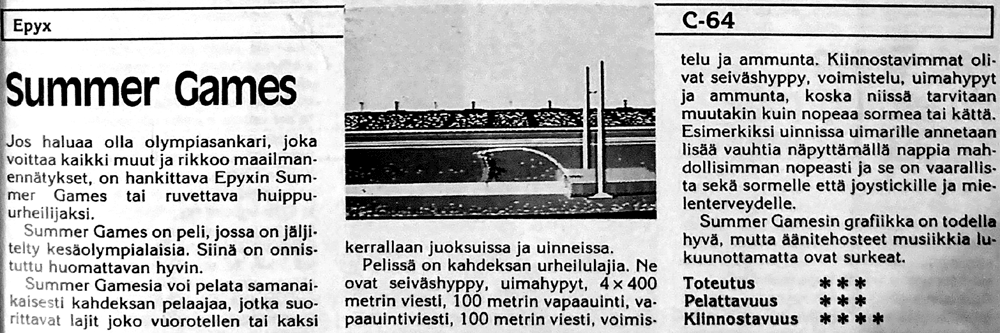
Summer Games1987Pysyvä linkkiJos haluaa olla olympiasankari, joka voittaa kaikki muut ja rikkoo maailmanennätykset, on hankittava Epyxin Summer Games tai ruvettava huippu-urheilijaksi.
Summer Games on peli, jossa on jäljitelty kesäolympialaisia. Siinä on onnistuttu huomattavan hyvin.
Summer Gamesia voi pelata samanaikaisesti kahdeksan pelaajaa, jotka suorittavat lajit joko vuorotellen tai kaksi kerrallaan juoksuissa ja uinneissa.
Pelissä on kahdeksan urheilulajia. Ne ovat seiväshyppy, uimahypyt, 4 × 400 metrin viesti, 100 metrin vapaauinti, vapaauintiviesti, 100 metrin viesti, voimistelu ja ammunta. Kiinnostavimmat olivat seiväshyppy, voimistelu, uimahypyt ja ammunta, koska niissä tarvitaan muutakin kuin nopeaa sormea tai kättä. Esimerkiksi uinnissa uimarille annetaan lisää vauhtia näpyttämällä nappia mahdollisimman nopeasti ja se on vaarallista sekä sormelle että joystickille ja mielenterveydelle.
Summer Gamesin grafiikka on todella hyvä, mutta äänitehosteet musiikkia lukuunottamatta ovat surkeat.
Summer Games1987PermalinkIf you want to be an Olympic hero who beats everybody else and smashes world records, you have to get Epyx's Summer Games or become a top athlete.
Summer Games is a game that imitates the Summer Olympics. It has succeeded at this remarkably well.
Up to eight players can play Summer Games at once, taking the events either in turns or, in the running and swimming races, two at a time.
There are eight sports in the game. They are the pole vault, diving, the 4 × 400 metre relay, the 100 metre freestyle, the freestyle relay, the 100 metre relay, gymnastics and shooting. The most interesting were the pole vault, gymnastics, diving and shooting, because they take more than just a quick finger or hand. In the swimming, for example, you give your swimmer more speed by tapping the button as fast as you can, and that is dangerous for your finger, your joystick and your mental health alike.
The graphics in Summer Games are really good, but the sound effects, apart from the music, are dismal.
Super Bowl
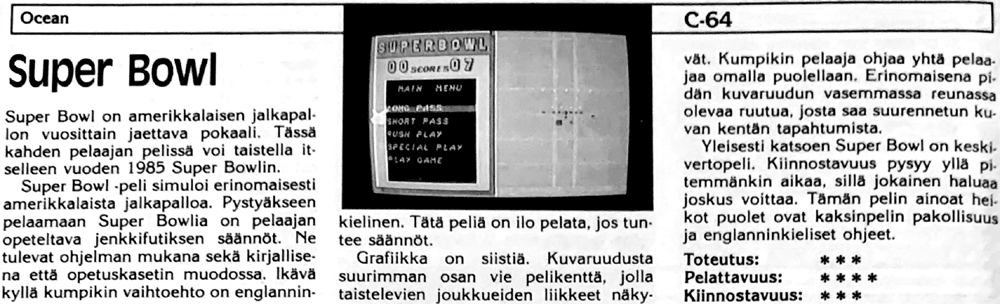
Super Bowl1987Pysyvä linkkiSuper Bowl on amerikkalaisen jalkapallon vuosittain jaettava pokaali. Tässä kahden pelaajan pelissä voi taistella itselleen vuoden 1985 Super Bowlin.
Super Bowl -peli simuloi erinomaisesti amerikkalaista jalkapalloa. Pystyäkseen pelaamaan Super Bowlia on pelaajan opeteltava jenkkifutiksen säännöt. Ne tulevat ohjelman mukana sekä kirjallisena että opetuskasetin muodossa. Ikävä kyllä kumpikin vaihtoehto on englanninkielinen. Tätä peliä on ilo pelata, jos tuntee säännöt.
Grafiikka on siistiä. Kuvaruudusta suurimman osan vie pelikenttä, jolla taistelevien joukkueiden liikkeet näkyvät. Kumpikin pelaaja ohjaa yhtä pelaajaa omalla puolellaan. Erinomaisena pidän kuvaruudun vasemmassa reunassa olevaa ruutua, josta saa suurennetun kuvan kentän tapahtumista.
Yleisesti katsoen Super Bowl on keskivertopeli. Kiinnostavuus pysyy yllä pitemmänkin aikaa, sillä jokainen haluaa joskus voittaa. Tämän pelin ainoat heikot puolet ovat kaksinpelin pakollisuus ja englanninkieliset ohjeet.
Super Bowl1987PermalinkThe Super Bowl is American football's annually awarded trophy. In this two-player game you can fight to win the 1985 Super Bowl for yourself.
The Super Bowl game simulates American football excellently. To be able to play Super Bowl, the player has to learn the rules of Yank football. They come with the program both in written form and as an instructional cassette. Unfortunately, both options are in English. This game is a joy to play if you know the rules.
The graphics are neat. Most of the screen is taken up by the playing field, where you can see the moves of the battling teams. Each player controls one player on his own side. I think the box on the left-hand edge of the screen is excellent: it gives you a magnified view of the action on the field.
Generally speaking, Super Bowl is an average game. The interest holds up for quite a while, since everybody wants to win sometime. The only weak points of this game are the compulsory two-player mode and the instructions being in English.
Super Cars
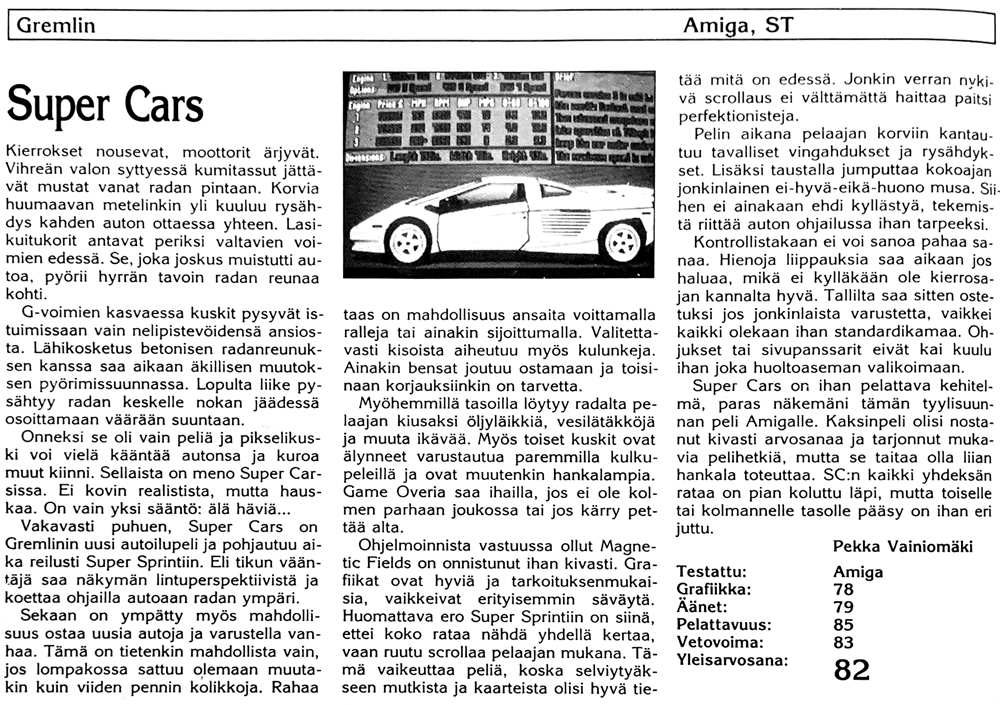
Super Cars1990 SyksyPysyvä linkkiKierrokset nousevat, moottorit ärjyvät. Vihreän valon syttyessä kumitassut jättävät mustat vanat radan pintaan. Korvia huumaavan metelinkin yli kuuluu rysähdys kahden auton ottaessa yhteen. Lasikuitukorit antavat periksi valtavien voimien edessä. Se, joka joskus muistutti autoa, pyörii hyrrän tavoin radan reunaa kohti.
G-voimien kasvaessa kuskit pysyvät istuimissaan vain nelipistevöidensä ansiosta. Lähikosketus betonisen radanreunuksen kanssa saa aikaan äkillisen muutoksen pyörimissuunnassa. Lopulta liike pysähtyy radan keskelle nokan jäädessä osoittamaan väärään suuntaan.
Onneksi se oli vain peliä ja pikselikuski voi vielä kääntää autonsa ja kuroa muut kiinni. Sellaista on meno Super Carsissa. Ei kovin realistista, mutta hauskaa. On vain yksi sääntö: älä häviä...
Vakavasti puhuen, Super Cars on Gremlinin uusi autoilupeli ja pohjautuu aika reilusti Super Sprintiin. Eli tikun vääntäjä saa näkymän lintuperspektiivistä ja koettaa ohjailla autoaan radan ympäri.
Sekaan on ympätty myös mahdollisuus ostaa uusia autoja ja varustella vanhaa. Tämä on tietenkin mahdollista vain, jos lompakossa sattuu olemaan muutakin kuin viiden pennin kolikkoja. Rahaa taas on mahdollisuus ansaita voittamalla ralleja tai ainakin sijoittumalla. Valitettavasti kisoista aiheutuu myös kulunkeja. Ainakin bensat joutuu ostamaan ja toisinaan korjauksiinkin on tarvetta.
Myöhemmillä tasoilla löytyy radalta pelaajan kiusaksi öljyläikkiä, vesilätäkköjä ja muuta ikävää. Myös toiset kuskit ovat älynneet varustautua paremmilla kulkupeleillä ja ovat muutenkin hankalampia. Game Overia saa ihailla, jos ei ole kolmen parhaan joukossa tai jos kärry pettää alta.
Ohjelmoinnista vastuussa ollut Magnetic Fields on onnistunut ihan kivasti. Grafiikat ovat hyviä ja tarkoituksenmukaisia, vaikkeivat erityisemmin säväytä. Huomattava ero Super Sprintiin on siinä, ettei koko rataa nähdä yhdellä kertaa, vaan ruutu scrollaa pelaajan mukana. Tämä vaikeuttaa peliä, koska selviytyäkseen mutkista ja kaarteista olisi hyvä tietää mitä on edessä. Jonkin verran nykivä scrollaus ei välttämättä haittaa paitsi perfektionisteja.
Pelin aikana pelaajan korviin kantautuu tavalliset vingahdukset ja rysähdykset. Lisäksi taustalla jumputtaa kokoajan jonkinlainen ei-hyvä-eikä-huono musa. Siihen ei ainakaan ehdi kyllästyä, tekemistä riittää auton ohjailussa ihan tarpeeksi.
Kontrollistakaan ei voi sanoa pahaa sanaa. Hienoja liippauksia saa aikaan jos haluaa, mikä ei kylläkään ole kierrosajan kannalta hyvä. Tallilta saa sitten ostetuksi jos jonkinlaista varustetta, vaikkei kaikki olekaan ihan standardikamaa. Ohjukset tai sivupanssarit eivät kai kuulu ihan joka huoltoaseman valikoimaan.
Super Cars on ihan pelattava kehitelmä, paras näkemäni tämän tyylisuunnan peli Amigalle. Kaksinpeli olisi nostanut kivasti arvosanaa ja tarjonnut mukavia pelihetkiä, mutta se taitaa olla liian hankala toteuttaa. SC:n kaikki yhdeksän rataa on pian koluttu läpi, mutta toiselle tai kolmannelle tasolle pääsy on ihan eri juttu.
Super Cars1990 SyksyPermalinkThe revs rise, the engines roar. As the green light comes on, the rubber paws leave black streaks on the track surface. Even over the deafening din you can hear the crunch as two cars collide. The fibreglass bodies give way before the immense forces. What once resembled a car spins like a top towards the edge of the track.
As the G-forces build, the drivers stay in their seats only thanks to their four-point harnesses. Close contact with the concrete track barrier brings about a sudden change in the direction of spin. Finally the motion stops in the middle of the track, with the nose left pointing the wrong way.
Luckily it was only a game, and the pixel driver can still turn the car around and catch the others up. That's how things go in Super Cars. Not very realistic, but fun. There's only one rule: don't lose...
Seriously speaking, Super Cars is Gremlin's new driving game and leans pretty heavily on Super Sprint. In other words, the joystick-yanker gets a bird's-eye view and tries to steer their car around the track.
Also stuffed into the mix is the option to buy new cars and kit out your old one. Naturally this is only possible if your wallet happens to hold something more than five-penni coins. Money, in turn, can be earned by winning races or at least by placing. Unfortunately the races also run up expenses. At the very least you have to buy the petrol, and sometimes repairs are needed too.
On later levels the track is strewn with oil slicks, puddles and other nasties to torment the player. The other drivers have also had the sense to equip themselves with better wheels, and are trickier customers in general too. You get to admire Game Over if you're not in the top three or if your jalopy gives out under you.
Magnetic Fields, who were responsible for the programming, have done quite a nice job. The graphics are good and fit for purpose, although they don't exactly dazzle. A notable difference from Super Sprint is that you don't see the whole track at once; instead the screen scrolls along with the player. This makes the game harder, because to get through the bends and curves it would be good to know what's ahead. The somewhat jerky scrolling won't necessarily bother anyone except perfectionists.
During play the usual squeals and crashes reach the player's ears. On top of that, some kind of neither-good-nor-bad tune thumps away in the background the whole time. At least you won't have time to get sick of it; steering the car keeps you plenty busy.
Nor can you say a bad word about the controls. You can pull off some fancy slides if you want to, though that isn't exactly good for your lap times. From the garage you can then buy all sorts of equipment, although not all of it is exactly standard stuff. Missiles or side armour probably aren't on the shelves at every service station.
Super Cars is a perfectly playable creation, the best game in this genre I've seen on the Amiga. A two-player mode would have nicely bumped up the score and provided some enjoyable gaming moments, but it's probably too tricky to implement. You'll soon have worked your way through all nine of SC's tracks, but getting to the second or third level is a whole different story.
Super Cars II
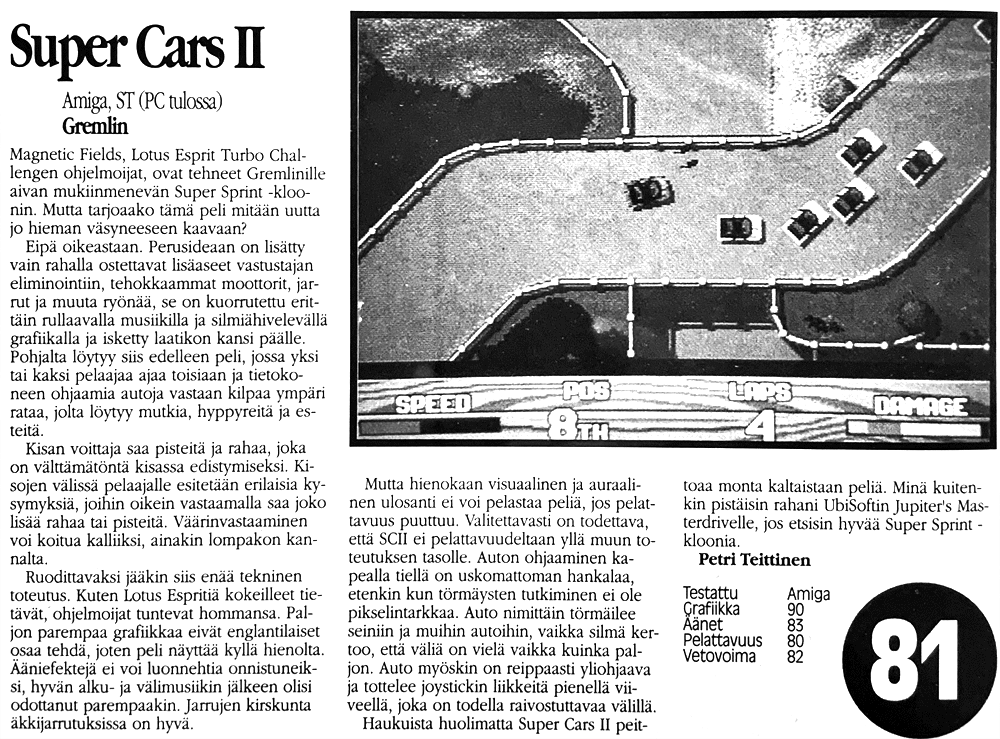
Super Cars II1991 SyksyPysyvä linkkiMagnetic Fields, Lotus Esprit Turbo Challengen ohjelmoijat, ovat tehneet Gremlinille aivan mukiinmenevän Super Sprint -kloonin. Mutta tarjoaako tämä peli mitään uutta jo hieman väsyneeseen kaavaan?
Eipä oikeastaan. Perusideaan on lisätty vain rahalla ostettavat lisäaseet vastustajan eliminointiin, tehokkaammat moottorit, jarrut ja muuta ryönää, se on kuorrutettu erittäin rullaavalla musiikilla ja silmiähivelevällä grafiikalla ja isketty laatikon kansi päälle. Pohjalta löytyy siis edelleen peli, jossa yksi tai kaksi pelaajaa ajaa toisiaan ja tietokoneen ohjaamia autoja vastaan kilpaa ympäri rataa, jolta löytyy mutkia, hyppyreitä ja esteitä.
Kisan voittaja saa pisteitä ja rahaa, joka on välttämätöntä kisassa edistymiseksi. Kisojen välissä pelaajalle esitetään erilaisia kysymyksiä, joihin oikein vastaamalla saa joko lisää rahaa tai pisteitä. Väärinvastaaminen voi koitua kalliiksi, ainakin lompakon kannalta.
Ruodittavaksi jääkin siis enää tekninen toteutus. Kuten Lotus Espritiä kokeilleet tietävät, ohjelmoijat tuntevat hommansa. Paljon parempaa grafiikkaa eivät englantilaiset osaa tehdä, joten peli näyttää kyllä hienolta. Ääniefektejä ei voi luonnehtia onnistuneiksi, hyvän alku- ja välimusiikin jälkeen olisi odottanut parempaakin. Jarrujen kirskunta äkkijarrutuksissa on hyvä.
Mutta hienokaan visuaalinen ja auraalinen ulosanti ei voi pelastaa peliä, jos pelattavuus puuttuu. Valitettavasti on todettava, että SCII ei pelattavuudeltaan yllä muun toteutuksen tasolle. Auton ohjaaminen kapealla tiellä on uskomattoman hankalaa, etenkin kun törmäysten tutkiminen ei ole pikselintarkkaa. Auto nimittäin törmäilee seiniin ja muihin autoihin, vaikka silmä kertoo, että väliä on vielä vaikka kuinka paljon. Auto myöskin on reippaasti yliohjaava ja tottelee joystickin liikkeitä pienellä viiveellä, joka on todella raivostuttavaa välillä.
Haukuista huolimatta Super Cars II peittoaa monta kaltaistaan peliä. Minä kuitenkin pistäisin rahani UbiSoftin Jupiter's Masterdrivelle, jos etsisin hyvää Super Sprint -kloonia.
Super Cars II1991 SyksyPermalinkMagnetic Fields, the programmers of Lotus Esprit Turbo Challenge, have made Gremlin a perfectly decent Super Sprint clone. But does this game bring anything new to what is already a somewhat tired formula?
Not really. All that's been added to the basic idea is extra weapons bought with cash for eliminating opponents, more powerful engines, brakes and other junk; the whole thing has been iced with really groovy music and eye-caressing graphics and had a box lid slapped on top. So underneath there's still a game in which one or two players race against each other and computer-controlled cars round a track full of bends, jumps and obstacles.
The winner of a race gets points and money, which is essential for making progress in the competition. Between races the player is asked various questions, and answering them correctly earns either more money or more points. A wrong answer can prove costly, at least as far as your wallet is concerned.
So all that's left to pick apart is the technical execution. As anyone who has tried Lotus Esprit knows, the programmers know their stuff. The English don't know how to make much better graphics than this, so the game certainly looks great. The sound effects can't be called a success; after the good title and interlude music you'd have expected better. The squeal of the brakes when you stamp on them is good.
But even fine visual and aural output can't save a game if the playability is missing. Unfortunately it has to be said that SCII's playability doesn't reach the level of the rest of the package. Steering the car on a narrow road is incredibly awkward, especially since the collision detection isn't pixel-perfect. You see, the car keeps bumping into walls and other cars even when your eyes tell you there's still heaps of room. The car also oversteers heavily and responds to the joystick with a slight delay, which is really infuriating at times.
Despite all the slagging, Super Cars II beats many a game of its kind. Still, I'd put my money on UbiSoft's Jupiter's Masterdrive if I were looking for a good Super Sprint clone.
Super Mario Bros 2
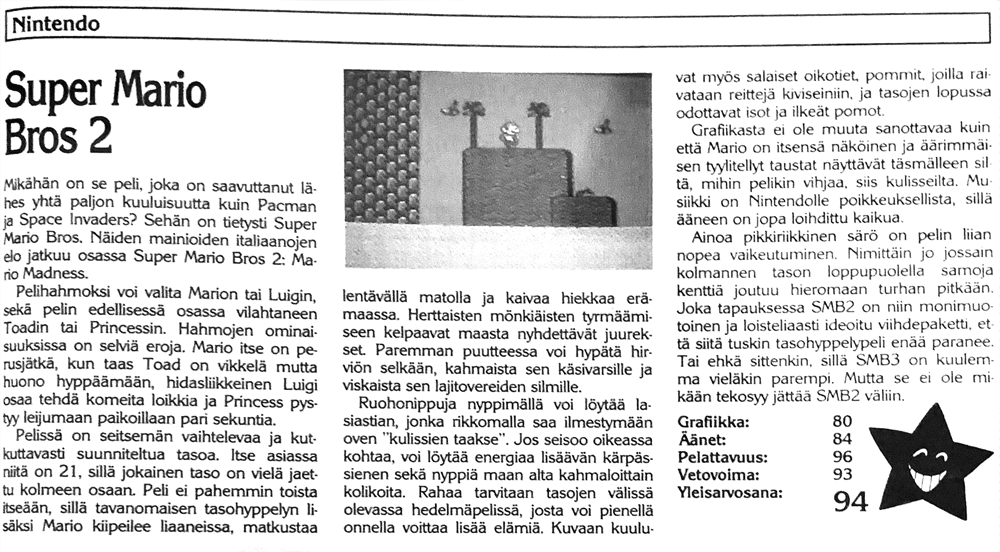
Super Mario Bros 21990 KevätPysyvä linkkiMikähän on se peli, joka on saavuttanut lähes yhtä paljon kuuluisuutta kuin Pacman ja Space Invaders? Sehän on tietysti Super Mario Bros. Näiden mainioiden italiaanojen elo jatkuu osassa Super Mario Bros 2: Mario Madness.
Pelihahmoksi voi valita Marion tai Luigin, sekä pelin edellisessä osassa vilahtaneen Toadin tai Princessin. Hahmojen ominaisuuksissa on selviä eroja. Mario itse on perusjätkä, kun taas Toad on vikkelä mutta huono hyppäämään, hidasliikkeinen Luigi osaa tehdä komeita loikkia ja Princess pystyy leijumaan paikoillaan pari sekuntia.
Pelissä on seitsemän vaihtelevaa ja kutkuttavasti suunniteltua tasoa. Itse asiassa niitä on 21, sillä jokainen taso on vielä jaettu kolmeen osaan. Peli ei pahemmin toista itseään, sillä tavanomaisen tasohyppelyn lisäksi Mario kiipeilee liaaneissa, matkustaa lentävällä matolla ja kaivaa hiekkaa erämaassa. Herttaisten mönkiäisten tyrmäämiseen kelpaavat maasta nyhdettävät juurekset. Paremman puutteessa voi hypätä hirviön selkään, kahmaista sen käsivarsille ja viskaista sen lajitovereiden silmille.
Ruohonippuja nyppimällä voi löytää lasiastian, jonka rikkomalla saa ilmestymään oven "kulissien taakse". Jos seisoo oikeassa kohtaa, voi löytää energiaa lisäävän kärpässienen sekä nyppiä maan alta kahmaloittain kolikoita. Rahaa tarvitaan tasojen välissä olevassa hedelmäpelissä, josta voi pienellä onnella voittaa lisää elämiä. Kuvaan kuuluvat myös salaiset oikotiet, pommit, joilla raivataan reittejä kiviseiniin, ja tasojen lopussa odottavat isot ja ilkeät pomot.
Grafiikasta ei ole muuta sanottavaa kuin että Mario on itsensä näköinen ja äärimmäisen tyylitellyt taustat näyttävät täsmälleen siltä, mihin pelikin vihjaa, siis kulisseilta. Musiikki on Nintendolle poikkeuksellista, sillä ääneen on jopa loihdittu kaikua.
Ainoa pikkiriikkinen särö on pelin liian nopea vaikeutuminen. Nimittäin jo jossain kolmannen tason loppupuolella samoja kenttiä joutuu hieromaan turhan pitkään. Joka tapauksessa SMB2 on niin monimuotoinen ja loisteliaasti ideoitu viihdepaketti, että siitä tuskin tasohyppelypeli enää paranee. Tai ehkä sittenkin, sillä SMB3 on kuulemma vieläkin parempi. Mutta se ei ole mikään tekosyy jättää SMB2 väliin.
Super Mario Bros 21990 KevätPermalinkNow which game could it be that has achieved almost as much fame as Pacman and Space Invaders? Why, it's Super Mario Bros, of course. The life of these splendid Italians goes on in the instalment Super Mario Bros 2: Mario Madness.
You can choose Mario or Luigi as your character, or Toad or Princess, both of whom flitted by in the previous instalment of the game. There are clear differences in the characters' abilities. Mario himself is your basic regular guy, whereas Toad is nippy but a poor jumper, the slow-moving Luigi can pull off handsome leaps and Princess can hover in place for a couple of seconds.
The game has seven varied and tantalisingly designed levels. Actually there are 21 of them, since each level is further split into three parts. The game doesn't repeat itself much, because on top of the usual platform jumping Mario climbs vines, travels on a flying carpet and digs through sand in the desert. Root vegetables yanked out of the ground will do for knocking out the sweet little critters. For want of anything better, you can jump on a monster's back, scoop it up in your arms and fling it in the faces of its fellow creatures.
By plucking tufts of grass you can find a glass vessel, and breaking it makes a door appear "behind the scenes". If you stand in the right spot, you can find an energy-boosting fly agaric and pull handfuls of coins out from under the ground. The money is needed for the fruit machine between levels, where with a bit of luck you can win extra lives. Also part of the picture are secret shortcuts, bombs for clearing a way through stone walls, and the big, nasty bosses waiting at the end of the levels.
There's nothing else to say about the graphics except that Mario looks like himself and the extremely stylised backgrounds look exactly like what the game itself hints at, namely stage scenery. The music is exceptional for Nintendo, since they have even conjured up some echo in the sound.
The only teeny-tiny crack is that the game gets difficult too quickly. You see, already somewhere towards the end of the third level you end up grinding away at the same stages for far too long. In any case SMB2 is such a many-sided and brilliantly conceived entertainment package that platform games hardly get any better than this. Or maybe they do after all, since SMB3 is said to be even better. But that's no excuse to give SMB2 a miss.
Super Monaco Grand Prix
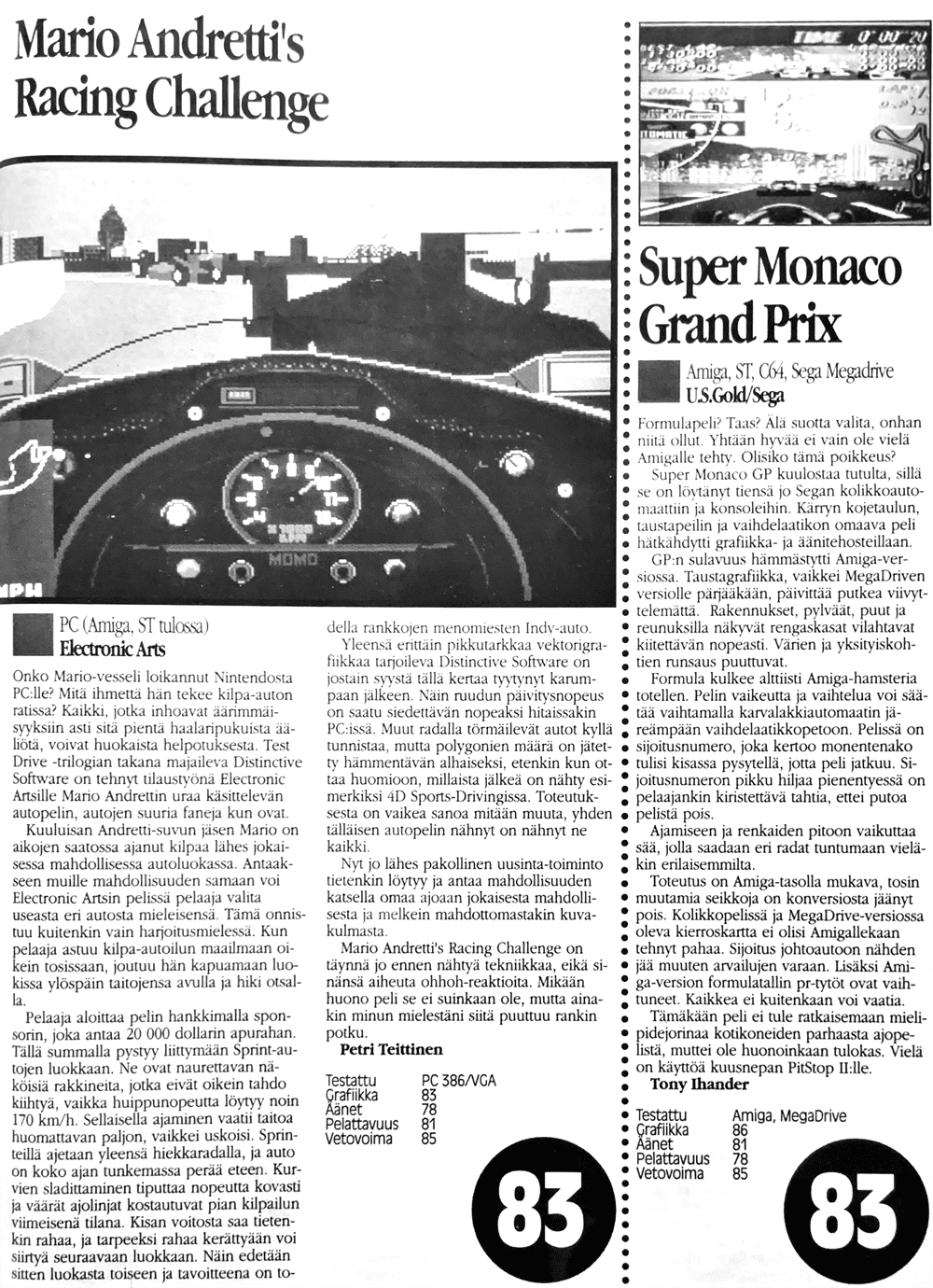
Super Monaco Grand Prix1991 SyksyPysyvä linkkiFormulapeli? Taas? Älä suotta valita, onhan niitä ollut. Yhtään hyvää ei vain ole vielä Amigalle tehty. Olisiko tämä poikkeus?
Super Monaco GP kuulostaa tutulta, sillä se on löytänyt tiensä jo Segan kolikkoautomaattiin ja konsoleihin. Kärryn kojetaulun, taustapeilin ja vaihdelaatikon omaava peli hätkähdytti grafiikka- ja äänitehosteillaan.
GP:n sulavuus hämmästytti Amiga-versiossa. Taustagrafiikka, vaikkei MegaDriven versiolle pärjääkään, päivittää putkea viivyttelemättä. Rakennukset, pylväät, puut ja reunuksilla näkyvät rengaskasat vilahtavat kiitettävän nopeasti. Värien ja yksityiskohtien runsaus puuttuvat.
Formula kulkee alttiisti Amiga-hamsteria totellen. Pelin vaikeutta ja vaihtelua voi säätää vaihtamalla karvalakkiautomaatin järeämpään vaihdelaatikkopetoon. Pelissä on sijoitusnumero, joka kertoo monentenako tulisi kisassa pysytellä, jotta peli jatkuu. Sijoitusnumeron pikku hiljaa pienentyessä on pelaajankin kiristettävä tahtia, ettei putoa pelistä pois.
Ajamiseen ja renkaiden pitoon vaikuttaa sää, jolla saadaan eri radat tuntumaan vieläkin erilaisemmilta.
Toteutus on Amiga-tasolla mukava, tosin muutamia seikkoja on konversiosta jäänyt pois. Kolikkopelissä ja MegaDrive-versiossa oleva kierroskartta ei olisi Amigallekaan tehnyt pahaa. Sijoitus johtoautoon nähden jää muuten arvailujen varaan. Lisäksi Amiga-version formulatallin pr-tytöt ovat vaihtuneet. Kaikkea ei kuitenkaan voi vaatia.
Tämäkään peli ei tule ratkaisemaan mielipidejorinaa kotikoneiden parhaasta ajopelistä, muttei ole huonoinkaan tulokas. Vielä on käyttöä kuusnepan PitStop II:lle.
Super Monaco Grand Prix1991 SyksyPermalinkA Formula One game? Again? Don't moan for nothing - sure, there have been plenty. It's just that not a single good one has been made for the Amiga yet. Could this be the exception?
Super Monaco GP sounds familiar, as it has already found its way into Sega's coin-op and consoles. With its buggy's dashboard, rear-view mirror and gearbox, the game dazzled everyone with its graphics and sound effects.
GP's smoothness came as a surprise in the Amiga version. The background graphics, though no match for the MegaDrive version, keep the screen updated without dawdling. Buildings, pillars, trees and the tyre stacks along the verges flash past commendably fast. What's missing is a wealth of colour and detail.
The car readily does what the Amiga's rodent tells it. You can adjust the game's difficulty and variety by swapping the Sunday-driver automatic for a beefier gearbox beast. The game has a position number that tells you which place you need to hold in the race for the game to carry on. As the position number gradually shrinks, the player has to up the pace too, so as not to drop out of the game.
Driving and tyre grip are affected by the weather, which makes the different tracks feel even more different.
By Amiga standards the execution is pleasant, though a few things have been left out of the conversion. The lap map in the coin-op and the MegaDrive version wouldn't have done the Amiga any harm either. Otherwise your position relative to the lead car is left to guesswork. What's more, the racing team's PR girls have changed in the Amiga version. Still, you can't ask for everything.
This game won't settle the endless opinion-jabbering about the best driving game on home computers either, but it's not the worst newcomer by any means. There's still a use for the Commodore 64's PitStop II.
Super Scrable Simulator
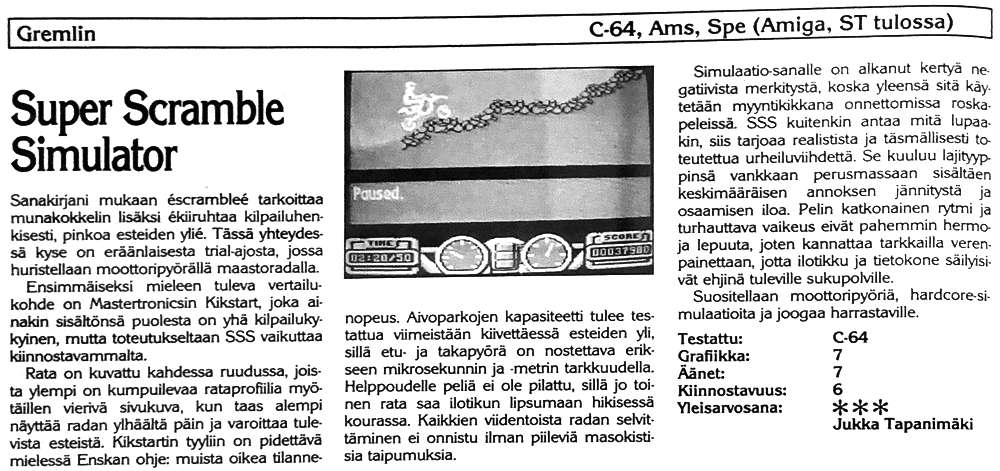
Super Scrable Simulator1989 SyksyPysyvä linkkiSanakirjani mukaan éscrambleé tarkoittaa munakokkelin lisäksi ékiiruhtaa kilpailuhenkisesti, pinkoa esteiden ylié. Tässä yhteydessä kyse on eräänlaisesta trial-ajosta, jossa huristellaan moottoripyörällä maastoradalla.
Ensimmäiseksi mieleen tuleva vertailukohde on Mastertronicsin Kikstart, joka ainakin sisältönsä puolesta on yhä kilpailukykyinen, mutta toteutukseltaan SSS vaikuttaa kiinnostavammalta.
Rata on kuvattu kahdessa ruudussa, joista ylempi on kumpuilevaa rataprofiilia myötäillen vierivä sivukuva, kun taas alempi näyttää radan ylhäältä päin ja varoittaa tulevista esteistä. Kikstartin tyyliin on pidettävä mielessä Enskan ohje: muista oikea tilannenopeus. Aivoparkojen kapasiteetti tulee testattua viimeistään kiivettäessä esteiden yli, sillä etu- ja takapyörä on nostettava erikseen mikrosekunnin ja -metrin tarkkuudella. Helppoudelle peliä ei ole pilattu, sillä jo toinen rata saa ilotikun lipsumaan hikisessä kourassa. Kaikkien viidentoista radan selvittäminen ei onnistu ilman piileviä masokistisia taipumuksia.
Simulaatio-sanalle on alkanut kertyä negatiivista merkitystä, koska yleensä sitä käytetään myyntikikkana onnettomissa roskapeleissä. SSS kuitenkin antaa mitä lupaakin, siis tarjoaa realistista ja täsmällisesti toteutettua urheiluviihdettä. Se kuuluu lajityyppinsä vankkaan perusmassaan sisältäen keskimääräisen annoksen jännitystä ja osaamisen iloa. Pelin katkonainen rytmi ja turhauttava vaikeus eivät pahemmin hermoja lepuuta, joten kannattaa tarkkailla verenpainettaan, jotta ilotikku ja tietokone säilyisivät ehjinä tuleville sukupolville.
Suositellaan moottoripyöriä, hardcore-simulaatioita ja joogaa harrastaville.
Super Scrable Simulator1989 SyksyPermalinkAccording to my dictionary, "scramble" means, besides scrambled eggs, "to hurry competitively, to scurry over obstacles". In this context it is a kind of trial riding, in which you buzz around an off-road course on a motorbike.
The first point of comparison that springs to mind is Mastertronics' Kikstart, which is still competitive at least as far as content goes, but in its execution SSS seems more interesting.
The course is shown in two screens, the upper of which is a side view that scrolls along following the undulating profile of the track, while the lower one shows the track from above and warns of upcoming obstacles. Kikstart-style, you have to keep Enska's advice in mind: remember the right speed for the conditions. The capacity of your poor old brain gets tested at the latest when climbing over obstacles, since the front and rear wheel have to be lifted separately with microsecond and micrometre precision. Nobody has spoiled this game by making it easy, as already the second track has the joystick slipping in your sweaty fist. Clearing all fifteen tracks is not going to happen without latent masochistic tendencies.
The word "simulation" has started to pick up negative connotations, since it is usually used as a sales gimmick on wretched rubbish games. SSS, however, delivers what it promises, that is, it offers realistic and precisely executed sports entertainment. It belongs to the solid mainstream of its genre, containing an average dose of excitement and the joy of mastery. The game's choppy rhythm and frustrating difficulty don't exactly soothe the nerves, so it is worth keeping an eye on your blood pressure, so that the joystick and the computer survive intact for future generations.
Recommended for those into motorbikes, hardcore simulations and yoga.
Super Sprint
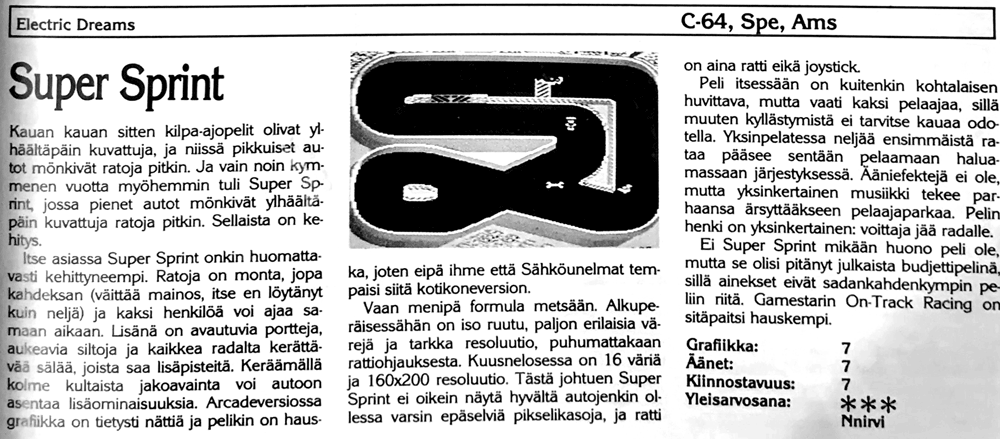
Super Sprint1988Pysyvä linkkiKauan kauan sitten kilpa-ajopelit olivat ylhäältäpäin kuvattuja, ja niissä pikkuiset autot mönkivät ratoja pitkin. Ja vain noin kymmenen vuotta myöhemmin tuli Super Sprint, jossa pienet autot mönkivät ylhäältäpäin kuvattuja ratoja pitkin. Sellaista on kehitys.
Itse asiassa Super Sprint onkin huomattavasti kehittyneempi. Ratoja on monta, jopa kahdeksan (väittää mainos, itse en löytänyt kuin neljä) ja kaksi henkilöä voi ajaa samaan aikaan. Lisänä on avautuvia portteja, aukeavia siltoja ja kaikkea radalta kerättävää sälää, joista saa lisäpisteitä. Keräämällä kolme kultaista jakoavainta voi autoon asentaa lisäominaisuuksia. Arcadeversiossa grafiikka on tietysti nättiä ja pelikin on hauska, joten eipä ihme että Sähköunelmat tempaisi siitä kotikoneversion.
Vaan menipä formula metsään. Alkuperäisessähän on iso ruutu, paljon erilaisia värejä ja tarkka resoluutio, puhumattakaan rattiohjauksesta. Kuusnelosessa on 16 väriä ja 160x200 resoluutio. Tästä johtuen Super Sprint ei oikein näytä hyvältä autojenkin ollessa varsin epäselviä pikselikasoja, ja ratti on aina ratti eikä joystick.
Peli itsessään on kuitenkin kohtalaisen huvittava, mutta vaati kaksi pelaajaa, sillä muuten kyllästymistä ei tarvitse kauaa odotella. Yksinpelatessa neljää ensimmäistä rataa pääsee sentään pelaamaan haluamassaan järjestyksessä. Ääniefektejä ei ole, mutta yksinkertainen musiikki tekee parhaansa ärsyttääkseen pelaajaparkaa. Pelin henki on yksinkertainen: voittaja jää radalle.
Ei Super Sprint mikään huono peli ole, mutta se olisi pitänyt julkaista budjettipelinä, sillä ainekset eivät sadankahdenkympin peliin riitä. Gamestarin On-Track Racing on sitäpaitsi hauskempi.
Super Sprint1988PermalinkLong, long ago, racing games were viewed from above, and in them tiny cars crawled along tracks. And only about ten years later along came Super Sprint, in which little cars crawl along tracks viewed from above. That's progress for you.
Actually, Super Sprint is a good deal more advanced. There are lots of tracks, as many as eight (so the advert claims; I couldn't find more than four), and two people can drive at the same time. On top of that there are gates that open, bridges that open up and all sorts of junk to pick up off the track for bonus points. Collect three golden spanners and you can fit extra features to your car. In the arcade version the graphics are pretty, of course, and the game is fun too, so it's no wonder Sähköunelmat knocked out a home computer version of it.
But this formula ended up in the ditch. The original, after all, has a big screen, lots of different colours and a sharp resolution, not to mention steering-wheel control. The Commodore 64 has 16 colours and a 160x200 resolution. Because of this Super Sprint doesn't really look good, with even the cars being rather blurry heaps of pixels, and a steering wheel will always be a steering wheel, not a joystick.
The game itself is fairly amusing all the same, but it needs two players, because otherwise you won't have to wait long for boredom to set in. Playing solo, you do at least get to take on the first four tracks in whatever order you like. There are no sound effects, but the simple music does its best to annoy the poor player. The spirit of the game is simple: winner stays on the track.
Super Sprint isn't a bad game, but it should have been released as a budget title, because the ingredients don't stretch to a hundred-and-twenty-mark game. Gamestar's On-Track Racing is more fun, besides.
Super Sunday
Super Sunday1987Pysyvä linkkiAmerikkalaista jalkapalloa kutsutaan ruohokenttien shakiksi, sillä vauhdikkaasta ja raisusta ilmiasustaan huolimatta kyse on hienovaraisten strategioiden kaksintaistelusta. Tietokonefutikset ovatkin keskittyneet juuri pelinrakentamiseen. Pelaaja(t) valitsee mielestään parhaan taktiikan ja siihen sopivimman miehityksen kentälle.
Suomalaisittain katsoen jenkkifutispelit ovat aina narahtaneet samaan ongelmaan - ohjelman käyttöohjeiden laatijat eivät ole voineet kuvitellakaan, ettei joku osaisi pelin sääntöjä. Pääpaino on pantu erikoistilanteisiin sopivien taktiikoiden esittelylle. Samaten vuolaasti esitellyt eri Super Bowl (?!?) -finalistien ominaisuudet voivat jäädä alaa harrastamattomalle utopiaksi.
Super Sunday on tyypillinen lajinsa edustaja. Toiminta rajoittuu kuvainnollisesti pelikentän laidalla istumiseen, mutta net ken tykkää jenkkifutailusta ynnä aivovoimistelusta, saattavat pitää myös tästä ohjelmasta.
Super Sunday1987PermalinkAmerican football is called chess on grass, because despite its fast and rough appearance it is a duel of subtle strategies. So computer football games have concentrated on exactly that: building the plays. The player(s) choose what they reckon is the best tactic and the line-up best suited to it on the field.
From a Finnish point of view, Yank football games have always come unstuck on the same problem - the people who wrote the program's instructions couldn't even imagine that someone might not know the rules of the game. The main emphasis has been put on presenting tactics suited to special situations. Likewise, the lavishly described attributes of the various Super Bowl (?!?) finalists may well remain a distant utopia to anyone who doesn't follow the sport.
Super Sunday is a typical specimen of its kind. The action is limited, figuratively speaking, to sitting on the sidelines, but those who fancy Yank footballing along with some brain gymnastics may well take to this program too.
Supercycle
Supercycle1987Pysyvä linkkiVrrrrooommmmm! Sylkipärskeet peittävät kuvaruudun kun Supercycle vie moottoripyöräkuskit mukanaan. Eikä ihme. Se on nopea, hyvän näköinen, äärimmäisen pelattava ja tarpeeksi vaihteleva erilaisine ratoineen, esteineen ja vaikeustasoineen, jotta siihen ei-motoristikin jaksaa innostua. Äänet ovat vähän tavanomaiset.
Ratoja on 10 erilaista, ja niissä on vaihteleva estemäärä. Löytyy lätäkköä, kuoppaa, puomeja, muita kuskeja sun muuta pyörän surmaa. Pole Positionin tyylin jokaista rataa kohti on tietty aikamäärä, jonka kuluessa se täytyy ajaa läpi. Karsinta-ajoja ei valitettavasti ole, muuten SC olisikin täydellinen Pole-kopio. Levyversiossa on vielä bonuksena Vorpal-latausjärjestelmä, jonka ansiosta peli latautuu 25 kertaa normaalia nopeammin, ja levylle säästettävä high-score-taulukko.
Vaikka Pistop II on mielestäni edelleenkin kaikkien rallipelien ykkönen sen kaksinpelimahdollisuuden takia, ei sen ja Supercyclen välillä monta milliä ole. Supercyclen mukaan tullaan tulevat rallipelit tuomitsemaan!
Supercycle1987PermalinkVrrrrooommmmm! Sprays of spit cover the screen as Supercycle carries the bikers away with it. And no wonder. It's fast, good-looking, extremely playable and varied enough, with its different tracks, obstacles and difficulty levels, that even a non-biker can get fired up about it. The sounds are a bit run-of-the-mill.
There are 10 different tracks, with a varying number of obstacles on them. You get puddles, potholes, barriers, other riders and whatever else spells death for a bike. In the style of Pole Position, each track has a set amount of time within which it has to be completed. Unfortunately there are no qualifying laps, otherwise SC would be a perfect Pole copy. As a bonus the disk version also has the Vorpal loading system, thanks to which the game loads 25 times faster than normal, and a high-score table that is saved to disk.
Although in my opinion Pistop II is still the number one of all racing games because of its two-player option, there aren't many millimetres between it and Supercycle. Supercycle is the yardstick future racing games will be judged by!
Superleague Soccer
Superleague Soccer1990 SyksyPysyvä linkkiSuperleague simuloi jälleen sitä vähemmän vauhdikasta puolta jalkapallosta eli managerin työtä. Managerin toimenkuvaan kuuluu pelaajien ostaminen, myyminen, rahatilanteen hoitaminen, pelien järjestely ja oman joukkueen huoltaminen. Myös itse ottelussa voi manageri ottaa ohjat käsiinsä ja näin vaikuttaa pelin lopputulokseen. Superleaguessa on kaikki tämä, jopa ylikin.
Joukkueita on parisenkymmentä erilaista, kaikki 'oikeita' moninekymmenine pelaajineen. Ja jos valmiit pelaajat/joukkueet eivät miellytä, voi nekin muokata uusiksi aina nimeä ja ikää myöten. Jokaisella pelaajalla on myös tietyt perusarvot eli nopeus, tarkkuus ja niin edelleen, joiden olisi tarkoitus vaikuttaa lopputulokseen. Pelaajia voi ostaa ja myydä haluamansa mukaan, valmiiksi sovittuun hintaan. Pelaajien sopimuksia voi solmia uudelleen, ettei tule ikäviä yllätyksiä pelaajien liittyessä muihin joukkueisiin. Pelata voi liigassa, Euro Cupissa tai vaikka harrastaa hyväntekeväisyyspelejä.
Tähän asti kaikki hyvin, vaan entäpäs pelattavuus? Kyllä sitä tulee karskimmallekin miehelle tippa silmään kun yrittää pelata jalkapalloa siten, että ohjaa yhtä miestä kerrallaan muun joukkueen seistessä paikallaan. Mutta kuin sekään ei riittäisi, miehen kulku on vielä hoipertelevaa ja pallo tuntuu lentävän minne sattuu. Onneksi itse pelin voi kytkeä tietokoneen hoidettavaksi, mikä kylläkin tuntuu tekevän siitä täysin satunnaisen. On hyvin mielenkiintoista hävitä 4-0 joukkueelle, joka on muokattu siten että keski-ikä on siinä 90 vuoden paikkeilla.
Hiiren pointteria simuloiva ohjaus on kankea ja hidas, paperinäyttöä simuloiva näyttösysteemi tekee siitä vain vaikealukuisen. On tästä aiheesta tehty hyviäkin pelejä (esimerkiksi Football Managerit) joten miksi vaivautua?
Superleague Soccer1990 SyksyPermalinkSuperleague once again simulates the less action-packed side of football, namely the manager's job. The manager's duties include buying and selling players, handling the finances, arranging matches and looking after your own team. In the match itself, too, the manager can take the reins and so influence the result. Superleague has all this, and then some.
There are twenty-odd different teams, all 'real' ones with their dozens upon dozens of players. And if the ready-made players/teams aren't to your liking, you can rework them as well, right down to names and ages. Each player also has certain basic attributes, i.e. speed, accuracy and so on, which are supposed to affect the outcome. Players can be bought and sold as you please, at a pre-set price. Players' contracts can be renewed so that there are no nasty surprises with players going off to join other teams. You can play in the league, in the Euro Cup, or even take up charity matches.
So far so good, but what about the playability? Even the toughest of men will get a tear in his eye trying to play football by controlling one man at a time while the rest of the team stands still. But as if that weren't enough, the man totters about as he goes and the ball seems to fly wherever it likes. Luckily the match itself can be handed over to the computer, although that seems to make it completely random. It's very interesting to lose 4-0 to a team that's been edited so that its average age is somewhere around 90.
The controls, which simulate a mouse pointer, are stiff and slow, and the display system, which simulates a sheet of paper, only makes it hard to read. Good games have been made on this subject too (the Football Managers, for example), so why bother?
Superman - Man of Steel
Superman - Man of Steel1989 KevätPysyvä linkkiOn rehellisesti tunnustettava, että ennen kun Byrne uudisti Teräsmiehen, oli lehti hirveää luettavaa. Uudistus puri hetken, mutta taas vanhat virheet ovat ryömineet mitä erikoisimmilla tekosyillä takaisin Terikseen ja lehti on jälleen hirveää luettavaa. No vaikkei Kryptonin partiopoika olekaan suurta sarjakuvaa, ei se estä hyvän pelin tekemistä vanhasta ässärinnasta.
Tynesoftin luomus jakautuu kuuteen osaan. Käytössä on vaihteleva määrä Teräsmieskykyjä aina lentotaitoa, lämpökatsetta, superpuhallusta ja röntgennäköä myöten. Teräsmies polttaa parademoneita, kuljettaa avaruussukkulan läpi meteorilauman, taistelee robotteja vastaan, kuljettaa satelliitin läpi meteorien, tuhoaa Luthorin linnakkeen ja taistelee robotteja vastaan. Jokainen tehtävä jakautuu sarjakuvamaiseen välisoittoon (lue: kasettiasema pyörii aina vähän väliä).
Kyllähän Teräsmiehen kuusnelosenkin grafiikasta tuntee, mutta muuta mainitsemisen arvoista on vaikea keksiä. Teräsmiehen teema elokuvasta "Superman" sentään raikuu tunnistettavasti. Pelin eri osat, vaikkakin ovatkin yksinkertaisia, ovat ihan pelattavia. Vika onkin siinä että ne on muodostettu parista eri pelistä spritet vaihtamalla. Amigassa grafiikka luonnollisesti on huomattavasti parempaa, mutta itse peli on huomattavsti kuusnelosversiota vaikeampi ja näin menee yli Terisfani-ikäryhmältä.
Kyllähän Superman ihan siedettävä on, mutta kun joskus tekisi mieli nähdä muitakin kuin "siedettäviä" pelejä. Kuusnelosversion helppous silti taannee pienempien teräsmiesten suosion.
Superman - Man of Steel1989 KevätPermalinkIt must honestly be admitted that before Byrne revamped Superman, the comic was dreadful reading. The revamp took hold for a while, but the old faults have once again crawled back into Supes under the most peculiar pretexts, and the comic is dreadful reading once more. Well, even if the Boy Scout from Krypton isn't great comics, that doesn't stop anyone making a good game out of old S-chest.
Tynesoft's creation is divided into six parts. You get a varying number of Superman powers to use, all the way to flight, heat vision, super-breath and X-ray vision. Superman burns parademons, escorts a space shuttle through a meteor swarm, fights robots, escorts a satellite through meteors, destroys Luthor's fortress and fights robots. Each mission breaks off into a comic-book-style interlude (read: the tape deck whirs into action every little while).
Sure, you can recognise Superman even in the C-64 graphics, but it's hard to think of anything else worth mentioning. At least the Man of Steel's theme from the film "Superman" rings out recognisably. The game's various parts, simple as they are, are quite playable. The trouble is that they've been put together out of a couple of different games by swapping the sprites. On the Amiga the graphics are naturally considerably better, but the game itself is considerably harder than the C-64 version and so goes over the heads of the Supes-fan age group.
Sure, Superman is tolerable enough, but sometimes you'd like to see games other than "tolerable" ones too. Still, the ease of the C-64 version should guarantee its popularity with the smaller supermen.
Supersports
Supersports1989 KevätPysyvä linkkiMonta lajia sisältäviä urheilupelejä on tehty lukemattomia. Joskus juolahtaa mieleen, että lienevätkö peliyhtiöiden tietokoneet ylikuumenneet liiasta pelaamisesta, kun urheilupelien lajiyhdistelmät ovat niin outoja.
Outoja tai ei, Supersportsin viisi lajia ovat silti ihan kiva kokonaisuus, vaikkei mitään järkevää yhteistä nimittäjää edes derivoinnin kautta löydykään. Ensimmäisenä lajina on maaliammunnat, jossa sunnuntairambo räiskii haulikolla enemmän ja vähemmän liikkuvia maalitauluja. Välillä lentelevistä maaleista saa myös hyvin pisteitä. Toisena lajina on surmanhyppy tornista altaaseen. Pisteitä saa rohkeudesta eli kuinka korkealta hyppää, tyylistä eli suoritetuista tempuista ja hypyn suoruudesta eli pystyykö pitämään varjonsa altaan kohdalla. Epäonnistuneet yrittäjät päätyvät K-kaupan lihatiskille.
Seuraavana lajina on laatanmurskaus, jossa aikarajan sisällä pitää iskeä sumopainijoiden pitelemiä laattoja mahdollisimman monta mahdollisimman vaikeilla liikkeillä kiinalaisiksi palapeleiksi. Sitten alkaakin jalkajousella ampuminen eri etäisyyksillä oleviin tauluihin. Tämä on pelin surkein laji, sillä jousi pitää virittää joystickia rämpyttämällä ja aikarajan vuoksi ei yleensä ehdi ampua kaikkia nuolia.
Viimeisenä lajina on vedenalainen esterata, jossa sukelletaan radan läpi mahdollisimman nopeasti. Matkalla ei saa törmätä esteisiin eikä mereneläviin, mutta bonuksia saa keräämällä kultakolikoita ja uimalla renkaiden läpi. Välillä pitää käydä haukkaamassa lisää happea, jolloin vaarana on hullu vesiskootteristi.
Supersports on piristävää vaihtelua pelimaailman kloonien sekaan. Pelattavuus on mainio ja peliä koko ajan selostava kommentaattori yrittää olla jopa hauska. Jos koomista urheilupeliä etsii, niin tässä se on.
Supersports1989 KevätPermalinkCountless sports games with lots of events have been made. Sometimes it crosses your mind whether the software houses' computers might have overheated from too much gaming, given how odd the event combinations in sports games are.
Odd or not, Supersports' five events still make quite a nice package, even if you can't find any sensible common denominator for them even by differentiating. The first event is target shooting, in which a Sunday Rambo blasts away with a shotgun at targets that move more or less. The targets that fly past now and then are also good for plenty of points. The second event is a death dive from a tower into a pool. Points are awarded for courage, i.e. how high you jump from, for style, i.e. the tricks performed, and for the straightness of the dive, i.e. whether you can keep your shadow over the pool. Failed contestants end up on the meat counter of a K-kauppa grocery.
The next event is slab smashing, in which, within a time limit, you have to strike as many of the slabs held up by sumo wrestlers as possible, with the most difficult moves possible, into Chinese puzzles. Then comes crossbow shooting at targets at different distances. This is the game's most miserable event, since the bow has to be drawn by waggling the joystick, and because of the time limit you usually don't get to shoot all your bolts.
The last event is an underwater obstacle course, where you dive through the course as fast as possible. On the way you mustn't bump into obstacles or sea creatures, but you get bonuses by collecting gold coins and swimming through rings. Every now and then you have to go up for a gulp of oxygen, and then the danger is a crazy jet-skier.
Supersports is a refreshing change amid the clones of the games world. The playability is excellent, and the commentator who narrates the game the whole time even tries to be funny. If you're looking for a comic sports game, here it is.
Supremacy
Supremacy1991 KevätPysyvä linkkiUups! Kun rohkeasti menee sinne minne kukaan ei aikaisemmin ole mennyt, voi vaikka vahingossa avata neljä ovea toisiin ulottuvaisuuksiin. Nämä "ovet" ovat aurinkokunnan muodossa, ja pelaaja ei ole niissä yksin. Alkaen tyhmästä Wotokista pikku kuuden planeetan järjestelmässä ja päätyen Jumalan kaliiberin Rorniin 32 planeetan järjestelmässä on Maan Imperiumin johtajan lyötävä nämä vihattavat avaruusoliot.
Planeettatyyppejä on muutama erilainen. Metropolis-planeetoilta tulee reippaammin rahaa, trooppisilta planeetoilta heruu ruokaa, tuliperäisiltä raaka-aineita ja autiomaaplaneetoilta energiaa. Tukikohtaplaneetta on ainoa, jossa voi kouluttaa joukkoja ja ostaa aluksia. Näitä löytyy planeetanmuokkaajan lisäksi kaivos- ja farmiyksiköt, energiasatelliitti, rahtialus ja taisteluristeilijä. Taisteluristeilijän ainoa funktio tosin on kuljettaa joukkoja.
Varsinainen peliosuus Supremacyssä on yksinkertainen. Pelaaja yrittää löytää tasapainoa väestönkasvun, verotuksen ja saatavilla olevan ruoan välillä, kouluttaa ja siirtää joukkoja, muokkaa planeettoja asuinkelpoisiksi Star Trek II:sta kähmityn animaation kera ja käydä valloitussotaa vihulaista vastaan.
Käyttäjäliityntä on aika mukava, ainoastaan avaruuslaivaston hallinta on kökköisen tuntuista. Listassa kun näkyy joka ikinen pikku voimasatelliittikin, ja esimerkiksi oman NCC-1701:n lastia ja kuljetuksessa olevia ei saa selville kuin laskeutumalla planeetalle. Alusten määrittäminen automatiikalle, esimerkiksi kuljettamaan ruokaa A:sta B:hen olisi kohentanut peliä kovasti.
Loppupisteitä pudottaa roimasti yksi anteeksiantamaton lapsus. Supremacyssä ei ole minkäännäköistä avaruustaistelua, mikä on uskomatonta. Kaikki taistelu tapahtuu planeettojen pinnalla, ja pelaajan osuus jää aggressiotason määrittämiseen taistelun aikana, sekä koulutustason ja varusteiden päättämiseen ennen.
Supremacy on pelimekanismiltaan yksinkertainen strategiapeli, eräänlainen köyhän miehen Imperium, ja siitä huolimatta/johtuen suositeltava ostos. Silti jotenkin toivoisi, että vanha kunnon Imperium Galactum kääntyisi 16-bittiseen muotoon.
Kapteeni Tapanimäkikin on samaa mieltä. "Supremacyn pelkistetty sisältö ja upea grafiikka tuovat ensimmäiseksi mieleen Millennium 2.2:n, mutta aivan yhtä onnistuneeseen lopputulokseen ei ole ylletty. Eniten toivomisen varaa on käyttäjäliitynnässä. Niinkin yksinkertainen toimenpide kuin aluksen siirtäminen planeetalta toiselle vaatii aivan turhaa sähläystä, kuten kiertoradalle laukaisemisen ja telakoitumisen. Jos tekee välillä jotain muuta, on todella rasittavaa etsiä tietty alus sotkuisesta luettelosta. Olisi ollut paljon kätevämpää, jos jokaisella alustyypillä olisi oma sarakkeensa, tai ainakin voisi automaattisesti näyttää mitä aluksia on kiertoradalla.
Yhdellä mitättömällä pullonkaulalla peliin on saatu raivostuttava "mitä hittoa olinkaan tekemässä" -meininki, mutta muilta osin se on kohtalaisen innostava, joskin turhan simppeli sotapeli. Arvosana 85."
Supremacy1991 KevätPermalinkOops! When you boldly go where no one has gone before, you might just accidentally open four doors into other dimensions. These "doors" take the form of solar systems, and the player isn't alone in them. Starting with the stupid Wotok in a little six-planet system and ending with the God-calibre Rorn in a 32-planet system, the leader of the Earth Empire has to beat these hateful aliens.
There are a few different planet types. Metropolis planets bring in money at a brisker rate, tropical planets yield food, volcanic ones raw materials and desert planets energy. The base planet is the only one where you can train troops and buy ships. On offer, besides the terraformer, are mining and farming units, an energy satellite, a cargo ship and a battle cruiser. The battle cruiser's only function, mind you, is to carry troops.
The actual gameplay in Supremacy is simple. The player tries to strike a balance between population growth, taxation and the available food, trains and moves troops, terraforms planets into habitable ones with an animation pinched from Star Trek II, and wages a war of conquest against the baddie.
The user interface is pretty nice; only managing the space fleet feels clunky. The list shows every single little power satellite, you see, and, for example, you can only find out your own NCC-1701's cargo and who's aboard by landing on a planet. Being able to set ships to automatic, for example to haul food from A to B, would have improved the game a lot.
The final score is knocked down heavily by one unforgivable lapse. Supremacy has no space combat of any kind whatsoever, which is unbelievable. All fighting takes place on the planets' surfaces, and the player's part is limited to setting the aggression level during the battle, and deciding the training level and equipment beforehand.
In its game mechanics Supremacy is a simple strategy game, a sort of poor man's Imperium, and despite/because of that a recommended buy. Still, you somehow wish the good old Imperium Galactum would get converted into 16-bit form.
Captain Tapanimäki agrees too. "Supremacy's pared-down content and superb graphics first bring to mind Millennium 2.2, but it doesn't quite reach an equally successful end result. The user interface leaves the most to be desired. Even as simple an operation as moving a ship from one planet to another requires completely pointless faffing about, such as launching into orbit and docking. If you do something else in between, it's really tiresome to hunt for a particular ship in the messy list. It would have been much handier if each ship type had its own column, or if you could at least automatically display which ships are in orbit.
One measly bottleneck has given the game an infuriating 'what the heck was I doing again' feel, but otherwise it's a fairly inspiring, if needlessly simple, war game. Score 85."
Sweevo's World
Sweevo's World1987Pysyvä linkkiSweedo on pieni, pitkäkaulainen robotti. Rakennusvaiheessa sattui pieniä virheitä, joten Sweevosta tuli maailmankaikkeuden tyhmin ja epäonnistunein robotti. Sille annettiin kuitenkin viimeinen mahdollisuus: tutkia ja kunnostaa maailman kummallisin planeetta.
Sweevon pitäisi siis kerätä erilaisia esineitä, joiden avulla kaikenlaiset kummalliset otukset poistetaan planeetalta. Esineet kyllä löytyvät helposti, mutta niiden poimiminen ei ole niin helppoa, sillä Sweevo ei voi hyppiä esteiden yli. Osa esteistä on vaarallisia, mutta ne eivät välttämättä heti tapa, ainoastaan Sweevon kasvonilmeet muuttuvat. Kaikkialla pelissä näkyy humoristin kädenjälki. Kun kuolet viimeisen kerran, kommentti on: Kuolleempi!
Peli on laajennettu Spectrum Plussan Sweevo's World -pelistä lisäämällä huoneiden määrä 250:een. Pelissä käytetään samanlaista kolmiulotteista grafiikkaa kuin esimerkiksi Knight Loressa. Toteutukseltaan grafiikka on huippuluokkaa, nopeaa ja tarkkaa. Ohjausnäppäimet eivät ole parhaat mahdolliset, mutta ilotikkuvaihtoehtoja on useita. Ainakaan 128:n äänipiiriä ei pelissä ole hyödynnetty niin hyvin kuin olisi ollut mahdollista.
Sweevo's World1987PermalinkSweedo is a small, long-necked robot. A few small mistakes crept in during construction, so Sweevo turned out to be the stupidest and most botched robot in the universe. It was given one last chance, though: to explore and fix up the strangest planet in the world.
So Sweevo has to collect various objects that are used to rid the planet of all sorts of weird creatures. The objects are easy enough to find, but picking them up is not so easy, since Sweevo can't jump over obstacles. Some of the obstacles are dangerous, but they don't necessarily kill you outright; only Sweevo's facial expression changes. The hand of a humorist shows everywhere in the game. When you die for the last time, the comment is: Deader!
The game has been expanded from the Spectrum Plus game Sweevo's World by raising the number of rooms to 250. It uses the same kind of three-dimensional graphics as, for example, Knight Lore. In execution the graphics are top class, fast and precise. The control keys aren't the best possible, but there are several joystick options. The 128's sound chip, at least, hasn't been put to as good use as it could have been.
Switchblade
Switchblade1990 KevätPysyvä linkkiJuoni ei aina kerro mitä pelissä piilee. "Vain Hiro, viimeinen Bladeknight, voi pelastaa Thraxxin maan etsimällä ja kokoamalla Tuliterän, joka mahdollista Havokin (paha jätkä) terminoinnin." Tarina viittaa vahvasti tuikitavalliseen pompi & kerää -teokseen, luoja meitä niistä varjelkoon.
Itse asiassa Switchblade ON tuikitavallinen P&K-peli, paitsi että kliseilyä löytyy hyvin vähän. Hiron liikkuessa maanalaisessa kaupungissa huoneet ilmestyvät sitä mukaan näkyviin kuin Hiro nokkansa niihin tunkee, mitä kartoitusta vierastavat pelimiehet tervehtivät "hyvä!"-huudoilla. Massiivinen määrä piilotettuja lisäbonuksia vain kohentaa positiivista vaikutelmaa.
Hiron aggressiot purkautuvat epätotunnaisella tavalla. Paljain nyrkein iskulaji vaihteleekin sen mukaan miten kauan firenappulaa malttaa pitää pohjassa, eikä kepin suunnan mukaan. Myös lisäaseisiin pätee yleensä sama periaate.
Vaikka SB onkin Coren (tunnettu Rick Dangerousista) suunnittelema, muistuttaa se huomattavasti pelikonsolipeliä, mikä on tässä yhteydessä tulkittava kehumiseksi. Japanin meininki paistaa läpi graafisesta suunnittelusta, söpöistä spriteistä, avauskuvista, nimistä mutta mikä tärkeintä, myös pelattavuudesta. Niin grafiikka kuin äänipuolikin on toteutettu todella huolellisesti joka suhteessa.
Gremlin ei pitkään aikaan ole julkaissut mitään erikoisen hyvää. Switchblade kirkastaa firman yrityskuvaa aika tavalla.
Switchblade1990 KevätPermalinkThe plot doesn't always tell you what lurks in a game. "Only Hiro, the last Bladeknight, can save the land of Thraxx by finding and assembling the Fireblade, which makes possible the termination of Havok (bad guy)." The story points strongly towards a bog-standard jump & collect opus, the Lord preserve us from those.
As a matter of fact Switchblade IS a bog-standard J&C game, except that there's very little cliché-mongering. As Hiro moves around the underground city, the rooms come into view only as he pokes his nose into them, which gamers averse to mapping will greet with shouts of "hooray!". The massive number of hidden extra bonuses only improves the positive impression.
Hiro's aggressions are vented in an unconventional way. With bare fists, you see, the type of blow varies according to how long you have the patience to keep the fire button held down, and not according to the direction of the stick. The same principle usually applies to the extra weapons too.
Although SB was designed by Core (known for Rick Dangerous), it bears a striking resemblance to a console game, which in this context should be read as praise. The Japanese vibe shines through in the graphic design, the cute sprites, the opening screens, the names, but, most importantly, in the playability too. Both the graphics and the sound side have been done really carefully in every respect.
Gremlin hasn't released anything particularly good for a long time. Switchblade polishes up the firm's corporate image quite a bit.
SwitchBlade II
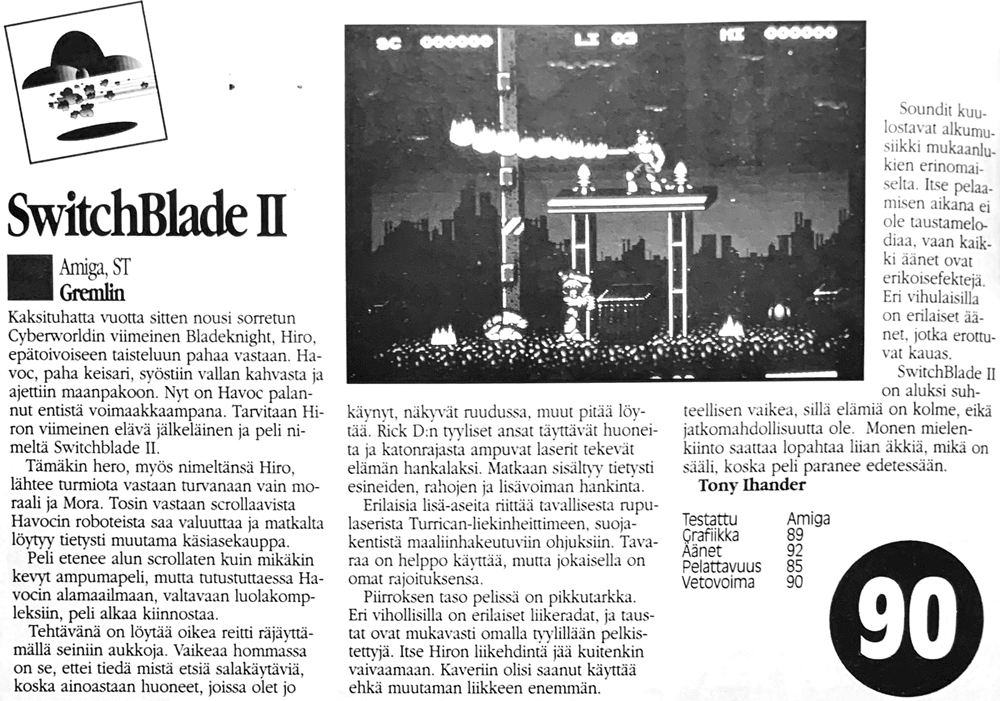
SwitchBlade II1991 SyksyPysyvä linkkiKaksituhatta vuotta sitten nousi sorretun Cyberworldin viimeinen Bladeknight, Hiro, epätoivoiseen taisteluun pahaa vastaan. Havoc, paha keisari, syöstiin vallan kahvasta ja ajettiin maanpakoon. Nyt on Havoc palannut entistä voimaakkaampana. Tarvitaan Hiron viimeinen elävä jälkeläinen ja peli nimeltä Switchblade II.
Tämäkin hero, myös nimeltänsä Hiro, lähtee turmiota vastaan turvanaan vain moraali ja Mora. Tosin vastaan scrollaavista Havocin roboteista saa valuuttaa ja matkalta löytyy tietysti muutama käsiasekauppa.
Peli etenee alun scrollaten kuin mikäkin kevyt ampumapeli, mutta tutustuttaessa Havocin alamaailmaan, valtavaan luolakompleksiin, peli alkaa kiinnostaa.
Tehtävänä on löytää oikea reitti räjäyttämällä seiniin aukkoja. Vaikeaa hommassa on se, ettei tiedä mistä etsiä salakäytäviä, koska ainoastaan huoneet, joissa olet jo käynyt, näkyvät ruudussa, muut pitää löytää. Rick D:n tyyliset ansat täyttävät huoneita ja katonrajasta ampuvat laserit tekevät elämän hankalaksi. Matkaan sisältyy tietysti esineiden, rahojen ja lisävoiman hankinta.
Erilaisia lisä-aseita riittää tavallisesta rupulaserista Turrican-liekinheittimeen, suojakentistä maaliinhakeutuviin ohjuksiin. Tavaraa on helppo käyttää, mutta jokaisella on omat rajoituksensa.
Piirroksen taso pelissä on pikkutarkka. Eri vihollisilla on erilaiset liikeradat, ja taustat ovat mukavasti omalla tyylillään pelkistettyjä. Itse Hiron liikehdintä jää kuitenkin vaivaamaan. Kaveriin olisi saanut käyttää ehkä muutaman liikkeen enemmän.
Soundit kuulostavat alkumusiikki mukaanlukien erinomaiselta. Itse pelaamisen aikana ei ole taustamelodiaa, vaan kaikki äänet ovat erikoisefektejä. Eri vihulaisilla on erilaiset äänet, jotka erottuvat kauas.
SwitchBlade II on aluksi suhteellisen vaikea, sillä elämiä on kolme, eikä jatkomahdollisuutta ole. Monen mielenkiinto saattaa lopahtaa liian äkkiä, mikä on sääli, koska peli paranee edetessään.
SwitchBlade II1991 SyksyPermalinkTwo thousand years ago, Hiro, the last Bladeknight of oppressed Cyberworld, rose up in a desperate battle against evil. Havoc, the evil emperor, was hurled from the helm of power and driven into exile. Now Havoc has returned mightier than ever. What's needed is Hiro's last living descendant and a game called Switchblade II.
This hero too, also going by the name of Hiro, sets out against ruin with nothing to rely on but morale and a Mora. Mind you, Havoc's robots scrolling in from ahead yield cash, and along the way there are of course a few handgun shops.
At first the game scrolls along like any lightweight shoot-'em-up, but once you start exploring Havoc's underworld, a vast cave complex, the game starts to get interesting.
The task is to find the right route by blasting holes in the walls. The hard part is that you don't know where to look for secret passages, because only the rooms you've already visited show up on the screen; the rest have to be found. Rick D-style traps fill the rooms, and lasers firing from up by the ceiling make life difficult. The journey of course involves picking up items, money and extra power.
There's no shortage of extra weapons, from the ordinary crummy laser to a Turrican flamethrower, from shields to homing missiles. The gear is easy to use, but each piece has its own limitations.
The drawing in the game is meticulous. Different enemies have different movement patterns, and the backgrounds are nicely pared down in a style of their own. Hiro's own movement, however, leaves a nagging feeling. The guy could perhaps have been given a few more moves.
The sounds, title music included, are excellent. During actual play there's no background tune; instead all the sounds are special effects. Different baddies have different sounds, which you can pick out from far off.
SwitchBlade II is relatively hard at first, since you get three lives and no continues. Many players may lose interest too quickly, which is a shame, because the game gets better as it goes on.
SWIV

SWIV1991 SyksyPysyvä linkkiPitkään ja hartaasti ovat tulitusnappikrampista kärsineet amigistit saaneet pelata sellaisia klassikoita kuin Xenon 2, MegaBlast ja Silkworm. Uutta voittajaa, tai edes haastajaa näille peleille ole tullut.
Kaupansedän hyllyssä paistatellut outo nimi herätti huomion. SWIV? Hetken aprikoinnin jälkeen nimi alkoi muovautua - SilkWorm IV. Nelonen? Missä ovat kakkonen ja kolmonen? Takakansi paljasti oikean nimen: Special Weapons Interdiction Vehicles.
Levyke löysi itsensä levyasemasta ja Unique Dynamic -lataussysteemin ansiosta alkupoppi alkoi hetkessä värisyttää monitorin kaiuttimia. Samat ohjelmoijat kuin... kulkuneuvoina kopteri ja jeeppi... tämä todella on Silkworm Kakkonen!
Silkwormin sivuvyörytysrutiini on saanut väistyä, mutta sitä ei kohta enää huomaakaan. Peli alkaa sumeilematta toimintana, turhaan ei selitellä, kenen puolella olemme, mikä on päämäärämme ja teemmekö kaiken oikeuden ja kohtuuden nimissä.
Vertikaaliskrolli soljuttaa maastoa ylhäältä alas, pelaajat ohjaavat helikopteria (tasa-arvovaltuutettu: miksi ei tonykopteria) ja (tai) jeeppiä. Lahtaustavaraa tulee madellen, lentäen, ja hyppien edestä, sivuilta ja takaa.
Jeeppi MKIV+ ja kopteri on aseistettu pulssikanuunalla ja lisä-aseistusta suojineen löytyy sieltä täältä. Kopteri pysyy tietyssä lentokorkeudessa esteiden yllä kylväen tuhoa. Jeeppi, joka vaikuttaa ehkä enemmän jenkkien Hummerilta, joutuu väistelemään esteitä, plussana tietenkin realistinen turbo. Lisäksi jeepin katolla olevan tykkilavetin voi lukita ampumaan tiettyyn suuntaan, joita kuitenkin on vain neljä.
Vihulaisissa riittää vaihtelua pienistä isoihin, koptereista tankkeihin, lentävistä kaloista sukellusveneisiin. Mukana on ykkösestä tuttu petokopteri. Maastoja on monia: lunta, aavikkoa, merta ja lentokenttää. Krediittien loputtua on sankarikaksikon taas aloitettava alusta.
Grafiikka on toteutettu pikkutarkasti, nättejä yksityiskohtia lisäten. Piirtämisen tahti ei tunnu hidastuvan vaikka ruudulla metallia liikkuu läjittäin. Soundeja löytyy alkumusasta alkaen riittävästi, melodia tosin korvautuu pelin alkaessa räjähdysefekteillä. Isojen vihollisten jysähdysääni ei ole yhtä kumiseva kuin ykkössilkkimadossa.
Pelistä ei pääse irti: täytyy testata, pääsisikö ensi kerralla vielä pidemmälle.
SWIV1991 SyksyPermalinkLong and devoutly have Amigans suffering from fire-button cramp been able to play such classics as Xenon 2, MegaBlast and Silkworm. No new winner, or even a challenger, has come along for these games.
An odd name basking on the shopkeeper's shelf caught my attention. SWIV? After a moment's pondering the name began to take shape - SilkWorm IV. Four? Where are two and three? The back cover revealed the real name: Special Weapons Interdiction Vehicles.
The disk found its way into the drive, and thanks to the Unique Dynamic loading system the intro pop soon had the monitor's speakers vibrating. The same programmers as... a chopper and a jeep for vehicles... this really is Silkworm Two!
Silkworm's sideways scrolling routine has had to make way, but soon you don't even notice. The game plunges unceremoniously into action; there's no pointless explaining whose side we're on, what our goal is and whether we're doing it all in the name of justice and fairness.
The vertical scroll flows the terrain from top to bottom, and the players steer a helicopter (equality ombudsman: why not a tonycopter) and (or) a jeep. Slaughter fodder comes crawling, flying and hopping at you from the front, the sides and behind.
The Jeep MKIV+ and the chopper are armed with a pulse cannon, and extra weaponry along with shields turns up here and there. The chopper stays at a fixed altitude above the obstacles, sowing destruction. The jeep, which perhaps looks more like the Yanks' Hummer, has to dodge obstacles, with a realistic turbo as a plus, naturally. In addition, the gun mount on the jeep's roof can be locked to fire in a particular direction, though there are only four of those.
There's plenty of variety among the baddies, from small to big, from choppers to tanks, from flying fish to submarines. The predator chopper familiar from the first game is along too. There are many terrains: snow, desert, sea and airfield. When the credits run out, the heroic duo has to start again from the beginning.
The graphics have been done meticulously, with pretty details added. The drawing pace doesn't seem to slow down even when there's metal moving on screen by the heap. There are enough sounds, starting with the intro music, though the tune gets replaced by explosion effects once the game starts. The big enemies' crunch isn't as booming as in the first Silkworm.
You can't tear yourself away from the game: you have to test whether you could get even further next time.
Sword of Aragorn
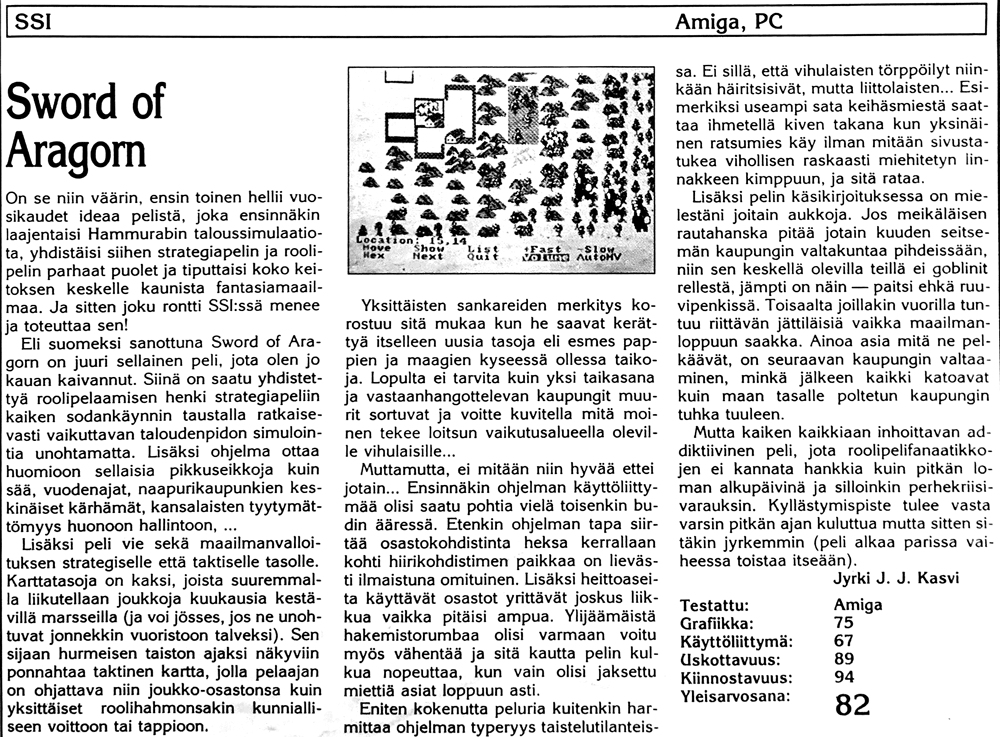
Sword of Aragorn1990 SyksyPysyvä linkkiOn se niin väärin, ensin toinen hellii vuosikaudet ideaa pelistä, joka ensinnäkin laajentaisi Hammurabin taloussimulaatiota, yhdistäisi siihen strategiapelin ja roolipelin parhaat puolet ja tiputtaisi koko keitoksen keskelle kaunista fantasiamaailmaa. Ja sitten joku rontti SSI:ssä menee ja toteuttaa sen!
Eli suomeksi sanottuna Sword of Aragorn on juuri sellainen peli, jota olen jo kauan kaivannut. Siinä on saatu yhdistettyä roolipelaamisen henki strategiapeliin kaiken sodankäynnin taustalla ratkaisevasti vaikuttavan taloudenpidon simulointia unohtamatta. Lisäksi ohjelma ottaa huomioon sellaisia pikkuseikkoja kuin sää, vuodenajat, naapurikaupunkien keskinäiset kärhämät, kansalaisten tyytymättömyys huonoon hallintoon, ...
Lisäksi peli vie sekä maailmanvalloituksen strategiselle että taktiselle tasolle. Karttatasoja on kaksi, joista suuremmalla liikutellaan joukkoja kuukausia kestävillä marsseilla (ja voi jösses, jos ne unohtuvat jonnekkin vuoristoon talveksi). Sen sijaan hurmeisen taiston ajaksi näkyviin ponnahtaa taktinen kartta, jolla pelaajan on ohjattava niin joukko-osastonsa kuin yksittäiset roolihahmonsakin kunnialliseen voittoon tai tappioon.
Yksittäisten sankareiden merkitys korostuu sitä mukaa kun he saavat kerättyä itselleen uusia tasoja eli esmes pappien ja maagien kyseessä ollessa taikoja. Lopulta ei tarvita kuin yksi taikasana ja vastaanhangottelevan kaupungit muurit sortuvat ja voitte kuvitella mitä moinen tekee loitsun vaikutusalueella oleville vihulaisille...
Muttamutta, ei mitään niin hyvää ettei jotain... Ensinnäkin ohjelman käyttöliittymää olisi saatu pohtia vielä toisenkin budin ääressä. Etenkin ohjelman tapa siirtää osastokohdistinta heksa kerrallaan kohti hiirikohdistimen paikkaa on lievästi ilmaistuna omituinen. Lisäksi heittoaseita käyttävät osastot yrittävät joskus liikkua vaikka pitäisi ampua. Ylijäämäistä hakemistorumbaa olisi varmaan voitu myös vähentää ja sitä kautta pelin kulkua nopeuttaa, kun vain olisi jaksettu miettiä asiat loppuun asti.
Eniten kokenutta peluria kuitenkin harmittaa ohjelman typeryys taistelutilanteissa. Ei sillä, että vihulaisten törppöilyt niinkään häiritsisivät, mutta liittolaisten... Esimerkiksi useampi sata keihäsmiestä saattaa ihmetellä kiven takana kun yksinäinen ratsumies käy ilman mitään sivustatukea vihollisen raskaasti miehitetyn linnakkeen kimppuun, ja sitä rataa.
Lisäksi pelin käsikirjoituksessa on mielestäni joitain aukkoja. Jos meikäläisen rautahanska pitää jotain kuuden seitsemän kaupungin valtakuntaa pihdeissään, niin sen keskellä olevilla teillä ei goblinit rellestä, jämpti on näin - paitsi ehkä ruuvipenkissä. Toisaalta joillakin vuorilla tuntuu riittävän jättiläisiä vaikka maailmanloppuun saakka. Ainoa asia mitä ne pelkäävät, on seuraavan kaupungin valtaaminen, minkä jälkeen kaikki katoavat kuin maan tasalle poltetun kaupungin tuhka tuuleen.
Mutta kaiken kaikkiaan inhoittavan addiktiivinen peli, jota roolipelifanaatikkojen ei kannata hankkia kuin pitkän loman alkupäivinä ja silloinkin perhekriisivarauksin. Kyllästymispiste tulee vasta varsin pitkän ajan kuluttua mutta sitten sitäkin jyrkemmin (peli alkaa parissa vaiheessa toistaa itseään).
Sword of Aragorn1990 SyksyPermalinkIt's just so wrong: first some of us spend years nursing the idea for a game that would, first of all, expand on Hammurabi's economic simulation, combine it with the best sides of strategy and role-playing games, and drop the whole concoction into the middle of a beautiful fantasy world. And then some oaf at SSI goes and makes it!
In plain English, then, Sword of Aragorn is exactly the kind of game I've been longing for for ages. It manages to combine the spirit of role-playing with a strategy game, without forgetting to simulate the economics that decisively shape all warfare behind the scenes. On top of that, the program takes into account such little details as the weather, the seasons, squabbles between neighbouring towns, the citizens' discontent with bad government, ...
What's more, the game takes world conquest to both the strategic and the tactical level. There are two map levels; on the larger one you move troops about on marches lasting months (and good grief if you forget them somewhere up in the mountains for the winter). For the duration of gory battle, on the other hand, a tactical map pops up, on which the player has to lead both their units and their individual role-playing characters to honourable victory or defeat.
The importance of individual heroes grows as they manage to rack up new levels - which, in the case of priests and mages, say, means spells. In the end all it takes is a single magic word and the walls of a defiant town come tumbling down, and you can all imagine what that does to any baddies within the spell's area of effect...
But-but, nothing is so good that there isn't something... First of all, the program's user interface could have done with mulling over one more Bud. In particular, the program's way of moving the unit cursor one hex at a time towards the position of the mouse pointer is peculiar, to put it mildly. Also, units armed with missile weapons sometimes try to move when they ought to shoot. The surplus menu rigmarole could probably have been cut down as well, speeding up the flow of the game, if only someone had bothered to think things through to the end.
What annoys the experienced gamer most, though, is the program's stupidity in combat. Not that the baddies' bungling is all that much of a bother, but the allies'... For example, several hundred spearmen may stand gawping behind a rock while a lone horseman, with no flank support whatsoever, lays into the enemy's heavily manned fortress, and so on and so forth.
Also, in my opinion, the game's script has a few holes in it. If yours truly's iron gauntlet has some kingdom of six or seven towns clamped in its pincers, then goblins do not go carousing on the roads in the middle of it, and that's that - except maybe in a vice. On the other hand, some mountains seem to have giants to spare right up until the end of the world. The only thing they fear is the capture of the next town, after which they all vanish like the ashes of a town burnt to the ground, scattered on the wind.
But all in all, a disgustingly addictive game that role-playing fanatics shouldn't get hold of except in the first days of a long holiday, and even then with a family crisis budgeted for. The saturation point only comes after quite a long time, but then all the more steeply (at a couple of stages the game starts repeating itself).
Sword of Sodan
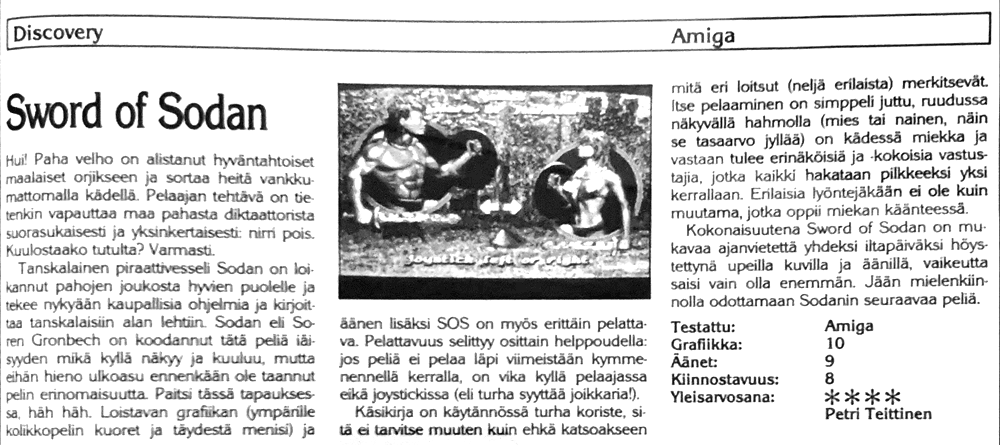
Sword of Sodan1989 SyksyPysyvä linkkiHui! Paha velho on alistanut hyväntahtoiset maalaiset orjikseen ja sortaa heitä vankkumattomalla kädellä. Pelaajan tehtävä on tietenkin vapauttaa maa pahasta diktaattorista suorasukaisesti ja yksinkertaisesti: nirri pois. Kuulostaako tutulta? Varmasti.
Tanskalainen piraattivesseli Sodan on loikannut pahojen joukosta hyvien puolelle ja tekee nykyään kaupallisia ohjelmia ja kirjoittaa tanskalaisiin alan lehtiin. Sodan eli Soren Gronbech on koodannut tätä peliä iäisyyden mikä kyllä näkyy ja kuuluu, mutta eihän hieno ulkoasu ennenkään ole taannut pelin erinomaisuutta. Paitsi tässä tapauksessa, häh häh. Loistavan grafiikan (ympärille kolikkopelin kuoret ja täydestä menisi) ja äänen lisäksi SOS on myös erittäin pelattava. Pelattavuus selittyy osittain helppoudella: jos peliä ei pelaa läpi viimeistään kymmenennellä kerralla, on vika kyllä pelaajassa eikä joystickissä (eli turha syyttää joikkaria!).
Käsikirja on käytännössä turha koriste, sitä ei tarvitse muuten kuin ehkä katsoakseen mitä eri loitsut (neljä erilaista) merkitsevät. Itse pelaaminen on simppeli juttu, ruudussa näkyvällä hahmolla (mies tai nainen, näin se tasaarvo jyllää) on kädessä miekka ja vastaan tulee erinäköisiä ja -kokoisia vastustajia, jotka kaikki hakataan pilkkeeksi yksi kerrallaan. Erilaisia lyöntejäkään ei ole kuin muutama, jotka oppii miekan käänteessä.
Kokonaisuutena Sword of Sodan on mukavaa ajanvietettä yhdeksi iltapäiväksi höystettynä upeilla kuvilla ja äänillä, vaikeutta saisi vain olla enemmän. Jään mielenkiinnolla odottamaan Sodanin seuraavaa peliä.
Sword of Sodan1989 SyksyPermalinkEek! An evil wizard has made slaves of the good-hearted country folk and oppresses them with an unwavering hand. The player's task is of course to free the land from the evil dictator, bluntly and simply: bump him off. Sound familiar? Sure it does.
The Danish pirate rascal Sodan has defected from the bad guys to the side of the good, and these days makes commercial software and writes for Danish computer magazines. Sodan, aka Soren Gronbech, has been coding this game for an eternity, which you can certainly see and hear, but then a fancy look has never guaranteed a game's excellence before. Except in this case, heh heh. Besides the brilliant graphics (stick an arcade cabinet around it and it would pass for the real thing) and sound, SOS is also extremely playable. The playability is partly explained by how easy it is: if you haven't beaten the game by the tenth go at the latest, the fault really lies with the player and not with the joystick (so there's no point blaming the stick!).
The manual is in practice a useless ornament; you don't need it except perhaps to look up what the various spells (four different ones) mean. The playing itself is a simple business: the character on screen (man or woman - that's equality running riot for you) has a sword in hand, and up come opponents of all shapes and sizes, who are all hacked into kindling one at a time. There are only a handful of different strokes, too, which you pick up in a flick of the sword.
All in all, Sword of Sodan is a pleasant pastime for one afternoon, spiced up with gorgeous visuals and sounds - there just ought to be more difficulty. I'll be waiting with interest for Sodan's next game.
Swords Of Twilight
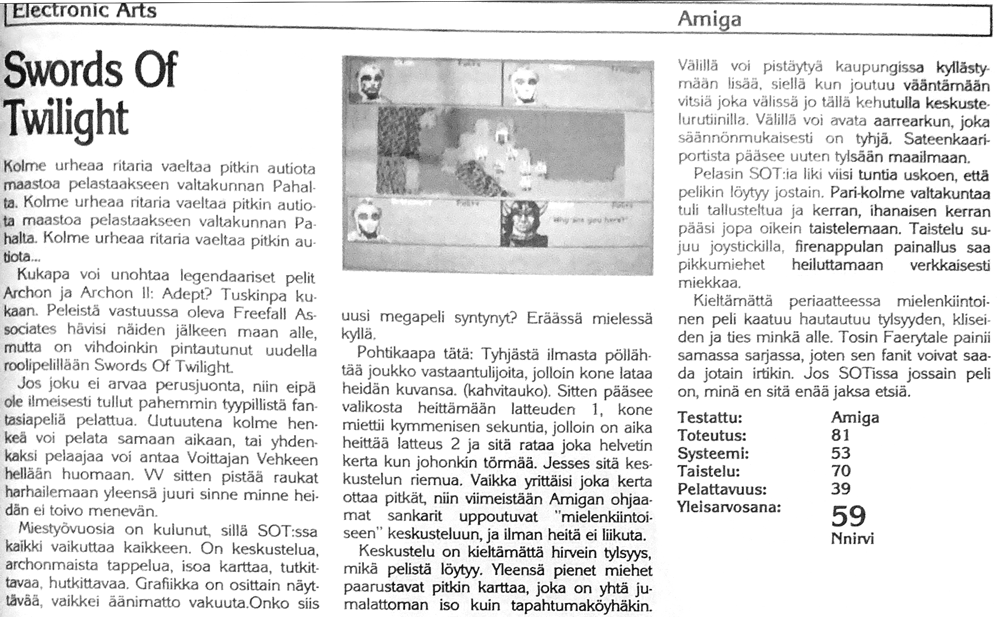
Swords Of Twilight1990 KevätPysyvä linkkiKolme urheaa ritaria vaeltaa pitkin autiota maastoa pelastaakseen valtakunnan Pahalta. Kolme urheaa ritaria vaeltaa pitkin autiota maastoa pelastaakseen valtakunnan Pahalta. Kolme urheaa ritaria vaeltaa pitkin autiota...
Kukapa voi unohtaa legendaariset pelit Archon ja Archon II: Adept? Tuskinpa kukaan. Peleistä vastuussa oleva Freefall Associates hävisi näiden jälkeen maan alle, mutta on vihdoinkin pintautunut uudella roolipelillään Swords Of Twilight.
Jos joku ei arvaa perusjuonta, niin eipä ole ilmeisesti tullut pahemmin tyypillistä fantasiapeliä pelattua. Uutuutena kolme henkeä voi pelata samaan aikaan, tai yhdenkaksi pelaajaa voi antaa Voittajan Vehkeen hellään huomaan. VV sitten pistää raukat harhailemaan yleensä juuri sinne minne heidän ei toivo menevän.
Miestyövuosia on kulunut, sillä SOT:ssa kaikki vaikuttaa kaikkeen. On keskustelua, archonmaista tappelua, isoa karttaa, tutkittavaa, hutkittavaa. Grafiikka on osittain näyttävää, vaikkei äänimatto vakuuta.Onko siis uusi megapeli syntynyt? Eräässä mielessä kyllä.
Pohtikaapa tätä: Tyhjästä ilmasta pöllähtää joukko vastaantulijoita, jolloin kone lataa heidän kuvansa. (kahvitauko). Sitten pääsee valikosta heittämään latteuden 1, kone miettii kymmenisen sekuntia, jolloin on aika heittää latteus 2 ja sitä rataa joka helvetin kerta kun johonkin törmää. Jesses sitä keskustelun riemua. Vaikka yrittäisi joka kerta ottaa pitkät, niin viimeistään Amigan ohjaamat sankarit uppoutuvat "mielenkiintoiseen" keskusteluun, ja ilman heitä ei liikuta.
Keskustelu on kieltämättä hirvein tylsyys, mikä pelistä löytyy. Yleensä pienet miehet paarustavat pitkin karttaa, joka on yhtä jumalattoman iso kuin tapahtumaköyhäkin.
Välillä voi pistäytyä kaupungissa kyllästymään lisää, siellä kun joutuu vääntämään vitsiä joka välissä jo tällä kehutulla keskustelurutiinilla. Välillä voi avata aarrearkun, joka säännönmukaisesti on tyhjä. Sateenkaariportista pääsee uuteen tylsään maailmaan.
Pelasin SOT:ia liki viisi tuntia uskoen, että pelikin löytyy jostain. Pari-kolme valtakuntaa tuli tallusteltua ja kerran, ihanaisen kerran pääsi jopa oikein taistelemaan. Taistelu sujuu joystickilla, firenappulan painallus saa pikkumiehet heiluttamaan verkkaisesti miekkaa.
Kieltämättä periaatteessa mielenkiintoinen peli kaatuu hautautuu tylsyyden, kliseiden ja ties minkä alle. Tosin Faerytale painii samassa sarjassa, joten sen fanit voivat saada jotain irtikin. Jos SOTissa jossain peli on, minä en sitä enää jaksa etsiä.
Swords Of Twilight1990 KevätPermalinkThree brave knights wander across a desolate landscape to save the kingdom from Evil. Three brave knights wander across a desolate landscape to save the kingdom from Evil. Three brave knights wander across a desolate...
Who could possibly forget the legendary games Archon and Archon II: Adept? Hardly anyone. Freefall Associates, who were responsible for the games, vanished underground after them, but has finally surfaced with its new role-playing game Swords Of Twilight.
If anyone can't guess the basic plot, then evidently they haven't played much in the way of typical fantasy games. As a novelty, three people can play at the same time, or one or two of the players can be handed over to the tender care of the Winner's Widget. The WW then sends the poor souls wandering off, usually to exactly where you'd hope they wouldn't go.
Man-years of work have gone into it, since in SOT everything affects everything. There's conversation, Archon-style fighting, a big map, stuff to scout, stuff to clout. The graphics are impressive in places, although the soundscape doesn't convince. So has a new megagame been born? In a sense, yes.
Ponder this: a bunch of strangers poofs into being out of thin air, whereupon the machine loads their picture. (coffee break). Then you get to toss out platitude 1 from a menu, the machine thinks for ten seconds or so, at which point it's time to toss out platitude 2, and so on every bloody time you run into anything. Jeez, the joy of conversation. Even if you try to take to your heels every time, if nothing else the heroes controlled by the Amiga get absorbed in some "interesting" conversation, and without them you're not going anywhere.
The conversation is, admittedly, the most horrendous tedium the game has to offer. Mostly the little men trudge across the map, which is as godawfully big as it is short on events.
Now and then you can drop into a town to get bored some more, since there you have to crack jokes at every turn with this much-vaunted conversation routine. Now and then you can open a treasure chest, which as a rule is empty. A rainbow gate takes you to a new boring world.
I played SOT for nearly five hours in the belief that a game would turn up in there somewhere too. I tramped through two or three kingdoms, and once, one lovely once, I even got to fight properly. Fighting is done with the joystick; pressing the fire button makes the little men swing their swords at a leisurely pace.
An admittedly interesting-in-principle game collapses, buried under tedium, clichés and who knows what else. Then again, Faerytale fights in the same weight class, so its fans may get something out of it. If there's a game somewhere in SOT, I can't be bothered to look for it any more.
Sydney Affair, The
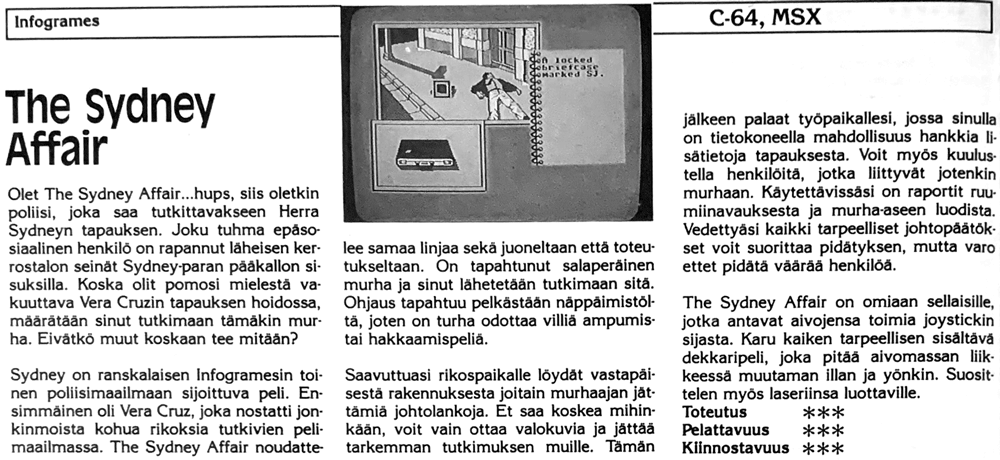
Sydney Affair, The1987Pysyvä linkkiOlet The Sydney Affair...hups, siis oletkin poliisi, joka saa tutkittavakseen Herra Sydneyn tapauksen. Joku tuhma epäsosiaalinen henkilö on rapannut läheisen kerrostalon seinät Sydney-paran pääkallon sisuksilla. Koska olit pomosi mielestä vakuuttava Vera Cruzin tapauksen hoidossa, määrätään sinut tutkimaan tämäkin murha. Eivätkö muut koskaan tee mitään?
Sydney on ranskalaisen Infogramesin toinen poliisimaailmaan sijoittuva peli. Ensimmäinen oli Vera Cruz, joka nostatti jonkinmoista kohua rikoksia tutkivien pelimaailmassa. The Sydney Affair noudattelee samaa linjaa sekä juoneltaan että toteutukseltaan. On tapahtunut salaperäinen murha ja sinut lähetetään tutkimaan sitä. Ohjaus tapahtuu pelkästään näppäimistöltä, joten on turha odottaa villiä ampumis- tai hakkaamispeliä.
Saavuttuasi rikospaikalle löydät vastapäisestä rakennuksesta joitain murhaajan jättämiä johtolankoja. Et saa koskea mihinkään, voit vain ottaa valokuvia ja jättää tarkemman tutkimuksen muille. Tämän jälkeen palaat työpaikallesi, jossa sinulla on tietokoneella mahdollisuus hankkia lisätietoja tapauksesta. Voit myös kuulustella henkilöitä, jotka liittyvät jotenkin murhaan. Käytettävissäsi on raportit ruumiinavauksesta ja murha-aseen luodista. Vedettyäsi kaikki tarpeelliset johtopäätökset voit suorittaa pidätyksen, mutta varo ettet pidätä väärää henkilöä.
The Sydney Affair on omiaan sellaisille, jotka antavat aivojensa toimia joystickin sijasta. Karu kaiken tarpeellisen sisältävä dekkaripeli, joka pitää aivomassan liikkeessä muutaman illan ja yönkin. Suosittelen myös laseriinsa luottaville.
Sydney Affair, The1987PermalinkYou are The Sydney Affair...oops, I mean, you are actually a policeman who is handed the case of Mr Sydney to investigate. Some naughty antisocial individual has plastered the walls of a nearby block of flats with the insides of poor Sydney's skull. Since your boss thought you were convincing in your handling of the Vera Cruz case, you are assigned to investigate this murder as well. Doesn't anybody else ever do anything?
Sydney is the second game from the French company Infogrames to be set in the world of the police. The first was Vera Cruz, which caused something of a stir in the world of crime-solving games. The Sydney Affair follows the same line in both plot and execution. A mysterious murder has taken place and you are sent to investigate it. Control is by keyboard alone, so there's no point expecting a wild shoot-'em-up or beat-'em-up.
On arriving at the scene of the crime you find some clues left by the murderer in the building opposite. You are not allowed to touch anything; you can only take photographs and leave the closer investigation to others. After that you return to your office, where you can use the computer to dig up more information about the case. You can also interrogate people who are somehow connected with the murder. You have at your disposal the reports on the autopsy and on the bullet from the murder weapon. Once you have drawn all the necessary conclusions you can make an arrest, but be careful not to arrest the wrong person.
The Sydney Affair is just the thing for those who let their brains do the work instead of the joystick. An austere detective game with everything it needs, which will keep your grey matter moving for a few evenings, and nights too. I also recommend it to those who put their trust in their laser.