Space Ace
Pelit was a Finnish-language (bi)annual book series published from 1987 to 1991 containing gaming-related articles, tips and most importantly game reviews. Here you can find all the reviews from the books. The reviews were originally written in Finnish; the English versions are translations of the Finnish originals. Maininta tekijänoikeuksista
 1987
1987 1988
1988 1989 Kevät
 1989 Syksy
 1990 Kevät
 1990 Syksy
 1991 Kevät
 1991 Syksy
Space Ace
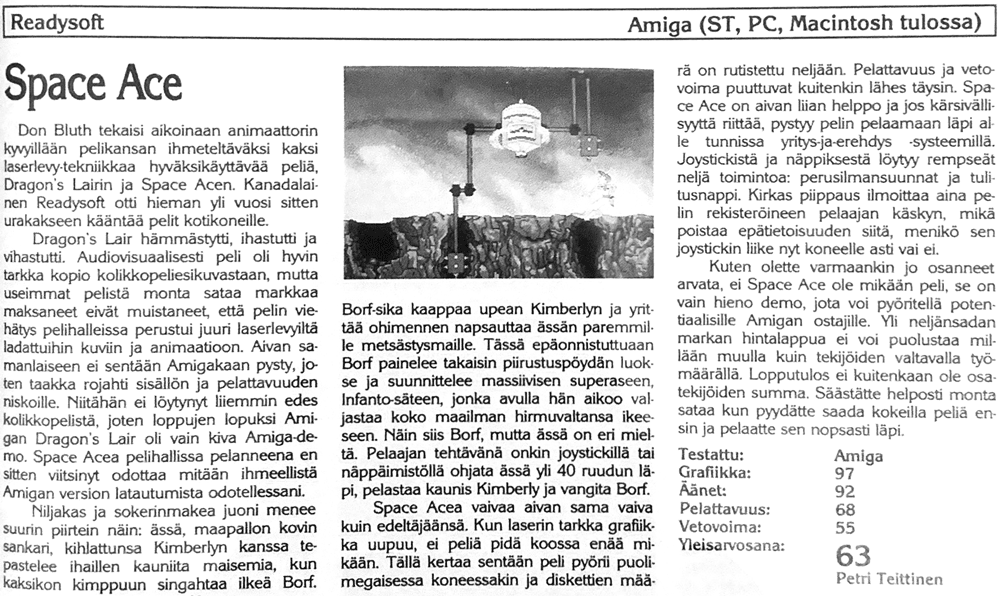
Space Ace1990 KevätPysyvä linkkiDon Bluth tekaisi aikoinaan animaattorin kyvyillään pelikansan ihmeteltäväksi kaksi laserlevy-tekniikkaa hyväksikäyttävää peliä, Dragon's Lairin ja Space Acen. Kanadalainen Readysoft otti hieman yli vuosi sitten urakakseen kääntää pelit kotikoneille.
Dragon's Lair hämmästytti, ihastutti ja vihastutti. Audiovisuaalisesti peli oli hyvin tarkka kopio kolikkopeliesikuvastaan, mutta useimmat pelistä monta sataa markkaa maksaneet eivät muistaneet, että pelin viehätys pelihalleissa perustui juuri laserlevyiltä ladattuihin kuviin ja animaatioon. Aivan samanlaiseen ei sentään Amigakaan pysty, joten taakka rojahti sisällön ja pelattavuuden niskoille. Niitähän ei löytynyt liiemmin edes kolikkopelistä, joten loppujen lopuksi Amigan Dragon's Lair oli vain kiva Amiga-demo. Space Acea pelihallissa pelanneena en sitten viitsinyt odottaa mitään ihmeellistä Amigan version latautumista odotellessani.
Niljakas ja sokerinmakea juoni menee suurin piirtein näin: ässä, maapallon kovin sankari, kihlattunsa Kimberlyn kanssa tepastelee ihaillen kauniita maisemia, kun kaksikon kimppuun singahtaa ilkeä Borf. Borf-sika kaappaa upean Kimberlyn ja yrittää ohimennen napsauttaa ässän paremmille metsästysmaille. Tässä epäonnistuttuaan Borf painelee takaisin piirustuspöydän luokse ja suunnittelee massiivisen superaseen, Infanto-säteen, jonka avulla hän aikoo valjastaa koko maailman hirmuvaltansa ikeeseen. Näin siis Borf, mutta ässä on eri mieltä. Pelaajan tehtävänä onkin joystickillä tai näppäimistöllä ohjata ässä yli 40 ruudun läpi, pelastaa kaunis Kimberly ja vangita Borf.
Space Acea vaivaa aivan sama vaiva kuin edeltäjäänsä. Kun laserin tarkka grafiikka uupuu, ei peliä pidä koossa enää mikään. Tällä kertaa sentään peli pyöri puolimegaisessa koneessakin ja diskettien määrä on rutistettu neljään. Pelattavuus ja vetovoima puuttuvat kuitenkin lähes täysin. Space Ace on aivan liian helppo ja jos kärsivällisyyttä riittää, pystyy pelin pelaamaan läpi alle tunnissa yritys-ja-erehdys -systeemillä. Joystickistä ja näppiksestä löytyy rempseät neljä toimintoa: perusilmansuunnat ja tulitusnappi. Kirkas piippaus ilmoittaa aina pelin rekisteröineen pelaajan käskyn, mikä poistaa epätietoisuuden siitä, menikö sen joystickin liike nyt koneelle asti vai ei.
Kuten olette varmaankin jo osanneet arvata, ei Space Ace ole mikään peli, se on vain hieno demo, jota voi pyöritellä potentiaalisille Amigan ostajille. Yli neljänsadan markan hintalappua ei voi puolustaa millään muulla kuin tekijöiden valtavalla työmäärällä. Lopputulos ei kuitenkaan ole osatekijöiden summa. Säästätte helposti monta sataa kun pyydätte saada kokeilla peliä ensin ja pelaatte sen nopsasti läpi.
Space Ace1990 KevätPermalinkBack in the day, Don Bluth used his animator's talents to knock out two games exploiting laserdisc technology for the gaming public to marvel at: Dragon's Lair and Space Ace. A little over a year ago the Canadian Readysoft took on the job of converting the games to home computers.
Dragon's Lair amazed, delighted and infuriated. Audiovisually the game was a very faithful copy of its coin-op original, but most of those who paid several hundred marks for it forgot that the game's charm in the arcades rested precisely on the pictures and animation loaded off laserdisc. Not even the Amiga can manage quite the same thing, so the burden came crashing down on the shoulders of content and playability. And there wasn't much of those to be found even in the coin-op, so in the end the Amiga Dragon's Lair was just a nice Amiga demo. Having played Space Ace in the arcade, I didn't bother expecting anything amazing while I waited for the Amiga version to load.
The slimy, sickly-sweet plot goes roughly like this: Ace, Earth's toughest hero, is tootling along with his fiancée Kimberly admiring the lovely scenery when the wicked Borf swoops down on the pair. That swine Borf kidnaps the gorgeous Kimberly and, in passing, tries to zap Ace off to the happy hunting grounds. Having failed at this, Borf scurries back to the drawing board and designs a massive superweapon, the Infanto ray, with which he intends to bring the whole world under the yoke of his tyranny. So much for Borf, but Ace begs to differ. The player's task, then, is to steer Ace with the joystick or keyboard through more than 40 screens, rescue the beautiful Kimberly and capture Borf.
Space Ace suffers from exactly the same ailment as its predecessor. Without the laser's crisp graphics, nothing holds the game together any more. This time, at least, the game ran on a half-meg machine too, and the number of disks has been squeezed down to four. Playability and appeal, however, are almost entirely missing. Space Ace is far too easy, and if your patience holds out you can play it through in under an hour using the trial-and-error method. The joystick and keyboard offer a whopping four functions: the basic compass directions and the fire button. A clear beep always announces that the game has registered the player's command, which removes any uncertainty over whether that joystick movement actually made it all the way to the computer or not.
As you have probably already guessed, Space Ace is no game at all; it is just a fancy demo you can run for prospective Amiga buyers. The price tag of over four hundred marks cannot be defended with anything other than the enormous amount of work its makers put in. The end result, however, is not the sum of its parts. You can easily save several hundred by asking to try the game first and zipping through it to the end on the spot.