1133 reviews from "Pelit"-books
Pelit was a Finnish-language (bi)annual book series published from 1987 to 1991 containing gaming-related articles, tips and most importantly game reviews. Here you can find all the reviews from the books. The reviews were originally written in Finnish; the English versions are translations of the Finnish originals. Maininta tekijänoikeuksista
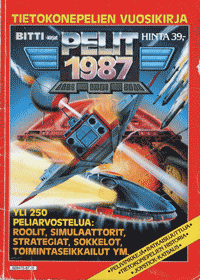 1987
1987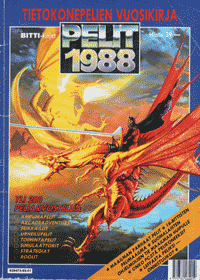 1988
1988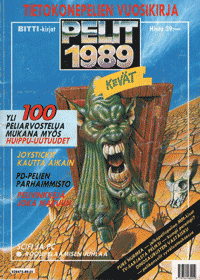 1989 Kevät
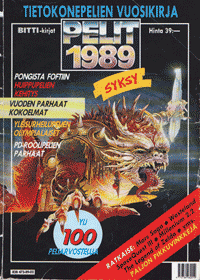 1989 Syksy
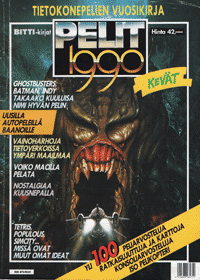 1990 Kevät
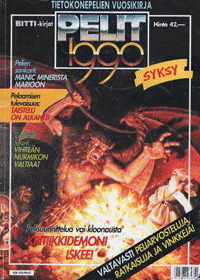 1990 Syksy
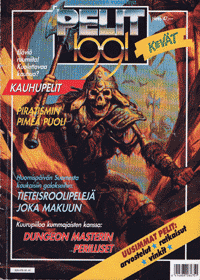 1991 Kevät
 1991 Syksy
Obitus
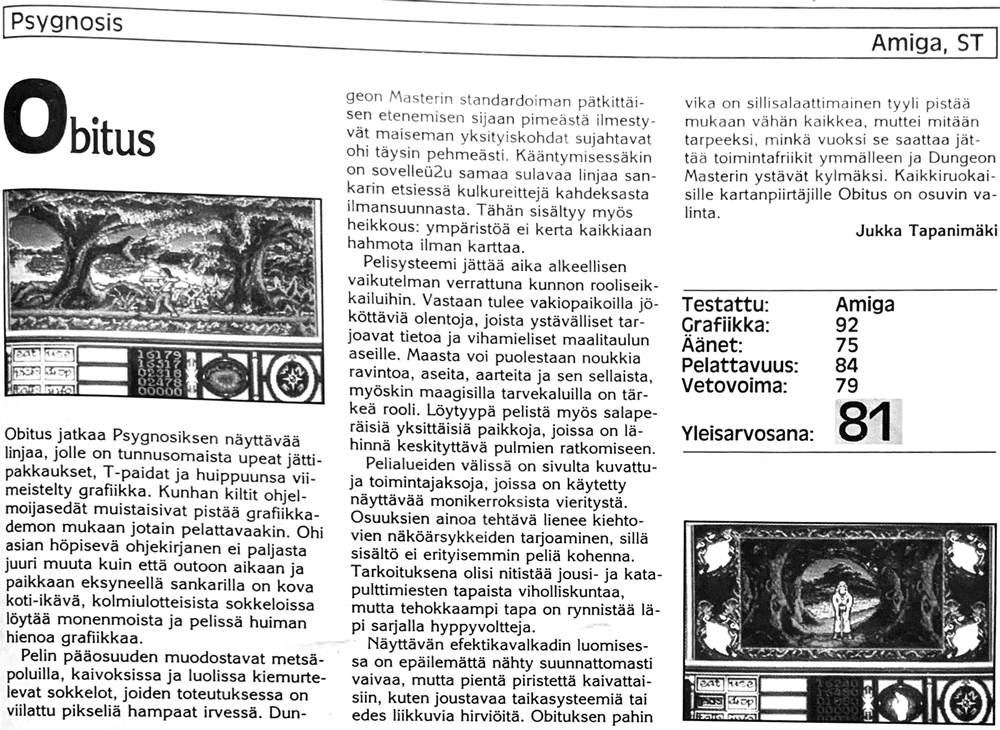
Obitus1991 KevätPysyvä linkkiObitus jatkaa Psygnosiksen näyttävää linjaa, jolle on tunnusomaista upeat jättipakkaukset, T-paidat ja huippuunsa viimeistelty grafiikka. Kunhan kiltit ohjelmoijasedät muistaisivat pistää grafiikkademon mukaan jotain pelattavaakin. Ohi asian höpisevä ohjekirjanen ei paljasta juuri muuta kuin että outoon aikaan ja paikkaan eksyneellä sankarilla on kova koti-ikävä, kolmiulotteisista sokkeloissa löytää monenmoista ja pelissä huiman hienoa grafiikkaa.
Pelin pääosuuden muodostavat metsäpoluilla, kaivoksissa ja luolissa kiemurtelevat sokkelot, joiden toteutuksessa on viilattu pikseliä hampaat irvessä. Dungeon Masterin standardoiman pätkittäisen etenemisen sijaan pimeästä ilmestyvät maiseman yksityiskohdat sujahtavat ohi täysin pehmeästi. Kääntymisessäkin on sovelleü2u samaa sulavaa linjaa sankarin etsiessä kulkureittejä kahdeksasta ilmansuunnasta. Tähän sisältyy myös heikkous: ympäristöä ei kerta kaikkiaan hahmota ilman karttaa.
Pelisysteemi jättää aika alkeellisen vaikutelman verrattuna kunnon rooliseikkailuihin. Vastaan tulee vakiopaikoilla jököttäviä olentoja, joista ystävälliset tarjoavat tietoa ja vihamieliset maalitaulun aseille. Maasta voi puolestaan noukkia ravintoa, aseita, aarteita ja sen sellaista, myöskin maagisilla tarvekaluilla on tärkeä rooli. Löytyypä pelistä myös salaperäisiä yksittäisiä paikkoja, joissa on lähinnä keskityttävä pulmien ratkomiseen.
Pelialueiden välissä on sivulta kuvattuja toimintajaksoja, joissa on käytetty näyttävää monikerroksista vieritystä. Osuuksien ainoa tehtävä lienee kiehtovien näköärsykkeiden tarjoaminen, sillä sisältö ei erityisemmin peliä kohenna. Tarkoituksena olisi nitistää jousi- ja katapulttimiesten tapaista viholliskuntaa, mutta tehokkaampi tapa on rynnistää läpi sarjalla hyppyvoltteja.
Näyttävän efektikavalkadin luomisessa on epäilemättä nähty suunnattomasti vaivaa, mutta pientä piristettä kaivattaisiin, kuten joustavaa taikasysteemiä tai edes liikkuvia hirviöitä. Obituksen pahin vika on sillisalaattimainen tyyli pistää mukaan vähän kaikkea, muttei mitään tarpeeksi, minkä vuoksi se saattaa jättää toimintafriikit ymmälleen ja Dungeon Masterin ystävät kylmäksi. Kaikkiruokaisille kartanpiirtäjille Obitus on osuvin valinta.
Obitus1991 KevätPermalinkObitus continues Psygnosis's showy line, which is characterised by gorgeous giant boxes, T-shirts and graphics polished to the very last detail. If only the kind programmer uncles would remember to put something playable in with the graphics demo, too. The manual, which babbles off the point, reveals little more than that the hero, lost in a strange time and place, is terribly homesick, that you can find all sorts of things in the three-dimensional mazes, and that the game has stunningly fine graphics.
The main part of the game is made up of mazes winding along forest paths and through mines and caves, and in building them someone has been filing away at the pixels with gritted teeth. Instead of the step-by-step movement made standard by Dungeon Master, the details of the scenery emerge out of the dark and slide past perfectly smoothly. The same fluid approach has been applied to turning as well, as the hero looks for routes in eight compass directions. Therein also lies a weakness: you simply can't get a grip on your surroundings without a map.
The game system leaves a rather primitive impression compared with proper role-playing adventures. You come across creatures squatting in fixed places; the friendly ones offer information and the hostile ones a target for your weapons. From the ground, meanwhile, you can pick up food, weapons, treasure and that sort of thing, and magical gear also plays an important role. The game even has some mysterious one-off places where you mostly have to concentrate on solving puzzles.
Between the game areas there are side-on action sequences that use flashy multi-layered scrolling. The only job of these sections is presumably to provide fascinating visual stimuli, as their content doesn't particularly improve the game. The idea would be to snuff out an enemy force of the bowmen and catapult-men sort, but a more effective way is to charge through with a series of somersault leaps.
No doubt an enormous amount of effort has gone into creating the spectacular cavalcade of effects, but a little pepping up would be welcome, such as a flexible magic system or even monsters that move. Obitus's worst flaw is its hotchpotch style of throwing in a bit of everything but not enough of anything, which is why it may leave action freaks baffled and Dungeon Master fans cold. For omnivorous map-drawers, Obitus is the most fitting choice.
Obliterator
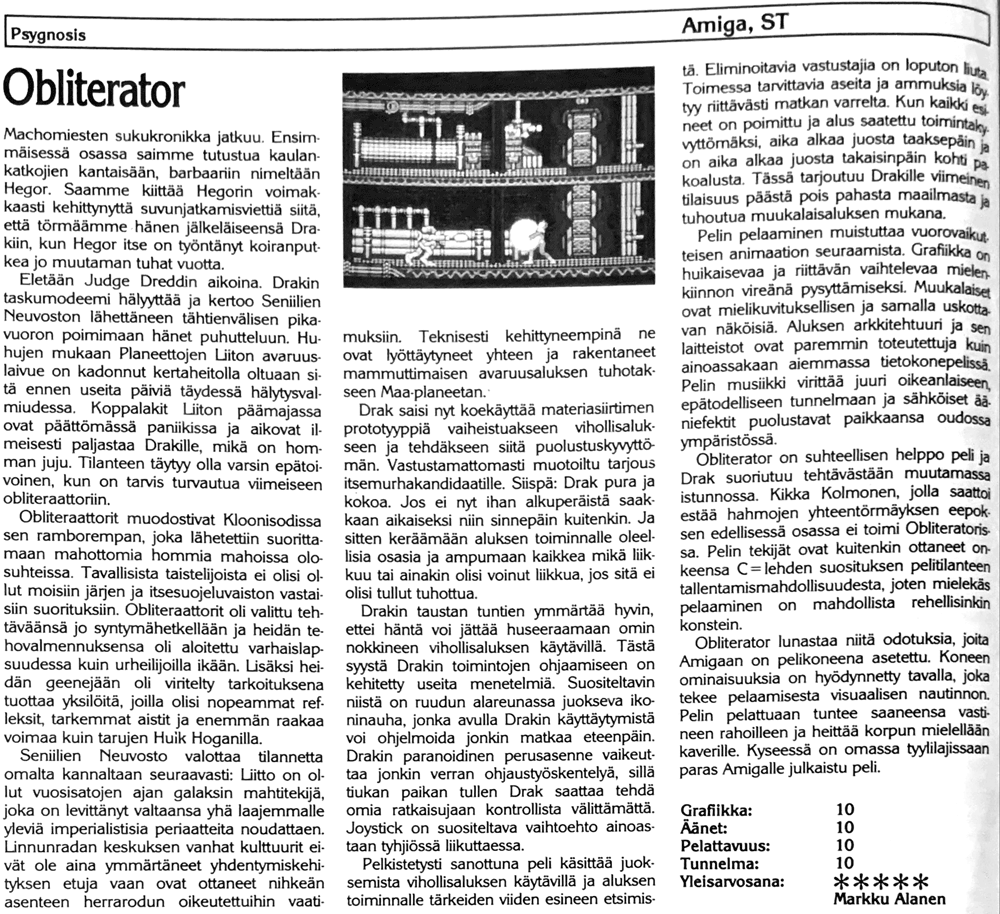
Obliterator1988Pysyvä linkkiMachomiesten sukukronikka jatkuu. Ensimmäisessä osassa saimme tutustua kaulankatkojien kantaisään, barbaariin nimeltään Hegor. Saamme kiittää Hegorin voimakkaasti kehittynyttä suvunjatkamisviettiä siitä, että törmäämme hänen jälkeläiseensä Drakiin, kun Hegor itse on työntänyt koiranputkea jo muutaman tuhat vuotta.
Eletään Judge Dreddin aikoina. Drakin taskumodeemi hälyyttää ja kertoo Seniilien Neuvoston lähettäneen tähtienvälisen pikavuoron poimimaan hänet puhutteluun. Huhujen mukaan Planeettojen Liiton avaruuslaivue on kadonnut kertaheitolla oltuaan sitä ennen useita päiviä täydessä hälytysvalmiudessa. Koppalakit Liiton päämajassa ovat päättömässä paniikissa ja aikovat ilmeisesti paljastaa Drakille, mikä on homman juju. Tilanteen täytyy olla varsin epätoivoinen, kun on tarvis turvautua viimeiseen obliteraattoriin.
Obliteraattorit muodostivat Kloonisodissa sen ramborempan, joka lähetettiin suorittamaan mahottomia hommia mahoissa olosuhteissa. Tavallisista taistelijoista ei olisi ollut moisiin järjen ja itsesuojeluvaiston vastaisiin suorituksiin. Obliteraattorit oli valittu tehtäväänsä jo syntymähetkellään ja heidän tehovalmennuksensa oli aloitettu varhaislapsuudessa kuin urheilijoilla ikään. Lisäksi heidän geenejään oli viritelty tarkoituksena tuottaa yksilöitä, joilla olisi nopeammat refleksit, tarkemmat aistit ja enemmän raakaa voimaa kuin tarujen Huik Hoganilla.
Seniilien Neuvosto valottaa tilannetta omalta kannaltaan seuraavasti: Liitto on ollut vuosisatojen ajan galaksin mahtitekijä, joka on levittänyt valtaansa yhä laajemmalle yleviä imperialistisia periaatteita noudattaen. Linnunradan keskuksen vanhat kulttuurit eivät ole aina ymmärtäneet yhdentymiskehityksen etuja vaan ovat ottaneet nihkeän asenteen herrarodun oikeutettuihin vaatimuksiin. Teknisesti kehittyneempinä ne ovat lyöttäytyneet yhteen ja rakentaneet mammuttimaisen avaruusaluksen tuhotakseen Maa-planeetan.
Drak saisi nyt koekäyttää materiasiirtimen prototyyppiä vaiheistuakseen vihollisalukseen ja tehdäkseen siitä puolustuskyvyttömän. Vastustamattomasti muotoiltu tarjous itsemurhakandidaatille. Siispä: Drak pura ja kokoa. Jos ei nyt ihan alkuperäistä saakkaan aikaiseksi niin sinnepäin kuitenkin. Ja sitten keräämään aluksen toiminnalle oleellisia osasia ja ampumaan kaikkea mikä liikkuu tai ainakin olisi voinut liikkua, jos sitä ei olisi tullut tuhottua.
Drakin taustan tuntien ymmärtää hyvin, ettei häntä voi jättää huseeraamaan omin nokkineen vihollisaluksen käytävillä. Tästä syystä Drakin toimintojen ohjaamiseen on kehitetty useita menetelmiä. Suositeltavin niistä on ruudun alareunassa juokseva ikoninauha, jonka avulla Drakin käyttäytymistä voi ohjelmoida jonkin matkaa eteenpäin. Drakin paranoidinen perusasenne vaikeuttaa jonkin verran ohjaustyöskentelyä, sillä tiukan paikan tullen Drak saattaa tehdä omia ratkaisujaan kontrollista välittämättä. Joystick on suositeltava vaihtoehto ainoastaan tyhjiössä liikuttaessa.
Pelkistetysti sanottuna peli käsittää juoksemista vihollisaluksen käytävillä ja aluksen toiminnalle tärkeiden viiden esineen etsimistä. Eliminoitavia vastustajia on loputon liuta. Toimessa tarvittavia aseita ja ammuksia löytyy riittävästi matkan varrelta. Kun kaikki esineet on poimittu ja alus saatettu toimintakyvyttömäksi, aika alkaa juosta taaksepäin ja on aika alkaa juosta takaisinpäin kohti pakoalusta. Tässä tarjoutuu Drakille viimeinen tilaisuus päästä pois pahasta maailmasta ja tuhoutua muukalaisaluksen mukana.
Pelin pelaaminen muistuttaa vuorovaikutteisen animaation seuraamista. Grafiikka on huikaisevaa ja riittävän vaihtelevaa mielenkiinnon vireänä pysyttämiseksi. Muukalaiset ovat mielikuvituksellisen ja samalla uskottavan näköisiä. Aluksen arkkitehtuuri ja sen laitteistot ovat paremmin toteutettuja kuin ainoassakaan aiemmassa tietokonepelissä. Pelin musiikki virittää juuri oikeanlaiseen, epätodelliseen tunnelmaan ja sähköiset ääniefektit puolustavat paikkaansa oudossa ympäristössä.
Obliterator on suhteellisen helppo peli ja Drak suoriutuu tehtävästään muutamassa istunnossa. Kikka Kolmonen, jolla saattoi estää hahmojen yhteentörmäyksen eepoksen edellisessä osassa ei toimi Obliteratorissa. Pelin tekijät ovat kuitenkin ottaneet onkeensa C=lehden suosituksen pelitilanteen tallentamismahdollisuudesta, joten mielekäs pelaaminen on mahdollista rehellisinkin konstein.
Obliterator lunastaa niitä odotuksia, joita Amigaan on pelikoneena asetettu. Koneen ominaisuuksia on hyödynnetty tavalla, joka tekee pelaamisesta visuaalisen nautinnon. Pelin pelattuaan tuntee saaneensa vastineen rahoilleen ja heittää korpun mielellään kaverille. Kyseessä on omassa tyylilajissaan paras Amigalle julkaistu peli.
Obliterator1988PermalinkThe family chronicle of the macho men continues. In the first instalment we got to know the founding father of the cutthroats, a barbarian named Hegor. We have Hegor's powerfully developed urge to carry on the family line to thank for the fact that we now run into his descendant Drak, Hegor himself having been pushing up daisies for a few thousand years already.
We are living in the days of Judge Dredd. Drak's pocket modem sounds the alarm and tells him that the Senile Council has sent an interstellar express shuttle to pick him up for a talking-to. Rumour has it that the space fleet of the Planetary Federation has vanished at a stroke, after spending several days on full alert beforehand. The brass hats at Federation headquarters are in a headless panic and apparently intend to reveal to Drak what the score is. The situation must be pretty desperate if there is call to fall back on the last obliterator.
In the Clone Wars the obliterators made up the Rambo squad that was sent off to do impossible jobs in impossible conditions. Ordinary fighters would not have been up to such feats, which go against all reason and the instinct of self-preservation. The obliterators had been picked for their task at the very moment of birth, and their intensive training had begun in early childhood, just like athletes'. On top of that, their genes had been tinkered with in order to produce individuals with faster reflexes, sharper senses and more brute strength than the legendary Huik Hogan.
The Senile Council sheds light on the situation from its own point of view as follows: for centuries the Federation has been the dominant power in the galaxy, spreading its rule ever wider in accordance with lofty imperialist principles. The old cultures at the centre of the Milky Way have not always understood the benefits of integration, but have instead taken a sniffy attitude to the rightful demands of the master race. Being technically more advanced, they have ganged up together and built a mammoth spaceship to destroy the planet Earth.
Drak would now get to test-drive a prototype matter transmitter in order to phase himself aboard the enemy ship and render it defenceless. An irresistibly worded offer for a suicide candidate. So then: Drak, strip and reassemble. If not quite back into the original, then somewhere in that general direction anyway. And then off to collect the bits essential to the ship's operation and to shoot everything that moves, or at least could have moved if it hadn't gone and got itself destroyed.
Knowing Drak's background, you can well understand that he cannot be left to throw his weight around the corridors of the enemy ship all on his own. For this reason several methods have been developed for directing Drak's actions. The most recommendable of them is the icon strip running along the bottom of the screen, which lets you program Drak's behaviour some way ahead. Drak's basically paranoid attitude makes the controlling job somewhat harder, because when things get tight Drak may make his own decisions regardless of the controls. The joystick is a recommendable option only when moving in a vacuum.
Put simply, the game consists of running along the corridors of the enemy ship and searching for five objects vital to the ship's operation. There is an endless string of opponents to be eliminated. Enough weapons and ammunition for the job can be found along the way. Once all the objects have been picked up and the ship put out of action, time starts running backwards and it is time to start running back towards the escape craft. This offers Drak one last chance to leave this wicked world and be destroyed along with the alien ship.
Playing the game is like following an interactive animation. The graphics are dazzling and varied enough to keep your interest alive. The aliens look imaginative and believable at the same time. The ship's architecture and its equipment are better executed than in any previous computer game. The game's music tunes you into just the right, unreal mood, and the electric sound effects earn their place in the strange surroundings.
Obliterator is a relatively easy game, and Drak will get his mission done in a few sittings. Trick Number Three, which let you stop the characters colliding in the previous part of the epic, does not work in Obliterator. The makers of the game have, however, taken on board C=lehti's recommendation of a save-game option, so meaningful play is possible even by the most honest of means.
Obliterator lives up to the expectations that have been placed on the Amiga as a games machine. The machine's capabilities have been exploited in a way that makes playing a visual treat. Once you have played the game you feel you have got your money's worth, and you will gladly toss the floppy over to a mate. This is the best game in its genre released for the Amiga.
Octagon Squad
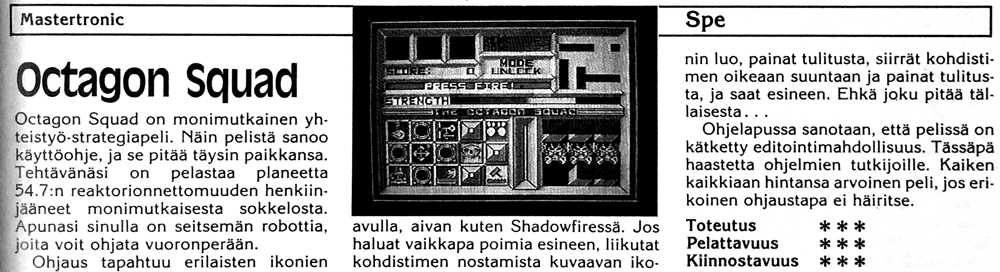
Octagon Squad1987Pysyvä linkkiOctagon Squad on monimutkainen yhteistyö-strategiapeli. Näin pelistä sanoo käyttöohje, ja se pitää täysin paikkansa. Tehtävänäsi on pelastaa planeetta 54.7:n reaktorionnettomuuden henkiinjääneet monimutkaisesta sokkelosta. Apunasi sinulla on seitsemän robottia, joita voit ohjata vuoronperään.
Ohjaus tapahtuu erilaisten ikonien avulla, aivan kuten Shadowfiressä. Jos haluat vaikkapa poimia esineen, liikutat kohdistimen nostamista kuvaavan ikonin luo, painat tulitusta, siirrät kohdistimen oikeaan suuntaan ja painat tulitusta, ja saat esineen. Ehkä joku pitää tällaisesta...
Ohjelapussa sanotaan, että pelissä on kätketty editointimahdollisuus. Tässäpä haastetta ohjelmien tutkijoille. Kaiken kaikkiaan hintansa arvoinen peli, jos erikoinen ohjaustapa ei häiritse.
Octagon Squad1987PermalinkOctagon Squad is a complex co-operative strategy game. So says the instruction manual, and it is absolutely right. Your task is to rescue the survivors of the reactor accident on planet 54.7 from a complicated maze. To help you, you have seven robots, which you can control in turn.
Control is by means of various icons, just like in Shadowfire. If you want to, say, pick up an object, you move the cursor to the icon depicting lifting, press fire, move the cursor in the right direction and press fire, and you get the object. Maybe somebody likes this sort of thing...
The instruction leaflet says that the game has a hidden editing feature. Now there's a challenge for those who like to dig around inside programs. All in all a game worth its price, if the unusual control method doesn't bother you.
Octapolis
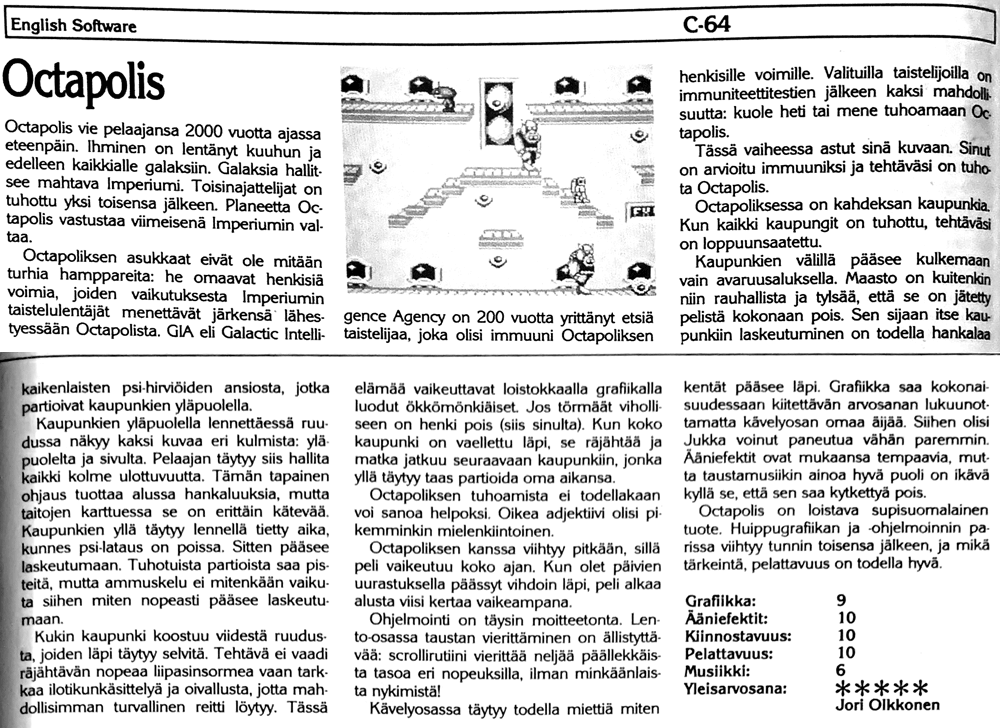
Octapolis1988Pysyvä linkkiOctapolis vie pelaajansa 2000 vuotta ajassa eteenpäin. Ihminen on lentänyt kuuhun ja edelleen kaikkialle galaksiin. Galaksia hallitsee mahtava Imperiumi. Toisinajattelijat on tuhottu yksi toisensa jälkeen. Planeetta Octapolis vastustaa viimeisenä Imperiumin valtaa.
Octapoliksen asukkaat eivät ole mitään turhia hamppareita: he omaavat henkisiä voimia, joiden vaikutuksesta Imperiumin taistelulentäjät menettävät järkensä lähestyessään Octapolista. GIA eli Galactic Intelligence Agency on 200 vuotta yrittänyt etsiä taistelijaa, joka olisi immuuni Octapoliksen henkisille voimille. Valituilla taistelijoilla on immuniteettitestien jälkeen kaksi mahdollisuutta: kuole heti tai mene tuhoamaan Octapolis.
Tässä vaiheessa astut sinä kuvaan. Sinut on arvioitu immuuniksi ja tehtäväsi on tuhota Octapolis.
Octapoliksessa on kahdeksan kaupunkia. Kun kaikki kaupungit on tuhottu, tehtäväsi on loppuunsaatettu.
Kaupunkien välillä pääsee kulkemaan vain avaruusaluksella. Maasto on kuitenkin niin rauhallista ja tylsää, että se on jätetty pelistä kokonaan pois. Sen sijaan itse kaupunkiin laskeutuminen on todella hankalaa kaikenlaisten psi-hirviöiden ansiosta, jotka partioivat kaupunkien yläpuolella.
Kaupunkien yläpuolella lennettäessä ruudussa näkyy kaksi kuvaa eri kulmista: yläpuolelta ja sivulta. Pelaajan täytyy siis hallita kaikki kolme ulottuvuutta. Tämän tapainen ohjaus tuottaa alussa hankaluuksia, mutta taitojen karttuessa se on erittäin kätevää. Kaupunkien yllä täytyy lennellä tietty aika, kunnes psi-lataus on poissa. Sitten pääsee laskeutumaan. Tuhotuista partioista saa pisteitä, mutta ammuskelu ei mitenkään vaikuta siihen miten nopeasti pääsee laskeutumaan.
Kukin kaupunki koostuu viidestä ruudusta, joiden läpi täytyy selvitä. Tehtävä ei vaadi räjähtävän nopeaa liipasinsormea vaan tarkkaa ilotikunkäsittelyä ja oivallusta, jotta mahdollisimman turvallinen reitti löytyy. Tässä elämää vaikeuttavat loistokkaalla grafiikalla luodut ökkömönkiäiset. Jos törmäät viholliseen on henki pois (siis sinulta). Kun koko kaupunki on vaellettu läpi, se räjähtää ja matka jatkuu seuraavaan kaupunkiin, jonka yllä täytyy taas partioida oma aikansa.
Octapoliksen tuhoamista ei todellakaan voi sanoa helpoksi. Oikea adjektiivi olisi pikemminkin mielenkiintoinen.
Octapoliksen kanssa viihtyy pitkään, sillä peli vaikeutuu koko ajan. Kun olet päivien uurastuksella päässyt vihdoin läpi, peli alkaa alusta viisi kertaa vaikeampana.
Ohjelmointi on täysin moitteetonta. Lento-osassa taustan vierittäminen on ällistyttävää: scrollirutiini vierittää neljää päällekkäistä tasoa eri nopeuksilla, ilman minkäänlaista nykimistä!
Kävelyosassa täytyy todella miettiä miten kentät pääsee läpi. Grafiikka saa kokonaisuudessaan kiitettävän arvosanan lukuunottamatta kävelyosan omaa äijää. Siihen olisi Jukka voinut paneutua vähän paremmin. Ääniefektit ovat mukaansa tempaavia, mutta taustamusiikin ainoa hyvä puoli on ikävä kyllä se, että sen saa kytkettyä pois.
Octapolis on loistava supisuomalainen tuote. Huippugrafiikan ja -ohjelmoinnin parissa viihtyy tunnin toisensa jälkeen, ja mikä tärkeintä, pelattavuus on todella hyvä.
Octapolis1988PermalinkOctapolis takes its player 2000 years forward in time. Man has flown to the moon and on to every corner of the galaxy. The galaxy is ruled by the mighty Empire. The dissidents have been destroyed one after another. The planet Octapolis is the last to resist the Empire's power.
The inhabitants of Octapolis are no small potatoes: they possess mental powers which make the Empire's fighter pilots lose their minds as they approach Octapolis. The GIA, or Galactic Intelligence Agency, has been trying for 200 years to find a fighter who would be immune to the mental powers of Octapolis. After the immunity tests the chosen fighters have two options: die at once or go and destroy Octapolis.
This is where you step into the picture. You have been assessed as immune, and your task is to destroy Octapolis.
There are eight cities on Octapolis. Once all the cities have been destroyed, your mission is accomplished.
The only way to travel between the cities is by spaceship. The terrain, however, is so peaceful and dull that it has been left out of the game altogether. Landing in the city itself, on the other hand, is really tricky thanks to all manner of psi-monsters patrolling above the cities.
When flying above the cities, the screen shows two views from different angles: from above and from the side. So the player has to master all three dimensions. This kind of control causes difficulties at first, but as your skills build up it becomes extremely handy. Above the cities you have to fly around for a certain time until the psi-charge is gone. Then you get to land. Destroyed patrols earn you points, but the shooting has no effect whatsoever on how quickly you get to land.
Each city consists of five screens that you have to get through. The task does not call for an explosively fast trigger finger, but for precise joystick handling and insight, so that the safest possible route is found. Making life harder here are creepy-crawlies created with splendid graphics. If you collide with an enemy, a life is gone (yours, that is). Once the whole city has been trekked through, it explodes and the journey continues to the next city, above which you again have to patrol for your allotted time.
Destroying Octapolis really cannot be called easy. The right adjective would rather be interesting.
Octapolis keeps you entertained for a long time, since the game keeps getting harder. When, after days of toil, you finally get through, the game starts again from the beginning, five times harder.
The programming is completely flawless. In the flying section the background scrolling is astonishing: the scroll routine moves four overlapping layers at different speeds without the slightest jerkiness!
In the walking section you really have to think about how to get through the levels. The graphics as a whole earn an excellent mark, with the exception of your own bloke in the walking section. Jukka could have put a bit more effort into him. The sound effects are gripping, but the only good thing about the background music, sadly, is that you can switch it off.
Octapolis is a brilliant, one-hundred-percent Finnish product. The top-notch graphics and programming keep you entertained hour after hour, and most importantly, the playability is really good.
Off Shore Warrior
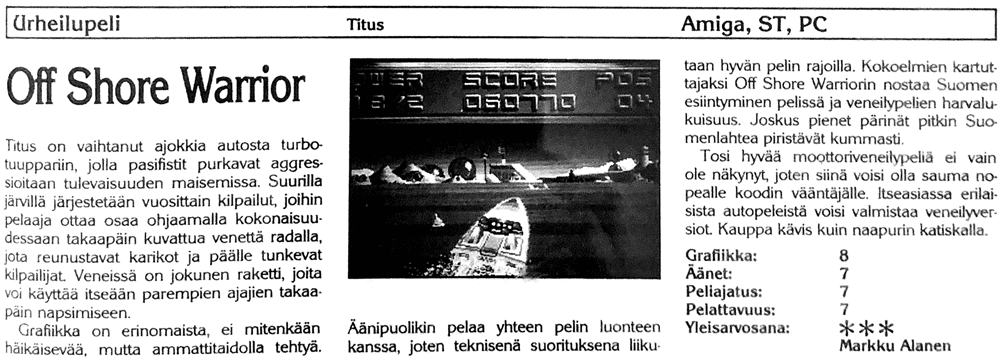
Off Shore Warrior1989 KevätPysyvä linkkiTitus on vaihtanut ajokkia autosta turbotuuppariin, jolla pasifistit purkavat aggressioitaan tulevaisuuden maisemissa. Suurilla järvillä järjestetään vuosittain kilpailut, joihin pelaaja ottaa osaa ohjaamalla kokonaisuudessaan takaapäin kuvattua venettä radalla, jota reunustavat karikot ja päälle tunkevat kilpailijat. Veneissä on jokunen raketti, joita voi käyttää itseään parempien ajajien takaapäin napsimiseen.
Grafiikka on erinomaista, ei mitenkään häikäisevää, mutta ammattitaidolla tehtyä. Äänipuolikin pelaa yhteen pelin luonteen kanssa, joten teknisenä suorituksena liikutaan hyvän pelin rajoilla. Kokoelmien kartuttajaksi Off Shore Warriorin nostaa Suomen esiintyminen pelissä ja veneilypelien harvalukuisuus. Joskus pienet pärinät pitkin Suomenlahtea piristävät kummasti.
Tosi hyvää moottoriveneilypeliä ei vain ole näkynyt, joten siinä voisi olla sauma nopealle koodin vääntäjälle. Itseasiassa erilaisista autopeleistä voisi valmistaa veneilyversiot. Kauppa kävis kuin naapurin katiskalla.
Off Shore Warrior1989 KevätPermalinkTitus has swapped its ride from a car to a turbo speedboat, on which pacifists work off their aggressions in the landscapes of the future. Every year races are held on the great lakes, and the player takes part by steering a boat, seen in its entirety from behind, along a course lined with reefs and competitors crowding in on you. The boats carry the odd rocket, which can be used for picking off drivers better than yourself from behind.
The graphics are excellent - not in any way dazzling, but made with professional skill. The sound side, too, plays along with the character of the game, so as a technical achievement we're on the borders of a good game. What raises Off Shore Warrior to collection-worthy status is Finland's appearance in the game and the scarcity of boating games. Now and then a quick blast along the Gulf of Finland does wonders for the spirits.
A really good powerboat game just hasn't turned up, so there could be an opening there for a speedy code-cruncher. In fact, boating versions could be made of all sorts of car games. Trade would be as brisk as at the neighbour's fish trap.
Ogre
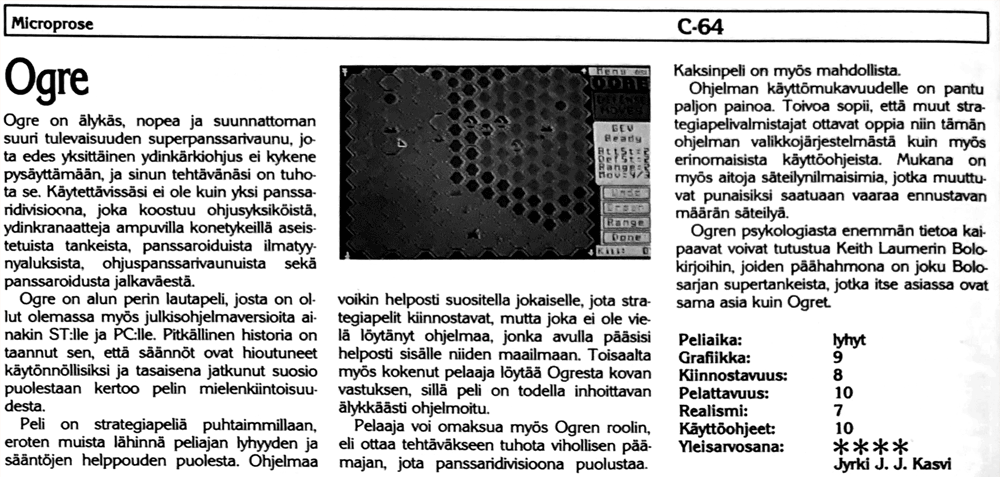
Ogre1988Pysyvä linkkiOgre on älykäs, nopea ja suunnattoman suuri tulevaisuuden superpanssarivaunu, jota edes yksittäinen ydinkärkiohjus ei kykene pysäyttämään, ja sinun tehtävänäsi on tuhota se. Käytettävissäsi ei ole kuin yksi panssaridivisioona, joka koostuu ohjusyksiköistä, ydinkranaatteja ampuvilla konetykeillä aseistetuista tankeista, panssaroiduista ilmatyynyaluksista, ohjuspanssarivaunuista sekä panssaroidusta jalkaväestä.
Ogre on alun perin lautapeli, josta on ollut olemassa myös julkisohjelmaversioita ainakin ST:lle ja PC:lle. Pitkällinen historia on taannut sen, että säännöt ovat hioutuneet käytönnöllisiksi ja tasaisena jatkunut suosio puolestaan kertoo pelin mielenkiintoisuudesta.
Peli on strategiapeliä puhtaimmillaan, eroten muista lähinnä peliajan lyhyyden ja sääntöjen helppouden puolesta. Ohjelmaa voikin helposti suositella jokaiselle, jota strategiapelit kiinnostavat, mutta joka ei ole vielä löytänyt ohjelmaa, jonka avulla pääsisi helposti sisälle niiden maailmaan. Toisaalta myös kokenut pelaaja löytää Ogresta kovan vastuksen, sillä peli on todella inhoittavan älykkäästi ohjelmoitu.
Pelaaja voi omaksua myös Ogren roolin, eli ottaa tehtäväkseen tuhota vihollisen päämajan, jota panssaridivisioona puolustaa. Kaksinpeli on myös mahdollista.
Ohjelman käyttömukavuudelle on pantu paljon painoa. Toivoa sopii, että muut strategiapelivalmistajat ottavat oppia niin tämän ohjelman valikkojärjestelmästä kuin myös erinomaisista käyttöohjeista. Mukana on myös aitoja säteilynilmaisimia, jotka muuttuvat punaisiksi saatuaan vaaraa ennustavan määrän säteilyä.
Ogren psykologiasta enemmän tietoa kaipaavat voivat tutustua Keith Laumerin Bolo-kirjoihin, joiden päähahmona on joku Bolo-sarjan supertankeista, jotka itse asiassa ovat sama asia kuin Ogret.
Ogre1988PermalinkOgre is an intelligent, fast and immensely huge super tank of the future, which not even a single nuclear-tipped missile can stop, and your task is to destroy it. All you have at your disposal is a single armoured division, made up of missile units, tanks armed with autocannons that fire nuclear shells, armoured hovercraft, missile tanks and armoured infantry.
Ogre was originally a board game, which has also existed in public domain versions for at least the ST and the PC. Its long history has ensured that the rules have been honed into practical shape, and its steadily continuing popularity, for its part, tells you how interesting the game is.
The game is strategy gaming at its purest, differing from the rest mainly in the shortness of its playing time and the simplicity of its rules. So the program can easily be recommended to anyone who is interested in strategy games but has not yet found a program that would let them get into that world easily. On the other hand, the experienced player will also find a tough opponent in Ogre, since the game has been programmed to be really, nastily clever.
The player can also take on the role of the Ogre, i.e. take on the task of destroying the enemy headquarters, which the armoured division defends. A two-player game is also possible.
A great deal of weight has been placed on the program's ease of use. It is to be hoped that other strategy game makers take a lesson from both this program's menu system and its excellent manual. Also included are genuine radiation detectors, which turn red after receiving an amount of radiation that spells danger.
Those who want to know more about the psychology of the Ogre can look into Keith Laumer's Bolo books, whose main character is one of the super tanks of the Bolo series, which in fact are the same thing as Ogres.
Oids
Oids1988Pysyvä linkkiPahaa aavistamatta löin pelin latautumaan. Kuinka ollakaan, parin minuutin kuluttua olin saanut Oids-tartunnan.
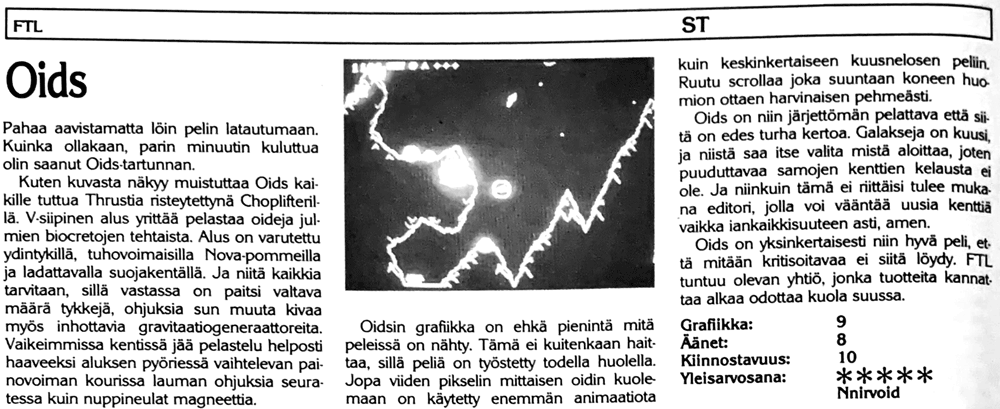
Kuten kuvasta näkyy muistuttaa Oids kaikille tuttua Thrustia risteytettynä Choplifterillä. V-siipinen alus yrittää pelastaa oideja julmien biocretojen tehtaista. Alus on varutettu ydintykillä, tuhovoimaisilla Nova-pommeilla ja ladattavalla suojakentällä. Ja niitä kaikkia tarvitaan, sillä vastassa on paitsi valtava määrä tykkejä, ohjuksia sun muuta kivaa myös inhottavia gravitaatiogeneraattoreita. Vaikeimmissa kentissä jää pelastelu helposti haaveeksi aluksen pyöriessä vaihtelevan painovoiman kourissa lauman ohjuksia seuratessa kuin nuppineulat magneettia.
Oidsin grafiikka on ehkä pienintä mitä peleissä on nähty. Tämä ei kuitenkaan haittaa, sillä peliä on työstetty todella huolella. Jopa viiden pikselin mittaisen oidin kuolemaan on käytetty enemmän animaatiota kuin keskinkertaiseen kuusnelosen peliin. Ruutu scrollaa joka suuntaan koneen huomion ottaen harvinaisen pehmeästi.
Oids on niin järjettömän pelattava että siitä on edes turha kertoa. Galakseja on kuusi, ja niistä saa itse valita mistä aloittaa, joten puuduttavaa samojen kenttien kelausta ei ole. Ja niinkuin tämä ei riittäisi tulee mukana editori, jolla voi vääntää uusia kenttiä vaikka iankaikkisuuteen asti, amen.
Oids on yksinkertaisesti niin hyvä peli, että mitään kritisoitavaa ei siitä löydy. FTL tuntuu olevan yhtiö, jonka tuotteita kannattaa alkaa odottaa kuola suussa.
Oids1988PermalinkSuspecting nothing, I set the game loading. And wouldn't you know it, a couple of minutes later I had come down with an Oids infection.
As you can see from the picture, Oids resembles the Thrust everybody knows, crossbred with Choplifter. A V-winged ship tries to rescue oids from the factories of the cruel biocretes. The ship is equipped with a nuclear cannon, devastating Nova bombs and a rechargeable shield. And you need every one of them, because you're up against not only a huge number of guns, missiles and other such fun stuff but also nasty gravity generators. On the hardest levels the rescuing easily stays a pipe dream, with the ship spinning in the grip of shifting gravity while a pack of missiles follows it like pins follow a magnet.
The graphics in Oids are perhaps the smallest ever seen in a game. That doesn't matter, though, because the game has been worked on with real care. Even the death of a five-pixel-tall oid gets more animation than an average Commodore 64 game. The screen scrolls in every direction, unusually smoothly considering the machine.
Oids is so insanely playable that there's no point even talking about it. There are six galaxies and you get to pick which one to start from, so there's none of that numbing slog through the same levels over and over. And as if that weren't enough, it comes with an editor for cranking out new levels for ever and ever, amen.
Oids is simply such a good game that there's nothing in it to criticise. FTL seems to be a company whose products are worth waiting for with drool running down your chin.
Oil Imperium

Oil Imperium1990 KevätPysyvä linkkiDallas tietokoneessa, mutta ilman imeliä ja hataria rakkaustarinoita. Oil Imperium käsittelee öljyalan liukasta ja likaista puolta, businesstoimintaa. Pelaajan tavoitteena on ahkeralla työllä ja pikku vilungilla saattaa muut kilpailijat pois markkinoilla ja saavuttaa näin öljymonopoli maailmassa.
Neljä pelaajaa voi perustaa oman yhtiönsä, ostaa pari öljylähdettä ja alkaa hätistellä kilpailijoitaan. Pelaajat voivat solmia sopimuksia palkkasotureiden kanssa, jotta nämä käyvät sytyttämässä kilpailijoiden öljylähteet tuleen. Muita konsteja ovat muunmuuassa kilpailijan pankin ryöstäminen, kiristäminen ja varastosäiliöiden räjäyttäminen.
Suojakeinojakin löytyy. Kuka tahansa voi palkata etsivän, joka ilmoittaa palkkaajalleen heti, jos joku kilpailijoista suunnittelee jotain tämän päänmenoksi. Jos todisteita on tarpeeksi, voidaan juttu vetää oikeuteen ja jutun voittaja saa omakseen joitain hävinneen öljylähteitä. Normaalit rutiinityöt hoidetaan toimistosta (valittavissa on neljästä erilaisesta, yhdestä toimistosta löytyy hyllyltä USS Enterprisen pienoismalli, joten minä valitsin tietysti sen), mutta silloin tällöin pelaajan pitää hyökätä öljykentälle sammuttamaan öljypaloa, liittämään öljyputkia tai poraamaan öljyä.
Oil Imperium on ohjelmoitu saksalaisella perusteellisuudella ja täytyy sanoa, etten ole pitkään aikaan nähnyt näin pelattavaa peliä. Peli luistaa kuin unelma, eikä Gurua tarvitse liiemmin pelätä. öljymaailman kireä tunnelma välittyy pelistä todella loistavasti ja peliä pelaa ilokseen viikkoja, etenkin jos on kavereita, keitä vastaan pelata. Graafisesti OI ei auo uusia uria, mutta visuaalisesti peli on aivan tarpeeksi hyvä. Erinomaisen musiikin vastineeksi äänitehosteet ovat aika kehnoja.
Oil Imperium edustaa Amigan pelitarjontaa parhaimmillaan sekoittaen sopivasti toimintaa ja strategiaa.
Oil Imperium1990 KevätPermalinkDallas on the computer, but without the sugary, flimsy love stories. Oil Imperium deals with the slippery and dirty side of the oil industry: the business. The player's aim is to use hard work and a little bit of cheating to drive the other competitors out of the market and so win a monopoly on the world's oil.
Four players can each set up their own company, buy a couple of oil wells and start chasing off their rivals. Players can strike deals with mercenaries to go and set the rivals' oil wells on fire. Other tricks include robbing a rival's bank, blackmail and blowing up storage tanks, among other things.
There are ways of protecting yourself, too. Anyone can hire a detective, who reports back at once if one of the rivals is plotting the employer's downfall. If there's enough evidence, the matter can be taken to court, and the winner of the case gets some of the loser's oil wells. Normal routine work is handled from the office (there are four different ones to choose from, and one of them has a scale model of the USS Enterprise on the shelf, so naturally I chose that one), but every now and then the player has to charge out to the oil field to put out an oil fire, connect pipelines or drill for oil.
Oil Imperium has been programmed with German thoroughness, and I must say I haven't seen such a playable game in a long time. The game runs like a dream and there's not much need to fear the Guru. The tense atmosphere of the oil world comes across really brilliantly, and you'll happily play the game for weeks, especially if you have friends to play against. Graphically OI doesn't break any new ground, but visually the game is quite good enough. In return for the excellent music, the sound effects are pretty poor.
Oil Imperium represents the Amiga's range of games at its best, mixing action and strategy in just the right measure.
Olli & Lissa
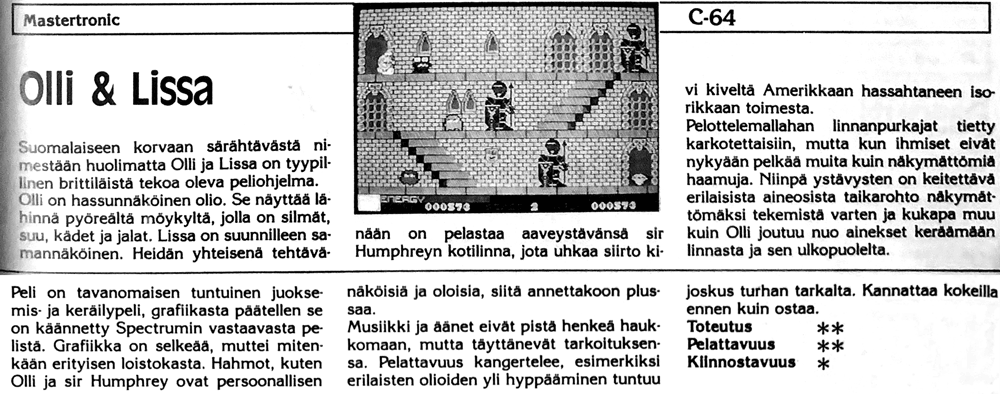
Olli & Lissa1987Pysyvä linkkiSuomalaiseen korvaan särähtävästä nimestään huolimatta Olli ja Lissa on tyypillinen brittiläistä tekoa oleva peliohjelma. Olli on hassunnäköinen olio. Se näyttää lähinnä pyöreältä möykyltä, jolla on silmät, suu, kädet ja jalat. Lissa on suunnilleen samannäköinen. Heidän yhteisenä tehtävänään on pelastaa aaveystävänsä sir Humphreyn kotilinna, jota uhkaa siirto kivi kiveltä Amerikkaan hassahtaneen isorikkaan toimesta.
Pelottelemallahan linnanpurkajat tietty karkotettaisiin, mutta kun ihmiset eivät nykyään pelkää muita kuin näkymättömiä haamuja. Niinpä ystävysten on keitettävä erilaisista aineosista taikarohto näkymättömäksi tekemistä varten ja kukapa muu kuin Olli joutuu nuo ainekset keräämään linnasta ja sen ulkopuolelta. Peli on tavanomaisen tuntuinen juoksemis- ja keräilypeli, grafiikasta päätellen se on käännetty Spectrumin vastaavasta pelistä. Grafiikka on selkeää, muttei mitenkään erityisen loistokasta. Hahmot, kuten Olli ja sir Humphrey ovat persoonallisen näköisiä ja oloisia, siitä annettakoon plussaa.
Musiikki ja äänet eivät pistä henkeä haukkomaan, mutta täyttänevät tarkoituksensa. Pelattavuus kangertelee, esimerkiksi erilaisten olioiden yli hyppääminen tuntuu joskus turhan tarkalta. Kannattaa kokeilla ennen kuin ostaa.
Olli & Lissa1987PermalinkDespite a name that jars on a Finnish ear, Olli and Lissa is a typical British-made game program. Olli is a funny-looking creature. It looks more or less like a round lump with eyes, a mouth, hands and feet. Lissa looks roughly the same. Their joint mission is to save the ancestral castle of their ghost friend sir Humphrey, which is under threat of being moved stone by stone to America by a loopy moneybags.
Naturally the castle wreckers could just be scared off, except that these days people aren't afraid of any ghosts but invisible ones. So the friends have to brew a magic potion of invisibility from various ingredients, and who else but Olli gets landed with collecting those ingredients from the castle and outside it. The game is a run-and-collect game of the usual sort; judging by the graphics, it has been converted from the corresponding Spectrum game. The graphics are clear, but nothing particularly splendid. The characters, such as Olli and sir Humphrey, look and act full of personality, and let that earn a plus.
The music and sound effects won't leave you gasping for breath, but they will probably serve their purpose. The playability stumbles; for example, jumping over the various creatures sometimes feels needlessly exacting. Worth trying before you buy.
Omega
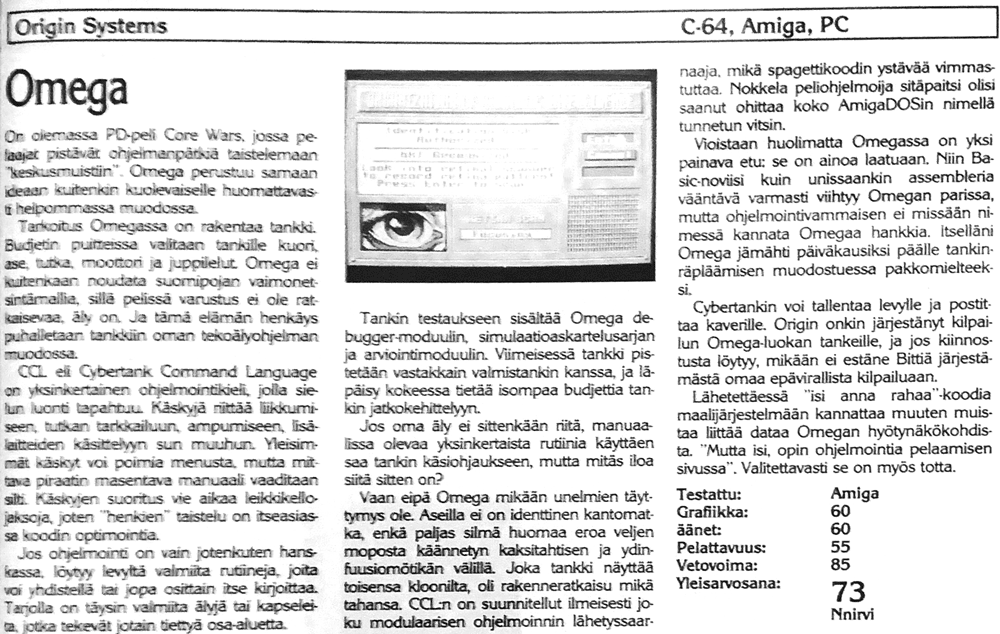
Omega1990 KevätPysyvä linkkiOn olemassa PD-peli Core Wars, jossa pelaajat pistävät ohjelmanpätkiä taistelemaan "keskusmuistiin". Omega perustuu samaan ideaan kuitenkin kuolevaiselle huomattavasti helpommassa muodossa.
Tarkoitus Omegassa on rakentaa tankki. Budjetin puitteissa valitaan tankille kuori, ase, tutka, moottori ja juppilelut. Omega ei kuitenkaan noudata suomipojan vaimonetsintämallia, sillä pelissä varustus ei ole ratkaisevaa, äly on. Ja tämä elämän henkäys puhalletaan tankkiin oman tekoälyohjelman muodossa.
CCL eli Cybertank Command Language on yksinkertainen ohjelmointikieli, jolla sielun luonti tapahtuu. Käskyjä riittää liikkumiseen, tutkan tarkkailuun, ampumiseen, lisälaitteiden käsittelyyn sun muuhun. Yleisimmät käskyt voi poimia menusta, mutta mittava piraatin masentava manuaali vaaditaan silti. Käskyjen suoritus vie aikaa leikkikellojaksoja, joten "henkien" taistelu on itseasiassa koodin optimointia.
Jos ohjelmointi on vain jotenkuten hanskassa, löytyy levyltä valmiita rutiineja, joita voi yhdistellä tai jopa osittain itse kirjoittaa. Tarjolla on täysin valmiita älyjä tai kapseleita, jotka tekevät jotain tiettyä osa-aluetta.
Tankin testaukseen sisältää Omega debugger-moduulin, simulaatioaskartelusarjan ja arviointimoduulin. Viimeisessä tankki pistetään vastakkain valmistankin kanssa, ja läpäisy kokeessa tietää isompaa budjettia tankin jatkokehittelyyn.
Jos oma äly ei sittenkään riitä, manuaalissa olevaa yksinkertaista rutiinia käyttäen saa tankin käsiohjaukseen, mutta mitäs iloa siitä sitten on?
Vaan eipä Omega mikään unelmien täyttymys ole. Aseilla ei on identtinen kantomatka, enkä paljas silmä huomaa eroa veljen moposta käännetyn kaksitahtisen ja ydinfuusiomötikän välillä. Joka tankki näyttää toisensa kloonilta, oli rakenneratkaisu mikä tahansa. CCL:n on suunnitellut ilmeisesti joku modulaarisen ohjelmoinnin lähetyssaarnaaja, mikä spagettikoodin ystävää vimmastuttaa. Nokkela peliohjelmoija sitäpaitsi olisi saanut ohittaa koko AmigaDOSin nimellä tunnetun vitsin.
Vioistaan huolimatta Omegassa on yksi painava etu: se on ainoa laatuaan. Niin Basic-noviisi kuin unissaankin assembleria vääntävä varmasti viihtyy Omegan parissa, mutta ohjelmointivammaisen ei missään nimessä kannata Omegaa hankkia. Itselläni Omega jämähti päiväkausiksi päälle tankinräpläämisen muodostuessa pakkomielteeksi.
Cybertankin voi tallentaa levylle ja postittaa kaverille. Origin onkin järjestänyt kilpailun Omega-luokan tankeille, ja jos kiinnostusta löytyy, mikään ei estäne Bittiä järjestämästä omaa epävirallista kilpailuaan.
Lähetettäessä "isi anna rahaa"-koodia maalijärjestelmään kannattaa muuten muistaa liittää dataa Omegan hyötynäkökohdista. "Mutta isi, opin ohjelmointia pelaamisen sivussa". Valitettavasti se on myös totta.
Omega1990 KevätPermalinkThere is a PD game called Core Wars, in which players set bits of program code fighting in "core memory". Omega is based on the same idea, but in a form considerably easier for mere mortals.
The idea in Omega is to build a tank. Within the budget you choose a hull, weapon, radar, engine and yuppie toys for the tank. Omega doesn't follow the Finnish lad's model of wife-hunting, though, because in this game it isn't the kit that decides it, it's the brains. And this breath of life is blown into the tank in the form of your own artificial intelligence program.
CCL, or Cybertank Command Language, is a simple programming language with which the creation of the soul takes place. There are commands enough for moving, watching the radar, shooting, operating extra equipment and whatnot. The most common commands can be picked from a menu, but the massive, pirate-depressing manual is still required. Executing the commands takes time in pretend clock cycles, so the battle of the "spirits" is actually code optimisation.
If you only just about have programming in hand, there are ready-made routines on the disk which you can combine or even partly write yourself. On offer are completely finished brains, or capsules that take care of one particular area.
For testing the tank, Omega includes a debugger module, a simulation arts-and-crafts kit and an evaluation module. In the last of these the tank is pitted against a ready-made tank, and passing the test means a bigger budget for developing the tank further.
If your own brains aren't up to it after all, a simple routine in the manual lets you put the tank under manual control, but then where's the fun in that?
But no, Omega is no dream come true. The weapons have identical range, and the naked eye can't tell the difference between a two-stroke nicked off your brother's moped and a great lump of a nuclear fusion engine. Every tank looks like a clone of the next, whatever the design. CCL has apparently been designed by some missionary of modular programming, which drives a lover of spaghetti code up the wall. Besides, a clever game programmer could well have bypassed the whole joke known as AmigaDOS.
Despite its faults, Omega has one weighty advantage: it is one of a kind. Both the Basic novice and the type who bangs out assembler even in their sleep will certainly enjoy themselves with Omega, but the programming-handicapped should on no account get hold of Omega. On my machine Omega got stuck on for days on end as tank-tinkering turned into an obsession.
You can save your Cybertank to disk and post it to a friend. Origin has in fact organised a competition for Omega-class tanks, and if there's any interest, surely nothing would stop Bitti from holding its own unofficial competition.
When sending the "daddy give me money" code to the target system, by the way, remember to attach data on Omega's practical benefits. "But daddy, I'm learning programming on the side while I play". Unfortunately that's true, too.
Omni-Play Basketball
Omni-Play Basketball1990 KevätPysyvä linkkiMindscapen SportTime-sarja se vain jatkuu jatkumistaan. Sarjan uusin tulokas on Basketball, joka sisältää pari teknisesti hienoa oivallusta ja on samalla uranuurtaja ohjelmallisesti.
Omni-Play Basketball on ohjelmoitu modulaarista tekniikkaa käyttäen. Useimmille termi on ehkä outo, joten pienoinen selitys on ehkä paikallaan. Oletetaan, että olet pelannut toistasataa ottelua ja alat pikkuhiljaa kyllästyä tapaan, jolla ottelut esitetään. Itse asiassa olet jo aivan kurkkuasi myöten täynnä pelaajien katselemista takaa ja ylhäältä.
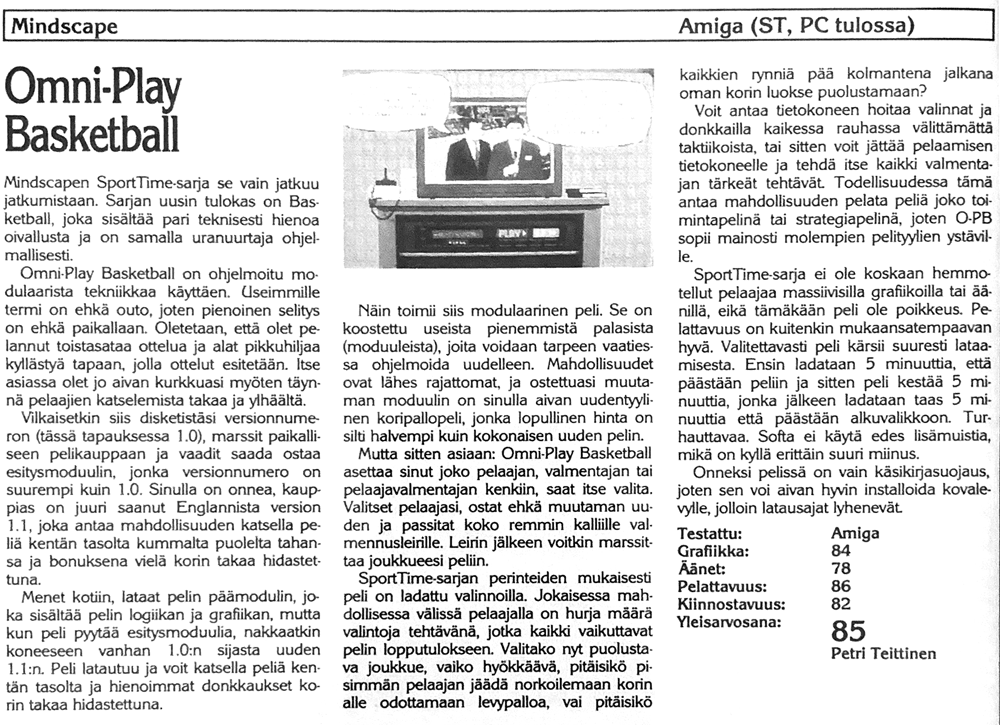
Vilkaisetkin siis disketistäsi versionnumeron (tässä tapauksessa 1.0), marssit paikalliseen pelikauppaan ja vaadit saada ostaa esitysmoduulin, jonka versionnumero on suurempi kuin 1.0. Sinulla on onnea, kauppias on juuri saanut Englannista version 1.1, joka antaa mahdollisuuden katsella peliä kentän tasolta kummalta puolelta tahansa ja bonuksena vielä korin takaa hidastettuna.
Menet kotiin, lataat pelin päämodulin, joka sisältää pelin logiikan ja grafiikan, mutta kun peli pyytää esitysmoduulia, nakkaatkin koneeseen vanhan 1.0:n sijasta uuden 1.1:n. Peli latautuu ja voit katsella peliä kentän tasolta ja hienoimmat donkkaukset korin takaa hidastettuna.
Näin toimii siis modulaarinen peli. Se on koostettu useista pienemmistä palasista (moduuleista), joita voidaan tarpeen vaatiessa ohjelmoida uudelleen. Mahdollisuudet ovat lähes rajattomat, ja ostettuasi muutaman moduulin on sinulla aivan uudentyylinen koripallopeli, jonka lopullinen hinta on silti halvempi kuin kokonaisen uuden pelin.
Mutta sitten asiaan: Omni-Play Basketball asettaa sinut joko pelaajan, valmentajan tai pelaajavalmentajan kenkiin, saat itse valita. Valitset pelaajasi, ostat ehkä muutaman uuden ja passitat koko remmin kalliille valmennusleirille. Leirin jälkeen voitkin marssittaa joukkueesi peliin.
SportTime-sarjan perinteiden mukaisesti peli on ladattu valinnoilla. Jokaisessa mahdollisessa välissä pelaajalla on hurja määrä valintoja tehtävänä, jotka kaikki vaikuttavat pelin lopputulokseen. Valitako nyt puolustava joukkue, vaiko hyökkäävä, pitäisikö pisimmän pelaajan jäädä norkoilemaan korin alle odottamaan levypalloa, vai pitäisikö kaikkien rynniä pää kolmantena jalkana oman korin luokse puolustamaan?
Voit antaa tietokoneen hoitaa valinnat ja donkkailla kaikessa rauhassa välittämättä taktiikoista, tai sitten voit jättää pelaamisen tietokoneelle ja tehdä itse kaikki valmentajan tärkeät tehtävät. Todellisuudessa tämä antaa mahdollisuuden pelata peliä joko toimintapelinä tai strategiapelinä, joten O-PB sopii mainosti molempien pelityylien ystäville.
SportTime-sarja ei ole koskaan hemmotellut pelaajaa massiivisilla grafiikoilla tai äänillä, eikä tämäkään peli ole poikkeus. Pelattavuus on kuitenkin mukaansatempaavan hyvä. Valitettavasti peli kärsii suuresti lataamisesta. Ensin ladataan 5 minuuttia, että päästään peliin ja sitten peli kestää 5 minuuttia, jonka jälkeen ladataan taas 5 minuuttia että päästään alkuvalikkoon. Turhauttavaa. Softa ei käytä edes lisämuistia, mikä on kyllä erittäin suuri miinus.
Onneksi pelissä on vain käsikirjasuojaus, joten sen voi aivan hyvin installoida kovalevylle, jolloin latausajat lyhenevät.
Omni-Play Basketball1990 KevätPermalinkMindscape's SportTime series just keeps going and going. The latest arrival in the series is Basketball, which contains a couple of technically neat ideas and at the same time breaks new ground software-wise.
Omni-Play Basketball has been programmed using a modular technique. The term may be unfamiliar to most, so a little explanation is perhaps in order. Let's suppose you've played well over a hundred matches and are gradually getting tired of the way the matches are presented. In fact you're already sick to the back teeth of watching the players from behind and above.
So you glance at the version number on your disk (in this case 1.0), march down to your local games shop and demand to buy a presentation module with a version number higher than 1.0. You're in luck: the shopkeeper has just received version 1.1 from England, which lets you watch the game at court level from either side and, as a bonus, from behind the basket in slow motion.
You go home and load the game's main module, which contains the game logic and graphics, but when the game asks for the presentation module, you chuck the new 1.1 into the machine instead of the old 1.0. The game loads and you can watch the game at court level and the finest dunks from behind the basket in slow motion.
So that's how a modular game works. It's put together from several smaller pieces (modules), which can be reprogrammed as the need arises. The possibilities are almost limitless, and after buying a few modules you have a completely new style of basketball game, whose final price is still lower than that of a whole new game.
But now to the point: Omni-Play Basketball puts you in the shoes of a player, a coach or a player-coach, your choice. You pick your players, maybe buy a few new ones and pack the whole gang off to an expensive training camp. After the camp you can march your team into the game.
In keeping with SportTime series tradition, the game is loaded with options. At every possible juncture the player has a staggering number of choices to make, all of which affect the outcome of the game. Should you pick a defensive team or an attacking one, should the tallest player hang around under the basket waiting for the rebound, or should everybody charge back hell for leather to their own basket to defend?
You can let the computer handle the choices and dunk away in peace without bothering about tactics, or else you can leave the playing to the computer and do all the important coaching jobs yourself. In reality this lets you play the game either as an action game or as a strategy game, so O-PB suits fans of both styles of play splendidly.
The SportTime series has never pampered the player with massive graphics or sound, and this game is no exception. The playability, however, is grippingly good. Unfortunately the game suffers badly from loading. First you load for 5 minutes to get into the game, then the game lasts 5 minutes, after which you load for another 5 minutes to get back to the start menu. Frustrating. The software doesn't even use extra memory, which is a very big minus indeed.
Luckily the game only has manual protection, so you can perfectly well install it on a hard disk, which shortens the loading times.
Onslaught
Onslaught1990 KevätPysyvä linkkiKeskiaikaan sijoittuva Gargoren valtakunta ei ole mikään rauhallinen onnela, mutta kun maaginen ritari sekoaa lopullisesti ja päättää valloittaa yksin koko maan, niin tuloksena on tietokonepelien totaalisin verilöyly.
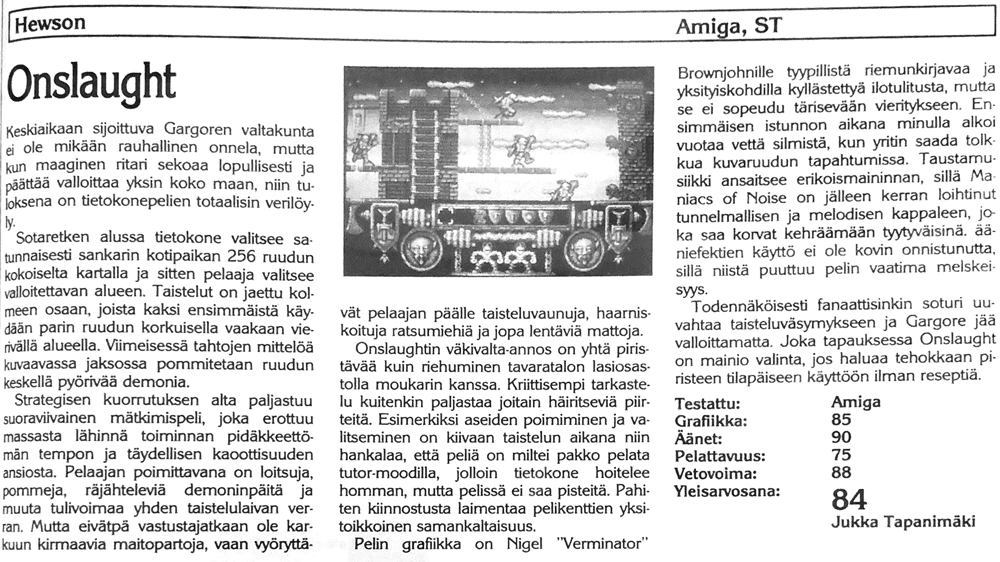
Sotaretken alussa tietokone valitsee satunnaisesti sankarin kotipaikan 256 ruudun kokoiselta kartalla ja sitten pelaaja valitsee valloitettavan alueen. Taistelut on jaettu kolmeen osaan, joista kaksi ensimmäistä käydään parin ruudun korkuisella vaakaan vierivällä alueella. Viimeisessä tahtojen mittelöä kuvaavassa jaksossa pommitetaan ruudun keskellä pyörivää demonia.
Strategisen kuorrutuksen alta paljastuu suoraviivainen mätkimispeli, joka erottuu massasta lähinnä toiminnan pidäkkeettömän tempon ja täydellisen kaoottisuuden ansiosta. Pelaajan poimittavana on loitsuja, pommeja, räjähteleviä demoninpäitä ja muuta tulivoimaa yhden taistelulaivan verran. Mutta eivätpä vastustajatkaan ole karkuun kirmaavia maitopartoja, vaan vyöryttävät pelaajan päälle taisteluvaunuja, haarniskoituja ratsumiehiä ja jopa lentäviä mattoja.
Onslaughtin väkivalta-annos on yhtä piristävää kuin riehuminen tavaratalon lasiosastolla moukarin kanssa. Kriittisempi tarkastelu kuitenkin paljastaa joitain häiritseviä piirteitä. Esimerkiksi aseiden poimiminen ja valitseminen on kiivaan taistelun aikana niin hankalaa, että peliä on miltei pakko pelata tutor-moodilla, jolloin tietokone hoitelee homman, mutta pelissä ei saa pisteitä. Pahiten kiinnostusta laimentaa pelikenttien yksitoikkoinen samankaltaisuus.
Pelin grafiikka on Nigel "Verminator" Brownjohnille tyypillistä riemunkirjavaa ja yksityiskohdilla kyllästettyä ilotulitusta, mutta se ei sopeudu tärisevään vieritykseen. Ensimmäisen istunnon aikana minulla alkoi vuotaa vettä silmistä, kun yritin saada tolkkua kuvaruudun tapahtumissa. Taustamusiikki ansaitsee erikoismaininnan, sillä Maniacs of Noise on jälleen kerran loihtinut tunnelmallisen ja melodisen kappaleen, joka saa korvat kehräämään tyytyväisinä. ääniefektien käyttö ei ole kovin onnistunutta, sillä niistä puuttuu pelin vaatima melskeisyys.
Todennäköisesti fanaattisinkin soturi uuvahtaa taisteluväsymykseen ja Gargore jää valloittamatta. Joka tapauksessa Onslaught on mainio valinta, jos haluaa tehokkaan piristeen tilapäiseen käyttöön ilman reseptiä.
Onslaught1990 KevätPermalinkThe medieval kingdom of Gargore is no peaceful paradise to begin with, but when a magical knight loses it for good and decides to conquer the whole land single-handed, the result is the most total bloodbath in computer games.
At the start of the campaign the computer randomly picks the hero's home base on a 256-square map, and then the player chooses the territory to conquer. The battles are divided into three parts, the first two of which are fought in a horizontally scrolling area a couple of screens high. In the last section, depicting a clash of wills, you bombard a demon spinning in the middle of the screen.
Beneath the strategic icing lies a straightforward bash-'em-up that stands out from the crowd mainly thanks to the unrestrained pace of the action and its utter chaos. The player can pick up spells, bombs, exploding demon heads and other firepower, enough to fill a battleship. But the enemies aren't exactly milksops scampering off either; they roll war wagons, armoured horsemen and even flying carpets over the player.
Onslaught's dose of violence is as invigorating as running amok in a department store's glassware section with a sledgehammer. A more critical look, however, reveals some annoying features. For example, picking up and selecting weapons in the heat of battle is so awkward that you're almost forced to play in tutor mode, where the computer takes care of it, but you don't score any points. What dampens the interest most is the monotonous sameness of the levels.
The game's graphics are the riotously colourful, detail-saturated fireworks typical of Nigel "Verminator" Brownjohn, but they don't take well to the juddering scroll. During the first session my eyes started to water as I tried to make sense of what was happening on screen. The background music deserves a special mention, as Maniacs of Noise have once again conjured up an atmospheric and melodic tune that makes your ears purr with contentment. The use of sound effects is not very successful, since they lack the din the game calls for.
In all likelihood even the most fanatical warrior will succumb to battle fatigue and Gargore will go unconquered. Either way, Onslaught is a fine choice if you want a powerful stimulant for occasional use, no prescription required.
Operation Harrier
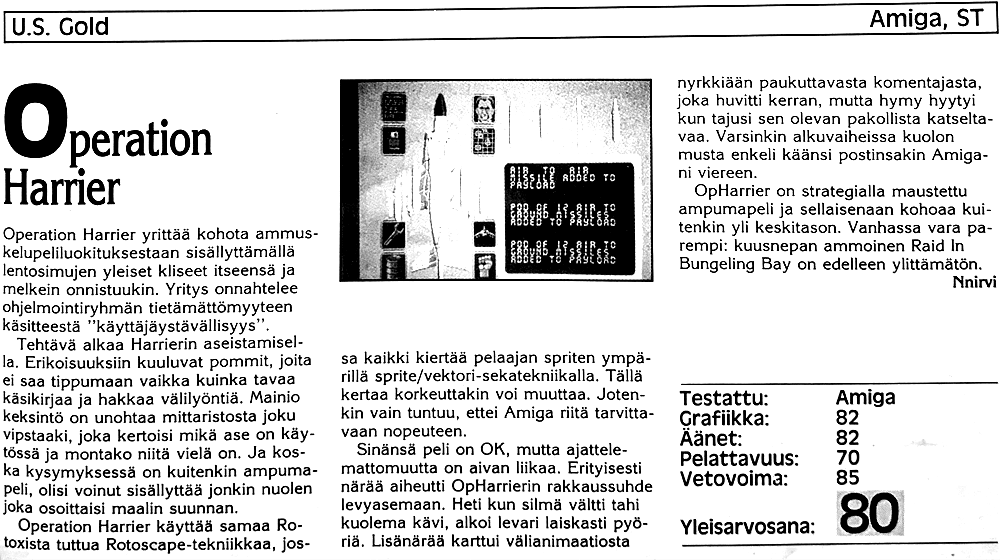
Operation Harrier1991 KevätPysyvä linkkiOperation Harrier yrittää kohota ammuskelupeliluokituksestaan sisällyttämällä lentosimujen yleiset kliseet itseensä ja melkein onnistuukin. Yritys onnahtelee ohjelmointiryhmän tietämättömyyteen käsitteestä "käyttäjäystävällisyys".
Tehtävä alkaa Harrierin aseistamisella. Erikoisuuksiin kuuluvat pommit, joita ei saa tippumaan vaikka kuinka tavaa käsikirjaa ja hakkaa välilyöntiä. Mainio keksintö on unohtaa mittaristosta joku vipstaaki, joka kertoisi mikä ase on käytössä ja montako niitä vielä on. Ja koska kysymyksessä on kuitenkin ampumapeli, olisi voinut sisällyttää jonkin nuolen joka osoittaisi maalin suunnan.
Operation Harrier käyttää samaa Rotoxista tuttua Rotoscape-tekniikkaa, jossa kaikki kiertää pelaajan spriten ympärillä sprite/vektori-sekatekniikalla. Tällä kertaa korkeuttakin voi muuttaa. Jotenkin vain tuntuu, ettei Amiga riitä tarvittavaan nopeuteen.
Sinänsä peli on OK, mutta ajattelemattomuutta on aivan liikaa. Erityisesti närää aiheutti OpHarrierin rakkaussuhde levyasemaan. Heti kun silmä vältti tahi kuolema kävi, alkoi levari laiskasti pyöriä. Lisänärää karttui välianimaatiosta nyrkkiään paukuttavasta komentajasta, joka huvitti kerran, mutta hymy hyytyi kun tajusi sen olevan pakollista katseltavaa. Varsinkin alkuvaiheissa kuolon musta enkeli käänsi postinsakin Amigani viereen.
OpHarrier on strategialla maustettu ampumapeli ja sellaisenaan kohoaa kuitenkin yli keskitason. Vanhassa vara parempi: kuusnepan ammoinen Raid In Bungeling Bay on edelleen ylittämätön.
Operation Harrier1991 KevätPermalinkOperation Harrier tries to rise above its shoot-'em-up classification by taking the usual flight sim cliches on board, and it very nearly succeeds. The attempt limps along, tripping over the programming team's ignorance of the concept of "user-friendliness".
A mission begins with arming the Harrier. The special features include bombs that you can't get to drop no matter how hard you spell your way through the manual and hammer the space bar. A splendid invention is leaving out of the instruments some doohickey that would tell you which weapon is in use and how many of them are still left. And since this is a shoot-'em-up after all, they could have included some arrow pointing towards the target.
Operation Harrier uses the same Rotoscape technique familiar from Rotox, in which everything rotates around the player's sprite using a mixed sprite/vector technique. This time you can change altitude as well. Somehow it just feels as if the Amiga isn't up to the speed it needs.
As such the game is OK, but there's far too much thoughtlessness. What particularly riled me was OpHarrier's love affair with the disk drive. The moment you looked away or death came calling, the drive lazily started spinning. More irritation piled up from the cut-scene of a fist-pounding commander, which was amusing once, but the smile froze when you realised it was compulsory viewing. Especially in the early stages, the black angel of death even had its mail redirected to next to my Amiga.
OpHarrier is a shoot-'em-up seasoned with strategy, and as such it still rises above average. Old is gold: the C-64's ancient Raid In Bungeling Bay is still unsurpassed.
Operation Market Garden
Operation Market Garden1989 SyksyPysyvä linkkiVanhoihin SSI:n 'ei-aivan-klassikoihin' lukeutuva Operation Market Garden (OMG) jaksaa kiinnostaa vielä tänäkin päivänä. Aihe jaksaa vetää puoleensa, onhan vaihteeksi mielenkiintoista käydä taistelu jossa liittoutuneet saivat rutkasti turpiinsa sen sijaan että hangattaisiin aina saksalaisten tappioon huipentuvia taisteluita.
Operaatio Market Garden oli massiivinen laskuvarjojoukkojen hyökkäys, jossa laskettiin maihin vihollisen linjojen taa kolme divisioonaa, panssarijoukkojen murtaessa etelässä vihollisen etulinjat. Historiassa saksalaiset häiritsivät hyökkäystä tehokkaasti estäen laskuvarjojoukkojen pääsyn kohteisiinsa ja hidastaen päähyökkäyksen kulkua ratkaisevasti. Nyt sama uusiksi, mutta voitko päästä edes samoihin tuloksiin kuin liittoutuneet pääsivät silloin?
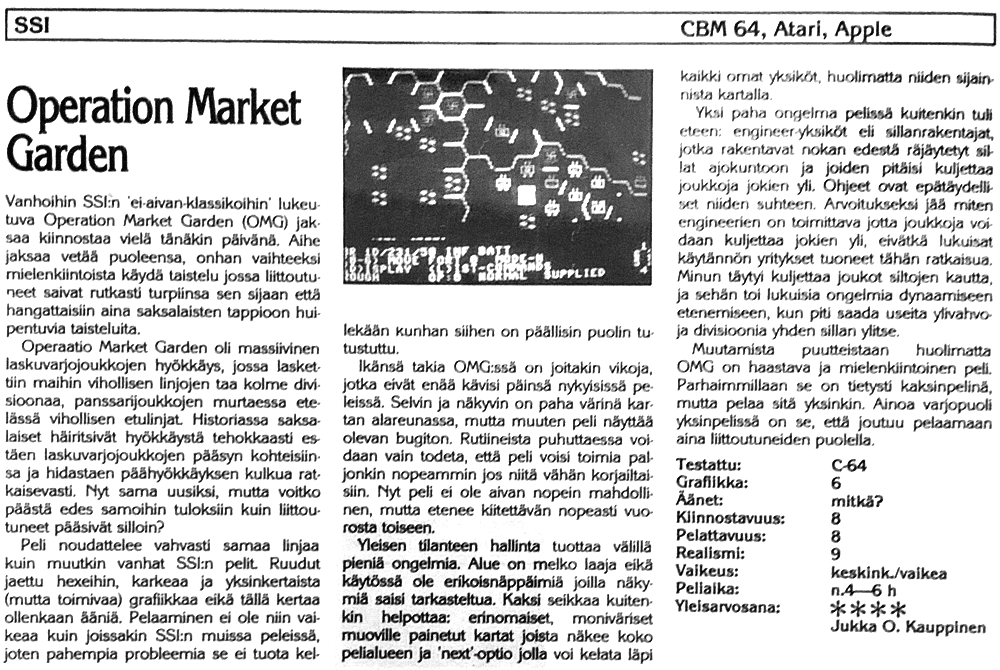
Peli noudattelee vahvasti samaa linjaa kuin muutkin vanhat SSI:n pelit. Ruudut jaettu hexeihin, karkeaa ja yksinkertaista (mutta toimivaa) grafiikkaa eikä tällä kertaa ollenkaan ääniä. Pelaaminen ei ole niin vaikeaa kuin joissakin SSI:n muissa peleissä, joten pahempia probleemia se ei tuota kelkään kunhan siihen on päällisin puolin tutustuttu.
Ikänsä takia OMG:ssä on joitakin vikoja, jotka eivät enää kävisi päinsä nykyisissä peleissä. Selvin ja näkyvin on paha värinä kartan alareunassa, mutta muuten peli näyttää olevan bugiton. Rutiineista puhuttaessa voidaan vain todeta, että peli voisi toimia paljonkin nopeammin jos niitä vähän korjailtaisiin. Nyt peli ei ole aivan nopein mahdollinen, mutta etenee kiitettävän nopeasti vuorosta toiseen.
Yleisen tilanteen hallinta tuottaa välillä pieniä ongelmia. Alue on melko laaja eikä käytössä ole erikoisnäppäimiä joilla näkymiä saisi tarkasteltua. Kaksi seikkaa kuitenkin helpottaa: erinomaiset, moniväriset muoville painetut kartat joista näkee koko pelialueen ja 'next'-optio jolla voi kelata läpi kaikki omat yksiköt, huolimatta niiden sijainnista kartalla.
Yksi paha ongelma pelissä kuitenkin tuli eteen: engineer-yksiköt eli sillanrakentajat, jotka rakentavat nokan edestä räjäytetyt sillat ajokuntoon ja joiden pitäisi kuljettaa joukkoja jokien yli. Ohjeet ovat epätäydelliset niiden suhteen. Arvoitukseksi jää miten engineerien on toimittava jotta joukkoja voidaan kuljettaa jokien yli, eivätkä lukuisat käytännön yritykset tuoneet tähän ratkaisua. Minun täytyi kuljettaa joukot siltojen kautta, ja sehän toi lukuisia ongelmia dynaamiseen etenemiseen, kun piti saada useita ylivahvoja divisioonia yhden sillan ylitse.
Muutamista puutteistaan huolimatta OMG on haastava ja mielenkiintoinen peli. Parhaimmillaan se on tietysti kaksinpelinä, mutta pelaa sitä yksinkin. Ainoa varjopuoli yksinpelissä on se, että joutuu pelaamaan aina liittoutuneiden puolella.
Operation Market Garden1989 SyksyPermalinkOperation Market Garden (OMG), one of SSI's old 'not-quite-classics', still manages to hold interest even today. The subject still has its pull; after all, it makes an interesting change to fight a battle in which the Allies took a right thrashing, instead of forever grinding through battles that culminate in a German defeat.
Operation Market Garden was a massive airborne assault in which three divisions were landed behind enemy lines while armoured forces broke through the enemy front line in the south. Historically the Germans disrupted the attack effectively, keeping the paratroopers from reaching their objectives and decisively slowing the progress of the main thrust. Now it's all to do again, but can you even match the results the Allies achieved back then?
The game sticks closely to the same line as SSI's other old games. Screens divided into hexes, crude and simple (but functional) graphics, and this time no sound at all. Playing isn't as hard as in some of SSI's other games, so it won't give anybody any serious problems once they've got the gist of it.
Because of its age, OMG has some faults that would no longer pass in today's games. The clearest and most visible is a nasty jitter along the bottom edge of the map, but otherwise the game seems to be bug-free. As for the routines, one can only note that the game could run a good deal faster if they were tweaked a little. As it is, the game isn't quite the fastest possible, but it moves from one turn to the next commendably quickly.
Keeping on top of the overall situation causes small problems at times. The area is fairly large and there are no special keys for surveying the view. Two things help, though: the excellent multicoloured maps printed on plastic, which show the whole playing area, and the 'next' option, which lets you cycle through all your own units regardless of where they are on the map.
One nasty problem did crop up in the game, though: the engineer units, i.e. the bridge-builders, who put bridges blown up right under your nose back into working order and who are supposed to ferry troops across rivers. The instructions are incomplete where they are concerned. It remains a mystery how the engineers have to operate so that troops can be carried across rivers, and numerous attempts in practice brought no solution. I had to move my troops over the bridges, and that of course caused plenty of problems for a dynamic advance, when several over-strength divisions had to be squeezed across a single bridge.
Despite a few shortcomings, OMG is a challenging and interesting game. It's at its best as a two-player game, of course, but go ahead and play it solo too. The only downside of solo play is that you always have to play on the Allied side.
Operation Neptune
Operation Neptune1989 SyksyPysyvä linkkiVedenpinnan alainen maailma ei tunnu olevan tuttu elementti peliohjelmoijille. Se on saanut olla jokseenkin rauhassa tietokonepelien tapahtumien keskittyessä maallisempiin asioihin. Ainoat mainetta niittäneet vedenalaiset visiot ovat olleet erilaiset sukellusvenesimulaatiot, jotka ovat yleensä tarkastelleet asioita Toisen Maailmansodan periskooppiperspektiivistä. Muut pelityypit ovat muutamaa harvaa poikkeusta lukuunottamatta tyytyneet jättämään tämän elementin kaloille. Nyt ranskalainen Infogrames uskaltautuu tuntemattomille vesille toiminta- ja strategiapelillä Operation Neptune.
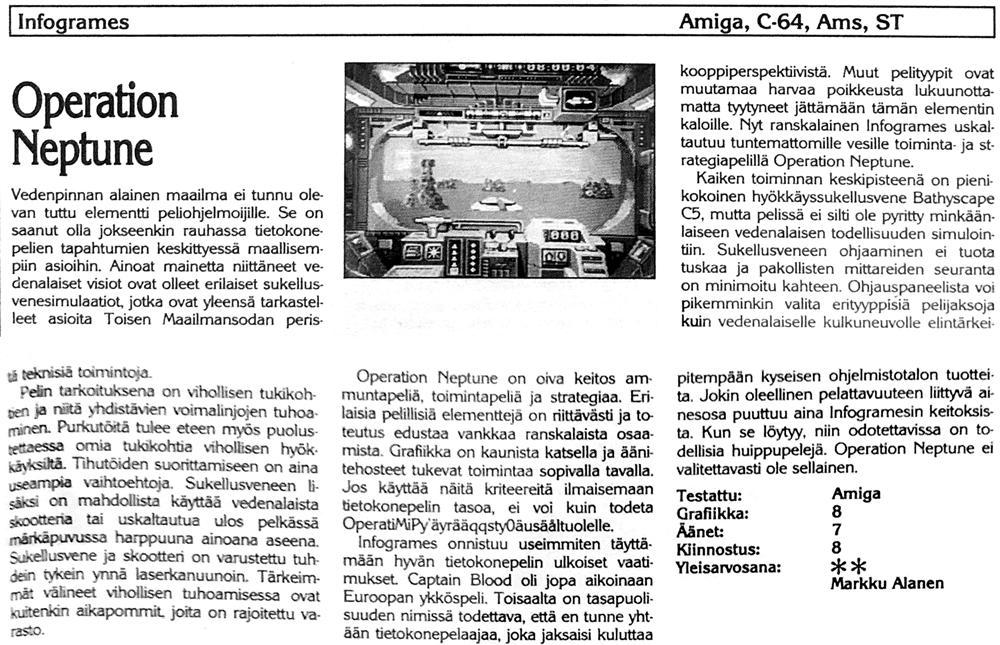
Kaiken toiminnan keskipisteenä on pienikokoinen hyökkäyssukellusvene Bathyscape C5, mutta pelissä ei silti ole pyritty minkäänlaiseen vedenalaisen todellisuuden simulointiin. Sukellusveneen ohjaaminen ei tuota tuskaa ja pakollisten mittareiden seuranta on minimoitu kahteen. Ohjauspaneelista voi pikemminkin valita erityyppisiä pelijaksoja kuin vedenalaiselle kulkuneuvolle elintärkeitä teknisiä toimintoja.
Pelin tarkoituksena on vihollisen tukikohtien ja niitä yhdistävien voimalinjojen tuhoaminen. Purkutöitä tulee eteen myös puolustettaessa omia tukikohtia vihollisen hyökkäyksiltä. Tihutöiden suorittamiseen on aina useampia vaihtoehtoja. Sukellusveneen lisäksi on mahdollista käyttää vedenalaista skootteria tai uskaltautua ulos pelkässä märkäpuvussa harppuuna ainoana aseena. Sukellusvene ja skootteri on varustettu tuhdein tykein ynnä laserkanuunoin. Tärkeimmät välineet vihollisen tuhoamisessa ovat kuitenkin aikapommit, joita on rajoitettu varasto.
Operation Neptune on oiva keitos ammuntapeliä, toimintapeliä ja strategiaa. Erilaisia pelillisiä elementtejä on riittävästi ja toteutus edustaa vankkaa ranskalaista osaamista. Grafiikka on kaunista katsella ja äänitehosteet tukevat toimintaa sopivalla tavalla. Jos käyttää näitä kriteereitä ilmaisemaan tietokonepelin tasoa, ei voi kuin todeta OperatiMiPy'äyrääqqsty0äusäältuolelle.
Infogrames onnistuu useimmiten täyttämään hyvän tietokonepelin ulkoiset vaatimukset. Captain Blood oli jopa aikoinaan Euroopan ykköspeli. Toisaalta on tasapuolisuuden nimissä todettava, että en tunne yhtään tietokonepelaajaa, joka jaksaisi kuluttaa pitempään kyseisen ohjelmistotalon tuotteita. Jokin oleellinen pelattavuuteen liittyvä ainesosa puuttuu aina Infogramesin keitoksista. Kun se löytyy, niin odotettavissa on todellisia huippupelejä. Operation Neptune ei valitettavasti ole sellainen.
Operation Neptune1989 SyksyPermalinkThe world beneath the surface doesn't seem to be a familiar element to game programmers. It has been left more or less in peace while computer games have concentrated on more terrestrial matters. The only underwater visions to have won any fame have been various submarine simulations, which have usually viewed things from a Second World War periscope perspective. Other game types, with a few rare exceptions, have been content to leave this element to the fish. Now France's Infogrames ventures into uncharted waters with the action and strategy game Operation Neptune.
At the centre of all the action is the small attack submarine Bathyscape C5, but even so the game makes no attempt whatsoever at simulating underwater reality. Steering the submarine causes no agony, and the gauges you're obliged to keep an eye on have been kept to a minimum of two. From the control panel you select different types of game sequence rather than technical functions vital to an underwater vessel.
The object of the game is to destroy the enemy's bases and the power lines connecting them. Demolition work also comes up when defending your own bases against enemy attacks. There are always several ways to go about the dirty work. Besides the submarine, you can use an underwater scooter or venture out in nothing but a wetsuit with a harpoon as your only weapon. The submarine and the scooter are fitted with hefty guns plus laser cannons. The most important tools for destroying the enemy, however, are time bombs, of which there is a limited supply.
Operation Neptune is a fine brew of shoot-'em-up, action game and strategy. There are enough different gameplay elements, and the execution represents solid French know-how. The graphics are lovely to look at and the sound effects back up the action in a fitting way. If you use these criteria to express the standard of a computer game, you can only conclude that OperatiMiPy'äyrääqqsty0äusäältuolelle.
Infogrames mostly manages to meet the outward requirements of a good computer game. Captain Blood was even Europe's number one game in its day. On the other hand, in the name of fairness it must be said that I don't know a single computer gamer with the stamina to keep playing this software house's products for long. Some essential ingredient to do with playability is always missing from Infogrames' brews. Once it's found, we can expect some truly top-notch games. Operation Neptune, sadly, is not one of them.
Operation Stealth
Operation Stealth1990 SyksyPysyvä linkkiOvelia nämä sotastrategistit. Yleisölle esiteltiinkin kelvoton prototyyppi ja samaan aikaan oikea Stealth-hävittäjä pidettiin visusti piilossa, kunnes eräänä tähtikirkkaana yönä se otti siivet alleen ja sujahti muihin maisemiin. Sotkuja setvimään tarvitaan hallituksen huippuagentti, jonka asiallinen asiamies-look kätkee sisäänsä passinväärentäjällä ja itsetuhomekanismilla varustetun salkun, kiipeilykaapeleita singauttavan rannekellon, raketteja ampuvat savukkeet ja muuta nerokkaasti naamioitua korkeateknologiaa. Kuulostaa kovasti Bondahtavalta, mutta sankarin nimi on kuitenkin Glames, John Glames.
Operation Stealth on Delphinen toinen graafinen seikkailu, joka käyttää samaa systeemiä kuin ajassa ja paikassa hillittömästi hyppinyt Future Wars. Sitten viime näkemän käyttäjäliityntää on jonkin verran parannettu Sierran ja Lucasfilmin suuntaan. Menusta löytyvät 'operate', 'take', 'speak' ja muut ytimekkäät komennot, lisäksi voi tutkia ja käsitellä myös kantamiaan tavaroita, mikä ei onnistunut Future Warsissa. Toinen parannus on siinä, että enää ei tarvitse sietää 'come a little closer' -huomautuksia, jos ei seiso oikean pikselin kohdalla, vaan sankari tepastelee automaattisesti esineen tai henkilön luo.
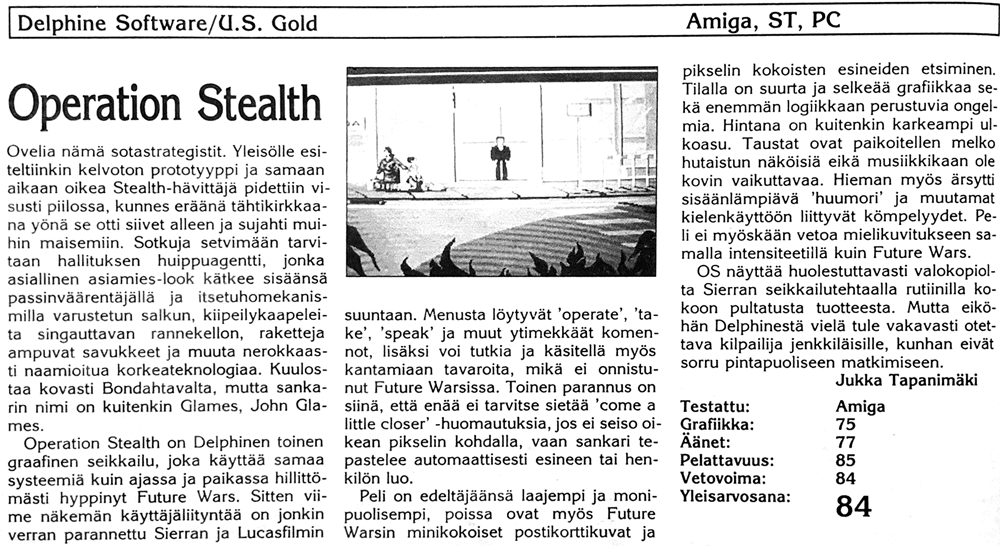
Peli on edeltäjäänsä laajempi ja monipuolisempi, poissa ovat myös Future Warsin minikokoiset postikorttikuvat ja pikselin kokoisten esineiden etsiminen. Tilalla on suurta ja selkeää grafiikkaa sekä enemmän logiikkaan perustuvia ongelmia. Hintana on kuitenkin karkeampi ulkoasu. Taustat ovat paikoitellen melko hutaistun näköisiä eikä musiikkikaan ole kovin vaikuttavaa. Hieman myös ärsytti sisäänlämpiävä 'huumori' ja muutamat kielenkäyttöön liittyvät kömpelyydet. Peli ei myöskään vetoa mielikuvitukseen samalla intensiteetillä kuin Future Wars.
OS näyttää huolestuttavasti valokopiolta Sierran seikkailutehtaalla rutiinilla kokoon pultatusta tuotteesta. Mutta eiköhän Delphinestä vielä tule vakavasti otettava kilpailija jenkkiläisille, kunhan eivät sorru pintapuoliseen matkimiseen.
Operation Stealth1990 SyksyPermalinkCrafty, these military strategists. The public was shown a useless prototype, and meanwhile the real Stealth fighter was kept carefully out of sight, until one starry night it took wing and slipped off to other parts. Untangling the mess calls for the government's top agent, whose businesslike businessman look conceals a briefcase fitted with a passport forger and a self-destruct mechanism, a wristwatch that fires out climbing cables, rocket-launching cigarettes and other ingeniously disguised high technology. Sounds awfully Bond-ish, but the hero's name is in fact Glames, John Glames.
Operation Stealth is Delphine's second graphic adventure, and it uses the same system as Future Wars, which hopped about wildly in time and space. Since we last saw it, the user interface has been improved somewhat in the direction of Sierra and Lucasfilm. The menu offers 'operate', 'take', 'speak' and other pithy commands, and you can now also examine and handle the items you are carrying, which couldn't be done in Future Wars. Another improvement is that you no longer have to put up with 'come a little closer' remarks when you aren't standing on exactly the right pixel; instead the hero toddles over to the object or person automatically.
The game is bigger and more varied than its predecessor, and gone too are Future Wars' miniature postcard-sized pictures and the hunt for pixel-sized objects. In their place come big, clear graphics and more logic-based puzzles. The price, however, is a cruder look. The backgrounds look rather slapdash in places, and the music isn't very impressive either. I was also a little irked by the in-jokey 'humour' and a few clumsy bits of language. Nor does the game fire the imagination with the same intensity as Future Wars.
OS looks worryingly like a photocopy of a product bolted together by rote at Sierra's adventure factory. But surely Delphine will yet become a rival for the Yanks to be taken seriously, as long as they don't stoop to superficial imitation.
Operation Thunderbolt
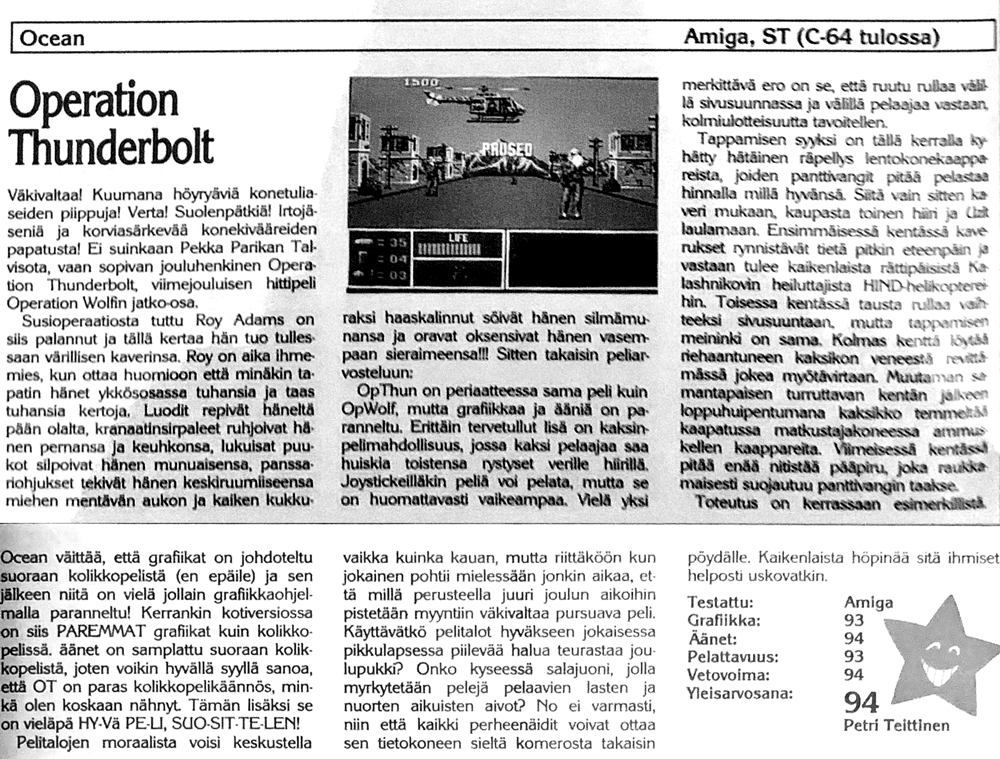
Operation Thunderbolt1990 KevätPysyvä linkkiVäkivaltaa! Kuumana höyryäviä konetuliaseiden piippuja! Verta! Suolenpätkiä! Irtojäseniä ja korviasärkevää konekivääreiden papatusta! Ei suinkaan Pekka Parikan Talvisota, vaan sopivan jouluhenkinen Operation Thunderbolt, viimejouluisen hittipeli Operation Wolfin jatko-osa.
Susioperaatiosta tuttu Roy Adams on siis palannut ja tällä kertaa hän tuo tullessaan värillisen kaverinsa. Roy on aika ihmemies, kun ottaa huomioon että minäkin tapatin hänet ykkösosassa tuhansia ja taas tuhansia kertoja. Luodit repivät häneltä pään olalta, kranaatinsirpaleet ruhjoivat hänen pernansa ja keuhkonsa, lukuisat puukot silpoivat hänen munuaisensa, panssariohjukset tekivät hänen keskiruumiiseensa miehen mentävän aukon ja kaiken kukkuraksi haaskalinnut söivät hänen silmämunansa ja oravat oksensivat hänen vasempaan sieraimeensa!!! Sitten takaisin peliarvosteluun:
OpThun on periaatteessa sama peli kuin OpWolf, mutta grafiikkaa ja ääniä on paranneltu. Erittäin tervetullut lisä on kaksinpelimahdollisuus, jossa kaksi pelaajaa saa huiskia toistensa rystyset verille hiirillä. Joystickeilläkin peliä voi pelata, mutta se on huomattavasti vaikeampaa. Vielä yksi merkittävä ero on se, että ruutu rullaa välillä sivusuunnassa ja välillä pelaajaa vastaan, kolmiulotteisuutta tavoitellen.
Tappamisen syyksi on tällä kerralla kyhätty hätäinen räpellys lentokonekaappareista, joiden panttivangit pitää pelastaa hinnalla millä hyvänsä. Siitä vain sitten kaveri mukaan, kaupasta toinen hiiri ja Uzit laulamaan. Ensimmäisessä kentässä kaverukset rynnistävät tietä pitkin eteenpäin ja vastaan tulee kaikenlaista rättipäisistä Kalashnikovin heiluttajista HIND-helikoptereihin. Toisessa kentässä tausta rullaa vaihteeksi sivusuuntaan, mutta tappamisen meininki on sama. Kolmas kenttä löytää riehaantuneen kaksikon veneestä revittämässä jokea myötävirtaan. Muutaman samantapaisen turruttavan kentän jälkeen loppuhuipentumana kaksikko temmeltää kaapatussa matkustajakoneessa ammuskellen kaappareita. Viimeisessä kentässä pitää enää nitistää pääpiru, joka raukkamaisesti suojautuu panttivangin taakse.
Toteutus on kerrassaan esimerkillistä. Ocean väittää, että grafiikat on johdoteltu suoraan kolikkopelistä (en epäile) ja sen jälkeen niitä on vielä jollain grafiikkaohjelmalla paranneltu! Kerrankin kotiversiossa on siis PAREMMAT grafiikat kuin kolikkopelissä. äänet on samplattu suoraan kolikkopelistä, joten voikin hyvällä syyllä sanoa, että OT on paras kolikkopelikäännös, minkä olen koskaan nähnyt. Tämän lisäksi se on vieläpä HY-Vä PE-LI, SUO-SIT-TE-LEN!
Pelitalojen moraalista voisi keskustella vaikka kuinka kauan, mutta riittäköön kun jokainen pohtii mielessään jonkin aikaa, että millä perusteella juuri joulun aikoihin pistetään myyntiin väkivaltaa pursuava peli. Käyttävätkö pelitalot hyväkseen jokaisessa pikkulapsessa piilevää halua teurastaa joulupukki? Onko kyseessä salajuoni, jolla myrkytetään pelejä pelaavien lasten ja nuorten aikuisten aivot? No ei varmasti, niin että kaikki perheenäidit voivat ottaa sen tietokoneen sieltä komerosta takaisin pöydälle. Kaikenlaista höpinää sitä ihmiset helposti uskovatkin.
Operation Thunderbolt1990 KevätPermalinkViolence! Steaming-hot gun barrels! Blood! Bits of gut! Severed limbs and the ear-splitting rattle of machine guns! No, not Pekka Parikka's Talvisota, but the suitably Christmassy Operation Thunderbolt, the sequel to last Christmas's hit game Operation Wolf.
So Roy Adams, familiar from the Wolf operation, is back, and this time he's bringing his coloured buddy along. Roy is quite the miracle man, considering that I alone got him killed thousands upon thousands of times in part one. Bullets tore his head off his shoulders, grenade shrapnel mangled his spleen and lungs, countless knives shredded his kidneys, anti-tank missiles blew a hole you could walk through in his midriff, and to top it all off vultures ate his eyeballs and squirrels threw up in his left nostril!!! And now back to the game review:
OpThun is basically the same game as OpWolf, but the graphics and sound have been improved. A very welcome addition is the two-player option, in which two players get to whack each other's knuckles bloody with their mice. You can play with joysticks too, but it's considerably harder. One more significant difference is that the screen scrolls sometimes sideways and sometimes towards the player, going for a 3D effect.
This time the excuse for the killing is a hastily cobbled-together botch about aircraft hijackers whose hostages must be rescued at any cost. So off you go: bring a buddy along, grab a second mouse from the shop and get those Uzis singing. In the first level the pals charge forward along a road and everything comes at them, from rag-headed Kalashnikov-wavers to HIND helicopters. In the second level the background scrolls sideways for a change, but the killing goes on in exactly the same spirit. The third level finds the rampaging duo in a boat, tearing downstream along a river. After a few more similarly numbing levels, the grand finale has the duo running riot through a hijacked airliner, gunning down hijackers. In the last level all that's left is to snuff out the head devil, who cowers behind a hostage like the coward he is.
The execution is downright exemplary. Ocean claims the graphics were wired straight across from the arcade machine (I don't doubt it) and then touched up further with some graphics program! So for once a home version has BETTER graphics than the arcade machine. The sound is sampled straight from the arcade machine, so one can fairly say that OT is the best arcade conversion I have ever seen. On top of that, it's a GOOD GAME, I RE-COM-MEND IT!
The morals of the software houses could be debated endlessly, but let it suffice for everyone to ponder for a while on what grounds a game oozing with violence gets put on sale right at Christmas time. Are the software houses exploiting the urge to butcher Father Christmas that lurks in every little child? Is this a secret plot to poison the brains of game-playing children and young adults? No, certainly not, so all you mothers can take that computer back out of the cupboard and put it on the table again. The drivel people will readily believe.
Operation Wolf
Operation Wolf1989 KevätPysyvä linkki"Mie on Rokan Antti ja hää, hää o Operaatio Sus." Operation Wolf, erittäin suositun peliautomaatin kotiversio kuului ehdottomasti joulun -88 odotetuimpiin peleihin .
Operaatio Susi tähtää sotavankien vapautukseen. Ruutu scrollailee hiljakseen yli erilaisten näkymien ja sotilaita, tankkeja sun muita poukkoilee näkyviin. Pelaaja tilittää sisimpäänsä luotettavalla M-16-rynnärillään, jossa on ilmeisesti 30 mm sinko piipun alla (terkkuja Tony Montanalle), sillä raketitkin kuuluvat aseistukseen. Viholliset ammuskelevat kohti ruutua, ja vahinkoilmaisin nousee, nousee... Voiko tämä olla voimakaksikon loppu?
Atari ST ja Amiga hallitsevat grafiikan siinä määrin, että niiden Susi on imuroitu suoraan kolikkoautomaatista. Versiot ovat muuten identtisiä, mutta Amiga voittaa huomattavasti kauniimmalla scrollillaan ja paremmilla äänillään. Jatkuva ja todella huonosti suunniteltu levyjen vaihtelu tosin rassaa, eivätkä pitkät latausajat, etenkin Amigassa, varsinaisesti riemastuta. Kuitenkin, pelaaminen hiiren kanssa on erinomaisen mukavaa ja on hyväksyttävä vaihtoehto alkuperäiselle UZIlle. Todella nautittava jouluhenkinen väkivaltaeepos.
Eikä ole kuusnelosversiokaan hassumpi. Grafiikka on aivan hyväksyttävää, ja ainoa nirisemisen aihe pakollisen multiloadin lisäksi on käytännön pakko käyttää joystickia. Ohjelma tarjoaa mahdollisuuden käyttää NEOSin hiirtä, mutta kenelläpä sellainen on? Peli reagoi joystickin käyttöön helpottamalla peliä, mikä onkin aivan oikein. 16-bittisten tasolle ei luonnollisestikaan kyllä päästä.
Operation Wolf ei nimestään huolimatta ole susi, vaan kuuluu niihin harvinaisiin kohupeleihin, jotka kestävät ennakko-odotusten paineet.
Operation Wolf1989 KevätPermalink"Me is Antti Rokka an' 'e, 'e is Op'ration Wolf." Operation Wolf, the home version of a hugely popular arcade machine, was without doubt one of the most eagerly awaited games of Christmas '88.
Operation Wolf is aimed at freeing prisoners of war. The screen scrolls slowly across various scenes, and soldiers, tanks and whatnot bounce into view. The player pours out their innermost feelings with their trusty M-16 assault rifle, which apparently has a 30 mm bazooka under the barrel (say hi to Tony Montana), since rockets are part of the armament too. The enemies take potshots at the screen, and the damage meter rises, and rises... Could this be the end of the Dynamic Duo?
The Atari ST and Amiga have such a command of graphics that their Wolf has been hoovered straight out of the coin-op. The versions are otherwise identical, but the Amiga wins out with its considerably prettier scrolling and better sound. The constant and really badly designed disk-swapping does grate, though, and the long loading times, especially on the Amiga, are not exactly a joy. Still, playing with the mouse is wonderfully comfortable and makes an acceptable alternative to the original UZI. A truly enjoyable violence epic in the Christmas spirit.
Nor is the C-64 version half bad. The graphics are perfectly acceptable, and the only thing to nitpick about besides the compulsory multiload is the practical necessity of using a joystick. The program offers the option of using a NEOS mouse, but who's got one of those? The game responds to joystick use by making itself easier, which is quite right too. Naturally, though, it doesn't reach the level of the 16-bitters.
Despite its name, Operation Wolf is no wolf, as Finns call a dud, but one of those rare hyped games that hold up under the pressure of advance expectations.
Operation Wolf

Operation Wolf1990 SyksyPysyvä linkkiOperaatio Susi on Taiton muinainen kolikkopeli, jonka teho perustui siihen, että pikseleitä lahdattiin jykevällä valokiväärillä. Valopistoolilla täydennettyyn Segaan peli kääntyy mainiosti, vaikka kiväärin tilalla onkin lelumainen Light Phaser.
Mitään syvällistä sisältöä pelissä ei ole, kunhan niitetään verkkaisesti vaakaan etenevä näkymä tyhjäksi vihollisista ja varotaan siviileitä. Kuvan laidoilta tähtäimeen rynnivät rynnäkkökivääriä heiluttava sotilaat ovat helppo pala, kun taas helikoptereihin ja panssaroituihin ajoneuvoihin on taottava kilon verran luoteja tai yksi singon laukaus pelleistä läpi. Myöhemmin maisemiin ilmaantuu myös luodinkestävillä liiveillä varustautuneita heppuja, jotka teloitetaan ampumalla silmien väliin. Singon käyttö on ratkaistu siten, että toisessa kädessä pidetään tavallista peliohjainta, josta löytyy laukaisuun tarvittava namikka.
OW on ehdottomasti Segan paras valopistoolipeli. Toteutusta heikentää ainoastaan Segamainen välkkyminen, muuten peli on erinomaisen onnistunut. Vaikeus on juuri sopiva, jotta tiivis tunnelma pitäisi imussaan tunnista toiseen. Taustamaisemat ovat hieman karuja, mutta ulkoasusta jää silti täyteläinen maku kolikkopelistä imuroitujen välikuvien ansiosta.
Operation Wolf1990 SyksyPermalinkOperaatio Susi is Taito's ancient coin-op, whose punch came from slaughtering pixels with a hefty light rifle. The game converts splendidly to a Sega supplemented with a light gun, even if the rifle has been replaced by the toy-like Light Phaser.
There's no deep content to the game whatsoever; you just mow the slowly sideways-scrolling view clear of enemies and watch out for civilians. The soldiers rushing into your sights from the edges of the screen waving assault rifles are easy meat, whereas helicopters and armoured vehicles need a kilo's worth of bullets hammered into them, or one bazooka round straight through the clowns. Later on, blokes equipped with bulletproof vests also turn up in the scenery, and they are executed by shooting them between the eyes. Using the bazooka has been solved by having you hold an ordinary joypad in your other hand, which has the button needed to fire it.
OW is definitely the Sega's best light gun game. The only thing that lets the implementation down is the typical Sega flicker; otherwise the game is an excellent success. The difficulty is just right for the intense atmosphere to keep you in its grip hour after hour. The background scenery is a bit bare, but the look still leaves a rich taste thanks to the intermission screens vacuumed straight out of the coin-op.
Oriental Games
Oriental Games1991 KevätPysyvä linkkiEipä ehtinyt kulua pitkääkään aikaa Electronic Artsin mainiosta Budokanista, kun Prosen piti syytää ulos peli samalla kaavalla. Toisin sanoen läjätään pakettiin mahdollisimman agggressiivisia itämaisia riehumislajeja.
Kendo on se vanha tuttu kepinhuiskuttelu, joka tosin oli paljon monimuotoisemmin toteutettu EA:n Budokanissa. Sama pätee Kung Fu'hun, jossa ei ainakaan meikäläisen silmiin näy paljonkaan eroa karateen, paitsi että Budokanin karate hakkaa OG:n kädet alhaalla, potkuvalikoima kun oli sen verran vaikuttava. Kolmas ja viimeinen 16-bittisten laji on Kyo-Kushin-Kai, jota voisi lähinnä luonnehtia vapaamuotoiseksi nyrkkitappeluksi. Mukana on esimerkiksi pääpusku ja jalalla polkaisu. Eipä kovin budo-henkistä. Jostain kumman syystä kasibittisten versioissa on enemmän ja erilaisia lajeja: Kendo, Karate, Kung Fu ja Sumo.
OG:n mielenkiintoisin ominaisuus on joystick-editori, vai pitäisikö sanoa liike-editori, ennen kuin lähdette noutamaan vajasta puukkoa ja pöllinpalaa. Toisin todeten saa aivan itse päättää millaiselle kiemuralle tikku on väännettävä, jotta raajat huiskisivat haluttuja ratoja.
Vastustajien älyvapaus heittelee laidasta laitaan, alkupään vastukset enimmäkseen seisoskelevat kun taas mitalikamppailuissa sohitaan senkin edestä. Harjoittelua ei ole mukana, vaan sännätään suoraan tatamille ottelemaan mitaleista kerrasta poikki systeemillä.
Grafiikka on vähän suttuista mutta sentään suurta, animointi ei leukaa loksauta enempää kuin kuuslankun Exploding Fist ja äänet taasen ovat tyypillistä sirkkelin särähtelyä. Pirteimmin korvaan sopivat kendokeppien kalinat.
Sen verran verettömän olon OG jättää, että ihmetellä täytyy. Ilmeisesti saamme näistä kärsiä niin pitkään kuin itämailla riittää toinen toistaan eksoottisempia lajeja, esimerkiksi annettakoon vinkiksi, että Tae kwon do taitaa olla vielä käsittelemättä. Tämä tekele ainakin töksähtää selälleen keräilyerien puolelle.
Oriental Games1991 KevätPermalinkHardly any time at all had passed since Electronic Arts' excellent Budokan before Prose had to spew out a game on the same pattern. In other words, you pile into the package the most aggressive Oriental rampaging sports you can find.
Kendo is that same old familiar stick-waving, which admittedly was done with far more variety in EA's Budokan. The same goes for Kung Fu, in which, to my eyes at least, there's not much difference from karate, except that Budokan's karate beats OG's hands down, its range of kicks being that impressive. The third and last sport in the 16-bit versions is Kyo-Kushin-Kai, which could best be described as a freestyle fist fight. It includes, for example, a head-butt and a stamp of the foot. Not very much in the budo spirit. For some strange reason the 8-bit versions have more sports, and different ones: Kendo, Karate, Kung Fu and Sumo.
OG's most interesting feature is the joystick editor, or should I say move editor, before you go off to fetch a knife and a chunk of log from the shed. Put another way, you get to decide all by yourself what kind of contortion the stick has to be twisted through so that the limbs swish along the desired paths.
The opponents' freedom from intelligence swings from one extreme to the other: the early opponents mostly stand around, whereas in the medal bouts they flail away all the more to make up for it. There's no training included; instead you rush straight onto the tatami to fight for medals on a sudden-death system.
The graphics are a bit smudgy but at least they're big, the animation drops no more jaws than the C-64's Exploding Fist, and the sound, for its part, is the typical rasping of a circular saw. The clacking of the kendo sticks is the liveliest thing on the ear.
OG leaves such a bloodless feeling that you can't help wondering. Apparently we'll have to suffer these for as long as the East has ever more exotic sports to offer; by way of example, let it be given as a tip that Tae kwon do still seems to be untouched. This effort, at least, thuds flat on its back onto the seconds pile.
Out Run
Out Run1989 KevätPysyvä linkkiOut Run! Ferrari Testarossan moottorin jylinä kimpoaa kuumasta asfaltista ja sekoittuu pelkääjänpaikan blondin tukan kahinaan tuimassa ajoviimassa. Keskiviiva vilisee renkaiden alla ja muutenkin on hauskaa.
Erittäin suosittu kolikkopeli Out Run on kotikoneversiona tuttu jo viime vuodelta, jolloin ilmestyivät heikot kasibittikäännökset. Se ei kuitenkaan estänyt niistä tulemasta massiivisia hittejä. Nyt Out Run on saatavissa myös koneissa, joiden teho riittää jo kunnon käännökseen. Eipä ihme että että ST-Amiga-versiot ovatkin kuin eri peli.
Out Runin ST-versio on ollut olemassa jo yli puoli vuotta ja myi valtavasti. Eipä siis ihme että U.S. Gold päätti kuin päättikin julkaista myös upouuden ja jopa parannellun Amiga-version. Miksi jättää myyntivoittoa keräämättä?
No mitkä ovat erot kasibittiversioihin verrattuna? Grafiikkahan se ensimmäiseksi silmään pistää ja vihdoinkin se on kelvollista. Pitkästä aikaa ei Amiga-versiota ole imuroitu ST:stä, vaan jo ST-versiossa hyvää grafiikkaa on vielä venytetty kohti kolikkopelin tasoja. Kaikella on kuitenkin hintansa: Amigan grafiikka ei liiku läheskään yhtä pehmeästi kuin ST:ssä.
Suurin miinus grafiikassa on animaation puute. Autonrenkaat eivät pyöri, tytön tukka ei liehu ja ympäriajossa ei tyttösen sormi heilu. Kumpikin versio paitsi latautuu hienolla 1541-emulaatiolla, myös pelin aikana latailee ikävästi lisäradanpätkiä, mutta ainakin risteykset ovat tällä kertaa mukana.
Äänissä Amiga odotetusti loistaa. Erittäin dramaattinen samplattu pätkä toivottaa pelaajan tervetulleeksi Out Runiin, hyvät versiot pelimusiikista raikuvat ja renkaat kirskuvat (tosin pikkuisen aneemisesti) Testarossan kiitäessä kuin punainen nuoli pitkin highwayta. Taustamusiikin saa itse valita ja efektejä riittää. ST-versiossa on vain renkaiden kirskunta, ja musiikki vaihtuu radan vaihtuessa.
Vaikkei 16-bittisten tehoa hyödynnetäkään loppuun saakka Out Run -fanit saavat vihdoinkin vastineen rahoilleen. Kaikista Out Runin versioista on Amigan paras, ST-version paremmasta pelattavuudesta huolimatta, SE versio.
Out Run1989 KevätPermalinkOut Run! The roar of the Ferrari Testarossa's engine bounces off the hot asphalt and mingles with the rustle of the passenger-seat blonde's hair in the fierce rush of wind. The centre line flickers by under the tyres and generally it's all good fun.
The hugely popular coin-op Out Run is already familiar in home computer form from last year, when the feeble eight-bit conversions came out. That didn't stop them becoming massive hits, though. Now Out Run is also available on machines with enough power for a proper conversion. Small wonder, then, that the ST and Amiga versions are like a different game.
The ST version of Out Run has been around for over half a year already and sold enormously. So no wonder U.S. Gold went ahead and decided to release a brand-new and even improved Amiga version as well. Why leave sales profits uncollected?
So what are the differences compared with the eight-bit versions? It's the graphics that catch the eye first, and at last they're decent. For the first time in ages the Amiga version hasn't been hoovered from the ST; instead the graphics, already good in the ST version, have been stretched even further towards arcade levels. Everything has its price, though: the Amiga's graphics don't move anywhere near as smoothly as on the ST.
The biggest minus in the graphics is the lack of animation. The car's wheels don't turn, the girl's hair doesn't flutter, and when you spin out the girlie's finger doesn't wag. Both versions not only load with a splendid 1541 emulation but also annoyingly load extra stretches of track during play, but at least the junctions are included this time.
In the sound department the Amiga shines, as expected. A highly dramatic sampled snippet welcomes the player to Out Run, good versions of the game music ring out, and the tyres squeal (if a tad anaemically) as the Testarossa streaks like a red arrow along the highway. You can choose the background music yourself and there are plenty of effects. The ST version has only the tyre squeal, and the music changes as the track changes.
Even though the power of the 16-bitters isn't exploited to the full, Out Run fans finally get their money's worth. Of all the versions of Out Run, the Amiga's is the best, despite the ST version's better playability: THE version.
Outlaws
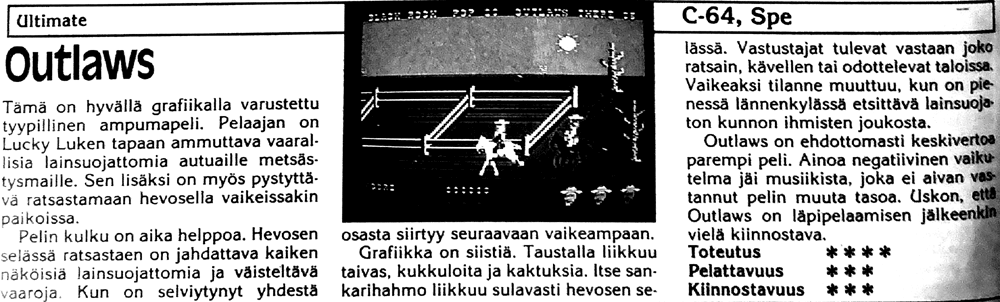
Outlaws1987Pysyvä linkkiTämä on hyvällä grafiikalla varustettu tyypillinen ampumapeli. Pelaajan on Lucky Luken tapaan ammuttava vaarallisia lainsuojattomia autuaille metsästysmaille. Sen lisäksi on myös pystyttävä ratsastamaan hevosella vaikeissakin paikoissa.
Pelin kulku on aika helppoa. Hevosen selässä ratsastaen on jahdattava kaiken näköisiä lainsuojattomia ja väisteltävä vaaroja. Kun on selviytynyt yhdestä osasta siirtyy seuraavaan vaikeampaan.
Grafiikka on siistiä. Taustalla liikkuu taivas, kukkuloita ja kaktuksia. Itse sankarihahmo liikkuu sulavasti hevosen selässä. Vastustajat tulevat vastaan joko ratsain, kävellen tai odottelevat taloissa. Vaikeaksi tilanne muuttuu, kun on pienessä lännenkylässä etsittävä lainsuojaton kunnon ihmisten joukosta.
Outlaws on ehdottomasti keskivertoa parempi peli. Ainoa negatiivinen vaikutelma jäi musiikista, joka ei aivan vastannut pelin muuta tasoa. Uskon, että Outlaws on läpipelaamisen jälkeenkin vielä kiinnostava.
Outlaws1987PermalinkThis is a typical shoot-'em-up equipped with good graphics. Like Lucky Luke, the player has to shoot dangerous outlaws off to the happy hunting grounds. On top of that, you also have to be able to ride a horse even in difficult places.
The gameplay is pretty easy. Riding on horseback, you have to chase down all sorts of outlaws and dodge dangers. Once you've made it through one section, you move on to the next, harder one.
The graphics are neat. In the background the sky, hills and cacti move past. The hero figure moves smoothly on horseback. The opponents come at you either riding or on foot, or lie in wait in the houses. Things get difficult when, in a small western town, you have to find the outlaw among the decent folk.
Outlaws is definitely a better-than-average game. The only negative impression was left by the music, which didn't quite match the standard of the rest of the game. I believe Outlaws will still be interesting even after you've played it through.
Outrun
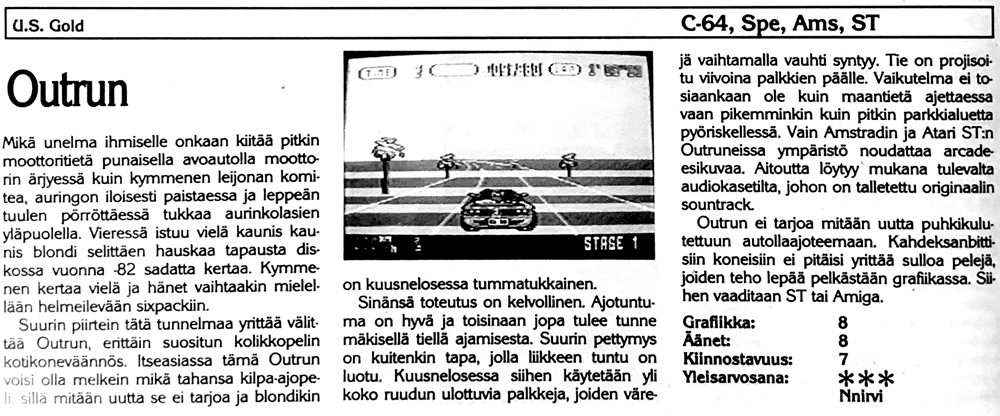
Outrun1988Pysyvä linkkiMikä unelma ihmiselle onkaan kiitää pitkin moottoritietä punaisella avoautolla moottorin ärjyessä kuin kymmenen leijonan komitea, auringon iloisesti paistaessa ja leppeän tuulen pörröttäessä tukkaa aurinkolasien yläpuolella. Vieressä istuu vielä kaunis kaunis blondi selittäen hauskaa tapausta diskossa vuonna -82 sadatta kertaa. Kymmenen kertaa vielä ja hänet vaihtaakin mielellään helmeilevään sixpackiin.
Suurin piirtein tätä tunnelmaa yrittää välittää Outrun, erittäin suositun kolikkopelin kotikoneväännös. Itseasiassa tämä Outrun voisi olla melkein mikä tahansa kilpa-ajopeli, sillä mitään uutta se ei tarjoa ja blondikin on kuusnelosessa tummatukkainen.
Sinänsä toteutus on kelvollinen. Ajotuntuma on hyvä ja toisinaan jopa tulee tunne mäkisellä tiellä ajamisesta. Suurin pettymys on kuitenkin tapa, jolla liikkeen tuntu on luotu. Kuusnelosessa siihen käytetään yli koko ruudun ulottuvia palkkeja, joiden värejä vaihtamalla vauhti syntyy. Tie on projisoitu viivoina palkkien päälle. Vaikutelma ei tosiaankaan ole kuin maantietä ajettaessa vaan pikemminkin kuin pitkin parkkialuetta pyöriskellessä. Vain Amstradin ja Atari ST:n Outruneissa ympäristö noudattaa arcade-esikuvaa. Aitoutta löytyy mukana tulevalta audiokasetilta, johon on talletettu originaalin sountrack.
Outrun ei tarjoa mitään uutta puhkikulutettuun autollaajoteemaan. Kahdeksanbittisiin koneisiin ei pitäisi yrittää sulloa pelejä, joiden teho lepää pelkästään grafiikassa. Siihen vaaditaan ST tai Amiga.
Outrun1988PermalinkWhat a dream it is to go tearing down the motorway in a red convertible, the engine roaring like a committee of ten lions, the sun shining merrily and a gentle breeze tousling your hair above your sunglasses. And to top it off, sitting next to you is a beautiful, beautiful blonde, telling you the funny story about what happened at a disco in '82 for the hundredth time. Ten more times and you'd gladly swap her for a frosty, sparkling six-pack.
This is roughly the mood that Outrun, the home-computer conversion of a hugely popular coin-op, tries to convey. In fact this Outrun could be almost any racing game, since it offers nothing new, and on the Commodore 64 even the blonde has dark hair.
As such, the implementation is passable. The driving feel is good, and at times you even get the sensation of driving on a hilly road. The biggest disappointment, though, is the way the sense of motion has been created. On the Commodore 64 it uses bars stretching across the whole screen, and the speed comes from changing their colours. The road is projected as lines on top of the bars. The effect really isn't like driving down a highway at all, more like pottering around a car park. Only in the Amstrad and Atari ST Outruns does the scenery follow the arcade original. Authenticity can be found on the audio cassette that comes with the game, which holds the original's soundtrack.
Outrun offers nothing new on the worn-out driving-a-car theme. You shouldn't try to cram games whose punch rests purely on the graphics into eight-bit machines. That takes an ST or an Amiga.
Overlander
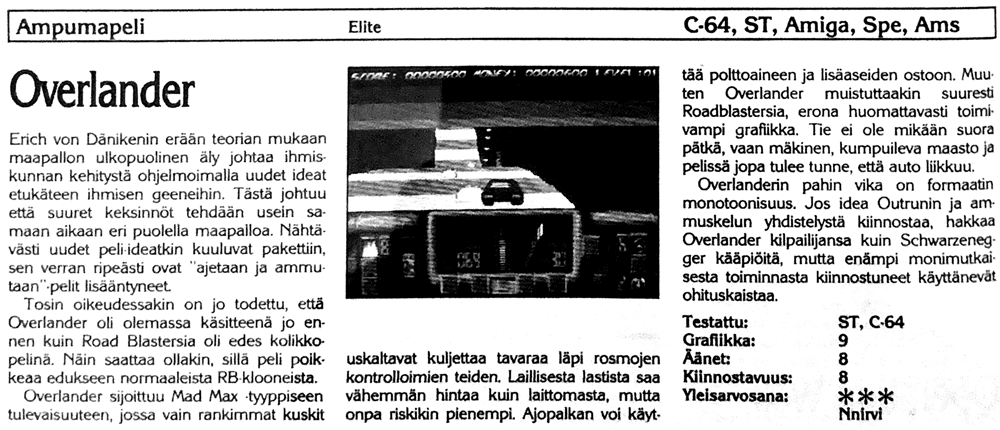
Overlander1989 KevätPysyvä linkkiErich von Dänikenin erään teorian mukaan maapallon ulkopuolinen äly johtaa ihmiskunnan kehitystä ohjelmoimalla uudet ideat etukäteen ihmisen geeneihin. Tästä johtuu että suuret keksinnöt tehdään usein samaan aikaan eri puolella maapalloa. Nähtävästi uudet peli-ideatkin kuuluvat pakettiin, sen verran ripeästi ovat "ajetaan ja ammutaan"-pelit lisääntyneet.
Tosin oikeudessakin on jo todettu, että Overlander oli olemassa käsitteenä jo ennen kuin Road Blastersia oli edes kolikkopelinä. Näin saattaa ollakin, sillä peli poikkeaa edukseen normaaleista RB-klooneista.
Overlander sijoittuu Mad Max -tyyppiseen tulevaisuuteen, jossa vain rankimmat kuskit uskaltavat kuljettaa tavaraa läpi rosmojen kontrolloimien teiden. Laillisesta lastista saa vähemmän hintaa kuin laittomasta, mutta onpa riskikin pienempi. Ajopalkan voi käyttää polttoaineen ja lisäaseiden ostoon. Muuten Overlander muistuttaakin suuresti Roadblastersia, erona huomattavasti toimivampi grafiikka. Tie ei ole mikään suora pätkä, vaan mäkinen, kumpuileva maasto ja pelissä jopa tulee tunne, että auto liikkuu.
Overlanderin pahin vika on formaatin monotoonisuus. Jos idea Outrunin ja ammuskelun yhdistelystä kiinnostaa, hakkaa Overlander kilpailijansa kuin Schwarzenegger kääpiöitä, mutta enämpi monimutkaisesta toiminnasta kiinnostuneet käyttänevät ohituskaistaa.
Overlander1989 KevätPermalinkAccording to one of Erich von Däniken's theories, an extraterrestrial intelligence is steering the development of mankind by programming new ideas into human genes in advance. That is why great inventions are often made at the same time in different parts of the globe. Apparently new game ideas come as part of the package too, judging by how briskly "drive and shoot" games have been multiplying.
Mind you, it has even been established in court already that Overlander existed as a concept before Road Blasters was even a coin-op. That may well be the case, as the game stands out favourably from the usual RB clones.
Overlander is set in a Mad Max-style future where only the toughest drivers dare to haul goods along roads controlled by thugs. A legal load pays less than an illegal one, but then the risk is smaller too. Your driving pay can be spent on fuel and extra weapons. Otherwise Overlander does closely resemble Roadblasters, the difference being far more effective graphics. The road is no straight stretch but hilly, rolling terrain, and the game even gives you the feeling that the car is actually moving.
Overlander's worst flaw is the monotony of the format. If the idea of combining Outrun with shooting appeals, Overlander thrashes its competitors like Schwarzenegger thrashing dwarves, but those more interested in complex action will probably take the overtaking lane.
Overrun
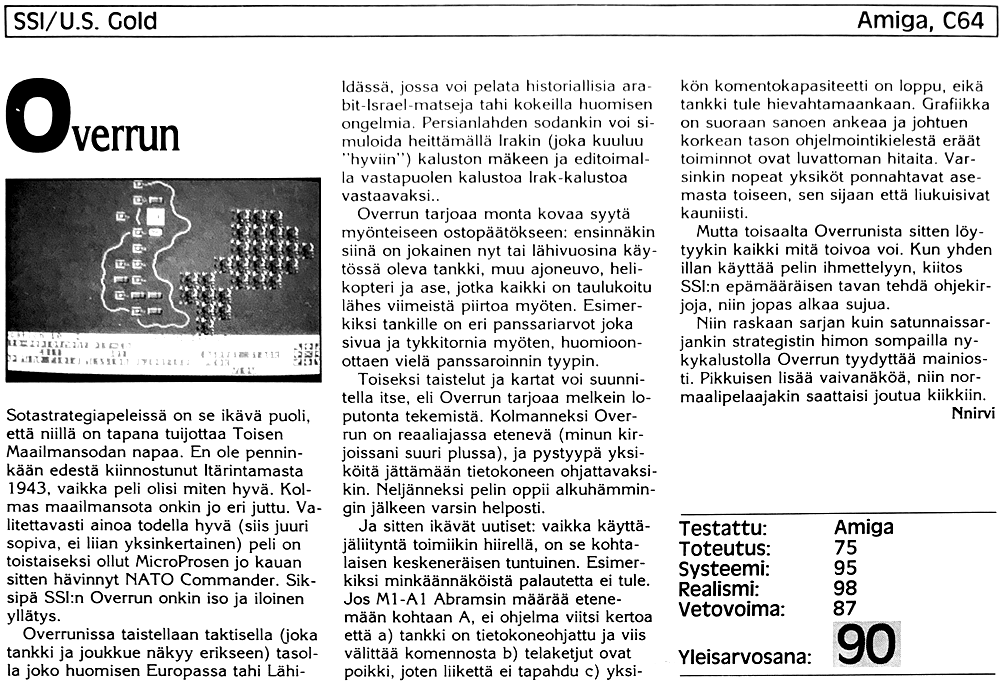
Overrun1991 KevätPysyvä linkkiSotastrategiapeleissä on se ikävä puoli, että niillä on tapana tuijottaa Toisen Maailmansodan napaa. En ole penninkään edestä kiinnostunut Itärintamasta 1943, vaikka peli olisi miten hyvä. Kolmas maailmansota onkin jo eri juttu. Valitettavasti ainoa todella hyvä (siis juuri sopiva, ei liian yksinkertainen) peli on toistaiseksi ollut MicroProsen jo kauan sitten hävinnyt NATO Commander. Siksipä SSI:n Overrun onkin iso ja iloinen yllätys.
Overrunissa taistellaan taktisella (joka tankki ja joukkue näkyy erikseen) tasolla joko huomisen Europassa tahi Lähi-Idässä, jossa voi pelata historiallisia arabit-Israel-matseja tahi kokeilla huomisen ongelmia. Persianlahden sodankin voi simuloida heittämällä Irakin (joka kuuluu "hyviin") kaluston mäkeen ja editoimalla vastapuolen kalustoa Irak-kalustoa vastaavaksi..
Overrun tarjoaa monta kovaa syytä myönteiseen ostopäätökseen: ensinnäkin siinä on jokainen nyt tai lähivuosina käytössä oleva tankki, muu ajoneuvo, helikopteri ja ase, jotka kaikki on taulukoitu lähes viimeistä piirtoa myöten. Esimerkiksi tankille on eri panssariarvot joka sivua ja tykkitornia myöten, huomioonottaen vielä panssaroinnin tyypin.
Toiseksi taistelut ja kartat voi suunnitella itse, eli Overrun tarjoaa melkein loputonta tekemistä. Kolmanneksi Overrun on reaaliajassa etenevä (minun kirjoissani suuri plussa), ja pystyypä yksiköitä jättämään tietokoneen ohjattavaksikin. Neljänneksi pelin oppii alkuhämmingin jälkeen varsin helposti.
Ja sitten ikävät uutiset: vaikka käyttäjäliityntä toimiikin hiirellä, on se kohtalaisen keskeneräisen tuntuinen. Esimerkiksi minkäännäköistä palautetta ei tule. Jos M1-A1 Abramsin määrää etenemään kohtaan A, ei ohjelma viitsi kertoa että a) tankki on tietokoneohjattu ja viis välittää komennosta b) telaketjut ovat poikki, joten liikettä ei tapahdu c) yksikön komentokapasiteetti on loppu, eikä tankki tule hievahtamaankaan. Grafiikka on suoraan sanoen ankeaa ja johtuen korkean tason ohjelmointikielestä eräät toiminnot ovat luvattoman hitaita. Varsinkin nopeat yksiköt ponnahtavat asemasta toiseen, sen sijaan että liukuisivat kauniisti.
Mutta toisaalta Overrunista sitten löytyykin kaikki mitä toivoa voi. Kun yhden illan käyttää pelin ihmettelyyn, kiitos SSI:n epämääräisen tavan tehdä ohjekirjoja, niin jopas alkaa sujua.
Niin raskaan sarjan kuin satunnaissarjankin strategistin himon sompailla nykykalustolla Overrun tyydyttää mainiosti. Pikkuisen lisää vaivanäköä, niin normaalipelaajakin saattaisi joutua kiikkiin.
Overrun1991 KevätPermalinkThe unfortunate thing about war strategy games is that they have a habit of staring at the navel of the Second World War. I don't care one penny's worth about the Eastern Front 1943, no matter how good the game is. World War Three, now, is a different matter. Unfortunately, the only really good game (meaning just right, not too simple) has so far been MicroProse's long-since-vanished NATO Commander. And that's why SSI's Overrun is a big and happy surprise.
In Overrun you fight at the tactical level (every tank and platoon is shown separately), either in the Europe of tomorrow or in the Middle East, where you can play historical Arabs-versus-Israel matches or try out tomorrow's problems. You can even simulate the Persian Gulf war by chucking out the hardware of Iraq (which is one of the "good guys") and editing the other side's hardware to match Iraq's.
Overrun offers many hard reasons for a positive buying decision: firstly, it has every tank, other vehicle, helicopter and weapon in service now or in the next few years, all of them tabulated down to very nearly the last detail. A tank, for example, has different armour values for every side and even the turret, taking the type of armour into account as well.
Secondly, you can design battles and maps yourself, so Overrun offers almost endless things to do. Thirdly, Overrun runs in real time (a big plus in my book), and you can even leave units to the computer's control. Fourthly, once the initial bewilderment wears off, the game is quite easy to learn.
And now the bad news: although the user interface works with the mouse, it feels fairly unfinished. For example, you get no feedback of any kind. If you order an M1-A1 Abrams to advance to point A, the program can't be bothered to tell you that a) the tank is computer-controlled and couldn't care less about the order b) its tracks are broken, so no movement is going to happen c) the unit's command capacity has run out, and the tank isn't going to budge an inch. The graphics are frankly dreary, and because of the high-level programming language some operations are inexcusably slow. Fast units in particular pop from one position to the next instead of gliding along beautifully.
But then again, Overrun does have everything you could wish for. Spend one evening puzzling over the game, thanks to SSI's woolly way of writing manuals, and well, would you look at that, things start going smoothly.
Overrun splendidly satisfies the urge of heavyweight and occasional-weight strategists alike to mess about with modern hardware. A tiny bit more effort, and even the ordinary gamer might get hooked.
Overrun
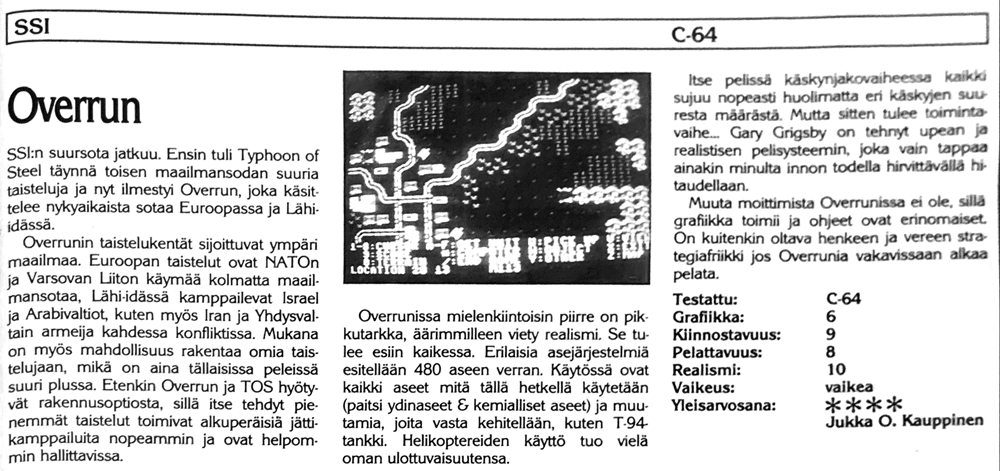
Overrun1989 SyksyPysyvä linkkiSSI:n suursota jatkuu. Ensin tuli Typhoon of Steel täynnä toisen maailmansodan suuria taisteluja ja nyt ilmestyi Overrun, joka käsittelee nykyaikaista sotaa Euroopassa ja Lähi-idässä.
Overrunin taistelukentät sijoittuvat ympäri maailmaa. Euroopan taistelut ovat NATOn ja Varsovan Liiton käymää kolmatta maailmansotaa, Lähi-idässä kamppailevat Israel ja Arabivaltiot, kuten myös Iran ja Yhdysvaltain armeija kahdessa konfliktissa. Mukana on myös mahdollisuus rakentaa omia taistelujaan, mikä on aina tällaisissa peleissä suuri plussa. Etenkin Overrun ja TOS hyötyvät rakennusoptiosta, sillä itse tehdyt pienemmät taistelut toimivat alkuperäisiä jättikamppailuita nopeammin ja ovat helpommin hallittavissa.
Overrunissa mielenkiintoisin piirre on pikkutarkka, äärimmilleen viety realismi. Se tulee esiin kaikessa. Erilaisia asejärjestelmiä esitellään 480 aseen verran. Käytössä ovat kaikki aseet mitä tällä hetkellä käytetään (paitsi ydinaseet & kemialliset aseet) ja muutamia, joita vasta kehitellään, kuten T-94-tankki. Helikoptereiden käyttö tuo vielä oman ulottuvaisuutensa.
Itse pelissä käskynjakovaiheessa kaikki sujuu nopeasti huolimatta eri käskyjen suuresta määrästä. Mutta sitten tulee toimintavaihe... Gary Grigsby on tehnyt upean ja realistisen pelisysteemin, joka vain tappaa ainakin minulta innon todella hirvittävällä hitaudellaan.
Muuta moittimista Overrunissa ei ole, sillä grafiikka toimii ja ohjeet ovat erinomaiset. On kuitenkin oltava henkeen ja vereen strategiafriikki jos Overrunia vakavissaan alkaa pelata.
Overrun1989 SyksyPermalinkSSI's great war rages on. First came Typhoon of Steel, packed with the great battles of the Second World War, and now Overrun has appeared, dealing with modern warfare in Europe and the Middle East.
Overrun's battlefields are spread around the world. The European battles are a Third World War fought between NATO and the Warsaw Pact; in the Middle East, Israel and the Arab states fight it out, as do Iran and the US Army in two conflicts. There's also the option to build your own battles, which is always a big plus in games like this. Overrun and TOS in particular benefit from the construction option, since smaller home-made battles run faster than the original giant clashes and are easier to manage.
The most interesting feature of Overrun is its meticulous realism, taken to the extreme. It shows in everything. Weapon systems of all kinds are featured to the tune of 480 weapons. At your disposal are all the weapons currently in use (except nuclear & chemical weapons) and a few that are still being developed, such as the T-94 tank. The use of helicopters adds a dimension of its own on top.
In the game itself, everything goes quickly in the orders phase despite the large number of different commands. But then comes the action phase... Gary Grigsby has made a superb and realistic game system which, for me at least, simply kills all enthusiasm with its truly horrendous slowness.
There's nothing else to complain about in Overrun, since the graphics work and the manual is excellent. You do, however, have to be a dyed-in-the-wool strategy freak if you're going to start playing Overrun seriously.