Espionage
Pelit was a Finnish-language (bi)annual book series published from 1987 to 1991 containing gaming-related articles, tips and most importantly game reviews. Here you can find all the reviews from the books. The reviews were originally written in Finnish; the English versions are translations of the Finnish originals. Maininta tekijänoikeuksista
 1987
1987 1988
1988 1989 Kevät
 1989 Syksy
 1990 Kevät
 1990 Syksy
 1991 Kevät
 1991 Syksy
Espionage
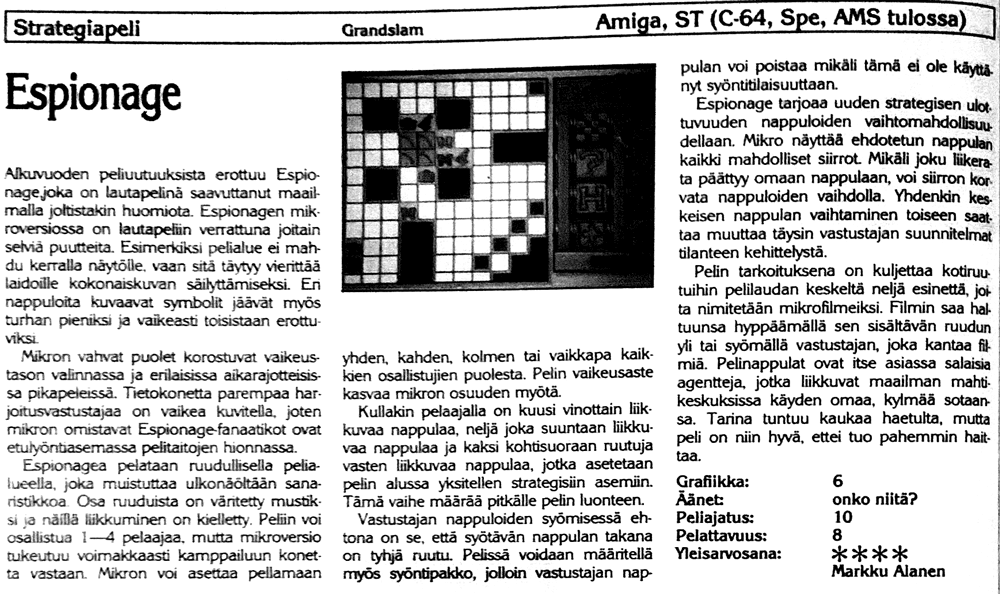
Espionage1989 KevätPysyvä linkkiAlkuvuoden peliuutuuksista erottuu Espionage,joka on lautapelinä saavuttanut maailmalla joltistakin huomiota. Espionagen mikroversiossa on lautapeliin verrattuna joitain selviä puutteita. Esimerkiksi pelialue ei mahdu kerralla näytölle, vaan sitä täytyy vierittää laidoille kokonaiskuvan säilyttämiseksi. Eri nappuloita kuvaavat symbolit jäävät myös turhan pieniksi ja vaikeasti toisistaan erottuviksi.
Mikron vahvat puolet korostuvat vaikeustason valinnassa ja erilaisissa aikarajotteisissa pikapeleissä. Tietokonetta parempaa harjoitusvastustajaa on vaikea kuvitella, joten mikron omistavat Espionage-fanaatikot ovat etulyöntiasemassa pelitaitojen hionnassa.
Espionagea pelataan ruudullisella pelialueella, joka muistuttaa ulkonäöltään sanaristikkoa. Osa ruuduista on väritetty mustiksi ja näillä liikkuminen on kielletty. Peliin voi osallistua 1-4 pelaajaa, mutta mikroversio tukeutuu voimakkaasti kamppailuun konetta vastaan. Mikron voi asettaa pellamaan yhden, kahden, kolmen tai vaikkapa kaikkien osallistujien puolesta. Pelin vaikeusaste kasvaa mikron osuuden myötä.
Kullakin pelaajalla on kuusi vinottain liikkuvaa nappulaa, neljä joka suuntaan liikkuvaa nappulaa ja kaksi kohtisuoraan ruutuja vasten liikkuvaa nappulaa, jotka asetetaan pelin alussa yksitellen strategisiin asemiin. Tämä vaihe määrää pitkälle pelin luonteen.
Vastustajan nappuloiden syömisessä ehtona on se, että syötävän nappulan takana on tyhjä ruutu. Pelissä voidaan määritellä myös syöntipakko, jolloin vastustajan nappulan voi poistaa mikäli tämä ei ole käyttänyt syöntitilaisuuttaan.
Espionage tarjoaa uuden strategisen ulottuvuuden nappuloiden vaihtomahdollisuudellaan. Mikro näyttää ehdotetun nappulan kaikki mahdolliset siirrot. Mikäli joku liikerata päättyy omaan nappulaan, voi siirron korvata nappuloiden vaihdolla. Yhdenkin keskeisen nappulan vaihtaminen toiseen saattaa muuttaa täysin vastustajan suunnitelmat tilanteen kehittelystä.
Pelin tarkoituksena on kuljettaa kotiruutuihin pelilaudan keskeltä neljä esinettä, joita nimitetään mikrofilmeiksi. Filmin saa haltuunsa hyppäämällä sen sisältävän ruudun yli tai syömällä vastustajan, joka kantaa filmiä. Pelinappulat ovat itse asiassa salaisia agentteja, jotka liikkuvat maailman mahtikeskuksissa käyden omaa, kylmää sotaansa. Tarina tuntuu kaukaa haetulta, mutta peli on niin hyvä, ettei tuo pahemmin haittaa.
Espionage1989 KevätPermalinkStanding out among the new games of early this year is Espionage, which as a board game has attracted a fair amount of attention around the world. Compared with the board game, the computer version of Espionage has some clear shortcomings. For example, the playing area doesn't fit on the screen all at once, so it has to be scrolled to the sides to keep hold of the overall picture. The symbols representing the different pieces are also needlessly small and hard to tell apart.
The computer's strengths come to the fore in the choice of difficulty level and in the various time-limited quick games. It's hard to imagine a better practice opponent than a computer, so Espionage fanatics who own a computer have a head start in honing their playing skills.
Espionage is played on a gridded playing area that looks like a crossword. Some of the squares are coloured black, and moving onto them is forbidden. The game can be played by 1-4 players, but the computer version leans heavily on battling against the machine. The computer can be set to play on behalf of one, two, three or even all of the participants. The game's difficulty increases with the computer's share.
Each player has six pieces that move diagonally, four pieces that move in every direction and two pieces that move at right angles to the squares; these are placed one at a time in strategic positions at the start of the game. This phase goes a long way towards deciding the character of the game.
The condition for capturing an opponent's pieces is that there's an empty square behind the piece being captured. Compulsory capture can also be switched on, in which case an opponent's piece can be removed if it has not used its chance to capture.
Espionage offers a new strategic dimension with its option of swapping pieces. The computer shows all the possible moves of the piece you nominate. If a path ends on one of your own pieces, the move can be replaced with a swap of the two pieces. Swapping even one key piece for another can completely change the opponent's plans for developing the position.
The object of the game is to carry four items, called microfilms, from the middle of the board to your home squares. You gain possession of a film by jumping over the square that holds it or by capturing an opposing piece that is carrying the film. The pieces are in fact secret agents moving around the world's centres of power, waging their own cold war. The story feels far-fetched, but the game is so good that it doesn't much matter.