1133 reviews from "Pelit"-books
Pelit was a Finnish-language (bi)annual book series published from 1987 to 1991 containing gaming-related articles, tips and most importantly game reviews. Here you can find all the reviews from the books. The reviews were originally written in Finnish; the English versions are translations of the Finnish originals. Maininta tekijänoikeuksista
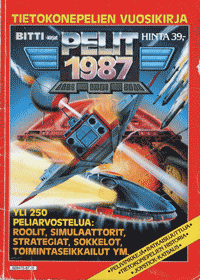 1987
1987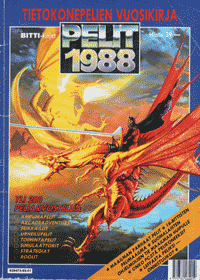 1988
1988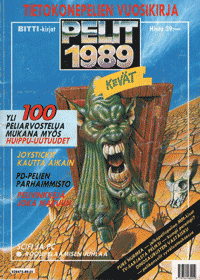 1989 Kevät
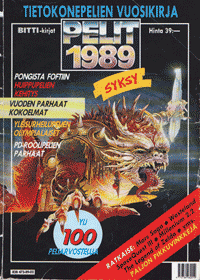 1989 Syksy
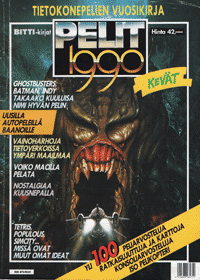 1990 Kevät
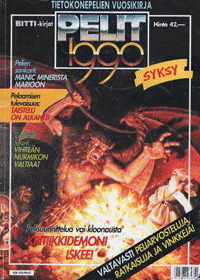 1990 Syksy
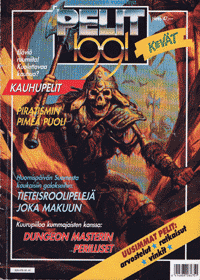 1991 Kevät
 1991 Syksy
P.O.W.
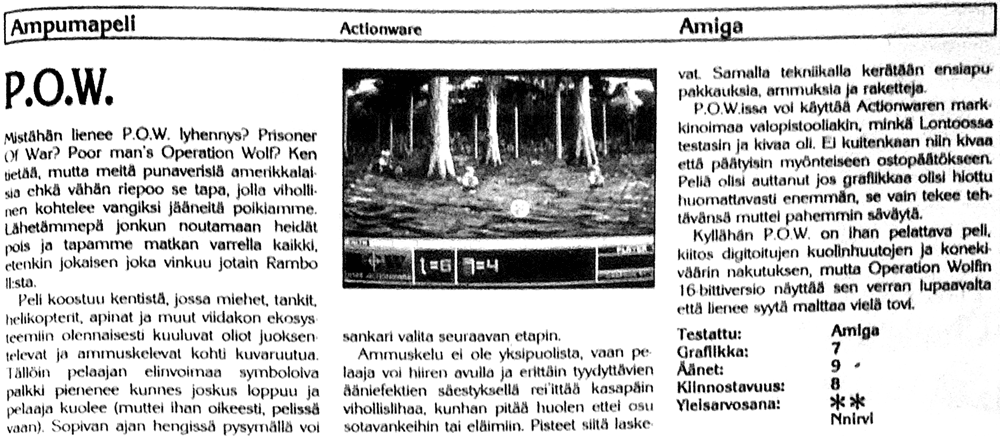
P.O.W.1989 KevätPysyvä linkkiMistähän lienee P.O.W. lyhennys? Prisoner Of War? Poor man's Operation Wolf? Ken tietää, mutta meitä punaverisiä amerikkalaisia ehkä vähän riepoo se tapa, jolla vihollinen kohtelee vangiksi jääneitä poikiamme. Lähetämmepä jonkun noutamaan heidät pois ja tapamme matkan varrella kaikki, etenkin jokaisen joka vinkuu jotain Rambo II:sta.
Peli koostuu kentistä, jossa miehet, tankit, helikopterit, apinat ja muut viidakon ekosysteemiin olennaisesti kuuluvat oliot juoksentelevat ja ammuskelevat kohti kuvaruutua. Tällöin pelaajan elinvoimaa symboloiva palkki pienenee kunnes joskus loppuu ja pelaaja kuolee (muttei ihan oikeesti, pelissä vaan). Sopivan ajan hengissä pysymällä voi sankari valita seuraavan etapin.
Ammuskelu ei ole yksipuolista, vaan pelaaja voi hiiren avulla ja erittäin tyydyttävien ääniefektien säestyksellä rei'ittää kasapäin vihollislihaa, kunhan pitää huolen ettei osu sotavankeihin tai eläimiin. Pisteet siitä laskevat. Samalla tekniikalla kerätään ensiapupakkauksia, ammuksia ja raketteja.
P.O.W.issa voi käyttää Actionwaren markkinoimaa valopistooliakin, minkä Lontoossa testasin ja kivaa oli. Ei kuitenkaan niin kivaa että päätyisin myönteiseen ostopäätökseen. Peliä olisi auttanut jos grafiikkaa olisi hiottu huomattavasti enemmän, se vain tekee tehtävänsä muttei pahemmin säväytä.
Kyllähän P.O.W. on ihan pelattava peli, kiitos digitoitujen kuolinhuutojen ja konekiväärin nakutuksen, mutta Operation Wolfin 16-bittiversio näyttää sen verran lupaavalta että lienee syytä malttaa vielä tovi.
P.O.W.1989 KevätPermalinkI wonder what P.O.W. might be short for? Prisoner Of War? Poor man's Operation Wolf? Who knows, but it does rather rile us red-blooded Americans, the way the enemy treats our boys who've been taken prisoner. So we'll send someone to bring them back and kill everybody along the way, especially anyone who whines anything about Rambo II.
The game consists of levels in which men, tanks, helicopters, monkeys and other creatures that are an essential part of the jungle ecosystem run around and shoot towards the screen. When they do, the bar representing the player's vitality shrinks until at some point it runs out and the player dies (but not for real, like, just in the game). By staying alive for long enough the hero gets to choose the next stage.
The shooting isn't one-sided, though: with the help of the mouse and to the accompaniment of extremely satisfying sound effects, the player can riddle heaps of enemy flesh with holes, as long as they take care not to hit the prisoners of war or the animals. That costs you points. The same technique is used to collect first-aid kits, ammo and rockets.
P.O.W. can also be played with the light gun Actionware markets, which I tried out in London, and it was fun. Not so much fun, though, that I'd arrive at a positive purchasing decision. It would have helped the game if the graphics had been polished a good deal more; they just do their job without exactly dazzling.
Sure, P.O.W. is a perfectly playable game, thanks to the digitised death screams and the rattle of the machine gun, but the 16-bit version of Operation Wolf looks promising enough that it's probably wise to hold your horses a while longer.
P47 Thunderbolt
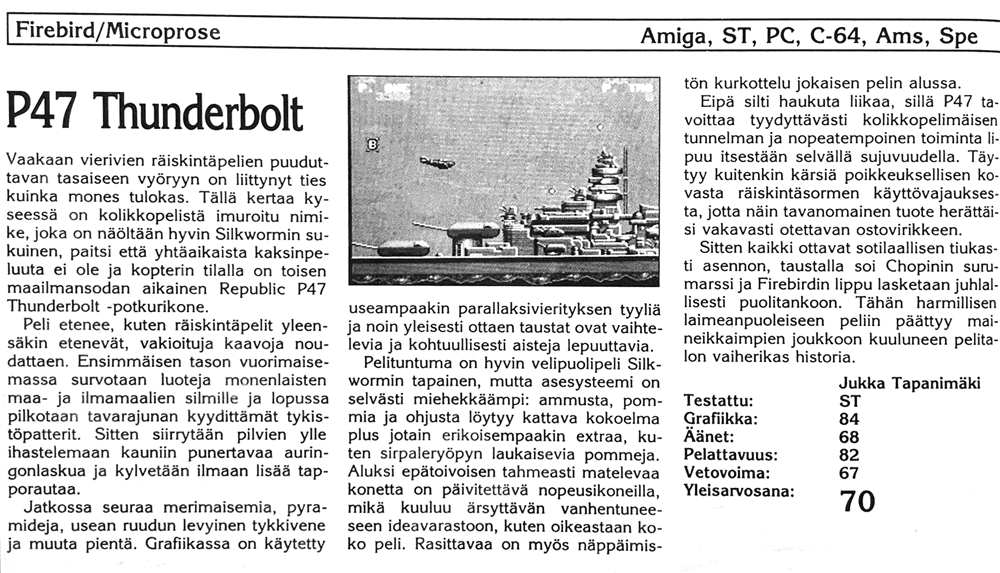
P47 Thunderbolt1990 SyksyPysyvä linkkiVaakaan vierivien räiskintäpelien puuduttavan tasaiseen vyöryyn on liittynyt ties kuinka mones tulokas. Tällä kertaa kyseessä on kolikkopelistä imuroitu nimike, joka on näöltään hyvin Silkwormin sukuinen, paitsi että yhtäaikaista kaksinpeluuta ei ole ja kopterin tilalla on toisen maailmansodan aikainen Republic P47 Thunderbolt -potkurikone.
Peli etenee, kuten räiskintäpelit yleensäkin etenevät, vakioituja kaavoja noudattaen. Ensimmäisen tason vuorimaisemassa survotaan luoteja monenlaisten maa- ja ilmamaalien silmille ja lopussa pilkotaan tavarajunan kyydittämät tykistöpatterit. Sitten siirrytään pilvien ylle ihastelemaan kauniin punertavaa auringonlaskua ja kylvetään ilmaan lisää tapporautaa.
Jatkossa seuraa merimaisemia, pyramideja, usean ruudun levyinen tykkivene ja muuta pientä. Grafiikassa on käytetty useampaakin parallaksivierityksen tyyliä ja noin yleisesti ottaen taustat ovat vaihtelevia ja kohtuullisesti aisteja lepuuttavia.
Pelituntuma on hyvin velipuolipeli Silkwormin tapainen, mutta asesysteemi on selvästi miehekkäämpi: ammusta, pommia ja ohjusta löytyy kattava kokoelma plus jotain erikoisempaakin extraa, kuten sirpaleryöpyn laukaisevia pommeja. Aluksi epätoivoisen tahmeasti matelevaa konetta on päivitettävä nopeusikoneilla, mikä kuuluu ärsyttävän vanhentuneeseen ideavarastoon, kuten oikeastaan koko peli. Rasittavaa on myös näppäimistön kurkottelu jokaisen pelin alussa.
Eipä silti haukuta liikaa, sillä P47 tavoittaa tyydyttävästi kolikkopelimäisen tunnelman ja nopeatempoinen toiminta lipuu itsestään selvällä sujuvuudella. Täytyy kuitenkin kärsiä poikkeuksellisen kovasta räiskintäsormen käyttövajauksesta, jotta näin tavanomainen tuote herättäisi vakavasti otettavan ostovirikkeen.
Sitten kaikki ottavat sotilaallisen tiukasti asennon, taustalla soi Chopinin surumarssi ja Firebirdin lippu lasketaan juhlallisesti puolitankoon. Tähän harmillisen laimeanpuoleiseen peliin päättyy maineikkaimpien joukkoon kuuluneen pelitalon vaiherikas historia.
P47 Thunderbolt1990 SyksyPermalinkThe numbingly monotonous onslaught of horizontally scrolling shoot-'em-ups has been joined by yet another newcomer - heaven knows the how-manyeth. This time it's a title vacuumed up from a coin-op, and it looks very much like a relative of Silkworm, except that there's no simultaneous two-player mode and instead of the chopper you get a Second World War Republic P47 Thunderbolt prop plane.
The game progresses the way shoot-'em-ups generally progress, following standardised formulas. In the mountain scenery of the first level you ram bullets into the faces of all sorts of ground and air targets, and at the end you carve up the artillery batteries riding on a goods train. Then it's up above the clouds to admire a beautifully reddish sunset and sow more killing iron through the air.
After that come seascapes, pyramids, a gunboat several screens wide and other odds and ends. The graphics use quite a few styles of parallax scrolling, and generally speaking the backgrounds are varied and reasonably restful to the senses.
The game feels very much like its half-brother Silkworm, but the weapon system is clearly more manly: there's a comprehensive collection of shells, bombs and missiles, plus some more exotic extras, such as bombs that unleash a hail of shrapnel. The plane, which at first crawls along with desperate sluggishness, has to be upgraded with speed icons, which belongs to an irritatingly outdated stock of ideas, as does, really, the whole game. Another tiresome thing is having to reach over to the keyboard at the start of every game.
Still, let's not slag it off too much, as P47 captures a coin-op atmosphere satisfactorily and the fast-paced action glides along with self-evident smoothness. You would, however, have to be suffering from an exceptionally severe trigger-finger usage deficit for such a run-of-the-mill product to spark a buying impulse worth taking seriously.
Then everyone stands to attention with military rigour, Chopin's funeral march plays in the background and Firebird's flag is solemnly lowered to half-mast. With this regrettably rather feeble game ends the eventful history of a software house that was among the most renowned of them all.
Pac Land

Pac Land1988Pysyvä linkkiOlipa kerran keltainen pallo, jolla oli ongelma. Hän oli niin alas vajonnut, että näki kummituksia ja joutui syömään pillereitä jatkuvalla soitolla. Hänestä tuli Pac-Man, tietokonepelien megatähti ja henkilöitymä.
Herra Pac on nyt palannut. Lomansa aikana hän kasvattanut jalat, kädet ja nenän sekä investoinut komeaan hattuun. Onpa hän päässyt eroon pillereistäkin. Pac pääsee peliin, kun hän eräänä päivänä kohtaan eksyneen keijuraukan ja lupaa viedä hänet takaisin Keijumaahan. Mutta Ah ja Voi! Kummitukset Inky, Blinky, Pinky ja Clyde vanhaan tapaansa aikovat lopettaa Pacin päivät. Kehitys tunkee paceliminointiinkin, sillä haamuveljeksillä on käytössään autoja ja lentokoneita.
Avainsana Pac-Landissa on yksinkertaisuus. Peliformaatti on tosi klassinen eli Mr Pac etenee vasemmalta oikealle, hyppelee, väistelee kummituksia ja yrittää ehtiä kentän loppuun ennen energian hupenemista.
Pacmanista muistuttavat bonuskirsikat ja voimapillerit. Voimapillerin syöminen mahdollistaa kummituskaartin tuhoamisen aivan kuten vanhassa kunnon sokkelopelissä.
Pac-grafiikka on yksinkertaista, mutta selkeää ja sopii peliin kuin luoti otsaan. Pac-vaikeusaste nousee juuri mukavasti, mikä tietysti innostaa Pac-lisäpeleihin.
Pac-Land on onnistunut arcadekäännös, joka kiehtoo juuri näennäisellä yksinkertaisuudellaan. Hauska nähdä, että Quicksilva osaa tehdä pelattaviakin pelejä. Däbä däbä Pacmaaan!
Pac Land1988PermalinkOnce upon a time there was a yellow ball who had a problem. He had sunk so low that he was seeing ghosts and had to keep popping pills on constant repeat. He became Pac-Man, megastar and living embodiment of computer games.
Mr Pac is now back. During his holiday he has grown legs, arms and a nose, and invested in a handsome hat. He has even managed to kick the pills. Pac gets into the game when one day he meets a poor lost fairy and promises to take the little thing back to Fairyland. But Alas and Alack! The ghosts Inky, Blinky, Pinky and Clyde, true to their old ways, are out to end Pac's days. Progress is barging in even on pac-elimination, since the ghost brothers have cars and aeroplanes at their disposal.
The keyword in Pac-Land is simplicity. The game format is truly classic, i.e. Mr Pac makes his way from left to right, hops about, dodges ghosts and tries to reach the end of the level before his energy runs out.
Reminders of Pacman are the bonus cherries and the power pills. Eating a power pill lets you wipe out the ghost brigade, just like in the good old maze game.
The Pac-graphics are simple but clear, and they fit the game like a glove. The Pac-difficulty rises at just the right rate, which of course gets you raring for more Pac-games.
Pac-Land is a successful arcade conversion that fascinates precisely through its apparent simplicity. Nice to see that Quicksilva can make playable games too. Dabba dabba Pacmaaan!
Pacmania
Pacmania1989 KevätPysyvä linkkiVanhoista pelisankareista juuri Pacman on voimallisimmin tekemässä comebackia. Pitkän tauon jälkeen Pac oli pääosassa mukavassa Paclandissa ja nyt palaa askeleen lähemmäksi juuriaan Pacmaniassa.
Pacmania on nykyaikaistettu Pacman-klooni. Ideana on edelleen kompata sokkeloita, syödä pillereitä ja väistellä pacdieetillä olevia haamuja. Voi haamuja, jos Pac ehtii napata voimatabun. Silloin syötävästä tulee syöjä, joka nirsona keltaisena pallona kuitenkin jättää silmät lautasen reunalle.
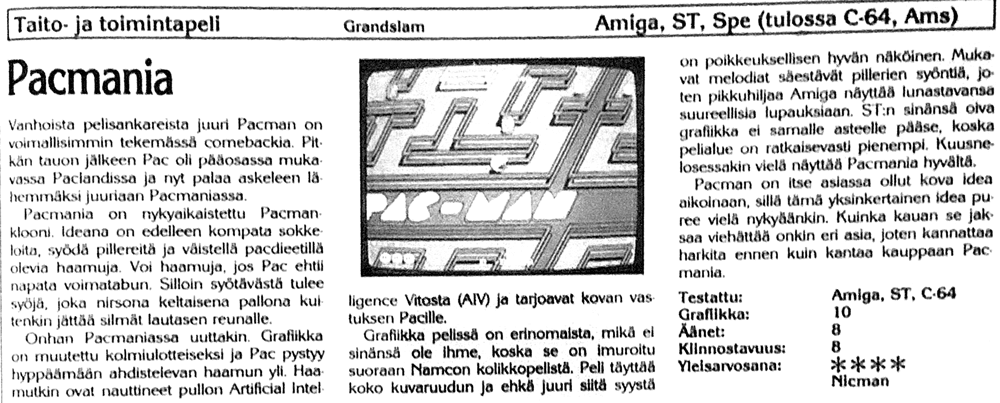
Onhan Pacmaniassa uuttakin. Grafiikka on muutettu kolmiulotteiseksi ja Pac pystyy hyppäämään ahdistelevan haamun yli. Haamutkin ovat nauttineet pullon Artificial Intelligence Vitosta (AIV) ja tarjoavat kovan vastuksen Pacille.
Grafiikka pelissä on erinomaista, mikä ei sinänsä ole ihme, koska se on imuroitu suoraan Namcon kolikkopelistä. Peli täyttää koko kuvaruudun ja ehkä juuri siitä syystä on poikkeuksellisen hyvän näköinen. Mukavat melodiat säestävät pillerien syöntiä, joten pikkuhiljaa Amiga näyttää lunastavansa suureellisia lupauksiaan. ST:n sinänsä oiva grafiikka ei samalle asteelle pääse, koska pelialue on ratkaisevasti pienempi. Kuusnelosessakin vielä näyttää Pacmania hyvältä.
Pacman on itse asiassa ollut kova idea aikoinaan, sillä tämä yksinkertainen idea puree vielä nykyäänkin. Kuinka kauan se jaksaa viehättää onkin eri asia, joten kannattaa harkita ennen kuin kantaa kauppaan Pacmania.
Pacmania1989 KevätPermalinkOf all the old game heroes, it's Pacman who is making the most forceful comeback. After a long break Pac took the lead role in the pleasant Pacland, and now he returns a step closer to his roots in Pacmania.
Pacmania is a modernised Pacman clone. The idea is still to stumble around mazes, eat pills and dodge ghosts who are on a Pac diet. Woe to the ghosts if Pac manages to grab a power tab. Then the eaten becomes the eater, who, being a fussy yellow ball, nonetheless leaves the eyes on the edge of the plate.
There's something new in Pacmania too, of course. The graphics have been made three-dimensional and Pac can jump over a harassing ghost. The ghosts, for their part, have knocked back a bottle of Artificial Intelligence Vitonen (AIV) and put up tough resistance to Pac.
The graphics in the game are excellent, which is no wonder in itself, since they've been hoovered straight out of Namco's coin-op. The game fills the whole screen and perhaps for that very reason looks exceptionally good. Pleasant melodies accompany the pill-munching, so little by little the Amiga seems to be making good on its grandiose promises. The ST's graphics, fine as they are, don't reach the same level, because the play area is decisively smaller. Even on the C-64 Pacmania still looks good.
Pacman was actually a cracking idea in its day, since this simple idea still bites even now. How long it will keep its charm is another matter, so it's worth thinking it over before you carry your money to the shop for Pacmania.
Pacos Pete
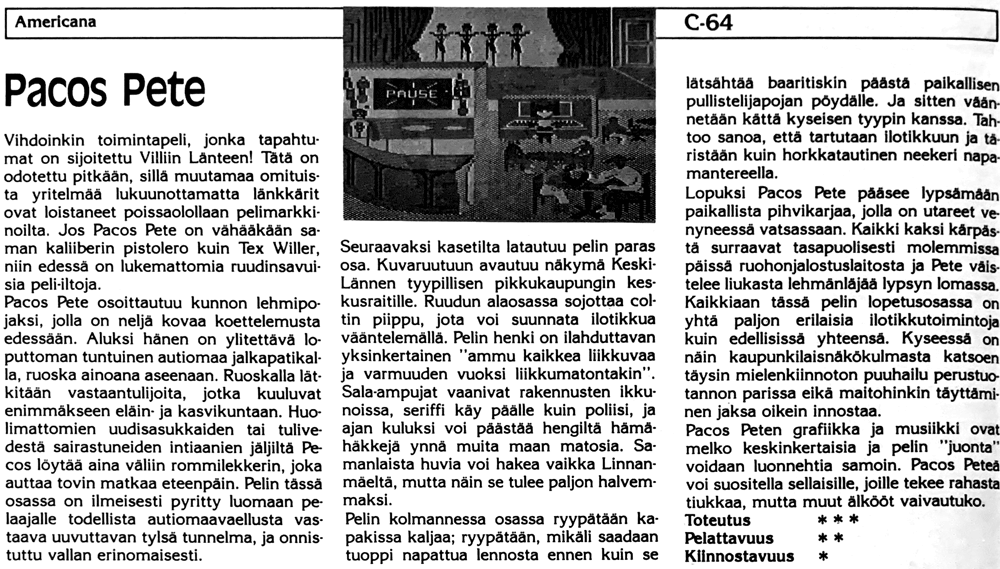
Pacos Pete1987Pysyvä linkkiVihdoinkin toimintapeli, jonka tapahtumat on sijoitettu Villiin Länteen! Tätä on odotettu pitkään, sillä muutamaa omituista yritelmää lukuunottamatta länkkärit ovat loistaneet poissaolollaan pelimarkkinoilta. Jos Pacos Pete on vähääkään saman kaliiberin pistolero kuin Tex Willer, niin edessä on lukemattomia ruudinsavuisia peli-iltoja.
Pacos Pete osoittautuu kunnon lehmipojaksi, jolla on neljä kovaa koettelemusta edessään. Aluksi hänen on ylitettävä loputtoman tuntuinen autiomaa jalkapatikalla, ruoska ainoana aseenaan. Ruoskalla lätkitään vastaantulijoita, jotka kuuluvat enimmäkseen eläin- ja kasvikuntaan. Huolimattomien uudisasukkaiden tai tulivedestä sairastuneiden intiaanien jäljiltä Pecos löytää aina väliin rommilekkerin, joka auttaa tovin matkaa eteenpäin. Pelin tässä osassa on ilmeisesti pyritty luomaan pelaajalle todellista autiomaavaellusta vastaava uuvuttavan tylsä tunnelma, ja onnistuttu vallan erinomaisesti.
Seuraavaksi kasetilta latautuu pelin paras osa. Kuvaruutuun avautuu näkymä Keski-Lännen tyypillisen pikkukaupungin keskusraitille. Ruudun alaosassa sojottaa coltin piippu, jota voi suunnata ilotikkua vääntelemällä. Pelin henki on ilahduttavan yksinkertainen "ammu kaikkea liikkuvaa ja varmuuden vuoksi liikkumatontakin". Sala-ampujat vaanivat rakennusten ikkunoissa, seriffi käy päälle kuin poliisi, ja ajan kuluksi voi päästää hengiltä hämähäkkejä ynnä muita maan matosia. Samanlaista huvia voi hakea vaikka Linnanmäeltä, mutta näin se tulee paljon halvemmaksi.
Pelin kolmannessa osassa ryypätään kapakissa kaljaa; ryypätään, mikäli saadaan tuoppi napattua lennosta ennen kuin se lätsähtää baaritiskin päästä paikallisen pullistelijapojan pöydälle. Ja sitten väännetään kättä kyseisen tyypin kanssa. Tahtoo sanoa, että tartutaan ilotikkuun ja täristään kuin horkkatautinen neekeri napamantereella.
Lopuksi Pacos Pete pääsee lypsämään paikallista pihvikarjaa, jolla on utareet venyneessä vatsassaan. Kaikki kaksi kärpästä surraavat tasapuolisesti molemmissa päissä ruohonjalostuslaitosta ja Pete väistelee liukasta lehmänläjää lypsyn lomassa. Kaikkiaan tässä pelin lopetusosassa on yhtä paljon erilaisia ilotikkutoimintoja kuin edellisissä yhteensä. Kyseessä on näin kaupunkilaisnäkökulmasta katsoen täysin mielenkiinnoton puuhailu perustuotannon parissa eikä maitohinkin täyttäminen jaksa oikein innostaa.
Pacos Peten grafiikka ja musiikki ovat melko keskinkertaisia ja pelin "juonta" voidaan luonnehtia samoin. Pacos Peteä voi suositella sellaisille, joille tekee rahasta tiukkaa, mutta muut älkööt vaivautuko.
Pacos Pete1987PermalinkAt last, an action game set in the Wild West! This one has been a long time coming, since apart from a few peculiar attempts, westerns have been conspicuous by their absence from the games market. If Pacos Pete is even remotely the same calibre of pistolero as Tex Willer, then countless gunsmoke-filled gaming evenings lie ahead.
Pacos Pete turns out to be a proper cowpoke with four hard trials ahead of him. First he has to cross a seemingly endless desert on shanks' pony, with a whip as his only weapon. The whip is for swatting whoever comes along, and they mostly belong to the animal and vegetable kingdoms. Every now and then, left behind by careless settlers or by Indians taken ill from firewater, Pecos finds a little keg of rum that helps him on his way for a while. In this part of the game they have evidently tried to create for the player an exhaustingly dull atmosphere to match a real trek across the desert, and have succeeded quite splendidly.
Next, the best part of the game loads from the cassette. The screen opens onto a view of the main street of a typical little Midwestern town. At the bottom of the screen sticks out the barrel of a Colt, which you can aim by wrenching the joystick about. The spirit of the game is a delightfully simple "shoot everything that moves, and just to be on the safe side, everything that doesn't too". Snipers lurk in the windows of the buildings, the sheriff comes at you like a cop, and to pass the time you can do away with spiders and other lowly worms of the earth. You could go looking for the same kind of fun at Linnanmäki amusement park, say, but this way it works out a lot cheaper.
In the third part of the game you knock back beer in a saloon; you knock it back, that is, if you manage to grab the tankard in mid-flight before it splats off the end of the bar onto the table of the local muscle-flexing tough guy. And then you arm-wrestle the character in question. Which is to say, you grab the joystick and shake like a fever-racked negro in Antarctica.
Finally Pacos Pete gets to milk the local beef cattle, which have their udders in their sagging bellies. All two of the flies buzz even-handedly at either end of the grass-processing plant, and Pete dodges a slippery cowpat in between the milking. All in all, this closing part of the game has as many different joystick functions as the previous ones put together. Looked at from a city dweller's angle like mine, it's a completely uninteresting bit of pottering about in primary production, and filling a milk pail doesn't really manage to get you fired up.
Pacos Pete's graphics and music are fairly mediocre, and the game's "plot" can be described the same way. Pacos Pete can be recommended to those who are strapped for cash, but the rest needn't bother.
Paladin
Paladin1990 KevätPysyvä linkkiYritys soveltaa "oikeista" roolipeleistä napsittuja elementtejä tietokoneessa ei välttämättä ole paras mahdollinen lähestymistapa, siis että kootaan peli rajatuista skenaarioista ja kontrolloidaan toimintaa liikepisteiden avulla. Toisaalta ainakin Laser Squadissa systeemi toimi mainiosti.
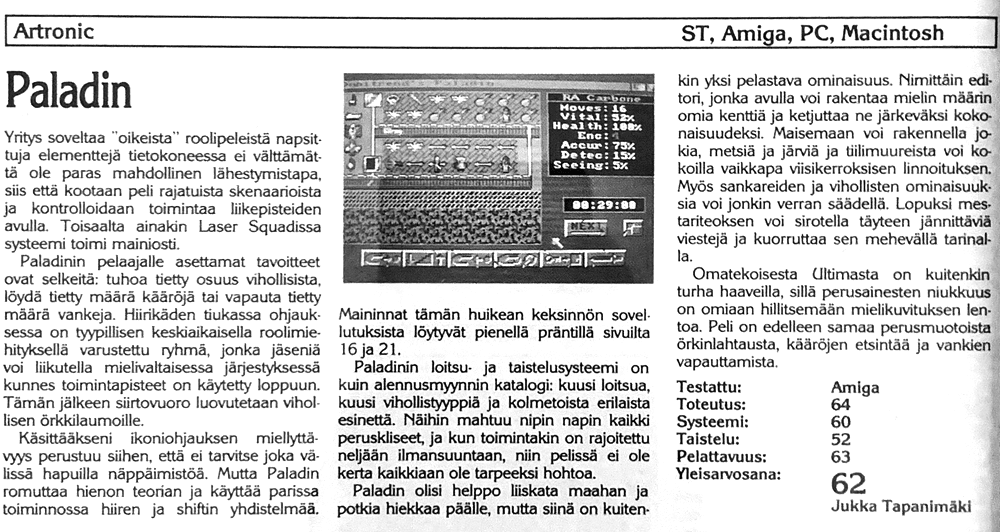
Paladinin pelaajalle asettamat tavoitteet ovat selkeitä: tuhoa tietty osuus vihollisista, löydä tietty määrä kääröjä tai vapauta tietty määrä vankeja. Hiirikäden tiukassa ohjauksessa on tyypillisen keskiaikaisella roolimiehityksellä varustettu ryhmä, jonka jäseniä voi liikutella mielivaltaisessa järjestyksessä kunnes toimintapisteet on käytetty loppuun. Tämän jälkeen siirtovuoro luovutetaan vihollisen örkkilaumoille.
Käsittääkseni ikoniohjauksen miellyttävyys perustuu siihen, että ei tarvitse joka välissä hapuilla näppäimistöä. Mutta Paladin romuttaa hienon teorian ja käyttää parissa toiminnossa hiiren ja shiftin yhdistelmää. Maininnat tämän huikean keksinnön sovellutuksista löytyvät pienellä präntillä sivuilta 16 ja 21.
Paladinin loitsu- ja taistelusysteemi on kuin alennusmyynnin katalogi: kuusi loitsua, kuusi vihollistyyppiä ja kolmetoista erilaista esinettä. Näihin mahtuu nipin napin kaikki peruskliseet, ja kun toimintakin on rajoitettu neljään ilmansuuntaan, niin pelissä ei ole kerta kaikkiaan ole tarpeeksi hohtoa.
Paladin olisi helppo liiskata maahan ja potkia hiekkaa päälle, mutta siinä on kuitenkin yksi pelastava ominaisuus. Nimittäin editori, jonka avulla voi rakentaa mielin määrin omia kenttiä ja ketjuttaa ne järkeväksi kokonaisuudeksi. Maisemaan voi rakennella jokia, metsiä ja järviä ja tiilimuureista voi kokoilla vaikkapa viisikerroksisen linnoituksen. Myös sankareiden ja vihollisten ominaisuuksia voi jonkin verran säädellä. Lopuksi mestariteoksen voi sirotella täyteen jännittäviä viestejä ja kuorruttaa sen mehevällä tarinalla.
Omatekoisesta Ultimasta on kuitenkin turha haaveilla, sillä perusainesten niukkuus on omiaan hillitsemään mielikuvituksen lentoa. Peli on edelleen samaa perusmuotoista örkinlahtausta, kääröjen etsintää ja vankien vapauttamista.
Paladin1990 KevätPermalinkTrying to apply elements snipped from "real" role-playing games on a computer isn't necessarily the best possible approach - that is, building a game out of confined scenarios and controlling the action with movement points. Then again, in Laser Squad at least the system worked splendidly.
The goals Paladin sets the player are clear: destroy a certain share of the enemies, find a certain number of scrolls or free a certain number of prisoners. Under the firm control of your mouse hand is a party with a typically medieval role line-up, whose members can be moved in any order you like until the action points run out. After that the turn is handed over to the enemy's orc hordes.
As I understand it, the appeal of icon control rests on not having to fumble for the keyboard at every turn. But Paladin wrecks this fine theory and uses a combination of the mouse and Shift for a couple of functions. Mentions of the applications of this staggering invention can be found in small print on pages 16 and 21.
Paladin's spell and combat system is like a clearance-sale catalogue: six spells, six enemy types and thirteen different items. That just about squeezes in all the basic cliches, and since the action is limited to four compass directions as well, the game simply doesn't have enough sparkle.
It would be easy to squash Paladin flat and kick sand over it, but it does have one saving grace. Namely an editor, with which you can build as many levels of your own as you like and chain them into a sensible whole. You can build rivers, forests and lakes into the landscape, and out of brick walls you can put together, say, a five-storey fortress. The attributes of the heroes and the enemies can also be adjusted to some extent. Finally you can sprinkle your masterpiece full of exciting messages and ice it with a juicy story.
There's no point dreaming of a home-made Ultima, though, since the scarcity of basic ingredients is just the thing to clip the wings of your imagination. The game is still the same basic-model orc slaughter, scroll hunting and prisoner freeing.
Pandora
Pandora1989 KevätPysyvä linkkiAvaruuslaiva Pandora rakennettiin 1990-luvulla. Sen miehistö koostui ihmisistä ja droideista. Sen tarkoitus oli pitää miehistö elossa monivuotisen tutkimuksen ajan. Alusta kontrolloi seitsemännen sukupolven tietokone Pandora, jonka mukaan alus oli saanut nimensä. Pandoran rakentajien tarkoituksena oli tehdä sellainen tietokone, jonka veroista ei olisi eikä tulisi. Jokin meni kuitenkin vikaan ja avaruuslaiva purjehti yhä kauemmaksi, eikä mitään viestejä enää kantautunut maan pinnalle.
Nyt 2100-luvulla tiedemiehet ovat taas tavoittaneet Pandoran tutkiinsa. Yhä varmemmin näyttää siltä, että Pandora ei ole enää menossa kauemmaksi maasta, vaan on tulossa kiihtyvällä vauhdilla maata kohti. Hätääntyneet suurvaltajohtajat lähettävät sukkulan Pandoraa vastaan ottamaan selvää onko siitä vaaraa maapallolle.
Pelaajan tehtävänä on maapallon edustajana telakoitua Pandoralle ja tutkia tilannetta. Jos jotain hälyttävää on tekeillä, pelaajan on saatava todisteita vihamielisen elämänmuodon olemassaolosta.
Pelin alkaessa maan lähetti seisoo Pandoran telakoitumispisteessä. Vastaanottoupseeri kysyy henkilöpapereita ja kun niitä ei ole, lähetti pamauttaa upseerin hengiltä ja ottaa hänen paperinsa. Henkilöpapereita on useita erilaisia, ja niillä pääsee aluksen eri osiin.
Pandora on todella iso alus. Siellä on useita henkilöitä sekä robotteja ja droideja, joista osa on jo valmiiksi kuolleita. Pelaaja voi keskustella muiden kanssa, tapella voimiensa mukaan ja ottaa kuolleilta henkilöiltä niiden kantamat tavarat. Tavaroita eli todisteita voi viedä yksi kerrallaan sukkulaan. Muiden kanssa voi myös vaihtaa tavaroita, siksi kaikkien kanssa ei kannata ryhtyä tappelemaan. Tappelun voi käydä paljain nyrkein tai jollakin käsiaseella. Pandorasta löytyy myös tuliaseita, joilla voi tappaa lähes kenet tahansa.
Sukkulaan johtavan oven edessä on voimakenttä. Se aukeaa, kun on kerätty tarpeeksi tavaroita, eli peli on ratkaistu. Pelaajalla ei ole mitään keinoa selvittää kuinka pitkällä hän on. Pelin ratkaisu on kokonaan pelaajan älykkydestä kiinni, hänen täytyy näet itse päättää mitkä tavarat kelpaavat todisteiksi.
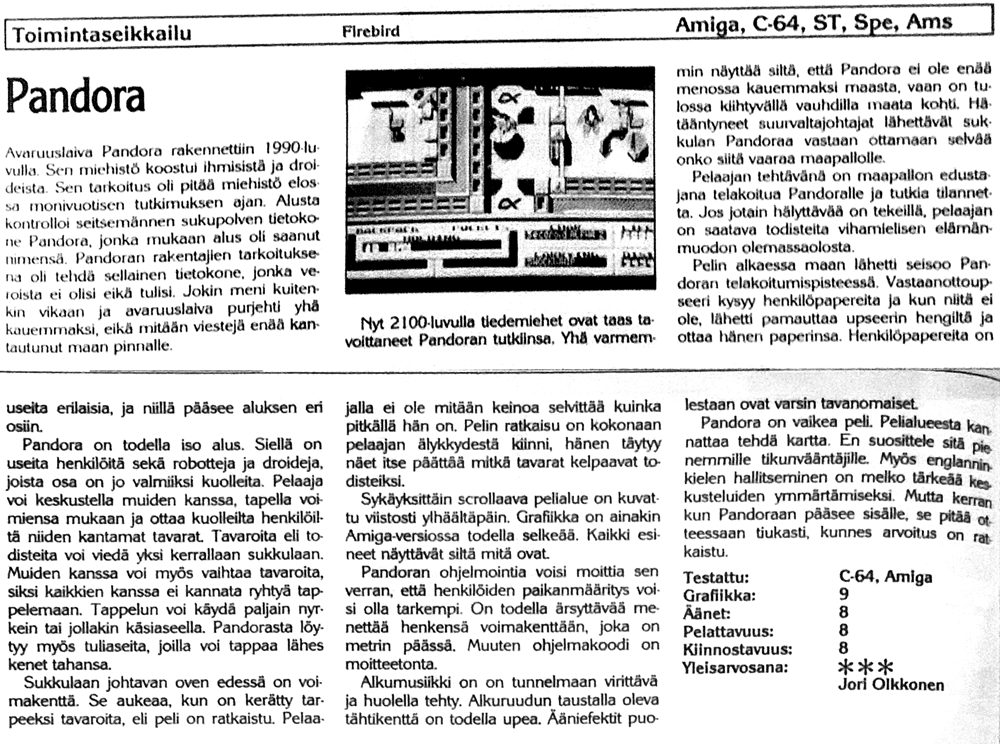
Sykäyksittäin scrollaava pelialue on kuvattu viistosti ylhäältäpäin. Grafiikka on ainakin Amiga-versiossa todella selkeää. Kaikki esineet näyttävät siltä mitä ovat.
Pandoran ohjelmointia voisi moittia sen verran, että henkilöiden paikanmääritys voisi olla tarkempi. On todella ärsyttävää menettää henkensä voimakenttään, joka on metrin päässä. Muuten ohjelmakoodi on moitteetonta.
Alkumusiikki on on tunnelmaan virittävä ja huolella tehty. Alkuruudun taustalla oleva tähtikenttä on todella upea. Äänefektit puolestaan ovat varsin tavanomaiset.
Pandora on vaikea peli. Pelialueesta kannattaa tehdä kartta. En suosittele sitä pienemmille tikunvääntäjille. Myös englanninkielen hallitseminen on melko tärkeää keskusteluiden ymmärtämiseksi. Mutta kerran kun Pandoraan pääsee sisälle, se pitää otteessaan tiukasti, kunnes arvoitus on ratkaistu.
Pandora1989 KevätPermalinkThe spaceship Pandora was built in the 1990s. Its crew consisted of humans and droids. Its purpose was to keep the crew alive for the duration of a research mission lasting many years. The ship was controlled by a seventh-generation computer, Pandora, after which the ship had been named. Pandora's builders had set out to make a computer the like of which there was not and never would be. Something went wrong, however, and the spaceship sailed further and further away, and no more messages reached the surface of the Earth.
Now, in the 2100s, scientists have picked up Pandora on their radars again. It looks more and more certain that Pandora is no longer heading away from Earth but is coming towards it at accelerating speed. The panicked superpower leaders send a shuttle out to meet Pandora and find out whether it poses a danger to the planet.
The player's task, as Earth's representative, is to dock with Pandora and investigate the situation. If something alarming is afoot, the player must obtain evidence of the existence of a hostile life form.
As the game begins, Earth's envoy is standing at Pandora's docking point. The reception officer asks for identity papers, and since there aren't any, the envoy blasts the officer dead and takes their papers. There are several different kinds of identity papers, and they get you into different parts of the ship.
Pandora is a really big ship. There are a number of people on board as well as robots and droids, some of whom are already dead to begin with. The player can talk with the others, fight as far as their strength allows, and take whatever the dead were carrying. The items, that is the evidence, can be taken to the shuttle one at a time. You can also trade items with the others, which is why it doesn't pay to start a fight with everyone. Fights can be fought with bare fists or with some hand weapon. Pandora also has firearms, with which you can kill almost anyone.
There's a force field in front of the door leading to the shuttle. It opens when enough items have been collected, in other words when the game has been solved. The player has no way of finding out how far along they are. Solving the game depends entirely on the player's intelligence, since, you see, they have to decide for themselves which items count as evidence.
The play area, which scrolls in jerks, is viewed obliquely from above. The graphics, in the Amiga version at least, are really clear. All the objects look like what they are.
The one criticism you could make of Pandora's programming is that the characters' position detection could be more accurate. It's really annoying to lose your life to a force field that's a metre away. Otherwise the program code is flawless.
The title music sets the mood and has been made with care. The starfield in the background of the title screen is really gorgeous. The sound effects, on the other hand, are fairly ordinary.
Pandora is a difficult game. It's worth making a map of the play area. I don't recommend it to younger joystick-twiddlers. A command of English is also pretty important for understanding the conversations. But once you get inside Pandora, it keeps a tight grip on you until the riddle has been solved.
Pang
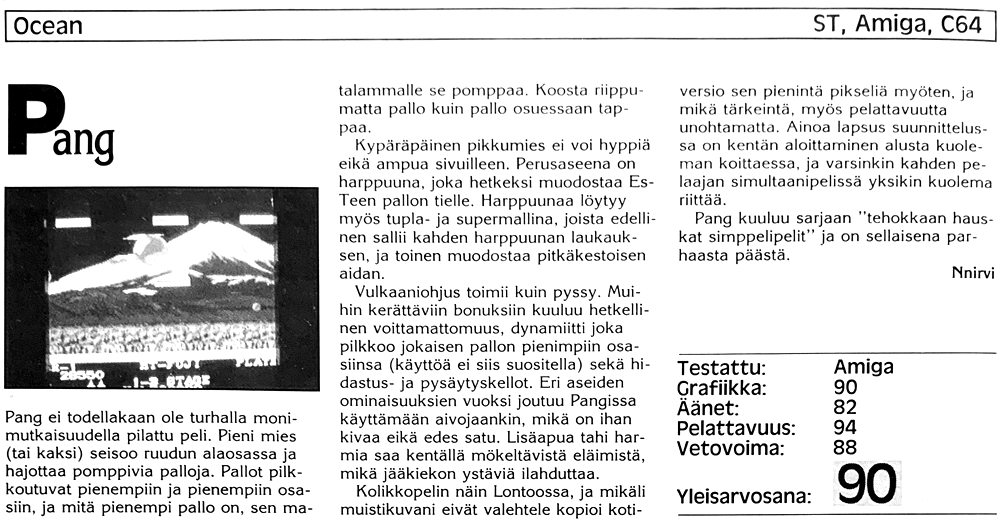
Pang1991 KevätPysyvä linkkiPang ei todellakaan ole turhalla monimutkaisuudella pilattu peli. Pieni mies (tai kaksi) seisoo ruudun alaosassa ja hajottaa pomppivia palloja. Pallot pilkkoutuvat pienempiin ja pienempiin osasiin, ja mitä pienempi pallo on, sen matalammalle se pomppaa. Koosta riippumatta pallo kuin pallo osuessaan tappaa.
Kypäräpäinen pikkumies ei voi hyppiä eikä ampua sivuilleen. Perusaseena on harppuuna, joka hetkeksi muodostaa EsTeen pallon tielle. Harppuunaa löytyy myös tupla- ja supermallina, joista edellinen sallii kahden harppuunan laukauksen, ja toinen muodostaa pitkäkestoisen aidan.
Vulkaaniohjus toimii kuin pyssy. Muihin kerättäviin bonuksiin kuuluu hetkellinen voittamattomuus, dynamiitti joka pilkkoo jokaisen pallon pienimpiin osasiinsa (käyttöä ei siis suositella) sekä hidastus- ja pysäytyskellot. Eri aseiden ominaisuuksien vuoksi joutuu Pangissa käyttämään aivojaankin, mikä on ihan kivaa eikä edes satu. Lisäapua tahi harmia saa kentällä mökeltävistä eläimistä, mikä jääkiekon ystäviä ilahduttaa.
Kolikkopelin näin Lontoossa, ja mikäli muistikuvani eivät valehtele kopioi kotiversio sen pienintä pikseliä myöten, ja mikä tärkeintä, myös pelattavuutta unohtamatta. Ainoa lapsus suunnittelussa on kentän aloittaminen alusta kuoleman koittaessa, ja varsinkin kahden pelaajan simultaanipelissä yksikin kuolema riittää.
Pang kuuluu sarjaan "tehokkaan hauskat simppelipelit" ja on sellaisena parhaasta päästä.
Pang1991 KevätPermalinkPang is certainly not a game spoiled by needless complexity. A little man (or two) stands at the bottom of the screen and breaks up bouncing balls. The balls split into smaller and smaller pieces, and the smaller the ball, the lower it bounces. Whatever its size, any ball at all kills you when it hits.
The helmet-headed little man can neither jump nor shoot sideways. The basic weapon is a harpoon, which briefly forms an obstacle in the ball's path. The harpoon also comes in double and super models, the former letting you fire two harpoons and the other forming a long-lasting fence.
The Vulcan missile works like a gun. Other collectable bonuses include temporary invincibility, dynamite that splits every ball into its smallest pieces (use is therefore not recommended), and slow-down and stop clocks. Because of the different weapons' properties you have to use your brain in Pang as well, which is quite nice and doesn't even hurt. Extra help or harm comes from animals scrambling about the level, which will gladden ice hockey fans.
I saw the coin-op in London, and if my memory doesn't lie, the home version copies it down to the smallest pixel and, most importantly, without forgetting the playability either. The only slip in the design is restarting the level from the beginning when death comes, and especially in the two-player simultaneous game a single death is enough.
Pang belongs in the category "efficiently fun simple games" and as such it's among the very best.
Paperboy
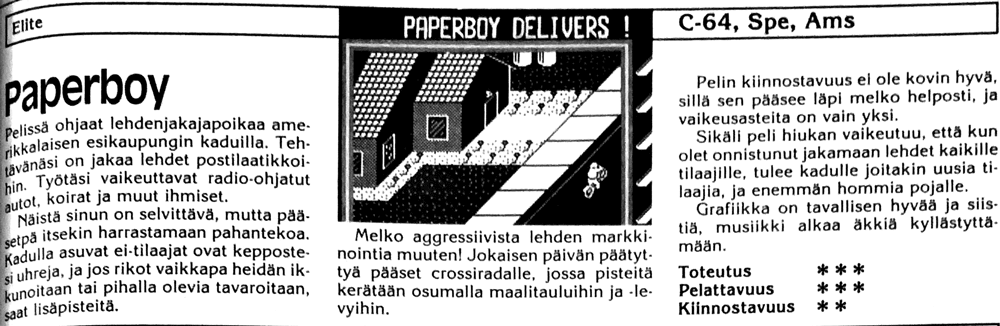
Paperboy1987Pysyvä linkkiPelissä ohjaat lehdenjakajapoikaa amerikkalaisen esikaupungin kaduilla. Tehtävänäsi on jakaa lehdet postilaatikkoihin. Työtäsi vaikeuttavat radio-ohjatut autot, koirat ja muut ihmiset.
Näistä sinun on selvittävä, mutta pääsetpä itsekin harrastamaan pahantekoa. Kadulla asuvat ei-tilaajat ovat keppostesi uhreja, ja jos rikot vaikkapa heidän ikkunoitaan tai pihalla olevia tavaroitaan, saat lisäpisteitä.
Melko agressiivista lehden markkinointia muuten! Jokaisen päivän päätyttyä pääset crossiradalle, jossa pisteitä kerätään osumalla maalitauluihin ja -levyihin.
Pelin kiinnostavuus ei ole kovin hyvä, sillä sen pääsee läpi melko helposti, ja vaikeusasteita on vain yksi.
Sikäli peli hiukan vaikeutuu, että kun olet onnistunut jakamaan lehdet kaikille tilaajille, tulee kadulle joitakin uusia tilaajia, ja enemmän hommia pojalle.
Grafiikka on tavallisen hyvää ja siistiä, musiikki alkaa äkkiä kyllästyttämään.
Paperboy1987PermalinkIn the game you steer a paperboy through the streets of an American suburb. Your job is to deliver the papers into the mailboxes. Your work is made harder by radio-controlled cars, dogs and other people.
You have to get past all of these, but you also get to indulge in a bit of mischief yourself. The non-subscribers living on the street are the victims of your pranks, and if you smash, say, their windows or the stuff in their yards, you get bonus points.
Pretty aggressive newspaper marketing, by the way! At the end of each day you get to go out on a BMX track, where you collect points by hitting targets and target boards.
The game's lasting interest isn't very good, since you can get through it fairly easily, and there's only one difficulty level.
The game does get a little harder in that once you've managed to deliver papers to all the subscribers, some new subscribers turn up on the street, and there's more work for the boy.
The graphics are good and neat in an ordinary sort of way, and the music soon starts to wear thin.
Paradroid 90
Paradroid 901991 KevätPysyvä linkkiBraybrook parka on varmaankin ollut kovilla, kun muutama miljoona fania on pommittanut kirjeillä vaatien 16-bittistä versiota Paradroidista. Mikäli et Paradroidia tunne, niin onpa paha aukko sivistyksessä, pidettiinhän sitä aikoinaan yhtenä maailman nerokkaimmista peleistä.
Tehtäväksi on uskottu rahtialus U.S.F Paradroidin takaisinvaltaus, se kun on joutunut droidi-invaasion jalkoihin. Käytännössä puhdistus sujuu kahdella rinnakkaisella taktiikalla. Niistä suoraviivaisempi on droidien tussauttaminen pois jaloista, mutta pelkällä pyssyttelyllä henki on liian herkässä.
Hienovaraisempi metodi on droidien kaappaaminen tuuppamalla kylkeen kiinni ja siirtymällä alipeliin, jossa kilpaillaan kytkennöistä. Ideana on saada yli puolet piuhoista haltuunsa, jolloin droidi on valvonnassa ja samalla saa käyttöönsä sen aseen, nopeuden ja panssaroinnin. Mitä kovempi peli, sitä vaikeampi sitä on kaapata, joten pelille onkin tyypillistä droidistatuksen kohottaminen hitaasti kiiruhtaen. Kerroksesta toiseen hissien kautta sujahtelevan droidin tukena on huoltopisteitä energiatäydennykseen sekä päätteitä, joista voi plarata pohjapiirustuksia ja muuta dataa.
Alkuperäiseen versioon verrattuna silmiinpistävin ero on vierityksen rajoittuminen pystysuuntaan, mutta se on sivuseikka. Yksittäisistä uutuusideoista maininnan ansaitsevat kentille ripotellut esteet, jotka tarjoavat tulisuojaa vain muutaman laukauksen ajaksi. Varomaton voi jopa tykittää energialaturit tuusaksi. Kehitystä on myös vihulaisten älyssä, esimerkiksi sotimisen lomassa ne hakeutuvat energiatäydennykseen ja eräskin sala-ampuja laukoo mieluusti oven suusta tai nurkan takaa.
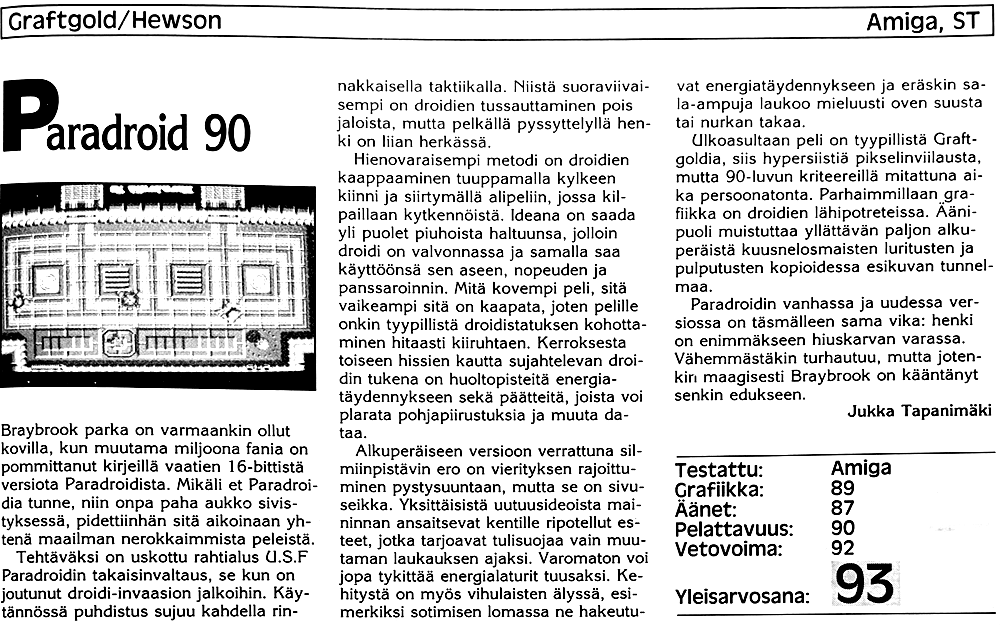
Ulkoasultaan peli on tyypillistä Graftgoldia, siis hypersiistiä pikselinviilausta, mutta 90-luvun kriteereillä mitattuna aika persoonatonta. Parhaimmillaan grafiikka on droidien lähipotreteissa. Äänipuoli muistuttaa yllättävän paljon alkuperäistä kuusnelosmaisten luritusten ja pulputusten kopioidessa esikuvan tunnelmaa.
Paradroidin vanhassa ja uudessa versiossa on täsmälleen sama vika: henki on enimmäkseen hiuskarvan varassa. Vähemmästäkin turhautuu, mutta jotenkin maagisesti Braybrook on kääntänyt senkin edukseen.
Paradroid 901991 KevätPermalinkPoor Braybrook must have had a rough time of it, with a few million fans launching a letter bombardment demanding a 16-bit version of Paradroid. If you don't know Paradroid, well, that's a nasty gap in your education, seeing as it was considered in its day one of the most ingenious games in the world.
You have been entrusted with retaking the freighter U.S.F Paradroid, since it has been trampled under the feet of a droid invasion. In practice the clean-up proceeds by two parallel tactics. The more straightforward of them is zapping the droids out of your way, but with gunplay alone your life is far too fragile.
The subtler method is capturing droids by bumping up against their side and moving into a subgame where you compete for circuit connections. The idea is to get more than half the wires under your control, whereupon the droid is under your command and at the same time you get the use of its weapon, speed and armour. The tougher the customer, the harder it is to capture, so typical of the game is raising your droid status by making haste slowly. The droid, whizzing from deck to deck by lift, is supported by service points for energy top-ups and by terminals where you can leaf through floor plans and other data.
Compared with the original version, the most striking difference is that scrolling is restricted to the vertical, but that's a side issue. Of the individual new ideas, the obstacles sprinkled around the levels deserve a mention: they provide cover from fire for only a few shots. The careless can even blast the energy chargers to smithereens. There's been progress in the baddies' intelligence too; for example, in between the fighting they go off to top up their energy, and one sniper in particular likes to fire from a doorway or from round a corner.
In appearance the game is typical Graftgold, meaning hyper-tidy pixel-polishing, but measured by 90s criteria rather characterless. The graphics are at their best in the close-up portraits of the droids. The sound side is surprisingly reminiscent of the original, with Commodore 64-style warbles and burbles copying the atmosphere of the model.
The old and new versions of Paradroid have exactly the same flaw: your life mostly hangs by a hair. You'd get frustrated over less, but somehow, magically, Braybrook has turned even that into an asset.
Parallax
Parallax1987Pysyvä linkkiNähdessäni paketin takakannen kuvat löin ennakkoluuloni kanssa vetoa, että pelin nimen pitäisi olla Paradium. Peli latautui ja ennakkoluulot toivat shekkivihkoni. Parallaxissa Uridiumia ei ole kuin grafiikan korkealaatuisuus.
Juoni on vanha kunnon "vain yksi mies/nainen voi maailman pelastaa, mutta kokeilepa sinäkin". Ulkoavaruudesta saapuva tietokonejohdettu kulttuuri uhkaa ratkaista ylikansoitusongelman omalla tavallaan, siis ei kansoitusta, ei ongelmia. Sankari ja hänen neljä kollegaansa ovat olleet tutkimuskatkalla Parallaxissa, kun tämä hälyttävä tieto saatiin. Tehtävänä on siis ensin pelastaa nuo neljä ja sitten tuhota Parallax yx kax. Tappamisvaisto saa taistonsa, mutta lasereitten lisäksi on pelissä annos seikkailuakin. Jotta pääsee etenemään tasolta toiselle, täytyy jättää aluksen suoja ja tunkeutua hangaareihin. Näistä löytyy tiedemiehiä, jotka ammutaan ja joilta varastetaan heidän ID-korttinsa. Näillä saa nostettua pankkiautomaateista rahaa, jolla voi ostaa lisää happea ja ammuksia, mutta niillä pääsee myös tunkeutumaan päätietokoneeseen, joka antaa salasanan kirjaimia. Kun salasana on koossa ja toveri pelastettu voi edetä seuraavalle vyöhykkeelle.
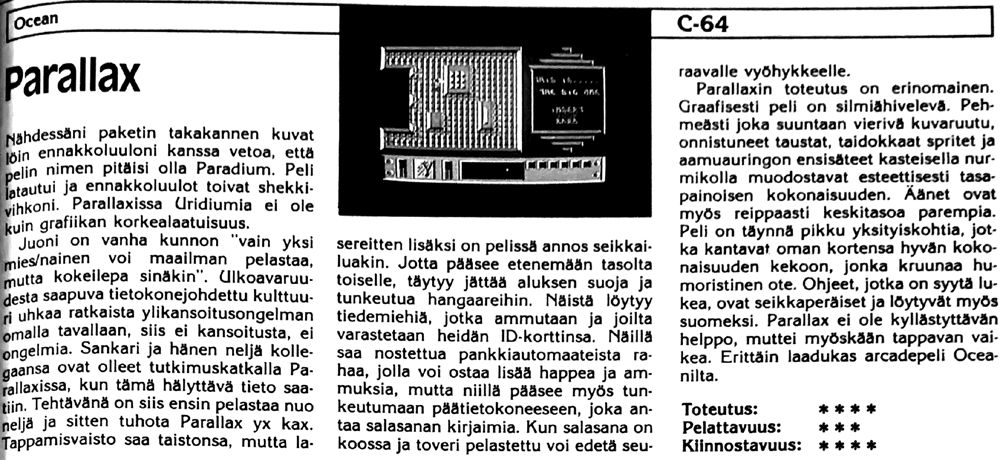
Parallaxin toteutus on erinomainen. Graafisesti peli on silmiähivelevä. Pehmeästi joka suuntaan vierivä kuvaruutu, onnistuneet taustat, taidokkaat spritet ja aamuauringon ensisäteet kasteisella nurmikolla muodostavat esteettisesti tasapainoisen kokonaisuuden. Äänet ovat myös reippaasti keskitasoa parempia. Peli on täynnä pikku yksityiskohtia, jotka kantavat oman kortensa hyvän kokonaisuuden kekoon, jonka kruunaa humoristinen ote. Ohjeet, jotka on syytä lukea, ovat seikkaperäiset ja löytyvät myös suomeksi. Parallax ei ole kyllästyttävän helppo, muttei myöskään tappavan vaikea. Erittäin laadukas arcadepeli Oceanilta.
Parallax1987PermalinkWhen I saw the pictures on the back of the box, I made a bet with my prejudices that the game should really be called Paradium. The game loaded, and my prejudices brought me my chequebook. The only thing Uridium about Parallax is the high quality of the graphics.
The plot is the good old "only one man/woman can save the world, but go on, you have a go too". A computer-run culture arriving from outer space threatens to solve the overpopulation problem in its own way, i.e. no population, no problems. The hero and four colleagues were on a research expedition in Parallax when this alarming news came in. So the task is first to rescue those four and then destroy Parallax in two shakes. The killer instinct gets its fill of fighting, but besides the lasers there's a helping of adventure in the game as well. To get from one level to the next, you have to leave the shelter of your ship and break into the hangars. In these you'll find scientists, who get shot and have their ID cards stolen. With the cards you can withdraw money from cash machines to buy more oxygen and ammo, but they also get you into the main computer, which hands out letters of the password. Once the password is complete and your comrade rescued, you can move on to the next zone.
Parallax's execution is excellent. Graphically the game is a treat for the eyes. The screen scrolling smoothly in every direction, the well-made backgrounds, the skilful sprites and the first rays of the morning sun on a dewy lawn form an aesthetically balanced whole. The sound is also comfortably above average. The game is full of little details that each do their bit for the fine overall package, which is crowned by a humorous touch. The instructions, which are worth reading, are thorough and also available in Finnish. Parallax isn't boringly easy, but it isn't deadly difficult either. A very high-quality arcade game from Ocean.
Passing Shot
Passing Shot1990 KevätPysyvä linkkiPassing Shot on alunperin Segan kolikkopeli, mutta nykyisen suuntauksen mukaan heikotkin kolikkopelit käännetään kotikoneille. Ihmetyttää, että Imageworksin tasoinen yhtiö retkahtaa näinkin huonoon peliin. Suurin osa haukuista pitää kuitenkin ohjata käännöksen tehneen ryhmän osoitteeseen. Teque (Thunderbirds) ei ole liiemmin vakuuttanut ohjelmointitaidoillaan, eikä vakuuta nytkään.
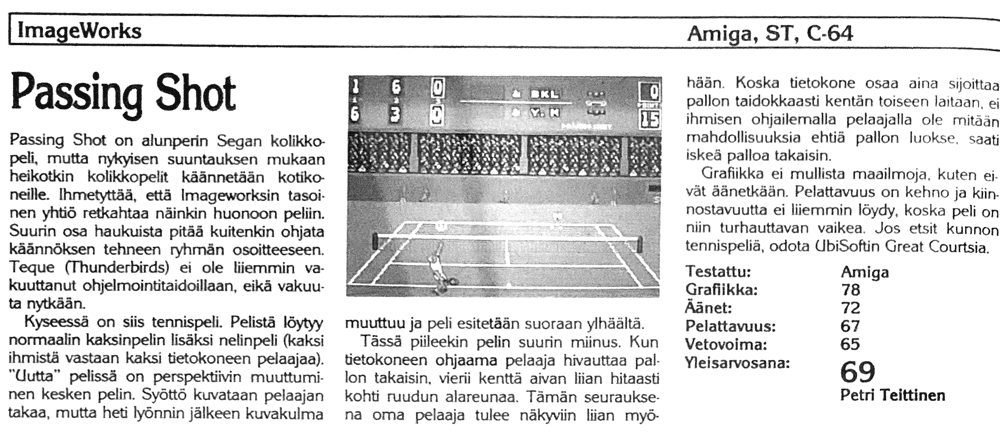
Kyseessä on siis tennispeli. Pelistä löytyy normaalin kaksinpelin lisäksi nelinpeli (kaksi ihmistä vastaan kaksi tietokoneen pelaajaa). "Uutta" pelissä on perspektiivin muuttuminen kesken pelin. Syöttö kuvataan pelaajan takaa, mutta heti lyönnin jälkeen kuvakulma muuttuu ja peli esitetään suoraan ylhäältä.
Tässä piileekin pelin suurin miinus. Kun tietokoneen ohjaama pelaaja hivauttaa pallon takaisin, vierii kenttä aivan liian hitaasti kohti ruudun alareunaa. Tämän seurauksena oma pelaaja tulee näkyviin liian myöhään. Koska tietokone osaa aina sijoittaa pallon taidokkaasti kentän toiseen laitaan, ei ihmisen ohjailemalla pelaajalla ole mitään mahdollisuuksia ehtiä pallon luokse, saati iskeä palloa takaisin.
Grafiikka ei mullista maailmoja, kuten eivät äänetkään. Pelattavuus on kehno ja kiinnostavuutta ei liiemmin löydy, koska peli on niin turhauttavan vaikea. Jos etsit kunnon tennispeliä, odota UbiSoftin Great Courtsia.
Passing Shot1990 KevätPermalinkPassing Shot was originally a Sega coin-op, but in keeping with the current trend even weak coin-ops get converted to home computers. It's a wonder that a company of Imageworks' calibre would fall for such a poor game. Most of the flak, however, should be sent to the address of the team that did the conversion. Teque (Thunderbirds) haven't exactly impressed with their programming skills before, and they don't impress now either.
So, what we have here is a tennis game. Besides normal singles, the game offers doubles (two humans against two computer players). What's "new" in the game is that the perspective changes in mid-play. The serve is shown from behind the player, but straight after the shot the viewing angle changes and the game is shown from directly above.
And therein lies the game's biggest minus. When the computer-controlled player flicks the ball back, the court scrolls far too slowly towards the bottom of the screen. As a result your own player comes into view too late. Since the computer always manages to place the ball skilfully over on the other side of the court, a human-controlled player has no chance at all of reaching the ball, let alone hitting it back.
The graphics won't turn the world upside down, and neither will the sound. The playability is poor and there isn't much appeal to be found, because the game is so frustratingly hard. If you're looking for a proper tennis game, wait for UbiSoft's Great Courts.
Patton vs. Rommel
Patton vs. Rommel1988Pysyvä linkkiTykkien jyskettä... Panssarien kolinaa... KK:n jäkätystä ja tuskaa. Operaatio Cobra.
25.7.1944 liittoutuneet laukaisivat amerikkalaiselta sektorilta valtavan hyökkäyksen. Jo valmiiksi murtumispisteessä olevat saksalaisjoukot yksinkertaisesti luhistuivat hyökkäyksen edessä. Mitä jos Rommel mokasi? Mitä jos Rommel ja Patton olisivat tavanneet toisensa taistelussa? Mitä jos? Pystytkö pidättämään liittoutuneita ja lyömään heidät takaisin? Vai kykenetkö iskemään saksalaisten rintaman hajalle vieläkin perusteellisemmin? Vai onko koneen ääressä kaksi yhtä tyhmää tolloa jotka eivät pysty tekemään toisilleen kuin pientä kiusaa...
Patton versus Rommel on hienosti tehty peli. Oppiminen ei voi tuottaa pahemmin vaikeuksia kenellekään selkeän ikonijärjestelmän ansiosta. Aloittelijoilla on vieläkin helpompaa, ei ole edes ikoneita. Vain yksinkertainen yksikköjen liikuttaminen.
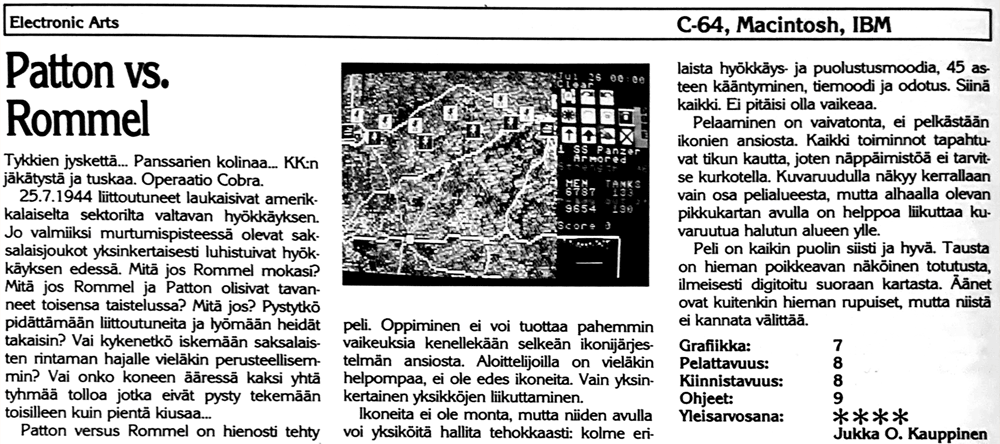
Ikoneita ei ole monta, mutta niiden avulla voi yksiköitä hallita tehokkaasti: kolme erilaista hyökkäys- ja puolustusmoodia, 45 asteen kääntyminen, tiemoodi ja odotus. Siinä kaikki. Ei pitäisi olla vaikeaa.
Pelaaminen on vaivatonta, ei pelkästään ikonien ansiosta. Kaikki toiminnot tapahtuvat tikun kautta, joten näppäimistöä ei tarvitse kurkotella. Kuvaruudulla näkyy kerrallaan vain osa pelialueesta, mutta alhaalla olevan pikkukartan avulla on helppoa liikuttaa kuvaruutua halutun alueen ylle.
Peli on kaikin puolin siisti ja hyvä. Tausta on hieman poikkeavan näköinen totutusta, ilmeisesti digitoitu suoraan kartasta. Äänet ovat kuitenkin hieman rupuiset, mutta niistä ei kannata välittää.
Patton vs. Rommel1988PermalinkThe thunder of guns... The clatter of tanks... The yammer of machine guns, and agony. Operation Cobra.
On 25 July 1944 the Allies launched a massive attack from the American sector. The German forces, already at breaking point, simply collapsed in the face of the attack. What if Rommel had blown it? What if Rommel and Patton had met each other in battle? What if? Can you hold back the Allies and drive them back? Or can you smash the German front apart even more thoroughly? Or are there two equally dim dolts at the computer who can't manage anything against each other but a bit of petty needling...
Patton versus Rommel is a finely made game. Thanks to the clear icon system, learning it can't really give anybody much trouble. Beginners have it even easier - there aren't even any icons. Just simple moving of units.
There aren't many icons, but with them you can control your units effectively: three different attack and defence modes, 45-degree turning, road mode and wait. That's all. Shouldn't be hard.
Playing is effortless, and not just thanks to the icons. Everything is done via the joystick, so there's no need to stretch for the keyboard. Only part of the play area is shown on screen at a time, but the little map at the bottom makes it easy to move the view over whichever area you want.
The game is neat and good in every respect. The background looks a little different from what you're used to, apparently digitised straight from a map. The sound, however, is a bit crummy, but it's not worth worrying about.
Pawn
Pawn1987Pysyvä linkkiOn niitä, jotka pelastavat maailman mieluummin savuava joystick kädessä ja niitä, jotka istuvat näppäimistön ääressä aamuneljään miettien englanninkielisiä verbejä millä pelastaa itsensä kiipelistä. Jos itse kuulut ryhmään pure-laseriani-pieni-vihreä-olio, voitkin jättää tämän jutun lukemisen.
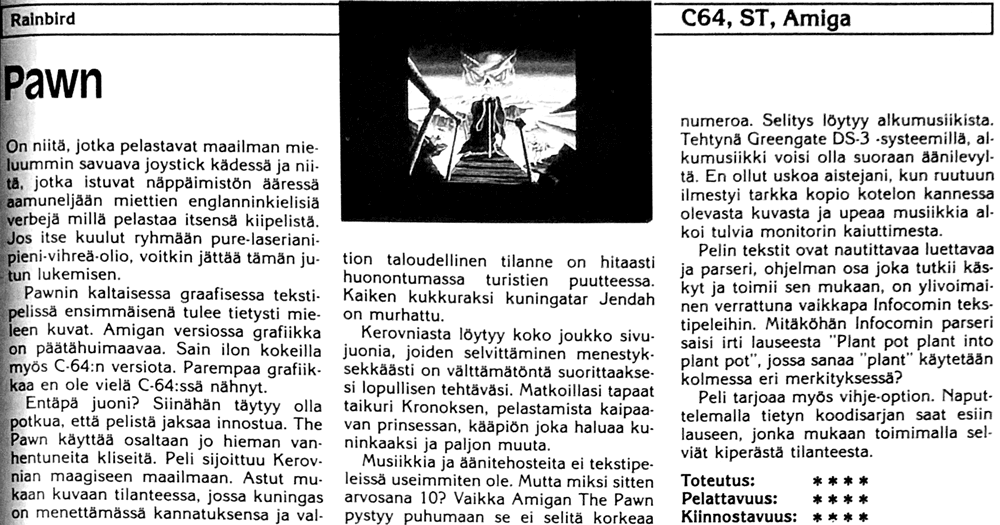
Pawnin kaltaisessa graafisessa tekstipelissä ensimmäisenä tulee tietysti mieleen kuvat. Amigan versiossa grafiikka on päätähuimaavaa. Sain ilon kokeilla myös C-64:n versiota. Parempaa grafiikkaa en ole vielä C-64:ssä nähnyt.
Entäpä juoni? Siinähän täytyy olla potkua, että pelistä jaksaa innostua. The Pawn käyttää osaltaan jo hieman vanhentuneita kliseitä. Peli sijoittuu Kerovnian maagiseen maailmaan. Astut mukaan kuvaan tilanteessa, jossa kuningas on menettämässä kannatuksensa ja valtion taloudellinen tilanne on hitaasti huonontumassa turistien puutteessa. Kaiken kukkuraksi kuningatar Jendah on murhattu.
Kerovniasta löytyy koko joukko sivujuonia, joiden selvittäminen menestyksekkäästi on välttämätöntä suorittaaksesi lopullisen tehtäväsi. Matkoillasi tapaat taikuri Kronoksen, pelastamista kaipaavan prinsessan, kääpiön joka haluaa kuninkaaksi ja paljon muuta.
Musiikkia ja äänitehosteita ei tekstipeleissä useimmiten ole. Mutta miksi sitten arvosana 10? Vaikka Amigan The Pawn pystyy puhumaan se ei selitä korkeaa numeroa. Selitys löytyy alkumusiikista. Tehtynä Greengate DS-3 -systeemillä, alkumusiikki voisi olla suoraan äänilevyltä. En ollut uskoa aistejani, kun ruutuun ilmestyi tarkka kopio kotelon kannessa olevasta kuvasta ja upeaa musiikkia alkoi tulvia monitorin kaiuttimesta.
Pelin tekstit ovat nautittavaa luettavaa ja parseri, ohjelman osa joka tutkii käskyt ja toimii sen mukaan, on ylivoimainen verrattuna vaikkapa Infocomin tekstipeleihin. Mitäköhän Infocomin parseri saisi irti lauseesta "Plant pot plant into plant pot", jossa sanaa "plant" käytetään kolmessa eri merkityksessä?
Peli tarjoaa myös vihje-option. Naputtelemalla tietyn koodisarjan saat esiin lauseen, jonka mukaan toimimalla selviät kiperästä tilanteesta.
Pawn1987PermalinkThere are those who would rather save the world with a smoking joystick in hand, and those who sit at the keyboard until four in the morning, racking their brains for English verbs to get themselves out of a fix. If you yourself belong to the eat-my-laser-little-green-thing group, you may as well skip reading this piece.
In a graphical text game like Pawn, the first thing that comes to mind is of course the pictures. In the Amiga version the graphics are head-spinning. I also had the pleasure of trying out the C-64 version. I have yet to see better graphics on the C-64.
And the plot? It has to have some kick to it if you're going to stay excited about the game. In part, The Pawn relies on clichés that are already a bit dated. The game is set in the magical world of Kerovnia. You step into the picture at a moment when the king is losing his support and the state's finances are slowly going downhill for lack of tourists. To top it all off, Queen Jendah has been murdered.
Kerovnia has a whole bunch of subplots, and solving them successfully is essential to completing your final task. On your travels you'll meet the magician Kronos, a princess in need of rescuing, a dwarf who wants to be king, and much more.
Text games mostly have no music or sound effects. So why the grade of 10, then? Even though The Pawn on the Amiga can talk, that doesn't explain the high mark. The explanation lies in the title music. Made with the Greengate DS-3 system, the title music could be straight off a record. I could scarcely believe my senses when an exact copy of the picture on the box cover appeared on the screen and gorgeous music came flooding out of the monitor's speaker.
The game's texts make enjoyable reading, and the parser, the part of the program that examines your commands and acts accordingly, is far superior to, say, Infocom's text games. I wonder what Infocom's parser would make of the sentence "Plant pot plant into plant pot", where the word "plant" is used in three different senses?
The game also offers a hint option. By tapping in a certain code sequence, you bring up a sentence which, if you act on it, gets you out of a tricky spot.
Pepsi Challenge Mad Mix Game, The
Pepsi Challenge Mad Mix Game, The1989 KevätPysyvä linkkiPepsin ja U.S. Goldin kädenpaiskaamisen tuloksena on syntynyt vahvasti Michael Pacsoniin nojaava Mad Mix, joka oli virallisena pelinä samaisten yhtiöiden sponsoroimassa Enlannin pelimestaruuskilpailussa. Minkämoisen pelin uusi sukupolvi sitten on valinnut?
Pelin sankari on Pepsimies, joka voi pelastaa Pepsikylän kummituksilta syömällä sokkeloiden käytäviltä kaikki pallerot. Pepsiman ei joudu tyytymään vain tähän, vaan hän voi syödä myös erilaisia ikoneita. Yksi muuttaa hänet vihaiseksi Pepsimieheksi, joka voi tuhota kummituksia, mutta silti jatkaa palleromässäilyä. Toinen ikoni muuttaa hänet Pepsisiaksi, joka ei voi kerätä palleroita, mutta voipahan liiskata kaiken liikkuvan. Tietyillä radanpätkillä voi Pepsimies muuttua lentokoneeksi tai tankiksikin. Siihen ei Pacman koskaan pystynyt.
Sokkeloista löytyy myös salaovia ja pakkoliikuntaikoneita peliä piristämään. Pahoja poikia on olemassa kolmea eri tyyppiä, joista lukuisimpina mellastavat kummitukset. Näiden lisäksi on myös Leppäharmi ja Mr. Vastenmielinen, joiden idiosynkrasiat antavat lisämakua pelisoppaan.
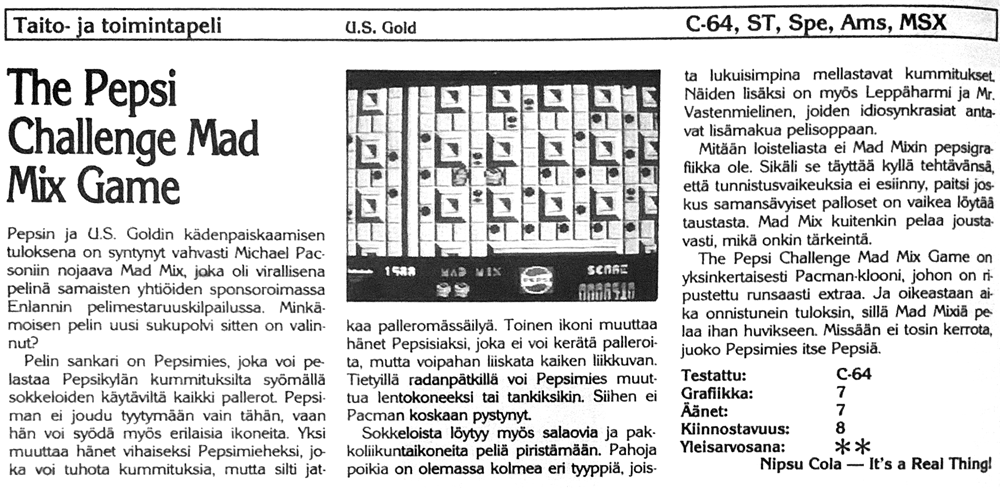
Mitään loisteliasta ei Mad Mixin pepsigrafiikka ole. Sikäli se täyttää kyllä tehtävänsä, että tunnistusvaikeuksia ei esiinny, paitsi joskus samansävyiset palloset on vaikea löytää taustasta. Mad Mix kuitenkin pelaa joustavasti, mikä onkin tärkeintä.
The Pepsi Challenge Mad Mix Game on yksinkertaisesti Pacman-klooni, johon on ripustettu runsaasti extraa. Ja oikeastaan aika onnistunein tuloksin, sillä Mad Mixiä pelaa ihan huvikseen. Missään ei tosin kerrota, juoko Pepsimies itse Pepsiä.
Pepsi Challenge Mad Mix Game, The1989 KevätPermalinkThe handshake between Pepsi and U.S. Gold has given birth to Mad Mix, a game that leans heavily on Michael Pacson and was the official game of the England games championship sponsored by those very same companies. So what kind of game has the new generation chosen?
The hero of the game is Pepsi Man, who can save Pepsi Village from the ghosts by eating up all the pellets in the corridors of the mazes. Pepsiman doesn't have to settle for just that, though, because he can also eat various icons. One turns him into an angry Pepsi Man who can destroy ghosts but still carry on gorging on pellets. Another icon turns him into a Pepsi Pig, which can't collect pellets but can at least squash anything that moves. On certain stretches of the level Pepsi Man can even turn into a plane or a tank. Pacman could never do that.
The mazes also contain secret doors and compulsory-exercise icons to liven the game up. There are three different types of bad guys, of whom the ghosts run riot in the greatest numbers. On top of these there are also the Ladybugbear and Mr. Repulsive, whose idiosyncrasies add extra flavour to the game soup.
There's nothing splendid about Mad Mix's Pepsi graphics. They do serve their purpose insofar as there's no trouble telling things apart, except that sometimes pellets of the same shade are hard to pick out from the background. Mad Mix plays smoothly, however, and that's what matters most.
The Pepsi Challenge Mad Mix Game is simply a Pacman clone with plenty of extras hung onto it. And with rather successful results, actually, since you play Mad Mix just for the fun of it. Nowhere, though, does it say whether Pepsi Man himself drinks Pepsi.
Persian Gulf Inferno
Persian Gulf Inferno1990 SyksyPysyvä linkkiTulevaisuuden (ehkei silti niin kovin kaukaisen) maailmassa öljy alkaa olla vähissä. Terroristit ovat virittäneet Persianlahden ympäristön öljyvarastoihin mahtavat atomipommit ja kiristävät niillä maailmaa. Lisäksi ne siat ovat napanneet panttivankeja sanojensa lisävakuudeksi.
Sinut lähetetään helikopterilla 'ratkaisemaan' kiperä tilanne, mutta terroristit ampuvat kopterin alas ja molskahdat veteen mukanasi vain pari räjähdettä ja pistooli, johon löydät taskuistasi viisi lipasta. Onnistut puikahtamaan terroristien tukikohtaan ja tehtäväsi on kukistaa terroristit ja pelastaa panttivangit. Helppo nakki, eikö?
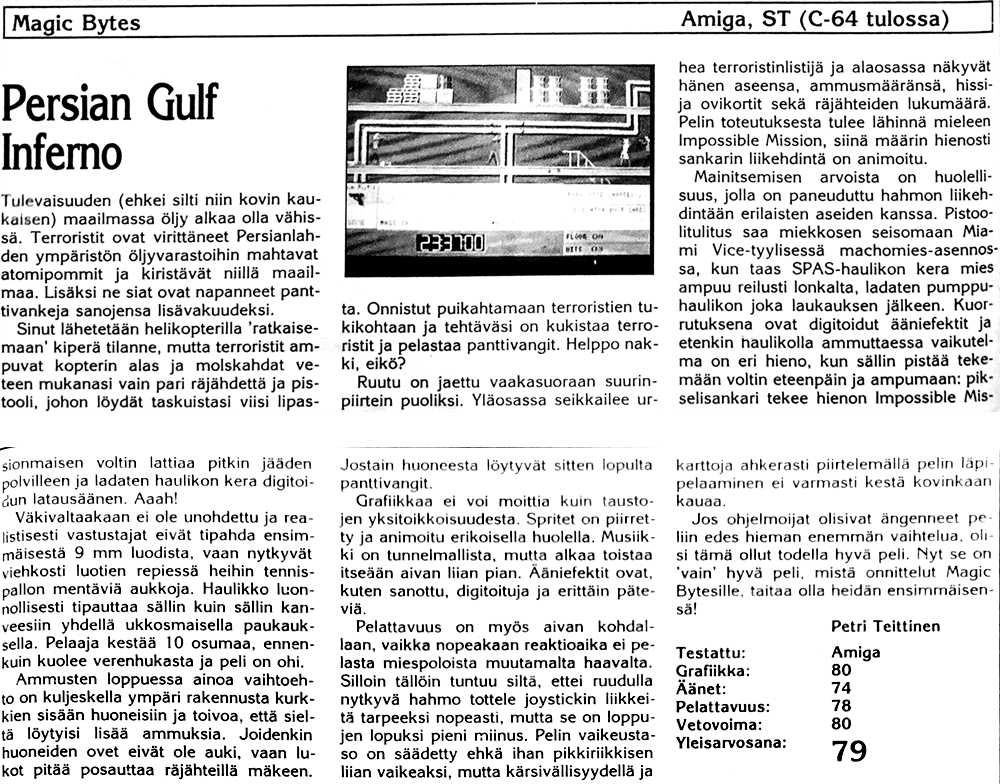
Ruutu on jaettu vaakasuoraan suurinpiirtein puoliksi. Yläosassa seikkailee urhea terroristinlistijä ja alaosassa näkyvät hänen aseensa, ammusmääränsä, hissi- ja ovikortit sekä räjähteiden lukumäärä. Pelin toteutuksesta tulee lähinnä mieleen Impossible Mission, siinä määrin hienosti sankarin liikehdintä on animoitu.
Mainitsemisen arvoista on huolellisuus, jolla on paneuduttu hahmon liikehdintään erilaisten aseiden kanssa. Pistoolitulitus saa miekkosen seisomaan Miami Vice-tyylisessä machomies-asennossa, kun taas SPAS-haulikon kera mies ampuu reilusti lonkalta, ladaten pumppuhaulikon joka laukauksen jälkeen. Kuorrutuksena ovat digitoidut ääniefektit ja etenkin haulikolla ammuttaessa vaikutelma on eri hieno, kun sällin pistää tekemään voltin eteenpäin ja ampumaan: pikselisankari tekee hienon Impossible Missionmaisen voltin lattiaa pitkin jääden polvilleen ja ladaten haulikon kera digitoidun latausäänen. Aaah!
Väkivaltaakaan ei ole unohdettu ja realistisesti vastustajat eivät tipahda ensimmäisestä 9 mm luodista, vaan nytkyvät viehkosti luotien repiessä heihin tennispallon mentäviä aukkoja. Haulikko luonnollisesti tipauttaa sällin kuin sällin kanveesiin yhdellä ukkosmaisella paukauksella. Pelaaja kestää 10 osumaa, ennenkuin kuolee verenhukasta ja peli on ohi.
Ammusten loppuessa ainoa vaihtoehto on kuljeskella ympäri rakennusta kurkkien sisään huoneisiin ja toivoa, että sieltä löytyisi lisää ammuksia. Joidenkin huoneiden ovet eivät ole auki, vaan lukot pitää posauttaa räjähteillä mäkeen. Jostain huoneesta löytyvät sitten lopulta panttivangit.
Grafiikkaa ei voi moittia kuin taustojen yksitoikkoisuudesta. Spritet on piirretty ja animoitu erikoisella huolella. Musiikki on tunnelmallista, mutta alkaa toistaa itseään aivan liian pian. Ääniefektit ovat, kuten sanottu, digitoituja ja erittäin päteviä.
Pelattavuus on myös aivan kohdallaan, vaikka nopeakaan reaktioaika ei pelasta miespoloista muutamalta haavalta. Silloin tällöin tuntuu siltä, ettei ruudulla nytkyvä hahmo tottele joystickin liikkeitä tarpeeksi nopeasti, mutta se on loppujen lopuksi pieni miinus. Pelin vaikeustaso on säädetty ehkä ihan pikkiriikkisen liian vaikeaksi, mutta kärsivällisyydellä ja karttoja ahkerasti piirtelemällä pelin läpipelaaminen ei varmasti kestä kovinkaan kauaa.
Jos ohjelmoijat olisivat ängenneet peliin edes hieman enemmän vaihtelua, olisi tämä ollut todella hyvä peli. Nyt se on 'vain' hyvä peli, mistä onnittelut Magic Bytesille, taitaa olla heidän ensimmäisensä!
Persian Gulf Inferno1990 SyksyPermalinkIn the world of the future (though perhaps not such a very distant one), oil is starting to run low. Terrorists have rigged mighty atom bombs in the oil depots around the Persian Gulf and are using them to blackmail the world. On top of that, the swine have grabbed hostages as extra collateral for their words.
You're sent in by helicopter to 'resolve' the tricky situation, but the terrorists shoot the chopper down and you splash into the water with nothing but a couple of explosives and a pistol, for which you find five magazines in your pockets. You manage to slip into the terrorists' base, and your mission is to defeat the terrorists and rescue the hostages. Piece of cake, eh?
The screen is split horizontally roughly in half. In the top half our brave terrorist-whacker goes about his adventures, and the bottom half shows his weapons, his ammo count, lift and door cards, and the number of explosives. The implementation mostly brings Impossible Mission to mind, so finely is the hero's movement animated.
Worth mentioning is the care that has gone into the character's movements with the different weapons. Firing the pistol makes the fella stand in a Miami Vice-style macho-man stance, whereas with the SPAS shotgun the man shoots unashamedly from the hip, racking the pump-action after every shot. The icing on the cake is the digitised sound effects, and especially with the shotgun the effect is something else when you make the geezer do a forward somersault and shoot: the pixel hero does a fine Impossible Mission-style somersault along the floor, ending up on his knees and racking the shotgun, complete with a digitised reloading sound. Aaah!
Nor has the violence been forgotten: realistically, opponents don't drop from the first 9 mm bullet but twitch charmingly as the bullets tear holes you could pass a tennis ball through. The shotgun naturally sends any geezer you like to the canvas with a single thunderous boom. The player can take 10 hits before dying of blood loss, and then the game is over.
When the ammo runs out, the only option is to wander around the building peeking into rooms and hoping to find more ammunition in there. Some of the rooms' doors aren't open, and their locks have to be blown to kingdom come with explosives. Eventually the hostages turn up in one room or another.
The only fault you can find with the graphics is the monotony of the backgrounds. The sprites have been drawn and animated with special care. The music is atmospheric but starts repeating itself far too soon. The sound effects are, as mentioned, digitised and extremely competent.
The playability is also spot on, although even quick reactions won't save the poor chap from a few wounds. Now and then it feels as if the figure jerking about on screen doesn't obey the joystick quickly enough, but in the end that's a small minus. The difficulty has perhaps been set just a teeny-weeny bit too hard, but with patience and diligent map-drawing, getting through the game certainly won't take very long.
If the programmers had crammed in even a little more variety, this would have been a really good game. As it is, it's 'only' a good game, for which congratulations to Magic Bytes - I think it's their first!
Personal Nightmare
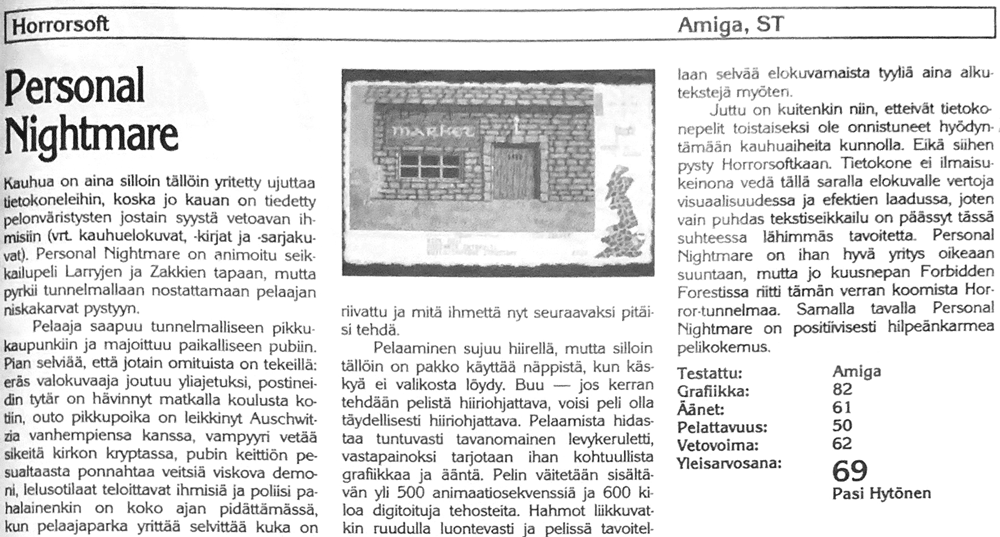
Personal Nightmare1990 KevätPysyvä linkkiKauhua on aina silloin tällöin yritetty ujuttaa tietokoneleihin, koska jo kauan on tiedetty pelonväristysten jostain syystä vetoavan ihmisiin (vrt. kauhuelokuvat, -kirjat ja -sarjakuvat). Personal Nightmare on animoitu seikkailupeli Larryjen ja Zakkien tapaan, mutta pyrkii tunnelmallaan nostattamaan pelaajan niskakarvat pystyyn.
Pelaaja saapuu tunnelmalliseen pikkukaupunkiin ja majoittuu paikalliseen pubiin. Pian selviää, että jotain omituista on tekeillä: eräs valokuvaaja joutuu yliajetuksi, postineidin tytär on hävinnyt matkalla koulusta kotiin, outo pikkupoika on leikkinyt Auschwitzia vanhempiensa kanssa, vampyyri vetää sikeitä kirkon kryptassa, pubin keittiön pesualtaasta ponnahtaa veitsiä viskova demoni, lelusotilaat teloittavat ihmisiä ja poliisi pahalainenkin on koko ajan pidättämässä, kun pelaajaparka yrittää selvittää kuka on riivattu ja mitä ihmettä nyt seuraavaksi pitäisi tehdä.
Pelaaminen sujuu hiirellä, mutta silloin tällöin on pakko käyttää näppistä, kun käskyä ei valikosta löydy. Buu - jos kerran tehdään pelistä hiiriohjattava, voisi peli olla täydellisesti hiiriohjattava. Pelaamista hidastaa tuntuvasti tavanomainen levykeruletti, vastapainoksi tarjotaan ihan kohtuullista grafiikkaa ja ääntä. Pelin väitetään sisältävän yli 500 animaatiosekvenssiä ja 600 kiloa digitoituja tehosteita. Hahmot liikkuvatkin ruudulla luontevasti ja pelissä tavoitellaan selvää elokuvamaista tyyliä aina alkutekstejä myöten.
Juttu on kuitenkin niin, etteivät tietokonepelit toistaiseksi ole onnistuneet hyödyntämään kauhuaiheita kunnolla. Eikä siihen pysty Horrorsoftkaan. Tietokone ei ilmaisukeinona vedä tällä saralla elokuvalle vertoja visuaalisuudessa ja efektien laadussa, joten vain puhdas tekstiseikkailu on päässyt tässä suhteessa lähimmäs tavoitetta. Personal Nightmare on ihan hyvä yritys oikeaan suuntaan, mutta jo kuusnepan Forbidden Forestissa riitti tämän verran koomista Horror-tunnelmaa. Samalla tavalla Personal Nightmare on positiivisesti hilpeänkarmea pelikokemus.
Personal Nightmare1990 KevätPermalinkEvery now and then people have tried to sneak horror into computer games, since it has long been known that shivers of fear, for some reason, appeal to people (cf. horror films, horror books and horror comics). Personal Nightmare is an animated adventure game in the manner of the Larrys and the Zaks, but it uses its atmosphere to try to make the hairs on the back of the player's neck stand on end.
The player arrives in an atmospheric little town and takes a room at the local pub. It soon becomes clear that something strange is going on: a photographer gets run over, the postmistress's daughter has vanished on her way home from school, a weird little boy has been playing Auschwitz with his parents, a vampire is sleeping like a log in the church crypt, a knife-throwing demon pops out of the sink in the pub kitchen, toy soldiers are executing people, and the baddie police are forever about to arrest you while the poor player tries to work out who is possessed and what on earth ought to be done next.
You play with the mouse, but every now and then you're forced to use the keyboard when a command can't be found in the menu. Boo - if you're going to make a game mouse-controlled, the game could jolly well be completely mouse-controlled. Play is slowed down considerably by the usual disk roulette; to make up for it you're offered perfectly decent graphics and sound. The game is claimed to contain over 500 animation sequences and 600K of digitised effects. The characters do move naturally on screen, and the game clearly goes for a cinematic style, right down to the opening credits.
The thing is, though, that computer games haven't so far managed to make proper use of horror themes. And Horrorsoft can't manage it either. As a medium of expression, the computer can't hold a candle to film in this field when it comes to visuals and the quality of effects, so only the pure text adventure has got anywhere near the goal in this respect. Personal Nightmare is a pretty good attempt in the right direction, but the C-64's Forbidden Forest already had this much comical Horror atmosphere. In the same way, Personal Nightmare is a positively jolly-ghastly gaming experience.
Petch
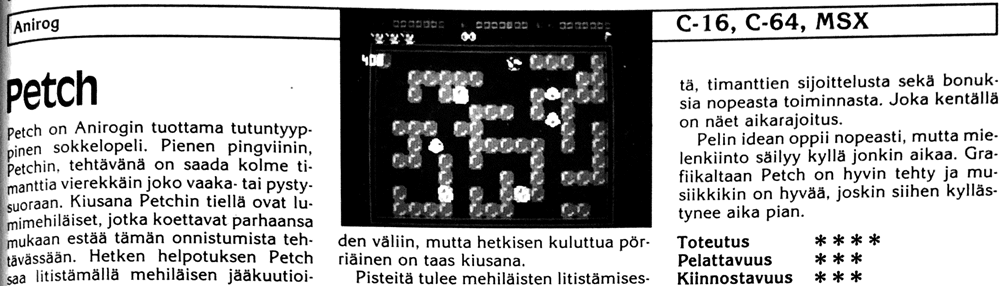
Petch1987Pysyvä linkkiPetch on Anirogin tuottama tutuntyyppinen sokkelopeli. Pienen pingviinin, Petchin, tehtävänä on saada kolme timanttia vierekkäin joko vaaka- tai pystysuoraan. Kiusana Petchin tiellä ovat lumimehiläiset, jotka koettavat parhaansa mukaan estää tämän onnistumista tehtävässään. Hetken helpotuksen Petch saa litistämällä mehiläisen jääkuutioiden väliin, mutta hetkisen kuluttua pörriäinen on taas kiusana.
Pisteitä tulee mehiläisten litistämisestä, timanttien sijoittelusta sekä bonuksia nopeasta toiminnasta. Joka kentällä on näet aikarajoitus.
Pelin idean oppii nopeasti, mutta mielenkiinto säilyy kyllä jonkin aikaa. Grafiikaltaan Petch on hyvin tehty ja musiikkikin on hyvää, joskin siihen kyllästynee aika pian.
Petch1987PermalinkPetch is a maze game of a familiar type, produced by Anirog. The task of the little penguin, Petch, is to get three diamonds next to each other, either horizontally or vertically. Pestering Petch along the way are the snow bees, which try their very best to stop it succeeding in its task. Petch gets a moment's relief by squashing a bee between ice cubes, but after a little while the buzzer is back pestering it again.
Points come from squashing bees and placing diamonds, plus bonuses for quick action. Every level has a time limit, you see.
You pick up the idea of the game quickly, but the interest does hold for a while. Graphically Petch is well made and the music is good too, though you'll probably tire of it fairly soon.
Phantasie II
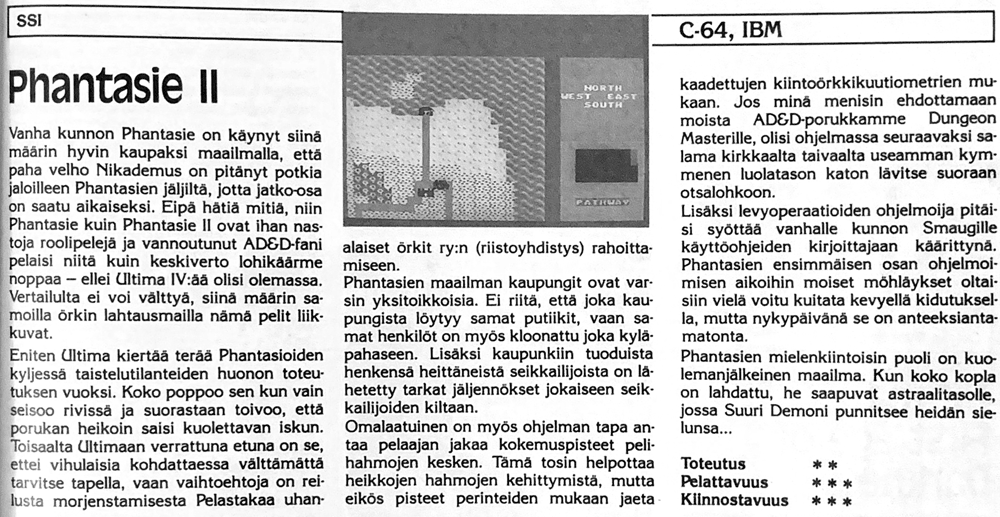
Phantasie II1987Pysyvä linkkiVanha kunnon Phantasie on käynyt siinä määrin hyvin kaupaksi maailmalla, että paha velho Nikademus on pitänyt potkia jaloilleen Phantasien jäljiltä, jotta jatko-osa on saatu aikaiseksi. Eipä hätiä mitiä, niin Phantasie kuin Phantasie II ovat ihan nastoja roolipelejä ja vannoutunut AD&D-fani pelaisi niitä kuin keskiverto lohikäärme noppaa - ellei Ultima IV:ää olisi olemassa. Vertailulta ei voi välttyä, siinä määrin samoilla örkin lahtausmailla nämä pelit liikkuvat.
Eniten Ultima kiertää terää Phantasioiden kyljessä taistelutilanteiden huonon toteutuksen vuoksi. Koko poppoo sen kun vain seisoo rivissä ja suorastaan toivoo, että porukan heikoin saisi kuolettavan iskun. Toisaalta Ultimaan verrattuna etuna on se, ettei vihulaisia kohdattaessa välttämättä tarvitse tapella, vaan vaihtoehtoja on reilusta morjenstamisesta Pelastakaa uhanalaiset örkit ry:n (riistoyhdistys) rahoittamiseen.
Phantasien maailman kaupungit ovat varsin yksitoikkoisia. Ei riitä, että joka kaupungista löytyy samat putiikit, vaan samat henkilöt on myös kloonattu joka kyläpahaseen. Lisäksi kaupunkiin tuoduista henkensä heittäneistä seikkailijoista on lähetetty tarkat jäljennökset jokaiseen seikkailijoiden kiltaan.
Omalaatuinen on myös ohjelman tapa antaa pelaajan jakaa kokemuspisteet pelihahmojen kesken. Tämä tosin helpottaa heikkojen hahmojen kehittymistä, mutta eikös pisteet perinteiden mukaan jaeta kaadettujen kintoörkkikuutiometrien mukaan. Jos minä menisin ehdottamaan moista AD&D-porukkamme Dungeon Masterille, olisi ohjelmassa seuraavaksi salama kirkkaalta taivaalta useamman kymmenen luolatason katon lävitse suoraan otsalohkoon.
Lisäksi levyoperaatioiden ohjelmoija pitäisi syöttää vanhalle kunnon Smaugille käyttöohjeiden kirjoittajaan käärittynä. Phantasien ensimmäisen osan ohjelmoimisen aikoihin moiset möhläykset oltaisiin vielä voitu kuitata kevyellä kidutuksella, mutta nykypäivänä se on anteeksiantamatonta.
Phantasien mielenkiintoisin puoli on kuolemanjälkeinen maailma. Kun koko kopla on lahdattu, he saapuvat astraalitasolle, jossa Suuri Demoni punnitsee heidän sielunsa...
Phantasie II1987PermalinkGood old Phantasie sold so well around the world that the evil wizard Nikademus had to be kicked back onto his feet after the events of Phantasie so that a sequel could be made. No sweat, though: Phantasie and Phantasie II are both perfectly neat role-playing games, and a sworn AD&D fan would play them the way the average dragon plays dice - if Ultima IV didn't exist. There is no avoiding the comparison, these games roam so much the same orc-butchering grounds.
What twists Ultima's knife deepest in the Phantasies' side is the poor handling of combat. The whole gang just stands there in a row, practically hoping that the weakest of the bunch takes a fatal blow. On the other hand, one advantage over Ultima is that you don't necessarily have to fight when you run into the baddies; the options range from a good honest howdy to funding the Save the Endangered Orcs Association (a registered racket).
The towns in the world of Phantasie are pretty monotonous. It isn't enough that every town has the same shops; the same people have also been cloned into every wretched little village. What's more, exact copies of any adventurers who gave up the ghost and were carried into town have been sent to every adventurers' guild.
Another peculiar thing is the way the program lets the player share out the experience points among the characters. Admittedly this makes it easier for weak characters to develop, but aren't points traditionally handed out by the solid cubic metre of orc felled? If I went and suggested anything of the sort to our AD&D group's Dungeon Master, next on the programme would be a bolt from the blue, straight through the ceilings of a few dozen dungeon levels and right into my frontal lobe.
On top of that, whoever programmed the disk operations ought to be fed to good old Smaug, wrapped in the author of the manual. Back when the first part of Phantasie was being programmed, blunders like these could still have been settled with a spot of light torture, but these days it is unforgivable.
The most interesting side of Phantasie is the afterlife. Once the whole mob has been slaughtered, they arrive on the astral plane, where the Great Demon weighs their souls...
Phantasie III - The Wrath of Nikademus

Phantasie III - The Wrath of Nikademus1988Pysyvä linkkiMikäli Ultimoilla on ollut yksinäistä roolipelimarkkinoiden huipulla, niin ei ole enää. Phantasie-sarjan uusimmassa tulokkaassa on sarjan aiempien osien pahimmat virheet korjattu pienempien parannusten ohessa, ja tuloksena on roolipeli, jota pelaa kuin lohikäärme noppaa.
Tällä kertaa tapahtumat sijoittuvat Scandorin mantereelle. Aiemmissa osissa oli kyse Gelnorin ja Ferronnahin kaltaisista pienistä saarista. Nikod... eikun Nikademus, vai mikä se iljetys nyt oikein olikaan, on jälleen vauhdissa. Tällä kertaa hänellä on kohteenaan itse Scandorin manner. Kaiken maailman ja vähän muunkin ötökkää saapuu hänen käskystään kauniin maan rannoille tehtävänään ilmi selvästi tappaa ja syödä (ei välttämättä tässä järjestyksessä) kaikki vastaan tulevat seikkailijat.
Pelaaja kokoaa kuusihenkisen joukon, joka lähtee keräämään kokemusta, aarteita ja aseita. Kun miehet (naiset!) lopulta alkavat olla tarpeeksi kokeneita, on aika käydä itse Nikademuksen kimppuun. Kokemus luokitellaan kokemuspisteiden avulla. Kun pisteitä on tarpeeksi, henkilö voi mennä koulutukseen, jossa hän oppii lisää taitoja ja loitsuja sekä kestämään vihollisten iskuja paremmin.
Uutta realismia tähänastisiin tietokoneroolipeleihin verrattuna on se, että normaalien hit pointsien (iskupisteiden) lisäksi pelihahmon terveydentila on määritelty kaikkien raajojen, vartalon ja pään osalta erikseen. Tämä käytäntöhän on tuttu eräistä 'oikeista' roolipeleistä kuten esimerkiksi Runequestista. Kukin ruumiinosa voi olla joko terve, loukkaantunut, poikki tai poissa. Ideana on se, että esimerkiksi katkenneella oikealla kädellä on hyvin vaikea heilutella miekkaa, tai kadonneella päällä pysyä hengissä. Kaikeksi onneksi tarpeeksi tasokas pappi voi jopa kasvattaa irronneen raajan paikoilleen. Pään suhteen tarvitaankin sitten jo todella pätevä hengenmies.
Kukin pelihahmo voi olla ammatiltaan joko soturi, samoaja, velho (Wexteen the Wizard I presume), pappi, munkki tai varas. Eri ammattikunnilla on erilaisia kykyjä ja erilaisia loitsuja. Vastaavasti myös hahmon rotu voi vaihdella ihmisestä puolituisen kautta peikkoon. Myös eri rotujen ominaisuudet vaihtelevat, ja tietyt rodut soveltuvat toisia paremmin tiettyihin ammatteihin.
Ohjelman tekijä Winston Wood (Phantasioissa on ja on ollut mukana muiden muassa henkilö nimeltä Lord Wood) on onnistunut erinomaisesti yhdistämään uudet ideansa aiempien Phantasioiden tunnelmaan. Poissa ovat tuskastuttavan pitkät mietiskelytauot ja kömpelöhkö grafiikka, jotka ovat olleet peittää erinomaisen juonen alleen. Tilalle ovat tulleet jouset, pelihahmojen ryhmittely taistelussa kolmeen riviin, käytännölliset käskyvalikot ja muuta. Paras kaikista on kuitenkin eri ruumiinosien terveydentilan huomioiva hit point -järjestelmä.
Vaikka Phantasie III on roolipeliksi harvinaisen monipuolinen, siihen on yllättävän helppo päästä sisälle. Pelihahmoja tosin kuolee ensi alkuun kuin kärpäsiä, mutta niin käy kokeneemmallekin pelaajalle (nimim. Kokemusta On). Lisäksi ohjelma on onnistuttu ahtamaan kahdelle levyn puoliskolle, joista toista tarvitaan vain ohjelmaa käynnistettäessä. Jatkuvaa levyruljanssia ohjelman aikana ei siis ole! 1541:n toimintanopeus tosin aiheuttaa viivettä, kun siirrytään kaupunkiin tai luolaan, mutta kaikki ohjelman aikana tarvittava tieto on tosiaan yhdellä levykkeellä.
Ohjelma tukee varmuuskopion tekemistä sisältäen itse ohjelman, jolla pelilevystä (siitä levystä, jota tarvitaan ohjelman aikana) tehdään kopio itse pelaamista varten. Alkuperäisellä levykkeellä pelaaminen ei oikein edes onnistu.
Kuten edellä kerrotusta voi päätellä, Phantasie III on erinomainen roolipeli ja onnistunut ostos, jonka avulla voi pitää miekkansa terän terävänä Ultima V:ttä odotellessaan.
Phantasie III - The Wrath of Nikademus1988PermalinkIf the Ultimas have been lonely at the top of the role-playing market, they aren't any more. In the newest arrival in the Phantasie series the worst faults of the earlier instalments have been fixed, along with smaller improvements, and the result is a role-playing game you'll play the way a dragon plays dice.
This time the action is set on the continent of Scandor. The earlier instalments dealt with small islands like Gelnor and Ferronnah. Nikod... er, I mean Nikademus, or whatever that abomination's name was again, is on the go once more. This time his target is the continent of Scandor itself. At his command, every creepy-crawly under the sun and then some arrives on the shores of the beautiful land, with the obvious mission of killing and eating (not necessarily in that order) every adventurer it comes across.
The player assembles a party of six, which sets off to gather experience, treasure and weapons. When the men (women!) finally start to be experienced enough, it's time to go after Nikademus himself. Experience is measured in experience points. Once a character has enough points, they can go for training, where they learn more skills and spells and to withstand enemy blows better.
What's new in realism compared with the computer role-playing games so far is that besides the usual hit points, a character's state of health is defined separately for every limb, the torso and the head. This practice is familiar, of course, from certain 'real' role-playing games such as Runequest. Each body part can be healthy, injured, broken or gone. The idea is that, for example, it's very hard to swing a sword with a broken right arm, or to stay alive with a missing head. Luckily, a priest of high enough level can even grow a severed limb back into place. When it comes to the head, though, you'll need a truly accomplished man of the cloth.
Each character can be, by profession, a fighter, ranger, wizard (Wexteen the Wizard I presume), priest, monk or thief. The different professions have different abilities and different spells. Likewise a character's race can range from human via halfling to troll. The races' attributes vary too, and certain races are better suited than others to certain professions.
The program's author Winston Wood (the Phantasies feature, and have featured, among others a character called Lord Wood) has done a superb job of blending the new ideas into the atmosphere of the earlier Phantasies. Gone are the agonisingly long pauses for thought and the rather clunky graphics, which all but buried the excellent plot. In their place have come bows, arranging the characters into three ranks in combat, handy command menus and more. Best of all, though, is the hit point system that keeps track of the health of each body part.
Although Phantasie III is unusually versatile for a role-playing game, it's surprisingly easy to get into. Admittedly characters drop like flies at first, but that happens to more experienced players too (signed, Speaking From Experience). What's more, they've managed to cram the program onto two disk sides, one of which is only needed when starting up. So no constant disk juggling while you play! The 1541's speed does cause delays when you move into a town or a dungeon, but everything the program needs while running really is on a single disk.
The program supports making a backup, and includes a utility of its own for copying the game disk (the disk that is needed while the program is running) to actually play on. Playing on the original disk doesn't really even work.
As you can gather from the above, Phantasie III is an excellent role-playing game and a sound purchase that will keep your sword's edge sharp while you wait for Ultima V.
Phantasm
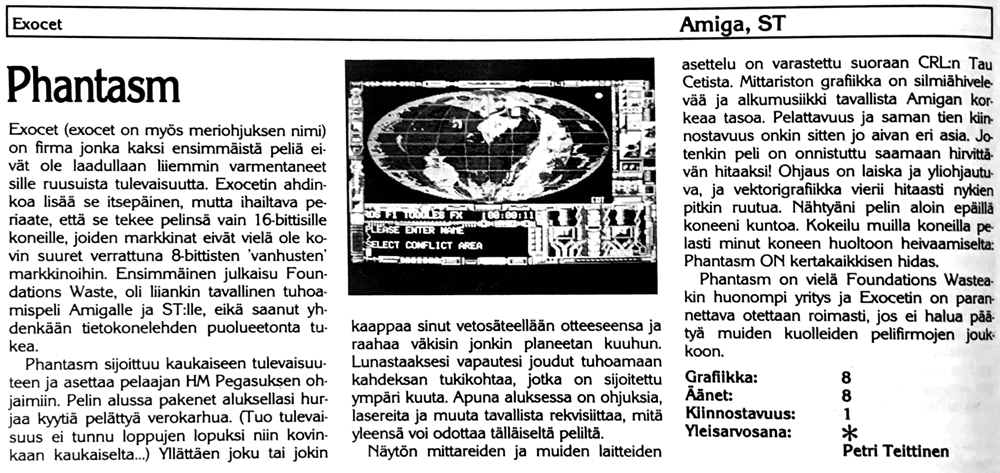
Phantasm1988Pysyvä linkkiExocet (exocet on myös meriohjuksen nimi) on firma jonka kaksi ensimmäistä peliä eivät ole laadullaan liiemmin varmentaneet sille ruusuista tulevaisuutta. Exocetin ahdinkoa lisää se itsepäinen, mutta ihailtava periaate, että se tekee pelinsä vain 16-bittisille koneille, joiden markkinat eivät vielä ole kovin suuret verrattuna 8-bittisten 'vanhusten' markkinoihin. Ensimmäinen julkaisu Foundations Waste, oli liiankin tavallinen tuhoamispeli Amigalle ja ST:lle, eikä saanut yhdenkään tietokonelehden puolueetonta tukea.
Phantasm sijoittuu kaukaiseen tulevaisuuteen ja asettaa pelaajan HM Pegasuksen ohjaimiin. Pelin alussa pakenet aluksellasi hurjaa kyytiä pelättyä verokarhua. (Tuo tulevaisuus ei tunnu loppujen lopuksi niin kovinkaan kaukaiselta...) Yllättäen joku tai jokin kaappaa sinut vetosäteellään otteeseensa ja raahaa väkisin jonkin planeetan kuuhun. Lunastaaksesi vapautesi joudut tuhoamaan kahdeksan tukikohtaa, jotka on sijoitettu ympäri kuuta. Apuna aluksessa on ohjuksia, lasereita ja muuta tavallista rekvisiittaa, mitä yleensä voi odottaa tälläiseltä peliltä.
Näytön mittareiden ja muiden laitteiden asettelu on varastettu suoraan CRL:n Tau Cetista. Mittariston grafiikka on silmiähivelevää ja alkumusiikki tavallista Amigan korkeaa tasoa. Pelattavuus ja saman tien kiinnostavuus onkin sitten jo aivan eri asia. Jotenkin peli on onnistuttu saamaan hirvittävän hitaaksi! Ohjaus on laiska ja yliohjautuva, ja vektorigrafiikka vierii hitaasti nykien pitkin ruutua. Nähtyäni pelin aloin epäillä koneeni kuntoa. Kokeilu muilla koneilla pelasti minut koneen huoltoon heivaamiselta: Phantasm ON kertakaikkisen hidas.
Phantasm on vielä Foundations Wasteakin huonompi yritys ja Exocetin on parannettava otettaan roimasti, jos ei halua päätyä muiden kuolleiden pelifirmojen joukkoon.
Phantasm1988PermalinkExocet (exocet is also the name of a naval missile) is a company whose first two games have not, by their quality, done much to guarantee it a rosy future. Exocet's predicament is made worse by its stubborn but admirable principle of making its games only for 16-bit machines, whose market is not yet very big compared with the market for the 8-bit 'old-timers'. Its first release, Foundations Waste, was an all-too-ordinary shoot-'em-up for the Amiga and ST, and did not win the impartial backing of a single computer magazine.
Phantasm is set in the distant future and puts the player at the controls of the HM Pegasus. At the start of the game you are fleeing in your ship at a breakneck pace from the dreaded taxman. (That future doesn't feel all that distant after all...) Suddenly someone or something grabs you in its tractor beam and drags you by force to the moon of some planet. To buy back your freedom you have to destroy eight bases scattered around the moon. To help you out, the ship carries missiles, lasers and the rest of the usual props you would generally expect from a game like this.
The layout of the on-screen gauges and other instruments has been stolen straight from CRL's Tau Ceti. The instrument panel graphics are a feast for the eyes and the title music is up to the Amiga's usual high standard. Playability, and with it interest, is then a whole different matter. Somehow they have managed to make the game horrendously slow! The controls are sluggish and oversteer, and the vector graphics crawl jerkily across the screen. After seeing the game I began to doubt the health of my machine. Trying it on other machines saved me from hauling mine off to be repaired: Phantasm IS downright slow.
Phantasm is an even worse effort than Foundations Waste, and Exocet will have to raise its game considerably if it doesn't want to end up among all the other dead games companies.
Phantasy Star
Phantasy Star1990 KevätPysyvä linkkiPhantasy Starin sankari ei olekaan tavanomainen öljyisiä lihaksia pullisteleva streroidiveikko, vaan Alis-niminen hento tyttölapsi. Pelin johdannossa tyrannimainen Lassic on murhannut velikullan, joten Alis päättää pistää Algolin valtarakenteet uusiksi.
Pelialueeseen kuuluu kolme planeettaa Algolin tähtiryhmästä: vihreä Palma, joka on Alisin kotiplaneetta, autiomaan peittämä Motavia ja hyisen kylmä Dezoria. Vaelluksella seurueeseen liittyy soturi, velho ja Myau-niminen kissa, joilla kullakin on omat erikoistaitonsa. Roolipelimäiseen tyyliin pelissä on tärkeää keskustella asukkaiden kanssa ja kerätä rahaa ja kokemusta taistelemalla hirviölaumoja vastaan. Hirmujen jättämistä arkuista voi kahmia mesetoja, jotka tuhlataan ruokaan, käyttöesineisiin, parempiin aseisiin ja haarniskoihin.
Grafiikassa on kolmenlaista esitystapaa. Maanpäällisissä jaksoissa on käytetty yläperspektiivistä kuvattua maisemaa, jossa seurue liikkuu veikeänä letkana. Maanalaisissa tyrmissä vaihdetaan sutjakkaaseen kolmiulotteiseen vieritykseen. Putiikeissa ja taisteluiden aikana ruudussa on staattinen lähikuva. Loitsut, esineet, tilanteen tallennus ja muu vastaava löytyy napin painalluksella esiin ponnahtavasta valikosta.
Tilanteen mukaan vaihtuva musiikki on miellyttävän melodista ja kestää pitkää kuuntelua. Myös grafiikka repii Segasta kaiken irti. Erilaisia hirviötä löytyy loputtomasti ja niiden taidokkaasti piirretyistä pikseleistä pursuaa musertavaa voimaa. Varsinkin tyrmän kattoa hipovat lohikäärmeet ja titaanit saavat heikkohermoisen kirkumaan.
Laadusta kertoo sekin, että tyrmässä kääntyminen on kuvattu sulavasti vierittämällä. Ainoa valittamisen aihe löytyy hirviöiden animaatiosta. Aluksi se on nautinnollista nähtävää, mutta kun kimppuun käy sadannen kerran kuuden zombien jengi, niin saman koreografian katseleminen alkaa lievästi sanottuna tympiä.
Phantasy Starin juoni on jännittävä yhdistelmä ritariajan maailmasta ja modernista tieteiskuvitelmasta. Peli tarjoaa sopivassa tahdissa uusia tutkimattomia paikkoja ja selkeitä välitavoitteita, joten sen parissa aika rientää mukavasti aamuyön tunteina. Uuvuttavia taisteluita on ehkä rahtusen verran liian tiheässä, mutta ei peliin silti kyllästy. Jotain taianomaista vetovoimaa siihen on kätketty.
Phantasy Star1990 KevätPermalinkThe hero of Phantasy Star turns out not to be the usual steroid lad flexing oily muscles, but a slender little girl named Alis. In the game's intro the tyrannical Lassic has murdered her dear brother, so Alis decides to turn the power structures of Algol upside down.
The playing area takes in three planets of the Algol star system: green Palma, which is Alis's home planet, desert-covered Motavia and icy-cold Dezoria. On her travels the party is joined by a warrior, a wizard and a cat named Myau, each of whom has their own special skills. In role-playing style, it's important in the game to talk with the inhabitants and to gather money and experience by fighting hordes of monsters. From the chests the brutes leave behind you can scoop up mesetas, which get blown on food, utility items, better weapons and armour.
The graphics come in three styles of presentation. The overground sections use a landscape seen from above, across which the party moves in a jaunty little line. In the underground dungeons it switches to slick three-dimensional scrolling. In the shops and during fights the screen shows a static close-up. Spells, items, saving your position and the like are found in a menu that pops up at the press of a button.
The music, which changes to suit the situation, is pleasantly melodic and stands up to long listening. The graphics, too, wring everything out of the Sega. There's no end of different monsters, and crushing power bursts out of their skilfully drawn pixels. The dragons and titans brushing the dungeon ceiling in particular will have the faint-hearted screaming.
Another sign of the quality is that turning in the dungeon is shown with smooth scrolling. The only cause for complaint is the monster animation. At first it's a delight to watch, but when a gang of six zombies jumps you for the hundredth time, watching the same choreography starts, to put it mildly, to get tiresome.
Phantasy Star's plot is an exciting combination of the age of chivalry and modern science fiction. The game serves up new unexplored places and clear intermediate goals at just the right pace, so the hours fly by pleasantly with it into the small hours of the morning. The exhausting battles come perhaps a tad too thick and fast, but you still don't get fed up with the game. Some kind of magical pull has been hidden inside it.
PHM Pegasus
PHM Pegasus1988Pysyvä linkkiPHM Pegasus on kova sana niin Rapakon tuolla kuin tälläkin puolen. Pääseehän siinä ampumaan PLO:n sissejä, syyrialaisia, kuubalaisia, libyalaisia, nicaraqualaisia ja iranilaisia. Mikäs sen mukavampaa.
Pelaaja asetetaan erittäin nopean ohjuksilla ja 76-millisellä tykillä varustetun kantosiipialuksen ruoriin. Tehtävänään hänellä on etsiä ja tuhota vihollisia eri puolilla maailmaa, valokuvata Nicaraquaan matkalla olevia aluksia aselastin löytämiseksi, viedä alus vihamielisten vesialueiden lävitse, saattaa huoltoaluksia Persian lahdella ja muualla ja mitä vielä.
Pelin toiminta jakautuu kahdelle näytölle. Toisella pelaaja näkee pelikentän jollakin maailman tulenaroista merialueista, ja toisella avautuu näkymä kantosiipialuksen komentosillalta. Mukana ovat myös aluksen mittaristo ja kiikari, jolla voi tiirailla vastaan tulevia aluksia.
Varsinainen mäiske keskittyy kiikariin, jossa tykin tähtäintä pitää liikutella kiikarissa näkyvän aluksen suhteen oikean ennakon määrittämiseksi. Komentosiltanäkymä vaikuttaa muilta osin pelkältä koristeelta. Ohjelmassa voi myös ohjata etsintähelikopteria tai saatettavaa rahtialusta, joiden hallintalaitteet toimivat periaatteessa samalla tavalla kuin kantosiipialuksenkin.
Kaiken kaikkiaan Pegasus on pienoinen pettymys ennakkomaineeseensa ja erityisesti EOA-kuoriinsa nähden. Varsinaista toimintaa on hyvin vähän ja siihenkin kyllästyy varsin pian. Jos joku saa tyydytystä siitä, että räiskii kaikki omenapiirakan viholliset shanguainruoaksi niin siitä vaan. Muuten tässä pelisssä ei haise mikään muu kuin vuosisadan vaihteen tykkivenepolitiikan härskiintyneet aseöljyt ja erään suurvallan alemmuuskompleksi.
PHM Pegasus1988PermalinkPHM Pegasus is big news on both sides of the Pond. After all, it lets you shoot PLO guerrillas, Syrians, Cubans, Libyans, Nicaraquans and Iranians. What could be more fun?
The player is put at the helm of a very fast hydrofoil armed with missiles and a 76-millimetre gun. The tasks at hand are to seek out and destroy enemies in various parts of the world, photograph ships bound for Nicaraqua to uncover arms shipments, take the boat through hostile waters, escort supply ships in the Persian Gulf and elsewhere, and what have you.
The game's action is split across two screens. On one the player sees the playing area in one of the world's volatile stretches of sea, and the other opens up a view from the hydrofoil's bridge. Also included are the boat's instruments and a pair of binoculars for squinting at approaching vessels.
The actual mayhem centres on the binoculars, where you have to move the gun sight relative to the ship visible in them to work out the right lead. Apart from that, the bridge view seems to be mere decoration. In the program you can also steer a search helicopter or the cargo ship you're escorting, whose controls work basically the same way as the hydrofoil's.
All in all, Pegasus is a bit of a letdown given its advance reputation and especially its EOA packaging. There's very little actual action, and you get fed up with even that pretty quickly. If somebody gets satisfaction out of blasting every enemy of apple pie into Shanguai chow, go right ahead. Otherwise, the only things that stink in this game are the rancid gun oils of turn-of-the-century gunboat diplomacy and a certain superpower's inferiority complex.
Phobia
Phobia1989 SyksyPysyvä linkkiKuusnelosesta ja Monty Molesta tunnettu peliguru Tony Crowther on jälleen vauhdissa. Tällä kertaa mies on ottanut 16-bittistä sarvista ja koodannut itse myös Phobian Amiga-version.
Pelon mestari lordi Phobos on vanginnut galaktisen presidentin tyttären ja pitää sulotarta suojissaan auringon kehällä. Pelastuspartion pelossa Phobos on luonut useita planeettoja, jotka sankarin täytyy kiertää läpi saavuttaakseen auringon.
Jokaisella planeetalla on paljon erilaisia vihollisia. Sankarin täytyy kerätä sivuttain vieriviltä kentiltä voimapillereitä tuhoten samalla erikokoisia hämähäkkejä ja muita mönkiäisiä. Jokaisen kentän lopussa on iso monsteri, jota täytyy jyntätä olan takaa. Mikäli sankari missaa yhdenkin voimapillerin, tai häviää kamppailun pääjehua vastaan, koko taso on aloitettava alusta.
Planeetat on nidottu toisiinsa eräänlaisella seittimäisellä verkolla. Pelaaja voi itse valita reitin, jota pitkin kulkee aurinkoon. Reittivaihtoehtoja on useita, ja sen takia peliä täytyy pelata useampaan otteeseen ennenkuin kaikki tasot on nähty.
Mullistavana lisänä normaaliin shoot-em-uppiin Phobiassa on kaksinpelioptio, jossa molemmat pelaajat räiskivät ruudussa yhtäaikaa. Oivallinen oivallus on myös se, että toisen aluksen ampuessa toista ammutun voimat lisääntyvät. Näin saadaan aikaan hyperlatinki, jolla voi grillata pahimmatkin vastustajat.
Kentät eivät todellakaan ole helppoja ja parhaiten ne pääseekin läpi pelaamalla kaverin kanssa. Yksinpeliä on onneksi helpotettu aluksen tuplausmahdollisuudella. Spacea painamalla yhdestä tulee kaksi ja tulivoima moninkertaistuu. Pahaksi onneksi myös viholliset osuvat kaksin verroin paremmin.
Täydellisestä hyökkäyksen torjumisesta kentälle jää lillumaan potikoita, joita keräämällä aluksen ominaisuudet karttuvat. Nopeutta tulee lisää ja tulitus voimistuu sekä tuplaantuu hajaantuen sekalaisiin suuntiin.
Phobian grafiikka on molemmissa koneissa varsin selkeää ja taidolla tehtyä. Crowther on ideoinut kenttiin varsin mielipuolista grafiikka, vai miltä kuulostaa tappava kostajavesihana? Äänipuoli on sitävastoin jäänyt viimeistelemättä: efektit ovat lähinnä tavanomaisia ja alkumusiikki Paradroid-tyy listä piipelipaapelia.
Amiga-version grafiikka on suurempaa kuin kuusnelosen. Tämän vuoksi ruutu skrollaa myös ylös-alas muutaman rivin, jolloin pelaaja ei välttämättä näe mitä tulossa on. Tämän haitan voi poistaa siirtymällä interlace-näyttöön, jolloin koko ruutu pienenee puolella.
Aloittelijalle Phobia saattaa tuntua mahdottoman vaikealta selvittää. Mutta kun on oppinut tietyt liikeradat pelaaminen maistuu mansikalta ja peliin on palattava, kunnes kaikki radat on tutkittu.
Phobia1989 SyksyPermalinkGame guru Tony Crowther, known from the C-64 and Monty Mole, is on a roll again. This time the man has taken the 16-bit bull by the horns and coded the Amiga version of Phobia personally as well.
The master of fear, Lord Phobos, has captured the daughter of the galactic president and keeps the fair maiden in his clutches on the rim of the sun. Fearing a rescue party, Phobos has created a number of planets that the hero has to work through to reach the sun.
Every planet has lots of different enemies. The hero has to collect power pills from the sideways-scrolling levels while destroying spiders of all sizes and other creepy-crawlies. At the end of each level there's a big monster that has to be pounded for all you're worth. If the hero misses even a single power pill, or loses the fight against the head honcho, the whole level has to be started over.
The planets are bound to one another by a kind of cobweb-like network. The player can choose the route to take to the sun. There are several alternative routes, and because of that the game has to be played a number of times before all the levels have been seen.
As a revolutionary addition to the normal shoot-em-up, Phobia has a two-player option in which both players blast away on screen at the same time. Another brilliant brainwave is that when one ship shoots the other, the one being shot gets more powerful. This produces a hyper-charge that can grill even the nastiest opponents.
The levels are certainly not easy, and the best way to get through them is to play with a mate. Luckily, solo play has been made easier with the option of doubling your ship. Press space and one becomes two and your firepower multiplies. As bad luck would have it, the enemies also hit twice as well.
Wiping out an attack wave completely leaves pods bobbing about on the level, and collecting them builds up your ship's abilities. You get more speed, and your fire grows stronger and doubles, spraying out in all sorts of directions.
Phobia's graphics are very clear and skilfully done on both machines. Crowther has dreamed up some pretty deranged graphics for the levels, or how does a deadly avenger water tap sound to you? The sound side, on the other hand, has been left unpolished: the effects are mostly run-of-the-mill and the title music is Paradroid-style bleepety-bloopety.
The Amiga version's graphics are bigger than the C-64's. Because of this the screen also scrolls up and down by a few lines, so the player can't necessarily see what's coming. You can get rid of this drawback by switching to the interlace display, which shrinks the whole screen by half.
To a beginner, Phobia may seem impossibly hard to crack. But once you've learned certain flight paths, playing tastes as sweet as strawberries and you have to keep coming back to the game until all the paths have been explored.
Photon Storm
Photon Storm1990 SyksyPysyvä linkkiJeff Minter, kuka ihmeen Jeff Minter? Leikki sikseen, kaikkihan Jeffin tuntevat, tai ainakin pitäisi tuntea. Hän oli kansainvälisesti tunnettu pelintekijä jo silloin, kun Vic 20 oli markkinoiden kovin pelikone. Lähes kymmenen vuotta on vierähtänyt, mutta yhä hän jaksaa tehdä pelejä eikä ole myöskään muuttanut tyyliään mihinkään suuntaan.
Perushippi Minterin näkemyksen mukaan pelissä pitää olla agressiivista toimintaa ruudun täydeltä, kaikki muu on epäolennaista. Tähän kaavaan istuu luontevasti myös Photon Storm, joka on jonkinlainen psykedelisoitu versio Stargatesta.
Pelaajalla on vapaasti avaruudessa leijuva hiiriohjattava alus, jonka laserit sylkevät sädekimppuja kolmeen suuntaan. Tehtävänä on yksinkertaisesti tyhjentää kenttä ja sitten loikata Llamasoftin logoa muistuttavan portin läpi seuraavaan. Ylimääräisiä bonuksia ansaitsee keräämällä plutoniumia, jota vihollinen pyrkii rahtaamaan taisteluaseman rakennusaineeksi. Jos ei pidä puoliaan, vihollinen aktivoi kammottavan kuolontähden, joka yrittää muuttaa sankarin kaasupilveksi yleensä siinä onnistuen.
Photon Storm on täynnä näppäriä pikku oivalluksia. Tulitus ja liikuminen suunnataan erikseen, tasojen välissä on kauniilla varppiefektillä terästetty tunnelijakso ja tutka muuttaa suurennosta automaattisesti, kunnes siinä näkyy vihollisia. Mutta oleellisinta on pelkistetty toiminta, jossa on samaa nostalgista henkeä kuin erinomaisessa Datastormissa. Juuri sitä, mitä Minteriltä sopii odottaakin: Hengästyttävää vauhtia, kirjavilla pistekuvioilla luotuja räjähdyksiä ja muita surrealistisia efektejä, jopa äänitehosteet ovat kuin kaikuja menneisyydestä.
Nykyaikaisten suurproduktioden hemmottelema pelaajasukupolvi ei välttämättä Minterin tyylistä pidä. Peli on kuitenkin omalla tavallaan kiehtova aikamatka tietokonepelien juurille.
Photon Storm1990 SyksyPermalinkJeff Minter, who on earth is Jeff Minter? Joking aside, everyone knows Jeff, or at least they ought to. He was an internationally known game maker back when the Vic 20 was the hottest gaming machine on the market. Nearly ten years have rolled by, but he still has the energy to make games, and he hasn't changed his style in any direction either.
In the view of Minter, your basic hippie, a game has to have a screenful of aggressive action; everything else is irrelevant. Photon Storm, a sort of psychedelicised version of Stargate, fits naturally into this formula too.
The player has a mouse-controlled ship floating freely in space, whose lasers spit out bundles of beams in three directions. The task is simply to clear the level and then leap through a gate resembling the Llamasoft logo into the next one. Extra bonuses are earned by collecting plutonium, which the enemy is trying to haul off as building material for a battle station. If you don't stand your ground, the enemy activates a horrific death star that tries to turn the hero into a cloud of gas, and usually succeeds.
Photon Storm is full of neat little touches. Firing and movement are aimed separately, between levels there's a tunnel sequence spiced up with a beautiful warp effect, and the radar changes its magnification automatically until enemies show up on it. But the most essential thing is the stripped-down action, which has the same nostalgic spirit as the excellent Datastorm. Just what you'd expect from Minter: breathtaking speed, explosions made of colourful dot patterns and other surreal effects, and even the sound effects are like echoes from the past.
A generation of players spoilt by today's big-budget productions won't necessarily like Minter's style. In its own way, though, the game is a fascinating trip back in time to the roots of computer games.
Pick'n Pile

Pick'n Pile1991 SyksyPysyvä linkkiPick'n Pile paisuttaa palikkapelien paljoutta. Pallojen putoiltua pelikentälle pelaaja poistaa pikavauhtia pintavärin perusteella pystyriveihin pinotut palikat. Paljon palikkapelejä pelanneena pää pakostakin pakkaa puutumaan pakkosyötön paineessa.
Vastaavia ideoita on nähty aivan liikaa viime aikoina, muttei PP pelkkää peetä ole vihjailusta huolimatta. Eniten eroa vastaaviin variaatioihin on siinä, että PP on ennemminkin nopeatempoista sählinkiä aikarajan puitteissa kuin syvämietteistä palikoiden asettelua.
Ideana on, että klikattaessa kahta palloa ne vaihtavat paikkaa. Kun kokonaisen pystyrivin pallot ovat samaa väriä, ne katoavat. Pallojen lisäksi kentällä on kiinteitä palkkeja, joita käytetään tukena pinottaessa korkeampia torneja, sillä pallot valuvat alas painovoimaa totellen. Muita erikoisuuksia ovat ylös leviävät liekit, pommit, aikaa kiihdyttävät pikkupaholaiset ja jokeripalat, joista saa bonuskertoimia ja lisäaikaa.
Pelin aivoja rasittava osuus rajoittuu lähinnä siihen, että mistään väristä ei saisi jäädä jäljelle yhtä yksinäistä palleroa. Mikäli aika riittää, tästäkin tilanteesta voi helposti luistaa nappia painelemalla, jolloin taivaalta sataa satunnaista pallovarastoa.
Tuloksena ei välttämättä olekaan hyvä peli, vaikka idea olisi miten yksinkertainen ja teoriassa tehokas. PP:tä pelaa kerran pari vaikutelman ollessa positiivinen, mutta minkäänlaista halua palata pelin ääreen ei ole havaittavissa. Se on tuupattava samaan lokeroon muiden pasianssien kanssa, jotka kaivetaan esiin vain hätätilanteessa paremman tekemisen puutteessa.
Pick'n Pile1991 SyksyPermalinkPick'n Pile pumps up the plethora of puzzle-block programs. Pellets plop onto the playfield, and the player promptly purges the pieces piled in perpendicular pillars, picking them by pigment. Having played plenty of puzzle-block programs, a player's pate predictably proceeds to petrify under the pressure of perpetual force-feeding.
Similar ideas have been seen far too often lately, but PP isn't pure pee, the insinuations notwithstanding. Where it differs most from similar variations is that PP is more a matter of fast-paced frantic fumbling against a time limit than of deeply contemplative block placement.
The idea is that when you click on two balls, they swap places. When all the balls in an entire column are the same colour, they disappear. Besides the balls, the playfield has fixed bars which are used as supports when stacking taller towers, since the balls slide down in obedience to gravity. Other special features include flames that spread upwards, bombs, little devils that speed up time, and joker pieces that give you bonus multipliers and extra time.
The brain-taxing part of the game is mostly limited to making sure that no colour is left with one lonely little ball. If time allows, you can easily wriggle out of even that situation by pressing a button, whereupon a random supply of balls rains down from the sky.
The result isn't necessarily a good game, however simple and in theory effective the idea may be. You play PP once or twice with a positive impression, but no desire whatsoever to come back to it can be detected. It has to be shoved into the same pigeonhole as the other solitaire games, which get dug out only in an emergency for lack of anything better to do.
Pinball Magic
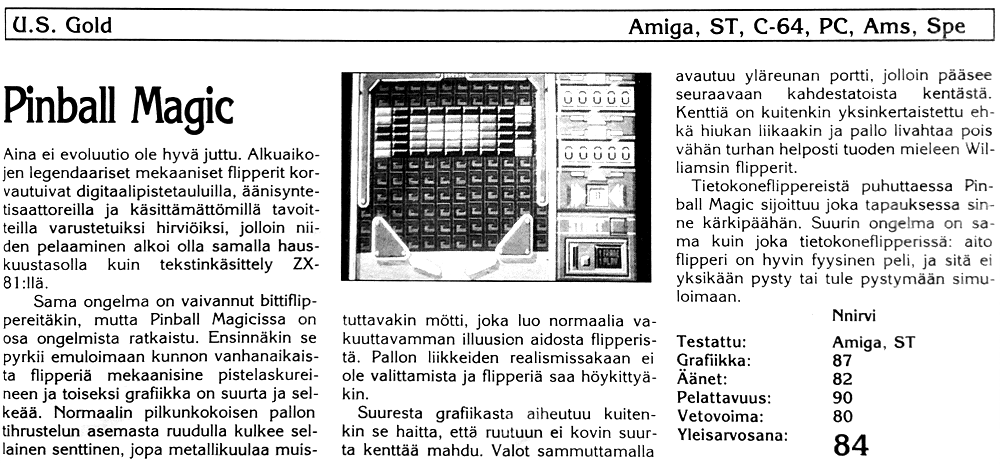
Pinball Magic1990 SyksyPysyvä linkkiAina ei evoluutio ole hyvä juttu. Alkuaikojen legendaariset mekaaniset flipperit korvautuivat digitaalipistetauluilla, äänisyntetisaattoreilla ja käsittämättömillä tavoitteilla varustetuiksi hirviöiksi, jolloin niiden pelaaminen alkoi olla samalla hauskuustasolla kuin tekstinkäsittely ZX-81:llä.
Sama ongelma on vaivannut bittiflippereitäkin, mutta Pinball Magicissa on osa ongelmista ratkaistu. Ensinnäkin se pyrkii emuloimaan kunnon vanhanaikaista flipperiä mekaanisine pistelaskureineen ja toiseksi grafiikka on suurta ja selkeää. Normaalin pilkunkokoisen pallon tihrustelun asemasta ruudulla kulkee sellainen senttinen, jopa metallikuulaa muistuttavakin mötti, joka luo normaalia vakuuttavamman illuusion aidosta flipperistä. Pallon liikkeiden realismissakaan ei ole valittamista ja flipperiä saa höykittyäkin.
Suuresta grafiikasta aiheutuu kuitenkin se haitta, että ruutuun ei kovin suurta kenttää mahdu. Valot sammuttamalla avautuu yläreunan portti, jolloin pääsee seuraavaan kahdestatoista kentästä. Kenttiä on kuitenkin yksinkertaistettu ehkä hiukan liikaakin ja pallo livahtaa pois vähän turhan helposti tuoden mieleen Williamsin flipperit.
Tietokoneflippereistä puhuttaessa Pinball Magic sijoittuu joka tapauksessa sinne kärkipäähän. Suurin ongelma on sama kuin joka tietokoneflipperissä: aito flipperi on hyvin fyysinen peli, ja sitä ei yksikään pysty tai tule pystymään simuloimaan.
Pinball Magic1990 SyksyPermalinkEvolution isn't always a good thing. The legendary mechanical pinball machines of the early days gave way to monsters equipped with digital scoreboards, sound synthesisers and incomprehensible objectives, whereupon playing them started to be about as much fun as word processing on a ZX-81.
The same problem has plagued bit-pinballs too, but Pinball Magic has solved some of the problems. Firstly, it tries to emulate a proper old-fashioned pinball machine with mechanical score counters, and secondly the graphics are big and clear. Instead of squinting at the usual comma-sized ball, what rolls around the screen is a centimetre-wide lump that even resembles a metal ball, which creates a more convincing illusion of a real pinball machine than usual. There's nothing to complain about in the realism of the ball's movement either, and you can even give the table a good thumping.
The big graphics do have one drawback, though: not a very big table fits on the screen. Turning off the lights opens the gate at the top, taking you on to the next of the twelve tables. The tables have perhaps been simplified a little too much, however, and the ball slips away rather too easily, which brings Williams' pinball machines to mind.
When it comes to computer pinball, Pinball Magic ranks up there at the top end in any case. The biggest problem is the same as with every computer pinball: real pinball is a very physical game, and not a single one of them can simulate that, or ever will.
Pinball Wizard
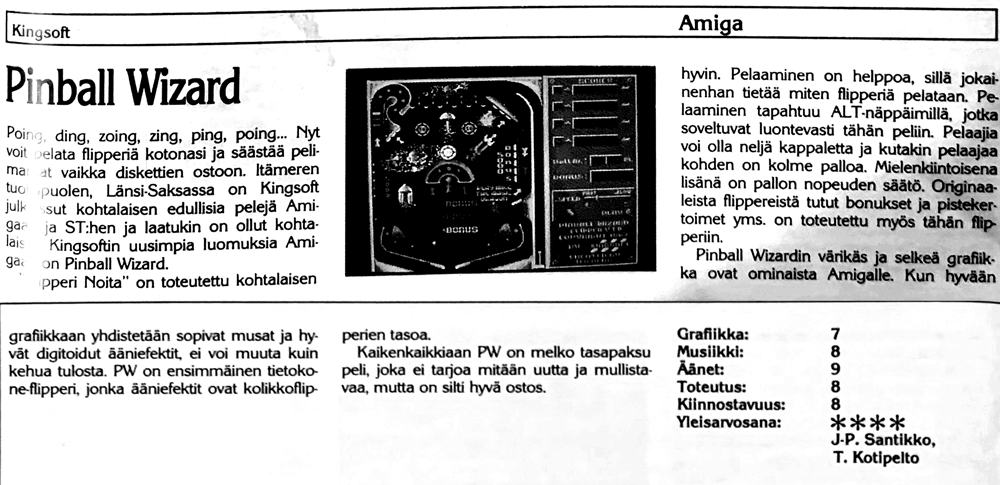
Pinball Wizard1988Pysyvä linkkiPoing, ding, zoing, zing, ping, poing... Nyt voit pelata flipperiä kotonasi ja säästää pelimarkat vaikka diskettien ostoon. Itämeren tuollapuolen, Länsi-Saksassa on Kingsoft julkaissut kohtalaisen edullisia pelejä Amigaan ja ST:hen ja laatukin on ollut kohtalaista. Kingsoftin uusimpia luomuksia Amigaan on Pinball Wizard.
"Flipperi Noita" on toteutettu kohtalaisen hyvin. Pelaaminen on helppoa, sillä jokainenhan tietää miten flipperiä pelataan. Pelaaminen tapahtuu ALT-näppäimillä, jotka soveltuvat luontevasti tähän peliin. Pelaajia voi olla neljä kappaletta ja kutakin pelaajaa kohden on kolme palloa. Mielenkiintoisena lisänä on pallon nopeuden säätö. Originaaleista flippereistä tutut bonukset ja pistekertoimet yms. on toteutettu myös tähän flipperiin.
Pinball Wizardin värikäs ja selkeä grafiikka ovat ominaista Amigalle. Kun hyvään grafiikkaan yhdistetään sopivat musat ja hyvät digitoidut ääniefektit, ei voi muuta kuin kehua tulosta. PW on ensimmäinen tietokone-flipperi, jonka ääniefektit ovat kolikkoflipperien tasoa.
Kaikenkaikkiaan PW on melko tasapaksu peli, joka ei tarjoa mitään uutta ja mullistavaa, mutta on silti hyvä ostos.
Pinball Wizard1988PermalinkPoing, ding, zoing, zing, ping, poing... Now you can play pinball at home and save your arcade markkas for buying floppy disks, say. On the far side of the Baltic, in West Germany, Kingsoft has been releasing fairly cheap games for the Amiga and ST, and the quality has been fair too. One of Kingsoft's newest creations for the Amiga is Pinball Wizard.
"Pinball Witch" has been done fairly well. Playing is easy, since everybody knows how to play pinball, right? You play with the ALT keys, which suit this game naturally. There can be four players, and each player gets three balls. An interesting extra is the ability to adjust the ball speed. The bonuses, score multipliers and so on familiar from the real pinball machines have been built into this pinball too.
Pinball Wizard's colourful and clear graphics are typical of the Amiga. When good graphics are combined with fitting tunes and good digitised sound effects, you can do nothing but praise the result. PW is the first computer pinball whose sound effects are on a par with coin-op pinball machines.
All in all PW is a pretty middle-of-the-road game that offers nothing new or revolutionary, but it is still a good buy.
Pink Panther
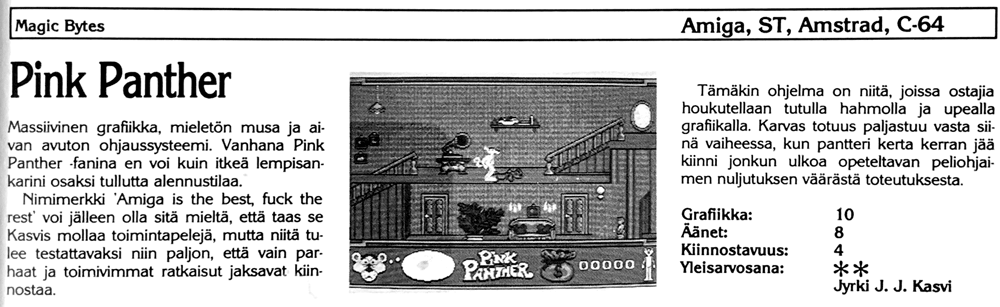
Pink Panther1988Pysyvä linkkiMassiivinen grafiikka, mieletön musa ja aivan avuton ohjaussysteemi. Vanhana Pink Panther -fanina en voi kuin itkeä lempisankarini osaksi tullutta alennustilaa.
Nimimerkki 'Amiga is the best, fuck the rest' voi jälleen olla sitä mieltä, että taas se Kasvis mollaa toimintapelejä, mutta niitä tulee testattavaksi niin paljon, että vain parhaat ja toimivimmat ratkaisut jaksavat kiinnostaa.
Tämäkin ohjelma on niitä, joissa ostajia houkutellaan tutulla hahmolla ja upealla grafiikalla. Karvas totuus paljastuu vasta siinä vaiheessa, kun pantteri kerta kerran jää kiinni jonkun ulkoa opeteltavan peliohjaimen nuljutuksen väärästä toteutuksesta.
Pink Panther1988PermalinkMassive graphics, insane music and a completely hopeless control system. As an old Pink Panther fan I can only weep at the degradation that has befallen my favourite hero.
The letter-writer signing as 'Amiga is the best, fuck the rest' may once again feel that there goes that Kasvis slagging off action games again, but so many of them come in for testing that only the best and most workable solutions can still hold my interest.
This program too is one of those where buyers are lured in with a familiar character and gorgeous graphics. The bitter truth only comes out once the panther gets caught time after time because you botched some joystick-waggling routine that has to be learnt by heart.
Pirates!
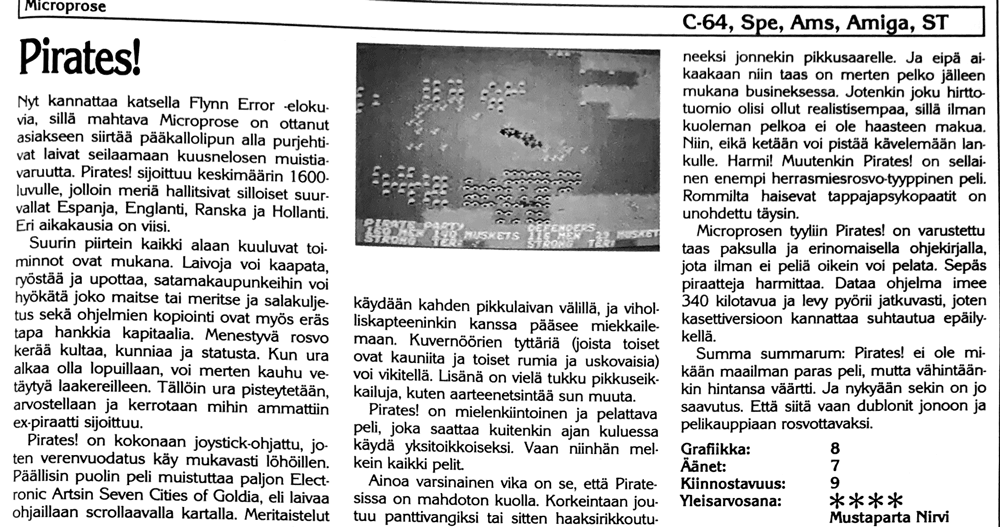
Pirates!1988Pysyvä linkkiNyt kannattaa katsella Flynn Error -elokuvia, sillä mahtava Microprose on ottanut asiakseen siirtää pääkallolipun alla purjehtivat laivat seilaamaan kuusnelosen muistiavaruutta. Pirates! sijoittuu keskimäärin 1600-luvulle, jolloin meriä hallitsivat silloiset suurvallat Espanja, Englanti, Ranska ja Hollanti. Eri aikakausia on viisi.
Suurin piirtein kaikki alaan kuuluvat toiminnot ovat mukana. Laivoja voi kaapata, ryöstää ja upottaa, satamakaupunkeihin voi hyökätä joko maitse tai meritse ja salakuljetus sekä ohjelmien kopiointi ovat myös eräs tapa hankkia kapitaalia. Menestyvä rosvo kerää kultaa, kunniaa ja statusta. Kun ura alkaa olla lopuillaan, voi merten kauhu vetäytyä laakereilleen. Tällöin ura pisteytetään, arvostellaan ja kerrotaan mihin ammattiin ex-piraatti sijoittuu.
Pirates! on kokonaan joystick-ohjattu, joten verenvuodatus käy mukavasti löhöillen. Päällisin puolin peli muistuttaa paljon Electronic Artsin Seven Cities of Goldia, eli laivaa ohjaillaan scrollaavalla kartalla. Meritaistelut käydään kahden pikkulaivan välillä, ja viholliskapteeninkin kanssa pääsee miekkailemaan. Kuvernöörien tyttäriä (joista toiset ovat kauniita ja toiset rumia ja uskovaisia) voi vikitellä. Lisänä on vielä tukku pikkuseikkailuja, kuten aarteenetsintää sun muuta.
Pirates! on mielenkiintoinen ja pelattava peli, joka saattaa kuitenkin ajan kuluessa käydä yksitoikkoiseksi. Vaan niinhän melkein kaikki pelit.
Ainoa varsinainen vika on se, että Piratessissa on mahdoton kuolla. Korkeintaan joutuu panttivangiksi tai sitten haaksirikkoutuneeksi jonnekin pikkusaarelle. Ja eipä aikaakaan niin taas on merten pelko jälleen mukana busineksessa. Jotenkin joku hirttotuomio olisi ollut realistisempaa, sillä ilman kuoleman pelkoa ei ole haasteen makua. Niin, eikä ketään voi pistää kävelemään lankulle. Harmi! Muutenkin Pirates! on sellainen enempi herrasmiesrosvo-tyyppinen peli. Rommilta haisevat tappajapsykopaatit on unohdettu täysin.
Microprosen tyyliin Pirates! on varustettu taas paksulla ja erinomaisella ohjekirjalla, jota ilman ei peliä oikein voi pelata. Sepäs piraatteja harmittaa. Dataa ohjelma imee 340 kilotavua ja levy pyörii jatkuvasti, joten kasettiversioon kannattaa suhtautua epäilykellä.
Summa summarum: Pirates! ei ole mikään maailman paras peli, mutta vähintäänkin hintansa väärtti. Ja nykyään sekin on jo saavutus. Että siitä vaan dublonit jonoon ja pelikauppiaan rosvottavaksi.
Pirates!1988PermalinkNow is the time to watch some Flynn Error films, because the mighty Microprose has taken it upon itself to set ships flying the skull and crossbones sailing across the memory space of the Commodore 64. Pirates! is set, on average, in the 17th century, when the seas were ruled by the great powers of the day: Spain, England, France and Holland. There are five different eras.
Pretty much every activity that goes with the trade is included. You can capture, plunder and sink ships, attack port towns either by land or by sea, and smuggling and software copying are also one way of raising capital. A successful buccaneer collects gold, glory and status. When the career is nearing its end, the terror of the seas can retire to rest on the laurels. The career is then scored and assessed, and you are told what profession the ex-pirate ends up in.
Pirates! is entirely joystick-controlled, so the bloodshed can be done lounging about comfortably. On the surface the game closely resembles Electronic Arts' Seven Cities of Gold, i.e. you steer your ship around a scrolling map. Sea battles are fought between two little ships, and you also get to cross swords with the enemy captain. The governors' daughters (some of whom are beautiful and others ugly and devout) can be wooed. On top of that there is a bunch of mini-adventures, like treasure hunting and whatnot.
Pirates! is an interesting and playable game, which may nevertheless grow monotonous over time. But then, so do almost all games.
The only real flaw is that in Pirates it is impossible to die. At worst you get taken hostage or shipwrecked on some little island. And before you know it, the dread of the seas is back in business once again. Somehow a sentence of hanging would have been more realistic, since without the fear of death there is no taste of challenge. Oh, and you can't make anyone walk the plank either. Pity! Generally Pirates! is more of a gentleman-thief sort of game. The rum-reeking psychopathic killers have been forgotten entirely.
In Microprose style, Pirates! once again comes with a thick and excellent manual, without which the game can't really be played. Now that'll annoy the pirates. The program sucks in 340 kilobytes of data and the disk is constantly spinning, so the tape version is best approached with suspicion.
Summa summarum: Pirates! is not the best game in the world, but it is at least worth the price. And these days even that is an achievement. So go on, line up your doubloons for the games dealer to plunder.
Pitstop II
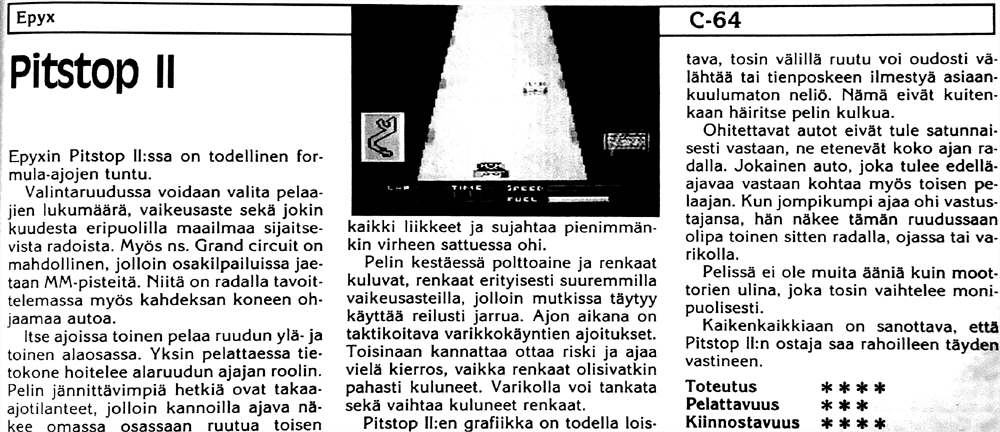
Pitstop II1987Pysyvä linkkiEpyxin Pitstop II:ssa on todellinen formula-ajojen tuntu.
Valintaruudussa voidaan valita pelaajien lukumäärä, vaikeusaste sekä jokin kuudesta eripuolilla maailmaa sijaitsevista radoista. Myös ns. Grand circuit on mahdollinen, jolloin osakilpailuissa jaetaan MM-pisteitä. Niitä on radalla tavoittelemassa myös kahdeksan koneen ohjaamaa autoa.
Itse ajoissa toinen pelaa ruudun ylä- ja toinen alaosassa. Yksin pelattaessa tietokone hoitelee alaruudun ajajan roolin. Pelin jännittävimpiä hetkiä ovat takaa-ajotilanteet, jolloin kannoilla ajava näkee omassa osassaan ruutua toisen kaikki liikkeet ja sujahtaa pienimmänkin virheen sattuessa ohi.
Pelin kestäessä polttoaine ja renkaat kuluvat, renkaat erityisesti suuremmilla vaikeusasteilla, jolloin mutkissa täytyy käyttää reilusti jarrua. Ajon aikana on taktikoitava varikkokäyntien ajoitukset. Toisinaan kannattaa ottaa riski ja ajaa vielä kierros, vaikka renkaat olisivatkin pahasti kuluneet. Varikolla voi tankata sekä vaihtaa kuluneet renkaat.
Pitstop II:en grafiikka on todella loistava, tosin välillä ruutu voi oudosti välähtää tai tienposkeen ilmestyä asiaankuulumaton neliö. Nämä eivät kuitenkaan häiritse pelin kulkua.
Ohitettavat autot eivät tule satunnaisesti vastaan, ne etenevät koko ajan radalla. Jokainen auto, joka tulee edelläajavaa vastaan kohtaa myös toisen pelaajan. Kun jompikumpi ajaa ohi vastustajansa, hän näkee tämän ruudussaan olipa toinen sitten radalla, ojassa tai varikolla.
Pelissä ei ole muita ääniä kuin moottorien ulina, joka tosin vaihtelee monipuolisesti.
Kaikenkaikkiaan on sanottava, että Pitstop II:n ostaja saa rahoilleen täyden vastineen.
Pitstop II1987PermalinkEpyx's Pitstop II has the real feel of Formula racing.
On the selection screen you can choose the number of players, the difficulty level and one of six tracks located in different parts of the world. A so-called Grand circuit is also available, in which World Championship points are awarded in each race. Eight computer-driven cars are out on the track chasing those points too.
In the races themselves, one player drives in the top half of the screen and the other in the bottom half. When you play alone, the computer takes on the role of the driver in the lower screen. The most exciting moments in the game are the chases, where the driver on the other's tail can see every move the leader makes in their own part of the screen and slips past at the slightest mistake.
As the race goes on, fuel and tyres wear down - the tyres especially on the higher difficulty levels, where you have to use plenty of brake in the bends. During the race you have to plan the tactics of when to make your pit stops. Sometimes it pays to take a risk and do one more lap even though the tyres are badly worn. In the pits you can refuel and change worn tyres.
The graphics in Pitstop II are truly brilliant, although now and then the screen may flash strangely or a square that has no business being there may appear at the roadside. These don't disturb the flow of the game, though.
The cars you overtake don't just turn up at random; they keep moving round the track the whole time. Every car the leading driver comes up against is also met by the other player. When either of them overtakes their opponent, they can see the other on their screen, whether the other is on the track, in the ditch or in the pits.
There are no sounds in the game other than the whine of the engines, though that does vary a good deal.
All in all, it has to be said that whoever buys Pitstop II gets full value for their money.
Platoon
Platoon1988Pysyvä linkki"Ensimmäinen uhri on omaperäisyys" voisi olla lisenssipelien motto niinnoin yleensä. Ja nyt lisenssiflopeistaan tunnettu Ocean on tarrannut kiinni Amerikan Tuntemattomaan Sotilaaseen, Platooniin. Voiko tulos olla muuta kuin floppi?
Ihme ja kumma voi. Oliver Stonen yliarvostettu Vietnam-tilitys on yllättäen kääntynyt ehkä parhaaksi elokuvan mukaan tehdyksi peliksi kautta aikojen.
Platoon jakautuu viiteen osaan. Ensimmäisessä on viiden sotilaan joukkueen löydettävä tiensä viidakon halki kylään. Heidän täytyy löytää TNT:tä, jotta kylään johtava silta saadaan poikki eikä iso Charlie-osasto teurasta USAn poikia. Kylästä pääsee toiseen osioon löytämällä majan, joka johtaa Vietkongin maanalaiseen tunneliverkostoon. Täällä taistellaan Congin veitsi- ja kiväärimiehiä vastaan.
Kolmannessa osiossa istutaan yöllä bunkkerissa ja yritetään rei'ittää pimeydessä hiipiviä sissejä. Valoraketit luovat valoa pimeyteen, mutta niitäkin on vain rajoitettu määrä.
Neljännessä osassa rynnitään läpi sissitäyteisen viidakon M-14 loimuten kohti rendezvousta helikopterien kanssa. Ja viidennessä osassa on tarkoitus teilata paha tappokonekersantti Barnes kranaattien auliilla avustuksella. Barnes vaatii viisi kranaattia ennenkuin sielu rääkyen siirtyy viimeiselle tuomiolle.
Platoon on ajatuksella toteutettu grafiikan vaihdellessa hyvästä erinomaiseen. Mukavaa on, että jokainen sotilas kestää neljä osumaa ennen siirtoa Taivaalliseen merijalkaväkeen. Kiitos lukuisten osien ei peliin pääse puutumaan (paitsi ehkä ensimmäiseen osioon). Musiikki on kuunneltavaa ja onpa mukana digitoituja huutojakin.
Platoon -The Movie oli pettymys, kiitos siloitellun Vietnam-kuvauksensa, höpöhöpö-filosofian ja klassisen hyvät-pahat -jaottelunsa. Platoon -The Game taas oli yllätys, toivoa sopii että Ocean jatkossakin malttaa pitää vähintäänkin tämän tason. Outoa silti vaikka sota riehuu ympärillä kuluttaa joukkue aikaansa WC:n etsimiseen. War is strange.
Platoon1988Permalink"The first casualty is originality" could be the motto of licensed games pretty much in general. And now Ocean, known for its licence flops, has grabbed hold of America's Unknown Soldier, Platoon. Can the result be anything but a flop?
Wonder of wonders, it can. Oliver Stone's overrated Vietnam soul-baring has surprisingly turned into perhaps the best game based on a film of all time.
Platoon is divided into five parts. In the first, a squad of five soldiers has to find its way through the jungle to a village. They have to find TNT so that the bridge leading to the village can be blown and a big Charlie unit doesn't slaughter the boys from the USA. From the village you get to the second section by finding the hut that leads into the Viet Cong's underground tunnel network. Here you fight the Cong's knife men and riflemen.
In the third section you sit in a bunker at night trying to put holes in the guerrillas creeping about in the dark. Flares light up the darkness, but there is only a limited supply of those too.
In the fourth part you charge through a guerrilla-packed jungle, M-14 blazing, towards a rendezvous with the helicopters. And in the fifth part the idea is to do in the evil killing-machine sergeant Barnes with the generous assistance of grenades. Barnes takes five grenades before that soul goes shrieking off to the Last Judgement.
Platoon has been made with thought, with graphics ranging from good to excellent. It is nice that each soldier can take four hits before being transferred to the Heavenly Marine Corps. Thanks to the many sections you don't get bored with the game (except perhaps with the first section). The music is listenable, and there are even some digitised screams.
Platoon -The Movie was a disappointment, thanks to its sanitised portrayal of Vietnam, its mumbo-jumbo philosophy and its classic goodies-and-baddies split. Platoon -The Game, on the other hand, was a surprise; let's hope Ocean has the sense to keep at least to this standard from now on. Strange all the same that while war rages all around, the squad spends its time looking for the toilet. War is strange.
Player Manager

Player Manager1990 SyksyPysyvä linkkiKick Off on eittämättä paras jalkapallopeli, mitä tähän päivään mennessä on tehty. Football Managerin ystävät voivat olla toista mieltä. Mutta mitä saadaan kun yhdistetään Kick Offin pelattavuus ja mainio valmennuspeli? Anco tarjoaa vastaukseksi Player Manageria.
Alku ei ainakaan nosta odotuksia. Uutta peliä aloitettaessa PM touhuaa itsekseen useita minuutteja laskeskellen joukkueiden välisiä voimasuhteita, pelaajien arvoja ja muuta. Tänä aikana pelaaja ei voi tehdä muuta kuin pyöritellä peukaloitaan. Rasittavaa, kyllä, mutta odotus palkitaan. Alkuvalikosta löytyvät valinnat mahdollistavat joukkueen taloudellisen tilan seurannan, pelaajien oston ja myynnin, pelaajien kunnon ja moraalin seurannan, pelaajien kunnon kohottamisen, taktiikkojen hiomisen, uusien taktiikkojen tekemisen ja paljon muuta. Luonnollisesti pelaajalle tarjotaan myös mahdollisuus muuttaa joukkueensa nimeä ja pelaajien nimiä.
On kerrassaan uskomatonta, miten Anco on onnistunut mahduttamaan näin paljon tavaraa puolimegaiseen Amigaan. Normaalitoimintojen lisäksi PM sisältää sellaisen helmen kuin pelistrategioiden muuttamisen ja suunnittelemisen. Tämä tapahtuu hiirellä luontevasti ja helposti. Näkyviin tulee kenttä, jolla näkyvät joukkueen pelaajat numeroina. Numerosta lähtee viiva, joka esittää pelaajan kulkua kentällä tietyssä pelitilanteessa. Hiirellä "otetaan kiinni" pelaajaa esittävästä numerosta ja raahataan numero haluttuun paikkaan. Pelissä sitten kyseinen pelaaja tekee halutut temput. Tämä on koettava, että sitä osaa arvostaa. Lisäksi PM on erittäin realistinen. Pelaajia loukkaantuu peleissä silloin tällöin, eivätkä he suinkaan pääse heti seuraavassa pelissä kentälle. Myynti- ja ostomarkkinat ovat monipuolisimmat, mitä olen koskaan nähnyt. Tinkiminen on päivän sana ja tämä toimii sekä ostamisessa että myymisessä. Kun asetat pelaajan myyntilistalle, ei kannata odottaa, että joku joukkue on heti ostamassa häntä. Ei suinkaan, hinnan pitää olla tarpeeksi alhainen ja vielä siitäkin ostava joukkue yrittää tinkiä. Onneksi PM ilmoittaa, minkä arvoinen myynnissä oleva pelaaja on, ettei häntä sentään pilkkahinnalla tule myytyä.
Valmentajapeli on siis huippuluokkaa. Ilokseni voin todeta, että Anco on ajatellut kaikkea: ennen peliä, kun pelaajat on valittu, voi vielä valita pelaako itse normaalissa vai nopeassa pelissä, vai näyttääkö peli vain ottelun lopputuloksen. Kick Offiin tutustuneet tuntevat olonsa kotoisaksi, sillä peliosuus on hieman muuteltu Kick Off. Kerrallaan näkyvissä pelialue on hieman pienempi, alareunassa näkyvät kellonaika, tulos ja kulloinkin palloa hallussaan pitävän pelaajan nimi mustalla kentän päällä. Tervetullut lisäys on pelaajien vaihto. Ennen peliä valmentaja valitsee kaksi vaihtopelaajaa, jotka saa tuoda kentälle missä vaiheessa tahansa. Itse peli on muuten entisellään, se vanha tuttu erinomainen ja vauhdikas Kick Off.
Graafisesti PM ei liiemmin mässäile, valmennuspuoli koostuu pääasiassa vain kylmistä numeroista ja kirjaimista. Peliosuuden pelaajat ovat ylhäältä kuvattuja könttejä, mutta pelattavuus korvaa karun ulkokuoren. Ääniä ei ole muualla kuin pelin aikana, ja silloinkin vain muutama yleisön kohahdus, pillin vihellys ja pallon töminä ruohoon. Vetovoimaa löytyy vaikka toisille jakaa, vaikka pari kertaa peli onkin kaatunut omituisesti. Pelattavuutta ei voi tarpeeksi kehua. Näillä eväillä Player Manageria ei voi kuin varauksetta suositella kaikille jalkapallosta kiinnostuneille.
Player Manager1990 SyksyPermalinkKick Off is indisputably the best football game made to date. Fans of Football Manager may disagree. But what do you get when you combine Kick Off's playability with a splendid management game? Anco offers Player Manager as the answer.
The start, at least, doesn't raise your hopes. When you begin a new game, PM busies itself for several minutes working out the relative strengths of the teams, the players' values and so on. During this time the player can do nothing but twiddle their thumbs. Tiresome, yes, but the wait is rewarded. The options on the main menu let you monitor the team's finances, buy and sell players, monitor the players' fitness and morale, improve the players' fitness, polish tactics, create new tactics and much more. Naturally, the player is also given the chance to change the team's name and the names of the players.
It's downright incredible how Anco has managed to squeeze this much stuff into a half-meg Amiga. On top of the standard functions, PM contains such a gem as the ability to change and design match strategies. This is done naturally and easily with the mouse. A pitch appears, with the team's players shown on it as numbers. From each number runs a line that represents the player's movement on the pitch in a given match situation. With the mouse you "grab hold of" the number representing a player and drag it to the desired spot. Then in the match that player does the tricks you wanted. You have to experience this to appreciate it. What's more, PM is extremely realistic. Players get injured in matches now and then, and they certainly don't get straight back on the pitch for the next match. The selling and buying markets are the most versatile I have ever seen. Haggling is the word of the day, and it works both when buying and when selling. When you put a player on the transfer list, don't expect some team to be buying straight away. Oh no, the price has to be low enough, and even then the buying team tries to haggle. Fortunately PM tells you what the player up for sale is worth, so at least you don't end up selling for a pittance.
So the management game is top class. I'm pleased to report that Anco has thought of everything: before a match, once the players have been picked, you can still choose whether to play it yourself in a normal or a fast game, or whether the game just shows the final result. Those acquainted with Kick Off will feel right at home, since the match part is a slightly modified Kick Off. The area of pitch visible at any one time is slightly smaller, and along the bottom you see the time, the score and the name of whichever player has the ball, in black over the pitch. A welcome addition is substitutions. Before the match the manager picks two substitutes, who can be brought on at any stage. Otherwise the game itself is as it was: the same old familiar, excellent and fast-paced Kick Off.
Graphically PM doesn't exactly indulge itself; the management side consists mainly of cold numbers and letters. The players in the match section are blobs seen from above, but the playability makes up for the bare exterior. There's no sound except during matches, and even then only a few murmurs from the crowd, the whistle and the thud of the ball on the grass. It has pulling power to spare, even if the game has crashed strangely a couple of times. The playability can't be praised enough. With credentials like these, Player Manager can only be recommended without reservation to anyone interested in football.
Plotting
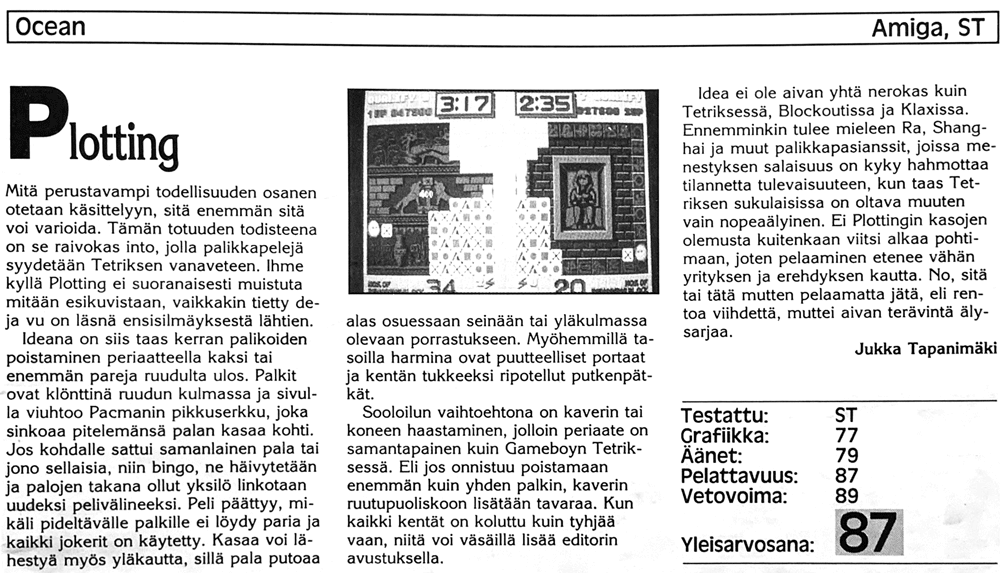
Plotting1991 KevätPysyvä linkkiMitä perustavampi todellisuuden osanen otetaan käsittelyyn, sitä enemmän sitä voi varioida. Tämän totuuden todisteena on se raivokas into, jolla palikkapelejä syydetään Tetriksen vanaveteen. Ihme kyllä Plotting ei suoranaisesti muistuta mitään esikuvistaan, vaikkakin tietty deja vu on läsnä ensisilmäyksestä lähtien.
Ideana on siis taas kerran palikoiden poistaminen periaatteella kaksi tai enemmän pareja ruudulta ulos. Palkit ovat klönttinä ruudun kulmassa ja sivulla viuhtoo Pacmanin pikkuserkku, joka sinkoaa pitelemänsä palan kasaa kohti. Jos kohdalle sattui samanlainen pala tai jono sellaisia, niin bingo, ne häivytetään ja palojen takana ollut yksilö linkotaan uudeksi pelivälineeksi. Peli päättyy, mikäli pideltävälle palkille ei löydy paria ja kaikki jokerit on käytetty. Kasaa voi lähestyä myös yläkautta, sillä pala putoaa alas osuessaan seinään tai yläkulmassa olevaan porrastukseen. Myöhemmillä tasoilla harmina ovat puutteelliset portaat ja kentän tukkeeksi ripotellut putkenpätkät.
Sooloilun vaihtoehtona on kaverin tai koneen haastaminen, jolloin periaate on samantapainen kuin Gameboyn Tetriksessä. Eli jos onnistuu poistamaan enemmän kuin yhden palkin, kaverin ruutupuoliskoon lisätään tavaraa. Kun kaikki kentät on koluttu kuin tyhjää vaan, niitä voi väsäillä lisää editorin avustuksella.
Idea ei ole aivan yhtä nerokas kuin Tetriksessä, Blockoutissa ja Klaxissa. Ennemminkin tulee mieleen Ra, Shanghai ja muut palikkapasianssit, joissa menestyksen salaisuus on kyky hahmottaa tilannetta tulevaisuuteen, kun taas Tetriksen sukulaisissa on oltava muuten vain nopeaälyinen. Ei Plottingin kasojen olemusta kuitenkaan viitsi alkaa pohtimaan, joten pelaaminen etenee vähän yrityksen ja erehdyksen kautta. No, sitä tai tätä mutten pelaamatta jätä, eli rentoa viihdettä, muttei aivan terävintä älysarjaa.
Plotting1991 KevätPermalinkThe more fundamental the particle of reality you take up, the more you can vary it. Proof of this truth is the furious zeal with which block games are being churned out in Tetris's wake. Amazingly enough, Plotting doesn't directly resemble any of its models, although a certain deja vu is present from the very first glance.
So the idea is once again removing blocks, on a two-or-more-in-pairs-off-the-screen principle. The blocks sit in a lump in the corner of the screen, and at the side Pacman's little second cousin flails about, hurling the piece it's holding at the pile. If a matching piece or a row of them happened to be in line, then bingo, they're made to vanish and the one that was behind them is flung back as your new playing piece. The game ends if there's no match for the block you're holding and all the jokers have been used. You can also approach the pile from above, since the piece drops down when it hits the wall or the stepped ledge in the top corner. On the later levels the nuisances are incomplete steps and bits of pipe sprinkled about to clog up the level.
As an alternative to going solo you can challenge a friend or the computer, in which case the principle is much the same as in the Gameboy's Tetris. That is, if you manage to remove more than one block, stuff gets added to your pal's half of the screen. Once you've breezed through all the levels like they were nothing, you can knock together more of them with the help of the editor.
The idea isn't quite as ingenious as in Tetris, Blockout and Klax. Rather, it brings to mind Ra, Shanghai and other block solitaires, where the secret of success is the ability to see how the situation will play out in the future, whereas with Tetris's relatives you just have to be quick-witted. Still, you can't really be bothered to start pondering the nature of Plotting's piles, so play proceeds a bit by trial and error. Well, be that as it may, I won't be leaving it unplayed: relaxed entertainment, that is, but not quite the sharpest in the brain-game league.
Pogostick Olympics
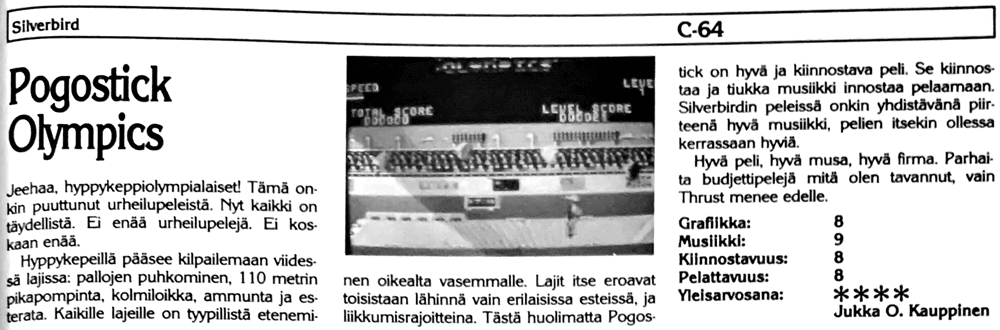
Pogostick Olympics1988Pysyvä linkkiJeehaa, hyppykeppiolympialaiset! Tämä onkin puuttunut urheilupeleistä. Nyt kaikki on täydellistä. Ei enää urheilupelejä. Ei koskaan enää.
Hyppykepeillä pääsee kilpailemaan viidessä lajissa: pallojen puhkominen, 110 metrin pikapompinta, kolmiloikka, ammunta ja esterata. Kaikille lajeille on tyypillistä eteneminen oikealta vasemmalle. Lajit itse eroavat toisistaan lähinnä vain erilaisissa esteissä, ja liikkumisrajoitteina. Tästä huolimatta Pogostick on hyvä ja kiinnostava peli. Se kiinnostaa ja tiukka musiikki innostaa pelaamaan. Silverbirdin peleissä onkin yhdistävänä piirteenä hyvä musiikki, pelien itsekin ollessa kerrassaan hyviä.
Hyvä peli, hyvä musa, hyvä firma. Parhaita budjettipelejä mitä olen tavannut, vain Thrust menee edelle.
Pogostick Olympics1988PermalinkYeehaa, pogo stick Olympics! This is just what sports games were missing. Now everything is perfect. No more sports games. Never again.
On pogo sticks you get to compete in five events: ball bursting, the 110-metre sprint bounce, triple jump, shooting and an obstacle course. Common to all the events is moving from right to left. The events themselves differ from one another mainly just in their different obstacles and movement restrictions. Despite this, Pogostick is a good and interesting game. It holds your interest, and the punchy music gets you fired up to play. Good music is indeed the common thread in Silverbird's games, the games themselves being downright good too.
Good game, good tunes, good company. One of the best budget games I have come across; only Thrust beats it.
Polar Pierre
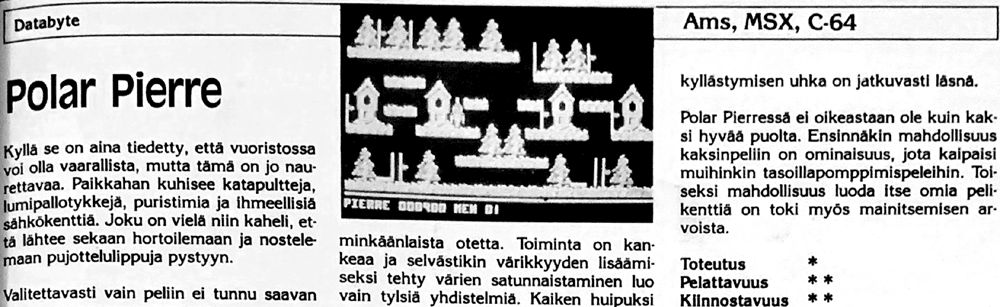
Polar Pierre1987Pysyvä linkkiKyllä se on aina tiedetty, että vuoristossa voi olla vaarallista, mutta tämä on jo naurettavaa. Paikkahan kuhisee katapultteja, lumipallotykkejä, puristimia ja ihmeellisiä sähkökenttiä. Joku on vielä niin kaheli, että lähtee sekaan hortoilemaan ja nostelemaan pujottelulippuja pystyyn.
Valitettavasti vain peliin ei tunnu saavan minkäänlaista otetta. Toiminta on kankeaa ja selvästikin värikkyyden lisäämiseksi tehty värien satunnaistaminen luo vain tylsiä yhdistelmiä. Kaiken huipuksi kyllästymisen uhka on jatkuvasti läsnä.
Polar Pierressä ei oikeastaan ole kuin kaksi hyvää puolta. Ensinnäkin mahdollisuus kaksinpeliin on ominaisuus, jota kaipaisi muihinkin tasoillapomppimispeleihin. Toiseksi mahdollisuus luoda itse omia pelikenttiä on toki myös mainitsemisen arvoista.
Polar Pierre1987PermalinkEveryone has always known that the mountains can be dangerous, but this is getting ridiculous. The place is swarming with catapults, snowball cannons, crushers and weird electric fields. And somebody is nutty enough to go blundering around in the middle of it all, standing slalom flags back up.
Unfortunately, you just can't seem to get any kind of grip on the game. The action is stiff, and the randomised colours, obviously meant to make things more colourful, only produce dull combinations. To top it all, the threat of boredom is ever present.
Polar Pierre really only has two good points. First, the two-player option is a feature you'd like to see in other hop-about-on-platforms games too. Second, the chance to create your own levels is certainly worth a mention as well.
Police Cadet
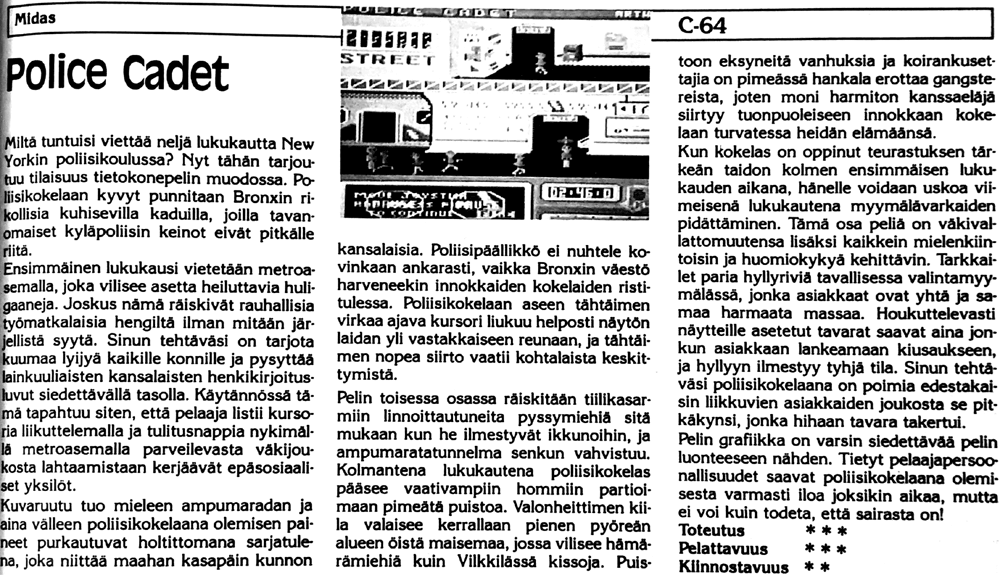
Police Cadet1987Pysyvä linkkiMiltä tuntuisi viettää neljä lukukautta New Yorkin poliisikoulussa? Nyt tähän tarjoutuu tilaisuus tietokonepelin muodossa. Poliisikokelaan kyvyt punnitaan Bronxin rikollisia kuhisevilla kaduilla, joilla tavanomaiset kyläpoliisin keinot eivät pitkälle riitä.
Ensimmäinen lukukausi vietetään metroasemalla, joka vilisee asetta heiluttavia huligaaneja. Joskus nämä räiskivät rauhallisia työmatkalaisia hengiltä ilman mitään järjellistä syytä. Sinun tehtäväsi on tarjota kuumaa lyijyä kaikille konnille ja pysyttää lainkuuliaisten kansalaisten henkikirjoitusluvut siedettävällä tasolla. Käytännössä tämä tapahtuu siten, että pelaaja listii kursoria liikuttelemalla ja tulitusnappia nykimällä metroasemalla parveilevasta väkijoukosta lahtaamistaan kerjäävät epäsosiaaliset yksilöt.
Kuvaruutu tuo mieleen ampumaradan ja aina välleen poliisikokelaana olemisen paineet purkautuvat holtittomana sarjatulena, joka niittää maahan kasapäin kunnon kansalaisia. Poliisipäällikkö ei nuhtele kovinkaan ankarasti, vaikka Bronxin väestö harveneekin innokkaiden kokelaiden ristitulessa. Poliisikokelaan aseen tähtäimen virkaa ajava kursori liukuu helposti näytön laidan yli vastakkaiseen reunaan, ja tähtäimen nopea siirto vaatii kohtalaista keskittymistä.
Pelin toisessa osassa räiskitään tiilikasarmiin linnoittautuneita pyssymiehiä sitä mukaan kun he ilmestyvät ikkunoihin, ja ampumaratatunnelma senkun vahvistuu. Kolmantena lukukautena poliisikokelas pääsee vaativampiin hommiin partioimaan pimeätä puistoa. Valonheittimen kiila valaisee kerrallaan pienen pyöreän alueen öistä maisemaa, jossa vilisee hämärämiehiä kuin Vilkkilässä kissoja. Puistoon eksyneitä vanhuksia ja koirankusettajia on pimeässä hankala erottaa gangstereista, joten moni harmiton kanssaeläjä siirtyy tuonpuoleiseen innokkaan kokelaan turvatessa heidän elämäänsä.
Kun kokelas on oppinut teurastuksen tärkeän taidon kolmen ensimmäisen lukukauden aikana, hänelle voidaan uskoa viimeisenä lukukautena myymälävarkaiden pidättäminen. Tämä osa peliä on väkivallattomuutensa lisäksi kaikkein mielenkiintoisin ja huomiokykyä kehittävin. Tarkkailet paria hyllyriviä tavallisessa valintamyymälässä, jonka asiakkaat ovat yhtä ja samaa harmaata massaa. Houkuttelevasti näytteille asetetut tavarat saavat aina jonkun asiakkaan lankeamaan kiusaukseen, ja hyllyyn ilmestyy tyhjä tila. Sinun tehtäväsi poliisikokelaana on poimia edestakaisin liikkuvien asiakkaiden joukosta se pitkäkynsi, jonka hihaan tavara takertui.
Pelin grafiikka on varsin siedettävää pelin luonteeseen nähden. Tietyt pelaajapersoonallisuudet saavat poliisikokelaana olemisesta varmasti iloa joksikin aikaa, mutta ei voi kuin todeta, että sairasta on!
Police Cadet1987PermalinkHow would you like to spend four terms at the New York police academy? Now you have the chance, in the form of a computer game. The cadet's abilities are put to the test on the crime-infested streets of the Bronx, where the usual methods of the village bobby won't get you very far.
The first term is spent in a subway station teeming with gun-waving hooligans. Sometimes they blast peaceful commuters dead for no sensible reason whatsoever. Your job is to serve hot lead to every crook and keep the census figures for law-abiding citizens at a tolerable level. In practice this means the player moves the cursor around and jerks the fire button to bump off the antisocial individuals in the crowd swarming the station who are just begging to be butchered.
The screen brings a shooting range to mind, and every now and then the pressures of being a police cadet erupt in reckless bursts of automatic fire that mow down decent citizens by the heap. The police chief doesn't scold you very harshly, even though the population of the Bronx does thin out in the crossfire of eager cadets. The cursor, which stands in for the sights of the cadet's gun, easily slides off the edge of the screen to the opposite side, and moving the sights quickly takes a fair amount of concentration.
In the second part of the game you blast away at gunmen holed up in a brick tenement as they appear at the windows, and the shooting-range atmosphere just keeps getting stronger. In the third term the cadet moves on to more demanding work, patrolling a dark park. The beam of a searchlight lights up one small round patch of the night-time landscape at a time, and it is teeming with shady characters like a back alley full of cats. In the dark it is hard to tell the old folk who have strayed into the park and the people out taking their dogs for a pee from the gangsters, so many a harmless fellow creature passes on to the other side while the eager cadet is safeguarding their lives.
Once the cadet has learned the important skill of slaughter over the first three terms, they can be entrusted in the final term with arresting shoplifters. Besides being non-violent, this part of the game is the most interesting of all and the one that does most to sharpen your powers of observation. You watch a couple of rows of shelves in an ordinary self-service shop whose customers are all one and the same grey mass. The temptingly displayed goods always lead some customer into temptation, and a gap appears on the shelf. Your job as a police cadet is to pick out, from among the customers wandering back and forth, the light-fingered one whose sleeve the item got stuck to.
The graphics are quite tolerable considering the nature of the game. Certain player personalities will surely get some fun out of being a police cadet for a while, but there is no other way to put it: it's sick!
Pools of Darkness
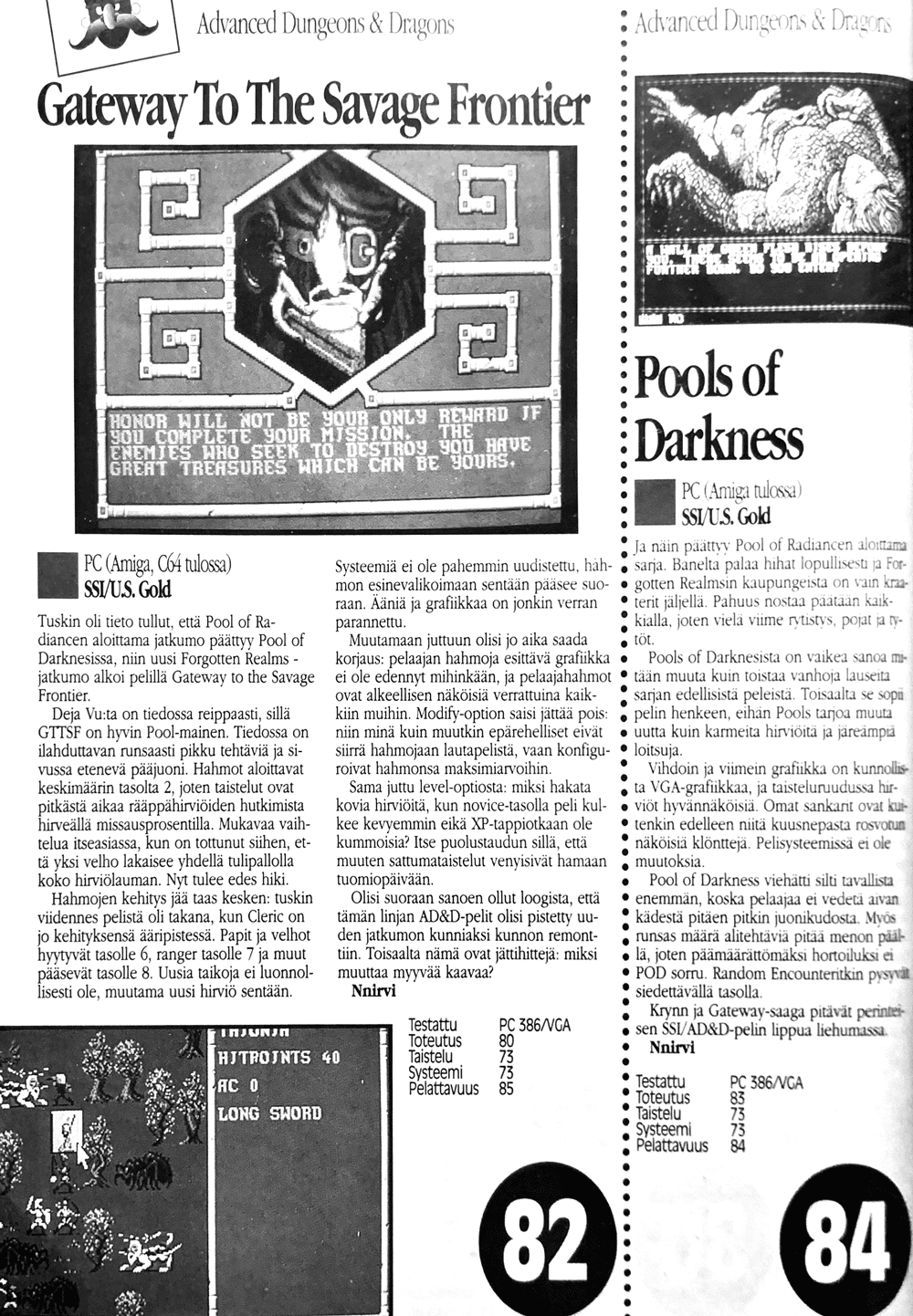
Pools of Darkness1991 SyksyPysyvä linkkiJa näin päättyy Pool of Radiancen aloittama sarja. Banelta palaa hihat lopullisesti ja Forgotten Realmsin kaupungeista on vain kraaterit jäljellä. Pahuus nostaa päätään kaikkialla, joten vielä viime rytistys, pojat ja tytöt.
Pools of Darknesista on vaikea sanoa mitään muuta kuin toistaa vanhoja lauseita sarjan edellisistä peleistä. Toisaalta se sopii pelin henkeen, eihän Pools tarjoa muuta uutta kuin karmeita hirviöitä ja järeämpiä loitsuja.
Vihdoin ja viimein grafiikka on kunnollista VGA-grafiikkaa, ja taisteluruudussa hirviöt hyvännäköisiä. Omat sankarit ovat kuitenkin edelleen niitä kuusnepasta rosvotun näköisiä klönttejä. Pelisysteemissä ei ole muutoksia.
Pool of Darkness viehätti silti tavallista enemmän, koska pelaajaa ei vedetä aivan kädestä pitäen pitkin juonikudosta. Myös runsas määrä alitehtäviä pitää menon päällä, joten päämäärättömäksi hortoiluksi ei POD sorru. Random Encounteritkin pysyvät siedettävällä tasolla.
Krynn ja Gateway-saaga pitävät perinteisen SSI/AD&D-pelin lippua liehumassa.
Pools of Darkness1991 SyksyPermalinkAnd so ends the series that Pool of Radiance began. Bane blows a fuse for good, and nothing is left of the cities of the Forgotten Realms but craters. Evil is rearing its head everywhere, so one last scrap, boys and girls.
It's hard to say anything about Pools of Darknes other than repeat the same old sentences from the series' previous games. Then again, that suits the spirit of the game, since Pools offers nothing new except gruesome monsters and beefier spells.
At long last the graphics are proper VGA graphics, and on the combat screen the monsters look good. Your own heroes, however, are still those lumps that look like they were pilfered from the Commodore 64. There are no changes to the game system.
Even so, Pool of Darkness charmed me more than usual, because the player isn't led quite so much by the hand through the web of the plot. A generous number of subquests also keeps things going, so POD never lapses into aimless wandering. Even the Random Encounters stay at a bearable level.
Krynn and the Gateway saga keep the flag of the traditional SSI/AD&D game flying.
Populous
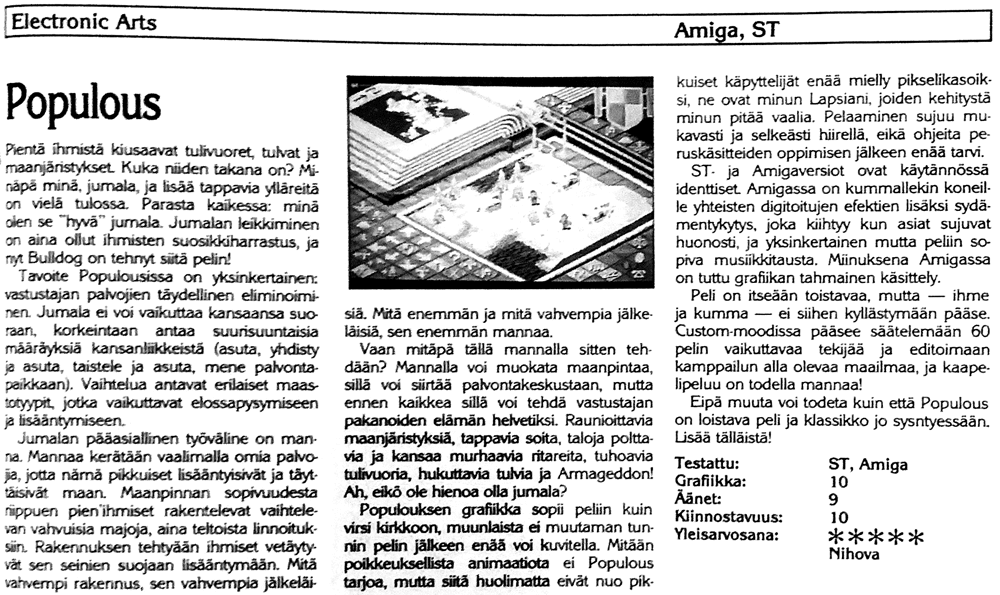
Populous1989 SyksyPysyvä linkkiPientä ihmistä kiusaavat tulivuoret, tulvat ja maanjäristykset. Kuka niiden takana on? Minäpä minä, jumala, ja lisää tappavia ylläreitä on vielä tulossa. Parasta kaikessa: minä olen se "hyvä" jumala. Jumalan leikkiminen on aina ollut ihmisten suosikkiharrastus, ja nyt Bulldog on tehnyt siitä pelin!
Tavoite Populousissa on yksinkertainen: vastustajan palvojien täydellinen eliminoiminen. Jumala ei voi vaikuttaa kansaansa suoraan, korkeintaan antaa suurisuuntaisia määräyksiä kansanliikkeistä (asuta, yhdisty ja asuta, taistele ja asuta, mene palvontapaikkaan). Vaihtelua antavat erilaiset maastotyypit, jotka vaikuttavat elossapysymiseen ja lisääntymiseen.
Jumalan pääasiallinen työväline on manna. Mannaa kerätään vaalimalla omia palvojia, jotta nämä pikkuiset lisääntyisivät ja täyttäisivät maan. Maanpinnan sopivuudesta riippuen pien'ihmiset rakentelevat vaihtelevan vahvuisia majoja, aina teltoista linnoituksiin. Rakennuksen tehtyään ihmiset vetäytyvät sen seinien suojaan lisääntymään. Mitä vahvempi rakennus, sen vahvempia jälkeläisiä. Mitä enemmän ja mitä vahvempia jälkeläisiä, sen enemmän mannaa.
Vaan mitäpä tällä mannalla sitten tehdään? Mannalla voi muokata maanpintaa, sillä voi siirtää palvontakeskustaan, mutta ennen kaikkea sillä voi tehdä vastustajan pakanoiden elämän helvetiksi. Raunioittavia maanjäristyksiä, tappavia soita, taloja polttavia ja kansaa murhaavia ritareita, tuhoavia tulivuoria, hukuttavia tulvia ja Armageddon! Ah, eikö ole hienoa olla jumala?
Populouksen grafiikka sopii peliin kuin virsi kirkkoon, muunlaista ei muutaman tunnin pelin jälkeen enää voi kuvitella. Mitään poikkeuksellista animaatiota ei Populous tarjoa, mutta siitä huolimatta eivät nuo pikkuiset käpyttelijät enää mielly pikselikasoiksi, ne ovat minun Lapsiani, joiden kehitystä minun pitää vaalia. Pelaaminen sujuu mukavasti ja selkeästi hiirellä, eikä ohjeita peruskäsitteiden oppimisen jälkeen enää tarvi.
ST- ja Amigaversiot ovat käytännössä identtiset. Amigassa on kummallekin koneille yhteisten digitoitujen efektien lisäksi sydämentykytys, joka kiihtyy kun asiat sujuvat huonosti, ja yksinkertainen mutta peliin sopiva musiikkitausta. Miinuksena Amigassa on tuttu grafiikan tahmainen käsittely.
Peli on itseään toistavaa, mutta - ihme ja kumma - ei siihen kyllästymään pääse. Custom-moodissa pääsee säätelemään 60 pelin vaikuttavaa tekijää ja editoimaan kamppailun alla olevaa maailmaa, ja kaapelipeluu on todella mannaa!
Eipä muuta voi todeta kuin että Populous on loistava peli ja klassikko jo sysntyessään. Lisää tälläistä!
Populous1989 SyksyPermalinkVolcanoes, floods and earthquakes torment the little man. Who's behind them? Me, that's who - god - and there are more deadly surprises still to come. Best of all: I'm the "good" god. Playing God has always been mankind's favourite hobby, and now Bulldog has made a game of it!
The goal in Populous is simple: the total elimination of your opponent's worshippers. God cannot influence the people directly, only at most issue broad orders about the movements of the masses (settle, join and settle, fight and settle, go to the place of worship). Variety comes from the different terrain types, which affect survival and reproduction.
God's main tool is manna. Manna is collected by tending your own worshippers so that these little ones will multiply and fill the earth. Depending on how suitable the ground is, the little people build dwellings of varying strength, anything from tents to castles. Once they've put up a building, the people withdraw behind its walls to multiply. The stronger the building, the stronger the offspring. The more offspring and the stronger they are, the more manna.
But what, then, do you do with all this manna? With manna you can reshape the land, you can use it to move your centre of worship, but above all you can use it to make life hell for your opponent's heathens. Earthquakes that leave ruins, deadly swamps, house-burning, people-murdering knights, destructive volcanoes, drowning floods and Armageddon! Ah, isn't it great to be god?
Populous's graphics suit the game like a hymn suits a church; after a few hours' play you can't imagine them any other way. Populous offers no exceptional animation, but in spite of that those little pitter-patterers no longer register as heaps of pixels, they are my Children, whose development I must nurture. Playing goes comfortably and clearly with the mouse, and once you've learned the basic concepts you no longer need the manual.
The ST and Amiga versions are practically identical. On top of the digitised effects common to both machines, the Amiga has a heartbeat that speeds up when things are going badly, and a simple but fitting musical backing. On the minus side, the Amiga has the familiar sticky handling of the graphics.
The game is repetitive, but - wonder of wonders - you just can't get bored of it. In Custom mode you get to adjust 60 factors affecting the game and edit the world the battle is fought over, and playing over the link cable is pure manna!
There's nothing left to say except that Populous is a brilliant game and a classic from the moment of its birth. More of this sort of thing!
Ports of Call
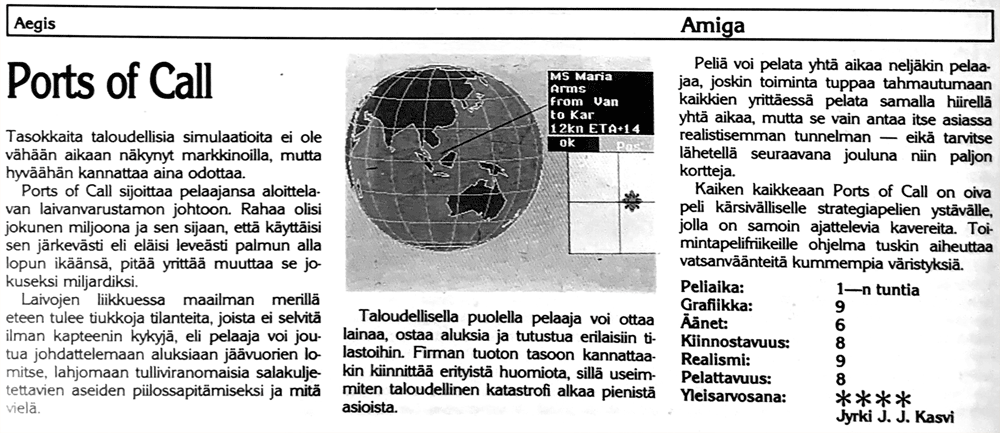
Ports of Call1988Pysyvä linkkiTasokkaita taloudellisia simulaatioita ei ole vähään aikaan näkynyt markkinoilla, mutta hyväähän kannattaa aina odottaa.
Ports of Call sijoittaa pelaajansa aloittelevan laivanvarustamon johtoon. Rahaa olisi jokunen miljoona ja sen sijaan, että käyttäisi sen järkevästi eli eläisi leveästi palmun alla lopun ikäänsä, pitää yrittää muuttaa se jokuseksi miljardiksi.
Laivojen liikkuessa maailman merillä eteen tulee tiukkoja tilanteita, joista ei selvitä ilman kapteenin kykyjä, eli pelaaja voi joutua johdattelemaan aluksiaan jäävuorien lomitse, lahjomaan tulliviranomaisia salakuljetettavien aseiden piilossapitämiseksi ja mitä vielä.
Taloudellisella puolella pelaaja voi ottaa lainaa, ostaa aluksia ja tutustua erilaisiin tilastoihin. Firman tuoton tasoon kannattaakin kiinnittää erityistä huomiota, sillä useimmiten taloudellinen katastrofi alkaa pienistä asioista.
Peliä voi pelata yhtä aikaa neljäkin pelaajaa, joskin toiminta tuppaa tahmautumaan kaikkien yrittäessä pelata samalla hiirellä yhtä aikaa, mutta se vain antaa itse asiassa realistisemman tunnelman - eikä tarvitse lähetellä seuraavana jouluna niin paljon kortteja.
Kaiken kaikkeaan Ports of Call on oiva peli kärsivälliselle strategiapelien ystävälle, jolla on samoin ajattelevia kavereita. Toimintapelifriikeille ohjelma tuskin aiheuttaa vatsanvääntettä kummempia väristyksiä.
Ports of Call1988PermalinkHigh-quality economic simulations haven't been seen on the market for a while, but then good things are always worth waiting for.
Ports of Call puts the player in charge of a fledgling shipping company. You have a few million in cash, and instead of using it sensibly, that is, living it up under a palm tree for the rest of your days, you have to try to turn it into a few billion.
As the ships ply the world's seas, tight spots crop up that can't be got out of without a captain's skills, which means the player may have to steer their vessels between icebergs, bribe customs officials to keep smuggled weapons hidden, and what not.
On the financial side the player can take out loans, buy ships and pore over all kinds of statistics. It pays to keep a particularly close eye on the company's earnings, since financial disaster usually starts with little things.
Up to four players can play the game at once, although the action does tend to bog down when everyone tries to play with the same mouse at the same time, but that actually just makes for a more realistic atmosphere - and you won't have to send out so many cards next Christmas.
All in all, Ports of Call is a fine game for the patient strategy game fan who has like-minded friends. For action game freaks the program is unlikely to produce any thrills beyond a bit of stomach churning.
Power at Sea
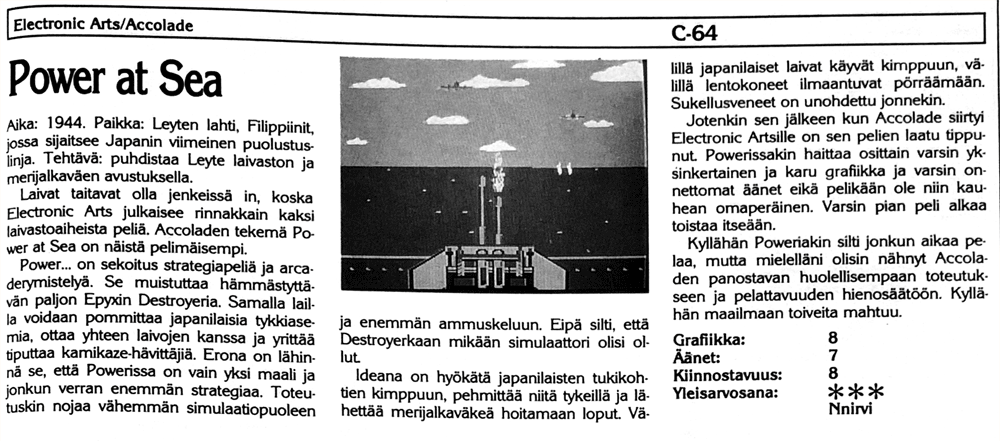
Power at Sea1988Pysyvä linkkiAika: 1944. Paikka: Leyten lahti, Filippiinit, jossa sijaitsee Japanin viimeinen puolustuslinja. Tehtävä: puhdistaa Leyte laivaston ja merijalkaväen avustuksella.
Laivat taitavat olla jenkeissä in, koska Electronic Arts julkaisee rinnakkain kaksi laivastoaiheista peliä. Accoladen tekemä Power at Sea on näistä pelimäisempi.
Power... on sekoitus strategiapeliä ja arcaderymistelyä. Se muistuttaa hämmästyttävän paljon Epyxin Destroyeria. Samalla lailla voidaan pommittaa japanilaisia tykkiasemia, ottaa yhteen laivojen kanssa ja yrittää tiputtaa kamikaze-hävittäjiä. Erona on lähinnä se, että Powerissa on vain yksi maali ja jonkun verran enemmän strategiaa. Toteutuskin nojaa vähemmän simulaatiopuoleen ja enemmän ammuskeluun. Eipä silti, että Destroyerkaan mikään simulaattori olisi ollut.
Ideana on hyökätä japanilaisten tukikohtien kimppuun, pehmittää niitä tykeillä ja lähettää merijalkaväkeä hoitamaan loput. Välillä japanilaiset laivat käyvät kimppuun, välillä lentokoneet ilmaantuvat pörräämään. Sukellusveneet on unohdettu jonnekin.
Jotenkin sen jälkeen kun Accolade siirtyi Electronic Artsille on sen pelien laatu tippunut. Powerissakin haittaa osittain varsin yksinkertainen ja karu grafiikka ja varsin onnettomat äänet eikä pelikään ole niin kauhean omaperäinen. Varsin pian peli alkaa toistaa itseään.
Kyllähän Poweriakin silti jonkun aikaa pelaa, mutta mielelläni olisin nähnyt Accoladen panostavan huolellisempaan toteutukseen ja pelattavuuden hienosäätöön. Kyllähän maailmaan toiveita mahtuu.
Power at Sea1988PermalinkTime: 1944. Place: Leyte Gulf, the Philippines, site of Japan's last line of defence. Mission: clear Leyte with the help of the navy and the marines.
Ships must be the in thing over in Yankeeland, since Electronic Arts is releasing two naval games side by side. Of the two, Accolade's Power at Sea is the more game-like.
Power... is a mixture of strategy game and arcade romp. It bears an astonishing resemblance to Epyx's Destroyer. In just the same way you can bombard Japanese gun emplacements, clash with ships and try to bring down kamikaze fighters. The main difference is that Power has only one target and a fair bit more strategy. The implementation also leans less on the simulation side and more on shooting. Not that Destroyer was any kind of simulator either.
The idea is to attack the Japanese bases, soften them up with the guns and send in the marines to finish the job. Now and then Japanese ships come at you, now and then aircraft turn up to buzz around. The submarines have been forgotten somewhere.
Somehow, ever since Accolade moved over to Electronic Arts, the quality of its games has dropped. Power, too, is partly let down by rather simple and bare graphics and rather wretched sound, and the game isn't all that terribly original either. Quite soon the game starts repeating itself.
Sure, you'll still play Power for a while, but I'd have liked to see Accolade put more effort into a careful implementation and into fine-tuning the playability. Oh well, there's always room in the world for wishes.
Powerdrome
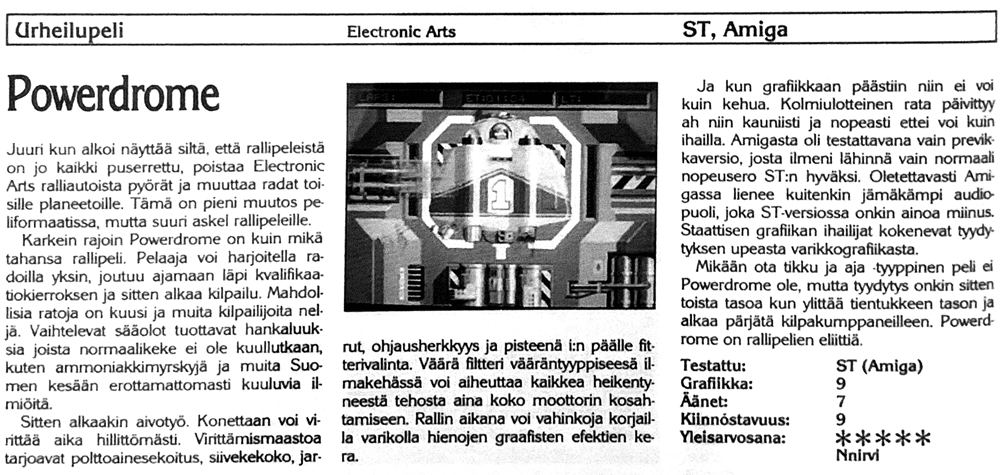
Powerdrome1989 KevätPysyvä linkkiJuuri kun alkoi näyttää siltä, että rallipeleistä on jo kaikki puserrettu, poistaa Electronic Arts ralliautoista pyörät ja muuttaa radat toisille planeetoille. Tämä on pieni muutos peliformaatissa, mutta suuri askel rallipeleille.
Karkein rajoin Powerdrome on kuin mikä tahansa rallipeli. Pelaaja voi harjoitella radoilla yksin, joutuu ajamaan läpi kvalifikaatiokierroksen ja sitten alkaa kilpailu. Mahdollisia ratoja on kuusi ja muita kilpailijoita neljä. Vaihtelevat sääolot tuottavat hankaluuksia joista normaalikeke ei ole kuullutkaan, kuten ammoniakkimyrskyjä ja muita Suomen kesään erottamattomasti kuuluvia ilmiöitä.
Sitten alkaakin aivotyö. Konettaan voi virittää aika hillittömästi. Virittämismaastoa tarjoavat polttoainesekoitus, siivekekoko, jarrut, ohjausherkkyys ja pisteenä i:n päälle fitterivalinta. Väärä filtteri vääräntyyppiseesä ilmakehässä voi aiheuttaa kaikkea heikentyneestä tehosta aina koko moottorin kosahtamiseen. Rallin aikana voi vahinkoja korjailla varikolla hienojen graafisten efektien kera.
Ja kun grafiikkaan päästiin niin ei voi kuin kehua. Kolmiulotteinen rata päivittyy ah niin kauniisti ja nopeasti ettei voi kuin ihailla. Amigasta oli testattavana vain previkkaversio, josta ilmeni lähinnä vain normaali nopeusero ST:n hyväksi. Oletettavasti Amigassa lienee kuitenkin jämäkämpi audiopuoli, joka ST-versiossa onkin ainoa miinus. Staattisen grafiikan ihailijat kokenevat tyydytyksen upeasta varikkografiikasta.
Mikään ota tikku ja aja -tyyppinen peli ei Powerdrome ole, mutta tyydytys onkin sitten toista tasoa kun ylittää tientukkeen tason ja alkaa pärjätä kilpakumppaneilleen. Powerdrome on rallipelien eliittiä.
Powerdrome1989 KevätPermalinkJust when it was starting to look as if everything had already been squeezed out of racing games, Electronic Arts takes the wheels off the racing cars and moves the tracks to other planets. This is a small change in the game format, but a big step for racing games.
In rough outline Powerdrome is like any racing game. The player can practise on the tracks alone, has to drive through a qualifying lap, and then the race begins. There are six possible tracks and four other competitors. Changing weather conditions cause difficulties your average Keke has never even heard of, such as ammonia storms and other phenomena inseparable from the Finnish summer.
Then the brainwork begins. You can tune your machine pretty much without restraint. Tuning terrain is provided by the fuel mix, wing size, brakes, steering sensitivity and, to dot the i, the choice of filter. The wrong filter in the wrong type of atmosphere can cause anything from reduced power all the way to the whole engine going kaput. During the race you can patch up damage in the pits, complete with fine graphical effects.
And now that we've got to the graphics, there's nothing to do but praise. The three-dimensional track updates oh so beautifully and quickly that you can only admire it. Of the Amiga there was only a preview copy to test, which mainly revealed just the usual speed difference in the ST's favour. Presumably the Amiga will nonetheless have a beefier audio side, which is in fact the only minus in the ST version. Admirers of static graphics will probably find satisfaction in the superb pit-stop graphics.
Powerdrome is no grab-the-stick-and-drive kind of game, but then the satisfaction is on another level entirely once you rise above mobile-roadblock level and start holding your own against your rivals. Powerdrome is the elite of racing games.
Powermonger
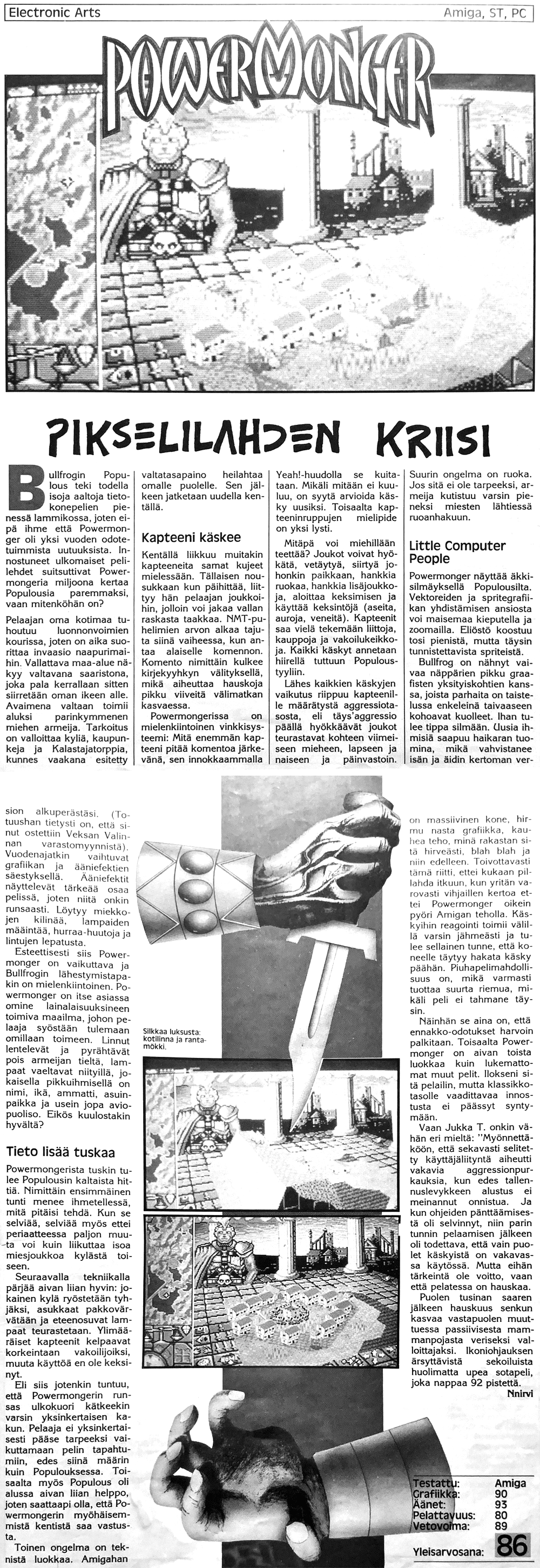
Powermonger1991 KevätPysyvä linkkiBullfrogin Populous teki todella isoja aaltoja tietokonepelien pienessä lammikossa, joten eipä ihme että Powermonger oli yksi vuoden odotetuimmista uutuuksista. Innostuneet ulkomaiset pelilehdet suitsuttivat Powermongeria miljoona kertaa Populousia paremmaksi, vaan mitenköhän on?
Pelaajan oma kotimaa tuhoutuu luonnonvoimien kourissa, joten on aika suorittaa invaasio naapurimaihin. Vallattava maa-alue näkyy valtavana saaristona, joka pala kerrallaan sitten siirretään oman ikeen alle. Avaimena valtaan toimii aluksi parinkymmenen miehen armeija. Tarkoitus on valloittaa kyliä, kaupunkeja ja Kalastajatorppia, kunnes vaakana esitetty valtatasapaino heilahtaa omalle puolelle. Sen jälkeen jatketaan uudella kentällä.
Kapteeni käskee
Kentällä liikkuu muitakin kapteeneita samat kujeet mielessään. Tällaisen nousukkaan kun päihittää, liittyy hän pelaajan joukkoihin, jolloin voi jakaa vallan raskasta taakkaa. NMT-puhelimien arvon alkaa tajuta siinä vaiheessa, kun antaa alaiselle komennon. Komento nimittäin kulkee kirjekyyhkyn välityksellä, mikä aiheuttaa hauskoja pikku viiveitä välimatkan kasvaessa.
Powermongerissa on mielenkiintoinen vinkkisysteemi: Mitä enemmän kapteeni pitää komentoa järkevänä, sen innokkaammalla Yeah!-huudolla se kuitataan. Mikäli mitään ei kuulu, on syytä arvioida käsky uusiksi. Toisaalta kapteeninruppujen mielipide on yksi lysti.
Mitäpä voi miehillään teettää? Joukot voivat hyökätä, vetäytyä, siirtyä johonkin paikkaan, hankkia ruokaa, hankkia lisäjoukkoja, aloittaa keksimisen ja käyttää keksintöjä (aseita, auroja, veneitä). Kapteenit saa vielä tekemään liittoja, kauppoja ja vakoilukeikkoja. Kaikki käskyt annetaan hiirellä tuttuun Populous-tyyliin.
Lähes kaikkien käskyjen vaikutus riippuu kapteenille määrätystä aggressiotasosta, eli täys'aggressio päällä hyökkäävät joukot teurastavat kohteen viimeiseen mieheen, lapseen ja naiseen ja päinvastoin.
Suurin ongelma on ruoka. Jos sitä ei ole tarpeeksi, armeija kutistuu varsin pieneksi miesten lähtiessä ruoanhakuun.
Little Computer People
Powermonger näyttää äkkisilmäyksellä Populousilta. Vektoreiden ja spritegrafiikan yhdistämisen ansiosta voi maisemaa kieputella ja zoomailla. Eliöstö koostuu tosi pienistä, mutta täysin tunnistettavista spriteistä.
Bullfrog on nähnyt vaivaa näppärien pikku graafisten yksityiskohtien kanssa, joista parhaita on taistelussa enkeleinä taivaaseen kohoavat kuolleet. Ihan tulee tippa silmään. Uusia ihmisiä saapuu haikaran tuomina, mikä vahvistanee isän ja äidin kertoman version alkuperästäsi. (Totuushan tietysti on, että sinut ostettiin Veksan Valinnan varastomyynnistä). Vuodenajatkin vaihtuvat grafiikan ja ääniefektien säestyksellä. Ääniefektit näyttelevät tärkeää osaa pelissä, joten niitä onkin runsaasti. Löytyy miekkojen kilinää, lampaiden määintää, hurraa-huutoja ja lintujen lepatusta.
Esteettisesti siis Powermonger on vaikuttava ja Bullfrogin lähestymistapakin on mielenkiintoinen. Powermonger on itse asiassa omine lainalaisuuksineen toimiva maailma, johon pelaaja syöstään tulemaan omillaan toimeen. Linnut lentelevät ja pyrähtävät pois armeijan tieltä, lampaat vaeltavat niityillä, jokaisella pikkuihmisellä on nimi, ikä, ammatti, asuinpaikka ja usein jopa aviopuoliso. Eikös kuulostakin hyvältä?
Tieto lisää tuskaa
Powermongerista tuskin tulee Populousin kaltaista hittiä. Nimittäin ensimmäinen tunti menee ihmetellessä, mitä pitäisi tehdä. Kun se selviää, selviää myös ettei periaatteessa paljon muuta voi kuin liikuttaa isoa miesjoukkoa kylästä toiseen.
Seuraavalla tekniikalla pärjää aivan liian hyvin: jokainen kylä ryöstetään tyhjäksi, asukkaat pakkovärvätään ja eteenosuvat lampaat teurastetaan. Ylimääräiset kapteenit kelpaavat korkeintaan vakoilijoiksi, muuta käyttöä en ole keksinyt.
Eli siis jotenkin tuntuu, että Powermongerin runsas ulkokuori kätkeekin varsin yksinkertaisen kakun. Pelaaja ei yksinkertaisesti pääse tarpeeksi vaikuttamaan pelin tapahtumiin, edes siinä määrin kuin Populouksessa. Toisaalta myös Populous oli alussa aivan liian helppo, joten saattaapi olla, että Powermongerin myöhäisemmistä kentistä saa vastusta.
Toinen ongelma on teknistä luokkaa. Amigahan on massiivinen kone, hirmu nasta grafiikka, kauhea teho, minä rakastan sitä hirveästi, blah blah ja niin edelleen. Toivottavasti tämä riitti, ettei kukaan pillahda itkuun, kun yritän varovasti vihjaillen kertoa ettei Powermonger oikein pyöri Amigan teholla. Käskyihin reagointi toimii välillä varsin jähmeästi ja tulee sellainen tunne, että koneelle täytyy hakata käsky päähän. Piuhapelimahdollisuus on, mikä varmasti tuottaa suurta riemua, mikäli peli ei tahmane täysin.
Näinhän se aina on, että ennakko-odotukset harvoin palkitaan. Toisaalta Powermonger on aivan toista luokkaa kuin lukemattomat muut pelit. Ilokseni sitä pelailin, mutta klassikkotasolle vaadittavaa innostusta ei päässyt syntymään.
Vaan Jukka T. onkin vähän eri mieltä: "Myönnettäköön, että sekavasti selitetty käyttäjäliityntä aiheutti vakavia aggressionpurkauksia, kun edes tallennuslevykkeen alustus ei meinannut onnistua. Ja kun ohjeiden pänttäämisestä oli selvinnyt, niin parin tunnin pelaamisen jälkeen oli todettava, että vain puolet käskyistä on vakavassa käytössä. Mutta eihän tärkeintä ole voitto, vaan että pelatessa on hauskaa.
Puolen tusinan saaren jälkeen hauskuus senkun kasvaa vastapuolen muuttuessa passiivisesta mammanpojasta veriseksi valloittajaksi. Ikoniohjauksen ärsyttävistä sekoiluista huolimatta upea sotapeli, joka nappaa 92 pistettä.
Powermonger1991 KevätPermalinkBullfrog's Populous made really big waves in the small pond of computer games, so it's no wonder Powermonger was one of the most eagerly awaited new releases of the year. Excited foreign games magazines gushed that Powermonger was a million times better than Populous, but is that really so, I wonder?
The player's own homeland is being destroyed in the grip of the forces of nature, so it's time to carry out an invasion of the neighbouring lands. The territory to be conquered appears as a vast archipelago, which is then brought under your own yoke one piece at a time. The key to power at first is an army of twenty-odd men. The aim is to conquer villages, towns and Kalastajatorppas until the balance of power, shown as a pair of scales, swings to your side. After that you carry on with a new level.
The Captain Commands
There are other captains moving about the level too, with the same tricks in mind. Beat one of these upstarts and they join the player's forces, so you can share the heavy burden of power. You start to appreciate the value of NMT mobile phones the moment you give an order to a subordinate. The order, you see, travels by carrier pigeon, which causes amusing little delays as the distance grows.
Powermonger has an interesting hint system: the more sensible the captain thinks an order is, the more enthusiastic the "Yeah!" shout it is acknowledged with. If nothing is heard, it's time to reconsider the order. Then again, the opinion of those tinpot captains doesn't matter one jot.
So what can you have your men do? The troops can attack, retreat, move to some place, gather food, get more troops, start inventing and use inventions (weapons, ploughs, boats). You can also get the captains to make alliances, deals and spying trips. All orders are given with the mouse in the familiar Populous style.
The effect of almost every order depends on the aggression level assigned to the captain, so troops attacking with full-on aggression switched on slaughter the target to the last man, child and woman, and vice versa.
The biggest problem is food. If there isn't enough of it, the army shrinks to quite a small size as the men go off foraging.
Little Computer People
At first glance Powermonger looks like Populous. Thanks to combining vectors and sprite graphics, you can spin the landscape around and zoom in and out. The living things are made up of really tiny but fully recognisable sprites.
Bullfrog has taken trouble over nifty little graphical details, the best of which are the dead rising to heaven as angels in battle. It really brings a tear to your eye. New people arrive delivered by the stork, which presumably confirms the version of your origins that your mum and dad told you. (The truth, of course, is that you were bought at the Veksan Valinta warehouse sale). The seasons change too, accompanied by graphics and sound effects. Sound effects play an important part in the game, so there are plenty of them. There's the clang of swords, the bleating of sheep, hurrah-shouts and the fluttering of birds.
Aesthetically, then, Powermonger is impressive, and Bullfrog's approach is interesting too. Powermonger is in fact a world that works by its own laws, into which the player is flung to fend for themselves. Birds flit about and flutter out of the army's way, sheep wander the meadows, and every little person has a name, an age, a profession, a place of residence and often even a spouse. Doesn't that sound good?
Knowledge Increases Sorrow
Powermonger is hardly going to be a hit like Populous. You see, the first hour goes on wondering what you're supposed to do. Once that becomes clear, it also becomes clear that in principle you can't do much else than move a big bunch of men from one village to the next.
The following technique works far too well: every village is plundered bare, the inhabitants are press-ganged and any sheep in your way are slaughtered. Surplus captains are good for spies at most; I haven't come up with any other use for them.
So, somehow it feels as if Powermonger's lavish outer crust is hiding a rather simple cake. The player simply doesn't get enough influence over what happens in the game, not even to the extent of Populous. Then again, Populous was far too easy at first as well, so it might just be that Powermonger's later levels put up a fight.
The second problem is of a technical nature. The Amiga is, of course, a massive machine, awfully nifty graphics, tremendous power, I love it terribly, blah blah and so on. Hopefully that was enough to keep anyone from bursting into tears when I try, with careful hints, to tell you that Powermonger doesn't quite run on the Amiga's horsepower. Responses to orders are at times pretty sluggish, and you get the feeling you have to hammer the order into the machine's head. There's a link-up play option, which will surely bring great joy, provided the game doesn't get completely bogged down.
That's always the way: advance expectations are rarely rewarded. On the other hand, Powermonger is in a whole different class from countless other games. I enjoyed playing it, but the enthusiasm needed for classic status never got going.
But Jukka T. is of a somewhat different opinion: "Admittedly, the confusingly explained user interface caused serious outbursts of aggression, when even formatting a save disk barely wanted to work. And once I'd survived cramming the manual, after a couple of hours of play I had to admit that only half the orders get any serious use. But winning isn't the most important thing, having fun while you play is.
"After half a dozen islands the fun just keeps growing as the opposition turns from a passive mummy's boy into a bloody conqueror. Despite the irritating muddles of the icon controls, a superb war game that grabs 92 points."
Powerplay
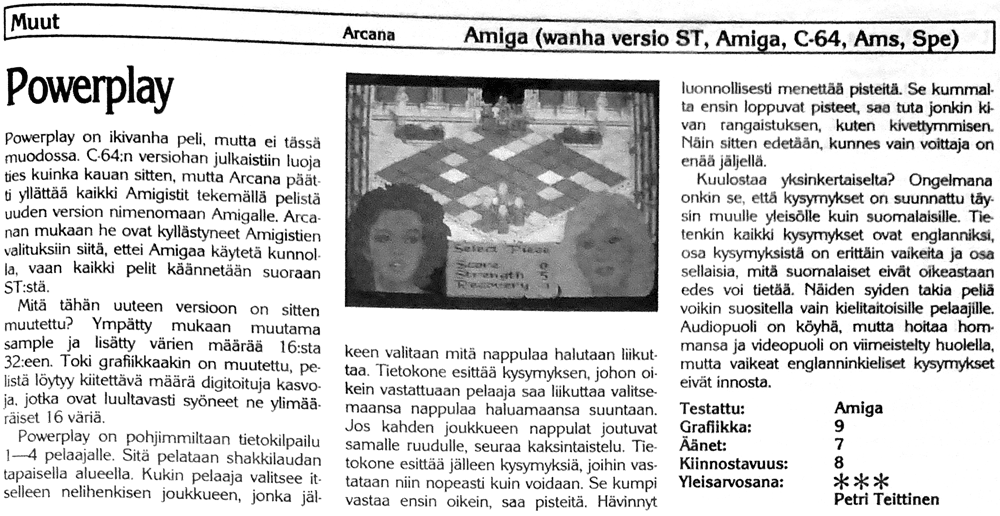
Powerplay1989 KevätPysyvä linkkiPowerplay on ikivanha peli, mutta ei tässä muodossa. C-64:n versiohan julkaistiin luoja ties kuinka kauan sitten, mutta Arcana päätti yllättää kaikki Amigistit tekemällä pelistä uuden version nimenomaan Amigalle. Arcanan mukaan he ovat kyllästyneet Amigistien valituksiin siitä, ettei Amigaa käytetä kunnolla, vaan kaikki pelit käännetään suoraan ST:stä.
Mitä tähän uuteen versioon on sitten muutettu? Ympätty mukaan muutama sample ja lisätty värien määrää 16:sta 32:een. Toki grafiikkaakin on muutettu, pelistä löytyy kiitettävä määrä digitoituja kasvoja, jotka ovat luultavasti syöneet ne ylimääräiset 16 väriä.
Powerplay on pohjimmiltaan tietokilpailu 1-4 pelaajalle. Sitä pelataan shakkilaudan tapaisella alueella. Kukin pelaaja valitsee itselleen nelihenkisen joukkueen, jonka jälkeen valitaan mitä nappulaa halutaan liikuttaa. Tietokone esittää kysymyksen, johon oikein vastattuaan pelaaja saa liikuttaa valitsemaansa nappulaa haluamaansa suuntaan. Jos kahden joukkueen nappulat joutuvat samalle ruudulle, seuraa kaksintaistelu. Tietokone esittää jälleen kysymyksiä, joihin vastataan niin nopeasti kuin voidaan. Se kumpi vastaa ensin oikein, saa pisteitä. Hävinnyt luonnollisesti menettää pisteitä. Se kummalta ensin loppuvat pisteet, saa tuta jonkin kivan rangaistuksen, kuten kivettymmisen. Näin sitten edetään, kunnes vain voittaja on enää jäljellä.
Kuulostaa yksinkertaiselta? Ongelmana onkin se, että kysymykset on suunnattu täysin muulle yleisölle kuin suomalaisille. Tietenkin kaikki kysymykset ovat englanniksi, osa kysymyksistä on erittäin vaikeita ja osa sellaisia, mitä suomalaiset eivät oikeastaan edes voi tietää. Näiden syiden takia peliä voikin suositella vain kielitaitoisille pelaajille. Audiopuoli on köyhä, mutta hoitaa hommansa ja videopuoli on viimeistelty huolella, mutta vaikeat englanninkieliset kysymykset eivät innosta.
Powerplay1989 KevätPermalinkPowerplay is an ancient game, but not in this form. The C-64 version came out heaven knows how long ago, but Arcana decided to surprise all the Amigans by making a new version of the game specifically for the Amiga. According to Arcana, they're fed up with the Amigans' complaints that the Amiga isn't being used properly and that every game is just converted straight from the ST.
So what has been changed in this new version? A few samples have been crammed in and the number of colours raised from 16 to 32. The graphics have been changed too, of course: the game has a commendable number of digitised faces, which have probably eaten up those extra 16 colours.
At heart Powerplay is a quiz for 1-4 players. It's played on an area rather like a chessboard. Each player picks a four-man team, after which you choose which piece you want to move. The computer asks a question, and after answering it correctly the player gets to move the chosen piece in whichever direction they like. If two teams' pieces end up on the same square, a duel follows. The computer again asks questions, which are answered as fast as you can manage. Whichever of the two answers correctly first gets points. The loser naturally loses points. Whichever of the two runs out of points first gets a taste of some lovely punishment, such as being turned to stone. And so it goes on until only the winner is left.
Sounds simple? The problem is that the questions are aimed squarely at an audience other than Finns. Naturally all the questions are in English; some of them are extremely difficult and some are things Finns can't really be expected to know at all. For these reasons the game can only be recommended to players with a good command of the language. The audio side is meagre but does its job, and the video side has been carefully polished, but the difficult English-language questions don't exactly fire you up.
Powerplay Hockey USA vs. USSR

Powerplay Hockey USA vs. USSR1989 KevätPysyvä linkkiElectronic Artsin ohjelmoijapoikaset ovat vieläkin innoissaan vuoden 1980 (!) talviolympialaisista, jolloin USA:n jääkiekkojoukkue voitti olympiakultaa pestyään itänaapurimme punakoneen niukasti. Mikäpä siinä, saahan sana "jääkiekko" minutkin kiekuramakkaran kimppuun ja TV:n ääneen meuhaamaan.
Powerplay on tehty taidolla. Pelaajien kontrollointi on vedetty uusiksi verrattuna tuttuihin ja turvallisiin konsteihin, esim. "kiekkohirmu" joystickin johdon päässä ei ohjaile pelin missään vaiheessa maalivahtia. Lisäksi ilokepin vatkaaminen ei vaikuta pelkästään siihen mieheen, joka sattuu olemaan lähinnä kiekkoa, vaan penkkiurheilija ohjailee koko pelin ajan samaa miestä. On siis täysin mahdollista jäädä keikkumaan ruudun ulkopuolelle odottelemaan puolustajien viskaamaa kiekkoa.
Sääntöihin on kiinnitetty sopivasti huomiota. Kaikki muistanevat klassisen kepinheilutuspelin nimeltä Slap Shot. Sitä onkin mainio verrata Powerplayhyn, sillä väkivaltaa löytyy molemmista ihan mukavasti. Tuomari viheltää paitsiot, pitkät kiekot ja silloin tällöin myös jäähyt. Tietokonetuomari katselee aika tavalla sormien välistä paitsioita, ei ole mitenkään epätavallista olla paitsiossa metrejä ilman tuomarireaktioita. Jäähyjäkin kone jakelee aika määrin vähäisin, sillä vastustajia voi kampitella nuoleskelemaan jään pintaa aika rauhassa ilman että mitään tapahtuu. Mutta jos vastapelaaja ottaa pulttia, eli hermostuu ja alkaa veistellä kampittajaa naamariin eli kasvoihin, on jäähy lähellä.
Powerplay Hockeysta ei ole tehty liian monimutkaista, vaan tällaisenaan se on suunnatonta hupia eikä rassaa aivoja liikaa ja sellaisesta minä pidän. Lyhyesti: C-64:n paras jääkiekkopeli, missä viipyy Amigan versio?
Powerplay Hockey USA vs. USSR1989 KevätPermalinkThe young programmer lads at Electronic Arts are still all excited about the 1980 (!) Winter Olympics, when the USA's ice hockey team won Olympic gold after narrowly giving our eastern neighbour's Red Machine a scrubbing. Fair enough - the word "ice hockey" gets even me tearing into a coil of sausage and hollering in front of the TV.
Powerplay has been made with skill. The controlling of the players has been redone from scratch compared with the familiar, safe old methods: for example, the "puck fiend" at the end of the joystick lead never controls the goalie at any point in the game. What's more, waggling the joystick doesn't just affect whichever man happens to be nearest the puck; instead the armchair athlete controls the same man for the whole game. So it's entirely possible to be left loitering off-screen, waiting for a puck flung up by the defencemen.
Suitable attention has been paid to the rules. Everyone will probably remember the classic stick-swinging game called Slap Shot. It makes a fine comparison with Powerplay, since both have a nice healthy dose of violence. The referee whistles for offsides, icings and now and then penalties as well. The computer referee turns a fairly blind eye to offsides; it's not at all unusual to be offside by several metres without any reaction from the ref. The machine hands out penalties rather sparingly too, since you can trip opponents into licking the surface of the ice pretty much in peace without anything happening. But if the opposing player blows a fuse, that is, loses his temper and starts whittling away at the tripper's mug, that is, his face, a penalty is close at hand.
Powerplay Hockey hasn't been made too complicated; as it is, it's tremendous fun and doesn't strain the brain too much, and that's the kind of thing I like. In short: the best ice hockey game on the C-64 - so what's keeping the Amiga version?
Predator
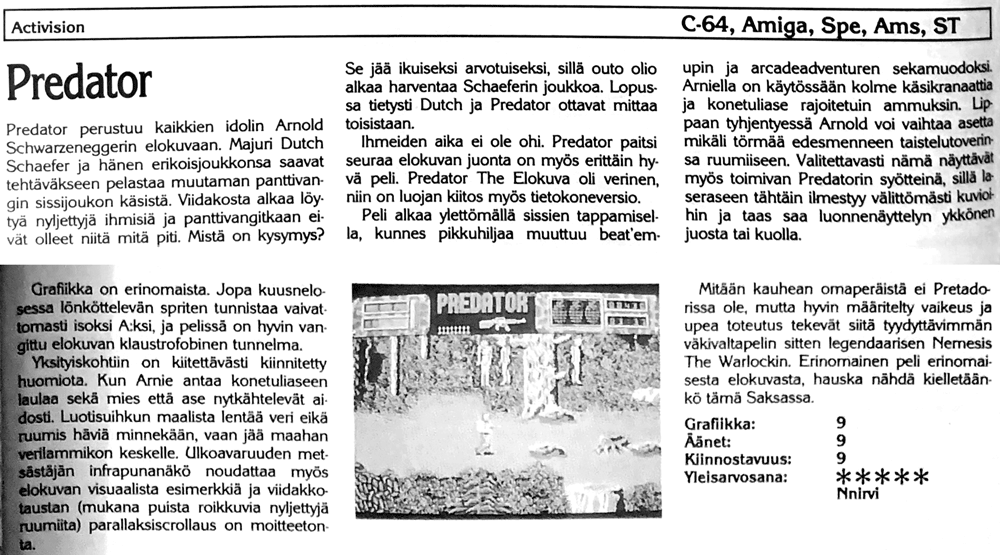
Predator1988Pysyvä linkkiPredator perustuu kaikkien idolin Arnold Schwarzeneggerin elokuvaan. Majuri Dutch Schaefer ja hänen erikoisjoukkonsa saavat tehtäväkseen pelastaa muutaman panttivangin sissijoukon käsistä. Viidakosta alkaa löytyä nyljettyjä ihmisiä ja panttivangitkaan eivät olleet niitä mitä piti. Mistä on kysymys? Se jää ikuiseksi arvotuiseksi, sillä outo olio alkaa harventaa Schaeferin joukkoa. Lopussa tietysti Dutch ja Predator ottavat mittaa toisistaan.
Ihmeiden aika ei ole ohi. Predator paitsi seuraa elokuvan juonta on myös erittäin hyvä peli. Predator The Elokuva oli verinen, niin on luojan kiitos myös tietokoneversio.
Peli alkaa ylettömällä sissien tappamisella, kunnes pikkuhiljaa muuttuu beat'emupin ja arcadeadventuren sekamuodoksi. Arniella on käytössään kolme käsikranaattia ja konetuliase rajoitetuin ammuksin. Lippaan tyhjentyessä Arnold voi vaihtaa asetta mikäli törmää edesmenneen taistelutoverinsa ruumiiseen. Valitettavasti nämä näyttävät myös toimivan Predatorin syötteinä, sillä laseraseen tähtäin ilmestyy välittömästi kuvioihin ja taas saa luonnenäyttelyn ykkönen juosta tai kuolla. Grafiikka on erinomaista. Jopa kuusnelosessa lönköttelevän spriten tunnistaa vaivattomasti isoksi A:ksi, ja pelissä on hyvin vangittu elokuvan klaustrofobinen tunnelma.
Yksityiskohtiin on kiitettävästi kiinnitetty huomiota. Kun Arnie antaa konetuliaseen laulaa sekä mies että ase nytkähtelevät aidosti. Luotisuihkun maalista lentää veri eikä ruumis häviä minnekään, vaan jää maahan verilammikon keskelle. Ulkoavaruuden metsästäjän infrapunanäkö noudattaa myös elokuvan visuaalista esimerkkiä ja viidakkotaustan (mukana puista roikkuvia nyljettyjä ruumiita) parallaksiscrollaus on moitteetonta.
Mitään kauhean omaperäistä ei Pretadorissa ole, mutta hyvin määritelty vaikeus ja upea toteutus tekevät siitä tyydyttävimmän väkivaltapelin sitten legendaarisen Nemesis The Warlockin. Erinomainen peli erinomaisesta elokuvasta, hauska nähdä kielletäänkö tämä Saksassa.
Predator1988PermalinkPredator is based on the film starring everybody's idol, Arnold Schwarzenegger. Major Dutch Schaefer and his special forces unit are given the job of rescuing a few hostages from the hands of a guerrilla band. Skinned people start turning up in the jungle, and the hostages weren't what they were supposed to be either. What's going on? That remains an eternal riddle, because a strange creature starts thinning out Schaefer's unit. At the end, of course, Dutch and the Predator take each other's measure.
The age of miracles is not over. Not only does Predator follow the plot of the film, it is also a very good game. Predator The Movie was bloody, and so, thank the Lord, is the computer version.
The game starts with an excess of guerrilla-killing, until little by little it turns into a hybrid of beat'em up and arcade adventure. Arnie has three hand grenades and a machine gun with limited ammo at his disposal. When his magazine runs dry, Arnold can switch weapons if he stumbles upon the body of a fallen comrade-in-arms. Unfortunately these also seem to serve as bait for the Predator, because the sight of a laser weapon immediately shows up on the scene, and once again the number one of character acting has to run or die. The graphics are excellent. Even on the Commodore 64 the lumbering sprite is effortlessly recognisable as the big A, and the game captures the film's claustrophobic atmosphere very well.
Commendable attention has been paid to detail. When Arnie lets the machine gun sing, both man and gun judder convincingly. Blood flies from whatever the hail of bullets hits, and the body doesn't vanish anywhere but stays on the ground in the middle of a pool of blood. The outer-space hunter's infrared vision also follows the film's visual example, and the parallax scrolling of the jungle background (complete with skinned bodies hanging from the trees) is flawless.
There's nothing terribly original in Pretador, but the well-judged difficulty and the superb implementation make it the most satisfying violent game since the legendary Nemesis The Warlock. An excellent game of an excellent film; it'll be fun to see whether this one gets banned in Germany.
Predator 2
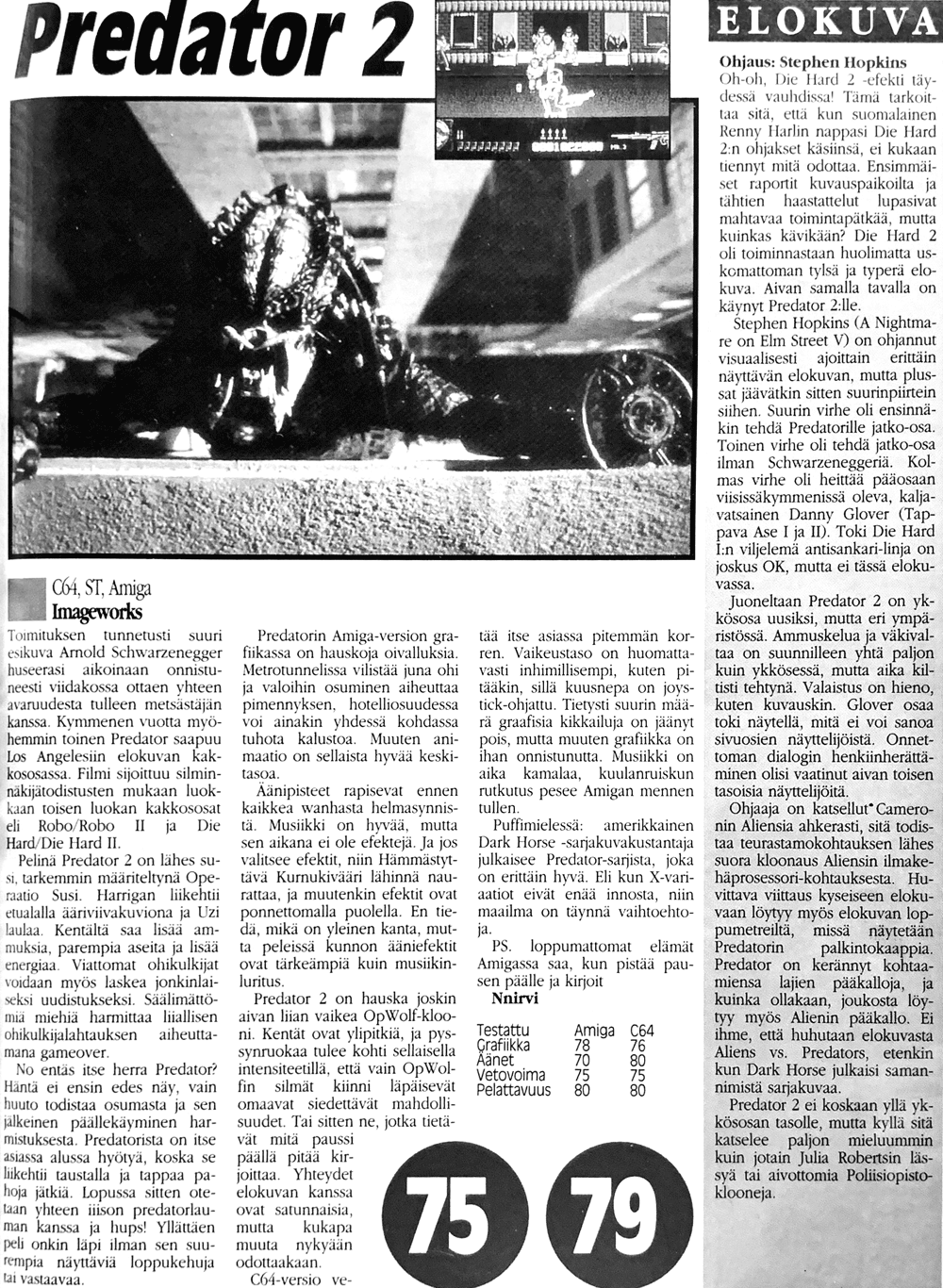
Predator 21991 SyksyPysyvä linkkiToimituksen tunnetusti suuri esikuva Arnold Schwarzenegger huseerasi aikoinaan onnistuneesti viidakossa ottaen yhteen avaruudesta tulleen metsästäjän kanssa. Kymmenen vuotta myöhemmin toinen Predator saapuu Los Angelesiin elokuvan kakkososassa. Filmi sijoittuu silminnäkijätodistusten mukaan luokkaan toisen luokan kakkososat eli Robo/Robo II ja Die Hard/Die Hard II.
Pelinä Predator 2 on lähes susi, tarkemmin määriteltynä Operaatio Susi. Harrigan liikehtii etualalla ääriviivakuviona ja Uzi laulaa. Kentältä saa lisää ammuksia, parempia aseita ja lisää energiaa. Viattomat ohikulkijat voidaan myös laskea jonkinlaiseksi uudistukseksi. Säälimättömiä miehiä harmittaa liiallisen ohikulkijalahtauksen aiheuttamana gameover.
No entäs itse herra Predator? Häntä ei ensin edes näy, vain huuto todistaa osumasta ja sen jälkeinen päällekäyminen harmistuksesta. Predatorista on itse asiassa alussa hyötyä, koska se liikehtii taustalla ja tappaa pahoja jätkiä. Lopussa sitten otetaan yhteen iiison predatorlauman kanssa ja hups! Yllättäen peli onkin läpi ilman sen suurempia näyttäviä loppukehuja tai vastaavaa.
Predatorin Amiga-version grafiikassa on hauskoja oivalluksia. Metrotunnelissa vilistää juna ohi ja valoihin osuminen aiheuttaa pimennyksen, hotelliosuudessa voi ainakin yhdessä kohdassa tuhota kalustoa. Muuten animaatio on sellaista hyvää keskitasoa.
Äänipisteet rapisevat ennen kaikkea wanhasta helmasynnistä. Musiikki on hyvää, mutta sen aikana ei ole efektejä. Ja jos valitsee efektit, niin Hämmästyttävä Kurnukivääri lähinnä naurattaa, ja muutenkin efektit ovat ponnettomalla puolella. En tiedä, mikä on yleinen kanta, mutta peleissä kunnon ääniefektit ovat tärkeämpiä kuin musiikinluritus.
Predator 2 on hauska joskin aivan liian vaikea OpWolf-klooni. Kentät ovat ylipitkiä, ja pyssynruokaa tulee kohti sellaisella intensiteetillä, että vain OpWolfin silmät kiinni läpäisevät omaavat siedettävät mahdollisuudet. Tai sitten ne, jotka tietävät mitä paussi päällä pitää kirjoittaa. Yhteydet elokuvan kanssa ovat satunnaisia, mutta kukapa muuta nykyään odottaakaan.
C64-versio vetää itse asiassa pitemmän korren. Vaikeustaso on huomattavasti inhimillisempi, kuten pitääkin, sillä kuusnepa on joystick-ohjattu. Tietysti suurin määrä graafisia kikkailuja on jäänyt pois, mutta muuten grafiikka on ihan onnistunutta. Musiikki on aika kamalaa, kuulanruiskun rutkutus pesee Amigan mennen tullen.
Puffimielessä: amerikkainen Dark Horse -sarjakuvakustantaja julkaisee Predator-sarjista, joka on erittäin hyvä. Eli kun X-variaatiot eivät enää innosta, niin maailma on täynnä vaihtoehtoja.
PS. loppumattomat elämät Amigassa saa, kun pistää pausen päälle ja kirjoit
ELOKUVA
Ohjaus: Stephen Hopkins
Oh-oh, Die Hard 2 -efekti täydessä vauhdissa! Tämä tarkoittaa sitä, että kun suomalainen Renny Harlin nappasi Die Hard 2:n ohjakset käsiinsä, ei kukaan tiennyt mitä odottaa. Ensimmäiset raportit kuvauspaikoilta ja tähtien haastattelut lupasivat mahtavaa toimintapätkää, mutta kuinkas kävikään? Die Hard 2 oli toiminnastaan huolimatta uskomattoman tylsä ja typerä elokuva. Aivan samalla tavalla on käynyt Predator 2:lle.
Stephen Hopkins (A Nightmare on Elm Street V) on ohjannut visuaalisesti ajoittain erittäin näyttävän elokuvan, mutta plussat jäävätkin sitten suurinpiirtein siihen. Suurin virhe oli ensinnäkin tehdä Predatorille jatko-osa. Toinen virhe oli tehdä jatko-osa ilman Schwarzeneggeriä. Kolmas virhe oli heittää pääosaan viisissäkymmenissä oleva, kaljavatsainen Danny Glover (Tappava Ase I ja II). Toki Die Hard I:n viljelemä antisankari-linja on joskus OK, mutta ei tässä elokuvassa.
Juoneltaan Predator 2 on ykkösosa uusiksi, mutta eri ympäristössä. Ammuskelua ja väkivaltaa on suunnilleen yhtä paljon kuin ykkösessä, mutta aika kiltisti tehtynä. Valaistus on hieno, kuten kuvauskin. Glover osaa toki näytellä, mitä ei voi sanoa sivuosien näyttelijöistä. Onnettoman dialogin henkiinherättäminen olisi vaatinut aivan toisen tasoisia näyttelijöitä.
Ohjaaja on katsellut Cameronin Aliensia ahkerasti, sitä todistaa teurastamokohtauksen lähes suora kloonaus Aliensin ilmakehäprosessori-kohtauksesta. Huvittava viittaus kyseiseen elokuvaan löytyy myös elokuvan loppumetreiltä, missä näytetään Predatorin palkintokaappia. Predator on kerännyt kohtaamiensa lajien pääkalloja, ja kuinka ollakaan, joukosta löytyy myös Alienin pääkallo. Ei ihme, että huhutaan elokuvasta Aliens vs. Predators, etenkin kun Dark Horse julkaisi samannimistä sarjakuvaa.
Predator 2 ei koskaan yllä ykkösosan tasolle, mutta kyllä sitä katselee paljon mieluummin kuin jotain Julia Robertsin lässyä tai aivottomia Poliisiopistoklooneja.
Predator 21991 SyksyPermalinkArnold Schwarzenegger, famously the editorial team's great role model, once rampaged successfully through the jungle, locking horns with a hunter from outer space. Ten years later a second Predator arrives in Los Angeles in the film's part two. According to eyewitness testimony, the film belongs in the category of second-rate part twos, i.e. Robo/Robo II and Die Hard/Die Hard II.
As a game, Predator 2 is very nearly a dog - Operation Wolf, to be more precise. Harrigan moves about in the foreground as an outline figure and the Uzi sings. You can pick up more ammo, better weapons and more energy along the level. The innocent passers-by can also be counted as some sort of innovation. Merciless types will be annoyed by the game over brought on by excessive passer-by slaughter.
So what about Mr Predator himself? At first you can't even see him; only a scream testifies to a hit, and the charge at you that follows testifies to his annoyance. The Predator is actually useful to begin with, because it moves about in the background killing the bad guys. At the end you then take on a biiig pack of predators and whoops! Surprisingly, the game is finished, without any great showy closing praise or the like.
The graphics of Predator's Amiga version contain some fun touches. In the subway tunnel a train whizzes past and hitting the lights causes a blackout, and in the hotel section you can smash up the furniture in at least one spot. Otherwise the animation is of a good middling standard.
The sound score crumbles above all because of that olde besetting sin. The music is good, but there are no effects while it plays. And if you choose the effects, the Amazing Croaking Rifle mostly makes you laugh, and the effects are on the feeble side anyway. I don't know what the general view is, but in games proper sound effects matter more than musical warbling.
Predator 2 is a fun, if far too difficult, OpWolf clone. The levels are overlong, and the gun fodder comes at you with such intensity that only those who can finish OpWolf with their eyes shut stand a tolerable chance. Or else those who know what to type with the pause on. The links with the film are occasional, but who expects anything else these days.
The C64 version actually draws the longer straw. The difficulty level is considerably more humane, as it should be, since on the C-64 it's joystick-controlled. Naturally most of the graphical trickery has been left out, but otherwise the graphics are quite successful. The music is pretty awful, but the rattle of the bullet-squirter beats the Amiga's hands down.
By way of a plug: the American comics publisher Dark Horse publishes a Predator comic, which is very good. So when the X-variations no longer excite you, the world is full of alternatives.
PS. You get infinite lives on the Amiga by putting the pause on and typ
THE FILM
Directed by: Stephen Hopkins
Uh-oh, the Die Hard 2 effect in full swing! What this means is that when Finland's own Renny Harlin took the reins of Die Hard 2, nobody knew what to expect. The first reports from the shooting locations and the stars' interviews promised a mighty action flick, but how did it turn out? For all its action, Die Hard 2 was an unbelievably dull and stupid film. Exactly the same thing has happened to Predator 2.
Stephen Hopkins (A Nightmare on Elm Street V) has directed a film that is at times visually very striking, but that's roughly where the pluses end. The biggest mistake, first of all, was making a sequel to Predator. The second mistake was making the sequel without Schwarzenegger. The third mistake was throwing the fifty-something, beer-bellied Danny Glover (Lethal Weapon I and II) into the lead role. Sure, the anti-hero line cultivated by Die Hard I is OK sometimes, but not in this film.
Plot-wise Predator 2 is part one all over again, but in a different setting. There is roughly as much shooting and violence as in the first one, but done rather tamely. The lighting is great, as is the camerawork. Glover can certainly act, which can't be said of the supporting cast. Breathing life into the wretched dialogue would have taken actors of an entirely different calibre.
The director has been diligently watching Cameron's Aliens, as proven by the slaughterhouse scene, a near-direct clone of the atmosphere processor scene in Aliens. An amusing reference to that same film can also be found in the final stretch of the movie, where the Predator's trophy cabinet is shown. The Predator has collected the skulls of the species it has encountered, and lo and behold, among them there's also an Alien's skull. No wonder there are rumours of a film called Aliens vs. Predators, especially since Dark Horse published a comic of the same name.
Predator 2 never reaches the level of part one, but you'd still much rather watch it than some Julia Roberts drivel or brainless Police Academy clones.
Prehistorik
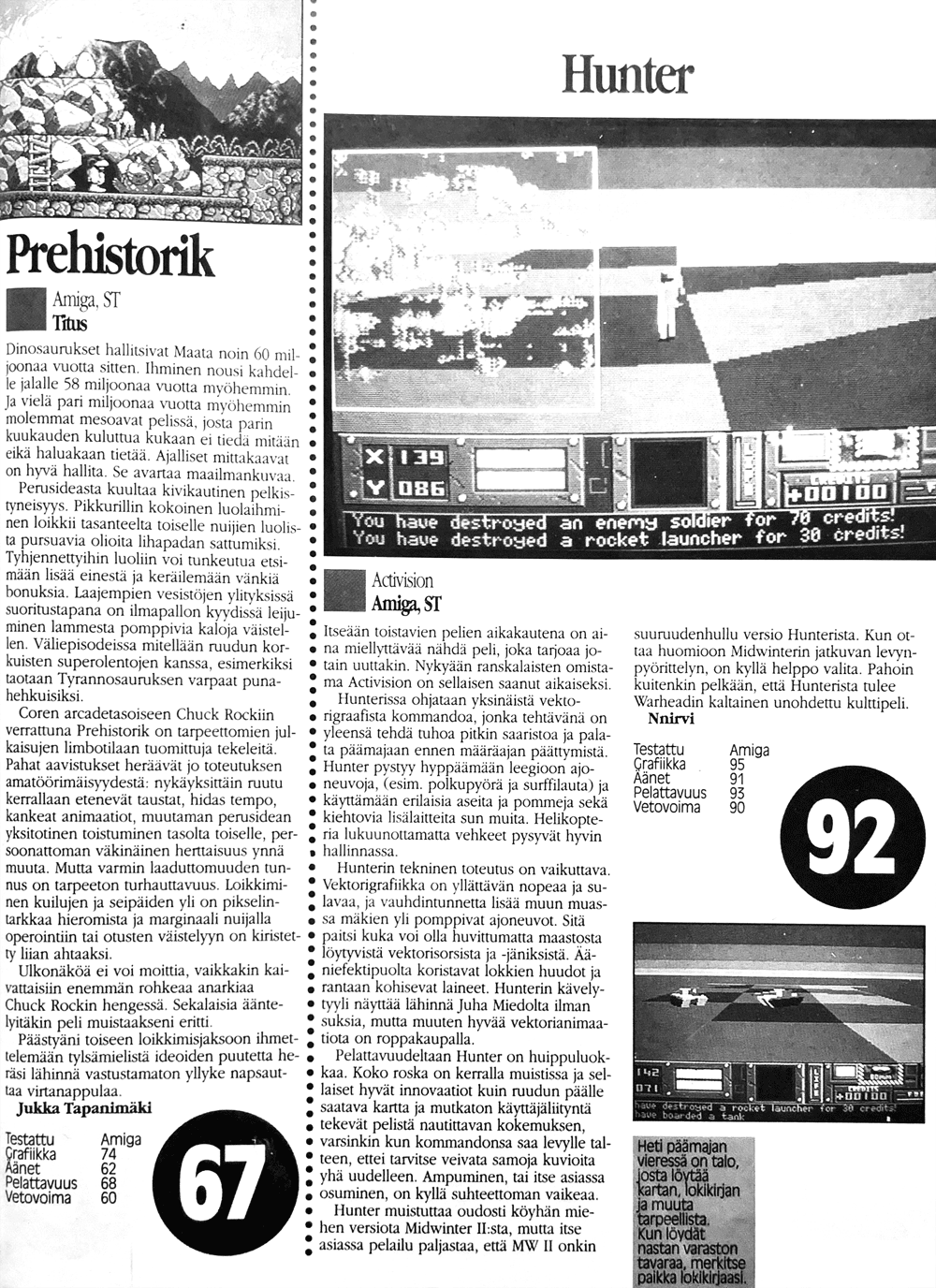
Prehistorik1991 SyksyPysyvä linkkiDinosaurukset hallitsivat Maata noin 60 miljoonaa vuotta sitten. Ihminen nousi kahdelle jalalle 58 miljoonaa vuotta myöhemmin. Ja vielä pari miljoonaa vuotta myöhemmin molemmat mesoavat pelissä, josta parin kuukauden kuluttua kukaan ei tiedä mitään eikä haluakaan tietää. Ajalliset mittakaavat on hyvä hallita. Se avartaa maailmankuvaa.
Perusideasta kuultaa kivikautinen pelkistyneisyys. Pikkurillin kokoinen luolaihminen loikkii tasanteelta toiselle nuijien luolista pursuavia olioita lihapadan sattumiksi. Tyhjennettyihin luoliin voi tunkeutua etsimään lisää einestä ja keräilemään vänkiä bonuksia. Laajempien vesistöjen ylityksissä suoritustapana on ilmapallon kyydissä leijuminen lammesta pomppivia kaloja väistellen. Väliepisodeissa mitellään ruudun korkuisten superolentojen kanssa, esimerkiksi taotaan Tyrannosauruksen varpaat punahehkuisiksi.
Coren arcadetasoiseen Chuck Rockiin verrattuna Prehistorik on tarpeettomien julkaisujen limbotilaan tuomittuja tekeleitä. Pahat aavistukset heräävät jo toteutuksen amatöörimäisyydestä: nykäyksittäin ruutu kerrallaan etenevät taustat, hidas tempo, kankeat animaatiot, muutaman perusidean yksitotinen toistuminen tasolta toiselle, persoonattoman väkinäinen herttaisuus ynnä muuta. Mutta varmin laaduttomuuden tunnus on tarpeeton turhauttavuus. Loikkiminen kuilujen ja seipäiden yli on pikselintarkkaa hieromista ja marginaali nuijalla operointiin tai otusten väistelyyn on kiristetty liian ahtaaksi.
Ulkonäköä ei voi moittia, vaikkakin kaivattaisiin enemmän rohkeaa anarkiaa Chuck Rockin hengessä. Sekalaisia ääntelyitäkin peli muistaakseni eritti.
Päästyäni toiseen loikkimisjaksoon ihmettelemään tylsämielistä ideoiden puutetta heräsi lähinnä vastustamaton yllyke napsauttaa virtanappulaa.
Prehistorik1991 SyksyPermalinkDinosaurs ruled the Earth some 60 million years ago. Man got up onto two legs 58 million years later. And a couple of million years after that, both of them are raising a ruckus in a game that in a couple of months' time nobody will know anything about, nor even want to. It's good to have a grip on time scales. It broadens your view of the world.
The basic idea has a Stone Age simplicity shining through it. A caveman the size of your little finger leaps from ledge to ledge, clubbing the creatures swarming out of the caves into chunks for the stewpot. You can barge into the emptied caves to look for more convenience food and collect nifty bonuses. Larger bodies of water are crossed by floating along aboard a balloon, dodging the fish leaping out of the pond. In the in-between episodes you square off against screen-high super-creatures, for instance hammering a Tyrannosaurus's toes until they glow red.
Compared with Core's arcade-quality Chuck Rock, Prehistorik is one of those efforts condemned to the limbo of unnecessary releases. Bad premonitions are stirred straight away by the amateurishness of the execution: backgrounds that lurch forward a screen at a time, a slow tempo, stiff animations, the monotonous repetition of a few basic ideas from one level to the next, a characterless, forced cuteness and so on. But the surest mark of poor quality is needless frustration. Leaping over chasms and spikes is pixel-precise fiddling, and the margin for working the club or dodging the critters has been squeezed far too tight.
The looks can't be faulted, although you'd wish for more bold anarchy in the spirit of Chuck Rock. As I recall, the game also secreted assorted noises.
Having made it to the second leaping stage to marvel at the dim-witted lack of ideas, what mainly awoke in me was an irresistible urge to flick the power switch.
President Is Missing
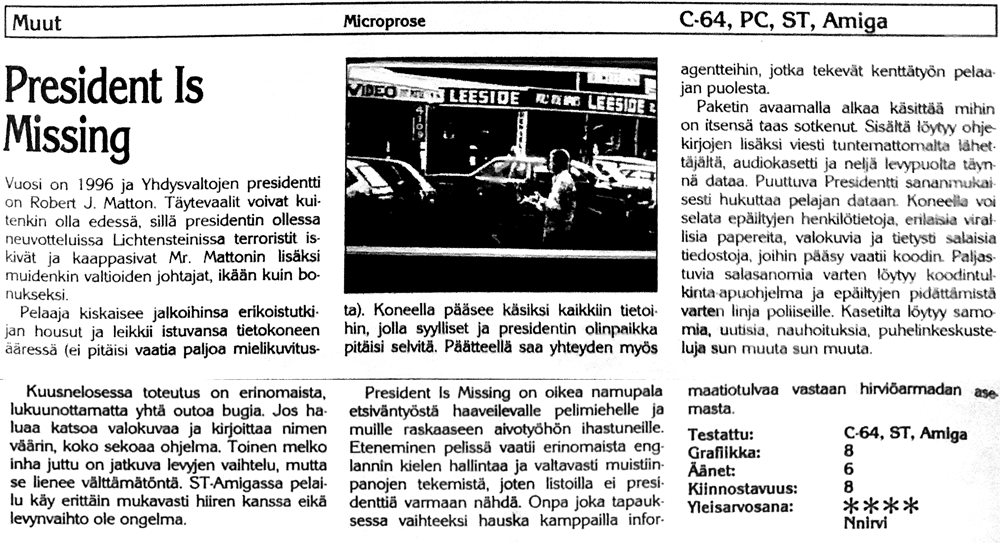
President Is Missing1989 KevätPysyvä linkkiVuosi on 1996 ja Yhdysvaltojen presidentti on Robert J. Matton. Täytevaalit voivat kuitenkin olla edessä, sillä presidentin ollessa neuvotteluissa Lichtensteinissa terroristit iskivät ja kaappasivat Mr. Mattonin lisäksi muidenkin valtioiden johtajat, ikään kuin bonukseksi.
Pelaaja kiskaisee jalkoihinsa erikoistutkijan housut ja leikkii istuvansa tietokoneen ääressä (ei pitäisi vaatia paljoa mielikuvitusta). Koneella pääsee käsiksi kaikkiin tietoihin, jolla syylliset ja presidentin olinpaikka pitäisi selvitä. Päätteellä saa yhteyden myös agentteihin, jotka tekevät kenttätyön pelaajan puolesta.
Paketin avaamalla alkaa käsittää mihin on itsensä taas sotkenut. Sisältä löytyy ohjekirjojen lisäksi viesti tuntemattomalta lähettäjältä, audiokasetti ja neljä levypuolta täynnä dataa. Puuttuva Presidentti sananmukaisesti hukuttaa pelajan dataan. Koneella voi selata epäiltyjen henkilötietoja, erilaisia virallisia papereita, valokuvia ja tietysti salaisia tiedostoja, joihin pääsy vaatii koodin. Paljastuvia salasanomia varten löytyy koodintulkinta-apuohjelma ja epäiltyjen pidättämistä varten linja poliiseille. Kasetilta löytyy samomia, uutisia, nauhoituksia, puhelinkeskusteluja sun muuta sun muuta. Kuusnelosessa toteutus on erinomaista, lukuunottamatta yhtä outoa bugia. Jos haluaa katsoa valokuvaa ja kirjoittaa nimen väärin, koko sekoaa ohjelma. Toinen melko inha juttu on jatkuva levyjen vaihtelu, mutta se lienee välttämätöntä. ST-Amigassa pelailu käy erittäin mukavasti hiiren kanssa eikä levynvaihto ole ongelma.
President Is Missing on oikea namupala etsiväntyöstä haaveilevalle pelimiehelle ja muille raskaaseen aivotyöhön ihastuneille. Eteneminen pelissä vaatii erinomaista englannin kielen hallintaa ja valtavasti muistiinpanojen tekemistä, joten listoilla ei presidenttiä varmaan nähdä. Onpa joka tapauksessa vaihteeksi hauska kamppailla informaatiotulvaa vastaan hirviöarmadan asemasta.
President Is Missing1989 KevätPermalinkThe year is 1996 and the President of the United States is Robert J. Matton. A by-election may be on the cards, however, because while the President was at talks in Lichtenstein, terrorists struck and kidnapped not only Mr. Matton but the leaders of other nations too, as a sort of bonus.
The player yanks on a special investigator's trousers and pretends to be sitting at a computer (that shouldn't take much imagination). The computer gives access to all the information that ought to reveal the culprits and the President's whereabouts. The terminal also puts you in touch with agents, who do the fieldwork on the player's behalf.
Opening the package, you begin to grasp what you've got yourself mixed up in this time. Inside, besides the manuals, there's a message from an unknown sender, an audio cassette and four disk sides full of data. The Missing President quite literally drowns the player in data. On the computer you can browse the suspects' personal details, assorted official papers, photographs and of course secret files, which need a code to get into. For the secret messages that come to light there's a code-breaking utility, and for arresting suspects a line to the police. The cassette holds messages, news reports, recordings, phone conversations and so on and so forth. On the C-64 the implementation is excellent, apart from one strange bug. If you want to look at a photograph and type the name wrong, the whole program goes haywire. Another rather nasty thing is the constant disk swapping, but that's probably unavoidable. On the ST and Amiga, playing goes very nicely with the mouse and disk swapping isn't a problem.
President Is Missing is a real treat for the gamer who dreams of detective work and for anyone else smitten with heavy brainwork. Getting anywhere in the game demands an excellent command of English and a huge amount of note-taking, so the President probably won't be turning up in the charts. Still, for a change it's fun to battle a flood of information instead of an armada of monsters.
Prince
Prince1990 KevätPysyvä linkkiPelissä on kaksi armeijaa ja valittavana kahdeksan saarta, joille joukot viskaistaan satunnaiseen kohtaan. Tavoite on selkeä: vastapuolen prinssin lynkkaaminen. Karttaa voi tutkiskella neljällä eriasteisella suurennoksella, joista ensimmäisellä näkyy koko alue, toisella armeijoiden liput, kolmannella rykmentit ja lähikuvassa komppaniat. Kahdessa viimeisessä joukot on kuvattu animoituina jalka- ja ratsumiehinä, jotka kipittävät ja listivät toisiaan. Zoomauksessa on sellainen älyttömyys, että ukkeleiden suurentuessa kuva pienenee. Komppanioiden komentaminen ei ole erityisen hauskaa, kun maisemasta näkyy helsinkiläisen yksiön kokoinen alue.
Kumpuilevan maiseman kuvaamisella hieman yläviistosta on ilmeisesti pyritty Populousmaiseen vaikutelmaan, mutta lopputulos on karmea. Maasto on epämääräisen mittakaavatonta ja hämminkiä lisää jättiläissotilaiden sotkuiset rykelmät. Kun tämä yhdistetään rajoitetun näkyvyyden ongelmaan, niin tuloksena on harvinaisen epäpelattava strategiasähläys.
Tietokonetta vastaan pelaaminen on silkkaa kidutusta, sillä se ei kärsi pelaajan rajoitteisuudesta ja nuijii armeijat ärsyttävän tehokkaasti. Ohjekirjasen mukaan Prince onkin suunniteltu kahdelle pelaajalle, tarkemmin sanottuna kahdelle tietokoneelle.
Modeemista ei ole apua, vaan tarvitaan kaapeli ja kaksi konetta, joiden ei tarvitse olla samaa merkkiä. Siis Amiga ja ST voivat jutustella sulassa sovussa. Mutta juttuun sisältyy pieni käytännön pulma: kuinka moni jaksaa raahata koneensa kaverin luo tai ostaa viisi kilometriä kaapelia?
Prince1990 KevätPermalinkThe game has two armies and a choice of eight islands, onto which the troops are tossed at random spots. The objective is clear: lynching the opposing side's prince. The map can be examined at four different magnifications, of which the first shows the whole area, the second the armies' flags, the third the regiments and the close-up the companies. In the last two the troops are depicted as animated foot soldiers and horsemen who scurry about and bump each other off. The zoom has one absurdity: as the little men get bigger, the picture gets smaller. Commanding companies isn't particularly fun when you can see a patch of landscape the size of a Helsinki studio flat.
Showing the rolling landscape slightly from above at an angle was evidently meant to give a Populous-style impression, but the end result is dreadful. The terrain has a vague lack of scale, and the messy clumps of giant soldiers add to the confusion. Combine this with the problem of limited visibility and the result is an exceptionally unplayable strategy shambles.
Playing against the computer is sheer torture, since it doesn't suffer from the player's limitations and clubs the armies down with irritating efficiency. According to the manual booklet, Prince was in fact designed for two players, or more precisely for two computers.
A modem is no help; what you need is a cable and two machines, which don't have to be the same make. So an Amiga and an ST can chat away in perfect harmony. But there's one small practical snag: how many people can be bothered to lug their computer round to a friend's place or buy five kilometres of cable?
Prince of Persia
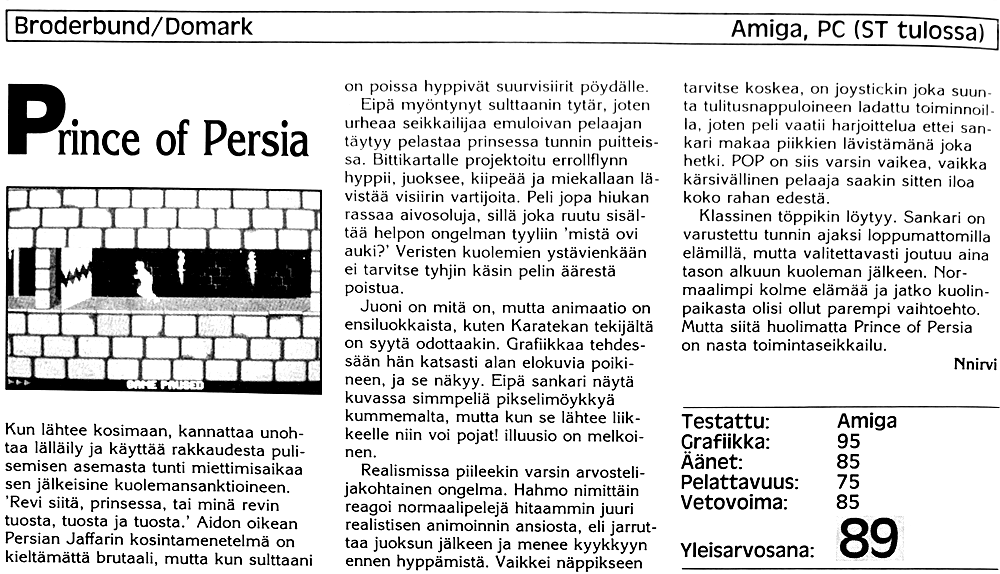
Prince of Persia1991 KevätPysyvä linkkiKun lähtee kosimaan, kannattaa unohtaa lälläily ja käyttää rakkaudesta pulisemisen asemasta tunti miettimisaikaa sen jälkeisine kuolemansanktioineen. 'Revi siitä, prinsessa, tai minä revin tuosta, tuosta ja tuosta.' Aidon oikean Persian Jaffarin kosintamenetelmä on kieltämättä brutaali, mutta kun sulttaani on poissa hyppivät suurvisiirit pöydälle.
Eipä myöntynyt sulttaanin tytär, joten urheaa seikkailijaa emuloivan pelaajan täytyy pelastaa prinsessa tunnin puitteissa. Bittikartalle projektoitu errollflynn hyppii, juoksee, kiipeää ja miekallaan lävistää visiirin vartijoita. Peli jopa hiukan rassaa aivosoluja, sillä joka ruutu sisältää helpon ongelman tyyliin 'mistä ovi auki?' Veristen kuolemien ystävienkään ei tarvitse tyhjin käsin pelin äärestä poistua.
Juoni on mitä on, mutta animaatio on ensiluokkaista, kuten Karatekan tekijältä on syytä odottaakin. Grafiikkaa tehdessään hän katsasti alan elokuvia poikineen, ja se näkyy. Eipä sankari näytä kuvassa simmpeliä pikselimöykkyä kummemalta, mutta kun se lähtee liikkeelle niin voi pojat! illuusio on melkoinen.
Realismissa piileekin varsin arvostelijakohtainen ongelma. Hahmo nimittäin reagoi normaalipelejä hitaammin juuri realistisen animoinnin ansiosta, eli jarruttaa juoksun jälkeen ja menee kyykkyyn ennen hyppämistä. Vaikkei näppikseen tarvitse koskea, on joystickin joka suunta tulitusnappuloineen ladattu toiminnoilla, joten peli vaatii harjoittelua ettei sankari makaa piikkien lävistämänä joka hetki. POP on siis varsin vaikea, vaikka kärsivällinen pelaaja saakin sitten iloa koko rahan edestä.
Klassinen töppikin löytyy. Sankari on varustettu tunnin ajaksi loppumattomilla elämillä, mutta valitettavasti joutuu aina tason alkuun kuoleman jälkeen. Normaalimpi kolme elämää ja jatko kuolinpaikasta olisi ollut parempi vaihtoehto. Mutta siitä huolimatta Prince of Persia on nasta toimintaseikkailu.
Prince of Persia1991 KevätPermalinkWhen you go a-courting, it pays to forget the soppy stuff and, instead of prattling on about love, hand out an hour's thinking time with the death sentence that follows it. 'Chew on that, princess, or I'll tear into this, this and this.' The courting method of Jaffar of the genuine, authentic Persia is admittedly brutal, but when the sultan's away, the grand viziers will play.
Well, the sultan's daughter didn't say yes, so the player, emulating a brave adventurer, has to rescue the princess within the hour. The errollflynn projected onto a bitmap jumps, runs, climbs and, sword in hand, skewers the vizier's guards. The game even gives the brain cells a bit of a workout, since every screen contains an easy problem along the lines of 'how do I get the door open?' Even fans of bloody deaths needn't walk away from the game empty-handed.
The plot is what it is, but the animation is first-class, as you'd rightly expect from the maker of Karateka. While working on the graphics, the author went through the genre's films and then some, and it shows. In the screenshot the hero doesn't look like much more than a simple lump of pixels, but once it gets moving, oh boy! the illusion is quite something.
The realism, though, hides a rather reviewer-dependent problem. The character, you see, reacts more slowly than in normal games precisely because of the realistic animation: it brakes after running and crouches before jumping. Although you don't need to touch the keyboard, every direction of the joystick, fire button included, is loaded with actions, so the game takes practice if the hero isn't to be lying skewered on spikes every moment. So POP is pretty difficult, although the patient player then gets their full money's worth of fun.
There's a classic blunder too. The hero is equipped with unlimited lives for the hour, but unfortunately always has to go back to the start of the level after dying. A more normal three lives and carrying on from where you died would have been a better option. But in spite of that, Prince of Persia is a nifty action adventure.
Prison
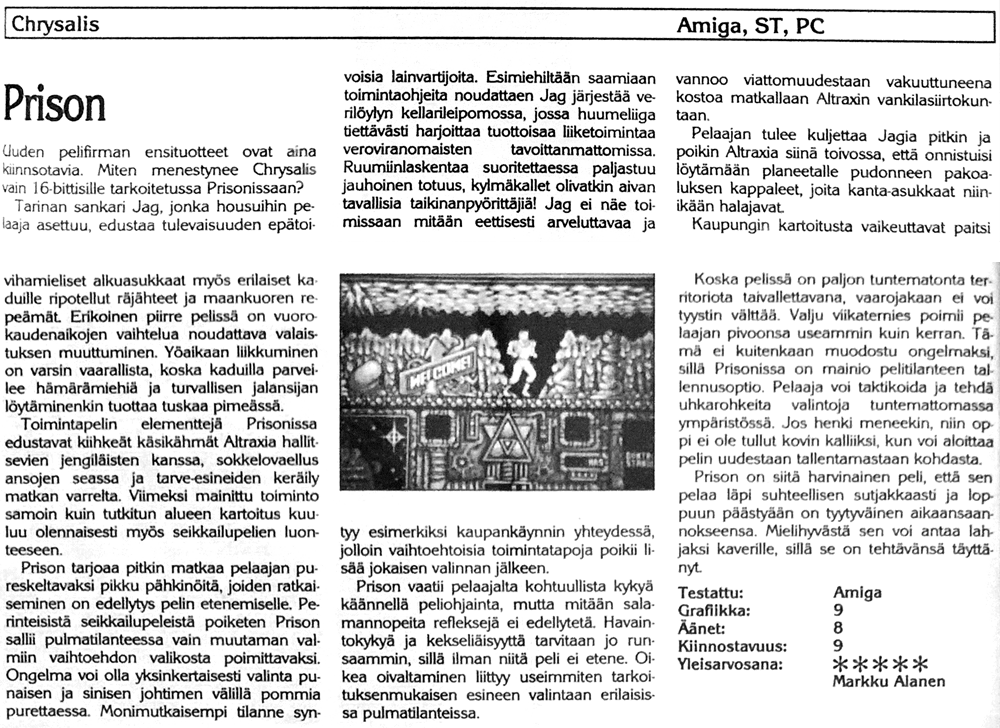
Prison1989 SyksyPysyvä linkkiUuden pelifirman ensituotteet ovat aina kiinnsotavia. Miten menestynee Chrysalis vain 16-bittisille tarkoitetussa Prisonissaan?
Tarinan sankari Jag, jonka housuihin pelaaja asettuu, edustaa tulevaisuuden epätoivoisia lainvartijoita. Esimiehiltään saamiaan toimintaohjeita noudattaen Jag järjestää verilöylyn kellarileipomossa, jossa huumeliiga tiettävästi harjoittaa tuottoisaa liiketoimintaa veroviranomaisten tavoittanmattomissa. Ruumiinlaskentaa suoritettaessa paljastuu jauhoinen totuus, kylmäkallet olivatkin aivan tavallisia taikinanpyörittäjiä! Jag ei näe toimissaan mitään eettisesti arveluttavaa ja vannoo viattomuudestaan vakuuttuneena kostoa matkallaan Altraxin vankilasiirtokuntaan.
Pelaajan tulee kuljettaa Jagia pitkin ja poikin Altraxia siinä toivossa, että onnistuisi löytämään planeetalle pudonneen pakoaluksen kappaleet, joita kanta-asukkaat niinikään halajavat.
Kaupungin kartoitusta vaikeuttavat paitsi vihamieliset alkuasukkaat myös erilaiset kaduille ripotellut räjähteet ja maankuoren repeämät. Erikoinen piirre pelissä on vuorokaudenaikojen vaihtelua noudattava valaistuksen muuttuminen. Yöaikaan liikkuminen on varsin vaarallista, koska kaduilla parveilee hämärämiehiä ja turvallisen jalansijan löytäminenkin tuottaa tuskaa pimeässä.
Toimintapelin elementtejä Prisonissa edustavat kiihkeät käsikähmät Altraxia hallitsevien jengiläisten kanssa, sokkelovaellus ansojen seassa ja tarve-esineiden keräily matkan varrelta. Viimeksi mainittu toiminto samoin kuin tutkitun alueen kartoitus kuuluu olennaisesti myös seikkailupelien luonteeseen.
Prison tarjoaa pitkin matkaa pelaajan pureskeltavaksi pikku pähkinöitä, joiden ratkaiseminen on edellytys pelin etenemiselle. Perinteisistä seikkailupeleistä poiketen Prison sallii pulmatilanteessa vain muutaman valmiin vaihtoehdon valikosta poimittavaksi. Ongelma voi olla yksinkertaisesti valinta punaisen ja sinisen johtimen välillä pommia purettaessa. Monimutkaisempi tilanne syntyy esimerkiksi kaupankäynnin yhteydessä, jolloin vaihtoehtoisia toimintatapoja poikii lisää jokaisen valinnan jälkeen.
Prison vaatii pelaajalta kohtuullista kykyä käännellä peliohjainta, mutta mitään salamannopeita reflekseja ei edellytetä. Havaintokykyä ja kekseliäisyyttä tarvitaan jo runsaammin, sillä ilman niitä peli ei etene. Oikea oivaltaminen liittyy useimmiten tarkoituksenmukaisen esineen valintaan erilaisissa pulmatilanteissa.
Koska pelissä on paljon tuntematonta territoriota taivallettavana, vaarojakaan ei voi tyystin välttää. Valju viikatemies poimii pelaajan pivoonsa useammin kuin kerran. Tämä ei kuitenkaan muodostu ongelmaksi, sillä Prisonissa on mainio pelitilanteen tallennusoptio. Pelaaja voi taktikoida ja tehdä uhkarohkeita valintoja tuntemattomassa ympäristössä. Jos henki meneekin, niin oppi ei ole tullut kovin kalliiksi, kun voi aloittaa pelin uudestaan tallentamastaan kohdasta.
Prison on siitä harvinainen peli, että sen pelaa läpi suhteellisen sutjakkaasti ja loppuun päästyään on tyytyväinen aikaansaannokseensa. Mielihyvästä sen voi antaa lahjaksi kaverille, sillä se on tehtävänsä täyttänyt.
Prison1989 SyksyPermalinkThe debut products of a new games company are always interesting. How might Chrysalis fare with Prison, which is intended for 16-bit machines only?
The hero of the story, Jag, into whose trousers the player steps, represents the desperate lawmen of the future. Following the instructions he has received from his superiors, Jag stages a bloodbath in a basement bakery where a drug ring is reportedly running a lucrative business out of the tax authorities' reach. When the bodies are counted, the floury truth comes out: the cold-blooded hard men were in fact perfectly ordinary dough-rollers! Jag sees nothing ethically questionable in his actions and, convinced of his innocence, swears revenge on his way to the prison colony of Altrax.
The player has to steer Jag the length and breadth of Altrax in the hope of finding the pieces of an escape ship that has crashed on the planet, pieces which the natives likewise hanker after.
Mapping the town is made harder not only by the hostile natives but also by assorted explosives sprinkled about the streets and by rifts in the planet's crust. A peculiar feature of the game is the lighting, which changes with the time of day. Moving about at night is rather dangerous, because the streets swarm with shady characters, and even finding safe footing is agony in the dark.
The action-game elements in Prison are represented by frantic hand-to-hand brawls with the gangsters who rule Altrax, maze-wandering among traps and gathering useful items along the way. The last of these, like mapping the explored area, is also an essential part of the nature of adventure games.
All along the way, Prison serves up little nuts for the player to chew on, and cracking them is a prerequisite for making progress in the game. Unlike traditional adventure games, Prison only lets you pick one of a handful of ready-made options from a menu when you hit a puzzle. The problem may simply be choosing between the red and the blue wire when defusing a bomb. A more complicated situation arises when trading, for example, where every choice spawns more alternative courses of action.
Prison requires a reasonable knack for wiggling the joystick, but no lightning-fast reflexes are called for. Powers of observation and inventiveness are needed in greater supply, since without them the game goes nowhere. The right flash of insight usually comes down to choosing the appropriate object in various puzzle situations.
Since there is a lot of unknown territory to trek across in the game, danger can't be avoided altogether either. The pallid Grim Reaper scoops the player into his palm more than once. This doesn't turn into a problem, however, as Prison has an excellent save-game option. The player can play tactically and make daredevil choices in unfamiliar surroundings. If you do lose your life, the lesson hasn't come too dear, since you can start the game again from the point you saved.
Prison is a rare game in that you get through it relatively smoothly and, once you reach the end, you're pleased with what you've achieved. Feeling good about it, you can give it away to a pal as a present, since it has done its job.
Pro Tennis Tour
Pro Tennis Tour1990 KevätPysyvä linkkiTutustuin tähän peliin ensimmäisen kerran muutama kuukausi sitten Lontoossa PC-messuilla. Ranskalaisen Ubisoftin edustajat alkoivat jopa hermostua kun jostain Neuvostoliiton rajalta tullut kirgiisi pelasi heidän mainiota tennispeliään tunnista toiseen eikä päästänyt edes paikallisia isoja kihoja pelaamaan. Pidin siis pelistä.
Niin pidän muuten vieläkin. Ja paljon. Voinpa jopa väittää sen olevan paras tennispeli, jonka olen koskaan nähnyt millekään koneelle. Tämä osittain siksi, että Pro Tennis Tour ON hyvä peli, ja osittain siksi, että kilpailu alalla ei tosiaankaan ole järin tiukkaa.
Tenniksen luulisi olevan kaikille lukijoille tavalla tai toisella tuttu laji, joten ei siitä sen enempää. Lajin kiihkeyden ja tunnelman siirtäminen tehokkaasti tietokoneelle onkin aika temppu, mutta kuten sanottu, Ubisoft on onnistunut ihailtavasti. Grafiikka on osittain jopa pröystäilevää, ei tennispeli näin hyvää grafiikkaa tarvitsisi. Audiopuoli hemmottelee pelaajaa: digitoidut lyöntiäänet ja linjatuomarien älähdykset mäiskähtelevät mukavasti kaiuttimista. Yleisön huokaukset ja reagoinnit kun vielä saisi mukaan, niin aijai!
Tiivis tunnelma on siis siirtynyt bittimuotoon hyvin. Realismi jatkuu pelattavuudenkin puolelle: alussa palloa läiskii aivan huvikseen ja kyllä palautukset pysyvät kentällä kohtalaisen hyvin kunhan ei yritä liikoja. Kun taidot karttuvat, alkavat sijoituksetkin onnistua. Syötöt hioutuvat parin tunnin pelin jälkeen todellisiksi tappajiksi. Kun pelaaja etenee urallaan (nousee korkeammalle ATP-listalla), alkaa pelikin vaikeutua. Yllättäen onkin tärkeää kuinka pelaaja on sijoittunut ja mistä asennosta hän yrittää palloa lyödä. Niinpä pelistä riittää hupia viikkojen ajan.
Pähkinänkuoressa Pro Tennis Tour on parasta tietokonetennistä koskaan. Jos pidät tenniksestä, osta Pro Tennis Tour, et kadu.
Pro Tennis Tour1990 KevätPermalinkI first got acquainted with this game a few months ago at the PC show in London. The representatives of French Ubisoft even started getting nervous when a Kirghiz from somewhere out on the Soviet border played their splendid tennis game hour after hour and wouldn't let even the local bigwigs have a go. So I liked the game.
And so I still do, by the way. A lot. I'd even go so far as to claim it's the best tennis game I have ever seen on any machine. This is partly because Pro Tennis Tour IS a good game, and partly because the competition in the field really isn't all that stiff.
You'd think tennis would be a sport familiar to every reader one way or another, so no more about that. Transferring the intensity and atmosphere of the sport effectively onto a computer is quite a trick, but as I said, Ubisoft has pulled it off admirably. The graphics are in places downright showy; a tennis game wouldn't even need graphics this good. The audio side pampers the player: the digitised shot sounds and the yelps of the line judges come thwacking pleasantly out of the speakers. If they could just get the crowd's sighs and reactions in as well, then oh boy!
So the intense atmosphere has made the move into bit form well. The realism carries over into the playability too: at first you just whack the ball about for the fun of it, and your returns do stay in the court reasonably well as long as you don't try too much. As your skills grow, your placement starts coming off too. After a couple of hours of play your serves get honed into real killers. As the player advances in their career (climbs higher in the ATP rankings), the game starts getting harder too. All of a sudden it matters how the player is positioned and from what stance they try to hit the ball. And so the game provides fun for weeks.
In a nutshell, Pro Tennis Tour is the best computer tennis ever. If you like tennis, buy Pro Tennis Tour; you won't regret it.
Prohibition
Prohibition1988Pysyvä linkkiRanskalainen Infogrames on kääntänyt tapa-kaikki-jotka-näet-pelinsä C-64:äänkin. Atari ST:n versio hiiriohjauksineen ja hyvine grafiikoineen pistää miettimään miten käännös on onnistunut. Vastaus kuuluu: kohtalaisesti.
Prohibition sijoittuu Amerikkaan 1920-luvulle, kun kieltolaki oli voimassa ja väestön ääriainekset rikastuivat salakuljettamalla juovuttavaa nestettä janoisille ihmisille.
Mutta kilpailu alalla on kova. Monet joukkiot näkevät väkivallan ainoana keinona vallata itselleen palan markkinakakkua. Salamurhien ja taistelujen lisääntyessä poliisi on voimaton ja joutuu hankkimaan palkkasotureita avukseen. Sinä olet yksi tästä pahamaineisesta joukosta. Thompson-konepistooli apunasi tehtäväksesi annetaan tappaa kaikki rikolliset alueeltasi. Omituisena yksityiskohtana mainittakoon, että pelin mukaan konepistoolissasi on kiikaritähtäin, joka ei sovi sellaiseen aseeseen lainkaan.
Toteutus on keskinkertaista. (Mitä sitten odotit?) Ruudun oikeassa laidassa näkyy kello, joka kertoo kuinka paljon sinulla on aikaa nitistää sinua aseella tähtäävä miekkonen. Alareunaan ilmestyy nuoli osoittamaan maalisi suuntaa, jos hän ei ole ruudussa näkyvällä alueella. Jos aika loppuu, voit vielä yrittää väistää luoteja painamalla jotain nappulaa, mutta tälläkin keinolla on rajoituksensa.
Alkuruudun musiikissa ei ole kehumista, eikä äänitehosteista voi puhuakaan. Peliin kyllästyy hämmästyttävän nopeasti jo vaikeudenkin takia.
Prohibition1988PermalinkFrance's Infogrames has converted its kill-everyone-you-see game to the C-64 as well. The Atari ST version, with its mouse control and good graphics, makes you wonder how well the conversion has turned out. The answer: moderately.
Prohibition is set in 1920s America, when prohibition was in force and the extreme elements of the population grew rich smuggling intoxicating liquid to thirsty people.
But competition in the trade is fierce. Many gangs see violence as the only way to grab themselves a slice of the market pie. As assassinations and gunfights multiply, the police are powerless and have to hire mercenaries to help them. You are one of this notorious crew. With a Thompson submachine gun at your side, your assignment is to kill every criminal in your area. As a peculiar detail, it's worth mentioning that according to the game your submachine gun has a telescopic sight, which doesn't suit that kind of weapon at all.
The implementation is mediocre. (What did you expect?) On the right-hand side of the screen is a clock that tells you how much time you have to bump off the fellow drawing a bead on you. An arrow appears at the bottom to point in the direction of your target if he isn't in the visible area of the screen. If the time runs out, you can still try to dodge the bullets by pressing some button, but this trick has its limits too.
The title screen music is nothing to write home about, and the sound effects aren't even worth mentioning. You get bored with the game astonishingly quickly, if only because of the difficulty.
Project Nova
Project Nova1987Pysyvä linkkiProject Nova on aivan normaali räiskintäpeli. On hyvät (eli pelaaja) ja pahat (eli kaikki muut). Pelaajalle annetaan avaruusalus, yksi elämä ja 50000 energiayksikköä. Niiden avulla on vapautettava linnunrata vihollisista.
Taistelu on helppoa. Pelaaja kytkee suojakilvet päälle ja tappaa kaiken mikä eteen tulee. Kaikki toiminnot kuluttavat energiaa ja peli loppuu, kun energiamittari tippuu nollaan. Vihollisen ammukset eivät suoraan verota energiavarastoja, mutta niiden aiheuttamien laitevikojen korjaus on kallista puuhaa.
Taistelualueena oleva Linnunrata on jaettu 64:ään sektoriin. Sektoreissa on joko lisäenergiaa tai vihollisia. Peli loppuu, kun kaikki sektorit on tyhjennetty vihollisista.
Grafiikka ei tässä(kään) pelissä ollut hurrattavaa. Vihollisalukset olivat epämääräisiä sprite-laatikoita, jotka tunnisti viholliseksi ainoastaan, koska pelissä on vain vihollisia. Ainoat hyvät yllätykset olivat merkistö (josta satuin pitämään) sekä taustalla näkyvät tähdet, jotka liikkuessa antavat hienon kolmiulotteisen vaikutelman.
Pelin yleisvaikutelma on välttävä, kun sitä vertaa muiden koneiden tarjontaan. Jos katsotaan ainoastaan C-16:n pelejä, on tämän varmaankin eräs parhaimmista.
Project Nova1987PermalinkProject Nova is a perfectly ordinary shoot-'em-up. There are the goodies (that is, the player) and the baddies (that is, everybody else). The player is given a spaceship, one life and 50000 energy units. With these you have to free the Milky Way from the enemy.
Combat is easy. The player switches on the shields and kills everything that gets in the way. Every action uses up energy, and the game ends when the energy gauge drops to zero. Enemy shots don't eat directly into your energy reserves, but repairing the equipment damage they cause is an expensive business.
The Milky Way, which serves as the battle zone, is divided into 64 sectors. The sectors contain either extra energy or enemies. The game ends when every sector has been cleared of enemies.
The graphics were nothing to cheer about in this game (either). The enemy ships were vague sprite boxes that you could only recognise as enemies because there is nothing but enemies in the game. The only pleasant surprises were the character set (which I happened to like) and the stars in the background, which give a fine three-dimensional impression as they move.
The overall impression of the game is passable when you compare it with what other machines have to offer. If you look only at C-16 games, this is probably one of the best.
Project: Stealth Fighter
Project: Stealth Fighter1988Pysyvä linkkiHämmentynyt suomalainen ilmavalvontamies Sodankylän lähistöllä haroo tukkaansa. Mikä on tämä outo ilmestys, joka välillä vilahtaa tutkassa ja taas häviää? Taivaalliset tulivaunut? UFO? Vai...risteilyohjus! Gasp!
Älä pelästy, moku-raukka, se on vain suomalaisten lehtimiesten joukosta jätetty eversti Nirvi ja hänen mainio stealth-hävittäjänsä Lockheed F-19 'Frisbee' matkalla valokuvaamaan Muurmanskin laivastotukikohtia.
F-19 Stealth Fighter on hävittäjä, joka on suunniteltu tutkalle näkymättömäksi. Koneen muoto on tarkkaan laskettu ja rakentamisessa on käytetty mahdollisimman paljon aineita, jotka eivät heijasta tutkasäteitä. Kone myös säteilee mahdollisimman vähän lämpöä, jotta infrapunalle herkät laitteet eivät sitä havaitse. Näkymättömyys maksaa suorituskyvyssä: mikään ilmataistelukone ei F-19 ole. Tästä ehkä jo käytössä olevasta hävittäjästä on mainio Microprose väsännyt korkealaatuisen simulaattorin, joka varmasti pyörii jo Kremlininkin kuusnelosissa.
Gunshipista tuttuun tapaan erilaisia tehtäviä erilaisissa maisemissa (Suomenkin ilmatilaan pääsee!) on valtava määrä. Uran kehittyessä satelee ylennyksiä ja kunniamerkkejä, jotka ainakin levyversiossa voi tallentaa. Aseita on joka lähtöön. 20 mm konetykin lisäksi on tukku ohjuksia, erilaisia pommeja ja tiedustelutehtäviin löytyy infrapunakamera. Puolustusjärjestelmiä on niin lämpöhakuisia kuin tutkaohjattuja ohjuksiakin vastaan. Tärkeintä on kuitenkin lentää näkymättömänä. Stealth Fighter on tietysti varustettu mittarilla, joka näyttää ympäristöön leviävän elektromagneettisen säteilyn.
Simulaattorina Stealth Fighter on erinomainen ja aivan erilainen kuin esimerkiksi F-15 Strike Eagle. Yksityiskohtien ansiosta todentuntu on melkoinen ja tehtävät ovat aivan tarpeeksi erilaisia, ettei koko peli tunnu yhden ja saman asian jauhamiselta. Nappulapaljous ei karkaa käsistä kiitos näppäimistölle sijoitettavan kaavion ja ennätyspaksu ohjekirja on jo sinällään mielenkiintoinen luettava, varsinkin kun sieltä löytää mielenkiintoista kerrottavaa Suomesta. Ilman kirjaa ei Stealth Fighteriin pääse sisälle, joten englanninkielen taito olisi suotavaa.
Toteutus on jälleen mahtava. Lentosimulaattoriksi harvinaisen yksityiskohtainen maisema liikkuu tarpeellisella nopeudella lentoilluusion synnyttämiseksi. Nopeussyistä Stealthin vektorigrafiikka ei ole täytettyä kuten Gunshipissä. Äänet ovat yksinkertaisia mutta oikeissa paikoissa. Mittaristo on selkeä ja helppolukuinen (ainakin yhden tehtävän jälkeen).
Stealth Fighter on todella monipuolinen. Tehtävät vaativat asejärjestelmistä riippuen aivan erilaisen hyökkäystavan ja vaikeustasoja saa säädettyä monia. Tähän upeaan simulaattoriin on vaikea kyllästyä, varsinkin kun Microprose puolittain lupailee siihen uusia taistelualueita.
Gunship ja Stealth Fighter edustavat 8-bittisen simulaattoreiden kirkkainta kärkeä. Kielitaidottomalle ensikertalaiselle voi SF ampua yli, muille on tiedossa kuukausikaupalla huvia. Yhdelläkään hyvän lentosimun ystävällä ei ole varaa jättää Stealth Fighteriä väliin.
Project: Stealth Fighter1988PermalinkA bewildered Finnish air surveillance man near Sodankylä runs his hands through his hair. What is this strange apparition that flickers on the radar one moment and vanishes the next? Heavenly chariots of fire? A UFO? Or... a cruise missile! Gasp!
Don't panic, you poor sod, it's only Colonel Nirvi, castoff from the ranks of Finnish journalists, and his splendid Lockheed F-19 'Frisbee' stealth fighter, on its way to photograph the naval bases at Murmansk.
The F-19 Stealth Fighter is a fighter designed to be invisible to radar. The aircraft's shape has been precisely calculated, and its construction uses as many materials as possible that don't reflect radar beams. The plane also gives off as little heat as possible, so that infrared-sensitive equipment won't detect it. Invisibility comes at a cost in performance: the F-19 is no dogfighter. Out of this fighter, which may already be in service, the splendid Microprose has knocked together a high-quality simulator that is surely already running on the Commodore 64s in the Kremlin too.
In the familiar Gunship manner there's a huge number of different missions in different landscapes (you even get into Finnish airspace!). As your career progresses, promotions and decorations come raining down, and at least in the disk version they can be saved. There are weapons for every occasion. Besides the 20 mm cannon there's a bunch of missiles and various bombs, and for reconnaissance missions there's an infrared camera. There are defensive systems against heat-seeking and radar-guided missiles alike. The most important thing, though, is to fly unseen. The Stealth Fighter is of course equipped with a gauge showing the electromagnetic radiation it is spreading into its surroundings.
As a simulator Stealth Fighter is excellent and quite different from, say, F-15 Strike Eagle. Thanks to the detail, the sense of reality is considerable, and the missions are varied enough that the whole game never feels like grinding away at one and the same thing. The multitude of keys doesn't get out of hand, thanks to an overlay that goes on the keyboard, and the record-thick manual is an interesting read in itself, especially as you'll find interesting things in it about Finland. You won't get into Stealth Fighter without the manual, so a knowledge of English would be advisable.
The implementation is once again terrific. The landscape, unusually detailed for a flight simulator, moves at the speed needed to create the illusion of flight. For speed reasons, Stealth's vector graphics aren't filled as they are in Gunship. The sounds are simple but in the right places. The instruments are clear and easy to read (at least after one mission).
Stealth Fighter is truly versatile. Depending on the weapon systems, the missions call for completely different ways of attacking, and the difficulty can be adjusted in many ways. It's hard to get bored of this superb simulator, especially as Microprose is half-promising new combat zones for it.
Gunship and Stealth Fighter represent the very brightest spearhead of 8-bit simulators. For a first-timer with no English, SF may shoot over their head; everyone else has months of fun in store. No friend of a good flight sim can afford to pass up Stealth Fighter.
Projectyle
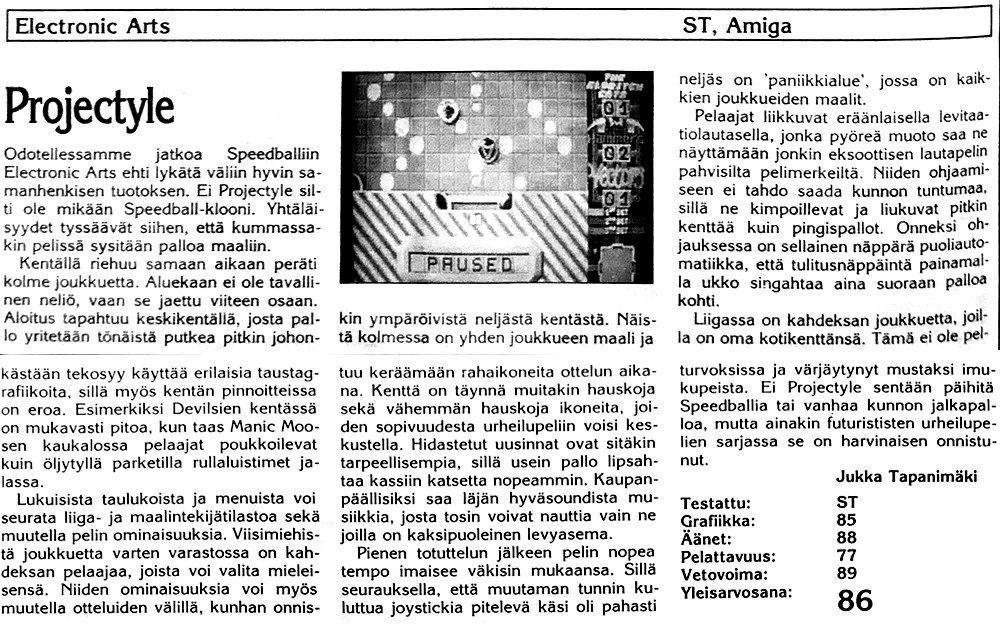
Projectyle1990 SyksyPysyvä linkkiOdotellessamme jatkoa Speedballiin Electronic Arts ehti lykätä väliin hyvin samanhenkisen tuotoksen. Ei Projectyle silti ole mikään Speedball-klooni. Yhtäläisyydet tyssäävät siihen, että kummassakin pelissä sysitään palloa maaliin.
Kentällä riehuu samaan aikaan peräti kolme joukkuetta. Aluekaan ei ole tavallinen neliö, vaan se jaettu viiteen osaan. Aloitus tapahtuu keskikentällä, josta pallo yritetään tönäistä putkea pitkin johonkin ympäröivistä neljästä kentästä. Näistä kolmessa on yhden joukkueen maali ja neljäs on 'paniikkialue', jossa on kaikkien joukkueiden maalit.
Pelaajat liikkuvat eräänlaisella levitaatiolautasella, jonka pyöreä muoto saa ne näyttämään jonkin eksoottisen lautapelin pahvisilta pelimerkeiltä. Niiden ohjaamiseen ei tahdo saada kunnon tuntumaa, sillä ne kimpoilevat ja liukuvat pitkin kenttää kuin pingispallot. Onneksi ohjauksessa on sellainen näppärä puoliautomatiikka, että tulitusnäppäintä painamalla ukko singahtaa aina suoraan palloa kohti.
Liigassa on kahdeksan joukkuetta, joilla on oma kotikenttänsä. Tämä ei ole pelkästään tekosyy käyttää erilaisia taustagrafiikoita, sillä myös kentän pinnoitteissa on eroa. Esimerkiksi Devilsien kentässä on mukavasti pitoa, kun taas Manic Moosen kaukalossa pelaajat poukkoilevat kuin öljytyllä parketilla rullaluistimet jalassa.
Lukuisista taulukoista ja menuista voi seurata liiga- ja maalintekijätilastoa sekä muutella pelin ominaisuuksia. Viisimiehistä joukkuetta varten varastossa on kahdeksan pelaajaa, joista voi valita mieleisensä. Niiden ominaisuuksia voi myös muutella otteluiden välillä, kunhan onnistuu keräämään rahaikoneita ottelun aikana. Kenttä on täynnä muitakin hauskoja sekä vähemmän hauskoja ikoneita, joiden sopivuudesta urheilupeliin voisi keskustella. Hidastetut uusinnat ovat sitäkin tarpeellisempia, sillä usein pallo lipsahtaa kassiin katsetta nopeammin. Kaupanpäällisiksi saa läjän hyväsoundista musiikkia, josta tosin voivat nauttia vain ne joilla on kaksipuoleinen levyasema.
Pienen totuttelun jälkeen pelin nopea tempo imaisee väkisin mukaansa. Sillä seurauksella, että muutaman tunnin kuluttua joystickia pitelevä käsi oli pahasti turvoksissa ja värjäytynyt mustaksi imukupeista. Ei Projectyle sentään päihitä Speedballia tai vanhaa kunnon jalkapalloa, mutta ainakin futurististen urheilupelien sarjassa se on harvinaisen onnistunut.
Projectyle1990 SyksyPermalinkWhile we've been waiting for the sequel to Speedball, Electronic Arts has managed to slip in a production of very much the same spirit. Projectyle is still no Speedball clone, though. The similarities grind to a halt at the fact that in both games you shove a ball into a goal.
No fewer than three teams run riot on the pitch at the same time. Nor is the arena an ordinary square; it's divided into five sections. Play starts in the centre field, from which you try to nudge the ball along a tube into one of the four surrounding fields. Three of these each hold one team's goal, and the fourth is the 'panic zone', which has the goals of all the teams.
The players get around on a sort of levitation saucer, whose round shape makes them look like the cardboard counters of some exotic board game. It's hard to get a proper feel for steering them, since they bounce and slide around the pitch like ping-pong balls. Luckily the controls have a handy bit of semi-automation: press the fire button and your man always shoots straight towards the ball.
The league has eight teams, each with its own home ground. This isn't just an excuse to use different background graphics, since the pitch surfaces differ too. The Devils' pitch, for example, has nice grip, whereas in Manic Moose's rink the players bounce around like someone on roller skates on an oiled parquet floor.
From numerous tables and menus you can follow the league and top-scorer statistics and tweak the game's settings. For the five-man team there are eight players in stock, and you can pick the ones you like. Their attributes can also be tweaked between matches, as long as you manage to collect money icons during the match. The pitch is full of other fun and not-so-fun icons too, whose place in a sports game is open to debate. The slow-motion replays are all the more necessary, since the ball often slips into the net faster than the eye can follow. Thrown into the bargain is a pile of good-sounding music, which, mind you, only those with a double-sided disk drive get to enjoy.
After a little getting used to, the game's fast pace sucks you in whether you like it or not. With the result that a few hours later the hand holding the joystick was badly swollen and stained black from the suction cups. Projectyle doesn't quite beat Speedball or good old football, but at least in the futuristic sports game class it's an unusually successful effort.
Prosoccer 2190
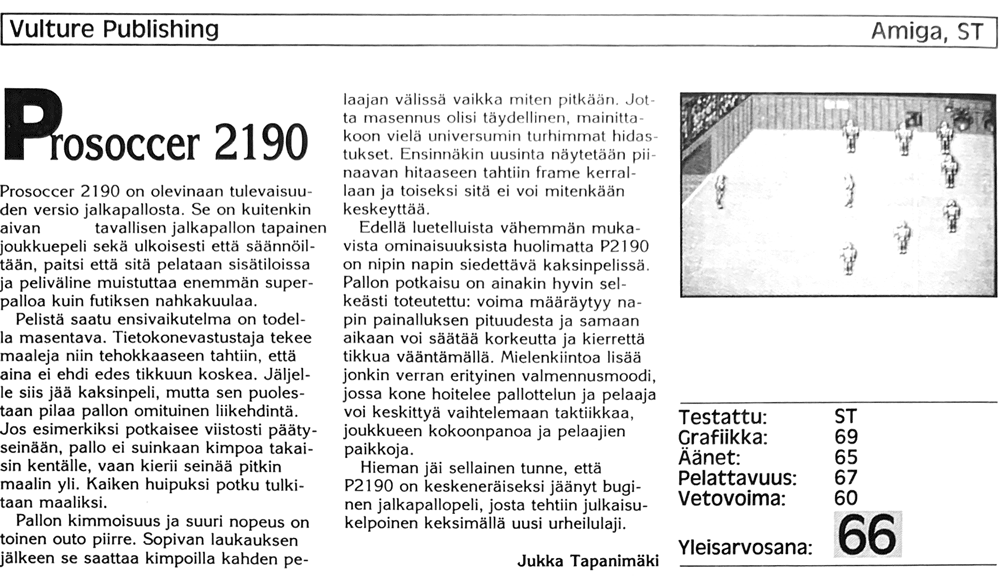
Prosoccer 21901991 KevätPysyvä linkkiProsoccer 2190 on olevinaan tulevaisuuden versio jalkapallosta. Se on kuitenkin aivan tavallisen jalkapallon tapainen joukkuepeli sekä ulkoisesti että säännöiltään, paitsi että sitä pelataan sisätiloissa ja peliväline muistuttaa enemmän superpalloa kuin futiksen nahkakuulaa.
Pelistä saatu ensivaikutelma on todella masentava. Tietokonevastustaja tekee maaleja niin tehokkaaseen tahtiin, että aina ei ehdi edes tikkuun koskea. Jäljelle siis jää kaksinpeli, mutta sen puolestaan pilaa pallon omituinen liikehdintä. Jos esimerkiksi potkaisee viistosti päätyseinään, pallo ei suinkaan kimpoa takaisin kentälle, vaan kierii seinää pitkin maalin yli. Kaiken huipuksi potku tulkitaan maaliksi.
Pallon kimmoisuus ja suuri nopeus on toinen outo piirre. Sopivan laukauksen jälkeen se saattaa kimpoilla kahden pelaajan välissä vaikka miten pitkään. Jotta masennus olisi täydellinen, mainittakoon vielä universumin turhimmat hidastukset. Ensinnäkin uusinta näytetään piinaavan hitaaseen tahtiin frame kerrallaan ja toiseksi sitä ei voi mitenkään keskeyttää.
Edellä luetelluista vähemmän mukavista ominaisuuksista huolimatta P2190 on nipin napin siedettävä kaksinpelissä. Pallon potkaisu on ainakin hyvin selkeästi toteutettu: voima määräytyy napin painalluksen pituudesta ja samaan aikaan voi säätää korkeutta ja kierrettä tikkua vääntämällä. Mielenkiintoa lisää jonkin verran erityinen valmennusmoodi, jossa kone hoitelee pallottelun ja pelaaja voi keskittyä vaihtelemaan taktiikkaa, joukkueen kokoonpanoa ja pelaajien paikkoja.
Hieman jäi sellainen tunne, että P2190 on keskeneräiseksi jäänyt buginen jalkapallopeli, josta tehtiin julkaisukelpoinen keksimällä uusi urheilulaji.
Prosoccer 21901991 KevätPermalinkProsoccer 2190 purports to be a future version of football. It is, however, a team game just like perfectly ordinary football, both in looks and in its rules, except that it's played indoors and the ball resembles a superball more than footy's leather sphere.
The first impression the game gives is truly depressing. The computer opponent scores goals at such an efficient rate that you don't always even get the chance to touch the joystick. That leaves the two-player game, but that in turn is ruined by the ball's peculiar movement. If, for example, you kick it at an angle into the end wall, the ball by no means bounces back onto the pitch, but rolls along the wall and over the goal. To top it all, the kick is counted as a goal.
The ball's bounciness and high speed are another odd feature. After the right kind of shot it may bounce back and forth between two players for goodness knows how long. To make the depression complete, let me also mention the most pointless slow-motion replays in the universe. Firstly, the replay is shown at an agonisingly slow pace one frame at a time, and secondly there is no way whatsoever to interrupt it.
Despite the less than pleasant features listed above, P2190 is just barely bearable as a two-player game. Kicking the ball, at least, has been implemented very clearly: the power is determined by how long you hold the button down, and at the same time you can adjust the height and the spin by twisting the joystick. Interest is boosted somewhat by a special coaching mode, in which the computer handles the kicking about and the player can concentrate on switching tactics, the team line-up and the players' positions.
I was left with a slight feeling that P2190 is an unfinished, buggy football game that was made fit for release by inventing a new sport.
Psi 5 Trading Co.
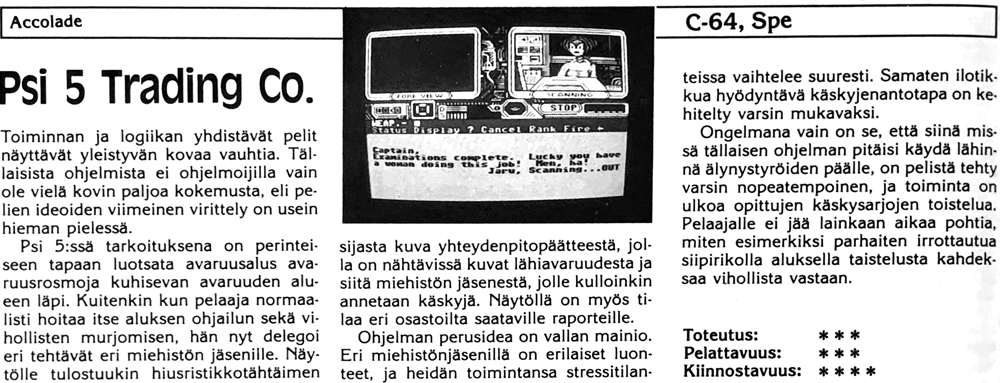
Psi 5 Trading Co.1987Pysyvä linkkiToiminnan ja logiikan yhdistävät pelit näyttävät yleistyvän kovaa vauhtia. Tällaisista ohjelmista ei ohjelmoijilla vain ole vielä kovin paljoa kokemusta, eli pelien ideoiden viimeinen virittely on usein hieman pielessä.
Psi 5:ssä tarkoituksena on perinteiseen tapaan luotsata avaruusalus avaruusrosmoja kuhisevan avaruuden alueen läpi. Kuitenkin kun pelaaja normaalisti hoitaa itse aluksen ohjailun sekä vihollisten murjomisen, hän nyt delegoi eri tehtävät eri miehistön jäsenille. Näytölle tulostuukin hiusristikkotähtäimen sijasta kuva yhteydenpitopäätteestä, jolla on nähtävissä kuvat lähiavaruudesta ja siitä miehistön jäsenestä, jolle kulloinkin annetaan käskyjä. Näytöllä on myös tilaa eri osastoilta saataville raporteille.
Ohjelman perusidea on vallan mainio. Eri miehistönjäsenillä on erilaiset luonteet, ja heidän toimintansa stressitilanteissa vaihtelee suuresti. Samaten ilotikkua hyödyntävä käskyjenantotapa on kehitelty varsin mukavaksi.
Ongelmana vain on se, että siinä missä tällaisen ohjelman pitäisi käydä lähinnä älynystyröiden päälle, on pelistä tehty varsin nopeatempoinen, ja toiminta on ulkoa opittujen käskysarjojen toistelua. Pelaajalle ei jää lainkaan aikaa pohtia, miten esimerkiksi parhaiten irrottautua siipirikolla aluksella taistelusta kahdeksaa vihollista vastaan.
Psi 5 Trading Co.1987PermalinkGames that combine action and logic seem to be catching on fast. Programmers just don't have much experience with programs of this kind yet, which means the final fine-tuning of the games' ideas is often a little off.
In Psi 5 the aim, in the traditional way, is to pilot a spaceship through a region of space swarming with space bandits. However, whereas the player would normally handle the steering and the pummelling of enemies personally, here they delegate the various tasks to different crew members. So instead of a crosshair sight, the screen shows a picture of a communications terminal, on which you can see views of nearby space and of whichever crew member is currently being given orders. There is also room on the screen for reports coming in from the various departments.
The basic idea of the program is splendid. The different crew members have different personalities, and the way they act under stress varies a great deal. Likewise, the joystick-driven way of giving orders has been worked out quite nicely.
The only problem is that where a program like this ought to work mainly on the little grey cells, the game has been made rather fast-paced, and the action boils down to repeating sequences of commands learned by heart. The player is left no time at all to ponder, for example, how best to break off a fight against eight enemies in a crippled ship.
Psycho Soldier
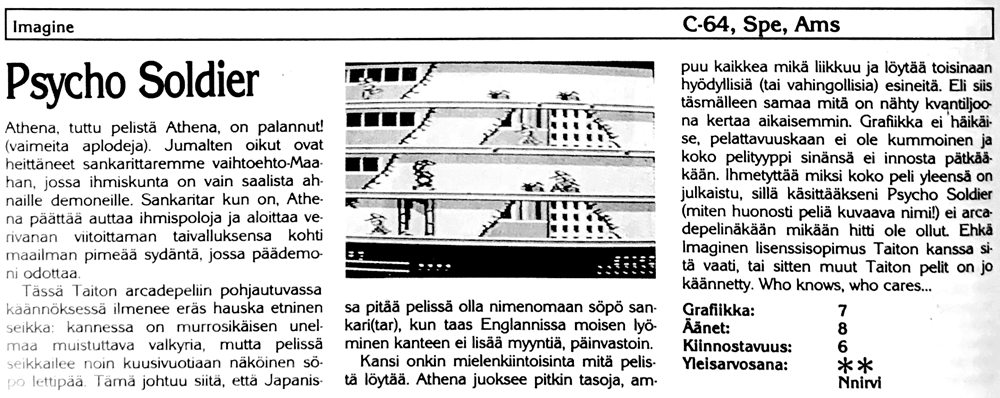
Psycho Soldier1988Pysyvä linkkiAthena, tuttu pelistä Athena, on palannut! (vaimeita aplodeja). Jumalten oikut ovat heittäneet sankarittaremme vaihtoehto-Maahan, jossa ihmiskunta on vain saalista ahnaille demoneille. Sankaritar kun on, Athena päättää auttaa ihmispoloja ja aloittaa verivanan viitoittaman taivalluksensa kohti maailman pimeää sydäntä, jossa päädemoni odottaa.
Tässä Taiton arcadepeliin pohjautuvassa käännöksessä ilmenee eräs hauska etninen seikka: kannessa on murrosikäisen unelmaa muistuttava valkyria, mutta pelissä seikkailee noin kuusivuotiaan näköinen söpö lettipää. Tämä johtuu siitä, että Japanissa pitää pelissä olla nimenomaan söpö sankari(tar), kun taas Englannissa moisen lyöminen kanteen ei lisää myyntiä, päinvastoin.
Kansi onkin mielenkiintoisinta mitä pelistä löytää. Athena juoksee pitkin tasoja, ampuu kaikkea mikä liikkuu ja löytää toisinaan hyödyllisiä (tai vahingollisia) esineitä. Eli siis täsmälleen samaa mitä on nähty kvantiljoona kertaa aikaisemmin. Grafiikka ei häikäise, pelattavuuskaan ei ole kummoinen ja koko pelityyppi sinänsä ei innosta pätkääkään. Ihmetyttää miksi koko peli yleensä on julkaistu, sillä käsittääkseni Psycho Soldier (miten huonosti peliä kuvaava nimi!) ei arcadepelinäkään mikään hitti ole ollut. Ehkä Imaginen lisenssisopimus Taiton kanssa sitä vaati, tai sitten muut Taiton pelit on jo käännetty. Who knows, who cares...
Psycho Soldier1988PermalinkAthena, familiar from the game Athena, is back! (muted applause). The whims of the gods have hurled our heroine onto an alternative Earth, where mankind is nothing but prey for greedy demons. Being a heroine and all, Athena decides to help the poor humans and sets off on a trek, signposted by a trail of blood, towards the dark heart of the world where the head demon awaits.
This conversion of a Taito arcade game reveals an amusing ethnic quirk: the cover features a Valkyrie straight out of an adolescent's dreams, but the one adventuring in the game is a cute pigtailed kid who looks about six years old. This is because in Japan a game has to have a specifically cute hero(ine), whereas in England slapping one of those on the cover doesn't boost sales, quite the opposite.
The cover is in fact the most interesting thing to be found in the game. Athena runs along platforms, shoots everything that moves and now and then finds useful (or harmful) items. In other words, exactly the same thing that's been seen a zillion times before. The graphics don't dazzle, the playability is nothing much either, and the whole game genre as such doesn't excite one bit. It's a wonder why the game was released at all, since as far as I know Psycho Soldier (what a poor description of the game that name is!) wasn't any kind of hit even as an arcade game. Maybe Imagine's licensing deal with Taito demanded it, or else all the other Taito games have already been converted. Who knows, who cares...
PT 109 Patrol Boat Simulator
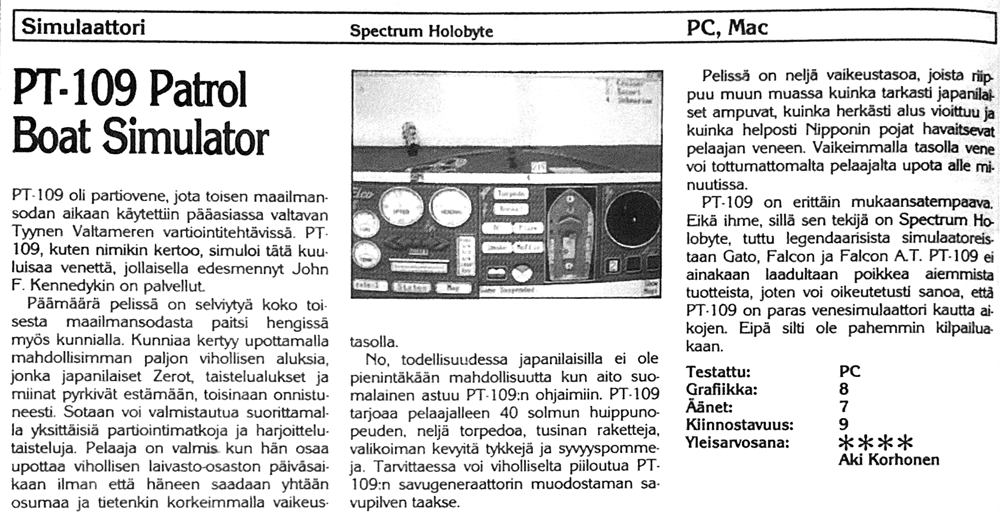
PT 109 Patrol Boat Simulator1989 KevätPysyvä linkkiPT-109 oli partiovene, jota toisen maailmansodan aikaan käytettiin pääasiassa valtavan Tyynen Valtameren vartiointitehtävissä. PT-109, kuten nimikin kertoo, simuloi tätä kuuluisaa venettä, jollaisella edesmennyt John F. Kennedykin on palvellut.
Päämäärä pelissä on selviytyä koko toisesta maailmansodasta paitsi hengissä myös kunnialla. Kunniaa kertyy upottamalla mahdollisimman paljon vihollisen aluksia, jonka japanilaiset Zerot, taistelualukset ja miinat pyrkivät estämään, toisinaan onnistuneesti. Sotaan voi valmistautua suorittamalla yksittäisiä partiointimatkoja ja harjoittelutaisteluja. Pelaaja on valmis kun hän osaa upottaa vihollisen laivasto-osaston päiväsaikaan ilman että häneen saadaan yhtään osumaa ja tietenkin korkeimmalla vaikeustasolla.
No, todellisuudessa japanilaisilla ei ole pienintäkään mahdollisuutta kun aito suomalainen astuu PT-109:n ohjaimiin. PT-109 tarjoaa pelaajalleen 40 solmun huippunopeuden, neljä torpedoa, tusinan raketteja, valikoiman kevyitä tykkejä ja syvyyspommeja. Tarvittaessa voi viholliselta piiloutua PT-109:n savugeneraattorin muodostaman savupilven taakse.
Pelissä on neljä vaikeustasoa, joista riippuu muun muassa kuinka tarkasti japanilaiset ampuvat, kuinka herkästi alus vioittuu ja kuinka helposti Nipponin pojat havaitsevat pelaajan veneen. Vaikeimmalla tasolla vene voi tottumattomalta pelaajalta upota alle minuutissa.
PT-109 on erittäin mukaansatempaava. Eikä ihme, sillä sen tekijä on Spectrum Holobyte, tuttu legendaarisista simulaatoreistaan Gato, Falcon ja Falcon A.T. PT-109 ei ainakaan laadultaan poikkea aiemmista tuotteista, joten voi oikeutetusti sanoa, että PT-109 on paras venesimulaattori kautta aikojen. Eipä silti ole pahemmin kilpailuakaan.
PT 109 Patrol Boat Simulator1989 KevätPermalinkPT-109 was a patrol boat that during the Second World War was used mainly for guard duty on the vast Pacific Ocean. PT-109, as the name suggests, simulates this famous boat, the kind the late John F. Kennedy also served on.
The aim of the game is to get through the entire Second World War not only alive but with honour. Honour is earned by sinking as many enemy ships as possible, something the Japanese Zeros, warships and mines try to prevent, sometimes successfully. You can prepare for the war by carrying out individual patrol runs and practice battles. The player is ready when they can sink an enemy naval squadron in daylight without taking a single hit - and on the highest difficulty level, naturally.
Well, in reality the Japanese don't stand the slightest chance when a genuine Finn takes the controls of PT-109. PT-109 offers its player a top speed of 40 knots, four torpedoes, a dozen rockets, an assortment of light guns, and depth charges. If need be, you can hide from the enemy behind the cloud of smoke laid down by PT-109's smoke generator.
The game has four difficulty levels, which determine among other things how accurately the Japanese shoot, how easily the boat takes damage and how readily the sons of Nippon spot the player's boat. On the hardest level an inexperienced player can have the boat sink under them in less than a minute.
PT-109 is extremely gripping. No wonder, since it's made by Spectrum Holobyte, known for its legendary simulators Gato, Falcon and Falcon A.T. In quality, at least, PT-109 is no departure from the earlier products, so one can justifiably say that PT-109 is the best boat simulator of all time. Not that there's much competition, mind you.
Purple Saturn Day
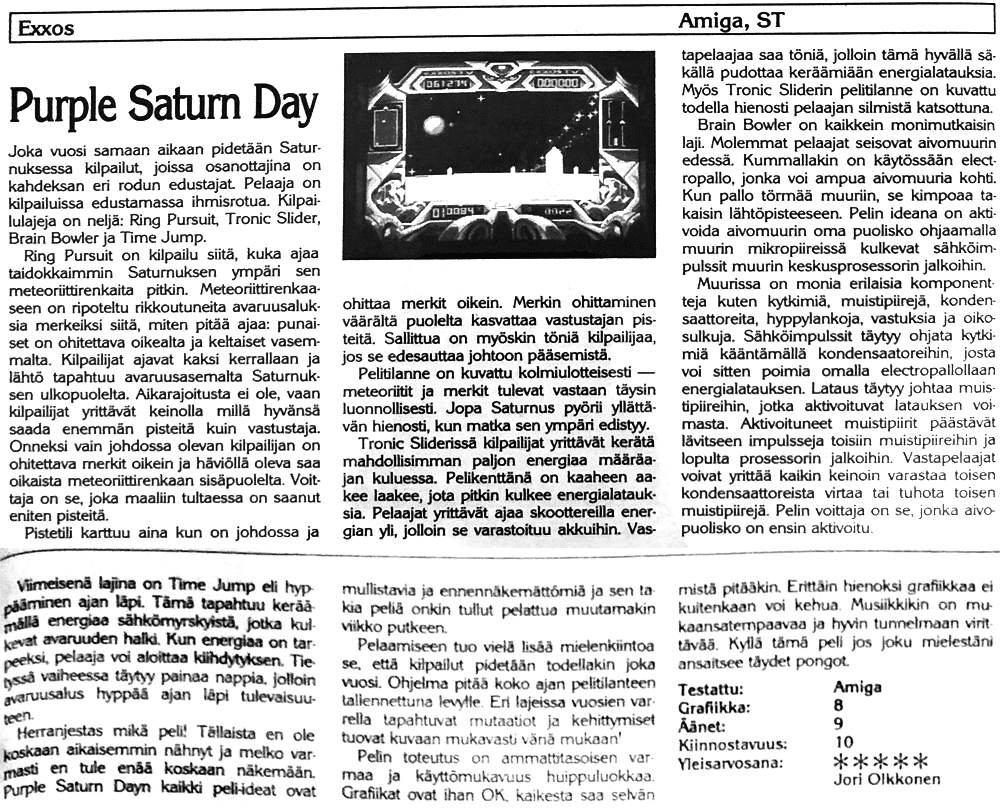
Purple Saturn Day1989 SyksyPysyvä linkkiJoka vuosi samaan aikaan pidetään Saturnuksessa kilpailut, joissa osanottajina on kahdeksan eri rodun edustajat. Pelaaja on kilpailuissa edustamassa ihmisrotua. Kilpailulajeja on neljä: Ring Pursuit, Tronic Slider, Brain Bowler ja Time Jump.
Ring Pursuit on kilpailu siitä, kuka ajaa taidokkaimmin Saturnuksen ympäri sen meteoriittirenkaita pitkin. Meteoriittirenkaaseen on ripoteltu rikkoutuneita avaruusaluksia merkeiksi siitä, miten pitää ajaa: punaiset on ohitettava oikealta ja keltaiset vasemmalta. Kilpailijat ajavat kaksi kerrallaan ja lähtö tapahtuu avaruusasemalta Saturnuksen ulkopuolelta. Aikarajoitusta ei ole, vaan kilpailijat yrittävät keinolla millä hyvänsä saada enemmän pisteitä kuin vastustaja. Onneksi vain johdossa olevan kilpailijan on ohitettava merkit oikein ja häviöllä oleva saa oikaista meteoriittirenkaan sisäpuolelta. Voittaja on se, joka maaliin tultaessa on saanut eniten pisteitä.
Pistetili karttuu aina kun on johdossa ja ohittaa merkit oikein. Merkin ohittaminen väärältä puolelta kasvattaa vastustajan pisteitä. Sallittua on myöskin töniä kilpailijaa, jos se edesauttaa johtoon pääsemistä.
Pelitilanne on kuvattu kolmiulotteisesti - meteoriitit ja merkit tulevat vastaan täysin luonnollisesti. Jopa Saturnus pyörii yllättävän hienosti, kun matka sen ympäri edistyy.
Tronic Sliderissä kilpailijat yrittävät kerätä mahdollisimman paljon energiaa määräajan kuluessa. Pelikenttänä on kaaheen aakee laakee, jota pitkin kulkee energialatauksia. Pelaajat yrittävät ajaa skoottereilla energian yli, jolloin se varastoituu akkuihin. Vastapelaajaa saa töniä, jolloin tämä hyvällä säkällä pudottaa keräämiään energialatauksia. Myös Tronic Sliderin pelitilanne on kuvattu todella hienosti pelaajan silmistä katsottuna.
Brain Bowler on kaikkein monimutkaisin laji. Molemmat pelaajat seisovat aivomuurin edessä. Kummallakin on käytössään electropallo, jonka voi ampua aivomuuria kohti. Kun pallo törmää muuriin, se kimpoaa takaisin lähtöpisteeseen. Pelin ideana on aktivoida aivomuurin oma puolisko ohjaamalla muurin mikropiireissä kulkevat sähköimpulssit muurin keskusprosessorin jalkoihin.
Muurissa on monia erilaisia komponentteja kuten kytkimiä, muistipiirejä, kondensaattoreita, hyppylankoja, vastuksia ja oikosulkuja. Sähköimpulssit täytyy ohjata kytkimiä kääntämällä kondensaattoreihin, josta voi sitten poimia omalla electropallollaan energialatauksen. Lataus täytyy johtaa muistipiireihin, jotka aktivoituvat latauksen voimasta. Aktivoituneet muistipiirit päästävät lävitseen impulsseja toisiin muistipiireihin ja lopulta prosessorin jalkoihin. Vastapelaajat voivat yrittää kaikin keinoin varastaa toisen kondensaattoreista virtaa tai tuhota toisen muistipiirejä. Pelin voittaja on se, jonka aivopuolisko on ensin aktivoitu. Viimeisenä lajina on Time Jump eli hyppääminen ajan läpi. Tämä tapahtuu keräämällä energiaa sähkömyrskyistä, jotka kulkevat avaruuden halki. Kun energiaa on tarpeeksi, pelaaja voi aloittaa kiihdytyksen. Tietyssä vaiheessa täytyy painaa nappia, jolloin avaruusalus hyppää ajan läpi tulevaisuuteen.
Herranjestas mikä peli! Tällaista en ole koskaan aikaisemmin nähnyt ja melko varmasti en tule enää koskaan näkemään. Purple Saturn Dayn kaikki peli-ideat ovat mullistavia ja ennennäkemättömiä ja sen takia peliä onkin tullut pelattua muutamakin viikko putkeen.
Pelaamiseen tuo vielä lisää mielenkiintoa se, että kilpailut pidetään todellakin joka vuosi. Ohjelma pitää koko ajan pelitilanteen tallennettuna levylle. Eri lajeissa vuosien varrella tapahtuvat mutaatiot ja kehittymiset tuovat kuvaan mukavasti väriä mukaan!
Pelin toteutus on ammattitasoisen varmaa ja käyttömukavuus huippuluokkaa. Grafiikat ovat ihan OK, kaikesta saa selvän mistä pitääkin. Erittäin hienoksi grafiikkaa ei kuitenkaan voi kehua. Musiikkikin on mukaansatempaavaa ja hyvin tunnelmaan virittävää. Kyllä tämä peli jos joku mielestäni ansaitsee täydet pongot.
Purple Saturn Day1989 SyksyPermalinkEvery year at the same time, games are held on Saturn in which representatives of eight different races take part. The player competes on behalf of the human race. There are four events: Ring Pursuit, Tronic Slider, Brain Bowler and Time Jump.
Ring Pursuit is a contest to see who can race most skilfully around Saturn along its meteorite rings. Wrecked spaceships have been scattered across the meteorite ring as markers showing how you have to race: the red ones must be passed on the right and the yellow ones on the left. The competitors race two at a time, and the start is from a space station outside Saturn. There is no time limit; instead the competitors try by any means whatsoever to score more points than their opponent. Fortunately only the competitor in the lead has to pass the markers correctly, and the one who is losing is allowed to cut across the inside of the meteorite ring. The winner is whoever has the most points on reaching the finish.
Your points pile up whenever you are in the lead and pass the markers correctly. Passing a marker on the wrong side adds to your opponent's points. It's also allowed to shove your rival if it helps you get into the lead.
The action is depicted in three dimensions - the meteorites and markers come at you completely naturally. Even Saturn rotates surprisingly nicely as your journey around it progresses.
In Tronic Slider the competitors try to collect as much energy as possible within a set time. The playing field is one great big wide-open flatland, across which energy charges travel. The players try to ride their scooters over the energy, which is then stored in their batteries. You're allowed to shove the opposing player, and with a bit of luck they will drop the energy charges they've collected. Tronic Slider's action is also depicted really nicely, as seen through the player's eyes.
Brain Bowler is the most complicated event of all. Both players stand in front of a brain wall. Each of them has an electro-ball which can be fired at the brain wall. When the ball hits the wall, it bounces back to its starting point. The idea is to activate your own half of the brain wall by steering the electrical impulses running through the wall's microcircuits to the pins of the wall's central processor.
The wall contains lots of different components such as switches, memory chips, capacitors, jumper wires, resistors and short circuits. By flipping the switches you have to steer the electrical impulses into the capacitors, from which you can then pick up an energy charge with your own electro-ball. The charge has to be conducted to the memory chips, which are activated by its power. Activated memory chips let impulses through to other memory chips and finally to the processor's pins. The opponents can try by every means possible to steal current from each other's capacitors or destroy each other's memory chips. The winner is the one whose brain half is activated first. The last event is Time Jump, that is, jumping through time. This is done by collecting energy from the electrical storms that travel across space. When there is enough energy, the player can start accelerating. At a certain point you have to press the button, whereupon the spaceship jumps through time into the future.
Good Lord, what a game! I have never seen anything like this before, and quite certainly I never will again. All of Purple Saturn Day's game ideas are revolutionary and unprecedented, and that's why I've ended up playing it for a good few weeks on end.
Adding still more interest to the playing is the fact that the games really are held every year. The program keeps the game state saved to disk all the time. The mutations and developments that take place in the various events over the years add a nice splash of colour to the picture!
The game is implemented with professional assurance, and the ease of use is top class. The graphics are perfectly OK; you can make out everything you're supposed to. You can't, however, praise the graphics as particularly fine. The music, too, is catchy and gets you nicely into the mood. If any game deserves full points, in my opinion this one does.
Puzznic
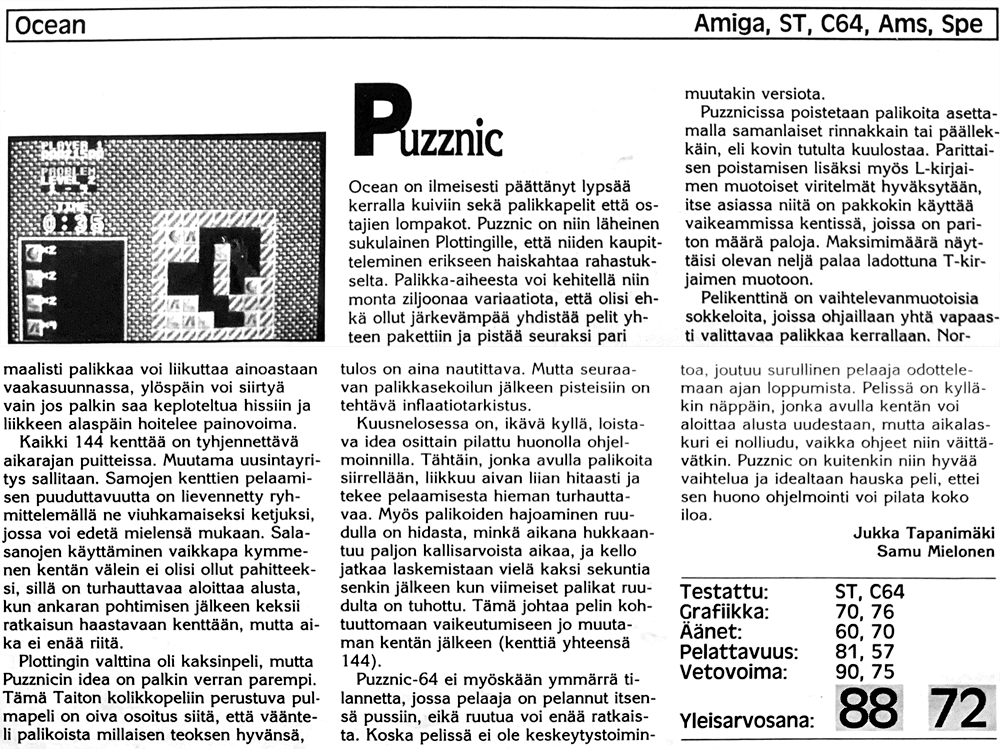
Puzznic1991 KevätPysyvä linkkiOcean on ilmeisesti päättänyt lypsää kerralla kuiviin sekä palikkapelit että ostajien lompakot. Puzznic on niin läheinen sukulainen Plottingille, että niiden kaupitteleminen erikseen haiskahtaa rahastukselta. Palikka-aiheesta voi kehitellä niin monta ziljoonaa variaatiota, että olisi ehkä ollut järkevämpää yhdistää pelit yhteen pakettiin ja pistää seuraksi pari muutakin versiota.
Puzznicissa poistetaan palikoita asettamalla samanlaiset rinnakkain tai päällekkäin, eli kovin tutulta kuulostaa. Parittaisen poistamisen lisäksi myös L-kirjaimen muotoiset viritelmät hyväksytään, itse asiassa niitä on pakkokin käyttää vaikeammissa kentissä, joissa on pariton määrä paloja. Maksimimäärä näyttäisi olevan neljä palaa ladottuna T-kirjaimen muotoon.
Pelikenttinä on vaihtelevanmuotoisia sokkeloita, joissa ohjaillaan yhtä vapaasti valittavaa palikkaa kerrallaan. Normaalisti palikkaa voi liikuttaa ainoastaan vaakasuunnassa, ylöspäin voi siirtyä vain jos palkin saa keploteltua hissiin ja liikkeen alaspäin hoitelee painovoima.
Kaikki 144 kenttää on tyhjennettävä aikarajan puitteissa. Muutama uusintayritys sallitaan. Samojen kenttien pelaamisen puuduttavuutta on lievennetty ryhmittelemällä ne viuhkamaiseksi ketjuksi, jossa voi edetä mielensä mukaan. Salasanojen käyttäminen vaikkapa kymmenen kentän välein ei olisi ollut pahitteeksi, sillä on turhauttavaa aloittaa alusta, kun ankaran pohtimisen jälkeen keksii ratkaisun haastavaan kenttään, mutta aika ei enää riitä.
Plottingin valttina oli kaksinpeli, mutta Puzznicin idea on palkin verran parempi. Tämä Taiton kolikkopeliin perustuva pulmapeli on oiva osoitus siitä, että väänteli palikoista millaisen teoksen hyvänsä, tulos on aina nautittava. Mutta seuraavan palikkasekoilun jälkeen pisteisiin on tehtävä inflaatiotarkistus.
Kuusnelosessa on, ikävä kyllä, loistava idea osittain pilattu huonolla ohjelmoinnilla. Tähtäin, jonka avulla palikoita siirrellään, liikkuu aivan liian hitaasti ja tekee pelaamisesta hieman turhauttavaa. Myös palikoiden hajoaminen ruudulla on hidasta, minkä aikana hukkaantuu paljon kallisarvoista aikaa, ja kello jatkaa laskemistaan vielä kaksi sekuntia senkin jälkeen kun viimeiset palikat ruudulta on tuhottu. Tämä johtaa pelin kohtuuttomaan vaikeutumiseen jo muutaman kentän jälkeen (kenttiä yhteensä 144).
Puzznic-64 ei myöskään ymmärrä tilannetta, jossa pelaaja on pelannut itsensä pussiin, eikä ruutua voi enää ratkaista. Koska pelissä ei ole keskeytystoimintoa, joutuu surullinen pelaaja odottelemaan ajan loppumista. Pelissä on kylläkin näppäin, jonka avulla kentän voi aloittaa alusta uudestaan, mutta aikalaskuri ei nolliudu, vaikka ohjeet niin väittävätkin. Puzznic on kuitenkin niin hyvää vaihtelua ja idealtaan hauska peli, ettei sen huono ohjelmointi voi pilata koko iloa.
Puzznic1991 KevätPermalinkOcean has apparently decided to milk both block games and buyers' wallets dry in one go. Puzznic is such a close relative of Plotting that selling them separately smells of a cash grab. You can come up with so many zillion variations on the block theme that it might have been more sensible to combine the games into one package and throw in a couple of other versions to keep them company.
In Puzznic you remove blocks by placing identical ones side by side or on top of each other, so it all sounds very familiar. Besides removing them in pairs, L-shaped contraptions are accepted too; in fact you are forced to use them in the harder levels, which have an odd number of pieces. The maximum seems to be four pieces stacked in the shape of a T.
The levels are mazes of varying shapes, in which you steer one freely chosen block at a time. Normally a block can only be moved horizontally; you can only go upwards if you manage to wangle the block onto a lift, and gravity takes care of the downward movement.
All 144 levels have to be cleared within a time limit. A few retries are allowed. The tedium of playing the same levels over has been eased by grouping them into a fan-shaped chain in which you can advance as you please. Passwords every ten levels or so wouldn't have hurt, since it is frustrating to start over from the beginning when, after some hard thinking, you figure out the solution to a challenging level but there's no longer enough time.
Plotting's trump card was the two-player mode, but Puzznic's idea is one block better. This puzzle game, based on Taito's coin-op, is a fine demonstration that whatever kind of work you twist out of blocks, the result is always enjoyable. But after the next round of block tomfoolery, the scores will need adjusting for inflation.
On the Commodore 64, sadly, a brilliant idea has been partly spoiled by poor programming. The pointer used to move the blocks around moves far too slowly and makes playing a bit frustrating. The blocks are also slow to break up on screen, which wastes a lot of precious time, and the clock keeps counting down for another two seconds even after the last blocks on the screen have been destroyed. This makes the game unreasonably hard after only a few levels (144 levels in total).
Nor does Puzznic-64 understand a situation where the player has played themselves into a corner and the screen can no longer be solved. Since the game has no abort function, the sad player has to wait for the time to run out. There is, admittedly, a key that lets you start the level over again, but the timer doesn't reset, even though the instructions claim it does. Still, Puzznic is such a good change of pace and such a fun game in concept that its poor programming can't spoil all the fun.
Pyjamarama
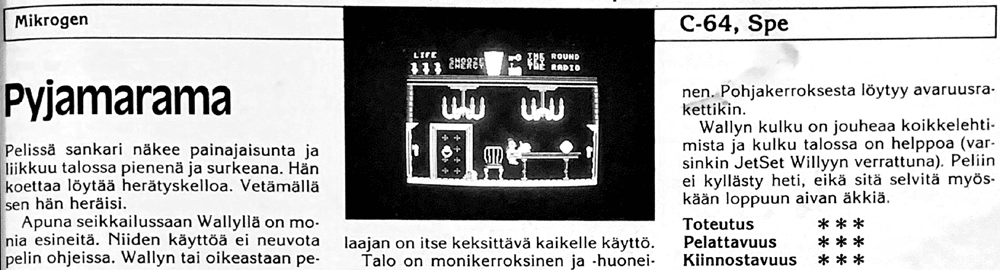
Pyjamarama1987Pysyvä linkkiPelissä sankari näkee painajaisunta ja liikkuu talossa pienenä ja surkeana. Hän koettaa löytää herätyskelloa. Vetämällä sen hän heräisi.
Apuna seikkailussaan Wallyllä on monia esineitä. Niiden käyttöä ei neuvota pelin ohjeissa. Wallyn tai oikeastaan pelaajan on itse keksittävä kaikelle käyttö.
Talo on monikerroksinen ja -huoneinen. Pohjakerroksesta löytyy avaruusrakettikin.
Wallyn kulku on jouheaa koikkelehtimista ja kulku talossa on helppoa (varsinkin JetSet Willyyn verrattuna). Peliin ei kyllästy heti, eikä sitä selvitä myöskään loppuun aivan äkkiä.
Pyjamarama1987PermalinkIn the game the hero is having a nightmare and wanders around the house, small and miserable. He tries to find the alarm clock. By winding it up he would wake up.
Wally has lots of objects to help him on his adventure. The game's instructions don't tell you how to use them. Wally, or really the player, has to work out a use for everything without any help.
The house has many floors and many rooms. There's even a space rocket on the ground floor.
Wally gets about with a smooth sort of tottering, and getting around the house is easy (especially compared to JetSet Willy). You won't get bored of the game straight away, and you won't get it finished in a hurry either.
Pyramax
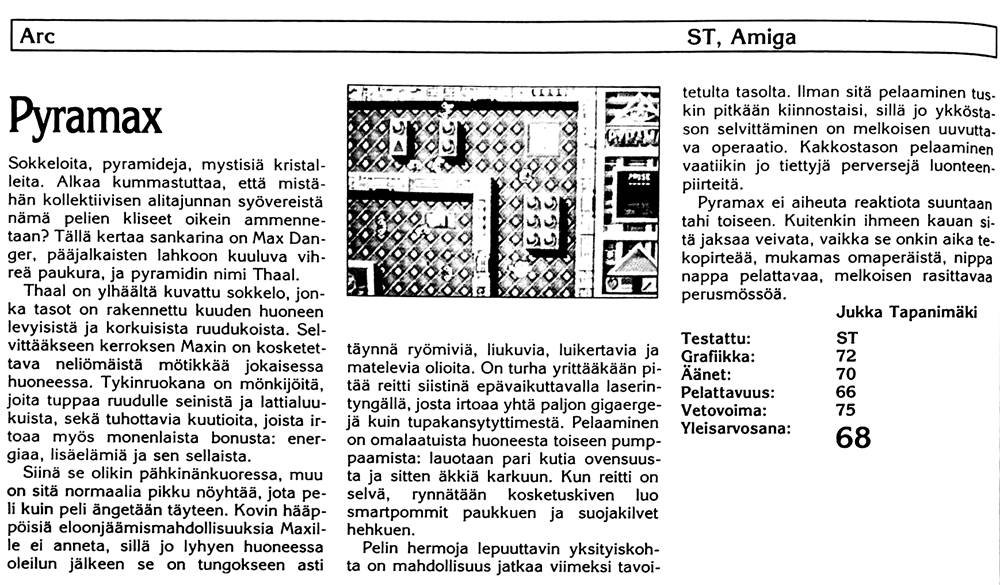
Pyramax1990 SyksyPysyvä linkkiSokkeloita, pyramideja, mystisiä kristalleita. Alkaa kummastuttaa, että mistähän kollektiivisen alitajunnan syövereistä nämä pelien kliseet oikein ammennetaan? Tällä kertaa sankarina on Max Danger, pääjalkaisten lahkoon kuuluva vihreä paukura, ja pyramidin nimi Thaal.
Thaal on ylhäältä kuvattu sokkelo, jonka tasot on rakennettu kuuden huoneen levyisistä ja korkuisista ruudukoista. Selvittääkseen kerroksen Maxin on kosketettava neliömäistä mötikkää jokaisessa huoneessa. Tykinruokana on mönkijöitä, joita tuppaa ruudulle seinistä ja lattialuukuista, sekä tuhottavia kuutioita, joista irtoaa myös monenlaista bonusta: energiaa, lisäelämiä ja sen sellaista.
Siinä se olikin pähkinänkuoressa, muu on sitä normaalia pikku nöyhtää, jota peli kuin peli ängetään täyteen. Kovin hääppöisiä eloonjäämismahdollisuuksia Maxille ei anneta, sillä jo lyhyen huoneessa oleilun jälkeen se on tungokseen asti täynnä ryömiviä, liukuvia, luikertavia ja matelevia olioita. On turha yrittääkään pitää reitti siistinä epävaikuttavalla laserintyngällä, josta irtoaa yhtä paljon gigaergejä kuin tupakansytyttimestä. Pelaaminen on omalaatuista huoneesta toiseen pumppaamista: lauotaan pari kutia ovensuusta ja sitten äkkiä karkuun. Kun reitti on selvä, rynnätään kosketuskiven luo smartpommit paukkuen ja suojakilvet hehkuen.
Pelin hermoja lepuuttavin yksityiskohta on mahdollisuus jatkaa viimeksi tavoitetulta tasolta. Ilman sitä pelaaminen tuskin pitkään kiinnostaisi, sillä jo ykköstason selvittäminen on melkoisen uuvuttava operaatio. Kakkostason pelaaminen vaatiikin jo tiettyjä perversejä luonteenpiirteitä.
Pyramax ei aiheuta reaktiota suuntaan tahi toiseen. Kuitenkin ihmeen kauan sitä jaksaa veivata, vaikka se onkin aika tekopirteää, mukamas omaperäistä, nippa nappa pelattavaa, melkoisen rasittavaa perusmössöä.
Pyramax1990 SyksyPermalinkMazes, pyramids, mystic crystals. You start to wonder from which depths of the collective unconscious these game clichés are actually being dredged up. This time the hero is Max Danger, a green lump belonging to the cephalopod order, and the pyramid is called Thaal.
Thaal is a maze viewed from above, whose levels are built from grids six rooms wide and six rooms high. To clear a floor Max has to touch a square lump in every room. For cannon fodder there are crawlers, which keep pushing onto the screen out of the walls and floor hatches, plus destructible cubes, which also cough up all sorts of bonuses: energy, extra lives and that sort of thing.
That's it in a nutshell; the rest is the usual little fluff that every game without exception gets crammed full of. Max isn't given much of a chance of survival, since after even a short stay in a room it's packed to bursting with crawling, sliding, slithering and creeping creatures. There's no point even trying to keep the route clear with an unimpressive stub of a laser that puts out about as many gigaergs as a cigarette lighter. Playing is a peculiar kind of pumping back and forth from one room to the next: loose off a couple of shots from the doorway and then run for it, fast. Once the route is clear, you charge over to the touchstone with smart bombs booming and shields glowing.
The most nerve-soothing detail in the game is the option to continue from the last level reached. Without it playing would hardly hold your interest for long, since clearing even level one is a pretty exhausting operation. Playing level two, then, already calls for certain perverse character traits.
Pyramax provokes no reaction one way or the other. Yet you find the stamina to crank away at it for a surprisingly long time, even though it's pretty fake-cheerful, supposedly original, barely playable, rather wearing run-of-the-mill mush.