1133 reviews from "Pelit"-books
Pelit was a Finnish-language (bi)annual book series published from 1987 to 1991 containing gaming-related articles, tips and most importantly game reviews. Here you can find all the reviews from the books. The reviews were originally written in Finnish; the English versions are translations of the Finnish originals. Maininta tekijänoikeuksista
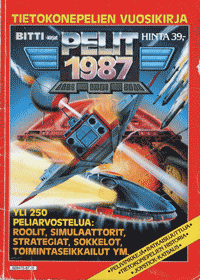 1987
1987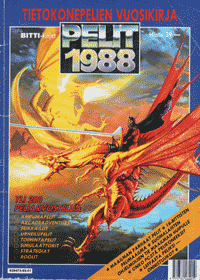 1988
1988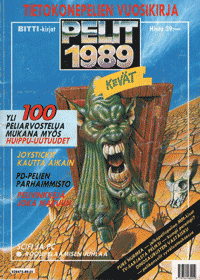 1989 Kevät
 1989 Syksy
 1990 Kevät
 1990 Syksy
 1991 Kevät
 1991 Syksy
B 24
B 241988Pysyvä linkkiMitäs tämä on olevinaan? SSI tekee simulaattorin? Strategiafirma siirtyy simulaattoripuolelle.
Eihän se ole noin yksinkertaista. Tavallista simua odottaneet kokevat karvaan pettymyksen ladatessaan B-24:n. SSI:n käsistä on jälleen lähtenyt varteenotettava strategiapeli, joka ei vaadi niin suurta opiskelua kuin tavallisesti.
Pelaaja saa B-24 Liberator -pommittajan ohjaimet känsäisiin käsiinsä ja pääsee johtamaan pommituslentoja Romaniassa sijaitsevaa Natsi-Saksan tärkeintä öljyntuottajaa Ploestia vastaan. Eikä homma ole helppo, siitä pitävät huolen 19 vaarallista tehtävää it-tulen, hävittäjien ja moottorivaurioiden riepoteltavana.
Toteutus on paljolti vanhan ikivihreän 50 Mission Crushin tyyppinen. Tosin paljon kehittyneempi. Lyhyt tehtävänkuvaus voisi olla seuraavanlainen: lentoonlähtö, nousu 2000-3000 jalan välille odottamaan laivueen kokoontumista, lennetään saattohävittäjien tapaamispaikalle, noustaan pommituskorkeuteen ja lennetään kohteelle, pudotetaan pommit ja palataan kotiin.
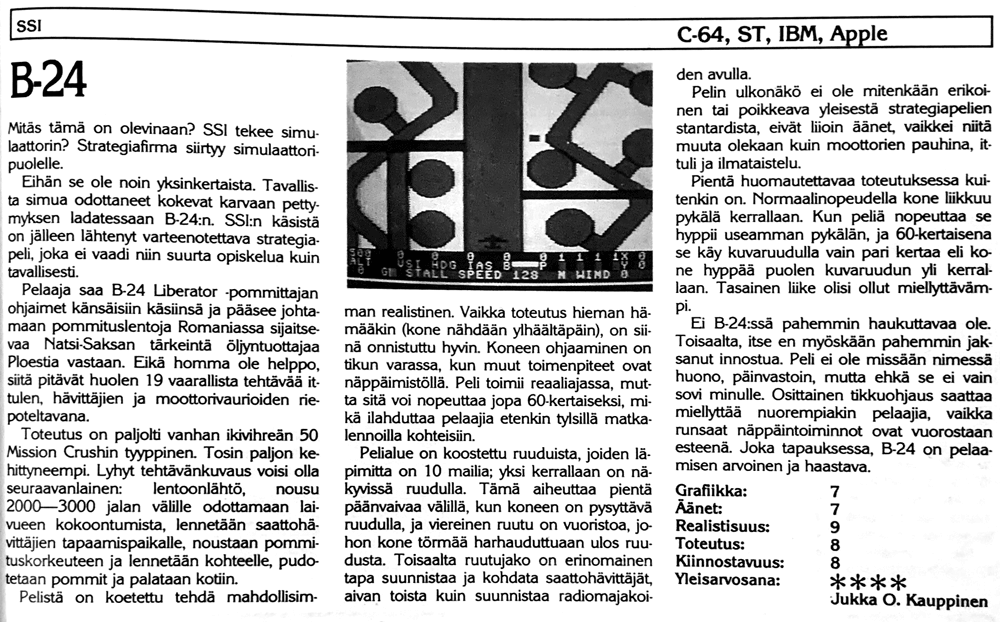
Pelistä on koetettu tehdä mahdollisimman realistinen. Vaikka toteutus on hieman hämääkin (kone nähdään ylhäältäpäin), on siinä onnistuttu hyvin. Koneen ohjaaminen on tikun varassa, kun muut toimenpiteet ovat näppäimistöllä. Peli toimii reaaliajassa, mutta sitä voi nopeuttaa jopa 60-kertaiseksi, mikä ilahduttaa pelaajia etenkin tylsillä matkalennoilla kohteisiin.
Pelialue on koostettu ruuduista, joiden läpimitta on 10 mailia; yksi kerrallaan on näkyvissä ruudulla. Tämä aiheuttaa pientä päänvaivaa välillä, kun koneen on pysyttävä ruudulla, ja viereinen ruutu on vuoristoa, johon kone törmää harhauduttuaan ulos ruudusta. Toisaalta ruutujako on erinomainen tapa suunnistaa ja kohdata saattohävittäjät, aivan toista kuin suunnistaa radiomajakoiden avulla.
Pelin ulkonäkö ei ole mitenkään erikoinen tai poikkeava yleisestä strategiapelien stantardista, eivät liioin äänet, vaikkei niitä muuta olekaan kuin moottorien pauhina, it-tuli ja ilmataistelu.
Pientä huomautettavaa toteutuksessa kuitenkin on. Normaalinopeudella kone liikkuu pykälä kerrallaan. Kun peliä nopeuttaa se hyppii useamman pykälän, ja 60-kertaisena se käy kuvaruudulla vain pari kertaa eli kone hyppää puolen kuvaruudun yli kerrallaan. Tasainen liike olisi ollut miellyttävämpi.
Ei B-24:ssä pahemmin haukuttavaa ole. Toisaalta, itse en myöskään pahemmin jaksanut innostua. Peli ei ole missään nimessä huono, päinvastoin, mutta ehkä se ei vain sovi minulle. Osittainen tikkuohjaus saattaa miellyttää nuorempiakin pelaajia, vaikka runsaat näppäintoiminnot ovat vuorostaan esteenä. Joka tapauksessa, B-24 on pelaamisen arvoinen ja haastava.
B 241988PermalinkAnd what is this supposed to be? SSI making a simulator? A strategy company crossing over to the simulator side.
Well, it's not as simple as that. Anyone expecting an ordinary sim is in for a bitter disappointment when they load up B-24. Once again SSI has turned out a strategy game worth taking seriously, one that doesn't demand as much studying as usual.
The player gets the controls of a B-24 Liberator bomber in their calloused hands and gets to lead bombing raids against Ploesti in Romania, Nazi Germany's most important oil producer. And the job isn't easy - the 19 dangerous missions, spent being knocked about by flak, fighters and engine damage, make sure of that.
The execution is very much of the same type as the old evergreen 50 Mission Crush. Much more advanced, though. A brief mission description might go like this: take off, climb to 2000-3000 feet to wait for the squadron to form up, fly to the rendezvous with the escort fighters, climb to bombing altitude and fly to the target, drop the bombs and head home.
An effort has been made to make the game as realistic as possible. Although the presentation is a little deceptive (the plane is seen from above), it has been pulled off well. Flying the plane is done with the stick, while the other actions are on the keyboard. The game runs in real time, but it can be sped up as much as 60 times, which will cheer players up especially on the dull cruise legs to the targets.
The play area is made up of squares 10 miles across; one at a time is visible on the screen. This occasionally causes a bit of a headache when the plane has to stay within the square and the neighbouring square is mountains, which the plane crashes into after straying out of its square. On the other hand, the grid is an excellent way to navigate and to meet up with the escort fighters, a whole different thing from navigating by radio beacons.
The game's look is nothing special, nor does it depart from the general strategy game standard, and neither does the sound, though there isn't anything more to it than the roar of the engines, flak and air combat.
There is one small complaint about the execution, however. At normal speed the plane moves one notch at a time. When you speed the game up it jumps several notches, and at 60 times it only shows up on the screen a couple of times, meaning the plane jumps half the screen at a time. Smooth movement would have been more pleasant.
There's not much to slate in B-24. Then again, I personally couldn't get very excited about it either. The game is by no means bad, quite the opposite, but maybe it just isn't for me. The partial stick control may appeal to younger players too, although the many keyboard functions are an obstacle in turn. In any case, B-24 is worth playing, and challenging.
B.A.T
B.A.T1991 SyksyPysyvä linkkiSelenian suurin kaupunki Terrapolis: galaktisten rotujen kohtauspaikka, jonka kuvaaminen sanoilla "kiehtova ja kukoistava" vaatii sarkastista huumorintajua. Vielä vähemmän houkuttelevaksi se muuttuu, mikäli kaheli tiedemies Vrangor ja hänen apurinsa toteuttavat uhkauksensa mossauttaa kuusitoista nucturobiogenistä pommia, mitä ne lienevätkin.
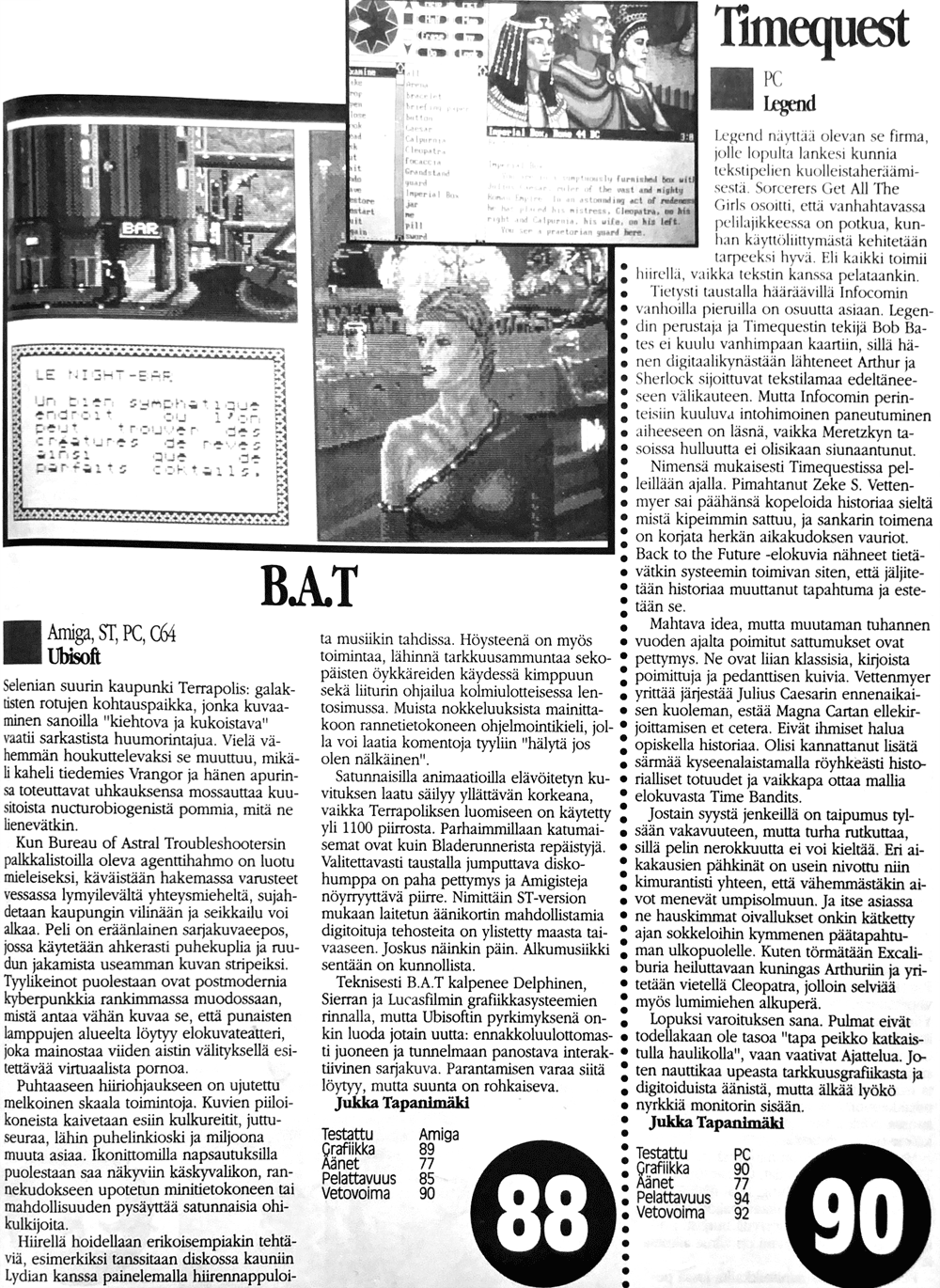
Kun Bureau of Astral Troubleshootersin palkkalistoilla oleva agenttihahmo on luotu mieleiseksi, käväistään hakemassa varusteet vessassa lymyilevältä yhteysmieheltä, sujahdetaan kaupungin vilinään ja seikkailu voi alkaa. Peli on eräänlainen sarjakuvaeepos, jossa käytetään ahkerasti puhekuplia ja ruudun jakamista useamman kuvan stripeiksi. Tyylikeinot puolestaan ovat postmodernia kyberpunkkia rankimmassa muodossaan, mistä antaa vähän kuvaa se, että punaisten lamppujen alueelta löytyy elokuvateatteri, joka mainostaa viiden aistin välityksellä esitettävää virtuaalista pornoa.
Puhtaaseen hiiriohjaukseen on ujutettu melkoinen skaala toimintoja. Kuvien piiloikoneista kaivetaan esiin kulkureitit, juttuseuraa, lähin puhelinkioski ja miljoona muuta asiaa. Ikonittomilla napsautuksilla puolestaan saa näkyviin käskyvalikon, rannekudokseen upotetun minitietokoneen tai mahdollisuuden pysäyttää satunnaisia ohikulkijoita.
Hiirellä hoidellaan erikoisempiakin tehtäviä, esimerkiksi tanssitaan diskossa kauniin Lydian kanssa painelemalla hiirennappuloita musiikin tahdissa. Höysteenä on myös toimintaa, lähinnä tarkkuusammuntaa sekopäisten öykkäreiden käydessä kimppuun sekä liiturin ohjailua kolmiulotteisessa lentosimussa. Muista nokkeluuksista mainittakoon rannetietokoneen ohjelmointikieli, jolla voi laatia komentoja tyyliin "hälytä jos olen nälkäinen".
Satunnaisilla animaatioilla elävöitetyn kuvituksen laatu säilyy yllättävän korkeana, vaikka Terrapoliksen luomiseen on käytetty yli 1100 piirrosta. Parhaimmillaan katumaisemat ovat kuin Bladerunnerista repäistyjä. Valitettavasti taustalla jumputtava diskohumppa on paha pettymys ja Amigisteja nöyrryyttävä piirre. Nimittäin ST-version mukaan laitetun äänikortin mahdollistamia digitoituja tehosteita on ylistetty maasta taivaaseen. Joskus näinkin päin. Alkumusiikki sentään on kunnollista.
Teknisesti B.A.T kalpenee Delphinen, Sierran ja Lucasfilmin grafiikkasysteemien rinnalla, mutta Ubisoftin pyrkimyksenä onkin luoda jotain uutta: ennakkoluulottomasti juoneen ja tunnelmaan panostava interaktiivinen sarjakuva. Parantamisen varaa siitä löytyy, mutta suunta on rohkaiseva.
B.A.T1991 SyksyPermalinkTerrapolis, the largest city on Selenia: a meeting place for the galactic races, and describing it with the words "fascinating and flourishing" takes a sarcastic sense of humour. It becomes even less inviting if the crackpot scientist Vrangor and his henchmen carry out their threat to set off sixteen nucturobiogenic bombs with a bang, whatever those may be.
Once your agent on the Bureau of Astral Troubleshooters' payroll has been created to your liking, you pop over to collect your gear from a contact lurking in the toilets, slip into the bustle of the city, and the adventure can begin. The game is a sort of comic-book epic that makes busy use of speech bubbles and of splitting the screen into strips of several panels. The stylistic devices, for their part, are postmodern cyberpunk in its most hardcore form, which you can get a bit of an idea of from the fact that the red-light district has a cinema advertising virtual porn delivered through all five senses.
Quite a range of functions has been squeezed into the pure mouse control. Hidden icons in the pictures turn up routes, someone to chat to, the nearest phone booth and a million other things. Clicks away from any icon, on the other hand, bring up the command menu, the mini-computer implanted in your wrist tissue, or the chance to stop random passers-by.
The mouse handles more unusual tasks too, for instance dancing at the disco with the beautiful Lydia by pressing the mouse buttons in time with the music. For added spice there's action as well, mainly sharpshooting when deranged thugs jump you, plus piloting a glider in a three-dimensional flight sim. Among the other clever touches, the wrist computer's programming language deserves a mention: with it you can write commands along the lines of "alert me if I'm hungry".
The quality of the artwork, livened up with random animations, stays surprisingly high even though over 1100 drawings went into creating Terrapolis. At their best the street scenes look ripped straight out of Bladerunner. Sadly, the disco oompah thumping away in the background is a bad letdown and a humiliating touch for Amiga owners. You see, the digitised effects made possible by the sound card bundled with the ST version have been praised to high heaven. Sometimes it goes this way round, too. The title music, at least, is decent.
Technically B.A.T pales beside the graphics systems of Delphine, Sierra and Lucasfilm, but then Ubisoft's aim is to create something new: an interactive comic that boldly puts its money on plot and atmosphere. There's room for improvement, but the direction is encouraging.
Back to the Future
Back to the Future1987Pysyvä linkkiBack to the Future on samannimisen elokuvan perusteella tehty peli. Elokuvassa Marty (elokuvan sankari) lipsahtaa atomikäyttöisellä De Lorean -autolla 30 vuotta taaksepäin menneisyyteen. Ongelmalliseksi tilanne muuttuu, kun hän vahingossa sekoittaa vanhempiensa tapaamisen. Martyn on nyt saatava Lorraine (äiti) ja George (isä) rakastumaan, jotta he pystyisivät tulevaisuudessa tekemään Martyn mahdolliseksi.
Pelin idea on saada George ja Lorraine rakastumaan toisiinsa pitämällä heitä useasti yhdessä. Se onnistuu erilaisin tavaroin, joita löytyy pelialueelta. Jos ja kun pelaaja saa pelattua pelin loppuun, voi Marty palata takaisin tulevaisuuteen.
Pelin edistymisen näkee kahdesta valokuvasta. Mitä paremmin nämä kuvat näkyvät, sitä pitemmällä on suhde Lorrainen ja Georgen kesken. Jos kummatkin kuvat pyyhkiytyvät täysin tyhjiksi, loppuu peli.
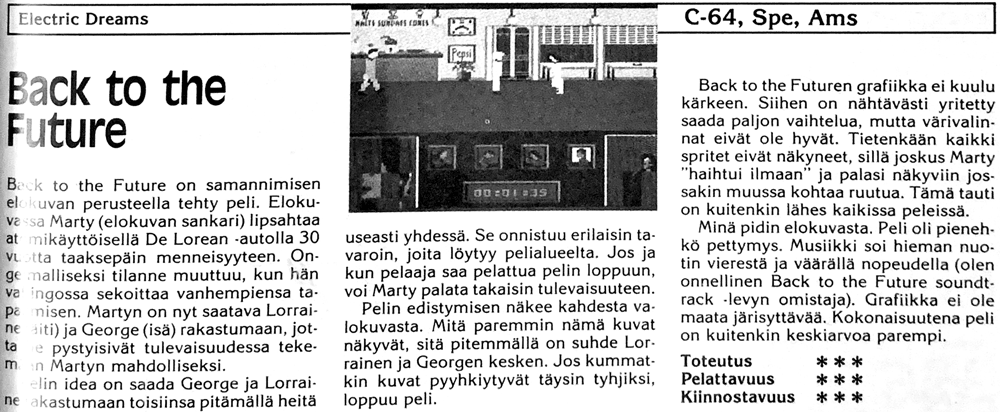
Back to the Futuren grafiikka ei kuulu kärkeen. Siihen on nähtävästi yritetty saada paljon vaihtelua, mutta värivalinnat eivät ole hyvät. Tietenkään kaikki spritet eivät näkyneet, sillä joskus Marty "haihtui ilmaan" ja palasi näkyviin jossakin muussa kohtaa ruutua. Tämä tauti on kuitenkin lähes kaikissa peleissä.
Minä pidin elokuvasta. Peli oli pienehkö pettymys. Musiikki soi hieman nuotin vierestä ja väärällä nopeudella (olen onnellinen Back to the Future soundtrack -levyn omistaja). Grafiikka ei ole maata järisyttävää. Kokonaisuutena peli on kuitenkin keskiarvoa parempi.
Back to the Future1987PermalinkBack to the Future is a game based on the film of the same name. In the film Marty (the film's hero) slips 30 years back into the past in an atomic-powered De Lorean car. Things get tricky when he accidentally messes up his parents' first meeting. Marty now has to get Lorraine (his mother) and George (his father) to fall in love, so that in the future they will be able to make Marty possible.
The idea of the game is to get George and Lorraine to fall in love with each other by keeping them together as often as possible. This is done with various items that can be found around the playing area. If and when the player manages to play the game through to the end, Marty can go back to the future.
You can see how the game is going from two photographs. The more clearly these pictures show, the further along the relationship between Lorraine and George is. If both photos fade away completely to nothing, the game is over.
Back to the Future's graphics are not among the best. There has evidently been an attempt to put plenty of variety into them, but the colour choices are not good. Naturally not all the sprites showed up, since sometimes Marty "vanished into thin air" and reappeared somewhere else on the screen. Then again, nearly every game suffers from this disease.
I liked the film. The game was a smallish disappointment. The music plays slightly off-key and at the wrong speed (I'm the happy owner of the Back to the Future soundtrack album). The graphics are not earth-shattering. All in all, though, the game is better than average.
Back To The Future III
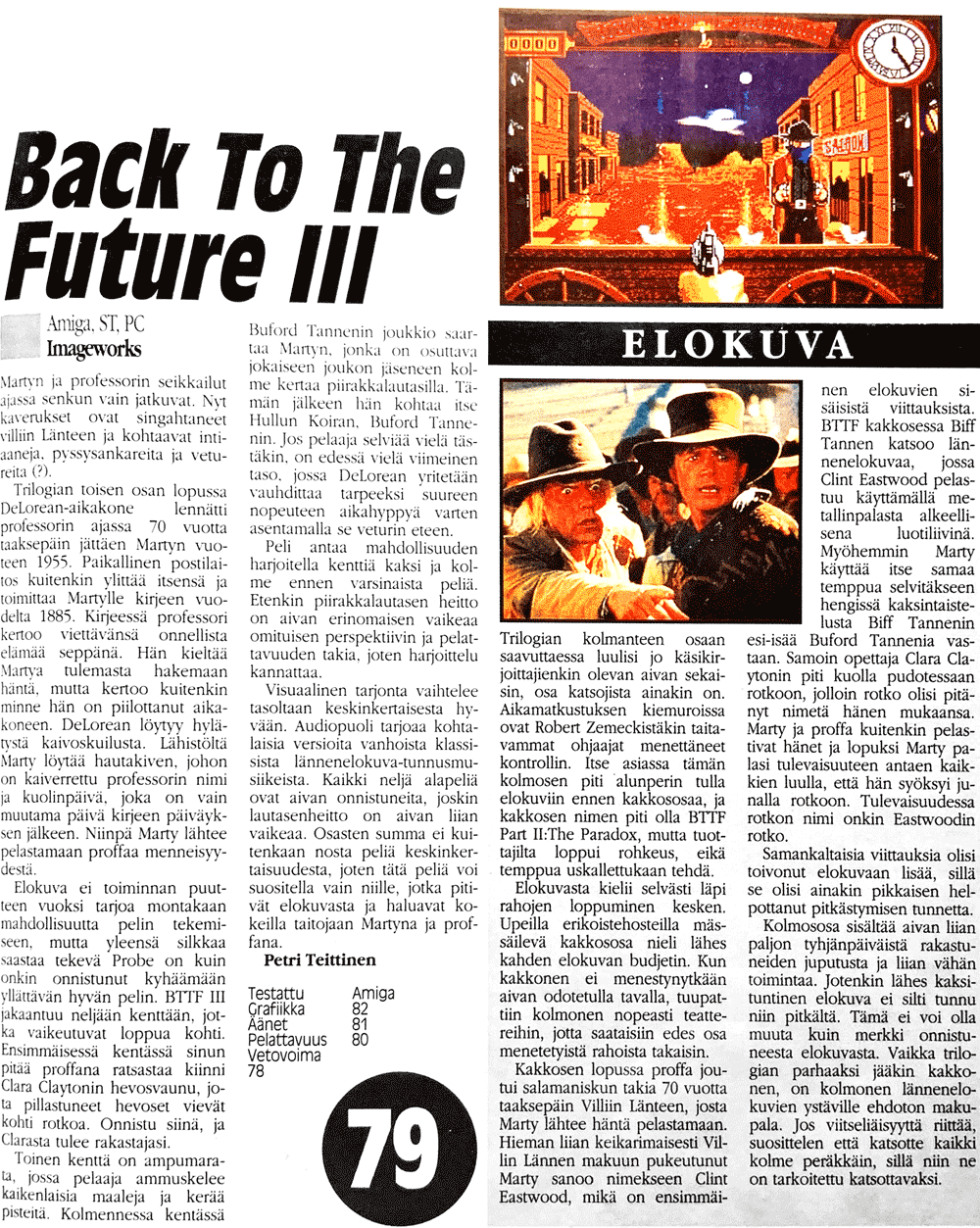
Back To The Future III1991 SyksyPysyvä linkkiMartyn ja professorin seikkailut ajassa senkun vain jatkuvat. Nyt kaverukset ovat singahtaneet villiin Länteen ja kohtaavat intiaaneja, pyssysankareita ja vetureita (?).
Trilogian toisen osan lopussa DeLorean-aikakone lennätti professorin ajassa 70 vuotta taaksepäin jättäen Martyn vuoteen 1955. Paikallinen postilaitos kuitenkin ylittää itsensä ja toimittaa Martylle kirjeen vuodelta 1885. Kirjeessä professori kertoo viettävänsä onnellista elämää seppänä. Hän kieltää Martya tulemasta hakemaan häntä, mutta kertoo kuitenkin minne hän on piilottanut aikakoneen. DeLorean löytyy hylätystä kaivoskuilusta. Lähistöltä Marty löytää hautakiven, johon on kaiverrettu professorin nimi ja kuolinpäivä, joka on vain muutama päivä kirjeen päiväyksen jälkeen. Niinpä Marty lähtee pelastamaan proffaa menneisyydestä.
Elokuva ei toiminnan puutteen vuoksi tarjoa montakaan mahdollisuutta pelin tekemiseen, mutta yleensä silkkaa saastaa tekevä Probe on kuin onkin onnistunut kyhäämään yllättävän hyvän pelin. BTTF III jakaantuu neljään kenttään, jotka vaikeutuvat loppua kohti. Ensimmäisessä kentässä sinun pitää proffana ratsastaa kiinni Clara Claytonin hevosvaunu, jota pillastuneet hevoset vievät kohti rotkoa. Onnistu siinä, ja Clarasta tulee rakastajasi.
Toinen kenttä on ampumarata, jossa pelaaja ammuskelee kaikenlaisia maaleja ja kerää pisteitä. Kolmennessa kentässä Buford Tannenin joukkio saartaa Martyn, jonka on osuttava jokaiseen joukon jäseneen kolme kertaa piirakkalautasilla. Tämän jälkeen hän kohtaa itse Hullun Koiran, Buford Tannenin. Jos pelaaja selviää vielä tästäkin, on edessä vielä viimeinen taso, jossa DeLorean yritetään vauhdittaa tarpeeksi suureen nopeuteen aikahyppyä varten asentamalla se veturin eteen.
Peli antaa mahdollisuuden harjoitella kenttiä kaksi ja kolme ennen varsinaista peliä. Etenkin piirakkalautasen heitto on aivan erinomaisen vaikeaa omituisen perspektiivin ja pelattavuuden takia, joten harjoittelu kannattaa.
Visuaalinen tarjonta vaihtelee tasoltaan keskinkertaisesta hyvään. Audiopuoli tarjoaa kohtalaisia versioita vanhoista klassisista lännenelokuva-tunnusmusiikeista. Kaikki neljä alapeliä ovat aivan onnistuneita, joskin lautasenheitto on aivan liian vaikeaa. Osasten summa ei kuitenkaan nosta peliä keskinkertaisuudesta, joten tätä peliä voi suositella vain niille, jotka pitivät elokuvasta ja haluavat kokeilla taitojaan Martyna ja proffana.
Back To The Future III1991 SyksyPermalinkThe adventures of Marty and the professor in time just keep on rolling. Now the pals have shot off to the Wild West, where they come up against Indians, gunslingers and locomotives (?).
At the end of the second part of the trilogy, the DeLorean time machine flung the professor 70 years back in time, leaving Marty stuck in 1955. The local postal service, however, outdoes itself and delivers Marty a letter from 1885. In the letter the professor says he is living a happy life as a blacksmith. He forbids Marty to come and fetch him, but still tells him where he has hidden the time machine. The DeLorean turns up in an abandoned mine shaft. Nearby, Marty finds a gravestone engraved with the professor's name and a date of death just a few days after the date on the letter. So Marty sets off to rescue the prof from the past.
For lack of action, the film doesn't offer many openings for making a game, but Probe, who usually turn out sheer garbage, have lo and behold managed to cobble together a surprisingly good game. BTTF III is split into four levels that get harder towards the end. In the first level, as the prof, you have to ride down Clara Clayton's horse-drawn wagon, which bolting horses are carrying towards a ravine. Pull that off, and Clara becomes your lover.
The second level is a shooting gallery where the player blasts away at all sorts of targets and racks up points. In the third level Buford Tannen's gang surround Marty, who has to hit every member of the gang three times with pie plates. After that he faces Mad Dog himself, Buford Tannen. If the player survives even this, there's still one last level ahead, in which you try to get the DeLorean up to a high enough speed for the time jump by mounting it in front of a locomotive.
The game lets you practise levels two and three before the game proper. The pie-plate throwing in particular is quite exceptionally difficult because of the odd perspective and the way it plays, so practising pays off.
The visuals range in quality from average to good. The audio side offers passable versions of classic old western film theme tunes. All four sub-games are quite decent, although the plate throwing is far too hard. The sum of the parts doesn't lift the game out of mediocrity, though, so this game can only be recommended to those who liked the film and want to try their skills as Marty and the prof.
Backlash
Backlash1988Pysyvä linkkiPaul Woakes on outo lintu, joka vain kaksi peliä tehtyään saavutti jo puolijumalan asteen. Mercenary on käsite, mutta monikohan muistaa Woakesin ensimmäisen pelin, klassisen Encounterin?
Backlashin koko nimi on Backlash: Enocounter Mk II, joka Encounterin tunteville kertoo mikä pitäisi olla homman nimi. Siis järjettömän nopea kolmiulotteinen raivokas mega-ammuskelupeli. Ja sellainenhan Backlash on. Vanhana Emcounter-fanina sekosin riemusta pelattuani Backlashia muutaman minuutin.
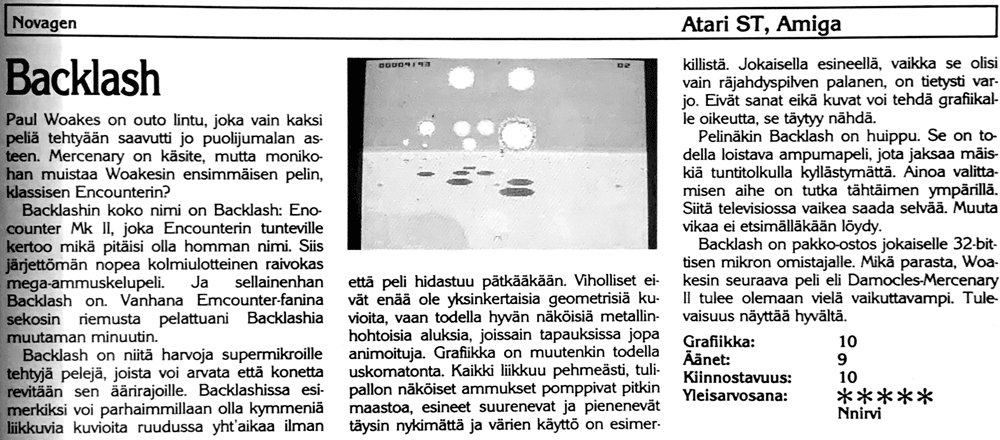
Backlash on niitä harvoja supermikroille tehtyjä pelejä, joista voi arvata että konetta revitään sen äärirajoille. Backlashissa esimerkiksi voi parhaimmillaan olla kymmeniä liikkuvia kuvioita ruudussa yht'aikaa ilman että peli hidastuu pätkääkään. Viholliset eivät enää ole yksinkertaisia geometrisiä kuvioita, vaan todella hyvän näköisiä metallinhohtoisia aluksia, joissain tapauksissa jopa animoituja. Grafiikka on muutenkin todella uskomatonta. Kaikki liikkuu pehmeästi, tulipallon näköiset ammukset pomppivat pitkin maastoa, esineet suurenevat ja pienenevät täysin nykimättä ja värien käyttö on esimerkillistä. Jokaisella esineellä, vaikka se olisi vain räjähdyspilven palanen, on tietysti varjo. Eivät sanat eikä kuvat voi tehdä grafiikalle oikeutta, se täytyy nähdä.
Pelinäkin Backlash on huippu. Se on todella loistava ampumapeli, jota jaksaa mäiskiä tuntitolkulla kyllästymättä. Ainoa valittamisen aihe on tutka tähtäimen ympärillä. Siitä televisiossa vaikea saada selvää. Muuta vikaa ei etsimälläkään löydy.
Backlash on pakko-ostos jokaiselle 32-bittisen mikron omistajalle. Mikä parasta, Woakesin seuraava peli eli Damocles-Mercenary II tulee olemaan vielä vaikuttavampi. Tulevaisuus näyttää hyvältä.
Backlash1988PermalinkPaul Woakes is an odd bird who reached demigod status after making only two games. Mercenary is a legend, but how many people remember Woakes's first game, the classic Encounter?
Backlash's full name is Backlash: Enocounter Mk II, which tells anyone familiar with Encounter what the name of the game ought to be. That is, an insanely fast, furious, three-dimensional mega-shoot-'em-up. And that's exactly what Backlash is. As an old Emcounter fan, I went crazy with delight after just a few minutes of playing Backlash.
Backlash is one of those rare games made for the super micros where you can tell the machine is being pushed to its absolute limits. In Backlash, for example, there can be dozens of moving objects on screen at once without the game slowing down one bit. The enemies are no longer simple geometric shapes but really good-looking ships with a metallic sheen, in some cases even animated. The graphics are truly unbelievable all round. Everything moves smoothly, fireball-like shots bounce across the terrain, objects grow and shrink without the slightest jerkiness, and the use of colour is exemplary. Every object, even if it's just a scrap of an explosion cloud, naturally has a shadow. Neither words nor pictures can do the graphics justice; you have to see it.
As a game, too, Backlash is top class. It's a truly brilliant shooter that you can keep blasting away at for hours on end without getting bored. The only thing to complain about is the radar around the gunsight. It's hard to make out on a television. Search as you might, you won't find any other fault.
Backlash is a must-buy for every owner of a 32-bit micro. Best of all, Woakes's next game, Damocles-Mercenary II, is going to be even more impressive. The future looks bright.
Bad Blood
Bad Blood1990 SyksyPysyvä linkkiJälleen kerran siirrymme ydinsodan runtelemaan maailmaan. Pelaajia lohdutellaan valoisiin tulevaisuudennäkymiin asettamalla hänet mutantin kenkiin ja, valitettavasti, housuihin.
Ydinsodan seurauksena maailmaan syntyi paljon mutantteja. Nopeasti normaalit ihmiset eristivät mutantit joukostaan, ja mutantti-raukat ajettiin kauas sivilisaatiosta. Omissa reservaateissaan mutantit elävät rauhallista eloa häiritsemättä 'normeja', jotka vuorostaan jättävät heidät rauhaan. Näin jatkui jonkin aikaa. Sitten alkoi vuorten takaa kuulua hälyttäviä viestejä. Normit ovat jostain syystä lähtemässä ristiretkelle mutantteja vastaan. Mutanttien päällikkö päättelee, että mutanteista ei ole voittamaan aseellista kamppailua, joten ainoaksi vaihtoehdoksi jää harmaiden aivosolujen käyttö. Päällikkö lähettää yhden vakoilijan ottamaan selvää, miksi ihmiset ovat yllättäen kääntyneet mutantteja vastaan. Tämä mutantti olet tietysti sinä, onneksi olkoon.
Pelin ohjelmoija on Chris Roberts, jonka ansiolistaan kuuluu Originin peli Times Of Lore. TOL paistaa läpi Bad Bloodissakin. Ruudulla näkyy osittain hautautunut televisio, josta peliä seurataan. Television vieressä on pullo, jonka sisältö kuvastaa pelaajan energiaa. Televisiossa on muutama nappula, jolla hoidellaan kaikki pelissä tarvittavat asiat. Peli on kuvattu TOL:n tavoin ylhäältä päin. VGA-kortin omistajat ovat onnellisessa asemassa, sillä suuntaus on menossa kohti 256-väristä VGA-grafiikkaa. Bad Bloodkin noudattelee uutta standardia ja lopputulos on todella silmiähivelevää.
PC:n piipillä ei edes yritetä tehdä mitään mullistavaa, mutta annas olla, jos koneesta löytyy jokin suosituimmista äänikorteista. Musiikkiin on ilmeisesti panostettu muutamakin työtunti ja se luo tunnelmaa mainiosti. Näppäinohjaus toimii mukisematta ja tarkasti. Ainoa suuri miinus pelissä on alun yletön vaikeus. Johtolankoja ei ole nimeksikään, hahmo on heikko ja lähes aseeton. Pelialue on niin laaja, että aavikolle eksyy aivan liian helposti. Jos jano ja nälkä eivät hahmoa nopeasti tapa, siitä pitävät huolen moninaiset radioaktiivisen pölyn muuntamat hirviöt.
BB paljastaa parhaat puolensa vasta monen tunnin pelin jälkeen, mutta siinä vaiheessa kärsimättömimmät pelaajat ovat jo vääntäneet koneesta virran pois. Tämä on sääli, sillä BB on hyvä peli alkuvaikeuksista huolimatta. Ohjeeksi voin sanoa, että jos pidit Times Of Loresta, pidät tästäkin.
Bad Blood1990 SyksyPermalinkOnce again we move into a world mangled by nuclear war. To console players about the bright prospects for the future, they are put into a mutant's shoes and, unfortunately, trousers.
As a result of the nuclear war a lot of mutants were born into the world. The normal people quickly cut the mutants off from their midst, and the poor mutants were driven far away from civilisation. In their own reservations the mutants live a peaceful existence without disturbing the 'norms', who in turn leave them in peace. Things went on like this for some time. Then alarming messages began to come from beyond the mountains. For some reason the norms are setting off on a crusade against the mutants. The mutants' chief reasons that the mutants haven't got what it takes to win an armed struggle, so the only option left is to use the little grey cells. The chief sends a single spy to find out why the humans have suddenly turned against the mutants. That mutant is of course you, congratulations.
The game's programmer is Chris Roberts, whose track record includes Origin's game Times Of Lore. TOL shines through in Bad Blood as well. On screen there's a partly buried television through which you watch the game. Next to the television is a bottle whose contents reflect the player's energy. The television has a few knobs that handle everything you need to do in the game. Like TOL, the game is viewed from above. Owners of a VGA card are in a happy position, as the trend is moving towards 256-colour VGA graphics. Bad Blood too follows the new standard, and the end result is a real treat for the eyes.
Nobody even tries to do anything revolutionary with the PC's beeper, but it's another story if the machine has one of the more popular sound cards. Apparently quite a few working hours have been put into the music, and it creates a splendid atmosphere. The keyboard control works accurately and without a murmur. The only big minus in the game is the inordinate difficulty at the start. There isn't so much as a token clue, and the character is weak and nearly unarmed. The playing area is so vast that you get lost in the desert far too easily. If thirst and hunger don't kill the character off quickly, the assorted monsters transformed by radioactive dust will see to that.
BB only shows its best sides after many hours of play, but by then the most impatient players will already have switched the machine off. That's a pity, because BB is a good game despite its initial difficulties. By way of guidance, I can say that if you liked Times Of Lore, you'll like this one too.
Bad Cat
Bad Cat1988Pysyvä linkkiEletään vuotta 1988 ja Soul valmistautuu olympiakisoihin. Kuuluisuudet valmistelevat puheitaan ja kisojen järjestäjät odottelevat ihmismassoja saapuviksi. Mutta kaikkien inhoamat pahamaineiset viemärikissat suunnittelevat omia kisojaan.
Huh huh, kaikista lukemistani idioottimaisista pelin oikeutukseksi kyhätyistä tarinoista Bad Catin jorina on varmasti niitä kaikkein typerimpiä.
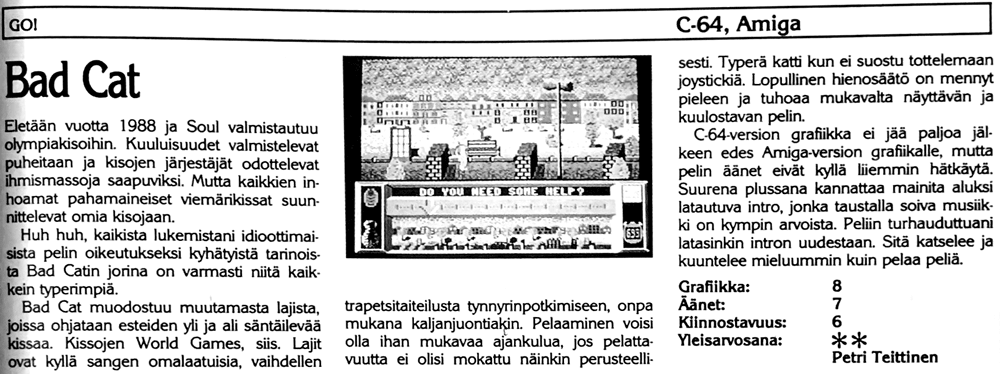
Bad Cat muodostuu muutamasta lajista, joissa ohjataan esteiden yli ja ali säntäilevää kissaa. Kissojen World Games, siis. Lajit ovat kyllä sangen omalaatuisia, vaihdellen trapetsitaiteilusta tynnyrinpotkimiseen, onpa mukana kaljanjuontiakin. Pelaaminen voisi olla ihan mukavaa ajankulua, jos pelattavuutta ei olisi mokattu näinkin perusteellisesti. Typerä katti kun ei suostu tottelemaan joystickiä. Lopullinen hienosäätö on mennyt pieleen ja tuhoaa mukavalta näyttävän ja kuulostavan pelin.
C-64-version grafiikka ei jää paljoa jälkeen edes Amiga-version grafiikalle, mutta pelin äänet eivät kyllä liiemmin hätkäytä. Suurena plussana kannattaa mainita aluksi latautuva intro, jonka taustalla soiva musiikki on kympin arvoista. Peliin turhauduttuani latasinkin intron uudestaan. Sitä katselee ja kuuntelee mieluummin kuin pelaa peliä.
Bad Cat1988PermalinkThe year is 1988 and Seoul is getting ready for the Olympics. Celebrities are preparing their speeches and the organisers are waiting for the crowds to pour in. But the notorious sewer cats, loathed by everyone, are planning games of their own.
Phew. Of all the idiotic stories I've read that were cobbled together to justify a game, Bad Cat's drivel must surely be among the very dumbest.
Bad Cat consists of a handful of events in which you steer a cat dashing over and under obstacles. World Games for cats, then. The events are certainly rather peculiar, ranging from trapeze artistry to barrel kicking, and there's even some beer drinking in there. Playing it could be quite a pleasant way to pass the time, if the playability hadn't been botched quite so thoroughly. The stupid moggy just won't obey the joystick. The final fine-tuning has gone wrong, and it wrecks a game that looks and sounds nice.
The C-64 version's graphics don't lag much behind even the Amiga version's, but the game's sound certainly doesn't make you sit up and take notice. A big plus worth mentioning is the intro that loads first, whose background music deserves a perfect ten. Once the game had frustrated me, I actually loaded the intro all over again. It's nicer to watch and listen to than the game is to play.
Bad Company
Bad Company1990 SyksyPysyvä linkkiVoidaan todellakin sanoa, että olet joutunut pahaan seuraan. Ympäriltä löytyy väkivaltaisen näköistä porukkaa: palkkasotureita, yhtiön palkollisia, ase-experttejä eli ilmeisiä psykopaatteja. Vai mitä voisi odottaa tyypeiltä, joiden nimet ovat sellaisia kuin Chronos Warchild tai Bruce 'Maniac' North.
BAD-yhtiö on pestannut nämä oliot hävittämään kaiken elävän muutamalta planeetalta, jotta ne sitten voitaisiin myydä maalle asutettavaksi. Hommahan on selvä itsemurhatehtävä, mutta mitäpä sitä ei tekisi rahan edestä.
Kun tietää, kuka Bad Companyn on ideoinut, osaa odottaa veristä ja tappamiseen liittyvää peliä. Steve Bak on saavuttanut jonkinlaista mainetta Commandotyylisten pelien tekijänä. Viimeisimpiin tuotteisiin kuuluu muunmuuassa Dogs of War, jonka piti olla eräänlainen lajinsa huipentuma. Siinä DoW ei täysin onnistunut, mutta siitä masentumatta on Bak puskenut seuraavan pelinsä ulos. Joka odottaa taas uutta Commando-peliä, pettyy.
Bak laski normaalin ylhäältäpäin kuvatun ammuskelupelin olevan puserrettu tyhjiin, joten uutta oli keksittävä. Bad Company ei ole kuitenkaan mikään kovin originelli vaan muistuttaa Space Harrieria. Takaapäin kuvattu mies juoksee läpi kolmiulotteisen maiseman ja pienii pyssyllään vastaantulevia hirviöitä vähemmän epäystävälliseen muotoon.
Jottei Bad Companya erehtyisi luulemaan Space Harrier kakkoseksi, on jotain uutta täytynyt heittää sekaan. Näkyvin ero on se, ettei Bruce Maniac kumppaneineen pysty lentämään. Mutta Brucen on mahdollista liikkua myös taaksepäin ja myös lisäaseita on tarjolla. Bruce voi myös suojautua erilaisten kiviröykkiöiden taakse ja toivoa, ettei vihollisen tulitus räjäytä suojusta palasiksi.
Planeettojen pinnalla on mahdollisuus kohdata omituisia lentäviä tai jalkavoimin liikkuvia otuksia. Toiset viholliset paiskovat tappavia palloja pelaajan harmiksi, toiset tyytyvät pelkkään ampumiseen. Pelaajan voima, joka vähenee osumista, on havainnollistettu pylväällä ruudun yläreunassa. Onneksi voimat palautuvat pikku hiljaa soturin kunnosta riippuen. Lopullinen pelastus löytyy regeneraattorista, joka nostaa voimat alkuperäiselle tasolle.
Aseiden keräilyssä tarvitaan myös hieman taktiikkaa. Lentäviä vihulaisia ei saa tiputetuksi kuin muutamalla aseella. Tehon parantamiseksi on mahdollista löytää energiapakkauksia, joiden käytön jälkeen ytyä löytyy tuplasti lisää.
Joka tason lopussa on isompi hirviö niitattavana, valitettavasti sama malli joka maailmassa. Loppuhirviön kuoltua toimittaa yhtiö pelaajan taas uuteen maailmaan. Tuttu tähtiscrolli käy ruudulla ja sitten onkin taas ammuskelua edessä.
Grafiikka ei ole mitenkään mullistavaa eivätkä ääniefektit saa aikaan sen parempaa vaikutusta. Bad Company olisi ihan mukava peli, mutta jotain tuntuu puuttuvan. Ammuskelufaneille peli voi tuoda jonkin asteista tyydytystä, mutta kiinnostavuus laskee pian, varsinkin kun peli ei ole tuhottoman vaikea pelata läpi. Kaksinpeluumahdollisuus nostaa luonnollisesti kiinnostusta, mutta ei tarpeeksi.
Bad Company1990 SyksyPermalinkIt can truly be said that you've fallen into bad company. All around you there's a violent-looking bunch: mercenaries, company hirelings, weapons experts, in other words obvious psychopaths. Or what else could you expect from guys with names like Chronos Warchild or Bruce 'Maniac' North.
The BAD company has hired these creatures to wipe out every living thing on a few planets, so that the planets can then be sold off to Earth for settlement. The job is obviously a suicide mission, but what wouldn't you do for money.
When you know who dreamed up Bad Company, you know to expect a bloody game that's all about killing. Steve Bak has earned a certain reputation as a maker of Commando-style games. His latest products include, among others, Dogs of War, which was supposed to be a kind of culmination of its genre. At that DoW didn't entirely succeed, but undaunted, Bak has pushed his next game out the door. Anyone expecting yet another Commando game will be disappointed.
Bak reckoned the ordinary top-down shoot-'em-up had been squeezed dry, so something new had to be invented. Bad Company isn't all that original, though; it resembles Space Harrier. A man seen from behind runs through a three-dimensional landscape, whittling the oncoming monsters down with his gun into a less unfriendly shape.
So that nobody mistakes Bad Company for Space Harrier 2, something new has had to be thrown into the mix. The most visible difference is that Bruce Maniac and his pals can't fly. But Bruce can also move backwards, and extra weapons are on offer too. Bruce can also take cover behind various heaps of rock and hope the enemy fire doesn't blast the cover to pieces.
On the planets' surfaces you may run into strange creatures that fly or get about on foot. Some enemies hurl deadly balls to the player's annoyance, others settle for plain shooting. The player's strength, which drops with every hit, is shown as a bar at the top of the screen. Fortunately your strength slowly comes back, depending on the soldier's condition. The ultimate salvation is a regenerator, which raises your strength back to its original level.
Collecting weapons also calls for a bit of tactics. The flying baddies can only be brought down with a few of the weapons. To boost your firepower you can find energy packs, and once you've used one you've got twice the oomph.
At the end of every level there's a bigger monster to nail, unfortunately the same model in every world. Once the end monster is dead, the company ships the player off to a new world again. The familiar star scroll whizzes across the screen, and then it's more shooting ahead.
The graphics are in no way revolutionary, and the sound effects don't make any better an impression. Bad Company would be quite a nice game, but something seems to be missing. Shoot-'em-up fans may get some degree of satisfaction out of it, but interest soon drops, especially as the game isn't terribly hard to play through. The two-player option naturally raises interest, but not enough.
Bad Dudes vs. Dragonninja
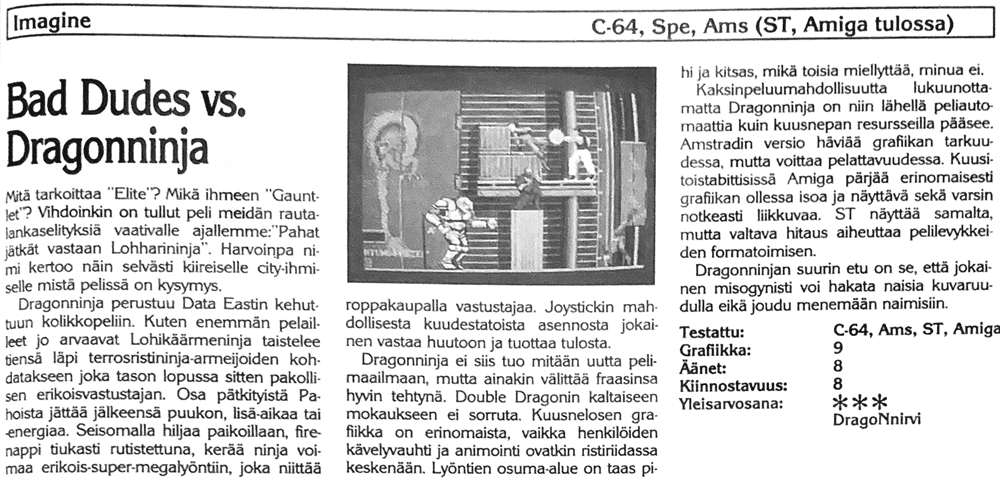
Bad Dudes vs. Dragonninja1989 SyksyPysyvä linkkiMitä tarkoittaa "Elite"? Mikä ihmeen "Gauntlet"? Vihdoinkin on tullut peli meidän rautalankaselityksiä vaativalle ajallemme:"Pahat jätkät vastaan Lohharininja". Harvoinpa nimi kertoo näin selvästi kiireiselle city-ihmiselle mistä pelissä on kysymys.
Dragonninja perustuu Data Eastin kehuttuun kolikkopeliin. Kuten enemmän pelailleet jo arvaavat Lohikäärmeninja taistelee tiensä läpi terrosristininja-armeijoiden kohdatakseen joka tason lopussa sitten pakollisen erikoisvastustajan. Osa pätkityistä Pahoista jättää jälkeensä puukon, lisä-aikaa tai -energiaa. Seisomalla hiljaa paikoillaan, fire-nappi tiukasti rutistettuna, kerää ninja voimaa erikois-super-megalyöntiin, joka niittää roppakaupalla vastustajaa. Joystickin mahdollisesta kuudestatoista asennosta jokainen vastaa huutoon ja tuottaa tulosta.
Dragonninja ei siis tuo mitään uutta pelimaailmaan, mutta ainakin välittää fraasinsa hyvin tehtynä. Double Dragonin kaltaiseen mokaukseen ei sorruta. Kuusnelosen grafiikka on erinomaista, vaikka henkilöiden kävelyvauhti ja animointi ovatkin ristiriidassa keskenään. Lyöntien osuma-alue on taas pihi ja kitsas, mikä toisia miellyttää, minua ei.
Kaksinpeluumahdollisuutta lukuunottamatta Dragonninja on niin lähellä peliautomaattia kuin kuusnepan resursseilla pääsee. Amstradin versio häviää grafiikan tarkuudessa, mutta voittaa pelattavuudessa. Kuusitoistabittisissä Amiga pärjää erinomaisesti grafiikan ollessa isoa ja näyttävä sekä varsin notkeasti liikkuvaa. ST näyttää samalta, mutta valtava hitaus aiheuttaa pelilevykkeiden formatoimisen.
Dragonninjan suurin etu on se, että jokainen misogynisti voi hakata naisia kuvaruudulla eikä joudu menemään naimisiin.
Bad Dudes vs. Dragonninja1989 SyksyPermalinkWhat does "Elite" mean? What on earth is "Gauntlet"? At last a game has arrived for our age, which needs everything spelled out: "Bad Dudes Versus Dragon Ninja". Rarely does a name tell the busy city type so clearly what a game is all about.
Dragonninja is based on Data East's acclaimed coin-op. As those who have played a bit more will already guess, the Dragon Ninja battles through armies of terrorist ninjas to face, at the end of every level, the obligatory special opponent. Some of the clobbered Bad Dudes leave behind a knife, extra time or extra energy. By standing still on the spot with the fire button squeezed tight, the ninja builds up power for a special-super-mega-punch that mows down opponents by the bucketload. Of the joystick's sixteen possible positions, every single one answers the call and gets results.
So Dragonninja brings nothing new to the gaming world, but at least it delivers its stock phrases nicely crafted. There's no stumbling into a botch-up like Double Dragon. The Commodore 64 graphics are excellent, even though the characters' walking speed and their animation are at odds with each other. The hit area of the blows, on the other hand, is stingy and miserly, which pleases some people but not me.
Two-player option aside, Dragonninja is as close to the arcade machine as the Commodore 64's resources will get you. The Amstrad version loses out on graphic detail but wins on playability. Among the 16-bits, the Amiga does excellently, with graphics that are big and showy and move very nimbly. The ST looks the same, but the massive slowness results in the game disks being formatted.
Dragonninja's biggest advantage is that any misogynist can beat up women on screen without having to get married.
Badlands
Badlands1991 KevätPysyvä linkkiKlassinen Super Sprint, joka kotiversioista ST saa täyden pongot ja muut versiot haukut, on tullut takaisin Atarin kolikkopelissä Badlands.
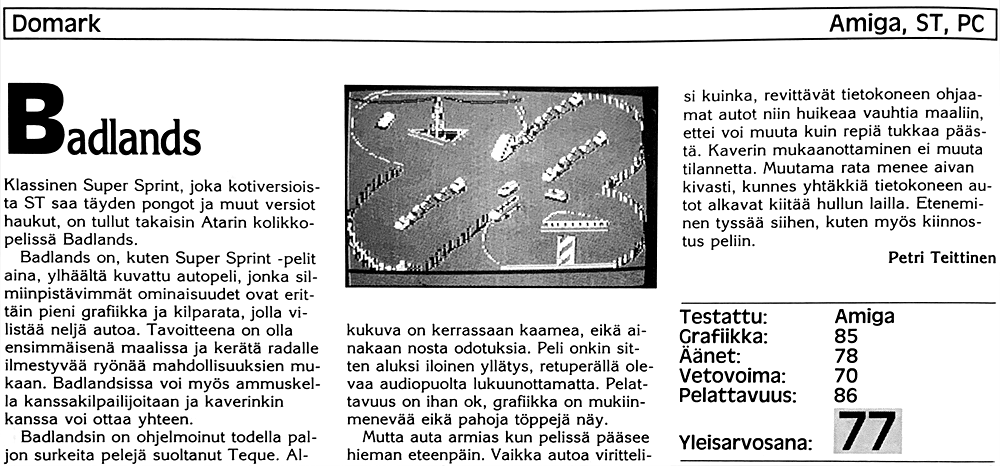
Badlands on, kuten Super Sprint -pelit aina, ylhäältä kuvattu autopeli, jonka silmiinpistävimmät ominaisuudet ovat erittäin pieni grafiikka ja kilparata, jolla vilistää neljä autoa. Tavoitteena on olla ensimmäisenä maalissa ja kerätä radalle ilmestyvää ryönää mahdollisuuksien mukaan. Badlandsissa voi myös ammuskella kanssakilpailijoitaan ja kaverinkin kanssa voi ottaa yhteen.
Badlandsin on ohjelmoinut todella paljon surkeita pelejä suoltanut Teque. Alkukuva on kerrassaan kaamea, eikä ainakaan nosta odotuksia. Peli onkin sitten aluksi iloinen yllätys, retuperällä olevaa audiopuolta lukuunottamatta. Pelattavuus on ihan ok, grafiikka on mukiinmenevää eikä pahoja töppejä näy.
Mutta auta armias kun pelissä pääsee hieman eteenpäin. Vaikka autoa virittelisi kuinka, revittävät tietokoneen ohjaamat autot niin huikeaa vauhtia maaliin, ettei voi muuta kuin repiä tukkaa päästä. Kaverin mukaanottaminen ei muuta tilannetta. Muutama rata menee aivan kivasti, kunnes yhtäkkiä tietokoneen autot alkavat kiitää hullun lailla. Eteneminen tyssää siihen, kuten myös kiinnostus peliin.
Badlands1991 KevätPermalinkThe classic Super Sprint, whose ST home version earns full marks and whose other versions earn a roasting, has come back in Atari's arcade game Badlands.
Badlands is, as Super Sprint games always are, a top-down racing game whose most striking features are very small graphics and a race track with four cars scurrying round it. The aim is to be first across the line and to pick up as much of the junk that appears on the track as you can. In Badlands you can also take potshots at your fellow competitors, and you can go head to head with a mate too.
Badlands was programmed by Teque, who have churned out a truly large number of dismal games. The title screen is downright ghastly and certainly doesn't raise expectations. So the game turns out to be a pleasant surprise at first, apart from the audio side, which is in a sorry state. The playability is perfectly OK, the graphics are passable and there are no bad blunders in sight.
But heaven help you once you get a bit further into the game. However much you tune up your car, the computer-driven cars tear to the finish at such a staggering speed that all you can do is tear your hair out. Bringing a mate along doesn't change a thing. A few tracks go quite nicely, until all of a sudden the computer's cars start zooming round like mad. That's where your progress grinds to a halt, and so does your interest in the game.
Ballblazer
Ballblazer1987Pysyvä linkkiBallblazerin idea on sama kuin jalkapallossa. Pelaajia on aina kaksi. Jollei kahta pelaajaa löydy, on vastustajana tietokone.
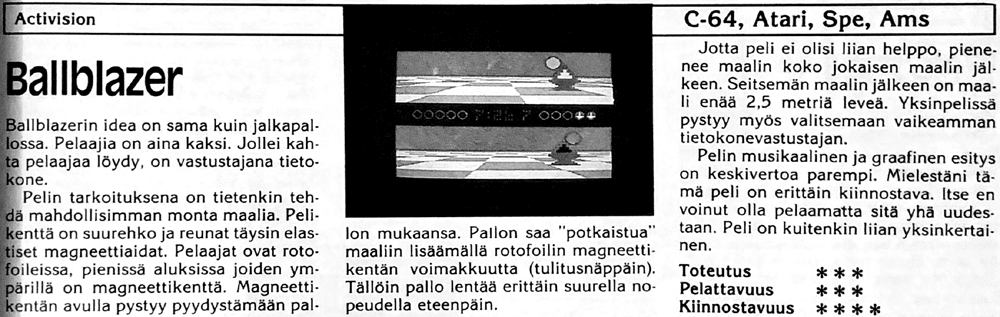
Pelin tarkoituksena on tietenkin tehdä mahdollisimman monta maalia. Pelikenttä on suurehko ja reunat täysin elastiset magneettiaidat. Pelaajat ovat rotofoileissa, pienissä aluksissa joiden ympärillä on magneettikenttä. Magneettikentän avulla pystyy pyydystämään pallon mukaansa. Pallon saa "potkaistua" maaliin lisäämällä rotofoilin magneettikentän voimakkuutta (tulitusnäppäin). Tällöin pallo lentää erittäin suurella nopeudella eteenpäin.
Jotta peli ei olisi liian helppo, pienenee maalin koko jokaisen maalin jälkeen. Seitsemän maalin jälkeen on maali enää 2,5 metriä leveä. Yksinpelissä pystyy myös valitsemaan vaikeamman tietokonevastustajan.
Pelin musikaalinen ja graafinen esitys on keskivertoa parempi. Mielestäni tämä peli on erittäin kiinnostava. Itse en voinut olla pelaamatta sitä yhä uudestaan. Peli on kuitenkin liian yksinkertainen.
Ballblazer1987PermalinkThe idea of Ballblazer is the same as in football. There are always two players. If you can't find a second player, the computer is your opponent.
The object of the game is naturally to score as many goals as possible. The pitch is fairly large and its edges are completely elastic magnetic fences. The players sit in rotofoils, small craft surrounded by a magnetic field. With the magnetic field you can catch the ball and carry it along with you. You "kick" the ball into the goal by boosting the strength of the rotofoil's magnetic field (fire button). The ball then flies forward at tremendous speed.
So that the game doesn't get too easy, the goal gets smaller after every goal scored. After seven goals the goal is only 2.5 metres wide. In a one-player game you can also choose a tougher computer opponent.
The game's musical and graphical presentation is better than average. In my opinion this game is extremely interesting. I myself couldn't stop playing it again and again. The game is too simple, though.
Ballistix
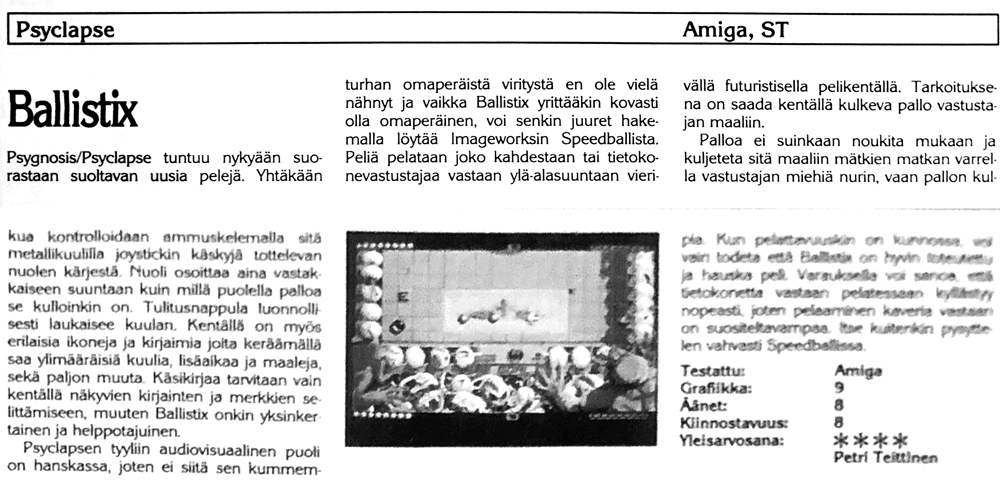
Ballistix1989 SyksyPysyvä linkkiPsygnosis/Psyclapse tuntuu nykyään suorastaan suoltavan uusia pelejä. Yhtäkään turhan omaperäistä viritystä en ole vielä nähnyt ja vaikka Ballistix yrittääkin kovasti olla omaperäinen, voi senkin juuret hakemalla löytää Imageworksin Speedballista. Peliä pelataan joko kahdestaan tai tietokonevastustajaa vastaan ylä-alasuuntaan vierivällä futuristisella pelikentällä. Tarkoituksena on saada kentällä kulkeva pallo vastustajan maaliin.
Palloa ei suinkaan noukita mukaan ja kuljeteta sitä maaliin mätkien matkan varrella vastustajan miehiä nurin, vaan pallon kulkua kontrolloidaan ammuskelemalla sitä metallikuulilla joystickin käskyjä tottelevan nuolen kärjestä. Nuoli osoittaa aina vastakkaiseen suuntaan kuin millä puolella palloa se kulloinkin on. Tulitusnappula luonnollisesti laukaisee kuulan. Kentällä on myös erilaisia ikoneja ja kirjaimia joita keräämällä saa ylimääräisiä kuulia, lisäaikaa ja maaleja, sekä paljon muuta. Käsikirjaa tarvitaan vain kentällä näkyvien kirjainten ja merkkien selittämiseen, muuten Ballistix onkin yksinkertainen ja helppotajuinen.
Psyclapsen tyyliin audiovisuaalinen puoli on hanskassa, joten ei siitä sen kummempia. Kun pelattavuuskin on kunnossa, voi vain todeta että Ballistix on hyvin toteutettu ja hauska peli. Varauksella voi sanoa, että tietokonetta vastaan pelatessaan kyllästyy nopeasti, joten pelaaminen kaveria vastaan on suositeltavampaa. Itse kuitenkin pysyttelen vahvasti Speedballissa.
Ballistix1989 SyksyPermalinkPsygnosis/Psyclapse seems to be positively churning out new games these days. I have yet to see a single overly original contraption, and although Ballistix tries hard to be original, dig a little and you can trace its roots too to Imageworks' Speedball. The game is played either two-player or against a computer opponent, on a futuristic pitch that scrolls up and down. The idea is to get the ball travelling around the pitch into the opponent's goal.
You by no means scoop up the ball and carry it into the goal, knocking the opponent's men flat along the way; instead the ball's course is controlled by shooting metal pellets at it from the tip of an arrow that obeys the joystick's commands. The arrow always points in the direction opposite to whichever side of the ball it happens to be on. The fire button naturally launches a pellet. There are also various icons and letters on the pitch, and collecting them gets you extra pellets, extra time and goals, and plenty more. The manual is only needed to explain the letters and symbols that appear on the pitch; otherwise Ballistix is simple and easy to grasp.
In true Psyclapse style the audiovisual side is well in hand, so nothing more to say there. With the playability in order as well, all you can say is that Ballistix is a well-made and fun game. With some reservation, you could say that playing against the computer gets boring quickly, so playing against a mate is more advisable. Myself, though, I'm sticking firmly with Speedball.
Baltic 1985
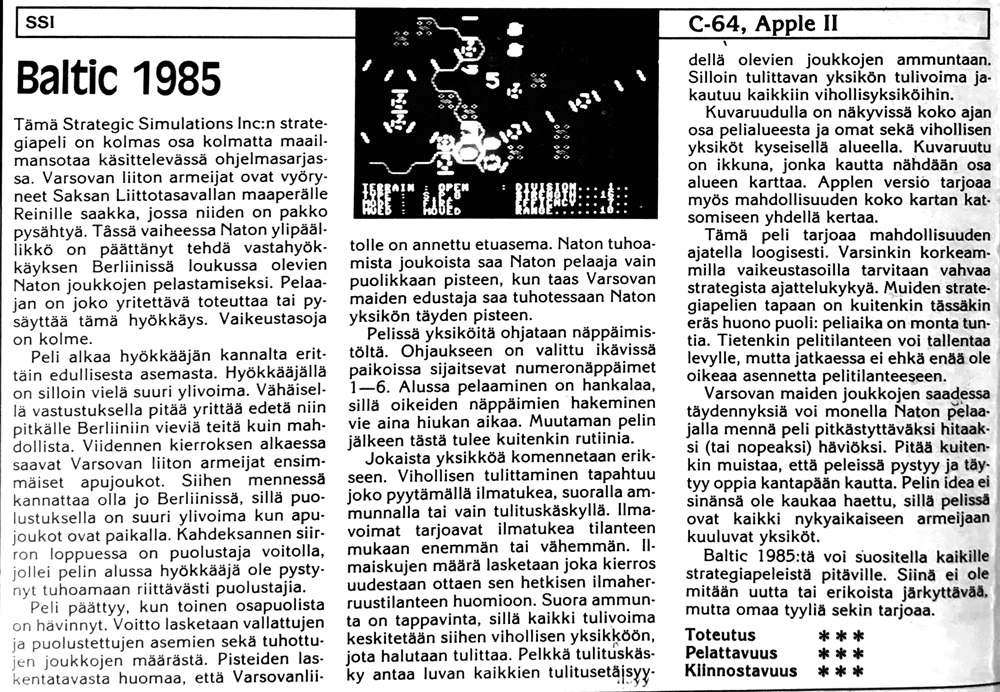
Baltic 19851987Pysyvä linkkiTämä Strategic Simulations Inc:n strategiapeli on kolmas osa kolmatta maailmansotaa käsittelevässä ohjelmasarjassa. Varsovan liiton armeijat ovat vyöryneet Saksan Liittotasavallan maaperälle Reinille saakka, jossa niiden on pakko pysähtyä. Tässä vaiheessa Naton ylipäällikkö on päättänyt tehdä vastahyökkäyksen Berliinissä loukussa olevien Naton joukkojen pelastamiseksi. Pelaajan on joko yritettävä toteuttaa tai pysäyttää tämä hyökkäys. Vaikeustasoja on kolme.
Peli alkaa hyökkääjän kannalta erittäin edullisesta asemasta. Hyökkääjällä on silloin vielä suuri ylivoima. Vähäisellä vastustuksella pitää yrittää edetä niin pitkälle Berliiniin vieviä teitä kuin mahdollista. Viidennen kierroksen alkaessa saavat Varsovan liiton armeijat ensimmäiset apujoukot. Siihen mennessä kannattaa olla jo Berliinissä, sillä puolustuksella on suuri ylivoima kun apujoukot ovat paikalla. Kahdeksannen siirron loppuessa on puolustaja voitolla, jollei pelin alussa hyökkääjä ole pystynyt tuhoamaan riittävästi puolustajia.
Peli päättyy, kun toinen osapuolista on hävinnyt. Voitto lasketaan vallattujen ja puolustettujen asemien sekä tuhottujen joukkojen määrästä. Pisteiden laskentatavasta huomaa, että Varsovanliittolle on annettu etuasema. Naton tuhoamista joukoista saa Naton pelaaja vain puolikkaan pisteen, kun taas Varsovan maiden edustaja saa tuhotessaan Naton yksikön täyden pisteen.
Pelissä yksiköitä ohjataan näppäimistöltä. Ohjaukseen on valittu ikävissä paikoissa sijaitsevat numeronäppäimet 1-6. Alussa pelaaminen on hankalaa, sillä oikeiden näppäimien hakeminen vie aina hiukan aikaa. Muutaman pelin jälkeen tästä tulee kuitenkin rutiinia.
Jokaista yksikköä komennetaan erikseen. Vihollisen tulittaminen tapahtuu joko pyytämällä ilmatukea, suoralla ammunnalla tai vain tulituskäskyllä. Ilmavoimat tarjoavat ilmatukea tilanteen mukaan enemmän tai vähemmän. Ilmaiskujen määrä lasketaan joka kierros uudestaan ottaen sen hetkisen ilmaherruustilanteen huomioon. Suora ammunta on tappavinta, sillä kaikki tulivoima keskitetään siihen vihollisen yksikköön, jota halutaan tulittaa. Pelkkä tulituskäsky antaa luvan kaikkien tulitusetäisyydellä olevien joukkojen ammuntaan. Silloin tulittavan yksikön tulivoima jakautuu kaikkiin vihollisyksiköihin.
Kuvaruudulla on näkyvissä koko ajan osa pelialueesta ja omat sekä vihollisen yksiköt kyseisellä alueella. Kuvaruutu on ikkuna, jonka kautta nähdään osa alueen karttaa. Applen versio tarjoaa myös mahdollisuuden koko kartan katsomiseen yhdellä kertaa.
Tämä peli tarjoaa mahdollisuuden ajatella loogisesti. Varsinkin korkeammilla vaikeustasoilla tarvitaan vahvaa strategista ajattelukykyä. Muiden strategiapelien tapaan on kuitenkin tässäkin eräs huono puoli: peliaika on monta tuntia. Tietenkin pelitilanteen voi tallentaa levylle, mutta jatkaessa ei ehkä enää ole oikeaa asennetta pelitilanteeseen.
Varsovan maiden joukkojen saadessa täydennyksiä voi monella Naton pelaajalla mennä peli pitkästyttäväksi hitaaksi (tai nopeaksi) häviöksi. Pitää kuitenkin muistaa, että peleissä pystyy ja täytyy oppia kantapään kautta. Pelin idea ei sinänsä ole kaukaa haettu, sillä pelissä ovat kaikki nykyaikaiseen armeijaan kuuluvat yksiköt.
Baltic 1985:tä voi suositella kaikille strategiapeleistä pitäville. Siinä ei ole mitään uutta tai erikoista järkyttävää, mutta omaa tyyliä sekin tarjoaa.
Baltic 19851987PermalinkThis strategy game from Strategic Simulations Inc. is the third part of a series of programs about World War III. The Warsaw Pact armies have rolled onto the soil of the Federal Republic of Germany as far as the Rhine, where they are forced to halt. At this point NATO's supreme commander has decided to launch a counter-attack to rescue the NATO troops trapped in Berlin. The player has to either try to carry out this attack or stop it. There are three difficulty levels.
The game starts from a position that is highly favourable to the attacker. At that stage the attacker still has a large superiority in strength. While resistance is light, you have to try to push as far as possible along the roads leading to Berlin. At the start of the fifth turn the Warsaw Pact armies receive their first reinforcements. By then you had better already be in Berlin, because the defence has a large superiority once the reinforcements have arrived. By the end of the eighth move the defender is winning, unless the attacker has managed to destroy enough of the defenders early in the game.
The game ends when one of the sides has lost. Victory is calculated from the number of positions captured and held and the number of troops destroyed. You can tell from the way the points are counted that the Warsaw Pact has been given the upper hand. The NATO player gets only half a point for each unit NATO destroys, whereas whoever represents the Warsaw Pact countries gets a full point for destroying a NATO unit.
In the game the units are controlled from the keyboard. The number keys 1-6, which sit in awkward places, have been chosen for the controls. Playing is fiddly at first, since finding the right keys always takes a moment. After a few games, though, it becomes routine.
Each unit is commanded separately. The enemy is fired on either by calling in air support, by direct fire or just with a general fire order. The air force provides more or less air support depending on the situation. The number of air strikes is recalculated every turn, taking the current state of air superiority into account. Direct fire is the deadliest, because all the firepower is concentrated on the one enemy unit you want to hit. A plain fire order gives all the troops within range permission to open fire. The firing unit's firepower is then split among all the enemy units.
The screen always shows part of the playing area, along with your own and the enemy's units in that area. The screen is a window through which you see part of the map of the area. The Apple version also lets you view the whole map at once.
This game offers a chance to think logically. Especially at the higher difficulty levels, strong strategic thinking is needed. Like other strategy games, though, this one has a drawback too: a game lasts many hours. Of course you can save the game to disk, but when you carry on you may no longer be in quite the right frame of mind for the situation.
Once the Warsaw Pact countries' troops get their reinforcements, for many a NATO player the game may turn into a tediously slow (or quick) defeat. You have to remember, though, that in games you can, and must, learn the hard way. The idea of the game is not far-fetched as such, since it has all the units that make up a modern army.
Baltic 1985 can be recommended to anyone who likes strategy games. There is nothing new or particularly earth-shattering about it, but it has a style of its own all the same.
Barbarian
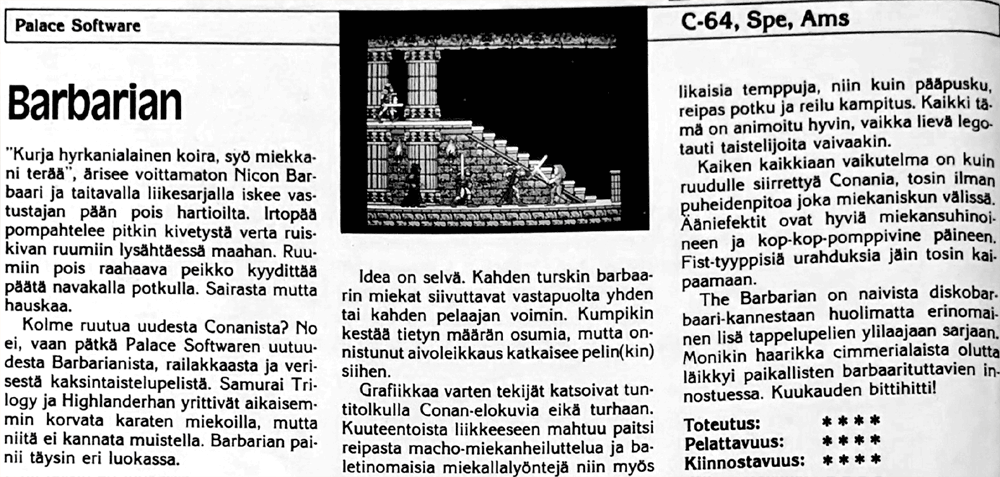
Barbarian1987Pysyvä linkki"Kurja hyrkanialainen koira, syö miekkani terää", ärisee voittamaton Nicon Barbaari ja taitavalla liikesarjalla iskee vastustajan pään pois hartioilta. Irtopää pompahtelee pitkin kivetystä verta ruiskivan ruumiin lysähtäessä maahan. Ruumiin pois raahaava peikko kyydittää päätä navakalla potkulla. Sairasta mutta hauskaa.
Kolme ruutua uudesta Conanista? No ei, vaan pätkä Palace Softwaren uutuudesta Barbarianista, railakkaasta ja verisestä kaksintaistelupelistä. Samurai Trilogy ja Highlanderhan yrittivät aikaisemmin korvata karaten miekoilla, mutta niitä ei kannata muistella. Barbarian painii täysin eri luokassa.
Idea on selvä. Kahden turskin barbaarin miekat siivuttavat vastapuolta yhden tai kahden pelaajan voimin. Kumpikin kestää tietyn määrän osumia, mutta onnistunut aivoleikkaus katkaisee pelin(kin) siihen.
Grafiikkaa varten tekijät katsoivat tuntitolkulla Conan-elokuvia eikä turhaan. Kuuteentoista liikkeeseen mahtuu paitsi reipasta macho-miekanheiluttelua ja baletinomaisia miekallalyöntejä niin myös likaisia temppuja, niin kuin pääpusku, reipas potku ja reilu kampitus. Kaikki tämä on animoitu hyvin, vaikka lievä legotauti taistelijoita vaivaakin.
Kaiken kaikkiaan vaikutelma on kuin ruudulle siirrettyä Conania, tosin ilman puheidenpitoa joka miekaniskun välissä. Ääniefektit ovat hyviä miekansuhinoineen ja kop-kop-pomppivine päineen. Fist-tyyppisiä urahduksia jäin tosin kaipaamaan.
The Barbarian on naivista diskobarbaari-kannestaan huolimatta erinomainen lisä tappelupelien ylilaajaan sarjaan. Monikin haarikka cimmerialaista olutta läikkyi paikallisten barbaarituttavien innostuessa. Kuukauden bittihitti!
Barbarian1987Permalink"Wretched Hyrkanian dog, eat the edge of my sword", growls Nico's invincible Barbarian, and with a deft combination of moves he strikes his opponent's head clean off his shoulders. The loose head goes bouncing along the flagstones as the blood-spurting body slumps to the ground. The goblin dragging the body away sends the head on its way with a hefty kick. Sick but fun.
Three frames from the new Conan? Well no, just a snippet of Barbarian, Palace Software's new release, a rollicking and bloody duelling game. Samurai Trilogy and Highlander did try earlier to swap karate for swords, of course, but they're not worth remembering. Barbarian fights in a whole different weight class.
The idea is simple. The swords of two burly barbarians carve slices off each other, driven by one or two players. Each can take a certain number of hits, but one successful bit of brain surgery cuts off the game (as well) right there.
For the graphics the makers watched Conan films for hours on end, and not in vain. The sixteen moves have room not only for hearty macho sword-waving and ballet-like sword strokes but also for dirty tricks, such as a headbutt, a good hard kick and a fair old trip. All of this is nicely animated, even though the fighters suffer from a mild case of Lego disease.
All in all, the impression is of Conan transplanted onto the screen, though without the speechifying between every sword stroke. The sound effects are good, with their swishing swords and clonk-clonk bouncing heads. I did miss Fist-style grunts, though.
Despite its naive disco-barbarian cover, The Barbarian is an excellent addition to the overstuffed range of fighting games. Many a tankard of Cimmerian ale got spilled as the local barbarian crowd got carried away. Bit hit of the month!
Barbarian II: Dungeon of Drax
Barbarian II: Dungeon of Drax1989 KevätPysyvä linkkiDrax - hän elää! Barbarian I saavutti runsaasti huomiota, ei vähiten Maria Whittakerin henkisten avujen ansiosta, mutta pääasiassa kuitenkin sisältämänsä hilpeän väkivallan takia. Eikä Barbarian II petä odotuksia: se on varmasti mukana todistusaineistossa, jos ja kun videopelejä aletaan sensuroida.
Tasa-arvovaltuutettu ei Barbarianista kostu, sillä pelaaja voi valita pikseliconanin lisäksi myös prinsessa Marianan. Kumpikin omistaa identtiset tappokyvyt, vaikka uros heiluttaakin kauheaa kirvestä ja naaras sutjakampaa miekkaa. Ja näillä kyvyillä pitäisi saada velho Drax vainajax.
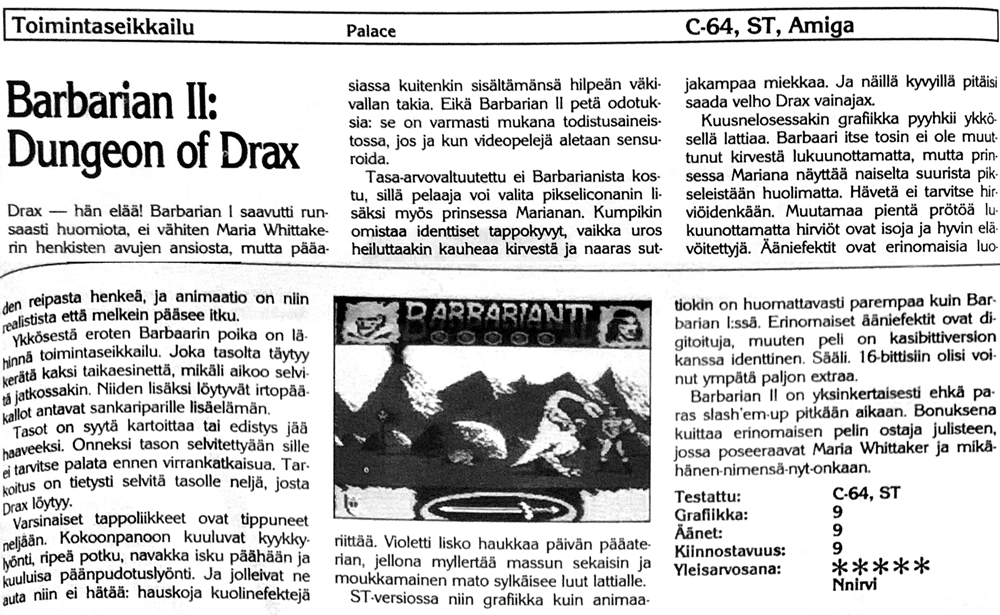
Kuusnelosessakin grafiikka pyyhkii ykkösellä lattiaa. Barbaari itse tosin ei ole muuttunut kirvestä lukuunottamatta, mutta prinsessa Mariana näyttää naiselta suurista pikseleistään huolimatta. Hävetä ei tarvitse hirviöidenkään. Muutamaa pientä prötöä lukuunottamatta hirviöt ovat isoja ja hyvin elävöitettyjä. Ääniefektit ovat erinomaisia luoden reipasta henkeä, ja animaatio on niin realistista että melkein pääsee itku.
Ykkösestä eroten Barbaarin poika on lähinnä toimintaseikkailu. Joka tasolta täytyy kerätä kaksi taikaesinettä, mikäli aikoo selvitä jatkossakin. Niiden lisäksi löytyvät irtopääkallot antavat sankariparille lisäelämän.
Tasot on syytä kartoittaa tai edistys jää haaveeksi. Onneksi tason selvitettyään sille ei tarvitse palata ennen virrankatkaisua. Tarkoitus on tietysti selvitä tasolle neljä, josta Drax löytyy.
Varsinaiset tappoliikkeet ovat tippuneet neljään. Kokoonpanoon kuuluvat kyykkylyönti, ripeä potku, navakka isku päähään ja kuuluisa päänpudotuslyönti. Ja jolleivat ne auta niin ei hätää: hauskoja kuolinefektejä riittää. Violetti lisko haukkaa päivän pääaterian, jellona myllertää massun sekaisin ja moukkamainen mato sylkäisee luut lattialle.
ST-versiossa niin grafiikka kuin animaatiokin on huomattavasti parempaa kuin Barbarian I:ssä. Erinomaiset ääniefektit ovat digitoituja, muuten peli on kasibittiversion kanssa identtinen. Sääli. 16-bittisiin olisi voinut ympätä paljon extraa.
Barbarian II on yksinkertaisesti ehkä paras slash'em-up pitkään aikaan. Bonuksena kuittaa erinomaisen pelin ostaja julisteen, jossa poseeraavat Maria Whittaker ja mikä-hänen-nimensä-nyt-onkaan.
Barbarian II: Dungeon of Drax1989 KevätPermalinkDrax - he lives! Barbarian I got plenty of attention, not least thanks to Maria Whittaker's intellectual assets, but mainly because of the jolly violence it contained. And Barbarian II doesn't disappoint: it's sure to be part of the evidence if and when video games start getting censored.
The Equality Ombudsman will get no joy out of Barbarian, since besides the pixel-Conan the player can also choose Princess Mariana. Both possess identical killing skills, although the male swings a terrible axe and the female a more svelte sword. And with these skills you're supposed to make the wizard Drax an ex-Drax.
Even on the C-64 the graphics wipe the floor with the first game. Admittedly the barbarian himself hasn't changed, apart from the axe, but Princess Mariana looks like a woman despite her big pixels. The monsters have nothing to be ashamed of either. Apart from a few little blobs, the monsters are big and nicely animated. The sound effects are excellent and create a lively atmosphere, and the animation is so realistic it almost brings you to tears.
Unlike the first game, Son of Barbarian is more of an action adventure. On every level you have to collect two magic items if you mean to survive further on. On top of those, the stray skulls lying about give our hero pair an extra life.
You'd better map the levels, or progress will remain a pipe dream. Luckily, once you've cleared a level you don't need to go back to it until you switch off. The aim, of course, is to make it to level four, where Drax is to be found.
The actual killing moves have dropped to four. The line-up consists of a crouching strike, a quick kick, a stiff blow to the head and the famous head-lopping stroke. And if those don't help, never fear: there are plenty of fun death effects. The purple lizard snaps up its main meal of the day, the jelly blob churns your tummy into a mess and the loutish worm spits your bones out onto the floor.
In the ST version both the graphics and the animation are considerably better than in Barbarian I. The excellent sound effects are digitised; otherwise the game is identical to the 8-bit version. A pity. A lot of extras could have been crammed into the 16-bit ones.
Barbarian II is quite simply perhaps the best slash'em-up in a long time. As a bonus, the buyer of this excellent game pockets a poster in which Maria Whittaker and what's-their-name-again strike a pose.
Bard's Tale III: Thief of Fate
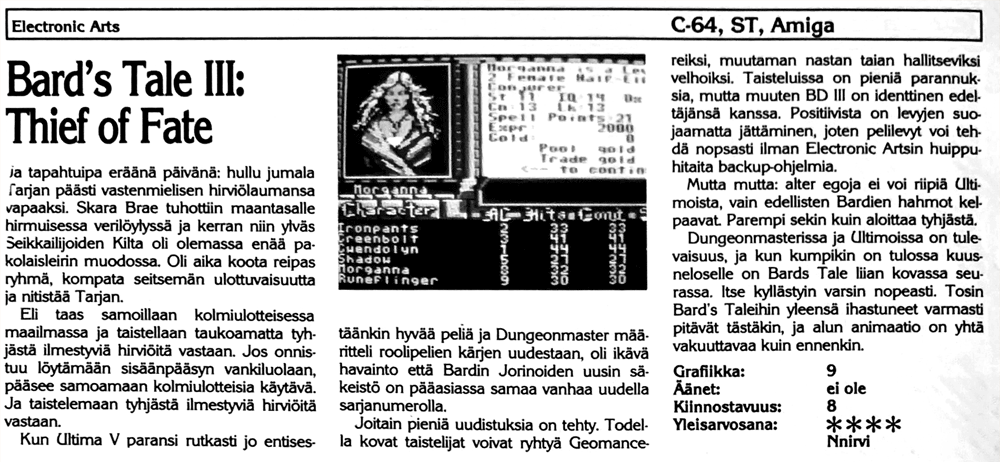
Bard's Tale III: Thief of Fate1988Pysyvä linkkija tapahtuipa eräänä päivänä: hullu jumala Tarjan päästi vastenmielisen hirviölaumansa vapaaksi. Skara Brae tuhottiin maantasalle hirmuisessa verilöylyssä ja kerran niin ylväs Seikkailijoiden Kilta oli olemassa enää pakolaisleirin muodossa. Oli aika koota reipas ryhmä, kompata seitsemän ulottuvaisuutta ja nitistää Tarjan.
Eli taas samoillaan kolmiulotteisessa maailmassa ja taistellaan taukoamatta tyhjästä ilmestyviä hirviöitä vastaan. Jos onnistuu löytämään sisäänpääsyn vankiluolaan, pääsee samoamaan kolmiulotteisia käytävä. Ja taistelemaan tyhjästä ilmestyviä hirviöitä vastaan.
Kun Ultima V paransi rutkasti jo entisestäänkin hyvää peliä ja Dungeonmaster määritteli roolipelien kärjen uudestaan, oli ikävä havainto että Bardin Jorinoiden uusin säkeistö on pääasiassa samaa vanhaa uudella sarjanumerolla.
Joitain pieniä uudistuksia on tehty. Todella kovat taistelijat voivat ryhtyä Geomancereiksi, muutaman nastan taian hallitseviksi velhoiksi. Taisteluissa on pieniä parannuksia, mutta muuten BD III on identtinen edeltäjänsä kanssa. Positiivista on levyjen suojaamatta jättäminen, joten pelilevyt voi tehdä nopsasti ilman Electronic Artsin huippuhitaita backup-ohjelmia.
Mutta mutta: alter egoja ei voi riipiä Ultimoista, vain edellisten Bardien hahmot kelpaavat. Parempi sekin kuin aloittaa tyhjästä.
Dungeonmasterissa ja Ultimoissa on tulevaisuus, ja kun kumpikin on tulossa kuusneloselle on Bards Tale liian kovassa seurassa. Itse kyllästyin varsin nopeasti. Tosin Bard's Taleihin yleensä ihastuneet varmasti pitävät tästäkin, ja alun animaatio on yhtä vakuuttavaa kuin ennenkin.
Bard's Tale III: Thief of Fate1988Permalinkand it came to pass one day: the mad god Tarjan set his loathsome horde of monsters loose. Skara Brae was razed to the ground in a terrible bloodbath, and the once so proud Adventurers' Guild survived only in the form of a refugee camp. It was time to gather a plucky party, comb through the seven dimensions and snuff out Tarjan.
So once again you roam a three-dimensional world and fight nonstop against monsters that appear out of nowhere. If you manage to find the way into a dungeon, you get to roam three-dimensional corridors. And fight monsters that appear out of nowhere.
With Ultima V having vastly improved an already good game and Dungeonmaster having redefined the cutting edge of role-playing games, it was a sad discovery that the latest verse of the Bard's Ramblings is mostly the same old thing with a new serial number.
A few small changes have been made. Really tough fighters can become Geomancers, wizards who command a handful of nifty spells. There are small improvements to the combat, but otherwise BT III is identical to its predecessor. On the plus side, the disks have been left unprotected, so you can make your play disks in a jiffy without Electronic Arts' ultra-slow backup programs.
But, but: you can't rip your alter egos out of the Ultimas, only characters from the previous Bards will do. Even that beats starting from scratch.
The future lies with Dungeonmaster and the Ultimas, and with both of them coming to the Commodore 64, Bard's Tale is in far too tough company. Personally, I got bored pretty quickly. Then again, anyone who has generally been smitten with the Bard's Tales will surely like this one too, and the opening animation is as convincing as ever.
Basil The Great Mouse Detective
Basil The Great Mouse Detective1988Pysyvä linkkiBasil Mestarietsivä on uusin Disneyn piirretyistä. Ja myös Gremlinin lisenssipeleistä.
Seuraa juonilyhennelmä:
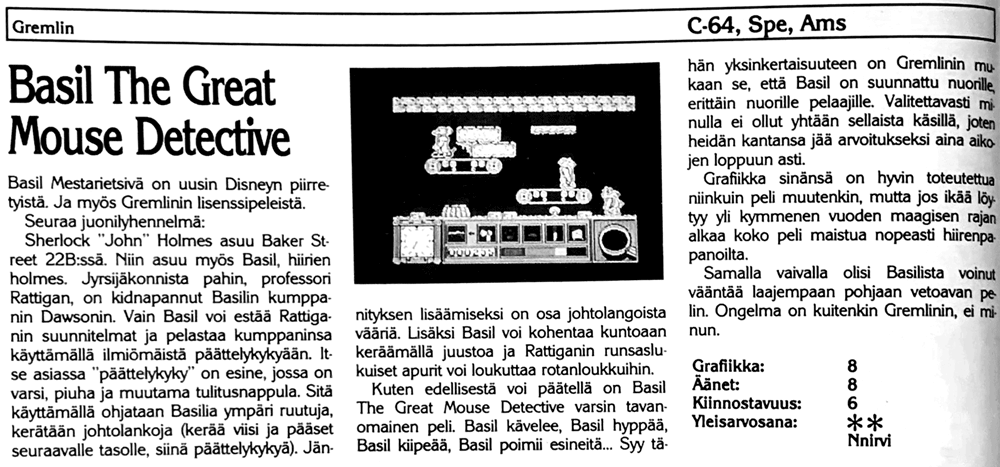
Sherlock "John" Holmes asuu Baker Street 22B:ssä. Niin asuu myös Basil, hiirien holmes. Jyrsijäkonnista pahin, professori Rattigan, on kidnapannut Basilin kumppanin Dawsonin. Vain Basil voi estää Rattiganin suunnitelmat ja pelastaa kumppaninsa käyttämällä ilmiömäistä päättelykykyään. Itse asiassa "päättelykyky" on esine, jossa on varsi, piuha ja muutama tulitusnappula. Sitä käyttämällä ohjataan Basilia ympäri ruutuja, kerätään johtolankoja (kerää viisi ja pääset seuraavalle tasolle, siinä päättelykykyä). Jännityksen lisäämiseksi on osa johtolangoista vääriä. Lisäksi Basil voi kohentaa kuntoaan keräämällä juustoa ja Rattiganin runsaslukuiset apurit voi loukuttaa rotanloukkuihin.
Kuten edellisestä voi päätellä on Basil The Great Mouse Detective varsin tavanomainen peli. Basil kävelee, Basil hyppää, Basil kiipeää, Basil poimii esineitä... Syy tähän yksinkertaisuuteen on Gremlinin mukaan se, että Basil on suunnattu nuorille, erittäin nuorille pelaajille. Valitettavasti minulla ei ollut yhtään sellaista käsillä, joten heidän kantansa jää arvoitukseksi aina aikojen loppuun asti.
Grafiikka sinänsä on hyvin toteutettua niinkuin peli muutenkin, mutta jos ikää löytyy yli kymmenen vuoden maagisen rajan alkaa koko peli maistua nopeasti hiirenpapanoilta.
Samalla vaivalla olisi Basilista voinut vääntää laajempaan pohjaan vetoavan pelin. Ongelma on kuitenkin Gremlinin, ei minun.
Basil The Great Mouse Detective1988PermalinkBasil the Great Mouse Detective is the latest of the Disney cartoons. And also of Gremlin's licensed games.
A plot summary follows:
Sherlock "John" Holmes lives at 221B Baker Street. So does Basil, the holmes of mice. The worst of the rodent villains, Professor Rattigan, has kidnapped Basil's partner Dawson. Only Basil can foil Rattigan's plans and rescue his partner by using his phenomenal powers of deduction. Actually, the "powers of deduction" are an object with a stick, a lead and a few fire buttons. Using it, you steer Basil around the screens and collect clues (collect five and you get to the next level - there's deduction for you). To heighten the suspense, some of the clues are false. On top of that, Basil can build up his strength by collecting cheese, and Rattigan's numerous henchmen can be caught in rat traps.
As you can deduce from the above, Basil The Great Mouse Detective is a pretty run-of-the-mill game. Basil walks, Basil jumps, Basil climbs, Basil picks up objects... According to Gremlin, the reason for this simplicity is that Basil is aimed at young, very young players. Unfortunately I didn't have any of those to hand, so their view will remain a mystery until the end of time.
The graphics as such are well done, as is the rest of the game, but if you're past the magic age limit of ten, the whole thing soon starts to taste of mouse droppings.
With the same effort, Basil could have been hammered into a game with broader appeal. That's Gremlin's problem, though, not mine.
Basket Master
Basket Master1988Pysyvä linkkiKorispeli Imaginelta? Nyt on jotain mennyt jossain pahan kerran pieleen, kun Imagine ei julkaissutkaan surkeaa räiskintäpeliä, vaan ihan pelattavan urheilupelin.
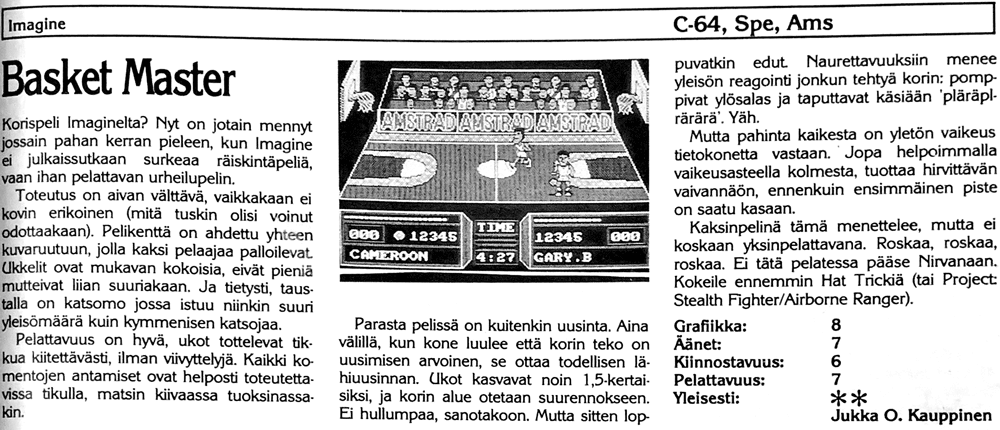
Toteutus on aivan välttävä, vaikkakaan ei kovin erikoinen (mitä tuskin olisi voinut odottaakaan). Pelikenttä on ahdettu yhteen kuvaruutuun, jolla kaksi pelaajaa palloilevat. Ukkelit ovat mukavan kokoisia, eivät pieniä mutteivat liian suuriakaan. Ja tietysti, taustalla on katsomo jossa istuu niinkin suuri yleisömäärä kuin kymmenisen katsojaa.
Pelattavuus on hyvä, ukot tottelevat tikkua kiitettävästi, ilman viivyttelyjä. Kaikki komentojen antamiset ovat helposti toteutettavissa tikulla, matsin kiivaassa tuoksinassakin.
Parasta pelissä on kuitenkin uusinta. Aina välillä, kun kone luulee että korin teko on uusimisen arvoinen, se ottaa todellisen lähiuusinnan. Ukot kasvavat noin 1,5-kertaisiksi, ja korin alue otetaan suurennokseen. Ei hullumpaa, sanotakoon. Mutta sitten loppuvatkin edut. Naurettavuuksiin menee yleisön reagointi jonkun tehtyä korin: pomppivat ylösalas ja taputtavat käsiään 'pläräplrärärä'. Yäh.
Mutta pahinta kaikesta on yletön vaikeus tietokonetta vastaan. Jopa helpoimmalla vaikeusasteella kolmesta, tuottaa hirvittävän vaivannäön, ennenkuin ensimmäinen piste on saatu kasaan.
Kaksinpelinä tämä menettelee, mutta ei koskaan yksinpelattavana. Roskaa, roskaa, roskaa. Ei tätä pelatessa pääse Nirvanaan. Kokeile ennemmin Hat Trickiä (tai Project: Stealth Fighter/Airborne Ranger).
Basket Master1988PermalinkA basketball game from Imagine? Something has gone badly wrong somewhere this time, because instead of putting out a lousy shoot-'em-up, Imagine has released a perfectly playable sports game.
The execution is quite passable, though not very special (which you could hardly have expected anyway). The court is crammed onto a single screen, on which two players knock the ball about. The little guys are a nice size, not small but not too big either. And of course, in the background there's a stand seating a crowd as vast as ten or so spectators.
The playability is good; the guys obey the stick admirably, with no delay. All the commands are easy to give with the stick, even in the thick of a heated match.
The best thing in the game, though, is the replay. Every now and then, when the computer reckons a basket is worth replaying, it runs a proper close-up replay. The players grow to about 1.5 times their size, and the area around the basket is shown enlarged. Not bad at all, let it be said. But that's where the good points run out. The crowd's reaction when someone scores is downright ridiculous: they bounce up and down and clap their hands 'clappity-clappity-clap'. Yuck.
But worst of all is the outrageous difficulty against the computer. Even on the easiest of the three difficulty levels, it takes a horrendous amount of effort before you've scraped together your first point.
As a two-player game this passes muster, but never as a one-player one. Rubbish, rubbish, rubbish. Playing this won't get you to Nirvana. Try Hat Trick instead (or Project: Stealth Fighter/Airborne Ranger).
Batman
Batman1989 KevätPysyvä linkkiOn ihmeen ihana iltapäivä Gotham Cityssä. Yhtäkkiä Ocean julkaisee pelin nimeltään Batman, vaikka pari vuotta sitten Ocean julkaisi pelin nimeltä Batman. Pyhä olisinpa hiukan hämilläni, jollen tietäisi, että uusi peli pohjautuu tulevaan Batelokuvaan.
Paitsi että Pingviini aikoo valloittaa ei sen vähempää kuin koko maailman robottipingviineillään, on Jokeri kidnapannut Robinin eli Batmanin tehtäväkenttä on harvinaisen selkeä.
Batman hallitsee tyydyttävän määrän taisteluliikkeitä ja voi jopa nakella Batarangia kunhan vain löytää sen ensin. Monia muitakin esineitä voi Lepakkomies löytää. Gotham Cityn kartta on iso ja laaja, joten tekemistä riittää.
Batesteettisesti peli on hyvin tehty. C-64-Batmanilla on jopa aito Adam West-batpömppömahakin. ST-Amiga-Batissa grafiikka näyttää lähinnä sarjakuvalta ja Amigassa on jopa samplattu Batteema. Batanimaatio pelaa ja batmenu on miellyttävä käyttää. Grafiikkaporkkanana on sarjakuvamaista fiilistä antava ikkunointi, eli uusi batruutu ponnahtaa suoraan vanhan päälle. Siksi onkin sääli, että peli edustaa normaalia brittiläistä arcadeadventurelinjaa eli joka ruutuun riittää konna pari ja bonukseksi ampuvia pikkurobotteja. Täydennysjoukot ilmestyvät heti paikalle kun entisistä on päästy eroon. Olenko vainoharhainen vai onko tosiaan näin, ettei mitään uutta enää jakseta keksiä?
Näin batmiehenä harmitti tappeluista puuttuva Sock!Pow!-mentaliteetti ja poissaolollaan loistava lepakkoauto. Omassa lajissaan Batman on kuitenkin hyvä toimintaseikkailu, mutta kun samaa kaavaa eri spriteillä on pelannut jo lapsuudessaan ei voi huoahtaa "Pyhä unohdus!" ja lyödä nyrkillä kämmeneen. Ei mikään (le)pakko-ostos.
Batman1989 KevätPermalinkIt's a wondrously lovely afternoon in Gotham City. Suddenly Ocean releases a game called Batman, even though a couple of years ago Ocean released a game called Batman. Holy I'd be a little baffled, if I didn't know that the new game is based on the upcoming Batfilm.
Besides the Penguin planning to conquer nothing less than the entire world with his robot penguins, the Joker has kidnapped Robin, so Batman's remit is unusually clear-cut.
Batman commands a satisfactory number of fighting moves and can even fling the Batarang, as long as he finds it first. The Bat-Man can find plenty of other items too. The map of Gotham City is big and sprawling, so there's plenty to do.
Bataesthetically the game is well made. The C-64 Batman even has a genuine Adam West batpotbelly. In the ST-Amiga Bat the graphics look pretty much like a comic, and the Amiga even has a sampled Battheme. The Batanimation works and the batmenu is pleasant to use. The graphical carrot is the windowing, which gives a comic-book feel: a new batscreen pops up right on top of the old one. That's why it's such a pity that the game follows the usual British arcade adventure line, i.e. every screen has a villain or two plus, as a bonus, little robots that shoot. Reinforcements turn up on the spot as soon as you've got rid of the previous lot. Am I paranoid, or is it really true that nobody can be bothered to come up with anything new any more?
As a batman myself, I was annoyed by the lack of Sock!Pow! mentality in the fights and by the Batmobile, conspicuous by its absence. In its own genre Batman is nevertheless a good action adventure, but when you've been playing the same formula with different sprites since you were a kid, you can't just sigh "Holy amnesia!" and punch your fist into your palm. Not exactly a (bat)must-buy.
Batman - The Movie
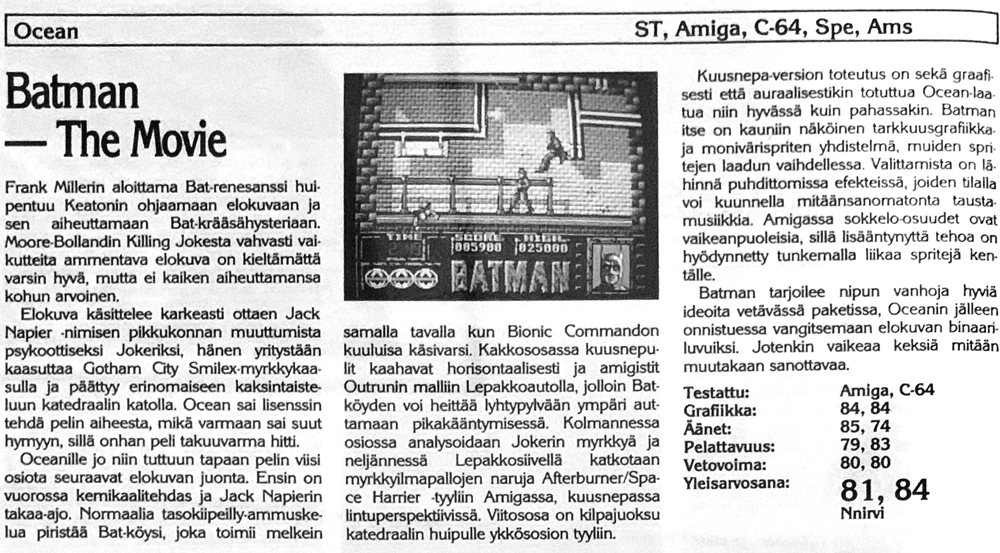
Batman - The Movie1990 KevätPysyvä linkkiFrank Millerin aloittama Bat-renesanssi huipentuu Keatonin ohjaamaan elokuvaan ja sen aiheuttamaan Bat-krääsähysteriaan. Moore-Bollandin Killing Jokesta vahvasti vaikutteita ammentava elokuva on kieltämättä varsin hyvä, mutta ei kaiken aiheuttamansa kohun arvoinen.
Elokuva käsittelee karkeasti ottaen Jack Napier -nimisen pikkukonnan muuttumista psykoottiseksi Jokeriksi, hänen yritystään kaasuttaa Gotham City Smilex-myrkkykaasulla ja päättyy erinomaiseen kaksintaisteluun katedraalin katolla. Ocean sai lisenssin tehdä pelin aiheesta, mikä varmaan sai suut hymyyn, sillä onhan peli takuuvarma hitti.
Oceanille jo niin tuttuun tapaan pelin viisi osiota seuraavat elokuvan juonta. Ensin on vuorossa kemikaalitehdas ja Jack Napierin takaa-ajo. Normaalia tasokiipeily-ammuskelua piristää Bat-köysi, joka toimii melkein samalla tavalla kun Bionic Commandon kuuluisa käsivarsi. Kakkososassa kuusnepulit kaahavat horisontaalisesti ja amigistit Outrunin malliin Lepakkoautolla, jolloin Bat-köyden voi heittää lyhtypylvään ympäri auttamaan pikakääntymisessä. Kolmannessa osiossa analysoidaan Jokerin myrkkyä ja neljännessä Lepakkosiivellä katkotaan myrkkyilmapallojen naruja Afterburner/Space Harrier -tyyliin Amigassa, kuusnepassa lintuperspektiivissä. Viitososa on kilpajuoksu katedraalin huipulle ykkösosion tyyliin.
Kuusnepa-version toteutus on sekä graafisesti että auraalisestikin totuttua Ocean-laatua niin hyvässä kuin pahassakin. Batman itse on kauniin näköinen tarkkuusgrafiikka- ja monivärispriten yhdistelmä, muiden spritejen laadun vaihdellessa. Valittamista on lähinnä puhdittomissa efekteissä, joiden tilalla voi kuunnella mitäänsanomatonta taustamusiikkia. Amigassa sokkelo-osuudet ovat vaikeanpuoleisia, sillä lisääntynyttä tehoa on hyödynnetty tunkemalla liikaa spritejä kentälle.
Batman tarjoilee nipun vanhoja hyviä ideoita vetävässä paketissa, Oceanin jälleen onnistuessa vangitsemaan elokuvan binaariluvuiksi. Jotenkin vaikeaa keksiä mitään muutakaan sanottavaa.
Batman - The Movie1990 KevätPermalinkThe Bat-renaissance begun by Frank Miller culminates in the film directed by Keaton and the Bat-junk hysteria it has set off. The film, which draws heavily on Moore-Bolland's Killing Joke, is admittedly pretty good, but not worth all the fuss it has caused.
Roughly speaking, the film deals with a small-time crook named Jack Napier turning into the psychotic Joker and his attempt to gas Gotham City with Smilex poison gas, and it ends in an excellent duel on the roof of a cathedral. Ocean got the licence to make a game of it, which no doubt brought smiles to faces, since the game is, after all, a guaranteed hit.
In the way already so familiar from Ocean, the game's five sections follow the plot of the film. First up are the chemical plant and the pursuit of Jack Napier. The usual platform-climbing-and-shooting is livened up by the Bat-rope, which works almost the same way as the famous arm in Bionic Commando. In part two the C-64 crowd tear along horizontally and the Amiga owners Outrun-style in the Batmobile, and the Bat-rope can be thrown round a lamp post to help with quick turns. In the third section you analyse the Joker's poison, and in the fourth you cut the ropes of poison balloons with the Batwing, Afterburner/Space Harrier style on the Amiga and from a bird's-eye view on the C-64. Part five is a race to the top of the cathedral in the style of part one.
The execution of the C-64 version is, both graphically and aurally, the usual Ocean quality, for better and for worse. Batman himself is a nice-looking combination of a hi-res sprite and a multicolour sprite, while the quality of the other sprites varies. The main complaint is the punchless sound effects, in place of which you can listen to nondescript background music. On the Amiga the maze sections are on the difficult side, since the extra power has been put to use by cramming too many sprites into the level.
Batman serves up a bundle of good old ideas in an attractive package, with Ocean once again managing to capture a film in binary numbers. Somehow it's hard to think of anything else to say.
Battalion Commander
Battalion Commander1990 KevätPysyvä linkkiKuka muistaa vanhan, ihanan kuusnelosen pelin Combat Leader? Ken pelasi sitä päivät pitkät, koettaen erottaa vihreästä taustasta vihreät yksiköt ja vihreät viholliset? Allekirjoittanut ja J3-Kasvis ainakin. (ja minä!-NN) Kuinka moni puolestaan on koskaan kuullut Battalion Commanderista? Tai pelannut? Ei niinkään moni. Ja taas todistimme etteivät jatko-osat juuri koskaan yllä alkuperäisten tasolle.
Battalion Commander on laajennettu ja parannettu osa legendasta, Combat Leaderista. Mukana on uusia yksiköitä, 40 eri karttaa ja kolme eri osapuolta (Purukumin jauhajat, neukut ja keltanaamat vinosilmät). Kuten Combat Leaderissakin taistelu tapahtuu reaaliajassa, mikä on piristävä poikkeus. On jalkaväkeä, panssariajoneuvoja ja varsinkin tankkeja. Edistystä on tapahtunut: yksiköt eivät ole enää taustan värisiä vaan mustia, mikä säästää epätoivoiselta joukkojen etsimiseltä samanvärisestä taustasta.
Kuulostaa siis hyvältä, valitettavasti totuus on toinen. Periaatteessa Battalion Commander voittaa Combat Leaderin miten päin vain, mutta mutta... Jotain puuttuu, lähinnä se jokin joka saa olion istumaan koneen ääressä tuntikaupalla, pelaamassa samaa peliä uudestaan ja uudestaan. Poikkeuksiakin on: yksi tuntemani henkilö pelasi aina vain tätä, ehkä siksi ettei hänellä muuta ollut.
Battalion Commander1990 KevätPermalinkWho remembers that lovely old C-64 game Combat Leader? Who among you played it for days on end, trying to tell the green units and the green enemies apart from the green background? The undersigned and J3-Kasvis at least. (and me!-NN) How many, on the other hand, have ever heard of Battalion Commander? Or played it? Not all that many. And once again we have proved that sequels hardly ever reach the level of the originals.
Battalion Commander is an expanded and improved instalment of the legend that is Combat Leader. It comes with new units, 40 different maps and three different sides (gum-chompers, Russkies and yellow-faced slant-eyes). As in Combat Leader, the fighting takes place in real time, which is a refreshing exception. There is infantry, there are armoured vehicles and above all tanks. Progress has been made: the units are no longer the colour of the background but black, which spares you the desperate hunt for your troops against a background of the same colour.
So it sounds good; unfortunately the truth is something else. In principle Battalion Commander beats Combat Leader any which way, but, but... Something is missing, chiefly that certain something that makes a creature sit at the computer for hours on end, playing the same game over and over again. There are exceptions too: one person I know played nothing but this, perhaps because they didn't have anything else.
Battle Chess II: Chinese Chess
Battle Chess II: Chinese Chess1991 KevätPysyvä linkkiMyyvää ideaa ei hylätä. Siitä tehdään jatko-osa. Tämän markkinointipoliittisen syvällisyyden on oivaltanut myös Interplay. Battle Chess kakkosessa grafiikka ja pelin säännöt ovat vaihtuneet, mutta siirtojen ja lyöntien esittäminen hauskoilla animaatioilla on täsmälleen sama idea kuin edeltäjässä.
Kiinalainen ja moderni shakki ovat sikäli sukua toisilleen, että kummallakin on sama esi-isä, intialainen Chaturanga. Pelit vain ovat kehittyneet hieman eri suuntiin. Laudan koko on hieman kasvanut ja sen keskelle on lisätty vesistö, mikä on lähinnä viittaus siihen, että Kiinan valtakunnan jakaa kahtia sen keskellä virtaava Keltainen joki. Myös nappulavalikoimassa näkyy paikallisväriä, esimerkiksi muiden kalikoiden yli ampuva kanuuna on todiste siitä, että kiinalaiset ruudinkeksijät ehtivät länsimaalaisten edelle. Jäljellä on myös runsaasti jäänteitä alkuperäisestä pelistä, kuten ministeri, joka siirtyy samalla tavoin kaksi ruutua viistoon kuin Chaturangan elefantti.
Kiinalaisessa shakissa on täsmälleen sama vika kuin edeltäjässä. Korkealaatuisia animaatioita on hauska katsella aikansa, mutta siten ne muuttuvat lähinnä peliä hidastavaksi häiriötekijäksi. Huumorista myöskin puuttuu Battle Chessin inspiroitunut anarkismi. Joukossa on joitain hauskoja oivalluksia, kuten että vankkureita vetävä muuli muuttuu ensin lohikäärmeeksi, sitten vastapuoli taikoo sen sisiliskoksi ja liiskaa jalkansa alle. Mukaan on kuitenkin eksynyt hävyttömän pitkäveteisiä tai jopa suoraan edeltäjästä varastettuja taistelunäytöksiä. Vitseistä myös katoaa terävin kärki sen vuoksi, että nappulat eivät ole samalla tavoin tuttuja kuin modernissa shakissa.
Pelillisesti kiinalaista shakkia on vaikea arvioida, koska en ole siinä mestari, mutta sen ainakin huomasin, että vaikeustason ja tilanteen ollessa sama kone pelaa aina täsmälleen saman siirron. Grafiikaltaan ja ääniltään peli kylläkin on korkeatasoinen. Jokaista nappulaa varten on erilainen fanfaari, joka kuulostaa varsin tyylikkäältä Adlibin kautta. Yllättäen äänikortista irtoavat tehosteet ovat ponnetonta suhinaa, kun taas PC:n omaa kaiutinta käytettäessä ne ovat vakuuttavasti digitoituja kalinoita ja kilahduksia. Prosessoriaikaa ahmivan tekniikan hintana on animaation ärsyttävä pysähteleminen.
Battle Chess II: Chinese Chess1991 KevätPermalinkYou don't abandon an idea that sells. You make a sequel out of it. This profound insight into marketing policy has dawned on Interplay too. In Battle Chess number two the graphics and the rules of the game have changed, but presenting the moves and captures with funny animations is exactly the same idea as in its predecessor.
Chinese and modern chess are related in the sense that both have the same ancestor, the Indian Chaturanga. The games have just developed in slightly different directions. The board has grown a little and a stretch of water has been added across its middle, which is mainly a nod to the fact that the Chinese empire is split in two by the Yellow River flowing through its middle. The line-up of pieces shows local colour too; for example, the cannon that fires over the other lumps of wood is proof that the Chinese inventors of gunpowder got there ahead of the Westerners. Plenty of remnants of the original game are left as well, such as the minister, which moves two squares diagonally in the same way as Chaturanga's elephant.
Chinese chess has exactly the same flaw as its predecessor. The high-quality animations are fun to watch for a while, but then they turn into little more than a distraction that slows the game down. The humour also lacks the inspired anarchism of Battle Chess. There are some funny ideas in there, such as the mule pulling a cart first turning into a dragon, after which the other side magics it into a lizard and squashes it underfoot. But some shamelessly tedious combat scenes have strayed in too, some of them even stolen straight from the predecessor. The jokes also lose their sharpest edge because the pieces aren't familiar in the same way as in modern chess.
As a game, Chinese chess is hard to judge because I'm no master at it, but I did at least notice that with the same difficulty level and the same position the computer always plays exactly the same move. In graphics and sound, though, the game is certainly top-notch. Each piece has its own fanfare, which sounds quite stylish through the Adlib. Surprisingly, the effects that come out of the sound card are feeble hissing, whereas when you use the PC's own speaker they are convincingly digitised clanks and clinks. The price of this processor-time-gobbling technique is the animation's irritating habit of stalling.
Battle Command
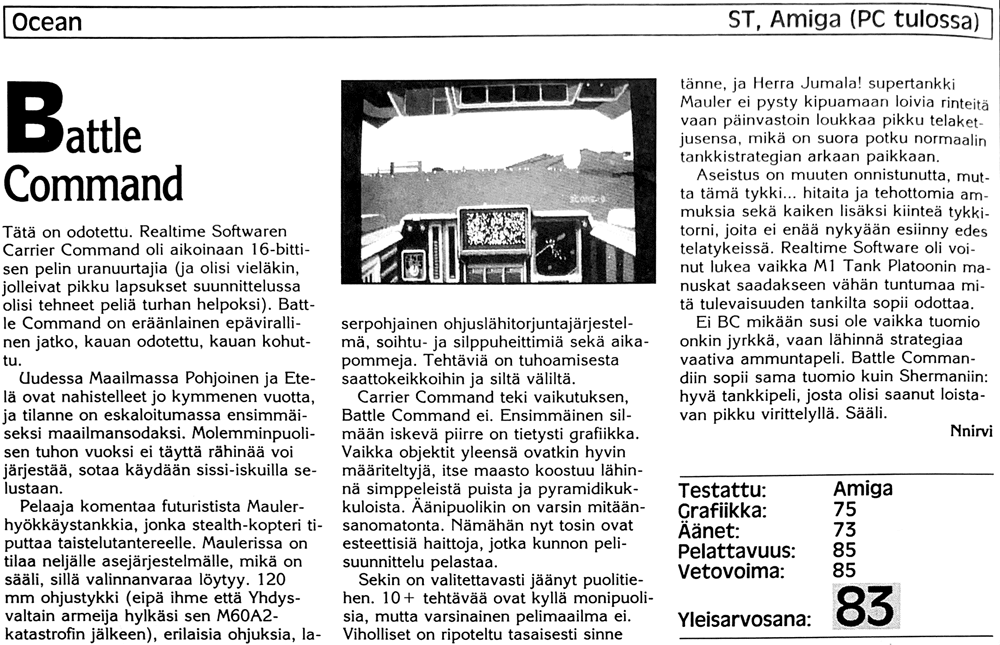
Battle Command1991 KevätPysyvä linkkiTätä on odotettu. Realtime Softwaren Carrier Command oli aikoinaan 16-bittisen pelin uranuurtajia (ja olisi vieläkin, jolleivat pikku lapsukset suunnittelussa olisi tehneet peliä turhan helpoksi). Battle Command on eräänlainen epävirallinen jatko, kauan odotettu, kauan kohuttu.
Uudessa Maailmassa Pohjoinen ja Etelä ovat nahistelleet jo kymmenen vuotta, ja tilanne on eskaloitumassa ensimmäiseksi maailmansodaksi. Molemminpuolisen tuhon vuoksi ei täyttä rähinää voi järjestää, sotaa käydään sissi-iskuilla selustaan.
Pelaaja komentaa futuristista Mauler-hyökkäystankkia, jonka stealth-kopteri tiputtaa taistelutantereelle. Maulerissa on tilaa neljälle asejärjestelmälle, mikä on sääli, sillä valinnanvaraa löytyy. 120 mm ohjustykki (eipä ihme että Yhdysvaltain armeija hylkäsi sen M60A2-katastrofin jälkeen), erilaisia ohjuksia, laserpohjainen ohjuslähitorjuntajärjestelmä, soihtu- ja silppuheittimiä sekä aikapommeja. Tehtäviä on tuhoamisesta saattokeikkoihin ja siltä väliltä.
Carrier Command teki vaikutuksen, Battle Command ei. Ensimmäinen silmään iskevä piirre on tietysti grafiikka. Vaikka objektit yleensä ovatkin hyvin määriteltyjä, itse maasto koostuu lähinnä simppeleistä puista ja pyramidikukkuloista. Äänipuolikin on varsin mitäänsanomatonta. Nämähän nyt tosin ovat esteettisiä haittoja, jotka kunnon pelisuunnittelu pelastaa.
Sekin on valitettavasti jäänyt puolitiehen. 10+ tehtävää ovat kyllä monipuolisia, mutta varsinainen pelimaailma ei. Viholliset on ripoteltu tasaisesti sinne tänne, ja Herra Jumala! supertankki Mauler ei pysty kipuamaan loivia rinteitä vaan päinvastoin loukkaa pikku telaketjusensa, mikä on suora potku normaalin tankkistrategian arkaan paikkaan.
Aseistus on muuten onnistunutta, mutta tämä tykki... hitaita ja tehottomia ammuksia sekä kaiken lisäksi kiinteä tykkitorni, joita ei enää nykyään esiinny edes telatykeissä. Realtime Software oli voinut lukea vaikka M1 Tank Platoonin manuskat saadakseen vähän tuntumaa mitä tulevaisuuden tankilta sopii odottaa.
Ei BC mikään susi ole vaikka tuomio onkin jyrkkä, vaan lähinnä strategiaa vaativa ammuntapeli. Battle Commandiin sopii sama tuomio kuin Shermaniin: hyvä tankkipeli, josta olisi saanut loistavan pikku virittelyllä. Sääli.
Battle Command1991 KevätPermalinkWe've been waiting for this one. Realtime Software's Carrier Command was in its day one of the pioneers of 16-bit gaming (and still would be, if the little kiddies in design hadn't made the game needlessly easy). Battle Command is a sort of unofficial sequel, long awaited, long hyped.
In the New World the North and the South have been squabbling for ten years now, and the situation is escalating into the first world war. Because of mutual destruction, an all-out brawl can't be staged, so the war is fought with guerrilla strikes behind enemy lines.
The player commands a futuristic Mauler assault tank, which a stealth chopper drops onto the battlefield. The Mauler has room for four weapon systems, which is a pity, because there's plenty to choose from. A 120 mm missile gun (no wonder the US Army ditched it after the M60A2 disaster), various missiles, a laser-based close-in missile defence system, flare and chaff launchers, and time bombs. The missions range from destruction jobs to escort gigs and everything in between.
Carrier Command made an impression; Battle Command doesn't. The first thing to hit the eye is, of course, the graphics. Although the objects are generally well defined, the terrain itself consists mostly of simple trees and pyramid hills. The sound side is pretty nondescript too. Then again, these are aesthetic drawbacks that proper game design can rescue.
Sadly, that has been left half-done as well. The 10+ missions are varied, sure, but the actual game world isn't. The enemies are sprinkled evenly here and there, and good Lord! the Mauler supertank can't climb gentle slopes but instead hurts its poor little tracks, which is a kick right where it hurts to normal tank strategy.
The armament is otherwise well done, but this gun... slow and ineffective shells and, on top of everything, a fixed turret, which you don't even find on self-propelled guns these days. Realtime Software could have read, say, the M1 Tank Platoon manuals to get a bit of a feel for what you can expect from a tank of the future.
BC is no dud, even if the verdict is harsh; it's more of a shoot-'em-up that demands strategy. Battle Command deserves the same verdict as Sherman: a good tank game that a little tweaking could have made brilliant. Pity.
Battle Island
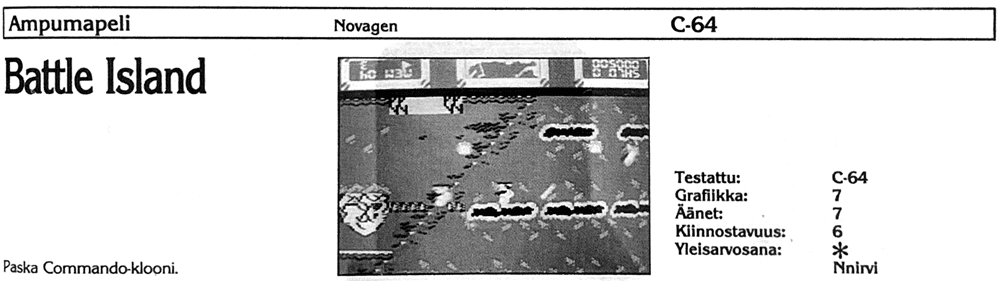
Battle Island1989 KevätPysyvä linkkiPaska Commando-klooni.
Battle Island1989 KevätPermalinkCrap Commando clone.
Battle Master
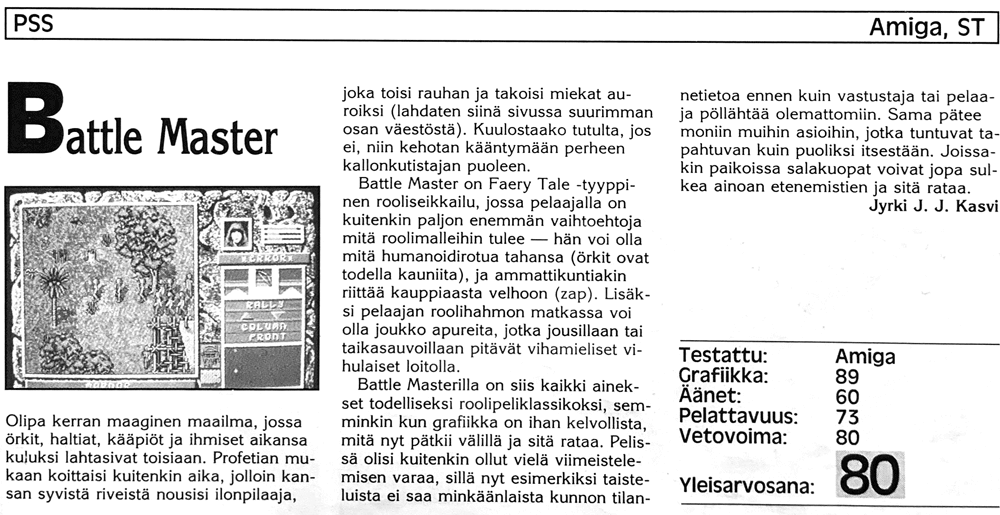
Battle Master1991 KevätPysyvä linkkiOlipa kerran maaginen maailma, jossa örkit, haltiat, kääpiöt ja ihmiset aikansa kuluksi lahtasivat toisiaan. Profetian mukaan koittaisi kuitenkin aika, jolloin kansan syvistä riveistä nousisi ilonpilaaja, joka toisi rauhan ja takoisi miekat auroiksi (lahdaten siinä sivussa suurimman osan väestöstä). Kuulostaako tutulta, jos ei, niin kehotan kääntymään perheen kallonkutistajan puoleen.
Battle Master on Faery Tale -tyyppinen rooliseikkailu, jossa pelaajalla on kuitenkin paljon enemmän vaihtoehtoja mitä roolimalleihin tulee - hän voi olla mitä humanoidirotua tahansa (örkit ovat todella kauniita), ja ammattikuntiakin riittää kauppiaasta velhoon (zap). Lisäksi pelaajan roolihahmon matkassa voi olla joukko apureita, jotka jousillaan tai taikasauvoillaan pitävät vihamieliset vihulaiset loitolla.
Battle Masterilla on siis kaikki ainekset todelliseksi roolipeliklassikoksi, semminkin kun grafiikka on ihan kelvollista, mitä nyt pätkii välillä ja sitä rataa. Pelissä olisi kuitenkin ollut vielä viimeistelemisen varaa, sillä nyt esimerkiksi taisteluista ei saa minkäänlaista kunnon tilannetietoa ennen kuin vastustaja tai pelaaja pöllähtää olemattomiin. Sama pätee moniin muihin asioihin, jotka tuntuvat tapahtuvan kuin puoliksi itsestään. Joissakin paikoissa salakuopat voivat jopa sulkea ainoan etenemistien ja sitä rataa.
Battle Master1991 KevätPermalinkOnce upon a time there was a magical world where orcs, elves, dwarves and humans slaughtered one another to pass the time. According to prophecy, however, a time would come when a killjoy would rise from the rank and file of the common folk, who would bring peace and beat swords into ploughshares (slaughtering most of the population along the way). Does that sound familiar? If not, I suggest you turn to the family headshrinker.
Battle Master is a Faery Tale-type role-playing adventure, but one in which the player has a lot more choice when it comes to role models - you can be any humanoid race you like (the orcs are really beautiful), and there are plenty of professions too, from merchant to wizard (zap). What's more, the player's character can have a band of helpers along for the journey, who keep the hostile baddies at bay with their bows or magic wands.
So Battle Master has all the ingredients of a true role-playing classic, all the more so since the graphics are perfectly passable, apart from being jerky now and then and so on. The game could still have done with some finishing touches, though, since as it is you get no proper idea of how a fight is going, for example, until either the opponent or the player goes poof. The same goes for many other things, which seem to happen half by themselves. In some places pitfalls can even block off the only way forward, and so on.
Battle of Midway
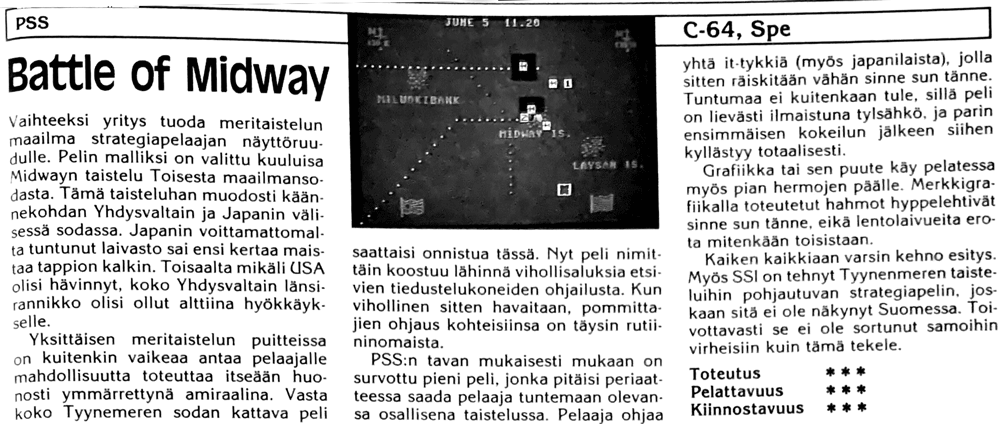
Battle of Midway1987Pysyvä linkkiVaihteeksi yritys tuoda meritaistelun maailma strategiapelaajan näyttöruudulle. Pelin malliksi on valittu kuuluisa Midwayn taistelu Toisesta maailmansodasta. Tämä taisteluhan muodosti käännekohdan Yhdysvaltain ja Japanin välisessä sodassa. Japanin voittamattomalta tuntunut laivasto sai ensi kertaa maistaa tappion kalkin. Toisaalta mikäli USA olisi hävinnyt, koko Yhdysvaltain länsirannikko olisi ollut alttiina hyökkäykselle.
Yksittäisen meritaistelun puitteissa on kuitenkin vaikeaa antaa pelaajalle mahdollisuutta toteuttaa itseään huonosti ymmärrettynä amiraalina. Vasta koko Tyynemeren sodan kattava peli saattaisi onnistua tässä. Nyt peli nimittäin koostuu lähinnä vihollisaluksia etsivien tiedustelukoneiden ohjailusta. Kun vihollinen sitten havaitaan, pommittajien ohjaus kohteisiinsa on täysin rutiininomaista.
PSS:n tavan mukaisesti mukaan on survottu pieni peli, jonka pitäisi periaatteessa saada pelaaja tuntemaan olevansa osallisena taistelussa. Pelaaja ohjaa yhtä it-tykkiä (myös japanilaista), jolla sitten räiskitään vähän sinne sun tänne. Tuntumaa ei kuitenkaan tule, sillä peli on lievästi ilmaistuna tylsähkö, ja parin ensimmäisen kokeilun jälkeen siihen kyllästyy totaalisesti.
Grafiikka tai sen puute käy pelatessa myös pian hermojen päälle. Merkkigrafiikalla toteutetut hahmot hyppelehtivät sinne sun tänne, eikä lentolaivueita erota mitenkään toisistaan.
Kaiken kaikkiaan varsin kehno esitys. Myös SSI on tehnyt Tyynenmeren taisteluihin pohjautuvan strategiapelin, joskaan sitä ei ole näkynyt Suomessa. Toivottavasti se ei ole sortunut samoihin virheisiin kuin tämä tekele.
Battle of Midway1987PermalinkHere, for a change, is an attempt to bring the world of naval warfare to the strategy gamer's screen. The model chosen for the game is the famous Battle of Midway from the Second World War. This battle, as we know, was the turning point in the war between the United States and Japan. Japan's seemingly invincible navy got its first taste of the bitter cup of defeat. On the other hand, had the USA lost, the entire west coast of the United States would have been open to attack.
Within the confines of a single naval battle, however, it is hard to give the player a chance to fulfil themselves as a misunderstood admiral. Only a game covering the entire Pacific War might pull that off. As it is, the game consists mainly of steering reconnaissance planes around in search of enemy ships. When the enemy is finally spotted, guiding the bombers to their targets is utterly routine.
As is PSS's habit, a little mini-game has been crammed in, which in principle is supposed to make the player feel part of the battle. The player controls a single anti-aircraft gun (a Japanese one as well), which is then used to blast away a bit here, there and everywhere. The feeling never arrives, though, since the game is, to put it mildly, on the dull side, and after the first couple of tries you get totally fed up with it.
The graphics, or the lack of them, also soon start getting on your nerves while playing. The figures, done in character graphics, hop about here and there, and there is no way whatsoever to tell the air squadrons apart.
All in all, a pretty feeble performance. SSI has also made a strategy game based on the Pacific battles, though it hasn't been seen in Finland. Hopefully it hasn't fallen into the same mistakes as this sorry effort.
Battle of the Planets
Battle of the Planets1987Pysyvä linkkiVanha kunnon Zoltar (kuka?) on keksinyt tuhota koko ihmiskunnan minun aurinkokunnassani, kertoo viesti... On aika hyvästellä rakkaimmat, postittaa muistokirjoitus lehteen, taputtaa Cobra Mk. III:sta ja hypätä Phoenix-hävittäjän hyttiin. Turbo täysille ja ulkoavaruuteen! Ja mitä siellä näkyykään? Uskomattoman hyvännäköisiä viivagrafiikalla toteutettuja vihollishävittäjiä. Käytännöllinen tutka kertoo vihollisten, kotiplaneetan ja yliavaruusportin sijainnin, joten lähin vihollinen tähtäimiin ja firenappulan painalluksella laserini vähentävät Zoltarin palkkakuluja. Epätoivoisesti koetti raukka väistellä mutta ei auttanut ei.
Kuten Elitessäkin, viholliset kestävät vaihtelevan määrän osumia, joten kylmästi osun useita kertoja. FOMP! ympyränmuotoinen tulipallo leviää ja voin vetää viivan laserin kahvaan. Jottei vihollinen kyllästy, tapan pari seuraavaa neutroniohjuksilla. Selatessani statusruutujani (suojakentät, moottorit, planeetta, ohjukset, laserit) huomaan suojakenttien olevan keltaisella ja onpa muutama vihollinen ehtinyt laskeutua kotiplaneetalleni tuhoten hulppeat 60 % asukkaista. Siispä kurssi kohti Xenathia korjauksia varten. Näyttö vaihtuu planeetan pinnaksi. Planeetalla ovat tankkeri- ja korjausalukset ja tällä kertaa siis myös vihollistankit, jotka ihme ja kumma tuhoavat minut ennenkuin ehdin pelastaa loput neljä planeettaa.
Battle of the Planets pohjautuu ohjeista päätellen Englannissa pyörivään tv-sarjaan. Mikään Elite II se ei ole. Onpahan kuitenkin erittäin hyvin tehty ja kulutusta kestävä ampumapeli, jossa on mukana ripaus realismia. BOP on valittu kilpailupeliksi "National Computer Games Championship" -kilpailuun, joten laatupelistä on kysymys.
Battle of the Planets1987PermalinkGood old Zoltar (who?) has hit on the idea of wiping out all of humanity in my solar system, says the message... Time to say goodbye to my nearest and dearest, mail my obituary to the paper, give the Cobra Mk. III a pat and jump into the cockpit of the Phoenix fighter. Turbo to full and off into outer space! And what do we see out there? Incredibly good-looking enemy fighters done in wireframe graphics. A handy radar shows the positions of the enemies, the home planet and the hyperspace gate, so the nearest enemy goes in the sights, and at a press of the fire button my lasers trim Zoltar's wage bill. The poor wretch tried desperately to dodge, but it did him no good, no sir.
As in Elite, the enemies can take a varying number of hits, so I coolly hit them several times. FOMP! A circular fireball spreads out and I can carve a notch in the laser's grip. So that the enemy doesn't get bored, I kill the next couple with neutron missiles. Flicking through my status screens (shields, engines, planet, missiles, lasers) I notice the shields are on yellow, and what do you know, a few enemies have managed to land on my home planet, wiping out a whopping 60% of the inhabitants. So, set course for Xenath for repairs. The screen changes to the surface of the planet. On the planet are the tanker and repair ships, and this time, then, the enemy tanks as well, which, wonder of wonders, destroy me before I get the chance to save the remaining four planets.
Judging by the instructions, Battle of the Planets is based on a TV series showing in England. It's no Elite II. Still, it is a very well made, hard-wearing shoot-'em-up with a dash of realism thrown in. BOP has been chosen as a competition game for the "National Computer Games Championship", so this is a quality game we're talking about.
Battle Out Run

Battle Out Run1990 SyksyPysyvä linkkiEnsin Out Run, sitten sama turbona ja nyt taisteluversiona. On suunnittelijoilla sentään ollut sen verran mielikuvitusta, ettei pelien nimiksi ole pistetty Out Run ykkönen, kakkonen ja kolmonen. BOR on kuin riisuttu versio Chase H.Q.:sta, joka sekin on julkaistu Segalle, mutta huomattavasti pelattavampi ja grafiikaltaan aivan toista luokkaa.
Idea on tuttu: istahdat turboviritellyn bensahirviön rattiin ja alat kaasutella kiinni edellä kiitävää lainrikkojaa väistellen matelevia kuplavolkkareita, öljyläikkiä ja tiesulkuja. Etappien päätteeksi on mahdollisuus viritellä autoonsa uusia ominaisuuksia, kuten lisää tehoa kaasuttimeen, parempi moottori, pitävämmät renkaat ja tukevampi kori roiston romuttamista varten. Ainoa kertakäyttöinen ostos on turboahtimen kurkkuun kaadettava nitro.
Sulavasti mutkittelevalla kolmikaistaisella tiellä syksyvän punaisen Ferrarin ohjauksessa on mainio tuntuma, tosin auto liikkuu sivusuunnassa niin hitaasti, että mutkan takaa eteen singahtavia hidastelijoita ei aina kerkiä väistää. Onneksi pientareen kautta koukkiminen ei mitenkään olennaisesti häiritse matkantekoa. Vaikeustaso on hiottu todella tarkkaan. Kun rosmon vihdoin saa kiinni ja sitä alkaa töniä romuksi, toimituksesta kehkeytyy yleensä hermoja riipivä sekunttipeli.
Moduulin lykkää mielellään koneeseen pelkästään ajamisen vuoksi. Kunhan Sega vielä viitsisi pistää mukaan kumpuilevaa maastoa, kuten Nintendon Rad Racerissa, tuloksena olisi huippuluokan autoilupeli.
Battle Out Run1990 SyksyPermalinkFirst Out Run, then the same thing as a turbo, and now as a battle version. The designers have at least had enough imagination not to name the games Out Run 1, 2 and 3. BOR is like a stripped-down version of Chase H.Q., which has also been released for the Sega, but it is considerably more playable and in a completely different class graphically.
The idea is familiar: you plonk yourself behind the wheel of a turbo-tuned petrol monster and put your foot down to catch the lawbreaker speeding ahead, dodging crawling VW Beetles, oil slicks and roadblocks. At the end of each stage you get the chance to tune new features into your car, like more power to the carburettor, a better engine, grippier tyres and a sturdier body for smashing the villain to scrap. The only single-use purchase is the nitro you pour down the turbocharger's throat.
On the smoothly winding three-lane road the throbbing red Ferrari handles with a splendid feel, though the car moves sideways so slowly that you can't always dodge the dawdlers that shoot out in front of you from around a bend. Luckily, cutting round them via the hard shoulder doesn't really hold you up at all. The difficulty level has been honed really precisely. When you finally catch the crook and start shunting it into scrap, the proceedings usually turn into a nerve-shredding game of seconds.
You'll happily shove the cartridge into the machine for the driving alone. If only Sega could also be bothered to throw in some rolling terrain, as in Nintendo's Rad Racer, the result would be a top-class driving game.
Battle Squadron
Battle Squadron1990 KevätPysyvä linkkiBattle Squadron on, kuten nimikin enteilee, shoot'em-up ja vielä aivan tavallinen ylöspäin scrollaava ammuskelupeli. Ei pahemmin herätä kiinnostusta, vai? No, asiaan vihkiytyneet alkavat herätä, kun kerrotaan, että peli on oikeastaan Hybris II. Siltä varalta, ettei joku Hybristä tunne, kerrottakoon että se oli tasokas ammuskelupeli varustettuna hienoilla grafiikoilla, upeilla efekteillä ja hyvällä musiikilla.
Pelin alku ei herätä minkäänäköistä pelonsekaista kunnioitusta ohjelmoijaa kohtaan. Pelaajan oma alus ei näytä erikoiselta, vaikka onkin hyvin animoitu. Taustatkaan eivät näytä ihmeemmiltä. Mukava soundtrack junnaa taustalla. Mutta hetken pelailun jälkeen käykin ilmi, ettei tämä pelituokio jääkään kovin lyhyeksi.
Pelin tarkoituksena on tuhota paha Barraxin Imperiumi. Ensin kierrellään Barraxin planeetan pintaa ja sitten tunkeudutaan syvemmälle maan sisään vähän väliä vastaan tulevista aukoista. Kun maanalainen osa on tuhottu, noustaan taas pinnalle, etsitään uusi aukko, mennään alas ja sitä rataa. Näihin maanalaisiin osiin menemisellä ei kannata pitää kiirettä, sillä sieltä löytyvät todella isot (myös todella hyvin tehdyt) alienit, joihin ei mikään pikkulaser pure. Kannattaa siis kierrellä planeetan pintaa niin kauan, että hal lussa on todella hyvät aseet.
Pelaajan alus liitelee yli hyvin tehdyn likaisenvihreän kraaterien pilkuttaman maaston. Vastaan tulee jos jonkin moista vihollista, ja piankos tulee ensimmäinen tilaisuus saada lisäaseita: isomman puoleinen vihollisalus jättää jälkeensä pienen värikkään laatikon, jonka pelaaja sitten kerää. Pelaajan kannattaa odottaa, että "lisäaselaatikko" vaihtaa väriä, ja sitten kerätä värin mukaisen lisäaseen, sillä kaikki aseet eivät pure tiettyihin vihollisiin yhtä hyvin kuin toiset.
Aseita on neljää eri perusmallia: oranssit tulipallot, siniset ja vihreät laserit sekä joka suuntaan lähtevät punaiset pallot. Perusmalleista löytyy todella monta eritehoista ja -näköistä muunnosta. Yksi BS:n parhaista puolista on todella upeat ja monipuoliset lisäaseet. Käytössä on myös Nova Missile, eräänlainen smart bomb, joita aluksi on käytössä kolme. Lisää saa tietysti kerättyä.
Koska pelikenttä on leveämpi kuin monitori, kentästä nähdään vain kapea siivu kerrallaan, joten scrollaus voi tapahtua myös sivuille. Myös yhtäaikainen kaksinpeli on mahdollista, joskin tämä aiheuttaa taistoja myös toisella puolella ruutua, kun pelaajat "keskustelevat" kummalle se lisäase loppujen lopuksi kuuluui. Hämmennystä voi saada aikaan sekin, että kumpainenkin pelajaa tempoo ruutua omaan suuntaansa.
BS:n kiitettävin puoli on upeat efektit, joihin luetaan niin mahtavat lisäaseet kuin erinäiset pikkutemput, jotka lisäävät kiinnostusta peliin mahtavasti. Näistä mainittakoon silloin tällöin vastaa tuleva vihollinen, joka tuo mieleen hirviön elokuvasta Predator.
Battle Squadron on ostamisen arvoinen peli, johon kiinnostus ei ihan heti lopu. Itse havaitsin silmät verestäen pelanneeni monta tuntia putkeen, vaikken erityisemmin shoot'em-upeista pidäkään.
Battle Squadron1990 KevätPermalinkBattle Squadron is, as the name suggests, a shoot'em-up, and a perfectly ordinary upward-scrolling shooter at that. Doesn't exactly wake up your interest, does it? Well, the initiated start waking up when they're told that the game is actually Hybris II. In case someone doesn't know Hybris, let it be said that it was a high-quality shooter equipped with fine graphics, superb effects and good music.
The start of the game doesn't inspire any sort of awe towards the programmer. The player's own ship doesn't look like anything special, though it is well animated. The backgrounds don't look like much either. A pleasant soundtrack chugs along in the background. But after playing for a while it turns out that this gaming session isn't going to be a short one after all.
The aim of the game is to destroy the evil Barrax Empire. First you cruise around the surface of the Barrax planet and then you burrow deeper underground through the openings that keep turning up. Once an underground section has been destroyed, you rise to the surface again, look for a new opening, go down, and so on. There's no point hurrying into these underground sections, since that's where you'll find the really big (and also really well made) aliens that no puny little laser will make a dent in. So it pays to cruise around the planet's surface until you've got some really good weapons in hand.
The player's ship glides over well-made, dirty-green terrain dotted with craters. All sorts of enemies come at you, and before you know it the first chance to get extra weapons comes along: a biggish enemy ship leaves behind a small colourful box, which the player then collects. The player would do well to wait for the "extra weapon box" to change colour and then collect the extra weapon matching that colour, since not all weapons bite on certain enemies as well as others do.
There are four basic types of weapon: orange fireballs, blue and green lasers, and red balls that fly off in every direction. The basic types come in a great many variants of differing power and looks. One of BS's best points is the really superb and versatile extra weapons. There's also the Nova Missile, a kind of smart bomb, of which you have three at the start. More can be collected, of course.
Since the playfield is wider than the monitor, you only see a narrow slice of it at a time, so the screen can also scroll sideways. Simultaneous two-player play is possible too, though this leads to battles on the other side of the screen as well, as the players "discuss" who that extra weapon really belonged to in the end. Confusion can also be caused by each player yanking the screen in their own direction.
BS's most praiseworthy aspect is the superb effects, which include both the mighty extra weapons and various little tricks that add hugely to the interest of the game. Of these, let's mention the enemy that turns up every now and then and brings to mind the monster from the film Predator.
Battle Squadron is a game worth buying, and your interest in it won't run out any time soon. I myself found, with bloodshot eyes, that I had played for many hours straight, even though I'm not especially fond of shoot'em-ups.
Battle Through Time
Battle Through Time1987Pysyvä linkkiAnirogin Battle Through Timessä ohjataan erikoisvalmisteista autoa, joka on varustettu asein. Pelissä on tehtävänä ampua kaikkea liikkuvaa.
Peli alkaa ensimmäisesta maailmansodasta, jossa vastuksena on rätiseviä kaksitasolentokoneita. Selvitettyään kaksitasokoneiden aiheuttaman vastuksen pelaaja siirtyy ajassa eteenpäin toiseen maailmansotaan, jossa kaksitasokoneet vaihtuvat 1940-luvun taistelukoneisiin. 1940-luvun lentokoneet pudottavat pommiryöppyjä yrittäen estää etenemistä Korean sotaan.
Korean sodassa korealaiset pommittajat uhkaavat pelaajan tulevaisuutta. Väisteltyään tai tuhottuaan pommittajat pelaaja siirtyy jälleen ajassa eteenpäin, tosin ei kovin pitkää harppausta tällä kertaa: Vietnamin sotaan.
Vietnamin sodan helikopterit ovat valmiita ampumaan pelaajan minä hetkenä hyvänsä. Kun on välttänyt helikopterin uhkan siirrytään kolmanteen maailmansotaan, jossa erilaiset satelliitit uhkaavat pelaajaa. Selvitettyään satelliittien uhkan koko maailma räjähtää ja pelaajaa vastassa on erilaisia sotamuunnoksia. Niiden jälkeen tulee pelaajaa vastaan erilaisia alkukantaisia hirviöitä. Alkukantaisten hirviöiden jakson lopussa on tyrannosaurus Rex. Tästä pelin testaaja ei enää selvinnytkään.
Battle Through Time kuuluu sarjaan moonbuggypelit. Pelin grafiikka on hieman tavallista moonbuggytasoa parempaa. Pelin äänet ovat perustasoa. Tehosteina on pamahduksia ja muita rysähdyksiä. Pelin kiinnostavuus häipyy yhdessä illassa, koska peliä voi jatkaa samasta tilanteesta, johon jäi. Kokonaisuutena peli on huono ostos sinänsä, koska siihen kyllästyy nopeasti.
Battle Through Time1987PermalinkIn Anirog's Battle Through Time you drive a specially built car fitted with weapons. Your task in the game is to shoot everything that moves.
The game begins in the First World War, where the opposition consists of rattling biplanes. Having dealt with the resistance put up by the biplanes, the player moves forward in time to the Second World War, where the biplanes give way to 1940s fighter planes. The 1940s aircraft drop showers of bombs, trying to stop you from advancing to the Korean War.
In the Korean War, Korean bombers threaten the player's future. After dodging or destroying the bombers, the player once again moves forward in time, though not by a very long leap this time: to the Vietnam War.
The helicopters of the Vietnam War are ready to shoot the player at any moment. Once you have avoided the helicopter threat, you move on to the Third World War, where various satellites threaten the player. Once the satellite threat has been dealt with, the whole world explodes and the player faces assorted war mutations. After them, various primeval monsters come at the player. At the end of the primeval monster stage there is a Tyrannosaurus rex. The game's tester never made it past this one.
Battle Through Time belongs to the moonbuggy game category. Its graphics are slightly better than the usual moonbuggy standard. The sound is basic. The effects consist of bangs and other crashes. The game's interest evaporates in a single evening, because you can carry on from the same point where you left off. As a whole the game is a poor buy in itself, since you soon get bored with it.
Battle Valley
Battle Valley1990 KevätPysyvä linkkiBattle Valley on alkujaan kuusnepalle ohjelmoitu halpapeli, joten on aika mielenkiintoista, että se on vaivauduttu kääntämään 16-bittisille. Nykyäänhän on enemmän sääntö kuin poikkeus, että ensin pelit suunnitellaan ST-Amigalla ja sitten sullotaan väkisin kasibittisiin pikkuveljiin.
Pelin taustajuoni tarinoi jotain terroristeista, ydinohjuksista ja muista sen tapaisista asioista, joten ilmeisesti on taas aika kaivaa sotakalusto esiin komerosta.
Peli tapahtumat etenevät kahdessa vaiheessa: ensiksi on kerättävä ponttooneita helikopterin vakiovarusteisiin kuuluvalla vinssillä ja korjattava tuhoutuneet sillat. Samalla siistitään kukkuloiden rinteitä ylimääräisestä roinasta sekä tarpeen vaatiessa hinataan ylös polttoainetta ja ammuksia. Tämän jälkeen voi huristella terroristien päämajaan tankilla, joka seurailee hauskasti kukkuloiden topologista struktuuria (siis pintaa). Kiusana on tiukka aikaraja, jonka umpeuduttua pahat terroristit tuhoavat maailman. Olisi mielenkiintoista tietää, miten se onnistuu kahdella keskimatkan ydinohjuksella. Jos ne olisivat mannertenvälisiä, niin looginen ratkaisu olisi tähdätä yksi kummallekin napajäätikölle (Will you shut up Mr Spock!).
Teknisessä mielessä pelin toteutuksessa ei ole moittimista. Tausta vierii kauniisti kolmessa kerroksessa eikä ylimääräisiä nylkytyksiä löydy etsimälläkään. Mutta pelin sisältö antaa vähän aneemisen ensivaikutelman: lennellään helikopterilla oikealla tai vasemmalle ja ammutaan silloin tällöin pari laukausta. Tankkiosuus on vieläkin tylsempi.
Sama säästeliäs ote jatkuu grafiikassa, jonka yleisilme on yksitoikkoinen ja väritykseltään maanläheinen (paitsi taivas, jonka sininen sävytys on oikein kaunis). Äänitehosteetkaan eivät paljon keskitason yli yllä, mutta musiikki on sentään ihan kuunneltavaa.
Kovan linjan räiskintäpeliksi Battle Valleysta ei ole, sillä se on kuin leppoisaa sunnuntaikävelyä jonkun Silkwormin rinnalla, mutta kokonaisuutena se on kiinnostavasti rakennettu. Saman kuvion loputon hierominen pudottaa kuitenkin vähitellen kiinnostavuuden samalle tasolle kuin kolmelta yöllä tulevat TV-ohjelmat.
Hohhoijaa, nyt tämäpoika resetoi Amigan ja karistaa unet silmistään heittämällä levyasemaan jotain repäisevämpää, kuten Datastormin.
Battle Valley1990 KevätPermalinkBattle Valley was originally a budget game programmed for the C-64, so it's rather interesting that somebody bothered to convert it to the 16-bit machines. After all, these days it's more the rule than the exception that games are first designed on the ST and Amiga and then crammed by brute force into their 8-bit little brothers.
The game's backstory spins some yarn about terrorists, nuclear missiles and other things of that sort, so apparently it's time once again to dig the war gear out of the closet.
The game's events unfold in two stages: first you have to collect pontoons with the winch that comes as standard equipment on the helicopter and repair the destroyed bridges. At the same time you tidy the hillsides of surplus junk and, when need be, haul up fuel and ammo. After that you can go cruising off to the terrorists' headquarters in a tank that amusingly follows the topological structure of the hills (meaning the surface). To add to the torment there's a tight time limit, and once it runs out the evil terrorists destroy the world. It would be interesting to know how they manage that with two medium-range nuclear missiles. If they were intercontinental, the logical solution would be to aim one at each polar ice cap (Will you shut up Mr Spock!).
Technically speaking, there's nothing to fault in the way the game has been done. The background scrolls beautifully in three layers, and you won't find any stray judder even if you go looking for it. But the game's content gives a somewhat anaemic first impression: you fly the helicopter right or left and fire off a couple of shots every now and then. The tank section is even duller.
The same frugal approach carries on in the graphics, whose overall look is monotonous and down-to-earth in its colouring (except for the sky, whose blue shading is really lovely). The sound effects don't rise much above average either, but the music is at least perfectly listenable.
Battle Valley isn't cut out to be a hardline shoot'em-up, since next to the likes of Silkworm it's a leisurely Sunday stroll, but as a whole it's interestingly put together. Endlessly grinding through the same routine, though, gradually drags the interest down to the level of the TV programmes that come on at three in the morning.
Yaaawn. Right, this boy is resetting the Amiga and shaking off the sleep by tossing something a bit more rip-roaring into the disk drive, like Datastorm.
Battlechess
Battlechess1989 KevätPysyvä linkkiMissä valkoinen aloittaa aina (paitsi Etelä-Afrikassa)? No shakissapa tietenkin. Tämän pelin pyhät rituaalit ovat jo satoja vuosia ylväinä, pystyinpäin uhmanneet kaikkia muutoksia. Tähän asti. Nyt Bard's Taleista tuttu Interplay aivan kirjaimellisesti herättää shakin eloon tuoden mukaan seksiä, huumoria ja väkivaltaa.
Kuten me kaikki tiedämme pohjautuu Battlechess tunnettuun lautapeliin, jonka nykyinen maailmanmestari on Garri "Gasp!"Arov. Shakin säännöt selviävät "Maailman uskonnot" -kirjasta, joten keskitytäänpä tähän uusimpaan versioon.
Esitin joskus vaatimattoman toivomuksen shakista, jossa syöminen (tarkoittaa nappulan poistamista laudalta) olisi animoitu. Interplaykin nähtävästi lukee C=lehteä. Jokainen nappula on upeasti elävöitetty ja kun kaksi nappulaa kohtaa seuraa kiva taistelu. Esimerkkinä mainittakoon kahden ratsun (knight in english) kohtaaminen, jolloin voittaja katkoo häviäjältä kaikki raajat, yksi kerrallaan, aivan kuten elokuvassa "Monty Python & Holy Grail". Animaatiota löytyy vielä neljän megatavun edestä, joten esimerkit loppuvat tähän.
Grafiikka on todella, todella hyvää ja digitoidut efektit antavat vielä lisäpuhtia. Nappuloiden kuolema ja sen tuottamus vaihtuu aina sen mukaan mitkä nappulat kohtaavat, joten dramaattisia kuolinkohtauksia on ihan kiitettävästi. Kuulemma Battlechess myös pelaa hyvin, joten ilo ei rajoitu vain näytöksestä nauttimiseen. Shakkiin vakavasti suhtautuvat voivat vaihtaa ruudun sisällön normaaliksi elottomaksi kaksiulotteiseksi laudaksi, jos pyhäinhäväistys käy kestämättömäksi.
Ihmetyttää vain kenelle Battlechess on suunnattu. Peliä harrastamattomat pelaavat muutaman kierroksen grafiikan lumoissa, mutta shakki on shakki vaikka grafiikassa paistaisi. Shakki-Matit taas vihastuvat huumorin yhdistämisestä pyhään harrastukseensa ja minäpoika en ristinollasta luovu, mutta kiitos kaikille Chessmaster-arvostelun johdosta kirjoittaneille.
Battlechess1989 KevätPermalinkWhere does white always go first (apart from South Africa)? Why, in chess, of course. For hundreds of years the sacred rituals of this game have proudly defied all change, heads held high. Until now. Now Interplay, familiar from the Bard's Tales, is quite literally bringing chess to life, and bringing sex, humour and violence along with it.
As we all know, Battlechess is based on a well-known board game whose current world champion is Garri "Gasp!"Arov. The rules of chess can be found in the book "World Religions", so let's concentrate on this latest version.
I once expressed a modest wish for a chess game in which capturing (meaning removing a piece from the board) would be animated. Apparently Interplay reads C=lehti too. Every piece is superbly animated, and when two pieces meet, a nice fight follows. By way of example, take the meeting of two horses (knight in English), where the winner hacks off all of the loser's limbs, one at a time, just like in the film "Monty Python & Holy Grail". There's another four megabytes' worth of animation, so the examples stop here.
The graphics are really, really good, and the digitised effects give an extra boost on top. The death of a piece, and the way it's dealt out, always change depending on which pieces meet, so there's a very commendable number of dramatic death scenes. Word has it Battlechess also plays well, so the fun isn't limited to just enjoying the show. Those who take chess seriously can switch the screen to a normal lifeless two-dimensional board if the sacrilege becomes unbearable.
The only thing that puzzles me is who Battlechess is aimed at. People who don't play chess will play a few rounds under the spell of the graphics, but chess is chess even if you fry it in graphics. The Check-Mates, on the other hand, will be incensed at humour being mixed into their sacred hobby, and this boy isn't giving up noughts and crosses, but thanks to everyone who wrote in about the Chessmaster review.
Battlefield Germany
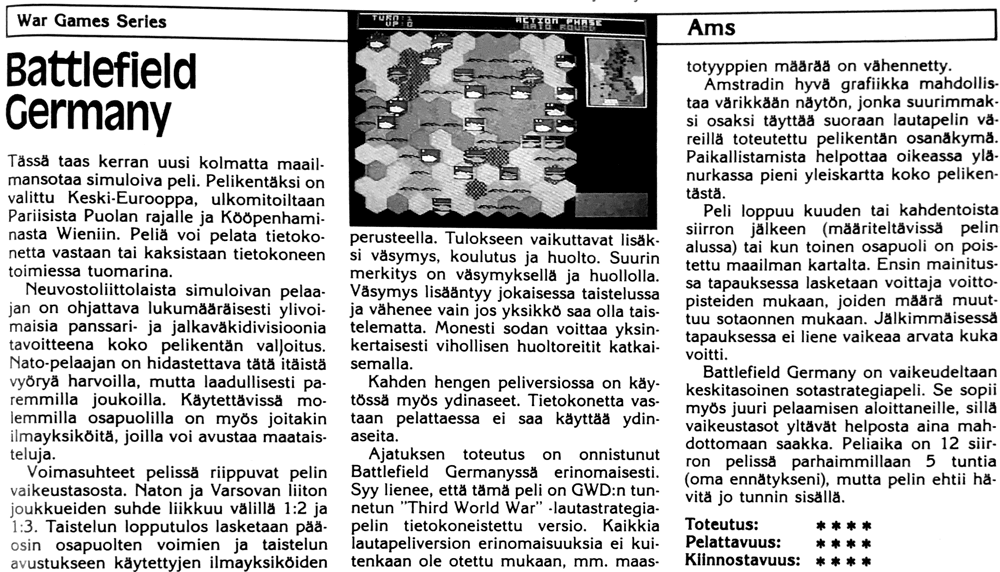
Battlefield Germany1987Pysyvä linkkiTässä taas kerran uusi kolmatta maailmansotaa simuloiva peli. Pelikentäksi on valittu Keski-Eurooppa, ulkomitoiltaan Pariisista Puolan rajalle ja Kööpenhaminasta Wieniin. Peliä voi pelata tietokonetta vastaan tai kaksistaan tietokoneen toimiessa tuomarina.
Neuvostoliittolaista simuloivan pelaajan on ohjattava lukumääräisesti ylivoimaisia panssari- ja jalkaväkidivisioonia tavoitteena koko pelikentän valloitus. Nato-pelaajan on hidastettava tätä itäistä vyöryä harvoilla, mutta laadullisesti paremmilla joukoilla. Käytettävissä molemmilla osapuolilla on myös joitakin ilmayksiköitä, joilla voi avustaa maataisteluja.
Voimasuhteet pelissä riippuvat pelin vaikeustasosta. Naton ja Varsovan liiton joukkueiden suhde liikkuu välillä 1:2 ja 1:3. Taistelun lopputulos lasketaan pääosin osapuolten voimien ja taistelun avustukseen käytettyjen ilmayksiköiden perusteella. Tulokseen vaikuttavat lisäksi väsymys, koulutus ja huolto. Suurin merkitys on väsymyksellä ja huollolla. Väsymys lisääntyy jokaisessa taistelussa ja vähenee vain jos yksikkö saa olla taistelematta. Monesti sodan voittaa yksinkertaisesti vihollisen huoltoreitit katkaisemalla.
Kahden hengen peliversiossa on käytössä myös ydinaseet. Tietokonetta vastaan pelattaessa ei saa käyttää ydinaseita.
Ajatuksen toteutus on onnistunut Battlefield Germanyssä erinomaisesti. Syy lienee, että tämä peli on GWD:n tunnetun "Third World War" -lautastrategiapelin tietokoneistettu versio. Kaikkia lautapeliversion erinomaisuuksia ei kuitenkaan ole otettu mukaan, mm. maastotyyppien määrää on vähennetty.
Amstradin hyvä grafiikka mahdollistaa värikkään näytön, jonka suurimmaksi osaksi täyttää suoraan lautapelin väreillä toteutettu pelikentän osanäkymä. Paikallistamista helpottaa oikeassa ylänurkassa pieni yleiskartta koko pelikentästä.
Peli loppuu kuuden tai kahdentoista siirron jälkeen (määriteltävissä pelin alussa) tai kun toinen osapuoli on poistettu maailman kartalta. Ensin mainitussa tapauksessa lasketaan voittaja voittopisteiden mukaan, joiden määrä muuttuu sotaonnen mukaan. Jälkimmäisessä tapauksessa ei liene vaikeaa arvata kuka voitti.
Battlefield Germany on vaikeudeltaan keskitasoinen sotastrategiapeli. Se sopii myös juuri pelaamisen aloittaneille, sillä vaikeustasot yltävät helposta aina mahdottomaan saakka. Peliaika on 12 siirron pelissä parhaimmillaan 5 tuntia (oma ennätykseni), mutta pelin ehtii hävitä jo tunnin sisällä.
Battlefield Germany1987PermalinkHere, once again, is a new game simulating the Third World War. The playing field chosen is Central Europe, its outer limits running from Paris to the Polish border and from Copenhagen to Vienna. The game can be played against the computer or by two players with the computer acting as referee.
The player simulating the Soviets must command numerically superior armoured and infantry divisions, the aim being to conquer the whole playing field. The NATO player has to slow down this onslaught from the east with few but qualitatively superior troops. Both sides also have some air units at their disposal, which can be used to support the ground battles.
The balance of forces in the game depends on the difficulty level. The ratio of NATO to Warsaw Pact forces ranges between 1:2 and 1:3. The outcome of a battle is calculated mainly on the basis of the two sides' strengths and the air units used to support the battle. The result is also affected by fatigue, training and supply. Fatigue and supply matter most. Fatigue increases with every battle and only decreases if the unit is allowed to stay out of combat. Often the war can be won simply by cutting the enemy's supply lines.
In the two-player version nuclear weapons are available too. When playing against the computer, you are not allowed to use nuclear weapons.
The idea has been carried out excellently in Battlefield Germany. The reason is probably that this game is a computerised version of GDW's well-known "Third World War" strategy board game. Not all the fine points of the board game version have been brought over, though; for instance, the number of terrain types has been reduced.
The Amstrad's good graphics make for a colourful display, most of which is filled by a partial view of the playing field done straight in the colours of the board game. Finding your bearings is made easier by a small overview map of the whole playing field in the top right-hand corner.
The game ends after six or twelve turns (set at the start of the game) or when one side has been wiped off the map of the world. In the former case the winner is determined by victory points, the number of which changes with the fortunes of war. In the latter case it probably isn't hard to guess who won.
Battlefield Germany is a war strategy game of medium difficulty. It also suits those who have only just taken up gaming, since the difficulty levels range all the way from easy to impossible. A 12-turn game lasts 5 hours at the most (my own record), but you can manage to lose the game within an hour.
BattleForce
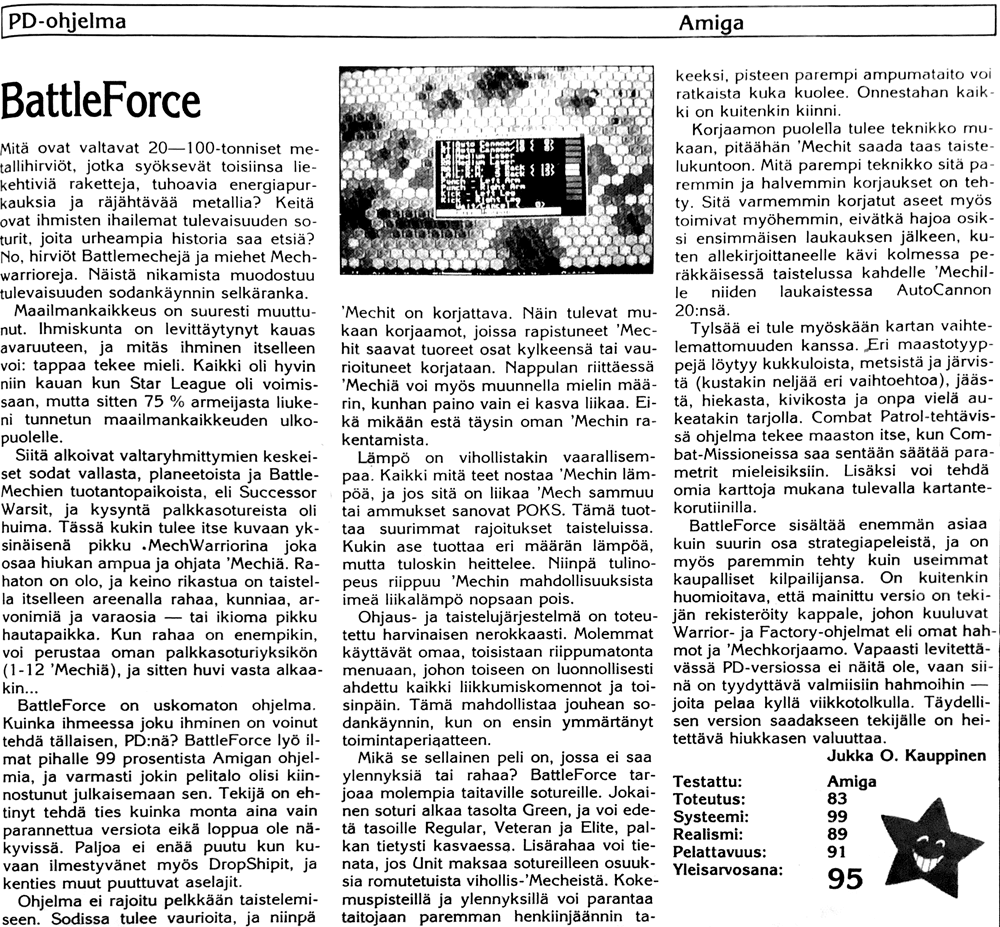
BattleForce1990 SyksyPysyvä linkkiMitä ovat valtavat 20-100-tonniset metallihirviöt, jotka syöksevät toisiinsa liekehtiviä raketteja, tuhoavia energiapurkauksia ja räjähtävää metallia? Keitä ovat ihmisten ihailemat tulevaisuuden soturit, joita urheampia historia saa etsiä? No, hirviöt Battlemechejä ja miehet Mechwarrioreja. Näistä nikamista muodostuu tulevaisuuden sodankäynnin selkäranka.
Maailmankaikkeus on suuresti muuttunut. Ihmiskunta on levittäytynyt kauas avaruuteen, ja mitäs ihminen itselleen voi: tappaa tekee mieli. Kaikki oli hyvin niin kauan kun Star League oli voimissaan, mutta sitten 75 % armeijasta liukeni tunnetun maailmankaikkeuden ulkopuolelle.
Siitä alkoivat valtaryhmittymien keskeiset sodat vallasta, planeetoista ja BattleMechien tuotantopaikoista, eli Successor Warsit, ja kysyntä palkkasotureista oli huima. Tässä kukin tulee itse kuvaan yksinäisenä pikku .MechWarriorina joka osaa hiukan ampua ja ohjata 'Mechiä. Rahaton on olo, ja keino rikastua on taistella itselleen areenalla rahaa, kunniaa, arvonimiä ja varaosia - tai ikioma pikku hautapaikka. Kun rahaa on enempikin, voi perustaa oman palkkasoturiyksikön (1-12 'Mechiä), ja sitten huvi vasta alkaakin...
BattleForce on uskomaton ohjelma. Kuinka ihmeessa joku ihminen on voinut tehdä tällaisen, PD:nä? BattleForce lyö ilmat pihalle 99 prosentista Amigan ohjelmia, ja varmasti jokin pelitalo olisi kiinnostunut julkaisemaan sen. Tekijä on ehtinyt tehdä ties kuinka monta aina vain parannettua versiota eikä loppua ole näkyvissä. Paljoa ei enää puutu kun kuvaan ilmestyvänet myös DropShipit, ja kenties muut puuttuvat aselajit.
Ohjelma ei rajoitu pelkkään taistelemiseen. Sodissa tulee vaurioita, ja niinpä 'Mechit on korjattava. Näin tulevat mukaan korjaamot, joissa rapistuneet 'Mechit saavat tuoreet osat kylkeensä tai vaurioituneet korjataan. Nappulan riittäessä 'Mechiä voi myös muunnella mielin määrin, kunhan paino vain ei kasva liikaa. Eikä mikään estä täysin oman 'Mechin rakentamista.
Lämpö on vihollistakin vaarallisempaa. Kaikki mitä teet nostaa 'Mechin lämpöä, ja jos sitä on liikaa 'Mech sammuu tai ammukset sanovat POKS. Tämä tuottaa suurimmat rajoitukset taisteluissa. Kukin ase tuottaa eri määrän lämpöä, mutta tuloskin heittelee. Niinpä tulinopeus riippuu 'Mechin mahdollisuuksista imeä liikalämpö nopsaan pois.
Ohjaus- ja taistelujärjestelmä on toteutettu harvinaisen nerokkaasti. Molemmat käyttävät omaa, toisistaan riippumatonta menuaan, johon toiseen on luonnollisesti ahdettu kaikki liikkumiskomennot ja toisinpäin. Tämä mahdollistaa jouhean sodankäynnin, kun on ensin ymmärtänyt toimintaperiaatteen.
Mikä se sellainen peli on, jossa ei saa ylennyksiä tai rahaa? BattleForce tarjoaa molempia taitaville sotureille. Jokainen soturi alkaa tasolta Green, ja voi edetä tasoille Regular, Veteran ja Elite, palkan tietysti kasvaessa. Lisärahaa voi tienata, jos Unit maksaa sotureilleen osuuksia romutetuista vihollis-'Mecheistä. Kokemuspisteillä ja ylennyksillä voi parantaa taitojaan paremman henkiinjäännin takeeksi, pisteen parempi ampumataito voi ratkaista kuka kuolee. Onnestahan kaikki on kuitenkin kiinni.
Korjaamon puolella tulee teknikko mukaan, pitäähän 'Mechit saada taas taistelukuntoon. Mitä parempi teknikko sitä paremmin ja halvemmin korjaukset on tehty. Sitä varmemmin korjatut aseet myös toimivat myöhemmin, eivätkä hajoa osiksi ensimmäisen laukauksen jälkeen, kuten allekirjoittaneelle kävi kolmessa peräkkäisessä taistelussa kahdelle 'Mechille niiden laukaistessa AutoCannon 20:nsä.
Tylsää ei tule myöskään kartan vaihtelemattomuuden kanssa. Eri maastotyyppejä löytyy kukkuloista, metsistä ja järvistä (kustakin neljää eri vaihtoehtoa), jäästä, hiekasta, kivikosta ja onpa vielä aukeatakin tarjolla. Combat Patrol-tehtävissä ohjelma tekee maaston itse, kun Combat-Missioneissa saa sentään säätää parametrit mieleisiksiin. Lisäksi voi tehdä omia karttoja mukana tulevalla kartantekorutiinilla.
BattleForce sisältää enemmän asiaa kuin suurin osa strategiapeleistä, ja on myös paremmin tehty kuin useimmat kaupalliset kilpailijansa. On kuitenkin huomioitava, että mainittu versio on tekijän rekisteröity kappale, johon kuuluvat Warrior- ja Factory-ohjelmat eli omat hahmot ja 'Mechkorjaamo. Vapaasti levitettävässä PD-versiossa ei näitä ole, vaan siinä on tyydyttävä valmiisiin hahmoihin - joita pelaa kyllä viikkotolkulla. Täydellisen version saadakseen tekijälle on heitettävä hiukkasen valuuttaa.
BattleForce1990 SyksyPermalinkWhat are the huge 20-100-ton metal monsters that hurl flaming rockets, devastating energy bursts and exploding metal at each other? Who are the warriors of the future, idolised by the people, whose match in bravery history will be hard put to find? Well, the monsters are Battlemechs and the men Mechwarriors. These vertebrae make up the backbone of future warfare.
The universe has changed a great deal. Mankind has spread far out into space, and people being what they are, they can't help it: they itch to kill. All was well as long as the Star League was going strong, but then 75% of the army melted away beyond the edge of the known universe.
That set off the wars between the power blocs over power, planets and BattleMech production sites, in other words the Successor Wars, and demand for mercenaries was huge. This is where you yourself come into the picture, as a lonely little .MechWarrior who can shoot a bit and pilot a 'Mech. You're feeling broke, and the way to get rich is to fight in the arena for money, glory, titles and spare parts - or a little grave plot all your own. Once you have more money, you can found your own mercenary unit (1-12 'Mechs), and that's when the fun really starts...
BattleForce is an incredible program. How on earth has one person managed to make something like this, as PD? BattleForce knocks the wind out of 99 percent of Amiga programs, and surely some games house would be interested in publishing it. The author has already turned out who knows how many ever-improved versions, and there's no end in sight. Not much will be missing any more once DropShips turn up too, as they presumably will, and perhaps the other missing combat arms.
The program isn't limited to fighting alone. Wars bring damage, and so the 'Mechs have to be repaired. That brings in the repair shops, where worn-out 'Mechs get fresh parts bolted on or the damaged ones get fixed. As long as your stash holds out, you can also modify a 'Mech to your heart's content, provided the weight doesn't grow too much. And nothing stops you from building a 'Mech entirely of your own.
Heat is even more dangerous than the enemy. Everything you do raises the 'Mech's heat, and if there's too much of it the 'Mech shuts down or the ammo goes BANG. This imposes the biggest limits in combat. Each weapon produces a different amount of heat, but the output varies too. So the rate of fire depends on how well the 'Mech can quickly soak away the excess heat.
The control and combat systems are implemented with rare ingenuity. Each uses its own menu, independent of the other, with all the movement commands naturally crammed into one of them and vice versa. This makes for smooth warfare once you've first grasped the principle.
What kind of game is it where you don't get promotions or money? BattleForce offers both to skilful warriors. Every warrior starts at the Green level and can advance to Regular, Veteran and Elite, with the pay rising of course. Extra money can be earned if the Unit pays its warriors shares of scrapped enemy 'Mechs. With experience points and promotions you can improve your skills as a better guarantee of survival; a single point more of shooting skill can decide who dies. Still, it all comes down to luck in the end.
On the repair shop side a technician comes into play; after all, the 'Mechs have to be made battle-ready again. The better the technician, the better and cheaper the repairs. And the more surely the repaired weapons will also work later on, instead of falling to pieces after the first shot, as happened to the undersigned in three consecutive battles to two 'Mechs as they fired their AutoCannon 20s.
Nor will you get bored by any sameness in the maps. The terrain types include hills, forests and lakes (four different variants of each), ice, sand and rocky ground, and there's even open ground on offer. In Combat Patrol missions the program makes the terrain itself, whereas in Combat-Missions you at least get to tweak the parameters to your liking. On top of that you can make your own maps with the included map-making routine.
BattleForce has more substance than most strategy games, and it's also better made than most of its commercial rivals. It should be noted, though, that the version described is the author's registered copy, which includes the Warrior and Factory programs, in other words your own characters and the 'Mech repair shop. The freely distributed PD version doesn't have these; there you have to make do with the ready-made characters - which will certainly keep you playing for weeks on end. To get the full version you have to toss the author a bit of currency.
Battlefront - Corps Level Command in World War II
Battlefront - Corps Level Command in World War II1989 KevätPysyvä linkkiBattlefront sisältää neljä taistelua: Kreeta 20. - 26. maaliskuuta 1941, Stalingrad 17. - 23. joulukuuta 1942, Saipan 15. - 30. kesäkuuta 1944 ja Bastogne 18. - 26. joulukuuta 1944. Kaikista löytyy riittävä määrä maaston vaihtelua, jota voi käyttää hyväkseen, mutta erityisesti Stalingradin halki kulkevan joen penkereillä ohjelma joutuu koville.
Battlefrontista ei enempää kannata kertoakaan, sillä käytännössä se on muiden SSG-pelien kaltainen. Battlefront kuuluu kuitenkin strategiapelien parhaimmistoon, ja sitä voi hyvin suositella toiseksi strategiapeliksi esimerkiksi Reach for the Starsin jälkeen.
Battlefront - Corps Level Command in World War II1989 KevätPermalinkBattlefront contains four battles: Crete 20 - 26 March 1941, Stalingrad 17 - 23 December 1942, Saipan 15 - 30 June 1944 and Bastogne 18 - 26 December 1944. All of them have enough variety of terrain to exploit, but on the banks of the river running through Stalingrad in particular, the program really has its work cut out.
There's no point saying any more about Battlefront, since in practice it's just like the other SSG games. Battlefront is nonetheless among the very best of strategy games, and it can easily be recommended as your second strategy game, after Reach for the Stars, for example.
Battlehawks 1942
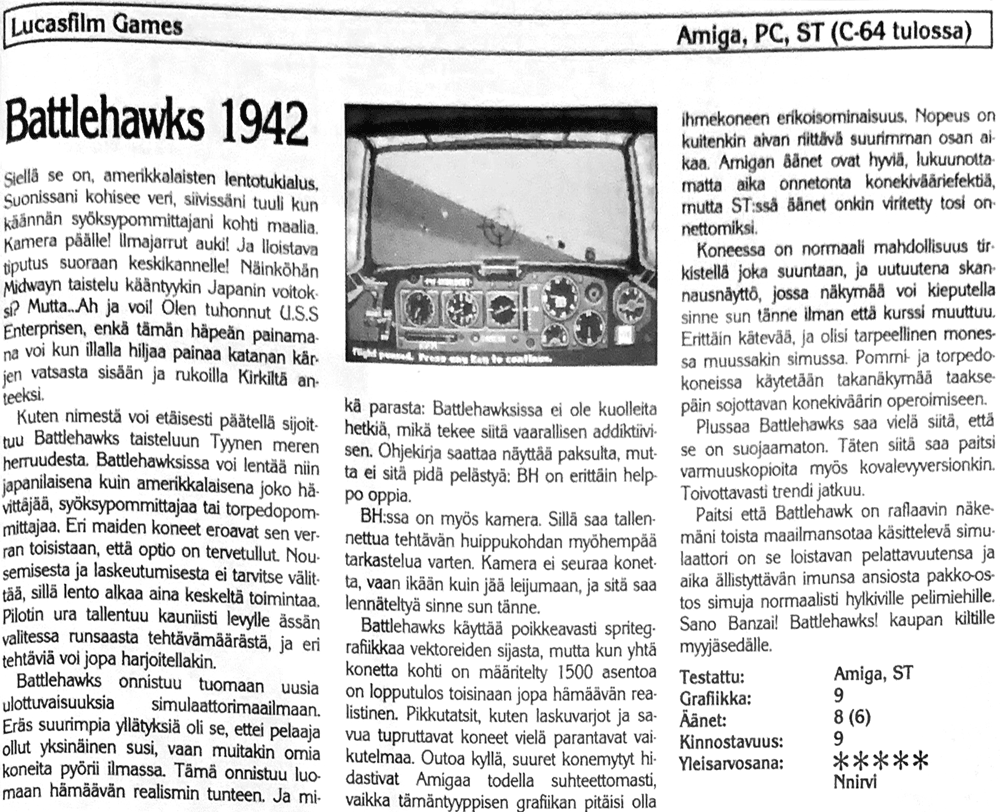
Battlehawks 19421989 SyksyPysyvä linkkiSiellä se on, amerikkalaisten lentotukialus. Suonissani kohisee veri, siivissäni tuuli kun käännän syöksypommittajani kohti maalia. Kamera päälle! Ilmajarrut auki! Ja lloistava tiputus suoraan keskikannelle! Näinköhän Midwayn taistelu kääntyykin Japanin voitoksi? Mutta...Ah ja voi! Olen tuhonnut U.S.S Enterprisen, enkä tämän häpeän painamana voi kun illalla hiljaa painaa katanan kärjen vatsasta sisään ja rukoilla Kirkiltä anteeksi.
Kuten nimestä voi etäisesti päätellä sijoittuu Battlehawks taisteluun Tyynen meren herruudesta. Battlehawksissa voi lentää niin japanilaisena kuin amerikkalaisena joko hävittäjää, syöksypommittajaa tai torpedopommittajaa. Eri maiden koneet eroavat sen verran toisistaan, että optio on tervetullut. Nousemisesta ja laskeutumisesta ei tarvitse välittää, sillä lento alkaa aina keskeltä toimintaa. Pilotin ura tallentuu kauniisti levylle ässän valitessa runsaasta tehtävämäärästä, ja eri tehtäviä voi jopa harjoitellakin.
Battlehawks onnistuu tuomaan uusia ulottuvaisuuksia simulaattorimaailmaan. Eräs suurimpia yllätyksiä oli se, ettei pelaaja ollut yksinäinen susi, vaan muitakin omia koneita pyöri ilmassa. Tämä onnistuu luomaan hämäävän realismin tunteen. Ja mikä parasta: Battlehawksissa ei ole kuolleita hetkiä, mikä tekee siitä vaarallisen addiktiivisen. Ohjekirja saattaa näyttää paksulta, mutta ei sitä pidä pelästyä: BH on erittäin helppo oppia.
BH:ssa on myös kamera. Sillä saa tallennettua tehtävän huippukohdan myöhempää tarkastelua varten. Kamera ei seuraa konetta, vaan ikään kuin jää leijumaan, ja sitä saa lennäteltyä sinne sun tänne.
Battlehawks käyttää poikkeavasti spritegrafiikkaa vektoreiden sijasta, mutta kun yhtä konetta kohti on määritelty 1500 asentoa on lopputulos toisinaan jopa hämäävän realistinen. Pikkutatsit, kuten laskuvarjot ja savua tupruttavat koneet vielä parantavat vaikutelmaa. Outoa kyllä, suuret konemytyt hidastivat Amigaa todella suhteettomasti, vaikka tämäntyyppisen grafiikan pitäisi olla ihmekoneen erikoisominaisuus. Nopeus on kuitenkin aivan riittävä suurimman osan aikaa. Amigan äänet ovat hyviä, lukuunottamatta aika onnetonta konekivääriefektiä, mutta ST:ssä äänet onkin viritetty tosi onnettomiksi.
Koneessa on normaali mahdollisuus tirkistellä joka suuntaan, ja uutuutena skannausnäyttö, jossa näkymää voi kieputella sinne sun tänne ilman että kurssi muuttuu. Erittäin kätevää, ja olisi tarpeellinen monessa muussakin simussa. Pommi- ja torpedokoneissa käytetään takanäkymää taaksepäin sojottavan konekiväärin operoimiseen.
Plussaa Battlehawks saa vielä siitä, että se on suojaamaton. Täten siitä saa paitsi varmuuskopioita myös kovalevyversionkin. Toivottavasti trendi jatkuu.
Paitsi että Battlehawk on raflaavin näkemäni toista maailmansotaa käsittelevä simulaattori on se loistavan pelattavuutensa ja aika ällistyttävän imunsa ansiosta pakko-ostos simuja normaalisti hylkiville pelimiehille. Sano Banzai! Battlehawks! kaupan kiltille myyjäsedälle.
Battlehawks 19421989 SyksyPermalinkThere it is, the Americans' aircraft carrier. Blood roars in my veins and wind in my wings as I turn my dive bomber towards the target. Camera on! Air brakes open! And a brilliant drop smack onto the middle of the deck! Could the Battle of Midway be turning into a Japanese victory after all? But... oh woe! I have destroyed the U.S.S Enterprise, and bowed down by this shame I can do nothing but, this evening, quietly press the point of a katana into my belly and pray to Kirk for forgiveness.
As you might vaguely deduce from the name, Battlehawks is set in the battle for mastery of the Pacific. In Battlehawks you can fly as either Japanese or American, in a fighter, a dive bomber or a torpedo bomber. The different nations' planes differ enough from each other that the option is welcome. You don't need to bother with taking off and landing, since the flight always starts in the thick of the action. The pilot's career is saved neatly to disk as the ace picks from a generous number of missions, and you can even practise the different missions.
Battlehawks manages to bring new dimensions to the simulator world. One of the biggest surprises was that the player wasn't a lone wolf: other friendly planes were whirling around in the air as well. This manages to create a deceptive feeling of realism. And best of all: Battlehawks has no dead moments, which makes it dangerously addictive. The manual may look thick, but there's no need to be scared of it: BH is extremely easy to learn.
BH also has a camera. With it you can record the high point of a mission for later viewing. The camera doesn't follow the plane but sort of stays hovering in place, and you can fly it around here, there and everywhere.
Unusually, Battlehawks uses sprite graphics instead of vectors, but with 1500 positions defined for each plane, the end result is at times deceptively realistic. Little touches, like parachutes and planes billowing smoke, improve the impression further. Strangely enough, big clumps of planes slowed the Amiga down really disproportionately, even though this type of graphics should be the wonder machine's special talent. Still, the speed is perfectly adequate most of the time. The Amiga sounds are good, apart from a rather pitiful machine-gun effect, but on the ST the sounds have been tuned to be truly pitiful.
The plane has the usual ability to peek in every direction, plus, as a novelty, a scanning view in which you can spin the view all over the place without your course changing. Extremely handy, and it would be needed in many other sims as well. In the bombers and torpedo planes, the rear view is used to operate the machine gun sticking out backwards.
Battlehawks earns a further plus for being unprotected. So you can make not only backup copies but a hard disk version too. Hopefully the trend continues.
Besides being the flashiest Second World War simulator I've seen, Battlehawk is, thanks to its brilliant playability and pretty astonishing pull, a must-buy for gamers who normally shun sims. Say Banzai! Battlehawks! to the nice man behind the shop counter.
Battles in Normandy - June July 1944
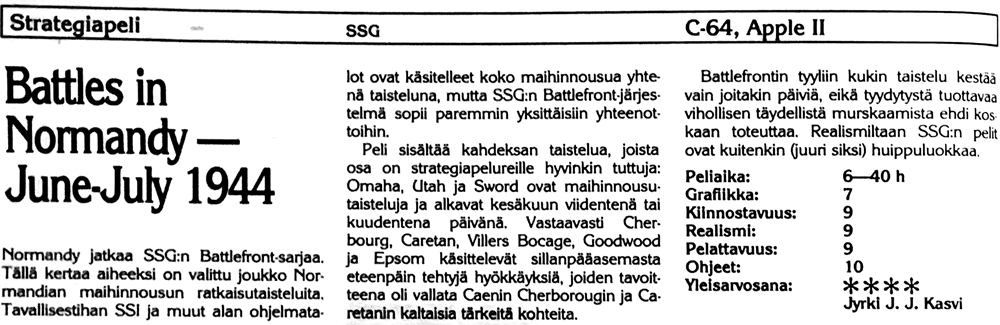
Battles in Normandy - June July 19441989 KevätPysyvä linkkiNormandy jatkaa SSG:n Battlefront-sarjaa. Tällä kertaa aiheeksi on valittu joukko Normandian maihinnousun ratkaisutaisteluita. Tavallisestihan SSI ja muut alan ohjelmatalot ovat käsitelleet koko maihinnousua yhtenä taisteluna, mutta SSG:n Battlefront-järjestelmä sopii paremmin yksittäisiin yhteenottoihin.
Peli sisältää kahdeksan taistelua, joista osa on strategiapelureille hyvinkin tuttuja: Omaha, Utah ja Sword ovat maihinnousutaisteluja ja alkavat kesäkuun viidentenä tai kuudentena päivänä. Vastaavasti Cherbourg, Caretan, Villers Bocage, Goodwood ja Epsom käsittelevät sillanpääasemasta eteenpäin tehtyjä hyökkäyksiä, joiden tavoitteena oli vallata Caenin Cherborougin ja Caretanin kaltaisia tärkeitä kohteita.
Battlefrontin tyyliin kukin taistelu kestää vain joitakin päiviä, eikä tyydytystä tuottavaa vihollisen täydellistä murskaamista ehdi koskaan toteuttaa. Realismiltaan SSG:n pelit ovat kuitenkin (juuri siksi) huippuluokkaa.
Battles in Normandy - June July 19441989 KevätPermalinkNormandy continues SSG's Battlefront series. This time the chosen subject is a set of the decisive battles of the Normandy landings. SSI and the other software houses in the field have usually treated the whole landing as a single battle, of course, but SSG's Battlefront system is better suited to individual engagements.
The game contains eight battles, some of them very familiar to strategy gamers: Omaha, Utah and Sword are landing battles and begin on the fifth or sixth of June. Cherbourg, Caretan, Villers Bocage, Goodwood and Epsom, for their part, deal with the attacks launched onward from the beachhead, aimed at capturing important objectives such as Caen, Cherboroug and Caretan.
In true Battlefront style, each battle lasts only a few days, and you never get the time to carry out that satisfying total crushing of the enemy. In terms of realism, though, SSG's games are (precisely because of that) top class.
Battlestorm
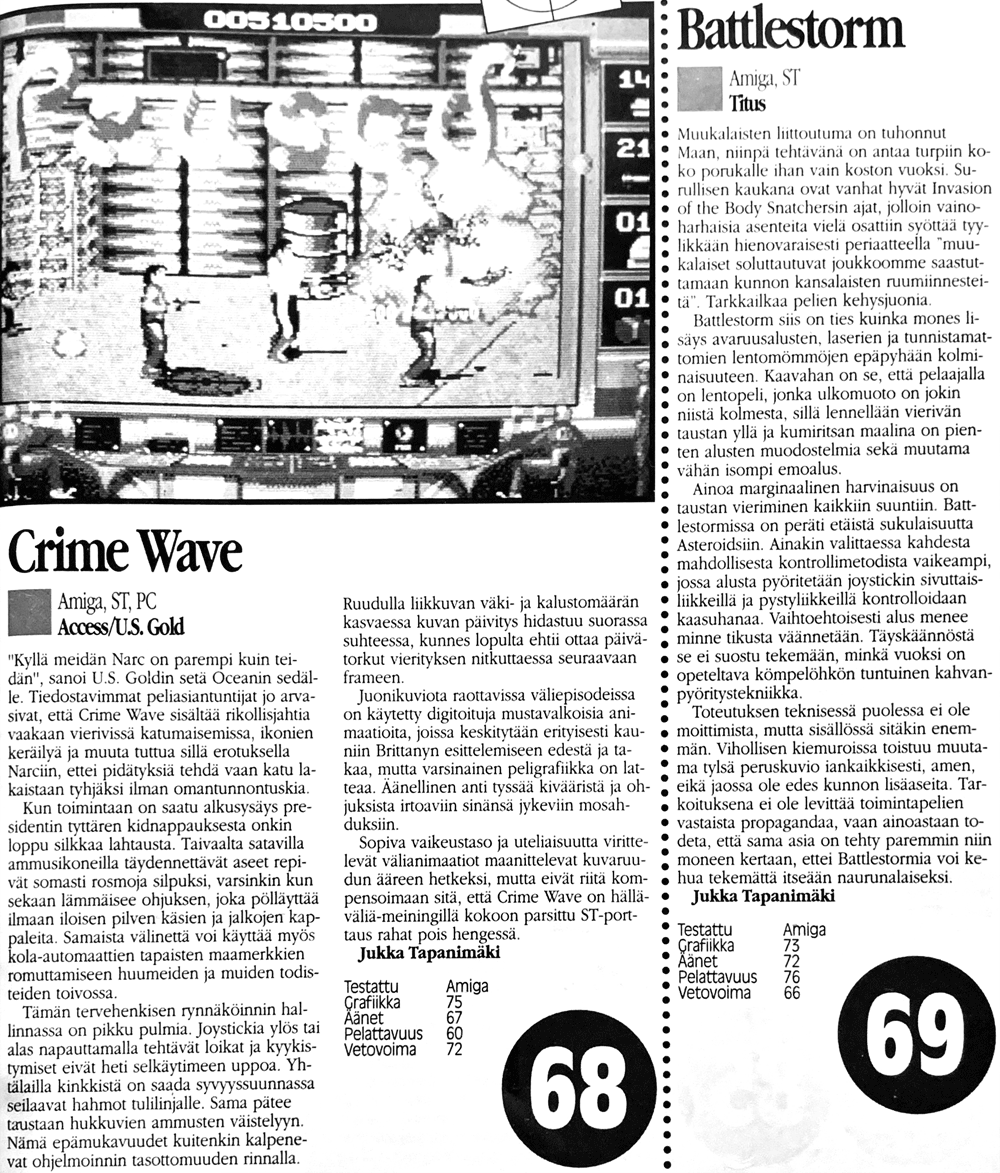
Battlestorm1991 SyksyPysyvä linkkiMuukalaisten liittoutuma on tuhonnut Maan, niinpä tehtävänä on antaa turpiin koko porukalle ihan vain koston vuoksi. Surullisen kaukana ovat vanhat hyvät Invasion of the Body Snatchersin ajat, jolloin vainoharhaisia asenteita vielä osattiin syöttää tyylikkään hienovaraisesti periaatteella "muukalaiset soluttautuvat joukkoomme saastuttamaan kunnon kansalaisten ruumiinnesteitä". Tarkkailkaa pelien kehysjuonia.
Battlestorm siis on ties kuinka mones lisäys avaruusalusten, laserien ja tunnistamattomien lentomömmöjen epäpyhään kolminaisuuteen. Kaavahan on se, että pelaajalla on lentopeli, jonka ulkomuoto on jokin niistä kolmesta, sillä lennellään vierivän taustan yllä ja kumiritsan maalina on pienten alusten muodostelmia sekä muutama vähän isompi emoalus.
Ainoa marginaalinen harvinaisuus on taustan vieriminen kaikkiin suuntiin. Battlestormissa on peräti etäistä sukulaisuutta Asteroidsiin. Ainakin valittaessa kahdesta mahdollisesta kontrollimetodista vaikeampi, jossa alusta pyöritetään joystickin sivuttaisliikkeillä ja pystyliikkeillä kontrolloidaan kaasuhanaa. Vaihtoehtoisesti alus menee minne tikusta väännetään. Täyskäännöstä se ei suostu tekemään, minkä vuoksi on opeteltava kömpelöhkön tuntuinen kahvanpyöritystekniikka.
Toteutuksen teknisessä puolessa ei ole moittimista, mutta sisällössä sitäkin enemmän. Vihollisen kiemuroissa toistuu muutama tylsä peruskuvio iankaikkisesti, amen, eikä jaossa ole edes kunnon lisäaseita. Tarkoituksena ei ole levittää toimintapelien vastaista propagandaa, vaan ainoastaan todeta, että sama asia on tehty paremmin niin moneen kertaan, ettei Battlestormia voi kehua tekemättä itseään naurunalaiseksi.
Battlestorm1991 SyksyPermalinkAn alliance of aliens has destroyed the Earth, so the mission is to give the whole lot of them a good thumping, purely for revenge. Sadly far behind us are the good old days of Invasion of the Body Snatchers, when people still knew how to feed us paranoid attitudes with stylish subtlety, on the principle of "the aliens are infiltrating our ranks to contaminate the bodily fluids of decent citizens". Keep a close eye on the plots of games.
So Battlestorm is the umpteenth addition to the unholy trinity of spaceships, lasers and unidentified flying blobs. The formula, of course, is that the player gets a flying machine shaped like one of those three, it gets flown around above a scrolling background, and the targets for your slingshot are formations of small ships plus a few slightly bigger motherships.
The only marginal rarity is that the background scrolls in all directions. Battlestorm even bears a distant family resemblance to Asteroids. At least if you choose the harder of the two available control methods, in which the ship is rotated by moving the joystick sideways and the throttle is worked by moving it up and down. Alternatively, the ship goes wherever you wrench the stick. It won't make a full about-turn, which is why you have to learn a rather clumsy-feeling stick-twirling technique.
There's nothing to complain about on the technical side of the execution, but all the more in the content. The enemies' squiggles repeat a few dull basic patterns for ever and ever, amen, and there aren't even any decent extra weapons on offer. The aim is not to spread anti-action-game propaganda, but merely to point out that the same thing has been done better so many times that you can't praise Battlestorm without making a laughing stock of yourself.
BattleTech
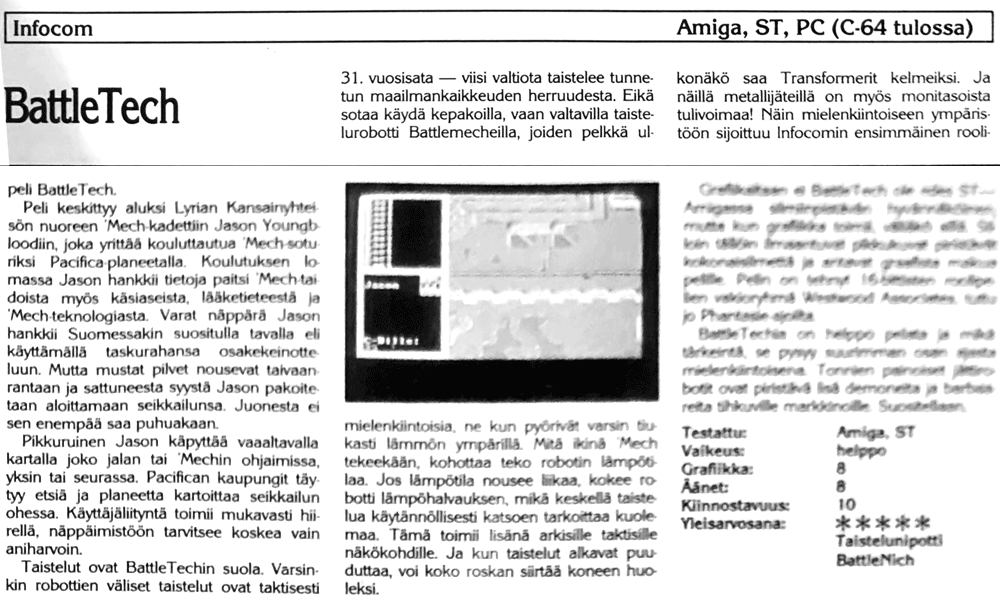
BattleTech1989 SyksyPysyvä linkki31. vuosisata - viisi valtiota taistelee tunnetun maailmankaikkeuden herruudesta. Eikä sotaa käydä kepakoilla, vaan valtavilla taistelurobotti Battlemecheilla, joiden pelkkä ulkonäkö saa Transformerit kelmeiksi. Ja näillä metallijäteillä on myös monitasoista tulivoimaa! Näin mielenkiintoiseen ympäristöön sijoittuu Infocomin ensimmäinen roolipeli BattleTech.
Peli keskittyy aluksi Lyrian Kansainyhteisön nuoreen 'Mech-kadettiin Jason Youngbloodiin, joka yrittää kouluttautua 'Mech-soturiksi Pacifica-planeetalla. Koulutuksen lomassa Jason hankkii tietoja paitsi 'Mech-taidoista myös käsiaseista, lääketieteestä ja 'Mech-teknologiasta. Varat näppärä Jason hankkii Suomessakin suositulla tavalla eli käyttämällä taskurahansa osakekeinotteluun. Mutta mustat pilvet nousevat taivaanrantaan ja sattuneesta syystä Jason pakoitetaan aloittamaan seikkailunsa. Juonesta ei sen enempää saa puhuakaan.
Pikkuruinen Jason käpyttää vaaltavalla kartalla joko jalan tai 'Mechin ohjaimissa, yksin tai seurassa. Pacifican kaupungit täytyy etsiä ja planeetta kartoittaa seikkailun ohessa. Käyttäjäliityntä toimii mukavasti hiirellä, näppäimistöön tarvitsee koskea vain aniharvoin.
Taistelut ovat BattleTechin suola. Varsinkin robottien väliset taistelut ovat taktisesti mielenkiintoisia, ne kun pyörivät varsin tiukasti lämmön ympärillä. Mitä ikinä 'Mech tekeekään, kohottaa teko robotin lämpötilaa. Jos lämpötila nousee liikaa, kokee robotti lämpöhalvauksen, mikä keskellä taistelua käytännöllisesti katsoen tarkoittaa kuolemaa. Tämä toimii lisänä arkisille taktisille näkökohdille. Ja kun taistelut alkavat puuduttaa, voi koko roskan siirtää koneen huoleksi.
Grafiikaltaan ei BattleTech ole edes ST-Amigassa silmiinpistävän hyvännäköinen, mutta kun grafiikka toimii, väliäkö sillä. Silloin tällöin ilmaantuvat pikkukuvat piristävät kokonaisilmettä ja antavat graafista makua pelille. Pelin on tehnyt 16-bittisten roolipelien vakioryhmä Westwood Associates, tuttu jo Phantasie-ajoilta.
BattleTechiä on helppo pelata ja mikä tärkeintä, se pysyy suurimman osan ajasta mielenkiintoisena. Tonnien painoiset jättirobotit ovat piristävä lisä demoneita ja barbaareita tihkuville markkinoille. Suositellaan.
BattleTech1989 SyksyPermalinkThe 31st century - five states are battling for mastery of the known universe. And this war isn't fought with sticks, but with gigantic Battlemech fighting robots whose mere appearance turns the Transformers pale. And these metal giants pack multi-level firepower too! Such is the intriguing setting of Infocom's first role-playing game, BattleTech.
At first the game focuses on Jason Youngblood, a young 'Mech cadet of the Lyran Commonwealth, who is trying to train as a 'Mech warrior on the planet Pacifica. In between his training, Jason picks up knowledge not just of 'Mech skills but also of small arms, medicine and 'Mech technology. Clever Jason raises funds the way that's popular in Finland too, namely by pouring his pocket money into stock speculation. But dark clouds gather on the horizon and, for reasons best left unsaid, Jason is forced to set off on his adventure. Not another word may be said about the plot.
Teeny-weeny Jason toddles across a huuuge map, either on foot or at the controls of a 'Mech, alone or in company. The cities of Pacifica have to be tracked down and the planet mapped as the adventure goes along. The user interface works nicely with the mouse; you only need to touch the keyboard once in a blue moon.
The battles are the spice of BattleTech. The robot-on-robot battles in particular are tactically interesting, since they revolve pretty tightly around heat. Whatever a 'Mech does, the action raises the robot's temperature. If the temperature climbs too high, the robot suffers heatstroke, which in the middle of a battle practically means death. This comes on top of the everyday tactical considerations. And when the fighting starts to get tedious, you can dump the whole lot on the computer to worry about.
Graphically BattleTech isn't strikingly good-looking even on the ST and Amiga, but when the graphics do their job, who cares. The little pictures that pop up now and then liven up the overall look and give the game some graphical flavour. The game was made by Westwood Associates, the regular team for 16-bit role-playing games, familiar from as far back as the Phantasie days.
BattleTech is easy to play and, most importantly, it stays interesting most of the time. Giant robots weighing tons are a refreshing addition to a market oozing with demons and barbarians. Recommended.
Beach Head II
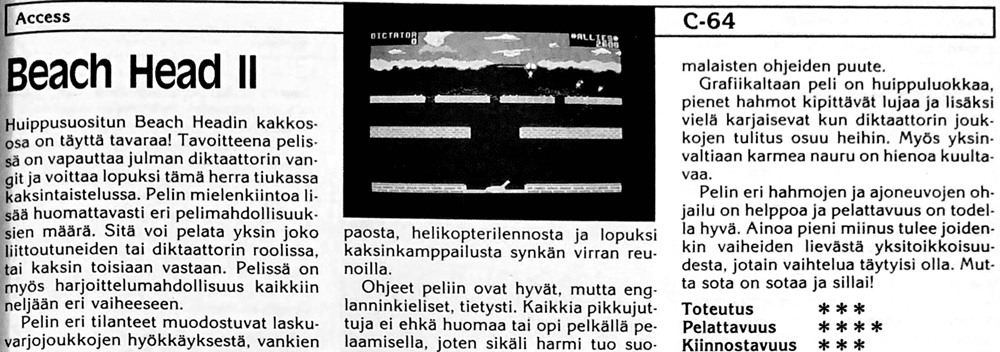
Beach Head II1987Pysyvä linkkiHuippusuositun Beach Headin kakkososa on täyttä tavaraa! Tavoitteena pelissä on vapauttaa julman diktaattorin vangit ja voittaa lopuksi tämä herra tiukassa kaksintaistelussa. Pelin mielenkiintoa lisää huomattavasti eri pelimahdollisuuksien määrä. Sitä voi pelata yksin joko liittoutuneiden tai diktaattorin roolissa, tai kaksin toisiaan vastaan. Pelissä on myös harjoittelumahdollisuus kaikkiin neljään eri vaiheeseen.
Pelin eri tilanteet muodostuvat laskuvarjojoukkojen hyökkäyksestä, vankien paosta, helikopterilennosta ja lopuksi kaksinkamppailusta synkän virran reunoilla.
Ohjeet peliin ovat hyvät, mutta englanninkieliset, tietysti. Kaikkia pikkujuttuja ei ehkä huomaa tai opi pelkällä pelaamisella, joten sikäli harmi tuo suomalaisten ohjeiden puute.
Grafiikaltaan peli on huippuluokkaa, pienet hahmot kipittävät lujaa ja lisäksi vielä karjaisevat kun diktaattorin joukkojen tulitus osuu heihin. Myös yksinvaltiaan karmea nauru on hienoa kuultavaa.
Pelin eri hahmojen ja ajoneuvojen ohjailu on helppoa ja pelattavuus on todella hyvä. Ainoa pieni miinus tulee joidenkin vaiheiden lievästä yksitoikkoisuudesta, jotain vaihtelua täytyisi olla. Mutta sota on sotaa ja sillai!
Beach Head II1987PermalinkThe sequel to the hugely popular Beach Head is the real deal! The aim of the game is to free the cruel dictator's prisoners and finally to beat the gentleman himself in a tight duel. The game's appeal is considerably boosted by the number of different ways to play. You can play it alone in the role of either the Allies or the dictator, or two players against each other. The game also has a practice option for all four stages.
The game's different scenes consist of a paratroop assault, the prisoners' escape, a helicopter flight and finally a duel on the banks of a gloomy river.
The instructions for the game are good, but in English, of course. You may not notice or learn all the little details just by playing, so in that respect the lack of Finnish instructions is a pity.
Graphically the game is top class: the little figures scurry along at a good clip and even let out a yell when fire from the dictator's troops hits them. The autocrat's ghastly laugh is also great to hear.
Controlling the game's various characters and vehicles is easy and the playability is really good. The only small minus comes from the slight monotony of some of the stages; there ought to be some variety. But war is war and all that!
Beach Volley
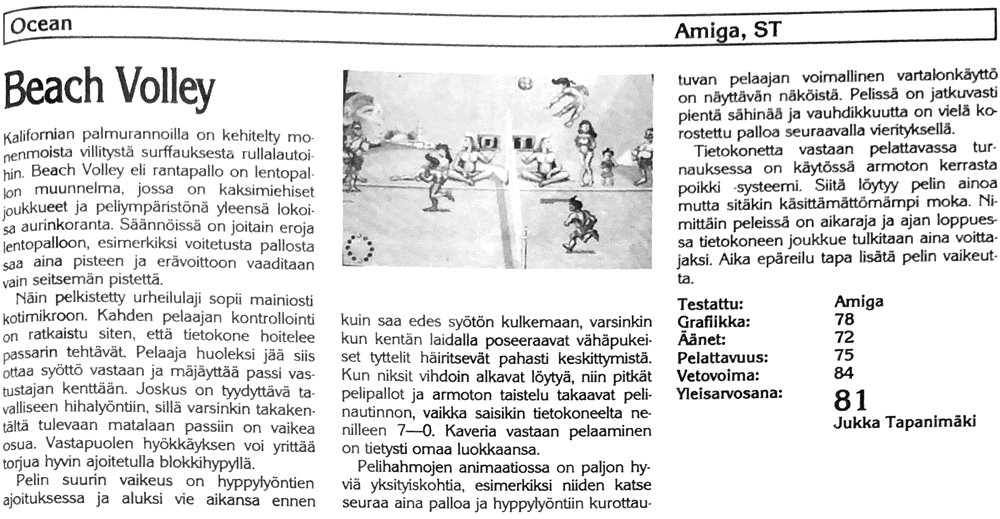
Beach Volley1990 KevätPysyvä linkkiKalifornian palmurannoilla on kehitelty monenmoista villitystä surffauksesta rullalautoihin. Beach Volley eli rantapallo on lentopallon muunnelma, jossa on kaksimiehiset joukkueet ja peliympäristönä yleensä lokoisa aurinkoranta. Säännöissä on joitain eroja lentopalloon, esimerkiksi voitetusta pallosta saa aina pisteen ja erävoittoon vaaditaan vain seitsemän pistettä.
Näin pelkistetty urheilulaji sopii mainiosti kotimikroon. Kahden pelaajan kontrollointi on ratkaistu siten, että tietokone hoitelee passarin tehtävät. Pelaaja huoleksi jää siis ottaa syöttö vastaan ja mäjäyttää passi vastustajan kenttään. Joskus on tyydyttävä tavalliseen hihalyöntiin, sillä varsinkin takakentältä tulevaan matalaan passiin on vaikea osua. Vastapuolen hyökkäyksen voi yrittää torjua hyvin ajoitetulla blokkihypyllä.
Pelin suurin vaikeus on hyppylyöntien ajoituksessa ja aluksi vie aikansa ennen kuin saa edes syötön kulkemaan, varsinkin kun kentän laidalla poseeraavat vähäpukeiset tyttelit häiritsevät pahasti keskittymistä. Kun niksit vihdoin alkavat löytyä, niin pitkät pelipallot ja armoton taistelu takaavat pelinautinnon, vaikka saisikin tietokoneelta nenilleen 7-0. Kaveria vastaan pelaaminen on tietysti omaa luokkaansa.
Pelihahmojen animaatiossa on paljon hyviä yksityiskohtia, esimerkiksi niiden katse seuraa aina palloa ja hyppylyöntiin kurottautuvan pelaajan voimallinen vartalonkäyttö on näyttävän näköistä. Pelissä on jatkuvasti pientä sähinää ja vauhdikkuutta on vielä korostettu palloa seuraavalla vierityksellä.
Tietokonetta vastaan pelattavassa turnauksessa on käytössä armoton kerrasta poikki -systeemi. Siitä löytyy pelin ainoa mutta sitäkin käsittämättömämpi moka. Nimittäin peleissä on aikaraja ja ajan loppuessa tietokoneen joukkue tulkitaan aina voittajaksi. Aika epäreilu tapa lisätä pelin vaikeutta.
Beach Volley1990 KevätPermalinkAll sorts of crazes have been dreamed up on the palm-lined beaches of California, from surfing to skateboards. Beach Volley, i.e. beach volleyball, is a variant of volleyball with two-man teams, usually played on a cosy sun-soaked beach. The rules differ from volleyball in a few ways; for example, you always get a point for winning a rally, and only seven points are needed to win a set.
A sport stripped down this far is a perfect fit for a home computer. The problem of controlling two players has been solved by having the computer take care of the setter's duties. So all that's left for the player to worry about is receiving the serve and smashing the set into the opponents' court. Sometimes you have to settle for a plain old bump, since a low set coming from the back court in particular is hard to hit. You can try to stop the other side's attack with a well-timed jump block.
The game's biggest difficulty lies in timing the jump spikes, and at first it takes a while before you can even get a serve over, especially since the skimpily clad girlies posing at the courtside badly wreck your concentration. Once you finally start getting the hang of the tricks, the long rallies and merciless battles guarantee some real gaming pleasure, even if the computer hands you a 7-0 drubbing. Playing against a mate is, of course, in a class of its own.
The animation of the players has lots of nice details; for example, their eyes always follow the ball, and the powerful body work of a player stretching up into a jump spike looks impressive. There's a constant bit of sizzle in the game, and the sense of speed is played up even further by scrolling that follows the ball.
The tournament against the computer uses a merciless one-strike-and-you're-out system. That's where you'll find the game's one and only blunder - and an all the more baffling one for it. You see, the matches have a time limit, and when time runs out the computer's team is always declared the winner. A pretty unfair way to add to the game's difficulty.
Bermuda Project
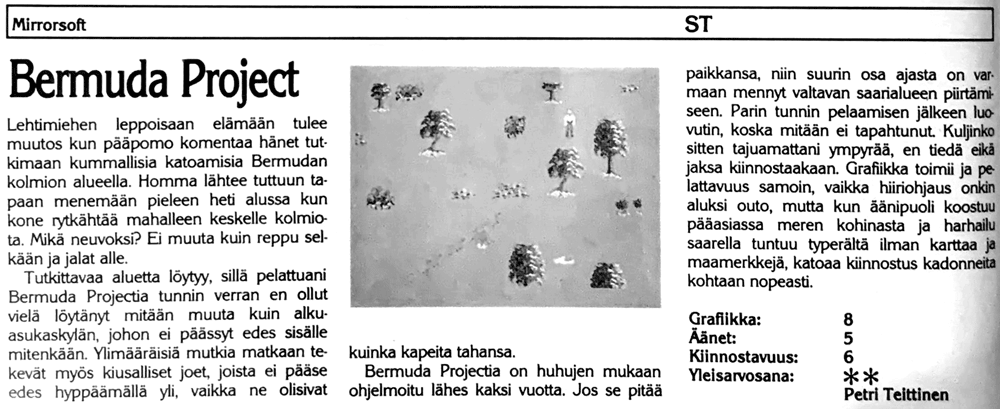
Bermuda Project1988Pysyvä linkkiLehtimiehen leppoisaan elämään tulee muutos kun pääpomo komentaa hänet tutkimaan kummallisia katoamisia Bermudan kolmion alueella. Homma lähtee tuttuun tapaan menemään pieleen heti alussa kun kone rytkähtää mahalleen keskelle kolmiota. Mikä neuvoksi? Ei muuta kuin reppu selkään ja jalat alle.
Tutkittavaa aluetta löytyy, sillä pelattuani Bermuda Projectia tunnin verran en ollut vielä löytänyt mitään muuta kuin alkuasukaskylän, johon ei päässyt edes sisälle mitenkään. Ylimääräisiä mutkia matkaan tekevät myös kiusalliset joet, joista ei pääse edes hyppäämällä yli, vaikka ne olisivat kuinka kapeita tahansa.
Bermuda Projectia on huhujen mukaan ohjelmoitu lähes kaksi vuotta. Jos se pitää paikkansa, niin suurin osa ajasta on varmaan mennyt valtavan saarialueen piirtämiseen. Parin tunnin pelaamisen jälkeen luovutin, koska mitään ei tapahtunut. Kuljinko sitten tajuamattani ympyrää, en tiedä eikä jaksa kiinnostaakaan. Grafiikka toimii ja pelattavuus samoin, vaikka hiiriohjaus onkin aluksi outo, mutta kun äänipuoli koostuu pääasiassa meren kohinasta ja harhailu saarella tuntuu typerältä ilman karttaa ja maamerkkejä, katoaa kiinnostus kadonneita kohtaan nopeasti.
Bermuda Project1988PermalinkA newspaperman's easygoing life takes a turn when the top boss orders the newshound to investigate strange disappearances in the Bermuda Triangle. As usual, things start going wrong right at the start, when the plane belly-flops down in the middle of the Triangle. What to do? Nothing for it but to shoulder the backpack and set off on foot.
There's plenty of ground to explore: after playing Bermuda Project for an hour I still hadn't found anything except a native village, which there was no way of even getting into. Extra detours are also added to the trip by annoying rivers that you can't even jump across, no matter how narrow they are.
Rumour has it that Bermuda Project was nearly two years in the programming. If that's true, most of the time must have gone into drawing the enormous island area. After a couple of hours of play I gave up, because nothing was happening. Whether I was walking in circles without realising it, I don't know and can't be bothered to care. The graphics work and so does the playability, even if the mouse control feels odd at first, but when the sound side consists mainly of the rush of the sea and wandering around the island feels pointless without a map or landmarks, your interest in the disappeared soon disappears too.
Betrayal
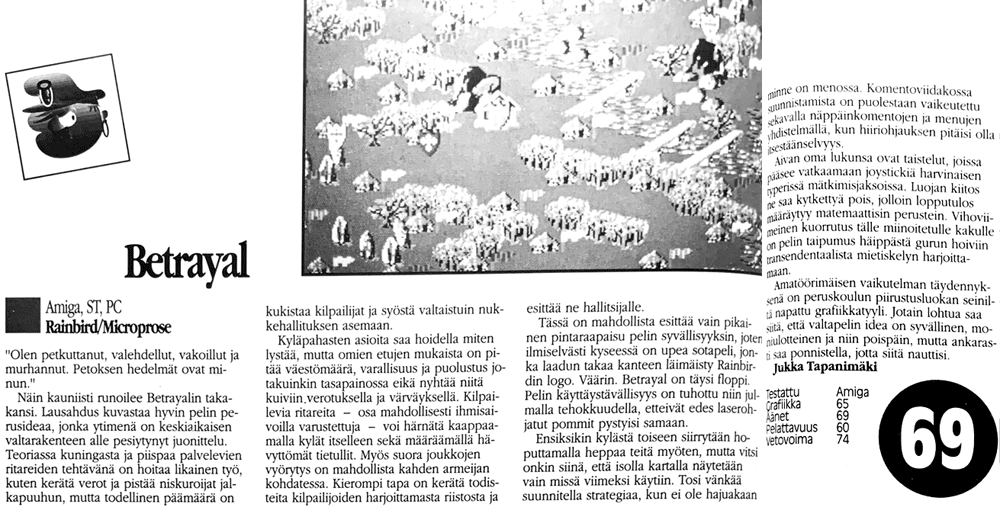
Betrayal1991 SyksyPysyvä linkki"Olen petkuttanut, valehdellut, vakoillut ja murhannut. Petoksen hedelmät ovat minun."
Näin kauniisti runoilee Betrayalin takakansi. Lausahdus kuvastaa hyvin pelin perusideaa, jonka ytimenä on keskiaikaisen valtarakenteen alle pesiytynyt juonittelu. Teoriassa kuningasta ja piispaa palvelevien ritareiden tehtävänä on hoitaa likainen työ, kuten kerätä verot ja pistää niskuroijat jalkapuuhun, mutta todellinen päämäärä on kukistaa kilpailijat ja syöstä valtaistuin nukkehallituksen asemaan.
Kyläpahasten asioita saa hoidella miten lystää, mutta omien etujen mukaista on pitää väestömäärä, varallisuus ja puolustus jotakuinkin tasapainossa eikä nyhtää niitä kuiviin.verotuksella ja värväyksellä. Kilpailevia ritareita - osa mahdollisesti ihmisaivoilla varustettuja - voi härnätä kaappaamalla kylät itselleen sekä määräämällä hävyttömät tietullit. Myös suora joukkojen vyörytys on mahdollista kahden armeijan kohdatessa. Kierompi tapa on kerätä todisteita kilpailijoiden harjoittamasta riistosta ja esittää ne hallitsijalle.
Tässä on mahdollista esittää vain pikainen pintaraapaisu pelin syvällisyyksin, joten ilmiselvästi kyseessä on upea sotapeli, jonka laadun takaa kanteen läimäisty Rainbirdin logo. Väärin. Betrayal on täysi floppi. Pelin käyttäystävällisyys on tuhottu niin julmalla tehokkuudella, etteivät edes laserohjatut pommit pystyisi samaan.
Ensiksikin kylästä toiseen siirrytään hoputtamalla heppaa teitä myöten, mutta vitsi onkin siinä, että isolla kartalla näytetään vain missä viimeksi käytiin. Tosi vänkää suunnitella strategiaa, kun ei ole hajuakaan minne on menossa. Komentoviidakossa suunnistamista on puolestaan vaikeutettu sekavalla näppäinkomentojen ja menujen yhdistelmällä, kun hiiriohjauksen pitäisi olla itsestäänselvyys.
Aivan oma lukunsa ovat taistelut, joissa pääsee vatkaamaan joystickiä harvinaisen typerissä mätkimisjaksoissa. Luojan kiitos ne saa kytkettyä pois, jolloin lopputulos määräytyy matemaattisin perustein. Vihoviimeinen kuorrutus tälle miinoitetulle kakulle on pelin taipumus häippästä gurun hoiviin transendentaalista mietiskelyn harjoittamaan.
Amatöörimäisen vaikutelman täydennyksenä on peruskoulun piirustusluokan seiniltä napattu grafiikkatyyli. Jotain lohtua saa siitä, että valtapelin idea on syvällinen, moniulotteinen ja niin poispäin, mutta ankarasti saa ponnistella, jotta siitä nauttisi.
Betrayal1991 SyksyPermalink"I have cheated, lied, spied and murdered. The fruits of betrayal are mine."
So beautifully does the back of Betrayal's box wax poetic. The line captures the game's basic idea well: at its heart is the scheming that has nested beneath a medieval power structure. In theory the knights who serve the king and the bishop are there to do the dirty work, like collecting the taxes and clapping troublemakers in the stocks, but the real goal is to crush your rivals and reduce the throne to a puppet government.
You can run the affairs of your one-horse villages however you like, but it's in your own interest to keep population, wealth and defences more or less in balance rather than bleeding them dry with taxes and conscription. Rival knights - some of them possibly equipped with human brains - can be needled by grabbing their villages for yourself and imposing outrageous road tolls. A head-on troop onslaught is also possible when two armies meet. A more crooked approach is to gather evidence of the exploitation your rivals are practising and present it to the ruler.
Only the briefest scratch at the surface of the game's depths is possible here, so obviously this is a superb wargame, its quality guaranteed by the Rainbird logo slapped on the cover. Wrong. Betrayal is a complete flop. The game's user-friendliness has been destroyed with such ruthless efficiency that not even laser-guided bombs could match it.
First of all, you get from one village to the next by hurrying your horsie along the roads, but the joke is that the big map only shows where you were last. Real neat, planning strategy when you haven't the foggiest where you're going. Finding your way through the command jungle, meanwhile, has been made harder by a muddled combination of keyboard commands and menus, when mouse control ought to go without saying.
The battles are a chapter all of their own, where you get to whisk the joystick about in uncommonly stupid bashing sequences. Thank God they can be switched off, in which case the outcome is decided on mathematical grounds. The very last icing on this booby-trapped cake is the game's habit of pushing off into the guru's care to practise transcendental meditation.
Rounding off the amateurish impression is a graphics style lifted off the walls of a primary school art class. There's some comfort in the fact that the idea of the power game is deep, multidimensional and so on and so forth, but you have to strain hard to enjoy it.
Beverly Hills Cop

Beverly Hills Cop1990 SyksyPysyvä linkkiIhmettelinkin jo missä Beverly Hills Copin peliversio viipyi. Cop ykkösestä on kulunut jo monta vuotta ja kakkonenkin on ehtinyt elokuvateattereihin aikoja sitten. Saamme olla Tynesoftille kiitollisia koska voimme jälleen kerran seurata Axel Foleyn tempauksia. (Siitäkö pitäisi olla kiitollinen?)
Alussa valitaan yksi kolmesta vaikeusasteesta. Firenappulan painallus tuo ruudulle isokokoisen spriten, joka on jotenkuten tunnustettava Axel Foleyksi. Foleyn kädestä löytyy Colt, joten homman nimi on helppo arvata.
Axel kulkee läpi kolmitasoisen parallaksiscrollin ammuskellen aseellaan konnat täyteen reikiä. Elämiä on kolme kappaletta, joita kutakin kuvaa sydän ruudun alareunassa. Aina sydämen valuessa kuiviin kuolee yksi Axel. Nopearefleksinen pelaaja selvittää tämän tason ilman suurempia vaikeuksia.
Seuraavassa vaiheessa Axelin on tarkoitus 'rypyttää' kolme rekkaa. Tämän onnistuminen vaatii hypyn Mersun ratin taakse ja monta lippaallista panoksia Coltiin.
Ajelu on toteutettu vektorigrafiikalla, joka on vieläpä kohtalaisen nopeaa. Maasto on kumpuilevaa ja tie aika mutkikas, mutta Mersu pysyy hyvin tiellä tiukimmissakin kaarteissa. Ohjauksen voi valita hiiren tai tikun väliltä. Hiiriohjaus on kyllä hiukan liian herkkä, mutta se ei paljon menoa haittaa. Ei vie kauaakaan, ennenkuin kaikki rekat on saatettu ajokelvottomaan kuntoon.
Kolmas taso on jo hankalampi. Axel hiippailee ympäriinsä puistossa ja ammuskelee siinä sivussa konnan pari. Coltin lisäksi on mahdollisuus käyttää konekiväärejä, jotka joku on epähuomiossa sirotellut pitkin puistoa. Tämä taso jää graafisesti selvästi jälkeen kahdesta edellisestä, Pelattavuuskin ontuu. Vaikeustasoa on sentään ymmärretty nostaa jonkin verran. Nytkin voi valita hiiriohjauksen, joka on ehkäpä helpompikin kuin tikun kanssa räpeltäminen.
Neljännellä tasolla Axel sompailee ympäriinsä sokkelossa ja etsii hissejä seuraaville tasoille. Välissä ehditään vapauttamaan muutama kauniimman sukupuolen edustaja ja siinä samassa saattaa muutama rikollinenkin päästä hengestään. Lopuksi nitistetään pääkonna. Tällä kertaa 'aseistariisunta' tapahtuu pumppuhaulikolla, Colt on kai unohtunut työpöydän laatikkoon.
Sokkelo on toteutettu Xybotsin tapaan ja vaikuttaa aluksi varsin oivalliselta. Ensimmäinen hissi löytyy kohtalaisen helpolla, mutta toisen etsiminen alkaa olla jo hankalaa. Kolmas kerros on jo sen verran sekava, että siinä onkin etsimistä. Kärsivällisinkin pelaaja hermostuu, kun huomaa kiertäneensä ympyrää viimeiset viisi minuuttia.
Sokkeloa vaivaa ikävä monotonisuus: kaikki kerrokset ovat samanlaisia, mitä nyt värit vaihtuvat. Silloin tällöin tielle osuvat pyssymiehet ovat graafisesti köyhiä ja toistensa kopioita. Kun vaihtelua ei löydy, kiertely sokkelossa alkaa nopeasti maistua puulta. Kehno pelattavuus ei paranna asiaa.
Kun muutama pikku vika korjattaisiin, BHC olisi hyvää ajanvietettä. Esimerkiksi sokkelosta olisi varmasti tullut hyvä, jos se olisi saatu vaihtelevammaksi. Yksinään ei mikään taso olisi kovin mainittava peli, mutta yhdessä ne muodostavat siedettävän kokonaisuuden.
Beverly Hills Cop1990 SyksyPermalinkI was already wondering where the game version of Beverly Hills Cop had got to. Many years have passed since Cop 1, and the second one hit the cinemas ages ago too. We can be grateful to Tynesoft because we can once again follow Axel Foley's antics. (Is that something to be grateful for?)
At the start you pick one of three difficulty levels. A press of the fire button brings a large sprite onto the screen, which you more or less have to accept is Axel Foley. In Foley's hand there's a Colt, so the name of the game is easy to guess.
Axel makes his way through a three-layer parallax scroll, shooting the crooks full of holes with his gun. There are three lives, each shown as a heart at the bottom of the screen. Every time a heart drains dry, one Axel dies. A player with quick reflexes will get through this level without much trouble.
In the next stage Axel is supposed to 'crumple' three trucks. Pulling this off takes a jump behind the wheel of a Merc and many magazines' worth of rounds for the Colt.
The driving is done in vector graphics, which are fairly fast to boot. The terrain is rolling and the road pretty twisty, but the Merc holds the road well even in the tightest bends. You can choose between mouse and joystick control. The mouse control is admittedly a bit too sensitive, but that doesn't spoil the ride much. It doesn't take long before all the trucks have been rendered undriveable.
The third level is already trickier. Axel sneaks around a park, plugging a crook or two on the side. Besides the Colt you can use machine guns that somebody has absent-mindedly scattered around the park. This level lags clearly behind the previous two graphically, and the playability limps too. At least they've had the sense to raise the difficulty somewhat. Here too you can choose mouse control, which is perhaps even easier than fumbling with the joystick.
On the fourth level Axel fumbles his way around a maze, looking for lifts to the next levels. In between there's time to free a few representatives of the fairer sex, and while you're at it a few criminals may lose their lives too. Finally the main villain gets snuffed out. This time the 'disarmament' is done with a pump-action shotgun; the Colt has presumably been left behind in a desk drawer.
The maze is done in the style of Xybots and seems pretty clever at first. The first lift is found fairly easily, but finding the second one is already getting tricky. The third floor is so confusing that you really have your work cut out searching. Even the most patient player loses their temper on realising they've been going round in circles for the last five minutes.
The maze suffers from a dreary monotony: all the floors are alike, apart from the colours changing. The gunmen who cross your path now and then are graphically poor and copies of each other. With no variety to be found, wandering the maze quickly starts to get old. The poor playability doesn't improve matters.
If a few little flaws were fixed, BHC would be a good pastime. The maze, for example, would surely have turned out well if it had been made more varied. On its own none of the levels would be much of a game to speak of, but together they make up a tolerable whole.
Bill Elliott's NASCAR Challenge
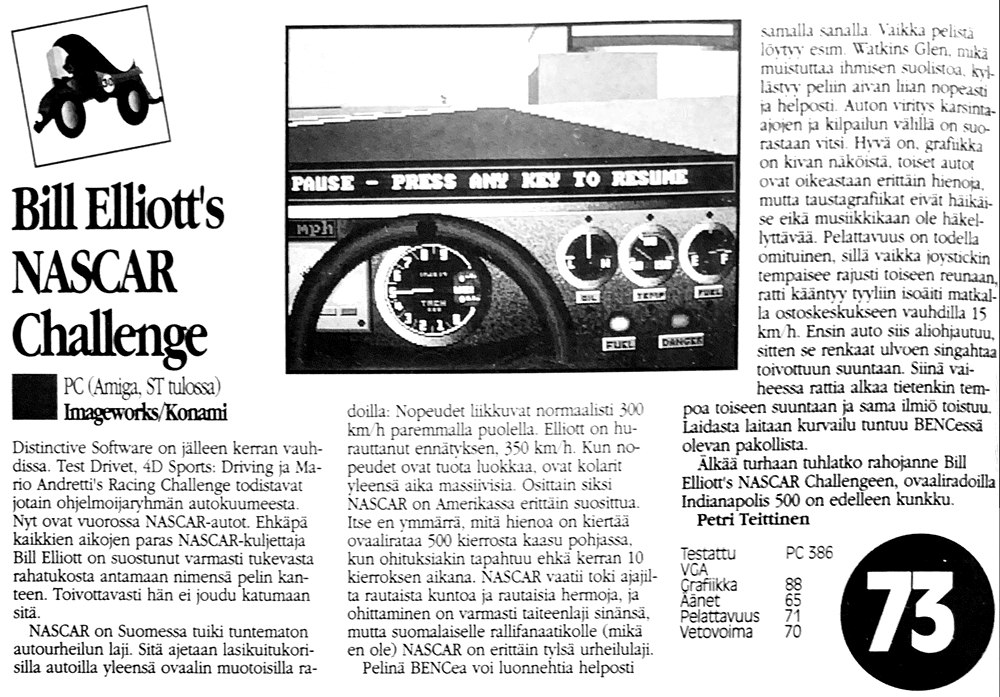
Bill Elliott's NASCAR Challenge1991 SyksyPysyvä linkkiDistinctive Software on jälleen kerran vauhdissa. Test Drivet, 4D Sports: Driving ja Mario Andretti's Racing Challenge todistavat jotain ohjelmoijaryhmän autokuumeesta. Nyt ovat vuorossa NASCAR-autot. Ehkäpä kaikkien aikojen paras NASCAR-kuljettaja Bill Elliott on suostunut varmasti tukevasta rahatukosta antamaan nimensä pelin kanteen. Toivottavasti hän ei joudu katumaan sitä.
NASCAR on Suomessa tuiki tuntematon autourheilun laji. Sitä ajetaan lasikuitukorisilla autoilla yleensä ovaalin muotoisilla radoilla: Nopeudet liikkuvat normaalisti 300 km/h paremmalla puolella. Elliott on hurauttanut ennätyksen, 350 km/h. Kun nopeudet ovat tuota luokkaa, ovat kolarit yleensä aika massiivisia. Osittain siksi NASCAR on Amerikassa erittäin suosittua. Itse en ymmärrä, mitä hienoa on kiertää ovaalirataa 500 kierrosta kaasu pohjassa, kun ohituksiakin tapahtuu ehkä kerran 10 kierroksen aikana. NASCAR vaatii toki ajajilta rautaista kuntoa ja rautaisia hermoja, ja ohittaminen on varmasti taiteenlaji sinänsä, mutta suomalaiselle rallifanaatikolle (mikä en ole) NASCAR on erittäin tylsä urheilulaji.
Pelinä BENCea voi luonnehtia helposti samalla sanalla. Vaikka pelistä löytyy esim. Watkins Glen, mikä muistuttaa ihmisen suolistoa, kyllästyy peliin aivan liian nopeasti ja helposti. Auton viritys karsinta-ajojen ja kilpailun välillä on suorastaan vitsi. Hyvä on, grafiikka on kivan näköistä, toiset autot ovat oikeastaan erittäin hienoja, mutta taustagrafiikat eivät häikäise eikä musiikkikaan ole häkellyttävää. Pelattavuus on todella omituinen, sillä vaikka joystickin tempaisee rajusti toiseen reunaan, ratti kääntyy tyyliin isoäiti matkalla ostoskeskukseen vauhdilla 15 km/h. Ensin auto siis aliohjautuu, sitten se renkaat ulvoen singahtaa toivottuun suuntaan. Siinä vaiheessa rattia alkaa tietenkin tempoa toiseen suuntaan ja sama ilmiö toistuu. Laidasta laitaan kurvailu tuntuu BENCessä olevan pakollista.
Älkää turhaan tuhlatko rahojanne Bill Elliott's NASCAR Challengeen, ovaaliradoilla Indianapolis 500 on edelleen kunkku.
Bill Elliott's NASCAR Challenge1991 SyksyPermalinkDistinctive Software is on a roll once again. The Test Drives, 4D Sports: Driving and Mario Andretti's Racing Challenge testify to something about this programming team's car fever. Now it's the turn of NASCAR cars. Bill Elliott, perhaps the best NASCAR driver of all time, has agreed, surely for a hefty wad of cash, to lend his name to the game's cover. Let's hope he won't come to regret it.
In Finland NASCAR is a completely unknown branch of motor sport. It's raced in fibreglass-bodied cars, usually on oval-shaped tracks: speeds normally sit on the high side of 300 km/h. Elliott has zipped to the record, 350 km/h. When speeds are in that class, the crashes tend to be pretty massive. That's partly why NASCAR is extremely popular in America. Personally I don't get what's so great about circling an oval track for 500 laps with your foot to the floor, when an overtake happens maybe once every 10 laps. Granted, NASCAR demands iron fitness and nerves of iron from its drivers, and overtaking is surely an art form in itself, but for a Finnish rally fanatic (which I am not) NASCAR is an extremely boring sport.
As a game, BENC can easily be described with that same word. Even though the game features, for example, Watkins Glen, which resembles the human intestines, you get bored with the game far too quickly and easily. Tuning the car between qualifying and the race is nothing short of a joke. All right, the graphics look nice, and the other cars are actually very fine indeed, but the background graphics don't dazzle and the music isn't exactly staggering either. The playability is really peculiar, because even if you yank the joystick hard over to one side, the steering wheel turns like a granny on her way to the shopping centre at 15 km/h. So first the car understeers, then, tyres howling, it shoots off in the desired direction. At that point you naturally start yanking the wheel the other way, and the same thing happens all over again. Swerving from side to side seems to be compulsory in BENC.
Don't go wasting your money on Bill Elliott's NASCAR Challenge; on oval tracks, Indianapolis 500 is still king.
Bionic Commando
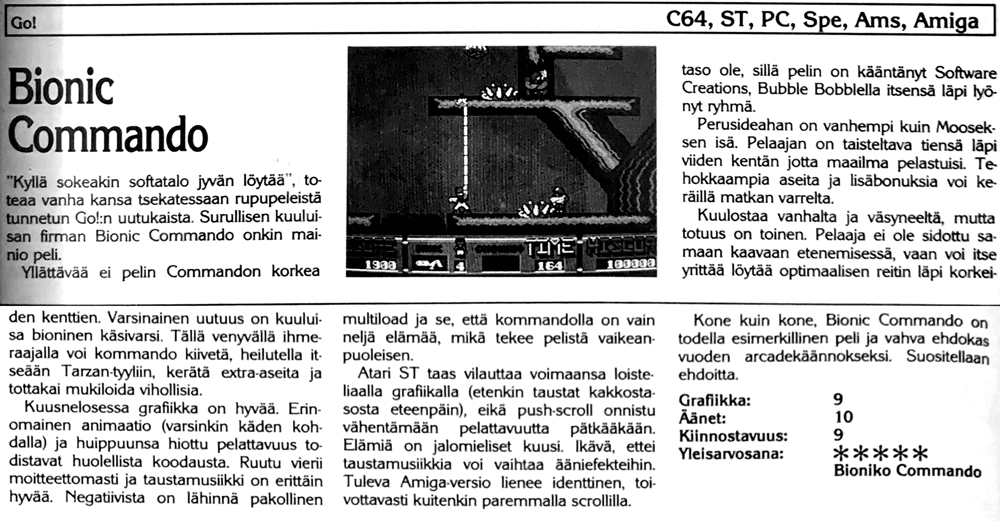
Bionic Commando1988Pysyvä linkki"Kyllä sokeakin softatalo jyvän löytää", toteaa vanha kansa tsekatessaan rupupeleistä tunnetun Go!:n uutukaista. Surullisen kuuluisan firman Bionic Commando onkin mainio peli.
Yllättävää ei pelin Commandon korkea taso ole, sillä pelin on kääntänyt Software Creations, Bubble Bobblella itsensä läpi lyönyt ryhmä.
Perusideahan on vanhempi kuin Mooseksen isä. Pelaajan on taisteltava tiensä läpi viiden kentän jotta maailma pelastuisi. Tehokkaampia aseita ja lisäbonuksia voi keräillä matkan varrelta.
Kuulostaa vanhalta ja väsyneeltä, mutta totuus on toinen. Pelaaja ei ole sidottu samaan kaavaan etenemisessä, vaan voi itse yrittää löytää optimaalisen reitin läpi korkei den kenttien. Varsinainen uutuus on kuuluisa bioninen käsivarsi. Tällä venyvällä ihmeraajalla voi kommando kiivetä, heilutella itseään Tarzan-tyyliin, kerätä extra-aseita ja tottakai mukiloida vihollisia.
Kuusnelosessa grafiikka on hyvää. Erinomainen animaatio (varsinkin käden kohdalla) ja huippuunsa hiottu pelattavuus todistavat huolellista koodausta. Ruutu vierii moitteettomasti ja taustamusiikki on erittäin hyvää. Negatiivista on lähinnä pakollinen multiload ja se, että kommandolla on vain neljä elämää, mikä tekee pelistä vaikeanpuoleisen.
Atari ST taas vilauttaa voimaansa loisteliaalla grafiikalla (etenkin taustat kakkostasosta eteenpäin), eikä push-scroll onnistu vähentämään pelattavuutta pätkääkään. Elämiä on jalomieliset kuusi. Ikävä, ettei taustamusiikkia voi vaihtaa ääniefekteihin. Tuleva Amiga-versio lienee identtinen, toivottavasti kuitenkin paremmalla scrollilla.
Kone kuin kone, Bionic Commando on todella esimerkillinen peli ja vahva ehdokas vuoden arcadekäännökseksi. Suositellaan ehdoitta.
Bionic Commando1988Permalink"Even a blind software house finds a grain now and then," say the old folk as they check out the latest release from Go!, a label known for its junk games. And indeed the infamous firm's Bionic Commando is a splendid game.
The high standard of Commando is no surprise, though, since the game was converted by Software Creations, the team that made its breakthrough with Bubble Bobble.
The basic idea is older than Moses' father, of course. The player has to fight their way through five levels so that the world may be saved. More powerful weapons and extra bonuses can be picked up along the way.
Sounds old and tired, but the truth is different. The player isn't tied to one fixed pattern of progress, but can try to find the optimal route through the tall levels for themselves. The real novelty is the famous bionic arm. With this stretchy wonder-limb the commando can climb, swing about Tarzan-style, collect extra weapons and of course club the enemies senseless.
On the Commodore 64 the graphics are good. Excellent animation (especially on the arm) and playability honed to perfection testify to careful coding. The screen scrolls flawlessly and the background music is very good. The main negatives are the compulsory multiload and the fact that the commando has only four lives, which makes the game on the difficult side.
The Atari ST, for its part, flexes its muscles with splendid graphics (especially the backgrounds from level two onwards), and the push-scroll doesn't manage to take one bit away from the playability. Lives come in a magnanimous six. A pity that the background music can't be swapped for sound effects. The upcoming Amiga version will presumably be identical, though hopefully with better scrolling.
Whatever the machine, Bionic Commando is a truly exemplary game and a strong candidate for arcade conversion of the year. Recommended without reservation.
Bismarck
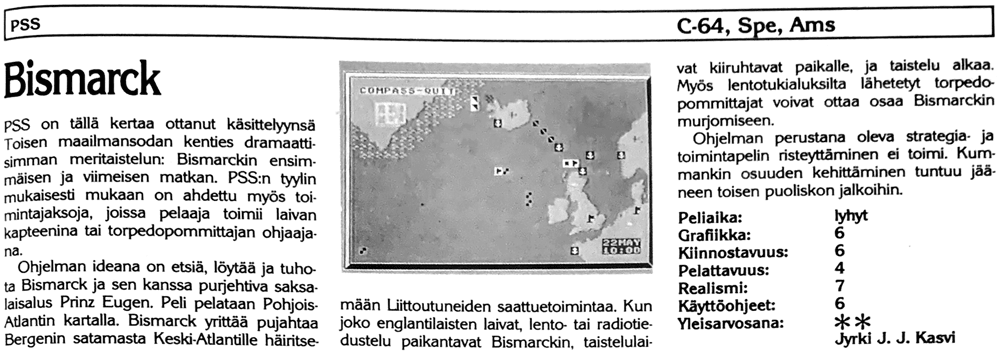
Bismarck1988Pysyvä linkkiPSS on tällä kertaa ottanut käsittelyynsä Toisen maailmansodan kenties dramaattisimman meritaistelun: Bismarckin ensimmäisen ja viimeisen matkan. PSS:n tyylin mukaisesti mukaan on ahdettu myös toimintajaksoja, joissa pelaaja toimii laivan kapteenina tai torpedopommittajan ohjaajana.
Ohjelman ideana on etsiä, löytää ja tuhota Bismarck ja sen kanssa purjehtiva saksalaisalus Prinz Eugen. Peli pelataan Pohjois-Atlantin kartalla. Bismarck yrittää pujahtaa Bergenin satamasta Keski-Atlantille häiritsemään Liittoutuneiden saattuetoimintaa. Kun joko englantilaisten laivat, lento- tai radiotiedustelu paikantavat Bismarckin, taistelulaivat kiiruhtavat paikalle, ja taistelu alkaa. Myös lentotukialuksilta lähetetyt torpedopommittajat voivat ottaa osaa Bismarckin murjomiseen.
Ohjelman perustana oleva strategia- ja toimintapelin risteyttäminen ei toimi. Kummankin osuuden kehittäminen tuntuu jääneen toisen puoliskon jalkoihin.
Bismarck1988PermalinkThis time PSS has taken on perhaps the most dramatic naval battle of the Second World War: the Bismarck's first and last voyage. In true PSS style, action sequences have been crammed in as well, in which the player acts as a ship's captain or as the pilot of a torpedo bomber.
The idea of the program is to search for, find and destroy the Bismarck and the German ship sailing with it, the Prinz Eugen. The game is played on a map of the North Atlantic. The Bismarck tries to slip out of Bergen harbour into the mid-Atlantic to disrupt Allied convoy operations. When either the British ships or air or radio reconnaissance locate the Bismarck, the battleships hurry to the scene and battle begins. Torpedo bombers launched from aircraft carriers can also join in pummelling the Bismarck.
The cross-breeding of strategy game and action game that the program is built on doesn't work. Each half seems to have ended up trampled underfoot by the other.
Black Lamp
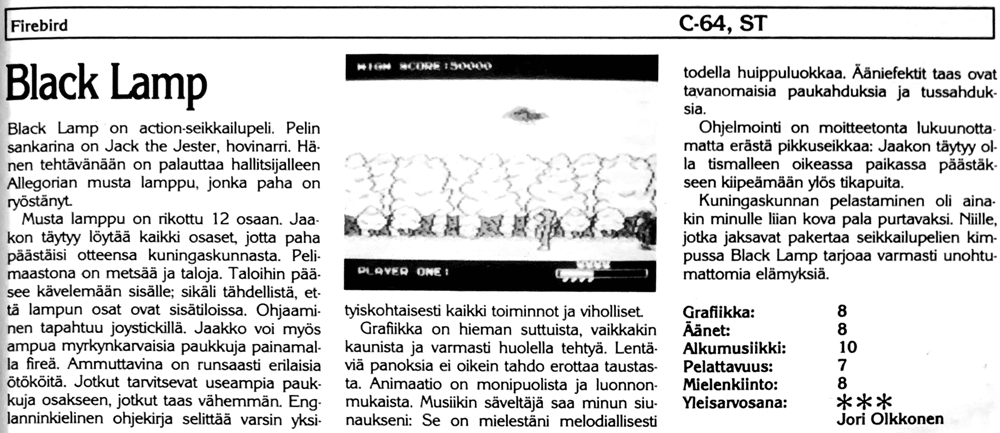
Black Lamp1988Pysyvä linkkiBlack Lamp on action-seikkailupeli. Pelin sankarina on Jack the Jester, hovinarri. Hänen tehtävänään on palauttaa hallitsijalleen Allegorian musta lamppu, jonka paha on ryöstänyt.
Musta lamppu on rikottu 12 osaan. Jaakon täytyy löytää kaikki osaset, jotta paha päästäisi otteensa kuningaskunnasta. Pelimaastona on metsää ja taloja. Taloihin pääsee kävelemään sisälle; sikäli tähdellistä, että lampun osat ovat sisätiloissa. Ohjaaminen tapahtuu joystickillä. Jaakko voi myös ampua myrkynkarvaisia paukkuja painamalla fireä. Ammuttavina on runsaasti erilaisia ötököitä. Jotkut tarvitsevat useampia paukkuja osakseen, jotkut taas vähemmän. Englanninkielinen ohjekirja selittää varsin yksityiskohtaisesti kaikki toiminnot ja viholliset.
Grafiikka on hieman suttuista, vaikkakin kaunista ja varmasti huolella tehtyä. Lentäviä panoksia ei oikein tahdo erottaa taustasta. Animaatio on monipuolista ja luonnonmukaista. Musiikin säveltäjä saa minun siunaukseni: Se on mielestäni melodiallisesti todella huippuluokkaa. Ääniefektit taas ovat tavanomaisia paukahduksia ja tussahduksia.
Ohjelmointi on moitteetonta lukuunottamatta erästä pikkuseikkaa: Jaakon täytyy olla tismalleen oikeassa paikassa päästäkseen kiipeämään ylös tikapuita.
Kuningaskunnan pelastaminen oli ainakin minulle liian kova pala purtavaksi. Niille, jotka jaksavat pakertaa seikkailupelien kimpussa Black Lamp tarjoaa varmasti unohtumattomia elämyksiä.
Black Lamp1988PermalinkBlack Lamp is an action adventure. The game's hero is Jack the Jester, a court jester. His task is to return the black lamp of Allegoria, which evil has stolen, to his ruler.
The black lamp has been broken into 12 pieces. Jaakko has to find all the pieces so that evil will release its grip on the kingdom. The terrain consists of forest and houses. You can walk inside the houses, which matters insofar as the pieces of the lamp are indoors. Control is by joystick. Jaakko can also shoot poison-coloured blasts by pressing fire. There are plenty of different critters to shoot. Some need more blasts to go down, others fewer. The English-language manual explains all the actions and enemies in considerable detail.
The graphics are a little smudgy, though pretty and certainly made with care. The flying shots are hard to tell apart from the background. The animation is varied and natural. The composer of the music gets my blessing: in my opinion it is truly top class melodically. The sound effects, on the other hand, are the usual bangs and fizzles.
The programming is flawless apart from one small detail: Jaakko has to be in exactly the right spot to be able to climb up the ladders.
Saving the kingdom was too tough a nut to crack, for me at least. For those who have the stamina to slog away at adventure games, Black Lamp is sure to offer unforgettable experiences.
Black Tiger
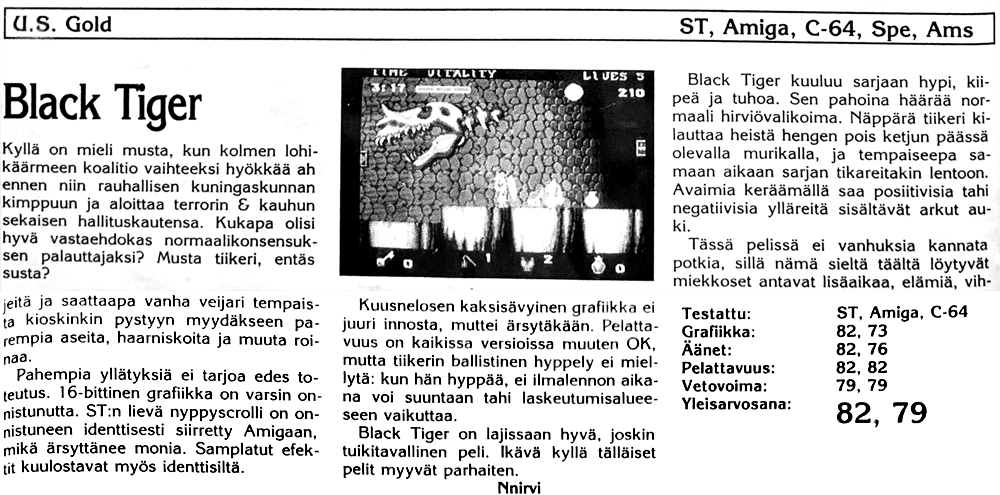
Black Tiger1990 SyksyPysyvä linkkiKyllä on mieli musta, kun kolmen lohikäärmeen koalitio vaihteeksi hyökkää ah ennen niin rauhallisen kuningaskunnan kimppuun ja aloittaa terrorin & kauhun sekaisen hallituskautensa. Kukapa olisi hyvä vastaehdokas normaalikonsensuksen palauttajaksi? Musta tiikeri, entäs susta?
Black Tiger kuuluu sarjaan hypi, kiipeä ja tuhoa. Sen pahoina häärää normaali hirviövalikoima. Näppärä tiikeri kilauttaa heistä hengen pois ketjun päässä olevalla murikalla, ja tempaiseepa samaan aikaan sarjan tikareitakin lentoon. Avaimia keräämällä saa positiivisia tahi negatiivisia ylläreitä sisältävät arkut auki.
Tässä pelissä ei vanhuksia kannata potkia, sillä nämä sieltä täältä löytyvät miekkoset antavat lisäaikaa, elämiä, vihjeitä ja saattaapa vanha veijari tempaista kioskinkin pystyyn myydäkseen parempia aseita, haarniskoita ja muuta roinaa.
Pahempia yllätyksiä ei tarjoa edes toteutus. 16-bittinen grafiikka on varsin onnistunutta. ST:n lievä nyppyscrolli on onnistuneen identtisesti siirretty Amigaan, mikä ärsyttänee monia. Samplatut efektit kuulostavat myös identtisiltä.
Kuusnelosen kaksisävyinen grafiikka ei juuri innosta, muttei ärsytäkään. Pelattavuus on kaikissa versioissa muuten OK, mutta tiikerin ballistinen hyppely ei miellytä: kun hän hyppää, ei ilmalennon aikana voi suuntaan tahi laskeutumisalueeseen vaikuttaa.
Black Tiger on lajissaan hyvä, joskin tuikitavallinen peli. Ikävä kyllä tälläiset pelit myyvät parhaiten.
Black Tiger1990 SyksyPermalinkMy mood is black indeed, as a coalition of three dragons, for a change, attacks the, ah, once so peaceful kingdom and begins its reign of mingled terror & horror. Who would make a good opposition candidate to restore the normal consensus? Black Tiger, how about you?
Black Tiger belongs to the jump, climb and destroy series. Its baddies are the usual assortment of monsters. The nimble tiger clonks the life out of them with a lump of rock on the end of a chain, and at the same time flings a volley of daggers into the air as well. By collecting keys you get to open chests containing positive or negative surprises.
In this game it doesn't pay to kick old folks, because these old chaps found here and there give you extra time, lives and hints, and the old rascal may even throw up a kiosk to sell better weapons, armour and other junk.
Not even the implementation offers any nastier surprises. The 16-bit graphics are quite successful. The ST's slightly jerky scrolling has been carried over to the Amiga with successful exactness, which will probably annoy many. The sampled effects sound identical too.
The C-64's two-tone graphics don't exactly thrill, but they don't annoy either. Playability is otherwise OK in all versions, but the tiger's ballistic jumping doesn't please: once the tiger jumps, you can't influence the direction or the landing zone during the flight.
Black Tiger is a good game of its kind, if a thoroughly ordinary one. Sadly, games like this sell the best.
BlackJack Academy
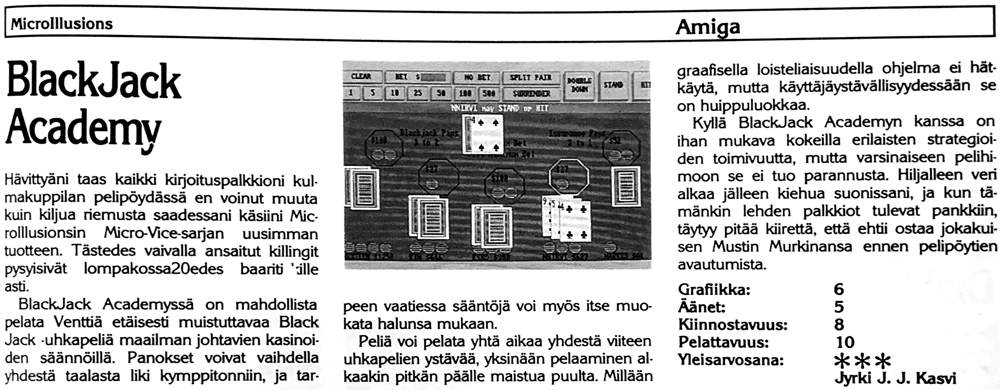
BlackJack Academy1988Pysyvä linkkiHävittyäni taas kaikki kirjoituspalkkioni kulmakuppilan pelipöydässä en voinut muuta kuin kiljua riemusta saadessani käsiini Microlllusionsin Micro-Vice-sarjan uusimman tuotteen. Tästedes vaivalla ansaitut killingit pysyisivät lompakossa20edes baaritiskille asti.
BlackJack Academyssä on mahdollista pelata Venttiä etäisesti muistuttavaa Black Jack -uhkapeliä maailman johtavien kasinoiden säännöillä. Panokset voivat vaihdella yhdestä taalasta liki kymppitonniin, ja tarpeen vaatiessa sääntöjä voi myös itse muokata halunsa mukaan.
Peliä voi pelata yhtä aikaa yhdestä viiteen uhkapelien ystävää, yksinään pelaaminen alkaakin pitkän päälle maistua puulta. Millään graafisella loisteliaisuudella ohjelma ei hätkäytä, mutta käyttäjäystävällisyydessään se on huippuluokkaa.
Kyllä BlackJack Academyn kanssa on ihan mukava kokeilla erilaisten strategioiden toimivuutta, mutta varsinaiseen pelihimoon se ei tuo parannusta. Hiljalleen veri alkaa jälleen kiehua suonissani, ja kun tämänkin lehden palkkiot tulevat pankkiin, täytyy pitää kiirettä, että ehtii ostaa jokakuisen Mustin Murkinansa ennen pelipöytien avautumista.
BlackJack Academy1988PermalinkHaving once again lost all my writing fees at the gaming table of the corner dive, I could do nothing but shriek with joy when I got my hands on the latest product in Microlllusions' Micro-Vice series. From now on my hard-earned pennies would stay in my wallet at least as far as the bar counter.
In BlackJack Academy you can play Black Jack, a gambling game distantly resembling pontoon, by the rules of the world's leading casinos. Stakes can range from one dollar to nearly ten grand, and if need be you can also modify the rules yourself as you like.
From one to five gambling enthusiasts can play at the same time, and indeed playing on your own starts to taste of sawdust in the long run. The program won't startle anyone with any graphical splendour, but in user-friendliness it is top class.
Sure, BlackJack Academy is quite nice for trying out how well different strategies work, but it brings no cure for the actual gambling itch. Slowly the blood is starting to boil in my veins again, and when the fees for this magazine too land in the bank, I'll have to hurry to buy my monthly Mustin Murkina dog food before the gaming tables open.
Blasteroids
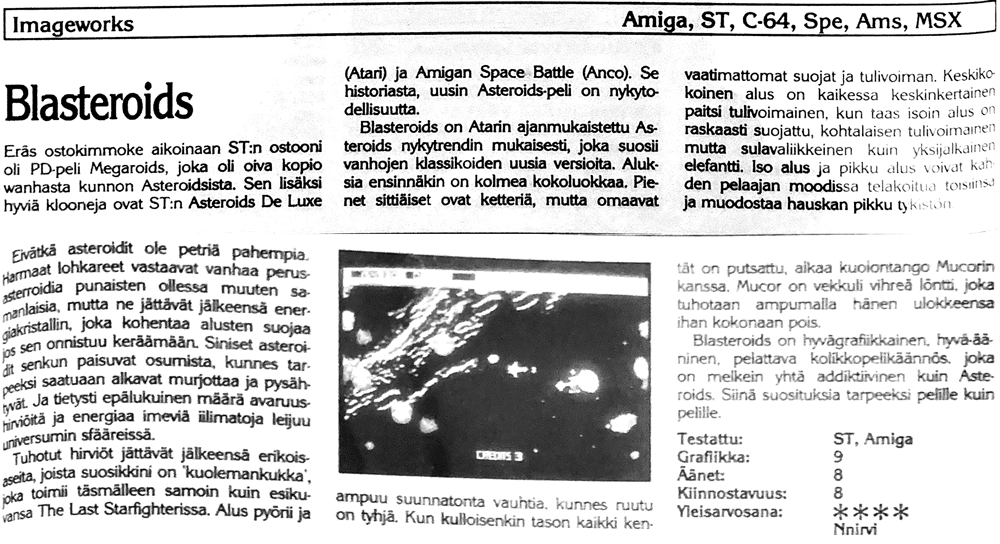
Blasteroids1989 SyksyPysyvä linkkiEräs ostokimmoke aikoinaan ST:n ostooni oli PD-peli Megaroids, joka oli oiva kopio wanhasta kunnon Asteroidsista. Sen lisäksi hyviä klooneja ovat ST:n Asteroids De Luxe (Atari) ja Amigan Space Battle (Anco). Se historiasta, uusin Asteroids-peli on nykytodellisuutta.
Blasteroids on Atarin ajanmukaistettu Asteroids nykytrendin mukaisesti, joka suosii vanhojen klassikoiden uusia versioita. Aluksia ensinnäkin on kolmea kokoluokkaa. Pienet sittiäiset ovat ketteriä, mutta omaavat vaatimattomat suojat ja tulivoiman. Keskikokoinen alus on kaikessa keskinkertainen paitsi tulivoimainen, kun taas isoin alus on raskaasti suojattu, kohtalaisen tulivoimainen mutta sulavaliikkeinen kuin yksijalkainen elefantti. Iso alus ja pikku alus voivat kahden pelaajan moodissa telakoitua toisiinsa ja muodostaa hauskan pikku tykistön. Eivätkä asteroidit ole petriä pahempia. Harmaat lohkareet vastaavat vanhaa perusasterroidia punaisten ollessa muuten samanlaisia, mutta ne jättävät jälkeensä energiakristallin, joka kohentaa alusten suojaa jos sen onnistuu keräämään. Siniset asteroidit senkun paisuvat osumista, kunnes tarpeeksi saatuaan alkavat murjottaa ja pysähtyvät. Ja tietysti epälukuinen määrä avaruushirviöitä ja energiaa imeviä iilimatoja leijuu universumin sfääreissä.
Tuhotut hirviöt jättävät jälkeensä erikoisaseita, joista suosikkini on 'kuolemankukka', joka toimii täsmälleen samoin kuin esikuvansa The Last Starfighterissa. Alus pyörii ja ampuu suunnatonta vauhtia, kunnes ruutu on tyhjä. Kun kulloisenkin tason kaikki kentät on putsattu, alkaa kuolontango Mucorin kanssa. Mucor on vekkuli vihreä löntti, joka tuhotaan ampumalla hänen ulokkeensa ihan kokonaan pois.
Blasteroids on hyvägrafiikkainen, hyvä-ääninen, pelattava kolikkopelikäännös, joka on melkein yhtä addiktiivinen kuin Asteroids. Siinä suosituksia tarpeeksi pelille kuin pelille.
Blasteroids1989 SyksyPermalinkOne of the things that spurred me to buy my ST back in the day was the PD game Megaroids, which was a fine copy of good olde Asteroids. Other good clones besides it are Asteroids De Luxe (Atari) on the ST and Space Battle (Anco) on the Amiga. So much for history - the newest Asteroids game is present-day reality.
Blasteroids is Atari's modernised Asteroids, in line with the current trend of favouring new versions of old classics. For starters, the ships come in three size classes. The little dung beetles are nimble, but have modest shields and firepower. The medium-sized ship is middling at everything except firepower, where it is strong, while the biggest ship is heavily shielded and fairly well armed, but as graceful as a one-legged elephant. In two-player mode the big ship and the little ship can dock with each other to form a fun little artillery unit. And the asteroids are no worse than petri either. The grey boulders correspond to the old basic asteroid, while the red ones are otherwise the same but leave behind an energy crystal that boosts the ships' shields if you manage to collect it. The blue asteroids just swell up when hit, until, having had enough, they start sulking and come to a stop. And of course a countless number of space monsters and energy-sucking leeches float about in the spheres of the universe.
Destroyed monsters leave behind special weapons, my favourite of which is the 'death blossom', which works exactly like its model in The Last Starfighter. The ship spins and fires at a tremendous rate until the screen is empty. Once all the stages of the current level have been cleaned out, the tango of death with Mucor begins. Mucor is a cheeky green blob who is destroyed by shooting his appendages off completely, every last bit.
Blasteroids is a good-graphicked, good-sounding, playable coin-op conversion that is almost as addictive as Asteroids. That's recommendation enough for any game at all.
Blazer
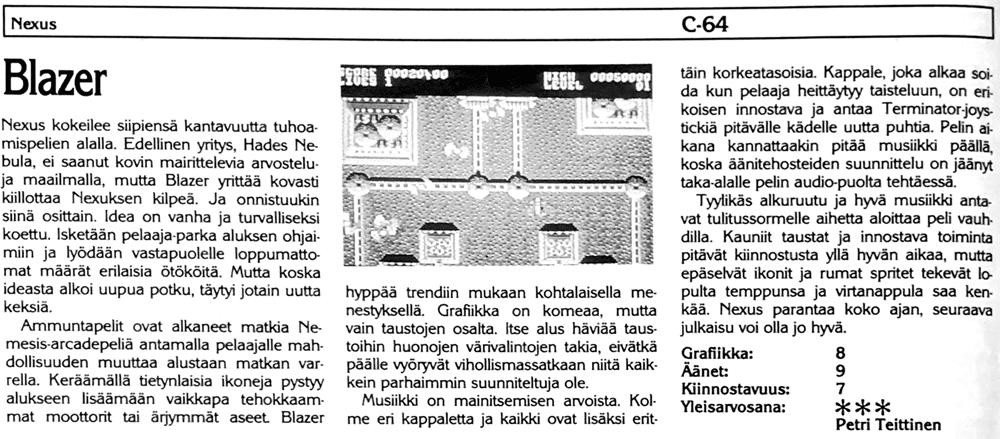
Blazer1988Pysyvä linkkiNexus kokeilee siipiensä kantavuutta tuhoamispelien alalla. Edellinen yritys, Hades Nebula, ei saanut kovin mairittelevia arvosteluja maailmalla, mutta Blazer yrittää kovasti kiillottaa Nexuksen kilpeä. Ja onnistuukin siinä osittain. Idea on vanha ja turvalliseksi koettu. Isketään pelaaja-parka aluksen ohjaimiin ja lyödään vastapuolelle loppumattomat määrät erilaisia ötököitä. Mutta koska ideasta alkoi uupua potku, täytyi jotain uutta keksiä.
Ammuntapelit ovat alkaneet matkia Nemesis-arcadepeliä antamalla pelaajalle mahdollisuuden muuttaa alustaan matkan varrella. Keräämällä tietynlaisia ikoneja pystyy alukseen lisäämään vaikkapa tehokkaammat moottorit tai ärjymmät aseet. Blazer hyppää trendiin mukaan kohtalaisella menestyksellä. Grafiikka on komeaa, mutta vain taustojen osalta. Itse alus häviää taustoihin huonojen värivalintojen takia, eivätkä päälle vyöryvät vihollismassatkaan niitä kaikkein parhaimmin suunniteltuja ole.
Musiikki on mainitsemisen arvoista. Kolme eri kappaletta ja kaikki ovat lisäksi erittäin korkeatasoisia. Kappale, joka alkaa soida kun pelaaja heittäytyy taisteluun, on erikoisen innostava ja antaa Terminator-joystickiä pitävälle kädelle uutta puhtia. Pelin aikana kannattaakin pitää musiikki päällä, koska äänitehosteiden suunnittelu on jäänyt taka-alalle pelin audio-puolta tehtäessä.
Tyylikäs alkuruutu ja hyvä musiikki antavat tulitussormelle aihetta aloittaa peli vauhdilla. Kauniit taustat ja innostava toiminta pitävät kiinnostusta yllä hyvän aikaa, mutta epäselvät ikonit ja rumat spritet tekevät lopulta temppunsa ja virtanappula saa kenkää. Nexus parantaa koko ajan, seuraava julkaisu voi olla jo hyvä.
Blazer1988PermalinkNexus is testing whether its wings will carry it in the field of destruction games. The previous attempt, Hades Nebula, didn't get very flattering reviews out in the world, but Blazer tries hard to polish up Nexus's shield. And partly succeeds, too. The idea is old and considered safe. Stick the poor player at the controls of a ship and line up endless numbers of assorted critters on the other side. But since the idea had started to lose its kick, something new had to be invented.
Shoot-'em-ups have started imitating the Nemesis arcade game by giving the player the chance to modify their craft along the way. By collecting certain kinds of icons you can add, say, more powerful engines or meaner weapons to the ship. Blazer jumps on the bandwagon with moderate success. The graphics are handsome, but only as far as the backgrounds go. The ship itself gets lost in the backgrounds because of poor colour choices, and the enemy hordes rolling in on you aren't exactly the best designed either.
The music is worth a mention. Three different tunes, and all of them very high quality to boot. The tune that starts playing when the player throws themselves into battle is especially rousing and gives new oomph to the hand gripping the Terminator joystick. It's worth keeping the music on during the game, too, since the design of the sound effects was pushed into the background when the audio side of the game was being made.
The stylish title screen and good music give the trigger finger reason to get the game going at full tilt. The pretty backgrounds and rousing action keep the interest up for a good while, but the unclear icons and ugly sprites do their trick in the end and the power switch gets the boot. Nexus is improving all the time; the next release might already be a good one.
BlockOut!
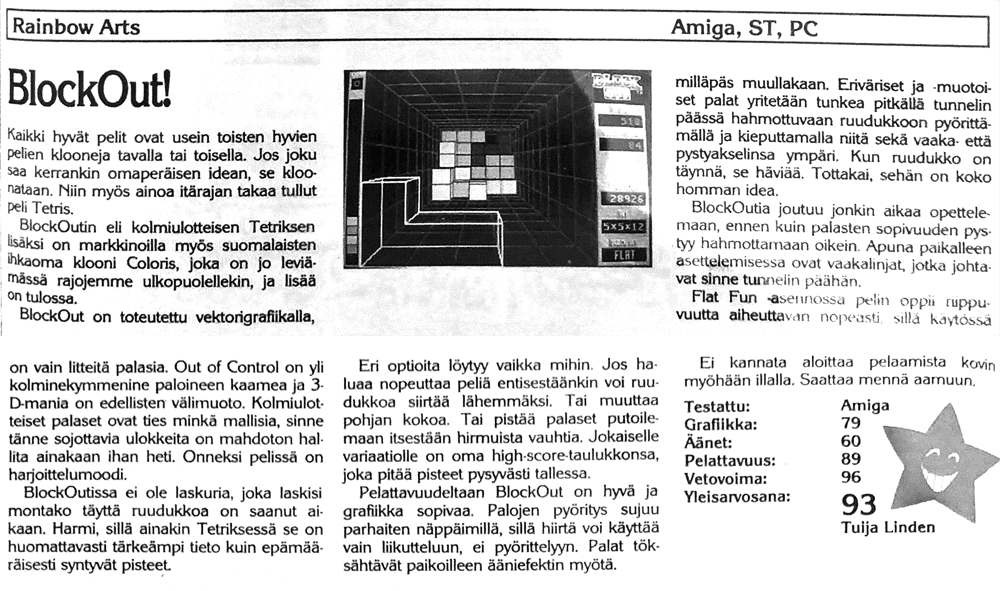
BlockOut!1990 KevätPysyvä linkkiKaikki hyvät pelit ovat usein toisten hyvien pelien klooneja tavalla tai toisella. Jos joku saa kerrankin omaperäisen idean, se kloonataan. Niin myös ainoa itärajan takaa tullut peli Tetris.
BlockOutin eli kolmiulotteisen Tetriksen lisäksi on markkinoilla myös suomalaisten ihkaoma klooni Coloris, joka on jo leviämässä rajojemme ulkopuolellekin, ja lisää on tulossa.
BlockOut on toteutettu vektorigrafiikalla, milläpäs muullakaan. Eriväriset ja -muotoiset palat yritetään tunkea pitkällä tunnelin päässä hahmottuvaan ruudukkoon pyörittämällä ja kieputtamalla niitä sekä vaaka- että pystyakselinsa ympäri. Kun ruudukko on täynnä, se häviää. Tottakai, sehän on koko homman idea.
BlockOutia joutuu jonkin aikaa opettelemaan, ennen kuin palasten sopivuuden pystyy hahmottamaan oikein. Apuna paikalleen asettelemisessa ovat vaakalinjat, jotka johtavat sinne tunnelin päähän.
Flat Fun -asennossa pelin oppii riippuvuutta aiheuttavan nopeasti, sillä käytössä on vain litteitä palasia. Out of Control on yli kolminekymmenine paloineen kaamea ja 3-D-mania on edellisten välimuoto. Kolmiulotteiset palaset ovat ties minkä mallisia, sinne tänne sojottavia ulokkeita on mahdoton hallita ainakaan ihan heti. Onneksi pelissä on harjoittelumoodi.
BlockOutissa ei ole laskuria, joka laskisi montako täyttä ruudukkoa on saanut aikaan. Harmi, sillä ainakin Tetriksessä se on huomattavasti tärkeämpi tieto kuin epämääräisesti syntyvät pisteet.
Eri optioita löytyy vaikka mihin. Jos haluaa nopeuttaa peliä entisestäänkin voi ruudukkoa siirtää lähemmäksi. Tai muuttaa pohjan kokoa. Tai pistää palaset putoilemaan itsestään hirmuista vauhtia. Jokaiselle variaatiolle on oma high-score-taulukkonsa, joka pitää pisteet pysyvästi tallessa.
Pelattavuudeltaan BlockOut on hyvä ja grafiikka sopivaa. Palojen pyöritys sujuu parhaiten näppäimillä, sillä hiirtä voi käyttää vain liikutteluun, ei pyörittelyyn. Palat töksähtävät paikoilleen ääniefektin myötä.
Ei kannata aloittaa pelaamista kovin myöhään illalla. Saattaa mennä aamuun.
BlockOut!1990 KevätPermalinkAll good games are often clones of other good games in one way or another. If somebody for once comes up with an original idea, it gets cloned. The same goes for Tetris, the only game ever to come from across the eastern border.
Besides BlockOut, i.e. three-dimensional Tetris, there's also the Finns' very own clone on the market, Coloris, which is already spreading beyond our borders too, and more are on the way.
BlockOut is done in vector graphics - what else? You try to cram pieces of different colours and shapes into a grid that looms far away at the end of a tunnel, by spinning and twirling them around both their horizontal and vertical axes. When the grid is full, it disappears. Naturally, that's the whole point of the thing.
BlockOut takes a while to learn before you can properly make out how the pieces will fit. Helping you put them in place are horizontal lines that lead all the way down to the end of the tunnel.
In the Flat Fun setting you pick the game up addictively fast, since only flat pieces are used. Out of Control, with its more than thirty pieces, is horrendous, and 3-D-mania is somewhere in between the two. The three-dimensional pieces come in heaven knows what shapes, and the knobbly bits sticking out every which way are impossible to master, at least not right away. Fortunately the game has a practice mode.
BlockOut has no counter to tally how many full grids you've managed to complete. A pity, since in Tetris at least that's a far more important piece of information than the points, which pile up in some vague fashion.
There are options for just about everything. If you want to speed the game up even further, you can move the grid closer. Or change the size of the floor. Or set the pieces dropping on their own at a terrific pace. Each variation has its own high-score table, which keeps the scores stored permanently.
In terms of playability BlockOut is good, and the graphics are fitting. Rotating the pieces works best with the keys, since the mouse can only be used for moving them around, not for rotating. The pieces clunk into place with a sound effect.
Don't start playing too late in the evening. It might go on until morning.
Blood Brothers
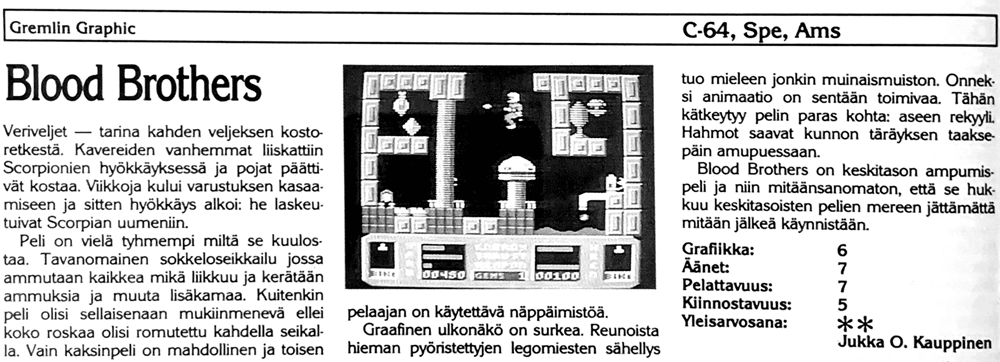
Blood Brothers1988Pysyvä linkkiVeriveljet - tarina kahden veljeksen kostoretkestä. Kavereiden vanhemmat liiskattiin Scorpionien hyökkäyksessä ja pojat päättivät kostaa. Viikkoja kului varustuksen kasaamiseen ja sitten hyökkäys alkoi: he laskeutuivat Scorpian uumeniin.
Peli on vielä tyhmempi miltä se kuulostaa. Tavanomainen sokkeloseikkailu jossa ammutaan kaikkea mikä liikkuu ja kerätään ammuksia ja muuta lisäkamaa. Kuitenkin peli olisi sellaisenaan mukiinmenevä ellei koko roskaa olisi romutettu kahdella seikalla. Vain kaksinpeli on mahdollinen ja toisen pelaajan on käytettävä näppäimistöä.
Graafinen ulkonäkö on surkea. Reunoista hieman pyöristettyjen legomiesten sähellys tuo mieleen jonkin muinaismuiston. Onneksi animaatio on sentään toimivaa. Tähän kätkeytyy pelin paras kohta: aseen rekyyli. Hahmot saavat kunnon täräyksen taaksepäin amupuessaan.
Blood Brothers on keskitason ampumispeli ja niin mitäänsanomaton, että se hukkuu keskitasoisten pelien mereen jättämättä mitään jälkeä käynnistään.
Blood Brothers1988PermalinkBlood Brothers - the story of two brothers' mission of revenge. The lads' parents were squashed in an attack by the Scorpions, and the boys decided to take revenge. Weeks went by gathering equipment, and then the assault began: they descended into the bowels of Scorpia.
The game is even dumber than it sounds. A run-of-the-mill maze adventure where you shoot everything that moves and collect ammo and other extra gear. Still, the game would be passable as it stands if the whole shebang hadn't been wrecked by two things. Only two-player mode is possible, and the second player has to use the keyboard.
The graphics look miserable. The bumbling about of Lego men slightly rounded at the edges brings to mind some ancient relic. Luckily the animation at least works. Therein lies the best part of the game: the recoil of the guns. The characters get a proper jolt backwards when they shoot.
Blood Brothers is a middling shoot-'em-up, and so bland that it drowns in the sea of middling games without leaving any trace of its visit.
Bloodwych
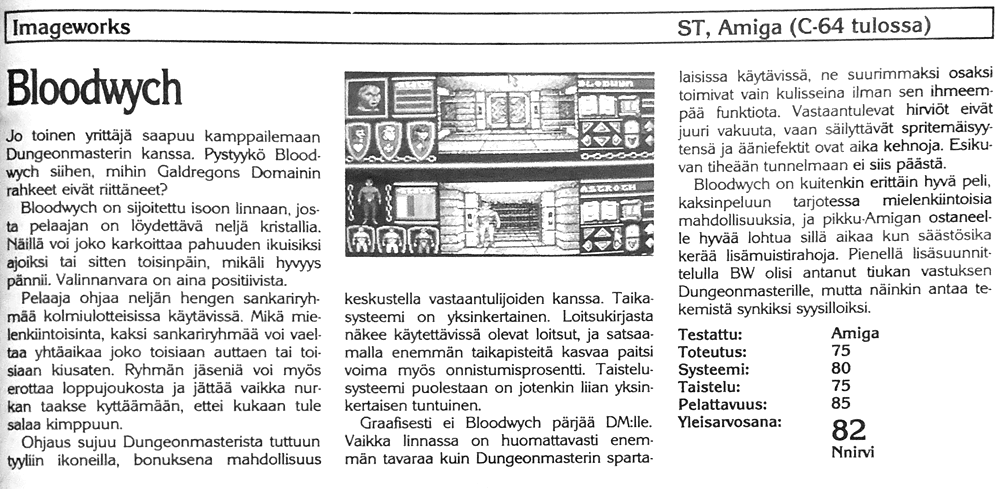
Bloodwych1990 KevätPysyvä linkkiJo toinen yrittäjä saapuu kamppailemaan Dungeonmasterin kanssa. Pystyykö Bloodwych siihen, mihin Galdregons Domainin rahkeet eivät riittäneet?
Bloodwych on sijoitettu isoon linnaan, josta pelaajan on löydettävä neljä kristallia. Näillä voi joko karkoittaa pahuuden ikuisiksi ajoiksi tai sitten toisinpäin, mikäli hyvyys pännii. Valinnanvara on aina positiivista.
Pelaaja ohjaa neljän hengen sankariryhmää kolmiulotteisissa käytävissä. Mikä mielenkiintoisinta, kaksi sankariryhmää voi vaeltaa yhtäaikaa joko toisiaan auttaen tai toisiaan kiusaten. Ryhmän jäseniä voi myös erottaa loppujoukosta ja jättää vaikka nurkan taakse kyttäämään, ettei kukaan tule salaa kimppuun.
Ohjaus sujuu Dungeonmasterista tuttuun tyyliin ikoneilla, bonuksena mahdollisuus keskustella vastaantulijoiden kanssa. Taikasysteemi on yksinkertainen. Loitsukirjasta näkee käytettävissä olevat loitsut, ja satsaamalla enemmän taikapisteitä kasvaa paitsi voima myös onnistumisprosentti. Taistelusysteemi puolestaan on jotenkin liian yksinkertaisen tuntuinen.
Graafisesti ei Bloodwych pärjää DM:lle. Vaikka linnassa on huomattavasti enemmän tavaraa kuin Dungeonmasterin spartalaisissa käytävissä, ne suurimmaksi osaksi toimivat vain kulisseina ilman sen ihmeempää funktiota. Vastaantulevat hirviöt eivät juuri vakuuta, vaan säilyttävät spritemäisyytensä ja ääniefektit ovat aika kehnoja. Esikuvan tiheään tunnelmaan ei siis päästä.
Bloodwych on kuitenkin erittäin hyvä peli, kaksinpeluun tarjotessa mielenkiintoisia mahdollisuuksia, ja pikku-Amigan ostaneelle hyvää lohtua sillä aikaa kun säästösika kerää lisämuistirahoja. Pienellä lisäsuunnittelulla BW olisi antanut tiukan vastuksen Dungeonmasterille, mutta näinkin antaa tekemistä synkiksi syysilloiksi.
Bloodwych1990 KevätPermalinkHere comes the second contender already, stepping up to take on Dungeonmaster. Can Bloodwych pull off what Galdregons Domain didn't have the muscle for?
Bloodwych is set in a large castle, where the player has to find four crystals. With these you can either banish evil for all eternity, or else the other way round, if goodness gets on your nerves. Having a choice is always a positive thing.
The player controls a four-strong party of heroes in three-dimensional corridors. Most interesting of all, two parties can roam at the same time, either helping each other or making each other's lives miserable. Party members can also be split off from the rest of the group and left, say, behind a corner on the lookout, so that nobody sneaks up and jumps you.
Control is handled with icons in the style familiar from Dungeonmaster, with the bonus of being able to chat with whoever you run into. The magic system is simple. The spellbook shows the spells available to you, and by putting more magic points into a spell you increase not only its power but also its chance of success. The combat system, on the other hand, somehow feels too simple.
Graphically, Bloodwych is no match for DM. Although the castle has a good deal more stuff in it than Dungeonmaster's spartan corridors, most of it just serves as scenery with no particular function. The monsters you meet hardly convince, staying stubbornly sprite-like, and the sound effects are pretty feeble. So it never gets anywhere near the dense atmosphere of the game it's modelled on.
Nevertheless, Bloodwych is a very good game, with two-player mode offering interesting possibilities, and for anyone who bought the little Amiga it's fine consolation while the piggy bank saves up for extra memory. With a little more design work BW would have given Dungeonmaster a real run for its money, but even as it is, it'll keep you busy through the gloomy autumn evenings.
Bloodwych
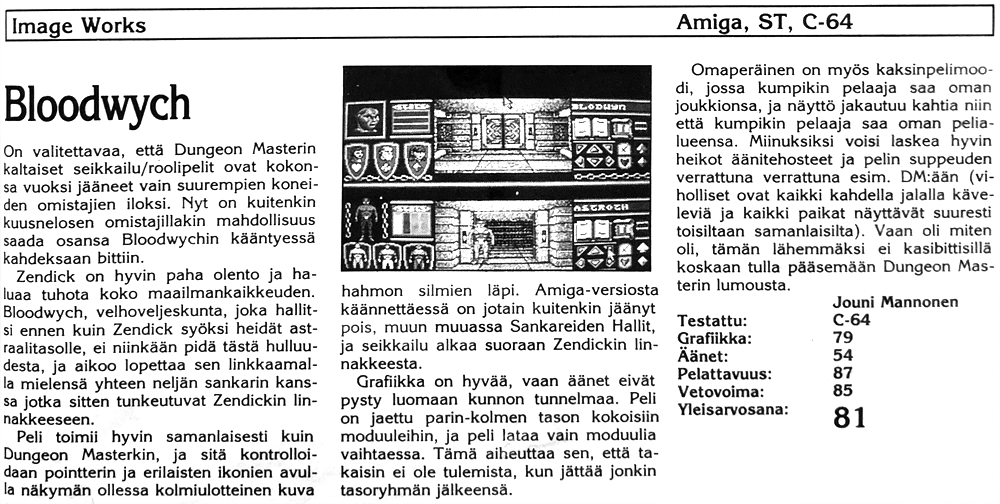
Bloodwych1990 SyksyPysyvä linkkiOn valitettavaa, että Dungeon Masterin kaltaiset seikkailu/roolipelit ovat kokonsa vuoksi jääneet vain suurempien koneiden omistajien iloksi. Nyt on kuitenkin kuusnelosen omistajillakin mahdollisuus saada osansa Bloodwychin kääntyessä kahdeksaan bittiin.
Zendick on hyvin paha olento ja haluaa tuhota koko maailmankaikkeuden. Bloodwych, velhoveljeskunta, joka hallitsi ennen kuin Zendick syöksi heidät astraalitasolle, ei niinkään pidä tästä hulluudesta, ja aikoo lopettaa sen linkkaamalla mielensä yhteen neljän sankarin kanssa jotka sitten tunkeutuvat Zendickin linnakkeeseen.
Peli toimii hyvin samanlaisesti kuin Dungeon Masterkin, ja sitä kontrolloidaan pointterin ja erilaisten ikonien avulla näkymän ollessa kolmiulotteinen kuva hahmon silmien läpi. Amiga-versiosta käännettäessä on jotain kuitenkin jäänyt pois, muun muuassa Sankareiden Hallit, ja seikkailu alkaa suoraan Zendickin linnakkeesta.
Grafiikka on hyvää, vaan äänet eivät pysty luomaan kunnon tunnelmaa. Peli on jaettu parin-kolmen tason kokoisiin moduuleihin, ja peli lataa vain moduulia vaihtaessa. Tämä aiheuttaa sen, että takaisin ei ole tulemista, kun jättää jonkin tasoryhmän jälkeensä.
Omaperäinen on myös kaksinpelimoodi, jossa kumpikin pelaaja saa oman joukkionsa, ja näyttö jakautuu kahtia niin että kumpikin pelaaja saa oman pelialueensa. Miinuksiksi voisi laskea hyvin heikot äänitehosteet ja pelin suppeuden verrattuna verrattuna esim. DM:ään (viholliset ovat kaikki kahdella jalalla käveleviä ja kaikki paikat näyttävät suuresti toisiltaan samanlaisilta). Vaan oli miten oli, tämän lähemmäksi ei kasibittisillä koskaan tulla pääsemään Dungeon Masterin lumousta.
Bloodwych1990 SyksyPermalinkIt's a pity that adventure/role-playing games like Dungeon Master have, because of their size, remained a treat only for owners of bigger machines. Now, though, C-64 owners also get the chance to have their share, as Bloodwych is converted to eight bits.
Zendick is a very evil being and wants to destroy the entire universe. The Bloodwych, a brotherhood of wizards who ruled before Zendick cast them down onto the astral plane, aren't too keen on this madness, and intend to put an end to it by linking their minds with four heroes, who then break into Zendick's stronghold.
The game works very much like Dungeon Master, and it's controlled with a pointer and various icons, the view being a three-dimensional picture through the character's eyes. Something has been left out in the conversion from the Amiga version, though, among other things the Halls of Heroes, and the adventure begins straight in Zendick's stronghold.
The graphics are good, but the sounds can't create a proper atmosphere. The game is split into modules two or three levels in size, and it only loads when you switch modules. The upshot is that there's no coming back once you leave a group of levels behind.
Also original is the two-player mode, in which each player gets their own little band and the screen splits in two so that each player gets their own play area. On the minus side you could count the very weak sound effects and the game's narrowness compared to, say, DM (the enemies all walk on two legs and all the places look very much alike). But be that as it may, the eight-bit machines will never get any closer than this to the magic of Dungeon Master.
Blue Angels
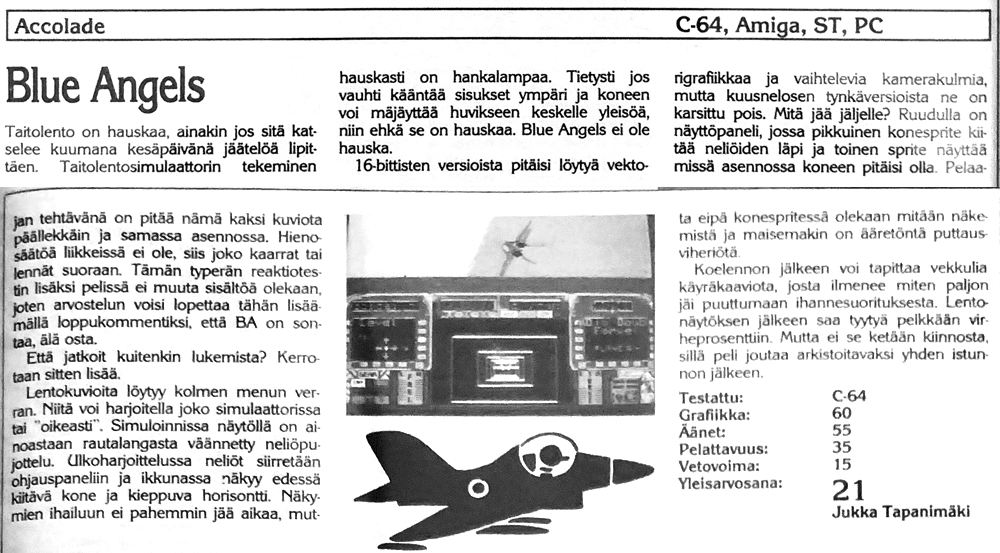
Blue Angels1990 KevätPysyvä linkkiTaitolento on hauskaa, ainakin jos sitä katselee kuumana kesäpäivänä jäätelöä lipittäen. Taitolentosimulaattorin tekeminen hauskasti on hankalampaa. Tietysti jos vauhti kääntää sisukset ympäri ja koneen voi mäjäyttää huvikseen keskelle yleisöä, niin ehkä se on hauskaa. Blue Angels ei ole hauska.
16-bittisten versioista pitäisi löytyä vektorigrafiikkaa ja vaihtelevia kamerakulmia, mutta kuusnelosen tynkäversioista ne on karsittu pois. Mitä jää jäljelle? Ruudulla on näyttöpaneli, jossa pikkuinen konesprite kiitää neliöiden läpi ja toinen sprite näyttää missä asennossa koneen pitäisi olla. Pelaajan tehtävänä on pitää nämä kaksi kuviota päällekkäin ja samassa asennossa. Hienosäätöä liikkeissä ei ole, siis joko kaarrat tai lennät suoraan. Tämän typerän reaktiotestin lisäksi pelissä ei muuta sisältöä olekaan, joten arvostelun voisi lopettaa tähän lisäämällä loppukommentiksi, että BA on sontaa, älä osta.
Että jatkoit kuitenkin lukemista? Kerrotaan sitten lisää.
Lentokuvioita löytyy kolmen menun verran. Niitä voi harjoitella joko simulaattorissa tai "oikeasti". Simuloinnissa näytöllä on ainoastaan rautalangasta väännetty neliöpujottelu. Ulkoharjoittelussa neliöt siirretään ohjauspaneliin ja ikkunassa näkyy edessä kiitävä kone ja kieppuva horisontti. Näkymien ihailuun ei pahemmin jää aikaa, mutta eipä konespritessä olekaan mitään näkemistä ja maisemakin on ääretöntä puttausviheriötä.
Koelennon jälkeen voi tapittaa vekkulia käyräkaaviota, josta ilmenee miten paljon jäi puuttumaan ihannesuorituksesta. Lentonäytöksen jälkeen saa tyytyä pelkkään virheprosenttiin. Mutta ei se ketään kiinnosta, sillä peli joutaa arkistoitavaksi yhden istunnon jälkeen.
Blue Angels1990 KevätPermalinkAerobatics is fun, at least if you're watching it on a hot summer's day while licking an ice cream. Making an aerobatics simulator fun is trickier. Of course, if the speed turns your insides out and you can smash the plane into the middle of the crowd just for kicks, then maybe it's fun. Blue Angels is not fun.
The 16-bit versions are supposed to have vector graphics and varying camera angles, but these have been pruned out of the stunted C-64 version. What's left? On screen there's a display panel in which a teeny plane sprite zips through squares while another sprite shows what position the plane ought to be in. The player's job is to keep these two figures on top of each other and in the same position. There's no fine control over the movements, so you're either turning or flying straight. Apart from this idiotic reaction test the game has no other content at all, so the review could end right here with the closing comment that BA is crap, don't buy it.
So you kept on reading anyway? Well then, let's tell you some more.
There are three menus' worth of flight manoeuvres. You can practise them either in the simulator or "for real". In the simulation the screen shows nothing but a slalom through squares bent out of wire. In outdoor practice the squares are moved onto the control panel, and the window shows the plane zooming along ahead and a spinning horizon. There's not much time left over for admiring the view, but then there's nothing worth seeing in the plane sprite anyway, and the landscape is one endless putting green.
After a test flight you can gawp at a cute little line graph showing how far short of the ideal performance you fell. After an air show you have to make do with a bare error percentage. But nobody cares about that anyway, because after a single session the game is fit only for the archive.
Blue Lightning
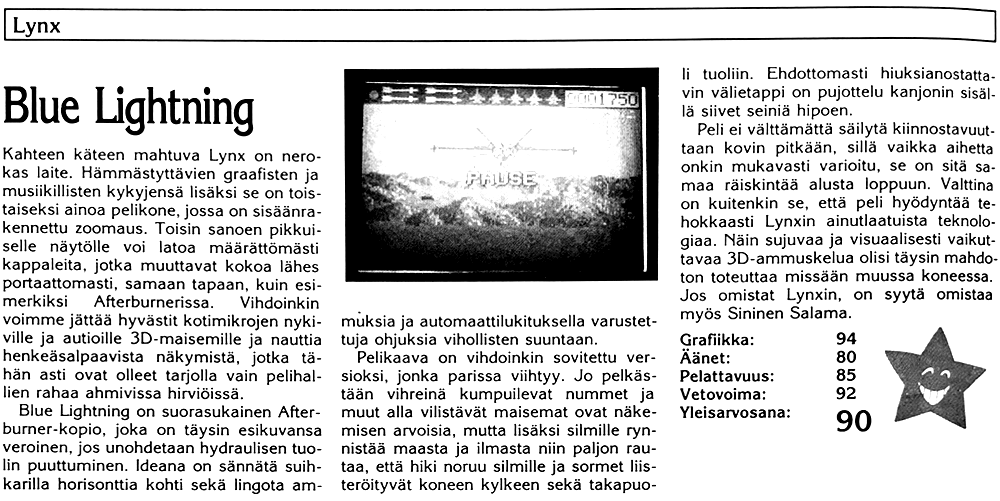
Blue Lightning1990 SyksyPysyvä linkkiKahteen käteen mahtuva Lynx on nerokas laite. Hämmästyttävien graafisten ja musiikillisten kykyjensä lisäksi se on toistaiseksi ainoa pelikone, jossa on sisäänrakennettu zoomaus. Toisin sanoen pikkuiselle näytölle voi latoa määrättömästi kappaleita, jotka muuttavat kokoa lähes portaattomasti, samaan tapaan, kuin esimerkiksi Afterburnerissa. Vihdoinkin voimme jättää hyvästit kotimikrojen nykiville ja autioille 3D-maisemille ja nauttia henkeäsalpaavista näkymistä, jotka tähän asti ovat olleet tarjolla vain pelihallien rahaa ahmivissa hirviöissä.
Blue Lightning on suorasukainen Afterburner-kopio, joka on täysin esikuvansa veroinen, jos unohdetaan hydraulisen tuolin puuttuminen. Ideana on sännätä suihkarilla horisonttia kohti sekä lingota ammuksia ja automaattilukituksella varustettuja ohjuksia vihollisten suuntaan.
Pelikaava on vihdoinkin sovitettu versioksi, jonka parissa viihtyy. Jo pelkästään vihreinä kumpuilevat nummet ja muut alla vilistävät maisemat ovat näkemisen arvoisia, mutta lisäksi silmille rynnistää maasta ja ilmasta niin paljon rautaa, että hiki noruu silmille ja sormet liisteröityvät koneen kylkeen sekä takapuoli tuoliin. Ehdottomasti hiuksianostattavin välietappi on pujottelu kanjonin sisällä siivet seiniä hipoen.
Peli ei välttämättä säilytä kiinnostavuuttaan kovin pitkään, sillä vaikka aihetta onkin mukavasti varioitu, se on sitä samaa räiskintää alusta loppuun. Valttina on kuitenkin se, että peli hyödyntää tehokkaasti Lynxin ainutlaatuista teknologiaa. Näin sujuvaa ja visuaalisesti vaikuttavaa 3D-ammuskelua olisi täysin mahdoton toteuttaa missään muussa koneessa. Jos omistat Lynxin, on syytä omistaa myös Sininen Salama.
Blue Lightning1990 SyksyPermalinkThe Lynx, small enough to hold in two hands, is an ingenious device. On top of its astonishing graphical and musical abilities, it is so far the only games machine with built-in zooming. In other words, you can pile any number of objects onto the tiny screen and have them change size almost seamlessly, the same way as in, say, Afterburner. At last we can bid farewell to the jerky, deserted 3D landscapes of home computers and enjoy breathtaking views that until now have only been on offer in the money-gobbling monsters of the arcades.
Blue Lightning is a straight-up Afterburner copy that is every bit the equal of its model, if we overlook the missing hydraulic seat. The idea is to hurtle toward the horizon in a jet, slinging rounds and auto-locking missiles in the direction of the enemy.
The formula has at last been adapted into a version you can actually enjoy. The rolling green moors and the other scenery flashing past below are worth seeing all on their own, but on top of that so much hardware comes storming at your eyes from the ground and the air that sweat trickles into your eyes, your fingers get pasted to the side of the machine and your backside to the chair. By far the most hair-raising leg is slaloming through the inside of a canyon with your wings grazing the walls.
The game won't necessarily hold its appeal for very long, because although the theme has been nicely varied, it's the same old blasting from start to finish. Its trump card, however, is that it makes effective use of the Lynx's unique technology. 3D shooting this smooth and visually impressive would be utterly impossible to pull off on any other machine. If you own a Lynx, you ought to own Sininen Salama too.
Blue Max - Aces of The Great War
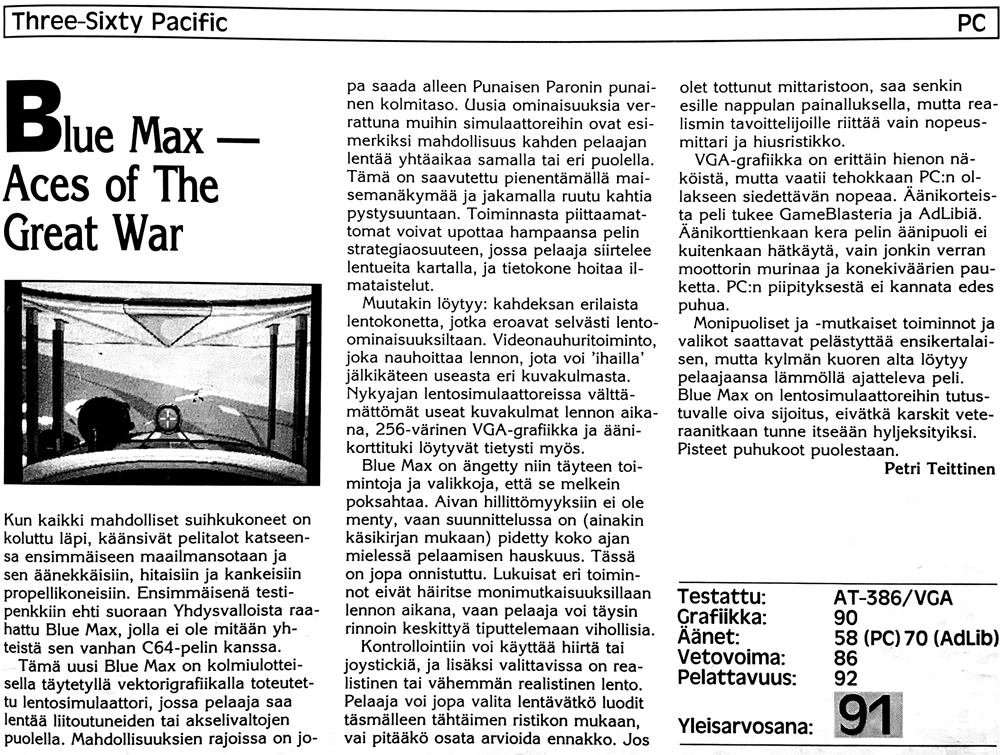
Blue Max - Aces of The Great War1991 KevätPysyvä linkkiKun kaikki mahdolliset suihkukoneet on koluttu läpi, käänsivät pelitalot katseensa ensimmäiseen maailmansotaan ja sen äänekkäisiin, hitaisiin ja kankeisiin propellikoneisiin. Ensimmäisenä testipenkkiin ehti suoraan Yhdysvalloista raahattu Blue Max, jolla ei ole mitään yhteistä sen vanhan C64-pelin kanssa.
Tämä uusi Blue Max on kolmiulotteisella täytetyllä vektorigrafiikalla toteutettu lentosimulaattori, jossa pelaaja saa lentää liitoutuneiden tai akselivaltojen puolella. Mahdollisuuksien rajoissa on jopa saada alleen Punaisen Paronin punainen kolmitaso. Uusia ominaisuuksia verrattuna muihin simulaattoreihin ovat esimerkiksi mahdollisuus kahden pelaajan lentää yhtäaikaa samalla tai eri puolella. Tämä on saavutettu pienentämällä maisemanäkymää ja jakamalla ruutu kahtia pystysuuntaan. Toiminnasta piittaamattomat voivat upottaa hampaansa pelin strategiaosuuteen, jossa pelaaja siirtelee lentueita kartalla, ja tietokone hoitaa ilmataistelut.
Muutakin löytyy: kahdeksan erilaista lentokonetta, jotka eroavat selvästi lento-ominaisuuksiltaan. Videonauhuritoiminto, joka nauhoittaa lennon, jota voi 'ihailla' jälkikäteen useasta eri kuvakulmasta. Nykyajan lentosimulaattoreissa välttämättömät useat kuvakulmat lennon aikana, 256-värinen VGA-grafiikka ja äänikorttituki löytyvät tietysti myös.
Blue Max on ängetty niin täyteen toimintoja ja valikkoja, että se melkein poksahtaa. Aivan hillittömyyksiin ei ole menty, vaan suunnittelussa on (ainakin käsikirjan mukaan) pidetty koko ajan mielessä pelaamisen hauskuus. Tässä on jopa onnistuttu. Lukuisat eri toiminnot eivät häiritse monimutkaisuuksillaan lennon aikana, vaan pelaaja voi täysin rinnoin keskittyä tiputtelemaan vihollisia.
Kontrollointiin voi käyttää hiirtä tai joystickiä, ja lisäksi valittavissa on realistinen tai vähemmän realistinen lento. Pelaaja voi jopa valita lentävätkö luodit täsmälleen tähtäimen ristikon mukaan, vai pitääkö osata arvioida ennakko. Jos olet tottunut mittaristoon, saa senkin esille nappulan painalluksella, mutta realismin tavoittelijoille riittää vain nopeusmittari ja hiusristikko.
VGA-grafiikka on erittäin hienon näköistä, mutta vaatii tehokkaan PC:n ollakseen siedettävän nopeaa. Äänikorteista peli tukee GameBlasteria ja AdLibiä. Äänikorttienkaan kera pelin äänipuoli ei kuitenkaan hätkäytä, vain jonkin verran moottorin murinaa ja konekiväärien pauketta. PC:n piipityksestä ei kannata edes puhua.
Monipuoliset ja -mutkaiset toiminnot ja valikot saattavat pelästyttää ensikertalaisen, mutta kylmän kuoren alta löytyy pelaajaansa lämmöllä ajatteleva peli. Blue Max on lentosimulaattoreihin tutustuvalle oiva sijoitus, eivätkä karskit veteraanitkaan tunne itseään hyljeksityiksi. Pisteet puhukoot puolestaan.
Blue Max - Aces of The Great War1991 KevätPermalinkHaving ploughed through every jet plane imaginable, the software houses turned their gaze to the First World War and its noisy, slow and clumsy propeller planes. First onto the test bench is Blue Max, dragged straight over from the United States, which has nothing in common with that old C64 game.
This new Blue Max is a flight simulator done in three-dimensional filled vector graphics, in which the player gets to fly on the side of the Allies or the Axis powers. It is even within the realm of possibility to get the Red Baron's red triplane under you. New features compared with other simulators include, for example, the chance for two players to fly at the same time, on the same side or on opposite sides. This has been achieved by shrinking the view of the landscape and splitting the screen in two vertically. Those who don't care for action can sink their teeth into the game's strategy section, in which the player moves squadrons around on a map and the computer handles the dogfights.
There's more, too: eight different aircraft that differ clearly in their flight characteristics. A video recorder function that tapes your flight, which you can 'admire' afterwards from several different camera angles. The multiple in-flight views that are a must in today's flight simulators, 256-colour VGA graphics and sound card support are of course there as well.
Blue Max is crammed so full of functions and menus that it very nearly pops. Things haven't been taken to wild extremes, though; instead the design has (according to the manual, at least) kept the fun of playing in mind the whole time. And they have even succeeded in this. The numerous functions don't get in your way with their complexity during flight, so the player can concentrate wholeheartedly on knocking enemies out of the sky.
You can control the plane with the mouse or a joystick, and you can also choose between realistic and less realistic flight. The player can even choose whether the bullets fly exactly where the crosshairs point or whether you have to be able to judge the lead yourself. If you're used to a full instrument panel, you can bring that up too at the press of a button, but for those after realism, just an airspeed indicator and the crosshairs will do.
The VGA graphics look extremely fine, but they need a powerful PC to be tolerably fast. As for sound cards, the game supports the GameBlaster and the AdLib. Even with the sound cards, though, the game's audio side isn't exactly startling, just a certain amount of engine drone and machine-gun rattle. The PC's beeping isn't even worth talking about.
The versatile and complicated functions and menus may scare off a first-timer, but beneath the cold shell lies a game that thinks warmly of its player. Blue Max is an excellent investment for someone getting to know flight simulators, and the grizzled veterans won't feel left out either. Let the scores speak for themselves.
BMX Kidz
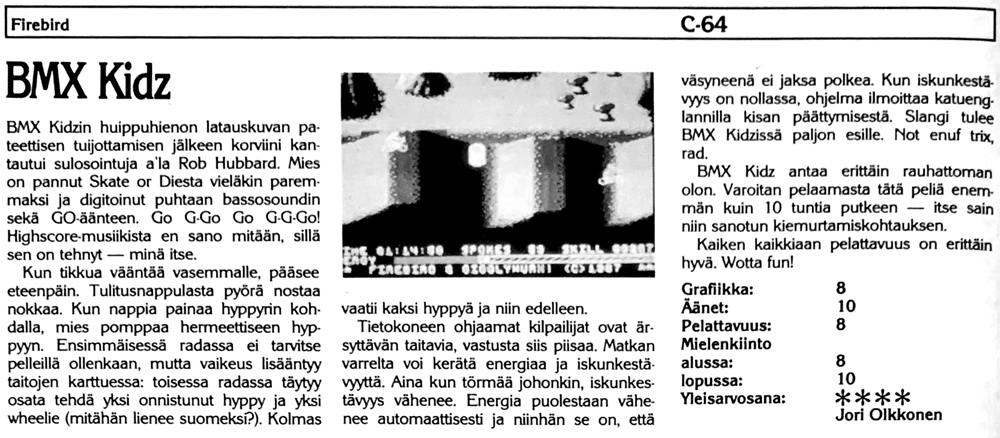
BMX Kidz1988Pysyvä linkkiBMX Kidzin huippuhienon latauskuvan pateettisen tuijottamisen jälkeen korviini kantautui sulosointuja a'la Rob Hubbard. Mies on pannut Skate or Diesta vieläkin paremmaksi ja digitoinut puhtaan bassosoundin sekä GO-äänteen. Go G-Go Go G-G-Go! Highscore-musiikista en sano mitään, sillä sen on tehnyt - minä itse.
Kun tikkua vääntää vasemmalle, pääsee eteenpäin. Tulitusnappulasta pyörä nostaa nokkaa. Kun nappia painaa hyppyrin kohdalla, mies pomppaa hermeettiseen hyppyyn. Ensimmäisessä radassa ei tarvitse pelleillä ollenkaan, mutta vaikeus lisääntyy taitojen karttuessa: toisessa radassa täytyy osata tehdä yksi onnistunut hyppy ja yksi wheelie (mitähän lienee suomeksi?). Kolmas vaatii kaksi hyppyä ja niin edelleen.
Tietokoneen ohjaamat kilpailijat ovat ärsyttävän taitavia, vastusta siis piisaa. Matkan varrelta voi kerätä energiaa ja iskunkestävyyttä. Aina kun törmää johonkin, iskunkestävyys vähenee. Energia puolestaan vähenee automaattisesti ja niinhän se on, että väsyneenä ei jaksa polkea. Kun iskunkestävyys on nollassa, ohjelma ilmoittaa katuenglannilla kisan päättymisestä. Slangi tulee BMX Kidzissä paljon esille. Not enuf trix, rad.
BMX Kidz antaa erittäin rauhattoman olon. Varoitan pelaamasta tätä peliä enemmän kuin 10 tuntia putkeen - itse sain niin sanotun kiemurtamiskohtauksen.
Kaiken kaikkiaan pelattavuus on erittäin hyvä. Wotta fun!
BMX Kidz1988PermalinkAfter a spell of melodramatic staring at BMX Kidz's ultra-fancy loading screen, sweet strains à la Rob Hubbard drifted to my ears. The man has gone one better than even Skate or Die and digitised a clean bass sound plus a GO sound. Go G-Go Go G-G-Go! About the high-score music I'll say nothing, because it was made by - yours truly.
Push the stick left and you move forward. The fire button makes the bike lift its nose. Press the button at a ramp and the guy bounces into a hermetic jump. On the first track you don't need to fool around at all, but the difficulty rises as your skills grow: on the second track you have to manage one successful jump and one wheelie (what might that be in Finnish, I wonder?). The third requires two jumps, and so on.
The computer-controlled competitors are annoyingly skilful, so there's plenty of opposition. Along the way you can collect energy and impact resistance. Every time you crash into something, your impact resistance goes down. Energy, for its part, drains automatically, and that's just how it is: when you're tired you haven't got the strength to pedal. When impact resistance hits zero, the program announces the end of the race in street English. Slang crops up a lot in BMX Kidz. Not enuf trix, rad.
BMX Kidz leaves you feeling extremely restless. I warn against playing this game for more than 10 hours straight - I myself came down with a so-called fit of the squirms.
All in all, the playability is very good. Wotta fun!
BMX Simulator + BMX Simulator Pro
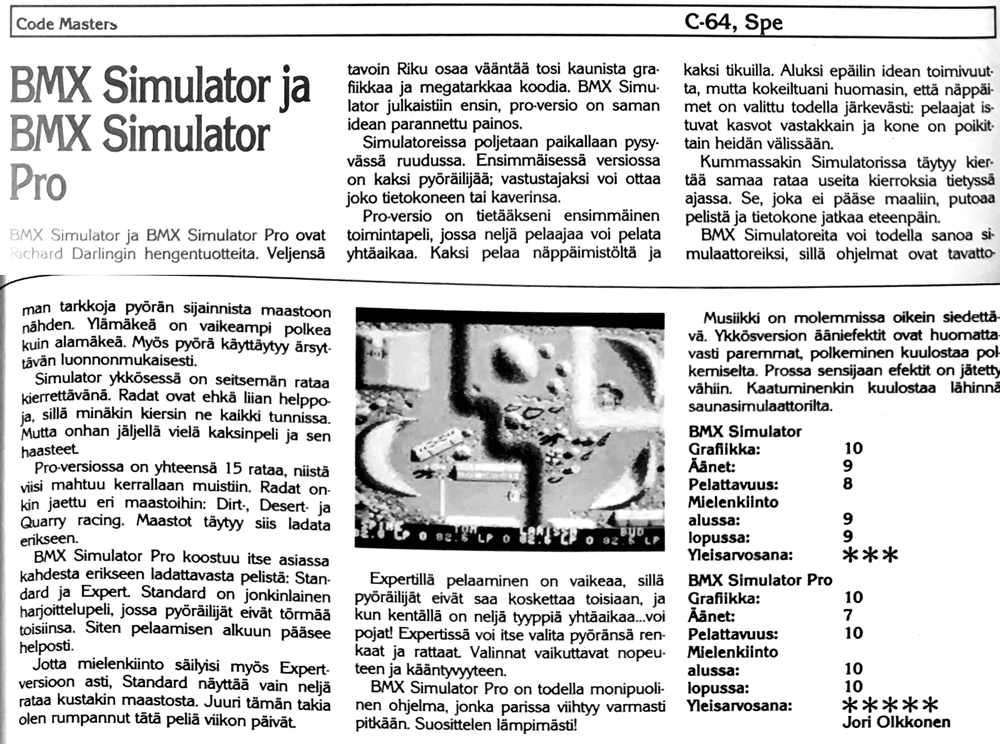
BMX Simulator + BMX Simulator Pro1988Pysyvä linkkiBMX Simulator ja BMX Simulator Pro ovat Richard Darlingin hengentuotteita. Veljensä tavoin Riku osaa vääntää tosi kaunista grafiikkaa ja megatarkkaa koodia. BMX Simulator julkaistiin ensin, pro-versio on saman idean parannettu painos.
Simulatoreissa poljetaan paikallaan pysyvässä ruudussa. Ensimmäisessä versiossa on kaksi pyöräilijää; vastustajaksi voi ottaa joko tietokoneen tai kaverinsa.
Pro-versio on tietääkseni ensimmäinen toimintapeli, jossa neljä pelaajaa voi pelata yhtäaikaa. Kaksi pelaa näppäimistöltä ja kaksi tikuilla. Aluksi epäilin idean toimivuutta, mutta kokeiltuani huomasin, että näppäimet on valittu todella järkevästi: pelaajat istuvat kasvot vastakkain ja kone on poikittain heidän välissään.
Kummassakin Simulatorissa täytyy kiertää samaa rataa useita kierroksia tietyssä ajassa. Se, joka ei pääse maaliin, putoaa pelistä ja tietokone jatkaa eteenpäin.
BMX Simulatoreita voi todella sanoa simulaattoreiksi, sillä ohjelmat ovat tavattoman tarkkoja pyörän sijainnista maastoon nähden. Ylämäkeä on vaikeampi polkea kuin alamäkeä. Myös pyörä käyttäytyy ärsyttävän luonnonmukaisesti.
Simulator ykkösessä on seitsemän rataa kierrettävänä. Radat ovat ehkä liian helppoja, sillä minäkin kiersin ne kaikki tunnissa. Mutta onhan jäljellä vielä kaksinpeli ja sen haasteet.
Pro-versiossa on yhteensä 15 rataa, niistä viisi mahtuu kerrallaan muistiin. Radat onkin jaettu eri maastoihin: Dirt-, Desert- ja Quarry racing. Maastot täytyy siis ladata erikseen.
BMX Simulator Pro koostuu itse asiassa kahdesta erikseen ladattavasta pelistä: Standard ja Expert. Standard on jonkinlainen harjoittelupeli, jossa pyöräilijät eivät törmää toisiinsa. Siten pelaamisen alkuun pääsee helposti.
Jotta mielenkiinto säilyisi myös Expert-versioon asti, Standard näyttää vain neljä rataa kustakin maastosta. Juuri tämän takia olen rumpannut tätä peliä viikon päivät.
Expertillä pelaaminen on vaikeaa, sillä pyöräilijät eivät saa koskettaa toisiaan, ja kun kentällä on neljä tyyppiä yhtäaikaa...voi pojat! Expertissä voi itse valita pyöränsä renkaat ja rattaat. Valinnat vaikuttavat nopeuteen ja kääntyvyyteen.
BMX Simulator Pro on todella monipuolinen ohjelma, jonka parissa viihtyy varmasti pitkään. Suosittelen lämpimästi!
Musiikki on molemmissa oikein siedettävä. Ykkösversion ääniefektit ovat huomattavasti paremmat, polkeminen kuulostaa polkemiselta. Prossa sensijaan efektit on jätetty vähiin. Kaatuminenkin kuulostaa lähinnä saunasimulaattorilta.
BMX Simulator + BMX Simulator Pro1988PermalinkBMX Simulator and BMX Simulator Pro are the brainchildren of Richard Darling. Like his brother, Riku can knock out really beautiful graphics and mega-precise code. BMX Simulator came out first; the Pro version is an improved edition of the same idea.
In the Simulators you pedal around a screen that stays put. The first version has two riders; you can take on either the computer or a friend as your opponent.
The Pro version is, as far as I know, the first action game in which four players can play at the same time. Two play on the keyboard and two with joysticks. At first I doubted whether the idea would work, but having tried it I found that the keys have been chosen really sensibly: the players sit facing each other with the computer sideways between them.
In both Simulators you have to ride several laps of the same track within a set time. Whoever fails to make it to the finish drops out of the game, and the computer carries on.
The BMX Simulators truly can be called simulators, because the programs are extraordinarily precise about the bike's position relative to the terrain. Uphill is harder to pedal than downhill. The bike also behaves annoyingly true to life.
Simulator One has seven tracks to ride. The tracks are perhaps too easy, since even I got round all of them in an hour. But then there's still the two-player game and its challenges.
The Pro version has 15 tracks in total, five of which fit in memory at a time. So the tracks have been divided into different terrains: Dirt, Desert and Quarry racing. The terrains therefore have to be loaded separately.
BMX Simulator Pro actually consists of two separately loaded games: Standard and Expert. Standard is a sort of practice game in which the riders don't collide with each other. That makes it easy to get started.
So that your interest holds all the way to the Expert version, Standard only shows four tracks from each terrain. That is exactly why I've been hammering away at this game for a solid week.
Playing Expert is hard, because the riders mustn't touch each other, and when there are four guys on the track at the same time... oh boy! In Expert you can choose your bike's tyres and sprockets yourself. The choices affect speed and cornering.
BMX Simulator Pro is a really versatile program that is sure to keep you entertained for a long time. I warmly recommend it!
The music in both is perfectly bearable. The sound effects in the first version are considerably better; pedalling sounds like pedalling. In the Pro, on the other hand, the effects have been kept to a minimum. Even a crash sounds mostly like a sauna simulator.
Bomber

Bomber1990 KevätPysyvä linkkiBomberin kantavana ideana on mahdollisuus kokeilla pommituslentoja useilla konemalleilla. Kuusnepan valikoimassa on kolme tavanomaisesta poikkeavaa vaihtoehtoa: Mig 29 Fulcrum, F14 Tomcat ja F5E Tiger II, jotka alussa esitellään upeasti piirretyissä kuvissa. Tällä kertaa F15, F16 ynnä muut tutummat äffät jätetään varikolle.
Koneiden aseistuksena ovat tavanomaiset Sidewinderit ja vapaasti valittava yhdistelmä maamaaleihin sopivia Maverick-ohjuksia ja pommeja. Myöhemmissä tehtävissä on mahdollisesti tarjolla muitakin aseita. Pommituslentoja ei voi vapaasti valita, mikä lisää pelin ikää tai sitten ei, sillä vaarana on ennenaikainen pitkästyminen.
Aluksi vaihtoehdot rajoittuvat vapaaseen lentelyyn ja terroristien päämajan pommitukseen eikä tässä vaiheessa lentävistä vihollisista näy vielä jälkeäkään. Jos pystyy selvittämään kaikki tehtävät, niitä voi suunnitella lisää. Mielenkiinnon säilymisen takaa mahdollisuus vaihdella tehtävädiskettejä kavereiden kanssa.
Teknisellä puolella Bomber käy läpi simujen pakolliset kuviot. Koneen lentoa voi seurata lennonjohtotornista, satelliitista tai vapaasti valittavasta pisteestä, jonka etäisyyttä voi zoomailla. Erikoisuutena on mahdollisuus tutustua putoavan pommin näkövinkkeliin. Harvemmin nähtyjä yksityiskohtia ovat myös pitkillä lennoilla tarvittavat välitankkaukset sekä tehtävän jälkeen näytettävä taktinen kartta, josta näkee lentämänsä reitin.
Teknisistä saavutuksista voi mainita sen verran, että pelissä on kaarevia vektoreita esim. lentokoneiden moottoreissa ja renkaissa.
C-64
Täytettyä vektorigrafiikkaa käyttävän lentosimulaattorin kääntäminen kuusneloseen on vähän kuin kaupittelisi mersuja Romaniassa, eli optimismia tekijöillä ainakin piisaa. Sitä paitsi taistelu markkinaosuuksista on kiihtymässä, sillä maailma on jo väärällään toinen toistaan ihmeellisempiä simuja.
Maisema on aika piirteetön ja grafiikan päivitystaajuus on sellaista sekunnin luokkaa, mutta ainakin koneen ohjaustuntuma on siedettävän rajoilla. Huolettomassa lentelyssä kuusnelosen hitaus ei häiritse, mutta kohteeseen osuminen onkin kokonaan toinen juttu. Kokeneellakin pilotilla on edessään piinallisia hetkiä, kun kone tuntuu matelevan, ohjausliikkeet ovat liian karkeita ja kohteen etäisyys jää arvailujen varaan.
Bomberin kääntäminen kuusneloseen tuntuu jotenkin ylimitoitetulta urakalta, mutta tulihan tehtyä ja pitäkää hyvänänne. Mutta yksi seikka jäi kaivelemaan: kun pelin nimi on kerran Bomber, niin miksi siihen ei ole tajuttu laittaa paria mehevää pommituslentoa ydinaselastissa?
Amiga
Graafisesti peli on tosi hieno, upeampia mittaristoja en ole koskaan nähnyt. Lisäksi pelin kaikki objektit on piirretty todella monella polygonilla, ennätys on jossain 130 paikkeilla. äänet ovat tietysti normaalia suihkumoottoreiden suhinaa, mutta alkumusiikki on digitoitua kitaran rämpytystä, joka kestää kiitettävän pitkään, vaikka liitoskohdat huomaakin.
Ulkokuori on siis aivan kunnossa. Sitten onkin aika puhua hieman miinuspuolista. Suurin miinus löytyy pelattavuuden saralta. Kiitos monimutkaisten maisemien ja ennätyksellisten tarkkojen lentokoneiden, on ruudunpäivitys todella hidasta. Tarkoitan siis TODELLA hidasta. Eniten harmittaa se, miten toiminta hidastuu hidastumistaan, kun ruudulla alkaa olla hiemankin enemmän tavaraa.
Hitaudesta huolimatta Bomber on oiva esimerkki siitä, mihin ollaan menossa. Tehtäväeditori on vain alkua, en usko että menee kauan, kun pelaaja saa suunnitella oman koneensa ja testata sitä toisella puolella maailmaa asuvan ihmisen suunnittelemissa tehtävissä. Simulaattorifanien tulevaisuus näyttää ruusuisalta.
PC
Koneesta riippuen PC:n Fighter Bomber joko pesee Amigan version kevyesti tai sitten ei. Jos pöydälläsi muhii 20-25 Mhz 386-prosessorilla varustettu tehohirmu, on FB lähes pakko-ostos. Hitaammissa koneissa maiseman ja koneiden yksityiskohtaisuudesta voi installoinnin yhteydessä tinkiä, jolloin pelin nopeus ei kärsi kauheasti.
Englantilaisten ohjelmatalojen tyyliin kuuluu valitettavasti se, ettei mahdollisia äänikortteja oteta huomioon. Niinpä äänet ovat sitä samaa ilkeää vinkunaa ja piipitystä, jota PC:n omistajat joutuvat sietämään päivästä toiseen.
Kiitos huomattavan nopean ruudunpäivityksen, on PC:n FB:ia suorastaan ilo pelata. Muutenkin PC:n versio tuntuu yleensä ottaen paremmin toteutetulta ja mukavammalta käyttää kuin muut versiot.
Bomber1990 KevätPermalinkBomber's central idea is the chance to try out bombing runs in several different aircraft. The C-64 line-up has three out-of-the-ordinary choices: the Mig 29 Fulcrum, the F14 Tomcat and the F5E Tiger II, which are introduced at the start in superbly drawn pictures. This time the F15, the F16 and the other more familiar F's are left back at the depot.
The planes are armed with the usual Sidewinders plus a freely chosen mix of Maverick missiles and bombs suited to ground targets. Later missions may offer other weapons too. You can't choose your bombing missions freely, which either lengthens the game's life or doesn't, since there's a risk of premature boredom.
To begin with, your options are limited to free flight and bombing the terrorists' headquarters, and at this stage there's not yet a trace of any airborne enemies. If you manage to complete all the missions, you can design more of them. Interest is kept alive by the chance to swap mission disks with your mates.
On the technical side, Bomber goes through the compulsory figures of the sim. You can follow the plane's flight from the control tower, from a satellite or from a freely chosen point whose distance you can zoom in and out. A special feature is the chance to get acquainted with the view from a falling bomb. Other less often seen details are the refuelling stops needed on long flights and the tactical map shown after a mission, which lets you see the route you flew.
As for technical achievements, it's worth mentioning that the game has curved vectors, e.g. in the planes' engines and wheels.
C-64
Converting a flight simulator with filled vector graphics to the C-64 is a bit like hawking Mercs in Romania, so the makers at least aren't short of optimism. Besides, the battle for market share is heating up, since the world is already crammed full of sims, each more amazing than the last.
The landscape is pretty featureless and the graphics update rate is somewhere in the one-second ballpark, but at least the feel of the controls is within tolerable limits. For carefree flying about, the C-64's slowness doesn't bother you, but hitting a target is a whole other matter. Even an experienced pilot faces agonising moments when the plane seems to crawl, the control inputs are too coarse, and the distance to the target is left to guesswork.
Converting Bomber to the C-64 somehow feels like an oversized undertaking, but well, it got done, and you're welcome to it. But one thing kept nagging at me: seeing as the game is called Bomber, why didn't anyone think to put in a couple of juicy bombing runs with a nuclear payload?
Amiga
Graphically the game is really fine; I've never seen more gorgeous instrument panels. On top of that, all the objects in the game are drawn with a great many polygons, the record being somewhere around 130. The sound is naturally the usual whoosh of jet engines, but the title music is digitised guitar strumming that lasts commendably long, even if you can hear the joins.
So the outer shell is in perfect order. Now it's time to talk a little about the downsides. The biggest minus is to be found in the playability department. Thanks to the complex landscapes and record-breakingly detailed aircraft, the screen update is really slow. I mean REALLY slow. What annoys me most is how the action gets slower and slower the moment there's even a little more stuff on the screen.
Despite the slowness, Bomber is a fine example of where things are heading. The mission editor is only the beginning; I don't think it'll be long before the player gets to design their own plane and test it in missions designed by someone living on the other side of the world. The future looks rosy for simulator fans.
PC
Depending on the machine, the PC's Fighter Bomber either wipes the floor with the Amiga version or it doesn't. If you've got a powerhouse with a 20-25 MHz 386 processor humming away on your desk, FB is practically a must-buy. On slower machines you can skimp on the detail of the landscape and aircraft when installing, so the game's speed doesn't suffer too terribly.
Unfortunately it's typical of English software houses not to take any sound cards you might have into account. So the sound is the same nasty whining and beeping that PC owners have to put up with day in, day out.
Thanks to the considerably faster screen update, the PC's FB is a downright joy to play. In other respects too, the PC version generally feels better done and nicer to use than the other versions.
Bombuzal
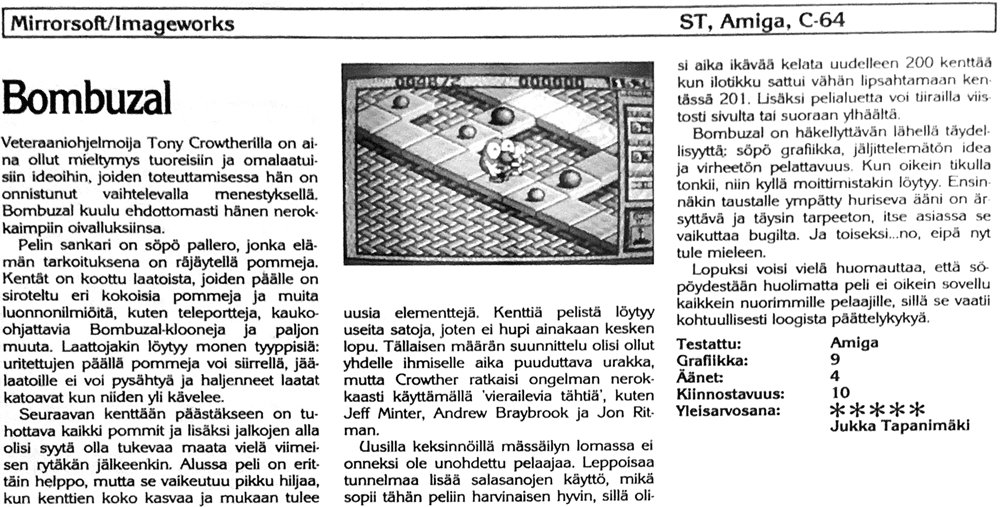
Bombuzal1989 SyksyPysyvä linkkiVeteraaniohjelmoija Tony Crowtherilla on aina ollut mieltymys tuoreisiin ja omalaatuisiin ideoihin, joiden toteuttamisessa hän on onnistunut vaihtelevalla menestyksellä. Bombuzal kuulu ehdottomasti hänen nerokkaimpiin oivalluksiinsa.
Pelin sankari on söpö pallero, jonka elämän tarkoituksena on räjäytellä pommeja. Kentät on koottu laatoista, joiden päälle on siroteltu eri kokoisia pommeja ja muita luonnonilmiöitä, kuten teleportteja, kauko-ohjattavia Bombuzal-klooneja ja paljon muuta. Laattojakin löytyy monen tyyppisiä: uritettujen päällä pommeja voi siirrellä, jäälaatoille ei voi pysähtyä ja haljenneet laatat katoavat kun niiden yli kävelee.
Seuraavan kenttään päästäkseen on tuhottava kaikki pommit ja lisäksi jalkojen alla olisi syytä olla tukevaa maata vielä viimeisen rytäkän jälkeenkin. Alussa peli on erittäin helppo, mutta se vaikeutuu pikku hiljaa, kun kenttien koko kasvaa ja mukaan tulee uusia elementtejä. Kenttiä pelistä löytyy useita satoja, joten ei hupi ainakaan kesken lopu. Tällaisen määrän suunnittelu olisi ollut yhdelle ihmiselle aika puuduttava urakka, mutta Crowther ratkaisi ongelman nerokkaasti käyttämällä 'vierailevia tähtiä', kuten Jeff Minter, Andrew Braybrook ja Jon Ritman.
Uusilla keksinnöillä mässäilyn lomassa ei onneksi ole unohdettu pelaajaa. Leppoisaa tunnelmaa lisää salasanojen käyttö, mikä sopii tähän peliin harvinaisen hyvin, sillä olisi aika ikävää kelata uudelleen 200 kenttää kun ilotikku sattui vähän lipsahtamaan kentässä 201. Lisäksi pelialuetta voi tiirailla viistosti sivulta tai suoraan ylhäältä.
Bombuzal on häkellyttävän lähellä täydellisyyttä: söpö grafiikka, jäljittelemätön idea ja virheetön pelattavuus. Kun oikein tikulla tonkii, niin kyllä moittimistakin löytyy. Ensinnäkin taustalle ympätty huriseva ääni on ärsyttävä ja täysin tarpeeton, itse asiassa se vaikuttaa bugilta. Ja toiseksi...no, eipä nyt tule mieleen.
Lopuksi voisi vielä huomauttaa, että söpöydestään huolimatta peli ei oikein sovellu kaikkein nuorimmille pelaajille, sillä se vaatii kohtuullisesti loogista päättelykykyä.
Bombuzal1989 SyksyPermalinkVeteran programmer Tony Crowther has always had a soft spot for fresh and quirky ideas, which he has carried out with varying success. Bombuzal definitely ranks among his most brilliant brainwaves.
The game's hero is a cute little roly-poly whose purpose in life is to blow up bombs. The levels are put together from tiles, on top of which are scattered bombs of various sizes and other natural phenomena, such as teleports, remote-controlled Bombuzal clones and plenty more. The tiles come in many types too: on grooved ones you can push bombs around, you can't stop on ice tiles, and cracked tiles disappear when you walk over them.
To get to the next level you have to destroy all the bombs, and on top of that you'd better still have solid ground under your feet after the final ruckus. At first the game is very easy, but it gets harder bit by bit as the levels grow in size and new elements join in. The game has several hundred levels, so at least the fun won't run out halfway. Designing that many would have been a pretty mind-numbing job for one person, but Crowther solved the problem ingeniously by using 'guest stars' such as Jeff Minter, Andrew Braybrook and Jon Ritman.
Amid all the gorging on new inventions, the player has luckily not been forgotten. The laid-back mood is helped by the use of passwords, which suits this game unusually well, since it would be rather nasty to wind through 200 levels again just because the joystick happened to slip a little on level 201. What's more, you can eye up the playing area either at an angle from the side or straight from above.
Bombuzal is staggeringly close to perfection: cute graphics, an inimitable idea and flawless playability. If you really go poking around with a stick, you can find something to grumble about, sure enough. Firstly, the whirring noise stuck into the background is irritating and completely unnecessary; in fact, it seems like a bug. And secondly... well, nothing springs to mind right now.
Finally, it's worth pointing out that despite its cuteness the game isn't really suitable for the very youngest players, since it takes a fair amount of logical reasoning.
Borrowed Time
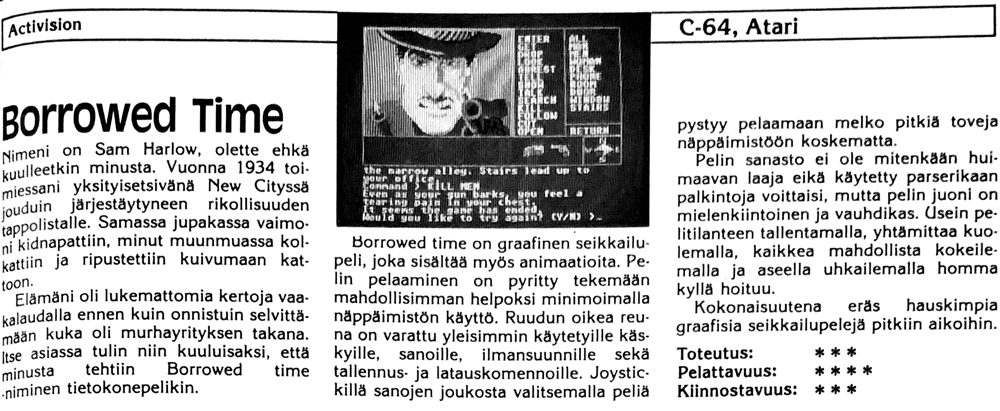
Borrowed Time1987Pysyvä linkkiNimeni on Sam Harlow, olette ehkä kuulleetkin minusta. Vuonna 1934 toimiessani yksityisetsivänä New Cityssä jouduin järjestäytyneen rikollisuuden tappolistalle. Samassa jupakassa vaimoni kidnapattiin, minut muunmuassa kolkattiin ja ripustettiin kuivumaan kattoon.
Elämäni oli lukemattomia kertoja vaakalaudalla ennen kuin onnistuin selvittämään kuka oli murhayrityksen takana. Itse asiassa tulin niin kuuluisaksi, että minusta tehtiin Borrowed time -niminen tietokonepelikin.
Borrowed time on graafinen seikkailupeli, joka sisältää myös animaatioita. Pelin pelaaminen on pyritty tekemään mahdollisimman helpoksi minimoimalla näppäimistön käyttö. Ruudun oikea reuna on varattu yleisimmin käytetyille käskyille, sanoille, ilmansuunnille sekä tallennus- ja latauskomennoille. Joystickillä sanojen joukosta valitsemalla peliä pystyy pelaamaan melko pitkiä toveja näppäimistöön koskematta.
Pelin sanasto ei ole mitenkään huimaavan laaja eikä käytetty parserikaan palkintoja voittaisi, mutta pelin juoni on mielenkiintoinen ja vauhdikas. Usein pelitilanteen tallentamalla, yhtämittaa kuolemalla, kaikkea mahdollista kokeilemalla ja aseella uhkailemalla homma kyllä hoituu.
Kokonaisuutena eräs hauskimpia graafisia seikkailupelejä pitkiin aikoihin.
Borrowed Time1987PermalinkMy name is Sam Harlow; you may even have heard of me. In 1934, while working as a private eye in New City, I landed on organised crime's hit list. In the same ruckus my wife was kidnapped, and I, among other things, got knocked out cold and strung up from the ceiling to dry.
My life hung in the balance countless times before I managed to work out who was behind the murder attempt. In fact, I became so famous that they even made a computer game about me, called Borrowed Time.
Borrowed Time is a graphic adventure game that also contains animations. The aim has been to make playing the game as easy as possible by keeping keyboard use to a minimum. The right-hand edge of the screen is reserved for the most commonly used commands, words and compass directions, as well as the save and load commands. By picking from among the words with the joystick, you can play the game for quite long stretches without touching the keyboard.
The game's vocabulary is by no means dizzyingly large, and the parser used wouldn't win any prizes either, but the plot is interesting and fast-moving. By saving your game often, dying constantly, trying everything you can think of and making threats with a gun, you'll get the job done all right.
All in all, one of the most entertaining graphic adventure games in a long time.
Botics
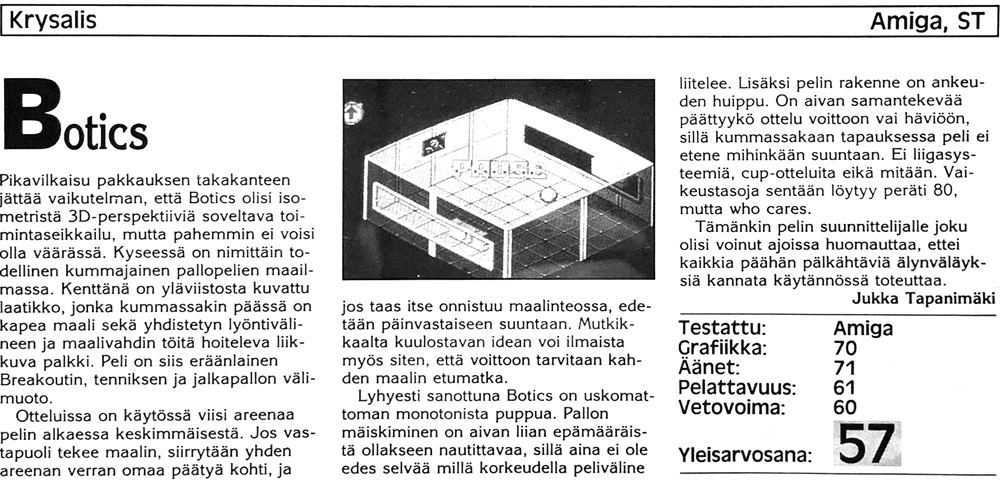
Botics1991 KevätPysyvä linkkiPikavilkaisu pakkauksen takakanteen jättää vaikutelman, että Botics olisi isometristä 3D-perspektiiviä soveltava toimintaseikkailu, mutta pahemmin ei voisi olla väärässä. Kyseessä on nimittäin todellinen kummajainen pallopelien maailmassa. Kenttänä on yläviistosta kuvattu laatikko, jonka kummassakin päässä on kapea maali sekä yhdistetyn lyöntivälineen ja maalivahdin töitä hoiteleva liikkuva palkki. Peli on siis eräänlainen Breakoutin, tenniksen ja jalkapallon välimuoto.
Otteluissa on käytössä viisi areenaa pelin alkaessa keskimmäisestä. Jos vastapuoli tekee maalin, siirrytään yhden areenan verran omaa päätyä kohti, ja jos taas itse onnistuu maalinteossa, edetään päinvastaiseen suuntaan. Mutkikkaalta kuulostavan idean voi ilmaista myös siten, että voittoon tarvitaan kahden maalin etumatka.
Lyhyesti sanottuna Botics on uskomattoman monotonista puppua. Pallon mäiskiminen on aivan liian epämääräistä ollakseen nautittavaa, sillä aina ei ole edes selvää millä korkeudella peliväline liitelee. Lisäksi pelin rakenne on ankeuden huippu. On aivan samantekevää päättyykö ottelu voittoon vai häviöön, sillä kummassakaan tapauksessa peli ei etene mihinkään suuntaan. Ei liigasysteemiä, cup-otteluita eikä mitään. Vaikeustasoja sentään löytyy peräti 80, mutta who cares.
Tämänkin pelin suunnittelijalle joku olisi voinut ajoissa huomauttaa, ettei kaikkia päähän pälkähtäviä älynväläyksiä kannata käytännössä toteuttaa.
Botics1991 KevätPermalinkA quick glance at the back of the box leaves the impression that Botics is an action adventure using isometric 3D perspective, but you couldn't be more wrong. What we have here is a real oddity in the world of ball games. The pitch is a box viewed from above at an angle, with a narrow goal at each end and a moving bar that does the job of a combined bat and goalkeeper. So the game is a kind of cross between Breakout, tennis and football.
Matches use five arenas, with play starting in the middle one. If the opponent scores, you move one arena towards your own end, and if you manage to score yourself, you advance in the opposite direction. This complicated-sounding idea can also be put another way: to win you need a two-goal lead.
To put it briefly, Botics is unbelievably monotonous drivel. Whacking the ball about is far too vague to be enjoyable, since it isn't always even clear at what height the thing is gliding. On top of that, the structure of the game is the height of dreariness. It makes no difference at all whether a match ends in a win or a loss, since either way the game doesn't go anywhere. No league system, no cup matches, no nothing. There are, mind you, no fewer than 80 difficulty levels, but who cares.
Someone could have pointed out to this game's designer too, in good time, that not every flash of brilliance that pops into your head is worth putting into practice.
Boulder Dash
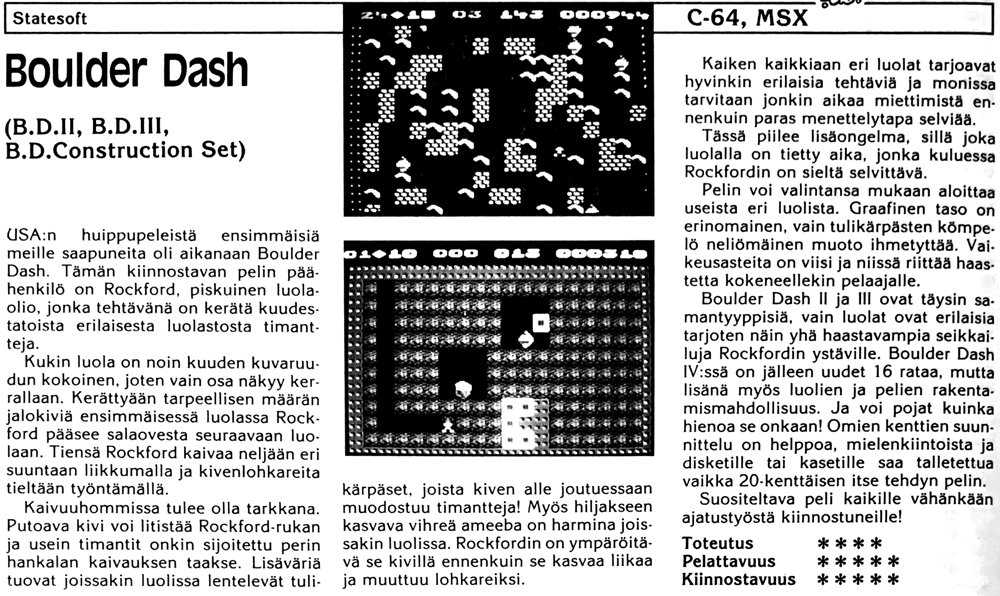
Boulder Dash1987Pysyvä linkki(B.D.II, B.D.III, B.D.Construction Set)
USA:n huippupeleistä ensimmäisiä meille saapuneita oli aikanaan Boulder Dash. Tämän kiinnostavan pelin päähenkilö on Rockford, piskuinen luolaolio, jonka tehtävänä on kerätä kuudestatoista erilaisesta luolastosta timantteja.
Kukin luola on noin kuuden kuvaruudun kokoinen, joten vain osa näkyy kerrallaan. Kerättyään tarpeellisen määrän jalokiviä ensimmäisessä luolassa Rockford pääsee salaovesta seuraavaan luolaan. Tiensä Rockford kaivaa neljään eri suuntaan liikkumalla ja kivenlohkareita tieltään työntämällä.
Kaivuuhommissa tulee olla tarkkana. Putoava kivi voi litistää Rockford-rukan ja usein timantit onkin sijoitettu perin hankalan kaivauksen taakse. Lisäväriä tuovat joissakin luolissa lentelevät tulikärpäset, joista kiven alle joutuessaan muodostuu timantteja! Myös hiljakseen kasvava vihreä ameeba on harmina joissakin luolissa. Rockfordin on ympäröitävä se kivillä ennenkuin se kasvaa liikaa ja muuttuu lohkareiksi.
Kaiken kaikkiaan eri luolat tarjoavat hyvinkin erilaisia tehtäviä ja monissa tarvitaan jonkin aikaa miettimistä ennenkuin paras menettelytapa selviää.
Tässä piilee lisäongelma, sillä joka luolalla on tietty aika, jonka kuluessa Rockfordin on sieltä selvittävä.
Pelin voi valintansa mukaan aloittaa useista eri luolista. Graafinen taso on erinomainen, vain tulikärpästen kömpelö neliömäinen muoto ihmetyttää. Vaikeusasteita on viisi ja niissä riittää haastetta kokeneellekin pelaajalle.
Boulder Dash II ja III ovat täysin samantyyppisiä, vain luolat ovat erilaisia tarjoten näin yhä haastavampia seikkailuja Rockfordin ystäville. Boulder Dash IV:ssä on jälleen uudet 16 rataa, mutta lisänä myös luolien ja pelien rakentamismahdollisuus. Ja voi pojat kuinka hienoa se onkaan! Omien kenttien suunnittelu on helppoa, mielenkiintoista ja disketille tai kasetille saa talletettua vaikka 20-kenttäisen itse tehdyn pelin.
Suositeltava peli kaikille vähänkään ajatustyöstä kiinnostuneille!
Boulder Dash1987Permalink(B.D.II, B.D.III, B.D.Construction Set)
Back in the day, Boulder Dash was one of the first top American games to reach us. The hero of this intriguing game is Rockford, a tiny cave creature whose job is to collect diamonds from sixteen different caverns.
Each cave is about six screens in size, so only part of it is visible at a time. Once the required number of gems has been collected in the first cave, Rockford gets through a secret door into the next one. Rockford digs a way through by moving in four directions and pushing boulders out of the way.
You have to be careful with the digging. A falling rock can squash poor old Rockford flat, and the diamonds are often tucked away behind some thoroughly awkward excavation. Extra colour comes from the fireflies flitting about in some caves, which turn into diamonds when they end up under a rock! A slowly growing green amoeba is also a nuisance in some caves. Rockford has to wall it in with rocks before it grows too big and turns into boulders.
All in all, the different caves offer very varied tasks, and many of them take a fair bit of thinking before the best approach becomes clear.
Therein lies an extra problem, since each cave has a set time within which Rockford must get out of it.
You can start the game from any of several different caves, as you choose. The graphics are excellent; only the clumsy square shape of the fireflies is a bit baffling. There are five difficulty levels, and they hold plenty of challenge even for an experienced player.
Boulder Dash II and III are exactly the same kind of game; only the caves are different, offering ever more challenging adventures for Rockford's fans. Boulder Dash IV once again has 16 new levels, but on top of that it also lets you build your own caves and games. And oh boy, is it great! Designing your own levels is easy and interesting, and you can save a home-made game of as many as 20 levels to disk or tape.
A recommended game for anyone with the slightest interest in brainwork!
Brat
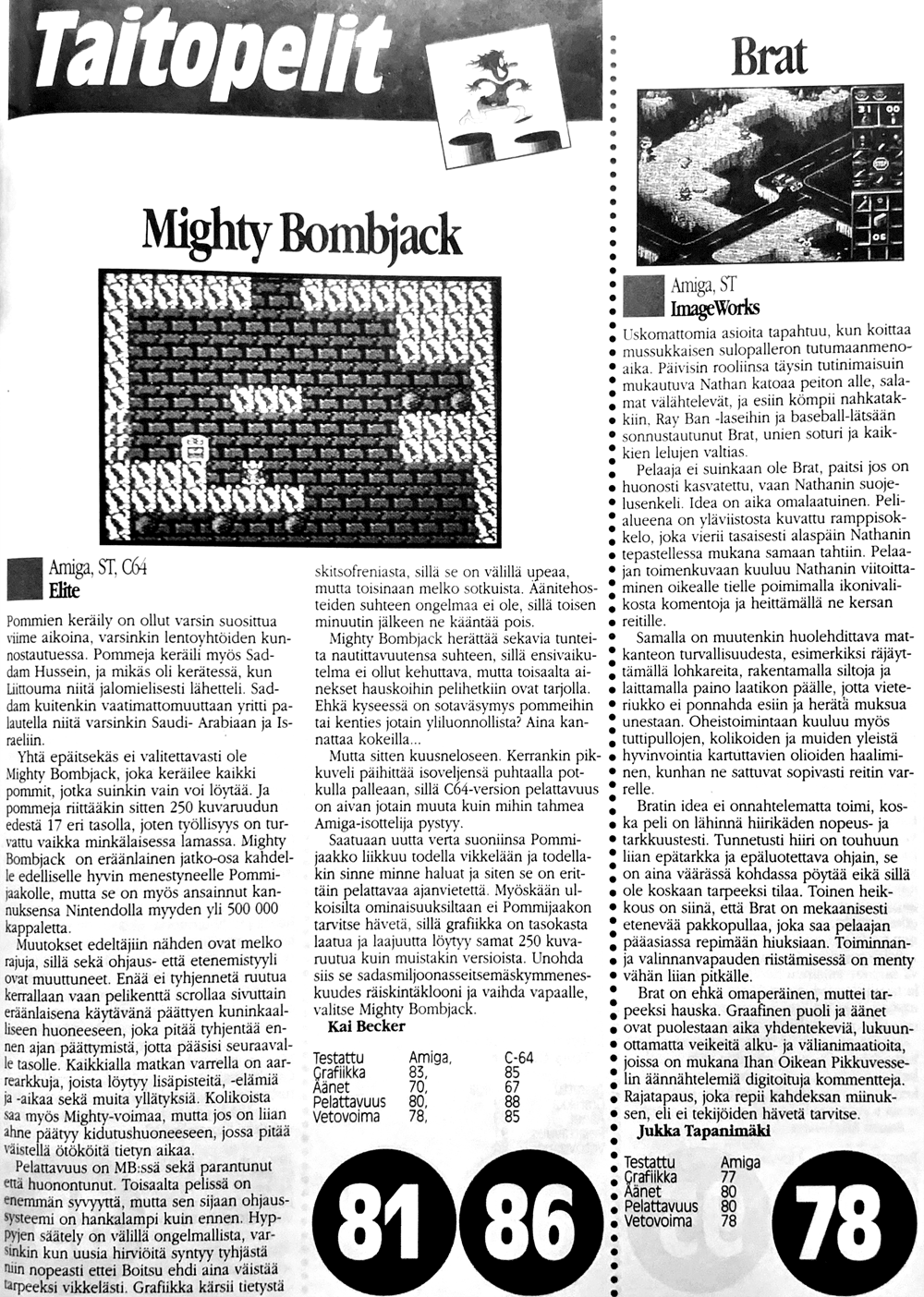
Brat1991 SyksyPysyvä linkkiUskomattomia asioita tapahtuu, kun koittaa mussukkaisen sulopalleron tutumaanmenoaika. Päivisin rooliinsa täysin tutinimaisuin mukautuva Nathan katoaa peiton alle, salamat välähtelevät, ja esiin kömpii nahkatakkiin, Ray Ban -laseihin ja baseball-lätsään sonnustautunut Brat, unien soturi ja kaikkien lelujen valtias.
Pelaaja ei suinkaan ole Brat, paitsi jos on huonosti kasvatettu, vaan Nathanin suojelusenkeli. Idea on aika omalaatuinen. Pelialueena on yläviistosta kuvattu ramppisokkelo, joka vierii tasaisesti alaspäin Nathanin tepastellessa mukana samaan tahtiin. Pelaajan toimenkuvaan kuuluu Nathanin viitoittaminen oikealle tielle poimimalla ikonivalikosta komentoja ja heittämällä ne kersan reitille.
Samalla on muutenkin huolehdittava matkanteon turvallisuudesta, esimerkiksi räjäyttämällä lohkareita, rakentamalla siltoja ja laittamalla paino laatikon päälle, jotta vieteriukko ei ponnahda esiin ja herätä muksua unestaan. Oheistoimintaan kuuluu myös tuttipullojen, kolikoiden ja muiden yleistä hyvinvointia kartuttavien olioiden haaliminen, kunhan ne sattuvat sopivasti reitin varrelle.
Bratin idea ei onnahtelematta toimi, koska peli on lähinnä hiirikäden nopeus- ja tarkkuustesti. Tunnetusti hiiri on touhuun liian epätarkka ja epäluotettava ohjain, se on aina väärässä kohdassa pöytää eikä sillä ole koskaan tarpeeksi tilaa. Toinen heikkous on siinä, että Brat on mekaanisesti etenevää pakkopullaa, joka saa pelaajan pääasiassa repimään hiuksiaan. Toiminnan- ja valinnanvapauden riistämisessä on menty vähän liian pitkälle.
Brat on ehkä omaperäinen, muttei tarpeeksi hauska. Graafinen puoli ja äänet ovat puolestaan aika yhdentekeviä, lukuunottamatta veikeitä alku- ja välianimaatioita, joissa on mukana Ihan Oikean Pikkuvesselin äännähtelemiä digitoituja kommentteja. Rajatapaus, joka repii kahdeksan miinuksen, eli ei tekijöiden hävetä tarvitse.
Brat1991 SyksyPermalinkIncredible things happen when the cutesy-wutesy little sweetie-pie's beddy-byes time comes round. Nathan, who by day adapts to his role with utter goo-goo babyishness, vanishes under the blanket, lightning flashes, and out crawls Brat, decked out in a leather jacket, Ray Ban shades and a baseball cap, warrior of dreams and lord of all toys.
The player is by no means Brat, unless they were badly brought up, but rather Nathan's guardian angel. The idea is fairly peculiar. The playing area is a maze of ramps viewed from diagonally above, which scrolls steadily downwards while Nathan toddles along at the same pace. The player's job description includes signposting Nathan onto the right path by picking commands from an icon menu and tossing them onto the kid's route.
At the same time you also have to look after the safety of the journey in general, for example by blowing up boulders, building bridges and putting a weight on top of a box so that the jack-in-the-box doesn't pop out and wake the nipper up. Side activities also include scooping up baby bottles, coins and other items that add to the general well-being, provided they happen to lie conveniently along the route.
Brat's idea doesn't work without a limp, since the game is mostly a test of your mouse hand's speed and accuracy. As everyone knows, the mouse is too imprecise and unreliable a controller for this sort of thing: it's always in the wrong spot on the desk and there's never enough room for it. The other weakness is that Brat is a mechanically advancing chore that mainly makes the player tear their hair out. They've gone a bit too far in taking away freedom of action and choice.
Brat may be original, but it's not fun enough. The graphics and sound, for their part, are pretty much neither here nor there, apart from the cute intro and intermission animations, which feature digitised comments burbled by a Real Live Little Rascal. A borderline case that squeezes out a B-minus, so the makers have nothing to be ashamed of.
Bravestarr
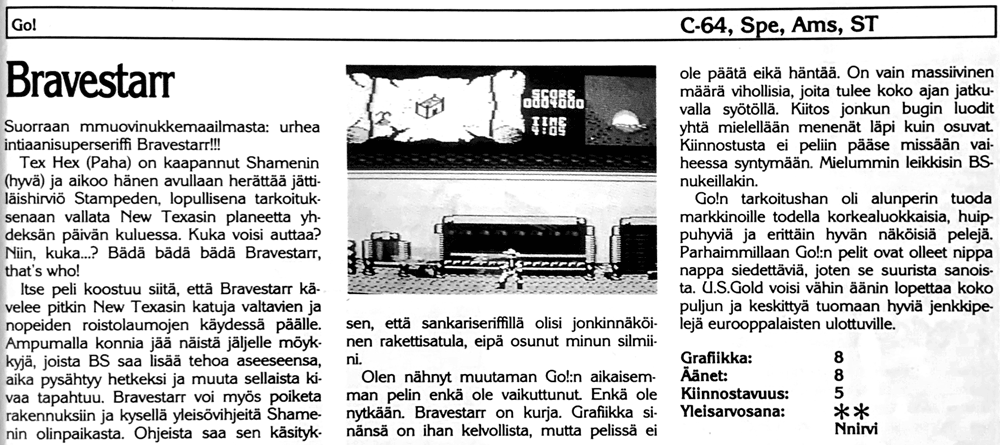
Bravestarr1988Pysyvä linkkiSuorraan mmuovinukkemaailmasta: urhea intiaanisuperseriffi Bravestarr!!!
Tex Hex (Paha) on kaapannut Shamenin (hyvä) ja aikoo hänen avullaan herättää jättiläishirviö Stampeden, lopullisena tarkoituksenaan vallata New Texasin planeetta yhdeksän päivän kuluessa. Kuka voisi auttaa? Niin, kuka...? Bädä bädä bädä Bravestarr, that's who!
Itse peli koostuu siitä, että Bravestarr kävelee pitkin New Texasin katuja valtavien ja nopeiden roistolaumojen käydessä päälle. Ampumalla konnia jää näistä jäljelle möykkyjä, joista BS saa lisää tehoa aseeseensa, aika pysähtyy hetkeksi ja muuta sellaista kivaa tapahtuu. Bravestarr voi myös poiketa rakennuksiin ja kysellä yleisövihjeitä Shamenin olinpaikasta. Ohjeista saa sen käsityksen, että sankariseriffillä olisi jonkinnäköinen rakettisatula, eipä osunut minun silmiini.
Olen nähnyt muutaman Go!:n aikaisemman pelin enkä ole vaikuttunut. Enkä ole nytkään. Bravestarr on kurja. Grafiikka sinänsä on ihan kelvollista, mutta pelissä ei ole päätä eikä häntää. On vain massiivinen määrä vihollisia, joita tulee koko ajan jatkuvalla syötöllä. Kiitos jonkun bugin luodit yhtä mielellään menenät läpi kuin osuvat. Kiinnostusta ei peliin pääse missään vaiheessa syntymään. Mielummin leikkisin BS-nukeillakin.
Go!n tarkoitushan oli alunperin tuoda markkinoille todella korkealuokkaisia, huippuhyviä ja erittäin hyvän näköisiä pelejä. Parhaimmillaan Go!:n pelit ovat olleet nippa nappa siedettäviä, joten se suurista sanoista. U.S.Gold voisi vähin äänin lopettaa koko puljun ja keskittyä tuomaan hyviä jenkkipelejä eurooppalaisten ulottuville.
Bravestarr1988PermalinkStraight out of the world of plastic action figures: the valiant Native American super-sheriff Bravestarr!!!
Tex Hex (Evil) has kidnapped the Shamen (good) and intends, with his help, to awaken the giant monster Stampede, his ultimate aim being to conquer the planet New Texas within nine days. Who could help? Yes, who...? Bada bada bada Bravestarr, that's who!
The game itself consists of Bravestarr walking along the streets of New Texas while huge, fast hordes of villains come at him. Shoot the crooks and they leave behind blobs that give BS more power for his gun, stop time for a moment and make other nice things like that happen. Bravestarr can also drop into buildings and ask around for tip-offs from the public on the Shamen's whereabouts. The instructions give the impression that our heroic sheriff has some sort of rocket saddle - well, it never caught my eye.
I have seen a few of Go!'s earlier games and was not impressed. Nor am I now. Bravestarr is miserable. The graphics as such are perfectly passable, but there is neither rhyme nor reason to the game. There is just a massive number of enemies, fed in on a continuous supply the whole time. Thanks to some bug, the bullets are just as happy to pass straight through as to hit. At no point does any interest in the game get a chance to develop. I'd sooner play with the BS dolls.
Go!'s whole idea, after all, was originally to bring really high-class, top-notch and extremely good-looking games to the market. At their very best Go!'s games have been just barely tolerable, so much for the big talk. U.S.Gold could quietly shut down the whole outfit and concentrate on bringing good Yank games within reach of Europeans.
Breakdance
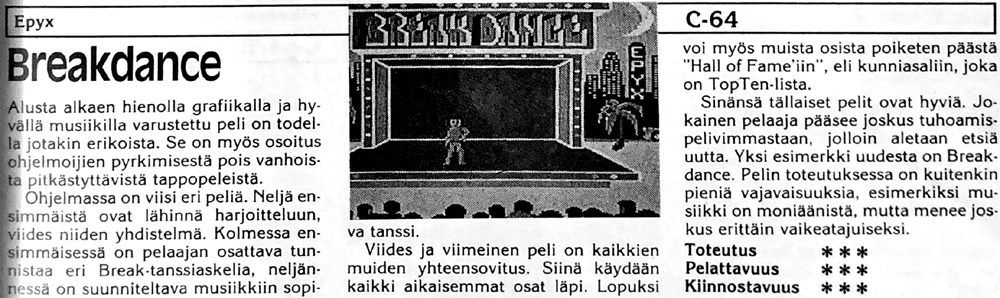
Breakdance1987Pysyvä linkkiAlusta alkaen hienolla grafiikalla ja hyvällä musiikilla varustettu peli on todella jotakin erikoista. Se on myös osoitus ohjelmoijien pyrkimisestä pois vanhoista pitkästyttävistä tappopeleistä.
Ohjelmassa on viisi eri peliä. Neljä ensimmäistä ovat lähinnä harjoitteluun, viides niiden yhdistelmä. Kolmessa ensimmäisessä on pelaajan osattava tunnistaa eri Break-tanssiaskelia, neljännessä on suunniteltava musiikkiin sopiva tanssi.
Viides ja viimeinen peli on kaikkien muiden yhteensovitus. Siinä käydään kaikki aikaisemmat osat läpi. Lopuksi voi myös muista osista poiketen päästä "Hall of Fame'iin", eli kunniasaliin, joka on TopTen-lista.
Sinänsä tällaiset pelit ovat hyviä. Jokainen pelaaja pääsee joskus tuhoamispelivimmastaan, jolloin aletaan etsiä uutta. Yksi esimerkki uudesta on Breakdance. Pelin toteutuksessa on kuitenkin pieniä vajavaisuuksia, esimerkiksi musiikki on moniäänistä, mutta menee joskus erittäin vaikeatajuiseksi.
Breakdance1987PermalinkKitted out with fine graphics and good music right from the start, this game really is something special. It is also a sign of programmers striving to get away from the tedious old killing games.
The program contains five different games. The first four are mainly for practice, and the fifth is a combination of them. In the first three the player has to be able to recognise different break-dance steps; in the fourth you have to choreograph a dance to fit the music.
The fifth and final game brings all the others together. In it you go through all the earlier parts. At the end, unlike in the other parts, you can also make it into the "Hall of Fame", in other words the hall of honour, which is a Top Ten list.
As such, games like this are good. Every player gets over their destruction-game frenzy at some point, and then starts looking for something new. Breakdance is one example of the new. There are, however, small shortcomings in the game's execution; for example, the music is polyphonic, but it sometimes becomes extremely hard to follow.
Bruce Lee Lives
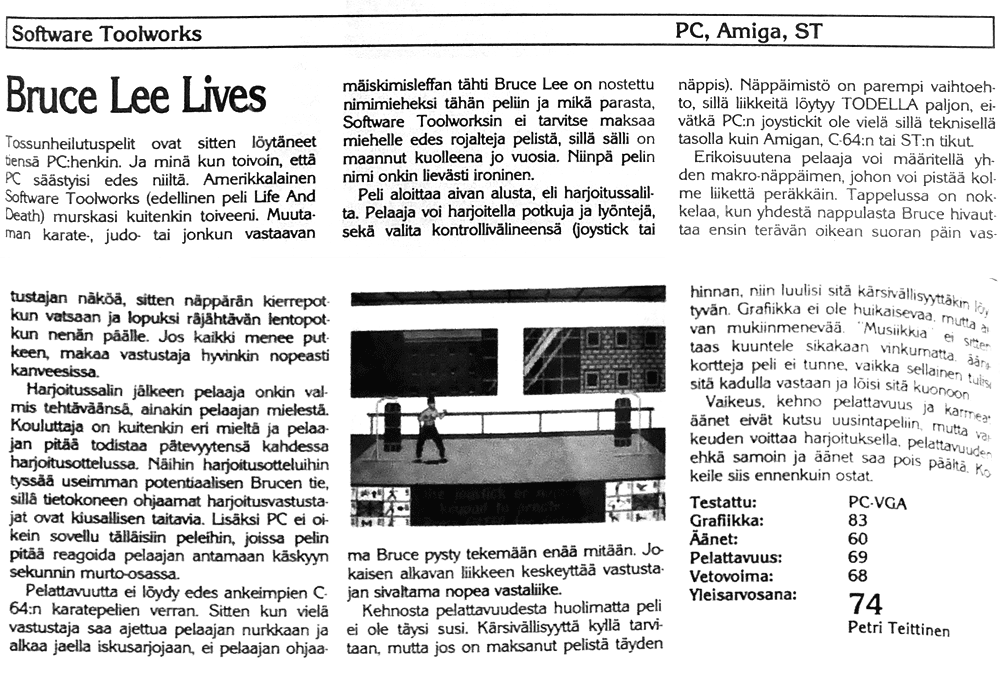
Bruce Lee Lives1990 KevätPysyvä linkkiTossunheilutuspelit ovat sitten löytäneet tiensä PC:henkin. Ja minä kun toivoin, että PC säästyisi edes niiltä. Amerikkalainen Software Toolworks (edellinen peli Life And Death) murskasi kuitenkin toiveeni. Muutaman karate-, judo- tai jonkun vastaavan mäiskimisleffan tähti Bruce Lee on nostettu nimimieheksi tähän peliin ja mikä parasta, Software Toolworksin ei tarvitse maksaa miehelle edes rojalteja pelistä, sillä sälli on maannut kuolleena jo vuosia. Niinpä pelin nimi onkin lievästi ironinen.
Peli aloittaa aivan alusta, eli harjoitussalilta. Pelaaja voi harjoitella potkuja ja lyöntejä, sekä valita kontrollivälineensä (joystick tai näppis). Näppäimistö on parempi vaihtoehto, sillä liikkeitä löytyy TODELLA paljon, eivätkä PC:n joystickit ole vielä sillä teknisellä tasolla kuin Amigan, C-64:n tai ST:n tikut.
Erikoisuutena pelaaja voi määritellä yhden makro-näppäimen, johon voi pistää kolme liikettä peräkkäin. Tappelussa on nokkelaa, kun yhdestä nappulasta Bruce hivauttaa ensin terävän oikean suoran päin vastustajan näköä, sitten näppärän kierrepotkun vatsaan ja lopuksi räjähtävän lentopotkun nenän päälle. Jos kaikki menee putkeen, makaa vastustaja hyvinkin nopeasti kanveesissa.
Harjoitussalin jälkeen pelaaja onkin valmis tehtäväänsä, ainakin pelaajan mielestä. Kouluttaja on kuitenkin eri mieltä ja pelaajan pitää todistaa pätevyytensä kahdessa harjoitusottelussa. Näihin harjoitusotteluihin tyssää useimman potentiaalisen Brucen tie, sillä tietokoneen ohjaamat harjoitusvastustajat ovat kiusallisen taitavia. Lisäksi PC ei oikein sovellu tälläisiin peleihin, joissa pelin pitää reagoida pelaajan antamaan käskyyn sekunnin murto-osassa.
Pelattavuutta ei löydy edes ankeimpien C-64:n karatepelien verran. Sitten kun vielä vastustaja saa ajettua pelaajan nurkkaan ja alkaa jaella iskusarjojaan, ei pelaajan ohjaama Bruce pysty tekemään enää mitään. Jokaisen alkavan liikkeen keskeyttää vastustajan sivaltama nopea vastaliike.
Kehnosta pelattavuudesta huolimatta peli ei ole täysi susi. Kärsivällisyyttä kyllä tarvitaan, mutta jos on maksanut pelistä täyden hinnan, niin luulisi sitä kärsivällisyyttäkin löytyvän. Grafiikka ei ole huikaisevaa, mutta aivan mukiinmenevää. "Musiikkia" ei sitten taas kuuntele sikakaan vinkumatta, äänikortteja peli ei tunne, vaikka sellainen tulisi sitä kadulla vastaan ja löisi sitä kuonoon.
Vaikeus, kehno pelattavuus ja karmeat äänet eivät kutsu uusintapeliin, mutta vaikeuden voittaa harjoituksella, pelattavuuden ehkä samoin ja äänet saa pois päältä. Kokeile siis ennenkuin ostat.
Bruce Lee Lives1990 KevätPermalinkSo the sneaker-swinging games have found their way onto the PC as well. And here I was hoping the PC would at least be spared those. The American Software Toolworks (previous game Life And Death) crushed my hopes, however. Bruce Lee, star of a few karate, judo or some similar thumping flicks, has been promoted to the name above the title of this game, and best of all, Software Toolworks doesn't even have to pay the man royalties for the game, since the bloke has been lying dead for years now. So the game's name is mildly ironic.
The game starts right from the beginning, that is, in the training hall. The player can practise kicks and punches, and pick a means of control (joystick or keys). The keyboard is the better option, since there are REALLY a lot of moves, and PC joysticks aren't yet at the same technical level as the sticks on the Amiga, C-64 or ST.
As a special feature the player can define one macro key, into which you can stick three moves in a row. It's slick in a fight when, from a single button, Bruce first slips a sharp right straight smack in the opponent's face, then a nifty spinning kick to the stomach and finally an explosive flying kick right on the nose. If everything goes like clockwork, the opponent is lying on the canvas very quickly indeed.
After the training hall the player is ready for the mission, at least in the player's own opinion. The instructor, however, disagrees, and the player has to prove their competence in two sparring bouts. These sparring bouts are where the road of most would-be Bruces comes to a dead stop, since the computer-controlled sparring partners are embarrassingly skilled. What's more, the PC isn't really suited to games like this, where the game has to react to the player's command within a fraction of a second.
There isn't even as much playability as in the dreariest C-64 karate games. And then once the opponent manages to drive the player into a corner and starts dishing out combinations, the player's Bruce can't do a thing any more. Every move you start is cut short by a quick counter slashed out by the opponent.
Despite the poor playability the game isn't a complete dud. You do need patience, but if you've paid full price for the game, you'd think you could find the patience too. The graphics aren't dazzling, but perfectly passable. The "music", on the other hand, not even a pig could listen to without squealing, and the game doesn't recognise sound cards, not even if one walked up to it in the street and punched it on the snout.
The difficulty, the poor playability and the ghastly sound don't exactly invite a rematch, but the difficulty can be beaten with practice, the playability perhaps likewise, and the sound can be switched off. So try before you buy.
Bubble Bobble
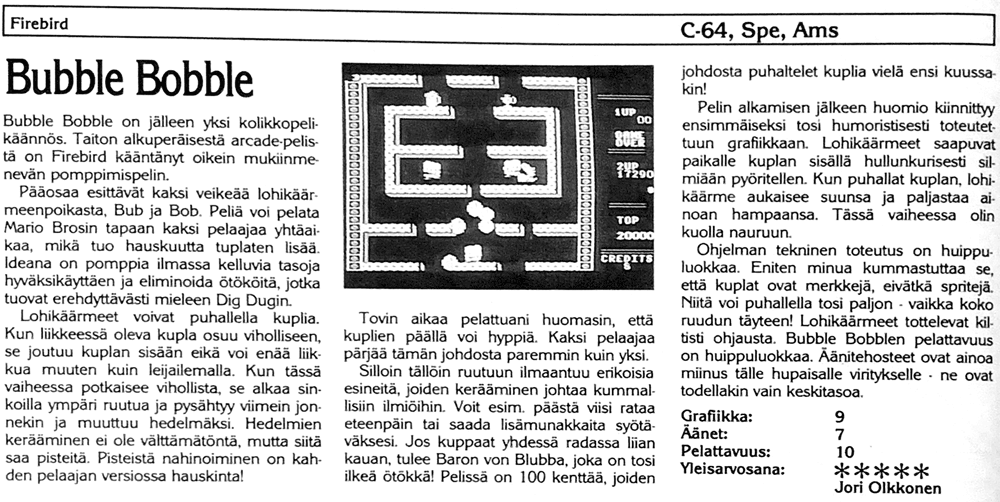
Bubble Bobble1988Pysyvä linkkiBubble Bobble on jälleen yksi kolikkopelikäännös. Taiton alkuperäisestä arcade-pelistä on Firebird kääntänyt oikein mukiinmenevän pomppimispelin.
Pääosaa esittävät kaksi veikeää lohikäärmeenpoikasta, Bub ja Bob. Peliä voi pelata Mario Brosin tapaan kaksi pelaajaa yhtäaikaa, mikä tuo hauskuutta tuplaten lisää. Ideana on pomppia ilmassa kelluvia tasoja hyväksikäyttäen ja eliminoida ötököitä, jotka tuovat erehdyttävästi mieleen Dig Dugin.
Lohikäärmeet voivat puhallella kuplia. Kun liikkeessä oleva kupla osuu viholliseen, se joutuu kuplan sisään eikä voi enää liikkua muuten kuin leijailemalla. Kun tässä vaiheessa potkaisee vihollista, se alkaa sinkoilla ympäri ruutua ja pysähtyy viimein jonnekin ja muuttuu hedelmäksi. Hedelmien kerääminen ei ole välttämätöntä, mutta siitä saa pisteitä. Pisteistä nahinoiminen on kahden pelaajan versiossa hauskinta!
Tovin aikaa pelattuani huomasin, että kuplien päällä voi hyppiä. Kaksi pelaajaa pärjää tämän johdosta paremmin kuin yksi.
Silloin tällöin ruutuun ilmaantuu erikoisia esineitä, joiden kerääminen johtaa kummallisiin ilmiöihin. Voit esim. päästä viisi rataa eteenpäin tai saada lisämunakkaita syötäväksesi. Jos kuppaat yhdessä radassa liian kauan, tulee Baron von Blubba, joka on tosi ilkeä ötökkä! Pelissä on 100 kenttää, joiden johdosta puhaltelet kuplia vielä ensi kuussakin!
Pelin alkamisen jälkeen huomio kiinnittyy ensimmäiseksi tosi humoristisesti toteutettuun grafiikkaan. Lohikäärmeet saapuvat paikalle kuplan sisällä hullunkurisesti silmiään pyöritellen. Kun puhallat kuplan, lohikäärme aukaisee suunsa ja paljastaa ainoan hampaansa. Tässä vaiheessa olin kuolla nauruun.
Ohjelman tekninen toteutus on huippuluokkaa. Eniten minua kummastuttaa se, että kuplat ovat merkkejä, eivätkä spritejä. Niitä voi puhallella tosi paljon - vaikka koko ruudun täyteen! Lohikäärmeet tottelevat kiltisti ohjausta. Bubble Bobblen pelattavuus on huippuluokkaa. Äänitehosteet ovat ainoa miinus tälle hupaisalle viritykselle - ne ovat todellakin vain keskitasoa.
Bubble Bobble1988PermalinkBubble Bobble is yet another coin-op conversion. Out of Taito's original arcade game Firebird has made a thoroughly decent jumping game.
The leading roles are played by two cheeky little baby dragons, Bub and Bob. As in Mario Bros, two players can play at the same time, which brings double the fun. The idea is to hop about using platforms floating in mid-air and eliminate bugs that could easily be mistaken for something out of Dig Dug.
The dragons can blow bubbles. When a moving bubble hits an enemy, the enemy ends up trapped inside the bubble and can no longer move except by floating. If you kick the enemy at this point, it starts ricocheting around the screen, finally stops somewhere and turns into fruit. Collecting the fruit isn't essential, but it earns you points. Squabbling over the points is the most fun part of the two-player version!
After playing for a while I noticed that you can jump on top of the bubbles. Because of this, two players get on better than one.
Every now and then special items appear on the screen, and collecting them leads to strange phenomena. You can, for example, skip five levels ahead or get extra omelettes to eat. If you hang about on one level for too long, along comes Baron von Blubba, who is a really nasty bug! The game has 100 levels, which means you'll still be blowing bubbles next month!
Once the game starts, the first thing that grabs your attention is the really humorous graphics. The dragons arrive on the scene inside a bubble, comically rolling their eyes. When you blow a bubble, the dragon opens its mouth and reveals its only tooth. At this point I nearly died laughing.
The program's technical execution is top class. What puzzles me most is that the bubbles are characters and not sprites. You can blow loads of them - even fill the whole screen! The dragons obediently do what the controls tell them. Bubble Bobble's playability is top class. The sound effects are the only minus for this amusing contraption - they really are only average.
Buck Rogers
Buck Rogers1987Pysyvä linkkiKolikkopeliautomaateissa klassikoksi muodostunut Buck Rogers julkaistiin viime vuonna kuusneloselle. Nyt sankari on herätetty henkiin MSX-mikroissa.
Buck Rogersissa pelaaja tutkii avaruusaluksellaan vastalöydettyä planeettarykelmää. Ensimmäisellä planeetalla on sähköpylväitä, joiden välistä on lennettävä. Kun tarpeeksi monen pylvään välistä on lennetty, päästään seuraavaan vaiheeseen, jossa planeetalle ilmestyy vieraita lentäviä lautasmiinoja. Niitä voi joko väistellä tai ammuskella, jolloin saa pisteitä.
Kolmannessa vaiheessa vastaan tulee hyppiviä avaruusolioita. Niitäkin ammuskelemalla pistetili karttuu. On kuitenkin muistettava, että pistetilin kartuttaminen ei ole tärkein tehtävä vaan sähköpylväiden välistä lentely, jotta annettu tehtävä tulisi suoritetuksi. Kolmannen vaiheen jälkeen siirrytään avaruuteen, jossa vastassa on avaruusmiinojen lisäksi niiden emäalus, joka on tuhottava. Jos selviät tästä, etenet seuraavalle planeetalle, jossa vastus on edellistä kovempi.
Pelin grafiikka on todella sujuvaa ja lentämiseen on saatu kolmiulotteisuuden tuntua. MSX:n Buck Rogers on grafiikaltaan jopa parempi kuin kuusnelosen vastaava. Peli näyttää suuntaa, mihin MSX-mikrojen peligrafiikassa pitää mennä.
Ääni on kärsinyt grafiikan kustannuksella ja on jäänyt varsin vaatimattomaksi.
Alusta voi ohjata joko peliohjaimella tai näppäimistöllä. Pelituntuma on varsinkin peliohjaimella hyvä. Näppäimistöllä on helppo aluksi painaa väärää ohjausnäppäintä, mutta melko nopeasti näppäimistölläkin pelaaminen alkaa sujua.
MSX-mikroilla pelin lataaminen kasetilta on esim. kuusnelosta kätevämpää. Kuvaruudulla on nähtävissä lataustiedot ja niille voidaan Spectrumin tapaan piirtää kuva latauksen ajaksi. Lisäksi ainakin tämä peli oli tallennettu kasetin eri puolille eri nopeuksilla; 1200 baudia huonolle ja 2400 baudia hyvälle kasettinauhurille.
Kaikenkaikkiaan peli on klassisena avaruuspelinä lajinsa parhaita. Buck Rogers on suositeltava ostos kaikille tämän tyyppisistä peleistä pitäville.
Buck Rogers1987PermalinkBuck Rogers, which became a classic in the arcades, was released for the Commodore 64 last year. Now the hero has been brought back to life on MSX micros.
In Buck Rogers the player explores a newly discovered cluster of planets in a spaceship. The first planet has electric pylons that you must fly between. Once you have flown between enough pylons, you move on to the next stage, where alien flying-saucer mines appear on the planet. You can either dodge them or shoot at them, which earns you points.
In the third stage you come up against hopping space aliens. Shooting them racks up your score too. You must remember, though, that building up your score is not the main task; flying between the electric pylons is, so that the assigned mission gets completed. After the third stage you move out into space, where besides the space mines you face their mothership, which must be destroyed. If you survive this, you advance to the next planet, where the opposition is tougher than on the last.
The game's graphics are really smooth, and the flying has been given a sense of three dimensions. Graphically, the MSX Buck Rogers is even better than its Commodore 64 counterpart. The game shows the direction MSX game graphics ought to be heading in.
The sound has suffered at the expense of the graphics and has ended up rather modest.
The ship can be steered with either a joystick or the keyboard. The game feels good, especially with a joystick. On the keyboard it is easy at first to press the wrong control key, but fairly quickly playing on the keyboard starts to go smoothly too.
On MSX micros, loading a game from tape is handier than on, say, the Commodore 64. The loading details are shown on screen, and, Spectrum-style, a picture can be drawn there for the duration of the load. What's more, this game at least had been recorded on the two sides of the tape at different speeds: 1200 baud for a poor cassette recorder and 2400 baud for a good one.
All in all, as a classic space game it is one of the best of its kind. Buck Rogers is a recommended purchase for everyone who likes this type of game.
Buck Rogers - Countdown to Doomsday
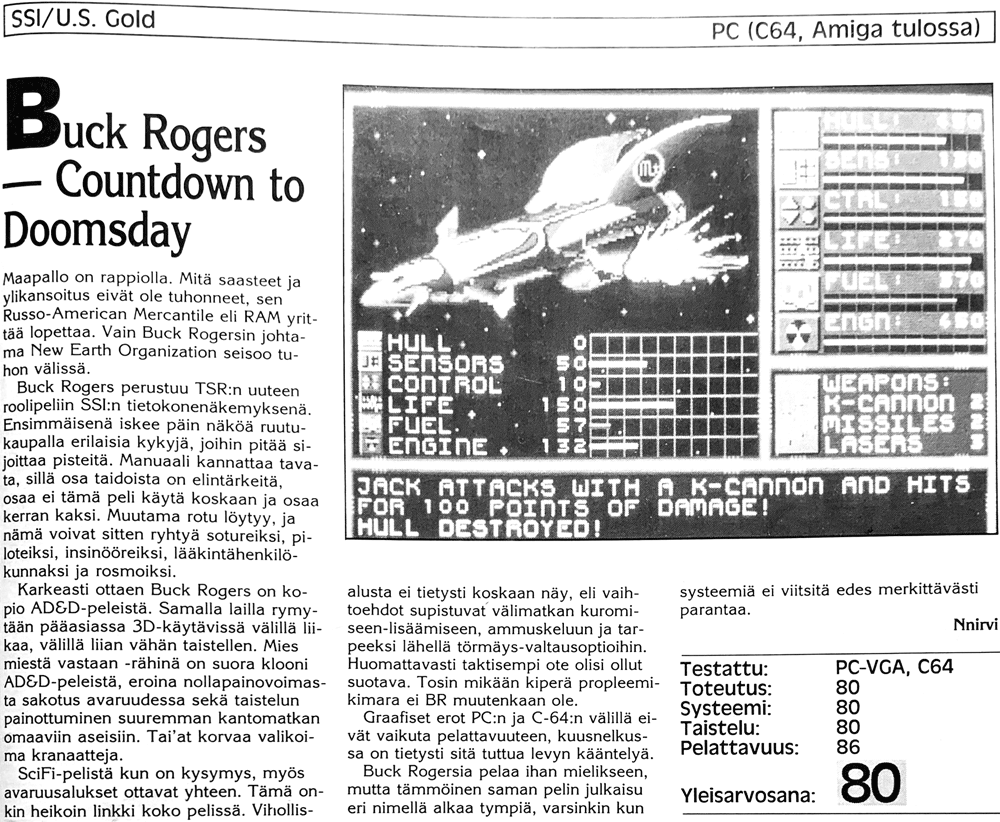
Buck Rogers - Countdown to Doomsday1991 KevätPysyvä linkkiMaapallo on rappiolla. Mitä saasteet ja ylikansoitus eivät ole tuhonneet, sen Russo-American Mercantile eli RAM yrittää lopettaa. Vain Buck Rogersin johtama New Earth Organization seisoo tuhon välissä.
Buck Rogers perustuu TSR:n uuteen roolipeliin SSI:n tietokonenäkemyksenä. Ensimmäisenä iskee päin näköä ruutukaupalla erilaisia kykyjä, joihin pitää sijoittaa pisteitä. Manuaali kannattaa tavata, sillä osa taidoista on elintärkeitä, osaa ei tämä peli käytä koskaan ja osaa kerran kaksi. Muutama rotu löytyy, ja nämä voivat sitten ryhtyä sotureiksi, piloteiksi, insinööreiksi, lääkintähenkilökunnaksi ja rosmoiksi.
Karkeasti ottaen Buck Rogers on kopio AD&D-peleistä. Samalla lailla rymytään pääasiassa 3D-käytävissä välillä liikaa, välillä liian vähän taistellen. Mies miestä vastaan -rähinä on suora klooni AD&D-peleistä, eroina nollapainovoimasta sakotus avaruudessa sekä taistelun painottuminen suuremman kantomatkan omaaviin aseisiin. Tai'at korvaa valikoima kranaatteja.
SciFi-pelistä kun on kysymys, myös avaruusalukset ottavat yhteen. Tämä onkin heikoin linkki koko pelissä. Vihollisalusta ei tietysti koskaan näy, eli vaihtoehdot supistuvat välimatkan kuromiseen-lisäämiseen, ammuskeluun ja tarpeeksi lähellä törmäys-valtausoptioihin. Huomattavasti taktisempi ote olisi ollut suotava. Tosin mikään kiperä propleemikimara ei BR muutenkaan ole.
Graafiset erot PC:n ja C-64:n välillä eivät vaikuta pelattavuuteen, kuusnelkussa on tietysti sitä tuttua levyn kääntelyä.
Buck Rogersia pelaa ihan mielikseen, mutta tämmöinen saman pelin julkaisu eri nimellä alkaa tympiä, varsinkin kun systeemiä ei viitsitä edes merkittävästi parantaa.
Buck Rogers - Countdown to Doomsday1991 KevätPermalinkThe Earth is in decline. Whatever pollution and overpopulation haven't destroyed, the Russo-American Mercantile, or RAM, is trying to finish off. Only the New Earth Organization, led by Buck Rogers, stands in the way of destruction.
Buck Rogers is SSI's computer take on TSR's new role-playing game. The first thing to smack you in the face is screen after screen of different abilities that you have to put points into. It's worth poring over the manual, since some of the skills are vital, some this game never uses and some it uses once or twice. There are a few races, and these can then become warriors, pilots, engineers, medical staff and rogues.
Roughly speaking, Buck Rogers is a copy of the AD&D games. In the same way you blunder about mainly in 3D corridors, sometimes fighting too much, sometimes too little. The man-against-man brawling is a straight clone of the AD&D games, the differences being penalties for zero gravity in space and combat leaning towards longer-range weapons. Spells are replaced by an assortment of grenades.
This being a SciFi game, spaceships clash too. And this is the weakest link in the whole game. Naturally you never actually see the enemy ship, so your options shrink to closing-or-opening the distance, shooting and, once close enough, ram-or-board options. A considerably more tactical approach would have been welcome. Mind you, BR isn't exactly a thorny tangle of problems in any other respect either.
The graphical differences between the PC and the C-64 don't affect the playability; on the C-64 there's of course that familiar disk flipping.
Buck Rogers is quite enjoyable to play, but this business of releasing the same game under a different name is starting to get on my nerves, especially when they can't even be bothered to improve the system significantly.
Budokan
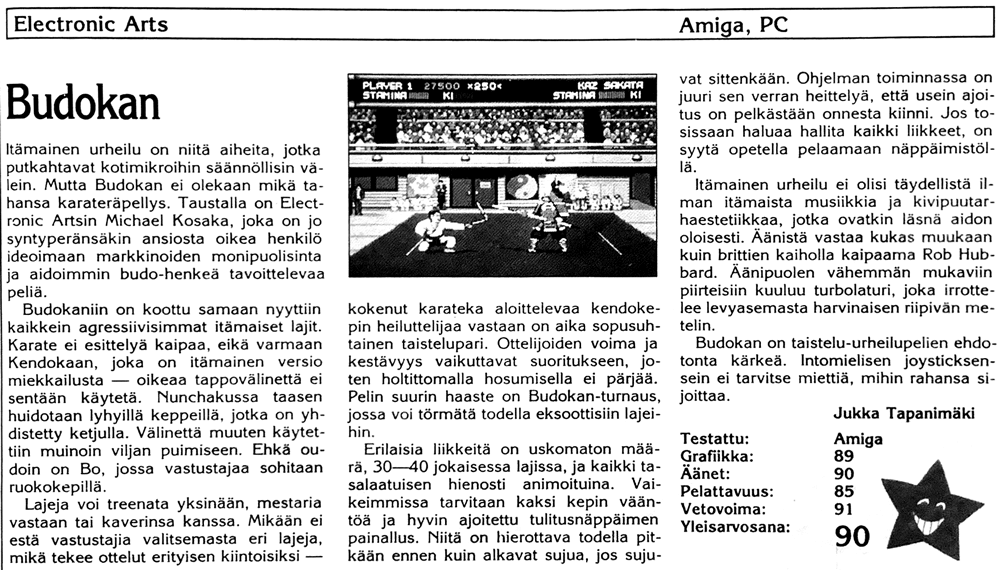
Budokan1990 SyksyPysyvä linkkiItämainen urheilu on niitä aiheita, jotka putkahtavat kotimikroihin säännöllisin välein. Mutta Budokan ei olekaan mikä tahansa karateräpellys. Taustalla on Electronic Artsin Michael Kosaka, joka on jo syntyperänsäkin ansiosta oikea henkilö ideoimaan markkinoiden monipuolisinta ja aidoimmin budo-henkeä tavoittelevaa peliä.
Budokaniin on koottu samaan nyyttiin kaikkein agressiivisimmat itämaiset lajit. Karate ei esittelyä kaipaa, eikä varmaan Kendokaan, joka on itämainen versio miekkailusta - oikeaa tappovälinettä ei sentään käytetä. Nunchakussa taasen huidotaan lyhyillä keppeillä, jotka on yhdistetty ketjulla. Välinettä muuten käytettiin muinoin viljan puimiseen. Ehkä oudoin on Bo, jossa vastustajaa sohitaan ruokokepillä.
Lajeja voi treenata yksinään, mestaria vastaan tai kaverinsa kanssa. Mikään ei estä vastustajia valitsemasta eri lajeja, mikä tekee ottelut erityisen kiintoisiksi - kokenut karateka aloittelevaa kendokepin heiluttelijaa vastaan on aika sopusuhtainen taistelupari. Ottelijoiden voima ja kestävyys vaikuttavat suoritukseen, joten holtittomalla hosumisella ei pärjää. Pelin suurin haaste on Budokan-turnaus, jossa voi törmätä todella eksoottisiin lajeihin.
Erilaisia liikkeitä on uskomaton määrä, 30-40 jokaisessa lajissa, ja kaikki tasalaatuisen hienosti animoituina. Vaikeimmissa tarvitaan kaksi kepin vääntöä ja hyvin ajoitettu tulitusnäppäimen painallus. Niitä on hierottava todella pitkään ennen kuin alkavat sujua, jos sujuvat sittenkään. Ohjelman toiminnassa on juuri sen verran heittelyä, että usein ajoitus on pelkästään onnesta kiinni. Jos tosissaan haluaa hallita kaikki liikkeet, on syytä opetella pelaamaan näppäimistöllä.
Itämainen urheilu ei olisi täydellistä ilman itämaista musiikkia ja kivipuutarhaestetiikkaa, jotka ovatkin läsnä aidon oloisesti. Äänistä vastaa kukas muukaan kuin brittien kaiholla kaipaama Rob Hubbard. Äänipuolen vähemmän mukaviin piirteisiin kuuluu turbolaturi, joka irrottelee levyasemasta harvinaisen riipivän metelin.
Budokan on taistelu-urheilupelien ehdotonta kärkeä. Intomielisen joysticksensein ei tarvitse miettiä, mihin rahansa sijoittaa.
Budokan1990 SyksyPermalinkEastern sport is one of those subjects that pop up on home computers at regular intervals. But Budokan is no ordinary karate botch-job. Behind it is Electronic Arts' Michael Kosaka, who by ancestry alone is the right person to come up with the most versatile game on the market, and the one that most authentically strives for the spirit of budo.
Budokan ties the most aggressive of the Eastern disciplines up together in one bundle. Karate needs no introduction, and probably neither does Kendo, which is the Eastern version of fencing - no real killing instrument is used, mind you. In Nunchaku, on the other hand, you flail about with short sticks joined by a chain. The implement, incidentally, was used in days of old for threshing grain. Perhaps the oddest is Bo, in which you jab at your opponent with a cane stick.
You can train in the disciplines on your own, against a master or with a friend. Nothing stops opponents from choosing different disciplines, which makes the bouts particularly interesting - a seasoned karateka against a novice kendo-stick swinger is a pretty well-balanced pairing. The fighters' strength and stamina affect their performance, so reckless thrashing about will get you nowhere. The game's biggest challenge is the Budokan tournament, where you can run into some truly exotic disciplines.
There is an unbelievable number of different moves, 30-40 in each discipline, and all of them consistently beautifully animated. The hardest ones need two wrenches of the stick and a well-timed press of the fire button. You have to grind away at them for a really long time before they start to come off, if they come off even then. There is just enough erratic behaviour in the program that the timing often comes down to pure luck. If you seriously want to master all the moves, you'd do well to learn to play with the keyboard.
Eastern sport wouldn't be complete without Eastern music and rock-garden aesthetics, and both are indeed there, with an authentic feel. The sound is by who else but Rob Hubbard, whom the Brits miss so wistfully. Among the less pleasant features of the audio side is the turbo loader, which wrings an exceptionally grating racket out of the disk drive.
Budokan is at the absolute top of the combat sports games. The avid joystick sensei needn't think twice about where to put their money.
Buffalo Bill's Rodeo Games
Buffalo Bill's Rodeo Games1989 SyksyPysyvä linkkiBuffalo Billin villin lännen show veti kansaa kuin pipoa 1880-luvulla. Tynesoft on ottanut härkää sarvista ja tehnyt aiheesta jonkinasteisen urheilupelin. Lajeina on veitsen heitto, tarkkuusammunta, villin hevosen selässä pysyminen, postivaunujen pelastaminen, vasikan lassoaminen ja härkäpaini.
Koko hoito on hoidettu varsin tyylikkäästi. Näyttävällä grafiikalla säestäen ohjelma pyytää pelaajien lukumäärää ja nimiä. Pelaajia voi olla yhdestä neljään ja koko ajan taustalla soi taidokkaasti tehty wild west -musiikki. Musiikin eteen on nähty paljon vaivaa: jokaisessa lajissa on oma tunnusmusiikkinsa.
Alkuvalikossa voidaan valita mikä tahansa laji, tai vaikka kaikki. Lajit ladataan multiloadina, mutta onneksi kaikkia lajeja voi pelata kuinka monta kertaa tahansa.
Veitsen heitto vaatii pelaajalta tarkkuutta, hyviä refleksejä ja hitusen onnea. Maalina toimii ympyrän muotoiseen pyörivään puukehikkoon sidottu kaunis intiaanityttö. Mitä lähemmäksi tyttöä pelaaja veitsensä heittää, sitä enemmän pisteitä karttuu. Jos veitsi osuu tyttöön, ruutu värjäytyy lentävästä verestä punaiseksi.
Tarkkuusammunnassa pelaajan tulee ampua aavikolta nousevia pahvikylttejä mahdollisimman nopeasti. Kylteissä on roistojen, naisten ja sheriffien kuvia, naisten ja sheriffien ampuminen tietää huutia.
Villin hevosen selässä pysyminen ei ole niitä helpoimpia tehtäviä. Ruudun alareunassa on nuolet kaikkiin ilmansuuntiin. Pelaajan tehtävä on vääntää tikkua vastakkaiseen suuntaan kuin lineaarisesti kasvava nuoli näyttää. Oikealla taktiikalla äijä sattaa pysyä hevosen selässä jopa viisi sekuntia...
Postivaunujen pelastamisessa ranne joutuu Decathlonin tapaan kovalle koetukselle. Ideana on ratsastaa inkkarien ryöstämien postivaunujen perässä vemputtamalla tikkua olan takaa oikealta vasemmalle ja sitten tapella nyrkkitappelua punanahkojen kanssa.
Vasikan lassoaminen ja härkäpaini ovat luonteeltaan kutakuinkin samanlaisia lajeja. Sivusuunnassa skrollaavalla ruudulla pelaaja yrittää saada kiinni elikon ja kukistaa sen maahan mahdollisimman nopeasti.
Kaikenkaikkiaan Rodeo Games on ihan hauskaa puuhaa iltojen iloksi. Peli on hyvin toteutettu ja kaikinpuolin kiva pelata: varteenotettava vaihtoehto urheilupeliä ostettaessa.
Buffalo Bill's Rodeo Games1989 SyksyPermalinkBuffalo Bill's Wild West show drew crowds like crazy in the 1880s. Tynesoft has taken the bull by the horns and made a sports game of sorts out of the subject. The events are knife throwing, sharpshooting, staying on a wild horse, rescuing the stagecoach, calf roping and steer wrestling.
The whole affair has been handled with real style. Accompanied by eye-catching graphics, the program asks for the number of players and their names. There can be from one to four players, and all the while skilfully made Wild West music plays in the background. A lot of trouble has gone into the music: each event has its own theme tune.
In the opening menu you can pick any event, or even all of them. The events are loaded as a multiload, but fortunately you can play every event as many times as you like.
Knife throwing demands accuracy, good reflexes and a smidgen of luck from the player. The target is a beautiful Indian girl tied to a round, spinning wooden frame. The closer to the girl you throw your knife, the more points you rack up. If the knife hits the girl, the screen turns red with flying blood.
In sharpshooting the player has to shoot cardboard signs popping up from the desert as quickly as possible. The signs carry pictures of outlaws, women and sheriffs; shooting the women and sheriffs earns you a telling-off.
Staying on a wild horse isn't one of the easiest tasks. At the bottom of the screen there are arrows pointing in every direction of the compass. The player's job is to wrench the stick in the opposite direction to the one shown by the linearly growing arrow. With the right tactics the guy might stay on the horse's back for as long as five seconds...
In the stagecoach rescue your wrist is put through a tough test, Decathlon-style. The idea is to ride after the stagecoach robbed by the Injuns by waggling the stick from right to left for all you're worth, and then have a fistfight with the redskins.
Calf roping and steer wrestling are pretty much the same kind of event. On a sideways-scrolling screen, the player tries to catch the critter and wrestle it to the ground as quickly as possible.
All in all, Rodeo Games is quite a fun way to brighten up your evenings. The game is well made and nice to play in every way: a serious option when buying a sports game.
Buggy Boy
Buggy Boy1988Pysyvä linkkiElite on tunnettu siitä, että se tuntuu haukkaavan liian suuren palan arcadekäännöksissään. Riskin otto kannattaa, sillä lähes poikkeuksetta yritys onnistuu erinomaisesti. Vaan kuinkas käy tällä kertaa, sillä arcade-Buggy Boyssa näkyy rata kolmesta monitorista ja grafiikka on yhtä nopeaa kuin monipuolistakin. Riittääkö kotimikron kapasiteetti samaan?
Buggy Boyssa tehdään sitä mitä autopelissä voidaan odottaa tehtävän eli yritetään ajaa rata läpi ennenkuin aika loppuu. Käyttämättä jäänyt aika muutetaan bonuspisteiksi ja lisäajaksi. Lisäpisteitä saa läpäisemällä pisteportteja ja ajamalla nurin lippuja (jalankulkijat olisivat olleet parempi idea).
Porteista joissa lukee TIME saa lisäaikaa niinkuin voi hyvin olettaa. Rantakirpun saa pomppimaan ajamalla kaatuneen puun yli ja ajamalla kiven tai kannon päältä voi siirtyä kaksipyöräiseen ajoon kuin K.I.T.T. parhaina päivinään. Jotta kaikki ei olisi liian yksinkertaista on rata täynnä kiviä, puita, aitoja ja niin edes päin, joita päin ei edes saa ajaa. Monipuolisia ratoja on viisi erilaista tunneleineen, siltoineen ja kallistettuine kurveineen.
Buggy Boy on todella hyvin toteutettu. Erinomainen grafiikka rullaa sujuvasti, ääniefektit ovat hyviä ja pelattavuus on hirmuinen. ST-versiota ei erota arcadepelistä ja kuusnelos-versiokin venyttää koneen aivan uusiin ulottuvuuksiin. Buggyssä on hyvä ohjaustuntuma, se on hyvän näköinen ja pelin vaikeus on juuri sopiva. Ohjelmointi on huolellista eikä tässä pojassa tunnu olevan bugeja. Vaan eipä ole kolmea kuvaruutuakaan.
Elite vetää pisteet kotiin. Buggy Boy on erinomainen arcadekäännös, jonka tapaisia kaivataan lisää. Tämän jälkeen autoilupelit eivät enää ole entisiään.
Buggy Boy1988PermalinkElite is known for seeming to bite off more than it can chew with its arcade conversions. Taking the risk pays off, since almost without exception the company pulls it off superbly. But how will it go this time, given that the arcade Buggy Boy shows the track across three monitors and the graphics are as fast as they are varied? Is a home micro up to the same job?
In Buggy Boy you do what you'd expect to do in a car game, i.e. try to get round the track before time runs out. Unused time is converted into bonus points and extra time. Extra points come from driving through point gates and knocking down flags (pedestrians would have been a better idea).
Gates marked TIME give you extra time, as you might well expect. You can make your sand flea of a buggy hop by driving over a fallen tree, and driving over a rock or a stump puts you up on two wheels like K.I.T.T. in its best days. So that things aren't too simple, the track is full of rocks, trees, fences and so on and so forth, which you mustn't so much as drive into. There are five different, varied tracks, complete with tunnels, bridges and banked bends.
Buggy Boy is really well done. The excellent graphics scroll smoothly, the sound effects are good and the playability is tremendous. You can't tell the ST version from the arcade game, and even the C-64 version stretches the machine into whole new dimensions. Buggy has a good feel to the controls, it looks good and the difficulty is just right. The programming is careful and there don't seem to be any bugs in this boy. Then again, there aren't three screens either.
Elite takes the points home. Buggy Boy is an excellent arcade conversion, and we need more like it. After this, driving games will never be the same again.