1133 reviews from "Pelit"-books
Pelit was a Finnish-language (bi)annual book series published from 1987 to 1991 containing gaming-related articles, tips and most importantly game reviews. Here you can find all the reviews from the books. The reviews were originally written in Finnish; the English versions are translations of the Finnish originals. Maininta tekijänoikeuksista
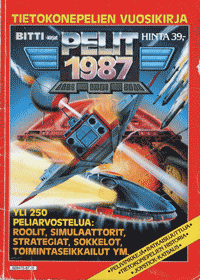 1987
1987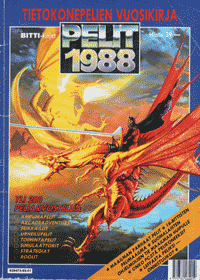 1988
1988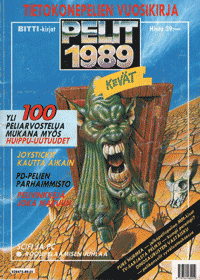 1989 Kevät
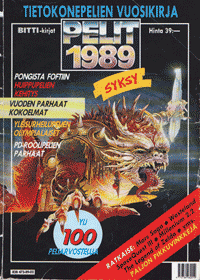 1989 Syksy
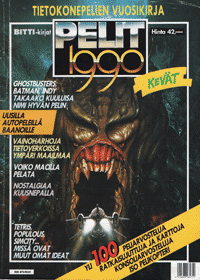 1990 Kevät
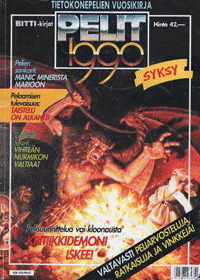 1990 Syksy
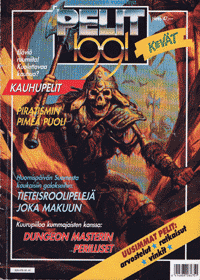 1991 Kevät
 1991 Syksy
C.R.E.A.T.U.R.E.S

C.R.E.A.T.U.R.E.S1991 SyksyPysyvä linkkiMuistathan ne pienet, isoilla silmillä varustetut, värilliset karvapallot, joiden jalkapohjissa oli liimapinta, ja joita kaikki epätoivoiset yhtiöt jakoivat messuilla pienten lasten suuhun tungettaviksi. Siis juuri ne, jotka messujen jälkeen löytyivät mitä ihmeellisimmistä paikoista, kuten jääkaapin ovesta, koululaukusta tai Laura Palmerin päiväkirjan kannesta. No, nyt niistä on tehty peli ja mukana paketissa on jälleen yksi tuollainen suloinen/ärsyttävä stick-it!-pallo.
Creatures on valloittava peli. Kuka voisi olla rakastumatta päätä pahkaa pieneen karvapalloon, jonka pahanhajuinen hengitys tappaa useamman metrin päästä! Jo kaksi kenttää selvitettyään karvapallo heitetään kidutuskammioon ja sitten hupi vasta alkaa. Matkalla karvapallo voi kuitenkin kerätä mukaansa pienempiä otuksia noidalle, jonka otuksista tekemä taikajuoma tekee pallolle vielä tehokkaamman grillaushenkäyksen kunnon Mr Hyde -tyyliin. Ja aikanaan pallo pääsee ottelemaan demoneja vastaan ja pelastamaan ystävänsä.
Creatures todella on valloittava peli. Heti pelaamisen aloitettuaan huomaa, kuinka paljon huomiota on kiinnitetty kaikkien hahmojen piirtämiseen, animointiin ja taustojen hilpeyteen. Eri näköiset hirviöt liikkuvat eri tavalla ja osuman saatuaan välkkyvät hieman aikaa. Tämä onkin ehdottoman tärkeää, sillä myöhemmin pelissä on hirviöitä, jotka tuhoutuvat vain tietyllä aseella. Myös karvapallon liikuttelu on vaivatonta, eikä edes erittäin tarkkojen hyppyjen suorittaminen tuota pelissä liikaa vaivaa.
Sekä grafiikassa ja pelin juonessa on selvä sarjakuvamainen henki, jota tukevat vielä tavallista oudommat äänet. Pelissä on myös paljon ivallista ja jopa mustaa huumoria niille, jotka sellaista arvostavat.
Mitään tyhjentävää yhteenvetoa on pelistä turha tehdä. Se olisi kuitenkin vain ylipitkä kehusanojen luettelo, Creatures on yksinkertaisesti vain todella hyvä peli, jonka kaltaisia toivomme lisää.
C.R.E.A.T.U.R.E.S1991 SyksyPermalinkYou'll remember those little coloured fuzzballs with big eyes and sticky pads on the soles of their feet, which every desperate company handed out at trade fairs for small children to stuff in their mouths. Yes, the very ones that turned up after the fair in the most amazing places, like the fridge door, a school bag or the cover of Laura Palmer's diary. Well, now they've been made into a game, and the package comes with yet another of those sweet/irritating stick-it! balls.
Creatures is a captivating game. Who could help falling head over heels for a little fuzzball whose foul breath kills from several metres away! After clearing just two levels the fuzzball gets thrown into a torture chamber, and that's when the fun really starts. Along the way, though, the fuzzball can collect smaller critters for a witch, whose potion made from the critters gives the ball an even more effective grilling breath, in proper Mr Hyde style. And in due course the ball gets to fight demons and rescue its friends.
Creatures really is a captivating game. As soon as you start playing you notice how much attention has been paid to the drawing and animation of all the characters and to the jollity of the backgrounds. Different-looking monsters move in different ways, and after taking a hit they flash for a little while. This is absolutely vital, since later in the game there are monsters that can only be destroyed with a particular weapon. Moving the fuzzball around is effortless too, and even pulling off extremely precise jumps doesn't cause too much trouble in the game.
Both the graphics and the game's plot have a clear cartoon-like spirit, further backed up by stranger-than-usual sound effects. The game also has plenty of mocking and even black humour for those who appreciate that kind of thing.
There's no point writing any exhaustive summary of the game. It would only be an overlong list of words of praise anyway; Creatures is quite simply a really good game, and we hope to see more like it.
Cabal
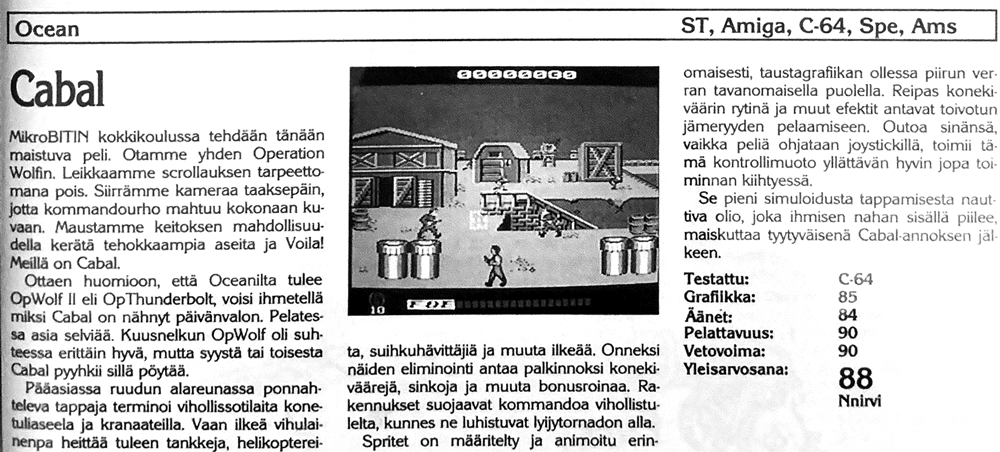
Cabal1990 KevätPysyvä linkkiMikroBITIN kokkikoulussa tehdään tänään maistuva peli. Otamme yhden Operation Wolfin. Leikkaamme scrollauksen tarpeettomana pois. Siirrämme kameraa taaksepäin, jotta kommandourho mahtuu kokonaan kuvaan. Maustamme keitoksen mahdollisuudella kerätä tehokkaampia aseita ja Voila! Meillä on Cabal.
Ottaen huomioon, että Oceanilta tulee OpWolf II eli OpThunderbolt, voisi ihmetellä miksi Cabal on nähnyt päivänvalon. Pelatessa asia selviää. Kuusnelkun OpWolf oli suhteessa erittäin hyvä, mutta syystä tai toisesta Cabal pyyhkii sillä pöytää.
Pääasiassa ruudun alareunassa ponnahteleva tappaja terminoi vihollissotilaita konetuliaseela ja kranaateilla. Vaan ilkeä vihulainenpa heittää tuleen tankkeja, helikoptereita, suihkuhävittäjiä ja muuta ilkeää. Onneksi näiden eliminointi antaa palkinnoksi konekiväärejä, sinkoja ja muuta bonusroinaa. Rakennukset suojaavat kommandoa vihollistulelta, kunnes ne luhistuvat lyijytornadon alla.
Spritet on määritelty ja animoitu erinomaisesti, taustagrafiikan ollessa piirun verran tavanomaisella puolella. Reipas konekiväärin rytinä ja muut efektit antavat toivotun jämeryyden pelaamiseen. Outoa sinänsä, vaikka peliä ohjataan joystickillä, toimii tämä kontrollimuoto yllättävän hyvin jopa toiminnan kiihtyessä.
Se pieni simuloidusta tappamisesta nauttiva olio, joka ihmisen nahan sisällä piilee, maiskuttaa tyytyväisenä Cabal-annoksen jälkeen.
Cabal1990 KevätPermalinkToday in MikroBITTI's cookery school we are making a tasty game. We take one Operation Wolf. We cut out the scrolling as unnecessary. We move the camera back so that the commando hero fits entirely in the picture. We season the brew with the chance to collect more powerful weapons and Voila! We have Cabal.
Considering that Ocean has OpWolf II, a.k.a. OpThunderbolt, on the way, you might wonder why Cabal has seen the light of day. Playing it clears the matter up. The C-64 OpWolf was, relatively speaking, very good, but for one reason or another Cabal wipes the floor with it.
The killer, bouncing about mostly along the bottom edge of the screen, terminates enemy soldiers with automatic weapons and grenades. But the nasty baddie goes and throws tanks, helicopters, jet fighters and other nastiness into the fray. Luckily, eliminating these earns you machine guns, bazookas and other bonus junk as a reward. Buildings shield the commando from enemy fire until they crumble under the tornado of lead.
The sprites are excellently defined and animated, with the background graphics a notch on the ordinary side. The brisk rattle of the machine gun and the other effects give the playing the beefiness you'd want. Odd in itself: even though the game is controlled with the joystick, this form of control works surprisingly well even when the action speeds up.
That little creature that relishes simulated killing, lurking inside the human hide, smacks its lips contentedly after a helping of Cabal.
Cadaver
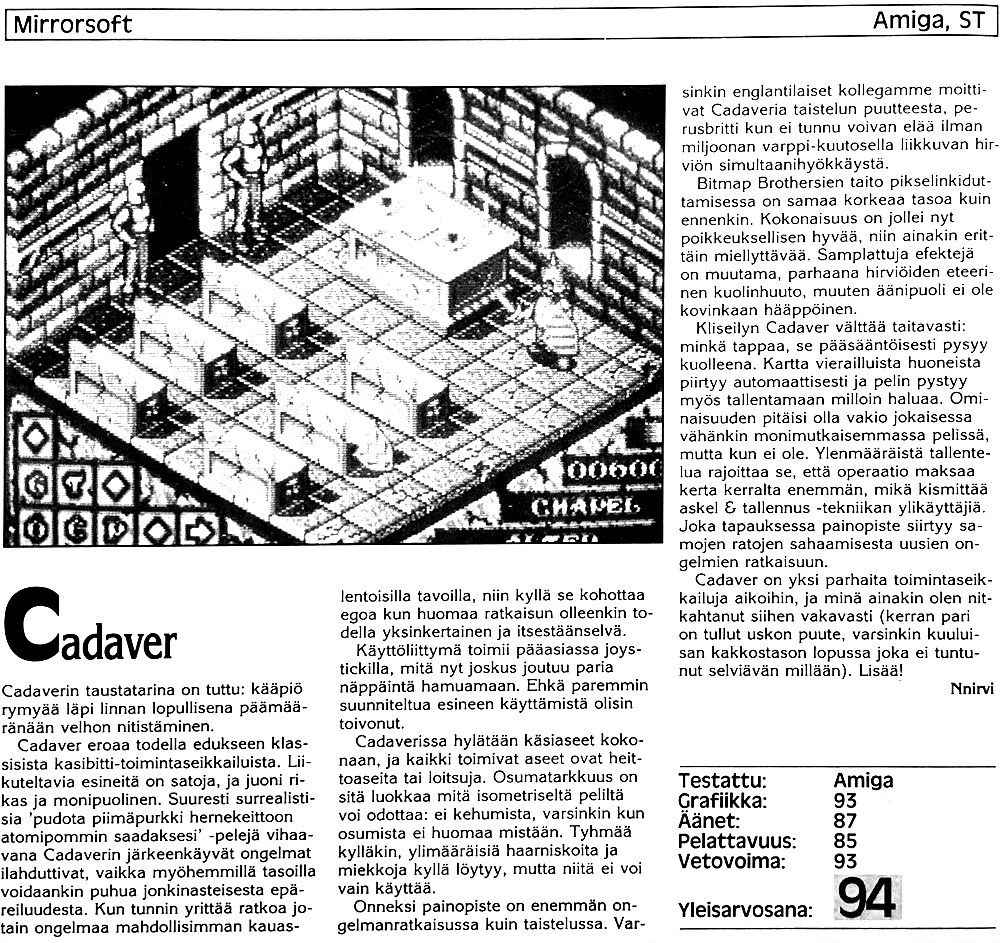
Cadaver1991 KevätPysyvä linkkiCadaverin taustatarina on tuttu: kääpiö rymyää läpi linnan lopullisena päämääränään velhon nitistäminen.
Cadaver eroaa todella edukseen klassisista kasibitti-toimintaseikkailuista. Liikuteltavia esineitä on satoja, ja juoni rikas ja monipuolinen. Suuresti surrealistisia 'pudota piimäpurkki hernekeittoon atomipommin saadaksesi' -pelejä vihaavana Cadaverin järkeenkäyvät ongelmat ilahduttivat, vaikka myöhemmillä tasoilla voidaankin puhua jonkinasteisesta epäreiluudesta. Kun tunnin yrittää ratkoa jotain ongelmaa mahdollisimman kauaslentoisilla tavoilla, niin kyllä se kohottaa egoa kun huomaa ratkaisun olleenkin todella yksinkertainen ja itsestäänselvä.
Käyttöliittymä toimii pääasiassa joystickilla, mitä nyt joskus joutuu paria näppäintä hamuamaan. Ehkä paremmin suunniteltua esineen käyttämistä olisin toivonut.
Cadaverissa hylätään käsiaseet kokonaan, ja kaikki toimivat aseet ovat heittoaseita tai loitsuja. Osumatarkkuus on sitä luokkaa mitä isometriseltä peliltä voi odottaa: ei kehumista, varsinkin kun osumista ei huomaa mistään. Tyhmää kylläkin, ylimääräisiä haarniskoita ja miekkoja kyllä löytyy, mutta niitä ei voi vain käyttää.
Onneksi painopiste on enemmän ongelmanratkaisussa kuin taistelussa. Varsinkin englantilaiset kollegamme moittivat Cadaveria taistelun puutteesta, perusbritti kun ei tunnu voivan elää ilman miljoonan varppi-kuutosella liikkuvan hirviön simultaanihyökkäystä.
Bitmap Brothersien taito pikselinkiduttamisessa on samaa korkeaa tasoa kuin ennenkin. Kokonaisuus on jollei nyt poikkeuksellisen hyvää, niin ainakin erittäin miellyttävää. Samplattuja efektejä on muutama, parhaana hirviöiden eteerinen kuolinhuuto, muuten äänipuoli ei ole kovinkaan hääppöinen.
Kliseilyn Cadaver välttää taitavasti: minkä tappaa, se pääsääntöisesti pysyy kuolleena. Kartta vierailluista huoneista piirtyy automaattisesti ja pelin pystyy myös tallentamaan milloin haluaa. Ominaisuuden pitäisi olla vakio jokaisessa vähänkin monimutkaisemmassa pelissä, mutta kun ei ole. Ylenmääräistä tallentelua rajoittaa se, että operaatio maksaa kerta kerralta enemmän, mikä kismittää askel & tallennus -tekniikan ylikäyttäjiä. Joka tapauksessa painopiste siirtyy samojen ratojen sahaamisesta uusien ongelmien ratkaisuun.
Cadaver on yksi parhaita toimintaseikkailuja aikoihin, ja minä ainakin olen nitkahtanut siihen vakavasti (kerran pari on tullut uskon puute, varsinkin kuuluisan kakkostason lopussa joka ei tuntunut selviävän millään). Lisää!
Cadaver1991 KevätPermalinkCadaver's back story is a familiar one: a dwarf barges his way through a castle with the ultimate goal of bumping off a wizard.
Cadaver really does stand out to its advantage from the classic eight-bit action adventures. There are hundreds of objects you can move around, and the plot is rich and varied. As someone who hates supremely surreal 'drop the carton of buttermilk into the pea soup to get the atom bomb' games, I was delighted by Cadaver's sensible puzzles, although on the later levels you could talk of a certain degree of unfairness. When you've spent an hour trying to crack some problem in the most far-fetched ways possible, it really does wonders for your ego to discover that the solution was actually really simple and obvious all along.
The interface runs mainly on the joystick, apart from the odd time you have to grope for a couple of keys. I might have wished for a better-designed way of using objects.
Cadaver abandons hand weapons altogether, and all the weapons that work are thrown weapons or spells. The accuracy is about what you can expect from an isometric game: nothing to boast about, especially as there's no way of telling when you've hit something. Stupidly enough, there are spare suits of armour and swords to be found, but you just can't use them.
Luckily the emphasis is more on problem-solving than on combat. Our English colleagues in particular have slated Cadaver for its lack of combat, since your average Brit apparently can't live without a simultaneous attack by a million monsters moving at warp six.
The Bitmap Brothers' skill at pixel-torturing is of the same high standard as ever. The whole thing is, if not exactly exceptionally good, then at least extremely pleasing. There are a few sampled effects, the best being the monsters' ethereal death scream; otherwise the audio side isn't all that hot.
Cadaver skilfully steers clear of cliche: whatever you kill generally stays dead. A map of the rooms you've visited draws itself automatically, and you can also save the game whenever you like. That feature ought to be standard in every game that's even slightly complicated, but it just isn't. Excessive saving is kept in check by the fact that the operation costs more each time, which irks the over-users of the step & save technique. In any case, the emphasis shifts from traipsing back and forth over the same routes to solving new problems.
Cadaver is one of the best action adventures in ages, and I for one have got seriously hooked on it (once or twice my faith has wavered, especially at the end of the famous level two, which just wouldn't seem to crack). More!
California Games
California Games1990 SyksyPysyvä linkkiKotimikroilijoille tuttu perijenkkiläisiä nuorisohuveja simuloiva paketti on inkartoitunut vähän joka koneelle Lynxiä myöten. Eipä siinä olekaan mitään ihmettelemistä. Pelin aihepiiri toimii ärsykkeenä myyville mielikuville: räikeissä shortseissa lautailevia kalifornialaisia bodareita, hyvävartaloisia bikinikaunottaria, paahdetta ja ruskettunutta pintaa.
Urheilupeleille epätyypillisesti CG ei vaadi ankaraa ohjaimen renkutusta, vaan monipuolisen ja -mutkaisen ohjauksen hallintaa. Alkuperäiseen versioon verrattuna grafiikkaa, ääniä tai edes pelattavuutta ei ole muutettu juuri mihinkään suuntaan.
Foot Bag eli narupallon potkiminen oli ainakin kotimikroissa mielenkiintoisin laji, mutta Segan versiossa se on toteutettu kehnosti. Miekkosella on niin hitaat nivelet, että pallo karkaa ensimmäisestä huonosti suunnatusta potkusta. Rampissa temppuilu rullalaudalla on ehkä paketin paras laji, mutta hankalat ohjauskomennot eivät aivan heti mene selkäytimeen.
Rullaluistelu sekä BMX-pyöräily ovat myös paremmasta päästä. Edellisessä viuhdotaan jalkakäytävällä, joka on täynnä roskaa, viemärinkansia ja muita esteitä, jälkimmäisesä taas tehdään akrobaattitemppuja mäkisellä radalla. Surffailun vielä jotenkin kestää, mutta frisbeen heiton apaattinen tylsyys ei Segan versiossa ole muuksi muuttunut.
Pienellä porukalla pelatessa kalifornialaiset pelit ovat oivaa ajantappohuvia, mutta yksin pelatessa on vaikea pidätellä haukotusta. Menestyksestään huolimatta California Games on mielestäni Epyxin urheilusarjan huonoin, mutta toistakin mieltä saa olla.
California Games1990 SyksyPermalinkFamiliar to home computer owners, this package simulating quintessentially Yankee youth pastimes has been incarnated on just about every machine, right down to the Lynx. Nothing surprising about that. The game's subject matter works as a trigger for images that sell: Californian beefcakes boarding about in garish shorts, shapely bikini beauties, blazing sun and bronzed skin.
Unusually for a sports game, CG doesn't demand furious waggling of the joystick, but mastery of controls that are both versatile and convoluted. Compared with the original version, the graphics, the sound and even the playability have hardly been changed in any direction at all.
Foot Bag, or kicking a hacky sack about, was the most interesting event at least on the home computers, but in the Sega version it has been done poorly. The chap's joints are so slow that the ball gets away from him on the first badly aimed kick. Doing skateboard tricks on the ramp is perhaps the best event in the package, but the awkward control commands don't exactly become second nature right away.
Roller skating and BMX biking are also among the better ones. In the former you whizz along a sidewalk full of litter, manhole covers and other obstacles, while in the latter you perform acrobatic stunts on a hilly track. The surfing is still somehow bearable, but the apathetic tedium of frisbee throwing hasn't turned into anything else in the Sega version.
Played with a small crowd, the California games are fine time-killing fun, but played alone it's hard to hold back a yawn. Despite its success, California Games is in my opinion the worst of Epyx's sports series, but you're free to disagree.
Captain Blood
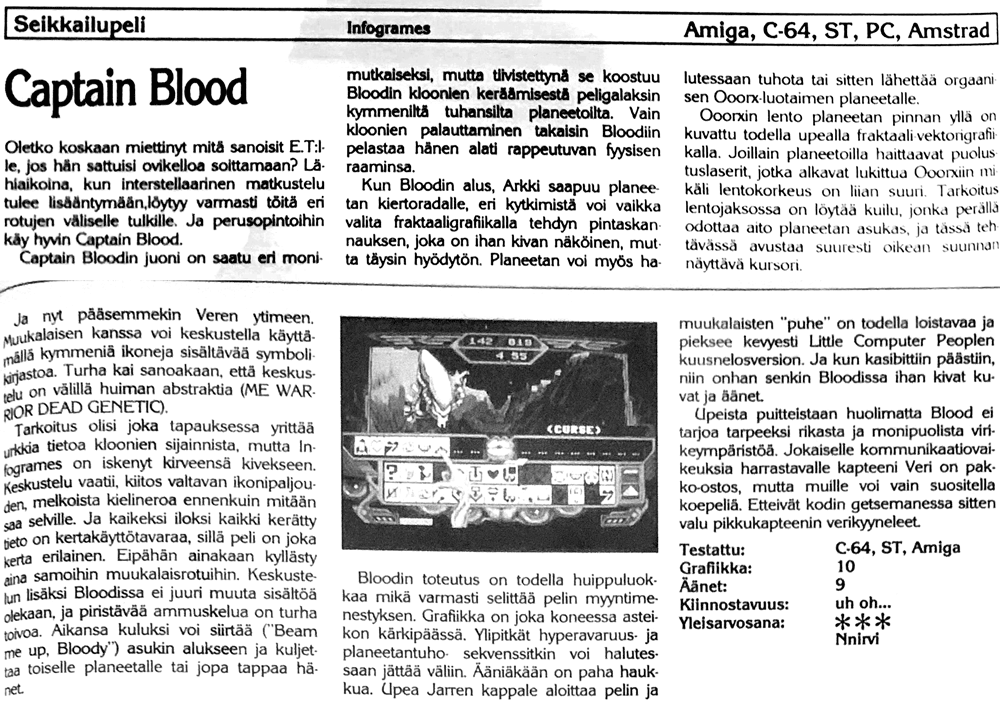
Captain Blood1989 KevätPysyvä linkkiOletko koskaan miettinyt mitä sanoisit E.T:lle, jos hän sattuisi ovikelloa soittamaan? Lähiaikoina, kun interstellaarinen matkustelu tulee lisääntymään,löytyy varmasti töitä eri rotujen väliselle tulkille. Ja perusopintoihin käy hyvin Captain Blood.
Captain Bloodin juoni on saatu eri monimutkaiseksi, mutta tiivistettynä se koostuu Bloodin kloonien keräämisestä peligalaksin kymmeniltä tuhansilta planeetoilta. Vain kloonien palauttaminen takaisin Bloodiin pelastaa hänen alati rappeutuvan fyysisen raaminsa.
Kun Bloodin alus, Arkki saapuu planeetan kiertoradalle, eri kytkimistä voi vaikka valita fraktaaligrafiikalla tehdyn pintaskannauksen, joka on ihan kivan näköinen, mutta täysin hyödytön. Planeetan voi myös halutessaan tuhota tai sitten lähettää orgaanisen Ooorx-luotaimen planeetalle.
Ooorxin lento planeetan pinnan yllä on kuvattu todella upealla fraktaali-vektorigrafiikalla. Joillain planeetoilla haittaavat puolustuslaserit, jotka alkavat lukittua Ooorxiin mikäli lentokorkeus on liian suuri. Tarkoitus lentojaksossa on löytää kuilu, jonka perällä odottaa aito planeetan asukas, ja tässä tehtävässä avustaa suuresti oikean suunnan näyttävä kursori. Ja nyt pääsemmekin Veren ytimeen. Muukalaisen kanssa voi keskustella käyttämällä kymmeniä ikoneja sisältävää symbolikirjastoa. Turha kai sanoakaan, että keskustelu on välillä huiman abstraktia (ME WARRIOR DEAD GENETIC).
Tarkoitus olisi joka tapauksessa yrittää urkkia tietoa kloonien sijainnista, mutta Infogrames on iskenyt kirveensä kivekseen. Keskustelu vaatii, kiitos valtavan ikonipaljouden, melkoista kielineroa ennenkuin mitään saa selville. Ja kaikeksi iloksi kaikki kerätty tieto on kertakäyttötavaraa, sillä peli on joka kerta erilainen. Eipähän ainakaan kyllästy aina samoihin muukalaisrotuihin. Keskustelun lisäksi Bloodissa ei juuri muuta sisältöä olekaan, ja piristävää ammuskelua on turha toivoa. Aikansa kuluksi voi siirtää ("Beam me up, Bloody") asukin alukseen ja kuljettaa toiselle planeetalle tai jopa tappaa hänet.
Bloodin toteutus on todella huippuluokkaa mikä varmasti selittää pelin myyntimenestyksen. Grafiikka on joka koneessa asteikon kärkipäässä. Ylipitkät hyperavaruus- ja planeetantuho- sekvenssitkin voi halutessaan jättää väliin. Ääniäkään on paha haukkua. Upea Jarren kappale aloittaa pelin ja muukalaisten "puhe" on todella loistavaa ja pieksee kevyesti Little Computer Peoplen kuusnelosversion. Ja kun kasibittiin päästiin, niin onhan senkin Bloodissa ihan kivat kuvat ja äänet.
Upeista puitteistaan huolimatta Blood ei tarjoa tarpeeksi rikasta ja monipuolista virikeympäristöä. Jokaiselle kommunikaatiovaikeuksia harrastavalle kapteeni Veri on pakko-ostos, mutta muille voi vain suositella koepeliä. Etteivät kodin getsemanessa sitten valu pikkukapteenin verikyyneleet.
Captain Blood1989 KevätPermalinkHave you ever wondered what you'd say if E.T. happened to ring your doorbell? In the near future, as interstellar travel becomes more common, there's bound to be work for interpreters between the different races. And Captain Blood will do nicely for the basic course.
Captain Blood's plot has been made seriously complicated, but boiled down it consists of collecting Blood's clones from the tens of thousands of planets in the game's galaxy. Only returning the clones back into Blood will save the captain's ever-decaying physical frame.
When Blood's ship, the Ark, arrives in a planet's orbit, you can use the various switches to select, say, a surface scan done in fractal graphics, which looks quite nice but is completely useless. If you like, you can also destroy the planet, or else send the organic Ooorx probe down to it.
The Ooorx's flight over the planet's surface is depicted in truly gorgeous fractal vector graphics. On some planets you're harassed by defence lasers, which start locking on to the Ooorx if you fly too high. The aim of the flight sequence is to find a chasm at the far end of which a genuine inhabitant of the planet is waiting, and a cursor showing the right direction is a great help in this task. And now we get to the very heart of Blood. You can converse with the alien using a symbol library containing dozens of icons. Needless to say, the conversation is at times wildly abstract (ME WARRIOR DEAD GENETIC).
The idea, in any case, is to try to pump them for information on where the clones are, but Infogrames has swung its axe straight into its own nuts. Thanks to the vast profusion of icons, the conversation demands quite some linguistic genius before you find anything out. And to everyone's great delight, all the information you gather is disposable, since the game is different every time. Well, at least you won't get bored of the same old alien races. Apart from the conversation there's hardly anything else to Blood, and there's no point hoping for some invigorating shooting. To pass the time you can transport ("Beam me up, Bloody") the local on board your ship and ferry them to another planet, or even kill them.
Blood's implementation is truly top class, which surely explains the game's sales success. On every machine the graphics are at the top end of the scale. Even the overlong hyperspace and planet-destruction sequences can be skipped if you want. The sound is hard to knock, either. A superb Jarre piece opens the game, and the aliens' "speech" is really brilliant and easily thrashes the Commodore 64 version of Little Computer People. And now that we've got onto 8-bit: even its Blood has pretty nice pictures and sounds.
Despite its gorgeous trappings, Blood doesn't offer a sufficiently rich and varied stimulus environment. For anyone whose hobby is communication difficulties, Captain Blood is a must-buy, but everyone else can only be recommended a trial play. Lest the little captain end up weeping tears of blood in the Gethsemane of the family home.
Captain Fizz
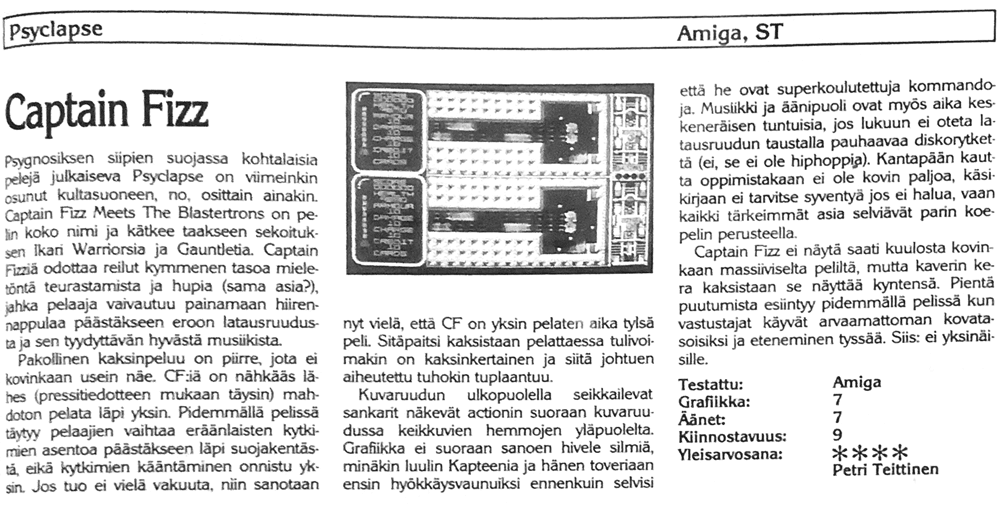
Captain Fizz1989 SyksyPysyvä linkkiPsygnosiksen siipien suojassa kohtalaisia pelejä julkaiseva Psyclapse on viimeinkin osunut kultasuoneen, no, osittain ainakin. Captain Fizz Meets The Blastertrons on pelin koko nimi ja kätkee taakseen sekoituksen Ikari Warriorsia ja Gauntletia. Captain Fizziä odottaa reilut kymmenen tasoa mieletöntä teurastamista ja hupia (sama asia?), jahka pelaaja vaivautuu painamaan hiirennappulaa päästäkseen eroon latausruudusta ja sen tyydyttävän hyvästä musiikista.
Pakollinen kaksinpeluu on piirre, jota ei kovinkaan usein näe. CF:iä on nähkääs lähes (pressitiedotteen mukaan täysin) mahdoton pelata läpi yksin. Pidemmällä pelissä täytyy pelaajien vaihtaa eräänlaisten kytkimien asentoa päästäkseen läpi suojakenttästä, eikä kytkimien kääntäminen onnistu yksin. Jos tuo ei vielä vakuuta, niin sanotaan nyt vielä, että CF on yksin pelaten aika tylsä peli. Sitäpaitsi kaksistaan pelattaessa tulivoimakin on kaksinkertainen ja siitä johtuen aiheutettu tuhokin tuplaantuu.
Kuvaruudun ulkopuolella seikkailevat sankarit näkevät actionin suoraan kuvaruudussa keikkuvien hemmojen yläpuolelta. Grafiikka ei suoraan sanoen hivele silmiä, minäkin luulin Kapteenia ja hänen toveriaan ensin hyökkäysvaunuiksi ennenkuin selvisi että he ovat superkoulutettuja kommandoja. Musiikki ja äänipuoli ovat myös aika keskeneräisen tuntuisia, jos lukuun ei oteta latausruudun taustalla pauhaavaa diskorytkettä (ei, se ei ole hiphoppia). Kantapään kautta oppimistakaan ei ole kovin paljoa, käsikirjaan ei tarvitse syventyä jos ei halua, vaan kaikki tärkeimmät asia selviävät parin koepelin perusteella.
Captain Fizz ei näytä saati kuulosta kovinkaan massiiviselta peliltä, mutta kaverin kera kaksistaan se näyttää kyntensä. Pientä puutumista esiintyy pidemmällä pelissä kun vastustajat käyvät arvaamattoman kovatasoisiksi ja eteneminen tyssää. Siis: ei yksinäisille.
Captain Fizz1989 SyksyPermalinkPsyclapse, which puts out middling games under Psygnosis's wing, has finally struck a vein of gold - well, partly at least. Captain Fizz Meets The Blastertrons is the game's full name, and behind it hides a blend of Ikari Warriors and Gauntlet. A good ten levels of mindless slaughter and fun (same thing?) await Captain Fizz, as soon as the player bothers to press the mouse button to get rid of the loading screen and its satisfactorily good music.
Compulsory two-player mode is a feature you don't see very often. You see, CF is almost (according to the press release, totally) impossible to play through alone. Further on in the game the players have to change the position of some sort of switches to get through the force field, and turning the switches can't be done on your own. If that doesn't convince you yet, let's also mention that played solo, CF is a pretty dull game. Besides, when playing as a pair the firepower is doubled too, and consequently so is the destruction dealt out.
The heroes adventuring outside the screen see the action from directly above the dudes bobbing about on the screen. Frankly, the graphics don't exactly caress the eye; even I at first took the Captain and his comrade for assault vehicles before it dawned on me that they're super-trained commandos. The music and sound side also feel rather unfinished, if you leave out the disco beat pounding away behind the loading screen (no, it's not hip hop). There isn't much learning the hard way either: you don't need to bury yourself in the manual if you don't want to, as all the most important things become clear after a couple of trial games.
Captain Fizz doesn't look, let alone sound, like a particularly massive game, but with a mate alongside it shows its claws. A bit of numbness sets in further into the game, when the enemies get unpredictably tough and progress stalls. So: not for loners.
Carrier Command
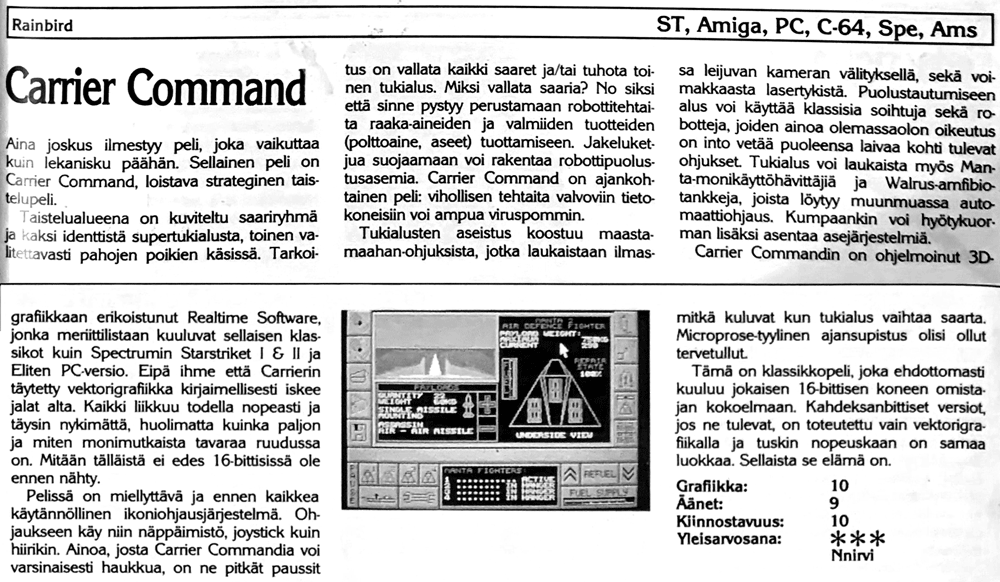
Carrier Command1988Pysyvä linkkiAina joskus ilmestyy peli, joka vaikuttaa kuin lekanisku päähän. Sellainen peli on Carrier Command, loistava strateginen taistelupeli.
Taistelualueena on kuviteltu saariryhmä ja kaksi identtistä supertukialusta, toinen valitettavasti pahojen poikien käsissä. Tarkoitus on vallata kaikki saaret ja/tai tuhota toinen tukialus. Miksi vallata saaria? No siksi että sinne pystyy perustamaan robottitehtaita raaka-aineiden ja valmiiden tuotteiden (polttoaine, aseet) tuottamiseen. Jakeluketjua suojaamaan voi rakentaa robottipuolustusasemia. Carrier Command on ajankohtainen peli: vihollisen tehtaita valvoviin tietokoneisiin voi ampua viruspommin.
Tukialusten aseistus koostuu maasta-maahan-ohjuksista, jotka laukaistaan ilmassa leijuvan kameran välityksellä, sekä voimakkaasta lasertykistä. Puolustautumiseen alus voi käyttää klassisia soihtuja sekä robotteja, joiden ainoa olemassaolon oikeutus on into vetää puoleensa laivaa kohti tulevat ohjukset. Tukialus voi laukaista myös Manta-monikäyttöhävittäjiä ja Walrus-amfibiotankkeja, joista löytyy muunmuassa automaattiohjaus. Kumpaankin voi hyötykuorman lisäksi asentaa asejärjestelmiä.
Carrier Commandin on ohjelmoinut 3Dgrafiikkaan erikoistunut Realtime Software, jonka meriittilistaan kuuluvat sellaisen klassikot kuin Spectrumin Starstriket I & II ja Eliten PC-versio. Eipä ihme että Carrierin täytetty vektorigrafiikka kirjaimellisesti iskee jalat alta. Kaikki liikkuu todella nopeasti ja täysin nykimättä, huolimatta kuinka paljon ja miten monimutkaista tavaraa ruudussa on. Mitään tälläistä ei edes 16-bittisissä ole ennen nähty.
Pelissä on miellyttävä ja ennen kaikkea käytännöllinen ikoniohjausjärjestelmä. Ohjaukseen käy niin näppäimistö, joystick kuin hiirikin. Ainoa, josta Carrier Commandia voi varsinaisesti haukkua, on ne pitkät paussit mitkä kuluvat kun tukialus vaihtaa saarta. Microprose-tyylinen ajansupistus olisi ollut tervetullut.
Tämä on klassikkopeli, joka ehdottomasti kuuluu jokaisen 16-bittisen koneen omistajan kokoelmaan. Kahdeksanbittiset versiot, jos ne tulevat, on toteutettu vain vektorigrafiikalla ja tuskin nopeuskaan on samaa luokkaa. Sellaista se elämä on.
Carrier Command1988PermalinkEvery now and then a game comes out that hits you like a sledgehammer to the head. Carrier Command, a brilliant strategic combat game, is one such game.
The battleground is a fictional group of islands and two identical super-carriers, one of them unfortunately in the hands of the bad guys. The aim is to capture all the islands and/or destroy the other carrier. Why capture islands? Well, because you can set up robot factories there to produce raw materials and finished goods (fuel, weapons). To protect the supply chain you can build robot defence stations. Carrier Command is a topical game: you can fire a virus bomb into the computers that run the enemy's factories.
The carriers' armament consists of surface-to-surface missiles, launched via a camera hovering in the air, and a powerful laser cannon. For defence the ship can use classic flares and robots whose sole justification for existence is an eagerness to draw in the missiles heading for the ship. The carrier can also launch Manta multi-role fighters and Walrus amphibious tanks, which feature an autopilot, among other things. Both can be fitted with weapon systems as well as a payload.
Carrier Command was programmed by 3D graphics specialists Realtime Software, whose track record includes such classics as Starstrike I & II on the Spectrum and the PC version of Elite. No wonder, then, that Carrier's filled vector graphics literally knock you off your feet. Everything moves really fast and completely without jerking, no matter how much stuff there is on screen or how complex it is. Nothing like this has been seen before, not even on the 16-bitters.
The game has a pleasant and above all practical icon control system. You can control it with the keyboard, a joystick or a mouse alike. The only thing you can really slate Carrier Command for is the long pauses that go by while the carrier moves from one island to another. Microprose-style time compression would have been welcome.
This is a classic game that absolutely belongs in the collection of every 16-bit machine owner. The eight-bit versions, if they come out, will be done with plain vector graphics only, and the speed is hardly going to be in the same league either. That's life.
Carrier Force
Carrier Force1987Pysyvä linkkiCarries Force on sotastrategiapeli. Ajassa siirrytään yli 40 vuotta taaksepäin toisen maailmansodan tärkeimpiin hetkiin. Tapahtumapaikkana on Tyynimeri. Pelaajalla on mahdollisuus pelata uudelleen Santa Cruzin, Midwayn, Solomonsin ja Coral Sean kuuluisat meritaistelut. Peliä voi pelata historiallisilla tai sattumanvaraisesti valituilla aloituskohdilla. Vaikeustasoja on monia.
Tässä pelissä pelaaja ei tiedä vastustajan siirroista mitään. Tutkat ovat liian heikkoja nähdäkseen kaukana olevan vihollisen, joka on löydettävä etsintälentokoneiden avulla.
Strategista ajattelukykyä tässä pelissä tarvitaan paljon. Pelaaja voi vahingossa lähettää vääriä laivoja vihollisen kimppuun. Tällöin nämä voivat tuhoutua helposti. Ilmavoimia on muistettava käyttää paljon hyväkseen. Kannattaa aina pitää ainakin yksi lentue ilmassa koko ajan, jotta se pystyisi estämään vihollisen pommittajien hyökkäykset. Japanilaisella pelaajalla on yleensä enemmän laivoja, mutta niitä tasapainottamassa on yleensä yhdysvaltalaisten suurempi voima.
Peli tarjoaa mahdollisuuden katsoa karttaa. Tämä tapahtuu muiden strategiapelien tapaan kuvaruudun kokoisesta ikkunasta, josta näkee osan koko alueesta. Tätä karttaa pitääkin käyttää hyväkseen ilmahyökkäyksiä tehdessä, sillä sen avulla ohjataan ilmalaivueita. Laivasto-osastot liikkuvat omaa annettua kurssiaan. Kurssin vaihdoksissa ei tarvita tietokoneen karttaa.
Siirtojen syöttö on normaaleista peleistä poikkeava. Yhden näppäimen toimintojen ja koko ajan näkyvän kartan sijasta on kuvaruutu normaalisti koko ajan tekstimuodossa. Sinänsä tämä vähän latistaa tunnelmaa, mutta pelin mukana tulevilla kartoilla pystyy kuvittelemaan tilanteen.
Kartoilla saa selvän kuvan taistelumaastosta. Kuitenkin pelin tekijöiltä on eräs tärkeä asia unohtunut. Karttojen mukana ei tule pelinappuloita, joiden avulla pystyisi helposti toteamaan pelin tilanteen. Itse korjasin sen minitarranpaloilla, joiden päälle asetin pienen paperinpalasen. Paperilla luki kyseisen yksikön järjestysnumero. Tällä tavoin saakin selvän kartan.
Carrier Force on peli ajattelijoille. Se tuntuu pitkästyttävältä, varsinkin kun ei tiedä vihollisten sijaintia. Vihollisen yksikköjen etsintä onkin turhauttavinta puuhaa, jota tämä peli tarjoaa. Samalla se voi kuitenkin myös kutittaa hermoja, sillä vihollisen voi joskus löytää ihan yllättävistä paikoista.
Itse ohjelmassa on muutamia harmittavia piirteitä. Koko peli rakentuu Basicin ympärille. Se taas hidastaa pelin toimintaa, koska tietokone laskee vastasiirtonsa huolella. Tosin suurin osa strategiapeleistä on Basicia tai käännettyä Pascalia, jotta riittävän pieneen tilaan mahtuisi riittävästi ohjelmakoodia.
Pelin idea on hyvä. Puutteena on hitaus ja pelinappuloiden puute. Kokonaisuutena peli on kuitenkin erikoinen.
Carrier Force1987PermalinkCarries Force is a war strategy game. It takes you more than 40 years back in time, to the most important moments of the Second World War. The setting is the Pacific. The player gets the chance to refight the famous naval battles of Santa Cruz, Midway, the Solomons and the Coral Sea. The game can be played with historical or randomly chosen starting positions. There are many difficulty levels.
In this game the player knows nothing of the opponent's moves. The radars are too weak to see a distant enemy, which has to be found with the help of search planes.
This game calls for a lot of strategic thinking. The player may accidentally send the wrong ships against the enemy. They can then easily be destroyed. You must remember to make plenty of use of your air power. It always pays to keep at least one squadron in the air at all times, so that it can fend off attacks by the enemy's bombers. The Japanese player usually has more ships, but these are usually balanced out by the greater strength of the Americans.
The game gives you the option of looking at a map. As in other strategy games, this is done through a screen-sized window that shows part of the whole area. You really do have to make use of this map when launching air strikes, since it is used to direct the air squadrons. The naval task forces keep to their own assigned courses. Changing course does not require the computer map.
Entering moves is different from normal games. Instead of single-key commands and a map that is on view all the time, the screen is normally in text mode the whole time. As such this dampens the atmosphere a little, but with the maps that come with the game you can picture the situation.
The maps give you a clear picture of the battle area. The game's makers have, however, forgotten one important thing. The maps don't come with any counters that would let you easily keep track of the state of the game. I fixed this myself with little bits of sticker, on top of which I placed a small scrap of paper. The paper had the number of the unit in question written on it. This way you do end up with a clear map.
Carrier Force is a game for thinkers. It feels tedious, especially when you don't know where the enemy is. Searching for enemy units is in fact the most frustrating pastime this game has to offer. At the same time, though, it can also set your nerves tingling, since you can sometimes find the enemy in quite surprising places.
The program itself has a few annoying features. The whole game is built around Basic. That in turn slows the game down, as the computer works out its replies carefully. Then again, most strategy games are in Basic or compiled Pascal, so that enough program code will fit into a small enough space.
The idea of the game is good. Its shortcomings are the slowness and the lack of counters. As a whole, though, the game is something out of the ordinary.
Castle Master
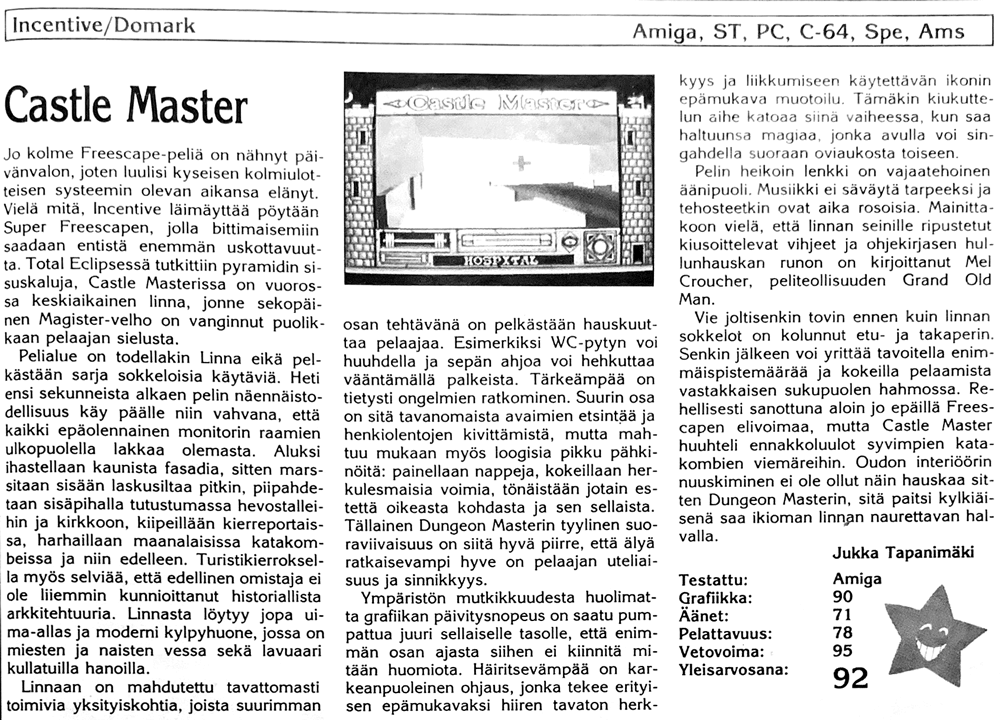
Castle Master1990 SyksyPysyvä linkkiJo kolme Freescape-peliä on nähnyt päivänvalon, joten luulisi kyseisen kolmiulotteisen systeemin olevan aikansa elänyt. Vielä mitä, Incentive läimäyttää pöytään Super Freescapen, jolla bittimaisemiin saadaan entistä enemmän uskottavuutta. Total Eclipsessä tutkittiin pyramidin sisuskaluja, Castle Masterissa on vuorossa keskiaikainen linna, jonne sekopäinen Magister-velho on vanginnut puolikkaan pelaajan sielusta.
Pelialue on todellakin Linna eikä pelkästään sarja sokkeloisia käytäviä. Heti ensi sekunneista alkaen pelin näennäistodellisuus käy päälle niin vahvana, että kaikki epäolennainen monitorin raamien ulkopuolella lakkaa olemasta. Aluksi ihastellaan kaunista fasadia, sitten marssitaan sisään laskusiltaa pitkin, piipahdetaan sisäpihalla tutustumassa hevostalleihin ja kirkkoon, kiipeillään kierreportaissa, harhaillaan maanalaisissa katakombeissa ja niin edelleen. Turistikierroksella myös selviää, että edellinen omistaja ei ole liiemmin kunnioittanut historiallista arkkitehtuuria. Linnasta löytyy jopa uima-allas ja moderni kylpyhuone, jossa on miesten ja naisten vessa sekä lavuaari kullatuilla hanoilla.
Linnaan on mahdutettu tavattomasti toimivia yksityiskohtia, joista suurimman osan tehtävänä on pelkästään hauskuuttaa pelaajaa. Esimerkiksi WC-pytyn voi huuhdella ja sepän ahjoa voi hehkuttaa vääntämällä palkeista. Tärkeämpää on tietysti ongelmien ratkominen. Suurin osa on sitä tavanomaista avaimien etsintää ja henkiolentojen kivittämistä, mutta mahtuu mukaan myös loogisia pikku pähkinöitä: painellaan nappeja, kokeillaan herkulesmaisia voimia, tönäistään jotain estettä oikeasta kohdasta ja sen sellaista. Tällainen Dungeon Masterin tyylinen suoraviivaisuus on siitä hyvä piirre, että älyä ratkaisevampi hyve on pelaajan uteliaisuus ja sinnikkyys.
Ympäristön mutkikkuudesta huolimatta grafiikan päivitysnopeus on saatu pumpattua juuri sellaiselle tasolle, että enimmän osan ajasta siihen ei kiinnitä mitään huomiota. Häiritsevämpää on karkeanpuoleinen ohjaus, jonka tekee erityisen epämukavaksi hiiren tavaton herkkyys ja liikkumiseen käytettävän ikonin epämukava muotoilu. Tämäkin kiukuttelun aihe katoaa siinä vaiheessa, kun saa haltuunsa magiaa, jonka avulla voi singahdella suoraan oviaukosta toiseen.
Pelin heikoin lenkki on vajaatehoinen äänipuoli. Musiikki ei säväytä tarpeeksi ja tehosteetkin ovat aika rosoisia. Mainittakoon vielä, että linnan seinille ripustetut kiusoittelevat vihjeet ja ohjekirjasen hullunhauskan runon on kirjoittanut Mel Croucher, peliteollisuuden Grand Old Man.
Vie joltisenkin tovin ennen kuin linnan sokkelot on kolunnut etu- ja takaperin. Senkin jälkeen voi yrittää tavoitella enimmäispistemäärää ja kokeilla pelaamista vastakkaisen sukupuolen hahmossa. Rehellisesti sanottuna aloin jo epäillä Freescapen elivoimaa, mutta Castle Master huuhteli ennakkoluulot syvimpien katakombien viemäreihin. Oudon interiöörin nuuskiminen ei ole ollut näin hauskaa sitten Dungeon Masterin, sitä paitsi kylkiäisenä saa ikioman linnan naurettavan halvalla.
Castle Master1990 SyksyPermalinkThree Freescape games have already seen the light of day, so you'd think the three-dimensional system in question had had its day. Not a bit of it: Incentive slaps Super Freescape down on the table, bringing more credibility than ever to the pixel landscapes. In Total Eclipse you explored the innards of a pyramid; in Castle Master it's the turn of a medieval castle, where the crackpot wizard Magister has imprisoned half of the player's soul.
The playing area really is a Castle and not just a series of mazy corridors. From the very first seconds, the game's virtual reality takes hold so strongly that everything irrelevant outside the monitor's frame ceases to exist. First you admire the handsome facade, then you march in across the drawbridge, pop into the courtyard to take a look at the stables and the church, clamber up spiral staircases, wander about the underground catacombs, and so on. The sightseeing tour also reveals that the previous owner didn't have much respect for historic architecture. The castle even has a swimming pool and a modern bathroom with gents' and ladies' toilets and a washbasin with gold-plated taps.
An enormous number of working details have been squeezed into the castle, most of which are there purely to amuse the player. For example, you can flush the toilet, and you can make the smith's forge glow by working the bellows. More important, of course, is solving the problems. Most of them are the usual business of hunting for keys and stoning spirits, but there's room for some little logic nuts to crack as well: pressing buttons, trying out Herculean strength, giving some obstacle a shove in the right spot, and that sort of thing. This Dungeon Master-style straightforwardness is a good trait in that the player's curiosity and perseverance are more decisive virtues than brains.
Despite the intricacy of the surroundings, the graphics update rate has been pumped up to just the level where most of the time you don't pay it any attention at all. More bothersome are the rather crude controls, made especially uncomfortable by the mouse's tremendous sensitivity and the uncomfortable design of the icon used for moving. Even this cause for grumbling disappears once you get hold of magic that lets you zip straight from one doorway to another.
The game's weakest link is its underpowered sound. The music doesn't thrill enough and the effects are pretty rough too. It should also be mentioned that the teasing clues hung on the castle walls and the hilarious poem in the manual were written by Mel Croucher, the Grand Old Man of the games industry.
It takes a good long while before you've combed the castle's labyrinths forwards and backwards. Even after that you can go for the maximum score and try playing as a character of the opposite sex. To be honest, I was already beginning to doubt Freescape's vitality, but Castle Master flushed my prejudices down the sewers of the deepest catacombs. Nosing around a strange interior hasn't been this much fun since Dungeon Master, and what's more, you get a castle of your very own thrown in for a ridiculously low price.
Castle Warrior
Castle Warrior1989 SyksyPysyvä linkkiKun kuningas joi myrkyn, niin eipä auta muu kuin pistää valtakunnan öklöttävin muskelimies noutamaan lääkettä. Tämän eeppisen retken vaiheista kertova kuvaelma on jaettu kuuteen näytökseen: kuoleman käytävä, louhikäärme Olisos, maanalainen joki, Jibba-hirviö, kohtaaminen Zandorin kanssa ja voittoisa paluu.
Ensimmäisessä osassa sankarimme laahaa muskelimassaansa kolmiulotteisesti vierivää käytävää pitkin ja huiskii lepakoita miekallaan. Pariin otteeseen etenemisen pysäyttää isompi hirviö, jonka syöksemät tulipallot pitää palauttaa hallitulla baseball-tekniikalla. Toisessa osassa sankarimme keihästää vaikuttavan näköisen vaaleanpunaisen louhikäärmeen, joka syöksee tulipalloja ja kahmii isoilla kourillaan. Kolmannessa osassa ohjaillaan kanoottia kolmiulotteisesti vierivässä tippukiviluolassa. Ja sitä rataa.
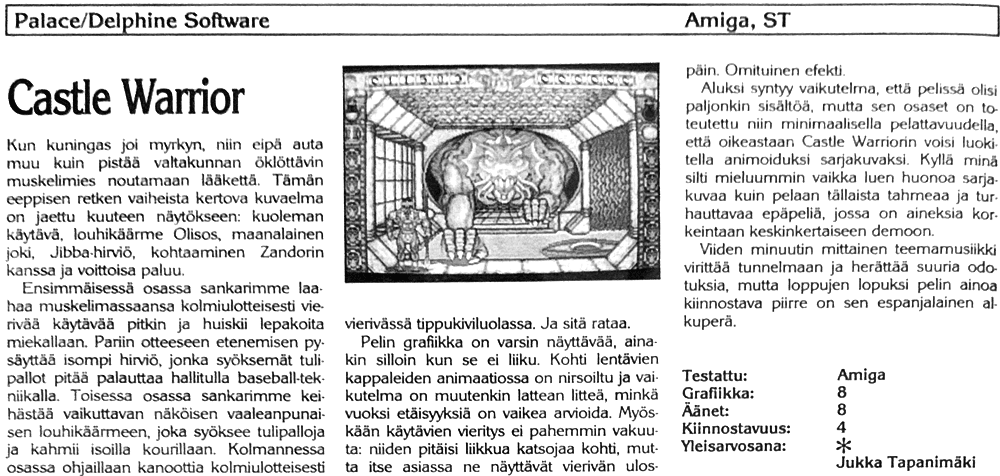
Pelin grafiikka on varsin näyttävää, ainakin silloin kun se ei liiku. Kohti lentävien kappaleiden animaatiossa on nirsoiltu ja vaikutelma on muutenkin lattean litteä, minkä vuoksi etäisyyksiä on vaikea arvioida. Myöskään käytävien vieritys ei pahemmin vakuuta: niiden pitäisi liikkua katsojaa kohti, mutta itse asiassa ne näyttävät vierivän ulospäin. Omituinen efekti.
Aluksi syntyy vaikutelma, että pelissä olisi paljonkin sisältöä, mutta sen osaset on toteutettu niin minimaalisella pelattavuudella, että oikeastaan Castle Warriorin voisi luokitella animoiduksi sarjakuvaksi. Kyllä minä silti mieluummin vaikka luen huonoa sarjakuvaa kuin pelaan tällaista tahmeaa ja turhauttavaa epäpeliä, jossa on aineksia korkeintaan keskinkertaiseen demoon.
Viiden minuutin mittainen teemamusiikki virittää tunnelmaan ja herättää suuria odotuksia, mutta loppujen lopuksi pelin ainoa kiinnostava piirre on sen espanjalainen alkuperä.
Castle Warrior1989 SyksyPermalinkWhen the king has drunk the poison, there's nothing for it but to send the most revolting muscleman in the realm off to fetch the cure. The tableau recounting the stages of this epic trek is divided into six acts: the corridor of death, the dragon Olisos, the underground river, the Jibba monster, the encounter with Zandor and the triumphant return.
In the first part our hero lugs his muscle mass along a corridor that scrolls in three dimensions and swishes at bats with his sword. A couple of times his progress is halted by a bigger monster whose spewed fireballs have to be returned with controlled baseball technique. In the second part our hero spears an impressive-looking pink dragon that spews fireballs and grabs about with its great big mitts. In the third part you steer a canoe through a stalactite cave that scrolls in three dimensions. And so on.
The game's graphics are pretty spectacular, at least when they're not moving. The animation of objects flying towards you has been skimped on, and the overall impression is drearily flat anyway, which makes distances hard to judge. Nor is the scrolling of the corridors particularly convincing: they ought to move towards the viewer, but in fact they seem to scroll outwards. A strange effect.
At first you get the impression that there's plenty of content in the game, but its parts have been implemented with such minimal playability that you could really classify Castle Warrior as an animated comic. Still, I'd sooner read even a bad comic than play a sticky, frustrating non-game like this, which has the makings of a mediocre demo at best.
The five-minute theme tune sets the mood and raises great expectations, but in the end the game's only interesting feature is its Spanish origin.
Castles
Castles1991 SyksyPysyvä linkkiJos rahasta ei olisi pulaa, niin rakentaisimpa nyhverön omakotitalon asemasta uljaan linnan. Ja kun naapuri seuraavan kerran valittaa, että lemmikkileopardini Kirk pisti poskeensa sekä Mustin että pikku-Mikon, niin "voi voi, kun ikävää"-valitus korvautuu kyllä saavilla sulaa lyijyä. Mutta haaveet ja saldo harvoin kohtaavat, joten on tyytyminen Interplayn linnanrakennusohjelmaan Castles.
Pelaaja on kuningas, ja hänen tarkoituksensa on rakentaa linna (tai useampi, riippuu minkä tason on valinnut). Tämä käykin helposti: valitaan sopiva miksaus vaadittavia ammatti-ihmisiä, suunnitellaan linna ja pistetään pojat töihin. Linna nousee pikkuhiljaa, sitä nopeammin mitä paremmin osaa työvoimaansa hyödyntää. Samalla pitää pitää rahaasiat kunnossa ja ostaa ruokaa talven varalle. Noin kerran kuukaudessa menon katkaisee milloin mikäkin avuntarvitsija tai muu tyytymätön aines, jolloin voi käyttää ABC-tekniikkaan pohjautuvaa kuninkaallista päätösvaltaansa. Nämä episodit muodostavat taustalle eränlaisen tarinan, joista yksi on esmes Robin Hood-variaatio. (Vihje: sääli on sairautta)
Ja sitten vähän väliä hyökkäävät vihamieliset keltit linnan kimppuun. Tässä osuudessa piileekin Castlesin suurimmat heikkoudet: taistelut ovat vielä yksinkertaisempia kuin Powermongerissa. Pelaaja voi käyttää jousimiehiä ja jalkaväkeä, strategian jäädessä siihen että sijoittaa ne oikeaan paikkaan. Sen jälkeen ne käyttäytyvät itsenäisesti. Esimerkiksi kun sekoittaa idän ja lännen, niin poikien saaminen vihollisen kimppuun jää huonoimmassa tapauksessa haaveeksi. Lisäksi innokas lauma ryntää vihollisen kimppuun sen nähdessään, joten se taktikoinnista.
Typerää kyllä, joukot täytyy sijoittaa varsin nopeasti tai mutten ne jävät käyttämättä eli kun hakee kupin kahvia nin surkea parin keltin rääppäjoukko on tasinut koko linnan. Yleensä pelaajan armeija teurastaa koko sakin ennenkuin nämä edes näkevät linnaa. Edes linnan valmistuttua, kun sen täytyy kestää suurempi hyökkäys, ei kilttien kelttien eliminointi ole ongelma eikä mikään. Linnan rakenteella tai muulla sellaisella ei tuntuisi olevan merkittävämpää taktista merkitystä vallihautaa lukuunottamatta.
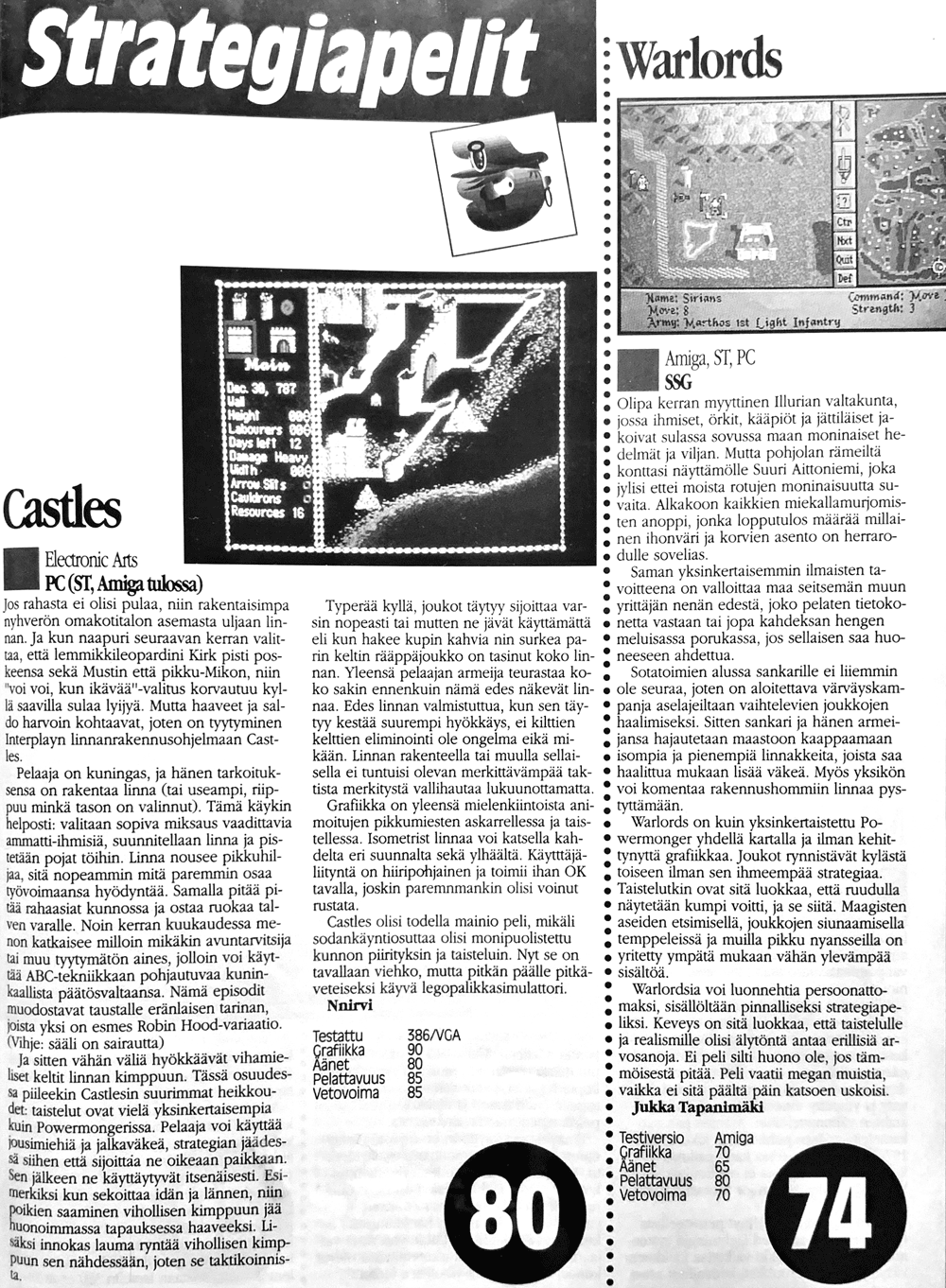
Grafiikka on yleensä mielenkiintoista animoitujen pikkumiesten askarrellessa ja taistellessa. Isometrist linnaa voi katsella kahdelta eri suunnalta sekä ylhäältä. Käyttäjäliityntä on hiiripohjainen ja toimii ihan OK tavalla, joskin paremnmankin olisi voinut rustata.
Castles olisi todella mainio peli, mikäli sodankäyntiosuttaa olisi monipuolistettu kunnon piirityksin ja taisteluin. Nyt se on tavallaan viehko, mutta pitkän päälle pitkäveteiseksi käyvä legopalikkasimulattori.
Castles1991 SyksyPermalinkIf I weren't short of money, I'd jolly well build a magnificent castle instead of a poky little detached house. And the next time the neighbour complains that my pet leopard Kirk has scoffed both Musti and little Mikko, the "oh dear, what a shame" lament will most certainly be replaced by a vat of molten lead. But dreams and bank balances rarely meet, so I'll have to make do with Interplay's castle-building program, Castles.
The player is the king, and his aim is to build a castle (or several, depending on which level you've picked). And that's easily done: you choose a suitable mix of the required tradesmen, design the castle and put the lads to work. The castle rises little by little, the faster the better you know how to use your workforce. At the same time you have to keep your finances in order and buy food for the winter. About once a month the proceedings are interrupted by some supplicant or other, or some other disgruntled element, at which point you get to exercise your royal prerogative, which runs on the ABC technique. These episodes form a kind of story in the background, one of which is, say, a Robin Hood variation. (Hint: pity is a sickness)
And then every so often hostile Celts come at the castle. This part is where Castles' biggest weaknesses lie: the battles are even simpler than in Powermonger. The player can use archers and infantry, with strategy amounting to placing them in the right spot. After that they behave independently. For example, if you mix up east and west, then in the worst case getting the lads to lay into the enemy remains a pipe dream. What's more, the eager mob charges at the enemy as soon as it sees it, so that's it for tactics.
Stupidly enough, the troops have to be placed pretty quickly or else they go unused, meaning that by the time you've fetched a cup of coffee, some pathetic ragtag band of a couple of Celts has levelled the entire castle. Usually the player's army slaughters the whole gang before they even catch sight of the castle. Even once the castle is finished, when it has to withstand a bigger attack, eliminating the kindly Celts is no problem at all. The castle's layout or anything of the sort wouldn't seem to have any significant tactical importance, apart from the moat.
The graphics are generally interesting, with animated little men pottering about and fighting. The isometric castle can be viewed from two different directions and from above. The user interface is mouse-based and works in a perfectly OK way, though a better one could have been knocked together too.
Castles would be a truly splendid game if the warfare section had been made more varied with proper sieges and battles. As it is, it's a sort of charming, but in the long run tedious, Lego brick simulator.
Castlevania
Castlevania1990 KevätPysyvä linkkiPerinteinen tasohyppely on konsolipelien todellista perusmateriaalia. Castlevaniassa roima sankari tempaisee ruoskan vyöltään ja tunkeutuu synkän linnan uumeniin mitelläkseen ritareiden, lepakoiden ja muiden kammotusten kanssa. Soihtuja sammuttamalla ja tiiliä mäiskimällä löytää sydämiä, joilla saa palautusta uupuneen sankarin vitaliteettiin. Poimittavana on myös tehokkaampia varusteita, kuten lisää vartta piiskaan, piikkinuija ja erilaisia heittoaseita. Tasojen loppuhuipennuksena on tavalliseen tapaan eeppinen taisto isohkon tappokoneen kanssa.
Menestyksen salaisuutena on harkittu eteneminen ja aseiden käytön tarkka ajoittaminen. Sankarin nujertuessa peliä ei ole pakko aloittaa alusta, mikä lisääkin suuresti pelattavuutta, sillä myöhemmät tasot ovat varsin vaikeita. Sekä liikkuminen että aseiden käsittely tuntuu oudon tahmaiselta, mikä saattaa aiheuttaa turhautumista tiukoissa tilanteissa.
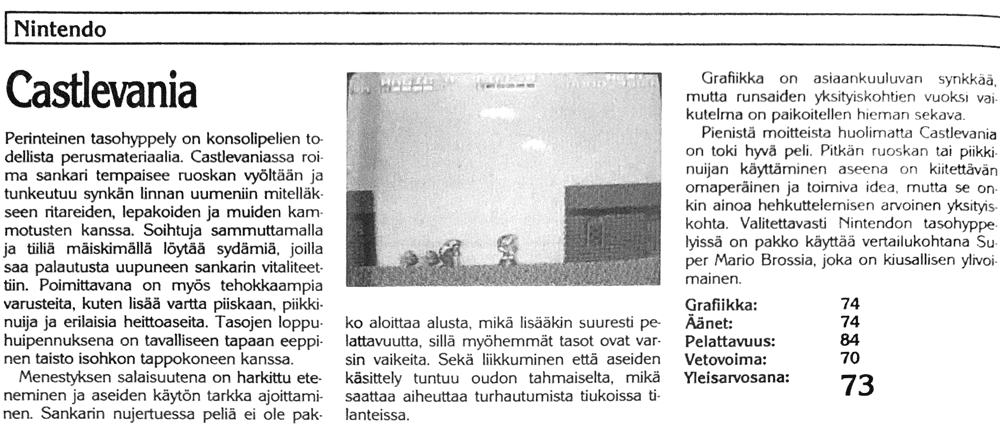
Grafiikka on asiaankuuluvan synkkää, mutta runsaiden yksityiskohtien vuoksi vaikutelma on paikoitellen hieman sekava.
Pienistä moitteista huolimatta Castlevania on toki hyvä peli. Pitkän ruoskan tai piikkinuijan käyttäminen aseena on kiitettävän omaperäinen ja toimiva idea, mutta se onkin ainoa hehkuttelemisen arvoinen yksityiskohta. Valitettavasti Nintendon tasohyppelyissä on pakko käyttää vertailukohtana Super Mario Brossia, joka on kiusallisen ylivoimainen.
Castlevania1990 KevätPermalinkThe traditional platform game is the true staple fare of console gaming. In Castlevania a strapping hero snatches the whip from his belt and forces his way into the bowels of a gloomy castle to take on knights, bats and other horrors. By putting out torches and smashing bricks you find hearts, which restore some of the exhausted hero's vitality. There is also more powerful equipment to pick up, such as extra length for the whip, a spiked mace and various throwing weapons. As usual, each level climaxes in an epic battle with a largish killing machine.
The secret of success is careful progress and precise timing of your weapons. When the hero is laid low you don't have to start the game from the beginning, which adds greatly to the playability, since the later levels are pretty tough. Both movement and weapon handling feel oddly sticky, which can cause frustration in tight spots.
The graphics are suitably gloomy, but because of the wealth of detail the effect is a little muddled in places.
Minor gripes aside, Castlevania is certainly a good game. Using a long whip or a spiked mace as a weapon is a commendably original and workable idea, but it is also the only detail worth raving about. Unfortunately, with Nintendo platform games you can't avoid using Super Mario Bross as the yardstick, and it is embarrassingly superior.
Catch-23
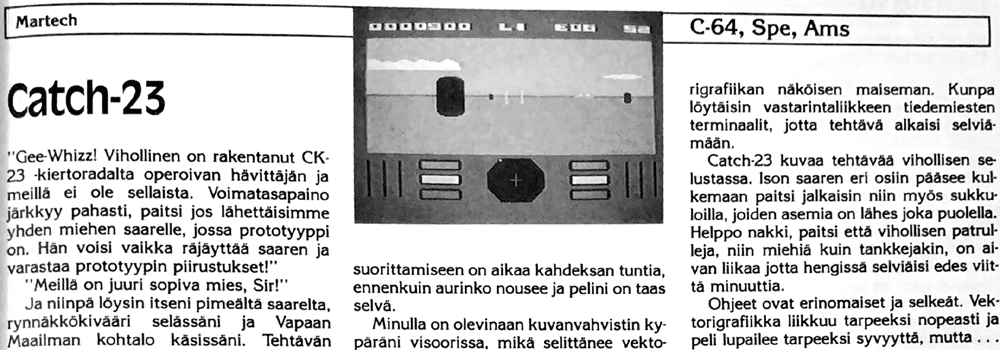
Catch-231987Pysyvä linkki"Gee-Whizz! Vihollinen on rakentanut CK-23 -kiertoradalta operoivan hävittäjän ja meillä ei ole sellaista. Voimatasapaino järkkyy pahasti, paitsi jos lähettäisimme yhden miehen saarelle, jossa prototyyppi on. Hän voisi vaikka räjäyttää saaren ja varastaa prototyypin piirustukset!"
"Meillä on juuri sopiva mies, Sir!"
Ja niinpä löysin itseni pimeältä saarelta, rynnäkkökivääri selässäni ja Vapaan Maailman kohtalo käsissäni. Tehtävän suorittamiseen on aikaa kahdeksan tuntia, ennenkuin aurinko nousee ja pelini on taas selvä.
Minulla on olevinaan kuvanvahvistin kypäräni visoorissa, mikä selittänee vektorigrafiikan näköisen maiseman. Kunpa löytäisin vastarintaliikkeen tiedemiesten terminaalit, jotta tehtävä alkaisi selviämään.
Catch-23 kuvaa tehtävää vihollisen selustassa. Ison saaren eri osiin pääsee kulkemaan paitsi jalkaisin niin myös sukkuloilla, joiden asemia on lähes joka puolella. Helppo nakki, paitsi että vihollisen patrulleja, niin miehiä kuin tankkejakin, on aivan liikaa jotta hengissä selviäisi edes viittä minuuttia.
Ohjeet ovat erinomaiset ja selkeät. Vektorigrafiikka liikkuu tarpeeksi nopeasti ja peli lupailee tarpeeksi syvyyttä, mutta ... Ammuskelu on vedetty pahasti metsään. Raukan kommandon on nimittäin parin sekunnin sisällä siirrettävä tähtäimensä vihollisen päälle ja painettava liipasinta, ja joystickillä tämä ei ole niin helppoa. Kuolema tulee ennenpitkää yhtä varmasti kuin kuolema ja verot.
Tämä yksityiskohta kaataa lupaavan pelin. On typerää että näinkin laaja peli katkeaa yhteen pikku mokaan joystickin käsittelyssä. Catch-23:a kannattaa silti kokeilla jos uskoo olevansa maailman nopein joystickin käsittelijä.
Catch-231987Permalink"Gee-Whizz! The enemy has built the CK-23, a fighter that operates from orbit, and we haven't got one. The balance of power is going to be badly upset, unless we send one man to the island where the prototype is. He could, say, blow up the island and steal the prototype's blueprints!"
"We have just the man, Sir!"
And so I found myself on a dark island, an assault rifle on my back and the fate of the Free World in my hands. I have eight hours to complete the mission before the sun comes up and it's game over for me once again.
I supposedly have an image intensifier in my helmet visor, which presumably explains why the landscape looks like vector graphics. If only I could find the resistance scientists' terminals, so that the mission would start to make some sense.
Catch-23 depicts a mission behind enemy lines. You can get around the different parts of the big island not only on foot but also by shuttle, with stations almost everywhere. A piece of cake, except that there are far too many enemy patrols, men and tanks alike, to stay alive for even five minutes.
The instructions are excellent and clear. The vector graphics move fast enough and the game promises enough depth, but ... The shooting has gone badly wrong. You see, within a couple of seconds the poor commando has to get the sights onto the enemy and pull the trigger, and with a joystick that isn't so easy. Sooner or later death comes, as sure as death and taxes.
This one detail sinks a promising game. It's stupid that a game this big should come to an end over one little slip on the joystick. Catch-23 is still worth a try if you reckon you're the fastest joystick-handler in the world.
Caveman Ugh!Lympics
Caveman Ugh!Lympics1989 KevätPysyvä linkkiSarjassamme kaikenkarvaisia urheilupelejä näemme nyt osan kivikausi. Sitä mitä Epyx aloitti Summer Gamesilla on moni jo jatkanut omilla olympiapeleillään. Caveman Ugh!Lympics on Electronic Artsin versio aiheesta.
Ugh!Lympicsissä kivikautiset luolamiehet ottavat mittaa toisistaan lajeinaan kaverinheitto, tiikeriä-pakoon-juoksu, tulen tekeminen, kaverin pamputtaminen, dinosaurusajot ja dinosauruksen yli hyppääminen. Valittavana on normaaliin tapaan 1-6 erilaista pelaajaa ja harjoittelumahdollisuus. Yhteistä kaikille lajeille on joystickin suuri kulumisprosentti ja äh-puh-äännähdykset.
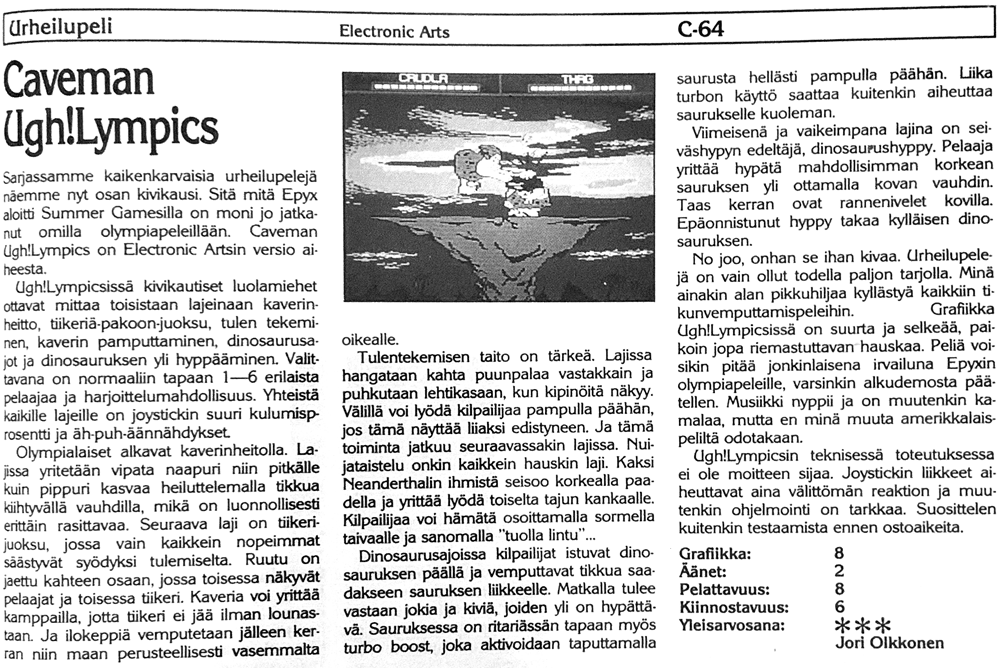
Olympialaiset alkavat kaverinheitolla. Lajissa yritetään vipata naapuri niin pitkälle kuin pippuri kasvaa heiluttelemalla tikkua kiihtyvällä vauhdilla, mikä on luonnollisesti erittäin rasittavaa. Seuraava laji on tiikerijuoksu, jossa vain kaikkein nopeimmat säästyvät syödyksi tulemiselta. Ruutu on jaettu kahteen osaan, jossa toisessa näkyvät pelaajat ja toisessa tiikeri. Kaveria voi yrittää kamppailla, jotta tiikeri ei jää ilman lounastaan. Ja ilokeppiä vemputetaan jälleen kerran niin maan perusteellisesti vasemmalta oikealle.
Tulentekemisen taito on tärkeä. Lajissa hangataan kahta puunpalaa vastakkain ja puhkutaan lehtikasaan, kun kipinöitä näkyy. Välillä voi lyödä kilpailijaa pampulla päähän, jos tämä näyttää liiaksi edistyneen. Ja tämä toiminta jatkuu seuraavassakin lajissa. Nuijataistelu onkin kaikkein hauskin laji. Kaksi Neanderthalin ihmistä seisoo korkealla paadella ja yrittää lyödä toiselta tajun kankaalle. Kilpailijaa voi hämätä osoittamalla sormella taivaalle ja sanomalla "tuolla lintu"...
Dinosaurusajoissa kilpailijat istuvat dinosauruksen päällä ja vemputtavat tikkua saadakseen sauruksen liikkeelle. Matkalla tulee vastaan jokia ja kiviä, joiden yli on hypättävä. Sauruksessa on ritariässän tapaan myös turbo boost, joka aktivoidaan taputtamalla saurusta hellästi pampulla päähän. Liika turbon käyttö saattaa kuitenkin aiheuttaa saurukselle kuoleman.
Viimeisenä ja vaikeimpana lajina on seiväshypyn edeltäjä, dinosaurushyppy. Pelaaja yrittää hypätä mahdollisimman korkean sauruksen yli ottamalla kovan vauhdin. Taas kerran ovat rannenivelet kovilla. Epäonnistunut hyppy takaa kylläisen dinosauruksen.
No joo, onhan se ihan kivaa. Urheilupelejä on vain ollut todella paljon tarjolla. Minä ainakin alan pikkuhiljaa kyllästyä kaikkiin tikunvemputtamispeleihin. Grafiikka Ugh!Lympicsissä on suurta ja selkeää, paikoin jopa riemastuttavan hauskaa. Peliä voisikin pitää jonkinlaisena irvailuna Epyxin olympiapeleille, varsinkin alkudemosta päätellen. Musiikki nyppii ja on muutenkin kamalaa, mutta en minä muuta amerikkalaispeliltä odotakaan.
Ugh!Lympicsin teknisessä toteutuksessa ei ole moitteen sijaa. Joystickin liikkeet aiheuttavat aina välittömän reaktion ja muutenkin ohjelmointi on tarkkaa. Suosittelen kuitenkin testaamista ennen ostoaikeita.
Caveman Ugh!Lympics1989 KevätPermalinkIn our series on sports games of every stripe, we now present the Stone Age episode. What Epyx started with Summer Games, many have since carried on with Olympic games of their own. Caveman Ugh!Lympics is Electronic Arts' take on the subject.
In Ugh!Lympics, Stone Age cavemen measure themselves against each other in the events of mate-tossing, running-away-from-a-tiger, fire-making, bludgeoning your mate, dinosaur racing and jumping over a dinosaur. As usual, you can choose from 1-6 different players, and there's a practice option. What all the events have in common is a high rate of joystick wear and huff-puff grunting.
The Olympics open with mate-tossing. In this event you try to fling your neighbour off to the back of beyond by waggling the stick faster and faster, which is naturally extremely tiring. The next event is the tiger run, in which only the very fastest escape being eaten. The screen is split in two, with the players shown in one half and the tiger in the other. You can try tripping your pal so that the tiger doesn't go without its lunch. And once again the joystick gets waggled ever so thoroughly from left to right.
The art of making fire is important. In this event you rub two pieces of wood together and blow on a pile of leaves when sparks appear. Now and then you can whack your rival over the head with a club if they seem to be getting too far ahead. And this activity carries on into the next event too. The club fight is in fact the most fun event of all. Two Neanderthals stand on a high slab of rock and try to knock each other out cold. You can fool your opponent by pointing at the sky and saying "look, a bird"...
In the dinosaur race the competitors sit on top of a dinosaur and waggle the stick to get the saurus moving. Along the way you come across rivers and rocks that have to be jumped over. Knight Rider-style, the saurus also has a turbo boost, which is activated by patting the saurus gently on the head with a club. Too much use of the turbo can, however, be the death of the saurus.
The last and hardest event is the forerunner of the pole vault, the dinosaur vault. The player tries to jump over as tall a saurus as possible by taking a hard run-up. Once again it's the wrist joints that take a beating. A failed jump guarantees a well-fed dinosaur.
Well, yeah, it's quite fun, I suppose. It's just that there have been a whole lot of sports games on offer. I for one am slowly getting fed up with all these stick-waggling games. The graphics in Ugh!Lympics are big and clear, in places even delightfully funny. You could actually see the game as some kind of send-up of Epyx's Olympic games, especially judging by the intro demo. The music grates and is generally awful, but then I don't expect anything else from an American game.
There's nothing to fault in the technical implementation of Ugh!Lympics. Joystick movements always get an instant response, and the programming is precise in other respects too. I do still recommend trying it out before you think of buying.
Caverns of Sillach
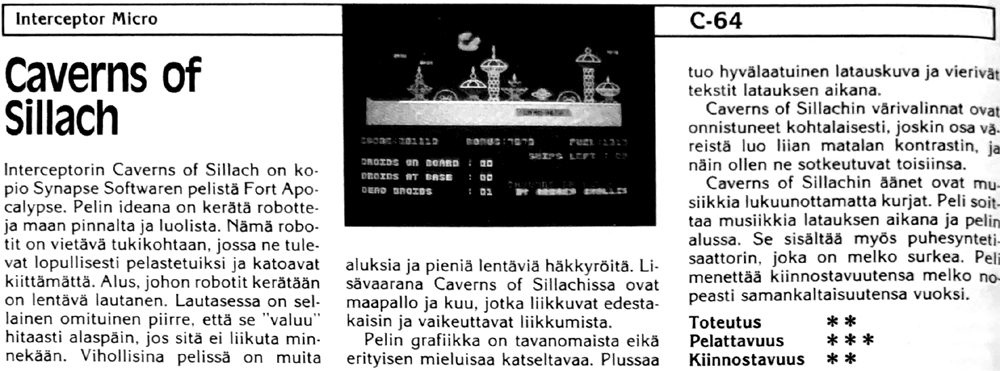
Caverns of Sillach1987Pysyvä linkkiInterceptorin Caverns of Sillach on kopio Synapse Softwaren pelistä Fort Apocalypse. Pelin ideana on kerätä robotteja maan pinnalta ja luolista. Nämä robotit on vietävä tukikohtaan, jossa ne tulevat lopullisesti pelastetuiksi ja katoavat kiittämättä. Alus, johon robotit kerätään on lentävä lautanen. Lautasessa on sellainen omituinen piirre, että se "valuu" hitaasti alaspäin, jos sitä ei liikuta minnekään. Vihollisina pelissä on muita aluksia ja pieniä lentäviä häkkyröitä. Lisävaarana Caverns of Sillachissa ovat maapallo ja kuu, jotka liikkuvat edestakaisin ja vaikeuttavat liikkumista.
Pelin grafiikka on tavanomaista eikä erityisen mieluisaa katseltavaa. Plussaa tuo hyvälaatuinen latauskuva ja vierivät tekstit latauksen aikana.
Caverns of Sillachin värivalinnat ovat onnistuneet kohtalaisesti, joskin osa väreistä luo liian matalan kontrastin, ja näin ollen ne sotkeutuvat toisiinsa.
Caverns of Sillachin äänet ovat musiikkia lukuunottamatta kurjat. Peli soittaa musiikkia latauksen aikana ja pelin alussa. Se sisältää myös puhesyntetisaattorin, joka on melko surkea. Peli menettää kiinnostavuutensa melko nopeasti samankaltaisuutensa vuoksi.
Caverns of Sillach1987PermalinkInterceptor's Caverns of Sillach is a copy of Synapse Software's game Fort Apocalypse. The idea of the game is to collect robots from the surface and from the caves. These robots have to be taken to a base, where they are rescued for good and vanish without so much as a thank-you. The craft the robots are collected in is a flying saucer. The saucer has the peculiar habit of slowly "trickling" downwards if you don't move it anywhere. The enemies in the game are other craft and small flying contraptions. An additional hazard in Caverns of Sillach is the Earth and the Moon, which move back and forth and make getting around harder.
The game's graphics are run-of-the-mill and not especially pleasant to look at. On the plus side there's a good-quality loading screen and scrolling text during loading.
The colour choices in Caverns of Sillach are moderately successful, although some of the colours give too low a contrast and so blur into one another.
Apart from the music, the sound in Caverns of Sillach is miserable. The game plays music during loading and at the start of the game. It also contains a speech synthesiser, which is pretty wretched. The game loses its appeal fairly quickly because of its sameness.
Centurion - Defender Of Rome
Centurion - Defender Of Rome1990 SyksyPysyvä linkkiJos vahvin aineesi koulussa on historia ja tiedät kaiken Julius Caesarista ja Kleopatrasta, muutenkin kuin Asterixin perusteella, on Centurion tehty juuri Sinulle. Maailmanvalloitus ei ole koskaan ollut näin hauskaa ja vaivatonta.
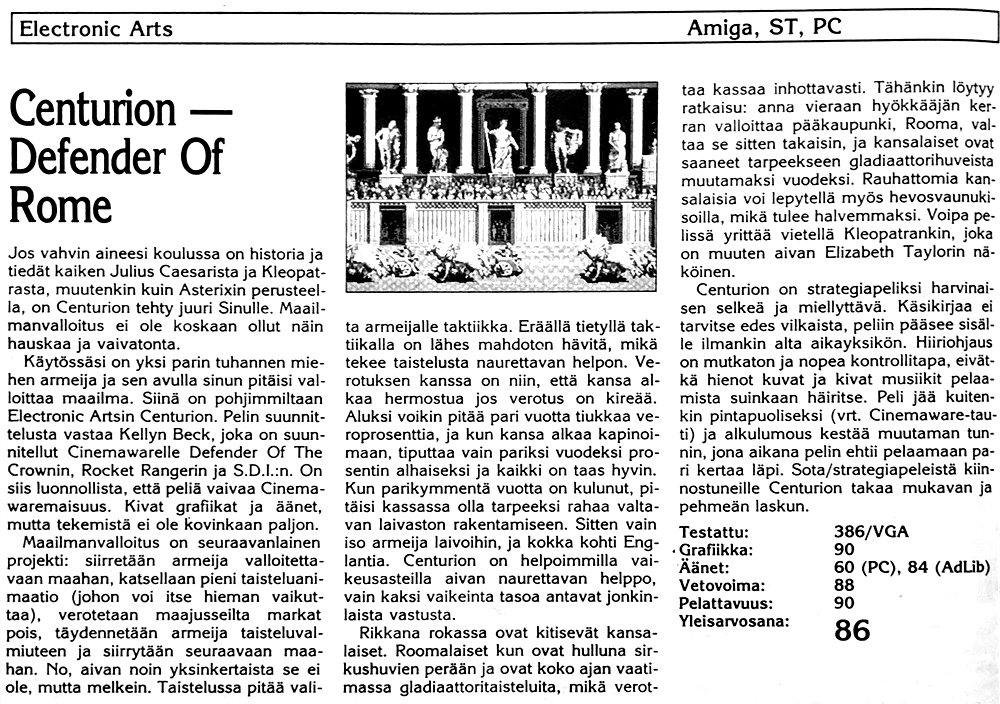
Käytössäsi on yksi parin tuhannen miehen armeija ja sen avulla sinun pitäisi valloittaa maailma. Siinä on pohjimmiltaan Electronic Artsin Centurion. Pelin suunnittelusta vastaa Kellyn Beck, joka on suunnitellut Cinemawarelle Defender Of The Crownin, Rocket Rangerin ja S.D.I.:n. On siis luonnollista, että peliä vaivaa Cinemawaremaisuus. Kivat grafiikat ja äänet, mutta tekemistä ei ole kovinkaan paljon.
Maailmanvalloitus on seuraavanlainen projekti: siirretään armeija valloitettavaan maahan, katsellaan pieni taisteluanimaatio (johon voi itse hieman vaikuttaa), verotetaan maajusseilta markat pois, täydennetään armeija taisteluvalmiuteen ja siirrytään seuraavaan maahan. No, aivan noin yksinkertaista se ei ole, mutta melkein. Taistelussa pitää valita armeijalle taktiikka. Eräällä tietyllä taktiikalla on lähes mahdoton hävitä, mikä tekee taistelusta naurettavan helpon. Verotuksen kanssa on niin, että kansa alkaa hermostua jos verotus on kireää. Aluksi voikin pitää pari vuotta tiukkaa veroprosenttia, ja kun kansa alkaa kapinoimaan, tiputtaa vain pariksi vuodeksi prosentin alhaiseksi ja kaikki on taas hyvin. Kun parikymmentä vuotta on kulunut, pitäisi kassassa olla tarpeeksi rahaa valtavan laivaston rakentamiseen. Sitten vain iso armeija laivoihin, ja kokka kohti Englantia. Centurion on helpoimmilla vaikeusasteilla aivan naurettavan helppo, vain kaksi vaikeinta tasoa antavat jonkinlaista vastusta.
Rikkana rokassa ovat kitisevät kansalaiset. Roomalaiset kun ovat hulluna sirkushuvien perään ja ovat koko ajan vaatimassa gladiaattoritaisteluita, mikä verottaa kassaa inhottavasti. Tähänkin löytyy ratkaisu: anna vieraan hyökkääjän kerran valloittaa pääkaupunki, Rooma, valtaa se sitten takaisin, ja kansalaiset ovat saaneet tarpeekseen gladiaattorihuveista muutamaksi vuodeksi. Rauhattomia kansalaisia voi lepytellä myös hevosvaunukisoilla, mikä tulee halvemmaksi. Voipa pelissä yrittää vietellä Kleopatrankin, joka on muuten aivan Elizabeth Taylorin näköinen.
Centurion on strategiapeliksi harvinaisen selkeä ja miellyttävä. Käsikirjaa ei tarvitse edes vilkaista, peliin pääsee sisälle ilmankin alta aikayksikön. Hiiriohjaus on mutkaton ja nopea kontrollitapa, eivätkä hienot kuvat ja kivat musiikit pelaamista suinkaan häiritse. Peli jää kuitenkin pintapuoliseksi (vrt. Cinemaware-tauti) ja alkulumous kestää muutaman tunnin, jona aikana pelin ehtii pelaamaan pari kertaa läpi. Sota/strategiapeleistä kiinnostuneille Centurion takaa mukavan ja pehmeän laskun.
Centurion - Defender Of Rome1990 SyksyPermalinkIf your best subject at school is history and you know everything about Julius Caesar and Kleopatra, and not just from Asterix, then Centurion was made just for You. World conquest has never been this much fun or this effortless.
You have at your disposal one army of a couple of thousand men, and with it you are supposed to conquer the world. That, at bottom, is Electronic Arts' Centurion. The game was designed by Kellyn Beck, who designed Defender Of The Crown, Rocket Ranger and S.D.I. for Cinemaware. So it's only natural that the game is afflicted with Cinemaware-ishness. Nice graphics and sounds, but not all that much to do.
World conquest is a project that goes like this: move the army into the country to be conquered, watch a little battle animation (which you can influence a bit yourself), tax the yokels out of their markkas, bring the army back up to fighting strength and move on to the next country. Well, it's not quite as simple as that, but nearly. In battle you have to choose a tactic for your army. With one particular tactic it's almost impossible to lose, which makes the fighting ridiculously easy. The thing with taxes is that the people start getting jumpy if taxation is steep. So at first you can keep a stiff tax rate for a couple of years, and when the people start revolting, you just drop the rate low for a couple of years and everything is fine again. Once twenty-odd years have gone by, there should be enough money in the treasury to build an enormous fleet. Then just load a big army onto the ships and point the prow toward England. On the easiest difficulty levels Centurion is absolutely ridiculously easy; only the two hardest levels put up any kind of resistance.
The fly in the ointment is the whining citizenry. The Romans, you see, are mad about circus entertainment and are forever demanding gladiator fights, which taxes the treasury horribly. There's a solution for this too: let a foreign invader take the capital, Rome, once, then win it back, and the citizens will have had their fill of gladiator shows for a few years. Restless citizens can also be pacified with chariot races, which works out cheaper. In the game you can even try to seduce Kleopatra, who incidentally looks exactly like Elizabeth Taylor.
For a strategy game, Centurion is unusually clear and pleasant. You don't even need to glance at the manual; you'll get into the game without it in no time flat. Mouse control is a straightforward and quick way of controlling things, and the fine pictures and nice music certainly don't get in the way of playing. The game does, however, stay superficial (cf. Cinemaware disease), and the initial spell lasts a few hours, in which time you'll manage to play it through a couple of times. For those interested in war/strategy games, Centurion guarantees a nice, soft landing.
Champ, The
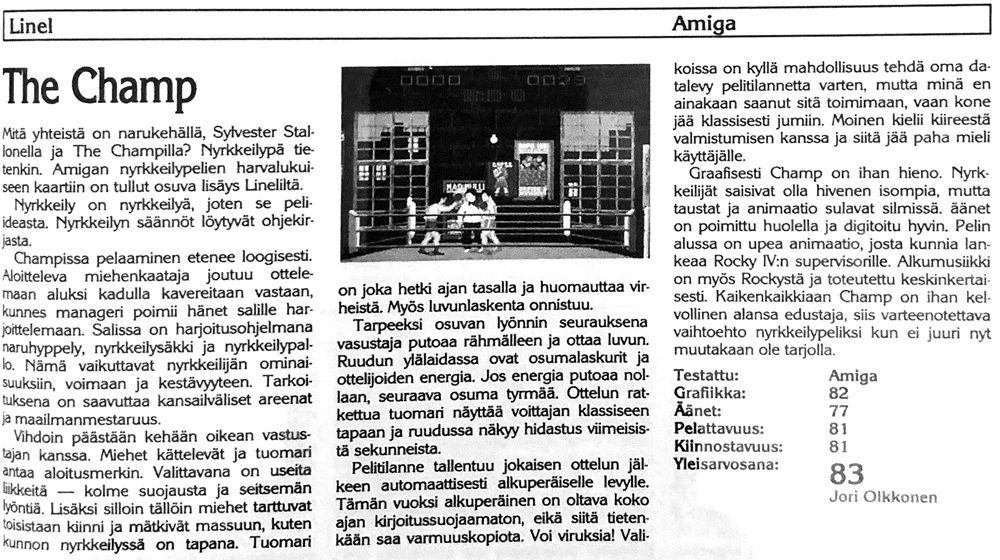
Champ, The1990 KevätPysyvä linkkiMitä yhteistä on narukehällä, Sylvester Stallonella ja The Champilla? Nyrkkeilypä tietenkin. Amigan nyrkkeilypelien harvalukuiseen kaartiin on tullut osuva lisäys Lineliltä.
Nyrkkeily on nyrkkeilyä, joten se peli-ideasta. Nyrkkeilyn säännöt löytyvät ohjekirjasta.
Champissa pelaaminen etenee loogisesti. Aloitteleva miehenkaataja joutuu ottelemaan aluksi kadulla kavereitaan vastaan, kunnes manageri poimii hänet salille harjoittelemaan. Salissa on harjoitusohjelmana naruhyppely, nyrkkeilysäkki ja nyrkkeilypallo. Nämä vaikuttavat nyrkkeilijän ominaisuuksiin, voimaan ja kestävyyteen. Tarkoituksena on saavuttaa kansailväliset areenat ja maailmanmestaruus.
Vihdoin päästään kehään oikean vastustajan kanssa. Miehet kättelevät ja tuomari antaa aloitusmerkin. Valittavana on useita liikkeitä - kolme suojausta ja seitsemän lyöntiä. Lisäksi silloin tällöin miehet tarttuvat toisistaan kiinni ja mätkivät massuun, kuten kunnon nyrkkeilyssä on tapana. Tuomari on joka hetki ajan tasalla ja huomauttaa virheistä. Myös luvunlaskenta onnistuu.
Tarpeeksi osuvan lyönnin seurauksena vasustaja putoaa rähmälleen ja ottaa luvun. Ruudun ylälaidassa ovat osumalaskurit ja ottelijoiden energia. Jos energia putoaa nollaan, seuraava osuma tyrmää. Ottelun ratkettua tuomari näyttää voittajan klassiseen tapaan ja ruudussa näkyy hidastus viimeisistä sekunneista.
Pelitilanne tallentuu jokaisen ottelun jälkeen automaattisesti alkuperäiselle levylle. Tämän vuoksi alkuperäinen on oltava koko ajan kirjoitussuojaamaton, eikä siitä tietenkään saa varmuuskopiota. Voi viruksia! Valikoissa on kyllä mahdollisuus tehdä oma datalevy pelitilannetta varten, mutta minä en ainakaan saanut sitä toimimaan, vaan kone jää klassisesti jumiin. Moinen kielii kiireestä valmistumisen kanssa ja siitä jää paha mieli käyttäjälle.
Graafisesti Champ on ihan hieno. Nyrkkeilijät saisivat olla hivenen isompia, mutta taustat ja animaatio sulavat silmissä. äänet on poimittu huolella ja digitoitu hyvin. Pelin alussa on upea animaatio, josta kunnia lankeaa Rocky IV:n supervisorille. Alkumusiikki on myös Rockystä ja toteutettu keskinkertaisesti. Kaikenkaikkiaan Champ on ihan kelvollinen alansa edustaja, siis varteenotettava vaihtoehto nyrkkeilypeliksi kun ei juuri nyt muutakaan ole tarjolla.
Champ, The1990 KevätPermalinkWhat do a roped ring, Sylvester Stallone and The Champ have in common? Why, boxing, of course. The sparse ranks of Amiga boxing games have received a well-aimed addition from Linel.
Boxing is boxing, so that's it for the game concept. The rules of boxing can be found in the manual.
In Champ, play progresses logically. The fledgling man-feller first has to fight his mates in the street, until a manager picks him up to train at the gym. The gym's training programme consists of skipping, the heavy bag and the speed ball. These affect the boxer's attributes, strength and stamina. The aim is to reach the international arenas and the world championship.
At last you get into the ring with a real opponent. The men shake hands and the referee signals the start. There are several moves to choose from - three blocks and seven punches. On top of that, every now and then the men grab hold of each other and thump away at the tummy, as is customary in proper boxing. The referee is on the ball at every moment and points out fouls. The count works too.
After a sufficiently well-landed punch the opponent goes down flat on his face and takes a count. At the top of the screen are the hit counters and the fighters' energy. If the energy drops to zero, the next hit is a knockout. Once the bout is decided, the referee shows the winner in the classic manner and the screen shows a slow-motion replay of the final seconds.
The game state is saved automatically to the original disk after every bout. Because of this the original has to be left un-write-protected all the time, and of course you can't make a backup of it. Oh, the viruses! The menus do give you the option of making a separate data disk for the game state, but I for one couldn't get it to work; instead the machine hangs, classically. That kind of thing smacks of a rush to get it finished, and it leaves a bad taste in the user's mouth.
Graphically Champ is quite fine. The boxers could be a tad bigger, but the backgrounds and animation just melt in the eye. The sounds have been picked with care and well digitised. At the start of the game there's a superb animation, the credit for which goes to the supervisor of Rocky IV. The intro music is also from Rocky and has been done in a mediocre way. All in all Champ is a perfectly decent representative of its field, i.e. a worthwhile choice of boxing game when there isn't much else on offer right now anyway.
Chaos Strikes Back
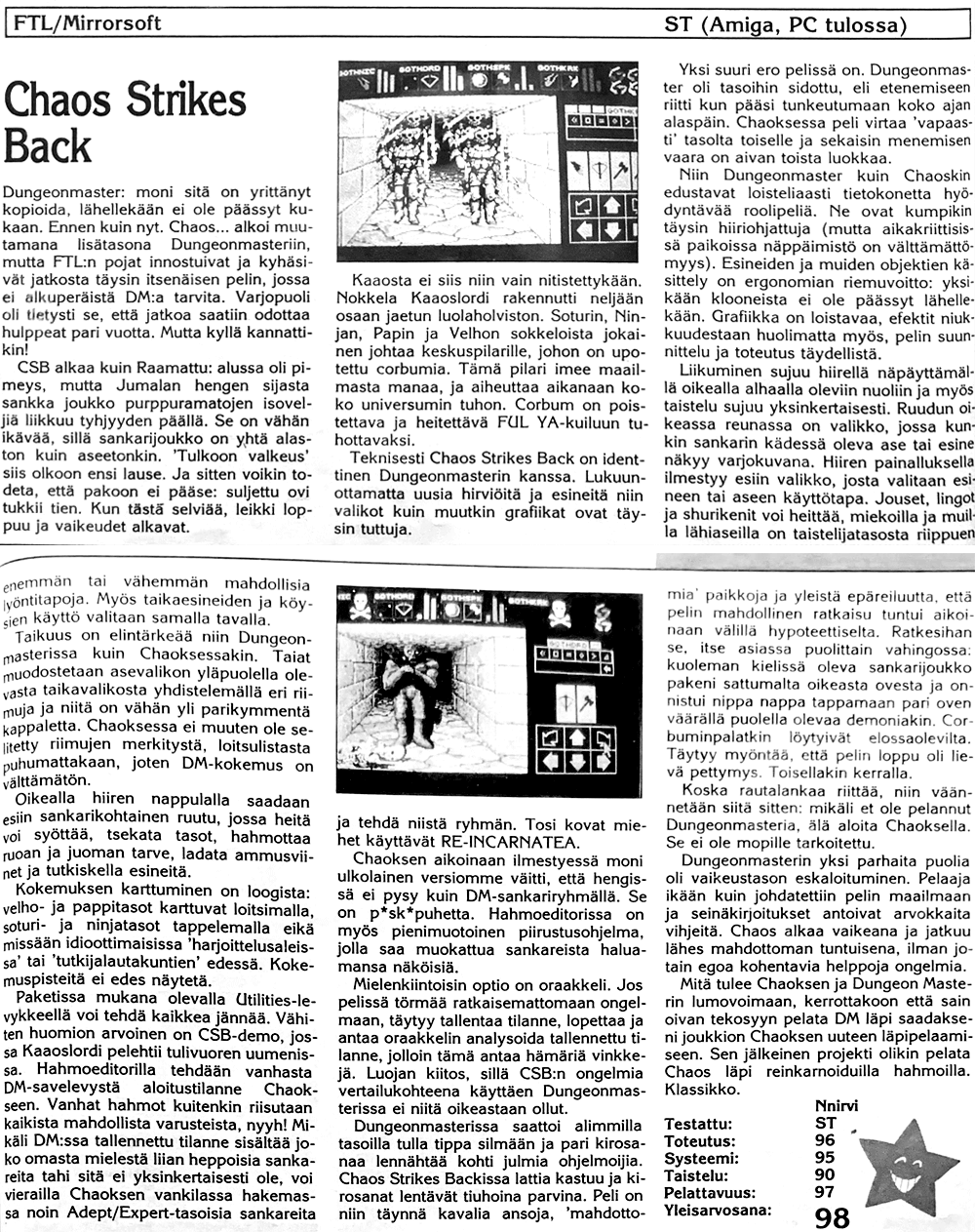
Chaos Strikes Back1990 SyksyPysyvä linkkiDungeonmaster: moni sitä on yrittänyt kopioida, lähellekään ei ole päässyt kukaan. Ennen kuin nyt. Chaos... alkoi muutamana lisätasona Dungeonmasteriin, mutta FTL:n pojat innostuivat ja kyhäsivät jatkosta täysin itsenäisen pelin, jossa ei alkuperäistä DM:a tarvita. Varjopuoli oli tietysti se, että jatkoa saatiin odottaa hulppeat pari vuotta. Mutta kyllä kannattikin!
CSB alkaa kuin Raamattu: alussa oli pimeys, mutta Jumalan hengen sijasta sankka joukko purppuramatojen isoveljiä liikkuu tyhjyyden päällä. Se on vähän ikävää, sillä sankarijoukko on yhtä alaston kuin aseetonkin. 'Tulkoon valkeus' siis olkoon ensi lause. Ja sitten voikin todeta, että pakoon ei pääse: suljettu ovi tukkii tien. Kun tästä selviää, leikki loppuu ja vaikeudet alkavat.
Kaaosta ei siis niin vain nitistettykään. Nokkela Kaaoslordi rakennutti neljään osaan jaetun luolaholviston. Soturin, Ninjan, Papin ja Velhon sokkeloista jokainen johtaa keskuspilarille, johon on upotettu corbumia. Tämä pilari imee maailmasta manaa, ja aiheuttaa aikanaan koko universumin tuhon. Corbum on poistettava ja heitettävä FUL YA-kuiluun tuhottavaksi.
Teknisesti Chaos Strikes Back on identtinen Dungeonmasterin kanssa. Lukuunottamatta uusia hirviöitä ja esineitä niin valikot kuin muutkin grafiikat ovat täysin tuttuja.
Yksi suuri ero pelissä on. Dungeonmaster oli tasoihin sidottu, eli etenemiseen riitti kun pääsi tunkeutumaan koko ajan alaspäin. Chaoksessa peli virtaa 'vapaasti' tasolta toiselle ja sekaisin menemisen vaara on aivan toista luokkaa.
Niin Dungeonmaster kuin Chaoskin edustavat loisteliaasti tietokonetta hyödyntävää roolipeliä. Ne ovat kumpikin täysin hiiriohjattuja (mutta aikakriittisissä paikoissa näppäimistö on välttämättömyys). Esineiden ja muiden objektien käsittely on ergonomian riemuvoitto: yksikään klooneista ei ole päässyt lähellekään. Grafiikka on loistavaa, efektit niukkuudestaan huolimatta myös, pelin suunnittelu ja toteutus täydellistä.
Liikuminen sujuu hiirellä näpäyttämällä oikealla alhaalla oleviin nuoliin ja myös taistelu sujuu yksinkertaisesti. Ruudun oikeassa reunassa on valikko, jossa kunkin sankarin kädessä oleva ase tai esine näkyy varjokuvana. Hiiren painalluksella ilmestyy esiin valikko, josta valitaan esineen tai aseen käyttötapa. Jouset, lingot ja shurikenit voi heittää, miekoilla ja muilla lähiaseilla on taistelijatasosta riippuen enemmän tai vähemmän mahdollisia lyöntitapoja. Myös taikaesineiden ja köysien käyttö valitaan samalla tavalla.
Taikuus on elintärkeää niin Dungeonmasterissa kuin Chaoksessakin. Taiat muodostetaan asevalikon yläpuolella olevasta taikavalikosta yhdistelemällä eri riimuja ja niitä on vähän yli parikymmentä kappaletta. Chaoksessa ei muuten ole selitetty riimujen merkitystä, loitsulistasta puhumattakaan, joten DM-kokemus on välttämätön.
Oikealla hiiren nappulalla saadaan esiin sankarikohtainen ruutu, jossa heitä voi syöttää, tsekata tasot, hahmottaa ruoan ja juoman tarve, ladata ammusviinet ja tutkiskella esineitä.
Kokemuksen karttuminen on loogista: velho- ja pappitasot karttuvat loitsimalla, soturi- ja ninjatasot tappelemalla eikä missään idioottimaisissa 'harjoittelusaleissa' tai 'tutkijalautakuntien' edessä. Kokemuspisteitä ei edes näytetä.
Paketissa mukana olevalla Utilities-levykkeellä voi tehdä kaikkea jännää. Vähiten huomion arvoinen on CSB-demo, jossa Kaaoslordi pelehtii tulivuoren uumenissa. Hahmoeditorilla tehdään vanhasta DM-savelevystä aloitustilanne Chaokseen. Vanhat hahmot kuitenkin riisutaan kaikista mahdollista varusteista, nyyh! Mikäli DM:ssa tallennettu tilanne sisältää joko omasta mielestä liian heppoisia sankareita tahi sitä ei yksinkertaisesti ole, voi vierailla Chaoksen vankilassa hakemassa noin Adept/Expert-tasoisia sankareita ja tehdä niistä ryhmän. Tosi kovat miehet käyttävät RE-INCARNATEA.
Chaoksen aikoinaan ilmestyessä moni ulkolainen versiomme väitti, että hengissä ei pysy kuin DM-sankariryhmällä. Se on p*sk*puhetta. Hahmoeditorissa on myös pienimuotoinen piirustusohjelma, jolla saa muokattua sankareista haluamansa näköisiä.
Mielenkiintoisin optio on oraakkeli. Jos pelissä törmää ratkaisemattomaan ongelmaan, täytyy tallentaa tilanne, lopettaa ja antaa oraakkelin analysoida tallennettu tilanne, jolloin tämä antaa hämäriä vinkkejä. Luojan kiitos, sillä CSB:n ongelmia vertailukohteena käyttäen Dungeonmasterissa ei niitä oikeastaan ollut.
Dungeonmasterissa saattoi alimmilla tasoilla tulla tippa silmään ja pari kirosanaa lennähtää kohti julmia ohjelmoijia. Chaos Strikes Backissa lattia kastuu ja kirosanat lentävät tiuhoina parvina. Peli on niin täynnä kavalia ansoja, 'mahdottomia' paikkoja ja yleistä epäreiluutta, että pelin mahdollinen ratkaisu tuntui aikoinaan välillä hypoteettiselta. Ratkesihan se, itse asiassa puolittain vahingossa: kuoleman kielissä oleva sankarijoukko pakeni sattumalta oikeasta ovesta ja onnistui nippa nappa tappamaan pari oven väärällä puolella olevaa demoniakin. Corbuminpalatkin löytyivät elossaolevilta. Täytyy myöntää, että pelin loppu oli lievä pettymys. Toisellakin kerralla.
Koska rautalankaa riittää, niin väännetään siitä sitten: mikäli et ole pelannut Dungeonmasteria, älä aloita Chaoksella. Se ei ole mopille tarkoitettu.
Dungeonmasterin yksi parhaita puolia oli vaikeustason eskaloituminen. Pelaaja ikään kuin johdatettiin pelin maailmaan ja seinäkirjoitukset antoivat arvokkaita vihjeitä. Chaos alkaa vaikeana ja jatkuu lähes mahdottoman tuntuisena, ilman jotain egoa kohentavia helppoja ongelmia.
Mitä tulee Chaoksen ja Dungeon Masterin lumovoimaan, kerrottakoon että sain oivan tekosyyn pelata DM läpi saadakseni joukkion Chaoksen uuteen läpipelaamiseen. Sen jälkeinen projekti olikin pelata Chaos läpi reinkarnoiduilla hahmoilla. Klassikko.
Chaos Strikes Back1990 SyksyPermalinkDungeonmaster: many have tried to copy it, nobody has come anywhere close. Until now. Chaos... started out as a few extra levels for Dungeonmaster, but the FTL boys got carried away and cobbled the sequel together into a completely standalone game that doesn't need the original DM. The downside, of course, was that we got to wait a whopping couple of years for the sequel. But boy, was it worth it!
CSB begins like the Bible: in the beginning there was darkness, but instead of the Spirit of God, a dense crowd of the purple worms' big brothers moves upon the void. That's a bit unfortunate, since the band of heroes is as naked as it is unarmed. So let 'Let there be light' be your opening line. And then you realise that there's no getting away: a closed door blocks the way. Once you get through this, the fun and games are over and the difficulties begin.
So Chaos wasn't that easily squashed after all. The crafty Chaos Lord had a dungeon vault built, divided into four parts. Each of the mazes of the Fighter, the Ninja, the Priest and the Wizard leads to a central pillar in which corbum has been embedded. This pillar sucks mana out of the world and will in time bring about the destruction of the entire universe. The corbum has to be removed and thrown into the FUL YA pit to be destroyed.
Technically, Chaos Strikes Back is identical to Dungeonmaster. Apart from the new monsters and items, the menus and the rest of the graphics alike are completely familiar.
There is one big difference in the game. Dungeonmaster was tied to its levels, meaning that to make progress it was enough to keep burrowing your way further down. In Chaos the game flows 'freely' from one level to another, and the risk of losing your bearings is in a whole other league.
Dungeonmaster and Chaos alike are splendid examples of the role-playing game that makes real use of the computer. Both are entirely mouse-controlled (although in time-critical spots the keyboard is a necessity). The handling of items and other objects is a triumph of ergonomics: not one of the clones has come anywhere near it. The graphics are brilliant, the effects too despite their sparseness, the game's design and execution perfect.
Moving is done by clicking the mouse on the arrows at the bottom right, and fighting is simple too. At the right-hand edge of the screen there's a menu in which the weapon or item each hero holds in their hand appears as a silhouette. A click of the mouse brings up a menu from which you choose how to use the item or weapon. Bows, slings and shuriken can be thrown; swords and other close-combat weapons have more or fewer possible ways of striking depending on fighter level. The use of magic items and ropes is chosen the same way as well.
Magic is vital in Dungeonmaster and Chaos alike. Spells are formed by combining different runes in the magic menu above the weapon menu, and there are a little over twenty of them. Chaos, by the way, doesn't explain what the runes mean, let alone provide a spell list, so DM experience is essential.
The right mouse button brings up a screen for the individual hero, where you can feed them, check their levels, gauge their need for food and drink, load their quivers and examine items.
Gaining experience is logical: wizard and priest levels build up through casting spells, fighter and ninja levels through fighting, and not in some idiotic 'training halls' or in front of 'boards of examiners'. Experience points aren't even displayed.
The Utilities disk that comes in the package lets you do all sorts of neat things. The least noteworthy is the CSB demo, in which the Chaos Lord frolics in the bowels of a volcano. The character editor turns an old DM save disk into a starting setup for Chaos. The old characters are, however, stripped of every last piece of equipment, sob! If your DM saved game either contains heroes you consider too feeble, or else you simply don't have one, you can visit the prison in Chaos to fetch heroes of roughly Adept/Expert level and make a party of them. Real hard men use RE-INCARNATE.
When Chaos first came out, many of our foreign counterparts claimed that you could only stay alive with a DM party of heroes. That's b*llsh*t. The character editor also includes a small paint program with which you can make the heroes look however you like.
The most interesting option is the oracle. If you run into an unsolvable problem in the game, you have to save, quit and let the oracle analyse the saved game, whereupon it gives you murky hints. Thank God for that, because measured against the problems in CSB, Dungeonmaster didn't really have any.
In Dungeonmaster, on the lowest levels, a tear might come to your eye and a couple of swear words might go flying at the cruel programmers. In Chaos Strikes Back the floor gets wet and the swear words fly in dense flocks. The game is so full of treacherous traps, 'impossible' places and general unfairness that back when it came out, solving it at times seemed purely hypothetical. It did get solved, actually half by accident: a party of heroes at death's door happened to flee through the right door and just barely managed to kill a couple of demons on the wrong side of it too. And the corbum pieces were found on the survivors as well. I have to admit that the ending was a mild disappointment. The second time round too.
Since there's no shortage of crayons, let's draw you a picture: if you haven't played Dungeonmaster, don't start with Chaos. It is not meant for rookies.
One of Dungeonmaster's best features was the escalating difficulty. The player was, as it were, guided into the game's world, and the writings on the walls gave valuable hints. Chaos starts out hard and carries on feeling nearly impossible, without any easy, ego-boosting problems.
As for the allure of Chaos and Dungeon Master, let it be said that I got a fine excuse to play DM through in order to get a party together for a fresh run through Chaos. The project after that, naturally, was to play Chaos through with reincarnated characters. A classic.
Chase
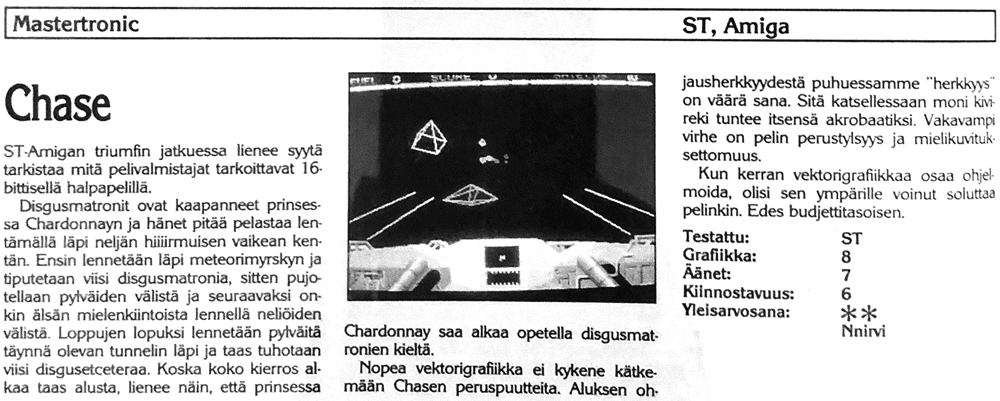
Chase1989 SyksyPysyvä linkkiST-Amigan triumfin jatkuessa lienee syytä tarkistaa mitä pelivalmistajat tarkoittavat 16-bittisellä halpapelillä.
Disgusmatronit ovat kaapanneet prinsessa Chardonnayn ja hänet pitää pelastaa lentämällä läpi neljän hiiiirmuisen vaikean kentän. Ensin lennetään läpi meteorimyrskyn ja tiputetaan viisi disgusmatronia, sitten pujotellaan pylväiden välistä ja seuraavaksi onkin älsän mielenkiintoista lennellä neliöiden välistä. Loppujen lopuksi lennetään pylväitä täynnä olevan tunnelin läpi ja taas tuhotaan viisi disgusetceteraa. Koska koko kierros alkaa taas alusta, lienee näin, että prinsessa Chardonnay saa alkaa opetella disgusmatronien kieltä.
Nopea vektorigrafiikka ei kykene kätkemään Chasen peruspuutteita. Aluksen ohjausherkkyydestä puhuessamme "herkkyys" on väärä sana. Sitä katsellessaan moni kivireki tuntee itsensä akrobaatiksi. Vakavampi virhe on pelin perustylsyys ja mielikuvituksettomuus.
Kun kerran vektorigrafiikkaa osaa ohjelmoida, olisi sen ympärille voinut soluttaa pelinkin. Edes budjettitasoisen.
Chase1989 SyksyPermalinkWith the ST-Amiga triumph rolling on, it's probably time to check what games publishers mean by a 16-bit budget game.
The disgusmatrons have kidnapped Princess Chardonnay, and she has to be rescued by flying through four fiiiiendishly difficult levels. First you fly through a meteor storm and shoot down five disgusmatrons, then you weave between pillars, and next it's insanely interesting to flit about between squares. Finally you fly through a tunnel full of pillars and once again destroy five disgusetceteras. Since the whole round then starts again from the beginning, it would seem that Princess Chardonnay may as well start learning the disgusmatrons' language.
The fast vector graphics can't hide Chase's fundamental flaws. When we talk about the ship's steering sensitivity, "sensitivity" is the wrong word. Watching it, many a stone sledge feels like an acrobat. A more serious flaw is the game's basic dullness and lack of imagination.
If you know how to program vector graphics in the first place, you could have smuggled a game in around them too. Even a budget-grade one.
Chase H.Q.
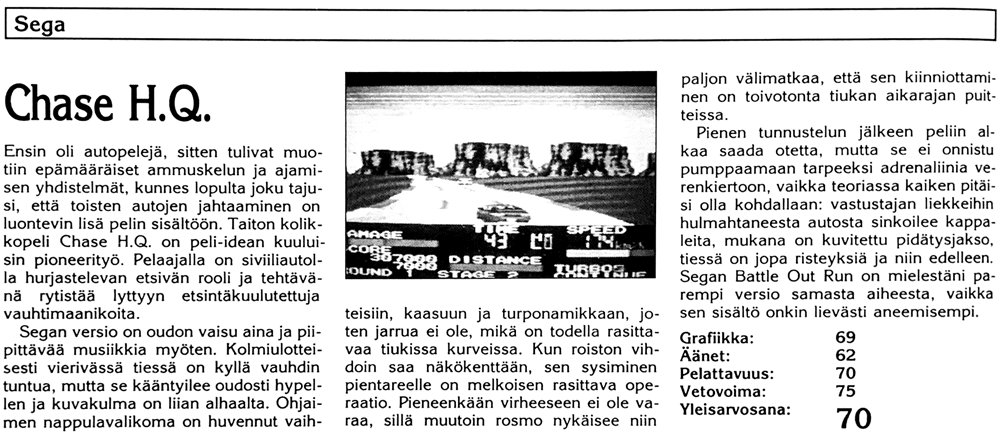
Chase H.Q.1990 SyksyPysyvä linkkiEnsin oli autopelejä, sitten tulivat muotiin epämääräiset ammuskelun ja ajamisen yhdistelmät, kunnes lopulta joku tajusi, että toisten autojen jahtaaminen on luontevin lisä pelin sisältöön. Taiton kolikkopeli Chase H.Q. on peli-idean kuuluisin pioneerityö. Pelaajalla on siviiliautolla hurjastelevan etsivän rooli ja tehtävänä rytistää lyttyyn etsintäkuulutettuja vauhtimaanikoita.
Segan versio on oudon vaisu aina ja piipittävää musiikkia myöten. Kolmiulotteisesti vierivässä tiessä on kyllä vauhdin tuntua, mutta se kääntyilee oudosti hypellen ja kuvakulma on liian alhaalta. Ohjaimen nappulavalikoma on huvennut vaihteisiin, kaasuun ja turponamikkaan, joten jarrua ei ole, mikä on todella rasittavaa tiukissa kurveissa. Kun roiston vihdoin saa näkökenttään, sen sysiminen pientareelle on melkoisen rasittava operaatio. Pieneenkään virheeseen ei ole varaa, sillä muutoin rosmo nykäisee niin paljon välimatkaa, että sen kiinniottaminen on toivotonta tiukan aikarajan puitteissa.
Pienen tunnustelun jälkeen peliin alkaa saada otetta, mutta se ei onnistu pumppaamaan tarpeeksi adrenaliinia verenkiertoon, vaikka teoriassa kaiken pitäisi olla kohdallaan: vastustajan liekkeihin hulmahtaneesta autosta sinkoilee kappaleita, mukana on kuvitettu pidätysjakso, tiessä on jopa risteyksiä ja niin edelleen. Segan Battle Out Run on mielestäni parempi versio samasta aiheesta, vaikka sen sisältö onkin lievästi aneemisempi.
Chase H.Q.1990 SyksyPermalinkFirst there were driving games, then vague mixtures of shooting and driving came into fashion, until finally somebody realised that chasing other cars is the most natural thing to add to a game's content. Taito's coin-op Chase H.Q. is the most famous pioneering work of this game idea. The player takes the role of a detective tearing around in an unmarked car, and the task is to crumple wanted speed maniacs flat.
The Sega version is oddly feeble, right down to the bleepy music. The road scrolling in three dimensions certainly has a sense of speed, but it turns in strange little hops and the camera angle is too low. The controller's range of buttons has dwindled to gears, accelerator and a turbo knob, so there is no brake, which is really irritating on tight bends. When you finally get the villain into view, shoving it off onto the verge is quite a tiresome operation. You can't afford even the smallest mistake, because otherwise the crook pulls so far ahead that catching it is hopeless within the tight time limit.
After a bit of feeling your way you start to get a grip on the game, but it doesn't manage to pump enough adrenaline into your bloodstream, even though in theory everything should be in place: pieces fly off the opponent's car as it bursts into flames, there's an illustrated arrest sequence, the road even has junctions, and so on. In my opinion Sega's Battle Out Run is a better take on the same subject, even if its content is slightly more anaemic.
Chase HQ
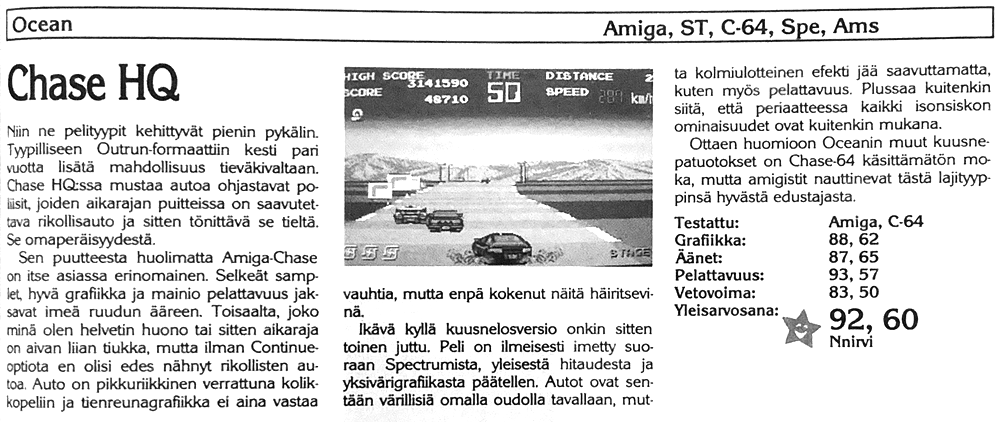
Chase HQ1990 KevätPysyvä linkkiNiin ne pelityypit kehittyvät pienin pykälin. Tyypilliseen Outrun-formaattiin kesti pari vuotta lisätä mahdollisuus tieväkivaltaan. Chase HQ:ssa mustaa autoa ohjastavat poliisit, joiden aikarajan puitteissa on saavutettava rikollisauto ja sitten tönittävä se tieltä. Se omaperäisyydestä.
Sen puutteesta huolimatta Amiga-Chase on itse asiassa erinomainen. Selkeät samplet, hyvä grafiikka ja mainio pelattavuus jaksavat imeä ruudun ääreen. Toisaalta, joko minä olen helvetin huono tai sitten aikaraja on aivan liian tiukka, mutta ilman Continue-optiota en olisi edes nähnyt rikollisten autoa. Auto on pikkuriikkinen verrattuna kolikkopeliin ja tienreunagrafiikka ei aina vastaa vauhtia, mutta enpä kokenut näitä häiritsevinä.
Ikävä kyllä kuusnelosversio onkin sitten toinen juttu. Peli on ilmeisesti imetty suoraan Spectrumista, yleisestä hitaudesta ja yksivärigrafiikasta päätellen. Autot ovat sentään värillisiä omalla oudolla tavallaan, mutta kolmiulotteinen efekti jää saavuttamatta, kuten myös pelattavuus. Plussaa kuitenkin siitä, että periaatteessa kaikki isonsiskon ominaisuudet ovat kuitenkin mukana.
Ottaen huomioon Oceanin muut kuusnepatuotokset on Chase-64 käsittämätön moka, mutta amigistit nauttinevat tästä lajityyppinsä hyvästä edustajasta.
Chase HQ1990 KevätPermalinkAnd so game genres evolve, one tiny notch at a time. It took a couple of years to add the option of road violence to the typical Outrun format. In Chase HQ the black car is driven by cops who, within a time limit, have to catch up with the criminals' car and then shove it off the road. So much for originality.
Despite the lack of it, the Amiga Chase is actually excellent. Clear samples, good graphics and splendid playability keep sucking you back in front of the screen. Then again, either I'm hellishly bad or the time limit is far too tight, but without the Continue option I wouldn't even have seen the criminals' car. The car is teeny-tiny compared with the coin-op and the roadside graphics don't always match the speed, but I didn't find these bothersome.
Sadly, the C-64 version is another story altogether. Judging by the general slowness and the single-colour graphics, the game has apparently been sucked straight out of the Spectrum. The cars are at least coloured, in their own strange way, but the three-dimensional effect never materialises, and neither does the playability. A plus, though, for the fact that in principle all of big sister's features are in there all the same.
Considering Ocean's other C-64 output, Chase-64 is an incomprehensible blunder, but Amiga owners should enjoy this good example of its genre.
Chase HQ II
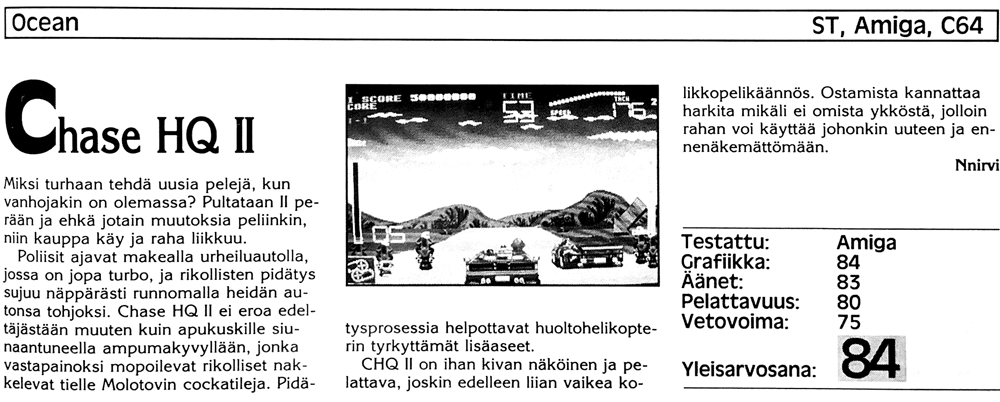
Chase HQ II1991 KevätPysyvä linkkiMiksi turhaan tehdä uusia pelejä, kun vanhojakin on olemassa? Pultataan II perään ja ehkä jotain muutoksia peliinkin, niin kauppa käy ja raha liikkuu.
Poliisit ajavat makealla urheiluautolla, jossa on jopa turbo, ja rikollisten pidätys sujuu näppärästi runnomalla heidän autonsa tohjoksi. Chase HQ II ei eroa edeltäjästään muuten kuin apukuskille siunaantuneella ampumakyvyllään, jonka vastapainoksi mopoilevat rikolliset nakkelevat tielle Molotovin cockatileja. Pidätysprosessia helpottavat huoltohelikopterin tyrkyttämät lisäaseet.
CHQ II on ihan kivan näköinen ja pelattava, joskin edelleen liian vaikea kolikkopelikäännös. Ostamista kannattaa harkita mikäli ei omista ykköstä, jolloin rahan voi käyttää johonkin uuteen ja ennenäkemättömään.
Chase HQ II1991 KevätPermalinkWhy bother making new games when there are old ones already? Bolt a II on the end, and maybe a few changes to the game as well, and business booms and the money rolls in.
The cops drive a sweet sports car that even has a turbo, and arresting criminals is a neat matter of smashing their car to a pulp. Chase HQ II differs from its predecessor only in the shooting ability the co-driver has been blessed with, to counterbalance which the puttering crooks toss Molotov cocktails onto the road. The arrest process is made easier by extra weapons pushed on you by a support helicopter.
CHQ II is a nice enough looking and playable, if still too difficult, coin-op conversion. It's worth considering buying if you don't own the first one, in which case you can spend your money on something new and never seen before.
Chess Simulator
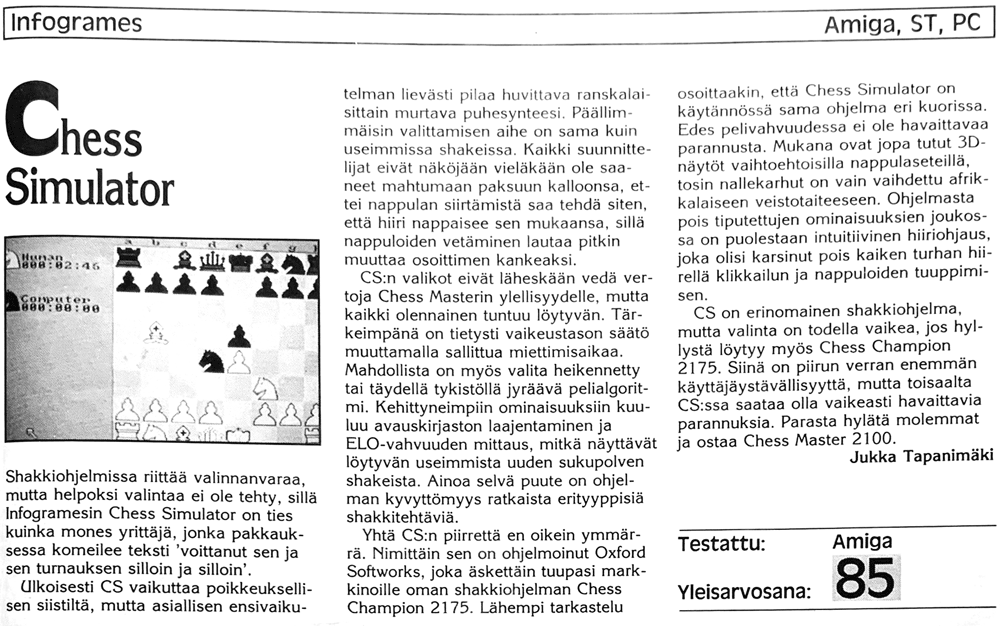
Chess Simulator1991 KevätPysyvä linkkiShakkiohjelmissa riittää valinnanvaraa, mutta helpoksi valintaa ei ole tehty, sillä Infogramesin Chess Simulator on ties kuinka mones yrittäjä, jonka pakkauksessa komeilee teksti 'voittanut sen ja sen turnauksen silloin ja silloin'.
Ulkoisesti CS vaikuttaa poikkeuksellisen siistiltä, mutta asiallisen ensivaikutelman lievästi pilaa huvittava ranskalaisittain murtava puhesynteesi. Päällimmäisin valittamisen aihe on sama kuin useimmissa shakeissa. Kaikki suunnittelijat eivät näköjään vieläkään ole saaneet mahtumaan paksuun kalloonsa, ettei nappulan siirtämistä saa tehdä siten, että hiiri nappaisee sen mukaansa, sillä nappuloiden vetäminen lautaa pitkin muuttaa osoittimen kankeaksi.
CS:n valikot eivät läheskään vedä vertoja Chess Masterin ylellisyydelle, mutta kaikki olennainen tuntuu löytyvän. Tärkeimpänä on tietysti vaikeustason säätö muuttamalla sallittua miettimisaikaa. Mahdollista on myös valita heikennetty tai täydellä tykistöllä jyräävä pelialgoritmi. Kehittyneimpiin ominaisuuksiin kuuluu avauskirjaston laajentaminen ja ELO-vahvuuden mittaus, mitkä näyttävät löytyvän useimmista uuden sukupolven shakeista. Ainoa selvä puute on ohjelman kyvyttömyys ratkaista erityyppisiä shakkitehtäviä.
Yhtä CS:n piirrettä en oikein ymmärrä. Nimittäin sen on ohjelmoinut Oxford Softworks, joka äskettäin tuupasi markkinoille oman shakkiohjelman Chess Champion 2175. Lähempi tarkastelu osoittaakin, että Chess Simulator on käytännössä sama ohjelma eri kuorissa. Edes pelivahvuudessa ei ole havaittavaa parannusta. Mukana ovat jopa tutut 3D-näytöt vaihtoehtoisilla nappulaseteillä, tosin nallekarhut on vain vaihdettu afrikkalaiseen veistotaiteeseen. Ohjelmasta pois tiputettujen ominaisuuksien joukossa on puolestaan intuitiivinen hiiriohjaus, joka olisi karsinut pois kaiken turhan hiirellä klikkailun ja nappuloiden tuuppimisen.
CS on erinomainen shakkiohjelma, mutta valinta on todella vaikea, jos hyllystä löytyy myös Chess Champion 2175. Siinä on piirun verran enemmän käyttäjäystävällisyyttä, mutta toisaalta CS:ssa saataa olla vaikeasti havaittavia parannuksia. Parasta hylätä molemmat ja ostaa Chess Master 2100.
Chess Simulator1991 KevätPermalinkThere's no shortage of choice among chess programs, but nobody has made the choosing easy, since Infogrames' Chess Simulator is the umpteenth contender with the words 'winner of such-and-such tournament at such-and-such time' emblazoned on its box.
On the outside CS looks exceptionally neat, but the businesslike first impression is slightly spoiled by a comical speech synthesizer with a French accent. The number one complaint is the same as with most chess games. Apparently not every designer has yet managed to get it into their thick skull that moving a piece must not work by having the mouse snatch it up and drag it along, because dragging pieces across the board makes the pointer sluggish.
CS's menus come nowhere near the luxury of Chess Master, but everything essential seems to be there. The most important, of course, is adjusting the difficulty level by changing the permitted thinking time. You can also choose between a weakened playing algorithm and one that steamrollers you with its full artillery. The more advanced features include expanding the opening library and measuring ELO strength, which seem to be found in most of the new generation of chess games. The only clear shortcoming is the program's inability to solve chess problems of various kinds.
There's one feature of CS I don't really understand. You see, it was programmed by Oxford Softworks, who recently shoved their own chess program, Chess Champion 2175, onto the market. And a closer look does show that Chess Simulator is practically the same program in a different wrapper. There isn't even any noticeable improvement in playing strength. It even includes the familiar 3D displays with alternative piece sets, although the teddy bears have simply been swapped for African sculpture. Among the features dropped from the program, on the other hand, is the intuitive mouse control, which would have cut out all the pointless clicking of the mouse and shoving of pieces.
CS is an excellent chess program, but the choice is a really tough one if the shelf also holds Chess Champion 2175. That one has a hair more user-friendliness, but on the other hand CS may contain improvements that are hard to spot. Best to reject both and buy Chess Master 2100.
Chessmaster 2000
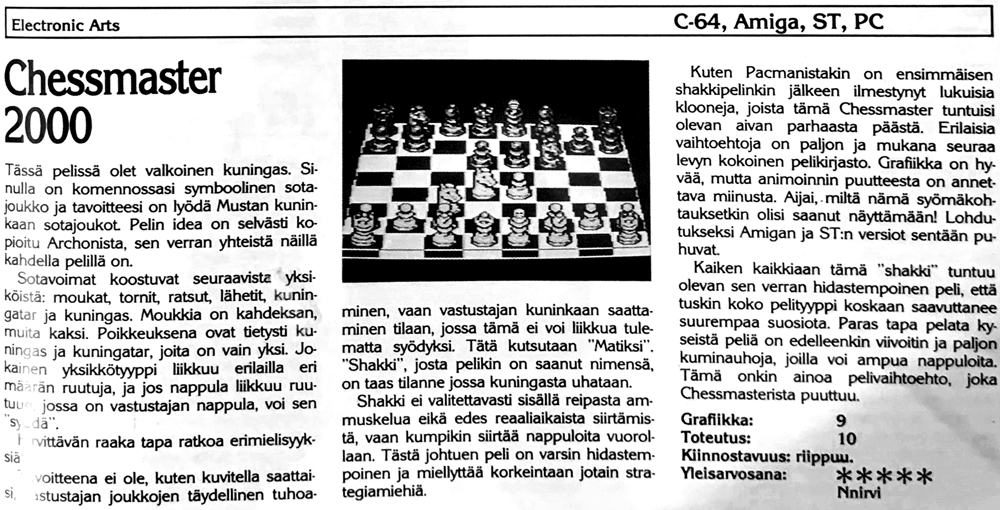
Chessmaster 20001988Pysyvä linkkiTässä pelissä olet valkoinen kuningas. Sinulla on komennossasi symboolinen sotajoukko ja tavoitteesi on lyödä Mustan kuninkaan sotajoukot. Pelin idea on selvästi kopioitu Archonista, sen verran yhteistä näillä kahdella pelillä on.
Sotavoimat koostuvat seuraavista yksiköistä: moukat, tornit, ratsut, lähetit, kuningatar ja kuningas. Moukkia on kahdeksan, muita kaksi. Poikkeuksena ovat tietysti kuningas ja kuningatar, joita on vain yksi. Jokainen yksikkötyyppi liikkuu erilailla eri määrän ruutuja, ja jos nappula liikkuu ruutuun, jossa on vastustajan nappula, voi sen "syödä".
Hirvittävän raaka tapa ratkoa erimielisyyksiä!
Tavoitteena ei ole, kuten kuvitella saattaisi, vastustajan joukkojen täydellinen tuhoaminen, vaan vastustajan kuninkaan saattaminen tilaan, jossa tämä ei voi liikkua tulematta syödyksi. Tätä kutsutaan "Matiksi". "Shakki", josta pelikin on saanut nimensä, on taas tilanne jossa kuningasta uhataan.
Shakki ei valitettavasti sisällä reipasta ammuskelua eikä edes reaaliaikaista siirtämistä, vaan kumpikin siirtää nappuloita vuorollaan. Tästä johtuen peli on varsin hidastempoinen ja miellyttää korkeintaan jotain strategiamiehiä.
Kuten Pacmanistakin on ensimmäisen shakkipelinkin jälkeen ilmestynyt lukuisia klooneja, joista tämä Chessmaster tuntuisi olevan aivan parhaasta päästä. Erilaisia vaihtoehtoja on paljon ja mukana seuraa levyn kokoinen pelikirjasto. Grafiikka on hyvää, mutta animoinnin puutteesta on annettava miinusta. Aijai, miltä nämä syömäkohtauksetkin olisi saanut näyttämään! Lohdutukseksi Amigan ja ST:n versiot sentään puhuvat.
Kaiken kaikkiaan tämä "shakki" tuntuu olevan sen verran hidastempoinen peli, että tuskin koko pelityyppi koskaan saavuttanee suurempaa suosiota. Paras tapa pelata kyseistä peliä on edelleenkin viivoitin ja paljon kuminauhoja, joilla voi ampua nappuloita. Tämä onkin ainoa pelivaihtoehto, joka Chessmasterista puuttuu.
Chessmaster 20001988PermalinkIn this game you are the white king. You have a symbolic army under your command, and your goal is to defeat the armies of the Black king. The idea of the game has clearly been copied from Archon, that's how much these two games have in common.
The armed forces consist of the following units: pawns, rooks, knights, bishops, a queen and a king. There are eight pawns and two of each of the others. The exception, of course, is the king and the queen, of which there is only one. Each unit type moves differently and a different number of squares, and if a piece moves onto a square containing an opponent's piece, it can "eat" it.
A horrifically brutal way to settle disagreements!
The goal is not, as you might imagine, the complete destruction of the opponent's troops, but getting the opponent's king into a position where he cannot move without being eaten. This is called "Mate". "Check", which the game takes its name from, is on the other hand a situation where the king is threatened.
Unfortunately chess does not include any brisk shooting, or even real-time movement; instead each side moves its pieces in turn. As a result the game is rather slow-paced and will appeal at most to a few strategy types.
As with Pacman, the first chess game has been followed by numerous clones, of which this Chessmaster would seem to be right up there with the very best. There are lots of different options, and a whole disk's worth of game library comes along too. The graphics are good, but the lack of animation has to be marked down. Oh boy, what they could have made these eating scenes look like! As consolation, the Amiga and ST versions do at least talk.
All in all, this "chess" seems to be such a slow-paced game that the whole genre is hardly likely ever to achieve any great popularity. The best way to play the game in question is still with a ruler and lots of rubber bands for shooting the pieces. This, in fact, is the only game option Chessmaster lacks.
Chicago 30's
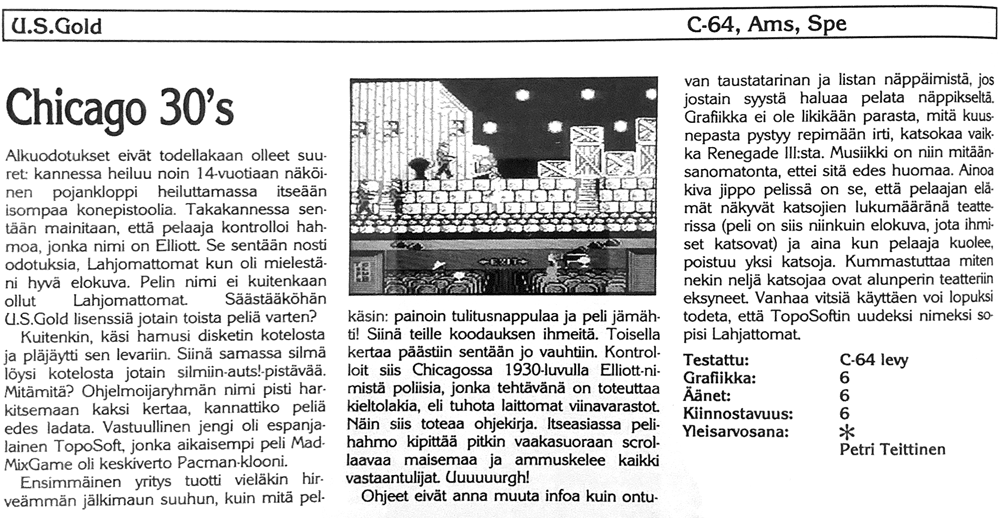
Chicago 30's1989 SyksyPysyvä linkkiAlkuodotukset eivät todellakaan olleet suuret: kannessa heiluu noin 14-vuotiaan näköinen pojankloppi heiluttamassa itseään isompaa konepistoolia. Takakannessa sentään mainitaan, että pelaaja kontrolloi hahmoa, jonka nimi on Elliott. Se sentään nosti odotuksia, Lahjomattomat kun oli mielestäni hyvä elokuva. Pelin nimi ei kuitenkaan ollut Lahjomattomat. Säästääköhän U.S.Gold lisenssiä jotain toista peliä varten?
Kuitenkin, käsi hamusi disketin kotelosta ja pläjäytti sen levariin. Siinä samassa silmä löysi kotelosta jotain silmiin-auts!-pistävää. Mitämitä? Ohjelmoijaryhmän nimi pisti harkitsemaan kaksi kertaa, kannattiko peliä edes ladata. Vastuullinen jengi oli espanjalainen TopoSoft, jonka aikaisempi peli MadMixGame oli keskiverto Pacman-klooni.
Ensimmäinen yritys tuotti vieläkin hirveämmän jälkimaun suuhun, kuin mitä pelkäsin: painoin tulitusnappulaa ja peli jämähti! Siinä teille koodauksen ihmeitä. Toisella kertaa päästiin sentään jo vauhtiin. Kontrolloit siis Chicagossa 1930-luvulla Elliott-nimistä poliisia, jonka tehtävänä on toteuttaa kieltolakia, eli tuhota laittomat viinavarastot. Näin siis toteaa ohjekirja. Itseasiassa pelihahmo kipittää pitkin vaakasuoraan scrollaavaa maisemaa ja ammuskelee kaikki vastaantulijat. Uuuuuurgh!
Ohjeet eivät anna muuta infoa kuin ontuvan taustatarinan ja listan näppäimistä, jos jostain syystä haluaa pelata näppikseltä. Grafiikka ei ole likikään parasta, mitä kuusnepasta pystyy repimään irti, katsokaa vaikka Renegade III:sta. Musiikki on niin mitäänsanomatonta, ettei sitä edes huomaa. Ainoa kiva jippo pelissä on se, että pelaajan elämät näkyvät katsojien lukumääränä teatterissa (peli on siis niinkuin elokuva, jota ihmiset katsovat) ja aina kun pelaaja kuolee, poistuu yksi katsoja. Kummastuttaa miten nekin neljä katsojaa ovat alunperin teatteriin eksyneet. Vanhaa vitsiä käyttäen voi lopuksi todeta, että TopoSoftin uudeksi nimeksi sopisi Lahjattomat.
Chicago 30's1989 SyksyPermalinkInitial expectations really weren't high: on the cover a young whippersnapper who looks about 14 is swaying about waving a submachine gun bigger than himself. The back cover does at least mention that the player controls a character called Elliott. That at least raised my expectations, since I thought The Untouchables was a good film. The game wasn't called The Untouchables, though. Could U.S.Gold be saving the licence for some other game?
Anyway, my hand groped the disk out of the case and slapped it into the drive. At that very moment my eye found something in the case that was eye-ouch!-catching. Whatwhat? The name of the programming team made me think twice about whether it was even worth loading the game. The gang responsible was the Spanish TopoSoft, whose previous game MadMixGame was an average Pacman clone.
The first attempt left an even more horrible aftertaste in my mouth than I'd feared: I pressed the fire button and the game froze! There's the wonders of coding for you. Second time round we did at least get going. So, you control a policeman called Elliott in 1930s Chicago, whose task is to enforce Prohibition, i.e. destroy the illegal booze stashes. So says the manual, anyway. In actual fact the character scurries along a horizontally scrolling landscape and shoots everyone who comes his way. Uuuuuurgh!
The instructions give no info beyond a lame background story and a list of keys, in case for some reason you want to play from the keyboard. The graphics are nowhere near the best that can be wrung out of the C-64 - just look at Renegade III, say. The music is so bland that you don't even notice it. The only nice trick in the game is that the player's lives are shown as the number of spectators in a theatre (the game is, you see, like a film that people are watching), and every time the player dies, one spectator leaves. It makes you wonder how even those four spectators wandered into the theatre in the first place. To use an old joke, one can finally note that a fitting new name for TopoSoft would be the Untalented.
Chicago 90
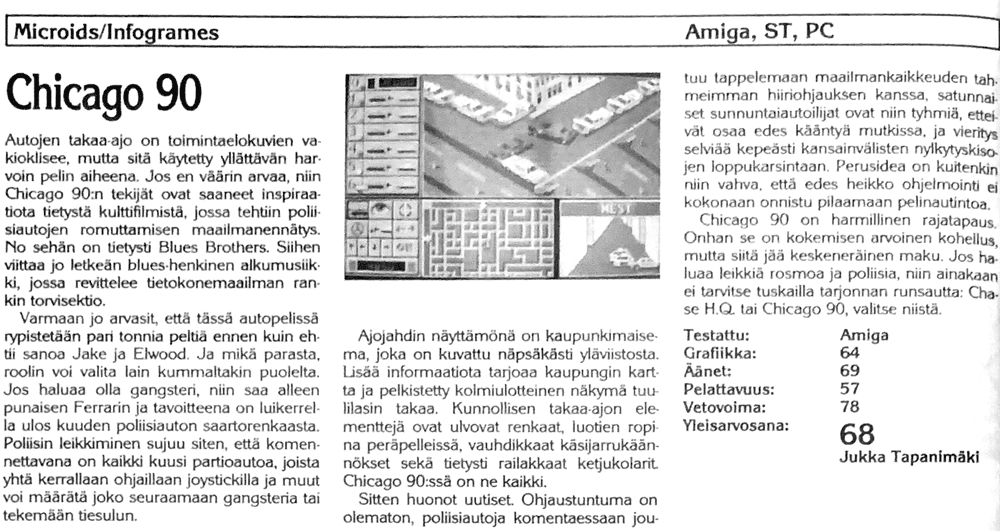
Chicago 901990 KevätPysyvä linkkiAutojen takaa-ajo on toimintaelokuvien vakioklisee, mutta sitä käytetty yllättävän harvoin pelin aiheena. Jos en väärin arvaa, niin Chicago 90:n tekijät ovat saaneet inspiraatiota tietystä kulttifilmistä, jossa tehtiin poliisiautojen romuttamisen maailmanennätys. No sehän on tietysti Blues Brothers. Siihen viittaa jo letkeän blues-henkinen alkumusiikki, jossa revittelee tietokonemaailman rankin torvisektio.
Varmaan jo arvasit, että tässä autopelissä rypistetään pari tonnia peltiä ennen kuin ehtii sanoa Jake ja Elwood. Ja mikä parasta, roolin voi valita lain kummaltakin puolelta. Jos haluaa olla gangsteri, niin saa alleen punaisen Ferrarin ja tavoitteena on luikerrella ulos kuuden poliisiauton saartorenkaasta. Poliisin leikkiminen sujuu siten, että komennettavana on kaikki kuusi partioautoa, joista yhtä kerrallaan ohjaillaan joystickilla ja muut voi määrätä joko seuraamaan gangsteria tai tekemään tiesulun.
Ajojahdin näyttämönä on kaupunkimaisema, joka on kuvattu näpsäkästi yläviistosta. Lisää informaatiota tarjoaa kaupungin kartta ja pelkistetty kolmiulotteinen näkymä tuulilasin takaa. Kunnollisen takaa-ajon elementtejä ovat ulvovat renkaat, luotien ropina peräpelleissä, vauhdikkaat käsijarrukäännökset sekä tietysti railakkaat ketjukolarit. Chicago 90:ssä on ne kaikki.
Sitten huonot uutiset. Ohjaustuntuma on olematon, poliisiautoja komentaessaan joutuu tappelemaan maailmankaikkeuden tahmeimman hiiriohjauksen kanssa, satunnaiset sunnuntaiautoilijat ovat niin tyhmiä, etteivät osaa edes kääntyä mutkissa, ja vieritys selviää kepeästi kansainvälisten nylkytyskisojen loppukarsintaan. Perusidea on kuitenkin niin vahva, että edes heikko ohjelmointi ei kokonaan onnistu pilaamaan pelinautintoa.
Chicago 90 on harmillinen rajatapaus. Onhan se on kokemisen arvoinen kohellus, mutta siitä jää keskeneräinen maku. Jos haluaa leikkiä rosmoa ja poliisia, niin ainakaan ei tarvitse tuskailla tarjonnan runsautta: Chase H.Q. tai Chicago 90, valitse niistä.
Chicago 901990 KevätPermalinkThe car chase is a stock cliché of action films, but it has been used surprisingly rarely as the subject of a game. Unless I guess wrong, the makers of Chicago 90 have drawn inspiration from a certain cult film in which the world record for wrecking police cars was set. Well, that's Blues Brothers, of course. The laid-back, bluesy intro music, where the toughest horn section in the computer world lets rip, already points that way.
You've probably guessed already that in this car game a couple of tons of sheet metal get crumpled before you can say Jake and Elwood. And best of all, you can pick your role from either side of the law. If you want to be the gangster, you get a red Ferrari under you and the aim is to wriggle out of a ring of six police cars. Playing the police works like this: all six patrol cars are under your command, one at a time is steered with the joystick, and the others can be ordered either to follow the gangster or to set up a roadblock.
The stage for the manhunt is a cityscape, neatly shown from diagonally above. More information comes from a map of the city and a simplified three-dimensional view from behind the windscreen. The ingredients of a proper chase are howling tyres, bullets drumming on the rear panels, dashing handbrake turns and, of course, rip-roaring pile-ups. Chicago 90 has them all.
Then the bad news. The steering feel is non-existent, when commanding the police cars you have to wrestle with the stickiest mouse control in the universe, the random Sunday drivers are so dim they can't even turn at the bends, and the scrolling breezes into the final qualifying round of the international jerking championships. The basic idea is so strong, however, that not even weak programming quite manages to spoil the fun of playing.
Chicago 90 is an annoying borderline case. Sure, it's a shambles worth experiencing, but it leaves an unfinished taste. If you want to play cops and robbers, at least you don't have to agonise over an embarrassment of choice: Chase H.Q. or Chicago 90, take your pick.
Cholo
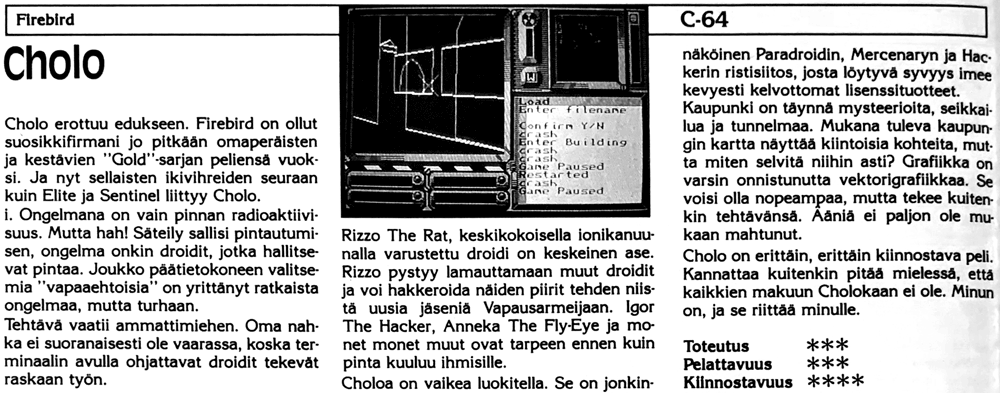
Cholo1987Pysyvä linkkiCholo erottuu edukseen. Firebird on ollut suosikkifirmani jo pitkään omaperäisten ja kestävien "Gold"-sarjan peliensä vuoksi. Ja nyt sellaisten ikivihreiden seuraan kuin Elite ja Sentinel liittyy Cholo.
i. Ongelmana on vain pinnan radioaktiivisuus. Mutta hah! Säteily sallisi pintautumisen, ongelma onkin droidit, jotka hallitsevat pintaa. Joukko päätietokoneen valitsemia "vapaaehtoisia" on yrittänyt ratkaista ongelmaa, mutta turhaan.
Tehtävä vaatii ammattimiehen. Oma nahka ei suoranaisesti ole vaarassa, koska terminaalin avulla ohjattavat droidit tekevät raskaan työn.
Rizzo The Rat, keskikokoisella ionikanuunalla varustettu droidi on keskeinen ase. Rizzo pystyy lamauttamaan muut droidit ja voi hakkeroida näiden piirit tehden niistä uusia jäseniä Vapausarmeijaan. Igor The Hacker, Anneka The Fly-Eye ja monet monet muut ovat tarpeen ennen kuin pinta kuuluu ihmisille.
Choloa on vaikea luokitella. Se on jonkinnäköinen Paradroidin, Mercenaryn ja Hackerin ristisiitos, josta löytyvä syvyys imee kevyesti kelvottomat lisenssituotteet.
Kaupunki on täynnä mysteerioita, seikkailua ja tunnelmaa. Mukana tuleva kaupungin kartta näyttää kiintoisia kohteita, mutta miten selvitä niihin asti? Grafiikka on varsin onnistunutta vektorigrafiikkaa. Se voisi olla nopeampaa, mutta tekee kuitenkin tehtävänsä. Ääniä ei paljon ole mukaan mahtunut.
Cholo on erittäin, erittäin kiinnostava peli. Kannattaa kuitenkin pitää mielessä, että kaikkien makuun Cholokaan ei ole. Minun on, ja se riittää minulle.
Cholo1987PermalinkCholo stands out from the crowd. Firebird has long been my favourite company, thanks to the original and long-lasting games in its "Gold" series. And now Cholo joins the company of such evergreens as Elite and Sentinel.
...The only problem is the radioactivity on the surface. But hah! The radiation would actually allow surfacing - the real problem is the droids that rule the surface. A bunch of "volunteers" hand-picked by the main computer have tried to solve the problem, but in vain.
The job calls for a professional. Your own hide isn't directly on the line, since the droids you control from a terminal do the heavy lifting.
Rizzo The Rat, a droid armed with a medium-sized ion cannon, is your key weapon. Rizzo can stun other droids and hack their circuits, turning them into new recruits for the Freedom Army. Igor The Hacker, Anneka The Fly-Eye and many, many others will be needed before the surface belongs to humans.
Cholo is hard to pigeonhole. It's some sort of crossbreed of Paradroid, Mercenary and Hacker, and the depth to be found in it effortlessly swallows those worthless licence tie-ins whole.
The city is full of mystery, adventure and atmosphere. The city map that comes with the game shows interesting locations, but how do you make it all the way there? The graphics are rather successful vector graphics. They could be faster, but they do the job all the same. Not much sound has managed to squeeze in.
Cholo is a very, very interesting game. It's worth keeping in mind, though, that Cholo isn't to everyone's taste either. It's to mine, and that's enough for me.
Choro Q
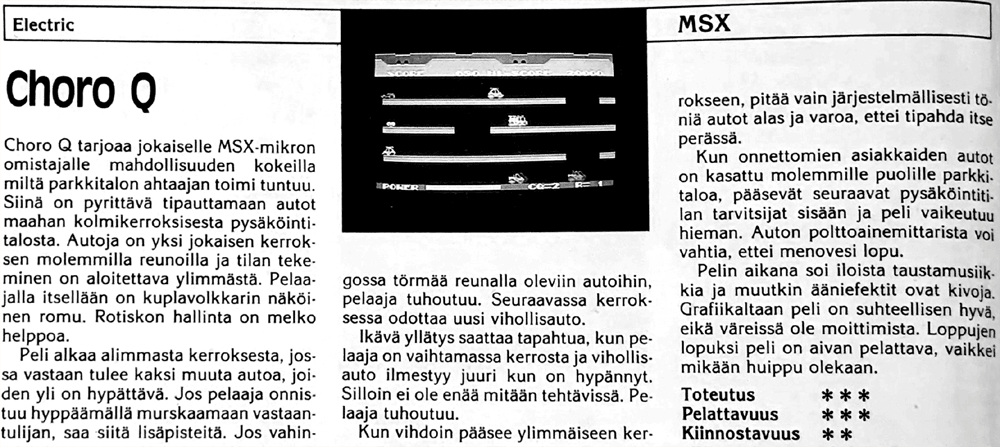
Choro Q1987Pysyvä linkkiChoro Q tarjoaa jokaiselle MSX-mikron omistajalle mahdollisuuden kokeilla miltä parkkitalon ahtaajan toimi tuntuu. Siinä on pyrittävä tipauttamaan autot maahan kolmikerroksisesta pysäköintitalosta. Autoja on yksi jokaisen kerroksen molemmilla reunoilla ja tilan tekeminen on aloitettava ylimmästä. Pelaajalla itsellään on kuplavolkkarin näköinen romu. Rotiskon hallinta on melko helppoa.
Peli alkaa alimmasta kerroksesta, jossa vastaan tulee kaksi muuta autoa, joiden yli on hypättävä. Jos pelaaja onnistuu hyppäämällä murskaamaan vastaantulijan, saa siitä lisäpisteitä. Jos vahingossa törmää reunalla oleviin autoihin, pelaaja tuhoutuu. Seuraavassa kerroksessa odottaa uusi vihollisauto.
Ikävä yllätys saattaa tapahtua, kun pelaaja on vaihtamassa kerrosta ja vihollisauto ilmestyy juuri kun on hypännyt. Silloin ei ole enää mitään tehtävissä. Pelaaja tuhoutuu.
Kun vihdoin pääsee ylimmäiseen kerrokseen, pitää vain järjestelmällisesti töniä autot alas ja varoa, ettei tipahda itse perässä.
Kun onnettomien asiakkaiden autot on kasattu molemmille puolille parkkitaloa, pääsevät seuraavat pysäköintitilan tarvitsijat sisään ja peli vaikeutuu hieman. Auton polttoainemittarista voi vahtia, ettei menovesi lopu.
Pelin aikana soi iloista taustamusiikkia ja muutkin ääniefektit ovat kivoja. Grafiikaltaan peli on suhteellisen hyvä, eikä väreissä ole moittimista. Loppujen lopuksi peli on aivan pelattava, vaikkei mikään huippu olekaan.
Choro Q1987PermalinkChoro Q gives every MSX owner the chance to find out what the job of a multi-storey car park stevedore feels like. The aim is to drop the cars to the ground from a three-storey car park. There's one car at each edge of every floor, and the clearing out has to start from the top one. The player gets a heap of their own that looks like a VW Beetle. Handling the rattletrap is fairly easy.
The game starts on the bottom floor, where two other cars come at you and have to be jumped over. If the player manages to crush an oncoming car by jumping on it, that earns bonus points. Bump into the cars at the edges by accident and the player is destroyed. On the next floor a new enemy car lies in wait.
A nasty surprise can happen when the player is changing floors and an enemy car appears just after you've jumped. Then there's nothing left to be done. The player is destroyed.
When you finally make it to the top floor, you just have to methodically shove the cars off and take care not to tumble down after them yourself.
Once the unlucky customers' cars have been piled up on both sides of the car park, the next lot in need of a parking space get in and the game gets a little harder. You can keep an eye on the car's fuel gauge to make sure you don't run out of go-juice.
Cheerful background music plays during the game, and the other sound effects are nice too. Graphics-wise the game is relatively good, and there's nothing to complain about in the colours. All in all the game is perfectly playable, even if it's nothing top-notch.
Chrono Quest
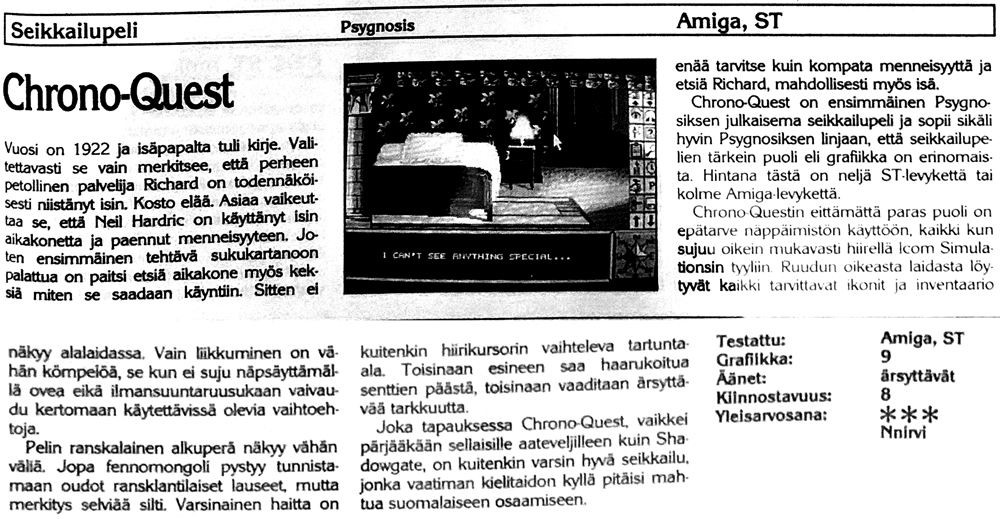
Chrono Quest1989 KevätPysyvä linkkiVuosi on 1922 ja isäpapalta tuli kirje. Valitettavasti se vain merkitsee, että perheen petollinen palvelija Richard on todennäköisesti niistänyt isin. Kosto elää. Asiaa vaikeuttaa se, että Neil Hardric on käyttänyt isin aikakonetta ja paennut menneisyyteen. Joten ensimmäinen tehtävä sukukartanoon palattua on paitsi etsiä aikakone myös keksiä miten se saadaan käyntiin. Sitten ei enää tarvitse kuin kompata menneisyyttä ja etsiä Richard, mahdollisesti myös isä.
Chrono-Quest on ensimmäinen Psygnosiksen julkaisema seikkailupeli ja sopii sikäli hyvin Psygnosiksen linjaan, että seikkailupelien tärkein puoli eli grafiikka on erinomaista. Hintana tästä on neljä ST-levykettä tai kolme Amiga-levykettä.
Chrono-Questin eittämättä paras puoli on epätarve näppäimistön käyttöön, kaikki kun sujuu oikein mukavasti hiirellä Icom Simulationsin tyyliin. Ruudun oikeasta laidasta löytyvät kaikki tarvittavat ikonit ja inventaario näkyy alalaidassa. Vain liikkuminen on vähän kömpelöä, se kun ei suju näpsäyttämällä ovea eikä ilmansuuntaruusukaan vaivaudu kertomaan käytettävissä olevia vaihtoehtoja.
Pelin ranskalainen alkuperä näkyy vähän väliä. Jopa fennomongoli pystyy tunnistamaan oudot ransklantilaiset lauseet, mutta merkitys selviää silti. Varsinainen haitta on kuitenkin hiirikursorin vaihteleva tartunta-ala. Toisinaan esineen saa haarukoitua senttien päästä, toisinaan vaaditaan ärsyttävää tarkkuutta.
Joka tapauksessa Chrono-Quest, vaikkei pärjääkään sellaisille aateveljilleen kuin Shadowgate, on kuitenkin varsin hyvä seikkailu, jonka vaatiman kielitaidon kyllä pitäisi mahtua suomalaiseen osaamiseen.
Chrono Quest1989 KevätPermalinkThe year is 1922, and a letter has arrived from dear old Dad. Unfortunately, all it means is that the family's treacherous servant Richard has probably bumped Daddy off. Vengeance lives. Complicating matters, Neil Hardric has used Daddy's time machine and fled into the past. So the first task once you're back at the family manor is not only to find the time machine but also to figure out how to get it going. After that, all you need to do is scour the past and find Richard, and possibly Dad as well.
Chrono-Quest is the first adventure game published by Psygnosis, and it fits the Psygnosis line well in the sense that the most important aspect of adventure games, namely the graphics, is excellent. The price for this is four ST disks or three Amiga disks.
Chrono-Quest's undeniably best feature is the non-need to use the keyboard, since everything goes very nicely with the mouse, Icom Simulations style. All the icons you need are on the right-hand edge of the screen, and the inventory is shown along the bottom. Only moving around is a bit clumsy, since it isn't done by clicking on a door, and the compass rose doesn't bother to tell you which options are available either.
The game's French origins show every so often. Even a Fenno-Mongol can spot the weird Frenglish sentences, but the meaning comes through all the same. The real drawback, though, is the mouse cursor's varying grab area. Sometimes you can zero in on an object from centimetres away, other times irritating precision is required.
In any case, Chrono-Quest, though it can't match kindred spirits such as Shadowgate, is nonetheless a pretty good adventure, and the language skills it demands should certainly be within Finnish capabilities.
Chronoquest II
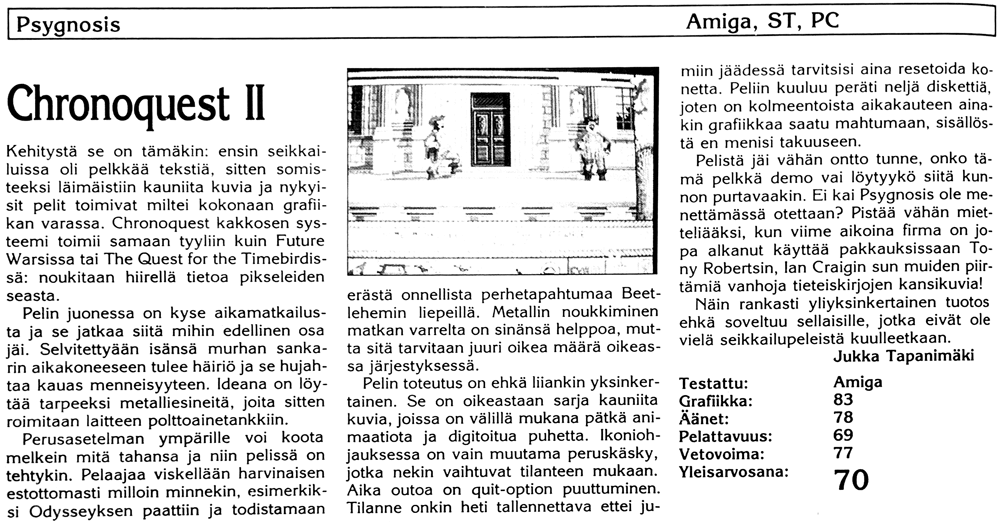
Chronoquest II1990 SyksyPysyvä linkkiKehitystä se on tämäkin: ensin seikkailuissa oli pelkkää tekstiä, sitten somisteeksi läimäistiin kauniita kuvia ja nykyisit pelit toimivat miltei kokonaan grafiikan varassa. Chronoquest kakkosen systeemi toimii samaan tyyliin kuin Future Warsissa tai The Quest for the Timebirdissä: noukitaan hiirellä tietoa pikseleiden seasta.
Pelin juonessa on kyse aikamatkailusta ja se jatkaa siitä mihin edellinen osa jäi. Selvitettyään isänsä murhan sankarin aikakoneeseen tulee häiriö ja se hujahtaa kauas menneisyyteen. Ideana on löytää tarpeeksi metalliesineitä, joita sitten roimitaan laitteen polttoainetankkiin.
Perusasetelman ympärille voi koota melkein mitä tahansa ja niin pelissä on tehtykin. Pelaajaa viskellään harvinaisen estottomasti milloin minnekin, esimerkiksi Odysseyksen paattiin ja todistamaan erästä onnellista perhetapahtumaa Beetlehemin liepeillä. Metallin noukkiminen matkan varrelta on sinänsä helppoa, mutta sitä tarvitaan juuri oikea määrä oikeassa järjestyksessä.
Pelin toteutus on ehkä liiankin yksinkertainen. Se on oikeastaan sarja kauniita kuvia, joissa on välillä mukana pätkä animaatiota ja digitoitua puhetta. Ikoniohjauksessa on vain muutama peruskäsky, jotka nekin vaihtuvat tilanteen mukaan. Aika outoa on quit-option puuttuminen. Tilanne onkin heti tallennettava ettei jumiin jäädessä tarvitsisi aina resetoida konetta. Peliin kuuluu peräti neljä diskettiä, joten on kolmeentoista aikakauteen ainakin grafiikkaa saatu mahtumaan, sisällöstä en menisi takuuseen.
Pelistä jäi vähän ontto tunne, onko tämä pelkkä demo vai löytyykö siitä kunnon purtavaakin. Ei kai Psygnosis ole menettämässä otettaan? Pistää vähän mietteliääksi, kun viime aikoina firma on jopa alkanut käyttää pakkauksissaan Tony Robertsin, Ian Craigin sun muiden piirtämiä vanhoja tieteiskirjojen kansikuvia!
Näin rankasti yliyksinkertainen tuotos ehkä soveltuu sellaisille, jotka eivät ole vielä seikkailupeleistä kuulleetkaan.
Chronoquest II1990 SyksyPermalinkI suppose this counts as progress too: first adventures were nothing but text, then pretty pictures were slapped on as decoration, and today's games run almost entirely on graphics. Chronoquest Two's system works in the same style as Future Wars or The Quest for the Timebird: you pick information out from among the pixels with the mouse.
The game's plot is about time travel, and it carries on from where the previous instalment left off. After the hero has solved his father's murder, his time machine develops a fault and whooshes off far into the past. The idea is to find enough metal objects, which are then chucked into the machine's fuel tank.
You could build almost anything around this basic setup, and that is just what the game has done. The player is flung about with unusual abandon from one place to another, for example into the boat of Odysseys and to witness a certain happy family event on the outskirts of Beetlehem. Picking up metal along the way is easy enough in itself, but you need exactly the right amount in the right order.
The game's execution is perhaps even too simple. It's really a series of pretty pictures, now and then with a snippet of animation and digitised speech thrown in. The icon control has only a handful of basic commands, and even those change depending on the situation. Rather odd is the lack of a quit option. So you'd better save your position straight away, so that you don't have to reset the machine every time you get stuck. The game comes on no fewer than four disks, so at least the graphics for thirteen eras have been squeezed in; as for the content, I wouldn't vouch for it.
The game left a somewhat hollow feeling: is this just a demo, or is there some proper meat to chew on in it as well? Surely Psygnosis isn't losing its grip? It does make you wonder, when lately the company has even started using old science fiction book covers drawn by Tony Roberts, Ian Craig and the like on its packaging!
Such a drastically oversimplified product might suit those who have never even heard of adventure games yet.
Chuck Rock

Chuck Rock1991 SyksyPysyvä linkkiChuck Rockin juoni sisältää riipaisevan tosipohjaisen opetuksen: kun liiaksi keskittyy TV:n töllöttämiseen, naapurin öykkäri käy varastamassa vaimon. Kaappaaminen oli kivikaudella erityisen vaivatonta, koska siihen tarvittiin ainoastaan riittävän painava puukalikka.
Niinpä miehisen löhökulttuurin kantaisän on lähdettävä vaaralliselle taipaleelle noutamaan takaisin armasta pyykinripustajaa. Tämä syvällisiä ikuisuusteemoja koskettava tematiikka on saanut kuvaruudulla läpeensä tavanomaisen loikkimispelin ilmenemismuodot. Ikävystyttävästä kliseisyydestä ei kuitenkaan näy jälkeäkään huikean komiikan ja yleisen sympaattisuuden ansiosta.
Yleisten harhakäsitysten mukaisesti maastoa kansoittavat piikivikaudelle kuulumattomat saurukset, joita Chuck hätistää loitommalle joko tömäyttämällä isokokoisella vatsalla tai monottamalla jalkaterällä. Chuck pystyy myös kaappaamaan käsivarsilleen lohkareen, jota voi käyttää suojakilpenä ilmahyökkäyksien varalta ja heittoaseena.
Pelien toteutuksessa pahasti hapuillut Core on kerrankin saanut aikaan tekeleen, jonka teknisestä puolesta ei ole mitään pahaa sanottavaa. Tarkemmin sanottuna Chuck Rock on kerrassaan upea. Useamman ruudullisen korkuiset alueet vierivät kauniisti kahdessa kerroksessa ja kaikki toimii sulavasti kellon tarkkuudella. Sarjakuvamaiseksi tyylitelty grafiikka on hiottu silmiähiveleväksi ja siinä on vahva lataus maanläheistä junttihuumoria. Maasto on myös täynnä hauskoja yllätyksiä, joilla rikotaan perusidean yksitoikkoisuutta. Esimerkiksi alitettaessa valtavaa brontosaurusta on oltava varuillaan takajalkojen kohdalla, jotta otus ei ruittaise päälle lastillista guanoa.
Pahiten pielessä on musiikki, joka onnistuu lähinnä ärsyttämään kuulokalustoa. Muuten peli onkin todellinen täysosuma Corelta, vaikka kyseessä onkin tyypillisen turhauttava tasannekohellus eikä pintaa syvemmältä löydy todellista omaperäisyyttä.
Chuck Rock1991 SyksyPermalinkChuck Rock's plot contains a harrowing lesson based on real life: if you concentrate too much on goggling at the TV, the neighbourhood lout comes round and steals your wife. Abduction was particularly effortless in the Stone Age, since all it took was a sufficiently heavy wooden club.
And so the founding father of manly slob culture must set out on a perilous trek to fetch back his beloved laundry-hanger. On screen, this subject matter, touching as it does on profound eternal themes, has taken on all the trappings of a thoroughly conventional jumping game. There's not a trace of tedious cliché, however, thanks to the stupendous comedy and all-round likeability.
In keeping with popular misconceptions, the terrain is populated by saurians that have no business in the flint age, which Chuck shoos away either by thumping them with his outsize belly or by booting them with his foot. Chuck can also snatch a boulder up into his arms, which can be used both as a shield against air attacks and as a missile.
Core, which has fumbled badly at actually putting its games together, has for once managed to produce an effort about whose technical side there is nothing bad to say. To be more precise, Chuck Rock is absolutely gorgeous. Areas several screens tall scroll beautifully in two layers and everything runs smoothly with clockwork precision. The cartoon-styled graphics have been polished into a feast for the eyes, and they carry a strong charge of down-to-earth yokel humour. The terrain is also full of amusing surprises that break up the monotony of the basic idea. For example, when passing underneath a huge brontosaurus you have to watch out by the hind legs, so that the beast doesn't squirt a load of guano on top of you.
Furthest off target is the music, which mainly succeeds in irritating your auditory apparatus. Otherwise the game is a real bull's-eye from Core, even though it's a typically frustrating bit of platform bumbling and there's no real originality to be found beneath the surface.
Chuck Yeager's Advanced Flight Trainer 2.0
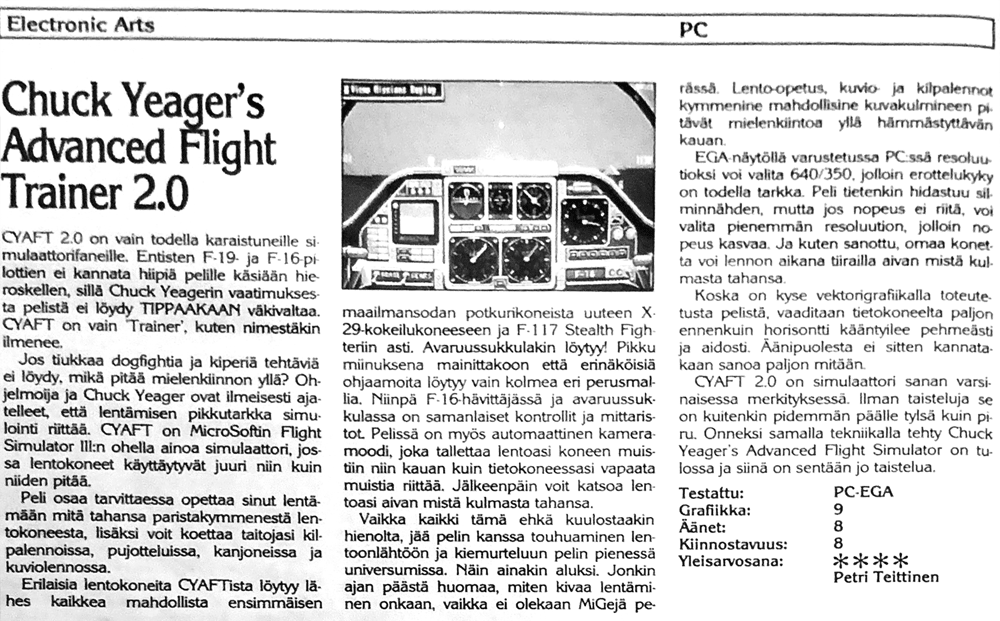
Chuck Yeager's Advanced Flight Trainer 2.01989 SyksyPysyvä linkkiCYAFT 2.0 on vain todella karaistuneille simulaattorifaneille. Entisten F-19- ja F-16-pilottien ei kannata hiipiä pelille käsiään hieroskellen, sillä Chuck Yeagerin vaatimuksesta pelistä ei löydy TIPPAAKAAN väkivaltaa. CYAFT on vain 'Trainer', kuten nimestäkin ilmenee.
Jos tiukkaa dogfightia ja kiperiä tehtäviä ei löydy, mikä pitää mielenkiinnon yllä? Ohjelmoija ja Chuck Yeager ovat ilmeisesti ajatelleet, että lentämisen pikkutarkka simulointi riittää. CYAFT on MicroSoftin Flight Simulator III:n ohella ainoa simulaattori, jossa lentokoneet käyttäytyvät juuri niin kuin niiden pitää.
Peli osaa tarvittaessa opettaa sinut lentämään mitä tahansa paristakymmenestä lentokoneesta, lisäksi voit koettaa taitojasi kilpalennoissa, pujotteluissa, kanjoneissa ja kuviolennossa.
Erilaisia lentokoneita CYAFTista löytyy lähes kaikkea mahdollista ensimmäisen maailmansodan potkurikoneista uuteen X-29-kokeilukoneeseen ja F-117 Stealth Fighteriin asti. Avaruussukkulakin löytyy! Pikku miinuksena mainittakoon että erinäköisiä ohjaamoita löytyy vain kolmea eri perusmallia. Niinpä F-16-hävittäjässä ja avaruussukkulassa on samanlaiset kontrollit ja mittaristot. Pelissä on myös automaattinen kameramoodi, joka tallettaa lentoasi koneen muistiin niin kauan kuin tietokoneessasi vapaata muistia riittää. Jälkeenpäin voit katsoa lentoasi aivan mistä kulmasta tahansa.
Vaikka kaikki tämä ehkä kuulostaakin hienolta, jää pelin kanssa touhuaminen lentoonlähtöön ja kiemurteluun pelin pienessä universumissa. Näin ainakin aluksi. Jonkin ajan päästä huomaa, miten kivaa lentäminen onkaan, vaikka ei olekaan MiGejä perässä. Lento-opetus, kuvio- ja kilpalennot kymmenine mahdollisine kuvakulmineen pitävät mielenkiintoa yllä hämmästyttävän kauan.
EGA-näytöllä varustetussa PC:ssä resoluutioksi voi valita 640/350, jolloin erottelukyky on todella tarkka. Peli tietenkin hidastuu silminnähden, mutta jos nopeus ei riitä, voi valita pienemmän resoluution, jolloin nopeus kasvaa. Ja kuten sanottu, omaa konetta voi lennon aikana tiirailla aivan mistä kulmasta tahansa.
Koska on kyse vektorigrafiikalla toteutetusta pelistä, vaaditaan tietokoneelta paljon ennenkuin horisontti kääntyilee pehmeästi ja aidosti. Äänipuolesta ei sitten kannatakaan sanoa paljon mitään.
CYAFT 2.0 on simulaattori sanan varsinaisessa merkityksessä. Ilman taisteluja se on kuitenkin pidemmän päälle tylsä kuin piru. Onneksi samalla tekniikalla tehty Chuck Yeager's Advanced Flight Simulator on tulossa ja siinä on sentään jo taistelua.
Chuck Yeager's Advanced Flight Trainer 2.01989 SyksyPermalinkCYAFT 2.0 is only for truly hardened simulator fans. Former F-19 and F-16 pilots needn't creep up on the game rubbing their hands, because at Chuck Yeager's insistence there is not ONE DROP of violence in the game. CYAFT is just a 'Trainer', as the name itself makes clear.
If there's no tight dogfighting and no tricky missions, what keeps your interest up? The programmer and Chuck Yeager have apparently figured that meticulous simulation of flying is enough. Alongside MicroSoft's Flight Simulator III, CYAFT is the only simulator in which aircraft behave exactly as they should.
If need be, the game can teach you to fly any of some twenty aircraft; you can also test your skills in air races, slaloms, canyons and formation flying.
As for different aircraft, CYAFT has just about everything possible, from First World War propeller planes all the way to the new X-29 experimental aircraft and the F-117 Stealth Fighter. There's even a space shuttle! As a small minus, let it be mentioned that the different-looking cockpits come in only three basic models. So the F-16 fighter and the space shuttle have the same controls and instruments. The game also has an automatic camera mode, which records your flight in the machine's memory for as long as your computer has free memory left. Afterwards you can watch your flight from absolutely any angle.
Although all this may well sound great, messing about with the game comes down to taking off and wriggling around in the game's small universe. At first, at least. After a while you notice how much fun flying really is, even without MiGs on your tail. The flight lessons, formation flights and air races, with their dozens of possible viewing angles, keep your interest up for a surprisingly long time.
On a PC fitted with an EGA display you can choose a resolution of 640/350, which gives really sharp definition. The game naturally slows down visibly, but if the speed isn't enough, you can choose a lower resolution, which speeds things up. And as I said, you can peer at your own plane from absolutely any angle during the flight.
Since this is a game done in vector graphics, a lot is demanded of the computer before the horizon tilts smoothly and realistically. As for the sound side, it's best not to say much of anything.
CYAFT 2.0 is a simulator in the true sense of the word. Without combat, though, it's boring as hell in the long run. Luckily Chuck Yeager's Advanced Flight Simulator, made with the same technology, is on its way, and that one at least has combat.
Chuck Yeagers Air Combat
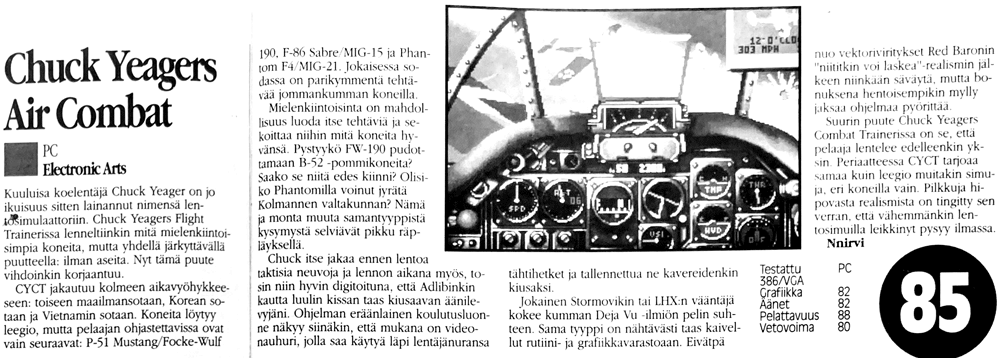
Chuck Yeagers Air Combat1991 SyksyPysyvä linkkiKuuluisa koelentäjä Chuck Yeager on jo ikuisuus sitten lainannut nimensä lentosimulaattoriin. Chuck Yeagers Flight Trainerissa lenneltiinkin mitä mielenkiintoisimpia koneita, mutta yhdellä järkyttävällä puutteella: ilman aseita. Nyt tämä puute vihdoinkin korjaantuu.
CYCT jakautuu kolmeen aikavyöhykkeeseen: toiseen maailmansotaan, Korean sotaan ja Vietnamin sotaan. Koneita löytyy leegio, mutta pelaajan ohjastettavissa ovat vain seuraavat: P-51 Mustang/Focke-Wulf 190, F-86 Sabre/MIG-15 ja Phantom F4/MIG-21. Jokaisessa sodassa on parikymmentä tehtävää jommankumman koneilla.
Mielenkiintoisinta on mahdollisuus luoda itse tehtäviä ja sekoittaa niihin mitä koneita hyvänsä. Pystyykö FW-190 pudottamaan B-52 -pommikoneita? Saako se niitä edes kiinni? Olisiko Phantomilla voinut jyrätä Kolmannen valtakunnan? Nämä ja monta muuta samantyyppistä kysymystä selviävät pikku räpläyksellä.
Chuck itse jakaa ennen lentoa taktisia neuvoja ja lennon aikana myös, tosin niin hyvin digitoituna, että Adlibinkin kautta luulin kissan taas kiusaavan äänilevyjäni. Ohjelman eräänlainen koulutusluonne näkyy siinäkin, että mukana on videonauhuri, jolla saa käytyä läpi lentäjänuransa tähtihetket ja tallennettua ne kavereidenkin kiusaksi.
Jokainen Stormovikin tai LHX:n vääntäjä kokee kumman Deja Vu -ilmiön pelin suhteen. Sama tyyppi on nähtävästi taas kaivellut rutiini- ja grafiikkavarastoaan. Eivätpä nuo vektoriviritykset Red Baronin "niititkin voi laskea"-realismin jälkeen niinkään säväytä, mutta bonuksena hentoisempikin mylly jaksaa ohjelmaa pyörittää.
Suurin puute Chuck Yeagers Combat Trainerissa on se, että pelaaja lentelee edelleenkin yksin. Periaatteessa CYCT tarjoaa samaa kuin leegio muitakin simuja, eri koneilla vain. Pilkkuja hipovasta realismista on tingitty sen verran, että vähemmänkin lentosimuilla leikkinyt pysyy ilmassa.
Chuck Yeagers Air Combat1991 SyksyPermalinkFamous test pilot Chuck Yeager lent his name to a flight simulator an eternity ago. In Chuck Yeagers Flight Trainer you got to fly the most interesting aircraft imaginable, but with one shocking shortcoming: no weapons. Now that shortcoming is finally being put right.
CYCT is split into three eras: the Second World War, the Korean War and the Vietnam War. There's a legion of aircraft, but only the following can be flown by the player: P-51 Mustang/Focke-Wulf 190, F-86 Sabre/MIG-15 and Phantom F4/MIG-21. Each war has some twenty missions in either side's machines.
The most interesting thing is the chance to create missions yourself and throw any planes you like into them. Can an FW-190 shoot down B-52 bombers? Can it even catch them? Could you have steamrollered the Third Reich with a Phantom? These and many other questions of the same sort are answered with a little fiddling.
Chuck himself dishes out tactical advice before the flight and during it too, albeit so well digitised that even through the Adlib I thought the cat was tormenting my records again. The program's sort-of-training character also shows in the inclusion of a video recorder, with which you can go back over the highlights of your flying career and save them to torment your mates with as well.
Anyone who has wrestled with Stormovik or LHX will experience an uncanny deja vu phenomenon with this game. The same guy has evidently been digging through his stock of routines and graphics again. Those vector contraptions don't exactly thrill after Red Baron's "you can even count the rivets" realism, but as a bonus even a feebler machine can manage to run the program.
The biggest shortcoming of Chuck Yeagers Combat Trainer is that the player still flies alone. In principle CYCT offers the same as a legion of other sims, just with different planes. The hair-splitting realism has been toned down enough that even someone who has played less with flight sims stays in the air.
Circus Games
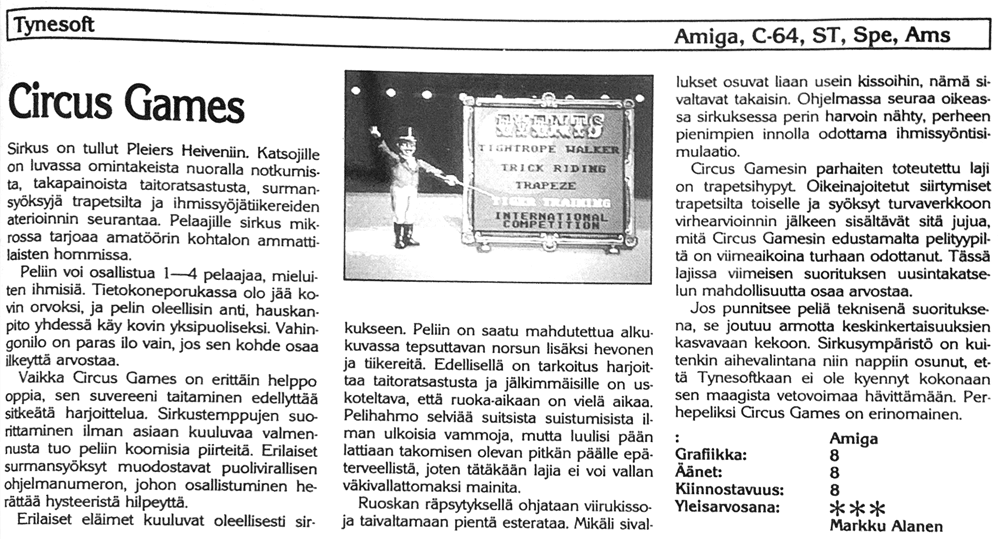
Circus Games1989 SyksyPysyvä linkkiSirkus on tullut Pleiers Heiveniin. Katsojille on luvassa omintakeista nuoralla notkumista, takapainoista taitoratsastusta, surmansyöksyjä trapetsilta ja ihmissyöjätiikereiden aterioinnin seurantaa. Pelaajille sirkus mikrossa tarjoaa amatöörin kohtalon ammattilaisten hommissa.
Peliin voi osallistua 1-4 pelaajaa, mieluiten ihmisiä. Tietokoneporukassa olo jää kovin orvoksi, ja pelin oleellisin anti, hauskanpito yhdessä käy kovin yksipuoliseksi. Vahingonilo on paras ilo vain, jos sen kohde osaa ilkeyttä arvostaa.
Vaikka Circus Games on erittäin helppo oppia, sen suvereeni taitaminen edellyttää sitkeätä harjoittelua. Sirkustemppujen suorittaminen ilman asiaan kuuluvaa valmennusta tuo peliin koomisia piirteitä. Erilaiset surmansyöksyt muodostavat puolivirallisen ohjelmanumeron, johon osallistuminen herättää hysteeristä hilpeyttä.
Erilaiset eläimet kuuluvat oleellisesti sirkukseen. Peliin on saatu mahdutettua alkukuvassa tepsuttavan norsun lisäksi hevonen ja tiikereitä. Edellisellä on tarkoitus harjoittaa taitoratsastusta ja jälkimmäisille on uskoteltava, että ruoka-aikaan on vielä aikaa. Pelihahmo selviää suitsista suistumisista ilman ulkoisia vammoja, mutta luulisi pään lattiaan takomisen olevan pitkän päälle epäterveellistä, joten tätäkään lajia ei voi vallan väkivallattomaksi mainita.
Ruoskan räpsytyksellä ohjataan viirukissoja taivaltamaan pientä esterataa. Mikäli sivallukset osuvat liian usein kissoihin, nämä sivaltavat takaisin. Ohjelmassa seuraa oikeassa sirkuksessa perin harvoin nähty, perheen pienimpien innolla odottama ihmissyöntisimulaatio.
Circus Gamesin parhaiten toteutettu laji on trapetsihypyt. Oikeinajoitetut siirtymiset trapetsilta toiselle ja syöksyt turvaverkkoon virhearvioinnin jälkeen sisältävät sitä jujua, mitä Circus Gamesin edustamalta pelityypiltä on viimeaikoina turhaan odottanut. Tässä lajissa viimeisen suorituksen uusintakatselun mahdollisuutta osaa arvostaa.
Jos punnitsee peliä teknisenä suorituksena, se joutuu armotta keskinkertaisuuksien kasvavaan kekoon. Sirkusympäristö on kuitenkin aihevalintana niin nappiin osunut, että Tynesoftkaan ei ole kyennyt kokonaan sen maagista vetovoimaa hävittämään. Perhepeliksi Circus Games on erinomainen.
Circus Games1989 SyksyPermalinkThe circus has come to Pleiers Heiven. The audience can look forward to idiosyncratic sagging on the tightrope, tail-heavy trick riding, death dives from the trapeze and a close follow-up of man-eating tigers at mealtime. For the players, the circus on a micro offers the fate of an amateur doing a professional's job.
1-4 players can take part in the game, preferably humans. Being in a gang of computers feels awfully orphaned, and the game's most essential offering, having fun together, turns awfully one-sided. Schadenfreude is the best joy only if its target knows how to appreciate spite.
Although Circus Games is extremely easy to learn, sovereign mastery of it takes dogged practice. Performing circus stunts without the proper coaching lends the game its comic side. The various death dives form a semi-official act on the programme, and taking part in it sets off hysterical hilarity.
Various animals are an essential part of the circus. Besides the elephant tripping about on the title screen, the game has managed to squeeze in a horse and tigers. The former is for practising trick riding, and the latter have to be persuaded that feeding time is still a while off. The game character survives his spills from the saddle without external injuries, but you'd think banging your head on the floor would be unhealthy in the long run, so this event can't exactly be called non-violent either.
Cracking the whip, you steer the stripy cats round a small obstacle course. If your lashes hit the cats too often, the cats lash back. Next on the programme comes something very rarely seen in a real circus and eagerly awaited by the littlest members of the family: a people-eating simulation.
The best-implemented event in Circus Games is the trapeze jumps. Well-timed transfers from one trapeze to another, and plunges into the safety net after a misjudgement, have that certain something you've lately waited for in vain from the kind of game Circus Games represents. In this event you really come to appreciate the option of a replay of your last attempt.
Weighed as a technical achievement, the game lands mercilessly on the growing heap of mediocrities. As a choice of subject, though, the circus setting is such a bullseye that even Tynesoft hasn't managed to destroy its magical pull entirely. As a family game, Circus Games is excellent.
Clever & Smart
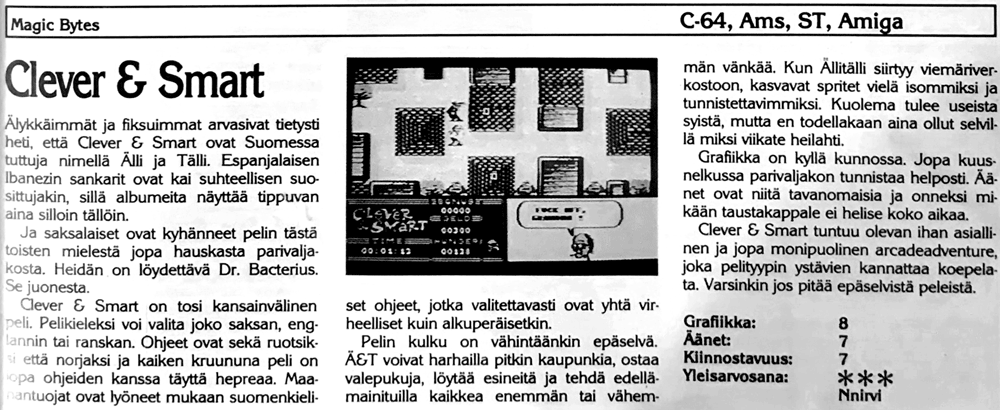
Clever & Smart1988Pysyvä linkkiÄlykkäimmät ja fiksuimmat arvasivat tietysti heti, että Clever & Smart ovat Suomessa tuttuja nimellä Älli ja Tälli. Espanjalaisen Ibanezin sankarit ovat kai suhteellisen suosittujakin, sillä albumeita näyttää tippuvan aina silloin tällöin.
Ja saksalaiset ovat kyhänneet pelin tästä toisten mielestä jopa hauskasta parivaljakosta. Heidän on löydettävä Dr. Bacterius. Se juonesta.
Clever & Smart on tosi kansainvälinen peli. Pelikieleksi voi valita joko saksan, englannin tai ranskan. Ohjeet ovat sekä ruotsiksi että norjaksi ja kaiken kruununa peli on jopa ohjeiden kanssa täyttä hepreaa. Maahantuojat ovat lyöneet mukaan suomenkieliset ohjeet, jotka valitettavasti ovat yhtä virheelliset kuin alkuperäisetkin.
Pelin kulku on vähintäänkin epäselvä. Ä&T voivat harhailla pitkin kaupunkia, ostaa valepukuja, löytää esineitä ja tehdä edellämainituilla kaikkea enemmän tai vähemmän vänkää. Kun Ällitälli siirtyy viemäriverkostoon, kasvavat spritet vielä isommiksi ja tunnistettavimmiksi. Kuolema tulee useista syistä, mutta en todellakaan aina ollut selvillä miksi viikate heilahti.
Grafiikka on kyllä kunnossa. Jopa kuusnelkussa parivaljakon tunnistaa helposti. Äänet ovat niitä tavanomaisia ja onneksi mikään taustakappale ei helise koko aikaa.
Clever & Smart tuntuu olevan ihan asiallinen ja jopa monipuolinen arcadeadventure, joka pelityypin ystävien kannattaa koepelata. Varsinkin jos pitää epäselvistä peleistä.
Clever & Smart1988PermalinkThe cleverest and smartest among you will of course have guessed straight away that Clever & Smart are known in Finland as Älli ja Tälli. The Spaniard Ibanez's heroes are presumably fairly popular too, since albums seem to trickle out every now and then.
And the Germans have cobbled together a game about this duo, whom some people even find funny. They have to find Dr. Bacterius. So much for the plot.
Clever & Smart is a truly international game. You can choose German, English or French as the game language. The instructions are in both Swedish and Norwegian, and to crown it all, even with the instructions the game is all Greek. The importers have thrown in Finnish instructions, which unfortunately are just as full of errors as the originals.
The way the game works is baffling, to say the least. Ä&T can wander around the town, buy disguises, find objects and do all sorts of more or less cool things with the aforementioned. When Ällitälli moves into the sewer network, the sprites grow even bigger and more recognisable. Death comes from a number of causes, but I really wasn't always clear on why the scythe swung.
The graphics are fine, I'll give it that. Even on the C-64 the duo is easy to recognise. The sounds are the usual sort, and luckily there's no background tune jangling away the whole time.
Clever & Smart seems to be a perfectly decent and even varied arcade adventure that fans of the genre should give a test play. Especially if you like baffling games.
Cloud Kingdoms
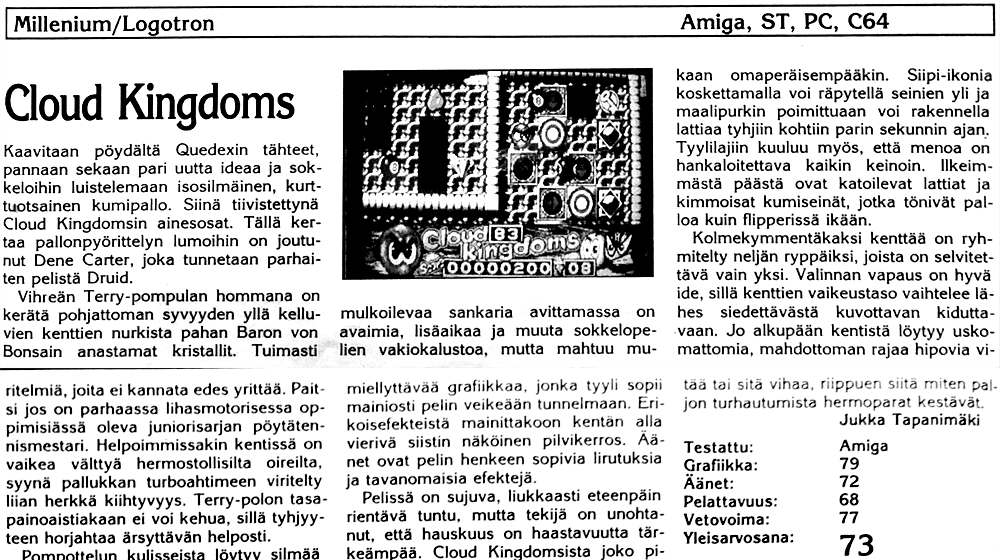
Cloud Kingdoms1990 SyksyPysyvä linkkiKaavitaan pöydältä Quedexin tähteet, pannaan sekaan pari uutta ideaa ja sokkeloihin luistelemaan isosilmäinen, kurttuotsainen kumipallo. Siinä tiivistettynä Cloud Kingdomsin ainesosat. Tällä kertaa pallonpyörittelyn lumoihin on joutunut Dene Carter, joka tunnetaan parhaiten pelistä Druid.
Vihreän Terry-pompulan hommana on kerätä pohjattoman syvyyden yllä kelluvien kenttien nurkista pahan Baron von Bonsain anastamat kristallit. Tuimasti mulkoilevaa sankaria avittamassa on avaimia, lisäaikaa ja muuta sokkelopelien vakiokalustoa, mutta mahtuu mukaan omaperäisempääkin. Siipi-ikonia koskettamalla voi räpytellä seinien yli ja maalipurkin poimittuaan voi rakennella lattiaa tyhjiin kohtiin parin sekunnin ajan. Tyylilajiin kuuluu myös, että menoa on hankaloitettava kaikin keinoin. Ilkeimmästä päästä ovat katoilevat lattiat ja kimmoisat kumiseinät, jotka tönivät palloa kuin flipperissä ikään.
Kolmekymmentäkaksi kenttää on ryhmitelty neljän ryppäiksi, joista on selvitettävä vain yksi. Valinnan vapaus on hyvä ide, sillä kenttien vaikeustaso vaihtelee lähes siedettävästä kuvottavan kiduttavaan. Jo alkupään kentistä löytyy uskomattomia, mahdottoman rajaa hipovia viritelmiä, joita ei kannata edes yrittää. Paitsi jos on parhaassa lihasmotorisessa oppimisiässä oleva juniorisarjan pöytätennismestari. Helpoimmissakin kentissä on vaikea välttyä hermostollisilta oireilta, syynä pallukkan turboahtimeen viritelty liian herkkä kiihtyvyys. Terry-polon tasapainoaistiakaan ei voi kehua, sillä tyhjyyteen horjahtaa ärsyttävän helposti.
Pompottelun kulisseista löytyy silmää miellyttävää grafiikkaa, jonka tyyli sopii mainiosti pelin veikeään tunnelmaan. Erikoisefekteistä mainittakoon kentän alla vierivä siistin näköinen pilvikerros. Äänet ovat pelin henkeen sopivia lirutuksia ja tavanomaisia efektejä.
Pelissä on sujuva, liukkaasti eteenpäin rientävä tuntu, mutta tekijä on unohtanut, että hauskuus on haastavuutta tärkeämpää. Cloud Kingdomsista joko pitää tai sitä vihaa, riippuen siitä miten paljon turhautumista hermoparat kestävät.
Cloud Kingdoms1990 SyksyPermalinkScrape the leftovers of Quedex off the table, stir in a couple of new ideas and send a big-eyed, frown-wrinkled rubber ball skating around the mazes. There, in a nutshell, are the ingredients of Cloud Kingdoms. This time the one who has fallen under the spell of ball-rolling is Dene Carter, best known for the game Druid.
The job of Terry, the little green bouncer, is to collect the crystals stolen by the evil Baron von Bonsai from the corners of levels floating above a bottomless abyss. Helping the fiercely glowering hero along are keys, extra time and the rest of the standard maze-game furniture, but there's room for something more original too. By touching a wing icon you can flap over walls, and after picking up a paint pot you can build floor over the empty spots for a couple of seconds. It also goes with the genre that progress has to be made difficult by every means possible. At the nastiest end are the vanishing floors and springy rubber walls that shove the ball about just like in a pinball machine.
The thirty-two levels are grouped into clusters of four, of which you only have to clear one. The freedom of choice is a good idea, since the difficulty of the levels ranges from almost bearable to sickeningly torturous. Even among the early levels there are unbelievable contraptions bordering on the impossible, which aren't even worth attempting. Unless you happen to be a junior-league table tennis champion at the peak age for learning motor skills. Even in the easiest levels it's hard to escape nervous symptoms, the reason being the far too twitchy acceleration tuned into the little ball's turbocharger. Poor Terry's sense of balance is nothing to boast about either, since it's irritatingly easy to totter off into the void.
Behind all the bouncing there are eye-pleasing graphics whose style suits the game's playful mood splendidly. Among the special effects, the neat-looking layer of cloud scrolling beneath the level deserves a mention. The sound consists of tootling tunes in keeping with the spirit of the game and the usual effects.
The game has a smooth, slickly flowing feel, but its creator has forgotten that fun matters more than challenge. You either like Cloud Kingdoms or you hate it, depending on how much frustration your poor nerves can take.
Cobra
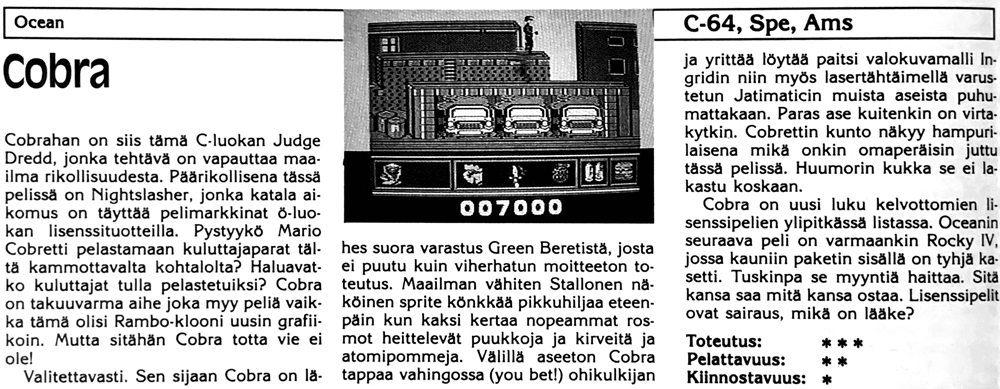
Cobra1987Pysyvä linkkiCobrahan on siis tämä C-luokan Judge Dredd, jonka tehtävä on vapauttaa maailma rikollisuudesta. Päärikollisena tässä pelissä on Nightslasher, jonka katala aikomus on täyttää pelimarkkinat ö-luokan lisenssituotteilla. Pystyykö Mario Cobretti pelastamaan kuluttajaparat tältä kammottavalta kohtalolta? Haluavatko kuluttajat tulla pelastetuiksi? Cobra on takuuvarma aihe joka myy peliä vaikka tämä olisi Rambo-klooni uusin grafiikoin. Mutta sitähän Cobra totta vie ei ole!
Valitettavasti. Sen sijaan Cobra on lähes suora varastus Green Beretistä, josta ei puutu kuin viherhatun moitteeton toteutus. Maailman vähiten Stallonen näköinen sprite könkkää pikkuhiljaa eteenpäin kun kaksi kertaa nopeammat rosmot heittelevät puukkoja ja kirveitä ja atomipommeja. Välillä aseeton Cobra tappaa vahingossa (you bet!) ohikulkijan ja yrittää löytää paitsi valokuvamalli Ingridin niin myös lasertähtäimellä varustetun Jatimaticin muista aseista puhumattakaan. Paras ase kuitenkin on virtakytkin. Cobrettin kunto näkyy hampurilaisena mikä onkin omaperäisin juttu tässä pelissä. Huumorin kukka se ei lakastu koskaan.
Cobra on uusi luku kelvottomien lisenssipelien ylipitkässä listassa. Oceanin seuraava peli on varmaankin Rocky IV, jossa kauniin paketin sisällä on tyhjä kasetti. Tuskinpa se myyntiä haittaa. Sitä kansa saa mitä kansa ostaa. Lisenssipelit ovat sairaus, mikä on lääke?
Cobra1987PermalinkSo Cobra, then, is this C-grade Judge Dredd whose job is to rid the world of crime. The chief villain in this game is Nightslasher, whose dastardly plan is to flood the games market with Z-grade licence products. Can Marion Cobretti save the poor consumers from this horrifying fate? Do the consumers even want to be saved? Cobra is a surefire subject that would sell the game even if it were a Rambo clone with new graphics. But that, by golly, is one thing Cobra is not!
Unfortunately. Instead, Cobra is an almost straight rip-off of Green Beret, lacking only the green hat's flawless execution. The world's least Stallone-looking sprite clomps forward bit by bit while crooks twice as fast hurl knives and axes and atom bombs. Every now and then the unarmed Cobra accidentally (you bet!) kills a passer-by and tries to find not only photo model Ingrid but also a Jatimatic with a laser sight, not to mention other weapons. The best weapon, though, is the power switch. Cobretti's health is shown as a hamburger, which is in fact the most original thing in this game. Ah, the flower of humour - it never wilts.
Cobra is yet another entry on the overlong list of worthless licence games. Ocean's next game will probably be Rocky IV, with an empty cassette inside a pretty package. That's hardly going to hurt sales. The people get what the people buy. Licence games are a disease - what's the cure?
Cobra Triangle
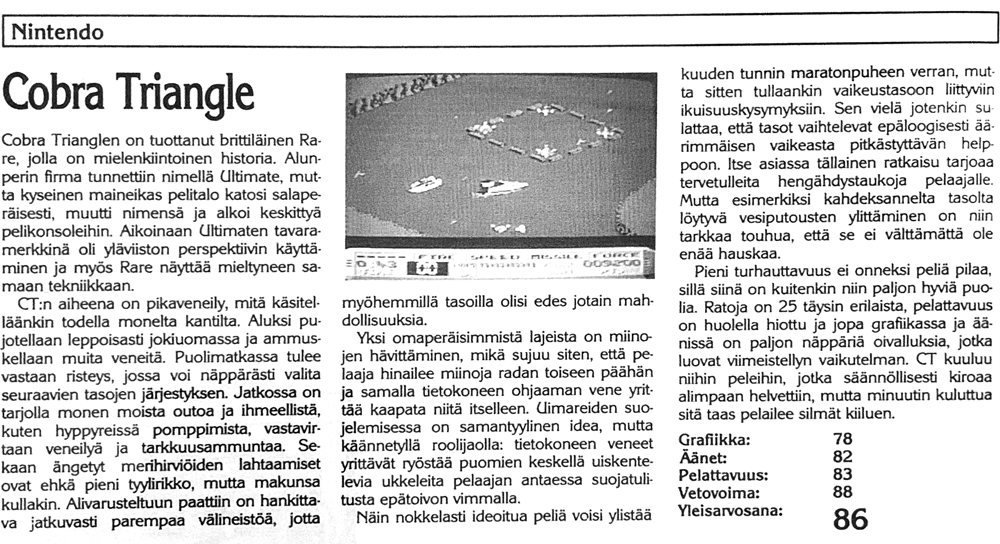
Cobra Triangle1990 KevätPysyvä linkkiCobra Trianglen on tuottanut brittiläinen Rare, jolla on mielenkiintoinen historia. Alunperin firma tunnettiin nimellä Ultimate, mutta kyseinen maineikas pelitalo katosi salaperäisesti, muutti nimensä ja alkoi keskittyä pelikonsoleihin. Aikoinaan Ultimaten tavaramerkkinä oli yläviiston perspektiivin käyttäminen ja myös Rare näyttää mieltyneen samaan tekniikkaan.
CT:n aiheena on pikaveneily, mitä käsitelläänkin todella monelta kantilta. Aluksi pujotellaan leppoisasti jokiuomassa ja ammuskellaan muita veneitä. Puolimatkassa tulee vastaan risteys, jossa voi näppärästi valita seuraavien tasojen järjestyksen. Jatkossa on tarjolla monen moista outoa ja ihmeellistä, kuten hyppyreissä pomppimista, vastavirtaan veneilyä ja tarkkuusammuntaa. Sekaan ängetyt merihirviöiden lahtaamiset ovat ehkä pieni tyylirikko, mutta makunsa kullakin. Alivarusteltuun paattiin on hankittava jatkuvasti parempaa välineistöä, jotta myöhemmillä tasoilla olisi edes jotain mahdollisuuksia.
Yksi omaperäisimmistä lajeista on miinojen hävittäminen, mikä sujuu siten, että pelaaja hinailee miinoja radan toiseen päähän ja samalla tietokoneen ohjaaman vene yrittää kaapata niitä itselleen. Uimareiden suojelemisessa on samantyylinen idea, mutta käännetyllä roolijaolla: tietokoneen veneet yrittävät ryöstää puomien keskellä uiskentelevia ukkeleita pelaajan antaessa suojatulitusta epätoivon vimmalla.
Näin nokkelasti ideoitua peliä voisi ylistää kuuden tunnin maratonpuheen verran, mutta sitten tullaankin vaikeustasoon liittyviin ikuisuuskysymyksiin. Sen vielä jotenkin sulattaa, että tasot vaihtelevat epäloogisesti äärimmäisen vaikeasta pitkästyttävän helppoon. Itse asiassa tällainen ratkaisu tarjoaa tervetulleita hengähdystaukoja pelaajalle. Mutta esimerkiksi kahdeksannelta tasolta löytyvä vesiputousten ylittäminen on niin tarkkaa touhua, että se ei välttämättä ole enää hauskaa.
Pieni turhauttavuus ei onneksi peliä pilaa, sillä siinä on kuitenkin niin paljon hyviä puolia. Ratoja on 25 täysin erilaista, pelattavuus on huolella hiottu ja jopa grafiikassa ja äänissä on paljon näppäriä oivalluksia, jotka luovat viimeistellyn vaikutelman. CT kuuluu niihin peleihin, jotka säännöllisesti kiroaa alimpaan helvettiin, mutta minuutin kuluttua sitä taas pelailee silmät kiiluen.
Cobra Triangle1990 KevätPermalinkCobra Triangle was produced by the British Rare, which has an interesting history. Originally the firm was known as Ultimate, but that renowned games house mysteriously vanished, changed its name and started concentrating on games consoles. In its day Ultimate's trademark was the use of a diagonal overhead perspective, and Rare too seems to have taken a liking to the same technique.
CT's subject is speedboating, which it tackles from a great many angles. At first you slalom leisurely along a river channel taking potshots at other boats. Halfway along you come to a junction where you can handily choose the order of the following levels. After that there's all sorts of weird and wonderful stuff on offer, such as bouncing over ramps, boating against the current and precision shooting. The sea-monster slaughters crammed in among it all are perhaps a slight lapse of style, but each to their own. You have to keep getting better gear for your under-equipped tub so as to stand at least some kind of chance on the later levels.
One of the most original events is mine clearing, which works like this: the player tows mines to the other end of the course while a computer-controlled boat tries to snatch them for itself. Protecting swimmers has a similar sort of idea but with the roles reversed: the computer's boats try to kidnap the little fellows paddling about in the middle of the booms while the player lays down covering fire with the fury of desperation.
A game this cleverly thought out could be praised for the length of a six-hour marathon speech, but then we come to the eternal questions surrounding the difficulty level. You can somehow still swallow the levels varying illogically from extremely hard to boringly easy. In fact, that sort of arrangement gives the player welcome breathers. But crossing the waterfalls on level eight, for example, is such a precise business that it isn't necessarily fun any more.
Luckily a little frustration doesn't spoil the game, since it has so many good points all the same. There are 25 completely different courses, the playability has been carefully honed, and even the graphics and sound have lots of neat touches that create a polished impression. CT is one of those games that you regularly curse to the lowest pit of hell, but a minute later there you are playing it again with your eyes gleaming.
Codename Mat
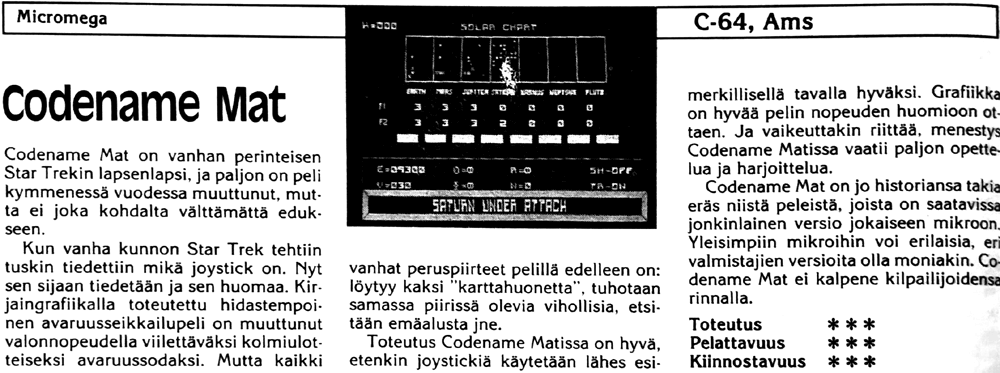
Codename Mat1987Pysyvä linkkiCodename Mat on vanhan perinteisen Star Trekin lapsenlapsi, ja paljon on peli kymmenessä vuodessa muuttunut, mutta ei joka kohdalta välttämättä edukseen.
Kun vanha kunnon Star Trek tehtiin tuskin tiedettiin mikä joystick on. Nyt sen sijaan tiedetään ja sen huomaa. Kirjaingrafiikalla toteutettu hidastempoinen avaruusseikkailupeli on muuttunut valonnopeudella viilettäväksi kolmiulotteiseksi avaruussodaksi. Mutta kaikki vanhat peruspiirteet pelillä edelleen on: löytyy kaksi "karttahuonetta", tuhotaan samassa piirissä olevia vihollisia, etsitään emäalusta jne.
Toteutus Codename Matissa on hyvä, etenkin joystickiä käytetään lähes esimerkillisellä tavalla hyväksi. Grafiikka on hyvää pelin nopeuden huomioon ottaen. Ja vaikeuttakin riittää, menestys Codename Matissa vaatii paljon opettelua ja harjoittelua.
Codename Mat on jo historiansa takia eräs niistä peleistä, joista on saatavissa jonkinlainen versio jokaiseen mikroon. Yleisimpiin mikroihin voi erilaisia, eri valmistajien versioita olla moniakin. Codename Mat ei kalpene kilpailijoidensa rinnalla.
Codename Mat1987PermalinkCodename Mat is a grandchild of the good old traditional Star Trek, and the game has changed a lot in ten years, though not necessarily for the better in every respect.
When good old Star Trek was made, people hardly knew what a joystick was. Now, on the other hand, they do, and it shows. The slow-paced space adventure done in character graphics has turned into a three-dimensional space war tearing along at the speed of light. But the game still has all the old basic features: there are two "map rooms", you destroy the enemies in the same sector, you search for the mothership, etc.
The execution in Codename Mat is good; the joystick in particular is put to use in an almost exemplary way. The graphics are good considering the speed of the game. And there's plenty of difficulty too: succeeding at Codename Mat takes a lot of learning and practice.
Because of its history alone, Codename Mat is one of those games that you can get some version of for every computer. For the most common computers there may even be several different versions from different makers. Codename Mat does not pale beside its rivals.
Colonial Conquest
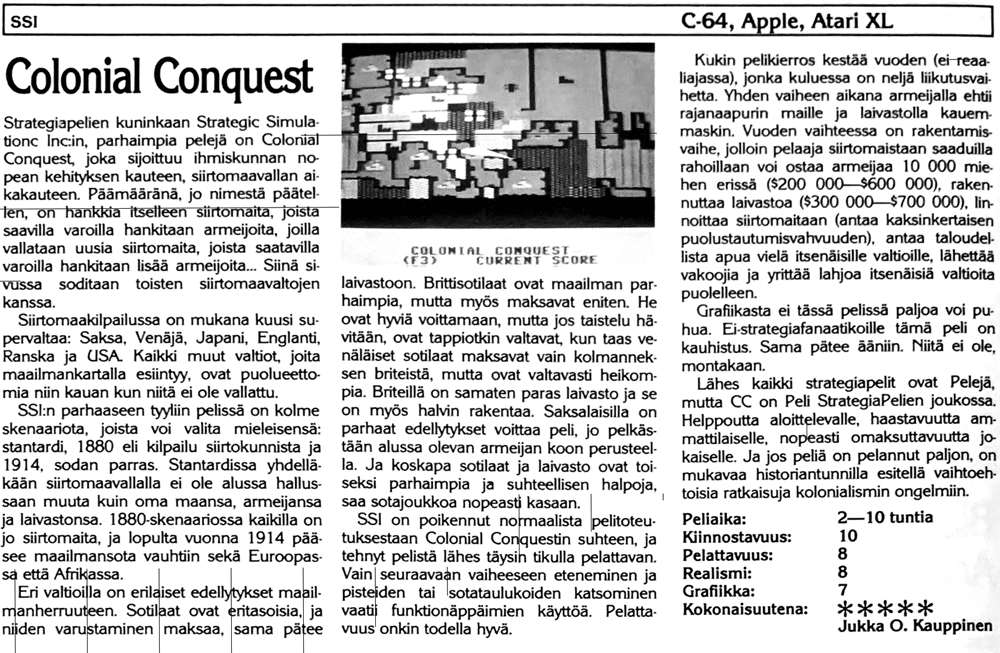
Colonial Conquest1988Pysyvä linkkiStrategiapelien kuninkaan Strategic Simulationc Inc:in, parhaimpia pelejä on Colonial Conquest, joka sijoittuu ihmiskunnan nopean kehityksen kauteen, siirtomaavallan aikakauteen. Päämääränä, jo nimestä päätellen, on hankkia itselleen siirtomaita, joista saavilla varoilla hankitaan armeijoita, joilla vallataan uusia siirtomaita, joista saatavilla varoilla hankitaan lisää armeijoita... Siinä sivussa soditaan toisten siirtomaavaltojen kanssa.
Siirtomaakilpailussa on mukana kuusi supervaltaa: Saksa, Venäjä, Japani, Englanti, Ranska ja USA. Kaikki muut valtiot, joita maailmankartalla esiintyy, ovat puolueettomia niin kauan kun niitä ei ole vallattu.
SSI:n parhaaseen tyyliin pelissä on kolme skenaariota, joista voi valita mieleisensä: stantardi, 1880 eli kilpailu siirtokunnista ja 1914, sodan parras. Stantardissa yhdelläkään siirtomaavallalla ei ole alussa hallussaan muuta kuin oma maansa, armeijansa ja laivastonsa. 1880-skenaariossa kaikilla on jo siirtomaita, ja lopulta vuonna 1914 pääsee maailmansota vauhtiin sekä Euroopassa että Afrikassa.
Eri valtioilla on erilaiset edellytykset maailmanherruuteen. Sotilaat ovat eritasoisia, ja niiden varustaminen maksaa, sama pätee laivastoon. Brittisotilaat ovat maailman parhaimpia, mutta myös maksavat eniten. He ovat hyviä voittamaan, mutta jos taistelu hävitään, ovat tappiotkin valtavat, kun taas venäläiset sotilaat maksavat vain kolmanneksen briteistä, mutta ovat valtavasti heikompia. Briteillä on samaten paras laivasto ja se on myös halvin rakentaa. Saksalaisilla on parhaat edellytykset voittaa peli, jo pelkästään alussa olevan armeijan koon perusteella. Ja koskapa sotilaat ja laivasto ovat toiseksi parhaimpia ja suhteellisen halpoja, saa sotajoukkoa nopeasti kasaan.
SSI on poikennut normaalista pelitoteutuksestaan Colonial Conquestin suhteen, ja tehnyt pelistä lähes täysin tikulla pelattavan. Vain seuraavaan vaiheeseen eteneminen ja pisteiden tai sotataulukoiden katsominen vaatii funktionäppäimien käyttöä. Pelattavuus onkin todella hyvä.
Kukin pelikierros kestää vuoden (ei reaaliajassa), jonka kuluessa on neljä liikutusvaihetta. Yhden vaiheen aikana armeijalla ehtii rajanaapurin maille ja laivastolla kauemmaskin. Vuoden vaihteessa on rakentamisvaihe, jolloin pelaaja siirtomaistaan saaduilla rahoillaan voi ostaa armeijaa 10 000 miehen erissä ($200 000-$600 000), rakennuttaa laivastoa ($300 000-$700 000), linnoittaa siirtomaitaan (antaa kaksinkertaisen puolustautumisvahvuuden), antaa taloudellista apua vielä itsenäisille valtioille, lähettää vakoojia ja yrittää lahjoa itsenäisiä valtioita puolelleen.
Grafiikasta ei tässä pelissä paljoa voi puhua. Ei-strategiafanaatikoille tämä peli on kauhistus. Sama pätee ääniin. Niitä ei ole, montakaan.
Lähes kaikki strategiapelit ovat Pelejä, mutta CC on Peli StrategiaPelien joukossa. Helppoutta aloittelevalle, haastavuutta ammattilaiselle, nopeasti omaksuttavuutta jokaiselle. Ja jos peliä on pelannut paljon, on mukavaa historiantunnilla esitellä vaihtoehtoisia ratkaisuja kolonialismin ongelmiin.
Colonial Conquest1988PermalinkOne of the best games from Strategic Simulationc Inc, the king of strategy games, is Colonial Conquest, which is set in a period of rapid human development, the age of colonial power. The aim, as the name already suggests, is to acquire colonies, whose revenues buy armies, which conquer new colonies, whose revenues buy more armies... And on the side you wage war with the other colonial powers.
Six superpowers take part in the race for colonies: Germany, Russia, Japan, England, France and the USA. All the other states that appear on the world map are neutral for as long as they haven't been conquered.
In the best SSI style, the game has three scenarios to choose from: standard, 1880, i.e. the race for colonies, and 1914, the brink of war. In the standard scenario none of the colonial powers holds anything at the start except its own country, its army and its navy. In the 1880 scenario everyone already has colonies, and finally, in 1914, the world war gets into full swing in both Europe and Africa.
The different nations have different prospects of world domination. The soldiers vary in quality, and equipping them costs money; the same goes for the navy. British soldiers are the best in the world, but they also cost the most. They're good at winning, but if a battle is lost, the losses are huge too, whereas Russian soldiers cost only a third of what the British do, but are vastly weaker. The British likewise have the best navy, and it is also the cheapest to build. The Germans have the best chance of winning the game, if only because of the size of the army they start with. And since their soldiers and navy are the second best and relatively cheap, you can put a fighting force together quickly.
With Colonial Conquest SSI has departed from its usual way of making games and made the game almost entirely playable with the joystick. Only moving on to the next phase and looking at the scores or the war tables requires the function keys. The playability is, accordingly, really good.
Each game round lasts a year (not in real time), during which there are four movement phases. In one phase an army can reach the lands of a neighbouring country, and a navy can get even further. At the turn of the year there is a build phase, when the player, with the money from their colonies, can buy army in lots of 10,000 men ($200,000-$600,000), have a navy built ($300,000-$700,000), fortify their colonies (which doubles their defensive strength), give economic aid to states that are still independent, send out spies and try to bribe independent states over to their side.
There isn't much to be said about the graphics in this game. To non-strategy-fanatics this game is an abomination. The same goes for the sound. There isn't any. Not much, anyway.
Almost all strategy games are Games, but CC is The Game among StrategyGames. Ease for the beginner, challenge for the professional, quick to pick up for everyone. And if you've played the game a lot, it's nice to present alternative solutions to the problems of colonialism in history class.
Colorado
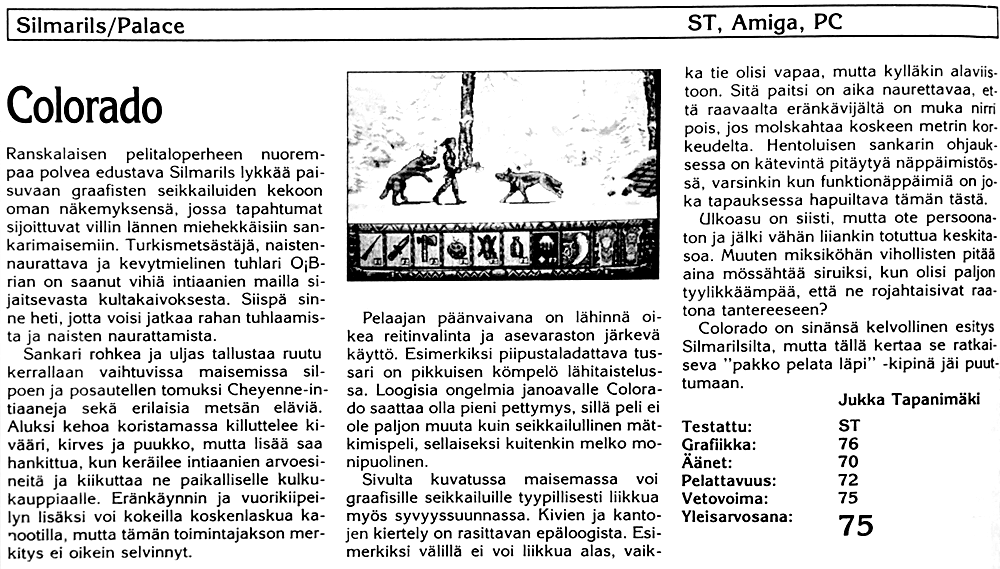
Colorado1990 SyksyPysyvä linkkiRanskalaisen pelitaloperheen nuorempaa polvea edustava Silmarils lykkää paisuvaan graafisten seikkailuiden kekoon oman näkemyksensä, jossa tapahtumat sijoittuvat villin lännen miehekkäisiin sankarimaisemiin. Turkismetsästäjä, naistennaurattava ja kevytmielinen tuhlari O¡Brian on saanut vihiä intiaanien mailla sijaitsevasta kultakaivoksesta. Siispä sinne heti, jotta voisi jatkaa rahan tuhlaamista ja naisten naurattamista.
Sankari rohkea ja uljas tallustaa ruutu kerrallaan vaihtuvissa maisemissa silpoen ja posautellen tomuksi Cheyenne-intiaaneja sekä erilaisia metsän eläviä. Aluksi kehoa koristamassa killuttelee kivääri, kirves ja puukko, mutta lisää saa hankittua, kun keräilee intiaanien arvoesineitä ja kiikuttaa ne paikalliselle kulkukauppiaalle. Eränkäynnin ja vuorikiipeilyn lisäksi voi kokeilla koskenlaskua kanootilla, mutta tämän toimintajakson merkitys ei oikein selvinnyt.
Pelaajan päänvaivana on lähinnä oikea reitinvalinta ja asevaraston järkevä käyttö. Esimerkiksi piipustaladattava tussari on pikkuisen kömpelö lähitaistelussa. Loogisia ongelmia janoavalle Colorado saattaa olla pieni pettymys, sillä peli ei ole paljon muuta kuin seikkailullinen mätkimispeli, sellaiseksi kuitenkin melko monipuolinen.
Sivulta kuvatussa maisemassa voi graafisille seikkailuille tyypillisesti liikkua myös syvyyssuunnassa. Kivien ja kantojen kiertely on rasittavan epäloogista. Esimerkiksi välillä ei voi liikkua alas, vaikka tie olisi vapaa, mutta kylläkin alaviistoon. Sitä paitsi on aika naurettavaa, että raavaalta eränkävijältä on muka nirri pois, jos molskahtaa koskeen metrin korkeudelta. Hentoluisen sankarin ohjauksessa on kätevintä pitäytyä näppäimistössä, varsinkin kun funktionäppäimiä on joka tapauksessa hapuiltava tämän tästä.
Ulkoasu on siisti, mutta ote persoonaton ja jälki vähän liiankin totuttua keskitasoa. Muuten miksiköhän vihollisten pitää aina mössähtää siruiksi, kun olisi paljon tyylikkäämpää, että ne rojahtaisivat raatona tantereeseen?
Colorado on sinänsä kelvollinen esitys Silmarilsilta, mutta tällä kertaa se ratkaiseva "pakko pelata läpi" -kipinä jäi puuttumaan.
Colorado1990 SyksyPermalinkSilmarils, representing the younger generation of the French family of game houses, shoves its own take onto the swelling heap of graphic adventures, with the action set in the manly heroic landscapes of the Wild West. Fur trapper, ladies' man and frivolous spendthrift O¡Brian has caught wind of a gold mine on Indian land. So off he goes at once, so that he can carry on squandering money and charming the ladies.
The hero, brave and gallant, trudges through landscapes that change a screen at a time, hacking up Cheyenne Indians and assorted beasts of the forest and blasting them to dust. To begin with, dangling about his person as decoration are a rifle, an axe and a knife, but you can get more by collecting the Indians' valuables and lugging them to the local travelling trader. Besides roughing it in the wilds and climbing mountains you can also try shooting the rapids in a canoe, but the point of this action sequence never really became clear.
The player's headaches are mainly choosing the right route and making sensible use of the arsenal. The muzzle-loading shooting iron, for example, is a tad clumsy in close combat. Anyone thirsting for logical puzzles may find Colorado a slight disappointment, since the game is little more than an adventurous bash-'em-up, though a fairly varied one for all that.
As is typical of graphic adventures, in the side-on landscape you can also move into and out of the screen. Getting round rocks and stumps is irritatingly illogical. Sometimes, for example, you can't move down even though the way is clear, and yet you can move diagonally down. Besides, it's pretty ridiculous that a burly backwoodsman supposedly snuffs it if he plops into the rapids from a height of one metre. When steering this brittle-boned hero it's handiest to stick to the keyboard, especially as you have to fumble for the function keys every now and then anyway.
The presentation is tidy, but the approach is impersonal and the result a bit too much of the usual middling standard. And by the way, why do enemies always have to splat into smithereens, when it would be much classier for them to keel over dead in the dust?
Colorado is a decent enough effort from Silmarils in itself, but this time that crucial "must play it through" spark was missing.
Coloris
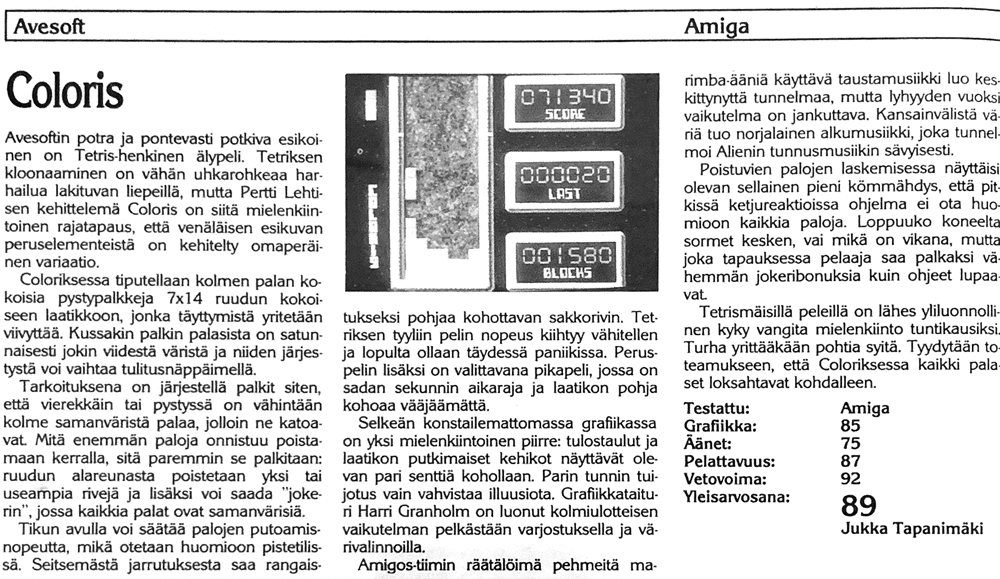
Coloris1990 KevätPysyvä linkkiAvesoftin potra ja pontevasti potkiva esikoinen on Tetris-henkinen älypeli. Tetriksen kloonaaminen on vähän uhkarohkeaa harhailua lakituvan liepeillä, mutta Pertti Lehtisen kehittelemä Coloris on siitä mielenkiintoinen rajatapaus, että venäläisen esikuvan peruselementeistä on kehitelty omaperäinen variaatio.
Coloriksessa tiputellaan kolmen palan kokoisia pystypalkkeja 7x14 ruudun kokoiseen laatikkoon, jonka täyttymistä yritetään viivyttää. Kussakin palkin palasista on satunnaisesti jokin viidestä väristä ja niiden järjestystä voi vaihtaa tulitusnäppäimellä.
Tarkoituksena on järjestellä palkit siten, että vierekkäin tai pystyssä on vähintään kolme samanväristä palaa, jolloin ne katoavat. Mitä enemmän paloja onnistuu poistamaan kerralla, sitä paremmin se palkitaan: ruudun alareunasta poistetaan yksi tai useampia rivejä ja lisäksi voi saada "jokerin", jossa kaikkia palat ovat samanvärisiä.
Tikun avulla voi säätää palojen putoamisnopeutta, mikä otetaan huomioon pistetilissä. Seitsemästä jarrutuksesta saa rangaistukseksi pohjaa kohottavan sakkorivin. Tetriksen tyyliin pelin nopeus kiihtyy vähitellen ja lopulta ollaan täydessä paniikissa. Peruspelin lisäksi on valittavana pikapeli, jossa on sadan sekunnin aikaraja ja laatikon pohja kohoaa vääjäämättä.
Selkeän konstailemattomassa grafiikassa on yksi mielenkiintoinen piirre: tulostaulut ja laatikon putkimaiset kehikot näyttävät olevan pari senttiä kohollaan. Parin tunnin tuijotus vain vahvistaa illuusiota. Grafiikkataituri Harri Granholm on luonut kolmiulotteisen vaikutelman pelkästään varjostuksella ja värivalinnoilla.
Amigos-tiimin räätälöimä pehmeitä marimba-ääniä käyttävä taustamusiikki luo keskittynyttä tunnelmaa, mutta lyhyyden vuoksi vaikutelma on jankuttava. Kansainvälistä väriä tuo norjalainen alkumusiikki, joka tunnelmoi Alienin tunnusmusiikin sävyisesti.
Poistuvien palojen laskemisessa näyttäisi olevan sellainen pieni kömmähdys, että pitkissä ketjureaktioissa ohjelma ei ota huomioon kaikkia paloja. Loppuuko koneelta sormet kesken, vai mikä on vikana, mutta joka tapauksessa pelaaja saa palkaksi vähemmän jokeribonuksia kuin ohjeet lupaavat.
Tetrismäisillä peleillä on lähes yliluonnollinen kyky vangita mielenkiinto tuntikausiksi. Turha yrittääkään pohtia syitä. Tyydytään toteamukseen, että Coloriksessa kaikki palaset loksahtavat kohdalleen.
Coloris1990 KevätPermalinkAvesoft's strapping, lustily kicking firstborn is a Tetris-style puzzle game. Cloning Tetris is a somewhat reckless wander along the fringes of the courtroom, but Coloris, developed by Pertti Lehtinen, is an interesting borderline case in that an original variation has been built out of the basic elements of the Russian model.
In Coloris you drop vertical bars three pieces tall into a box measuring 7x14 squares, and try to put off the moment it fills up. Each of the pieces in a bar is randomly one of five colours, and their order can be switched with the fire button.
The idea is to arrange the bars so that at least three pieces of the same colour line up side by side or vertically, at which point they disappear. The more pieces you manage to clear at once, the better the reward: one or more rows are removed from the bottom of the screen, and on top of that you can get a "joker", in which all the pieces are the same colour.
The joystick lets you adjust how fast the pieces fall, which is taken into account in the scoring. Braking seven times earns you a penalty row that pushes the floor up. In true Tetris style the game gradually speeds up, and in the end you're in full-blown panic. Besides the basic game there's also a quick game to choose from, with a hundred-second time limit and a box floor that rises relentlessly.
The clear, unfussy graphics have one interesting feature: the scoreboards and the tubular frames of the box seem to stand a couple of centimetres proud of the screen. A couple of hours of staring only strengthens the illusion. Graphics wizard Harri Granholm has created the three-dimensional impression purely through shading and choice of colours.
The background music tailored by the Amigos team, using soft marimba sounds, creates a focused mood, but since it's so short the effect is repetitive and nagging. A touch of international colour comes from the Norwegian title music, which sets the mood in the vein of the Alien theme.
There seems to be a small blunder in the counting of cleared pieces: in long chain reactions the program doesn't take all the pieces into account. Whether the machine runs out of fingers to count on or something else is wrong, either way the player is rewarded with fewer joker bonuses than the instructions promise.
Tetris-like games have an almost supernatural ability to hold your interest for hours on end. No point even trying to work out why. Let's just settle for saying that in Coloris all the pieces click into place.
Commando
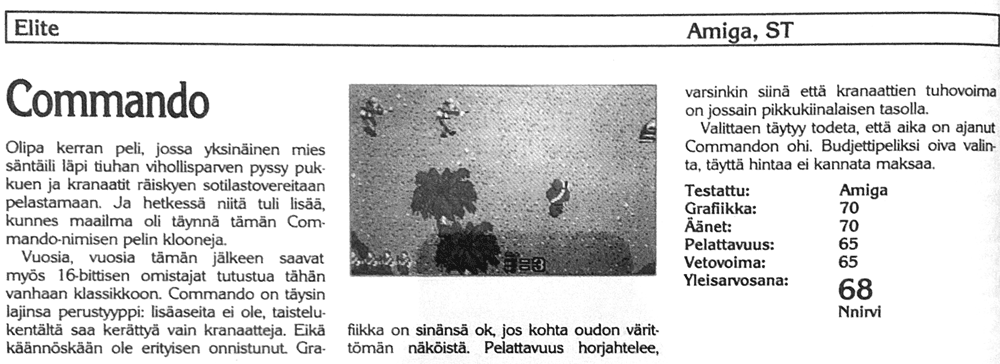
Commando1990 KevätPysyvä linkkiOlipa kerran peli, jossa yksinäinen mies säntäili läpi tiuhan vihollisparven pyssy pukkuen ja kranaatit räiskyen sotilastovereitaan pelastamaan. Ja hetkessä niitä tuli lisää, kunnes maailma oli täynnä tämän Commando-nimisen pelin klooneja.
Vuosia, vuosia tämän jälkeen saavat myös 16-bittisen omistajat tutustua tähän vanhaan klassikkoon. Commando on täysin lajinsa perustyyppi: lisäaseita ei ole, taistelukentältä saa kerättyä vain kranaatteja. Eikä käännöskään ole erityisen onnistunut. Grafiikka on sinänsä ok, jos kohta oudon värittömän näköistä. Pelattavuus horjahtelee, varsinkin siinä että kranaattien tuhovoima on jossain pikkukiinalaisen tasolla.
Valittaen täytyy todeta, että aika on ajanut Commandon ohi. Budjettipeliksi oiva valinta, täyttä hintaa ei kannata maksaa.
Commando1990 KevätPermalinkOnce upon a time there was a game in which a lone man dashed through a dense swarm of enemies, gun rattling and grenades blasting, to rescue his fellow soldiers. And in no time more of them came along, until the world was full of clones of this game called Commando.
Years and years later, the owners of 16-bitters also get to make the acquaintance of this old classic. Commando is the absolute basic model of its kind: there are no extra weapons, and the only thing you can collect on the battlefield is grenades. Nor is the conversion particularly successful. The graphics are OK as such, if strangely colourless-looking. The playability wobbles, especially in that the grenades pack roughly the destructive power of a penny banger.
Regrettably it has to be said that time has passed Commando by. As a budget game it would be an excellent choice, but it's not worth paying full price for.
Conflict Europe
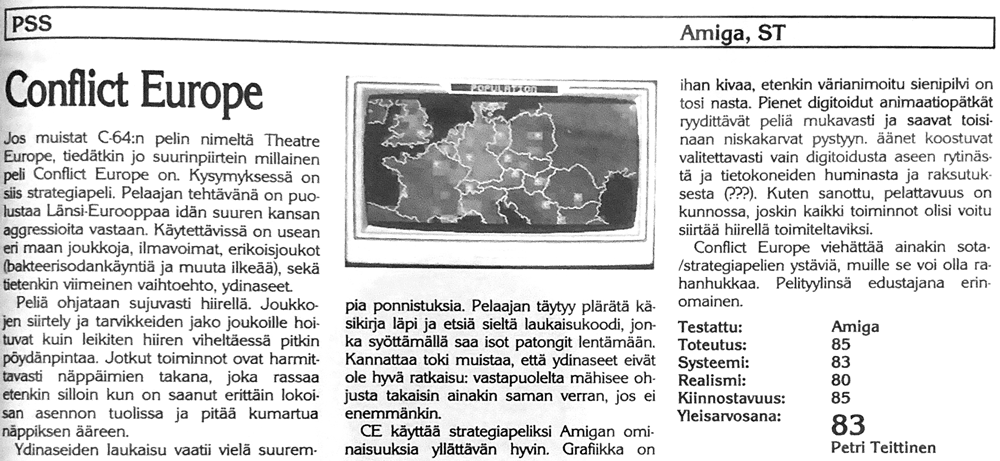
Conflict Europe1990 KevätPysyvä linkkiJos muistat C-64:n pelin nimeltä Theatre Europe, tiedätkin jo suurinpiirtein millainen peli Conflict Europe on. Kysymyksessä on siis strategiapeli. Pelaajan tehtävänä on puolustaa Länsi-Eurooppaa idän suuren kansan aggressioita vastaan. Käytettävissä on usean eri maan joukkoja, ilmavoimat, erikoisjoukot (bakteerisodankäyntiä ja muuta ilkeää), sekä tietenkin viimeinen vaihtoehto, ydinaseet.
Peliä ohjataan sujuvasti hiirellä. Joukkojen siirtely ja tarvikkeiden jako joukoille hoituvat kuin leikiten hiiren viheltäessä pitkin pöydänpintaa. Jotkut toiminnot ovat harmittavasti näppäimien takana, joka rassaa etenkin silloin kun on saanut erittäin lokoisan asennon tuolissa ja pitää kumartua näppiksen ääreen.
Ydinaseiden laukaisu vaatii vielä suurempia ponnistuksia. Pelaajan täytyy plärätä käsikirja läpi ja etsiä sieltä laukaisukoodi, jonka syöttämällä saa isot patongit lentämään. Kannattaa toki muistaa, että ydinaseet eivät ole hyvä ratkaisu: vastapuolelta mähisee ohjusta takaisin ainakin saman verran, jos ei enemmänkin.
CE käyttää strategiapeliksi Amigan ominaisuuksia yllättävän hyvin. Grafiikka on ihan kivaa, etenkin värianimoitu sienipilvi on tosi nasta. Pienet digitoidut animaatiopätkät ryydittävät peliä mukavasti ja saavat toisinaan niskakarvat pystyyn. äänet koostuvat valitettavasti vain digitoidusta aseen rytinästä ja tietokoneiden huminasta ja raksutuksesta (???). Kuten sanottu, pelattavuus on kunnossa, joskin kaikki toiminnot olisi voitu siirtää hiirellä toimiteltaviksi.
Conflict Europe viehättää ainakin sota-/strategiapelien ystäviä, muille se voi olla rahanhukkaa. Pelityylinsä edustajana erinomainen.
Conflict Europe1990 KevätPermalinkIf you remember the C-64 game called Theatre Europe, you already know roughly what kind of game Conflict Europe is. So what we have here is a strategy game. The player's task is to defend Western Europe against the aggressions of the great people of the East. At your disposal are troops from several different countries, the air force, special forces (germ warfare and other nasty stuff) and, of course, the last resort: nuclear weapons.
The game is controlled smoothly with the mouse. Moving troops around and handing out supplies to them is child's play, with the mouse whistling along the tabletop. Some functions are annoyingly tucked away behind keys, which really grates, especially when you've settled into an extremely comfy position in your chair and have to lean over to the keyboard.
Launching nuclear weapons demands even greater effort. The player has to leaf through the manual and dig out the launch code, and typing it in gets the big baguettes flying. Do bear in mind, though, that nukes are not a good solution: at least as many missiles come whooshing back from the other side, if not more.
For a strategy game, CE uses the Amiga's capabilities surprisingly well. The graphics are quite nice, and the colour-animated mushroom cloud in particular is really neat. Little digitised animation clips spice up the game nicely and now and then make the hairs on the back of your neck stand up. The sound, sadly, consists only of digitised weapon clatter and the humming and clicking of computers (???). As I said, the playability is in good shape, although all the functions could have been moved over to the mouse.
Conflict Europe will at least charm fans of war/strategy games; for everyone else it may be a waste of money. An excellent representative of its genre.
Conflict: Middle East
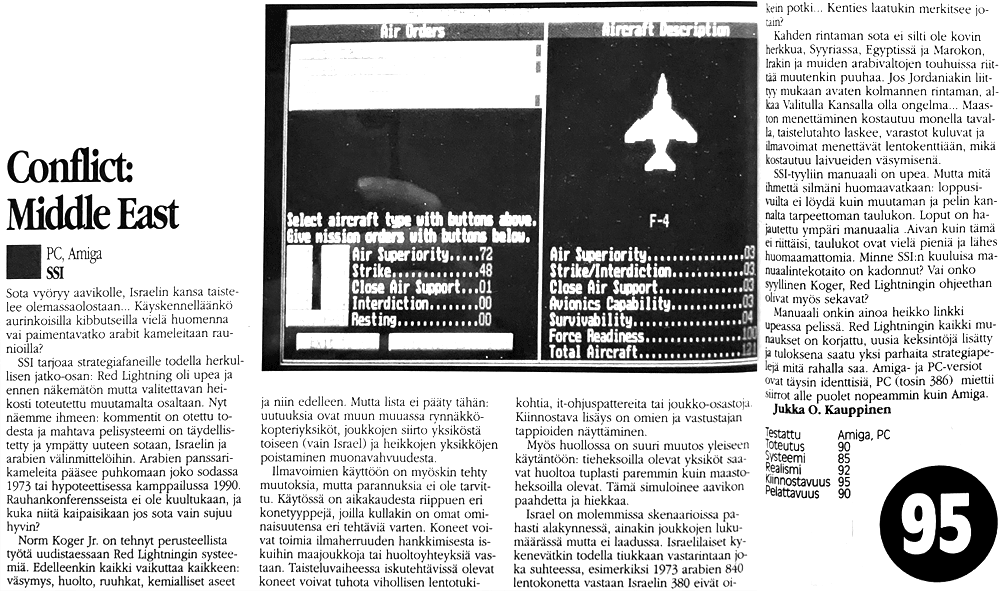
Conflict: Middle East1991 SyksyPysyvä linkkiSota vyöryy aavikolle, Israelin kansa taistelee olemassaolostaan... Käyskennelläänkö aurinkoisilla kibbutseilla vielä huomenna vai paimentavatko arabit kameleitaan raunioilla?
SSI tarjoaa strategiafaneille todella herkullisen jatko-osan: Red Lightning oli upea ja ennen näkemätön mutta valitettavan heikosti toteutettu muutamalta osaltaan. Nyt näemme ihmeen: kommentit on otettu todesta ja mahtava pelisysteemi on täydellistetty ja ympätty uuteen sotaan, Israelin ja arabien välinmittelöihin. Arabien panssarikameleita pääsee puhkomaan joko sodassa 1973 tai hypoteettisessa kamppailussa 1990. Rauhankonferensseista ei ole kuultukaan, ja kuka niitä kaipaisikaan jos sota vain sujuu hyvin?
Norm Koger Jr. on tehnyt perusteellista työtä uudistaessaan Red Lightningin systeemiä. Edelleenkin kaikki vaikuttaa kaikkeen: väsymys, huolto, ruuhkat, kemialliset aseet ja niin edelleen. Mutta lista ei pääty tähän: uutuuksia ovat muun muuassa rynnäkkökopteriyksiköt, joukkojen siirto yksiköstä toiseen (vain Israel) ja heikkojen yksikköjen poistaminen muonavahvuudesta.
Ilmavoimien käyttöön on myöskin tehty muutoksia, mutta parannuksia ei ole tarvittu. Käytössä on aikakaudesta riippuen eri konetyyppejä, joilla kullakin on omat ominaisuutensa eri tehtäviä varten. Koneet voivat toimia ilmaherruuden hankkimisesta iskuihin maajoukkoja tai huoltoyhteyksiä vastaan. Taisteluvaiheessa iskutehtävissä olevat koneet voivat tuhota vihollisen lentotukikohtia, it-ohjuspattereita tai joukko-osastoja. Kiinnostava lisäys on omien ja vastustajan tappioiden näyttäminen.
Myös huollossa on suuri muutos yleiseen käytäntöön: tieheksoilla olevat yksiköt saavat huoltoa tuplasti paremmin kuin maastoheksoilla olevat. Tämä simuloinee aavikon paahdetta ja hiekkaa.
Israel on molemmissa skenaarioissa pahasti alakynnessä, ainakin joukkojen lukumäärässä mutta ei laadussa. Israelilaiset kykenevätkin todella tiukkaan vastarintaan joka suhteessa, esimerkiksi 1973 arabien 840 lentokonetta vastaan Israelin 380 eivät oikein potki... Kenties laatukin merkitsee jotain?
Kahden rintaman sota ei silti ole kovin herkkua, Syyriassa, Egyptissä ja Marokon, Irakin ja muiden arabivaltojen touhuissa riittää muutenkin puuhaa. Jos Jordaniakin liittyy mukaan avaten kolmannen rintaman, alkaa Valitulla Kansalla olla ongelma... Maaston menettäminen kostautuu monella tavalla, taistelutahto laskee, varastot kuluvat ja ilmavoimat menettävät lentokenttiään, mikä kostautuu laivueiden väsymisenä.
SSI-tyyliin manuaali on upea. Mutta mitä ihmettä silmäni huomaavatkaan: loppusivuilta ei löydä kuin muutaman ja pelin kannalta tarpeettoman taulukon. Loput on hajautettu ympäri manuaalia .Aivan kuin tämä ei riittäisi, taulukot ovat vielä pieniä ja lähes huomaamattomia. Minne SSI:n kuuluisa manuaalintekotaito on kadonnut? Vai onko syyllinen Koger, Red Lightningin ohjeethan olivat myös sekavat?
Manuaali onkin ainoa heikko linkki upeassa pelissä. Red Lightningin kaikki munaukset on korjattu, uusia keksintöjä lisätty ja tuloksena saatu yksi parhaita strategiapelejä mitä rahalla saa. Amiga- ja PC-versiot ovat täysin identtisiä, PC (tosin 386) miettii siirrot alle puolet nopeammin kuin Amiga.
Conflict: Middle East1991 SyksyPermalinkWar rolls across the desert, the people of Israel are fighting for their existence... Will people still be strolling about the sunny kibbutzim tomorrow, or will the Arabs be herding their camels among the ruins?
SSI serves strategy fans a truly delicious sequel: Red Lightning was superb and unprecedented but regrettably poorly executed in a few respects. Now we witness a miracle: the feedback has been taken seriously, and the mighty game system has been perfected and grafted onto a new war, the showdowns between Israel and the Arabs. You get to puncture Arab armoured camels either in the war of 1973 or in a hypothetical clash in 1990. Peace conferences are unheard of, and who would miss them anyway, as long as the war is going well?
Norm Koger Jr. has done a thorough job revamping Red Lightning's system. Everything still affects everything: fatigue, supply, traffic jams, chemical weapons and so on. But the list doesn't end there: the new features include, among other things, attack helicopter units, transferring troops from one unit to another (Israel only) and striking weak units off the ration roll.
Changes have also been made to the use of the air force, but no improvements were needed. Depending on the era, different aircraft types are available, each with its own characteristics for different missions. The planes can do anything from winning air superiority to strikes against ground troops or supply lines. In the combat phase, planes on strike missions can destroy enemy air bases, anti-aircraft missile batteries or troop formations. An interesting addition is the display of your own and the enemy's losses.
Supply, too, marks a big change from common practice: units on road hexes get supplied twice as well as those on off-road hexes. This presumably simulates the scorching heat and sand of the desert.
In both scenarios Israel is at a severe disadvantage, at least in numbers of troops, though not in quality. The Israelis are indeed capable of really stubborn resistance in every respect; for example, in 1973 the Arabs' 840 aircraft against Israel's 380 don't really cut it... Perhaps quality counts for something too?
Even so, a two-front war is not much of a treat; Syria and Egypt, plus the antics of Morocco, Iraq and the other Arab states, keep you busy enough as it is. If Jordan joins in too, opening a third front, the Chosen People start to have a problem... Losing ground comes back to bite you in many ways: fighting spirit drops, stockpiles dwindle and the air force loses its airfields, which comes back to bite you as squadron fatigue.
In true SSI style, the manual is superb. But what on earth do my eyes behold: the back pages hold only a handful of tables, and ones that are unnecessary for the game at that. The rest are scattered all over the manual. As if that weren't enough, the tables are small and almost unnoticeable to boot. Where has SSI's famous manual-making skill vanished to? Or is Koger the culprit, seeing as Red Lightning's instructions were muddled too?
The manual, then, is the only weak link in a superb game. All of Red Lightning's cock-ups have been fixed, new inventions added, and the result is one of the best strategy games money can buy. The Amiga and PC versions are completely identical; the PC (a 386, admittedly) thinks over its moves in less than half the time the Amiga takes.
Conqueror
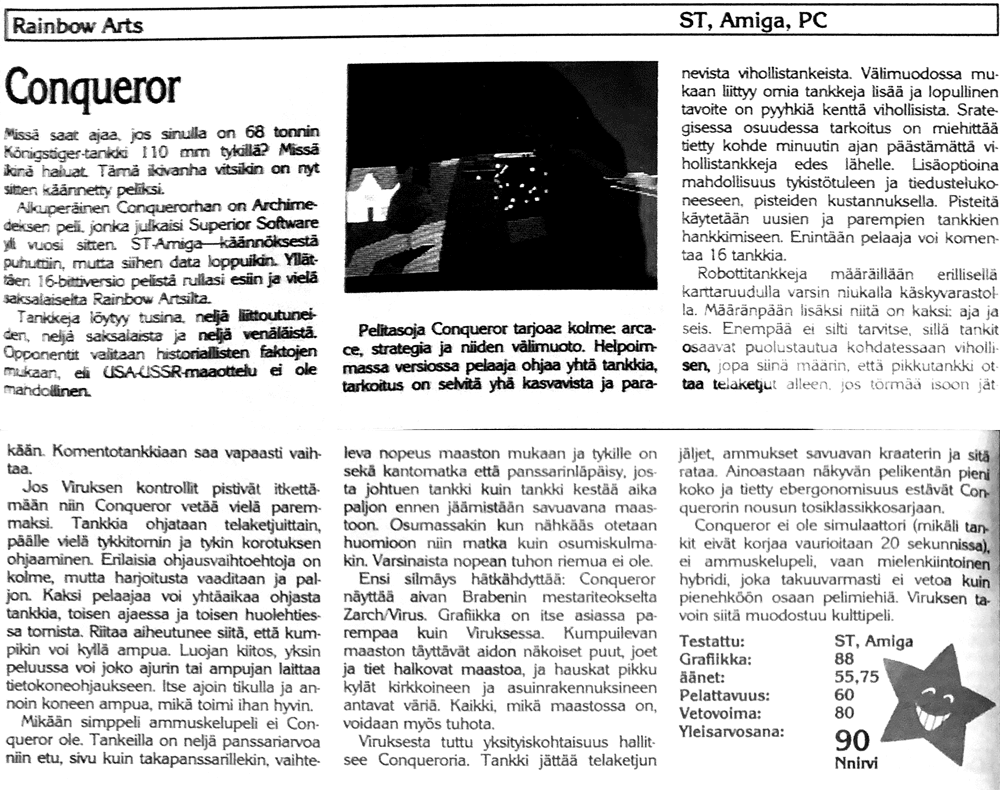
Conqueror1990 KevätPysyvä linkkiMissä saat ajaa, jos sinulla on 68 tonnin Königstiger-tankki 110 mm tykillä? Missä ikinä haluat. Tämä ikivanha vitsikin on nyt sitten käännetty peliksi.
Alkuperäinen Conquerorhan on Archimedeksen peli, jonka julkaisi Superior Software yli vuosi sitten. ST-Amiga-käännöksestä puhuttiin, mutta siihen data loppuikin. Yllättäen 16-bittiversio pelistä rullasi esiin ja vielä saksalaiselta Rainbow Artsilta.
Tankkeja löytyy tusina, neljä liittoutuneiden, neljä saksalaista ja neljä venäläistä. Opponentit valitaan historiallisten faktojen mukaan, eli USA-USSR-maaottelu ei ole mahdollinen.
Pelitasoja Conqueror tarjoaa kolme: arcace, strategia ja niiden välimuoto. Helpoimmassa versiossa pelaaja ohjaa yhtä tankkia, tarkoitus on selvitä yhä kasvavista ja paranevista vihollistankeista. Välimuodossa mukaan liittyy omia tankkeja lisää ja lopullinen tavoite on pyyhkiä kenttä vihollisista. Srategisessa osuudessa tarkoitus on miehittää tietty kohde minuutin ajan päästämättä vihollistankkeja edes lähelle. Lisäoptioina mahdollisuus tykistötuleen ja tiedustelukoneeseen, pisteiden kustannuksella. Pisteitä käytetään uusien ja parempien tankkien hankkimiseen. Enintään pelaaja voi komentaa 16 tankkia.
Robottitankkeja määräillään erillisellä karttaruudulla varsin niukalla käskyvarastolla. Määränpään lisäksi niitä on kaksi: aja ja seis. Enempää ei silti tarvitse, sillä tankit osaavat puolustautua kohdatessaan vihollisen, jopa siinä määrin, että pikkutankki ottaa telaketjut alleen, jos törmää isoon jätkään. Komentotankkiaan saa vapaasti vaihtaa.
Jos Viruksen kontrollit pistivät itkettämään niin Conqueror vetää vielä paremmaksi. Tankkia ohjataan telaketjuittain, päälle vielä tykkitornin ja tykin korotuksen ohjaaminen. Erilaisia ohjausvaihtoehtoja on kolme, mutta harjoitusta vaaditaan ja paljon. Kaksi pelaajaa voi yhtäaikaa ohjasta tankkia, toisen ajaessa ja toisen huolehtiessa tornista. Riitaa aiheutunee siitä, että kumpikin voi kyllä ampua. Luojan kiitos, yksin peluussa voi joko ajurin tai ampujan laittaa tietokoneohjaukseen. Itse ajoin tikulla ja annoin koneen ampua, mikä toimi ihan hyvin.
Mikään simppeli ammuskelupeli ei Conqueror ole. Tankeilla on neljä panssariarvoa niin etu, sivu kuin takapanssarillekin, vaihteleva nopeus maaston mukaan ja tykille on sekä kantomatka että panssarinläpäisy, josta johtuen tankki kuin tankki kestää aika paljon ennen jäämistään savuavana maastoon. Osumassakin kun nähkääs otetaan huomioon niin matka kuin osumiskulmakin. Varsinaista nopean tuhon riemua ei ole.
Ensi silmäys hätkähdyttää: Conqueror näyttää aivan Brabenin mestariteokselta Zarch/Virus. Grafiikka on itse asiassa parempaa kuin Viruksessa. Kumpuilevan maaston täyttävät aidon näkoiset puut, joet ja tiet halkovat maastoa, ja hauskat pikku kylät kirkkoineen ja asuinrakennuksineen antavat väriä. Kaikki, mikä maastossa on, voidaan myös tuhota.
Viruksesta tuttu yksityiskohtaisuus hallitsee Conqueroria. Tankki jättää telaketjun jäljet, ammukset savuavan kraaterin ja sitä rataa. Ainoastaan näkyvän pelikentän pieni koko ja tietty ebergonomisuus estävät Conquerorin nousun tosiklassikkosarjaan.
Conqueror ei ole simulaattori (mikäli tankit eivät korjaa vaurioitaan 20 sekunnissa), ei ammuskelupeli, vaan mielenkiintoinen hybridi, joka takuuvarmasti ei vetoa kuin pienehköön osaan pelimiehiä. Viruksen tavoin siitä muodostuu kulttipeli.
Conqueror1990 KevätPermalinkWhere can you drive if you've got a 68-tonne Königstiger tank with a 110 mm gun? Anywhere you like. So now even this ancient joke has been converted into a game.
The original Conqueror, as you know, is an Archimedes game, released by Superior Software more than a year ago. There was talk of an ST/Amiga conversion, but that's where the data ran out. Then out of the blue a 16-bit version of the game came rolling out, and from the German Rainbow Arts of all people.
There's a dozen tanks: four Allied, four German and four Russian. Opponents are chosen according to historical fact, so a USA-USSR international match isn't on.
Conqueror offers three game levels: arcade, strategy and a halfway house between the two. In the easiest version the player controls one tank, and the idea is to survive ever-growing numbers of ever-better enemy tanks. In the in-between mode more of your own tanks join in, and the ultimate goal is to sweep the field clear of enemies. In the strategic section the idea is to hold a particular objective for a minute without letting enemy tanks even get close. Extra options are artillery fire and a reconnaissance plane, at the cost of points. Points are used to acquire new and better tanks. The player can command at most 16 tanks.
The robot tanks are bossed around on a separate map screen with a rather meagre stock of orders. Besides the destination there are two: go and stop. You don't need any more than that, though, since the tanks know how to defend themselves when they meet the enemy, even to the extent that a little tank takes to its tracks if it runs into a big bloke. You can switch your command tank freely.
If Virus's controls made you cry, Conqueror goes one better. The tank is steered one track at a time, and on top of that you control the turret and the gun elevation. There are three different control options, but practice is required, and lots of it. Two players can control the tank at the same time, one driving and the other looking after the turret. Arguments will probably arise from the fact that both of them can shoot. Thank the Lord, when playing alone you can hand either the driver or the gunner over to computer control. I drove with the joystick myself and let the machine do the shooting, which worked quite well.
Conqueror is no simple shoot-'em-up. The tanks have four armour values, for front, side and rear armour alike, a speed that varies with the terrain, and the gun has both a range and an armour penetration, which means any tank at all can take quite a lot before it's left smoking in the landscape. You see, even a hit takes into account both the distance and the angle of impact. There's none of the real joy of quick destruction.
The first glance is startling: Conqueror looks just like Braben's masterpiece Zarch/Virus. The graphics are actually better than in Virus. The rolling landscape is filled with realistic-looking trees, rivers and roads cut across the terrain, and cute little villages with their churches and houses add colour. Everything in the landscape can also be destroyed.
The attention to detail familiar from Virus rules Conqueror. The tank leaves track marks, the shells leave a smoking crater, and so on. Only the small size of the visible playfield and a certain lack of ergonomics keep Conqueror from rising into the true-classics league.
Conqueror is not a simulator (unless tanks repair their damage in 20 seconds), nor a shoot-'em-up, but an interesting hybrid that is guaranteed to appeal to only a smallish portion of gamers. Like Virus, it will become a cult game.
Continental Circus
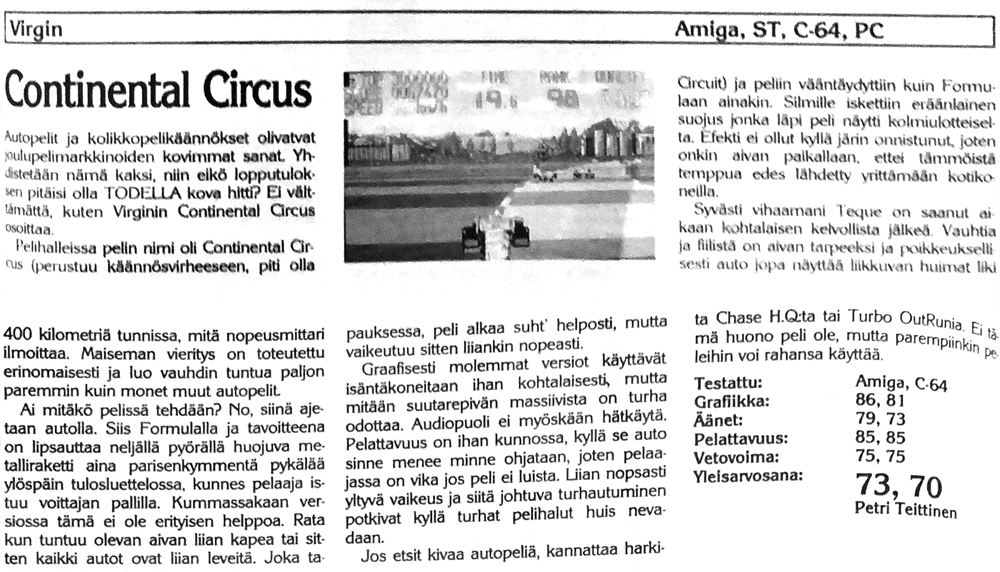
Continental Circus1990 KevätPysyvä linkkiAutopelit ja kolikkopelikäännökset olivatvat joulupelimarkkinoiden kovimmat sanat. Yhdistetään nämä kaksi, niin eikö lopputuloksen pitäisi olla TODELLA kova hitti? Ei välttämättä, kuten Virginin Continental Circus osoittaa.
Pelihalleissa pelin nimi oli Continental Circus (perustuu käännösvirheeseen, piti olla Circuit) ja peliin vääntäydyttiin kuin Formulaan ainakin. Silmille iskettiin eräänlainen suojus jonka läpi peli näytti kolmiulotteiselta. Efekti ei ollut kyllä järin onnistunut, joten onkin aivan paikallaan, ettei tämmöistä temppua edes lähdetty yrittämään kotikoneilla.
Syvästi vihaamani Teque on saanut aikaan kohtalaisen kelvollista jälkeä. Vauhtia ja fiilistä on aivan tarpeeksi ja poikkeuksellisesti auto jopa näyttää liikkuvan huimat liki 400 kilometriä tunnissa, mitä nopeusmittari ilmoittaa. Maiseman vieritys on toteutettu erinomaisesti ja luo vauhdin tuntua paljon paremmin kuin monet muut autopelit.
Ai mitäkö pelissä tehdään? No, siinä ajetaan autolla. Siis Formulalla ja tavoitteena on lipsauttaa neljällä pyörällä huojuva metalliraketti aina parisenkymmentä pykälää ylöspäin tulosluettelossa, kunnes pelaaja istuu voittajan pallilla. Kummassakaan versiossa tämä ei ole erityisen helppoa. Rata kun tuntuu olevan aivan liian kapea tai sitten kaikki autot ovat liian leveitä. Joka tapauksessa, peli alkaa suht' helposti, mutta vaikeutuu sitten liiankin nopeasti.
Graafisesti molemmat versiot käyttävät isäntäkoneitaan ihan kohtalaisesti, mutta mitään suutarepivän massiivista on turha odottaa. Audiopuoli ei myöskään hätkäytä. Pelattavuus on ihan kunnossa, kyllä se auto sinne menee minne ohjataan, joten pelaajassa on vika jos peli ei luista. Liian nopsasti yltyvä vaikeus ja siitä johtuva turhautuminen potkivat kyllä turhat pelihalut huis nevadaan.
Jos etsit kivaa autopeliä, kannattaa harkita Chase H.Q:ta tai Turbo OutRunia. Ei tämä huono peli ole, mutta parempiinkin peleihin voi rahansa käyttää.
Continental Circus1990 KevätPermalinkDriving games and coin-op conversions were the hottest buzzwords of the Christmas games market. Combine the two, and shouldn't the end result be a REALLY big hit? Not necessarily, as Virgin's Continental Circus demonstrates.
In the arcades the game was called Continental Circus (based on a translation error, it was supposed to be Circuit), and you squeezed yourself into it as if into a real Formula car. A sort of visor was slapped over your eyes, and through it the game looked three-dimensional. The effect wasn't all that successful, mind you, so it's entirely fitting that nobody even set out to attempt that kind of trick on the home machines.
Teque, whom I loathe deeply, has turned out reasonably decent work. There's plenty of speed and feel, and for once the car even looks like it's doing the dizzying nearly 400 kilometres per hour the speedometer claims. The scrolling of the scenery is excellently done and creates a sense of speed much better than many other driving games.
Oh, what do you do in the game? Well, you drive a car. A Formula car, that is, and the aim is to slip a metal rocket wobbling on four wheels all of twenty-odd notches up the results table, until the player is sitting on the winner's podium. In neither version is this particularly easy. The track seems to be far too narrow, or else all the cars are too wide. Anyway, the game starts off fairly easy, but then gets harder all too quickly.
Graphically both versions make fairly moderate use of their host machines, but there's no point expecting anything massively jaw-dropping. The audio side doesn't startle anyone either. The playability is quite all right; the car does go where you steer it, so if the game isn't going smoothly the fault lies with the player. The difficulty ramping up far too fast, and the frustration that follows, do kick any idle urge to play to the kerb for good, though.
If you're looking for a fun driving game, you'd do well to consider Chase H.Q. or Turbo OutRun. This isn't a bad game, but there are better games to spend your money on too.
Convoy Raider
Convoy Raider1987Pysyvä linkkiSarjassamme Gremlinin flopit kerromme tällä kertaa Convoy Raiderista. Juoni ei tarjoa mitään uutta: sota on syttynyt ja maasi on vaarassa. Sen puolustamisen raskas taakka lasketaan jälleen kerran vain pelaajan hartioille. Käytettävissä on Seawolf, tappavan tarkka ohjus lentokoneita ja toisia ohjuksia vastaan, Exocet, videolla ohjattava raketti merimaaleja vastaan sekä sukellusveneitä tuhoava helikopteri, jolla voi tiputtaa syvyyspommeja vihollisen sukellusveneiden päälle.
Vaihtelun vuoksi koko hässäkkä sijoittuu jostain syystä vain rannikoille. Tämä pikku seikka ei kuitenkaan tuo peliin sitä mitä siitä puuttuu, nimittäin jännitystä. Grafiikka on todella mielikuvituksetonta, värit ovat ehkäpä ainoa asia missä mielikuvitusta on käytetty liiankin kanssa. Spritet ovat vuodelta -82, eikä kontrollisysteemissäkään ole hurraamista.
Musiikkipuolella asiat ovat, jos mahdollista, vieläkin huonommin. Musiikkia ei ole nimeksikään, ja äänitehosteet ovat erittäin kuivia eivätkä vastaa tarkoitustaan. Pienet pim-äänet ja huonot kohinat eivät innosta vääntämään voluumia suuremmalle. Mihin Gremlin on hukannut kaikki taitavat musiikkiohjelmoijansa?
Kaikki yllämainitut seikat huomioonottaen voisi ajatella pelin olevan kaikkien aikojen huonoin. Mutta kaikki ei ole menetetty, ei suinkaan. Eivätköhän voitonmaksimoijat pian keksi julkaista tätäkin kehnoa Beach Head-matkintaa halpapelinä. Tämän rinnalla jopa Miami Vice tuntuu pelattavalta. Miksi tälläistä roskaa enää tehdään?
Convoy Raider1987PermalinkIn our series "Gremlin's Flops", this time we bring you Convoy Raider. The plot offers nothing new: war has broken out and your country is in danger. Once again the heavy burden of defending it is laid on the player's shoulders alone. At your disposal are Seawolf, a deadly accurate missile against aircraft and other missiles; Exocet, a video-guided rocket against sea targets; and a submarine-killing helicopter that can drop depth charges on top of enemy submarines.
For a bit of variety, the whole shebang is for some reason set only on coastlines. This little detail doesn't, however, give the game what it's missing, namely excitement. The graphics are truly unimaginative; the colours are perhaps the only thing where imagination has been used, and then some. The sprites are vintage '82, and the control system is nothing to cheer about either.
On the music side things are, if possible, even worse. There isn't even a token scrap of music, and the sound effects are extremely dry and don't do their job. Feeble little pip noises and lousy hissing hardly make you want to crank the volume up. Where has Gremlin lost all its skilled music programmers?
Taking all of the above into account, you might think this was the worst game of all time. But all is not lost, not by any means. Surely the profit-maximisers will soon think of re-releasing this shoddy Beach Head imitation as a budget game too. Next to this, even Miami Vice feels playable. Why is rubbish like this still being made?
Corruption
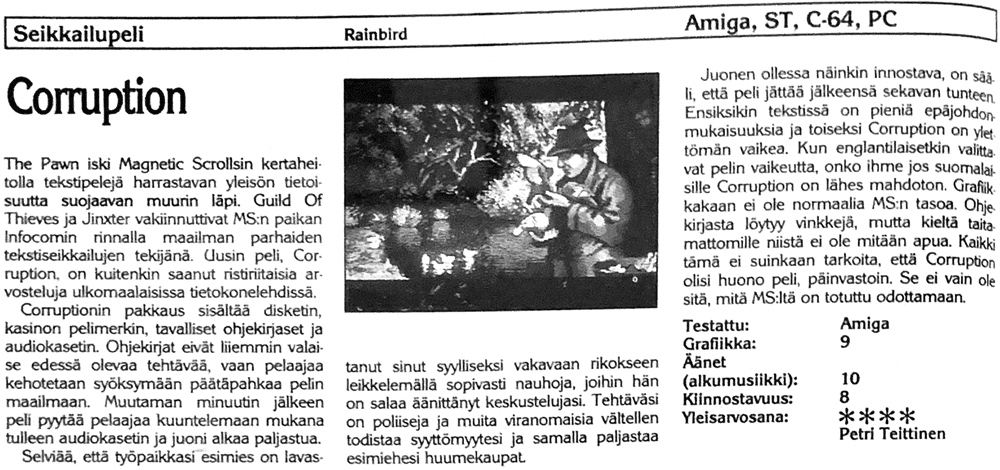
Corruption1989 KevätPysyvä linkkiThe Pawn iski Magnetic Scrollsin kertaheitolla tekstipelejä harrastavan yleisön tietoisuutta suojaavan muurin läpi. Guild Of Thieves ja Jinxter vakiinnuttivat MS:n paikan Infocomin rinnalla maailman parhaiden tekstiseikkailujen tekijänä. Uusin peli, Corruption, on kuitenkin saanut ristiriitaisia arvosteluja ulkomaalaisissa tietokonelehdissä.
Corruptionin pakkaus sisältää disketin, kasinon pelimerkin, tavalliset ohjekirjaset ja audiokasetin. Ohjekirjat eivät liiemmin valaise edessä olevaa tehtävää, vaan pelaajaa kehotetaan syöksymään päätäpahkaa pelin maailmaan. Muutaman minuutin jälkeen peli pyytää pelaajaa kuuntelemaan mukana tulleen audiokasetin ja juoni alkaa paljastua.
Selviää, että työpaikkasi esimies on lavastanut sinut syylliseksi vakavaan rikokseen leikkelemällä sopivasti nauhoja, joihin hän on salaa äänittänyt keskustelujasi. Tehtäväsi on poliiseja ja muita viranomaisia vältellen todistaa syyttömyytesi ja samalla paljastaa esimiehesi huumekaupat.
Juonen ollessa näinkin innostava, on sääli, että peli jättää jälkeensä sekavan tunteen. Ensiksikin tekstissä on pieniä epäjohdonmukaisuuksia ja toiseksi Corruption on ylettömän vaikea. Kun englantilaisetkin valittavat pelin vaikeutta, onko ihme jos suomalaisille Corruption on lähes mahdoton. Grafiikkakaan ei ole normaalia MS:n tasoa. Ohjekirjasta löytyy vinkkejä, mutta kieltä taitamattomille niistä ei ole mitään apua. Kaikki tämä ei suinkaan tarkoita, että Corruption olisi huono peli, päinvastoin. Se ei vain ole sitä, mitä MS:ltä on totuttu odottamaan.
Corruption1989 KevätPermalinkIn one fell swoop, The Pawn punched Magnetic Scrolls through the wall shielding the consciousness of the text-game-playing public. Guild Of Thieves and Jinxter cemented MS's place alongside Infocom as a maker of the world's best text adventures. The latest game, Corruption, has however received mixed reviews in foreign computer magazines.
The Corruption package contains a disk, a casino chip, the usual manuals and an audio cassette. The manuals don't shed much light on the task ahead; instead, the player is urged to plunge headlong into the game world. After a few minutes the game asks the player to listen to the enclosed audio cassette, and the plot begins to unfold.
It turns out that your boss at work has framed you for a serious crime by conveniently cutting up tapes of your conversations, recorded in secret. Your task is to prove your innocence while dodging the police and other authorities, and at the same time to expose your boss's drug dealing.
With a plot this exciting, it's a pity that the game leaves a muddled feeling behind. Firstly, the text has small inconsistencies, and secondly, Corruption is outrageously difficult. When even the English complain about how hard the game is, is it any wonder if Corruption is nearly impossible for Finns? The graphics aren't up to the usual MS standard either. The manual contains hints, but they're no help at all to those who don't know the language. None of this means that Corruption is a bad game - quite the opposite. It just isn't what we've come to expect from MS.
Cosmic Causeway
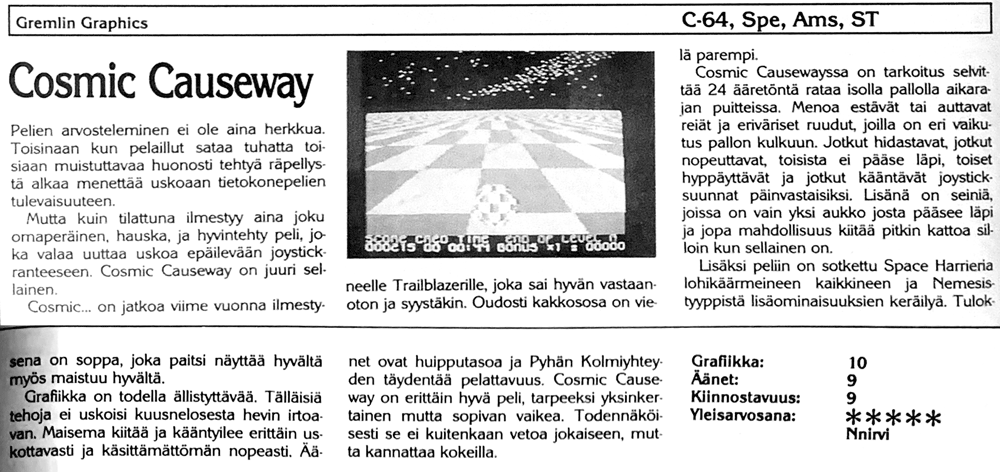
Cosmic Causeway1988Pysyvä linkkiPelien arvosteleminen ei ole aina herkkua. Toisinaan kun pelaillut sataa tuhatta toisiaan muistuttavaa huonosti tehtyä räpellystä alkaa menettää uskoaan tietokonepelien tulevaisuuteen.
Mutta kuin tilattuna ilmestyy aina joku omaperäinen, hauska, ja hyvintehty peli, joka valaa uuttaa uskoa epäilevään joystick-ranteeseen. Cosmic Causeway on juuri sellainen.
Cosmic... on jatkoa viime vuonna ilmestyneelle Trailblazerille, joka sai hyvän vastaanoton ja syystäkin. Oudosti kakkososa on vielä parempi.
Cosmic Causewayssa on tarkoitus selvittää 24 ääretöntä rataa isolla pallolla aikarajan puitteissa. Menoa estävät tai auttavat reiät ja eriväriset ruudut, joilla on eri vaikutus pallon kulkuun. Jotkut hidastavat, jotkut nopeuttavat, toisista ei pääse läpi, toiset hyppäyttävät ja jotkut kääntävät joystick-suunnat päinvastaisiksi. Lisänä on seiniä, joissa on vain yksi aukko josta pääsee läpi ja jopa mahdollisuus kiitää pitkin kattoa silloin kun sellainen on.
Lisäksi peliin on sotkettu Space Harrieria lohikäärmeineen kaikkineen ja Nemesis-tyyppistä lisäominaisuuksien keräilyä. Tuloksena on soppa, joka paitsi näyttää hyvältä myös maistuu hyvältä.
Grafiikka on todella ällistyttävää. Tällaisia tehoja ei uskoisi kuusnelosesta hevin irtoavan. Maisema kiitää ja kääntyilee erittäin uskottavasti ja käsittämättömän nopeasti. Äänet ovat huipputasoa ja Pyhän Kolmiyhteyden täydentää pelattavuus. Cosmic Causeway on erittäin hyvä peli, tarpeeksi yksinkertainen mutta sopivan vaikea. Todennäköisesti se ei kuitenkaan vetoa jokaiseen, mutta kannattaa kokeilla.
Cosmic Causeway1988PermalinkReviewing games isn't always a treat. Sometimes, after playing a hundred thousand badly made botch-jobs that all look like one another, you start to lose your faith in the future of computer games.
But as if on order, along always comes some original, fun and well-made game that breathes new faith into the doubting joystick wrist. Cosmic Causeway is just such a game.
Cosmic... is the sequel to Trailblazer, released last year, which got a good reception, and rightly so. Strangely, part two is even better.
In Cosmic Causeway the idea is to get through 24 endless tracks with a big ball within a time limit. Your progress is hindered or helped by holes and squares of different colours, which have different effects on how the ball moves. Some slow you down, some speed you up, some you can't get through, others make you jump and some reverse the joystick directions. On top of that there are walls with only one gap you can get through, and even the chance to race along the ceiling when there is one.
What's more, some Space Harrier has been stirred into the game, dragons and all, along with Nemesis-style collecting of power-ups. The result is a soup that not only looks good but tastes good too.
The graphics are truly astonishing. You'd hardly believe the C-64 could squeeze out this kind of power. The scenery races and swerves very convincingly and incomprehensibly fast. The sound is top-notch, and the Holy Trinity is completed by the playability. Cosmic Causeway is a very good game, simple enough but suitably difficult. It probably won't appeal to everyone, though, but it's worth a try.
Countdown to Meltdown
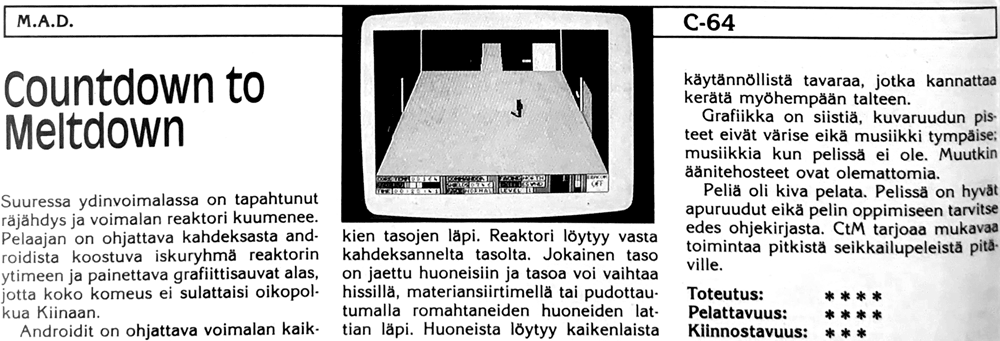
Countdown to Meltdown1987Pysyvä linkkiSuuressa ydinvoimalassa on tapahtunut räjähdys ja voimalan reaktori kuumenee. Pelaajan on ohjattava kahdeksasta androidista koostuva iskuryhmä reaktorin ytimeen ja painettava grafiittisauvat alas, jotta koko komeus ei sulattaisi oikopolkua Kiinaan.
Androidit on ohjattava voimalan kaikkien tasojen läpi. Reaktori löytyy vasta kahdeksannelta tasolta. Jokainen taso on jaettu huoneisiin ja tasoa voi vaihtaa hissillä, materiansiirtimellä tai pudottautumalla romahtaneiden huoneiden lattian läpi. Huoneista löytyy kaikenlaista käytännöllistä tavaraa, jotka kannattaa kerätä myöhempään talteen.
Grafiikka on siistiä, kuvaruudun pisteet eivät värise eikä musiikki tympäise; musiikkia kun pelissä ei ole. Muutkin äänitehosteet ovat olemattomia.
Peliä oli kiva pelata. Pelissä on hyvät apuruudut eikä pelin oppimiseen tarvitse edes ohjekirjasta. CtM tarjoaa mukavaa toimintaa pitkistä seikkailupeleistä pitäville.
Countdown to Meltdown1987PermalinkThere has been an explosion at a big nuclear power plant, and the plant's reactor is heating up. The player has to guide a strike team of eight androids to the reactor core and push the graphite rods down, so that the whole magnificent works doesn't melt itself a shortcut to China.
The androids have to be guided through every level of the plant. The reactor isn't found until the eighth level. Each level is divided into rooms, and you can change levels by lift, by matter transporter or by dropping through the floors of collapsed rooms. The rooms hold all sorts of practical stuff that's worth collecting and stashing away for later.
The graphics are neat, the pixels on the screen don't flicker and the music doesn't get on your nerves; there's no music in the game, you see. The other sound effects are non-existent too.
The game was fun to play. It has good help screens, and you don't even need the manual to learn the game. CtM offers pleasant action for those who like long adventure games.
Covert Action
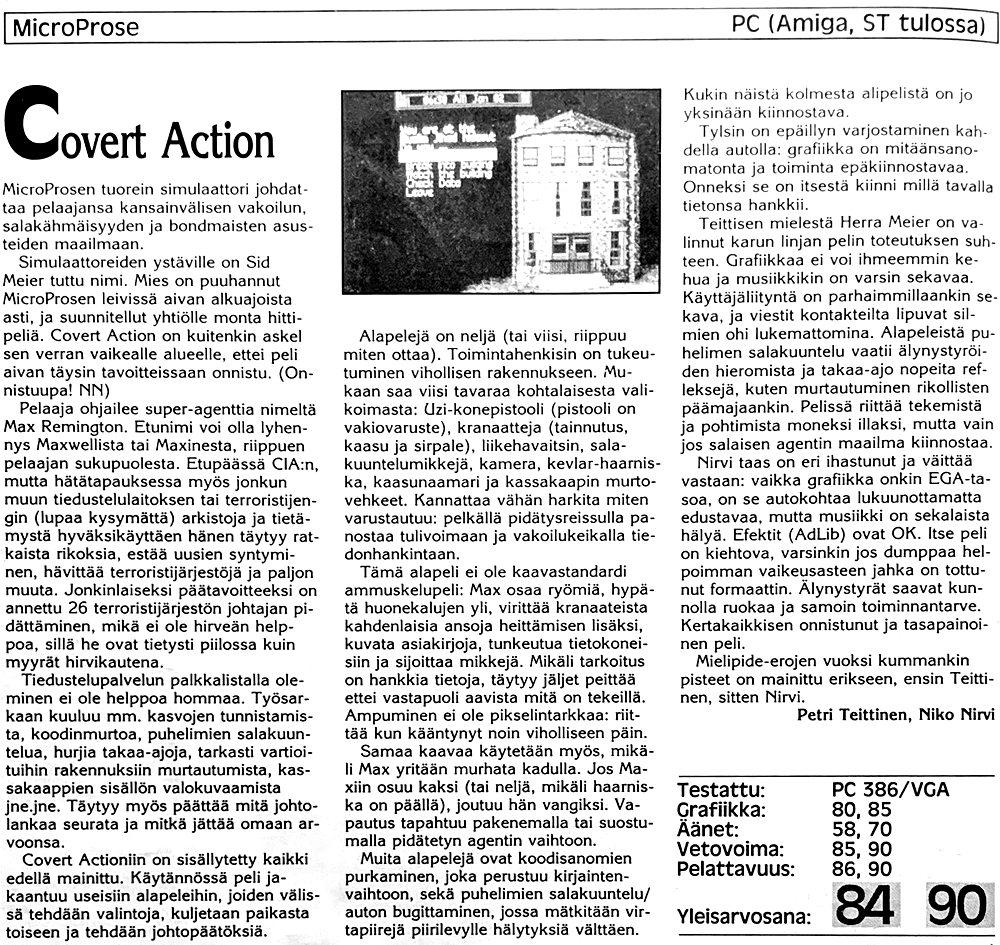
Covert Action1991 KevätPysyvä linkkiMicroProsen tuorein simulaattori johdattaa pelaajansa kansainvälisen vakoilun, salakähmäisyyden ja bondmaisten asusteiden maailmaan.
Simulaattoreiden ystäville on Sid Meier tuttu nimi. Mies on puuhannut MicroProsen leivissä aivan alkuajoista asti, ja suunnitellut yhtiölle monta hittipeliä. Covert Action on kuitenkin askel sen verran vaikealle alueelle, ettei peli aivan täysin tavoitteissaan onnistu. (Onnistuupa! NN)
Pelaaja ohjailee super-agenttia nimeltä Max Remington. Etunimi voi olla lyhennys Maxwellista tai Maxinesta, riippuen pelaajan sukupuolesta. Etupäässä CIA:n, mutta hätätapauksessa myös jonkun muun tiedustelulaitoksen tai terroristijengin (lupaa kysymättä) arkistoja ja tietämystä hyväksikäyttäen hänen täytyy ratkaista rikoksia, estää uusien syntyminen, hävittää terroristijärjestöjä ja paljon muuta. Jonkinlaiseksi päätavoitteeksi on annettu 26 terroristijärjestön johtajan pidättäminen, mikä ei ole hirveän helppoa, sillä he ovat tietysti piilossa kuin myyrät hirvikautena.
Tiedustelupalvelun palkkalistalla oleminen ei ole helppoa hommaa. Työsarkaan kuuluu mm. kasvojen tunnistamista, koodinmurtoa, puhelimien salakuuntelua, hurjia takaa-ajoja, tarkasti vartioituihin rakennuksiin murtautumista, kassakaappien sisällön valokuvaamista jne.jne. Täytyy myös päättää mitä johtolankaa seurata ja mitkä jättää omaan arvoonsa.
Covert Actioniin on sisällytetty kaikki edellä mainittu. Käytännössä peli jakaantuu useisiin alapeleihin, joiden välissä tehdään valintoja, kuljetaan paikasta toiseen ja tehdään johtopäätöksiä.
Alapelejä on neljä (tai viisi, riippuu miten ottaa). Toimintahenkisin on tukeutuminen vihollisen rakennukseen. Mukaan saa viisi tavaraa kohtalaisesta valikoimasta: Uzi-konepistooli (pistooli on vakiovaruste), kranaatteja (tainnutus, kaasu ja sirpale), liikehavaitsin, salakuuntelumikkejä, kamera, kevlar-haarniska, kaasunaamari ja kassakaapin murtovehkeet. Kannattaa vähän harkita miten varustautuu: pelkällä pidätysreissulla panostaa tulivoimaan ja vakoilukeikalla tiedonhankintaan.
Tämä alapeli ei ole kaavastandardi ammuskelupeli: Max osaa ryömiä, hypätä huonekalujen yli, virittää kranaateista kahdenlaisia ansoja heittämisen lisäksi, kuvata asiakirjoja, tunkeutua tietokoneisiin ja sijoittaa mikkejä. Mikäli tarkoitus on hankkia tietoja, täytyy jäljet peittää ettei vastapuoli aavista mitä on tekeillä. Ampuminen ei ole pikselintarkkaa: riittää kun kääntynyt noin viholliseen päin.
Samaa kaavaa käytetään myös, mikäli Max yritään murhata kadulla. Jos Maxiin osuu kaksi (tai neljä, mikäli haarniska on päällä), joutuu hän vangiksi. Vapautus tapahtuu pakenemalla tai suostumalla pidätetyn agentin vaihtoon.
Muita alapelejä ovat koodisanomien purkaminen, joka perustuu kirjaintenvaihtoon, sekä puhelimien salakuuntelu/auton bugittaminen, jossa mätkitään virtapiirejä piirilevylle hälytyksiä välttäen. Kukin näistä kolmesta alipelistä on jo yksinään kiinnostava.
Tylsin on epäillyn varjostaminen kahdella autolla: grafiikka on mitäänsanomatonta ja toiminta epäkiinnostavaa. Onneksi se on itsestä kiinni millä tavalla tietonsa hankkii.
Teittisen mielestä Herra Meier on valinnut karun linjan pelin toteutuksen suhteen. Grafiikkaa ei voi ihmeemmin kehua ja musiikkikin on varsin sekavaa. Käyttäjäliityntä on parhaimmillaankin sekava, ja viestit kontakteilta lipuvat silmien ohi lukemattomina. Alapeleistä puhelimen salakuuntelu vaatii älynystyröiden hieromista ja takaa-ajo nopeita refleksejä, kuten murtautuminen rikollisten päämajaankin. Pelissä riittää tekemistä ja pohtimista moneksi illaksi, mutta vain jos salaisen agentin maailma kiinnostaa.
Nirvi taas on eri ihastunut ja väittää vastaan: vaikka grafiikka onkin EGA-tasoa, on se autokohtaa lukuunottamatta edustavaa, mutta musiikki on sekalaista hälyä. Efektit (AdLib) ovat OK. Itse peli on kiehtova, varsinkin jos dumppaa helpoimman vaikeusasteen jahka on tottunut formaattin. Älynystyrät saavat kunnolla ruokaa ja samoin toiminnantarve. Kertakaikkisen onnistunut ja tasapainoinen peli.
Mielipide-erojen vuoksi kummankin pisteet on mainittu erikseen, ensin Teittinen, sitten Nirvi.
Covert Action1991 KevätPermalinkMicroProse's latest simulator leads its players into the world of international espionage, skulduggery and Bond-style outfits.
To fans of simulators, Sid Meier is a familiar name. The man has been on MicroProse's payroll right from the very beginning and has designed many a hit game for the company. Covert Action, however, is a step into such difficult territory that the game doesn't quite fully achieve its aims. (Yes it does! NN)
The player steers a super-agent called Max Remington. The first name can be short for Maxwell or Maxine, depending on the player's sex. Making use of the archives and know-how mainly of the CIA, but in an emergency also those of some other intelligence agency or terrorist gang (without asking permission), Max has to solve crimes, prevent new ones from happening, wipe out terrorist organisations and much more. A sort of main goal has been set: arresting the leaders of 26 terrorist organisations, which isn't terribly easy, since they are of course lying low like moles in moose-hunting season.
Being on an intelligence service's payroll is no easy job. The work includes, among other things, identifying faces, code-breaking, tapping phones, wild car chases, breaking into closely guarded buildings, photographing the contents of safes, etc. etc. You also have to decide which leads to follow and which to leave be.
All of the above has been packed into Covert Action. In practice the game divides into several sub-games, in between which you make choices, travel from place to place and draw conclusions.
There are four sub-games (or five, depending on how you count). The most action-oriented is infiltrating an enemy building. You get to take along five items from a moderate selection: an Uzi submachine gun (a pistol is standard issue), grenades (stun, gas and fragmentation), a motion detector, bugging mikes, a camera, kevlar armour, a gas mask and safecracking gear. It pays to give a little thought to how you kit yourself out: on a plain arrest run you put your money on firepower, and on a spying job on gathering information.
This sub-game is not your standard formula shoot-'em-up: Max can crawl, jump over furniture, rig grenades into two kinds of booby trap besides throwing them, photograph documents, break into computers and plant mikes. If the idea is to gather information, you have to cover your tracks so the other side doesn't suspect what's going on. The shooting isn't pixel-precise: it's enough to be turned roughly towards the enemy.
The same formula is also used if someone tries to assassinate Max in the street. If Max is hit twice (or four times, if wearing the armour), our agent is taken prisoner. Release comes by escaping or by agreeing to an exchange for an arrested agent.
The other sub-games are decoding coded messages, which is based on letter substitution, and phone tapping/car bugging, in which you slap circuits onto a circuit board while avoiding the alarms. Each of these three sub-games is interesting in its own right.
The dullest is tailing a suspect with two cars: the graphics are bland and the action uninteresting. Luckily it's up to you how you get your information.
In Teittinen's view, Mr Meier has taken a spartan line with the game's execution. The graphics are nothing much to praise and the music is pretty muddled too. The user interface is muddled even at its best, and messages from contacts slide past your eyes unread. Of the sub-games, phone tapping calls for a good massage of the grey cells and the car chase for quick reflexes, as does breaking into the criminals' headquarters. The game offers enough to do and puzzle over for many an evening, but only if the world of the secret agent appeals to you.
Nirvi, on the other hand, is well and truly smitten and argues back: although the graphics are only EGA standard, apart from the car section they are presentable, but the music is a jumble of noise. The effects (AdLib) are OK. The game itself is fascinating, especially if you dump the easiest difficulty level once you've got used to the format. The grey cells get a proper feed, and so does the craving for action. A thoroughly successful and well-balanced game.
Because of the difference of opinion, both scores are given separately, first Teittinen's, then Nirvi's.
Crack Down
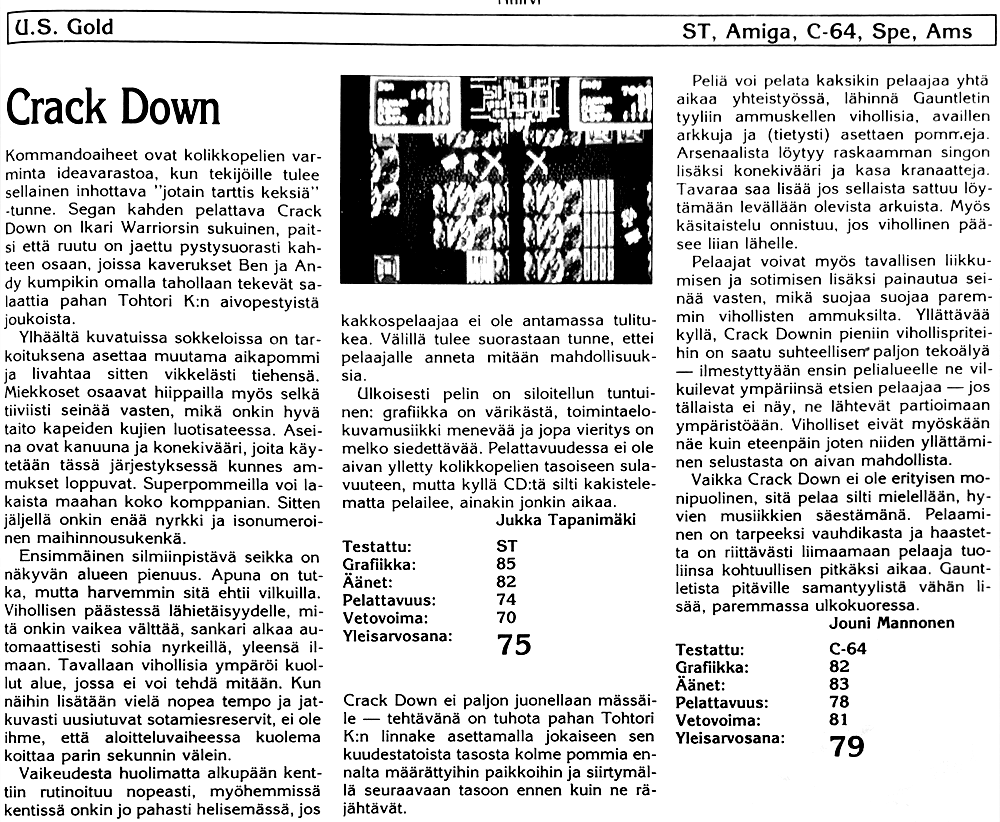
Crack Down1990 SyksyPysyvä linkkiKommandoaiheet ovat kolikkopelien varminta ideavarastoa, kun tekijöille tulee sellainen inhottava "jotain tarttis keksiä" -tunne. Segan kahden pelattava Crack Down on Ikari Warriorsin sukuinen, paitsi että ruutu on jaettu pystysuorasti kahteen osaan, joissa kaverukset Ben ja Andy kumpikin omalla tahollaan tekevät salaattia pahan Tohtori K:n aivopestyistä joukoista.
Ylhäältä kuvatuissa sokkeloissa on tarkoituksena asettaa muutama aikapommi ja livahtaa sitten vikkelästi tiehensä. Miekkoset osaavat hiippailla myös selkä tiiviisti seinää vasten, mikä onkin hyvä taito kapeiden kujien luotisateessa. Aseina ovat kanuuna ja konekivääri, joita käytetään tässä järjestyksessä kunnes ammukset loppuvat. Superpommeilla voi lakaista maahan koko komppanian. Sitten jäljellä onkin enää nyrkki ja isonumeroinen maihinnousukenkä.
Ensimmäinen silmiinpistävä seikka on näkyvän alueen pienuus. Apuna on tutka, mutta harvemmin sitä ehtii vilkuilla. Vihollisen päästessä lähietäisyydelle, mitä onkin vaikea välttää, sankari alkaa automaattisesti sohia nyrkeillä, yleensä ilmaan. Tavallaan vihollisia ympäröi kuollut alue, jossa ei voi tehdä mitään. Kun näihin lisätään vielä nopea tempo ja jatkuvasti uusiutuvat sotamiesreservit, ei ole ihme, että aloitteluvaiheessa kuolema koittaa parin sekunnin välein.
Vaikeudesta huolimatta alkupään kenttiin rutinoituu nopeasti, myöhemmissä kentissä onkin jo pahasti helisemässä, jos kakkospelaajaa ei ole antamassa tulitukea. Välillä tulee suorastaan tunne, ettei pelaajalle anneta mitään mahdollisuuksia.
Ulkoisesti pelin on siloitellun tuntuinen: grafiikka on värikästä, toimintaelokuvamusiikki menevää ja jopa vieritys on melko siedettävää. Pelattavuudessa ei ole aivan ylletty kolikkopelien tasoiseen sulavuuteen, mutta kyllä CD:tä silti kakistelematta pelailee, ainakin jonkin aikaa.
Crack Down ei paljon juonellaan mässäile - tehtävänä on tuhota pahan Tohtori K:n linnake asettamalla jokaiseen sen kuudestatoista tasosta kolme pommia ennalta määrättyihin paikkoihin ja siirtymällä seuraavaan tasoon ennen kuin ne räjähtävät.
Peliä voi pelata kaksikin pelaajaa yhtä aikaa yhteistyössä, lähinnä Gauntletin tyyliin ammuskellen vihollisia, availlen arkkuja ja (tietysti) asettaen pommeja. Arsenaalista löytyy raskaamman singon lisäksi konekivääri ja kasa kranaatteja. Tavaraa saa lisää jos sellaista sattuu löytämään levällään olevista arkuista. Myös käsitaistelu onnistuu, jos vihollinen pääsee liian lähelle.
Pelaajat voivat myös tavallisen liikkumisen ja sotimisen lisäksi painautua seinää vasten, mikä suojaa suojaa paremmin vihollisten ammuksilta. Yllättävää kyllä, Crack Downin pieniin vihollispriteihin on saatu suhteellisen paljon tekoälyä - ilmestyttyään ensin pelialueelle ne vilkuilevat ympäriinsä etsien pelaajaa - jos tällaista ei näy, ne lähtevät partioimaan ympäristöään. Viholliset eivät myöskään näe kuin eteenpäin joten niiden yllättäminen selustasta on aivan mahdollista.
Vaikka Crack Down ei ole erityisen monipuolinen, sitä pelaa silti mielellään, hyvien musiikkien säestämänä. Pelaaminen on tarpeeksi vauhdikasta ja haastetta on riittävästi liimaamaan pelaaja tuoliinsa kohtuullisen pitkäksi aikaa. Gauntletista pitäville samantyylistä vähän lisää, paremmassa ulkokuoressa.
Crack Down1990 SyksyPermalinkCommando themes are the coin-op makers' safest store of ideas whenever they get that nasty "gotta come up with something" feeling. Sega's two-player Crack Down is related to Ikari Warriors, except that the screen is split vertically into two halves, in which the buddies Ben and Andy, each in his own half, make mincemeat of the evil Doctor K's brainwashed troops.
In the top-down mazes the aim is to plant a few time bombs and then nip smartly off out of there. The chaps can also sneak along with their backs pressed tight against the wall, which is a handy skill indeed in the hail of bullets in the narrow alleys. The weapons are a cannon and a machine gun, used in that order until the ammo runs out. With the super bombs you can flatten a whole company. After that all you have left is your fist and a combat boot in a very large size.
The first thing that strikes you is how small the visible area is. There's a radar to help, but you rarely have time to glance at it. When an enemy gets in close, which is hard to avoid, the hero automatically starts jabbing with his fists, usually at thin air. In a way the enemies are surrounded by a dead zone in which you can't do anything. Add to this a fast pace and endlessly replenishing reserves of soldiers, and it's no wonder that while you're still learning, death comes every couple of seconds.
Despite the difficulty you quickly get into the routine of the early levels, but in the later ones you're in serious trouble if there's no second player to give covering fire. At times you get the downright feeling that the player isn't being given any chance at all.
On the outside the game feels polished: the graphics are colourful, the action-movie music is catchy and even the scrolling is fairly tolerable. The playability doesn't quite reach coin-op levels of smoothness, but you'll still play CD without a grumble, at least for a while.
Crack Down doesn't exactly wallow in plot - the task is to destroy the evil Doctor K's stronghold by planting three bombs in predetermined places on each of its sixteen levels and moving on to the next level before they go off.
The game can even be played by two players at once, cooperatively, mostly in the style of Gauntlet: shooting enemies, opening chests and (of course) planting bombs. Besides a heavier bazooka, the arsenal contains a machine gun and a pile of grenades. You can get more gear if you happen to find some in the chests lying scattered about. Hand-to-hand combat is also possible if an enemy gets too close.
Besides ordinary moving and fighting, the players can also press themselves against a wall, which protects them better from enemy fire. Surprisingly enough, a relatively large amount of artificial intelligence has been packed into Crack Down's small enemy sprites - on first appearing in the play area they glance around looking for the player - and if there's none to be seen, they set off to patrol their surroundings. The enemies also only see straight ahead, so taking them by surprise from behind is perfectly possible.
Although Crack Down isn't especially varied, you still enjoy playing it, accompanied by good music. The action is fast enough and there's enough challenge to glue the player to their chair for a reasonably long time. For those who like Gauntlet, a bit more of the same sort of thing, in a better wrapping.
Crash Garrett
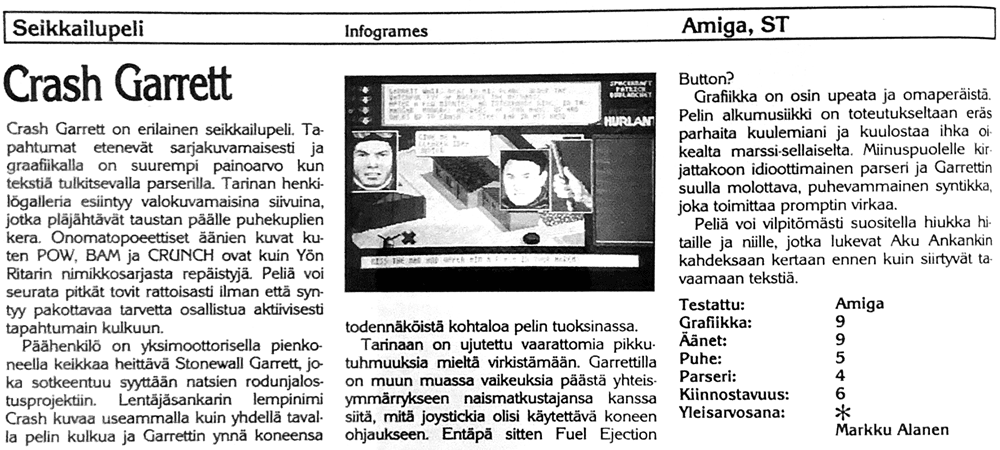
Crash Garrett1989 KevätPysyvä linkkiCrash Garrett on erilainen seikkailupeli. Tapahtumat etenevät sarjakuvamaisesti ja graafiikalla on suurempi painoarvo kun tekstiä tulkitsevalla parserilla. Tarinan henkilögalleria esiintyy valokuvamaisina siivuina, jotka pläjähtävät taustan päälle puhekuplien kera. Onomatopoeettiset äänien kuvat kuten POW, BAM ja CRUNCH ovat kuin Yön Ritarin nimikkosarjasta repäistyjä. Peliä voi seurata pitkät tovit rattoisasti ilman että syntyy pakottavaa tarvetta osallistua aktiivisesti tapahtumain kulkuun.
Päähenkilö on yksimoottorisella pienkoneella keikkaa heittävä Stonewall Garrett, joka sotkeentuu syyttään natsien rodunjalostusprojektiin. Lentäjäsankarin lempinimi Crash kuvaa useammalla kuin yhdellä tavalla pelin kulkua ja Garrettin ynnä koneensa todennäköistä kohtaloa pelin tuoksinassa.
Tarinaan on ujutettu vaarattomia pikkutuhmuuksia mieltä virkistämään. Garrettilla on muun muassa vaikeuksia päästä yhteisymmärrykseen naismatkustajansa kanssa siitä, mitä joystickia olisi käytettävä koneen ohjaukseen. Entäpä sitten Fuel Ejection Button?
Grafiikka on osin upeata ja omaperäistä. Pelin alkumusiikki on toteutukseltaan eräs parhaita kuulemiani ja kuulostaa ihka oikealta marssi-sellaiselta. Miinuspuolelle kirjattakoon idioottimainen parseri ja Garrettin suulla molottava, puhevammainen syntikka, joka toimittaa promptin virkaa.
Peliä voi vilpittömästi suositella hiukka hitaille ja niille, jotka lukevat Aku Ankankin kahdeksaan kertaan ennen kuin siirtyvät tavaamaan tekstiä.
Crash Garrett1989 KevätPermalinkCrash Garrett is a different kind of adventure game. The events unfold comic-strip style, and the graphics carry more weight than the parser that interprets the text. The story's gallery of characters appears as photo-like slices that splat onto the background complete with speech bubbles. The onomatopoeic sound pictures such as POW, BAM and CRUNCH look as if they had been torn straight out of the Dark Knight's own comic series. You can happily follow the game for long stretches without any pressing need arising to take an active part in the course of events.
The main character is Stonewall Garrett, who flies odd jobs in a single-engine light aircraft and gets innocently tangled up in a Nazi race-breeding project. The flying hero's nickname, Crash, describes in more than one way both how the game goes and the likely fate awaiting Garrett, plane and all, in the thick of the game.
Harmless little bits of naughtiness have been slipped into the story to refresh the spirits. Among other things, Garrett has trouble reaching an understanding with the lady passenger about which joystick ought to be used to fly the plane. And then what about the Fuel Ejection Button?
The graphics are in places superb and original. In its execution, the game's opening music is one of the best I've heard, and it sounds just like an honest-to-goodness real march-type thing. On the minus side, let the record show the idiotic parser and the speech-impaired synth that mumbles through Garrett's mouth and does duty as the prompt.
The game can be sincerely recommended to the slightly slow, and to those who read even their Aku Ankka comics eight times over before moving on to spelling out the text.
Crazy Comets
Crazy Comets1987Pysyvä linkkiErilaiset tuhoamispelit ovat olleet lähes kaikkien vanhojen peliklassikoiden ideana. Vuoden -84 loppupuolella tyrehtyi kuitenkin tämä "tuhoa-se"-pelien valmistus ja syynä oli ilmiselvästi ampumispeleihin kyllästyminen. Nyt "Crazy Comets" yrittää saada ostajakuntaa tarjoamalla keskiveroa paremman ammuskelupelin.
Idea on muiden ampumispelien tapaan erittäin selvä: Kaikki maailmankaikkeuden taivaankappaleet ovat tulleet hulluiksi, se on muuttumassa puhtaaksi energiaksi. Pelaajan täytyy tuhota kaikki taivaankappaleet, jotta välttyttäisiin suurilta vahingoilta.
Peliin on jopa lisätty pieni jännitysmomentti. Välillä avaruudesta tulee pelastuskapseleita vastaan, joita keräämällä (ei ampumalla) saa pisteitä. Muuten onkin vain ammuttava kaikkea liikkuvaa, joita löytyy yhteensä viittä eri lajia.
Peli on jaettu tasoihin, jotka vaikeutuvat pelin edetessä. Jokaisen tason jälkeen taivaankappaleet muuttuvat nopeammin suuremmiksi. Kappaleiden koko taas on suhteessa nopeuteen, joten nopeus kasvaa koon myötä. Kun se on huipussaan, törmäävät kappaleet aivan varmasti pelaajan alukseen.
Pelissä on grafiikkaa käytetty heikonlaisesti. Värejä kyllä löytyy, oma kirjasintyyppi sekä paljon välkehtiviä "crazyjä" - hulluja taivaankappaleita. Ainoa oikea valopilkku oli metka tausta, jossa taivaan tähdet pyörivät ja tulevat vastaan.
Musiikki on sitä tunnettua mukaansatempaavaa äänigeneraattorin ränkytystä, joka lähes pakottaa pelaamaan uuden pelin.
Crazy Comets1987PermalinkDestruction games of one kind or another have been the idea behind almost all the old game classics. Towards the end of '84, however, production of these "destroy-it" games dried up, and the reason was obviously that people had grown sick of shooting games. Now "Crazy Comets" is trying to win over buyers by offering a better-than-average shoot-'em-up.
Like other shooting games, the idea is perfectly clear: all the heavenly bodies in the universe have gone mad, and the universe is turning into pure energy. The player has to destroy all the heavenly bodies so that major damage can be avoided.
A small element of suspense has even been added to the game. Every now and then rescue capsules come at you out of space, and you score points by collecting them (not by shooting them). Otherwise you just have to shoot everything that moves, of which there are five different kinds in all.
The game is divided into levels that get harder as the game goes on. After each level the heavenly bodies grow bigger faster. The size of the bodies, in turn, is tied to their speed, so the speed goes up along with the size. When it hits its peak, the bodies are dead certain to crash into the player's ship.
The graphics in the game have been put to rather feeble use. There are colours, sure, a custom font and lots of flickering "crazies" - mad heavenly bodies. The only real bright spot was the neat background, where the stars in the sky spin round and come rushing towards you.
The music is that well-known, infectious sound-chip racket that practically forces you to play another game.
Crime Wave
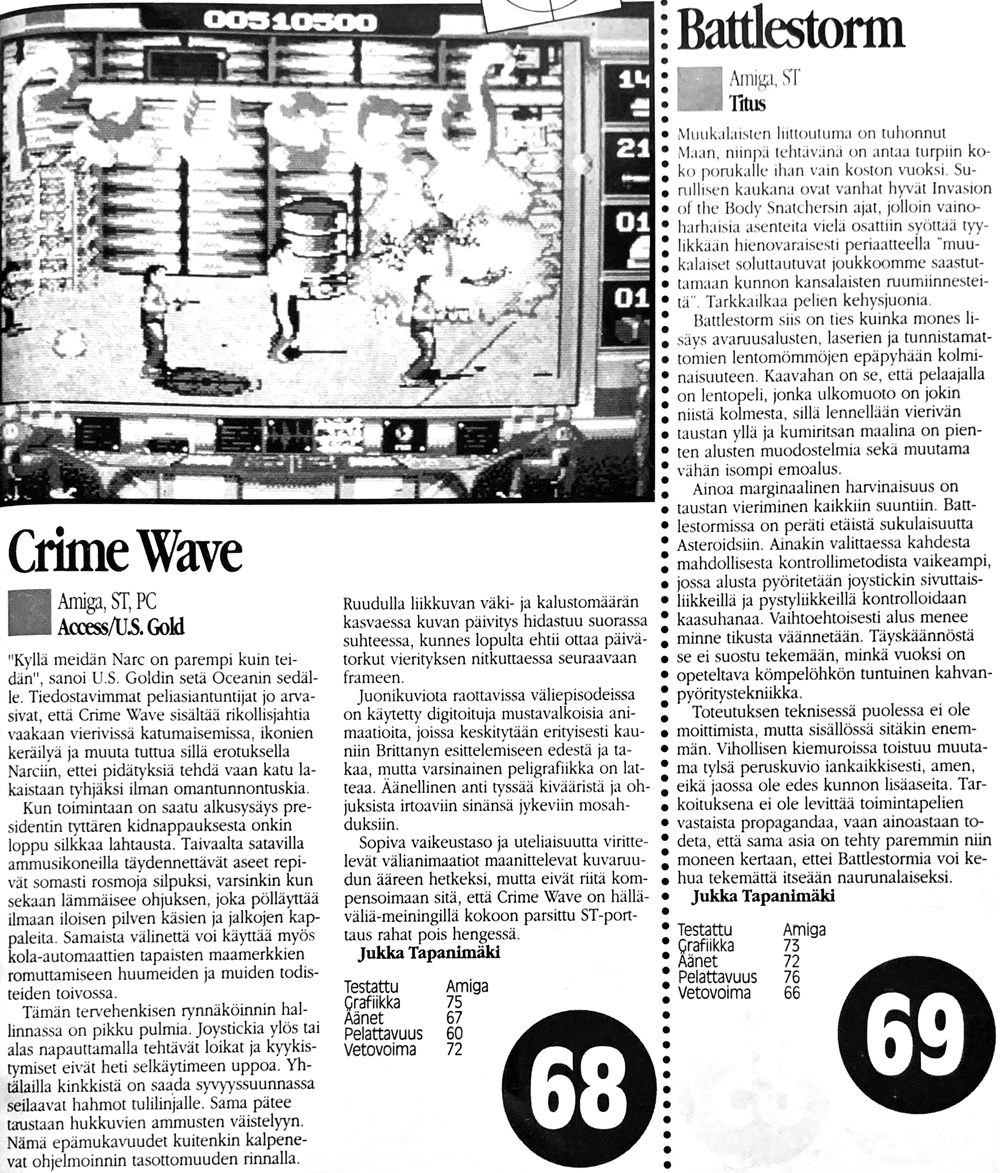
Crime Wave1991 SyksyPysyvä linkki"Kyllä meidän Narc on parempi kuin teidän", sanoi U.S. Goldin setä Oceanin sedälle. Tiedostavimmat peliasiantuntijat jo arvasivat, että Crime Wave sisältää rikollisjahtia vaakaan vierivissä katumaisemissa, ikonien keräilyä ja muuta tuttua sillä erotuksella Narciin, ettei pidätyksiä tehdä vaan katu lakaistaan tyhjäksi ilman omantunnontuskia.
Kun toimintaan on saatu alkusysäys presidentin tyttären kidnappauksesta onkin loppu silkkaa lahtausta. Taivaalta satavilla ammusikoneilla täydennettävät aseet repivät somasti rosmoja silpuksi, varsinkin kun sekaan lämmäisee ohjuksen, joka pölläyttää ilmaan iloisen pilven käsien ja jalkojen kappaleita. Samaista välinettä voi käyttää myös kola-automaattien tapaisten maamerkkien romuttamiseen huumeiden ja muiden todisteiden toivossa.
Tämän tervehenkisen rynnäköinnin hallinnassa on pikku pulmia. Joystickia ylös tai alas napauttamalla tehtävät loikat ja kyykistymiset eivät heti selkäytimeen uppoa. Yhtälailla kinkkistä on saada syvyyssuunnassa seilaavat hahmot tulilinjalle. Sama pätee taustaan hukkuvien ammusten väistelyyn. Nämä epämukavuudet kuitenkin kalpenevat ohjelmoinnin tasottomuuden rinnalla.
Ruudulla liikkuvan väki- ja kalustomäärän kasvaessa kuvan päivitys hidastuu suorassa suhteessa, kunnes lopulta ehtii ottaa päivätorkut vierityksen nitkuttaessa seuraavaan frameen.
Juonikuviota raottavissa väliepisodeissa on käytetty digitoituja mustavalkoisia animaatioita, joissa keskitytään erityisesti kauniin Brittanyn esittelemiseen edestä ja takaa, mutta varsinainen peligrafiikka on latteaa. Äänellinen anti tyssää kivääristä ja ohjuksista irtoaviin sinänsä jykeviin mosahduksiin.
Sopiva vaikeustaso ja uteliaisuutta virittelevät välianimaatiot maanittelevat kuvaruudun ääreen hetkeksi, mutta eivät riitä kompensoimaan sitä, että Crime Wave on hällä-väliä-meiningillä kokoon parsittu ST-porttaus rahat pois hengessä.
Crime Wave1991 SyksyPermalink"Our Narc really is better than yours," said the U.S. Gold man to the Ocean man. The most clued-up game experts have already guessed that Crime Wave contains criminal-hunting through horizontally scrolling street scenery, icon-collecting and other familiar stuff, the difference from Narc being that no arrests are made: the street is simply swept clean with no pangs of conscience.
Once the action has been given its initial shove by the kidnapping of the President's daughter, the rest is sheer slaughter. The weapons, topped up with ammo icons raining down from the sky, prettily rip the crooks to shreds, especially when you lob a missile into the mix, which puffs a merry cloud of arm and leg pieces into the air. The very same implement can also be used to trash landmarks such as cola machines in the hope of drugs and other evidence.
Controlling this wholesome rampage has its little snags. The jumps and crouches, performed by tapping the joystick up or down, don't sink straight into your reflexes. Just as tricky is getting characters who sail about along the depth axis into the line of fire. The same goes for dodging bullets that get lost against the background. These discomforts, however, pale beside the shoddiness of the programming.
As the number of people and hardware moving on screen grows, the screen update slows down in direct proportion, until eventually you have time for an afternoon nap while the scrolling jerks along to the next frame.
The intermission episodes that give glimpses of the plot use digitised black-and-white animations, which concentrate particularly on presenting the beautiful Brittany from the front and from behind, but the actual game graphics are flat. The sound offering stops dead at the admittedly beefy whumps coming out of the rifle and the missiles.
The reasonable difficulty level and the curiosity-piquing intermission animations coax you to the screen for a while, but they're not enough to make up for the fact that Crime Wave is an ST port cobbled together with a couldn't-care-less attitude in a take-the-money-and-run spirit.
Cruise for a Corpse
Cruise for a Corpse1991 SyksyPysyvä linkkiRanskalaisen Paul Cuissetin kehittelemä Cinematique-systeemi sai alkunsa graafisesti upeasta, mutta sisällöltään pelkistetystä Future Warsista, kehittyi sierramaiseen suuntaan Operation Stealthissa ja kolmas kehitelmä Cruise for a Corpse vie systeemiä vielä askelman pidemmälle.
Juonen runkona on perinteinen Agatha Christie -henkinen murhamysteerio. Tarkastaja Raoul Dusentierin Välimerenristeily ei kulu viiksien vahaamisen ja päivänvarjon alla lekottelun merkeissä, sillä isäntä kolkataan hengiltä ja syyllinen olisi tongittava esiin. Käytännössä se tehdään lähinnä penkomalla johtolankoja, salakuuntelemalla keskusteluja ja kuulustelemalla muita vieraita.
Pelialueena on pelkkä viisikansinen paatti, mutta siinäkin riittää koluamista enemmän kuin tarpeeksi. Tosin paikat ovat enimmäkseen pullollaan tyhjänpäiväistä rojua, jota nuuskitaan osoittimella klikkaamalla, jolloin esiin ponnahtaa vaihtoehdot sisältävä valikko. Mikäli mitään järkevää ei voi tehdä, tarkastaja usein ystävällisesti ilmoittaa tarvittavan esineen, oli se sitten ruuvimeisseli kokoa 14 tai mitä tahansa. Hahmolla on muutenkin taipumus esittää vinkkejä ympäristöä kommentoimalla.
Pelin toteutus on alkuintroa myöten aivan eri luokkaa kuin aikaisemmat Cinematique-tuotteet ja se lähentelee Lucasfilmin tyyliä. Erikoisinta on sankarihahmon animaatio sen kävellessä pelaajaa kohti, sillä se suurenee täyttäen lopulta koko näytön. Siinä on ilmeisesti käytetty eräänlaista vektorigrafiikkaa. Liikkeiden sulavuudessa on vain menty turhankin pitkälle, sillä miekkonen on rasittavan hidas liikkeissään.
Pelin pahin vika on siinä, että luvattoman paljon peliajasta kuluu turhaan harhailuun ja ihmettelyyn. Murhajutuissa on muutenkin hankalinta päästä alkuun, eli keksiä mikä on olennaista ja mikä ei. Älyä vaativista haasteista pitäville pitkäpinnaisille Ruumisristeily on silkkaa mannaa.
Cruise for a Corpse1991 SyksyPermalinkThe Cinematique system developed by the Frenchman Paul Cuisset had its beginnings in Future Wars, graphically superb but spare in content, evolved in a Sierra-like direction in Operation Stealth, and the third development, Cruise for a Corpse, takes the system yet another step further.
The backbone of the plot is a traditional Agatha Christie-style murder mystery. Inspector Raoul Dusentier's Mediterranean cruise isn't spent waxing his moustache and lounging under a parasol, since the host gets bludgeoned to death and the culprit has to be rooted out. In practice this is done mainly by rummaging for clues, eavesdropping on conversations and interrogating the other guests.
The playing area is a mere five-deck tub, but even that has more than enough to rummage through. Admittedly, the places are mostly crammed with pointless junk, which you sniff at by clicking with the pointer, whereupon a menu of options pops up. If there's nothing sensible to be done, the inspector often kindly announces the item required, be it a size 14 screwdriver or whatever. The character also has a general tendency to drop hints by commenting on his surroundings.
Right down to the opening intro, the game's execution is in an entirely different class from earlier Cinematique products, and it approaches the Lucasfilm style. The most remarkable thing is the hero's animation as he walks towards the player, since he grows until he finally fills the whole screen. Some sort of vector graphics has evidently been used for it. They've just gone rather too far with the smoothness of movement, since the chap is tiresomely slow in his movements.
The game's worst fault is that an inexcusable amount of playing time goes on pointless wandering and head-scratching. With murder cases the hardest part is getting started anyway, i.e. working out what's relevant and what isn't. For patient souls who enjoy challenges that demand brainpower, Cruise for a Corpse is pure manna.
Crusade in Europe
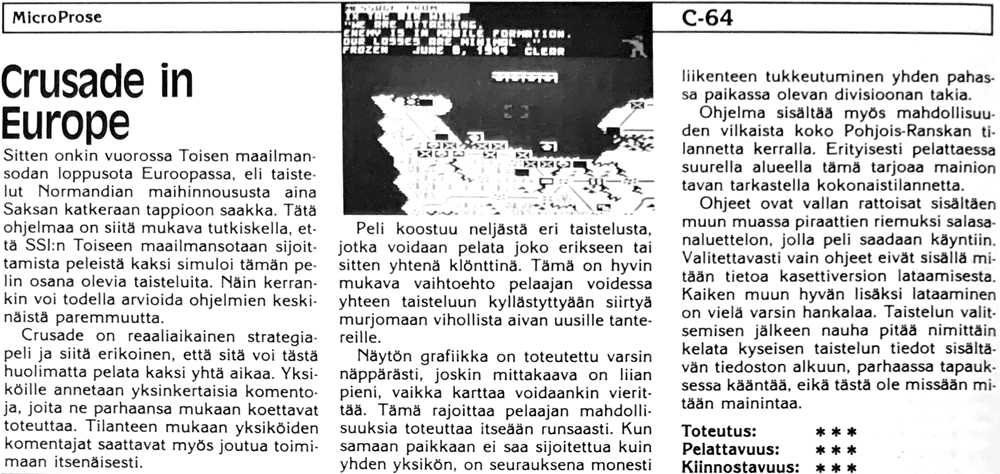
Crusade in Europe1987Pysyvä linkkiSitten onkin vuorossa Toisen maailmansodan loppusota Euroopassa, eli taistelut Normandian maihinnoususta aina Saksan katkeraan tappioon saakka. Tätä ohjelmaa on siitä mukava tutkiskella, että SSI:n Toiseen maailmansotaan sijoittamista peleistä kaksi simuloi tämän pelin osana olevia taisteluita. Näin kerrankin voi todella arvioida ohjelmien keskinäistä paremmuutta.
Crusade on reaaliaikainen strategiapeli ja siitä erikoinen, että sitä voi tästä huolimatta pelata kaksi yhtä aikaa. Yksiköille annetaan yksinkertaisia komentoja, joita ne parhaansa mukaan koettavat toteuttaa. Tilanteen mukaan yksiköiden komentajat saattavat myös joutua toimimaan itsenäisesti.
Peli koostuu neljästä eri taistelusta, jotka voidaan pelata joko erikseen tai sitten yhtenä klönttinä. Tämä on hyvin mukava vaihtoehto pelaajan voidessa yhteen taisteluun kyllästyttyään siirtyä murjomaan vihollista aivan uusille tantereille.
Näytön grafiikka on toteutettu varsin näppärästi, joskin mittakaava on liian pieni, vaikka karttaa voidaankin vierittää. Tämä rajoittaa pelaajan mahdollisuuksia toteuttaa itseään runsaasti. Kun samaan paikkaan ei saa sijoitettua kuin yhden yksikön, on seurauksena monesti liikenteen tukkeutuminen yhden pahassa paikassa olevan divisioonan takia.
Ohjelma sisältää myös mahdollisuuden vilkaista koko Pohjois-Ranskan tilannetta kerralla. Erityisesti pelattaessa suurella alueella tämä tarjoaa mainion tavan tarkastella kokonaistilannetta.
Ohjeet ovat vallan rattoisat sisältäen muun muassa piraattien riemuksi salasanaluettelon, jolla peli saadaan käyntiin. Valitettavasti vain ohjeet eivät sisällä mitään tietoa kasettiversion lataamisesta. Kaiken muun hyvän lisäksi lataaminen on vielä varsin hankalaa. Taistelun valitsemisen jälkeen nauha pitää nimittäin kelata kyseisen taistelun tiedot sisältävän tiedoston alkuun, parhaassa tapauksessa kääntää, eikä tästä ole missään mitään mainintaa.
Crusade in Europe1987PermalinkNext up, then, is the final stretch of the Second World War in Europe, that is, the battles from the Normandy landings all the way to Germany's bitter defeat. This program is a nice one to dig into, because two of SSI's Second World War games simulate battles that form part of this game. So for once you can really judge how the programs measure up against each other.
Crusade is a real-time strategy game, and unusual in that, despite this, two people can play it at the same time. The units are given simple orders, which they try to carry out as best they can. Depending on the situation, the unit commanders may also have to act on their own initiative.
The game consists of four different battles, which can be played either separately or as one big lump. This is a very nice option, since a player who gets fed up with one battle can move on to pummel the enemy on brand-new fields of battle.
The screen graphics have been done quite neatly, although the scale is too small, even if the map can be scrolled. This seriously limits the player's opportunities for self-expression. When you can't put more than one unit in the same spot, the result is often a traffic jam caused by a single division in an awkward place.
The program also lets you take a look at the situation across the whole of northern France at once. Especially when playing over a large area, this offers a splendid way to survey the overall picture.
The instructions are thoroughly entertaining, containing among other things, to the pirates' delight, a list of passwords for getting the game started. The only pity is that the instructions contain no information whatsoever about loading the cassette version. On top of all the other good things, loading is also pretty awkward. After choosing a battle, you see, you have to wind the tape to the start of the file holding that battle's data, and with any luck turn it over as well, and there is no mention of this anywhere.
Curse of Azure Bond
Curse of Azure Bond1989 SyksyPysyvä linkkiCurse of Azure Bond alkaa kuin mikä tahansa lauantaiaamu. Majatalossa herätään, mitään ei muisteta ja kaikki tavarat on viety. Kummastusta herättää kuitenkin viisi outoa merkkiä jokaisen ranteessa. Mitä tehdä? Minne mennä? Ja siihen loppuu juoniselostus, ettei peli-ilo kärsi. Todettakoon että tapahtumat alkavat nopeasti vyöryä omalla painollaan SSI:n jatkossa AD&D-seikkailuun Pool of Radiance.
COAB käyttää lähes identtistä systeemiä Poolin kanssa. Edelliseen osaan tutustumattomille kerrottakoon kuitenkin, että pääasiassa maisemissa liikutaan Bardseista tuttuun 3D-tyyliin. Taistelut käydään kuitenkin taktisesti kentällä, joka muotoutuu ympäristön mukaan. Halutessaan voi hahmo(t) taistella tietokoneohjattuna.
Erojakin löytyy. Ulkoilmaliikkuminen on menuohjattua ryhmän ollessa sidottu liikkumaan kaupungista kaupunkiin. Suurin osa kaupungeista on menumuodossa, eli 3D-käpyttelyä ei ole. Uskomaton parannus löytyy kuitenkin CAMP-menusta nimellä FIX. Se saa porukan clericit muistintamaan ja heittämään parannusloitsuja, kunnes kaikki on parannettu. Toinen suuri parannus on tietokoneohjatun taistelun entistä huomattavampi nopeus.
Hahmot voi ottaa Hillsfarista, Poolista tai luoda itse. Uudet hahmot aloittavat 25000 kokemuspisteellä ja vanhat menettävät KAIKKI hyvät varusteensa, nyyh! Niin paladinit kuin rangerit on lisätty hahmoluokkiin. Sekä MU- että Cleric-loitsut jatkuvat tasolle 5 ja lisämausteena on 1 tason Druidiloitsut eli AD&D-fanaatikon pitäisi olla suhtkoht tyytyväinen.
Tekninen puoli mainitakseni grafiikka on yleensä ottaen edeltäjää parempaa, ja koko peli syö kuusi levypuoliskoa. Latailu muodostuu ongelmaksi silloin jos levyasema ei kestä SSI:n turboa.
Curse on periaatteessa sama peli kuin Pool eri juonella. Ottaen huomioon Poolin korkean tason tämä on lähinnä kehu. Hillsfar on anteeksiannettu, Curse on todella erinomainen ja mielenkiintoinen ja sitä rataa roolipeli, joka on aiheuttanut sentin pölykerroksen ST-Amigan päälle. Kunpa joku vain kertoisi miten Monderin palaset saisi täältä ikuisuuteen.
Curse of Azure Bond1989 SyksyPermalinkCurse of Azure Bond starts like any old Saturday morning. You wake up at the inn, you remember nothing and all your stuff has been taken. What does raise eyebrows, though, is five strange marks on everyone's wrist. What to do? Where to go? And that's where the plot summary ends, so as not to spoil the fun of playing. Let it be said that events quickly start rolling under their own weight in SSI's sequel to the AD&D adventure Pool of Radiance.
COAB uses an almost identical system to Pool. For those unfamiliar with the previous instalment, though, let it be said that mostly you move through the scenery in the 3D style familiar from the Bards. Battles, however, are fought tactically on a field that takes its shape from the surroundings. If you like, the character(s) can fight under computer control.
There are differences too. Outdoor movement is menu-driven, with the party tied to moving from town to town. Most of the towns are in menu form, meaning there's no 3D trudging about. An incredible improvement, though, can be found in the CAMP menu under the name FIX. It gets the party's clerics memorising and casting healing spells until everyone has been healed. Another big improvement is the much greater speed of computer-controlled combat.
Characters can be taken from Hillsfar or Pool, or you can create your own. New characters start with 25000 experience points and old ones lose ALL their good equipment, sob! Both paladins and rangers have been added to the character classes. Both MU and Cleric spells go up to level 5, and as extra spice there are level 1 Druid spells, so the AD&D fanatic ought to be reasonably satisfied.
To mention the technical side, the graphics are generally better than the predecessor's, and the whole game eats up six disk sides. Loading becomes a problem if your disk drive can't cope with SSI's turbo.
Curse is basically the same game as Pool with a different plot. Considering Pool's high standard, that's more or less a compliment. Hillsfar is forgiven; Curse is a truly excellent and interesting and so on and so forth role-playing game, which has left an inch of dust on top of the ST-Amiga. If only someone would tell me how to get Monder's pieces from here to eternity.
Curse of Ra, The
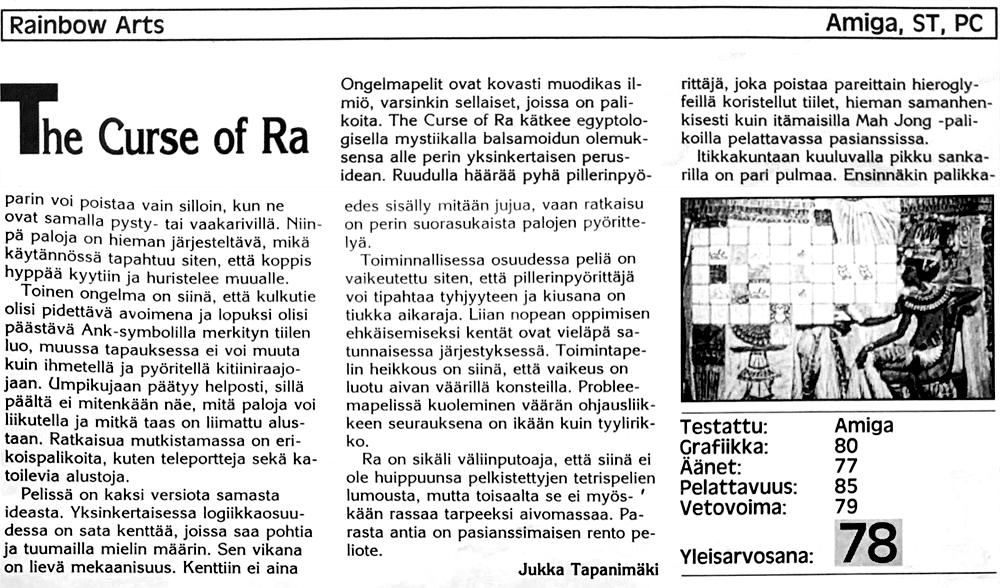
Curse of Ra, The1991 KevätPysyvä linkkiOngelmapelit ovat kovasti muodikas ilmiö, varsinkin sellaiset, joissa on palikoita. The Curse of Ra kätkee egyptologisella mystiikalla balsamoidun olemuksensa alle perin yksinkertaisen perusidean. Ruudulla häärää pyhä pillerinpyörittäjä, joka poistaa pareittain hieroglyfeillä koristellut tiilet, hieman samanhenkisesti kuin itämaisilla Mah Jong -palikoilla pelattavassa pasianssissa.
Itikkakuntaan kuuluvalla pikku sankarilla on pari pulmaa. Ensinnäkin palikkaparin voi poistaa vain silloin, kun ne ovat samalla pysty- tai vaakarivillä. Niinpä paloja on hieman järjesteltävä, mikä käytännössä tapahtuu siten, että koppis hyppää kyytiin ja huristelee muualle.
Toinen ongelma on siinä, että kulkutie olisi pidettävä avoimena ja lopuksi olisi päästävä Ank-symbolilla merkityn tiilen luo, muussa tapauksessa ei voi muuta kuin ihmetellä ja pyöritellä kitiiniraajojaan. Umpikujaan päätyy helposti, sillä päältä ei mitenkään näe, mitä paloja voi liikutella ja mitkä taas on liimattu alustaan. Ratkaisua mutkistamassa on erikoispalikoita, kuten teleportteja sekä katoilevia alustoja.
Pelissä on kaksi versiota samasta ideasta. Yksinkertaisessa logiikkaosuudessa on sata kenttää, joissa saa pohtia ja tuumailla mielin määrin. Sen vikana on lievä mekaanisuus. Kenttiin ei aina edes sisälly mitään jujua, vaan ratkaisu on perin suorasukaista palojen pyörittelyä.
Toiminnallisessa osuudessa peliä on vaikeutettu siten, että pillerinpyörittäjä voi tipahtaa tyhjyyteen ja kiusana on tiukka aikaraja. Liian nopean oppimisen ehkäisemiseksi kentät ovat vieläpä satunnaisessa järjestyksessä. Toimintapelin heikkous on siinä, että vaikeus on luotu aivan väärillä konsteilla. Probleemapelissä kuoleminen väärän ohjausliikkeen seurauksena on ikään kuin tyylirikko.
Ra on sikäli väliinputoaja, että siinä ei ole huippuunsa pelkistettyjen tetrispelien lumousta, mutta toisaalta se ei myöskään rassaa tarpeeksi aivomassaa. Parasta antia on pasianssimaisen rento peliote.
Curse of Ra, The1991 KevätPermalinkPuzzle games are a very fashionable phenomenon, especially the ones with blocks in them. Beneath its exterior, embalmed in Egyptological mysticism, The Curse of Ra hides a thoroughly simple basic idea. Bustling about the screen is a sacred scarab that removes hieroglyph-decorated tiles in pairs, somewhat in the same spirit as the patience game played with oriental Mah Jong tiles.
Our little hero from the creepy-crawly kingdom has a couple of problems. First, a pair of blocks can only be removed when they are in the same column or row. So the pieces need a bit of rearranging, which in practice works by the beetle hopping aboard and whizzing off somewhere else.
The second problem is that the path has to be kept open and at the end you have to reach the tile marked with the ankh symbol; otherwise there's nothing for it but to wonder and twiddle your chitinous limbs. It's easy to end up in a dead end, since there's no way of telling from the top which pieces can be moved and which are glued to the floor. Complicating the solution are special blocks such as teleports and disappearing platforms.
The game has two versions of the same idea. The simple logic section has a hundred levels in which you can ponder and mull to your heart's content. Its flaw is a slight mechanicalness. The levels don't always even contain any trick; the solution is just thoroughly straightforward shuffling of pieces.
In the action section the game has been made harder in that the scarab can tumble into the void, and a tight time limit is there to torment you. To stop you learning them too quickly, the levels even come in random order. The action game's weakness is that the difficulty has been created with entirely the wrong tricks. In a puzzle game, dying because of one wrong move of the controls is something of a lapse in style.
Ra falls between two stools in that it lacks the spell of Tetris-style games pared down to the bone, but on the other hand it doesn't give the grey matter enough of a workout either. The best thing on offer is a relaxed, patience-like style of play.
Cybercon III
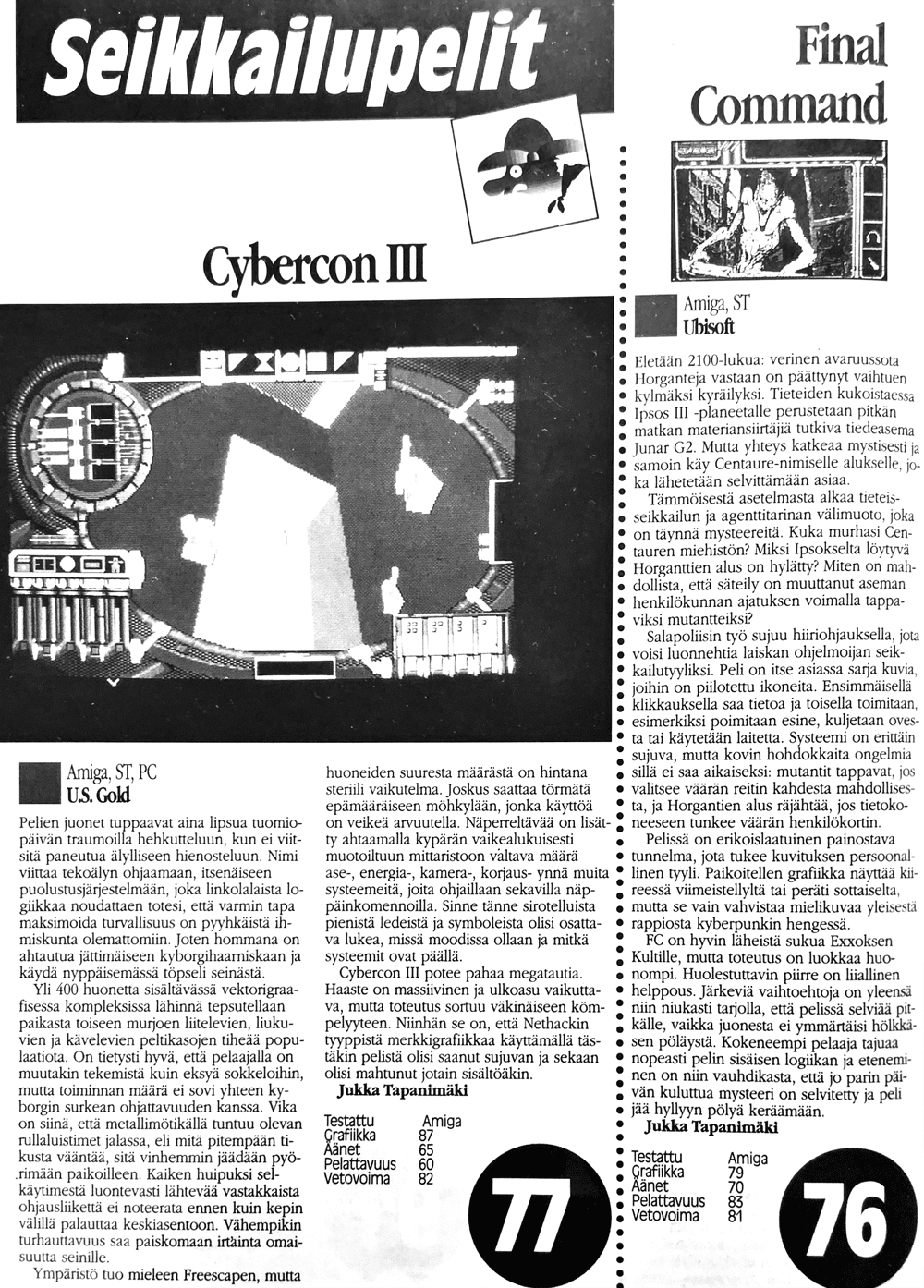
Cybercon III1991 SyksyPysyvä linkkiPelien juonet tuppaavat aina lipsua tuomiopäivän traumoilla hehkutteluun, kun ei viitsitä paneutua älylliseen hienosteluun. Nimi viittaa tekoälyn ohjaamaan, itsenäiseen puolustusjärjestelmään, joka linkolalaista logiikkaa noudattaen totesi, että varmin tapa maksimoida turvallisuus on pyyhkäistä ihmiskunta olemattomiin. Joten hommana on ahtautua jättimäiseen kyborgihaarniskaan ja käydä nyppäisemässä töpseli seinästä.
Yli 400 huonetta sisältävässä vektorigraafisessa kompleksissa lähinnä tepsutellaan paikasta toiseen murjoen liitelevien, liukuvien ja kävelevien peltikasojen tiheää populaatiota. On tietysti hyvä, että pelaajalla on muutakin tekemistä kuin eksyä sokkeloihin, mutta toiminnan määrä ei sovi yhteen kyborgin surkean ohjattavuuden kanssa. Vika on siinä, että metallimötikällä tuntuu olevan rullaluistimet jalassa, eli mitä pitempään tikusta vääntää, sitä vinhemmin jäädään pyörimään paikoilleen. Kaiken huipuksi selkäytimestä luontevasti lähtevää vastakkaista ohjausliikettä ei noteerata ennen kuin kepin välillä palauttaa keskiasentoon. Vähempikin turhauttavuus saa paiskomaan irtäinta omaisuutta seinille.
Ympäristö tuo mieleen Freescapen, mutta huoneiden suuresta määrästä on hintana steriili vaikutelma. Joskus saattaa törmätä epämääräiseen möhkylään, jonka käyttöä on veikeä arvuutella. Näperreltävää on lisätty ahtaamalla kypärän vaikealukuisesti muotoiltuun mittaristoon valtava määrä ase-, energia-, kamera-, korjaus- ynnä muita systeemeitä, joita ohjaillaan sekavilla näppäinkomennoilla. Sinne tänne sirotelluista pienistä ledeistä ja symboleista olisi osattava lukea, missä moodissa ollaan ja mitkä systeemit ovat päällä.
Cybercon III potee pahaa megatautia. Haaste on massiivinen ja ulkoasu vaikuttava, mutta toteutus sortuu väkinäiseen kömpelyyteen. Niinhän se on, että Nethackin tyyppistä merkkigrafiikkaa käyttämällä tästäkin pelistä olisi saanut sujuvan ja sekaan olisi mahtunut jotain sisältöäkin.
Cybercon III1991 SyksyPermalinkGame plots always tend to slip into raving about doomsday traumas when nobody can be bothered to get stuck into any intellectual finesse. The name refers to an AI-controlled, autonomous defence system which, following Linkola-style logic, concluded that the surest way to maximise security is to wipe humanity out of existence. So the job is to cram yourself into a gigantic cyborg suit of armour and go and yank the plug out of the wall.
In the vector-graphic complex of over 400 rooms, you mostly pitter-patter from place to place, pummelling a dense population of gliding, sliding and walking heaps of tin. It's good, of course, that the player has something to do besides getting lost in the mazes, but the amount of action doesn't go with the cyborg's wretched handling. The trouble is that the metal lump seems to be wearing roller skates, i.e. the longer you push the stick, the faster you end up spinning on the spot. To top it all, the opposite steering movement that comes naturally from the spinal cord isn't registered until you've returned the stick to the centre in between. Even less frustration than this would have you hurling your movable possessions at the walls.
The environment brings Freescape to mind, but the price of the large number of rooms is a sterile impression. Now and then you might bump into some nondescript lump whose purpose is fun to puzzle over. Extra fiddliness has been added by cramming into the helmet's illegibly designed instrument panel a huge number of weapon, energy, camera, repair and other systems, which are controlled with muddled keyboard commands. From little LEDs and symbols sprinkled here and there you're supposed to be able to read which mode you're in and which systems are on.
Cybercon III is suffering from a bad case of mega-itis. The challenge is massive and the presentation impressive, but the execution collapses into laboured clumsiness. That's just the way it is: with Nethack-type character graphics, this game too could have been made to run smoothly, and there'd have been room for some actual content in there as well.
Cybernoid
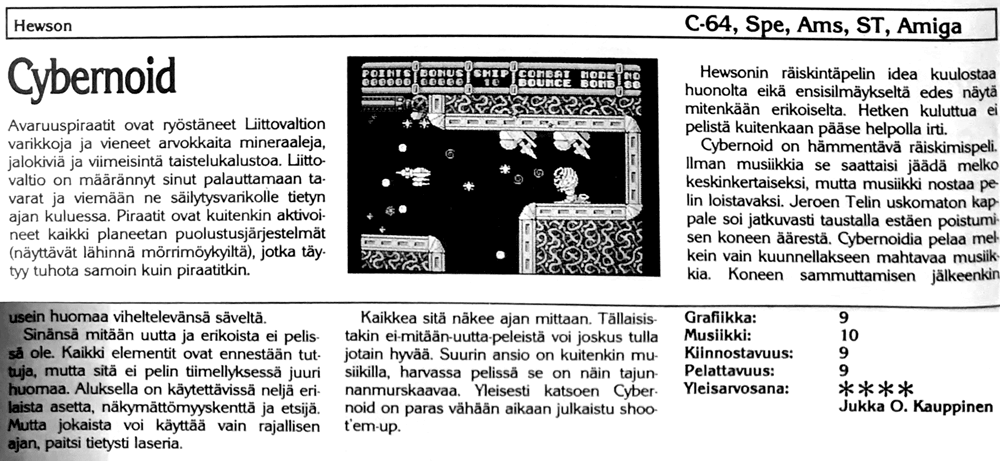
Cybernoid1988Pysyvä linkkiAvaruuspiraatit ovat ryöstäneet Liittovaltion varikkoja ja vieneet arvokkaita mineraaleja, jalokiviä ja viimeisintä taistelukalustoa. Liittovaltio on määrännyt sinut palauttamaan tavarat ja viemään ne säilytysvarikolle tietyn ajan kuluessa. Piraatit ovat kuitenkin aktivoineet kaikki planeetan puolustusjärjestelmät (näyttävät lähinnä mörrimöykyiltä), jotka täytyy tuhota samoin kuin piraatitkin.
Hewsonin räiskintäpelin idea kuulostaa huonolta eikä ensisilmäykseltä edes näytä mitenkään erikoiselta. Hetken kuluttua ei pelistä kuitenkaan pääse helpolla irti.
Cybernoid on hämmentävä räiskimispeli. Ilman musiikkia se saattaisi jäädä melko keskinkertaiseksi, mutta musiikki nostaa pelin loistavaksi. Jeroen Telin uskomaton kappale soi jatkuvasti taustalla estäen poistumisen koneen äärestä. Cybernoidia pelaa melkein vain kuunnellakseen mahtavaa musiikkia. Koneen sammuttamisen jälkeenkin usein huomaa viheltelevänsä säveltä.
Sinänsä mitään uutta ja erikoista ei pelissä ole. Kaikki elementit ovat ennestään tuttuja, mutta sitä ei pelin tiimellyksessä juuri huomaa. Aluksella on käytettävissä neljä erilaista asetta, näkymättömyyskenttä ja etsijä. Mutta jokaista voi käyttää vain rajallisen ajan, paitsi tietysti laseria.
Kaikkea sitä näkee ajan mittaan. Tällaisistakin ei-mitään-uutta-peleistä voi joskus tulla jotain hyvää. Suurin ansio on kuitenkin musiikilla, harvassa pelissä se on näin tajunnanmurskaavaa. Yleisesti katsoen Cybernoid on paras vähään aikaan julkaistu shoot'em-up.
Cybernoid1988PermalinkSpace pirates have raided the Federation's depots and made off with valuable minerals, jewels and the latest battle hardware. The Federation has ordered you to recover the goods and take them to the storage depot within a set time. The pirates, however, have activated all of the planet's defence systems (they look mostly like lumpy bogeymen), which have to be destroyed just like the pirates themselves.
The idea of Hewson's shoot-'em-up sounds bad, and at first glance it doesn't even look anything special. After a while, though, you can't easily tear yourself away from the game.
Cybernoid is a baffling blaster. Without the music it might have stayed fairly mediocre, but the music lifts the game to brilliance. Jeroen Tel's incredible tune plays constantly in the background, stopping you from ever leaving the computer. You play Cybernoid almost just to listen to the magnificent music. Even after switching the machine off you often catch yourself whistling the tune.
As such, there is nothing new or special in the game. All the elements are familiar from before, but in the heat of the game you hardly notice. The ship has four different weapons at its disposal, an invisibility field and a seeker. But each of them can only be used for a limited time, except of course the laser.
Stick around long enough and you'll see everything. Even these nothing-new games can sometimes turn out to be something good. The biggest credit, though, goes to the music; in few games is it this mind-shattering. All in all, Cybernoid is the best shoot-'em-up released in quite a while.
Cybernoid II - The Revenge
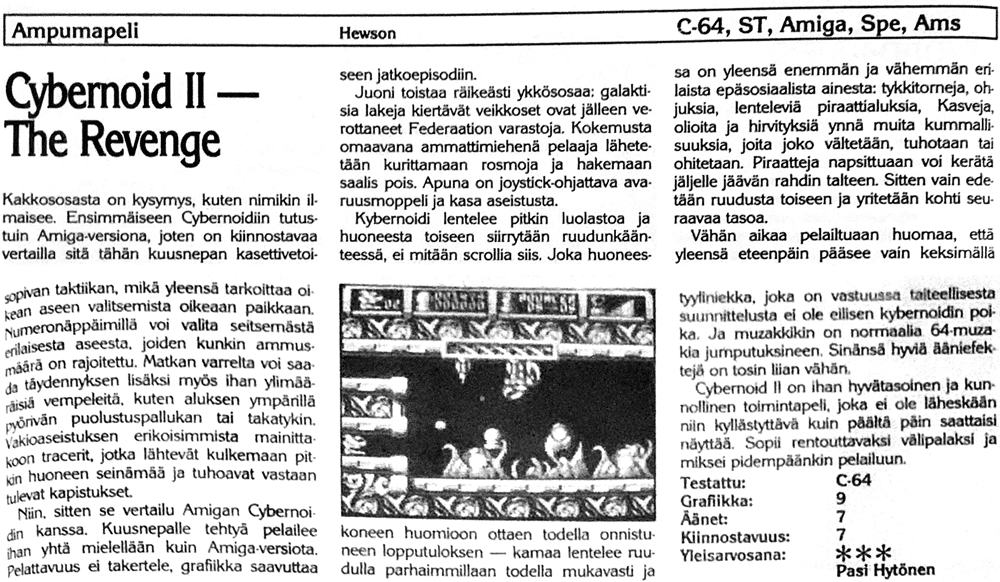
Cybernoid II - The Revenge1989 KevätPysyvä linkkiKakkososasta on kysymys, kuten nimikin ilmaisee. Ensimmäiseen Cybernoidiin tutustuin Amiga-versiona, joten on kiinnostavaa vertailla sitä tähän kuusnepan kasettivetoiseen jatkoepisodiin.
Juoni toistaa räikeästi ykkösosaa: galaktisia lakeja kiertävät veikkoset ovat jälleen verottaneet Federaation varastoja. Kokemusta omaavana ammattimiehenä pelaaja lähetetään kurittamaan rosmoja ja hakemaan saalis pois. Apuna on joystick-ohjattava avaruusmoppeli ja kasa aseistusta.
Kybernoidi lentelee pitkin luolastoa ja huoneesta toiseen siirrytään ruudunkäänteessä, ei mitään scrollia siis. Joka huoneessa on yleensä enemmän ja vähemmän erilaista epäsosiaalista ainesta: tykkitorneja, ohjuksia, lenteleviä piraattialuksia, Kasveja, olioita ja hirvityksiä ynnä muita kummallisuuksia, joita joko vältetään, tuhotaan tai ohitetaan. Piraatteja napsittuaan voi kerätä jäljelle jäävän rahdin talteen. Sitten vain edetään ruudusta toiseen ja yritetään kohti seuraavaa tasoa.
Vähän aikaa pelailtuaan huomaa, että yleensä eteenpäin pääsee vain keksimällä sopivan taktiikan, mikä yleensä tarkoittaa oikean aseen valitsemista oikeaan paikkaan. Numeronäppäimillä voi valita seitsemästä erilaisesta aseesta, joiden kunkin ammusmäärä on rajoitettu. Matkan varrelta voi saada täydennyksen lisäksi myös ihan ylimääräisiä vempeleitä, kuten aluksen ympärillä pyörivän puolustuspallukan tai takatykin. Vakioaseistuksen erikoisimmista mainittakoon tracerit, jotka lähtevät kulkemaan pitkin huoneen seinämää ja tuhoavat vastaan tulevat kapistukset.
Niin, sitten se vertailu Amigan Cybernoidin kanssa. Kuusnepalle tehtyä pelailee ihan yhtä mielellään kuin Amiga-versiota. Pelattavuus ei takertele, grafiikka saavuttaa koneen huomioon ottaen todella onnistuneen lopputuloksen - kamaa lentelee ruudulla parhaimmillaan todella mukavasti ja tyyliniekka, joka on vastuussa taiteellisesta suunnittelusta ei ole eilisen kybernoidin poika. Ja muzakkikin on normaalia 64-muzakia jumputuksineen. Sinänsä hyviä ääniefektejä on tosin liian vähän.
Cybernoid II on ihan hyvätasoinen ja kunnollinen toimintapeli, joka ei ole läheskään niin kyllästyttävä kuin päältä päin saattaisi näyttää. Sopii rentouttavaksi välipalaksi ja miksei pidempäänkin pelailuun.
Cybernoid II - The Revenge1989 KevätPermalinkIt's part two we're dealing with, as the name itself says. I got to know the first Cybernoid as the Amiga version, so it's interesting to compare it with this cassette-driven C-64 sequel episode.
The plot blatantly repeats part one: some galactic-law-dodging lads have once again levied their own tax on the Federation's storehouses. As a seasoned professional, the player is sent to give the crooks a hiding and fetch the loot back. To help out there's a joystick-controlled space moped and a heap of weaponry.
The cybernoid flits about the cave system, and you move from one room to the next in a flip of the screen, so no scrolling of any kind. Every room usually holds a more-or-less assorted bunch of antisocial elements: gun turrets, missiles, flying pirate ships, plants, creatures and horrors and other oddities, which are either avoided, destroyed or bypassed. After picking off pirates you can collect the cargo they leave behind. Then you just advance from screen to screen and try to push on towards the next level.
After playing for a little while you notice that usually the only way forward is to come up with a suitable tactic, which usually means choosing the right weapon for the right place. The number keys let you choose from seven different weapons, each with a limited amount of ammunition. Along the way, besides refills, you can also pick up some genuinely extra gadgets, such as a defence ball that circles the ship or a rear gun. Of the more unusual items in the standard armoury, the tracers deserve a mention: they set off crawling along the walls of the room and destroy whatever gizmos get in their way.
Right, and then that comparison with the Amiga Cybernoid. The one made for the C-64 is every bit as nice to play as the Amiga version. The playability doesn't snag, and the graphics, considering the machine, reach a really successful end result - at its best, stuff flies about the screen really nicely, and the stylist responsible for the artistic design wasn't born of yesterday's cybernoid. And the muzak is ordinary 64 muzak, thumping and all. There are, though, too few sound effects, good as they are in themselves.
Cybernoid II is a perfectly respectable, solid action game that is nowhere near as tiresome as it might look from the outside. Suitable as a relaxing snack between meals, and why not for longer spells of play too.
Cyberun
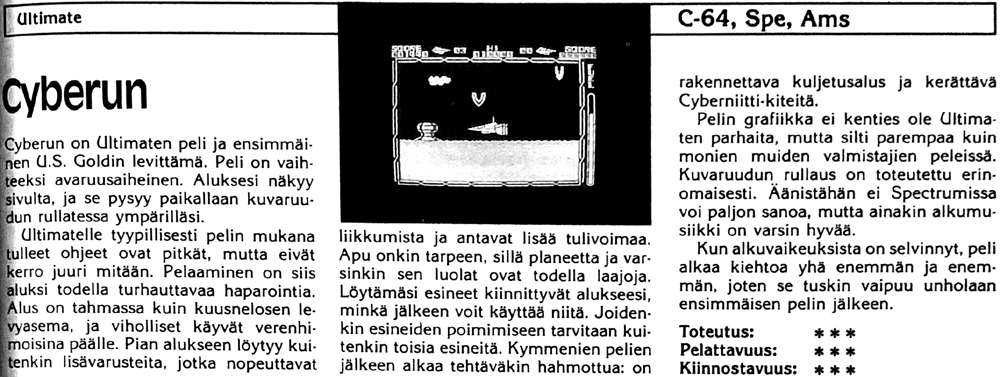
Cyberun1987Pysyvä linkkiCyberun on Ultimaten peli ja ensimmäinen U.S. Goldin levittämä. Peli on vaihteeksi avaruusaiheinen. Aluksesi näkyy sivulta, ja se pysyy paikallaan kuvaruudun rullatessa ympärilläsi.
Ultimatelle tyypillisesti pelin mukana tulleet ohjeet ovat pitkät, mutta eivät kerro juuri mitään. Pelaaminen on siis aluksi todella turhauttavaa haparointia. Alus on tahmassa kuin kuusnelosen levyasema, ja viholliset käyvät verenhimoisina päälle. Pian alukseen löytyy kuitenkin lisävarusteita, jotka nopeuttavat liikkumista ja antavat lisää tulivoimaa. Apu onkin tarpeen, sillä planeetta ja varsinkin sen luolat ovat todella laajoja. Löytämäsi esineet kiinnittyvät alukseesi, minkä jälkeen voit käyttää niitä. Joidenkin esineiden poimimiseen tarvitaan kuitenkin toisia esineitä. Kymmenien pelien jälkeen alkaa tehtäväkin hahmottua: on rakennettava kuljetusalus ja kerättävä Cyberniitti-kiteitä.
Pelin grafiikka ei kenties ole Ultimaten parhaita, mutta silti parempaa kuin monien muiden valmistajien peleissä. Kuvaruudun rullaus on toteutettu erinomaisesti. Äänistähän ei Spectrumissa voi paljon sanoa, mutta ainakin alkumusiikki on varsin hyvää.
Kun alkuvaikeuksista on selvinnyt, peli alkaa kiehtoa yhä enemmän ja enemmän, joten se tuskin vaipuu unholaan ensimmäisen pelin jälkeen.
Cyberun1987PermalinkCyberun is an Ultimate game, and the first one distributed by U.S. Gold. The game has a space theme, for a change. Your ship is seen from the side, and it stays put while the screen scrolls around you.
As is typical of Ultimate, the instructions that came with the game are long but tell you next to nothing. So at first, playing is a truly frustrating business of groping around in the dark. The ship is as sluggish as a Commodore 64 disk drive, and the enemies come at you out for blood. Soon, though, you find add-ons for the ship that speed up your movement and give you more firepower. The help is certainly needed, because the planet, and its caves in particular, are really vast. The objects you find attach themselves to your ship, after which you can use them. Picking up some objects, however, requires other objects. After dozens of games even the mission starts to take shape: you have to build a transport ship and collect Cybernite crystals.
The game's graphics may not be among Ultimate's best, but they're still better than in the games of many other makers. The screen scrolling has been done excellently. There's not much you can say about sound on the Spectrum, of course, but at least the title music is pretty good.
Once you've got past the teething troubles, the game grows more and more fascinating, so it's hardly going to sink into oblivion after the first game.
Cyborg
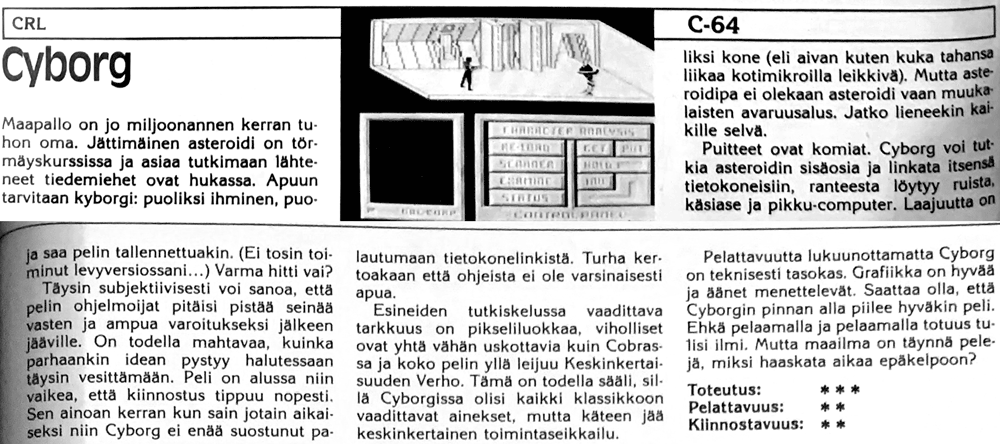
Cyborg1987Pysyvä linkkiMaapallo on jo miljoonannen kerran tuhon oma. Jättimäinen asteroidi on törmäyskurssissa ja asiaa tutkimaan lähteneet tiedemiehet ovat hukassa. Apuun tarvitaan kyborgi: puoliksi ihminen, puoliksi kone (eli aivan kuten kuka tahansa liikaa kotimikroilla leikkivä). Mutta asteroidipa ei olekaan asteroidi vaan muukalaisten avaruusalus. Jatko lieneekin kaikille selvä.
Puitteet ovat komiat. Cyborg voi tutkia asteroidin sisäosia ja linkata itsensä tietokoneisiin, ranteesta löytyy ruista, käsiase ja pikku-computer. Laajuutta on ja saa pelin tallennettuakin. (Ei tosin toiminut levyversiossani...) Varma hitti vai?
Täysin subjektiivisesti voi sanoa, että pelin ohjelmoijat pitäisi pistää seinää vasten ja ampua varoitukseksi jälkeen jääville. On todella mahtavaa, kuinka parhaankin idean pystyy halutessaan täysin vesittämään. Peli on alussa niin vaikea, että kiinnostus tippuu nopesti. Sen ainoan kerran kun sain jotain aikaiseksi niin Cyborg ei enää suostunut palautumaan tietokonelinkistä. Turha kertoakaan että ohjeista ei ole varsinaisesti apua.
Esineiden tutkiskelussa vaadittava tarkkuus on pikseliluokkaa, viholliset ovat yhtä vähän uskottavia kuin Cobrassa ja koko pelin yllä leijuu Keskinkertaisuuden Verho. Tämä on todella sääli, sillä Cyborgissa olisi kaikki klassikkoon vaadittavat ainekset, mutta käteen jää keskinkertainen toimintaseikkailu.
Pelattavuutta lukuunottamatta Cyborg on teknisesti tasokas. Grafiikka on hyvää ja äänet menettelevät. Saattaa olla, että Cyborgin pinnan alla piilee hyväkin peli. Ehkä pelaamalla ja pelaamalla totuus tulisi ilmi. Mutta maailma on täynnä pelejä, miksi haaskata aikaa epäkelpoon?
Cyborg1987PermalinkPlanet Earth is doomed for the millionth time. A gigantic asteroid is on a collision course, and the scientists who set off to investigate have gone missing. A cyborg is needed to help: half man, half machine (in other words, just like anyone who plays with home computers too much). But what do you know, the asteroid isn't an asteroid after all but an alien spaceship. The rest is probably obvious to everyone.
The setting is a grand one. Cyborg can explore the insides of the asteroid and hook itself up to computers, and at the wrist there's muscle, a handgun and a little computer. There's plenty of scope, and you can even save the game. (Though it didn't work on my disk version...) A sure-fire hit, then?
Speaking purely subjectively, the game's programmers ought to be stood up against a wall and shot as a warning to the rest. It's truly magnificent how, if you really want to, you can completely water down even the best of ideas. At the start the game is so hard that your interest drops off fast. The one and only time I did get something done, Cyborg then refused to come back out of the computer link. Needless to say, the instructions aren't exactly a help.
The precision needed to examine objects is down to the pixel, the enemies are about as believable as in Cobra, and the Veil of Mediocrity hangs over the whole game. This is a real pity, because Cyborg would have all the ingredients a classic needs, but what you're left holding is a mediocre action adventure.
Playability aside, Cyborg is technically of a high standard. The graphics are good and the sound is passable. It may be that there's even a good game lurking beneath Cyborg's surface. Maybe by playing and playing and playing the truth would come out. But the world is full of games, so why waste time on a dud?
Cycles, The
Cycles, The1990 KevätPysyvä linkkiAccoladen The Cycles on yksinkertaisesti Grand Prix Circuit moottoripyörällä. Eikä siinä ole mitään pahaa, sillä GPC oli aivan hyvä peli. Aivan suoraan peliä ei sentään ole kloonattu, vaan peliin on lisätty yksi ulottuvuus lisää, nimittäin ylä-ala-suunta. Nyt radat poukkoilevat huimasti pyörän alla ja tahtomattaankin yrittää kurkotella seuraavan mäen taakse, vaikka tietääkin ettei niskan venyttelystä ole mitään apua.
Jos olet aikaisemmin pelannut Grand Prix Circuitia, tiedät mistä on kyse. Jos et, tässä pelin sisältö lyhyesti: pelaaja istutetaan valintansa mukaisesti joko 125-, 250- tai 500-kuutioisen moottoripyörän sarvien taakse. Vaikeustason ja kisan pituuden valinnan jälkeen lähdetäänkin sitten polttamaan kumia ympäri maailmaa sijaitseville radoille. Tavoitteena on tietenkin kovan harjoittelun jälkeen maailmanmestaruus.
Tärkeintä tällaisessa pelissä on tietenkin vauhdin tuntu. Aivan täydellisesti eivät ohjelmoijat ole tätä onnistuneet tekemään, vaan peli tuntuu hieman oudolta ja nykivältä, sekä yleensäkin laiskalta. Vaikka nopeusmittarin mukaan pyörä kiitää pääsuoraa 250 km/h, ei maisema vilise ohitse vastaavalla vauhdilla. Tämä ei kuitenkaan haittaa pidemmän päälle kuin kaikkein kriittisimpiä pelaajia.
äänipuoli on vain moottorin surinaa ja satunnaisia vinkunoita kun kumit sutivat pitkin "liukasta" asfalttia. Pelin alkumusiikki ei ole sieltä parhaasta päästä, Amiga pystyy PALJON parempaan. Pelattavuudesta ei ole pahaa sanottavaa, muttei sitä tarvitse taivaaseenkaan kehua.
PC:n The Cycles on suurinpiirtein sama, mutta luonnollisesti PC häviää audiossa reilusti, kiitos massiivisen yksiäänisen piippinsä. Täytyy kuitenkin antaa tunnustus Accoladelle, PC:n The Cyclesin musiikki kuulostaa välillä kaksi-, jopa kolmiääniseltä. Bonusta on se, että peli ymmärtää AdLib-äänikortin ja alkumusiikissa onkin rankkaa menoa kortin avustuksella. Miinuksena on sitten se, että peli EI käytä korttia pelin aikana, vaan moottoripyörän kimityksen hoitaa PC.
Kaiken kaikkiaan The Cycles on parempi peli kuin Grand Prix Circuit. Jos pidit GPC:sta ja molemmista Test Driveistä, on tämäkin pakko-ostos.
Cycles, The1990 KevätPermalinkAccolade's The Cycles is simply Grand Prix Circuit on a motorbike. And there's nothing wrong with that, since GPC was a perfectly good game. The game hasn't been cloned quite directly, mind you; one more dimension has been added to it, namely the up-and-down direction. Now the tracks buck wildly under the bike and you can't help trying to peer over the next hill, even though you know full well that stretching your neck won't do any good.
If you've played Grand Prix Circuit before, you know what it's all about. If not, here's the gist of the game in brief: according to their choice, the player is seated behind the handlebars of a 125, 250 or 500 cc motorbike. After choosing the difficulty level and the length of the race, off you go to burn rubber on tracks located around the world. The goal, of course, after hard practice, is the world championship.
The most important thing in a game like this is naturally the sense of speed. The programmers haven't managed to pull this off quite perfectly; instead the game feels a little odd and jerky, and sluggish in general. Even though according to the speedometer the bike is flying down the main straight at 250 km/h, the scenery doesn't whizz past at a matching pace. In the long run, though, this only bothers the most critical of players.
The sound side is just the drone of the engine and the occasional squeal as the tyres spin along the "slippery" asphalt. The game's intro music isn't exactly top-drawer; the Amiga is capable of MUCH better. There's nothing bad to say about the playability, but there's no need to praise it to the skies either.
The Cycles on the PC is roughly the same, but naturally the PC loses heavily on audio, thanks to its massive single-voice beeper. You have to give Accolade credit, though: the music in the PC's The Cycles sounds two-, even three-voiced at times. A bonus is that the game understands the AdLib sound card, and the intro music really rocks along with the card's help. The minus, then, is that the game does NOT use the card during play; instead the motorbike's whine is left to the PC.
All in all, The Cycles is a better game than Grand Prix Circuit. If you liked GPC and both Test Drives, this one is a must-buy too.