1133 reviews from "Pelit"-books
Pelit was a Finnish-language (bi)annual book series published from 1987 to 1991 containing gaming-related articles, tips and most importantly game reviews. Here you can find all the reviews from the books. The reviews were originally written in Finnish; the English versions are translations of the Finnish originals. Maininta tekijänoikeuksista
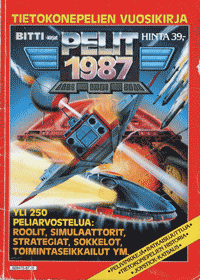 1987
1987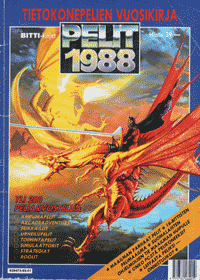 1988
1988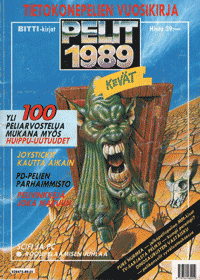 1989 Kevät
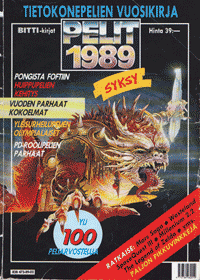 1989 Syksy
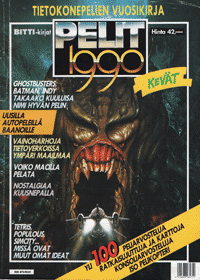 1990 Kevät
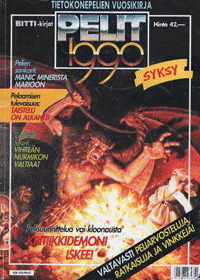 1990 Syksy
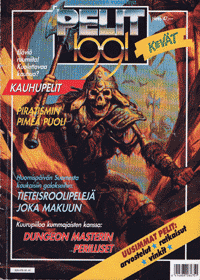 1991 Kevät
 1991 Syksy
T.K.O.
T.K.O.1989 KevätPysyvä linkkiOnko maailmassa mitään hauskempaa kuin katsella isoa raavasta miestä hakkaamassa tajua pois pieneltä koulutytöltä? Varmasti. Mutta siitä ei ole nyt kuitenkaan kysymys, vaan ihan rehdistä nyrkkeilystä kahden ammattilaisnyrkkeilijän välillä.
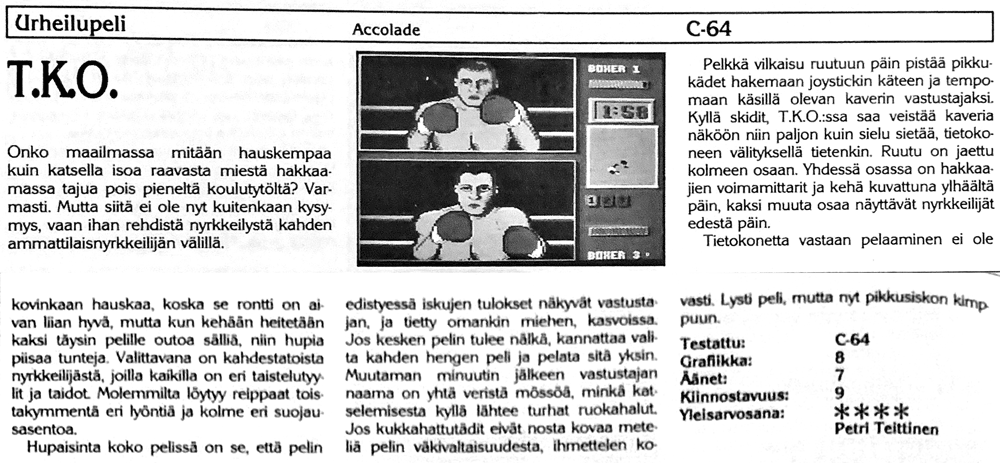
Pelkkä vilkaisu ruutuun päin pistää pikkukädet hakemaan joystickin käteen ja tempomaan käsillä olevan kaverin vastustajaksi. Kyllä skidit, T.K.O.:ssa saa veistää kaveria näköön niin paljon kuin sielu sietää, tietokoneen välityksellä tietenkin. Ruutu on jaettu kolmeen osaan. Yhdessä osassa on hakkaajien voimamittarit ja kehä kuvattuna ylhäältä päin, kaksi muuta osaa näyttävät nyrkkeilijät edestä päin.
Tietokonetta vastaan pelaaminen ei ole kovinkaan hauskaa, koska se rontti on aivan liian hyvä, mutta kun kehään heitetään kaksi täysin pelille outoa sälliä, niin hupia piisaa tunteja. Valittavana on kahdestatoista nyrkkeilijästä, joilla kaikilla on eri taistelutyylit ja taidot. Molemmilta löytyy reippaat toistakymmentä eri lyöntiä ja kolme eri suojausasentoa.
Hupaisinta koko pelissä on se, että pelin edistyessä iskujen tulokset näkyvät vastustajan, ja tietty omankin miehen, kasvoissa. Jos kesken pelin tulee nälkä, kannattaa valita kahden hengen peli ja pelata sitä yksin. Muutaman minuutin jälkeen vastustajan naama on yhtä veristä mössöä, minkä katselemisesta kyllä lähtee turhat ruokahalut. Jos kukkahattutädit eivät nosta kovaa meteliä pelin väkivaltaisuudesta, ihmettelen kovasti. Lysti peli, mutta nyt pikkusiskon kimppuun.
T.K.O.1989 KevätPermalinkIs there anything in the world more fun than watching a big strapping man beat a little schoolgirl senseless? Certainly. But that's not what this is about anyway - it's about good honest boxing between two professional boxers.
A mere glance at the screen sends little hands grabbing for the joystick and hauling the nearest mate to hand in as an opponent. Oh yes, kids, in T.K.O. you get to rearrange your mate's face to your heart's content - via the computer, of course. The screen is split into three parts. One part has the sluggers' power meters and the ring seen from above; the other two show the boxers from the front.
Playing against the computer isn't much fun, because the brute is far too good, but when you throw two blokes who are complete strangers to the game into the ring, the fun lasts for hours. There are twelve boxers to choose from, all with different fighting styles and skills. Both have well over ten different punches and three different guard positions.
The most amusing thing in the whole game is that as it goes on, the results of the blows show on the opponent's face - and on your own man's too, of course. If you get hungry in the middle of the game, it's worth choosing the two-player game and playing it alone. After a few minutes the opponent's mug is one bloody mush, and looking at that will certainly take away any needless appetite. If the flowery-hatted busybodies don't kick up a big fuss about the game's violence, I'll be very surprised. A jolly game, but now to go and set about my little sister.
Tag Team Wrestling plus Karate Champ
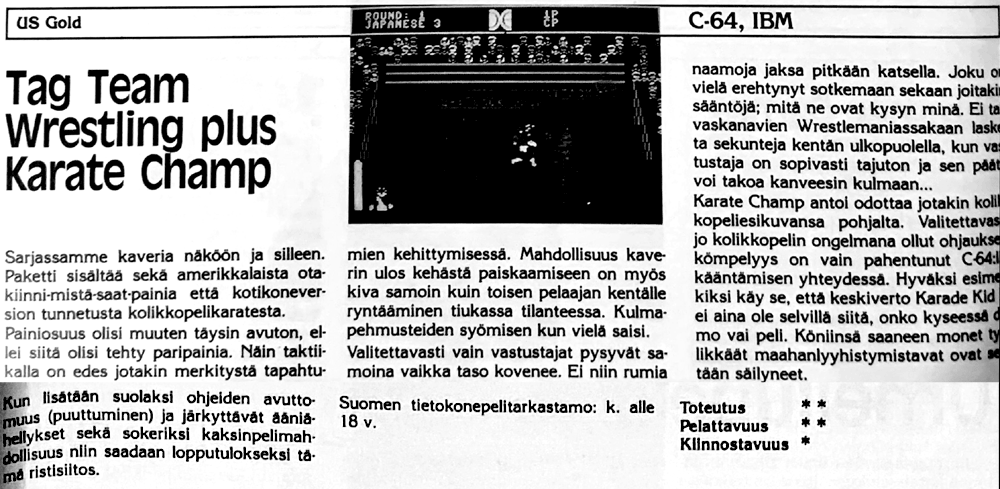
Tag Team Wrestling plus Karate Champ1987Pysyvä linkkiSarjassamme kaveria näköön ja silleen. Paketti sisältää sekä amerikkalaista otakiinni-mistä-saat-painia että kotikoneversion tunnetusta kolikkopelikaratesta.
Painiosuus olisi muuten täysin avuton, ellei siitä olisi tehty paripainia. Näin taktiikalla on edes jotakin merkitystä tapahtumien kehittymisessä. Mahdollisuus kaverin ulos kehästä paiskaamiseen on myös kiva samoin kuin toisen pelaajan kentälle ryntääminen tiukassa tilanteessa. Kulmapehmusteiden syömisen kun vielä saisi.
Valitettavasti vain vastustajat pysyvät samoina vaikka taso kovenee. Ei niin rumia naamoja jaksa pitkään katsella. Joku on vielä erehtynyt sotkemaan sekaan joitakin sääntöjä; mitä ne ovat kysyn minä. Ei taivaskanavien Wrestlemaniassakaan lasketa sekunteja kentän ulkopuolella, kun vastustaja on sopivasti tajuton ja sen pään voi takoa kanveesin kulmaan...
Karate Champ antoi odottaa jotakin kolikkopeliesikuvansa pohjalta. Valitettavasti jo kolikkopelin ongelmana ollut ohjauksen kömpelyys on vain pahentunut C-64:lle kääntämisen yhteydessä. Hyväksi esimerkiksi käy se, että keskiverto Karade Kid ei aina ole selvillä siitä, onko kyseessä demo vai peli. Köniinsä saaneen monet tyylikkäät maahanlyyhistymistavat ovat sentään säilyneet. Kun lisätään suolaksi ohjeiden avuttomuus (puuttuminen) ja järkyttävät ääniähellykset sekä sokeriksi kaksinpelimahdollisuus niin saadaan lopputulokseksi tämä ristisiitos.
Suomen tietokonepelitarkastamo: k. alle 18 v.
Tag Team Wrestling plus Karate Champ1987PermalinkIn our series: a buddy in sight and all that. The package contains both American grab-hold-wherever-you-can wrestling and a home computer version of the well-known arcade karate game.
The wrestling half would be utterly hopeless if it hadn't been turned into tag-team wrestling. This way tactics at least have some bearing on how things unfold. Being able to hurl the other guy out of the ring is nice too, as is the second player storming into the ring when things get tight. Now if only you could eat the corner pads as well.
Unfortunately the opponents stay the same even as the going gets tougher. Nobody can stand looking at faces that ugly for long. On top of that, someone has made the mistake of mixing in some rules; what are those, I ask you. Not even the sky channels' Wrestlemania counts the seconds outside the ring when your opponent is conveniently unconscious and you can pound their head against the corner of the canvas...
Karate Champ promised something, going by its arcade original. Unfortunately the clumsy controls, already a problem in the arcade game, have only got worse in the conversion to the C-64. A good example is that your average Karade Kid can't always tell whether it's the demo or the game. At least the many stylish ways of slumping to the mat after a thrashing have survived. Add, for salt, the helplessness (absence) of the instructions and the appalling aural caresses, and, for sugar, the two-player option, and what you end up with is this crossbreed.
Finnish Computer Game Censorship Board: banned for under-18s.
Tai Pan
Tai Pan1988Pysyvä linkkiShogunin seuraksi on nyt tullut Oceanilta uusi James Clavellin tarinaan perustuva seikkailupeli Tai-Pan.
On vuosi 1841. Kunnianhimoiset merimiehet seilaavat idän valtameriä rikastumisen toivossa. Sinä olet yksi heistä. Tarkoituksenasi on kerätä suunnattomia rikkauksia ja tulla kaikkien kuninkaaksi, Tai-Paniksi.
Aloitat pelin pennittömänä: ei rahaa, ei alusta, ei omaisuutta. Tiedät vain, että olet Cantonin kaupungissa ja että sinun täytyy lainata rahaa joltakulta päästäksesi alkuun. Rahat täytyy maksaa takaisin puolessa vuodessa, tai rahojen lainaaja menettää kunniansa ja sinä pääsi. Kun olet saanut rahaa kasaan, sinun täytyy ostaa laiva, miehistöä, ruokaa, kartta, sekstantti ja muuta sekalaista roinaa. Sitten vaan seilaamaan.
Peli koostuu kahdesta osasta: purjehtiminen ja käveleminen. Rahan ansaitsemiseen on monia keinoja, osta ja myy, uhkapelaa ja ryöstä. Kaupunkeja on paljon ja niiden välillä pääsee liikkumaan vain vesiteitse. Eri kaupungeissa on eri hintaisia tavaroita ja mottona on osta halvalla ja myy kalliilla. Ongelmana on se, että alukseesi ei mahdu kovin paljon tavaraa kerralla. Täytyy siis purjehtia monia kuukausia ennenkuin rahaa karttuu kylliksi.
Kaupungeista lyötyy myös monia mielenkiintoisia liikkeitä: ravintoloita, pankkeja, kauppoja, ilotaloja ja uhkapelipaikkoja. Uhkapelin idea on pokerin tapainen: aseta panokset ja voita (tai useimmiten: häviä).
Piratismi kukoistaa tässäkin pelissä. Jos omistat tarpeeksi ammuksia ja hyvän aluksen, voit vallata jonkin toisen laivan ja rahaa kertyy kertaheitolla. Tässäkin on omat riskinsä; voit hävitä taistelun ja menettää liikaa miehiä, missä tapauksessa et voi enää ohjata alustasi ja jäät nalkkiin merelle. Sinut voidaan myös tuomita vankeuteen piratismista.
Purjehtimiseen vaikuttavat sääolosuhteet. Voit ostaa kartan, josta näet eniten käytetyt reitit. Näillä reiteillä mahdollisuus tulla ryöstetyksi on erittäin pieni. Tutkimattomien alueiden tutkiminen on kuitenkin varsin mielenkiintoista.
Tai-Panissa on reaaliaika. Tai siis aika kuluu vaikka mitään ei tapahdu. Suhde oikeaan aikaan on jotakuinkin yksi päivä per 30 sekuntia kaupungeissa ja 10 sekuntia merellä. Voit siis laskea pelaavasi vähintään 4 päivää ennen läpipääsemistä. Käytännössä hommaan menee kuitenkin useampi kuukausi.
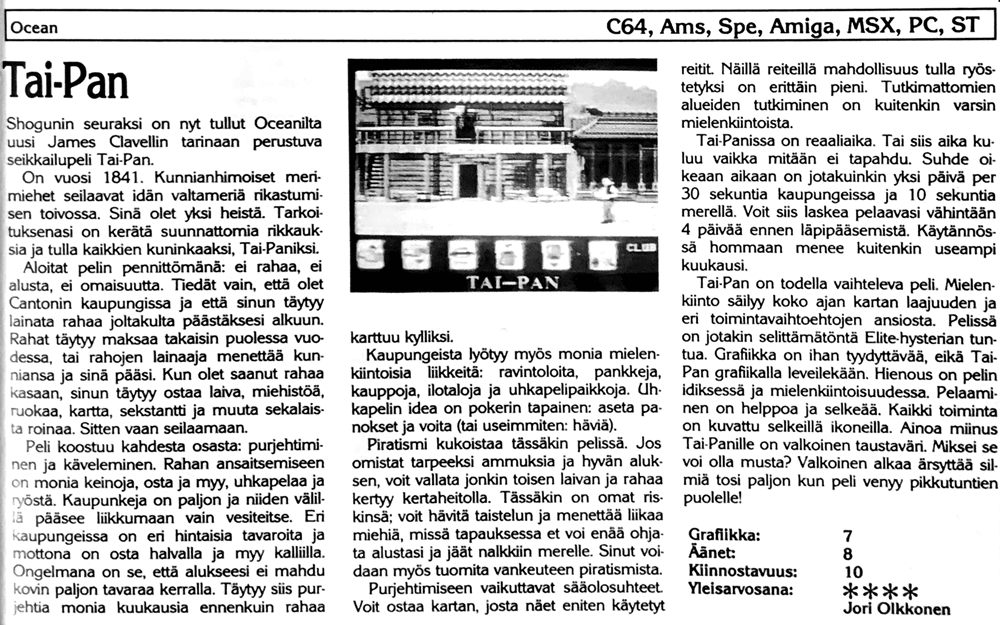
Tai-Pan on todella vaihteleva peli. Mielenkiinto säilyy koko ajan kartan laajuuden ja eri toimintavaihtoehtojen ansiosta. Pelissä on jotakin selittämätöntä Elite-hysterian tuntua. Grafiikka on ihan tyydyttävää, eikä Tai-Pan grafiikalla leveilekään. Hienous on pelin idiksessä ja mielenkiintoisuudessa. Pelaaminen on helppoa ja selkeää. Kaikki toiminta on kuvattu selkeillä ikoneilla. Ainoa miinus Tai-Panille on valkoinen taustaväri. Miksei se voi olla musta? Valkoinen alkaa ärsyttää silmiä tosi paljon kun peli venyy pikkutuntien puolelle!
Tai Pan1988PermalinkTo keep Shogun company, Ocean has now released a new adventure game based on a James Clavell story: Tai-Pan.
The year is 1841. Ambitious seamen sail the oceans of the East in the hope of making their fortune. You are one of them. Your aim is to amass boundless riches and become king of them all, the Tai-Pan.
You start the game penniless: no money, no ship, no possessions. All you know is that you're in the city of Canton and that you have to borrow money from someone to get going. The money has to be paid back within six months, or the lender loses face and you lose your head. Once you've scraped some money together, you have to buy a ship, a crew, food, a map, a sextant and other assorted junk. Then off you sail.
The game consists of two parts: sailing and walking. There are many ways to earn money: buy and sell, gamble and rob. There are plenty of towns, and you can only travel between them by water. Goods cost different amounts in different towns, and the motto is buy cheap and sell dear. The problem is that your ship can't hold very much cargo at a time. So you have to sail for many months before enough money piles up.
The towns also have plenty of interesting establishments: restaurants, banks, shops, brothels and gambling dens. The gambling works a bit like poker: place your bets and win (or, more often: lose).
Piracy flourishes in this game too. If you have enough ammunition and a good ship, you can capture some other vessel and the money rolls in at one stroke. This has its risks too; you can lose the battle and lose too many men, in which case you can no longer sail your ship and you're left stranded at sea. You can also be sentenced to prison for piracy.
Sailing is affected by the weather. You can buy a map that shows the most used routes. On these routes the chance of being robbed is very small. Exploring the unexplored regions is pretty interesting, though.
Tai-Pan runs in real time. That is, time passes even when nothing is happening. Relative to real time it works out at roughly one day per 30 seconds in towns and per 10 seconds at sea. So you can reckon on playing at least 4 days before you get through it. In practice, though, the job takes several months.
Tai-Pan is a truly varied game. Your interest holds the whole time, thanks to the size of the map and the range of things you can do. The game has something of that inexplicable Elite-hysteria feel about it. The graphics are quite satisfactory, and Tai-Pan doesn't try to show off with its graphics anyway. The beauty lies in the game's idea and in how absorbing it is. Playing is easy and clear. All the actions are shown with clear icons. The only minus for Tai-Pan is the white background colour. Why can't it be black? The white really starts to grate on your eyes when the game drags on into the small hours!
Tangram
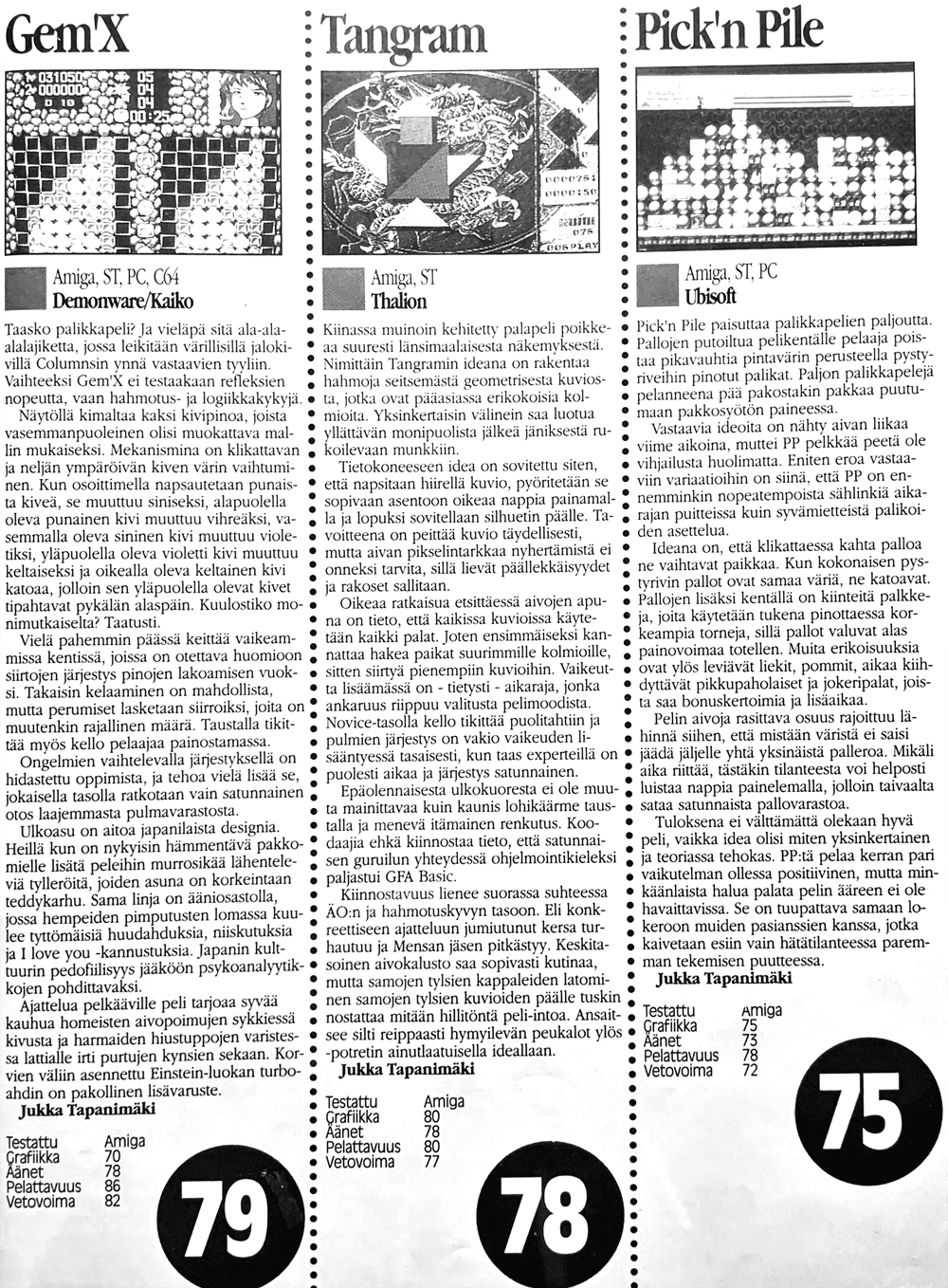
Tangram1991 SyksyPysyvä linkkiKiinassa muinoin kehitetty palapeli poikkeaa suuresti länsimaalaisesta näkemyksestä. Nimittäin Tangramin ideana on rakentaa hahmoja seitsemästä geometrisesta kuviosta, jotka ovat pääasiassa erikokoisia kolmioita. Yksinkertaisin välinein saa luotua yllättävän monipuolista jälkeä jäniksestä rukoilevaan munkkiin.
Tietokoneeseen idea on sovitettu siten, että napsitaan hiirellä kuvio, pyöritetään se sopivaan asentoon oikeaa nappia painamalla ja lopuksi sovitellaan silhuetin päälle. Tavoitteena on peittää kuvio täydellisesti, mutta aivan pikselintarkkaa nyhertämistä ei onneksi tarvita, sillä lievät päällekkäisyydet ja rakoset sallitaan.
Oikeaa ratkaisua etsittäessä aivojen apuna on tieto, että kaikissa kuvioissa käytetään kaikki palat. Joten ensimmäiseksi kannattaa hakea paikat suurimmille kolmioille, sitten siirtyä pienempiin kuvioihin. Vaikeutta lisäämässä on - tietysti - aikaraja, jonka ankaruus riippuu valitusta pelimoodista. Novice-tasolla kello tikittää puolitahtiin ja pulmien järjestys on vakio vaikeuden lisääntyessä tasaisesti, kun taas experteillä on puolesti aikaa ja järjestys satunnainen.
Epäolennaisesta ulkokuoresta ei ole muuta mainittavaa kuin kaunis lohikäärme taustalla ja menevä itämainen renkutus. Koodaajia ehkä kiinnostaa tieto, että satunnaisen guruilun yhteydessä ohjelmointikieleksi paljastui GFA Basic.
Kiinnostavuus lienee suorassa suhteessa ÄO:n ja hahmotuskyvyn tasoon. Eli konkreettiseen ajatteluun jumiutunut kersa turhautuu ja Mensan jäsen pitkästyy. Keskitasoinen aivokalusto saa sopivasti kutinaa, mutta samojen tylsien kappaleiden latominen samojen tylsien kuvioiden päälle tuskin nostattaa mitään hillitöntä peli-intoa. Ansaitsee silti reippaasti hymyilevän peukalot ylös -potretin ainutlaatuisella ideallaan.
Tangram1991 SyksyPermalinkThis puzzle, devised long ago in China, is very different from the Western idea of a jigsaw. The idea of Tangram, you see, is to build figures out of seven geometric shapes, which are mostly triangles of various sizes. With these simple tools you can produce surprisingly varied results, anything from a hare to a praying monk.
On the computer the idea has been adapted so that you click on a shape with the mouse, rotate it into a suitable position by pressing the right button, and finally fit it over the silhouette. The aim is to cover the figure completely, but luckily no pixel-perfect fiddling is required, since slight overlaps and little gaps are allowed.
When you are looking for the right solution, the brain gets some help from knowing that every figure uses all the pieces. So the first thing to do is find places for the largest triangles and then move on to the smaller shapes. Adding to the difficulty there is - naturally - a time limit, whose harshness depends on the game mode chosen. On Novice level the clock ticks at half speed and the order of the puzzles is fixed, with the difficulty rising steadily, whereas the experts get half the time and a random order.
Of the irrelevant outer wrapping there is nothing worth mentioning except a beautiful dragon in the background and a catchy oriental ditty. Coders may be interested to know that during the occasional Guru Meditation the programming language turned out to be GFA Basic.
Its appeal is probably in direct proportion to your IQ and your powers of spatial perception. In other words, a kid stuck in concrete thinking gets frustrated and a Mensa member gets bored. Average-grade brain equipment gets a nicely judged tickle, but laying the same boring pieces over the same boring shapes hardly whips up any wild gaming fervour. Still, with its unique idea it earns a broadly grinning thumbs-up portrait.
Tank
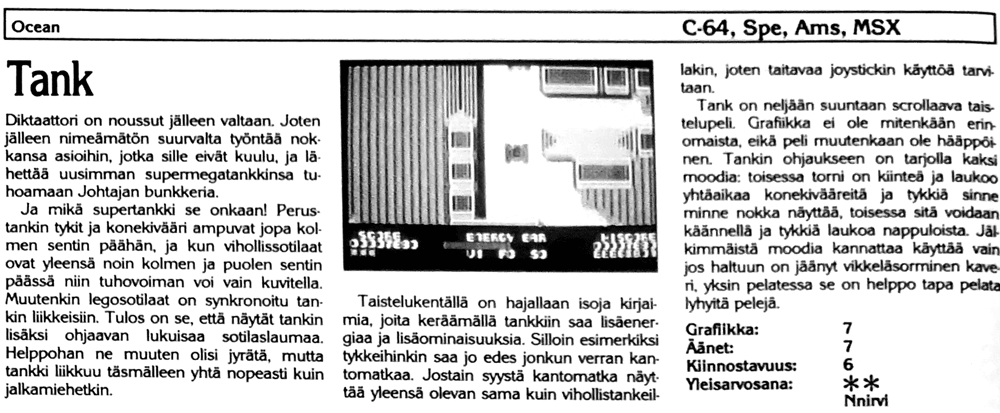
Tank1988Pysyvä linkkiDiktaattori on noussut jälleen valtaan. Joten jälleen nimeämätön suurvalta työntää nokkansa asioihin, jotka sille eivät kuulu, ja lähettää uusimman supermegatankkinsa tuhoamaan Johtajan bunkkeria.
Ja mikä supertankki se onkaan! Perustankin tykit ja konekivääri ampuvat jopa kolmen sentin päähän, ja kun vihollissotilaat ovat yleensä noin kolmen ja puolen sentin päässä niin tuhovoiman voi vain kuvitella. Muutenkin legosotilaat on synkronoitu tankin liikkeisiin. Tulos on se, että näytät tankin lisäksi ohjaavan lukuisaa sotilaslaumaa. Helppohan ne muuten olisi jyrätä, mutta tankki liikkuu täsmälleen yhtä nopeasti kuin jalkamiehetkin.
Taistelukentällä on hajallaan isoja kirjaimia, joita keräämällä tankkiin saa lisäenergiaa ja lisäominaisuuksia. Silloin esimerkiksi tykkeihinkin saa jo edes jonkun verran kantomatkaa. Jostain syystä kantomatka näyttää yleensä olevan sama kuin vihollistankeillakin, joten taitavaa joystickin käyttöä tarvitaan.
Tank on neljään suuntaan scrollaava taistelupeli. Grafiikka ei ole mitenkään erinomaista, eikä peli muutenkaan ole hääppöinen. Tankin ohjaukseen on tarjolla kaksi moodia: toisessa torni on kiinteä ja laukoo yhtäaikaa konekivääreitä ja tykkiä sinne minne nokka näyttää, toisessa sitä voidaan käännellä ja tykkiä laukoa nappuloista. Jälkimmäistä moodia kannattaa käyttää vain jos haltuun on jäänyt vikkeläsorminen kaveri, yksin pelatessa se on helppo tapa pelata lyhyitä pelejä.
Tank1988PermalinkA dictator has risen to power once again. So once again an unnamed superpower sticks its nose into matters that are none of its business and sends its latest super-mega-tank to destroy the Leader's bunker.
And what a super-tank it is! The basic tank's cannons and machine gun fire as far as three centimetres, and since the enemy soldiers are usually about three and a half centimetres away, you can only imagine the destructive power. What's more, the Lego soldiers are synchronised to the tank's movements. The result is that you appear to be steering a sizeable herd of soldiers as well as the tank. They'd be easy enough to flatten otherwise, but the tank moves exactly as fast as the foot soldiers do.
Scattered around the battlefield are big letters, and by collecting them you get extra energy and extra features for the tank. Then, for example, even the cannons finally get at least some sort of range. For some reason the range usually seems to be the same as the enemy tanks' too, so skilful joystick work is needed.
Tank is a four-way scrolling combat game. The graphics are nothing special, and the game isn't up to much otherwise either. There are two modes for controlling the tank: in one the turret is fixed and fires the machine guns and cannon at the same time wherever the nose is pointing, in the other it can be swivelled about and the cannon fired from the buttons. The latter mode is only worth using if you happen to have a nimble-fingered mate on your hands; playing alone it's an easy way to play short games.
Target; Renegade

Target; Renegade1988Pysyvä linkkiKeskiolutkommandojen suosikkipeli, Renegade, on poikinut lisää moraalisesti arveluttavaa videoviihdettä.
Edelliselle Renegadelle kävi köpelösti. Mr Big sai hänet vangiksi, mutta onneksi hänellä on taistelukykyinen pikkuveli. Yllätys yllätys, pikkuveikka lähtee Mr Bigin perään veljenvapautukseen. Matkalla telotaan moottoripyöräjengejä, naisia, skinejä ja jopa rockyhtyekin puree luuvitosta ennenkuin veljekset pääsevät kotiin.
Olinpa hämmästyksestä mutkalla kun peli oli latautunut. Odotin edellisen Renegaden kaltaista jäykkää ja kulmikasta tuotetta, mutta Target; Renegade yllätti positiivisesti.
Siinä vaiheessa, kun potkaisin mopomiehen pyörältään ja huitelin huligaania pitkin näköä, hänen salakavala kaverinsa tarttui minua kurkusta ja parivaljakko veteli minua päin näköä pesäpallomailalla, tajusin jotain. Jummi, tämäpä onkin hauska peli!
Grafiikka on todella erinomaista. Spritet on määritelty tavattoman hyvin ja animaatio on jouhevaa. Kaikki 16 liikettä hoituvat yhdellä joystickilla, ilman näppäimistön käyttöä (kuten edeltäjässä), ja pelaaminen on hauskaa. Positiivista on myös, että sankari voi käyttää aseita hyväkseen. Ääniefektejä tosin olisi saanut hioa, eikä taustalla rullaava kappalekaan säväytä.
Summa summarum, Target; Renegade on erinomainen arcadekäännös, joka todistaa, että kuusnepallakin saa kelpo jälkeä aikaan, kunhan viitsii nähdä vaivaa.
Target; Renegade1988PermalinkThe favourite game of the lager-lout commandos, Renegade, has spawned more morally dubious video entertainment.
The previous Renegade came a cropper. Mr Big took him prisoner, but luckily he has a little brother who can handle himself in a fight. Surprise, surprise, the kid brother sets off after Mr Big on a brother-liberation mission. Along the way biker gangs, women and skinheads get smashed up, and even a rock band eats a knuckle sandwich before the brothers make it home.
Was I ever tied in knots with amazement once the game had loaded. I was expecting a stiff and angular product like the previous Renegade, but Target; Renegade was a pleasant surprise.
Right around the point where I'd kicked a moped man off his bike and walloped a hooligan across the chops, and the hooligan's sneaky mate grabbed me by the throat and the pair of them laid into my face with a baseball bat, I realised something. Gosh, this is actually a fun game!
The graphics are truly excellent. The sprites are designed extraordinarily well and the animation is smooth. All 16 moves are handled with a single joystick, without using the keyboard (as in the predecessor), and playing is fun. Another plus is that the hero can make use of weapons. The sound effects could have done with some polishing, though, and the tune rolling along in the background isn't much of a thrill either.
Summa summarum, Target; Renegade is an excellent arcade conversion, which proves that even the Commodore 64 can turn out decent work, as long as you can be bothered to make the effort.
Task III
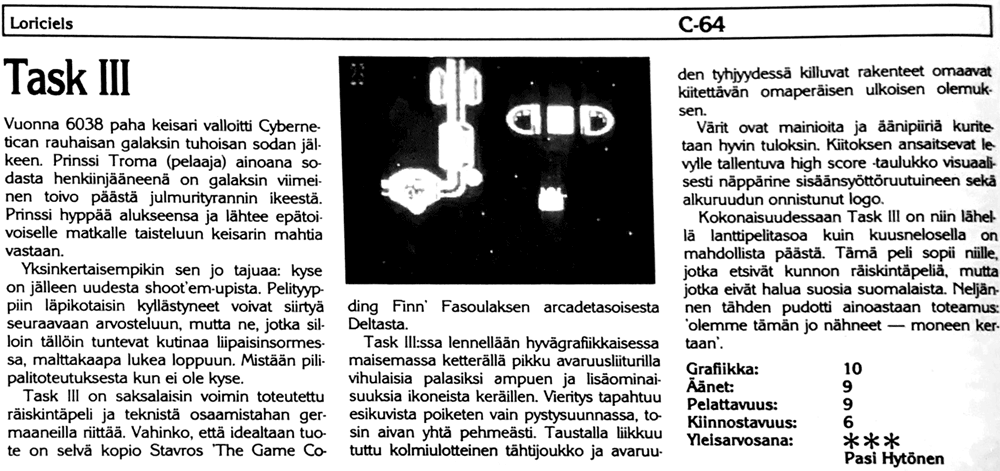
Task III1988Pysyvä linkkiVuonna 6038 paha keisari valloitti Cybernetican rauhaisan galaksin tuhoisan sodan jälkeen. Prinssi Troma (pelaaja) ainoana sodasta henkiinjääneenä on galaksin viimeinen toivo päästä julmurityrannin ikeestä. Prinssi hyppää alukseensa ja lähtee epätoivoiselle matkalle taisteluun keisarin mahtia vastaan.
Yksinkertaisempikin sen jo tajuaa: kyse on jälleen uudesta shoot'em-upista. Pelityyppiin läpikotaisin kyllästyneet voivat siirtyä seuraavaan arvosteluun, mutta ne, jotka silloin tällöin tuntevat kutinaa liipaisinsormessa, malttakaapa lukea loppuun. Mistään pilipalitoteutuksesta kun ei ole kyse.
Task III on saksalaisin voimin toteutettu räiskintäpeli ja teknistä osaamistahan germaaneilla riittää. Vahinko, että idealtaan tuote on selvä kopio Stavros 'The Game Coding Finn' Fasoulaksen arcadetasoisesta Deltasta.
Task III:ssa lennellään hyvägrafiikkaisessa maisemassa ketterällä pikku avaruusliiturilla vihulaisia palasiksi ampuen ja lisäominaisuuksia ikoneista keräillen. Vieritys tapahtuu esikuvista poiketen vain pystysuunnassa, tosin aivan yhtä pehmeästi. Taustalla liikkuu tuttu kolmiulotteinen tähtijoukko ja avaruuden tyhjyydessä killuvat rakenteet omaavat kiitettävän omaperäisen ulkoisen olemuksen.
Värit ovat mainioita ja äänipiiriä kuritetaan hyvin tuloksin. Kiitoksen ansaitsevat levylle tallentuva high score -taulukko visuaalisesti näppärine sisäänsyöttöruutuineen sekä alkuruudun onnistunut logo.
Kokonaisuudessaan Task III on niin lähellä lanttipelitasoa kuin kuusnelosella on mahdollista päästä. Tämä peli sopii niille, jotka etsivät kunnon räiskintäpeliä, mutta jotka eivät halua suosia suomalaista. Neljännen tähden pudotti ainoastaan toteamus: 'olemme tämän jo nähneet - moneen kertaan'.
Task III1988PermalinkIn the year 6038 an evil emperor conquered the peaceful galaxy of Cybernetica after a devastating war. Prince Troma (the player), as the sole survivor of the war, is the galaxy's last hope of escaping the yoke of the brutal tyrant. The prince jumps into his ship and sets off on a desperate journey to battle against the emperor's might.
Even the slower among us have got it by now: this is yet another new shoot'em-up. Those thoroughly fed up with the genre can move on to the next review, but those of you who now and then feel an itch in your trigger finger, do hang on and read to the end. Because this is no two-bit job.
Task III is a blaster made by German hands, and the Teutons certainly have technical know-how to spare. Pity that, as an idea, the product is a blatant copy of Stavros 'The Game Coding Finn' Fasoulas's arcade-quality Delta.
In Task III you fly through nicely drawn scenery in a nimble little space glider, shooting the baddies to bits and picking up extra features from icons. Unlike its models, it scrolls only vertically, though every bit as smoothly. In the background drifts the familiar three-dimensional star field, and the structures dangling in the void of space have a commendably original look to them.
The colours are splendid and the sound chip gets a good thrashing with fine results. Praise is also due for the high score table that saves to disk, with its visually slick name-entry screen, and for the well-made logo on the title screen.
All in all, Task III is as close to coin-op level as it's possible to get on the Commodore 64. This game is for those who are looking for a proper blaster but would rather not buy Finnish. The fourth star was knocked off by one observation alone: 'we've seen this before - many times over'.
Tau Ceti
Tau Ceti1987Pysyvä linkkiVuonna 2050 Tau Cetiin perustettiin ihmissiirtokunta. Kaikki sujui hyvin siihen saakka kunnes Encken syndroomaksi nimitetty tauti tappoi suurimman osan siirtolaisista. Jäljelle jääneet evakuoivat planeetan.
Kaksi vuotta myöhemmin lääke löytyi ja jälleenasutus saattoi alkaa. Ongelmana tosin oli, että Tau Ceti III:n meteoritörmäyksessä vaurioitunut päätietokone ei pitänyt ajatuksesta. Tau Cetin puolustus on niin vahva, että ainoa mahdollisuus lamauttaa puolustus on sulkea Centraliksen pääreaktori. Ympäri planeettaa olevat jäähdytintankojen kappaleet on sovitettava yhteen ja työnnettävä pääreaktoriin. Retkikunnan mukana on yksi vahvasti aseistettu ja panssaroitu maakiitäjä, jolla ehkä on mahdollista selviytyä tehtävästä. Tarvitaan enää vapaaehtoinen.
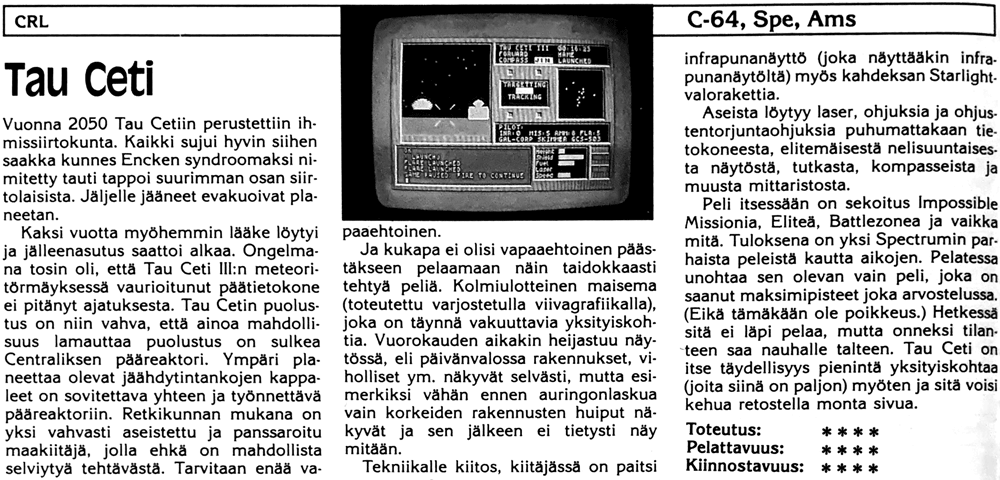
Ja kukapa ei olisi vapaaehtoinen päästäkseen pelaamaan näin taidokkaasti tehtyä peliä. Kolmiulotteinen maisema (toteutettu varjostetulla viivagrafiikalla), joka on täynnä vakuuttavia yksityiskohtia. Vuorokauden aikakin heijastuu näytössä, eli päivänvalossa rakennukset, viholliset ym. näkyvät selvästi, mutta esimerkiksi vähän ennen auringonlaskua vain korkeiden rakennusten huiput näkyvät ja sen jälkeen ei tietysti näy mitään.
Tekniikalle kiitos, kiitäjässä on paitsi infrapunanäyttö (joka näyttääkin infrapunanäytöltä) myös kahdeksan Starlight-valorakettia.
Aseista löytyy laser, ohjuksia ja ohjustentorjuntaohjuksia puhumattakaan tietokoneesta, elitemäisestä nelisuuntaisesta näytöstä, tutkasta, kompasseista ja muusta mittaristosta.
Peli itsessään on sekoitus Impossible Missionia, Eliteä, Battlezonea ja vaikka mitä. Tuloksena on yksi Spectrumin parhaista peleistä kautta aikojen. Pelatessa unohtaa sen olevan vain peli, joka on saanut maksimipisteet joka arvostelussa. (Eikä tämäkään ole poikkeus.) Hetkessä sitä ei läpi pelaa, mutta onneksi tilanteen saa nauhalle talteen. Tau Ceti on itse täydellisyys pienintä yksityiskohtaa (joita siinä on paljon) myöten ja sitä voisi kehua retostella monta sivua.
Tau Ceti1987PermalinkIn 2050 a human colony was founded on Tau Ceti. Everything went well until a disease known as Encke's syndrome killed most of the colonists. The survivors evacuated the planet.
Two years later a cure was found and resettlement could begin. The snag was that the main computer of Tau Ceti III, damaged in a meteor strike, didn't care for the idea. Tau Ceti's defences are so strong that the only way to cripple them is to shut down the main reactor in Centralis. Pieces of cooling rods scattered around the planet have to be fitted together and pushed into the main reactor. The expedition has brought along one heavily armed and armoured ground skimmer, with which it might just be possible to pull off the mission. All that's needed now is a volunteer.
And who wouldn't volunteer to get to play such a skilfully made game? A three-dimensional landscape (done in shaded line graphics), full of convincing detail. Even the time of day is reflected on screen: in daylight the buildings, enemies and so on show up clearly, but shortly before sunset, for example, only the tops of tall buildings can be seen, and after that, naturally, you can't see a thing.
Praise be to technology: the skimmer has not only an infrared display (which actually looks like an infrared display) but also eight Starlight flares.
For weapons there's a laser, missiles and anti-missile missiles, not to mention the computer, the Elite-style four-way view, the radar, compasses and the rest of the instrumentation.
The game itself is a mix of Impossible Mission, Elite, Battlezone and who knows what else. The result is one of the best Spectrum games of all time. While playing you forget that it's just a game, one that has scored top marks in every review. (And this one is no exception.) You won't get through it in a hurry, but luckily you can save your position to tape. Tau Ceti is perfection itself down to the smallest detail (and it has plenty of those), and you could go on singing its praises and raving about it for pages.
Team Suzuki
Team Suzuki1991 SyksyPysyvä linkkiAntaessani koneelle kaasua ärjähti allani oleva ratapeto ja tempoi päästäkseen jo matkaan. Jatkoin kierrosten kohottamista ja virnistykseni jäi kypärän sisään vilkaistessani sivuilla olevia kilpailijoitani. Niin, unohtakaa RVF Hondat ja Hang Onit, vektorigraafinen Team Suzuki on täällä!
Asialla on Gremlin, jonka historian sivuilta löytyvät myös Toyota GT ja Lotus Esprit, molemmat omassa luokassaan hyviä. Team Suzukissa otetaan alle Suzuki 500, voimakas, pieniruokainen ratapyörä. Tietysti on vaihtoehtoina myös automaattivaihteinen 125cc tai helpommin hallittava 250cc, mutta pelin henki on selvä: joko maailmanmestaruus tai nolo häviö.
Mestaruusajot käsittävät 16 eri rataa ympäri maailman ja tietysti jokaista voi harjoitella, ajaa testiaikoja ja tallennella omaa suoritusta. Ratoja pitäisi tulla myöhemmin lisää. Gremliniltä saa myös ilmaisen levyn, jolla Team Suzukin saa harjoittelutilaan, mikäli mopo horjuu radalta liian tiuhasti.
Itse peli on vektorigrafiikan taidonnäyte, bittikarttagrafiikkaa edustaa ainoastaan oman Suzukin mittaristo ja väliaika/kierros -taulu. Ohjaaminen tapahtuu joko hiirellä, näppiksellä tai tikulla. Hamsterilla ohjaus on tietenkin näppärintä, varsinkin jos on päytälaatikossa herkkä optinen rotta. Näköaloja voi katsella pärrän päältä eteen ja taakse sekä myös takaapäin, mikä helpottaa vanhaa Hang On -fania. Harjoituspuolella ovat vielä käytössä vektorizoom ja kamera, joita voi portaattomasti säätää. Peliin tuo suunnattomasti "lisähupia", kun käyttää vaikka etuylösalaisin -kuvakulmaa. Näitä toimintoja ei harmi kyllä voi käyttää varsinaisessa kisassa.
Epärealistisuutta peliin tuo huono vauriojärjestelmä, joka kerrotaan ruudun yläreunassa prosenteissa. Prosenttilukema kasvaa kun ajellaan radan reunassa olevalla nurmikolla. Pyörää ei saa edes kunnolla radalta, pienet oikotiet ja ajot kirkuvaan yleisömereen estyvät. Myös kilpailukumppaneille saisi käydä jokin ikävä onnettomuus leikkisästi kylkeen tuupatessa kuten Indianapoliksessa. Äänipuoli on kehno alkuääntelyistä lähtien. Pelin moottorinääni ei ainakaan ole ratapyörästä lähtöisin.
Team Suzuki on prätkäpelien ehdoton ykkönen ja jaksaa kiinnostaa pitkään. Prääään!
Team Suzuki1991 SyksyPermalinkAs I gave the machine some throttle, the track beast beneath me roared and strained to be off. I kept piling on the revs, and my grin stayed inside my helmet as I glanced at my rivals alongside. Yes, forget your RVF Hondas and Hang Ons, the vector-graphic Team Suzuki is here!
Behind it is Gremlin, whose pages of history also include Toyota GT and Lotus Esprit, both good in their class. In Team Suzuki you mount a Suzuki 500, a powerful track bike with a modest appetite. There are of course also the alternatives of an automatic-gearbox 125cc or the easier-to-handle 250cc, but the spirit of the game is clear: either the world championship or an embarrassing defeat.
The championship covers 16 different tracks around the world, and naturally you can practise on each one, set test times and save your own performance. More tracks are supposed to follow later. Gremlin will also give you a free disk that puts Team Suzuki into a practice mode, should your moped keep wobbling off the track too often.
The game itself is a showpiece of vector graphics; the only bitmap graphics are your own Suzuki's instrument panel and the split time/lap board. Control is by mouse, keyboard or stick. Steering with the hamster is of course the nimblest, especially if you've got a sensitive optical rat in your desk drawer. You can take in the views from the saddle to the front and the back, and also from behind, which makes life easier for an old Hang On fan. On the practice side there are also a vector zoom and a camera, both steplessly adjustable. It brings the game an immense amount of "extra fun" when you use, say, the front-upside-down camera angle. Sadly these features can't be used in the actual race.
Unrealism is brought into the game by the poor damage system, shown as a percentage at the top of the screen. The percentage goes up when you ride on the grass at the edge of the track. You can't even get the bike properly off the track: little shortcuts and rides into the screaming sea of spectators are blocked. And your fellow competitors really ought to have some nasty accident when you playfully nudge them in the side, like in Indianapolis. The sound department is poor, right from the opening noises. The game's engine sound certainly doesn't come from any track bike.
Team Suzuki is the undisputed number one of motorbike games and will keep you interested for a long time. Braaaap!
Team Yankee
Team Yankee1991 KevätPysyvä linkkiNATOn kolonnan valitsema reitti on painajaismainen: keskellä laajaa aukeata olevaa tieuraa reunustavat tiheät metsät, joissa puna-armeijan tankit voivat rauhassa lymyillä. Pelko osoittautui oikeaksi, sillä lyhyen kiikaroinnin jälkeen näkökenttään osuu kaksi metsän reunassa odottavaa vihollista. M1 Abramsien piiput ärjäisevät ja venäläiset T-80-tankit mössähtelevät romuksi ennen kuin raukat ehtivät edes tajuta mitä tapahtui. Seuraavassa hetkessä ilman täyttää räjähdysten huumaava melu ja riemu vaihtuu paniikiksi: "Kuusi punaista on sivulla, ja metsästä tulee lisää!"
Kolmannen maailmansodan alkuhetkistä kertova kirja Team Yankee on kääntynyt peliksi niin onnistuneesti, että sen yhteydessä ei ole lainkaan liioiteltua käyttää alkuperäistä iskulausetta "niin todellinen, että voit haistaa savun". Kolmiulotteisuus on luotu graafisella sekatekniikalla, jossa vektoreita on käytetty vain teissä ja rakennuksissa, joihin ne sopivatkin hyvin, kun taas tankit ja metsät on kuvattu spriteilla.
Toteutus on samantapainen kuin Their Finest Hourissa, mutta pelin toiminta on huikeasti sujuvampaa. Enpä ollut uskoa silmiäni, kun viimeisessä skenaariossa peltoja pitkin rymistää kokonainen pataljoona venäläisiä tankkeja pelin hidastumatta juuri lainkaan. Tankit eivät myöskään katoa osuman jälkeen, vaan jäävät tantereelle kytemään taistelun loppuun asti. Aivan oman makunsa pelille antavat metsät, joiden taktinen merkitys on hyvin keskeinen.
Tiimiin kuuluu neljä tankkiryhmää, joita ohjaillaan kokonaisuuksina. Selkärankana ovat maailman tehokkaimmiksi kehutut M1 Abramsit, joiden aseistukseen kuuluu HEAT- ja SABOT-ammusten lisäksi savuverho sekä konekivääri, joka on tosin aika tehoton panssareita vastaan. Taustatukena on pitkän kantaman TOW-ohjuksilla varustettuja ITV-tankkeja, pari M2 Bradleyta sekä pari miehistönkuljetuspanssaria. Alussa annettavan tilannekatsauksen yhteydessä on jopa mahdollista päättää, minne ja mihin kellonaikaan tykistö jysäyttää keskityksen, mutta tosi mies selviää ilmankin.
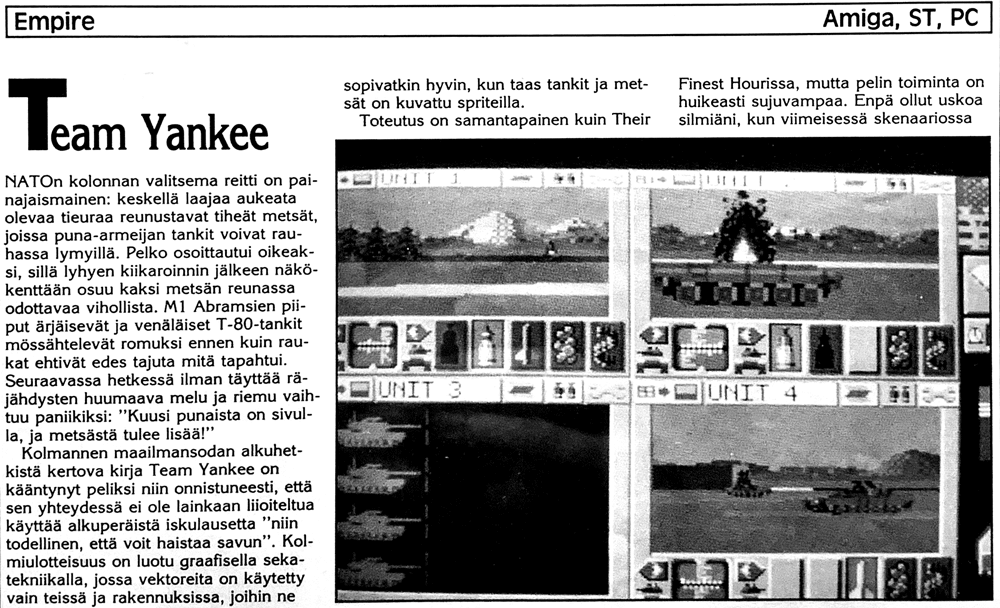
Ryhmien komentaminen samaan aikaan on ratkaistu siten, että näytöllä voi olla joko yhden ryhmän ikkuna suuremmassa koossa tai kaikki neljä kerralla. Etenemisen aikana on tehokasta pitää kaikki näkyvissä, jolloin voi kätevästi seurata tilannetta sekä 3D-näkymistä että zoomattavista kartoista. Taistelussa on puolestaan mukavampaa käyttää suurta ikkunaa jo senkin vuoksi, että erottaa paremmin vihollisten tappiohetket.
Pahiten realismista lipsahdetaan siinä, että rakennuksista voi rymistellä läpi ilman näkyviä seurauksia ja tankkien moottoreista ei kuulu pihaustakaan. Toisaalta taas pellolla junnaava tankki hötkyy ja tutisee todentuntuisesti ja tykissä on kunnolla rekyyliä.
Muutama lisätehtävä olisi ollut mannaa, sillä kirjan juonta myötäileviä skenaarioita on ainoastaan viisi, plus ylennyksen jälkeen samat vaikeutettuina neljään kertaan. Tehtävät ovat myös melko suppeita sisällöltään, mutta saavuttavat sellaisen realismin tason, että painajaisissaankin alkaa nähdä loputtomia T-80-kolonnia. Suosittelen.
Advocatus Diaboli
No onhan Team Yankeessa pahempiakin lapsuksia kuin Jukan luettelemat. Pahin on omien tyhmyys: päinvastoin kuin M1 Tank Platoonissa eivät muut joukot siirry tietokoneohjaukseen kun pelaaja operoi yhdellä joukkueella. Siinä ne sitten killittävät kun idän poika pistää reikiä kylkeen. Grafiikassa on jotain outoa, sillä usein neuvostojoukot tuntuvat omistavan Stealth-tankkeja: kartta näyttää kolonnan kivenheiton päässä, mutta mitään ei kuitenkaan näy.
Ihan hauska peli, mutta suositellaan varauksin.
Team Yankee1991 KevätPermalinkThe route chosen by the NATO column is a nightmare: the road running across the middle of a wide open plain is flanked by dense forests where Red Army tanks can lurk in peace. The fear turned out to be justified, for after a short spell with the binoculars two enemies waiting at the edge of the forest swim into view. The M1 Abrams' guns roar and the Russian T-80 tanks crumple into scrap before the poor wretches even have time to realise what happened. The next moment the air is filled with the deafening din of explosions and jubilation turns to panic: "Six reds on the flank, and more coming out of the woods!"
Team Yankee, the book about the opening moments of World War Three, has been turned into a game so successfully that it is no exaggeration at all to trot out the original slogan "so real you can smell the smoke". The 3D has been created with a mixed-media graphics technique in which vectors are used only for the roads and buildings, which they suit well, while the tanks and forests are drawn with sprites.
The implementation is similar to Their Finest Hour's, but the action runs staggeringly more smoothly. I could hardly believe my eyes when, in the last scenario, a whole battalion of Russian tanks came rumbling across the fields with the game barely slowing down at all. Nor do the tanks vanish after being hit; they stay on the battlefield, smouldering until the end of the fight. The forests, whose tactical importance is absolutely central, give the game a flavour all of its own.
The team consists of four tank groups, each controlled as a single unit. The backbone is the M1 Abrams, touted as the most effective tank in the world, whose armament includes, besides HEAT and SABOT rounds, a smoke screen and a machine gun, though the latter is pretty useless against armour. Backing them up are ITV tanks armed with long-range TOW missiles, a couple of M2 Bradleys and a couple of armoured personnel carriers. During the briefing at the start you can even decide where and at what time of day the artillery slams down a concentrated barrage, but a real man manages without.
Commanding the groups at the same time has been solved by letting the screen show either one group's window at a larger size or all four at once. While advancing it pays to keep them all in view, so you can conveniently follow the situation both from the 3D views and from the zoomable maps. In combat, on the other hand, the big window is nicer to use, if only because it lets you make out better the moments when the enemies meet their end.
The worst slip in realism is that you can go crashing straight through buildings with no visible consequences, and not so much as a peep can be heard from the tanks' engines. Then again, a tank grinding across a field lurches and shudders convincingly, and the gun has proper recoil.
A few extra missions would have been manna from heaven, as there are only five scenarios following the book's plot, plus the same ones made harder four times over after promotion. The missions are also fairly limited in content, but they reach such a level of realism that you start seeing endless T-80 columns even in your nightmares. Recommended.
Advocatus Diaboli
Well, Team Yankee does have worse blunders than the ones Jukka listed. The worst is the stupidity of your own side: unlike in M1 Tank Platoon, the other units don't switch over to computer control while the player is operating one platoon. So there they just sit gawping while the lad from the East punches holes in their flanks. There's something odd about the graphics, too, since the Soviet forces often seem to own Stealth tanks: the map shows a column a stone's throw away, and yet nothing is visible.
A fun enough game, but recommended with reservations.
Technocop
Technocop1989 KevätPysyvä linkkiTechnocop - osittain ajopeli, osittain ampumapeli, kokonaan amerikkalaisen Grey Matterin tekemä.
Tulevaisuus ei näytä kivalta. Teknologia jyrää pienen ihmisen, rikkaat tulevat rikkaammiksi, köyhät köyhemmiksi ja rikos rehottaa kaduilla niin että pieni ihminen jyräytyy toiseenkin kertaan. Eipä ihme että poliiseillekin annetaan makeat urheiluautot, jotta joku tähän epäkiitolliseen ammattiin hakeutuisi. Tästä kertoo Technocop, poliisi, jonka varustukseen kuuluvat tietokonerannekello, rikostutka, kivääri ja Magnum 88. Ja tietenkin maailman paras ja nopein auto.
Pelin ensimmäinen osio käsittelee Technocopin ajelua hienolla autolla tyypillisessä Roadblasters-kloonissa. Mutta kun rikostutka alkaa piipittää, loppuu ajelu ja alkaa työ.
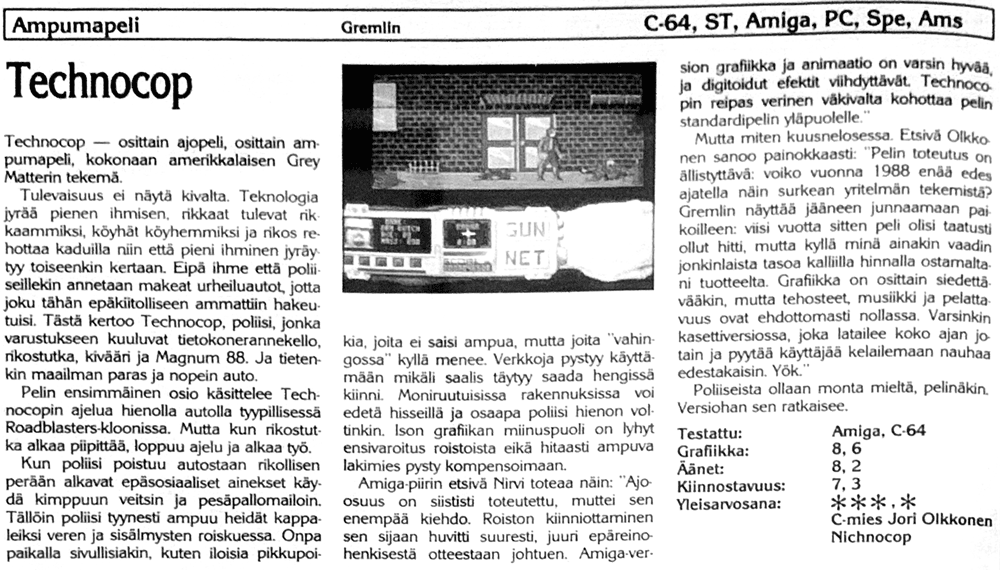
Kun poliisi poistuu autostaan rikollisen perään alkavat epäsosiaaliset ainekset käydä kimppuun veitsin ja pesäpallomailoin. Tällöin poliisi tyynesti ampuu heidät kappaleiksi veren ja sisälmysten roiskuessa. Onpa paikalla sivullisiakin, kuten iloisia pikkupoikia, joita ei saisi ampua, mutta joita "vahingossa" kyllä menee. Verkkoja pystyy käyttämään mikäli saalis täytyy saada hengissä kiinni. Moniruutuisissa rakennuksissa voi edetä hisseillä ja osaapa poliisi hienon voltinkin. Ison grafiikan miinuspuoli on lyhyt ensivaroitus roistoista eikä hitaasti ampuva lakimies pysty kompensoimaan.
Amiga-piirin etsivä Nirvi toteaa näin: "Ajo-osuus on siististi toteutettu, muttei sen enempää kiehdo. Roiston kiinniottaminen sen sijaan huvitti suuresti, juuri epäreinohenkisestä otteestaan johtuen. Amiga-version grafiikka ja animaatio on varsin hyvää, ja digitoidut efektit viihdyttävät. Technocopin reipas verinen väkivalta kohottaa pelin standardipelin yläpuolelle."
Mutta miten kuusnelosessa. Etsivä Olkkonen sanoo painokkaasti: "Pelin toteutus on ällistyttävä: voiko vuonna 1988 enää edes ajatella näin surkean yritelmän tekemistä? Gremlin näyttää jääneen junnaamaan paikoilleen: viisi vuotta sitten peli olisi taatusti ollut hitti, mutta kyllä minä ainakin vaadin jonkinlaista tasoa kalliilla hinnalla ostamaltani tuotteelta. Grafiikka on osittain siedettävääkin, mutta tehosteet, musiikki ja pelattavuus ovat ehdottomasti nollassa. Varsinkin kasettiversiossa, joka latailee koko ajan jotain ja pyytää käyttäjää kelailemaan nauhaa edestakaisin. Yök."
Poliiseista ollaan monta mieltä, pelinäkin. Versiohan sen ratkaisee.
Technocop1989 KevätPermalinkTechnocop - partly a driving game, partly a shoot-'em-up, wholly the work of the American Grey Matter.
The future doesn't look nice. Technology steamrolls the little man, the rich get richer, the poor get poorer, and crime runs rampant in the streets so that the little man gets steamrolled a second time too. No wonder even the police are handed sweet sports cars, so that someone might actually go into this thankless profession. This is the story of Technocop, a policeman whose kit includes a computer wristwatch, a crime radar, a rifle and a Magnum 88. And of course the world's best and fastest car.
The first section of the game deals with Technocop cruising about in his fancy car in a typical Roadblasters clone. But when the crime radar starts beeping, the cruising ends and the work begins.
When the cop leaves his car to go after the criminal, antisocial elements start going for him with knives and baseball bats. The cop then calmly shoots them to pieces as blood and guts splatter. There are bystanders around too, such as cheerful little boys, who you're not supposed to shoot, but some of whom do go down "by accident". Nets can be used if the quarry has to be caught alive. In the multi-screen buildings you can get about by lift, and the cop can even pull off a fancy somersault. The downside of the big graphics is the short advance warning of the villains, and the slow-shooting lawman can't make up for it.
Detective Nirvi of the Amiga precinct states as follows: "The driving section is neatly done, but doesn't fascinate beyond that. Catching the villain, on the other hand, amused me greatly, precisely because of its unsporting approach. The Amiga version's graphics and animation are rather good, and the digitised effects entertain. Technocop's hearty, bloody violence lifts the game above the standard game."
But how about on the C-64? Detective Olkkonen says emphatically: "The execution of the game is astounding: can anyone in 1988 even think of making such a pathetic effort any more? Gremlin seems to have got stuck marking time: five years ago the game would surely have been a hit, but I for one demand some sort of standard from a product I've bought at a high price. The graphics are even partly tolerable, but the effects, music and playability are absolutely at zero. Especially in the cassette version, which keeps loading something all the time and asks the user to wind the tape back and forth. Yuck."
Opinions of the police are many, and of it as a game too. It's the version that decides.
Temple Of Terror
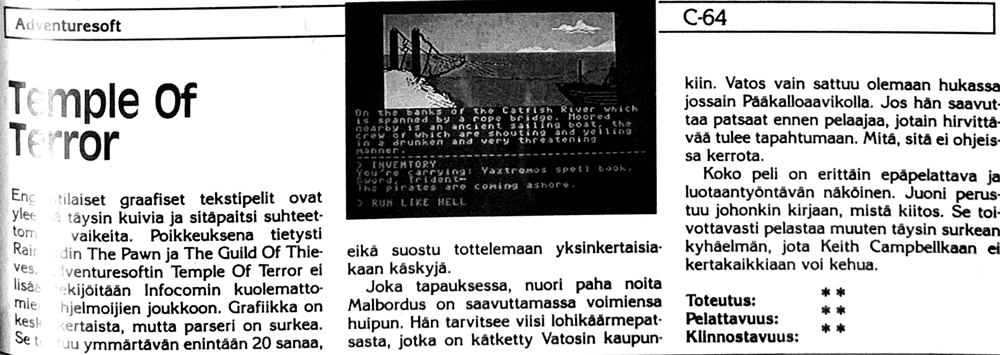
Temple Of Terror1987Pysyvä linkkiEnglantilaiset graafiset tekstipelit ovat yleensä täysin kuivia ja sitäpaitsi suhteettoman vaikeita. Poikkeuksena tietysti Rainbirdin The Pawn ja The Guild Of Thieves. Adventuresoftin Temple Of Terror ei lisää tekijöitään Infocomin kuolemattomien ohjelmoijien joukkoon. Grafiikka on keskinkertaista, mutta parseri on surkea. Se tuntuu ymmärtävän enintään 20 sanaa, eikä suostu tottelemaan yksinkertaisiakaan käskyjä.
Joka tapauksessa, nuori paha noita Malbordus on saavuttamassa voimiensa huipun. Hän tarvitsee viisi lohikäärmepatsasta, jotka on kätketty Vatosin kaupunkiin. Vatos vain sattuu olemaan hukassa jossain Pääkalloaavikolla. Jos hän saavuttaa patsaat ennen pelaajaa, jotain hirvittävää tulee tapahtumaan. Mitä, sitä ei ohjeissa kerrota.
Koko peli on erittäin epäpelattava ja luotaantyöntävän näköinen. Juoni perustuu johonkin kirjaan, mistä kiitos. Se toivottavasti pelastaa muuten täysin surkean kyhäelmän, jota Keith Campbellkaan ei kertakaikkiaan voi kehua.
Temple Of Terror1987PermalinkBritish graphic text adventures are usually bone dry and disproportionately difficult to boot. The exceptions, of course, are Rainbird's The Pawn and The Guild Of Thieves. Adventuresoft's Temple Of Terror won't be adding its authors to the ranks of Infocom's immortal programmers. The graphics are mediocre, but the parser is dire. It seems to understand 20 words at most, and refuses to obey even simple commands.
Anyway, the young evil sorcerer Malbordus is about to reach the peak of their powers. Malbordus needs five dragon statues, which are hidden in the city of Vatos. Vatos just happens to be lost somewhere in the Desert of Skulls. If Malbordus gets to the statues before the player does, something terrible is going to happen. What, the instructions don't say.
The whole game is extremely unplayable and repellent to look at. The plot is based on some book or other, for which we're grateful. Hopefully that will rescue an otherwise utterly wretched cobbled-together effort that even Keith Campbell simply can't find a good word for.
Tennis Ace
Tennis Ace1990 SyksyPysyvä linkkiTässäpä oiva peli kaikille segaileville pikkubeckereille ja -navratiloville. Segan urheilutarjonta ei päätä huimaa ja tasokin on ollut aika vaihtelevaa, mutta tennisässä venyy niukkaa erävoittoon tie-breakessa.
Tennis Acen vahvin ässä on monipuolinen sisältö, sikäli kun Pongia vastaavaan peli-ideaan yleensä mahtuu monipuolisuutta. Pelaaminen onnistuu yksin tai kaksin sekä eräänlaisessa sekanelinpelissä, jossa kaverukset voivat pelata joko tiiminä tai toisiaan vastaan parinaan tietokoneen ohjaama ukkeli. Laajasta optiovalikoimasta löytyy sellainenkin erikoisuus kuin erilaiset kentän pinnoitteet. Äänipuolella on kuusi valinnaista taustamusiikkia, jotka kaikki kuitenkin ovat samaa puuduttavaa piipitystä.
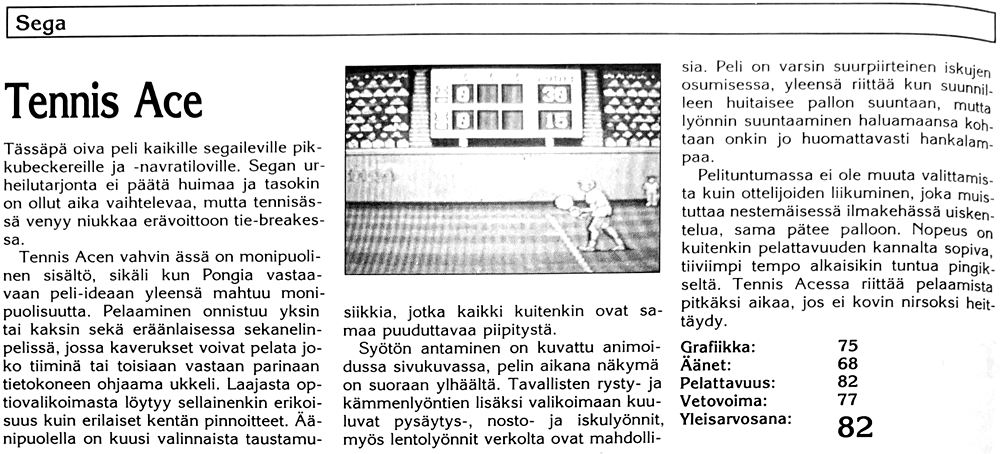
Syötön antaminen on kuvattu animoidussa sivukuvassa, pelin aikana näkymä on suoraan ylhäältä. Tavallisten rysty- ja kämmenlyöntien lisäksi valikoimaan kuuluvat pysäytys-, nosto- ja iskulyönnit, myös lentolyönnit verkolta ovat mahdollisia. Peli on varsin suurpiirteinen iskujen osumisessa, yleensä riittää kun suunnilleen huitaisee pallon suuntaan, mutta lyönnin suuntaaminen haluamaansa kohtaan onkin jo huomattavasti hankalampaa.
Pelituntumassa ei ole muuta valittamista kuin ottelijoiden liikuminen, joka muistuttaa nestemäisessä ilmakehässä uiskentelua, sama pätee palloon. Nopeus on kuitenkin pelattavuuden kannalta sopiva, tiiviimpi tempo alkaisikin tuntua pingikseltä. Tennis Acessa riittää pelaamista pitkäksi aikaa, jos ei kovin nirsoksi heittäydy.
Tennis Ace1990 SyksyPermalinkHere's a fine game for all you little Sega-playing Beckers and Navratilovas. Sega's sports lineup doesn't exactly make your head spin, and the standard has been pretty variable too, but this tennis ace stretches to a narrow set win in the tie-break.
Tennis Ace's strongest ace is its varied content, insofar as a game idea on a par with Pong can hold any variety at all. You can play alone or two at a time, and also in a kind of mixed doubles, where pals can play either as a team or against each other, each partnered by a computer-controlled little guy. The broad selection of options even includes such a novelty as different court surfaces. On the sound side there are six selectable background tunes, all of which are, however, the same numbing beeping.
Serving is shown in an animated side view; during play the view is straight from above. Besides the ordinary backhands and forehands, the repertoire includes drop shots, lobs and smashes, and volleys at the net are possible too. The game is pretty generous about shots connecting - it's usually enough to take a rough swipe in the direction of the ball - but steering the shot to where you want it is a considerably trickier matter.
There's nothing to complain about in the feel of the game except the way the players move, which is like paddling about in a liquid atmosphere; the same goes for the ball. The speed is nonetheless right as far as playability goes; any brisker a tempo and it would start to feel like ping-pong. Tennis Ace has enough play in it to last a long time, as long as you don't get too fussy.
Tennis Cup
Tennis Cup1990 SyksyPysyvä linkkiJokin aika sitten Ubisoftin Pro Tennis Tour oli tennispelien ehdotonta kärkeä, mutta toisen ranskalaisen, Loricielin, Tennis Cup antaa sille vakavan vastuksen. Tennispelien suurimpana miinuksena on ollut kaksinpelin toteuttaminen. Pro Tour Tennis on pääasiassa yhden pelaajan peli, sillä kaksi pelaajaa valittaessa toinen pelaaja joutuu koko ajan olemaan ruudun yläosassa 'piilossa'. Vaikka TC ei aivan pärjääkään PTT:lle pelattavuudessa, on siinä viimeinkin tehty kaksinpeli kunnolla.
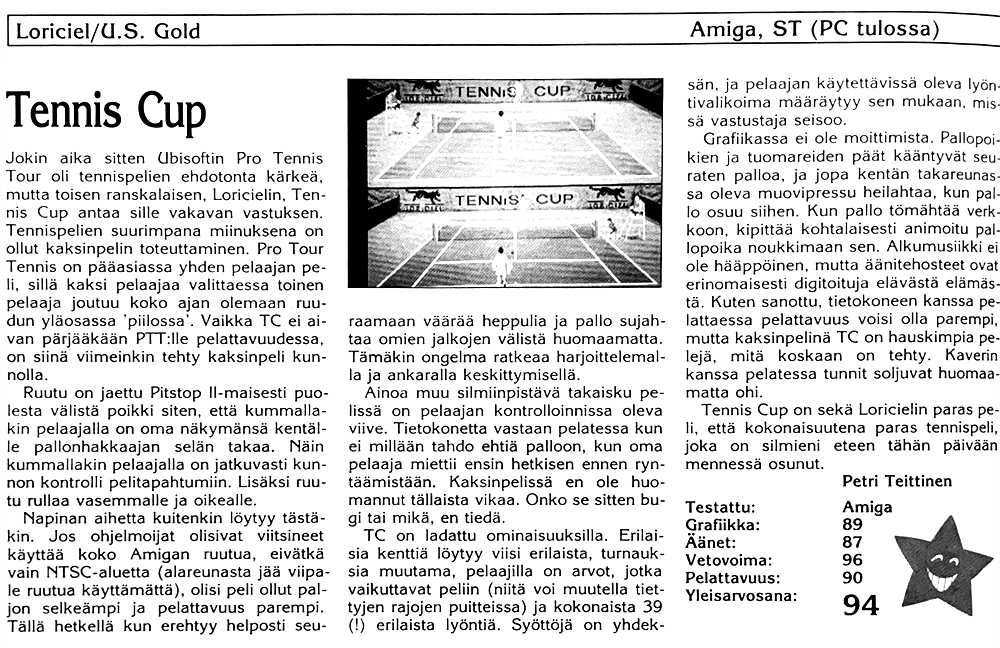
Ruutu on jaettu Pitstop II-maisesti puolesta välistä poikki siten, että kummallakin pelaajalla on oma näkymänsä kentälle pallonhakkaajan selän takaa. Näin kummallakin pelaajalla on jatkuvasti kunnon kontrolli pelitapahtumiin. Lisäksi ruutu rullaa vasemmalle ja oikealle.
Napinan aihetta kuitenkin löytyy tästäkin. Jos ohjelmoijat olisivat viitsineet käyttää koko Amigan ruutua, eivätkä vain NTSC-aluetta (alareunasta jää viipale ruutua käyttämättä), olisi peli ollut paljon selkeämpi ja pelattavuus parempi. Tällä hetkellä kun erehtyy helposti seuraamaan väärää heppulia ja pallo sujahtaa omien jalkojen välistä huomaamatta. Tämäkin ongelma ratkeaa harjoittelemalla ja ankaralla keskittymisellä.
Ainoa muu silmiinpistävä takaisku pelissä on pelaajan kontrolloinnissa oleva viive. Tietokonetta vastaan pelatessa kun ei millään tahdo ehtiä palloon, kun oma pelaaja miettii ensin hetkisen ennen ryntäämistään. Kaksinpelissä en ole huomannut tällaista vikaa. Onko se sitten bugi tai mikä, en tiedä.
TC on ladattu ominaisuuksilla. Erilaisia kenttiä löytyy viisi erilaista, turnauksia muutama, pelaajilla on arvot, jotka vaikuttavat peliin (niitä voi muutella tiettyjen rajojen puitteissa) ja kokonaista 39 (!) erilaista lyöntiä. Syöttöjä on yhdeksän, ja pelaajan käytettävissä oleva lyöntivalikoima määräytyy sen mukaan, missä vastustaja seisoo.
Grafiikassa ei ole moittimista. Pallopoikien ja tuomareiden päät kääntyvät seuraten palloa, ja jopa kentän takareunassa oleva muovipressu heilahtaa, kun pallo osuu siihen. Kun pallo tömähtää verkkoon, kipittää kohtalaisesti animoitu pallopoika noukkimaan sen. Alkumusiikki ei ole hääppöinen, mutta äänitehosteet ovat erinomaisesti digitoituja elävästä elämästä. Kuten sanottu, tietokoneen kanssa pelattaessa pelattavuus voisi olla parempi, mutta kaksinpelinä TC on hauskimpia pelejä, mitä koskaan on tehty. Kaverin kanssa pelatessa tunnit soljuvat huomaamatta ohi.
Tennis Cup on sekä Loricielin paras peli, että kokonaisuutena paras tennispeli, joka on silmieni eteen tähän päivään mennessä osunut.
Tennis Cup1990 SyksyPermalinkA while back Ubisoft's Pro Tennis Tour was the undisputed cream of the tennis games, but Tennis Cup from another Frenchman, Loriciel, gives it serious competition. The biggest minus of tennis games has been the way the two-player game is done. Pro Tour Tennis is mainly a one-player game, since when you choose two players, the second player is stuck 'hidden' at the top of the screen the whole time. Although TC doesn't quite hold its own against PTT in playability, it has at last got the two-player game done properly.
The screen is split across the middle Pitstop II-style, so that each player has their own view of the court from behind their ball-basher's back. That way both players have proper control of the action at all times. On top of that, the screen scrolls left and right.
Still, there's something to grumble about here too. If the programmers had bothered to use the whole Amiga screen and not just the NTSC area (a slice of the screen at the bottom goes unused), the game would have been much clearer and the playability better. As things stand, you easily end up following the wrong bloke by mistake, and the ball slips between your own legs without you noticing. This problem too can be solved with practice and fierce concentration.
The only other glaring setback in the game is the lag in controlling your player. Playing against the computer, you just can't seem to get to the ball in time, because your own player first ponders for a moment before dashing off. In two-player mode I haven't noticed any such fault. Whether it's a bug or what, I don't know.
TC is loaded with features. There are five different courts, a few tournaments, the players have attributes that affect the game (you can tweak them within certain limits), and a whole 39 (!) different shots. There are nine serves, and the range of shots available to the player depends on where the opponent is standing.
There's nothing to fault in the graphics. The heads of the ball boys and umpires turn to follow the ball, and even the plastic tarpaulin at the back of the court sways when the ball hits it. When the ball thuds into the net, a fairly well animated ball boy scurries off to pick it up. The title music is nothing to write home about, but the sound effects are excellently digitised from real life. As I said, the playability could be better when playing against the computer, but as a two-player game TC is one of the most fun games ever made. Playing with a mate, the hours slip by unnoticed.
Tennis Cup is both Loriciel's best game and, taken as a whole, the best tennis game to have come before my eyes to this day.
Terminator
Terminator1991 SyksyPysyvä linkkiJos on olemassa joku, joka ei ole Terminatoria nähnyt, niin voi raukkaa! Kysymyksessähän on paitsi Arnold Schwarzeneggerin läpilyönti-elikuva myös yksi kaikkien aikojen parhaimpia scifi/toimintapätkiä.
Pelaaja voi valita alter egokseen joko T-800-mallin Terminatorin tai Kyle Reesen, jolloin lopullinen päämäärä luonnollisesti on joko Sarah Connorin reittäminen tai Terminatorin terminoiminen. Kaksi pelaajaa voi linkittää koneensa kaapelin avulla.
Itse pelissä pelaaja dumpataan San Franciscoon, ja tarkoitus on löytää aseita, rahaa, muita varusteita ja Sarah Connor. Autoja voi kaappailla matkan jouduttamiiseen, ja autoissa on jopa käsi- tai automaattivaihteet. Optoita ja toimintoja riittää kymmeneen kevyempään peliin. Aseita muun muuassa on lukuisia erilaisia aina pyssyistä Stinger-ohjuksiin.
Raa'at pelaajat voivat ammuskella siviilejä, jolloin pieni animaatio näyttää kuolevia ihmisiä, tai jopa ajaa autolla päälle digitoidun rääkäisyn kera. Piristävää, vaikka kukkahattutädit tietysti huolestuvat.
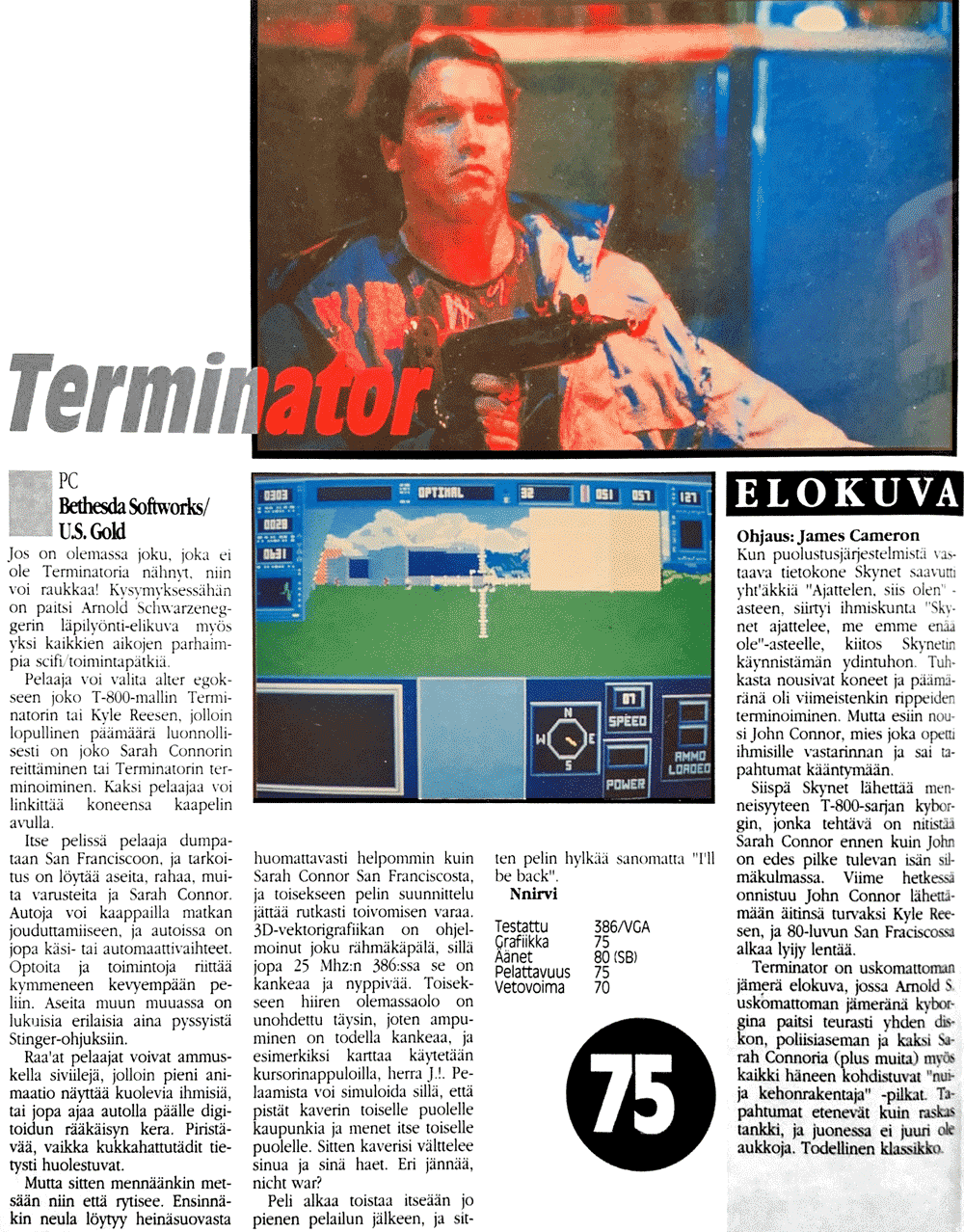
Mutta sitten mennäänkin metsään niin että rytisee. Ensinnäkin neula löytyy heinäsuovasta huomattavasti helpommin kuin Sarah Connor San Franciscosta, ja toisekseen pelin suunnittelu jättää rutkasti toivomisen varaa. 3D-vektorigrafiikan on ohjelmoinut joku rähmäkäpälä, sillä jopa 25 Mhz:n 386:ssa se on kankeaa ja nyppivää. Toisekseen hiiren olemassaolo on unohdettu täysin, joten ampuminen on todella kankeaa, ja esimerkiksi karttaa käytetään kursorinappuloilla, herra J.!. Pelaamista voi simuloida sillä, että pistät kaverin toiselle puolelle kaupunkia ja menet itse toiselle puolelle. Sitten kaverisi välttelee sinua ja sinä haet. Eri jännää, nicht war?
Peli alkaa toistaa itseään jo pienen pelailun jälkeen, ja sitten pelin hylkää sanomatta "I'll be back".
Terminator1991 SyksyPermalinkIf there's anyone out there who hasn't seen Terminator, oh, the poor soul! After all, it's not only Arnold Schwarzenegger's breakthrough film but also one of the best sci-fi/action flicks of all time.
The player can choose as an alter ego either the T-800 model Terminator or Kyle Reese, in which case the ultimate goal is naturally either perforating Sarah Connor or terminating the Terminator. Two players can link their machines with a cable.
In the game itself the player is dumped in San Francisco, and the idea is to find weapons, money, other equipment and Sarah Connor. You can hijack cars to speed your journey along, and the cars even come with a manual or automatic gearbox. There are enough options and functions for ten lighter games. Among other things there are numerous different weapons, all the way from guns to Stinger missiles.
Brutal players can pick off civilians, in which case a small animation shows people dying, or even run them over with a car, complete with a digitised shriek. Refreshing, though of course the pearl-clutching busybodies will get worried.
But then it all goes pear-shaped with a crash. Firstly, a needle is found in a haystack considerably more easily than Sarah Connor in San Francisco, and secondly the game's design leaves a great deal to be desired. The 3D vector graphics were programmed by some ham-fisted clod, because even on a 25 MHz 386 they're sluggish and irritating. Secondly, the existence of the mouse has been completely forgotten, so shooting is really clumsy, and the map, for example, is operated with the cursor keys, Mr J.! You can simulate playing it by putting a friend on one side of town and going to the other side yourself. Then your friend avoids you and you search. Dead exciting, nicht war?
The game starts repeating itself after just a little play, and then you abandon it without saying "I'll be back".
Terminator 2 The Judgement Day
Terminator 2 The Judgement Day1991 SyksyPysyvä linkkiVaikka kuinka yritimme ei Terminator 2 ehtinyt ilmestyä ennen Pelikirjan painoonmenoa. Tämä arvostelu pohjautuu lyhyeen demoon, lehdistömateriaaliin sekä siihen, mitä Ocean esitteli European Computer Showssa. Siksi arvosanoja ei ole annettu.
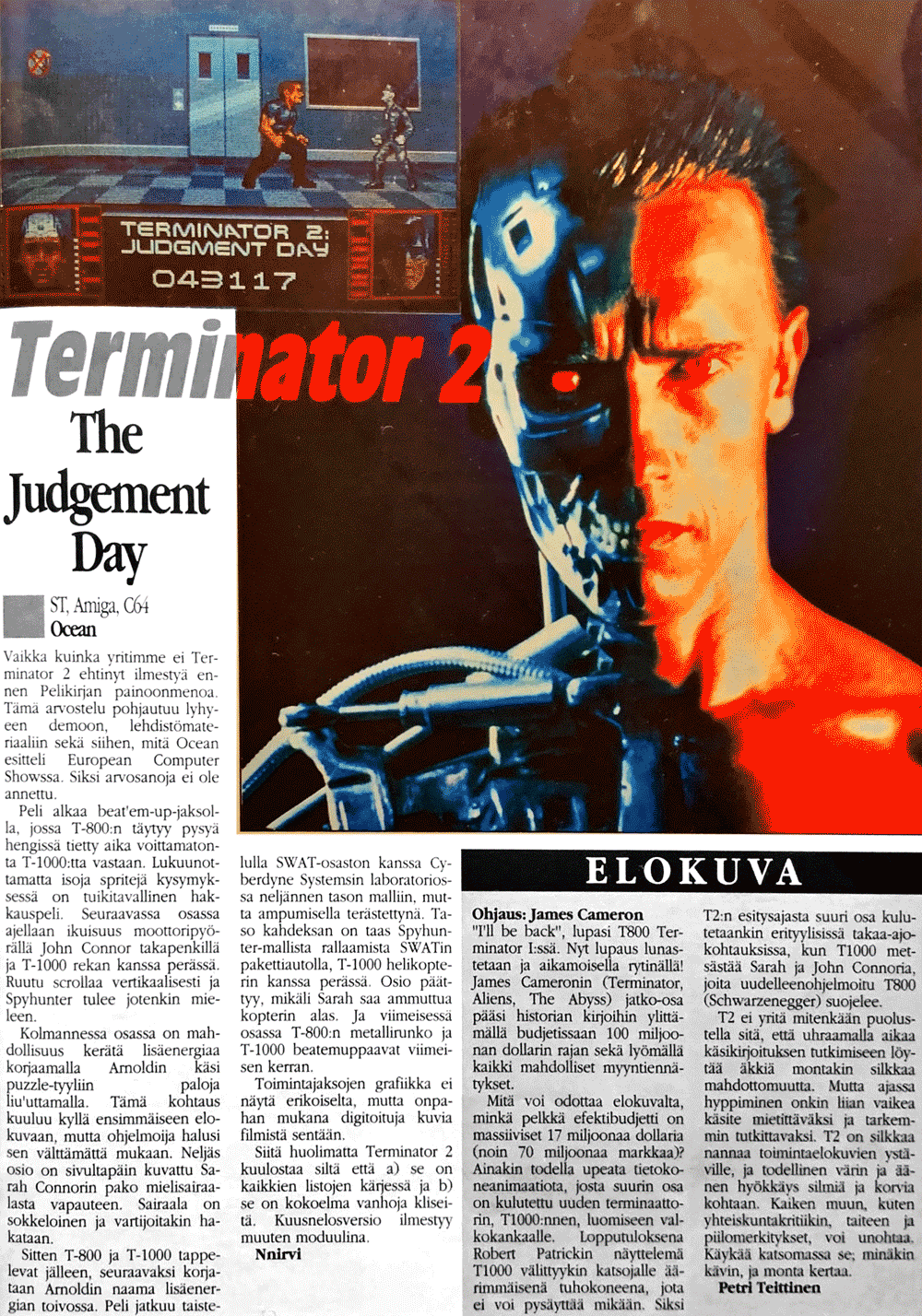
Peli alkaa beat'em-up-jaksolla, jossa T-800:n täytyy pysyä hengissä tietty aika voittamatonta T-1000:tta vastaan. Lukuunottamatta isoja spritejä kysymyksessä on tuikitavallinen hakkauspeli. Seuraavassa osassa ajellaan ikuisuus moottoripyörällä John Connor takapenkillä ja T-1000 rekan kanssa perässä. Ruutu scrollaa vertikaalisesti ja Spyhunter tulee jotenkin mieleen.
Kolmannessa osassa on mahdollisuus kerätä lisäenergiaa korjaamalla Arnoldin käsi puzzle-tyyliin paloja liu'uttamalla. Tämä kohtaus kuuluu kyllä ensimmäiseen elokuvaan, mutta ohjelmoija halusi sen välttämättä mukaan. Neljäs osio on sivultapäin kuvattu Sarah Connorin pako mielisairaalasta vapauteen. Sairaala on sokkeloinen ja vartijoitakin hakataan.
Sitten T-800 ja T-1000 tappelevat jälleen, seuraavaksi korjataan Arnoldin naama lisäenergian toivossa. Peli jatkuu taistelulla SWAT-osaston kanssa Cyberdyne Systemsin laboratoriossa neljännen tason malliin, mutta ampumisella terästettynä. Taso kahdeksan on taas Spyhunter-mallista rallaamista SWATin pakettiautolla, T-1000 helikopterin kanssa perässä. Osio päättyy, mikäli Sarah saa ammuttua kopterin alas. Ja viimeisessä osassa T-800:n metallirunko ja T-1000 beatemuppaavat viimeisen kerran.
Toimintajaksojen grafiikka ei näytä erikoiselta, mutta onpahan mukana digitoituja kuvia filmistä sentään.
Siitä huolimatta Terminator 2 kuulostaa siltä että a) se on kaikkien listojen kärjessä ja b) se on kokoelma vanhoja kliseitä. Kuusnelosversio ilmestyy muuten moduulina.
Terminator 2 The Judgement Day1991 SyksyPermalinkTry as we might, Terminator 2 didn't come out in time before Pelikirja went to press. This review is based on a short demo, press material and what Ocean showed at the European Computer Show. That's why no grades have been given.
The game begins with a beat'em-up section in which the T-800 has to stay alive for a set time against the invincible T-1000. Apart from the big sprites, this is a perfectly run-of-the-mill punch-up game. In the next part you ride a motorbike for an eternity with John Connor on the back seat and the T-1000 behind you in a truck. The screen scrolls vertically and somehow Spyhunter comes to mind.
In the third part you get the chance to pick up extra energy by repairing Arnold's arm puzzle-style, sliding pieces around. Admittedly this scene belongs to the first film, but the programmer just had to have it in. The fourth section is Sarah Connor's escape from the mental hospital to freedom, seen from the side. The hospital is a maze, and there are guards to beat up too.
Then the T-800 and the T-1000 fight again, and next you repair Arnold's face in the hope of extra energy. The game continues with a battle against the SWAT squad in the Cyberdyne Systems laboratory, in the style of level four but spiced up with shooting. Level eight is Spyhunter-style rallying again, in the SWAT van, with the T-1000 on your tail in a helicopter. The section ends if Sarah manages to shoot the chopper down. And in the final part the T-800's metal frame and the T-1000 beat'em-up each other one last time.
The graphics in the action sections don't look like anything special, but at least there are digitised pictures from the film.
Even so, Terminator 2 sounds as if a) it's at the top of every chart and b) it's a collection of old clichés. The Commodore 64 version, by the way, is coming out on cartridge.
Terramex
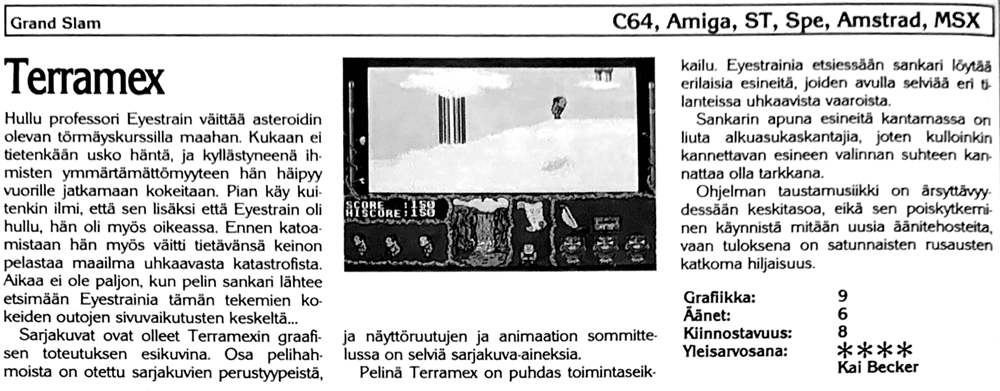
Terramex1988Pysyvä linkkiHullu professori Eyestrain väittää asteroidin olevan törmäyskurssilla maahan. Kukaan ei tietenkään usko häntä, ja kyllästyneenä ihmisten ymmärtämättömyyteen hän häipyy vuorille jatkamaan kokeitaan. Pian käy kuitenkin ilmi, että sen lisäksi että Eyestrain oli hullu, hän oli myös oikeassa. Ennen katoamistaan hän myös väitti tietävänsä keinon pelastaa maailma uhkaavasta katastrofista. Aikaa ei ole paljon, kun pelin sankari lähtee etsimään Eyestrainia tämän tekemien kokeiden outojen sivuvaikutusten keskeltä...
Sarjakuvat ovat olleet Terramexin graafisen toteutuksen esikuvina. Osa pelihahmoista on otettu sarjakuvien perustyypeistä, ja näyttöruutujen ja animaation sommittelussa on selviä sarjakuva-aineksia.
Pelinä Terramex on puhdas toimintaseikkailu. Eyestrainia etsiessään sankari löytää erilaisia esineitä, joiden avulla selviää eri tilanteissa uhkaavista vaaroista.
Sankarin apuna esineitä kantamassa on liuta alkuasukaskantajia, joten kulloinkin kannettavan esineen valinnan suhteen kannattaa olla tarkkana.
Ohjelman taustamusiikki on ärsyttävyydessään keskitasoa, eikä sen poiskytkeminen käynnistä mitään uusia äänitehosteita, vaan tuloksena on satunnaisten rusausten katkoma hiljaisuus.
Terramex1988PermalinkMad professor Eyestrain claims that an asteroid is on a collision course with Earth. Naturally nobody believes the professor, and, fed up with people's failure to understand, Eyestrain clears off to the mountains to carry on experimenting. Soon, however, it turns out that besides being mad, Eyestrain was also right. Before vanishing, Eyestrain had also claimed to know a way of saving the world from the looming catastrophe. There isn't much time left as the game's hero sets off in search of Eyestrain, amid the strange side effects of the professor's experiments...
Comics served as the models for Terramex's graphic design. Some of the characters are drawn from stock comic-strip types, and there are clear comic-strip elements in the layout of the screens and in the animation.
As a game, Terramex is a pure action adventure. While looking for Eyestrain, the hero finds various objects that help you get through the dangers lurking in different situations.
Helping the hero carry the objects is a whole string of native porters, so it pays to be careful about which object you choose to carry at any given moment.
The program's background music is middling as far as irritation goes, and switching it off doesn't bring any new sound effects to life; the result is simply silence broken by the occasional crunch.
Terror of The Deep
Terror of The Deep1987Pysyvä linkkiLoch Ness, luonnonkauniin Skotlannin kuuluisin järvi, on tapahtumien keskipisteenä. Tuskinpa kyläläisiä harmittaisi järveä kohtaan osoitettu kiinnostus, mutta kun vierailijat ovat avaruudesta. Nokkela tekniikka on onnistunut rakentamaan sukellusaluksen, jolla järven salat voidaan tonkia pintaan ja Nessie pelastaa. Hän heittää kuitenkin pyyhkeen kehään ja sinä olet ainoa joka osaa käyttää vedenalaista ihmettä.
Tehtävä on periaatteessa yksinkertainen: löydä muukalaisten energiakristalli(t), räjäytä ne ja jollei muuta tekemistä löydy, harppunoi myös liian lähelle uskaltautuvat avaruuden mömmiäiset. Tietysti muukalaisten käsitys kalanruoasta olet sinä, mutta kuka tahtoo elää ikuisesti?
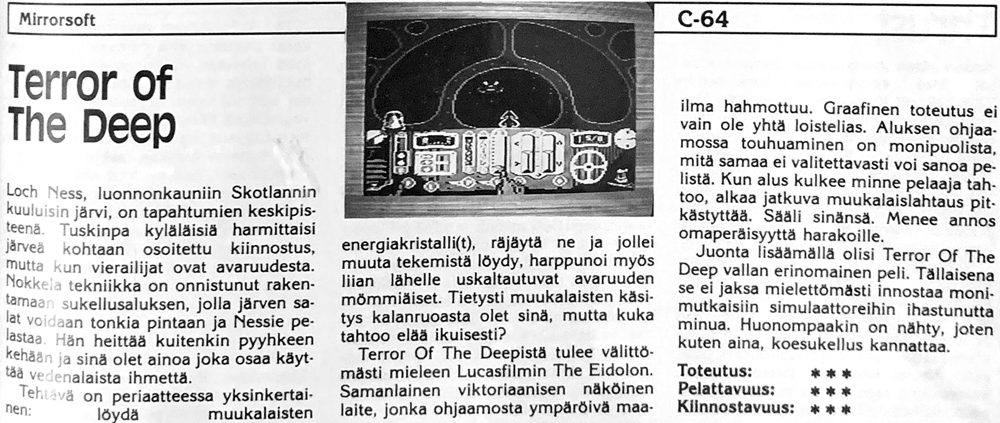
Terror Of The Deepistä tulee välittömästi mieleen Lucasfilmin The Eidolon. Samanlainen viktoriaanisen näköinen laite, jonka ohjaamosta ympäröivä maailma hahmottuu. Graafinen toteutus ei vain ole yhtä loistelias. Aluksen ohjaamossa touhuaminen on monipuolista, mitä samaa ei valitettavasti voi sanoa pelistä. Kun alus kulkee minne pelaaja tahtoo, alkaa jatkuva muukalaislahtaus pitkästyttää. Sääli sinänsä. Menee annos omaperäisyyttä harakoille.
Juonta lisäämällä olisi Terror Of The Deep vallan erinomainen peli. Tällaisena se ei jaksa mielettömästi innostaa monimutkaisiin simulaattoreihin ihastunutta minua. Huonompaakin on nähty, joten kuten aina, koesukellus kannattaa.
Terror of The Deep1987PermalinkLoch Ness, the most famous lake in scenic Scotland, is at the centre of events. The villagers would hardly begrudge the interest shown in their loch, except that the visitors are from outer space. A clever technician has managed to build a submersible with which the loch's secrets can be dredged up to the surface and Nessie rescued. The technician throws in the towel, however, and you are the only one who knows how to operate the underwater wonder.
The task is simple in principle: find the aliens' energy crystal(s), blow them up, and if you can't find anything else to do, harpoon any space creepy-crawlies that venture too close as well. Naturally the aliens' idea of fish food is you, but who wants to live forever?
Terror Of The Deep immediately brings to mind Lucasfilm's The Eidolon. The same sort of Victorian-looking contraption, from whose cockpit the surrounding world takes shape. The graphics just aren't as splendid. There's plenty to fiddle with in the craft's cockpit, which sadly can't be said of the game itself. Once the craft goes wherever the player wants, the endless alien slaughter starts to get tedious. A pity, really. A helping of originality goes to waste.
With more plot, Terror Of The Deep would be a downright excellent game. As it stands, it can't get me, a devotee of complicated simulators, all that madly excited. We've seen worse, though, so as always, a test dive is worth it.
Terrorist
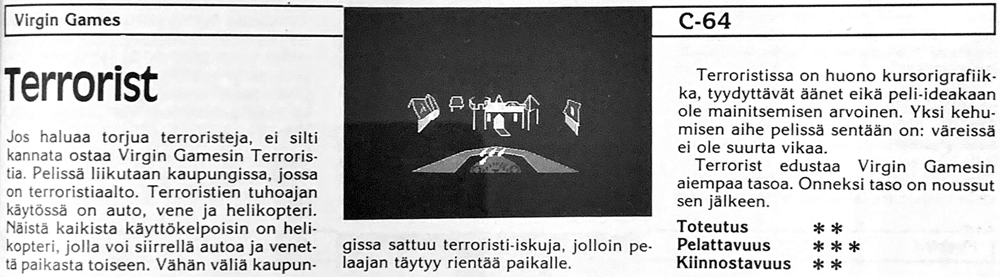
Terrorist1987Pysyvä linkkiJos haluaa torjua terroristeja, ei silti kannata ostaa Virgin Gamesin Terroristia. Pelissä liikutaan kaupungissa, jossa on terroristiaalto. Terroristien tuhoajan käytössä on auto, vene ja helikopteri. Näistä kaikista käyttökelpoisin on helikopteri, jolla voi siirrellä autoa ja venettä paikasta toiseen. Vähän väliä kaupungissa sattuu terroristi-iskuja, jolloin pelaajan täytyy rientää paikalle.
Terroristissa on huono kursorigrafiikka, tyydyttävät äänet eikä peli-ideakaan ole mainitsemisen arvoinen. Yksi kehumisen aihe pelissä sentään on: väreissä ei ole suurta vikaa.
Terrorist edustaa Virgin Gamesin aiempaa tasoa. Onneksi taso on noussut sen jälkeen.
Terrorist1987PermalinkEven if you want to fight terrorists, it's still not worth buying Virgin Games' Terrorist. The game takes place in a city hit by a wave of terrorism. The terrorist-buster has a car, a boat and a helicopter to work with. The most useful of these is the helicopter, which can ferry the car and the boat from place to place. Every so often there's a terrorist attack somewhere in the city, and the player has to rush to the scene.
Terrorist has poor cursor graphics, passable sound, and the game idea isn't worth mentioning either. There is at least one thing in the game worth praising: there's nothing much wrong with the colours.
Terrorist represents Virgin Games' earlier standard. Luckily the standard has gone up since then.
Terrorpods
Terrorpods1988Pysyvä linkkiLoistavan Barbarianin jälkeen oli aihetta odottaa Psygnosiksen seuraavaa julkaisua. Kolme ensimmäistä peliä menivät penkin alle, mutta pelien taso on ollut koko ajan noususuuntaista. Jostain syystä tämä nousujohteisuus kuitenkin päättyy Terrorpodsiin. Terrorpods on pohjimmiltaan vain kolmiulotteinen tuhoamispeli, johon on sotkettu lisäksi mineraalien vaihtamista.
Juoni on seuraavanlainen: Asteroidi Colian on täynnä rikkaita mineraalialueita. Mineraaleja, joita ei saa mistään muualta maailmankaikkeudesta, on kaivamassa päivänvaloon kymmenisen yhdyskuntaa. Eräänä päivänä Imperiumin emäalus asettuu kiertoradalle ja lähettää sotajoukkonsa valtaamaan asteroidin ja tehtaat rakentaakseen siellä itselleen Terrorpodeja, äärimmäisiä tuhokoneita.
Maasi hallitus antaa sinulle käskyn soluttautua planeetalle ja varastaa Terrorpodien komponentteja, jotta he voivat tutkia miten nämä tuhokoneet on valmistettu ja miten ne voidaan tuhota. Pelin alussa olet juuri laskeutunut aluksellasi asteroidille.
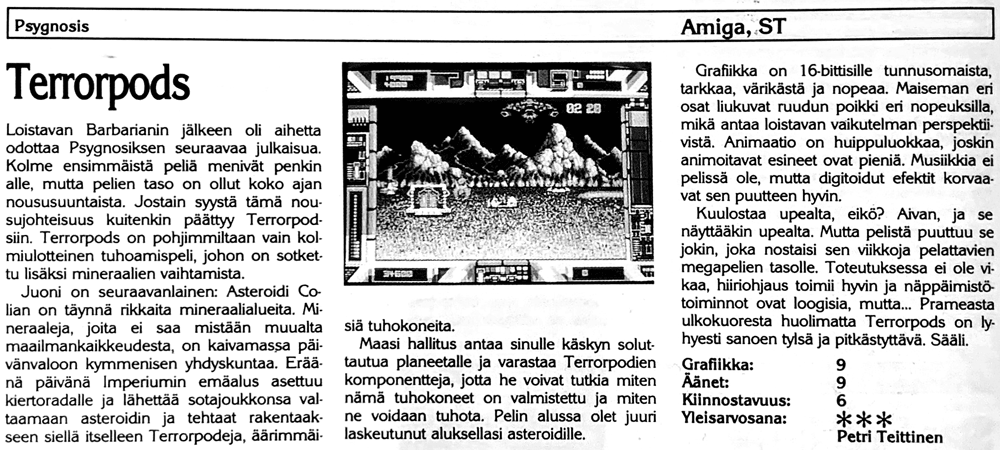
Grafiikka on 16-bittisille tunnusomaista, tarkkaa, värikästä ja nopeaa. Maiseman eri osat liukuvat ruudun poikki eri nopeuksilla, mikä antaa loistavan vaikutelman perspektiivistä. Animaatio on huippuluokkaa, joskin animoitavat esineet ovat pieniä. Musiikkia ei pelissä ole, mutta digitoidut efektit korvaavat sen puutteen hyvin.
Kuulostaa upealta, eikö? Aivan, ja se näyttääkin upealta. Mutta pelistä puuttuu se jokin, joka nostaisi sen viikkoja pelattavien megapelien tasolle. Toteutuksessa ei ole vikaa, hiiriohjaus toimii hyvin ja näppäimistötoiminnot ovat loogisia, mutta... Prameasta ulkokuoresta huolimatta Terrorpods on lyhyesti sanoen tylsä ja pitkästyttävä. Sääli.
Terrorpods1988PermalinkAfter the brilliant Barbarian there was reason to look forward to Psygnosis's next release. The first three games were flops, but the standard of the games has been on the rise all along. For some reason, though, this upward trend comes to an end with Terrorpods. At heart Terrorpods is just a three-dimensional destruction game with some mineral trading muddled in on top.
The plot goes like this: the asteroid Colian is full of rich mineral fields. Some ten colonies are busy digging minerals out into the daylight, minerals that can't be found anywhere else in the universe. One day the Empire's mothership settles into orbit and sends its troops down to seize the asteroid and the factories, so as to build itself Terrorpods there - the ultimate machines of destruction.
Your country's government orders you to infiltrate the planet and steal Terrorpod components, so that they can study how these machines of destruction are built and how they can be destroyed. At the start of the game you have just landed on the asteroid in your ship.
The graphics are typical of the 16-bit machines: detailed, colourful and fast. The different parts of the landscape slide across the screen at different speeds, which gives a brilliant impression of perspective. The animation is top class, although the animated objects are small. There is no music in the game, but the digitised effects make up for its absence nicely.
Sounds superb, doesn't it? Quite right, and it looks superb too. But the game lacks that certain something that would lift it to the level of the megagames you play for weeks on end. There's nothing wrong with the implementation - the mouse control works well and the keyboard functions are logical, but... Despite its showy outer shell, Terrorpods is, in short, dull and tedious. A pity.
Test Drive
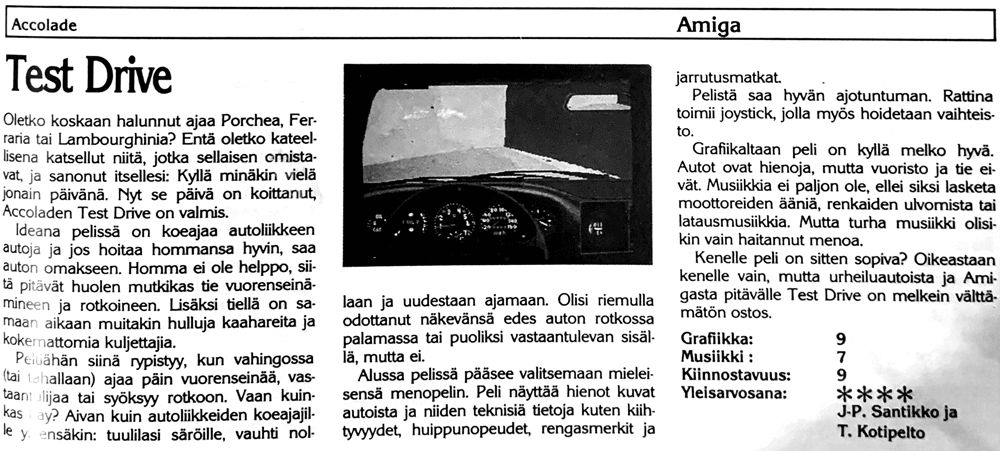
Test Drive1988Pysyvä linkkiOletko koskaan halunnut ajaa Porchea, Ferraria tai Lambourghinia? Entä oletko kateellisena katsellut niitä, jotka sellaisen omistavat, ja sanonut itsellesi: Kyllä minäkin vielä jonain päivänä. Nyt se päivä on koittanut, Accoladen Test Drive on valmis.
Ideana pelissä on koeajaa autoliikkeen autoja ja jos hoitaa hommansa hyvin, saa auton omakseen. Homma ei ole helppo, siitä pitävät huolen mutkikas tie vuorenseinämineen ja rotkoineen. Lisäksi tiellä on samaan aikaan muitakin hulluja kaahareita ja kokemattomia kuljettajia.
Peltiähän siinä rypistyy, kun vahingossa (tai tahallaan) ajaa päin vuorenseinää, vastaantulijaa tai syöksyy rotkoon. Vaan kuinkas käy? Aivan kuin autoliikkeiden koeajajille yleensäkin: tuulilasi säröille, vauhti nollaan ja uudestaan ajamaan. Olisi riemulla odottanut näkevänsä edes auton rotkossa palamassa tai puoliksi vastaantulevan sisällä, mutta ei.
Alussa pelissä pääsee valitsemaan mieleisensä menopelin. Peli näyttää hienot kuvat autoista ja niiden teknisiä tietoja kuten kiihtyvyydet, huippunopeudet, rengasmerkit ja jarrutusmatkat.
Pelistä saa hyvän ajotuntuman. Rattina toimii joystick, jolla myös hoidetaan vaihteisto.
Grafiikaltaan peli on kyllä melko hyvä. Autot ovat hienoja, mutta vuoristo ja tie eivät. Musiikkia ei paljon ole, ellei siksi lasketa moottoreiden ääniä, renkaiden ulvomista tai latausmusiikkia. Mutta turha musiikki olisikin vain haitannut menoa.
Kenelle peli on sitten sopiva? Oikeastaan kenelle vain, mutta urheiluautoista ja Amigasta pitävälle Test Drive on melkein välttämätön ostos.
Test Drive1988PermalinkHave you ever wanted to drive a Porche, a Ferrari or a Lambourghini? And have you ever looked enviously at the people who own one and said to yourself: One of these days, me too. Well, that day has now dawned - Accolade's Test Drive is ready.
The idea of the game is to test-drive cars from a car dealer's, and if you do the job well, the car is yours to keep. It's no easy job, and the winding road with its mountain walls and ravines makes sure of that. What's more, there are other crazy speed demons and inexperienced drivers on the road at the same time.
Naturally there's some crumpled sheet metal when you accidentally (or on purpose) drive into the mountain wall or an oncoming car, or plunge into a ravine. But then what happens? Just what usually happens to car dealers' test drivers: a cracked windscreen, speed down to zero and off you drive again. You'd have gleefully expected to see at least the car burning down in the ravine, or buried halfway inside the oncoming car, but no.
At the start of the game you get to pick the set of wheels of your choice. The game shows fine pictures of the cars and their technical details, such as acceleration figures, top speeds, tyre makes and braking distances.
The game gives you a good feel for the driving. The joystick acts as the steering wheel, and it also handles the gearbox.
Graphically the game is certainly pretty good. The cars are great, but the mountains and the road aren't. There isn't much music, unless you count the engine noises, the howling of the tyres or the loading music. But pointless music would only have spoiled the ride anyway.
So who is the game for, then? Pretty much anyone, really, but for anyone who likes sports cars and the Amiga, Test Drive is an almost essential purchase.
Test Drive III: The Passion
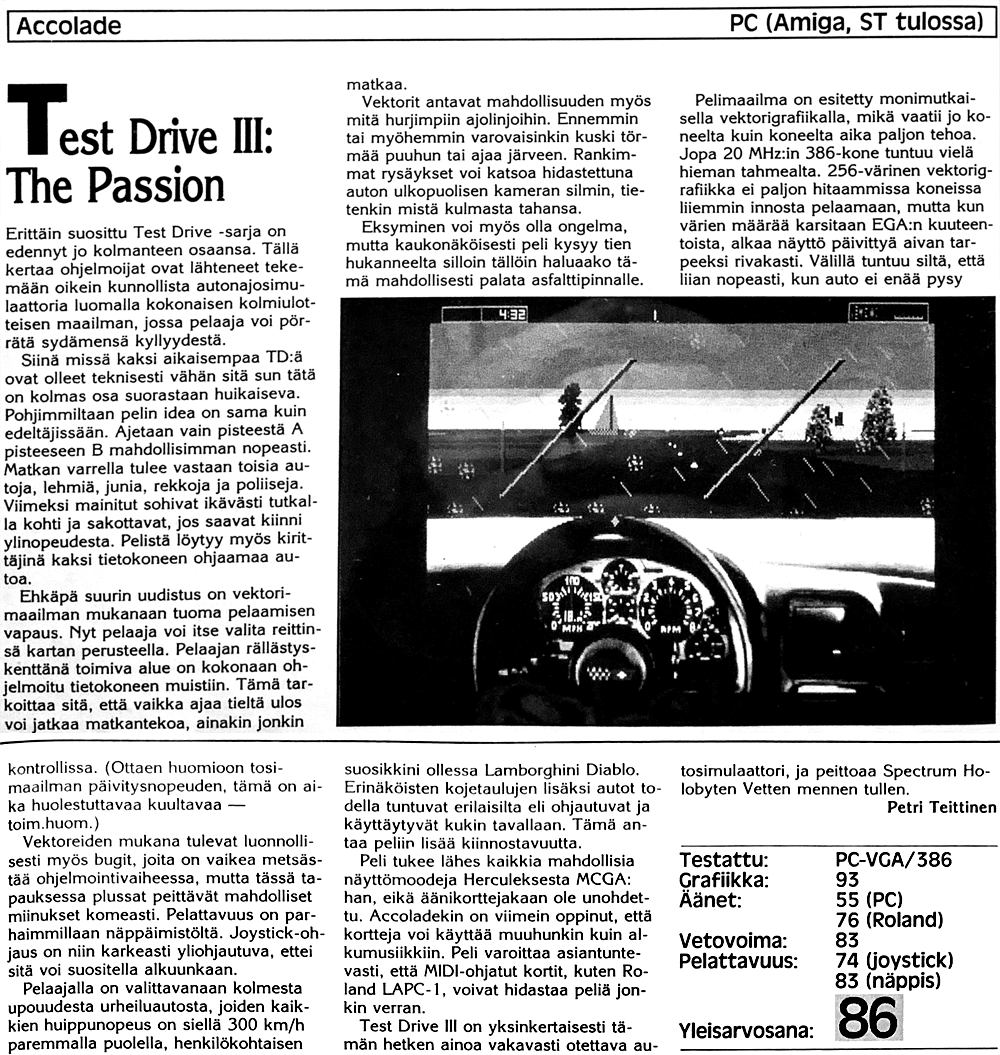
Test Drive III: The Passion1991 KevätPysyvä linkkiErittäin suosittu Test Drive -sarja on edennyt jo kolmanteen osaansa. Tällä kertaa ohjelmoijat ovat lähteneet tekemään oikein kunnollista autonajosimulaattoria luomalla kokonaisen kolmiulotteisen maailman, jossa pelaaja voi pörrätä sydämensä kyllyydestä.
Siinä missä kaksi aikaisempaa TD:ä ovat olleet teknisesti vähän sitä sun tätä on kolmas osa suorastaan huikaiseva. Pohjimmiltaan pelin idea on sama kuin edeltäjissään. Ajetaan vain pisteestä A pisteeseen B mahdollisimman nopeasti. Matkan varrella tulee vastaan toisia autoja, lehmiä, junia, rekkoja ja poliiseja. Viimeksi mainitut sohivat ikävästi tutkalla kohti ja sakottavat, jos saavat kiinni ylinopeudesta. Pelistä löytyy myös kirittäjinä kaksi tietokoneen ohjaamaa autoa.
Ehkäpä suurin uudistus on vektorimaailman mukanaan tuoma pelaamisen vapaus. Nyt pelaaja voi itse valita reittinsä kartan perusteella. Pelaajan rällästyskenttänä toimiva alue on kokonaan ohjelmoitu tietokoneen muistiin. Tämä tarkoittaa sitä, että vaikka ajaa tieltä ulos voi jatkaa matkantekoa, ainakin jonkin matkaa.
Vektorit antavat mahdollisuuden myös mitä hurjimpiin ajolinjoihin. Ennemmin tai myöhemmin varovaisinkin kuski törmää puuhun tai ajaa järveen. Rankimmat rysäykset voi katsoa hidastettuna auton ulkopuolisen kameran silmin, tietenkin mistä kulmasta tahansa.
Eksyminen voi myös olla ongelma, mutta kaukonäköisesti peli kysyy tien hukanneelta silloin tällöin haluaako tämä mahdollisesti palata asfalttipinnalle.
Pelimaailma on esitetty monimutkaisella vektorigrafiikalla, mikä vaatii jo koneelta kuin koneelta aika paljon tehoa. Jopa 20 MHz:in 386-kone tuntuu vielä hieman tahmealta. 256-värinen vektorigrafiikka ei paljon hitaammissa koneissa liiemmin innosta pelaamaan, mutta kun värien määrää karsitaan EGA:n kuuteentoista, alkaa näyttö päivittyä aivan tarpeeksi rivakasti. Välillä tuntuu siltä, että liian nopeasti, kun auto ei enää pysy kontrollissa. (Ottaen huomioon tosimaailman päivitysnopeuden, tämä on aika huolestuttavaa kuultavaa - toim.huom.)
Vektoreiden mukana tulevat luonnollisesti myös bugit, joita on vaikea metsästää ohjelmointivaiheessa, mutta tässä tapauksessa plussat peittävät mahdolliset miinukset komeasti. Pelattavuus on parhaimmillaan näppäimistöltä. Joystick-ohjaus on niin karkeasti yliohjautuva, ettei sitä voi suositella alkuunkaan.
Pelaajalla on valittavanaan kolmesta upouudesta urheiluautosta, joiden kaikkien huippunopeus on siellä 300 km/h paremmalla puolella, henkilökohtaisen suosikkini ollessa Lamborghini Diablo. Erinäköisten kojetaulujen lisäksi autot todella tuntuvat erilaisilta eli ohjautuvat ja käyttäytyvät kukin tavallaan. Tämä antaa peliin lisää kiinnostavuutta.
Peli tukee lähes kaikkia mahdollisia näyttömoodeja Herculeksesta MCGA:han, eikä äänikorttejakaan ole unohdettu. Accoladekin on viimein oppinut, että kortteja voi käyttää muuhunkin kuin alkumusiikkiin. Peli varoittaa asiantuntevasti, että MIDI-ohjatut kortit, kuten Roland LAPC-1, voivat hidastaa peliä jonkin verran.
Test Drive III on yksinkertaisesti tämän hetken ainoa vakavasti otettava autosimulaattori, ja peittoaa Spectrum Holobyten Vetten mennen tullen.
Test Drive III: The Passion1991 KevätPermalinkThe hugely popular Test Drive series has already reached its third instalment. This time the programmers have set out to make a really proper driving simulator by creating an entire three-dimensional world where the player can buzz around to their heart's content.
Whereas the two earlier TDs were technically a bit so-so, the third part is downright dazzling. At heart the game's idea is the same as in its predecessors. You just drive from point A to point B as fast as possible. Along the way you run into other cars, cows, trains, trucks and police. The last of these nastily poke their radar at you and hand out fines if they catch you speeding. The game also has two computer-controlled cars to push the pace.
Perhaps the biggest innovation is the freedom of play that the vector world brings with it. Now the player can choose their own route from the map. The whole area serving as the player's tearing-about ground is programmed into the computer's memory. This means that even if you drive off the road you can carry on travelling, for a while at least.
The vectors also make possible the wildest of driving lines. Sooner or later even the most careful driver slams into a tree or drives into a lake. The hardest smash-ups can be watched in slow motion through the eyes of a camera outside the car, from any angle you like, of course.
Getting lost can also be a problem, but with admirable foresight the game every now and then asks anyone who has mislaid the road whether they might perhaps care to return to the tarmac.
The game world is presented in complex vector graphics, which demands quite a lot of power from any machine whatsoever. Even a 20 MHz 386 still feels a bit sluggish. On much slower machines the 256-colour vector graphics don't exactly make you eager to play, but when the number of colours is cut down to EGA's sixteen, the screen starts updating quite briskly enough. At times it feels like too fast, when the car no longer stays under control. (Considering the refresh rate of the real world, this is rather worrying to hear - ed.)
Along with vectors naturally come bugs, which are hard to hunt down at the programming stage, but in this case the pluses handsomely cover any minuses there may be. Playability is at its best from the keyboard. The joystick control oversteers so crudely that it can't be recommended at all.
The player has a choice of three brand-new sports cars, all with top speeds somewhere on the right side of 300 km/h, my personal favourite being the Lamborghini Diablo. Besides having different-looking dashboards, the cars really do feel different, meaning each one steers and behaves in its own way. This makes the game all the more interesting.
The game supports almost every display mode imaginable, from Hercules to MCGA, and sound cards haven't been forgotten either. Even Accolade has finally learned that the cards can be used for something other than the title music. The game knowledgeably warns that MIDI-driven cards such as the Roland LAPC-1 may slow the game down somewhat.
Test Drive III is simply the only driving simulator around at the moment that deserves to be taken seriously, and it beats Spectrum Holobyte's Vette hands down.
Tetris
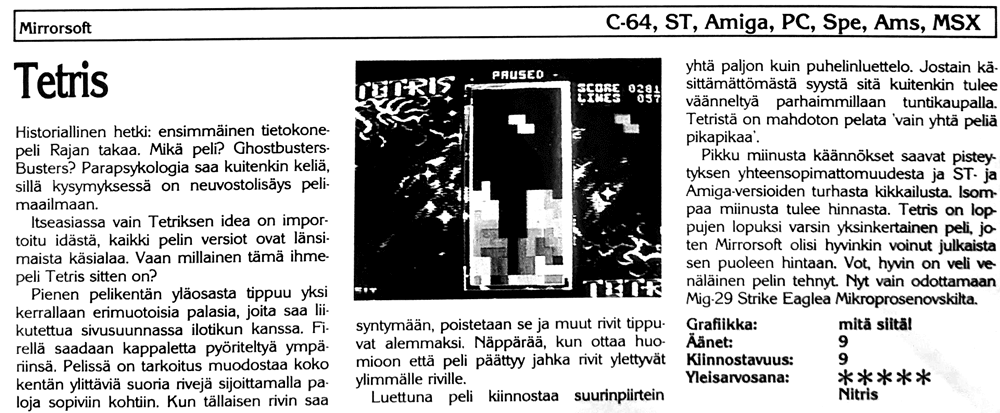
Tetris1988Pysyvä linkkiHistoriallinen hetki: ensimmäinen tietokonepeli Rajan takaa. Mikä peli? Ghostbusters-Busters? Parapsykologia saa kuitenkin keliä, sillä kysymyksessä on neuvostolisäys pelimaailmaan.
Itseasiassa vain Tetriksen idea on importoitu idästä, kaikki pelin versiot ovat länsimaista käsialaa. Vaan millainen tämä ihmepeli Tetris sitten on?
Pienen pelikentän yläosasta tippuu yksi kerrallaan erimuotoisia palasia, joita saa liikutettua sivusuunnassa ilotikun kanssa. Firellä saadaan kappaletta pyöriteltyä ympäriinsä. Pelissä on tarkoitus muodostaa koko kentän ylittäviä suoria rivejä sijoittamalla paloja sopiviin kohtiin. Kun tällaisen rivin saa syntymään, poistetaan se ja muut rivit tippuvat alemmaksi. Näppärää, kun ottaa huomioon että peli päättyy jahka rivit ylettyvät ylimmälle riville.
Luettuna peli kiinnostaa suurinpiirtein yhtä paljon kuin puhelinluettelo. Jostain käsittämättömästä syystä sitä kuitenkin tulee väänneltyä parhaimmillaan tuntikaupalla. Tetristä on mahdoton pelata 'vain yhtä peliä pikapikaa'.
Pikku miinusta käännökset saavat pisteytyksen yhteensopimattomuudesta ja ST- ja Amiga-versioiden turhasta kikkailusta. Isompaa miinusta tulee hinnasta. Tetris on loppujen lopuksi varsin yksinkertainen peli, joten Mirrorsoft olisi hyvinkin voinut julkaista sen puoleen hintaan. Vot, hyvin on veli venäläinen pelin tehnyt. Nyt vain odottamaan Mig-29 Strike Eaglea Mikroprosenovskilta.
Tetris1988PermalinkA historic moment: the first computer game from the Other Side. Which game? Ghostbusters-Busters? Parapsychology can take a hike, though, because what we have here is a Soviet addition to the gaming world.
Actually, only the idea of Tetris has been imported from the East; all the versions of the game are Western handiwork. But what is this wonder game Tetris actually like, then?
Pieces of different shapes drop one at a time from the top of a small playing area, and you can shift them sideways with the joystick. Fire gets the piece spinning around. The aim of the game is to form straight rows running across the whole playing area by placing the pieces in suitable spots. When you manage to create such a row, it is removed and the other rows drop down. Handy, considering that the game ends as soon as the rows reach the top row.
Read about on paper, the game is about as gripping as the phone book. For some incomprehensible reason, though, at its best it has you twisting away at it for hours on end. It is impossible to play Tetris for 'just one quick game'.
The conversions get a small minus for their incompatible scoring and for the needless gimmickry in the ST and Amiga versions. A bigger minus comes from the price. Tetris is, when all's said and done, a pretty simple game, so Mirrorsoft could very well have released it at half the price. Vot, brother Russian has made a fine game. Now all that's left is to wait for Mig-29 Strike Eagle from Mikroprosenovski.
Thanatos
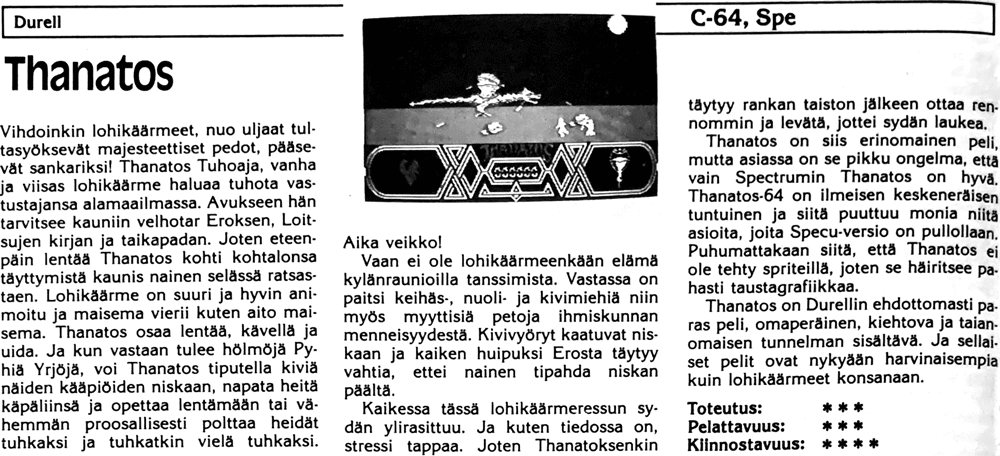
Thanatos1987Pysyvä linkkiVihdoinkin lohikäärmeet, nuo uljaat tultasyöksevät majesteettiset pedot, pääsevät sankariksi! Thanatos Tuhoaja, vanha ja viisas lohikäärme haluaa tuhota vastustajansa alamaailmassa. Avukseen hän tarvitsee kauniin velhotar Eroksen, Loitsujen kirjan ja taikapadan. Joten eteenpäin lentää Thanatos kohti kohtalonsa täyttymistä kaunis nainen selässä ratsastaen. Lohikäärme on suuri ja hyvin animoitu ja maisema vierii kuten aito maisema. Thanatos osaa lentää, kävellä ja uida. Ja kun vastaan tulee hölmöjä Pyhiä Yrjöjä, voi Thanatos tiputella kiviä näiden kääpiöiden niskaan, napata heitä käpäliinsä ja opettaa lentämään tai vähemmän proosallisesti polttaa heidät tuhkaksi ja tuhkatkin vielä tuhkaksi.
Aika veikko!
Vaan ei ole lohikäärmeenkään elämä kylänraunioilla tanssimista. Vastassa on paitsi keihäs-, nuoli- ja kivimiehiä niin myös myyttisiä petoja ihmiskunnan menneisyydestä. Kivivyöryt kaatuvat niskaan ja kaiken huipuksi Erosta täytyy vahtia, ettei nainen tipahda niskan päältä.
Kaikessa tässä lohikäärmeressun sydän ylirasittuu. Ja kuten tiedossa on, stressi tappaa. Joten Thanatoksenkin täytyy rankan taiston jälkeen ottaa rennommin ja levätä, jottei sydän laukea.
Thanatos on siis erinomainen peli, mutta asiassa on se pikku ongelma, että vain Spectrumin Thanatos on hyvä. Thanatos-64 on ilmeisen keskeneräisen tuntuinen ja siitä puuttuu monia niitä asioita, joita Specu-versio on pullollaan. Puhumattakaan siitä, että Thanatos ei ole tehty spriteillä, joten se häiritsee pahasti taustagrafiikkaa.
Thanatos on Durellin ehdottomasti paras peli, omaperäinen, kiehtova ja taianomaisen tunnelman sisältävä. Ja sellaiset pelit ovat nykyään harvinaisempia kuin lohikäärmeet konsanaan.
Thanatos1987PermalinkAt last the dragons, those proud, fire-breathing, majestic beasts, get to be the hero! Thanatos the Destroyer, an old and wise dragon, wants to destroy his enemies in the underworld. To help him he needs the beautiful sorceress Eros, the Book of Spells and the magic cauldron. So onward flies Thanatos towards the fulfilment of his destiny, with a beautiful woman riding on his back. The dragon is big and well animated, and the landscape scrolls like a real landscape. Thanatos can fly, walk and swim. And when some foolish Saint Georges turn up, Thanatos can drop rocks on these pipsqueaks' heads, snatch them up in his paws and teach them to fly or, less prosaically, burn them to ashes and then burn the ashes to ashes too.
What a guy!
But even a dragon's life isn't all dancing on the ruins of villages. He's up against not only spear-, arrow- and rock-men but also mythical beasts from humanity's past. Rockslides come crashing down on his head, and to top it all you have to keep an eye on Eros so the lady doesn't tumble off his neck.
With all this going on, the poor old dragon's heart gets overstrained. And as we all know, stress kills. So even Thanatos has to take it easy and rest after a hard fight, so that his heart doesn't give out.
So Thanatos is an excellent game, but there's one small problem: only the Spectrum Thanatos is any good. Thanatos-64 feels obviously unfinished, and it's missing many of the things the Spectrum version is packed with. Not to mention that Thanatos isn't made with sprites, so he badly interferes with the background graphics.
Thanatos is without question Durell's best game: original, fascinating and full of a magical atmosphere. And games like that are rarer these days than dragons ever were.
Theatre Europe

Theatre Europe1987Pysyvä linkkiJännitys kiristyy suurvaltojen välillä Euroopassa. Neuvostoliitto vaatii Länsi-Saksan aseistamisen lopettamista. Yhdysvallat kieltäytyy jyrkästi. Nato järjestää suuria sotaharjoituksia ja perustaa uusia ydinasetukikohtia Länsi-Saksaan. Varsovanliitto vastaa lisäämällä joukkojaan Itä-Saksassa. Lopulta kylmä sota muuttuu kuumaksi.
Varsovanliiton joukot vyöryvät Saksojen välisen rajan yli tavoitteenaan riisua Länsi-Saksa aseista. Naton joukot joutuvat puolustuskannalle aseistukseltaan ylivoimaista vihollista vastaan.
Tässä vaiheessa huomataan, että onneksi ei ole kysymys elävästä elämästä vaan PSS:n sotasimulaatiosta Theatre Europe. Voit turvallisin mielin asettua joko Varsovanliiton tai Naton komentajan asemaan ja pyrkiä saavuttamaan sinulle asetetun tavoitteen.
Simulaatiossa on kaksi pelimahdollisuutta: strategiapeli ampumispeleihin kyllästyneille ja arcade-jaksoja sisältävä peli verenhimoisille joystick-faneille. Pelissä liikutellaan Keski-Euroopan kartalla valitun sotilasliiton joukkoyksiköitä, tietokone komentaa toisen sotilasliiton joukkoja.
Simulaation ohjaaminen on toteutettu macintoshmaisen helposti. Joukkojen ohjaus tapahtuu joystickillä osoittaen, näppäimistöön ei tarvitse alkuvalintojen jälkeen paljon koskea.
Pelikierroksella on kolme vaihetta: siirtymis-, taistelu- ja huoltovaihe. Kohdistimen ollessa oman joukkoyksikön kohdalla kuvaruudulla näkyy joukkoyksikön nimi ja vahvuus. Vastustajan joukkoyksiköstä saatavat tiedot riippuvat ilmatiedustelun tehokkuudesta.
Ilmavoimia on molemmilla osapuolilla käytettävissä rajoitetusti. Ilmayksiköitä voidaan määrätä monenlaisiin tehtäviin. Melkein yhtä tärkeää kuin maavoimien järkevä siirtely on ilmayksiköiden sijoittaminen strategian kannalta oikeisiin tehtäviin.
Arcade-jaksossa pelaaja valitsee minkä joukkoyksiköiden välisen taistelun hän haluaa kokea. Kuvaruutuun tulee taistelukenttä, jossa hyökkääviä vastustajan koneita ja joukkoja yritetään tuhota ohjuksin.
Helikoptereihin ja panssarivaunuihin on helppo osua, mutta lentokoneeseen osuminen vaatii hyvää aavistusta. Taistelujaksossa menestyminen vaikuttaa kaikkiin sillä kierroksella tapahtuviin taisteluihin.
Simulaatiossa on käytettävissä myös kemialliset ja ydinaseet. Kiellettyjen kemiallisten aseiden käyttö lisää menestymismahdollisuuksia, mutta saattaa pitemmän päälle aiheuttaa vastustajan ydinhyökkäyksen. Ydinhyökkäyksen voi suorittaa joko taktisena, johonkin joukkoyksikköön kohdistuvana iskuna tai massiivisena "kaikki peliin" -iskuna.
Simulaation toisen osapuolen saavutettua tavoitteensa peli päättyy ja pelaaja saa tietää komentajan kykynsä prosentteina. Voitto toisesta osapuolesta hinnalla millä hyvänsä ei takaa sataa prosenttia, vaan omien joukkojen järkevä käyttö.
Pelissä on käytetty hyvin värejä tukemassa luonnollisen tuntuista grafiikkaa. Pelaaminen on nautittavan helppoa ja nopeaa sauvaohjaimella. Erikoisplussan voi antaa Amersoftille hyvästä suomenkielisestä käyttöoppaasta. Ilman sitä pelaaminen olisi paljon hankalampaa.
Ääntä on pelissä käytetty harkiten. Strategiapelissä ei pidä olla liikaa ääntä, koska se häiritsee keskittymistä, mutta Theatre Europen oikea-aikaiset ääniefektit tekevät pelaamisen nautittavaksi.
Peli on erityisesti strategiapeleistä pitäville oikea helmi.
Theatre Europe1987PermalinkTension is mounting between the superpowers in Europe. The Soviet Union demands an end to the arming of West Germany. The United States flatly refuses. Nato stages large-scale military exercises and sets up new nuclear weapons bases in West Germany. The Warsaw Pact responds by reinforcing its troops in East Germany. In the end the cold war turns hot.
Warsaw Pact forces roll across the inner German border, aiming to disarm West Germany. Nato's forces are pushed onto the defensive against an enemy with superior weaponry.
At this point we realise that, luckily, this is not real life but PSS's war simulation Theatre Europe. With your mind at ease, you can take up the post of either the Warsaw Pact or the Nato commander and strive to achieve the objective set for you.
The simulation offers two ways to play: a strategy game for those fed up with shoot-'em-ups, and a game with arcade sequences for bloodthirsty joystick fans. You move the units of your chosen military alliance around a map of Central Europe, while the computer commands the forces of the other alliance.
Controlling the simulation has been made Macintosh-easy. Troops are directed by pointing with the joystick; after the initial choices you hardly need to touch the keyboard.
A game turn has three phases: movement, combat and supply. When the cursor is over one of your own units, the screen shows the unit's name and strength. How much you learn about an enemy unit depends on how effective your air reconnaissance is.
Both sides have limited air forces at their disposal. Air units can be assigned to many kinds of missions. Putting your air units on the missions that are right for your strategy is almost as important as moving your ground forces about sensibly.
In the arcade sequence the player chooses which units' battle they want to experience. A battlefield appears on the screen, where you try to destroy the attacking enemy aircraft and troops with missiles.
Helicopters and tanks are easy to hit, but hitting an aeroplane takes a good sense of anticipation. How well you do in the combat sequence affects every battle fought in that turn.
Chemical and nuclear weapons are also available in the simulation. Using the banned chemical weapons improves your chances of success, but in the longer run it may provoke a nuclear attack from the enemy. A nuclear attack can be carried out either as a tactical strike aimed at a single unit or as a massive "all-in" strike.
When one side in the simulation achieves its objective, the game ends and the player finds out their ability as a commander as a percentage. Beating the other side at any cost does not guarantee a hundred percent - sensible use of your own troops does.
The game makes good use of colour to support natural-looking graphics. Playing with the joystick is pleasantly easy and quick. Amersoft deserves a special bonus point for a good Finnish-language manual. Without it playing would be much harder.
Sound has been used judiciously in the game. A strategy game shouldn't have too much sound, because it breaks your concentration, but Theatre Europe's well-timed sound effects make playing a pleasure.
For fans of strategy games in particular, this game is a real gem.
Their Finest Hour - Battle Of Britain
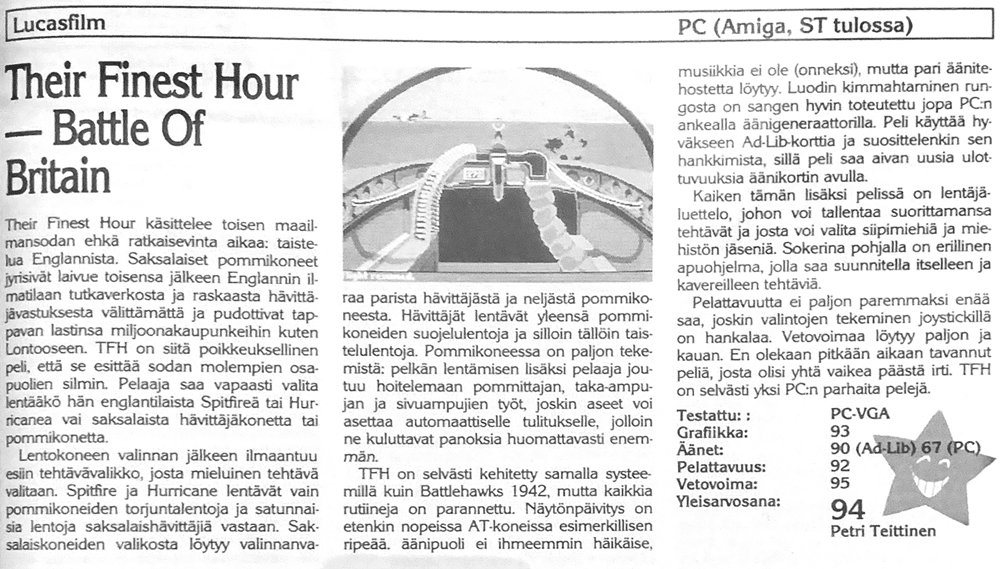
Their Finest Hour - Battle Of Britain1990 KevätPysyvä linkkiTheir Finest Hour käsittelee toisen maailmansodan ehkä ratkaisevinta aikaa: taistelua Englannista. Saksalaiset pommikoneet jyrisivät laivue toisensa jälkeen Englannin ilmatilaan tutkaverkosta ja raskaasta hävittäjävastuksesta välittämättä ja pudottivat tappavan lastinsa miljoonakaupunkeihin kuten Lontooseen. TFH on siitä poikkeuksellinen peli, että se esittää sodan molempien osapuolien silmin. Pelaaja saa vapaasti valita lentääkö hän englantilaista Spitfireä tai Hurricanea vai saksalaista hävittäjäkonetta tai pommikonetta.
Lentokoneen valinnan jälkeen ilmaantuu esiin tehtävävalikko, josta mieluinen tehtävä valitaan. Spitfire ja Hurricane lentävät vain pommikoneiden torjuntalentoja ja satunnaisia lentoja saksalaishävittäjiä vastaan. Saksalaiskoneiden valikosta löytyy valinnanvaraa parista hävittäjästä ja neljästä pommikoneesta. Hävittäjät lentävät yleensä pommikoneiden suojelulentoja ja silloin tällöin taistelulentoja. Pommikoneessa on paljon tekemistä: pelkän lentämisen lisäksi pelaaja joutuu hoitelemaan pommittajan, taka-ampujan ja sivuampujien työt, joskin aseet voi asettaa automaattiselle tulitukselle, jolloin ne kuluttavat panoksia huomattavasti enemmän.
TFH on selvästi kehitetty samalla systeemillä kuin Battlehawks 1942, mutta kaikkia rutiineja on parannettu. Näytönpäivitys on etenkin nopeissa AT-koneissa esimerkillisen ripeää. äänipuoli ei ihmeemmin häikäise, musiikkia ei ole (onneksi), mutta pari äänitehostetta löytyy. Luodin kimmahtaminen rungosta on sangen hyvin toteutettu jopa PC:n ankealla äänigeneraattorilla. Peli käyttää hyväkseen Ad-Lib-korttia ja suosittelenkin sen hankkimista, sillä peli saa aivan uusia ulottuvuuksia äänikortin avulla.
Kaiken tämän lisäksi pelissä on lentäjäluettelo, johon voi tallentaa suorittamansa tehtävät ja josta voi valita siipimiehiä ja miehistön jäseniä. Sokerina pohjalla on erillinen apuohjelma, jolla saa suunnitella itselleen ja kavereilleen tehtäviä.
Pelattavuutta ei paljon paremmaksi enää saa, joskin valintojen tekeminen joystickillä on hankalaa. Vetovoimaa löytyy paljon ja kauan. En olekaan pitkään aikaan tavannut peliä, josta olisi yhtä vaikea päästä irti. TFH on selvästi yksi PC:n parhaita pelejä.
Their Finest Hour - Battle Of Britain1990 KevätPermalinkTheir Finest Hour deals with what was perhaps the most decisive period of the Second World War: the Battle of Britain. German bombers thundered into British airspace squadron after squadron, heedless of the radar network and heavy fighter resistance, and dropped their deadly cargo on cities of millions such as London. TFH is an exceptional game in that it presents the war through the eyes of both sides. The player is free to choose whether to fly a British Spitfire or Hurricane, or a German fighter or bomber.
After choosing the aircraft, a mission menu appears, from which you pick the mission you fancy. The Spitfire and Hurricane fly only bomber interception sorties and the occasional sortie against German fighters. The German aircraft menu offers a choice of a couple of fighters and four bombers. The fighters generally fly bomber escort missions and now and then combat sorties. There's a lot to do in a bomber: besides the flying itself, the player has to handle the jobs of the bombardier, the tail gunner and the side gunners, although the guns can be set to automatic fire, in which case they use up considerably more ammunition.
TFH has clearly been developed with the same system as Battlehawks 1942, but all the routines have been improved. The screen update is exemplarily brisk, especially on fast AT machines. The sound side doesn't exactly dazzle; there's no music (thankfully), but there are a couple of sound effects. A bullet ricocheting off the fuselage is very well done even on the PC's dismal sound generator. The game supports the Ad-Lib card, and I do recommend getting one, as the game gains whole new dimensions with a sound card.
On top of all this, the game has a pilot roster where you can save the missions you've flown and from which you can pick wingmen and crew members. The icing on the cake is a separate utility program for designing missions for yourself and your mates.
Playability doesn't get much better than this, though making selections with the joystick is awkward. There's plenty of appeal, and it lasts a long time. Indeed, I haven't come across a game this hard to tear myself away from in a long while. TFH is clearly one of the best games on the PC.
Their Finest Hour: Battle Of Britain
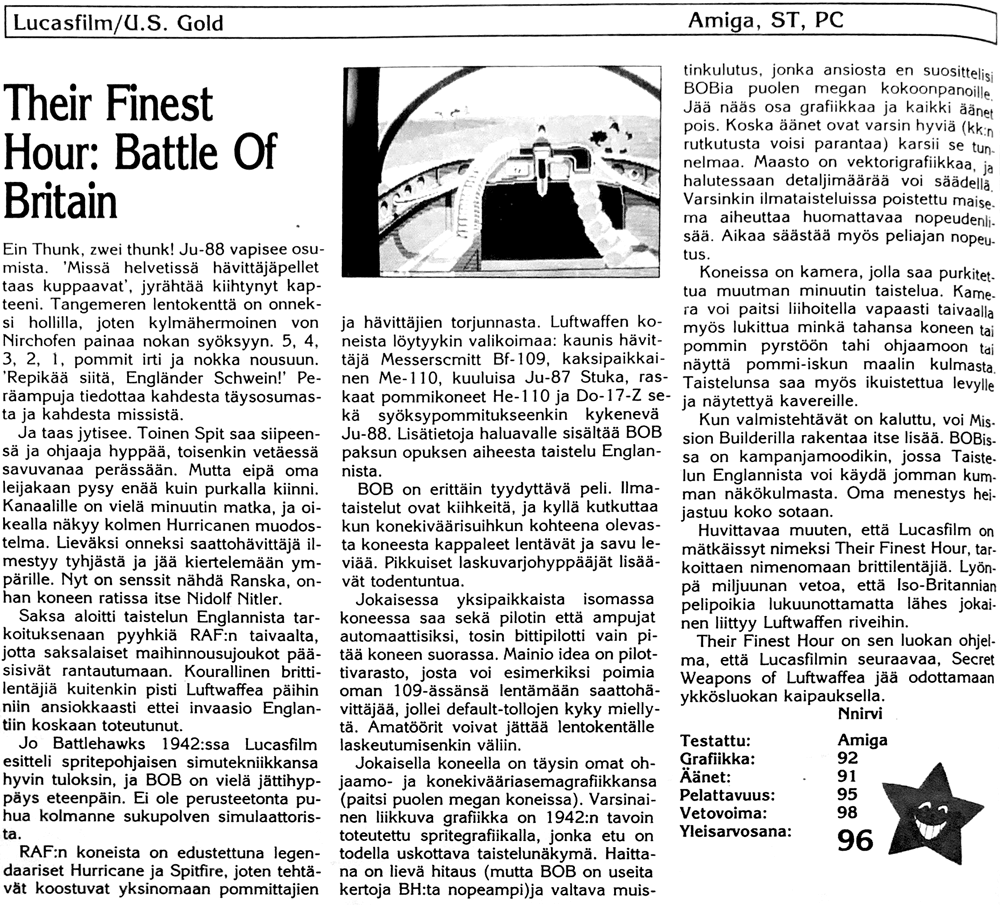
Their Finest Hour: Battle Of Britain1990 SyksyPysyvä linkkiEin Thunk, zwei thunk! Ju-88 vapisee osumista. 'Missä helvetissä hävittäjäpellet taas kuppaavat', jyrähtää kiihtynyt kapteeni. Tangemeren lentokenttä on onneksi hollilla, joten kylmähermoinen von Nirchofen painaa nokan syöksyyn. 5, 4, 3, 2, 1, pommit irti ja nokka nousuun. 'Repikää siitä, Engländer Schwein!' Peräampuja tiedottaa kahdesta täysosumasta ja kahdesta missistä.
Ja taas jytisee. Toinen Spit saa siipeensä ja ohjaaja hyppää, toisenkin vetäessä savuvanaa perässään. Mutta eipä oma leijakaan pysy enää kuin purkalla kiinni. Kanaalille on vielä minuutin matka, ja oikealla näkyy kolmen Hurricanen muodostelma. Lieväksi onneksi saattohävittäjä ilmestyy tyhjästä ja jää kiertelemään ympärille. Nyt on senssit nähdä Ranska, onhan koneen ratissa itse Nidolf Nitler.
Saksa aloitti taistelun Englannista tarkoituksenaan pyyhkiä RAF:n taivaalta, jotta saksalaiset maihinnousujoukot pääsisivät rantautumaan. Kourallinen brittilentäjiä kuitenkin pisti Luftwaffea päihin niin ansiokkaasti ettei invaasio Englantiin koskaan toteutunut.
Jo Battlehawks 1942:ssa Lucasfilm esitteli spritepohjaisen simutekniikkansa hyvin tuloksin, ja BOB on vielä jättihyppäys eteenpäin. Ei ole perusteetonta puhua kolmanne sukupolven simulaattorista.
RAF:n koneista on edustettuna legendaariset Hurricane ja Spitfire, joten tehtävät koostuvat yksinomaan pommittajien ja hävittäjien torjunnasta. Luftwaffen koneista löytyykin valikoimaa: kaunis hävittäjä Messerscmitt Bf-109, kaksipaikkainen Me-110, kuuluisa Ju-87 Stuka, raskaat pommikoneet He-110 ja Do-17-Z sekä syöksypommitukseenkin kykenevä Ju-88. Lisätietoja haluavalle sisältää BOB paksun opuksen aiheesta taistelu Englannista.
BOB on erittäin tyydyttävä peli. Ilmataistelut ovat kiihkeitä, ja kyllä kutkuttaa kun konekiväärisuihkun kohteena olevasta koneesta kappaleet lentävät ja savu leviää. Pikkuiset laskuvarjohyppääjät lisäävät todentuntua.
Jokaisessa yksipaikkaista isomassa koneessa saa sekä pilotin että ampujat automaattisiksi, tosin bittipilotti vain pitää koneen suorassa. Mainio idea on pilottivarasto, josta voi esimerkiksi poimia oman 109-ässänsä lentämään saattohävittäjää, jollei default-tollojen kyky miellytä. Amatöörit voivat jättää lentokentälle laskeutumisenkin väliin.
Jokaisella koneella on täysin omat ohjaamo- ja konekivääriasemagrafiikkansa (paitsi puolen megan koneissa). Varsinainen liikkuva grafiikka on 1942:n tavoin toteutettu spritegrafiikalla, jonka etu on todella uskottava taistelunäkymä. Haittana on lievä hitaus (mutta BOB on useita kertoja BH:ta nopeampi)ja valtava muistinkulutus, jonka ansiosta en suosittelisi BOBia puolen megan kokoonpanoille. Jää nääs osa grafiikkaa ja kaikki äänet pois. Koska äänet ovat varsin hyviä (kk:n rutkutusta voisi parantaa) karsii se tunnelmaa. Maasto on vektorigrafiikkaa, ja halutessaan detaljimäärää voi säädellä. Varsinkin ilmataisteluissa poistettu maisema aiheuttaa huomattavaa nopeudenlisää. Aikaa säästää myös peliajan nopeutus.
Koneissa on kamera, jolla saa purkitettua muutman minuutin taistelua. Kamera voi paitsi liihoitella vapaasti taivaalla myös lukittua minkä tahansa koneen tai pommin pyrstöön tahi ohjaamoon tai näyttä pommi-iskun maalin kulmasta. Taistelunsa saa myös ikuistettua levylle ja näytettyä kavereille.
Kun valmistehtävät on kaluttu, voi Mission Builderilla rakentaa itse lisää. BOBissa on kampanjamoodikin, jossa Taistelun Englannista voi käydä jomman kumman näkökulmasta. Oma menestys heijastuu koko sotaan.
Huvittavaa muuten, että Lucasfilm on mätkäissyt nimeksi Their Finest Hour, tarkoittaen nimenomaan brittilentäjiä. Lyönpä miljuunan vetoa, että Iso-Britannian pelipoikia lukuunottamatta lähes jokainen liittyy Luftwaffen riveihin.
Their Finest Hour on sen luokan ohjelma, että Lucasfilmin seuraavaa, Secret Weapons of Luftwaffea jää odottamaan ykkösluokan kaipauksella.
Their Finest Hour: Battle Of Britain1990 SyksyPermalinkEin Thunk, zwei thunk! The Ju-88 shudders from the hits. 'Where the hell are those fighter clowns skiving off this time', thunders the worked-up captain. Luckily Tangemere airfield is close at hand, so the cool-headed von Nirchofen shoves the nose into a dive. 5, 4, 3, 2, 1, bombs away and nose up. 'Chew on that, Engländer Schwein!' The tail gunner reports two direct hits and two misses.
And it's rumbling again. One Spit takes it in the wing and the pilot bails out, as the other one too trails a streak of smoke behind it. But then our own kite is only held together by chewing gum any more either. It's still a minute to the Channel, and on the right a formation of three Hurricanes comes into view. As a small mercy an escort fighter appears out of nowhere and stays circling around us. Now there's a chance of seeing France, since at the controls of the plane is none other than Nidolf Nitler himself.
Germany began the Battle of Britain intending to wipe the RAF from the skies, so that German landing forces could get ashore. A handful of British pilots, however, knocked the Luftwaffe about the head so creditably that the invasion of England never came to pass.
Already in Battlehawks 1942 Lucasfilm showed off its sprite-based sim technique with good results, and BOB is a giant leap further forward still. It's not unfounded to speak of a third-generation simulator.
Of the RAF's planes, the legendary Hurricane and Spitfire are represented, so the missions consist solely of intercepting bombers and fighters. The Luftwaffe's planes, on the other hand, come in quite a selection: the beautiful fighter Messerscmitt Bf-109, the two-seater Me-110, the famous Ju-87 Stuka, the heavy bombers He-110 and Do-17-Z, and the Ju-88, which can even manage dive-bombing. For anyone wanting more background, BOB includes a thick tome on the subject of the Battle of Britain.
BOB is an extremely satisfying game. The dogfights are intense, and it sure gives you a thrill when pieces fly off the plane on the receiving end of your machine-gun burst and the smoke spreads. The tiny parachutists add to the sense of reality.
In every plane bigger than a single-seater you can set both the pilot and the gunners to automatic, although the bit-pilot only keeps the plane flying straight. A splendid idea is the pilot pool, from which you can, for example, pick your own 109 ace to fly the escort fighter if the skills of the default dimwits don't satisfy you. Amateurs can even skip landing at the airfield.
Every plane has its very own cockpit and gun-position graphics (except on half-meg machines). The actual moving graphics are done with sprites, as in 1942, the advantage of which is a really convincing combat view. The drawbacks are a slight sluggishness (though BOB is several times faster than BH) and enormous memory consumption, thanks to which I wouldn't recommend BOB for half-meg setups. Y'see, part of the graphics and all of the sound get left out. Since the sound is pretty good (the MG rattle could be improved), that takes the edge off the atmosphere. The terrain is vector graphics, and you can adjust the amount of detail if you want. Especially in dogfights, switching off the scenery gives a considerable boost in speed. Speeding up game time saves time as well.
The planes carry a camera with which you can get a few minutes of combat in the can. The camera can not only drift freely about the sky but also lock onto the tail of any plane or bomb, or into its cockpit, or show a bombing raid from the target's angle. You can also immortalise your battles on disk and show them to your mates.
Once you've gnawed your way through the ready-made missions, you can build more yourself with the Mission Builder. BOB even has a campaign mode, in which you can fight the Battle of Britain from either side's point of view. Your own success is reflected in the whole war.
Amusing, by the way, that Lucasfilm has slapped on the title Their Finest Hour, meaning specifically the British pilots. I'll bet you a cool million that, apart from Great Britain's gamer boys, nearly everyone will join the ranks of the Luftwaffe.
Their Finest Hour is a program of such class that it leaves you awaiting Lucasfilm's next one, Secret Weapons of Luftwaffe, with first-class longing.
Thexder
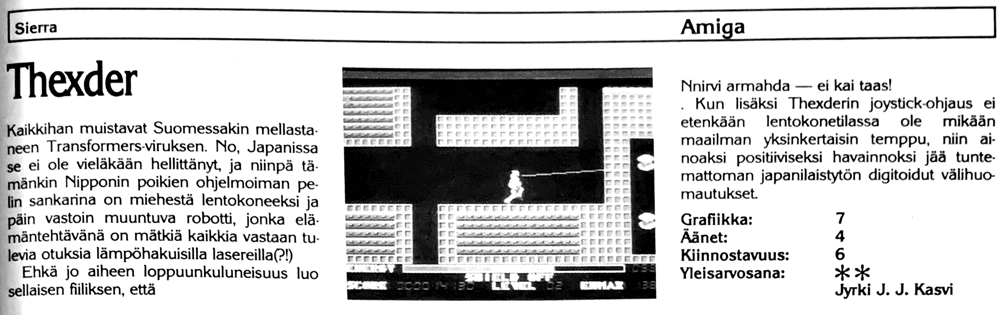
Thexder1988Pysyvä linkkiKaikkihan muistavat Suomessakin mellastaneen Transformers-viruksen. No, Japanissa se ei ole vieläkään hellittänyt, ja niinpä tämänkin Nipponin poikien ohjelmoiman pelin sankarina on miehestä lentokoneeksi ja päin vastoin muuntuva robotti, jonka elämäntehtävänä on mätkiä kaikkia vastaan tulevia otuksia lämpöhakuisilla lasereilla(?!)
Ehkä jo aiheen loppuunkuluneisuus luo sellaisen fiiliksen, että Nnirvi armahda - ei kai taas!
Kun lisäksi Thexderin joystick-ohjaus ei etenkään lentokonetilassa ole mikään maailman yksinkertaisin temppu, niin ainoaksi positiiviseksi havainnoksi jää tuntemattoman japanilaistytön digitoidut välihuomautukset.
Thexder1988PermalinkEveryone surely remembers the Transformers virus that ran riot in Finland too. Well, in Japan it still hasn't let up, and so the hero of this game as well, programmed by the lads of Nippon, is a robot that turns from man into plane and back again, and whose mission in life is to whack every critter that comes its way with heat-seeking lasers(?!)
Perhaps the sheer done-to-deathness of the subject alone creates the sort of feeling where it's Nnirvi have mercy - surely not again!
Add to that the fact that Thexder's joystick control, especially in plane mode, is hardly the simplest trick in the world, and the only positive observation left is the digitised asides of an unknown Japanese girl.
Three Musketeers, The
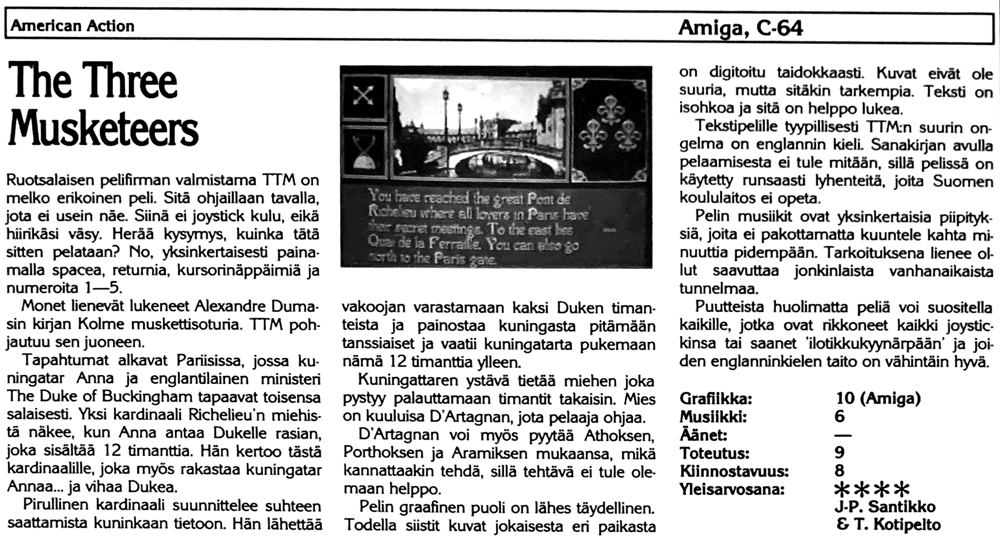
Three Musketeers, The1988Pysyvä linkkiRuotsalaisen pelifirman valmistama TTM on melko erikoinen peli. Sitä ohjaillaan tavalla, jota ei usein näe. Siinä ei joystick kulu, eikä hiirikäsi väsy. Herää kysymys, kuinka tätä sitten pelataan? No, yksinkertaisesti painamalla spacea, returnia, kursorinäppäimiä ja numeroita 1-5.
Monet lienevät lukeneet Alexandre Dumasin kirjan Kolme muskettisoturia. TTM pohjautuu sen juoneen.
Tapahtumat alkavat Pariisissa, jossa kuningatar Anna ja englantilainen ministeri The Duke of Buckingham tapaavat toisensa salaisesti. Yksi kardinaali Richelieu'n miehistä näkee, kun Anna antaa Dukelle rasian, joka sisältää 12 timanttia. Hän kertoo tästä kardinaalille, joka myös rakastaa kuningatar Annaa... ja vihaa Dukea.
Pirullinen kardinaali suunnittelee suhteen saattamista kuninkaan tietoon. Hän lähettää vakoojan varastamaan kaksi Duken timanteista ja painostaa kuningasta pitämään tanssiaiset ja vaatii kuningatarta pukemaan nämä 12 timanttia ylleen.
Kuningattaren ystävä tietää miehen joka pystyy palauttamaan timantit takaisin. Mies on kuuluisa D'Artagnan, jota pelaaja ohjaa.
D'Artagnan voi myös pyytää Athoksen, Porthoksen ja Aramiksen mukaansa, mikä kannattaakin tehdä, sillä tehtävä ei tule olemaan helppo.
Pelin graafinen puoli on lähes täydellinen. Todella siistit kuvat jokaisesta eri paikasta on digitoitu taidokkaasti. Kuvat eivät ole suuria, mutta sitäkin tarkempia. Teksti on isohkoa ja sitä on helppo lukea.
Tekstipelille tyypillisesti TTM:n suurin ongelma on englannin kieli. Sanakirjan avulla pelaamisesta ei tule mitään, sillä pelissä on käytetty runsaasti lyhenteitä, joita Suomen koululaitos ei opeta.
Pelin musiikit ovat yksinkertaisia piipityksiä, joita ei pakottamatta kuuntele kahta minuuttia pidempään. Tarkoituksena lienee ollut saavuttaa jonkinlaista vanhanaikaista tunnelmaa.
Puutteista huolimatta peliä voi suositella kaikille, jotka ovat rikkoneet kaikki joystickinsa tai saanet 'ilotikkukyynärpään' ja joiden englanninkielen taito on vähintäin hyvä.
Three Musketeers, The1988PermalinkMade by a Swedish games company, TTM is a rather unusual game. It's controlled in a way you don't often see. Your joystick won't wear out and your mouse hand won't get tired. The question arises: how do you play this, then? Well, simply by pressing space, return, the cursor keys and the numbers 1-5.
Many of you will probably have read Alexandre Dumas's book The Three Musketeers. TTM is based on its plot.
The events begin in Paris, where Queen Anna and the English minister The Duke of Buckingham meet in secret. One of Cardinal Richelieu's men sees Anna give the Duke a casket containing 12 diamonds. He reports this to the cardinal, who is also in love with Queen Anna... and hates the Duke.
The devilish cardinal plots to bring the affair to the king's attention. He sends a spy to steal two of the Duke's diamonds, pressures the king into holding a ball and demands that the queen wear these 12 diamonds.
A friend of the queen knows a man who can bring the diamonds back. The man is the famous D'Artagnan, whom the player controls.
D'Artagnan can also ask Athos, Porthos and Aramis to come along, which is well worth doing, since the task is not going to be easy.
The graphical side of the game is almost perfect. Really neat pictures of every single location have been skilfully digitised. The pictures aren't big, but they're all the more detailed. The text is fairly large and easy to read.
As is typical of a text game, TTM's biggest problem is the English language. Playing with a dictionary gets you nowhere, since the game uses plenty of abbreviations that the Finnish school system doesn't teach.
The game's music consists of simple bleeps that nobody would listen to for longer than two minutes unless forced to. The idea was presumably to create some sort of old-fashioned atmosphere.
Despite its shortcomings, the game can be recommended to anyone who has broken all their joysticks or come down with 'joystick elbow', and whose English is good at the very least.
Three Stooges, The
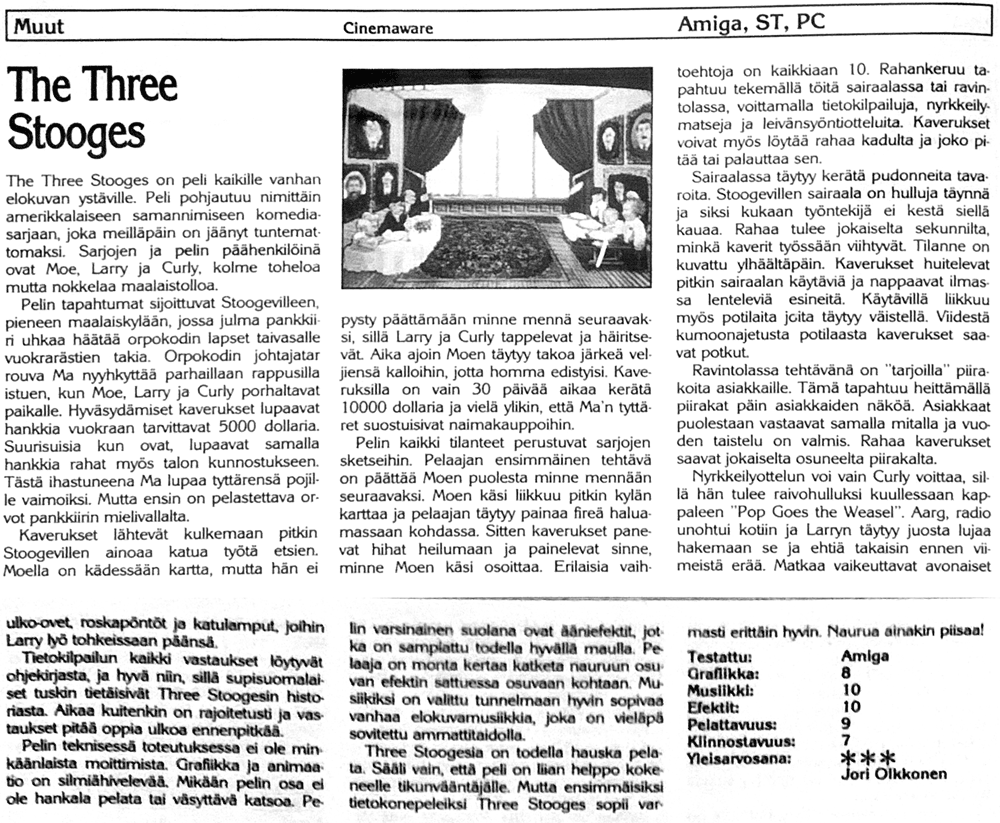
Three Stooges, The1989 KevätPysyvä linkkiThe Three Stooges on peli kaikille vanhan elokuvan ystäville. Peli pohjautuu nimittäin amerikkalaiseen samannimiseen komediasarjaan, joka meilläpäin on jäänyt tuntemattomaksi. Sarjojen ja pelin päähenkilöinä ovat Moe, Larry ja Curly, kolme toheloa mutta nokkelaa maalaistolloa.
Pelin tapahtumat sijoittuvat Stoogevilleen, pieneen maalaiskylään, jossa julma pankkiiri uhkaa häätää orpokodin lapset taivasalle vuokrarästien takia. Orpokodin johtajatar rouva Ma nyyhkyttää parhaillaan rappusilla istuen, kun Moe, Larry ja Curly porhaltavat paikalle. Hyväsydämiset kaverukset lupaavat hankkia vuokraan tarvittavat 5000 dollaria. Suurisuisia kun ovat, lupaavat samalla hankkia rahat myös talon kunnostukseen. Tästä ihastuneena Ma lupaa tyttärensä pojille vaimoiksi. Mutta ensin on pelastettava orvot pankkiirin mielivallalta.
Kaverukset lähtevät kulkemaan pitkin Stoogevillen ainoaa katua työtä etsien. Moella on kädessään kartta, mutta hän ei pysty päättämään minne mennä seuraavaksi, sillä Larry ja Curly tappelevat ja häiritsevät. Aika ajoin Moen täytyy takoa järkeä veljiensä kalloihin, jotta homma edistyisi. Kaveruksilla on vain 30 päivää aikaa kerätä 10000 dollaria ja vielä ylikin, että Ma'n tyttäret suostuisivat naimakauppoihin.
Pelin kaikki tilanteet perustuvat sarjojen sketseihin. Pelaajan ensimmäinen tehtävä on päättää Moen puolesta minne mennään seuraavaksi. Moen käsi liikkuu pitkin kylän karttaa ja pelaajan täytyy painaa fireä haluamassaan kohdassa. Sitten kaverukset panevat hihat heilumaan ja painelevat sinne, minne Moen käsi osoittaa. Erilaisia vaihtoehtoja on kaikkiaan 10. Rahankeruu tapahtuu tekemällä töitä sairaalassa tai ravintolassa, voittamalla tietokilpailuja, nyrkkeilymatseja ja leivänsyöntiotteluita. Kaverukset voivat myös löytää rahaa kadulta ja joko pitää tai palauttaa sen.
Sairaalassa täytyy kerätä pudonneita tavaroita. Stoogevillen sairaala on hulluja täynnä ja siksi kukaan työntekijä ei kestä siellä kauaa. Rahaa tulee jokaiselta sekunnilta, minkä kaverit työssään viihtyvät. Tilanne on kuvattu ylhäältäpäin. Kaverukset huitelevat pitkin sairaalan käytäviä ja nappaavat ilmassa lenteleviä esineitä. Käytävillä liikkuu myös potilaita joita täytyy väistellä. Viidestä kumoonajetusta potilaasta kaverukset saavat potkut.
Ravintolassa tehtävänä on "tarjoilla" piirakoita asiakkaille. Tämä tapahtuu heittämällä piirakat päin asiakkaiden näköä. Asiakkaat puolestaan vastaavat samalla mitalla ja vuoden taistelu on valmis. Rahaa kaverukset saavat jokaiselta osuneelta piirakalta.
Nyrkkeilyottelun voi vain Curly voittaa, sillä hän tulee raivohulluksi kuullessaan kappaleen "Pop Goes the Weasel". Aarg, radio unohtui kotiin ja Larryn täytyy juosta lujaa hakemaan se ja ehtiä takaisin ennen viimeistä erää. Matkaa vaikeuttavat avonaiset ulko-ovet, roskapöntöt ja katulamput, joihin Larry lyö tohkeissaan päänsä.
Tietokilpailun kaikki vastaukset löytyvät ohjekirjasta, ja hyvä niin, sillä supisuomalaiset tuskin tietäisivät Three Stoogesin historiasta. Aikaa kuitenkin on rajoitetusti ja vastaukset pitää oppia ulkoa ennenpitkää.
Pelin teknisessä toteutuksessa ei ole minkäänlaista moittimista. Grafiikka ja animaatio on silmiähivelevää. Mikään pelin osa ei ole hankala pelata tai väsyttävä katsoa. Pelin varsinainen suolana ovat ääniefektit, jotka on samplattu todella hyvällä maulla. Pelaaja on monta kertaa katketa nauruun osuvan efektin sattuessa osuvaan kohtaan. Musiikiksi on valittu tunnelmaan hyvin sopivaa vanhaa elokuvamusiikkia, joka on vieläpä sovitettu ammattitaidolla.
Three Stoogesia on todella hauska pelata. Sääli vain, että peli on liian helppo kokeneelle tikunvääntäjälle. Mutta ensimmäisiksi tietokonepeleiksi Three Stooges sopii varmasti erittäin hyvin. Naurua ainakin piisaa!
Three Stooges, The1989 KevätPermalinkThe Three Stooges is a game for everyone who loves old films. That's because the game is based on the American comedy series of the same name, which has remained unknown in these parts. The main characters of both the series and the game are Moe, Larry and Curly, three bungling but quick-witted country bumpkins.
The game is set in Stoogeville, a small country village where a cruel banker is threatening to turf the orphanage's children out onto the street over rent arrears. The orphanage's matron, Mrs. Ma, is sitting on the steps sobbing her heart out when Moe, Larry and Curly come barrelling onto the scene. The good-hearted pals promise to get hold of the 5000 dollars needed for the rent. Bigmouths that they are, they promise at the same time to raise the money to do the house up as well. Delighted by this, Ma promises the boys her daughters as wives. But first the orphans have to be saved from the banker's tyranny.
The pals set off along Stoogeville's only street looking for work. Moe has a map in his hand, but he can't decide where to go next, because Larry and Curly keep fighting and getting in the way. Every now and then Moe has to hammer some sense into his brothers' skulls to get things moving. The pals have just 30 days to scrape together 10000 dollars and then some, so that Ma's daughters will agree to the marriage deal.
All the situations in the game are based on sketches from the series. The player's first task is to decide on Moe's behalf where to go next. Moe's hand moves across the map of the village and the player has to press fire at the spot they want. Then the pals get their arms pumping and hurry off to wherever Moe's hand is pointing. There are 10 different options in all. Money is raised by working at the hospital or the restaurant, and by winning quizzes, boxing matches and bread-eating contests. The pals can also find money in the street and either keep it or hand it back.
At the hospital you have to collect dropped items. Stoogeville's hospital is full of lunatics, which is why no member of staff lasts there long. Money comes in for every second the guys manage to stick at the job. The action is shown from above. The pals dash along the hospital corridors grabbing objects flying through the air. There are also patients moving about the corridors who have to be dodged. Knock over five patients and the pals get the sack.
At the restaurant the job is to "serve" pies to the customers. This is done by throwing the pies in the customers' faces. The customers, for their part, respond in kind, and the battle of the year is on. The pals get money for every pie that hits.
Only Curly can win the boxing match, because he goes berserk when he hears the tune "Pop Goes the Weasel". Argh, the radio got left at home and Larry has to run like mad to fetch it and make it back before the final round. His trip is hampered by open front doors, dustbins and street lamps, which Larry bangs his head on in his flustered haste.
All the answers to the quiz can be found in the manual, and a good thing too, since your average true-blue Finn would hardly know anything about the history of the Three Stooges. Time is limited, however, and sooner or later you'll have to learn the answers by heart.
There's nothing whatsoever to fault in the game's technical execution. The graphics and animation are a feast for the eyes. No part of the game is awkward to play or tiring to watch. The real salt of the game, though, is the sound effects, which have been sampled with really good taste. Many a time the player is on the verge of cracking up with laughter when a spot-on effect hits just the right spot. For music they've picked old film music that suits the atmosphere nicely, and it has even been arranged with real professional skill.
Three Stooges is really fun to play. The only pity is that the game is too easy for a seasoned joystick-twister. But as a first computer game, Three Stooges will certainly fit the bill very well. There's laughter aplenty, at any rate!
Thrust
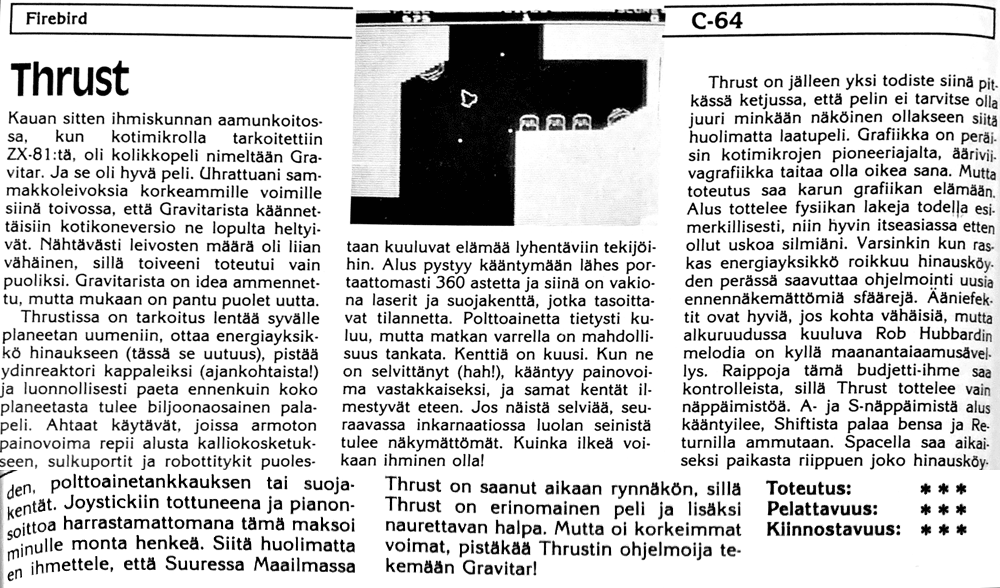
Thrust1987Pysyvä linkkiKauan sitten ihmiskunnan aamunkoitossa, kun kotimikrolla tarkoitettiin ZX-81:tä, oli kolikkopeli nimeltään Gravitar. Ja se oli hyvä peli. Uhrattuani sammakkoleivoksia korkeammille voimille siinä toivossa, että Gravitarista käännettäisiin kotikoneversio ne lopulta heltyivät. Nähtävästi leivosten määrä oli liian vähäinen, sillä toiveeni toteutui vain puoliksi. Gravitarista on idea ammennettu, mutta mukaan on pantu puolet uutta.
Thrustissa on tarkoitus lentää syvälle planeetan uumeniin, ottaa energiayksikkö hinaukseen (tässä se uutuus), pistää ydinreaktori kappaleiksi (ajankohtaista!) ja luonnollisesti paeta ennenkuin koko planeetasta tulee biljoonaosainen palapeli. Ahtaat käytävät, joissa armoton painovoima repii alusta kalliokosketukseen, sulkuportit ja robottitykit puolestaan kuuluvat elämää lyhentäviin tekijöihin. Alus pystyy kääntymään lähes portaattomasti 360 astetta ja siinä on vakiona laserit ja suojakenttä, jotka tasoittavat tilannetta. Polttoainetta tietysti kuluu, mutta matkan varrella on mahdollisuus tankata. Kenttiä on kuusi. Kun ne on selvittänyt (hah!), kääntyy painovoima vastakkaiseksi, ja samat kentät ilmestyvät eteen. Jos näistä selviää, seuraavassa inkarnaatiossa luolan seinistä tulee näkymättömät. Kuinka ilkeä voikaan ihminen olla!
Thrust on jälleen yksi todiste siinä pitkässä ketjussa, että pelin ei tarvitse olla juuri minkään näköinen ollakseen siitä huolimatta laatupeli. Grafiikka on peräisin kotimikrojen pioneeriajalta, ääriviivagrafiikka taitaa olla oikea sana. Mutta toteutus saa karun grafiikan elämään. Alus tottelee fysiikan lakeja todella esimerkillisesti, niin hyvin itseasiassa etten ollut uskoa silmiäni. Varsinkin kun raskas energiayksikkö roikkuu hinausköyden perässä saavuttaa ohjelmointi uusia ennennäkemättömiä sfäärejä. Ääniefektit ovat hyviä, jos kohta vähäisiä, mutta alkuruudussa kuuluva Rob Hubbardin melodia on kyllä maanantaiaamusävellys. Raippoja tämä budjetti-ihme saa kontrolleista, sillä Thrust tottelee vain näppäimistöä. A- ja S-näppäimistä alus kääntyilee, Shiftistä palaa bensa ja Returnilla ammutaan. Spacella saa aikaiseksi paikasta riippuen joko hinausköyden, polttoainetankkauksen tai suojakentät. Joystickiin tottuneena ja pianonsoittoa harrastamattomana tämä maksoi minulle monta henkeä. Siitä huolimatta en ihmettele, että Suuressa Maailmassa Thrust on saanut aikaan rynnäkön, sillä Thrust on erinomainen peli ja lisäksi naurettavan halpa. Mutta oi korkeimmat voimat, pistäkää Thrustin ohjelmoija tekemään Gravitar!
Thrust1987PermalinkLong ago, at the dawn of humankind, when "home computer" meant the ZX-81, there was an arcade game called Gravitar. And it was a good game. After I had sacrificed frog pastries to the higher powers in the hope that someone would convert Gravitar for home computers, they finally relented. Apparently there weren't quite enough pastries, since my wish came true only by half. The idea has been drawn from Gravitar, but half of what's in it is new.
In Thrust the aim is to fly deep into the bowels of a planet, take an energy pod in tow (that's the new bit), blow a nuclear reactor to pieces (topical!) and naturally escape before the whole planet turns into a trillion-piece jigsaw puzzle. Narrow passages, where merciless gravity drags your ship into contact with the rock, along with gates and robot guns, are among the things that shorten your life. The ship can turn almost steplessly through 360 degrees, and it comes with lasers and a shield as standard, which even things up. Fuel does of course get used up, but you can refuel along the way. There are six levels. Once you have cleared them (hah!), gravity reverses and the same levels appear before you again. If you survive those, in the next incarnation the cavern walls become invisible. How nasty can a human being be!
Thrust is yet another piece of evidence in that long chain showing that a game doesn't have to look like much of anything to be a quality game all the same. The graphics date from the pioneering days of home computers; outline graphics is probably the right term. But the execution brings the bare graphics to life. The ship obeys the laws of physics in a truly exemplary way, so well in fact that I could hardly believe my eyes. Especially when the heavy energy pod is dangling at the end of the tow rope, the programming reaches new, never-before-seen spheres. The sound effects are good, if few, but the Rob Hubbard tune on the title screen is definitely a Monday-morning composition. This budget wonder gets a flogging for its controls, since Thrust answers only to the keyboard. A and S turn the ship, Shift burns petrol and Return fires. Space gives you, depending on where you are, either the tow rope, refuelling or the shields. Since I'm used to a joystick and don't play the piano, this cost me a lot of lives. Even so, I'm not surprised that out in the Big Wide World Thrust has set off a stampede, since Thrust is an excellent game and ridiculously cheap into the bargain. But O highest powers, get Thrust's programmer to make Gravitar!
Thunder Blade
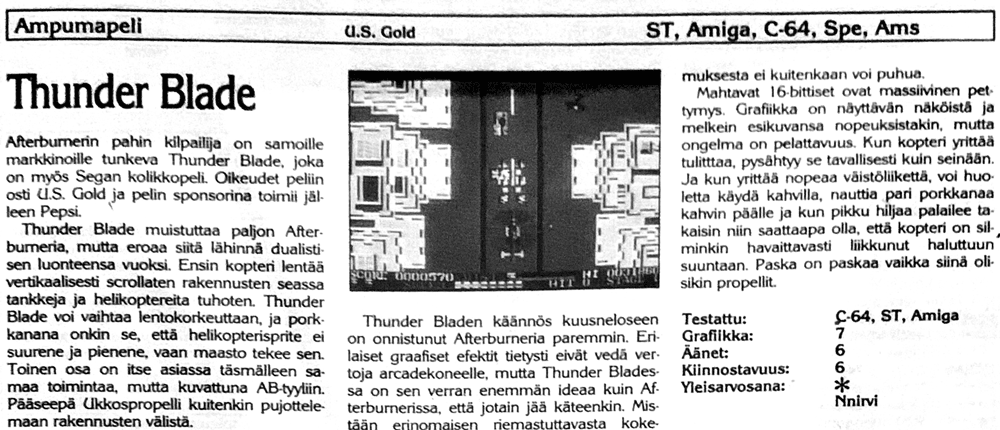
Thunder Blade1989 KevätPysyvä linkkiAfterburnerin pahin kilpailija on samoille markkinoille tunkeva Thunder Blade, joka on myös Segan kolikkopeli. Oikeudet peliin osti U.S. Gold ja pelin sponsorina toimii jälleen Pepsi.
Thunder Blade muistuttaa paljon Afterburneria, mutta eroaa siitä lähinnä dualistisen luonteensa vuoksi. Ensin kopteri lentää vertikaalisesti scrollaten rakennusten seassa tankkeja ja helikoptereita tuhoten. Thunder Blade voi vaihtaa lentokorkeuttaan, ja porkkanana onkin se, että helikopterisprite ei suurene ja pienene, vaan maasto tekee sen. Toinen osa on itse asiassa täsmälleen samaa toimintaa, mutta kuvattuna AB-tyyliin. Pääseepä Ukkospropelli kuitenkin pujottelemaan rakennusten välistä.
Thunder Bladen käännös kuusneloseen on onnistunut Afterburneria paremmin. Erilaiset graafiset efektit tietysti eivät vedä vertoja arcadekoneelle, mutta Thunder Bladessa on sen verran enemmän ideaa kuin Afterburnerissa, että jotain jää käteenkin. Mistään erinomaisen riemastuttavasta kokemuksesta ei kuitenkaan voi puhua.
Mahtavat 16-bittiset ovat massiivinen pettymys. Grafiikka on näyttävän näköistä ja melkein esikuvansa nopeuksistakin, mutta ongelma on pelattavuus. Kun kopteri yrittää tulitttaa, pysähtyy se tavallisesti kuin seinään. Ja kun yrittää nopeaa väistöliikettä, voi huoletta käydä kahvilla, nauttia pari porkkanaa kahvin päälle ja kun pikku hiljaa palailee takaisin niin saattaapa olla, että kopteri on silminkin havaittavasti liikkunut haluttuun suuntaan. Paska on paskaa vaikka siinä olisikin propellit.
Thunder Blade1989 KevätPermalinkAfterburner's worst rival is Thunder Blade, which is shoving its way into the same market and is also a Sega coin-op. The rights to the game were bought by U.S. Gold, and once again Pepsi is acting as the game's sponsor.
Thunder Blade is a lot like Afterburner, but differs from it mainly because of its dualistic nature. First the chopper flies over a vertically scrolling landscape, destroying tanks and helicopters among the buildings. Thunder Blade can change its altitude, and the carrot here is that the helicopter sprite doesn't grow and shrink - the terrain does. The second part is actually exactly the same action, but shown AB-style. Still, the Thunder Propeller does at least get to weave its way between the buildings.
Thunder Blade's conversion to the C-64 has turned out better than Afterburner's. The various graphical effects obviously can't hold a candle to the arcade machine, but Thunder Blade has that much more of an idea to it than Afterburner that you actually come away with something. You can't really talk about any outstandingly exhilarating experience, though.
The mighty 16-bitters are a massive disappointment. The graphics look impressive and are nearly up to the speed of the original, but the problem is the playability. When the chopper tries to open fire, it usually stops dead as if it had hit a wall. And when you try a quick evasive move, you can safely go and have a coffee, enjoy a couple of carrots after the coffee, and when you slowly wander back it may just be that the chopper has moved in the direction you wanted by an amount visible to the naked eye. Crap is crap even if it has propellers.
Thunderbirds
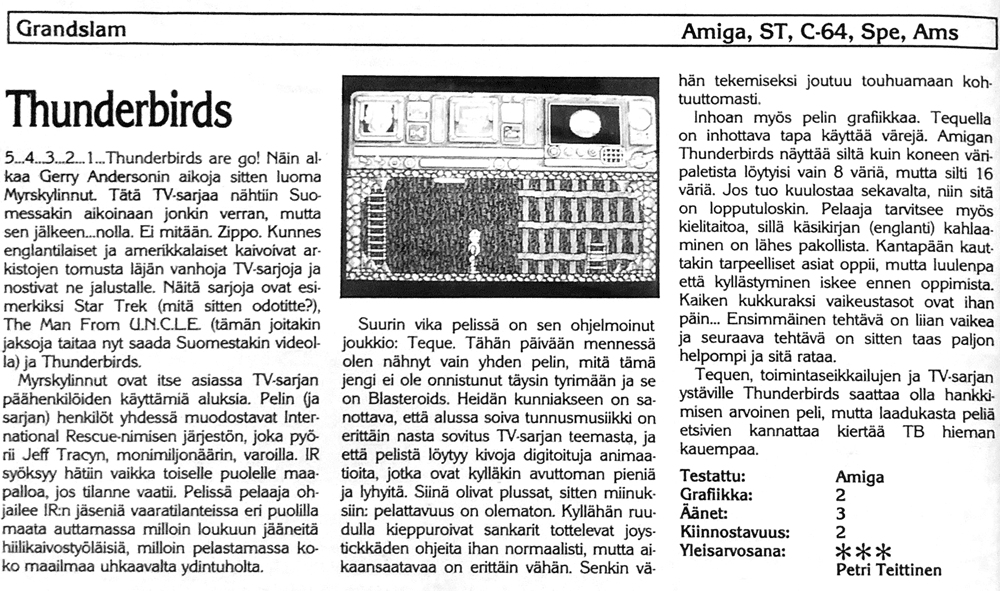
Thunderbirds1989 SyksyPysyvä linkki5...4...3...2...1...Thunderbirds are go! Näin alkaa Gerry Andersonin aikoja sitten luoma Myrskylinnut. Tätä TV-sarjaa nähtiin Suomessakin aikoinaan jonkin verran, mutta sen jälkeen...nolla. Ei mitään. Zippo. Kunnes englantilaiset ja amerikkalaiset kaivoivat arkistojen tomusta läjän vanhoja TV-sarjoja ja nostivat ne jalustalle. Näitä sarjoja ovat esimerkiksi Star Trek (mitä sitten odotitte?), The Man From U.N.C.L.E. (tämän joitakin jaksoja taitaa nyt saada Suomestakin videolla) ja Thunderbirds.
Myrskylinnut ovat itse asiassa TV-sarjan päähenkilöiden käyttämiä aluksia. Pelin (ja sarjan) henkilöt yhdessä muodostavat International Rescue-nimisen järjestön, joka pyörii Jeff Tracyn, monimiljonäärin, varoilla. IR syöksyy hätiin vaikka toiselle puolelle maapalloa, jos tilanne vaatii. Pelissä pelaaja ohjailee IR:n jäseniä vaaratilanteissa eri puolilla maata auttamassa milloin loukkuun jääneitä hiilikaivostyöläisiä, milloin pelastamassa koko maailmaa uhkaavalta ydintuholta.
Suurin vika pelissä on sen ohjelmoinut joukkio: Teque. Tähän päivään mennessä olen nähnyt vain yhden pelin, mitä tämä jengi ei ole onnistunut täysin tyrimään ja se on Blasteroids. Heidän kunniakseen on sanottava, että alussa soiva tunnusmusiikki on erittäin nasta sovitus TV-sarjan teemasta, ja että pelistä löytyy kivoja digitoituja animaatioita, jotka ovat kylläkin avuttoman pieniä ja lyhyitä. Siinä olivat plussat, sitten miinuksiin: pelattavuus on olematon. Kyllähän ruudulla kieppuroivat sankarit tottelevat joystickkäden ohjeita ihan normaalisti, mutta aikaansaatavaa on erittäin vähän. Senkin vähän tekemiseksi joutuu touhuamaan kohtuuttomasti.
Inhoan myös pelin grafiikkaa. Tequella on inhottava tapa käyttää värejä. Amigan Thunderbirds näyttää siltä kuin koneen väripaletista löytyisi vain 8 väriä, mutta silti 16 väriä. Jos tuo kuulostaa sekavalta, niin sitä on lopputuloskin. Pelaaja tarvitsee myös kielitaitoa, sillä käsikirjan (englanti) kahlaaminen on lähes pakollista. Kantapään kauttakin tarpeelliset asiat oppii, mutta luulenpa että kyllästyminen iskee ennen oppimista. Kaiken kukkuraksi vaikeustasot ovat ihan päin... Ensimmäinen tehtävä on liian vaikea ja seuraava tehtävä on sitten taas paljon helpompi ja sitä rataa.
Tequen, toimintaseikkailujen ja TV-sarjan ystäville Thunderbirds saattaa olla hankkimisen arvoinen peli, mutta laadukasta peliä etsivien kannattaa kiertää TB hieman kauempaa.
Thunderbirds1989 SyksyPermalink5...4...3...2...1...Thunderbirds are go! That's how Myrskylinnut, created by Gerry Anderson ages ago, begins. This TV series was shown to some extent in Finland too back in the day, but after that...zero. Nothing. Zippo. Until the English and the Americans dug a pile of old TV series out of the dust of the archives and put them up on a pedestal. These series include, for example, Star Trek (well, what did you expect?), The Man From U.N.C.L.E. (some episodes of which are apparently now available on video in Finland too) and Thunderbirds.
Myrskylinnut are actually the craft used by the TV series' main characters. Together, the characters of the game (and the series) make up an organisation called International Rescue, which runs on the funds of Jeff Tracy, a multimillionaire. IR will rush to help even on the other side of the globe if the situation demands it. In the game the player steers members of IR through danger situations in various parts of the world, one moment helping trapped coal miners, the next saving the whole world from the nuclear destruction threatening it.
The biggest flaw in the game is the bunch who programmed it: Teque. To this day I have seen only one game this gang hasn't managed to completely botch, and that's Blasteroids. To their credit it has to be said that the theme tune playing at the start is a really neat arrangement of the TV series' theme, and that the game has some nice digitised animations, even if they are hopelessly small and short. Those were the pluses; now on to the minuses: the playability is non-existent. Sure, the heroes twirling about on screen obey the joystick hand's commands perfectly normally, but there is very little to get done. And even to do that little you have to faff about unreasonably.
I also loathe the game's graphics. Teque has a loathsome way of using colours. The Amiga Thunderbirds looks as if the machine's palette had only 8 colours, but still 16 colours. If that sounds confusing, so is the end result. The player also needs language skills, as wading through the manual (English) is all but compulsory. You can learn the necessary things the hard way too, but I rather suspect boredom will strike before learning does. To top it all off, the difficulty levels are totally up the... The first mission is too hard, and the next mission is then much easier again, and so on.
For friends of Teque, action adventures and the TV series, Thunderbirds may be a game worth getting, but anyone looking for a quality game would do well to give TB a rather wide berth.
Thundercats
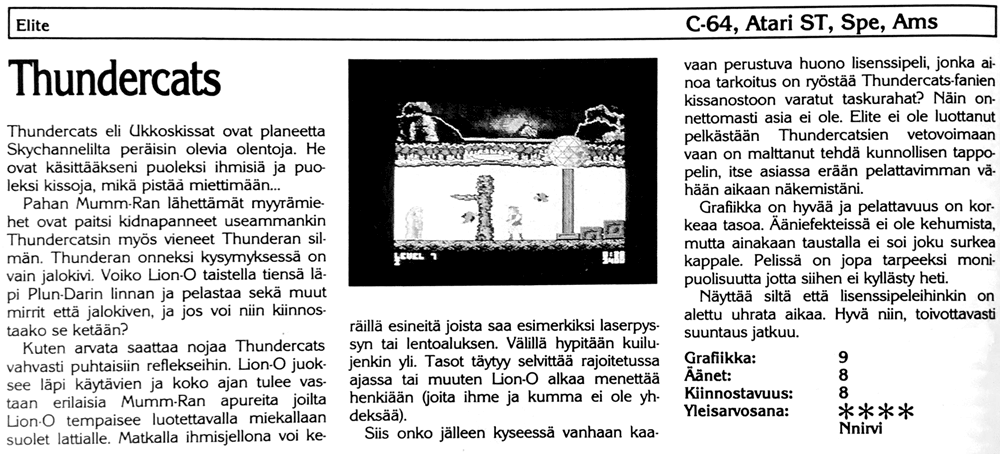
Thundercats1988Pysyvä linkkiThundercats eli Ukkoskissat ovat planeetta Skychannelilta peräisin olevia olentoja. He ovat käsittääkseni puoleksi ihmisiä ja puoleksi kissoja, mikä pistää miettimään...
Pahan Mumm-Ran lähettämät myyrämiehet ovat paitsi kidnapanneet useammankin Thundercatsin myös vieneet Thunderan silmän. Thunderan onneksi kysymyksessä on vain jalokivi. Voiko Lion-O taistella tiensä läpi Plun-Darin linnan ja pelastaa sekä muut mirrit että jalokiven, ja jos voi niin kiinnostaako se ketään?
Kuten arvata saattaa nojaa Thundercats vahvasti puhtaisiin refleskeihin. Lion-O juoksee läpi käytävien ja koko ajan tulee vastaan erilaisia Mumm-Ran apureita joilta Lion-O tempaisee luotettavalla miekallaan suolet lattialle. Matkalla ihmisjellona voi keräillä esineitä joista saa esimerkiksi laserpyssyn tai lentoaluksen. Välillä hypitään kuilujenkin yli. Tasot täytyy selvittää rajoitetussa ajassa tai muuten Lion-O alkaa menettää henkiään (joita ihme ja kumma ei ole yhdeksää).
Siis onko jälleen kyseessä vanhaan kaavaan perustuva huono lisenssipeli, jonka ainoa tarkoitus on ryöstää Thundercats-fanien kissanostoon varatut taskurahat? Näin onnettomasti asia ei ole. Elite ei ole luottanut pelkästään Thundercatsien vetovoimaan vaan on malttanut tehdä kunnollisen tappopelin, itse asiassa erään pelattavimman vähään aikaan näkemistäni.
Grafiikka on hyvää ja pelattavuus on korkeaa tasoa. Ääniefekteissä ei ole kehumista, mutta ainakaan taustalla ei soi joku surkea kappale. Pelissä on jopa tarpeeksi monipuolisuutta jotta siihen ei kyllästy heti.
Näyttää siltä että lisenssipeleihinkin on alettu uhrata aikaa. Hyvä niin, toivottavasti suuntaus jatkuu.
Thundercats1988PermalinkThundercats, or Ukkoskissat, are creatures originating from the planet Skychannel. As far as I understand, they are half human and half cat, which does make you wonder...
The mole men sent by the evil Mumm-Ra have not only kidnapped several Thundercats but also made off with the Eye of Thundera. Luckily for Thundera, it's only a jewel. Can Lion-O battle through Plun-Dar's castle and rescue both the other moggies and the jewel, and if so, does anyone care?
As you might guess, Thundercats leans heavily on pure reflexes. Lion-O dashes along corridors, and all the while assorted Mumm-Ra henchmen keep turning up, whose guts Lion-O rips out onto the floor with that trusty sword. Along the way the man-critter can collect items that give you, for example, a laser gun or a flying ship. Every now and then you jump over chasms too. Levels have to be cleared within a time limit, or else Lion-O starts losing lives (of which, wonder of wonders, there are not nine).
So is this yet another lousy licence game built on the old formula, whose only purpose is to rob Thundercats fans of the pocket money they'd put aside for buying cats? Things are not that dismal. Elite haven't relied solely on the pulling power of the Thundercats but have taken the trouble to make a decent killing game, in fact one of the most playable I've seen in a while.
The graphics are good and the playability is of a high standard. The sound effects are nothing to brag about, but at least there isn't some pathetic tune playing in the background. The game even has enough variety that you don't get bored of it straight away.
It looks as though people have started putting time into licence games too. Good thing; hopefully the trend continues.
Thunderchopper
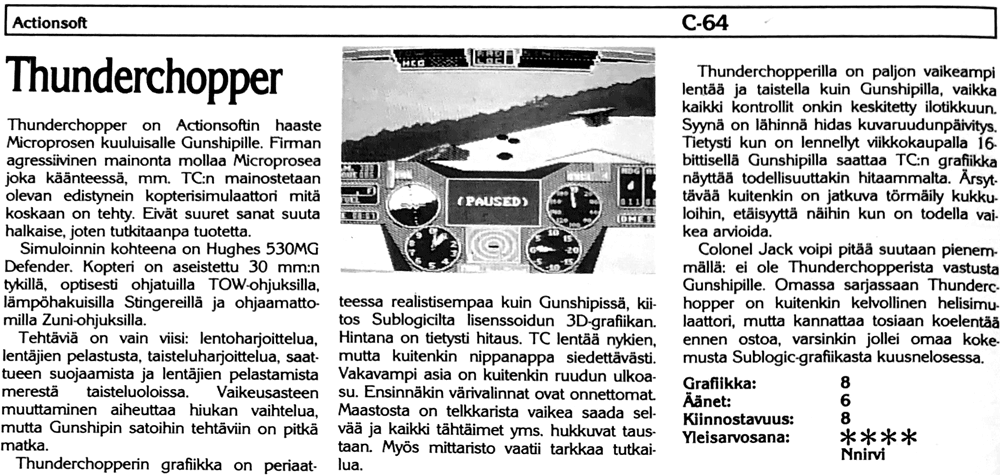
Thunderchopper1988Pysyvä linkkiThunderchopper on Actionsoftin haaste Microprosen kuuluisalle Gunshipille. Firman agressiivinen mainonta mollaa Microprosea joka käänteessä, mm. TC:n mainostetaan olevan edistynein kopterisimulaattori mitä koskaan on tehty. Eivät suuret sanat suuta halkaise, joten tutkitaanpa tuotetta.
Simuloinnin kohteena on Hughes 530MG Defender. Kopteri on aseistettu 30 mm:n tykillä, optisesti ohjatuilla TOW-ohjuksilla, lämpöhakuisilla Stingereillä ja ohjaamattomilla Zuni-ohjuksilla.
Tehtäviä on vain viisi: lentoharjoittelua, lentäjien pelastusta, taisteluharjoittelua, saattueen suojaamista ja lentäjien pelastamista merestä taisteluoloissa. Vaikeusasteen muuttaminen aiheuttaa hiukan vaihtelua, mutta Gunshipin satoihin tehtäviin on pitkä matka.
Thunderchopperin grafiikka on periaatteessa realistisempaa kuin Gunshipissä, kiitos Sublogicilta lisenssoidun 3D-grafiikan. Hintana on tietysti hitaus. TC lentää nykien, mutta kuitenkin nippanappa siedettävästi. Vakavampi asia on kuitenkin ruudun ulkoasu. Ensinnäkin värivalinnat ovat onnettomat. Maastosta on telkkarista vaikea saada selvää ja kaikki tähtäimet yms. hukkuvat taustaan. Myös mittaristo vaatii tarkkaa tutkailua.
Thunderchopperilla on paljon vaikeampi lentää ja taistella kuin Gunshipilla, vaikka kaikki kontrollit onkin keskitetty ilotikkuun. Syynä on lähinnä hidas kuvaruudunpäivitys. Tietysti kun on lennellyt viikkokaupalla 16-bittisellä Gunshipilla saattaa TC:n grafiikka näyttää todellisuuttakin hitaammalta. Ärsyttävää kuitenkin on jatkuva törmäily kukkuloihin, etäisyyttä näihin kun on todella vaikea arvioida.
Colonel Jack voipi pitää suutaan pienemmällä: ei ole Thunderchopperista vastusta Gunshipille. Omassa sarjassaan Thunderchopper on kuitenkin kelvollinen helisimulaattori, mutta kannattaa tosiaan koelentää ennen ostoa, varsinkin jollei omaa kokemusta Sublogic-grafiikasta kuusnelosessa.
Thunderchopper1988PermalinkThunderchopper is Actionsoft's challenge to Microprose's famous Gunship. The company's aggressive advertising knocks Microprose at every turn; among other things, TC is advertised as the most advanced helicopter simulator ever made. Talk is cheap, so let's examine the product.
The aircraft being simulated is the Hughes 530MG Defender. The chopper is armed with a 30 mm cannon, optically guided TOW missiles, heat-seeking Stingers and unguided Zuni missiles.
There are only five missions: flight training, pilot rescue, combat training, convoy escort and rescuing pilots from the sea under combat conditions. Changing the difficulty level brings a little variety, but it's a long way from Gunship's hundreds of missions.
Thunderchopper's graphics are in principle more realistic than Gunship's, thanks to 3D graphics licensed from Sublogic. The price, of course, is slowness. TC flies jerkily, but still just about tolerably. A more serious matter, though, is the look of the screen. For one thing, the colour choices are dreadful. The terrain is hard to make out on a telly, and all the gunsights etc. get lost in the background. The instruments, too, need close scrutiny.
It's much harder to fly and fight with Thunderchopper than with Gunship, even though all the controls are concentrated on the joystick. The main reason is the slow screen update. Of course, after you've been flying the 16-bit Gunship for weeks on end, TC's graphics may look even slower than they really are. What is annoying, though, is constantly crashing into hills, since the distance to them is really hard to judge.
Colonel Jack can jolly well pipe down: Thunderchopper is no match for Gunship. In its own class, though, Thunderchopper is a decent heli simulator, but it really is worth a test flight before buying, especially if you have no experience of your own with Sublogic graphics on the Commodore 64.
Thundercross
Thundercross1988Pysyvä linkkiThundercross on vasemmalle scrollaava pumpum-peli. Pelaaja on Thudercross-avaruusaluksen ohjaimissa ja ideana on tietenkin ammu tai tule ammutuksi.
Aluksella voi ampua kahdeksaan suuntaan julmetun määrän paukkuja kerrallaan. Pelin ensimmäisessä osassa hajoitetaan avaruudessa silmille hyppiviä merkkigrafiikkoja. Taustalla pyörii nykivä tähtikenttä.
Kun ollaan räiskitty tarpeeksi, saavutaan Uridium-tyyliselle emäalukselle. Tosin Uridium tulee mieleen vain scrollauksen suunnasta. Näyttöä vieritetään merkki kerrallaan joka toinen raster-kierros, joten nylkytys on päätäsärkevää.
Emäaluksella olevat pöntöt pitää ampua tuhannen turjakkeeksi. Pöntöt ampuvat ilkeästi takaisin ja suojakentän loppuessa loppuu peli. Jos onnistuu väistelemään luoteja, tulee kohta vastaan seiniä, joita ei erota maastosta ja räiskintä täytyy aloittaa alusta.
Thundercrossia ei jaksa katsella kovin kauan. Pelaaminen on todella yksitoikkoista ja hermoillekäyvää. Alkumusiikeissa on sentään digitoidut rummut (olettaisin, että nekin on pummittu Martin Galwayltä). Grafiikatkin on varmaan suunnitellut naapurin koira. Yök.
Thundercross1988PermalinkThundercross is a left-scrolling bang-bang game. The player is at the controls of the Thudercross spaceship, and the idea, naturally, is shoot or be shot.
The ship can fire a monstrous number of shots at a time in eight directions. In the first part of the game you break up character graphics that leap in your face out in space. A jerky starfield rolls along in the background.
Once you've blasted enough, you reach a Uridium-style mothership. Mind you, Uridium only comes to mind because of the scrolling direction. The screen is scrolled one character at a time every other raster frame, so the judder gives you a headache.
The pots on the mothership have to be shot to smithereens. The pots shoot back nastily, and when your shield runs out, so does the game. If you manage to dodge the bullets, you soon come up against walls you can't tell apart from the terrain, and the blasting has to start all over again.
You can't stand watching Thundercross for very long. Playing it is really monotonous and nerve-grating. The title tunes do at least have digitised drums (I'd assume those were cadged from Martin Galway too). As for the graphics, they were probably designed by the neighbour's dog. Yuck.
Thunderhawk
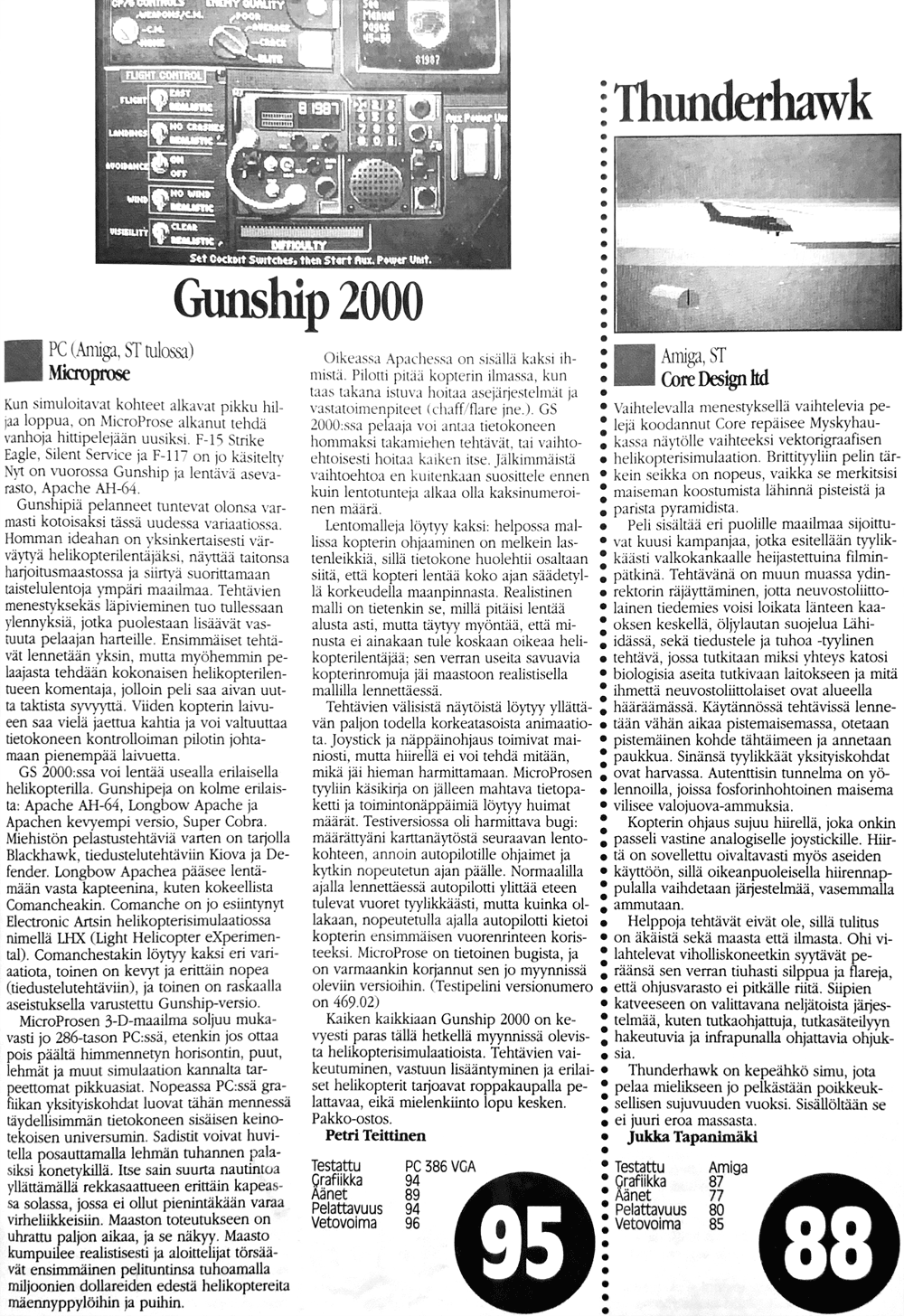
Thunderhawk1991 SyksyPysyvä linkkiVaihtelevalla menestyksellä vaihtelevia pelejä koodannut Core repäisee Myskyhaukassa näytölle vaihteeksi vektorigraafisen helikopterisimulaation. Brittityyliin pelin tärkein seikka on nopeus, vaikka se merkitsisi maiseman koostumista lähinnä pisteistä ja parista pyramidista.
Peli sisältää eri puolille maailmaa sijoittuvat kuusi kampanjaa, jotka esitellään tyylikkäästi valkokankaalle heijastettuina filminpätkinä. Tehtävänä on muun muassa ydinrektorin räjäyttäminen, jotta neuvostoliittolainen tiedemies voisi loikata länteen kaaoksen keskellä, öljylautan suojelua Lähi-idässä, sekä tiedustele ja tuhoa -tyylinen tehtävä, jossa tutkitaan miksi yhteys katosi biologisia aseita tutkivaan laitokseen ja mitä ihmettä neuvostoliittolaiset ovat alueella hääräämässä. Käytännössä tehtävissä lennetään vähän aikaa pistemaisemassa, otetaan pistemäinen kohde tähtäimeen ja annetaan paukkua. Sinänsä tyylikkäät yksityiskohdat ovat harvassa. Autenttisin tunnelma on yölennoilla, joissa fosforinhohtoinen maisema vilisee valojuova-ammuksia.
Kopterin ohjaus sujuu hiirellä, joka onkin passeli vastine analogiselle joystickille. Hiirtä on sovellettu oivaltavasti myös aseiden käyttöön, sillä oikeanpuoleisella hiirennappulalla vaihdetaan järjestelmää, vasemmalla ammutaan.
Helppoja tehtävät eivät ole, sillä tulitus on äkäistä sekä maasta että ilmasta. Ohi vilahtelevat viholliskoneetkin syytävät peräänsä sen verran tiuhasti silppua ja flareja, että ohjusvarasto ei pitkälle riitä. Siipien katveeseen on valittavana neljätoista järjestelmää, kuten tutkaohjattuja, tutkasäteilyyn hakeutuvia ja infrapunalla ohjattavia ohjuksia.
Thunderhawk on kepeähkö simu, jota pelaa mielikseen jo pelkästään poikkeuksellisen sujuvuuden vuoksi. Sisällöltään se ei juuri eroa massasta.
Thunderhawk1991 SyksyPermalinkCore, which has coded a variety of games with varying success, whips a vector-graphics helicopter simulation onto the screen in Myskyhaukka, for a change. In true British style, the most important thing about the game is speed, even if it means the landscape consists mostly of dots and a couple of pyramids.
The game contains six campaigns set in different parts of the world, which are stylishly presented as film clips projected onto a cinema screen. The missions include, among other things, blowing up a nuclear reactor so that a Soviet scientist can defect to the West amid the chaos, protecting an oil rig in the Middle East, and a seek-and-destroy type mission in which you investigate why contact was lost with a facility researching biological weapons and what on earth the Soviets are busying themselves with in the area. In practice the missions consist of flying around a dot landscape for a while, getting a dot-like target in your sights and letting rip. Details that are stylish in their own right are thin on the ground. The most authentic atmosphere comes on the night flights, where the phosphor-glowing landscape teems with tracer rounds.
The chopper is flown with the mouse, which makes a handy substitute for an analogue joystick. The mouse has been cleverly applied to the weapons too: the right-hand mouse button switches systems, the left one fires.
The missions are no pushover, since the fire coming at you is vicious from both the ground and the air. Even the enemy planes flitting past spew chaff and flares out behind them so thickly that your missile stock doesn't go very far. There are fourteen systems to choose from to tuck under the wings, such as radar-guided, radar-homing and infrared-guided missiles.
Thunderhawk is a lightish sim that's a pleasure to play for its exceptional smoothness alone. Content-wise, it hardly stands out from the crowd.
Thunderstrike

Thunderstrike1990 SyksyPysyvä linkkiMillenium on mielenkiintoinen firma, jonka pelit eivät koskaan lipsu kuin korkeintaan keskinkertaista paremmiksi, mutta toisaalta eivät nouse megapelisarjaan. Melkein megoihin kuuluu Thunderstrikekin.
Tekosyy on vanha kunnon 'tulevaisuuden TV-show' -perusjuoni. Itse pelikin on nopeasti määritelty: vektorigraafinen ampumapeli, maustettu Viruksella ja Defenderillä.
TV-tähtikandidaatti voi valita viidestä eri lailla käyttäytyvästä aluksesta. Periaate on yksinkertainen. Kentällä on vaihteleva määrä omia tukikohtia, joita pitää varjella, ja vihollisen tukikohtia, joita pitää tuhota. Jälkimmäiset generoivat uusia vihollisia, joten kannattaa pistää ne tappolistan kärkeen. Tuhottu vihollisalus saattaa jättää jälkeensä kapselin, jonka onnistunut keräys palkitaan tuplatulella, voimakkaammilla ammuksilla, suojapalleroilla, lisäkilpienergialla tai turboboosterilla. Vikkelään liikkumiseen löytyy ojaverkoston näköinen kuljetusjärjestelmä.
Kun vihollistukikohdat ja vihollisalukset on tuhottu, erä on selvä ja voitonkierteen jälkeen siirrytään seuraavaan erään. Tässä välissä pelaajan alusta modifioidaan. Jos yksikin oma tukikohta on tuhoutunut, rampautetaan alusta mutta jos osumaprosentti on tarpeeksi korkea, sitä parannetaan.
Thunderstrikessä lennetään fraktaalivektorimaisemassa ja kuvakulma on aluksen ulkoa Viruksen tyyliin. Gimmick onkin se, että oma alus näkyy kamerassa, joka ei nopeassa lentelyssä ehdi pysyä perässä aiheuttaen "mielenkiintoisia" tilanteita mitä tulee tähtäämiseen. Onneksi osuma-alue vihollisiin on varsin kiltti, joten suurin ongelma on osua lisävarustemoduleihin. Kuolema seuraa jos katsojat kyllästyvät, kaikki omat tukikohdat tuhotaan tai suojakentistä loppuu puhti.
Grafiikka on riittävän nopeaa, mutta äänipuoli on luvattoman aneemista. Onkohan pikku bugiveitikka lipsahtanut sekaan, sillä oma alus pystyy ilman ongelmia vaipumaan maan alle.
Thunderstrikessä ei ole mitään muuta vikaa kuin samankaltaisuus kentästä toiseen. Millenium osuu jälleen lähemmäksi huippupeliä.
Thunderstrike1990 SyksyPermalinkMillenium is an interesting company whose games never slip any lower than better than average at the very worst, but on the other hand never rise into the mega-game league. Thunderstrike too belongs among the almost-megas.
The excuse is the good old 'TV show of the future' stock plot. The game itself is quickly defined too: a vector-graphics shoot-'em-up, seasoned with Virus and Defender.
The aspiring TV star can choose from five ships that each behave differently. The principle is simple. Each level has a varying number of your own bases, which you have to protect, and enemy bases, which you have to destroy. The latter generate new enemies, so it pays to put them at the top of your hit list. A destroyed enemy ship may leave behind a capsule, and successfully collecting it is rewarded with double fire, more powerful shots, shield orbs, extra shield energy or a turbo booster. For zipping about quickly there's a transport system that looks like a network of ditches.
Once the enemy bases and enemy ships have been destroyed, the round is won, and after a victory roll you move on to the next round. In between, the player's ship gets modified. If even one of your own bases has been destroyed, the ship is crippled, but if your hit percentage is high enough, it's upgraded.
In Thunderstrike you fly over a fractal vector landscape, and the viewpoint is from outside the ship, Virus-style. The gimmick is that your own ship is seen through a camera that can't keep up during fast flying, causing "interesting" situations as far as aiming goes. Luckily the hit area on enemies is pretty forgiving, so the biggest problem is hitting the add-on modules. Death follows if the viewers get bored, all your own bases are destroyed, or your shields run out of puff.
The graphics are fast enough, but the sound side is inexcusably anaemic. I wonder whether a cheeky little bug has slipped in, since your own ship can sink underground without any trouble.
There's nothing else wrong with Thunderstrike except the sameness from one level to the next. Millenium once again lands closer to a top game.
Tiger Mission
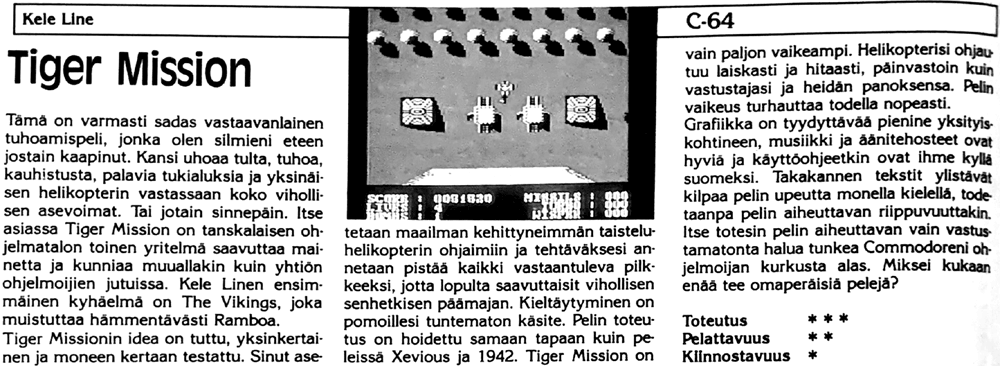
Tiger Mission1987Pysyvä linkkiTämä on varmasti sadas vastaavanlainen tuhoamispeli, jonka olen silmieni eteen jostain kaapinut. Kansi uhoaa tulta, tuhoa, kauhistusta, palavia tukialuksia ja yksinäisen helikopterin vastassaan koko vihollisen asevoimat. Tai jotain sinnepäin. Itse asiassa Tiger Mission on tanskalaisen ohjelmatalon toinen yritelmä saavuttaa mainetta ja kunniaa muuallakin kuin yhtiön ohjelmoijien jutuissa. Kele Linen ensimmäinen kyhäelmä on The Vikings, joka muistuttaa hämmentävästi Ramboa.
Tiger Missionin idea on tuttu, yksinkertainen ja moneen kertaan testattu. Sinut asetetaan maailman kehittyneimmän taisteluhelikopterin ohjaimiin ja tehtäväksesi annetaan pistää kaikki vastaantuleva pilkkeeksi, jotta lopulta saavuttaisit vihollisen senhetkisen päämajan. Kieltäytyminen on pomoillesi tuntematon käsite. Pelin toteutus on hoidettu samaan tapaan kuin peleissä Xevious ja 1942. Tiger Mission on vain paljon vaikeampi. Helikopterisi ohjautuu laiskasti ja hitaasti, päinvastoin kuin vastustajasi ja heidän panoksensa. Pelin vaikeus turhauttaa todella nopeasti.
Grafiikka on tyydyttävää pienine yksityiskohtineen, musiikki ja äänitehosteet ovat hyviä ja käyttöohjeetkin ovat ihme kyllä suomeksi. Takakannen tekstit ylistävät kilpaa pelin upeutta monella kielellä, todetaanpa pelin aiheuttavan riippuvuuttakin. Itse totesin pelin aiheuttavan vain vastustamatonta halua tunkea Commodoreni ohjelmoijan kurkusta alas. Miksei kukaan enää tee omaperäisiä pelejä?
Tiger Mission1987PermalinkThis is surely the hundredth destruction game of its kind that I've scraped up from somewhere and set before my eyes. The cover blusters about fire, destruction, horror, burning carriers and a lone helicopter up against the enemy's entire armed forces. Or something along those lines. Tiger Mission is in fact the Danish software house's second attempt at winning fame and glory somewhere other than in its own programmers' chatter. Kele Line's first concoction is The Vikings, which bears a bewildering resemblance to Rambo.
The idea of Tiger Mission is familiar, simple and tested many times over. You are put at the controls of the world's most advanced combat helicopter and given the task of turning everything that comes your way into matchwood, so that you finally reach the enemy's headquarters of the moment. Refusal is a concept unknown to your bosses. The game is put together the same way as Xevious and 1942. Tiger Mission is just a lot harder. Your helicopter steers lazily and slowly, unlike your opponents and their bullets. The game's difficulty gets frustrating really fast.
The graphics are satisfactory, with their small details, the music and sound effects are good, and the instructions are, wonder of wonders, even in Finnish. The back-cover blurbs compete to praise the game's magnificence in many languages, even claiming that the game is addictive. For my part, all I found the game caused was an irresistible urge to ram my Commodore down the programmer's throat. Why doesn't anyone make original games any more?
Tiger Road

Tiger Road1989 KevätPysyvä linkkiRuy Barbie Ohin avovelho Ruy Ken Oh haaveilee lapsiarmeijasta. Omista lapsista koostuvan armeijan valmistaminen veisi kuitenkin niin kauan aikaa, että laiskana miehenä herra Oh päättääkin varastella muksut ympäristöstä. Onneksi on olemassa sankareita, kuten Lee Wong, jonka lyhyen tähtäimen suunitelmiin kuuluu hankkia lapset takaisin niiden alkuperäisille omistajille.
Lee Wong etenee horisontaalisesti ja poukkii pitkin palkkeja paukuttaen piikkinuijallaan pahat oliot parahultaisen pieniksi paloiksi. Osa olioista jättää jälkeensä lisäaseita ja energiaa palauttavia annoksia. Valitettavasti näyttää olevan yksi lysti mitä asetta Wong käyttää, eroja niiden välillä kun ei ole.
Niin sankari kuin pahat pojatkin on yleensä ottaen animoitu ihan kivasti ja näyttävätkin kohtalaisen siedettäviltä, mutta mitään huippuunsa viritettyä grafiikkaa ei Tiikeritien penkereeltä löydy. Äänet ovat tavanomaisen tylsiä.
Tiger Road on ihan hyväksyttävä Ghostsén Goblins -tyyppinen peli, jota pelailee sen pahemmin kyllästyttämättä, muttei missään välissä sydän pelaamisen riemusta pakahtumaisillaan. Saavutus kai sekin Go!n yleinen taso huomioon ottaen, ja lause joka valitettavasti alkaa sopia peliin kuin peliin.
Tiger Road1989 KevätPermalinkRuy Barbie Oh's live-in wizard Ruy Ken Oh dreams of an army of children. Producing an army made up of his own children would take so long, however, that being a lazy man, Mr. Oh decides to pinch the kids from the surrounding area instead. Luckily there are heroes, such as Lee Wong, whose short-term plans include getting the children back to their original owners.
Lee Wong advances horizontally and bounces along the beams, battering the bad beasties into perfectly bite-sized bits with his spiked club. Some of the creatures leave behind extra weapons and energy-restoring rations. Unfortunately it seems to make no odds which weapon Wong uses, since there's no difference between them.
Both the hero and the bad guys are, generally speaking, animated quite nicely and look reasonably tolerable, but you won't find any graphics tuned to the max along the verges of Tiger Road. The sound is the usual dull stuff.
Tiger Road is a perfectly acceptable Ghostsén Goblins-type game that you can play without getting too bored, but at no point is your heart about to burst with the joy of playing. I suppose even that is an achievement, considering Go!'s general standard, and a sentence that, sadly, is starting to fit just about any game.
Tigers in the Snow
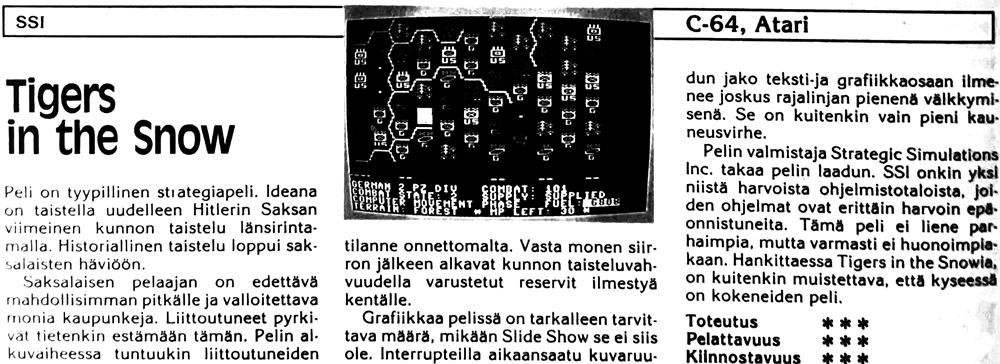
Tigers in the Snow1987Pysyvä linkkiPeli on tyypillinen strategiapeli. Ideana on taistella uudelleen Hitlerin Saksan viimeinen kunnon taistelu länsirintamalla. Historiallinen taistelu loppui saksalaisten häviöön.
Saksalaisen pelaajan on edettävä mahdollisimman pitkälle ja valloitettava monia kaupunkeja. Liittoutuneet pyrkivät tietenkin estämään tämän. Pelin alkuvaiheessa tuntuukin liittoutuneiden tilanne onnettomalta. Vasta monen siirron jälkeen alkavat kunnon taisteluvahvuudella varustetut reservit ilmestyä kentälle.
Grafiikkaa pelissä on tarkalleen tarvittava määrä, mikään Slide Show se ei siis ole. Interrupteilla aikaansaatu kuvaruudun jako teksti-ja grafiikkaosaan ilmenee joskus rajalinjan pienenä välkkymisenä. Se on kuitenkin vain pieni kauneusvirhe.
Pelin valmistaja Strategic Simulations Inc. takaa pelin laadun. SSI onkin yksi niistä harvoista ohjelmistotaloista, joiden ohjelmat ovat erittäin harvoin epäonnistuneita. Tämä peli ei liene parhaimpia, mutta varmasti ei huonoimpiakaan. Hankittaessa Tigers in the Snowia, on kuitenkin muistettava, että kyseessä on kokeneiden peli.
Tigers in the Snow1987PermalinkThis is a typical strategy game. The idea is to refight the last proper battle Hitler's Germany fought on the Western Front. The historical battle ended in German defeat.
The German player has to advance as far as possible and capture a good many towns. The Allies naturally try to prevent this. And indeed, early in the game the Allies' situation feels dismal. Only after many moves do reserves with proper combat strength start to appear on the field.
The game has exactly as much graphics as it needs, so it's no Slide Show. The split of the screen into text and graphics sections, done with interrupts, sometimes shows up as a slight flicker along the dividing line. That is, however, only a minor cosmetic flaw.
The game's maker, Strategic Simulations Inc., is a guarantee of its quality. SSI is indeed one of those few software houses whose programs very rarely turn out to be failures. This game is probably not among their best, but certainly not among their worst either. When buying Tigers in the Snow, however, remember that it is a game for experienced players.
Time Fighter
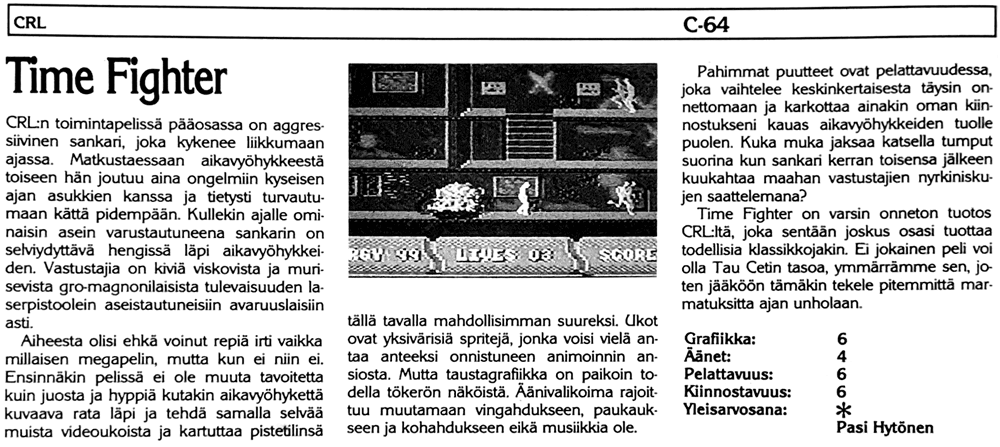
Time Fighter1988Pysyvä linkkiCRL:n toimintapelissä pääosassa on aggressiivinen sankari, joka kykenee liikkumaan ajassa. Matkustaessaan aikavyöhykkeestä toiseen hän joutuu aina ongelmiin kyseisen ajan asukkien kanssa ja tietysti turvautumaan kättä pidempään. Kullekin ajalle ominaisin asein varustautuneena sankarin on selviydyttävä hengissä läpi aikavyöhykkeiden. Vastustajia on kiviä viskovista ja murisevista gro-magnonilaisista tulevaisuuden laserpistoolein aseistautuneisiin avaruuslaisiin asti.
Aiheesta olisi ehkä voinut repiä irti vaikka millaisen megapelin, mutta kun ei niin ei. Ensinnäkin pelissä ei ole muuta tavoitetta kuin juosta ja hyppiä kutakin aikavyöhykettä kuvaava rata läpi ja tehdä samalla selvää muista videoukoista ja kartuttaa pistetilinsä tällä tavalla mahdollisimman suureksi. Ukot ovat yksivärisiä spritejä, jonka voisi vielä antaa anteeksi onnistuneen animoinnin ansiosta. Mutta taustagrafiikka on paikoin todella tökerön näköistä. Äänivalikoima rajoittuu muutamaan vingahdukseen, paukaukseen ja kohahdukseen eikä musiikkia ole.
Pahimmat puutteet ovat pelattavuudessa, joka vaihtelee keskinkertaisesta täysin onnettomaan ja karkottaa ainakin oman kiinnostukseni kauas aikavyöhykkeiden tuolle puolen. Kuka muka jaksaa katsella tumput suorina kun sankari kerran toisensa jälkeen kuukahtaa maahan vastustajien nyrkiniskujen saattelemana?
Time Fighter on varsin onneton tuotos CRL:ltä, joka sentään joskus osasi tuottaa todellisia klassikkojakin. Ei jokainen peli voi olla Tau Cetin tasoa, ymmärrämme sen, joten jääköön tämäkin tekele pitemmittä marmatuksitta ajan unholaan.
Time Fighter1988PermalinkThe star of CRL's action game is an aggressive hero who is able to move through time. Travelling from one time zone to another, he always gets into trouble with the inhabitants of the era in question and, naturally, has to resort to something with more reach than his bare fists. Kitted out with the weapons most typical of each era, the hero has to make it through the time zones alive. The opponents range from rock-hurling, grunting Cro-Magnons all the way to spacemen of the future armed with laser pistols.
Maybe you could have wrung any kind of mega-game you liked out of the subject, but no, it just wasn't to be. For a start, the game has no goal other than to run and jump your way through the course representing each time zone, making short work of the other video blokes along the way and so racking up as big a score as possible. The blokes are single-colour sprites, which might still be forgiven thanks to the well-done animation. But in places the background graphics look really clumsy. The range of sounds is limited to a few squeaks, bangs and whooshes, and there is no music.
The worst shortcomings are in the playability, which ranges from mediocre to utterly hopeless and drives my interest, at least, far off to the other side of the time zones. Who on earth can be bothered to sit there, arms hanging limp, watching the hero keel over time after time to the accompaniment of the enemies' punches?
Time Fighter is a pretty sorry effort from CRL, who did at least once know how to produce genuine classics too. Not every game can be up to Tau Ceti's standard, we understand that, so let this botch job, too, sink into the oblivion of time without further grumbling.
Time Machine
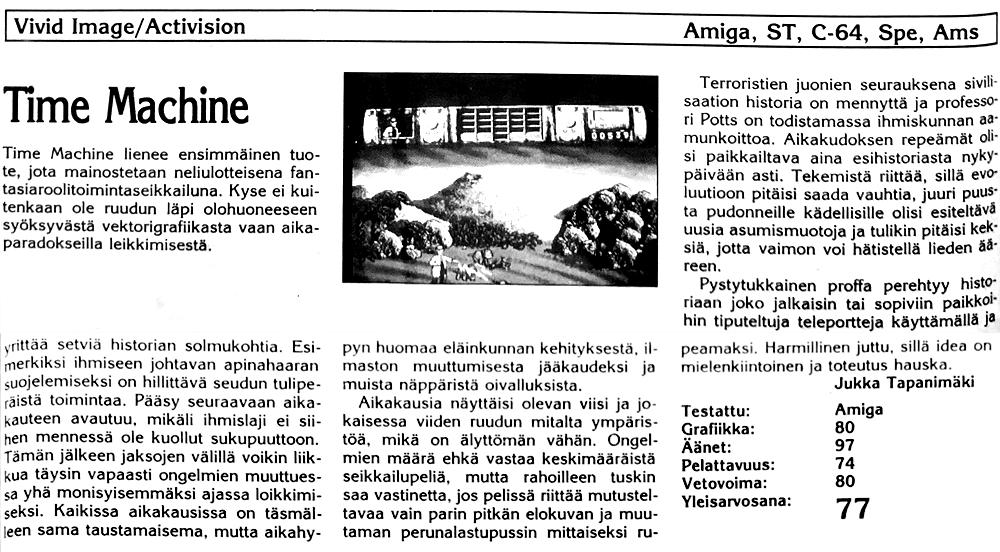
Time Machine1990 SyksyPysyvä linkkiTime Machine lienee ensimmäinen tuote, jota mainostetaan neliulotteisena fantasiaroolitoimintaseikkailuna. Kyse ei kuitenkaan ole ruudun läpi olohuoneeseen syöksyvästä vektorigrafiikasta vaan aikaparadokseilla leikkimisestä.
Terroristien juonien seurauksena sivilisaation historia on mennyttä ja professori Potts on todistamassa ihmiskunnan aamunkoittoa. Aikakudoksen repeämät olisi paikkailtava aina esihistoriasta nykypäivään asti. Tekemistä riittää, sillä evoluutioon pitäisi saada vauhtia, juuri puusta pudonneille kädellisille olisi esiteltävä uusia asumismuotoja ja tulikin pitäisi keksiä, jotta vaimon voi hätistellä lieden ääreen.
Pystytukkainen proffa perehtyy historiaan joko jalkaisin tai sopiviin paikkoihin tiputeltuja teleportteja käyttämällä ja yrittää setviä historian solmukohtia. Esimerkiksi ihmiseen johtavan apinahaaran suojelemiseksi on hillittävä seudun tuliperäistä toimintaa. Pääsy seuraavaan aikakauteen avautuu, mikäli ihmislaji ei siihen mennessä ole kuollut sukupuuttoon. Tämän jälkeen jaksojen välillä voikin liikkua täysin vapaasti ongelmien muuttuessa yhä monisyisemmäksi ajassa loikkimiseksi. Kaikissa aikakausissa on täsmälleen sama taustamaisema, mutta aikahypyn huomaa eläinkunnan kehityksestä, ilmaston muuttumisesta jääkaudeksi ja muista näppäristä oivalluksista.
Aikakausia näyttäisi olevan viisi ja jokaisessa viiden ruudun mitalta ympäristöä, mikä on älyttömän vähän. Ongelmien määrä ehkä vastaa keskimääräistä seikkailupeliä, mutta rahoilleen tuskin saa vastinetta, jos pelissä riittää mutusteltavaa vain parin pitkän elokuvan ja muutaman perunalastupussin mittaiseksi rupeamaksi. Harmillinen juttu, sillä idea on mielenkiintoinen ja toteutus hauska.
Time Machine1990 SyksyPermalinkTime Machine is probably the first product ever to be advertised as a four-dimensional fantasy-roleplaying-action-adventure. We're not talking about vector graphics lunging out of the screen into your living room, though, but about playing around with time paradoxes.
Thanks to the schemes of terrorists, the history of civilisation is history, and Professor Potts is left witnessing the dawn of mankind. The rips in the fabric of time have to be patched up all the way from prehistory to the present day. There's plenty to do: evolution needs speeding up, primates just down from the trees have to be introduced to new forms of housing, and fire has to be invented too, so that the wife can be shooed off to the stove.
The spiky-haired prof gets to know history either on foot or by using teleporters dropped in handy places, and tries to untangle history's knotty points. For example, to protect the branch of apes that leads to man, the volcanic activity in the area has to be kept in check. Access to the next era opens up provided the human race hasn't died out by then. After that you can move between the periods completely freely, while the problems turn into ever more intricate leaping about in time. Every era has exactly the same background scenery, but you can tell you've jumped in time from the evolution of the animal kingdom, the climate turning into an ice age and other nifty touches.
There seem to be five eras, each with five screens' worth of surroundings, which is ridiculously little. The number of problems may match your average adventure game, but you hardly get your money's worth if the game only gives you enough to munch on for a stint lasting a couple of feature films and a few bags of crisps. A shame, since the idea is interesting and the execution fun.
Time Soldier
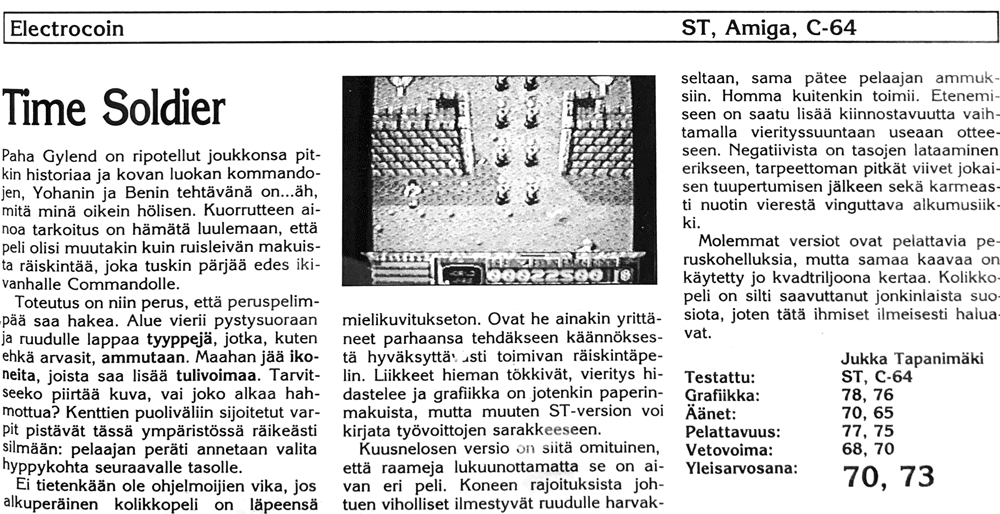
Time Soldier1990 SyksyPysyvä linkkiPaha Gylend on ripotellut joukkonsa pitkin historiaa ja kovan luokan kommandojen, Yohanin ja Benin tehtävänä on...äh, mitä minä oikein hölisen. Kuorrutteen ainoa tarkoitus on hämätä luulemaan, että peli olisi muutakin kuin ruisleivän makuista räiskintää, joka tuskin pärjää edes ikivanhalle Commandolle.
Toteutus on niin perus, että peruspelimpää saa hakea. Alue vierii pystysuoraan ja ruudulle lappaa tyyppejä, jotka, kuten ehkä arvasit, ammutaan. Maahan jää ikoneita, joista saa lisää tulivoimaa. Tarvitseeko piirtää kuva, vai joko alkaa hahmottua? Kenttien puoliväliin sijoitetut varpit pistävät tässä ympäristössä räikeästi silmään: pelaajan peräti annetaan valita hyppykohta seuraavalle tasolle.
Ei tietenkään ole ohjelmoijien vika, jos alkuperäinen kolikkopeli on läpeensä mielikuvitukseton. Ovat he ainakin yrittäneet parhaansa tehdäkseen käännöksestä hyväksyttävästi toimivan räiskintäpelin. Liikkeet hieman tökkivät, vieritys hidastelee ja grafiikka on jotenkin paperinmakuista, mutta muuten ST-version voi kirjata työvoittojen sarakkeeseen.
Kuusnelosen versio on siitä omituinen, että raameja lukuunottamatta se on aivan eri peli. Koneen rajoituksista johtuen viholliset ilmestyvät ruudulle harvakseltaan, sama pätee pelaajan ammuksiin. Homma kuitenkin toimii. Etenemiseen on saatu lisää kiinnostavuutta vaihtamalla vierityssuuntaan useaan otteeseen. Negatiivista on tasojen lataaminen erikseen, tarpeettoman pitkät viivet jokaisen tuupertumisen jälkeen sekä karmeasti nuotin vierestä vinguttava alkumusiikki.
Molemmat versiot ovat pelattavia peruskohelluksia, mutta samaa kaavaa on käytetty jo kvadriljoona kertaa. Kolikkopeli on silti saavuttanut jonkinlaista suosiota, joten tätä ihmiset ilmeisesti haluavat.
Time Soldier1990 SyksyPermalinkThe evil Gylend has scattered troops all through history, and it falls to hard-as-nails commandos Yohan and Ben to... ugh, what am I even blathering on about. The sole purpose of all this icing is to fool you into thinking the game is something more than a shoot-'em-up with all the flavour of rye bread, one that could barely hold its own even against the ancient Commando.
The execution is so basic you'd be hard pressed to find a more basic basic game. The playfield scrolls vertically and guys come pouring onto the screen, and they, as you may have guessed, get shot. They leave icons on the ground that give you more firepower. Do I need to draw you a picture, or is it starting to sink in yet? In these surroundings the warps placed halfway through the levels stick out like a sore thumb: the player is even allowed to choose where to jump in on the next level.
Of course it isn't the programmers' fault if the original coin-op is thoroughly unimaginative. They have at least done their best to turn the conversion into an acceptably working shoot-'em-up. The movement is a bit jerky, the scrolling dawdles and the graphics somehow taste of paper, but otherwise the ST version can be filed under hard-won victories.
The Commodore 64 version is odd in that, apart from the basic framework, it is a completely different game. Owing to the machine's limitations the enemies turn up on screen only sparsely, and the same goes for the player's bullets. The thing works all the same. Progress has been made more interesting by switching the scrolling direction several times. On the negative side are the separately loaded levels, the needlessly long delays after every keeling-over, and the title music, which whines along horribly off-key.
Both versions are playable basic romps, but the same formula has already been used a quadrillion times. The coin-op has nevertheless achieved some sort of popularity, so apparently this is what people want.
Timequest
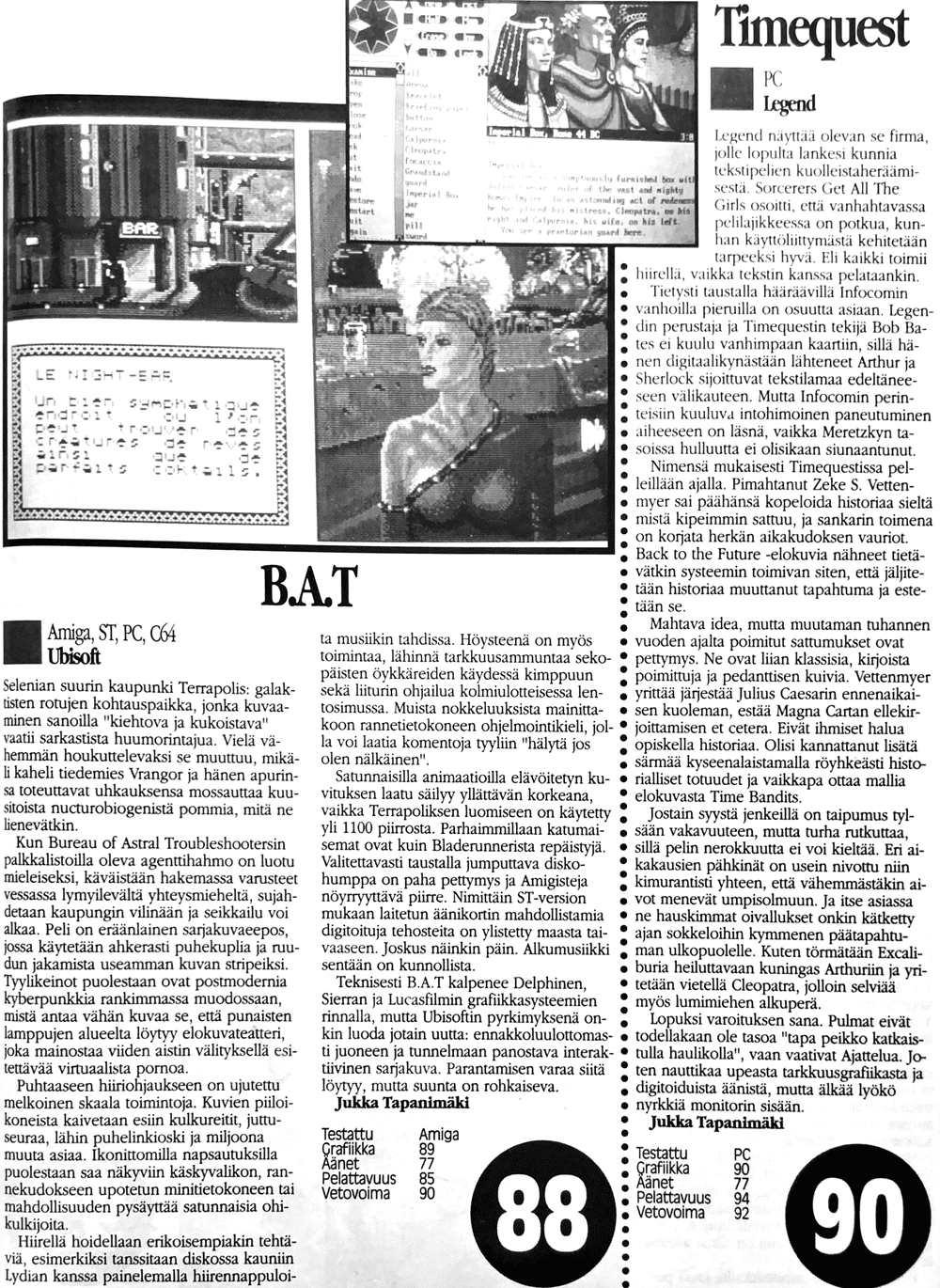
Timequest1991 SyksyPysyvä linkkiLegend näyttää olevan se firma, jolle lopulta lankesi kunnia tekstipelien kuolleistaheräämisestä. Sorcerers Get All The Girls osoitti, että vanhahtavassa pelilajikkeessa on potkua, kunhan käyttöliittymästä kehitetään tarpeeksi hyvä. Eli kaikki toimii hiirellä, vaikka tekstin kanssa pelataankin.
Tietysti taustalla hääräävillä Infocomin vanhoilla pieruilla on osuutta asiaan. Legendin perustaja ja Timequestin tekijä Bob Bates ei kuulu vanhimpaan kaartiin, sillä hänen digitaalikynästään lähteneet Arthur ja Sherlock sijoittuvat tekstilamaa edeltäneeseen välikauteen. Mutta Infocomin perinteisiin kuuluva intohimoinen paneutuminen aiheeseen on läsnä, vaikka Meretzkyn tasoissa hulluutta ei olisikaan siunaantunut.
Nimensä mukaisesti Timequestissa pelleillään ajalla. Pimahtanut Zeke S. Vettenmyer sai päähänsä kopeloida historiaa sieltä mistä kipeimmin sattuu, ja sankarin toimena on korjata herkän aikakudoksen vauriot. Back to the Future -elokuvia nähneet tietävätkin systeemin toimivan siten, että jäljitetään historiaa muuttanut tapahtuma ja estetään se.
Mahtava idea, mutta muutaman tuhannen vuoden ajalta poimitut sattumukset ovat pettymys. Ne ovat liian klassisia, kirjoista poimittuja ja pedanttisen kuivia. Vettenmyer yrittää järjestää Julius Caesarin ennenaikaisen kuoleman, estää Magna Cartan ellekirjoittamisen et cetera. Eivät ihmiset halua opiskella historiaa. Olisi kannattanut lisätä särmää kyseenalaistamalla röyhkeästi historialliset totuudet ja vaikkapa ottaa mallia elokuvasta Time Bandits.
Jostain syystä jenkeillä on taipumus tylsään vakavuuteen, mutta turha rutkuttaa, sillä pelin nerokkuutta ei voi kieltää. Eri aikakausien pähkinät on usein nivottu niin kimurantisti yhteen, että vähemmästäkin aivot menevät umpisolmuun. Ja itse asiassa ne hauskimmat oivallukset onkin kätketty ajan sokkeloihin kymmenen päätapahtuman ulkopuolelle. Kuten törmätään Excaliburia heiluttavaan kuningas Arthuriin ja yritetään vietellä Cleopatra, jolloin selviää myös lumimiehen alkuperä.
Lopuksi varoituksen sana. Pulmat eivät todellakaan ole tasoa "tapa peikko katkaistulla haulikolla", vaan vaativat Ajattelua. Joten nauttikaa upeasta tarkkuusgrafiikasta ja digitoiduista äänistä, mutta älkää lyökö nyrkkiä monitorin sisään.
Timequest1991 SyksyPermalinkLegend looks like being the firm that was finally granted the honour of raising text games from the dead. Sorcerers Get All The Girls showed that the old-fashioned genre still has some kick in it, as long as the interface is made good enough. In other words, everything works with the mouse, even though you're playing with text.
Of course, the old Infocom farts pottering about in the background have a hand in this. Legend's founder and Timequest's author Bob Bates doesn't belong to the oldest guard, since the Arthur and Sherlock that came from Bates's digital pen date from the interim period that preceded the text slump. But the passionate absorption in the subject that is part of the Infocom tradition is there, even if it hasn't been blessed with Meretzky-grade madness.
True to its name, Timequest clowns around with time. The unhinged Zeke S. Vettenmyer got the bright idea of groping history where it hurts the most, and the hero's job is to repair the damage to the delicate fabric of time. Anyone who has seen the Back to the Future films will know that the system works like this: you track down the event that changed history and prevent it.
A terrific idea, but the incidents picked from a span of a few thousand years are a disappointment. They are too classic, lifted from books and pedantically dry. Vettenmyer tries to arrange Julius Caesar's premature death, prevent the signing of the Magna Carta, et cetera. People don't want to study history. It would have paid to add some edge by brazenly questioning historical truths, and perhaps taking a leaf out of the film Time Bandits.
For some reason the Yanks have a tendency towards dull seriousness, but there's no use grumbling, because the game's brilliance can't be denied. The nuts to crack from the different eras are often knotted together so fiendishly that brains would tie themselves in a hard knot over far less. And in fact the funniest insights have been hidden away in the mazes of time, outside the ten main events. Like when you bump into King Arthur brandishing Excalibur, and try to seduce Cleopatra, which also reveals the origin of the Abominable Snowman.
Finally, a word of warning. The puzzles are definitely not of the "kill the troll with the sawn-off shotgun" calibre; they require Thinking. So enjoy the gorgeous high-resolution graphics and digitised sound, but don't put your fist through the monitor.
Times of Lore
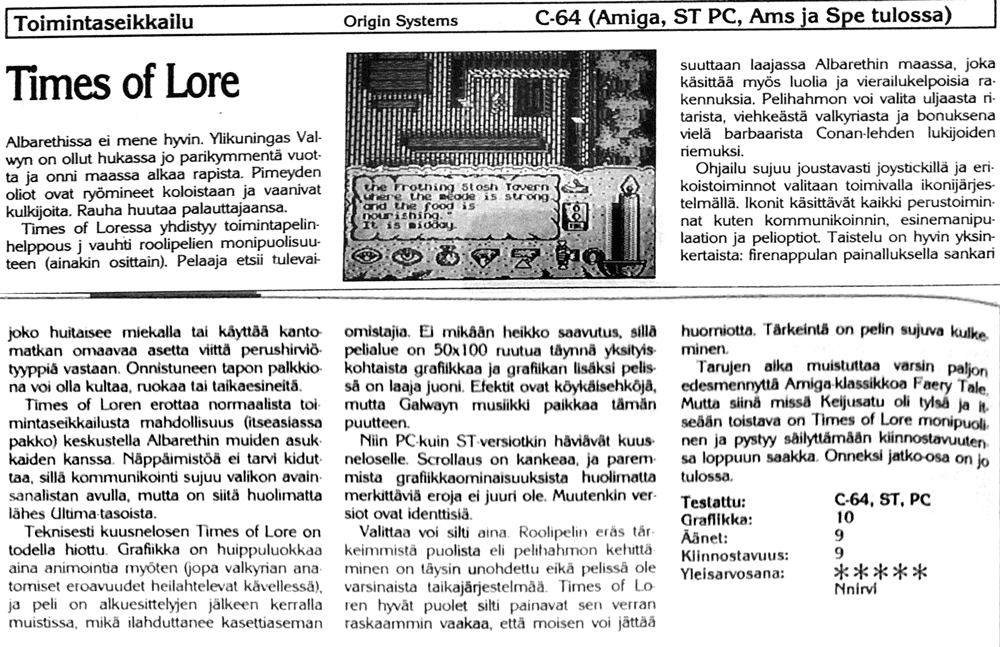
Times of Lore1989 KevätPysyvä linkkiAlbarethissa ei mene hyvin. Ylikuningas Valwyn on ollut hukassa jo parikymmentä vuotta ja onni maassa alkaa rapista. Pimeyden oliot ovat ryömineet koloistaan ja vaanivat kulkijoita. Rauha huutaa palauttajaansa.
Times of Loressa yhdistyy toimintapelinhelppous j vauhti roolipelien monipuolisuuteen (ainakin osittain). Pelaaja etsii tulevaisuuttaan laajassa Albarethin maassa, joka käsittää myös luolia ja vierailukelpoisia rakennuksia. Pelihahmon voi valita uljaasta ritarista, viehkeästä valkyriasta ja bonuksena vielä barbaarista Conan-lehden lukijoiden riemuksi.
Ohjailu sujuu joustavasti joystickillä ja erikoistoiminnot valitaan toimivalla ikonijärjestelmällä. Ikonit käsittävät kaikki perustoiminnat kuten kommunikoinnin, esinemanipulaation ja pelioptiot. Taistelu on hyvin yksinkertaista: firenappulan painalluksella sankari joko huitaisee miekalla tai käyttää kantomatkan omaavaa asetta viittä perushirviötyyppiä vastaan. Onnistuneen tapon palkkiona voi olla kultaa, ruokaa tai taikaesineitä.
Times of Loren erottaa normaalista toimintaseikkailusta mahdollisuus (itseasiassa pakko) keskustella Albarethin muiden asukkaiden kanssa. Näppäimistöä ei tarvi kiduttaa, sillä kommunikointi sujuu valikon avainsanalistan avulla, mutta on siitä huolimatta lähes Ultima-tasoista.
Teknisesti kuusnelosen Times of Lore on todella hiottu. Grafiikka on huippuluokkaa aina animointia myöten (jopa valkyrian anatomiset eroavuudet heilahtelevat kävellessä), ja peli on alkuesittelyjen jälkeen kerralla muistissa, mikä ilahduttanee kasettiaseman omistajia. Ei mikään heikko saavutus, sillä pelialue on 50x100 ruutua täynnä yksityiskohtaista grafiikkaa ja grafiikan lisäksi pelissä on laaja juoni. Efektit ovat köykäisehköjä, mutta Galwayn musiikki paikkaa tämän puutteen.
Niin PC-kuin ST-versiotkin häviävät kuusneloselle. Scrollaus on kankeaa, ja paremmista grafiikkaominaisuuksista huolimatta merkittäviä eroja ei juuri ole. Muutenkin versiot ovat identtisiä.
Valittaa voi silti aina. Roolipelin eräs tärkeimmistä puolista eli pelihahmon kehittäminen on täysin unohdettu eikä pelissä ole varsinaista taikajärjestelmää. Times of Loren hyvät puolet silti painavat sen verran raskaammin vaakaa, että moisen voi jättää huomiotta. Tärkeintä on pelin sujuva kulkeminen.
Tarujen aika muistuttaa varsin paljon edesmennyttä Amiga-klassikkoa Faery Tale. Mutta siinä missä Keijusatu oli tylsä ja itseään toistava on Times of Lore monipuolinen ja pystyy säilyttämään kiinnostavuutensa loppuun saakka. Onneksi jatko-osa on jo tulossa.
Times of Lore1989 KevätPermalinkThings are not going well in Albareth. High King Valwyn has been missing for a good twenty years now, and the land's good fortune is starting to crumble. The creatures of darkness have crawled out of their holes and lie in wait for travellers. Peace is crying out for someone to restore it.
Times of Lore combines the ease and pace of an action game with the variety of role-playing games (at least partly). The player seeks their future in the vast land of Albareth, which also includes caves and buildings you can visit. For your character you can choose between a gallant knight, a fetching valkyrie and, as a bonus, a barbarian too, to the delight of Conan comic readers.
Control runs smoothly on the joystick, and special actions are chosen through a well-working icon system. The icons cover all the basic actions, such as communication, object manipulation and game options. Combat is very simple: at a press of the fire button the hero either takes a swipe with a sword or uses a ranged weapon against the five basic monster types. The reward for a successful kill may be gold, food or magic items.
What sets Times of Lore apart from the normal action adventure is the chance (in fact the obligation) to talk with Albareth's other inhabitants. There's no need to torture the keyboard, as conversation is handled with a menu keyword list, but it's nevertheless almost up to Ultima level.
Technically the C-64 Times of Lore is really polished. The graphics are top-class right down to the animation (even the valkyrie's anatomical differences sway as she walks), and after the opening sequences the whole game sits in memory in one go, which should please owners of cassette decks. No mean feat, since the play area is 50x100 screens full of detailed graphics, and on top of the graphics the game has an extensive plot. The effects are on the flimsy side, but Galway's music makes up for this shortcoming.
Both the PC and the ST versions lose out to the C-64. The scrolling is stiff, and despite the better graphics capabilities there are hardly any significant differences. The versions are identical in other respects too.
Still, there's always something to complain about. One of the most important sides of a role-playing game, namely developing your character, has been completely forgotten, and the game has no real magic system. Even so, Times of Lore's good points weigh that much more heavily on the scales that such things can be overlooked. The main thing is that the game flows smoothly.
The Time of Legends is rather reminiscent of the late Amiga classic Faery Tale. But where Fairy Tale was dull and repetitive, Times of Lore is varied and manages to hold your interest right to the end. Luckily a sequel is already on the way.
Tintin In The Moon
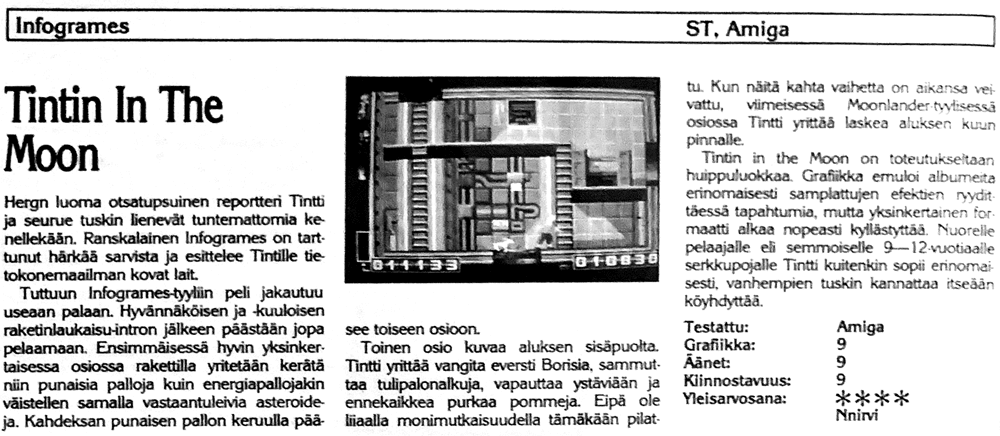
Tintin In The Moon1989 SyksyPysyvä linkkiHergn luoma otsatupsuinen reportteri Tintti ja seurue tuskin lienevät tuntemattomia kenellekään. Ranskalainen Infogrames on tarttunut härkää sarvista ja esittelee Tintille tietokonemaailman kovat lait.
Tuttuun Infogrames-tyyliin peli jakautuu useaan palaan. Hyvännäköisen ja -kuuloisen raketinlaukaisu-intron jälkeen päästään jopa pelaamaan. Ensimmäisessä hyvin yksinkertaisessa osiossa raketilla yritetään kerätä niin punaisia palloja kuin energiapallojakin väistellen samalla vastaantulevia asteroideja. Kahdeksan punaisen pallon keruulla pääsee toiseen osioon.
Toinen osio kuvaa aluksen sisäpuolta. Tintti yrittää vangita eversti Borisia, sammuttaa tulipalonalkuja, vapauttaa ystäviään ja ennenkaikkea purkaa pommeja. Eipä ole liiaalla monimutkaisuudella tämäkään pilattu. Kun näitä kahta vaihetta on aikansa veivattu, viimeisessä Moonlander-tyylisessä osiossa Tintti yrittää laskea aluksen kuun pinnalle.
Tintin in the Moon on toteutukseltaan huippuluokkaa. Grafiikka emuloi albumeita erinomaisesti samplattujen efektien ryydittäessä tapahtumia, mutta yksinkertainen formaatti alkaa nopeasti kyllästyttää. Nuorelle pelaajalle eli semmoiselle 9-12-vuotiaalle serkkupojalle Tintti kuitenkin sopii erinomaisesti, vanhempien tuskin kannattaa itseään köyhdyttää.
Tintin In The Moon1989 SyksyPermalinkThe quiff-topped reporter Tintti created by Herg, and his entourage, can hardly be unknown to anyone. France's Infogrames has taken the bull by the horns and is introducing Tintti to the harsh laws of the computer world.
In familiar Infogrames style, the game is divided into several parts. After a good-looking and good-sounding rocket-launch intro, you even get to play. In the first, very simple section you try to collect both red balls and energy balls with the rocket, while dodging the oncoming asteroids. Collecting eight red balls gets you into the second section.
The second section shows the inside of the ship. Tintti tries to capture Colonel Boris, put out fires before they get going, free his friends and above all defuse bombs. This one hasn't been spoiled by excessive complexity either. Once you've cranked away at these two stages for a while, in the final, Moonlander-style section Tintti tries to land the ship on the surface of the moon.
Tintin in the Moon is top-class in its execution. The graphics emulate the albums excellently, with sampled effects spicing up the action, but the simple format quickly starts to get boring. For a young player, that is, your 9-12-year-old cousin type, Tintti is nonetheless an excellent fit; older players should hardly bother impoverishing themselves.
Toki
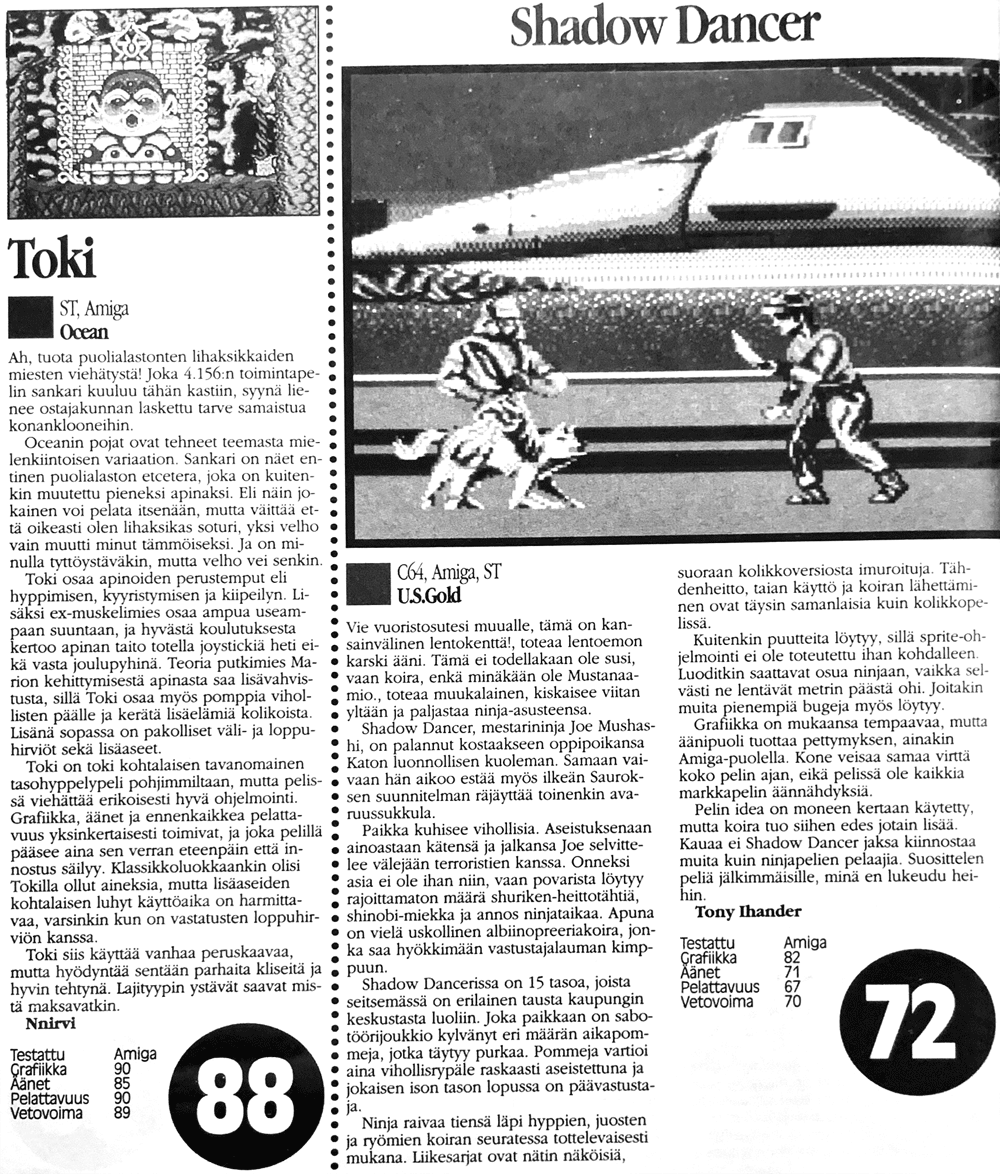
Toki1991 SyksyPysyvä linkkiAh, tuota puolialastonten lihaksikkaiden miesten viehätystä! Joka 4.156:n toimintapelin sankari kuuluu tähän kastiin, syynä lienee ostajakunnan laskettu tarve samaistua konanklooneihin.
Oceanin pojat ovat tehneet teemasta mielenkiintoisen variaation. Sankari on näet entinen puolialaston etcetera, joka on kuitenkin muutettu pieneksi apinaksi. Eli näin jokainen voi pelata itsenään, mutta väittää että oikeasti olen lihaksikas soturi, yksi velho vain muutti minut tämmöiseksi. Ja on minulla tyttöystäväkin, mutta velho vei senkin.
Toki osaa apinoiden perustemput eli hyppimisen, kyyristymisen ja kiipeilyn. Lisäksi ex-muskelimies osaa ampua useampaan suuntaan, ja hyvästä koulutuksesta kertoo apinan taito totella joystickiä heti eikä vasta joulupyhinä. Teoria putkimies Marion kehittymisestä apinasta saa lisävahvistusta, sillä Toki osaa myös pomppia vihollisten päälle ja kerätä lisäelämiä kolikoista. Lisänä sopassa on pakolliset väli- ja loppuhirviöt sekä lisäaseet.
Toki on toki kohtalaisen tavanomainen tasohyppelypeli pohjimmiltaan, mutta pelissä viehättää erikoisesti hyvä ohjelmointi. Grafiikka, äänet ja ennenkaikkea pelattavuus yksinkertaisesti toimivat, ja joka pelillä pääsee aina sen verran eteenpäin että innostus säilyy. Klassikkoluokkaankin olisi Tokilla ollut aineksia, mutta lisäaseiden kohtalaisen luhyt käyttöaika on harmittavaa, varsinkin kun on vastatusten loppuhirviön kanssa.
Toki siis käyttää vanhaa peruskaavaa, mutta hyödyntää sentään parhaita kliseitä ja hyvin tehtynä. Lajityypin ystävät saavat mistä maksavatkin.
Toki1991 SyksyPermalinkAh, the allure of half-naked muscular men! The hero of every 4.156th action game belongs to this caste, the reason presumably being the buying public's calculated need to identify with Conan clones.
The Ocean boys have come up with an interesting variation on the theme. You see, the hero is a former half-naked etcetera, who has, however, been turned into a small ape. So this way everyone can play as themselves, yet claim that really I'm a muscular warrior, it's just that some wizard turned me into this. And I do have a girlfriend too, only the wizard took that as well.
Toki has mastered the basic ape tricks, namely jumping, crouching and climbing. On top of that, the ex-muscleman can shoot in several directions, and the ape's knack for obeying the joystick immediately rather than some time around Christmas is testament to a good education. The theory that Mario the plumber evolved from an ape gets further confirmation, since Toki can also bounce on enemies' heads and collect extra lives from coins. Thrown into the soup are the obligatory mid-level and end-of-level monsters, plus extra weapons.
Toki is, to be sure, a fairly run-of-the-mill platformer at heart, but what is especially appealing about the game is the good programming. The graphics, the sound and above all the playability simply work, and every game gets you just far enough that the enthusiasm lasts. Toki would even have had the makings of a classic, but the rather short lifespan of the extra weapons is a pity, especially when you're up against an end-of-level monster.
So Toki uses the old basic formula, but at least it makes use of the best clichés, and well executed at that. Fans of the genre get their money's worth.
Tom and the Ghost
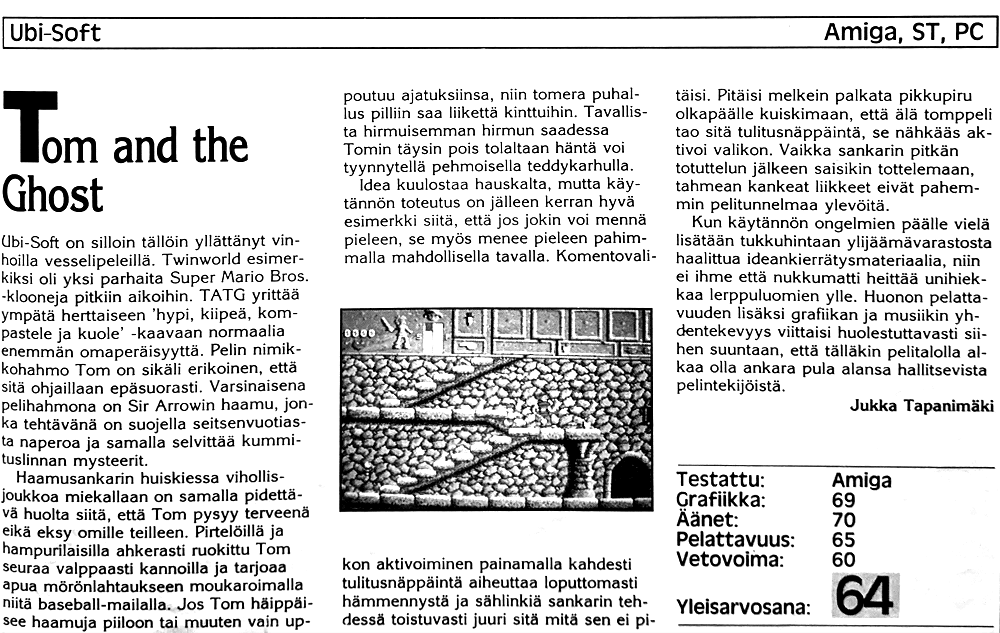
Tom and the Ghost1991 KevätPysyvä linkkiUbi-Soft on silloin tällöin yllättänyt vinhoilla vesselipeleillä. Twinworld esimerkiksi oli yksi parhaita Super Mario Bros. -klooneja pitkiin aikoihin. TATG yrittää ympätä herttaiseen 'hypi, kiipeä, kompastele ja kuole' -kaavaan normaalia enemmän omaperäisyyttä. Pelin nimikkohahmo Tom on sikäli erikoinen, että sitä ohjaillaan epäsuorasti. Varsinaisena pelihahmona on Sir Arrowin haamu, jonka tehtävänä on suojella seitsenvuotiasta naperoa ja samalla selvittää kummituslinnan mysteerit.
Haamusankarin huiskiessa vihollisjoukkoa miekallaan on samalla pidettävä huolta siitä, että Tom pysyy terveenä eikä eksy omille teilleen. Pirtelöillä ja hampurilaisilla ahkerasti ruokittu Tom seuraa valppaasti kannoilla ja tarjoaa apua mörönlahtaukseen moukaroimalla niitä baseball-mailalla. Jos Tom häippäisee haamuja piiloon tai muuten vain uppoutuu ajatuksiinsa, niin tomera puhallus pilliin saa liikettä kinttuihin. Tavallista hirmuisemman hirmun saadessa Tomin täysin pois tolaltaan häntä voi tyynnytellä pehmoisella teddykarhulla.
Idea kuulostaa hauskalta, mutta käytännön toteutus on jälleen kerran hyvä esimerkki siitä, että jos jokin voi mennä pieleen, se myös menee pieleen pahimmalla mahdollisella tavalla. Komentovalikon aktivoiminen painamalla kahdesti tulitusnäppäintä aiheuttaa loputtomasti hämmennystä ja sählinkiä sankarin tehdessä toistuvasti juuri sitä mitä sen ei pitäisi. Pitäisi melkein palkata pikkupiru olkapäälle kuiskimaan, että älä tomppeli tao sitä tulitusnäppäintä, se nähkääs aktivoi valikon. Vaikka sankarin pitkän totuttelun jälkeen saisikin tottelemaan, tahmean kankeat liikkeet eivät pahemmin pelitunnelmaa ylevöitä.
Kun käytännön ongelmien päälle vielä lisätään tukkuhintaan ylijäämävarastosta haalittua ideankierrätysmateriaalia, niin ei ihme että nukkumatti heittää unihiekkaa lerppuluomien ylle. Huonon pelattavuuden lisäksi grafiikan ja musiikin yhdentekevyys viittaisi huolestuttavasti siihen suuntaan, että tälläkin pelitalolla alkaa olla ankara pula alansa hallitsevista pelintekijöistä.
Tom and the Ghost1991 KevätPermalinkUbi-Soft has now and then surprised us with zippy little scallywag games. Twinworld, for instance, was one of the best Super Mario Bros. clones in ages. TATG tries to graft more originality than usual onto the sweet 'hop, climb, stumble and die' formula. The game's title character Tom is unusual in that you control him indirectly. The actual player character is the ghost of Sir Arrow, whose job is to protect the seven-year-old tot and at the same time unravel the mysteries of the haunted castle.
While the ghostly hero swishes at the enemy hordes with his sword, you also have to make sure that Tom stays healthy and doesn't wander off on his own. Diligently fed on milkshakes and hamburgers, Tom follows alertly at your heels and offers a hand with the bogeyman-butchering by clobbering them with a baseball bat. If Tom scarpers off to hide from the ghosts or simply gets lost in his thoughts, a brisk blast on the whistle puts some life into his pins. When a more horrible horror than usual throws Tom completely off balance, you can calm him down with a soft teddy bear.
The idea sounds fun, but the practical execution is once again a fine example of the rule that if something can go wrong, it will go wrong in the worst possible way. Activating the command menu by pressing the fire button twice causes endless confusion and fumbling, with the hero repeatedly doing exactly what it shouldn't. You'd almost need to hire a little devil to sit on your shoulder and whisper: don't hammer that fire button, you nitwit, it activates the menu, you see. Even if after long practice you do get the hero to obey, the stickily stiff movements hardly elevate the game's atmosphere.
When on top of the practical problems you add recycled-idea material scraped together from a surplus warehouse at wholesale prices, it's no wonder the Sandman sprinkles sleep-sand over drooping eyelids. Besides the poor playability, the sheer who-cares quality of the graphics and music would worryingly suggest that this software house too is starting to run badly short of game makers who have mastered their craft.
Tomahawk
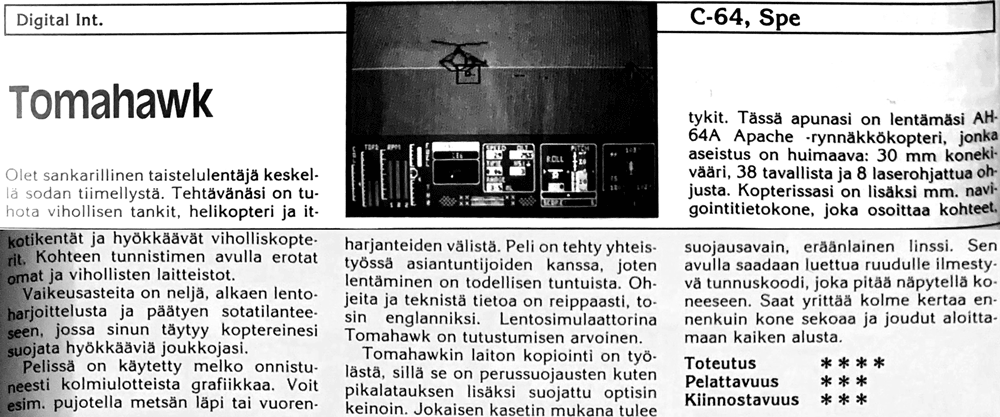
Tomahawk1987Pysyvä linkkiOlet sankarillinen taistelulentäjä keskellä sodan tiimellystä. Tehtävänäsi on tuhota vihollisen tankit, helikopteri ja it-tykit. Tässä apunasi on lentämäsi AH-64A Apache -rynnäkkökopteri, jonka aseistus on huimaava: 30 mm konekivääri, 38 tavallista ja 8 laserohjattua ohjusta. Kopterissasi on lisäksi mm. navigointitietokone, joka osoittaa kohteet, kotikentät ja hyökkäävät vihollishelikopterit. Kohteen tunnistimen avulla erotat omat ja vihollisten laitteistot.
Vaikeusasteita on neljä, alkaen lentoharjoittelusta ja päätyen sotatilanteeseen, jossa sinun täytyy koptereinesi suojata hyökkääviä joukkojasi.
Pelissä on käytetty melko onnistuneesti kolmiulotteista grafiikkaa. Voit esim. pujotella metsän läpi tai vuorenharjanteiden välistä. Peli on tehty yhteistyössä asiantuntijoiden kanssa, joten lentäminen on todellisen tuntuista. Ohjeita ja teknistä tietoa on reippaasti, tosin englanniksi. Lentosimulaattorina Tomahawk on tutustumisen arvoinen.
Tomahawkin laiton kopiointi on työlästä, sillä se on perussuojausten kuten pikalatauksen lisäksi suojattu optisin keinoin. Jokaisen kasetin mukana tulee suojausavain, eräänlainen linssi. Sen avulla saadaan luettua ruudulle ilmestyvä tunnuskoodi, joka pitää näpytellä koneeseen. Saat yrittää kolme kertaa ennenkuin kone sekoaa ja joudut aloittamaan kaiken alusta.
Tomahawk1987PermalinkYou are a heroic combat pilot in the thick of war. Your mission is to destroy the enemy's tanks, helicopters and anti-aircraft guns. To help you with this you have the AH-64A Apache attack helicopter you fly, whose armament is staggering: a 30 mm machine gun, 38 ordinary missiles and 8 laser-guided ones. Your chopper also has, among other things, a navigation computer that points out targets, home bases and attacking enemy helicopters. With the target identifier you can tell your own hardware from the enemy's.
There are four difficulty levels, starting with flight training and ending with a combat situation in which you and your choppers have to cover your attacking troops.
The game makes fairly successful use of three-dimensional graphics. You can, for example, weave through a forest or between mountain ridges. The game was made in cooperation with experts, so the flying feels realistic. There is plenty of instruction and technical information, although it is in English. As a flight simulator, Tomahawk is worth getting to know.
Illegally copying Tomahawk is hard work, since on top of basic protection such as fast loading it is protected by optical means. Every cassette comes with a protection key, a kind of lens. With it you can read the code that appears on the screen, which then has to be tapped into the computer. You get three tries before the machine goes haywire and you have to start everything over from the beginning.
Toobin'
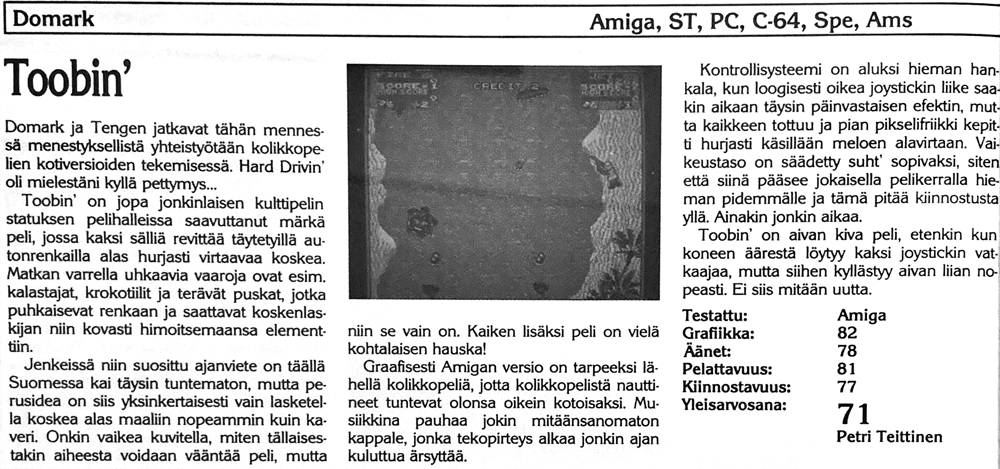
Toobin'1990 KevätPysyvä linkkiDomark ja Tengen jatkavat tähän mennessä menestyksellistä yhteistyötään kolikkopelien kotiversioiden tekemisessä. Hard Drivin' oli mielestäni kyllä pettymys...
Toobin' on jopa jonkinlaisen kulttipelin statuksen pelihalleissa saavuttanut märkä peli, jossa kaksi sälliä revittää täytetyillä autonrenkailla alas hurjasti virtaavaa koskea. Matkan varrella uhkaavia vaaroja ovat esim. kalastajat, krokotiilit ja terävät puskat, jotka puhkaisevat renkaan ja saattavat koskenlaskijan niin kovasti himoitsemaansa elementtiin.
Jenkeissä niin suosittu ajanviete on täällä Suomessa kai täysin tuntematon, mutta perusidea on siis yksinkertaisesti vain lasketella koskea alas maaliin nopeammin kuin kaveri. Onkin vaikea kuvitella, miten tällaisestakin aiheesta voidaan vääntää peli, mutta niin se vain on. Kaiken lisäksi peli on vielä kohtalaisen hauska!
Graafisesti Amigan versio on tarpeeksi lähellä kolikkopeliä, jotta kolikkopelistä nauttineet tuntevat olonsa oikein kotoisaksi. Musiikkina pauhaa jokin mitäänsanomaton kappale, jonka tekopirteys alkaa jonkin ajan kuluttua ärsyttää.
Kontrollisysteemi on aluksi hieman hankala, kun loogisesti oikea joystickin liike saakin aikaan täysin päinvastaisen efektin, mutta kaikkeen tottuu ja pian pikselifriikki kepitti hurjasti käsillään meloen alavirtaan. Vaikeustaso on säädetty suht' sopivaksi, siten että siinä pääsee jokaisella pelikerralla hieman pidemmälle ja tämä pitää kiinnostusta yllä. Ainakin jonkin aikaa.
Toobin' on aivan kiva peli, etenkin kun koneen äärestä löytyy kaksi joystickin vatkaajaa, mutta siihen kyllästyy aivan liian nopeasti. Ei siis mitään uutta.
Toobin'1990 KevätPermalinkDomark and Tengen are continuing their so-far successful collaboration on home versions of coin-ops. Mind you, I did think Hard Drivin' was a letdown...
Toobin' is a wet game that has even achieved some sort of cult status in the arcades, in which two dudes tear down a wildly rushing rapid on inflated car tyres. The dangers threatening along the way include fishermen, crocodiles and sharp bushes, which puncture the tyre and deliver the rapids-rider into the element they crave so badly.
This pastime, so popular over in the States, is probably completely unknown here in Finland, but the basic idea, then, is simply to ride down the rapids to the finish faster than your mate. It's hard to imagine how anyone could wring a game out of a subject like this, but there you go. On top of everything, the game is even fairly fun!
Graphically the Amiga version is close enough to the coin-op that those who enjoyed the coin-op will feel right at home. The music is some meaningless ditty blaring away, whose forced cheerfulness starts to grate after a while.
The control system is a bit awkward at first, since the logically correct joystick movement produces the exact opposite effect, but you get used to anything, and soon this pixel freak was waggling the stick like mad, paddling downstream with his hands. The difficulty level has been set more or less right, so that you get a little further each time you play, and that keeps your interest up. For a while, at least.
Toobin' is a perfectly nice game, especially when there are two joystick-wagglers at the machine, but you get bored of it far too quickly. So, nothing new.
Top Gun
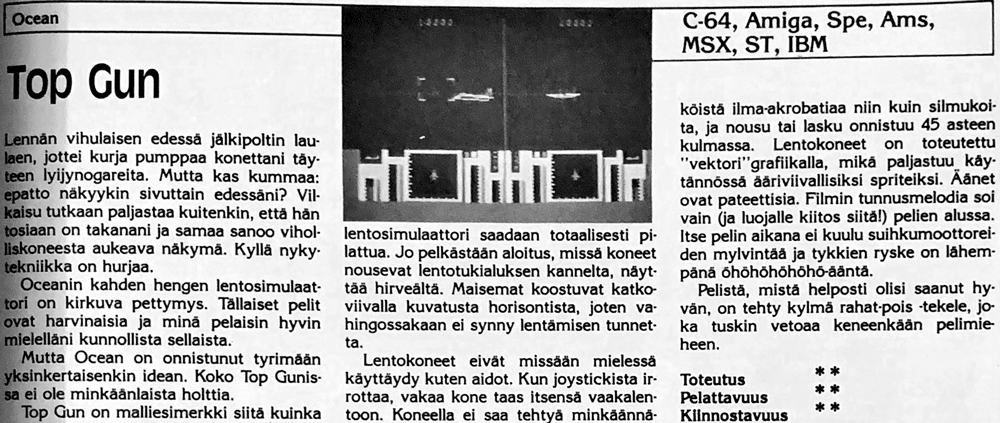
Top Gun1987Pysyvä linkkiLennän vihulaisen edessä jälkipoltin laulaen, jottei kurja pumppaa konettani täyteen lyijynogareita. Mutta kas kummaa: epatto näkyykin sivuttain edessäni? Vilkaisu tutkaan paljastaa kuitenkin, että hän tosiaan on takanani ja samaa sanoo vihollliskoneesta aukeava näkymä. Kyllä nykytekniikka on hurjaa.
Oceanin kahden hengen lentosimulaattori on kirkuva pettymys. Tällaiset pelit ovat harvinaisia ja minä pelaisin hyvin mielelläni kunnollista sellaista.
Mutta Ocean on onnistunut tyrimään yksinkertaisenkin idean. Koko Top Gunissa ei ole minkäänlaista holttia.
Top Gun on malliesimerkki siitä kuinka lentosimulaattori saadaan totaalisesti pilattua. Jo pelkästään aloitus, missä koneet nousevat lentotukialuksen kannelta, näyttää hirveältä. Maisemat koostuvat katkoviivalla kuvatusta horisontista, joten vahingossakaan ei synny lentämisen tunnetta.
Lentokoneet eivät missään mielessä käyttäydy kuten aidot. Kun joystickista irrottaa, vakaa kone taas itsensä vaakalentoon. Koneella ei saa tehtyä minkäännäköistä ilma-akrobatiaa niin kuin silmukoita, ja nousu tai lasku onnistuu 45 asteen kulmassa. Lentokoneet on toteutettu "vektori"grafiikalla, mikä paljastuu käytännössä ääriviivallisiksi spriteiksi. Äänet ovat pateettisia. Filmin tunnusmelodia soi vain (ja luojalle kiitos siitä!) pelien alussa. Itse pelin aikana ei kuulu suihkumoottoreiden mylvintää ja tykkien ryske on lähempänä öhöhöhöhöhö-ääntä.
Pelistä, mistä helposti olisi saanut hyvän, on tehty kylmä rahat-pois -tekele, joka tuskin vetoaa keneenkään pelimieheen.
Top Gun1987PermalinkI'm flying in front of the baddie, afterburner singing, so the wretch can't pump my plane full of lead cigarette butts. But what do you know: the scoundrel shows up side-on in front of me? A glance at the radar reveals, though, that the villain really is behind me, and the view from the enemy plane says the same. Modern technology sure is wild.
Ocean's two-player flight simulator is a screaming disappointment. Games like this are rare, and I would very much like to play a decent one.
But Ocean has managed to botch even a simple idea. There is no rhyme or reason whatsoever to the whole of Top Gun.
Top Gun is a textbook example of how to ruin a flight simulator completely. Even the opening alone, where the planes take off from the deck of an aircraft carrier, looks awful. The scenery consists of a horizon drawn as a dashed line, so not even by accident does any feeling of flight arise.
The planes don't behave like real ones in any sense. When you let go of the joystick, the plane steadies itself back into level flight. You can't do any kind of aerobatics with the plane, such as loops, and climbing or diving happens at a 45-degree angle. The planes are done in "vector" graphics, which in practice turn out to be outlined sprites. The sounds are pathetic. The film's theme tune plays only (and thank the Lord for that!) at the start of each game. During the game itself there is no roar of jet engines, and the rattle of the guns is closer to a huh-huh-huh-huh-huh-huh noise.
A game that could easily have been made into a good one has been turned into a cold cash-grab of a thing that is unlikely to appeal to any gamer.
Torvak the Warrior
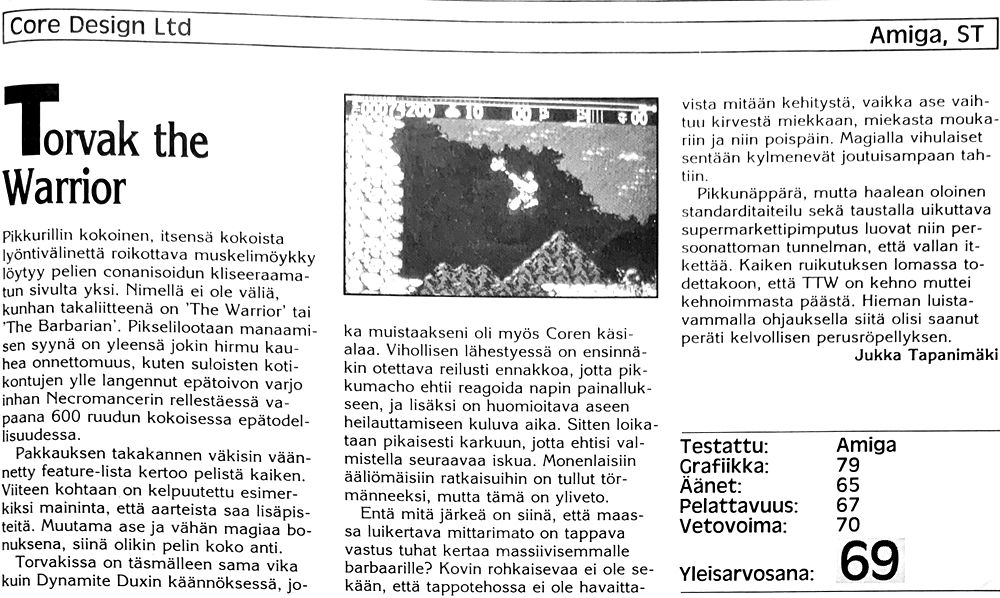
Torvak the Warrior1991 KevätPysyvä linkkiPikkurillin kokoinen, itsensä kokoista lyöntivälinettä roikottava muskelimöykky löytyy pelien conanisoidun kliseeraamatun sivulta yksi. Nimellä ei ole väliä, kunhan takaliitteenä on 'The Warrior' tai 'The Barbarian'. Pikselilootaan manaamisen syynä on yleensä jokin hirmu kauhea onnettomuus, kuten suloisten kotikontujen ylle langennut epätoivon varjo inhan Necromancerin rellestäessä vapaana 600 ruudun kokoisessa epätodellisuudessa.
Pakkauksen takakannen väkisin väännetty feature-lista kertoo pelistä kaiken. Viiteen kohtaan on kelpuutettu esimerkiksi maininta, että aarteista saa lisäpisteitä. Muutama ase ja vähän magiaa bonuksena, siinä olikin pelin koko anti.
Torvakissa on täsmälleen sama vika kuin Dynamite Duxin käännöksessä, joka muistaakseni oli myös Coren käsialaa. Vihollisen lähestyessä on ensinnäkin otettava reilusti ennakkoa, jotta pikkumacho ehtii reagoida napin painallukseen, ja lisäksi on huomioitava aseen heilauttamiseen kuluva aika. Sitten loikataan pikaisesti karkuun, jotta ehtisi valmistella seuraavaa iskua. Monenlaisiin ääliömäisiin ratkaisuihin on tullut törmänneeksi, mutta tämä on yliveto.
Entä mitä järkeä on siinä, että maassa luikertava mittarimato on tappava vastus tuhat kertaa massiivisemmalle barbaarille? Kovin rohkaisevaa ei ole sekään, että tappotehossa ei ole havaittavista mitään kehitystä, vaikka ase vaihtuu kirvestä miekkaan, miekasta moukariin ja niin poispäin. Magialla vihulaiset sentään kylmenevät joutuisampaan tahtiin.
Pikkunäppärä, mutta haalean oloinen standarditaiteilu sekä taustalla uikuttava supermarkettipimputus luovat niin persoonattoman tunnelman, että vallan itkettää. Kaiken ruikutuksen lomassa todettakoon, että TTW on kehno muttei kehnoimmasta päästä. Hieman luistavammalla ohjauksella siitä olisi saanut peräti kelvollisen perusröpellyksen.
Torvak the Warrior1991 KevätPermalinkThe little-finger-sized lump of muscle dangling a bludgeon as big as himself can be found on page one of gaming's Conanised cliché bible. The name doesn't matter, as long as it's followed by 'The Warrior' or 'The Barbarian'. The reason for conjuring him into the pixel box is usually some awfully terrible calamity, such as a shadow of despair falling over the sweet old homestead while the nasty Necromancer runs riot, loose in an unreality 600 screens in size.
The feature list forcibly wrung out on the back of the box tells you everything about the game. Deemed worthy of one of its five points, for example, is the mention that treasures earn you extra points. A few weapons and a bit of magic as a bonus, and that was the game's entire offering.
Torvak has exactly the same flaw as the conversion of Dynamite Dux, which if I remember rightly was also Core's handiwork. When an enemy approaches, you first have to act well in advance so that the little macho man has time to react to the button press, and on top of that you have to allow for the time it takes to swing the weapon. Then you hop swiftly out of the way so as to have time to wind up the next blow. I've run into all sorts of idiotic design decisions, but this one takes the cake.
And what sense is there in an inchworm wriggling along the ground being a deadly opponent for a barbarian a thousand times more massive? Not very encouraging either is the fact that there's no noticeable improvement in killing power, even though the weapon changes from axe to sword, from sword to sledgehammer and so forth. With magic the baddies do at least go cold at a brisker pace.
The neat-ish but lukewarm-feeling standard artwork, together with the supermarket plink-plonk whimpering away in the background, creates such a characterless atmosphere that it's enough to make you cry. Amid all this whining, let it be said that TTW is poor but not among the poorest. With slightly slicker controls it could even have made a decent basic bash-'em-up.
Total Eclipse
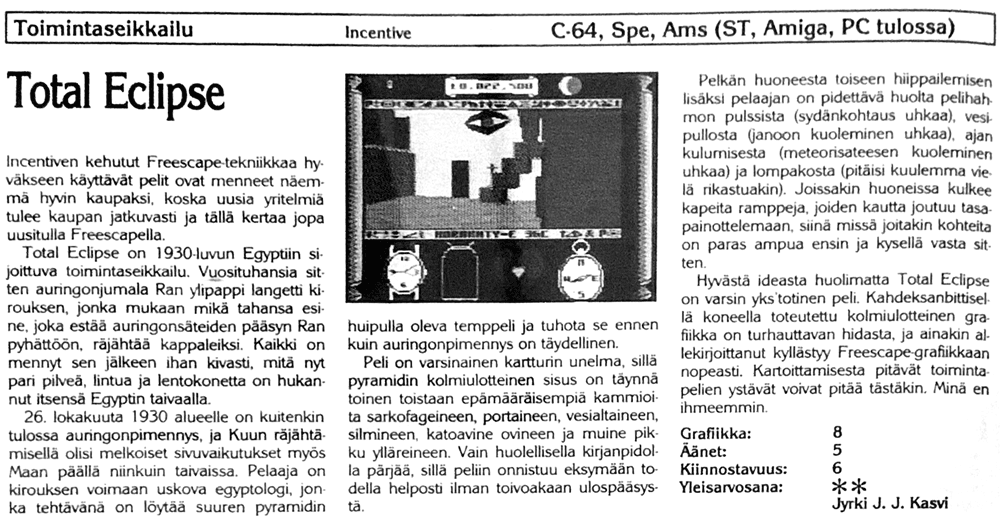
Total Eclipse1989 KevätPysyvä linkkiIncentiven kehutut Freescape-tekniikkaa hyväkseen käyttävät pelit ovat menneet näemmä hyvin kaupaksi, koska uusia yritelmiä tulee kaupan jatkuvasti ja tällä kertaa jopa uusitulla Freescapella.
Total Eclipse on 1930-luvun Egyptiin sijoittuva toimintaseikkailu. Vuosituhansia sitten auringonjumala Ran ylipappi langetti kirouksen, jonka mukaan mikä tahansa esine, joka estää auringonsäteiden pääsyn Ran pyhättöön, räjähtää kappaleiksi. Kaikki on mennyt sen jälkeen ihan kivasti, mitä nyt pari pilveä, lintua ja lentokonetta on hukannut itsensä Egyptin taivaalla.
26. lokakuuta 1930 alueelle on kuitenkin tulossa auringonpimennys, ja Kuun räjähtämisellä olisi melkoiset sivuvaikutukset myös Maan päällä niinkuin taivaissa. Pelaaja on kirouksen voimaan uskova egyptologi, jonka tehtävänä on löytää suuren pyramidin huipulla oleva temppeli ja tuhota se ennen kuin auringonpimennys on täydellinen.
Peli on varsinainen kartturin unelma, sillä pyramidin kolmiulotteinen sisus on täynnä toinen toistaan epämääräisempiä kammioita sarkofageineen, portaineen, vesialtaineen, silmineen, katoavine ovineen ja muine pikku ylläreineen. Vain huolellisella kirjanpidolla pärjää, sillä peliin onnistuu eksymään todella helposti ilman toivoakaan ulospääsystä.
Pelkän huoneesta toiseen hiippailemisen lisäksi pelaajan on pidettävä huolta pelihahmon pulssista (sydänkohtaus uhkaa), vesipullosta (janoon kuoleminen uhkaa), ajan kulumisesta (meteorisateeseen kuoleminen uhkaa) ja lompakosta (pitäisi kuulemma vielä rikastuakin). Joissakin huoneissa kulkee kapeita ramppeja, joiden kautta joutuu tasapainottelemaan, siinä missä joitakin kohteita on paras ampua ensin ja kysellä vasta sitten.
Hyvästä ideasta huolimatta Total Eclipse on varsin yks'totinen peli. Kahdeksanbittisellä koneella toteutettu kolmiulotteinen grafiikka on turhauttavan hidasta, ja ainakin allekirjoittanut kyllästyy Freescape-grafiikkaan nopeasti. Kartoittamisesta pitävät toimintapelien ystävät voivat pitää tästäkin. Minä en ihmeemmin.
Total Eclipse1989 KevätPermalinkIncentive's much-praised games making use of the Freescape technique have evidently sold well, since new efforts keep hitting the shops, and this time even with an overhauled Freescape.
Total Eclipse is an action adventure set in 1930s Egypt. Millennia ago the high priest of the sun god Ra laid down a curse under which any object that stops the sun's rays reaching Ra's shrine will be blown to pieces. Everything has gone along quite nicely since then, apart from a couple of clouds, birds and aeroplanes having lost themselves in the Egyptian sky.
On 26 October 1930, however, a solar eclipse is due over the area, and the Moon exploding would have quite some side effects, on Earth as it is in heaven. The player is an Egyptologist who believes in the power of the curse, and whose task is to find the temple at the top of the great pyramid and destroy it before the eclipse is total.
The game is a real mapper's dream, since the three-dimensional interior of the pyramid is full of chambers, each more nondescript than the last, complete with their sarcophagi, stairs, water basins, eyes, vanishing doors and other little surprises. Only careful bookkeeping will see you through, because it's really easy to get lost in the game without the faintest hope of finding a way out.
Besides simply sneaking from one room to the next, the player has to keep an eye on the character's pulse (a heart attack looms), water bottle (death by thirst looms), the passing of time (death by meteor shower looms) and wallet (apparently you're supposed to get rich as well). Some rooms have narrow ramps running through them that you have to balance your way across, while some targets are best shot first, with questions asked only afterwards.
Despite the good idea, Total Eclipse is a pretty monotonous game. Three-dimensional graphics done on an eight-bit machine are frustratingly slow, and the undersigned at least gets bored of Freescape graphics fast. Action game fans who like mapping may well like this one too. Me, not particularly.
Tower of Babel
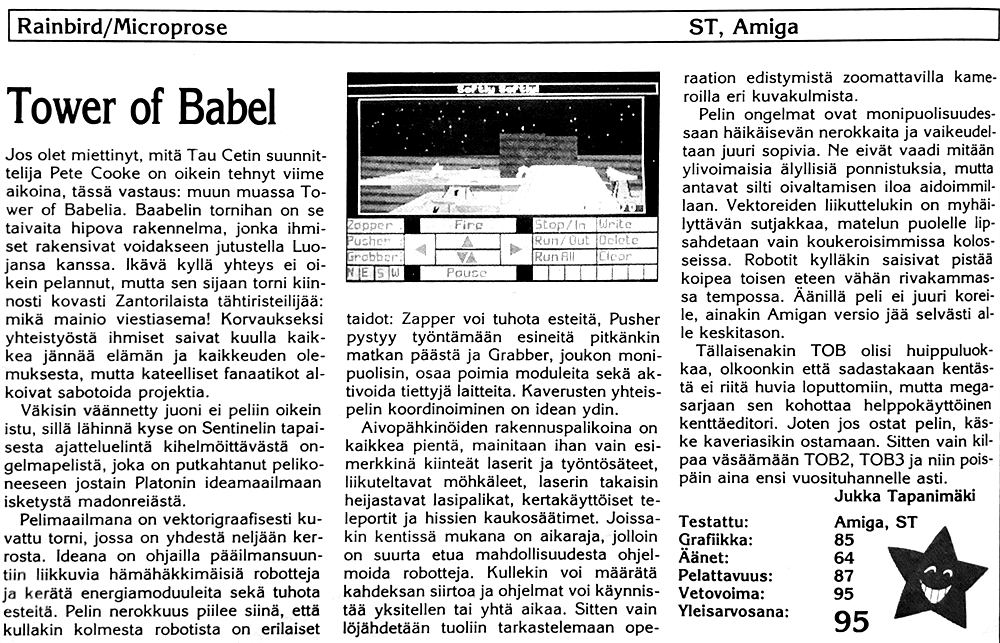
Tower of Babel1990 SyksyPysyvä linkkiJos olet miettinyt, mitä Tau Cetin suunnittelija Pete Cooke on oikein tehnyt viime aikoina, tässä vastaus: muun muassa Tower of Babelia. Baabelin tornihan on se taivaita hipova rakennelma, jonka ihmiset rakensivat voidakseen jutustella Luojansa kanssa. Ikävä kyllä yhteys ei oikein pelannut, mutta sen sijaan torni kiinnosti kovasti Zantorilaista tähtiristeilijää: mikä mainio viestiasema! Korvaukseksi yhteistyöstä ihmiset saivat kuulla kaikkea jännää elämän ja kaikkeuden olemuksesta, mutta kateelliset fanaatikot alkoivat sabotoida projektia.
Väkisin väännetty juoni ei peliin oikein istu, sillä lähinnä kyse on Sentinelin tapaisesta ajatteluelintä kihelmöittävästä ongelmapelistä, joka on putkahtanut pelikoneeseen jostain Platonin ideamaailmaan isketystä madonreiästä.
Pelimaailmana on vektorigraafisesti kuvattu torni, jossa on yhdestä neljään kerrosta. Ideana on ohjailla pääilmansuuntiin liikkuvia hämähäkkimäisiä robotteja ja kerätä energiamoduuleita sekä tuhota esteitä. Pelin nerokkuus piilee siinä, että kullakin kolmesta robotista on erilaiset taidot: Zapper voi tuhota esteitä, Pusher pystyy työntämään esineitä pitkänkin matkan päästä ja Grabber, joukon monipuolisin, osaa poimia moduleita sekä aktivoida tiettyjä laitteita. Kaverusten yhteispelin koordinoiminen on idean ydin.
Aivopähkinöiden rakennuspalikoina on kaikkea pientä, mainitaan ihan vain esimerkkinä kiinteät laserit ja työntösäteet, liikuteltavat möhkäleet, laserin takaisin heijastavat lasipalikat, kertakäyttöiset teleportit ja hissien kaukosäätimet. Joissakin kentissä mukana on aikaraja, jolloin on suurta etua mahdollisuudesta ohjelmoida robotteja. Kullekin voi määrätä kahdeksan siirtoa ja ohjelmat voi käynnistää yksitellen tai yhtä aikaa. Sitten vain löjähdetään tuoliin tarkastelemaan operaation edistymistä zoomattavilla kameroilla eri kuvakulmista.
Pelin ongelmat ovat monipuolisuudessaan häikäisevän nerokkaita ja vaikeudeltaan juuri sopivia. Ne eivät vaadi mitään ylivoimaisia älyllisiä ponnistuksia, mutta antavat silti oivaltamisen iloa aidoimmillaan. Vektoreiden liikuttelukin on myhäilyttävän sutjakkaa, matelun puolelle lipsahdetaan vain koukeroisimmissa kolosseissa. Robotit kylläkin saisivat pistää koipea toisen eteen vähän rivakammassa tempossa. Äänillä peli ei juuri koreile, ainakin Amigan versio jää selvästi alle keskitason.
Tällaisenakin TOB olisi huippuluokkaa, olkoonkin että sadastakaan kentästä ei riitä huvia loputtomiin, mutta megasarjaan sen kohottaa helppokäyttöinen kenttäeditori. Joten jos ostat pelin, käske kaveriasikin ostamaan. Sitten vain kilpaa väsäämään TOB2, TOB3 ja niin poispäin aina ensi vuosituhannelle asti.
Tower of Babel1990 SyksyPermalinkIf you've been wondering what Tau Ceti designer Pete Cooke has been up to lately, here's the answer: Tower of Babel, among other things. The Tower of Babel, as you'll know, is that heaven-grazing edifice people built so they could have a chat with their Creator. Sadly the line never really worked, but the tower did catch the keen interest of a Zantorian star cruiser: what a splendid relay station! In return for their cooperation the humans got to hear all sorts of exciting stuff about the nature of life and the universe, but jealous fanatics started sabotaging the project.
The shoehorned plot doesn't really suit the game, since what we have here is mostly a Sentinel-style puzzle game that sets the old thinking organ tingling, one that has popped into your games machine through some wormhole punched into Plato's world of ideas.
The game world is a tower drawn in vector graphics, with anywhere from one to four floors. The idea is to steer spider-like robots that move along the main compass directions, collecting energy modules and destroying obstacles. The genius of the game lies in the fact that each of the three robots has different skills: the Zapper can destroy obstacles, the Pusher can push objects even from a long way off, and the Grabber, the most versatile of the bunch, can pick up modules and activate certain devices. Coordinating the teamwork of the three pals is the heart of the idea.
The building blocks of the brainteasers include all sorts of little things; to mention just a few examples, fixed lasers and pusher beams, movable blocks, glass blocks that reflect lasers back, single-use teleporters and remote controls for lifts. Some levels have a time limit, and then the ability to program the robots is a big advantage. Each one can be given eight moves, and the programs can be started one at a time or all at once. Then you just flop back in your chair and watch the operation progress through zoomable cameras from different angles.
The game's puzzles are dazzlingly ingenious in their variety and just right in difficulty. They don't demand any superhuman feats of intellect, but they still deliver the joy of the eureka moment at its purest. Even the shifting of the vectors is grin-inducingly slick; only in the most convoluted colossi does it slip into a crawl. The robots could stand to put one pin in front of the other at a somewhat snappier pace, mind you. The game doesn't exactly show off in the sound department; the Amiga version at least falls clearly below average.
Even as it stands TOB would be top class, granted that not even a hundred levels will keep you amused forever, but what lifts it into the mega league is the easy-to-use level editor. So if you buy the game, tell your mate to buy it too. Then the two of you can race to knock together TOB2, TOB3 and so on, all the way into the next millennium.
Toyota Celica GT Rally
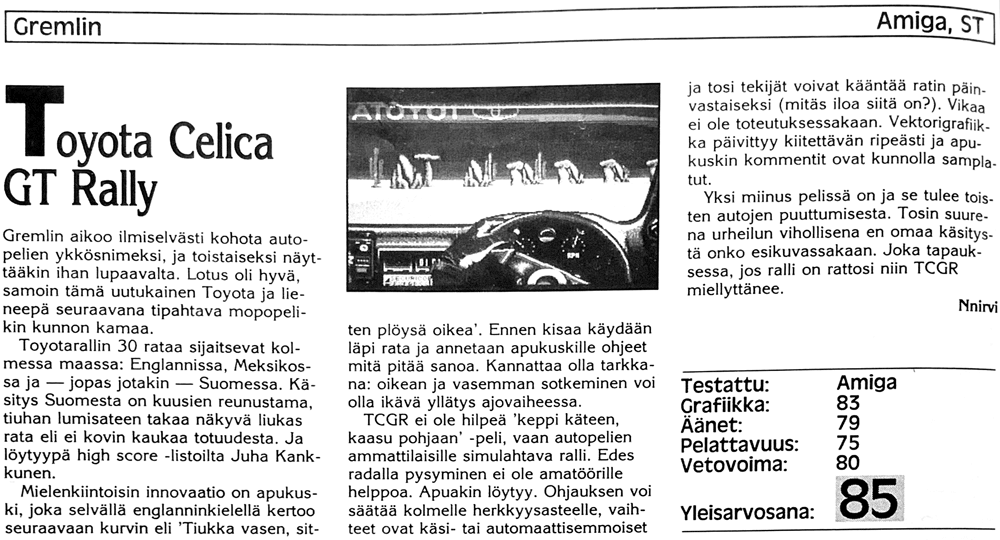
Toyota Celica GT Rally1991 KevätPysyvä linkkiGremlin aikoo ilmiselvästi kohota autopelien ykkösnimeksi, ja toistaiseksi näyttääkin ihan lupaavalta. Lotus oli hyvä, samoin tämä uutukainen Toyota ja lieneepä seuraavana tipahtava mopopelikin kunnon kamaa.
Toyotarallin 30 rataa sijaitsevat kolmessa maassa: Englannissa, Meksikossa ja - jopas jotakin - Suomessa. Käsitys Suomesta on kuusien reunustama, tiuhan lumisateen takaa näkyvä liukas rata eli ei kovin kaukaa totuudesta. Ja löytyypä high score -listoilta Juha Kankkunen.
Mielenkiintoisin innovaatio on apukuski, joka selvällä englanninkielellä kertoo seuraavaan kurvin eli 'Tiukka vasen, sitten plöysä oikea'. Ennen kisaa käydään läpi rata ja annetaan apukuskille ohjeet mitä pitää sanoa. Kannattaa olla tarkkana: oikean ja vasemman sotkeminen voi olla ikävä yllätys ajovaiheessa.
TCGR ei ole hilpeä 'keppi käteen, kaasu pohjaan' -peli, vaan autopelien ammattilaisille simulahtava ralli. Edes radalla pysyminen ei ole amatöörille helppoa. Apuakin löytyy. Ohjauksen voi säätää kolmelle herkkyysasteelle, vaihteet ovat käsi- tai automaattisemmoiset ja tosi tekijät voivat kääntää ratin päinvastaiseksi (mitäs iloa siitä on?). Vikaa ei ole toteutuksessakaan. Vektorigrafiikka päivittyy kiitettävän ripeästi ja apukuskin kommentit ovat kunnolla samplatut.
Yksi miinus pelissä on ja se tulee toisten autojen puuttumisesta. Tosin suurena urheilun vihollisena en omaa käsitystä onko esikuvassakaan. Joka tapauksessa, jos ralli on rattosi niin TCGR miellyttänee.
Toyota Celica GT Rally1991 KevätPermalinkGremlin is obviously aiming to become the number one name in car games, and so far it's looking pretty promising, too. Lotus was good, so is this brand-new Toyota, and presumably the moped game dropping next will be proper stuff as well.
The Toyota rally's 30 tracks are spread across three countries: England, Mexico and - well, what do you know - Finland. The picture of Finland is a slippery track lined with spruces and seen through thick falling snow, i.e. not very far from the truth. And Juha Kankkunen even turns up on the high score lists.
The most interesting innovation is the co-driver, who calls out the next bend in clear English, as in 'Tight left, then easy right'. Before the race you go through the track and give the co-driver instructions on what to say. It pays to be careful: mixing up right and left can make for a nasty surprise in the driving stage.
TCGR is no jolly 'stick in hand, foot to the floor' game but a simulation-style rally for car-game professionals. Even staying on the track isn't easy for an amateur. Help is at hand, too. The steering can be set to three levels of sensitivity, the gears come in manual or automatic sorts, and the real hotshots can reverse the steering wheel (what's the fun in that?). Nothing wrong with the implementation either. The vector graphics update commendably briskly and the co-driver's comments are properly sampled.
The game has one minus, and it comes from the absence of other cars. Then again, being a great enemy of sport, I have no idea whether the real thing has them either. In any case, if rallying is your cup of tea, TCGR ought to please.
Track & Field II
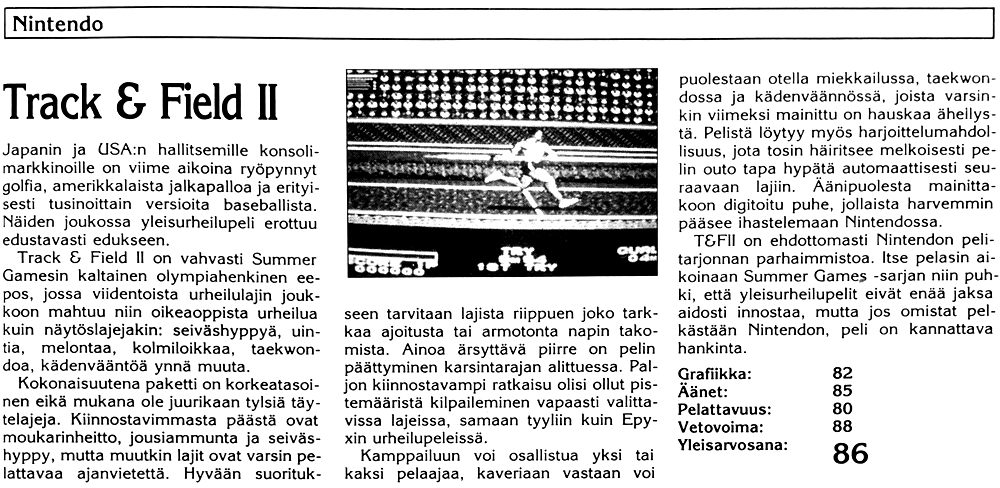
Track & Field II1990 SyksyPysyvä linkkiJapanin ja USA:n hallitsemille konsolimarkkinoille on viime aikoina ryöpynnyt golfia, amerikkalaista jalkapalloa ja erityisesti tusinoittain versioita baseballista. Näiden joukossa yleisurheilupeli erottuu edustavasti edukseen.
Track & Field II on vahvasti Summer Gamesin kaltainen olympiahenkinen eepos, jossa viidentoista urheilulajin joukkoon mahtuu niin oikeaoppista urheilua kuin näytöslajejakin: seiväshyppyä, uintia, melontaa, kolmiloikkaa, taekwondoa, kädenvääntöä ynnä muuta.
Kokonaisuutena paketti on korkeatasoinen eikä mukana ole juurikaan tylsiä täytelajeja. Kiinnostavimmasta päästä ovat moukarinheitto, jousiammunta ja seiväshyppy, mutta muutkin lajit ovat varsin pelattavaa ajanvietettä. Hyvään suoritukseen tarvitaan lajista riippuen joko tarkkaa ajoitusta tai armotonta napin takomista. Ainoa ärsyttävä piirre on pelin päättyminen karsintarajan alittuessa. Paljon kiinnostavampi ratkaisu olisi ollut pistemääristä kilpaileminen vapaasti valittavissa lajeissa, samaan tyyliin kuin Epyxin urheilupeleissä.
Kamppailuun voi osallistua yksi tai kaksi pelaajaa, kaveriaan vastaan voi puolestaan otella miekkailussa, taekwondossa ja kädenväännössä, joista varsinkin viimeksi mainittu on hauskaa ähellystä. Pelistä löytyy myös harjoittelumahdollisuus, jota tosin häiritsee melkoisesti pelin outo tapa hypätä automaattisesti seuraavaan lajiin. Äänipuolesta mainittakoon digitoitu puhe, jollaista harvemmin pääsee ihastelemaan Nintendossa.
T&FII on ehdottomasti Nintendon pelitarjonnan parhaimmistoa. Itse pelasin aikoinaan Summer Games -sarjan niin puhki, että yleisurheilupelit eivät enää jaksa aidosti innostaa, mutta jos omistat pelkästään Nintendon, peli on kannattava hankinta.
Track & Field II1990 SyksyPermalinkThe console market, ruled by Japan and the USA, has lately been deluged with golf, American football and, above all, versions of baseball by the dozen. Among these a track-and-field game stands out splendidly from the crowd.
Track & Field II is an Olympic-spirited epic very much along the lines of Summer Games, and its fifteen events have room for proper sport and demonstration events alike: pole vault, swimming, canoeing, triple jump, taekwondo, arm wrestling and so on.
As a whole the package is of high quality, with hardly any dull filler events. Among the most interesting are the hammer throw, archery and pole vault, but the other events are pretty playable entertainment too. Depending on the event, a good performance calls for either precise timing or merciless button-bashing. The only irritating feature is that the game ends when you fall short of the qualifying mark. A much more interesting solution would have been competing for points in freely chosen events, in the same style as Epyx's sports games.
One or two players can take part in the contest, and you can go head to head with a friend in fencing, taekwondo and arm wrestling, the last of which in particular is a fun bit of grunting and straining. The game also has a practice option, although it is spoiled rather badly by the game's odd habit of jumping automatically to the next event. On the sound side, a mention goes to the digitised speech, the like of which you don't often get to marvel at on the Nintendo.
T&FII is definitely among the best the Nintendo has to offer. I myself played the Summer Games series to death back in the day, so track-and-field games no longer really get me going, but if the Nintendo is all you own, the game is a worthwhile buy.
Tracker
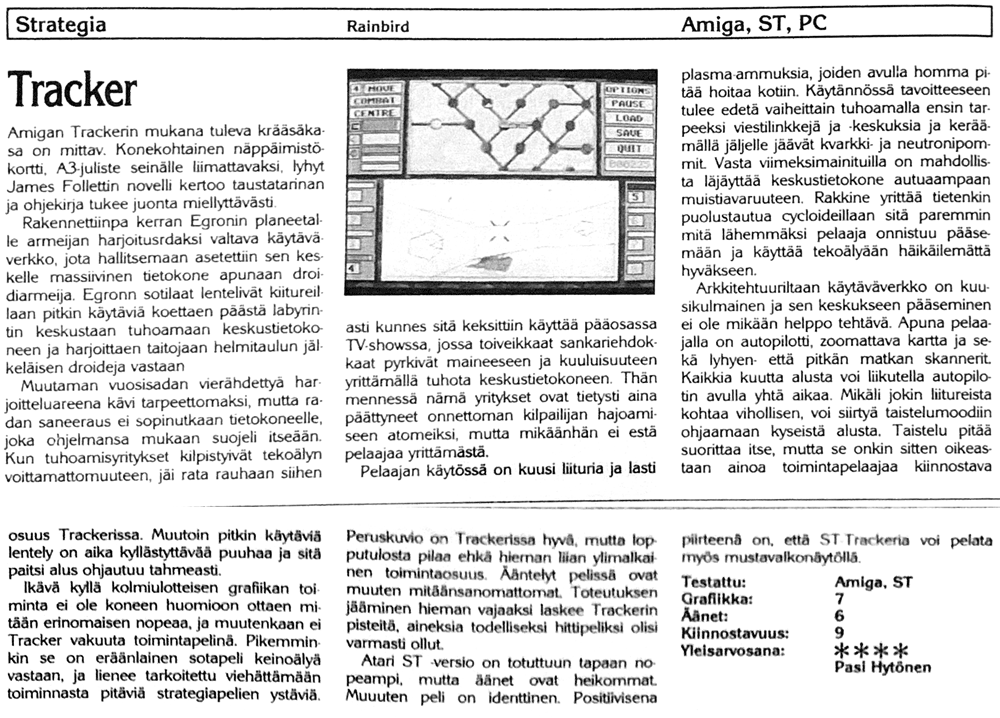
Tracker1989 KevätPysyvä linkkiAmigan Trackerin mukana tuleva krääsäkasa on mittav. Konekohtainen näppäimistökortti, A3-juliste seinälle liimattavaksi, lyhyt James Follettin novelli kertoo taustatarinan ja ohjekirja tukee juonta miellyttävästi.
Rakennettiinpa kerran Egronin planeetalle armeijan harjoitusrdaksi valtava käytäväverkko, jota hallitsemaan asetettiin sen keskelle massiivinen tietokone apunaan droidiarmeija. Egronn sotilaat lentelivät kiitureillaan pitkin käytäviä koettaen päästä labyrintin keskustaan tuhoamaan keskustietokoneen ja harjoittaen taitojaan helmitaulun jälkeläisen droideja vastaan
Muutaman vuosisadan vierähdettyä harjoitteluareena kävi tarpeettomaksi, mutta radan saneeraus ei sopinutkaan tietokoneelle, joka ohjelmansa mukaan suojeli itseään. Kun tuhoamisyritykset kilpistyivät tekoälyn voittamattomuuteen, jäi rata rauhaan siihen asti kunnes sitä keksittiin käyttää pääosassa TV-showssa, jossa toiveikkaat sankariehdokkaat pyrkivät maineeseen ja kuuluisuuteen yrittämällä tuhota keskustietokoneen. Thän mennessä nämä yritykset ovat tietysti aina päättyneet onnettoman kilpailijan hajoamiseen atomeiksi, mutta mikäänhän ei estä pelaajaa yrittämästä.
Pelaajan käytössä on kuusi liituria ja lasti plasma-ammuksia, joiden avulla homma pitää hoitaa kotiin. Käytännössä tavoitteeseen tulee edetä vaiheittain tuhoamalla ensin tarpeeksi viestilinkkejä ja -keskuksia ja keräämällä jäljelle jäävät kvarkki- ja neutronipommit. Vasta viimeksimainituilla on mahdollista läjäyttää keskustietokone autuaampaan muistiavaruuteen. Rakkine yrittää tietenkin puolustautua cycloideillaan sitä paremmin mitä lähemmäksi pelaaja onnistuu pääsemään ja käyttää tekoälyään häikäilemättä hyväkseen.
Arkkitehtuuriltaan käytäväverkko on kuusikulmainen ja sen keskukseen pääseminen ei ole mikään helppo tehtävä. Apuna pelaajalla on autopilotti, zoomattava kartta ja sekä lyhyen- että pitkän matkan skannerit. Kaikkia kuutta alusta voi liikutella autopilotin avulla yhtä aikaa. Mikäli jokin liitureista kohtaa vihollisen, voi siirtyä taistelumoodiin ohjaamaan kyseistä alusta. Taistelu pitää suorittaa itse, mutta se onkin sitten oikeastaan ainoa toimintapelaajaa kiinnostava osuus Trackerissa. Muutoin pitkin käytäviä lentely on aika kyllästyttävää puuhaa ja sitä paitsi alus ohjautuu tahmeasti.
Ikävä kyllä kolmiulotteisen grafiikan toiminta ei ole koneen huomioon ottaen mitään erinomaisen nopeaa, ja muutenkaan ei Tracker vakuuta toimintapelinä. Pikemminkin se on eräänlainen sotapeli keinoälyä vastaan, ja lienee tarkoitettu viehättämään toiminnasta pitäviä strategiapelien ystäviä.
Peruskuvio on Trackerissa hyvä, mutta lopputulosta pilaa ehkä hieman liian ylimalkainen toimintaosuus. Ääntelyt pelissä ovat muuten mitäänsanomattomat. Toteutuksen jääminen hieman vajaaksi laskee Trackerin pisteitä, aineksia todelliseksi hittipeliksi olisi varmasti ollut.
Atari ST -versio on totuttuun tapaan nopeampi, mutta äänet ovat heikommat. Muuten peli on identtinen. Positiivisena piirteenä on, että ST-Trackeria voi pelata myös mustavalkonäytöllä.
Tracker1989 KevätPermalinkThe heap of swag that comes with Amiga Tracker is a hefty one. A machine-specific keyboard card, an A3 poster to glue on your wall, a short story by James Follett that tells the backstory, and a manual that backs up the plot nicely.
Once upon a time, a vast network of corridors was built on the planet Egron as a training course for the army, and a massive computer was installed at its centre to run it, with an army of droids to help. The soldiers of Egronn flew up and down the corridors in their speeders, trying to reach the centre of the labyrinth to destroy the central computer and honing their skills against the droids of the abacus's descendant.
After a few centuries had rolled by, the training arena became redundant, but having the course redeveloped didn't suit the computer, which, as its program dictated, protected itself. When the attempts to destroy it foundered on the invincibility of the artificial intelligence, the course was left in peace until someone hit on the idea of giving it the starring role in a TV show in which hopeful would-be heroes seek fame and glory by trying to destroy the central computer. So far these attempts have, of course, always ended with the unfortunate contestant being broken down into atoms, but then nothing stops the player from having a go.
The player has six gliders and a load of plasma rounds at their disposal, with which the job has to be brought home. In practice you have to work towards the goal in stages, first destroying enough communication links and centres and collecting the quark and neutron bombs left behind. Only with the latter is it possible to blast the central computer off to a better memory space. The contraption naturally tries to defend itself with its cycloids, all the harder the closer the player manages to get, and makes ruthless use of its artificial intelligence.
Architecturally the corridor network is hexagonal, and reaching its centre is no easy task. To help, the player has an autopilot, a zoomable map and both short- and long-range scanners. All six craft can be moved at the same time using the autopilot. If one of the gliders meets an enemy, you can switch to combat mode to control the craft in question. The fighting you have to do yourself, but then that's really the only part of Tracker that will interest an action player. Otherwise, flying along the corridors is pretty tedious work, and on top of that the craft's steering is sticky.
Unfortunately, considering the machine, the 3D graphics are nothing exceptionally fast, and Tracker doesn't convince as an action game in other respects either. Rather, it is a kind of war game against an artificial intelligence, and is presumably meant to appeal to strategy fans who like a bit of action.
The basic pattern of Tracker is good, but the end result is spoiled by an action section that is perhaps a little too sketchy. The noises in the game are, incidentally, nondescript. Execution that falls slightly short lowers Tracker's score; the ingredients for a real hit were certainly there.
As usual, the Atari ST version is faster, but the sound is weaker. Otherwise the game is identical. On the plus side, ST Tracker can also be played on a monochrome monitor.
Train, The
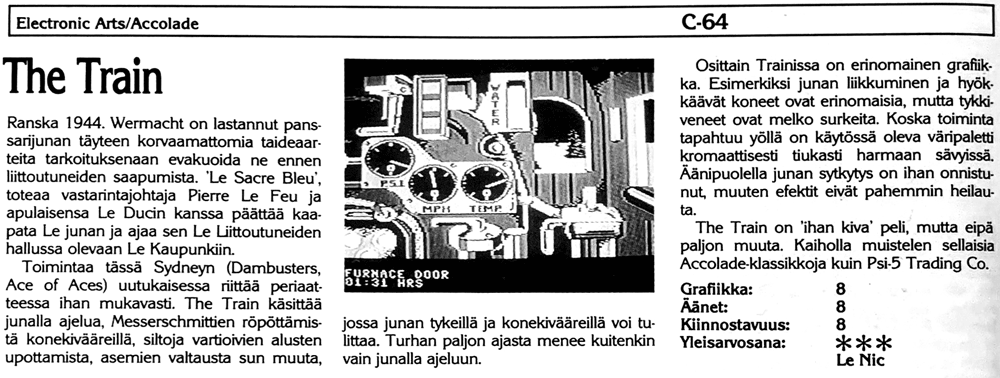
Train, The1988Pysyvä linkkiRanska 1944. Wermacht on lastannut panssarijunan täyteen korvaamattomia taideaarteita tarkoituksenaan evakuoida ne ennen liittoutuneiden saapumista. 'Le Sacre Bleu', toteaa vastarintajohtaja Pierre Le Feu ja apulaisensa Le Ducin kanssa päättää kaapata Le junan ja ajaa sen Le Liittoutuneiden hallussa olevaan Le Kaupunkiin.
Toimintaa tässä Sydneyn (Dambusters, Ace of Aces) uutukaisessa riittää periaatteessa ihan mukavasti. The Train käsittää junalla ajelua, Messerschmittien röpöttämistä konekivääreillä, siltoja vartioivien alusten upottamista, asemien valtausta sun muuta, jossa junan tykeillä ja konekivääreillä voi tulittaa. Turhan paljon ajasta menee kuitenkin vain junalla ajeluun.
Osittain Trainissa on erinomainen grafiikka. Esimerkiksi junan liikkuminen ja hyökkäävät koneet ovat erinomaisia, mutta tykkiveneet ovat melko surkeita. Koska toiminta tapahtuu yöllä on käytössä oleva väripaletti kromaattisesti tiukasti harmaan sävyissä. Äänipuolella junan sytkytys on ihan onnistunut, muuten efektit eivät pahemmin heilauta.
The Train on 'ihan kiva' peli, mutta eipä paljon muuta. Kaiholla muistelen sellaisia Accolade-klassikkoja kuin Psi-5 Trading Co.
Train, The1988PermalinkFrance, 1944. The Wermacht has loaded an armoured train full of irreplaceable art treasures, intending to evacuate them before the Allies arrive. 'Le Sacre Bleu', declares resistance leader Pierre Le Feu, and together with assistant Le Duc decides to hijack Le train and drive it to Le Town held by Le Allies.
In principle there's a nice enough amount of action in this brand-new release from Sydney (Dambusters, Ace of Aces). The Train involves riding around on the train, rat-a-tatting Messerschmitts with machine guns, sinking boats that guard bridges, capturing stations and whatnot, where you get to fire away with the train's cannons and machine guns. Far too much of the time, though, goes on just riding the train.
In places, Train has excellent graphics. The movement of the train and the attacking planes, for example, are excellent, but the gunboats are pretty pathetic. Since the action takes place at night, the palette in use is chromatically confined strictly to shades of grey. On the sound side, the clickety-clack of the train comes off quite well; otherwise the effects don't exactly sweep you off your feet.
The Train is a 'nice enough' game, but not much more than that. I think back wistfully on such Accolade classics as Psi-5 Trading Co.
Trantor - The Last Stormtrooper
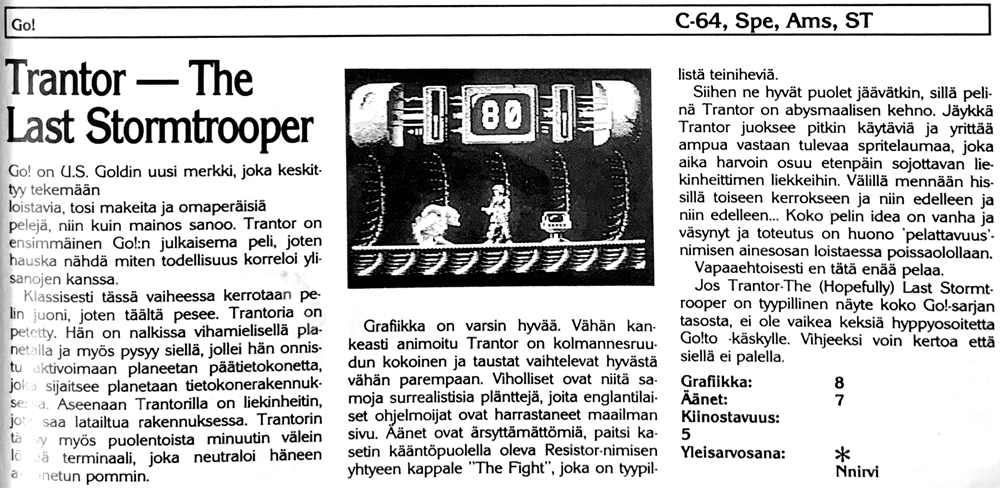
Trantor - The Last Stormtrooper1988Pysyvä linkkiGo! on U.S. Goldin uusi merkki, joka keskittyy tekemään loistavia, tosi makeita ja omaperäisiä pelejä, niin kuin mainos sanoo. Trantor on ensimmäinen Go!:n julkaisema peli, joten hauska nähdä miten todellisuus korreloi ylisanojen kanssa.
Klassisesti tässä vaiheessa kerrotaan pelin juoni, joten täältä pesee. Trantoria on petetty. Hän on nalkissa vihamielisellä planetalla ja myös pysyy siellä, jollei hän onnistu aktivoimaan planeetan päätietokonetta, joka sijaitsee planetaan tietokonerakennuksessa. Aseenaan Trantorilla on liekinheitin, jota saa latailtua rakennuksessa. Trantorin täytyy myös puolentoista minuutin välein löytää terminaali, joka neutraloi häneen asennetun pommin.
Grafiikka on varsin hyvää. Vähän kankeasti animoitu Trantor on kolmannesruudun kokoinen ja taustat vaihtelevat hyvästä vähän parempaan. Viholliset ovat niitä samoja surrealistisia plänttejä, joita englantilaiset ohjelmoijat ovat harrastaneet maailman sivu. Äänet ovat ärsyttämättömiä, paitsi kasetin kääntöpuolella oleva Resistor-nimisen yhtyeen kappale "The Fight", joka on tyypillistä teiniheviä.
Siihen ne hyvät puolet jäävätkin, sillä pelinä Trantor on abysmaalisen kehno. Jäykkä Trantor juoksee pitkin käytäviä ja yrittää ampua vastaan tulevaa spritelaumaa, joka aika harvoin osuu etenpäin sojottavan liekinheittimen liekkeihin. Välillä mennään hissillä toiseen kerrokseen ja niin edelleen ja niin edelleen... Koko pelin idea on vanha ja väsynyt ja toteutus on huono 'pelattavuus'-nimisen ainesosan loistaessa poissaolollaan.
Vapaaehtoisesti en tätä enää pelaa.
Jos Trantor-The (Hopefully) Last Stormtrooper on tyypillinen näyte koko Go!-sarjan tasosta, ei ole vaikea keksiä hyppyosoitetta Go!to -käskylle. Vihjeeksi voin kertoa että siellä ei palella.
Trantor - The Last Stormtrooper1988PermalinkGo! is U.S. Gold's new label, which concentrates on making brilliant, really cool and original games, as the advert says. Trantor is the first game released by Go!, so it'll be fun to see how reality correlates with the superlatives.
Classically, this is the point where the plot of the game gets told, so here goes. Trantor has been betrayed. He is stuck on a hostile planet and will stay there, too, unless he manages to activate the planet's main computer, which is located in the planet's computer building. For a weapon Trantor has a flamethrower, which can be topped up inside the building. Every minute and a half Trantor also has to find a terminal that neutralises the bomb implanted in him.
The graphics are pretty good. The somewhat stiffly animated Trantor is a third of the screen tall, and the backgrounds range from good to a bit better. The enemies are those same surreal blobs that English programmers have been going in for since the dawn of time. The sounds are non-irritating, except for the track "The Fight" by a band called Resistor on the flip side of the cassette, which is typical teenage metal.
And that's where the good points end, because as a game Trantor is abysmally lousy. The stiff Trantor runs along corridors trying to shoot the swarm of sprites coming at him, which quite rarely ends up in the flames of the flamethrower jutting out in front of him. Every now and then you take a lift to another floor, and so on and so on... The whole idea of the game is old and tired, and the execution is poor, with the ingredient called 'playability' conspicuous by its absence.
I won't be playing this again of my own free will.
If Trantor-The (Hopefully) Last Stormtrooper is a typical sample of the standard of the whole Go! range, it's not hard to come up with a jump address for the Go!to command. As a hint, I can tell you that nobody feels the cold there.
Trapdoor
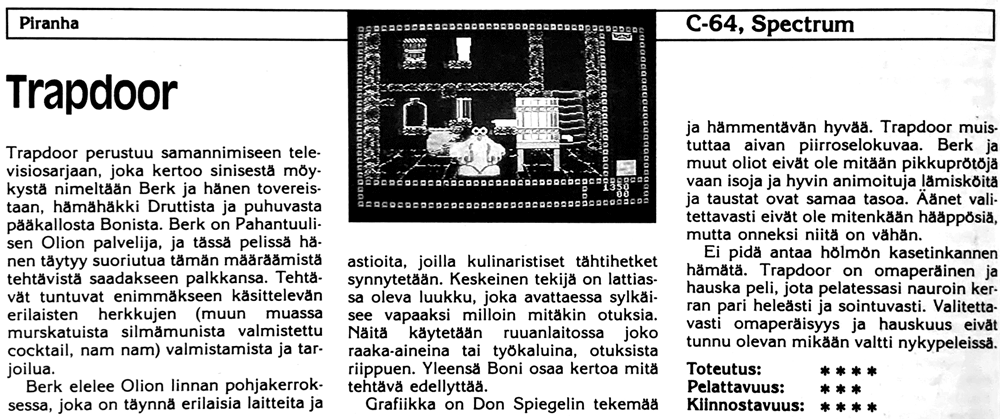
Trapdoor1987Pysyvä linkkiTrapdoor perustuu samannimiseen televisiosarjaan, joka kertoo sinisestä möykystä nimeltään Berk ja hänen tovereistaan, hämähäkki Druttista ja puhuvasta pääkallosta Bonista. Berk on Pahantuulisen Olion palvelija, ja tässä pelissä hänen täytyy suoriutua tämän määräämistä tehtävistä saadakseen palkkansa. Tehtävät tuntuvat enimmäkseen käsittelevän erilaisten herkkujen (muun muassa murskatuista silmämunista valmistettu cocktail, nam nam) valmistamista ja tarjoilua.
Berk elelee Olion linnan pohjakerroksessa, joka on täynnä erilaisia laitteita ja astioita, joilla kulinaristiset tähtihetket synnytetään. Keskeinen tekijä on lattiassa oleva luukku, joka avattaessa sylkäisee vapaaksi milloin mitäkin otuksia. Näitä käytetään ruuanlaitossa joko raaka-aineina tai työkaluina, otuksista riippuen. Yleensä Boni osaa kertoa mitä tehtävä edellyttää.
Grafiikka on Don Spiegelin tekemää ja hämmentävän hyvää. Trapdoor muistuttaa aivan piirroselokuvaa. Berk ja muut oliot eivät ole mitään pikkuprötöjä vaan isoja ja hyvin animoituja lämisköitä ja taustat ovat samaa tasoa. Äänet valitettavasti eivät ole mitenkään hääppösiä, mutta onneksi niitä on vähän.
Ei pidä antaa hölmön kasetinkannen hämätä. Trapdoor on omaperäinen ja hauska peli, jota pelatessasi nauroin kerran pari heleästi ja sointuvasti. Valitettavasti omaperäisyys ja hauskuus eivät tunnu olevan mikään valtti nykypeleissä.
Trapdoor1987PermalinkTrapdoor is based on the television series of the same name, which tells of a blue blob called Berk and his companions, Drutt the spider and Boni the talking skull. Berk is the servant of the Bad-Tempered Thing, and in this game he has to get through the tasks it sets him in order to earn his wages. The tasks mostly seem to be about preparing and serving various delicacies (among them a cocktail made of crushed eyeballs, yum yum).
Berk lives out his days on the bottom floor of the Thing's castle, which is full of all kinds of appliances and pots with which culinary moments of glory are brought into the world. The key feature is the trapdoor in the floor, which, when opened, spits out creatures of one sort or another. These are used in the cooking either as ingredients or as tools, depending on the creature. Boni can usually tell you what a task requires.
The graphics are by Don Spiegel, and they're bafflingly good. Trapdoor looks just like a cartoon film. Berk and the other creatures aren't piddly little specks but big, well-animated wobbly lumps, and the backgrounds are of the same standard. The sound, unfortunately, is nothing to write home about, but luckily there isn't much of it.
Don't let the silly cassette cover fool you. Trapdoor is an original and funny game, and while playing it I laughed a clear, melodious laugh once or twice. Unfortunately, originality and fun don't seem to be much of a trump card in today's games.
TRAZ
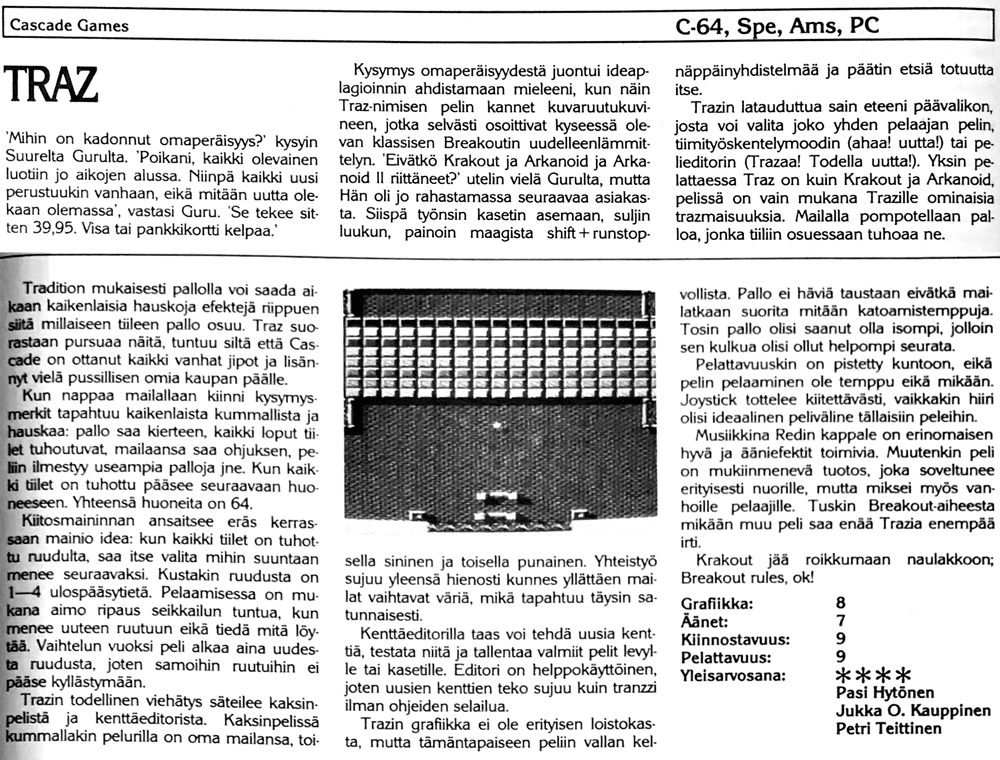
TRAZ1988Pysyvä linkki'Mihin on kadonnut omaperäisyys?' kysyin Suurelta Gurulta. 'Poikani, kaikki olevainen luotiin jo aikojen alussa. Niinpä kaikki uusi perustuukin vanhaan, eikä mitään uutta olekaan olemassa', vastasi Guru. 'Se tekee sitten 39,95. Visa tai pankkikortti kelpaa.'
Kysymys omaperäisyydestä juontui ideaplagioinnin ahdistamaan mieleeni, kun näin Traz-nimisen pelin kannet kuvaruutukuvineen, jotka selvästi osoittivat kyseessä olevan klassisen Breakoutin uudelleenlämmittelyn. 'Eivätkö Krakout ja Arkanoid ja Arkanoid II riittäneet?' utelin vielä Gurulta, mutta Hän oli jo rahastamassa seuraavaa asiakasta. Siispä työnsin kasetin asemaan, suljin luukun, painoin maagista shift+runstop-näppäinyhdistelmää ja päätin etsiä totuutta itse.
Trazin latauduttua sain eteeni päävalikon, josta voi valita joko yhden pelaajan pelin, tiimityöskentelymoodin (ahaa! uutta!) tai pelieditorin (Trazaa! Todella uutta!). Yksin pelattaessa Traz on kuin Krakout ja Arkanoid, pelissä on vain mukana Trazille ominaisia trazmaisuuksia. Mailalla pompotellaan palloa, jonka tiiliin osuessaan tuhoaa ne. Tradition mukaisesti pallolla voi saada aikaan kaikenlaisia hauskoja efektejä riippuen siitä millaiseen tiileen pallo osuu. Traz suorastaan pursuaa näitä, tuntuu siltä että Cascade on ottanut kaikki vanhat jipot ja lisännyt vielä pussillisen omia kaupan päälle.
Kun nappaa mailallaan kiinni kysymysmerkit tapahtuu kaikenlaista kummallista ja hauskaa: pallo saa kierteen, kaikki loput tiilet tuhoutuvat, mailaansa saa ohjuksen, peliin ilmestyy useampia palloja jne. Kun kaikki tiilet on tuhottu pääsee seuraavaan huoneeseen. Yhteensä huoneita on 64.
Kiitosmaininnan ansaitsee eräs kerrassaan mainio idea: kun kaikki tiilet on tuhottu ruudulta, saa itse valita mihin suuntaan menee seuraavaksi. Kustakin ruudusta on 1-4 ulospääsytietä. Pelaamisessa on mukana aimo ripaus seikkailun tuntua, kun menee uuteen ruutuun eikä tiedä mitä löytää. Vaihtelun vuoksi peli alkaa aina uudesta ruudusta, joten samoihin ruutuihin ei pääse kyllästymään.
Trazin todellinen viehätys säteilee kaksinpelistä ja kenttäeditorista. Kaksinpelissä kummallakin pelurilla on oma mailansa, toisella sininen ja toisella punainen. Yhteistyö sujuu yleensä hienosti kunnes yllättäen mailat vaihtavat väriä, mikä tapahtuu täysin satunnaisesti.
Kenttäeditorilla taas voi tehdä uusia kenttiä, testata niitä ja tallentaa valmiit pelit levylle tai kasetille. Editori on helppokäyttöinen, joten uusien kenttien teko sujuu kuin tranzzi ilman ohjeiden selailua.
Trazin grafiikka ei ole erityisen loistokasta, mutta tämäntapaiseen peliin vallan kelvollista. Pallo ei häviä taustaan eivätkä mailatkaan suorita mitään katoamistemppuja. Tosin pallo olisi saanut olla isompi, jolloin sen kulkua olisi ollut helpompi seurata.
Pelattavuuskin on pistetty kuntoon, eikä pelin pelaaminen ole temppu eikä mikään. Joystick tottelee kiitettävästi, vaikkakin hiiri olisi ideaalinen peliväline tällaisiin peleihin.
Musiikkina Redin kappale on erinomaisen hyvä ja ääniefektit toimivia. Muutenkin peli on mukiinmenevä tuotos, joka soveltunee erityisesti nuorille, mutta miksei myös vanhoille pelaajille. Tuskin Breakout-aiheesta mikään muu peli saa enää Trazia enempää irti.
Krakout jää roikkumaan naulakkoon; Breakout rules, ok!
TRAZ1988Permalink'Where has originality gone?' I asked the Great Guru. 'My son, all that is was created at the beginning of time. And so everything new is based on the old, and nothing new exists at all,' answered the Guru. 'That'll be 39.95, then. Visa or bank card accepted.'
The question of originality arose in my mind, harried as it is by the plagiarism of ideas, when I saw the cover of a game called Traz, complete with screenshots that clearly showed this was a warmed-up rehash of the classic Breakout. 'Weren't Krakout and Arkanoid and Arkanoid II enough?' I pressed the Guru further, but He was already busy fleecing the next customer. So I pushed the cassette into the drive, closed the lid, pressed the magic shift+runstop key combination and decided to seek the truth myself.
Once Traz had loaded I was greeted by the main menu, from which you can choose either a one-player game, a teamwork mode (aha! new!) or a game editor (Trazaa! Really new!). Played solo, Traz is like Krakout and Arkanoid, only with the Trazzy touches characteristic of Traz thrown in. You bounce a ball about with a bat, and when the ball hits the bricks it destroys them. In keeping with tradition, the ball can set off all sorts of fun effects depending on what kind of brick it hits. Traz positively overflows with these; it feels as if Cascade has taken all the old tricks and thrown in a bagful of its own into the bargain.
When you catch the question marks with your bat, all sorts of strange and fun things happen: the ball gets spin, all the remaining bricks are destroyed, your bat gets a missile, several balls appear in the game, etc. When all the bricks have been destroyed you get to the next room. There are 64 rooms in all.
One downright splendid idea deserves an honourable mention: when all the bricks on a screen have been destroyed, you get to choose for yourself which direction to go next. Each screen has 1-4 exits. The playing has a generous dash of adventure to it, as you go into a new screen not knowing what you'll find. For variety's sake the game always starts on a different screen, so you never get the chance to grow tired of the same screens.
Traz's real charm radiates from the two-player game and the level editor. In the two-player game each player has their own bat, one blue and the other red. The cooperation usually goes splendidly until the bats suddenly swap colours, which happens completely at random.
With the level editor, on the other hand, you can make new levels, test them and save the finished games to disk or cassette. The editor is easy to use, so making new levels goes like a dream without any leafing through the instructions.
Traz's graphics are not especially splendid, but perfectly passable for a game of this kind. The ball doesn't vanish into the background, and the bats don't perform any disappearing acts either. Admittedly the ball could have been bigger, which would have made its path easier to follow.
The playability has been sorted out too, and playing the game is no trick at all. The joystick obeys admirably, although a mouse would be the ideal controller for games like this.
As for music, Red's tune is exceedingly good and the sound effects do the job. In other respects too the game is a decent effort, likely to suit young players in particular, but why not old ones as well. Hardly any other game is going to squeeze more out of the Breakout theme than Traz.
Krakout can stay hanging on its peg; Breakout rules, ok!
Treasure Trap
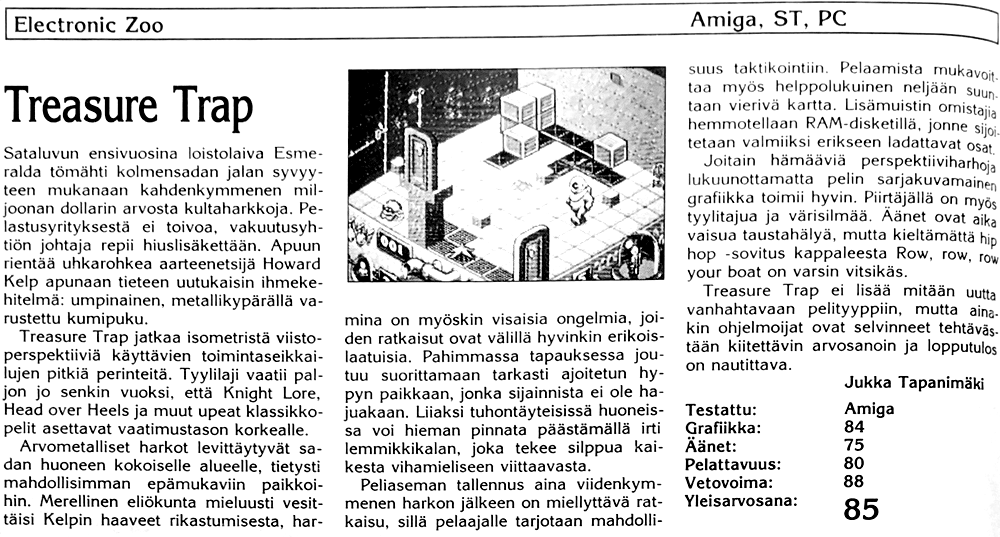
Treasure Trap1990 SyksyPysyvä linkkiSataluvun ensivuosina loistolaiva Esmeralda tömähti kolmensadan jalan syvyyteen mukanaan kahdenkymmenen miljoonan dollarin arvosta kultaharkkoja. Pelastusyrityksestä ei toivoa, vakuutusyhtiön johtaja repii hiuslisäkettään. Apuun rientää uhkarohkea aarteenetsijä Howard Kelp apunaan tieteen uutukaisin ihmekehitelmä: umpinainen, metallikypärällä varustettu kumipuku.
Treasure Trap jatkaa isometristä viistoperspektiiviä käyttävien toimintaseikkailujen pitkiä perinteitä. Tyylilaji vaatii paljon jo senkin vuoksi, että Knight Lore, Head over Heels ja muut upeat klassikkopelit asettavat vaatimustason korkealle.
Arvometalliset harkot levittäytyvät sadan huoneen kokoiselle alueelle, tietysti mahdollisimman epämukaviin paikkoihin. Merellinen eliökunta mieluusti vesittäisi Kelpin haaveet rikastumisesta, harmina on myöskin visaisia ongelmia, joiden ratkaisut ovat välillä hyvinkin erikoislaatuisia. Pahimmassa tapauksessa joutuu suorittamaan tarkasti ajoitetun hypyn paikkaan, jonka sijainnista ei ole hajuakaan. Liiaksi tuhontäyteisissä huoneissa voi hieman pinnata päästämällä irti lemmikkikalan, joka tekee silppua kaikesta vihamieliseen viittaavasta.
Peliaseman tallennus aina viidenkymmenen harkon jälkeen on miellyttävä ratkaisu, sillä pelaajalle tarjotaan mahdollisuus taktikointiin. Pelaamista mukavoittaa myös helppolukuinen neljään suuntaan vierivä kartta. Lisämuistin omistajia hemmotellaan RAM-disketillä, jonne sijoitetaan valmiiksi erikseen ladattavat osat.
Joitain hämääviä perspektiiviharhoja lukuunottamatta pelin sarjakuvamainen grafiikka toimii hyvin. Piirtäjällä on myös tyylitajua ja värisilmää. Äänet ovat aika vaisua taustahälyä, mutta kieltämättä hip hop -sovitus kappaleesta Row, row, row your boat on varsin vitsikäs.
Treasure Trap ei lisää mitään uutta vanhahtavaan pelityyppiin, mutta ainakin ohjelmoijat ovat selvinneet tehtävästään kiitettävin arvosanoin ja lopputulos on nautittava.
Treasure Trap1990 SyksyPermalinkIn the early nineteen-hundreds the luxury liner Esmeralda thudded down to a depth of three hundred feet, taking twenty million dollars' worth of gold bars with it. No hope of a salvage attempt; the head of the insurance company is tearing out their hairpiece. To the rescue rushes daredevil treasure hunter Howard Kelp, backed up by science's very latest wonder invention: a sealed rubber suit fitted with a metal helmet.
Treasure Trap carries on the long tradition of action adventures played in isometric oblique perspective. The genre is a demanding one, if only because Knight Lore, Head over Heels and other superb classics set the bar high.
The precious-metal bars are spread across an area a hundred rooms in size, naturally in the most awkward places possible. The marine life would gladly dampen Kelp's dreams of striking it rich, and adding to the grief are tricky puzzles whose solutions are at times very peculiar indeed. At worst you have to make a precisely timed jump to a spot whose whereabouts you haven't the foggiest notion of. In rooms a bit too packed with destruction you can slack off a little by letting loose your pet fish, which makes mincemeat of anything that looks remotely hostile.
Saving your game position after every fifty bars is a pleasant touch, since it gives the player room for tactics. Play is also made more comfortable by an easy-to-read map that scrolls in four directions. Owners of extra memory are pampered with a RAM disk, onto which the separately loaded parts are placed in advance.
Apart from a few confusing perspective illusions, the game's cartoony graphics work well. The artist has a sense of style and an eye for colour, too. The sound is fairly limp background noise, but admittedly the hip hop arrangement of Row, row, row your boat is pretty witty.
Treasure Trap adds nothing new to an old-fashioned genre, but at least the programmers have come through their task with top marks and the end result is enjoyable.
Treenari
Treenari1987Pysyvä linkkiKiinnostaisiko opiskella kotona tietokoneen avustuksella hauskalla tavalla esimerkiksi englantia, ruotsia, historiaa, biologiaa tai muita aineita ja vieläpä suomenkielisellä selostuksella? Siihen on mahdollisuus Commodoren Treenari-opetusohjelmilla. Ne antavat apua opiskelussa ja koulunkäynnissä.
Ohjelmat sopivat mainiosti esimerkiksi englannin opiskeluun, vaikka et olisi ennen lukenut englantia.
Treenari-levykkeet ovat melkein täysiä ja useimmissa kasettiversioissa tulee mukana kaksi kasettia.
Opiskeluvarmuuden takaa 12-jäseninen suomalainen opettajaryhmä, joka on laatinut ohjelmat täysin Suomen peruskoulun opetussuunnitelmien mukaisesti.
Ohjelmissa olevat tehtävät käsittävät kolme eri tehtävätyyppiä: Valintatehtävät eli kysymykset, joiden perässä on useita vastausvaihtoehtoja, täydennystehtävät, joissa sinun täytyy täydentää tietokoneen antama väite, ja muunnostehtävät, joissa tietokone kyselee esimerkiksi kielioppiin liittyviä kysymyksiä ja antaa tehtäviä.
Tehtäviä voit pelata yksin tai jonkun kaverisi kanssa. Peli koostuu 5-20:stä kysymyksestä. Kun tiedät kysymyksen oikean vastauksen, saat kolme pistettä, mutta varo vääriä vastauksia, sillä niistä menetät pisteen.
Opiskeluaineiden valikoima on laaja. Valittavanasi ovat seuraavat aineet: Englanti III-IX lk, Ruotsi VII-IX lk, Biologia III-IX lk, Maantieto III-IX lk, Matematiikka III-IX lk, Äidinkieli III-IX lk, Historia V-IX lk ja Fysiikka-Kemia VIII-IX lk.
Kaikenkaikkiaan Treenari-opetusohjelmat ovat erittäin hyviä kaikille peruskoulun oppilaille kotiopiskelua varten. Ne opettavat sinua hauskalla tavalla, opiskelu tuntuu helpolta. Treenarit ovat myös hyvää harjoitusta kokeita varten.
Treenari1987PermalinkWould you be interested in studying at home with the help of a computer, in a fun way, subjects such as English, Swedish, history, biology or others - and with explanations in Finnish to boot? You can, with Commodore's Treenari educational programs. They give you a hand with your studies and your schoolwork.
The programs are excellently suited to studying English, for example, even if you've never studied English before.
The Treenari disks are almost full, and most of the cassette versions come with two cassettes.
The soundness of your studying is guaranteed by a 12-member team of Finnish teachers, who have drawn up the programs entirely in line with the Finnish comprehensive school curricula.
The exercises in the programs come in three different types: multiple-choice exercises, i.e. questions followed by several alternative answers; completion exercises, in which you have to complete a statement given by the computer; and transformation exercises, in which the computer asks you questions about grammar, for example, and sets you tasks.
You can play the exercises on your own or with a friend. A game consists of 5-20 questions. When you know the right answer to a question you get three points, but watch out for wrong answers, because they cost you a point.
The range of subjects is wide. You can choose from the following subjects: English grades 3-9, Swedish grades 7-9, Biology grades 3-9, Geography grades 3-9, Mathematics grades 3-9, Mother Tongue grades 3-9, History grades 5-9 and Physics-Chemistry grades 8-9.
All in all, the Treenari educational programs are very good for home study for all comprehensive school pupils. They teach you in a fun way, and studying feels easy. The Treenaris are also good practice for exams.
Trojan Warrior
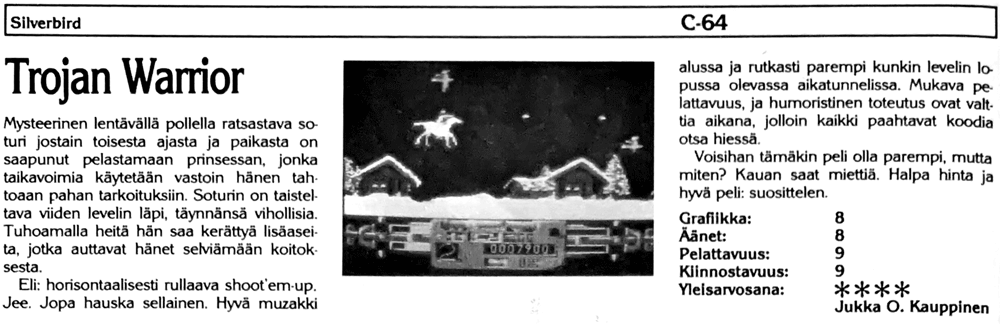
Trojan Warrior1988Pysyvä linkkiMysteerinen lentävällä pollella ratsastava soturi jostain toisesta ajasta ja paikasta on saapunut pelastamaan prinsessan, jonka taikavoimia käytetään vastoin hänen tahtoaan pahan tarkoituksiin. Soturin on taisteltava viiden levelin läpi, täynnänsä vihollisia. Tuhoamalla heitä hän saa kerättyä lisäaseita, jotka auttavat hänet selviämään koitoksesta.
Eli: horisontaalisesti rullaava shoot'em-up. Jee. Jopa hauska sellainen. Hyvä muzakki alussa ja rutkasti parempi kunkin levelin lopussa olevassa aikatunnelissa. Mukava pelattavuus, ja humoristinen toteutus ovat valttia aikana, jolloin kaikki paahtavat koodia otsa hiessä.
Voisihan tämäkin peli olla parempi, mutta miten? Kauan saat miettiä. Halpa hinta ja hyvä peli: suosittelen.
Trojan Warrior1988PermalinkA mysterious warrior riding a flying horsie, from some other time and place, has arrived to rescue a princess whose magic powers are being used against her will for evil ends. The warrior has to fight his way through five levels, chock-full of enemies. By destroying them he gets to collect extra weapons that help him survive the ordeal.
In other words: a horizontally scrolling shoot'em-up. Yay. A fun one, even. Good tunes at the start and loads better ones in the time tunnel at the end of each level. Pleasant playability and a humorous execution are trump cards at a time when everyone is churning out code by the sweat of their brow.
Sure, this game could be better too, but how? You'll be thinking about that for a long time. Cheap price and a good game: I recommend it.
Troll
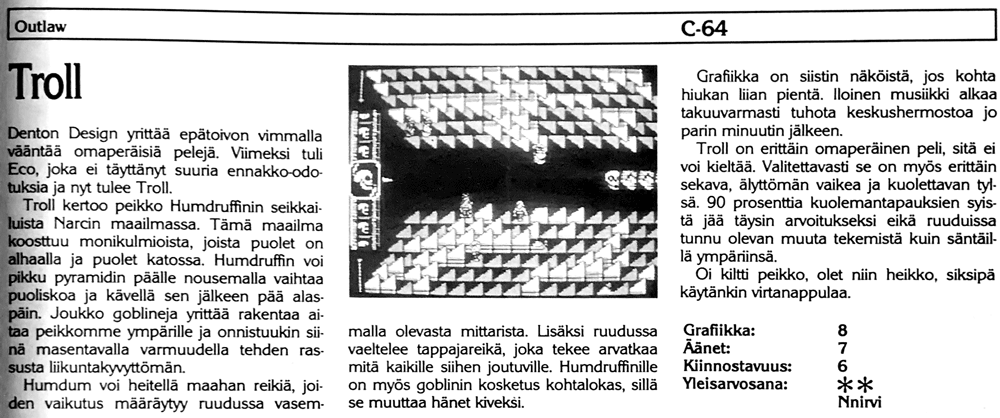
Troll1988Pysyvä linkkiDenton Design yrittää epätoivon vimmalla vääntää omaperäisiä pelejä. Viimeksi tuli Eco, joka ei täyttänyt suuria ennakko-odotuksia ja nyt tulee Troll.
Troll kertoo peikko Humdruffinin seikkailuista Narcin maailmassa. Tämä maailma koosttuu monikulmioista, joista puolet on alhaalla ja puolet katossa. Humdruffin voi pikku pyramidin päälle nousemalla vaihtaa puoliskoa ja kävellä sen jälkeen pää alaspäin. Joukko goblineja yrittää rakentaa aitaa peikkomme ympärille ja onnistuukin siinä masentavalla varmuudella tehden rassusta liikuntakyvyttömän.
Humdum voi heitellä maahan reikiä, joiden vaikutus määräytyy ruudussa vasemmalla olevasta mittarista. Lisäksi ruudussa vaeltelee tappajareikä, joka tekee arvatkaa mitä kaikille siihen joutuville. Humdruffinille on myös goblinin kosketus kohtalokas, sillä se muuttaa hänet kiveksi.
Grafiikka on siistin näköistä, jos kohta hiukan liian pientä. Iloinen musiikki alkaa takuuvarmasti tuhota keskushermostoa jo parin minuutin jälkeen.
Troll on erittäin omaperäinen peli, sitä ei voi kieltää. Valitettavasti se on myös erittäin sekava, älyttömän vaikea ja kuolettavan tylsä. 90 prosenttia kuolemantapauksien syistä jää täysin arvoitukseksi eikä ruuduissa tunnu olevan muuta tekemistä kuin säntäillä ympäriinsä.
Oi kiltti peikko, olet niin heikko, siksipä käytänkin virtanappulaa.
Troll1988PermalinkDenton Design is trying with the fury of desperation to crank out original games. Last came Eco, which didn't live up to the high advance expectations, and now comes Troll.
Troll tells of the adventures of Humdruffin the troll in the world of Narc. This world consists of polygons, half of which are down below and half on the ceiling. By climbing on top of a little pyramid Humdruffin can switch halves and then walk upside down. A bunch of goblins try to build a fence around our troll, and succeed with depressing certainty, leaving the poor thing unable to move.
Humdum can toss holes onto the ground, and their effect is determined by the gauge on the left of the screen. In addition, a killer hole wanders around the screen, and it does guess-what to everyone who ends up in it. A goblin's touch is also fatal to Humdruffin, as it turns him to stone.
The graphics look neat, if a little too small. The cheerful music is guaranteed to start destroying your central nervous system after just a couple of minutes.
Troll is a highly original game, that can't be denied. Unfortunately it is also highly confusing, insanely difficult and deadly dull. 90 percent of the causes of death remain a complete mystery, and there seems to be nothing to do on the screens except dash about.
Oh kind troll, you are so feeble, which is why I'm reaching for the power switch.
Turbo

Turbo1989 KevätPysyvä linkkiNimikin sen kertoo: kyseessä on taas autoilupeli. Erona lukuisiin vastaaviin voi Turbossa normaaliin MicroIllusions-tyyliin valita yksin- ja kaksinpelin sekä modeemin välityksellä pelaamisen.
Lähtövalojen vaihduttua vihreiksi kisa alkaa. Tarkoitus on kaahata maaliin alle yhdeksänkymmenen sekuntin samalla tuhoten muita tielläliikkujia. Peli on kuvattu ylhäältäpäin, reitin kulkiessa läpi kaupungin, myöhemmin ohi kallioiden ja muun maaseudun. Kaksinpelissä pelaajat näkyvät omissa pikku ruuduissaan ja voivat ajeskella toisistaan riippumatta. Ruudussa näkyy myös kartta, joka osoittaa pelaajien sijainnin. Tieltä voi kerätä autoonsa lisävarusteita ja etenkin aseistusta, joka helpottaa kilpailijoiden vähentämistä. Tietysti vihollisautotkin yrittävät parhaansa mukaan saada pelaajan räjähtämään tuhansiksi pieniksi kappaleiksi. Omaperäistä, vai mitä?
Jos juoni ei ole hyvä olisi toteutuksen parasta olla loistava.Mutta kun ei ole. Tie scrollaa nykien, ja autot näyttävät samoilta kuin kolikkopeleissä noin sataviisikymmentä vuotta sitten. Muutenkin grafiikka on melkoisen yksinkertaista. Äänetkin ovat vain tavallisia räjähdyksiä ja muuta sellaista. Tylsää. Kaiken lisäksi vauhtia pitää hiljentää vähän väliä tien poikki kulkevien junaratojen takia. Junat kulkevat noin kolmen sekunnin välein.
Peli on siis epäonnistunut varsin lahjakkaasti. MicroIllusionilta ei Faery Talen jälkeen ole tullut yhtään todella hyvää peliä, joten toivotaan, että tuleva roolipeli "Land of Legends" parantaa tilannetta.
Turbo1989 KevätPermalinkThe name says it all: this is yet another driving game. What sets Turbo apart from the countless others like it is that, in the usual MicroIllusions style, you can choose between a one-player game, a two-player game and playing over a modem.
When the starting lights change to green, the race begins. The idea is to tear across the finish line in under ninety seconds while destroying other road users along the way. The game is viewed from above, with the route running through a city and later past rocky crags and other countryside. In two-player mode the players appear in their own little windows and can drive about independently of each other. The screen also shows a map indicating where the players are. You can pick up extras for your car off the road, weapons in particular, which make it easier to thin out the competition. Naturally the enemy cars also do their very best to blow the player into thousands of little pieces. Original, eh?
If the plot isn't good, the execution had better be brilliant. But it just isn't. The road scrolls jerkily, and the cars look the same as they did in arcade games about a hundred and fifty years ago. The graphics are pretty basic all round, too. The sound is just ordinary explosions and the like as well. Boring. On top of everything, you have to keep slowing down every few moments because of railway lines crossing the road. The trains come along roughly every three seconds.
So the game has failed with quite some talent. Not a single really good game has come from MicroIllusion since Faery Tale, so let's hope the upcoming role-playing game "Land of Legends" improves the situation.
Turbo Outrun
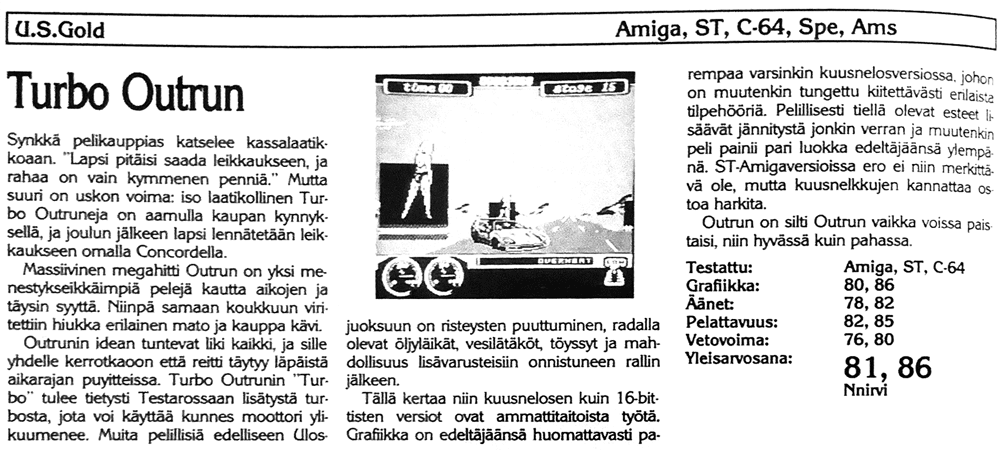
Turbo Outrun1990 KevätPysyvä linkkiSynkkä pelikauppias katselee kassalaatikkoaan. "Lapsi pitäisi saada leikkaukseen, ja rahaa on vain kymmenen penniä." Mutta suuri on uskon voima: iso laatikollinen Turbo Outruneja on aamulla kaupan kynnyksellä, ja joulun jälkeen lapsi lennätetään leikkaukseen omalla Concordella.
Massiivinen megahitti Outrun on yksi menestykseikkäimpiä pelejä kautta aikojen ja täysin syyttä. Niinpä samaan koukkuun viritettiin hiukka erilainen mato ja kauppa kävi.
Outrunin idean tuntevat liki kaikki, ja sille yhdelle kerrotkaoon että reitti täytyy läpäistä aikarajan puyitteissa. Turbo Outrunin "Turbo" tulee tietysti Testarossaan lisätystä turbosta, jota voi käyttää kunnes moottori ylikuumenee. Muita pelillisiä edelliseen Ulosjuoksuun on risteysten puuttuminen, radalla olevat öljyläikät, vesilätäköt, töyssyt ja mahdollisuus lisävarusteisiin onnistuneen rallin jälkeen.
Tällä kertaa niin kuusnelosen kuin 16-bittisten versiot ovat ammattitaitoista työtä. Grafiikka on edeltäjäänsä huomattavasti parempaa varsinkin kuusnelosversiossa, johon on muutenkin tungettu kiitettävästi erilaista tilpehööriä. Pelillisesti tiellä olevat esteet lisäävät jännitystä jonkin verran ja muutenkin peli painii pari luokkaa edeltäjäänsä ylempänä. ST-Amigaversioissa ero ei niin merkittävä ole, mutta kuusnelkkujen kannattaa ostoa harkita.
Outrun on silti Outrun vaikka voissa paistaisi, niin hyvässä kuin pahassa.
Turbo Outrun1990 KevätPermalinkA gloomy games dealer stares into the till. "The child needs an operation, and there's only ten pennies." But great is the power of faith: in the morning there's a big boxful of Turbo Outruns on the shop doorstep, and after Christmas the child is flown to surgery by private Concorde.
The massive megahit Outrun is one of the most successful games of all time, and for no reason whatsoever. So a slightly different worm was threaded onto the same hook, and business was brisk.
Nearly everyone knows the idea of Outrun, and for the benefit of that one person, let it be told that the route must be completed within a time limit. The "Turbo" in Turbo Outrun comes, of course, from the turbo added to the Testarossa, which you can use until the engine overheats. Other gameplay differences from the previous Outrun are the absence of forks in the road, oil slicks on the track, puddles, bumps, and the chance of extra equipment after a successful rally.
This time both the C-64 and the 16-bit versions are professional work. The graphics are considerably better than the predecessor's, especially in the C-64 version, which has also been commendably crammed with all sorts of bits and bobs. Gameplay-wise, the obstacles on the road add a certain amount of tension, and all in all the game wrestles a couple of weight classes above its predecessor. In the ST and Amiga versions the difference isn't all that significant, but C-64 owners should consider buying it.
Outrun is still Outrun however you dress it up, for better or for worse.
Turbo Trax
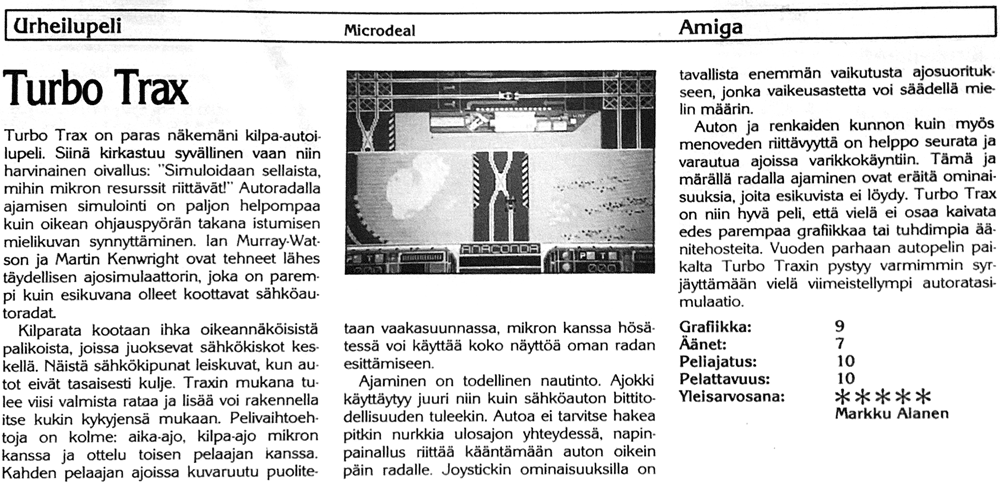
Turbo Trax1989 KevätPysyvä linkkiTurbo Trax on paras näkemäni kilpa-autoilupeli. Siinä kirkastuu syvällinen vaan niin harvinainen oivallus: "Simuloidaan sellaista, mihin mikron resurssit riittävät!" Autoradalla ajamisen simulointi on paljon helpompaa kuin oikean ohjauspyörän takana istumisen mielikuvan synnyttäminen. Ian Murray-Watson ja Martin Kenwright ovat tehneet lähes täydellisen ajosimulaattorin, joka on parempi kuin esikuvana olleet koottavat sähköautoradat.
Kilparata kootaan ihka oikeannäköisistä palikoista, joissa juoksevat sähkökiskot keskellä. Näistä sähkökipunat leiskuvat, kun autot eivät tasaisesti kulje. Traxin mukana tulee viisi valmista rataa ja lisää voi rakennella itse kukin kykyjensä mukaan. Pelivaihtoehtoja on kolme: aika-ajo, kilpa-ajo mikron kanssa ja ottelu toisen pelaajan kanssa. Kahden pelaajan ajoissa kuvaruutu puolitetaan vaakasuunnassa, mikron kanssa hösätessä voi käyttää koko näyttöä oman radan esittämiseen.
Ajaminen on todellinen nautinto. Ajokki käyttäytyy juuri niin kuin sähköauton bittitodellisuuden tuleekin. Autoa ei tarvitse hakea pitkin nurkkia ulosajon yhteydessä, napinpainallus riittää kääntämään auton oikein päin radalle. Joystickin ominaisuuksilla on tavallista enemmän vaikutusta ajosuoritukseen, jonka vaikeusastetta voi säädellä mielin määrin.
Auton ja renkaiden kunnon kuin myös menoveden riittävyyttä on helppo seurata ja varautua ajoissa varikkokäyntiin. Tämä ja märällä radalla ajaminen ovat eräitä ominaisuuksia, joita esikuvista ei löydy. Turbo Trax on niin hyvä peli, että vielä ei osaa kaivata edes parempaa grafiikkaa tai tuhdimpia äänitehosteita. Vuoden parhaan autopelin paikalta Turbo Traxin pystyy varmimmin syrjäyttämään vielä viimeistellympi autoratasimulaatio.
Turbo Trax1989 KevätPermalinkTurbo Trax is the best racing game I have seen. It crystallises a profound yet oh-so-rare insight: "Let's simulate something the micro actually has the resources for!" Simulating driving on a toy racetrack is much easier than creating the illusion of sitting behind a real steering wheel. Ian Murray-Watson and Martin Kenwright have made a near-perfect driving simulator that is better than the build-it-yourself electric slot-car sets it was modelled on.
The track is assembled from honest-to-goodness real-looking pieces with electric rails running down the middle. Sparks flash from these when the cars aren't running smoothly. Trax comes with five ready-made tracks, and everyone can build more to the best of their abilities. There are three game options: time trial, a race against the micro and a head-to-head against another player. In two-player races the screen is split horizontally; when tussling with the micro you can use the whole screen to show your own track.
Driving is a real pleasure. Your motor behaves exactly the way an electric car's bit-reality ought to. You don't have to go fetching the car from the corners of the room when you fly off the track; a press of the button is enough to set the car back on the track the right way round. The properties of your joystick have more effect than usual on your driving, the difficulty of which can be adjusted to your heart's content.
It's easy to keep an eye on the condition of the car and the tyres, as well as on whether the go-juice will last, and to prepare for a pit stop in good time. This and driving on a wet track are among the features you won't find in the sets it's modelled on. Turbo Trax is such a good game that you don't even find yourself wishing for better graphics or beefier sound effects yet. The thing most sure to knock Turbo Trax off its spot as the best car game of the year is an even more polished racetrack simulation.
Turboat

Turboat1987Pysyvä linkkiTehtävänäsi on ohjata venettä pitkin virtaa. Ensimmäisessä ruudussa kaasutat tulitusnapilla ja ammut vihollisaluksia rightGRPH-näppäimellä. Lisäpisteitä saat tuhoamalla rannalla olevia tukikohtia.
Toisessa ruudussa taistelet lentokoneita vastaan koettaen samalla kerätä tarpeeksi polttoainetta.
Kolmas ruutu on jälleen kuten ensimmäinen, paitsi että nyt sinun on pommien ampumisen sijasta väisteltävä niitä.
Aluksi peli tuntuu melko vaikealta, mutta kunhan siihen tottuu, alkaa veneily sujua. Grafiikaltaan peli ei ole aivan huipputasoa, mutta silti aivan kiinnostava lisä SVI:n valikoimiin.
Turboat1987PermalinkYour task is to steer a boat along a river. On the first screen you accelerate with the fire button and shoot enemy vessels with the right GRPH key. You get extra points for destroying bases on the shore.
On the second screen you fight against aircraft while trying to collect enough fuel at the same time.
The third screen is like the first one again, except that now, instead of shooting bombs, you have to dodge them.
At first the game feels fairly difficult, but once you get used to it, the boating starts to go smoothly. Graphically the game isn't quite top class, but it's still quite an interesting addition to the SVI range.
Turrican II - Final Fight
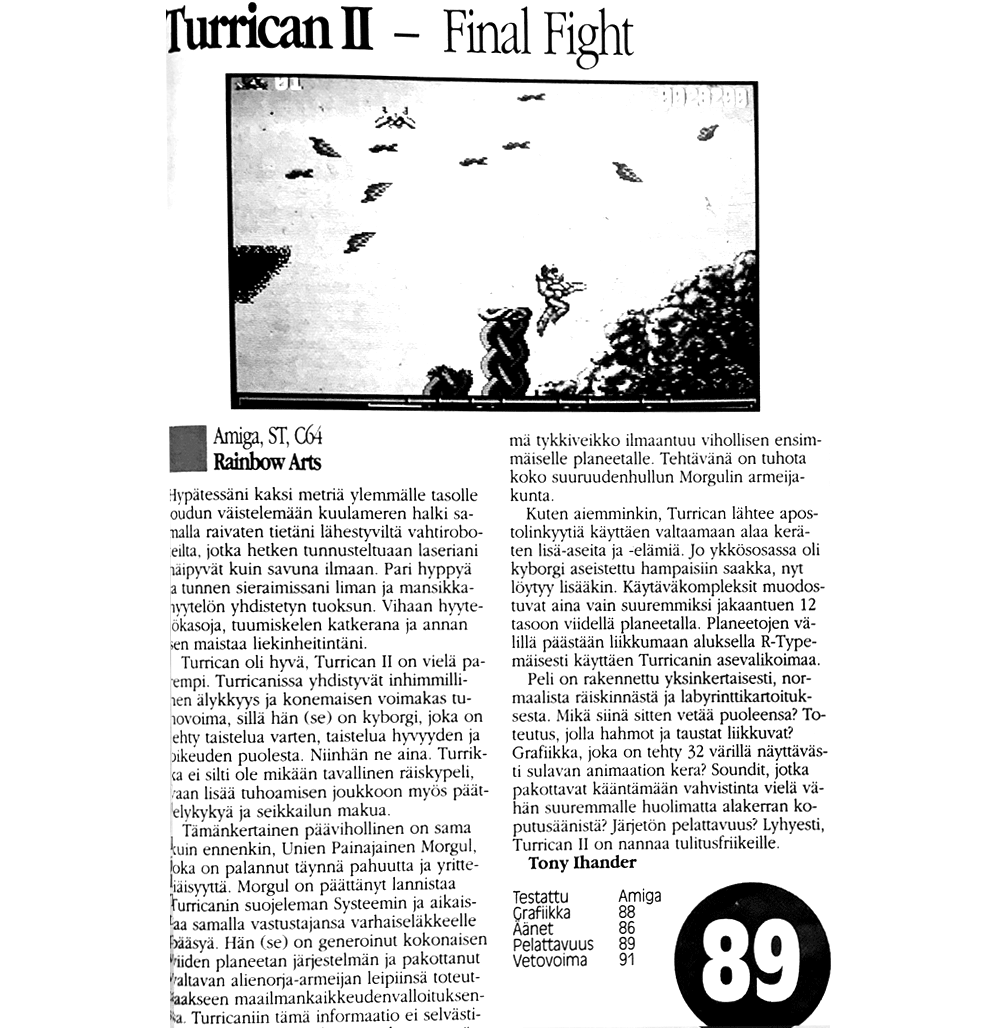
Turrican II - Final Fight1991 SyksyPysyvä linkkiHypätessäni kaksi metriä ylemmälle tasolle joudun väistelemään kuulameren halki samalla raivaten tietäni lähestyviltä vahtiroboteilta, jotka hetken tunnusteltuaan laseriani häipyvät kuin savuna ilmaan. Pari hyppyä ja tunnen sieraimissani liman ja mansikkahyytelön yhdistetyn tuoksun. Vihaan hyytelökasoja, tuumiskelen katkerana ja annan sen maistaa liekinheitintäni.
Turrican oli hyvä, Turrican II on vielä parempi. Turricanissa yhdistyvät inhimmillinen älykkyys ja konemaisen voimakas tuhovoima, sillä hän (se) on kyborgi, joka on tehty taistelua varten, taistelua hyvyyden ja oikeuden puolesta. Niinhän ne aina. Turrikka ei silti ole mikään tavallinen räiskypeli, vaan lisää tuhoamisen joukkoon myös päättelykykyä ja seikkailun makua.
Tämänkertainen päävihollinen on sama kuin ennenkin, Unien Painajainen Morgul, joka on palannut täynnä pahuutta ja yritteliäisyyttä. Morgul on päättänyt lannistaa Turricanin suojeleman Systeemin ja aikaistaa samalla vastustajansa varhaiseläkkeelle pääsyä. Hän (se) on generoinut kokonaisen viiden planeetan järjestelmän ja pakottanut valtavan alienorja-armeijan leipiinsä toteuttaakseen maailmankaikkeudenvalloituksensa. Turricaniin tämä informaatio ei selvästikään vaikuta, sillä pakattuaan kamansa tämä tykkiveikko ilmaantuu vihollisen ensimmäiselle planeetalle. Tehtävänä on tuhota koko suuruudenhullun Morgulin armeijakunta.
Kuten aiemminkin, Turrican lähtee apostolinkyytiä käyttäen valtaamaan alaa keräten lisä-aseita ja -elämiä. Jo ykkösosassa oli kyborgi aseistettu hampaisiin saakka, nyt löytyy lisääkin. Käytäväkompleksit muodostuvat aina vain suuremmiksi jakaantuen 12 tasoon viidellä planeetalla. Planeetojen välillä päästään liikkumaan aluksella R-Type-mäisesti käyttäen Turricanin asevalikoimaa.
Peli on rakennettu yksinkertaisesti, normaalista räiskinnästä ja labyrinttikartoituksesta. Mikä siinä sitten vetää puoleensa? Toteutus, jolla hahmot ja taustat liikkuvat? Grafiikka, joka on tehty 32 värillä näyttävästi sulavan animaation kera? Soundit, jotka pakottavat kääntämään vahvistinta vielä vähän suuremmalle huolimatta alakerran koputusäänistä? Järjetön pelattavuus? Lyhyesti, Turrican II on nannaa tulitusfriikeille.
Turrican II - Final Fight1991 SyksyPermalinkAs I jump up to a level two metres higher, I have to dodge my way through a sea of bullets while clearing a path through the approaching guard robots, which, after a moment's acquaintance with my laser, vanish into thin air like smoke. A couple of jumps and my nostrils catch the combined aroma of slime and strawberry jelly. I hate heaps of jelly, I muse bitterly, and give it a taste of my flamethrower.
Turrican was good; Turrican II is even better. Turrican combines human intelligence with machine-grade destructive power, since they (it) are a cyborg built for battle, battle for goodness and justice. They always are. Still, Turrikka is no ordinary shoot-'em-up: it adds deductive reasoning and a taste of adventure to the destruction.
This time the arch-enemy is the same as before: Morgul, the Nightmare of Dreams, who has returned full of evil and entrepreneurial spirit. Morgul has decided to bring the System under Turrican's protection to its knees and, while at it, to bring forward the opponent's early retirement. They (it) have generated an entire system of five planets and press-ganged a huge alien slave army into service in order to pull off a universe-conquest. This information clearly cuts no ice with Turrican, because having packed up the kit, this gun-toting chum pops up on the enemy's first planet. The task is to destroy the megalomaniac Morgul's entire army corps.
As before, Turrican sets off on Shanks's pony to gain ground, collecting extra weapons and extra lives along the way. Already in the first part the cyborg was armed to the teeth; now there's even more to be had. The corridor complexes just keep getting bigger, divided into 12 levels on five planets. Between the planets you get to travel by ship, R-Type fashion, using Turrican's arsenal.
The game is simply built, out of ordinary blasting and labyrinth mapping. So what is it that draws you in? The execution that sets the characters and backgrounds moving? The graphics, done in 32 colours with spectacularly smooth animation? The sound, which forces you to turn the amp up just a bit more despite the knocking from downstairs? The insane playability? In short, Turrican II is pure yum-yum for gunfire freaks.
TV Sports Football
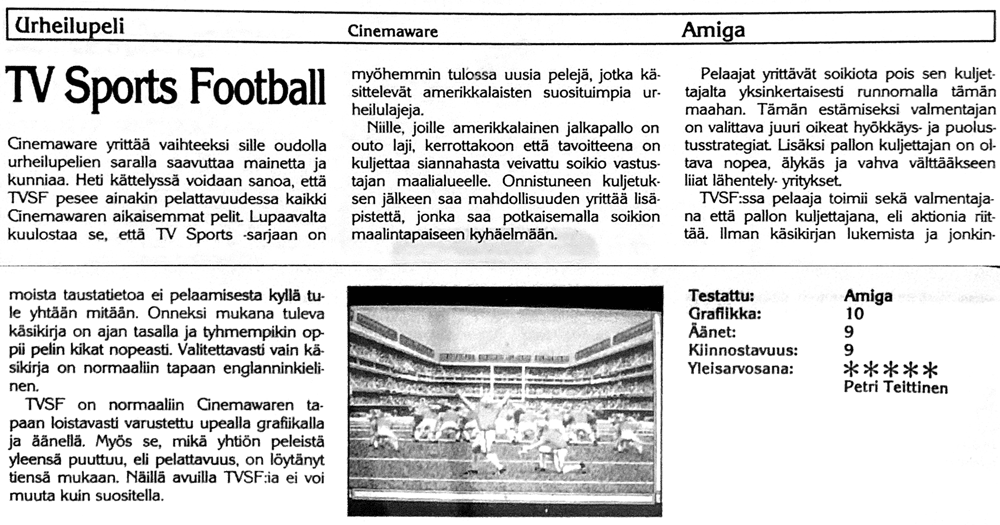
TV Sports Football1989 KevätPysyvä linkkiCinemaware yrittää vaihteeksi sille oudolla urheilupelien saralla saavuttaa mainetta ja kunniaa. Heti kättelyssä voidaan sanoa, että TVSF pesee ainakin pelattavuudessa kaikki Cinemawaren aikaisemmat pelit. Lupaavalta kuulostaa se, että TV Sports -sarjaan on myöhemmin tulossa uusia pelejä, jotka käsittelevät amerikkalaisten suosituimpia urheilulajeja.
Niille, joille amerikkalainen jalkapallo on outo laji, kerrottakoon että tavoitteena on kuljettaa siannahasta veivattu soikio vastustajan maalialueelle. Onnistuneen kuljetuksen jälkeen saa mahdollisuuden yrittää lisäpistettä, jonka saa potkaisemalla soikion maalintapaiseen kyhäelmään.
Pelaajat yrittävät soikiota pois sen kuljettajalta yksinkertaisesti runnomalla tämän maahan. Tämän estämiseksi valmentajan on valittava juuri oikeat hyökkäys- ja puolustusstrategiat. Lisäksi pallon kuljettajan on oltava nopea, älykäs ja vahva välttääkseen liiat lähentely- yritykset.
TVSF:ssa pelaaja toimii sekä valmentajana että pallon kuljettajana, eli aktionia riittää. Ilman käsikirjan lukemista ja jonkinmoista taustatietoa ei pelaamisesta kyllä tule yhtään mitään. Onneksi mukana tuleva käsikirja on ajan tasalla ja tyhmempikin oppii pelin kikat nopeasti. Valitettavasti vain käsikirja on normaaliin tapaan englanninkielinen.
TVSF on normaaliin Cinemawaren tapaan loistavasti varustettu upealla grafiikalla ja äänellä. Myös se, mikä yhtiön peleistä yleensä puuttuu, eli pelattavuus, on löytänyt tiensä mukaan. Näillä avuilla TVSF:ia ei voi muuta kuin suositella.
TV Sports Football1989 KevätPermalinkFor a change, Cinemaware is trying to win fame and glory in the field of sports games, which is strange territory for it. Right off the bat it can be said that TVSF wipes the floor with all of Cinemaware's earlier games, at least in playability. It sounds promising that more games are coming later in the TV Sports series, covering the Americans' most popular sports.
For those to whom American football is a strange sport, let it be said that the aim is to carry an oval knocked together out of pigskin into the opponent's goal area. After a successful carry you get the chance to try for an extra point, which you earn by kicking the oval into a goal-like contraption.
The players try to get the oval off its carrier simply by smashing him into the ground. To prevent this, the coach has to choose exactly the right offensive and defensive strategies. In addition, the ball carrier has to be fast, smart and strong to avoid too many unwanted advances.
In TVSF the player acts as both coach and ball carrier, so there's action aplenty. Without reading the manual and some sort of background knowledge, the playing will come to absolutely nothing. Luckily the manual that comes with it is up to scratch, and even the dimmer among us learn the game's tricks quickly. Unfortunately, as usual, the manual is in English.
As is usual for Cinemaware, TVSF comes brilliantly equipped with superb graphics and sound. And the thing that is usually missing from the company's games, namely playability, has found its way in too. With these virtues, TVSF can only be recommended.
TV-Sports Football
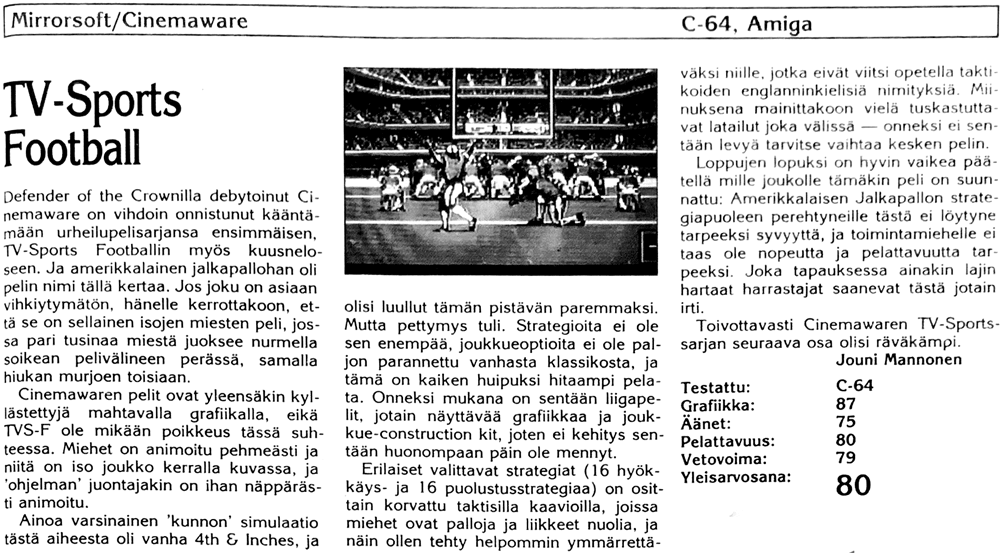
TV-Sports Football1990 SyksyPysyvä linkkiDefender of the Crownilla debytoinut Cinemaware on vihdoin onnistunut kääntämään urheilupelisarjansa ensimmäisen, TV-Sports Footballin myös kuusneloseen. Ja amerikkalainen jalkapallohan oli pelin nimi tällä kertaa. Jos joku on asiaan vihkiytymätön, hänelle kerrottakoon, että se on sellainen isojen miesten peli, jossa pari tusinaa miestä juoksee nurmella soikean pelivälineen perässä, samalla hiukan murjoen toisiaan.
Cinemawaren pelit ovat yleensäkin kyllästettyjä mahtavalla grafiikalla, eikä TVS-F ole mikään poikkeus tässä suhteessa. Miehet on animoitu pehmeästi ja niitä on iso joukko kerralla kuvassa, ja 'ohjelman' juontajakin on ihan näppärästi animoitu.
Ainoa varsinainen 'kunnon' simulaatio tästä aiheesta oli vanha 4th & Inches, ja olisi luullut tämän pistävän paremmaksi. Mutta pettymys tuli. Strategioita ei ole sen enempää, joukkueoptioita ei ole paljon parannettu vanhasta klassikosta, ja tämä on kaiken huipuksi hitaampi pelata. Onneksi mukana on sentään liigapelit, jotain näyttävää grafiikkaa ja joukkue-construction kit, joten ei kehitys sentään huonompaan päin ole mennyt.
Erilaiset valittavat strategiat (16 hyökkäys- ja 16 puolustusstrategiaa) on osittain korvattu taktisilla kaavioilla, joissa miehet ovat palloja ja liikkeet nuolia, ja näin ollen tehty helpommin ymmärrettäväksi niille, jotka eivät viitsi opetella taktiikoiden englanninkielisiä nimityksiä. Miinuksena mainittakoon vielä tuskastuttavat latailut joka välissä - onneksi ei sentään levyä tarvitse vaihtaa kesken pelin.
Loppujen lopuksi on hyvin vaikea päätellä mille joukolle tämäkin peli on suunnattu: Amerikkalaisen Jalkapallon strategiapuoleen perehtyneille tästä ei löytyne tarpeeksi syvyyttä, ja toimintamiehelle ei taas ole nopeutta ja pelattavuutta tarpeeksi. Joka tapauksessa ainakin lajin hartaat harrastajat saanevat tästä jotain irti.
Toivottavasti Cinemawaren TV-Sports-sarjan seuraava osa olisi räväkämpi.
TV-Sports Football1990 SyksyPermalinkCinemaware, who made their debut with Defender of the Crown, have finally managed to convert the first game in their sports series, TV-Sports Football, to the C-64 as well. And American football was the name of the game this time. If anyone is uninitiated in the matter, let it be said that it's one of those big men's games in which a couple of dozen men run across the grass after an oval piece of sporting equipment, roughing each other up a little along the way.
Cinemaware's games are generally saturated with magnificent graphics, and TVS-F is no exception in this respect. The men are smoothly animated and there's a big crowd of them on screen at once, and even the host of the 'program' is quite nicely animated.
The only genuinely 'proper' simulation on this subject was the old 4th & Inches, and you'd have thought this one would go one better. But disappointment struck. There are no more strategies than before, the team options haven't been improved much on the old classic, and to top it all this one is slower to play. Luckily there are at least league games, some flashy graphics and a team-construction kit, so things haven't actually gone backwards.
The various selectable strategies (16 offensive and 16 defensive) have partly been replaced with tactical diagrams in which the men are circles and the movements are arrows, which makes them easier to understand for those who can't be bothered to learn the English names of the tactics. On the minus side, let it also be mentioned that there's exasperating loading at every turn - luckily you don't have to swap disks in the middle of a game, at least.
In the end it's very hard to work out who this game, too, is aimed at: those versed in the strategic side of American Football probably won't find enough depth here, while the action man, for his part, won't get enough speed and playability. In any case, at least devoted followers of the sport should get something out of it.
Here's hoping the next instalment in Cinemaware's TV-Sports series will be punchier.
Tv-Sports: Basketball
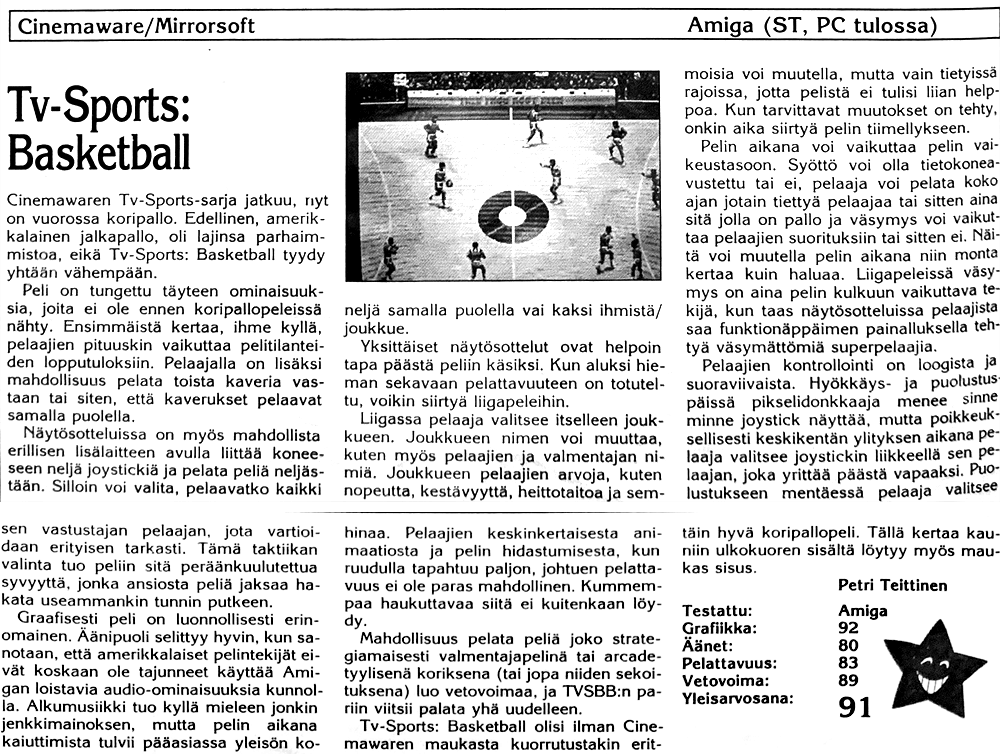
Tv-Sports: Basketball1990 SyksyPysyvä linkkiCinemawaren Tv-Sports-sarja jatkuu, nyt on vuorossa koripallo. Edellinen, amerikkalainen jalkapallo, oli lajinsa parhaimmistoa, eikä Tv-Sports: Basketball tyydy yhtään vähempään.
Peli on tungettu täyteen ominaisuuksia, joita ei ole ennen koripallopeleissä nähty. Ensimmäistä kertaa, ihme kyllä, pelaajien pituuskin vaikuttaa pelitilanteiden lopputuloksiin. Pelaajalla on lisäksi mahdollisuus pelata toista kaveria vastaan tai siten, että kaverukset pelaavat samalla puolella.
Näytösotteluissa on myös mahdollista erillisen lisälaitteen avulla liittää koneeseen neljä joystickiä ja pelata peliä neljästään. Silloin voi valita, pelaavatko kaikki neljä samalla puolella vai kaksi ihmistä/joukkue.
Yksittäiset näytösottelut ovat helpoin tapa päästä peliin käsiksi. Kun aluksi hieman sekavaan pelattavuuteen on totuteltu, voikin siirtyä liigapeleihin.
Liigassa pelaaja valitsee itselleen joukkueen. Joukkueen nimen voi muuttaa, kuten myös pelaajien ja valmentajan nimiä. Joukkueen pelaajien arvoja, kuten nopeutta, kestävyyttä, heittotaitoa ja semmoisia voi muutella, mutta vain tietyissä rajoissa, jotta pelistä ei tulisi liian helppoa. Kun tarvittavat muutokset on tehty, onkin aika siirtyä pelin tiimellykseen.
Pelin aikana voi vaikuttaa pelin vaikeustasoon. Syöttö voi olla tietokoneavustettu tai ei, pelaaja voi pelata koko ajan jotain tiettyä pelaajaa tai sitten aina sitä jolla on pallo ja väsymys voi vaikuttaa pelaajien suorituksiin tai sitten ei. Näitä voi muutella pelin aikana niin monta kertaa kuin haluaa. Liigapeleissä väsymys on aina pelin kulkuun vaikuttava tekijä, kun taas näytösotteluissa pelaajista saa funktionäppäimen painalluksella tehtyä väsymättömiä superpelaajia.
Pelaajien kontrollointi on loogista ja suoraviivaista. Hyökkäys- ja puolustuspäässä pikselidonkkaaja menee sinne minne joystick näyttää, mutta poikkeuksellisesti keskikentän ylityksen aikana pelaaja valitsee joystickin liikkeellä sen pelaajan, joka yrittää päästä vapaaksi. Puolustukseen mentäessä pelaaja valitsee sen vastustajan pelaajan, jota vartioidaan erityisen tarkasti. Tämä taktiikan valinta tuo peliin sitä peräänkuulutettua syvyyttä, jonka ansiosta peliä jaksaa hakata useammankin tunnin putkeen.
Graafisesti peli on luonnollisesti erinomainen. Äänipuoli selittyy hyvin, kun sanotaan, että amerikkalaiset pelintekijät eivät koskaan ole tajunneet käyttää Amigan loistavia audio-ominaisuuksia kunnolla. Alkumusiikki tuo kyllä mieleen jonkin jenkkimainoksen, mutta pelin aikana kaiuttimista tulvii pääasiassa yleisön kohinaa. Pelaajien keskinkertaisesta animaatiosta ja pelin hidastumisesta, kun ruudulla tapahtuu paljon, johtuen pelattavuus ei ole paras mahdollinen. Kummempaa haukuttavaa siitä ei kuitenkaan löydy.
Mahdollisuus pelata peliä joko strategiamaisesti valmentajapelinä tai arcadetyylisenä koriksena (tai jopa niiden sekoituksena) luo vetovoimaa, ja TVSBB:n pariin viitsii palata yhä uudelleen.
Tv-Sports: Basketball olisi ilman Cinemawaren maukasta kuorrutustakin erittäin hyvä koripallopeli. Tällä kertaa kauniin ulkokuoren sisältä löytyy myös maukas sisus.
Tv-Sports: Basketball1990 SyksyPermalinkCinemaware's Tv-Sports series continues, and now it's basketball's turn. The previous one, American football, was among the best of its kind, and Tv-Sports: Basketball settles for nothing less.
The game has been crammed full of features never before seen in basketball games. For the first time, amazingly enough, even the players' height affects how plays turn out. On top of that, you can play against a friend, or in such a way that the two pals play on the same side.
In exhibition games it's also possible, with the help of a separate add-on, to plug four joysticks into the machine and play the game four at a time. You can then choose whether all four play on the same side or two people per team.
One-off exhibition games are the easiest way to get to grips with the game. Once you've got used to the playability, which is a bit confusing at first, you can move on to league games.
In the league you pick a team for yourself. The team's name can be changed, as can the names of the players and the coach. The team's player ratings, such as speed, stamina, shooting skill and stuff like that, can be tweaked, but only within certain limits so that the game doesn't get too easy. Once the necessary changes have been made, it's time to plunge into the thick of the action.
During the game you can adjust the difficulty level. Passing can be computer-assisted or not, you can control one particular player the whole time or else always whoever has the ball, and fatigue can affect the players' performance or not. You can change these during the game as many times as you like. In league games fatigue is always a factor in how the game goes, whereas in exhibition games a press of a function key turns the players into tireless superplayers.
Controlling the players is logical and straightforward. At the attacking and defending ends the pixel dunker goes wherever the joystick points, but as an exception, while crossing half court you use the joystick to pick which player tries to get open. When dropping back on defence, you pick the opposing player who is to be guarded especially tightly. This choice of tactics gives the game that much-called-for depth which means you'll happily hammer away at it for hours on end.
Graphically the game is, naturally, excellent. The sound is explained well enough by pointing out that American game makers have never figured out how to use the Amiga's brilliant audio capabilities properly. The intro music does bring to mind some Yank TV ad, but during play what floods out of the speakers is mostly crowd noise. Owing to the players' mediocre animation and the game slowing down when there's a lot happening on screen, the playability isn't the best it could be. Beyond that, though, there's not much to knock it for.
Being able to play either as a strategy-style coaching game or as arcade-style hoops (or even a mix of the two) gives it real appeal, and TVSBB is something you'll want to come back to again and again.
Even without Cinemaware's tasty icing, Tv-Sports: Basketball would be a very good basketball game. This time the pretty outer shell has a tasty filling inside as well.
Twin Kingdom Walley
Twin Kingdom Walley1987Pysyvä linkkiTwin Kingdom Walley edustaa myös grafiikkaa tulostavien seikkailupelien ryhmää. Twin Kingdom Walleyssä seikkailet omassa keksityssä maailmassa, jossa on runsaasti metsää, rakennuksia, eläimiä, teitä ja paljon muuta, mikä aiheuttaa ongelmia ja monenlaisia vaaratilanteita.
Pelin alussa seisotaan mökin edessä. Siitä lähtee tie, jota pitkin hyppii jänis. Kasettikotelossa neuvotaan menemään ensin sisään mökkiin. Loppu onkin sitten pelaajan harteilla.
Twin Kingdom Walleyssä on hyvä grafiikka. Peli piirtää grafiikan nopeimmin, mitä koskaan olen nähnyt. Pelin grafiikka on moniväristä, ja kuva on joka paikassa mihin voi mennä. Lisäksi pelin alussa valitaan muoto, kuinka laajan selostuksen peli antaa siitä paikasta, missä ollaan ja piirretäänkö kuvaa vai ei.
Twin Kingdom Walleyssä on yli 175 paikkaa, joten se on laajempi kuin Hobbit tai The Dallas Quest. Pelissä ei ole minkäänlaisia ääniä. Värivalinnat ovat keskinkertaiset. Pelin kiinnostavuutta laskee se että se ei ymmärrä enempää kuin kolme sanaa kerrallaan.
Twin Kingdom Walley1987PermalinkTwin Kingdom Walley also belongs to the group of adventure games that display graphics. In Twin Kingdom Walley you adventure in a made-up world of its own, with plenty of forest, buildings, animals, roads and much else that causes problems and all sorts of dangerous situations.
At the start of the game you're standing in front of a cottage. A road leads away from it, and a hare is hopping along the road. The cassette case advises you to go into the cottage first. After that, the rest is on the player's shoulders.
Twin Kingdom Walley has good graphics. The game draws its pictures faster than anything I have ever seen. The game's graphics are multicoloured, and there's a picture of every place you can go to. In addition, at the start of the game you choose a format: how full a description the game gives of the place you're in, and whether the picture is drawn or not.
Twin Kingdom Walley has over 175 locations, so it's bigger than Hobbit or The Dallas Quest. The game has no sounds of any kind. The colour choices are mediocre. What lowers the game's interest is that it doesn't understand more than three words at a time.
Twin Tornado
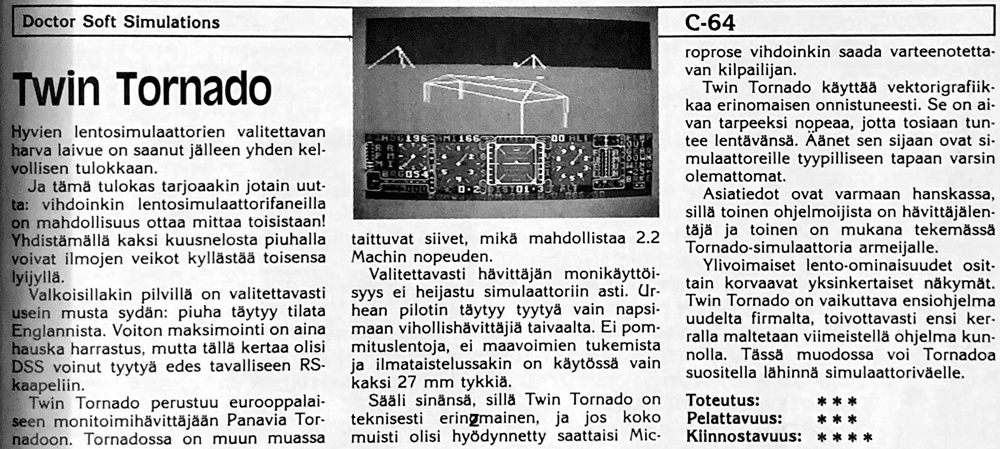
Twin Tornado1987Pysyvä linkkiHyvien lentosimulaattorien valitettavan harva laivue on saanut jälleen yhden kelvollisen tulokkaan.
Ja tämä tulokas tarjoaakin jotain uutta: vihdoinkin lentosimulaattorifaneilla on mahdollisuus ottaa mittaa toisistaan! Yhdistämällä kaksi kuusnelosta piuhalla voivat ilmojen veikot kyllästää toisensa lyijyllä.
Valkoisillakin pilvillä on valitettavasti usein musta sydän: piuha täytyy tilata Englannista. Voiton maksimointi on aina hauska harrastus, mutta tällä kertaa olisi DSS voinut tyytyä edes tavalliseen RS-kaapeliin.
Twin Tornado perustuu eurooppalaiseen monitoimihävittäjään Panavia Tornadoon. Tornadossa on muun muassa taittuvat siivet, mikä mahdollistaa 2.2 Machin nopeuden.
Valitettavasti hävittäjän monikäyttöisyys ei heijastu simulaattoriin asti. Urhean pilotin täytyy tyytyä vain napsimaan vihollishävittäjiä taivaalta. Ei pommituslentoja, ei maavoimien tukemista ja ilmataistelussakin on käytössä vain kaksi 27 mm tykkiä.
Sääli sinänsä, sillä Twin Tornado on teknisesti erinomainen, ja jos koko muisti olisi hyödynnetty saattaisi Microprose vihdoinkin saada varteenotettavan kilpailijan.
Twin Tornado käyttää vektorigrafiikkaa erinomaisen onnistuneesti. Se on aivan tarpeeksi nopeaa, jotta tosiaan tuntee lentävänsä. Äänet sen sijaan ovat simulaattoreille tyypilliseen tapaan varsin olemattomat.
Asiatiedot ovat varmaan hanskassa, sillä toinen ohjelmoijista on hävittäjälentäjä ja toinen on mukana tekemässä Tornado-simulaattoria armeijalle.
Ylivoimaiset lento-ominaisuudet osittain korvaavat yksinkertaiset näkymät. Twin Tornado on vaikuttava ensiohjelma uudelta firmalta, toivottavasti ensi kerralla maltetaan viimeistellä ohjelma kunnolla. Tässä muodossa voi Tornadoa suositella lähinnä simulaattoriväelle.
Twin Tornado1987PermalinkThe regrettably thin squadron of good flight simulators has gained one more worthy recruit.
And this recruit actually offers something new: at last, flight simulator fans have the chance to take each other's measure! By connecting two Commodore 64s with a cable, the flyboys can saturate each other with lead.
Sadly, even white clouds often have a black heart: the cable has to be ordered from England. Maximising profit is always a fun hobby, but this time DSS could at least have settled for an ordinary RS cable.
Twin Tornado is based on the European multi-role fighter, the Panavia Tornado. Among other things, the Tornado has swing wings, which make a speed of Mach 2.2 possible.
Unfortunately, the fighter's versatility doesn't carry over into the simulator. The brave pilot has to make do with just picking enemy fighters out of the sky. No bombing runs, no ground support, and even in air combat only the two 27 mm cannons are available.
A pity, really, since Twin Tornado is technically excellent, and had the whole memory been put to use, Microprose might finally have got a serious rival.
Twin Tornado uses vector graphics exceptionally well. They're plenty fast enough that you really feel you're flying. The sound, on the other hand, is pretty much non-existent, as is typical of simulators.
The facts are surely well in hand, since one of the programmers is a fighter pilot and the other is involved in making a Tornado simulator for the military.
The superior flight characteristics partly make up for the simple views. Twin Tornado is an impressive debut from a new company; hopefully next time they'll have the patience to finish the program off properly. In its present form, Tornado can be recommended mainly to the simulator crowd.
Twinworld
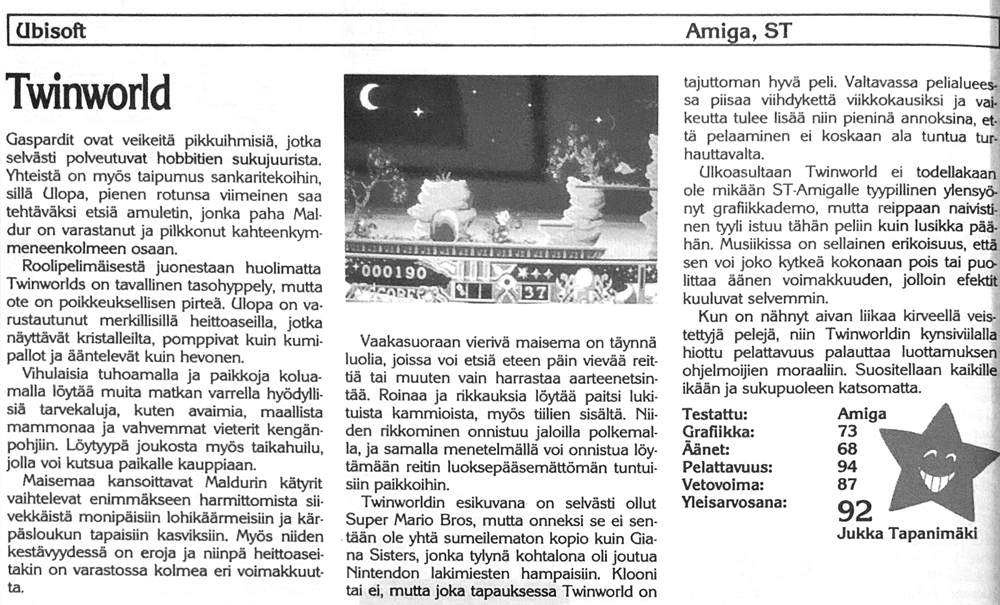
Twinworld1990 KevätPysyvä linkkiGaspardit ovat veikeitä pikkuihmisiä, jotka selvästi polveutuvat hobbitien sukujuurista. Yhteistä on myös taipumus sankaritekoihin, sillä Ulopa, pienen rotunsa viimeinen saa tehtäväksi etsiä amuletin, jonka paha Maldur on varastanut ja pilkkonut kahteenkymmeneenkolmeen osaan.
Roolipelimäisestä juonestaan huolimatta Twinworlds on tavallinen tasohyppely, mutta ote on poikkeuksellisen pirteä. Ulopa on varustautunut merkillisillä heittoaseilla, jotka näyttävät kristalleilta, pomppivat kuin kumipallot ja ääntelevät kuin hevonen.
Vihulaisia tuhoamalla ja paikkoja koluamalla löytää muita matkan varrella hyödyllisiä tarvekaluja, kuten avaimia, maallista mammonaa ja vahvemmat vieterit kengänpohjiin. Löytyypä joukosta myös taikahuilu, jolla voi kutsua paikalle kauppiaan.
Maisemaa kansoittavat Maldurin kätyrit vaihtelevat enimmäkseen harmittomista siivekkäistä monipäisiin lohikäärmeisiin ja kärpäsloukun tapaisiin kasviksiin. Myös niiden kestävyydessä on eroja ja niinpä heittoaseitakin on varastossa kolmea eri voimakkuutta.
Vaakasuoraan vierivä maisema on täynnä luolia, joissa voi etsiä eteen päin vievää reittiä tai muuten vain harrastaa aarteenetsintää. Roinaa ja rikkauksia löytää paitsi lukituista kammioista, myös tiilien sisältä. Niiden rikkominen onnistuu jaloilla polkemalla, ja samalla menetelmällä voi onnistua löytämään reitin luoksepääsemättömän tuntuisiin paikkoihin.
Twinworldin esikuvana on selvästi ollut Super Mario Bros, mutta onneksi se ei sentään ole yhtä sumeilematon kopio kuin Giana Sisters, jonka tylynä kohtalona oli joutua Nintendon lakimiesten hampaisiin. Klooni tai ei, mutta joka tapauksessa Twinworld on tajuttoman hyvä peli. Valtavassa pelialueessa piisaa viihdykettä viikkokausiksi ja vaikeutta tulee lisää niin pieninä annoksina, että pelaaminen ei koskaan ala tuntua turhauttavalta.
Ulkoasultaan Twinworld ei todellakaan ole mikään ST-Amigalle tyypillinen ylensyönyt grafiikkademo, mutta reippaan naivistinen tyyli istuu tähän peliin kuin lusikka päähän. Musiikissa on sellainen erikoisuus, että sen voi joko kytkeä kokonaan pois tai puolittaa äänen voimakkuuden, jolloin efektit kuuluvat selvemmin.
Kun on nähnyt aivan liikaa kirveellä veistettyjä pelejä, niin Twinworldin kynsiviilalla hiottu pelattavuus palauttaa luottamuksen ohjelmoijien moraaliin. Suositellaan kaikille ikään ja sukupuoleen katsomatta.
Twinworld1990 KevätPermalinkThe Gaspards are jolly little people who are clearly descended from hobbit stock. They also share a penchant for heroic deeds, since Ulopa, the last of that little race, is given the task of finding an amulet which the evil Maldur has stolen and chopped into twenty-three pieces.
Despite its role-playing-style plot, Twinworlds is an ordinary platform game, but its approach is unusually perky. Ulopa is armed with peculiar throwing weapons that look like crystals, bounce like rubber balls and neigh like a horse.
By wiping out baddies and rummaging through places you find other gear that comes in handy along the way, such as keys, worldly mammon and stronger springs for the soles of your shoes. Among the lot there's even a magic flute, with which you can summon a merchant.
Maldur's henchmen, who populate the landscape, range from mostly harmless winged things to many-headed dragons and flytrap-like vegetables. Their toughness varies too, and so the throwing weapons also come in stock in three different strengths.
The horizontally scrolling landscape is full of caves where you can hunt for the route onward or just go treasure hunting for the sake of it. Junk and riches are found not only in locked chambers but also inside bricks. You break those by stomping on them with your feet, and the same method can also turn up a route into places that seem out of reach.
Twinworld has clearly taken Super Mario Bros as its model, but luckily it is at least not as unscrupulous a copy as Giana Sisters, whose cruel fate was to end up in the jaws of Nintendo's lawyers. Clone or not, Twinworld is in any case an insanely good game. The huge play area holds enough entertainment for weeks on end, and the difficulty goes up in such small doses that playing never starts to feel frustrating.
In looks, Twinworld is certainly no overfed graphics demo of the kind so typical of the ST-Amiga, but its jaunty naive style fits this game like a glove. One special thing about the music is that you can either switch it off completely or halve its volume, so that the effects can be heard more clearly.
When you have seen far too many games hacked out with an axe, Twinworld's playability, honed with a nail file, restores your faith in the morals of programmers. Recommended for everyone, regardless of age or gender.
Two on Two
Two on Two1987Pysyvä linkkiTwo on Twossa pelataan pelin nimen mukaisesti koripalloa kaksimiehisin joukkuein. Pelissä voi valita useita eri peliyhdistelmiä, mm. kahdestaan tai yksin tietokonetta vastaan.
Yksinpelissä tietokone ohjaa toista omaa miestäsi. Tästä on apua sikäli, että kun olet syöttänyt tietokoneohjatulle pelaajallesi, voit rauhassa itse hakea vapaata paikkaa. Löydettyäsi hyvän aseman painat nappia ja kaveri heittää pallon sinulle.
Pelin ohjevihkosessa on paljon hyödyllistä tietoa, mm. lista pelaajista, joista voit kumppanisi valita. Siinä on myös miesten koriinheitto-prosentit kertova taulukko.
Peliin sisältyy harjoittelumahdollisuus niille, jotka eivät tunne kaikkia koripallon hienouksia jo ennestään.
Two on Twossa on myös sarjapelisysteemi, joten voit halutessasi pistää pystyyn oikein turnauksen.
Musiikki alussa ja tehosteäänet pelin aikana ovat yleisön hurraamisen lisäksi ainoat äänet, mutta mitäpä tässä pelissä marssimusiikilla tekisikään? Grafiikka on siistiä, ainoastaan miesten loikkiminen kentälle voi hiukan huvittaa, mutta siihen tottuu.
Ilmeisesti Two on Two on paras tällä hetkellä markkinoilla olevista koripallopeleistä.
Two on Two1987PermalinkIn Two on Two, just as the game's name says, you play basketball in two-man teams. You can choose from several different game combinations, e.g. two of you together or on your own against the computer.
In the one-player game the computer controls the other man on your team. This helps in that once you've passed to your computer-controlled player, you can go and look for an open spot in peace. Once you've found a good position, you press the button and your teammate throws the ball to you.
The game's instruction booklet has lots of useful information, e.g. a list of the players you can pick your partner from. It also has a table giving the players' shooting percentages.
The game includes a practice option for those who don't already know all the finer points of basketball.
Two on Two also has a league system, so if you like you can set up a proper tournament.
Apart from the crowd cheering, the music at the start and the sound effects during the game are the only sounds, but then what would you even do with marching music in this game? The graphics are neat; only the way the men hop onto the court may be slightly comical, but you get used to it.
Two on Two is apparently the best of the basketball games currently on the market.
Typhoon
Typhoon1987Pysyvä linkkiJipiiiiii, uusi ohjelma Atari ST:lle. Äkkiä viimeisin Xanth-kirja syrjään ja levykettä koneeseen. 'Please insert disk B' - haaaaa, paketti sisältääkin kaksi levykettä, eli koko ST:n muisti otetaan käyttöön. Aina vain paranee.
Hmmmmmm. Tavanomainen pakkovierityspeli. Avaruusaluksen kaasuvaijeri on hirttänyt kiinni, ja purtilo painelee täysillä kohden vihulaisalueen ydintä. Matkan varrella ilkeämieliset intergalaktiset tappajamakeiset tekevät parhaansa kaasuvaijerin siinä missä kaikkien muidenkin aluksen osien irrottamiseksi. Matkan varrella vastaan tippuu kummallisesti eri kirjaimia muistuttavia energiakapseleita, jotka antavat uutta puhtia aluksen kilville tai lasereille.
Joooooooopa - juonesta ei voi pahemmin puhua, mutta shoot them (y)uppina Typhoon menettelee ihan näppärästi. Taustalla vierivä maisema on todella sievästi toteutettu, mutta miksi ihmeessä sitä pitää ladata aina parin kentän välein levykkeeltä uudestaan? Lisäksi aluksen kyvyttömyys ryhtyä törmäämistä lukuun ottamatta mihinkään toimenpiteisiin vihollisen maa-asemia vastaan saa Xeviousille sydämensä menettäneet ataristit itkemään avaruuslentopetrolia.
Mutta sitten oikein iiiiiiso MUTTA. Kuka tajuton tohelo on keksinyt tehdä Typhoonista sellaisen, että pelaajan heitettyä viimeisen viidestä hengestään lerpunmurskaimeen pitääkin ensin heittää A-diski ja sitten vielä B-diski, ennen kuin ohjelma suostuu kajauttamaan kuolinfanfaarin Game over -tekstin kera. Kun tämä toistuu joka kerta, alkaa pelaaja lopulta kaivata Typhooniinsa sellaista peliruutua, jossa vastaan leijuu pelin tekijöiden sinivihreitä hahmoja, joita sitten voi sadistisesti hirnuen ampua tuusannuuskaksi.
Typhoon1987PermalinkYippeeeeee, a new program for the Atari ST. Quick, the latest Xanth book goes to one side and the disk goes into the machine. 'Please insert disk B' - aaahhh, the package actually comes on two disks, so the ST's entire memory is being put to use. It just keeps getting better.
Hmmmmmm. A standard forced-scrolling game. The spaceship's throttle cable has jammed wide open, and the old tub is careering flat out towards the heart of enemy territory. Along the way, malicious intergalactic killer candies do their best to prise loose the throttle cable, and every other part of the ship while they're at it. Also along the way, energy capsules that look oddly like various letters drop into your path, giving fresh oomph to the ship's shields or lasers.
Weeeeeeell - there's no plot to speak of, really, but as a shoot them (y)up Typhoon gets by quite handily. The landscape scrolling in the background is really prettily done, but why on earth does it have to be reloaded from the disk every couple of levels? On top of that, the ship's inability to take any action whatsoever against enemy ground installations, apart from crashing into them, will leave Atari owners who lost their hearts to Xevious weeping tears of space-grade jet fuel.
But then comes a really biiiiiig BUT. Which clueless bungler came up with the idea of making Typhoon so that once the player has thrown the last of their five lives into the floppy crusher, you first have to bung in disk A and then disk B as well, before the program will deign to blast out the death fanfare along with the Game over text? When this happens every single time, the player eventually starts wishing Typhoon had a screen where blue-green figures of the game's makers come floating towards you, so you can shoot them to smithereens with a sadistic horse laugh.
Typhoon
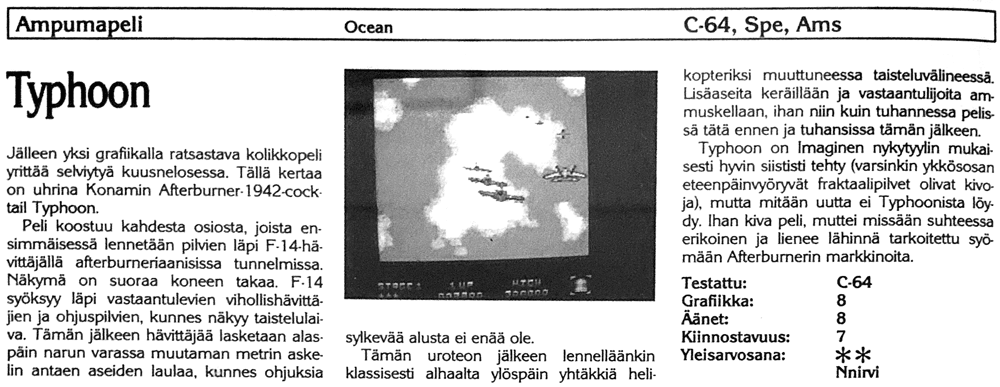
Typhoon1989 KevätPysyvä linkkiJälleen yksi grafiikalla ratsastava kolikkopeli yrittää selviytyä kuusnelosessa. Tällä kertaa on uhrina Konamin Afterburner-1942-cocktail Typhoon.
Peli koostuu kahdesta osiosta, joista ensimmäisessä lennetään pilvien läpi F-14-hävittäjällä afterburneriaanisissa tunnelmissa. Näkymä on suoraa koneen takaa. F-14 syöksyy läpi vastaantulevien vihollishävittäjien ja ohjuspilvien, kunnes näkyy taistelulaiva. Tämän jälkeen hävittäjää lasketaan alaspäin narun varassa muutaman metrin askelin antaen aseiden laulaa, kunnes ohjuksia sylkevää alusta ei enää ole.
Tämän uroteon jälkeen lennelläänkin klassisesti alhaalta ylöspäin yhtäkkiä helikopteriksi muuttuneessa taisteluvälineessä. Lisäaseita keräillään ja vastaantulijoita ammuskellaan, ihan niin kuin tuhannessa pelissä tätä ennen ja tuhansissa tämän jälkeen.
Typhoon on Imaginen nykytyylin mukaisesti hyvin siististi tehty (varsinkin ykkösosan eteenpäinvyöryvät fraktaalipilvet olivat kivoja), mutta mitään uutta ei Typhoonista löydy. Ihan kiva peli, muttei missään suhteessa erikoinen ja lienee lähinnä tarkoitettu syömään Afterburnerin markkinoita.
Typhoon1989 KevätPermalinkYet another arcade game riding on its graphics tries to survive on the C-64. This time the victim is Konami's Afterburner-1942 cocktail Typhoon.
The game consists of two sections, in the first of which you fly through the clouds in an F-14 fighter in an Afterburnerian atmosphere. The view is from directly behind the plane. The F-14 hurtles through oncoming enemy fighters and clouds of missiles until a battleship comes into view. After this the fighter is lowered downwards on a string a few metres at a time, letting its guns sing, until the missile-spitting ship is no more.
After this heroic deed it's on to flying classically from the bottom of the screen to the top, in a fighting machine that has suddenly turned into a helicopter. Extra weapons are collected and oncoming foes shot at, just as in a thousand games before this one and thousands after it.
In keeping with Imagine's current style, Typhoon is very neatly made (the fractal clouds rolling forward in part one were especially nice), but there's nothing new to be found in Typhoon. A perfectly nice game, but not special in any respect, and presumably meant mainly to eat into Afterburner's market.
Typhoon of Steel
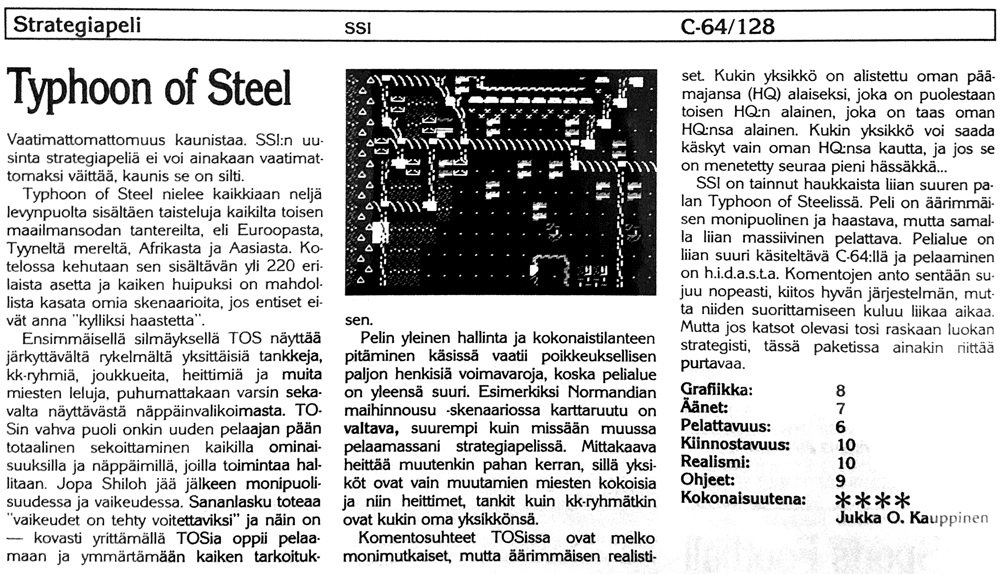
Typhoon of Steel1989 KevätPysyvä linkkiVaatimattomattomuus kaunistaa. SSI:n uusinta strategiapeliä ei voi ainakaan vaatimattomaksi väittää, kaunis se on silti.
Typhoon of Steel nielee kaikkiaan neljä levynpuolta sisältäen taisteluja kaikilta toisen maailmansodan tantereilta, eli Euroopasta, Tyyneltä mereltä, Afrikasta ja Aasiasta. Kotelossa kehutaan sen sisältävän yli 220 erilaista asetta ja kaiken huipuksi on mahdollista kasata omia skenaarioita, jos entiset eivät anna "kylliksi haastetta".
Ensimmäisellä silmäyksellä TOS näyttää järkyttävältä rykelmältä yksittäisiä tankkeja, kk-ryhmiä, joukkueita, heittimiä ja muita miesten leluja, puhumattakaan varsin sekavalta näyttävästä näppäinvalikoimasta. TOSin vahva puoli onkin uuden pelaajan pään totaalinen sekoittaminen kaikilla ominaisuuksilla ja näppäimillä, joilla toimintaa hallitaan. Jopa Shiloh jää jälkeen monipuolisuudessa ja vaikeudessa. Sananlasku toteaa "vaikeudet on tehty voitettaviksi" ja näin on - kovasti yrittämällä TOSia oppii pelaamaan ja ymmärtämään kaiken tarkoituksen.
Pelin yleinen hallinta ja kokonaistilanteen pitäminen käsissä vaatii poikkeuksellisen paljon henkisiä voimavaroja, koska pelialue on yleensä suuri. Esimerkiksi Normandian maihinnousu -skenaariossa karttaruutu on valtava, suurempi kuin missään muussa pelaamassani strategiapelissä. Mittakaava heittää muutenkin pahan kerran, sillä yksiköt ovat vain muutamien miesten kokoisia ja niin heittimet, tankit kuin kk-ryhmätkin ovat kukin oma yksikkönsä.
Komentosuhteet TOSissa ovat melko monimutkaiset, mutta äärimmäisen realistiset. Kukin yksikkö on alistettu oman päämajansa (HQ) alaiseksi, joka on puolestaan toisen HQ:n alainen, joka on taas oman HQ:nsa alainen. Kukin yksikkö voi saada käskyt vain oman HQ:nsa kautta, ja jos se on menetetty seuraa pieni hässäkkä...
SSI on tainnut haukkaista liian suuren palan Typhoon of Steelissä. Peli on äärimmäisen monipuolinen ja haastava, mutta samalla liian massiivinen pelattava. Pelialue on liian suuri käsiteltävä C-64:llä ja pelaaminen on h.i.d.a.s.t.a. Komentojen anto sentään sujuu nopeasti, kiitos hyvän järjestelmän, mutta niiden suorittamiseen kuluu liikaa aikaa. Mutta jos katsot olevasi tosi raskaan luokan strategisti, tässä paketissa ainakin riittää purtavaa.
Typhoon of Steel1989 KevätPermalinkModesty is a thing of beauty. SSI's latest strategy game certainly can't be called modest, but a thing of beauty it is all the same.
Typhoon of Steel gobbles up no fewer than four disk sides, containing battles from every battlefield of the Second World War, namely Europe, the Pacific, Africa and Asia. The box boasts that it contains over 220 different weapons, and to top it all you can put together your own scenarios if the existing ones don't offer "enough of a challenge".
At first glance TOS looks like a horrifying jumble of individual tanks, MG teams, platoons, mortars and other boys' toys, not to mention a rather confusing-looking selection of keys. Indeed, TOS's strong suit is totally scrambling a new player's head with all the features and keys used to control the action. Even Shiloh falls behind it in versatility and difficulty. The proverb says "difficulties are there to be overcome", and so it is - by trying hard you learn to play TOS and to understand what it's all for.
Running the game in general and keeping the overall situation in hand demand an exceptional amount of mental resources, since the play area is usually large. In the Normandy landings scenario, for instance, the map area is huge, bigger than in any other strategy game I have played. The scale is badly out of kilter in other ways too, as units are only a few men strong, and mortars, tanks and MG teams alike are each a unit of their own.
The chain of command in TOS is fairly complicated but extremely realistic. Each unit is subordinated to its own headquarters (HQ), which in turn is subordinate to another HQ, which in turn is subordinate to its own HQ. Each unit can only receive orders through its own HQ, and if that has been lost, a bit of a kerfuffle follows...
SSI seems to have bitten off more than it can chew with Typhoon of Steel. The game is extremely versatile and challenging, but at the same time too massive to play. The play area is too big to handle on the C-64, and playing is s.l.o.w. At least issuing orders goes quickly, thanks to a good system, but carrying them out takes too much time. But if you reckon you're a truly heavyweight strategist, this package at least has plenty to chew on.
Typhoon of Steel
Typhoon of Steel1991 SyksyPysyvä linkkiTahmat pois koneesta tai toinen tilalle, totesi Gary Grigsby Typhoon of Steeliä ihmetellessään. Vanha 64 ei enää venynyt, joten Typhoon Of Steel ja edeltäjä Overrun löysivät toisensa Amigasta ja PC:ltä. Nepa olikin liian vähäinen kone näille simulaatioille - valtava määrä dataa tahmasi muutenkin hitaan masiinan esimerkillisesti, mutta 16+bittiä tarjoaa jo muutakin kuin ikuisia kahvitaukoja.
Aikakautta lukuunottamatta Typhoon Of Steel on lähes 100% kopio Overrunista sisältäen samat plussat ja munaukset. Suurimmat erot löytyvät nimenomaan ajanjaksosta (Suuri Sota II), aseistuksesta (eipä ole M1 käytössä) ja sijainnista - mukana seuraa valmiita skenarioita Tyynenmeren, Euroopan ja Aasian kentiltä, yhteensä 7 kappaletta. Omia voi tietysti rakentaa lisää.
Koskapa pelit ovat systeemeiltään samat, virheet ovat identtiset. Pahimmin pännii kartan onneton päivitysrutiini sekä tiedon puute siitä josko yksikkö on tietokoneen ohjauksessa vaiko ei. Pahimmillaan joukot saattavat lähteä omille teilleen kesken taistoa tai eivät välitä käskyistä nenmpää kuin TJ1:n vanha... Olisiko pieni päivitys ollut niin vaikeaa, Garyseni?
Todella hyvän simulaation tahtoville Typhoon of Steel on ehdoton. Sen tarkkuudelle lyö vertoja vain Overrun, ja Amiga/PC-versioiden erona on vain PC:n suurempi potku (lue: kahville ei enää jouda ollenkaan). Jo jäi Kampfgruppe kakkoseksi...
Typhoon of Steel1991 SyksyPermalinkGet the treacle out of the machine or put another one in its place, declared Gary Grigsby while puzzling over Typhoon of Steel. The old 64 couldn't stretch any further, so Typhoon Of Steel and its predecessor Overrun found each other on the Amiga and the PC. The C64 really was too modest a machine for these simulations - the huge amount of data turned the already slow contraption to treacle in exemplary fashion, but 16+ bits has more to offer than eternal coffee breaks.
Apart from the era, Typhoon Of Steel is a nearly 100% copy of Overrun, complete with the same pluses and cock-ups. The biggest differences lie specifically in the time period (Great War II), the weaponry (no M1 to play with, then) and the location - it comes with ready-made scenarios from the Pacific, European and Asian theatres, 7 in total. You can of course build more of your own.
Since the games' systems are the same, the flaws are identical. What grates most is the map's wretched update routine, plus the lack of any information on whether a unit is under computer control or not. At worst the troops may wander off on their own in the middle of a battle, or pay orders no more heed than a demob-happy old-timer with one day of service left... Would a little update really have been so hard, my dear Gary?
For anyone who wants a really good simulation, Typhoon of Steel is a must. Only Overrun rivals its precision, and the only difference between the Amiga/PC versions is the PC's greater kick (read: there's no time left to go for coffee at all). Well, that leaves Kampfgruppe in second place...