1133 reviews from "Pelit"-books
Pelit was a Finnish-language (bi)annual book series published from 1987 to 1991 containing gaming-related articles, tips and most importantly game reviews. Here you can find all the reviews from the books. The reviews were originally written in Finnish; the English versions are translations of the Finnish originals. Maininta tekijänoikeuksista
 1987
1987 1988
1988 1989 Kevät
 1989 Syksy
 1990 Kevät
 1990 Syksy
 1991 Kevät
 1991 Syksy
L.E.D. Storm
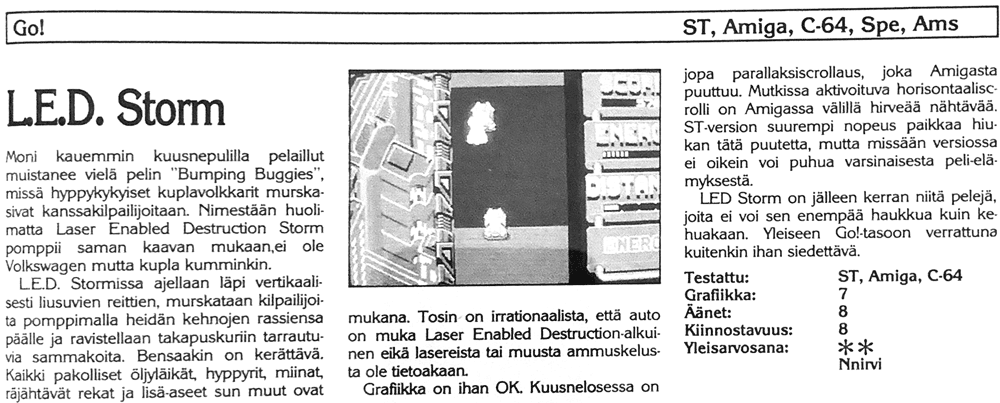
L.E.D. Storm1989 SyksyPysyvä linkkiMoni kauemmin kuusnepulilla pelaillut muistanee vielä pelin "Bumping Buggies", missä hyppykykyiset kuplavolkkarit murskasivat kanssakilpailijoitaan. Nimestään huolimatta Laser Enabled Destruction Storm pomppii saman kaavan mukaan,ei ole Volkswagen mutta kupla kumminkin.
L.E.D. Stormissa ajellaan läpi vertikaalisesti liusuvien reittien, murskataan kilpailijoita pomppimalla heidän kehnojen rassiensa päälle ja ravistellaan takapuskuriin tarrautuvia sammakoita. Bensaakin on kerättävä. Kaikki pakolliset öljyläikät, hyppyrit, miinat, räjähtävät rekat ja lisä-aseet sun muut ovat mukana. Tosin on irrationaalista, että auto on muka Laser Enabled Destruction-alkuinen eikä lasereista tai muusta ammuskelusta ole tietoakaan.
Grafiikka on ihan OK. Kuusnelosessa on jopa parallaksiscrollaus, joka Amigasta puuttuu. Mutkissa aktivoituva horisontaaliscrolli on Amigassa välillä hirveää nähtävää. ST-version suurempi nopeus paikkaa hiukan tätä puutetta, mutta missään versiossa ei oikein voi puhua varsinaisesta peli-elämyksestä.
LED Storm on jälleen kerran niitä pelejä, joita ei voi sen enempää haukkua kuin kehuakaan. Yleiseen Go!-tasoon verrattuna kuitenkin ihan siedettävä.
L.E.D. Storm1989 SyksyPermalinkMany who have played on the C-64 for a good while will probably still remember the game "Bumping Buggies", in which VW Beetles with a talent for jumping crushed their fellow competitors. Despite its name, Laser Enabled Destruction Storm bounces along to the same formula: it's not a Volkswagen, but it's a Beetle all the same.
In L.E.D. Storm you drive along vertically scrolling routes, crush competitors by bouncing on top of their lousy bangers and shake off frogs clinging to your rear bumper. You have to collect petrol too. All the obligatory oil slicks, ramps, mines, exploding trucks, extra weapons and what-have-you are included. Admittedly it's irrational that the car is supposedly Laser Enabled Destruction-something, yet there's no sign of lasers or any other shooting.
The graphics are quite OK. The C-64 even has parallax scrolling, which the Amiga lacks. The horizontal scroll that kicks in on the bends is at times a horrible sight on the Amiga. The ST version's greater speed makes up a little for this shortcoming, but in none of the versions can you really talk about an actual gaming experience.
LED Storm is once again one of those games you can neither slate nor praise very much. Compared with the general Go! standard, though, it's quite tolerable.
Lancaster
Lancaster1990 KevätPysyvä linkkiEnglantilaisen CRL:n omistama Actual Screenshots ei ole vielä tähän päivään mennessä vakuuttanut peleillään. Ensimmäinen peli, ensimmäiset 10 sekuntia kohtalaisen hupaisa gladiaattorivitsailu, jonka nimi ei syystä tai toisesta nyt tule mieleen, oli tylsä kuin piru. Sama vitsaus taitaa iskeä kyntensä Lancasteriinkin.
Pelaaja istutetaan toisen maailmansodan aikaisen pommikoneen taka-ampujan paikalle. Käsikirja kuluttaa muutaman sivun kehuakseen Lancaster-koneen mainioita ominaisuuksia ja jättää sitten pelin selostamisen sikseen, melkein.
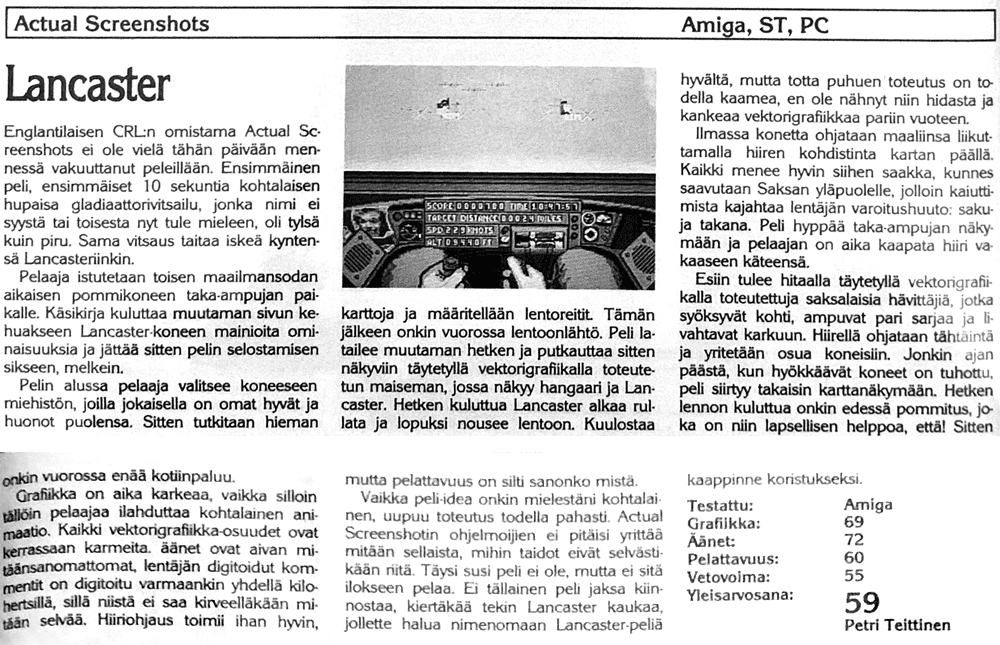
Pelin alussa pelaaja valitsee koneeseen miehistön, joilla jokaisella on omat hyvät ja huonot puolensa. Sitten tutkitaan hieman karttoja ja määritellään lentoreitit. Tämän jälkeen onkin vuorossa lentoonlähtö. Peli latailee muutaman hetken ja putkauttaa sitten näkyviin täytetyllä vektorigrafiikalla toteutetun maiseman, jossa näkyy hangaari ja Lancaster. Hetken kuluttua Lancaster alkaa rullata ja lopuksi nousee lentoon. Kuulostaa hyvältä, mutta totta puhuen toteutus on todella kaamea, en ole nähnyt niin hidasta ja kankeaa vektorigrafiikkaa pariin vuoteen.
Ilmassa konetta ohjataan maaliinsa liikuttamalla hiiren kohdistinta kartan päällä. Kaikki menee hyvin siihen saakka, kunnes saavutaan Saksan yläpuolelle, jolloin kaiuttimista kajahtaa lentäjän varoitushuuto: sakuja takana. Peli hyppää taka-ampujan näkymään ja pelaajan on aika kaapata hiiri vakaaseen käteensä.
Esiin tulee hitaalla täytetyllä vektorigrafiikalla toteutettuja saksalaisia hävittäjiä, jotka syöksyvät kohti, ampuvat pari sarjaa ja livahtavat karkuun. Hiirellä ohjataan tähtäintä ja yritetään osua koneisiin. Jonkin ajan päästä, kun hyökkäävät koneet on tuhottu, peli siirtyy takaisin karttanäkymään. Hetken lennon kuluttua onkin edessä pommitus, joka on niin lapsellisen helppoa, että! Sitten onkin vuorossa enää kotiinpaluu.
Grafiikka on aika karkeaa, vaikka silloin tällöin pelaajaa ilahduttaa kohtalainen animaatio. Kaikki vektorigrafiikka-osuudet ovat kerrassaan karmeita. äänet ovat aivan mitäänsanomattomat, lentäjän digitoidut kommentit on digitoitu varmaankin yhdellä kilohertsillä, sillä niistä ei saa kirveelläkään mitään selvää. Hiiriohjaus toimii ihan hyvin, mutta pelattavuus on silti sanonko mistä.
Vaikka peli-idea onkin mielestäni kohtalainen, uupuu toteutus todella pahasti. Actual Screenshotin ohjelmoijien ei pitäisi yrittää mitään sellaista, mihin taidot eivät selvästikään riitä. Täysi susi peli ei ole, mutta ei sitä ilokseen pelaa. Ei tällainen peli jaksa kiinnostaa, kiertäkää tekin Lancaster kaukaa, jollette halua nimenomaan Lancaster-peliä kaappinne koristukseksi.
Lancaster1990 KevätPermalinkActual Screenshots, owned by the English CRL, has not so far managed to impress anyone with its games. Its first game, a gladiator gag that was moderately amusing for the first 10 seconds and whose name for one reason or another escapes me right now, was boring as hell. The same plague seems to be sinking its claws into Lancaster too.
The player is plonked into the rear gunner's seat of a Second World War bomber. The manual spends a few pages praising the splendid qualities of the Lancaster aircraft and then leaves explaining the game well alone, almost.
At the start of the game the player picks a crew for the aircraft, each of whom has their own strengths and weaknesses. Then you study the maps a little and plot the flight routes. After that it's time for take-off. The game loads away for a few moments and then pops up a landscape done in filled vector graphics, showing a hangar and the Lancaster. After a while the Lancaster starts to taxi and finally takes off. Sounds good, but to be honest the execution is truly ghastly; I haven't seen vector graphics this slow and stiff in a couple of years.
In the air, the plane is steered to its target by moving the mouse pointer over the map. All goes well until you get over Germany, at which point the pilot's warning shout rings out of the speakers: Jerries on our tail. The game jumps to the rear gunner's view and it's time for the player to grab the mouse in a steady hand.
Up come German fighters done in slow filled vector graphics, which dive at you, fire a couple of bursts and slip away. You steer the gunsight with the mouse and try to hit the planes. After a while, once the attacking planes have been destroyed, the game switches back to the map view. A short flight later the bombing run is upon you, and it's so childishly easy that... well! Then all that's left is the trip home.
The graphics are pretty crude, although now and then the player is cheered by a passable bit of animation. All the vector graphics sections are downright horrible. The sound is utterly bland; the pilot's digitised comments must have been digitised at one kilohertz, since you can't make out a word of them for love nor money. The mouse control works just fine, but the playability is still, how shall I put it, from where the sun doesn't shine.
Although I think the game idea is passable, the execution falls badly short. Actual Screenshot's programmers shouldn't attempt anything their skills are clearly not up to. The game isn't a complete dud, but nobody plays it for fun. A game like this just can't hold your interest; you too should give Lancaster a wide berth, unless you specifically want a Lancaster game to decorate your cupboard.
Lands of Havoc
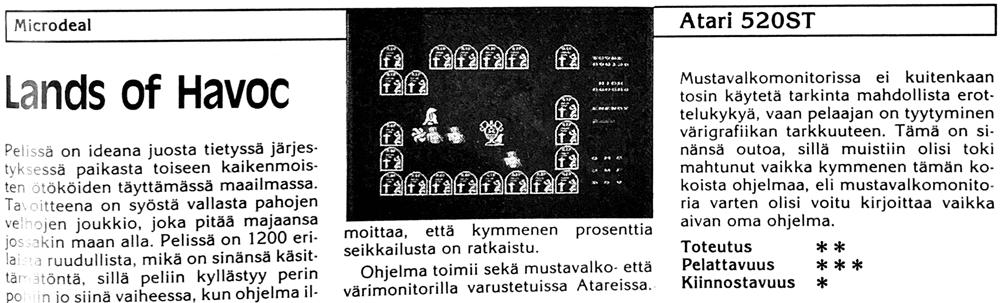
Lands of Havoc1987Pysyvä linkkiPelissä on ideana juosta tietyssä järjestyksessä paikasta toiseen kaikenmoisten ötököiden täyttämässä maailmassa. Tavoitteena on syöstä vallasta pahojen velhojen joukkio, joka pitää majaansa jossakin maan alla. Pelissä on 1200 erilaista ruudullista, mikä on sinänsä käsittämätöntä, sillä peliin kyllästyy perin pohjin jo siinä vaiheessa, kun ohjelma ilmoittaa, että kymmenen prosenttia seikkailusta on ratkaistu.
Ohjelma toimii sekä mustavalko- että värimonitorilla varustetuissa Atareissa. Mustavalkomonitorissa ei kuitenkaan tosin käytetä tarkinta mahdollista erottelukykyä, vaan pelaajan on tyytyminen värigrafiikan tarkkuuteen. Tämä on sinänsä outoa, sillä muistiin olisi toki mahtunut vaikka kymmenen tämän kokoista ohjelmaa, eli mustavalkomonitoria varten olisi voitu kirjoittaa vaikka aivan oma ohjelma.
Lands of Havoc1987PermalinkThe idea of the game is to run from place to place, in a set order, through a world crawling with all manner of creepy-crawlies. The goal is to topple a gang of evil wizards who hole up somewhere underground. The game has 1200 different screenfuls, which is baffling in itself, since you're thoroughly sick of the game by the time the program announces that ten per cent of the adventure has been solved.
The program runs on Ataris fitted with either a monochrome or a colour monitor. On the monochrome monitor, however, it doesn't use the highest resolution available; the player has to make do with the resolution of the colour graphics. This is odd in itself, since the memory could easily have held ten programs this size, meaning a whole separate program could perfectly well have been written for the monochrome monitor.
Laser Squad
Laser Squad1990 KevätPysyvä linkkiKauan sitten, kun Spectrumkin oli vielä hengissä, tuli yhtiöltä Red Shift -peli nimeltään Rebelstar Raiders. Peli kohosi nopeasti kulttipelin maineeseen, mutta hävisi Red Shiftin ottaessa Kon-kurssin. Nyt RSR on noussut unohduksesta uudella nimellä ja uljaampana kuin koskaan.
Laser Squad edustaa harvinaista lintua pelimaailmassa. Siinä ohjataan ryhmää avaruuscommandoja mies kerrallaan, tehtävien vaihdellessa salamurhasta taistelutehtäviin. Commando-tyyppisestä rytystelystä ei ole kyse, vaan taktiikka on avainsana.
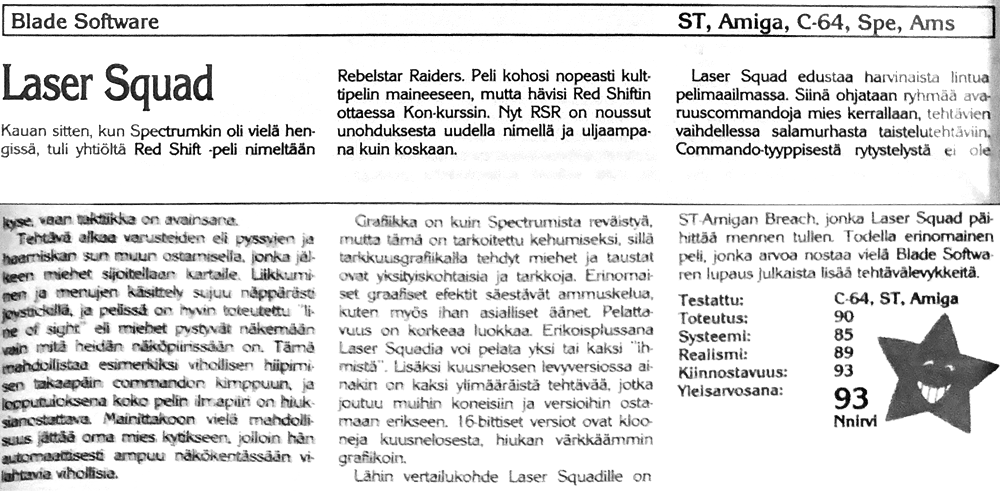
Tehtävä alkaa varusteiden eli pyssyjen ja haarniskan sun muun ostamisella, jonka jälkeen miehet sijoitellaan kartalle. Liikkuminen ja menujen käsittely sujuu näppärästi joystickillä, ja pelissä on hyvin toteutettu "line of sight" eli miehet pystyvät näkemään vain mitä heidän näköpiirissään on. Tämä mahdollistaa esimerkiksi vihollisen hiipimisen takaapäin commandon kimppuun, ja lopputuloksena koko pelin ilmapiiri on hiuksianostattava. Mainittakoon vielä mahdollisuus jättää oma mies kytikseen, jolloin hän automaattisesti ampuu näkökentässään vilahtavia vihollisia.
Grafiikka on kuin Spectrumista reväistyä, mutta tämä on tarkoitettu kehumiseksi, sillä tarkkuusgrafiikalla tehdyt miehet ja taustat ovat yksityiskohtaisia ja tarkkoja. Erinomaiset graafiset efektit säestävät ammuskelua, kuten myös ihan asialliset äänet. Pelattavuus on korkeaa luokkaa. Erikoisplussana Laser Squadia voi pelata yksi tai kaksi "ihmistä". Lisäksi kuusnelosen levyversiossa ainakin on kaksi ylimääräistä tehtävää, jotka joutuu muihin koneisiin ja versioihin ostamaan erikseen. 16-bittiset versiot ovat klooneja kuusnelosesta, hiukan värkkäämmin grafiikoin.
Lähin vertailukohde Laser Squadille on ST-Amigan Breach, jonka Laser Squad päihittää mennen tullen. Todella erinomainen peli, jonka arvoa nostaa vielä Blade Softwaren lupaus julkaista lisää tehtävälevykkeitä.
Laser Squad1990 KevätPermalinkLong ago, when even the Spectrum was still alive, the company Red Shift put out a game called Rebelstar Raiders. The game quickly rose to cult status, but vanished when Red Shift went bankrupt. Now RSR has risen from oblivion under a new name and more gallant than ever.
Laser Squad is a rare bird in the gaming world. In it you control a squad of space commandos one man at a time, with missions ranging from assassination to combat assignments. This is no Commando-style rough and tumble; tactics is the key word.
A mission starts with buying equipment, that is guns and armour and whatnot, after which the men are positioned on the map. Moving and working the menus goes nimbly with the joystick, and the game has a well-implemented "line of sight", meaning the men can only see what is within their field of view. This makes it possible, for example, for an enemy to sneak up on a commando from behind, and the end result is that the atmosphere of the whole game is hair-raising. Let me also mention the option to leave one of your men lying in wait, in which case he automatically shoots any enemies that flit across his field of vision.
The graphics look as if they had been ripped straight off the Spectrum, but this is meant as praise, since the men and backgrounds, done in high-resolution graphics, are detailed and sharp. Excellent graphic effects accompany the shooting, as does perfectly decent sound. The playability is top class. As a special bonus, Laser Squad can be played by one or two "humans". In addition, the Commodore 64 disk version at least has two extra missions, which you have to buy separately for the other machines and versions. The 16-bit versions are clones of the Commodore 64 one, with slightly more colourful graphics.
The closest point of comparison for Laser Squad is Breach on the ST and Amiga, which Laser Squad beats hands down. A truly excellent game, its value boosted further by Blade Software's promise to release more mission disks.
Last Mission
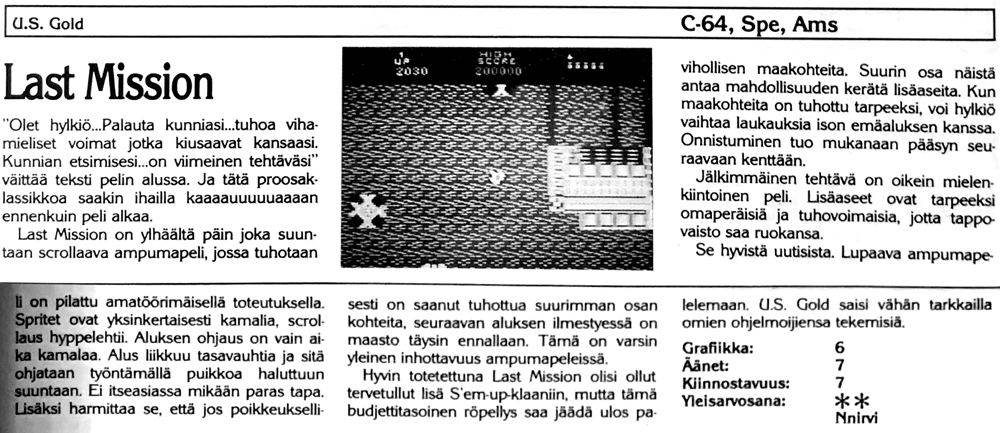
Last Mission1988Pysyvä linkki"Olet hylkiö...Palauta kunniasi...tuhoa vihamieliset voimat jotka kiusaavat kansaasi. Kunnian etsimisesi...on viimeinen tehtäväsi" väittää teksti pelin alussa. Ja tätä proosaklassikkoa saakin ihailla kaaaauuuuuaaaan ennenkuin peli alkaa.
Last Mission on ylhäältä päin joka suuntaan scrollaava ampumapeli, jossa tuhotaan vihollisen maakohteita. Suurin osa näistä antaa mahdollisuuden kerätä lisäaseita. Kun maakohteita on tuhottu tarpeeksi, voi hylkiö vaihtaa laukauksia ison emäaluksen kanssa. Onnistuminen tuo mukanaan pääsyn seuraavaan kenttään.
Jälkimmäinen tehtävä on oikein mielenkiintoinen peli. Lisäaseet ovat tarpeeksi omaperäisiä ja tuhovoimaisia, jotta tappovaisto saa ruokansa.
Se hyvistä uutisista. Lupaava ampumapeli on pilattu amatöörimäisellä toteutuksella. Spritet ovat yksinkertaisesti kamalia, scrollaus hyppelehtii. Aluksen ohjaus on vain aika kamalaa. Alus liikkuu tasavauhtia ja sitä ohjataan työntämällä puikkoa haluttuun suuntaan. Ei itseasiassa mikään paras tapa. Lisäksi harmittaa se, että jos poikkeuksellisesti on saanut tuhottua suurimman osan kohteita, seuraavan aluksen ilmestyessä on maasto täysin ennallaan. Tämä on varsin yleinen inhottavuus ampumapeleissä.
Hyvin toteutettuna Last Mission olisi ollut tervetullut lisä S'em-up-klaaniin, mutta tämä budjettitasoinen röpellys saa jäädä ulos palelemaan. U.S. Gold saisi vähän tarkkailla omien ohjelmoijiensa tekemisiä.
Last Mission1988Permalink"You are an outcast...Restore your honour...destroy the hostile forces that torment your people. Your quest for honour...is your last mission," claims the text at the start of the game. And you get to admire this classic of prose for a loooooong tiiiime before the game starts.
Last Mission is a top-down shoot-'em-up that scrolls in every direction, in which you destroy enemy ground targets. Most of these give you the chance to pick up extra weapons. Once enough ground targets have been destroyed, the outcast can trade shots with a big mothership. Success brings with it access to the next level.
The Latter Mission is a really quite interesting game. The extra weapons are original and destructive enough for your killer instinct to get fed.
So much for the good news. A promising shooter has been ruined by an amateurish implementation. The sprites are simply awful, and the scrolling judders. Steering the ship is just pretty awful. The ship moves at a constant speed and you steer it by pushing the stick in the direction you want to go. Not actually the best way of doing it. What's more, it's annoying that if, by some fluke, you have managed to destroy most of the targets, the terrain is completely back to its old self when the next ship appears. This is a fairly common nastiness in shoot-'em-ups.
Well executed, Last Mission would have been a welcome addition to the shoot-'em-up clan, but this budget-grade botch job can stay out in the cold. U.S. Gold ought to keep a bit more of an eye on what its own programmers are up to.
Last Ninja 2
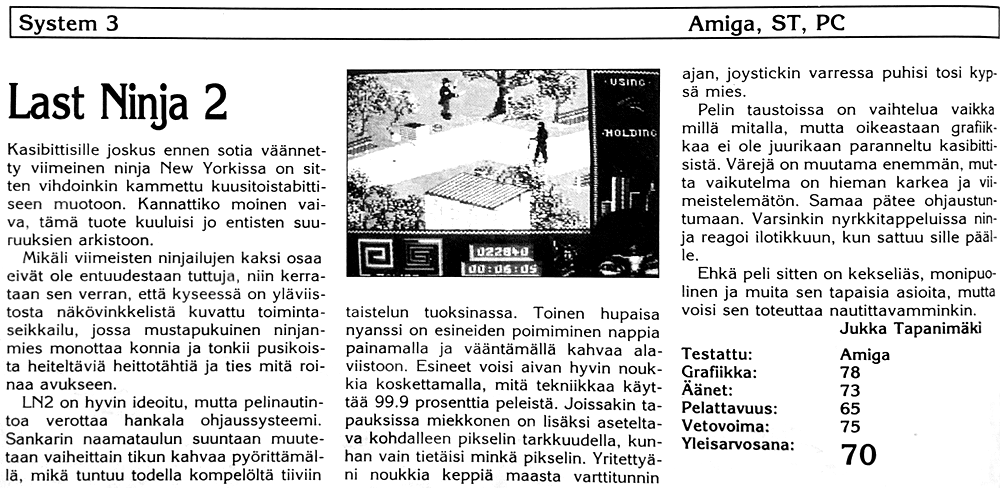
Last Ninja 21990 SyksyPysyvä linkkiKasibittisille joskus ennen sotia väännetty viimeinen ninja New Yorkissa on sitten vihdoinkin kammettu kuusitoistabittiseen muotoon. Kannattiko moinen vaiva, tämä tuote kuuluisi jo entisten suuruuksien arkistoon.
Mikäli viimeisten ninjailujen kaksi osaa eivät ole entuudestaan tuttuja, niin kerrataan sen verran, että kyseessä on yläviistosta näkövinkkelistä kuvattu toimintaseikkailu, jossa mustapukuinen ninjanmies monottaa konnia ja tonkii pusikoista heiteltäviä heittotähtiä ja ties mitä roinaa avukseen.
LN2 on hyvin ideoitu, mutta pelinautintoa verottaa hankala ohjaussysteemi. Sankarin naamataulun suuntaan muutetaan vaiheittain tikun kahvaa pyörittämällä, mikä tuntuu todella kompelöltä tiiviin taistelun tuoksinassa. Toinen hupaisa nyanssi on esineiden poimiminen nappia painamalla ja vääntämällä kahvaa alaviistoon. Esineet voisi aivan hyvin noukkia koskettamalla, mitä tekniikkaa käyttää 99.9 prosenttia peleistä. Joissakin tapauksissa miekkonen on lisäksi aseteltava kohdalleen pikselin tarkkuudella, kunhan vain tietäisi minkä pikselin. Yritettyäni noukkia keppiä maasta varttitunnin ajan, joystickin varressa puhisi tosi kypsä mies.
Pelin taustoissa on vaihtelua vaikka millä mitalla, mutta oikeastaan grafiikkaa ei ole juurikaan paranneltu kasibittisistä. Värejä on muutama enemmän, mutta vaikutelma on hieman karkea ja viimeistelemätön. Samaa pätee ohjaustuntumaan. Varsinkin nyrkkitappeluissa ninja reagoi ilotikkuun, kun sattuu sille päälle.
Ehkä peli sitten on kekseliäs, monipuolinen ja muita sen tapaisia asioita, mutta voisi sen toteuttaa nautittavamminkin.
Last Ninja 21990 SyksyPermalinkThe last ninja in New York, knocked together for the eight-bits sometime back before the wars, has now finally been cranked into sixteen-bit form. Was all that bother worth it? This product ought to be in the archive of former greats by now.
If the two instalments of last-ninja-ing aren't already familiar to you, let's recap just this much: it's an action adventure seen from a diagonal overhead viewpoint, in which a black-clad ninja man boots villains around and rummages in the bushes for throwable throwing stars and who knows what junk to help him out.
LN2 is well thought out, but the enjoyment is taxed by an awkward control system. The direction the hero's mug is facing is changed step by step by rotating the stick's handle, which feels really clumsy in the thick of close combat. Another amusing nuance is picking up objects by pressing the button and wrenching the handle diagonally down. The objects could perfectly well be picked up just by touching them, a technique used by 99.9 per cent of games. In some cases the fellow also has to be lined up with pixel precision, if only you knew which pixel. After I'd tried to pick a stick up off the ground for a quarter of an hour, there was one seriously fed-up man fuming at the end of the joystick.
There's variety in the game's backdrops by the bucketload, but really the graphics have hardly been improved on the eight-bit versions. There are a few more colours, but the impression is a bit rough and unfinished. The same goes for the feel of the controls. In the fist fights especially, the ninja responds to the joystick when he happens to be in the mood.
So maybe the game is inventive, versatile and other things of that sort, but it could have been made a lot more enjoyable.
Last Ninja II
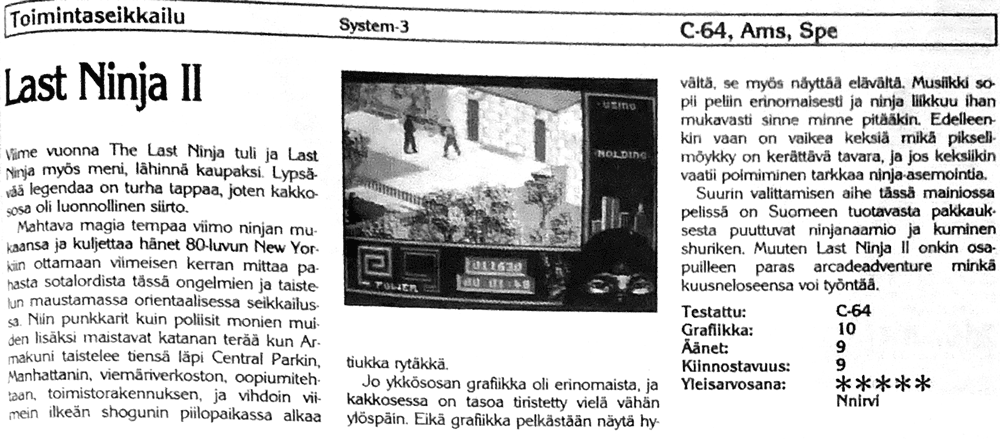
Last Ninja II1989 KevätPysyvä linkkiViime vuonna The Last Ninja tuli ja Last Ninja myös meni, lähinnä kaupaksi. Lypsävää legendaa on turha tappaa, joten kakkososa oli luonnollinen siirto.
Mahtava magia tempaa viimo ninjan mukaansa ja kuljettaa hänet 80-luvun New Yorkiin ottamaan viimeisen kerran mittaa pahasta sotalordista tässä ongelmien ja taistelun maustamassa orientaalisessa seikkailussa. Niin punkkarit kuin poliisit monien muiden lisäksi maistavat katanan terää kun Armakuni taistelee tiensä läpi Central Parkin, Manhattanin, viemäriverkoston, oopiumitehtaan, toimistorakennuksen, ja vihdoin viimein ilkeän shogunin piilopaikassa alkaa tiukka rytäkkä.
Jo ykkösosan grafiikka oli erinomaista, ja kakkosessa on tasoa tiristetty vielä vähän ylöspäin. Eikä grafiikka pelkästään näytä hyvältä, se myös näyttää elävältä. Musiikki sopii peliin erinomaisesti ja ninja liikkuu ihan mukavasti sinne minne pitääkin. Edelleenkin vaan on vaikea keksiä mikä pikselimöykky on kerättävä tavara, ja jos keksiikin vaatii poimiminen tarkkaa ninja-asemointia.
Suurin valittamisen aihe tässä mainiossa pelissä on Suomeen tuotavasta pakkauksesta puuttuvat ninjanaamio ja kuminen shuriken. Muuten Last Ninja II onkin osapuilleen paras arcadeadventure minkä kuusneloseensa voi työntää.
Last Ninja II1989 KevätPermalinkLast year The Last Ninja came, and Last Ninja also went - mostly like hot cakes. There's no point slaughtering a legend that still gives milk, so a sequel was the natural move.
Mighty magic sweeps up the last ninja and carries the warrior off to 1980s New York to square up to an evil warlord one last time, in this oriental adventure seasoned with puzzles and combat. Punks and police alike, along with many others, get a taste of the katana's blade as Armakuni battles through Central Park, Manhattan, the sewer network, an opium factory, an office building, and at long last a fierce brawl kicks off in the wicked shogun's hideout.
The graphics were already excellent in the first part, and in the sequel the standard has been squeezed up a little further still. And the graphics don't just look good, they look alive, too. The music suits the game excellently, and the ninja moves quite nicely to wherever required. Still, it's hard to work out which lump of pixels is an item to collect, and even if you do work it out, picking it up calls for precise ninja positioning.
The biggest cause for complaint about this splendid game is that the ninja mask and rubber shuriken are missing from the package imported into Finland. Otherwise Last Ninja II is just about the best arcade adventure you can shove into your C-64.
Last Ninja III
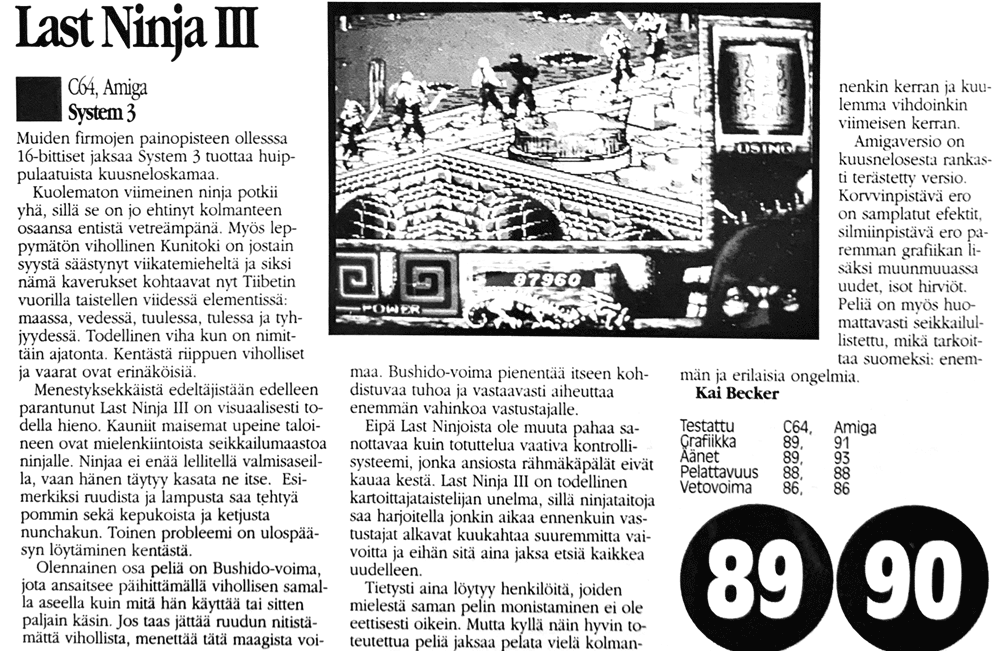
Last Ninja III1991 SyksyPysyvä linkkiMuiden firmojen painopisteen ollesssa 16-bittiset jaksaa System 3 tuottaa huippulaatuista kuusneloskamaa.
Kuolematon viimeinen ninja potkii yhä, sillä se on jo ehtinyt kolmanteen osaansa entistä vetreämpänä. Myös leppymätön vihollinen Kunitoki on jostain syystä säästynyt viikatemieheltä ja siksi nämä kaverukset kohtaavat nyt Tiibetin vuorilla taistellen viidessä elementissä: maassa, vedessä, tuulessa, tulessa ja tyhjyydessä. Todellinen viha kun on nimittäin ajatonta. Kentästä riippuen viholliset ja vaarat ovat erinäköisiä.
Menestyksekkäistä edeltäjistään edelleen parantunut Last Ninja III on visuaalisesti todella hieno. Kauniit maisemat upeine taloineen ovat mielenkiintoista seikkailumaastoa ninjalle. Ninjaa ei enää lellitellä valmisaseilla, vaan hänen täytyy kasata ne itse. Esimerkiksi ruudista ja lampusta saa tehtyä pommin sekä kepukoista ja ketjusta nunchakun. Toinen probleemi on ulospääsyn löytäminen kentästä.
Olennainen osa peliä on Bushido-voima, jota ansaitsee päihittämällä vihollisen samalla aseella kuin mitä hän käyttää tai sitten paljain käsin. Jos taas jättää ruudun nitistämättä vihollista, menettää tätä maagista voimaa. Bushido-voima pienentää itseen kohdistuvaa tuhoa ja vastaavasti aiheuttaa enemmän vahinkoa vastustajalle.
Eipä Last Ninjoista ole muuta pahaa sanottavaa kuin totuttelua vaativa kontrollisysteemi, jonka ansiosta rähmäkäpälät eivät kauaa kestä. Last Ninja III on todellinen kartoittajataistelijan unelma, sillä ninjataitoja saa harjoitella jonkin aikaa ennenkuin vastustajat alkavat kuukahtaa suuremmitta vaivoitta ja eihän sitä aina jaksa etsiä kaikkea uudelleen.
Tietysti aina löytyy henkilöitä, joiden mielestä saman pelin monistaminen ei ole eettisesti oikein. Mutta kyllä näin hyvin toteutettua peliä jaksaa pelata vielä kolmannenkin kerran ja kuulemma vihdoinkin viimeisen kerran.
Amigaversio on kuusnelosesta rankasti terästetty versio. Korvvinpistävä ero on samplatut efektit, silmiinpistävä ero paremman grafiikan lisäksi muunmuuassa uudet, isot hirviöt. Peliä on myös huomattavasti seikkailullistettu, mikä tarkoittaa suomeksi: enemmän ja erilaisia ongelmia.
Last Ninja III1991 SyksyPermalinkWhile other firms have their focus on the 16-bitters, System 3 keeps on churning out top-quality Commodore 64 stuff.
The immortal last ninja is still kicking, having already made it to his third instalment more supple than ever. His implacable enemy Kunitoki has also for some reason been spared by the Grim Reaper, and so these two pals now meet in the mountains of Tibet, fighting in five elements: earth, water, wind, fire and the void. True hatred, you see, is timeless. Depending on the level, the enemies and dangers look different.
Improved yet again on its successful predecessors, Last Ninja III is visually really fine. The beautiful landscapes with their splendid buildings make interesting adventuring terrain for the ninja. The ninja is no longer pampered with ready-made weapons; he has to put them together himself. For example, gunpowder and a lamp make a bomb, and a couple of sticks and a chain make a nunchaku. The other problem is finding the way out of the level.
An essential part of the game is Bushido power, which you earn by beating an enemy with the same weapon he's using, or else with your bare hands. If, on the other hand, you leave a screen without bumping off the enemy, you lose some of this magical power. Bushido power reduces the damage done to you and, correspondingly, makes you do more damage to your opponent.
There's nothing else bad to say about the Last Ninjas except the control system, which takes some getting used to and means the butterfingers won't last long. Last Ninja III is a real dream for the mapping warrior, since you have to practise your ninja skills for a while before opponents start keeling over without much bother, and you can't always be bothered to search for everything all over again.
Of course there are always people who think that duplicating the same game isn't ethically right. But a game this well made you'll happily play a third time too, and, so they say, finally the last time.
The Amiga version is a heavily souped-up version of the Commodore 64 one. The ear-catching difference is the sampled effects; the eye-catching difference, besides the better graphics, is among other things the new, big monsters. The game has also been considerably adventurised, which in plain English means: more and different problems.
Last Ninja, The
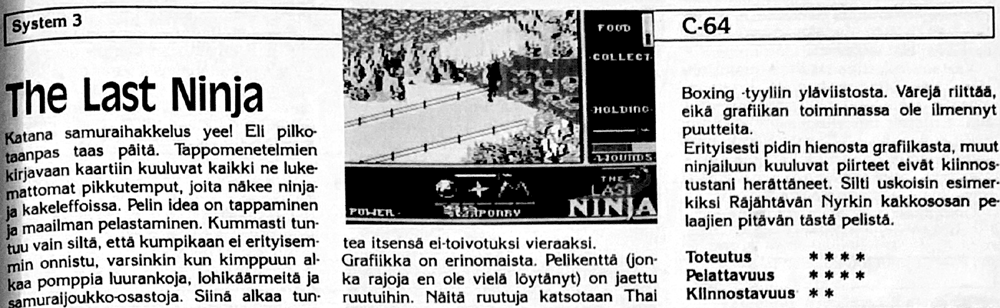
Last Ninja, The1987Pysyvä linkkiKatana samuraihakkelus yee! Eli pilkotaanpas taas päitä. Tappomenetelmien kirjavaan kaartiin kuuluvat kaikki ne lukemattomat pikkutemput, joita näkee ninja- ja kakeleffoissa. Pelin idea on tappaminen ja maailman pelastaminen. Kummasti tuntuu vain siltä, että kumpikaan ei erityisemmin onnistu, varsinkin kun kimppuun alkaa pomppia luurankoja, lohikäärmeitä ja samuraijoukko-osastoja. Siinä alkaa tuntea itsensä ei-toivotuksi vieraaksi.
Grafiikka on erinomaista. Pelikenttä (jonka rajoja en ole vielä löytänyt) on jaettu ruutuihin. Näitä ruutuja katsotaan Thai Boxing -tyyliin yläviistosta. Värejä riittää, eikä grafiikan toiminnassa ole ilmennyt puutteita.
Erityisesti pidin hienosta grafiikasta, muut ninjailuun kuuluvat piirteet eivät kiinnostustani herättäneet. Silti uskoisin esimerkiksi Räjähtävän Nyrkin kakkososan pelaajien pitävän tästä pelistä.
Last Ninja, The1987PermalinkKatana samurai mincemeat, yee! So let's go chopping heads again. The colourful arsenal of killing methods includes all those countless little tricks you see in ninja and chop-socky flicks. The idea of the game is killing and saving the world. Funnily enough, though, it just feels like neither is going particularly well, especially when skeletons, dragons and whole samurai detachments start jumping on you. You begin to feel like an unwelcome guest.
The graphics are excellent. The playing area (whose edges I haven't found yet) is divided into screens. These screens are viewed diagonally from above, Thai Boxing style. There are plenty of colours, and no flaws have turned up in how the graphics work.
I particularly liked the fine graphics; the other features that go with all the ninja-ing didn't spark my interest. Still, I'd reckon that players of, say, the second Exploding Fist would like this game.
Laurel & Hardy
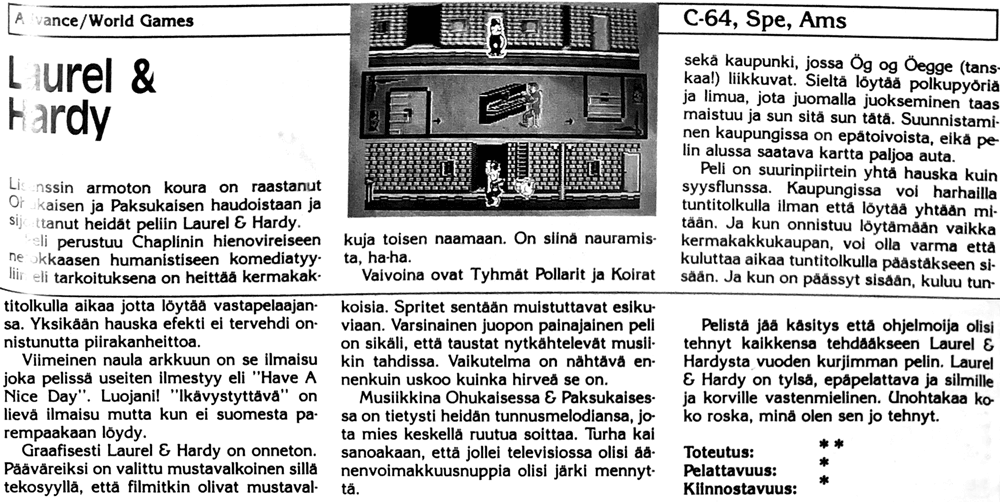
Laurel & Hardy1987Pysyvä linkkiLisenssin armoton koura on raastanut Ohukaisen ja Paksukaisen haudoistaan ja sijoittanut heidät peliin Laurel & Hardy.
Peli perustuu Chaplinin hienovireiseen nerokkaaseen humanistiseen komediatyyliin eli tarkoituksena on heittää kermakakkuja toisen naamaan. On siinä nauramista, ha-ha.
Vaivoina ovat Tyhmät Pollarit ja Koirat sekä kaupunki, jossa Ög og Öegge (tanskaa!) liikkuvat. Sieltä löytää polkupyöriä ja limua, jota juomalla juokseminen taas maistuu ja sun sitä sun tätä. Suunnistaminen kaupungissa on epätoivoista, eikä pelin alussa saatava kartta paljoa auta.
Peli on suurinpiirtein yhtä hauska kuin syysflunssa. Kaupungissa voi harhailla tuntitolkulla ilman että löytää yhtään mitään. Ja kun onnistuu löytämään vaikka kermakakkukaupan, voi olla varma että kuluttaa aikaa tuntitolkulla päästäkseen sisään. Ja kun on päässyt sisään, kuluu tuntitolkulla aikaa jotta löytää vastapelaajansa. Yksikään hauska efekti ei tervehdi onnistunutta piirakanheittoa.
Viimeinen naula arkkuun on se ilmaisu joka pelissä useiten ilmestyy eli "Have A Nice Day". Luojani! "Ikävystyttävä" on lievä ilmaisu mutta kun ei suomesta parempaakaan löydy.
Graafisesti Laurel & Hardy on onneton. Pääväreiksi on valittu mustavalkoinen sillä tekosyyllä, että filmitkin olivat mustavalkoisia. Spritet sentään muistuttavat esikuviaan. Varsinainen juopon painajainen peli on sikäli, että taustat nytkähtelevät musiikin tahdissa. Vaikutelma on nähtävä ennenkuin uskoo kuinka hirveä se on.
Musiikkina Ohukaisessa & Paksukaisessa on tietysti heidän tunnusmelodiansa, jota mies keskellä ruutua soittaa. Turha kai sanoakaan, että jollei televisiossa olisi äänenvoimakkuusnuppia olisi järki mennyttä.
Pelistä jää käsitys että ohjelmoija olisi tehnyt kaikkensa tehdäkseen Laurel & Hardysta vuoden kurjimman pelin. Laurel & Hardy on tylsä, epäpelattava ja silmille ja korville vastenmielinen. Unohtakaa koko roska, minä olen sen jo tehnyt.
Laurel & Hardy1987PermalinkThe merciless hand of licensing has dragged Stan and Ollie from their graves and stuck them into a game called Laurel & Hardy.
The game is based on Chaplin's subtle, ingenious, humanist style of comedy, which is to say the object is to throw cream cakes in the other guy's face. What a laugh, ha-ha.
The hazards are the Stupid Coppers and Dogs, plus the town where Gøg og Gokke (that's Danish!) roam about. In it you'll find bicycles, and fizzy pop that puts you back in the mood for running when you drink it, and this, that and the other. Finding your way around town is hopeless, and the map you get at the start of the game doesn't help much.
The game is roughly as much fun as an autumn cold. You can wander around town for hours on end without finding a single thing. And when you do manage to find, say, the cream cake shop, you can be sure you'll spend hours on end getting in. And once you're in, it takes hours on end to find your opponent. Not one funny effect greets a successful pie-throw.
The final nail in the coffin is the phrase that pops up most often in the game, namely "Have A Nice Day". Good Lord! "Tedious" is putting it mildly, but Finnish just doesn't have anything better.
Graphically Laurel & Hardy is a disaster. Black and white has been chosen as the main colours, on the pretext that the films were black and white too. The sprites do at least resemble the originals. The game is a real drunkard's nightmare in that the backgrounds jerk about in time to the music. You have to see the effect before you'll believe how awful it is.
For music, Stan & Ollie naturally has their theme tune, played by a man in the middle of the screen. Needless to say, if the TV didn't have a volume knob, I'd have lost my mind.
The game leaves you with the impression that the programmer did everything in their power to make Laurel & Hardy the most miserable game of the year. Laurel & Hardy is dull, unplayable, and repulsive to both eyes and ears. Forget the whole load of junk - I already have.
Law of the West

Law of the West1987Pysyvä linkkiLännen Laki johdattaa sinut pieneen villin lännen kaupunkiin, jossa sinun tulisi sheriffinä pitää järjestystä yllä ja rikolliset aisoissa. Pelkällä nopealla liipasinsormella ei tässä pelissä menesty, vaan huippupisteisiin tarvitaan muutakin. Sinun on yritettävä tulla toimeen erilaisten kaupunkilaisten kanssa, mikä tuntuu toisinaan vaikealta.
Kärsivällisen odotuksen jälkeen ohjelma on ladannut eneimmäisen kuvan, ja peli voi alkaa. Kuljet kaupungin kaduilla aseinesi ja keskustelet vastaantulijoiden kanssa. Kaupunkilaiset sanovat repliikkinsä, joihin voit valita vastauksen neljästä vaihtoehdosta. Voit vetää erilaisia rooleja, kuten tunnotonta tappajaa, ymmärtäväistä miestä tai pelkuria. Monet rikolliset saa telkien taakse puhumalla, ja tästä tulee enemmän pisteitä kuin ampumisesta. Joudut myös hoitamaan naissuhteitasi sekä urkkimaan tietoja mahdollisista ryöstöistä. Jos saat vihjeen ryöstöstä, ole valmis toimintaan, sillä Daltoneihin ei puhe tehoa. Mielenkiintoinen tuttavuus on myös kaupungin juoppo lääkäri, joka voi joko pelastaa sinut, jos joudut ammutuksi, tai todeta kylmästi "Miksi ette kertoneet, että se on hän, en olisi vaivautunut tulemaan", riippuen keskusteluistasi hänen kanssaan.
Pelin grafiikka on loistavaa, erilaisia maisemia on puolenkymmentä, kaikki pikkutarkasti tarkkuusgrafiikalla tehtyjä. Maisemissa on myös mukavia yksityiskohtia, kuten ohikulkijat, jotka pakenevat paikalta ammuskelun alkaessa. Pelin taustalla soi musiikki, joka vaihtelee keskustelukumppanistasi riippuen. Efektit rajoittuvat laukausten ääniin, jotka eivät kylläkään ole kovin päätähuimaavia. Kun pelin ensi kertaa lataa levyltä, on vaikutelma mahtava, mutta kuinka ollakkaan, kun pelin on päässyt läpi, eli on selvinnyt hengissä iltaan asti, alkaa keskustelu ja ammuskelu pitkästyttää. Tietenkin voi ruveta kokeilemaan uusia taktiikoita selviämiseksi, mutta kuitenkin...
Law of the West1987PermalinkLaw of the West takes you to a small Wild West town where, as sheriff, you're supposed to keep the peace and keep the outlaws in check. A quick trigger finger alone won't get you far in this game; top scores take more than that. You have to try to get along with all sorts of townsfolk, which at times feels hard.
After a patient wait the program has loaded the first picture, and the game can begin. You walk the streets of the town with your guns and chat with the people you meet. The townsfolk say their lines, and you can pick your reply from four options. You can play various roles, such as the cold-blooded killer, the understanding sort or the coward. Many outlaws can be talked behind bars, and that earns more points than shooting. You also have to look after your love life and dig up information about possible robberies. If you get a tip-off about a robbery, be ready for action, because talk doesn't work on the Daltons. Another interesting acquaintance is the town's drunken doctor, who, if you get shot, can either save you or coldly remark "Why didn't you tell me it was him, I wouldn't have bothered coming", depending on your conversations with him.
The game's graphics are superb: there are five or so different scenes, all done in meticulous detail in high-resolution graphics. The scenery also has nice details, such as passers-by who flee the scene when the shooting starts. Music plays in the background, changing depending on who you're talking to. The sound effects are limited to gunshots, which admittedly aren't all that breathtaking. When you first load the game from disk the impression is tremendous, but wouldn't you know it, once you've got through the game, that is, survived until evening, the talking and the shooting start to get boring. Of course you can start trying out new tactics for survival, but still...
Le Mans 2
Le Mans 21987Pysyvä linkkiElectric on siirtänyt aiemmin kasetilla julkaistun hyvän autourheilupelinsä COB-tekniikalla toteutetulle luottokorttimoduulille. Autourheilupelejä on maailmalla julkaistu monia, useimmissa ollaan formula 1 -kisoissa. Le Mans on nimensä mukaan kuuluisan 24 tunnin urheiluautokisan tietokoneversio. Peliä ei kuitenkaan pelata 24 tuntia, lyhyempi aika riittää.
Kuvaruudulla on näkymä urheiluauton ratin takaa. Edessä on ohjauspyörä, vaihteisto, mittaristo ja sivupeilit. Autosi ei ole ihan kärjessä lähdössä, mutta taitavalla ajolla voit ohittaa muita kilpailijoita. Autoa ohjataan sauvaohjaimella. Kaasuttaessa ohjainta työnnetään eteen, jarruttaessa taakse ja kääntyessä sivulle.
Ohjelmassa on hyviä yksityiskohtia. Nopeuden noustessa tai laskiessa ohjelma muuttaa automaattisesti vaihdetta ja kääntyessä myös ohjauspyörä kääntyy. Sivupeilistä näet muiden kilpailijoiden ohitusyritykset. Maisemat ovat melko yksitoikkoisia, vain katsomo erottuu omana kokonaisuutenaan. Jos ajat liian kovaa kaarteeseen, kierähtää maisema ylösalaisin.
Auton ohjaustuntuma on melko hyvä, mutta kaasua tulee painettua helposti liikaa, jolloin polttoainetta kuluu hukkaan ja kaarteissa on vaara ajaa ulos. Ulosajosta verotetaan polttoainetta. Pelin ainoana tarkoituksena ei ole vain ohittaa kilpailijoita, yhtä tärkeää on säästää polttoainetta järkevällä ajolla, jotta yleensä pääsisi maaliin asti. Ajossa pärjääminen palkitaan pullolla shampanjaa sekä nimen ikuistamisella top ten -taulukkoon.
Äänenä on käytetty lähinnä moottorin ärinää ja ulosajettaessa särkyvien lasien helinää. Lisäksi menestyneet palkitaan palkintofanfaarilla.
Le Mans 2 on kohtuullisen hyvä autourheilupeli, jossa on hyvä tuntuma ja hyvin toteutettu autografiikka. Pelin pisteitä laskevat yksitoikkoinen maisemagrafiikka sekä niukat äänet.
Le Mans 21987PermalinkElectric has moved its good motor racing game, previously released on cassette, onto a credit-card module built with COB technology. Plenty of motor racing games have been released around the world, and most of them are set in Formula 1 races. Le Mans, as the name says, is a computer version of the famous 24-hour sports car race. You don't play the game for 24 hours, though; a shorter stint will do.
The screen shows the view from behind the wheel of a sports car. In front of you are the steering wheel, the gearbox, the instruments and the wing mirrors. Your car isn't quite at the front at the start, but with skilful driving you can overtake the other competitors. The car is controlled with a joystick. To accelerate you push the stick forward, to brake you pull it back, and to turn you push it to the side.
The program has some good details. As your speed rises or falls the program changes gear automatically, and when you turn, the steering wheel turns too. In the wing mirror you can see the other competitors trying to overtake. The scenery is fairly monotonous; only the grandstand stands out as a feature in its own right. If you take a bend too fast, the scenery rolls upside down.
The car's handling feels fairly good, but it's easy to give it too much throttle, which wastes fuel and risks running off the track in the bends. Going off the track costs you fuel. Overtaking the competitors isn't the game's only aim; it's just as important to save fuel by driving sensibly, so that you make it to the finish at all. A good drive is rewarded with a bottle of champagne and your name immortalised in the top ten table.
The sound consists mainly of the snarl of the engine and the tinkle of breaking glass when you go off the track. On top of that, those who do well are rewarded with a victory fanfare.
Le Mans 2 is a reasonably good motor racing game with a good feel and well-executed car graphics. Its score is dragged down by the monotonous scenery graphics and the sparse sound.
Leather Goddesses Of Phobos
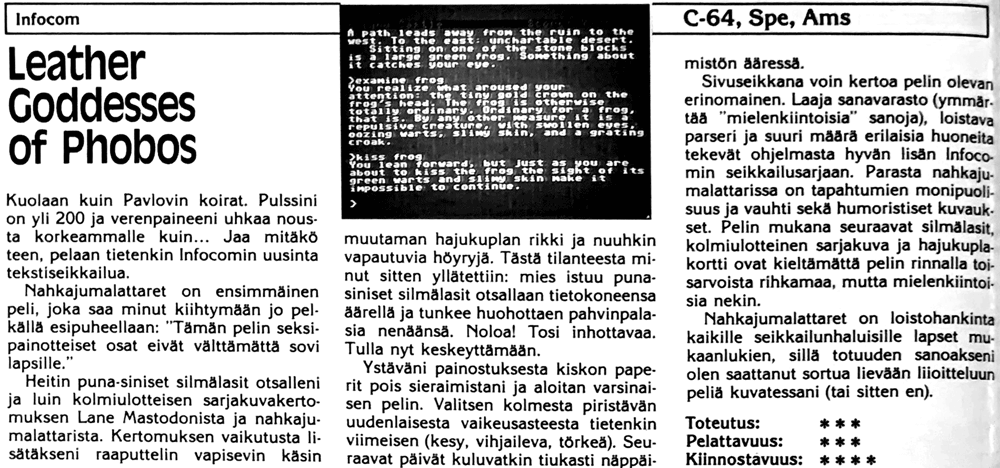
Leather Goddesses Of Phobos1987Pysyvä linkkiKuolaan kuin Pavlovin koirat. Pulssini on yli 200 ja verenpaineeni uhkaa nousta korkeammalle kuin... Jaa mitäkö teen, pelaan tietenkin Infocomin uusinta tekstiseikkailua.
Nahkajumalattaret on ensimmäinen peli, joka saa minut kiihtymään jo pelkällä esipuheellaan: "Tämän pelin seksipainotteiset osat eivät välttämättä sovi lapsille."
Heitin puna-siniset silmälasit otsalleni ja luin kolmiulotteisen sarjakuvakertomuksen Lane Mastodonista ja nahkajumalattarista. Kertomuksen vaikutusta lisätäkseni raaputtelin vapisevin käsin muutaman hajukuplan rikki ja nuuhkin vapautuvia höyryjä. Tästä tilanteesta minut sitten yllätettiin: mies istuu punasiniset silmälasit otsallaan tietokoneensa äärellä ja tunkee huohottaen pahvinpalasia nenäänsä. Noloa! Tosi inhottavaa. Tulla nyt keskeyttämään.
Ystäväni painostuksesta kiskon paperit pois sieraimistani ja aloitan varsinaisen pelin. Valitsen kolmesta piristävän uudenlaisesta vaikeusasteesta tietenkin viimeisen (kesy, vihjaileva, törkeä). Seuraavat päivät kuluvatkin tiukasti näppäimistön ääressä.
Sivuseikkana voin kertoa pelin olevan erinomainen. Laaja sanavarasto (ymmärtää "mielenkiintoisia" sanoja), loistava parseri ja suuri määrä erilaisia huoneita tekevät ohjelmasta hyvän lisän Infocomin seikkailusarjaan. Parasta nahkajumalattarissa on tapahtumien monipuolisuus ja vauhti sekä humoristiset kuvaukset. Pelin mukana seuraavat silmälasit, kolmiulotteinen sarjakuva ja hajukuplakortti ovat kieltämättä pelin rinnalla toisarvoista rihkamaa, mutta mielenkiintoisia nekin.
Nahkajumalattaret on loistohankinta kaikille seikkailunhaluisille lapset mukaanlukien, sillä totuuden sanoakseni olen saattanut sortua lievään liioitteluun peliä kuvatessani (tai sitten en).
Leather Goddesses Of Phobos1987PermalinkI'm drooling like Pavlov's dogs. My pulse is over 200 and my blood pressure is threatening to climb higher than... Oh, what am I doing? Playing Infocom's latest text adventure, of course.
Leather Goddesses is the first game that gets me all worked up with its foreword alone: "The sexually oriented parts of this game may not be suitable for children."
I flung the red-and-blue glasses onto my forehead and read the three-dimensional comic story about Lane Mastodon and the leather goddesses. To heighten the effect of the story, I scratched open a few scent bubbles with trembling hands and sniffed the fumes they released. And that's the situation I was caught in: a man sitting at his computer with red-and-blue glasses on his forehead, panting as he stuffs bits of cardboard up his nose. How embarrassing! Really horrid. Fancy coming in and interrupting like that.
At my friend's insistence I yank the bits of paper out of my nostrils and start the game proper. Of the three refreshingly novel difficulty levels I naturally pick the last one (tame, suggestive, lewd). The days that follow are spent firmly glued to the keyboard.
As a side note, I can tell you the game is excellent. A large vocabulary (it understands "interesting" words), a brilliant parser and a large number of different rooms make the program a fine addition to Infocom's adventure series. The best things about Leather Goddesses are the variety and pace of the action and the humorous descriptions. The glasses, the 3-D comic and the scratch-and-sniff card that come with the game are admittedly second-rate trinkets next to the game itself, but they're interesting too.
Leather Goddesses is a superb buy for everyone with a taste for adventure, children included, because to tell the truth I may have been guilty of slight exaggeration in describing the game (or then again, maybe not).
Leavin' Teramis
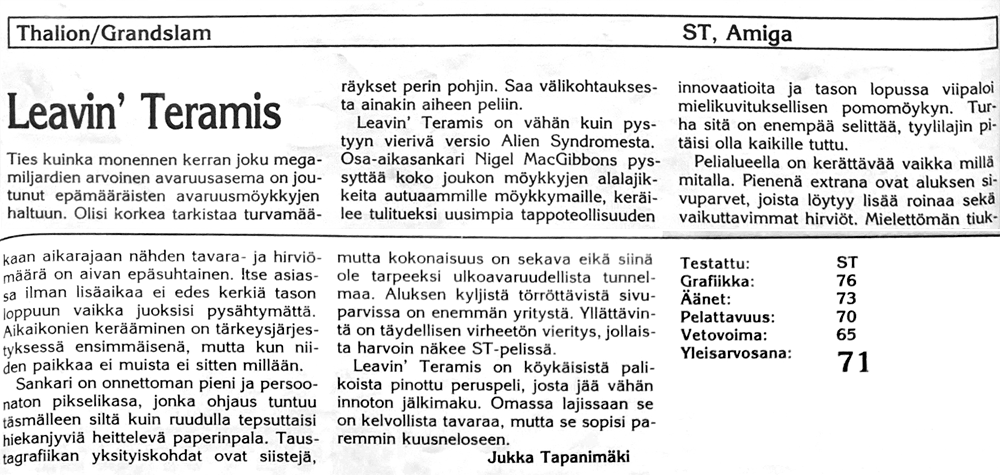
Leavin' Teramis1990 SyksyPysyvä linkkiTies kuinka monennen kerran joku megamiljardien arvoinen avaruusasema on joutunut epämääräisten avaruusmöykkyjen haltuun. Olisi korkea tarkistaa turvamääräykset perin pohjin. Saa välikohtauksesta ainakin aiheen peliin.
Leavin' Teramis on vähän kuin pystyyn vierivä versio Alien Syndromesta. Osa-aikasankari Nigel MacGibbons pyssyttää koko joukon möykkyjen alalajikkeita autuaammille möykkymaille, keräilee tulitukseksi uusimpia tappoteollisuuden innovaatioita ja tason lopussa viipaloi mielikuvituksellisen pomomöykyn. Turha sitä on enempää selittää, tyylilajin pitäisi olla kaikille tuttu.
Pelialueella on kerättävää vaikka millä mitalla. Pienenä extrana ovat aluksen sivuparvet, joista löytyy lisää roinaa sekä vaikuttavimmat hirviöt. Mielettömän tiukkaan aikarajaan nähden tavara- ja hirviömäärä on aivan epäsuhtainen. Itse asiassa ilman lisäaikaa ei edes kerkiä tason loppuun vaikka juoksisi pysähtymättä. Aikaikonien kerääminen on tärkeysjärjestyksessä ensimmäisenä, mutta kun niiden paikkaa ei muista ei sitten millään.
Sankari on onnettoman pieni ja persoonaton pikselikasa, jonka ohjaus tuntuu täsmälleen siltä kuin ruudulla tepsuttaisi hiekanjyviä heittelevä paperinpala. Taustagrafiikan yksityiskohdat ovat siistejä, mutta kokonaisuus on sekava eikä siinä ole tarpeeksi ulkoavaruudellista tunnelmaa. Aluksen kyljistä törröttävistä sivuparvissa on enemmän yritystä. Yllättävintä on täydellisen virheetön vieritys, jollaista harvoin näkee ST-pelissä.
Leavin' Teramis on köykäisistä palikoista pinottu peruspeli, josta jää vähän innoton jälkimaku. Omassa lajissaan se on kelvollista tavaraa, mutta se sopisi paremmin kuusneloseen.
Leavin' Teramis1990 SyksyPermalinkFor who knows which time, some space station worth megabillions has fallen into the hands of vague space blobs. It'd be high time to go through the safety regulations from top to bottom. At least the incident gives you a subject for a game.
Leavin' Teramis is a bit like a vertically scrolling version of Alien Syndrome. Part-time hero Nigel MacGibbons guns a whole host of blob subspecies off to the happy blob grounds, picks up the latest innovations of the killing industry for firepower and, at the end of the level, slices up an imaginative boss blob. No point explaining any further, the genre should be familiar to everyone.
There's stuff to collect in the play area by the bucketload. A small extra is the ship's side galleries, where you'll find more junk as well as the most impressive monsters. Considering the insanely tight time limit, the amount of items and monsters is completely out of proportion. In fact, without extra time you won't even make it to the end of the level even if you run without stopping. Collecting the time icons comes first in order of priority, but then you just can't for the life of you remember where they are.
The hero is a pitifully small and characterless heap of pixels, and steering him feels exactly as if a scrap of paper throwing grains of sand were pattering about the screen. The details of the background graphics are neat, but the whole is a muddle and hasn't got enough outer-space atmosphere. There's more effort in the side galleries jutting out from the ship's flanks. Most surprising is the perfectly flawless scrolling, the like of which you rarely see in an ST game.
Leavin' Teramis is a basic game stacked up out of flimsy building blocks, and it leaves a somewhat listless aftertaste. In its own class it's passable stuff, but it would suit the Commodore 64 better.
Legend of Faerghail
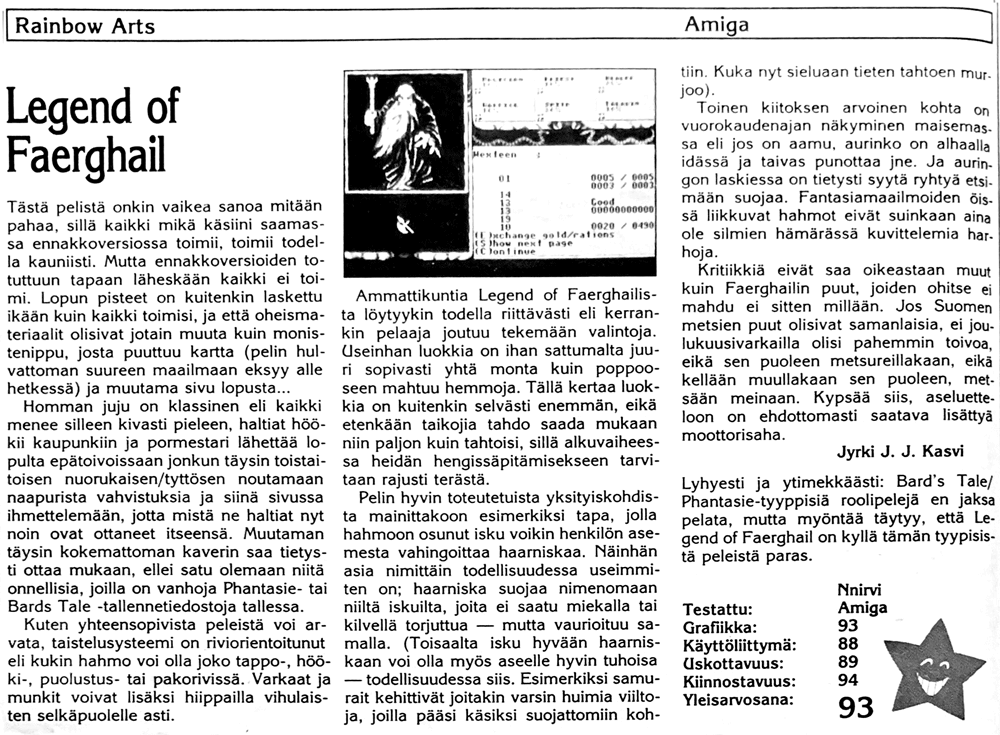
Legend of Faerghail1990 SyksyPysyvä linkkiTästä pelistä onkin vaikea sanoa mitään pahaa, sillä kaikki mikä käsiini saamassa ennakkoversiossa toimii, toimii todella kauniisti. Mutta ennakkoversioiden totuttuun tapaan läheskään kaikki ei toimi. Lopun pisteet on kuitenkin laskettu ikään kuin kaikki toimisi, ja että oheismateriaalit olisivat jotain muuta kuin monistenippu, josta puuttuu kartta (pelin hulvattoman suureen maailmaan eksyy alle hetkessä) ja muutama sivu lopusta...
Homman juju on klassinen eli kaikki menee silleen kivasti pieleen, haltiat höökii kaupunkiin ja pormestari lähettää lopulta epätoivoissaan jonkun täysin toistaitoisen nuorukaisen/tyttösen noutamaan naapurista vahvistuksia ja siinä sivussa ihmettelemään, jotta mistä ne haltiat nyt noin ovat ottaneet itseensä. Muutaman täysin kokemattoman kaverin saa tietysti ottaa mukaan, ellei satu olemaan niitä onnellisia, joilla on vanhoja Phantasie- tai Bards Tale -tallennetiedostoja tallessa.
Kuten yhteensopivista peleistä voi arvata, taistelusysteemi on riviorientoitunut eli kukin hahmo voi olla joko tappo-, hööki-, puolustus- tai pakorivissä. Varkaat ja munkit voivat lisäksi hiippailla vihulaisten selkäpuolelle asti.
Ammattikuntia Legend of Faerghailista löytyykin todella riittävästi eli kerrankin pelaaja joutuu tekemään valintoja. Useinhan luokkia on ihan sattumalta juuri sopivasti yhtä monta kuin poppooseen mahtuu hemmoja. Tällä kertaa luokkia on kuitenkin selvästi enemmän, eikä etenkään taikojia tahdo saada mukaan niin paljon kuin tahtoisi, sillä alkuvaiheessa heidän hengissäpitämisekseen tarvitaan rajusti terästä.
Pelin hyvin toteutetuista yksityiskohdista mainittakoon esimerkiksi tapa, jolla hahmoon osunut isku voikin henkilön asemesta vahingoittaa haarniskaa. Näinhän asia nimittäin todellisuudessa useimmiten on; haarniska suojaa nimenomaan niiltä iskuilta, joita ei saatu miekalla tai kilvellä torjuttua - mutta vaurioituu samalla. (Toisaalta isku hyvään haarniskaan voi olla myös aseelle hyvin tuhoisa - todellisuudessa siis. Esimerkiksi samurait kehittivät joitakin varsin huimia viiltoja, joilla pääsi käsiksi suojattomiin kohtiin. Kuka nyt sieluaan tieten tahtoen murjoo).
Toinen kiitoksen arvoinen kohta on vuorokaudenajan näkyminen maisemassa eli jos on aamu, aurinko on alhaalla idässä ja taivas punottaa jne. Ja auringon laskiessa on tietysti syytä ryhtyä etsimään suojaa. Fantasiamaailmoiden öissä liikkuvat hahmot eivät suinkaan aina ole silmien hämärässä kuvittelemia harhoja.
Kritiikkiä eivät saa oikeastaan muut kuin Faerghailin puut, joiden ohitse ei mahdu ei sitten millään. Jos Suomen metsien puut olisivat samanlaisia, ei joulukuusivarkailla olisi pahemmin toivoa, eikä sen puoleen metsureillakaan, eikä kellään muullakaan sen puoleen, metsään meinaan. Kypsää siis, aseluetteloon on ehdottomasti saatava lisättyä moottorisaha.
Lyhyesti ja ytimekkäästi: Bard's Tale/Phantasie-tyyppisiä roolipelejä en jaksa pelata, mutta myöntää täytyy, että Legend of Faerghail on kyllä tämän tyyppisistä peleistä paras.
Legend of Faerghail1990 SyksyPermalinkIt's hard to say anything bad about this game, since everything that works in the preview version that came into my hands works really beautifully. But as is the custom with preview versions, nowhere near everything works. The scores at the end have nevertheless been worked out as if everything worked, and as if the accompanying materials were something other than a bundle of photocopies missing the map (you get lost in the game's outrageously huge world in less than a moment) and a few pages from the end...
The gist of the thing is classic, i.e. everything goes nicely wrong, the elves come storming into town, and in the end the mayor in desperation sends some utterly inept young lad/lass to fetch reinforcements from the neighbours, and on the side to puzzle out what it is that's got those elves so offended. You're allowed to take a few completely inexperienced pals along, of course, unless you happen to be one of the lucky ones with old Phantasie or Bards Tale save files tucked away.
As you can guess from the compatible games, the combat system is row-oriented, i.e. each character can be in either the killing, charging, defending or fleeing row. Thieves and monks can also sneak all the way round behind the baddies' backs.
Legend of Faerghail has professions aplenty, really enough of them, so for once the player has to make choices. Usually, you see, there just happen, by sheer coincidence, to be exactly as many classes as there are blokes who fit in the gang. This time, though, there are clearly more classes, and you especially can't get as many spellcasters along as you'd like, because in the early stages it takes a fierce amount of steel to keep them alive.
Among the game's well-executed details, let me mention for instance the way a blow that hits a character can damage the armour instead of the person. That, you see, is how it mostly goes in reality; armour protects precisely against the blows that couldn't be parried with sword or shield - but gets damaged in the process. (On the other hand, a blow against good armour can also be very destructive for the weapon - in reality, that is. The samurai, for example, developed some pretty wild cuts that got at the unprotected spots. Who'd knowingly batter their own soul, after all).
Another praiseworthy point is the way the time of day shows in the landscape, i.e. if it's morning, the sun is low in the east and the sky glows red, etc. And as the sun goes down it is of course wise to start looking for shelter. The figures that move about in the nights of fantasy worlds are by no means always illusions conjured up by eyes in the twilight.
Really the only thing that gets criticism is Faerghail's trees, which you just can't squeeze past for love or money. If the trees in Finland's forests were like that, Christmas-tree thieves wouldn't have much hope, nor for that matter would lumberjacks, nor anyone else for that matter, of getting into the forest, I mean. Maddening, in short; a chainsaw absolutely has to be added to the weapon list.
Short and sweet: I can't be bothered to play Bard's Tale/Phantasie-type role-playing games, but I have to admit that Legend of Faerghail really is the best of this type of game.
Legend Of Kage
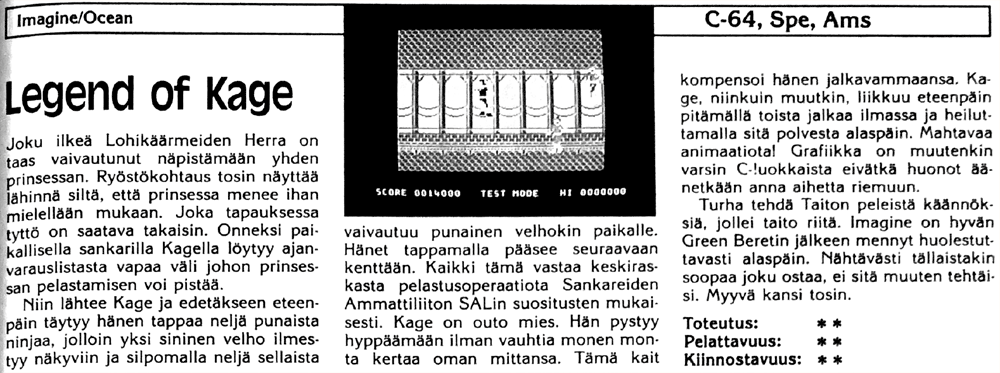
Legend Of Kage1987Pysyvä linkkiJoku ilkeä Lohikäärmeiden Herra on taas vaivautunut näpistämään yhden prinsessan. Ryöstökohtaus tosin näyttää lähinnä siltä, että prinsessa menee ihan mielellään mukaan. Joka tapauksessa tyttö on saatava takaisin. Onneksi paikallisella sankarilla Kagella löytyy ajanvarauslistasta vapaa väli johon prinsessan pelastamisen voi pistää.
Niin lähtee Kage ja edetäkseen eteenpäin täytyy hänen tappaa neljä punaista ninjaa, jolloin yksi sininen velho ilmestyy näkyviin ja silpomalla neljä sellaista vaivautuu punainen velhokin paikalle. Hänet tappamalla pääsee seuraavaan kenttään. Kaikki tämä vastaa keskiraskasta pelastusoperaatiota Sankareiden Ammattiliiton SALin suositusten mukaisesti. Kage on outo mies. Hän pystyy hyppäämään ilman vauhtia monen monta kertaa oman mittansa. Tämä kait kompensoi hänen jalkavammaansa. Kage, niinkuin muutkin, liikkuu eteenpäin pitämällä toista jalkaa ilmassa ja heiluttamalla sitä polvesta alaspäin. Mahtavaa animaatiota! Grafiikka on muutenkin varsin C-luokkaista eivätkä huonot äänetkään anna aihetta riemuun.
Turha tehdä Taiton peleistä käännöksiä, jollei taito riitä. Imagine on hyvän Green Beretin jälkeen mennyt huolestuttavasti alaspäin. Nähtävästi tällaistakin soopaa joku ostaa, ei sitä muuten tehtäisi. Myyvä kansi tosin.
Legend Of Kage1987PermalinkSome nasty Lord of the Dragons has once again gone to the trouble of pinching a princess. Mind you, the kidnapping scene mostly looks as if the princess is going along quite happily. Anyway, the girl has to be got back. Luckily the local hero Kage has a free slot in his appointment book that the princess rescue can be squeezed into.
And so off goes Kage, and to make any progress he has to kill four red ninjas, whereupon one blue wizard appears, and once you've carved up four of those the red wizard bothers to turn up as well. Killing him gets you to the next level. All of this amounts to a medium-weight rescue operation as recommended by SAL, the Heroes' Trade Union. Kage is a strange man. From a standing start he can jump many, many times his own height. I suppose this makes up for his leg injury. Kage, like everybody else, moves forward by holding one leg in the air and waggling it from the knee down. Fantastic animation! The graphics are pretty C-grade in other respects too, and the poor sound gives no cause for rejoicing either.
There's no point converting Taito's games if you haven't got the skill. Since the good Green Beret, Imagine has gone worryingly downhill. Apparently somebody buys even rubbish like this, otherwise it wouldn't get made. Selling cover, though.
Leisure Suit Larry 5: Passionate Patty Does a Little Undercover Work

Leisure Suit Larry 5: Passionate Patty Does a Little Undercover Work1991 SyksyPysyvä linkkiKoska King's Quest on päässyt jo viidenteen osaansa ja Space Questkin jo neljänteen, päätti Larryn luoja Al Lowe tehdä yllättävän tempauksen ja hyppäsi kokonaan Larryn neljännen seikkailun yli. Siksi siis Larry hortoilee nyt seikkailujensa viidennessä osassa ja ihmettelee, mitä tapahtui pelille nimeltä Leisure Suit Larry 4 - Missing Floppies.
Pelaaja löytää itsensä Larryn kengistä PornProdCorpin tiloista videonauhan pääylipyyhkijänä ja desinfioijana. Yhtiö tuottaa Yhdysvaltain suosituinta TV-sarjaa, Amerikan Seksimmäimmät Kotivideot, ja etsii sille uutta superseksikästä juontajaa. Vitsi piilee siinä, että naisen on oltava niin seksikäs, että hän suostuu puuhiin vaikka Amerikan niljakkaimman ja ärsyttävimmän miehen kanssa. Niinpä Larry pistetään testaamaan kolme pääkandidaattia.
Mutta mafiallakin on näppinsä pelissä. TV-sarja ja sen vastustajat, Conservatives Against Nearly Everything, ovat mafian keksintöjä saada samaan aikaan paljon julkisuutta TV-sarjalle sekä myydä hurjasti pornoelokuvia, joiden myynti on viime aikoina laskenut hälyttävästi.
Pelissä on myös miniseikkailu, jossa pelaaja ohjaa Passionate Pattia FBI:n agenttina aina kun Larry nukahtaa. Sitten kun Patti nukahtaa, siirrytään takaisin Larryn housuihin (heh heh). Pattin tehtävä paljastaa mafian temput musiikkibisneksessä tuovat parin lopulta arvatenkin taas yhteen. Larry muuten törmää pelin aikana jopa varapresidentti Dan Quayleen, josta heitetään aika rankkaa herjaa.
Sierran uusi pelinkehityssofta pistää parastaan Larry 5:ssä. Grafiikka on silmiähivelevän upeaa ja animaatio loistavaa. Peli tukee yhtäaikaa Rolandia ja Soundblasteria siten, että musiikki tulee Rolandista ja digitoidut äänitehosteet Soundblasterista. Ongelma on vain siinä, miten saada molempien korttien äänet yht'aikaa kuuluviin. Mutta jos lompakko on niin paksu, että on varaa omistaa molemmat äänikortit, niin tuskinpa mikseri korttien ja vahvistimen väliin enää tuntuu paljon missään. Uusista Sierran peleistä tuttu hiiriohjaus (ei tarvitse kirjoittaa mitään) on jälleen pistetty osittain uusiksi. Ikonit on suunniteltu uudestaan ja jotain toimintoja on paranneltu.
Pelin käsikirjasuojaus ei ole mitenkään rasittava, sitä tarvitaan vain silloin kun matkustetaan kaupungista toiseen. Larry 5 sisältää edeltäjiään huomattavasti arkaluontoisempaa materiaalia, niinpä peli antaa mahdollisuuden suojata peli salasanalla. Näin perheen pienimmät eivät pääse salaa pelailemaan. Tämä toimii tietenkin toisinkinpäin, eli lapsukaiset voivat estää vanhempia pelaamasta, hah!
Larry-fanit ovat odottaneet tätä peliä vesi kielellä jo ties kuinka kauan. Tyytyväisenä voin ilmoittaa, että kyllä hyvää kannatti odottaa. Larry 5 on kaikkea sitä, mitä siltä voi kohtuuden rajoissa toivoa. Paljastamatta yhtään enempää pelin mainiota vitsejä ja muuta, sanon vain, että Larry 5 edustaa Sierran pelien ehdotonta kärkeä ja on jokaiselle Larry-mieliselle ehdoton pakko-ostos.
Leisure Suit Larry 5: Passionate Patty Does a Little Undercover Work1991 SyksyPermalinkSince King's Quest has already reached its fifth instalment and Space Quest its fourth, Larry's creator Al Lowe decided to pull a surprise stunt and skipped Larry's fourth adventure altogether. So that's why Larry is now wandering about in the fifth part of his adventures, wondering what happened to a game called Leisure Suit Larry 4 - Missing Floppies.
You find yourself in Larry's shoes on the premises of PornProdCorp, working as chief videotape eraser and disinfector. The company produces the most popular TV series in the United States, America's Sexiest Home Videos, and is looking for a new super-sexy host for it. The joke is that the woman has to be so sexy that she'll agree to get up to things even with America's slimiest and most irritating man. So Larry is sent off to test the three main candidates.
But the Mafia has its fingers in the pie too. The TV series and its opponents, Conservatives Against Nearly Everything, are both Mafia inventions for getting the series plenty of publicity while at the same time selling a whole lot of porn films, whose sales have lately dropped alarmingly.
The game also has a mini-adventure in which the player controls Passionate Patti as an FBI agent whenever Larry falls asleep. Then when Patti falls asleep, you move back into Larry's trousers (heh heh). Patti's mission to expose the Mafia's tricks in the music business will, you can guess, bring the pair back together in the end. By the way, during the game Larry even bumps into Vice President Dan Quayle, who gets some pretty harsh ribbing.
Sierra's new game development software gives its all in Larry 5. The graphics are eye-caressingly gorgeous and the animation brilliant. The game supports the Roland and the Soundblaster at the same time, so that the music comes from the Roland and the digitised sound effects from the Soundblaster. The only problem is how to get the sound from both cards to be heard at once. But if your wallet is so fat you can afford to own both sound cards, a mixer between the cards and the amplifier will hardly make much of a dent any more. The mouse control familiar from Sierra's new games (no need to type anything) has once again been partly reworked. The icons have been redesigned and some functions have been improved.
The game's manual-based copy protection isn't a nuisance at all; it's only needed when you travel from one city to another. Larry 5 contains considerably more delicate material than its predecessors, so the game gives you the option of protecting it with a password. That way the littlest members of the family can't sneak off to play it in secret. Of course this also works the other way round, meaning the little darlings can stop their parents from playing, hah!
Larry fans have been waiting for this game with their mouths watering for who knows how long. I'm pleased to announce that good things really do come to those who wait. Larry 5 is everything you could reasonably hope for from it. Without giving away any more of the game's splendid jokes and so on, I'll just say that Larry 5 represents the absolute top of Sierra's games and is an absolute must-buy for everyone who's Larry-minded.
Leisure Suit Larry Goes Looking for Love (In Several Wrong Places)
.png)
Leisure Suit Larry Goes Looking for Love (In Several Wrong Places)1989 SyksyPysyvä linkkiLeisure Suit Larry on tullut takaisin! Taas saa nauraa itsensä melkein hengiltä istuessaan yökolmeen monitorin ääressä. Ja vielä hauskempaa on kun malttaa pistää koneen päälle, sillä Larryn kakkososa on, jos mahdollista, vielä parempi kuin ykkösosa.
Eli lyhyesti: Larry on taas pahemmassa kuin pulassa, sillä tyttöystävä kyllästyi häneen ja heitti miehen ulos talosta. Onhan maailmassa muitakin naisia, minkä tietää Larrykin. Hänellä on siis selvä tavoite: löytää 'Se Oikea'. Etsinnän Larry aloittaa Los Angelesista, mutta pelin aikana hän löytää itsensä mitä ihmeellisimmistä ja hauskemmista paikoista(pelaajan kannalta). Esimerkkinä voisi mainita vaikkapa kaupan Los Angelesissa, jossa Larryn kielitaito tulee hyvin esille onklunkkia ostettaessa. Pelin edetessä Larry hylkää Yhdysvallat ja näkee maailmaa.
Ykköseen verrattuna on grafiikka parantunut, ja kakkos-Larry syö levyjäkin entistä enemmän, mikä tarkoitta laajempaa peliä. Äänipuoli ei ole kehittynyt yhtään, mutta ketäpä tuo haittaa. Kun Larry-pakettiin lisätään vielä hyvä pelattavuus ja loistava huumori (kansikuvasta lähtien), niin tuloksena on yksi parhaista seikkailupeleistä vähään aikaan.
Asia on sanomattakin selvä:jos et ole tosikko, niin mene lähimpään pelikauppaan ja hae itsellesi kunnon naurut! (Ja tosikot ilmeisesti lähimpään rautakauppaan hakemaan kunnon narut -toim.huom.)
Leisure Suit Larry Goes Looking for Love (In Several Wrong Places)1989 SyksyPermalinkLeisure Suit Larry is back! Once again you get to laugh yourself nearly to death sitting in front of the monitor until three in the morning. And it's even more fun if you can bring yourself to switch the machine on, because the second Larry is, if possible, even better than the first.
So, in brief: Larry is in worse than trouble again, because his girlfriend got fed up with him and threw him out of the house. There are other women in the world, of course, as Larry knows too. So he has a clear goal: to find 'The One'. Larry begins his search in Los Angeles, but during the game he finds himself in the most amazing and funniest places (from the player's point of view). One example worth mentioning is a shop in Los Angeles where Larry's language skills really come to the fore when buying an onklunk. As the game goes on, Larry leaves the United States behind and sees the world.
Compared with the first one, the graphics have improved, and the second Larry eats even more disks than before, which means a bigger game. The sound hasn't developed one bit, but who's bothered about that. When you add good playability and brilliant humour (starting from the cover picture) to the Larry package, the result is one of the best adventure games in a while.
It goes without saying: if you're not a sourpuss, go to your nearest games shop and get yourself a good laugh! (And the sourpusses, presumably, to the nearest hardware shop to get themselves a good length of rope - ed.)
Leisuresuit Larry III - Passionate Patty in Pursuit of the Pulsating Pectorals

Leisuresuit Larry III - Passionate Patty in Pursuit of the Pulsating Pectorals1990 KevätPysyvä linkkiLarry on palannut! Sarjan tuoreimmassa osassa tapaamme hieman erilaisen Larryn: hävinnyt on komearaaminen naistennaurattaja ja tilalla on pulska naistennaurattaja. Nontoonyt-saarikin on käynyt läpi kokonaisen muutosten sarjan. Saaren asukkaat ovat keksineet, että heidän asuinsaarensa on pienin kohennuksin todellinen juppiparatiisi. Niinpä saarelle kasvaakin alta aikayksikön toinen toistaan upeampia hotelleja ja ravintoloita. Luonnollisesti Larry on kehityksen keskellä lievästi hukassa, eikä asiaa auta ainakaan se, että kaikki alkaa mennä pahasti pieleen.
Ensiksi Larryn vaimo potkaisee hänet pihalle toisen NAISEN (!) takia. Niin kuin tämä ei olisi tarpeeksi, antaa Larryn ex-vaimon isä Larry-paralle potkut. Niinpä Larry on pelin alusta laskien alle kahdessa minuutissa vaimoton, rahaton ja onneton. Pelaajan tehtävänä onkin saattaa asiat jälleen tolalleen.
Larry-sarjan kaksi ensimmäistä osaa ovat saavuttaneet valtavan suosion maailmalla, enkä ihmettele miksi. Veikkaisin jopa, että tämä kolmas osa lyö edeltäjiensä myyntiennätykset rikki reilusti. Yksi tärkeä tähän vaikuttava syy on se, että Larry III on uskaliaampi ja paljastavampi kuin molemmat aiemmat Larryt yhteensä. Pelin alussa kysytään pelaajan ikää ja suoritetaan Larry I:n tavoin viisi kysymystä, joilla varmistetaan, että pelaaja on täysi-ikäinen.
Kysymysosiolla määritellään myöskin pelin törkeystaso. Päinvastoin kuin Larry II:ssa, jossa pelaaja saa itse päättää paljonko peli näyttää, ei pelaaja voi Larry III:ssa itse vaikuttaa pelin alettua törkytasoon. Mitä useamman vastauksen vastaat oikein, sitä enemmän paljasta pintaa ruudulle ilmestyy kuolattavaksi. Valitettavasti kysymykset on selvästi tarkoitettu amerikkalaisille, enkä usko että kovinkaan moni suomalainen saa täysiä pisteitä kysymyssarjasta, jossa on tällaisia kysymyksiä: "kuinka monta kertaa Johnny Carson on enimmillään heitellyt lyijykyniä juontamassaan TV-ohjelmassa?" Vanha kunnon ALT-X ei tunnu toimivan, joten valitettavan usein pitää tyytyä törkytasoon, joka on luultavasti tarkoitettu uskonnonopettajille ja alakoululaisille.
Sierran tasokasta seikkailusysteemiä ei ole liiemmin paranneltu Larry II:n jälkeen ja löysinkin pelistä pari pienoista bugia, jotka eivät kuitenkaan vaikuta mitenkään pelinautintoon. Grafiikka vaihtelee koneen suorituskyvystä riippuen siedettävästä erinomaiseen. EGA:n 16 väriä riittävät mainiosti Amigan väriloistoon tottuneelle. Musiikki ja äänitehosteet ovat aina PC:n heikko kohta ja niin nytkin. Jos PC:n laajennuspaikoista ei löydy ainakin Ad-Libin tasoista musiikkikorttia, nipaisee iljettävän piipityksen ilolla minimiin. Pelattavuutta ja kiinnostavuutta löytyy roppakaupalla, eikä edes sekava, mutta ratkiriemukas käsikirja himmennä peli-iloa.
Lyhyesti: parasta Sierraa koskaan. Osta, älä kopioi, ja laatu säilyy vastakin.
Leisuresuit Larry III - Passionate Patty in Pursuit of the Pulsating Pectorals1990 KevätPermalinkLarry is back! In the latest instalment of the series we meet a slightly different Larry: gone is the strapping ladies' man, and in his place is a pudgy ladies' man. Nontoonyt Island has gone through a whole series of changes too. The islanders have figured out that with a few small improvements their home island is a true yuppie paradise. And so, in no time at all, the island sprouts hotels and restaurants, each more splendid than the last. Naturally Larry is slightly lost in the middle of all this development, and it certainly doesn't help matters that everything starts going badly wrong.
First, Larry's wife kicks him out for another WOMAN (!). As if that weren't enough, Larry's ex-wife's father gives poor Larry the boot. So within two minutes of the start of the game, Larry is wifeless, penniless and luckless. The player's task, then, is to set things right again.
The first two instalments of the Larry series have become hugely popular around the world, and I can't say I'm surprised. I'd even wager that this third instalment will smash its predecessors' sales records by a wide margin. One important reason for this is that Larry III is more daring and more revealing than both earlier Larrys put together. At the start, the game asks for the player's age and, as in Larry I, puts five questions to make sure the player is an adult.
The question section also sets the game's smut level. Unlike Larry II, where the player gets to decide for themselves how much the game shows, in Larry III the player can't influence the smut level once the game has started. The more questions you answer correctly, the more bare skin appears on screen for you to drool over. Unfortunately the questions are clearly aimed at Americans, and I don't believe many Finns will get full marks on a quiz with questions like this: "what is the most times Johnny Carson has thrown pencils on the TV show he hosts?" Good old ALT-X doesn't seem to work, so all too often you have to settle for a smut level presumably intended for religious education teachers and primary school kids.
Sierra's high-quality adventure system hasn't been improved much since Larry II, and I did find a couple of minor bugs in the game, though they don't spoil the enjoyment in the slightest. Depending on the machine's performance, the graphics range from tolerable to excellent. EGA's 16 colours are plenty even for someone used to the Amiga's blaze of colour. Music and sound effects are always the PC's weak spot, and so it is this time too. If the PC's expansion slots don't hold at least an Ad-Lib-class music card, you'll happily snip the revolting beeping down to the minimum. There's playability and interest by the bucketload, and not even the confusing but hilarious manual dims the fun.
In short: the best Sierra ever. Buy it, don't copy it, and the quality will keep up in future too.
Leisuresuit Larry In The Land Of Lounge Lizards
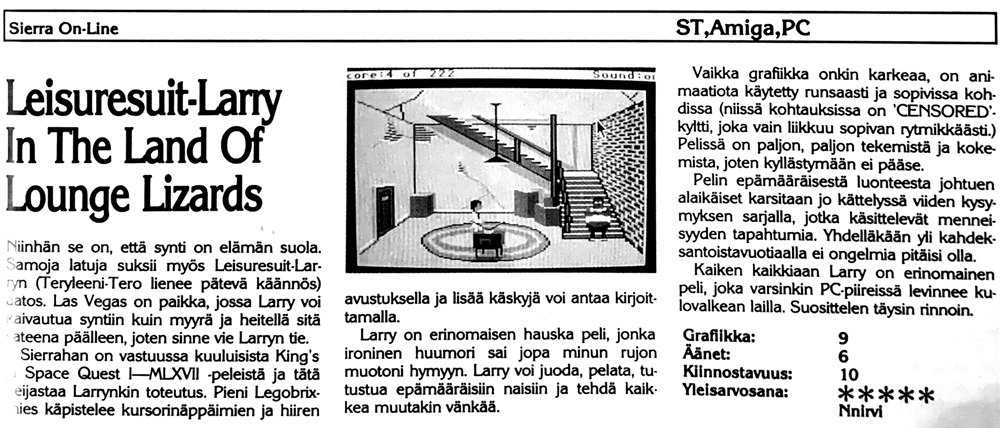
Leisuresuit Larry In The Land Of Lounge Lizards1988Pysyvä linkkiNiinhän se on, että synti on elämän suola. Samoja latuja suksii myös Leisuresuit-Larryn (Teryleeni-Tero lienee pätevä käännös) aatos. Las Vegas on paikka, jossa Larry voi kaivautua syntiin kuin myyrä ja heitellä sitä sateena päälleen, joten sinne vie Larryn tie.
Sierrahan on vastuussa kuuluisista King's ja Space Quest I-MLXVII -peleistä ja tätä heijastaa Larrynkin toteutus. Pieni Legobrixmies käpistelee kursorinäppäimien ja hiiren avustuksella ja lisää käskyjä voi antaa kirjoittamalla.
Larry on erinomaisen hauska peli, jonka ironinen huumori sai jopa minun rujon muotoni hymyyn. Larry voi juoda, pelata, tutustua epämääräisiin naisiin ja tehdä kaikkea muutakin vänkää.
Vaikka grafiikka onkin karkeaa, on animaatiota käytetty runsaasti ja sopivissa kohdissa (niissä kohtauksissa on 'CENSORED'-kyltti, joka vain liikkuu sopivan rytmikkäästi.) Pelissä on paljon, paljon tekemistä ja kokemista, joten kyllästymään ei pääse.
Pelin epämääräisestä luonteesta johtuen alaikäiset karsitaan jo kättelyssä viiden kysymyksen sarjalla, jotka käsittelevät menneisyyden tapahtumia. Yhdelläkään yli kahdeksantoistavuotiaalla ei ongelmia pitäisi olla.
Kaiken kaikkiaan Larry on erinomainen peli, joka varsinkin PC-piireissä levinnee kulovalkean lailla. Suosittelen täysin rinnoin.
Leisuresuit Larry In The Land Of Lounge Lizards1988PermalinkIt's true what they say: sin is the salt of life. Leisuresuit-Larry's train of thought skis along the very same tracks (Teryleeni-Tero would presumably be a fair Finnish translation). Las Vegas is a place where Larry can burrow into sin like a mole and bathe in a downpour of the stuff, so that is where the road leads for Larry.
Sierra, as we all know, is responsible for the famous King's and Space Quest I-MLXVII games, and this is reflected in Larry's execution too. A little Legobrix man potters about with the help of the cursor keys and the mouse, and further commands can be given by typing.
Larry is an exceedingly funny game whose ironic humour got even my own misshapen mug to crack a smile. Larry can drink, gamble, get acquainted with dubious women and do all sorts of other cool stuff.
Although the graphics are crude, animation has been used generously and in all the right places (in those scenes there's a 'CENSORED' sign that simply moves with a suitably rhythmic beat). There is lots and lots to do and experience in the game, so you never get the chance to be bored.
Owing to the game's dubious nature, minors are weeded out right off the bat with a series of five questions dealing with events of the past. Nobody over eighteen should have any trouble with them.
All in all, Larry is an excellent game that will probably spread like wildfire, in PC circles especially. I recommend it wholeheartedly.
Leisuresuit Larry In The Land of the Lounge Lizards

Leisuresuit Larry In The Land of the Lounge Lizards1991 SyksyPysyvä linkkiMitä hemmettiä? Eikös nyt ole vuosi 1991? Mutta joka tapauksessa, Hän on palannut! Jälleen kerran täällä tänään, Larry Laffer!
Pelilaatikossa lukee huomiota herättävän pienellä tekstillä: WARNING - The game contains adult subject matter. Parental guidance is suggested. Onneksi eivät myyjäpoika eikä asiakkaana oleva 5-vuotias ymmärrä niin laajaa englanninsanastoa, joten pelilaatikon taustakuviin ihastunut pikkuvesseli pääsee pian installoimaan Larryn kovalevylleen.
Kyseessä on Sierran rahat-pois-köyhiltä-taktiikka, jossa vanhoja pelejä pakataan uusiin kuoriin. Mutta millaisiin kuoriin, siitähän tässä on kyse.
Larry supliikkimiehenä on saanut puhuttua upeat raamit ympärilleen, 256-väristä VGA-näyttöä taustalla myhäilevään Rolandiin asti. Larry todellakin näyttää upealta käsinmaalatun näköisissä hauskasti kallellaan olevissa maisemissa. Larry on itse hivenen vielä keski-ikäisemmän näköinen, hiusraja nousee edelleen, tosin ei samaa vauhtia kuin tarinan veistäjällä, Sierran Al Lowella.
Soundipuoli järkyttää: miten on alkuperäisestä Larry-biisistä saatu näin upea stereofoninen kokonaisuus. Musiikkivaraston laajuuteen pääset tutustumaan, kun vaihdat kaukosäätimellä siellä Tutussa Paikassa TV-kanavia, sillä joka kanavalla on omat soundinsa. Larryn olen myös nähnyt ja mikä parasta, myöskin kuullut CD-ROM-versiona, formaattina, jota kannattaa ehdottamasti suosia tulevaisuudessa. (Niinkö? Aika näyttää - Toim. kyyn. huom.)
Alkuperäisen version kysymystekniikka on tottakai alussa mukana. Viiteen oikein vastaamalla tai tietämällä näppäinkoodin pääsee varsinaiseen peliin sisään. Kysymykset toki ovat vaihtuneet.
Vanhat paikat, kasinot, diskot, baarit ja hotellit ovat paikallaan edelleen, mutta paljon, niin paljon on tullut tavaraa lisää. Uusia sisäpiirivitsejä tihkuu joka paikasta, vanhoista tutuista osa taas on muuttunut päinvastaiseksi alkuperäisestä. Vastaan tulee henkilöitä, lähinnä daameja, jotka todella elävät, puhuvat ja kävelevät. Laaja värimäärä tulee tässä hyödynnettyä: liha on oikeamman väristä.
Suurin muutos on tietysti ikivanhan tekstisysteemin muuttaminen täysin hiiriohjatuksi. Hiiripointteri muuttuu halutuksi toiminnoksi joko oikeasta hiirenkorvasta tai ruudun ylävalikosta. Ottakaamme esimerkiksi vaikkapa tuttu teksti Ken sent me. Luettuamme sen huussin seinältä se ilmestyy tavaroidemme joukkoon niin, että sen voi antaa ovisilmästä kurkistelijalle. Helppoa, mutta aikaaviepääkin, sillä tekstipätkä on pakko käydä ensin hakemassa.
Tässä muodossa Larry kelvannee entistä useammille, joten edessä on taas yöunien menetys.
Leisuresuit Larry In The Land of the Lounge Lizards1991 SyksyPermalinkWhat the heck? Isn't it 1991 now? But anyway, He is back! Here once again today: Larry Laffer!
The game box says, in attention-grabbingly small print: WARNING - The game contains adult subject matter. Parental guidance is suggested. Luckily neither the shop boy nor the 5-year-old customer understands that wide an English vocabulary, so the little rascal, smitten with the pictures on the back of the box, will soon get to install Larry on their hard disk.
This is Sierra's take-the-money-off-the-poor tactic, where old games are packed into new wrappings. But what wrappings - that's what this is all about.
Being a smooth talker, Larry has managed to talk himself into a splendid setting, from a 256-colour VGA display all the way to a Roland purring contentedly in the background. Larry really does look great in the hand-painted-looking, amusingly lopsided scenery. Larry himself looks a touch more middle-aged still, and his hairline is still receding, though not at the same pace as that of the man who spun the tale, Sierra's Al Lowe.
The sound side is a shock: how on earth did they get such a gorgeous stereophonic whole out of the original Larry tune? You get to explore the full extent of the music library when you flip through the TV channels with the remote in That Familiar Place, since every channel has its own sounds. I've also seen Larry, and best of all heard it too, as a CD-ROM version, a format that's definitely worth favouring in the future. (Is that so? Time will tell - cynical ed. note.)
The original version's quiz technique is of course there at the start. Answer five correctly, or know the key code, and you get into the game proper. The questions have changed, mind you.
The old places, the casinos, discos, bars and hotels, are all still where they were, but a lot, oh so much, new stuff has been added. New in-jokes seep out of every corner, while some of the old familiar ones have been turned into the opposite of the original. You meet characters, mostly dames, who really live, talk and walk. The wide range of colours gets put to good use here: the flesh is a truer colour.
The biggest change, of course, is that the ancient text system has been turned into a fully mouse-driven one. The mouse pointer changes into the action you want, either from the right mouse button or from the menu at the top of the screen. Let us take as an example the familiar phrase Ken sent me. Once we've read it off the wall of the loo, it appears among our belongings so that it can be handed over to the one peering through the peephole. Easy, but time-consuming too, because you have to go and fetch the snippet of text first.
In this form Larry should appeal to more people than ever, so there are sleepless nights ahead again.
Lemmings
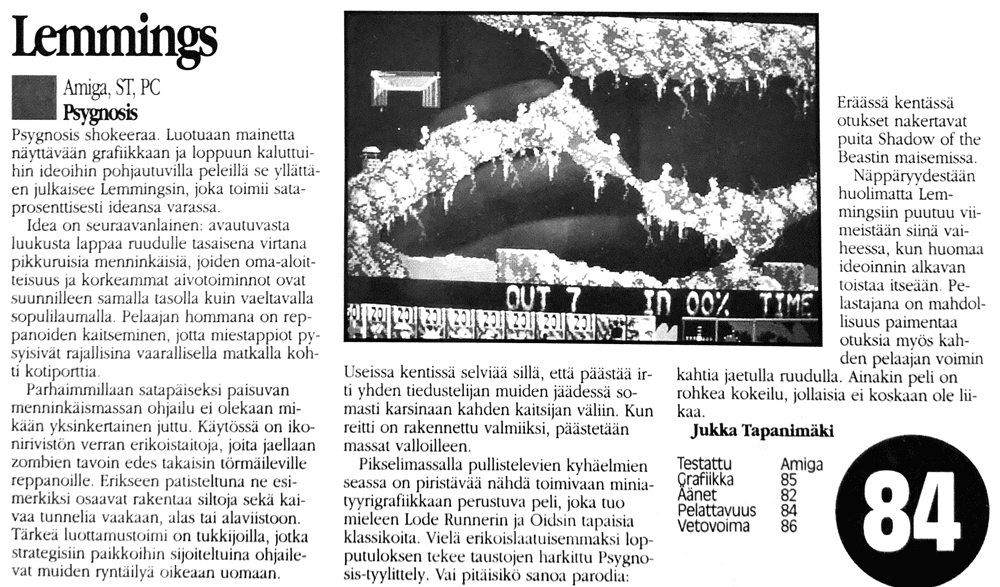
Lemmings1991 SyksyPysyvä linkkiPsygnosis shokeeraa. Luotuaan mainetta näyttävään grafiikkaan ja loppuun kaluttuihin ideoihin pohjautuvilla peleillä se yllättäen julkaisee Lemmingsin, joka toimii sataprosenttisesti ideansa varassa.
Idea on seuraavanlainen: avautuvasta luukusta lappaa ruudulle tasaisena virtana pikkuruisia menninkäisiä, joiden oma-aloitteisuus ja korkeammat aivotoiminnot ovat suunnilleen samalla tasolla kuin vaeltavalla sopulilaumalla. Pelaajan hommana on reppanoiden kaitseminen, jotta miestappiot pysyisivät rajallisina vaarallisella matkalla kohti kotiporttia.
Parhaimmillaan satapäiseksi paisuvan menninkäismassan ohjailu ei olekaan mikään yksinkertainen juttu. Käytössä on ikonirivistön verran erikoistaitoja, joita jaellaan zombien tavoin edes takaisin törmäileville reppanoille. Erikseen patisteltuna ne esimerkiksi osaavat rakentaa siltoja sekä kaivaa tunnelia vaakaan, alas tai alaviistoon. Tärkeä luottamustoimi on tukkijoilla, jotka strategisiin paikkoihin sijoiteltuina ohjailevat muiden ryntäilyä oikeaan uomaan.
Useissa kentissä selviää sillä, että päästää irti yhden tiedustelijan muiden jäädessä somasti karsinaan kahden kaitsijan väliin. Kun reitti on rakennettu valmiiksi, päästetään massat valloilleen.
Pikselimassalla pullistelevien kyhäelmien seassa on piristävää nähdä toimivaan miniatyyrigrafiikkaan perustuva peli, joka tuo mieleen Lode Runnerin ja Oidsin tapaisia klassikoita. Vielä erikoislaatuisemmaksi lopputuloksen tekee taustojen harkittu Psygnosis-tyylittely. Vai pitäisikö sanoa parodia: Eräässä kentässä otukset nakertavat puita Shadow of the Beastin maisemissa.
Näppäryydestään huolimatta Lemmingsiin puutuu viimeistään siinä vaiheessa, kun huomaa ideoinnin alkavan toistaa itseään. Pelastajana on mahdollisuus paimentaa otuksia myös kahden pelaajan voimin kahtia jaetulla ruudulla. Ainakin peli on rohkea kokeilu, jollaisia ei koskaan ole liikaa.
Lemmings1991 SyksyPermalinkPsygnosis shocks. Having made its name with games built on spectacular graphics and ideas chewed down to the bone, it suddenly releases Lemmings, a game that runs one hundred percent on its idea.
The idea goes like this: out of an opening hatch, a steady stream of teeny-tiny goblins pours onto the screen, their initiative and higher brain functions roughly on a par with those of a migrating horde of lemmings. The player's job is to shepherd the poor wretches so that casualties are kept within limits on the perilous journey towards the home gate.
Steering a goblin mass that can swell to a hundred heads at its peak turns out to be no simple matter. You have an icon bar's worth of special skills, which are dished out to the poor wretches as they bump back and forth like zombies. Prodded individually, they can for instance build bridges and dig tunnels horizontally, downwards or diagonally down. A key position of trust falls to the blockers, who, placed at strategic spots, steer the others' stampeding into the right channel.
Many levels can be cleared by letting a single scout loose while the others stay sweetly penned in between two minders. Once the route has been built, the masses are unleashed.
Amid all the cobbled-together efforts flexing their pixel mass, it's refreshing to see a game built on functional miniature graphics, one that brings to mind classics like Lode Runner and Oids. The end result is made even more unusual by the deliberate Psygnosis styling of the backgrounds. Or should that be parody: in one level the critters gnaw through trees in the scenery of Shadow of the Beast.
For all its cleverness, Lemmings starts to wear thin at the latest when you notice the ideas beginning to repeat themselves. The saving grace is the option to herd the critters with two players as well, on a split screen. At the very least the game is a bold experiment, and you can never have too many of those.
LHX Attack Chopper
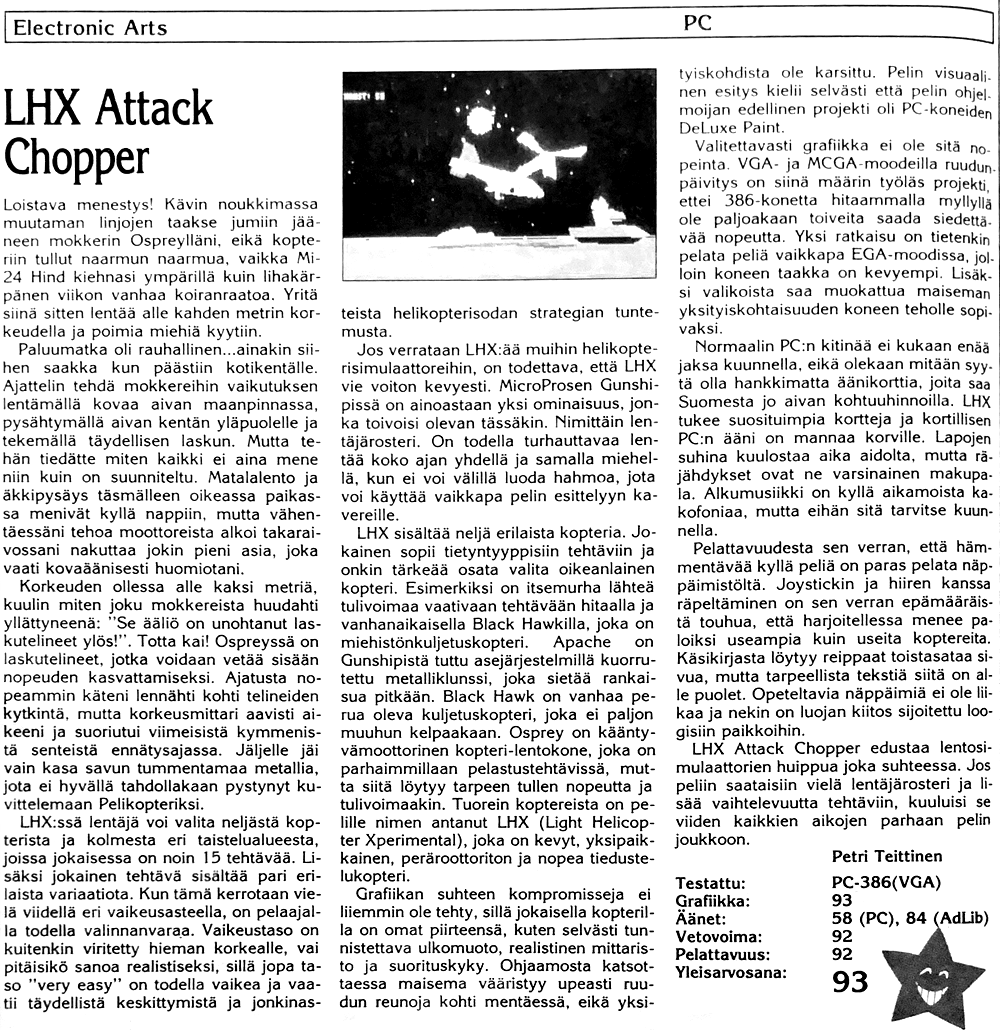
LHX Attack Chopper1990 SyksyPysyvä linkkiLoistava menestys! Kävin noukkimassa muutaman linjojen taakse jumiin jääneen mokkerin Ospreylläni, eikä kopteriin tullut naarmun naarmua, vaikka Mi-24 Hind kiehnasi ympärillä kuin lihakärpänen viikon vanhaa koiranraatoa. Yritä siinä sitten lentää alle kahden metrin korkeudella ja poimia miehiä kyytiin.
Paluumatka oli rauhallinen...ainakin siihen saakka kun päästiin kotikentälle. Ajattelin tehdä mokkereihin vaikutuksen lentämällä kovaa aivan maanpinnassa, pysähtymällä aivan kentän yläpuolelle ja tekemällä täydellisen laskun. Mutta tehän tiedätte miten kaikki ei aina mene niin kuin on suunniteltu. Matalalento ja äkkipysäys täsmälleen oikeassa paikassa menivät kyllä nappiin, mutta vähentäessäni tehoa moottoreista alkoi takaraivossani nakuttaa jokin pieni asia, joka vaati kovaäänisesti huomiotani.
Korkeuden ollessa alle kaksi metriä, kuulin miten joku mokkereista huudahti yllättyneenä: "Se ääliö on unohtanut laskutelineet ylös!". Totta kai! Ospreyssä on laskutelineet, jotka voidaan vetää sisään nopeuden kasvattamiseksi. Ajatusta nopeammin käteni lennähti kohti telineiden kytkintä, mutta korkeusmittari aavisti aikeeni ja suoriutui viimeisistä kymmenistä senteistä ennätysajassa. Jäljelle jäi vain kasa savun tummentamaa metallia, jota ei hyvällä tahdollakaan pystynyt kuvittelemaan Pelikopteriksi.
LHX:ssä lentäjä voi valita neljästä kopterista ja kolmesta eri taistelualueesta, joissa jokaisessa on noin 15 tehtävää. Lisäksi jokainen tehtävä sisältää pari erilaista variaatiota. Kun tämä kerrotaan vielä viidellä eri vaikeusasteella, on pelaajalla todella valinnanvaraa. Vaikeustaso on kuitenkin viritetty hieman korkealle, vai pitäisikö sanoa realistiseksi, sillä jopa taso "very easy" on todella vaikea ja vaatii täydellistä keskittymistä ja jonkinasteista helikopterisodan strategian tuntemusta.
Jos verrataan LHX:ää muihin helikopterisimulaattoreihin, on todettava, että LHX vie voiton kevyesti. MicroProsen Gunshipissä on ainoastaan yksi ominaisuus, jonka toivoisi olevan tässäkin. Nimittäin lentäjärosteri. On todella turhauttavaa lentää koko ajan yhdellä ja samalla miehellä, kun ei voi välillä luoda hahmoa, jota voi käyttää vaikkapa pelin esittelyyn kavereille.
LHX sisältää neljä erilaista kopteria. Jokainen sopii tietyntyyppisiin tehtäviin ja onkin tärkeää osata valita oikeanlainen kopteri. Esimerkiksi on itsemurha lähteä tulivoimaa vaativaan tehtävään hitaalla ja vanhanaikaisella Black Hawkilla, joka on miehistönkuljetuskopteri. Apache on Gunshipistä tuttu asejärjestelmillä kuorrutettu metalliklunssi, joka sietää rankaisua pitkään. Black Hawk on vanhaa perua oleva kuljetuskopteri, joka ei paljon muuhun kelpaakaan. Osprey on kääntyvämoottorinen kopteri-lentokone, joka on parhaimmillaan pelastustehtävissä, mutta siitä löytyy tarpeen tullen nopeutta ja tulivoimaakin. Tuorein koptereista on pelille nimen antanut LHX (Light Helicopter Xperimental), joka on kevyt, yksipaikkainen, peräroottoriton ja nopea tiedustelukopteri.
Grafiikan suhteen kompromisseja ei liiemmin ole tehty, sillä jokaisella kopterilla on omat piirteensä, kuten selvästi tunnistettava ulkomuoto, realistinen mittaristo ja suorituskyky. Ohjaamosta katsottaessa maisema vääristyy upeasti ruudun reunoja kohti mentäessä, eikä yksityiskohdista ole karsittu. Pelin visuaalinen esitys kielii selvästi että pelin ohjelmoijan edellinen projekti oli PC-koneiden DeLuxe Paint.
Valitettavasti grafiikka ei ole sitä nopeinta. VGA- ja MCGA-moodeilla ruudunpäivitys on siinä määrin työläs projekti, ettei 386-konetta hitaammalla myllyllä ole paljoakaan toiveita saada siedettävää nopeutta. Yksi ratkaisu on tietenkin pelata peliä vaikkapa EGA-moodissa, jolloin koneen taakka on kevyempi. Lisäksi valikoista saa muokattua maiseman yksityiskohtaisuuden koneen teholle sopivaksi.
Normaalin PC:n kitinää ei kukaan enää jaksa kuunnella, eikä olekaan mitään syytä olla hankkimatta äänikorttia, joita saa Suomesta jo aivan kohtuuhinnoilla. LHX tukee suosituimpia kortteja ja kortillisen PC:n ääni on mannaa korville. Lapojen suhina kuulostaa aika aidolta, mutta räjähdykset ovat ne varsinainen makupala. Alkumusiikki on kyllä aikamoista kakofoniaa, mutta eihän sitä tarvitse kuunnella.
Pelattavuudesta sen verran, että hämmentävää kyllä peliä on paras pelata näppäimistöltä. Joystickin ja hiiren kanssa räpeltäminen on sen verran epämääräistä touhua, että harjoitellessa menee paloiksi useampia kuin useita koptereita. Käsikirjasta löytyy reippaat toistasataa sivua, mutta tarpeellista tekstiä siitä on alle puolet. Opeteltavia näppäimiä ei ole liikaa ja nekin on luojan kiitos sijoitettu loogisiin paikkoihin.
LHX Attack Chopper edustaa lentosimulaattorien huippua joka suhteessa. Jos peliin saataisiin vielä lentäjärosteri ja lisää vaihtelevuutta tehtäviin, kuuluisi se viiden kaikkien aikojen parhaan pelin joukkoon.
LHX Attack Chopper1990 SyksyPermalinkA brilliant success! I went to pick up a few grunts stuck behind the lines in my Osprey, and the chopper didn't get so much as a scratch, even though a Mi-24 Hind hung around it like a blowfly round a week-old dog carcass. Just try flying under two metres off the ground and picking men up with that going on.
The flight back was peaceful... at least until we got to the home base. I thought I'd impress the grunts by flying fast right down at ground level, stopping right above the pad and making a perfect landing. But you know how not everything always goes the way it was planned. The low-level flight and the sudden stop in exactly the right place went off perfectly, but as I cut the power from the engines, some little thing began nagging at the back of my head, loudly demanding my attention.
With the altitude under two metres, I heard one of the grunts cry out in surprise: "The idiot's left the landing gear up!". Of course! The Osprey has landing gear that can be retracted to increase speed. Faster than thought, my hand flew towards the gear switch, but the altimeter sensed my intention and dispatched the last few dozen centimetres in record time. All that was left was a heap of smoke-blackened metal, which not even with the best will in the world could anyone picture as the Pelikopteri.
In LHX the pilot can choose from four choppers and three different combat zones, each of which has around 15 missions. On top of that, every mission comes in a couple of different variations. When you then multiply all that by five different difficulty levels, the player really is spoilt for choice. The difficulty has, however, been tuned a little high, or should I say realistic, because even the "very easy" level is really hard and demands total concentration and some degree of knowledge of helicopter warfare strategy.
If you compare LHX with other helicopter simulators, you have to say that LHX wins hands down. MicroProse's Gunship has just one feature you'd wish this one had as well. Namely, a pilot roster. It's really frustrating to fly with one and the same man all the time, when you can't create a character now and then to use, say, for showing the game off to your mates.
LHX contains four different choppers. Each suits particular kinds of missions, so it's important to know how to pick the right chopper. For example, it's suicide to set off on a mission that calls for firepower in the slow and old-fashioned Black Hawk, which is a troop-transport chopper. The Apache, familiar from Gunship, is a metal clunker frosted with weapon systems that can take punishment for a long time. The Black Hawk is a transport chopper of old stock that isn't much good for anything else anyway. The Osprey is a tilt-engine chopper-plane that's at its best on rescue missions, but when needed it has speed and firepower too. The newest of the choppers is the LHX (Light Helicopter Xperimental) that gives the game its name, a light, single-seat, tail-rotorless and fast reconnaissance chopper.
Not many compromises have been made on the graphics front, since each chopper has its own characteristics, such as a clearly recognisable shape, realistic instruments and performance. Looking out from the cockpit, the landscape distorts superbly towards the edges of the screen, and no details have been skimped on. The game's visual presentation clearly betrays that its programmer's previous project was DeLuxe Paint for the PC.
Unfortunately the graphics aren't exactly the fastest. In VGA and MCGA modes, updating the screen is such a laborious project that on any box slower than a 386 there's not much hope of getting a tolerable speed. One solution is of course to play the game in, say, EGA mode, which lightens the machine's load. You can also adjust the landscape detail from the menus to suit your machine's power.
Nobody can be bothered to listen to the squeaking of an ordinary PC any more, and there's no reason not to get a sound card, as you can already get them in Finland at quite reasonable prices. LHX supports the most popular cards, and the sound of a PC with a card is manna to the ears. The swish of the rotor blades sounds pretty authentic, but the explosions are the real treat. The intro music is quite a cacophony, admittedly, but then nobody makes you listen to it.
As for playability, suffice it to say that, confusingly enough, the game is best played from the keyboard. Fumbling about with a joystick and mouse is such a vague business that you'll smash more than several choppers to pieces while practising. The manual runs to a good hundred-odd pages, but less than half of it is text you actually need. There aren't too many keys to learn, and thank God they've been put in logical places too.
LHX Attack Chopper represents the pinnacle of flight simulators in every respect. If the game could also get a pilot roster and more variety in the missions, it would rank among the five best games of all time.
License To Kill
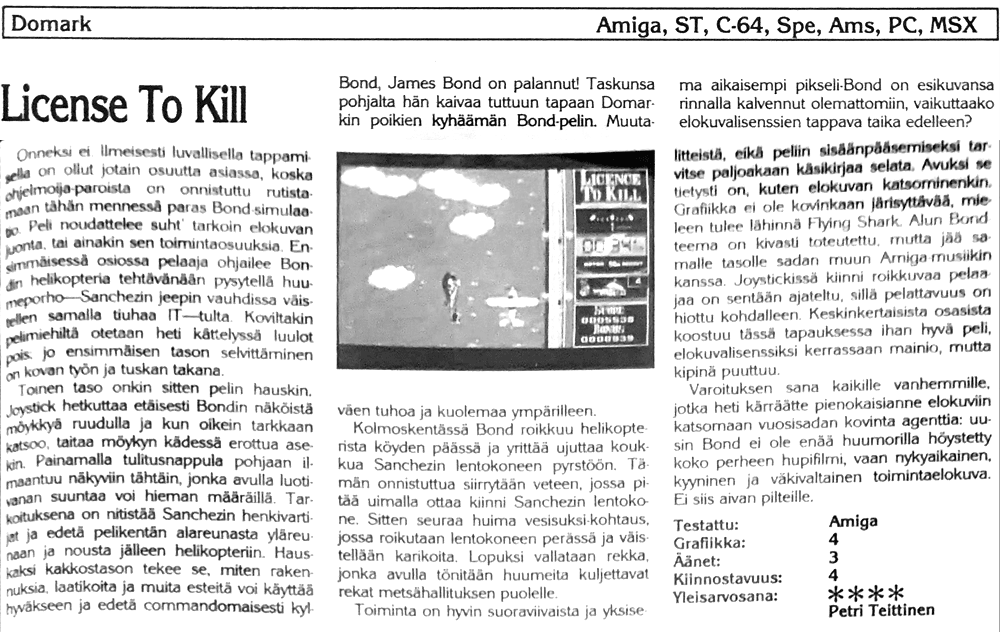
License To Kill1989 SyksyPysyvä linkkiBond, James Bond on palannut! Taskunsa pohjalta hän kaivaa tuttuun tapaan Domarkin poikien kyhäämän Bond-pelin. Muutama aikaisempi pikseli-Bond on esikuvansa rinnalla kalvennut olemattomiin, vaikuttaako elokuvalisenssien tappava taika edelleen? Onneksi ei. Ilmeisesti luvallisella tappamisella on ollut jotain osuutta asiassa, koska ohjelmoija-paroista on onnistuttu rutistamaan tähän mennessä paras Bond-simulaatio. Peli noudattelee suht' tarkoin elokuvan juonta, tai ainakin sen toimintaosuuksia. Ensimmäisessä osiossa pelaaja ohjailee Bondin helikopteria tehtävänään pysytellä huumeporho-Sanchezin jeepin vauhdissa väistellen samalla tiuhaa IT-tulta. Koviltakin pelimiehiltä otetaan heti kättelyssä luulot pois: jo ensimmäisen tason selvittäminen on kovan työn ja tuskan takana.
Toinen taso onkin sitten pelin hauskin. Joystick hetkuttaa etäisesti Bondin näköistä möykkyä ruudulla ja kun oikein tarkkaan katsoo, taitaa möykyn kädessä erottua asekin. Painamalla tulitusnappula pohjaan ilmaantuu näkyviin tähtäin, jonka avulla luotivanan suuntaa voi hieman määräillä. Tarkoituksena on nitistää Sanchezin henkivartijat ja edetä pelikentän alareunasta yläreunaan ja nousta jälleen helikopteriin. Hauskaksi kakkostason tekee se, miten rakennuksia, laatikoita ja muita esteitä voi käyttää hyväkseen ja edetä commandomaisesti kylväen tuhoa ja kuolemaa ympärilleen.
Kolmoskentässä Bond roikkuu helikopterista köyden päässä ja yrittää ujuttaa koukkua Sanchezin lentokoneen pyrstöön. Tämän onnistuttua siirrytään veteen, jossa pitää uimalla ottaa kiinni Sanchezin lentokone. Sitten seuraa huima vesisuksi-kohtaus, jossa roikutaan lentokoneen perässä ja väistellään karikoita. Lopuksi vallataan rekka, jonka avulla tönitään huumeita kuljettavat rekat metsähallituksen puolelle.
Toiminta on hyvin suoraviivaista ja yksiselitteistä, eikä peliin sisäänpääsemiseksi tarvitse paljoakaan käsikirjaa selata. Avuksi se tietysti on, kuten elokuvan katsominenkin. Grafiikka ei ole kovinkaan järisyttävää, mieleen tulee lähinnä Flying Shark. Alun Bond teema on kivasti toteutettu, mutta jää samalle tasolle sadan muun Amiga-musiikin kanssa. Joystickissä kiinni roikkuvaa pelaajaa on sentään ajateltu, sillä pelattavuus on hiottu kohdalleen. Keskinkertaisista osasista koostuu tässä tapauksessa ihan hyvä peli, elokuvalisenssiksi kerrassaan mainio, mutta kipinä puuttuu.
Varoituksen sana kaikille vanhemmille, jotka heti kärräätte pienokaisianne elokuviin katsomaan vuosisadan kovinta agenttia: uusin Bond ei ole enää huumorilla höystetty koko perheen hupifilmi, vaan nykyaikainen, kyyninen ja väkivaltainen toimintaelokuva. Ei siis aivan pilteille.
License To Kill1989 SyksyPermalinkBond, James Bond is back! From the bottom of his pocket he digs out, as usual, a Bond game knocked together by the Domark boys. A few earlier pixel Bonds have paled into nothingness next to their role model - is the deadly curse of film licences still at work? Fortunately not. Apparently licensed killing has had some part to play, because the poor programmers have been wrung hard enough to squeeze out the best Bond simulation so far. The game follows the film's plot fairly closely, or at least its action sequences. In the first section the player steers Bond's helicopter, the task being to keep pace with drug baron Sanchez's jeep while dodging dense AA fire. Even hardened gamers are taken down a peg right from the off: just getting through the first level takes hard work and agony.
The second level, then, is the most fun in the game. The joystick jiggles a lump on the screen that looks vaguely like Bond, and if you look really closely, you can probably make out a gun in the lump's hand too. Holding the fire button down brings up a crosshair with which you can steer the stream of bullets a little. The aim is to finish off Sanchez's bodyguards, advance from the bottom of the play area to the top and climb back into the helicopter. What makes the second level fun is the way you can use buildings, crates and other obstacles to your advantage and advance commando-style, sowing destruction and death all around you.
On the third level Bond dangles from the helicopter on the end of a rope and tries to slip a hook onto the tail of Sanchez's plane. Once that's done, the action moves into the water, where you have to swim to catch up with Sanchez's plane. Then comes a wild water-skiing scene in which you hang on behind the plane and dodge rocks. Finally you commandeer a truck and use it to shove the drug-carrying trucks off the road into the forestry department's jurisdiction.
The action is very straightforward and unambiguous, and you don't need to leaf through the manual much to get into the game. It helps, of course, as does watching the film. The graphics aren't particularly earth-shattering; what mostly comes to mind is Flying Shark. The Bond theme at the start is nicely done, but it stays on the same level as a hundred other pieces of Amiga music. The player clinging to the joystick has at least been thought of, since the playability has been honed just right. In this case mediocre parts add up to a pretty good game, a downright splendid one for a film licence, but the spark is missing.
A word of warning to all you parents who are about to cart your little ones off to the cinema to see the toughest agent of the century: the latest Bond is no longer a family fun film seasoned with humour, but a modern, cynical and violent action movie. So not really for the kiddies.
Life & Death II: The Brain

Life & Death II: The Brain1991 KevätPysyvä linkkiPotilas makaa pää ajeltuna leikkauspöydällä. Kirurgi Nirvi tempaisee kumihanskat käsiin, vetäisee skalpellilla Z:n päälakeen ja tempaisee päänahan raolleen. Kolme neljäsosaa leikkauksen yleisöstä keksii yht'äkkiä parempaa tekemistä ja missaa raflaavan reikä-kalloon-silmät-kiinni-ohjelmanumeron. Imuri käyntiin, kasvain ulos ja kallo kiinni, niin taas yksi potilas voi langeta samettisilmäisen huippukirurgi Nirvin jalkojen juureen.
Näinhän aivoleikkaus ei missään tapauksessa etene, minkä voi itse todeta mainiosta Life & Death II:sta. Ensin potilaasta täytyy tehdä diagnoosi (70-vuotiaita mummoja, jotka käyttävät huumeita, heh.) Suuri apu on muun muuassa on-line-neurokirurgian oppikirjasta. Potilasta pistellään muun muassa neuloilla, ja kun tökkää neulan simmuun, saa vain nuhteet mutta pysyy töissä. Epäilyttävää, taidanpa peruuttaa maanantain aikani.
Alussa suuri osa potilaista ei kaipaa kuin aspiriinia, psykiatria ja reipasta potkua persiiseen, mutta ennemmin tai myöhemmin joutuu leikkaamaan, joten on parempi vierailla luokkahuoneesa ja tehdä kunnon muistiinpanot, muuten käy huonosti niin potilaalle kuin lääkärillekin. 256-värinen VGA-grafiikka pitää huolen, että leikkaussalissa on nokka valkoinen ja aamiainen etsii exitiä.
Software Toolworks on kehittänyt kakkososaa huimasti: surkea CGA-grafiikka ja piippaus on korvattu VGA:lla ja äänikorttituella, ja jopa PC-piippi toistaa samplattuja efektejä erinomaisesti.
Life & Death II on onnistunut ja hyvin tehty kirurgisimulaatio, joka tarjoaa "mukavaa" vaihtelua tuhanteen kertaan nähdyille kaavapeleille.
Life & Death II: The Brain1991 KevätPermalinkThe patient lies on the operating table with a shaved head. Surgeon Nirvi yanks on the rubber gloves, slashes a Z into the crown of the head with the scalpel and yanks the scalp open. Three quarters of the operation's audience suddenly think of something better to do and miss the sensational hole-in-the-skull-eyes-shut number. Suction on, tumour out and skull shut, and yet another patient can fall at the feet of velvet-eyed star surgeon Nirvi.
Which is by no means how brain surgery goes, as you can see for yourself in the excellent Life & Death II. First you have to diagnose the patient (70-year-old grannies who do drugs, heh.) A big help comes from, among other things, the on-line neurosurgery textbook. The patient gets prodded with needles, among other things, and when you jab a needle into their eye, all you get is a telling-off, and you keep your job. Suspicious. I think I'll cancel my Monday appointment.
At the start, a lot of the patients need nothing more than aspirin, a psychiatrist and a good swift kick up the backside, but sooner or later you'll have to operate, so you'd better pay a visit to the classroom and take proper notes, or things will go badly for patient and doctor alike. The 256-colour VGA graphics make sure that in the operating theatre you go white as a sheet and your breakfast goes looking for the exit.
Software Toolworks have improved the sequel tremendously: the wretched CGA graphics and beeping have been replaced with VGA and sound card support, and even the PC beeper plays the sampled effects excellently.
Life & Death II is a successful and well-made surgery simulation that offers a "pleasant" change from the formula games you've seen a thousand times.
Life And Death
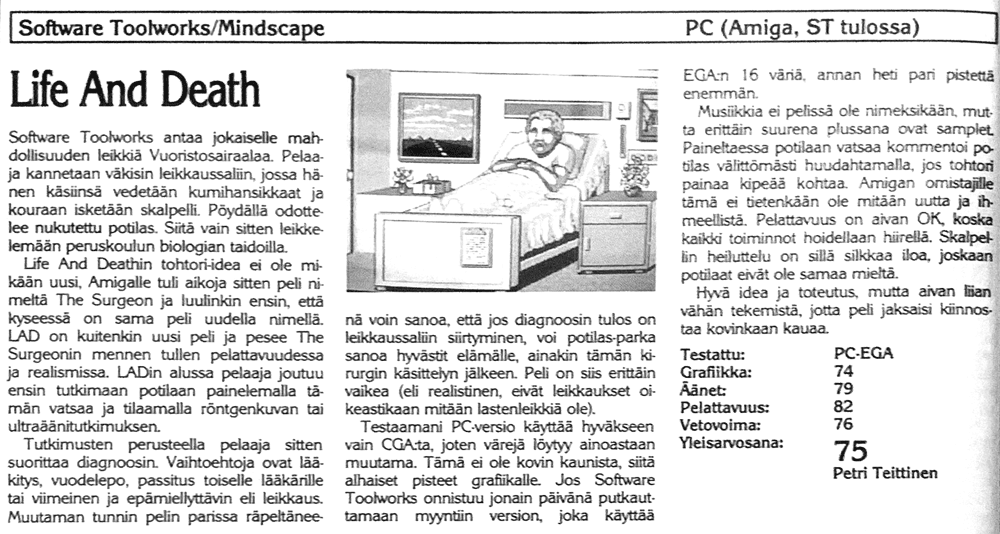
Life And Death1990 KevätPysyvä linkkiSoftware Toolworks antaa jokaiselle mahdollisuuden leikkiä Vuoristosairaalaa. Pelaaja kannetaan väkisin leikkaussaliin, jossa hänen käsiinsä vedetään kumihansikkaat ja kouraan isketään skalpelli. Pöydällä odottelee nukutettu potilas. Siitä vain sitten leikkelemään peruskoulun biologian taidoilla.
Life And Deathin tohtori-idea ei ole mikään uusi, Amigalle tuli aikoja sitten peli nimeltä The Surgeon ja luulinkin ensin, että kyseessä on sama peli uudella nimellä. LAD on kuitenkin uusi peli ja pesee The Surgeonin mennen tullen pelattavuudessa ja realismissa. LADin alussa pelaaja joutuu ensin tutkimaan potilaan painelemalla tämän vatsaa ja tilaamalla röntgenkuvan tai ultraäänitutkimuksen.
Tutkimusten perusteella pelaaja sitten suorittaa diagnoosin. Vaihtoehtoja ovat lääkitys, vuodelepo, passitus toiselle lääkärille tai viimeinen ja epämiellyttävin eli leikkaus. Muutaman tunnin pelin parissa räpeltäneenä voin sanoa, että jos diagnoosin tulos on leikkaussaliin siirtyminen, voi potilas-parka sanoa hyvästit elämälle, ainakin tämän kirurgin käsittelyn jälkeen. Peli on siis erittäin vaikea (eli realistinen, eivät leikkaukset oikeastikaan mitään lastenleikkiä ole).
Testaamani PC-versio käyttää hyväkseen vain CGA:ta, joten värejä löytyy ainoastaan muutama. Tämä ei ole kovin kaunista, siitä alhaiset pisteet grafiikalle. Jos Software Toolworks onnistuu jonain päivänä putkauttamaan myyntiin version, joka käyttää EGA:n 16 väriä, annan heti pari pistettä enemmän.
Musiikkia ei pelissä ole nimeksikään, mutta erittäin suurena plussana ovat samplet. Paineltaessa potilaan vatsaa kommentoi potilas välittömästi huudahtamalla, jos tohtori painaa kipeää kohtaa. Amigan omistajille tämä ei tietenkään ole mitään uutta ja ihmeellistä. Pelattavuus on aivan OK, koska kaikki toiminnot hoidellaan hiirellä. Skalpellin heiluttelu on sillä silkkaa iloa, joskaan potilaat eivät ole samaa mieltä.
Hyvä idea ja toteutus, mutta aivan liian vähän tekemistä, jotta peli jaksaisi kiinnostaa kovinkaan kauaa.
Life And Death1990 KevätPermalinkSoftware Toolworks gives everyone the chance to play Vuoristosairaala. The player is carried by force into the operating theatre, where rubber gloves are pulled onto their hands and a scalpel is slapped into their fist. An anaesthetised patient lies waiting on the table. Then off you go, carving away with the biology you learned at school.
The doctor idea in Life And Death is nothing new; a game called The Surgeon came out for the Amiga ages ago, and at first I actually thought this was the same game under a new name. LAD is, however, a new game, and it wipes the floor with The Surgeon in playability and realism. At the start of LAD, the player first has to examine the patient by prodding their stomach and ordering an X-ray or an ultrasound scan.
Based on the tests, the player then makes a diagnosis. The options are medication, bed rest, referral to another doctor, or the last and least pleasant one, surgery. Having fumbled about with the game for a few hours, I can say that if the diagnosis ends in a trip to the operating theatre, the poor patient can kiss life goodbye, at least once this surgeon has got his hands on them. So the game is extremely difficult (i.e. realistic; real operations aren't exactly child's play either).
The PC version I tested only makes use of CGA, so there are just a few colours. This is not very pretty, hence the low score for graphics. If Software Toolworks one day manages to pop out a version that uses EGA's 16 colours, I'll give it a couple of points more straight away.
There's not so much as a token scrap of music in the game, but a very big plus are the samples. When you prod the patient's stomach, the patient instantly comments by crying out if the doctor presses a sore spot. For Amiga owners this is of course nothing new or amazing. The playability is perfectly OK, since all functions are handled with the mouse. Waving the scalpel around with it is pure joy, although the patients don't agree.
A good idea and execution, but far too little to do for the game to hold your interest for very long.
Life Force

Life Force1990 SyksyPysyvä linkkiNintendo on ansioitunut ikämiessarjan räiskintäklassikoiden julkaisijana. Valikoimasta löytyy muun muassa Xevious, Gradius ja Life Force, joista kaksi viimeksi mainittua tunnetaan paremmin Konamin alkuperäisistä kolikkopeistä Nemesis ja Salamander.
Kolmikon kiinnostavin on Life Force, erittäin mielikuvituksekas avaruusräiskintäpeli lisäasevillityksen alkuajoilta. Orgaanisissa tahmaonkaloissa puihkelehtivaan alukseen saa keräiltyä aisteja värisyttävän tulivoiman, jolla Zeloksen olioista voi puristaa elinvoiman pihalle. Mikä parasta, aseet ovat välittömästi tarjolla sen sijaan että ensimmäistä lisälaserin tynkäänsä joutuisi odottamaan puoli peliä. Tosin moderneihin aseilla mässäilyihin verratuna pelin ikä alkaa jo näkyä. Lisäammukset eteen ja viistoon, satelliitit ja superammukset eivät uusimmalle R-Typelle versio tuhatmiljoonaakaksikymmentäyksi pärjää, mutta on sekin parempi kuin konsolipeleissä hävyttömän usein näkyvät hiekanjyviä heittelevät ritsalingot.
Vaaka- ja pystyvierityksen vuorottelu, alkuperäistä versiota tarkasti myötäilevät painajaismaisemat ja ylivoimaisen hyvin tasapainoitettu tekevät Life Forcesta ehdottomasti Nintendon parhaan tuhoamispelin. Räiskintäpeleille tyypillisesti peli on ankaraa pinnistystä alusta loppuun, minkä vuoksi täydellinen aloittelija voi tuntea itsensä masentavan kömpelöksi mämmikouraksi. Tästä avaruusajan miehuuskokeesta saavat eniten irti kokeneemmat expertit.
Life Force1990 SyksyPermalinkNintendo has earned its stripes as a publisher of old-timers'-league shoot-'em-up classics. The range includes, among others, Xevious, Gradius and Life Force, the last two of which are better known as Konami's original coin-ops Nemesis and Salamander.
The most interesting of the trio is Life Force, a highly imaginative space shoot-'em-up from the early days of the extra-weapon craze. The ship, whooshing along through organic goo-caverns, can collect senses-quivering firepower with which to squeeze the life force right out of the creatures of Zelos. Best of all, the weapons are on offer straight away, instead of you having to wait half the game for your first stub of an extra laser. Mind you, compared with modern weapon binges, the game's age is starting to show. The extra shots forwards and diagonally, the satellites and the super shots are no match for the latest R-Type, version one-thousand-million-and-twenty-one, but even that is better than the sand-grain-flinging slingshots seen shamelessly often in console games.
The alternation of horizontal and vertical scrolling, the nightmare landscapes that closely follow the original version and the supremely well-balanced gameplay make Life Force unquestionably the best destruction game on the Nintendo. As is typical of shoot-'em-ups, the game is a gruelling strain from start to finish, which is why a complete beginner may feel like a depressingly clumsy butterfingers. It's the more seasoned experts who will get the most out of this space-age test of manhood.
Light Corridor

Light Corridor1991 KevätPysyvä linkkiTetris palautti yksinkertaisen, mutta hyvän idean kunniaan, ja tätä periaatetta hyödyntää Ligh Corridorkin.
Päämäärä on saada kuljetettua palloa syvemmälle kolmiulotteisessa tunnelissa Arkanoid-tyyliin. Tunnelissa on ennalta-arvattavien seinien lisäksi liikkuvia seiniä, voimakenttiä, ja erikoisseiniä, kuten tiettyyn kohtaan osumista vaativat ja pala palalta hajotettavat. Tietysti tunnelissa roikkuu myös lisäominaisuuksia mailaan tämän jo mainitun Arkanoidin malliin.
Pelissä on koodijärjestelmä tauottoman saman osuuden kanssa tahkoamisen välttämiseksi sekä rakennusosio omia tunneleita varten. Grafiikka on yksinkertaista eikä haittaa peliä, ääniefektitkin miellyttävät korvaa. Ainoa vika on liiallinen nopeus: Light Corridor vaatii suhteettoman hyvät refleksit.
Ihan kiva peli, mutta riittääkö se?
Light Corridor1991 KevätPermalinkTetris restored the simple but good idea to a place of honour, and Ligh Corridor makes use of this principle too.
The aim is to carry a ball ever deeper along a three-dimensional tunnel, Arkanoid-style. Besides the predictable walls, the tunnel has moving walls, force fields and special walls, such as ones that have to be hit in a particular spot and ones that have to be broken down piece by piece. Naturally there are also extras for your bat hanging about in the tunnel, after the fashion of the aforementioned Arkanoid.
The game has a code system so you don't have to slog through the same section over and over, as well as a construction section for building your own tunnels. The graphics are simple and don't get in the way of the game, and the sound effects are easy on the ear too. The only flaw is the excessive speed: Light Corridor demands disproportionately good reflexes.
A perfectly nice game, but is that enough?
Lightspeed
Lightspeed1991 KevätPysyvä linkkiVihdoinkin ihmiset tekivät sen mitä heiltä odotettiin: maapallo on täysin asumiskelvoton. Populaatio lastattiin Conestoga-luokan kuljetusaluksiin (matkustajakapasiteetti 10.000.000) ja singottiin saastuttamaan muita planeettoja.
Sinun tehtäväsi, Jim, on löytää asutuskelpoisia planeettoja sekä raaka-aineita siirtokuntien tarpeisiin. Otapa tästä 3,4 kilometrin kokoinen Trailblazer-alus ja anna palaa. Muista olla kohtalaisen kiltti muita rotuja kohtaan ja solmia rauhansopimuksia.
Lightspeed väittää yhdistävänsä seikkailua ja toimintaa. Ottakaamme esimerkkilento.
3D-tähtikartasta lähimmän tutkimattoman järjestelmän valittuaan Trailblazer varppaa ja saapuu keskelle mustaa avaruutta. Luotain laukaistaan ja kertoo, että toisella planeetalla on radioaktiivisia aineita. Sinne siis yksi kolmesta automaattitehtaasta. Sitten kurssi seuraavaan aurinkokuntaan.
Ops! Kesken matkan joku hyökkää kimppuun. Äkkiä jättialuksen aseet toimintakuntoon. Nokalle on asennettu kiinteä antiprotonitykki ja välilyönnin nuijaisulla pääsee blastertykkitorniin, jonka pääasiallinen tarkoitus on vihollisammusten tuhoaminen. Taistelun jälkeen imuroidaan vihollisaluksen jälkeenjääneet komponentit, jotka eivät tietysti yleensä koskaan riitä korvaamaan taistelussa menetettyjä.
Komponenttien merkitys selviää konehuoneessa: laitteistojen teho vähenee komponenttien rikkoutuessa (ja paranee, kun peruskompot korvataan tehosellaisilla). Niitä käytetään myös kauppatavaroina.
Joka tapauksessa matka jatkuu, ja yllätys yllätys! Aurinkokunta onkin varattu! Trailblazer varppaa millintarkasti Broodmastereiden avaruusaseman viereen vaikka mitä tekisi. Kuten 95% muistakin muukalaisroduista, Broodmasterit eivät suostu kaupankäyntiin ennen kuin pelaaja on hätistellyt muita rotuja. Tässä vaiheessa varpataankin takaisin omalle avaruusasemalle tankkausta varten ja mietitään, että nämä rahat olisi voinut sijoittaa parempaankin peliin.
Kun MicroProsen kaltainen nimi tekee avaruuspelin, on aihetta odottaa jotain tavallisuudesta poikkeavaa. Ja näin onkin. Kiltisti sanottuna Lightspeed on susi ja ihmetyttääkin, että tiukasta laadunvalvonnastaan tunnettu MicroProse on sen päästänyt markkinoille. Periaatteessa pelin rakenne on ok ja mielenkiintoinen, mutta toteutus kaataa jalat alta. Realismin tai edes näennäisrealismin osuus on liki nolla.
Keskiverto SDP:n piirikokous on jännittävämpi kuin avaruustaistelu, josta tulee mieleen pässitappelu: kaksi eläintä puskee toisiaan päähän kunnes toiselta hajoaa kallo. Trailblazer lentää kuin lehmä vaikka koneena olisi 33MHz 486 ("Mutta isi, eihän lehmä lennä! -Oikein, poikani.") joten ainoa taktiikka on kaasu täysille ja kohti. Blastertykki on tehoton eikä sillä tee juuri mitään. Sinänsä näppärä on ohjuskuorijärjestelmä, josta saa joko heikkotehoisen itsehakeutuvan ohjuksen, tehokkaamman ohjattavan kamikazeversion tai blastereilla aseistetun hävittäjän.
Taistelussa tuhoutuu säännönmukaisesti suuri määrä komponentteja, joiden korvaaminen on vaikeaa, ellei mahdotonta. Keskustelu vieraiden rotujen kanssa on "valitse vaihtoehto"-tyylistä hyödytöntä ja tylsää näpertelyä.
Lightspeed muistuttaa lähinnä yksinkertaista PD-peliä. Positiivisinta on varsin hyvät AdLib-efektit.
Ja Jukka Tapanimäki jatkaa: "Lightspeedin 3D on poikkeuksellista: sulavaa, värikästä, valonlähteen mukaan varjostettua VGA-vektorigrafiikkaa. Mutta kaikki muu onkin lievästi poskellaan. Vaihtokauppa ja diplomatia ovat tylsää rutiinia eivätkä taistelutkaan mieltä ylennä. Miksi hitossa viholliset aina viskataan suoraan nenän eteen, eihän siinä ole mitään hohtoa?
Asejärjestelmissä ehkä olisi kovastikin potkua, jos toteutus ei olisi jäänyt puolitiehen. Ympäristön puhdistaminen laukaistavan minihävittäjän ohjaimissa on paras idea, mutta esimerkiksi Lutinien rynnäkköalusten kanssa on turhauttavaa yrittääkään kehitellä hedelmällistä dogfightia, koska ne pirulaiset höökivät suoraan tähtialuksen läpi.
Ei mikään huono peli, mutta idean potentiaalin ja käytäntöön soveltamisen välillä on liikaa klappia. 78 pistettä."
Lightspeed1991 KevätPermalinkAt last humanity did what was expected of it: the Earth is completely uninhabitable. The population was loaded onto Conestoga-class transports (passenger capacity 10,000,000) and flung off to pollute other planets.
Your mission, Jim, is to find habitable planets as well as raw materials for the colonies' needs. Here, take this 3.4-kilometre Trailblazer ship and let rip. Remember to be reasonably nice to the other races and to sign peace treaties.
Lightspeed claims to combine adventure and action. Let us take a sample flight.
Having picked the nearest unexplored system on the 3D star map, the Trailblazer warps and arrives in the middle of black space. A probe is launched and reports that the second planet has radioactive materials. So one of the three automatic factories goes there. Then set a course for the next solar system.
Oops! Halfway there, somebody jumps you. Quick, get the giant ship's weapons ready for action. A fixed antiproton cannon is mounted on the nose, and a whack of the space bar gets you into the blaster turret, whose main purpose is destroying enemy shots. After the battle you vacuum up the components the enemy ship left behind, which of course generally never make up for the ones lost in the fight.
What the components are for becomes clear in the engine room: the equipment loses power as components break (and gains it when the basic comps are swapped for high-power ones). They're also used as trade goods.
Anyway, the journey goes on, and surprise surprise! The solar system is already taken! The Trailblazer warps right up next to the Broodmasters' space station, accurate to the millimetre, whatever you do. Like 95% of the other alien races, the Broodmasters refuse to trade until the player has chased off the other races. At this point you warp back to your own space station to refuel and reflect that this money could have been put into a better game.
When a name like MicroProse makes a space game, there's reason to expect something out of the ordinary. And so it is. To put it kindly, Lightspeed is a turkey, and it's a wonder that MicroProse, known for its strict quality control, has let it onto the market. In principle the game's structure is OK and interesting, but the execution knocks the legs out from under it. The share of realism, or even pseudo-realism, is close to zero.
An average SDP district meeting is more exciting than the space combat, which brings to mind a ram fight: two animals butting each other in the head until one of them's skull cracks. The Trailblazer flies like a cow even if your machine is a 33MHz 486 ("But Daddy, cows don't fly! -Right, son.") so the only tactic is full throttle, straight at them. The blaster cannon is ineffective and you can hardly do anything with it. The missile shell system is neat in itself, giving you either a low-powered homing missile, a more powerful steerable kamikaze version or a fighter armed with blasters.
Combat regularly destroys a large number of components, which are hard, if not impossible, to replace. Conversation with alien races is useless and tedious fiddling of the "choose an option" kind.
Lightspeed mostly resembles a simple PD game. The most positive thing is the rather good AdLib effects.
And Jukka Tapanimäki continues: "Lightspeed's 3D is exceptional: smooth, colourful VGA vector graphics shaded according to the light source. But everything else is slightly off kilter. Bartering and diplomacy are dull routine, and the battles don't exactly lift the spirits either. Why the heck are the enemies always tossed right under your nose? There's no thrill in that at all.
The weapon systems might well have plenty of kick, if the execution hadn't been left halfway. Clearing the surroundings at the controls of the launchable mini-fighter is the best idea, but with the Lutins' assault craft, for example, it's frustrating even to try to work up a fruitful dogfight, because the little devils barge straight through the starship.
Not a bad game at all, but there's too much slack between the idea's potential and its practical application. 78 points."
Line Of Fire

Line Of Fire1991 KevätPysyvä linkkiLine Of Fire on Segan Operation Wolf -klooni, jossa uutena ideana on vaihteleva liikkuminen, toisin sanoen pelkän sivu- tahi eteenpäin menon asemasta liikutaan jopa takaperin tai vinoittain. LOF:in kehystarina on parin jätkän pako.
Tuttuun tyyliin konekiväärit paukkuvat hiiriohjauksessa ja kranaatitkin lentelevät. Tason lopussa ilmestyy myös loppuhirviö, -helikopteri tai muu vastaava.
Näissä peleissä onnistuminen vaatii kunnon ohjelmointia, ja siinä LOF kangertelee. Amigan 32 värin paletista käytetään korkeintaan neljännes, ja muutenkin käytetty tekniikka muistuttaa epäonnistunutta Afterburner-käännöstä, siis legografiikkaa. Äänienkin pitäisi olla huimasti reippaampia synnyttääkseen vaadittavan overkill-tunnelman.
Positiivisessa hengessä voidaan kuitenkin todeta, että on LOF sentään pelattava. Menee lisämausteena kokoelmassa, muttei pysy omilla jaloillaan.
Line Of Fire1991 KevätPermalinkLine Of Fire is Sega's Operation Wolf clone, whose new idea is varied movement: in other words, instead of just going sideways or forwards, you even move backwards or diagonally. LOF's framing story is a couple of blokes making their escape.
In the familiar style, the machine guns rattle away under mouse control and grenades fly about too. At the end of a level there's also an end-of-level monster, end-of-level helicopter or some other such thing.
Success in games like these demands proper programming, and that's where LOF falters. At most a quarter of the Amiga's 32-colour palette gets used, and otherwise too the technique on show resembles a botched Afterburner conversion - Lego graphics, in other words. The sound ought to be a whole lot livelier as well to generate the required overkill atmosphere.
In a positive spirit, though, it can be noted that LOF is at least playable. It'll do as extra seasoning in a compilation, but it won't stand on its own two feet.
Little Computer People
Little Computer People1987Pysyvä linkkiLähes jokainen elossa oleva ihminen on kuullut puhuttavan mikroprosessoreista. Sanotaan, että prosessorit ohjaavat tietokoneita, mutta onko kukaan koskaan miettinyt, miten prosessorit tämän tekevät. Kyllä, asiaa on tutkittu vuosikausia ja ensimmäiset varmat tulokset on juuri päästetty julkisuuteen. Jokaisessa tietokoneessa on vähintään yksi pieni tietokoneihminen, joka pitää huolen laitteen toiminnasta.
Kuulostaa uskomattomalta, mutta Activision todistaa väitteensä. Se on nimittäin tuonut markkinoille ohjelman, jolla pienet tietokoneihmiset eli pti:t saadaan näkyviin.
Pötypuhetta sanot sinä, ja niin sanoin minäkin työntäessäni disketin levyasemaani. Kerrottuani ohjelmalle nimeni ja kellonajan näin hetkessä ruudulla kuvan halkileikatusta talosta, se oli aivan kuin nukkekoti. Talossa ei ollut ketään. Tuijotin ruutua hetken ymmärtämättä mistään mitään, mutta sitten alakerran ovi avautui. Sisään käveli pieni mies letkeän vetävästi askeltaen. Arastelematta hän käveli suoraan jääkaapille ja avasi sen toiveikkaana, mutta kaappi oli tyhjä. Seuraavaksi mies kokeili toimiiko WC:n pönttö, laittoi television päälle, availi piirongin laatikoita ja tutkittuaan paikkoja tarpeeksensa käveli ulos. Muutaman sekunnin kuluttua mies palasi koiransa ja maallisen omaisuutensa kanssa. Hän oli hyväksynyt talon uudeksi asunnokseen. Tyynesti mies kiipeää kolmanteen kerrokseen, avaa arkistokaapin laatikon, katsoo minuun luottavaisin silmin ja kysyy: "Haluatko pelata sananarvausta, sotakorttipeliä vai pokeria?" Kokeilin kaikkia kolmea ja totesin pikku miehen pelien olevan kovin yksinkertaisia. Sanoin sen ääneen, pikku mies ryntäsi puhelimeen ja selitti kiihtyneeseen äänensävyyn jollekulle, kuinka törkeästi minä häntä kohtelen. Lohdutukseksi tilasin miehelle muutaman äänilevyn ja hyvän kirjan. Lopullisesti mies leppyi pyytäessäni häntä soittamaan pianolla jotain klassista (kirjoitin "Please play the piano'). Erittäin taidokkaasti soitetun kappaleen jälkeen oli miehen kasvoilla levein koskaan näkemäni hymy hänen kuunnellessaan aploodejani. Hieman sekavin tuntein päätin istunnon pikku äijäni kanssa kytkemällä kuusneloseni virran pois.
Ohjelman grafiikka on erinomaista ja pianolla soitettu musiikki loistavaa, mutta en kuitenkaan ymmärrä mitä ohjelma tekee. Idea saattaa kylläkin olla alkua jollekin, joka tulee lakaisemaan hiiret, ikonit ja muut ns. käyttäjäystävälliset ideat vanhanaikaisina markkinoilta. Mikä olisikaan luonnonläheisempää kuin pyytää tuttua pikku äijää lajittelemaan kirjeitä, järjestämään arkistot jne.
Kiehtova idea ja hyvä toteutus, mutta jotain kuitenkin puuttuu. Pelkäksi peliksi ohjelmassa ei ainakaan vanhemmille ja vaativammille asian harrastajille ole tarpeeksi sisältöä, eikä sillä mitään hyödyllistäkään pysty tekemään. Nuoremmat pelaajat todennäköisesti pystyvät nauttimaan ohjelmasta pidempään.
Little Computer People1987PermalinkAlmost every living person has heard talk of microprocessors. People say that processors control computers, but has anyone ever stopped to think how the processors actually do it? Yes, the matter has been researched for years, and the first conclusive results have just been made public. Inside every computer there is at least one little computer person who keeps the machine running.
It sounds incredible, but Activision proves the claim. It has put a program on the market that makes the little computer people, or LCPs, visible.
Poppycock, you say, and that's what I said too as I shoved the disk into my drive. Once I had told the program my name and the time, a moment later I was looking at a cross-section of a house on the screen; it was just like a dolls' house. There was nobody in the house. I stared at the screen for a while without understanding a thing, but then the downstairs door opened. In walked a little man with a loose, easy swagger. Without a trace of shyness he went straight to the fridge and opened it hopefully, but it was empty. Next the man checked whether the toilet worked, switched on the television, opened the drawers of the chest one after another and, having inspected the premises to his satisfaction, walked out. A few seconds later he was back with his dog and all his worldly goods. He had accepted the house as his new home. Calmly the man climbs to the third floor, opens a filing cabinet drawer, looks at me with trusting eyes and asks: "Would you like to play a word-guessing game, War or poker?" I tried all three and found the little man's games awfully simple. I said so out loud, and the little man rushed to the phone and explained to someone in an agitated voice how outrageously I was treating him. To console him I ordered him a few records and a good book. He was finally mollified when I asked him to play something classical on the piano (I typed "Please play the piano"). After a very skilfully played piece, the man's face wore the widest smile I have ever seen as he listened to my applause. With somewhat mixed feelings I ended the session with my little guy by switching off my Commodore 64.
The program's graphics are excellent and the piano music brilliant, but I still don't understand what the program actually does. Then again, the idea may well be the start of something that will sweep mice, icons and other so-called user-friendly ideas off the market as old-fashioned. What could be more natural than asking a familiar little guy to sort your letters, put the files in order and so on?
A fascinating idea and a good execution, but something is still missing. As a game pure and simple it doesn't have enough content, at least not for older and more demanding hobbyists, and you can't do anything useful with it either. Younger players will probably be able to enjoy it for longer.
Live and Let Die
Live and Let Die1989 KevätPysyvä linkkiJo kolmannen kerran kajoaa Domarkin käsi James Bondiin, ja uuden puutteessa on esiin kaivettu vanha "Elä anna toisten kuolla". Totuttuun tapaan pelin ja elokuvan yhteneväisyydet ovat lähinnä tulkinnanvaraisia.
Jonkinlainen yhtymäkohta elokuvaan on pikaveneellä ajelu. Tarkoitus on yksi kerrallaan tuhota "Mr. Big" Kanangan peiteoperaatiot ympäri maailman. Bondin venho on varustettu rajattomalla määrällä pikkuohjuksia ja kolmella miestenohjuksella.
Kun peliä on jonkin aikaa pelannut hiipii mieleen vahva tunne Deja Vu'sta. Ja toden totta, Live and Let Die on Buggy Boy, jossa rantakirppu on korvattu veneellä ja lisätty soppaan Roadblasteria. Pikaveneellä voi hyppiä yli tukkien, on tunneleita ja kurveissa on ramppi, jota pitkin veneen voi liu'uttaa esteiden ohi. Eroina on lähinnä aikarajan puute ja reittikartan puuttuminen.
Polttoaine vähenee tasaista tahtia, kuoleman ottaessa tankista kunnon hörpyn, ja peli loppuu siinä missä polttoainekin. Onneksi sitä saa kerättyä matkan varrelta. Samalaisen huonepalvelun helikopteri tiputtaa silloin tällöin uusia ohjuksia ja muita aseita. Pelissä on kolme harjoitustehtävää ja ensimmäinen aito tehtävä New Orleansissa. Oudosti kyllä pelasin sitä kauan, kauan ilman että taso loppui. Lieneekö tarkoituskaan?
Ihan hyvä kolmiulotteinen grafiikka liikkuu notkeasti, 16-bittisissä jopa liiankin notkeasti. Kun olin jonkin aikaa pelaillut, huomasin jotain kohtalaisen yllättävää: Live and Let Die ei ole mikään heikko peli, varsinkaan 16-bittinen versio. Bondin kanssa ei luonnollisesti ole muuta yhteistä kun nimi. Samapa tuo.
Live and Let Die1989 KevätPermalinkFor the third time already, Domark's hand lays hold of James Bond, and for want of a new one the old "Elä anna toisten kuolla" has been dug out. As usual, the similarities between game and film are largely a matter of interpretation.
One point of contact of sorts with the film is cruising about in a speedboat. The aim is to destroy "Mr. Big" Kananga's covert operations around the world, one at a time. Bond's tub is equipped with an unlimited supply of small missiles and three man-sized missiles.
Once you've played the game for a while, a strong feeling of Deja Vu creeps into your mind. And sure enough, Live and Let Die is Buggy Boy with the beach buggy swapped for a boat and some Roadblaster thrown into the soup. With the speedboat you can jump over logs, there are tunnels, and on the bends there's a ramp along which you can slide the boat past obstacles. The main differences are the lack of a time limit and the absence of a route map.
Fuel goes down at a steady rate, with death taking a good swig out of the tank, and the game ends right where the fuel does. Luckily you can pick more up along the way. A helicopter offering the same sort of room service drops fresh missiles and other weapons now and then. The game has three training missions and a first real mission in New Orleans. Strangely enough, I played it for a long, long time without the level ending. Could that even be intended?
The quite decent three-dimensional graphics move smoothly, on the 16-bit machines even a little too smoothly. After I'd been playing for a while, I noticed something fairly surprising: Live and Let Die is by no means a weak game, especially not the 16-bit version. Naturally, it has nothing in common with Bond other than the name. Not that it matters.
Living Daylights
Living Daylights1987Pysyvä linkkiHiphei, kammottava A View To Kill on saanut jatkoa uuteen Averell Dalton-Bondiin perustuvassa Living Daylightsissa. Saako maailmanhistorian huonoimpiin kuuluva huijaus vahvan kilpailijan?
Domark tosiaan uskoo tuotteeseensa: peli käännetään paitsi kaikkiin mahdollisiin 8-bittisiin koneisiin niin myös Amigaan ja lisäksi Living Daylightsista tehdään kolikkopeli.
Taloudellinen riski ei tietysti ole suuri: Elävä Päivänsäde myisi vaikka se olisi View To Kill uusilla kansilla. Onneksi näin ei kuitenkaan ole.
Tällä kertaa on nähty vaivaa. Grafiikka on hyvää ja kelvollinen versio elokuvan teemasta renkuttaa pelin alussa. Typerän Ah-Ha-kappaleen asemasta olisi kyllä saanut käyttää wanhaa kunnon Bond-teemaa.
Peli sinänsä on varsin yksinkertainen: Bond juoksee kuusi filmiin perustuvaa, mutta kohtalaisen samanlaista tasoa läpi oikealta vasemmalle ja kohtaa vaihtelevia vihollisia. Tasojen välillä 007 voi valita Q:n laajoista varastoista aseistusta.
Jokainen taso vaatii tietyn erikoisaseen. Väärän aseen valinta vaikeuttaa läpipeluuta, muttei tee sitä mahdottomaksi. Ampuessaan Bond pysähtyy ja kohdistin osoittaa minne lyijy lentää. James-boy myötäilee kädellään pyssyn suuntaa.
Ketteränä miehenä 007 voi myös hyppiä ja kumartua. Eikä yksi luoti riitä kirjoittamaan Bondin muistovärssyä. Living Daylights voisi olla mihin tahansa elokuvaan perustuva peli, mitään Bond-leffalle ominaista siihen ei ole taltioitu.
Mikään floppi Living Daylights ei ole, muttei myöskään mikään virstanpylväs tietokonepelien historiassa. Onpahan vain kohtalaisen sujuva ampumapeli, joka varmasti löytää kohderyhmänsä, etenkin pelaajakunnan nuoremmasta päästä. Ostakoon ken tahtoo, ilmankin tulee toimeen.
Living Daylights1987PermalinkWhoopee, the ghastly A View To Kill has got a sequel in Living Daylights, based on the new Averell Dalton Bond. Is one of the worst rip-offs in the history of the world about to get a serious rival?
Domark really does believe in its product: the game is being converted not only to every conceivable 8-bit machine but also to the Amiga, and on top of that Living Daylights is being turned into a coin-op.
The financial risk isn't great, of course: Living Sunbeam would sell even if it were View To Kill in a new box. Fortunately, that isn't the case.
This time somebody has actually gone to some trouble. The graphics are good, and a passable version of the film's theme jingles away at the start of the game. Instead of the daft a-ha song, though, they could perfectly well have used the good olde Bond theme.
The game itself is quite simple: Bond runs from right to left through six levels that are based on the film but fairly similar to one another, and meets a variety of enemies. Between levels 007 can choose his weaponry from Q's extensive stores.
Each level calls for a particular special weapon. Choosing the wrong one makes getting through harder, but not impossible. When he shoots, Bond stops and a cursor shows where the lead is going to fly. James-boy's arm follows the direction of the gun.
Being a nimble fellow, 007 can also jump and duck. Nor is a single bullet enough to write Bond's epitaph. Living Daylights could be a game based on any film at all; nothing characteristic of a Bond movie has been captured in it.
Living Daylights is no flop, but it's no milestone in the history of computer games either. It's just a reasonably smooth shoot-'em-up that is sure to find its audience, especially at the younger end of the gaming public. Let him buy it who will; you'll manage fine without it, too.
Lode Runner
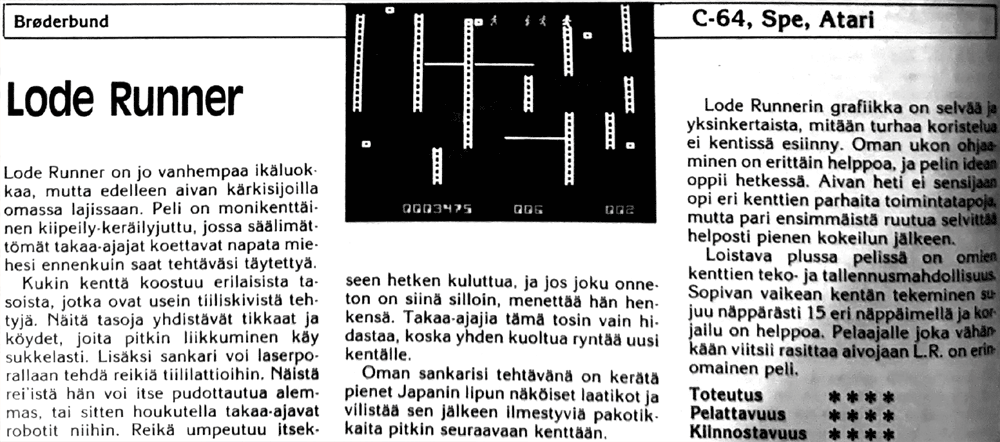
Lode Runner1987Pysyvä linkkiLode Runner on jo vanhempaa ikäluokkaa, mutta edelleen aivan kärkisijoilla omassa lajissaan. Peli on monikenttäinen kiipeily-keräilyjuttu, jossa säälimättömät takaa-ajajat koettavat napata miehesi ennenkuin saat tehtäväsi täytettyä.
Kukin kenttä koostuu erilaisista tasoista, jotka ovat usein tiiliskivistä tehtyjä. Näitä tasoja yhdistävät tikkaat ja köydet, joita pitkin liikkuminen käy sukkelasti. Lisäksi sankari voi laserporallaan tehdä reikiä tiililattioihin. Näistä rei'istä hän voi itse pudottautua alemmas, tai sitten houkutella takaa-ajavat robotit niihin. Reikä umpeutuu itsekseen hetken kuluttua, ja jos joku onneton on siinä silloin, menettää hän henkensä. Takaa-ajajia tämä tosin vain hidastaa, koska yhden kuoltua ryntää uusi kentälle.
Oman sankarisi tehtävänä on kerätä pienet Japanin lipun näköiset laatikot ja vilistää sen jälkeen ilmestyviä pakotikkaita pitkin seuraavaan kenttään.
Lode Runnerin grafiikka on selvää ja yksinkertaista, mitään turhaa koristelua ei kentissä esiinny. Oman ukon ohjaaminen on erittäin helppoa, ja pelin idean oppii hetkessä. Aivan heti ei sensijaan opi eri kenttien parhaita toimintatapoja, mutta pari ensimmäistä ruutua selvittää helposti pienen kokeilun jälkeen.
Loistava plussa pelissä on omien kenttien teko- ja tallennusmahdollisuus. Sopivan vaikean kentän tekeminen sujuu näppärästi 15 eri näppäimellä ja korjailu on helppoa. Pelaajalle joka vähänkään viitsii rasittaa aivojaan L.R. on erinomainen peli.
Lode Runner1987PermalinkLode Runner is getting on a bit already, but it is still right at the top of its own genre. The game is a multi-level climbing-and-collecting affair in which merciless pursuers try to nab your man before you've managed to complete your task.
Each level is made up of various platforms, often built from bricks. The platforms are linked by ladders and ropes, which let you get around nippily. The hero can also use his laser drill to make holes in the brick floors. He can drop down through these holes himself, or else lure the pursuing robots into them. A hole fills itself in again after a moment, and if some unfortunate is in it at the time, he loses his life. This only slows the pursuers down, though, because as soon as one dies a new one comes charging onto the level.
Your own hero's job is to collect the little boxes that look like Japanese flags and then scurry up the escape ladders that appear afterwards to reach the next level.
Lode Runner's graphics are clear and simple; there's no pointless decoration anywhere in the levels. Controlling your own little man is very easy, and you grasp the idea of the game in a moment. What you won't learn right away, on the other hand, is the best way to tackle each level, but after a little experimenting the first couple of screens are easy enough to clear.
A brilliant plus in the game is the option to make and save your own levels. Building a suitably difficult level goes smoothly with 15 different keys, and making corrections is easy. For any player who can be bothered to exert their brain even slightly, L.R. is an excellent game.
Lombard RAC Rally
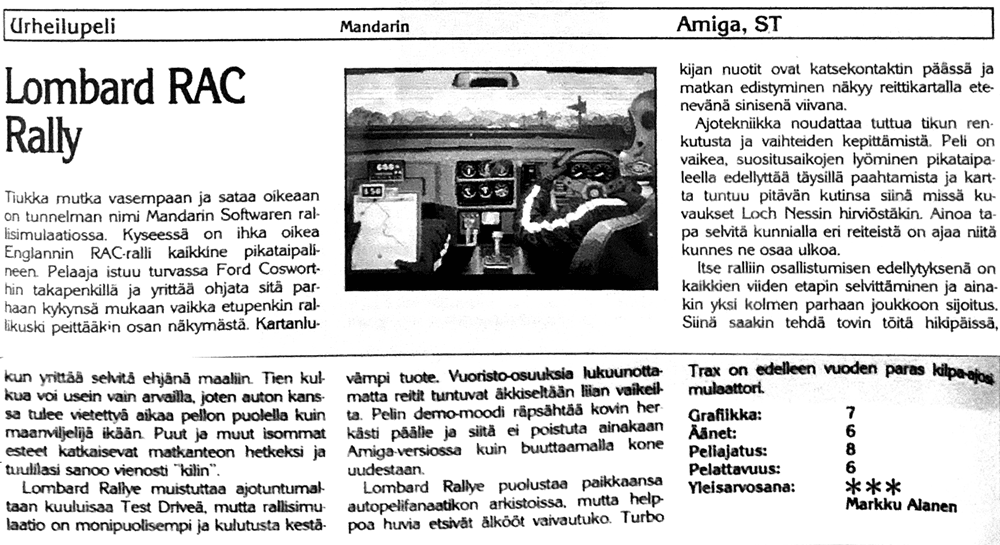
Lombard RAC Rally1989 KevätPysyvä linkkiTiukka mutka vasempaan ja sataa oikeaan on tunnelman nimi Mandarin Softwaren rallisimulaatiossa. Kyseessä on ihka oikea Englannin RAC-ralli kaikkine pikataipaleineen. Pelaaja istuu turvassa Ford Cosworthin takapenkillä ja yrittää ohjata sitä parhaan kykynsä mukaan vaikka etupenkin rallikuski peittääkin osan näkymästä. Kartanlukijan nuotit ovat katsekontaktin päässä ja matkan edistyminen näkyy reittikartalla etenevänä sinisenä viivana.
Ajotekniikka noudattaa tuttua tikun renkutusta ja vaihteiden kepittämistä. Peli on vaikea, suositusaikojen lyöminen pikataipaleella edellyttää täysillä paahtamista ja kartta tuntuu pitävän kutinsa siinä missä kuvaukset Loch Nessin hirviöstäkin. Ainoa tapa selvitä kunnialla eri reiteistä on ajaa niitä kunnes ne osaa ulkoa.
Itse ralliin osallistumisen edellytyksenä on kaikkien viiden etapin selvittäminen ja ainakin yksi kolmen parhaan joukkoon sijoitus. Siinä saakin tehdä tovin töitä hikipäissä, kun yrittää selvitä ehjänä maaliin. Tien kulkua voi usein vain arvailla, joten auton kanssa tulee vietettyä aikaa pellon puolella kuin maanviljelijä ikään. Puut ja muut isommat esteet katkaisevat matkanteon hetkeksi ja tuulilasi sanoo vienosti "kilin".
Lombard Rallye muistuttaa ajotuntumaltaan kuuluisaa Test Driveä, mutta rallisimulaatio on monipuolisempi ja kulutusta kestävämpi tuote. Vuoristo-osuuksia lukuunottamatta reitit tuntuvat äkkiseltään liian vaikeilta. Pelin demo-moodi räpsähtää kovin herkästi päälle ja siitä ei poistuta ainakaan Amiga-versiossa kuin buuttaamalla kone uudestaan.
Lombard Rallye puolustaa paikkaansa autopelifanaatikon arkistoissa, mutta helppoa huvia etsivät älkööt vaivautuko. Turbo Trax on edelleen vuoden paras kilpa-ajosimulaattori.
Lombard RAC Rally1989 KevätPermalinkTight bend left and a hundred right - that's the atmosphere in a nutshell in Mandarin Software's rally simulation. This is the genuine English RAC Rally, special stages and all. The player sits safely in the back seat of a Ford Cosworth and tries to steer it as best they can, even if the rally driver in the front seat does block part of the view. The navigator's pace notes are just a glance away, and your progress shows up on the route map as an advancing blue line.
The driving technique follows the familiar routine of jiggling the joystick and rowing through the gears. The game is hard: beating the target times on a special stage means going flat out, and the map seems about as trustworthy as descriptions of the Loch Ness monster. The only way to get through the various routes with your honour intact is to drive them until you know them by heart.
To take part in the rally itself you have to get through all five stages and finish in the top three at least once. That'll keep you sweating away for a good while as you try to reach the finish in one piece. Often you can only guess where the road goes, so you end up spending time out in the fields with your car like some farmer. Trees and other bigger obstacles bring the journey to a brief halt, and the windscreen goes a delicate "tinkle".
In driving feel, Lombard Rallye resembles the famous Test Drive, but the rally simulation is a more varied product with more staying power. Apart from the mountain sections, the routes seem far too difficult at first. The game's demo mode snaps on at the slightest excuse, and at least in the Amiga version the only way out of it is to reboot the machine.
Lombard Rallye earns its place in a car game fanatic's archives, but those looking for easy fun need not bother. Turbo Trax is still the best racing simulator of the year.
Loom
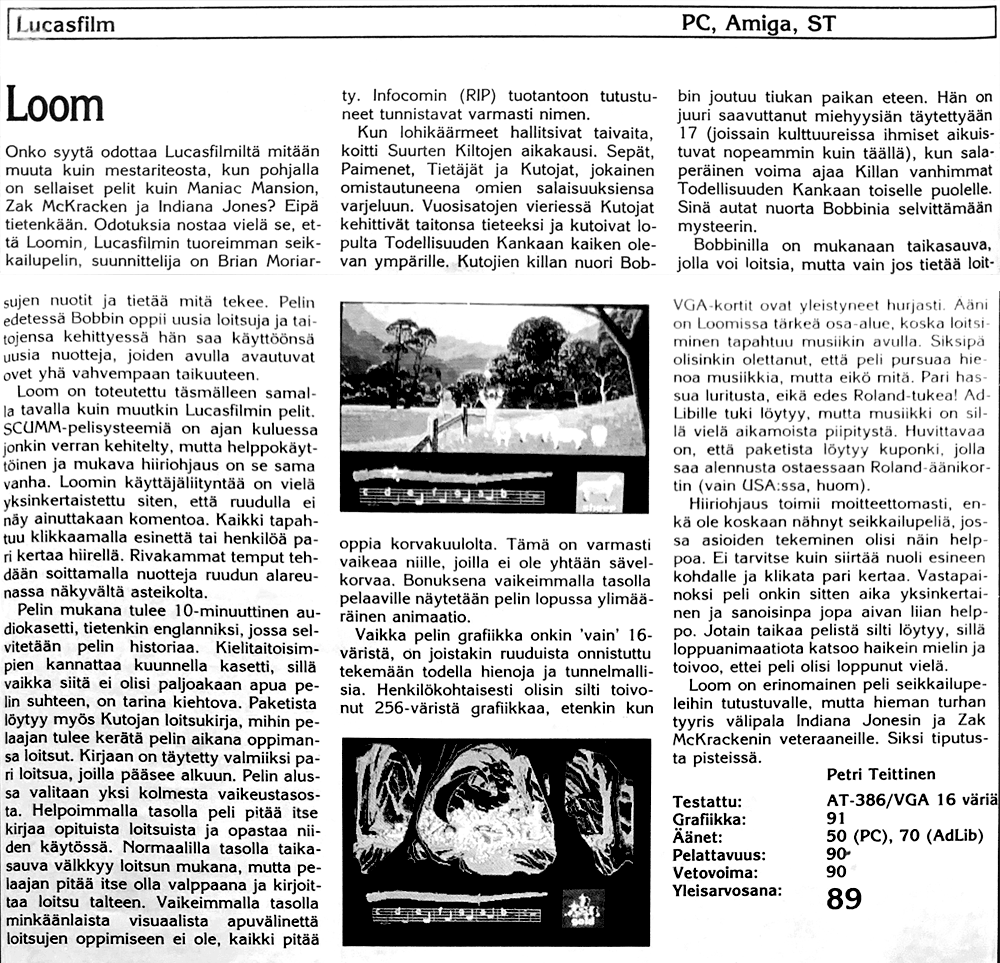
Loom1990 SyksyPysyvä linkkiOnko syytä odottaa Lucasfilmiltä mitään muuta kuin mestariteosta, kun pohjalla on sellaiset pelit kuin Maniac Mansion, Zak McKracken ja Indiana Jones? Eipä tietenkään. Odotuksia nostaa vielä se, että Loomin, Lucasfilmin tuoreimman seikkailupelin, suunnittelija on Brian Moriarty. Infocomin (RIP) tuotantoon tutustuneet tunnistavat varmasti nimen.
Kun lohikäärmeet hallitsivat taivaita, koitti Suurten Kiltojen aikakausi. Sepät, Paimenet, Tietäjät ja Kutojat, jokainen omistautuneena omien salaisuuksiensa varjeluun. Vuosisatojen vieriessä Kutojat kehittivät taitonsa tieteeksi ja kutoivat lopulta Todellisuuden Kankaan kaiken olevan ympärille. Kutojien killan nuori Bobbin joutuu tiukan paikan eteen. Hän on juuri saavuttanut miehyysiän täytettyään 17 (joissain kulttuureissa ihmiset aikuistuvat nopeammin kuin täällä), kun salaperäinen voima ajaa Killan vanhimmat Todellisuuden Kankaan toiselle puolelle. Sinä autat nuorta Bobbinia selvittämään mysteerin.
Bobbinilla on mukanaan taikasauva, jolla voi loitsia, mutta vain jos tietää loitsujen nuotit ja tietää mitä tekee. Pelin edetessä Bobbin oppii uusia loitsuja ja taitojensa kehittyessä hän saa käyttöönsä uusia nuotteja, joiden avulla avautuvat ovet yhä vahvempaan taikuuteen.
Loom on toteutettu täsmälleen samalla tavalla kuin muutkin Lucasfilmin pelit. SCUMM-pelisysteemiä on ajan kuluessa jonkin verran kehitelty, mutta helppokäyttöinen ja mukava hiiriohjaus on se sama vanha. Loomin käyttäjäliityntää on vielä yksinkertaistettu siten, että ruudulla ei näy ainuttakaan komentoa. Kaikki tapahtuu klikkaamalla esinettä tai henkilöä pari kertaa hiirellä. Rivakammat temput tehdään soittamalla nuotteja ruudun alareunassa näkyvältä asteikolta.
Pelin mukana tulee 10-minuuttinen audiokasetti, tietenkin englanniksi, jossa selvitetään pelin historiaa. Kielitaitoisimpien kannattaa kuunnella kasetti, sillä vaikka siitä ei olisi paljoakaan apua pelin suhteen, on tarina kiehtova. Paketista löytyy myös Kutojan loitsukirja, mihin pelaajan tulee kerätä pelin aikana oppimansa loitsut. Kirjaan on täytetty valmiiksi pari loitsua, joilla pääsee alkuun. Pelin alussa valitaan yksi kolmesta vaikeustasosta. Helpoimmalla tasolla peli pitää itse kirjaa opituista loitsuista ja opastaa niiden käytössä. Normaalilla tasolla taikasauva välkkyy loitsun mukana, mutta pelaajan pitää itse olla valppaana ja kirjoittaa loitsu talteen. Vaikeimmalla tasolla minkäänlaista visuaalista apuvälinettä loitsujen oppimiseen ei ole, kaikki pitää oppia korvakuulolta. Tämä on varmasti vaikeaa niille, joilla ei ole yhtään sävelkorvaa. Bonuksena vaikeimmalla tasolla pelaaville näytetään pelin lopussa ylimääräinen animaatio.
Vaikka pelin grafiikka onkin 'vain' 16-väristä, on joistakin ruuduista onnistuttu tekemään todella hienoja ja tunnelmallisia. Henkilökohtaisesti olisin silti toivonut 256-väristä grafiikkaa, etenkin kun VGA-kortit ovat yleistyneet hurjasti. Ääni on Loomissa tärkeä osa-alue, koska loitsiminen tapahtuu musiikin avulla. Siksipä olisinkin olettanut, että peli pursuaa hienoa musiikkia, mutta eikö mitä. Pari hassua luritusta, eikä edes Roland-tukea! AdLibille tuki löytyy, mutta musiikki on sillä vielä aikamoista piipitystä. Huvittavaa on, että paketista löytyy kuponki, jolla saa alennusta ostaessaan Roland-äänikortin (vain USA:ssa, huom).
Hiiriohjaus toimii moitteettomasti, enkä ole koskaan nähnyt seikkailupeliä, jossa asioiden tekeminen olisi näin helppoa. Ei tarvitse kuin siirtää nuoli esineen kohdalle ja klikata pari kertaa. Vastapainoksi peli onkin sitten aika yksinkertainen ja sanoisinpa jopa aivan liian helppo. Jotain taikaa pelistä silti löytyy, sillä loppuanimaatiota katsoo haikein mielin ja toivoo, ettei peli olisi loppunut vielä.
Loom on erinomainen peli seikkailupeleihin tutustuvalle, mutta hieman turhan tyyris välipala Indiana Jonesin ja Zak McKrackenin veteraaneille. Siksi tiputusta pisteissä.
Loom1990 SyksyPermalinkIs there any reason to expect anything other than a masterpiece from Lucasfilm, when it has games like Maniac Mansion, Zak McKracken and Indiana Jones behind it? Of course not. Expectations are raised further still by the fact that the designer of Loom, Lucasfilm's latest adventure game, is Brian Moriarty. Anyone familiar with the output of Infocom (RIP) will surely recognise the name.
When dragons ruled the skies, there dawned the Age of the Great Guilds. The Blacksmiths, the Shepherds, the Sages and the Weavers, each devoted to guarding its own secrets. As the centuries rolled by, the Weavers developed their craft into a science and finally wove the Fabric of Reality around all that exists. Young Bobbin of the Weavers' guild finds himself in a tight spot. He has just reached manhood on turning 17 (in some cultures people grow up faster than here) when a mysterious force drives the elders of the Guild to the other side of the Fabric of Reality. You help young Bobbin solve the mystery.
Bobbin carries a magic staff that can be used to cast spells, but only if you know the notes of the spells and know what you're doing. As the game progresses, Bobbin learns new spells, and as his skills develop he gains the use of new notes, which open the doors to ever stronger magic.
Loom has been put together in exactly the same way as Lucasfilm's other games. The SCUMM game system has been developed somewhat over time, but the easy-to-use and pleasant mouse control is the same old one. Loom's user interface has been simplified even further, so that not a single command appears on the screen. Everything happens by clicking an object or a person a couple of times with the mouse. The snappier tricks are done by playing notes on the scale shown along the bottom of the screen.
The game comes with a 10-minute audio cassette, in English of course, which explains the game's history. Those with the best language skills should listen to the tape, because even if it isn't much help with the game itself, the story is fascinating. The package also contains the Weaver's spell book, in which the player is meant to collect the spells learned during the game. A couple of spells have already been filled in to get you started. At the start of the game you choose one of three difficulty levels. On the easiest level the game itself keeps track of the spells you have learned and guides you in using them. On the normal level the magic staff flickers along with the spell, but you have to stay alert yourself and write the spell down. On the hardest level there is no visual aid of any kind for learning the spells; everything has to be learned by ear. This is sure to be hard for those who have no ear for music at all. As a bonus, those playing on the hardest level are shown an extra animation at the end of the game.
Although the game's graphics are 'only' 16-colour, some of the screens have been made really beautiful and atmospheric. Personally, though, I would have hoped for 256-colour graphics, especially now that VGA cards have become tremendously common. Sound is an important part of Loom, because spellcasting is done by means of music. So I would have expected the game to be bursting with great music, but not a bit of it. A couple of measly warbles, and not even Roland support! There is support for the AdLib, but even on that the music is still pretty much bleeping. The funny thing is that the package contains a coupon giving you a discount when you buy a Roland sound card (USA only, mind you).
The mouse control works flawlessly, and I have never seen an adventure game in which doing things is this easy. All you have to do is move the arrow over an object and click a couple of times. On the flip side, the game is then pretty simple and, I'd even say, far too easy. There is still some magic to be found in the game, though, since you watch the closing animation with a wistful heart, wishing the game hadn't ended yet.
Loom is an excellent game for someone getting to know adventure games, but a rather too pricey snack between meals for veterans of Indiana Jones and Zak McKracken. Hence the drop in the score.
Lord of the Rings
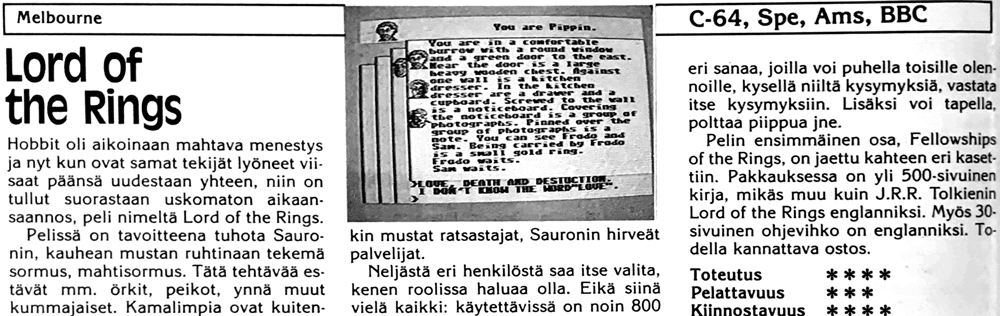
Lord of the Rings1987Pysyvä linkkiHobbit oli aikoinaan mahtava menestys ja nyt kun ovat samat tekijät lyöneet viisaat päänsä uudestaan yhteen, niin on tullut suorastaan uskomaton aikaansaannos, peli nimeltä Lord of the Rings.
Pelissä on tavoitteena tuhota Sauronin, kauhean mustan ruhtinaan tekemä sormus, mahtisormus. Tätä tehtävää estävät mm. örkit, peikot, ynnä muut kummajaiset. Kamalimpia ovat kuitenkin mustat ratsastajat, Sauronin hirveät palvelijat.
Neljästä eri henkilöstä saa itse valita, kenen roolissa haluaa olla. Eikä siinä vielä kaikki: käytettävissä on noin 800 eri sanaa, joilla voi puhella toisille olennoille, kysellä niiltä kysymyksiä, vastata itse kysymyksiin. Lisäksi voi tapella, polttaa piippua jne.
Pelin ensimmäinen osa, Fellowships of the Rings, on jaettu kahteen eri kasettiin. Pakkauksessa on yli 500-sivuinen kirja, mikäs muu kuin J.R.R. Tolkienin Lord of the Rings englanniksi. Myös 30-sivuinen ohjevihko on englanniksi. Todella kannattava ostos.
Lord of the Rings1987PermalinkHobbit was a massive success in its day, and now that the same people have put their wise heads together again, the result is nothing short of incredible: a game called Lord of the Rings.
The aim of the game is to destroy the ring made by Sauron, the terrible Dark Lord - the Ring of Power. Standing in the way of this task are orcs, trolls and other assorted oddities. The most dreadful of all, however, are the Black Riders, Sauron's horrible servants.
You get to choose for yourself which of four different characters you want to play. And that's not all: there are around 800 different words at your disposal, which you can use to chat with other beings, ask them questions and answer questions yourself. You can also fight, smoke a pipe and so on.
The first part of the game, Fellowship of the Ring, is split across two separate cassettes. The box contains a book of over 500 pages - what else but J.R.R. Tolkien's Lord of the Rings, in English. The 30-page instruction booklet is in English too. A really worthwhile buy.
Lord of the Rings
Lord of the Rings1991 KevätPysyvä linkkiTaru Sormusten Herrasta on älyttömän tylsä ja lapsellinen kirjasarja. Näinpä saatiin edes yksi arvostelu tästä pelistä alkamaan muulla kuin Tolkienin klassisen romaanin ylistyksellä. Kirja itse asiassa on todella, todella hyvä ja olen lukenut sen 10+ kertaa läpi. Siksipä oletamme, että juonikuvio ja henkilöt ovat tuttuja jokaiselle lukutaitoiselle (jollei ole, niin kipin kapin kirjastoon).
Tolkienin maailmaan sijoittuvia pelejä on tullut ennenkin, Melbourne Housen vastatessa kaikista. Peliveteraanit muistavat tekstiseikkailu The Hobbitin ("When going gets tough, Thorin sits down and sings about gold"), toisen, bugisuudessaan ainutlaatuisen, tekstiseikkailun Lord Of The Rings 1: The Fellowship of The Ring ja uusimman strategiapelin War In Middle Earth. Mirrorsoftiltakin on tulossa Tolkien-peli ja jenkeissä myydään Riders of Rohan -peliä.
Sormusten Herran on ohjelmoinut Bard's Taleistaan tunnetuin Interplay, joka tällä kertaa on vetänyt oikean johtopäätöksen Ultima VI:n toteutuksesta. Poissa on sekava klooni-3D, tällä kertaa hobittilauma vilistää hiiren (tai näppiksen) kepittämänä suurella ruudulla linnun silmin katsottuna. Menun saa ponnahtamaan esiin hiiren nappulasta.
Henkilölauma valuu johtajan perässä, muttei luojan kiitos takerru maastoon kiinni, vaan viimeistään poistuessaan näkökentästä teleporttautuu ryhmän kannoille. Eroon tietokoneroolipelien kliseilystä ei Interplay ole päässyt, sillä myös vihollisilla on taipumus teleporttautua suoraan niskaan.
Menusta näkee pelihahmon tilastotiedot, voi valita johtajan, vaihtaa pelihahmoa, operoida taidoilla, ottaa esineitä, käyttää ja antaa esineitä, rekrytoida hahmon, antaa kenkää henkilölle, keskustella henkilön kanssa, taistella ja heittää magiaa.
Taistelua ei niin hirveästi esiinny, mutta systeemi on yksinkertainen ja toimiva. Taistelijat operoivat vuoronperään liikkuen, lyöden ja taikoja heitellen. Valtavat asetaulukot loistavat poissaolollaan, perusaseet löytyvät ja peli on ripoteltu täyteen taika-aseita.
Kuten kirjan lukeneet tietävät ei magia Keski-Maassa jyllää lainkaan siihen tahtiin kuin jossain Dungeons & Dragonsissa tahi Ultimoissa. Pelaajan käytössä on alle 10 taikaa, ja muutama Voimasana. Magia verotetaan käyttäjän terveydestä, joten mitään massatuhoaseita eivät velhot ole. Varsinkin kun taistelutaikoja on kokonaiset kaksi eikä niiden tehossa ole kehumista.
Pelissä on mukana myös voimasanoja, ei suinkaan luokkaa !HEMMETTI vaan !LUTHIEN, !BOMBADIL ja sitä rataa. Suurin osa pätee tietyssä tilanteessa, esimerkiksi kahlaamolla, kun Nazgul-joukkue lähestyy, niin on aika huutaa...
Henkilöillä on myös taitoja, joista suurin osa on itsestäänselviä, kuten CLIMB, JUMP, READ ja semmoiset. Konnussa muuten parikin ongelmaa ratkeaa CHARISMALLA ja PERCEPTION on eräänlainen look-komento, jonka ahkera käyttö tuo itsensä takaisin.
Keskustelu muiden henkilöiden kanssa on Lordin huonoin puoli. Jotkut replikoivat kun menee tarpeeksi lähelle, mutta yleensä tietoja joutuu pumppaamaan. Interplay olisi saanut katsoa Ultima VI:n lähemmin, sillä keskustelu noudattaa "arvaa mikä avainsana"-tekniikkaa. Myös esineiden onginnan olisi voinut hoitaa tyylikkäämmin, nyt se hoituu metodilla "näkymättömät esineet", eli ilmoitetaan, että poimittavaa löytyy, mutta jos esine on vaikka ruudun rajoilla niin sinnehän jää. Tosin löysin varsin vaivattomasti kilokaupalla tavaraa, joten joko kävi hirveä munkki tai sitten pelissä lojuu tavaraa joka puolella.
Grafiikka on näppärää ja kaunista. VGA-versio käyttää jopa enemmän kuin kuusitoista väriä, ja peli ei tahmaile (kokeiltu 25MHz/386 sekä 12MHz/AT). EGAna grafiikka on ihan OK (EGA-standardin mukaan) ja CGA:n jätän kommentoimatta. Tuki yleisimmille ja vähemmän yleisimmille äänikorteille löytyy, mutta musiikinpätkiä lukuunottamatta ei pelissä sen ihmeempiä efektejä ole. Ilman äänikorttia kannattaa hamuilla musiikinkatkaisunappulaa, sillä vaikka PC-piip yrittää toistaa digitoitua (ilmeisesti) ääntä, niin Jumala korvia varjelkoon.
Ensimmäisen illan sessio jätti päällimmäiseksi "Voi luoja, iso kartta ja päämäärätön harhailu" -fiiliksen, joka kuitenkin osoittautui vääräksi kun vihdoin ja viimein tajusi jotain pelitavasta. Kontu jo yksinään tarjoaa runsaasti koluttavaa. saati sitten kun lyö nokkansa Konnun tuolle puolen. Konnusta on sentään kartta, ja ohjekirja tuntuu viittaavan myös ulkomaailman karttaan. Tätä en pakkauksesta löytänyt, ja peli vaatii ehdottomasti edes yleiskartan, joka tosin löytyy kirjoista. Tolkienistejä tietysti kiinnostaa mihin asti peli ulottuu. Parhaillaan komppaan Morian kaivoksia, ja veikkaan että kyllä ensimmäinen kirja on mahtunut mukaan.
Lord of The Rings tarjoaa tekemistä pitkäksi, pitkäksi aikaa, eikä Tolkienin ystävien tarvitse ähkiä tuskasta ja kirkua pyhäinhäpäisyä.
Lord of the Rings1991 KevätPermalinkThe Lord of the Rings is an insanely boring and childish book series. There - that gets at least one review of this game started with something other than praise for Tolkien's classic novel. The book is actually really, really good, and I've read it through 10+ times. Which is why we'll assume that the plot and the characters are familiar to everyone who can read (if not, then off to the library, chop-chop).
Games set in Tolkien's world have come out before, with Melbourne House responsible for all of them. Gaming veterans will remember the text adventure The Hobbit ("When going gets tough, Thorin sits down and sings about gold"), a second text adventure, unique in its bugginess, Lord Of The Rings 1: The Fellowship of The Ring, and the latest, the strategy game War In Middle Earth. Mirrorsoft has a Tolkien game on the way too, and over in the States they're selling a game called Riders of Rohan.
Lord of The Rings has been programmed by Interplay, best known for its Bard's Tales, who this time have drawn the right conclusion from the way Ultima VI was done. Gone is the messy clone-3D; this time the hobbit horde scurries about a large screen, seen from a bird's-eye view and herded along by the mouse (or the keyboard). The menu pops up at the click of a mouse button.
The gaggle of characters trickles along behind the leader, but thank God it doesn't get stuck on the scenery; at the latest when they drop out of sight, they teleport right onto the party's heels. Interplay hasn't managed to shake off the clichés of computer role-playing games, though, since the enemies also have a tendency to teleport right on top of you.
From the menu you can see a character's stats, choose the leader, switch characters, operate with skills, pick up items, use and give items, recruit a character, give someone the boot, talk to someone, fight and sling magic.
There isn't an awful lot of fighting, but the system is simple and it works. The combatants take turns moving, hitting and slinging spells. Huge weapon tables are conspicuous by their absence; the basic weapons are there, and the game is sprinkled full of magic weapons.
As those who've read the book know, magic in Middle-earth doesn't run riot anywhere near the way it does in some Dungeons & Dragons or the Ultimas. The player has fewer than 10 spells at their disposal, plus a few Words of Power. Magic is taxed from the caster's health, so wizards are no weapons of mass destruction. Especially since there are a whole two combat spells, and their power is nothing to write home about.
The game also features words of power - not, mind you, of the !DAMMIT variety, but !LUTHIEN, !BOMBADIL and so on. Most of them apply in one particular situation; for example, at the ford, when the Nazgul squad is closing in, it's time to shout...
The characters also have skills, most of which are self-explanatory, like CLIMB, JUMP, READ and suchlike. In the Shire, by the way, a couple of problems get solved with CHARISMA, and PERCEPTION is a kind of look command that pays for itself if you use it diligently.
Talking with other characters is the weakest side of Lord. Some of them pipe up when you get close enough, but usually you have to pump them for information. Interplay could have taken a closer look at Ultima VI, since conversation follows the "guess the keyword" technique. Fishing for items could have been handled more stylishly too; as it is, it's done with the "invisible items" method, i.e. you're told there's something to pick up, but if the item happens to be, say, at the edge of the screen, then there it stays. Mind you, I found stuff by the kilo with very little effort, so either I had a hell of a fluke or the game has stuff lying around all over the place.
The graphics are neat and pretty. The VGA version even uses more than sixteen colours, and the game doesn't bog down (tried on a 25MHz/386 and a 12MHz/AT). In EGA the graphics are perfectly OK (by EGA standards), and CGA I'll leave without comment. There's support for the most common and the less common sound cards, but apart from snippets of music there are no special effects to speak of in the game. Without a sound card you'd better grope for the music-off button, because although the PC beep tries to reproduce (apparently) digitised sound, God preserve your ears.
The first evening's session left me mostly with an "Oh God, a big map and aimless wandering" feeling, which turned out to be wrong, though, once I finally, at long last, grasped something about how the game is played. The Shire alone offers plenty to scour, never mind once you poke your nose out beyond the Shire. There is at least a map of the Shire, and the manual seems to refer to a map of the outside world as well. That one I didn't find in the box, and the game absolutely needs at least an overview map, although one can be found in the books. Tolkienists will naturally want to know how far the game goes. Right now I'm stomping around the Mines of Moria, and my bet is that yes, the whole first book has fit in.
Lord of The Rings offers plenty to do for a long, long time, and Tolkien's fans needn't groan in agony and scream sacrilege.
Lords of Chaos
Lords of Chaos1990 SyksyPysyvä linkkiVanha ja viisas velhoni rapsuttelee partaansa ja pohtii, mitä tällä kertaa poimisi loihdintamenusta. Otetaan seuraksi vaikka yksi zombie, väkivahva demoni ja pari siivekkästä harpyijaa. Taistoon valmis hilpeä ryhmäni astelee ulkoilmaan ja joutuu välittömästi viereisestä ryteiköstä lehahtavan tulimuurin saartamaksi. Neuvokkaasti selaan varastosta uuden loitsun ja tuossa tuokiossa maagi ratsastaa lentävän hevosen selässä kylväen vihaisia vasamia parin lepakkomaisen yön ruhtinaan suuntaan. Kaivetaanpa vielä taskusta kourallinen yrttejä, heitetään ne pataan ja manataan eetteristä punainen lohikäärme. Eiköhän näillä apujoukoilla jo pärjää pahalle Torquemadalle.
Laser Squadin tekijöiden uutuus on edeltäjänsä tyylisesti toteutettu taktinen roolipeli, jossa futuristinen laserjengi on korvattu taistelevilla arkkimaageilla. Aseistuksena on neljäkymmentäviisi loitsua, joista kaksikymmentaviisi on varattu olentojen manaamiseen. Apujoukkoja on neljää tyyppiä: ovien ja esineiden käsittelyyn kykeneviä kädellisiä, tiedusteluun sopivia siivekkäitä, nelijalkaisia, jotka kelpaavat ratsuksi, ja kuolleita, joita on ymmärrettävästi varsin hankala tappaa. Olennot voivat myös kuulua useampaan ryhmään, esimerkiksi Pegasus on siivekäs ratsu ja demoni kuollut kädellinen.
Muu magia sisältää pitkän kantaman aseita, kuten salamia, tulimuureja ja kirouksia, sekä suojaavia ja vahvistavia manauksia. Tiettyihin loitsuihin tarvitaan yrttejä ja pata, johon maaginen keitos sekoitetaan, sitten otetaan hörppy ja loput pullotetaan evääksi. Tähän tyyliin huhuillaan esiin myös lohikäärmeet, liittolaisista vahvimmat.
Toiminta etenee tuttuun tapaan siirtovuoro kerrallaan ja käytössä on line of sight -systeemi, kartalta siis löytyvät vain näkökentässä olevat oliot. Ulkoasukaan ei ole muuksi muuttunut: se on edelleen Ultiman mieleen tuovaa selväpiirteistä ja toimivaa tarkkuusgrafiikkaa. Uutta on sen sijaan mahdollisuus taistella peräti kolmea kavereiden ohjaamaa velhoa vastaan. Pelisysteemin roolipelimäisyyttä on korostettu siten, että velhon voi itse rakennella mieleisekseen ja jokainen voitettu taistelu parantaa sen ominaisuuksia.
Ainoa paha puoli on taistelukenttien vähäisyys, niitä kun löytyy vaivaiset kolme. Näissäkin riittää aluksi tekemistä, sillä alkuasetelmissa niin paljon satunnaisuutta, että kahden identtisen taistelun pelaaminen on äärimmäisen epätodennäköistä. Lisäksi Gollopin klaani lupailee, että suoraan Mythos Gamesilta voi jo tilata pari uutta skenaariota ja jatkoa on luvassa. LOC on välttämätön hankinta kaikille Laser Squadista innostuneille.
Lords of Chaos1990 SyksyPermalinkMy old and wise wizard scratches his beard and ponders what to pick from the conjuring menu this time. Let's take along, say, one zombie, a mighty-muscled demon and a couple of winged harpies. My merry band, ready for battle, strolls out into the open air and is immediately hemmed in by a wall of fire that flares up out of the neighbouring thicket. Resourcefully I scroll through my stock for a new spell, and in no time at all the mage is riding on the back of a flying horse, sowing angry arrows in the direction of a couple of bat-like princes of the night. Now let's dig a handful of herbs out of a pocket, toss them into the cauldron and conjure a red dragon out of the ether. Surely these reinforcements will be enough to see off the wicked Torquemada.
The new release from the makers of Laser Squad is a tactical role-playing game done in the style of its predecessor, with the futuristic laser gang replaced by battling archmages. The armoury consists of forty-five spells, twenty-five of which are reserved for summoning creatures. There are four types of reinforcements: primates capable of handling doors and objects, winged ones suited to scouting, four-legged ones that will do as mounts, and dead ones, which are understandably rather hard to kill. Creatures can also belong to more than one group; for example, the Pegasus is a winged mount and the demon a dead primate.
The rest of the magic includes long-range weapons such as lightning bolts, walls of fire and curses, as well as protective and strengthening incantations. Certain spells need herbs and a cauldron in which to mix the magic brew; then you take a swig and bottle the rest as a packed lunch. This is also the way the dragons, the strongest of the allies, are hollered up.
The action proceeds in the familiar way, one move turn at a time, and there is a line of sight system, meaning that only the creatures in your field of view appear on the map. Nor has the presentation changed at all: it is still clear-cut, functional high-resolution graphics reminiscent of Ultima. What is new, on the other hand, is the chance to fight against as many as three wizards controlled by your friends. The role-playing side of the game system has been emphasised in that you can build your wizard to your own liking, and every battle won improves its attributes.
The only bad side is the scarcity of battlefields, since there are a measly three of them. Even these keep you busy at first, because there is so much randomness in the starting set-ups that playing two identical battles is extremely unlikely. What's more, the Gollop clan promises that a couple of new scenarios can already be ordered direct from Mythos Games, with more to come. LOC is an essential purchase for everyone who got hooked on Laser Squad.
Lords of Midnight
Lords of Midnight1987Pysyvä linkkiLords on Midnight ei ole uusi arcadiapeli eikä adventure eikä myöskään strategiapeli. Se on jotain todella uutta pelirintamalla. Se on lähinnä todella onnistunut sekoitus adventuresta ja strategiapelistä. Lords of Midnightia markkinoi Beyond, sen on kirjoittanut Mike Singleton ja se perustuu hollantilaisen professorin J.R.R. Tolkienin kirjasarjaan Taru sormusten herrasta 1-3.
Laaja pelialue
Pelialue on todella laaja, noin 4000 ruutua. Peli piirtää noin 32 000 todella laadukasta maisemakuvaa. Mike Singleton on itse sanonut, että jos hänellä olisi ollut 2 kiloa muistia lisää, hän olisi saanut pelin kaksi kuukautta aikaisemmin valmiiksi.
Pelialue käsittää siis noin 4000 ruutua ja jokaisesta ruudusta voi katsoa kaikkiin kahdeksaan ilmansuuntaan. Midnightin maa on täynnä vuoria, meriä, järviä ja ylänköjä, ainoastaan joet puuttuvat. Sinne tänne on sijoitettu linnoja, torneja, linnoituksia, raunioita ja jopa igluja.
Pelaaminen
Pelin alussa sinä, Luxor the Moonprince, poikasi Morkin the Boy sekä kaksi uskollista ystäväänne Corleth the Fey ja Rorthron the Wise seisotte Kuun tornissa keskellä Midnightin maata. Tehtävänäsi on vapauttaa maa Doomdarkin vallasta.
Voit tuhota Doomdarkin kahdella tavalla, joko tuhoamalla hänet taistelussa tai tuhoamalla Ice Crownin, joka on Doomdarkin voimien takana. Puhdas sotilaallinen voitto on lähes mahdoton, sillä vaikka värväisit kaikki mahdolliset miehet olisi Doomdarkilla vielä nelinkertainen ylivoima. Tietokone ei kuitenkaan keskitä voimiaan, vaan ajaa ne hyökkäykseen vähitellen. Tästä on se etu, että keskittämällä omat joukkosi voit saavuttaa voiton muuten ylivoimaisesta vihollisjoukosta.
Taistelut
Yksi pelin tärkeimmistä osista on taisteleminen. Alussa sinulla on neljä lordia eikä yhtään sotilasta. Ympäriinsä kulkemalla voit löytää lisää lordeja ja samalla sotilaita. Heitä värväämällä voit hankkia jopa 32 lordin ja kymmenien tuhansien miesten armeijan. Kulkiessasi ympäri maata saatat kohdata vihollisen joukkoja. Niitä vastaan sinulla on kahdenlaisia sotilaita, ratsu- ja jalkamiehiä. Ratsumiesten taisteluarvo on suurempi kuin jalkamiesten. Lisäksi jalkamiehet väsyvät helpommin. Vihollisen lisäksi saatat kohdata myös muita vastustajia. Niihin kuuluvat sudet, lohikäärmeet, jäätrullit ynnä muut sellaiset.
Vaikka nämä taistelut ovat pieniä eivät ne ole aivan mitättömiä. Aseeton lordi voi nimittäin kuolla niissä ja jos se lordi olet sinä tai poikasi Morkin, voi ennen pitkää käydä hassusti.
Loppu
Peli loppuu kun sinä ja Morkin olette kuolleet tai kun Morkin on kuollut ja vihollinen on saanut vallattua Xajorkithin linnan. Tämän vuoksi kannattaa keskittää Luxor tai Morkin ja mahdollisimman monta (10-20) lordia Xajorkithin linnaan ja odottaa. Tietokone ajaa kymmeniä tuhansia miehiä sinua vastaan mutta älä huolestu. Viholliset tulevat muutaman tuhannen miehen osastoissa, jotka on helppo tuhota. Kun on kulunut 100-150 päivää sodan alkamisesta tai kun vihollisia ei ole pitkään aikaan tullut, voit liikkua vapaasti. Viimeiset huomattavat vihollisarmeijat ovat pohjoisrajalla Ushgarakin linnan ympäristössä.
Varaa aikaa
Peliaika alusta loppuun on noin 3-6 tuntia. Peli voi loppua myös muutamassa minuutissa tai se voi jatkua useita päiviä tai jopa viikkoja. Joskus suuren armeijan kuljettaminen pitkiä matkoja saattaa tuntua turhauttavalta varsinkin jos joutuu tekemään mutkia.
Ääniä pelissä ei ole, mutta grafiikka on sitäkin upeampaa. Vaikka pelin pääsisi läpi, kiinnostavuus säilyy pelin laajuuden ansiosta.
Lords of Midnight1987PermalinkLords on Midnight is not a new arcade game, nor an adventure, nor a strategy game either. It is something genuinely new on the gaming front. More than anything, it is a really successful blend of adventure and strategy game. Lords of Midnight is marketed by Beyond, it was written by Mike Singleton, and it is based on the Dutch professor J.R.R. Tolkien's book series The Lord of the Rings, volumes 1-3.
A vast playing area
The playing area is truly vast, some 4,000 squares. The game draws around 32,000 really high-quality landscape views. Mike Singleton has said himself that if he had had 2K more memory, he would have got the game finished two months earlier.
So the playing area covers some 4,000 squares, and from each square you can look in all eight directions of the compass. The land of Midnight is full of mountains, seas, lakes and highlands; only rivers are missing. Castles, towers, fortresses, ruins and even igloos have been scattered here and there.
Playing the game
At the start of the game you, Luxor the Moonprince, your son Morkin the Boy and your two faithful friends Corleth the Fey and Rorthron the Wise are standing in the Tower of the Moon in the middle of the land of Midnight. Your task is to free the land from Doomdark's rule.
You can destroy Doomdark in two ways: either by destroying him in battle or by destroying the Ice Crown, which lies behind Doomdark's power. A purely military victory is almost impossible, because even if you recruited every man available, Doomdark would still outnumber you four to one. The computer doesn't concentrate its forces, however, but sends them into the attack a little at a time. The advantage of this is that by concentrating your own troops you can win a victory over an otherwise overwhelming enemy host.
Battles
One of the most important parts of the game is fighting. At the start you have four lords and not a single soldier. By travelling around you can find more lords, and soldiers along with them. By recruiting them you can raise an army of as many as 32 lords and tens of thousands of men. As you travel around the land you may run into enemy troops. Against them you have two kinds of soldiers, horsemen and foot soldiers. Horsemen are worth more in battle than foot soldiers. Foot soldiers also tire more easily. Besides the enemy army you may also meet other adversaries. These include wolves, dragons, ice trolls and the like.
Although these fights are small, they aren't entirely trivial. An unarmed lord can in fact die in them, and if that lord is you or your son Morkin, things could go a bit funny before long.
The end
The game ends when you and Morkin are both dead, or when Morkin is dead and the enemy has managed to capture the castle of Xajorkith. For this reason it pays to gather Luxor or Morkin and as many lords as possible (10-20) in the castle of Xajorkith and wait. The computer will send tens of thousands of men against you, but don't worry. The enemy comes in detachments of a few thousand men, which are easy to wipe out. Once 100-150 days have passed since the war began, or when no enemies have turned up for a long while, you can move about freely. The last sizeable enemy armies are on the northern border, around the castle of Ushgarak.
Allow plenty of time
Playing time from start to finish is around 3-6 hours. The game can also be over in a few minutes, or it can go on for several days or even weeks. Sometimes marching a big army over long distances can feel frustrating, especially if you have to take detours.
There's no sound in the game, but the graphics are all the more magnificent for it. Even once you've beaten the game, it stays interesting thanks to its sheer scale.
Lords of the Rising Sun
Lords of the Rising Sun1989 SyksyPysyvä linkkiCinemawaren pelit ovay yleensä sisältäneet kaunista grafiikkaa, mutteivat paljon muuta. Uutukainen Lords of the Rising Sun sisältää kuitenkin juuri sopivassa suhteessa passiivista, silmien editse vierivien tapahtumain seurantaa ja aktiivista strategian suunnittelua ynnä hiiren heiluttelua.
Pelin tapahtumat sijoittuvat Japanissa 1100-luvun lopulla riehuneeseen Gempeisotaan. Vastakkain ovat ensisijassa kaksi vallasta taistelevaa klaania Tairat ja Minamotot. Näiden kahden sotamahdin vihamielisyydet juontavat vuosisatojen taakse ja puhkeavat täyteen taistoon Minamoton klaanin kahden perillisen Yoritomon ja Yoshitsunen pyrkiessä samanaikaisesti yksinvaltiaiksi Taira-klaanin ollessa vielä vahvasti vallan syrjässä kiinni.
Pelin selvimmin strategista osuutta pelataan suurella Japanin kartalla, jolta löytyy 51 erilaista kaupunkia, linnaa, luostaria ja satamaa. Tairat pitävät hallussaan maan keskiosia samoin kuin saaren länsipuolta. Minamotojen tukialueena toimivat itäiset provinssit. Tarkoituksena on valloittaa kaikki vihollisen linnoitukset ja nousta näin Shoguniksi eli Japanin tosiasialliseksi valtiaaksi. Jotta tähän päämäärään päästäisiin, armeijoita on liikuteltava kartalla teitä tai vesistöjä pitkin kohteesta toiseen. Omien ja vihollisen joukkojen vahvuuksia ja toimintaedellytyksiä on mahdollista tarkastella ennen ratkaisujen tekoa.
Kartan ääressä vietettyjen strategiapalaverien lisäksi Lords of the Rising Sun sisältää tavattoman paljon erilaisia pelielementtejä ja toiminnallisia peliosuuksia. Kotilinnassa on esimerkiksi mahdollista palkata huipputehokas Ninja poistamaan päiviltä pahimpia vastustajia. Jos salamurha epäonnistuu, ei pelaajalle jää muuta mahdollisuutta kasvojensa pelastamiseksi kuin suorittaa rituaalinen itsemurha Seppuku.
Yksittäisiä taisteluita käyviä armeijoita voi järjestellä mielekkäisiin muodostelmiin esimerkiksi jousimiesten suojaamiseksi suoralta veitsimiesten viiltelyltä. Mikäli vihollinen peräytyy, pelaaja voi karauttaa ratsulla takaa-ajoon ja lahdata karkuun kirmaavia jalkamiehiä. Linnoitusta vallattaessa veri virtaa taas ja saattaapa sokkeloista sukeltautua kaunis prinsessakin sotaurhon elämää sulostuttamaan. Urheilupeleistä kiinnostuneitakaan ei ole unohdettu. Itse piiritetyksi joutuessaan pelaaja voi pitää vastustajan sotilaita pilkkanaan jousella.
Kuten edellä luetusta jo toivottavasti selvisikin, Lords of the Rising Sun tarjoaa tietokonepelaajalle monipuolista viihdettä upeasti pakattuna. Cinemaware-tuotteet parantavat tasoaan kuin sika juoksuaan, joten niille voi povata vain ruusuista tulevaisuutta.
Lords of the Rising Sun1989 SyksyPermalinkCinemaware's games have usually contained beautiful graphics, but not much else. The brand-new Lords of the Rising Sun, however, contains just the right proportion of passively following events that roll past your eyes and actively planning strategy, plus waving the mouse about.
The events of the game are set in the Gempei War that raged in Japan in the late 1100s. Facing each other are, first and foremost, two clans fighting for power, the Tairas and the Minamotos. The hostilities between these two military powers go back centuries, and they break out into full-scale war when the two heirs of the Minamoto clan, Yoritomo and Yoshitsune, both strive at the same time to become sole ruler while the Taira clan still has a firm grip on power.
The most clearly strategic part of the game is played on a large map of Japan, on which you will find 51 different towns, castles, monasteries and ports. The Tairas hold the central parts of the country as well as the western side of the island. The eastern provinces serve as the Minamotos' base of support. The aim is to conquer all of the enemy's strongholds and so rise to become Shogun, that is, the de facto ruler of Japan. To reach this goal, armies have to be moved across the map along roads or waterways from one objective to the next. The strengths and operational capabilities of your own and the enemy's troops can be examined before decisions are made.
Besides the strategy sessions spent over the map, Lords of the Rising Sun contains an extraordinary number of different game elements and action sequences. In your home castle, for instance, you can hire a supremely efficient Ninja to dispatch your worst adversaries. If the assassination fails, the player is left with no way of saving face other than to perform the ritual suicide, Seppuku.
Armies fighting individual battles can be arranged into sensible formations, for example to shield the archers from being slashed at directly by the knife-men. If the enemy retreats, the player can gallop off in pursuit on horseback and slaughter the foot soldiers scampering away. When a stronghold is being stormed the blood flows once more, and a pretty princess may even pop out of the passageways to sweeten the warrior's life. Even those interested in sports games have not been forgotten. When besieged themselves, the player can use the enemy soldiers for target practice with a bow.
As has hopefully become clear from the above, Lords of the Rising Sun offers the computer gamer varied entertainment in a superb package. Cinemaware's products are improving by leaps and bounds, so one can only predict a rosy future for them.
Lost Patrol, The

Lost Patrol, The1990 SyksyPysyvä linkkiVietnamin sota: suurvallan massiivinen sotakoneisto ei pystynyt kukistamaan Maansa Vapauden ja Kansainvälisen Kommunismin puolesta taistelevia Urheita Sissejä (jotka tosin tapattivat ihmisiä vertaansa vailla olevalla teholla, minkä tosiasian jokainen Edistyksellinen ja Solidaarinen henkilö voi kuitenkin helposti peittää aatteen lipulla: Vietnam oli niin kaukana). Yhdysvaltain nolo lähihistoria tarjoaa kuitenkin oivan aiheen pelille.
Pelin alussa putoaa muutakin kuin purkka: nimittäin kopteri taivaalta ja jenkit penkiltä. Hyvä uutinen on se, ettei kukaan loukkaantunut sen pahemmin, huono taas että kotiin on pitkä matka. Tiedossa on taivallus läpi VC:n kontrolloiman viidakon.
The Lost Patrol on Oceanin yritys tunkeutua Cinemawaren markkinoille eli peli koostuu näyttävistä animaatio/grafiikkaruuduista, joita on säestetty alipeleillä. Nämä "elokuvapelit" sattuvat olemaan pelityyppi, joita itse asiassa vihaan, ja kauhulla odotan CD-teknologian yleistymistä, sillä pahalta näyttää että ainoa etu tulee olemaan tämän genren ystäville. Näissä peleissä näyttää olevan ainoa päämäärä tuijottaa mageita grafiikoita ja odottaa levyaseman pyörimisen lakkaamista.
Pääosin Lost Patrol liikkuu suurella karttaruudulla, jossa määrätään kulkusuunta ja -vauhti, ruoka-annosten koko, lepotauot ja sissipirujen kiusaksi ansoitus. Liikkuminen on könkösti tehty kahdeksan pääilmansuunnan mukaan (käsittämättömän hitaasti) eikä järkevästi osoittamalla kohdetta.
Alipelejä on kokonaiset viisi kappaletta. Jos lähdetään heikoimmasta päästä liikkeelle niin ensimmäinen on aseeton lähitaistelu, johon joudutaan haluttaessa eliminoida vartija tahi törmätessä Charlien tiedustelijaan. Näen tapauksen sieluni silmin: sotilas jättää kiväärinsä sekä pistimensä jemmaan, lähestyy sissiä joka myös auliisti heittää kiväärin veke (ampumisen ja hälyytyksen tekemisen asemasta) ja sitten mäiskitään turpaan niin että soi. Kyseessä on erittäin yksinkertainen beat'em-up kahdella taisteluliikkeellä.
Seuraavaksi törmää C-luokan OpWolf-klooniin. Aivan pahvikuvilta näyttävät VC-sotilaat nousevat pellosta ilman animaatiota ja jos he onnistuvat heittämään kranaatin loppuvat vihollisuudet siihen. Pöh! Jonkinasteista innovaatiota on kuitenkin mahdollisuus vetäytyä muurin suojaan.
Loput kolme alipeliä ovatkin sitten äärettömän simppeleitä, mutta ne sentään istuvat Vietnam-skenaarioon kuin 120mm tykki Abramsiin. Miinakentän läpi kuljetaan konttaamalla ja tuikkimalla veistä maahan (suuri miinus siitä, että miinat ilmeisesti aina ovat samoissa paikoissa). KK-pesäkkeen eliminointi käsikranaateilla on myös yksinkertainen, mutta realistisen tuntuinen.
Paras jakso on kuitenkin sala-ampujien terminointi kiikarikiväärillä. Kiikarin läpi nimittäin sala-ampuja näkyy ampuessaan muutaman pikselin kokoisena suuliekkinä ja mihin häiskä sitten siirtyy perustuukin arvaukseen.
Eräänlaisia alipelejä ovat myös kanta-asujaimiston kuulustelu, josta kuuluisa "kiväärinperällä hampaisiin"-kohta on sensuroitu. Koko kylän väestön voi kuitenkin tapattaa, niinkuin jenkkien tapoihin kuului.
Pahin puute Lost Patrolissa on realismin totaalinen hylkääminen, josta pahimpana esimerkkinä on ruokaongelma. Kylistä ei löydy välttämättä yhtään ruokaa, ei edes makkaravoileivän verran eivätkä M16-rynnäreillä varustetut kovat sotilaat pysty elämää kuhisevasta viidakosta pyydystämään mitään, eivät edes hedelmiä.
The Lost Patrolista olisi kannattanut riisua näyttävät, mutta ah! niin tarpeettomat välikuvat ja animaatiot, ja käyttää vapautunut tila useampaan alipeliin unohtaen pelimaailman pahimmat kliseet. Nyt pelissä Yhdysvaltain ja Pohjois-Vietnamin taistelu jää täysin hyvien ideoiden ja typerien mokien taisteluksi, jonka jälkimmäiset niukinnaukin voittavat. Se on sääli, sillä ainesta olisi ollut huomattavasti parempaankin.
Lost Patrol, The1990 SyksyPermalinkThe Vietnam War: the massive war machine of a superpower could not defeat the Brave Guerrillas fighting for the Freedom of their Country and for International Communism (who, granted, had people killed with unrivalled efficiency, a fact that every Progressive and Solidarity-Minded person can nevertheless easily cover up with the flag of the Cause: Vietnam was so far away). Still, the United States' embarrassing recent history offers a fine subject for a game.
At the start of the game it isn't just the gum that drops out of your mouth: so does the chopper, out of the sky, and the Yanks fall off their chairs. The good news is that nobody got hurt too badly; the bad news is that it's a long way home. What lies ahead is a trek through VC-controlled jungle.
The Lost Patrol is Ocean's attempt to muscle in on Cinemaware's market, which means the game consists of flashy animation/graphics screens accompanied by sub-games. These "movie games" happen to be a type of game I actually hate, and I dread CD technology catching on, since it looks grim: the only ones to benefit will be the fans of this genre. The sole aim in these games seems to be staring at wicked graphics and waiting for the disk drive to stop spinning.
For the most part Lost Patrol plays out on a big map screen, where you set the direction and pace of march, the size of the food rations, the rest stops, and the booby-trapping to torment the guerrilla devils. Movement has been clumsily done by the eight main compass points (incomprehensibly slowly) instead of sensibly by pointing at a destination.
There are a whole five sub-games. If we start from the weakest end, the first is unarmed close combat, which you're forced into when you want to take out a sentry or when you bump into one of Charlie's scouts. I can see the scene in my mind's eye: the soldier stashes his rifle and his bayonet, approaches the guerrilla, who likewise obligingly chucks his rifle away (instead of shooting and raising the alarm), and then they smack each other in the chops till their ears ring. It's a very simple beat'em-up with two fighting moves.
Next you run into a C-grade OpWolf clone. VC soldiers who look just like cardboard cut-outs pop up out of the field with no animation, and if they manage to throw a grenade, hostilities end right there. Pah! A degree of innovation, though, is the option to pull back into cover behind a wall.
The remaining three sub-games are then extremely simple, but at least they fit the Vietnam scenario like a 120mm gun fits an Abrams. You get through the minefield by crawling and jabbing your knife into the ground (a big minus for the mines apparently always being in the same places). Taking out an MG nest with hand grenades is also simple, but feels realistic.
The best section, though, is terminating snipers with a scoped rifle. Through the scope, you see, the sniper shows up as a muzzle flash a few pixels in size when he fires, and where the fellow moves to after that is down to guesswork.
A sub-game of sorts is also the interrogation of the natives, from which the famous "rifle butt in the teeth" bit has been censored. You can, however, have a whole village's population killed, as was the Yanks' custom.
The worst shortcoming in Lost Patrol is its total abandonment of realism, the worst example of which is the food problem. The villages don't necessarily have any food at all, not even a sausage sandwich's worth, and the tough soldiers armed with M16 assault rifles can't catch a thing in a jungle teeming with life, not even fruit.
The Lost Patrol should have been stripped of its flashy but, ah! so unnecessary cut-scenes and animations, and the freed-up space used for more sub-games, forgetting the gaming world's worst cliches. As it is, the game's battle between the United States and North Vietnam ends up being entirely a battle between good ideas and stupid blunders, which the latter win by a whisker. That's a pity, since there was material for something considerably better.
Lotus Esprit Turbo Challenge
Lotus Esprit Turbo Challenge1991 KevätPysyvä linkkiViimeaikaisissa autopeleissä on tyydytty yrittämään siirtää kolikkopelin tehoa kotimikron kuoriin, eivätkä nämä riisutut mallit ole paljon toisistaan eronneet. Kunnon Pole Position -tyyppistä rallipeliä haikaileva on joutunut kiduttamaan Pitstop II:llä varustettua kuusnelostaan.
Sitten Magnetic Fields sai sarjan yksinkertaisia mutta toimivia ideoita ja Pitstop II kohtasi, jollei voittajaansa niin vähintäänkin vertaisensa. Kuin silloin ennen, kaksi pelaajaa voi samaan aikaan ottaa mittaa toisistaan ja varikkokäyntikin löytyy. Varikolla saa vain lisäbensaa. Sääli, sillä kuluvien renkaiden implementointi olisi tehnyt Lotuksesta käytännöllisesti täydellisen pelin.
Toisaalta taas peliin on siirretty Lotuksen tekniset ominaisuudet, lukuunottamatta kiihtyvyyttä, jota on paranneltu. Fiksu keksintö on mahdollisuus valita käsi- tai automaattivaihteet: laiskaa vaihtajaa rangaistaan suuremmalla bensankulutuksella sekä pienemmällä kiihtyvyydellä ja huippunopeudella.
Grafiikka on todella onnistunutta. Vauhti pysyy nopeana, vaikka ruudulla olisi kamaa kasakaupalla. Spritepohjainen 3D toimii kuin unelma, ja mitä mäkiin tulee ainoastaan Stunt Car Racerissa ottaa vatsanpohjasta enemmän.
Kovasti ilahdutti myös se, että muut autot eivät ilmesty näkyviin satunnaisesti, vaan kaksikymmentä muuta Lotusta pörrää radalla oman päänsä mukaisesti. Pelaajan täytyy selvitä 10 parhaan joukkoon saadakseen jatkaa.
Ainoa miinus koko pelissä on ratojen harjoittelumahdollisuuden puuttuminen. Plussiin verrattuna se paljoa paina: Lotus Esprit Turbo Challenge on tyhmästä nimestään huolimatta tämäntyyppisten autopelien paras.
Lotus Esprit Turbo Challenge1991 KevätPermalinkRecent car games have contented themselves with trying to squeeze the punch of a coin-op into a home micro's casing, and these stripped-down models haven't differed much from one another. Anyone pining for a proper Pole Position-type racing game has had to torture their Pitstop II-equipped Commodore 64.
Then Magnetic Fields came up with a set of simple but effective ideas, and Pitstop II met, if not its conqueror, then at least its equal. Just like back in the day, two players can go head to head at the same time, and there's even a pit stop. At the pits you only get extra petrol. A pity, since implementing tyre wear would have made Lotus a practically perfect game.
Then again, the technical characteristics of the Lotus have been carried over into the game, with the exception of the acceleration, which has been improved. A clever invention is the option to choose manual or automatic gears: the lazy shifter is punished with higher fuel consumption plus lower acceleration and top speed.
The graphics are a real success. The pace stays fast even when there's stuff on the screen by the heap. The sprite-based 3D works like a dream, and as far as the hills go, only Stunt Car Racer grabs you harder in the pit of the stomach.
Something else that pleased me no end is that the other cars don't pop into view at random; instead, twenty other Lotuses buzz around the track with minds of their own. The player has to make it into the top 10 to be allowed to continue.
The only minus in the whole game is the lack of any way to practise the tracks. Compared to the plusses it doesn't weigh much: despite its stupid name, Lotus Esprit Turbo Challenge is the best of this type of car game.