Sleeping Gods Lie
Pelit was a Finnish-language (bi)annual book series published from 1987 to 1991 containing gaming-related articles, tips and most importantly game reviews. Here you can find all the reviews from the books. The reviews were originally written in Finnish; the English versions are translations of the Finnish originals. Maininta tekijänoikeuksista
 1987
1987 1988
1988 1989 Kevät
 1989 Syksy
 1990 Kevät
 1990 Syksy
 1991 Kevät
 1991 Syksy
Sleeping Gods Lie
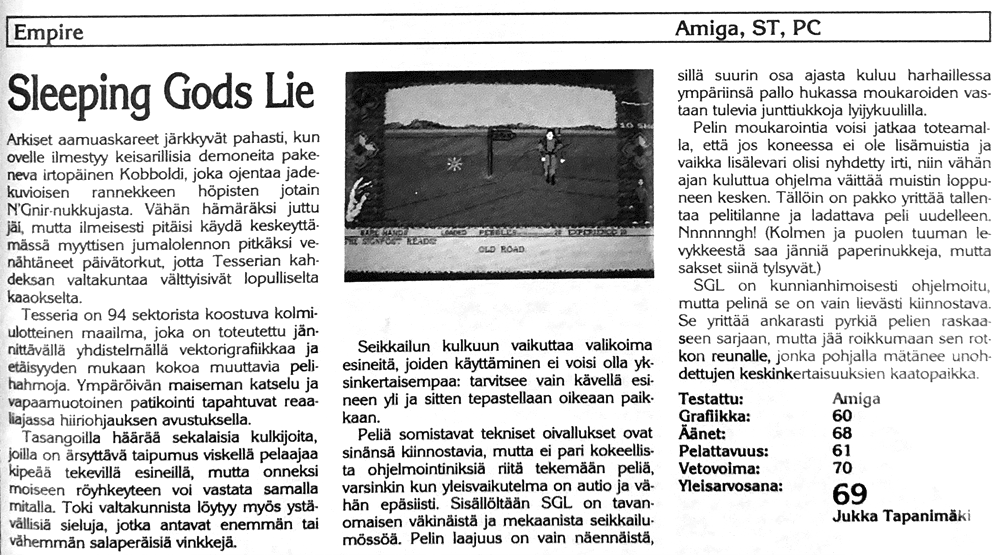
Sleeping Gods Lie1990 KevätPysyvä linkkiArkiset aamuaskareet järkkyvät pahasti, kun ovelle ilmestyy keisarillisia demoneita pakeneva irtopäinen Kobboldi, joka ojentaa jadekuvioisen rannekkeen höpisten jotain N'Gnir-nukkujasta. Vähän hämäräksi juttu jäi, mutta ilmeisesti pitäisi käydä keskeyttämässä myyttisen jumalolennon pitkäksi venähtäneet päivätorkut, jotta Tesserian kahdeksan valtakuntaa välttyisivät lopulliselta kaaokselta.
Tesseria on 94 sektorista koostuva kolmiulotteinen maailma, joka on toteutettu jännittävällä yhdistelmällä vektorigrafiikkaa ja etäisyyden mukaan kokoa muuttavia pelihahmoja. Ympäröivän maiseman katselu ja vapaamuotoinen patikointi tapahtuvat reaaliajassa hiiriohjauksen avustuksella.
Tasangoilla häärää sekalaisia kulkijoita, joilla on ärsyttävä taipumus viskellä pelaajaa kipeää tekevillä esineillä, mutta onneksi moiseen röyhkeyteen voi vastata samalla mitalla. Toki valtakunnista löytyy myös ystävällisiä sieluja, jotka antavat enemmän tai vähemmän salaperäisiä vinkkejä.
Seikkailun kulkuun vaikuttaa valikoima esineitä, joiden käyttäminen ei voisi olla yksinkertaisempaa: tarvitsee vain kävellä esineen yli ja sitten tepastellaan oikeaan paikkaan.
Peliä somistavat tekniset oivallukset ovat sinänsä kiinnostavia, mutta ei pari kokeellista ohjelmointiniksiä riitä tekemään peliä, varsinkin kun yleisvaikutelma on autio ja vähän epäsiisti. Sisällöltään SGL on tavanomaisen väkinäistä ja mekaanista seikkailumössöä. Pelin laajuus on vain näennäistä, sillä suurin osa ajasta kuluu harhaillessa ympäriinsä pallo hukassa moukaroiden vastaan tulevia junttiukkoja lyijykuulilla.
Pelin moukarointia voisi jatkaa toteamalla, että jos koneessa ei ole lisämuistia ja vaikka lisälevari olisi nyhdetty irti, niin vähän ajan kuluttua ohjelma väittää muistin loppuneen kesken. Tällöin on pakko yrittää tallentaa pelitilanne ja ladattava peli uudelleen. Nnnnnngh! (Kolmen ja puolen tuuman levykkeestä saa jänniä paperinukkeja, mutta sakset siinä tylsyvät.)
SGL on kunnianhimoisesti ohjelmoitu, mutta pelinä se on vain lievästi kiinnostava. Se yrittää ankarasti pyrkiä pelien raskaaseen sarjaan, mutta jää roikkumaan sen rotkon reunalle, jonka pohjalla mätänee unohdettujen keskinkertaisuuksien kaatopaikka.
Sleeping Gods Lie1990 KevätPermalinkYour everyday morning routine is badly thrown off when a loose-headed Kobold on the run from imperial demons turns up at the door, hands over a jade-patterned bracelet and babbles something about the N'Gnir sleeper. The story stayed a bit murky, but apparently you're supposed to go and interrupt a mythical divine being's overlong afternoon nap, so that the eight kingdoms of Tesseria can be spared final chaos.
Tesseria is a three-dimensional world consisting of 94 sectors, realised with an exciting combination of vector graphics and game characters that change size according to their distance. Viewing the surrounding landscape and free-form hiking happen in real time, with a helping hand from mouse control.
The plains are teeming with assorted wanderers who have an irritating tendency to pelt the player with objects that hurt, but luckily such impudence can be answered in kind. Of course, the kingdoms also have friendly souls who give you more or less cryptic hints.
The course of the adventure is affected by a selection of objects that couldn't be simpler to use: all you need to do is walk over the object and then toddle off to the right place.
The technical innovations that dress up the game are interesting in themselves, but a couple of experimental programming tricks aren't enough to make a game, especially when the overall impression is desolate and a bit messy. In content SGL is the usual forced and mechanical adventure mush. The game's scope is only apparent, since most of the time goes on wandering about all at sea, hammering the yokels you meet with lead balls.
One could carry on hammering the game by noting that if the machine has no extra memory, then even with the external drive yanked out, after a while the program claims to have run out of memory. At that point you have no choice but to try to save your position and load the game again. Nnnnnngh! (A three-and-a-half-inch floppy makes nifty paper dolls, but it blunts your scissors.)
SGL is ambitiously programmed, but as a game it's only mildly interesting. It tries hard to push its way into the heavyweight division of games, but is left hanging from the edge of the ravine at the bottom of which the rubbish tip of forgotten mediocrities lies rotting.