1133 reviews from "Pelit"-books
Pelit was a Finnish-language (bi)annual book series published from 1987 to 1991 containing gaming-related articles, tips and most importantly game reviews. Here you can find all the reviews from the books. The reviews were originally written in Finnish; the English versions are translations of the Finnish originals. Maininta tekijänoikeuksista
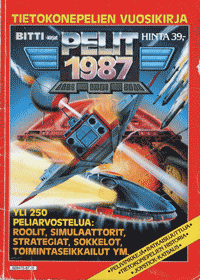 1987
1987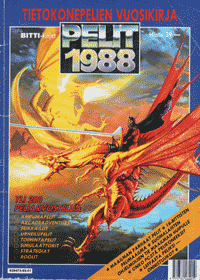 1988
1988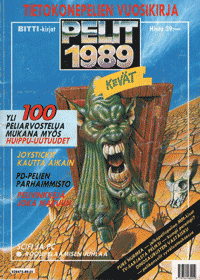 1989 Kevät
 1989 Syksy
 1990 Kevät
 1990 Syksy
 1991 Kevät
 1991 Syksy
Quedex - The Quest for Ultimate Dexterity
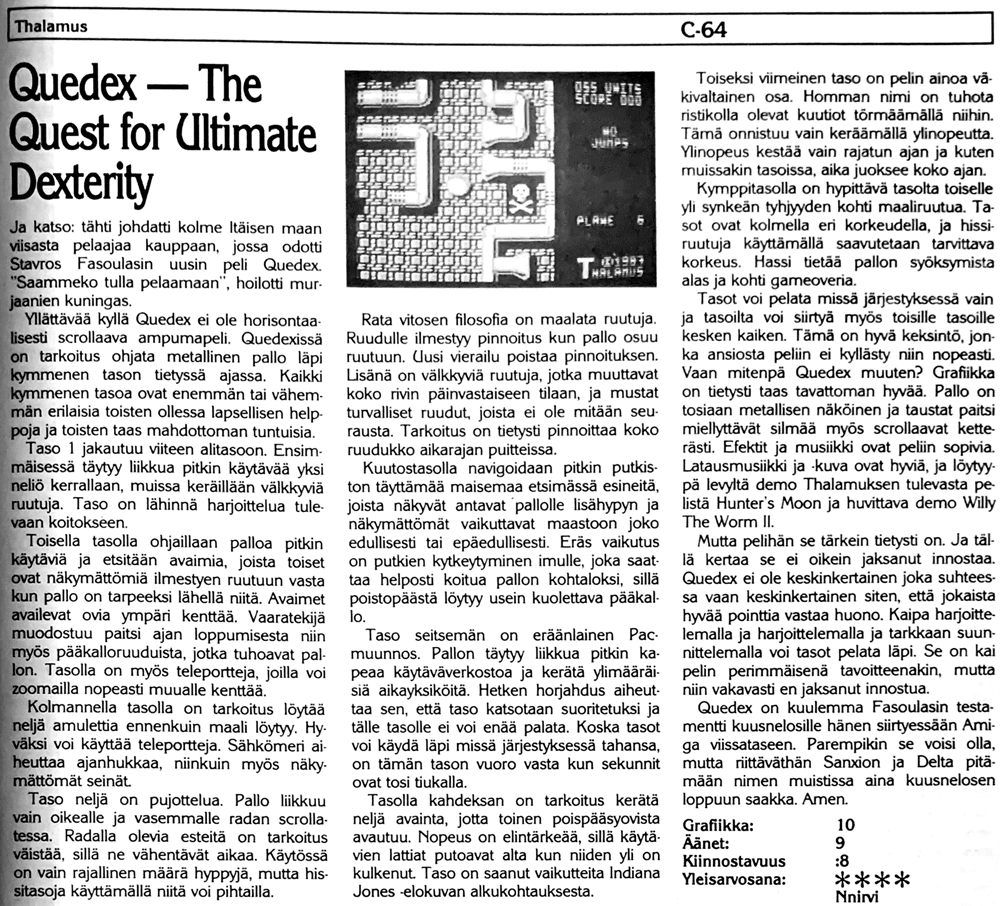
Quedex - The Quest for Ultimate Dexterity1988Pysyvä linkkiJa katso: tähti johdatti kolme Itäisen maan viisasta pelaajaa kauppaan, jossa odotti Stavros Fasoulasin uusin peli Quedex. "Saammeko tulla pelaamaan", hoilotti murjaanien kuningas.
Yllättävää kyllä Quedex ei ole horisontaalisesti scrollaava ampumapeli. Quedexissä on tarkoitus ohjata metallinen pallo läpi kymmenen tason tietyssä ajassa. Kaikki kymmenen tasoa ovat enemmän tai vähemmän erilaisia toisten ollessa lapsellisen helppoja ja toisten taas mahdottoman tuntuisia.
Taso 1 jakautuu viiteen alitasoon. Ensimmäisessä täytyy liikkua pitkin käytävää yksi neliö kerrallaan, muissa keräillään välkkyviä ruutuja. Taso on lähinnä harjoittelua tulevaan koitokseen.
Toisella tasolla ohjaillaan palloa pitkin käytäviä ja etsitään avaimia, joista toiset ovat näkymättömiä ilmestyen ruutuun vasta kun pallo on tarpeeksi lähellä niitä. Avaimet availevat ovia ympäri kenttää. Vaaratekijä muodostuu paitsi ajan loppumisesta niin myös pääkalloruuduista, jotka tuhoavat pallon. Tasolla on myös teleportteja, joilla voi zoomailla nopeasti muualle kenttää.
Kolmannella tasolla on tarkoitus löytää neljä amulettia ennenkuin maali löytyy. Hyväksi voi käyttää teleportteja. Sähkömeri aiheuttaa ajanhukkaa, niinkuin myös näkymättömät seinät.
Taso neljä on pujottelua. Pallo liikkuu vain oikealle ja vasemmalle radan scrollatessa. Radalla olevia esteitä on tarkoitus väistää, sillä ne vähentävät aikaa. Käytössä on vain rajallinen määrä hyppyjä, mutta hissitasoja käyttämällä niitä voi pihtailla.
Rata vitosen filosofia on maalata ruutuja. Ruudulle ilmestyy pinnoitus kun pallo osuu ruutuun. Uusi vierailu poistaa pinnoituksen. Lisänä on välkkyviä ruutuja, jotka muuttavat koko rivin päinvastaiseen tilaan, ja mustat turvalliset ruudut, joista ei ole mitään seurausta. Tarkoitus on tietysti pinnoittaa koko ruudukko aikarajan puitteissa.
Kuutostasolla navigoidaan pitkin putkiston täyttämää maisemaa etsimässä esineitä, joista näkyvät antavat pallolle lisähypyn ja näkymättömät vaikuttavat maastoon joko edullisesti tai epäedullisesti. Eräs vaikutus on putkien kytkeytyminen imulle, joka saattaa helposti koitua pallon kohtaloksi, sillä poistopäästä löytyy usein kuolettava pääkallo.
Taso seitsemän on eräänlainen Pac-muunnos. Pallon täytyy liikkua pitkin kapeaa käytäväverkostoa ja kerätä ylimääräisiä aikayksiköitä. Hetken horjahdus aiheuttaa sen, että taso katsotaan suoritetuksi ja tälle tasolle ei voi enää palata. Koska tasot voi käydä läpi missä järjestyksessä tahansa, on tämän tason vuoro vasta kun sekunnit ovat tosi tiukalla.
Tasolla kahdeksan on tarkoitus kerätä neljä avainta, jotta toinen poispääsyovista avautuu. Nopeus on elintärkeää, sillä käytävien lattiat putoavat alta kun niiden yli on kulkenut. Taso on saanut vaikutteita Indiana Jones -elokuvan alkukohtauksesta.
Toiseksi viimeinen taso on pelin ainoa väkivaltainen osa. Homman nimi on tuhota ristikolla olevat kuutiot törmäämällä niihin. Tämä onnistuu vain keräämällä ylinopeutta. Ylinopeus kestää vain rajatun ajan ja kuten muissakin tasoissa, aika juoksee koko ajan.
Kymppitasolla on hypittävä tasolta toiselle yli synkeän tyhjyyden kohti maaliruutua. Tasot ovat kolmella eri korkeudella, ja hissiruutuja käyttämällä saavutetaan tarvittava korkeus. Hassi tietää pallon syöksymista alas ja kohti gameoveria.
Tasot voi pelata missä järjestyksessä vain ja tasoilta voi siirtyä myös toisille tasoille kesken kaiken. Tämä on hyvä keksintö, jonka ansiosta peliin ei kyllästy niin nopeasti. Vaan mitenpä Quedex muuten? Grafiikka on tietysti taas tavattoman hyvää. Pallo on tosiaan metallisen näköinen ja taustat paitsi miellyttävät silmää myös scrollaavat ketterästi. Efektit ja musiikki ovat peliin sopivia. Latausmusiikki ja -kuva ovat hyviä, ja löytyypä levyltä demo Thalamuksen tulevasta pelistä Hunter's Moon ja huvittava demo Willy The Worm II.
Mutta pelihän se tärkein tietysti on. Ja tällä kertaa se ei oikein jaksanut innostaa. Quedex ei ole keskinkertainen joka suhteessa vaan keskinkertainen siten, että jokaista hyvää pointtia vastaa huono. Kaipa harjoittelemalla ja harjoittelemalla ja tarkkaan suunnittelemalla voi tasot pelata läpi. Se on kai pelin perimmäisenä tavoitteenakin, mutta niin vakavasti en jaksanut innostua.
Quedex on kuulemma Fasoulasin testamentti kuusnelosille hänen siirtyessään Amiga viissataseen. Parempikin se voisi olla, mutta riittäväthän Sanxion ja Delta pitämään nimen muistissa aina kuusnelosen loppuun saakka. Amen.
Quedex - The Quest for Ultimate Dexterity1988PermalinkAnd lo: the star led three wise gamers from the East to a shop where Stavros Fasoulas's latest game, Quedex, lay waiting. "May we come in and play?" bawled the King of the Moors.
Surprisingly enough, Quedex is not a horizontally scrolling shoot-'em-up. In Quedex the idea is to steer a metal ball through ten levels within a set time. All ten levels are more or less different from one another, some being childishly easy and others seemingly impossible.
Level 1 is divided into five sub-levels. In the first you have to move along a corridor one square at a time; in the others you collect flashing squares. The level is mostly practice for the ordeal to come.
On the second level you steer the ball along corridors looking for keys, some of which are invisible and only appear on screen once the ball is close enough to them. The keys open doors all over the level. The danger comes not just from running out of time but also from skull squares, which destroy the ball. The level also has teleports that let you zoom quickly to other parts of the level.
On the third level the idea is to find four amulets before the finish turns up. Teleports can be put to good use. The electric sea wastes time, as do the invisible walls.
Level four is a slalom. The ball moves only left and right as the course scrolls. The obstacles on the course are there to be dodged, since they eat into your time. You only get a limited number of jumps, but by using the lift platforms you can scrimp on them.
The philosophy of course five is painting squares. A square gets a coating when the ball hits it. A second visit removes the coating. On top of that there are flashing squares that flip the whole row to the opposite state, and safe black squares that have no effect at all. The idea, naturally, is to coat the entire grid within the time limit.
On level six you navigate through a landscape full of pipework, searching for objects: the visible ones give the ball an extra jump and the invisible ones affect the terrain either for better or for worse. One such effect is the pipes switching to suction, which can easily be the ball's undoing, since there is often a deadly skull waiting at the outlet end.
Level seven is a kind of Pac variant. The ball has to travel along a network of narrow corridors collecting extra units of time. A moment's wobble means the level is counted as completed, and you can never come back to it. Since the levels can be tackled in any order, this one's turn only comes when the seconds are running really tight.
On level eight the idea is to collect four keys so that one of the two exit doors opens. Speed is vital, since the corridor floors drop away from under you once you've passed over them. The level has taken its cue from the opening scene of the Indiana Jones film.
The second-to-last level is the only violent part of the game. The name of the game is to destroy the cubes on the grid by ramming them. This only works if you've built up overspeed. The overspeed lasts only a limited time and, as on the other levels, the clock is ticking the whole time.
On level ten you have to jump from platform to platform over a gloomy void towards the goal square. The platforms sit at three different heights, and the lift squares take you up to the height you need. A miss means the ball plunging down and on towards game over.
The levels can be played in whatever order you like, and you can also hop from one level to another midway through. This is a good invention, and thanks to it you don't tire of the game so quickly. But how does Quedex do otherwise? The graphics are, of course, exceptionally good once again. The ball really does look metallic, and the backgrounds not only please the eye but also scroll nimbly. The effects and music suit the game. The loading music and loading screen are good, and the disk even holds a demo of Thalamus's forthcoming game Hunter's Moon and an amusing demo, Willy The Worm II.
But the game itself is what matters most, of course. And this time it didn't really manage to fire me up. Quedex isn't mediocre in every respect; it's mediocre in the sense that every good point is matched by a bad one. I suppose that with practice and more practice and careful planning you can get through the levels. That's presumably the ultimate aim of the game, too, but I couldn't get that seriously excited about it.
Quedex is said to be Fasoulas's last will and testament to the C-64 as he moves on to the Amiga 500. It could be better, but then Sanxion and Delta are enough to keep the name remembered right up to the end of the C-64. Amen.
Quest for the Time Bird, The
Quest for the Time Bird, The1990 KevätPysyvä linkkiAkbarin onnellinen maailma on mullistusten partaalla, sillä taikakonstein merikotiloon vangittu Ramor-jumala vapautuu lumouksesta yhdeksän päivän kuluessa. Vain velhorouva Mara tietää, miten vallanhimoisen jumalöykkärin vapautumisen voi estää, mutta hän tarvitsee kotilon ja paljon aikaa, sillä loitsu ei todellakaan ole mikään suppea lastenloru. Niinpä hänen tyttärensä Roxanna ja urhea soturi Bragon lähtevät etsimään maagista lintua, jolla on kyky pysäyttää ajan kulku.
The Quest for the Time Bird perustuu ranskalaiseen sarjakuvaan, josta on nimen ja juonen lisäksi lainattu paljon vaikutteita myös ilmaisutapaan. Sankariparin harharetket alkavat suurella kartalla, josta valitaan reitti liikuttelemalla parrakkaan kertojan ryhmysauvaa.
Aluksi matkustaminen sujuu lentävien olentojen selässä, mutta myöhemmin taivalta joutuu taittamaan jalan, jolloin sekä päähenkilöt että vastaan tulevat akbarilaiset on läimäisty kartan päällä vierivään ruohikkomaisemaan.
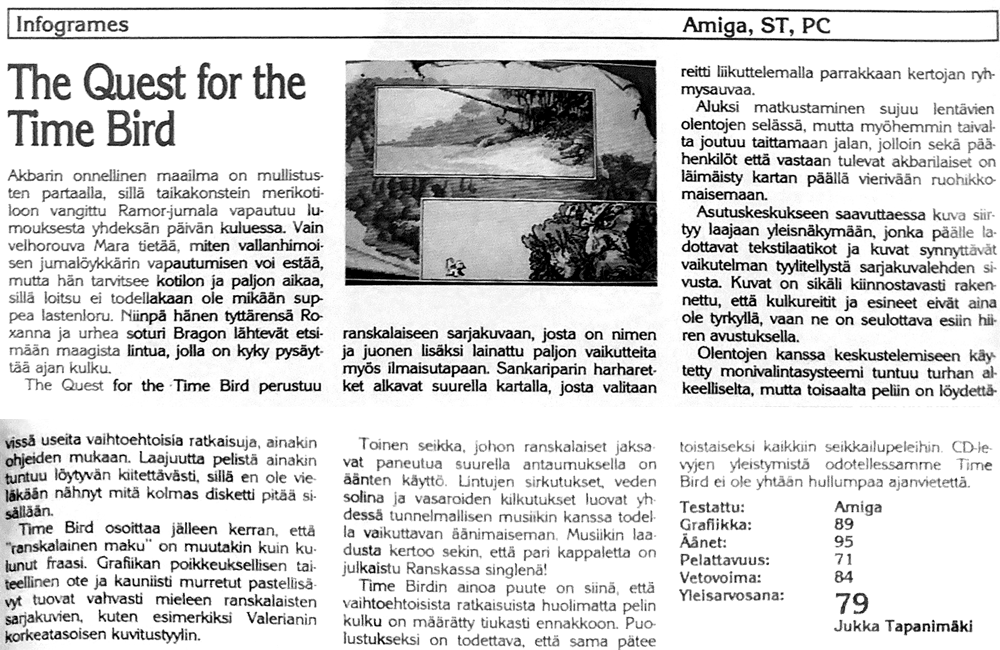
Asutuskeskukseen saavuttaessa kuva siirtyy laajaan yleisnäkymään, jonka päälle ladottavat tekstilaatikot ja kuvat synnyttävät vaikutelman tyylitellystä sarjakuvalehden sivusta. Kuvat on sikäli kiinnostavasti rakennettu, että kulkureitit ja esineet eivät aina ole tyrkyllä, vaan ne on seulottava esiin hiiren avustuksella.
Olentojen kanssa keskustelemiseen käytetty monivalintasysteemi tuntuu turhan alkeelliselta, mutta toisaalta peliin on löydettävissä useita vaihtoehtoisia ratkaisuja, ainakin ohjeiden mukaan. Laajuutta pelistä ainakin tuntuu löytyvän kiitettävästi, sillä en ole vieläkään nähnyt mitä kolmas disketti pitää sisällään.
Time Bird osoittaa jälleen kerran, että "ranskalainen maku" on muutakin kuin kulunut fraasi. Grafiikan poikkeuksellisen taiteellinen ote ja kauniisti murretut pastellisävyt tuovat vahvasti mieleen ranskalaisten sarjakuvien, kuten esimerkiksi Valerianin korkeatasoisen kuvitustyylin.
Toinen seikka, johon ranskalaiset jaksavat paneutua suurella antaumuksella on äänten käyttö. Lintujen sirkutukset, veden solina ja vasaroiden kilkutukset luovat yhdessä tunnelmallisen musiikin kanssa todella vaikuttavan äänimaiseman. Musiikin laadusta kertoo sekin, että pari kappaletta on julkaistu Ranskassa singlenä!
Time Birdin ainoa puute on siinä, että vaihtoehtoisista ratkaisuista huolimatta pelin kulku on määrätty tiukasti ennakkoon. Puolustukseksi on todettava, että sama pätee toistaiseksi kaikkiin seikkailupeleihin. CD-levyjen yleistymistä odotellessamme Time Bird ei ole yhtään hullumpaa ajanvietettä.
Quest for the Time Bird, The1990 KevätPermalinkThe happy world of Akbar is on the brink of upheaval, for the god Ramor, imprisoned in a sea conch by magic arts, will break free of the spell within nine days. Only the sorceress Mara knows how to stop the power-hungry thug of a god from getting loose, but she needs the conch and plenty of time, since the spell is certainly no short nursery rhyme. And so her daughter Roxanna and the brave warrior Bragon set out in search of a magical bird that has the power to stop the passage of time.
The Quest for the Time Bird is based on a French comic, from which, besides the name and the plot, a good deal of influence has been borrowed for the mode of expression too. The hero pair's wanderings begin on a large map, where the route is chosen by moving the gnarled staff of a bearded narrator.
At first you travel on the backs of flying creatures, but later the road has to be covered on foot, at which point both the protagonists and the Akbarians they meet have been slapped onto a grassy landscape that scrolls over the map.
On arriving at a settlement, the picture switches to a wide overview, with text boxes and pictures laid on top of it to create the impression of a stylised comic-book page. The pictures are interestingly built in that exits and objects aren't always shoved in your face; they have to be sifted out with the help of the mouse.
The multiple-choice system used for conversing with the creatures feels needlessly primitive, but on the other hand the game has several alternative solutions to be found, according to the instructions at least. The game certainly seems to have commendable scope, since I still haven't seen what the third disk holds.
Time Bird proves once again that "French flavour" is more than a worn-out phrase. The exceptionally artistic touch of the graphics and the beautifully muted pastel shades strongly call to mind the high-class illustration style of French comics, Valerian for example.
Another thing the French never tire of throwing themselves into with great devotion is the use of sound. Birds twittering, water babbling and hammers clinking, together with the atmospheric music, create a truly impressive soundscape. The quality of the music is also shown by the fact that a couple of the tracks have been released as a single in France!
Time Bird's only shortcoming is that, despite the alternative solutions, the course of the game is rigidly predetermined. In its defence, it must be said that the same holds, for now, for all adventure games. While we wait for CDs to catch on, Time Bird is not half bad as a way to pass the time.
Quo Vadis
Quo Vadis1987Pysyvä linkkiTässä Steven Chapmanin ohjelmoimassa pelissä pelaajan täytyy kulkea kaikkien käytävien, portaitten ja kuilujen lävitse ennen kuin saavuttaa päämääränsä, ainutlaatuisen valtikan.
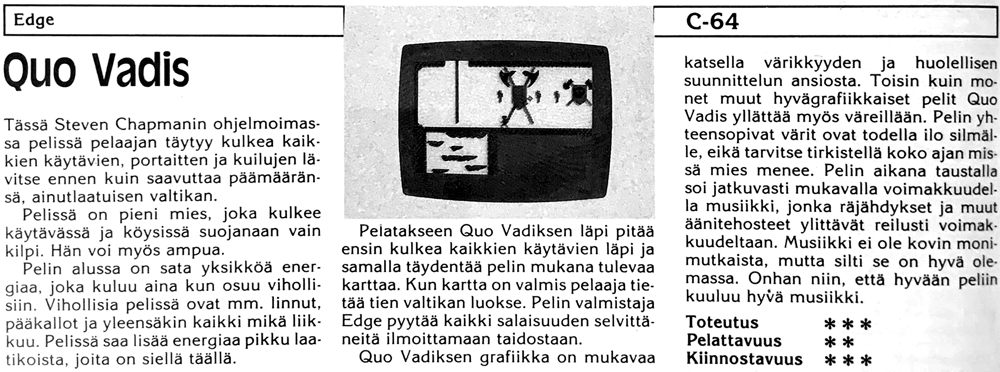
Pelissä on pieni mies, joka kulkee käytävässä ja köysissä suojanaan vain kilpi. Hän voi myös ampua.
Pelin alussa on sata yksikköä energiaa, joka kuluu aina kun osuu vihollisiin. Vihollisia pelissä ovat mm. linnut, pääkallot ja yleensäkin kaikki mikä liikkuu. Pelissä saa lisää energiaa pikku laatikoista, joita on siellä täällä.
Pelatakseen Quo Vadiksen läpi pitää ensin kulkea kaikkien käytävien läpi ja samalla täydentää pelin mukana tulevaa karttaa. Kun kartta on valmis pelaaja tietää tien valtikan luokse. Pelin valmistaja Edge pyytää kaikki salaisuuden selvittäneitä ilmoittamaan taidostaan.
Quo Vadiksen grafiikka on mukavaa katsella värikkyyden ja huolellisen suunnittelun ansiosta. Toisin kuin monet muut hyvägrafiikkaiset pelit Quo Vadis yllättää myös väreillään. Pelin yhteensopivat värit ovat todella ilo silmälle, eikä tarvitse tirkistellä koko ajan missä mies menee. Pelin aikana taustalla soi jatkuvasti mukavalla voimakkuudella musiikki, jonka räjähdykset ja muut äänitehosteet ylittävät reilusti voimakkuudeltaan. Musiikki ei ole kovin monimutkaista, mutta silti se on hyvä olemassa. Onhan niin, että hyvään peliin kuuluu hyvä musiikki.
Quo Vadis1987PermalinkIn this game, programmed by Steven Chapman, the player has to make their way through all the corridors, stairways and shafts before reaching the goal, a unique sceptre.
The game has a little man who makes his way along the corridors and up and down ropes with only a shield to protect him. He can also shoot.
At the start of the game you have a hundred units of energy, which drains away every time you run into enemies. The enemies in the game include birds, skulls and, generally speaking, everything that moves. You can get more energy from little boxes found here and there.
To play Quo Vadis through, you first have to go through all the corridors while filling in the map that comes with the game. Once the map is complete, the player knows the way to the sceptre. The game's maker, Edge, asks everyone who has solved the secret to let them know of their achievement.
The graphics of Quo Vadis are nice to look at, thanks to their colourfulness and careful design. Unlike many other games with good graphics, Quo Vadis also surprises with its colours. The game's well-matched colours really are a joy to the eye, and you don't have to squint all the time to see where the man is going. Throughout the game, music plays non-stop in the background at a pleasant volume, and the explosions and other sound effects come in well over the top of it. The music isn't very complicated, but it's still good to have it there. After all, a good game deserves good music.