1133 reviews from "Pelit"-books
Pelit was a Finnish-language (bi)annual book series published from 1987 to 1991 containing gaming-related articles, tips and most importantly game reviews. Here you can find all the reviews from the books. The reviews were originally written in Finnish; the English versions are translations of the Finnish originals. Maininta tekijänoikeuksista
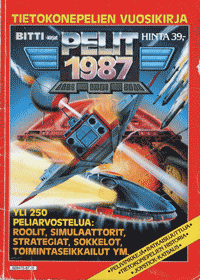 1987
1987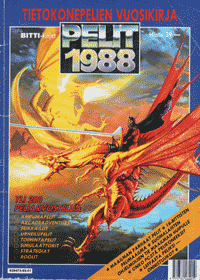 1988
1988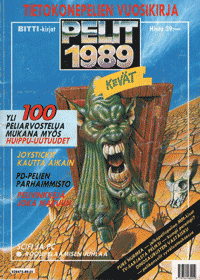 1989 Kevät
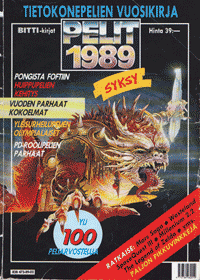 1989 Syksy
 1990 Kevät
 1990 Syksy
 1991 Kevät
 1991 Syksy
E-motion
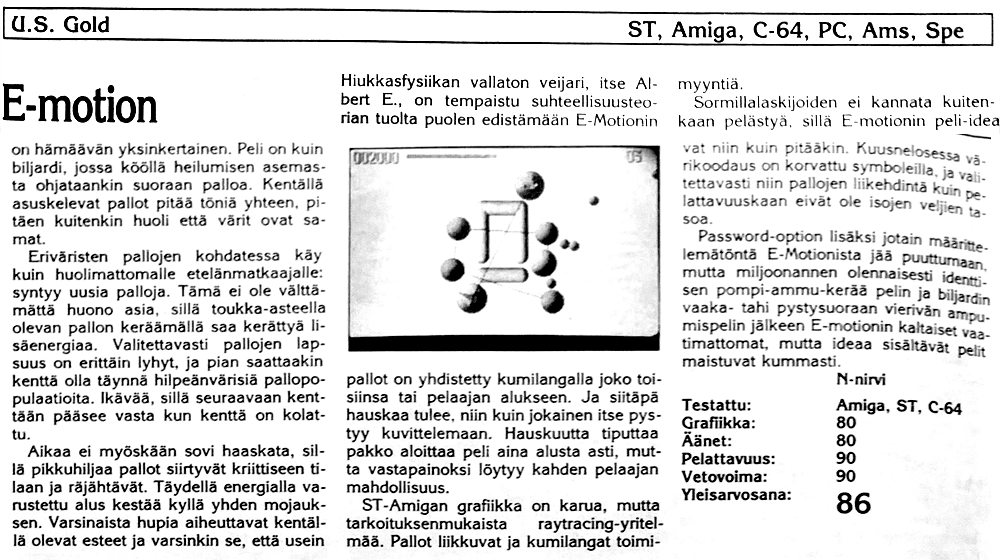
E-motion1990 SyksyPysyvä linkkiHiukkasfysiikan vallaton veijari, itse Albert E., on tempaistu suhteellisuusteorian tuolta puolen edistämään E-Motionin myyntiä.
Sormillalaskijoiden ei kannata kuitenkaan pelästyä, sillä E-motionin peli-idea on hämäävän yksinkertainen. Peli on kuin biljardi, jossa kööllä heilumisen asemasta ohjataankin suoraan palloa. Kentällä asuskelevat pallot pitää töniä yhteen, pitäen kuitenkin huoli että värit ovat samat.
Eriväristen pallojen kohdatessa käy kuin huolimattomalle etelänmatkaajalle: syntyy uusia palloja. Tämä ei ole välttämättä huono asia, sillä toukka-asteella olevan pallon keräämällä saa kerättyä lisäenergiaa. Valitettavasti pallojen lapsuus on erittäin lyhyt, ja pian saattaakin kenttä olla täynnä hilpeänvärisiä pallopopulaatioita. Ikävää, sillä seuraavaan kenttään pääsee vasta kun kenttä on kolattu.
Aikaa ei myöskään sovi haaskata, sillä pikkuhiljaa pallot siirtyvät kriittiseen tilaan ja räjähtävät. Täydellä energialla varustettu alus kestää kyllä yhden mojauksen. Varsinaista hupia aiheuttavat kentällä olevat esteet ja varsinkin se, että usein pallot on yhdistetty kumilangalla joko toisiinsa tai pelaajan alukseen. Ja siitäpä hauskaa tulee, niin kuin jokainen itse pystyy kuvittelemaan. Hauskuutta tiputtaa pakko aloittaa peli aina alusta asti, mutta vastapainoksi löytyy kahden pelaajan mahdollisuus.
ST-Amigan grafiikka on karua, mutta tarkoituksenmukaista raytracing-yritelmää. Pallot liikkuvat ja kumilangat toimivat niin kuin pitääkin. Kuusnelosessa värikoodaus on korvattu symboleilla, ja valitettavasti niin pallojen liikehdintä kuin pelattavuuskaan eivät ole isojen veljien tasoa.
Password-option lisäksi jotain määrittelemätöntä E-Motionista jää puuttumaan, mutta miljoonannen olennaisesti identtisen pompi-ammu-kerää pelin ja biljardin vaaka- tahi pystysuoraan vierivän ampumispelin jälkeen E-motionin kaltaiset vaatimattomat, mutta ideaa sisältävät pelit maistuvat kummasti.
E-motion1990 SyksyPermalinkThat unruly rascal of particle physics, Albert E. himself, has been whisked from the far side of the theory of relativity to boost sales of E-Motion.
Those who count on their fingers needn't panic, though, since E-motion's game idea is deceptively simple. The game is like billiards in which, instead of swinging a cue about, you steer the ball directly. The balls living on the playfield have to be nudged together, while taking care, mind you, that their colours are the same.
When balls of different colours meet, the same thing happens as to a careless holidaymaker down south: new balls are born. This isn't necessarily a bad thing, since by collecting a ball still at the larval stage you can pick up extra energy. Unfortunately the balls' childhood is very short, and before long the playfield may well be full of cheerfully coloured ball populations. A pity, since you only get to the next level once the playfield has been scraped clean.
Nor is there any time to waste, since little by little the balls go critical and explode. A ship with full energy can take one wallop, mind you. The real laughs come from the obstacles on the playfield and especially from the fact that the balls are often tied with a rubber band either to each other or to the player's ship. And what fun that makes, as anyone can imagine for themselves. The fun is dented by having to start the game from the very beginning every time, but to balance that there's a two-player option.
The ST-Amiga graphics are a spartan but fit-for-purpose attempt at raytracing. The balls move and the rubber bands work just as they should. On the Commodore 64 the colour coding has been replaced by symbols, and sadly neither the movement of the balls nor the playability is up to the big brothers' standard.
Apart from a password option, something indefinable is missing from E-Motion, but after the millionth essentially identical jump-shoot-collect game and the quadrillionth horizontally or vertically scrolling shoot-'em-up, modest games like E-motion that actually contain an idea taste remarkably good.
E-Swat
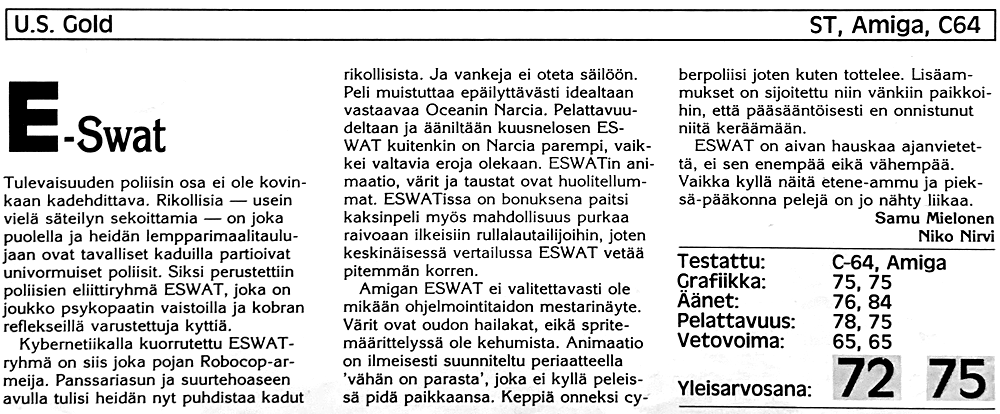
E-Swat1991 KevätPysyvä linkkiTulevaisuuden poliisin osa ei ole kovinkaan kadehdittava. Rikollisia - usein vielä säteilyn sekoittamia - on joka puolella ja heidän lempparimaalitaulujaan ovat tavalliset kaduilla partioivat univormuiset poliisit. Siksi perustettiin poliisien eliittiryhmä ESWAT, joka on joukko psykopaatin vaistoilla ja kobran reflekseillä varustettuja kyttiä.
Kybernetiikalla kuorrutettu ESWAT-ryhmä on siis joka pojan Robocop-armeija. Panssariasun ja suurtehoaseen avulla tulisi heidän nyt puhdistaa kadut rikollisista. Ja vankeja ei oteta säilöön. Peli muistuttaa epäilyttävästi idealtaan vastaavaa Oceanin Narcia. Pelattavuudeltaan ja ääniltään kuusnelosen ESWAT kuitenkin on Narcia parempi, vaikkei valtavia eroja olekaan. ESWATin animaatio, värit ja taustat ovat huolitellummat. ESWATissa on bonuksena paitsi kaksinpeli myös mahdollisuus purkaa raivoaan ilkeisiin rullalautailijoihin, joten keskinäisessä vertailussa ESWAT vetää pitemmän korren.
Amigan ESWAT ei valitettavasti ole mikään ohjelmointitaidon mestarinäyte. Värit ovat oudon hailakat, eikä spritemäärittelyssä ole kehumista. Animaatio on ilmeisesti suunniteltu periaatteella 'vähän on parasta', joka ei kyllä peleissä pidä paikkaansa. Keppiä onneksi cyberpoliisi joten kuten tottelee. Lisäammukset on sijoitettu niin vänkiin paikkoihin, että pääsääntöisesti en onnistunut niitä keräämään.
ESWAT on aivan hauskaa ajanvietettä, ei sen enempää eikä vähempää. Vaikka kyllä näitä etene-ammu ja pieksä-pääkonna pelejä on jo nähty liikaa.
E-Swat1991 KevätPermalinkThe lot of the policeman of the future is not a particularly enviable one. Criminals - often addled by radiation to boot - are everywhere, and their favourite targets are the ordinary uniformed police officers patrolling the streets. That is why the elite police unit ESWAT was founded, which is a bunch of cops fitted out with the instincts of a psychopath and the reflexes of a cobra.
Frosted with cybernetics, the ESWAT squad is, in other words, every boy's very own Robocop army. With the help of an armoured suit and a high-powered gun they are now supposed to clean the criminals off the streets. And they take no prisoners. The game is suspiciously reminiscent of Ocean's Narc, which has much the same idea. In playability and sound, though, the C-64 ESWAT beats Narc, even if the differences aren't huge. ESWAT's animation, colours and backgrounds are more polished. As a bonus, ESWAT has not only a two-player mode but also the chance to vent your rage on nasty skateboarders, so in a head-to-head comparison ESWAT draws the longer straw.
The Amiga ESWAT is unfortunately no masterpiece of programming skill. The colours are oddly washed out, and the sprite design is nothing to brag about. The animation has apparently been designed on the principle of 'less is best', which really doesn't hold true in games. Luckily the cyber-policeman obeys the joystick after a fashion. The extra ammo has been placed in such screwy spots that as a rule I didn't manage to pick it up.
ESWAT is quite fun as a pastime, no more and no less. Although we really have seen too many of these advance-and-shoot and thrash-the-boss games already.
E.S.S
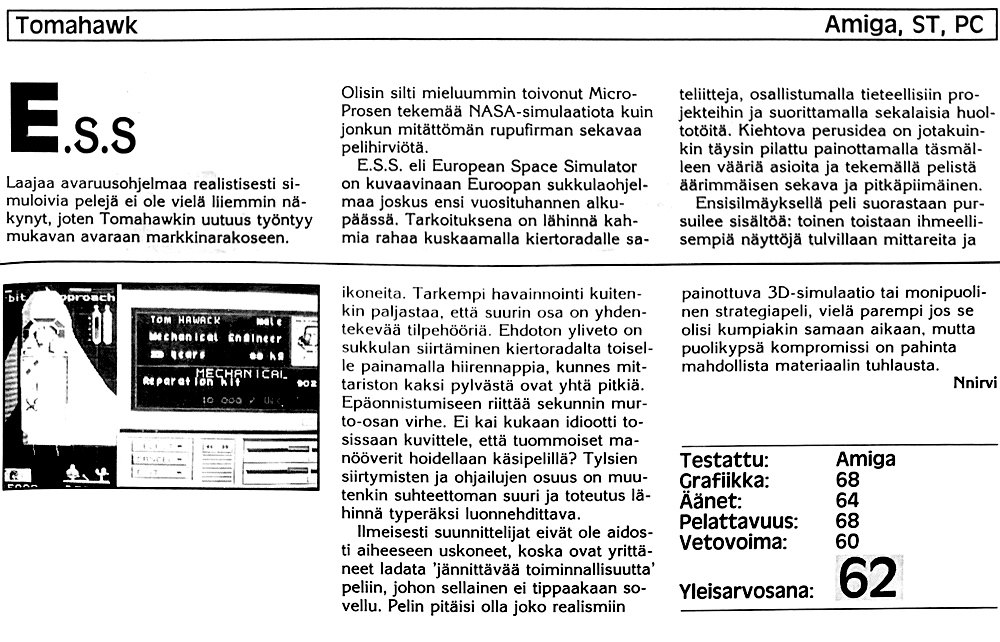
E.S.S1991 KevätPysyvä linkkiLaajaa avaruusohjelmaa realistisesti simuloivia pelejä ei ole vielä liiemmin näkynyt, joten Tomahawkin uutuus työntyy mukavan avaraan markkinarakoseen. Olisin silti mieluummin toivonut MicroProsen tekemää NASA-simulaatiota kuin jonkun mitättömän rupufirman sekavaa pelihirviötä.
E.S.S. eli European Space Simulator on kuvaavinaan Euroopan sukkulaohjelmaa joskus ensi vuosituhannen alkupäässä. Tarkoituksena on lähinnä kahmia rahaa kuskaamalla kiertoradalle sateliitteja, osallistumalla tieteellisiin projekteihin ja suorittamalla sekalaisia huoltotöitä. Kiehtova perusidea on jotakuinkin täysin pilattu painottamalla täsmälleen vääriä asioita ja tekemällä pelistä äärimmäisen sekava ja pitkäpiimäinen.
Ensisilmäyksellä peli suorastaan pursuilee sisältöä: toinen toistaan ihmeellisempiä näyttöjä tulvillaan mittareita ja ikoneita. Tarkempi havainnointi kuitenkin paljastaa, että suurin osa on yhdentekevää tilpehööriä. Ehdoton yliveto on sukkulan siirtäminen kiertoradalta toiselle painamalla hiirennappia, kunnes mittariston kaksi pylvästä ovat yhtä pitkiä. Epäonnistumiseen riittää sekunnin murto-osan virhe. Ei kai kukaan idiootti tosissaan kuvittele, että tuommoiset manööverit hoidellaan käsipelillä? Tylsien siirtymisten ja ohjailujen osuus on muutenkin suhteettoman suuri ja toteutus lähinnä typeräksi luonnehdittava.
Ilmeisesti suunnittelijat eivät ole aidosti aiheeseen uskoneet, koska ovat yrittäneet ladata 'jännittävää toiminnallisuutta' peliin, johon sellainen ei tippaakaan sovellu. Pelin pitäisi olla joko realismiin painottuva 3D-simulaatio tai monipuolinen strategiapeli, vielä parempi jos se olisi kumpiakin samaan aikaan, mutta puolikypsä kompromissi on pahinta mahdollista materiaalin tuhlausta.
E.S.S1991 KevätPermalinkGames that realistically simulate a large-scale space programme haven't been seen all that much yet, so Tomahawk's new release pushes its way into a nicely spacious little gap in the market. Still, I would rather have wished for a NASA simulation made by MicroProse than the muddled game-monster of some insignificant two-bit outfit.
E.S.S., or European Space Simulator, purports to depict Europe's shuttle programme sometime early in the next millennium. The aim is mainly to rake in money by ferrying satellites into orbit, taking part in scientific projects and carrying out assorted maintenance jobs. The fascinating basic idea has been more or less completely ruined by emphasising precisely the wrong things and by making the game extremely muddled and tediously drawn-out.
At first glance the game positively bursts with content: screens each more amazing than the last, brimming with gauges and icons. Closer inspection, however, reveals that most of it is pointless bric-a-brac. The absolute crowning glory is moving the shuttle from one orbit to another by pressing the mouse button until two bars on the instrument panel are the same length. An error of a split second is enough to fail. Surely no idiot seriously imagines that manoeuvres like that are handled by hand? The share of dull transfers and steering is disproportionately large anyway, and the implementation can best be described as stupid.
Evidently the designers didn't genuinely believe in the subject, since they have tried to cram 'exciting action' into a game that it doesn't suit one bit. The game ought to be either a 3D simulation with the emphasis on realism or a versatile strategy game, even better if it were both at the same time, but a half-baked compromise is the worst possible waste of material.
Earl Weaver Baseball
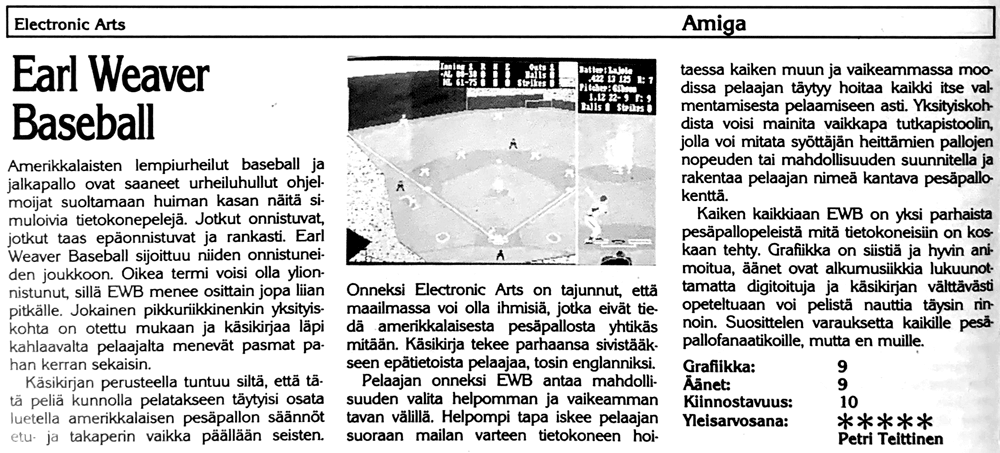
Earl Weaver Baseball1988Pysyvä linkkiAmerikkalaisten lempiurheilut baseball ja jalkapallo ovat saaneet urheiluhullut ohjelmoijat suoltamaan huiman kasan näitä simuloivia tietokonepelejä. Jotkut onnistuvat, jotkut taas epäonnistuvat ja rankasti. Earl Weaver Baseball sijoittuu niiden onnistuneiden joukkoon. Oikea termi voisi olla ylionnistunut, sillä EWB menee osittain jopa liian pitkälle. Jokainen pikkuriikkinenkin yksityiskohta on otettu mukaan ja käsikirjaa läpi kahlaavalta pelaajalta menevät pasmat pahan kerran sekaisin.
Käsikirjan perusteella tuntuu siltä, että tätä peliä kunnolla pelatakseen täytyisi osata luetella amerikkalaisen pesäpallon säännöt etu- ja takaperin vaikka päällään seisten. Onneksi Electronic Arts on tajunnut, että maailmassa voi olla ihmisiä, jotka eivät tiedä amerikkalaisesta pesäpallosta yhtikäs mitään. Käsikirja tekee parhaansa sivistääkseen epätietoista pelaajaa, tosin englanniksi.
Pelaajan onneksi EWB antaa mahdollisuuden valita helpomman ja vaikeamman tavan välillä. Helpompi tapa iskee pelaajan suoraan mailan varteen tietokoneen hoitaessa kaiken muun ja vaikeammassa moodissa pelaajan täytyy hoitaa kaikki itse valmentamisesta pelaamiseen asti. Yksityiskohdista voisi mainita vaikkapa tutkapistoolin, jolla voi mitata syöttäjän heittämien pallojen nopeuden tai mahdollisuuden suunnitella ja rakentaa pelaajan nimeä kantava pesäpallokenttä.
Kaiken kaikkiaan EWB on yksi parhaista pesäpallopeleistä mitä tietokoneisiin on koskaan tehty. Grafiikka on siistiä ja hyvin animoitua, äänet ovat alkumusiikkia lukuunottamatta digitoituja ja käsikirjan välttävästi opeteltuaan voi pelistä nauttia täysin rinnoin. Suosittelen varauksetta kaikille pesäpallofanaatikoille, mutta en muille.
Earl Weaver Baseball1988PermalinkThe Americans' favourite sports, baseball and football, have driven sports-mad programmers to churn out a staggering pile of computer games simulating them. Some succeed, while others fail, and fail hard. Earl Weaver Baseball ranks among the successful ones. The right term might be over-successful, since in places EWB even goes too far. Every last teeny-tiny detail has been included, and a player wading through the manual ends up well and truly befuddled.
Judging by the manual, it feels as if to play this game properly you would have to be able to recite the rules of American baseball forwards and backwards, standing on your head if need be. Luckily Electronic Arts has realised that there may be people in the world who know absolutely nothing whatsoever about American baseball. The manual does its best to educate the ignorant player, albeit in English.
Luckily for the player, EWB lets you choose between an easier and a harder way. The easier way puts the bat straight into the player's hands while the computer takes care of everything else, and in the harder mode the player has to handle everything personally, from coaching to playing. Among the details worth mentioning are, say, the radar gun that lets you measure the speed of the pitcher's throws, or the option to design and build a ballpark bearing the player's own name.
All in all, EWB is one of the best baseball games ever made for computers. The graphics are neat and well animated, the sounds are digitised apart from the title music, and once you've got a passable grip on the manual you can enjoy the game to the full. I recommend it unreservedly to all baseball fanatics, but not to anyone else.
Ebonstar
Ebonstar1988Pysyvä linkkiVuosi 3000: sodat ovat loppuneet, avaruus on valloitettu, ja muutenkin kaikki on eri hyvin. Tylsää tylsää tylsää. Onneksi on peli Ebonstar.
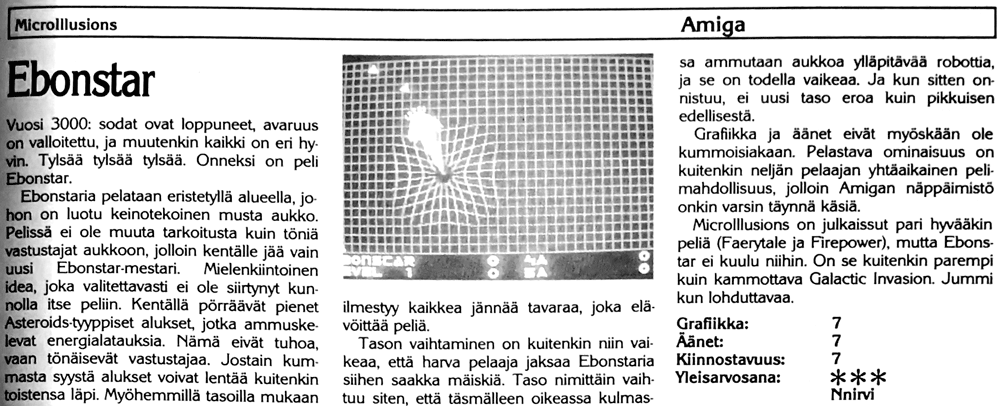
Ebonstaria pelataan eristetyllä alueella, johon on luotu keinotekoinen musta aukko. Pelissä ei ole muuta tarkoitusta kuin töniä vastustajat aukkoon, jolloin kentälle jää vain uusi Ebonstar-mestari. Mielenkiintoinen idea, joka valitettavasti ei ole siirtynyt kunnolla itse peliin. Kentällä pörräävät pienet Asteroids-tyyppiset alukset, jotka ammuskelevat energialatauksia. Nämä eivät tuhoa, vaan tönäisevät vastustajaa. Jostain kummasta syystä alukset voivat lentää kuitenkin toistensa läpi. Myöhemmillä tasoilla mukaan ilmestyy kaikkea jännää tavaraa, joka elävöittää peliä.
Tason vaihtaminen on kuitenkin niin vaikeaa, että harva pelaaja jaksaa Ebonstaria siihen saakka mäiskiä. Taso nimittäin vaihtuu siten, että täsmälleen oikeassa kulmassa ammutaan aukkoa ylläpitävää robottia, ja se on todella vaikeaa. Ja kun sitten onnistuu, ei uusi taso eroa kuin pikkuisen edellisestä.
Grafiikka ja äänet eivät myöskään ole kummoisiakaan. Pelastava ominaisuus on kuitenkin neljän pelaajan yhtäaikainen pelimahdollisuus, jolloin Amigan näppäimistö onkin varsin täynnä käsiä.
MicroIllusions on julkaissut pari hyvääkin peliä (Faerytale ja Firepower), mutta Ebonstar ei kuulu niihin. On se kuitenkin parempi kuin kammottava Galactic Invasion. Jummi kun lohduttavaa.
Ebonstar1988PermalinkThe year 3000: the wars have ended, space has been conquered, and everything else is just peachy too. Boring boring boring. Luckily there's a game called Ebonstar.
Ebonstar is played in an isolated zone in which an artificial black hole has been created. The game has no purpose other than shoving your opponents into the hole, until only the new Ebonstar champion is left in the arena. An interesting idea, which unfortunately hasn't carried over properly into the game itself. Little Asteroids-style ships buzz around the arena, taking potshots at each other with energy charges. These don't destroy; they give the opponent a shove. For some odd reason, though, the ships can fly right through each other. On later levels all sorts of exciting stuff turns up to liven the game up.
Getting to the next level is so hard, however, that few players will have the stamina to keep bashing away at Ebonstar that long. You see, the level changes when you shoot the robot that keeps the hole going at exactly the right angle, and that is really difficult. And when you finally pull it off, the new level is only a tiny bit different from the last one.
The graphics and sound aren't up to much either. The saving grace, however, is the option for four players to play simultaneously, at which point the Amiga's keyboard gets rather crowded with hands.
MicroIllusions has released a couple of good games too (Faerytale and Firepower), but Ebonstar isn't one of them. Still, it is better than the dreadful Galactic Invasion. Gosh, how comforting.
Echelon
Echelon1989 SyksyPysyvä linkkiEchelon on koodinimi huippusalaiselle armeijan tukikohdalle, joka on sijoitettu Isikselle, aurinkokuntamme kymmenennelle planeetalle. Echelonia ylläpitää Kansainvälinen Avaruusfederaatio, jonka elämäntehtävä on estää avaruusmerirosvoilu. Sattumalta Federaatio tietää, että rosvojen päätukikohta on Isiksellä, joten eipä muuta kuin C-104 Tomahawkin moottorit käyntiin ja piraattijahtiin.
Perimmäinen tarkoitus on tietysti löytää avaruusrosmojen kätketty tukikohta. Se löytyy lentelemällä pitkin Isiksen pintaa ja etsimällä esineitä ja johtolankoja, joista piraattien inhan lymypaikan koordinaatit pikkuhiljaa selviävät.
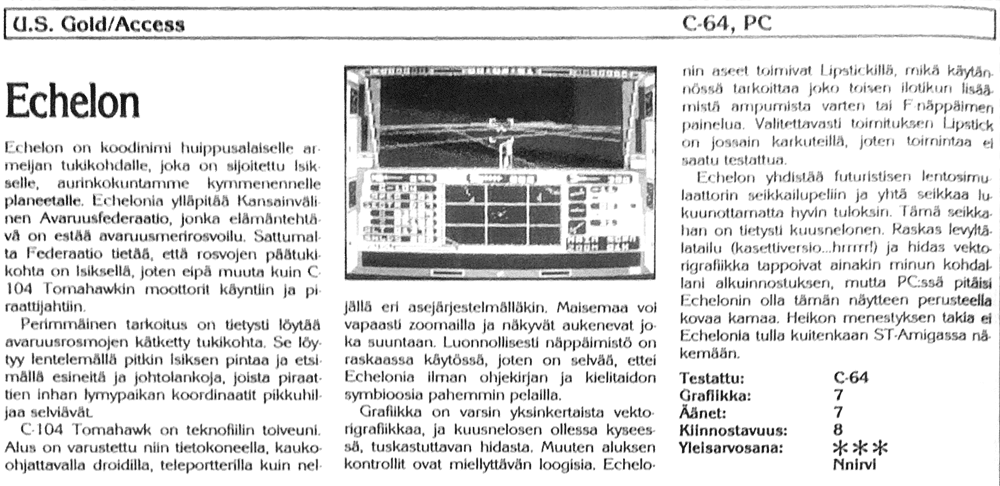
C-104 Tomahawk on teknofiilin toiveuni. Alus on varustettu niin tietokoneella, kauko-ohjattavalla droidilla, teleportterilla kuin neljällä eri asejärjestelmälläkin. Maisemaa voi vapaasti zoomailla ja näkyvät aukenevat joka suuntaan. Luonnollisesti näppäimistö on raskaassa käytössä, joten on selvää, ettei Echelonia ilman ohjekirjan ja kielitaidon symbioosia pahemmin pelailla.
Grafiikka on varsin yksinkertaista vektorigrafiikkaa, ja kuusnelosen ollessa kyseessä, tuskastuttavan hidasta. Muuten aluksen kontrollit ovat miellyttävän loogisia. Echelonin aseet toimivat Lipstickillä, mikä käytännössä tarkoittaa joko toisen ilotikun lisäämistä ampumista varten tai F-näppäimen painelua. Valitettavasti toimituksen Lipstick on jossain karkuteillä, joten toimintaa ei saatu testattua.
Echelon yhdistää futuristisen lentosimulaattorin seikkailupeliin ja yhtä seikkaa lukuunottamatta hyvin tuloksin. Tämä seikkahan on tietysti kuusnelonen. Raskas levyltälatailu (kasettiversio...hrrrrf!) ja hidas vektorigrafiikka tappoivat ainakin minun kohdallani alkuinnostuksen, mutta PC:ssä pitäisi Echelonin olla tämän näytteen perusteella kovaa kamaa. Heikon menestyksen takia ei Echelonia tulla kuitenkaan ST-Amigassa näkemään.
Echelon1989 SyksyPermalinkEchelon is the code name for a top-secret military base located on Isis, the tenth planet of our solar system. Echelon is run by the International Space Federation, whose mission in life is to put a stop to space piracy. As luck would have it, the Federation knows that the pirates' main base is on Isis, so there's nothing for it but to fire up the C-104 Tomahawk's engines and go pirate hunting.
The ultimate aim, of course, is to find the space crooks' hidden base. You find it by flitting about over the surface of Isis, searching for objects and clues from which the coordinates of the pirates' vile hideout gradually become clear.
The C-104 Tomahawk is a technophile's dream come true. The ship is equipped with a computer, a remote-controlled droid, a teleporter and four different weapon systems to boot. You can zoom the landscape freely and the views open up in every direction. Naturally the keyboard gets heavy use, so clearly you won't get much Echelon played without a symbiosis of manual and language skills.
The graphics are fairly simple vector graphics and, this being the C-64, excruciatingly slow. Otherwise the ship's controls are pleasantly logical. Echelon's weapons work with the Lipstick, which in practice means either plugging in a second joystick for the shooting or pressing the F key over and over. Unfortunately our office Lipstick is on the lam somewhere, so we couldn't test how it works.
Echelon combines a futuristic flight simulator with an adventure game, and with good results, save for one thing. That thing, of course, is the C-64. The laborious disk loading (the cassette version...hrrrrf!) and the slow vector graphics killed my initial enthusiasm, in my case at least, but on the PC Echelon ought to be hot stuff, judging by this sample. Due to poor sales, however, Echelon won't be seen on the ST or the Amiga.
Eco
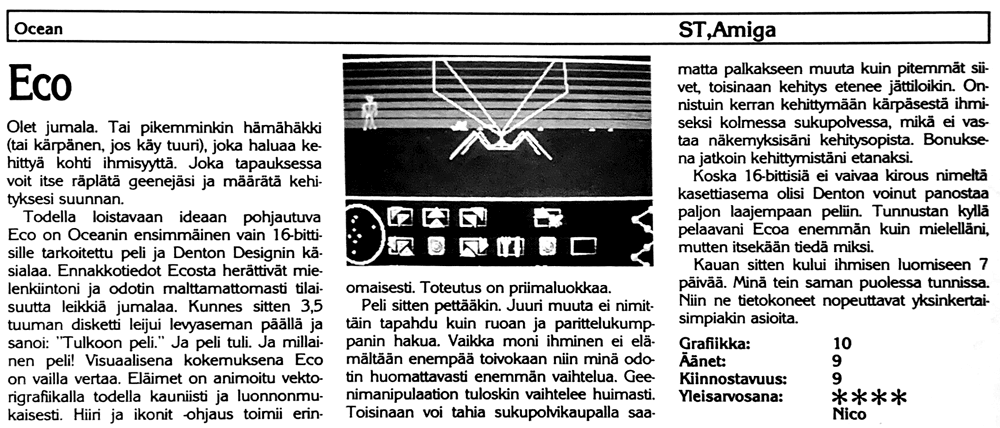
Eco1988Pysyvä linkkiOlet jumala. Tai pikemminkin hämähäkki (tai kärpänen, jos käy tuuri), joka haluaa kehittyä kohti ihmisyyttä. Joka tapauksessa voit itse räplätä geenejäsi ja määrätä kehityksesi suunnan.
Todella loistavaan ideaan pohjautuva Eco on Oceanin ensimmäinen vain 16-bittisille tarkoitettu peli ja Denton Designin käsialaa. Ennakkotiedot Ecosta herättivät mielenkiintoni ja odotin malttamattomasti tilaisuutta leikkiä jumalaa. Kunnes sitten 3,5 tuuman disketti leijui levyaseman päällä ja sanoi: "Tulkoon peli." Ja peli tuli. Ja millainen peli! Visuaalisena kokemuksena Eco on vailla vertaa. Eläimet on animoitu vektorigrafiikalla todella kauniisti ja luonnonmukaisesti. Hiiri ja ikonit -ohjaus toimii erinomaisesti. Toteutus on priimaluokkaa.
Peli sitten pettääkin. Juuri muuta ei nimittäin tapahdu kuin ruoan ja parittelukumppanin hakua. Vaikka moni ihminen ei elämältään enempää toivokaan niin minä odotin huomattavasti enemmän vaihtelua. Geenimanipulaation tuloskin vaihtelee huimasti. Toisinaan voi tahia sukupolvikaupalla saamatta palkakseen muuta kuin pitemmät siivet, toisinaan kehitys etenee jättiloikin. Onnistuin kerran kehittymään kärpäsestä ihmiseksi kolmessa sukupolvessa, mikä ei vastaa näkemyksisäni kehitysopista. Bonuksena jatkoin kehittymistäni etanaksi.
Koska 16-bittisiä ei vaivaa kirous nimeltä kasettiasema olisi Denton voinut panostaa paljon laajempaan peliin. Tunnustan kyllä pelaavani Ecoa enemmän kuin mielelläni, mutten itsekään tiedä miksi.
Kauan sitten kului ihmisen luomiseen 7 päivää. Minä tein saman puolessa tunnissa. Niin ne tietokoneet nopeuttavat yksinkertaisimpiakin asioita.
Eco1988PermalinkYou are a god. Or rather a spider (or a fly, if you're lucky) that wants to evolve towards humanity. Either way, you get to fiddle with your own genes and decide the direction of your evolution.
Based on a truly brilliant idea, Eco is Ocean's first game made for 16-bit machines only, and it is the handiwork of Denton Design. The advance news about Eco piqued my interest, and I waited impatiently for the chance to play God. Until at last the 3.5-inch floppy hovered over the disk drive and said: "Let there be a game." And there was a game. And what a game! As a visual experience Eco is without equal. The animals have been animated in vector graphics really beautifully and naturally. The mouse-and-icons control works excellently. The execution is top class.
It's the game itself that lets you down. Hardly anything happens apart from looking for food and a mate. Many people may not want anything more out of life, but I was expecting a lot more variety. The results of the genetic manipulation vary wildly, too. Sometimes you can slog away for generations with nothing to show for it but longer wings, while at other times evolution advances in giant leaps. Once I managed to evolve from a fly into a human in three generations, which doesn't match my views on the theory of evolution. As a bonus, I then carried on evolving into a snail.
Since the 16-bit machines aren't plagued by the curse called the cassette drive, Denton could have put the effort into a much bigger game. I do confess that I play Eco more than willingly, though I don't know why myself.
Long ago, creating man took 7 days. I did the same in half an hour. That's how computers speed up even the simplest of things.
Eidolon, The
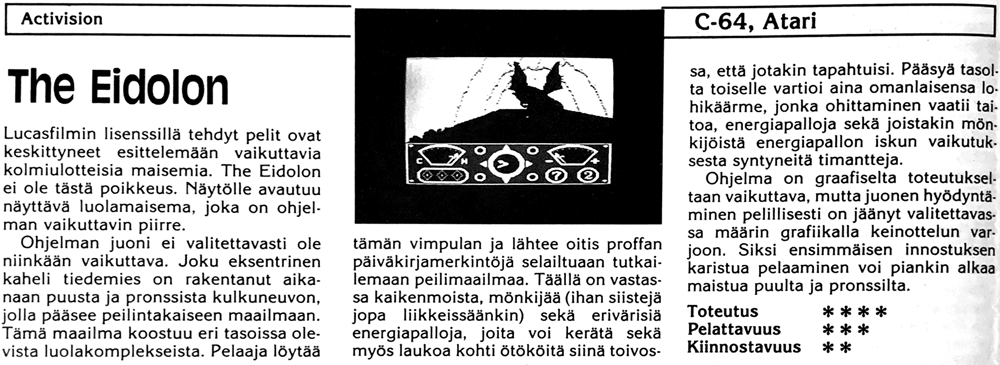
Eidolon, The1987Pysyvä linkkiLucasfilmin lisenssillä tehdyt pelit ovat keskittyneet esittelemään vaikuttavia kolmiulotteisia maisemia. The Eidolon ei ole tästä poikkeus. Näytölle avautuu näyttävä luolamaisema, joka on ohjelman vaikuttavin piirre.
Ohjelman juoni ei valitettavasti ole niinkään vaikuttava. Joku eksentrinen kaheli tiedemies on rakentanut aikanaan puusta ja pronssista kulkuneuvon, jolla pääsee peilintakaiseen maailmaan. Tämä maailma koostuu eri tasoissa olevista luolakomplekseista. Pelaaja löytää tämän vimpulan ja lähtee oitis proffan päiväkirjamerkintöjä selailtuaan tutkailemaan peilimaailmaa. Täällä on vastassa kaikenmoista, mönkijää (ihan siistejä jopa liikkeissäänkin) sekä erivärisiä energiapalloja, joita voi kerätä sekä myös laukoa kohti ötököitä siinä toivossa, että jotakin tapahtuisi. Pääsyä tasolta toiselle vartioi aina omanlaisensa lohikäärme, jonka ohittaminen vaatii taitoa, energiapalloja sekä joistakin mönkijöistä energiapallon iskun vaikutuksesta syntyneitä timantteja.
Ohjelma on graafiselta toteutukseltaan vaikuttava, mutta juonen hyödyntäminen pelillisesti on jäänyt valitettavassa määrin grafiikalla keinottelun varjoon. Siksi ensimmäisen innostuksen karistua pelaaminen voi piankin alkaa maistua puulta ja pronssilta.
Eidolon, The1987PermalinkThe games made under the Lucasfilm licence have concentrated on showing off impressive three-dimensional landscapes. The Eidolon is no exception. A spectacular cave landscape opens up on the screen, and it is the program's most impressive feature.
The program's plot, unfortunately, is not quite so impressive. Some eccentric nutcase of a scientist once built a vehicle out of wood and bronze that takes you into the world behind the mirror. This world consists of cave complexes on different levels. The player finds this contraption and, after leafing through the prof's diary entries, sets off at once to explore the mirror world. Here you're up against all sorts of crawlies (quite neat ones, even in the way they move) as well as energy balls of various colours, which you can collect and also fire at the critters in the hope that something might happen. The way from one level to the next is always guarded by a dragon of its own particular kind, and getting past it takes skill, energy balls and the diamonds that some of the crawlies turn into when hit by an energy ball.
The program's graphics are impressive, but putting the plot to use in the actual gameplay has, to a regrettable degree, been overshadowed by the graphics gimmickry. So once the first excitement wears off, playing may soon start to feel as dull as wood and bronze.
Electrocop
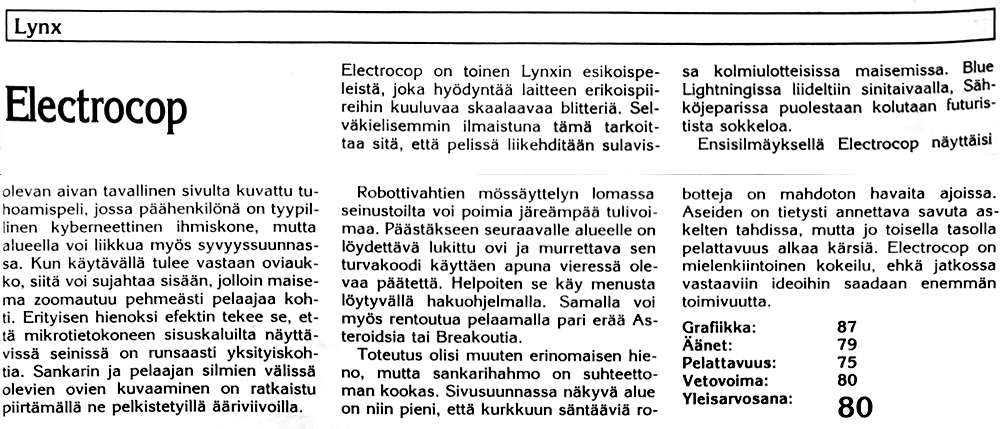
Electrocop1990 SyksyPysyvä linkkiElectrocop on toinen Lynxin esikoispeleistä, joka hyödyntää laitteen erikoispiireihin kuuluvaa skaalaavaa blitteriä. Selväkielisemmin ilmaistuna tämä tarkoittaa sitä, että pelissä liikehditään sulavissa kolmiulotteisissa maisemissa. Blue Lightningissa liideltiin sinitaivaalla, Sähköjeparissa puolestaan kolutaan futuristista sokkeloa.
Ensisilmäyksellä Electrocop näyttäisi olevan aivan tavallinen sivulta kuvattu tuhoamispeli, jossa päähenkilönä on tyypillinen kyberneettinen ihmiskone, mutta alueella voi liikkua myös syvyyssuunnassa. Kun käytävällä tulee vastaan oviaukko, siitä voi sujahtaa sisään, jolloin maisema zoomautuu pehmeästi pelaajaa kohti. Erityisen hienoksi efektin tekee se, että mikrotietokoneen sisuskaluilta näyttävissä seinissä on runsaasti yksityiskohtia. Sankarin ja pelaajan silmien välissä olevien ovien kuvaaminen on ratkaistu piirtämällä ne pelkistetyillä ääriviivoilla.
Robottivahtien mössäyttelyn lomassa seinustoilta voi poimia järeämpää tulivoimaa. Päästäkseen seuraavalle alueelle on löydettävä lukittu ovi ja murrettava sen turvakoodi käyttäen apuna vieressä olevaa päätettä. Helpoiten se käy menusta löytyvällä hakuohjelmalla. Samalla voi myös rentoutua pelaamalla pari erää Asteroidsia tai Breakoutia.
Toteutus olisi muuten erinomaisen hieno, mutta sankarihahmo on suhteettoman kookas. Sivusuunnassa näkyvä alue on niin pieni, että kurkkuun säntääviä robotteja on mahdoton havaita ajoissa. Aseiden on tietysti annettava savuta askelten tahdissa, mutta jo toisella tasolla pelattavuus alkaa kärsiä. Electrocop on mielenkiintoinen kokeilu, ehkä jatkossa vastaaviin ideoihin saadaan enemmän toimivuutta.
Electrocop1990 SyksyPermalinkElectrocop is the second of the Lynx's first-born games to make use of the scaling blitter that is one of the machine's custom chips. Put more plainly, this means that the game moves through smooth three-dimensional landscapes. In Blue Lightning you glided across the blue sky; in Electro-Copper, by contrast, you scour a futuristic maze.
At first glance Electrocop would seem to be a perfectly ordinary side-on destruction game starring the typical cybernetic man-machine, but you can also move into the depth of the area. When you come across a doorway in a corridor, you can slip through it, and the scenery zooms smoothly towards the player. What makes the effect especially fine is that the walls, which look like the innards of a microcomputer, are packed with detail. Showing the doors that lie between the hero and the player's eyes has been solved by drawing them as simplified outlines.
In between squashing robot guards to mush, you can pick up heavier firepower from along the walls. To get to the next area you have to find the locked door and crack its security code with the help of the terminal next to it. The easiest way is with the search program found in the menu. While you're at it, you can also relax with a couple of rounds of Asteroids or Breakout.
The execution would otherwise be excellent, but the hero figure is disproportionately large. The area visible to either side is so small that it's impossible to spot the robots lunging for your throat in time. Of course you have to let the guns smoke in time with your steps, but by the second level the playability already starts to suffer. Electrocop is an interesting experiment; perhaps in future similar ideas can be made to work better.
Elektraglide
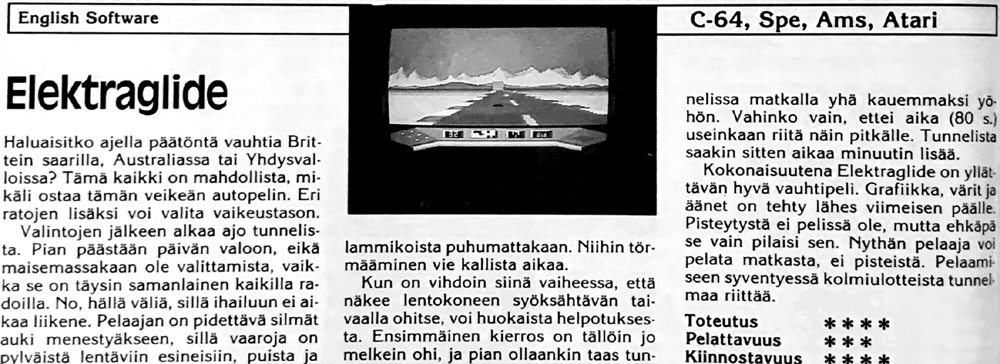
Elektraglide1987Pysyvä linkkiHaluaisitko ajella päätöntä vauhtia Brittein saarilla, Australiassa tai Yhdysvalloissa? Tämä kaikki on mahdollista, mikäli ostaa tämän veikeän autopelin. Eri ratojen lisäksi voi valita vaikeustason.
Valintojen jälkeen alkaa ajo tunnelista. Pian päästään päivän valoon, eikä maisemassakaan ole valittamista, vaikka se on täysin samanlainen kaikilla radoilla. No, hällä väliä, sillä ihailuun ei aikaa liikene. Pelaajan on pidettävä silmät auki menestyäkseen, sillä vaaroja on pylväistä lentäviin esineisiin, puista ja lammikoista puhumattakaan. Niihin törmääminen vie kallista aikaa.
Kun on vihdoin siinä vaiheessa, että näkee lentokoneen syöksähtävän taivaalla ohitse, voi huokaista helpotuksesta. Ensimmäinen kierros on tällöin jo melkein ohi, ja pian ollaankin taas tunnelissa matkalla yhä kauemmaksi yöhön. Vahinko vain, ettei aika (80 s.) useinkaan riitä näin pitkälle. Tunnelista saakin sitten aikaa minuutin lisää.
Kokonaisuutena Elektraglide on yllättävän hyvä vauhtipeli. Grafiikka, värit ja äänet on tehty lähes viimeisen päälle. Pisteytystä ei pelissä ole, mutta ehkäpä se vain pilaisi sen. Nythän pelaaja voi pelata matkasta, ei pisteistä. Pelaamiseen syventyessä kolmiulotteista tunnelmaa riittää.
Elektraglide1987PermalinkWould you like to drive at breakneck speed around the British Isles, Australia or the United States? All this is possible if you buy this nifty driving game. Besides the different tracks, you can also choose the difficulty level.
After you've made your choices, the drive starts from a tunnel. Soon you come out into daylight, and there's nothing to complain about in the scenery either, even if it's exactly the same on every track. Oh well, who cares, since there's no time to spare for admiring it anyway. The player has to keep their eyes peeled to succeed, because the hazards range from pillars to flying objects, not to mention trees and ponds. Crashing into them costs precious time.
When you finally reach the point where you see an aeroplane swoop past across the sky, you can breathe a sigh of relief. By then the first lap is almost over, and soon you're back in a tunnel, heading ever deeper into the night. Pity only that the time limit (80 s) is seldom enough to get you this far. The tunnel then gives you another minute of time.
All in all, Elektraglide is a surprisingly good high-speed game. The graphics, colours and sound have been done almost to the very last detail. There's no scoring in the game, but perhaps that would only spoil it. This way the player can play for the journey, not for the points. Once you get absorbed in playing, there's plenty of three-dimensional atmosphere.
Elite
Elite1987Pysyvä linkkiElite on alunalkaen kirjoitettu BBC-mikrolle, mikä on aiheuttanut paljon närästystä muiden mikrojen omistajien keskuudessa. Onpa jopa sanottu, että kannattaa ostaa BBC pelkästään sen vuoksi, että pääsee pelaamaan Eliteä. Nyttemmin ohjelma on käännetty kuusneloselle, minkä seurauksen se on oitis kivunnut myyntilistojen kärkisijoille.
A.D. 3200
Neljännen vuosituhannen alussa maailmankaikkeus on todella kova paikka elää rehelliselle (?) kauppiaalle. Avaruusrosvous tuntuu olevan vähintään joka toisen avaruusaluksen omistajan pääammatti, ja ikäänkuin siinä ei olisi tarpeeksi, on Galaktinen liittovaltio vielä sodassa thargoidien kanssa, ja thargoidialuksia pääsee aina joskus livahtamaan linjojen lävitse terrorisoimaan galaktista kaupankäyntiä.
Galaktisen liittotasavallan muodostavat kahdeksan galaksin alueelle levinneet 2040 asuttua planeettaa. Pääelinkeinot vaihtelevat tekniikan ja maatalouden välillä samoin kuin planeettojen tekninen taso, joka määrää planeetalta alukseen saatavien laitteiden valikoiman. Pääelinkeino ratkaisee puolestaan osaltaan eri tuotteille määräytyvät hinnat.
Pääelinkeinon ja teknisen tason lisäksi planeetalla vallitseva poliittinen järjestelmä merkitsee paljon. Se määrää sen, kuinka tehokkaasti paikalliset viranomaiset pystyvät pitämään avaruusrosvouksen kurissa omassa aurinkokunnassaan.
Cobra Mk III
Pelaaja saa käyttöönsä Cobra Mk III -aluksen, 100 krediittiä valuuttaa sekä yhden pulssilaserin. Tavoitteena on kerätä rahaa kaupankäynnistä, varustaa alustaan entistä tehokkaammilla aseilla ja laitteilla sekä parantaa luokitustaan taistelijana tuhoamalla avaruusrosvojen aluksia sekä siinä sivussa kenties joitakin poliisien hävittäjiäkin.
Cobra Mk III soveltuu erinomaisesti yksinäiselle aurinkokuntien välillä liikkuvalle kauppiaalle. Se pystyy kuljettamaan suhteellisen paljon lastia, ja sillä on hyvä puolustautua runsasta lastia havittelevia avaruusrosvoja vastaan.
Galaktinen kaupankäynti keskittyy coriolis-avaruusasemille, joita on kaikkien asuttujen planeettojen kiertoradoilla. Kauppaa käyvä alus telakoituu asemaan sen pohjassa olevan, aseman mukana pyörivän aukon kautta (vaatii muuten todella tarkkaa ohjailua). Tämän jälkeen kauppias voi joko myydä tuomiaan tuotteita paikalliseen hintaan tai ostaa paikallisia tuotteita. Pelaaja voi myös varustaa alustaan. Ostettavissa olevien varusteiden taso määräytyy planeetan teknisen tason mukaan.
Kommentteja
Kaikki ohjelman juonen elementit ovat olennaisia, eivätkä ne jätä aukkoja tai lyö toisiaan korville. Alustyyppejä, asejärjestelmiä ja kauppatavaroita on runsaasti erilaisia. Planeettojen yhteiskuntajärjestelmiä on vaikka minkälaisia ja taistelijan kyvykkyysluokituksia riittää täysin harmittomasta aina eliteen asti. Harvinaiset satunnaiset tapahtumat, kuten armeijalta tai kauppiailta tulevat henkilökohtaiset viestit, thargoid-hyökkäykset hyperavaruudessa tai taistelutietokoneen antamat kannustavat sivuhuomautukset vielä lisäävät realismin tuntua.
Pahin ongelma on se, että kukaan ei tunnu väistelevän pelaajan alusta. Coriolis-asemalta vastaan tulevat laskeutumissukkulat eivät yritäkään väistää vaan räjähtävät törmätessään Cobran tehokkaisiin suojakilpiin. Tämän seurauksena pelaajan laillinen status kuitenkin laskee lähinnä yhteiskunnan ykkösvihollista vastaavaksi.
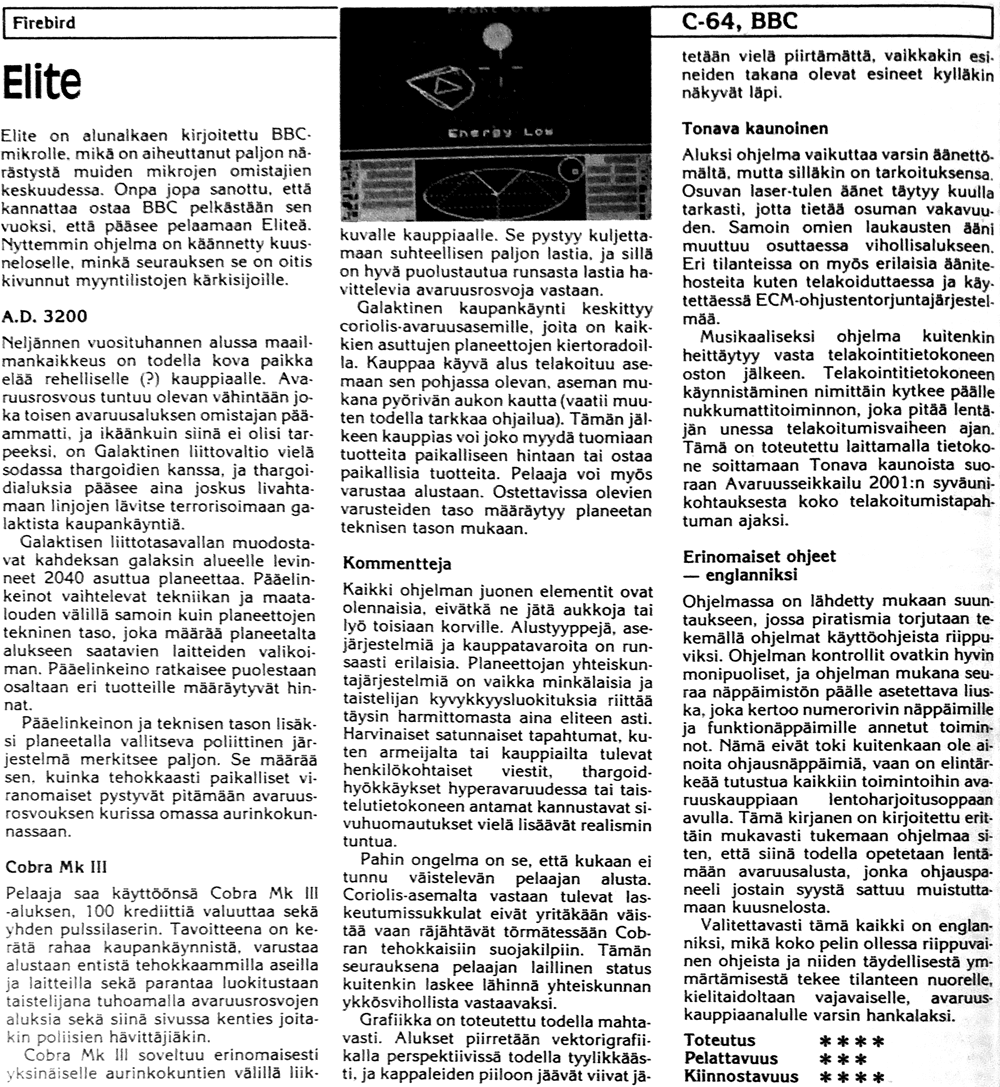
Grafiikka on toteutettu todella mahtavasti. Alukset piirretään vektorigrafiikalla perspektiivissä todella tyylikkäästi, ja kappaleiden piiloon jäävät viivat jätetään vielä piirtämättä, vaikkakin esineiden takana olevat esineet kylläkin näkyvät läpi.
Tonava kaunoinen
Aluksi ohjelma vaikuttaa varsin äänettömältä, mutta silläkin on tarkoituksensa. Osuvan laser-tulen äänet täytyy kuulla tarkasti, jotta tietää osuman vakavuuden. Samoin omien laukausten ääni muuttuu osuttaessa vihollisalukseen. Eri tilanteissa on myös erilaisia äänitehosteita kuten telakoiduttaessa ja käytettäessä ECM-ohjustentorjuntajärjestelmää.
Musikaaliseksi ohjelma kuitenkin heittäytyy vasta telakointitietokoneen oston jälkeen. Telakointitietokoneen käynnistäminen nimittäin kytkee päälle nukkumattitoiminnon, joka pitää lentäjän unessa telakoitumisvaiheen ajan. Tämä on toteutettu laittamalla tietokone soittamaan Tonava kaunoista suoraan Avaruusseikkailu 2001:n syväunikohtauksesta koko telakoitumistapahtuman ajaksi.
Erinomaiset ohjeet - englanniksi
Ohjelmassa on lähdetty mukaan suuntaukseen, jossa piratismia torjutaan tekemällä ohjelmat käyttöohjeista riippuviksi. Ohjelman kontrollit ovatkin hyvin monipuoliset, ja ohjelman mukana seuraa näppäimistön päälle asetettava liuska, joka kertoo numerorivin näppäimille ja funktionäppäimille annetut toiminnot. Nämä eivät toki kuitenkaan ole ainoita ohjausnäppäimiä, vaan on elintärkeää tutustua kaikkiin toimintoihin avaruuskauppiaan lentoharjoitusoppaan avulla. Tämä kirjanen on kirjoitettu erittäin mukavasti tukemaan ohjelmaa siten, että siinä todella opetetaan lentämään avaruusalusta, jonka ohjauspaneeli jostain syystä sattuu muistuttamaan kuusnelosta.
Valitettavasti tämä kaikki on englanniksi, mikä koko pelin ollessa riippuvainen ohjeista ja niiden täydellisestä ymmärtämisestä tekee tilanteen nuorelle, kielitaidoltaan vajavaiselle, avaruuskauppiaanalulle varsin hankalaksi.
Elite1987PermalinkElite was originally written for the BBC Micro, which has caused a lot of heartburn among owners of other micros. It has even been said that it's worth buying a BBC purely to get to play Elite. Now the program has been converted to the Commodore 64, and as a result it has immediately climbed to the top of the sales charts.
A.D. 3200
At the start of the fourth millennium, the universe is a really tough place to live for an honest (?) trader. Space piracy seems to be the main occupation of at least every other spaceship owner, and as if that weren't enough, the Galactic Federation is also at war with the Thargoids, and every now and then Thargoid ships manage to slip through the lines to terrorise galactic trade.
The Galactic Federal Republic is made up of 2040 inhabited planets spread across eight galaxies. The main economies range from high-tech to agricultural, and so does the planets' tech level, which determines the range of equipment you can get for your ship on a given planet. The main economy, in turn, partly decides the prices set for the various goods.
Besides the main economy and the tech level, the political system prevailing on a planet matters a great deal. It determines how effectively the local authorities are able to keep space piracy in check in their own solar system.
Cobra Mk III
The player is given a Cobra Mk III ship, 100 credits in cash and a single pulse laser. The aim is to make money from trading, kit out your ship with ever more powerful weapons and equipment, and improve your rating as a fighter by destroying pirate ships and, while you're at it, perhaps a few police fighters as well.
The Cobra Mk III is excellently suited to a lone trader travelling between solar systems. It can carry a relatively large amount of cargo, and it's good for defending yourself against space pirates with their eyes on that rich cargo.
Galactic trade is centred on Coriolis space stations, which orbit every inhabited planet. A trading ship docks with the station through an opening at its base that rotates along with the station (which, by the way, takes really precise piloting). After that the trader can either sell the goods they've brought at the local price or buy local goods. The player can also equip their ship. The level of equipment on sale depends on the planet's tech level.
Comments
All the elements of the program's plot are relevant, and they neither leave gaps nor clash with one another. There's a wide variety of ship types, weapon systems and trade goods. The planets have all kinds of social systems, and the combat ratings run all the way from completely Harmless to Elite. Rare random events, such as personal messages from the military or from traders, Thargoid attacks in hyperspace, or encouraging asides from the combat computer, add further to the sense of realism.
The worst problem is that nobody seems to bother getting out of the player's way. Landing shuttles coming out of the Coriolis station don't even try to dodge, and instead explode on hitting the Cobra's powerful shields. As a result, though, the player's legal status drops to roughly that of public enemy number one.
The graphics are done really magnificently. The ships are drawn in perspective with vector graphics in really stylish fashion, and the hidden lines of objects are even left undrawn, although objects behind other objects do show through.
The Blue Danube
At first the program seems rather silent, but even that has its purpose. You have to listen carefully to the sound of laser fire hitting you to know how serious the hit is. Likewise, the sound of your own shots changes when you hit an enemy ship. There are also different sound effects for different situations, such as docking and using the ECM missile defence system.
The program only turns musical, however, once you've bought a docking computer. Switching on the docking computer, you see, activates a sandman function that keeps the pilot asleep for the duration of the docking. This has been done by having the computer play The Blue Danube, straight out of the deep-sleep scene in 2001: A Space Odyssey, for the whole docking procedure.
Excellent instructions - in English
The program has joined the trend of fighting piracy by making programs dependent on their manuals. The controls are indeed very versatile, and the program comes with a strip that sits on top of the keyboard, listing the functions assigned to the number-row keys and the function keys. These are by no means the only control keys, however, and it is vital to get to know all the functions with the help of the space trader's flight training manual. This booklet is written very nicely to support the program, in that it really does teach you to fly a spaceship whose control panel, for some reason, happens to resemble a Commodore 64.
Unfortunately all of this is in English, which, with the whole game depending on the instructions and on understanding them completely, makes things rather tricky for a young space-trader-in-the-making whose language skills aren't quite there yet.
Elite Plus
Elite Plus1991 SyksyPysyvä linkkiTuo käymättömistä korpimaista viho viimeinen on koluttu Eliten voimin jo niin monena versiona, että olikin jo aika julkaista peli VGA- ja äänikorttituella. Alkuperäinen PC-versio kun oli kovin vanhentuneen näköinen CGA-viritelmä.
Plussan sisältö on vanha tuttu. Cobra-pilotin hommana on kasvattaa omaisuuttaan joko kaupankäynnillä, ryöväämällä rehellisiä kauppiaita tai harrastamalla palkkionmetsästystä. Sijoituskohteina on niin siviili- kuin sotakalustoakin, joista jälkimmäiselle löytyy käyttöä enemmän kuin kylliksi hypittäessä aurinkokunnasta toiseen.
Erot alkavat löytyä, kun tarttuu joystickin kahvaan. Positiivisinta on 3D-grafiikan nopeus, joka saa heikkohermoisen hapuilemaan 386:n turbonappulaa. Vähemmän vakuuttavaa on vastustajien tekoäly. Eivät ne alkuperäisessäkään neroja olleet, mutta Plussassa kaavamaisuus alkaa olla häiritsevää. Varsinaisia ääliöitä ovat piraatit, jotka syöksyvät kohti, tekevät täyskäännöksen ja etääntyvät eväänsä räväyttämättä, vaikka pelaaja lataisi täyslaidallisen peräsuuttimiin.
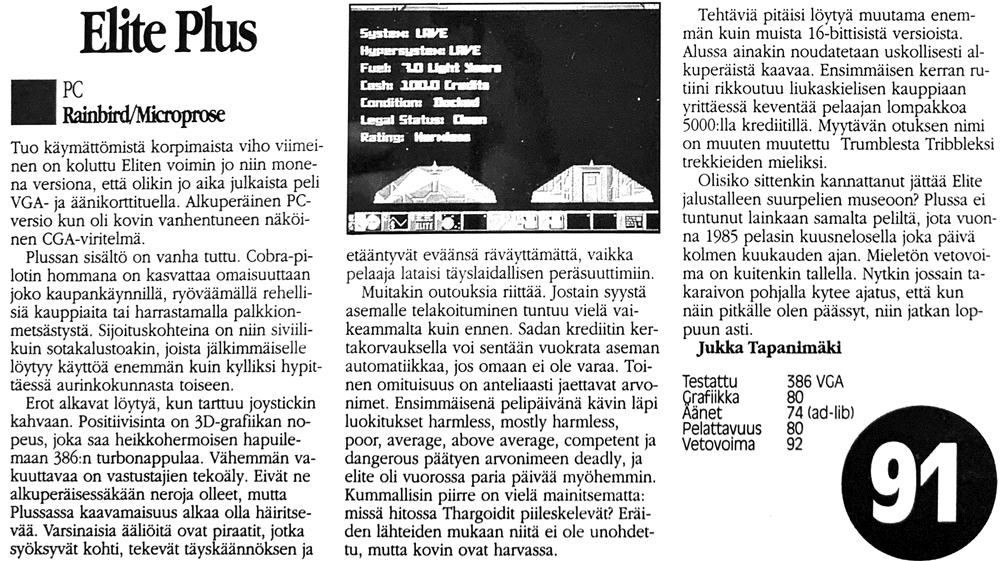
Muitakin outouksia riittää. Jostain syystä asemalle telakoituminen tuntuu vielä vaikeammalta kuin ennen. Sadan krediitin kertakorvauksella voi sentään vuokrata aseman automatiikkaa, jos omaan ei ole varaa. Toinen omituisuus on anteliaasti jaettavat arvonimet. Ensimmäisenä pelipäivänä kävin läpi luokitukset harmless, mostly harmless, poor, average, above average, competent ja dangerous päätyen arvonimeen deadly, ja elite oli vuorossa paria päivää myöhemmin. Kummallisin piirre on vielä mainitsematta: missä hitossa Thargoidit piileskelevät? Eräiden lähteiden mukaan niitä ei ole unohdettu, mutta kovin ovat harvassa.
Tehtäviä pitäisi löytyä muutama enemmän kuin muista 16-bittisistä versioista. Alussa ainakin noudatetaan uskollisesti alkuperäistä kaavaa. Ensimmäisen kerran rutiini rikkoutuu liukaskielisen kauppiaan yrittäessä keventää pelaajan lompakkoa 5000:lla krediitillä. Myytävän otuksen nimi on muuten muutettu Trumblesta Tribbleksi trekkieiden mieliksi.
Olisiko sittenkin kannattanut jättää Elite jalustalleen suurpelien museoon? Plussa ei tuntunut lainkaan samalta peliltä, jota vuonna 1985 pelasin kuusnelosella joka päivä kolmen kuukauden ajan. Mieletön vetovoima on kuitenkin tallella. Nytkin jossain takaraivon pohjalla kytee ajatus, että kun näin pitkälle olen päässyt, niin jatkan loppuun asti.
Elite Plus1991 SyksyPermalinkThat very last of the untrodden wildernesses has been scoured with Elite in so many versions already that it was about time the game came out with VGA and sound card support. The original PC version, after all, was a CGA contraption that looked terribly dated.
What's in the Plus is an old familiar story. The Cobra pilot's job is to build up a fortune, either by trading, by robbing honest merchants or by taking up bounty hunting. Things to invest in include civilian as well as military hardware, and there's more than enough use for the latter when hopping from one solar system to another.
The differences start turning up once you get a grip on the joystick. The most positive thing is the speed of the 3D graphics, which has the faint of heart fumbling for the 386's turbo button. Less convincing is the enemies' artificial intelligence. They were no geniuses in the original either, but in the Plus the predictability is getting annoying. The real idiots are the pirates, who dive at you, do a full about-turn and pull away without batting a fin, even if the player were pumping a full broadside into their tail nozzles.
There's no shortage of other oddities either. For some reason docking with a station feels even harder than before. For a one-off fee of a hundred credits you can at least hire the station's automatic system, if you can't afford one of your own. Another peculiarity is how generously the ranks are handed out. On my first day of play I went through the ratings harmless, mostly harmless, poor, average, above average, competent and dangerous, ending up with the title deadly, and elite came along a couple of days later. The strangest feature is yet to be mentioned: where the heck are the Thargoids hiding? According to some sources they haven't been forgotten, but they're mighty few and far between.
There are supposed to be a few more missions than in the other 16-bit versions. At the start, at least, the original formula is faithfully followed. The routine is broken for the first time when a smooth-tongued trader tries to lighten the player's wallet by 5000 credits. The name of the creature on sale, by the way, has been changed from Trumble to Tribble to please the Trekkies.
Would it have been better after all to leave Elite on its pedestal in the museum of great games? The Plus didn't feel at all like the same game I played on the Commodore 64 every day for three months in 1985. The insane pull is still there, though. Even now, somewhere at the back of my skull, the thought is smouldering that since I've got this far, I'll carry on to the very end.
Elvira
Elvira1991 KevätPysyvä linkkiPimeyden rakastajatar ja B-luokan kauhufilmien kuningatar olisi halunnut muuttaa linnansa vetäväksi turistikohteeksi, mutta suunnitelmat mutkistuivat. Elviran isoisoisoäiti Emelda nimittäin valmistautuu comebackiin ja siinä sivussa linnaan tulvii asiakkaita, jotka eivät ole eläviä, saati sitten maksavat laskujaan. Paikallinen eksorkisti tietty puhkuu työintoa saadessaan työnantajakseen kauhuttaren, jolla on Hollywoodin historian uhkeimmat, ööh, hiukset.
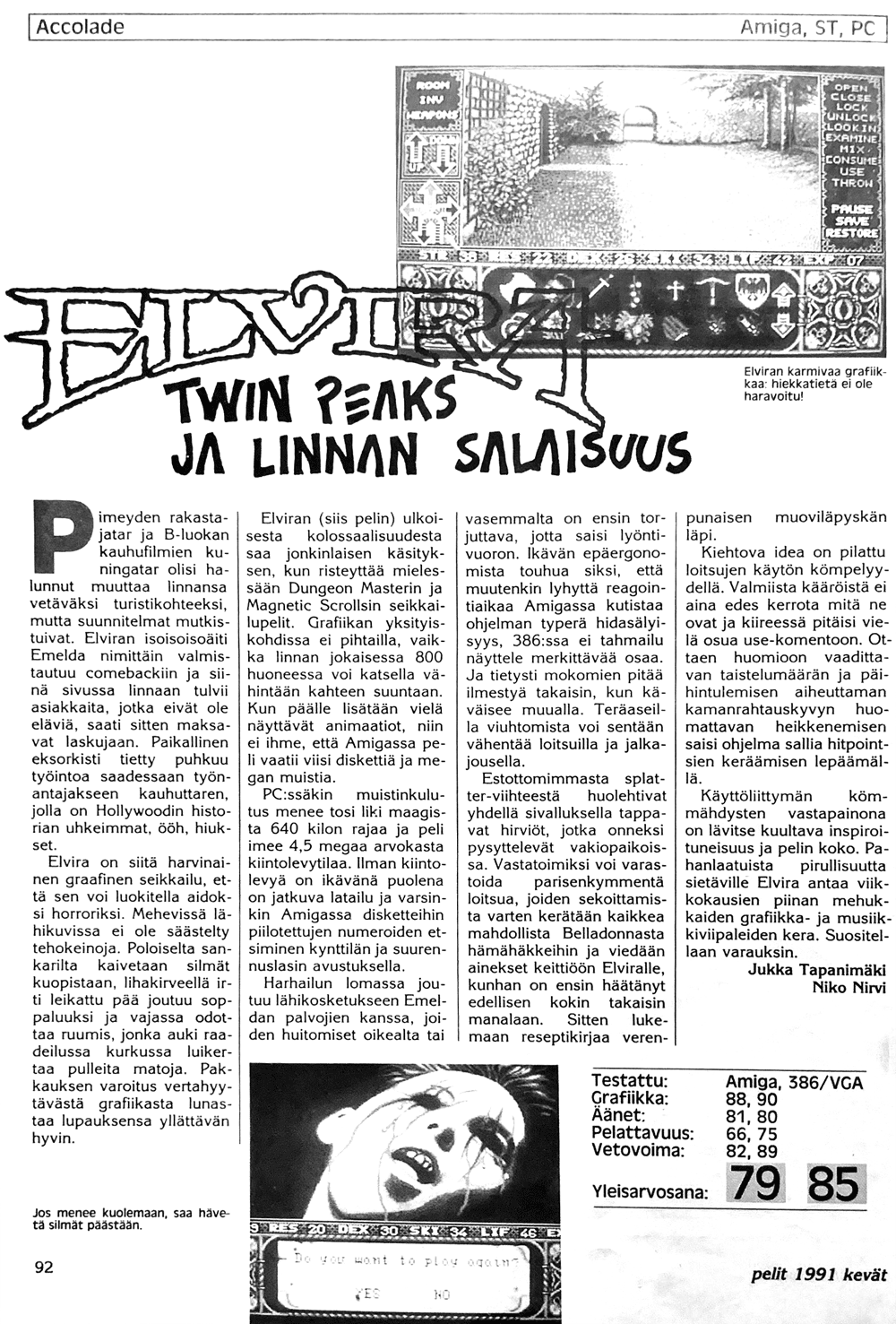
Elvira on siitä harvinainen graafinen seikkailu, että sen voi luokitella aidoksi horroriksi. Mehevissä lähikuvissa ei ole säästelty tehokeinoja. Poloiselta sankarilta kaivetaan silmät kuopistaan, lihakirveellä irti leikattu pää joutuu soppaluuksi ja vajassa odottaa ruumis, jonka auki raadeilussa kurkussa luikertaa pulleita matoja. Pakkauksen varoitus vertahyytävästä grafiikasta lunastaa lupauksensa yllättävän hyvin.
Elviran (siis pelin) ulkoisesta kolossaalisuudesta saa jonkinlaisen käsityksen, kun risteyttää mielessään Dungeon Masterin ja Magnetic Scrollsin seikkailupelit. Grafiikan yksityiskohdissa ei pihtailla, vaikka linnan jokaisessa 800 huoneessa voi katsella vähintään kahteen suuntaan. Kun päälle lisätään vielä näyttävät animaatiot, niin ei ihme, että Amigassa peli vaatii viisi diskettiä ja megan muistia.
PC:ssäkin muistinkulutus menee tosi liki maagista 640 kilon rajaa ja peli imee 4,5 megaa arvokasta kiintolevytilaa. Ilman kiintolevyä on ikävänä puolena on jatkuva latailu ja varsinkin Amigassa disketteihin piilotettujen numeroiden etsiminen kynttilän ja suurennuslasin avustuksella.
Harhailun lomassa joutuu lähikosketukseen Emeldan palvojien kanssa, joiden huitomiset oikealta tai vasemmalta on ensin torjuttava, jotta saisi lyöntivuoron. Ikävän epäergonomista touhua siksi, että muutenkin lyhyttä reagointiaikaa Amigassa kutistaa ohjelman typerä hidasälyisyys, 386:ssa ei tahmailu näyttele merkittävää osaa. Ja tietysti mokomien pitää ilmestyä takaisin, kun käväisee muualla. Teräaseilla viuhtomista voi sentään vähentää loitsuilla ja jalkajousella.
Estottomimmasta splatter-viihteestä huolehtivat yhdellä sivalluksella tappavat hirviöt, jotka onneksi pysyttelevät vakiopaikoissa. Vastatoimiksi voi varastoida parisenkymmentä loitsua, joiden sekoittamista varten kerätään kaikkea mahdollista Belladonnasta hämähäkkeihin ja viedään ainekset keittiöön Elviralle, kunhan on ensin häätänyt edellisen kokin takaisin manalaan. Sitten lukemaan reseptikirjaa verenpunaisen muoviläpyskän läpi.
Kiehtova idea on pilattu loitsujen käytön kömpelyydellä. Valmiista kääröistä ei aina edes kerrota mitä ne ovat ja kiireessä pitäisi vielä osua use-komentoon. Ottaen huomioon vaadittavan taistelumäärän ja päihintulemisen aiheuttaman kamanrahtauskyvyn huomattavan heikkenemisen saisi ohjelma sallia hitpointsien keräämisen lepäämällä.
Käyttöliittymän kömmähdysten vastapainona on lävitse kuultava inspiroituneisuus ja pelin koko. Pahanlaatuista pirullisuutta sietäville Elvira antaa viikkokausien piinan mehukkaiden grafiikka- ja musiikkiviipaleiden kera. Suositellaan varauksin.
Elvira1991 KevätPermalinkThe Mistress of the Dark and queen of B-grade horror films would have liked to turn her castle into a crowd-pulling tourist attraction, but her plans got complicated. You see, Elvira's great-great-grandmother Emelda is preparing a comeback, and meanwhile the castle is flooded with customers who aren't alive, let alone paying their bills. The local exorcist is naturally bursting with zeal for the job on landing an employer in the shape of a horroress with the most ample, er, hair in Hollywood history.
Elvira is a rare graphic adventure in that it can be classed as genuine horror. No effects have been spared in the juicy close-ups. The poor hero's eyes are gouged out of their sockets, a head hacked off with a meat cleaver ends up as a soup bone, and in the shed a corpse awaits, with plump worms wriggling in its ripped-open throat. The warning on the box about blood-curdling graphics delivers on its promise surprisingly well.
You get some idea of the outward colossalness of Elvira (the game, that is) by cross-breeding Dungeon Master and Magnetic Scrolls' adventure games in your mind. There's no skimping on graphical detail, even though in every one of the castle's 800 rooms you can look in at least two directions. Add the flashy animations on top of that and it's no wonder that on the Amiga the game needs five disks and a meg of memory.
On the PC, too, memory consumption comes really close to the magic 640K limit, and the game sucks up 4.5 megs of precious hard disk space. Without a hard disk, the downside is constant loading and, on the Amiga in particular, hunting for the numbers hidden on the disks with the help of a candle and a magnifying glass.
In between the wandering you come into close contact with Emelda's worshippers, whose swipes from the right or left must first be parried before you get your turn to strike. Nastily unergonomic business, because on the Amiga the reaction time, short enough as it is, is shrunk further by the program's stupid slow-wittedness; on the 386 the sluggishness plays no significant part. And of course the blighters have to reappear when you pop off somewhere else. At least the flailing about with blades can be cut down with spells and the crossbow.
The most uninhibited splatter entertainment is provided by monsters that kill with a single slash, though fortunately they stick to fixed locations. As countermeasures you can stock up some twenty spells, and to mix them you gather everything imaginable from Belladonna to spiders and take the ingredients to Elvira in the kitchen, once you've first evicted the previous cook back to the underworld. Then it's off to read the recipe book through a blood-red plastic doodad.
The fascinating idea is spoiled by how clumsy the spells are to use. You aren't always even told what the finished scrolls are, and in the heat of the moment you still have to hit the use command. Considering the amount of fighting required and the considerable drop in stuff-lugging capacity caused by taking a beating, the program ought to let you gather hitpoints back by resting.
Offsetting the interface blunders are the inspiration that shines through and the sheer size of the game. For those who can stand malignant devilry, Elvira dishes up weeks of torment along with juicy slices of graphics and music. Recommended with reservations.
Empire
Empire1987Pysyvä linkkiEmpire seuraa Elitestä tuttua linjaa: taitava sekoitus strategiaa ja tuhoamista.
Aloitat pelin normaalilla Cub-tiedustelualuksella. Tarkoituksenasi on rakentaa mahtava imperiumi, joka kattaa useita aurinkokuntia. Tämän saavuttaaksesi sinun on käytävä kauppaa avaruusasemien kanssa, tuhottava hyökkäävät muukalaiset, jotka ovat valloittaneet monia planeettoja, uskaltauduttava kymmeniin tehtäviin ympäri linnunrataa ja tultava kaikkien aikojen parhaaksi pilotiksi. Ja vielä lopuksi sinun on rakennettava suojakenttä turvaamaan valtakuntaasi maailman loppuun saakka. . .
Siinä onkin haastetta kerrakseen. Kaiken tämän tekemiseen menee varmasti useita viikkoja, koska Eliteä noudattaen Empiressä on mielettömästi planeettoja ja aurinkokuntia.
Kuten Elitessä, tässäkin on laaja valikoima kontrollinäppäimiä ja pienempien pelaajien iloksi suomenkieliset käyttöohjeet ovat (jos mahdollista) vieläkin pikkutarkemmat kuin alkuperäinen ohjelappunen.
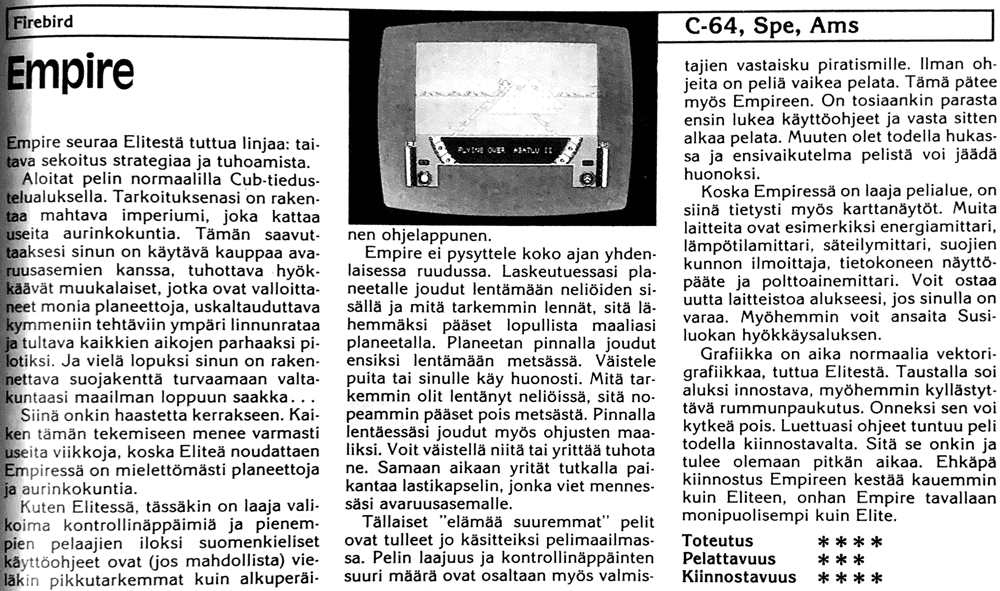
Empire ei pysyttele koko ajan yhdenlaisessa ruudussa. Laskeutuessasi planeetalle joudut lentämään neliöiden sisällä ja mitä tarkemmin lennät, sitä lähemmäksi pääset lopullista maaliasi planeetalla. Planeetan pinnalla joudut ensiksi lentämään metsässä. Väistele puita tai sinulle käy huonosti. Mitä tarkemmin olit lentänyt neliöissä, sitä nopeammin pääset pois metsästä. Pinnalla lentäessäsi joudut myös ohjusten maaliksi. Voit väistellä niitä tai yrittää tuhota ne. Samaan aikaan yrität tutkalla paikantaa lastikapselin, jonka viet mennessäsi avaruusasemalle.
Tällaiset "elämää suuremmat" pelit ovat tulleet jo käsitteiksi pelimaailmassa. Pelin laajuus ja kontrollinäppäinten suuri määrä ovat osaltaan myös valmistajien vastaisku piratismille. Ilman ohjeita on peliä vaikea pelata. Tämä pätee myös Empireen. On tosiaankin parasta ensin lukea käyttöohjeet ja vasta sitten alkaa pelata. Muuten olet todella hukassa ja ensivaikutelma pelistä voi jäädä huonoksi.
Koska Empiressä on laaja pelialue, on siinä tietysti myös karttanäytöt. Muita laitteita ovat esimerkiksi energiamittari, lämpötilamittari, säteilymittari, suojien kunnon ilmoittaja, tietokoneen näyttöpääte ja polttoainemittari. Voit ostaa uutta laitteistoa alukseesi, jos sinulla on varaa. Myöhemmin voit ansaita Susiluokan hyökkäysaluksen.
Grafiikka on aika normaalia vektorigrafiikkaa, tuttua Elitestä. Taustalla soi aluksi innostava, myöhemmin kyllästyttävä rummunpaukutus. Onneksi sen voi kytkeä pois. Luettuasi ohjeet tuntuu peli todella kiinnostavalta. Sitä se onkin ja tulee olemaan pitkän aikaa. Ehkäpä kiinnostus Empireen kestää kauemmin kuin Eliteen, onhan Empire tavallaan monipuolisempi kuin Elite.
Empire1987PermalinkEmpire follows the line familiar from Elite: a skilful mix of strategy and destruction.
You start the game with a standard Cub scout ship. Your aim is to build a mighty empire spanning several solar systems. To achieve this you have to trade with space stations, destroy the invading aliens who have conquered many planets, venture on dozens of missions all around the Milky Way and become the best pilot of all time. And finally, on top of all that, you have to build a force field to protect your realm until the end of the world. . .
That's quite a challenge, to say the least. Doing all this will surely take several weeks, since, following Elite's example, Empire has an insane number of planets and solar systems.
As in Elite, there's a wide selection of control keys here too, and to the delight of younger players the Finnish-language instructions are (if possible) even more meticulous than the original instruction leaflet.
Empire doesn't stick to one kind of screen the whole time. When landing on a planet you have to fly inside squares, and the more accurately you fly, the closer you get to your final destination on the planet. On the planet's surface you first have to fly through a forest. Dodge the trees or things will go badly for you. The more accurately you flew through the squares, the sooner you get out of the forest. While flying over the surface you also become a target for missiles. You can dodge them or try to destroy them. At the same time you're trying to locate a cargo pod on radar, which you take with you to the space station when you leave.
These "larger than life" games have already become an established concept in the gaming world. The scale of the game and the sheer number of control keys are also, in part, the manufacturers' counterattack against piracy. Without the instructions the game is hard to play. This applies to Empire too. It really is best to read the instructions first and only then start playing. Otherwise you'll be truly lost and your first impression of the game may end up a poor one.
Since Empire has a large playing area, it naturally has map screens as well. Other instruments include, for example, an energy gauge, a temperature gauge, a radiation meter, a shield status indicator, a computer display terminal and a fuel gauge. You can buy new equipment for your ship if you can afford it. Later on you can earn a Wolf-class attack ship.
The graphics are fairly ordinary vector graphics, familiar from Elite. In the background there's a drum-bashing soundtrack that's rousing at first and tiresome later. Luckily it can be switched off. Once you've read the instructions, the game feels really interesting. And so it is, and will remain for a long time. Perhaps interest in Empire will last longer than interest in Elite, since Empire is, in a way, more varied than Elite.
Empire
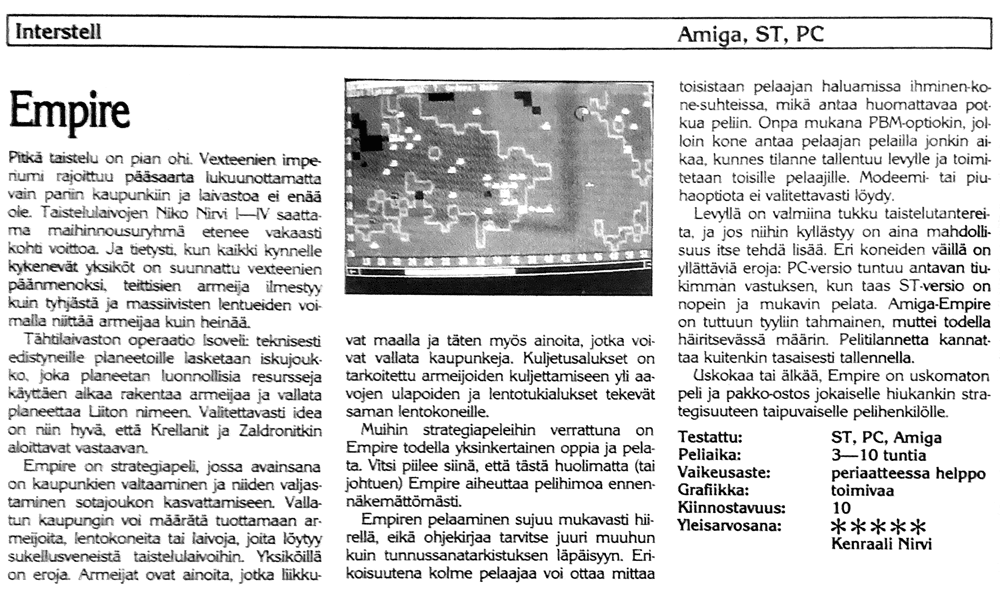
Empire1989 SyksyPysyvä linkkiPitkä taistelu on pian ohi. Vexteenien imperiumi rajoittuu pääsaarta lukuunottamatta vain pariin kaupunkiin ja laivastoa ei enää ole. Taistelulaivojen Niko Nirvi I-IV saattama maihinnousuryhmä etenee vakaasti kohti voittoa. Ja tietysti, kun kaikki kynnelle kykenevät yksiköt on suunnattu vexteenien päänmenoksi, teittisien armeija ilmestyy kuin tyhjästä ja massiivisten lentueiden voimalla niittää armeijaa kuin heinää.
Tähtilaivaston operaatio Isoveli: teknisesti edistyneille planeetoille lasketaan iskujoukko, joka planeetan luonnollisia resursseja käyttäen alkaa rakentaa armeijaa ja vallata planeettaa Liiton nimeen. Valitettavasti idea on niin hyvä, että Krellanit ja Zaldronitkin aloittavat vastaavan.
Empire on strategiapeli, jossa avainsana on kaupunkien valtaaminen ja niiden valjastaminen sotajoukon kasvattamiseen. Vallatun kaupungin voi määrätä tuottamaan armeijoita, lentokoneita tai laivoja, joita löytyy sukellusveneistä taistelulaivoihin. Yksiköillä on eroja. Armeijat ovat ainoita, jotka liikkuvat maalla ja täten myös ainoita, jotka voivat vallata kaupunkeja. Kuljetusalukset on tarkoitettu armeijoiden kuljettamiseen yli aavojen ulapoiden ja lentotukialukset tekevät saman lentokoneille.
Muihin strategiapeleihin verrattuna on Empire todella yksinkertainen oppia ja pelata. Vitsi piilee siinä, että tästä huolimatta (tai johtuen) Empire aiheuttaa pelihimoa ennennäkemättömästi.
Empiren pelaaminen sujuu mukavasti hiirellä, eikä ohjekirjaa tarvitse juuri muuhun kuin tunnussanatarkistuksen läpäisyyn. Erikoisuutena kolme pelaajaa voi ottaa mittaa toisistaan pelaajan haluamissa ihminen-kone-suhteissa, mikä antaa huomattavaa potkua peliin. Onpa mukana PBM-optiokin, jolloin kone antaa pelaajan pelailla jonkin aikaa, kunnes tilanne tallentuu levylle ja toimitetaan toisille pelaajille. Modeemi- tai piuhaoptiota ei valitettavasti löydy.
Levyllä on valmiina tukku taistelutantereita, ja jos niihin kyllästyy on aina mahdollisuus itse tehdä lisää. Eri koneiden väillä on yllättäviä eroja: PC-versio tuntuu antavan tiukimman vastuksen, kun taas ST-versio on nopein ja mukavin pelata. Amiga-Empire on tuttuun tyyliin tahmainen, muttei todella häiritsevässä määrin. Pelitilannetta kannattaa kuitenkin tasaisesti tallennella.
Uskokaa tai älkää, Empire on uskomaton peli ja pakko-ostos jokaiselle hiukankin strategisuuteen taipuvaiselle pelihenkilölle.
Empire1989 SyksyPermalinkThe long battle will soon be over. Apart from the main island, the vexteens' empire has shrunk to a mere couple of cities, and their navy is no more. Escorted by the battleships Niko Nirvi I-IV, the landing force advances steadily towards victory. And of course, just when every unit still able to stand has been sent off to finish the vexteens, the teittinens' army appears out of nowhere and, with the might of massive air squadrons, mows the army down like hay.
Star Fleet's Operation Big Brother: a strike force is dropped onto technologically advanced planets and, using the planet's natural resources, starts building an army and conquering the planet in the name of the Federation. Unfortunately the idea is so good that the Krellans and the Zaldrons start doing the same.
Empire is a strategy game in which the key word is capturing cities and harnessing them to build up your war machine. A captured city can be ordered to produce armies, aircraft or ships, which range from submarines to battleships. The units differ. Armies are the only ones that move on land and therefore also the only ones that can capture cities. Transports are meant for carrying armies across the open seas, and aircraft carriers do the same for planes.
Compared with other strategy games, Empire is really simple to learn and to play. The funny thing is that in spite of this (or because of it), Empire breeds a hunger to play like nothing ever seen before.
Empire plays comfortably with the mouse, and you hardly need the manual for anything except getting past the code-word check. As a special feature, three players can take each other on in whatever mix of humans and computers the player likes, which gives the game a considerable kick. There's even a PBM option, where the computer lets a player play for a while until the situation is saved to disk and delivered to the other players. Sadly there's no modem or cable option.
The disk comes with a bunch of ready-made battlefields, and if you get tired of those, you can always make more yourself. There are surprising differences between the machines: the PC version seems to put up the stiffest resistance, whereas the ST version is the fastest and nicest to play. Amiga Empire is sluggish in the familiar fashion, but not to a really annoying degree. It pays to save your game at regular intervals, though.
Believe it or not, Empire is an unbelievable game and a must-buy for every gaming individual with even the slightest strategic leanings.
Empire Strikes Back, The
Empire Strikes Back, The1988Pysyvä linkkiMonien ihmisten toive toteutui, kun Domark julkaisi käännökset maailman ehkä parhaasta ammuskelupelistä Star Wars. Valitettavasti vain ST- ja Amigajugend itki ilosta, sillä kahdeksanbittisten teho ei oikein riittänyt luistavaan peliin. Joka tapauksessa myynti oli melkoinen ja Domark lupauksensa mukaisesti julkisti nyt jatko-osan Imperiumin vastaisku.
Peli koostuu neljästä vaiheesta, jotka myötäilevät elokuvaa. Alussa taistellaan Imperiumin luotaimia vastaan ja yritetään estää näitä saamasta neljää radiosanomaa läpi. (Kaikkihan tietävät, että radioaaltoja voi ampua laserilla).
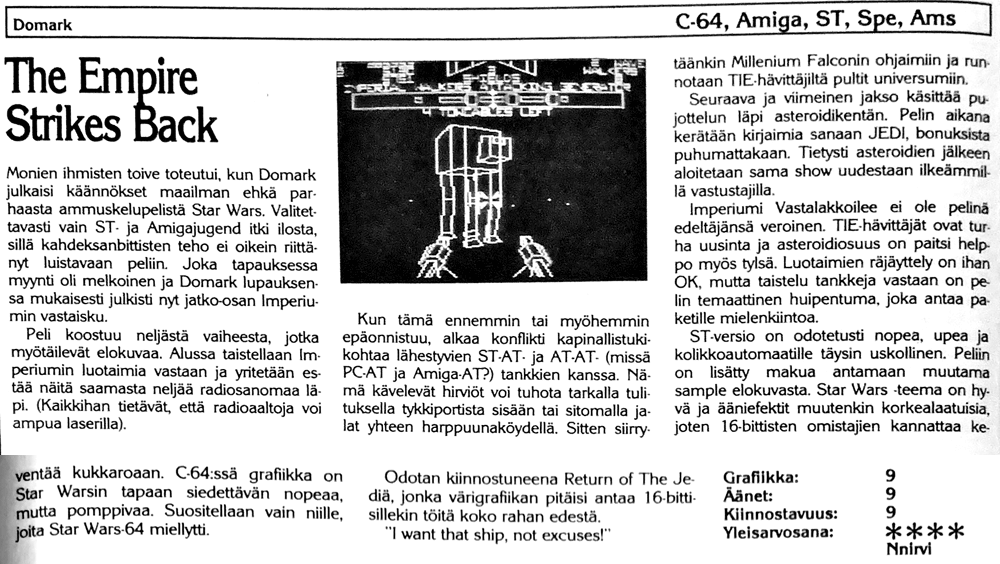
Kun tämä ennemmin tai myöhemmin epäonnistuu, alkaa konflikti kapinallistukikohtaa lähestyvien ST-AT- ja AT-AT- (missä PC-AT ja Amiga-AT?) tankkien kanssa. Nämä kävelevät hirviöt voi tuhota tarkalla tulituksella tykkiportista sisään tai sitomalla jalat yhteen harppuunaköydellä. Sitten siirrytäänkin Millenium Falconin ohjaimiin ja runnotaan TIE-hävittäjiltä pultit universumiin.
Seuraava ja viimeinen jakso käsittää pujottelun läpi asteroidikentän. Pelin aikana kerätään kirjaimia sanaan JEDI, bonuksista puhumattakaan. Tietysti asteroidien jälkeen aloitetaan sama show uudestaan ilkeämmillä vastustajilla.
Imperiumi Vastalakkoilee ei ole pelinä edeltäjänsä veroinen. TIE-hävittäjät ovat turha uusinta ja asteroidiosuus on paitsi helppo myös tylsä. Luotaimien räjäyttely on ihan OK, mutta taistelu tankkeja vastaan on pelin temaattinen huipentuma, joka antaa paketille mielenkiintoa.
ST-versio on odotetusti nopea, upea ja kolikkoautomaatille täysin uskollinen. Peliin on lisätty makua antamaan muutama sample elokuvasta. Star Wars -teema on hyvä ja ääniefektit muutenkin korkealaatuisia, joten 16-bittisten omistajien kannattaa keventää kukkaroaan. C-64:ssä grafiikka on Star Warsin tapaan siedettävän nopeaa, mutta pomppivaa. Suositellaan vain niille, joita Star Wars-64 miellytti.
Odotan kiinnostuneena Return of The Jediä, jonka värigrafiikan pitäisi antaa 16-bittisillekin töitä koko rahan edestä.
"I want that ship, not excuses!"
Empire Strikes Back, The1988PermalinkMany people's wish came true when Domark released the conversions of perhaps the world's best shoot-em-up, Star Wars. Unfortunately only the ST and Amiga Jugend wept for joy, since the eight-bit machines didn't quite have the power for a smooth-running game. In any case the sales were considerable, and Domark, true to its promise, has now released the sequel, The Empire Strikes Back.
The game consists of four stages that follow the film. First you fight the Imperial probes and try to stop them getting four radio messages through. (Everyone knows, of course, that you can shoot radio waves with a laser).
When this sooner or later fails, a conflict begins with the ST-AT and AT-AT (where are the PC-AT and Amiga-AT?) tanks closing in on the rebel base. These walking monsters can be destroyed with accurate fire into the gun port or by tying their legs together with a harpoon line. Then it's on to the controls of the Millenium Falcon to pound the bolts out of the TIE fighters and across the universe.
The next and final section consists of slaloming through an asteroid field. During the game you collect letters for the word JEDI, not to mention bonuses. After the asteroids, of course, the same show starts all over again with nastier opponents.
As a game, The Empire Goes Back On Strike doesn't measure up to its predecessor. The TIE fighters are a pointless rerun, and the asteroid section is not only easy but also dull. Blowing up the probes is perfectly OK, but the battle against the tanks is the thematic climax of the game, and it is what gives the package its interest.
The ST version is, as expected, fast, gorgeous and completely faithful to the coin-op. A few samples from the film have been added to give the game some flavour. The Star Wars theme is good and the sound effects are high quality all round, so 16-bit owners would do well to lighten their wallets. On the C-64 the graphics are tolerably fast, as in Star Wars, but jumpy. Recommended only for those who liked Star Wars-64.
I'm waiting with interest for Return of The Jedi, whose colour graphics should make even the 16-bit machines work for every penny.
"I want that ship, not excuses!"
Encounter
Encounter1987Pysyvä linkkiPintaliitäjäsi kiitää pitkin planeetan pintaa. Äärimmäistä tylsyyttä ei auta planeetan maasto, joka vihreän nurmen ja sinisen, oi niin sinisen taivaan lisäksi koostuu vain säännöllistä mustista monoliiteistä.
Pian vaihtuu ääni pilliin. Syvän avaruuden matalamieliset hirviöt katkaisevat rutiinin tehokkaasti. Erilaisia vihollisia (vaikkei välttämättä erinäköisiä) erilaisine taktiikkoineen tulee liukuhihnalta. On lentäviä lautasia, jotka ammuskelevat joko yksittäislaukauksia tai sitten mainioita haulikkoefektejä, jolloin koko tanner on täynnä luoteja. On myös ohjuksia, jotka eivät ammu mutta pyrkivät tuhoisaan kosketukseen. Eksterminoimalla kaksikymmentä vihollista voi yrittää päästä seuraavaan kenttään läpi vaarallisen hyperavaruuden jossa miljuunapäinen lauma palloja tulee kohti huimalla nopeudella.
Encounter perustuu tunnettuun ja rakastettuun peliin nimeltä Battlezone. Encounter ei kuitenkaan ole halpa kopio vaan peli, joka voi ylpeänä seistä omilla jaloillaan. Encounterin isä onkin Paul Woakes, joka ansaitsi paikkansa taivaassa pelillä Mercenary.
Ulkonäöllään Encounter tuskin vakuuttaa ketään. Kaikki koostuu tiukan geometrisista muodoista vailla yksityiskohtia. Mutta kun tätä vaatimatonta grafiikkaa liikutetaan niin järjettömän lujaa! Ja kun lisätään salamannopeita refleksejä vaativa taistelu on tuloksena yksi kuusnelkun parhaista taistelupeleistä kautta aikojen.
Encounter on niitä ohjelmia jotka kestävät yhtä kauan kuin kuusnelonenkin.
Encounter1987PermalinkYour skimmer races along the surface of the planet. The utter tedium isn't helped by the planet's terrain, which, apart from the green grass and the blue, oh so blue sky, consists only of regularly spaced black monoliths.
Soon it's a different tune altogether. The shallow-minded monsters of deep space break the routine very effectively. Different enemies (though not necessarily different-looking ones) with different tactics come rolling off the conveyor belt. There are flying saucers that fire either single shots or splendid shotgun effects, leaving the whole field full of bullets. There are also missiles that don't shoot but aim for destructive contact. By exterminating twenty enemies you can try to get through to the next level via perilous hyperspace, where a herd of balls a zillion head strong comes at you at dizzying speed.
Encounter is based on a well-known and much-loved game called Battlezone. Encounter is not a cheap copy, however, but a game that can proudly stand on its own two feet. Encounter's father is none other than Paul Woakes, who earned his place in heaven with the game Mercenary.
Encounter is hardly going to win anyone over with its looks. Everything is made up of strictly geometric shapes with no detail at all. But then these modest graphics are moved so insanely fast! And when you add combat that demands lightning-fast reflexes, the result is one of the best combat games on the Commodore 64 of all time.
Encounter is one of those programs that will last as long as the Commodore 64 itself.
Enduro Racer
Enduro Racer1987Pysyvä linkkiPelihalleissa ovat pauhanneet jo pitkään Hang On ja Enduro Racer. Hang On tuli kotimikroihin nimellä Super Cycle ja katso: hyvä peli olikin. Takapuskurin taa on nyt ilmestynyt kärkkymään Activisionin näkemys Enduro Racerista. Onko Super Cyclen kohtalonkello jo kaksitoista?
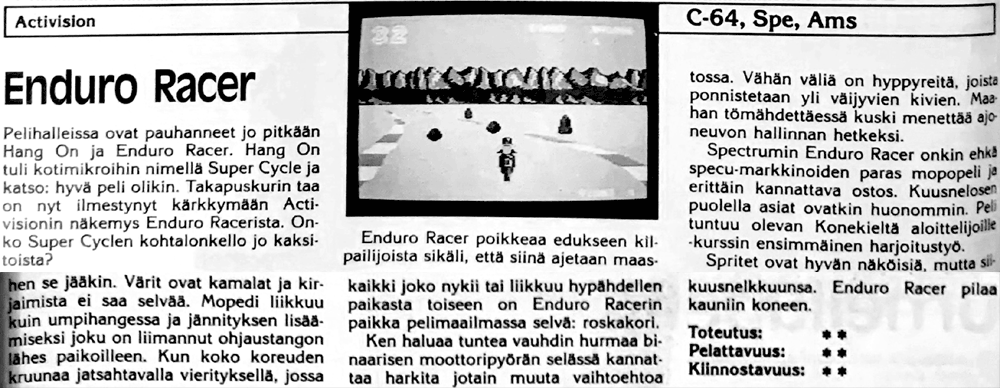
Enduro Racer poikkeaa edukseen kilpailijoista sikäli, että siinä ajetaan maastossa. Vähän väliä on hyppyreitä, joista ponnistetaan yli väijyvien kivien. Maahan tömähdettäessä kuski menettää ajoneuvon hallinnan hetkeksi.
Spectrumin Enduro Racer onkin ehkä specu-markkinoiden paras mopopeli ja erittäin kannattava ostos. Kuusnelosen puolella asiat ovatkin huonommin. Peli tuntuu olevan Konekieltä aloittelijoille -kurssin ensimmäinen harjoitustyö.
Spritet ovat hyvän näköisiä, mutta sihen se jääkin. Värit ovat kamalat ja kirjaimista ei saa selvää. Mopedi liikkuu kuin umpihangessa ja jännityksen lisäämiseksi joku on liimannut ohjaustangon lähes paikoilleen. Kun koko koreuden kruunaa jatsahtavalla vierityksellä, jossa kaikki joko nykii tai liikkuu hypähdellen paikasta toiseen on Enduro Racerin paikka pelimaailmassa selvä: roskakori.
Ken haluaa tuntea vauhdin hurmaa binaarisen moottoripyörän selässä kannattaa harkita jotain muuta vaihtoehtoa kuusnelkkuunsa. Enduro Racer pilaa kauniin koneen.
Enduro Racer1987PermalinkHang On and Enduro Racer have been roaring away in the arcades for a long time now. Hang On came to home micros under the name Super Cycle and behold: it was a good game. Now Activision's take on Enduro Racer has appeared right behind its rear bumper, waiting for its chance. Has the clock of doom already struck twelve for Super Cycle?
Enduro Racer stands out favourably from its competitors in that it's ridden off-road. Every so often there are jumps that launch you over lurking rocks. When you thump back down to earth, the rider loses control of the vehicle for a moment.
The Spectrum Enduro Racer is indeed perhaps the best bike game on the Spectrum market and a very worthwhile purchase. On the Commodore 64 side, though, things are worse. The game feels like the first practice assignment on a Machine Code for Beginners course.
The sprites look good, but that's where it ends. The colours are awful and you can't make out the lettering. The moped moves as if it were ploughing through deep snow, and to add to the excitement someone has glued the handlebars almost in place. When you crown the whole splendour with juddering scrolling in which everything either jerks or hops from one spot to the next, Enduro Racer's place in the gaming world is clear: the dustbin.
Whoever wants to feel the thrill of speed astride a binary motorbike would do well to consider some other option for their Commodore 64. Enduro Racer spoils a beautiful machine.
Enigma Force
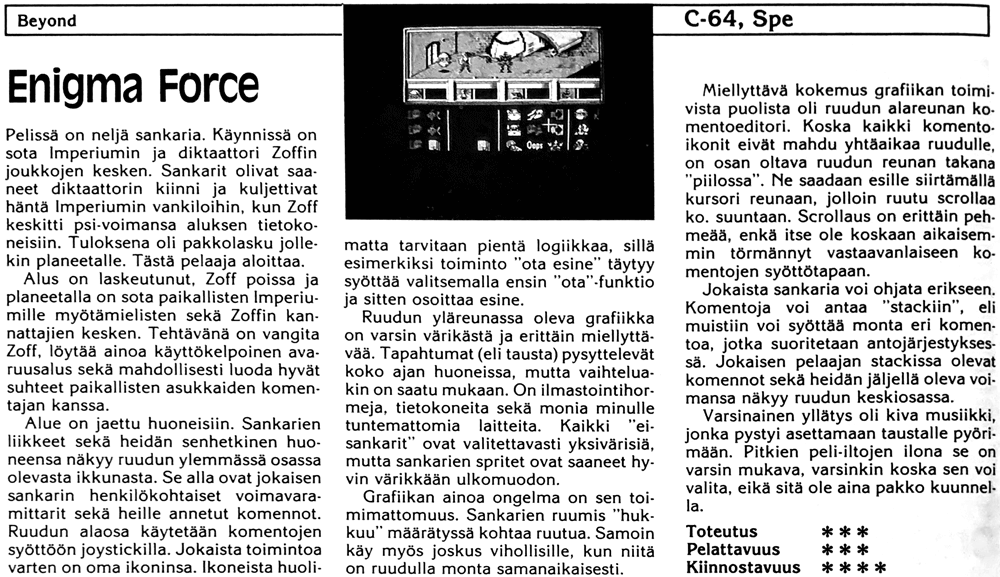
Enigma Force1987Pysyvä linkkiPelissä on neljä sankaria. Käynnissä on sota Imperiumin ja diktaattori Zoffin joukkojen kesken. Sankarit olivat saaneet diktaattorin kiinni ja kuljettivat häntä Imperiumin vankiloihin, kun Zoff keskitti psi-voimansa aluksen tietokoneisiin. Tuloksena oli pakkolasku jollekin planeetalle. Tästä pelaaja aloittaa.
Alus on laskeutunut, Zoff poissa ja planeetalla on sota paikallisten Imperiumille myötämielisten sekä Zoffin kannattajien kesken. Tehtävänä on vangita Zoff, löytää ainoa käyttökelpoinen avaruusalus sekä mahdollisesti luoda hyvät suhteet paikallisten asukkaiden komentajan kanssa.
Alue on jaettu huoneisiin. Sankarien liikkeet sekä heidän senhetkinen huoneensa näkyy ruudun ylemmässä osassa olevasta ikkunasta. Se alla ovat jokaisen sankarin henkilökohtaiset voimavaramittarit sekä heille annetut komennot. Ruudun alaosa käytetään komentojen syöttöön joystickilla. Jokaista toimintoa varten on oma ikoninsa. Ikoneista huolimatta tarvitaan pientä logiikkaa, sillä esimerkiksi toiminto "ota esine" täytyy syöttää valitsemalla ensin "ota"-funktio ja sitten osoittaa esine.
Ruudun yläreunassa oleva grafiikka on varsin värikästä ja erittäin miellyttävää. Tapahtumat (eli tausta) pysyttelevät koko ajan huoneissa, mutta vaihteluakin on saatu mukaan. On ilmastointihormeja, tietokoneita sekä monia minulle tuntemattomia laitteita. Kaikki "ei-sankarit" ovat valitettavasti yksivärisiä, mutta sankarien spritet ovat saaneet hyvin värikkään ulkomuodon.
Grafiikan ainoa ongelma on sen toimimattomuus. Sankarien ruumis "hukkuu" määrätyssä kohtaa ruutua. Samoin käy myös joskus vihollisille, kun niitä on ruudulla monta samanaikaisesti.
Miellyttävä kokemus grafiikan toimivista puolista oli ruudun alareunan komentoeditori. Koska kaikki komentoikonit eivät mahdu yhtäaikaa ruudulle, on osan oltava ruudun reunan takana "piilossa". Ne saadaan esille siirtämällä kursori reunaan, jolloin ruutu scrollaa ko. suuntaan. Scrollaus on erittäin pehmeää, enkä itse ole koskaan aikaisemmin törmännyt vastaavanlaiseen komentojen syöttötapaan.
Jokaista sankaria voi ohjata erikseen. Komentoja voi antaa "stackiin", eli muistiin voi syöttää monta eri komentoa, jotka suoritetaan antojärjestyksessä. Jokaisen pelaajan stackissa olevat komennot sekä heidän jäljellä oleva voimansa näkyy ruudun keskiosassa.
Varsinainen yllätys oli kiva musiikki, jonka pystyi asettamaan taustalle pyörimään. Pitkien peli-iltojen ilona se on varsin mukava, varsinkin koska sen voi valita, eikä sitä ole aina pakko kuunnella.
Enigma Force1987PermalinkThe game has four heroes. A war is under way between the Empire and the forces of the dictator Zoff. The heroes had captured the dictator and were transporting him to the Empire's prisons when Zoff focused his psi powers on the ship's computers. The result was a forced landing on some planet. This is where the player starts.
The ship has landed, Zoff is gone, and on the planet there's a war between locals sympathetic to the Empire and Zoff's supporters. The mission is to capture Zoff, find the only usable spaceship and possibly establish good relations with the commander of the local inhabitants.
The area is divided into rooms. The heroes' movements and the room they're currently in are shown in a window in the upper part of the screen. Below it are each hero's personal strength meters and the commands given to them. The lower part of the screen is used for entering commands with the joystick. Each action has its own icon. Despite the icons, a little logic is needed, since for example the action "take object" has to be entered by first selecting the "take" function and then pointing at the object.
The graphics at the top of the screen are very colourful and extremely pleasant. The action (that is, the backdrop) stays in rooms the whole time, but some variety has been worked in too. There are ventilation shafts, computers and many devices unknown to me. All the "non-heroes" are unfortunately single-coloured, but the heroes' sprites have been given a very colourful look.
The only problem with the graphics is that they don't work. The heroes' bodies "get lost" at a certain spot on the screen. The same sometimes happens to the enemies as well, when there are many of them on screen at once.
A pleasant experience on the working side of the graphics was the command editor at the bottom of the screen. Since not all the command icons fit on the screen at once, some of them have to be "hidden" beyond the edge of the screen. They're brought into view by moving the cursor to the edge, whereupon the screen scrolls in that direction. The scrolling is extremely smooth, and I myself have never come across a similar way of entering commands before.
Each hero can be controlled separately. Commands can be given into a "stack", meaning you can enter several different commands into memory, which are carried out in the order they were given. The commands in each player's stack, along with their remaining strength, are shown in the middle part of the screen.
The real surprise was the nice music, which could be set to play in the background. As a joy for long evenings of gaming it's rather pleasant, especially since it's optional and you don't always have to listen to it.
Escape from the Planet of the Robot Monsters
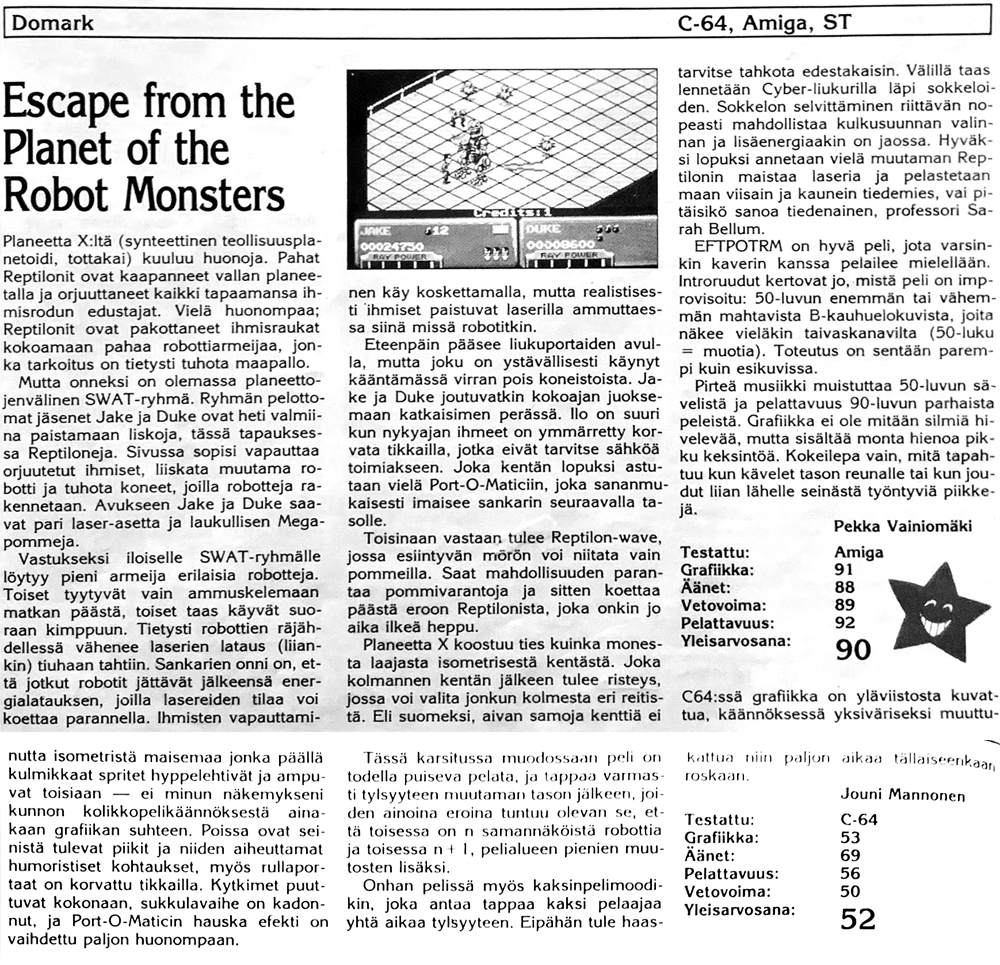
Escape from the Planet of the Robot Monsters1990 SyksyPysyvä linkkiPlaneetta X:ltä (synteettinen teollisuusplanetoidi, tottakai) kuuluu huonoja. Pahat Reptilonit ovat kaapanneet vallan planeetalla ja orjuuttaneet kaikki tapaamansa ihmisrodun edustajat. Vielä huonompaa; Reptilonit ovat pakottaneet ihmisraukat kokoamaan pahaa robottiarmeijaa, jonka tarkoitus on tietysti tuhota maapallo.
Mutta onneksi on olemassa planeettojenvälinen SWAT-ryhmä. Ryhmän pelottomat jäsenet Jake ja Duke ovat heti valmiina paistamaan liskoja, tässä tapauksessa Reptiloneja. Sivussa sopisi vapauttaa orjuutetut ihmiset, liiskata muutama robotti ja tuhota koneet, joilla robotteja rakennetaan. Avukseen Jake ja Duke saavat pari laser-asetta ja laukullisen Megapommeja.
Vastukseksi iloiselle SWAT-ryhmälle löytyy pieni armeija erilaisia robotteja. Toiset tyytyvät vain ammuskelemaan matkan päästä, toiset taas käyvät suoraan kimppuun. Tietysti robottien räjähdellessä vähenee laserien lataus (liiankin) tiuhaan tahtiin. Sankarien onni on, että jotkut robotit jättävät jälkeensä energialatauksen, joilla lasereiden tilaa voi koettaa parannella. Ihmisten vapauttaminen käy koskettamalla, mutta realistisesti ihmiset paistuvat laserilla ammuttaessa siinä missä robotitkin.
Eteenpäin pääsee liukuportaiden avulla, mutta joku on ystävällisesti käynyt kääntämässä virran pois koneistoista. Jake ja Duke joutuvatkin kokoajan juoksemaan katkaisimen perässä. Ilo on suuri kun nykyajan ihmeet on ymmärretty korvata tikkailla, jotka eivät tarvitse sähköä toimiakseen. Joka kentän lopuksi astutaan vielä Port-O-Maticiin, joka sananmukaisesti imaisee sankarin seuraavalla tasolle.
Toisinaan vastaan tulee Reptilon-wave, jossa esiintyvän mörön voi niitata vain pommeilla. Saat mahdollisuuden parantaa pommivarantoja ja sitten koettaa päästä eroon Reptilonista, joka onkin jo aika ilkeä heppu.
Planeetta X koostuu ties kuinka monesta laajasta isometrisestä kentästä. Joka kolmannen kentän jälkeen tulee risteys, jossa voi valita jonkun kolmesta eri reitistä. Eli suomeksi, aivan samoja kenttiä ei tarvitse tahkota edestakaisin. Välillä taas lennetään Cyber-liukurilla läpi sokkeloiden. Sokkelon selvittäminen riittävän nopeasti mahdollistaa kulkusuunnan valinnan ja lisäenergiaakin on jaossa. Hyväksi lopuksi annetaan vielä muutaman Reptilonin maistaa laseria ja pelastetaan maan viisain ja kaunein tiedemies, vai pitäisikö sanoa tiedenainen, professori Sarah Bellum.
EFTPOTRM on hyvä peli, jota varsinkin kaverin kanssa pelailee mielellään. Introruudut kertovat jo, mistä peli on improvisoitu: 50-luvun enemmän tai vähemmän mahtavista B-kauhuelokuvista, joita näkee vieläkin taivaskanavilta (50-luku = muotia). Toteutus on sentään parempi kuin esikuvissa.
Pirteä musiikki muistuttaa 50-luvun sävelistä ja pelattavuus 90-luvun parhaista peleistä. Grafiikka ei ole mitään silmiä hivelevää, mutta sisältää monta hienoa pikku keksintöä. Kokeilepa vain, mitä tapahtuu kun kävelet tason reunalle tai kun joudut liian lähelle seinästä työntyviä piikkejä.
C64:ssä grafiikka on yläviistosta kuvattua, käännöksessä yksiväriseksi muuttunutta isometristä maisemaa jonka päällä kulmikkaat spritet hyppelehtivät ja ampuvat toisiaan - ei minun näkemykseni kunnon kolikkopelikäännöksestä ainakaan grafiikan suhteen. Poissa ovat seinistä tulevat piikit ja niiden aiheuttamat humoristiset kohtaukset, myös rullaportaat on korvattu tikkailla. Kytkimet puuttuvat kokonaan, sukkulavaihe on kadonnut, ja Port-O-Maticin hauska efekti on vaihdettu paljon huonompaan.
Tässä karsitussa muodossaan peli on todella puiseva pelata, ja tappaa varmasti tylsyyteen muutaman tason jälkeen, joiden ainoina eroina tuntuu olevan se, että toisessa on n samannäköistä robottia ja toisessa n+1, pelialueen pienien muutosten lisäksi.
Onhan pelissä myös kaksinpelimoodikin, joka antaa tappaa kaksi pelaajaa yhtä aikaa tylsyyteen. Eipähän tule haaskattua niin paljon aikaa tällaiseenkaan roskaan.
Escape from the Planet of the Robot Monsters1990 SyksyPermalinkBad news from Planet X (a synthetic industrial planetoid, of course). The evil Reptilons have seized power on the planet and enslaved every member of the human race they have come across. Worse still: the Reptilons have forced the poor humans to assemble an evil robot army, whose purpose is, naturally, to destroy the Earth.
But luckily there is such a thing as an interplanetary SWAT team. The team's fearless members Jake and Duke are instantly ready to fry some lizards, in this case Reptilons. On the side it would be nice to free the enslaved humans, squash a few robots and destroy the machines the robots are built with. To help them out, Jake and Duke get a couple of laser guns and a bagful of Megabombs.
Standing in the way of the jolly SWAT team is a small army of assorted robots. Some are content just to take potshots from a distance, while others come straight at you. Naturally, as the robots go up in smoke, the lasers' charge drains at a (far too) brisk pace. Luckily for the heroes, some robots leave behind an energy charge with which you can try to perk your lasers up a bit. Humans are freed by touching them, but realistically enough, humans fry under laser fire just as well as robots do.
You get ahead by escalator, but someone has kindly been round to switch off the power to the machinery. So Jake and Duke are forever having to run after the switch. Great is the joy when someone has had the sense to replace these modern marvels with ladders, which need no electricity to work. At the end of every level you step into a Port-O-Matic, which quite literally sucks the hero up to the next level.
Every now and then you run into a Reptilon wave, where the bogeyman on show can only be taken out with bombs. You get the chance to top up your bomb supplies and then try to get rid of the Reptilon, who turns out to be a pretty nasty customer.
Planet X is made up of who knows how many sprawling isometric levels. After every third level comes a junction where you can pick one of three different routes. In plain English, you don't have to grind through exactly the same levels back and forth. Now and again you fly through mazes on a Cyber-glider. Getting through a maze quickly enough lets you choose which way to go, and there is bonus energy on offer too. As a fitting finale, you let a few more Reptilons taste laser and rescue the wisest and most beautiful man of science on Earth, or should that be woman of science, Professor Sarah Bellum.
EFTPOTRM is a good game, one you're happy to keep playing, especially with a friend. The intro screens already tell you what the game was riffed from: the more or less magnificent B-grade horror films of the fifties, which you can still catch on the sky channels (the fifties = in fashion). The execution is at least better than in the originals.
The perky music is reminiscent of fifties tunes, and the playability of the best games of the nineties. The graphics are no feast for the eyes, but they contain lots of neat little touches. Just try and see what happens when you walk to the edge of a platform or get too close to the spikes jutting out of the walls.
On the C64 the graphics are an isometric landscape viewed from diagonally above, turned monochrome in the conversion, on top of which blocky sprites hop about and shoot each other - not my idea of a proper coin-op conversion, at least as far as the graphics go. Gone are the spikes coming out of the walls and the comic scenes they cause, and the escalators have been replaced by ladders as well. The switches are missing altogether, the shuttle stage has vanished, and the Port-O-Matic's fun effect has been swapped for a much worse one.
In this stripped-down form the game is really wooden to play, and it is sure to bore you to death after a few levels, the only differences between which seem to be that one has n identical-looking robots and the next n+1, besides small changes to the play area.
There is a two-player mode as well, of course, which lets you bore two players to death at the same time. At least that way you don't waste quite so much time on rubbish like this either.
Espionage
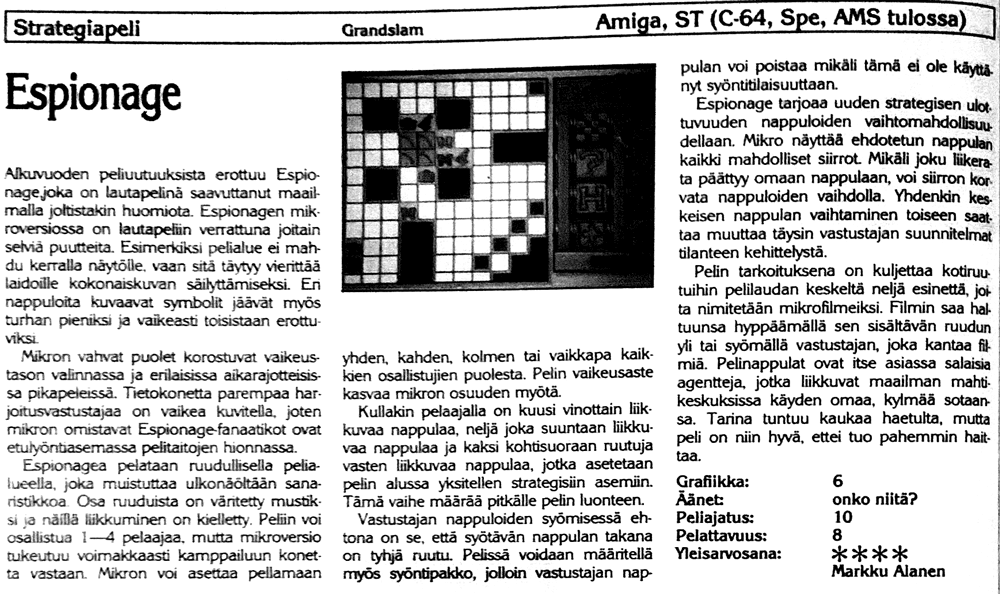
Espionage1989 KevätPysyvä linkkiAlkuvuoden peliuutuuksista erottuu Espionage,joka on lautapelinä saavuttanut maailmalla joltistakin huomiota. Espionagen mikroversiossa on lautapeliin verrattuna joitain selviä puutteita. Esimerkiksi pelialue ei mahdu kerralla näytölle, vaan sitä täytyy vierittää laidoille kokonaiskuvan säilyttämiseksi. Eri nappuloita kuvaavat symbolit jäävät myös turhan pieniksi ja vaikeasti toisistaan erottuviksi.
Mikron vahvat puolet korostuvat vaikeustason valinnassa ja erilaisissa aikarajotteisissa pikapeleissä. Tietokonetta parempaa harjoitusvastustajaa on vaikea kuvitella, joten mikron omistavat Espionage-fanaatikot ovat etulyöntiasemassa pelitaitojen hionnassa.
Espionagea pelataan ruudullisella pelialueella, joka muistuttaa ulkonäöltään sanaristikkoa. Osa ruuduista on väritetty mustiksi ja näillä liikkuminen on kielletty. Peliin voi osallistua 1-4 pelaajaa, mutta mikroversio tukeutuu voimakkaasti kamppailuun konetta vastaan. Mikron voi asettaa pellamaan yhden, kahden, kolmen tai vaikkapa kaikkien osallistujien puolesta. Pelin vaikeusaste kasvaa mikron osuuden myötä.
Kullakin pelaajalla on kuusi vinottain liikkuvaa nappulaa, neljä joka suuntaan liikkuvaa nappulaa ja kaksi kohtisuoraan ruutuja vasten liikkuvaa nappulaa, jotka asetetaan pelin alussa yksitellen strategisiin asemiin. Tämä vaihe määrää pitkälle pelin luonteen.
Vastustajan nappuloiden syömisessä ehtona on se, että syötävän nappulan takana on tyhjä ruutu. Pelissä voidaan määritellä myös syöntipakko, jolloin vastustajan nappulan voi poistaa mikäli tämä ei ole käyttänyt syöntitilaisuuttaan.
Espionage tarjoaa uuden strategisen ulottuvuuden nappuloiden vaihtomahdollisuudellaan. Mikro näyttää ehdotetun nappulan kaikki mahdolliset siirrot. Mikäli joku liikerata päättyy omaan nappulaan, voi siirron korvata nappuloiden vaihdolla. Yhdenkin keskeisen nappulan vaihtaminen toiseen saattaa muuttaa täysin vastustajan suunnitelmat tilanteen kehittelystä.
Pelin tarkoituksena on kuljettaa kotiruutuihin pelilaudan keskeltä neljä esinettä, joita nimitetään mikrofilmeiksi. Filmin saa haltuunsa hyppäämällä sen sisältävän ruudun yli tai syömällä vastustajan, joka kantaa filmiä. Pelinappulat ovat itse asiassa salaisia agentteja, jotka liikkuvat maailman mahtikeskuksissa käyden omaa, kylmää sotaansa. Tarina tuntuu kaukaa haetulta, mutta peli on niin hyvä, ettei tuo pahemmin haittaa.
Espionage1989 KevätPermalinkStanding out among the new games of early this year is Espionage, which as a board game has attracted a fair amount of attention around the world. Compared with the board game, the computer version of Espionage has some clear shortcomings. For example, the playing area doesn't fit on the screen all at once, so it has to be scrolled to the sides to keep hold of the overall picture. The symbols representing the different pieces are also needlessly small and hard to tell apart.
The computer's strengths come to the fore in the choice of difficulty level and in the various time-limited quick games. It's hard to imagine a better practice opponent than a computer, so Espionage fanatics who own a computer have a head start in honing their playing skills.
Espionage is played on a gridded playing area that looks like a crossword. Some of the squares are coloured black, and moving onto them is forbidden. The game can be played by 1-4 players, but the computer version leans heavily on battling against the machine. The computer can be set to play on behalf of one, two, three or even all of the participants. The game's difficulty increases with the computer's share.
Each player has six pieces that move diagonally, four pieces that move in every direction and two pieces that move at right angles to the squares; these are placed one at a time in strategic positions at the start of the game. This phase goes a long way towards deciding the character of the game.
The condition for capturing an opponent's pieces is that there's an empty square behind the piece being captured. Compulsory capture can also be switched on, in which case an opponent's piece can be removed if it has not used its chance to capture.
Espionage offers a new strategic dimension with its option of swapping pieces. The computer shows all the possible moves of the piece you nominate. If a path ends on one of your own pieces, the move can be replaced with a swap of the two pieces. Swapping even one key piece for another can completely change the opponent's plans for developing the position.
The object of the game is to carry four items, called microfilms, from the middle of the board to your home squares. You gain possession of a film by jumping over the square that holds it or by capturing an opposing piece that is carrying the film. The pieces are in fact secret agents moving around the world's centres of power, waging their own cold war. The story feels far-fetched, but the game is so good that it doesn't much matter.
European 5 A Side
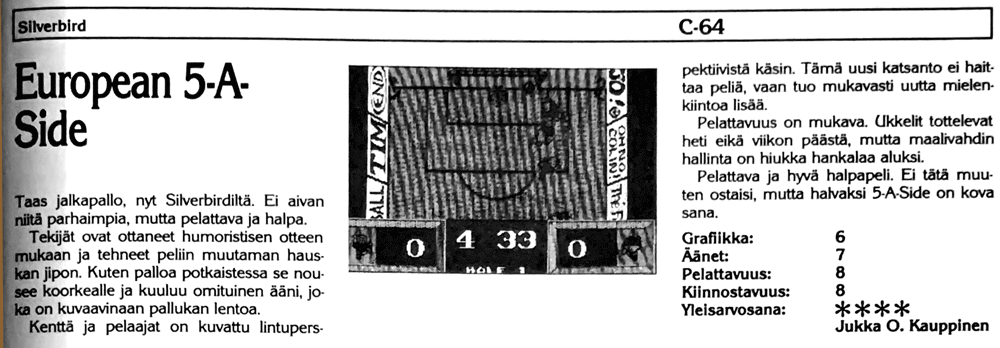
European 5 A Side1988Pysyvä linkkiTaas jalkapallo, nyt Silverbirdiltä. Ei aivan niitä parhaimpia, mutta pelattava ja halpa.
Tekijät ovat ottaneet humoristisen otteen mukaan ja tehneet peliin muutaman hauskan jipon. Kuten palloa potkaistessa se nousee koorkealle ja kuuluu omituinen ääni, joka on kuvaavinaan pallukan lentoa.
Kenttä ja pelaajat on kuvattu lintuperspektiivistä käsin. Tämä uusi katsanto ei haittaa peliä, vaan tuo mukavasti uutta mielenkiintoa lisää.
Pelattavuus on mukava. Ukkelit tottelevat heti eikä viikon päästä, mutta maalivahdin hallinta on hiukka hankalaa aluksi.
Pelattava ja hyvä halpapeli. Ei tätä muuten ostaisi, mutta halvaksi 5-A-Side on kova sana.
European 5 A Side1988PermalinkFootball again, this time from Silverbird. Not quite one of the very best, but playable and cheap.
The makers have taken a humorous approach and put a few funny gags into the game. Like how, when you kick the ball, it soars sky-high and you hear a peculiar noise that is supposed to depict the little ball's flight.
The pitch and the players are shown from a bird's-eye view. This new angle doesn't hurt the game; instead it adds a nice bit of fresh interest.
The playability is nice. The little guys obey right away and not a week later, but controlling the goalkeeper is a bit tricky at first.
A playable and good budget game. You wouldn't buy it otherwise, but for a cheapie 5-A-Side is hot stuff.
Everyone's a Wally
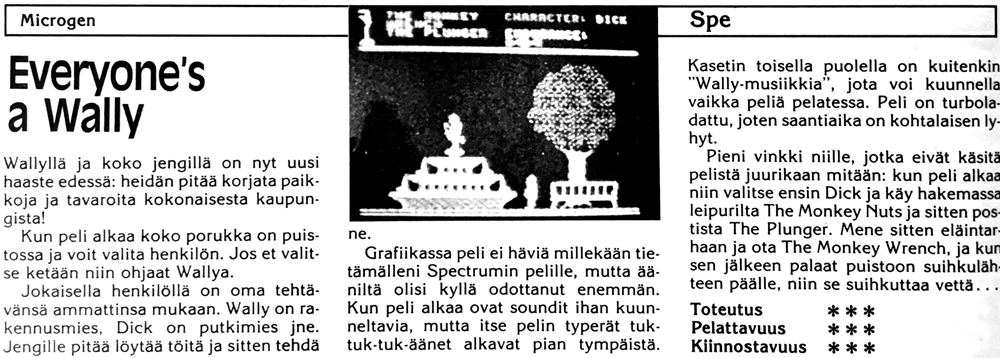
Everyone's a Wally1987Pysyvä linkkiWallyllä ja koko jengillä on nyt uusi haaste edessä: heidän pitää korjata paikkoja ja tavaroita kokonaisesta kaupungista!
Kun peli alkaa koko porukka on puistossa ja voit valita henkilön. Jos et valitse ketään niin ohjaat Wallya.
Jokaisella henkilöllä on oma tehtävänsä ammattinsa mukaan. Wally on rakennusmies, Dick on putkimies jne. Jengille pitää löytää töitä ja sitten tehdä ne.
Grafiikassa peli ei häviä millekään tietämälleni Spectrumin pelille, mutta ääniltä olisi kyllä odottanut enemmän. Kun peli alkaa ovat soundit ihan kuunneltavia, mutta itse pelin typerät tuk-tuk-tuk-äänet alkavat pian tympäistä.
Kasetin toisella puolella on kuitenkin "Wally-musiikkia", jota voi kuunnella vaikka peliä pelatessa. Peli on turboladattu, joten saantiaika on kohtalaisen lyhyt.
Pieni vinkki niille, jotka eivät käsitä pelistä juurikaan mitään: kun peli alkaa niin valitse ensin Dick ja käy hakemassa leipurilta The Monkey Nuts ja sitten postista The Plunger. Mene sitten eläintarhaan ja ota The Monkey Wrench, ja kun sen jälkeen palaat puistoon suihkulähteen päälle, niin se suihkuttaa vettä. . .
Everyone's a Wally1987PermalinkWally and the whole gang now have a new challenge ahead of them: they have to fix up places and things across an entire town!
When the game starts, the whole crew is in the park and you can pick a character. If you don't pick anyone, you control Wally.
Each character has their own job according to their trade. Wally is a builder, Dick is a plumber, and so on. You have to find work for the gang and then get it done.
Graphically the game doesn't lose out to any Spectrum game I know of, but I'd certainly have expected more from the sound. When the game starts the sounds are perfectly listenable, but the stupid tuk-tuk-tuk noises of the game itself soon start to grate.
On the other side of the tape, though, there's some "Wally music", which you can listen to while playing the game, if you like. The game is turbo-loaded, so the loading time is reasonably short.
A little tip for those who can't make much sense of the game at all: when the game starts, pick Dick first and go and fetch The Monkey Nuts from the baker's and then The Plunger from the post office. Then go to the zoo and take The Monkey Wrench, and when you then go back to the park and stand on top of the fountain, it sprays water...
Executioner, The
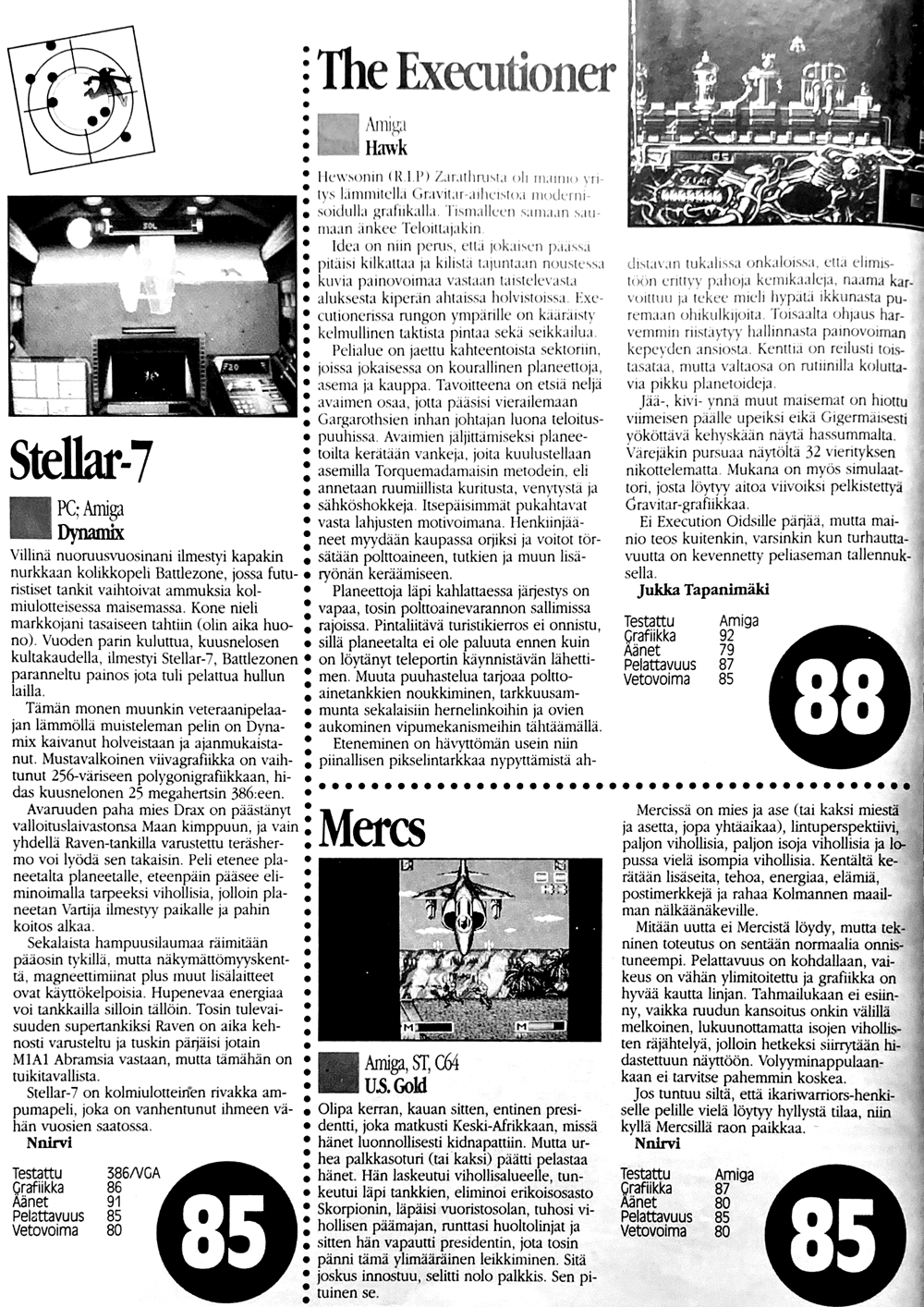
Executioner, The1991 SyksyPysyvä linkkiHewsonin (R.I.P) Zarathrusta oli mainio yritys lämmitellä Gravitar-aiheistoa modernisoidulla grafiikalla. Tismalleen samaan saumaan änkee Teloittajakin.
Idea on niin perus, että jokaisen päässä pitäisi kilkattaa ja kilistä tajuntaan noustessa kuvia painovoimaa vastaan taistelevasta aluksesta kiperän ahtaissa holvistoissa. Executionerissa rungon ympärille on kääräisty kelmullinen taktista pintaa sekä seikkailua.
Pelialue on jaettu kahteentoista sektoriin, joissa jokaisessa on kourallinen planeettoja, asema ja kauppa. Tavoitteena on etsiä neljä avaimen osaa, jotta pääsisi vierailemaan Gargarothsien inhan johtajan luona teloituspuuhissa. Avaimien jäljittämiseksi planeetoilta kerätään vankeja, joita kuulustellaan asemilla Torquemadamaisin metodein, eli annetaan ruumiillista kuritusta, venytystä ja sähköshokkeja. Itsepäisimmät pukahtavat vasta lahjusten motivoimana. Henkiinjääneet myydään kaupassa orjiksi ja voitot törsätään polttoaineen, tutkien ja muun lisäryönän keräämiseen.
Planeettoja läpi kahlattaessa järjestys on vapaa, tosin polttoainevarannon sallimissa rajoissa. Pintaliitävä turistikierros ei onnistu, sillä planeetalta ei ole paluuta ennen kuin on löytänyt teleportin käynnistävän lähettimen. Muuta puuhastelua tarjoaa polttoainetankkien noukkiminen, tarkkuusammunta sekalaisiin hernelinkoihin ja ovien aukominen vipumekanismeihin tähtäämällä.
Eteneminen on hävyttömän usein niin piinallisen pikselintarkkaa nypyttämistä ahdistavan tukalissa onkaloissa, että elimistöön erittyy pahoja kemikaaleja, naama karvoittuu ja tekee mieli hypätä ikkunasta puremaan ohikulkijoita. Toisaalta ohjaus harvemmin riistäytyy hallinnasta painovoiman kepeyden ansiosta. Kenttiä on reilusti toistasataa, mutta valtaosa on rutiinilla koluttavia pikku planetoideja.
Jää-, kivi- ynnä muut maisemat on hiottu viimeisen päälle upeiksi eikä Gigermäisesti yököttävä kehyskään näytä hassummalta. Värejäkin pursuaa näytöltä 32 vierityksen nikottelematta. Mukana on myös simulaattori, josta löytyy aitoa viivoiksi pelkistettyä Gravitar-grafiikkaa.
Ei Execution Oidsille pärjää, mutta mainio teos kuitenkin, varsinkin kun turhauttavuutta on kevennetty peliaseman tallennuksella.
Executioner, The1991 SyksyPermalinkHewson's (R.I.P) Zarathrusta was a splendid attempt at reheating the Gravitar theme with modernised graphics. The Executioner, too, crams itself into exactly the same slot.
The idea is so basic that bells ought to be clinking and jingling in everyone's head as images float up into consciousness of a ship battling against gravity in fiendishly cramped vaults. In Executioner the skeleton has been wrapped in a clingfilm layer of tactical surface and adventure.
The playing area is divided into twelve sectors, each with a handful of planets, a station and a shop. The goal is to find the four parts of a key so that you can pay a visit to the Gargaroths' nasty leader on execution business. To track down the keys you collect prisoners from the planets and interrogate them at the stations using Torquemada-like methods, i.e. corporal punishment, stretching and electric shocks. The most stubborn only let out a peep when motivated by bribes. The survivors are sold into slavery at the shop and the profits blown on stocking up with fuel, radars and other extra junk.
When wading through the planets the order is free, though within the limits of your fuel reserves. A skim-the-surface sightseeing tour is not an option, because there's no leaving a planet until you've found the transmitter that activates the teleport. Other things to potter about with are picking up fuel tanks, precision shooting at assorted peashooters and opening doors by aiming at lever mechanisms.
Progress is outrageously often such agonisingly pixel-precise nudging about in oppressively tight caverns that your body starts secreting nasty chemicals, hair sprouts on your face and you feel like jumping out of the window and biting passers-by. On the other hand, the controls seldom get out of hand, thanks to the lightness of the gravity. There are well over a hundred levels, but the vast majority are little planetoids you can comb through on routine.
The ice, rock and other landscapes have been polished to perfection and look superb, and the Gigeresquely nauseating frame doesn't look too bad either. Colours burst from the screen too, 32 of them, with no hiccups in the scrolling. There's also a simulator featuring authentic Gravitar graphics pared down to lines.
Execution is no match for Oids, but it's a splendid piece of work all the same, especially as the frustration has been eased by letting you save your game position.
Exploding Fist +
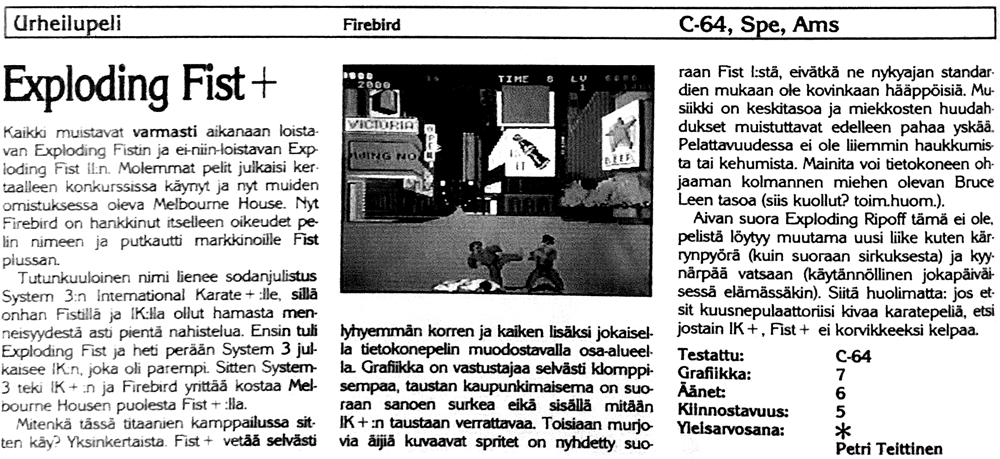
Exploding Fist +1989 KevätPysyvä linkkiKaikki muistavat varmasti aikanaan loistavan Exploding Fistin ja ei-niin-loistavan Exploding Fist II:n. Molemmat pelit julkaisi kertaalleen konkurssissa käynyt ja nyt muiden omistuksessa oleva Melbourne House. Nyt Firebird on hankkinut itselleen oikeudet pelin nimeen ja putkautti markkinoille Fist plussan.
Tutunkuuloinen nimi lienee sodanjulistus System 3:n International Karate+:lle, sillä onhan Fistillä ja IK:lla ollut hamasta menneisyydestä asti pientä nahistelua. Ensin tuli Exploding Fist ja heti perään System 3 julkaisee IK:n, joka oli parempi. Sitten System-3 teki IK+:n ja Firebird yrittää kostaa Melbourne Housen puolesta Fist+:lla.
Mitenkä tässä titaanien kamppailussa sitten käy? Yksinkertaista. Fist+ vetää selvästi lyhyemmän korren ja kaiken lisäksi jokaisella tietokonepelin muodostavalla osa-alueella. Grafiikka on vastustajaa selvästi klomppisempaa, taustan kaupunkimaisema on suoraan sanoen surkea eikä sisällä mitään IK+:n taustaan verrattavaa. Toisiaan murjovia äijiä kuvaavat spritet on nyhdetty suoraan Fist I:stä, eivätkä ne nykyajan standardien mukaan ole kovinkaan hääppöisiä. Musiikki on keskitasoa ja miekkosten huudahdukset muistuttavat edelleen pahaa yskää. Pelattavuudessa ei ole liiemmin haukkumista tai kehumista. Mainita voi tietokoneen ohjaaman kolmannen miehen olevan Bruce Leen tasoa (siis kuollut? toim.huom.).
Aivan suora Exploding Ripoff tämä ei ole, pelistä löytyy muutama uusi liike kuten kärrynpyörä (kuin suoraan sirkuksesta) ja kyynärpää vatsaan (käytännöllinen jokapäiväisessä elämässäkin). Siitä huolimatta: jos etsit kuusnepulaattoriisi kivaa karatepeliä, etsi jostain IK+, Fist+ ei korvikkeeksi kelpaa.
Exploding Fist +1989 KevätPermalinkEveryone surely remembers Exploding Fist, brilliant in its day, and the not-so-brilliant Exploding Fist II. Both games were published by Melbourne House, which has been through bankruptcy once and is now in other hands. Now Firebird has acquired the rights to the game's name and squeezed Fist plus out onto the market.
The familiar-sounding name is presumably a declaration of war on System 3's International Karate+, since Fist and IK have, after all, had a bit of a spat going since time immemorial. First came Exploding Fist, and straight after it System 3 puts out IK, which was better. Then System-3 made IK+, and Firebird tries to take revenge on Melbourne House's behalf with Fist+.
So how does this clash of the titans turn out, then? Simple. Fist+ clearly draws the shorter straw, and on top of it all in every single area that makes up a computer game. The graphics are clearly clunkier than the opponent's, and the city skyline in the background is frankly pitiful and contains nothing to compare with IK+'s background. The sprites depicting the blokes beating each other up have been plucked straight out of Fist I, and by today's standards they're not all that hot. The music is middling, and the chaps' yells still sound like a bad cough. There isn't much to either knock or praise in the playability. It may be mentioned that the computer-controlled third man is up to Bruce Lee's level (i.e. dead? ed. note).
This isn't quite a straight Exploding Ripoff; the game has a few new moves such as the cartwheel (as if straight from the circus) and the elbow to the stomach (handy in everyday life too). Even so: if you're looking for a nice karate game for your C-64, hunt down IK+ from somewhere, because Fist+ won't do as a substitute.
Explorer
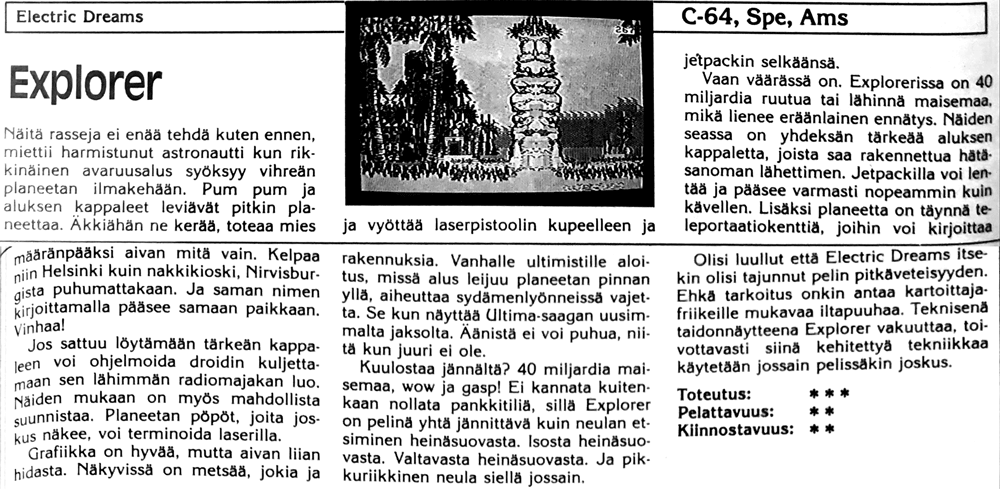
Explorer1987Pysyvä linkkiNäitä rasseja ei enää tehdä kuten ennen, miettii harmistunut astronautti kun rikkinäinen avaruusalus syöksyy vihreän planeetan ilmakehään. Pum pum ja aluksen kappaleet leviävät pitkin planeettaa. Äkkiähän ne kerää, toteaa mies ja vyöttää laserpistoolin kupeelleen ja jetpackin selkäänsä.
Vaan väärässä on. Explorerissa on 40 miljardia ruutua tai lähinnä maisemaa, mikä lienee eräänlainen ennätys. Näiden seassa on yhdeksän tärkeää aluksen kappaletta, joista saa rakennettua hätäsanoman lähettimen. Jetpackilla voi lentää ja pääsee varmasti nopeammin kuin kävellen. Lisäksi planeetta on täynnä teleportaatiokenttiä, joihin voi kirjoittaa määränpääksi aivan mitä vain. Kelpaa niin Helsinki kuin nakkikioski, Nirvisburgista puhumattakaan. Ja saman nimen kirjoittamalla pääsee samaan paikkaan. Vinhaa!
Jos sattuu löytämään tärkeän kappaleen voi ohjelmoida droidin kuljettamaan sen lähimmän radiomajakan luo. Näiden mukaan on myös mahdollista suunnistaa. Planeetan pöpöt, joita joskus näkee, voi terminoida laserilla.
Grafiikka on hyvää, mutta aivan liian hidasta. Näkyvissä on metsää, jokia ja rakennuksia. Vanhalle ultimistille aloitus, missä alus leijuu planeetan pinnan yllä, aiheuttaa sydämenlyönneissä vajetta. Se kun näyttää Ultima-saagan uusimmalta jaksolta. Äänistä ei voi puhua, niitä kun juuri ei ole.
Kuulostaa jännältä? 40 miljardia maisemaa, wow ja gasp! Ei kannata kuitenkaan nollata pankkitiliä, sillä Explorer on pelinä yhtä jännittävä kuin neulan etsiminen heinäsuovasta. Isosta heinäsuovasta. Valtavasta heinäsuovasta. Ja pikkuriikkinen neula siellä jossain.
Olisi luullut että Electric Dreams itsekin olisi tajunnut pelin pitkäveteisyyden. Ehkä tarkoitus onkin antaa kartoittajafriikeille mukavaa iltapuuhaa. Teknisenä taidonnäytteenä Explorer vakuuttaa, toivottavasti siinä kehitettyä tekniikkaa käytetään jossain pelissäkin joskus.
Explorer1987PermalinkThey don't make these old crates like they used to, muses the disgruntled astronaut as his broken-down spaceship plunges into the atmosphere of a green planet. Boom boom, and pieces of the ship scatter all over the planet. I'll have those gathered up in no time, the man declares, strapping a laser pistol to his hip and a jetpack onto his back.
But he's wrong. Explorer has 40 billion screens, or rather landscapes, which must be some kind of record. Somewhere among them are nine important pieces of the ship, from which you can build a distress beacon transmitter. You can fly with the jetpack, and it's sure to get you there faster than walking. What's more, the planet is full of teleport fields where you can type in absolutely anything as your destination. Helsinki will do just as well as a hot dog stand, not to mention Nirvisburg. And typing the same name gets you to the same place. Nifty!
If you happen to find an important piece, you can program a droid to carry it to the nearest radio beacon. You can also navigate by these beacons. The planet's creepy-crawlies, which you see now and then, can be terminated with the laser.
The graphics are good, but far too slow. On view are forests, rivers and buildings. For an old Ultima-ist, the opening, where the ship hovers above the planet's surface, causes a heartbeat deficit. That's because it looks just like the latest episode of the Ultima saga. There's no talking about the sound, since there barely is any.
Sounds exciting? 40 billion landscapes, wow and gasp! Don't go emptying your bank account, though, because as a game Explorer is about as exciting as looking for a needle in a haystack. A big haystack. A huge haystack. And a teeny-tiny needle somewhere in there.
You'd have thought Electric Dreams themselves would have realised how tedious the game is. Maybe the idea is to give mapping freaks a nice way to pass their evenings. As a technical showpiece Explorer is convincing; hopefully the technology developed for it will get used in some game too one of these days.
Express Raider
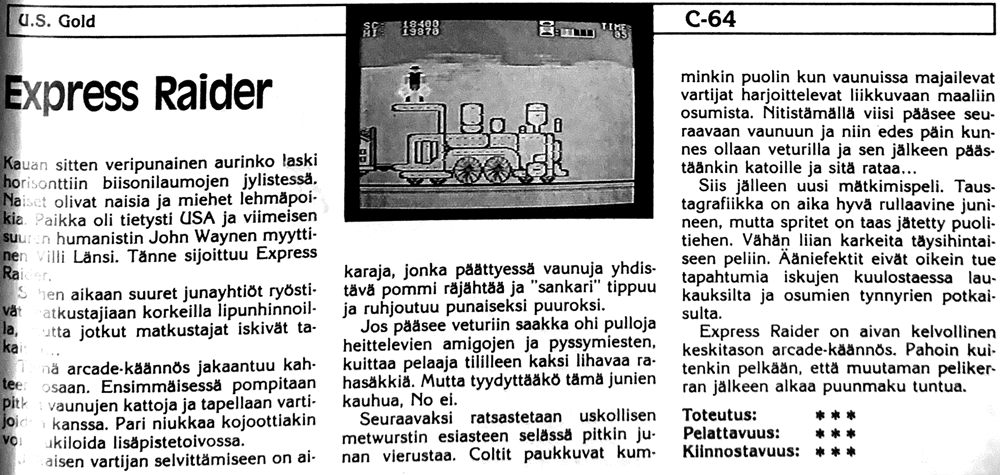
Express Raider1987Pysyvä linkkiKauan sitten veripunainen aurinko laski horisonttiin biisonilaumojen jylistessä. Naiset olivat naisia ja miehet lehmäpoikia. Paikka oli tietysti USA ja viimeisen suuren humanistin John Waynen myyttinen Villi Länsi. Tänne sijoittuu Express Raider.
Siihen aikaan suuret junayhtiöt ryöstivät matkustajiaan korkeilla lipunhinnoilla, mutta jotkut matkustajat iskivät takaisin...
Tämä arcade-käännös jakaantuu kahteen osaan. Ensimmäisessä pompitaan pitkin vaunujen kattoja ja tapellaan vartijoiden kanssa. Pari niukkaa kojoottiakin voi mukiloida lisäpistetoivossa.
Jokaisen vartijan selvittämiseen on aikaraja, jonka päättyessä vaunuja yhdistävä pommi räjähtää ja "sankari" tippuu ja ruhjoutuu punaiseksi puuroksi.
Jos pääsee veturiin saakka ohi pulloja heittelevien amigojen ja pyssymiesten, kuittaa pelaaja tililleen kaksi lihavaa rahasäkkiä. Mutta tyydyttääkö tämä junien kauhua, No ei.
Seuraavaksi ratsastetaan uskollisen metwurstin esiasteen selässä pitkin junan vierustaa. Coltit paukkuvat kumminkin puolin kun vaunuissa majailevat vartijat harjoittelevat liikkuvaan maaliin osumista. Nitistämällä viisi pääsee seuraavaan vaunuun ja niin edes päin kunnes ollaan veturilla ja sen jälkeen päästäänkin katoille ja sitä rataa...
Siis jälleen uusi mätkimispeli. Taustagrafiikka on aika hyvä rullaavine junineen, mutta spritet on taas jätetty puolitiehen. Vähän liian karkeita täysihintaiseen peliin. Ääniefektit eivät oikein tue tapahtumia iskujen kuulostaessa laukauksilta ja osumien tynnyrien potkaisulta.
Express Raider on aivan kelvollinen keskitason arcade-käännös. Pahoin kuitenkin pelkään, että muutaman pelikerran jälkeen alkaa puunmaku tuntua.
Express Raider1987PermalinkLong ago, the blood-red sun sank below the horizon as herds of bison thundered past. Women were women and men were cowboys. The place was, of course, the USA and the mythical Wild West of the last great humanist, John Wayne. This is where Express Raider is set.
In those days the big railroad companies robbed their passengers with sky-high ticket prices, but some passengers struck back...
This arcade conversion is split into two parts. In the first you hop along the carriage roofs and fight the guards. You can also clobber a couple of scrawny coyotes in the hope of extra points.
There's a time limit for dealing with each guard, and when it runs out the bomb on the coupling between the carriages goes off and the "hero" falls off and gets mashed into red porridge.
If you make it all the way to the locomotive, past the bottle-throwing amigos and the gunmen, the player gets two fat sacks of money credited to their account. But does this satisfy the scourge of the railroads? Well, no.
Next you ride along the side of the train on the back of your faithful metwurst-in-the-making. Colts blaze on both sides as the guards holed up in the carriages practise hitting a moving target. Bump off five and you move on to the next carriage, and so forth until you reach the locomotive, after which it's back up onto the roofs, and so on down the line...
So, yet another beat-'em-up. The background graphics are pretty good, with the train rolling along, but once again the sprites have been left half-finished. A bit too crude for a full-price game. The sound effects don't really back up the action either, with the punches sounding like gunshots and the hits like someone kicking a barrel.
Express Raider is a perfectly decent mid-range arcade conversion. I sorely fear, though, that after a few goes it will start to taste like sawdust.
Exterminator

Exterminator1991 SyksyPysyvä linkkiJalavakadun ihmiset täyttää hätä. Tuhannet hyönteiset, tuho-eläimet ja henkiinheränneet leikkikalut ovat hyökänneet ja vallanneet heidän talonsa, koirankoppinsa ja ennen kaikkea autotallinsa. Ketä voidaan kutsua apuun? Ghostbusters! Ei, vaan tuholaistuhooja Exterminator!
Exterminator parkkeeraa hyönteistorjuntakärrynsä ensimmäisen talon edustalle ja ottaa sisään mennessään mukaan välineensä. Mitkä välineet? Singon, ympäristömyrkyn ja Raidin? Ei, vaan kätensä! Exterminator voi ampua sormistaan tainnuttavia lasereita, läiskiä ja rusentaa lentäviä ötököitä, ja mikä parasta _ iskeä länään lattialla taapertavia kiusankappaleita.
Erilaista pelissä shoot em' uppeihin verrattuna on se, että torjujasta näkyy vain käsi tai kaksinpelissä molemmat. Kuulostaa jännältä idealta ja sitä se onkin. Vastaan tulee kärpäsiä ja muita lenteleviä, lattialla vilisee kaikenkarvaista ja -näköistä ekokatastrofia lelutankista hämähäkkeihin. Elukat kaiken lisäksi eivät suhtaudu oikein vakavasti saamiinsa terroristintuomioihin, vaan panevat rankasti vastaan. Kun selviää tappajatomaateista seuraavaan huoneeseen, alkaa sama uudelleen entistä kovemmilla tuholaisilla. Jos onnistuu de-buggaamaan koko talon, odottaa seuraava tölli selvittäjäänsä.
Peli on käännetty suoraan samannimisestä kolikkopelistä, joka huhupuheiden mukaan on vielä Amiga-versiota näyttävämpi. Mukana on digitoituja sampleja kuten sammakon litsahtaminen käden alla. Aito sample vai ei, sitä tutkii eläinsuojeluyhdistys. Kokonaisuus poikii tässäkin muutaman peli-illan varsinkin kaksinpelinä, mutta kiinnostus lopahtaa aika pian. Vaikeustaso tuntuu aluksi rankalta, mutta peliin perehdyttyä helpohkolta. Suositellaan harjoituksena ensi kesän hyttysaaltoa vastaan.
Exterminator1991 SyksyPermalinkPanic grips the people of Elm Street. Thousands of insects, vermin and toys come to life have attacked and taken over their houses, their dog kennels and above all their garages. Who you gonna call? Ghostbusters! No - pest-pulveriser Exterminator!
Exterminator parks the insect-control wagon in front of the first house and takes the tools of the trade along on the way in. What tools? A bazooka, eco-poison and Raid? No - a pair of hands! Exterminator can fire stunning lasers from the fingers, swat and crush flying bugs, and best of all - smash flat the little nuisances toddling across the floor.
What's different about the game compared with shoot 'em ups is that all you see of the exterminator is a hand, or in two-player mode both of them. Sounds like a nifty idea, and that's just what it is. Flies and other flying things come at you, and the floor teems with eco-catastrophe of every stripe and shape, from toy tanks to spiders. On top of everything, the critters don't take the terrorist verdicts they've been handed all that seriously, but fight back hard. When you make it past the killer tomatoes into the next room, the same thing starts all over again with even tougher pests. If you manage to de-bug the whole house, the next shack is waiting for someone to sort it out.
The game has been converted straight from the coin-op of the same name, which rumour has it is even flashier than the Amiga version. There are digitised samples included, such as the squelch of a frog under your hand. Real sample or not? The animal protection society is looking into it. Here too the package spawns a few evenings of play, especially as a two-player game, but interest fizzles out pretty soon. The difficulty level feels tough at first, but fairly easy once you've got to grips with the game. Recommended as practice for next summer's wave of mosquitoes.
Eye Of Beholder
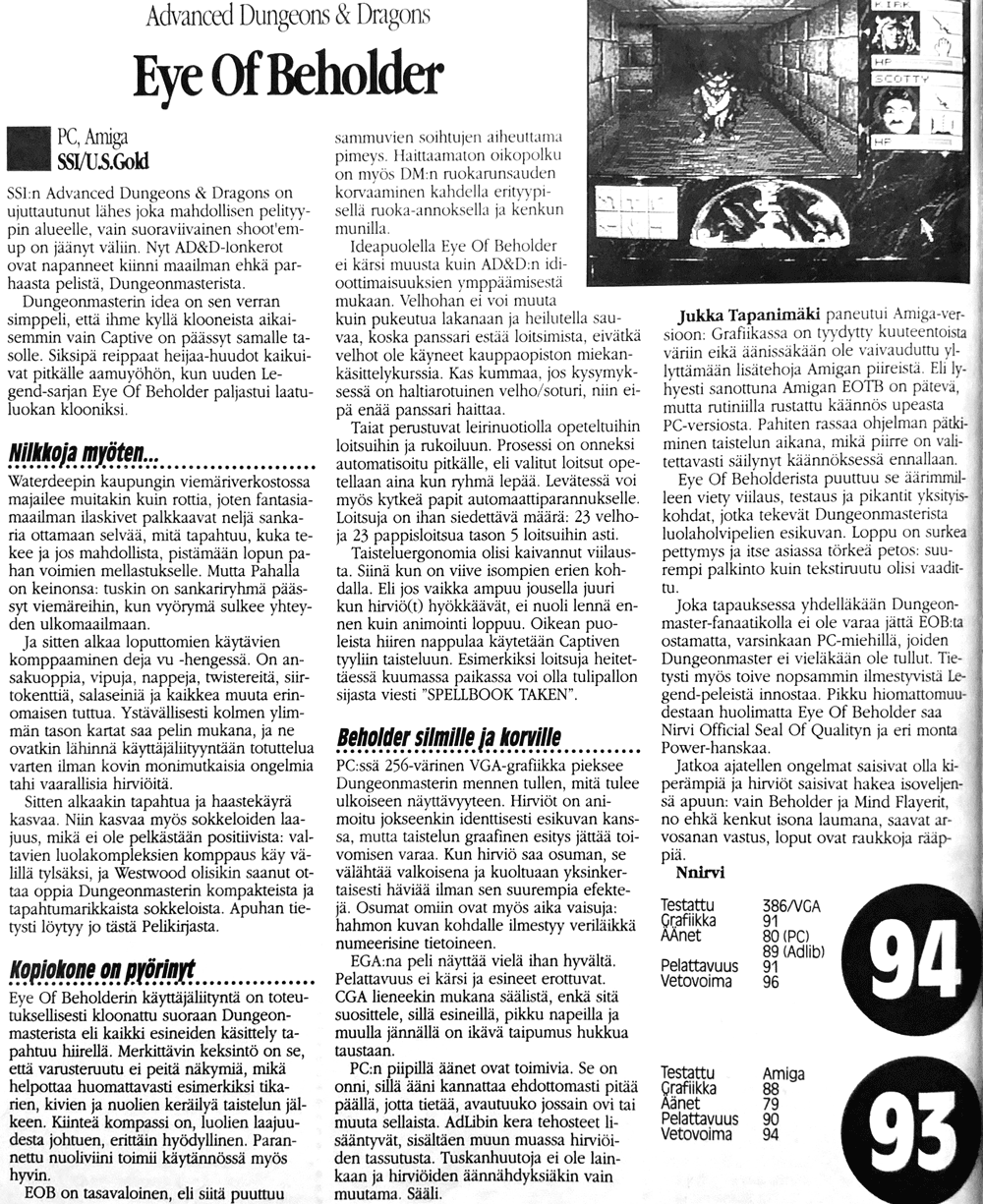
Eye Of Beholder1991 SyksyPysyvä linkkiSSI:n Advanced Dungeons & Dragons on ujuttautunut lähes joka mahdollisen pelityypin alueelle, vain suoraviivainen shoot'em-up on jäänyt väliin. Nyt AD&D-lonkerot ovat napanneet kiinni maailman ehkä parhaasta pelistä, Dungeonmasterista.
Dungeonmasterin idea on sen verran simppeli, että ihme kyllä klooneista aikaisemmin vain Captive on päässyt samalle tasolle. Siksipä reippaat heijaa-huudot kaikuivat pitkälle aamuyöhön, kun uuden Legend-sarjan Eye Of Beholder paljastui laatuluokan klooniksi.
Nilkkoja myöten...
Waterdeepin kaupungin viemäriverkostossa majailee muitakin kuin rottia, joten fantasiamaailman ilaskivet palkkaavat neljä sankaria ottamaan selvää, mitä tapahtuu, kuka tekee ja jos mahdollista, pistämään lopun pahan voimien mellastukselle. Mutta Pahalla on keinonsa: tuskin on sankariryhmä päässyt viemäreihin, kun vyörymä sulkee yhteyden ulkomaailmaan.
Ja sitten alkaa loputtomien käytävien komppaaminen deja vu -hengessä. On ansakuoppia, vipuja, nappeja, twistereitä, siirtokenttiä, salaseiniä ja kaikkea muuta erinomaisen tuttua. Ystävällisesti kolmen ylimmän tason kartat saa pelin mukana, ja ne ovatkin lähinnä käyttäjäliityyntään totuttelua varten ilman kovin monimutkaisia ongelmia tahi vaarallisia hirviöitä.
Sitten alkaakin tapahtua ja haastekäyrä kasvaa. Niin kasvaa myös sokkeloiden laajuus, mikä ei ole pelkästään positiivista: valtavien luolakompleksien komppaus käy välillä tylsäksi, ja Westwood olisikin saanut ottaa oppia Dungeonmasterin kompakteista ja tapahtumarikkaista sokkeloista. Apuhan tietysti löytyy jo tästä Pelikirjasta.
Kopiokone on pyörinyt
Eye Of Beholderin käyttäjäliityntä on toteutuksellisesti kloonattu suoraan Dungeonmasterista eli kaikki esineiden käsittely tapahtuu hiirellä. Merkittävin keksintö on se, että varusteruutu ei peitä näkymiä, mikä helpottaa huomattavasti esimerkiksi tikarien, kivien ja nuolien keräilyä taistelun jälkeen. Kiinteä kompassi on, luolien laajuudesta johtuen, erittäin hyödyllinen. Parannettu nuoliviini toimii käytännössä myös hyvin.
EOB on tasavaloinen, eli siitä puuttuu sammuvien soihtujen aiheuttama pimeys. Haittaamaton oikopolku on myös DM:n ruokarunsauden korvaaminen kahdella erityypisellä ruoka-annoksella ja kenkun munilla.
Ideapuolella Eye Of Beholder ei kärsi muusta kuin AD&D:n idioottimaisuuksien ymppäämisestä mukaan. Velhohan ei voi muuta kuin pukeutua lakanaan ja heilutella sauvaa, koska panssari estää loitsimista, eivätkä velhot ole käyneet kauppaopiston miekankäsittelykurssia. Kas kummaa, jos kysymyksessä on haltiarotuinen velho/soturi, niin eipä enää panssari haittaa.
Taiat perustuvat leirinuotiolla opeteltuihin loitsuihin ja rukoiluun. Prosessi on onneksi automatisoitu pitkälle, eli valitut loitsut opetellaan aina kun ryhmä lepää. Levätessä voi myös kytkeä papit automaattiparannukselle. Loitsuja on ihan siedettävä määrä: 23 velho- ja 23 pappisloitsua tason 5 loitsuihin asti.
Taisteluergonomia olisi kaivannut viilausta. Siinä kun on viive isompien erien kohdalla. Eli jos vaikka ampuu jousella juuri kun hirviö(t) hyökkäävät, ei nuoli lennä ennen kuin animointi loppuu. Oikean puoleista hiiren nappulaa käytetään Captiven tyyliin taisteluun. Esimerkiksi loitsuja heitettäessä kuumassa paikassa voi olla tulipallon sijasta viesti "SPELLBOOK TAKEN".
Beholder silmille ja korville
PC:ssä 256-värinen VGA-grafiikka pieksee Dungeonmasterin mennen tullen, mitä tulee ulkoiseen näyttävyyteen. Hirviöt on animoitu jokseenkin identtisesti esikuvan kanssa, mutta taistelun graafinen esitys jättää toivomisen varaa. Kun hirviö saa osuman, se välähtää valkoisena ja kuoltuaan yksinkertaisesti häviää ilman sen suurempia efektejä. Osumat omiin ovat myös aika vaisuja: hahmon kuvan kohdalle ilmestyy veriläikkä numeerisine tietoineen.
EGA:na peli näyttää vielä ihan hyvältä. Pelattavuus ei kärsi ja esineet erottuvat. CGA lieneekin mukana säälistä, enkä sitä suosittele, sillä esineillä, pikku napeilla ja muulla jännällä on ikävä taipumus hukkua taustaan.
PC:n piipillä äänet ovat toimivia. Se on onni, sillä ääni kannattaa ehdottomasti pitää päällä, jotta tietää, avautuuko jossain ovi tai muuta sellaista. AdLibin kera tehosteet lisääntyvät, sisältäen muun muassa hirviöiden tassutusta. Tuskanhuutoja ei ole lainkaan ja hirviöiden äännähdyksiäkin vain muutama. Sääli.
Jukka Tapanimäki paneutui Amiga-versioon: Grafiikassa on tyydytty kuuteentoista väriin eikä äänissäkään ole vaivauduttu yllyttämään lisätehoja Amigan piireistä. Eli lyhyesti sanottuna Amigan EOTB on pätevä, mutta rutiniilla rustattu käännös upeasta PC-versiosta. Pahiten rassaa ohjelman pätkiminen taistelun aikana, mikä piirre on valitettavasti säilynyt käännöksessä ennallaan.
Eye Of Beholderista puuttuu se äärimmilleen viety viilaus, testaus ja pikantit yksityiskohdat, jotka tekevät Dungeonmasterista luolaholvipelien esikuvan. Loppu on surkea pettymys ja itse asiassa törkeä petos: suurempi palkinto kuin tekstiruutu olisi vaadittu.
Joka tapauksessa yhdelläkään Dungeonmaster-fanaatikolla ei ole varaa jättä EOB:ta ostamatta, varsinkaan PC-miehillä, joiden Dungeonmaster ei vieläkään ole tullut. Tietysti myös toive nopsammin ilmestyvistä Legend-peleistä innostaa. Pikku hiomattomuudestaan huolimatta Eye Of Beholder saa Nirvi Official Seal Of Qualityn ja eri monta Power-hanskaa.
Jatkoa ajatellen ongelmat saisivat olla kiperämpiä ja hirviöt saisivat hakea isoveljensä apuun: vain Beholder ja Mind Flayerit, no ehkä kenkut isona laumana, saavat arvosanan vastus, loput ovat raukkoja rääppiä.
Eye Of Beholder1991 SyksyPermalinkSSI's Advanced Dungeons & Dragons has wormed its way into the territory of almost every possible type of game; only the straightforward shoot'em-up has been skipped. Now the AD&D tentacles have grabbed hold of perhaps the best game in the world, Dungeonmaster.
Dungeonmaster's idea is so simple that, oddly enough, only Captive among the earlier clones has made it to the same level. That's why rousing yippee-shouts echoed far into the small hours when Eye Of Beholder, from the new Legend series, turned out to be a quality-class clone.
Ankle-deep...
The sewer network of the city of Waterdeep is home to more than just rats, so the bigwigs of the fantasy world hire four heroes to find out what's going on, who's doing it and, if possible, to put an end to the rampaging of the forces of evil. But Evil has its ways: the band of heroes has barely got into the sewers when a cave-in cuts off the connection to the outside world.
And then the tramping of endless corridors begins, in a spirit of deja vu. There are pit traps, levers, buttons, twisters, teleport fields, secret walls and everything else exceedingly familiar. Kindly enough, the maps of the top three levels come with the game, and those levels are mainly for getting used to the user interface, without any very complicated problems nor dangerous monsters.
Then things really start happening and the challenge curve climbs. So does the size of the mazes, which isn't purely positive: tramping through huge cave complexes gets boring at times, and Westwood could well have taken a lesson from Dungeonmaster's compact and eventful mazes. Help, of course, is already to be found in this very Pelikirja.
The photocopier has been running
Implementation-wise, Eye Of Beholder's user interface has been cloned straight from Dungeonmaster, i.e. all handling of objects is done with the mouse. The most significant invention is that the equipment screen doesn't cover the view, which makes it considerably easier to, for example, collect daggers, rocks and arrows after a fight. The fixed compass is, owing to the size of the caves, extremely useful. The improved quiver also works well in practice.
EOB is evenly lit, meaning it lacks the darkness caused by torches burning out. Another harmless shortcut is replacing DM's abundance of food with two different kinds of rations and kenku eggs.
On the ideas side, Eye Of Beholder suffers from nothing except the grafting-in of AD&D's idiocies. The mage, you see, can do nothing but dress up in a bedsheet and wave a staff, because armour prevents spellcasting, and mages haven't taken the business college's swordsmanship course. Well, fancy that: if it's an elven mage/fighter, the armour suddenly doesn't get in the way any more.
Magic is based on spells learned at the campfire and on praying. Luckily the process has been largely automated, i.e. the chosen spells are learned whenever the party rests. While resting you can also switch the clerics to automatic healing. There's a perfectly tolerable number of spells: 23 mage and 23 cleric spells, up to level 5 spells.
The combat ergonomics could have used some fine-tuning. There's a lag, you see, in the bigger clashes. So if, say, you shoot your bow just as the monster(s) attack, the arrow won't fly until the animation ends. The right mouse button is used for fighting, Captive-style. When casting spells in a hot spot, for instance, instead of a fireball you may get the message "SPELLBOOK TAKEN".
Beholder for the eyes and ears
On the PC the 256-colour VGA graphics beat Dungeonmaster coming and going, as far as outward looks go. The monsters are animated more or less identically to the original, but the graphic presentation of combat leaves something to be desired. When a monster takes a hit it flashes white, and when it dies it simply vanishes without any further effects. Hits on your own party are also rather tame: a bloodstain with numerical details appears over the character's portrait.
In EGA the game still looks quite good. Playability doesn't suffer and the objects stand out. CGA is presumably included out of pity, and I don't recommend it, since objects, little buttons and other fun stuff have a nasty tendency to get lost in the background.
On the PC's beeper the sounds are serviceable. That's lucky, because you definitely want to keep the sound on so you know whether a door is opening somewhere, or something like that. With the AdLib the effects multiply, including among other things the padding of monsters' feet. There are no screams of pain at all, and only a few monster grunts. Pity.
Jukka Tapanimäki got stuck into the Amiga version: The graphics make do with sixteen colours, and nobody has bothered to coax any extra power out of the Amiga's chips for the sound either. So in short, the Amiga EOTB is a competent but routinely knocked-together conversion of the superb PC version. What grates most is the program stuttering during combat, a feature that has sadly survived the conversion unchanged.
Eye Of Beholder lacks the fine-tuning taken to the extreme, the testing and the piquant details that make Dungeonmaster the model for all dungeon-vault games. The ending is a miserable disappointment and in fact an outrageous swindle: a bigger reward than a text screen was called for.
In any case, no Dungeonmaster fanatic can afford to leave EOB unbought, least of all the PC men, whose Dungeonmaster still hasn't turned up. Naturally the hope of Legend games coming out at a brisker pace is exciting too. Despite its little rough edges, Eye Of Beholder gets the Nirvi Official Seal Of Quality and a great many Power gloves.
With the sequel in mind, the problems could be trickier and the monsters could go and fetch their big brothers to help: only the Beholder and the Mind Flayers - well, maybe the kenkus in a big pack - earn the grade of opponent; the rest are pitiful dregs.