Space Rogue
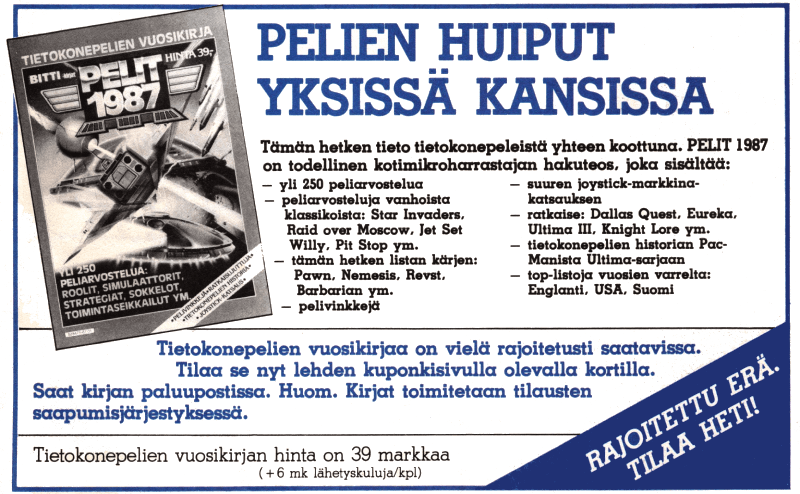
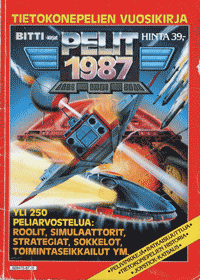
Pelit was a Finnish-language (bi)annual book series published from 1987 to 1991 containing gaming-related articles, tips and most importantly game reviews. Here you can find all the reviews from the books. The reviews were originally written in Finnish; the English versions are translations of the Finnish originals. Maininta tekijänoikeuksista
 1987
1987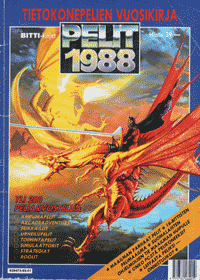 1988
1988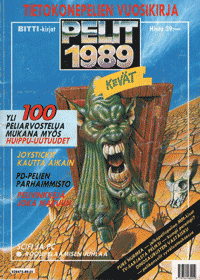 1989 Kevät
 1989 Syksy
 1990 Kevät
 1990 Syksy
 1991 Kevät
 1991 Syksy
Space Rogue
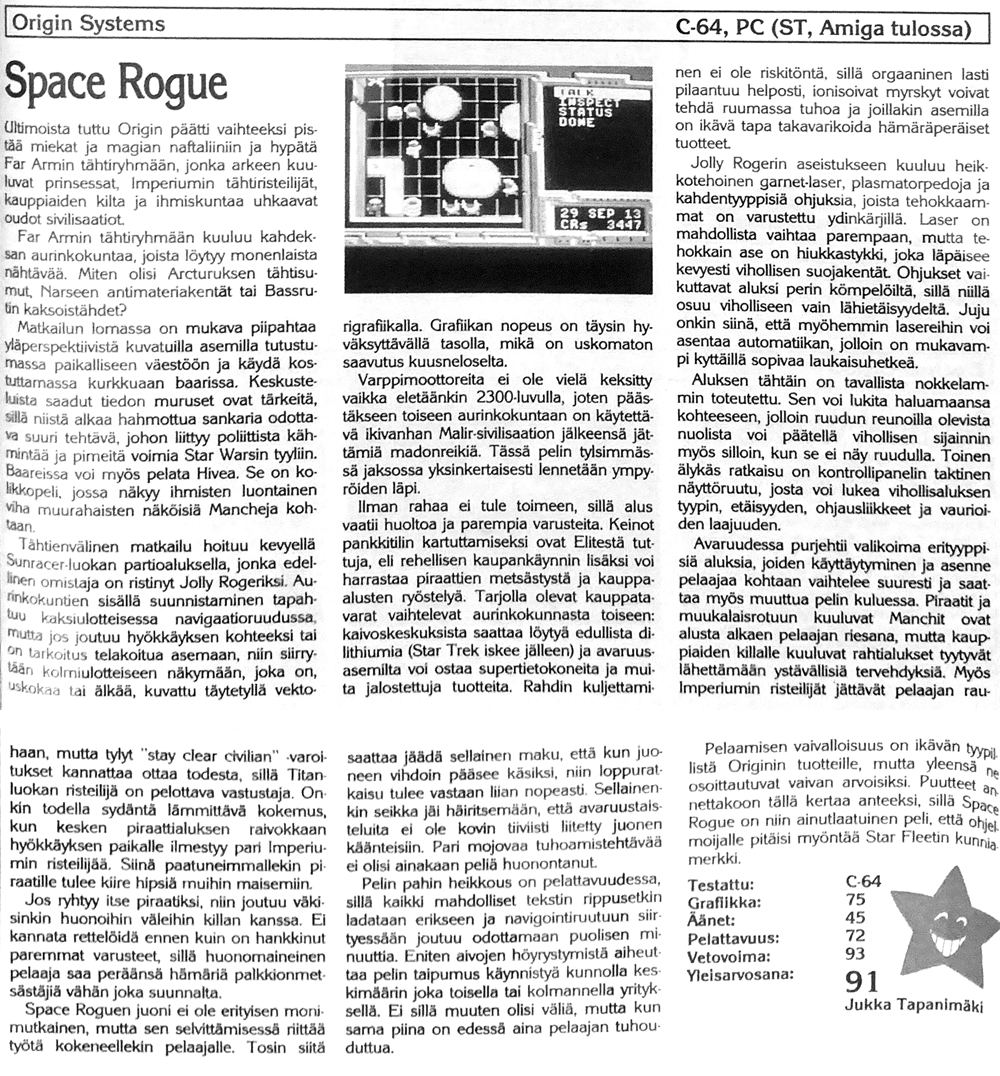
Space Rogue1990 KevätPysyvä linkkiUltimoista tuttu Origin päätti vaihteeksi pistää miekat ja magian naftaliiniin ja hypätä Far Armin tähtiryhmään, jonka arkeen kuuluvat prinsessat, Imperiumin tähtiristeilijät, kauppiaiden kilta ja ihmiskuntaa uhkaavat oudot sivilisaatiot.
Far Armin tähtiryhmään kuuluu kahdeksan aurinkokuntaa, joista löytyy monenlaista nähtävää. Miten olisi Arcturuksen tähtisumut, Narseen antimateriakentät tai Bassrutin kaksoistähdet?
Matkailun lomassa on mukava piipahtaa yläperspektiivistä kuvatuilla asemilla tutustumassa paikalliseen väestöön ja käydä kostuttamassa kurkkuaan baarissa. Keskusteluista saadut tiedon muruset ovat tärkeitä, sillä niistä alkaa hahmottua sankaria odottava suuri tehtävä, johon liittyy poliittista kähmintää ja pimeitä voimia Star Warsin tyyliin. Baareissa voi myös pelata Hivea. Se on kolikkopeli, jossa näkyy ihmisten luontainen viha muurahaisten näköisiä Mancheja kohtaan.
Tähtienvälinen matkailu hoituu kevyellä Sunracer-luokan partioaluksella, jonka edellinen omistaja on ristinyt Jolly Rogeriksi. Aurinkokuntien sisällä suunnistaminen tapahtuu kaksiulotteisessa navigaatioruudussa, mutta jos joutuu hyökkäyksen kohteeksi tai on tarkoitus telakoitua asemaan, niin siirrytään kolmiulotteiseen näkymään, joka on, uskokaa tai älkää, kuvattu täytetyllä vektorigrafiikalla. Grafiikan nopeus on täysin hyväksyttävällä tasolla, mikä on uskomaton saavutus kuusneloselta.
Varppimoottoreita ei ole vielä keksitty vaikka eletäänkin 2300-luvulla, joten päästäkseen toiseen aurinkokuntaan on käytettävä ikivanhan Malir-sivilisaation jälkeensä jättämiä madonreikiä. Tässä pelin tylsimmässä jaksossa yksinkertaisesti lennetään ympyröiden läpi.
Ilman rahaa ei tule toimeen, sillä alus vaatii huoltoa ja parempia varusteita. Keinot pankkitilin kartuttamiseksi ovat Elitestä tuttuja, eli rehellisen kaupankäynnin lisäksi voi harrastaa piraattien metsästystä ja kauppa-alusten ryöstelyä. Tarjolla olevat kauppatavarat vaihtelevat aurinkokunnasta toiseen: kaivoskeskuksista saattaa löytyä edullista dilithiumia (Star Trek iskee jälleen) ja avaruusasemilta voi ostaa supertietokoneita ja muita jalostettuja tuotteita. Rahdin kuljettaminen ei ole riskitöntä, sillä orgaaninen lasti pilaantuu helposti, ionisoivat myrskyt voivat tehdä ruumassa tuhoa ja joillakin asemilla on ikävä tapa takavarikoida hämäräperäiset tuotteet.
Jolly Rogerin aseistukseen kuuluu heikkotehoinen garnet-laser, plasmatorpedoja ja kahdentyyppisiä ohjuksia, joista tehokkaammat on varustettu ydinkärjillä. Laser on mahdollista vaihtaa parempaan, mutta tehokkain ase on hiukkastykki, joka läpäisee kevyesti vihollisen suojakentät. Ohjukset vaikuttavat aluksi perin kömpelöiltä, sillä niillä osuu viholliseen vain lähietäisyydeltä. Juju onkin siinä, että myöhemmin lasereihin voi asentaa automatiikan, jolloin on mukavampi kyttäillä sopivaa laukaisuhetkeä.
Aluksen tähtäin on tavallista nokkelammin toteutettu. Sen voi lukita haluamaansa kohteeseen, jolloin ruudun reunoilla olevista nuolista voi päätellä vihollisen sijainnin myös silloin, kun se ei näy ruudulla. Toinen älykäs ratkaisu on kontrollipanelin taktinen näyttöruutu, josta voi lukea vihollisaluksen tyypin, etäisyyden, ohjausliikkeet ja vaurioiden laajuuden.
Avaruudessa purjehtii valikoima erityyppisiä aluksia, joiden käyttäytyminen ja asenne pelaajaa kohtaan vaihtelee suuresti ja saattaa myös muuttua pelin kuluessa. Piraatit ja muukalaisrotuun kuuluvat Manchit ovat alusta alkaen pelaajan riesana, mutta kauppiaiden killalle kuuluvat rahtialukset tyytyvät lähettämään ystävällisiä tervehdyksiä. Myös Imperiumin risteilijät jättävät pelaajan rauhaan, mutta tylyt "stay clear civilian" -varoitukset kannattaa ottaa todesta, sillä Titan-luokan risteilijä on pelottava vastustaja. Onkin todella sydäntä lämmittävä kokemus, kun kesken piraattialuksen raivokkaan hyökkäyksen paikalle ilmestyy pari Imperiumin risteilijää. Siinä paatuneimmallekin piraatille tulee kiire hipsiä muihin maisemiin.
Jos ryhtyy itse piraatiksi, niin joutuu väkisinkin huonoihin väleihin killan kanssa. Ei kannata rettelöidä ennen kuin on hankkinut paremmat varusteet, sillä huonomaineinen pelaaja saa peräänsä hämäriä palkkionmetsästäjiä vähän joka suunnalta.
Space Roguen juoni ei ole erityisen monimutkainen, mutta sen selvittämisessä riittää työtä kokeneellekin pelaajalle. Tosin siitä saattaa jäädä sellainen maku, että kun juoneen vihdoin pääsee käsiksi, niin loppuratkaisu tulee vastaan liian nopeasti. Sellainenkin seikka jäi häiritsemään, että avaruustaisteluita ei ole kovin tiiviisti liitetty juonen käänteisiin. Pari mojovaa tuhoamistehtävää ei olisi ainakaan peliä huonontanut.
Pelin pahin heikkous on pelattavuudessa, sillä kaikki mahdolliset tekstin rippusetkin ladataan erikseen ja navigointiruutuun siirtyessään joutuu odottamaan puolisen minuuttia. Eniten aivojen höyrystymistä aiheuttaa pelin taipumus käynnistyä kunnolla keskimäärin joka toisella tai kolmannella yrityksellä. Ei sillä muuten olisi väliä, mutta kun sama piina on edessä aina pelaajan tuhouduttua.
Pelaamisen vaivalloisuus on ikävän tyypillistä Originin tuotteille, mutta yleensä ne osoittautuvat vaivan arvoisiksi. Puutteet annettakoon tällä kertaa anteeksi, sillä Space Rogue on niin ainutlaatuinen peli, että ohjelmoijalle pitäisi myöntää Star Fleetin kunniamerkki.
Space Rogue1990 KevätPermalinkOrigin, familiar from the Ultimas, decided for a change to put swords and magic in mothballs and leap into the Far Arm star cluster, whose everyday life includes princesses, Imperial star cruisers, the Merchants' Guild and strange civilisations threatening humankind.
The Far Arm cluster comprises eight solar systems, with all sorts of sights to see. How about the nebulae of Arcturus, the antimatter fields of Narsee or the twin stars of Bassrut?
In between the travelling it's nice to pop into the stations, shown from a top-down perspective, to get acquainted with the locals and wet your whistle at the bar. The crumbs of information gleaned from conversations are important, since from them the great task awaiting the hero begins to take shape, one involving political skulduggery and dark forces in the Star Wars style. In the bars you can also play Hive. It's an arcade game that shows off humanity's innate hatred of the ant-like Manchi.
Interstellar travel is handled by a light Sunracer-class patrol ship, which its previous owner christened the Jolly Roger. Navigation within solar systems takes place on a two-dimensional navigation screen, but if you come under attack or mean to dock at a station, the game switches to a three-dimensional view which is, believe it or not, drawn in filled vector graphics. The speed of the graphics is at a perfectly acceptable level, which is an incredible achievement for the C-64.
Warp drives haven't been invented yet, even though this is the 2300s, so to get to another solar system you have to use the wormholes left behind by the ancient Malir civilisation. In this, the dullest section of the game, you simply fly through circles.
You can't get by without money, since the ship needs maintenance and better equipment. The ways of fattening your bank account are familiar from Elite: besides honest trading, you can take up pirate hunting and plundering merchant ships. The goods on offer vary from one solar system to the next: mining centres may have cheap dilithium (Star Trek strikes again) and space stations sell supercomputers and other refined products. Hauling freight isn't risk-free, since organic cargo spoils easily, ionising storms can wreak havoc in the hold and some stations have a nasty habit of confiscating dubious goods.
The Jolly Roger's armament consists of a feeble garnet laser, plasma torpedoes and two types of missile, the more powerful of which are fitted with nuclear warheads. The laser can be swapped for a better one, but the most powerful weapon is the particle cannon, which breezes straight through enemy shields. The missiles seem terribly clumsy at first, since you can only hit the enemy with them at close range. The trick is that later on you can fit the lasers with automatic control, which makes it more comfortable to lie in wait for the right moment to fire.
The ship's gunsight is more cleverly done than usual. You can lock it onto the target of your choice, whereupon arrows at the edges of the screen let you work out the enemy's position even when it isn't visible on screen. Another smart solution is the control panel's tactical display, which shows the enemy ship's type, distance, manoeuvres and the extent of its damage.
Space is sailed by a selection of different kinds of ship, whose behaviour and attitude towards the player vary greatly and may also change as the game goes on. Pirates and the alien race of the Manchi are a pest from the very start, but the freighters belonging to the Merchants' Guild are content to send friendly greetings. The Imperial cruisers leave the player alone too, but their curt "stay clear civilian" warnings are worth taking seriously, because a Titan-class cruiser is a frightening opponent. So it's a truly heartwarming experience when, in the middle of a pirate ship's furious attack, a couple of Imperial cruisers turn up on the scene. Even the most hardened pirate is then in a hurry to tiptoe off to other parts.
If you turn pirate yourself, you inevitably end up on bad terms with the Guild. It's not worth making trouble before you've got better equipment, since a player with a bad reputation gets shady bounty hunters on their tail from pretty much every direction.
Space Rogue's plot isn't especially complicated, but unravelling it gives even an experienced player plenty of work. Then again, you may be left with the aftertaste that once you finally get to grips with the plot, the ending comes along too quickly. Another thing that kept bothering me was that the space battles aren't very tightly tied to the twists of the plot. A couple of hefty search-and-destroy missions certainly wouldn't have made the game any worse.
The game's worst weakness lies in the playability, since every last scrap of text is loaded separately, and switching to the navigation screen means waiting about half a minute. What gets your brain steaming most of all is the game's tendency to start up properly only on every second or third attempt on average. That wouldn't matter otherwise, except that the same torment awaits every time the player gets destroyed.
Laborious play is depressingly typical of Origin's products, but they usually turn out to be worth the trouble. Let the shortcomings be forgiven this time, for Space Rogue is such a unique game that its programmer ought to be awarded a Star Fleet decoration.