1133 reviews from "Pelit"-books
Pelit was a Finnish-language (bi)annual book series published from 1987 to 1991 containing gaming-related articles, tips and most importantly game reviews. Here you can find all the reviews from the books. The reviews were originally written in Finnish; the English versions are translations of the Finnish originals. Maininta tekijänoikeuksista
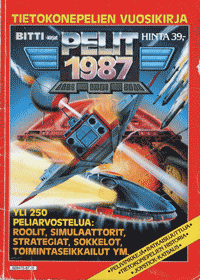 1987
1987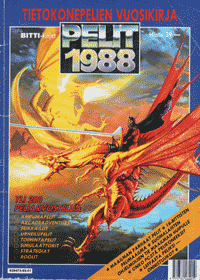 1988
1988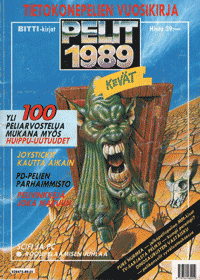 1989 Kevät
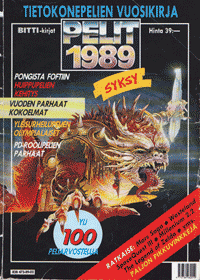 1989 Syksy
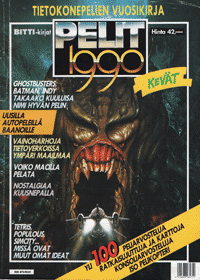 1990 Kevät
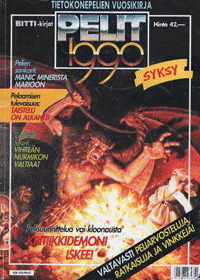 1990 Syksy
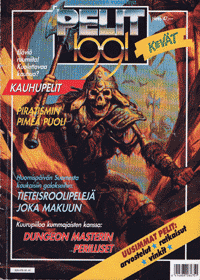 1991 Kevät
 1991 Syksy
Z-Out
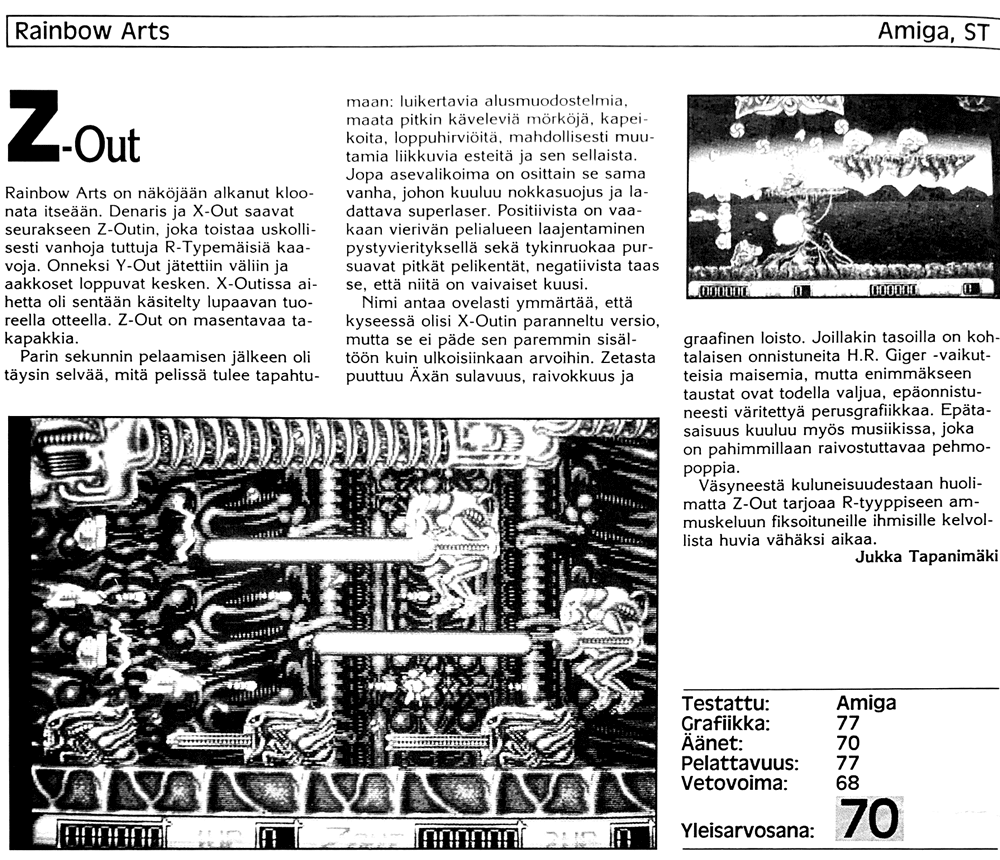
Z-Out1991 KevätPysyvä linkkiRainbow Arts on näköjään alkanut kloonata itseään. Denaris ja X-Out saavat seurakseen Z-Outin, joka toistaa uskollisesti vanhoja tuttuja R-Typemäisiä kaavoja. Onneksi Y-Out jätettiin väliin ja aakkoset loppuvat kesken. X-Outissa aihetta oli sentään käsitelty lupaavan tuoreella otteella. Z-Out on masentavaa takapakkia.
Parin sekunnin pelaamisen jälkeen oli täysin selvää, mitä pelissä tulee tapahtumaan: luikertavia alusmuodostelmia, maata pitkin käveleviä mörköjä, kapeikoita, loppuhirviöitä, mahdollisesti muutamia liikkuvia esteitä ja sen sellaista. Jopa asevalikoima on osittain se sama vanha, johon kuuluu nokkasuojus ja ladattava superlaser. Positiivista on vaakaan vierivän pelialueen laajentaminen pystyvierityksellä sekä tykinruokaa pursuavat pitkät pelikentät, negatiivista taas se, että niitä on vaivaiset kuusi.
Nimi antaa ovelasti ymmärtää, että kyseessä olisi X-Outin paranneltu versio, mutta se ei päde sen paremmin sisältöön kuin ulkoisiinkaan arvoihin. Zetasta puuttuu Äxän sulavuus, raivokkuus ja graafinen loisto. Joillakin tasoilla on kohtalaisen onnistuneita H.R. Giger -vaikutteisia maisemia, mutta enimmäkseen taustat ovat todella valjua, epäonnistuneesti väritettyä perusgrafiikkaa. Epätasaisuus kuuluu myös musiikissa, joka on pahimmillaan raivostuttavaa pehmopoppia.
Väsyneestä kuluneisuudestaan huolimatta Z-Out tarjoaa R-tyyppiseen ammuskeluun fiksoituneille ihmisille kelvollista huvia vähäksi aikaa.
Z-Out1991 KevätPermalinkRainbow Arts has apparently started cloning itself. Denaris and X-Out are now joined by Z-Out, which faithfully repeats the same old familiar R-Type-style formulas. Luckily Y-Out was skipped and the alphabet is running out. X-Out at least tackled the subject with a promisingly fresh approach. Z-Out is a depressing step backwards.
After a couple of seconds' play it was perfectly clear what was going to happen in the game: snaking formations of ships, bogeymen walking along the ground, narrow passages, end-of-level monsters, possibly a few moving obstacles and so on. Even the weapon selection is partly the same old lot, including a nose shield and a chargeable super laser. On the plus side, the horizontally scrolling play area is extended with vertical scrolling, and the long levels are bursting with cannon fodder; on the minus side, there are a measly six of them.
The name slyly suggests that this is an improved version of X-Out, but that holds true no more for the content than for the outward qualities. The Z lacks the X's smoothness, ferocity and graphical splendour. Some levels have fairly successful H.R. Giger-influenced landscapes, but for the most part the backgrounds are really washed-out, badly coloured bog-standard graphics. The unevenness is audible in the music too, which at its worst is infuriating wimpy pop.
Despite its tired, worn-out feel, Z-Out offers people fixated on R-Type-style blasting passable entertainment for a little while.
Zak McKracken and Alien Mindbenders

Zak McKracken and Alien Mindbenders1989 KevätPysyvä linkkiVuosi on 1997, ja maailma on entistä tyhmempi paikka. Eikä mikään ihme, sillä avaruuden muukalaiset ovat rakentaneet laitteen, joka hitaasti mutta varmasti tiputtaa maapallolaisten älykkyysosamäärää (niin että siinä selvisi sekin sitten).
Vain yksi mies voi pelastaa maailman ja hän on Zak McKracken, roskalehden avustaja. Yksi mies vastaa kolmea naista Lucasfilmin mukaan, sillä Zakilla on apunaan Annie, Muinaisen Viisauden Yhdistyksen puheenjohtaja sekä Leslie ja Melissa, kaksi teinityttöä, joiden krediitteihin kuuluu muun muuassa matka Marsiin muunnellulla pakettivaunulla. Onpas originellia ja äääärettömän hauskaa...
Zak McKracken jatkaa Maniac Mansionin viitoittamaa polkua. Näppäimistöön ei tässä seikkailupelissä tarvitse koskea, sillä käytettävät komennot valitaan joystickilla ruudun alalaidalla olevasta valikosta hyödyntäen myös ruudun yläosassa olevaa toimintaruutua, jossa Zak animoi. Systeemistä on se etu, että ei tarvitse arvailla verbi-substantiiviyhdistelmiä kuten normaalissa tekstiseikkailussa. Elokuvamaista tunnelmaa luovat välillä esiintyvät animaatiot, jotka kuljettavat juonta eteenpäin.
Zak McKracken vilisee Hitch-hiker's Guide -tyyppistä huumoria lähes kyllästymiseen asti. Ehkä pelin suurin puute on kuitenkin se, että päin vastoin kuin edeltäjä Manic Mansion, se alkaa kaukaa itse seikkailun ulkopuolelta.
Zakia voi suositella Manic Mansionin ja Douglas Adamsin kirjojen ystäville ja itse asiassa muillekin, sillä se on kelpo seikkailu, joka tarjoaa aivan tarpeeksi sopivan tasoista päänvaivaa suurimmalle osalle seikkailun ystävistä.
Zak McKracken and Alien Mindbenders1989 KevätPermalinkThe year is 1997, and the world is an even stupider place than before. And no wonder, since aliens from outer space have built a device that is slowly but surely lowering the IQ of Earthlings (so that clears that one up, then).
Only one man can save the world, and he is Zak McKracken, a stringer for a trashy tabloid. According to Lucasfilm, one man equals three women, since Zak's helpers are Annie, chairwoman of the Society of Ancient Wisdom, and Leslie and Melissa, two teenage girls whose credits include, among other things, a trip to Mars in a modified van. How original and iiiinfinitely funny...
Zak McKracken follows the path blazed by Maniac Mansion. You never have to touch the keyboard in this adventure game, because the commands are chosen with the joystick from a menu along the bottom of the screen, together with the action window in the upper part of the screen, where Zak goes through his animated paces. The advantage of the system is that you don't have to guess verb-noun combinations as in an ordinary text adventure. A cinematic atmosphere comes from the animations that crop up now and then to move the plot along.
Zak McKracken teems with Hitch-hiker's Guide-style humour almost to the point of tedium. Perhaps the game's biggest shortcoming, though, is that unlike its predecessor Manic Mansion, it starts a long way outside the adventure proper.
Zak can be recommended to fans of Manic Mansion and of Douglas Adams's books, and in fact to others too, since it is a decent adventure that offers quite enough head-scratching, at just the right level, for most adventure fans.
Zany Golf + Minigolf
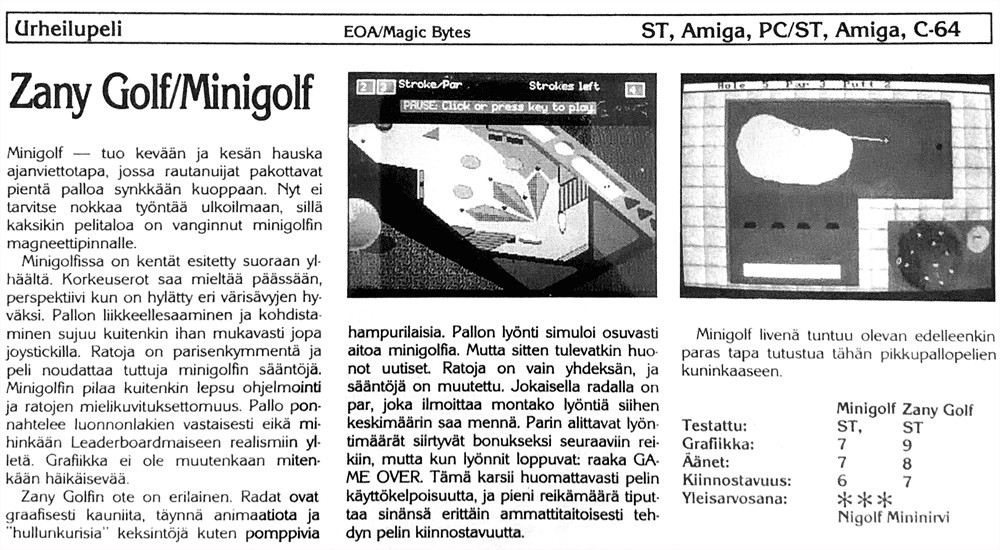
Zany Golf + Minigolf1989 KevätPysyvä linkkiMinigolf - tuo kevään ja kesän hauska ajanviettotapa, jossa rautanuijat pakottavat pientä palloa synkkään kuoppaan. Nyt ei tarvitse nokkaa työntää ulkoilmaan, sillä kaksikin pelitaloa on vanginnut minigolfin magneettipinnalle.
Minigolfissa on kentät esitetty suoraan ylhäältä. Korkeuserot saa mieltää päässään, perspektiivi kun on hylätty eri värisävyjen hyväksi. Pallon liikkeellesaaminen ja kohdistaminen sujuu kuitenkin ihan mukavasti jopa joystickilla. Ratoja on parisenkymmentä ja peli noudattaa tuttuja minigolfin sääntöjä. Minigolfin pilaa kuitenkin lepsu ohjelmointi ja ratojen mielikuvituksettomuus. Pallo ponnahtelee luonnonlakien vastaisesti eikä mihinkään Leaderboardmaiseen realismiin ylletä. Grafiikka ei ole muutenkaan mitenkään häikäisevää.
Zany Golfin ote on erilainen. Radat ovat graafisesti kauniita, täynnä animaatiota ja "hullunkurisia" keksintöjä kuten pomppivia hampurilaisia. Pallon lyönti simuloi osuvasti aitoa minigolfia. Mutta sitten tulevatkin huonot uutiset. Ratoja on vain yhdeksän, ja sääntöjä on muutettu. Jokaisella radalla on par, joka ilmoittaa montako lyöntiä siihen keskimäärin saa mennä. Parin alittavat lyöntimäärät siirtyvät bonukseksi seuraaviin reikiin, mutta kun lyönnit loppuvat: raaka GAME OVER. Tämä karsii huomattavasti pelin käyttökelpoisuutta, ja pieni reikämäärä tiputtaa sinänsä erittäin ammattitaitoisesti tehdyn pelin kiinnostavuutta.
Minigolf livenä tuntuu olevan edelleenkin paras tapa tutustua tähän pikkupallopelien kuninkaaseen.
Zany Golf + Minigolf1989 KevätPermalinkMinigolf - that jolly spring and summer pastime in which iron cudgels force a little ball into a gloomy pit. Now you don't have to stick your nose out into the fresh air, since no fewer than two software houses have imprisoned minigolf on a magnetic surface.
In Minigolf the courses are shown from directly overhead. You have to picture the differences in height in your head, since perspective has been dropped in favour of different shades of colour. Getting the ball moving and aiming it goes quite nicely, though, even with a joystick. There are about twenty holes, and the game follows the familiar rules of minigolf. Minigolf is spoiled, however, by slack programming and unimaginative holes. The ball bounces about in defiance of the laws of nature, and it gets nowhere near any Leaderboard-style realism. Nor are the graphics in any way dazzling otherwise.
Zany Golf takes a different approach. The holes are graphically beautiful, full of animation and "zany" contraptions such as bouncing hamburgers. Hitting the ball simulates real minigolf aptly. But then comes the bad news. There are only nine holes, and the rules have been changed. Every hole has a par, which tells you how many strokes you may spend on it on average. Strokes left under par carry over as a bonus to the following holes, but when you run out of strokes: a brutal GAME OVER. This cuts down the game's usefulness considerably, and the small number of holes lowers the appeal of what is in itself a very professionally made game.
Minigolf played live still seems to be the best way to get to know this king of little-ball games.
Zarathrusta
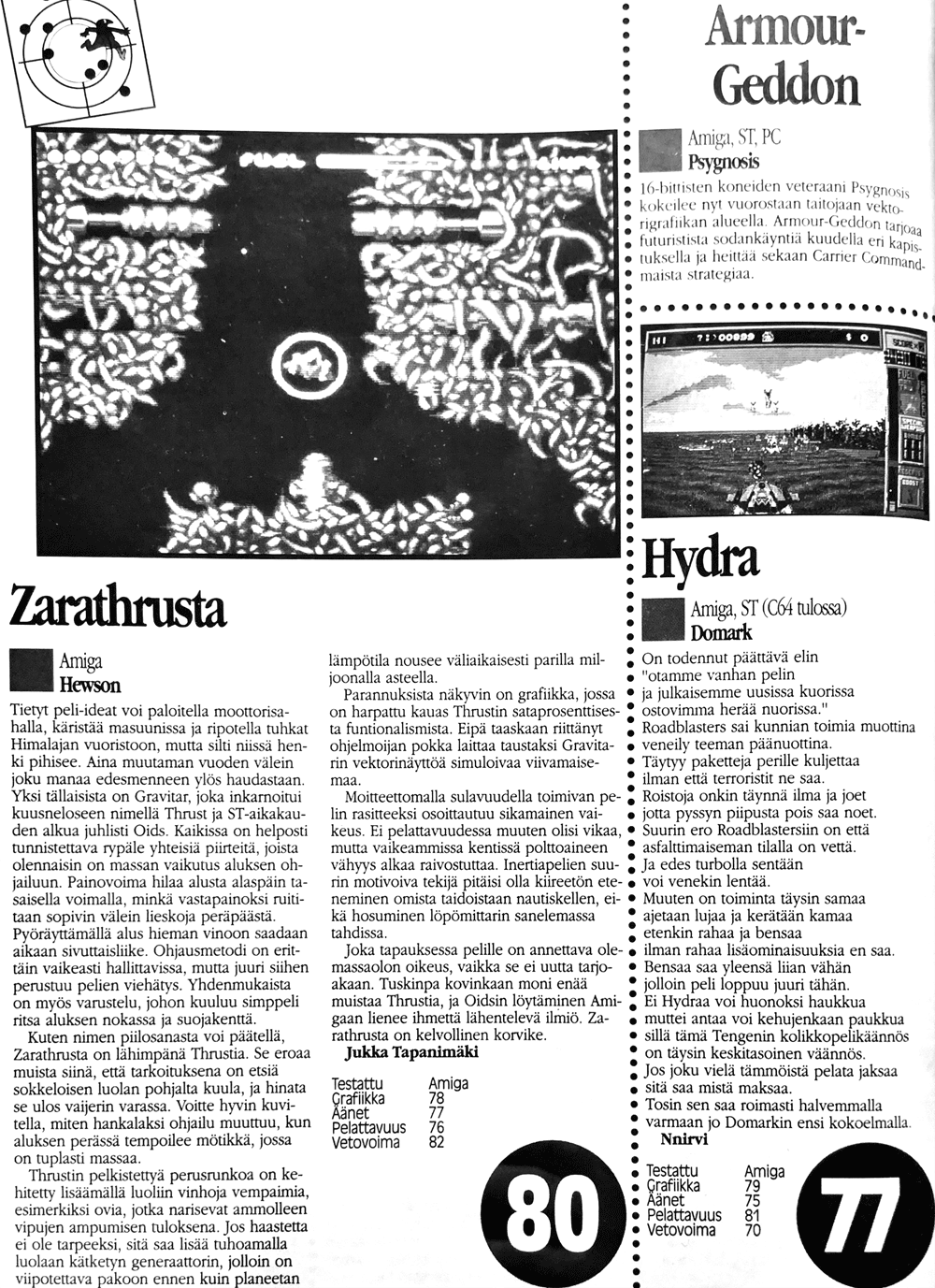
Zarathrusta1991 SyksyPysyvä linkkiTietyt peli-ideat voi paloitella moottorisahalla, käristää masuunissa ja ripotella tuhkat Himalajan vuoristoon, mutta silti niissä henki pihisee. Aina muutaman vuoden välein joku manaa edesmenneen ylös haudastaan. Yksi tällaisista on Gravitar, joka inkarnoitui kuusneloseen nimellä Thrust ja ST-aikakauden alkua juhlisti Oids. Kaikissa on helposti tunnistettava rypäle yhteisiä piirteitä, joista olennaisin on massan vaikutus aluksen ohjailuun. Painovoima hilaa alusta alaspäin tasaisella voimalla, minkä vastapainoksi ruititaan sopivin välein lieskoja peräpäästä. Pyöräyttämällä alus hieman vinoon saadaan aikaan sivuttaisliike. Ohjausmetodi on erittäin vaikeasti hallittavissa, mutta juuri siihen perustuu pelien viehätys. Yhdenmukaista on myös varustelu, johon kuuluu simppeli ritsa aluksen nokassa ja suojakenttä.
Kuten nimen piilosanasta voi päätellä, Zarathrusta on lähimpänä Thrustia. Se eroaa muista siinä, että tarkoituksena on etsiä sokkeloisen luolan pohjalta kuula, ja hinata se ulos vaijerin varassa. Voitte hyvin kuvitella, miten hankalaksi ohjailu muuttuu, kun aluksen perässä tempoilee mötikkä, jossa on tuplasti massaa.
Thrustin pelkistettyä perusrunkoa on kehitetty lisäämällä luoliin vinhoja vempaimia, esimerkiksi ovia, jotka narisevat ammolleen vipujen ampumisen tuloksena. Jos haastetta ei ole tarpeeksi, sitä saa lisää tuhoamalla luolaan kätketyn generaattorin, jolloin on viipotettava pakoon ennen kuin planeetan lämpötila nousee väliaikaisesti parilla miljoonalla asteella.
Parannuksista näkyvin on grafiikka, jossa on harpattu kauas Thrustin sataprosenttisesta funtionalismista. Eipä taaskaan riittänyt ohjelmoijan pokka laittaa taustaksi Gravitarin vektorinäyttöä simuloivaa viivamaisemaa.
Moitteettomalla sulavuudella toimivan pelin rasitteeksi osoittautuu sikamainen vaikeus. Ei pelattavuudessa muuten olisi vikaa, mutta vaikeammissa kentissä polttoaineen vähyys alkaa raivostuttaa. Inertiapelien suurin motivoiva tekijä pitäisi olla kiireetön eteneminen omista taidoistaan nautiskellen, eikä hosuminen löpömittarin sanelemassa tahdissa.
Joka tapauksessa pelille on annettava olemassaolon oikeus, vaikka se ei uutta tarjoakaan. Tuskinpa kovinkaan moni enää muistaa Thrustia, ja Oidsin löytäminen Amigaan lienee ihmettä lähentelevä ilmiö. Zarathrusta on kelvollinen korvike.
Zarathrusta1991 SyksyPermalinkSome game ideas you can hack to pieces with a chainsaw, roast in a blast furnace and scatter the ashes across the Himalayas, and still the breath goes on wheezing in them. Every few years somebody conjures the deceased back up out of its grave. One of these is Gravitar, which was reincarnated on the Commodore 64 as Thrust, while the dawn of the ST era was celebrated with Oids. All of them share an easily recognisable cluster of common features, the most essential of which is the effect of mass on how the ship handles. Gravity hauls the ship downwards with a steady force, which you counter by squirting flames out of the rear end at suitable intervals. Tilting the ship slightly askew gets you sideways movement. The control method is extremely hard to master, but that is exactly what the charm of these games rests on. The kit is uniform too: a simple peashooter in the ship's nose, and a shield.
As you can deduce from the word hidden in the name, Zarathrusta is closest to Thrust. It differs from the others in that the aim is to find a ball at the bottom of a labyrinthine cavern and tow it out on a cable. You can well imagine how awkward the steering gets when a lump with twice the mass is yanking about behind the ship.
Thrust's stripped-down basic framework has been developed by adding nifty gizmos to the caverns, for example doors that creak wide open when you shoot levers. If that isn't challenge enough, you can get more by destroying the generator hidden in the cavern, after which you have to scurry off to safety before the planet's temperature temporarily rises by a couple of million degrees.
The most visible of the improvements is the graphics, which have taken a giant stride away from Thrust's one-hundred-percent functionalism. Once again the programmer didn't have the nerve to use a line-drawn landscape simulating Gravitar's vector display as the backdrop.
The game runs with flawless smoothness, but it turns out to be weighed down by a beastly difficulty. There would otherwise be nothing wrong with the playability, but in the harder levels the shortage of fuel starts to drive you up the wall. The biggest motivating factor in inertia games ought to be unhurried progress, savouring your own skills, not flailing about at a pace dictated by the juice gauge.
In any case, the game has to be granted its right to exist, even if it offers nothing new. Hardly anybody remembers Thrust any more, and finding Oids for the Amiga must be a phenomenon bordering on the miraculous. Zarathrusta is a decent substitute.
Zaxxon
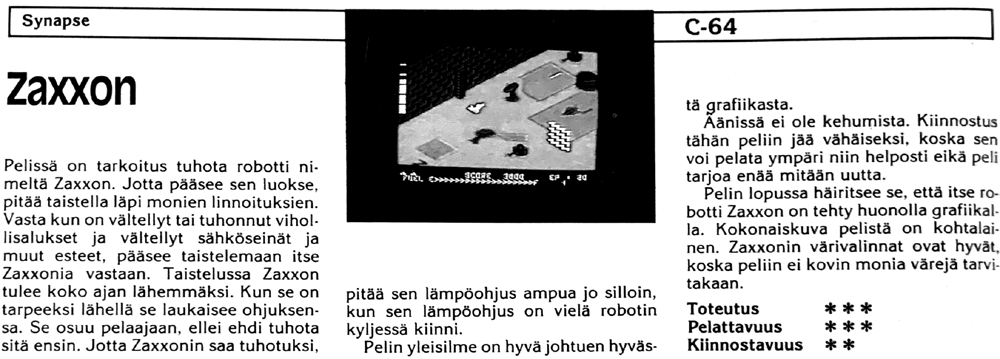
Zaxxon1987Pysyvä linkkiPelissä on tarkoitus tuhota robotti nimeltä Zaxxon. Jotta pääsee sen luokse, pitää taistella läpi monien linnoituksien. Vasta kun on vältellyt tai tuhonnut vihollisalukset ja vältellyt sähköseinät ja muut esteet, pääsee taistelemaan itse Zaxxonia vastaan. Taistelussa Zaxxon tulee koko ajan lähemmäksi. Kun se on tarpeeksi lähellä se laukaisee ohjuksensa. Se osuu pelaajaan, ellei ehdi tuhota sitä ensin. Jotta Zaxxonin saa tuhotuksi, pitää sen lämpöohjus ampua jo silloin, kun sen lämpöohjus on vielä robotin kyljessä kiinni.
Pelin yleisilme on hyvä johtuen hyvästä grafiikasta.
Äänissä ei ole kehumista. Kiinnostus tähän peliin jää vähäiseksi, koska sen voi pelata ympäri niin helposti eikä peli tarjoa enää mitään uutta.
Pelin lopussa häiritsee se, että itse robotti Zaxxon on tehty huonolla grafiikalla. Kokonaiskuva pelistä on kohtalainen. Zaxxonin värivalinnat ovat hyvät, koska peliin ei kovin monia värejä tarvitakaan.
Zaxxon1987PermalinkThe object of the game is to destroy a robot called Zaxxon. To get to it, you have to fight your way through a whole series of fortresses. Only once you have dodged or destroyed the enemy craft, and dodged the electric walls and other obstacles, do you get to fight Zaxxon itself. During the fight Zaxxon keeps coming closer. When it is close enough, it launches its missile. The missile hits the player unless you manage to destroy it first. To destroy Zaxxon, you have to shoot its heat-seeking missile while the heat-seeking missile is still attached to the robot's side.
The game's overall look is good, thanks to the good graphics.
The sound is nothing to write home about. Interest in this game stays low, because it is so easy to play all the way through, and after that the game has nothing new left to offer.
What spoils the end of the game is that the robot Zaxxon itself is drawn with poor graphics. The overall picture of the game is fair. Zaxxon's colour choices are good, since the game doesn't really need very many colours anyway.
ZimZalaBim
ZimZalaBim1987Pysyvä linkkiZimZalaBimin ideana on ryöstää kulta takaisin maan pahalta hallitsijalta ja palauttaa se kyläläisille, jotka odottavat luolassa. Peli alkaa palatsin muurien edestä, josta lähdetään autiomaahan hakemaan köysiä kaivosta. Matka jatkuu palatsin muurien yli köyden avulla. Palatsiin pääsee sisään vartijan ohi, kun yrittää tarpeeksi monta kertaa. Sisällä palatsissa on kaksi asuvaihtoehtoa, joista kannattaa päällensä ottaa sulttaanin asu. Sen jälkeen kaapataan rahat mukaan lattialta ja häivytään palatsista. Sieltä selviää ottamalla sulttaanin puvun taskusta avaimen. Avaimella aukeaa sulttaanin makuuhuoneen ovi ja salakäytävä löytyy takan takaa. Ulkona rahat pitää antaa kerjäläiselle jolloin kerjäläinen lahjoittaa avaimen, jolla pääsee avaamaan sulttaanin makuuhuoneessa olevan arkun. Makuuhuoneesta otetaan aarteet mukaan ja lähdetään luolaan, jossa kyläläiset jo odottavat. Kulta pudotetaan heille.
ZimZalaBimin grafiikka on hyvätasoista monivärigrafiikkaa. Sitä vieriteään aina sen mukaan, minnepäin pelaaja on matkalla. Grafiikka ei ole onnistunut täydellisesti, vaan kuvaruutu värisee aika-ajoin.
Pelin musiikki on aivan kiitettävää ja se vaihtuu erilaiseksi liikuttaessa paikasta toiseen.
Pelin kiinnostusta laskee sen helppous: pelin pelaa läpi viikossa, jopa vähemmässäkin ajassa. Tämä on kyllä mainittu pakkauksessa, joten kannattaa tutustua pakkauksiin. ennenkuin ostaa uuden pelin.
ZimZalaBim1987PermalinkThe idea of ZimZalaBim is to steal the gold back from the land's evil ruler and return it to the villagers, who are waiting in a cave. The game starts in front of the palace walls, from where you set off into the desert to fetch ropes from a well. The journey continues over the palace walls with the help of the rope. You get into the palace past the guard if you try enough times. Inside the palace there are two outfits to choose from, and the one worth putting on is the sultan's outfit. After that you grab the money off the floor and slip out of the palace. You get out of there by taking a key from the pocket of the sultan's suit. The key opens the door of the sultan's bedroom, and the secret passage is behind the fireplace. Outside, the money has to be given to a beggar, whereupon the beggar hands you a key that opens the chest in the sultan's bedroom. You take the treasure from the bedroom and head for the cave, where the villagers are already waiting. The gold is dropped down to them.
ZimZalaBim's graphics are good-quality multicolour graphics. They scroll along with whichever direction the player happens to be heading. The graphics haven't come off perfectly, though, as the screen judders from time to time.
The game's music is really commendable, and it changes to something different as you move from one place to another.
What drags the game's interest down is how easy it is: you can play it through in a week, or in even less time. This is mentioned on the packaging, admittedly, so it pays to study the packaging before you buy a new game.
Zoids
Zoids1987Pysyvä linkkiPelin juoni on osapuilleen seuraava: Kauan aikaa oli Zoidstar kuulunut sinisille Zoideille, kunnes punaiset Zoidit saapuivat viereisestä kuusta ja valtasivat planeetan. Siniset Zoidit eivät pystyneet taistelemaan vastaan. Silloin kuvaan astut sinä, ihminen haaksirikkoutuneesta aluksesta, synnynnäinen taistelija.
Sinulle annetaan Zoidzilla, mahtavin koskaan rakennettu Zoid ja määräykset tuhota Redhorn, punaisten Zoidien johtaja. Laskeutumisaluksesi kuitenkin ammutaan altasi, Zoidzilla puretaan osiin ja kätketään kuuteen kaupunkiin. Ehdit pelastaa Spiderzoidin ja sinun täytyy enää löytää Zoidzillan osat, liittää ne Zoidiisi ja jatkaa alkuperäistä tehtävää.
Niin helppoa se on. Ja sinä yrität, kerta toisensa jälkeen, kunnes Nukkumatti viskoo unihiekkaa ja joystick kirpoaa hervottomista kätösistäsi.
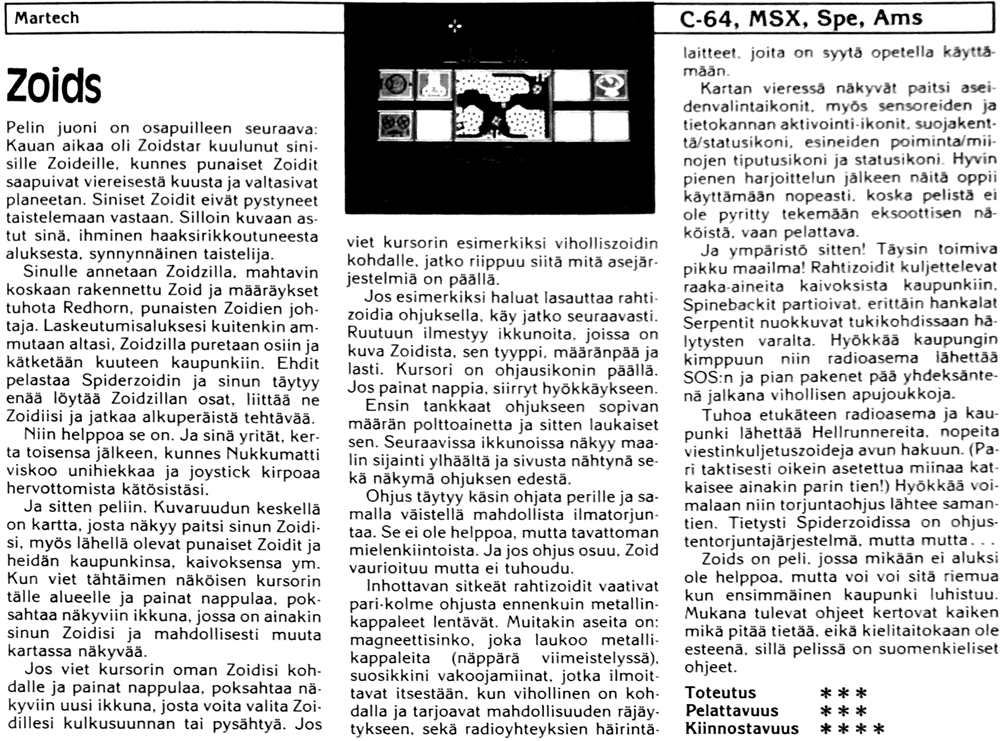
Ja sitten peliin. Kuvaruudun keskellä on kartta, josta näkyy paitsi sinun Zoidisi, myös lähellä olevat punaiset Zoidit ja heidän kaupunkinsa, kaivoksensa ym. Kun viet tähtäimen näköisen kursorin tälle alueelle ja painat nappulaa, poksahtaa näkyviin ikkuna, jossa on ainakin sinun Zoidisi ja mahdollisesti muuta kartassa näkyvää.
Jos viet kursorin oman Zoidisi kohdalle ja painat nappulaa, poksahtaa näkyviin uusi ikkuna, josta voita valita Zoidillesi kulkusuunnan tai pysähtyä. Jos viet kursorin esimerkiksi viholliszoidin kohdalle, jatko riippuu siitä mitä asejärjestelmiä on päällä.
Jos esimerkiksi haluat lasauttaa rahtizoidia ohjuksella, käy jatko seuraavasti. Ruutuun ilmestyy ikkunoita, joissa on kuva Zoidista, sen tyyppi, määränpää ja lasti. Kursori on ohjausikonin päällä. Jos painat nappia, siirryt hyökkäykseen.
Ensin tankkaat ohjukseen sopivan määrän polttoainetta ja sitten laukaiset sen. Seuraavissa ikkunoissa näkyy maalin sijainti ylhäältä ja sivusta nähtynä sekä näkymä ohjuksen edestä.
Ohjus täytyy käsin ohjata perille ja samalla väistellä mahdollista ilmatorjuntaa. Se ei ole helppoa, mutta tavattoman mielenkiintoista. Ja jos ohjus osuu, Zoid vaurioituu mutta ei tuhoudu.
Inhottavan sitkeät rahtizoidit vaativat pari-kolme ohjusta ennenkuin metallinkappaleet lentävät. Muitakin aseita on: magneettisinko, joka laukoo metallikappaleita (näppärä viimeistelyssä), suosikkini vakoojamiinat, jotka ilmoittavat itsestään, kun vihollinen on kohdalla ja tarjoavat mahdollisuuden räjäytykseen, sekä radioyhteyksien häirintälaitteet, joita on syytä opetella käyttämään.
Kartan vieressä näkyvät paitsi aseidenvalintaikonit, myös sensoreiden ja tietokannan aktivointi-ikonit, suojakenttä/statusikoni, esineiden poiminta/miinojen tiputusikoni ja statusikoni. Hyvin pienen harjoittelun jälkeen näitä oppii käyttämään nopeasti, koska pelistä ei ole pyritty tekemään eksoottisen näköistä, vaan pelattava.
Ja ympäristö sitten! Täysin toimiva pikku maailma! Rahtizoidit kuljettelevat raaka-aineita kaivoksista kaupunkiin, Spinebackit partioivat, erittäin hankalat Serpentit nuokkuvat tukikohdissaan hälytysten varalta. Hyökkää kaupungin kimppuun niin radioasema lähettää SOS:n ja pian pakenet pää yhdeksäntenä jalkana vihollisen apujoukkoja.
Tuhoa etukäteen radioasema ja kaupunki lähettää Hellrunnereita, nopeita viestinkuljetuszoideja avun hakuun. (Pari taktisesti oikein asetettua miinaa katkaisee ainakin parin tien!) Hyökkää voimalaan niin torjuntaohjus lähtee samantien. Tietysti Spiderzoidissa on ohjustentorjuntajärjestelmä, mutta mutta...
Zoids on peli, jossa mikään ei aluksi ole helppoa, mutta voi voi sitä riemua kun ensimmäinen kaupunki luhistuu. Mukana tulevat ohjeet kertovat kaiken mikä pitää tietää, eikä kielitaitokaan ole esteenä, sillä pelissä on suomenkieliset ohjeet.
Zoids1987PermalinkThe plot of the game goes roughly like this: For a long time Zoidstar had belonged to the blue Zoids, until the red Zoids arrived from the neighbouring moon and conquered the planet. The blue Zoids were unable to fight back. That is where you step into the picture: a human from a shipwrecked spacecraft, a born fighter.
You are given Zoidzilla, the mightiest Zoid ever built, and orders to destroy Redhorn, the leader of the red Zoids. Your landing craft, however, gets shot out from under you, and Zoidzilla is taken apart and hidden in six cities. You manage to rescue a Spiderzoid, and now all you have to do is find the parts of Zoidzilla, fit them onto your Zoid and carry on with the original mission.
It's as easy as that. And you try, time after time, until the Sandman starts flinging his sleeping sand and the joystick slips out of your limp little hands.
And now to the game. In the middle of the screen there is a map showing not only your own Zoid but also the nearby red Zoids and their cities, mines and so on. When you move the crosshair-like cursor over this area and press the button, a window pops up containing at least your Zoid and possibly other things visible on the map.
If you move the cursor onto your own Zoid and press the button, a new window pops up where you can choose a direction of travel for your Zoid or stop. If you move the cursor onto, say, an enemy Zoid, what happens next depends on which weapon systems are switched on.
If, for example, you want to let a cargo Zoid have it with a missile, things go as follows. Windows appear on the screen showing a picture of the Zoid, its type, destination and cargo. The cursor sits on top of the control icon. If you press the button, you go over to the attack.
First you tank the missile up with a suitable amount of fuel and then you launch it. The next windows show the target's position seen from above and from the side, plus the view from the nose of the missile.
The missile has to be steered all the way to the target by hand, dodging any anti-aircraft fire along the way. It isn't easy, but it is tremendously interesting. And if the missile hits, the Zoid is damaged but not destroyed.
The disgustingly tough cargo Zoids take two or three missiles before the scrap metal starts flying. There are other weapons too: a magnetic bazooka that fires lumps of metal (handy for finishing things off), my favourites the spy mines, which report in when an enemy is right on top of them and give you the chance to set them off, and radio jamming equipment, which is well worth learning to use.
Next to the map you can see not only the weapon selection icons but also the activation icons for the sensors and the database, a shield/status icon, an object pickup/mine drop icon and a status icon. After only a very little practice you quickly learn to use these, because the aim was not to make the game look exotic but to make it playable.
And then there's the setting! A fully working little world! Cargo Zoids ferry raw materials from the mines to the city, Spinebacks patrol, and the extremely nasty Serpents doze in their bases in case an alarm goes off. Attack a city and its radio station sends out an SOS, and soon you're fleeing hell for leather from the enemy reinforcements.
Take out the radio station first and the city sends Hellrunners, fast courier Zoids, off to fetch help. (A couple of tactically well-placed mines will cut off at least a couple of roads!) Attack a power station and an interceptor missile is launched right away. Of course the Spiderzoid has an anti-missile system, but, but...
Zoids is a game where nothing is easy at first, but oh my, the joy when the first city comes crashing down. The instructions that come with it tell you everything you need to know, and language skills aren't a barrier either, because the game comes with instructions in Finnish.
Zolyx
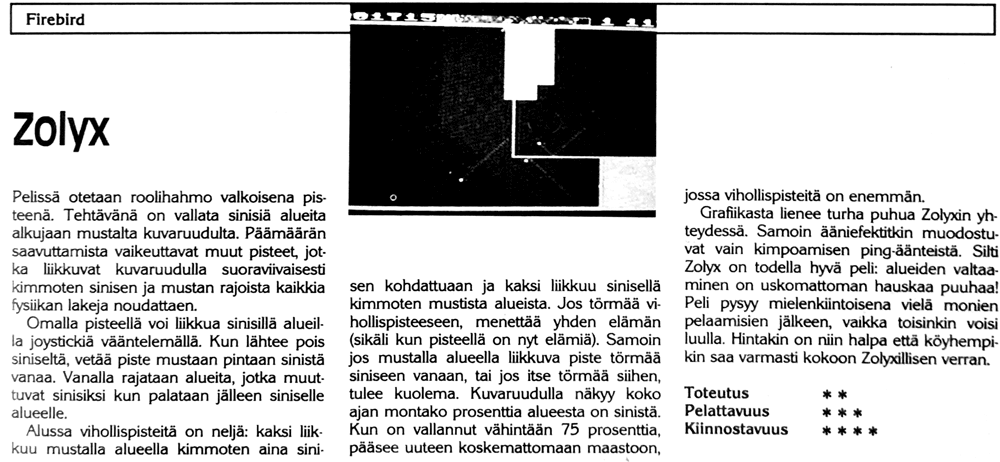
Zolyx1987Pysyvä linkkiPelissä otetaan roolihahmo valkoisena pisteenä. Tehtävänä on vallata sinisiä alueita alkujaan mustalta kuvaruudulta. Päämäärän saavuttamista vaikeuttavat muut pisteet, jotka liikkuvat kuvaruudulla suoraviivaisesti kimmoten sinisen ja mustan rajoista kaikkia fysiikan lakeja noudattaen.
Omalla pisteellä voi liikkua sinisillä alueilla joystickiä vääntelemällä. Kun lähtee pois siniseltä, vetää piste mustaan pintaan sinistä vanaa. Vanalla rajataan alueita, jotka muuttuvat sinisiksi kun palataan jälleen siniselle alueelle.
Alussa vihollispisteitä on neljä: kaksi liikkuu mustalla alueella kimmoten aina sinisen kohdattuaan ja kaksi liikkuu sinisellä kimmoten mustista alueista. Jos törmää vihollispisteeseen, menettää yhden elämän (sikäli kun pisteellä on nyt elämiä). Samoin jos mustalla alueella liikkuva piste törmää siniseen vanaan, tai jos itse törmää siihen, tulee kuolema. Kuvaruudulla näkyy koko ajan montako prosenttia alueesta on sinistä. Kun on vallannut vähintään 75 prosenttia, pääsee uuteen koskemattomaan maastoon, jossa vihollispisteitä on enemmän.
Grafiikasta lienee turha puhua Zolyxin yhteydessä. Samoin ääniefektitkin muodostuvat vain kimpoamisen ping-äänteistä. Silti Zolyx on todella hyvä peli: alueiden valtaaminen on uskomattoman hauskaa puuhaa! Peli pysyy mielenkiintoisena vielä monien pelaamisien jälkeen, vaikka toisinkin voisi luulla. Hintakin on niin halpa että köyhempikin saa varmasti kokoon Zolyxillisen verran.
Zolyx1987PermalinkIn this game your role-playing character is a white dot. The task is to claim blue areas from a screen that starts out black. Reaching the goal is made harder by other dots, which move across the screen in straight lines, bouncing off the borders between blue and black in obedience to all the laws of physics.
You can move your own dot around the blue areas by wrenching the joystick about. When you leave the blue, the dot draws a blue trail across the black surface. The trail is used to fence off areas, which turn blue when you get back onto a blue area again.
At the start there are four enemy dots: two move in the black area, bouncing off whenever they meet blue, and two move in the blue, bouncing off the black areas. If you collide with an enemy dot, you lose one life (insofar as a dot can be said to have lives). Likewise, if a dot moving in the black area runs into your blue trail, or if you run into it yourself, it's death. The screen shows at all times what percentage of the area is blue. Once you have claimed at least 75 percent, you move on to fresh, untouched terrain with more enemy dots.
There's probably no point talking about graphics where Zolyx is concerned. Likewise, the sound effects consist of nothing but the pings of things bouncing. Even so, Zolyx is a really good game: claiming territory is an unbelievably fun pastime! The game stays interesting even after you've played it many times, though you might think otherwise. The price is so cheap, too, that even the less well-off can surely scrape together a Zolyx's worth.
Zombi
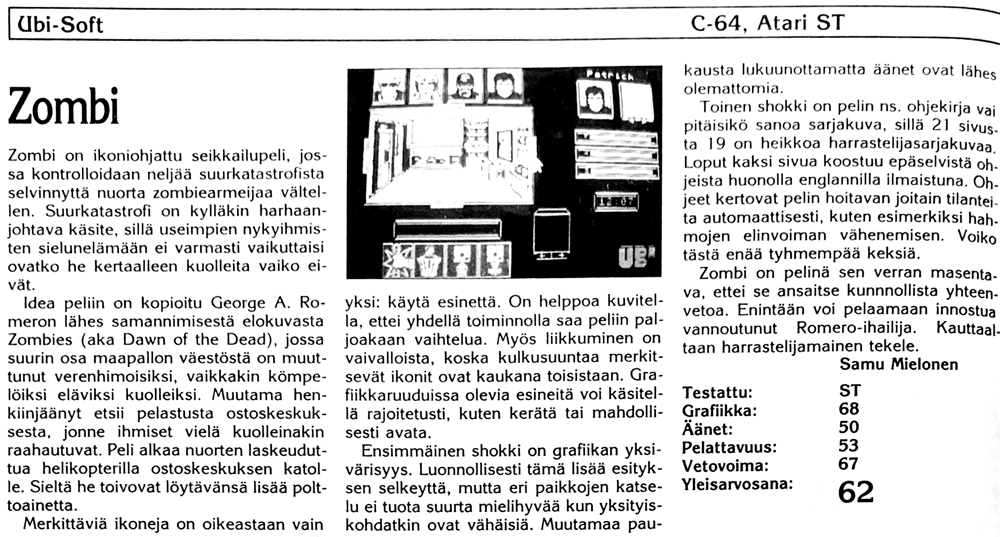
Zombi1990 SyksyPysyvä linkkiZombi on ikoniohjattu seikkailupeli, jossa kontrolloidaan neljää suurkatastrofista selvinnyttä nuorta zombiearmeijaa vältellen. Suurkatastrofi on kylläkin harhaanjohtava käsite, sillä useimpien nykyihmisten sielunelämään ei varmasti vaikuttaisi ovatko he kertaalleen kuolleita vaiko eivät.
Idea peliin on kopioitu George A. Romeron lähes samannimisestä elokuvasta Zombies (aka Dawn of the Dead), jossa suurin osa maapallon väestöstä on muuttunut verenhimoisiksi, vaikkakin kömpelöiksi eläviksi kuolleiksi. Muutama henkiinjäänyt etsii pelastusta ostoskeskuksesta, jonne ihmiset vielä kuolleinakin raahautuvat. Peli alkaa nuorten laskeuduttua helikopterilla ostoskeskuksen katolle. Sieltä he toivovat löytävänsä lisää polttoainetta.
Merkittäviä ikoneja on oikeastaan vain yksi: käytä esinettä. On helppoa kuvitella, ettei yhdellä toiminnolla saa peliin paljoakaan vaihtelua. Myös liikkuminen on vaivalloista, koska kulkusuuntaa merkitsevät ikonit ovat kaukana toisistaan. Grafiikkaruuduissa olevia esineitä voi käsitellä rajoitetusti, kuten kerätä tai mahdollisesti avata.
Ensimmäinen shokki on grafiikan yksivärisyys. Luonnollisesti tämä lisää esityksen selkeyttä, mutta eri paikkojen katselu ei tuota suurta mielihyvää kun yksityiskohdatkin ovat vähäisiä. Muutamaa paukausta lukuunottamatta äänet ovat lähes olemattomia.
Toinen shokki on pelin ns. ohjekirja vai pitäisikö sanoa sarjakuva, sillä 21 sivusta 19 on heikkoa harrastelijasarjakuvaa. Loput kaksi sivua koostuu epäselvistä ohjeista huonolla englannilla ilmaistuna. Ohjeet kertovat pelin hoitavan joitain tilanteita automaattisesti, kuten esimerkiksi hahmojen elinvoiman vähenemisen. Voiko tästä enää tyhmempää keksiä.
Zombi on pelinä sen verran masentava, ettei se ansaitse kunnnollista yhteenvetoa. Enintään voi pelaamaan innostua vannoutunut Romero-ihailija. Kauttaaltaan harrastelijamainen tekele.
Zombi1990 SyksyPermalinkZombi is an icon-driven adventure game in which you control four young people who have survived a major catastrophe, while steering clear of a zombie army. 'Major catastrophe' is a misleading term, though, since it surely wouldn't make any difference to the inner life of most people these days whether they had already died once or not.
The idea for the game has been copied from George A. Romero's almost identically titled film Zombies (aka Dawn of the Dead), in which most of the Earth's population has turned into bloodthirsty, if clumsy, living dead. A handful of survivors look for salvation in a shopping mall, where people still drag themselves even after they're dead. The game begins after the youngsters have landed on the roof of the mall by helicopter. Up there they hope to find more fuel.
There's really only one significant icon: use object. It's easy to imagine that a single action doesn't bring much variety to a game. Moving around is a chore as well, because the icons for the direction of travel are far apart from each other. The objects on the graphics screens can be handled in limited ways, such as picking them up or possibly opening them.
The first shock is that the graphics are monochrome. Naturally this adds to the clarity of the presentation, but looking at the various locations doesn't give much pleasure when there's hardly any detail either. Apart from a few bangs, the sound is practically non-existent.
The second shock is the game's so-called manual, or should I say comic book, since 19 of its 21 pages are feeble amateur comics. The remaining two pages consist of unclear instructions set out in poor English. The instructions say that the game handles some situations automatically, such as, for example, the characters' dwindling vitality. Could anyone possibly come up with anything dumber than that.
As a game, Zombi is so depressing that it doesn't deserve a proper summing-up. At most a sworn Romero devotee might get fired up about playing it. An amateurish botch from start to finish.
Zork III
Zork III1991 SyksyPysyvä linkkiVaikka rakastettu Infocom kärsi tuskallisen kuoleman, sen nimi elää ikuisesti, varsinkin kun halpapelifirma Mastertronic julkaisee wanhoja Infocom-legendoja uudelleen pikkurahalla.
Pakkausten taso tosin on romahtanut, nyt seikkailut saadaan pienissä 16 X 16 X 2 cm lootissa, joista löytyy pelilevyke ja pieni manuaali. Mennyttä ovat suuret kauniit laatikot, joissa oli enemmän ihanaa oheisroinaa kuin itse peliin liittyvää kamaa.
Zork III:ssa pelaaja heitetään maan alle Suuren Maanalaisen Valtakunnan luolastoihin kasvokkain lukemattomien vaarojen kanssa. Mikään ei ole miltä näyttää, mihinkään ei voi luottaa. Eli tarina on se perinteinen seikkailupelin juoni, mikä ei ole ihme, koska Zork III on perineteinen seikkailupeli, mikä näkyy ulkoasussakin.
Ohjelma edustaa perinteisen tekstiseikkailun huippukautta ja yhtä sen ajan parhaimmista saavutuksista. Parserinsa suhteen Zorkilla ei ole vieläkään mitään hävettävää, Infocom kehitti aikoinaan sen todella pitkälle, ja vaikka se ei vielä Zork III:ssa olekaan parhaimmillaan, se hakkaa rieppaasti useimpien muiden tekstiseikkailujen vastaavat.
Grafiikalla ei ole tässä mitään tekemistä. Sitäkin enemmän mielikuvituksella ja hyvällä kielipäällä. Peruskoulun englannin alkeiskurssilla, tai ruotsin pidemmilläkään opinnoilla ei Zork III:een pääse tippaakaan sisälle. Keskiverto shoot'em'up-fanilla ei ole mitään asiaa tämän pariin, mutta innokas kielitaidolla varustettu adventuristi tulee nauttimaan Zorkin maailmasta täysin siemauksin.
Zork III1991 SyksyPermalinkAlthough the beloved Infocom suffered an agonising death, its name will live forever, especially now that budget games company Mastertronic is re-releasing olde Infocom legends for pocket money.
The standard of the packaging has admittedly collapsed, though: now the adventures come in little 16 X 16 X 2 cm boxes containing a game disk and a small manual. Gone are the big, beautiful boxes that held more lovely extra junk than stuff actually to do with the game itself.
In Zork III the player is thrown underground into the caverns of the Great Underground Empire, face to face with countless dangers. Nothing is what it seems, nothing can be trusted. So the story is the traditional adventure game plot, which is no wonder, since Zork III is a traditional adventure game, and that shows in its presentation too.
The program represents the heyday of the traditional text adventure and one of the finest achievements of its time. When it comes to its parser, Zork still has nothing to be ashamed of: Infocom developed it a very long way back in the day, and although it isn't yet at its best in Zork III, it still handily beats the equivalents in most other text adventures.
Graphics have no part to play here. Imagination and a good head for languages, on the other hand, all the more. With a comprehensive school beginners' English course, or even with long-syllabus Swedish, you won't get the tiniest bit inside Zork III. The average shoot-'em-up fan has no business going anywhere near this one, but an enthusiastic adventurer equipped with language skills will drink in the world of Zork to the full.
Zorro
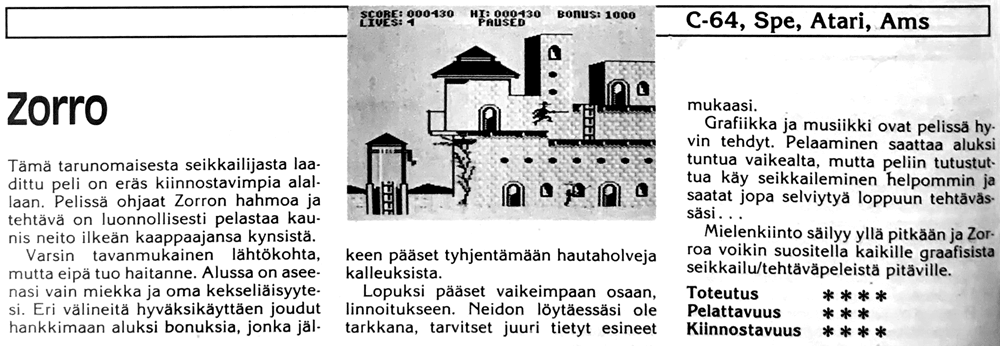
Zorro1987Pysyvä linkkiTämä tarunomaisesta seikkailijasta laadittu peli on eräs kiinnostavimpia alallaan. Pelissä ohjaat Zorron hahmoa ja tehtävä on luonnollisesti pelastaa kaunis neito ilkeän kaappaajansa kynsistä.
Varsin tavanmukainen lähtökohta, mutta eipä tuo haitanne. Alussa on aseenasi vain miekka ja oma kekseliäisyytesi. Eri välineitä hyväksikäyttäen joudut hankkimaan aluksi bonuksia, jonka jälkeen pääset tyhjentämään hautaholveja kalleuksista.
Lopuksi pääset vaikeimpaan osaan, linnoitukseen. Neidon löytäessäsi ole tarkkana, tarvitset juuri tietyt esineet mukaasi.
Grafiikka ja musiikki ovat pelissä hyvin tehdyt. Pelaaminen saattaa aluksi tuntua vaikealta, mutta peliin tutustuttua käy seikkaileminen helpommin ja saatat jopa selviytyä loppuun tehtävässäsi...
Mielenkiinto säilyy yllä pitkään ja Zorroa voikin suositella kaikille graafisista seikkailu/tehtäväpeleistä pitäville.
Zorro1987PermalinkThis game, built around the legendary adventurer, is one of the most interesting of its kind. In the game you control the figure of Zorro, and the task is, naturally, to rescue a beautiful maiden from the clutches of her wicked kidnapper.
A pretty conventional starting point, but that hardly matters, surely. At the start your only weapons are a sword and your own ingenuity. Making use of various items, you first have to collect bonuses, after which you get to empty the burial vaults of their valuables.
Finally you reach the hardest part, the fortress. When you find the maiden, watch out: you need exactly the right items with you.
The graphics and music in the game are well done. Playing may feel difficult at first, but once you've got to know the game the adventuring gets easier, and you might even make it to the end of your mission...
Interest holds up for a long time, and Zorro can be recommended to anyone who likes graphic adventure/quest games.