1133 reviews from "Pelit"-books
Pelit was a Finnish-language (bi)annual book series published from 1987 to 1991 containing gaming-related articles, tips and most importantly game reviews. Here you can find all the reviews from the books. The reviews were originally written in Finnish; the English versions are translations of the Finnish originals. Maininta tekijänoikeuksista
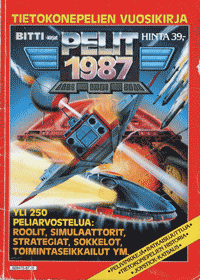 1987
1987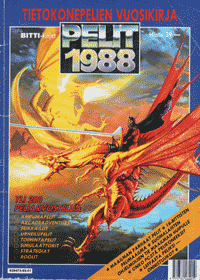 1988
1988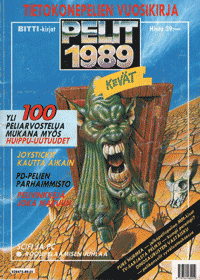 1989 Kevät
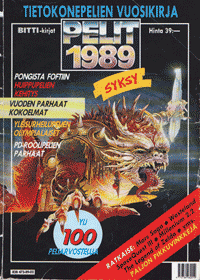 1989 Syksy
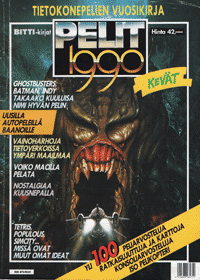 1990 Kevät
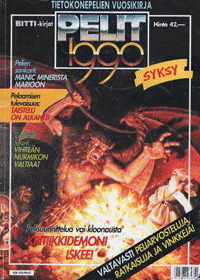 1990 Syksy
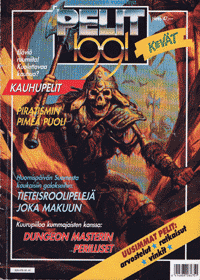 1991 Kevät
 1991 Syksy
F-14 Tomcat
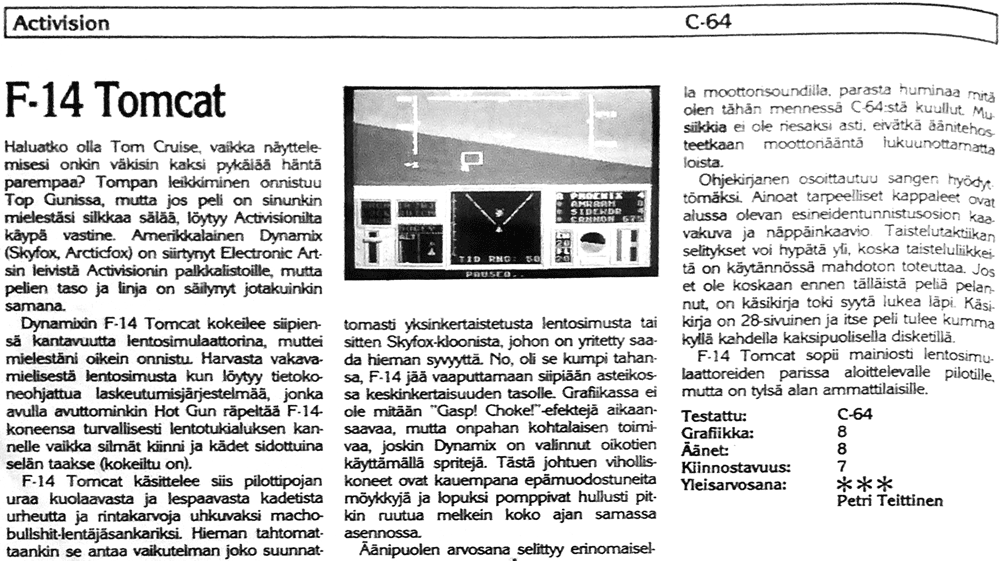
F-14 Tomcat1989 SyksyPysyvä linkkiHaluatko olla Tom Cruise, vaikka näyttelemisesi onkin väkisin kaksi pykälää häntä parempaa? Tompan leikkiminen onnistuu Top Gunissa, mutta jos peli on sinunkin mielestäsi silkkaa sälää, löytyy Activisionilta käypä vastine. Amerikkalainen Dynamix (Skyfox, Arcticfox) on siirtynyt Electronic Artsin leivistä Activisionin palkkalistoille, mutta pelien taso ja linja on säilynyt jotakuinkin samana.
Dynamixin F-14 Tomcat kokeilee siipiensä kantavuutta lentosimulaattorina, muttei mielestäni oikein onnistu. Harvasta vakavamielisestä lentosimusta kun löytyy tietokoneohjattua laskeutumisjärjestelmää, jonka avulla avuttominkin Hot Gun räpeltää F-14-koneensa turvallisesti lentotukialuksen kannelle vaikka silmät kiinni ja kädet sidottuina selän taakse (kokeiltu on).
F-14 Tomcat käsittelee siis pilottipojan uraa kuolaavasta ja lespaavasta kadetista urheutta ja rintakarvoja uhkuvaksi macho-bullshit-lentäjäsankariksi. Hieman tahtomattaankin se antaa vaikutelman joko suunnattomasti yksinkertaistetusta lentosimusta tai sitten Skyfox-kloonista, johon on yritetty saada hieman syvyyttä. No, oli se kumpi tahansa, F-14 jää vaaputtamaan siipiään asteikossa keskinkertaisuuden tasolle. Grafiikassa ei ole mitään "Gasp! Choke!"-efektejä aikaansaavaa, mutta onpahan kohtalaisen toimivaa, joskin Dynamix on valinnut oikotien käyttämällä spritejä. Tästä johtuen viholliskoneet ovat kauempana epämuodostuneita möykkyjä ja lopuksi pomppivat hullusti pitkin ruutua melkein koko ajan samassa asennossa.
Äänipuolen arvosana selittyy erinomaisella moottorisoundilla, parasta huminaa mitä olen tähän mennessä C-64:stä kuullut. Musiikkia ei ole riesaksi asti, eivätkä äänitehosteetkaan moottoriääntä lukuunottamatta loista.
Ohjekirjanen osoittautuu sangen hyödyttömäksi. Ainoat tarpeelliset kappaleet ovat alussa olevan esineidentunnistusosion kaavakuva ja näppäinkaavio. Taistelutaktiikan selitykset voi hypätä yli, koska taisteluliikkeitä on käytännössä mahdoton toteuttaa. Jos et ole koskaan ennen tälläistä peliä pelannut, on käsikirja toki syytä lukea läpi. Käsikirja on 28-sivuinen ja itse peli tulee kumma kyllä kahdella kaksipuolisella disketillä.
F-14 Tomcat sopii mainiosti lentosimulaattoreiden parissa aloittelevalle pilotille, mutta on tylsä alan ammattilaisille.
F-14 Tomcat1989 SyksyPermalinkDo you want to be Tom Cruise, even though your acting is bound to be a couple of notches better than his? You can play at being Tomppa in Top Gun, but if you too think that game is sheer junk, Activision has a worthy alternative. The American Dynamix (Skyfox, Arcticfox) has left Electronic Arts' employ for Activision's payroll, but the standard and style of its games have stayed more or less the same.
Dynamix's F-14 Tomcat tests whether its wings will carry it as a flight simulator, but in my opinion it doesn't really succeed. After all, few serious-minded flight sims come with a computer-controlled landing system that lets even the most helpless Hot Gun fumble their F-14 safely onto the carrier deck with their eyes shut and their hands tied behind their back (this has been tested).
So F-14 Tomcat follows a flyboy's career from a drooling, lisping cadet to a macho-bullshit pilot hero oozing courage and chest hair. Somewhat in spite of itself, it gives the impression of either a vastly simplified flight sim or else a Skyfox clone into which someone has tried to inject a bit of depth. Well, whichever it is, the F-14 is left waggling its wings at the level of mediocrity on the scale. There's nothing in the graphics to produce any "Gasp! Choke!" effects, but they do work reasonably well, although Dynamix has taken a shortcut by using sprites. Because of this, enemy planes in the distance are misshapen blobs, and in the end they bounce madly around the screen, stuck in almost the same pose the whole time.
The sound score is explained by the excellent engine sound, the best hum I've heard out of the C-64 so far. There isn't enough music to become a nuisance, and apart from the engine noise the sound effects don't exactly shine either.
The instruction booklet turns out to be pretty useless. The only necessary parts are the diagram in the object recognition section at the start and the key chart. You can skip the explanations of combat tactics, because the combat manoeuvres are practically impossible to pull off. If you've never played a game like this before, you should of course read the manual through. The manual runs to 28 pages and the game itself, oddly enough, comes on two double-sided floppies.
F-14 Tomcat is just the thing for a pilot starting out with flight simulators, but it's boring for the pros in the field.
F-15 Strike Eagle II
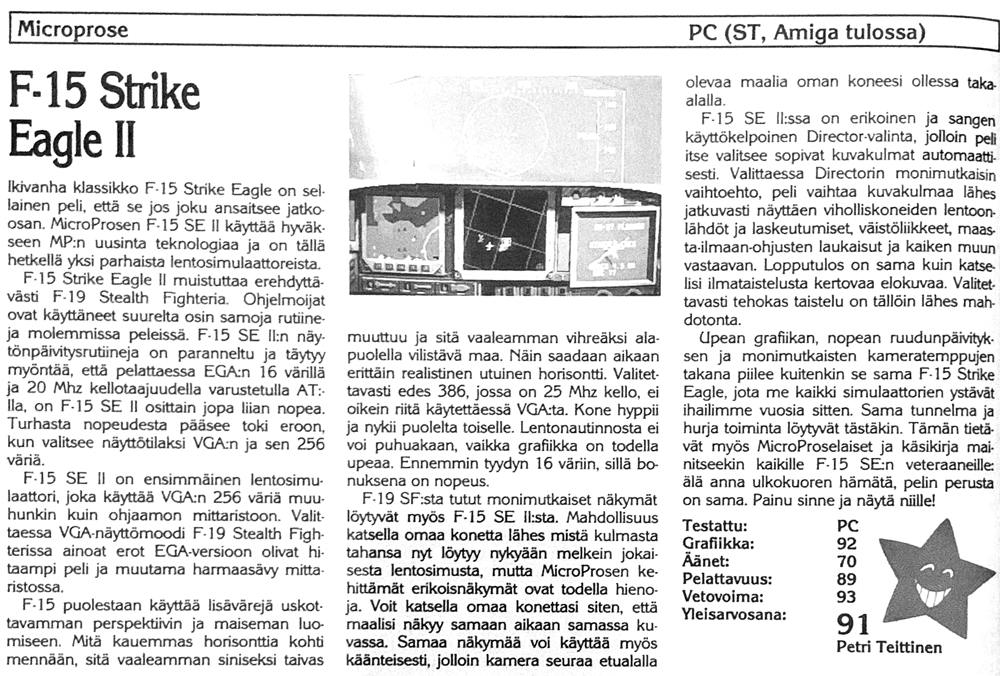
F-15 Strike Eagle II1990 KevätPysyvä linkkiIkivanha klassikko F-15 Strike Eagle on sellainen peli, että se jos joku ansaitsee jatko-osan. MicroProsen F-15 SE II käyttää hyväkseen MP:n uusinta teknologiaa ja on tällä hetkellä yksi parhaista lentosimulaattoreista.
F-15 Strike Eagle II muistuttaa erehdyttävästi F-19 Stealth Fighteria. Ohjelmoijat ovat käyttäneet suurelta osin samoja rutiineja molemmissa peleissä. F-15 SE II:n näytönpäivitysrutiineja on paranneltu ja täytyy myöntää, että pelattaessa EGA:n 16 värillä ja 20 Mhz kellotaajuudella varustetulla AT:lla, on F-15 SE II osittain jopa liian nopea. Turhasta nopeudesta pääsee toki eroon, kun valitsee näyttötilaksi VGA:n ja sen 256 väriä.
F-15 SE II on ensimmäinen lentosimulaattori, joka käyttää VGA:n 256 väriä muuhunkin kuin ohjaamon mittaristoon. Valittaessa VGA-näyttömoodi F-19 Stealth Fighterissa ainoat erot EGA-versioon olivat hitaampi peli ja muutama harmaasävy mittaristossa.
F-15 puolestaan käyttää lisävärejä uskottavamman perspektiivin ja maiseman luomiseen. Mitä kauemmas horisonttia kohti mennään, sitä vaaleamman siniseksi taivas muuttuu ja sitä vaaleamman vihreäksi alapuolella vilistävä maa. Näin saadaan aikaan erittäin realistinen utuinen horisontti. Valitettavasti edes 386, jossa on 25 Mhz kello, ei oikein riitä käytettäessä VGA:ta. Kone hyppii ja nykii puolelta toiselle. Lentonautinnosta ei voi puhuakaan, vaikka grafiikka on todella upeaa. Ennemmin tyydyn 16 väriin, sillä bonuksena on nopeus.
F-19 SF:sta tutut monimutkaiset näkymät löytyvät myös F-15 SE II:sta. Mahdollisuus katsella omaa konetta lähes mistä kulmasta tahansa nyt löytyy nykyään melkein jokaisesta lentosimusta, mutta MicroProsen kehittämät erikoisnäkymät ovat todella hienoja. Voit katsella omaa konettasi siten, että maalisi näkyy samaan aikaan samassa kuvassa. Samaa näkymää voi käyttää myös käänteisesti, jolloin kamera seuraa etualalla olevaa maalia oman koneesi ollessa taka-alalla.
F-15 SE II:ssa on erikoinen ja sangen käyttökelpoinen Director-valinta, jolloin peli itse valitsee sopivat kuvakulmat automaattisesti. Valittaessa Directorin monimutkaisin vaihtoehto, peli vaihtaa kuvakulmaa lähes jatkuvasti näyttäen viholliskoneiden lentoonlähdöt ja laskeutumiset, väistöliikkeet, maasta-ilmaan-ohjusten laukaisut ja kaiken muun vastaavan. Lopputulos on sama kuin katselisi ilmataistelusta kertovaa elokuvaa. Valitettavasti tehokas taistelu on tällöin lähes mahdotonta.
Upean grafiikan, nopean ruudunpäivityksen ja monimutkaisten kameratemppujen takana piilee kuitenkin se sama F-15 Strike Eagle, jota me kaikki simulaattorien ystävät ihailimme vuosia sitten. Sama tunnelma ja hurja toiminta löytyvät tästäkin. Tämän tietävät myös MicroProselaiset ja käsikirja mainitseekin kaikille F-15 SE:n veteraaneille: älä anna ulkokuoren hämätä, pelin perusta on sama. Painu sinne ja näytä niille!
F-15 Strike Eagle II1990 KevätPermalinkThe ancient classic F-15 Strike Eagle is the kind of game that deserves a sequel, if any game does. MicroProse's F-15 SE II makes use of MP's latest technology and is currently one of the best flight simulators around.
F-15 Strike Eagle II looks confusingly like F-19 Stealth Fighter. The programmers have used largely the same routines in both games. F-15 SE II's screen update routines have been improved, and it has to be admitted that when playing with EGA's 16 colours on an AT with a 20 MHz clock speed, F-15 SE II is at times even too fast. You can of course get rid of the excess speed by choosing VGA and its 256 colours as the display mode.
F-15 SE II is the first flight simulator to use VGA's 256 colours for anything other than the cockpit instruments. When you chose the VGA display mode in F-19 Stealth Fighter, the only differences from the EGA version were a slower game and a few shades of grey on the instrument panel.
F-15, on the other hand, uses the extra colours to create a more convincing perspective and landscape. The further you look towards the horizon, the paler the blue of the sky becomes, and the paler the green of the ground flashing past below. This produces an extremely realistic hazy horizon. Unfortunately even a 386 with a 25 MHz clock isn't really enough when using VGA. The plane jumps and jerks from side to side. Flying pleasure is out of the question, even though the graphics are truly gorgeous. I'd rather settle for 16 colours, since you get speed as a bonus.
The complex views familiar from F-19 SF are also found in F-15 SE II. The option of looking at your own plane from almost any angle turns up in nearly every flight sim these days, but the special views developed by MicroProse are really fine. You can view your own plane so that your target is visible in the same picture at the same time. The same view can also be used in reverse, with the camera following the target in the foreground while your own plane is in the background.
F-15 SE II has an unusual and rather handy Director option, in which the game itself picks suitable camera angles automatically. If you choose Director's most complex setting, the game changes the camera angle almost constantly, showing enemy planes' take-offs and landings, evasive manoeuvres, surface-to-air missile launches and everything else of the sort. The end result is the same as watching a film about an air battle. Unfortunately, effective fighting is then next to impossible.
Behind the gorgeous graphics, fast screen updates and complex camera tricks, however, lurks the same F-15 Strike Eagle that all of us simulator fans admired years ago. The same atmosphere and wild action are to be found here too. The MicroProse folks know this as well, and the manual tells all F-15 SE veterans: don't let the outer shell fool you, the foundation of the game is the same. Get out there and show 'em!
F-15 Strike Eagle II

F-15 Strike Eagle II1991 SyksyPysyvä linkkiPC:n käyttäjiä kiukusta punaisena kyräilevien Amigistien on pakko sopeutua siihen, että Microprose kyhää muiden koneiden versiot leppoisaan tahtiin. VGA-grafiikallaan hätkäyttäneestä simusta on vihdoin värkätty pätevä näköispainos, jonka ainoa merkittävä ero on utuisen horisontin käyttäminen vain ulkonäkymissä.
Kalvavat epäilyt 3D-grafiikan sulavuudesta katoavat kotkan suihkiessa sineen. Nykiminen on pahimmillaankin siedettävissä rajoissa, vaikka ilmaliikenne on vilkasta ja maisemassa ei todellakaan ole parilla viivalla ja pyramidilla koristeltua nurmikkoa. Sen sijaan äänitehosteet latistavat ensivaikutelmaa, sillä ne eivät ole yhtään PC:n Ad-Libin rutinoita kummoisempia.
Pelin runkona on yksinäinen operointi kuudella sotanäyttämöllä roiskien Maverickeja maamaaleihin sekä läiskien viholliskoneiden kattavaa valikoimaa Sidewindereilla ja pitkän kantaman AMRAAM-ohjuksilla. Kotkalla voi lennellä jopa Suomen yli operoitaessa Murmanskin alueelle. Valitettavasti Persianlahdelle ei ole lisätty Aavikkomyskyyn viittavia skenaarioita. Olivathan F-15 Eaglet siellä miltei pääroolissa. Oppaan johdannossa selitellään, että Irakin roolia ei ole päivitetty, koska tapahtumat ovat "liian läheisiä". (Toim.huom: itse asiassa Microprose on julkaissut "Operation Desert Storm"-täydennyslevykkeen, joten se liiasta läheisyydestä.)
Toimintovalikoiman tinkimätön ylellisyys tarjoaa Proselle vakiot ulkonäkymät, simun nopeuden ja yksityiskohtien säädön ynnä muut. Mukavana bonuksena on autopilotti, joka kerrankin hallitsee laskeutumisen. Ainakin melkein, sillä joskus kone töksäytetään pellolle pari kilometriä ennen kiitorataa. Neljästä vaikeusasteesta kukin löytää mieleisensä, joskin ässätasolla ei ehdi tehdä juuri muuta kuin väistellä hillitöntä ohjusryppyä pölläytellen ilmaan metallisilppua ja flareja.
F-15 on näyttävä ja monipuolinen, pitemmän päälle ehkä yksitotinen, mutta ehdottomasti Amigan simujen parhaimmistoa.
F-15 Strike Eagle II1991 SyksyPermalinkThe Amiga owners glowering at PC users, red with rage, simply have to accept that Microprose knocks together the versions for other machines at a leisurely pace. The sim that made everyone jump with its VGA graphics has finally been rigged up as a competent facsimile, whose only significant difference is that the hazy horizon is used in the external views only.
Gnawing doubts about the smoothness of the 3D graphics vanish as the Eagle whooshes off into the blue. Even at its worst the jerkiness stays within tolerable limits, although the air traffic is busy and the landscape is definitely not a lawn decorated with a couple of lines and a pyramid. The sound effects, on the other hand, deflate the first impression, since they're not one bit better than the crackles of the PC's Ad-Lib.
The backbone of the game is lone operations in six theatres of war, splattering Mavericks into ground targets and swatting a comprehensive selection of enemy aircraft with Sidewinders and long-range AMRAAM missiles. You can even fly the Eagle over Finland when operating in the Murmansk area. Unfortunately no scenarios referring to Desert Storm have been added to the Persian Gulf. After all, the F-15 Eagles had almost the starring role there. The introduction in the manual makes excuses that Iraq's role hasn't been updated because the events are "too close". (Ed.'s note: in fact Microprose has released an "Operation Desert Storm" add-on disk, so so much for being too close.)
The uncompromising luxury of the options on offer provides the external views standard for Prose, adjustment of sim speed and detail, and so on. A nice bonus is the autopilot, which for once can handle landing. Almost, anyway, since sometimes the plane gets plonked down in a field a couple of kilometres short of the runway. Of the four difficulty levels, everyone will find one to their liking, although on ace level you hardly have time for anything but dodging an insane cluster of missiles while puffing chaff and flares into the air.
F-15 is spectacular and versatile, in the long run perhaps monotonous, but definitely among the cream of Amiga sims.
F-19 Stealth Fighter
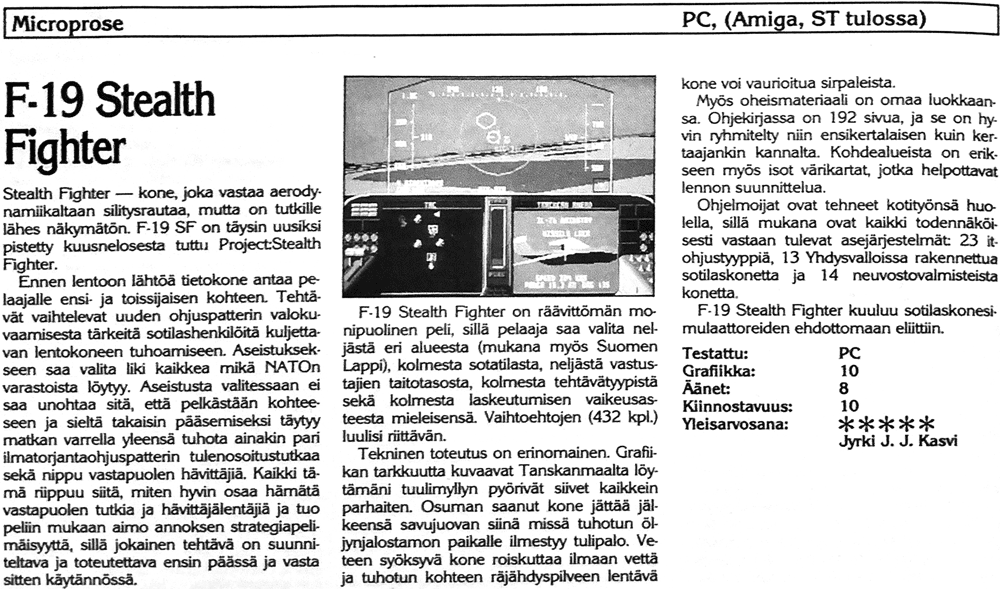
F-19 Stealth Fighter1989 SyksyPysyvä linkkiStealth Fighter - kone, joka vastaa aerodynamiikaltaan silitysrautaa, mutta on tutkille lähes näkymätön. F-19 SF on täysin uusiksi pistetty kuusnelosesta tuttu Project:Stealth Fighter.
Ennen lentoon lähtöä tietokone antaa pelaajalle ensi- ja toissijaisen kohteen. Tehtävät vaihtelevat uuden ohjuspatterin valokuvaamisesta tärkeitä sotilashenkilöitä kuljettavan lentokoneen tuhoamiseen. Aseistukseksseen saa valita liki kaikkea mikä NATOn varastoista löytyy. Aseistusta valitessaan ei saa unohtaa sitä, että pelkästään kohteeseen ja sieltä takaisin pääsemiseksi täytyy matkan varrella yleensä tuhota ainakin pari ilmatorjantaohjuspatterin tulenosoitustutkaa sekä nippu vastapuolen hävittäjiä. Kaikki tämä riippuu siitä, miten hyvin osaa hämätä vastapuolen tutkia ja hävittäjälentäjiä ja tuo peliin mukaan aimo annoksen strategiapelimäisyyttä, sillä jokainen tehtävä on suunniteltava ja toteutettava ensin päässä ja vasta sitten käytännössä.
F-19 Stealth Fighter on räävittömän monipuolinen peli, sillä pelaaja saa valita neljästä eri alueesta (mukana myös Suomen Lappi), kolmesta sotilastasta, neljästä vastustajien taitotasosta, kolmesta tehtävätyypistä sekä kolmesta laskeutumisen vaikeusasteesta mieleisensä. Vaihtoehtojen (432 kpl.) luulisi riittävän.
Tekninen toteutus on erinomainen. Grafiikan tarkkuutta kuvaavat Tanskanmaalta löytämäni tuulimyllyn pyörivät siivet kaikkein parhaiten. Osuman saanut kone jättää jälkeensä savujuovan siinä missä tuhotun öljynjalostamon paikalle ilmestyy tulipalo. Veteen syöksyvä kone roiskuttaa ilmaan vettä ja tuhotun kohteen räjähdyspilveen lentävä kone voi vaurioitua sirpaleista.
Myös oheismateriaali on omaa luokkaansa. Ohjekirjassa on 192 sivua, ja se on hyvin ryhmitelty niin ensikertalaisen kuin kertaajankin kannalta. Kohdealueista on erikseen myös isot värikartat, jotka helpottavat lennon suunnittelua.
Ohjelmoijat ovat tehneet kotityönsä huolella, sillä mukana ovat kaikki todennäköisesti vastaan tulevat asejärjestelmät: 23 it-ohjustyyppiä, 13 Yhdysvalloissa rakennettua sotilaskonetta ja 14 neuvostovalmisteista konetta.
F-19 Stealth Fighter kuuluu sotilaskonesimulaattoreiden ehdottomaan eliittiin.
F-19 Stealth Fighter1989 SyksyPermalinkStealth Fighter - a plane with the aerodynamics of a clothes iron, but almost invisible to radar. F-19 SF is a completely redone version of Project:Stealth Fighter, familiar from the C-64.
Before take-off, the computer gives the player a primary and a secondary target. Missions range from photographing a new missile battery to destroying a plane carrying important military personnel. For your armament you can pick almost anything to be found in NATO's stores. When choosing your weapons, you mustn't forget that just to get to the target and back again you usually have to destroy at least a couple of anti-aircraft missile battery fire-control radars and a bunch of enemy fighters along the way. All of this depends on how well you can fool the enemy's radars and fighter pilots, and that brings a hefty dose of strategy-game flavour into play, since every mission has to be planned and carried out first in your head and only then in practice.
F-19 Stealth Fighter is an outrageously versatile game, since the player gets to pick whatever they fancy from four different regions (Finnish Lapland included), three states of war, four enemy skill levels, three mission types and three landing difficulty levels. The options (432 of them) ought to be enough, you'd think.
The technical execution is excellent. The level of detail in the graphics is best illustrated by the turning sails of a windmill I found in Denmark. A plane that's been hit leaves a trail of smoke behind it, while a fire breaks out where a destroyed oil refinery stood. A plane plunging into the sea sends water splashing into the air, and a plane that flies into the explosion cloud of a destroyed target can be damaged by debris.
The accompanying material is in a class of its own too. The manual runs to 192 pages and is well organised for the first-timer and for someone brushing up alike. There are also separate large colour maps of the target areas, which make flight planning easier.
The programmers have done their homework thoroughly, since every weapon system you're likely to run into is included: 23 types of anti-aircraft missile, 13 US-built military aircraft and 14 Soviet-made aircraft.
F-19 Stealth Fighter belongs to the absolute elite of military aircraft simulators.
F-19 Stealth Fighter
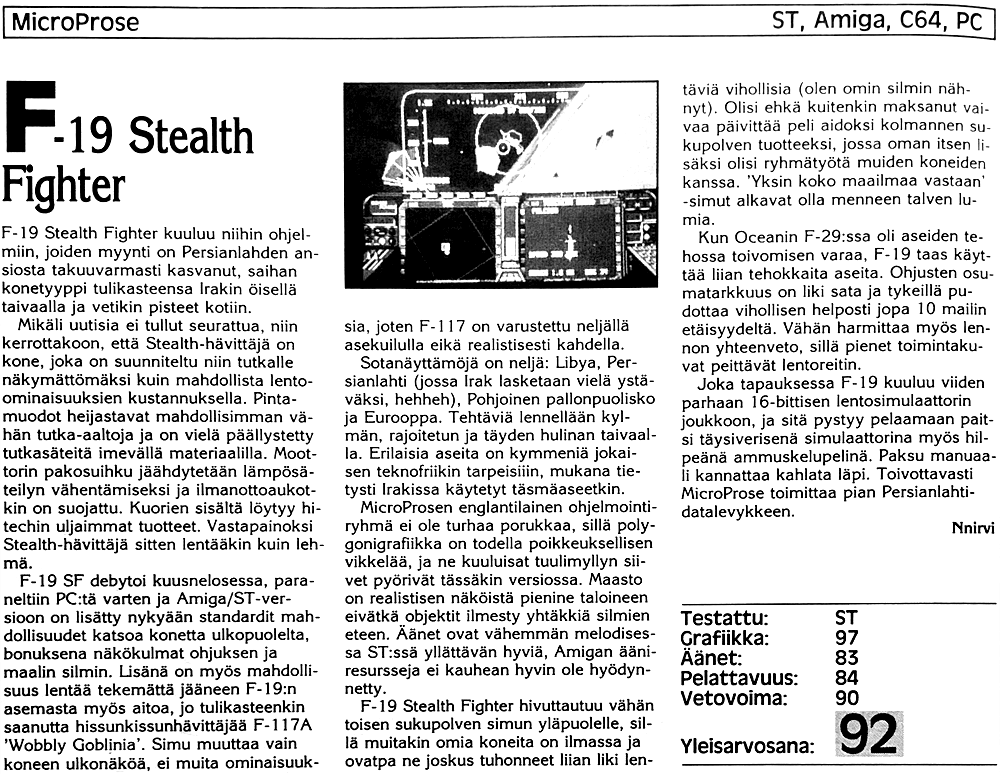
F-19 Stealth Fighter1991 KevätPysyvä linkkiF-19 Stealth Fighter kuuluu niihin ohjelmiin, joiden myynti on Persianlahden ansiosta takuuvarmasti kasvanut, saihan konetyyppi tulikasteensa Irakin öisellä taivaalla ja vetikin pisteet kotiin.
Mikäli uutisia ei tullut seurattua, niin kerrottakoon, että Stealth-hävittäjä on kone, joka on suunniteltu niin tutkalle näkymättömäksi kuin mahdollista lento-ominaisuuksien kustannuksella. Pintamuodot heijastavat mahdollisimman vähän tutka-aaltoja ja on vielä päällystetty tutkasäteitä imevällä materiaalilla. Moottorin pakosuihku jäähdytetään lämpösäteilyn vähentämiseksi ja ilmanottoaukotkin on suojattu. Kuorien sisältä löytyy hitechin uljaimmat tuotteet. Vastapainoksi Stealth-hävittäjä sitten lentääkin kuin lehmä.
F-19 SF debytoi kuusnelosessa, paraneltiin PC:tä varten ja Amiga/ST-versioon on lisätty nykyään standardit mahdollisuudet katsoa konetta ulkopuolelta, bonuksena näkökulmat ohjuksen ja maalin silmin. Lisänä on myös mahdollisuus lentää tekemättä jääneen F-19:n asemasta myös aitoa, jo tulikasteenkin saanutta hissunkissunhävittäjää F-117A 'Wobbly Goblinia'. Simu muuttaa vain koneen ulkonäköä, ei muita ominaisuuksia, joten F-117 on varustettu neljällä asekuilulla eikä realistisesti kahdella.
Sotanäyttämöjä on neljä: Libya, Persianlahti (jossa Irak lasketaan vielä ystäväksi, hehheh), Pohjoinen pallonpuolisko ja Eurooppa. Tehtäviä lennellään kylmän, rajoitetun ja täyden hulinan taivaalla. Erilaisia aseita on kymmeniä jokaisen teknofriikin tarpeisiiin, mukana tietysti Irakissa käytetyt täsmäaseetkin.
MicroProsen englantilainen ohjelmointiryhmä ei ole turhaa porukkaa, sillä polygonigrafiikka on todella poikkeuksellisen vikkelää, ja ne kuuluisat tuulimyllyn siivet pyörivät tässäkin versiossa. Maasto on realistisen näköistä pienine taloineen eivätkä objektit ilmesty yhtäkkiä silmien eteen. Äänet ovat vähemmän melodisessa ST:ssä yllättävän hyviä, Amigan ääniresursseja ei kauhean hyvin ole hyödynnetty.
F-19 Stealth Fighter hivuttautuu vähän toisen sukupolven simun yläpuolelle, sillä muitakin omia koneita on ilmassa ja ovatpa ne joskus tuhonneet liian liki lentäviä vihollisia (olen omin silmin nähnyt). Olisi ehkä kuitenkin maksanut vaivaa päivittää peli aidoksi kolmannen sukupolven tuotteeksi, jossa oman itsen lisäksi olisi ryhmätyötä muiden koneiden kanssa. 'Yksin koko maailmaa vastaan' -simut alkavat olla menneen talven lumia.
Kun Oceanin F-29:ssa oli aseiden tehossa toivomisen varaa, F-19 taas käyttää liian tehokkaita aseita. Ohjusten osumatarkkuus on liki sata ja tykeillä pudottaa vihollisen helposti jopa 10 mailin etäisyydeltä. Vähän harmittaa myös lennon yhteenveto, sillä pienet toimintakuvat peittävät lentoreitin.
Joka tapauksessa F-19 kuuluu viiden parhaan 16-bittisen lentosimulaattorin joukkoon, ja sitä pystyy pelaamaan paitsi täysiverisenä simulaattorina myös hilpeänä ammuskelupelinä. Paksu manuaali kannattaa kahlata läpi. Toivottavasti MicroProse toimittaa pian Persianlahti-datalevykkeen.
F-19 Stealth Fighter1991 KevätPermalinkF-19 Stealth Fighter is one of those programs whose sales are dead certain to have grown thanks to the Persian Gulf, what with the aircraft type getting its baptism of fire in the night skies over Iraq and walking off with the points, too.
In case you didn't keep up with the news, let it be said that the Stealth fighter is an aircraft designed to be as invisible to radar as possible at the expense of its flight characteristics. Its surface shapes reflect as few radar waves as possible and are furthermore coated with a material that absorbs radar beams. The engine exhaust is cooled to reduce heat radiation, and even the air intakes are shielded. Inside the shell you'll find the proudest products of hi-tech. To balance things out, the Stealth fighter then flies like a cow.
F-19 SF debuted on the C-64, was improved for the PC, and the Amiga/ST version adds the nowadays standard options of viewing the plane from outside, with views through the eyes of the missile and the target as a bonus. On top of that there's also the option of flying, instead of the never-built F-19, the real hush-hush fighter that has already had its baptism of fire too, the F-117A 'Wobbly Goblin'. The sim only changes the plane's looks, not its other characteristics, so the F-117 is fitted with four weapon bays rather than, realistically, two.
There are four theatres of war: Libya, the Persian Gulf (where Iraq still counts as a friend, heh heh), the Northern Hemisphere and Europe. Missions are flown in skies of cold, limited and full-scale mayhem. There are dozens of different weapons to meet every technofreak's needs, including of course the precision weapons used in Iraq.
MicroProse's English programming team is no bunch of slouches, since the polygon graphics are truly exceptionally nippy, and those famous windmill sails turn in this version too. The terrain looks realistic with its little houses, and objects don't suddenly pop up before your eyes. The sound on the less melodious ST is surprisingly good; the Amiga's sound resources haven't been exploited terribly well.
F-19 Stealth Fighter edges a little above the second-generation sim, since there are other friendly planes in the air too, and they have even been known to destroy enemies flying too close (I've seen it with my own eyes). Still, it might have been worth the trouble to upgrade the game into a genuine third-generation product where, besides yourself, there would be teamwork with other aircraft. 'Alone against the whole world' sims are becoming the snows of yesteryear.
Whereas the weapons in Ocean's F-29 left something to be desired in effectiveness, F-19 on the other hand uses weapons that are too effective. Missile accuracy is close to a hundred per cent, and with the guns you can easily down an enemy from as far as 10 miles away. The flight debriefing is a bit annoying too, as the small action pictures cover up the flight path.
In any case F-19 is one of the five best 16-bit flight simulators, and it can be played not only as a full-blooded simulator but also as a jolly shoot-'em-up. The thick manual is worth wading through. Hopefully MicroProse will soon deliver a Persian Gulf data disk.
F-29 Retaliator
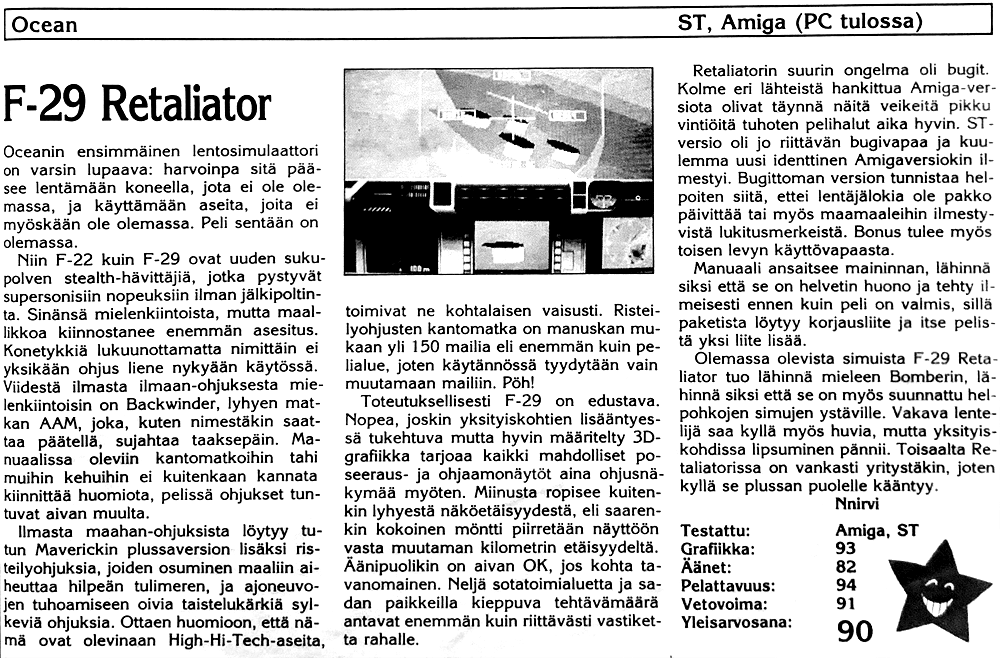
F-29 Retaliator1990 SyksyPysyvä linkkiOceanin ensimmäinen lentosimulaattori on varsin lupaava: harvoinpa sitä pääsee lentämään koneella, jota ei ole olemassa, ja käyttämään aseita, joita ei myöskään ole olemassa. Peli sentään on olemassa.
Niin F-22 kuin F-29 ovat uuden sukupolven stealth-hävittäjiä, jotka pystyvät supersonisiin nopeuksiin ilman jälkipoltinta. Sinänsä mielenkiintoista, mutta maallikkoa kiinnostanee enemmän asesitus. Konetykkiä lukuunottamatta nimittäin ei yksikään ohjus liene nykyään käytössä. Viidestä ilmasta ilmaan-ohjuksesta mielenkiintoisin on Backwinder, lyhyen matkan AAM, joka, kuten nimestäkin saattaa päätellä, sujahtaa taaksepäin. Manuaalissa oleviin kantomatkoihin tahi muihin kehuihin ei kuitenkaan kannata kiinnittää huomiota, pelissä ohjukset tuntuvat aivan muulta.
Ilmasta maahan-ohjuksista löytyy tutun Maverickin plussaversion lisäksi risteilyohjuksia, joiden osuminen maaliin aiheuttaa hilpeän tulimeren, ja ajoneuvojen tuhoamiseen oivia taistelukärkiä sylkeviä ohjuksia. Ottaen huomioon, että nämä ovat olevinaan High-Hi-Tech-aseita, toimivat ne kohtalaisen vaisusti. Risteilyohjusten kantomatka on manuskan mukaan yli 150 mailia eli enemmän kuin pelialue, joten käytännössä tyydytään vain muutamaan mailiin. Pöh!
Toteutuksellisesti F-29 on edustava. Nopea, joskin yksityiskohtien lisääntyessä tukehtuva mutta hyvin määritelty 3D-grafiikka tarjoaa kaikki mahdolliset poseeraus- ja ohjaamonäytöt aina ohjusnäkymää myöten. Miinusta ropisee kuitenkin lyhyestä näköetäisyydestä, eli saarenkin kokoinen möntti piirretään näyttöön vasta muutaman kilometrin etäisyydeltä. Äänipuolikin on aivan OK, jos kohta tavanomainen. Neljä sotatoimialuetta ja sadan paikkeilla kieppuva tehtävämäärä antavat enemmän kuin riittävästi vastiketta rahalle.
Retaliatorin suurin ongelma oli bugit. Kolme eri lähteistä hankittua Amiga-versiota olivat täynnä näitä veikeitä pikku vintiöitä tuhoten pelihalut aika hyvin. ST-versio oli jo riittävän bugivapaa ja kuulemma uusi identtinen Amigaversiokin ilmestyi. Bugittoman version tunnistaa helpoiten siitä, ettei lentäjälokia ole pakko päivittää tai myös maamaaleihin ilmestyvistä lukitusmerkeistä. Bonus tulee myös toisen levyn käyttövapaasta.
Manuaali ansaitsee maininnan, lähinnä siksi että se on helvetin huono ja tehty ilmeisesti ennen kuin peli on valmis, sillä paketista löytyy korjausliite ja itse pelistä yksi liite lisää.
Olemassa olevista simuista F-29 Retaliator tuo lähinnä mieleen Bomberin, lähinnä siksi että se on myös suunnattu helpohkojen simujen ystäville. Vakava lentelijä saa kyllä myös huvia, mutta yksityiskohdissa lipsuminen pännii. Toisaalta Retaliatorissa on vankasti yritystäkin, joten kyllä se plussan puolelle kääntyy.
F-29 Retaliator1990 SyksyPermalinkOcean's first flight simulator is quite promising: it's not often you get to fly a plane that doesn't exist and use weapons that don't exist either. The game, at least, does exist.
Both the F-22 and the F-29 are new-generation stealth fighters capable of supersonic speeds without afterburner. Interesting enough in itself, but the layman is probably more interested in the armament. Apart from the cannon, you see, not a single one of the missiles is likely to be in service today. Of the five air-to-air missiles the most interesting is the Backwinder, a short-range AAM which, as you might guess from the name, zips off backwards. The ranges quoted in the manual, or its other boasts, are not worth paying attention to, though; in the game the missiles feel like something else entirely.
Among the air-to-ground missiles, besides a souped-up version of the familiar Maverick, there are cruise missiles, which set off a merry sea of flame when they hit the target, and missiles that spit out warheads just the thing for wiping out vehicles. Considering that these are supposed to be High-Hi-Tech weapons, they perform rather feebly. According to the manual the cruise missiles' range is over 150 miles, i.e. more than the whole play area, so in practice you make do with just a few miles. Pah!
In terms of execution F-29 is a presentable effort. The fast - if choking as the detail piles up - but well-defined 3D graphics offer every possible show-off and cockpit view, right down to a missile's-eye view. The minus points come pouring in, though, for the short draw distance: even an island-sized lump only gets drawn on screen from a few kilometres away. The sound side is quite OK too, if run-of-the-mill. Four theatres of operations and a mission count hovering somewhere around a hundred give more than enough value for money.
Retaliator's biggest problem was bugs. Three Amiga versions obtained from different sources were full of these cheeky little rascals, which pretty well killed any desire to play. The ST version was already bug-free enough, and I hear a new, identical Amiga version has come out too. The easiest way to recognise the bug-free version is that you are not forced to update the pilot log, or else by the lock-on markers that appear on ground targets. Another bonus is the freedom to use the second disk.
The manual deserves a mention, mainly because it is bloody awful and was evidently written before the game was finished, since the box contains a correction supplement and the game itself one more supplement on top.
Of existing sims, F-29 Retaliator mostly brings Bomber to mind, mainly because it too is aimed at fans of fairly easy sims. The serious flyer will get some fun out of it as well, but the sloppiness in the details gets on your nerves. Then again, Retaliator also has plenty of solid effort in it, so it does come out on the plus side.
F/A-18 Interceptor
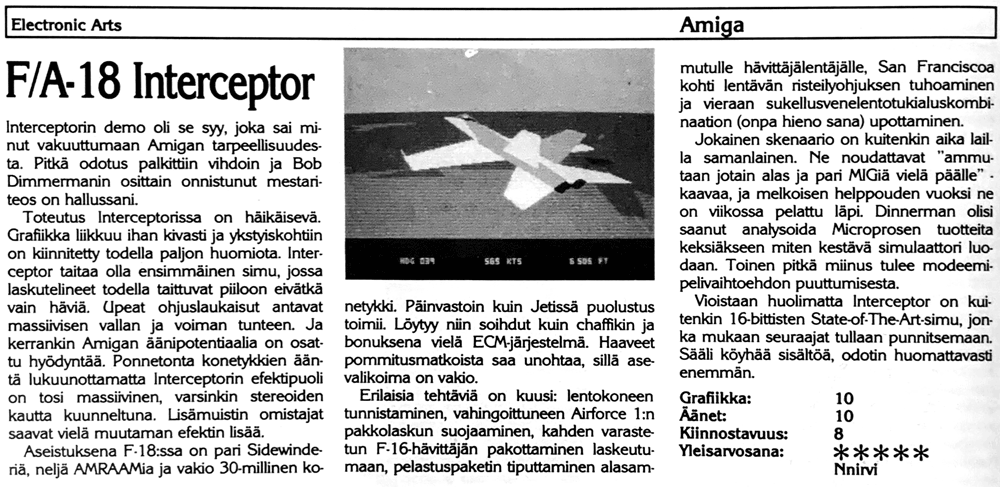
F/A-18 Interceptor1988Pysyvä linkkiInterceptorin demo oli se syy, joka sai minut vakuuttumaan Amigan tarpeellisuudesta. Pitkä odotus palkittiin vihdoin ja Bob Dimmermanin osittain onnistunut mestariteos on hallussani.
Toteutus Interceptorissa on häikäisevä. Grafiikka liikkuu ihan kivasti ja ykstyiskohtiin on kiinnitetty todella paljon huomiota. Interceptor taitaa olla ensimmäinen simu, jossa laskutelineet todella taittuvat piiloon eivätkä vain häviä. Upeat ohjuslaukaisut antavat massiivisen vallan ja voiman tunteen. Ja kerrankin Amigan äänipotentiaalia on osattu hyödyntää. Ponnetonta konetykkien ääntä lukuunottamatta Interceptorin efektipuoli on tosi massiivinen, varsinkin stereoiden kautta kuunneltuna. Lisämuistin omistajat saavat vielä muutaman efektin lisää.
Aseistuksena F-18:ssa on pari Sidewinderiä, neljä AMRAAMia ja vakio 30-millinen konetykki. Päinvastoin kuin Jetissä puolustus toimii. Löytyy niin soihdut kuin chaffikin ja bonuksena vielä ECM-järjestelmä. Haaveet pommitusmatkoista saa unohtaa, sillä asevalikoima on vakio.
Erilaisia tehtäviä on kuusi: lentokoneen tunnistaminen, vahingoittuneen Airforce 1:n pakkolaskun suojaaminen, kahden varastetun F-16-hävittäjän pakottaminen laskeutumaan, pelastuspaketin tiputtaminen alasammutulle hävittäjälentäjälle, San Franciscoa kohti lentävän risteilyohjuksen tuhoaminen ja vieraan sukellusvenelentotukialuskombinaation (onpa hieno sana) upottaminen.
Jokainen skenaario on kuitenkin aika lailla samanlainen. Ne noudattavat "ammutaan jotain alas ja pari MIGiä vielä päälle" -kaavaa, ja melkoisen helppouden vuoksi ne on viikossa pelattu läpi. Dinnerman olisi saanut analysoida Microprosen tuotteita keksiäkseen miten kestävä simulaattori luodaan. Toinen pitkä miinus tulee modeemipelivaihtoehdon puuttumisesta.
Vioistaan huolimatta Interceptor on kuitenkin 16-bittisten State-of-The-Art-simu, jonka mukaan seuraajat tullaan punnitsemaan. Sääli köyhää sisältöä, odotin huomattavasti enemmän.
F/A-18 Interceptor1988PermalinkThe Interceptor demo was what convinced me that I needed an Amiga. The long wait has finally been rewarded, and Bob Dimmerman's partially successful masterpiece is in my hands.
Interceptor's execution is dazzling. The graphics move quite nicely and a great deal of attention has been paid to detail. Interceptor may well be the first sim in which the landing gear actually folds away instead of just vanishing. The superb missile launches give a massive sense of power and might. And for once someone has known how to make use of the Amiga's sound potential. Apart from the feeble sound of the cannon, Interceptor's effects department is truly massive, especially when heard through a stereo. Owners of extra memory get a few more effects on top.
For armament the F-18 has a couple of Sidewinders, four AMRAAMs and a standard 30mm cannon. Unlike in Jet, the defences work. There are both flares and chaff, and as a bonus an ECM system too. You can forget any dreams of bombing runs, as the weapons loadout is fixed.
There are six different missions: identifying an aircraft, covering the emergency landing of a damaged Air Force One, forcing two stolen F-16 fighters to land, dropping a rescue package to a downed fighter pilot, destroying a cruise missile heading for San Francisco, and sinking a foreign submarine-aircraft-carrier-combination (now there's a fine word).
Every scenario is pretty much the same, though. They follow the "shoot something down, plus a couple of MiGs on top" formula, and since they're fairly easy you'll have played them all through within a week. Dinnerman would have done well to analyse Microprose's products to work out how to create a simulator with staying power. Another big minus is the lack of a modem play option.
Despite its flaws, Interceptor is nevertheless the state-of-the-art sim of the 16-bit machines, the one its successors will be measured against. A pity about the thin content; I expected a lot more.
F16 Combat Pilot
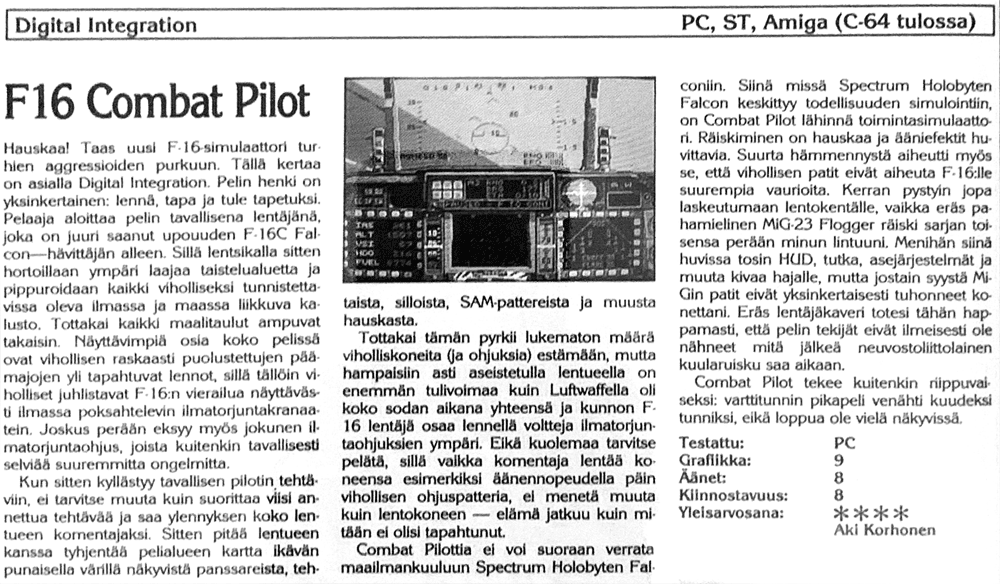
F16 Combat Pilot1989 SyksyPysyvä linkkiHauskaa! Taas uusi F-16-simulaattori turhien aggressioiden purkuun. Tällä kertaa on asialla Digital Integration. Pelin henki on yksinkertainen: lennä, tapa ja tule tapetuksi. Pelaaja aloittaa pelin tavallisena lentäjänä, joka on juuri saanut upouuden F-16C Falcon-hävittäjän alleen. Sillä lentsikalla sitten hortoillaan ympäri laajaa taistelualuetta ja pippuroidaan kaikki viholliseksi tunnistettavissa oleva ilmassa ja maassa liikkuva kalusto. Tottakai kaikki maalitaulut ampuvat takaisin. Näyttävimpiä osia koko pelissä ovat vihollisen raskaasti puolustettujen päämajojen yli tapahtuvat lennot, sillä tällöin viholliset juhlistavat F-16:n vierailua näyttävästi ilmassa poksahtelevin ilmatorjuntakranaatein. Joskus perään eksyy myös jokunen ilmatorjuntaohjus, joista kuitenkin tavallisesti selviää suuremmitta ongelmitta.
Kun sitten kyllästyy tavallisen pilotin tehtäviin, ei tarvitse muuta kuin suorittaa viisi annettua tehtävää ja saa ylennyksen koko lentueen komentajaksi. Sitten pitää lentueen kanssa tyhjentää pelialueen kartta ikävän punaisella värillä näkyvistä panssareista, tehtaista, silloista, SAM-pattereista ja muusta hauskasta.
Tottakai tämän pyrkii lukematon määrä viholliskoneita (ja ohjuksia) estämään, mutta hampaisiin asti aseistetulla lentueella on enemmän tulivoimaa kuin Luftwaffella oli koko sodan aikana yhteensä ja kunnon F-16 lentäjä osaa lennellä voltteja ilmatorjuntaohjuksien ympäri. Eikä kuolemaa tarvitse pelätä, sillä vaikka komentaja lentää koneensa esimerkiksi äänennopeudella päin vihollisen ohjuspatteria, ei menetä muuta kuin lentokoneen - elämä jatkuu kuin mitään ei olisi tapahtunut.
Combat Pilottia ei voi suoraan verrata maailmankuuluun Spectrum Holobyten Falconiin. Siinä missä Spectrum Holobyten Falcon keskittyy todellisuuden simulointiin, on Combat Pilot lähinnä toimintasimulaattori. Räiskiminen on hauskaa ja ääniefektit huvittavia. Suurta hämmennystä aiheutti myös se, että vihollisen patit eivät aiheuta F-16:lle suurempia vaurioita. Kerran pystyin jopa laskeutumaan lentokentälle, vaikka eräs pahamielinen MiG-23 Flogger räiski sarjan toisensa perään minun lintuuni. Menihän siinä huvissa tosin HUD, tutka, asejärjestelmät ja muuta kivaa hajalle, mutta jostain syystä MiGin patit eivät yksinkertaisesti tuhonneet konettani. Eräs lentäjäkaveri totesi tähän happamasti, että pelin tekijät eivät ilmeisesti ole nähneet mitä jälkeä neuvostoliittolainen kuularuisku saa aikaan.
Combat Pilot tekee kuitenkin riippuvaiseksi: varttitunnin pikapeli venähti kuudeksi tunniksi, eikä loppua ole vielä näkyvissä.
F16 Combat Pilot1989 SyksyPermalinkFun! Yet another F-16 simulator for venting pointless aggression. This time Digital Integration is behind it. The spirit of the game is simple: fly, kill and get killed. The player starts the game as an ordinary pilot who has just been handed a brand-new F-16C Falcon fighter. In that crate you then bumble around a wide combat area, peppering every piece of hardware moving in the air or on the ground that can be identified as hostile. Of course all the targets shoot back. The most spectacular parts of the whole game are the flights over the enemy's heavily defended headquarters, because that's when the enemy celebrates the F-16's visit in style with anti-aircraft shells popping in the air. Sometimes the odd anti-aircraft missile also wanders onto your tail, but you usually shake those off without any great trouble.
Then, when you get tired of the ordinary pilot's missions, all you need to do is complete five set missions and you get promoted to commander of the whole squadron. After that you and your squadron have to clear the game map of the tanks, factories, bridges, SAM batteries and other fun stuff that show up on it in a nasty shade of red.
Of course countless enemy planes (and missiles) try to stop this, but a squadron armed to the teeth has more firepower than the Luftwaffe had in total during the whole war, and a proper F-16 pilot knows how to fly loops around anti-aircraft missiles. Nor do you need to fear death, because even if the commander flies their plane into an enemy missile battery at, say, the speed of sound, all you lose is the aircraft - life goes on as if nothing had happened.
Combat Pilot can't be compared directly with Spectrum Holobyte's world-famous Falcon. Whereas Spectrum Holobyte's Falcon concentrates on simulating reality, Combat Pilot is more of an action simulator. The blasting is fun and the sound effects amusing. What also caused great bewilderment was that the enemy's guns don't do much damage to the F-16. Once I even managed to land at an airfield, even though a certain ill-tempered MiG-23 Flogger was pumping burst after burst into my bird. Admittedly, the HUD, the radar, the weapon systems and other nice things got busted in all the fun, but for some reason the MiG's guns simply didn't destroy my plane. A pilot buddy of mine remarked sourly on this that the makers of the game have evidently never seen the mess a Soviet bullet-hose makes.
Combat Pilot is addictive, though: a quick quarter-hour game stretched into six hours, and there's still no end in sight.
Fairlight
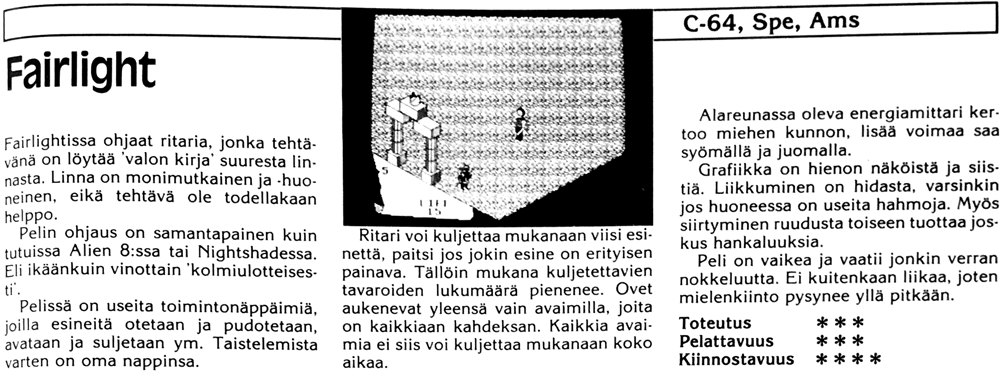
Fairlight1987Pysyvä linkkiFairlightissa ohjaat ritaria, jonka tehtävänä on löytää 'valon kirja' suuresta linnasta. Linna on monimutkainen ja -huoneinen, eikä tehtävä ole todellakaan helppo.
Pelin ohjaus on samantapainen kuin tutuissa Alien 8:ssa tai Nightshadessa. Eli ikäänkuin vinottain 'kolmiulotteisesti'.
Pelissä on useita toimintonäppäimiä, joilla esineitä otetaan ja pudotetaan, avataan ja suljetaan ym. Taistelemista varten on oma nappinsa.
Ritari voi kuljettaa mukanaan viisi esinettä, paitsi jos jokin esine on erityisen painava. Tällöin mukana kuljetettavien tavaroiden lukumäärä pienenee. Ovet aukenevat yleensä vain avaimilla, joita on kaikkiaan kahdeksan. Kaikkia avaimia ei siis voi kuljettaa mukanaan koko aikaa.
Alareunassa oleva energiamittari kertoo miehen kunnon, lisää voimaa saa syömällä ja juomalla.
Grafiikka on hienon näköistä ja siistiä. Liikkuminen on hidasta, varsinkin jos huoneessa on useita hahmoja. Myös siirtyminen ruudusta toiseen tuottaa joskus hankaluuksia.
Peli on vaikea ja vaatii jonkin verran nokkeluutta. Ei kuitenkaan liikaa, joten mielenkiinto pysynee yllä pitkään.
Fairlight1987PermalinkIn Fairlight you control a knight whose task is to find the 'Book of Light' in a large castle. The castle is full of twists and full of rooms, and the task is really not easy at all.
The game controls much like the familiar Alien 8 or Nightshade. That is, sort of diagonally 'three-dimensional'.
The game has several action keys for picking up and dropping objects, opening and closing things and so on. There's a separate button for fighting.
The knight can carry five objects with him, unless one of them is especially heavy. In that case the number of items he can carry goes down. Doors usually only open with keys, of which there are eight in all. So you can't carry every key with you the whole time.
The energy meter along the bottom of the screen shows the man's condition; you get more strength by eating and drinking.
The graphics look fine and neat. Movement is slow, especially if there are several characters in the room. Moving from one screen to the next also causes trouble now and then.
The game is hard and demands a certain amount of cleverness. Not too much, though, so your interest should hold up for a long time.
Falcon
Falcon1989 KevätPysyvä linkkiFalcon-maailman kuuluisin taistelulentosimulaattori. Onhan tämän mestariteoksen kummatkin MS-DOS-versiot jo esitelty, mutta kun uusi ST-Amiga-versio yksinkertaisesti on niin käsittämättömän hyvä ei vanha simulaattorien ystävä voi vaieta, vaan hänen on pakko kaiuttaa riemuaan maailmalle.
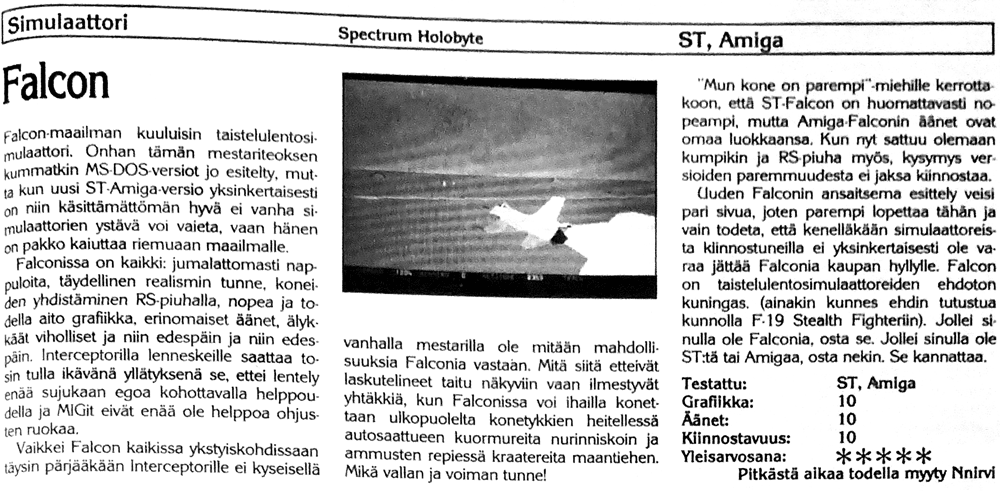
Falconissa on kaikki: jumalattomasti nappuloita, täydellinen realismin tunne, koneiden yhdistäminen RS-piuhalla, nopea ja todella aito grafiikka, erinomaiset äänet, älykkäät viholliset ja niin edespäin ja niin edespäin. Interceptorilla lenneskeille saattaa tosin tulla ikävänä yllätyksenä se, ettei lentely enää sujukaan egoa kohottavalla helppoudella ja MIGit eivät enää ole helppoa ohjusten ruokaa.
Vaikkei Falcon kaikissa ykstyiskohdissaan täysin pärjääkään Interceptorille ei kyseisellä vanhalla mestarilla ole mitään mahdollisuuksia Falconia vastaan. Mitä siitä etteivät laskutelineet taitu näkyviin vaan ilmestyvät yhtäkkiä, kun Falconissa voi ihailla konettaan ulkopuolelta konetykkien heitellessä autosaattueen kuormureita nurinniskoin ja ammusten repiessä kraatereita maantiehen. Mikä vallan ja voiman tunne!
"Mun kone on parempi"-miehille kerrottakoon, että ST-Falcon on huomattavasti nopeampi, mutta Amiga-Falconin äänet ovat omaa luokkaansa. Kun nyt sattuu olemaan kumpikin ja RS-piuha myös, kysymys versioiden paremmuudesta ei jaksa kiinnostaa.
Uuden Falconin ansaitsema esittely veisi pari sivua, joten parempi lopettaa tähän ja vain todeta, että kenelläkään simulaattoreista kiinnostuneilla ei yksinkertaisesti ole varaa jättää Falconia kaupan hyllylle. Falcon on taistelulentosimulaattoreiden ehdoton kuningas. (ainakin kunnes ehdin tutustua kunnolla F-19 Stealth Fighteriin). Jollei sinulla ole Falconia, osta se. Jollei sinulla ole ST:tä tai Amigaa, osta nekin. Se kannattaa.
Falcon1989 KevätPermalinkFalcon - the world's most famous combat flight simulator. Both MS-DOS versions of this masterpiece have already been reviewed, of course, but when the new ST-Amiga version is simply so incomprehensibly good, an old friend of simulators cannot stay silent, but is compelled to let the joy ring out across the world.
Falcon has everything: an ungodly number of buttons, a total sense of realism, linking machines together with an RS cable, fast and truly authentic graphics, excellent sound, intelligent enemies and so on and so forth. Those who have been flitting about in Interceptor may, however, be in for a nasty surprise: the flying no longer goes with ego-boosting ease, and the MIGs are no longer easy missile fodder.
Even though Falcon can't quite match Interceptor in every last detail, the old master in question stands no chance whatsoever against Falcon. So what if the landing gear doesn't fold down into view but just suddenly appears, when in Falcon you can admire your plane from the outside as the cannons toss the trucks of a road convoy head over heels and the shells rip craters in the highway. What a feeling of power and might!
For the "my machine is better" guys, let it be said that the ST Falcon is considerably faster, but the Amiga Falcon's sound is in a class of its own. Since I happen to have both, and the RS cable too, the question of which version is better just can't hold my interest.
The review the new Falcon deserves would take a couple of pages, so better to stop here and just state that anyone interested in simulators simply cannot afford to leave Falcon on the shop shelf. Falcon is the undisputed king of combat flight simulators. (At least until I get round to taking a proper look at F-19 Stealth Fighter.) If you don't have Falcon, buy it. If you don't have an ST or an Amiga, buy those too. It's worth it.
Falcon Mission Disk Volume 2
Falcon Mission Disk Volume 21991 KevätPysyvä linkkiSpectrum Holobyten Falcon oli ilmestyessään lentosimulaattoreiden kirkainta kärkeä. Ajan hammas ei muuten ole Falconiin purrut, paitsi alkuperäiseen kokonaisideaan eli toisiinsa liittymättömiin tehtäviin. Mission Disk 1 paikkasi tätä puutetta tekemällä Falconista pelin, jolla oli päämäärä. Ja nyt Mission Disk 2 jatkaa edelleen simun pönkittämistä kohti nykystandardeja.
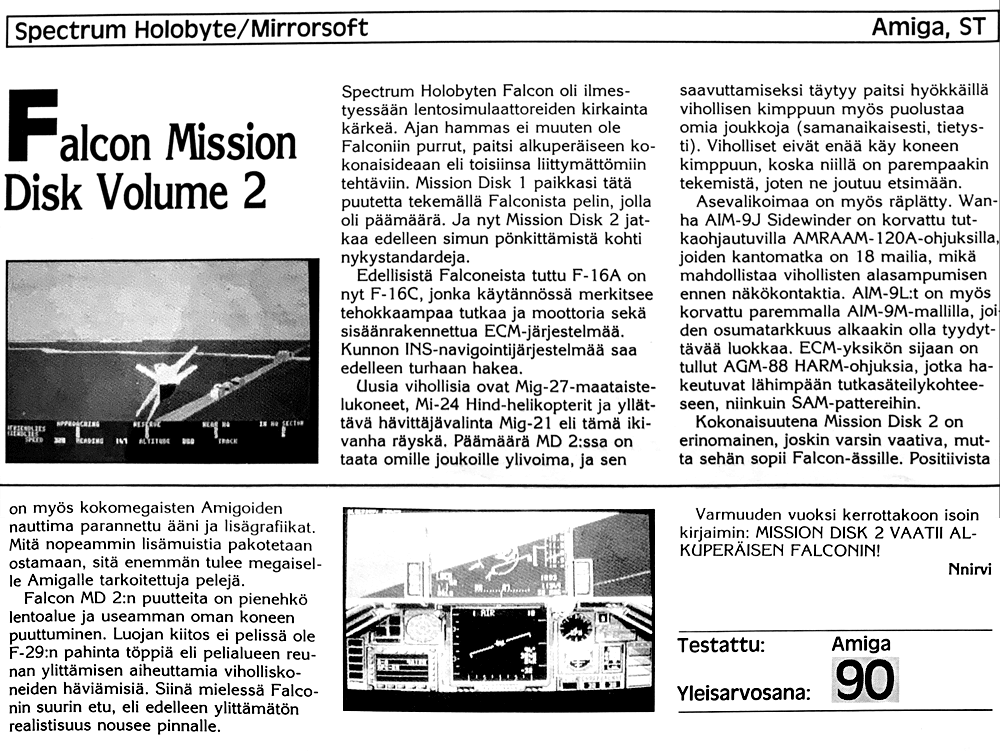
Edellisistä Falconeista tuttu F-16A on nyt F-16C, jonka käytännössä merkitsee tehokkaampaa tutkaa ja moottoria sekä sisäänrakennettua ECM-järjestelmää. Kunnon INS-navigointijärjestelmää saa edelleen turhaan hakea.
Uusia vihollisia ovat Mig-27-maataistelukoneet, Mi-24 Hind-helikopterit ja yllättävä hävittäjävalinta Mig-21 eli tämä ikivanha räyskä. Päämäärä MD 2:ssa on taata omille joukoille ylivoima, ja sen saavuttamiseksi täytyy paitsi hyökkäillä vihollisen kimppuun myös puolustaa omia joukkoja (samanaikaisesti, tietysti). Viholliset eivät enää käy koneen kimppuun, koska niillä on parempaakin tekemistä, joten ne joutuu etsimään.
Asevalikoimaa on myös räplätty. Wanha AIM-9J Sidewinder on korvattu tutkaohjautuvilla AMRAAM-120A-ohjuksilla, joiden kantomatka on 18 mailia, mikä mahdollistaa vihollisten alasampumisen ennen näkökontaktia. AIM-9L:t on myös korvattu paremmalla AIM-9M-mallilla, joiden osumatarkkuus alkaakin olla tyydyttävää luokkaa. ECM-yksikön sijaan on tullut AGM-88 HARM-ohjuksia, jotka hakeutuvat lähimpään tutkasäteilykohteeseen, niinkuin SAM-pattereihin.
Kokonaisuutena Mission Disk 2 on erinomainen, joskin varsin vaativa, mutta sehän sopii Falcon-ässille. Positiivista on myös kokomegaisten Amigoiden nauttima parannettu ääni ja lisägrafiikat. Mitä nopeammin lisämuistia pakotetaan ostamaan, sitä enemmän tulee megaiselle Amigalle tarkoitettuja pelejä.
Falcon MD 2:n puutteita on pienehkö lentoalue ja useamman oman koneen puuttuminen. Luojan kiitos ei pelissä ole F-29:n pahinta töppiä eli pelialueen reunan ylittämisen aiheuttamia viholliskoneiden häviämisiä. Siinä mielessä Falconin suurin etu, eli edelleen ylittämätön realistisuus nousee pinnalle.
Varmuuden vuoksi kerrottakoon isoin kirjaimin: MISSION DISK 2 VAATII ALKUPERÄISEN FALCONIN!
Falcon Mission Disk Volume 21991 KevätPermalinkWhen it came out, Spectrum Holobyte's Falcon was at the very forefront of flight simulators. Time hasn't otherwise taken a bite out of Falcon, except for the original overall concept, i.e. missions unconnected to one another. Mission Disk 1 patched this shortcoming by turning Falcon into a game with a goal. And now Mission Disk 2 carries on propping the sim up towards today's standards.
The F-16A familiar from the previous Falcons is now an F-16C, which in practice means a more powerful radar and engine plus a built-in ECM system. You'll still search in vain for a proper INS navigation system.
The new enemies are Mig-27 ground-attack aircraft, Mi-24 Hind helicopters and a surprising choice of fighter, the Mig-21, that ancient old rattletrap. The goal in MD 2 is to secure superiority for your own forces, and to achieve it you have to not only attack the enemy but also defend your own troops (at the same time, of course). The enemies no longer come after your plane, since they have better things to do, so you have to go looking for them.
The weapon selection has also been fiddled with. Ye olde AIM-9J Sidewinder has been replaced with radar-guided AMRAAM-120A missiles with a range of 18 miles, which makes it possible to shoot enemies down before visual contact. The AIM-9Ls have also been replaced with the better AIM-9M model, whose accuracy is finally starting to reach a satisfactory level. In place of the ECM unit come AGM-88 HARM missiles, which home in on the nearest source of radar emissions, such as SAM batteries.
As a whole Mission Disk 2 is excellent, if rather demanding, but then that suits Falcon aces. Also on the plus side are the improved sound and extra graphics enjoyed by full-meg Amigas. The sooner people are forced to buy extra memory, the more games there will be made for the one-meg Amiga.
Among Falcon MD 2's shortcomings are the smallish flying area and the lack of more friendly aircraft. Thank the Lord the game doesn't have F-29's worst blunder, i.e. enemy planes vanishing when you cross the edge of the play area. In that respect Falcon's greatest advantage, namely its still unsurpassed realism, rises to the surface.
Just to be on the safe side, let it be said in capital letters: MISSION DISK 2 REQUIRES THE ORIGINAL FALCON!
Falcon Patrol II
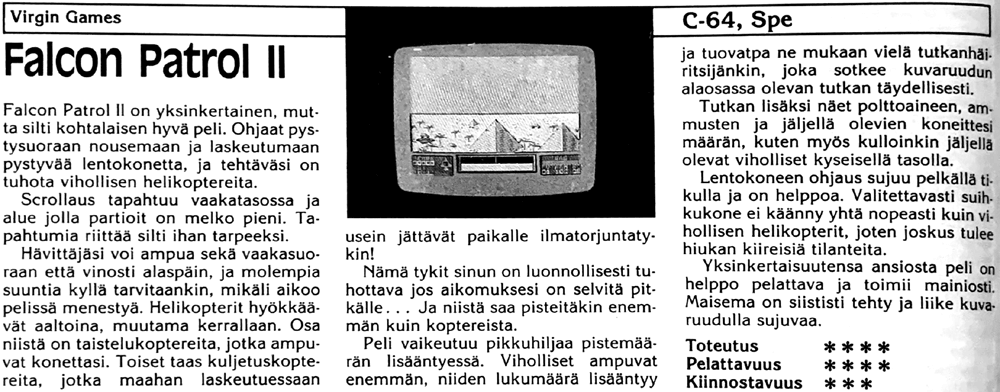
Falcon Patrol II1987Pysyvä linkkiFalcon Patrol II on yksinkertainen, mutta silti kohtalaisen hyvä peli. Ohjaat pystysuoraan nousemaan ja laskeutumaan pystyvää lentokonetta, ja tehtäväsi on tuhota vihollisen helikoptereita.
Scrollaus tapahtuu vaakatasossa ja alue jolla partioit on melko pieni. Tapahtumia riittää silti ihan tarpeeksi.
Hävittäjäsi voi ampua sekä vaakasuoraan että vinosti alaspäin, ja molempia suuntia kyllä tarvitaankin, mikäli aikoo pelissä menestyä. Helikopterit hyökkäävät aaltoina, muutama kerrallaan. Osa niistä on taistelukoptereita, jotka ampuvat konettasi. Toiset taas kuljetuskoptereita, jotka maahan laskeutuessaan usein jättävät paikalle ilmatorjuntatykin!
Nämä tykit sinun on luonnollisesti tuhottava jos aikomuksesi on selvitä pitkälle... Ja niistä saa pisteitäkin enemmän kuin koptereista.
Peli vaikeutuu pikkuhiljaa pistemäärän lisääntyessä. Viholliset ampuvat enemmän, niiden lukumäärä lisääntyy ja tuovatpa ne mukaan vielä tutkanhäiritsijänkin, joka sotkee kuvaruudun alaosassa olevan tutkan täydellisesti.
Tutkan lisäksi näet polttoaineen, ammusten ja jäljellä olevien koneittesi määrän, kuten myös kulloinkin jäljellä olevat viholliset kyseisellä tasolla.
Lentokoneen ohjaus sujuu pelkällä tikulla ja on helppoa. Valitettavasti suihkukone ei käänny yhtä nopeasti kuin vihollisen helikopterit, joten joskus tulee hiukan kiireisiä tilanteita.
Yksinkertaisuutensa ansiosta peli on helppo pelattava ja toimii mainiosti. Maisema on siististi tehty ja liike kuvaruudulla sujuvaa.
Falcon Patrol II1987PermalinkFalcon Patrol II is a simple but still fairly good game. You fly a plane capable of vertical take-off and landing, and your task is to destroy enemy helicopters.
The scrolling is horizontal and the area you patrol is fairly small. Even so, there's plenty going on.
Your fighter can shoot both horizontally and diagonally downwards, and you'll certainly need both directions if you mean to get anywhere in the game. The helicopters attack in waves, a few at a time. Some of them are gunships that shoot at your plane. Others are transport choppers, which, when they land, often leave an anti-aircraft gun behind!
Naturally you have to destroy these guns if you intend to last long... And they're worth more points than the choppers, too.
The game gets harder little by little as your score goes up. The enemies shoot more, there are more of them, and they even bring along a radar jammer, which completely scrambles the radar at the bottom of the screen.
Besides the radar, you can see your fuel, your ammo and the number of planes you have left, as well as how many enemies are still left on the current level.
The plane is flown with the joystick alone and is easy to handle. Unfortunately the jet doesn't turn as quickly as the enemy helicopters, so things sometimes get a bit hectic.
Thanks to its simplicity the game is easy to play and works splendidly. The scenery is neatly done and movement on the screen is smooth.
Falklands 82
Falklands 821987Pysyvä linkkiTämä on siitä poikkeuksellinen peli, että sen esikuvana olevat taistelut ovat vielä kaikkien muistissa. Argentiinan ja Englannin välisen konfliktin kehitystä seurattiin vuoden 1982 keväällä lähes jokaisessa uutislähetyksessä.
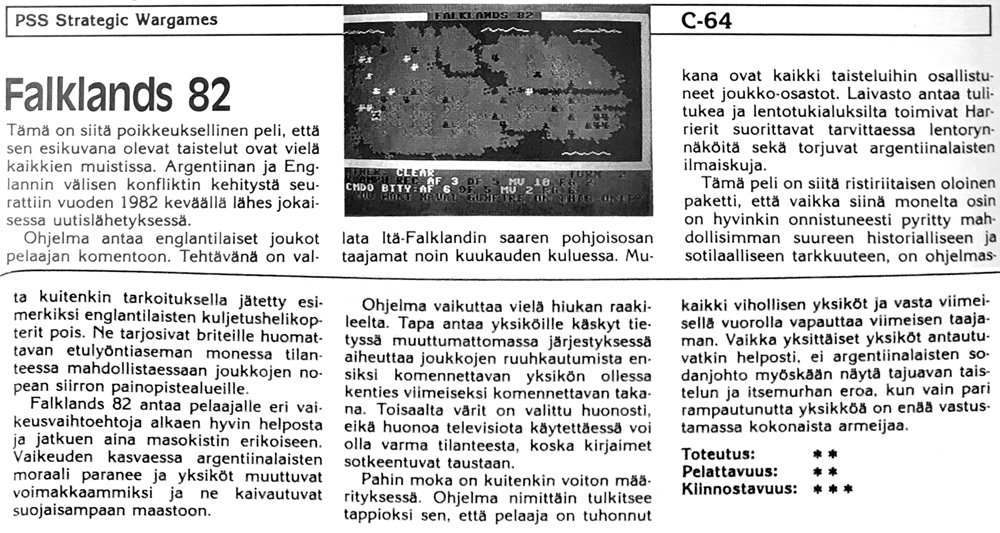
Ohjelma antaa englantilaiset joukot pelaajan komentoon. Tehtävänä on vallata Itä-Falklandin saaren pohjoisosan taajamat noin kuukauden kuluessa. Mukana ovat kaikki taisteluihin osallistuneet joukko-osastot. Laivasto antaa tulitukea ja lentotukialuksilta toimivat Harrierit suorittavat tarvittaessa lentorynnäköitä sekä torjuvat argentiinalaisten ilmaiskuja.
Tämä peli on siitä ristiriitaisen oloinen paketti, että vaikka siinä monelta osin on hyvinkin onnistuneesti pyritty mahdollisimman suureen historialliseen ja sotilaalliseen tarkkuuteen, on ohjelmasta kuitenkin tarkoituksella jätetty esimerkiksi englantilaisten kuljetushelikopterit pois. Ne tarjosivat briteille huomattavan etulyöntiaseman monessa tilanteessa mahdollistaessaan joukkojen nopean siirron painopistealueille.
Falklands 82 antaa pelaajalle eri vaikeusvaihtoehtoja alkaen hyvin helposta ja jatkuen aina masokistin erikoiseen. Vaikeuden kasvaessa argentiinalaisten moraali paranee ja yksiköt muuttuvat voimakkaammiksi ja ne kaivautuvat suojaisampaan maastoon.
Ohjelma vaikuttaa vielä hiukan raakileelta. Tapa antaa yksiköille käskyt tietyssä muuttumattomassa järjestyksessä aiheuttaa joukkojen ruuhkautumista ensiksi komennettavan yksikön ollessa kenties viimeiseksi komennettavan takana. Toisaalta värit on valittu huonosti, eikä huonoa televisiota käytettäessä voi olla varma tilanteesta, koska kirjaimet sotkeentuvat taustaan.
Pahin moka on kuitenkin voiton määrityksessä. Ohjelma nimittäin tulkitsee tappioksi sen, että pelaaja on tuhonnut kaikki vihollisen yksiköt ja vasta viimeisellä vuorolla vapauttaa viimeisen taajaman. Vaikka yksittäiset yksiköt antautuvatkin helposti, ei argentiinalaisten sodanjohto myöskään näytä tajuavan taistelun ja itsemurhan eroa, kun vain pari rampautunutta yksikköä on enää vastustamassa kokonaista armeijaa.
Falklands 821987PermalinkThis game is exceptional in that the battles it is modelled on are still fresh in everyone's memory. In the spring of 1982 the course of the conflict between Argentina and England was followed in almost every news broadcast.
The program puts the English forces under the player's command. The task is to capture the settlements in the northern part of the island of East Falkland within about a month. All the units that took part in the fighting are included. The navy provides fire support, and Harriers operating from the aircraft carriers fly ground-attack sorties when needed and fend off Argentine air raids.
This game is a contradictory package in that, although in many respects it has very successfully aimed for the greatest possible historical and military accuracy, the English transport helicopters, for example, have been deliberately left out of the program. They gave the British a considerable edge in many situations by allowing troops to be moved quickly to wherever the main effort was.
Falklands 82 offers the player a range of difficulty levels, starting from very easy and going all the way up to the masochist's special. As the difficulty goes up, Argentine morale improves, the units become stronger and they dig in on better-sheltered ground.
The program still seems a bit half-baked. The way units must be given their orders in a fixed, unchangeable sequence causes troops to jam up, when the unit you command first may well be stuck behind the one you command last. Then again, the colours have been badly chosen, and on a poor television you can't be sure what the situation is, because the letters blur into the background.
The worst blunder, though, is in how victory is determined. You see, the program counts it as a defeat if the player has destroyed all the enemy units and only liberates the last settlement on the final turn. And even if individual units do surrender easily, the Argentine high command doesn't seem to grasp the difference between fighting and suicide either, when only a couple of crippled units are left to hold out against an entire army.
Fast Break
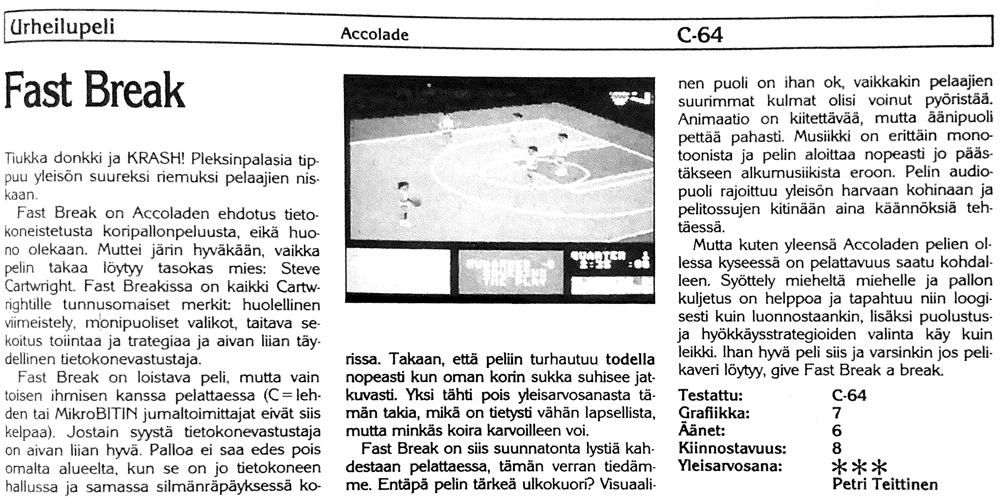
Fast Break1989 KevätPysyvä linkkiTiukka donkki ja KRASH! Pleksinpalasia tippuu yleisön suureksi riemuksi pelaajien niskaan.
Fast Break on Accoladen ehdotus tietokoneistetusta koripallonpeluusta, eikä huono olekaan. Muttei järin hyväkään, vaikka pelin takaa löytyy tasokas mies: Steve Cartwright. Fast Breakissa on kaikki Cartwrightille tunnusomaiset merkit: huolellinen viimeistely, monipuoliset valikot, taitava sekoitus toiintaa ja trategiaa ja aivan liian täydellinen tietokonevastustaja.
Fast Break on loistava peli, mutta vain toisen ihmisen kanssa pelattaessa (C=lehden tai MikroBITIN jumaltoimittajat eivät siis kelpaa). Jostain syystä tietokonevastustaja on aivan liian hyvä. Palloa ei saa edes pois omalta alueelta, kun se on jo tietokoneen hallussa ja samassa silmänräpäyksessä korissa. Takaan, että peliin turhautuu todella nopeasti kun oman korin sukka suhisee jatkuvasti. Yksi tähti pois yleisarvosanasta tämän takia, mikä on tietysti vähän lapsellista, mutta minkäs koira karvoilleen voi.
Fast Break on siis suunnatonta lystiä kahdestaan pelattaessa, tämän verran tiedämme. Entäpä pelin tärkeä ulkokuori? Visuaalinen puoli on ihan ok, vaikkakin pelaajien suurimmat kulmat olisi voinut pyöristää. Animaatio on kiitettävää, mutta äänipuoli pettää pahasti. Musiikki on erittäin monotoonista ja pelin aloittaa nopeasti jo päästäkseen alkumusiikista eroon. Pelin audiopuoli rajoittuu yleisön harvaan kohinaan ja pelitossujen kitinään aina käännöksiä tehtäessä.
Mutta kuten yleensä Accoladen pelien ollessa kyseessä on pelattavuus saatu kohdalleen. Syöttely mieheltä miehelle ja pallon kuljetus on helppoa ja tapahtuu niin loogisesti kuin luonnostaankin, lisäksi puolustus- ja hyökkäysstrategioiden valinta käy kuin leikki. Ihan hyvä peli siis ja varsinkin jos pelikaveri löytyy, give Fast Break a break.
Fast Break1989 KevätPermalinkA hard dunk and CRASH! Shards of perspex rain down on the players' heads, to the crowd's great delight.
Fast Break is Accolade's proposal for computerised basketball, and it isn't bad at all. Not terribly good either, though, even though there's a top-class man behind the game: Steve Cartwright. Fast Break has all of Cartwright's hallmarks: careful finishing touches, versatile menus, a skilful mix of action and strategy, and an altogether too perfect computer opponent.
Fast Break is a brilliant game, but only when played with another human being (so the godlike editors of C=lehti or MikroBITTI won't do). For some reason the computer opponent is far too good. You can't even get the ball out of your own half before the computer already has it and, in the same blink of an eye, it's in the basket. I guarantee you'll get frustrated with the game really fast when the net of your own basket keeps swishing nonstop. One star off the overall score because of this, which is a bit childish of course, but a leopard can't change its spots.
So Fast Break is enormous fun when two people play, that much we know. But what about the game's all-important outer shell? The visual side is perfectly OK, although the players' biggest corners could have been rounded off. The animation is commendable, but the sound side lets it down badly. The music is extremely monotonous, and you'll be quick to start the game if only to get away from the title music. The game's audio is limited to a thin murmur from the crowd and the squeak of sneakers whenever someone turns.
But as is usually the case with Accolade's games, the playability has been got just right. Passing from man to man and dribbling the ball are easy and happen both logically and naturally, and on top of that, choosing defensive and offensive strategies is child's play. A pretty good game, then, and especially if you can find someone to play with, give Fast Break a break.
Fast Tracks
Fast Tracks1987Pysyvä linkkiFast Tracks on monipuolinen kilpa-ajopeli. Normaalin kilpa-ajon ohella pystyy pelaaja suunnittelemaan myös omia reittejä.
Kilpa-ajoon osallistuu aina pelkästään yksi pelaaja ja kolme tietokoneen ohjaamaa autoa. Fast Tracksin kilpa-ajo on normaalista poikkeava: auto pysyy itsestään tiellä, jollei joystickiin kosketa. Yksikseen köröttelee auto kylläkin erittäin hitaasti. Vauhtia saa ajamalla itse, mutta liian kovalla vauhdilla auto suistuu jyrkissä kurveissa tieltä. Kilvan pituus on joko yksi, viisi tai kymmenen kierrosta.
Kilpa-ajossa on parasta, että peli ei lopu jos suistuu tieltä. Se jatkuu automaattisesti kierroksen alusta. Käytännössä tieltä suistuessa häviää siis pelkästään osan kierrosta, eikä se siis tarkoita kilvan loppumista. Vastustajan autojen ojaan tönimisestä saa kahden sekunnin bonuksen, eli törmäily jopa kannattaa.
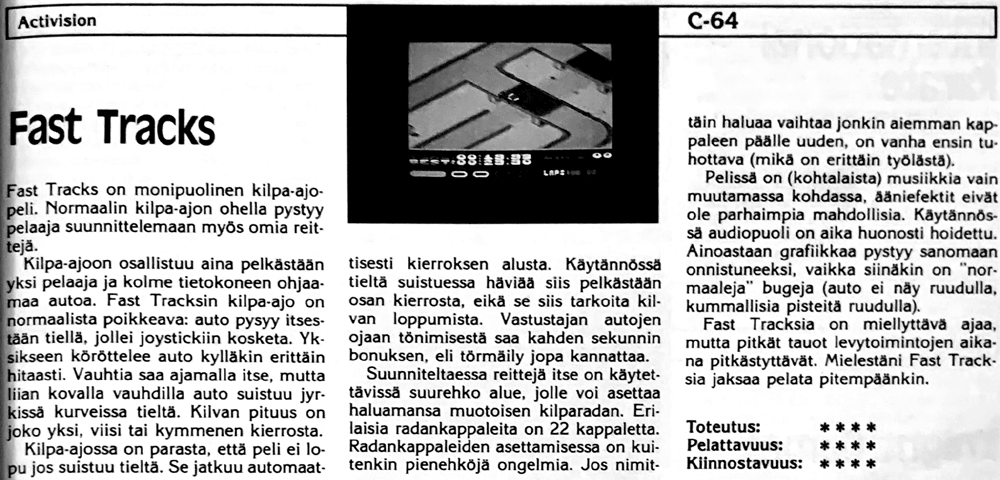
Suunniteltaessa reittejä itse on käytettävissä suurehko alue, jolle voi asettaa haluamansa muotoisen kilparadan. Erilaisia radankappaleita on 22 kappaletta. Radankappaleiden asettamisessa on kuitenkin pienehköjä ongelmia. Jos nimittäin haluaa vaihtaa jonkin aiemman kappaleen päälle uuden, on vanha ensin tuhottava (mikä on erittäin työlästä).
Pelissä on (kohtalaista) musiikkia vain muutamassa kohdassa, ääniefektit eivät ole parhaimpia mahdollisia. Käytännössä audiopuoli on aika huonosti hoidettu. Ainoastaan grafiikkaa pystyy sanomaan onnistuneeksi, vaikka siinäkin on "normaaleja" bugeja (auto ei näy ruudulla, kummallisia pisteitä ruudulla).
Fast Tracksia on miellyttävä ajaa, mutta pitkät tauot levytoimintojen aikana pitkästyttävät. Mielestäni Fast Tracksia jaksaa pelata pitempäänkin.
Fast Tracks1987PermalinkFast Tracks is a versatile racing game. Alongside ordinary racing, the player can also design their own courses.
A race always has just one player and three computer-driven cars. Racing in Fast Tracks is out of the ordinary: the car stays on the road by itself as long as you don't touch the joystick. Left to itself, though, the car trundles along extremely slowly. You get speed by driving yourself, but go too fast and the car flies off the road on the sharp bends. A race is either one, five or ten laps long.
The best thing about the racing is that the game doesn't end if you go off the road. It automatically carries on from the start of the lap. In practice, then, going off the road only costs you part of a lap, and it doesn't mean the end of the race. Shoving the opposing cars into the ditch earns you a two-second bonus, so ramming them actually pays off.
When designing your own courses you have a fairly large area to work with, on which you can lay out a race track of whatever shape you like. There are 22 different track pieces. Placing the track pieces does come with some smallish problems, though. Namely, if you want to put a new piece in place of an earlier one, you first have to destroy the old one (which is extremely laborious).
The game has (passable) music in only a few places, and the sound effects are not the best possible. In practice the audio side has been handled rather poorly. Only the graphics can be called a success, although even they have the "usual" bugs (the car not showing up on screen, strange dots on the screen).
Fast Tracks is pleasant to drive, but the long pauses during disk operations get tedious. In my opinion Fast Tracks is something you'll happily keep playing for a good while.
Fax
Fax1987Pysyvä linkkiEpyxin kustantama Fax edustaa harvaksi jäänyttä tietokilpailupelien joukkoa Commodore 64:lle. Faxin idea on vastata niin moneen kysymykseen kuin mahdollista mahdollisimman nopeasti.
Faxissa voi päästä eteenpäin myös naputtamalla yhtä nappulaa jatkuvasti, jolloin aika ei kulu ja oikea vastaus sattuu silloin tällöin kohdalle.
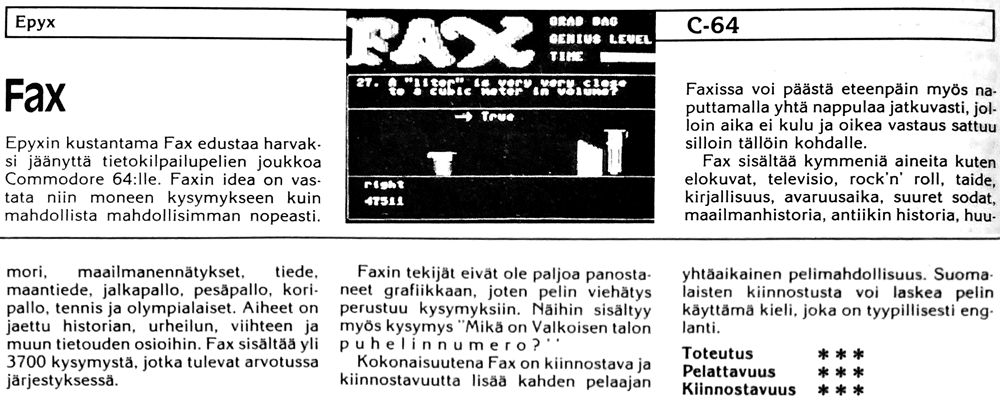
Fax sisältää kymmeniä aineita kuten elokuvat, televisio, rock'n' roll, taide, kirjallisuus, avaruusaika, suuret sodat, maailmanhistoria, antiikin historia, huumori, maailmanennätykset, tiede, maantiede, jalkapallo, pesäpallo, koripallo, tennis ja olympialaiset. Aiheet on jaettu historian, urheilun, viihteen ja muun tietouden osioihin. Fax sisältää yli 3700 kysymystä, jotka tulevat arvotussa järjestyksessä.
Faxin tekijät eivät ole paljoa panostaneet grafiikkaan, joten pelin viehätys perustuu kysymyksiin. Näihin sisältyy myös kysymys "Mikä on Valkoisen talon puhelinnumero?"
Kokonaisuutena Fax on kiinnostava ja kiinnostavuutta lisää kahden pelaajan yhtäaikainen pelimahdollisuus. Suomalaisten kiinnostusta voi laskea pelin käyttämä kieli, joka on tyypillisesti englanti.
Fax1987PermalinkFax, published by Epyx, represents the rather thin ranks of quiz games for the Commodore 64. The idea of Fax is to answer as many questions as possible as quickly as possible.
In Fax you can also get ahead by tapping one button over and over, in which case no time is lost and every now and then the right answer happens to come up.
Fax contains dozens of subjects such as film, television, rock'n'roll, art, literature, the space age, the great wars, world history, ancient history, humour, world records, science, geography, football, baseball, basketball, tennis and the Olympics. The subjects are divided into sections for history, sport, entertainment and general knowledge. Fax contains over 3,700 questions, which come up in random order.
The makers of Fax haven't put much effort into the graphics, so the game's appeal rests on the questions. These also include the question "What is the White House's phone number?"
All in all Fax is interesting, and the interest is boosted by the option for two players to play at the same time. What may dampen Finns' interest is the language the game uses, which is, typically, English.
Federation of Free Traders
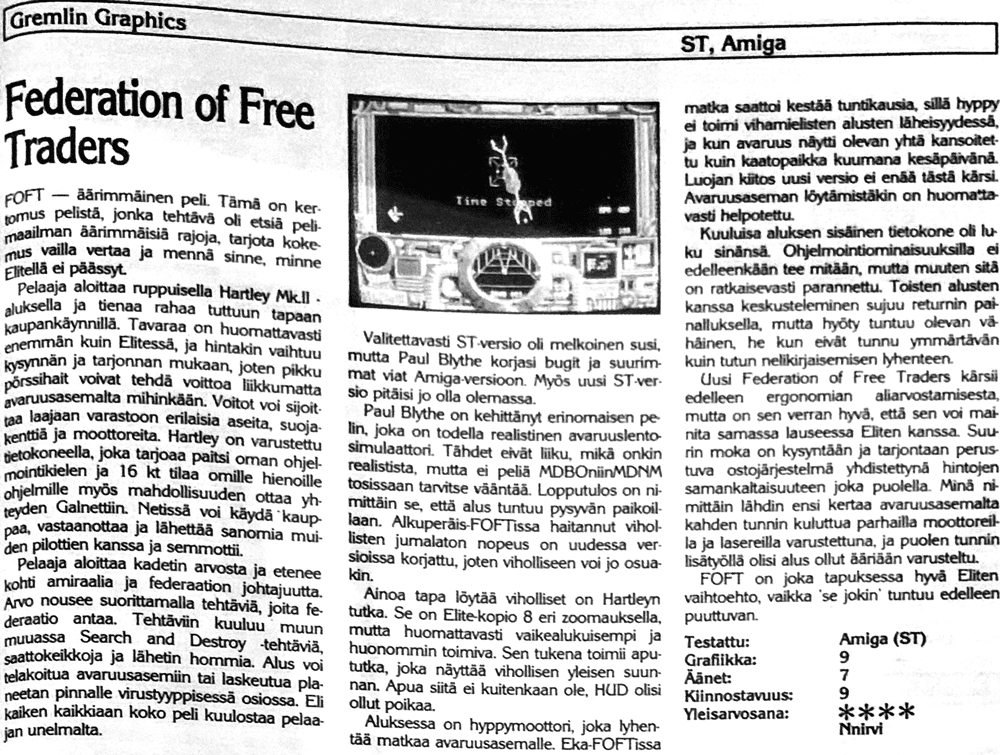
Federation of Free Traders1989 SyksyPysyvä linkkiFOFT - äärimmäinen peli. Tämä on kertomus pelistä, jonka tehtävä oli etsiä pelimaailman äärimmäisiä rajoja, tarjota kokemus vailla vertaa ja mennä sinne, minne Elitellä ei päässyt.
Pelaaja aloittaa ruppuisella Hartley Mk.II -aluksella ja tienaa rahaa tuttuun tapaan kaupankäynnillä. Tavaraa on huomattavasti enemmän kuin Elitessä, ja hintakin vaihtuu kysynnän ja tarjonnan mukaan, joten pikku pörssihait voivat tehdä voittoa liikkumatta avaruusasemalta mihinkään. Voitot voi sijoittaa laajaan varastoon erilaisia aseita, suojakenttiä ja moottoreita. Hartley on varustettu tietokoneella, joka tarjoaa paitsi oman ohjelmointikielen ja 16 kt tilaa omille hienoille ohjelmille myös mahdollisuuden ottaa yhteyden Galnettiin. Netissä voi käydä kauppaa, vastaanottaa ja lähettää sanomia muiden pilottien kanssa ja semmottii.
Pelaaja aloittaa kadetin arvosta ja etenee kohti amiraalia ja federaation johtajuutta. Arvo nousee suorittamalla tehtäviä, joita federaatio antaa. Tehtäviin kuuluu muun muuassa Search and Destroy -tehtäviä, saattokeikkoja ja lähetin hommia. Alus voi telakoitua avaruusasemiin tai laskeutua planeetan pinnalle virustyyppisessä osiossa. Eli kaiken kaikkiaan koko peli kuulostaa pelaajan unelmalta.
Valitettavasti ST-versio oli melkoinen susi, mutta Paul Blythe korjasi bugit ja suurimmat viat Amiga-versioon. Myös uusi ST-versio pitäisi jo olla olemassa.
Paul Blythe on kehittänyt erinomaisen pelin, joka on todella realistinen avaruuslentosimulaattori. Tähdet eivät liiku, mikä onkin realistista, mutta ei peliä MDBOniinMDNM tosissaan tarvitse vääntää. Lopputulos on nimittäin se, että alus tuntuu pysyvän paikoillaan. Alkuperäis-FOFTissa haitannut vihollisten jumalaton nopeus on uudessa versioissa korjattu, joten viholliseen voi jo osuakin.
Ainoa tapa löytää viholliset on Hartleyn tutka. Se on Elite-kopio 8 eri zoomauksella, mutta huomattavasti vaikealukuisempi ja huonommin toimiva. Sen tukena toimii apututka, joka näyttää vihollisen yleisen suunnan. Apua siitä ei kuitenkaan ole, HUD olisi ollut poikaa.
Aluksessa on hyppymoottori, joka lyhentää matkaa avaruusasemalle. Eka-FOFTissa matka saattoi kestää tuntikausia, sillä hyppy ei toimi vihamielisten alusten läheisyydessä, ja kun avaruus näytti olevan yhtä kansoitettu kuin kaatopaikka kuumana kesäpäivänä. Luojan kiitos uusi versio ei enää tästä kärsi. Avaruusaseman löytämistäkin on huomattavasti helpotettu.
Kuuluisa aluksen sisäinen tietokone oli luku sinänsä. Ohjelmointiominaisuuksilla ei edelleenkään tee mitään, mutta muuten sitä on ratkaisevasti parannettu. Toisten alusten kanssa keskusteleminen sujuu returnin painalluksella, mutta hyöty tuntuu olevan vähäinen, he kun eivät tunnu ymmärtävän kuin tutun nelikirjaisemisen lyhenteen.
Uusi Federation of Free Traders kärsii edelleen ergonomian aliarvostamisesta, mutta on sen verran hyvä, että sen voi mainita samassa lauseessa Eliten kanssa. Suurin moka on kysyntään ja tarjontaan perustuva ostojärjestelmä yhdistettynä hintojen samankaltaisuuteen joka puolella. Minä nimittäin lähdin ensi kertaa avaruusasemalta kahden tunnin kuluttua parhailla moottoreilla ja lasereilla varustettuna, ja puolen tunnin lisätyöllä olisi alus ollut ääriään varusteltu.
FOFT on joka tapauksessa hyvä Eliten vaihtoehto, vaikka 'se jokin' tuntuu edelleen puuttuvan.
Federation of Free Traders1989 SyksyPermalinkFOFT - the final game. This is the story of a game whose mission was to seek out the outermost frontiers of the gaming world, to offer an experience beyond compare and to go where Elite could not take you.
The player starts out with a grotty Hartley Mk.II ship and earns money by trading, in the familiar way. There are considerably more goods than in Elite, and prices change with supply and demand too, so little stock-market sharks can make a profit without budging from the space station. Profits can be invested in a wide stock of assorted weapons, shields and engines. The Hartley is equipped with a computer that offers not only its own programming language and 16 KB of room for your own fancy programs but also the chance to connect to the Galnet. On the net you can trade, receive and send messages with other pilots an' stuff.
The player starts at the rank of cadet and works up towards admiral and the leadership of the federation. You rise in rank by completing missions the federation hands out. The missions include, among other things, Search and Destroy missions, escort gigs and courier jobs. The ship can dock at space stations or land on a planet's surface in a Virus-style section. So all in all, the whole game sounds like a gamer's dream.
Unfortunately the ST version was quite a dud, but Paul Blythe fixed the bugs and the biggest flaws for the Amiga version. A new ST version should already be out as well.
Paul Blythe has developed an excellent game that is a truly realistic space flight simulator. The stars don't move, which is indeed realistic, but a game doesn't have to be built quite that seriously. The upshot, you see, is that the ship seems to stay put. The ungodly speed of the enemies, which was a nuisance in the original FOFT, has been fixed in the new version, so you can actually hit an enemy now.
The only way to find the enemies is the Hartley's radar. It's an Elite copy with 8 different zoom levels, but considerably harder to read and worse at its job. It's backed up by a helper radar that shows the enemy's general direction. It's no help, though; a HUD would have been just the ticket.
The ship has a jump drive that shortens the trip to the space station. In the first FOFT the trip could take hours, since the jump doesn't work near hostile ships, and space seemed to be as densely populated as a rubbish tip on a hot summer's day. Thank God the new version no longer suffers from this. Finding the space station has been made considerably easier as well.
The famous onboard computer was a chapter in itself. The programming features are still no use for anything, but otherwise it has been decisively improved. Talking to other ships is done with a press of Return, but the benefit seems slight, as they don't seem to understand anything but the familiar four-letter abbreviation.
The new Federation of Free Traders still suffers from undervalued ergonomics, but it's good enough to be mentioned in the same sentence as Elite. The biggest blunder is the supply-and-demand buying system combined with prices being much the same everywhere. You see, I left the space station for the first time after two hours, kitted out with the best engines and lasers, and with another half hour's work the ship would have been fitted out to the brim.
In any case, FOFT is a good alternative to Elite, even though 'that certain something' still seems to be missing.
Ferrari Formula One
Ferrari Formula One1990 SyksyPysyvä linkkiAjopelit käyvät läpi omaa muutoskauttaan kohti monimutkaisempaa ilmaisua. Ferrari Formula One oli uuden suunnan pioneereja, josta nyt on tullut 64-versio.
FF1 ei ole pelkkä ajopeli, vaan pyrkii antamaan kokonaisvaltaisemman johdatuksen F1-kilpailujen maailmaan. Jo pelin suunnittelija sekä oheismateriaali viittaavat aiheen asialliseen käsittelyyn ja lisäksi EOA väittää pelin sisältävän 'kaiken jännityksen formuloiden maailmasta'.
FF1 on tehty pelattavaksi joko kehittyneenä ajopelinä tai eräänlaisena Grand Prix -simulaationa, jolloin pelin vahvat puolet pääsevät esiin. Tällöin Ferraria voi muutella mielensä mukaisesti säätämällä vaikka etusiivekkeitä, polttoaineen suihkutusta tai vaihteiston välityksiä. Muutoksia voi ennen kisaa testata joko tuulitunnelissa tai harjoituskierrosten aikana, mutta säädöt voi joutua uusimaan juuri ennen kilpailua sään vaihtuessa.
Itse ajo-osuus ei kuitenkaan ole täysin onnistunut, sillä grafiikan hitaus heikentää pelattavuutta. Ajopelien äänet ovatkin jo luku erikseen, eikä niiden heikkous yleensä häiritse. Hitautta kompensoi mahdollisuus säätää auton ohjattavuutta, mikä parantaa pelattavuutta. Useat valikot ovat toteutettu selkeästi ja kuvat varikosta ja autoista näyttävät vaihteeksi viimeistellyiltä.
Niin kuin yleensä Electronic Artsin peleissä, ovat viimeistely ja monipuolisuus myös Ferrari Formula Onen vahvimmat puolet, eikä puhdasta ajopeliä hakevakaan varmasti pety. Test Drive I ja II ovat nyt saaneet kiitettävän seuraajan, kehityksen kuitenkaan jäämättä rahastuksen varjoon. Vauhdikkaiden ajopelien etsijät kuitenkin varokoot, sillä FF1 ei välttämättä tartu heti ensimmäisellä kerralla.
Ferrari Formula One1990 SyksyPermalinkRacing games are going through their own period of change towards a more complex form of expression. Ferrari Formula One was one of the pioneers of the new direction, and now there is a 64 version of it.
FF1 is not just a racing game; it tries to give a more all-round introduction to the world of F1 racing. The game's designer and the accompanying material alone point to a serious treatment of the subject, and on top of that EOA claims the game contains 'all the excitement of the world of Formula racing'.
FF1 is made to be played either as an advanced racing game or as a sort of Grand Prix simulation, which is where the game's strengths come to the fore. In that mode you can modify the Ferrari to your heart's content by adjusting, say, the front wings, the fuel injection or the gear ratios. Changes can be tested before the race either in the wind tunnel or during practice laps, but you may have to redo the settings just before the race if the weather changes.
The driving part itself, however, is not entirely successful, as the slowness of the graphics hurts the playability. Racing game sound is a whole other story, of course, and its weakness usually doesn't bother anyone. The slowness is offset by the option to adjust the car's handling, which improves the playability. Many of the menus are clearly laid out, and the pictures of the pits and the cars look polished for a change.
As usual with Electronic Arts games, polish and variety are Ferrari Formula One's strongest points too, and even someone after a pure racing game surely won't be disappointed. Test Drive I and II have now got a commendable successor, without the progress being overshadowed by cashing in. Those looking for fast-paced racing games had better beware, though, as FF1 may not grab you the very first time.
Ferrari Formula One: Grand Prix Racing Simulator
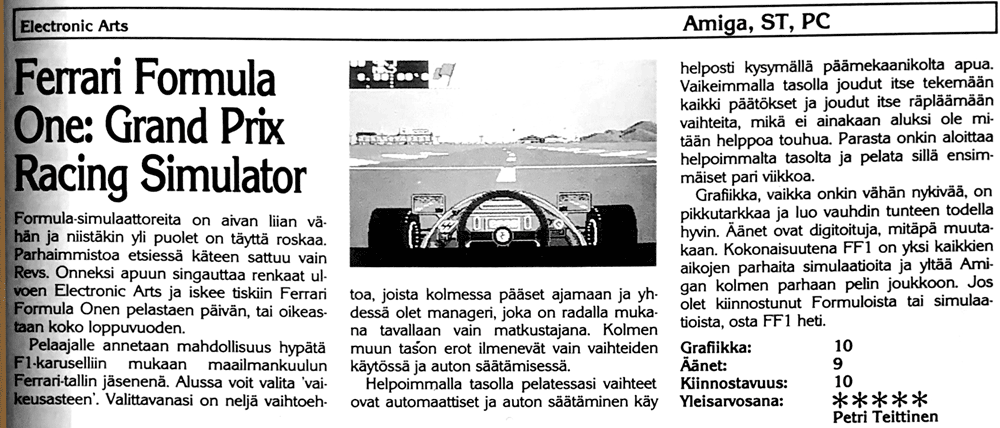
Ferrari Formula One: Grand Prix Racing Simulator1988Pysyvä linkkiFormula-simulaattoreita on aivan liian vähän ja niistäkin yli puolet on täyttä roskaa. Parhaimmistoa etsiessä käteen sattuu vain Revs. Onneksi apuun singauttaa renkaat ulvoen Electronic Arts ja iskee tiskiin Ferrari Formula Onen pelastaen päivän, tai oikeastaan koko loppuvuoden.
Pelaajalle annetaan mahdollisuus hypätä F1-karuselliin mukaan maailmankuulun Ferrari-tallin jäsenenä. Alussa voit valita 'vaikeusasteen'. Valittavanasi on neljä vaihtoehtoa, joista kolmessa pääset ajamaan ja yhdessä olet manageri, joka on radalla mukana tavallaan vain matkustajana. Kolmen muun tason erot ilmenevät vain vaihteiden käytössä ja auton säätämisessä.
Helpoimmalla tasolla pelatessasi vaihteet ovat automaattiset ja auton säätäminen käy helposti kysymällä päämekaanikolta apua. Vaikeimmalla tasolla joudut itse tekemään kaikki päätökset ja joudut itse räpläämään vaihteita, mikä ei ainakaan aluksi ole mitään helppoa touhua. Parasta onkin aloittaa helpoimmalta tasolta ja pelata sillä ensimmäiset pari viikkoa.
Grafiikka, vaikka onkin vähän nykivää, on pikkutarkkaa ja luo vauhdin tunteen todella hyvin. Äänet ovat digitoituja, mitäpä muutakaan. Kokonaisuutena FF1 on yksi kaikkien aikojen parhaita simulaatioita ja yltää Amigan kolmen parhaan pelin joukkoon. Jos olet kiinnostunut Formuloista tai simulaatioista, osta FF1 heti.
Ferrari Formula One: Grand Prix Racing Simulator1988PermalinkThere are far too few Formula simulators, and more than half of those are total rubbish. Go looking for the cream of the crop and all that comes to hand is Revs. Luckily, Electronic Arts comes zooming to the rescue with tyres screaming and slaps Ferrari Formula One down on the counter, saving the day - or actually the whole rest of the year.
The player is given the chance to jump onto the F1 merry-go-round as a member of the world-famous Ferrari team. At the start you can choose the 'difficulty level'. You have four options to choose from: in three of them you get to drive, and in one you are the manager, who is along at the track only as a passenger, so to speak. The differences between the other three levels show up only in the use of the gears and in setting up the car.
Playing on the easiest level, the gears are automatic and setting up the car is easy - you just ask the chief mechanic for help. On the hardest level you have to make all the decisions yourself and fiddle with the gears yourself, which is no easy business, at least at first. The best thing is to start on the easiest level and play on it for the first couple of weeks.
The graphics, although a bit jerky, are finely detailed and create a sense of speed really well. The sounds are digitised - what else would they be. All in all, FF1 is one of the best simulations of all time and makes it into the Amiga's top three games. If you're interested in Formula racing or in simulations, buy FF1 right away.
Fiendish Freddy's Big Top O'Fun
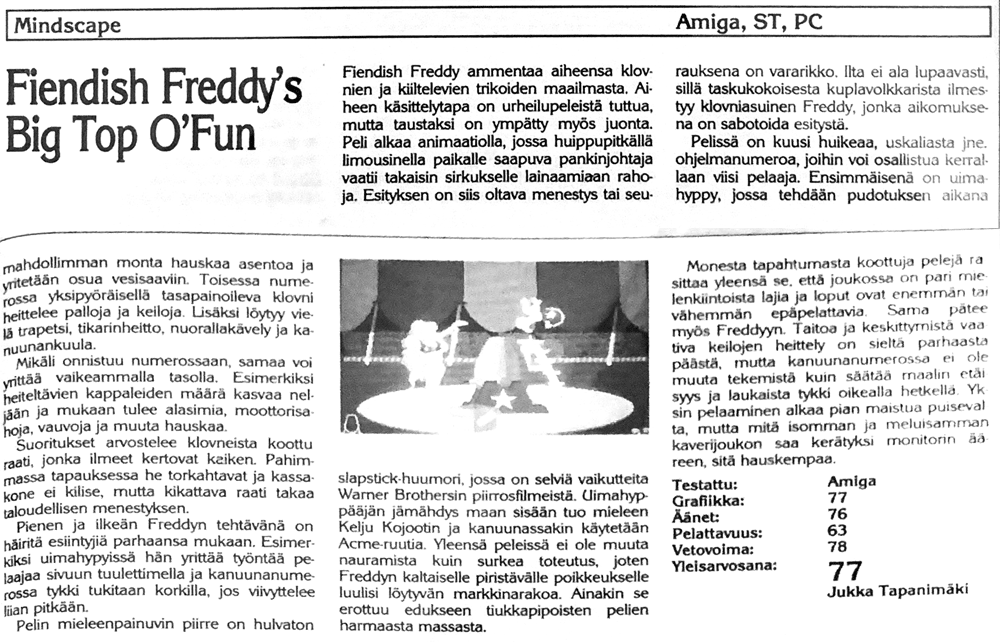
Fiendish Freddy's Big Top O'Fun1990 KevätPysyvä linkkiFiendish Freddy ammentaa aiheensa klovnien ja kiiltelevien trikoiden maailmasta. Aiheen käsittelytapa on urheilupeleistä tuttua, mutta taustaksi on ympätty myös juonta. Peli alkaa animaatiolla, jossa huippupitkällä limousinella paikalle saapuva pankinjohtaja vaatii takaisin sirkukselle lainaamiaan rahoja. Esityksen on siis oltava menestys tai seurauksena on vararikko. Ilta ei ala lupaavasti, sillä taskukokoisesta kuplavolkkarista ilmestyy klovniasuinen Freddy, jonka aikomuksena on sabotoida esitystä.
Pelissä on kuusi huikeaa, uskaliasta jne. ohjelmanumeroa, joihin voi osallistua kerrallaan viisi pelaaja. Ensimmäisenä on uimahyppy, jossa tehdään pudotuksen aikana mahdollimman monta hauskaa asentoa ja yritetään osua vesisaaviin. Toisessa numerossa yksipyöräisellä tasapainoileva klovni heittelee palloja ja keiloja. Lisäksi löytyy vielä trapetsi, tikarinheitto, nuorallakävely ja kanuunankuula.
Mikäli onnistuu numerossaan, samaa voi yrittää vaikeammalla tasolla. Esimerkiksi heiteltävien kappaleiden määrä kasvaa neljään ja mukaan tulee alasimia, moottorisahoja, vauvoja ja muuta hauskaa.
Suoritukset arvostelee klovneista koottu raati, jonka ilmeet kertovat kaiken. Pahimmassa tapauksessa he torkahtavat ja kassakone ei kilise, mutta kikattava raati takaa taloudellisen menestyksen.
Pienen ja ilkeän Freddyn tehtävänä on häiritä esiintyjiä parhaansa mukaan. Esimerkiksi uimahypyissä hän yrittää työntää pelaajaa sivuun tuulettimella ja kanuunanumerossa tykki tukitaan korkilla, jos viivyttelee liian pitkään.
Pelin mieleenpainuvin piirre on hulvaton slapstick-huumori, jossa on selviä vaikutteita Warner Brothersin piirrosfilmeistä. Uimahyppääjän jämähdys maan sisään tuo mieleen Kelju Kojootin ja kanuunassakin käytetään Acme-ruutia. Yleensä peleissä ei ole muuta nauramista kuin surkea toteutus, joten Freddyn kaltaiselle piristävälle poikkeukselle luulisi löytyvän markkinarakoa. Ainakin se erottuu edukseen tiukkapipoisten pelien harmaasta massasta.
Monesta tapahtumasta koottuja pelejä rasittaa yleensä se, että joukossa on pari mielenkiintoista lajia ja loput ovat enemmän tai vähemmän epäpelattavia. Sama pätee myös Freddyyn. Taitoa ja keskittymistä vaativa keilojen heittely on sieltä parhaasta päästä, mutta kanuunanumerossa ei ole muuta tekemistä kuin säätää maalin etäisyys ja laukaista tykki oikealla hetkellä. Yksin pelaaminen alkaa pian maistua puisevalta, mutta mitä isomman ja meluisamman kaverijoukon saa kerätyksi monitorin ääreen, sitä hauskempaa.
Fiendish Freddy's Big Top O'Fun1990 KevätPermalinkFiendish Freddy draws its subject matter from the world of clowns and glittering leotards. The way it handles the subject is familiar from sports games, but a plot has also been grafted on as a backdrop. The game begins with an animation in which a bank manager, arriving in an ultra-long limousine, demands the return of the money lent to the circus. So the show has to be a success, or the result is bankruptcy. The evening doesn't get off to a promising start, since out of a pocket-sized VW Beetle pops Freddy, dressed as a clown, with every intention of sabotaging the show.
The game has six breathtaking, daring etc. acts, in which up to five players can take part at a time. First up is high diving, where you strike as many funny poses as possible on the way down and try to hit the tub of water. In the second act a clown balancing on a unicycle juggles balls and clubs. On top of that there's also the trapeze, dagger throwing, tightrope walking and the human cannonball.
If you succeed in your act, you can try the same one at a harder level. For example, the number of objects being juggled goes up to four, and in come anvils, chainsaws, babies and other fun things.
The performances are judged by a panel made up of clowns, whose expressions say it all. In the worst case they nod off and the till doesn't ring, but a giggling panel guarantees financial success.
Small, nasty Freddy's task is to disrupt the performers every way possible. In the high dive, for example, Freddy tries to push the player aside with a fan, and in the cannon act the barrel gets plugged with a cork if you dawdle too long.
The game's most memorable feature is its riotous slapstick humour, which shows clear influences from Warner Brothers' cartoons. The high diver getting stuck fast in the ground brings Kelju Kojootti to mind, and even the cannon uses Acme gunpowder. Usually the only thing to laugh at in games is their lousy execution, so you'd think there would be a gap in the market for a refreshing exception like Freddy. At the very least it stands out favourably from the grey mass of uptight games.
Games put together from many events are usually dragged down by the fact that there are a couple of interesting events in the bunch and the rest are more or less unplayable. The same applies to Freddy too. The club juggling, which demands skill and concentration, is among the best of the lot, but in the cannon act there's nothing to do except set the distance to the target and fire the cannon at the right moment. Playing alone soon starts to feel wooden, but the bigger and noisier the gang of mates you can gather round the monitor, the more fun it gets.
Fighting Soccer

Fighting Soccer1990 KevätPysyvä linkkiFighting Soccer on kotikonekäännös ulkomailla jonkinmoista suosiota saaneesta kolikkopelistä. Ideana on yksinkertaisesti jalkapallon peluu. Peli on esitetty samalla tyylillä kuin esim. MicroProse Soccer, eli suoraan ylhäältä päin. Yhtäläisyydet eivät suinkaan lopu siihen.
Pelaajalla on mahdollisuus liukutaklaamalla napata pallo vastustajalta tai simppelisti menemällä sopivasti toisen pelaajan ja pallon väliin. Mitä kauemmin pidät tulitusnappulaa pohjassa, sitä kovempi ja korkeampi laaki lähtee. Kapealle kentälle on ahdettu 10 erittäin isoa pelaajaa, jotka kokonsa ja ulkonäkönsä puolesta sopisivat ennemmin Mr. Universum-kehonrakennuskisoihin.
Amigassa grafiikka on aivan siedettävää, pelaajat ovat isoja (liiankin) ja kohtalaisesti animoituja. C-64:n FS suorittaa taidokkaan ja hämäävän Sinclair Spectrum-emulaation. Spritet näyttävät kyllä aivan hyviltä, mutta grafiikka näyttää suoraan Spectrumista johdotetulta, mikä ei minun mielestäni ole kyllä plussaa, vaan päinvastoin.
ääninpuoli on kummassakin versiossa erittäin keskitasoista, mitään mullistavaa ei kummastakaan löydy. Amiga hurauttelee muutamat kivat samplet ja ärsyttävää alkumusiikkia, kun taas C-64:n musiikki kuulostaa samalta kuin tuhat muuta C-64:n alkupiisiä. Pelattavuudessa Amigan FS on varpaiden verran edellä, mutta kummatkin jäävät silti epäpelattavan puolelle. Koska kentällä nykivien pelaajien kontrollointi on mitä on, ei voi odottaa kovinkaan kiinnostavaa peliä. FS:n laskeekin mielellään hautaansa muutaman pelin jälkeen.
Täytyy vielä mainita, että Amigan FS on muuten ainakin yhtä hyvä jollei parempikin kuin Amigan MicroProse Soccer, muttei se sentään Kick Offia päihitä.
Fighting Soccer1990 KevätPermalinkFighting Soccer is a home computer conversion of a coin-op that has enjoyed some sort of popularity abroad. The idea is simply playing football. The game is presented in the same style as, e.g., MicroProse Soccer, that is, straight from above. The similarities by no means end there.
The player has the option of snatching the ball off an opponent with a sliding tackle, or simply by getting neatly between the other player and the ball. The longer you hold the fire button down, the harder and higher the wallop goes. Crammed onto the narrow pitch are 10 extremely big players who, going by their size and looks, would be better suited to the Mr. Universum bodybuilding contest.
On the Amiga the graphics are quite tolerable; the players are big (too big, if anything) and moderately well animated. The C-64 FS performs a skilful and deceptive Sinclair Spectrum emulation. The sprites do look quite good, but the graphics look as if they've been wired straight over from the Spectrum, which in my opinion is certainly no plus, quite the opposite.
The sound side is extremely average in both versions; there's nothing revolutionary to be found in either. The Amiga whizzes out a few nice samples and some irritating title music, whereas the C-64's music sounds the same as a thousand other C-64 title tunes. In playability the Amiga FS is a toe or two ahead, but both still end up on the unplayable side. Since controlling the players jerking about the pitch is what it is, you can't expect a very interesting game. And so you'll happily lower FS into its grave after a few games.
It must also be mentioned that the Amiga FS is, incidentally, at least as good as, if not better than, the Amiga MicroProse Soccer, though it doesn't beat Kick Off, mind you.
Final Assault
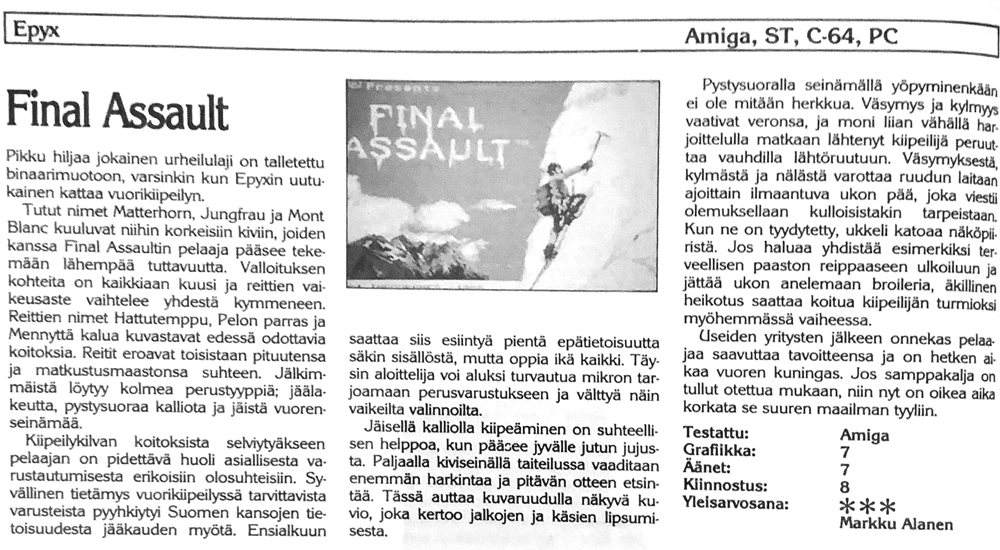
Final Assault1989 SyksyPysyvä linkkiPikku hiljaa jokainen urheilulaji on talletettu binaarimuotoon, varsinkin kun Epyxin uutukainen kattaa vuorikiipeilyn.
Tutut nimet Matterhorn, Jungfrau ja Mont Blanc kuuluvat niihin korkeisiin kiviin, joiden kanssa Final Assaultin pelaaja pääsee tekemään lähempää tuttavuutta. Valloituksen kohteita on kaikkiaan kuusi ja reittien vaikeusaste vaihtelee yhdestä kymmeneen. Reittien nimet Hattutemppu, Pelon parras ja Mennyttä kalua kuvastavat edessä odottavia koitoksia. Reitit eroavat toisistaan pituutensa ja matkustusmaastonsa suhteen. Jälkimmäistä löytyy kolmea perustyyppiä; jäälakeutta, pystysuoraa kalliota ja jäistä vuorenseinämää.
Kiipeilykilvan koitoksista selviytyäkseen pelaajan on pidettävä huoli asiallisesta varustautumisesta erikoisiin olosuhteisiin. Syvällinen tietämys vuorikiipeilyssä tarvittavista varusteista pyyhkiytyi Suomen kansojen tietoisuudesta jääkauden myötä. Ensialkuun saattaa siis esiintyä pientä epätietoisuutta säkin sisällöstä, mutta oppia ikä kaikki. Täysin aloittelija voi aluksi turvautua mikron tarjoamaan perusvarustukseen ja välttyä näin vaikeilta valinnoilta.
Jäisellä kalliolla kiipeäminen on suhteellisen helppoa, kun pääsee jyvälle jutun jujusta. Paljaalla kiviseinällä taiteilussa vaaditaan enemmän harkintaa ja pitävän otteen etsintää. Tässä auttaa kuvaruudulla näkyvä kuvio, joka kertoo jalkojen ja käsien lipsumisesta.
Pystysuoralla seinämällä yöpyminenkään ei ole mitään herkkua. Väsymys ja kylmyys vaativat veronsa, ja moni liian vähällä harjoittelulla matkaan lähtenyt kiipeilijä peruuttaa vauhdilla lähtöruutuun. Väsymyksestä, kylmästä ja nälästä varottaa ruudun laitaan ajoittain ilmaantuva ukon pää, joka viestii olemuksellaan kulloisistakin tarpeistaan. Kun ne on tyydytetty, ukkeli katoaa näköpiiristä. Jos haluaa yhdistää esimerkiksi terveellisen paaston reippaaseen ulkoiluun ja jättää ukon anelemaan broileria, äkillinen heikotus saattaa koitua kiipeilijän turmioksi myöhemmässä vaiheessa.
Useiden yritysten jälkeen onnekas pelaajaa saavuttaa tavoitteensa ja on hetken aikaa vuoren kuningas. Jos samppakalja on tullut otettua mukaan, niin nyt on oikea aika korkata se suuren maailman tyyliin.
Final Assault1989 SyksyPermalinkLittle by little every sport is getting stored in binary form, especially now that Epyx's latest offering covers mountain climbing.
The familiar names Matterhorn, Jungfrau and Mont Blanc are among the lofty rocks the Final Assault player gets to make closer acquaintance with. There are six peaks to conquer in all, and the routes range in difficulty from one to ten. Route names like Hat Trick, Brink of Fear and Goner reflect the ordeals waiting ahead. The routes differ from one another in length and in the terrain to be crossed. The latter comes in three basic types: ice plains, vertical rock and icy mountain face.
To survive the trials of the climbing contest, the player has to make sure of being properly equipped for the special conditions. Any deep knowledge of mountaineering gear was wiped from the consciousness of the Finnish peoples along with the Ice Age. So at first there may be a little uncertainty about what goes in the sack, but you're never too old to learn. A complete beginner can fall back at first on the basic kit offered by the computer and so avoid the tough choices.
Climbing on icy rock is relatively easy once you get the knack of the thing. Balancing on a bare rock wall calls for more deliberation and a hunt for a grip that holds. Help comes from a figure on screen that tells you when your feet and hands are slipping.
Spending the night on a vertical wall is no picnic either. Fatigue and cold take their toll, and many a climber who set off with too little practice backs up to square one in a hurry. Fatigue, cold and hunger are announced by an old geezer's head that pops up at the edge of the screen from time to time, conveying his needs of the moment through his general demeanour. Once they have been satisfied, the little fellow disappears from view. If you'd like to combine, say, a healthy fast with brisk outdoor exercise and leave the old boy begging for roast chicken, a sudden bout of faintness may prove the climber's undoing later on.
After several attempts the lucky player reaches the goal and is king of the mountain for a while. If you remembered to pack the bubbly, now is the right moment to pop the cork in true jet-set style.
Final Battle, The
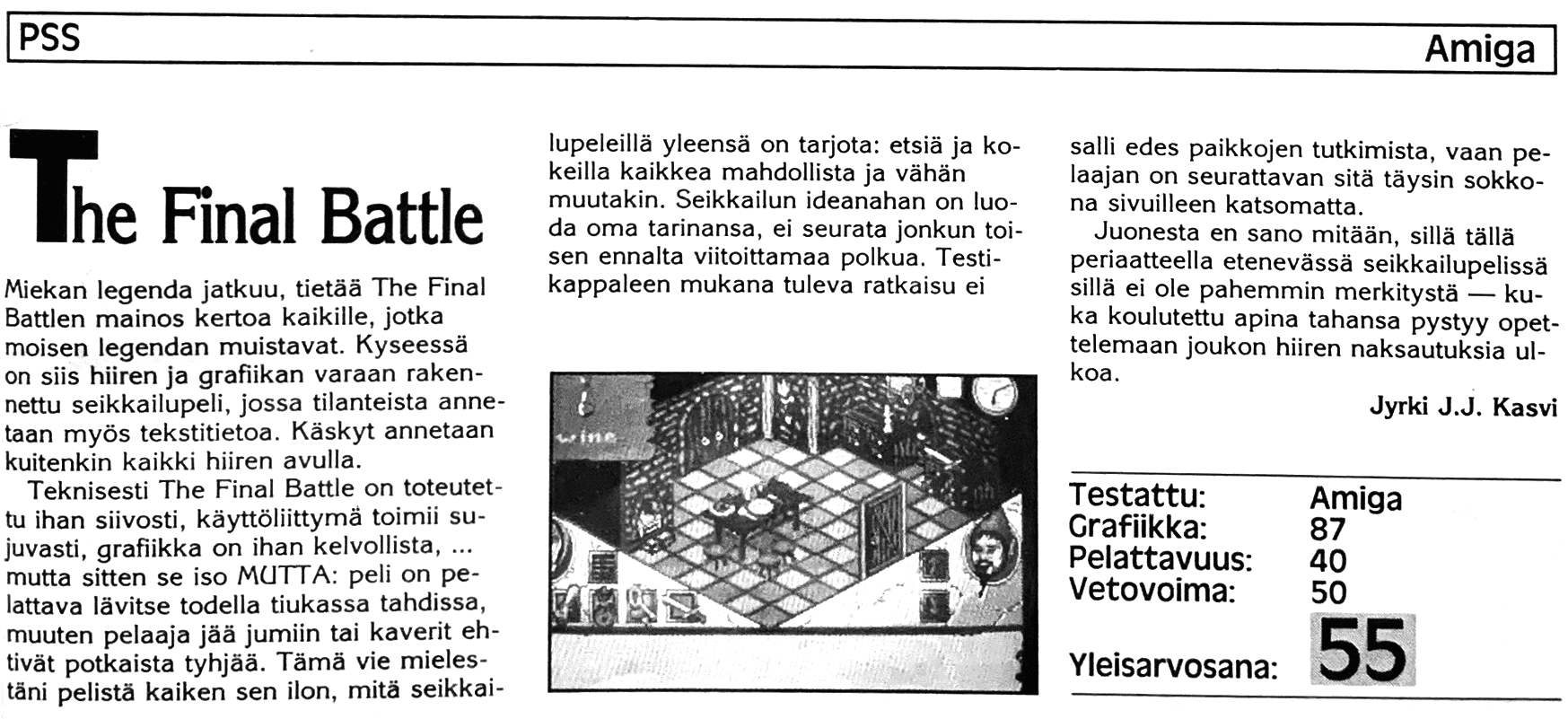
Final Battle, The1991 KevätPysyvä linkkiMiekan legenda jatkuu, tietää The Final Battlen mainos kertoa kaikille, jotka moisen legendan muistavat. Kyseessä on siis hiiren ja grafiikan varaan rakennettu seikkailupeli, jossa tilanteista annetaan myös tekstitietoa. Käskyt annetaan kuitenkin kaikki hiiren avulla.
Teknisesti The Final Battle on toteutettu ihan siivosti, käyttöliittymä toimii sujuvasti, grafiikka on ihan kelvollista, ... mutta sitten se iso MUTTA: peli on pelattava lävitse todella tiukassa tahdissa, muuten pelaaja jää jumiin tai kaverit ehtivät potkaista tyhjää. Tämä vie mielestäni pelistä kaiken sen ilon, mitä seikkailupeleillä yleensä on tarjota: etsiä ja kokeilla kaikkea mahdollista ja vähän muutakin. Seikkailun ideanahan on luoda oma tarinansa, ei seurata jonkun toisen ennalta viitoittamaa polkua. Testikappaleen mukana tuleva ratkaisu ei salli edes paikkojen tutkimista, vaan pelaajan on seurattava sitä täysin sokkona sivuilleen katsomatta.
Juonesta en sano mitään, sillä tällä periaatteella etenevässä seikkailupelissä sillä ei ole pahemmin merkitystä - kuka koulutettu apina tahansa pystyy opettelemaan joukon hiiren naksautuksia ulkoa.
Final Battle, The1991 KevätPermalinkThe legend of the sword continues, as the ad for The Final Battle is keen to tell everyone who remembers any such legend. So what we have is an adventure game built on the mouse and graphics, in which you are also given text information about situations. All the commands, however, are given with the mouse.
Technically The Final Battle is quite neatly done, the interface works smoothly, the graphics are perfectly decent, ... but then comes the big BUT: the game has to be played through at a really tight pace, otherwise the player gets stuck or the companions have time to kick the bucket. In my opinion this takes away all the joy adventure games usually have to offer: searching and trying everything possible and then some. The whole idea of an adventure, after all, is to create your own story, not to follow a path someone else has signposted in advance. The solution that came with the review copy doesn't even allow you to explore places; the player has to follow it completely blind, without glancing left or right.
I won't say anything about the plot, since in an adventure game that proceeds on this principle it doesn't much matter - any trained monkey can learn a bunch of mouse clicks by heart.
Final Command
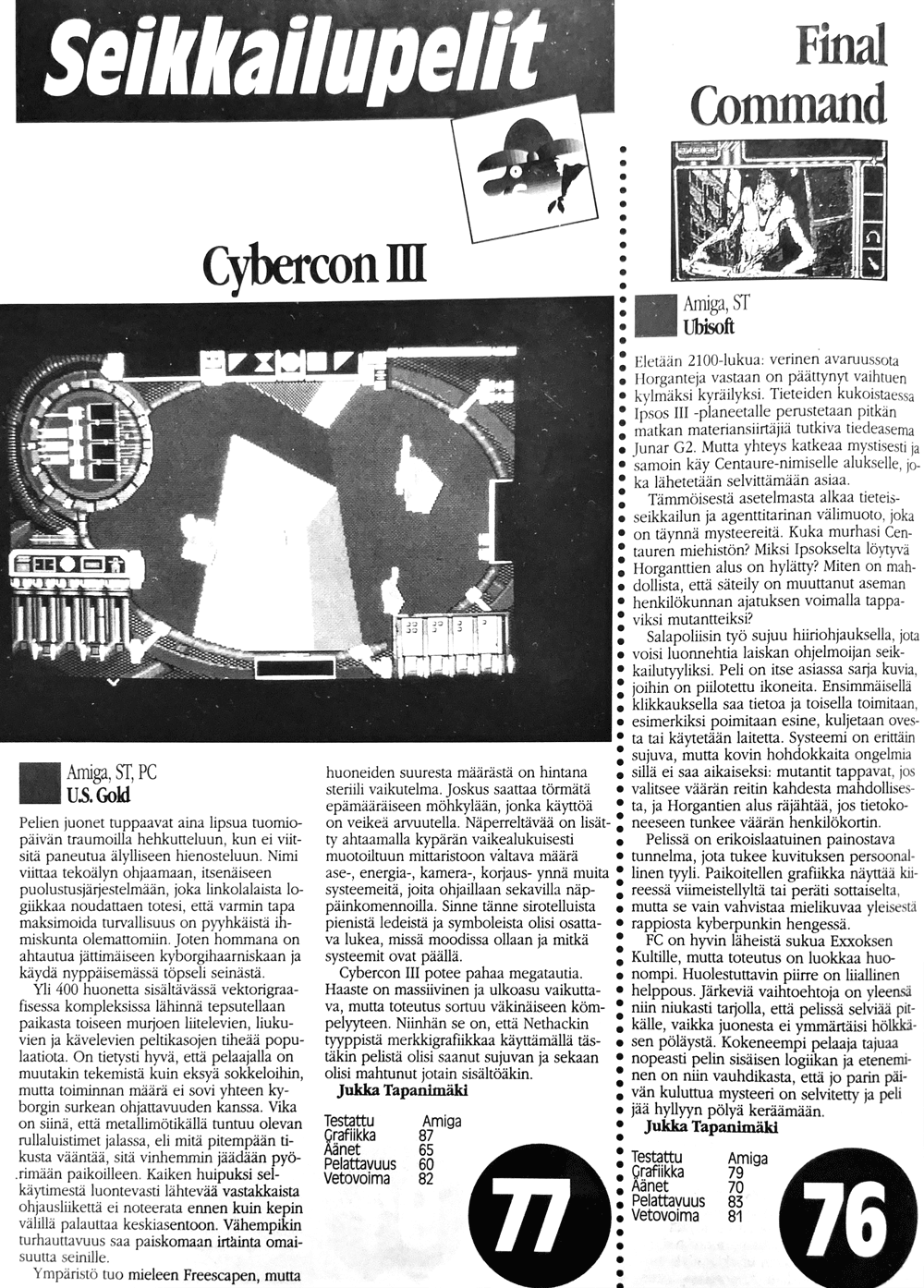
Final Command1991 SyksyPysyvä linkkiEletään 2100-lukua: verinen avaruussota Horganteja vastaan on päättynyt vaihtuen kylmäksi kyräilyksi. Tieteiden kukoistaessa Ipsos III -planeetalle perustetaan pitkän matkan materiansiirtäjiä tutkiva tiedeasema Junar G2. Mutta yhteys katkeaa mystisesti ja samoin käy Centaure-nimiselle alukselle, joka lähetetään selvittämään asiaa.
Tämmöisestä asetelmasta alkaa tieteisseikkailun ja agenttitarinan välimuoto, joka on täynnä mysteereitä. Kuka murhasi Centauren miehistön? Miksi Ipsokselta löytyvä Horganttien alus on hylätty? Miten on mahdollista, että säteily on muuttanut aseman henkilökunnan ajatuksen voimalla tappaviksi mutantteiksi?
Salapoliisin työ sujuu hiiriohjauksella, jota voisi luonnehtia laiskan ohjelmoijan seikkailutyyliksi. Peli on itse asiassa sarja kuvia, joihin on piilotettu ikoneita. Ensimmäisellä klikkauksella saa tietoa ja toisella toimitaan, esimerkiksi poimitaan esine, kuljetaan ovesta tai käytetään laitetta. Systeemi on erittäin sujuva, mutta kovin hohdokkaita ongelmia sillä ei saa aikaiseksi: mutantit tappavat, jos valitsee väärän reitin kahdesta mahdollisesta, ja Horgantien alus räjähtää, jos tietokoneeseen tunkee väärän henkilökortin.
Pelissä on erikoislaatuinen painostava tunnelma, jota tukee kuvituksen persoonallinen tyyli. Paikoitellen grafiikka näyttää kiireessä viimeistellyltä tai peräti sottaiselta, mutta se vain vahvistaa mielikuvaa yleisestä rappiosta kyberpunkin hengessä.
FC on hyvin läheistä sukua Exxoksen Kultille, mutta toteutus on luokkaa huonompi. Huolestuttavin piirre on liiallinen helppous. Järkeviä vaihtoehtoja on yleensä niin niukasti tarjolla, että pelissä selviää pitkälle, vaikka juonesta ei ymmärtäisi hölkkäsen pöläystä. Kokeneempi pelaaja tajuaa nopeasti pelin sisäisen logiikan ja eteneminen on niin vauhdikasta, että jo parin päivän kuluttua mysteeri on selvitetty ja peli jää hyllyyn pölyä keräämään.
Final Command1991 SyksyPermalinkIt is the 22nd century: the bloody space war against the Horgants has ended, giving way to a cold, sullen standoff. With the sciences flourishing, a research station called Junar G2 is set up on the planet Ipsos III to study long-range matter transmitters. But contact is mysteriously lost, and the same happens to a ship named Centaure, which is sent to look into the matter.
This is the setup for a cross between a sci-fi adventure and a spy story, and it is packed with mysteries. Who murdered the Centaure's crew? Why has the Horgantt ship found on Ipsos been abandoned? How is it possible that radiation has turned the station's staff into mutants who kill with the power of thought?
The detective work is done with mouse control, which you could describe as the lazy programmer's school of adventure. The game is in fact a series of pictures with icons hidden in them. The first click gives you information and the second one acts: picking up an object, going through a door or using a device, for example. The system is extremely smooth, but it doesn't make for very glamorous puzzles: the mutants kill you if you pick the wrong one of two possible routes, and the Horgant ship blows up if you shove the wrong ID card into the computer.
The game has a peculiar, oppressive atmosphere, backed up by the distinctive style of the artwork. In places the graphics look as if they were finished in a hurry, or even downright messy, but that only strengthens the impression of all-round decay in the cyberpunk spirit.
FC is a very close relative of Exxos's Kult, but the execution is a class below it. The most worrying feature is that it is far too easy. There are usually so few sensible options on offer that you get a long way in the game even if you don't understand diddly-squat about the plot. A more experienced player quickly grasps the game's internal logic, and progress is so brisk that within a couple of days the mystery is solved and the game is left on the shelf to gather dust.
Final Countdown
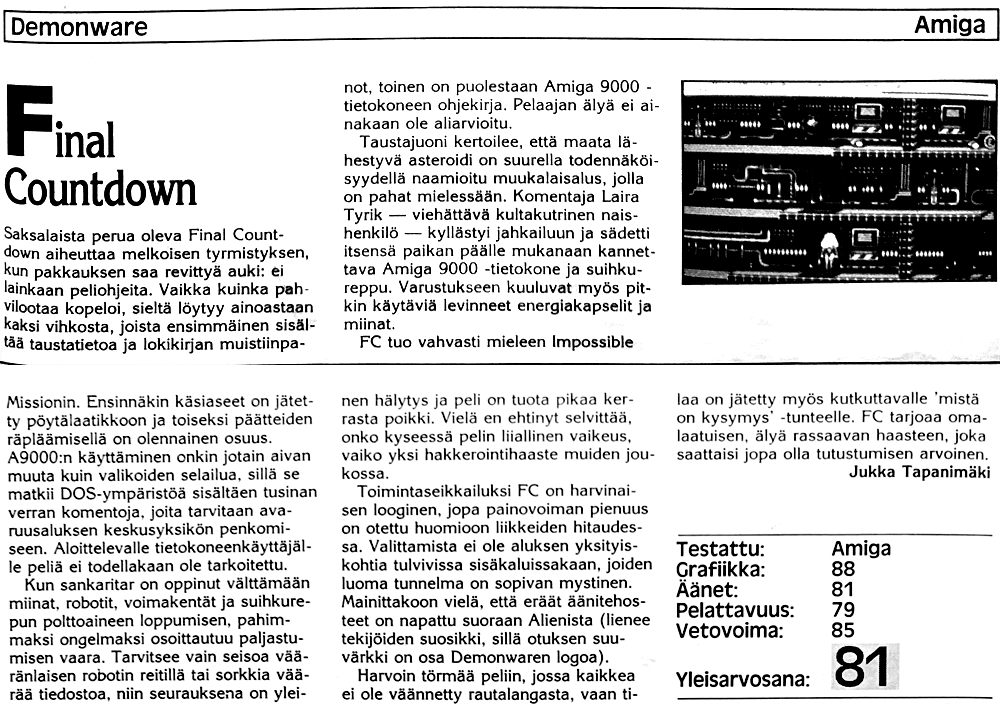
Final Countdown1991 KevätPysyvä linkkiSaksalaista perua oleva Final Countdown aiheuttaa melkoisen tyrmistyksen, kun pakkauksen saa revittyä auki: ei lainkaan peliohjeita. Vaikka kuinka pahvilootaa kopeloi, sieltä löytyy ainoastaan kaksi vihkosta, joista ensimmäinen sisältää taustatietoa ja lokikirjan muistiinpanot, toinen on puolestaan Amiga 9000 -tietokoneen ohjekirja. Pelaajan älyä ei ainakaan ole aliarvioitu.
Taustajuoni kertoilee, että maata lähestyvä asteroidi on suurella todennäköisyydellä naamioitu muukalaisalus, jolla on pahat mielessään. Komentaja Laira Tyrik - viehättävä kultakutrinen naishenkilö - kyllästyi jahkailuun ja sädetti itsensä paikan päälle mukanaan kannettava Amiga 9000 -tietokone ja suihkureppu. Varustukseen kuuluvat myös pitkin käytäviä levinneet energiakapselit ja miinat.
FC tuo vahvasti mieleen Impossible Missionin. Ensinnäkin käsiaseet on jätetty pöytälaatikkoon ja toiseksi päätteiden räpläämisellä on olennainen osuus. A9000:n käyttäminen onkin jotain aivan muuta kuin valikoiden selailua, sillä se matkii DOS-ympäristöä sisältäen tusinan verran komentoja, joita tarvitaan avaruusaluksen keskusyksikön penkomiseen. Aloittelevalle tietokoneenkäyttäjälle peliä ei todellakaan ole tarkoitettu.
Kun sankaritar on oppinut välttämään miinat, robotit, voimakentät ja suihkurepun polttoaineen loppumisen, pahimmaksi ongelmaksi osoittautuu paljastumisen vaara. Tarvitsee vain seisoa vääränlaisen robotin reitillä tai sorkkia väärää tiedostoa, niin seurauksena on yleinen hälytys ja peli on tuota pikaa kerrasta poikki. Vielä en ehtinyt selvittää, onko kyseessä pelin liiallinen vaikeus, vaiko yksi hakkerointihaaste muiden joukossa.
Toimintaseikkailuksi FC on harvinaisen looginen, jopa painovoiman pienuus on otettu huomioon liikkeiden hitaudessa. Valittamista ei ole aluksen yksityiskohtia tulvivissa sisäkaluissakaan, joiden luoma tunnelma on sopivan mystinen. Mainittakoon vielä, että eräät äänitehosteet on napattu suoraan Alienista (lienee tekijöiden suosikki, sillä otuksen suuvärkki on osa Demonwaren logoa).
Harvoin törmää peliin, jossa kaikkea ei ole väännetty rautalangasta, vaan tilaa on jätetty myös kutkuttavalle 'mistä on kysymys' -tunteelle. FC tarjoaa omalaatuisen, älyä rassaavan haasteen, joka saattaisi jopa olla tutustumisen arvoinen.
Final Countdown1991 KevätPermalinkFinal Countdown, which is of German origin, causes quite some consternation when you get the box ripped open: no game instructions at all. However much you rummage around the cardboard box, all you find in there are two booklets, the first of which contains background information and the logbook notes, while the second is the manual for the Amiga 9000 computer. At least the player's intelligence hasn't been underestimated.
The background story relates that an asteroid approaching the Earth is in all likelihood a disguised alien ship with evil on its mind. Commander Laira Tyrik - a charming golden-tressed female person - got fed up with the dithering and beamed herself onto the scene, taking along a portable Amiga 9000 computer and a jetpack. The kit also includes the energy capsules and mines strewn along the corridors.
FC strongly calls to mind Impossible Mission. Firstly, the handguns have been left in the desk drawer, and secondly, fiddling with terminals plays an essential part. Using the A9000 is something quite different from leafing through menus, since it mimics a DOS environment, featuring a dozen or so commands that are needed to rummage through the spaceship's central computer. The game is definitely not meant for the novice computer user.
Once the heroine has learned to avoid mines, robots, force fields and running out of jetpack fuel, the worst problem turns out to be the risk of being found out. All you need to do is stand in the path of the wrong kind of robot or poke at the wrong file, and the result is a general alarm and the game is over in one fell swoop before you know it. I haven't yet had time to figure out whether this is a case of the game being too difficult, or just one hacking challenge among the rest.
For an action adventure FC is unusually logical; even the low gravity has been taken into account in the slowness of movement. There's nothing to complain about in the ship's innards either, which are teeming with detail and create a suitably mysterious atmosphere. Let it also be mentioned that certain sound effects have been nabbed straight from Alien (presumably a favourite of the makers, since the creature's mouthparts form part of the Demonware logo).
Rarely do you come across a game where everything hasn't been spelled out in words of one syllable, but room has also been left for a tantalising 'what's this all about' feeling. FC offers a singular, brain-racking challenge that might even be worth getting to know.
Fire And Brimstone
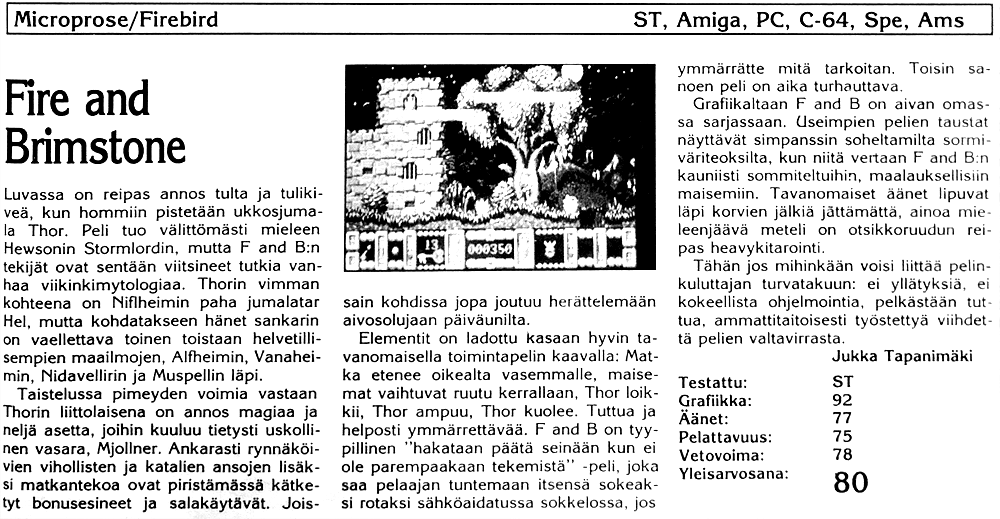
Fire And Brimstone1990 SyksyPysyvä linkkiLuvassa on reipas annos tulta ja tulikiveä, kun hommiin pistetään ukkosjumala Thor. Peli tuo välittömästi mieleen Hewsonin Stormlordin, mutta F and B:n tekijät ovat sentään viitsineet tutkia vanhaa viikinkimytologiaa. Thorin vimman kohteena on Niflheimin paha jumalatar Hel, mutta kohdatakseen hänet sankarin on vaellettava toinen toistaan helvetillisempien maailmojen, Alfheimin, Vanaheimin, Nidavellirin ja Muspellin läpi.
Taistelussa pimeyden voimia vastaan Thorin liittolaisena on annos magiaa ja neljä asetta, joihin kuuluu tietysti uskollinen vasara, Mjollner. Ankarasti rynnäköivien vihollisten ja katalien ansojen lisäksi matkantekoa ovat piristämässä kätketyt bonusesineet ja salakäytävät. Joissain kohdissa jopa joutuu herättelemään aivosolujaan päiväunilta.
Elementit on ladottu kasaan hyvin tavanomaisella toimintapelin kaavalla: Matka etenee oikealta vasemmalle, maisemat vaihtuvat ruutu kerrallaan, Thor loikkii, Thor ampuu, Thor kuolee. Tuttua ja helposti ymmärrettävää. F and B on tyypillinen "hakataan päätä seinään kun ei ole parempaakaan tekemistä" -peli, joka saa pelaajan tuntemaan itsensä sokeaksi rotaksi sähköaidatussa sokkelossa, jos ymmärrätte mitä tarkoitan. Toisin sanoen peli on aika turhauttava.
Grafiikaltaan F and B on aivan omassa sarjassaan. Useimpien pelien taustat näyttävät simpanssin soheltamilta sormiväriteoksilta, kun niitä vertaan F and B:n kauniisti sommiteltuihin, maalauksellisiin maisemiin. Tavanomaiset äänet lipuvat läpi korvien jälkiä jättämättä, ainoa mieleenjäävä meteli on otsikkoruudun reipas heavykitarointi.
Tähän jos mihinkään voisi liittää pelinkuluttajan turvatakuun: ei yllätyksiä, ei kokeellista ohjelmointia, pelkästään tuttua, ammattitaitoisesti työstettyä viihdettä pelien valtavirrasta.
Fire And Brimstone1990 SyksyPermalinkA hefty helping of fire and brimstone is in store as the thunder god Thor is put to work. The game instantly brings Hewson's Stormlord to mind, but the makers of F and B have at least bothered to study old Viking mythology. The target of Thor's fury is Hel, the evil goddess of Niflheim, but to face her the hero has to trek through a string of worlds, each more hellish than the last: Alfheim, Vanaheim, Nidavellir and Muspell.
In the fight against the forces of darkness, Thor's allies are a dose of magic and four weapons, including of course his trusty hammer, Mjollner. Besides fiercely charging enemies and treacherous traps, the journey is livened up by hidden bonus items and secret passages. In places you even have to rouse your brain cells from their afternoon nap.
The ingredients have been stacked together to a very conventional action-game formula: the journey goes from right to left, the scenery changes one screen at a time, Thor jumps, Thor shoots, Thor dies. Familiar and easy to grasp. F and B is a typical "bang your head against the wall when there's nothing better to do" game, one that makes the player feel like a blind rat in an electrified maze, if you know what I mean. In other words, the game is pretty frustrating.
Graphically F and B is in a class of its own. The backdrops of most games look like finger paintings smeared by a chimpanzee when I compare them with F and B's beautifully composed, painterly landscapes. The run-of-the-mill sounds drift in one ear and out the other without leaving a trace; the only memorable racket is the rousing heavy metal guitar work on the title screen.
If anything deserves a game consumer's safety guarantee, this does: no surprises, no experimental programming, just familiar, professionally crafted entertainment from the gaming mainstream.
Fire And Forget
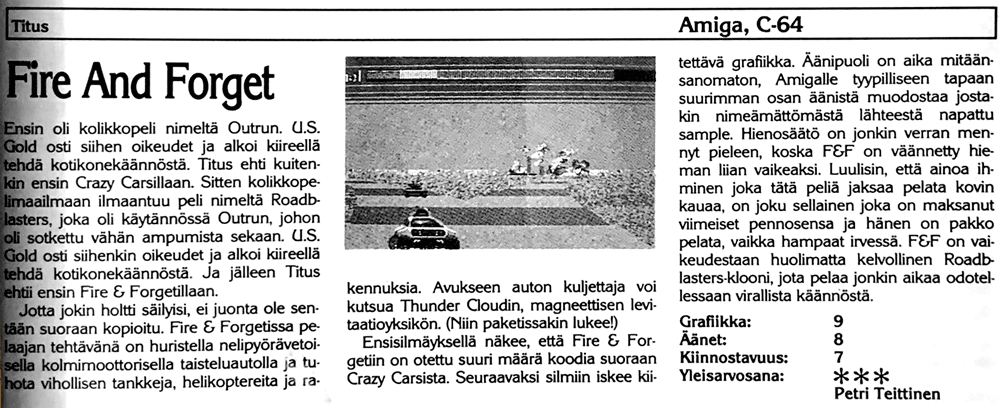
Fire And Forget1988Pysyvä linkkiEnsin oli kolikkopeli nimeltä Outrun. U.S. Gold osti siihen oikeudet ja alkoi kiireellä tehdä kotikonekäännöstä. Titus ehti kuitenkin ensin Crazy Carsillaan. Sitten kolikkopelimaailmaan ilmaantuu peli nimeltä Roadblasters, joka oli käytännössä Outrun, johon oli sotkettu vähän ampumista sekaan. U.S. Gold osti siihenkin oikeudet ja alkoi kiireellä tehdä kotikonekäännöstä. Ja jälleen Titus ehti ensin Fire & Forgetillaan.
Jotta jokin holtti säilyisi, ei juonta ole sentään suoraan kopioitu. Fire & Forgetissa pelaajan tehtävänä on huristella nelipyörävetoisella kolmimoottorisella taisteluautolla ja tuhota vihollisen tankkeja, helikoptereita ja rakennuksia. Avukseen auton kuljettaja voi kutsua Thunder Cloudin, magneettisen levitaatioyksikön. (Niin paketissakin lukee!)
Ensisilmäyksellä näkee, että Fire & Forgetiin on otettu suuri määrä koodia suoraan Crazy Carsista. Seuraavaksi silmiin iskee kiitettävä grafiikka. Äänipuoli on aika mitäänsanomaton, Amigalle tyypilliseen tapaan suurimman osan äänistä muodostaa jostakin nimeämättömästä lähteestä napattu sample. Hienosäätö on jonkin verran mennyt pieleen, koska F&F on väännetty hieman liian vaikeaksi. Luulisin, että ainoa ihminen joka tätä peliä jaksaa pelata kovin kauaa, on joku sellainen joka on maksanut viimeiset pennosensa ja hänen on pakko pelata, vaikka hampaat irvessä. F&F on vaikeudestaan huolimatta kelvollinen Roadblasters-klooni, jota pelaa jonkin aikaa odotellessaan virallista käännöstä.
Fire And Forget1988PermalinkFirst there was a coin-op called Outrun. U.S. Gold bought the rights to it and started hurriedly making a home computer conversion. Titus, however, got there first with its Crazy Cars. Then along comes a game in the arcade world called Roadblasters, which was practically Outrun with a bit of shooting stirred in. U.S. Gold bought the rights to that one too and started hurriedly making a home computer conversion. And once again Titus got there first with its Fire & Forget.
To keep at least some shred of restraint, the plot has not been copied outright. In Fire & Forget the player's task is to tear around in a four-wheel-drive, triple-engined combat car and destroy enemy tanks, helicopters and buildings. To help out, the driver of the car can call up the Thunder Cloud, a magnetic levitation unit. (That's what it says on the box, honestly!)
At first glance you can see that a large amount of code has been taken straight from Crazy Cars into Fire & Forget. The next thing to catch the eye is the commendable graphics. The sound side is fairly nondescript; as is typical for the Amiga, most of the sound is made up of a sample nabbed from some unnamed source. The fine-tuning has gone somewhat wrong, because F&F has been made a bit too difficult. I'd guess that the only person who will bother to play this game for very long is someone who has paid out their last pennies for it and has to play it, through gritted teeth. Despite its difficulty, F&F is a passable Roadblasters clone to play for a while as you wait for the official conversion.
Firefly
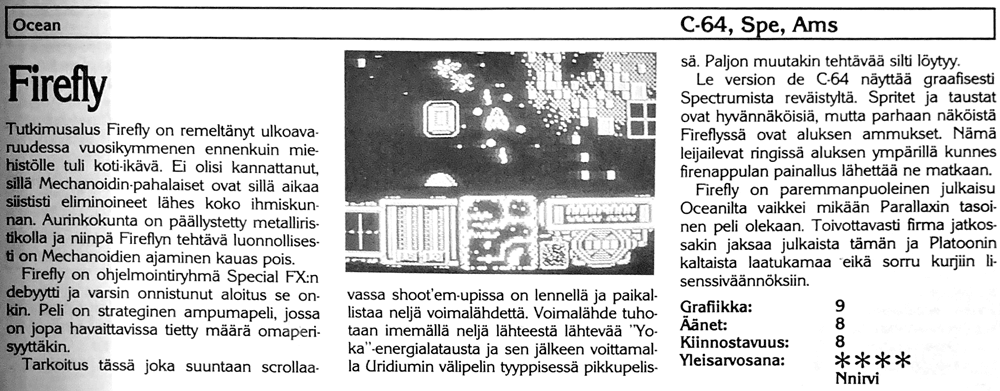
Firefly1988Pysyvä linkkiTutkimusalus Firefly on remeltänyt ulkoavaruudessa vuosikymmenen ennenkuin miehistölle tuli koti-ikävä. Ei olisi kannattanut, sillä Mechanoidin-pahalaiset ovat sillä aikaa siististi eliminoineet lähes koko ihmiskunnan. Aurinkokunta on päällystetty metalliristikolla ja niinpä Fireflyn tehtävä luonnollisesti on Mechanoidien ajaminen kauas pois.
Firefly on ohjelmointiryhmä Special FX:n debyytti ja varsin onnistunut aloitus se onkin. Peli on strateginen ampumapeli, jossa on jopa havaittavissa tietty määrä omaperisyyttäkin.
Tarkoitus tässä joka suuntaan scrollaavassa shoot'em-upissa on lennellä ja paikallistaa neljä voimalähdettä. Voimalähde tuhotaan imemällä neljä lähteestä lähtevää "Yoka"-energialatausta ja sen jälkeen voittamalla Uridiumin välipelin tyyppisessä pikkupelissä. Paljon muutakin tehtävää silti löytyy.
Le version de C-64 näyttää graafisesti Spectrumista reväistyltä. Spritet ja taustat ovat hyvännäköisiä, mutta parhaan näköistä Fireflyssä ovat aluksen ammukset. Nämä leijailevat ringissä aluksen ympärillä kunnes firenappulan painallus lähettää ne matkaan.
Firefly on paremmanpuoleinen julkaisu Oceanilta vaikkei mikään Parallaxin tasoinen peli olekaan. Toivottavasti firma jatkossakin jaksaa julkaista tämän ja Platoonin kaltaista laatukamaa eikä sorru kurjiin lisenssiväännöksiin.
Firefly1988PermalinkThe research vessel Firefly had been knocking about in outer space for a decade before the crew got homesick. They shouldn't have bothered, because in the meantime the Mechanoid baddies have neatly eliminated almost the whole of humanity. The solar system has been paved over with a metal lattice, and so the Firefly's task, naturally, is to drive the Mechanoids far away.
Firefly is the debut of the programming group Special FX, and a pretty successful start it is too. The game is a strategic shoot-'em-up in which a certain amount of originality can even be detected.
The point of this shoot'em-up, which scrolls in every direction, is to fly around and locate four power sources. A power source is destroyed by sucking up the four "Yoka" energy charges coming out of it and then winning a little mini-game of the Uridium in-between stage type. Still, there's plenty more to do besides.
Le version de C-64 looks graphically as if it had been ripped straight off the Spectrum. The sprites and backgrounds look good, but the best-looking thing in Firefly is the ship's bullets. They float in a ring around the ship until a press of the fire button sends them on their way.
Firefly is one of Ocean's better releases, even if it isn't a game on the level of Parallax. Hopefully the company will keep finding the energy to release quality stuff like this and Platoon in future, and won't sink into wretched licence cash-ins.
Firetrack
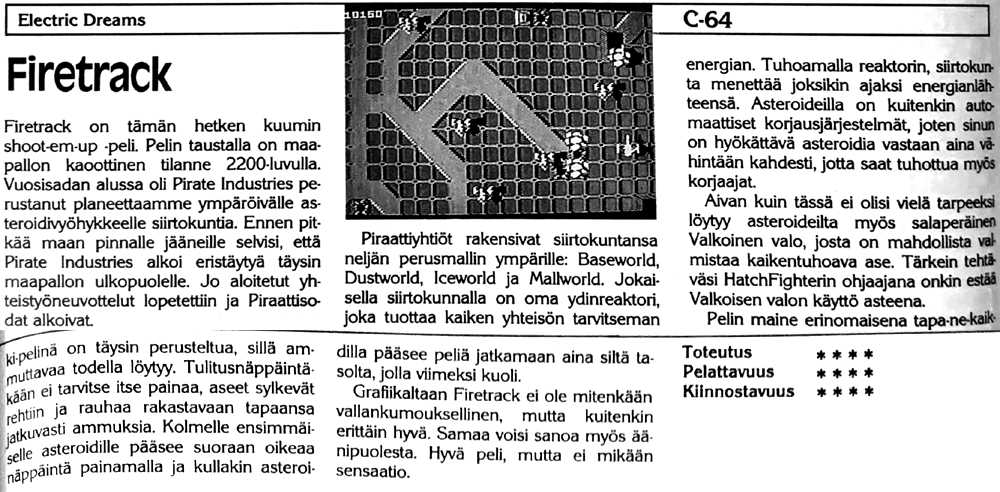
Firetrack1987Pysyvä linkkiFiretrack on tämän hetken kuumin shoot-em-up -peli. Pelin taustalla on maapallon kaoottinen tilanne 2200-luvulla. Vuosisadan alussa oli Pirate Industries perustanut planeettaamme ympäröivälle asteroidivyöhykkeelle siirtokuntia. Ennen pitkää maan pinnalle jääneille selvisi, että Pirate Industries alkoi eristäytyä täysin maapallon ulkopuolelle. Jo aloitetut yhteistyöneuvottelut lopetettiin ja Piraattisodat alkoivat.
Piraattiyhtiöt rakensivat siirtokuntansa neljän perusmallin ympärille: Baseworld, Dustworld, Iceworld ja Mallworld. Jokaisella siirtokunnalla on oma ydinreaktori, joka tuottaa kaiken yhteisön tarvitseman energian. Tuhoamalla reaktorin, siirtokunta menettää joksikin ajaksi energianlähteensä. Asteroideilla on kuitenkin automaattiset korjausjärjestelmät, joten sinun on hyökättävä asteroidia vastaan aina vähintään kahdesti, jotta saat tuhottua myös korjaajat.
Aivan kuin tässä ei olisi vielä tarpeeksi löytyy asteroideilta myös salaperäinen Valkoinen valo, josta on mahdollista valmistaa kaikentuhoava ase. Tärkein tehtäväsi HatchFighterin ohjaajana onkin estää Valkoisen valon käyttö asteena.
Pelin maine erinomaisena tapa-ne-kaikki-pelinä on täysin perusteltua, sillä ammuttavaa todella löytyy. Tulitusnäppäintäkään ei tarvitse itse painaa, aseet sylkevät rehtiin ja rauhaa rakastavaan tapaansa jatkuvasti ammuksia. Kolmelle ensimmäiselle asteroidille pääsee suoraan oikeaa näppäintä painamalla ja kullakin asteroidilla pääsee peliä jatkamaan aina siltä tasolta, jolla viimeksi kuoli.
Grafiikaltaan Firetrack ei ole mitenkään vallankumouksellinen, mutta kuitenkin erittäin hyvä. Samaa voisi sanoa myös äänipuolesta. Hyvä peli, mutta ei mikään sensaatio.
Firetrack1987PermalinkFiretrack is the hottest shoot-em-up of the moment. The game's backdrop is the chaotic state of planet Earth in the 23rd century. At the start of the century Pirate Industries had founded colonies in the asteroid belt surrounding our planet. Before long, those left behind on the Earth's surface realised that Pirate Industries was starting to cut itself off from the Earth completely. Cooperation talks that were already under way were broken off, and the Pirate Wars began.
The pirate companies built their colonies around four basic models: Baseworld, Dustworld, Iceworld and Mallworld. Every colony has its own nuclear reactor, which produces all the energy the community needs. Destroy the reactor and the colony loses its power source for a while. The asteroids do have automatic repair systems, though, so you always have to attack an asteroid at least twice in order to take out the repairers as well.
As if that weren't enough already, the asteroids also hold the mysterious White Light, from which an all-destroying weapon can be made. Your most important task as the pilot of the HatchFighter is, in fact, to stop the White Light being used as a weapon.
The game's reputation as an excellent kill-'em-all game is entirely justified, because there really is plenty to shoot at. You don't even have to press the fire button yourself: in their honest, peace-loving way, the guns spit out bullets nonstop. You can get straight to any of the first three asteroids by pressing the right key, and on each asteroid you can always continue the game from the level where you last died.
Graphics-wise Firetrack is in no way revolutionary, but it is still very good. The same could be said of the sound side too. A good game, but no sensation.
Firezone
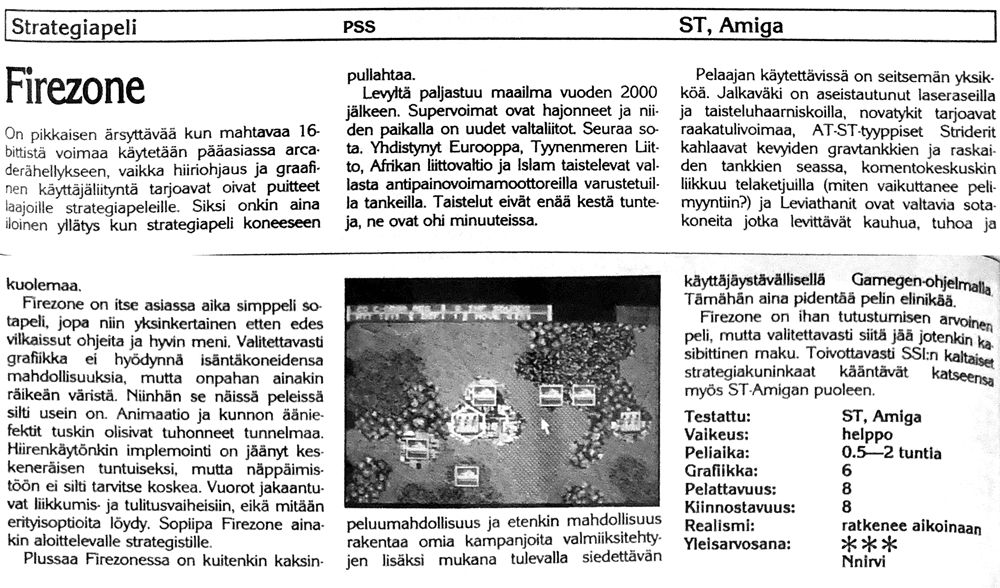
Firezone1989 KevätPysyvä linkkiOn pikkaisen ärsyttävää kun mahtavaa 16-bittistä voimaa käytetään pääasiassa arcaderähellykseen, vaikka hiiriohjaus ja graafinen käyttäjäliityntä tarjoavat oivat puitteet laajoille strategiapeleille. Siksi onkin aina iloinen yllätys kun strategiapeli koneeseen pullahtaa.
Levyltä paljastuu maailma vuoden 2000 jälkeen. Supervoimat ovat hajonneet ja niiden paikalla on uudet valtaliitot. Seuraa sota. Yhdistynyt Eurooppa, Tyynenmeren Liitto, Afrikan liittovaltio ja Islam taistelevat vallasta antipainovoimamoottoreilla varustetuilla tankeilla. Taistelut eivät enää kestä tunteja, ne ovat ohi minuuteissa.
Pelaajan käytettävissä on seitsemän yksikköä. Jalkaväki on aseistautunut laseraseilla ja taisteluhaarniskoilla, novatykit tarjoavat raakatulivoimaa, AT-ST-tyyppiset Striderit kahlaavat kevyiden gravtankkien ja raskaiden tankkien seassa, komentokeskuskin liikkuu telaketjuilla (miten vaikuttanee pelimyyntiin?) ja Leviathanit ovat valtavia sotakoneita jotka levittävät kauhua, tuhoa ja kuolemaa.
Firezone on itse asiassa aika simppeli sotapeli, jopa niin yksinkertainen etten edes vilkaissut ohjeita ja hyvin meni. Valitettavasti grafiikka ei hyödynnä isäntäkoneidensa mahdollisuuksia, mutta onpahan ainakin räikeän väristä. Niinhän se näissä peleissä silti usein on. Animaatio ja kunnon ääniefektit tuskin olisivat tuhonneet tunnelmaa. Hiirenkäytönkin implemointi on jäänyt keskeneräisen tuntuiseksi, mutta näppäimistöön ei silti tarvitse koskea. Vuorot jakaantuvat liikkumis- ja tulitusvaiheisiin, eikä mitään erityisoptioita löydy. Sopiipa Firezone ainakin aloittelevalle strategistille.
Plussaa Firezonessa on kuitenkin kaksinpeluumahdollisuus ja etenkin mahdollisuus rakentaa omia kampanjoita valmiiksitehtyjen lisäksi mukana tulevalla siedettävän käyttäjäystävällisellä Gamegen-ohjelmalla. Tämähän aina pidentää pelin elinikää.
Firezone on ihan tutustumisen arvoinen peli, mutta valitettavasti siitä jää jotenkin kasibittinen maku. Toivottavasti SSI:n kaltaiset strategiakuninkaat kääntävät katseensa myös ST-Amigan puoleen.
Firezone1989 KevätPermalinkIt's a tiny bit annoying that mighty 16-bit power gets used mainly for arcade mayhem, even though mouse control and a graphical user interface provide the ideal framework for large-scale strategy games. That's why it's always a pleasant surprise when a strategy game pops into the machine.
The disk reveals a world after the year 2000. The superpowers have fallen apart and in their place are new power blocs. War follows. United Europe, the Pacific League, the African Federation and Islam fight for power with tanks fitted with anti-gravity engines. Battles no longer last hours; they're over in minutes.
Seven units are at the player's disposal. The infantry is armed with laser weapons and battle armour, nova cannons provide raw firepower, AT-ST-style Striders wade among the light gravtanks and heavy tanks, even the command centre moves on caterpillar tracks (how might that affect game sales?), and the Leviathans are huge war machines that spread terror, destruction and death.
Firezone is actually a pretty simple war game, so simple in fact that I didn't even glance at the instructions and got on fine. Unfortunately the graphics don't make use of what their host machines can do, but at least they're garishly coloured. That's often the way with these games anyway. Animation and some proper sound effects would hardly have ruined the atmosphere. The implementation of mouse control, too, feels half-finished, but you still don't need to touch the keyboard. Turns are divided into movement and firing phases, and there are no special options to be found. Firezone does at least suit the budding strategist.
On the plus side, though, Firezone has a two-player option and, above all, the chance to build your own campaigns in addition to the ready-made ones, using the tolerably user-friendly Gamegen program that comes with it. That always extends a game's lifespan, of course.
Firezone is a game quite worth getting to know, but unfortunately it somehow leaves an 8-bit aftertaste. Hopefully strategy kings like SSI will turn their gaze towards the ST and Amiga as well.
First Contact
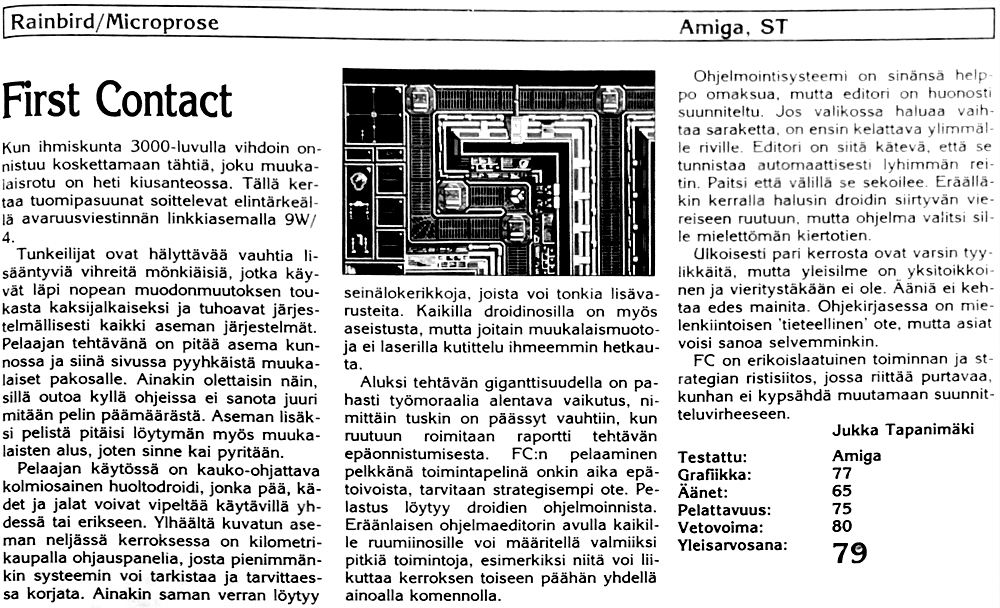
First Contact1990 SyksyPysyvä linkkiKun ihmiskunta 3000-luvulla vihdoin onnistuu koskettamaan tähtiä, joku muukalaisrotu on heti kiusanteossa. Tällä kertaa tuomipasuunat soittelevat elintärkeällä avaruusviestinnän linkkiasemalla 9W/4.
Tunkeilijat ovat hälyttävää vauhtia lisääntyviä vihreitä mönkiäisiä, jotka käyvät läpi nopean muodonmuutoksen toukasta kaksijalkaiseksi ja tuhoavat järjestelmällisesti kaikki aseman järjestelmät. Pelaajan tehtävänä on pitää asema kunnossa ja siinä sivussa pyyhkäistä muukalaiset pakosalle. Ainakin olettaisin näin, sillä outoa kyllä ohjeissa ei sanota juuri mitään pelin päämäärästä. Aseman lisäksi pelistä pitäisi löytymän myös muukalaisten alus, joten sinne kai pyritään.
Pelaajan käytössä on kauko-ohjattava kolmiosainen huoltodroidi, jonka pää, kädet ja jalat voivat vipeltää käytävillä yhdessä tai erikseen. Ylhäältä kuvatun aseman neljässä kerroksessa on kilometrikaupalla ohjauspanelia, josta pienimmänkin systeemin voi tarkistaa ja tarvittaessa korjata. Ainakin saman verran löytyy seinälokerikkoja, joista voi tonkia lisävarusteita. Kaikilla droidinosilla on myös aseistusta, mutta joitain muukalaismuotoja ei laserilla kutittelu ihmeemmin hetkauta.
Aluksi tehtävän giganttisuudella on pahasti työmoraalia alentava vaikutus, nimittäin tuskin on päässyt vauhtiin, kun ruutuun roimitaan raportti tehtävän epäonnistumisesta. FC:n pelaaminen pelkkänä toimintapelinä onkin aika epätoivoista, tarvitaan strategisempi ote. Pelastus löytyy droidien ohjelmoinnista. Eräänlaisen ohjelmaeditorin avulla kaikille ruumiinosille voi määritellä valmiiksi pitkiä toimintoja, esimerkiksi niitä voi liikuttaa kerroksen toiseen päähän yhdellä ainoalla komennolla.
Ohjelmointisysteemi on sinänsä helppo omaksua, mutta editori on huonosti suunniteltu. Jos valikossa haluaa vaihtaa saraketta, on ensin kelattava ylimmälle riville. Editori on siitä kätevä, että se tunnistaa automaattisesti lyhimmän reitin. Paitsi että välillä se sekoilee. Eräälläkin kerralla halusin droidin siirtyvän viereiseen ruutuun, mutta ohjelma valitsi sille mielettömän kiertotien.
Ulkoisesti pari kerrosta ovat varsin tyylikkäitä, mutta yleisilme on yksitoikkoinen ja vieritystäkään ei ole. Ääniä ei kehtaa edes mainita. Ohjekirjasessa on mielenkiintoisen 'tieteellinen' ote, mutta asiat voisi sanoa selvemminkin.
FC on erikoislaatuinen toiminnan ja strategian ristisiitos, jossa riittää purtavaa, kunhan ei kypsähdä muutamaan suunnitteluvirheeseen.
First Contact1990 SyksyPermalinkWhen mankind finally manages to touch the stars in the 3000s, some alien race immediately starts making trouble. This time the trumpets of doom are sounding at the vital space communications relay station 9W/4.
The intruders are green creepy-crawlies breeding at an alarming rate, which go through a rapid metamorphosis from grub to biped and systematically destroy every one of the station's systems. The player's job is to keep the station in working order and, while at it, send the aliens packing. At least that's what I'd assume, since oddly enough the instructions say next to nothing about the aim of the game. Besides the station, the game is supposed to contain the aliens' ship as well, so I suppose that's where you're headed.
At the player's disposal is a remote-controlled, three-part maintenance droid whose head, arms and legs can scurry along the corridors together or separately. The four floors of the station, seen from above, hold kilometres of control panels from which even the smallest system can be checked and, if need be, repaired. There are at least as many wall lockers to rummage through for extra equipment. All the droid parts are armed as well, but some alien forms are not much bothered by being tickled with a laser.
At first the sheer gigantic scale of the task has a badly demoralising effect: you have barely got going before a report of mission failure is slapped up on the screen. Playing FC purely as an action game is pretty hopeless, then; you need a more strategic approach. Salvation lies in programming the droids. With a sort of program editor you can define long sequences of actions for all the body parts in advance; for example, you can move them to the other end of the floor with one single command.
The programming system itself is easy to pick up, but the editor is badly designed. If you want to change column in the menu, you first have to scroll up to the top row. The editor is handy in that it automatically works out the shortest route. Except that sometimes it goes haywire. One time I wanted the droid to move to the next square, but the program picked an insane detour for it.
To look at, a couple of the floors are quite stylish, but the overall look is monotonous and there isn't even any scrolling. The sound doesn't even bear mentioning. The instruction booklet takes an interestingly 'scientific' approach, but things could be put more clearly.
FC is a peculiar cross-breed of action and strategy with plenty to get your teeth into, as long as a few design flaws don't drive you up the wall.
First Strike
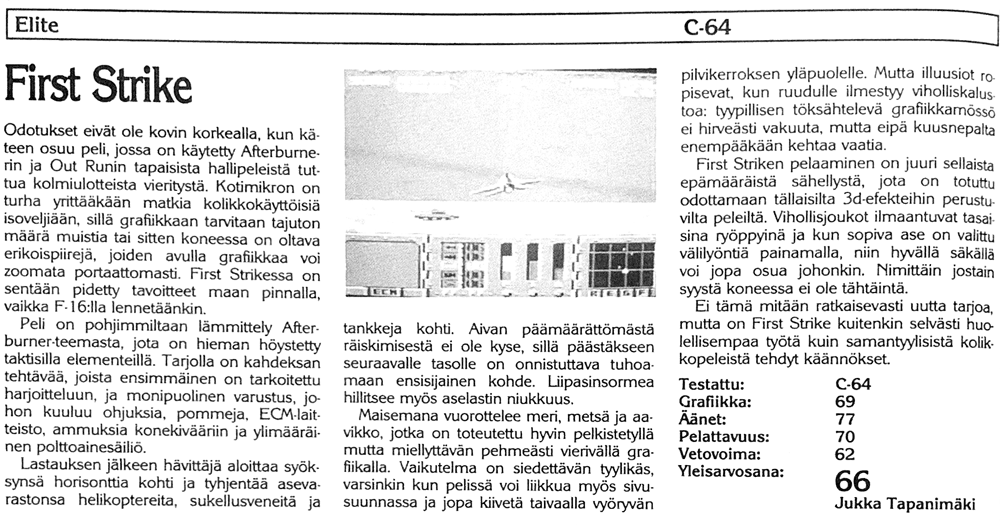
First Strike1990 KevätPysyvä linkkiOdotukset eivät ole kovin korkealla, kun käteen osuu peli, jossa on käytetty Afterburnerin ja Out Runin tapaisista hallipeleistä tuttua kolmiulotteista vieritystä. Kotimikron on turha yrittääkään matkia kolikkokäyttöisiä isoveljiään, sillä grafiikkaan tarvitaan tajuton määrä muistia tai sitten koneessa on oltava erikoispiirejä, joiden avulla grafiikkaa voi zoomata portaattomasti. First Strikessa on sentään pidetty tavoitteet maan pinnalla, vaikka F-16:lla lennetäänkin.
Peli on pohjimmiltaan lämmittely Afterburner-teemasta, jota on hieman höystetty taktisilla elementeillä. Tarjolla on kahdeksan tehtävää, joista ensimmäinen on tarkoitettu harjoitteluun, ja monipuolinen varustus, johon kuuluu ohjuksia, pommeja, ECM-laitteisto, ammuksia konekivääriin ja ylimääräinen polttoainesäiliö.
Lastauksen jälkeen hävittäjä aloittaa syöksynsä horisonttia kohti ja tyhjentää asevarastonsa helikoptereita, sukellusveneitä ja tankkeja kohti. Aivan päämäärättömästä räiskimisestä ei ole kyse, sillä päästäkseen seuraavalle tasolle on onnistuttava tuhoamaan ensisijainen kohde. Liipasinsormea hillitsee myös aselastin niukkuus.
Maisemana vuorottelee meri, metsä ja aavikko, jotka on toteutettu hyvin pelkistetyllä mutta miellyttävän pehmeästi vierivällä grafiikalla. Vaikutelma on siedettävän tyylikäs, varsinkin kun pelissä voi liikkua myös sivusuunnassa ja jopa kiivetä taivaalla vyöryvän pilvikerroksen yläpuolelle. Mutta illuusiot ropisevat, kun ruudulle ilmestyy viholliskalustoa: tyypillisen töksähtelevä grafiikkamössö ei hirveästi vakuuta, mutta eipä kuusnepalta enempääkään kehtaa vaatia.
First Striken pelaaminen on juuri sellaista epämääräistä sähellystä, jota on totuttu odottamaan tällaisilta 3d-efekteihin perustuvilta peleiltä. Vihollisjoukot ilmaantuvat tasaisina ryöppyinä ja kun sopiva ase on valittu välilyöntiä painamalla, niin hyvällä säkällä voi jopa osua johonkin. Nimittäin jostain syystä koneessa ei ole tähtäintä.
Ei tämä mitään ratkaisevasti uutta tarjoa, mutta on First Strike kuitenkin selvästi huolellisempaa työtä kuin samantyylisistä kolikkopeleistä tehdyt käännökset.
First Strike1990 KevätPermalinkExpectations aren't very high when you get your hands on a game that uses the three-dimensional scrolling familiar from arcade games like Afterburner and Out Run. There's no point in a home micro even trying to imitate its coin-operated big brothers, since the graphics need an insane amount of memory, or else the machine has to have special chips that can zoom the graphics seamlessly. First Strike has at least kept its ambitions down to earth, even if you do fly an F-16.
At heart the game is a reheat of the Afterburner theme, spiced up a little with tactical elements. On offer are eight missions, the first of which is meant for practice, and a varied loadout that includes missiles, bombs, ECM equipment, machine-gun ammunition and an extra fuel tank.
After loading up, the fighter starts its dive towards the horizon and empties its arsenal at helicopters, submarines and tanks. It isn't entirely aimless blasting, since to get to the next level you have to succeed in destroying the primary target. The trigger finger is also kept in check by the meagre weapons load.
The scenery alternates between sea, forest and desert, done in very stripped-down but pleasantly smooth-scrolling graphics. The effect is tolerably stylish, especially since in the game you can also move sideways and even climb above the layer of cloud rolling across the sky. But the illusions come tumbling down when enemy hardware appears on screen: the typically jerky graphical mush isn't terribly convincing, but then you can hardly have the nerve to ask more of the C-64.
Playing First Strike is exactly the kind of vague flailing about that you've come to expect from games like this built on 3D effects. The enemy forces appear in steady torrents, and once you've selected a suitable weapon by pressing the space bar, with a bit of luck you might even hit something. Because, for some reason, the plane has no gunsight.
This doesn't offer anything decisively new, but First Strike is nevertheless clearly more careful work than the conversions of coin-ops in the same style.
Flash Gordon
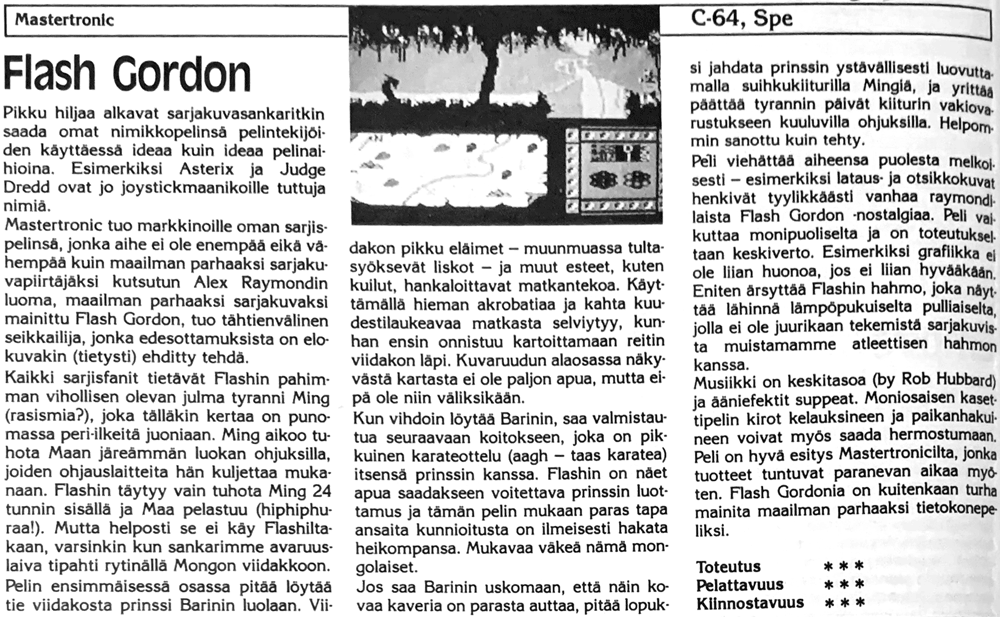
Flash Gordon1987Pysyvä linkkiPikku hiljaa alkavat sarjakuvasankaritkin saada omat nimikkopelinsä pelintekijöiden käyttäessä ideaa kuin ideaa pelinaihioina. Esimerkiksi Asterix ja Judge Dredd ovat jo joystickmaanikoille tuttuja nimiä.
Mastertronic tuo markkinoille oman sarjispelinsä, jonka aihe ei ole enempää eikä vähempää kuin maailman parhaaksi sarjakuvapiirtäjäksi kutsutun Alex Raymondin luoma, maailman parhaaksi sarjakuvaksi mainittu Flash Gordon, tuo tähtienvälinen seikkailija, jonka edesottamuksista on elokuvakin (tietysti) ehditty tehdä.
Kaikki sarjisfanit tietävät Flashin pahimman vihollisen olevan julma tyranni Ming (rasismia?), joka tälläkin kertaa on punomassa peri-ilkeitä juoniaan. Ming aikoo tuhota Maan järeämmän luokan ohjuksilla, joiden ohjauslaitteita hän kuljettaa mukanaan. Flashin täytyy vain tuhota Ming 24 tunnin sisällä ja Maa pelastuu (hiphiphuraa!). Mutta helposti se ei käy Flashiltakaan, varsinkin kun sankarimme avaruuslaiva tipahti rytinällä Mongon viidakkoon.
Pelin ensimmäisessä osassa pitää löytää tie viidakosta prinssi Barinin luolaan. Viidakon pikku eläimet - muunmuassa tultasyöksevät liskot - ja muut esteet, kuten kuilut, hankaloittavat matkantekoa. Käyttämällä hieman akrobatiaa ja kahta kuudestilaukeavaa matkasta selviytyy, kunhan ensin onnistuu kartoittamaan reitin viidakon läpi. Kuvaruudun alaosassa näkyvästä kartasta ei ole paljon apua, mutta eipä ole niin väliksikään.
Kun vihdoin löytää Barinin, saa valmistautua seuraavaan koitokseen, joka on pikkuinen karateottelu (aagh - taas karatea) itsensä prinssin kanssa. Flashin on näet apua saadakseen voitettava prinssin luottamus ja tämän pelin mukaan paras tapa ansaita kunnioitusta on ilmeisesti hakata heikompansa. Mukavaa väkeä nämä mongolaiset.
Jos saa Barinin uskomaan, että näin kovaa kaveria on parasta auttaa, pitää lopuksi jahdata prinssin ystävällisesti luovuttamalla suihkukiiturilla Mingiä, ja yrittää päättää tyrannin päivät kiiturin vakiovarustukseen kuuluvilla ohjuksilla. Helpommin sanottu kuin tehty.
Peli viehättää aiheensa puolesta melkoisesti - esimerkiksi lataus- ja otsikkokuvat henkivät tyylikkäästi vanhaa raymondilaista Flash Gordon -nostalgiaa. Peli vaikuttaa monipuoliselta ja on toteutukseltaan keskiverto. Esimerkiksi grafiikka ei ole liian huonoa, jos ei liian hyvääkään. Eniten ärsyttää Flashin hahmo, joka näyttää lähinnä lämpöpukuiselta pulliaiselta, jolla ei ole juurikaan tekemistä sarjakuvista muistamamme atleettisen hahmon kanssa.
Musiikki on keskitasoa (by Rob Hubbard) ja ääniefektit suppeat. Moniosaisen kasettipelin kirot kelauksineen ja paikanhakuineen voivat myös saada hermostumaan. Peli on hyvä esitys Mastertronicilta, jonka tuotteet tuntuvat paranevan aikaa myöten. Flash Gordonia on kuitenkaan turha mainita maailman parhaaksi tietokonepeliksi.
Flash Gordon1987PermalinkLittle by little even comic-strip heroes are starting to get games named after them, as game makers grab any idea going as raw material for a game. Asterix and Judge Dredd, for example, are already familiar names to joystick maniacs.
Mastertronic is bringing out a comics game of its own, whose subject is no more and no less than Flash Gordon - the strip named the world's best comic, created by Alex Raymond, who is called the world's best comic artist - that interstellar adventurer whose exploits have (naturally) already been made into a film as well.
All comics fans know that Flash's worst enemy is the cruel tyrant Ming (racism?), who this time too is hatching his utterly wicked schemes. Ming plans to destroy the Earth with some seriously heavy-duty missiles, whose guidance units he carries around with him. All Flash has to do is destroy Ming within 24 hours and the Earth is saved (hip hip hooray!). But it doesn't come easy even for Flash, especially since our hero's spaceship has come crashing down into the jungle of Mongo.
In the first part of the game you have to find your way through the jungle to Prince Barin's cave. The jungle's little critters - fire-breathing lizards among them - and other obstacles, such as chasms, make the going hard. With a bit of acrobatics and a pair of six-shooters you'll survive the journey, as long as you first manage to map out a route through the jungle. The map shown at the bottom of the screen isn't much help, but then it doesn't really matter much anyway.
When you finally find Barin, you can get ready for the next ordeal, which is a little karate bout (aagh - karate again) with the prince himself. You see, to get help Flash has to win the prince's trust, and according to this game the best way to earn respect is apparently to beat up someone weaker than yourself. Nice folks, these Mongolians.
If you get Barin to believe that a guy this tough is best helped, you finally have to chase Ming in a jet speeder kindly handed over by the prince, and try to end the tyrant's days with the missiles that come as standard equipment on the speeder. Easier said than done.
The game has quite a bit of charm thanks to its subject - the loading and title screens, for example, stylishly breathe old Raymond-style Flash Gordon nostalgia. The game seems varied and its execution is average. The graphics, for instance, aren't too bad, if not too good either. The most irritating thing is the Flash figure, who mostly looks like a roly-poly little fellow in a snowsuit and has hardly anything to do with the athletic figure we remember from the comics.
The music is middling (by Rob Hubbard) and the sound effects are sparse. The curses of a multi-part cassette game, with all the rewinding and hunting for the right spot on the tape, may also get on your nerves. The game is a good showing from Mastertronic, whose products seem to be getting better as time goes on. Still, there is no point calling Flash Gordon the world's best computer game.
Flight Of The Intruder
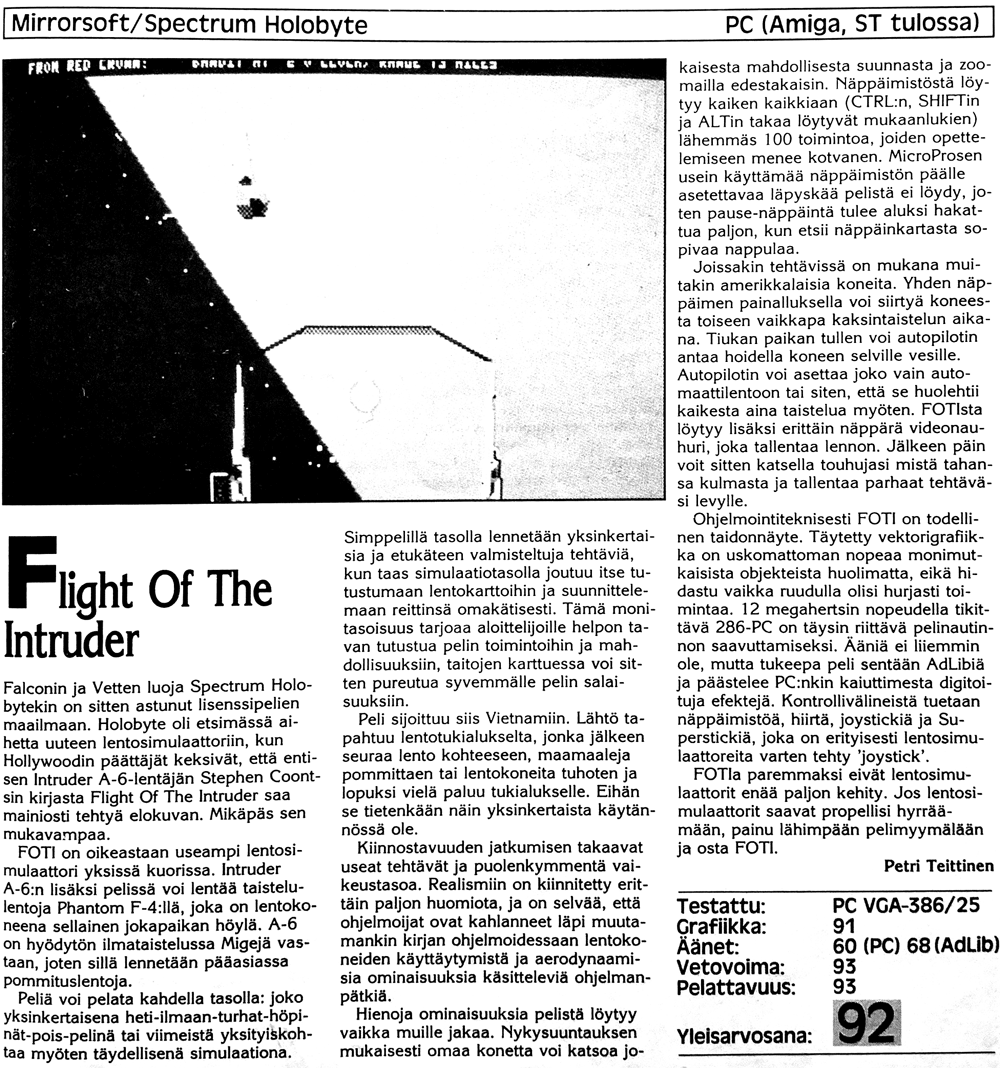
Flight Of The Intruder1991 KevätPysyvä linkkiFalconin ja Vetten luoja Spectrum Holobytekin on sitten astunut lisenssipelien maailmaan. Holobyte oli etsimässä aihetta uuteen lentosimulaattoriin, kun Hollywoodin päättäjät keksivät, että entisen Intruder A-6-lentäjän Stephen Coontsin kirjasta Flight Of The Intruder saa mainiosti tehtyä elokuvan. Mikäpäs sen mukavampaa.
FOTI on oikeastaan useampi lentosimulaattori yksissä kuorissa. Intruder A-6:n lisäksi pelissä voi lentää taistelulentoja Phantom F-4:llä, joka on lentokoneena sellainen jokapaikan höylä. A-6 on hyödytön ilmataistelussa Migejä vastaan, joten sillä lennetään pääasiassa pommituslentoja.
Peliä voi pelata kahdella tasolla: joko yksinkertaisena heti-ilmaan-turhat-höpinät-pois-pelinä tai viimeistä yksityiskohtaa myöten täydellisenä simulaationa. Simppelillä tasolla lennetään yksinkertaisia ja etukäteen valmisteltuja tehtäviä, kun taas simulaatiotasolla joutuu itse tutustumaan lentokarttoihin ja suunnittelemaan reittinsä omakätisesti. Tämä monitasoisuus tarjoaa aloittelijoille helpon tavan tutustua pelin toimintoihin ja mahdollisuuksiin, taitojen karttuessa voi sitten pureutua syvemmälle pelin salaisuuksiin.
Peli sijoittuu siis Vietnamiin. Lähtö tapahtuu lentotukialukselta, jonka jälkeen seuraa lento kohteeseen, maamaaleja pommittaen tai lentokoneita tuhoten ja lopuksi vielä paluu tukialukselle. Eihän se tietenkään näin yksinkertaista käytännössä ole.
Kiinnostavuuden jatkumisen takaavat useat tehtävät ja puolenkymmentä vaikeustasoa. Realismiin on kiinnitetty erittäin paljon huomiota, ja on selvää, että ohjelmoijat ovat kahlanneet läpi muutamankin kirjan ohjelmoidessaan lentokoneiden käyttäytymistä ja aerodynaamisia ominaisuuksia käsitteleviä ohjelmanpätkiä.
Hienoja ominaisuuksia pelistä löytyy vaikka muille jakaa. Nykysuuntauksen mukaisesti omaa konetta voi katsoa jokaisesta mahdollisesta suunnasta ja zoomailla edestakaisin. Näppäimistöstä löytyy kaiken kaikkiaan (CTRL:n, SHIFTin ja ALTin takaa löytyvät mukaanlukien) lähemmäs 100 toimintoa, joiden opettelemiseen menee kotvanen. MicroProsen usein käyttämää näppäimistön päälle asetettavaa läpyskää pelistä ei löydy, joten pause-näppäintä tulee aluksi hakattua paljon, kun etsii näppäinkartasta sopivaa nappulaa.
Joissakin tehtävissä on mukana muitakin amerikkalaisia koneita. Yhden näppäimen painalluksella voi siirtyä koneesta toiseen vaikkapa kaksintaistelun aikana. Tiukan paikan tullen voi autopilotin antaa hoidella koneen selville vesille. Autopilotin voi asettaa joko vain automaattilentoon tai siten, että se huolehtii kaikesta aina taistelua myöten. FOTIsta löytyy lisäksi erittäin näppärä videonauhuri, joka tallentaa lennon. Jälkeen päin voit sitten katsella touhujasi mistä tahansa kulmasta ja tallentaa parhaat tehtäväsi levylle.
Ohjelmointiteknisesti FOTI on todellinen taidonnäyte. Täytetty vektorigrafiikka on uskomattoman nopeaa monimutkaisista objekteista huolimatta, eikä hidastu vaikka ruudulla olisi hurjasti toimintaa. 12 megahertsin nopeudella tikittävä 286-PC on täysin riittävä pelinautinnon saavuttamiseksi. Ääniä ei liiemmin ole, mutta tukeepa peli sentään AdLibiä ja päästelee PC:nkin kaiuttimesta digitoituja efektejä. Kontrollivälineistä tuetaan näppäimistöä, hiirtä, joystickiä ja Superstickiä, joka on erityisesti lentosimulaattoreita varten tehty 'joystick'.
FOTIa paremmaksi eivät lentosimulaattorit enää paljon kehity. Jos lentosimulaattorit saavat propellisi hyrräämään, painu lähimpään pelimyymälään ja osta FOTI.
Flight Of The Intruder1991 KevätPermalinkSo Spectrum Holobyte, the creator of Falcon and Vette, has now stepped into the world of licensed games too. Holobyte was looking for a subject for a new flight simulator when the Hollywood bigwigs worked out that former Intruder A-6 pilot Stephen Coonts's book Flight Of The Intruder would make a splendid film. What could be nicer.
FOTI is really several flight simulators under one set of covers. Besides the Intruder A-6, you can fly combat missions in the Phantom F-4, which as aircraft go is a real jack-of-all-trades. The A-6 is useless in dogfights against MiGs, so it is mainly flown on bombing runs.
The game can be played at two levels: either as a simple straight-into-the-air-and-cut-the-waffle game or as a simulation complete down to the very last detail. At the simple level you fly simple, pre-prepared missions, whereas at the simulation level you have to study the flight maps yourself and plan your route with your own two hands. This multi-level approach gives beginners an easy way to get to know the game's functions and possibilities, and as your skills grow you can then sink your teeth deeper into the game's secrets.
So the game is set in Vietnam. You take off from an aircraft carrier, after which comes the flight to the target, bombing ground targets or destroying aircraft, and finally the return to the carrier. In practice, of course, it's not that simple.
Lasting interest is guaranteed by numerous missions and about five difficulty levels. A great deal of attention has been paid to realism, and it's clear the programmers waded through more than a few books while coding the bits of the program that deal with the aircraft's behaviour and aerodynamic properties.
The game has fine features enough to hand round to others. In line with current trends, you can view your own plane from every possible direction and zoom in and out. All in all the keyboard holds (including the ones hidden behind CTRL, SHIFT and ALT) close to 100 functions, which take a good while to learn. There's none of the keyboard overlay card MicroProse often uses, so at first you end up hammering the pause key a lot while you hunt through the key map for the right button.
Some missions include other American planes as well. At the press of a single key you can switch from one plane to another, even in the middle of a dogfight. When things get tight, you can let the autopilot steer the plane into safe waters. The autopilot can be set either just to fly automatically or to take care of everything, right down to the fighting. FOTI also has a very handy video recorder that records your flight. Afterwards you can watch your antics from any angle and save your best missions to disk.
In programming terms FOTI is a real showpiece of skill. The filled vector graphics are incredibly fast despite the complex objects, and don't slow down even when there's a huge amount of action on screen. A 286 PC ticking along at 12 megahertz is quite enough to get the full enjoyment out of the game. There isn't much in the way of sound, but the game does at least support the AdLib and lets rip with digitised effects even from the PC's speaker. As for controllers, the keyboard, mouse, joystick and Superstick are supported, the last being a 'joystick' made especially for flight simulators.
Flight simulators won't get much better than FOTI. If flight simulators get your propeller whirring, get yourself down to the nearest game shop and buy FOTI.
Flimbo's Quest
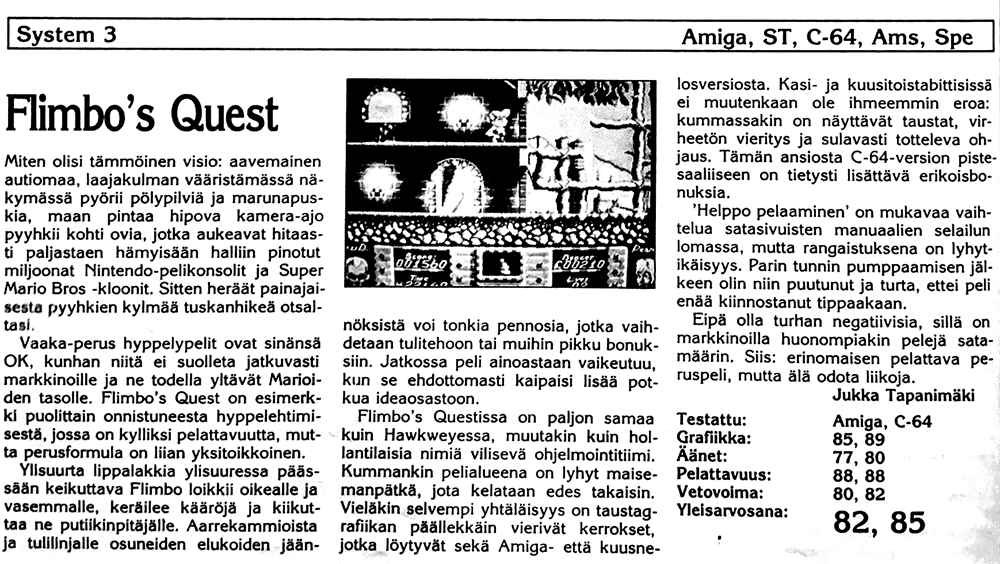
Flimbo's Quest1990 SyksyPysyvä linkkiMiten olisi tämmöinen visio: aavemainen autiomaa, laajakulman vääristämässä näkymässä pyörii pölypilviä ja marunapuskia, maan pintaa hipova kamera-ajo pyyhkii kohti ovia, jotka aukeavat hitaasti paljastaen hämyisään halliin pinotut miljoonat Nintendo-pelikonsolit ja Super Mario Bros -kloonit. Sitten heräät painajaisesta pyyhkien kylmää tuskanhikeä otsaltasi.
Vaaka-perus hyppelypelit ovat sinänsä OK, kunhan niitä ei suolleta jatkuvasti markkinoille ja ne todella yltävät Marioiden tasolle. Flimbo's Quest on esimerkki puolittain onnistuneesta hyppelehtimisestä, jossa on kylliksi pelattavuutta, mutta perusformula on liian yksitoikkoinen.
Ylisuurta lippalakkia ylisuuressa päässään keikuttava Flimbo loikkii oikealle ja vasemmalle, keräilee kääröjä ja kiikuttaa ne putiikinpitäjälle. Aarrekammioista ja tulilinjalle osuneiden elukoiden jäännöksistä voi tonkia pennosia, jotka vaihdetaan tulitehoon tai muihin pikku bonuksiin. Jatkossa peli ainoastaan vaikeutuu, kun se ehdottomasti kaipaisi lisää potkua ideaosastoon.
Flimbo's Questissa on paljon samaa kuin Hawkweyessa, muutakin kuin hollantilaisia nimiä vilisevä ohjelmointitiimi. Kummankin pelialueena on lyhyt maisemanpätkä, jota kelataan edes takaisin. Vieläkin selvempi yhtäläisyys on taustagrafiikan päällekkäin vierivät kerrokset, jotka löytyvät sekä Amiga- että kuusnelosversiosta. Kasi- ja kuusitoistabittisissä ei muutenkaan ole ihmeemmin eroa: kummassakin on näyttävät taustat, virheetön vieritys ja sulavasti totteleva ohjaus. Tämän ansiosta C-64-version pistesaaliiseen on tietysti lisättävä erikoisbonuksia.
'Helppo pelaaminen' on mukavaa vaihtelua satasivuisten manuaalien selailun lomassa, mutta rangaistuksena on lyhytikäisyys. Parin tunnin pumppaamisen jälkeen olin niin puutunut ja turta, ettei peli enää kiinnostanut tippaakaan.
Eipä olla turhan negatiivisia, sillä on markkinoilla huonompiakin pelejä satamäärin. Siis: erinomaisen pelattava peruspeli, mutta älä odota liikoja.
Flimbo's Quest1990 SyksyPermalinkHow about a vision like this: a ghostly desert, dust clouds and sagebrush tumbling across a wide-angle-distorted view, a tracking shot skimming the ground sweeps towards a set of doors that slowly swing open to reveal millions of Nintendo consoles and Super Mario Bros clones stacked in a dim hall. Then you wake from the nightmare, wiping the cold sweat of anguish from your brow.
Basic horizontal platform games are OK in themselves, as long as they aren't churned out onto the market non-stop and they genuinely reach the level of the Marios. Flimbo's Quest is an example of half-successful hopping about, with enough playability but a basic formula that is too monotonous.
Bobbing an oversized cap on his oversized head, Flimbo leaps right and left, collects scrolls and whisks them off to the shopkeeper. From treasure chambers and the remains of critters that strayed into the line of fire you can dig up a few pennies, which are traded for firepower or other little bonuses. From then on the game only gets harder, when what it absolutely needs is more kick in the ideas department.
Flimbo's Quest has a lot in common with Hawkweye, more than just a programming team teeming with Dutch names. In both, the play area is a short stretch of scenery that you scroll back and forth. An even clearer similarity is the layers of background graphics scrolling over one another, found in both the Amiga and the C-64 versions. There isn't much difference between the eight- and sixteen-bit versions anyway: both have showy backgrounds, flawless scrolling and smoothly responsive controls. Thanks to this, the C-64 version's score haul naturally has to get some special bonuses added.
'Easy playing' makes a nice change in between leafing through hundred-page manuals, but the penalty is a short lifespan. After a couple of hours of pumping away I was so numb and dazed that the game no longer interested me one bit.
Let's not be needlessly negative, though, since there are worse games on the market by the hundred. So: an eminently playable basic game, but don't expect too much.
Flood
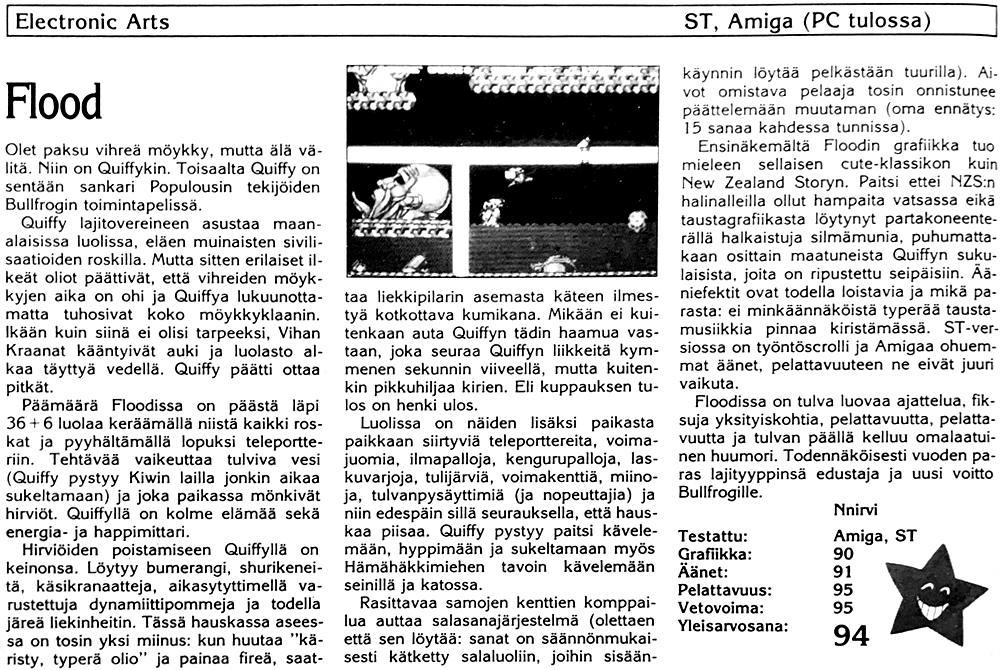
Flood1990 SyksyPysyvä linkkiOlet paksu vihreä möykky, mutta älä välitä. Niin on Quiffykin. Toisaalta Quiffy on sentään sankari Populousin tekijöiden Bullfrogin toimintapelissä.
Quiffy lajitovereineen asustaa maanalaisissa luolissa, eläen muinaisten sivilisaatioiden roskilla. Mutta sitten erilaiset ilkeät oliot päättivät, että vihreiden möykkyjen aika on ohi ja Quiffya lukuunottamatta tuhosivat koko möykkyklaanin. Ikään kuin siinä ei olisi tarpeeksi, Vihan Kraanat kääntyivät auki ja luolasto alkaa täyttyä vedellä. Quiffy päätti ottaa pitkät.
Päämäärä Floodissa on päästä läpi 36+6 luolaa keräämällä niistä kaikki roskat ja pyyhältämällä lopuksi teleportteriin. Tehtävää vaikeuttaa tulviva vesi (Quiffy pystyy Kiwin lailla jonkin aikaa sukeltamaan) ja joka paikassa mönkivät hirviöt. Quiffyllä on kolme elämää sekä energia- ja happimittari.
Hirviöiden poistamiseen Quiffyllä on keinonsa. Löytyy bumerangi, shurikeneita, käsikranaatteja, aikasytyttimellä varustettuja dynamiittipommeja ja todella järeä liekinheitin. Tässä hauskassa aseessa on tosin yksi miinus: kun huutaa "käristy, typerä olio" ja painaa fireä, saattaa liekkipilarin asemasta käteen ilmestyä kotkottava kumikana. Mikään ei kuitenkaan auta Quiffyn tädin haamua vastaan, joka seuraa Quiffyn liikkeitä kymmenen sekunnin viiveellä, mutta kuitenkin pikkuhiljaa kirien. Eli kuppauksen tulos on henki ulos.
Luolissa on näiden lisäksi paikasta paikkaan siirtyviä teleporttereita, voimajuomia, ilmapalloja, kengurupalloja, laskuvarjoja, tulijärviä, voimakenttiä, miinoja, tulvanpysäyttimiä (ja nopeuttajia) ja niin edespäin sillä seurauksella, että hauskaa piisaa. Quiffy pystyy paitsi kävelemään, hyppimään ja sukeltamaan myös Hämähäkkimiehen tavoin kävelemään seinillä ja katossa.
Rasittavaa samojen kenttien komppailua auttaa salasanajärjestelmä (olettaen että sen löytää: sanat on säännönmukaisesti kätketty salaluoliin, joihin sisäänkäynnin löytää pelkästään tuurilla). Aivot omistava pelaaja tosin onnistunee päättelemään muutaman (oma ennätys: 15 sanaa kahdessa tunnissa).
Ensinäkemältä Floodin grafiikka tuo mieleen sellaisen cute-klassikon kuin New Zealand Storyn. Paitsi ettei NZS:n halinalleilla ollut hampaita vatsassa eikä taustagrafiikasta löytynyt partakoneenterällä halkaistuja silmämunia, puhumattakaan osittain maatuneista Quiffyn sukulaisista, joita on ripustettu seipäisiin. Ääniefektit ovat todella loistavia ja mikä parasta: ei minkäännäköistä typerää taustamusiikkia pinnaa kiristämässä. ST-versiossa on työntöscrolli ja Amigaa ohuemmat äänet, pelattavuuteen ne eivät juuri vaikuta.
Floodissa on tulva luovaa ajattelua, fiksuja yksityiskohtia, pelattavuutta, pelattavuutta ja tulvan päällä kelluu omalaatuinen huumori. Todennäköisesti vuoden paras lajityyppinsä edustaja ja uusi voitto Bullfrogille.
Flood1990 SyksyPermalinkYou are a fat green blob, but never mind. So is Quiffy. Then again, Quiffy does at least get to be the hero of an action game by Bullfrog, the makers of Populous.
Quiffy and fellow blobs live in underground caves, getting by on the rubbish of ancient civilisations. But then assorted nasty creatures decided that the age of green blobs was over and wiped out the entire blob clan, except for Quiffy. As if that weren't enough, the Taps of Wrath were turned on and now the caves are filling up with water. Quiffy decided to make a run for it.
The aim in Flood is to get through 36+6 caves by collecting all the rubbish in them and finally dashing into the teleporter. The task is made harder by the rising flood water (like Kiwi, Quiffy can dive for a while) and the monsters crawling about all over the place. Quiffy has three lives plus an energy meter and an oxygen meter.
Quiffy has ways of getting rid of the monsters. There's a boomerang, shuriken, hand grenades, dynamite bombs fitted with time fuses and a really heavy-duty flamethrower. This fun weapon does have one downside, though: when you yell "fry, you stupid creature" and press fire, instead of a pillar of flame you may find a clucking rubber chicken in your hand. Nothing helps, however, against the ghost of Quiffy's aunt, which follows Quiffy's movements ten seconds behind but slowly gains ground all the same. In other words, dawdle and you're done for.
On top of all this the caves have teleporters that zap you from place to place, power potions, balloons, space hoppers, parachutes, lakes of fire, force fields, mines, flood stoppers (and flood speeders) and so on, with the result that there's fun aplenty. As well as walking, jumping and diving, Quiffy can also walk on walls and ceilings like Spider-Man.
The wearisome trudge through the same levels again and again is eased by a password system (assuming you find it: the words are invariably hidden in secret caves whose entrances you only find by sheer luck). A player who owns a brain should manage to work out a few, mind you (my own record: 15 words in two hours).
At first glance Flood's graphics call to mind a cute classic such as New Zealand Story. Except that NZS's cuddly teddies didn't have teeth in their bellies, and the background graphics didn't feature eyeballs split with a razor blade, not to mention partly decomposed relatives of Quiffy hung up on stakes. The sound effects are truly brilliant and, best of all, there's no stupid background music of any kind to fray your nerves. The ST version has push-scrolling and thinner sound than the Amiga, but they hardly affect the playability.
Flood has a flood of creative thinking, clever details, playability, playability, and floating on top of the flood is a quirky sense of humour. Probably the year's best example of its genre, and another win for Bullfrog.
Flying Shark
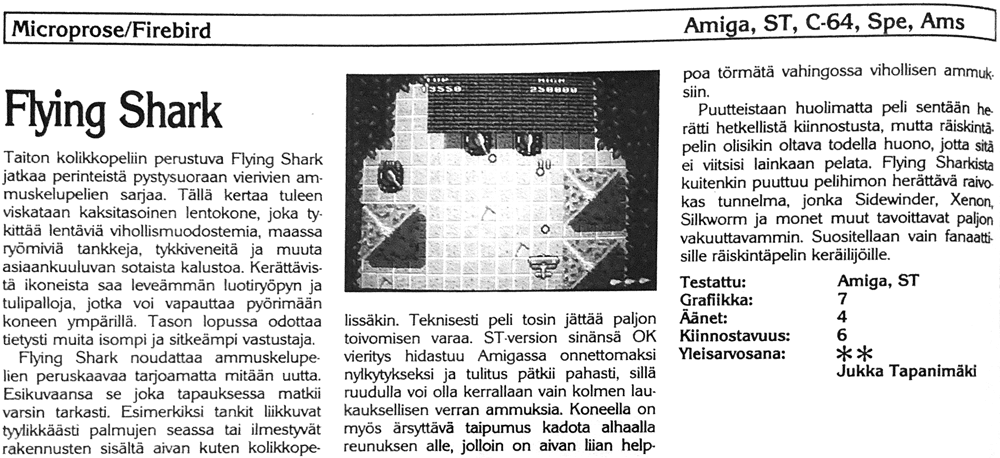
Flying Shark1989 SyksyPysyvä linkkiTaiton kolikkopeliin perustuva Flying Shark jatkaa perinteistä pystysuoraan vierivien ammuskelupelien sarjaa. Tällä kertaa tuleen viskataan kaksitasoinen lentokone, joka tykittää lentäviä vihollismuodostemia, maassa ryömiviä tankkeja, tykkiveneitä ja muuta asiaankuuluvan sotaista kalustoa. Kerättävistä ikoneista saa leveämmän luotiryöpyn ja tulipalloja, jotka voi vapauttaa pyörimään koneen ympärillä. Tason lopussa odottaa tietysti muita isompi ja sitkeämpi vastustaja.
Flying Shark noudattaa ammuskelupelien peruskaavaa tarjoamatta mitään uutta. Esikuvaansa se joka tapauksessa matkii varsin tarkasti. Esimerkiksi tankit liikkuvat tyylikkäästi palmujen seassa tai ilmestyvät rakennusten sisältä aivan kuten kolikkopelissäkin. Teknisesti peli tosin jättää paljon toivomisen varaa. ST-version sinänsä OK vieritys hidastuu Amigassa onnettomaksi nylkytykseksi ja tulitus pätkii pahasti, sillä ruudulla voi olla kerrallaan vain kolmen laukauksellisen verran ammuksia. Koneella on myös ärsyttävä taipumus kadota alhaalla reunuksen alle, jolloin on aivan liian helppoa törmätä vahingossa vihollisen ammuksiin.
Puutteistaan huolimatta peli sentään herätti hetkellistä kiinnostusta, mutta räiskintäpelin olisikin oltava todella huono, jotta sitä ei viitsisi lainkaan pelata. Flying Sharkista kuitenkin puuttuu pelihimon herättävä raivokas tunnelma, jonka Sidewinder, Xenon, Silkworm ja monet muut tavoittavat paljon vakuuttavammin. Suositellaan vain fanaattisille räiskintäpelin keräilijöille.
Flying Shark1989 SyksyPermalinkBased on Taito's coin-op, Flying Shark carries on the traditional line of vertically scrolling shoot-em-ups. This time it's a biplane that gets thrown into the fire, blasting away at flying enemy formations, tanks crawling along the ground, gunboats and other suitably warlike hardware. Collectable icons give you a wider spray of bullets, plus fireballs that can be released to circle around the plane. At the end of the level there is, of course, an opponent waiting that is bigger and tougher than the rest.
Flying Shark sticks to the basic shoot-em-up formula without offering anything new. It does, at any rate, copy its model quite faithfully. The tanks, for example, move stylishly among the palm trees or emerge from inside buildings just as in the coin-op. Technically, though, the game leaves a lot to be desired. The ST version's scrolling, OK enough in itself, slows down on the Amiga into a miserable judder, and the firing stutters badly, since only three shots' worth of bullets can be on screen at a time. The plane also has an irritating tendency to vanish under the border at the bottom, which makes it all too easy to fly into enemy bullets by accident.
Despite its shortcomings the game did at least stir up a moment's interest, but then a blaster would have to be truly dreadful for you not to bother playing it at all. What Flying Shark lacks, however, is the furious atmosphere that gets the gaming lust going, something Sidewinder, Xenon, Silkworm and many others capture far more convincingly. Recommended only for fanatical collectors of shoot-em-ups.
Formula 1 3-D
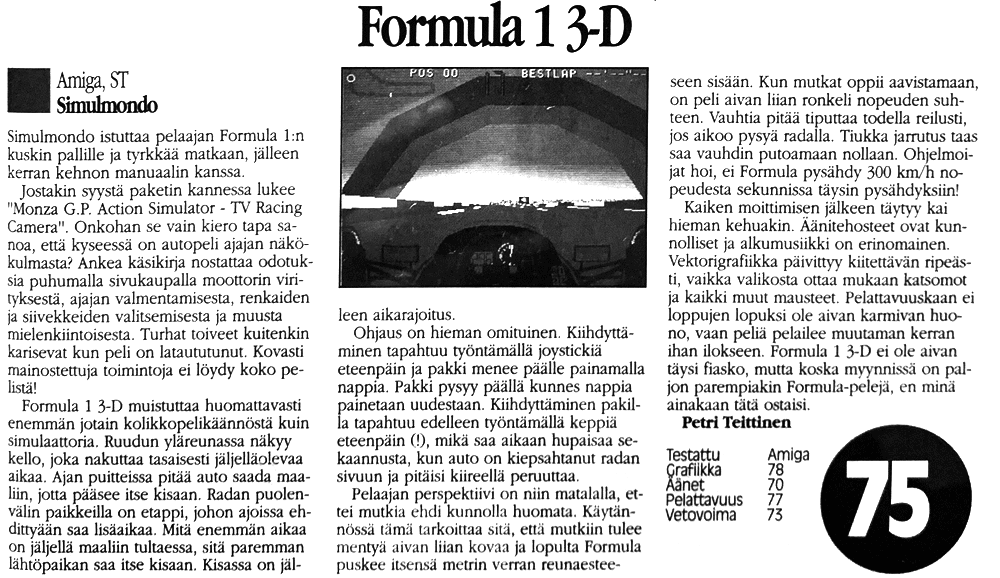
Formula 1 3-D1991 SyksyPysyvä linkkiSimulmondo istuttaa pelaajan Formula 1:n kuskin pallille ja tyrkkää matkaan, jälleen kerran kehnon manuaalin kanssa.
Jostakin syystä paketin kannessa lukee "Monza G.P. Action Simulator - TV Racing Camera". Onkohan se vain kiero tapa sanoa, että kyseessä on autopeli ajajan näkökulmasta? Ankea käsikirja nostattaa odotuksia puhumalla sivukaupalla moottorin virityksestä, ajajan valmentamisesta, renkaiden ja siivekkeiden valitsemisesta ja muusta mielenkiintoisesta. Turhat toiveet kuitenkin karisevat kun peli on lataututunut. Kovasti mainostettuja toimintoja ei löydy koko pelistä!
Formula 1 3-D muistuttaa huomattavasti enemmän jotain kolikkopelikäännöstä kuin simulaattoria. Ruudun yläreunassa näkyy kello, joka nakuttaa tasaisesti jäljelläolevaa aikaa. Ajan puitteissa pitää auto saada maaliin, jotta pääsee itse kisaan. Radan puolenvälin paikkeilla on etappi, johon ajoissa ehdittyään saa lisäaikaa. Mitä enemmän aikaa on jäljellä maaliin tultaessa, sitä paremman lähtöpaikan saa itse kisaan. Kisassa on jälleen aikarajoitus.
Ohjaus on hieman omituinen. Kiihdyttäminen tapahtuu työntämällä joystickiä eteenpäin ja pakki menee päälle painamalla nappia. Pakki pysyy päällä kunnes nappia painetaan uudestaan. Kiihdyttäminen pakilla tapahtuu edelleen työntämällä keppiä eteenpäin (!), mikä saa aikaan hupaisaa sekaannusta, kun auto on kiepsahtanut radan sivuun ja pitäisi kiireellä peruuttaa.
Pelaajan perspektiivi on niin matalalla, ettei mutkia ehdi kunnolla huomata. Käytännössä tämä tarkoittaa sitä, että mutkiin tulee mentyä aivan liian kovaa ja lopulta Formula puskee itsensä metrin verran reunaesteeseen sisään. Kun mutkat oppii aavistamaan, on peli aivan liian ronkeli nopeuden suhteen. Vauhtia pitää tiputtaa todella reilusti, jos aikoo pysyä radalla. Tiukka jarrutus taas saa vauhdin putoamaan nollaan. Ohjelmoijat hoi, ei Formula pysähdy 300 km/h nopeudesta sekunnissa täysin pysähdyksiin!
Kaiken moittimisen jälkeen täytyy kai hieman kehuakin. Äänitehosteet ovat kunnolliset ja alkumusiikki on erinomainen. Vektorigrafiikka päivittyy kiitettävän ripeästi, vaikka valikosta ottaa mukaan katsomot ja kaikki muut mausteet. Pelattavuuskaan ei loppujen lopuksi ole aivan karmivan huono, vaan peliä pelailee muutaman kerran ihan ilokseen. Formula 1 3-D ei ole aivan täysi fiasko, mutta koska myynnissä on paljon parempiakin Formula-pelejä, en minä ainakaan tätä ostaisi.
Formula 1 3-D1991 SyksyPermalinkSimulmondo plonks the player down in a Formula 1 driver's seat and shoves them off down the track, once again with a lousy manual.
For some reason the box cover reads "Monza G.P. Action Simulator - TV Racing Camera". Could that just be a roundabout way of saying it's a racing game seen from the driver's point of view? The dismal manual raises expectations by going on for pages about engine tuning, driver training, choosing tyres and wings and other interesting stuff. Those vain hopes wither away, however, once the game has loaded. Not one of the heavily advertised features is anywhere to be found in the game!
Formula 1 3-D resembles some coin-op conversion far more than a simulator. At the top of the screen there's a clock steadily ticking away the time remaining. You have to get the car to the finish line within the time limit to make it into the race proper. Around the halfway point of the track there's a checkpoint, and reaching it in time earns you extra time. The more time you have left when you cross the finish line, the better your starting position in the race itself. The race, once again, has a time limit.
The controls are a bit odd. You accelerate by pushing the joystick forward, and reverse is engaged by pressing the button. Reverse stays engaged until the button is pressed again. Accelerating in reverse is still done by pushing the stick forward (!), which causes hilarious confusion when the car has spun off the side of the track and you need to back up in a hurry.
The player's viewpoint is so low that you can't really see the bends coming in time. In practice this means you end up taking the bends far too fast, and eventually the Formula buries itself a metre deep in the barrier. Once you learn to anticipate the bends, the game turns out to be far too finicky about speed. You have to drop your speed really drastically if you intend to stay on the track. Hard braking, on the other hand, takes your speed right down to zero. Hey, programmers: a Formula car does not come to a dead stop from 300 km/h in one second!
After all this griping I suppose I should hand out a little praise too. The sound effects are decent and the title music is excellent. The vector graphics update commendably fast, even if you switch on the grandstands and all the other trimmings from the menu. In the end the playability isn't completely atrocious either; you can play the game a few times and quite enjoy it. Formula 1 3-D isn't a total fiasco, but since there are much better Formula games on sale, I for one wouldn't buy this one.
Fort Apocalypse
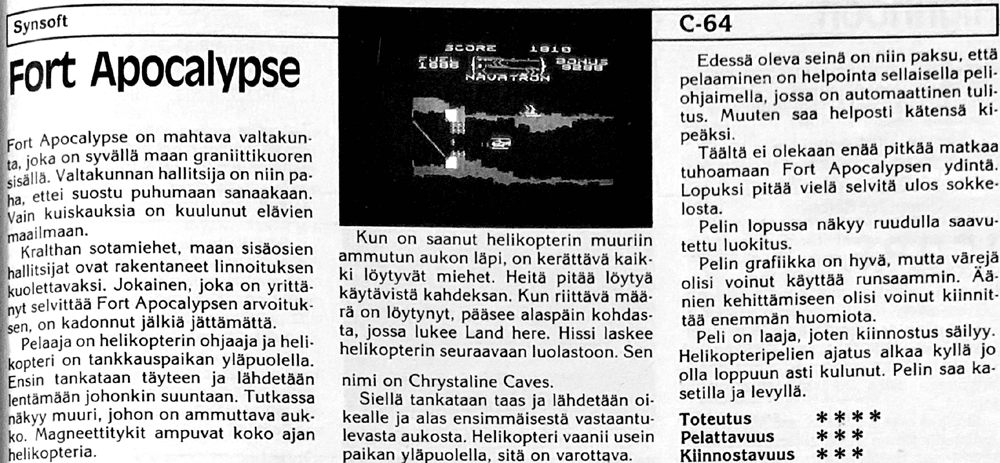
Fort Apocalypse1987Pysyvä linkkiFort Apocalypse on mahtava valtakunta, joka on syvällä maan graniittikuoren sisällä. Valtakunnan hallitsija on niin paha, ettei suostu puhumaan sanaakaan. Vain kuiskauksia on kuulunut elävien maailmaan.
Kralthan sotamiehet, maan sisäosien hallitsijat ovat rakentaneet linnoituksen kuolettavaksi. Jokainen, joka on yrittänyt selvittää Fort Apocalypsen arvoituksen, on kadonnut jälkiä jättämättä.
Pelaaja on helikopterin ohjaaja ja helikopteri on tankkauspaikan yläpuolella. Ensin tankataan täyteen ja lähdetään lentämään johonkin suuntaan. Tutkassa näkyy muuri, johon on ammuttava aukko. Magneettitykit ampuvat koko ajan helikopteria.
Kun on saanut helikopterin muuriin ammutun aukon läpi, on kerättävä kaikki löytyvät miehet. Heitä pitää löytyä käytävistä kahdeksan. Kun riittävä määrä on löytynyt, pääsee alaspäin kohdasta, jossa lukee Land here. Hissi laskee helikopterin seuraavaan luolastoon. Sen nimi on Chrystaline Caves.
Siellä tankataan taas ja lähdetään oikealle ja alas ensimmäisestä vastaantulevasta aukosta. Helikopteri vaanii usein paikan yläpuolella, sitä on varottava.
Edessä oleva seinä on niin paksu, että pelaaminen on helpointa sellaisella peliohjaimella, jossa on automaattinen tulitus. Muuten saa helposti kätensä kipeäksi.
Täältä ei olekaan enää pitkää matkaa tuhoamaan Fort Apocalypsen ydintä. Lopuksi pitää vielä selvitä ulos sokkelosta.
Pelin lopussa näkyy ruudulla saavutettu luokitus.
Pelin grafiikka on hyvä, mutta värejä olisi voinut käyttää runsaammin. Äänien kehittämiseen olisi voinut kiinnittää enemmän huomiota.
Peli on laaja, joten kiinnostus säilyy. Helikopteripelien ajatus alkaa kyllä jo olla loppuun asti kulunut. Pelin saa kasetilla ja levyllä.
Fort Apocalypse1987PermalinkFort Apocalypse is a mighty realm lying deep inside the Earth's granite crust. The realm's ruler is so evil that not a single word will be spoken. Only whispers have reached the world of the living.
The Kralthan soldiers, rulers of the Earth's interior, have built the fortress to be deadly. Everyone who has tried to solve the riddle of Fort Apocalypse has vanished without a trace.
The player is a helicopter pilot, and the helicopter is hovering above the refuelling pad. First you fill up the tank and set off flying in some direction. The radar shows a wall that you have to blast an opening in. Magnetic cannons fire at the helicopter the whole time.
Once you've got the helicopter through the hole shot in the wall, you have to pick up all the men you can find. There should be eight of them to find in the tunnels. When you've found enough of them, you can go down at the spot that says Land here. A lift lowers the helicopter into the next cave system. It is called Chrystaline Caves.
There you refuel again and head right, and then down through the first opening you come across. A helicopter often lurks above the spot, so watch out for it.
The wall ahead is so thick that playing is easiest with a joystick that has autofire. Otherwise you can easily end up with a sore hand.
From here it's no longer a long way to destroying the core of Fort Apocalypse. Finally you still have to make it out of the maze.
At the end of the game the screen shows the rating you've achieved.
The game's graphics are good, but the colours could have been used more generously. More attention could have been paid to developing the sounds.
The game is big, so your interest holds. The whole idea of helicopter games is certainly starting to be worn completely threadbare by now. The game is available on cassette and disk.
Fox Fights Back
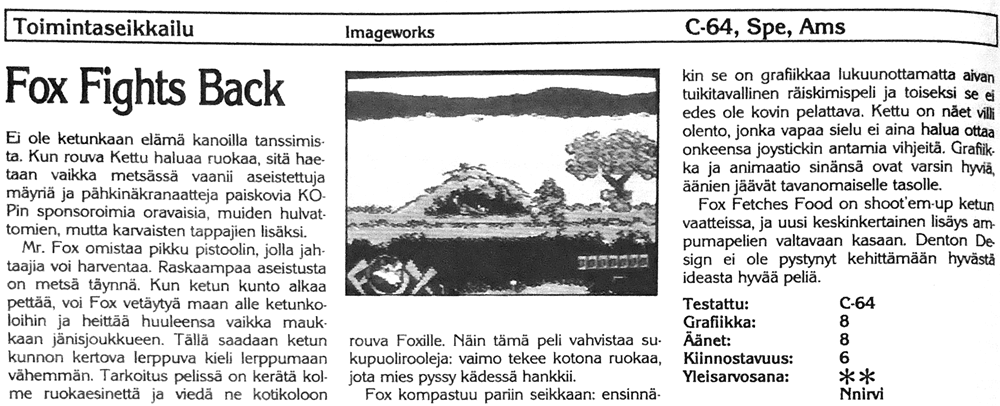
Fox Fights Back1989 KevätPysyvä linkkiEi ole ketunkaan elämä kanoilla tanssimista. Kun rouva Kettu haluaa ruokaa, sitä haetaan vaikka metsässä vaanii aseistettuja mäyriä ja pähkinäkranaatteja paiskovia KOPin sponsoroimia oravaisia, muiden hulvattomien, mutta karvaisten tappajien lisäksi.
Mr. Fox omistaa pikku pistoolin, jolla jahtaajia voi harventaa. Raskaampaa aseistusta on metsä täynnä. Kun ketun kunto alkaa pettää, voi Fox vetäytyä maan alle ketunkoloihin ja heittää huuleensa vaikka maukkaan jänisjoukkueen. Tällä saadaan ketun kunnon kertova lerppuva kieli lerppumaan vähemmän. Tarkoitus pelissä on kerätä kolme ruokaesinettä ja viedä ne kotikoloon rouva Foxille. Näin tämä peli vahvistaa sukupuolirooleja: vaimo tekee kotona ruokaa, jota mies pyssy kädessä hankkii.
Fox kompastuu pariin seikkaan: ensinnäkin se on grafiikkaa lukuunottamatta aivan tuikitavallinen räiskimispeli ja toiseksi se ei edes ole kovin pelattava. Kettu on näet villi olento, jonka vapaa sielu ei aina halua ottaa onkeensa joystickin antamia vihjeitä. Grafiikka ja animaatio sinänsä ovat varsin hyviä, äänien jäävät tavanomaiselle tasolle.
Fox Fetches Food on shoot'em-up ketun vaatteissa, ja uusi keskinkertainen lisäys ampumapelien valtavaan kasaan. Denton Design ei ole pystynyt kehittämään hyvästä ideasta hyvää peliä.
Fox Fights Back1989 KevätPermalinkLife isn't all a bed of chickens, even for a fox. When Mrs. Fox wants food, food gets fetched, even if armed badgers lurk in the forest along with KOP-sponsored squirrelkins lobbing nut grenades, on top of other hilarious but furry killers.
Mr. Fox owns a little pistol with which to thin out the pursuers. The forest is full of heavier weaponry. When the fox's stamina starts to give out, Fox can retreat underground into the foxholes and wolf down, say, a tasty team of hares. This makes the floppy tongue that shows the fox's condition flop about a little less. The object of the game is to collect three food items and take them back to the home den for Mrs. Fox. In this way the game reinforces gender roles: the wife cooks at home the food that the husband procures, gun in hand.
Fox trips over a couple of things: first, apart from the graphics it's a thoroughly run-of-the-mill shoot-'em-up, and second, it isn't even very playable. The fox, you see, is a wild creature whose free spirit doesn't always care to take the joystick's hints on board. The graphics and animation as such are pretty good; the sound stays at the usual level.
Fox Fetches Food is a shoot'em-up in fox's clothing, and yet another mediocre addition to the huge pile of shooting games. Denton Design has not managed to develop a good game out of a good idea.
Frak'64
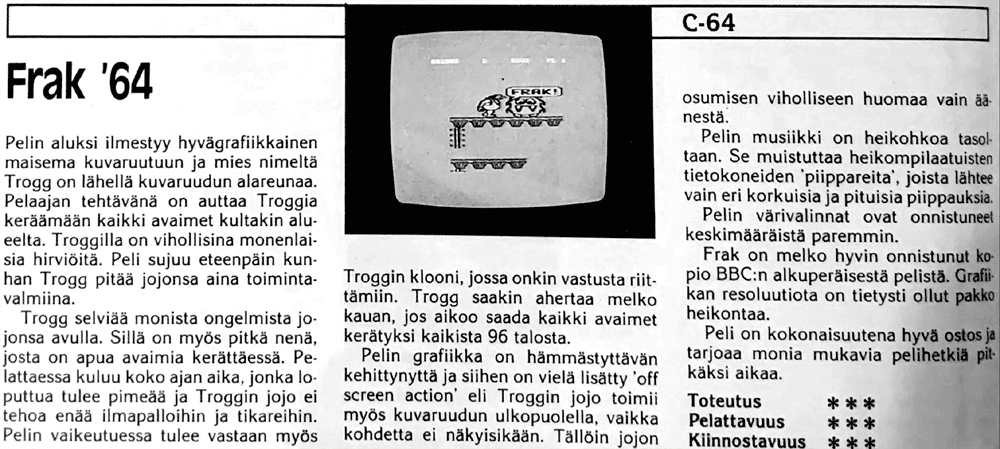
Frak'641987Pysyvä linkkiPelin aluksi ilmestyy hyvägrafiikkainen maisema kuvaruutuun ja mies nimeltä Trogg on lähellä kuvaruudun alareunaa. Pelaajan tehtävänä on auttaa Troggia keräämään kaikki avaimet kultakin alueelta. Troggilla on vihollisina monenlaisia hirviöitä. Peli sujuu eteenpäin kunhan Trogg pitää jojonsa aina toimintavalmiina.
Trogg selviää monista ongelmista jojonsa avulla. Sillä on myös pitkä nenä, josta on apua avaimia kerättäessä. Pelattaessa kuluu koko ajan aika, jonka loputtua tulee pimeää ja Troggin jojo ei tehoa enää ilmapalloihin ja tikareihin. Pelin vaikeutuessa tulee vastaan myös Troggin klooni, jossa onkin vastusta riittämiin. Trogg saakin ahertaa melko kauan, jos aikoo saada kaikki avaimet kerätyksi kaikista 96 talosta.
Pelin grafiikka on hämmästyttävän kehittynyttä ja siihen on vielä lisätty 'off screen action' eli Troggin jojo toimii myös kuvaruudun ulkopuolella, vaikka kohdetta ei näkyisikään. Tällöin jojon osumisen viholliseen huomaa vain äänestä.
Pelin musiikki on heikohkoa tasoltaan. Se muistuttaa heikompilaatuisten tietokoneiden 'piippareita', joista lähtee vain eri korkuisia ja pituisia piippauksia.
Pelin värivalinnat ovat onnistuneet keskimääräistä paremmin.
Frak on melko hyvin onnistunut kopio BBC:n alkuperäisestä pelistä. Grafiikan resoluutiota on tietysti ollut pakko heikontaa.
Peli on kokonaisuutena hyvä ostos ja tarjoaa monia mukavia pelihetkiä pitkäksi aikaa.
Frak'641987PermalinkAt the start of the game a good-looking landscape appears on the screen, and a man called Trogg is near the bottom edge of the screen. The player's task is to help Trogg collect all the keys from each area. Trogg's enemies are all sorts of monsters. The game moves along nicely as long as Trogg always keeps his yo-yo at the ready.
Trogg gets out of many a problem with the help of his yo-yo. He also has a long nose, which comes in handy when collecting keys. While you play, the time keeps running down, and once it's up, darkness falls and Trogg's yo-yo no longer works against the balloons and daggers. As the game gets harder you also come up against a clone of Trogg, who puts up more than enough of a fight. Trogg will have to slog away for quite a while if he means to get all the keys collected from all 96 houses.
The game's graphics are astonishingly advanced, and on top of that 'off screen action' has been added, meaning Trogg's yo-yo also works outside the screen even when the target can't be seen. In that case you can only tell that the yo-yo has hit an enemy from the sound.
The game's music is on the weakish side. It resembles the 'beepers' of lower-quality computers, which put out nothing but beeps of different pitches and lengths.
The game's colour choices have come off better than average.
Frak is a fairly successful copy of the original BBC game. The resolution of the graphics has of course had to be reduced.
All in all the game is a good buy and offers plenty of pleasant gaming moments for a long time to come.
Freddy Hardest
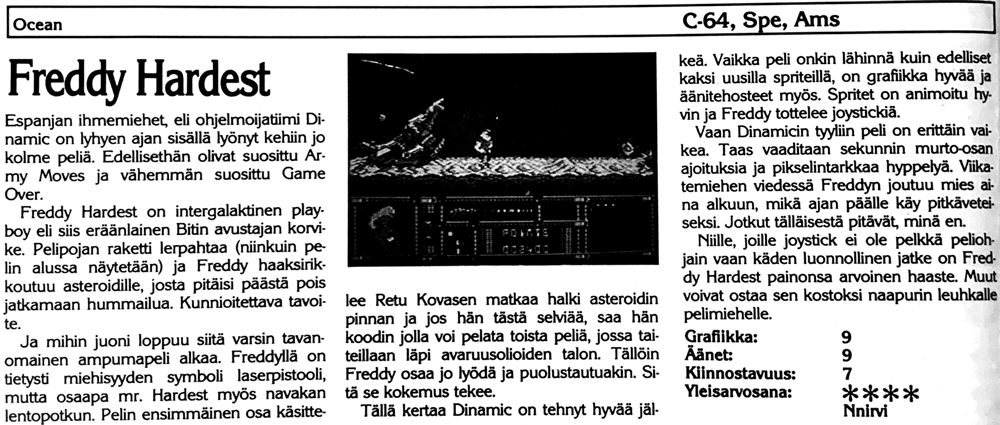
Freddy Hardest1988Pysyvä linkkiEspanjan ihmemiehet, eli ohjelmoijatiimi Dinamic on lyhyen ajan sisällä lyönyt kehiin jo kolme peliä. Edellisethän olivat suosittu Army Moves ja vähemmän suosittu Game Over.
Freddy Hardest on intergalaktinen playboy eli siis eräänlainen Bitin avustajan korvike. Pelipojan raketti lerpahtaa (niinkuin pelin alussa näytetään) ja Freddy haaksirikkoutuu asteroidille, josta pitäisi päästä pois jatkamaan hummailua. Kunnioitettava tavoite.
Ja mihin juoni loppuu siitä varsin tavanomainen ampumapeli alkaa. Freddyllä on tietysti miehisyyden symboli laserpistooli, mutta osaapa mr. Hardest myös navakan lentopotkun. Pelin ensimmäinen osa käsittelee Retu Kovasen matkaa halki asteroidin pinnan ja jos hän tästä selviää, saa hän koodin jolla voi pelata toista peliä, jossa taiteillaan läpi avaruusolioiden talon. Tällöin Freddy osaa jo lyödä ja puolustautuakin. Sitä se kokemus tekee.
Tällä kertaa Dinamic on tehnyt hyvää jälkeä. Vaikka peli onkin lähinnä kuin edelliset kaksi uusilla spriteillä, on grafiikka hyvää ja äänitehosteet myös. Spritet on animoitu hyvin ja Freddy tottelee joystickiä.
Vaan Dinamicin tyyliin peli on erittäin vaikea. Taas vaaditaan sekunnin murto-osan ajoituksia ja pikselintarkkaa hyppelyä. Viikatemiehen viedessä Freddyn joutuu mies aina alkuun, mikä ajan päälle käy pitkäveteiseksi. Jotkut tälläisestä pitävät, minä en.
Niille, joille joystick ei ole pelkkä peliohjain vaan käden luonnollinen jatke on Freddy Hardest painonsa arvoinen haaste. Muut voivat ostaa sen kostoksi naapurin leuhkalle pelimiehelle.
Freddy Hardest1988PermalinkThe wonder boys of Spain, i.e. the programming team Dinamic, have already thrown three games into the ring in a short space of time. The previous ones, as you know, were the popular Army Moves and the less popular Game Over.
Freddy Hardest is an intergalactic playboy, which is to say a sort of substitute for Bitti's Assistant. The playboy's rocket goes limp (as shown at the start of the game) and Freddy is shipwrecked on an asteroid, which he needs to get off so he can carry on living it up. A worthy goal.
And where the plot ends, a pretty ordinary shoot-'em-up begins. Freddy of course has that symbol of manhood, the laser pistol, but Mr. Hardest can also deliver a mean flying kick. The first part of the game deals with Retu Kovanen's journey across the surface of the asteroid, and if he survives that, he gets a code with which you can play the second game, where you pick your way through the aliens' house. By then Freddy can already punch and even defend himself. That's what experience does for you.
This time Dinamic have done a good job. Although the game is mostly like the previous two with new sprites, the graphics are good and so are the sound effects. The sprites are well animated and Freddy does what the joystick tells him.
But in true Dinamic style the game is extremely difficult. Once again it demands split-second timing and pixel-perfect jumping. When the Grim Reaper takes Freddy, the man always has to go back to the start, which gets tedious after a while. Some people like that sort of thing; I don't.
For those to whom the joystick is not just a game controller but a natural extension of the hand, Freddy Hardest is a challenge worth its weight in gold. Everyone else can buy it to get revenge on the show-off gamer next door.
Frightmare
Frightmare1988Pysyvä linkki'Levolle lasken, Luojani, armias ole suojani. Jos sijaltain en nousisi, taivaaseen ota luoksesi ja mieluiten osastoon, josta pääsee nauramaan kavereita Alakerrassa.'
Jokainenhan on joskus jäänyt unen vangiksi pystymättä heräämään. On unia, joihin jääminen on varsin mielenkiintoista, mutta painajaisunet eivät välttämättä kuulu niihin. Siksi Frightmaressa onkin tarkoitus herätä selviämällä hengissä keskiyöstä kello 8.15 asti. Kello siirtyy kuusi minuuttia eteenpäin aina kun nukkuja siirtyy uuteen uneen (eli kenttään, näin arkikielellä). Lisääntyvä pistetili muuttaa unen tyyppiä pahasta unesta karmivaan painajaiseen.
Unet vilisevät tätä tavallista paranormaalia hirviökaartia, nimittäin ihmissusia, zombieita, vampyyreitä sun muita vahvistettuina antiikin hirviöillä. Suureksi pettymyksekseni Freddy Krugerista ei näkynyt edes hattua. Unet vilisevät myös traditionaalista antihirviöaseistusta eli hopealuoteja, pyssyjä, ristejä, pyhää vettä ja vastaavia ja lisäksi joitain erikoisesineitä, jotka helpottavat elossapysymistä.
Frightmare on aivan normaali pompi, kerää ja ammu -peli, jonka plussapuolina ovat tunnelmaa luova soundtrack ja korkealuokkainen grafiikka. Peli-iloa puolestaan tehokkaasti vähentävät joka ruudussa viheltävät ziljoona spriteä.
Tässä painajaismaisessa pelityypissä on Frightmare sellainen paremmanpuoleinen painajainen.
Frightmare1988Permalink'Now I lay me down to sleep, I pray the Lord my soul to keep. If I should die before I wake, take me up to heaven with you, and preferably to the ward where I get to laugh at my mates Downstairs.'
We've all been held prisoner by a dream at some point, unable to wake up. There are dreams that are quite interesting to get stuck in, but nightmares aren't necessarily among them. That's why the idea in Frightmare is to wake up by surviving from midnight until 8:15. The clock moves six minutes forward every time the sleeper moves on to a new dream (i.e. a level, in everyday language). A growing score changes the type of dream from bad dream to hair-raising nightmare.
The dreams are crawling with the usual paranormal monster brigade, namely werewolves, zombies, vampires and so on, reinforced with monsters from antiquity. To my great disappointment, there wasn't so much as Freddy Krueger's hat to be seen. The dreams are also crawling with the traditional anti-monster armoury, i.e. silver bullets, guns, crosses, holy water and the like, plus some special items that make staying alive easier.
Frightmare is a perfectly ordinary jump, collect and shoot game whose plus points are an atmospheric soundtrack and high-class graphics. The fun, on the other hand, is effectively spoiled by the zillion sprites whizzing across every screen.
In this nightmarish type of game, Frightmare is one of the better sort of nightmares.
Full Metal Planet
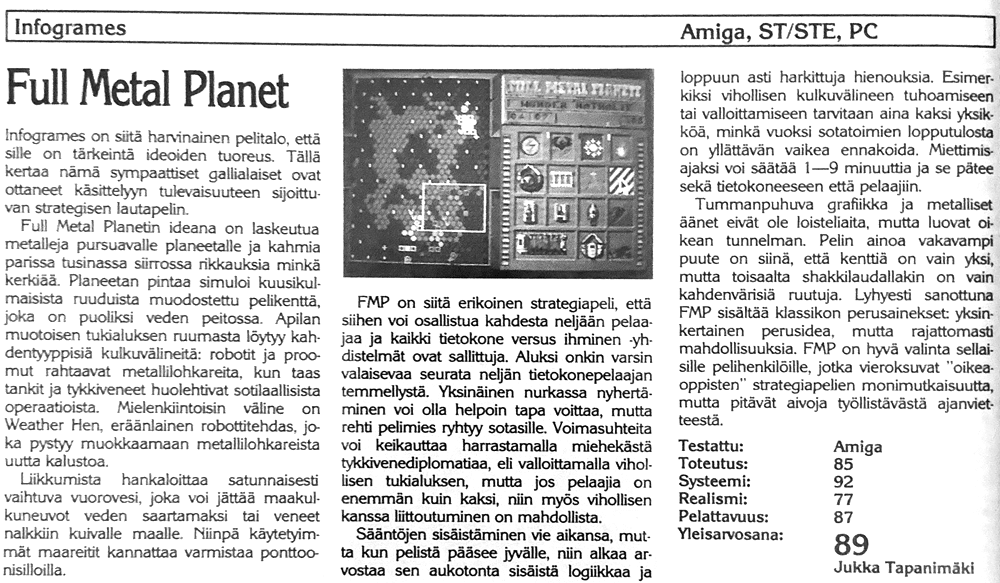
Full Metal Planet1990 KevätPysyvä linkkiInfogrames on siitä harvinainen pelitalo, että sille on tärkeintä ideoiden tuoreus. Tällä kertaa nämä sympaattiset gallialaiset ovat ottaneet käsittelyyn tulevaisuuteen sijoittuvan strategisen lautapelin.
Full Metal Planetin ideana on laskeutua metalleja pursuavalle planeetalle ja kahmia parissa tusinassa siirrossa rikkauksia minkä kerkiää. Planeetan pintaa simuloi kuusikulmaisista ruuduista muodostettu pelikenttä, joka on puoliksi veden peitossa. Apilan muotoisen tukialuksen ruumasta löytyy kahdentyyppisiä kulkuvälineitä: robotit ja proomut rahtaavat metallilohkareita, kun taas tankit ja tykkiveneet huolehtivat sotilaallisista operaatioista. Mielenkiintoisin väline on Weather Hen, eräänlainen robottitehdas, joka pystyy muokkaamaan metallilohkareista uutta kalustoa.
Liikkumista hankaloittaa satunnaisesti vaihtuva vuorovesi, joka voi jättää maakulkuneuvot veden saartamaksi tai veneet nalkkiin kuivalle maalle. Niinpä käytetyimmät maareitit kannattaa varmistaa ponttoonisilloilla.
FMP on siitä erikoinen strategiapeli, että siihen voi osallistua kahdesta neljään pelaajaa ja kaikki tietokone versus ihminen -yhdistelmät ovat sallittuja. Aluksi onkin varsin valaisevaa seurata neljän tietokonepelaajan temmellystä. Yksinäinen nurkassa nyhertäminen voi olla helpoin tapa voittaa, mutta rehti pelimies ryhtyy sotasille. Voimasuhteita voi keikauttaa harrastamalla miehekästä tykkivenediplomatiaa, eli valloittamalla vihollisen tukialuksen, mutta jos pelaajia on enemmän kuin kaksi, niin myös vihollisen kanssa liittoutuminen on mahdollista.
Sääntöjen sisäistäminen vie aikansa, mutta kun pelistä pääsee jyvälle, niin alkaa arvostaa sen aukotonta sisäistä logiikkaa ja loppuun asti harkittuja hienouksia. Esimerkiksi vihollisen kulkuvälineen tuhoamiseen tai valloittamiseen tarvitaan aina kaksi yksikköä, minkä vuoksi sotatoimien lopputulosta on yllättävän vaikea ennakoida. Miettimisajaksi voi säätää 1-9 minuuttia ja se pätee sekä tietokoneeseen että pelaajiin.
Tummanpuhuva grafiikka ja metalliset äänet eivät ole loisteliaita, mutta luovat oikean tunnelman. Pelin ainoa vakavampi puute on siinä, että kenttiä on vain yksi, mutta toisaalta shakkilaudallakin on vain kahdenvärisiä ruutuja. Lyhyesti sanottuna FMP sisältää klassikon perusainekset: yksinkertainen perusidea, mutta rajattomasti mahdollisuuksia. FMP on hyvä valinta sellaisille pelihenkilöille, jotka vieroksuvat "oikeaoppisten" strategiapelien monimutkaisuutta, mutta pitävät aivoja työllistävästä ajanvietteestä.
Full Metal Planet1990 KevätPermalinkInfogrames is a rare kind of games house in that what matters most to it is freshness of ideas. This time these likeable Gauls have taken on a strategic board game set in the future.
The idea of Full Metal Planet is to land on a planet bursting with metals and grab as much wealth as you can in a couple of dozen moves. The planet's surface is simulated by a playing field made up of hexagonal tiles, half of it covered in water. In the hold of the clover-shaped mothership you'll find two types of vehicle: robots and barges haul chunks of metal, while tanks and gunboats take care of military operations. The most interesting vehicle is the Weather Hen, a kind of robot factory that can turn chunks of metal into new hardware.
Movement is made trickier by the randomly changing tide, which can leave land vehicles surrounded by water or boats stranded high and dry. So it's worth securing the most used land routes with pontoon bridges.
FMP is an unusual strategy game in that two to four players can take part, and all computer-versus-human combinations are allowed. At first it's actually quite illuminating to watch four computer players romping about. Puttering away alone in a corner may be the easiest way to win, but an upstanding gamer goes off to play at war. You can tip the balance of power by indulging in manly gunboat diplomacy, i.e. by capturing the enemy's mothership, but if there are more than two players, allying with the enemy is also possible.
Getting the rules to sink in takes its time, but once you get the hang of the game you start to appreciate its watertight internal logic and its subtleties, thought through to the last detail. For example, destroying or capturing an enemy vehicle always takes two units, which makes the outcome of military action surprisingly hard to predict. The thinking time can be set to 1-9 minutes, and it applies to both the computer and the players.
The sombre graphics and metallic sounds aren't brilliant, but they create the right atmosphere. The game's only more serious shortcoming is that there's only one map, but then again, a chessboard only has squares in two colours too. In short, FMP contains the basic ingredients of a classic: a simple basic idea, but unlimited possibilities. FMP is a good choice for those gaming persons who shy away from the complexity of "proper" strategy games but enjoy a pastime that gives the brain some work.
Fusion
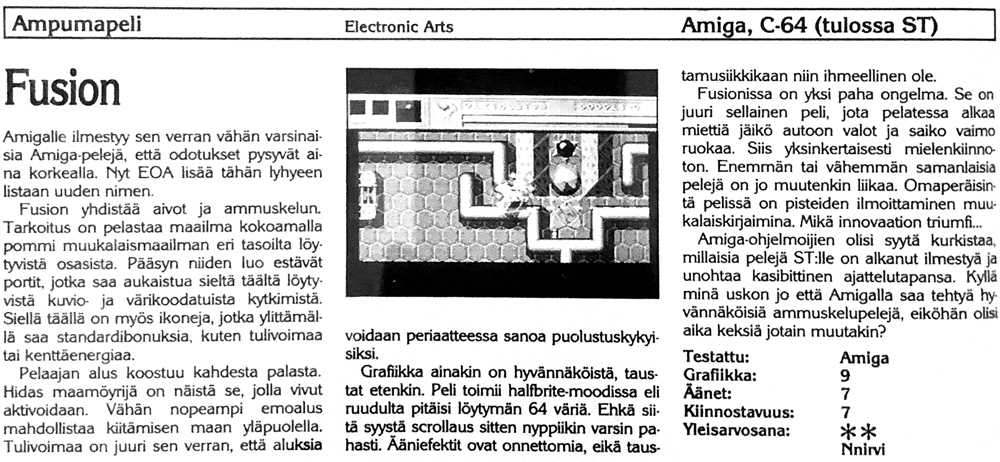
Fusion1989 KevätPysyvä linkkiAmigalle ilmestyy sen verran vähän varsinaisia Amiga-pelejä, että odotukset pysyvät aina korkealla. Nyt EOA lisää tähän lyhyeen listaan uuden nimen.
Fusion yhdistää aivot ja ammuskelun. Tarkoitus on pelastaa maailma kokoamalla pommi muukalaismaailman eri tasoilta löytyvistä osasista. Pääsyn niiden luo estävät portit, jotka saa aukaistua sieltä täältä löytyvistä kuvio- ja värikoodatuista kytkimistä. Siellä täällä on myös ikoneja, jotka ylittämällä saa standardibonuksia, kuten tulivoimaa tai kenttäenergiaa.
Pelaajan alus koostuu kahdesta palasta. Hidas maamöyrijä on näistä se, jolla vivut aktivoidaan. Vähän nopeampi emoalus mahdollistaa kiitämisen maan yläpuolella. Tulivoimaa on juuri sen verran, että aluksia voidaan periaatteessa sanoa puolustuskykyisiksi.
Grafiikka ainakin on hyvännäköistä, taustat etenkin. Peli toimii halfbrite-moodissa eli ruudulta pitäisi löytymän 64 väriä. Ehkä siitä syystä scrollaus sitten nyppiikin varsin pahasti. Ääniefektit ovat onnettomia, eikä taustamusiikkikaan niin ihmeellinen ole.
Fusionissa on yksi paha ongelma. Se on juuri sellainen peli, jota pelatessa alkaa miettiä jäikö autoon valot ja saiko vaimo ruokaa. Siis yksinkertaisesti mielenkiinnoton. Enemmän tai vähemmän samanlaisia pelejä on jo muutenkin liikaa. Omaperäisintä pelissä on pisteiden ilmoittaminen muukalaiskirjaimina. Mikä innovaation triumfi...
Amiga-ohjelmoijien olisi syytä kurkistaa, millaisia pelejä ST:lle on alkanut ilmestyä ja unohtaa kasibittinen ajattelutapansa. Kyllä minä uskon jo että Amigalla saa tehtyä hyvännäköisiä ammuskelupelejä, eiköhän olisi aika keksiä jotain muutakin?
Fusion1989 KevätPermalinkSo few proper Amiga games come out for the Amiga that expectations always stay high. Now EOA adds a new name to this short list.
Fusion combines brains and blasting. The aim is to save the world by assembling a bomb from parts found on the various levels of an alien world. Access to them is blocked by gates, which can be opened with pattern- and colour-coded switches found here and there. Here and there are also icons which, when passed over, give standard bonuses such as firepower or field energy.
The player's craft consists of two pieces. The slow ground-grubber is the one used to activate the levers. The somewhat faster mothership lets you zoom along above the ground. There's just enough firepower that the craft can, in principle, be called capable of defending themselves.
The graphics at least look good, especially the backgrounds. The game runs in halfbrite mode, which means there should be 64 colours on screen. Maybe that's why the scrolling then judders rather badly. The sound effects are miserable, and the background music isn't all that marvellous either.
Fusion has one serious problem. It's exactly the kind of game that has you wondering, while you play, whether you left the car lights on and whether the wife got anything to eat. In other words, simply uninteresting. There are too many more-or-less identical games already as it is. The most original thing in the game is showing the score in alien letters. What a triumph of innovation...
Amiga programmers would do well to take a peek at the kind of games that have started appearing for the ST, and forget their 8-bit mindset. All right, I believe it already: you can make good-looking shoot-'em-ups on the Amiga. Isn't it about time to come up with something else as well?
Future Basketball
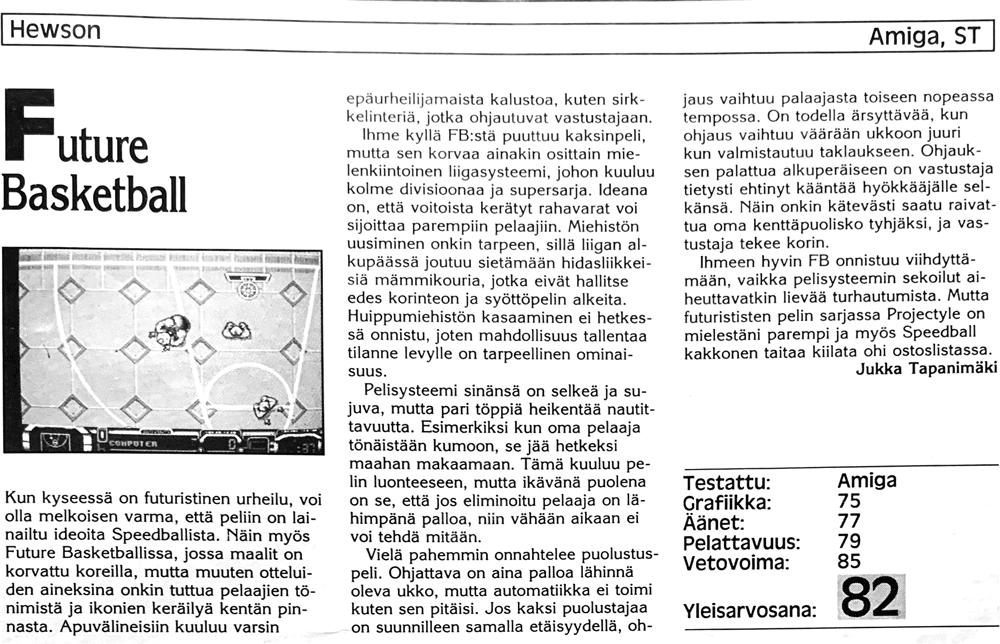
Future Basketball1991 KevätPysyvä linkkiKun kyseessä on futuristinen urheilu, voi olla melkoisen varma, että peliin on lainailtu ideoita Speedballista. Näin myös Future Basketballissa, jossa maalit on korvattu koreilla, mutta muuten otteluiden aineksina onkin tuttua pelaajien tönimistä ja ikonien keräilyä kentän pinnasta. Apuvälineisiin kuuluu varsin epäurheilijamaista kalustoa, kuten sirkkelinteriä, jotka ohjautuvat vastustajaan.
Ihme kyllä FB:stä puuttuu kaksinpeli, mutta sen korvaa ainakin osittain mielenkiintoinen liigasysteemi, johon kuuluu kolme divisioonaa ja supersarja. Ideana on, että voitoista kerätyt rahavarat voi sijoittaa parempiin pelaajiin. Miehistön uusiminen onkin tarpeen, sillä liigan alkupäässä joutuu sietämään hidasliikkeisiä mämmikouria, jotka eivät hallitse edes korinteon ja syöttöpelin alkeita. Huippumiehistön kasaaminen ei hetkessä onnistu, joten mahdollisuus tallentaa tilanne levylle on tarpeellinen ominaisuus.
Pelisysteemi sinänsä on selkeä ja sujuva, mutta pari töppiä heikentää nautittavuutta. Esimerkiksi kun oma pelaaja tönäistään kumoon, se jää hetkeksi maahan makaamaan. Tämä kuuluu pelin luonteeseen, mutta ikävänä puolena on se, että jos eliminoitu pelaaja on lähimpänä palloa, niin vähään aikaan ei voi tehdä mitään.
Vielä pahemmin onnahtelee puolustuspeli. Ohjattava on aina palloa lähinnä oleva ukko, mutta automatiikka ei toimi kuten sen pitäisi. Jos kaksi puolustajaa on suunnilleen samalla etäisyydellä, ohjaus vaihtuu palaajasta toiseen nopeassa tempossa. On todella ärsyttävää, kun ohjaus vaihtuu väärään ukkoon juuri kun valmistautuu taklaukseen. Ohjauksen palattua alkuperäiseen on vastustaja tietysti ehtinyt kääntää hyökkääjälle selkänsä. Näin onkin kätevästi saatu raivattua oma kenttäpuolisko tyhjäksi, ja vastustaja tekee korin.
Ihmeen hyvin FB onnistuu viihdyttämään, vaikka pelisysteemin sekoilut aiheuttavatkin lievää turhautumista. Mutta futurististen pelin sarjassa Projectyle on mielestäni parempi ja myös Speedball kakkonen taitaa kiilata ohi ostoslistassa.
Future Basketball1991 KevätPermalinkWhen it comes to futuristic sport, you can be pretty sure the game has borrowed a few ideas from Speedball. So too with Future Basketball, where the goals have been replaced with baskets, but otherwise the ingredients of the matches are the familiar shoving of players and collecting of icons off the court surface. The aids include some decidedly unsporting kit, such as circular saw blades that home in on the opponent.
Oddly enough FB lacks a two-player mode, but that is at least partly made up for by an interesting league system with three divisions and a super league. The idea is that the money you rake in from wins can be invested in better players. Renewing the squad is certainly necessary, since at the start of the league you have to put up with slow-moving butterfingers who haven't mastered even the basics of shooting baskets and passing. Assembling a top squad doesn't happen in a flash, so the option to save your position to disk is a much-needed feature.
The game system as such is clear and smooth, but a couple of blunders spoil the enjoyment. For example, when one of your players is shoved over, he stays lying on the ground for a while. That is part of the nature of the game, but the downside is that if the eliminated player is the one nearest the ball, you can't do a thing for a while.
The defensive play limps along even worse. The man you control is always the one nearest the ball, but the automatic switching doesn't work the way it should. If two defenders are at roughly the same distance, control flips from one player to the other at a rapid tempo. It's really infuriating when control switches to the wrong man just as you're lining up a tackle. By the time control returns to the original one, the opponent has of course had time to turn his back on the attacker. And so you've handily managed to clear your own half of the court, and the opponent scores a basket.
FB manages to entertain surprisingly well, even though the game system's muddles do cause mild frustration. But in the futuristic games class Projectyle is better in my opinion, and Speedball 2 probably squeezes ahead of it on the shopping list too.
Future Wars
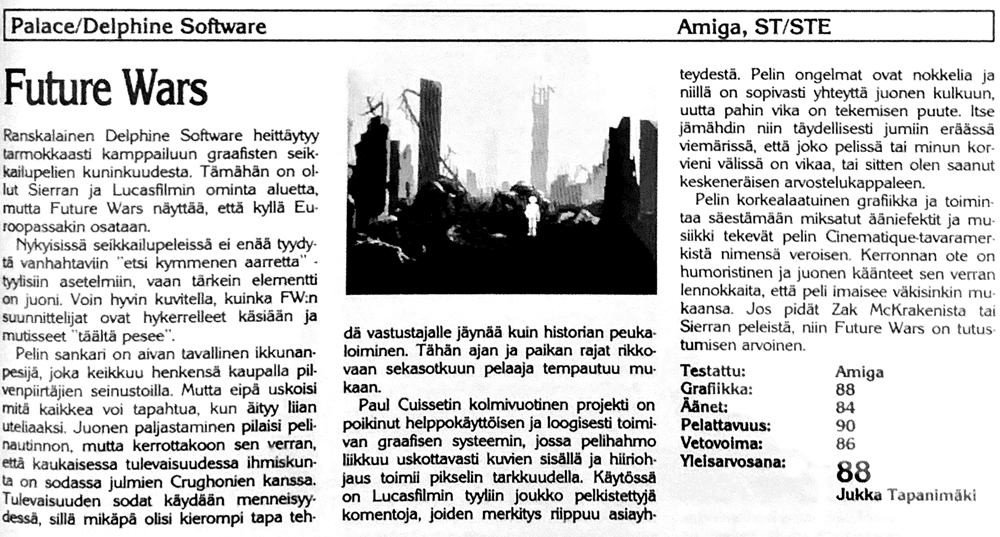
Future Wars1990 KevätPysyvä linkkiRanskalainen Delphine Software heittäytyy tarmokkaasti kamppailuun graafisten seikkailupelien kuninkuudesta. Tämähän on ollut Sierran ja Lucasfilmin ominta aluetta, mutta Future Wars näyttää, että kyllä Euroopassakin osataan.
Nykyisissä seikkailupeleissä ei enää tyydytä vanhahtaviin "etsi kymmenen aarretta" -tyylisiin asetelmiin, vaan tärkein elementti on juoni. Voin hyvin kuvitella, kuinka FW:n suunnittelijat ovat hykerrelleet käsiään ja mutisseet "täältä pesee".
Pelin sankari on aivan tavallinen ikkunanpesijä, joka keikkuu henkensä kaupalla pilvenpiirtäjien seinustoilla. Mutta eipä uskoisi mitä kaikkea voi tapahtua, kun äityy liian uteliaaksi. Juonen paljastaminen pilaisi pelinautinnon, mutta kerrottakoon sen verran, että kaukaisessa tulevaisuudessa ihmiskunta on sodassa julmien Crughonien kanssa. Tulevaisuuden sodat käydään menneisyydessä, sillä mikäpä olisi kierompi tapa tehdä vastustajalle jäynää kuin historian peukaloiminen. Tähän ajan ja paikan rajat rikkovaan sekasotkuun pelaaja tempautuu mukaan.
Paul Cuissetin kolmivuotinen projekti on poikinut helppokäyttöisen ja loogisesti toimivan graafisen systeemin, jossa pelihahmo liikkuu uskottavasti kuvien sisällä ja hiiriohjaus toimii pikselin tarkkuudella. Käytössä on Lucasfilmin tyyliin joukko pelkistettyjä komentoja, joiden merkitys riippuu asiayhteydestä. Pelin ongelmat ovat nokkelia ja niillä on sopivasti yhteyttä juonen kulkuun, uutta pahin vika on tekemisen puute. Itse jämähdin niin täydellisesti jumiin eräässä viemärissä, että joko pelissä tai minun korvieni välissä on vikaa, tai sitten olen saanut keskeneräisen arvostelukappaleen.
Pelin korkealaatuinen grafiikka ja toimintaa säestämään miksatut ääniefektit ja musiikki tekevät pelin Cinematique-tavaramerkistä nimensä veroisen. Kerronnan ote on humoristinen ja juonen käänteet sen verran lennokkaita, että peli imaisee väkisinkin mukaansa. Jos pidät Zak McKrakenista tai Sierran peleistä, niin Future Wars on tutustumisen arvoinen.
Future Wars1990 KevätPermalinkFrance's Delphine Software throws itself energetically into the battle for the crown of graphic adventure games. This, of course, has been Sierra's and Lucasfilm's very own turf, but Future Wars shows that they know how to do it in Europe too.
Today's adventure games no longer settle for old-fashioned "find ten treasures"-style set-ups; instead, the most important element is the plot. I can well imagine FW's designers rubbing their hands with glee and muttering "we'll wipe the floor with 'em".
The game's hero is a perfectly ordinary window washer who dangles at the risk of life and limb on the sides of skyscrapers. But you wouldn't believe everything that can happen when you get too curious. Revealing the plot would spoil the enjoyment of the game, but let it be said that in the distant future mankind is at war with the cruel Crughons. The wars of the future are fought in the past, for what could be a more crooked way of pulling a prank on your opponent than tampering with history. It is into this mess, which breaks the boundaries of time and space, that the player gets swept.
Paul Cuisset's three-year project has spawned an easy-to-use and logically working graphical system, in which the character moves convincingly within the pictures and the mouse control works with pixel precision. Lucasfilm-style, there's a set of pared-down commands whose meaning depends on the context. The game's problems are clever and suitably connected to the course of the plot, but the worst flaw is the lack of things to do. I myself got so utterly stuck in a certain sewer that either there's something wrong with the game or between my ears, or else I've been sent an unfinished review copy.
The game's high-quality graphics, and the sound effects and music mixed to accompany the action, make the game's Cinematique trademark live up to its name. The storytelling has a humorous touch and the plot twists are so high-flying that the game sucks you in whether you like it or not. If you like Zak McKraken or Sierra's games, Future Wars is worth getting to know.