Street Fighter
Pelit was a Finnish-language (bi)annual book series published from 1987 to 1991 containing gaming-related articles, tips and most importantly game reviews. Here you can find all the reviews from the books. The reviews were originally written in Finnish; the English versions are translations of the Finnish originals. Maininta tekijänoikeuksista
 1987
1987 1988
1988 1989 Kevät
 1989 Syksy
 1990 Kevät
 1990 Syksy
 1991 Kevät
 1991 Syksy
Street Fighter
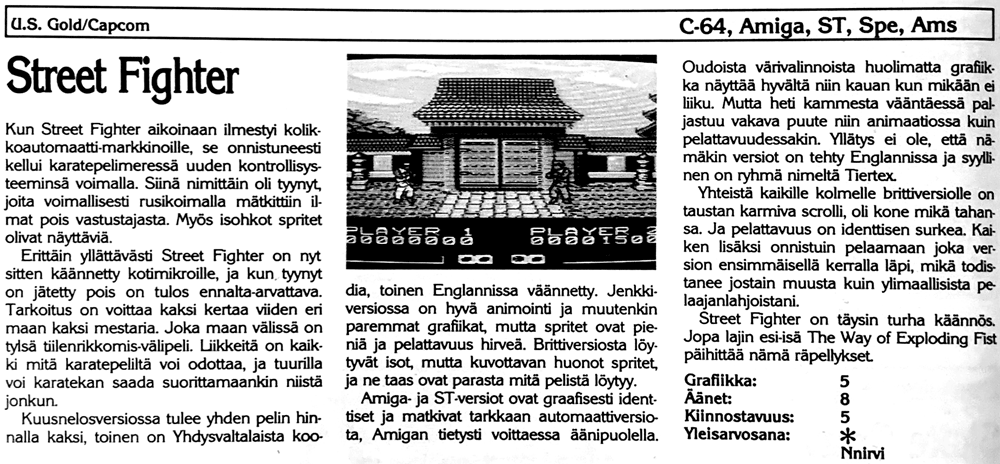
Street Fighter1988Pysyvä linkkiKun Street Fighter aikoinaan ilmestyi kolikkoautomaatti-markkinoille, se onnistuneesti kellui karatepelimeressä uuden kontrollisysteeminsä voimalla. Siinä nimittäin oli tyynyt, joita voimallisesti rusikoimalla mätkittiin ilmat pois vastustajasta. Myös isohkot spritet olivat näyttäviä.
Erittäin yllättävästi Street Fighter on nyt sitten käännetty kotimikroille, ja kun tyynyt on jätetty pois on tulos ennalta-arvattava. Tarkoitus on voittaa kaksi kertaa viiden eri maan kaksi mestaria. Joka maan välissä on tylsä tiilenrikkomis-välipeli. Liikkeitä on kaikki mitä karatepeliltä voi odottaa, ja tuurilla voi karatekan saada suorittamaankin niistä jonkun.
Kuusnelosversiossa tulee yhden pelin hinnalla kaksi, toinen on Yhdysvaltalaista koodia, toinen Englannissa väännetty. Jenkkiversiossa on hyvä animointi ja muutenkin paremmat grafiikat, mutta spritet ovat pieniä ja pelattavuus hirveä. Brittiversiosta löytyvät isot, mutta kuvottavan huonot spritet, ja ne taas ovat parasta mitä pelistä löytyy.
Amiga- ja ST-versiot ovat graafisesti identtiset ja matkivat tarkkaan automaattiversiota, Amigan tietysti voittaessa äänipuolella. Oudoista värivalinnoista huolimatta grafiikka näyttää hyvältä niin kauan kun mikään ei liiku. Mutta heti kammesta vääntäessä paljastuu vakava puute niin animaatiossa kuin pelattavuudessakin. Yllätys ei ole, että nämäkin versiot on tehty Englannissa ja syyllinen on ryhmä nimeltä Tiertex.
Yhteistä kaikille kolmelle brittiversiolle on taustan karmiva scrolli, oli kone mikä tahansa. Ja pelattavuus on identtisen surkea. Kaiken lisäksi onnistuin pelaamaan joka version ensimmäisellä kerralla läpi, mikä todistanee jostain muusta kuin ylimaallisista pelaajanlahjoistani.
Street Fighter on täysin turha käännös. Jopa lajin esi-isä The Way of Exploding Fist päihittää nämä räpellykset.
Street Fighter1988PermalinkWhen Street Fighter first appeared on the coin-op market, it stayed successfully afloat in the sea of karate games on the strength of its new control system. It had pads, you see, which you pummelled with all your might to knock the wind out of your opponent. The biggish sprites were impressive too.
Most surprisingly, Street Fighter has now been converted to home computers, and with the pads left out the result is predictable. The aim is to beat the two champions of five different countries, twice over. Between each country there's a dull brick-breaking interlude. The moves are everything you could expect from a karate game, and with luck you might even get your karateka to actually perform one of them.
The C-64 version gives you two for the price of one: one is American code, the other was knocked together in England. The Yank version has good animation and better graphics all round, but the sprites are small and the playability is terrible. The British version has big but sickeningly bad sprites, and those, in turn, are the best thing the game has to offer.
The Amiga and ST versions are graphically identical and faithfully mimic the arcade version, with the Amiga naturally winning on the sound front. Despite some odd choices of colour, the graphics look good as long as nothing moves. But the moment you start wrenching the stick, a serious deficiency is exposed in both animation and playability. It comes as no surprise that these versions were made in England too, and the culprit is a team called Tiertex.
Common to all three British versions is the dreadful background scrolling, whatever the machine. And the playability is identically miserable. On top of all that, I managed to play every version through on my first go, which presumably proves something other than my otherworldly gaming talent.
Street Fighter is a completely pointless conversion. Even the forefather of the genre, The Way of Exploding Fist, beats these botch-ups.