Jetfighter II
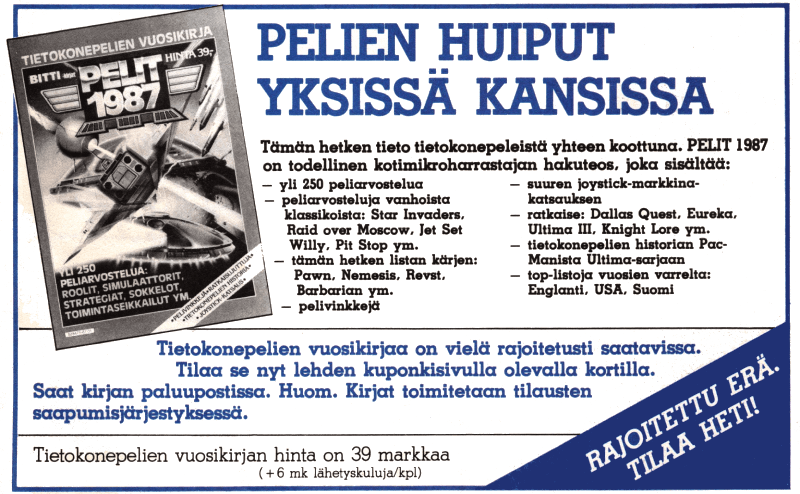
Pelit was a Finnish-language (bi)annual book series published from 1987 to 1991 containing gaming-related articles, tips and most importantly game reviews. Here you can find all the reviews from the books. The reviews were originally written in Finnish; the English versions are translations of the Finnish originals. Maininta tekijänoikeuksista
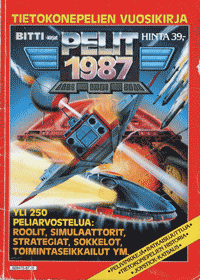 1987
1987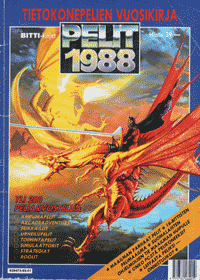 1988
1988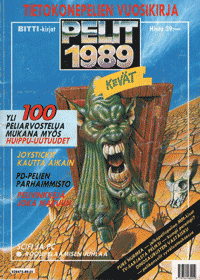 1989 Kevät
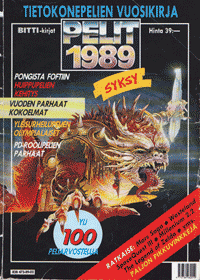 1989 Syksy
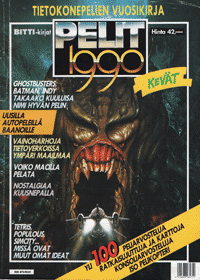 1990 Kevät
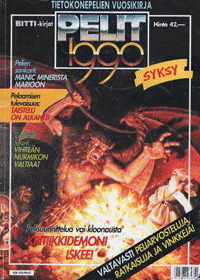 1990 Syksy
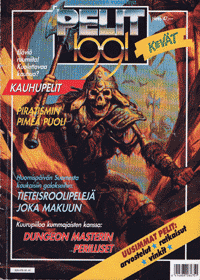 1991 Kevät
 1991 Syksy
Jetfighter II
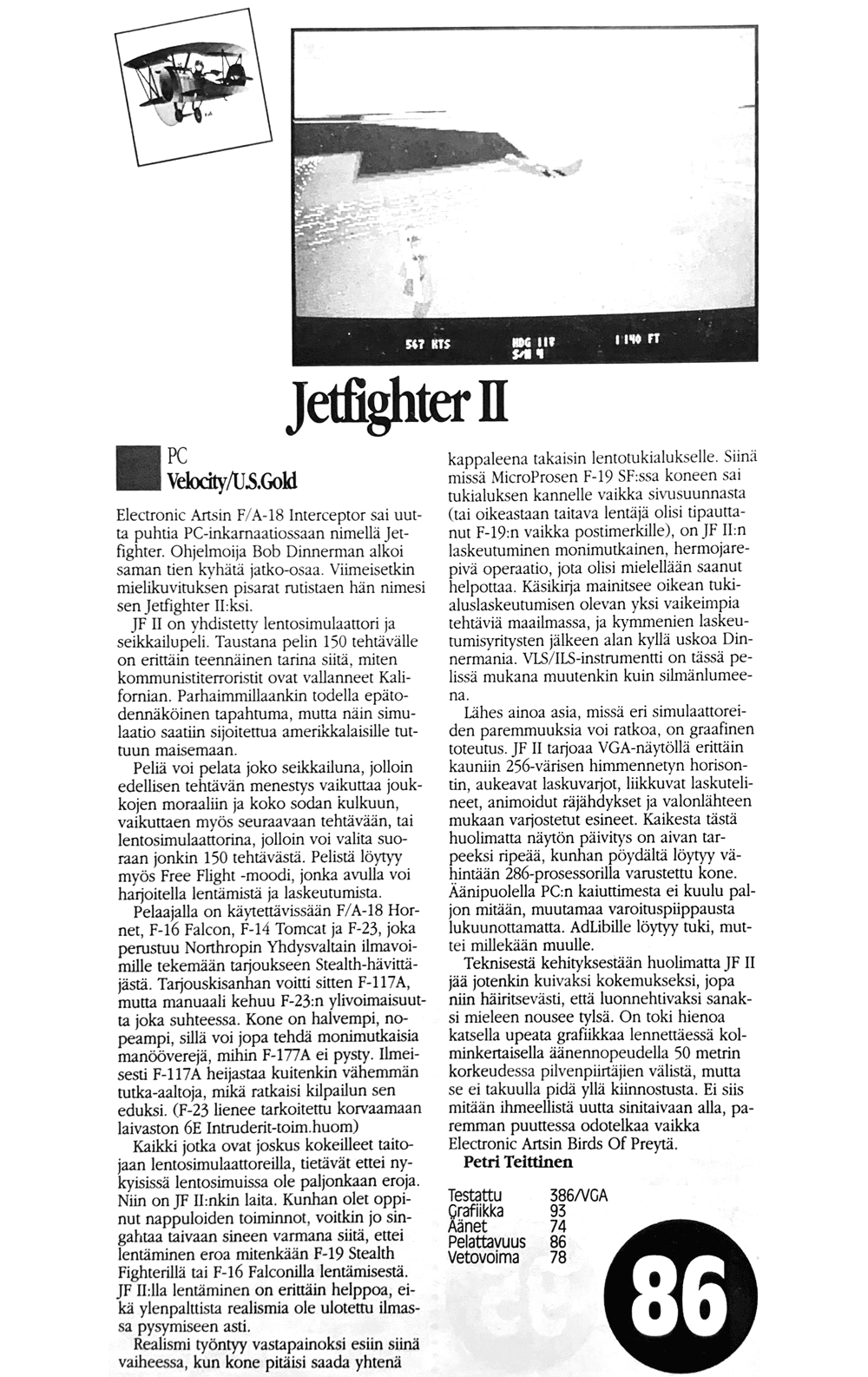
Jetfighter II1991 SyksyPysyvä linkkiElectronic Artsin F/A-18 Interceptor sai uutta puhtia PC-inkarnaatiossaan nimellä Jetfighter. Ohjelmoija Bob Dinnerman alkoi saman tien kyhätä jatko-osaa. Viimeisetkin mielikuvituksen pisarat rutistaen hän nimesi sen Jetfighter II:ksi.
JF II on yhdistetty lentosimulaattori ja seikkailupeli. Taustana pelin 150 tehtävälle on erittäin teennäinen tarina siitä, miten kommunistiterroristit ovat vallanneet Kalifornian. Parhaimmillaankin todella epätodennäköinen tapahtuma, mutta näin simulaatio saatiin sijoitettua amerikkalaisille tuttuun maisemaan.
Peliä voi pelata joko seikkailuna, jolloin edellisen tehtävän menestys vaikuttaa joukkojen moraaliin ja koko sodan kulkuun, vaikuttaen myös seuraavaan tehtävään, tai lentosimulaattorina, jolloin voi valita suoraan jonkin 150 tehtävästä. Pelistä löytyy myös Free Flight -moodi, jonka avulla voi harjoitella lentämistä ja laskeutumista.
Pelaajalla on käytettävissään F/A-18 Hornet, F-16 Falcon, F-14 Tomcat ja F-23, joka perustuu Northropin Yhdysvaltain ilmavoimille tekemään tarjoukseen Stealth-hävittäjästä. Tarjouskisanhan voitti sitten F-117A, mutta manuaali kehuu F-23:n ylivoimaisuutta joka suhteessa. Kone on halvempi, nopeampi, sillä voi jopa tehdä monimutkaisia manööverejä, mihin F-177A ei pysty. Ilmeisesti F-117A heijastaa kuitenkin vähemmän tutka-aaltoja, mikä ratkaisi kilpailun sen eduksi. (F-23 lienee tarkoitettu korvaamaan laivaston 6E Intruderit-toim.huom)
Kaikki jotka ovat joskus kokeilleet taitojaan lentosimulaattoreilla, tietävät ettei nykyisissä lentosimuissa ole paljonkaan eroja. Niin on JF II:nkin laita. Kunhan olet oppinut nappuloiden toiminnot, voitkin jo singahtaa taivaan sineen varmana siitä, ettei lentäminen eroa mitenkään F-19 Stealth Fighterillä tai F-16 Falconilla lentämisestä. JF II:lla lentäminen on erittäin helppoa, eikä ylenpalttista realismia ole ulotettu ilmassa pysymiseen asti.
Realismi työntyy vastapainoksi esiin siinä vaiheessa, kun kone pitäisi saada yhtenä kappaleena takaisin lentotukialukselle. Siinä missä MicroProsen F-19 SF:ssa koneen sai tukialuksen kannelle vaikka sivusuunnasta (tai oikeastaan taitava lentäjä olisi tipauttanut F-19:n vaikka postimerkille), on JF II:n laskeutuminen monimutkainen, hermojarepivä operaatio, jota olisi mielellään saanut helpottaa. Käsikirja mainitsee oikean tukialuslaskeutumisen olevan yksi vaikeimpia tehtäviä maailmassa, ja kymmenien laskeutumisyritysten jälkeen alan kyllä uskoa Dinnermania. VLS/ILS-instrumentti on tässä pelissä mukana muutenkin kuin silmänlumeena.
Lähes ainoa asia, missä eri simulaattoreiden paremmuuksia voi ratkoa, on graafinen toteutus. JF II tarjoaa VGA-näytöllä erittäin kauniin 256-värisen himmennetyn horisontin, aukeavat laskuvarjot, liikkuvat laskutelineet, animoidut räjähdykset ja valonlähteen mukaan varjostetut esineet. Kaikesta tästä huolimatta näytön päivitys on aivan tarpeeksi ripeää, kunhan pöydältä löytyy vähintään 286-prosessorilla varustettu kone. Äänipuolella PC:n kaiuttimesta ei kuulu paljon mitään, muutamaa varoituspiippausta lukuunottamatta. AdLibille löytyy tuki, muttei millekään muulle.
Teknisestä kehityksestään huolimatta JF II jää jotenkin kuivaksi kokemukseksi, jopa niin häiritsevästi, että luonnehtivaksi sanaksi mieleen nousee tylsä. On toki hienoa katsella upeata grafiikkaa lennettäessä kolminkertaisella äänennopeudella 50 metrin korkeudessa pilvenpiirtäjien välistä, mutta se ei takuulla pidä yllä kiinnostusta. Ei siis mitään ihmeellistä uutta sinitaivaan alla, paremman puuttessa odotelkaa vaikka Electronic Artsin Birds Of Preytä.
Jetfighter II1991 SyksyPermalinkElectronic Arts' F/A-18 Interceptor got a new lease of life in its PC incarnation under the name Jetfighter. Programmer Bob Dinnerman immediately started knocking together a sequel. Squeezing out the very last drops of his imagination, he named it Jetfighter II.
JF II is a combined flight simulator and adventure game. The backdrop to the game's 150 missions is an extremely contrived story about communist terrorists seizing California. A really unlikely event even at the best of times, but this way the simulation could be set in scenery familiar to Americans.
You can play either as an adventure, where your success in the previous mission affects the troops' morale and the course of the whole war, and so also the next mission, or as a flight simulator, where you can pick any of the 150 missions directly. The game also has a Free Flight mode for practising flying and landing.
You have at your disposal the F/A-18 Hornet, the F-16 Falcon, the F-14 Tomcat and the F-23, which is based on Northrop's bid to the United States Air Force for a Stealth fighter. The contest was of course won by the F-117A, but the manual raves about the F-23's superiority in every respect. The plane is cheaper and faster, and it can even pull off complex manoeuvres that the F-177A can't manage. Apparently the F-117A reflects fewer radar waves, though, and that settled the contest in its favour. (The F-23 is presumably meant to replace the navy's 6E Intruders - ed. note)
Anyone who has ever tried their hand at flight simulators knows that there isn't much difference between today's flight sims. The same goes for JF II. Once you've learned what the keys do, you can shoot off into the wild blue yonder, safe in the knowledge that flying it is no different at all from flying in F-19 Stealth Fighter or F-16 Falcon. JF II is extremely easy to fly, and the excessive realism hasn't been extended as far as staying in the air.
To balance things out, the realism muscles its way in at the point where you're supposed to get the plane back onto the aircraft carrier in one piece. Whereas in MicroProse's F-19 SF you could put the plane down on the carrier deck even from the side (or rather, a skilled pilot could have dropped the F-19 onto a postage stamp), landing in JF II is a complicated, nerve-shredding operation that could happily have been made easier. The manual says a real carrier landing is one of the most difficult tasks in the world, and after dozens of landing attempts I'm certainly starting to believe Dinnerman. The VLS/ILS instrument is in this game for more than just show.
Almost the only thing by which you can settle which simulator is better is the graphics. On a VGA display JF II offers an extremely beautiful 256-colour graded horizon, opening parachutes, moving landing gear, animated explosions and objects shaded according to the light source. Despite all this, the screen update is quite brisk enough, as long as there's a machine with at least a 286 processor on your desk. On the sound side, not much comes out of the PC speaker apart from a few warning beeps. There's support for AdLib, but for nothing else.
Despite its technical advances, JF II somehow remains a dry experience, so disturbingly so that the word that springs to mind to describe it is boring. Sure, it's nice to watch the gorgeous graphics while flying at three times the speed of sound 50 metres up between the skyscrapers, but that certainly won't keep your interest up. So nothing amazingly new under the blue sky; for want of anything better, why not wait for Electronic Arts' Birds Of Prey.