1133 reviews from "Pelit"-books
Pelit was a Finnish-language (bi)annual book series published from 1987 to 1991 containing gaming-related articles, tips and most importantly game reviews. Here you can find all the reviews from the books. The reviews were originally written in Finnish; the English versions are translations of the Finnish originals. Maininta tekijänoikeuksista
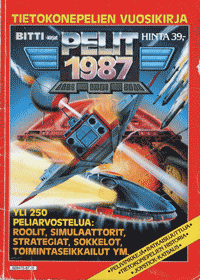 1987
1987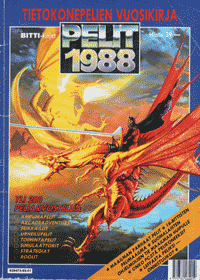 1988
1988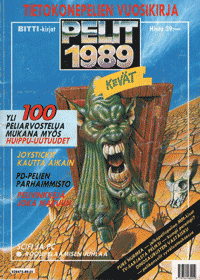 1989 Kevät
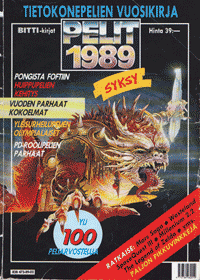 1989 Syksy
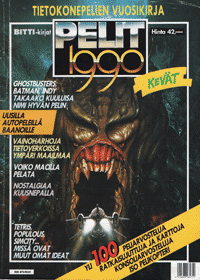 1990 Kevät
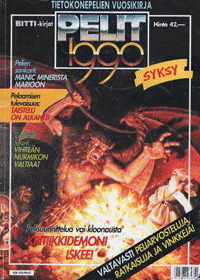 1990 Syksy
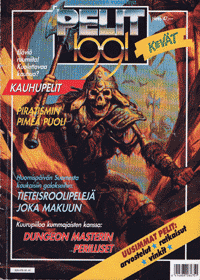 1991 Kevät
 1991 Syksy
M.A.C.H.
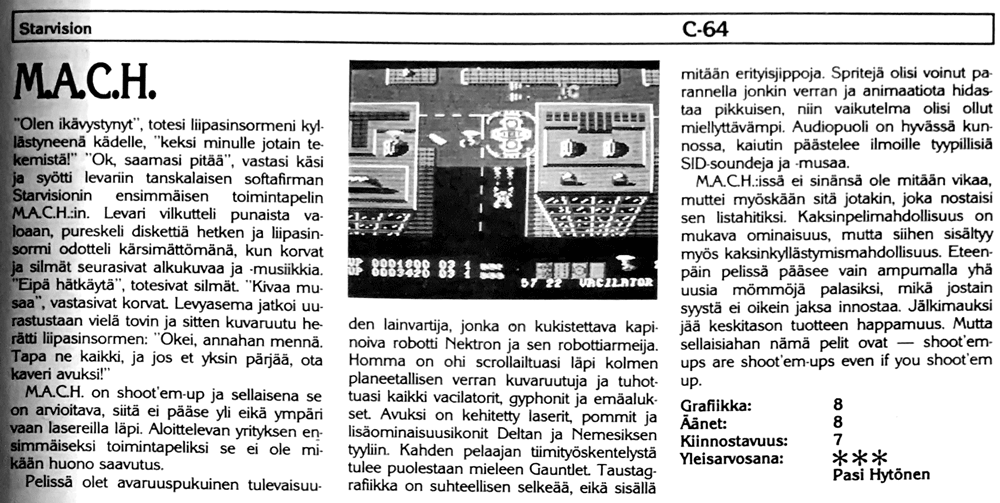
M.A.C.H.1988Pysyvä linkki"Olen ikävystynyt", totesi liipasinsormeni kyllästyneenä kädelle, "keksi minulle jotain tekemistä!" "Ok, saamasi pitää", vastasi käsi ja syötti levariin tanskalaisen softafirman Starvisionin ensimmäisen toimintapelin M.A.C.H.:in. Levari vilkutteli punaista valoaan, pureskeli diskettiä hetken ja liipasinsormi odotteli kärsimättömänä, kun korvat ja silmät seurasivat alkukuvaa ja -musiikkia. "Eipä hätkäytä", totesivat silmät. "Kivaa musaa", vastasivat korvat. Levyasema jatkoi uurastustaan vielä tovin ja sitten kuvaruutu herätti liipasinsormen: "Okei, annahan mennä. Tapa ne kaikki, ja jos et yksin pärjää, ota kaveri avuksi!"
M.A.C.H. on shoot'em-up ja sellaisena se on arvioitava, siitä ei pääse yli eikä ympäri vaan lasereilla läpi. Aloittelevan yrityksen ensimmäiseksi toimintapeliksi se ei ole mikään huono saavutus.
Pelissä olet avaruuspukuinen tulevaisuuden lainvartija, jonka on kukistettava kapinoiva robotti Nektron ja sen robottiarmeija. Homma on ohi scrollailtuasi läpi kolmen planeetallisen verran kuvaruutuja ja tuhottuasi kaikki vacilatorit, gyphonit ja emäalukset. Avuksi on kehitetty laserit, pommit ja lisäominaisuusikonit Deltan ja Nemesiksen tyyliin. Kahden pelaajan tiimityöskentelystä tulee puolestaan mieleen Gauntlet. Taustagrafiikka on suhteellisen selkeää, eikä sisällä mitään erityisjippoja. Spritejä olisi voinut parannella jonkin verran ja animaatiota hidastaa pikkuisen, niin vaikutelma olisi ollut miellyttävämpi. Audiopuoli on hyvässä kunnossa, kaiutin päästelee ilmoille tyypillisiä SID-soundeja ja -musaa.
M.A.C.H.:issä ei sinänsä ole mitään vikaa, muttei myöskään sitä jotakin, joka nostaisi sen listahitiksi. Kaksinpelimahdollisuus on mukava ominaisuus, mutta siihen sisältyy myös kaksinkyllästymismahdollisuus. Eteenpäin pelissä pääsee vain ampumalla yhä uusia mömmöjä palasiksi, mikä jostain syystä ei oikein jaksa innostaa. Jälkimauksi jää keskitason tuotteen happamuus. Mutta sellaisiahan nämä pelit ovat - shoot'em-ups are shoot'em-ups even if you shoot'em up.
M.A.C.H.1988Permalink"I'm bored," my trigger finger said wearily to the hand, "find me something to do!" "OK, you asked for it," replied the hand, and fed the drive M.A.C.H., the first action game from the Danish software house Starvision. The drive blinked its red light and chewed on the disk for a moment, and the trigger finger waited impatiently while the ears and eyes took in the title screen and title music. "Doesn't exactly make you jump," remarked the eyes. "Nice tunes," replied the ears. The disk drive toiled on for a while longer, and then the screen woke the trigger finger up: "Okay, let's get going. Kill them all, and if you can't cope on your own, bring a mate along to help!"
M.A.C.H. is a shoot'em-up and it has to be judged as one - there's no getting over it or round it, only through it with lasers. As the first action game from a fledgling company, it's no mean achievement.
In the game you are a space-suited lawman of the future who has to defeat the rebel robot Nektron and its robot army. The job is done once you've scrolled your way through three planets' worth of screens and destroyed all the vacilators, gyphons and motherships. To help you out there are lasers, bombs and power-up icons in the style of Delta and Nemesis. The two-player teamwork, for its part, brings Gauntlet to mind. The background graphics are relatively clear and don't contain any special tricks. The sprites could have been polished up a bit and the animation slowed down a touch, and the overall impression would have been more pleasing. The audio side is in good shape, with the speaker letting rip with typical SID sounds and tunes.
There's nothing actually wrong with M.A.C.H. as such, but it doesn't have that certain something that would turn it into a chart hit either. The two-player option is a nice feature, but it also comes with a two-player boredom option. The only way to get anywhere in the game is by shooting ever more blobs to bits, which for some reason just doesn't manage to get you fired up. The aftertaste it leaves is the sourness of a middling product. But then that's what these games are like - shoot'em-ups are shoot'em-ups even if you shoot'em up.
M1 Tank Platoon
M1 Tank Platoon1990 KevätPysyvä linkkiTankkipelit ovat autopelien kera tämän hetken kuumin peliaihe. Aivan lyhyen ajan sisällä tankkipelejä on ilmaantunut useitakin. Esittelyssä nyt joukon kärkeä edustava MicroProsen M1 Tank Platoon.
M1 Tank Platoon on MicroProsen yritys kerätä markat panssarivaunuista innostuneilta pelaajilta. Valtava paketti sisältää näppäinkaavioita, disketit ja tiiliskiviromaania muistuttavan käsikirjan. Nopea käsikirjan selailu paljastaa kuoren alla piilevän monimutkaisen pelin. Kysymyksessä ei olekaan yhden tankin kontrollointi taistelukentällä, vaan jopa neljän tankin ryhmän. Lisäksi pelistä löytyy tykistötulta, ilmatukea, muita omia tankkeja (joille voi myös antaa määräyksiä) ja tietenkin rutkasti vihollisia.
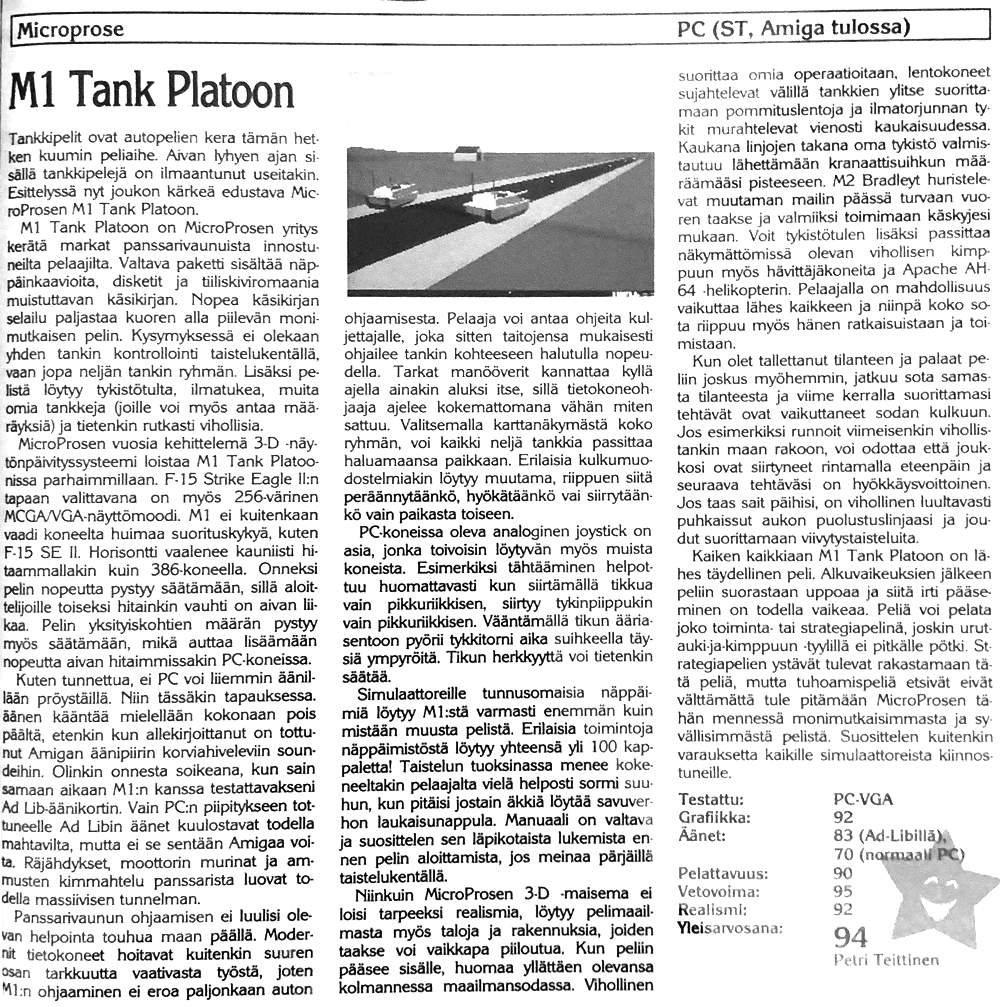
MicroProsen vuosia kehittelemä 3-D -näytönpäivityssysteemi loistaa M1 Tank Platoonissa parhaimmillaan. F-15 Strike Eagle II:n tapaan valittavana on myös 256-värinen MCGA/VGA-näyttömoodi. M1 ei kuitenkaan vaadi koneelta huimaa suorituskykyä, kuten F-15 SE II. Horisontti vaalenee kauniisti hitaammallakin kuin 386-koneella. Onneksi pelin nopeutta pystyy säätämään, sillä aloittelijoille toiseksi hitainkin vauhti on aivan liikaa. Pelin yksityiskohtien määrän pystyy myös säätämään, mikä auttaa lisäämään nopeutta aivan hitaimmissakin PC-koneissa.
Kuten tunnettua, ei PC voi liiemmin äänillään pröystäillä. Niin tässäkin tapauksessa. äänen kääntää mielellään kokonaan pois päältä, etenkin kun allekirjoittanut on tottunut Amigan äänipiirin korviahiveleviin soundeihin. Olinkin onnesta soikeana, kun sain samaan aikaan M1:n kanssa testattavakseni Ad Lib-äänikortin. Vain PC:n piipitykseen tottuneelle Ad Libin äänet kuulostavat todella mahtavilta, mutta ei se sentään Amigaa voita. Räjähdykset, moottorin murinat ja ammusten kimmahtelu panssarista luovat todella massiivisen tunnelman.
Panssarivaunun ohjaamisen ei luulisi olevan helpointa touhua maan päällä. Modernit tietokoneet hoitavat kuitenkin suuren osan tarkkuutta vaativasta työstä, joten M1:n ohjaaminen ei eroa paljonkaan auton ohjaamisesta. Pelaaja voi antaa ohjeita kuljettajalle, joka sitten taitojensa mukaisesti ohjailee tankin kohteeseen halutulla nopeudella. Tarkat manööverit kannattaa kyllä ajella ainakin aluksi itse, sillä tietokoneohjaaja ajelee kokemattomana vähän miten sattuu. Valitsemalla karttanäkymästä koko ryhmän, voi kaikki neljä tankkia passittaa haluamaansa paikkaan. Erilaisia kulkumuodostelmiakin löytyy muutama, riippuen siitä peräännytäänkö, hyökätäänkö vai siirrytäänkö vain paikasta toiseen.
PC-koneissa oleva analoginen joystick on asia, jonka toivoisin löytyvän myös muista koneista. Esimerkiksi tähtääminen helpottuu huomattavasti kun siirtämällä tikkua vain pikkuriikkisen, siirtyy tykinpiippukin vain pikkuriikkisen. Vääntämällä tikun ääriasentoon pyörii tykkitorni aika suihkeella täysiä ympyröitä. Tikun herkkyyttä voi tietenkin säätää.
Simulaattoreille tunnusomaisia näppäimiä löytyy M1:stä varmasti enemmän kuin mistään muusta pelistä. Erilaisia toimintoja näppäimistöstä löytyy yhteensä yli 100 kappaletta! Taistelun tuoksinassa menee kokeneeltakin pelaajalta vielä helposti sormi suuhun, kun pitäisi jostain äkkiä löytää savuverhon laukaisunappula. Manuaali on valtava ja suosittelen sen läpikotaista lukemista ennen pelin aloittamista, jos meinaa pärjäillä taistelukentällä.
Niinkuin MicroProsen 3-D -maisema ei loisi tarpeeksi realismia, löytyy pelimaailmasta myös taloja ja rakennuksia, joiden taakse voi vaikkapa piiloutua. Kun peliin pääsee sisälle, huomaa yllättäen olevansa kolmannessa maailmansodassa. Vihollinen suorittaa omia operaatioitaan, lentokoneet sujahtelevat välillä tankkien ylitse suorittamaan pommituslentoja ja ilmatorjunnan tykit murahtelevat vienosti kaukaisuudessa. Kaukana linjojen takana oma tykistö valmistautuu lähettämään kranaattisuihkun määräämääsi pisteeseen. M2 Bradleyt huristelevat muutaman mailin päässä turvaan vuoren taakse ja valmiiksi toimimaan käskyjesi mukaan. Voit tykistötulen lisäksi passittaa näkymättömissä olevan vihollisen kimppuun myös hävittäjäkoneita ja Apache AH-64 -helikopterin. Pelaajalla on mahdollisuus vaikuttaa lähes kaikkeen ja niinpä koko sota riippuu myös hänen ratkaisuistaan ja toimistaan.
Kun olet tallettanut tilanteen ja palaat peliin joskus myöhemmin, jatkuu sota samasta tilanteesta ja viime kerralla suorittamasi tehtävät ovat vaikuttaneet sodan kulkuun. Jos esimerkiksi runnoit viimeisenkin vihollistankin maan rakoon, voi odottaa että joukkosi ovat siirtyneet rintamalla eteenpäin ja seuraava tehtäväsi on hyökkäysvoittoinen. Jos taas sait päihisi, on vihollinen luultavasti puhkaissut aukon puolustuslinjaasi ja joudut suorittamaan viivytystaisteluita.
Kaiken kaikkiaan M1 Tank Platoon on lähes täydellinen peli. Alkuvaikeuksien jälkeen peliin suorastaan uppoaa ja siitä irti pääseminen on todella vaikeaa. Peliä voi pelata joko toiminta- tai strategiapelinä, joskin urut-auki-ja-kimppuun -tyylillä ei pitkälle pötki. Strategiapelien ystävät tulevat rakastamaan tätä peliä, mutta tuhoamispeliä etsivät eivät välttämättä tule pitämään MicroProsen tähän mennessä monimutkaisimmasta ja syvällisimmästä pelistä. Suosittelen kuitenkin varauksetta kaikille simulaattoreista kiinnostuneille.
M1 Tank Platoon1990 KevätPermalinkTank games, along with car games, are the hottest game subject of the moment. In a very short space of time quite a few tank games have popped up. Under review now is MicroProse's M1 Tank Platoon, which stands at the head of the pack.
M1 Tank Platoon is MicroProse's attempt to rake in the markkas of players keen on armoured vehicles. The huge package contains keyboard charts, the disks and a manual resembling a doorstopper novel. A quick flick through the manual reveals a complex game lurking under the shell. This isn't about controlling a single tank on the battlefield, but a group of as many as four tanks. On top of that the game features artillery fire, air support, other friendly tanks (which you can also give orders to) and, of course, plenty of enemies.
The 3-D screen update system that MicroProse has spent years developing shines at its very best in M1 Tank Platoon. As in F-15 Strike Eagle II, there's also a 256-colour MCGA/VGA display mode to choose from. M1 doesn't, however, demand dazzling performance from the machine the way F-15 SE II does. The horizon fades beautifully to a paler shade even on something slower than a 386. Luckily the game's speed can be adjusted, since for beginners even the second-slowest speed is far too much. The amount of detail in the game can also be adjusted, which helps raise the speed on even the very slowest PCs.
As is well known, the PC can't exactly show off with its sound. The same goes in this case. You'll gladly switch the sound off altogether, especially since the undersigned is used to the ear-caressing sounds of the Amiga's sound chip. So I was over the moon when I got an Ad Lib sound card to test at the same time as M1. To someone used only to the PC's beeping, the Ad Lib's sounds are truly awesome, but it still doesn't beat the Amiga. The explosions, the rumble of the engines and the shells ricocheting off the armour create a truly massive atmosphere.
You wouldn't think driving a tank was the easiest pastime on earth. However, modern computers handle much of the work that calls for precision, so driving the M1 is not much different from driving a car. The player can give instructions to the driver, who then steers the tank to the destination at the desired speed as best his skills allow. It's worth driving precise manoeuvres yourself, at least at first, since an inexperienced computer driver drives any old how. By selecting the whole platoon in the map view, you can send all four tanks off to wherever you like. There are also a few different movement formations, depending on whether you're retreating, attacking or just moving from one place to another.
The analogue joystick found on PCs is something I wish other machines had too. Aiming, for example, gets much easier when moving the stick just a teeny bit moves the gun barrel just a teeny bit too. Yank the stick all the way over and the turret spins full circles at a fair old lick. The stick's sensitivity can of course be adjusted.
M1 surely has more of the keys so characteristic of simulators than any other game. All told, there are over 100 different functions on the keyboard! In the heat of battle, even an experienced player is easily left scratching their head when they suddenly need to find the smoke screen launch button somewhere. The manual is huge, and I recommend reading it from cover to cover before starting the game if you mean to hold your own on the battlefield.
As if MicroProse's 3-D landscape didn't create enough realism, the game world also has houses and buildings you can, say, hide behind. Once you get into the game, you suddenly find yourself in the Third World War. The enemy carries out its own operations, aircraft now and then zip over the tanks on their way to bombing runs, and anti-aircraft guns grumble softly in the distance. Far behind the lines, your own artillery gets ready to send a shower of shells to the point you designate. M2 Bradleys whirr off a few miles away to safety behind a mountain, ready to act on your orders. Besides artillery fire, you can also send fighter planes and an Apache AH-64 helicopter after an enemy out of sight. The player can influence almost everything, and so the whole war also hinges on their decisions and actions.
When you have saved the situation and come back to the game some time later, the war carries on from the same point, and the missions you carried out last time have affected the course of the war. If, for example, you ground every last enemy tank into the dirt, you can expect your troops to have pushed forward along the front and your next mission to be mainly offensive. If on the other hand you got a thrashing, the enemy has probably punched a hole in your defensive line and you'll have to fight delaying actions.
All in all, M1 Tank Platoon is a near-perfect game. Once past the initial difficulties you positively sink into the game, and tearing yourself away is really hard. The game can be played either as an action or a strategy game, although the pedal-to-the-metal-and-charge style won't get you far. Strategy fans are going to love this game, but those looking for a destruction game may not necessarily like MicroProse's most complex and in-depth game to date. Even so, I recommend it without reservation to everyone interested in simulators.
MacArthur's War + The American Civil War Part II
MacArthur's War + The American Civil War Part II1989 KevätPysyvä linkkiLentääkö SSI:n veri kun SSG tulee taistelukentälle? Kamppailu SSI vastaan SSG jatkuu australialaisen SSG:n uusimpien tuotosten myötä. Mutta nämäpä eivät pärjääkään kentällä kovin mainiosti: parempiakin pelejä on.
MacArthur's War sijoittuu Korean sotaan 1950-1951 ja sisältää tästä sodasta yhdeksän ratkaisutaistelua. SSG:n tuttuun tapaan pelin ohjeet eivät ole kovin ihastuttavat: esimerkkipeli, jossa opastetaan miten pelata ensimmäinen kierros läpi, ja tämän jälkeen roppakaupalla menuselvityksiä. Parasta ohjeissa ovat mielenkiintoiset selvitykset kunkin skenaarion taustasta sekä siitä, miten historiallisesti kaikki tapahtui.
Pelattuani aikani jotain tuntui jäävän puuttumaan, mutta en kyennyt paikallistamaan mitä se oli. Minun tarpeitani ei MacArthur's War kykene täyttämään, vaikka en sitä huonoksikaan peliksi voi väittää.
The American Civil War on muissa suhteissa identtinen MacArthur's Warin kanssa, paitsi että se tapahtuu USA:n sisällissodan aikana. Menuja on hieman muuteltu, kartat ovat erilaiset ja mukana ei luonnollisesti ole ilmatukea tai panssareita.
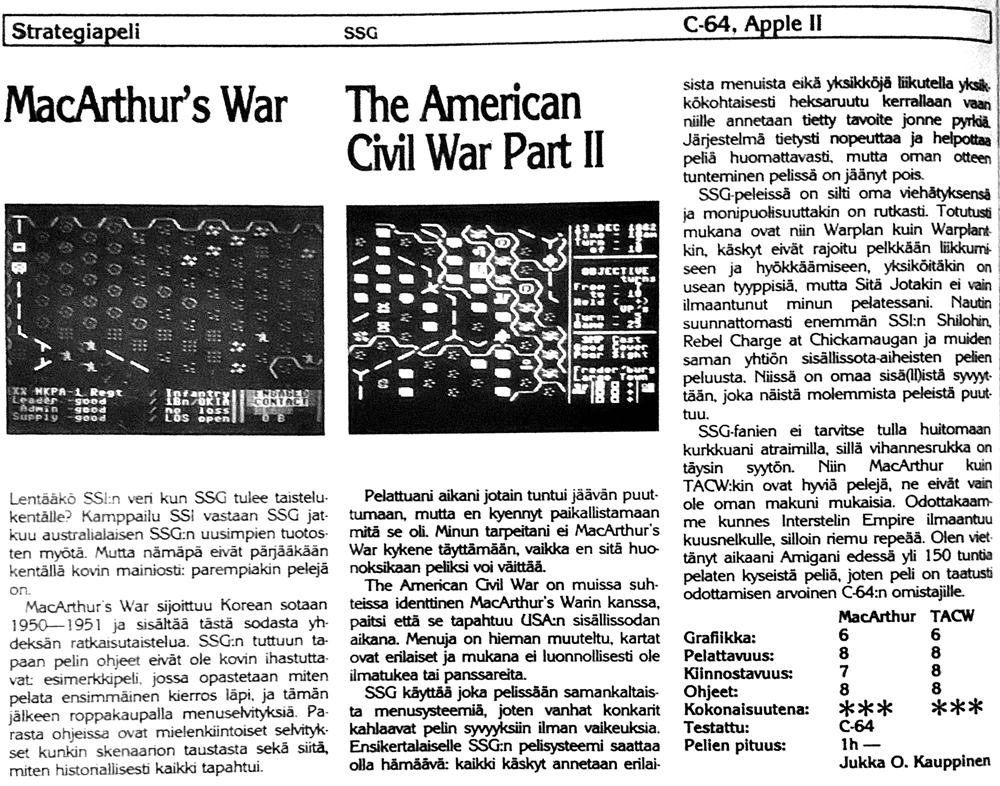
SSG käyttää joka pelissään samankaltaista menusysteemiä, joten vanhat konkarit kahlaavat pelin syvyyksiin ilman vaikeuksia. Ensikertalaiselle SSG:n pelisysteemi saattaa olla hämäävä: kaikki käskyt annetaan erilaisista menuista eikä yksikköjä liikutella yksikkökohtaisesti heksaruutu kerrallaan vaan niille annetaan tietty tavoite jonne pyrkiä. Järjestelmä tietysti nopeuttaa ja helpottaa peliä huomattavasti, mutta oman otteen tunteminen pelissä on jäänyt pois.
SSG-peleissä on silti oma viehätyksensä ja monipuolisuuttakin on rutkasti. Totutusti mukana ovat niin Warplan kuin Warplantkin, käskyt eivät rajoitu pelkkään liikkumiseen ja hyökkäämiseen, yksiköitäkin on usean tyyppisiä, mutta Sitä Jotakin ei vain ilmaantunut minun pelatessani. Nautin suunnattomasti enemmän SSI:n Shilohin, Rebel Charge at Chickamaugan ja muiden saman yhtiön sisällissota-aiheisten pelien peluusta. Niissä on omaa sisä(ll)istä syvyyttään, joka näistä molemmista peleistä puuttuu.
SSG-fanien ei tarvitse tulla huitomaan kurkkuani atraimilla, sillä vihannesrukka on täysin syytön. Niin MacArthur kuin TACW:kin ovat hyviä pelejä, ne eivät vain ole oman makuni mukaisia. Odottakaamme kunnes Interstelin Empire ilmaantuu kuusnelkulle, silloin riemu repeää. Olen viettänyt aikaani Amigani edessä yli 150 tuntia pelaten kyseistä peliä, joten peli on taatusti odottamisen arvoinen C-64:n omistajille.
MacArthur's War + The American Civil War Part II1989 KevätPermalinkWill SSI's blood fly when SSG takes the battlefield? The battle of SSI versus SSG continues with the latest releases from Australia's SSG. But these ones don't actually fare all that splendidly on the field: there are better games around.
MacArthur's War is set in the Korean War of 1950-1951 and contains nine decisive battles from that war. In SSG's familiar fashion, the game's instructions are not terribly delightful: a sample game that shows you how to play through the first turn, and after that menu explanations by the bucketload. The best part of the instructions is the interesting background to each scenario and the accounts of how it all happened historically.
After playing for a good while, something seemed to be missing, but I couldn't put my finger on what it was. MacArthur's War can't meet my needs, though I can't claim it's a bad game either.
In all other respects The American Civil War is identical to MacArthur's War, except that it takes place during the US Civil War. The menus have been changed a little, the maps are different, and naturally there's no air support or armour.
SSG uses a similar menu system in every one of its games, so old hands will wade into the depths of the game with no trouble. For a first-timer, SSG's game system may be confusing: all orders are given from various menus, and units aren't moved one by one, a hex at a time; instead they're given a particular objective to head for. The system naturally speeds the game up and makes it considerably easier, but the feeling of having your own grip on the game has gone missing.
SSG games still have a charm of their own, and there's plenty of variety too. As usual, both Warplan and Warplant are included, orders aren't limited to just moving and attacking, and there are several types of units, but That Certain Something just didn't turn up while I was playing. I enjoyed playing SSI's Shiloh, Rebel Charge at Chickamauga and that company's other Civil War games immeasurably more. They have an inner (civil) depth of their own that both of these games lack.
SSG fans needn't come flailing at my throat with tridents, since the poor thing is completely innocent. MacArthur and TACW alike are good games, they just aren't to my own taste. Let us wait until Interstel's Empire turns up on the C-64, then the fun will really kick off. I've spent over 150 hours in front of my Amiga playing that game, so it's guaranteed to be worth the wait for C-64 owners.
Mach 3

Mach 31989 KevätPysyvä linkkiGallialaisilla on tapana tehdä asiat hiukka hervottomasti rankalaisittain. Mach-3 on heidän näkemyksensä lentosimulaattorille olennaisista asioista. Tärkein tietysti ensin eli latauskuvassa cicciolinamaisesti veikistelevä amatsooni motivoi lentäjäsankaria antamaan kaikkensa pelin koitoksessa. Kun neitsykäiselle on vielä suotu seksikkäin ääni, mitä Amigan puhesyntikasta on milloinkaan maaniteltu esiin, niin galli tuskin valittaisi vaikka itse peli olisi Space Nirvaders -klooni.
Asioiden esteettisestä puolesta vähemmän kiinnostuneille kerrottakoon lohdukkeeksi, että Mach-3 on varsin tiukkatempoinen ampumapeli. Pelaaja istuu niin maanvietävästi vipeltävän rynnäkkökoneen ohjaimissa ja tulittaa vekkulisti kaikkea vastaan viuhuvaa. Näkövinkkeli on piristävän poikkeuksellisesti koneen takaa siten, että ilma-alus näkyy kokonaisuudessaan kuvaruudulla.
Aluksen käsittely ei edellytä lipsumattoman liipasinsormen lisäksi muuta kuin ilotikun heiluttamista pääilmansuuntiin. Ainoa vaikeus on siinä, että koneen nokka painuu alas, kun tikkua vetää itseensä päin. Tiukan aikan tullen satojen lentotuntien ehdollistamat selkärangan lihakset pyrkivät itsepäisesti noudattamaan ikimuistoista, edelliselle käänteistä logiikkaa.
Tykitettävissä löytyy sekä maassa mouruavia että ilmassa operoivia korkean teknologian tuotteita. Bonuksena pääsee räiskimään pimeässä leijuvia irtopäitä. Grafiikka on keskinkertaista parempaa ja taistelun äänet turruttavan tuttuja. Mutta lopussa kiitos seisoo! Kun olet vetäissyt viimeisen kerran ohjaimesta koneen nousuun ja törmännyt maanuoliaisiin (on se niin väärin), korvaasi kuiskataan kutkuttavasti Game Over ja kaikki on taas annettu anteeksi.
Mach 31989 KevätPermalinkThe Gauls have a habit of doing things in a slightly unhinged, French sort of way. Mach-3 is their take on what really matters in a flight simulator. First things first, naturally: an amazon posing coquettishly Cicciolina-style on the loading screen spurs the pilot hero on to give it everything in the game's ordeal. And when the little maiden has also been blessed with the sexiest voice ever coaxed out of the Amiga's speech synth, a Gaul would hardly complain even if the game itself were a Space Nirvaders clone.
For those less interested in the aesthetic side of things, let it be said by way of consolation that Mach-3 is a pretty tightly paced shoot-'em-up. The player sits at the controls of a devilishly nippy attack plane and cheekily blasts everything that comes whizzing at them. Refreshingly, and unusually, the viewpoint is from behind the plane, so that the whole aircraft is visible on screen.
Apart from a trigger finger that never slips, handling the craft takes nothing more than waggling the joystick towards the four points of the compass. The only difficulty is that the plane's nose dips when you pull the stick towards you. When things get tight, spinal muscles conditioned by hundreds of flying hours stubbornly insist on following the time-honoured logic, which is the exact reverse.
Among the things to shoot you'll find high-tech hardware both growling on the ground and operating in the air. As a bonus you get to blast disembodied heads floating in the dark. The graphics are better than average and the sounds of battle numbingly familiar. But the best is saved for last! When you have yanked the stick back one last time to climb and ended up in a sloppy kiss with the ground (it's just so wrong), Game Over is whispered tantalisingly into your ear and all is forgiven once again.
Mad Professor Mariarti
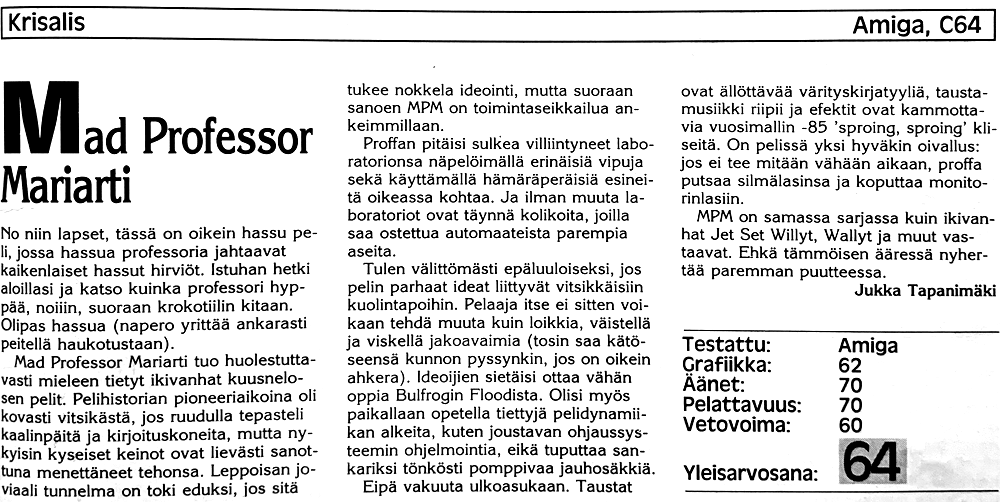
Mad Professor Mariarti1991 KevätPysyvä linkkiNo niin lapset, tässä on oikein hassu peli, jossa hassua professoria jahtaavat kaikenlaiset hassut hirviöt. Istuhan hetki aloillasi ja katso kuinka professori hyppää, noiiin, suoraan krokotiilin kitaan. Olipas hassua (napero yrittää ankarasti peitellä haukotustaan).
Mad Professor Mariarti tuo huolestuttavasti mieleen tietyt ikivanhat kuusnelosen pelit. Pelihistorian pioneeriaikoina oli kovasti vitsikästä, jos ruudulla tepasteli kaalinpäitä ja kirjoituskoneita, mutta nykyisin kyseiset keinot ovat lievästi sanottuna menettäneet tehonsa. Leppoisan joviaali tunnelma on toki eduksi, jos sitä tukee nokkela ideointi, mutta suoraan sanoen MPM on toimintaseikkailua ankeimmillaan.
Proffan pitäisi sulkea villiintyneet laboratorionsa näpelöimällä erinäisiä vipuja sekä käyttämällä hämäräperäisiä esineitä oikeassa kohtaa. Ja ilman muuta laboratoriot ovat täynnä kolikoita, joilla saa ostettua automaateista parempia aseita.
Tulen välittömästi epäluuloiseksi, jos pelin parhaat ideat liittyvät vitsikkäisiin kuolintapoihin. Pelaaja itse ei sitten voikaan tehdä muuta kuin loikkia, väistellä ja viskellä jakoavaimia (tosin saa kätöseensä kunnon pyssynkin, jos on oikein ahkera). Ideoijien sietäisi ottaa vähän oppia Bulfrogin Floodista. Olisi myös paikallaan opetella tiettyjä pelidynamiikan alkeita, kuten joustavan ohjaussysteemin ohjelmointia, eikä tuputtaa sankariksi tönkösti pomppivaa jauhosäkkiä.
Eipä vakuuta ulkoasukaan. Taustat ovat ällöttävää värityskirjatyyliä, taustamusiikki riipii ja efektit ovat kammottavia vuosimallin -85 'sproing, sproing' kliseitä. On pelissä yksi hyväkin oivallus: jos ei tee mitään vähään aikaan, proffa putsaa silmälasinsa ja koputtaa monitorinlasiin.
MPM on samassa sarjassa kuin ikivanhat Jet Set Willyt, Wallyt ja muut vastaavat. Ehkä tämmöisen ääressä nyhertää paremman puutteessa.
Mad Professor Mariarti1991 KevätPermalinkRight then, children, here's a really funny game where a funny professor is chased by all kinds of funny monsters. Now you sit still for a moment and watch how the professor jumps, theeere we go, straight into the crocodile's jaws. Wasn't that funny (the nipper tries hard to hide a yawn).
Mad Professor Mariarti is worryingly reminiscent of certain ancient Commodore 64 games. In the pioneering days of gaming history it was ever so witty to have cabbages and typewriters toddling about the screen, but nowadays those tricks have, to put it mildly, lost their edge. A laid-back, jovial atmosphere is of course an asset if it's backed up by clever ideas, but frankly MPM is action adventure at its dreariest.
The prof is supposed to shut down the laboratories, which have run amok, by fiddling with sundry levers and using dubious objects in the right spot. And naturally the labs are full of coins, with which you can buy better weapons from vending machines.
I immediately become suspicious if a game's best ideas have to do with comical ways of dying. And the player, it turns out, can do nothing but leap, dodge and chuck spanners (though you do get a proper gun in your little paw too, if you're really diligent). The ideas people ought to learn a thing or two from Bulfrog's Flood. It would also be in order to learn certain rudiments of game dynamics, such as programming a flexible control system, instead of foisting a stiffly bouncing sack of flour on us as the hero.
The looks don't convince either. The backgrounds are in a revolting colouring-book style, the background music grates and the effects are ghastly vintage-1985 'sproing, sproing' clichés. There is one good idea in the game, though: if you don't do anything for a while, the prof polishes the specs and taps on the monitor glass.
MPM is in the same league as the ancient Jet Set Willys, Wallys and their ilk. Maybe you could fiddle away at something like this for want of anything better.
Madballs
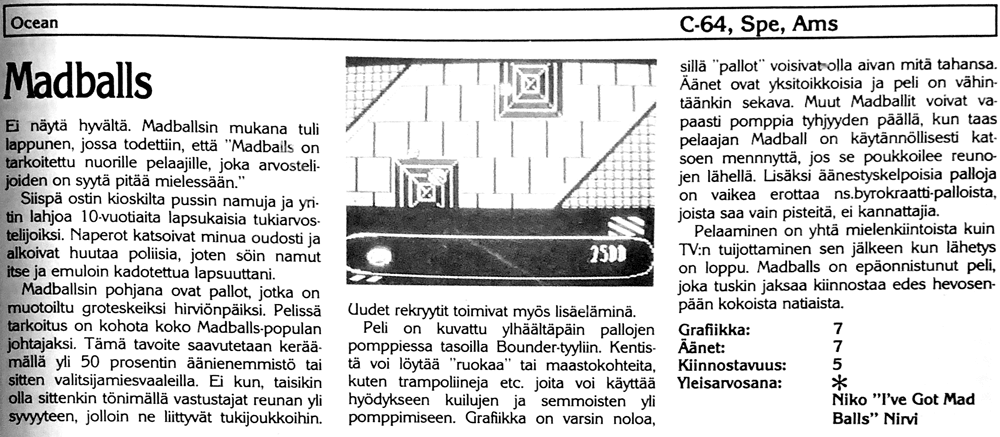
Madballs1988Pysyvä linkkiEi näytä hyvältä. Madballsin mukana tuli lappunen, jossa todettiin, että "Madballs on tarkoitettu nuorille pelaajille, joka arvostelijoiden on syytä pitää mielessään."
Siispä ostin kioskilta pussin namuja ja yritin lahjoa 10-vuotiaita lapsukaisia tukiarvostelijoiksi. Naperot katsoivat minua oudosti ja alkoivat huutaa poliisia, joten söin namut itse ja emuloin kadotettua lapsuuttani.
Madballsin pohjana ovat pallot, jotka on muotoiltu groteskeiksi hirviönpäiksi. Pelissä tarkoitus on kohota koko Madballs-populan johtajaksi. Tämä tavoite saavutetaan keräämällä yli 50 prosentin äänienemmistö tai sitten valitsijamiesvaaleilla. Ei kun, taisikin olla sittenkin tönimällä vastustajat reunan yli syvyyteen, jolloin ne liittyvät tukijoukkoihin. Uudet rekryytit toimivat myös lisäelämänä.
Peli on kuvattu ylhäältäpäin pallojen pomppiessa tasoilla Bounder-tyyliin. Kentistä voi löytää "ruokaa" tai maastokohteita, kuten trampoliineja etc. joita voi käyttää hyödykseen kuilujen ja semmoisten yli pomppimiseen. Grafiikka on varsin noloa, sillä "pallot" voisivat olla aivan mitä tahansa. Äänet ovat yksitoikkoisia ja peli on vähintäänkin sekava. Muut Madballit voivat vapaasti pomppia tyhjyyden päällä, kun taas pelaajan Madball on käytännöllisesti katsoen mennnyttä, jos se poukkoilee reunojen lähellä. Lisäksi äänestyskelpoisia palloja on vaikea erottaa ns.byrokraatti-palloista, joista saa vain pisteitä, ei kannattajia.
Pelaaminen on yhtä mielenkiintoista kuin TV:n tuijottaminen sen jälkeen kun lähetys on loppu. Madballs on epäonnistunut peli, joka tuskin jaksaa kiinnostaa edes hevosenpään kokoista natiaista.
Madballs1988PermalinkDoesn't look good. Madballs came with a little slip of paper stating that "Madballs is intended for young players, which reviewers would do well to bear in mind."
So I bought a bag of sweets from the kiosk and tried to bribe some 10-year-old tots into becoming assistant reviewers. The little nippers gave me a funny look and started shouting for the police, so I ate the sweets myself and emulated my lost childhood.
Madballs is based on balls moulded into grotesque monster heads. The aim of the game is to rise to become leader of the whole Madballs crowd. This goal is achieved by gathering a majority of over 50 per cent of the vote, or else through an electoral college. No wait, it was actually by shoving your opponents over the edge into the abyss, whereupon they join your supporters. The new recruits also serve as extra lives.
The game is viewed from above, with the balls bouncing about on platforms Bounder-style. In the levels you can find "food" or terrain features, such as trampolines etc., which you can make use of to bounce over chasms and suchlike. The graphics are pretty embarrassing, since the "balls" could be absolutely anything. The sound is monotonous and the game is confusing, to say the least. The other Madballs can bounce freely over thin air, whereas the player's Madball is as good as gone if it bounces about anywhere near the edges. What's more, the balls eligible to vote are hard to tell apart from the so-called bureaucrat balls, which only give you points, not supporters.
Playing it is about as interesting as staring at the TV after closedown. Madballs is a failed game that will hardly hold the interest of even a nipper no bigger than a horse's head.
Mag Max
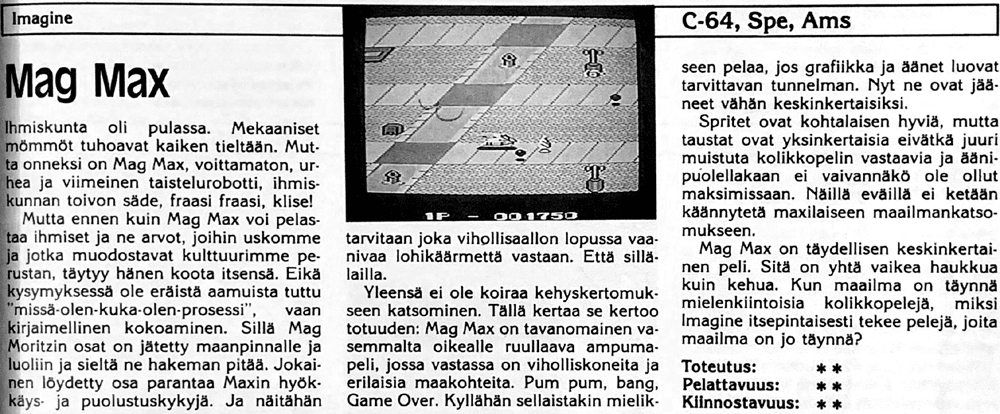
Mag Max1987Pysyvä linkkiIhmiskunta oli pulassa. Mekaaniset mömmöt tuhoavat kaiken tieltään. Mutta onneksi on Mag Max, voittamaton, urhea ja viimeinen taistelurobotti, ihmiskunnan toivon säde, fraasi fraasi, klise!
Mutta ennen kuin Mag Max voi pelastaa ihmiset ja ne arvot, joihin uskomme ja jotka muodostavat kulttuurimme perustan, täytyy hänen koota itsensä. Eikä kysymyksessä ole eräistä aamuista tuttu "missä-olen-kuka-olen-prosessi", vaan kirjaimellinen kokoaminen. Sillä Mag Moritzin osat on jätetty maanpinnalle ja luoliin ja sieltä ne hakeman pitää. Jokainen löydetty osa parantaa Maxin hyökkäys- ja puolustuskykyjä. Ja näitähän tarvitaan joka vihollisaallon lopussa vaanivaa lohikäärmettä vastaan. Että sillä lailla.
Yleensä ei ole koiraa kehyskertomukseen katsominen. Tällä kertaa se kertoo totuuden: Mag Max on tavanomainen vasemmalta oikealle ruullaava ampumapeli, jossa vastassa on viholliskoneita ja erilaisia maakohteita. Pum pum, bang, Game Over. Kyllähän sellaistakin mielikseen pelaa, jos grafiikka ja äänet luovat tarvittavan tunnelman. Nyt ne ovat jääneet vähän keskinkertaisiksi.
Spritet ovat kohtalaisen hyviä, mutta taustat ovat yksinkertaisia eivätkä juuri muistuta kolikkopelin vastaavia ja äänipuolellakaan ei vaivannäkö ole ollut maksimissaan. Näillä eväillä ei ketään käännytetä maxilaiseen maailmankatsomukseen.
Mag Max on täydellisen keskinkertainen peli. Sitä on yhtä vaikea haukkua kuin kehua. Kun maailma on täynnä mielenkiintoisia kolikkopelejä, miksi Imagine itsepintaisesti tekee pelejä, joita maailma on jo täynnä?
Mag Max1987PermalinkMankind was in a pickle. Mechanical nasties are destroying everything in their path. But luckily there is Mag Max, the invincible, brave and last battle robot, mankind's ray of hope, phrase phrase, cliché!
But before Mag Max can save humanity and the values we believe in and which form the foundation of our culture, he has to pull himself together. And we don't mean the "where-am-I-who-am-I process" familiar from certain mornings, but pulling himself together quite literally. For Mag Moritz's parts have been left lying on the surface and in caves, and that's where they have to be fetched from. Every part found improves Max's attack and defence capabilities. And those will certainly be needed against the dragon lurking at the end of every enemy wave. So there you have it.
Usually you shouldn't judge a book by its backstory. This time it tells the truth: Mag Max is a run-of-the-mill left-to-right scrolling shoot-'em-up, with enemy craft and assorted ground targets to face. Bang bang, boom, Game Over. Sure, you can happily play that sort of thing too, if the graphics and sound create the right atmosphere. This time they've ended up a bit mediocre.
The sprites are reasonably good, but the backgrounds are simple and bear little resemblance to the arcade game's, and on the sound side, too, the effort has hardly been maxed out. On this showing nobody is going to be converted to the Maxist world view.
Mag Max is a perfectly mediocre game. It's as hard to slate as it is to praise. When the world is full of interesting arcade games, why does Imagine stubbornly insist on making games the world is already full of?
Magic Fly
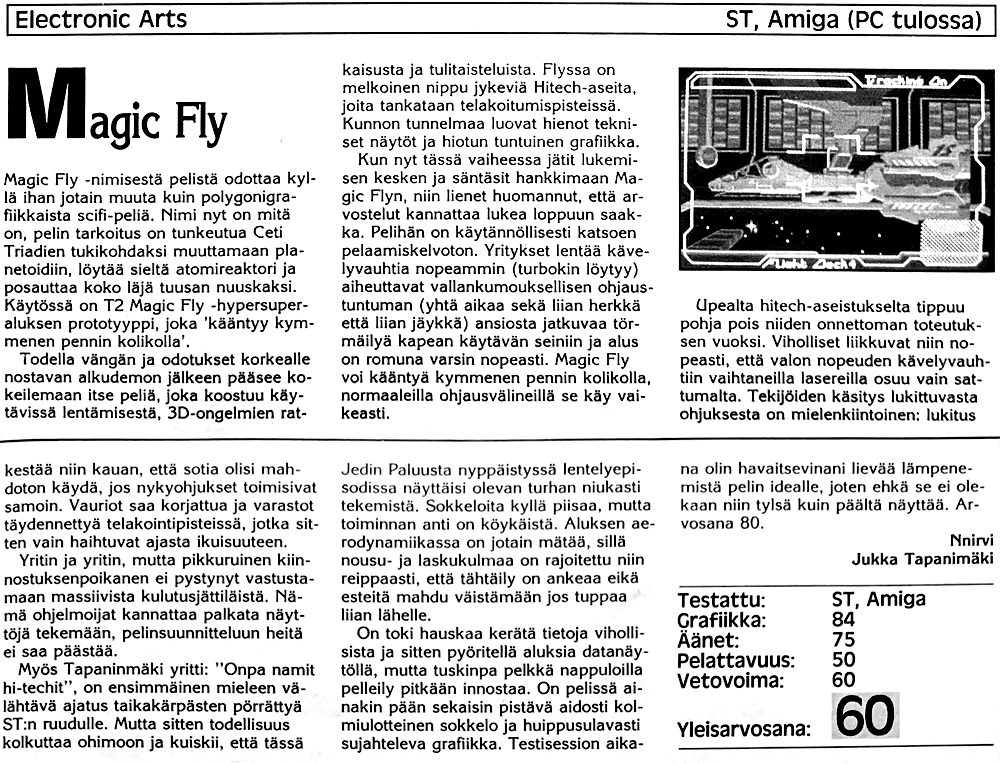
Magic Fly1991 KevätPysyvä linkkiMagic Fly -nimisestä pelistä odottaa kyllä ihan jotain muuta kuin polygonigrafiikkaista scifi-peliä. Nimi nyt on mitä on, pelin tarkoitus on tunkeutua Ceti Triadien tukikohdaksi muuttamaan planetoidiin, löytää sieltä atomireaktori ja posauttaa koko läjä tuusan nuuskaksi. Käytössä on T2 Magic Fly -hypersuperaluksen prototyyppi, joka 'kääntyy kymmenen pennin kolikolla'.
Todella vängän ja odotukset korkealle nostavan alkudemon jälkeen pääsee kokeilemaan itse peliä, joka koostuu käytävissä lentämisestä, 3D-ongelmien ratkaisusta ja tulitaisteluista. Flyssa on melkoinen nippu jykeviä Hitech-aseita, joita tankataan telakoitumispisteissä. Kunnon tunnelmaa luovat hienot tekniset näytöt ja hiotun tuntuinen grafiikka.
Kun nyt tässä vaiheessa jätit lukemisen kesken ja säntäsit hankkimaan Magic Flyn, niin lienet huomannut, että arvostelut kannattaa lukea loppuun saakka. Pelihän on käytännöllisesti katsoen pelaamiskelvoton. Yritykset lentää kävelyvauhtia nopeammin (turbokin löytyy) aiheuttavat vallankumouksellisen ohjaustuntuman (yhtä aikaa sekä liian herkkä että liian jäykkä) ansiosta jatkuvaa törmäilyä kapean käytävän seiniin ja alus on romuna varsin nopeasti. Magic Fly voi kääntyä kymmenen pennin kolikolla, normaaleilla ohjausvälineillä se käy vaikeasti.
Upealta hitech-aseistukselta tippuu pohja pois niiden onnettoman toteutuksen vuoksi. Viholliset liikkuvat niin nopeasti, että valon nopeuden kävelyvauhtiin vaihtaneilla lasereilla osuu vain sattumalta. Tekijöiden käsitys lukittuvasta ohjuksesta on mielenkiintoinen: lukitus kestää niin kauan, että sotia olisi mahdoton käydä, jos nykyohjukset toimisivat samoin. Vauriot saa korjattua ja varastot täydennettyä telakointipisteissä, jotka sitten vain haihtuvat ajasta ikuisuuteen.
Yritin ja yritin, mutta pikkuruinen kiinnostuksenpoikanen ei pystynyt vastustamaan massiivista kulutusjättiläistä. Nämä ohjelmoijat kannattaa palkata näyttöjä tekemään, pelinsuunnitteluun heitä ei saa päästää.
Myös Tapaninmäki yritti: "Onpa namit hi-techit", on ensimmäinen mieleen välähtävä ajatus taikakärpästen pörrättyä ST:n ruudulle. Mutta sitten todellisuus kolkuttaa ohimoon ja kuiskii, että tässä Jedin Paluusta nyppäistyssä lentelyepisodissa näyttäisi olevan turhan niukasti tekemistä. Sokkeloita kyllä piisaa, mutta toiminnan anti on köykäistä. Aluksen aerodynamiikassa on jotain mätää, sillä nousu- ja laskukulmaa on rajoitettu niin reippaasti, että tähtäily on ankeaa eikä esteitä mahdu väistämään jos tuppaa liian lähelle.
On toki hauskaa kerätä tietoja vihollisista ja sitten pyöritellä aluksia datanäytöllä, mutta tuskinpa pelkkä nappuloilla pelleily pitkään innostaa. On pelissä ainakin pään sekaisin pistävä aidosti kolmiulotteinen sokkelo ja huippusulavasti sujahteleva grafiikka. Testisession aikana olin havaitsevinani lievää lämpenemistä pelin idealle, joten ehkä se ei olekaan niin tylsä kuin päältä näyttää. Arvosana 80.
Magic Fly1991 KevätPermalinkFrom a game called Magic Fly you'd certainly expect something quite different from a polygon-graphics sci-fi game. The name is what it is; the aim of the game is to break into a planetoid that the Ceti Triads have turned into a base, find the atomic reactor there and blow the whole heap to smithereens. At your disposal is the prototype of the T2 Magic Fly hyper-super-ship, which 'turns on a ten-pence piece'.
After a really wicked intro demo that raises your expectations sky-high, you get to try out the game itself, which consists of flying along corridors, solving 3D problems and firefights. The Fly packs quite a bundle of hefty hi-tech weapons, which are topped up at docking points. A proper atmosphere is created by fine technical displays and polished-feeling graphics.
Now, if at this point you broke off reading and rushed out to get hold of Magic Fly, you've probably noticed that reviews are worth reading right to the end. The game is, for all practical purposes, unplayable. Attempts to fly faster than walking pace (there's even a turbo) lead, thanks to the revolutionary control feel (both too sensitive and too stiff at the same time), to constant bumping into the walls of the narrow corridor, and the ship is scrap pretty quickly. The Magic Fly may be able to turn on a ten-pence piece, but with normal controls it's hard going.
The superb hi-tech armament has the bottom knocked out of it by its hapless implementation. The enemies move so fast that the lasers, having swapped the speed of light for walking pace, only hit by chance. The makers' notion of a lock-on missile is an interesting one: the lock-on takes so long that waging war would be impossible if today's missiles worked the same way. Damage can be repaired and supplies replenished at docking points, which then simply evaporate from time into eternity.
I tried and tried, but my teeny-tiny fledgling of interest couldn't hold out against the massive giant of attrition. These programmers are well worth hiring to make displays, but they must not be let anywhere near game design.
Tapaninmäki tried too: "Ooh, what yummy hi-techs," is the first thought to flash into your mind once the magic flies have buzzed onto the ST's screen. But then reality knocks at your temple and whispers that this flying-about episode, plucked from Return of the Jedi, seems to have rather too little to do in it. There are mazes aplenty, but the action on offer is flimsy. There's something rotten in the ship's aerodynamics, because the climb and dive angles have been restricted so drastically that aiming is dismal and there's no room to dodge obstacles if you get too close.
Sure, it's fun to gather information on the enemies and then spin the ships around on the data screen, but mere fiddling with buttons is hardly going to excite for long. At least the game does have a head-spinning, genuinely three-dimensional maze and super-smoothly gliding graphics. During the test session I thought I detected a slight warming to the game's idea, so maybe it isn't as dull as it looks on the surface. Rating 80.
Magic Marble
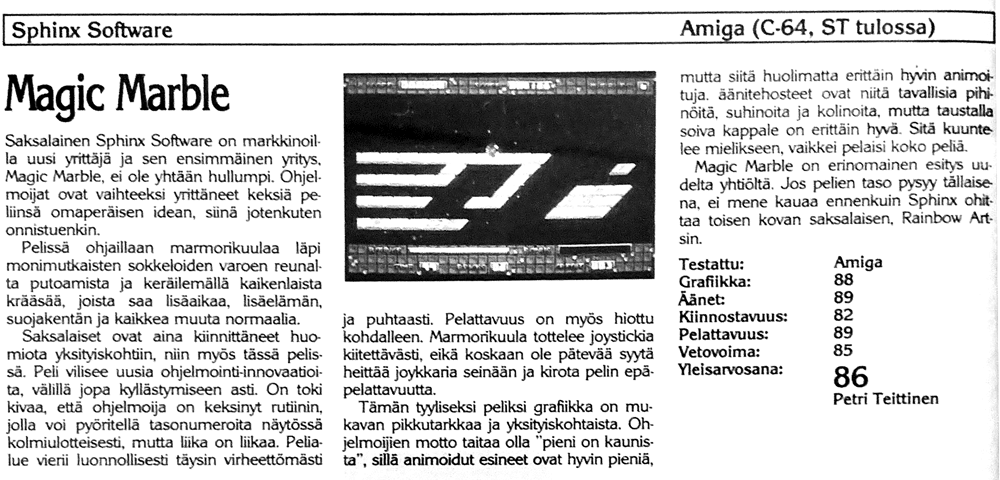
Magic Marble1990 KevätPysyvä linkkiSaksalainen Sphinx Software on markkinoilla uusi yrittäjä ja sen ensimmäinen yritys, Magic Marble, ei ole yhtään hullumpi. Ohjelmoijat ovat vaihteeksi yrittäneet keksiä peliinsä omaperäisen idean, siinä jotenkuten onnistuenkin.
Pelissä ohjaillaan marmorikuulaa läpi monimutkaisten sokkeloiden varoen reunalta putoamista ja keräilemällä kaikenlaista krääsää, joista saa lisäaikaa, lisäelämän, suojakentän ja kaikkea muuta normaalia.
Saksalaiset ovat aina kiinnittäneet huomiota yksityiskohtiin, niin myös tässä pelissä. Peli vilisee uusia ohjelmointi-innovaatioita, välillä jopa kyllästymiseen asti. On toki kivaa, että ohjelmoija on keksinyt rutiinin, jolla voi pyöritellä tasonumeroita näytössä kolmiulotteisesti, mutta liika on liikaa. Pelialue vierii luonnollisesti täysin virheettömästi ja puhtaasti. Pelattavuus on myös hiottu kohdalleen. Marmorikuula tottelee joystickia kiitettävästi, eikä koskaan ole pätevää syytä heittää joykkaria seinään ja kirota pelin epäpelattavuutta.
Tämän tyyliseksi peliksi grafiikka on mukavan pikkutarkkaa ja yksityiskohtaista. Ohjelmoijien motto taitaa olla "pieni on kaunista", sillä animoidut esineet ovat hyvin pieniä, mutta siitä huolimatta erittäin hyvin animoituja. äänitehosteet ovat niitä tavallisia pihinöitä, suhinoita ja kolinoita, mutta taustalla soiva kappale on erittäin hyvä. Sitä kuuntelee mielikseen, vaikkei pelaisi koko peliä.
Magic Marble on erinomainen esitys uudelta yhtiöltä. Jos pelien taso pysyy tällaisena, ei mene kauaa ennenkuin Sphinx ohittaa toisen kovan saksalaisen, Rainbow Artsin.
Magic Marble1990 KevätPermalinkThe German Sphinx Software is a newcomer on the market, and its first effort, Magic Marble, isn't half bad at all. For a change, the programmers have tried to come up with an original idea for their game, and have even more or less pulled it off.
In the game you steer a marble through complicated mazes, taking care not to fall off the edge and collecting all sorts of junk that gets you extra time, an extra life, a shield and all the other usual stuff.
The Germans have always paid attention to detail, and this game is no exception. The game teems with new programming innovations, at times to the point of tedium. Sure, it's nice that the programmer has come up with a routine for spinning the level numbers around on screen in three dimensions, but enough is enough. The playfield naturally scrolls completely flawlessly and cleanly. The playability has been honed just right, too. The marble obeys the joystick admirably, and there is never any good reason to hurl the stick at the wall and curse the game's unplayability.
For a game of this style, the graphics are pleasantly fine and detailed. The programmers' motto must be "small is beautiful", since the animated objects are very small, but very well animated all the same. The sound effects are the usual hisses, swishes and clunks, but the tune playing in the background is very good. You'd happily listen to it even without playing the game at all.
Magic Marble is an excellent showing from a new company. If the standard of its games stays like this, it won't be long before Sphinx overtakes that other tough German outfit, Rainbow Arts.
Manchester United
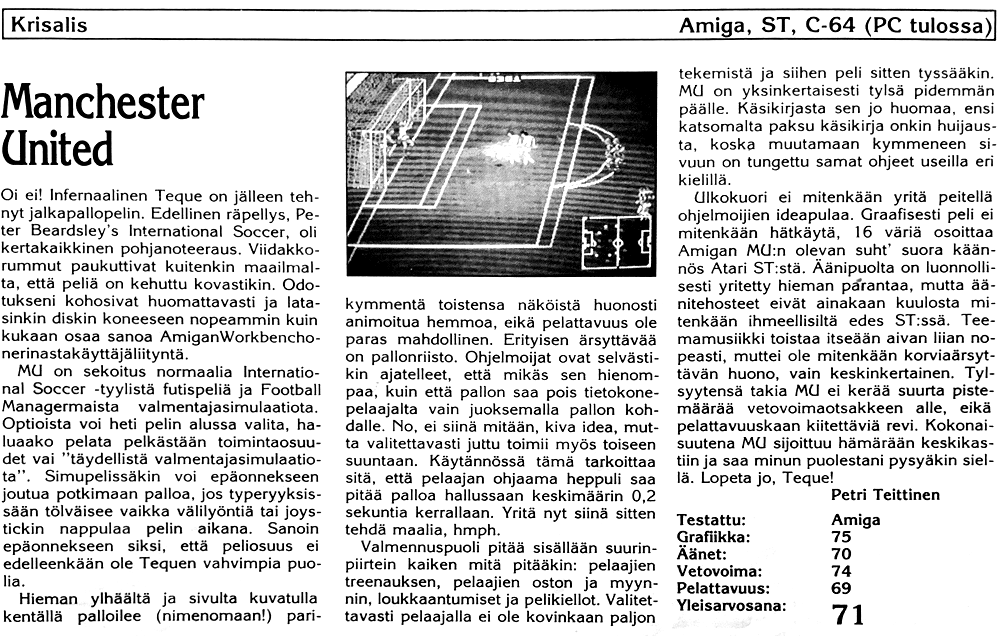
Manchester United1990 SyksyPysyvä linkkiOi ei! Infernaalinen Teque on jälleen tehnyt jalkapallopelin. Edellinen räpellys, Peter Beardsley's International Soccer, oli kertakaikkinen pohjanoteeraus. Viidakkorummut paukuttivat kuitenkin maailmalta, että peliä on kehuttu kovastikin. Odotukseni kohosivat huomattavasti ja latasinkin diskin koneeseen nopeammin kuin kukaan osaa sanoa AmiganWorkbenchonerinastakäyttäjäliityntä.
MU on sekoitus normaalia International Soccer -tyylistä futispeliä ja Football Managermaista valmentajasimulaatiota. Optioista voi heti pelin alussa valita, haluaako pelata pelkästään toimintaosuudet vai "täydellistä valmentajasimulaatiota". Simupelissäkin voi epäonnekseen joutua potkimaan palloa, jos typeryyksissään tölväisee vaikka välilyöntiä tai joystickin nappulaa pelin aikana. Sanoin epäonnekseen siksi, että peliosuus ei edelleenkään ole Tequen vahvimpia puolia.
Hieman ylhäältä ja sivulta kuvatulla kentällä palloilee (nimenomaan!) parikymmentä toistensa näköistä huonosti animoitua hemmoa, eikä pelattavuus ole paras mahdollinen. Erityisen ärsyttävää on pallonriisto. Ohjelmoijat ovat selvästikin ajatelleet, että mikäs sen hienompaa, kuin että pallon saa pois tietokonepelaajalta vain juoksemalla pallon kohdalle. No, ei siinä mitään, kiva idea, mutta valitettavasti juttu toimii myös toiseen suuntaan. Käytännössä tämä tarkoittaa sitä, että pelaajan ohjaama heppuli saa pitää palloa hallussaan keskimäärin 0,2 sekuntia kerrallaan. Yritä nyt siinä sitten tehdä maalia, hmph.
Valmennuspuoli pitää sisällään suurinpiirtein kaiken mitä pitääkin: pelaajien treenauksen, pelaajien oston ja myynnin, loukkaantumiset ja pelikiellot. Valitettavasti pelaajalla ei ole kovinkaan paljon tekemistä ja siihen peli sitten tyssääkin. MU on yksinkertaisesti tylsä pidemmän päälle. Käsikirjasta sen jo huomaa, ensi katsomalta paksu käsikirja onkin huijausta, koska muutamaan kymmeneen sivuun on tungettu samat ohjeet useilla eri kielillä.
Ulkokuori ei mitenkään yritä peitellä ohjelmoijien ideapulaa. Graafisesti peli ei mitenkään hätkäytä, 16 väriä osoittaa Amigan MU:n olevan suht' suora käännös Atari ST:stä. Äänipuolta on luonnollisesti yritetty hieman parantaa, mutta äänitehosteet eivät ainakaan kuulosta mitenkään ihmeellisiltä edes ST:ssä. Teemamusiikki toistaa itseään aivan liian nopeasti, muttei ole mitenkään korviaärsyttävän huono, vain keskinkertainen. Tylsyytensä takia MU ei kerää suurta pistemäärää vetovoimaotsakkeen alle, eikä pelattavuuskaan kiitettäviä revi. Kokonaisuutena MU sijoittuu hämärään keskikastiin ja saa minun puolestani pysyäkin siellä. Lopeta jo, Teque!
Manchester United1990 SyksyPermalinkOh no! The infernal Teque has made a football game again. The previous botch-up, Peter Beardsley's International Soccer, was an all-time low, full stop. Still, the jungle drums were pounding out word from abroad that the game had been praised pretty highly. My expectations rose considerably, and I loaded the disk into the machine faster than anyone can say AmigasWorkbenchisasplendiduserinterface.
MU is a mixture of a normal International Soccer-style footie game and a Football Manager-like manager simulation. Right at the start you can choose from the options whether you want to play just the action parts or the "complete manager simulation". Even in the sim game you can, to your misfortune, end up kicking the ball about if in your foolishness you happen to jab, say, the space bar or the joystick button during the game. I said to your misfortune because the playing part still isn't one of Teque's strong points.
On a pitch viewed slightly from above and from the side, twenty-odd identical-looking, badly animated blokes are kicking about (precisely!), and the playability isn't the best possible. Especially irritating is the tackling. The programmers have clearly thought: what could be finer than being able to take the ball off a computer player just by running onto the ball? Well, nothing wrong with that, nice idea, but unfortunately the thing works in the other direction too. In practice this means that the chap you control gets to keep the ball for an average of 0.2 seconds at a time. Just try scoring a goal like that, hmph.
The management side contains roughly everything it should: training players, buying and selling players, injuries and suspensions. Unfortunately the player doesn't have all that much to do, and that's where the game grinds to a halt. MU is simply boring in the long run. You can tell as much from the manual already: the manual, thick at first glance, is actually a con, because a few dozen pages have been crammed with the same instructions in several different languages.
The outer shell makes no attempt whatsoever to hide the programmers' shortage of ideas. Graphically the game doesn't startle in any way; the 16 colours show the Amiga MU to be a fairly straight conversion from the Atari ST. Naturally there has been some attempt to improve the sound a little, but the sound effects certainly wouldn't sound anything special even on the ST. The theme music repeats itself far too quickly, but it isn't ear-grindingly bad in any way, just mediocre. Because of its dullness MU doesn't rack up a big score under the appeal heading, and the playability doesn't snatch any top marks either. Overall, MU settles into the murky middle tier, and as far as I'm concerned it can stay there. Give it a rest, Teque!
Maniac Mansion
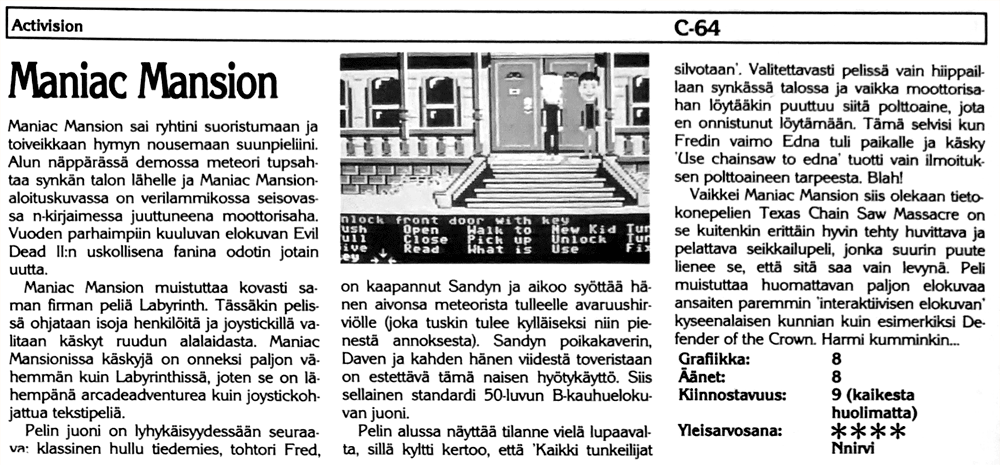
Maniac Mansion1988Pysyvä linkkiManiac Mansion sai ryhtini suoristumaan ja toiveikkaan hymyn nousemaan suunpieliini. Alun näppärässä demossa meteori tupsahtaa synkän talon lähelle ja Maniac Mansion-aloituskuvassa on verilammikossa seisovassa n-kirjaimessa juuttuneena moottorisaha. Vuoden parhaimpiin kuuluvan elokuvan Evil Dead II:n uskollisena fanina odotin jotain uutta.
Maniac Mansion muistuttaa kovasti saman firman peliä Labyrinth. Tässäkin pelissä ohjataan isoja henkilöitä ja joystickillä valitaan käskyt ruudun alalaidasta. Maniac Mansionissa käskyjä on onneksi paljon vähemmän kuin Labyrinthissä, joten se on lähempänä arcadeadventurea kuin joystickohjattua tekstipeliä.
Pelin juoni on lyhykäisyydessään seuraava: klassinen hullu tiedemies, tohtori Fred, on kaapannut Sandyn ja aikoo syöttää hänen aivonsa meteorista tulleelle avaruushirviölle (joka tuskin tulee kylläiseksi niin pienestä annoksesta). Sandyn poikakaverin, Daven ja kahden hänen viidestä toveristaan on estettävä tämä naisen hyötykäyttö. Siis sellainen standardi 50-luvun B-kauhuelokuvan juoni.
Pelin alussa näyttää tilanne vielä lupaavalta, sillä kyltti kertoo, että 'Kaikki tunkeilijat silvotaan'. Valitettavasti pelissä vain hiippaillaan synkässä talossa ja vaikka moottorisahan löytääkin puuttuu siitä polttoaine, jota en onnistunut löytämään. Tämä selvisi kun Fredin vaimo Edna tuli paikalle ja käsky 'Use chainsaw to edna' tuotti vain ilmoituksen polttoaineen tarpeesta. Blah!
Vaikkei Maniac Mansion siis olekaan tietokonepelien Texas Chain Saw Massacre on se kuitenkin erittäin hyvin tehty huvittava ja pelattava seikkailupeli, jonka suurin puute lienee se, että sitä saa vain levynä. Peli muistuttaa huomattavan paljon elokuvaa ansaiten paremmin 'interaktiivisen elokuvan' kyseenalaisen kunnian kuin esimerkiksi Defender of the Crown. Harmi kumminkin...
Maniac Mansion1988PermalinkManiac Mansion made me sit up straight and brought a hopeful smile to the corners of my mouth. In the nifty demo at the start a meteor plops down near a gloomy house, and on the Maniac Mansion title screen there's a chainsaw stuck in the letter n, which stands in a pool of blood. As a loyal fan of Evil Dead II, one of the best films of the year, I was expecting something new.
Maniac Mansion closely resembles the same company's game Labyrinth. In this game too you control big characters and pick commands from the bottom of the screen with the joystick. Fortunately Maniac Mansion has far fewer commands than Labyrinth, so it is closer to an arcade adventure than to a joystick-controlled text game.
In a nutshell the plot is as follows: the classic mad scientist, Doctor Fred, has kidnapped Sandy and intends to feed her brain to the space monster that came with the meteor (which is hardly going to be filled up by such a small portion). Sandy's boyfriend Dave and two of his five pals must prevent the lady from being put to such practical use. So, your standard 50s B-horror-movie plot.
At the start of the game things still look promising, since a sign announces that 'All trespassers will be mutilated'. Unfortunately in the game you just creep around the gloomy house, and even though you do find the chainsaw, it has no fuel, which I didn't manage to find. I discovered this when Fred's wife Edna turned up and the command 'Use chainsaw to edna' only produced a message about needing fuel. Blah!
So although Maniac Mansion isn't the Texas Chain Saw Massacre of computer games, it is nonetheless a very well made, amusing and playable adventure game, whose biggest shortcoming is probably that it's only available on disk. The game resembles a film to a remarkable degree, earning the dubious honour of 'interactive movie' more than, say, Defender of the Crown does. A pity, all the same...
Marauder
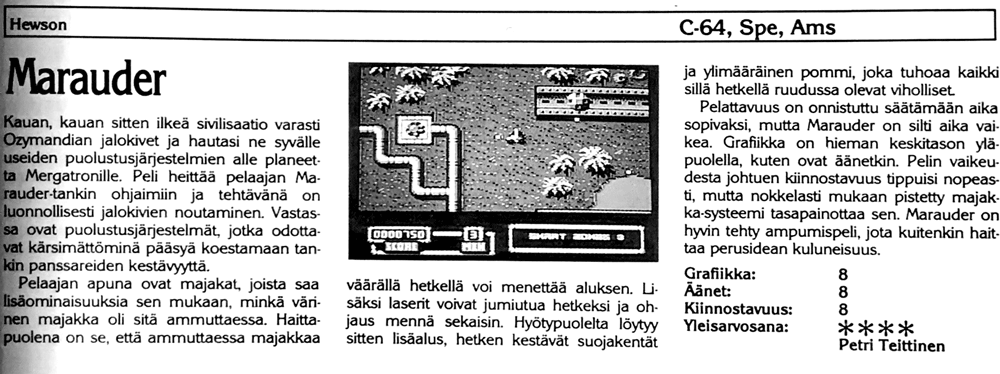
Marauder1988Pysyvä linkkiKauan, kauan sitten ilkeä sivilisaatio varasti Ozymandian jalokivet ja hautasi ne syvälle useiden puolustusjärjestelmien alle planeetta Mergatronille. Peli heittää pelaajan Marauder-tankin ohjaimiin ja tehtävänä on luonnollisesti jalokivien noutaminen. Vastassa ovat puolustusjärjestelmät, jotka odottavat kärsimättöminä pääsyä koestamaan tankin panssareiden kestävyyttä.
Pelaajan apuna ovat majakat, joista saa lisäominaisuuksia sen mukaan, minkä värinen majakka oli sitä ammuttaessa. Haittapuolena on se, että ammuttaessa majakkaa väärällä hetkellä voi menettää aluksen. Lisäksi laserit voivat jumiutua hetkeksi ja ohjaus mennä sekaisin. Hyötypuolelta löytyy sitten lisäalus, hetken kestävät suojakentät ja ylimääräinen pommi, joka tuhoaa kaikki sillä hetkellä ruudussa olevat viholliset.
Pelattavuus on onnistuttu säätämään aika sopivaksi, mutta Marauder on silti aika vaikea. Grafiikka on hieman keskitason yläpuolella, kuten ovat äänetkin. Pelin vaikeudesta johtuen kiinnostavuus tippuisi nopeasti, mutta nokkelasti mukaan pistetty majakka-systeemi tasapainottaa sen. Marauder on hyvin tehty ampumispeli, jota kuitenkin haittaa perusidean kuluneisuus.
Marauder1988PermalinkLong, long ago an evil civilisation stole the jewels of Ozymandia and buried them deep beneath several defence systems on the planet Mergatron. The game throws the player into the controls of the Marauder tank, and the task is naturally to retrieve the jewels. Standing in your way are the defence systems, which are waiting impatiently for their chance to test how well the tank's armour holds up.
Helping the player are beacons, which give you extra features depending on what colour the beacon was when you shot it. The downside is that if you shoot a beacon at the wrong moment you can lose a ship. The lasers can also jam for a while and the controls can go haywire. On the plus side there's an extra ship, shields that last a short while and a bonus bomb that destroys all the enemies on screen at that moment.
The playability has been tuned just about right, but Marauder is still pretty hard. The graphics are slightly above average, as is the sound. Because of the game's difficulty the interest would drop off quickly, but the cleverly added beacon system balances that out. Marauder is a well made shoot-'em-up, which is held back, however, by how worn out its basic idea is.
Marble Madness
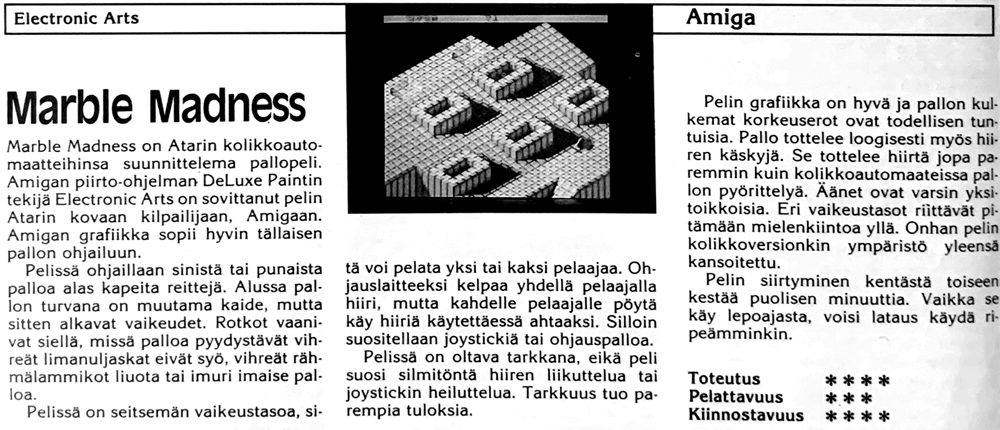
Marble Madness1987Pysyvä linkkiMarble Madness on Atarin kolikkoautomaatteihinsa suunnittelema pallopeli. Amigan piirto-ohjelman DeLuxe Paintin tekijä Electronic Arts on sovittanut pelin Atarin kovaan kilpailijaan, Amigaan. Amigan grafiikka sopii hyvin tällaisen pallon ohjailuun.
Pelissä ohjaillaan sinistä tai punaista palloa alas kapeita reittejä. Alussa pallon turvana on muutama kaide, mutta sitten alkavat vaikeudet. Rotkot vaanivat siellä, missä palloa pyydystävät vihreät limanuljaskat eivät syö, vihreät rähmälammikot liuota tai imuri imaise palloa.
Pelissä on seitsemän vaikeustasoa, sitä voi pelata yksi tai kaksi pelaajaa. Ohjauslaitteeksi kelpaa yhdellä pelaajalla hiiri, mutta kahdelle pelaajalle pöytä käy hiiriä käytettäessä ahtaaksi. Silloin suositellaan joystickiä tai ohjauspalloa.
Pelissä on oltava tarkkana, eikä peli suosi silmitöntä hiiren liikuttelua tai joystickin heiluttelua. Tarkkuus tuo parempia tuloksia.
Pelin grafiikka on hyvä ja pallon kulkemat korkeuserot ovat todellisen tuntuisia. Pallo tottelee loogisesti myös hiiren käskyjä. Se tottelee hiirtä jopa paremmin kuin kolikkoautomaateissa pallon pyörittelyä. Äänet ovat varsin yksitoikkoisia. Eri vaikeustasot riittävät pitämään mielenkiintoa yllä. Onhan pelin kolikkoversionkin ympäristö yleensä kansoitettu.
Pelin siirtyminen kentästä toiseen kestää puolisen minuuttia. Vaikka se käy lepoajasta, voisi lataus käydä ripeämminkin.
Marble Madness1987PermalinkMarble Madness is a ball game Atari designed for its coin-op machines. Electronic Arts, the maker of the Amiga paint program DeLuxe Paint, has converted the game to Atari's tough rival, the Amiga. The Amiga's graphics are well suited to steering a ball like this.
In the game you steer a blue or a red ball down narrow routes. At first the ball has a few railings to keep it safe, but then the trouble starts. Chasms lurk wherever the green slime-blobs out to catch the ball don't gobble it up, the green gunk puddles don't dissolve it or the vacuum cleaner doesn't suck it in.
The game has seven difficulty levels, and it can be played by one or two players. With one player the mouse will do as a controller, but with two players using mice the table gets cramped. In that case a joystick or a trackball is recommended.
You have to be careful in this game, and it doesn't reward frantic mouse-shoving or joystick-waggling. Precision brings better results.
The game's graphics are good and the drops and climbs the ball travels over feel real. The ball also obeys the mouse's commands logically. It follows the mouse even better than the ball follows the spinning of the trackball on the arcade machines. The sound is pretty monotonous. The various difficulty levels are enough to keep the interest up. After all, the coin-op version usually has a crowd around it too.
Moving the game from one level to the next takes about half a minute. Even though that passes for a rest break, the loading could be quicker.
Mario Andretti's Racing Challenge
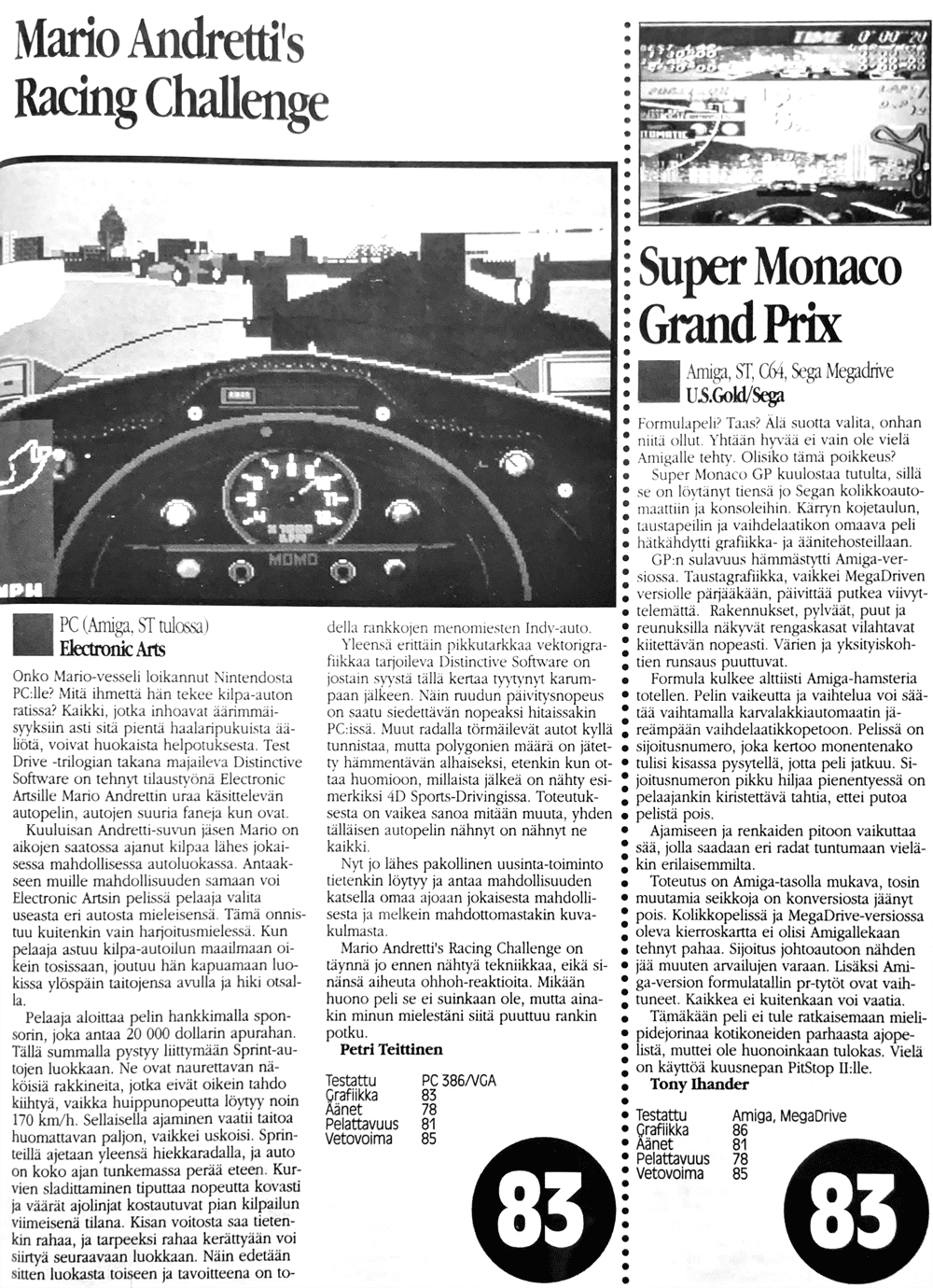
Mario Andretti's Racing Challenge1991 SyksyPysyvä linkkiOnko Mario-vesseli loikannut Nintendosta PC:lle? Mitä ihmettä hän tekee kilpa-auton ratissa? Kaikki, jotka inhoavat äärimmäisyyksiin asti sitä pientä haalaripukuista ääliötä, voivat huokaista helpotuksesta. Test Drive -trilogian takana majaileva Distinctive Software on tehnyt tilaustyönä Electronic Artsille Mario Andrettin uraa käsittelevän autopelin, autojen suuria faneja kun ovat.
Kuuluisan Andretti-suvun jäsen Mario on aikojen saatossa ajanut kilpaa lähes jokaisessa mahdollisessa autoluokassa. Antaakseen muille mahdollisuuden samaan voi Electronic Artsin pelissä pelaaja valita useasta eri autosta mieleisensä. Tämä onnistuu kuitenkin vain harjoitusmielessä. Kun pelaaja astuu kilpa-autoilun maailmaan oikein tosissaan, joutuu hän kapuamaan luokissa ylöspäin taitojensa avulla ja hiki otsalla.
Pelaaja aloittaa pelin hankkimalla sponsorin, joka antaa 20 000 dollarin apurahan. Tällä summalla pystyy liittymään Sprint-autojen luokkaan. Ne ovat naurettavan näköisiä rakkineita, jotka eivät oikein tahdo kiihtyä, vaikka huippunopeutta löytyy noin 170 km/h. Sellaisella ajaminen vaatii taitoa huomattavan paljon, vaikkei uskoisi. Sprinteillä ajetaan yleensä hiekkaradalla, ja auto on koko ajan tunkemassa perää eteen. Kurvien sladittaminen tiputtaa nopeutta kovasti ja väärät ajolinjat kostautuvat pian kilpailun viimeisenä tilana. Kisan voitosta saa tietenkin rahaa, ja tarpeeksi rahaa kerättyään voi siirtyä seuraavaan luokkaan. Näin edetään sitten luokasta toiseen ja tavoitteena on todella rankkojen menomiesten Indy-auto.
Yleensä erittäin pikkutarkkaa vektorigrafiikkaa tarjoileva Distinctive Software on jostain syystä tällä kertaa tyytynyt karumpaan jälkeen. Näin ruudun päivitysnopeus on saatu siedettävän nopeaksi hitaissakin PC:issä. Muut radalla törmäilevät autot kyllä tunnistaa, mutta polygonien määrä on jätetty hämmentävän alhaiseksi, etenkin kun ottaa huomioon, millaista jälkeä on nähty esimerkiksi 4D Sports-Drivingissa. Toteutuksesta on vaikea sanoa mitään muuta, yhden tälläisen autopelin nähnyt on nähnyt ne kaikki.
Nyt jo lähes pakollinen uusinta-toiminto tietenkin löytyy ja antaa mahdollisuuden katsella omaa ajoaan jokaisesta mahdollisesta ja melkein mahdottomastakin kuvakulmasta.
Mario Andretti's Racing Challenge on täynnä jo ennen nähtyä tekniikkaa, eikä sinänsä aiheuta ohhoh-reaktioita. Mikään huono peli se ei suinkaan ole, mutta ainakin minun mielestäni siitä puuttuu rankin potku.
Mario Andretti's Racing Challenge1991 SyksyPermalinkHas that Mario rascal defected from Nintendo to the PC? What on earth is Mario doing behind the wheel of a racing car? Everyone who loathes that little idiot in overalls to the utmost can breathe a sigh of relief. Distinctive Software, the outfit lurking behind the Test Drive trilogy, has made a car game about Mario Andretti's career as commissioned work for Electronic Arts, big car fans that they are.
A member of the famous Andretti clan, Mario has over the years raced in almost every car class imaginable. To give others a shot at the same, Electronic Arts' game lets the player pick whichever of several different cars takes their fancy. This only works as practice, though. When the player enters the world of motor racing in dead earnest, they have to climb up through the classes by skill and by the sweat of their brow.
The player starts the game by landing a sponsor, who hands over a grant of 20,000 dollars. That sum is enough to join the Sprint car class. These are ridiculous-looking contraptions that don't really want to accelerate, even though they top out at around 170 km/h. Driving one takes a remarkable amount of skill, though you wouldn't think it. Sprints usually race on dirt tracks, and the car is forever trying to shove its tail round to the front. Sliding through the bends knocks your speed down hard, and wrong racing lines soon come back to bite you in the shape of last place. Winning a race naturally earns you money, and once you've scraped together enough you can move up to the next class. And so you progress from one class to the next, the goal being the Indy car of the truly hard-core hotshots.
Distinctive Software, usually a purveyor of extremely meticulous vector graphics, has for some reason settled for a plainer finish this time. As a result the screen update rate has been made tolerably quick even on slow PCs. You can certainly recognise the other cars bumping around the track, but the polygon count has been kept bewilderingly low, especially considering the kind of work we've seen in, say, 4D Sports-Driving. It's hard to say anything else about the implementation; once you've seen one car game like this, you've seen them all.
The replay feature, by now practically compulsory, is naturally present and lets you watch your own driving from every possible and even nearly impossible camera angle.
Mario Andretti's Racing Challenge is packed with technology we've seen before, and as such doesn't trigger any oh-wow reactions. It's by no means a bad game, but in my opinion at least, it lacks that really hard kick.
Mario Bros
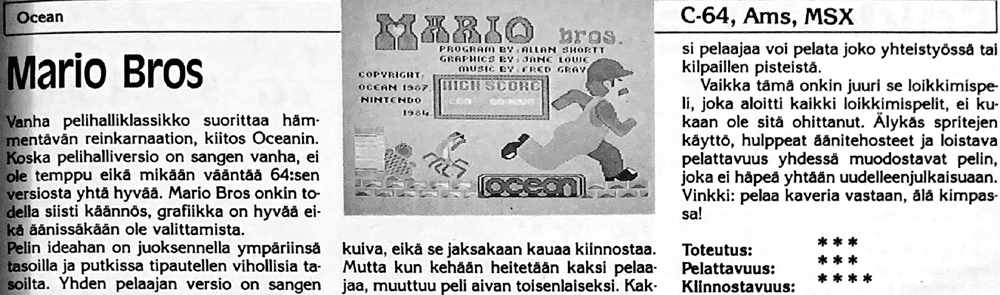
Mario Bros1987Pysyvä linkkiVanha pelihalliklassikko suorittaa hämmentävän reinkarnaation, kiitos Oceanin. Koska pelihalliversio on sangen vanha, ei ole temppu eikä mikään vääntää 64:sen versiosta yhtä hyvää. Mario Bros onkin todella siisti käännös, grafiikka on hyvää eikä äänissäkään ole valittamista.
Pelin ideahan on juoksennella ympäriinsä tasoilla ja putkissa tipautellen vihollisia tasoilta. Yhden pelaajan versio on sangen kuiva, eikä se jaksakaan kauaa kiinnostaa. Mutta kun kehään heitetään kaksi pelaajaa, muuttuu peli aivan toisenlaiseksi. Kaksi pelaajaa voi pelata joko yhteistyössä tai kilpaillen pisteistä.
Vaikka tämä onkin juuri se loikkimispeli, joka aloitti kaikki loikkimispelit, ei kukaan ole sitä ohittanut. Älykäs spritejen käyttö, hulppeat äänitehosteet ja loistava pelattavuus yhdessä muodostavat pelin, joka ei häpeä yhtään uudelleenjulkaisuaan. Vinkki: pelaa kaveria vastaan, älä kimpassa!
Mario Bros1987PermalinkAn old arcade classic undergoes a baffling reincarnation, thanks to Ocean. Since the arcade version is pretty old, it's no trick at all to knock out a Commodore 64 version that's just as good. And Mario Bros is indeed a really neat conversion: the graphics are good and there's nothing to complain about in the sound either.
The idea of the game, of course, is to run around the platforms and pipes knocking enemies off the platforms. The one-player version is pretty dry, and it doesn't hold the interest for long. But throw two players into the ring and the game becomes something else entirely. The two players can play either cooperatively or competing for points.
Even though this is the very jumping game that started all jumping games, nobody has surpassed it. Clever use of sprites, splendid sound effects and brilliant playability together make a game that needn't be the least bit ashamed of its re-release. Tip: play against your mate, not as a team!
Mars Saga

Mars Saga1989 KevätPysyvä linkkiKun helvetti on täynnä kuolleet kävelevät maan päällä...ups, kun Maan vankilat ovat täynnä vangit kävelevät Marsin päällä. Näin asutettiin Australia ja näin tullaan asuttamaan Electronic Artsin mukaan myös Mars.
Mars Saga on roolipeli, joka vaihteeksi sijoittuu tulevaisuuteen. Pelaajan alus teki pakkolaskun Marsiin, murskaantui ja rahat ovat loppu. Kotiin on niin ikävä, että hänen on pakko hyväksyä tarjottu tehtävä ja tutkia miksi yhteydet Prosceniumiin, Marsin suurimpaan kaupunkiin ovat katkenneet. Matkalla pelaaja tutustuu viehättäviin marsilaisiin elämänmuotoihin, ehkä lähemmin kuin haluaisikaan. Joka tapauksessa tehtävän suorittaminen on ainoa tie pois tältä kurjalta planeetalta.
Mars Sagan takaa löytyy vanha tuttu Westwood Associates. Saga ei vaihteeksi olekaan Ultima-kopio eikä edes Bard's-kopio, vaan miellyttävä järjestelmä, joka näyttää ympäristön paitsi kolmiulotteisena niin myös kätevänä karttana. Lisäksi Mars Saga on muutenkin harvinaisen pelattava. Näppäimistöön ei tarvitse koskea ja suurin osa pelistä on koko ajan muistissa, joten levyasema pyörii harvinaisen harvakseen.
Pelaaja aloittaa pelin yksin, mutta voi värvätä lisää porukkaa pelin edistyessä. Jokainen hahmo voi oppia taitoja 21 eri taidon ryhmästä. Taitoa löytyy aina erilaisten aseiden käytöstä hakkerointiin. Onpa Mars Sagassa oma boxikin. Pelaajien arvot näkyvät numeroiden asemasta pylväinä.
Taisteluosuus on erittäin mielenkiintoinen. Sen voi jättää kokonaan tietokoneen huoleksi tai tapella itse. Taktisessa taistelussa hahmoille annetaan komentojono, jota he yrittävät parhaansa mukaan toteuttaa. Taistelijat on kuvattu ylhäältä ja animoitu. Suoraan sanoen Mars Sagan taistelumekanismi on yksi parhaita kohtaamistani.
Mars Saga on todella erinomainen roolipeli, joka ei hukuta pelaajaa mittavaan optioröykkiöön, mutta on siitä huolimatta tarpeeksi monipuolinen, ettei puuduttava samankaltaisuus ala rasittaa. Sopii myös aloittelevalle roolipelaajalle.
Mars Saga1989 KevätPermalinkWhen hell is full, the dead walk the earth... oops, when the Earth's prisons are full, the prisoners walk on Mars. That is how Australia was settled, and according to Electronic Arts that is how Mars will be settled too.
Mars Saga is a role-playing game which, for a change, is set in the future. The player's ship made a forced landing on Mars and was smashed to pieces, and the money has run out. Homesickness is so bad that the player has no choice but to accept the job on offer and find out why contact with Proscenium, the biggest city on Mars, has been lost. Along the way the player gets acquainted with charming Martian life forms, perhaps more closely than they'd care to. In any case, completing the mission is the only way off this wretched planet.
Behind Mars Saga is our old friend Westwood Associates. For a change, the Saga isn't an Ultima copy, or even a Bard's copy, but a pleasant system that shows your surroundings not only in 3D but also as a handy map. Mars Saga is also unusually playable in other respects. You never have to touch the keyboard and most of the game is in memory all the time, so the disk drive spins unusually seldom.
The player starts the game alone but can recruit more people as the game progresses. Each character can learn skills from 21 different skill groups. The skills range all the way from using various weapons to hacking. Mars Saga even has its own box. The players' stats are shown as bars instead of numbers.
The combat part is extremely interesting. You can leave it entirely to the computer or do the fighting yourself. In tactical combat the characters are given a queue of commands, which they try to carry out as best they can. The fighters are shown from above and animated. Frankly, Mars Saga's combat mechanism is one of the best I've come across.
Mars Saga is a truly excellent role-playing game that doesn't drown the player in a massive heap of options, yet is still varied enough that numbing sameness doesn't start to grate. Suitable for the novice role-player too.
Mask
Mask1988Pysyvä linkkiKuin syöpä leviää ylikansallinen muovinukkien ja piirrosfilmien symbioosi Sky Channelista niin meidän karuun hanget-ja-sinitaivasmaahamme kuin myös jokaiseen muuhunkin maahan. Ja tämä näkyy jollei muussa niin ainakin niihin perustuvien pelien määrän huimana kasvuna.
Mask kertoo uljaista miehistä, joiden autot lentävät ja jotka pukeutuvat naamareihin taistellessaan rikollisliiga VENOMia vastaan. Suurinpiirtein siitä kertoo pelikin.
VENOM (Buu!) onnistuu ripottelemaan MASKin agentit ympäri neljää aikavyöhykettä, mutta ei kaikkia! Matt Trakker (Tarii taraa!) ja ihmeauto Thunderhawk jäävät jäljelle. Heidän tehtävänsä on paikallistaa MASKin agenttiparat ja Le Grande Finalena räjäyttää VENOMin päämaja.
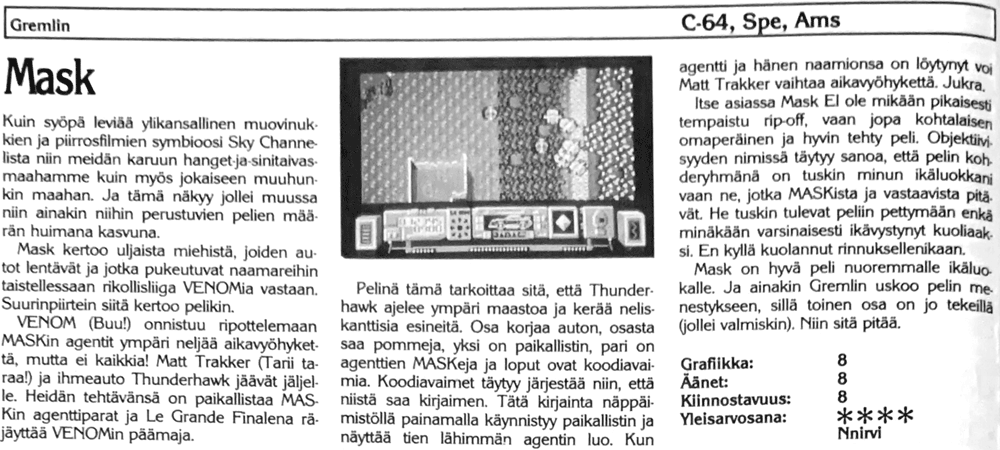
Pelinä tämä tarkoittaa sitä, että Thunderhawk ajelee ympäri maastoa ja kerää neliskanttisia esineitä. Osa korjaa auton, osasta saa pommeja, yksi on paikallistin, pari on agenttien MASKeja ja loput ovat koodiavaimia. Koodiavaimet täytyy järjestää niin, että niistä saa kirjaimen. Tätä kirjainta näppäimistöllä painamalla käynnistyy paikallistin ja näyttää tien lähimmän agentin luo. Kun agentti ja hänen naamionsa on löytynyt voi Matt Trakker vaihtaa aikavyöhykettä. Jukra.
Itse asiassa Mask EI ole mikään pikaisesti tempaistu rip-off, vaan jopa kohtalaisen omaperäinen ja hyvin tehty peli. Objektiivisyyden nimissä täytyy sanoa, että pelin kohderyhmänä on tuskin minun ikäluokkani vaan ne, jotka MASKista ja vastaavista pitävät. He tuskin tulevat peliin pettymään enkä minäkään varsinaisesti ikävystynyt kuoliaaksi. En kyllä kuolannut rinnuksellenikaan.
Mask on hyvä peli nuoremmalle ikäluokalle. Ja ainakin Gremlin uskoo pelin menestykseen, sillä toinen osa on jo tekeillä (jollei valmiskin). Niin sitä pitää.
Mask1988PermalinkLike a cancer, the transnational symbiosis of plastic dolls and cartoons is spreading from Sky Channel both into our own barren snowdrifts-and-blue-skies land and into every other country as well. And this shows, if in nothing else, then at least in the dizzying growth in the number of games based on them.
Mask is about gallant men whose cars fly and who put on masks when they fight the criminal league VENOM. That's roughly what the game is about too.
VENOM (Boo!) manages to scatter MASK's agents across four time zones, but not all of them! Matt Trakker (Ta-da-da-daa!) and the wonder car Thunderhawk are left. Their mission is to locate MASK's poor agents and, as Le Grande Finale, blow up VENOM's headquarters.
As a game this means that Thunderhawk drives around the terrain collecting square objects. Some repair the car, some give you bombs, one is a locator, a couple are the agents' MASKs and the rest are code keys. The code keys have to be arranged so that they form a letter. Pressing this letter on the keyboard activates the locator, which shows the way to the nearest agent. Once the agent and his mask have been found, Matt Trakker can change time zone. Golly.
As a matter of fact Mask is NOT some hastily knocked-together rip-off, but actually a fairly original and well made game. In the name of objectivity I have to say that the game's target group is hardly my age bracket, but rather those who like MASK and the like. They are unlikely to be disappointed by the game, and I wasn't exactly bored to death either. Then again, I didn't drool down my shirt front either.
Mask is a good game for the younger age group. And Gremlin at least believes in the game's success, since a second part is already in the works (if not finished already). That's the spirit.
Mask II
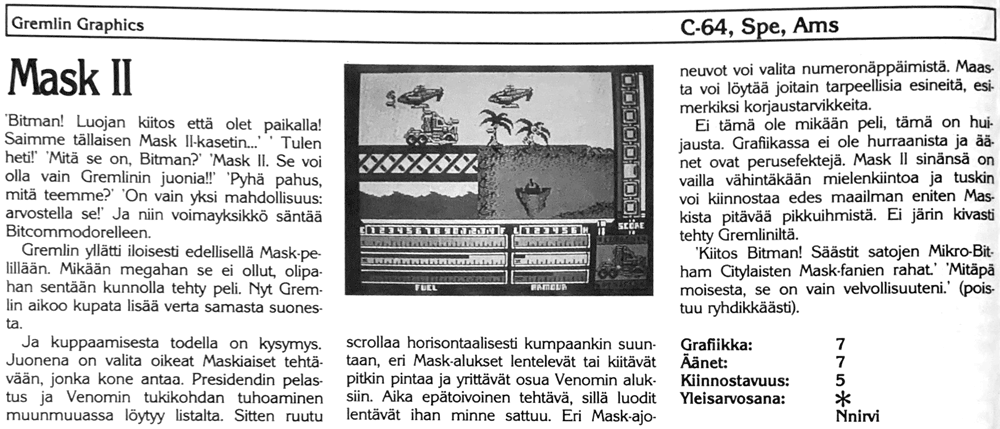
Mask II1988Pysyvä linkki'Bitman! Luojan kiitos että olet paikalla! Saimme tällaisen Mask II-kasetin...' ' Tulen heti!' 'Mitä se on, Bitman?' 'Mask II. Se voi olla vain Gremlinin juonia!!' 'Pyhä pahus, mitä teemme?' 'On vain yksi mahdollisuus: arvostella se!' Ja niin voimayksikkö säntää Bitcommodorelleen.
Gremlin yllätti iloisesti edellisellä Mask-pelillään. Mikään megahan se ei ollut, olipahan sentään kunnolla tehty peli. Nyt Gremlin aikoo kupata lisää verta samasta suonesta.
Ja kuppaamisesta todella on kysymys. Juonena on valita oikeat Maskiaiset tehtävään, jonka kone antaa. Presidendin pelastus ja Venomin tukikohdan tuhoaminen muunmuuassa löytyy listalta. Sitten ruutu scrollaa horisontaalisesti kumpaankin suuntaan, eri Mask-alukset lentelevät tai kiitävät pitkin pintaa ja yrittävät osua Venomin aluksiin. Aika epätoivoinen tehtävä, sillä luodit lentävät ihan minne sattuu. Eri Mask-ajoneuvot voi valita numeronäppäimistä. Maasta voi löytää joitain tarpeellisia esineitä, esimerkiksi korjaustarvikkeita.
Ei tämä ole mikään peli, tämä on huijausta. Grafiikassa ei ole hurraanista ja äänet ovat perusefektejä. Mask II sinänsä on vailla vähintäkään mielenkiintoa ja tuskin voi kiinnostaa edes maailman eniten Maskista pitävää pikkuihmistä. Ei järin kivasti tehty Gremliniltä.
'Kiitos Bitman! Säästit satojen Mikro-Bitham Citylaisten Mask-fanien rahat.' 'Mitäpä moisesta, se on vain velvollisuuteni.' (poistuu ryhdikkäästi).
Mask II1988Permalink'Bitman! Thank heavens you're here! We've received this Mask II tape...' 'I'm on my way!' 'What is it, Bitman?' 'Mask II. It can only be one of Gremlin's schemes!!' 'Holy heck, what do we do?' 'There's only one option: review it!' And so the Dynamic Solo dashes off to his Bitcommodore.
Gremlin pleasantly surprised us with their previous Mask game. It was no mega-hit, of course, but at least it was a properly made game. Now Gremlin intends to bleed more blood from the same vein.
And bleeding really is what it's all about. The idea is to pick the right Maskers for the mission the computer gives you. Rescuing the President and destroying Venom's base are among the items on the list. Then the screen scrolls horizontally in both directions, and the various Mask craft fly about or speed along the surface trying to hit Venom's craft. A pretty hopeless task, since the bullets fly off wherever they please. The different Mask vehicles can be selected with the number keys. On the ground you can find some useful items, for example repair kits.
This isn't a game, this is a swindle. The graphics are nothing to cheer about and the sound is basic effects. Mask II as such is devoid of even the slightest interest and can hardly appeal even to the little person who likes Mask more than anyone else in the world. Not very nicely done of Gremlin.
'Thank you, Bitman! You've saved the money of hundreds of Mask fans in Mikro-Bitham City.' 'Think nothing of it, it's merely my duty.' (exits, ramrod-straight).
Master Chess
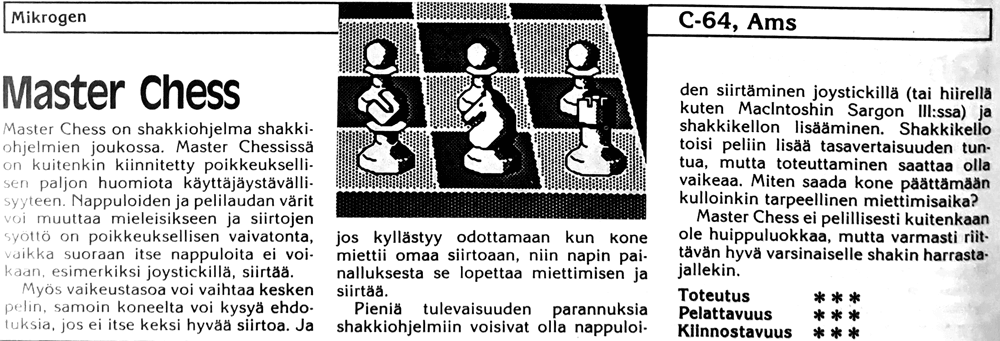
Master Chess1987Pysyvä linkkiMaster Chess on shakkiohjelma shakkiohjelmien joukossa. Master Chessissä on kuitenkin kiinnitetty poikkeuksellisen paljon huomiota käyttäjäystävällisyyteen. Nappuloiden ja pelilaudan värit voi muuttaa mieleisikseen ja siirtojen syöttö on poikkeuksellisen vaivatonta, vaikka suoraan itse nappuloita ei voikaan, esimerkiksi joystickillä, siirtää.
Myös vaikeustasoa voi vaihtaa kesken pelin, samoin koneelta voi kysyä ehdotuksia, jos ei itse keksi hyvää siirtoa. Ja jos kyllästyy odottamaan kun kone miettii omaa siirtoaan, niin napin painalluksesta se lopettaa miettimisen ja siirtää.
Pieniä tulevaisuuden parannuksia shakkiohjelmiin voisivat olla nappuloiden siirtäminen joystickillä (tai hiirellä kuten MacIntoshin Sargon III:ssa) ja shakkikellon lisääminen. Shakkikello toisi peliin lisää tasavertaisuuden tuntua, mutta toteuttaminen saattaa olla vaikeaa. Miten saada kone päättämään kulloinkin tarpeellinen miettimisaika?
Master Chess ei pelillisesti kuitenkaan ole huippuluokkaa, mutta varmasti riittävän hyvä varsinaiselle shakin harrastajallekin.
Master Chess1987PermalinkMaster Chess is just one chess program among many. In Master Chess, however, an exceptional amount of attention has been paid to user-friendliness. You can change the colours of the pieces and the board to your liking, and entering moves is exceptionally effortless, even though you can't move the pieces themselves directly, with a joystick for example.
The difficulty level can also be changed mid-game, and likewise you can ask the computer for suggestions if you can't come up with a good move yourself. And if you get fed up waiting while the computer ponders its own move, at the press of a button it stops thinking and moves.
Small future improvements to chess programs could be moving the pieces with a joystick (or with a mouse, as in Sargon III on the Macintosh) and adding a chess clock. A chess clock would give the game more of a sense of fair play, but implementing it may be difficult. How do you get the computer to decide how much thinking time it needs at any given moment?
In terms of playing strength, though, Master Chess isn't top class, but it's surely good enough even for a serious chess enthusiast.
Masterblazer
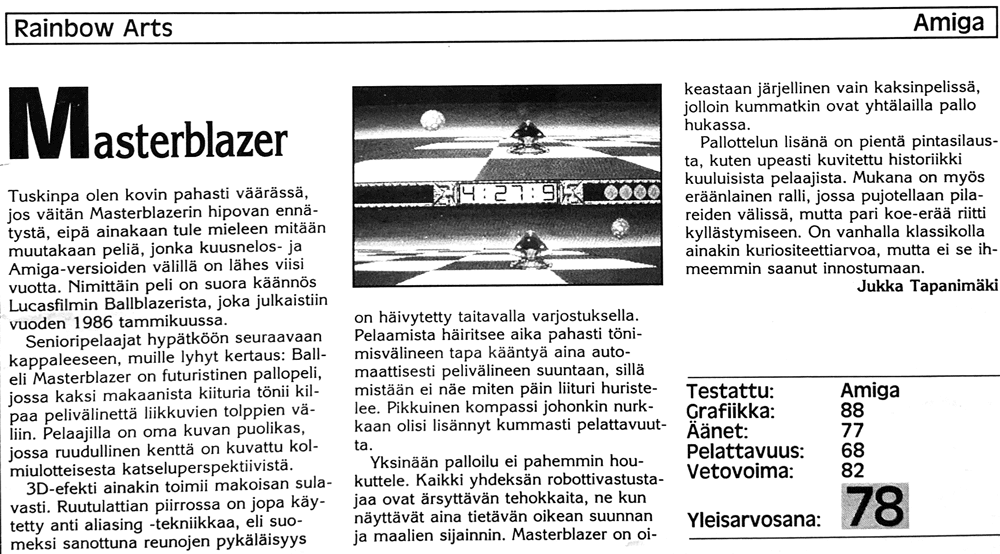
Masterblazer1991 KevätPysyvä linkkiTuskinpa olen kovin pahasti väärässä, jos väitän Masterblazerin hipovan ennätystä, eipä ainakaan tule mieleen mitään muutakaan peliä, jonka kuusnelos- ja Amiga-versioiden välillä on lähes viisi vuotta. Nimittäin peli on suora käännös Lucasfilmin Ballblazerista, joka julkaistiin vuoden 1986 tammikuussa.
Senioripelaajat hypätköön seuraavaan kappaleeseen, muille lyhyt kertaus: Ball- eli Masterblazer on futuristinen pallopeli, jossa kaksi makaanista kiituria tönii kilpaa pelivälinettä liikkuvien tolppien väliin. Pelaajilla on oma kuvan puolikas, jossa ruudullinen kenttä on kuvattu kolmiulotteisesta katseluperspektiivistä.
3D-efekti ainakin toimii makoisan sulavasti. Ruutulattian piirrossa on jopa käytetty anti aliasing -tekniikkaa, eli suomeksi sanottuna reunojen pykäläisyys on häivytetty taitavalla varjostuksella. Pelaamista häiritsee aika pahasti tönimisvälineen tapa kääntyä aina automaattisesti pelivälineen suuntaan, sillä mistään ei näe miten päin liituri huristelee. Pikkuinen kompassi johonkin nurkkaan olisi lisännyt kummasti pelattavuutta.
Yksinään palloilu ei pahemmin houkuttele. Kaikki yhdeksän robottivastustajaa ovat ärsyttävän tehokkaita, ne kun näyttävät aina tietävän oikean suunnan ja maalien sijainnin. Masterblazer on oikeastaan järjellinen vain kaksinpelissä, jolloin kummatkin ovat yhtälailla pallo hukassa.
Pallottelun lisänä on pientä pintasilausta, kuten upeasti kuvitettu historiikki kuuluisista pelaajista. Mukana on myös eräänlainen ralli, jossa pujotellaan pilareiden välissä, mutta pari koe-erää riitti kyllästymiseen. On vanhalla klassikolla ainakin kuriositeettiarvoa, mutta ei se ihmeemmin saanut innostumaan.
Masterblazer1991 KevätPermalinkI'm hardly very far wrong if I claim that Masterblazer is brushing up against a record; at any rate I can't think of any other game with nearly five years between its Commodore 64 and Amiga versions. The thing is, the game is a straight conversion of Lucasfilm's Ballblazer, which was released in January 1986.
Veteran players may hop straight to the next paragraph; for everyone else, a quick recap: Ball- a.k.a. Masterblazer is a futuristic ball game in which two mechanical speedsters race each other to shove the ball between moving posts. Each player has their own half of the screen, in which the chequered pitch is shown from a three-dimensional viewing perspective.
The 3D effect at least works deliciously smoothly. The drawing of the chequered floor even uses the anti-aliasing technique, which in plain English means that the jaggedness of the edges has been blurred away with skilful shading. Play is quite badly marred by the shoving machine's habit of always turning automatically to face the ball, because there's no way of seeing which way round the glider is whizzing along. A tiny little compass in some corner would have done wonders for the playability.
Knocking the ball about on your own isn't much of a lure. All nine robot opponents are irritatingly efficient, since they always seem to know the right direction and where the goals are. Masterblazer really only makes any sense as a two-player game, when neither player is any more on the ball than the other.
On top of the ball-bashing there's a little surface gloss, such as a superbly illustrated history of famous players. There's also a kind of rally in which you weave between pillars, but a couple of trial runs were enough to bore me. The old classic does at least have curiosity value, but it didn't get me especially fired up.
Masters of The Universe
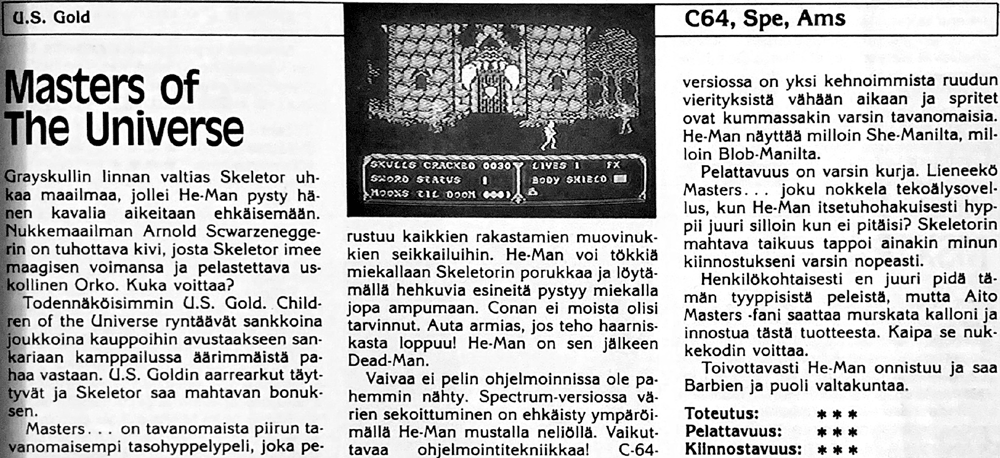
Masters of The Universe1987Pysyvä linkkiGrayskullin linnan valtias Skeletor uhkaa maailmaa, jollei He-Man pysty hänen kavalia aikeitaan ehkäisemään. Nukkemaailman Arnold Scwarzeneggerin on tuhottava kivi, josta Skeletor imee maagisen voimansa ja pelastettava uskollinen Orko. Kuka voittaa?
Todennäköisimmin U.S. Gold. Children of the Universe ryntäävät sankkoina joukkoina kauppoihin avustaakseen sankariaan kamppailussa äärimmäistä pahaa vastaan. U.S. Goldin aarrearkut täyttyvät ja Skeletor saa mahtavan bonuksen.
Masters... on tavanomaista piirun tavanomaisempi tasohyppelypeli, joka perustuu kaikkien rakastamien muovinukkien seikkailuihin. He-Man voi tökkiä miekallaan Skeletorin porukkaa ja löytämällä hehkuvia esineitä pystyy miekalla jopa ampumaan. Conan ei moista olisi tarvinnut. Auta armias, jos teho haarniskasta loppuu! He-Man on sen jälkeen Dead-Man.
Vaivaa ei pelin ohjelmoinnissa ole pahemmin nähty. Spectrum-versiossa värien sekoittuminen on ehkäisty ympäröimällä He-Man mustalla neliöllä. Vaikuttavaa ohjelmointitekniikkaa! C-64-versiossa on yksi kehnoimmista ruudun vierityksistä vähään aikaan ja spritet ovat kummassakin varsin tavanomaisia. He-Man näyttää milloin She-Manilta, milloin Blob-Manilta.
Pelattavuus on varsin kurja. Lieneekö Masters... joku nokkela tekoälysovellus, kun He-Man itsetuhohakuisesti hyppii juuri silloin kun ei pitäisi? Skeletorin mahtava taikuus tappoi ainakin minun kiinnostukseni varsin nopeasti.
Henkilökohtaisesti en juuri pidä tämän tyyppisistä peleistä, mutta Aito Masters -fani saattaa murskata kalloni ja innostua tästä tuotteesta. Kaipa se nukkekodin voittaa.
Toivottavasti He-Man onnistuu ja saa Barbien ja puoli valtakuntaa.
Masters of The Universe1987PermalinkSkeletor, lord of Castle Grayskull, threatens the world unless He-Man can thwart his treacherous schemes. The Arnold Scwarzenegger of the doll world must destroy the stone from which Skeletor draws his magic power, and rescue the faithful Orko. Who will win?
Most likely U.S. Gold. The Children of the Universe will rush to the shops in droves to help their hero in the struggle against ultimate evil. U.S. Gold's treasure chests fill up and Skeletor gets a mighty bonus.
Masters... is a platform game a notch more ordinary than ordinary, based on the adventures of everybody's beloved plastic dolls. He-Man can poke Skeletor's gang with his sword, and by finding glowing objects he can even shoot with the sword. Conan wouldn't have needed that sort of thing. Lord help you if the armour's power runs out! After that He-Man is Dead-Man.
Nobody has exactly broken a sweat programming this game. In the Spectrum version colour clash has been prevented by surrounding He-Man with a black square. Impressive programming technique! The C-64 version has one of the shoddiest screen scrolls in a while, and the sprites in both are pretty ordinary. He-Man looks like She-Man one moment, Blob-Man the next.
The playability is pretty miserable. Could Masters... be some clever artificial intelligence application, seeing as He-Man suicidally jumps exactly when he shouldn't? Skeletor's mighty magic killed my interest, at least, pretty quickly.
Personally I'm not much for games of this type, but a True Masters Fan might crush my skull and get excited about this product. I suppose it beats a dolls' house.
Here's hoping He-Man succeeds and gets Barbie and half the kingdom.
Masters Of The Universe: The Movie
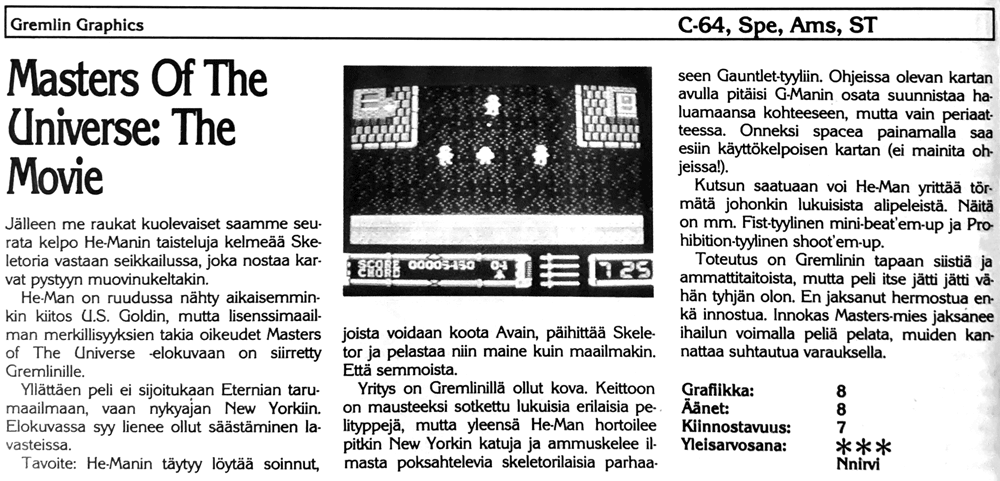
Masters Of The Universe: The Movie1988Pysyvä linkkiJälleen me raukat kuolevaiset saamme seurata kelpo He-Manin taisteluja kelmeää Skeletoria vastaan seikkailussa, joka nostaa karvat pystyyn muovinukeltakin.
He-Man on ruudussa nähty aikaisemminkin kiitos U.S. Goldin, mutta lisenssimaailman merkillisyyksien takia oikeudet Masters of The Universe -elokuvaan on siirretty Gremlinille.
Yllättäen peli ei sijoitukaan Eternian tarumaailmaan, vaan nykyajan New Yorkiin. Elokuvassa syy lienee ollut säästäminen lavasteissa.
Tavoite: He-Manin täytyy löytää soinnut, joista voidaan koota Avain, päihittää Skeletor ja pelastaa niin maine kuin maailmakin. Että semmoista.
Yritys on Gremlinillä ollut kova. Keittoon on mausteeksi sotkettu lukuisia erilaisia pelityyppejä, mutta yleensä He-Man hortoilee pitkin New Yorkin katuja ja ammuskelee ilmasta poksahtelevia skeletorilaisia parhaaseen Gauntlet-tyyliin. Ohjeissa olevan kartan avulla pitäisi G-Manin osata suunnistaa haluamaansa kohteeseen, mutta vain periaatteessa. Onneksi spacea painamalla saa esiin käyttökelpoisen kartan (ei mainita ohjeissa!).
Kutsun saatuaan voi He-Man yrittää törmätä johonkin lukuisista alipeleistä. Näitä on mm. Fist-tyylinen mini-beat'em-up ja Prohibition-tyylinen shoot'em-up.
Toteutus on Gremlinin tapaan siistiä ja ammattitaitoista, mutta peli itse jätti jätti vähän tyhjän olon. En jaksanut hermostua enkä innostua. Innokas Masters-mies jaksanee ihailun voimalla peliä pelata, muiden kannattaa suhtautua varauksella.
Masters Of The Universe: The Movie1988PermalinkOnce again we poor mortals get to follow the worthy He-Man's battles against the pallid Skeletor, in an adventure that would make the hair stand on end even on a plastic doll.
He-Man has been seen on screen before, thanks to U.S. Gold, but owing to the oddities of the licensing world the rights to the Masters of The Universe film have been transferred to Gremlin.
Surprisingly, the game isn't set in the fabled world of Eternia after all, but in present-day New York. In the film the reason was presumably saving money on sets.
The objective: He-Man has to find the chords from which the Key can be assembled, defeat Skeletor and save both his good name and the world. So there you go.
Gremlin have certainly tried hard. Numerous different game types have been stirred into the soup as seasoning, but mostly He-Man blunders about the streets of New York shooting Skeletorites that pop out of thin air, in the best Gauntlet style. With the help of the map in the instructions G-Man ought to be able to find his way to wherever he wants to go, but only in theory. Luckily, pressing space brings up a usable map (not mentioned in the instructions!).
On receiving a call, He-Man can try to bump into one of the numerous sub-games. These include a Fist-style mini beat'em-up and a Prohibition-style shoot'em-up.
The execution is, as usual with Gremlin, neat and professional, but the game itself left me feeling a bit empty. I couldn't be bothered to get annoyed, or excited either. A keen Masters man will probably keep playing on the strength of sheer adoration; everyone else should approach it with reservations.
Maze Mania
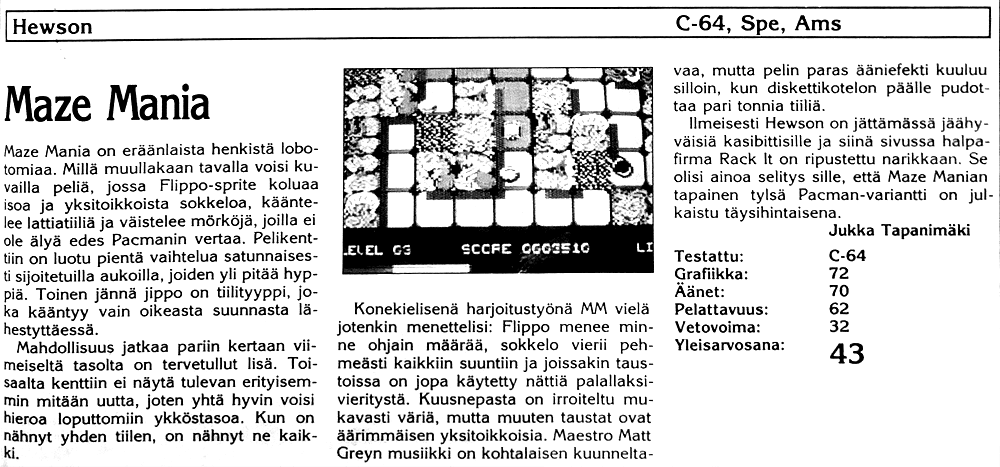
Maze Mania1990 SyksyPysyvä linkkiMaze Mania on eräänlaista henkistä lobotomiaa. Millä muullakaan tavalla voisi kuvailla peliä, jossa Flippo-sprite koluaa isoa ja yksitoikkoista sokkeloa, kääntelee lattiatiiliä ja väistelee mörköjä, joilla ei ole älyä edes Pacmanin vertaa. Pelikenttiin on luotu pientä vaihtelua satunnaisesti sijoitetuilla aukoilla, joiden yli pitää hyppiä. Toinen jännä jippo on tiilityyppi, joka kääntyy vain oikeasta suunnasta lähestyttäessä.
Mahdollisuus jatkaa pariin kertaan viimeiseltä tasolta on tervetullut lisä. Toisaalta kenttiin ei näytä tulevan erityisemmin mitään uutta, joten yhtä hyvin voisi hieroa loputtomiin ykköstasoa. Kun on nähnyt yhden tiilen, on nähnyt ne kaikki.
Konekielisenä harjoitustyönä MM vielä jotenkin menettelisi: Flippo menee minne ohjain määrää, sokkelo vierii pehmeästi kaikkiin suuntiin ja joissakin taustoissa on jopa käytetty nättiä palallaksivieritystä. Kuusnepasta on irroiteltu mukavasti väriä, mutta muuten taustat ovat äärimmäisen yksitoikkoisia. Maestro Matt Greyn musiikki on kohtalaisen kuunneltavaa, mutta pelin paras ääniefekti kuuluu silloin, kun diskettikotelon päälle pudottaa pari tonnia tiiliä.
Ilmeisesti Hewson on jättämässä jäähyväisiä kasibittisille ja siinä sivussa halpafirma Rack It on ripustettu narikkaan. Se olisi ainoa selitys sille, että Maze Manian tapainen tylsä Pacman-variantti on julkaistu täysihintaisena.
Maze Mania1990 SyksyPermalinkMaze Mania is a kind of mental lobotomy. How else could you describe a game in which the Flippo sprite scours a big, monotonous maze, flips floor tiles and dodges bogeymen who don't have even Pacman's brains? A little variety has been created in the levels with randomly placed holes that you have to jump over. Another nifty gimmick is a type of tile that only flips when approached from the right direction.
The chance to continue a couple of times from the last level reached is a welcome addition. Then again, nothing particularly new seems to turn up in the levels, so you might just as well grind away at level one forever. Once you've seen one tile, you've seen them all.
As a machine-code practice exercise MM might still just about pass muster: Flippo goes wherever the controller tells it, the maze scrolls smoothly in all directions and some of the backgrounds even use pretty parallax scrolling. A nice amount of colour has been squeezed out of the C-64, but otherwise the backgrounds are extremely monotonous. Maestro Matt Grey's music is reasonably listenable, but the game's best sound effect is the one you hear when you drop a couple of tons of bricks on the disk case.
Apparently Hewson is bidding farewell to the 8-bit machines, and in the process the budget label Rack It has been hung up in the cloakroom for good. That would be the only explanation for a dull Pacman variant like Maze Mania being released at full price.
Mean Streets
Mean Streets1991 KevätPysyvä linkkiNimi on pahasti harhaanjohtava, sillä Mean Streets ei ole mikään 'mätki pahat jätkät ketoon' -peli, vaan kovaksikeitetty dekkaritarina, jonka ympäristönä on vuoden 2033 San Francisco. Sankarin työnantajana on kuuluisan professorin tytär, joka epäilee isänsä itsemurhaan liittyvän tiettyjä hämäriä piirteitä.
Toteutus on mielenkiintoinen tyylien sekasotku. Liikkumiseen käytettävän liiturin ohjailu on kuin pelaisi vektorigraafista lentosimua, paitsi että suurimman osan ajasta selviää syöttämällä koordinaatteja navigointilaitteeseen, sitten vain istutaan ja ihaillaan maisemia. Matkoihin kuluvan ajan voi käyttää hyödyksi soittelemalla sihteerilleen Vanessalle tai tietolähteelleen, kauniille itämaiselle Leelle.
Puheluissa onkin pelin hauskin yksityiskohta, sillä digitoitujen 'what's up Tex' ja 'I'll check it out' -hölinöiden lisäksi digitoiduista kuvista muokattuja kasvoja animoidaan erittäin aidosti. Taustatuen hyödyllisyys onkin vähän sitä sun tätä, esimerkiksi jos kummaltakin kysyy samaa asiaa, saa yleensä tismalleen saman faxin.
Kun liituri on perillä ja parkissa, vuorossa on kolmenlaisia jaksoja paikasta riippuen. Palkkionmetsästykseen varatuissa kortteleissa ainoastaan räiskitään alamaailman edustajia tavanomaiseen toimintatyyliin. Myös joidenkin henkilöiden audienssia varten on ensin hieman hillittävä yli-innokkaan rupusakin riehumista.
Avainhenkilöiden kuulusteleminen on toteutettu siten, että ruutuun läimäistään asianomaisen naamataulu ja sankari laatii muotoa 'mitä tiedät henkilöstä tai asiasta X' olevia kysymyksiä, joita voi myös tehostaa lahjuksin tai uhkailemalla. Käytetyistä välinäytöksistä kolmas ja viimeinen liittyy johtolankojen etsimiseen. Sankaria ohjaillaan huoneistossa graafisten seikkailupelien tyyliin ja nuuskitaan paikat lattiasta kattoon, kuten kunnon etsivän kuuluukin.
Mikään pelin alaosioista ei sinänsä ole kovin innostava, mutta synkän futuristinen kyberpunkympäristö on omiaan lisäämään kiinnostavuutta. Inspiraation lähteenä on selvästi ollut Bladerunner, minkä voi päätellä hienovaraisista viitteistä, kuten liituriautoista ja tutuista nimistä (esim. Nexus).
Mean Streets on erikoinen yritys luoda aito film noir -henkinen dekkaritarina, jonka koossapitävänä voimana on johtolankojen hitaan varma vyyhdittyminen. Vähän enemmän peliä ja vähemmän diashowta, niin lopputulos olisi upea.
Mean Streets1991 KevätPermalinkThe name is badly misleading, because Mean Streets is no 'knock the bad guys flat' game but a hardboiled detective story set in the San Francisco of 2033. The hero's employer is the daughter of a famous professor, who suspects there are certain shady aspects to her father's suicide.
The execution is an interesting hotchpotch of styles. Steering the hover car you get around in is like playing a vector-graphics flight sim, except that most of the time you can get by just by entering coordinates into the navigation unit, and then you simply sit back and admire the scenery. The time spent travelling can be put to good use by ringing your secretary Vanessa or your informant, the beautiful oriental Lee.
The phone calls are in fact where the game's most entertaining detail lies, because on top of the digitised 'what's up Tex' and 'I'll check it out' blather, faces worked up from digitised pictures are animated very convincingly. How useful your back-up actually is turns out to be a bit hit-and-miss, though: for example, if you ask both of them the same thing, you usually get exactly the same fax.
Once the hover car has arrived and is parked, what follows is one of three kinds of sequence, depending on the location. In the blocks set aside for bounty hunting, you just blast away at representatives of the underworld in the usual action style. Getting an audience with certain characters also means you first have to curb the rampaging of some over-eager riff-raff a little.
Questioning key characters has been done by slapping the mug of the person concerned onto the screen, while the hero draws up questions of the form 'what do you know about person or thing X', which can also be given extra punch with bribes or threats. The third and last of the interludes on offer involves searching for clues. You steer the hero around an apartment in the style of graphic adventure games and sniff the place over from floor to ceiling, as any decent detective should.
None of the game's sub-sections is all that exciting in itself, but the grimly futuristic cyberpunk setting goes a long way towards adding interest. The source of inspiration has clearly been Bladerunner, as you can tell from subtle references such as the hover cars and familiar names (e.g. Nexus).
Mean Streets is an unusual attempt to create a genuine film noir-style detective story, whose binding force is the slow but sure way the threads of the clues wind together. A bit more game and a bit less slide show, and the end result would be superb.
Mech Brigade
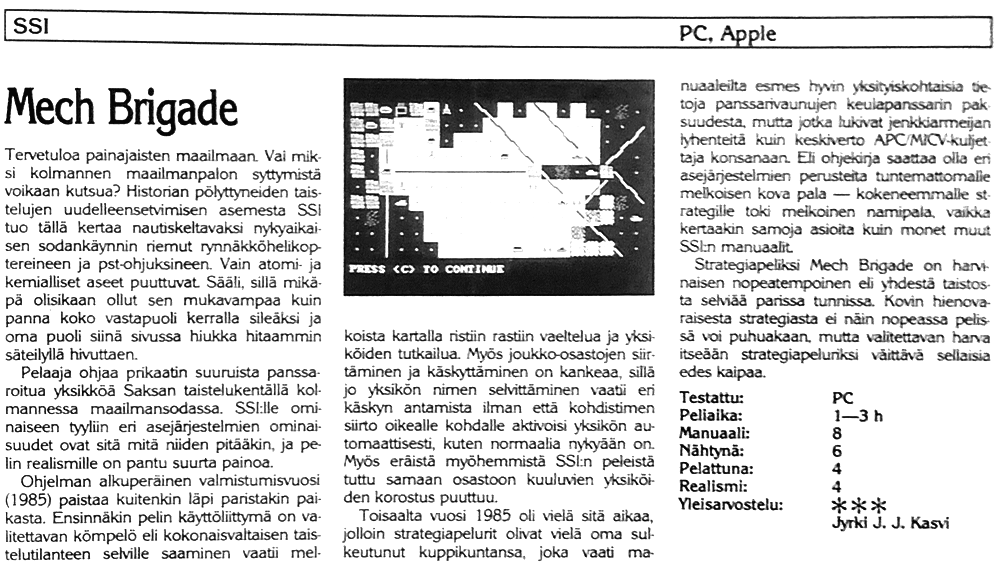
Mech Brigade1989 SyksyPysyvä linkkiTervetuloa painajaisten maailmaan. Vai miksi kolmannen maailmanpalon syttymistä voikaan kutsua? Historian pölyttyneiden taistelujen uudelleensetvimisen asemesta SSI tuo tällä kertaa nautiskeltavaksi nykyaikaisen sodankäynnin riemut rynnäkköhelikoptereineen ja pst-ohjuksineen. Vain atomi- ja kemialliset aseet puuttuvat. Sääli, sillä mikäpä olisikaan ollut sen mukavampaa kuin panna koko vastapuoli kerralla sileäksi ja oma puoli siinä sivussa hiukka hitaammin säteilyllä hivuttaen.
Pelaaja ohjaa prikaatin suuruista panssaroitua yksikköä Saksan taistelukentällä kolmannessa maailmansodassa. SSI:lle ominaiseen tyyliin eri asejärjestelmien ominaisuudet ovat sitä mitä niiden pitääkin, ja pelin realismille on pantu suurta painoa.
Ohjelman alkuperäinen valmistumisvuosi (1985) paistaa kuitenkin läpi paristakin paikasta. Ensinnäkin pelin käyttöliittymä on valitettavan kömpelö eli kokonaisvaltaisen taistelutilanteen selville saaminen vaatii melkoista kartalla ristiin rastiin vaeltelua ja yksiköiden tutkailua. Myös joukko-osastojen siirtäminen ja käskyttäminen on kankeaa, sillä jo yksikön nimen selvittäminen vaatii eri käskyn antamista ilman että kohdistimen siirto oikealle kohdalle aktivoisi yksikön automaattisesti, kuten normaalia nykyään on. Myös eräistä myöhemmistä SSI:n peleistä tuttu samaan osastoon kuuluvien yksiköiden korostus puuttuu.
Toisaalta vuosi 1985 oli vielä sitä aikaa, jolloin strategiapelurit olivat vielä oma sulkeutunut kuppikuntansa, joka vaati manuaaleilta esmes hyvin yksityiskohtaisia tietoja panssarivaunujen keulapanssarin paksuudesta, mutta jotka lukivat jenkkiarmeijan lyhenteitä kuin keskiverto APC/MICV-kuljettaja konsanaan. Eli ohjekirja saattaa olla eri asejärjestelmien perusteita tuntemattomalle melkoisen kova pala - kokeneemmalle strategille toki melkoinen namipala, vaikka kertaakin samoja asioita kuin monet muut SSI:n manuaalit.
Strategiapeliksi Mech Brigade on harvinaisen nopeatempoinen eli yhdestä taistosta selviää parissa tunnissa. Kovin hienovaraisesta strategiasta ei näin nopeassa pelissä voi puhuakaan, mutta valitettavan harva itseään strategiapeluriksi väittävä sellaisia edes kaipaa.
Mech Brigade1989 SyksyPermalinkWelcome to the world of nightmares. Or what else could you call the outbreak of the third world conflagration? Instead of re-untangling the dusty battles of history, this time SSI serves up the joys of modern warfare for our delectation, complete with attack helicopters and anti-tank missiles. Only nuclear and chemical weapons are missing. A pity, for what could have been more fun than flattening the entire opposing side in one go, and whittling down your own side along the way a little more slowly with radiation.
The player commands a brigade-sized armoured unit on the German battlefield in the Third World War. In typical SSI style, the characteristics of the various weapon systems are just what they should be, and great weight has been placed on the game's realism.
The program's original year of completion (1985) does, however, shine through in more than one place. First of all, the game's user interface is regrettably clumsy: getting a picture of the battle situation as a whole takes a good deal of wandering criss-cross over the map and peering at units. Moving formations and giving them orders is also stiff, since even finding out a unit's name requires giving a separate command, without moving the cursor to the right spot activating the unit automatically, as is normal these days. Also missing is the highlighting of units belonging to the same formation, familiar from some of SSI's later games.
On the other hand, 1985 was still the era when strategy gamers were a closed clique of their own, which demanded of manuals, f'rinstance, highly detailed information on the thickness of tanks' frontal armour, but who read Yank army abbreviations just like your average APC/MICV driver. So the manual may be quite a tough morsel for someone who doesn't know the basics of the various weapon systems - for the more experienced strategist, of course, quite a tasty morsel, even if it goes over the same things as many other SSI manuals.
For a strategy game Mech Brigade is unusually fast-paced: you can get through one battle in a couple of hours. In a game this quick there can be no talk of any very subtle strategy, but sadly few of those who claim to be strategy gamers even miss such a thing.
Mechwarrior

Mechwarrior1990 SyksyPysyvä linkkiDynamixin ohjelmoima Mechwarrior jatkaa Activisionin menestyksekästä BattleTech-sarjaa. Siinä missä Infocomin BattleTech oli roolipeleistä ja valtavista roboteista kiinnostuneille mannaa, korvaa MW roolipelaamisen kolmiulotteisella vektorigrafiikalla ja realistisella ympäristöllä. MW onkin oikeastaan Mech-simulaatio ja nappuloiden paljous vain tukee tätä käsitystä.
Pelaaja on Mechin omistava palkkasoturi, joka yrittää hankkia kunniaa ja rahaa suorittamalla erilaisia tehtäviä johtaville klaaneille. Hyvin normaali tehtävä on esimerkiksi panttivankien pelastaminen. Pelaajan täytyy rytistää aseet leiskuen vastustajan tukikohtaan, tuhota matkan varrella mahdollisimman monta Mechiä ja lopuksi räjäyttää tukikohdan seinät huis hiivattiin samalla pelastaen panttivangit.
Hyvin mielenkiintoiseksi tehtävien hankkimisen tekee tinkiminen. Klaani tekee tarjouksen ja pelaajalla on mahdollisuus ilmoittaa oma palkkiovaatimuksensa. Vaikuttaa voi palkkion suuruuteen, bonuksiin ja taistelukentältä löytyvien tavaroiden takavarikointiin. Palkkio on rahayksiköissä, kun taas bonukset ja tavarat arvioidaan prosentteina. Pelaaja saa itselleen sopimuksessa sovitun prosenttimäärän kaikesta Mech-tavarasta mitä taistelukentältä löytyy. Tinkimistä voi harjoittaa aika pitkälle, mutta käytännössä rajat tulevat esiin alle minuutin tinkimisen jälkeen.
Alussa pelaajalla on siis vain yksi Mech. Kun rahavarat karttuvat, voi pelaaja käydä värväämässä paikallisesta kuppilasta muita Mech-pilotteja omaan ryhmäänsä. Muillekin piloteille täytyy tietenkin hankkia Mech. Se maksaa rutosti, eikä hyväkään pelaaja pysty pitkään aikaan ostamaan toista Mechiä. Rahat kun tuppaavat menemään olemassaolevan robotin varustamiseen ja kunnostamiseen. Kun paikalliset maisemat alkavat kyllästyttää tai tehtävät ovat loppu, voi pelaaja lastata kaiken omaisuutensa avaruusalukseen ja hujauttaa jollekin toiselle kymmenistä planeetoista. Uusi planeetta, uudet tehtävät ja mahdollisuudet. Planeettoja löytyy kaiken kaikkiaan useita kymmeniä, joten tekeminen ei MW:ssa lopu aivan heti.
Graafisesti MW on sangen erinomainen. Täytetty kolmiulotteinen vektorigrafiikka on nopeaa hitaammissakin koneissa ja realistinen liikkuminen (horisontin pomppiminen Mechin askelten tahdissa) luo tunnelmaa hienosti. Monimutkaiset ja -puoliset taistelutietokoneet ovat ensi alkuun sekavia, mutta jonkin verran aikaa vievä opettelu on kyllä käytetyn ajan arvoista. Äänipuoli on PC:lle tyypillistä piipitystä, eikä MW käytä äänikorttejakaan kuin alkumusiikin tekemiseen. Äänitehosteet tulevat joka tapauksessa siis PC:n omasta äänipiiristä. Paksuhko käsikirja vie kovimmat peiihalut englantia taitamattomilta, mutta kieltä osaavat uppoavat nopeasti MW:n maailmaan pitkäksikin ajaksi.
Yhteenvetona voi sanoa, että MW on kevyesti paras BattleTech -aiheinen peli tällä hetkellä. Jos robotit ovat sydäntäsi lähellä, investoi markat sukkelaan.
Mechwarrior1990 SyksyPermalinkMechwarrior, programmed by Dynamix, continues Activision's successful BattleTech series. Whereas Infocom's BattleTech was manna for those interested in role-playing games and giant robots, MW replaces the role-playing with three-dimensional vector graphics and a realistic environment. In fact MW is really a Mech simulation, and the sheer number of keys only supports this impression.
The player is a Mech-owning mercenary who tries to earn honour and money by carrying out various missions for the leading clans. A very ordinary mission, for example, is rescuing hostages. The player has to crash into the enemy base with guns blazing, destroy as many Mechs as possible along the way and finally blow the base's walls to kingdom come, rescuing the hostages in the process.
What makes landing missions very interesting is the haggling. The clan makes an offer and the player gets the chance to state their own fee. You can influence the size of the fee, the bonuses and the seizure of goods found on the battlefield. The fee is in units of money, whereas the bonuses and goods are reckoned in percentages. The player gets the percentage agreed in the contract of all the Mech gear found on the battlefield. You can take the haggling quite far, but in practice the limits show up after less than a minute of bargaining.
So at the start the player has only one Mech. As the funds pile up, the player can go and recruit other Mech pilots into their own unit from the local dive. Naturally the other pilots have to be given Mechs too. That costs a packet, and even a good player won't be able to buy a second Mech for a long time. The money tends to go on equipping and repairing the robot you already have, you see. When the local scenery starts to bore you or the missions have run out, the player can load all their worldly goods onto a spaceship and whizz off to one of dozens of other planets. New planet, new missions and opportunities. All in all there are several dozen planets, so you won't run out of things to do in MW any time soon.
Graphically MW is quite excellent. The filled three-dimensional vector graphics are fast even on slower machines, and the realistic movement (the horizon bobbing in time with the Mech's footsteps) creates a fine atmosphere. The complex and versatile combat computers are confusing at first, but learning them, though it takes a fair while, is certainly worth the time spent. The sound is the beeping typical of the PC, and MW doesn't even use sound cards for anything but the intro music. So in any case the sound effects come from the PC's own sound chip. The fairly thick manual will kill even the keenest urge to play in those who don't know English, but those who speak the language will quickly sink into MW's world, perhaps for a long while.
To sum up, MW is easily the best BattleTech-themed game around at the moment. If robots are close to your heart, invest your marks pronto.
Medieval Lords
Medieval Lords1991 SyksyPysyvä linkkiOletko koskaan tahtonut olla keskiaikainen linnanherra, ryöstää ja polttaa, ruoskia orjia ja rakentaa linnoja? Kukapa ei olisi...
SSI:n tuore simulaatio Medieval Lords mahdollistaa lähes kaiken, mitä voisit toivoa keskiaikaan sijoittuvalta strategiapeliltä. Ohjelman on suunnitellut historian professori, Martin Campion, joka on syyllinen myöskin vanhan, upean Rails Westin synnystä. MLordsissa pääseekin riehumaan täysin sydämin: kerettiläisiä, hunnien hyökkäyksiä, valtakuntien nousuja ja romahduksia, kapinoita, diplomatiaa, sotia, ryöstöretkiä ja valloituksia, Paavin nuolemista, ristiretkiä ja oman valtakunnan huolehtimista.
Hallitsijaksi asti pelissä ei sentään nousta, vaan pelaaja astuu Lordin eli kuninkaan tms. neuvonantajan pallille. Neuvonantaja onkin varsin pitkäikäinen, kun Lordit kuolevat vanhuuteen, pelaaja porskuttaa eteenpäin. Voikin kelata läpi puolet keskiaikaa, vuodesta 1028 vuoteen 1530, ja pidemmällekin ja jotta peli ei kävisi liian yksioikoiseksi, on mahdollista vaihtaa valtakuntaa Lordin kuollessa. Vaikka pelaaja käytännössä veteleekin naruja, Lordi jakaa määräykset.
Kyvyt eli karisma, johtamistaito, sotaisuus ja hallitsemistaito saattavat vaihdella radikaalisti sukupolvesta toiseen, hyvän kuninkaan poika saattaakin olla mielipuoli. Hyvältä hallitsijalta onnistuu lähestulkoon mikä vain, milloin vain. Rupuinen vallanperijä taasen voi saada valtakunnan hajoamaan muutamassa vuosikymmenessä.
Tietokone on kunnioitettava vastustaja se voi ohjata jopa kuutta neuvonantajaa, yksittäisten Lordien lisäksi. Mikä parasta, jopa KYMMENEN pelaajaa voi ryhtyä neuvonantajiksi, jolloin parhaimmillaan on mahdollista pitää todelliset Medieval Lords -orgiat kuudellatoista pelaajalla. Jokainen tahtoo valloituksia, valtakunnan on laajennuttava maanpiirin käsittäväksi. Ei se ole noin helppoa, ei ei.
Suuri armeija on välttämätön valloituksiin, mistäs palkat? Kansa saattaa kapinoida, lojaalisuus laskea tai ties mitä, eikä siihen ehdi puuttua sodan aikana. Puhumattakaan aateliston päähän pinttymistä. Testipelissäni suuri Turkin valtakunta hajosi rahaongelmiin, hallitsija piti liian suurta armeijaa ja menot kasvoivat yli tulojen. Kansalaisten kuuliaisuus laski ja lopulta kapinat alkoivat. Pikkuvaltioita syntyi ympäri valtakuntaa, naapurit julistivat sotia ja Turkki oli raunio vain. Omakin valtakunta on huollettava. Kaupunkilaiset ja aatelisto on pidettävä tyytyväisenä, tai ainakin kurissa. Kerettiläiset on kitkettävä pois, ennen kuin he saavat jalansijan tai Paavi puuttuu asiaan. Valtiontalous on pidettävä tuottavana, ja jos kassaan kertyy liikaa rahaa Lordi voi ottaa leijonanosan omiin projekteihinsa.
Aikaa ei koskaan riitä tehdä haluamansa, joten hyvän neuvonantajan paras ominaisuus on taito tehdä kompromisseja. Jos pelatessa seuraa kaikkien valtioiden kaikki toimet, voi varata peliinsä aikaa seuraavat kuukaudet optio lienee masokisteille. Pienemmällä tietotulvalla peli kulkee paremmin, vaikka välilyöntiä saakin hakata reippaasti. Järkevintä kuitenkin on tarkkailla vain itseään koskevat tapahtumat.
Pelisysteemi tuo heti mieleen Colonial Conquestin ja Storm Across Europen. Alueet on jaettu samaan tyyliin, eikä itse pelaaminenkaan suuresti niistä eroa kaikki toiminta tapahtuu yhdessä vaiheessa (3 6 toimintapistettä), ja sitten vain seurataan mitä muualla tapahtuu. Erittäin helppoa systeemiä voi vain kehua.
Graafisestihan Mlords ei ole kummoinen, mutta täydellisen sopiva tarkoitukseensa. Vain värejä voisi olla enemmän, sillä eri valtiot erotetaan kartalla väristään, ja kaksi saman väristä valtiota vierekkäin aiheuttaa hiukan sekaannusta. Laajuudestaan johtuen Medieval Lords karkottaa luotaan 95 % peli-intoilijoista.
Lopuistakaan kaikki eivät välttämättä innostu. Suoraviivaista sotimista ML:stä ei saa revityksi raastimellakaan, ja sehän ei kaikkia miellytä. Muuta toimintaa on VALTAVASTI, ML on pumpattu täyteen realistisia yksityiskohtia ja ohjekirja väittääkin sen olevan historiallisesti oikea enkä epäile väitettä. Tekijä kertookin tehneensä ohjelman alunperin käytettäväksi omilla historiantunneillaan... Erittäin suositeltava raskaan sarjan strategisteille.
Medieval Lords1991 SyksyPermalinkHave you ever wanted to be a medieval lord of the castle, to pillage and burn, whip slaves and build castles? Who hasn't...
SSI's fresh simulation Medieval Lords makes possible almost everything you could wish for from a strategy game set in the Middle Ages. The program was designed by a history professor, Martin Campion, who is also guilty of bringing the grand old Rails West into the world. In MLords you really do get to run riot to your heart's content: heretics, Hun invasions, the rise and fall of kingdoms, rebellions, diplomacy, wars, raids and conquests, sucking up to the Pope, crusades and looking after your own kingdom.
You don't quite get to rise all the way to ruler in the game; instead the player takes the stool of adviser to the Lord, that is, the king or suchlike. The adviser is indeed remarkably long-lived: as the Lords die of old age, the player just keeps chugging along. You can reel through half the Middle Ages, from 1028 to 1530, and further still - and so that the game doesn't get too one-track, you can switch kingdoms when your Lord dies. Although in practice the player is the one pulling the strings, it's the Lord who hands out the orders.
The abilities, that is, charisma, leadership, belligerence and administrative skill, can vary radically from one generation to the next; a good king's son may well turn out to be a madman. A good ruler can pull off almost anything, any time. A lousy heir, on the other hand, can make the kingdom fall apart within a few decades.
The computer is a respectable opponent - it can control as many as six advisers, on top of the individual Lords. Best of all, as many as TEN players can take up the role of adviser, so at best you can hold a genuine sixteen-player Medieval Lords orgy. Everyone wants conquests; the kingdom must expand to encompass the whole wide world. It's not that easy, no no.
A big army is essential for conquest - so where's the pay coming from? The people may rebel, loyalty may fall or who knows what, and there's no time to deal with it in wartime. Not to mention the fixed ideas the nobility get stuck in their heads. In my test game the great kingdom of Turkey fell apart over money troubles: the ruler kept too big an army and spending outgrew income. The citizens' obedience declined and in the end the revolts began. Petty states sprang up all over the kingdom, the neighbours declared wars and Turkey was nothing but a ruin. Your own kingdom needs looking after too. The townsfolk and the nobility have to be kept content, or at least in line. Heretics have to be rooted out before they gain a foothold or the Pope steps in. The state economy must be kept profitable, and if too much money piles up in the treasury, the Lord may take the lion's share for their own projects.
There's never enough time to do everything you want, so the best quality in a good adviser is the ability to compromise. If you follow every action of every state while playing, you can book the next few months for your game - that option is presumably for masochists. With a smaller flood of information the game moves along better, although you do have to hammer the space bar briskly. The most sensible thing, though, is to keep watch only on the events that concern you.
The game system immediately brings to mind Colonial Conquest and Storm Across Europe. The territories are divided up in the same style, and the playing itself doesn't differ much from them either - all the action takes place in a single phase (3-6 action points), and then you just watch what happens elsewhere. An extremely easy system - one can only praise it.
Graphically Mlords is nothing to write home about, of course, but it's perfectly suited to its purpose. Only there could be more colours, since the different states are told apart on the map by their colour, and two states of the same colour side by side cause a little confusion. Owing to its sheer scope, Medieval Lords will drive off 95% of gaming enthusiasts.
Not all of the rest will necessarily get excited either. You couldn't tear any straightforward warfare out of ML even with a cheese grater, and that, of course, isn't to everyone's liking. There's a HUGE amount of other activity: ML has been pumped full of realistic detail, and the manual even claims it's historically accurate - and I don't doubt the claim. Indeed, the designer says they originally made the program for use in their own history lessons... Highly recommended for heavyweight strategists.
Meganoid Construction Kit
Meganoid Construction Kit1990 SyksyPysyvä linkkiNimi on hämäävä, sillä ei tämä ole kenttäeditori Meganoidiin, sellaista peliä ei olekaan, vaan Giganoidiin. Se on puolestaan yksi niistä lukemattomista Breakout-kopioista, joita taannoin lähes joka toinen kynnelle kykenevä koodaaja naputteli kuusneloseen ja Amigaan.
Kenttien väsääminen MCK:lla on äärimmäisen helppoa: napsautetaan menusta väri ja sitten maalataan hiirellä tiiliä kentän päälle. Toisesta menusta napsitaan piilotettavia bonuksia, joita tosin ei kovin montaa ole tarjolla. Kuusneloseen mainioon Traziin verrattuna sisältö tuntuukin melkoisen köykäiseltä. Levennetyt mailat, laserit, palloliima ja muut Arcanoidin peruspiirteet löytyvät eikä sitten muuta. Ikävin piirre on kenttien latautuminen editoriin yksi kerrallaan. Pakkauksen mukaan alkuperäisen Giganoidin omistaminen ei ole tarpeen, mutta on varsin ikävää pelata ensin yhtä kenttää ja sitten etsiä disketiltä seuraava. Sitä paitsi tuntuu aika omituiselta, että yhdelle disketille mahtuu vain kymmenen kenttää.
Toteutukseltaan MCK on tavanomainen perus-perus-Breakout, joka sentään toimii sulavasti. Yksi plussa ideasta, toinen hyvin tottelevasta mailasta ja iso miinus toteutuksen jättämisestä keskentekoiseksi.
Meganoid Construction Kit1990 SyksyPermalinkThe name is misleading, because this is not a level editor for Meganoid - there is no such game - but for Giganoid. That, in turn, is one of those countless Breakout clones that a while back nearly every other coder with a pulse tapped out for the Commodore 64 and the Amiga.
Knocking levels together with MCK is extremely easy: you click a colour from the menu and then paint bricks onto the level with the mouse. From another menu you click up hidden bonuses, though there aren't very many of those on offer. Compared with the splendid Traz on the Commodore 64, the content feels pretty lightweight. Widened bats, lasers, ball glue and the other basic features of Arcanoid are there, and that's your lot. The nastiest feature is that levels load into the editor one at a time. According to the box you don't need to own the original Giganoid, but it is rather a pain to play one level first and then go hunting for the next on the disk. Besides, it feels pretty odd that a single disk only has room for ten levels.
In execution MCK is a run-of-the-mill basic-basic Breakout, which at least runs smoothly. One plus for the idea, another for the very obedient bat, and a big minus for leaving the execution half-finished.
Menace
Menace1989 KevätPysyvä linkkiPsyclapse, joka on itse asiassa vanha tuttumme Psygnosis, putkauttaa muutaman kuukauden raskaanaolon jälkeen markkinoille terveen tuhoamispelin, jota voitaisiin kuitenkin kutsua ei-toivotuksi lapseksi. Vaikka päällisin puolin pelissä ei ole liiemmin moittimisen varaa, sen teema potkaisee alkuinnostuksen nopeasti mäkeen.
Menace on tuiki tavallinen räiskimispeli, jolle voitaisiin omaperäisyydestä antaa pyöreä nolla. Mutta koska se on shoot'em-up, niin sellaisena se täytyy myös arvostella. Eli: pelaajan tehtävänä on lennellä Draconian kuuden puolustusjärjestelmän läpi aiheuttaen samalla mahdollisimman paljon tuhoa ja hävitystä, että perässä tulevat varsinaiset hyökkäysjoukot eivät enää kohtaisi vastarintaa. Vallalla olevan kaavan mukaan matkan varrella voi keräillä lisäaseistusta ja muuta kivaa.
Psygnosiksen tapaan toteutus on ensiluokkaista. Musiikki pauhaa mukiinmenevästi ja pelattavuuskin on kohdallaan. Grafiikasta voi mainita sen verran, että käsikirja väittää pelissä olevan 64 väriä näytössä yhtaikaa. En olisi kyllä huomannut, jollei käsikirja olisi sitä kertonut.
Menace on siis aivan kiva peli. Sitä rasittaa vain teeman tavanomaisuus ja yksitoikkoinen pelitempo. Valitettavasti tällaisia pelejä tehdään niin kauan kun niitä ostetaan.
Menace1989 KevätPermalinkPsyclapse, which is in fact our old friend Psygnosis, has after a few months' pregnancy popped a healthy destruction game out onto the market, one that could nevertheless be called an unwanted child. Although on the surface there's not much to fault in the game, its theme quickly kicks your initial enthusiasm to the kerb.
Menace is a perfectly ordinary shooting game that would score a round zero for originality. But since it's a shoot'em-up, it has to be judged as one. So: the player's task is to fly through Draconia's six defence systems, causing as much havoc and destruction as possible along the way, so that the actual assault force following behind won't meet any more resistance. As the prevailing formula dictates, you can pick up extra weaponry and other goodies along the way.
As is Psygnosis's way, the execution is first-class. The music roars along decently enough and the playability's spot on too. About the graphics, it's worth mentioning that the manual claims the game has 64 colours on screen at once. I certainly wouldn't have noticed if the manual hadn't said so.
So Menace is quite a nice game. It's just dragged down by its run-of-the-mill theme and monotonous pace. Unfortunately, games like this will keep being made as long as people keep buying them.
Mercenary
Mercenary1987Pysyvä linkkiMercenary-pelissä pelaaja tekee pakkolaskun Targ-nimiselle planeetalle. Targilla on käynnissä sota Palyarien sekä Mechanoidien välillä. Pelaajan tehtävä on etsiä planeetan ainoa toimiva avaruusalus ja palata kotiplaneetalle. Jotta avaruusalus löytyisi, on kerättävä rahaa Targin sotaisilta asukkailta ja tutkittava aluetta. Pelissä on mahdoton kuolla. Ilman ajoneuvoa voi kuitenkin matkanteosta tulla niin pitkästyttävä, että mieluummin aloittaa pelin uudestaan alusta.
Pelialue on laaja. Se jakautuu maan päällä olevaan asutettuun alueeseen, jolla on kymmeniä rakennuksia. Maan alla on kaupunkeja, joista löytyy paljon hyödyllisiä esineitä.
Mercenaryn grafiikka on ehdottomasti pelin parhain piirre. Se on (tietenkin) vektorigrafiikkaa. Lentämällä matalalla suurella nopeudella näkee hienoja näköaloja. Grafiikka ei kertaakaan mennyt sekaisin monien muiden pelien tapaan.
Mercenaryssa on monia erikoisuuksia. Jos tuhoaa pelintekijän oman mainoskyltin, viholliset hyökkäävät kimppuun. Pelissä on myös Atari- ja Commodore-kylttejä, joiden tuhoamisesta saa kommentin "Nice show" tai "Traitor" merkistä riippuen.
Mielestäni peli on erinomainen Eliteen verrattava peli. Vaikka Novagen on vielä tuntematon ohjelmistovalmistaja, saa se tällä ohjelmalla taatusti julkisuutta. Jos sattuu pelaamaan pelin loppuun, kannattaa tallentaa tilanne Mercenary II:sta varten, jota tehdään parhaillaan.
Mercenary1987PermalinkIn Mercenary the player makes a forced landing on a planet called Targ. A war is under way on Targ between the Palyars and the Mechanoids. The player's task is to find the planet's only working spaceship and get back to the home planet. To find the spaceship, you have to collect money from Targ's warlike inhabitants and explore the area. It is impossible to die in the game. Without a vehicle, however, getting around can become so tedious that you'd rather start the game over from the beginning.
The playing area is large. It is divided into a populated area above ground, with dozens of buildings. Underground there are cities where you can find lots of useful objects.
Mercenary's graphics are definitely the game's best feature. They are (of course) vector graphics. Flying low at high speed you get some great views. The graphics never once got scrambled, the way they do in many other games.
Mercenary has lots of special touches. If you destroy the game maker's own advertising sign, the enemies come down on you. The game also has Atari and Commodore signs, and destroying them earns you the comment "Nice show" or "Traitor", depending on the make.
In my opinion this is an excellent game, comparable to Elite. Although Novagen is still an unknown software house, this program is sure to get it some publicity. If you happen to play the game through to the end, it's worth saving your position for Mercenary II, which is currently in the works.
Mercs
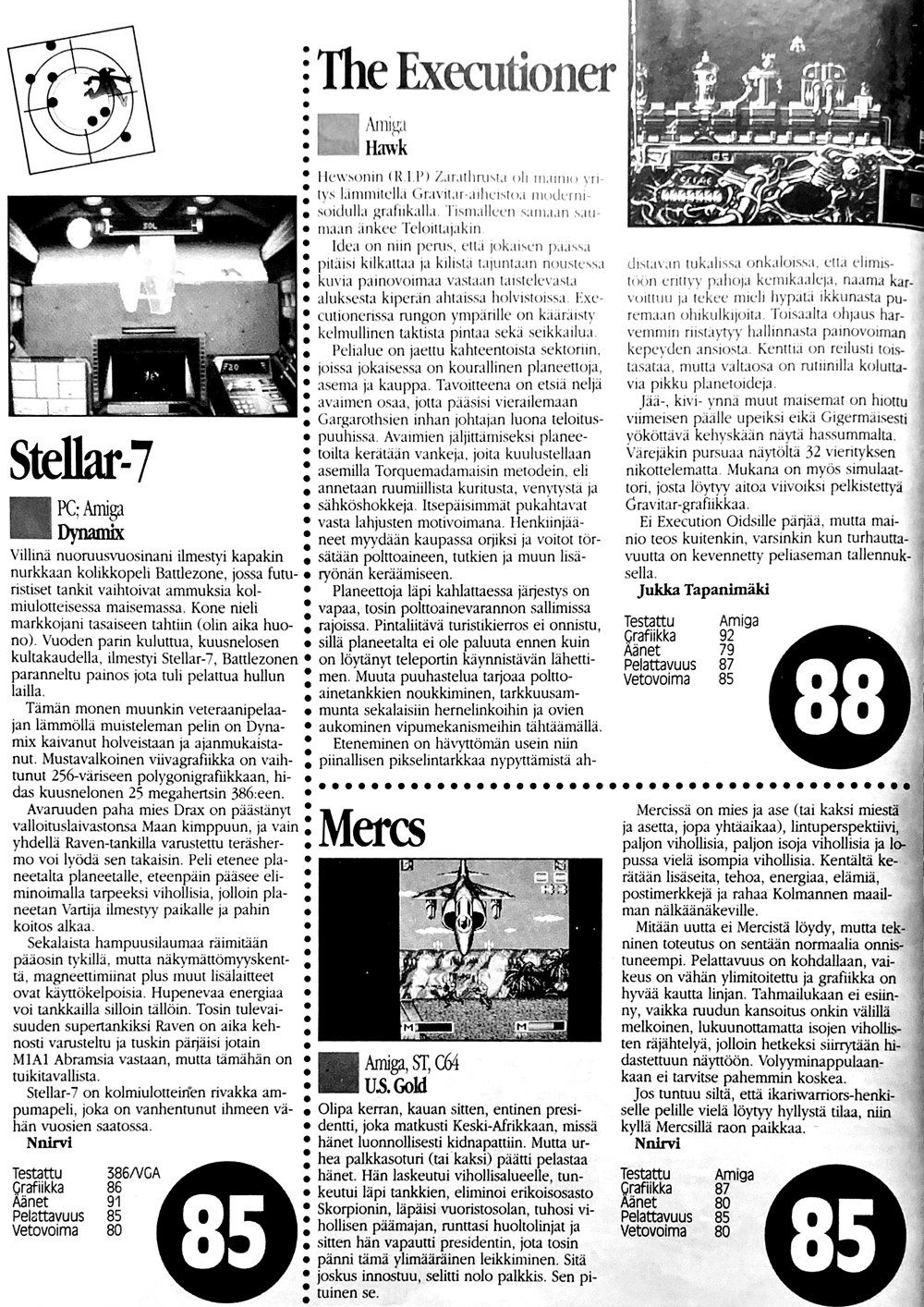
Mercs1991 SyksyPysyvä linkkiOlipa kerran, kauan sitten, entinen presidentti, joka matkusti Keski-Afrikkaan, missä hänet luonnollisesti kidnapattiin. Mutta urhea palkkasoturi (tai kaksi) päätti pelastaa hänet. Hän laskeutui vihollisalueelle, tunkeutui läpi tankkien, eliminoi erikoisosasto Skorpionin, läpäisi vuoristosolan, tuhosi vihollisen päämajan, runttasi huoltolinjat ja sitten hän vapautti presidentin, jota tosin pänni tämä ylimääräinen leikkiminen. Sitä joskus innostuu, selitti nolo palkkis. Sen pituinen se.
Mercissä on mies ja ase (tai kaksi miestä ja asetta, jopa yhtäaikaa), lintuperspektiivi, paljon vihollisia, paljon isoja vihollisia ja lopussa vielä isompia vihollisia. Kentältä kerätään lisäaseita, tehoa, energiaa, elämiä, postimerkkejä ja rahaa Kolmannen maailman nälkäänäkeville.
Mitään uutta ei Mercistä löydy, mutta tekninen toteutus on sentään normaalia onnistuneempi. Pelattavuus on kohdallaan, vaikeus on vähän ylimitoitettu ja grafiikka on hyvää kautta linjan. Tahmailukaan ei esiinny, vaikka ruudun kansoitus onkin välillä melkoinen, lukuunottamatta isojen vihollisten räjähtelyä, jolloin hetkeksi siirrytään hidastettuun näyttöön. Volyyminappulaankaan ei tarvitse pahemmin koskea.
Jos tuntuu siltä, että ikariwarriors-henkiselle pelille vielä löytyy hyllystä tilaa, niin kyllä Mercsillä raon paikkaa.
Mercs1991 SyksyPermalinkOnce upon a time, long ago, there was a former president who travelled to Central Africa, where naturally the president got kidnapped. But a brave mercenary (or two) decided to rescue the captive. They landed in enemy territory, pushed through the tanks, eliminated the special unit Skorpion, got through a mountain pass, destroyed the enemy headquarters, smashed the supply lines and then freed the president, who was admittedly rather peeved by all this extra horsing around. You get carried away sometimes, explained the sheepish merc. And that's the long and short of it.
Merc has a man and a gun (or two men and guns, even at the same time), a bird's-eye view, lots of enemies, lots of big enemies and, at the end, even bigger enemies. Out in the field you collect extra weapons, power, energy, lives, postage stamps and money for the starving of the Third World.
There's nothing new to be found in Merc, but at least the technical execution is more accomplished than usual. The playability is spot on, the difficulty is a little overdone and the graphics are good across the board. There's no sluggishness either, even though the screen gets pretty crowded at times, apart from the big enemies' explosions, when things briefly shift into slow motion. You won't need to touch the volume knob much either.
If you feel there's still room on your shelf for an ikariwarriors-style game, then Mercs will certainly plug the gap.
Metal Gear
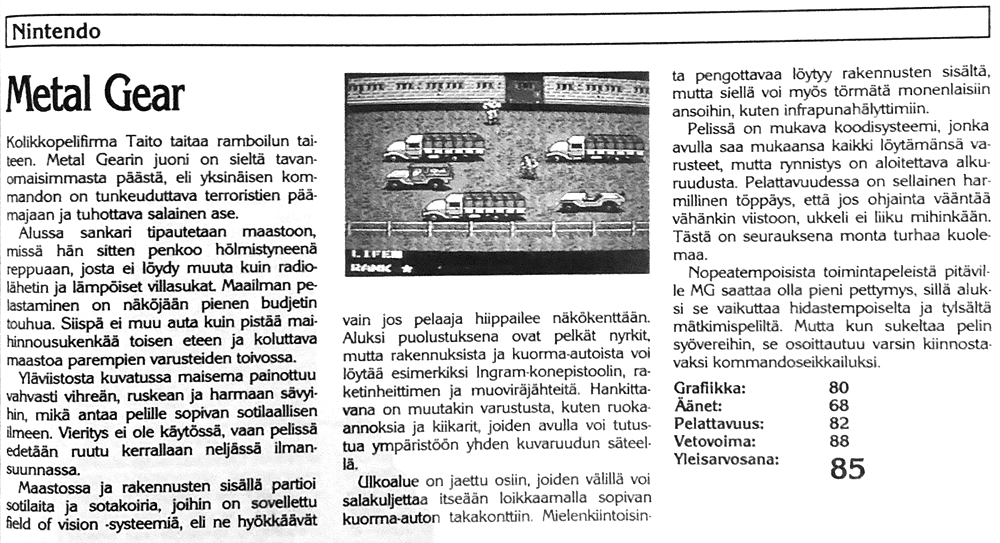
Metal Gear1990 KevätPysyvä linkkiKolikkopelifirma Taito taitaa ramboilun taiteen. Metal Gearin juoni on sieltä tavanomaisimmasta päästä, eli yksinäisen kommandon on tunkeuduttava terroristien päämajaan ja tuhottava salainen ase.
Alussa sankari tipautetaan maastoon, missä hän sitten penkoo hölmistyneenä reppuaan, josta ei löydy muuta kuin radiolähetin ja lämpöiset villasukat. Maailman pelastaminen on näköjään pienen budjetin touhua. Siispä ei muu auta kuin pistää maihinnousukenkää toisen eteen ja koluttava maastoa parempien varusteiden toivossa.
Yläviistosta kuvatussa maisema painottuu vahvasti vihreän, ruskean ja harmaan sävyihin, mikä antaa pelille sopivan sotilaallisen ilmeen. Vieritys ei ole käytössä, vaan pelissä edetään ruutu kerrallaan neljässä ilmansuunnassa.
Maastossa ja rakennusten sisällä partioi sotilaita ja sotakoiria, joihin on sovellettu field of vision -systeemiä, eli ne hyökkäävät vain jos pelaaja hiippailee näkökenttään. Aluksi puolustuksena ovat pelkät nyrkit, mutta rakennuksista ja kuorma-autoista voi löytää esimerkiksi Ingram-konepistoolin, raketinheittimen ja muoviräjähteitä. Hankittavana on muutakin varustusta, kuten ruoka-annoksia ja kiikarit, joiden avulla voi tutustua ympäristöön yhden kuvaruudun säteellä.
Ulkoalue on jaettu osiin, joiden välillä voi salakuljettaa itseään loikkaamalla sopivan kuorma-auton takakonttiin. Mielenkiintoisinta pengottavaa löytyy rakennusten sisältä, mutta siellä voi myös törmätä monenlaisiin ansoihin, kuten infrapunahälyttimiin.
Pelissä on mukava koodisysteemi, jonka avulla saa mukaansa kaikki löytämänsä varusteet, mutta rynnistys on aloitettava alkuruudusta. Pelattavuudessa on sellainen harmillinen töppäys, että jos ohjainta vääntää vähänkin viistoon, ukkeli ei liiku mihinkään. Tästä on seurauksena monta turhaa kuolemaa.
Nopeatempoisista toimintapeleistä pitäville MG saattaa olla pieni pettymys, sillä aluksi se vaikuttaa hidastempoiselta ja tylsältä mätkimispeliltä. Mutta kun sukeltaa pelin syövereihin, se osoittautuu varsin kiinnostavaksi kommandoseikkailuksi.
Metal Gear1990 KevätPermalinkCoin-op company Taito has mastered the art of going Rambo. Metal Gear's plot is from the most run-of-the-mill end of the scale: a lone commando has to infiltrate the terrorists' headquarters and destroy a secret weapon.
At the start the hero is dropped into the field, where he then rummages bewildered through his backpack, which holds nothing but a radio transmitter and a pair of warm woolly socks. Saving the world is evidently a low-budget affair. So there's nothing for it but to put one combat boot in front of the other and comb the terrain in the hope of better equipment.
The landscape, viewed obliquely from above, leans heavily on shades of green, brown and grey, which gives the game a suitably military look. There's no scrolling; instead you advance one screen at a time in the four compass directions.
Soldiers and war dogs patrol the terrain and the insides of the buildings, and they have been given a field of vision system, meaning they only attack if the player sneaks into their line of sight. At first your only defence is your bare fists, but in buildings and trucks you can find, for example, an Ingram submachine gun, a rocket launcher and plastic explosives. There's other kit to acquire too, such as food rations and binoculars, which let you scout the surroundings within a radius of one screen.
The outdoor area is divided into sections, and you can smuggle yourself from one to another by hopping into the back of a suitable truck. The most interesting stuff to rummage through is inside the buildings, but there you can also run into all kinds of traps, such as infrared alarms.
The game has a handy code system that lets you take along all the equipment you've found, but the assault has to be started from the first screen. The playability has one annoying blunder: if you push the controller even slightly diagonally, the little guy doesn't move anywhere. This leads to many pointless deaths.
For those who like fast-paced action games, MG may be a bit of a disappointment, since at first it seems like a slow-paced and dull slugfest. But once you dive into the game's depths, it turns out to be a rather interesting commando adventure.
Metroid

Metroid1990 SyksyPysyvä linkkiNintendon perushyppelymössön onnistuneimpiin edustajiin kuuluu Metroid, kieltämättä tavanomainen, mutta herkullisen pelattava konsoliteos. Samantapaisia pelejä on julkaistu niin tiuhaan tahtiin, että näitä pikkuisia loikkivia sankareita pursuaa ulos korvista ja sieraimista, mutta harmaimmasta massasta pelin erottaa vaihtelevuus. On vaakaan vierivää käytävää, korkeita pystysuoria kuiluja, salakäytäviä ja sen sellaista.
Julmalla teknolookilla vaatetettu sankari heristää hyppysissään vähemmän julmaa laserhernepyssyä, jota tosin saa päivitettyä enempi modernin ajan vaatimuksia vastaavaksi. Asevarastoa täydentävät ohjukset ja aikapommit, joilla voi löjäytellä esteisiin reikiä samaan tyyliin kuin Super Mario Bros kakkosessa. Sankarin erikoistaitoihin kuuluvat näyttävät kerävoltit sekä kyky käpertyä pikkuiseksi palloksi, joka mahtuu pyörimään kapeista rakosista.
Noin kokonaisuutena pelin maisemissa on mukavasti vaihtelua, mutta vierekkäisissä osastoissa tosin on välillä niin paljon toistoa, että niitä ei aina erota toisistaan. Pelissä on mukana koodisysteemi, jonka ansiosta luolastoissa pääsee etenemään mielenkiintoa säilyttävässä tempossa. Sujuvuus kärsii hieman siitä, että yhä laajemman energiavaraston täydentäminen käy loppua kohti rasittavaksi. Kuoleman jälkeen on miltei pakko etsiä hirviögeneraattori ja viettää sen äärellä varttitunti ikoneita keräillen.
Metroid on tyypillinen viihtyvyystakuulla varustettu Nintendon toimintaseikkailu, jonka melko varmasti jaksaa pelata loppuratkaisuun asti.
Metroid1990 SyksyPermalinkAmong the most successful specimens of Nintendo's basic platform-hopping mush is Metroid, an admittedly run-of-the-mill but deliciously playable console effort. Games of this sort have come out at such a clip that these tiny leaping heroes are oozing out of your ears and nostrils, but what sets this one apart from the greyest of the mass is variety. There are horizontally scrolling corridors, tall vertical shafts, secret passages and so on.
The hero, decked out in a wicked techno look, brandishes a rather less wicked laser peashooter, which can, admittedly, be upgraded to meet the demands of the modern age a bit better. The arsenal is rounded out by missiles and time bombs, which let you blast holes in obstacles in the same style as in Super Mario Bros 2. The hero's special skills include flashy curled-up somersaults and the ability to roll up into a tiny ball that fits through narrow gaps.
Taken as a whole, the game's scenery has a nice amount of variety, though neighbouring sections are at times so repetitive that you can't always tell them apart. The game comes with a code system, thanks to which you can press on through the caverns at a pace that keeps it interesting. The flow suffers a little from the fact that topping up an ever larger energy reserve becomes a chore towards the end. After dying you are almost forced to track down a monster generator and spend a quarter of an hour beside it collecting icons.
Metroid is a typical Nintendo action adventure that comes with a guarantee of a good time, and you'll very probably have the staying power to play it right through to the ending.
Mickey Mouse - The Computer Game
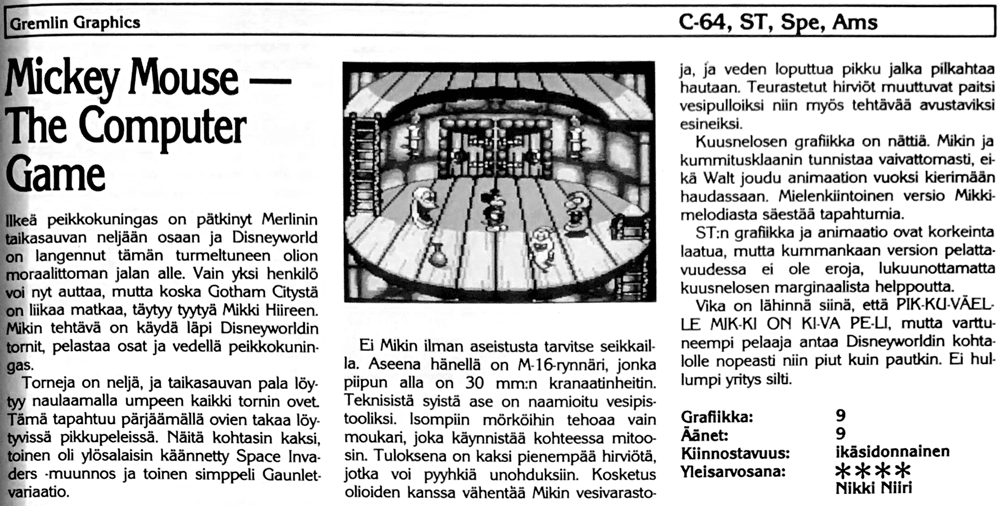
Mickey Mouse - The Computer Game1988Pysyvä linkkiIlkeä peikkokuningas on pätkinyt Merlinin taikasauvan neljään osaan ja Disneyworld on langennut tämän turmeltuneen olion moraalittoman jalan alle. Vain yksi henkilö voi nyt auttaa, mutta koska Gotham Citystä on liikaa matkaa, täytyy tyytyä Mikki Hiireen. Mikin tehtävä on käydä läpi Disneyworldin tornit, pelastaa osat ja vedellä peikkokuningas.
Torneja on neljä, ja taikasauvan pala löytyy naulaamalla umpeen kaikki tornin ovet. Tämä tapahtuu pärjäämällä ovien takaa löytyvissä pikkupeleissä. Näitä kohtasin kaksi, toinen oli ylösalaisin käännetty Space Invaders -muunnos ja toinen simppeli Gaunlet-variaatio.
Ei Mikin ilman aseistusta tarvitse seikkailla. Aseena hänellä on M-16-rynnäri, jonka piipun alla on 30 mm:n kranaatinheitin. Teknisistä syistä ase on naamioitu vesipistooliksi. Isompiin mörköihin tehoaa vain moukari, joka käynnistää kohteessa mitoosin. Tuloksena on kaksi pienempää hirviötä, jotka voi pyyhkiä unohduksiin. Kosketus olioiden kanssa vähentää Mikin vesivarastoja, ja veden loputtua pikku jalka pilkahtaa hautaan. Teurastetut hirviöt muuttuvat paitsi vesipulloiksi niin myös tehtävää avustaviksi esineiksi.
Kuusnelosen grafiikka on nättiä. Mikin ja kummitusklaanin tunnistaa vaivattomasti, eikä Walt joudu animaation vuoksi kierimään haudassaan. Mielenkiintoinen versio Mikkimelodiasta säestää tapahtumia.
ST:n grafiikka ja animaatio ovat korkeinta laatua, mutta kummankaan version pelattavuudessa ei ole eroja, lukuunottamatta kuusnelosen marginaalista helppoutta.
Vika on lähinnä siinä, että PIK-KU-VÄEL-LE MIK-KI ON KI-VA PE-LI, mutta varttuneempi pelaaja antaa Disneyworldin kohtalolle nopeasti niin piut kuin pautkin. Ei hullumpi yritys silti.
Mickey Mouse - The Computer Game1988PermalinkThe wicked troll king has chopped Merlin's magic wand into four pieces, and Disneyworld has fallen under the immoral foot of this depraved creature. Only one person can help now, but since Gotham City is too far away, we'll have to make do with Mickey Mouse. Mickey's task is to go through the towers of Disneyworld, rescue the pieces and take the troll king to the cleaners.
There are four towers, and a piece of the magic wand is won by nailing shut every door in a tower. This is done by succeeding in the little sub-games found behind the doors. I came across two of these: one was an upside-down Space Invaders variant and the other a simple Gaunlet variation.
Nor does Mickey have to go adventuring unarmed. The weapon of choice is an M-16 assault rifle with a 30 mm grenade launcher under the barrel. For technical reasons the gun has been disguised as a water pistol. The bigger bogeymen only yield to a sledgehammer, which sets off mitosis in its target. The result is two smaller monsters, which can then be wiped into oblivion. Contact with the creatures drains Mickey's water supply, and when the water runs out, a little foot is last glimpsed vanishing into the grave. Slaughtered monsters turn not only into water bottles but also into items that help with the mission.
The Commodore 64 graphics are pretty. Mickey and the ghost clan are easy to recognise, and Walt won't need to go spinning in the grave over the animation. An interesting version of the Mickey tune accompanies the action.
The ST's graphics and animation are of the highest quality, but there's no difference in playability between the two versions, apart from the Commodore 64 one being marginally easier.
The problem, mainly, is that FOR THE LIT-TLE ONES MICK-EY IS A FUN GAME, but an older player will soon stop giving two hoots about the fate of Disneyworld. Not a bad effort all the same.
Microprose Soccer
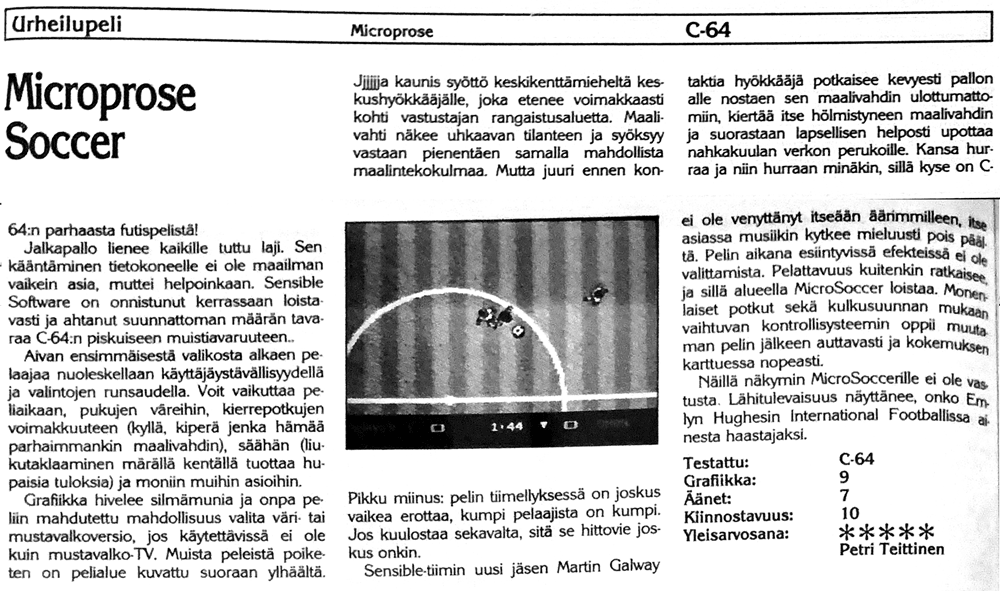
Microprose Soccer1989 KevätPysyvä linkkiJjjjja kaunis syöttö keskikenttämieheltä keskushyökkääjälle, joka etenee voimakkaasti kohti vastustajan rangaistusaluetta. Maalivahti näkee uhkaavan tilanteen ja syöksyy vastaan pienentäen samalla mahdollista maalintekokulmaa. Mutta juuri ennen kontaktia hyökkääjä potkaisee kevyesti pallon alle nostaen sen maalivahdin ulottumattomiin, kiertää itse hölmistyneen maalivahdin ja suorastaan lapsellisen helposti upottaa nahkakuulan verkon perukoille. Kansa hurraa ja niin hurraan minäkin, sillä kyse on C64:n parhaasta futispelistä!
Jalkapallo lienee kaikille tuttu laji. Sen kääntäminen tietokoneelle ei ole maailman vaikein asia, muttei helpoinkaan. Sensible Software on onnistunut kerrassaan loistavasti ja ahtanut suunnattoman määrän tavaraa C-64:n piskuiseen muistiavaruuteen.
Aivan ensimmäisestä valikosta alkaen pelaajaa nuoleskellaan käyttäjäystävällisyydellä ja valintojen runsaudella. Voit vaikuttaa peliaikaan, pukujen väreihin, kierrepotkujen voimakkuuteen (kyllä, kiperä jenka hämää parhaimmankin maalivahdin), säähän (liukutaklaaminen märällä kentällä tuottaa hupaisia tuloksia) ja moniin muihin asioihin.
Grafiikka hivelee silmämunia ja onpa peliin mahdutettu mahdollisuus valita väri- tai mustavalkoversio, jos käytettävissä ei ole kuin mustavalko-TV. Muista peleistä poiketen on pelialue kuvattu suoraan ylhäältä.
Pikku miinus: pelin tiimellyksessä on joskus vaikea erottaa, kumpi pelaajista on kumpi. Jos kuulostaa sekavalta, sitä se hittovie joskus onkin.
Sensible-tiimin uusi jäsen Martin Galway ei ole venyttänyt itseään äärimmilleen, itse asiassa musiikin kytkee mieluusti pois päältä. Pelin aikana esiintyvissä efekteissä ei ole valittamista. Pelattavuus kuitenkin ratkaisee, ja sillä alueella MicroSoccer loistaa. Monenlaiset potkut sekä kulkusuunnan mukaan vaihtuvan kontrollisysteemin oppii muutaman pelin jälkeen auttavasti ja kokemuksen karttuessa nopeasti.
Näillä näkymin MicroSoccerille ei ole vastusta. Lähitulevaisuus näyttänee, onko Emlyn Hughesin International Footballissa ainesta haastajaksi.
Microprose Soccer1989 KevätPermalinkAaaaand a beautiful pass from the midfielder to the centre forward, who drives powerfully towards the opposition's penalty area. The goalkeeper sees the danger and rushes out, narrowing the possible shooting angle at the same time. But just before contact the striker lightly chips under the ball, lifting it out of the keeper's reach, goes round the dumbfounded keeper and, with almost childish ease, buries the leather in the back of the net. The crowd cheers and so do I, because this is the best footie game on the C64!
Football is presumably a sport everyone knows. Converting it to the computer isn't the hardest thing in the world, but it isn't the easiest either. Sensible Software have succeeded absolutely brilliantly and crammed a huge amount of stuff into the C-64's tiny memory space.
From the very first menu, the player is fawned over with user-friendliness and a wealth of options. You can adjust the match length, the kit colours, the strength of the swerve shots (yes, a wicked bender will fool even the best of goalkeepers), the weather (sliding tackles on a wet pitch produce hilarious results) and many other things.
The graphics are a caress for the eyeballs, and the game even finds room for a choice between a colour and a black-and-white version, in case all you have is a black-and-white TV. Unlike other games, the pitch is shown from directly above.
A small minus: in the thick of the game it's sometimes hard to tell which of the two players is which. If that sounds confusing, well, dang it, sometimes it is.
Martin Galway, the Sensible team's new member, hasn't exactly stretched to the limit; in fact, you'll happily switch the music off. The effects during play are nothing to complain about. Playability is what decides it, though, and in that department MicroSoccer shines. The many kinds of kick, and the control system that changes with the direction you're running in, can be learned passably after a few games, and quickly as experience builds.
As things stand, MicroSoccer has no rival. The near future will probably show whether Emlyn Hughes's International Football has what it takes to be a challenger.
Microrhythm
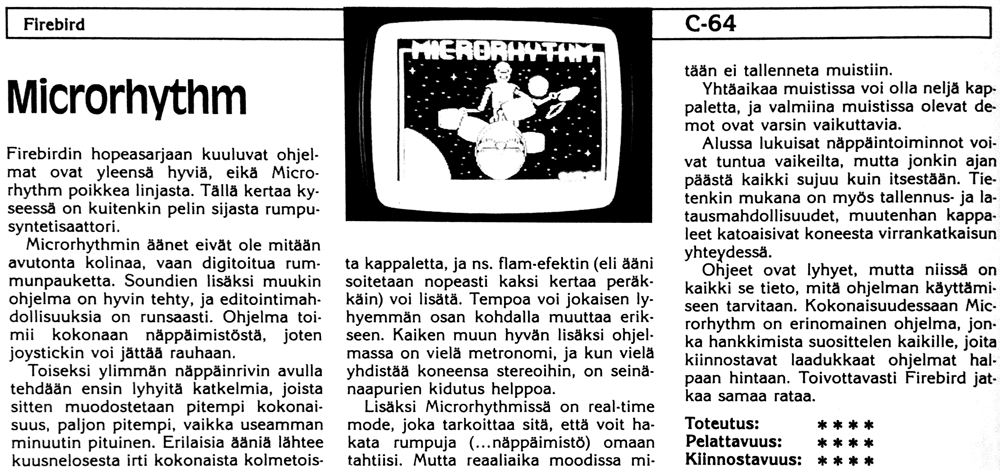
Microrhythm1987Pysyvä linkkiFirebirdin hopeasarjaan kuuluvat ohjelmat ovat yleensä hyviä, eikä Microrhythm poikkea linjasta. Tällä kertaa kyseessä on kuitenkin pelin sijasta rumpusyntetisaattori.
Microrhythmin äänet eivät ole mitään avutonta kolinaa, vaan digitoitua rummunpauketta. Soundien lisäksi muukin ohjelma on hyvin tehty, ja editointimahdollisuuksia on runsaasti. Ohjelma toimii kokonaan näppäimistöstä, joten joystickin voi jättää rauhaan.
Toiseksi ylimmän näppäinrivin avulla tehdään ensin lyhyitä katkelmia, joista sitten muodostetaan pitempi kokonaisuus, paljon pitempi, vaikka useamman minuutin pituinen. Erilaisia ääniä lähtee kuusnelosesta irti kokonaista kolmetoista kappaletta, ja ns. flam-efektin (eli ääni soitetaan nopeasti kaksi kertaa peräkkäin) voi lisätä. Tempoa voi jokaisen lyhyemmän osan kohdalla muuttaa erikseen. Kaiken muun hyvän lisäksi ohjelmassa on vielä metronomi, ja kun vielä yhdistää koneensa stereoihin, on seinänaapurien kidutus helppoa.
Lisäksi Microrhythmissä on real-time mode, joka tarkoittaa sitä, että voit hakata rumpuja (...näppäimistö) omaan tahtiisi. Mutta reaaliaika moodissa mitään ei tallenneta muistiin.
Yhtäaikaa muistissa voi olla neljä kappaletta, ja valmiina muistissa olevat demot ovat varsin vaikuttavia.
Alussa lukuisat näppäintoiminnot voivat tuntua vaikeilta, mutta jonkin ajan päästä kaikki sujuu kuin itsestään. Tietenkin mukana on myös tallennus- ja latausmahdollisuudet, muutenhan kappaleet katoaisivat koneesta virrankatkaisun yhteydessä.
Ohjeet ovat lyhyet, mutta niissä on kaikki se tieto, mitä ohjelman käyttämiseen tarvitaan. Kokonaisuudessaan Microrhythm on erinomainen ohjelma, jonka hankkimista suosittelen kaikille, joita kiinnostavat laadukkaat ohjelmat halpaan hintaan. Toivottavasti Firebird jatkaa samaa rataa.
Microrhythm1987PermalinkThe programs in Firebird's Silver range are generally good, and Microrhythm is no departure from the line. This time, though, it's a drum synthesizer rather than a game.
Microrhythm's sounds aren't some feeble clattering but digitized drum-pounding. Besides the sounds, the rest of the program is well made too, and there are plenty of editing options. The program runs entirely from the keyboard, so you can leave the joystick in peace.
Using the second row of keys from the top, you first make short snippets, which are then assembled into a longer whole - much longer, even several minutes long. You can wring no fewer than thirteen different sounds out of the Commodore 64, and you can add the so-called flam effect (meaning the sound is played twice in quick succession). The tempo can be changed separately for each of the shorter sections. On top of everything else that's good, the program even has a metronome, and once you hook your machine up to the stereo, torturing the neighbours on the other side of the wall is easy.
Microrhythm also has a real-time mode, which means you can bash the drums (...keyboard) to your own beat. But in real-time mode nothing is stored in memory.
Four songs can be in memory at once, and the demos already loaded into memory are quite impressive.
At first the numerous key functions may seem difficult, but after a while everything comes as if by itself. Naturally there are also save and load options, since otherwise your songs would vanish from the machine the moment the power goes off.
The instructions are short, but they contain all the information you need to use the program. All in all Microrhythm is an excellent program, and I recommend getting it to everyone who is interested in quality programs at a cheap price. Let's hope Firebird stays on the same track.
Microrhythm +
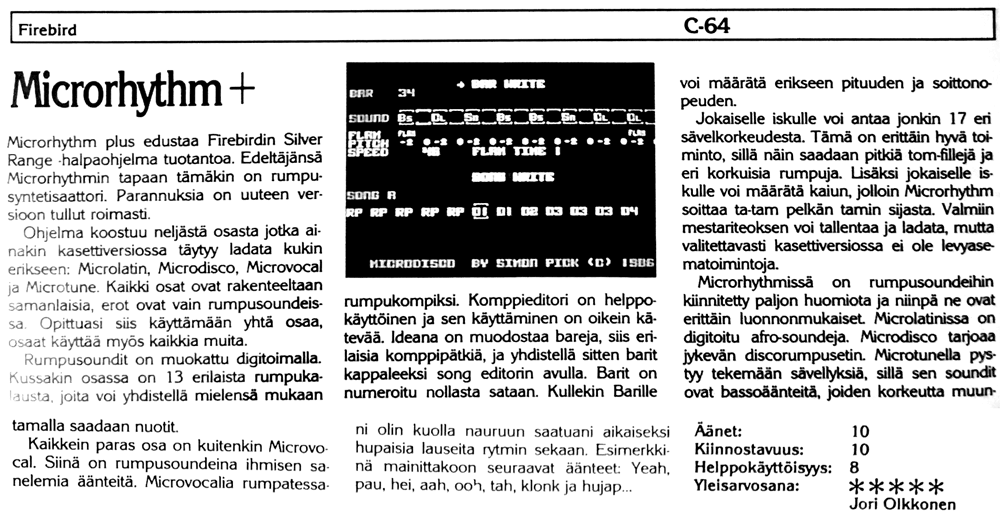
Microrhythm +1988Pysyvä linkkiMicrorhythm plus edustaa Firebirdin Silver Range -halpaohjelma tuotantoa. Edeltäjänsä Microrhythmin tapaan tämäkin on rumpusyntetisaattori. Parannuksia on uuteen versioon tullut roimasti.
Ohjelma koostuu neljästä osasta jotka ainakin kasettiversiossa täytyy ladata kukin erikseen: Microlatin, Microdisco, Microvocal ja Microtune. Kaikki osat ovat rakenteeltaan samanlaisia, erot ovat vain rumpusoundeissa. Opittuasi siis käyttämään yhtä osaa, osaat käyttää myös kaikkia muita.
Rumpusoundit on muokattu digitoimalla. Kussakin osassa on 13 erilaista rumpukalausta, joita voi yhdistellä mielensä mukaan rumpukompiksi. Komppieditori on helppokäyttöinen ja sen käyttäminen on oikein kätevää. Ideana on muodostaa bareja, siis erilaisia komppipätkiä, ja yhdistellä sitten barit kappaleeksi song editorin avulla. Barit on numeroitu nollasta sataan. Kullekin Barille voi määrätä erikseen pituuden ja soittonopeuden.
Jokaiselle iskulle voi antaa jonkin 17 eri sävelkorkeudesta. Tämä on erittäin hyvä toiminto, sillä näin saadaan pitkiä tom-fillejä ja eri korkuisia rumpuja. Lisäksi jokaiselle iskulle voi määrätä kaiun, jolloin Microrhythm soittaa ta-tam pelkän tamin sijasta. Valmiin mestariteoksen voi tallentaa ja levylle, mutta valitettavasti kasettiversiossa ei ole levyasematoimintoja.
Microrhythmissä on rumpusoundeihin kiinnitetty paljon huomiota ja niinpä ne ovat erittäin luonnonmukaiset. Microlatinissa on digitoitu afro-soundeja. Microdisco tarjoaa jykevän discorumpusetin. Microtunella pystyy tekemään sävellyksiä, sillä sen soundit ovat bassoäänteitä, joiden korkeutta muuntamalla saadaan nuotit.
Kaikkein paras osa on kuitenkin Microvocal. Siinä on rumpusoundeina ihmisen sanelemia äänteitä. Microvocalia rumpatessani olin kuolla nauruun saatuani aikaiseksi hupaisia lauseita rytmin sekaan. Esimerkkinä mainittakoon seuraavat äänteet: Yeah, pau, hei, aah, ooh, tah, klonk ja hujap...
Microrhythm +1988PermalinkMicrorhythm plus is part of Firebird's Silver Range budget software output. Like its predecessor Microrhythm, this one is a drum synthesiser too. The new version has had a hefty helping of improvements.
The program consists of four parts which, in the cassette version at least, each have to be loaded separately: Microlatin, Microdisco, Microvocal and Microtune. All the parts are identical in structure; the only differences are in the drum sounds. So once you've learned to use one part, you know how to use all the others too.
The drum sounds have been created by digitising. Each part has 13 different drum clatters, which you can combine into drum beats as you please. The beat editor is easy to use and really handy to work with. The idea is to build bars, that is, assorted snippets of beat, and then string the bars together into a song with the song editor. The bars are numbered from zero to a hundred. Each bar can be given its own length and playback speed.
Every hit can be given one of 17 different pitches. This is a very good feature, since it lets you get long tom fills and drums tuned to different pitches. On top of that, every hit can be given an echo, so that Microrhythm plays ta-tam instead of plain tam. The finished masterpiece can be saved, to disk as well, but unfortunately the cassette version has no disk drive functions.
A lot of attention has been paid to the drum sounds in Microrhythm, and so they are extremely true to life. Microlatin has digitised Afro sounds. Microdisco offers a beefy disco drum kit. With Microtune you can write compositions, since its sounds are bass tones whose pitch you change to get the notes.
The very best part, though, is Microvocal. Its drum sounds are syllables spoken by a human voice. Drumming away on Microvocal I nearly died laughing once I'd got hilarious phrases mixed in with the rhythm. By way of example, take the following sounds: Yeah, pow, hey, aah, ooh, tah, klonk and hujap...
Midnight Resistance
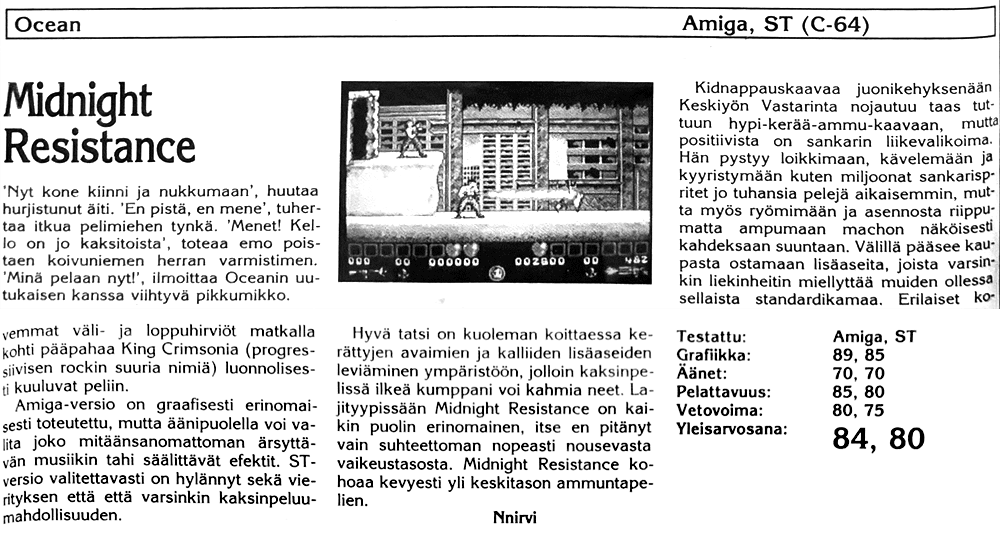
Midnight Resistance1990 SyksyPysyvä linkki'Nyt kone kiinni ja nukkumaan', huutaa hurjistunut äiti. 'En pistä, en mene', tuhertaa itkua pelimiehen tynkä. 'Menet! Kello on jo kaksitoista', toteaa emo poistaen koivuniemen herran varmistimen. 'Minä pelaan nyt!', ilmoittaa Oceanin uutukaisen kanssa viihtyvä pikkumikko.
Kidnappauskaavaa juonikehyksenään Keskiyön Vastarinta nojautuu taas tuttuun hypi-kerää-ammu-kaavaan, mutta positiivista on sankarin liikevalikoima. Hän pystyy loikkimaan, kävelemään ja kyyristymään kuten miljoonat sankarispritet jo tuhansia pelejä aikaisemmin, mutta myös ryömimään ja asennosta riippumatta ampumaan machon näköisesti kahdeksaan suuntaan. Välillä pääsee kaupasta ostamaan lisäaseita, joista varsinkin liekinheitin miellyttää muiden ollessa sellaista standardikamaa. Erilaiset kovemmat väli- ja loppuhirviöt matkalla kohti pääpahaa King Crimsonia (progressiivisen rockin suuria nimiä) luonnolisesti kuuluvat peliin.
Amiga-versio on graafisesti erinomaisesti toteutettu, mutta äänipuolella voi valita joko mitäänsanomattoman ärsyttävän musiikin tahi säälittävät efektit. ST-versio valitettavasti on hylännyt sekä vierityksen että että varsinkin kaksinpeluumahdollisuuden.
Hyvä tatsi on kuoleman koittaessa kerättyjen avaimien ja kalliiden lisäaseiden leviäminen ympäristöön, jolloin kaksinpelissä ilkeä kumppani voi kahmia neet. Lajityypissään Midnight Resistance on kaikin puolin erinomainen, itse en pitänyt vain suhteettoman nopeasti nousevasta vaikeustasosta. Midnight Resistance kohoaa kevyesti yli keskitason ammuntapelien.
Midnight Resistance1990 SyksyPermalink'Machine off and off to bed, right now,' yells an enraged mother. 'I won't turn it off, I won't go,' snivels the pint-sized gamer. 'You will! It's already twelve o'clock,' states Mum, flicking the safety catch off the good old birch switch. 'I'm playing now!' announces the little lad, who is having a fine old time with Ocean's latest.
With a kidnapping formula for its plot framework, Midnight Resistance leans once again on the familiar jump-collect-shoot formula, but the hero's repertoire of moves is a plus. The hero can leap, walk and crouch like millions of hero sprites thousands of games ago, but can also crawl and, whatever the position, shoot macho-style in eight directions. Every now and then you get to go shopping for extra weapons, of which the flamethrower in particular is a joy, the rest being the usual standard-issue stuff. A variety of tougher mid-level and end-of-level monsters on the way to the chief villain King Crimson (one of the big names of progressive rock) naturally come as part of the package.
The Amiga version is superbly done graphically, but on the sound side you get to choose either bland, irritating music or else pitiful effects. The ST version has sadly ditched both the scrolling and, worse still, the two-player option.
A nice touch is that when death comes, the keys you have collected and your expensive extra weapons scatter across the surroundings, so in two-player mode a nasty partner can grab them. Within its genre Midnight Resistance is excellent in every respect; the only thing I personally didn't like was the disproportionately quick rise in difficulty. Midnight Resistance rises effortlessly above the average shoot-'em-up.
Midwinter
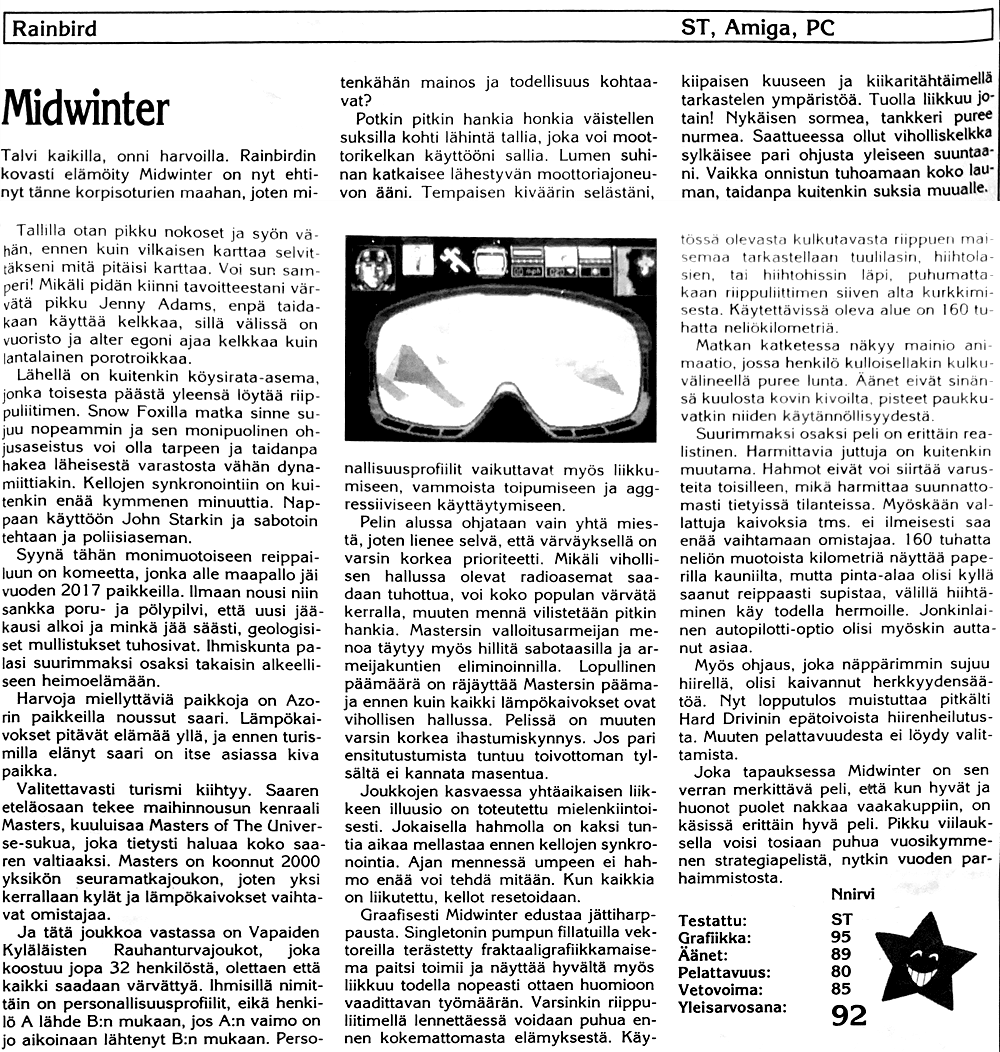
Midwinter1990 SyksyPysyvä linkkiTalvi kaikilla, onni harvoilla. Rainbirdin kovasti elämöity Midwinter on nyt ehtinyt tänne korpisoturien maahan, joten mitenkähän mainos ja todellisuus kohtaavat?
Potkin pitkin hankia honkia väistellen suksilla kohti lähintä tallia, joka voi moottorikelkan käyttööni sallia. Lumen suhinan katkaisee lähestyvän moottoriajoneuvon ääni. Tempaisen kiväärin selästäni, kiipaisen kuuseen ja kiikaritähtäimellä tarkastelen ympäristöä. Tuolla liikkuu jotain! Nykäisen sormea, tankkeri puree nurmea. Saattueessa ollut viholliskelkka sylkäisee pari ohjusta yleiseen suuntaani. Vaikka onnistun tuhoamaan koko lauman, taidanpa kuitenkin suksia muualle. Tallilla otan pikku nokoset ja syön vähän, ennen kuin vilkaisen karttaa selvittäkseni mitä pitäisi karttaa. Voi sun samperi! Mikäli pidän kiinni tavoitteestani värvätä pikku Jenny Adams, enpä taidakaan käyttää kelkkaa, sillä välissä on vuoristo ja alter egoni ajaa kelkkaa kuin lantalainen porotroikkaa.
Lähellä on kuitenkin köysirata-asema, jonka toisesta päästä yleensä löytää riippuliitimen. Snow Foxilla matka sinne sujuu nopeammin ja sen monipuolinen ohjusaseistus voi olla tarpeen ja taidanpa hakea läheisestä varastosta vähän dynamiittiakin. Kellojen synkronointiin on kuitenkin enää kymmenen minuuttia. Nappaan käyttöön John Starkin ja sabotoin tehtaan ja poliisiaseman.
Syynä tähän monimuotoiseen reippailuun on komeetta, jonka alle maapallo jäi vuoden 2017 paikkeilla. Ilmaan nousi niin sankka poru- ja pölypilvi, että uusi jääkausi alkoi ja minkä jää säästi, geologiset mullistukset tuhosivat. Ihmiskunta palasi suurimmaksi osaksi takaisin alkeelliseen heimoelämään.
Harvoja miellyttäviä paikkoja on Azorin paikkeilla noussut saari. Lämpökaivokset pitävät elämää yllä, ja ennen turismilla elänyt saari on itse asiassa kiva paikka.
Valitettavasti turismi kiihtyy. Saaren eteläosaan tekee maihinnousun kenraali Masters, kuuluisaa Masters of The Universe-sukua, joka tietysti haluaa koko saaren valtiaaksi. Masters on koonnut 2000 yksikön seuramatkajoukon, joten yksi kerrallaan kylät ja lämpökaivokset vaihtavat omistajaa.
Ja tätä joukkoa vastassa on Vapaiden Kyläläisten Rauhanturvajoukot, joka koostuu jopa 32 henkilöstä, olettaen että kaikki saadaan värvättyä. Ihmisillä nimittäin on personallisuusprofiilit, eikä henkilö A lähde B:n mukaan, jos A:n vaimo on jo aikoinaan lähtenyt B:n mukaan. Personallisuusprofiilit vaikuttavat myös liikkumiseen, vammoista toipumiseen ja aggressiiviseen käyttäytymiseen.
Pelin alussa ohjataan vain yhtä miestä, joten lienee selvä, että värväyksellä on varsin korkea prioriteetti. Mikäli vihollisen hallussa olevat radioasemat saadaan tuhottua, voi koko populan värvätä kerralla, muuten mennä vilistetään pitkin hankia. Mastersin valloitusarmeijan menoa täytyy myös hillitä sabotaasilla ja armeijakuntien eliminoinnilla. Lopullinen päämäärä on räjäyttää Mastersin päämaja ennen kuin kaikki lämpökaivokset ovat vihollisen hallussa. Pelissä on muuten varsin korkea ihastumiskynnys. Jos pari ensitutustumista tuntuu toivottoman tylsältä ei kannata masentua.
Joukkojen kasvaessa yhtäaikaisen liikkeen illuusio on toteutettu mielenkiintoisesti. Jokaisella hahmolla on kaksi tuntia aikaa mellastaa ennen kellojen synkronointia. Ajan mennessä umpeen ei hahmo enää voi tehdä mitään. Kun kaikkia on liikutettu, kellot resetoidaan.
Graafisesti Midwinter edustaa jättiharppausta. Singletonin pumpun fillatuilla vektoreilla terästetty fraktaaligrafiikkamaisema paitsi toimii ja näyttää hyvältä myös liikkuu todella nopeasti ottaen huomioon vaadittavan työmäärän. Varsinkin riippuliitimellä lennettäessä voidaan puhua ennen kokemattomasta elämyksestä. Käytössä olevasta kulkutavasta riippuen maisemaa tarkastellaan tuulilasin, hiihtolasien, tai hiihtohissin läpi, puhumattakaan riippuliittimen siiven alta kurkkimisesta. Käytettävissä oleva alue on 160 tuhatta neliökilometriä.
Matkan katketessa näkyy mainio animaatio, jossa henkilö kulloisellakin kulkuvälineellä puree lunta. Äänet eivät sinänsä kuulosta kovin kivoilta, pisteet paukkuvatkin niiden käytännöllisyydestä.
Suurimmaksi osaksi peli on erittäin realistinen. Harmittavia juttuja on kuitenkin muutama. Hahmot eivät voi siirtää varusteita toisilleen, mikä harmittaa suunnattomasti tietyissä tilanteissa. Myöskään vallattuja kaivoksia tms. ei ilmeisesti saa enää vaihtamaan omistajaa. 160 tuhatta neliön muotoista kilometriä näyttää paperilla kauniilta, mutta pinta-alaa olisi kyllä saanut reippaasti supistaa, välillä hiihtäminen käy todella hermoille. Jonkinlainen autopilotti-optio olisi myöskin auttanut asiaa.
Myös ohjaus, joka näppärimmin sujuu hiirellä, olisi kaivannut herkkyydensäätöä. Nyt lopputulos muistuttaa pitkälti Hard Drivinin epätoivoista hiirenheilutusta. Muuten pelattavuudesta ei löydy valittamista.
Joka tapauksessa Midwinter on sen verran merkittävä peli, että kun hyvät ja huonot puolet nakkaa vaakakuppiin, on käsissä erittäin hyvä peli. Pikku viilauksella voisi tosiaan puhua vuosikymmenen strategiapelistä, nytkin vuoden parhaimmistosta.
Midwinter1990 SyksyPermalinkWinter for all, luck for the few. Rainbird's much-hyped Midwinter has now made it here to the land of the backwoods warriors, so how exactly do the advertising and the reality match up?
I kick my way through the drifts on skis, dodging the pines, heading for the nearest garage, which might let me take a snowmobile for my voyage. The hiss of the snow is broken by the sound of an approaching motor vehicle. I snatch the rifle from my back, scramble up a spruce and survey the scene through the scope. Something's moving over there! I twitch a finger, and the tanker bites the dust. An enemy sled in the convoy spits a couple of missiles in my general direction. Even though I manage to wipe out the whole herd, I think I'll ski off somewhere else all the same. At the garage I take a little nap and have a bite to eat before I take a look at the map to see what to look out for. Well, blow me! If I'm sticking to my goal of recruiting little Jenny Adams, I'd better not take the sled after all, because there's a mountain range in the way and my alter ego drives a sled like a southern flatlander drives a reindeer troika.
There is, however, a cable car station nearby, and at its far end you can usually find a hang glider. With the Snow Fox the trip there goes quicker, and its versatile missile armament may well come in handy, and I think I'll fetch a bit of dynamite from a nearby depot as well. But there are only ten minutes left before the clocks are synchronised. I pick John Stark and sabotage the factory and the police station.
The reason for all this varied outdoor exercise is a comet, which the Earth ended up underneath around the year 2017. Such a thick cloud of ash and dust rose into the air that a new ice age began, and what the ice spared, geological upheavals destroyed. For the most part, mankind went back to primitive tribal life.
One of the few pleasant places left is an island that has risen near the Azores. Heat mines keep life going, and the island, which used to live off tourism, is actually a nice place.
Unfortunately, tourism is picking up. A landing on the southern part of the island is made by General Masters, of the famous Masters of The Universe family, who of course wants to become ruler of the whole island. Masters has put together a 2000-unit package-tour party, so one by one the villages and heat mines change hands.
And standing up to this lot is the Free Villagers' Peacekeeping Force, which consists of a whopping 32 people, assuming they can all be recruited. You see, people have personality profiles, and person A won't go along with B if A's wife once upon a time went off with B. The personality profiles also affect movement, recovery from injuries and aggressive behaviour.
At the start of the game you control just one man, so it should be obvious that recruitment has a pretty high priority. If the radio stations held by the enemy can be destroyed, you can recruit the whole populace in one go; otherwise it's off you go, scurrying across the snowdrifts. The advance of Masters' conquering army also has to be kept in check with sabotage and by eliminating army corps. The final goal is to blow up Masters' headquarters before all the heat mines are in enemy hands. The game, by the way, takes quite some time to fall in love with. If the first couple of get-togethers feel hopelessly dull, don't get discouraged.
As your forces grow, the illusion of simultaneous movement is handled in an interesting way. Each character has two hours to run riot before the clocks are synchronised. Once the time runs out, the character can't do anything more. When everyone has been moved, the clocks are reset.
Graphically Midwinter is a giant leap. The fractal landscape, beefed up with filled vectors from Singleton's engine, not only works and looks good but also moves really fast, considering the amount of work involved. Particularly when flying the hang glider, we can talk about an experience like nothing before. Depending on the means of transport in use, you view the landscape through a windscreen, ski goggles, or the ski lift, not to mention peeking out from under the hang glider's wing. The area available is 160 thousand square kilometres.
When a journey comes to an abrupt end, you get a splendid animation of the character eating snow on whatever vehicle they happen to be riding. The sounds as such don't sound all that nice; the points are scored for how useful they are.
For the most part, the game is extremely realistic. There are a few annoying things, though. Characters can't pass equipment to each other, which is immensely annoying in certain situations. Nor, apparently, can captured mines and the like be made to change hands again. 160 thousand square-shaped kilometres looks lovely on paper, but the area could quite easily have been cut down drastically; at times the skiing really gets on your nerves. Some kind of autopilot option would have helped matters too.
The controls, which are handiest with the mouse, could have used a sensitivity adjustment as well. As it is, the end result is a lot like Hard Drivin's desperate mouse-waving. Otherwise there's nothing to complain about in the playability.
In any case, Midwinter is such a significant game that when you toss the good and the bad sides onto the scales, you've got a very good game on your hands. With a little fine-tuning we could really be talking about the strategy game of the decade; even as it is, it's among the best of the year.
Midwinter II: Flames of Freedom
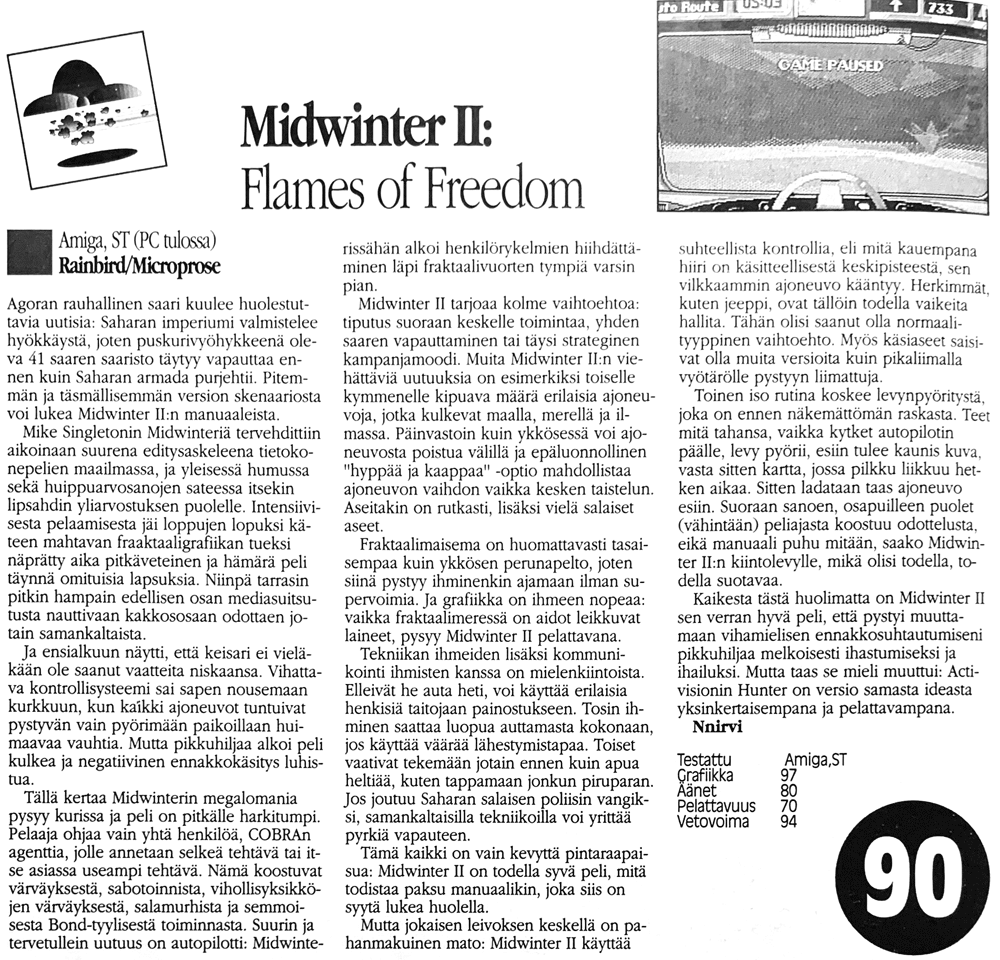
Midwinter II: Flames of Freedom1991 SyksyPysyvä linkkiAgoran rauhallinen saari kuulee huolestuttavia uutisia: Saharan imperiumi valmistelee hyökkäystä, joten puskurivyöhykkeenä oleva 41 saaren saaristo täytyy vapauttaa ennen kuin Saharan armada purjehtii. Pitemmän ja täsmällisemmän version skenaariosta voi lukea Midwinter II:n manuaaleista.
Mike Singletonin Midwinteriä tervehdittiin aikoinaan suurena editysaskeleena tietokonepelien maailmassa, ja yleisessä humussa sekä huippuarvosanojen sateessa itsekin lipsahdin yliarvostuksen puolelle. Intensiivisesta pelaamisesta jäi loppujen lopuksi käteen mahtavan fraaktaaligrafiikan tueksi näprätty aika pitkäveteinen ja hämärä peli täynnä omituisia lapsuksia. Niinpä tarrasin pitkin hampain edellisen osan mediasuitsutusta nauttivaan kakkososaan odottaen jotain samankaltaista.
Ja ensialkuun näytti, että keisari ei vieläkään ole saanut vaatteita niskaansa. Vihattava kontrollisysteemi sai sapen nousemaan kurkkuun, kun kaikki ajoneuvot tuntuivat pystyvän vain pyörimään paikoillaan huimaavaa vauhtia. Mutta pikkuhiljaa alkoi peli kulkea ja negatiivinen ennakkokäsitys luhistua.
Tällä kertaa Midwinterin megalomania pysyy kurissa ja peli on pitkälle harkitumpi. Pelaaja ohjaa vain yhtä henkilöä, COBRAn agenttia, jolle annetaan selkeä tehtävä tai itse asiassa useampi tehtävä. Nämä koostuvat värväyksestä, sabotoinnista, vihollisyksikköjen värväyksestä, salamurhista ja semmoisesta Bond-tyylisestä toiminnasta. Suurin ja tervetullein uutuus on autopilotti: Midwinterissähän alkoi henkilörykelmien hiihdättäminen läpi fraktaalivuorten tympiä varsin pian.
Midwinter II tarjoaa kolme vaihtoehtoa: tiputus suoraan keskelle toimintaa, yhden saaren vapauttaminen tai täysi strateginen kampanjamoodi. Muita Midwinter II:n viehättäviä uutuuksia on esimerkiksi toiselle kymmenelle kipuava määrä erilaisia ajoneuvoja, jotka kulkevat maalla, merellä ja ilmassa. Päinvastoin kuin ykkösessä voi ajoneuvosta poistua välillä ja epäluonnollinen "hyppää ja kaappaa" -optio mahdollistaa ajoneuvon vaihdon vaikka kesken taistelun. Aseitakin on rutkasti, lisäksi vielä salaiset aseet.
Fraktaalimaisema on huomattavasti tasaisempaa kuin ykkösen perunapelto, joten siinä pystyy ihminenkin ajamaan ilman supervoimia. Ja grafiikka on ihmeen nopeaa: vaikka fraktaalimeressä on aidot leikkuvat laineet, pysyy Midwinter II pelattavana.
Tekniikan ihmeiden lisäksi kommunikointi ihmisten kanssa on mielenkiintoista. Elleivät he auta heti, voi käyttää erilaisia henkisiä taitojaan painostukseen. Tosin ihminen saattaa luopua auttamasta kokonaan, jos käyttää väärää lähestymistapaa. Toiset vaativat tekemään jotain ennen kuin apua heltiää, kuten tappamaan jonkun piruparan. Jos joutuu Saharan salaisen poliisin vangiksi, samankaltaisilla tekniikoilla voi yrittää pyrkiä vapauteen.
Tämä kaikki on vain kevyttä pintaraapaisua: Midwinter II on todella syvä peli, mitä todistaa paksu manuaalikin, joka siis on syytä lukea huolella.
Mutta jokaisen leivoksen keskellä on pahanmakuinen mato: Midwinter II käyttää suhteellista kontrollia, eli mitä kauempana hiiri on käsitteellisestä keskipisteestä, sen vilkkaammin ajoneuvo kääntyy. Herkimmät, kuten jeeppi, ovat tällöin todella vaikeita hallita. Tähän olisi saanut olla normaalityyppinen vaihtoehto. Myös käsiaseet saisivat olla muita versioita kuin pikaliimalla vyötärölle pystyyn liimattuja.
Toinen iso rutina koskee levynpyöritystä, joka on ennen näkemättömän raskasta. Teet mitä tahansa, vaikka kytket autopilotin päälle, levy pyörii, esiin tulee kaunis kuva, vasta sitten kartta, jossa pilkku liikkuu hetken aikaa. Sitten ladataan taas ajoneuvo esiin. Suoraan sanoen, osapuilleen puolet (vähintään) peliajasta koostuu odottelusta, eikä manuaali puhu mitään, saako Midwinter II:n kiintolevylle, mikä olisi todella, todella suotavaa.
Kaikesta tästä huolimatta on Midwinter II sen verran hyvä peli, että pystyi muuttamaan vihamielisen ennakkosuhtautumiseni pikkuhiljaa melkoisesti ihastumiseksi ja ihailuksi. Mutta taas se mieli muuttui: Activisionin Hunter on versio samasta ideasta yksinkertaisempana ja pelattavampana.
Midwinter II: Flames of Freedom1991 SyksyPermalinkThe peaceful island of Agora hears worrying news: the Saharan empire is preparing an attack, so the 41-island archipelago serving as a buffer zone must be liberated before the Saharan armada sets sail. A longer and more precise version of the scenario can be read in Midwinter II's manuals.
Mike Singleton's Midwinter was hailed in its day as a great step forward in the world of computer games, and amid the general hubbub and the shower of top marks I too slipped over onto the side of overrating it. When all was said and done, what I was left holding after intensive play was a rather tedious and murky game, fiddled together to prop up the magnificent fractal graphics and full of peculiar lapses. So it was with gritted teeth that I latched onto the sequel, basking as it is in its predecessor's media adulation, expecting something similar.
And at first it looked as though the emperor still hadn't managed to get any clothes on. The hateful control system made the bile rise in my throat, as every vehicle seemed capable only of spinning on the spot at dizzying speed. But little by little the game started to flow and my negative preconceptions to crumble.
This time Midwinter's megalomania is kept in check and the game is far more carefully thought out. The player controls just one person, an agent of COBRA, who is given a clear mission, or in fact several missions. These consist of recruitment, sabotage, recruiting enemy units, assassinations and that sort of Bond-style action. The biggest and most welcome new feature is the autopilot: in Midwinter, after all, making clumps of characters ski across the fractal mountains started to grate pretty soon.
Midwinter II offers three options: being dropped straight into the middle of the action, liberating a single island, or the full strategic campaign mode. Among Midwinter II's other charming new features is, for example, a number of different vehicles running into double figures, travelling on land, at sea and in the air. Unlike in the first game, you can get out of a vehicle now and then, and an unnatural "jump and hijack" option lets you swap vehicles even in the middle of a battle. There are loads of weapons too, plus secret weapons on top.
The fractal landscape is considerably flatter than the potato field of the first game, so even a mere human can drive across it without superpowers. And the graphics are amazingly fast: even though the fractal sea has real moving waves, Midwinter II stays playable.
Besides the technical marvels, communicating with people is interesting. If they don't help straight away, you can use various mental skills to put pressure on them. Then again, a person may give up on helping altogether if you take the wrong approach. Others demand that you do something before any help comes loose, such as killing some poor devil. If you end up a prisoner of the Saharan secret police, you can try to work your way to freedom with similar techniques.
All this only lightly scratches the surface: Midwinter II is a truly deep game, as the thick manual also attests, so it's worth reading carefully.
But in the middle of every pastry lurks a foul-tasting worm: Midwinter II uses proportional control, meaning that the further the mouse is from a notional centre point, the more briskly the vehicle turns. The most sensitive ones, like the jeep, are then really difficult to handle. There should have been a normal-type alternative for this. The handguns, too, could come in some version other than superglued upright to your waist.
The other big grumble concerns the disk-spinning, which is heavier than anything seen before. Whatever you do, even just switching on the autopilot, the disk spins, a pretty picture appears, and only then the map, on which a dot moves for a while. Then the vehicle gets loaded up again. Frankly, roughly half (at least) of the playing time consists of waiting around, and the manual says nothing about whether Midwinter II can be put on a hard disk, which would be really, really desirable.
Despite all this, Midwinter II is a good enough game that little by little it managed to turn my hostile preconceptions into a fair amount of fondness and admiration. But then my mind changed again: Activision's Hunter is a version of the same idea, simpler and more playable.
MIG-29 Fulcrum
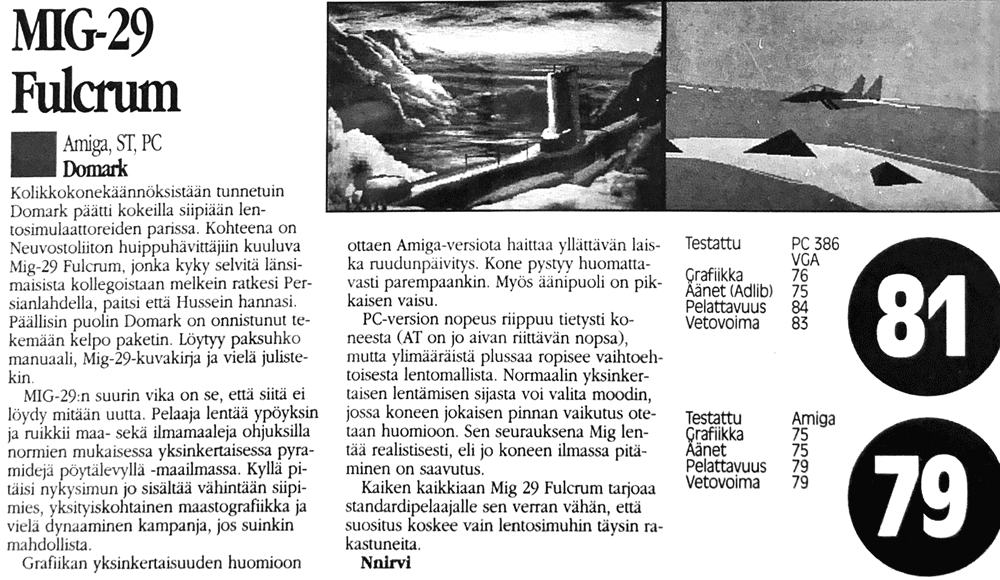
MIG-29 Fulcrum1991 SyksyPysyvä linkkiKolikkokonekäännöksistään tunnetuin Domark päätti kokeilla siipiään lentosimulaattoreiden parissa. Kohteena on Neuvostoliiton huippuhävittäjiin kuuluva Mig-29 Fulcrum, jonka kyky selvitä länsimaisista kollegoistaan melkein ratkesi Persianlahdella, paitsi että Hussein hannasi. Päällisin puolin Domark on onnistunut tekemään kelpo paketin. Löytyy paksuhko manuaali, Mig-29-kuvakirja ja vielä julistekin.
MIG-29:n suurin vika on se, että siitä ei löydy mitään uutta. Pelaaja lentää ypöyksin ja ruikkii maa- sekä ilmamaaleja ohjuksilla normien mukaisessa yksinkertaisessa pyramidejä pöytälevyllä -maailmassa. Kyllä pitäisi nykysimun jo sisältää vähintään siipimies, yksityiskohtainen maastografiikka ja vielä dynaaminen kampanja, jos suinkin mahdollista.
Grafiikan yksinkertaisuuden huomioon ottaen Amiga-versiota haittaa yllättävän laiska ruudunpäivitys. Kone pystyy huomattavasti parempaankin. Myös äänipuoli on pikkaisen vaisu.
PC-version nopeus riippuu tietysti koneesta (AT on jo aivan riittävän nopsa), mutta ylimääräistä plussaa ropisee vaihtoehtoisesta lentomallista. Normaalin yksinkertaisen lentämisen sijasta voi valita moodin, jossa koneen jokaisen pinnan vaikutus otetaan huomioon. Sen seurauksena Mig lentää realistisesti, eli jo koneen ilmassa pitäminen on saavutus.
Kaiken kaikkiaan Mig 29 Fulcrum tarjoaa standardipelaajalle sen verran vähän, että suositus koskee vain lentosimuhin täysin rakastuneita.
MIG-29 Fulcrum1991 SyksyPermalinkDomark, best known for its coin-op conversions, decided to try its wings at flight simulators. The subject is the Mig-29 Fulcrum, one of the Soviet Union's top fighters, whose ability to hold its own against its Western colleagues was very nearly settled in the Persian Gulf, except that Hussein balked. On the surface Domark has managed to put together a decent package. There's a thickish manual, a Mig-29 picture book and even a poster to boot.
MIG-29's biggest flaw is that there's nothing new to be found in it. The player flies utterly alone, squirting missiles at ground and air targets in the regulation simple pyramids-on-a-tabletop world. A present-day sim really ought to have at least a wingman, detailed terrain graphics and a dynamic campaign on top, if at all possible.
Considering how simple the graphics are, the Amiga version is hampered by a surprisingly lazy screen update. The machine is capable of a good deal better. The sound side is a tad subdued as well.
The speed of the PC version naturally depends on the machine (an AT is already plenty nippy), but extra plus points come raining down for the alternative flight model. Instead of the normal simple flying you can choose a mode in which the effect of every surface of the aircraft is taken into account. As a result the Mig flies realistically, which is to say that just keeping the plane in the air is an achievement.
All in all, Mig 29 Fulcrum offers the standard player so little that the recommendation only applies to those hopelessly in love with flight sims.
Might & Magic III: The Isles Of Terra
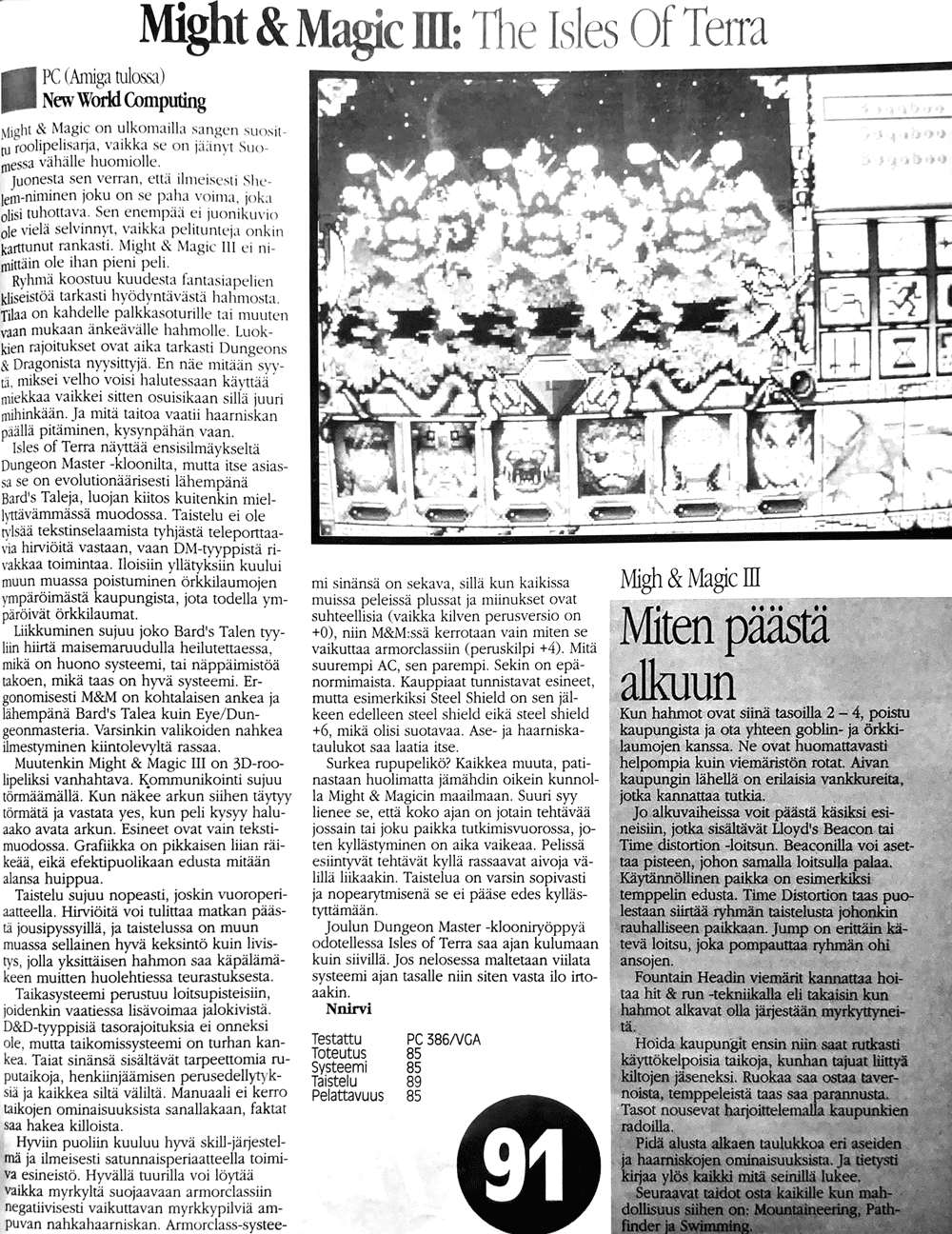
Might & Magic III: The Isles Of Terra1991 SyksyPysyvä linkkiMight & Magic on ulkomailla sangen suosittu roolipelisarja, vaikka se on jäänyt Suomessa vähälle huomiolle.
Juonesta sen verran, että ilmeisesti Shelem-niminen joku on se paha voima, joka olisi tuhottava. Sen enempää ei juonikuvio ole vielä selvinnyt, vaikka pelitunteja onkin karttunut rankasti. Might & Magic III ei nimittäin ole ihan pieni peli.
Ryhmä koostuu kuudesta fantasiapelien kliseistöä tarkasti hyödyntävästä hahmosta. Tilaa on kahdelle palkkasoturille tai muuten vaan mukaan änkeävälle hahmolle. Luokkien rajoitukset ovat aika tarkasti Dungeons & Dragonista nyysittyjä. En näe mitään syytä, miksei velho voisi halutessaan käyttää miekkaa vaikkei sitten osuisikaan sillä juuri mihinkään. Ja mitä taitoa vaatii haarniskan päällä pitäminen, kysynpähän vaan.
Isles of Terra näyttää ensisilmäykseltä Dungeon Master -kloonilta, mutta itse asiassa se on evolutionäärisesti lähempänä Bard's Taleja, luojan kiitos kuitenkin miellyttävämmässä muodossa. Taistelu ei ole tylsää tekstinselaamista tyhjästä teleporttaavia hirviöitä vastaan, vaan DM-tyyppistä rivakkaa toimintaa. Iloisiin yllätyksiin kuului muun muassa poistuminen örkkilaumojen ympäröimästä kaupungista, jota todella ympäröivät örkkilaumat.
Liikkuminen sujuu joko Bard's Talen tyyliin hiirtä maisemaruudulla heilutettaessa, mikä on huono systeemi, tai näppäimistöä takoen, mikä taas on hyvä systeemi. Ergonomisesti M&M on kohtalaisen ankea ja lähempänä Bard's Talea kuin Eye/Dungeonmasteria. Varsinkin valikoiden nahkea ilmestyminen kiintolevyltä rassaa.
Muutenkin Might & Magic III on 3D-roolipeliksi vanhahtava. Kommunikointi sujuu törmäämällä. Kun näkee arkun siihen täytyy törmätä ja vastata yes, kun peli kysyy haluaako avata arkun. Esineet ovat vain tekstimuodossa. Grafiikka on pikkaisen liian räikeää, eikä efektipuolikaan edusta mitään alansa huippua.
Taistelu sujuu nopeasti, joskin vuoroperiaatteella. Hirviöitä voi tulittaa matkan päästä jousipyssyillä, ja taistelussa on muun muassa sellainen hyvä keksintö kuin livistys, jolla yksittäisen hahmon saa käpälämäkeen muitten huolehtiessa teurastuksesta.
Taikasysteemi perustuu loitsupisteisiin, joidenkin vaatiessa lisävoimaa jalokivistä. D&D-tyyppisiä tasorajoituksia ei onneksi ole, mutta taikomissysteemi on turhan kankea. Taiat sinänsä sisältävät tarpeettomia ruputaikoja, henkiinjäämisen perusedellytyksiä ja kaikkea siltä väliltä. Manuaali ei kerro taikojen ominaisuuksista sanallakaan, faktat saa hakea killoista.
Hyviin puoliin kuuluu hyvä skill-järjestelmä ja ilmeisesti satunnaisperiaatteella toimiva esineistö. Hyvällä tuurilla voi löytää vaikka myrkyltä suojaavaan armorclassiin negatiivisesti vaikuttavan myrkkypilviä ampuvan nahkahaarniskan. Armorclass-systeemi sinänsä on sekava, sillä kun kaikissa muissa peleissä plussat ja miinukset ovat suhteellisia (vaikka kilven perusversio on +0), niin M&M:ssä kerrotaan vain miten se vaikuttaa armorclassiin (peruskilpi +4). Mitä suurempi AC, sen parempi. Sekin on epänormimaista. Kauppiaat tunnistavat esineet, mutta esimerkiksi Steel Shield on sen jälkeen edelleen steel shield eikä steel shield +6, mikä olisi suotavaa. Ase- ja haarniskataulukot saa laatia itse.
Surkea rupupelikö? Kaikkea muuta, patinastaan huolimatta jämähdin oikein kunnolla Might & Magicin maailmaan. Suuri syy lienee se, että koko ajan on jotain tehtävää jossain tai joku paikka tutkimisvuorossa, joten kyllästyminen on aika vaikeaa. Pelissä esiintyvät tehtävät kyllä rassaavat aivoja välillä liikaakin. Taistelua on varsin sopivasti ja nopearytmisenä se ei pääse edes kyllästyttämään.
Joulun Dungeon Master -klooniryöppyä odotellessa Isles of Terra saa ajan kulumaan kuin siivillä. Jos nelosessa maltetaan viilata systeemi ajan tasalle niin siten vasta ilo irtoaakin.
Might & Magic III: The Isles Of Terra1991 SyksyPermalinkMight & Magic is a highly popular role-playing series abroad, even though it has gone largely unnoticed in Finland.
As for the plot, apparently somebody called Shelem is the evil force that needs destroying. Beyond that the storyline hasn't become any clearer yet, even though the hours of play have been piling up something fierce. Might & Magic III, you see, is not exactly a small game.
The party is made up of six characters who faithfully exploit every fantasy-game cliché. There's room for two hirelings, or for characters who just barge in and tag along. The class restrictions have been nicked pretty faithfully from Dungeons & Dragon. I see no reason why a wizard shouldn't be able to use a sword if they feel like it, even if they then don't hit much of anything with it. And what skill does it take to keep a suit of armour on, I'd just like to know.
At first glance Isles of Terra looks like a Dungeon Master clone, but in fact it's evolutionarily closer to the Bard's Tales, though thank the Lord in a more pleasant form. Combat isn't dull scrolling through text against monsters that teleport in out of thin air, but brisk DM-style action. Among the happy surprises was leaving a town surrounded by orc hordes, which really was surrounded by orc hordes.
Movement works either Bard's Tale style, by waving the mouse around on the view window, which is a bad system, or by pounding the keyboard, which on the other hand is a good system. Ergonomically M&M is fairly dismal and closer to Bard's Tale than to Eye/Dungeonmaster. The sluggish way the menus crawl up off the hard disk is especially grating.
In other ways too, Might & Magic III is old-fashioned for a 3D role-playing game. Interaction is done by bumping into things. When you see a chest you have to bump into it and answer yes when the game asks whether you want to open the chest. Items exist only as text. The graphics are a tad too garish, and the effects side doesn't represent anything like the best in the business either.
Combat is quick, though turn-based. You can shoot at monsters from a distance with bows, and among other things combat features such a fine invention as legging it, which lets a single character take to their heels while the others see to the slaughter.
The magic system is based on spell points, with some spells needing extra power from gems. Thankfully there are no D&D-style level restrictions, but the spellcasting system is needlessly clunky. The spells themselves include useless junk spells, basic essentials for staying alive and everything in between. The manual doesn't say a word about what the spells do; you have to go and fetch the facts from the guilds.
Among the good points are a good skill system and items that apparently work on a random basis. With a bit of luck you might find, say, a poison-protecting, armour-class-lowering, poison-cloud-firing suit of leather armour. The armour class system itself is confusing, because whereas in every other game the pluses and minuses are relative (the basic version of a shield being +0, say), in M&M you're only told how it affects your armour class (basic shield +4). The bigger the AC, the better. That goes against the norm too. The merchants identify items, but a Steel Shield, for instance, is afterwards still a steel shield and not a steel shield +6, which would be preferable. You get to draw up the weapon and armour tables yourself.
A miserable junk game, then? Anything but: despite its patina, I got well and truly stuck in the world of Might & Magic. A big reason is probably that there's always something to do somewhere or some place due to be explored, so getting bored is pretty difficult. Admittedly the quests in the game do rack the brain, at times a bit too much. There's just the right amount of combat, and being fast-paced it never even gets the chance to become boring.
While waiting for the Christmas deluge of Dungeon Master clones, Isles of Terra makes the time fly. If they can be bothered to file the system up to date in part four, that's when the fun will really kick off.
Might and Magic Book One: Secret of the Inner Sanctum
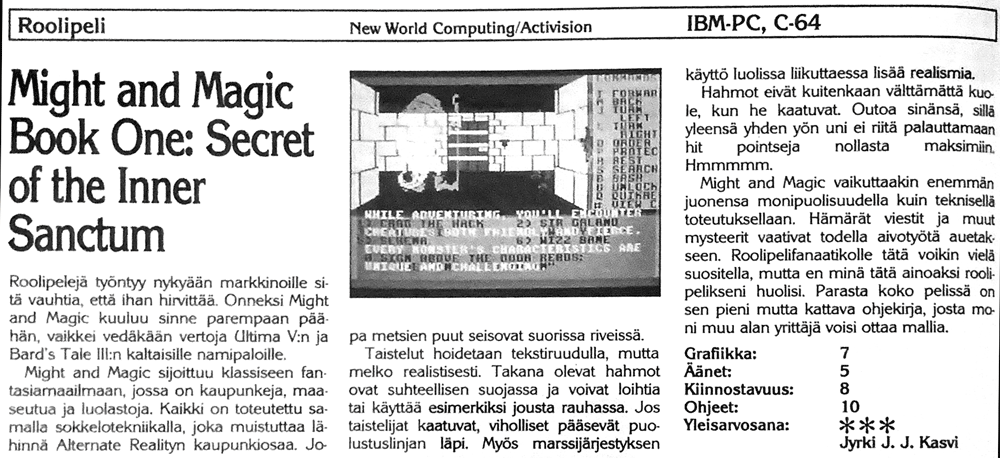
Might and Magic Book One: Secret of the Inner Sanctum1989 KevätPysyvä linkkiRoolipelejä työntyy nykyään markkinoille sitä vauhtia, että ihan hirvittää. Onneksi Might and Magic kuuluu sinne parempaan päähän, vaikkei vedäkään vertoja Ultima V:n ja Bard's Tale III:n kaltaisille namipaloille.
Might and Magic sijoittuu klassiseen fantasiamaailmaan, jossa on kaupunkeja, maaseutua ja luolastoja. Kaikki on toteutettu samalla sokkelotekniikalla, joka muistuttaa lähinnä Alternate Realityn kaupunkiosaa. Jopa metsien puut seisovat suorissa riveissä.
Taistelut hoidetaan tekstiruudulla, mutta melko realistisesti. Takana olevat hahmot ovat suhteellisen suojassa ja voivat loihtia tai käyttää esimerkiksi jousta rauhassa. Jos taistelijat kaatuvat, viholliset pääsevät puolustuslinjan läpi. Myös marssijärjestyksen käyttö luolissa liikuttaessa lisää realismia.
Hahmot eivät kuitenkaan välttämättä kuole, kun he kaatuvat. Outoa sinänsä, sillä yleensä yhden yön uni ei riitä palauttamaan hit pointseja nollasta maksimiin. Hmmmmm.
Might and Magic vaikuttaakin enemmän juonensa monipuolisuudella kuin teknisellä toteutuksellaan. Hämärät viestit ja muut mysteerit vaativat todella aivotyötä auetakseen. Roolipelifanaatikolle tätä voikin vielä suositella, mutta en minä tätä ainoaksi roolipelikseni huolisi. Parasta koko pelissä on sen pieni mutta kattava ohjekirja, josta moni muu alan yrittäjä voisi ottaa mallia.
Might and Magic Book One: Secret of the Inner Sanctum1989 KevätPermalinkRole-playing games are shoving their way onto the market these days at such a rate that it's downright frightening. Luckily Might and Magic belongs at the better end, even if it can't hold a candle to tasty morsels like Ultima V and Bard's Tale III.
Might and Magic is set in a classic fantasy world with towns, countryside and dungeons. Everything has been done with the same maze technique, which most closely resembles the city part of Alternate Reality. Even the trees in the forests stand in straight rows.
Combat is handled on a text screen, but fairly realistically. Characters at the back are relatively safe and can cast spells or use, say, a bow in peace. If the fighters fall, the enemies get through the line of defence. Using a marching order when moving through the dungeons also adds to the realism.
Characters don't necessarily die when they fall, though. Odd in itself, since one night's sleep usually isn't enough to restore hit points from zero to maximum. Hmmmmm.
So Might and Magic impresses more with the richness of its plot than with its technical execution. Cryptic messages and other mysteries take real brainwork to crack. To a role-playing fanatic this one can still be recommended, but I wouldn't settle for it as my only role-playing game. The best thing in the whole game is its small but comprehensive manual, which many another outfit in the business could take a lesson from.
Mighty Bombjack
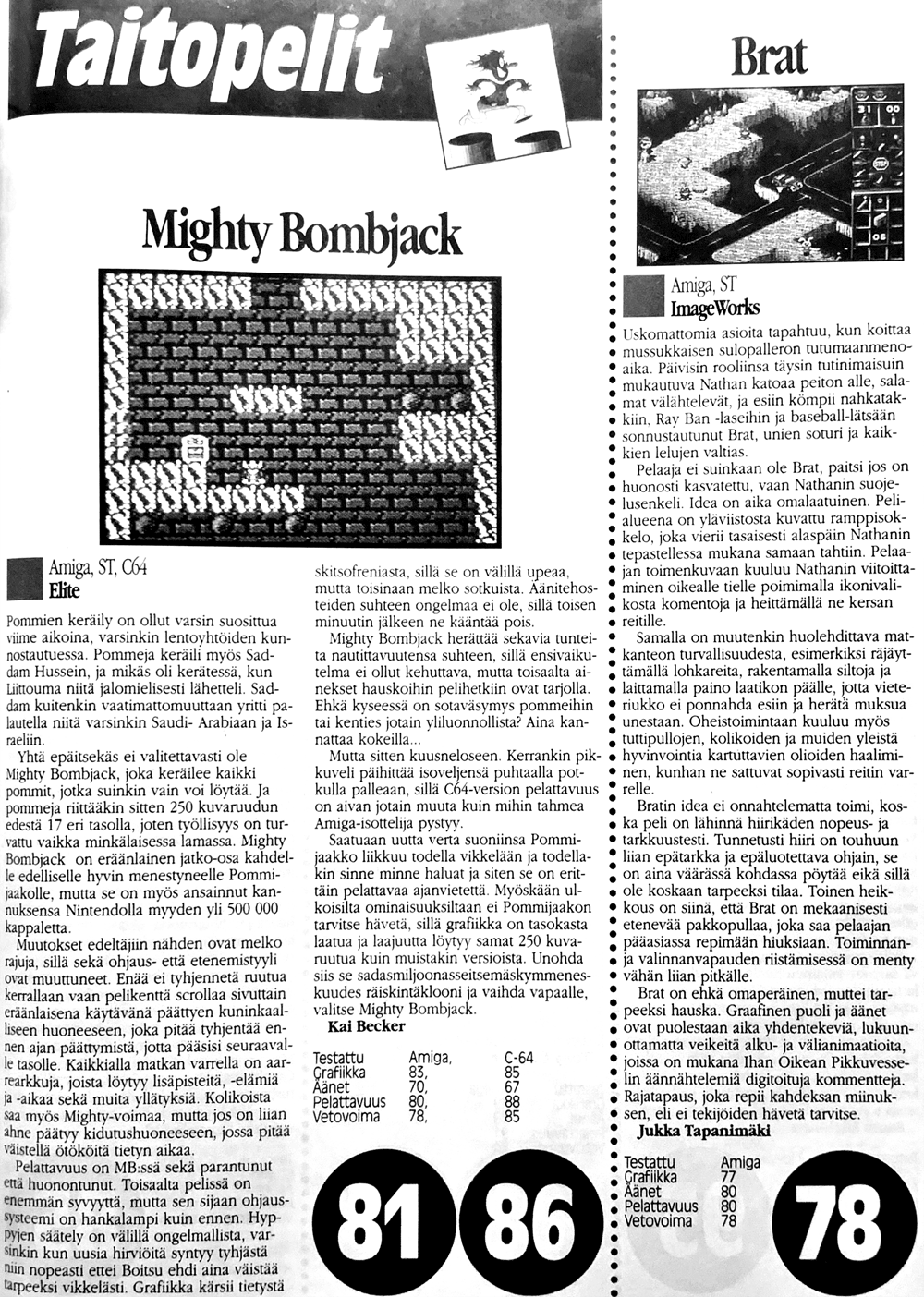
Mighty Bombjack1991 SyksyPysyvä linkkiPommien keräily on ollut varsin suosittua viime aikoina, varsinkin lentoyhtöiden kunnostautuessa. Pommeja keräili myös Saddam Hussein, ja mikäs oli kerätessä, kun Liittouma niitä jalomielisesti lähetteli. Saddam kuitenkin vaatimattomuuttaan yritti palautella niitä varsinkin Saudi- Arabiaan ja Israeliin.
Yhtä epäitsekäs ei valitettavasti ole Mighty Bombjack, joka keräilee kaikki pommit, jotka suinkin vain voi löytää. Ja pommeja riittääkin sitten 250 kuvaruudun edestä 17 eri tasolla, joten työllisyys on turvattu vaikka minkälaisessa lamassa. Mighty Bombjack on eräänlainen jatko-osa kahdelle edelliselle hyvin menestyneelle Pommijaakolle, mutta se on myös ansainnut kannuksensa Nintendolla myyden yli 500 000 kappaletta.
Muutokset edeltäjiin nähden ovat melko rajuja, sillä sekä ohjaus- että etenemistyyli ovat muuttuneet. Enää ei tyhjennetä ruutua kerrallaan vaan pelikenttä scrollaa sivuttain eräänlaisena käytävänä päättyen kuninkaalliseen huoneeseen, joka pitää tyhjentää ennen ajan päättymistä, jotta pääsisi seuraavalle tasolle. Kaikkialla matkan varrella on aarrearkkuja, joista löytyy lisäpisteitä, -elämiä ja -aikaa sekä muita yllätyksiä. Kolikoista saa myös Mighty-voimaa, mutta jos on liian ahne päätyy kidutushuoneeseen, jossa pitää väistellä ötököitä tietyn aikaa.
Pelattavuus on MB:ssä sekä parantunut että huonontunut. Toisaalta pelissä on enemmän syvyyttä, mutta sen sijaan ohjaussysteemi on hankalampi kuin ennen. Hyppyjen säätely on välillä ongelmallista, varsinkin kun uusia hirviöitä syntyy tyhjästä niin nopeasti ettei Boitsu ehdi aina väistää tarpeeksi vikkelästi. Grafiikka kärsii tietystä skitsofreniasta, sillä se on välillä upeaa, mutta toisinaan melko sotkuista. Äänitehosteiden suhteen ongelmaa ei ole, sillä toisen minuutin jälkeen ne kääntää pois.
Mighty Bombjack herättää sekavia tunteita nautittavuutensa suhteen, sillä ensivaikutelma ei ollut kehuttava, mutta toisaalta ainekset hauskoihin pelihetkiin ovat tarjolla. Ehkä kyseessä on sotaväsymys pommeihin tai kenties jotain yliluonnollista? Aina kannattaa kokeilla...
Mutta sitten kuusneloseen. Kerrankin pikkuveli päihittää isoveljensä puhtaalla potkulla palleaan, sillä C64-version pelattavuus on aivan jotain muuta kuin mihin tahmea Amiga-isottelija pystyy.
Saatuaan uutta verta suoniinsa Pommijaakko liikkuu todella vikkelään ja todellakin sinne minne haluat ja siten se on erittäin pelattavaa ajanvietettä. Myöskään ulkoisilta ominaisuuksiltaan ei Pommijaakon tarvitse hävetä, sillä grafiikka on tasokasta laatua ja laajuutta löytyy samat 250 kuvaruutua kuin muistakin versioista. Unohda siis se sadasmiljoonasseitsemäskymmeneskuudes räiskintäklooni ja vaihda vapaalle, valitse Mighty Bombjack.
Mighty Bombjack1991 SyksyPermalinkCollecting bombs has been quite popular lately, especially with the airlines distinguishing themselves. Saddam Hussein collected bombs too, and why not, with the Coalition so generously sending them his way. Out of sheer modesty, however, Saddam tried to return them, particularly to Saudi Arabia and Israel.
Unfortunately Mighty Bombjack is not so selfless, collecting every last bomb that can possibly be found. And there are bombs aplenty, too: 250 screens' worth across 17 different levels, so employment is secure however deep the recession gets. Mighty Bombjack is a sort of sequel to the two previous, highly successful Pommijaakko games, but it has also earned its spurs on the Nintendo, selling over 500,000 copies.
The changes compared with its predecessors are fairly drastic, since both the controls and the way you progress have changed. You no longer clear one screen at a time; instead the playfield scrolls sideways as a kind of corridor ending in a royal chamber, which has to be cleared before time runs out if you want to get to the next level. All along the way there are treasure chests holding extra points, lives and time as well as other surprises. Coins also give you Mighty power, but if you get too greedy you end up in the torture chamber, where you have to dodge creepy-crawlies for a set time.
In MB the playability has both improved and got worse. On the one hand there's more depth to the game, but then again the control system is more awkward than before. Judging your jumps is sometimes a problem, especially as new monsters spring up out of nowhere so fast that the lad doesn't always have time to dodge nimbly enough. The graphics suffer from a certain schizophrenia, since at times they're superb, at others fairly messy. There's no problem with the sound effects, since after the second minute you switch them off.
Mighty Bombjack stirs up mixed feelings as to how enjoyable it is, since the first impression was nothing to write home about, but on the other hand the ingredients for some fun gaming moments are all there. Maybe it's war-weariness with bombs, or perhaps something supernatural? It's always worth a go...
But now to the C-64. For once the little brother beats his big brother with a clean kick to the solar plexus, since the playability of the C64 version is something else entirely compared with what the sluggish Amiga big shot can manage.
With fresh blood in its veins, Pommijaakko moves really nippily and really does go where you want, which makes it a highly playable pastime. Nor does Pommijaakko have anything to be ashamed of in the looks department, since the graphics are of a high standard and there's the same scope of 250 screens as in the other versions. So forget that hundred-million-and-seventy-sixth shoot-'em-up clone, kick back and pick Mighty Bombjack.
Millenium 2.2
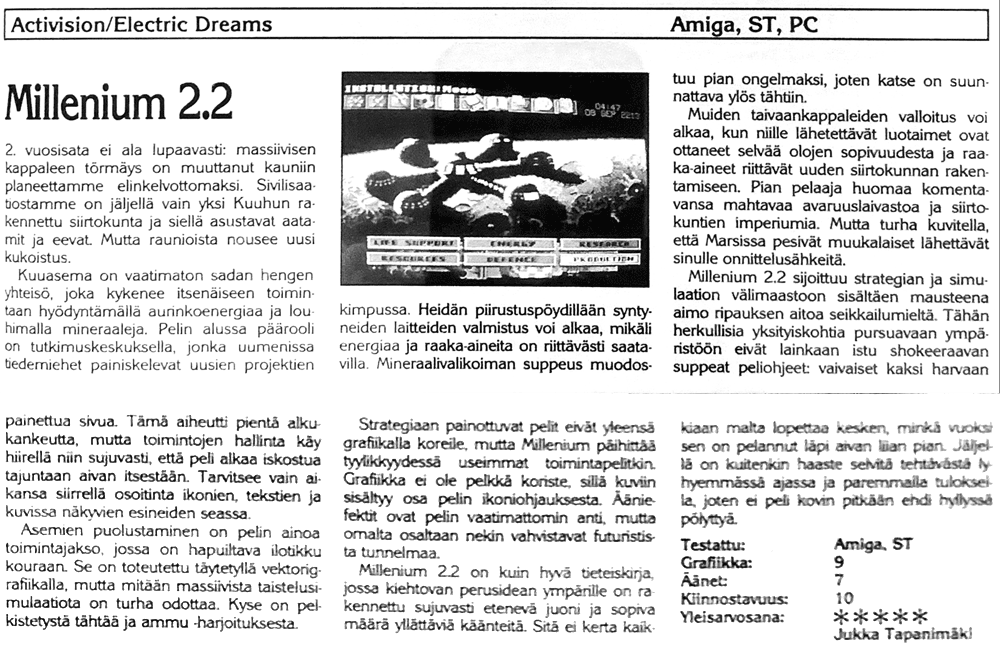
Millenium 2.21989 SyksyPysyvä linkki2. vuosisata ei ala lupaavasti: massiivisen kappaleen törmäys on muuttanut kauniin planeettamme elinkelvottomaksi. Sivilisaatiostamme on jäljellä vain yksi Kuuhun rakennettu siirtokunta ja siellä asustavat aatamit ja eevat. Mutta raunioista nousee uusi kukoistus.
Kuuasema on vaatimaton sadan hengen yhteisö, joka kykenee itsenäiseen toimintaan hyödyntämällä aurinkoenergiaa ja louhimalla mineraaleja. Pelin alussa päärooli on tutkimuskeskuksella, jonka uumenissa tiedemiehet painiskelevat uusien projektien kimpussa. Heidän piirustuspöydillään syntyneiden laitteiden valmistus voi alkaa, mikäli energiaa ja raaka-aineita on riittävästi saatavilla. Mineraalivalikoiman suppeus muodostuu pian ongelmaksi, joten katse on suunnattava ylös tähtiin.
Muiden taivaankappaleiden valloitus voi alkaa, kun niille lähetettävät luotaimet ovat ottaneet selvää olojen sopivuudesta ja raaka-aineet riittävät uuden siirtokunnan rakentamiseen. Pian pelaaja huomaa komentavansa mahtavaa avaruuslaivastoa ja siirtokuntien imperiumia. Mutta turha kuvitella, että Marsissa pesivät muukalaiset lähettävät sinulle onnittelusähkeitä.
Millenium 2.2 sijoittuu strategian ja simulaation välimaastoon sisältäen mausteena aimo ripauksen aitoa seikkailumieltä. Tähän herkullisia yksityiskohtia pursuavaan ympäristöön eivät lainkaan istu shokeeraavan suppeat peliohjeet: vaivaiset kaksi harvaan painettua sivua. Tämä aiheutti pientä alkukankeutta, mutta toimintojen hallinta käy hiirellä niin sujuvasti, että peli alkaa iskostua tajuntaan aivan itsestään. Tarvitsee vain aikansa siirrellä osoitinta ikonien, tekstien ja kuvissa näkyvien esineiden seassa.
Asemien puolustaminen on pelin ainoa toimintajakso, jossa on hapuiltava ilotikku kouraan. Se on toteutettu täytetyllä vektorigrafiikalla, mutta mitään massiivista taistelusimulaatiota on turha odottaa. Kyse on pelkistetystä tähtää ja ammu -harjoituksesta.
Strategiaan painottuvat pelit eivät yleensä grafiikalla koreile, mutta Millenium päihittää tyylikkyydessä useimmat toimintapelitkin. Grafiikka ei ole pelkkä koriste, sillä kuviin sisältyy osa pelin ikoniohjauksesta. Ääniefektit ovat pelin vaatimattomin anti, mutta omalta osaltaan nekin vahvistavat futuristista tunnelmaa.
Millenium 2.2 on kuin hyvä tieteiskirja, jossa kiehtovan perusidean ympärille on rakennettu sujuvasti etenevä juoni ja sopiva määrä yllättäviä käänteitä. Sitä ei kerta kaikkiaan malta lopettaa kesken, minkä vuoksi sen on pelannut läpi aivan liian pian. Jäljellä on kuitenkin haaste selvitä tehtävästä lyhyemmässä ajassa ja paremmalla tuloksella, joten ei peli kovin pitkään ehdi hyllyssä pölyttyä.
Millenium 2.21989 SyksyPermalinkThe 22nd century does not begin promisingly: the impact of a massive body has made our beautiful planet uninhabitable. All that is left of our civilisation is a single colony built on the Moon, where the Adams and Eves live. But from the ruins a new flowering arises.
The moon base is a modest community of a hundred souls, able to function independently by harnessing solar energy and mining minerals. At the start of the game the leading role belongs to the research centre, in whose depths the scientists wrestle with new projects. The devices born on their drawing boards can go into production if enough energy and raw materials are available. The narrow range of minerals soon becomes a problem, so your gaze must turn up to the stars.
The conquest of other heavenly bodies can begin once the probes sent to them have established whether conditions are suitable, and once there are enough raw materials to build a new colony. Soon the player finds that they are commanding a mighty space fleet and an empire of colonies. But don't kid yourself that the aliens nesting on Mars will be sending you congratulatory telegrams.
Millenium 2.2 is set in the borderland between strategy and simulation, with a hefty pinch of genuine adventurous spirit thrown in as seasoning. Shockingly scanty instructions do not fit this setting, brimming with delicious detail, at all: a measly two sparsely printed pages. This caused a little stiffness at the start, but the mouse control goes so smoothly that the game starts to sink into your mind all by itself. You just need to spend some time moving the pointer about among the icons, the texts and the objects visible in the pictures.
Defending the stations is the game's only action sequence, where you have to fumble a joystick into your fist. It is done in filled vector graphics, but there's no point expecting any massive combat simulation. It is a stripped-down aim-and-shoot exercise.
Games with an emphasis on strategy don't usually show off their graphics, but Millenium beats most action games for style as well. The graphics are not mere decoration, since part of the game's icon control is contained in the pictures. The sound effects are the game's most modest contribution, but they too do their bit to strengthen the futuristic atmosphere.
Millenium 2.2 is like a good science fiction novel, in which a smoothly flowing plot and a suitable number of surprising twists have been built around a fascinating basic idea. You simply can't bring yourself to stop halfway, which is why you've played it through far too soon. There is still the challenge of completing the task in less time and with a better result, though, so the game won't have long to gather dust on the shelf.
Mind Bender
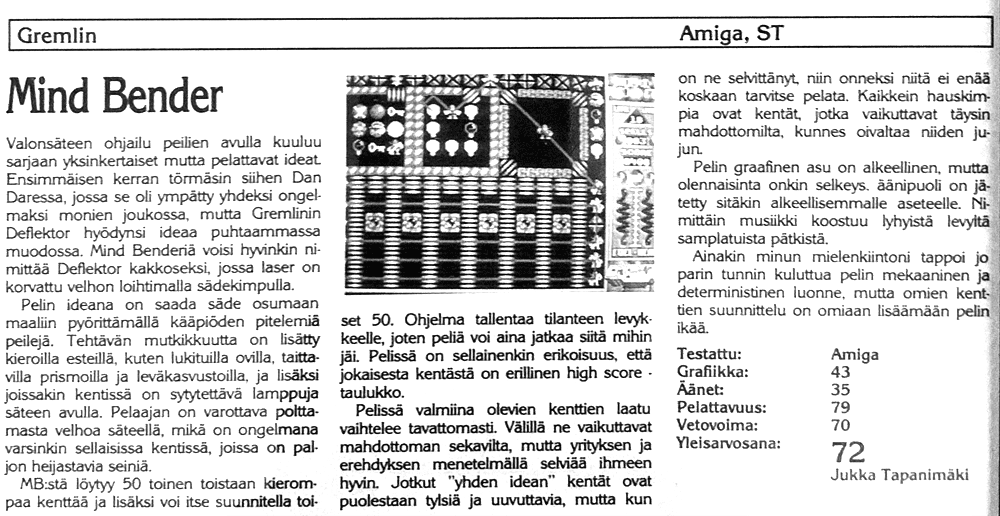
Mind Bender1990 KevätPysyvä linkkiValonsäteen ohjailu peilien avulla kuuluu sarjaan yksinkertaiset mutta pelattavat ideat. Ensimmäisen kerran törmäsin siihen Dan Daressa, jossa se oli ympätty yhdeksi ongelmaksi monien joukossa, mutta Gremlinin Deflektor hyödynsi ideaa puhtaammassa muodossa. Mind Benderiä voisi hyvinkin nimittää Deflektor kakkoseksi, jossa laser on korvattu velhon loihtimalla sädekimpulla.
Pelin ideana on saada säde osumaan maaliin pyörittämällä kääpiöiden pitelemiä peilejä. Tehtävän mutkikkuutta on lisätty kieroilla esteillä, kuten lukituilla ovilla, taittavilla prismoilla ja leväkasvustoilla, ja lisäksi joissakin kentissä on sytytettävä lamppuja säteen avulla. Pelaajan on varottava polttamasta velhoa säteellä, mikä on ongelmana varsinkin sellaisissa kentissä, joissa on paljon heijastavia seiniä.
MB:stä löytyy 50 toinen toistaan kierompaa kenttää ja lisäksi voi itse suunnitella toiset 50. Ohjelma tallentaa tilanteen levykkeelle, joten peliä voi aina jatkaa siitä mihin jäi. Pelissä on sellainenkin erikoisuus, että jokaisesta kentästä on erillinen high score -taulukko.
Pelissä valmiina olevien kenttien laatu vaihtelee tavattomasti. Välillä ne vaikuttavat mahdottoman sekavilta, mutta yrityksen ja erehdyksen menetelmällä selviää ihmeen hyvin. Jotkut "yhden idean" kentät ovat puolestaan tylsiä ja uuvuttavia, mutta kun on ne selvittänyt, niin onneksi niitä ei enää koskaan tarvitse pelata. Kaikkein hauskimpia ovat kentät, jotka vaikuttavat täysin mahdottomilta, kunnes oivaltaa niiden jujun.
Pelin graafinen asu on alkeellinen, mutta olennaisinta onkin selkeys. äänipuoli on jätetty sitäkin alkeellisemmalle aseteelle. Nimittäin musiikki koostuu lyhyistä levyltä samplatuista pätkistä.
Ainakin minun mielenkiintoni tappoi jo parin tunnin kuluttua pelin mekaaninen ja deterministinen luonne, mutta omien kenttien suunnittelu on omiaan lisäämään pelin ikää.
Mind Bender1990 KevätPermalinkSteering a beam of light with mirrors belongs in the category of simple but playable ideas. I first came across it in Dan Dare, where it had been grafted in as one puzzle among many, but Gremlin's Deflektor exploited the idea in a purer form. Mind Bender could well be called Deflektor 2, with the laser replaced by a bundle of rays conjured up by a wizard.
The idea of the game is to get the beam to hit the target by rotating mirrors held by dwarves. The task has been made more convoluted with devious obstacles such as locked doors, refracting prisms and patches of algae, and in some levels you also have to light lamps with the beam. The player has to take care not to burn the wizard with the beam, which is a problem especially in levels with lots of reflective walls.
MB has 50 levels, each more devious than the last, and on top of that you can design another 50 yourself. The program saves your position to disk, so you can always carry on where you left off. The game has one more special feature: every level has its own separate high score table.
The quality of the ready-made levels in the game varies enormously. Sometimes they look impossibly muddled, but by trial and error you get through surprisingly well. Some "one-idea" levels, on the other hand, are dull and exhausting, but once you've solved them, luckily you never have to play them again. The most fun of all are the levels that seem completely impossible until you twig the trick.
The game's graphics are primitive, but clarity is what matters most. The sound has been left at an even more primitive level. Namely, the music consists of short snippets sampled off a record.
My interest, at least, was killed off after just a couple of hours by the game's mechanical and deterministic nature, but designing your own levels is just the thing to extend the game's life.
Miner Machine
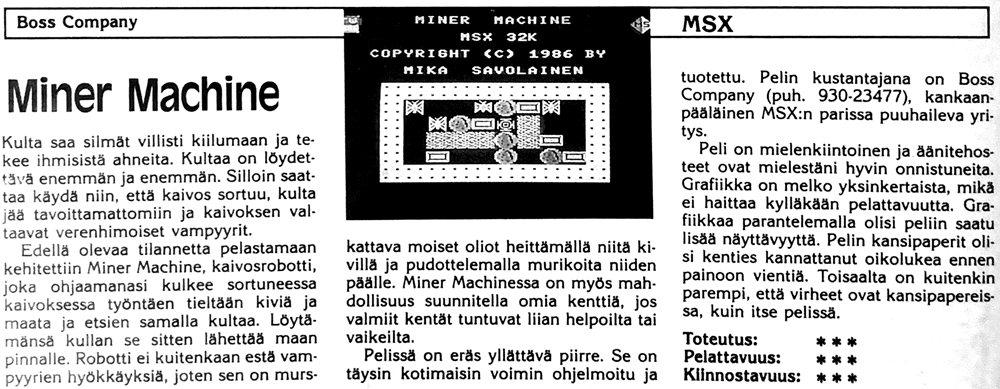
Miner Machine1987Pysyvä linkkiKulta saa silmät villisti kiilumaan ja tekee ihmisistä ahneita. Kultaa on löydettävä enemmän ja enemmän. Silloin saattaa käydä niin, että kaivos sortuu, kulta jää tavoittamattomiin ja kaivoksen valtaavat verenhimoiset vampyyrit.
Edellä olevaa tilannetta pelastamaan kehitettiin Miner Machine, kaivosrobotti, joka ohjaamanasi kulkee sortuneessa kaivoksessa työntäen tieltään kiviä ja maata ja etsien samalla kultaa. Löytämänsä kullan se sitten lähettää maan pinnalle. Robotti ei kuitenkaan estä vampyyrien hyökkäyksiä, joten sen on murskattava moiset oliot heittämällä niitä kivillä ja pudottelemalla murikoita niiden päälle. Miner Machinessa on myös mahdollisuus suunnitella omia kenttiä, jos valmiit kentät tuntuvat liian helpoilta tai vaikeilta.
Pelissä on eräs yllättävä piirre. Se on täysin kotimaisin voimin ohjelmoitu ja tuotettu. Pelin kustantajana on Boss Company (puh. 930-23477), kankaanpääläinen MSX:n parissa puuhaileva yritys.
Peli on mielenkiintoinen ja äänitehosteet ovat mielestäni hyvin onnistuneita. Grafiikka on melko yksinkertaista, mikä ei haittaa kylläkään pelattavuutta. Grafiikkaa parantelemalla olisi peliin saatu lisää näyttävyyttä. Pelin kansipaperit olisi kenties kannattanut oikolukea ennen painoon vientiä. Toisaalta on kuitenkin parempi, että virheet ovat kansipapereissa, kuin itse pelissä.
Miner Machine1987PermalinkGold makes eyes gleam wildly and makes people greedy. More and more gold has to be found. And then it may just happen that the mine caves in, the gold ends up out of reach and the mine is overrun by bloodthirsty vampires.
To rescue the situation described above, the Miner Machine was developed: a mining robot which, under your control, travels through the collapsed mine pushing rocks and earth out of its way while searching for gold. Whatever gold it finds, it then sends up to the surface. The robot can't stop the vampires from attacking, though, so it has to crush such creatures by throwing stones at them and dropping boulders on top of them. Miner Machine also lets you design your own levels, if the ready-made ones feel too easy or too difficult.
The game has one surprising feature. It was programmed and produced entirely by home-grown Finnish talent. The game's publisher is Boss Company (tel. 930-23477), a company from Kankaanpää that tinkers away with the MSX.
The game is interesting, and in my opinion the sound effects are very well done. The graphics are fairly simple, which doesn't actually hurt the playability, mind you. Polishing up the graphics would have given the game more visual punch. It might have been worth proofreading the game's cover inlay before sending it off to the printers. Then again, it's better to have the mistakes in the inlay than in the game itself.
Mini Putt
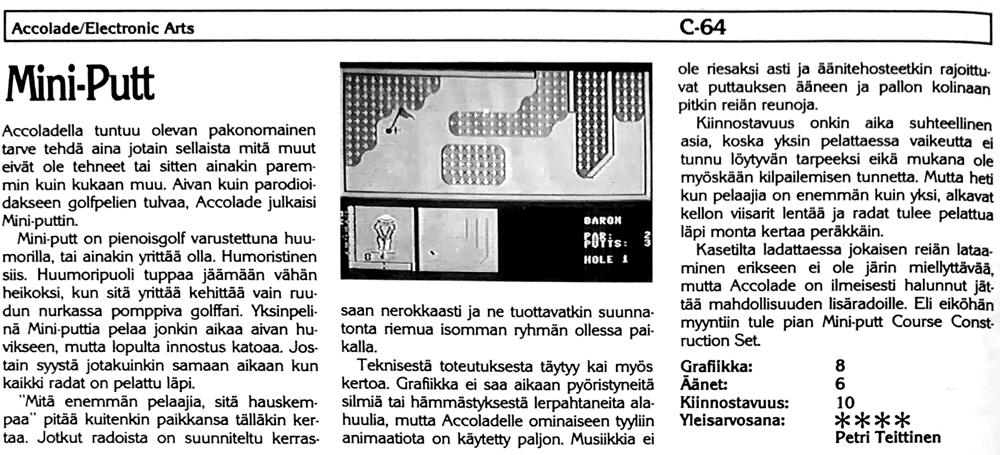
Mini Putt1988Pysyvä linkkiAccoladella tuntuu olevan pakonomainen tarve tehdä aina jotain sellaista mitä muut eivät ole tehneet tai sitten ainakin paremmin kuin kukaan muu. Aivan kuin parodioidakseen golfpelien tulvaa, Accolade julkaisi Mini-puttin.
Mini-putt on pienoisgolf varustettuna huumorilla, tai ainakin yrittää olla. Humoristinen siis. Huumoripuoli tuppaa jäämään vähän heikoksi, kun sitä yrittää kehittää vain ruudun nurkassa pomppiva golffari. Yksinpelinä Mini-puttia pelaa jonkin aikaa aivan huvikseen, mutta lopulta innostus katoaa. Jostain syystä jotakuinkin samaan aikaan kun kaikki radat on pelattu läpi.
"Mitä enemmän pelaajia, sitä hauskempaa" pitää kuitenkin paikkansa tälläkin kertaa. Jotkut radoista on suunniteltu kerrassaan nerokkaasti ja ne tuottavatkin suunnatonta riemua isomman ryhmän ollessa paikalla.
Teknisestä toteutuksesta täytyy kai myös kertoa. Grafiikka ei saa aikaan pyöristyneitä silmiä tai hämmästyksestä lerpahtaneita alahuulia, mutta Accoladelle ominaiseen tyyliin animaatiota on käytetty paljon. Musiikkia ei ole riesaksi asti ja äänitehosteetkin rajoittuvat puttauksen ääneen ja pallon kolinaan pitkin reiän reunoja.
Kiinnostavuus onkin aika suhteellinen asia, koska yksin pelattaessa vaikeutta ei tunnu löytyvän tarpeeksi eikä mukana ole myöskään kilpailemisen tunnetta. Mutta heti kun pelaajia on enemmän kuin yksi, alkavat kellon viisarit lentää ja radat tulee pelattua läpi monta kertaa peräkkäin.
Kasetilta ladattaessa jokaisen reiän lataaminen erikseen ei ole järin miellyttävää, mutta Accolade on ilmeisesti halunnut jättää mahdollisuuden lisäradoille. Eli eiköhän myyntiin tule pian Mini-putt Course Construction Set.
Mini Putt1988PermalinkAccolade seems to have a compulsive need to always do something nobody else has done, or failing that, at least to do it better than anybody else. As if to parody the flood of golf games, Accolade released Mini-putt.
Mini-putt is minigolf equipped with humour, or at least it tries to be. Humorous, that is. The humour side tends to stay a bit thin when the only thing trying to generate it is a golfer bouncing around in the corner of the screen. As a one-player game you'll play Mini-putt for a while just for the fun of it, but in the end the enthusiasm vanishes. For some reason at more or less the same moment all the courses have been played through.
"The more players, the merrier" still holds true this time, though. Some of the courses are designed downright ingeniously, and they generate enormous glee when a bigger crowd is on hand.
I suppose I ought to say something about the technical side too. The graphics won't produce saucer eyes or lower lips drooping in amazement, but in typical Accolade style a lot of animation has been used. There isn't so much music as to become a nuisance, and the sound effects are limited to the sound of the putt and the ball rattling around the rim of the hole.
Interest, then, is a rather relative matter, because played alone there doesn't seem to be enough challenge, nor is there any sense of competition. But as soon as there's more than one player, the hands of the clock start flying and you end up playing through the courses many times in a row.
When loading from cassette, having to load every hole separately isn't exactly pleasant, but Accolade has evidently wanted to leave the door open for extra courses. So I'd expect a Mini-putt Course Construction Set to be in the shops before long.
Zany Golf + Minigolf
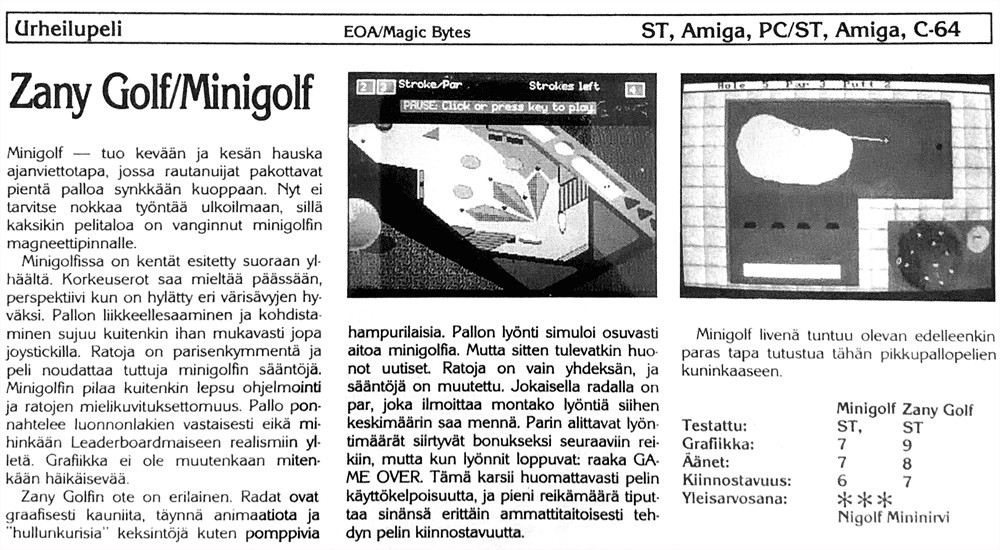
Zany Golf + Minigolf1989 KevätPysyvä linkkiMinigolf - tuo kevään ja kesän hauska ajanviettotapa, jossa rautanuijat pakottavat pientä palloa synkkään kuoppaan. Nyt ei tarvitse nokkaa työntää ulkoilmaan, sillä kaksikin pelitaloa on vanginnut minigolfin magneettipinnalle.
Minigolfissa on kentät esitetty suoraan ylhäältä. Korkeuserot saa mieltää päässään, perspektiivi kun on hylätty eri värisävyjen hyväksi. Pallon liikkeellesaaminen ja kohdistaminen sujuu kuitenkin ihan mukavasti jopa joystickilla. Ratoja on parisenkymmentä ja peli noudattaa tuttuja minigolfin sääntöjä. Minigolfin pilaa kuitenkin lepsu ohjelmointi ja ratojen mielikuvituksettomuus. Pallo ponnahtelee luonnonlakien vastaisesti eikä mihinkään Leaderboardmaiseen realismiin ylletä. Grafiikka ei ole muutenkaan mitenkään häikäisevää.
Zany Golfin ote on erilainen. Radat ovat graafisesti kauniita, täynnä animaatiota ja "hullunkurisia" keksintöjä kuten pomppivia hampurilaisia. Pallon lyönti simuloi osuvasti aitoa minigolfia. Mutta sitten tulevatkin huonot uutiset. Ratoja on vain yhdeksän, ja sääntöjä on muutettu. Jokaisella radalla on par, joka ilmoittaa montako lyöntiä siihen keskimäärin saa mennä. Parin alittavat lyöntimäärät siirtyvät bonukseksi seuraaviin reikiin, mutta kun lyönnit loppuvat: raaka GAME OVER. Tämä karsii huomattavasti pelin käyttökelpoisuutta, ja pieni reikämäärä tiputtaa sinänsä erittäin ammattitaitoisesti tehdyn pelin kiinnostavuutta.
Minigolf livenä tuntuu olevan edelleenkin paras tapa tutustua tähän pikkupallopelien kuninkaaseen.
Zany Golf + Minigolf1989 KevätPermalinkMinigolf - that jolly spring and summer pastime in which iron cudgels force a little ball into a gloomy pit. Now you don't have to stick your nose out into the fresh air, since no fewer than two software houses have imprisoned minigolf on a magnetic surface.
In Minigolf the courses are shown from directly overhead. You have to picture the differences in height in your head, since perspective has been dropped in favour of different shades of colour. Getting the ball moving and aiming it goes quite nicely, though, even with a joystick. There are about twenty holes, and the game follows the familiar rules of minigolf. Minigolf is spoiled, however, by slack programming and unimaginative holes. The ball bounces about in defiance of the laws of nature, and it gets nowhere near any Leaderboard-style realism. Nor are the graphics in any way dazzling otherwise.
Zany Golf takes a different approach. The holes are graphically beautiful, full of animation and "zany" contraptions such as bouncing hamburgers. Hitting the ball simulates real minigolf aptly. But then comes the bad news. There are only nine holes, and the rules have been changed. Every hole has a par, which tells you how many strokes you may spend on it on average. Strokes left under par carry over as a bonus to the following holes, but when you run out of strokes: a brutal GAME OVER. This cuts down the game's usefulness considerably, and the small number of holes lowers the appeal of what is in itself a very professionally made game.
Minigolf played live still seems to be the best way to get to know this king of little-ball games.
Miss Pacman
Miss Pacman1987Pysyvä linkkiMiss Pacman on nopeutettu versio vanhasta kunnon Pacmanista. Ohjailet herttaista rusettipäätä ympäri sokkeloa ja syöt matkallasi kaikki mahdolliset keltaiset pisteet. Neljä charmikasta kummitusta hoitelee takaa-ajoa varsin vauhdikkaasti.
Kentän joka kulmassa on tuttu voimapilleri, jonka nappaistuaan miss Pacman voi hetken ajan kokeilla takaa-ajajan roolia.
Lisäpisteitä neiti saa nappaamalla kiinni ympäri kenttää vaeltelevia hedelmiä.
Muutaman kierroksen jälkeen kenttä vaihtuu toisenlaiseksi ja vauhti tietysti lisääntyy. Hiukan pidemmälle päästessä alkaakin jo olla vaikeuksia; aaveet tulla huristavat sellaista vauhtia että kiinnijääminen on pian edessä. Lisämissin saa kymmenentuhannen pisteen kohdalla ja se onkin ainoa.
Varsin hauskasti toteutettu peli väliajoilla esitettävine näytöksineen P:n ja miss P:n kohtaamisesta. Lienee valitettavan tuttu ainakin idealtaan.
Miss Pacman1987PermalinkMiss Pacman is a sped-up version of good old Pacman. You steer a sweet little bow-head around a maze, eating every yellow dot you possibly can along the way. Four charming ghosts handle the chasing at quite a clip.
In every corner of the maze there's the familiar power pill, and after snapping one up Miss Pacman gets to try out the role of the chaser for a while.
The young lady earns extra points by catching the fruit that wander around the maze.
After a few rounds the maze changes to a different one and the pace naturally picks up. Get a little further and the trouble already starts; the ghosts come whizzing along at such a speed that getting caught is soon on the cards. You get an extra Miss at ten thousand points, and that's the only one you get.
A rather amusingly done game, complete with intermission acts about the meeting of P and Miss P. The idea, at least, is probably all too familiar.
Mission A.D.
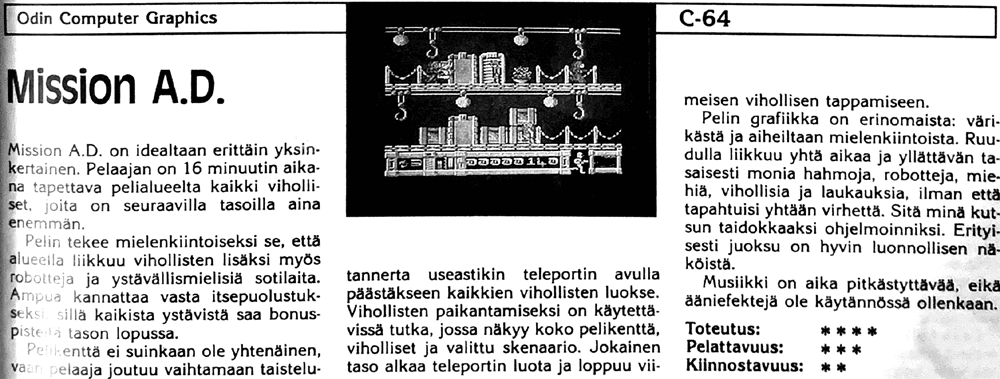
Mission A.D.1987Pysyvä linkkiMission A.D. on idealtaan erittäin yksinkertainen. Pelaajan on 16 minuutin aikana tapettava pelialueelta kaikki viholliset, joita on seuraavilla tasoilla aina enemmän.
Pelin tekee mielenkiintoiseksi se, että alueella liikkuu vihollisten lisäksi myös robotteja ja ystävällismielisiä sotilaita. Ampua kannattaa vasta itsepuolustukseksi, sillä kaikista ystävistä saa bonuspisteitä tason lopussa.
Pelikenttä ei suinkaan ole yhtenäinen, vaan pelaaja joutuu vaihtamaan taistelutannerta useastikin teleportin avulla päästäkseen kaikkien vihollisten luokse. Vihollisten paikantamiseksi on käytettävissä tutka, jossa näkyy koko pelikenttä, viholliset ja valittu skenaario. Jokainen taso alkaa teleportin luota ja loppuu viimeisen vihollisen tappamiseen.
Pelin grafiikka on erinomaista: värikästä ja aiheiltaan mielenkiintoista. Ruudulla liikkuu yhtä aikaa ja yllättävän tasaisesti monia hahmoja, robotteja, miehiä, vihollisia ja laukauksia, ilman että tapahtuisi yhtään virhettä. Sitä minä kutsun taidokkaaksi ohjelmoinniksi. Erityisesti juoksu on hyvin luonnollisen näköistä.
Musiikki on aika pitkästyttävää, eikä ääniefektejä ole käytännössä ollenkaan.
Mission A.D.1987PermalinkMission A.D. is extremely simple in concept. Within 16 minutes the player has to kill all the enemies in the play area, and there are always more of them on each following level.
What makes the game interesting is that besides the enemies, there are also robots and friendly soldiers moving about the area. It pays to shoot only in self-defence, since at the end of the level you get bonus points for all your friends.
The playfield is by no means one continuous area; instead the player has to switch battlefields quite a few times by teleport in order to get at all the enemies. To locate the enemies there's a radar that shows the whole playfield, the enemies and the chosen scenario. Every level starts at the teleport and ends with the killing of the last enemy.
The game's graphics are excellent: colourful and interesting in their subject matter. Lots of figures - robots, men, enemies and shots - move around the screen at the same time and surprisingly smoothly, without a single glitch. That's what I call skilful programming. The running in particular looks very natural.
The music is pretty boring, and there are practically no sound effects at all.
Modem Wars
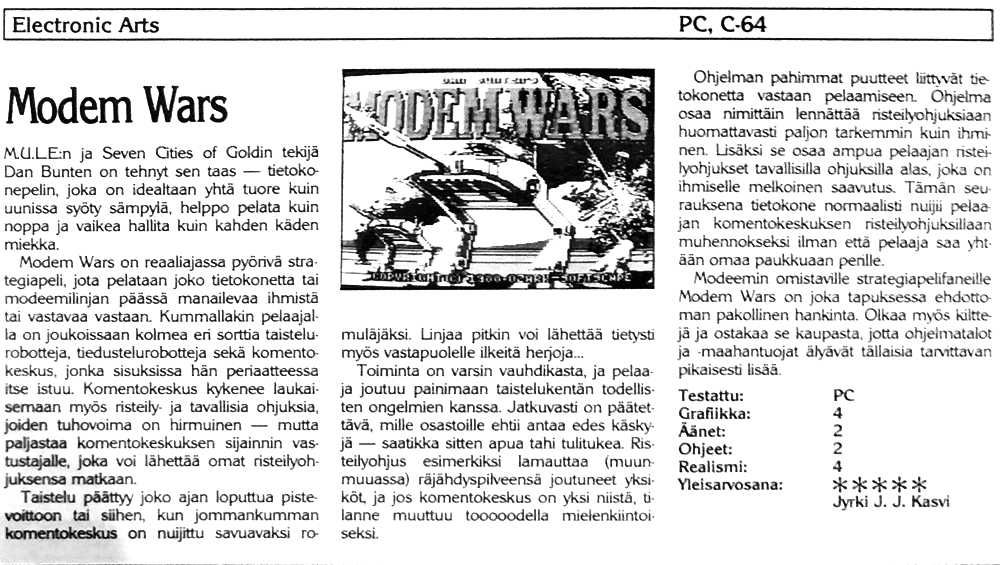
Modem Wars1989 SyksyPysyvä linkkiM.U.L.E:n ja Seven Cities of Goldin tekijä Dan Bunten on tehnyt sen taas - tietokonepelin, joka on idealtaan yhtä tuore kuin uunissa syöty sämpylä, helppo pelata kuin noppa ja vaikea hallita kuin kahden käden miekka.
Modem Wars on reaaliajassa pyörivä strategiapeli, jota pelataan joko tietokonetta tai modeemilinjan päässä manailevaa ihmistä tai vastavaa vastaan. Kummallakin pelaajalla on joukoissaan kolmea eri sorttia taistelurobotteja, tiedustelurobotteja sekä komentokeskus, jonka sisuksissa hän periaatteessa itse istuu. Komentokeskus kykenee laukaisemaan myös risteily- ja tavallisia ohjuksia, joiden tuhovoima on hirmuinen - mutta paljastaa komentokeskuksen sijainnin vastustajalle, joka voi lähettää omat risteilyohjuksensa matkaan.
Taistelu päättyy joko ajan loputtua pistevoittoon tai siihen, kun jommankumman komentokeskus on nuijittu savuavaksi romuläjäksi. Linjaa pitkin voi lähettää tietysti myös vastapuolelle ilkeitä herjoja...
Toiminta on varsin vauhdikasta, ja pelaaja joutuu painimaan taistelukentän todellisten ongelmien kanssa. Jatkuvasti on päätettävä, mille osastoille ehtii antaa edes käskyjä - saatikka sitten apua tahi tulitukea. Risteilyohjus esimerkiksi lamauttaa (muunmuuassa) räjähdyspilveensä joutuneet yksiköt, ja jos komentokeskus on yksi niistä, tilanne muuttuu tooooodella mielenkiintoiseksi.
Ohjelman pahimmat puutteet liittyvät tietokonetta vastaan pelaamiseen. Ohjelma osaa nimittäin lennättää risteilyohjuksiaan huomattavasti paljon tarkemmin kuin ihminen. Lisäksi se osaa ampua pelaajan risteilyohjukset tavallisilla ohjuksilla alas, joka on ihmiselle melkoinen saavutus. Tämän seurauksena tietokone normaalisti nuijii pelaajan komentokeskuksen risteilyohjuksillaan muhennokseksi ilman että pelaaja saa yhtään omaa paukkuaan perille.
Modeemin omistaville strategiapelifaneille Modem Wars on joka tapauksessa ehdottoman pakollinen hankinta. Olkaa myös kilttejä ja ostakaa se kaupasta, jotta ohjelmatalot ja -maahantuojat älyävät tällaisia tarvittavan pikaisesti lisää.
Modem Wars1989 SyksyPermalinkDan Bunten, the creator of M.U.L.E and Seven Cities of Gold, has done it again - a computer game whose idea is as fresh as a bread roll eaten straight out of the oven, as easy to play as a die and as hard to master as a two-handed sword.
Modem Wars is a strategy game running in real time, played either against the computer or against a human or equivalent cursing away at the other end of a modem line. Each player's forces consist of three different sorts of combat robots, scout robots and a command centre, inside which the player, in principle, sits in person. The command centre can also launch cruise missiles and ordinary missiles, whose destructive power is terrific - but this reveals the command centre's position to the opponent, who can then send their own cruise missiles on their way.
The battle ends either in a win on points when time runs out, or when one side's command centre has been clubbed into a smoking heap of scrap. Along the line you can of course also send nasty insults to the other side...
The action is pretty fast-paced, and the player has to grapple with the real problems of the battlefield. You constantly have to decide which units you even have time to give orders to - let alone aid or fire support. A cruise missile, for example, paralyses (among other things) any units caught in its blast cloud, and if the command centre is one of them, things get reeeeeally interesting.
The program's worst shortcomings have to do with playing against the computer. You see, the program can fly its cruise missiles a great deal more accurately than a human can. On top of that, it can shoot down the player's cruise missiles with ordinary missiles, which is quite an achievement for a human. As a result, the computer normally clubs the player's command centre into stew with its cruise missiles without the player getting a single one of their own shots home.
For strategy game fans who own a modem, Modem Wars is in any case an absolutely compulsory purchase. And be nice and buy it from a shop, so that the software houses and importers get the idea that more of this sort of thing is needed, and fast.
Molecule Man
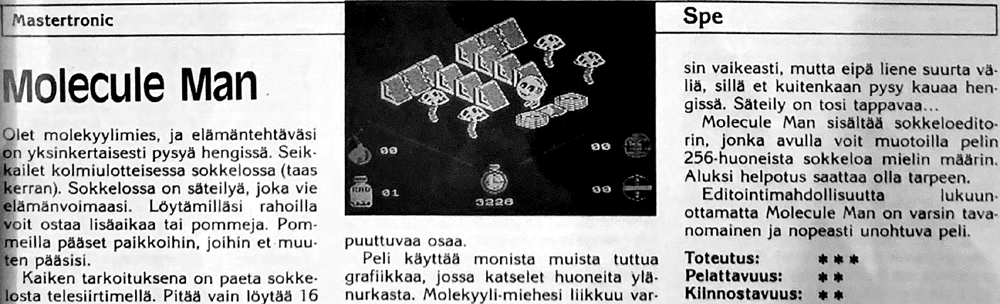
Molecule Man1987Pysyvä linkkiOlet molekyylimies, ja elämäntehtäväsi on yksinkertaisesti pysyä hengissä. Seikkailet kolmiulotteisessa sokkelossa (taas kerran). Sokkelossa on säteilyä, joka vie elämänvoimaasi. Löytämilläsi rahoilla voit ostaa lisäaikaa tai pommeja. Pommeilla pääset paikkoihin, joihin et muuten pääsisi.
Kaiken tarkoituksena on paeta sokkelosta telesiirtimellä. Pitää vain löytää 16 puuttuvaa osaa.
Peli käyttää monista muista tuttua grafiikkaa, jossa katselet huoneita ylänurkasta. Molekyyli-miehesi liikkuu varsin vaikeasti, mutta eipä liene suurta väliä, sillä et kuitenkaan pysy kauaa hengissä. Säteily on tosi tappavaa...
Molecule Man sisältää sokkeloeditorin, jonka avulla voit muotoilla pelin 256-huoneista sokkeloa mielin määrin. Aluksi helpotus saattaa olla tarpeen.
Editointimahdollisuutta lukuunottamatta Molecule Man on varsin tavanomainen ja nopeasti unohtuva peli.
Molecule Man1987PermalinkYou are the molecule man, and your mission in life is simply to stay alive. You adventure around a three-dimensional maze (yet again). The maze is full of radiation, which drains your life force. With the money you find you can buy extra time or bombs. Bombs get you into places you otherwise couldn't reach.
The point of it all is to escape from the maze by teleporter. All you have to do is find the 16 missing parts.
The game uses the graphics familiar from lots of other games, where you look at the rooms from an upper corner. Your molecule man moves rather awkwardly, but that probably doesn't matter much, since you won't stay alive for long anyway. The radiation is seriously deadly...
Molecule Man includes a maze editor that lets you reshape the game's 256-room maze to your heart's content. At first, a little easing-off may well be in order.
Apart from the editing option, Molecule Man is a pretty run-of-the-mill and quickly forgotten game.
Moonbase
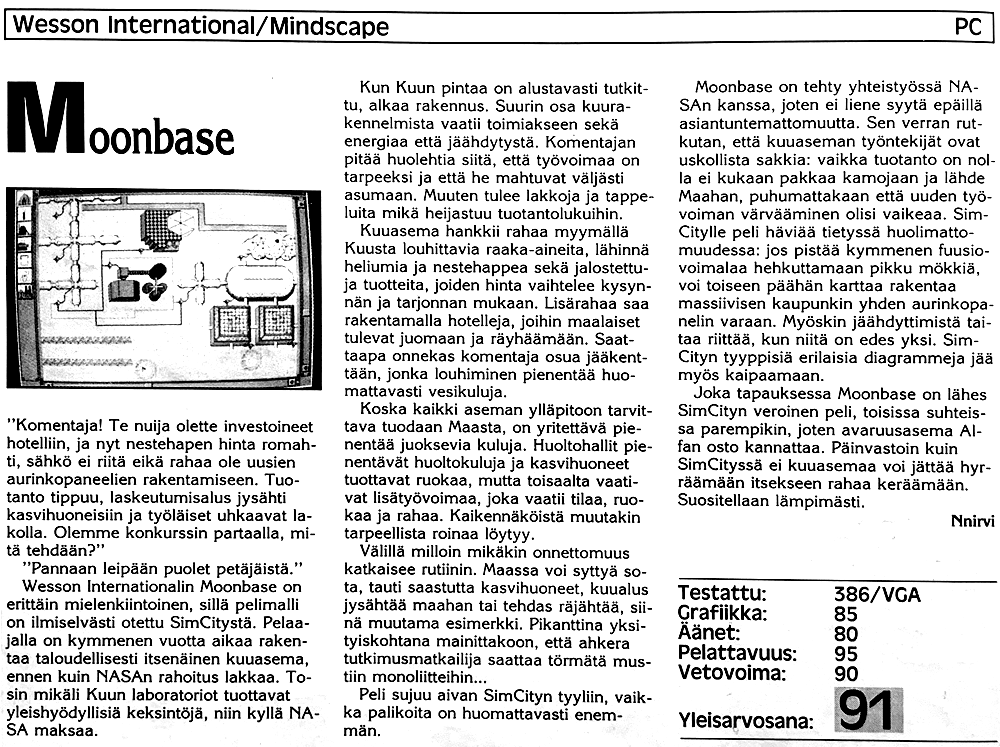
Moonbase1991 KevätPysyvä linkki"Komentaja! Te nuija olette investoineet hotelliin, ja nyt nestehapen hinta romahti, sähkö ei riitä eikä rahaa ole uusien aurinkopaneelien rakentamiseen. Tuotanto tippuu, laskeutumisalus jysähti kasvihuoneisiin ja työläiset uhkaavat lakolla. Olemme konkurssin partaalla, mitä tehdään?"
"Pannaan leipään puolet petäjäistä."
Wesson Internationalin Moonbase on erittäin mielenkiintoinen, sillä pelimalli on ilmiselvästi otettu SimCitystä. Pelaajalla on kymmenen vuotta aikaa rakentaa taloudellisesti itsenäinen kuuasema, ennen kuin NASAn rahoitus lakkaa. Tosin mikäli Kuun laboratoriot tuottavat yleishyödyllisiä keksintöjä, niin kyllä NASA maksaa.
Kun Kuun pintaa on alustavasti tutkittu, alkaa rakennus. Suurin osa kuurakennelmista vaatii toimiakseen sekä energiaa että jäähdytystä. Komentajan pitää huolehtia siitä, että työvoimaa on tarpeeksi ja että he mahtuvat väljästi asumaan. Muuten tulee lakkoja ja tappeluita mikä heijastuu tuotantolukuihin.
Kuuasema hankkii rahaa myymällä Kuusta louhittavia raaka-aineita, lähinnä heliumia ja nestehappea sekä jalostettuja tuotteita, joiden hinta vaihtelee kysynnän ja tarjonnan mukaan. Lisärahaa saa rakentamalla hotelleja, joihin maalaiset tulevat juomaan ja räyhäämään. Saattaapa onnekas komentaja osua jääkenttään, jonka louhiminen pienentää huomattavasti vesikuluja.
Koska kaikki aseman ylläpitoon tarvittava tuodaan Maasta, on yritettävä pienentää juoksevia kuluja. Huoltohallit pienentävät huoltokuluja ja kasvihuoneet tuottavat ruokaa, mutta toisaalta vaativat lisätyövoimaa, joka vaatii tilaa, ruokaa ja rahaa. Kaikennäköistä muutakin tarpeellista roinaa löytyy.
Välillä milloin mikäkin onnettomuus katkaisee rutiinin. Maassa voi syttyä sota, tauti saastutta kasvihuoneet, kuualus jysähtää maahan tai tehdas räjähtää, siinä muutama esimerkki. Pikanttina yksityiskohtana mainittakoon, että ahkera tutkimusmatkailija saattaa törmätä mustiin monoliitteihin...
Peli sujuu aivan SimCityn tyyliin, vaikka palikoita on huomattavasti enemmän.
Moonbase on tehty yhteistyössä NASAn kanssa, joten ei liene syytä epäillä asiantuntemattomuutta. Sen verran rutkutan, että kuuaseman työntekijät ovat uskollista sakkia: vaikka tuotanto on nolla ei kukaan pakkaa kamojaan ja lähde Maahan, puhumattakaan että uuden työvoiman värvääminen olisi vaikeaa. SimCitylle peli häviää tietyssä huolimattomuudessa: jos pistää kymmenen fuusiovoimalaa hehkuttamaan pikku mökkiä, voi toiseen päähän karttaa rakentaa massiivisen kaupungin yhden aurinkopanelin varaan. Myöskin jäähdyttimistä taitaa riittää, kun niitä on edes yksi. SimCityn tyyppisiä erilaisia diagrammeja jää myös kaipaamaan.
Joka tapauksessa Moonbase on lähes SimCityn veroinen peli, toisissa suhteissa parempikin, joten avaruusasema Alfan osto kannattaa. Päinvastoin kuin SimCityssä ei kuuasemaa voi jättää hyrräämään itsekseen rahaa keräämään. Suositellaan lämpimästi.
Moonbase1991 KevätPermalink"Commander! You, sir, blockhead that you are, have invested in a hotel, and now the price of liquid oxygen has crashed, there isn't enough electricity and there's no money to build new solar panels. Production is dropping, a lander has come crashing down on the greenhouses and the workers are threatening to strike. We're on the brink of bankruptcy, what do we do?"
"We'll make the bread half pine bark."
Wesson International's Moonbase is extremely interesting, because the game model has quite obviously been lifted from SimCity. The player has ten years to build a financially self-sufficient moon base before NASA's funding stops. Mind you, if the lunar laboratories come up with inventions of general benefit, then NASA will certainly pay up.
Once the Moon's surface has been given a preliminary survey, construction begins. Most of the lunar structures need both energy and cooling in order to work. The commander has to make sure that there is enough manpower and that they have plenty of room to live in. Otherwise there will be strikes and fights, which shows up in the production figures.
The moon base raises money by selling raw materials mined from the Moon, mainly helium and liquid oxygen, as well as refined products, whose prices vary with supply and demand. Extra money comes from building hotels, where the Earth yokels come to drink and raise hell. A lucky commander may even strike an ice field, and mining it cuts water costs considerably.
Since everything needed to keep the base running is shipped in from Earth, you have to try to cut the running costs. Maintenance hangars cut maintenance costs and greenhouses produce food, but on the other hand they need extra manpower, which needs space, food and money. There's all sorts of other useful junk to be had as well.
Every now and then some accident or other breaks the routine. War may break out on Earth, a disease may infect the greenhouses, a moon ship may slam into the ground or a factory may blow up, to name a few examples. As a piquant detail, let it be mentioned that a diligent explorer may stumble upon black monoliths...
The game plays just like SimCity, although there are considerably more building blocks.
Moonbase was made in cooperation with NASA, so there is presumably no reason to suspect a lack of expertise. I'll grumble this much, though: the moon base workers are a loyal lot - even when production is at zero, nobody packs up their stuff and heads back to Earth, never mind recruiting new workers ever being difficult. The game loses out to SimCity through a certain sloppiness: if you put ten fusion power plants to work keeping a little hut glowing, you can build a massive city at the other end of the map on the strength of a single solar panel. Likewise, it seems one cooler is plenty, as long as there's at least one. You also end up missing SimCity's assortment of charts.
In any case, Moonbase is a game very nearly on a par with SimCity, and in some respects even better, so buying space station Alfa is well worth it. Unlike in SimCity, you can't leave the moon base humming away on its own, raking in money. Warmly recommended.
Moonshine Racers

Moonshine Racers1991 SyksyPysyvä linkkiAmerikan kieltolaki astui voimaan 16. tammikuuta vuonna 1920. Kaikenlainen väkijuomien valmistus, jakelu ja nauttiminen oli ehdottomasti kielletty. Aikakaudesta kertovia TV-sarjoja ja elokuvia on tehty roppakaupalla, joten miksei pelejäkin?
Millenniumin julkaisema ja Peakstarin ohjelmoima Moonshine Racers kertoo kahdesta villistä nuoresta miehestä, Ikestä ja Billy Joesta, jotka elannokseen valmistavat korpirojua takametsissä kieltolain aikoihin ja sitten kuljettavat sitä myyntiin tienvarsien kahviloihin. Sheriffi Sam on kuitenkin sutena poikien kannoilla, kun nämä revittävät rämällä avolavallaan kyttää karkuun.
Pohjimmiltaan peli on kuitenkin autolla ajelua pisteestä A pisteeseen B mahdollisimman nopeasti. Mitä nopeammin tulet maaliin, sitä enemmän rahaa saat. Rahalla voit sitten ostaa kaikenlaisia tavaroita, jotka auttavat sinua kulkemaan nopeammin pisteestä A pisteeseen B ja niin edelleen. Tiellä vaanii kuitenkin kaikenlaisia vaaroja muista autoista tukkeihin ja tiesulkuihin.
Ideapuolella Moonshine Racers ei siis tarjoa mitään uutta tai hämmästyttävää. Ruodittavaksi jääkin siis toteutus. Graafisesti peli tarjoilee keskinkertaista paremmin piirrettyjä valikkoja, kuvia ja animaatiota, mutta itse ajo-osuus ei jaksa vakuuttaa. Vaikka maisemat ovatkin ihan OK ja tie vierii auton alla tarpeeksi nopeasti, ovat muut autot ja esteet huiman kuutiomaisia. Lisäksi näytöllä tapahtuu liikaa kaikenlaista muuta (hahmojen kommentteja, viestejä poliisiradiosta ym.), mikä vie keskittymisen itse ajamisesta. Jos keskinkertaiseksi toteamista ei sanota haukkumiseksi, niin äänipuolta ei voi haukkua eikä kehua.
Pelattavuudessa ei ole ihmeemmin valittamista, auto tottelee joystickiä ihan hyvin. Ainoa pikku miinus on pelin kaksi diskettiä, joista ensimmäisen syö kokonaan alun mainio animaatiopätkä. Jostain syystä peli kyselee silloin tällöin ykkösdiskettiä, eikä silti tunnu lataavan siltä paljon mitään. Tämä ei olisi haitta eikä mikään, jos peli tunnistaisi kaksi levyasemaa. Tällaisenaan diskettien kanssa pelaaminen jää harmittamaan.
Vauhdikasta autopeliä etsivät löytänevät tyydytyksensä paremmin jostain muualta kuin Moonshine Racersin parista.
Moonshine Racers1991 SyksyPermalinkProhibition in America came into force on 16 January 1920. All manufacture, distribution and consumption of alcoholic drinks was strictly forbidden. TV series and films about the era have been made by the bucketload, so why not games too?
Published by Millennium and programmed by Peakstar, Moonshine Racers tells the story of two wild young men, Ike and Billy Joe, who make their living brewing backwoods rotgut out in the sticks during Prohibition and then haul it off to be sold at roadside diners. Sheriff Sam, however, is dogging the boys' heels like a wolf as they tear away from the copper in their clapped-out pickup.
At heart, though, the game is about driving a car from point A to point B as fast as possible. The faster you reach the finish, the more money you get. With the money you can then buy all sorts of stuff that helps you get from point A to point B faster, and so on. All kinds of dangers lurk on the road, however, from other cars to logs and roadblocks.
So on the ideas front Moonshine Racers offers nothing new or astonishing. That leaves the execution to pick apart. Graphically the game serves up better-than-average menus, pictures and animation, but the driving section itself fails to convince. Although the scenery is perfectly OK and the road rolls under the car fast enough, the other cars and obstacles are wildly blocky. On top of that there's too much else going on on screen (character comments, messages from the police radio, etc.), which pulls your concentration away from the actual driving. If calling something average doesn't count as slagging it off, then the sound can be neither slagged off nor praised.
There's not much to complain about in the playability; the car obeys the joystick perfectly well. The only small minus is the game's two disks, the first of which is gobbled up entirely by the excellent opening animation. For some reason the game asks for disk one every now and then, and still doesn't seem to load much of anything from it. This would be no bother at all if the game recognised two drives. As it is, all the playing about with disks remains an annoyance.
Those looking for a fast-paced driving game will probably find their satisfaction somewhere other than in Moonshine Racers.
Moonwalker
Moonwalker1990 KevätPysyvä linkkiPlastiikkakirurginen kumiukko Michael Jackson ansaitsee oman tietokonepelin siinä missä mikä tahansa muukin rahavirtoja liikutteleva markkinailmiö. Michaelin elokuva Moonwalker tarjosi luonnollisesti oivan tilaisuuden rahastaa tietokoneistettuja Jackson-faneja.
Elokuvan juonesta olen autuaan tietämätön, mutta peliin liittyy kähinöintiä Mr Bigin joukkojen kanssa, lapsien pelastamista ja muuta vastaavaa (ei kuitenkaan kumiankan uittamista kylpyammeessa).
Pelissä on neljä osaa, joista ensimmäisessä Jacksonin on livahdettava elokuvastudioilta fanien huomaamatta. Tätä varten Mikon on pukeuduttava jänöpupuksi, mutta ensin on löydettävä puvun osat, sillä ne on ripoteltu pitkin studioaluetta. Seuraavassa osassa suunnistetaan moottoripyörällä Jacksonvilleen Mr Bigin joukkoja vältellen, sitten on vuorossa aseellinen välikohtaus Club 30:ssä ja lopuksi harhaillaan sokkeloissa etsimässä kidnapattua tyttölasta.
Jackson-fanit tietysti jo kuolaavat kuin seitsemän veljestä, mutta ikävä tuottaa pettymys, sillä Moonwalker kuuluu joka suhteessa samaan ryhmään muiden keskiharmaiden lisenssikähmintöjen kanssa. Onhan tietysti mukava seurata, kuinka nipin napin Jacksoniksi tunnistettava sprite askeltaa ruudulla ja taustalla soi "Bad". Mutta peli on pelkästään tylsä ja musiikkikin lähinnä demonstroi, miten minimaalisen melodisia Mikon hitit ovat ja miten täydellisesti ne toimivat hänen karismaattisen äänensä varassa. Kuusitoistabittisissäkään ei kannata paremmin hurrata. Graafisia eroja ei löydy kuin välianimaatioista, ja ST-versio Badista on vuoden hirvein yritys. Amiga-versio ei riko korvia, mutta siinä senkin krediitit tuli esiteltyä.
Jos välttämättä haluat kerätä Jackson-rihkamaa, niin osta ihmeessä Moonwalker, mutta muiden kannattaa vältellä sitä.
Moonwalker1990 KevätPermalinkPlastic-surgery rubber man Michael Jackson deserves his own computer game just as much as any other market phenomenon that sets rivers of money flowing. Michael's film Moonwalker naturally offered a splendid opportunity to cash in on computerised Jackson fans.
I am blissfully ignorant of the film's plot, but the game involves scuffling with Mr Big's forces, rescuing children and other such stuff (though not floating a rubber duck in the bathtub).
The game has four parts. In the first, Jackson has to slip out of the film studios without the fans noticing. To do this Mikko has to dress up as a bunny rabbit, but first the parts of the costume have to be found, since they have been scattered all over the studio lot. In the next part you navigate by motorbike to Jacksonville, dodging Mr Big's forces, then comes an armed incident at Club 30, and finally you wander through mazes looking for a kidnapped little girl.
The Jackson fans are of course already drooling like a gang of country bumpkins, but I'm sorry to disappoint them, since Moonwalker belongs in every respect to the same group as the other middling-grey licence grabs. Sure, it's nice to watch a sprite that's only just recognisable as Jackson stepping across the screen while "Bad" plays in the background. But the game is simply boring, and even the music mostly just demonstrates how minimally melodic Mikko's hits are and how completely they depend on his charismatic voice. There's no more reason to cheer for the 16-bit versions either. The only graphical differences are in the animated interludes, and the ST version of Bad is the most horrible effort of the year. The Amiga version doesn't hurt the ears, but that's the full list of its merits too.
If you absolutely must collect Jackson junk, then by all means buy Moonwalker, but everyone else should steer clear of it.
Morpheus
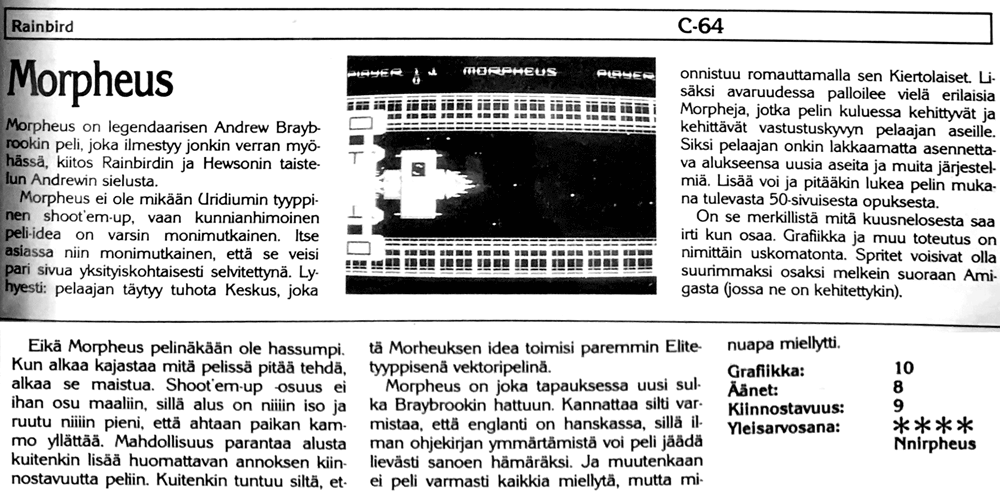
Morpheus1988Pysyvä linkkiMorpheus on legendaarisen Andrew Braybrookin peli, joka ilmestyy jonkin verran myöhässä, kiitos Rainbirdin ja Hewsonin taistelun Andrewin sielusta.
Morpheus ei ole mikään Uridiumin tyyppinen shoot'em-up, vaan kunnianhimoinen peli-idea on varsin monimutkainen. Itse asiassa niin monimutkainen, että se veisi pari sivua yksityiskohtaisesti selvitettynä. Lyhyesti: pelaajan täytyy tuhota Keskus, joka onnistuu romauttamalla sen Kiertolaiset. Lisäksi avaruudessa palloilee vielä erilaisia Morpheja, jotka pelin kuluessa kehittyvät ja kehittävät vastustuskyvyn pelaajan aseille. Siksi pelaajan onkin lakkaamatta asennettava alukseensa uusia aseita ja muita järjestelmiä. Lisää voi ja pitääkin lukea pelin mukana tulevasta 50-sivuisesta opuksesta.
On se merkillistä mitä kuusnelosesta saa irti kun osaa. Grafiikka ja muu toteutus on nimittäin uskomatonta. Spritet voisivat olla suurimmaksi osaksi melkein suoraan Amigasta (jossa ne on kehitettykin). Eikä Morpheus pelinäkään ole hassumpi. Kun alkaa kajastaa mitä pelissä pitää tehdä, alkaa se maistua. Shoot'em-up -osuus ei ihan osu maaliin, sillä alus on niiiin iso ja ruutu niiiin pieni, että ahtaan paikan kammo yllättää. Mahdollisuus parantaa alusta kuitenkin lisää huomattavan annoksen kiinnostavuutta peliin. Kuitenkin tuntuu siltä, että Morheuksen idea toimisi paremmin Elite-tyyppisenä vektoripelinä.
Morpheus on joka tapauksessa uusi sulka Braybrookin hattuun. Kannattaa silti varmistaa, että englanti on hanskassa, sillä ilman ohjekirjan ymmärtämistä voi peli jäädä lievästi sanoen hämäräksi. Ja muutenkaan ei peli varmasti kaikkia miellytä, mutta minuapa miellytti.
Morpheus1988PermalinkMorpheus is a game by the legendary Andrew Braybrook, and it's coming out somewhat late, thanks to Rainbird and Hewson's battle for Andrew's soul.
Morpheus is no Uridium-type shoot'em-up; instead its ambitious game idea is rather complex. So complex, in fact, that it would take a couple of pages to explain in detail. In brief: the player has to destroy the Centre, which is done by collapsing its Orbiters. On top of that, various Morphs are bobbing around in space, and as the game goes on they evolve and develop a resistance to the player's weapons. That's why the player has to keep fitting new weapons and other systems to the ship. More can - and must - be read in the 50-page tome that comes with the game.
It's remarkable what you can squeeze out of the Commodore 64 when you know how. The graphics and the rest of the execution are, you see, incredible. The sprites could for the most part have come almost straight from the Amiga (which is where they were in fact developed). Nor is Morpheus half bad as a game, either. Once it starts to dawn on you what you're supposed to do, you begin to get a taste for it. The shoot'em-up part doesn't quite hit the target, as the ship is sooo big and the screen sooo small that claustrophobia creeps up on you. The chance to upgrade the ship does, however, add a considerable dose of interest to the game. Still, it feels as though Morheus's idea would work better as an Elite-type vector game.
In any case, Morpheus is another feather in Braybrook's cap. Still, it's worth making sure your English is up to scratch, because without understanding the manual the game may remain murky, to put it mildly. And anyway the game certainly won't please everybody, but it sure pleased me.
Motor Massacre
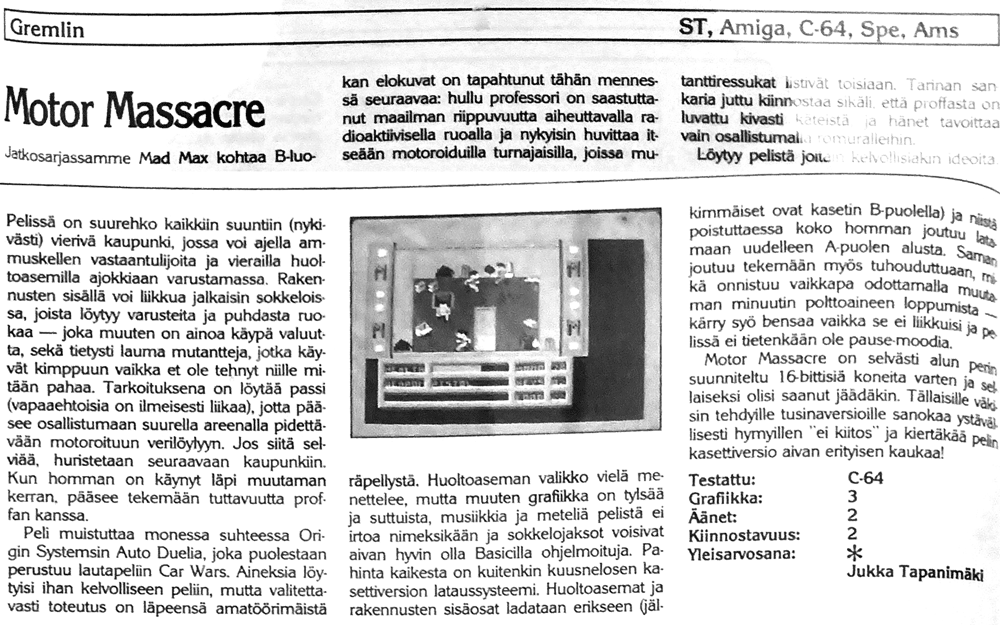
Motor Massacre1989 SyksyPysyvä linkkiJatkosarjassamme Mad Max kohtaa B-luokan elokuvat on tapahtunut tähän mennessä seuraavaa: hullu professori on saastuttanut maailman riippuvuutta aiheuttavalla radioaktiivisella ruoalla ja nykyisin huvittaa itseään motoroiduilla turnajaisilla, joissa mutanttiressukat listivät toisiaan. Tarinan sankaria juttu kiinnostaa sikäli, että proffasta on luvattu kivasti käteistä, ja hänet tavoittaa vain osallistumalla romuralleihin.
Löytyy pelistä joitain kelvollisiakin ideoita. Pelissä on suurehko kaikkiin suuntiin (nykivästi) vierivä kaupunki, jossa voi ajella ammuskellen vastaantulijoita ja vierailla huoltoasemilla ajokkiaan varustamassa. Rakennusten sisällä voi liikkua jalkaisin sokkeloissa, joista löytyy varusteita ja puhdasta ruokaa - joka muuten on ainoa käypä valuutta, sekä tietysti lauma mutantteja, jotka käyvät kimppuun vaikka et ole tehnyt niille mitään pahaa. Tarkoituksena on löytää passi (vapaaehtoisia on ilmeisesti liikaa), jotta pääsee osallistumaan suurella areenalla pidettävään motoroituun verilöylyyn. Jos siitä selviää, huristetaan seuraavaan kaupunkiin. Kun homman on käynyt läpi muutaman kerran, pääsee tekemään tuttavuutta proffan kanssa.
Peli muistuttaa monessa suhteessa Origin Systemsin Auto Duelia, joka puolestaan perustuu lautapeliin Car Wars. Aineksia löytyisi ihan kelvolliseen peliin, mutta valitettavasti toteutus on läpeensä amatöörimäistä räpellystä. Huoltoaseman valikko vielä menettelee, mutta muuten grafiikka on tylsää ja suttuista, musiikkia ja meteliä pelistä ei irtoa nimeksikään ja sokkelojaksot voisivat aivan hyvin olla Basicilla ohjelmoituja. Pahinta kaikesta on kuitenkin kuusnelosen kasettiversion lataussysteemi. Huoltoasemat ja rakennusten sisäosat ladataan erikseen (jälkimmäiset ovat kasetin B-puolella) ja niistä poistuttaessa koko homman joutuu lataamaan uudelleen A-puolen alusta. Saman joutuu tekemään myös tuhouduttuaan, mikä onnistuu vaikkapa odottamalla muutaman minuutin polttoaineen loppumista - kärry syö bensaa vaikka se ei liikkuisi ja pelissä ei tietenkään ole pause-moodia.
Motor Massacre on selvästi alun perin suunniteltu 16-bittisiä koneita varten ja sellaiseksi olisi saanut jäädäkin. Tällaisille väkisin tehdyille tusinaversioille sanokaa ystävällisesti hymyillen "ei kiitos" ja kiertäkää pelin kasettiversio aivan erityisen kaukaa!
Motor Massacre1989 SyksyPermalinkIn our ongoing serial Mad Max Meets the B-Movies, the story so far: a mad professor has contaminated the world with addictive radioactive food and these days amuses himself with motorised tournaments in which poor wretched mutants bump each other off. The hero of the story is interested in the business insofar as a nice bit of cash has been promised for the prof, and the only way to get at him is by taking part in the scrapheap rallies.
The game does have a few passable ideas as well. There is a biggish city scrolling (jerkily) in all directions, where you can drive around shooting at whoever comes the other way and visit service stations to kit out your ride. Inside the buildings you can move about on foot in mazes, where you find equipment and clean food - which, by the way, is the only valid currency - and of course a horde of mutants who go for you even though you've done them no harm. The aim is to find a pass (apparently there are too many volunteers) so that you can take part in the motorised bloodbath held in the big arena. If you survive that, it's off down the road to the next city. Once you've been through the whole routine a few times, you get to make the prof's acquaintance.
In many respects the game resembles Origin Systems' Auto Duel, which in turn is based on the board game Car Wars. The ingredients would be there for a perfectly decent game, but sadly the execution is amateurish botching through and through. The service station menu just about passes, but otherwise the graphics are dull and smeary, you can't get even a token amount of music or racket out of the game, and the maze sections might just as well have been programmed in Basic. Worst of all, though, is the loading system of the C-64 cassette version. The service stations and the building interiors are loaded separately (the latter are on side B of the tape), and when you leave them the whole thing has to be reloaded from the start of side A. You have to do the same after getting destroyed, which you can manage by, say, waiting a few minutes for the fuel to run out - the jalopy eats petrol even when it isn't moving, and naturally the game has no pause mode.
Motor Massacre was clearly designed for 16-bit machines in the first place, and it should have stayed that way. To forced, dime-a-dozen conversions like this, kindly say "no thanks" with a smile, and give the cassette version of the game a very especially wide berth!
Movie Monster Game
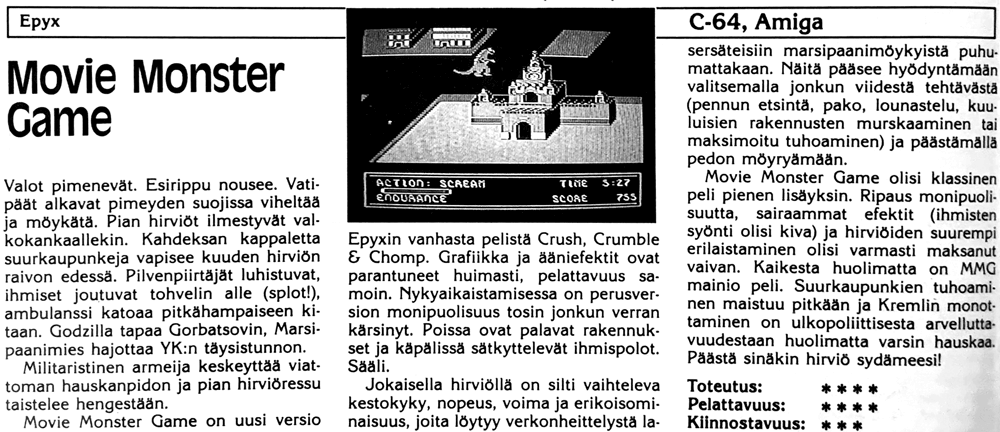
Movie Monster Game1987Pysyvä linkkiValot pimenevät. Esirippu nousee. Vatipäät alkavat pimeyden suojissa viheltää ja möykätä. Pian hirviöt ilmestyvät valkokankaallekin. Kahdeksan kappaletta suurkaupunkeja vapisee kuuden hirviön raivon edessä. Pilvenpiirtäjät luhistuvat, ihmiset joutuvat tohvelin alle (splot!), ambulanssi katoaa pitkähampaiseen kitaan. Godzilla tapaa Gorbatsovin, Marsipaanimies hajottaa YK:n täysistunnon.
Militaristinen armeija keskeyttää viattoman hauskanpidon ja pian hirviöressu taistelee hengestään.
Movie Monster Game on uusi versio Epyxin vanhasta pelistä Crush, Crumble & Chomp. Grafiikka ja ääniefektit ovat parantuneet huimasti, pelattavuus samoin. Nykyaikaistamisessa on perusversion monipuolisuus tosin jonkun verran kärsinyt. Poissa ovat palavat rakennukset ja käpälissä sätkyttelevät ihmispolot. Sääli.
Jokaisella hirviöllä on silti vaihteleva kestokyky, nopeus, voima ja erikoisominaisuus, joita löytyy verkonheittelystä lasersäteisiin marsipaanimöykyistä puhumattakaan. Näitä pääsee hyödyntämään valitsemalla jonkun viidestä tehtävästä (pennun etsintä, pako, lounastelu, kuuluisien rakennusten murskaaminen tai maksimoitu tuhoaminen) ja päästämällä pedon möyryämään.
Movie Monster Game olisi klassinen peli pienen lisäyksin. Ripaus monipuolisuutta, sairaammat efektit (ihmisten syönti olisi kiva) ja hirviöiden suurempi erilaistaminen olisi varmasti maksanut vaivan. Kaikesta huolimatta on MMG mainio peli. Suurkaupunkien tuhoaminen maistuu pitkään ja Kremlin monottaminen on ulkopoliittisesta arveluttavuudestaan huolimatta varsin hauskaa. Päästä sinäkin hirviö sydämeesi!
Movie Monster Game1987PermalinkThe lights go down. The curtain rises. Under cover of darkness the numbskulls start whistling and making a racket. Soon monsters show up on the silver screen as well. Eight big cities, count them, tremble before the fury of six monsters. Skyscrapers collapse, people end up under the slipper (splot!), an ambulance disappears into a long-toothed maw. Godzilla meets Gorbachev, the Marzipan Man breaks up the plenary session of the UN.
The militaristic military puts a stop to the innocent fun, and soon the poor old monster is fighting for its life.
Movie Monster Game is a new version of Epyx's old game Crush, Crumble & Chomp. The graphics and sound effects have improved enormously, and so has the playability. In the modernising, though, the variety of the original version has suffered somewhat. Gone are the burning buildings and the poor little humans wriggling in the monster's paws. Pity.
Each monster still has its own varying stamina, speed, strength and special ability, and these range from web-slinging to laser beams, not to mention marzipan blobs. You get to put them to use by picking one of five missions (searching for the baby, escape, lunching, crushing famous buildings or maximised destruction) and turning the beast loose to roar.
With a few small additions Movie Monster Game would be a classic. A pinch of variety, sicker effects (eating people would be nice) and making the monsters more different from one another would surely have been worth the trouble. Despite everything, MMG is a splendid game. Destroying big cities stays tasty for a long time, and putting the boot into the Kremlin is great fun, its dubiousness in terms of foreign policy notwithstanding. You too - let the monster into your heart!
Mr Do's Castle
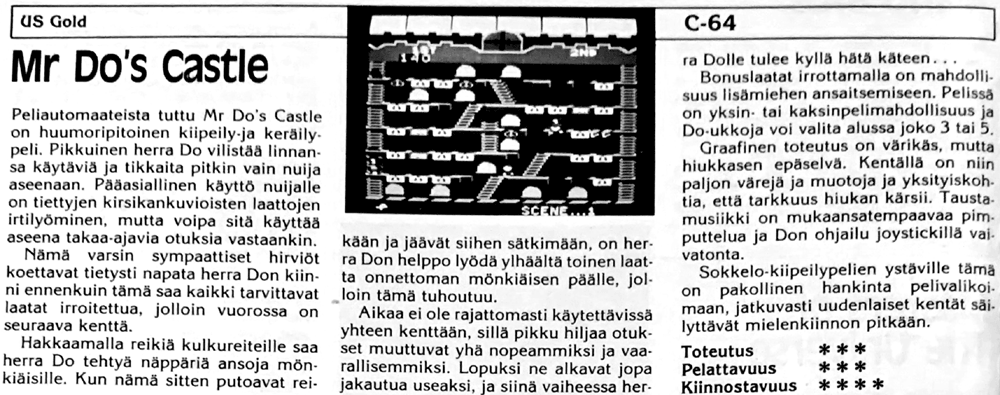
Mr Do's Castle1987Pysyvä linkkiPeliautomaateista tuttu Mr Do's Castle on huumoripitoinen kiipeily-ja keräilypeli. Pikkuinen herra Do vilistää linnansa käytäviä ja tikkaita pitkin vain nuija aseenaan. Pääasiallinen käyttö nuijalle on tiettyjen kirsikankuvioisten laattojen irtilyöminen, mutta voipa sitä käyttää aseena takaa-ajavia otuksia vastaankin.
Nämä varsin sympaattiset hirviöt koettavat tietysti napata herra Don kiinni ennenkuin tämä saa kaikki tarvittavat laatat irroitettua, jolloin vuorossa on seuraava kenttä.
Hakkaamalla reikiä kulkureiteille saa herra Do tehtyä näppäriä ansoja mönkiäisille. Kun nämä sitten putoavat reikään ja jäävät siihen sätkimään, on herra Don helppo lyödä ylhäältä toinen laatta onnettoman mönkiäisen päälle, jolloin tämä tuhoutuu.
Aikaa ei ole rajattomasti käytettävissä yhteen kenttään, sillä pikku hiljaa otukset muuttuvat yhä nopeammiksi ja vaarallisemmiksi. Lopuksi ne alkavat jopa jakautua useaksi, ja siinä vaiheessa herra Dolle tulee kyllä hätä käteen...
Bonuslaatat irrottamalla on mahdollisuus lisämiehen ansaitsemiseen. Pelissä on yksin- tai kaksinpelimahdollisuus ja Do-ukkoja voi valita alussa joko 3 tai 5.
Graafinen toteutus on värikäs, mutta hiukkasen epäselvä. Kentällä on niin paljon värejä ja muotoja ja yksityiskohtia, että tarkkuus hiukan kärsii. Taustamusiikki on mukaansatempaavaa pimputtelua ja Don ohjailu joystickillä vaivatonta.
Sokkelo-kiipeilypelien ystäville tämä on pakollinen hankinta pelivalikoimaan, jatkuvasti uudenlaiset kentät säilyttävät mielenkiinnon pitkään.
Mr Do's Castle1987PermalinkFamiliar from the arcades, Mr Do's Castle is a humour-laden climbing and collecting game. Teeny little Mr Do scurries along the corridors and up and down the ladders of his castle with nothing but a mallet for a weapon. The mallet's main use is knocking loose certain cherry-patterned tiles, but you can also use it as a weapon against the creatures chasing you.
These rather likeable monsters naturally try to nab Mr Do before he manages to knock loose all the tiles he needs, at which point it's on to the next level.
By hammering holes in the walkways, Mr Do can rig up handy traps for the creepy-crawlies. When one of them then falls into a hole and is left there flailing, it's easy for Mr Do to knock another tile down from above onto the hapless creepy-crawly, which destroys it.
There isn't unlimited time to spend on any one level, since little by little the creatures get faster and faster and more and more dangerous. In the end they even start splitting into several, and at that point Mr Do really is in a fix...
Knocking loose the bonus tiles gives you a chance to earn an extra man. The game can be played by one or two players, and at the start you can pick either 3 or 5 little Do-men.
The graphics are colourful but a tad unclear. There are so many colours and shapes and details on the screen that the sharpness suffers a little. The background music is catchy plinking, and steering Do with the joystick is effortless.
For fans of maze-and-ladder games this is a compulsory addition to the game collection; the levels, which keep on being different, hold your interest for a long time.
Mr Heli
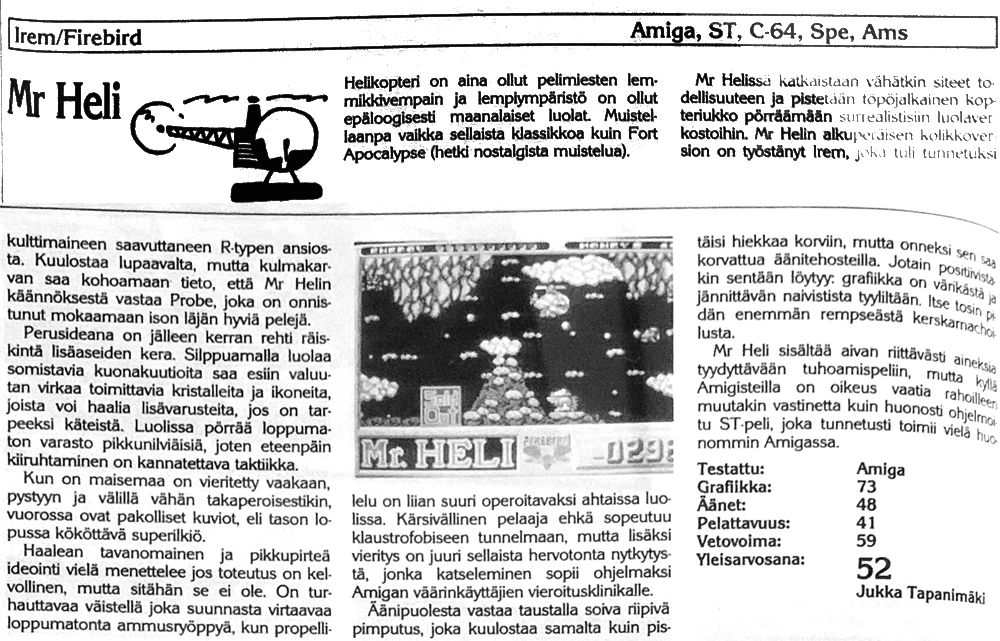
Mr Heli1990 KevätPysyvä linkkiHelikopteri on aina ollut pelimiesten lemmikkivempain ja lempiympäristö on ollut epäloogisesti maanalaiset luolat. Muistellaanpa vaikka sellaista klassikkoa kuin Fort Apocalypse (hetki nostalgista muistelua).
Mr Helissä katkaistaan vähätkin siteet todellisuuteen ja pistetään töpöjalkainen kopteriukko pörräämään surrealistisiin luolaverkostoihin. Mr Helin alkuperäisen kolikkoversion on työstänyt Irem, joka tuli tunnetuksi kulttimaineen saavuttaneen R-typen ansiosta. Kuulostaa lupaavalta, mutta kulmakarvan saa kohoamaan tieto, että Mr Helin käännöksestä vastaa Probe, joka on onnistunut mokaamaan ison läjän hyviä pelejä.
Perusideana on jälleen kerran rehti räiskintä lisäaseiden kera. Silppuamalla luolaa somistavia kuonakuutioita saa esiin valuutan virkaa toimittavia kristalleita ja ikoneita, joista voi haalia lisävarusteita, jos on tarpeeksi käteistä. Luolissa pörrää loppumaton varasto pikkunilviäisiä, joten eteenpäin kiiruhtaminen on kannatettava taktiikka.
Kun on maisemaa on vieritetty vaakaan, pystyyn ja välillä vähän takaperoisestikin, vuorossa ovat pakolliset kuviot, eli tason lopussa kököttävä superilkiö.
Haalean tavanomainen ja pikkupirteä ideointi vielä menettelee jos toteutus on kelvollinen, mutta sitähän se ei ole. On turhauttavaa väistellä joka suunnasta virtaavaa loppumatonta ammusryöppyä, kun propellilelu on liian suuri operoitavaksi ahtaissa luolissa. Kärsivällinen pelaaja ehkä sopeutuu klaustrofobiseen tunnelmaan, mutta lisäksi vieritys on juuri sellaista hervotonta nytkytystä, jonka katseleminen sopii ohjelmaksi Amigan väärinkäyttäjien vieroitusklinikalle.
Äänipuolesta vastaa taustalla soiva riipivä pimputus, joka kuulostaa samalta kuin pistäisi hiekkaa korviin, mutta onneksi sen saa korvattua äänitehosteilla. Jotain positiivistakin sentään löytyy: grafiikka on värikästä ja jännittävän naivistista tyyliltään. Itse tosin pidän enemmän rempseästä kerskamacholusta.
Mr Heli sisältää aivan riittävästi aineksia tyydyttävään tuhoamispeliin, mutta kyllä Amigisteilla on oikeus vaatia rahoilleen muutakin vastinetta kuin huonosti ohjelmoitu ST-peli, joka tunnetusti toimii vielä huonommin Amigassa.
Mr Heli1990 KevätPermalinkThe helicopter has always been the games crowd's pet gizmo, and its favourite haunt has, illogically, been underground caverns. Let's recall, for instance, a classic like Fort Apocalypse (a moment of nostalgic reminiscence).
Mr Heli cuts even the few remaining ties to reality and sends a stubby-legged chopper chap buzzing around surreal cave networks. The original coin-op version of Mr Heli was made by Irem, who became known thanks to the cult classic R-type. Sounds promising, but what gets the eyebrow rising is the news that Mr Heli's conversion is the work of Probe, who have managed to botch a big pile of good games.
The basic idea is once again an honest shoot-'em-up with extra weapons. Shredding the slag cubes that decorate the caves uncovers crystals that serve as currency, and icons from which you can scrape together extra equipment if you have enough cash. The caves buzz with an endless supply of little slugs, so pressing on quickly is a tactic worth recommending.
Once the scenery has been scrolled horizontally, vertically and now and then a bit backwards too, it's time for the obligatory routine, namely the super-baddie squatting at the end of the level.
Insipidly ordinary and mildly perky design would still pass if the execution were decent, but that it certainly isn't. It's frustrating to dodge the endless hail of bullets streaming in from every direction when the propeller toy is too big to manoeuvre in the cramped caves. A patient player might get used to the claustrophobic atmosphere, but on top of that the scrolling is exactly the kind of helpless juddering that would make ideal viewing on the programme at a detox clinic for Amiga abusers.
The sound department is handled by a grating plinking in the background that sounds like pouring sand into your ears, but luckily you can swap it for sound effects. There's something positive to be found after all: the graphics are colourful and excitingly naive in style. Personally, though, I prefer brash, swaggering macho posturing.
Mr Heli has quite enough ingredients for a satisfying destruction game, but Amiga owners surely have the right to demand more for their money than a badly programmed ST game, which, as everyone knows, runs even worse on the Amiga.
Mr Seek
Mr Seek1987Pysyvä linkkiViimeinkin markkinoille on saapunut kunnollinen kuvaseikkailu Spectravideolle. Tässä uutuuspelissä otteet eivät tuhoa elävää eivätkä elotonta, vaan tavoitteena on etsiä satumainen aarre. Vaarallinen sokkelo outoine hirviöineen saattaa kuitenkin tuottaa suuria vaikeuksia aarteenetsijöille.
Pelissä voidaan vaeltaa ruudusta toiseen aivan kuin muissakin kunnon seikkailupeleissä. Olet keppi kourassa aarretta etsivä kaivosmies, jonka on varottava alituisesti vaanivia hirviöitä, tauteja, hapen, ruoan ja veden puutetta, jotka saattavat millä hetkellä tahansa vaatia julman veronsa.
Pelin mukana tulevaan lyhykäiseen käyttöohjeeseen olisi voinut kiinnittää enemmän huomiota, sillä olisi ollut suotavaa mainita käyttöohjeessa, että mukana olevat kamat ym. voidaan tulostaa painamalla Fl.
Hyvä idea oli, suurten ohjelmatalojen mallin mukaan, laittaa kasetille versio kahdelle eri konetyypille. Värit ovat kohtuulliset, samoin grafiikka ottaen huomioon paikkojen lukumäärän. Hahmojen liikkuvuudessa olisi parantamisen varaa, sillä nykivä liike ja jäykähkö ohjaus tekevät pelistä vaikeahkon hallita. Arvoituksena peli on aivan kelvollinen, eikä ratkea parista pelikerrasta. Pelin alkuperästä kiinnostuneille mainittakoon kustantajan olevan Teknopiste Oy, tekijän Jari Paulin ja peli on tietenkin kotimainen.
Mr Seek1987PermalinkAt last a proper graphic adventure for the Spectravideo has arrived on the market. In this new game your moves destroy nothing living or lifeless; instead the aim is to search for a fabulous treasure. The dangerous maze with its strange monsters may, however, cause treasure hunters big difficulties.
In the game you can wander from screen to screen, just like in any other proper adventure game. You are a treasure-hunting miner, stick in hand, who has to watch out for ever-lurking monsters, diseases, and a lack of oxygen, food and water, any of which may exact its cruel toll at any moment.
More attention could have been paid to the rather skimpy instructions that come with the game, as it would have been advisable to mention in them that the gear you're carrying and so on can be listed by pressing F1.
It was a good idea, following the example of the big software houses, to put versions for two different types of machine on the tape. The colours are reasonable, as are the graphics, considering the number of locations. The characters' movement leaves room for improvement, as the jerky motion and somewhat stiff controls make the game rather hard to handle. As a puzzle the game is perfectly decent and won't be cracked in a couple of sittings. For those interested in the game's origins, let it be mentioned that the publisher is Teknopiste Oy, the author is Jari Paulin, and the game is, naturally, home-grown Finnish.
MSXTRA
MSXTRA1987Pysyvä linkkiMSXTRAan on koottu neljä peliä samaan kasettiin: ilmiselvä JWS-kopio Bladder, kolmiulotteinen jenkkifutispeli Superbowl, useita kovia vastustajia tarjoava 3D-Knockout nyrkkeilypeli ja Ultimaten Alien 8 -kaltainen Disc Warrior.
Bladderissa olet murtovaras, joka harjoittaa perinteikästä ammattiaan taloissa ja kaupoissa. Peli koostuu useista grafiikaltaan upeista ruuduista. Valitettavasti musiikkia ei saa pois, sillä siihen kyllästyy pian. Toki TV:n kaiuttimen voi aina hiljentää, mutta se hävittää samalla muut ääniefektit.
Kasetin heikoin tekele on Superbowl. Ainoastaan sen grafiikkaa voi kiittää. Sprite-hahmojen paljoudesta johtuva ruudun välkkyminen alkaa rasittaa silmiä jo lyhyen pelaamisen jälkeen.
Peli tuntuu aluksi sekavalta, mutta kun siihen pääsee sisälle, niin sen pelaaminen on suhteellisen yksinkertaista - ja tylsää. Pelaaminen on lähinnä erilaisten valikoiden kanssa sählimistä.
3D-Knockoutin kehäraakit eivät päästä pelaajaa vähällä. Saa olla todella haka, jos aikoo saada useampia lyöntejä perille.
Pelin kolmiulotteisessa grafiikassa ei ollut suurempia puutteita, ainoastaan hirveä välkkyminen haittasi. Peliä voi pelata myös kaksi pelaajaa, toinen joystickillä, ja toinen näppäimistöltä.
Disc Warriorissa liikut kolmiulotteisessa maailmassa ja yrität kerätä esineitä. Kuten pelin henkeen kuuluu, on siinä erilaisia kummituksia, lintuja ja muita hirvityksiä estämässä vapaan taistelijan liikuskelua. Onhan mukana toki aseita niiden listimiseen, mutta jollakin tavalla ne tuntuivat tehottomilta.
MSXTRA1987PermalinkMSXTRA gathers four games onto one cassette: Bladder, a blatant JWS copy; Superbowl, a three-dimensional American football game; 3D-Knockout, a boxing game offering several tough opponents; and Disc Warrior, in the style of Ultimate's Alien 8.
In Bladder you are a burglar plying his time-honoured trade in houses and shops. The game consists of a number of screens with superb graphics. Unfortunately the music can't be switched off, and you soon get sick of it. You can always turn down the TV speaker, of course, but that gets rid of the other sound effects as well.
The feeblest effort on the cassette is Superbowl. Only its graphics deserve any praise. The screen flicker caused by the sheer number of sprites starts to strain your eyes after even a short session.
At first the game seems confusing, but once you get into it, playing it is relatively simple - and dull. Playing it mostly means fumbling about with various menus.
3D-Knockout's battered old ring veterans don't let the player off lightly. You have to be a real ace if you want to land more than a few punches.
The game's three-dimensional graphics had no major flaws; only the terrible flicker got in the way. Two players can also play, one with a joystick and the other on the keyboard.
In Disc Warrior you move around a three-dimensional world trying to collect objects. As befits the spirit of the game, there are assorted ghosts, birds and other horrors hindering the free warrior's wanderings. There are weapons for bumping them off, of course, but somehow they felt ineffective.
Mugsy
Mugsy1987Pysyvä linkkiPeliä mainostetaan gansterimaailman sarjakuvapeliksi. Käytännössä peli on aivan tavallinen tekstiin perustuva taktiikkapeli. Hyvin tehdyt kuvamaisemat ovat vain tyhjän ruudun täytettä.
Pelaaja johtaa omaa joukkuettaan. Sen pitää tulla toimeen hyvin, muttei liian hyvin. Liika menestys tuo aina mukanaan vihollisia.
Pelaaja ostaa asiakkaita, joita suojellaan, hankkii aseita omille konnilleen ja kerää rahaa poliisin lahjontaan.
Päätösten teon jälkeen kone laskee menestyksen vuoden aikana ja esittää yhden kuvan tapahtuman elämästä gangsterikaupungissa. Peli etenee näin kierros kierrokselta ja on haukotuttavan hidas.
Vaikka maisemat ovat komeita, niihin kyllästyy. Ainakaan nuorimmat pelaajat eivät viihdy pitkään Mugsyn maailmassa. Jotain puuttuu pelistä, menestystä ei tule.
Mugsy1987PermalinkThe game is advertised as a comic-strip game set in the gangster world. In practice it is a perfectly ordinary text-based tactics game. The well-made picture scenes are just filler for an otherwise empty screen.
The player runs a gang of their own. It has to do well, but not too well. Too much success always brings enemies along with it.
The player buys up clients to protect, gets hold of guns for their hoods and collects money for bribing the police.
Once the decisions have been made, the computer works out how you did over the year and shows a single picture of some event from life in the gangster city. The game proceeds like this, round by round, and is yawn-inducingly slow.
Handsome as the scenes are, you get fed up with them. The youngest players, at least, won't stay entertained for long in Mugsy's world. Something is missing from the game, and success isn't coming its way.
Murder!
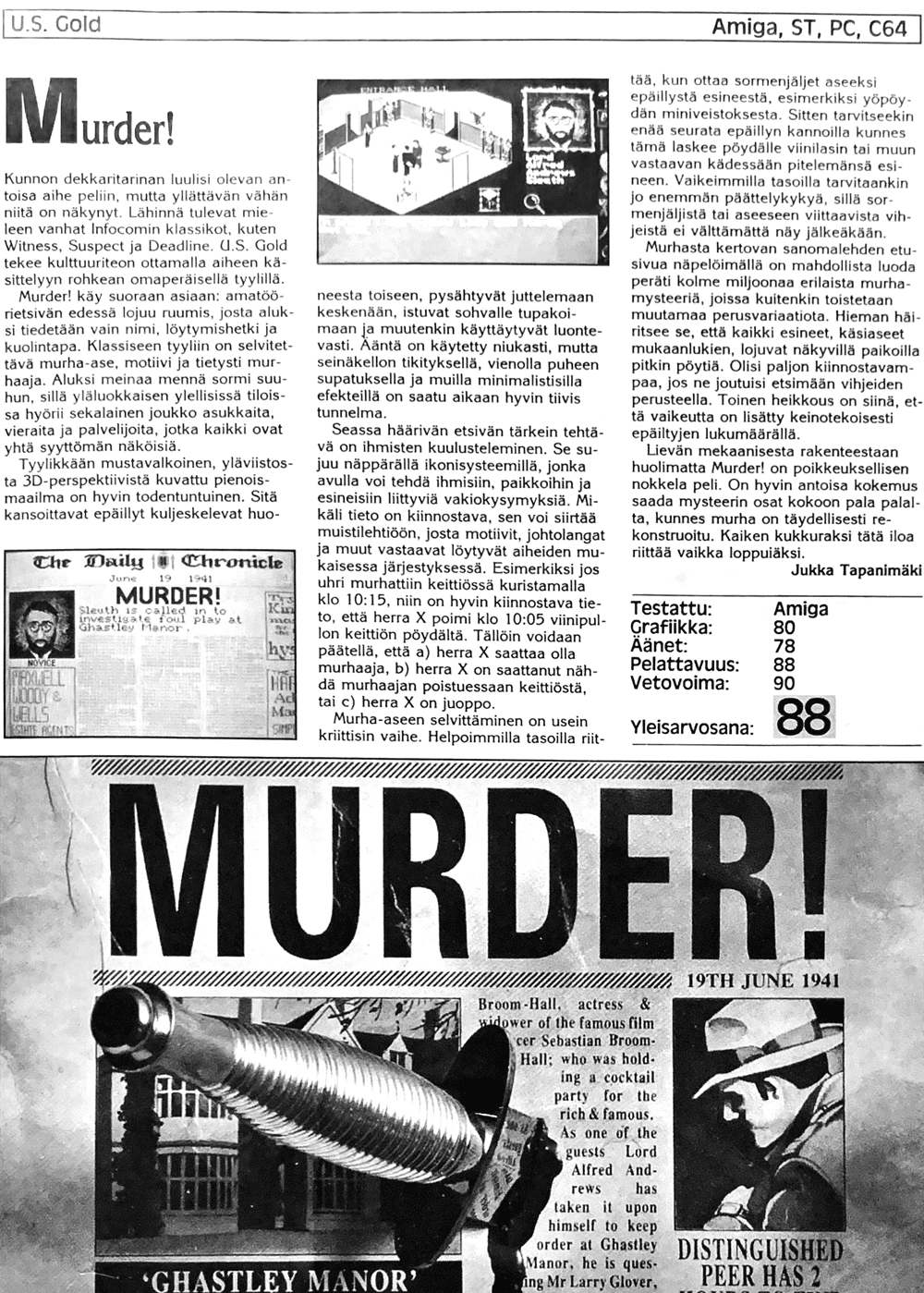
Murder!1991 KevätPysyvä linkkiKunnon dekkaritarinan luulisi olevan antoisa aihe peliin, mutta yllättävän vähän niitä on näkynyt. Lähinnä tulevat mieleen vanhat Infocomin klassikot, kuten Witness, Suspect ja Deadline. U.S. Gold tekee kulttuuriteon ottamalla aiheen käsittelyyn rohkean omaperäisellä tyylillä.
Murder! käy suoraan asiaan: amatöörietsivän edessä lojuu ruumis, josta aluksi tiedetään vain nimi, löytymishetki ja kuolintapa. Klassiseen tyyliin on selvitettävä murha-ase, motiivi ja tietysti murhaaja. Aluksi meinaa mennä sormi suuhun, sillä yläluokkaisen ylellisissä tiloissa hyörii sekalainen joukko asukkaita, vieraita ja palvelijoita, jotka kaikki ovat yhtä syyttömän näköisiä.
Tyylikkään mustavalkoinen, yläviistosta 3D-perspektiivistä kuvattu pienoismaailma on hyvin todentuntuinen. Sitä kansoittavat epäillyt kuljeskelevat huoneesta toiseen, pysähtyvät juttelemaan keskenään, istuvat sohvalle tupakoimaan ja muutenkin käyttäytyvät luontevasti. Ääntä on käytetty niukasti, mutta seinäkellon tikityksellä, vienolla puheen supatuksella ja muilla minimalistisilla efekteillä on saatu aikaan hyvin tiivis tunnelma.
Seassa häärivän etsivän tärkein tehtävä on ihmisten kuulusteleminen. Se sujuu näppärällä ikonisysteemillä, jonka avulla voi tehdä ihmisiin, paikkoihin ja esineisiin liittyviä vakiokysymyksiä. Mikäli tieto on kiinnostava, sen voi siirtää muistilehtiöön, josta motiivit, johtolangat ja muut vastaavat löytyvät aiheiden mukaisessa järjestyksessä. Esimerkiksi jos uhri murhattiin keittiössä kuristamalla klo 10:15, niin on hyvin kiinnostava tieto, että herra X poimi klo 10:05 viinipullon keittiön pöydältä. Tällöin voidaan päätellä, että a) herra X saattaa olla murhaaja, b) herra X on saattanut nähdä murhaajan poistuessaan keittiöstä, tai c) herra X on juoppo.
Murha-aseen selvittäminen on usein kriittisin vaihe. Helpoimmilla tasoilla riittää, kun ottaa sormenjäljet aseeksi epäillystä esineestä, esimerkiksi yöpöydän miniveistoksesta. Sitten tarvitseekin enää seurata epäillyn kannoilla kunnes tämä laskee pöydälle viinilasin tai muun vastaavan kädessään pitelemänsä esineen. Vaikeimmilla tasoilla tarvitaankin jo enemmän päättelykykyä, sillä sormenjäljistä tai aseeseen viittaavista vihjeistä ei välttämättä näy jälkeäkään.
Murhasta kertovan sanomalehden etusivua näpelöimällä on mahdollista luoda peräti kolme miljoonaa erilaista murhamysteeriä, joissa kuitenkin toistetaan muutamaa perusvariaatiota. Hieman häiritsee se, että kaikki esineet, käsiaseet mukaanlukien, lojuvat näkyvillä paikoilla pitkin pöytiä. Olisi paljon kiinnostavampaa, jos ne joutuisi etsimään vihjeiden perusteella. Toinen heikkous on siinä, että vaikeutta on lisätty keinotekoisesti epäiltyjen lukumäärällä.
Lievän mekaanisesta rakenteestaan huolimatta Murder! on poikkeuksellisen nokkela peli. On hyvin antoisa kokemus saada mysteerin osat kokoon pala palalta, kunnes murha on täydellisesti rekonstruoitu. Kaiken kukkuraksi tätä iloa riittää vaikka loppuiäksi.
Murder!1991 KevätPermalinkYou'd think a proper detective story would be a rewarding subject for a game, but surprisingly few of them have turned up. The ones that mainly spring to mind are the old Infocom classics, such as Witness, Suspect and Deadline. U.S. Gold does its bit for culture by tackling the subject in a boldly original style.
Murder! gets straight down to business: in front of the amateur detective lies a body, about which at first only the name, the time it was found and the manner of death are known. In classic style, you have to work out the murder weapon, the motive and, of course, the murderer. At first you're liable to be left completely at a loss, because the upper-class luxury of the premises is teeming with a motley bunch of residents, guests and servants, all of whom look equally innocent.
The stylishly black-and-white miniature world, shown in 3D perspective from diagonally above, feels very true to life. The suspects who populate it wander from room to room, stop to chat with each other, sit down on the sofa for a smoke and generally behave naturally. Sound has been used sparingly, but the ticking of the wall clock, the faint whisper of speech and other minimalist effects create a very dense atmosphere.
The main task of the detective bustling about among them is questioning people. This is done with a handy icon system that lets you ask standard questions about people, places and objects. If a piece of information is interesting, it can be transferred to the notebook, where motives, clues and the like are filed by subject. For example, if the victim was strangled in the kitchen at 10:15, then it is a very interesting fact that Mr X picked up a bottle of wine from the kitchen table at 10:05. From this we can deduce that a) Mr X may be the murderer, b) Mr X may have seen the murderer as he was leaving the kitchen, or c) Mr X is a drunk.
Figuring out the murder weapon is often the most critical stage. On the easiest levels it's enough to take fingerprints from the object suspected of being the weapon, for example the miniature sculpture on the bedside table. Then all you need to do is follow hot on the suspect's heels until they put down a wine glass or some similar object they've been holding. On the hardest levels you need a good deal more deductive power, since there may not be a trace of fingerprints, or of clues pointing to the weapon.
By fiddling with the front page of the newspaper reporting the murder, it's possible to create no fewer than three million different murder mysteries, though they do repeat a handful of basic variations. It's a little annoying that all the objects, handguns included, lie about in plain view all over the tables. It would be much more interesting if you had to hunt for them on the strength of clues. Another weakness is that the difficulty has been increased artificially through the number of suspects.
Despite its slightly mechanical structure, Murder! is an exceptionally clever game. It's a very rewarding experience to piece the mystery together bit by bit until the murder has been perfectly reconstructed. To top it all, there's enough of this joy to last you the rest of your life.
Murders in Space

Murders in Space1991 KevätPysyvä linkkiPelin nimestä voikin jo päätellä, mistä tässä graafisessa seikkailussa on kyse. Avaruusaseman komentaja on joutunut murhayrityksen kohteeksi ja asiaa pitäisi tutkia. Juonesta paljastetaan sen verran, että jokainen miehistön jäsen on hengenvaarassa ja jokaisella on jotain salattavaa.
Ainekset hyvään dekkariseikkailuun ovat koossa, mutta toteutus on kiltisti ilmaistuna hämärä. Sankari leijailee muutaman kapselin väliä joutuen toteamaan, että kovin on jähmeä peliympäristö. Miehistö puuhailee omiaan vakiopaikoilla antaen vakiokommentteja seuraavaan tasatuntiin asti, jolloin asemapaikat ja dialogit vaihtuvat. Tämän kaiken keskellä pelaaja sitten nuuskii ja utelee tuntien itsensä statistiksi.
Erityisen pahasti sijoiltaan vinksahtanut seikka on ranskalaisten rasittava tapa lisätä käyttäjäliityntään turhaa kikkailua. Joutuu pariinkin kertaan plaraamaan ohjekirjasta ennen kuin keksii, että keskustelu tapahtuu klikkaamalla ensin sankarin suuta ja sitten puhekuplaa. Vaihtoehtoiset toiminnat puolestaan löytyvät klikkaamalla otsaa.
Yleistä sekavuutta korostavat erityisesti monenlaiset laitteet, joiden merkitys jätetään alussa täysin hämäräksi. Esimerkiksi kauko-ohjattavasta kädestä ohjeet sentään mainitsevat, että sillä sekoitetaan lääkkeitä, ja käyttöohjekin löytyy lokikirjasta. Mutta olisi parempi, ettei koko laitteeseen voisi edes koskea, ennen kuin sillä on pelin kannalta jotain merkitystä. Pelin vaatima oivallus ja oma-aloitteisuus ei ole mitenkään tasapainossa periaatteella "simpanssi ja banaaniautomaatti" toimivaan peliympäristöön.
On kunnianhimoinen yritys ahtaa haastava ja pelaamista kestävä seikkailu kahdeksan huoneen kokoiseen tilaan, mutta lopputulos on liian klaustrofobinen ja itseään toistava, jotta sitä jaksaisi pelata paria tuntia pitempään. Ainoaksi myyntivaltiksi taitaa jäädä pakkaukseen laitettu pussillinen avaruusmuonaa.
Murders in Space1991 KevätPermalinkYou can already guess from the game's name what this graphic adventure is all about. The commander of a space station has been the target of a murder attempt, and the matter ought to be investigated. This much of the plot is revealed: every member of the crew is in mortal danger and every one of them has something to hide.
The ingredients for a good detective adventure are all there, but the execution is, to put it kindly, murky. The hero floats back and forth between a few capsules, only to conclude that the game environment is awfully rigid. The crew potter about with their own business in fixed spots, handing out stock comments until the next hour on the hour, when positions and dialogue change. In the middle of all this the player snoops and pries, feeling like an extra.
A particularly badly out-of-whack feature is the French's tiresome habit of cramming pointless gimmickry into the user interface. You have to leaf through the manual more than once before you work out that talking is done by first clicking on the hero's mouth and then on a speech bubble. Alternative actions, meanwhile, are found by clicking on the forehead.
The general confusion is heightened above all by all sorts of devices whose purpose is left completely obscure at the start. For instance, the manual does at least mention that the remote-controlled hand is used for mixing medicines, and its operating instructions can be found in the log book. But it would be better if you couldn't even touch the device until it has some bearing on the game. The insight and initiative the game demands are in no way in balance with a game environment that works on the "chimpanzee and banana vending machine" principle.
It's an ambitious attempt to cram a challenging adventure with staying power into a space eight rooms in size, but the end result is too claustrophobic and repetitive for you to bother playing it for more than a couple of hours. The only selling point is probably the bag of space rations included in the box.
Mutants
Mutants1987Pysyvä linkkiMutants on suhteellisen onnistunut yritys yhdistää toiminta ja aivotoiminta. Pelaajan tehtävänä on kaukaisessa tulevaisuudessa tuhota biologisia aseita tutkiva laboratorio. Laboratorioon on hätätapauksia varten rakennettu itsetuhojärjestelmä, mutta sen osat on juuri pelaajan kaltaisten tunkeilijoiden varalta sijoitettu koealueille, joilla mutanttibakteereja kokeillaan. Ongelmana on näiden osien hakeminen harvinaisen isojen(!) ynnä vihamielisten pasiliskojen huomasta.
Teknisesti Mutants toimii erinomaisesti. Grafiikka on yksityiskohtaista ja maisema vierii pehmeästi ja täsmällisesti. Musiikki ja äänitehosteet ovat vastaavasti viimeisen päälle viimeistellyt.
Ohjelman ongelmana on se, että pääpaino on annettu kustakin bakteerilajista selviämisen pohtimiselle. Eri ötököihin tepsii erilainen taktiikka, ja vaikka tämä ensi alkuun viehättääkin pelaajaa suuresti, on ideointi jäänyt hieman puolitiehen.
Mutants1987PermalinkMutants is a relatively successful attempt to combine action with brain action. In the distant future, the player's task is to destroy a laboratory researching biological weapons. The laboratory has a self-destruct system built in for emergencies, but precisely in case of intruders like the player, its components have been placed in the test zones where mutant bacteria are being tried out. The problem is fetching these components from the keeping of unusually big(!) and hostile bacilli.
Technically Mutants works excellently. The graphics are detailed and the landscape scrolls smoothly and precisely. The music and sound effects are likewise polished to the very last detail.
The program's problem is that the main emphasis has been put on puzzling out how to survive each species of bacteria. Different bugs call for different tactics, and although at first this charms the player greatly, the ideas have been left a bit half-finished.
Mystical
Mystical1991 KevätPysyvä linkkiVelhojen oppipojilla on taipumus aiheuttaa hankalia sotkuja leikkiessään liian huolettomasti taikavoimillaan. Tällä kertaa suunnaton varasto salaisia kääröjä ja sekoituksia on levinnyt ympäri jumalien ja demonien hallitsemaa limbotilaa. Vaihtoehtona on joko hakea taiat takaisin tai kohdata velhon viha, esimerkiksi joutumalla viettämään loppuikänsä paikallisen juottolan lattiana.
Mystical ei ole tippaakaan niin kiinnostava kuin miltä se kuulostaa. Pohjimmiltaan se on valeasuun kaavuttu Ikari Warriors -klooni. Sankarihahmo kuluttaa kengänpohjiaan pystyyn vierivässä maisemassa käyttäen maasta löytyviä taikoja päälle höökivää kummajaislaumaa vastaan. Paripelissä operaatiota avustaa peikon tapainen otus, joka liiskaa möröt alleen ja energian loppuessa vetäytyy väliaikaiselle lomalle myyrän hahmossa.
Taikojen toteutuksessa on mukana runsaasti huumoria. Papeista käveleviin puihin vaintelevat kummajaiset loihditaan sammakoiksi, maa nielaiset ne sisäänsä, tulipallo pyyhkii ne tuhkaksi ja ilmasta putoavat häkit vangitsevat ne sisäänsä. Käytännön toimivuus on sen sijaan pahasti pielessä. Kaikki löytyvät taiat käytetään heti, jos niitä ei siirrä varastoon painamalla välilyöntiä. Aktiivisen taian kuluessa loppuun on sitten etsittävä sopiva manaus välilyöntiä painelemalla ja loitsittava se painamalla enteriä. Mikäli tämä ei vielä ollut tarpeeksi kömpelöä, niin lisäksi taian aktivoinnin ja vaikutuksen välissä on pitkä viime sankarin lukiessa kääröä tai tyhjentäessä pullon sisältöä.
Vaikka taikasysteemi olisi saatu toimivaksi, niin tuskin peli siltikään jaksaisi kiinnostaa. Ruudun yläreunasta valuu loputtoman yksitoikkoinen jengi mörköjä, ja siinä kaikki. Ainoa mieleenjäävä seikka on vitsikkään sarjakuvamainen grafiikka.
Mystical1991 KevätPermalinkWizards' apprentices have a tendency to make awkward messes when they play too carelessly with their magic powers. This time an enormous stock of secret scrolls and potions has been scattered all over a limbo realm ruled by gods and demons. The choice is either to fetch the spells back or to face the wizard's wrath, for example by having to spend the rest of your life as the floor of the local boozer.
Mystical isn't one bit as interesting as it sounds. At heart it's an Ikari Warriors clone cloaked in disguise. The hero character wears out shoe leather across vertically scrolling scenery, using spells found on the ground against a horde of freaks charging in. In two-player mode the operation is assisted by a troll-like creature that squashes the bogeymen flat under itself and, when its energy runs out, retires on a temporary holiday in the shape of a mole.
There's plenty of humour in the way the spells are done. The freaks, which range from priests to walking trees, get magicked into frogs, the earth swallows them up, a fireball wipes them to ashes and cages dropping from the sky trap them inside. The practical workability, on the other hand, is badly off. Every spell you find gets used straight away unless you move it into storage by pressing the space bar. When the active spell runs out, you then have to hunt for a suitable incantation by tapping the space bar and cast it by pressing Enter. If that wasn't clumsy enough already, there's also a long delay between activating a spell and its effect while the hero reads the scroll or empties out the contents of the bottle.
Even if the magic system had been made to work, the game would hardly manage to hold your interest anyway. An endlessly monotonous gang of bogeymen trickles down from the top of the screen, and that's all there is to it. The only memorable thing is the wittily cartoonish graphics.
Myth

Myth1990 SyksyPysyvä linkkiKuusnelostelijoita on alkanut kiusata pula kiinnostavista uutuuksista. Mutta ei hätää, System 3 kirmaisee sankarillisesti näyttämölle ja ojentaa silkkisellä tyynyllä Mythin.
Peli alkaa lupaavasti upealla Maniacs of Noisen musiikilla ja digitoidulla sanoilla: "Welcome to Myth". Ensivaikutelma senkun vain paranee, kun ensimmäisen tason latauduttua saa ihastella maineikkaan Bob Stevensonin tyylittelemää hämärää luolaholvia, jonka pohjalla velloo helvetillinen liekkimeri.
Aluksi aseettoman sankarin on ryhdyttävä epätoivoiseen nyrkkitappeluun luurankojen ja vihreiden pikkumenninkäisten kanssa, jotta saisi anastettua miekan ja tulipalloja. Mutta tien tukkeena on Chimera, leijonanpäinen, vuohenvartaloinen ja käärmehäntäinen sekasikiö, johon tepsii ainostaan paholaisen atrain. Ohjekirjanen vihjaisee ystävällisesti, että pimeyden ruhtinaan manaamiseen tarvitaan paljon käristettyjä luita. Seuraavassa kentässä päästään haukkaamaan raitista ilmaa antiikin kreikkaan ja samalla selviää millainen on nymfin suudelma (tappava). Sitten onkin vuorossa ensimmäisen tason loppukohtaus, jossa loikitaan hämyisästi valaistun pilaririvistön päällä ja tutustutaan käärmehiuksisen medusan kuolettavaan katseeseen. Neidiltä irrotetaan kohteliaasti pää hartioilta ja kokeillaan katsekontaktia lopussa odottavaan kolmipäiseen lohikäärmeeseen.
Jatkossa seuraa yhä uusia myyttisiä maisemia, joista löytyy paljon oivaltavaa ideointia. Pelattavuuttakaan ei ole unohdettu, sillä mainiosti animoidulla sankarilla on poikkeuksellisen näppärä liikevalikoima, johon kuuluu esimerkiksi kolme erilaisia hyppyä. Pelaamista saa aina jatkaa viimeisestä ruudusta, mikä on ilahduttava ominaisuus useassa osassa ladattavassa pelissä.
Valitettavasti peliin on lipsahtanut pieni bugi. Jos menettää kaikki elämät ensimmäisessä kentässä, uloskäyntiä vartioivan hirviön pää saattaa kadota eikä sitä voi enää tuhota. Onneksi töppäys on alussa, mutta ylimääräinen latailu on silti harmittavaa.
Myöhemmillä tasoilla peli muuttuu hieman liian turhauttavaksi eikä se muutenkaan säilytä alun korkeata tasoa, mutta siitäkin huolimatta Myth on kuusnelosen mätkimispelien parhaimmistoa.
Myth1990 SyksyPermalinkCommodore 64 owners have started to be plagued by a shortage of interesting new releases. But never fear: System 3 bounds heroically onto the stage and presents Myth on a silken cushion.
The game gets off to a promising start with superb music by Maniacs of Noise and the digitised words: "Welcome to Myth". The first impression just keeps getting better when, once the first level has loaded, you get to admire a gloomy cavern vault styled by the renowned Bob Stevenson, at the bottom of which a hellish sea of flames surges.
To begin with, the unarmed hero has to launch into a desperate fistfight with skeletons and little green goblins in order to swipe a sword and fireballs. But blocking the way is the Chimera, a lion-headed, goat-bodied, snake-tailed mongrel monstrosity against which only the devil's trident works. The instruction booklet kindly hints that summoning the prince of darkness takes lots of charred bones. The next level lets you grab a breath of fresh air in ancient Greece, and at the same time you find out what a nymph's kiss is like (deadly). Then it's time for the first level's finale, where you leap about on top of a dimly lit row of pillars and get acquainted with the lethal gaze of the snake-haired medusa. The young lady's head is politely detached from her shoulders, and eye contact is then tried out on the three-headed dragon waiting at the end.
After that come ever more mythical landscapes, with lots of inspired ideas in them. Playability hasn't been forgotten either, since the splendidly animated hero has an unusually nifty repertoire of moves, including, for example, three different jumps. You can always carry on playing from the last screen, which is a welcome feature in a game that loads in several parts.
Unfortunately a little bug has slipped into the game. If you lose all your lives on the first level, the head of the monster guarding the exit may vanish, and then it can no longer be destroyed. Luckily the blunder is right at the start, but the extra loading is still annoying.
On the later levels the game gets a bit too frustrating, and it doesn't otherwise keep up the high standard of its opening either, but even so Myth is among the very best bash-'em-ups on the Commodore 64.