1133 reviews from "Pelit"-books
Pelit was a Finnish-language (bi)annual book series published from 1987 to 1991 containing gaming-related articles, tips and most importantly game reviews. Here you can find all the reviews from the books. The reviews were originally written in Finnish; the English versions are translations of the Finnish originals. Maininta tekijänoikeuksista
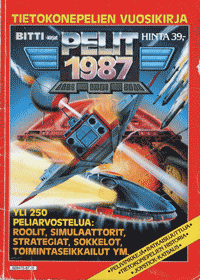 1987
1987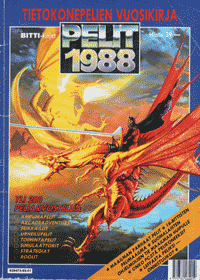 1988
1988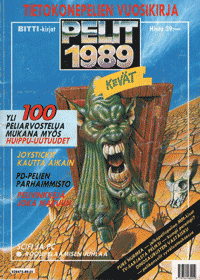 1989 Kevät
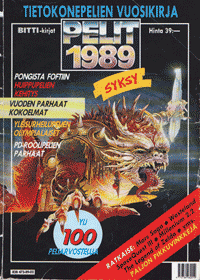 1989 Syksy
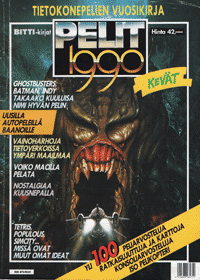 1990 Kevät
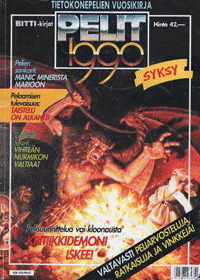 1990 Syksy
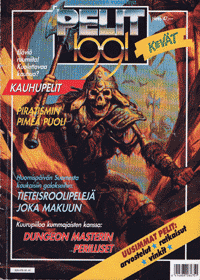 1991 Kevät
 1991 Syksy
N.O.M.A.D.
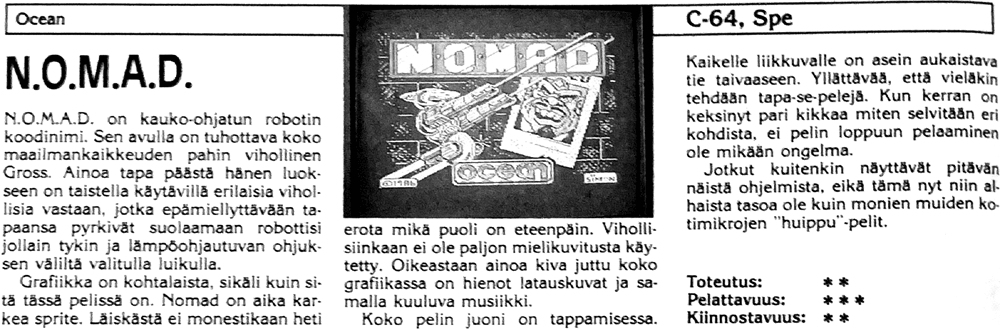
N.O.M.A.D.1987Pysyvä linkkiN.O.M.A.D. on kauko-ohjatun robotin koodinimi. Sen avulla on tuhottava koko maailmankaikkeuden pahin vihollinen Gross. Ainoa tapa päästä hänen luokseen on taistella käytävillä erilaisia vihollisia vastaan, jotka epämiellyttävään tapaansa pyrkivät suolaamaan robottisi jollain tykin ja lämpöohjautuvan ohjuksen väliltä valitulla luikulla.
Grafiikka on kohtalaista, sikäli kuin sitä tässä pelissä on. Nomad on aika karkea sprite. Läiskästä ei monestikaan heti erota mikä puoli on eteenpäin. Vihollisiinkaan ei ole paljon mielikuvitusta käytetty. Oikeastaan ainoa kiva juttu koko grafiikassa on hienot latauskuvat ja samalla kuuluva musiikki.
Koko pelin juoni on tappamisessa. Kaikelle liikkuvalle on asein aukaistava tie taivaaseen. Yllättävää, että vieläkin tehdään tapa-se-pelejä. Kun kerran on keksinyt pari kikkaa miten selvitään eri kohdista, ei pelin loppuun pelaaminen ole mikään ongelma.
Jotkut kuitenkin näyttävät pitävän näistä ohjelmista, eikä tämä nyt niin alhaista tasoa ole kuin monien muiden kotimikrojen "huippu"-pelit.
N.O.M.A.D.1987PermalinkN.O.M.A.D. is the code name of a remote-controlled robot. With it you have to destroy the worst enemy in the entire universe, Gross. The only way to get to him is to fight your way through corridors against assorted enemies who, in their unpleasant way, try to pepper your robot with some gizmo or other picked from anywhere between a cannon and a heat-seeking missile.
The graphics are middling, insofar as this game has any. Nomad is a pretty crude sprite. Often you can't tell right away which side of the blob is the front. Not much imagination has gone into the enemies either. Really the only nice thing in the whole graphics department is the fine loading screens and the music that plays over them.
The game's entire plot lies in killing. Everything that moves has to be shown the way to heaven at gunpoint. Surprising that kill-it games are still being made. Once you've worked out a couple of tricks for getting through the different sections, playing the game to the end is no problem at all.
Some people do seem to like these programs, though, and this one really isn't as low-grade as a lot of the other "top" games on home micros.
Narc
Narc1991 KevätPysyvä linkkiOceanin uusi kolikkopeliväännös Narc hyökkää huumekaupan keskukseen, Herra Ison Krak Companyyn. Matka on sinne kuitenkin pitkä halki vertikaaliscrollaavien narkkarikujien, metrotunneleiden ja huumelaboratorion. Pelissä on kaikkiaan 12 tasoa, jotka ovat täynnä pidätettävää, kuten narkkareita, Mr. Bigin henkivartiota, pikkudiilereitä ja pelin kopioijia. Pidättämisidea on mielenkiintoinen, itse pelistä ei näin ollen tule pelkkää tykinruoan lahtausta. Hyppäät rikoksenuusijan viereen, tyrkkäät teräksenkylmää kylkiluiden väliin ja "You're busted!". Paatunut rikollinen liihottelee itse putkaan.
Toinen fysikaalisesti todistamaton ilmiö on, että kimppuusi hyökkäävistä verikoirista tulee ampumalla puolet pienempiä. Rakit ovatkin melkoinen kiusa etenemisessä.
Kolmas yliluonnollinen tapahtuma on jälleen se, että kun antaa rikollisten maistaa omaa lääkettään, häviävät nämä tietenkin savuna ilmaan jättäen kuitenkin tavaroitaan. Näitä tavaroita keräämällä saadaan tarvittavat ammukset ja ohjukset samalla takavarikoiden erilaiset huumeannokset.
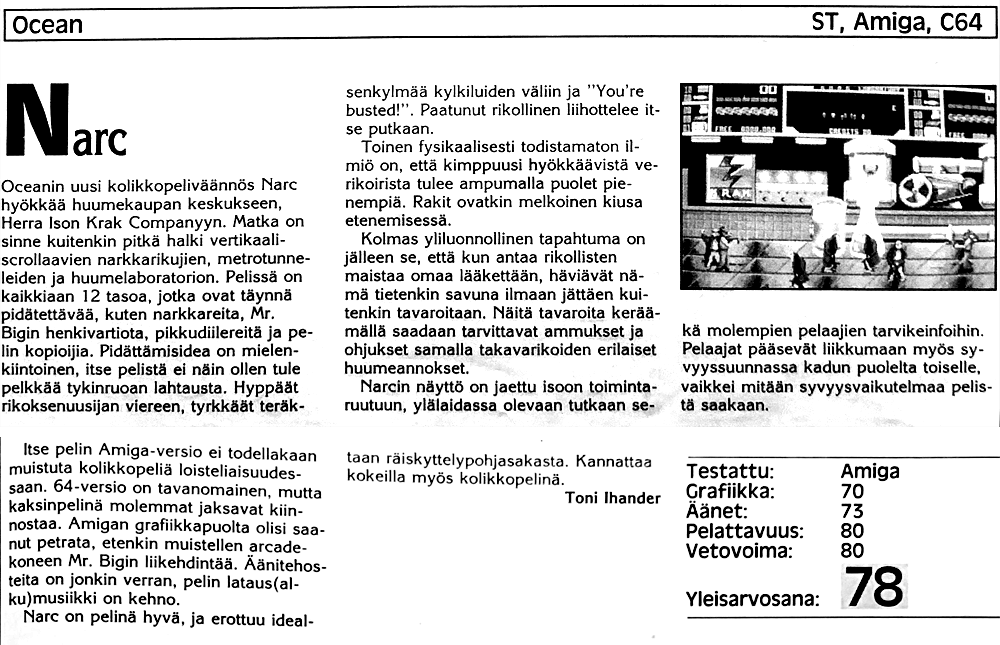
Narcin näyttö on jaettu isoon toimintaruutuun, ylälaidassa olevaan tutkaan sekä molempien pelaajien tarvikeinfoihin. Pelaajat pääsevät liikkumaan myös syvyyssuunnassa kadun puolelta toiselle, vaikkei mitään syvyysvaikutelmaa pelistä saakaan. Itse pelin Amiga-versio ei todellakaan muistuta kolikkopeliä loisteliaisuudessaan. 64-versio on tavanomainen, mutta kaksinpelinä molemmat jaksavat kiinnostaa. Amigan grafiikkapuolta olisi saanut petrata, etenkin muistellen arcadekoneen Mr. Bigin liikehdintää. Äänitehosteita on jonkin verran, pelin lataus(alku)musiikki on kehno.
Narc on pelinä hyvä, ja erottuu idealtaan räiskyttelypohjasakasta. Kannattaa kokeilla myös kolikkopelinä.
Narc1991 KevätPermalinkOcean's new coin-op conversion Narc storms the heart of the drug trade, Mr. Big's Krak Company. It's a long way there, though, through vertically scrolling junkie alleys, subway tunnels and a drug lab. The game has 12 levels in all, full of people to arrest, such as junkies, Mr. Big's bodyguards, small-time dealers and people who copy the game. The arresting idea is an interesting one, and so the game itself doesn't turn into mere slaughter of cannon fodder. You jump up next to the repeat offender, shove some cold steel between their ribs and "You're busted!". The hardened criminal floats off to the slammer under their own steam.
A second phenomenon unproven by physics is that the bloodhounds attacking you get half as big when you shoot them. The mutts are quite a pest when you're trying to make headway.
The third supernatural occurrence is, once again, that when you give the criminals a taste of their own medicine, they naturally vanish in a puff of smoke, though they do leave their belongings behind. Collecting these belongings gets you the ammo and missiles you need, while at the same time confiscating assorted doses of drugs.
Narc's screen is divided into a big action window, a radar along the top edge and the equipment info for both players. The players can also move in depth, from one side of the street to the other, even though the game gives no impression of depth whatsoever. The Amiga version of the game itself really doesn't come anywhere near the coin-op in splendour. The 64 version is run-of-the-mill, but as a two-player game both of them keep you interested. The Amiga's graphics could have done with some sprucing up, especially when you remember how Mr. Big moves on the arcade machine. There's a fair amount of sound effects; the game's loading (intro) music is lousy.
As a game Narc is good, and its idea sets it apart from the shoot-'em-up dregs. Worth trying as a coin-op too.
Nato Commander
Nato Commander1987Pysyvä linkkiPakolaisjono liikkuu hitaasti länteen, kohti turvaa. Taivaanrannassa välähtelee ja jyrisee, mutta kysymyksessä ei ole luonnonilmiö vaan ihmisen aikaansaannokset. Pakolaiset antavat tietä vastaantulevalle panssariyksikölle, kun yht'äkkiä taivaan täyttää uusi aurinko keskellä yötä. Tämä ei ole painajaisuni, tämä on sotaa!
Vuosi on 1980 ja rapiat. Varsovan Liiton sotakoneisto on lähtenyt liikkeelle ja etenee kohti länttä. Voivatko NATOn Euroopan joukot pysäyttää sen kulun? Microprosen sotapeli Nato Commander asettaa sinut Varsovan liittoa vastaan. Käytettävissä on koko NATOn arsenaali: panssareita, motorisoituja yksikköjä, helikoptereita, suihkukoneita ja taktisia ydinaseita.
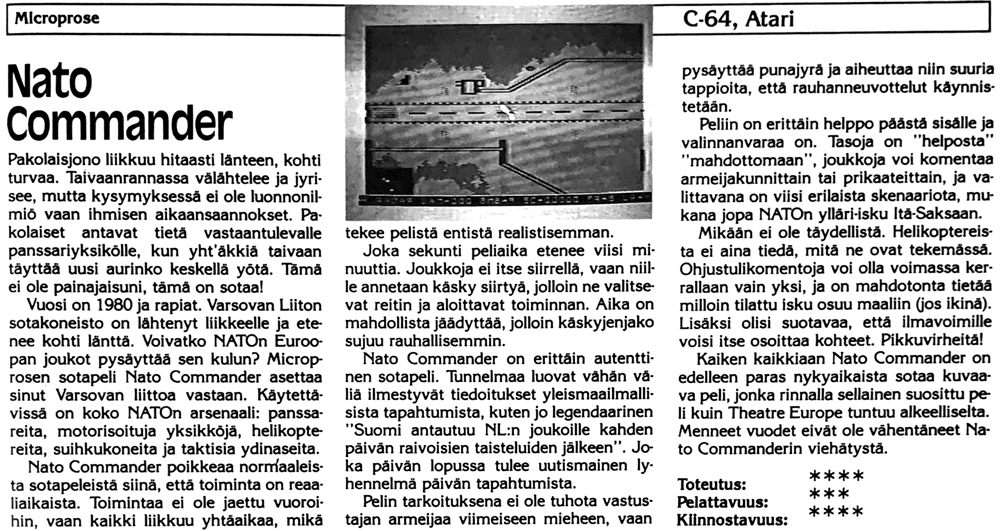
Nato Commander poikkeaa normaaleista sotapeleistä siinä, että toiminta on reaaliaikaista. Toimintaa ei ole jaettu vuoroihin, vaan kaikki liikkuu yhtäaikaa, mikä tekee pelistä entistä realistisemman.
Joka sekunti peliaika etenee viisi minuuttia. Joukkoja ei itse siirrellä, vaan niille annetaan käsky siirtyä, jolloin ne valitsevat reitin ja aloittavat toiminnan. Aika on mahdollista jäädyttää, jolloin käskyjenjako sujuu rauhallisemmin.
Nato Commander on erittäin autenttinen sotapeli. Tunnelmaa luovat vähän väliä ilmestyvät tiedoitukset yleismaailmallisista tapahtumista, kuten jo legendaarinen "Suomi antautuu NL:n joukoille kahden päivän raivoisien taisteluiden jälkeen". Joka päivän lopussa tulee uutismainen lyhennelmä päivän tapahtumista.
Pelin tarkoituksena ei ole tuhota vastustajan armeijaa viimeiseen mieheen, vaan pysäyttää punajyrä ja aiheuttaa niin suuria tappioita, että rauhanneuvottelut käynnistetään.
Peliin on erittäin helppo päästä sisälle ja valinnanvaraa on. Tasoja on "helposta" "mahdottomaan", joukkoja voi komentaa armeijakunnittain tai prikaateittain, ja valittavana on viisi erilaista skenaariota, mukana jopa NATOn ylläri-isku Itä-Saksaan.
Mikään ei ole täydellistä. Helikoptereista ei aina tiedä, mitä ne ovat tekemässä. Ohjustulikomentoja voi olla voimassa kerrallaan vain yksi, ja on mahdotonta tietää milloin tilattu isku osuu maaliin (jos ikinä). Lisäksi olisi suotavaa, että ilmavoimille voisi itse osoittaa kohteet. Pikkuvirheitä!
Kaiken kaikkiaan Nato Commander on edelleen paras nykyaikaista sotaa kuvaava peli, jonka rinnalla sellainen suosittu peli kuin Theatre Europe tuntuu alkeelliselta. Menneet vuodet eivät ole vähentäneet Nato Commanderin viehätystä.
Nato Commander1987PermalinkA column of refugees moves slowly west, towards safety. There are flashes and rumbling on the horizon, but this is no natural phenomenon; it is the handiwork of man. The refugees make way for an oncoming armoured unit when all of a sudden, in the middle of the night, a new sun fills the sky. This is not a nightmare, this is war!
The year is 1980-odd. The Warsaw Pact war machine has set off and is advancing westward. Can NATO's forces in Europe stop its advance? Microprose's wargame Nato Commander pits you against the Warsaw Pact. At your disposal is NATO's entire arsenal: tanks, motorised units, helicopters, jets and tactical nuclear weapons.
Nato Commander differs from normal wargames in that the action happens in real time. The action isn't divided into turns; instead everything moves at once, which makes the game all the more realistic.
Every second, five minutes of game time go by. You don't move the troops yourself; instead you give them an order to move, whereupon they choose a route and get going. It's possible to freeze time, which lets you hand out orders at a calmer pace.
Nato Commander is a highly authentic wargame. The atmosphere is built up by the bulletins on world events that pop up every so often, such as the already legendary "Finland surrenders to Soviet forces after two days of furious fighting". At the end of each day comes a newscast-style roundup of the day's events.
The object of the game isn't to destroy the enemy army to the last man, but to stop the red steamroller and inflict such heavy losses that peace talks get under way.
The game is very easy to get into, and there's plenty of choice. The levels run from "easy" to "impossible", troops can be commanded by corps or by brigade, and there are five different scenarios to choose from, even including a NATO sneak attack on East Germany.
Nothing is perfect. You don't always know what the helicopters are up to. Only one missile fire order can be in effect at a time, and it's impossible to know when the strike you've called in will hit its target (if ever). It would also be nice to be able to assign targets to the air force yourself. Minor flaws!
All in all, Nato Commander is still the best game depicting modern warfare, next to which even such a popular game as Theatre Europe feels primitive. The passing years have not diminished Nato Commander's appeal.
Navy Moves
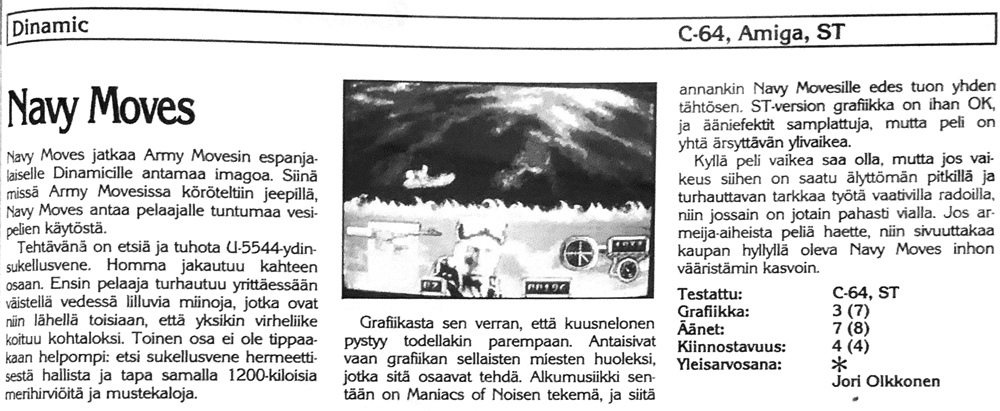
Navy Moves1989 SyksyPysyvä linkkiNavy Moves jatkaa Army Movesin espanjalaiselle Dinamicille antamaa imagoa. Siinä missä Army Movesissa köröteltiin jeepillä, Navy Moves antaa pelaajalle tuntumaa vesipelien käytöstä.
Tehtävänä on etsiä ja tuhota U-5544-ydinsukellusvene. Homma jakautuu kahteen osaan. Ensin pelaaja turhautuu yrittäessään väistellä vedessä lilluvia miinoja, jotka ovat niin lähellä toisiaan, että yksikin virheliike koituu kohtaloksi. Toinen osa ei ole tippaakaan helpompi: etsi sukellusvene hermeettisestä hallista ja tapa samalla 1200-kiloisia merihirviöitä ja mustekaloja.
Grafiikasta sen verran, että kuusnelonen pystyy todellakin parempaan. Antaisivat vaan grafiikan sellaisten miesten huoleksi, jotka sitä osaavat tehdä. Alkumusiikki sentään on Maniacs of Noisen tekemä, ja siitä annankin Navy Movesille edes tuon yhden tähtösen. ST-version grafiikka on ihan OK, ja ääniefektit samplattuja, mutta peli on yhtä ärsyttävän ylivaikea.
Kyllä peli vaikea saa olla, mutta jos vaikeus siihen on saatu älyttömän pitkillä ja turhauttavan tarkkaa työtä vaativilla radoilla, niin jossain on jotain pahasti vialla. Jos armeija-aiheista peliä haette, niin sivuuttakaa kaupan hyllyllä oleva Navy Moves inhon vääristämin kasvoin.
Navy Moves1989 SyksyPermalinkNavy Moves carries on the image that Army Moves gave the Spanish Dinamic. Where in Army Moves you trundled along in a jeep, Navy Moves gives the player a feel for handling watercraft.
The task is to seek out and destroy the U-5544 nuclear submarine. The job is split into two parts. First the player gets frustrated trying to dodge mines bobbing in the water, which are so close to each other that a single wrong move proves fatal. The second part isn't one jot easier: find the submarine in a hermetically sealed hall, killing 1200-kilo sea monsters and octopuses along the way.
As for the graphics, suffice it to say that the C-64 is truly capable of better. They should just leave the graphics to men who know how to do them. The intro music, at least, is by Maniacs of Noise, and for that I'll give Navy Moves at least that one little star. The ST version's graphics are perfectly OK and the sound effects are sampled, but the game is just as irritatingly overdifficult.
Sure, a game is allowed to be difficult, but if the difficulty has been achieved with absurdly long courses that demand frustratingly precise work, then something somewhere is badly wrong. If you're after a military-themed game, pass by Navy Moves on the shop shelf with your face twisted in disgust.
Navy Seal
Navy Seal1989 SyksyPysyvä linkkiKaikki menestyksekkäät pelit saavat aina jäljittelijöitä, eikä Microprosen Airborne Ranger ole ensimmäinen. Cosmi on tehnyt siitä oman versionsa, joka liikkuu täysin vastakohtaisissa sfääreissä kuin esikuvansa: Navy Seal.
Olet US-laivaston eliittisotilas, SEAL (Sea, Air and Land), joka saa niskoilleen pahimmat erikoistehtävät. Navy Sealissa on neljä tehtävää, joista jokainen alkaa pudottautumisella vastustajan läheisyyteen ja jatkuu räpiköinnillä heidän ydinalueilleen. Siellä tapellaan tie kohteeseen ja täytetään määräykset. Alusta lähtien vaarat kuitenkin uhkaavat, ei vähiten haiden, miinojen ja muiden sukeltajien muodossa.
Joidenkin mielestä tämä voi kuulostaa hyvältä, mutta toteutus klikkaa - ja pahasti. Ideoita voi varastaa, mutta taito puuttuu liian usein.
Anteeksiannettavaa (nippanappa) on heikko ulkonäkö ja aneeminen olemus. Kestämättömäksi kaiken tekee yletön vaikeus. Aina soturin kuollessa joutuu pelaaja aloittamaan levelin alusta, mikä käy pidemmän päälle pahasti hermoon.
Navy Sealistä on vaikea löytää mitään kovin hyvää. Hupaisin yksityiskohta kaikessa lienee pakkauksen mukana tuleva 'sukeltajankello'. Mutta muuten: bah. Unohda koko roska, on parempiakin kohteita tuhlata rahaa.
Navy Seal1989 SyksyPermalinkEvery successful game always gets its imitators, and Microprose's Airborne Ranger is not the first. Cosmi has made its own version of it, one that moves in spheres diametrically opposed to those of its role model: Navy Seal.
You are an elite soldier of the US Navy, a SEAL (Sea, Air and Land), who gets landed with the nastiest special missions. Navy Seal has four missions, each of which begins with a drop close to the enemy and continues with a splash-and-flail into their heartland. There you fight your way to the target and carry out your orders. From the very start, though, dangers lurk, not least in the form of sharks, mines and other divers.
Some may think this sounds good, but the execution misfires - and badly. Ideas can be stolen, but the skill is all too often missing.
Forgivable (just about) are the weak looks and the anaemic feel. What makes the whole thing unbearable is the excessive difficulty. Every time your warrior dies, the player has to start the level again from the beginning, which in the long run gets badly on your nerves.
It's hard to find anything much good in Navy Seal. The most amusing detail of the lot is probably the 'diver's watch' that comes in the box. But otherwise: bah. Forget the whole piece of junk, there are better things to waste your money on.
Navy Seals
Navy Seals1991 SyksyPysyvä linkkiSeal - Sea, Air, Land eli Yhdysvaltain laivaston erikoisjoukot, nuo miehemme maalla, merellä ja ilmassa. He ovat ne urheat Amerikan Miehet, jotka palvelevat laivaston erikoisjoukoissa tähtilippua uhmakkaasti kantaen. Ne, jotka väläyttävät hymykareen huulilleen suunnatessaan yötähtäintä TV-kameroiden edessä.
Sopivasti ennen viime talven sotaretkeä löivät Hollywoodin isot kihot turvonneet päänsä yhteen. Syntyi Navy Seals, jossa urheat sankarit ottavat yhteen rättipäisten terroristien kanssa.
Kuinkas sattuikaan, moista ilmeistä propagandaa ei Suomen elokuviin huolittukaan, vaan se sai tyytyä halvimpien videovuokraamoiden takanurkkauksiin. Silti, ottamatta huomioon Suomen kansan suurta osuutta pelimarkkinoista, päätti Ocean tehdä aiheesta pelinkin.
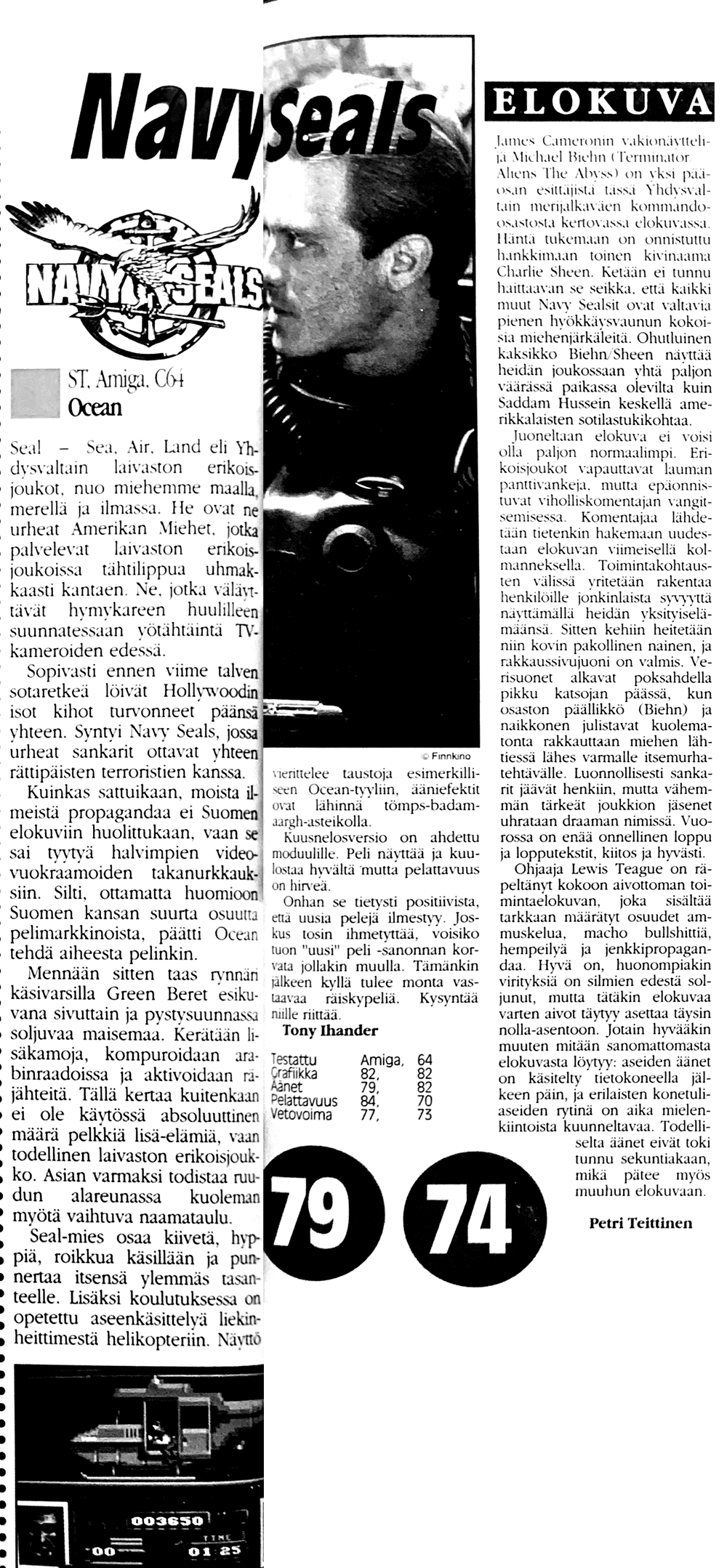
Mennään sitten taas rynnäri käsivarsilla Green Beret esikuvana sivuttain ja pystysuunnassa soljuvaa maisemaa. Kerätään lisäkamoja, kompuroidaan arabinraadoissa ja aktivoidaan räjähteitä. Tällä kertaa kuitenkaan ei ole käytössä absoluuttinen määrä pelkkiä lisä-elämiä, vaan todellinen laivaston erikoisjoukko. Asian varmaksi todistaa ruudun alareunassa kuoleman myötä vaihtuva naamataulu.
Seal-mies osaa kiivetä, hyppiä, roikkua käsillään ja punnertaa itsensä ylemmäs tasanteelle. Lisäksi koulutuksessa on opetettu aseenkäsittelyä liekinheittimestä helikopteriin. Näyttö vierittelee taustoja esimerkilliseen Ocean-tyyliin, ääniefektit ovat lähinnä tömps-badam-aargh-asteikolla.
Kuusnelosversio on ahdettu moduulille. Peli näyttää ja kuulostaa hyvältä 'mutta pelattavuus on hirveä.
Onhan se tietysti positiivista, että uusia pelejä ilmestyy. Joskus tosin ihmetyttää, voisiko tuon "uusi" peli -sanonnan korvata jollakin muulla. Tämänkin jälkeen kyllä tulee monta vastaavaa räiskypeliä. Kysyntää niille riittää.
Navy Seals1991 SyksyPermalinkSeal - Sea, Air, Land, in other words the United States Navy's special forces, those men of ours on land, at sea and in the air. They are the brave Men of America who serve in the navy's special forces, defiantly bearing the Stars and Stripes. The ones who flash the ghost of a smile as they level their night sights in front of the TV cameras.
Conveniently just before last winter's military campaign, Hollywood's big shots put their swollen heads together. The result was Navy Seals, in which brave heroes clash with raghead terrorists.
Wouldn't you know it, such blatant propaganda wasn't let into Finnish cinemas after all, and had to make do with the back corners of the cheapest video rental shops. Even so, with no regard for the Finnish people's large share of the games market, Ocean decided to make a game of it as well.
So here we go again, assault rifle in our arms and Green Beret as the role model, through scenery that flows sideways and vertically. We pick up extra gear, stumble over Arab carcasses and set off explosives. This time, however, you don't have an absolute number of mere extra lives but a genuine navy special forces unit. Proof positive of this is the mug at the bottom of the screen, which changes with each death.
The Seal man can climb, jump, hang by his hands and pull himself up onto a higher ledge. His training has also covered weapons handling, from the flamethrower to the helicopter. The screen scrolls the backgrounds in exemplary Ocean style, and the sound effects are mostly on the thud-badam-aargh scale.
The Commodore 64 version has been crammed onto a cartridge. The game looks and sounds good, but the playability is awful.
Of course it's a positive thing that new games keep coming out. Sometimes, though, you do wonder whether that "new" game expression couldn't be replaced with something else. Plenty more shoot-'em-ups like this one will certainly follow it, too. There's demand enough for them.
Nebulus
Nebulus1988Pysyvä linkkiPlaneetta Nebuluksella ei kaikki ole kunnossa. Joku tai jokin on rakentanut valtavia torneja mereen, kysymättä edes rakennuslupaa! Kunnalliskodissa heräät iltapäivätorkuilta puhelimen rämistessä pöydälläsi. Kunnanjohtaja karjuu jostain pikku hävityshommasta, joka sinun tulisi tehdä. Yhä puoliunessa kuuntelet pomon paasausta uudesta Mk. 7 -minisukellusveneestä mikä hänellä on sinulle. Sanat 'korkeampi työtuoli' kuultuasi olet leiskauksessa ulkona toimistosta, puhelimen roikkuessa ikkunasta ja pomon jatkaessa puhumistaan hirvittävästä vaarasta.
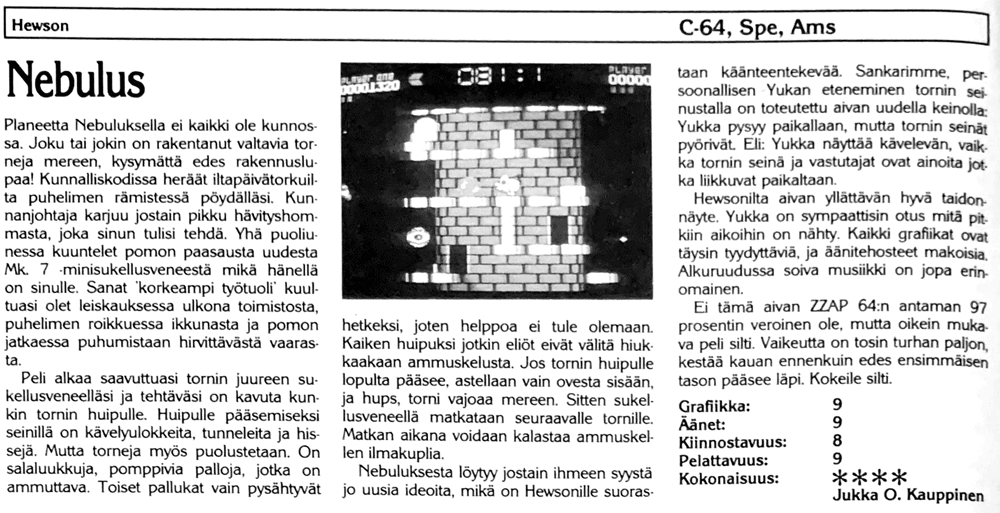
Peli alkaa saavuttuasi tornin juureen sukellusveneelläsi ja tehtäväsi on kavuta kunkin tornin huipulle. Huipulle pääsemiseksi seinillä on kävelyulokkeita, tunneleita ja hissejä. Mutta torneja myös puolustetaan. On salaluukkuja, pomppivia palloja, jotka on ammuttava. Toiset pallukat vain pysähtyvät hetkeksi, joten helppoa ei tule olemaan. Kaiken huipuksi jotkin eliöt eivät välitä hiukkaakaan ammuskelusta. Jos tornin huipulle lopulta pääsee, astellaan vain ovesta sisään, ja hups, torni vajoaa mereen. Sitten sukellusveneellä matkataan seuraavalle tornille. Matkan aikana voidaan kalastaa ammuskellen ilmakuplia.
Nebuluksesta löytyy jostain ihmeen syystä jo uusia ideoita, mikä on Hewsonille suorastaan käänteentekevää. Sankarimme, persoonallisen Yukan eteneminen tornin seinustalla on toteutettu aivan uudella keinolla: Yukka pysyy paikallaan, mutta tornin seinät pyörivät. Eli: Yukka näyttää kävelevän, vaikka tornin seinä ja vastutajat ovat ainoita jotka liikkuvat paikaltaan.
Hewsonilta aivan yllättävän hyvä taidonnäyte. Yukka on sympaattisin otus mitä pitkiin aikoihin on nähty. Kaikki grafiikat ovat täysin tyydyttäviä, ja äänitehosteet makoisia. Alkuruudussa soiva musiikki on jopa erinomainen.
Ei tämä aivan ZZAP 64:n antaman 97 prosentin veroinen ole, mutta oikein mukava peli silti. Vaikeutta on tosin turhan paljon, kestää kauan ennenkuin edes ensimmäisen tason pääsee läpi. Kokeile silti.
Nebulus1988PermalinkOn the planet Nebulus, all is not well. Someone or something has built huge towers in the sea, without even asking for a building permit! At the municipal old folks' home you wake from your afternoon nap to the phone clattering on your desk. The municipal manager is bellowing about some little demolition job you're supposed to do. Still half asleep, you listen to the boss ranting about a new Mk. 7 mini-submarine lined up for you. On hearing the words 'higher office chair' you're out of the office in a flash, the phone left dangling out of the window and the boss still going on about the terrible danger.
The game begins once you've arrived at the foot of a tower in your submarine, and your task is to climb to the top of each tower. To help you get to the top, the walls have walkway ledges, tunnels and lifts. But the towers are defended too. There are trapdoors, and bouncing balls that have to be shot. Some of the little balls merely stop for a moment, so it isn't going to be easy. To top it all, some creatures don't care one bit about being shot at. If you finally make it to the top of a tower, you just stroll in through the door and whoops, the tower sinks into the sea. Then it's off by submarine to the next tower. On the way you can do some fishing by shooting air bubbles.
For some miraculous reason Nebulus actually has new ideas in it, which for Hewson is nothing short of revolutionary. The progress of our hero, the characterful Yukka, along the tower wall has been done in an entirely new way: Yukka stays in place, but the tower walls rotate. In other words: Yukka appears to walk, even though the tower wall and the enemies are the only things that actually move from their spot.
A quite surprisingly good showing from Hewson. Yukka is the most likeable critter seen in ages. All the graphics are entirely satisfactory, and the sound effects are tasty. The music on the title screen is downright excellent.
It isn't quite worth the 97 per cent ZZAP 64 gave it, but it's a very nice game all the same. There's rather too much difficulty, mind you; it takes a long time before you get through even the first level. Give it a try anyway.
Nemesis
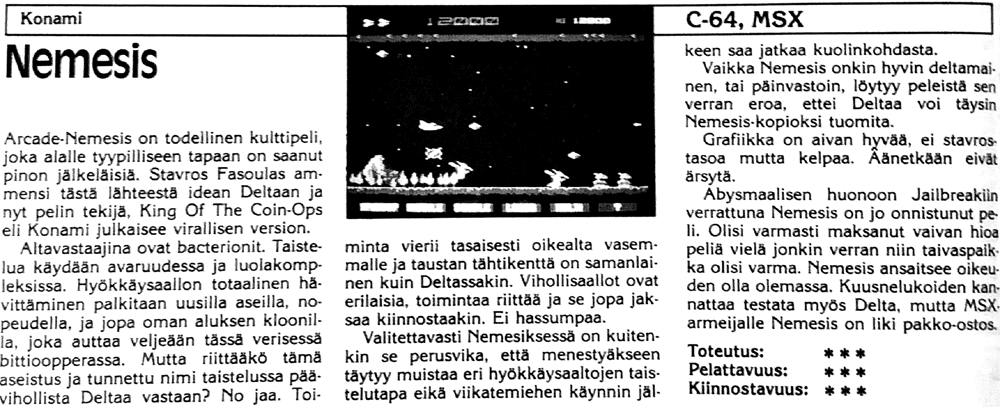
Nemesis1987Pysyvä linkkiArcade-Nemesis on todellinen kulttipeli, joka alalle tyypilliseen tapaan on saanut pinon jälkeläisiä. Stavros Fasoulas ammensi tästä lähteestä idean Deltaan ja nyt pelin tekijä, King Of The Coin-Ops eli Konami julkaisee virallisen version.
Altavastaajina ovat bacterionit. Taistelua käydään avaruudessa ja luolakomplekseissa. Hyökkäysaallon totaalinen hävittäminen palkitaan uusilla aseilla, nopeudella, ja jopa oman aluksen kloonilla, joka auttaa veljeään tässä verisessä bittioopperassa. Mutta riittääkö tämä aseistus ja tunnettu nimi taistelussa päävihollista Deltaa vastaan? No jaa. Toiminta vierii tasaisesti oikealta vasemmalle ja taustan tähtikenttä on samanlainen kuin Deltassakin. Vihollisaallot ovat erilaisia, toimintaa riittää ja se jopa jaksaa kiinnostaakin. Ei hassumpaa.
Valitettavasti Nemesiksessä on kuitenkin se perusvika, että menestyäkseen täytyy muistaa eri hyökkäysaaltojen taistelutapa eikä viikatemiehen käynnin jälkeen saa jatkaa kuolinkohdasta.
Vaikka Nemesis onkin hyvin deltamainen, tai päinvastoin, löytyy peleistä sen verran eroa, ettei Deltaa voi täysin Nemesis-kopioksi tuomita.
Grafiikka on aivan hyvää, ei stavrostasoa mutta kelpaa. Äänetkään eivät ärsytä.
Abysmaalisen huonoon Jailbreakiin verrattuna Nemesis on jo onnistunut peli. Olisi varmasti maksanut vaivan hioa peliä vielä jonkin verran niin taivaspaikka olisi varma. Nemesis ansaitsee oikeuden olla olemassa. Kuusnelukoiden kannattaa testata myös Delta, mutta MSX-armeijalle Nemesis on liki pakko-ostos.
Nemesis1987PermalinkThe arcade Nemesis is a real cult game which, as is typical in this business, has spawned a whole pile of offspring. Stavros Fasoulas drew his idea for Delta from this well, and now the game's maker, the King Of The Coin-Ops, a.k.a. Konami, is releasing the official version.
Cast as the underdogs are the Bacterions. The battle is fought in space and in cave complexes. Wiping out an attack wave completely is rewarded with new weapons, speed, and even a clone of your own ship, which helps its brother out in this bloody bit-opera. But are this firepower and a famous name enough in the fight against the arch-enemy, Delta? Well, sort of. The action scrolls smoothly from right to left and the starfield in the background is just like the one in Delta. The enemy waves are varied, there's plenty of action and it even manages to stay interesting. Not bad.
Unfortunately, though, Nemesis has the basic flaw that to succeed you have to memorise how each of the different attack waves fights, and after a visit from the Grim Reaper you don't get to carry on from the spot where you died.
Although Nemesis is very Delta-like, or vice versa, there are enough differences between the games that Delta can't be condemned outright as a Nemesis copy.
The graphics are quite good, not Stavros-class but they'll do. Nor do the sounds get on your nerves.
Compared with the abysmally bad Jailbreak, Nemesis is already a success. It would surely have been worth polishing the game a bit more, and then its place in heaven would have been guaranteed. Nemesis deserves the right to exist. The Commodore 64 crowd should give Delta a try as well, but for the MSX army Nemesis is close to a must-buy.
Nemesis The Warlock
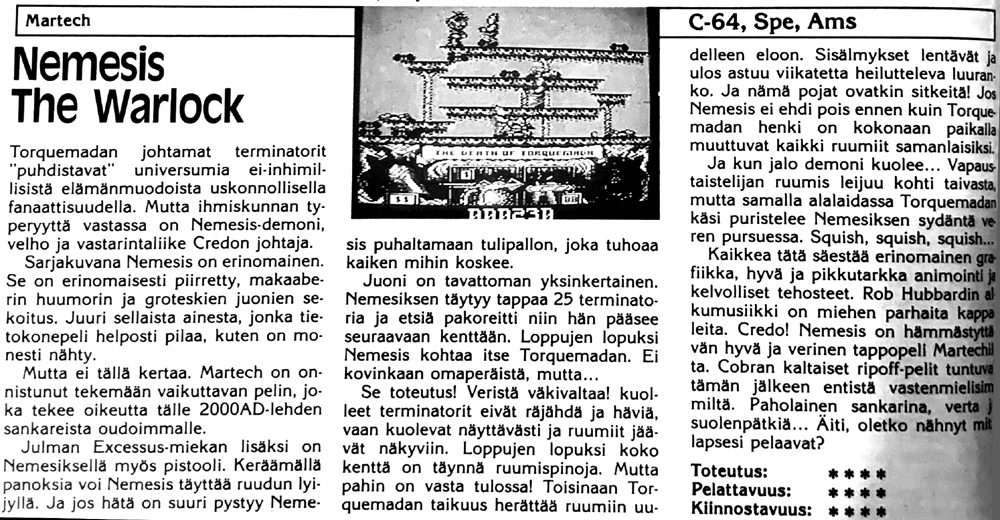
Nemesis The Warlock1987Pysyvä linkkiTorquemadan johtamat terminatorit "puhdistavat" universumia ei-inhimillisistä elämänmuodoista uskonnollisella fanaattisuudella. Mutta ihmiskunnan typeryyttä vastassa on Nemesis-demoni, velho ja vastarintaliike Credon johtaja.
Sarjakuvana Nemesis on erinomainen. Se on erinomaisesti piirretty, makaaberin huumorin ja groteskien juonien sekoitus. Juuri sellaista ainesta, jonka tietokonepeli helposti pilaa, kuten on monesti nähty.
Mutta ei tällä kertaa. Martech on onnistunut tekemään vaikuttavan pelin, joka tekee oikeutta tälle 2000AD-lehden sankareista oudoimmalle.
Julman Excessus-miekan lisäksi on Nemesiksellä myös pistooli. Keräämällä panoksia voi Nemesis täyttää ruudun lyijyllä. Ja jos hätä on suuri pystyy Nemesis puhaltamaan tulipallon, joka tuhoaa kaiken mihin koskee.
Juoni on tavattoman yksinkertainen. Nemesiksen täytyy tappaa 25 terminatoria ja etsiä pakoreitti niin hän pääsee seuraavaan kenttään. Loppujen lopuksi Nemesis kohtaa itse Torquemadan. Ei kovinkaan omaperäistä, mutta...
Se toteutus! Veristä väkivaltaa! kuolleet terminatorit eivät räjähdä ja häviä, vaan kuolevat näyttävästi ja ruumiit jäävät näkyviin. Loppujen lopuksi koko kenttä on täynnä ruumispinoja. Mutta pahin on vasta tulossa! Toisinaan Torquemadan taikuus herättää ruumiin uudelleen eloon. Sisälmykset lentävät ja ulos astuu viikatetta heilutteleva luuranko. Ja nämä pojat ovatkin sitkeitä! Jos Nemesis ei ehdi pois ennen kuin Torquemadan henki on kokonaan paikalla muuttuvat kaikki ruumiit samanlaisiksi.
Ja kun jalo demoni kuolee... Vapaustaistelijan ruumis leijuu kohti taivasta, mutta samalla alalaidassa Torquemadan käsi puristelee Nemesiksen sydäntä veren pursuessa. Squish, squish, squish...
Kaikkea tätä säestää erinomainen grafiikka, hyvä ja pikkutarkka animointi ja kelvolliset tehosteet. Rob Hubbardin alkumusiikki on miehen parhaita kappaleita. Credo! Nemesis on hämmästyttävän hyvä ja verinen tappopeli Martechilta. Cobran kaltaiset ripoff-pelit tuntuvat tämän jälkeen entistä vastenmielisimmiltä. Paholainen sankarina, verta ja suolenpätkiä... Äiti, oletko nähnyt mitä lapsesi pelaavat?
Nemesis The Warlock1987PermalinkThe Terminators, led by Torquemada, are "purifying" the universe of non-human life forms with religious fanaticism. But standing against mankind's stupidity is Nemesis, demon, warlock and leader of the resistance movement Credo.
As a comic, Nemesis is excellent. It is superbly drawn, a mixture of macabre humour and grotesque plots. Exactly the kind of material a computer game can easily ruin, as we have seen many a time.
But not this time. Martech has managed to make an impressive game that does justice to this, the weirdest of 2000AD's heroes.
Besides his cruel sword Excessus, Nemesis also has a pistol. By collecting ammunition, Nemesis can fill the screen with lead. And if things get really desperate, Nemesis can blow out a fireball that destroys everything it touches.
The plot is extraordinarily simple. Nemesis has to kill 25 Terminators and find an escape route, and then he gets through to the next level. In the end Nemesis comes face to face with Torquemada himself. Not terribly original, but...
Oh, but the execution! Bloody violence! Dead Terminators don't just explode and vanish, they die spectacularly and the bodies stay on screen. Eventually the whole level is covered in piles of corpses. But the worst is yet to come! Every now and then Torquemada's sorcery raises a corpse back to life. Guts fly and out steps a scythe-swinging skeleton. And these boys are tough ones! If Nemesis doesn't get out before Torquemada's spirit has fully arrived, all the corpses turn into the same thing.
And when the noble demon dies... The freedom fighter's body floats up towards heaven, while down at the bottom of the screen Torquemada's hand squeezes Nemesis's heart as the blood gushes out. Squish, squish, squish...
All this is accompanied by excellent graphics, good and finely detailed animation and decent sound effects. Rob Hubbard's title music is among the man's best pieces. Credo! Nemesis is an astonishingly good and bloody slaughter game from Martech. After this, rip-offs like Cobra feel more repulsive than ever. The Devil as the hero, blood and bits of gut... Mum, have you seen what your children are playing?
Netherworld
Netherworld1988Pysyvä linkkiNetherworld on Octopoliksella debytoineen Jukka Tapanimäen toinen peli. Octopolis sai aikoinaan erittäin hyvän vastaanoton, joten ennakkopaine Alamaailmaan oli suuri.
Pelaaja on joutunut toiseen ulottuvaisuuteen, ja sen sijaan että olisi iloinen vaihtelusta, haluaakin takaisin omaan arkiseen maailmaamme. Raha ratkaisee muillakin olemassaolon tasoilla, joten matkalipun hinta on tienattava keräämällä paikallisia rahayksiköitä (timantteja) tarvittava määrä.
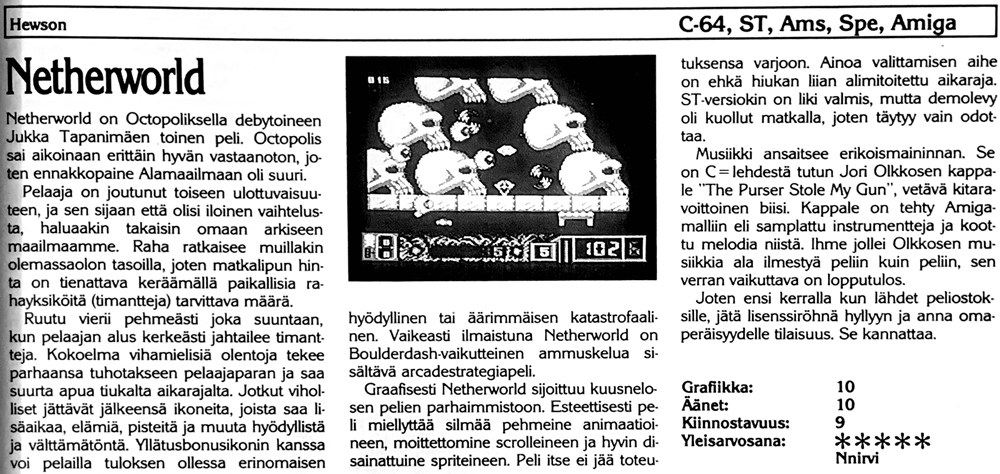
Ruutu vierii pehmeästi joka suuntaan, kun pelaajan alus kerkeästi jahtailee timantteja. Kokoelma vihamielisiä olentoja tekee parhaansa tuhotakseen pelaajaparan ja saa suurta apua tiukalta aikarajalta. Jotkut viholliset jättävät jälkeensä ikoneita, joista saa lisäaikaa, elämiä, pisteitä ja muuta hyödyllistä ja välttämätöntä. Yllätysbonusikonin kanssa voi pelailla tuloksen ollessa erinomaisen hyödyllinen tai äärimmäisen katastrofaalinen. Vaikeasti ilmaistuna Netherworld on Boulderdash-vaikutteinen ammuskelua sisältävä arcadestrategiapeli.
Graafisesti Netherworld sijoittuu kuusnelosen pelien parhaimmistoon. Esteettisesti peli miellyttää silmää pehmeine animaatioineen, moittettomine scrolleineen ja hyvin disainattuine spriteineen. Peli itse ei jää toteutuksensa varjoon. Ainoa valittamisen aihe on ehkä hiukan liian alimitoitettu aikaraja. ST-versiokin on liki valmis, mutta demolevy oli kuollut matkalla, joten täytyy vain odottaa.
Musiikki ansaitsee erikoismaininnan. Se on C=lehdestä tutun Jori Olkkosen kappale "The Purser Stole My Gun", vetävä kitaravoittoinen biisi. Kappale on tehty Amigamalliin eli samplattu instrumentteja ja koottu melodia niistä. Ihme jollei Olkkosen musiikkia ala ilmestyä peliin kuin peliin, sen verran vaikuttava on lopputulos.
Joten ensi kerralla kun lähdet peliostoksille, jätä lisenssiröhnä hyllyyn ja anna omaperäisyydelle tilaisuus. Se kannattaa.
Netherworld1988PermalinkNetherworld is the second game from Jukka Tapanimäki, who debuted with Octopolis. Octopolis got a very good reception back in its day, so the pressure of expectation on the Underworld was great.
The player has ended up in another dimension, and instead of being glad of the change, wants to go back to our own humdrum world. Money talks on other planes of existence too, so the price of the ticket home has to be earned by collecting the required number of the local currency units (diamonds).
The screen scrolls smoothly in every direction as the player's ship nimbly chases after diamonds. A collection of hostile beings does its best to destroy the poor player, and gets a great deal of help from a tight time limit. Some enemies leave behind icons that give extra time, lives, points and other useful and essential things. You can take a gamble with the surprise bonus icon, the outcome being either exceptionally useful or utterly catastrophic. To put it the complicated way, Netherworld is a Boulderdash-influenced arcade strategy game with shooting in it.
Graphically Netherworld ranks among the very best of Commodore 64 games. Aesthetically the game pleases the eye with its smooth animation, flawless scrolling and well-designed sprites. The game itself isn't left in the shadow of its execution. The only cause for complaint is perhaps a time limit that's cut a bit too fine. The ST version is nearly finished too, but the demo disk had died in transit, so we'll just have to wait.
The music deserves a special mention. It's "The Purser Stole My Gun", a track by Jori Olkkonen, familiar from C=lehti, and a catchy guitar-driven number it is. The track has been made the Amiga way, that is, by sampling instruments and building the melody out of them. It'll be a wonder if Olkkonen's music doesn't start turning up in game after game, that's how impressive the result is.
So next time you go game shopping, leave the licensed slop on the shelf and give originality a chance. It pays off.
Neuromancer
Neuromancer1989 KevätPysyvä linkkiWilliam Gibsonin esikoisteos Neuromancer on noussut kulttikirjaksi sitä mukaa kun se on napannut kaikki mahdolliset palkinnot, joita tieteiskirjalle voidaan myöntää: Hugon, Nebulan ja Philip K. Dickin muistopalkinnon. Nyt siitä on tehty myös tietokonepeli, ja elokuvaa filmataan täyttä päätä. Onneksi edes suomalaiset kirjankustantajat ovat pitäneet päänsä kylmänä eivätkä ole erehtyneet julkaisemaan tätä cyberpunkin perusteosta suomeksi (nirsknarsk!, kirskuvat hampaat).
Neuromancer on lisenssipeliksi siitä erikoinen, että se ei edes yritä toistaa itse kirjan juonta. Tapahtumat vain sijoittuvat Gibsonin luomaan saasteiseen cyberpunk-tulevaisuuteen, jota hallitsevat Hosakan, Maas Biolabsin ja Hitachin kaltaiset megakorporaatiot. Kasvihuoneilmiö jäytää, eikä ihmishenki ole elinten jälleenmyyntiarvoa kalliimpi.
Todellisen maailman lisäksi on olemassa niin kutsuttu cyberavaruus - tietokoneverkko, johon kaikki maailman tietokannat, tietokoneet ja tekoälyt ovat yhteydessä. Myös pieni ihminen pääsee cyberavaruuteen kytkemällä päätteensä plugin korvansa takana olevaan pistokkeeseen. Tietokannat on kuitenkin suojattu asiattomia tunkeutujia vastaan. Cyberavaruudessa käydäänkin jatkuvaa sotaa suojausohjelmimen eli jään ja hakkereiden jäänsärkijäohjelmien välillä. Jos ihmisaivot voidaan kytkeä tietokoneeseen, niin myös tietokone voi kytkeytyä ihmisaivoihin...
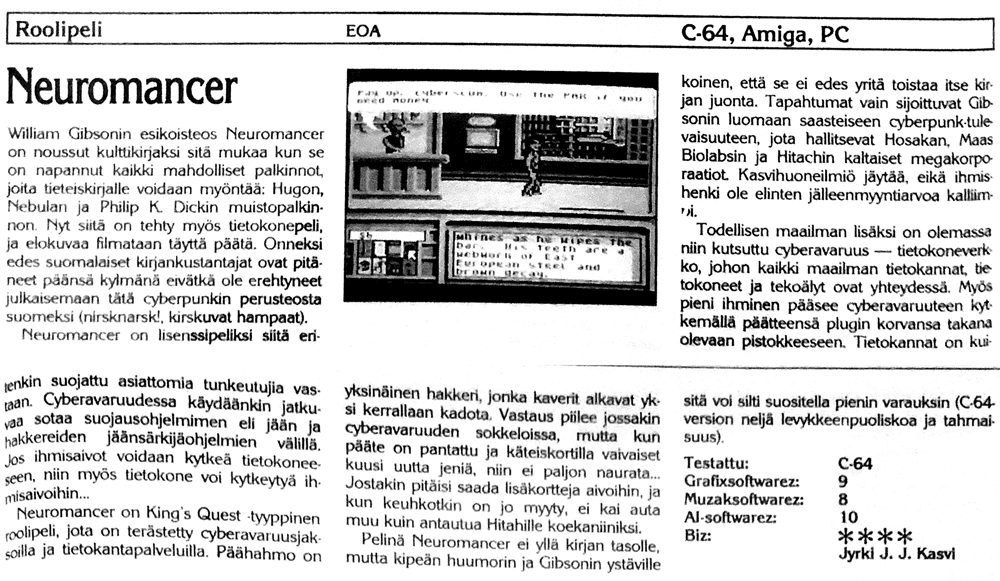
Neuromancer on King's Quest -tyyppinen roolipeli, jota on terästetty cyberavaruusjaksoilla ja tietokantapalveluilla. Päähahmo on yksinäinen hakkeri, jonka kaverit alkavat yksi kerrallaan kadota. Vastaus piilee jossakin cyberavaruuden sokkeloissa, mutta kun pääte on pantattu ja käteiskortilla vaivaiset kuusi uutta jeniä, niin ei paljon naurata... Jostakin pitäisi saada lisäkortteja aivoihin, ja kun keuhkotkin on jo myyty, ei kai auta muu kuin antautua Hitahille koekaniiniksi.
Pelinä Neuromancer ei yllä kirjan tasolle, mutta kipeän huumorin ja Gibsonin ystäville sitä voi silti suositella pienin varauksin (C-64-version neljä levykkeenpuoliskoa ja tahmaisuus).
Neuromancer1989 KevätPermalinkWilliam Gibson's debut novel Neuromancer has risen to cult status as it has scooped up every possible award a science fiction book can be given: the Hugo, the Nebula and the Philip K. Dick Memorial Award. Now it has also been made into a computer game, and a film is being shot at full tilt. Luckily Finnish book publishers at least have kept a cool head and have not been so misguided as to publish this foundational work of cyberpunk in Finnish (grind-gnash!, teeth grinding).
As a licensed game, Neuromancer is unusual in that it doesn't even try to reproduce the plot of the book itself. The events are simply set in the polluted cyberpunk future Gibson created, ruled by megacorporations such as Hosaka, Maas Biolabs and Hitachi. The greenhouse effect gnaws away, and a human life is worth no more than the resale value of its organs.
Besides the real world there is so-called cyberspace - a computer network to which all the world's databases, computers and artificial intelligences are connected. Even the little guy can get into cyberspace, by plugging the jack of their terminal into the socket behind their ear. The databases, however, are protected against unauthorised intruders. So a constant war is waged in cyberspace between the security programs, or ICE, and the hackers' icebreaker programs. If the human brain can be connected to a computer, then a computer can also connect itself to the human brain...
Neuromancer is a King's Quest-type role-playing game, spiked with cyberspace sequences and database services. The main character is a lone hacker whose pals start vanishing one by one. The answer lies somewhere in the mazes of cyberspace, but when your terminal is in hock and there's a measly six New Yen on your cash card, you're not laughing much... You need to get hold of extra cards for your brain from somewhere, and since you've already sold your lungs too, I suppose there's nothing for it but to sign yourself over to Hitahi as a guinea pig.
As a game Neuromancer doesn't reach the level of the book, but to friends of sick humour and of Gibson it can still be recommended with minor reservations (the C-64 version's four disk sides and sluggishness).
Neverending Story, The
Neverending Story, The1987Pysyvä linkkiPäättymätön tarina on kertomus nuoren Bastianin kuvitemaailmasta, joka syntyy tämän lukiessa taikakirjaa. Kyseessä on tekstiseikkailu, joka on tehty samannimisen elokuvan perusteella.
Bastian on nuori koulupoika, jolla ei näytä olevan ystäviä. Hän pakenee kirjojen ja unelmien maailmaan. Kerran Bastian törmää sattumalta oikeaan seikkailuun taikakirjan synnyttämässä mielikuvitusmaailmassa. Maailman nimi on Fantasia. Fantasiaa uhkaa "Kaiken Tuhoava Tyhjyys". Ainoa henkilö, joka pystyy pelastamaan Fantasian on nuori sankari Atreyu.
Peli on jaettu neljälle kasetinpuoliskolle. Ensin ladataan varsinainen ohjelma ensimmäiseltä kasetilta. Sitten käännetään kasetti ja ladataan sieltä ensimmäisen osan tiedot ja grafiikka. Kun on ratkaissut yhden osan, ladataan seuraava. Tämä tekniikka on pakollinen, sillä ohjelmakoodia grafiikalla ja teksteillä kertyy yli 100 kilotavua.
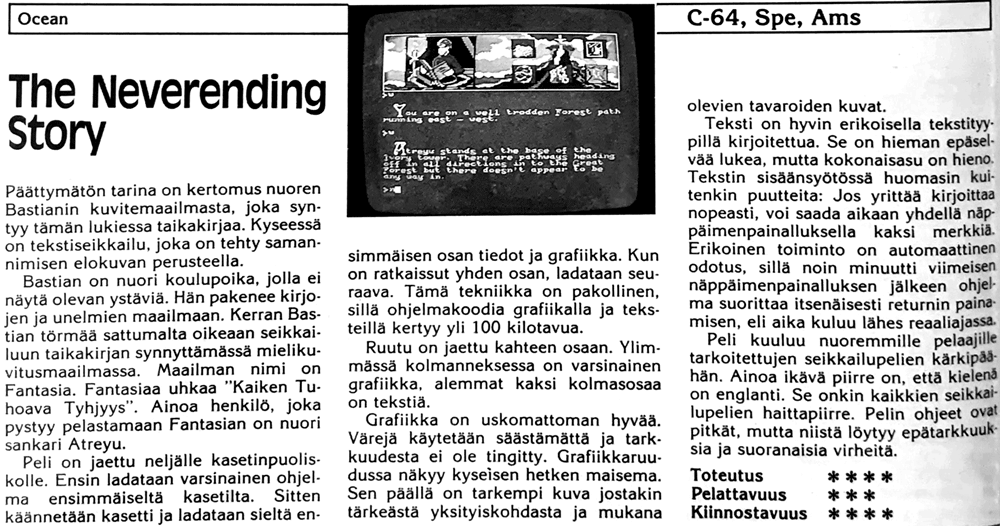
Ruutu on jaettu kahteen osaan. Ylimmässä kolmanneksessa on varsinainen grafiikka, alemmat kaksi kolmasosaa on tekstiä.
Grafiikka on uskomattoman hyvää. Värejä käytetään säästämättä ja tarkkuudesta ei ole tingitty. Grafiikkaruudussa näkyy kyseisen hetken maisema. Sen päällä on tarkempi kuva jostakin tärkeästä yksityiskohdasta ja mukana olevien tavaroiden kuvat.
Teksti on hyvin erikoisella tekstityypillä kirjoitettua. Se on hieman epäselvää lukea, mutta kokonaisasu on hieno. Tekstin sisäänsyötössä huomasin kuitenkin puutteita: Jos yrittää kirjoittaa nopeasti, voi saada aikaan yhdellä näppäimenpainalluksella kaksi merkkiä. Erikoinen toiminto on automaattinen odotus, sillä noin minuutti viimeisen näppäimenpainalluksen jälkeen ohjelma suorittaa itsenäisesti returnin painamisen, eli aika kuluu lähes reaaliajassa.
Peli kuuluu nuoremmille pelaajille tarkoitettujen seikkailupelien kärkipäähän. Ainoa ikävä piirre on, että kielenä on englanti. Se onkin kaikkien seikkailupelien haittapiirre. Pelin ohjeet ovat pitkät, mutta niistä löytyy epätarkkuuksia ja suoranaisia virheitä.
Neverending Story, The1987PermalinkThe Neverending Story is the tale of the imaginary world of young Bastian, which comes into being as he reads a magic book. It is a text adventure based on the film of the same name.
Bastian is a young schoolboy who doesn't seem to have any friends. He escapes into a world of books and dreams. One day Bastian happens to stumble into a real adventure in the imaginary world conjured up by the magic book. The world is called Fantasia. Fantasia is threatened by "The All-Destroying Nothing". The only person who can save Fantasia is the young hero Atreyu.
The game is split across four cassette sides. First you load the main program from the first cassette. Then you turn the cassette over and load the data and graphics for the first part from the other side. Once you have solved one part, you load the next. There is no way around this technique, since the program code together with the graphics and text adds up to more than 100 kilobytes.
The screen is divided into two parts. The top third holds the actual graphics, and the lower two thirds are text.
The graphics are unbelievably good. Colour is used unsparingly and no corners have been cut on detail. The graphics window shows the scenery of the moment. On top of it there is a closer picture of some important detail, along with pictures of the items you are carrying.
The text is written in a very unusual typeface. It is a little hard to read, but the overall look is fine. I did notice some flaws in the text input, though: if you try to type fast, a single keypress can produce two characters. An unusual feature is the automatic wait: about a minute after your last keypress the program presses Return all by itself, which means time passes almost in real time.
The game is among the very best adventure games meant for younger players. The only unfortunate thing is that the language is English. Then again, that is the drawback of all adventure games. The instructions are long, but they contain inaccuracies and outright errors.
Nevermind
Nevermind1990 KevätPysyvä linkkiTämä peli muuttaa aivosi vihannekseksi, väittävät peliohjeet. En tiedä onko se hyvä vai huono asia, sen tiedän että Psyclapsen uutuus Nevermind on omaperäinen älypeli.
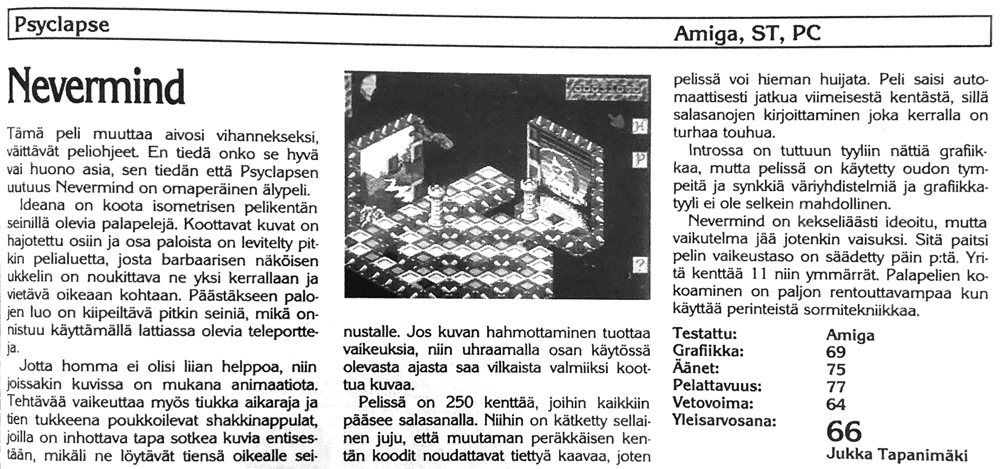
Ideana on koota isometrisen pelikentän seinillä olevia palapelejä. Koottavat kuvat on hajotettu osiin ja osa paloista on levitelty pitkin pelialuetta, josta barbaarisen näköisen ukkelin on noukittava ne yksi kerrallaan ja vietävä oikeaan kohtaan. Päästäkseen palojen luo on kiipeiltävä pitkin seiniä, mikä onnistuu käyttämällä lattiassa olevia teleportteja.
Jotta homma ei olisi liian helppoa, niin joissakin kuvissa on mukana animaatiota. Tehtävää vaikeuttaa myös tiukka aikaraja ja tien tukkeena poukkoilevat shakkinappulat, joilla on inhottava tapa sotkea kuvia entisestään, mikäli ne löytävät tiensä oikealle seinustalle. Jos kuvan hahmottaminen tuottaa vaikeuksia, niin uhraamalla osan käytössä olevasta ajasta saa vilkaista valmiiksi koottua kuvaa.
Pelissä on 250 kenttää, joihin kaikkiin pääsee salasanalla. Niihin on kätketty sellainen juju, että muutaman peräkkäisen kentän koodit noudattavat tiettyä kaavaa, joten pelissä voi hieman huijata. Peli saisi automaattisesti jatkua viimeisestä kentästä, sillä salasanojen kirjoittaminen joka kerralla on turhaa touhua.
Introssa on tuttuun tyyliin nättiä grafiikkaa, mutta pelissä on käytetty oudon tympeitä ja synkkiä väriyhdistelmiä ja grafiikkatyyli ei ole selkein mahdollinen.
Nevermind on kekseliäästi ideoitu, mutta vaikutelma jää jotenkin vaisuksi. Sitä paitsi pelin vaikeustaso on säädetty päin p:tä. Yritä kenttää 11 niin ymmärrät. Palapelien kokoaminen on paljon rentouttavampaa kun käyttää perinteistä sormitekniikkaa.
Nevermind1990 KevätPermalinkThis game will turn your brain into a vegetable, the instructions claim. I don't know whether that's a good thing or a bad thing, but I do know that Psyclapse's new release Nevermind is an original brain game.
The idea is to assemble jigsaw puzzles on the walls of an isometric playfield. The pictures to be assembled have been broken into pieces, and some of the pieces have been scattered around the play area, from where a barbarian-looking little guy has to pick them up one at a time and carry them to the right spot. To get to the pieces you have to clamber about on the walls, which you do by using the teleporters in the floor.
So that things don't get too easy, some of the pictures include animation. The task is also made harder by a tight time limit and by chess pieces bouncing around in your way, which have a nasty habit of scrambling the pictures even further if they find their way to the correct wall. If you're having trouble making out a picture, you can sacrifice some of your remaining time to take a peek at the finished picture.
The game has 250 levels, all of which can be reached with a password. There's a trick hidden in them: the codes for a few consecutive levels follow a certain pattern, so you can cheat a little. The game ought to continue automatically from the last level, since typing in passwords every time is a pointless chore.
The intro has pretty graphics in the familiar style, but the game itself uses strangely dreary and gloomy colour combinations, and the graphic style isn't the clearest possible.
Nevermind is an inventive idea, but the impression it leaves is somehow lacklustre. Besides, the game's difficulty level has been set completely a**-backwards. Try level 11 and you'll see. Putting jigsaw puzzles together is much more relaxing when you use the traditional finger technique.
New Zealand Story, The
New Zealand Story, The1989 SyksyPysyvä linkkiWally Walrus, tuo ilkeä mursu, hiippaili Uuden Seelannin eläintarhaan ja vei mennessään 20 kiwilintua. Tiki, ainoa vapaa kiwi, päättää pelastaa toverinsa pahan mursun pauloista. Aseenaan urhealla kiwillä on vain jousipyssy, mutta matkalta löytyy muunmuuassa laserpyssyjä ja pommeja. Tiki ei osaa lentää, mutta pomppii sitten senkin edestä. Matka sujuu myös veden alla tai teddykarhun päällä (siis tällä mikä sisältää aivot) lentämällä. Etanat, tappajatähdet, lentävät nallekarhut, lepakot ja muut erilaiset mutta söpöt vaarat vaikeuttavat kiwin vapautustaistelua.
The New Zealand Story kuuluu siis sarjaan "hypi, pompi ja ammu". TNZS kuuluu myös sarjaan "helvetin hyvät pelit". Lähin vertailukohde pelille on Bubble Bobble: kumpikin on söpöinen, näennäisesti yksinkertainen, vaarallisen pelattava ja pohjautuu Taiton automaattiin. Onpa kummassakin runsaasti salaisia ominaisuuksiakin.
Pelin kääntänyt Choice on tehnyt erinomaista työtä. Grafiikka on ensiluokkaista, peli pursuaa yksityiskohtia ja monipuolisia spritejä. Tällä kertaa ei Amiga-versiokaan ole suora ST-käännös, vaan notkeasti scrollaava eepos.
Kuusnelosversio on valitettavasti vähän omituinen. Tiki näyttää enemmän kananpojalta kuin kiwiltä, ja muutenkin versio on paljon vaikeampi kuin 16-bittisissä. Grafiikka ei muutenkaan ole totuttua Ocean-tasoa, mutta peli onneksi säilyttää suurimman osan viehättävyydestään.
The New Zealand Story on klassikko. Lisäbonuksena TNZ Storystä pitävät tytötkin, joten sen avulla voi vikitellä vaikka naapurin plikkaa.
New Zealand Story, The1989 SyksyPermalinkWally Walrus, that nasty walrus, snuck into a New Zealand zoo and made off with 20 kiwi birds. Tiki, the only kiwi still free, decides to rescue his comrades from the evil walrus's clutches. The brave kiwi's only weapon is a bow, but along the way he finds laser guns and bombs, among other things. Tiki can't fly, but he makes up for it by bouncing all the more. The journey also goes underwater, or flying on top of a teddy bear (the kind with a brain inside, that is). Snails, killer stars, flying teddy bears, bats and other assorted but cute dangers make the kiwi's liberation struggle harder.
The New Zealand Story belongs, then, to the "hop, bounce and shoot" category. TNZS also belongs to the "damn good games" category. The closest point of comparison for the game is Bubble Bobble: both are cutesy, deceptively simple, dangerously playable and based on a Taito coin-op. And both have plenty of secret features, too.
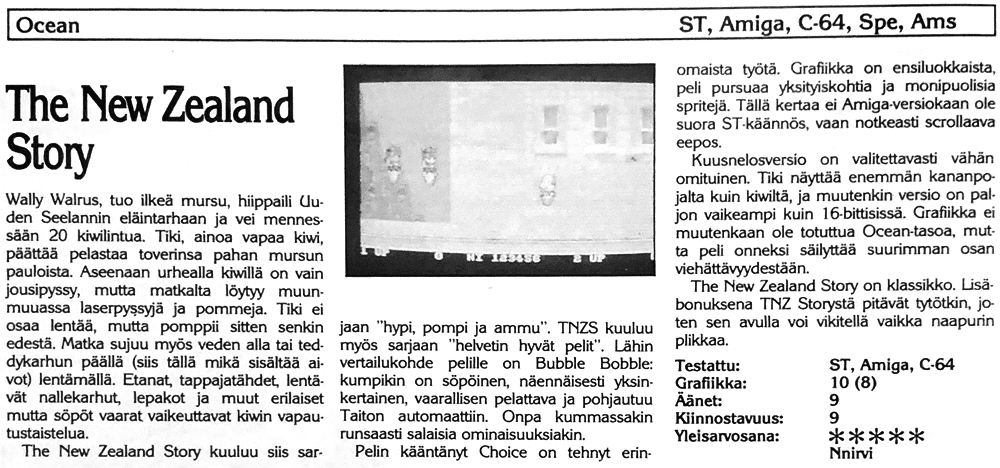
Choice, who converted the game, have done an excellent job. The graphics are first-class, and the game is bursting with detail and varied sprites. This time even the Amiga version isn't a straight ST port, but a smoothly scrolling epic.
The Commodore 64 version is unfortunately a bit odd. Tiki looks more like a baby chicken than a kiwi, and on top of that this version is much harder than the 16-bit ones. Nor are the graphics up to the usual Ocean standard, but luckily the game keeps most of its charm.
The New Zealand Story is a classic. As an added bonus, even girls like TNZ Story, so you can use it to sweet-talk the lass next door, say.
Night Hunter
Night Hunter1989 KevätPysyvä linkkiEivätpä neitsyet ole enää turvassa, sillä kreivi Dracula on noussut haudastaan ilman veren makua suussa. Voi näitä vapaamielisiä rappion aikoja: Draculan hampaisiin ei naista löydy, vaan uhrit ovat raavaita miehiä. Tähän ei urakka rajoitu, sillä kreivi joutuu keräämään joka kentästä viisi avainta ja kolme käsikirjoitusta, jotta pääsee seuraavaan ja loppujen lopuksi saa kerättyä viisi medaljonkia, jolloin tasapaino Hyvän ja Pahan välillä horjahtaa jälkimmäisen eduksi. Eli ei mitään hirveän erikoista.
Night Hunter ei ole hassumpi peli köyhähköstä perusideastaan huolimatta, sillä vampyyriperinteitä on kunnioitettu. Dracula osaa muuttua paitsi lepakoksi myös sudeksi (ihmissellaiseksi) ja lisäenergian hankintamuoto on veritankkaus digitaalisten Slurp-äänien säestyksellä. Lerpahtaapa tyhjiinimetty uhri vielä hilpeäksi luukasaksi. Turhaa luulla vampyyrinkaan eloa turhan huolettomaksi. Muun muassa jousimiehet, kirvesmiehet, paalukommandot, noidat (?), papit ja itse Van Helsing yrittävät muuttaa elävää kuollutta kuolleeksi kuolleeksi. Kentät kätkevät kavalia ansoja ja bonusvaikeutena Draculan täytyy löytää lepopaikka ennen auringonnousua.
Toteutus tekee pelin. Laadusta kertoo jo Night Hunterin tunnusmelodiana soiva samplattu pätkä Bauhausin kappaletta "Bela Lugosi is dead". Näinä tekopirteän pelimusiikin aikoina moinen säväyttää korvaa. Niin kreivi kuin elävätkin olennot on animoitu verevästi, ja erittäin atmosfääriset taustat, äänet ja pikkutouchit antavat pelille pontta. Vertakin näkyy.
Itse asiassa pidän Night Hunterista ihmeen paljon. Syy löytynee mahdollisuudesta pelata pahaa poikaa ihan kunnolla. Sen enempää jaarittelematta ja muutenkin lyhyttä yötä hukkaamatta taidankin taas raadella talonpojan ja kupata pari pappia. Sen jälkeen erä Night Hunteria maistuu taas.
Night Hunter1989 KevätPermalinkWell, virgins are safe no longer, for Count Dracula has risen from his grave without so much as a taste of blood in his mouth. Oh, these permissive, decadent times: there's not a woman to be found for Dracula's fangs; the victims are strapping men instead. Nor does the job end there, for the count has to collect five keys and three manuscripts from every level to get to the next one, and in the end manage to gather five medallions, whereupon the balance between Good and Evil tips in favour of the latter. So nothing terribly special.
Night Hunter isn't half bad as a game despite its rather thin basic idea, because vampire traditions have been respected. Dracula can turn not only into a bat but also into a wolf (the were- kind), and extra energy is obtained by a blood fill-up to the accompaniment of digitised Slurp sounds. What's more, the drained victim then flops into a jolly heap of bones. Don't go thinking even a vampire's existence is all too carefree, though. Archers, axemen, stake commandos, witches (?), priests and Van Helsing himself, among others, try to turn the living dead into dead dead. The levels hide treacherous traps, and as a bonus difficulty Dracula has to find a resting place before sunrise.
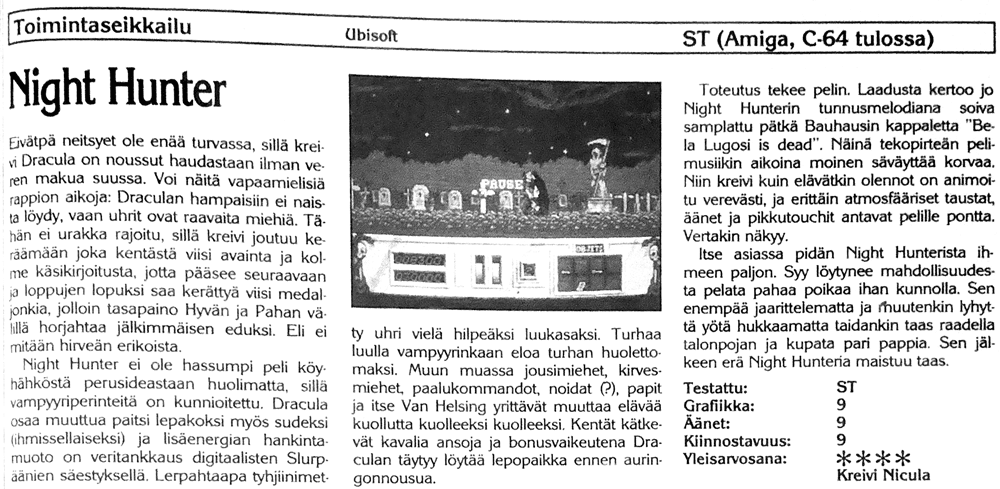
The execution makes the game. The quality shows straight away in the sampled snippet of Bauhaus's song "Bela Lugosi is dead" that plays as Night Hunter's theme tune. In these days of fake-chirpy game music, something like that sends a thrill through the ear. The count and the living creatures alike are animated in full-blooded style, and the highly atmospheric backgrounds, sounds and little touches give the game real punch. There's blood to be seen too.
As a matter of fact, I like Night Hunter surprisingly much. The reason is probably the chance to play the bad boy good and proper. Without rambling on any further, and without otherwise wasting the short night, I think I'll go and maul a peasant and bleed a couple of priests again. After that a round of Night Hunter will go down a treat again.
Night on the Tiles
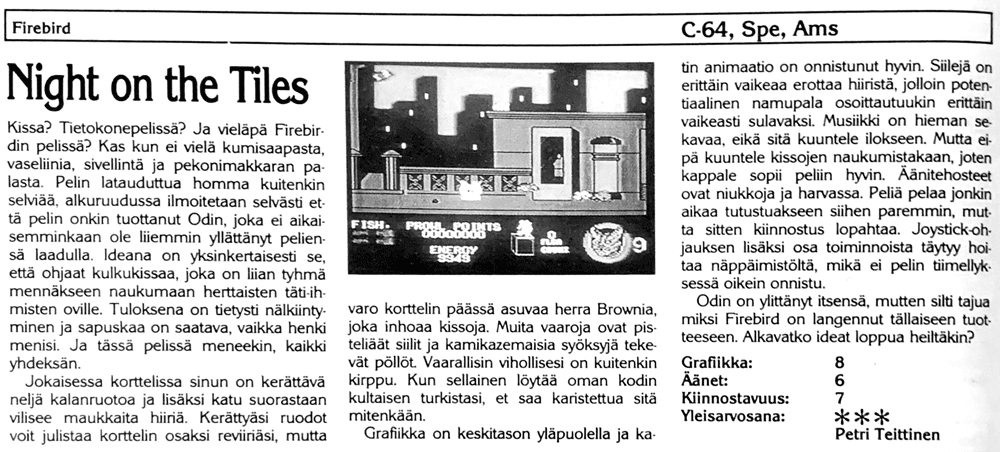
Night on the Tiles1988Pysyvä linkkiKissa? Tietokonepelissä? Ja vieläpä Firebirdin pelissä? Kas kun ei vielä kumisaapasta, vaseliinia, sivellintä ja pekonimakkaran palasta. Pelin latauduttua homma kuitenkin selviää, alkuruudussa ilmoitetaan selvästi että pelin onkin tuottanut Odin, joka ei aikaisemminkaan ole liiemmin yllättänyt peliensä laadulla. Ideana on yksinkertaisesti se, että ohjaat kulkukissaa, joka on liian tyhmä mennäkseen naukumaan herttaisten täti-ihmisten oville. Tuloksena on tietysti nälkiintyminen ja sapuskaa on saatava, vaikka henki menisi. Ja tässä pelissä meneekin, kaikki yhdeksän.
Jokaisessa korttelissa sinun on kerättävä neljä kalanruotoa ja lisäksi katu suorastaan vilisee maukkaita hiiriä. Kerättyäsi ruodot voit julistaa korttelin osaksi reviiriäsi, mutta varo korttelin päässä asuvaa herra Brownia, joka inhoaa kissoja. Muita vaaroja ovat pisteliäät siilit ja kamikazemaisia syöksyjä tekevät pöllöt. Vaarallisin vihollisesi on kuitenkin kirppu. Kun sellainen löytää oman kodin kultaisen turkistasi, et saa karistettua sitä mitenkään.
Grafiikka on keskitason yläpuolella ja katin animaatio on onnistunut hyvin. Siilejä on erittäin vaikeaa erottaa hiiristä, jolloin potentiaalinen namupala osoittautuukin erittäin vaikeasti sulavaksi. Musiikki on hieman sekavaa, eikä sitä kuuntele ilokseen. Mutta eipä kuuntele kissojen naukumistakaan, joten kappale sopii peliin hyvin. Äänitehosteet ovat niukkoja ja harvassa. Peliä pelaa jonkin aikaa tutustuakseen siihen paremmin, mutta sitten kiinnostus lopahtaa. Joystick-ohjauksen lisäksi osa toiminnoista täytyy hoitaa näppäimistöltä, mikä ei pelin tiimellyksessä oikein onnistu.
Odin on ylittänyt itsensä, mutten silti tajua miksi Firebird on langennut tällaiseen tuotteeseen. Alkavatko ideat loppua heiltäkin?
Night on the Tiles1988PermalinkA cat? In a computer game? And in a Firebird game, no less? Funny they didn't throw in a rubber boot, some vaseline, a paintbrush and a chunk of bacon sausage while they were at it. Once the game has loaded, though, the mystery clears up: the title screen plainly announces that the game was actually produced by Odin, who haven't exactly startled anyone with the quality of their games in the past either. The idea is simply that you control a stray cat that is too stupid to go and miaow at the doors of sweet little old ladies. The result is starvation, naturally, and grub must be had even if it costs you your life. And in this game it does - all nine of them.
In every block you have to collect four fishbones, and on top of that the street is positively teeming with tasty mice. Once you have collected the bones you can declare the block part of your territory, but beware of Mr Brown, who lives at the end of the block and hates cats. Other hazards include prickly hedgehogs and owls making kamikaze dives. Your most dangerous enemy, however, is the flea. Once one of those finds itself a home in your golden fur, there is no way whatsoever to shake it off.
The graphics are above average and the moggy's animation has come off well. The hedgehogs are extremely hard to tell apart from the mice, so a would-be tasty morsel turns out to be extremely hard to digest. The music is a bit of a muddle, and nobody listens to it for pleasure. But then nobody listens to cats yowling for pleasure either, so the tune suits the game well. The sound effects are scant and few and far between. You play the game for a while to get to know it better, but then your interest fizzles out. On top of the joystick control, some of the functions have to be handled from the keyboard, which doesn't really work in the heat of the game.
Odin have outdone themselves, but I still don't get why Firebird have stooped to a product like this. Are they running out of ideas too?
Night Shift
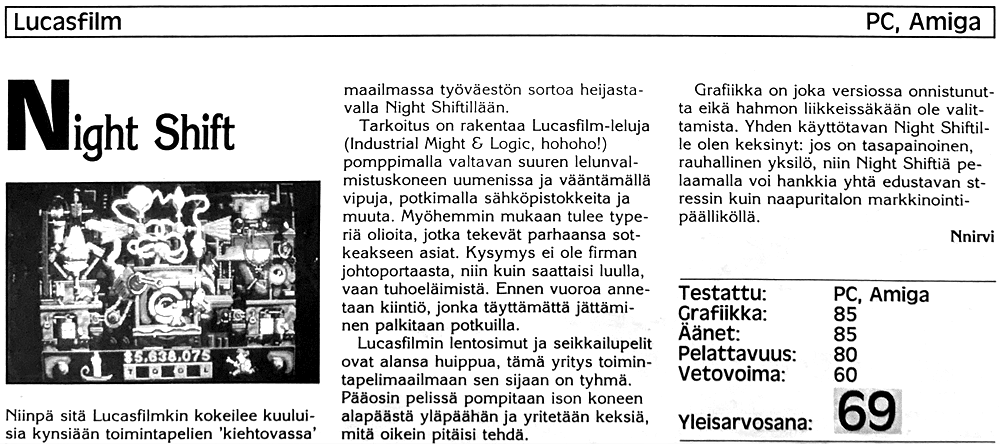
Night Shift1991 KevätPysyvä linkkiNiinpä sitä Lucasfilmkin kokeilee kuuluisia kynsiään toimintapelien 'kiehtovassa' maailmassa työväestön sortoa heijastavalla Night Shiftillään.
Tarkoitus on rakentaa Lucasfilm-leluja (Industrial Might & Logic, hohoho!) pomppimalla valtavan suuren lelunvalmistuskoneen uumenissa ja vääntämällä vipuja, potkimalla sähköpistokkeita ja muuta. Myöhemmin mukaan tulee typeriä olioita, jotka tekevät parhaansa sotkeakseen asiat. Kysymys ei ole firman johtoportaasta, niin kuin saattaisi luulla, vaan tuhoeläimistä. Ennen vuoroa annetaan kiintiö, jonka täyttämättä jättäminen palkitaan potkuilla.
Lucasfilmin lentosimut ja seikkailupelit ovat alansa huippua, tämä yritys toimintapelimaailmaan sen sijaan on tyhmä. Pääosin pelissä pompitaan ison koneen alapäästä yläpäähän ja yritetään keksiä, mitä oikein pitäisi tehdä.
Grafiikka on joka versiossa onnistunutta eikä hahmon liikkeissäkään ole valittamista. Yhden käyttötavan Night Shiftille olen keksinyt: jos on tasapainoinen, rauhallinen yksilö, niin Night Shiftiä pelaamalla voi hankkia yhtä edustavan stressin kuin naapuritalon markkinointipäälliköllä.
Night Shift1991 KevätPermalinkAnd so Lucasfilm, too, is trying out its famous claws in the 'fascinating' world of action games, with its Night Shift, which mirrors the oppression of the working class.
The idea is to build Lucasfilm toys (Industrial Might & Logic, hohoho!) by bouncing around in the bowels of an enormous toy-making machine, yanking levers, kicking electric plugs and so on. Later on some stupid creatures join in and do their best to mess things up. We are not talking about the company's management, as you might think, but about vermin. Before the shift you're given a quota, and failing to meet it is rewarded with the sack.
Lucasfilm's flight sims and adventure games are the best in their field; this attempt at the world of action games, on the other hand, is dumb. Mostly the game consists of bouncing from the bottom of the big machine to the top and trying to work out what on earth you're supposed to be doing.
The graphics are well done in every version, and there's nothing to complain about in the character's movements either. I have come up with one use for Night Shift: if you're a balanced, calm individual, playing Night Shift lets you acquire a stress every bit as impressive as the marketing manager's in the building next door.
Nightmare Rally
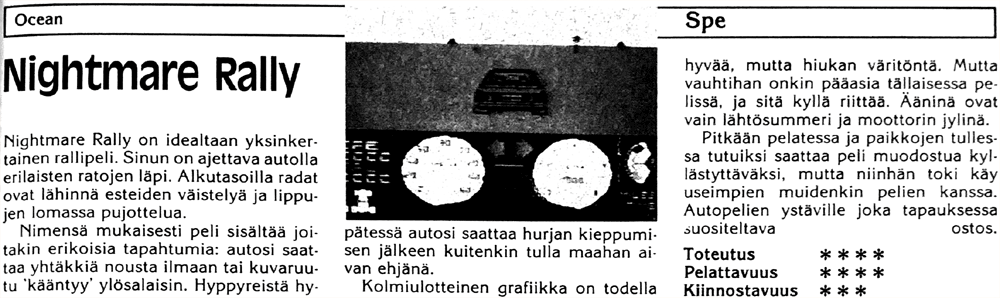
Nightmare Rally1987Pysyvä linkkiNightmare Rally on idealtaan yksinkertainen rallipeli. Sinun on ajettava autolla erilaisten ratojen läpi. Alkutasoilla radat ovat lähinnä esteiden väistelyä ja lippujen lomassa pujottelua.
Nimensä mukaisesti peli sisältää joitakin erikoisia tapahtumia: autosi saattaa yhtäkkiä nousta ilmaan tai kuvaruutu 'kääntyy' ylösalaisin. Hyppyreistä hypätessä autosi saattaa hurjan kieppumisen jälkeen kuitenkin tulla maahan aivan ehjänä.
Kolmiulotteinen grafiikka on todella hyvää, mutta hiukan väritöntä. Mutta vauhtihan onkin pääasia tällaisessa pelissä, ja sitä kyllä riittää. Ääninä ovat vain lähtösummeri ja moottorin jylinä.
Pitkään pelatessa ja paikkojen tullessa tutuiksi saattaa peli muodostua kyllästyttäväksi, mutta niinhän toki käy useimpien muidenkin pelien kanssa. Autopelien ystäville joka tapauksessa suositeltava ostos.
Nightmare Rally1987PermalinkNightmare Rally is a rally game with a simple concept. You have to drive a car through a variety of courses. On the early levels the courses are mostly a matter of dodging obstacles and slaloming in and out between flags.
True to its name, the game has some strange happenings in store: your car may suddenly rise into the air, or the screen 'flips' upside down. When you go off the jumps, though, your car may spin wildly through the air and still come down completely intact.
The 3D graphics are really good, if a little colourless. But then speed is the main thing in a game like this, and there's certainly plenty of that. The only sounds are the starting buzzer and the roar of the engine.
After playing for a long time, once the places start to feel familiar, the game may turn tedious, but of course that happens with most other games too. Either way, a recommended buy for fans of driving games.
Ninja Mission
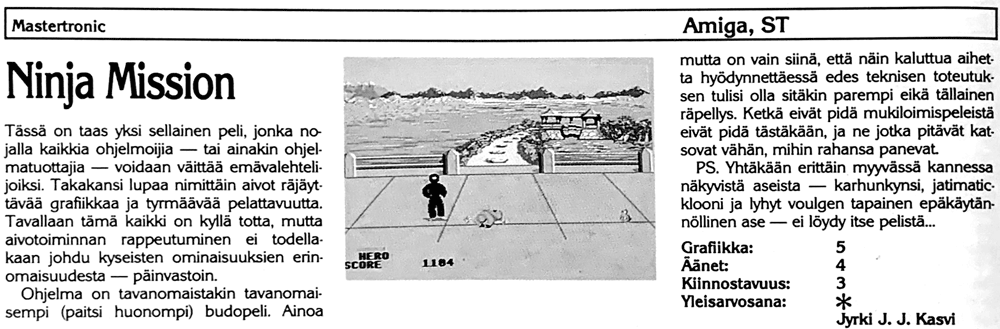
Ninja Mission1988Pysyvä linkkiTässä on taas yksi sellainen peli, jonka nojalla kaikkia ohjelmoijia - tai ainakin ohjelmatuottajia - voidaan väittää emävalehtelijoiksi. Takakansi lupaa nimittäin aivot räjäyttävää grafiikkaa ja tyrmäävää pelattavuutta. Tavallaan tämä kaikki on kyllä totta, mutta aivotoiminnan rappeutuminen ei todellakaan johdu kyseisten ominaisuuksien erinomaisuudesta - päinvastoin.
Ohjelma on tavanomaistakin tavanomaisempi (paitsi huonompi) budopeli. Ainoa mutta on vain siinä, että näin kaluttua aihetta hyödynnettäessä edes teknisen toteutuksen tulisi olla sitäkin parempi eikä tällainen räpellys. Ketkä eivät pidä mukiloimispeleistä eivät pidä tästäkään, ja ne jotka pitävät katsovat vähän, mihin rahansa panevat.
PS. Yhtäkään erittäin myyvässä kannessa näkyvistä aseista - karhunkynsi, jatimatic-klooni ja lyhyt voulgen tapainen epäkäytännöllinen ase - ei löydy itse pelistä...
Ninja Mission1988PermalinkHere is yet another of those games on the strength of which all programmers - or at least all software publishers - can be called barefaced liars. You see, the back cover promises brain-blowing graphics and knockout playability. In a way all of this is true enough, but the decay of your brain function is certainly not down to the excellence of said qualities - quite the opposite.
The program is a more-ordinary-than-ordinary (except worse) martial arts game. The only but is that when a theme has been gnawed to the bone like this one, at least the technical execution ought to be all the better, and not a botch job like this. Those who don't like beat-'em-ups won't like this one either, and those who do had better take a look at where they put their money.
PS. Not one of the weapons shown on the extremely saleable cover - a bear claw, a jatimatic clone and a short, impractical voulge-like weapon - is to be found in the game itself...
Ninja Warriors
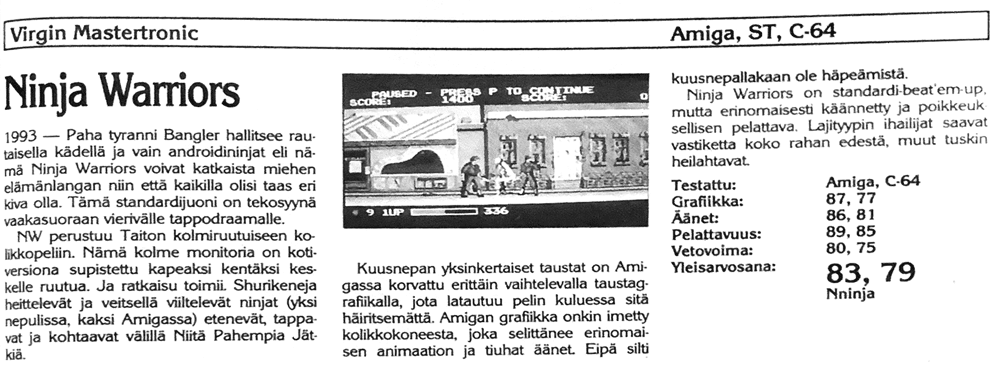
Ninja Warriors1990 KevätPysyvä linkki1993 - Paha tyranni Bangler hallitsee rautaisella kädellä ja vain androidininjat eli nämä Ninja Warriors voivat katkaista miehen elämänlangan niin että kaikilla olisi taas eri kiva olla. Tämä standardijuoni on tekosyynä vaakasuoraan vierivälle tappodraamalle.
NW perustuu Taiton kolmiruutuiseen kolikkopeliin. Nämä kolme monitoria on kotiversiona supistettu kapeaksi kentäksi keskelle ruutua. Ja ratkaisu toimii. Shurikeneja heittelevät ja veitsellä viiltelevät ninjat (yksi nepulissa, kaksi Amigassa) etenevät, tappavat ja kohtaavat välillä Niitä Pahempia Jätkiä.
Kuusnepan yksinkertaiset taustat on Amigassa korvattu erittäin vaihtelevalla taustagrafiikalla, jota latautuu pelin kuluessa sitä häiritsemättä. Amigan grafiikka onkin imetty kolikkokoneesta, joka selittänee erinomaisen animaation ja tiuhat äänet. Eipä silti kuusnepallakaan ole häpeämistä.
Ninja Warriors on standardi-beat'em-up, mutta erinomaisesti käännetty ja poikkeuksellisen pelattava. Lajityypin ihailijat saavat vastiketta koko rahan edestä, muut tuskin heilahtavat.
Ninja Warriors1990 KevätPermalink1993 - The evil tyrant Bangler rules with an iron fist, and only the android ninjas, i.e. these Ninja Warriors, can cut the man's thread of life so that everybody can have a super nice time again. This standard plot serves as the excuse for a horizontally scrolling killing drama.
NW is based on Taito's three-screen coin-op. In the home version these three monitors have been squeezed into a narrow strip in the middle of the screen. And the solution works. The shuriken-throwing, knife-slashing ninjas (one on the C-64, two on the Amiga) advance, kill and every so often come up against Those Badder Dudes.
The C-64's simple backgrounds have been replaced on the Amiga by highly varied background graphics, which load in as the game goes along without disturbing it. The Amiga graphics have in fact been sucked straight out of the coin-op machine, which presumably explains the excellent animation and the thick-and-fast sound. Not that the C-64 has anything to be ashamed of either.
Ninja Warriors is a standard beat'em-up, but excellently converted and exceptionally playable. Admirers of the genre get their money's worth in full; the rest will barely stir.
No Exit
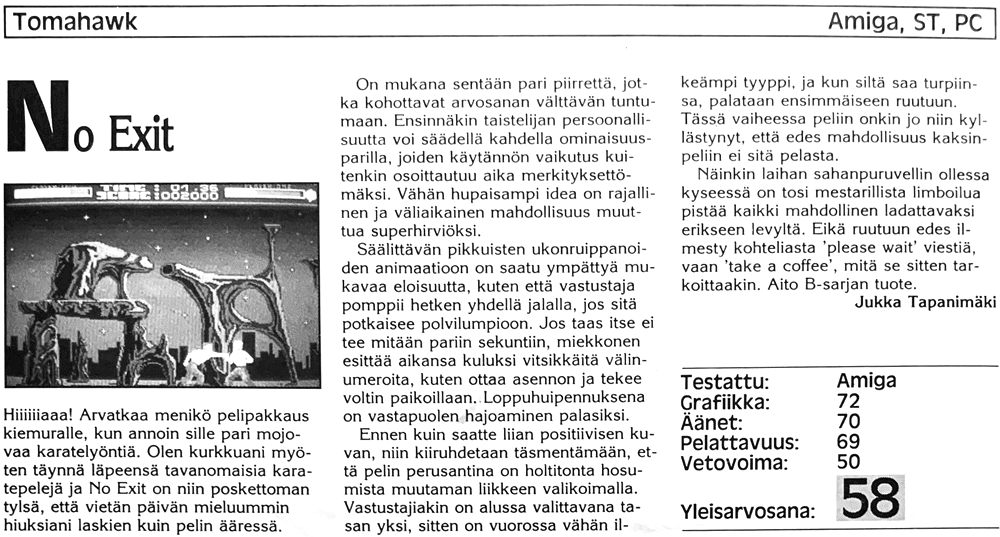
No Exit1991 KevätPysyvä linkkiHiiiiiaaa! Arvatkaa menikö pelipakkaus kiemuralle, kun annoin sille pari mojovaa karatelyöntiä. Olen kurkkuani myöten täynnä läpeensä tavanomaisia karatepelejä ja No Exit on niin poskettoman tylsä, että vietän päivän mieluummin hiuksiani laskien kuin pelin ääressä.
On mukana sentään pari piirrettä, jotka kohottavat arvosanan välttävän tuntumaan. Ensinnäkin taistelijan persoonallisuutta voi säädellä kahdella ominaisuusparilla, joiden käytännön vaikutus kuitenkin osoittautuu aika merkityksettömäksi. Vähän hupaisampi idea on rajallinen ja väliaikainen mahdollisuus muuttua superhirviöksi.
Säälittävän pikkuisten ukonruippanoiden animaatioon on saatu ympättyä mukavaa eloisuutta, kuten että vastustaja pomppii hetken yhdellä jalalla, jos sitä potkaisee polvilumpioon. Jos taas itse ei tee mitään pariin sekuntiin, miekkonen esittää aikansa kuluksi vitsikkäitä välinumeroita, kuten ottaa asennon ja tekee voltin paikoillaan. Loppuhuipennuksena on vastapuolen hajoaminen palasiksi.
Ennen kuin saatte liian positiivisen kuvan, niin kiiruhdetaan täsmentämään, että pelin perusantina on holtitonta hosumista muutaman liikkeen valikoimalla. Vastustajiakin on alussa valittavana tasan yksi, sitten on vuorossa vähän ilkeämpi tyyppi, ja kun siltä saa turpiinsa, palataan ensimmäiseen ruutuun. Tässä vaiheessa peliin onkin jo niin kyllästynyt, että edes mahdollisuus kaksinpeliin ei sitä pelasta.
Näinkin laihan sahanpuruvellin ollessa kyseessä on tosi mestarillista limboilua pistää kaikki mahdollinen ladattavaksi erikseen levyltä. Eikä ruutuun edes ilmesty kohteliasta 'please wait' viestiä, vaan 'take a coffee', mitä se sitten tarkoittaakin. Aito B-sarjan tuote.
No Exit1991 KevätPermalinkHiiiiiaaa! Just guess whether the game box went all crooked when I gave it a couple of mighty karate chops. I'm fed up to the back teeth with utterly run-of-the-mill karate games, and No Exit is so preposterously boring that I'd rather spend the day counting my hairs than sitting at the game.
There are, admittedly, a couple of features that lift the score to somewhere around 'passable'. First of all, you can adjust the fighter's personality with two pairs of attributes, though their practical effect turns out to be pretty insignificant. A slightly more amusing idea is the limited and temporary chance to turn into a super monster.
The animation of the pitifully tiny runts of men has been crammed with some nice liveliness, such as the opponent hopping on one leg for a moment if you kick them in the kneecap. And if you don't do anything yourself for a couple of seconds, the little fellow passes the time by putting on witty interludes, such as striking a pose and doing a somersault on the spot. The grand finale is the opponent falling to pieces.
Before you get too positive a picture, let's hasten to clarify that the game's basic offering is reckless flailing with a repertoire of a few moves. At the start there's exactly one opponent to choose from, too, then comes a slightly nastier type, and once that one has smashed your face in, it's back to square one. By this point you're already so sick of the game that not even the two-player option can save it.
With such a thin sawdust gruel as this, it's truly masterful limbo-dancing to put every conceivable thing on a separate load from disk. And the screen doesn't even show a polite 'please wait' message, but 'take a coffee', whatever that's supposed to mean. A genuine B-grade product.
Nodes of Yesod
Nodes of Yesod1987Pysyvä linkkiOdin Computer Graphicsin tekemä Nodes of Yesod on monen peli-idean yhdistelmä. Pelissä on pieni avaruuspukuinen mies, jonka on etsittävä erilaisia esineitä kuun luolista.
Pelin ideana on löytää kahdeksan avainta, joiden avulla pääsee erikoiseen luolaan, joka sisältää salaperäisen esineen. Luolissa pitää hypellä tasolta tasolle etsien avaimia. Jos tippuu menettää yhden kolmesta elämästä.
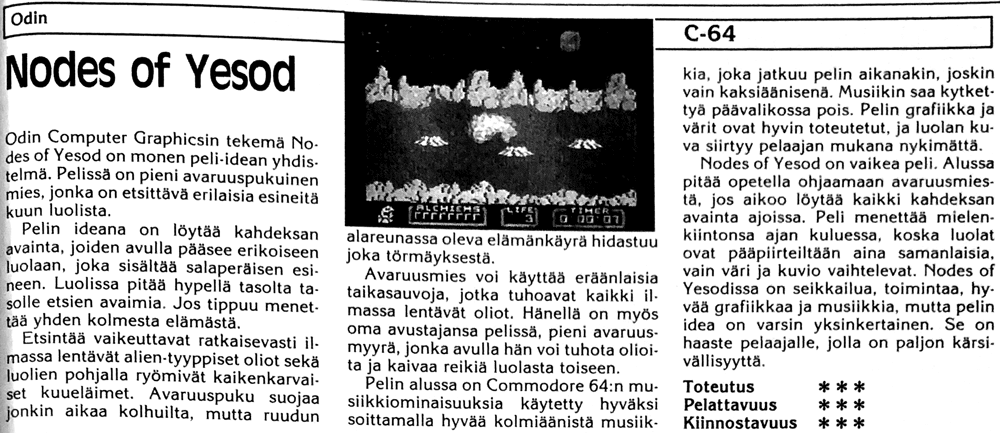
Etsintää vaikeuttavat ratkaisevasti ilmassa lentävät alien-tyyppiset oliot sekä luolien pohjalla ryömivät kaikenkarvaiset kuueläimet. Avaruuspuku suojaa jonkin aikaa kolhuilta, mutta ruudun alareunassa oleva elämänkäyrä hidastuu joka törmäyksestä.
Avaruusmies voi käyttää eräänlaisia taikasauvoja, jotka tuhoavat kaikki ilmassa lentävät oliot. Hänellä on myös oma avustajansa pelissä, pieni avaruusmyyrä, jonka avulla hän voi tuhota olioita ja kaivaa reikiä luolasta toiseen.
Pelin alussa on Commodore 64:n musiikkiominaisuuksia käytetty hyväksi soittamalla hyvää kolmiäänistä musiikkia, joka jatkuu pelin aikanakin, joskin vain kaksiäänisenä. Musiikin saa kytkettyä päävalikossa pois. Pelin grafiikka ja värit ovat hyvin toteutetut, ja luolan kuva siirtyy pelaajan mukana nykimättä.
Nodes of Yesod on vaikea peli. Alussa pitää opetella ohjaamaan avaruusmiestä, jos aikoo löytää kaikki kahdeksan avainta ajoissa. Peli menettää mielenkiintonsa ajan kuluessa, koska luolat ovat pääpiirteiltään aina samanlaisia, vain väri ja kuvio vaihtelevat. Nodes of Yesodissa on seikkailua, toimintaa, hyvää grafiikkaa ja musiikkia, mutta pelin idea on varsin yksinkertainen. Se on haaste pelaajalle, jolla on paljon kärsivällisyyttä.
Nodes of Yesod1987PermalinkNodes of Yesod, made by Odin Computer Graphics, is a combination of many game ideas. The game features a little man in a spacesuit who has to search the caves of the moon for various objects.
The idea of the game is to find eight keys, which get you into a special cave containing a mysterious object. In the caves you have to hop from platform to platform looking for the keys. If you fall, you lose one of your three lives.
The search is made decisively harder by alien-type creatures flying through the air and moon beasts of every description crawling along the cave floors. The spacesuit protects you from knocks for a while, but the life graph at the bottom of the screen slows down with every collision.
The spaceman can use a kind of magic wand that destroys all the creatures flying in the air. He also has his own assistant in the game, a little space mole, with whose help he can destroy creatures and dig holes from one cave to the next.
At the start of the game the Commodore 64's musical capabilities are put to good use, playing fine three-voice music that carries on during play too, although only in two voices. The music can be switched off from the main menu. The game's graphics and colours are well done, and the cave view moves along with the player without any jerking.
Nodes of Yesod is a difficult game. First you have to learn to control the spaceman if you mean to find all eight keys in time. The game loses its appeal as time goes by, because the caves are always basically the same, only the colour and the pattern change. Nodes of Yesod has adventure, action, good graphics and music, but the idea of the game is pretty simple. It is a challenge for a player with plenty of patience.
North and South
North and South1990 KevätPysyvä linkkiVoisi hyvin kuvitella, millaisen pelin Microprose vääntäisi Yhdysvaltain sisällissodasta: verta, hiekkaa, sapelinkalsketta ja historian patinaa tihkuva satasivuinen manuaali. Mutta kun asialla on ranskalainen Infogrames, niin koko homma on tehty vähän kieli poskella.
Jo alkuruudun valikko on täynnä huumorin pilkettä: ikoneiden klikkailua säestävät hupaisasti sovitetut fanfaarit, pelin vaikeustason voi päätellä sotilaiden ilmeistä ja peli aloitetaan klikkaamalla valokuvaajan varustesalkkua, jolloin salama välähtää ja ruutu valottuu mustavalkoiseksi. Valokuvaajakin alkaa hekotella, kun klikkaa sen takapuolta.
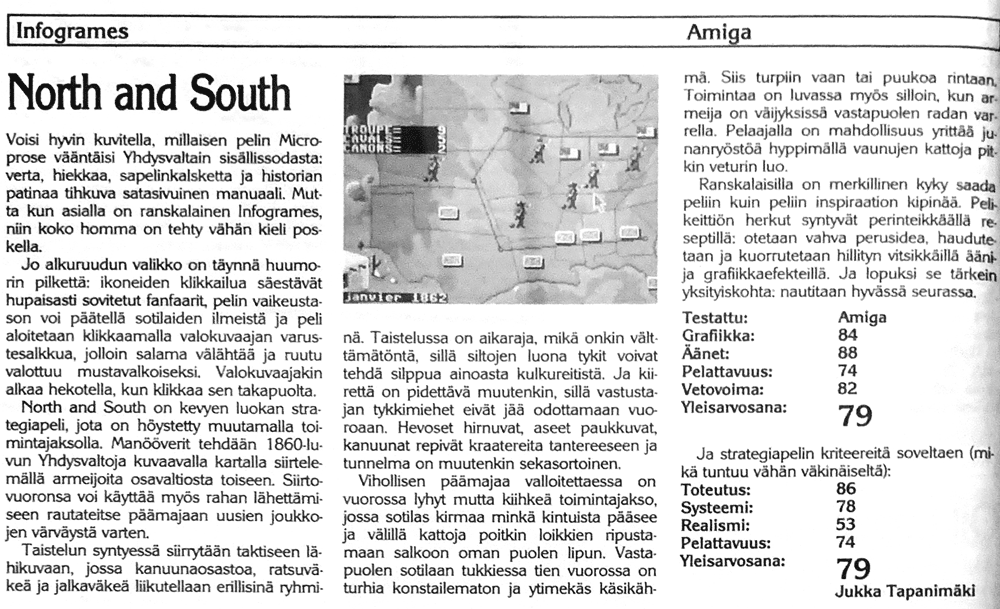
North and South on kevyen luokan strategiapeli, jota on höystetty muutamalla toimintajaksolla. Manööverit tehdään 1860-luvun Yhdysvaltoja kuvaavalla kartalla siirtelemällä armeijoita osavaltiosta toiseen. Siirtovuoronsa voi käyttää myös rahan lähettämiseen rautateitse päämajaan uusien joukkojen värväystä varten.
Taistelun syntyessä siirrytään taktiseen lähikuvaan, jossa kanuunaosastoa, ratsuväkeä ja jalkaväkeä liikutellaan erillisinä ryhminä. Taistelussa on aikaraja, mikä onkin välttämätöntä, sillä siltojen luona tykit voivat tehdä silppua ainoasta kulkureitistä. Ja kiirettä on pidettävä muutenkin, sillä vastustajan tykkimiehet eivät jää odottamaan vuoroaan. Hevoset hirnuvat, aseet paukkuvat, kanuunat repivät kraatereita tantereeseen ja tunnelma on muutenkin sekasortoinen.
Vihollisen päämajaa valloitettaessa on vuorossa lyhyt mutta kiihkeä toimintajakso, jossa sotilas kirmaa minkä kintuista pääsee ja välillä kattoja poitkin loikkien ripustamaan salkoon oman puolen lipun. Vastapuolen sotilaan tukkiessa tien vuorossa on turhia konstailematon ja ytimekäs käsikähmä. Siis turpiin vaan tai puukoa rintaan. Toimintaa on luvassa myös silloin, kun armeija on väijyksissä vastapuolen radan varrella. Pelaajalla on mahdollisuus yrittää junanryöstöä hyppimällä vaunujen kattoja pitkin veturin luo.
Ranskalaisilla on merkillinen kyky saada peliin kuin peliin inspiraation kipinää. Pelikeittiön herkut syntyvät perinteikkäällä reseptillä: otetaan vahva perusidea, haudutetaan ja kuorrutetaan hillityn vitsikkäillä ääni- ja grafiikkaefekteillä. Ja lopuksi se tärkein yksityiskohta: nautitaan hyvässä seurassa.
North and South1990 KevätPermalinkYou can easily imagine what kind of game Microprose would crank out about the American Civil War: a hundred-page manual oozing blood, sand, the clatter of sabres and the patina of history. But when the French Infogrames is on the job, the whole thing has been done a bit tongue in cheek.
Even the title screen menu twinkles with humour: clicking the icons is accompanied by amusingly arranged fanfares, the difficulty level can be read off the soldiers' faces, and the game is started by clicking the photographer's equipment case, at which the flash goes off and the screen is exposed in black and white. Even the photographer starts sniggering when you click its backside.
North and South is a lightweight strategy game seasoned with a few action sequences. The manoeuvres are made on a map of the 1860s United States by shifting armies from one state to another. You can also use your turn to send money by rail to headquarters to recruit new troops.
When a battle breaks out, the game switches to a tactical close-up in which the cannon detachment, cavalry and infantry are moved as separate groups. Battles have a time limit, which is just as well, since at the bridges the guns can make mincemeat of the only way across. And you have to hurry anyway, because the enemy gunners won't sit around waiting for their turn. Horses whinny, guns bang, cannons tear craters in the turf and the atmosphere is chaotic all round.
Storming the enemy headquarters brings on a short but frantic action sequence in which a soldier runs flat out, now and then leaping across rooftops, to hoist the home side's flag up the pole. When an enemy soldier blocks the way, what follows is a no-frills, to-the-point bout of hand-to-hand. So it's a smack in the gob or a knife in the chest. There's action in store as well when an army lies in ambush along the enemy's railway line. The player gets the chance to attempt a train robbery by jumping along the carriage roofs to the locomotive.
The French have a remarkable knack for getting a spark of inspiration into any game at all. The delicacies of the game kitchen are made to a time-honoured recipe: take a strong basic idea, let it simmer, and top it with understatedly witty sound and graphics effects. And finally the most important detail: enjoy in good company.
Northstar
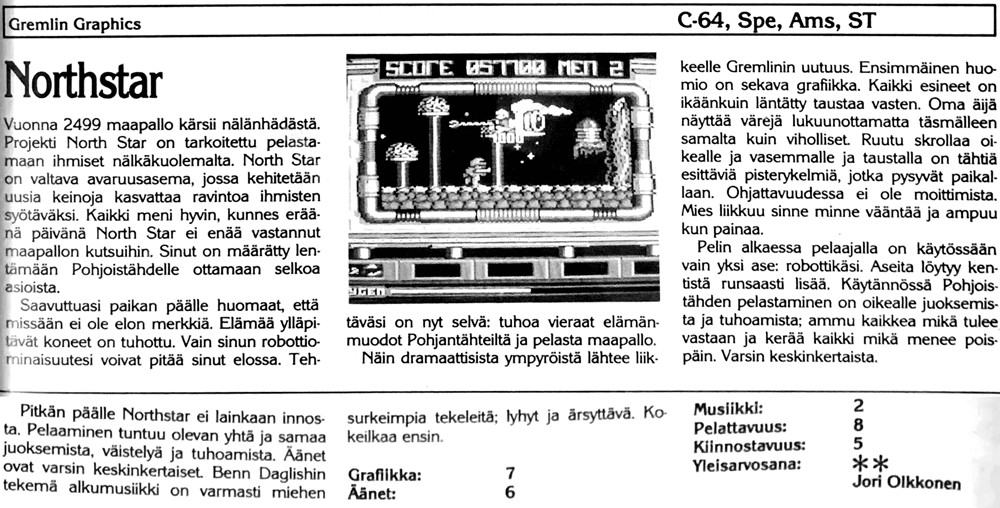
Northstar1988Pysyvä linkkiVuonna 2499 maapallo kärsii nälänhädästä. Projekti North Star on tarkoitettu pelastamaan ihmiset nälkäkuolemalta. North Star on valtava avaruusasema, jossa kehitetään uusia keinoja kasvattaa ravintoa ihmisten syötäväksi. Kaikki meni hyvin, kunnes eräänä päivänä North Star ei enää vastannut maapallon kutsuihin. Sinut on määrätty lentämään Pohjoistähdelle ottamaan selkoa asioista.
Saavuttuasi paikan päälle huomaat, että missään ei ole elon merkkiä. Elämää ylläpitävät koneet on tuhottu. Vain sinun robottiominaisuutesi voivat pitää sinut elossa. Tehtäväsi on nyt selvä: tuhoa vieraat elämänmuodot Pohjantähteiltä ja pelasta maapallo.
Näin dramaattisista ympyröistä lähtee liikkeelle Gremlinin uutuus. Ensimmäinen huomio on sekava grafiikka. Kaikki esineet on ikäänkuin läntätty taustaa vasten. Oma äijä näyttää värejä lukuunottamatta täsmälleen samalta kuin viholliset. Ruutu skrollaa oikealle ja vasemmalle ja taustalla on tähtiä esittäviä pisterykelmiä, jotka pysyvät paikallaan. Ohjattavuudessa ei ole moittimista. Mies liikkuu sinne minne vääntää ja ampuu kun painaa.
Pelin alkaessa pelaajalla on käytössään vain yksi ase: robottikäsi. Aseita löytyy kentistä runsaasti lisää. Käytännössä Pohjoistähden pelastaminen on oikealle juoksemista ja tuhoamista; ammu kaikkea mikä tulee vastaan ja kerää kaikki mikä menee poispäin. Varsin keskinkertaista. Pitkän päälle Northstar ei lainkaan innosta. Pelaaminen tuntuu olevan yhtä ja samaa juoksemista, väistelyä ja tuhoamista. Äänet ovat varsin keskinkertaiset. Benn Daglishin tekemä alkumusiikki on varmasti miehen surkeimpia tekeleitä; lyhyt ja ärsyttävä. Kokeilkaa ensin.
Northstar1988PermalinkIn the year 2499 the Earth is suffering from famine. Project North Star is meant to save people from starving to death. North Star is a huge space station where new ways of growing food for people to eat are developed. All went well until one day North Star no longer answered Earth's calls. You have been ordered to fly to the North Star to find out what is going on.
On arrival you notice that there is no sign of life anywhere. The life-support machines have been destroyed. Only your robot capabilities can keep you alive. Your mission is now clear: destroy the alien life forms on the North Star and save the Earth.
It is from such dramatic circumstances that Gremlin's new release sets off. The first thing you notice is the messy graphics. All the objects look as if they have simply been slapped on against the background. Your own bloke looks exactly the same as the enemies, apart from the colours. The screen scrolls right and left, and in the background there are clusters of dots representing stars, which stay put. There is nothing to complain about in the controls. The man goes where you yank him and shoots when you press.
At the start of the game the player has only one weapon at his disposal: a robot arm. Plenty more weapons can be found in the levels. In practice, saving the North Star means running right and destroying; shoot everything coming towards you and collect everything going away. Pretty middling. In the long run Northstar is not exciting at all. Playing seems to be one and the same running, dodging and destroying. The sounds are pretty middling. The title music by Benn Daglish is surely one of the man's most wretched efforts; short and irritating. Try it out first.
Nosferatu the Vampyre
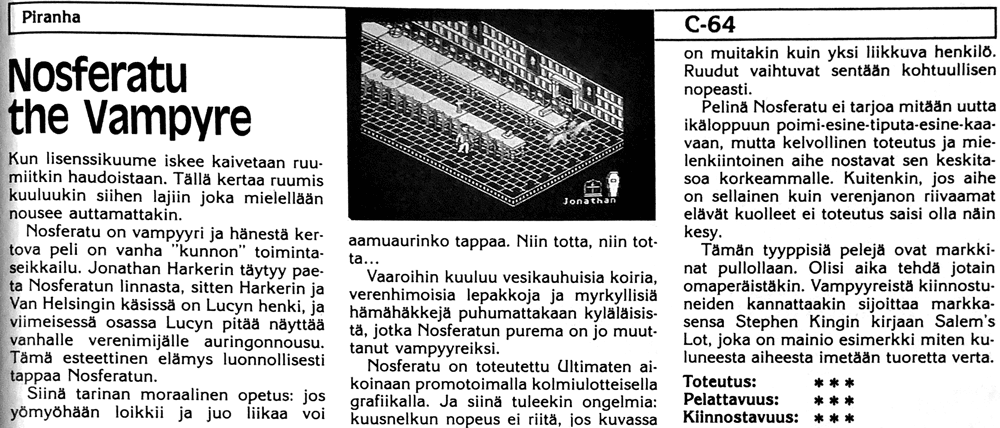
Nosferatu the Vampyre1987Pysyvä linkkiKun lisenssikuume iskee kaivetaan ruumiitkin haudoistaan. Tällä kertaa ruumis kuuluukin siihen lajiin joka mielellään nousee auttamattakin.
Nosferatu on vampyyri ja hänestä kertova peli on vanha "kunnon" toimintaseikkailu. Jonathan Harkerin täytyy paeta Nosferatun linnasta, sitten Harkerin ja Van Helsingin käsissä on Lucyn henki, ja viimeisessä osassa Lucyn pitää näyttää vanhalle verenimijälle auringonnousu. Tämä esteettinen elämys luonnollisesti tappaa Nosferatun.
Siinä tarinan moraalinen opetus: jos yömyöhään loikkii ja juo liikaa voi aamuaurinko tappaa. Niin totta, niin totta...
Vaaroihin kuuluu vesikauhuisia koiria, verenhimoisia lepakkoja ja myrkyllisiä hämähäkkejä puhumattakaan kyläläisistä, jotka Nosferatun purema on jo muuttanut vampyyreiksi.
Nosferatu on toteutettu Ultimaten aikoinaan promotoimalla kolmiulotteisella grafiikalla. Ja siinä tuleekin ongelmia: kuusnelkun nopeus ei riitä, jos kuvassa on muitakin kuin yksi liikkuva henkilö. Ruudut vaihtuvat sentään kohtuullisen nopeasti.
Pelinä Nosferatu ei tarjoa mitään uutta ikäloppuun poimi-esine-tiputa-esine-kaavaan, mutta kelvollinen toteutus ja mielenkiintoinen aihe nostavat sen keskitasoa korkeammalle. Kuitenkin, jos aihe on sellainen kuin verenjanon riivaamat elävät kuolleet ei toteutus saisi olla näin kesy.
Tämän tyyppisiä pelejä ovat markkinat pullollaan. Olisi aika tehdä jotain omaperäistäkin. Vampyyreistä kiinnostuneiden kannattaakin sijoittaa markkasensa Stephen Kingin kirjaan Salem's Lot, joka on mainio esimerkki miten kuluneesta aiheesta imetään tuoretta verta.
Nosferatu the Vampyre1987PermalinkWhen licence fever strikes, even corpses get dug out of their graves. This time, though, the corpse belongs to the sort that is quite happy to rise without any help.
Nosferatu is a vampire, and the game about him is a "good" old action adventure. Jonathan Harker has to escape from Nosferatu's castle, then Lucy's life is in the hands of Harker and Van Helsing, and in the final part Lucy has to show the old bloodsucker a sunrise. This aesthetic experience naturally kills Nosferatu.
And there you have the moral of the story: if you gad about till all hours and drink too much, the morning sun can kill you. So true, so true...
The dangers include rabid dogs, bloodthirsty bats and poisonous spiders, not to mention villagers whom Nosferatu's bite has already turned into vampires.
Nosferatu is done in the 3D graphics that Ultimate championed back in the day. And that is where the problems start: the Commodore 64 isn't fast enough if there is more than one moving character on screen. The screens do at least change reasonably quickly.
As a game, Nosferatu offers nothing new on the decrepit pick-up-object-drop-object formula, but a decent execution and an interesting subject lift it above average. Still, when the subject is something like the living dead possessed by bloodlust, the execution shouldn't be this tame.
The market is bursting with games of this type. It's about time someone made something original for a change. Anyone interested in vampires would do better to invest their money in Stephen King's book Salem's Lot, which is a splendid example of how to suck fresh blood out of a worn-out subject.