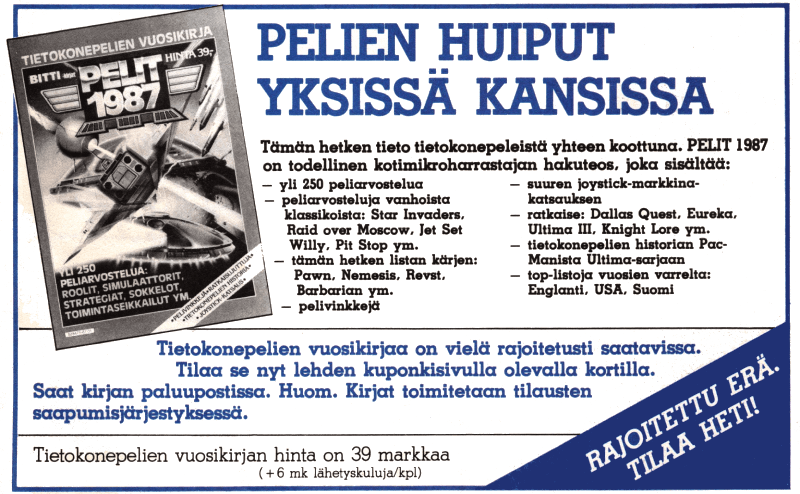
1133 reviews from "Pelit"-books
Pelit was a Finnish-language (bi)annual book series published from 1987 to 1991 containing gaming-related articles, tips and most importantly game reviews. Here you can find all the reviews from the books. The reviews were originally written in Finnish; the English versions are translations of the Finnish originals. Maininta tekijänoikeuksista
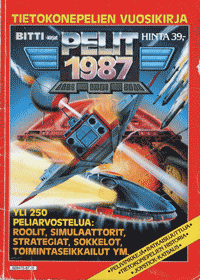 1987
1987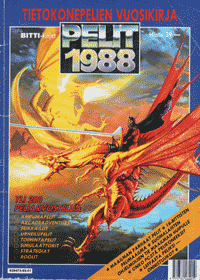 1988
1988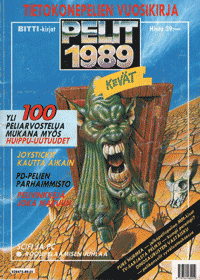 1989 Kevät
 1989 Syksy
 1990 Kevät
 1990 Syksy
 1991 Kevät
 1991 Syksy
Daley Thompson's Olympic Challenge
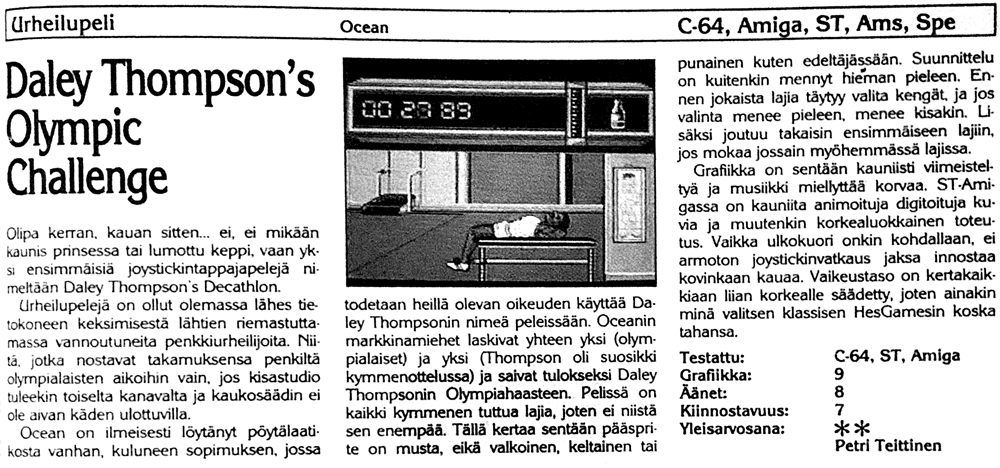
Daley Thompson's Olympic Challenge1989 KevätPysyvä linkkiOlipa kerran, kauan sitten... ei, ei mikään kaunis prinsessa tai lumottu keppi, vaan yksi ensimmäisiä joystickintappajapelejä nimeltään Daley Thompson's Decathlon.
Urheilupelejä on ollut olemassa lähes tietokoneen keksimisestä lähtien riemastuttamassa vannoutuneita penkkiurheilijoita. Niitä, jotka nostavat takamuksensa penkiltä olympialaisten aikoihin vain, jos kisastudio tuleekin toiselta kanavalta ja kaukosäädin ei ole aivan käden ulottuvilla.
Ocean on ilmeisesti löytänyt pöytälaatikosta vanhan, kuluneen sopimuksen, jossa todetaan heillä olevan oikeuden käyttää Daley Thompsonin nimeä peleissään. Oceanin markkinamiehet laskivat yhteen yksi (olympialaiset) ja yksi (Thompson oli suosikki kymmenottelussa) ja saivat tulokseksi Daley Thompsonin Olympiahaasteen. Pelissä on kaikki kymmenen tuttua lajia, joten ei niistä sen enempää. Tällä kertaa sentään pääsprite on musta, eikä valkoinen, keltainen tai punainen kuten edeltäjässään. Suunnittelu on kuitenkin mennyt hieman pieleen. Ennen jokaista lajia täytyy valita kengät, ja jos valinta menee pieleen, menee kisakin. Lisäksi joutuu takaisin ensimmäiseen lajiin, jos mokaa jossain myöhemmässä lajissa.
Grafiikka on sentään kauniisti viimeisteltyä ja musiikki miellyttää korvaa. ST-Amigassa on kauniita animoituja digitoituja kuvia ja muutenkin korkealuokkainen toteutus. Vaikka ulkokuori onkin kohdallaan, ei armoton joystickinvatkaus jaksa innostaa kovinkaan kauaa. Vaikeustaso on kertakaikkiaan liian korkealle säädetty, joten ainakin minä valitsen klassisen HesGamesin koska tahansa.
Daley Thompson's Olympic Challenge1989 KevätPermalinkOnce upon a time, long ago... no, no, not some beautiful princess or enchanted stick, but one of the first joystick-killer games, by the name of Daley Thompson's Decathlon.
Sports games have been around almost since the computer was invented, delighting dedicated armchair athletes. The kind who, come Olympics time, lift their backsides out of the armchair only if the Games coverage turns out to be on the other channel after all and the remote control isn't quite within arm's reach.
Ocean has apparently found in a desk drawer an old, worn-out contract stating that they have the right to use Daley Thompson's name in their games. Ocean's marketing men added up one (the Olympics) and one (Thompson was the favourite in the decathlon) and got Daley Thompson's Olympic Challenge as the result. The game has all ten familiar events, so enough said about them. This time, at least, the main sprite is black, and not white, yellow or red as in its predecessor. The design, however, has gone slightly wrong. Before every event you have to choose your shoes, and if you choose wrong, the event goes wrong too. On top of that, you get sent back to the first event if you blow it in some later one.
The graphics, at least, are beautifully polished, and the music pleases the ear. The ST-Amiga has beautiful animated digitised pictures and a high-class implementation all round. Even though the outer shell is in order, the merciless joystick-whisking doesn't keep you enthused for very long. The difficulty level is simply set too high, so I, for one, will pick the classic HesGames any day.
Daley Thompson's Super Test
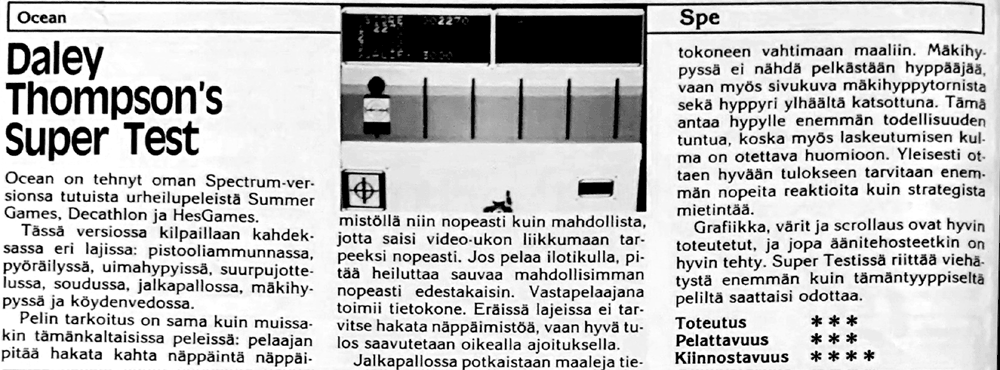
Daley Thompson's Super Test1987Pysyvä linkkiOcean on tehnyt oman Spectrum-versionsa tutuista urheilupeleistä Summer Games, Decathlon ja HesGames.
Tässä versiossa kilpaillaan kahdeksassa eri lajissa: pistooliammunnassa, pyöräilyssä, uimahypyissä, suurpujottelussa, soudussa, jalkapallossa, mäkihypyssä ja köydenvedossa.
Pelin tarkoitus on sama kuin muissakin tämänkaltaisissa peleissä: pelaajan pitää hakata kahta näppäintä näppäimistöllä niin nopeasti kuin mahdollista, jotta saisi video-ukon liikkumaan tarpeeksi nopeasti. Jos pelaa ilotikulla, pitää heiluttaa sauvaa mahdollisimman nopeasti edestakaisin. Vastapelaajana toimii tietokone. Eräissä lajeissa ei tarvitse hakata näppäimistöä, vaan hyvä tulos saavutetaan oikealla ajoituksella.
Jalkapallossa potkaistaan maaleja tietokoneen vahtimaan maaliin. Mäkihypyssä ei nähdä pelkästään hyppääjää, vaan myös sivukuva mäkihyppytornista sekä hyppyri ylhäältä katsottuna. Tämä antaa hypylle enemmän todellisuuden tuntua, koska myös laskeutumisen kulma on otettava huomioon. Yleisesti ottaen hyvään tulokseen tarvitaan enemmän nopeita reaktioita kuin strategista mietintää.
Grafiikka, värit ja scrollaus ovat hyvin toteutetut, ja jopa äänitehosteetkin on hyvin tehty. Super Testissä riittää viehätystä enemmän kuin tämäntyyppiseltä peliltä saattaisi odottaa.
Daley Thompson's Super Test1987PermalinkOcean has made its own Spectrum version of the familiar sports games Summer Games, Decathlon and HesGames.
In this version you compete in eight different events: pistol shooting, cycling, diving, giant slalom, rowing, football, ski jumping and tug-of-war.
The point of the game is the same as in all the other games of this kind: the player has to hammer two keys on the keyboard as fast as possible to get the little video man moving fast enough. If you play with a joystick, you have to waggle the stick back and forth as fast as you can. The computer acts as your opponent. In some events you don't have to hammer the keyboard; instead a good result comes from getting the timing right.
In the football you kick goals into a goal guarded by the computer. In the ski jump you don't just see the jumper, but also a side view of the ski-jump tower and the take-off ramp seen from above. This gives the jump more of a feel of reality, since the landing angle has to be taken into account too. Generally speaking, a good result calls for quick reactions more than strategic pondering.
The graphics, colours and scrolling have been well done, and even the sound effects are well made. Super Test has more charm to it than you might expect from a game of this type.
Dambusters
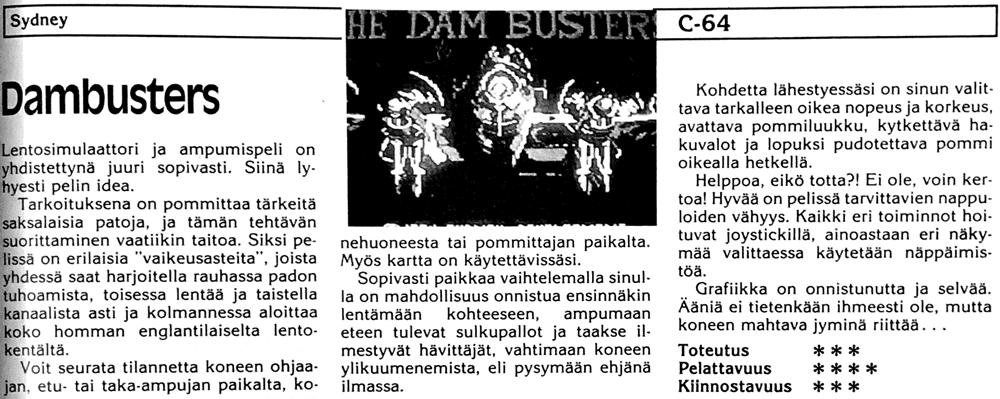
Dambusters1987Pysyvä linkkiLentosimulaattori ja ampumispeli on yhdistettynä juuri sopivasti. Siinä lyhyesti pelin idea.
Tarkoituksena on pommittaa tärkeitä saksalaisia patoja, ja tämän tehtävän suorittaminen vaatiikin taitoa. Siksi pelissä on erilaisia "vaikeusasteita", joista yhdessä saat harjoitella rauhassa padon tuhoamista, toisessa lentää ja taistella kanaalista asti ja kolmannessa aloittaa koko homman englantilaiselta lentokentältä.
Voit seurata tilannetta koneen ohjaajan, etu- tai taka-ampujan paikalta, konehuoneesta tai pommittajan paikalta. Myös kartta on käytettävissäsi.
Sopivasti paikkaa vaihtelemalla sinulla on mahdollisuus onnistua ensinnäkin lentämään kohteeseen, ampumaan eteen tulevat sulkupallot ja taakse ilmestyvät hävittäjät, vahtimaan koneen ylikuumenemista, eli pysymään ehjänä ilmassa.
Kohdetta lähestyessäsi on sinun valittava tarkalleen oikea nopeus ja korkeus, avattava pommiluukku, kytkettävä hakuvalot ja lopuksi pudotettava pommi oikealla hetkellä.
Helppoa, eikö totta?! Ei ole, voin kertoa! Hyvää on pelissä tarvittavien nappuloiden vähyys. Kaikki eri toiminnot hoituvat joystickillä, ainoastaan eri näkymää valittaessa käytetään näppäimistöä.
Grafiikka on onnistunutta ja selvää. Ääniä ei tietenkään ihmeesti ole, mutta koneen mahtava jyminä riittää...
Dambusters1987PermalinkA flight simulator and a shoot-'em-up combined in just the right measure. That, in short, is the idea of the game.
The aim is to bomb important German dams, and carrying out this mission really does take skill. That's why the game has various "difficulty levels": in one you get to practise destroying a dam in peace, in another you fly and fight all the way from the Channel, and in the third you start the whole business from an English airfield.
You can follow the situation from the pilot's seat, the front or rear gunner's position, the engine room or the bomb aimer's position. A map is also at your disposal.
By switching positions at the right moments, you have a chance of managing, first of all, to fly to the target, to shoot down the barrage balloons that come up ahead and the fighters that appear behind, and to keep an eye on the plane overheating - in other words, to stay in the air in one piece.
As you approach the target you have to pick exactly the right speed and altitude, open the bomb bay, switch on the spotlights and finally drop the bomb at just the right moment.
Easy, isn't it?! No, it isn't, let me tell you! One good thing is how few buttons the game needs. All the different functions are handled with the joystick; the keyboard is used only for picking a different view.
The graphics are well done and clear. Naturally there's not much in the way of sound, but the mighty rumble of the plane is enough...
Damocles
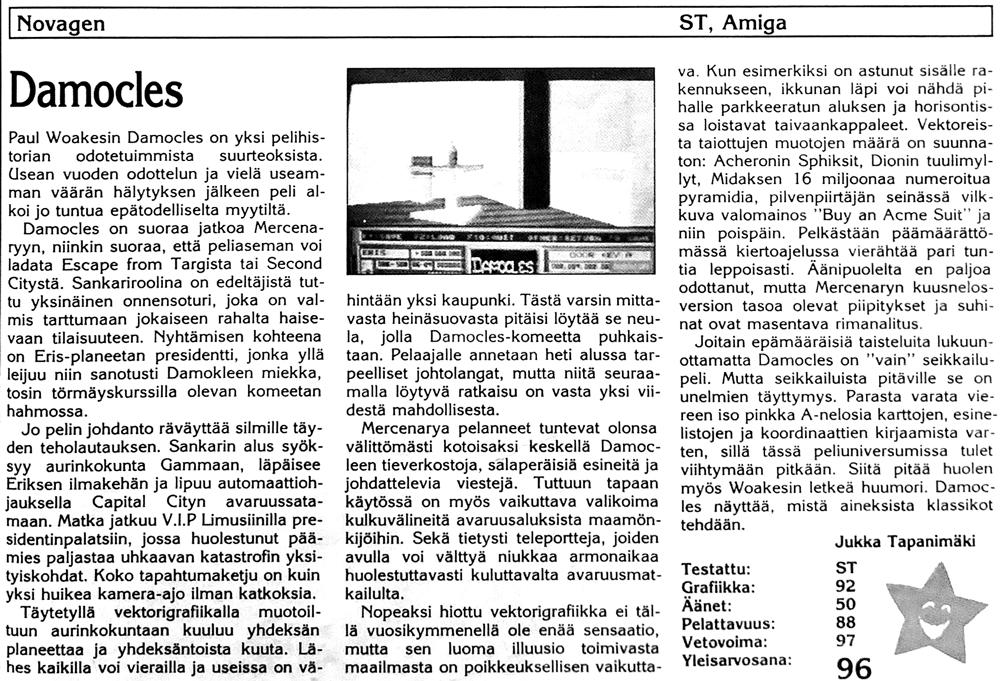
Damocles1990 SyksyPysyvä linkkiPaul Woakesin Damocles on yksi pelihistorian odotetuimmista suurteoksista. Usean vuoden odottelun ja vielä useamman väärän hälytyksen jälkeen peli alkoi jo tuntua epätodelliselta myytiltä.
Damocles on suoraa jatkoa Mercenaryyn, niinkin suoraa, että peliaseman voi ladata Escape from Targista tai Second Citystä. Sankariroolina on edeltäjistä tuttu yksinäinen onnensoturi, joka on valmis tarttumaan jokaiseen rahalta haisevaan tilaisuuteen. Nyhtämisen kohteena on Eris-planeetan presidentti, jonka yllä leijuu niin sanotusti Damokleen miekka, tosin törmäyskurssilla olevan komeetan hahmossa.
Jo pelin johdanto räväyttää silmille täyden teholautauksen. Sankarin alus syöksyy aurinkokunta Gammaan, läpäisee Eriksen ilmakehän ja lipuu automaattiohjauksella Capital Cityn avaruussatamaan. Matka jatkuu V.I.P Limusiinilla presidentinpalatsiin, jossa huolestunut päämies paljastaa uhkaavan katastrofin yksityiskohdat. Koko tapahtumaketju on kuin yksi huikea kamera-ajo ilman katkoksia.
Täytetyllä vektorigrafiikalla muotoiltuun aurinkokuntaan kuuluu yhdeksän planeettaa ja yhdeksäntoista kuuta. Lähes kaikilla voi vierailla ja useissa on vähintään yksi kaupunki. Tästä varsin mittavasta heinäsuovasta pitäisi löytää se neula, jolla Damocles-komeetta puhkaistaan. Pelaajalle annetaan heti alussa tarpeelliset johtolangat, mutta niitä seuraamalla löytyvä ratkaisu on vasta yksi viidestä mahdollisesta.
Mercenarya pelanneet tuntevat olonsa välittömästi kotoisaksi keskellä Damocleen tieverkostoja, salaperäisiä esineitä ja johdattelevia viestejä. Tuttuun tapaan käytössä on myös vaikuttava valikoima kulkuvälineitä avaruusaluksista maamönkijöihin. Sekä tietysti teleportteja, joiden avulla voi välttyä niukkaa armonaikaa huolestuttavasti kuluttavalta avaruusmatkailulta.
Nopeaksi hiottu vektorigrafiikka ei tällä vuosikymmenellä ole enää sensaatio, mutta sen luoma illuusio toimivasta maailmasta on poikkeuksellisen vaikuttava. Kun esimerkiksi on astunut sisälle rakennukseen, ikkunan läpi voi nähdä pihalle parkkeeratun aluksen ja horisontissa loistavat taivaankappaleet. Vektoreista taiottujen muotojen määrä on suunnaton: Acheronin Sphiksit, Dionin tuulimyllyt, Midaksen 16 miljoonaa numeroitua pyramidia, pilvenpiirtäjän seinässä vilkkuva valomainos "Buy an Acme Suit" ja niin poispäin. Pelkästään päämäärättömässä kiertoajelussa vierähtää pari tuntia leppoisasti. Äänipuolelta en paljoa odottanut, mutta Mercenaryn kuusnelosversion tasoa olevat piipitykset ja suhinat ovat masentava rimanalitus.
Joitain epämääräisiä taisteluita lukuunottamatta Damocles on "vain" seikkailupeli. Mutta seikkailuista pitäville se on unelmien täyttymys. Parasta varata viereen iso pinkka A-nelosia karttojen, esinelistojen ja koordinaattien kirjaamista varten, sillä tässä peliuniversumissa tulet viihtymään pitkään. Siitä pitää huolen myös Woakesin letkeä huumori. Damocles näyttää, mistä aineksista klassikot tehdään.
Damocles1990 SyksyPermalinkPaul Woakes's Damocles is one of the most eagerly awaited magnum opuses in gaming history. After several years of waiting and even more false alarms, the game had already begun to feel like an unreal myth.
Damocles is a direct sequel to Mercenary, so direct in fact that you can load in your saved position from Escape from Targ or Second City. The hero's role is the lone soldier of fortune familiar from the earlier games, ready to seize every opportunity that smells of money. The mark to be fleeced this time is the president of the planet Eris, over whom hangs, so to speak, the sword of Damocles, albeit in the shape of a comet on a collision course.
The game's intro alone blasts a full-power charge right into your eyes. The hero's ship plunges into the Gamma solar system, pierces the atmosphere of Eris and glides on autopilot into the spaceport of Capital City. The journey continues by V.I.P Limousine to the presidential palace, where the worried head of state reveals the details of the looming catastrophe. The whole chain of events is like one breathtaking tracking shot without a single cut.
The solar system, shaped in filled vector graphics, contains nine planets and nineteen moons. Almost all of them can be visited and many have at least one city. From this rather sizeable haystack you have to find the needle with which to pop the Damocles comet. The player is given the necessary clues right at the start, but the solution found by following them is only one of five possible ones.
Anyone who has played Mercenary will feel instantly at home amid Damocles's road networks, mysterious objects and hint-dropping messages. As usual there's also an impressive range of vehicles at your disposal, from spaceships to ground buggies. And of course teleports, which spare you space travel that eats alarmingly into your scant time of grace.
Vector graphics honed for speed are no longer a sensation this decade, but the illusion of a working world they create is exceptionally impressive. For example, once you've stepped inside a building, you can see through the window the ship parked outside and the heavenly bodies shining on the horizon. The number of shapes conjured out of vectors is enormous: the Sphinxes of Acheron, the windmills of Dion, the 16 million numbered pyramids of Midas, the "Buy an Acme Suit" neon sign flashing on the wall of a skyscraper, and so on and so forth. A couple of hours slip pleasantly by on an aimless sightseeing tour alone. I didn't expect much on the sound side, but the beeps and hisses, on a par with the Commodore 64 version of Mercenary, are a depressing failure to clear even that bar.
Apart from some vague battles, Damocles is "only" an adventure game. But for those who love adventures it's a dream come true. Best keep a big stack of A4 sheets beside you for writing down maps, item lists and coordinates, because you're going to spend a long, happy time in this game universe. Woakes's easy-going humour sees to that as well. Damocles shows what stuff classics are made of.
Dan Dare
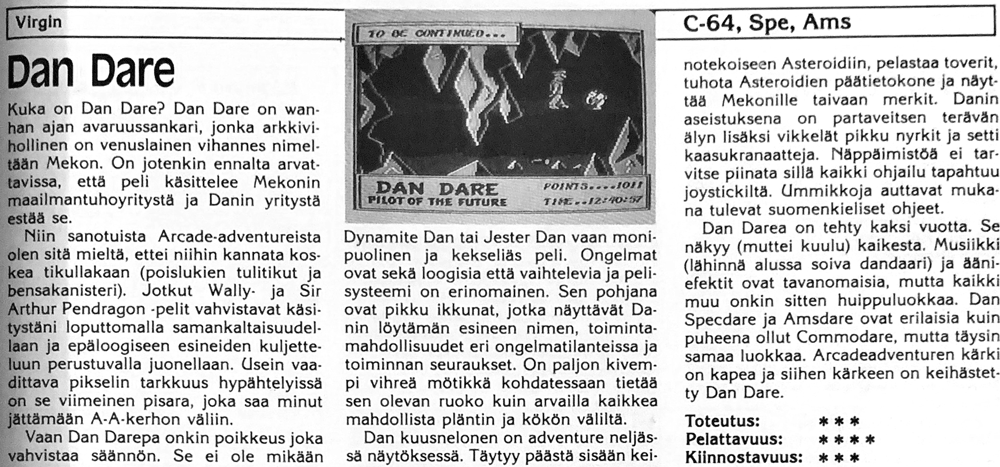
Dan Dare1987Pysyvä linkkiKuka on Dan Dare? Dan Dare on wanhan ajan avaruussankari, jonka arkkivihollinen on venuslainen vihannes nimeltään Mekon. On jotenkin ennalta arvattavissa, että peli käsittelee Mekonin maailmantuhoyritystä ja Danin yritystä estää se.
Niin sanotuista Arcade-adventureista olen sitä mieltä, ettei niihin kannata koskea tikullakaan (poislukien tulitikut ja bensakanisteri). Jotkut Wally- ja Sir Arthur Pendragon -pelit vahvistavat käsitystäni loputtomalla samankaltaisuudellaan ja epäloogiseen esineiden kuljetteluun perustuvalla juonellaan. Usein vaadittava pikselin tarkkuus hypähtelyissä on se viimeinen pisara, joka saa minut jättämään A-A-kerhon väliin.
Vaan Dan Darepa onkin poikkeus joka vahvistaa säännön. Se ei ole mikään Dynamite Dan tai Jester Dan vaan monipuolinen ja kekseliäs peli. Ongelmat ovat sekä loogisia että vaihtelevia ja pelisysteemi on erinomainen. Sen pohjana ovat pikku ikkunat, jotka näyttävät Danin löytämän esineen nimen, toimintamahdollisuudet eri ongelmatilanteissa ja toiminnan seuraukset. On paljon kivempi vihreä mötikkä kohdatessaan tietää sen olevan ruoko kuin arvailla kaikkea mahdollista pläntin ja kökön väliltä.
Dan kuusnelonen on adventure neljässä näytöksessä. Täytyy päästä sisään keinotekoiseen Asteroidiin, pelastaa toverit, tuhota Asteroidien päätietokone ja näyttää Mekonille taivaan merkit. Danin aseistuksena on partaveitsen terävän älyn lisäksi vikkelät pikku nyrkit ja setti kaasukranaatteja. Näppäimistöä ei tarvitse piinata sillä kaikki ohjailu tapahtuu joystickiltä. Ummikkoja auttavat mukana tulevat suomenkieliset ohjeet.
Dan Darea on tehty kaksi vuotta. Se näkyy (muttei kuulu) kaikesta. Musiikki (lähinnä alussa soiva dandaari) ja ääniefektit ovat tavanomaisia, mutta kaikki muu onkin sitten huippuluokkaa. Dan Specdare ja Amsdare ovat erilaisia kuin puheena ollut Commodare, mutta täysin samaa luokkaa. Arcadeadventuren kärki on kapea ja siihen kärkeen on keihästetty Dan Dare.
Dan Dare1987PermalinkWho is Dan Dare? Dan Dare is a space hero of ye olden days, whose arch-enemy is a Venusian vegetable called the Mekon. It is somehow predictable that the game deals with the Mekon's attempt to destroy the world and Dan's attempt to stop it.
My view of so-called arcade adventures is that they're not worth touching even with a stick (matchsticks and a can of petrol excepted). Certain Wally and Sir Arthur Pendragon games confirm my opinion with their endless sameness and their plots built on illogically lugging objects around. The pixel-perfect precision so often demanded in all the hopping about is the last straw that makes me give the A-A club a miss.
But Dan Dare turns out to be the exception that proves the rule. It's no Dynamite Dan or Jester Dan but a versatile and inventive game. The problems are both logical and varied, and the game system is excellent. It is built around little windows that show the name of the object Dan has found, the options for action in different problem situations and the consequences of those actions. When you come across a green lump it's much nicer to know it's a reed than to guess at every possibility between a blotch and a blob.
Dan on the Commodore 64 is an adventure in four acts. You have to get inside the artificial Asteroid, rescue your comrades, destroy the Asteroid's main computer and show the Mekon what's what. Besides his razor-sharp intellect, Dan is armed with nimble little fists and a set of gas grenades. There's no need to torment the keyboard, as all the control is done from the joystick. Those with no English are helped by the Finnish-language instructions included.
Dan Dare was two years in the making. You can see it (though not hear it) in everything. The music (mainly a dan-da-dare ditty playing at the start) and the sound effects are run-of-the-mill, but everything else is top class. Dan Specdare and Amsdare are different from the Commodare under discussion here, but in exactly the same class. The top of the arcade adventure heap is a narrow point, and Dan Dare has been speared right onto that point.
Dan Dare III - The Escape
Dan Dare III - The Escape1990 SyksyPysyvä linkkiKaikkien tuntema (?) sarjakuvasankari Dan Dare on jo edennyt pelisarjansa kolmanteen osaan. Paha Mekon, jonka Dan kohtasi jo aiemmissa osissa, on edelleen elossa ja suunnittelee yhä maailmanvaltausta. Ainoana esteenä on vain se, ettei Mekonilla ole ole sopivaa koekaniinia geenimutaatiokokeisiinsa, ja kukapa sopisikaan paremmin kuin Mekonin ah-niin-vihaama Dan itse?
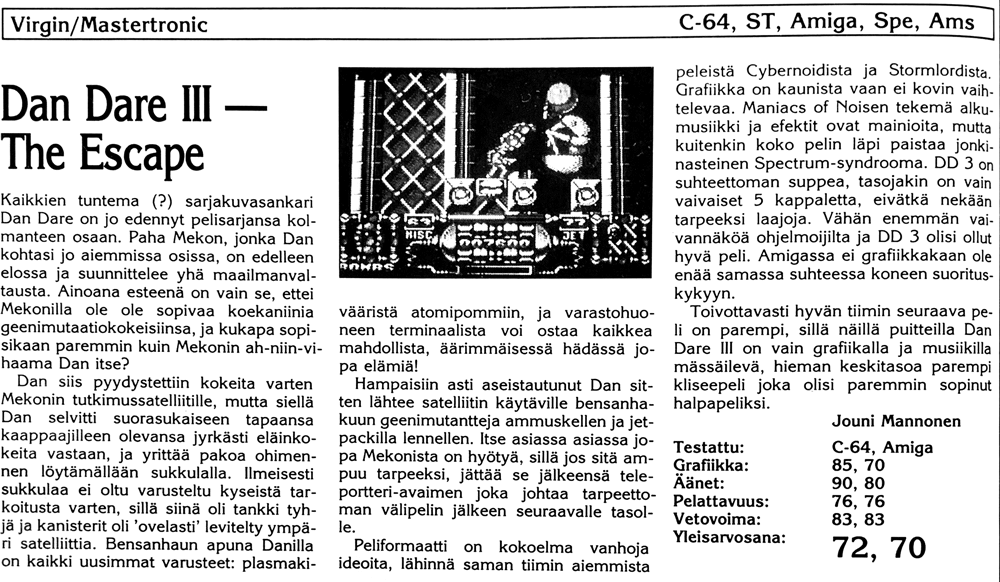
Dan siis pyydystettiin kokeita varten Mekonin tutkimussatelliitille, mutta siellä Dan selvitti suorasukaiseen tapaansa kaappaajilleen olevansa jyrkästi eläinkokeita vastaan, ja yrittää pakoa ohimennen löytämällään sukkulalla. Ilmeisesti sukkulaa ei oltu varusteltu kyseistä tarkoitusta varten, sillä siinä oli tankki tyhjä ja kanisterit oli 'ovelasti' levitelty ympäri satelliittia. Bensanhaun apuna Danilla on kaikki uusimmat varusteet: plasmakivääristä atomipommiin, ja varastohuoneen terminaalista voi ostaa kaikkea mahdollista, äärimmäisessä hädässä jopa elämiä!
Hampaisiin asti aseistautunut Dan sitten lähtee satelliitin käytäville bensanhakuun geenimutantteja ammuskellen ja jetpackilla lennellen. Itse asiassa asiassa jopa Mekonista on hyötyä, sillä jos sitä ampuu tarpeeksi, jättää se jälkeensä teleportteri-avaimen joka johtaa tarpeettoman välipelin jälkeen seuraavalle tasolle.
Peliformaatti on kokoelma vanhoja ideoita, lähinnä saman tiimin aiemmista peleistä Cybernoidista ja Stormlordista. Grafiikka on kaunista vaan ei kovin vaihtelevaa. Maniacs of Noisen tekemä alkumusiikki ja efektit ovat mainioita, mutta kuitenkin koko pelin läpi paistaa jonkinasteinen Spectrum-syndrooma. DD 3 on suhteettoman suppea, tasojakin on vain vaivaiset 5 kappaletta, eivätkä nekään tarpeeksi laajoja. Vähän enemmän vaivannäköä ohjelmoijilta ja DD 3 olisi ollut hyvä peli. Amigassa ei grafiikkakaan ole enää samassa suhteessa koneen suorituskykyyn.
Toivottavasti hyvän tiimin seuraava peli on parempi, sillä näillä puitteilla Dan Dare III on vain grafiikalla ja musiikilla mässäilevä, hieman keskitasoa parempi kliseepeli joka olisi paremmin sopinut halpapeliksi.
Dan Dare III - The Escape1990 SyksyPermalinkUniversally known (?) comic-strip hero Dan Dare has already advanced to the third instalment of his game series. The evil Mekon, whom Dan already faced in the earlier instalments, is still alive and still plotting to take over the world. The only obstacle is that the Mekon has no suitable guinea pig for his genetic mutation experiments, and who could fit the bill better than the Mekon's oh-so-hated Dan himself?
So Dan was nabbed for the experiments and hauled off to the Mekon's research satellite, but there, in his forthright way, Dan made it clear to his captors that he is firmly opposed to animal testing, and is now attempting to escape in a shuttle he happened across along the way. Apparently the shuttle had not been fitted out for that particular purpose, since its tank was empty and the canisters had been 'cunningly' scattered all around the satellite. To help with the petrol hunt Dan has all the latest gear: from plasma rifle to atom bomb, and the terminal in the storeroom sells everything imaginable, in direst need even lives!
Armed to the teeth, Dan then sets off down the satellite's corridors on his petrol hunt, shooting up gene mutants and flitting about on a jetpack. In fact even the Mekon comes in useful, since if you shoot it enough, it leaves behind a teleporter key which, after a pointless intermission game, leads to the next level.
The game format is a collection of old ideas, mainly from the same team's earlier games Cybernoid and Stormlord. The graphics are pretty but not very varied. The title music and effects by Maniacs of Noise are excellent, but even so a certain degree of Spectrum syndrome shines through the whole game. DD 3 is disproportionately small; there are only a measly 5 levels, and even those aren't big enough. A bit more effort from the programmers and DD 3 would have been a good game. On the Amiga even the graphics are no longer in proportion to what the machine can do.
Hopefully the good team's next game will be better, because as things stand Dan Dare III is merely a slightly-better-than-average cliche game that wallows in graphics and music, and would have been better suited to a budget release.
Dark Castle
Dark Castle1988Pysyvä linkkiHaa. Tumman linnan syövereihin tunkeutuminen on tämänkertainen tehtäväsi. Hieman tuntemattomien tekijöiden aikaansaannos saa taas arcade/adven-turistit hyppimään ilosta, vai saako?
Linnan syöveröissä tapahtuva peli-idea ei ole mikään uusi. Tummaan linnaan kätkeytyy monenlaista oliota. On lepakoita, robotteja ym. iljettävyyksiä. Kaikkia näitä tulee varoa kieli keskellä suuta ja ottaa se peukalo pois keskeltä kämmentä, sillä tehtävä ei ole helppo.
Sinun tulee hakea avain linnan sokkeloista ja saapua takaisin lähtöpaikalle. Apunasi on erinäinen määrä nyrkin-kokoisia kivenmurikoita, joita viskelemällä on tie avattava. Lisäapua antaa eliksiiri.
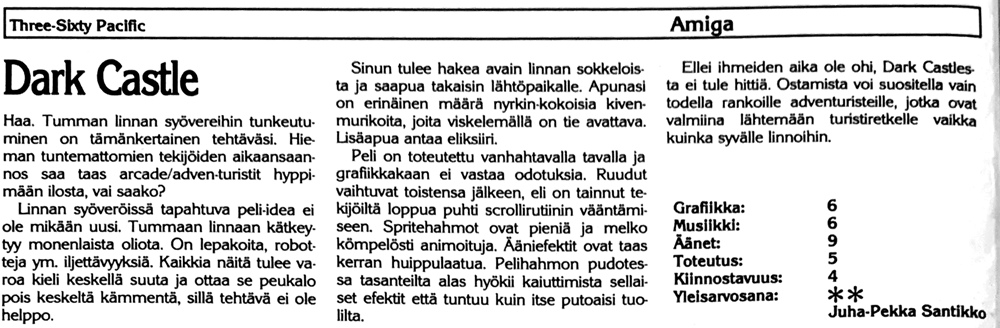
Peli on toteutettu vanhahtavalla tavalla ja grafiikkakaan ei vastaa odotuksia. Ruudut vaihtuvat toistensa jälkeen, eli on tainnut tekijöiltä loppua puhti scrollirutiinin vääntämiseen. Spritehahmot ovat pieniä ja melko kömpelösti animoituja. Ääniefektit ovat taas kerran huippulaatua. Pelihahmon pudotessa tasanteilta alas hyökii kaiuttimista sellaiset efektit että tuntuu kuin itse putoaisi tuolilta.
Ellei ihmeiden aika ole ohi, Dark Castlesta ei tule hittiä. Ostamista voi suositella vain todella rankoille adventuristeille, jotka ovat valmiina lähtemään turistiretkelle vaikka kuinka syvälle linnoihin.
Dark Castle1988PermalinkHaa. Penetrating the depths of the Dark Castle is your task this time. This creation from somewhat unknown makers will once again have arcade/adven-tourists jumping for joy, or will it?
A game idea set in the depths of a castle is nothing new. All kinds of creatures lurk in the Dark Castle. There are bats, robots and other such nasties. You have to watch out for all of them with total concentration and stop being all thumbs, because the task isn't easy.
You must fetch a key from the castle's labyrinths and make it back to the starting point. To help you, you have a certain number of fist-sized lumps of rock, which you have to fling about to clear your way. Extra help comes from an elixir.
The game is done in an old-fashioned way, and the graphics don't live up to expectations either. The screens flip one after another, so the makers must have run out of steam for knocking together a scroll routine. The sprite characters are small and rather clumsily animated. The sound effects, once again, are top quality. When your character falls off a ledge, such effects surge out of the speakers that it feels as if you were falling off your chair yourself.
Unless the age of miracles is still with us, Dark Castle won't be a hit. Buying it can only be recommended to really hardcore adventurers who are ready to go on a sightseeing tour however deep into castles it takes.
Dark Fusion
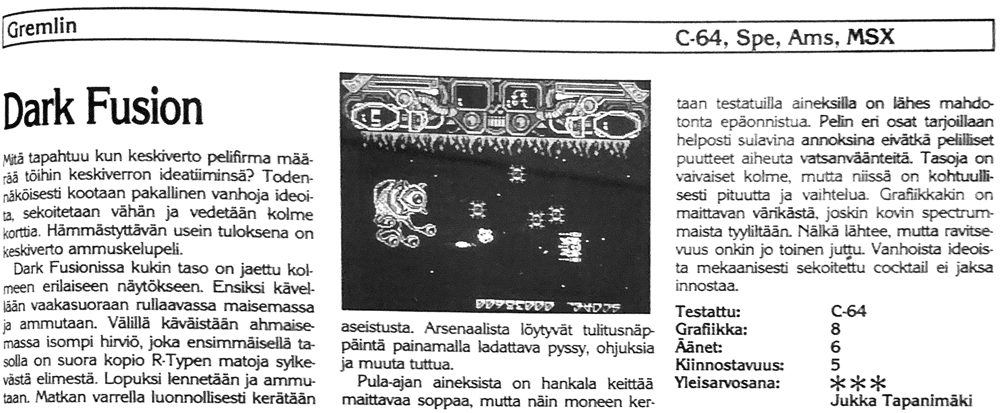
Dark Fusion1989 SyksyPysyvä linkkiMitä tapahtuu kun keskiverto pelifirma määrää töihin keskiverron ideatiiminsä? Todennäköisesti kootaan pakallinen vanhoja ideoita, sekoitetaan vähän ja vedetään kolme korttia. Hämmästyttävän usein tuloksena on keskiverto ammuskelupeli.
Dark Fusionissa kukin taso on jaettu kolmeen erilaiseen näytökseen. Ensiksi kävellään vaakasuoraan rullaavassa maisemassa ja ammutaan. Välillä käväistään ahmaisemassa isompi hirviö, joka ensimmäisellä tasolla on suora kopio R-Typen matoja sylkevästä elimestä. Lopuksi lennetään ja ammutaan. Matkan varrella luonnollisesti kerätään aseistusta. Arsenaalista löytyvät tulitusnäppäintä painamalla ladattava pyssy, ohjuksia ja muuta tuttua.
Pula-ajan aineksista on hankala keittää maittavaa soppaa, mutta näin moneen kertaan testatuilla aineksilla on lähes mahdotonta epäonnistua. Pelin eri osat tarjoillaan helposti sulavina annoksina eivätkä pelilliset puutteet aiheuta vatsanväänteitä. Tasoja on vaivaiset kolme, mutta niissä on kohtuullisesti pituutta ja vaihtelua. Grafiikkakin on maittavan värikästä, joskin kovin spectrummaista tyyliltään. Nälkä lähtee, mutta ravitsevuus onkin jo toinen juttu. Vanhoista ideoista mekaanisesti sekoitettu cocktail ei jaksa innostaa.
Dark Fusion1989 SyksyPermalinkWhat happens when an average games company puts its average ideas team to work? Most likely they gather up a deck's worth of old ideas, shuffle them a bit and draw three cards. Astonishingly often the result is an average shoot-em-up.
In Dark Fusion each level is split into three different acts. First you walk along a horizontally scrolling landscape and shoot. In between you pop off to gobble up a bigger monster, which on the first level is a straight copy of R-Type's worm-spitting organ. Finally you fly and shoot. Along the way you naturally collect weaponry. The arsenal holds a gun you charge up by pressing the fire button, missiles and other familiar stuff.
It's hard to cook up a tasty soup from rationing-era ingredients, but with ingredients tested this many times over it's almost impossible to fail. The game's various parts are served up in easily digestible portions, and the gameplay shortcomings cause no stomach cramps. There are a measly three levels, but they have a fair amount of length and variety. The graphics too are appetisingly colourful, if very Spectrum-like in style. It'll fill you up, but nourishment is another story. A cocktail mechanically mixed from old ideas just can't get you excited.
Darkman
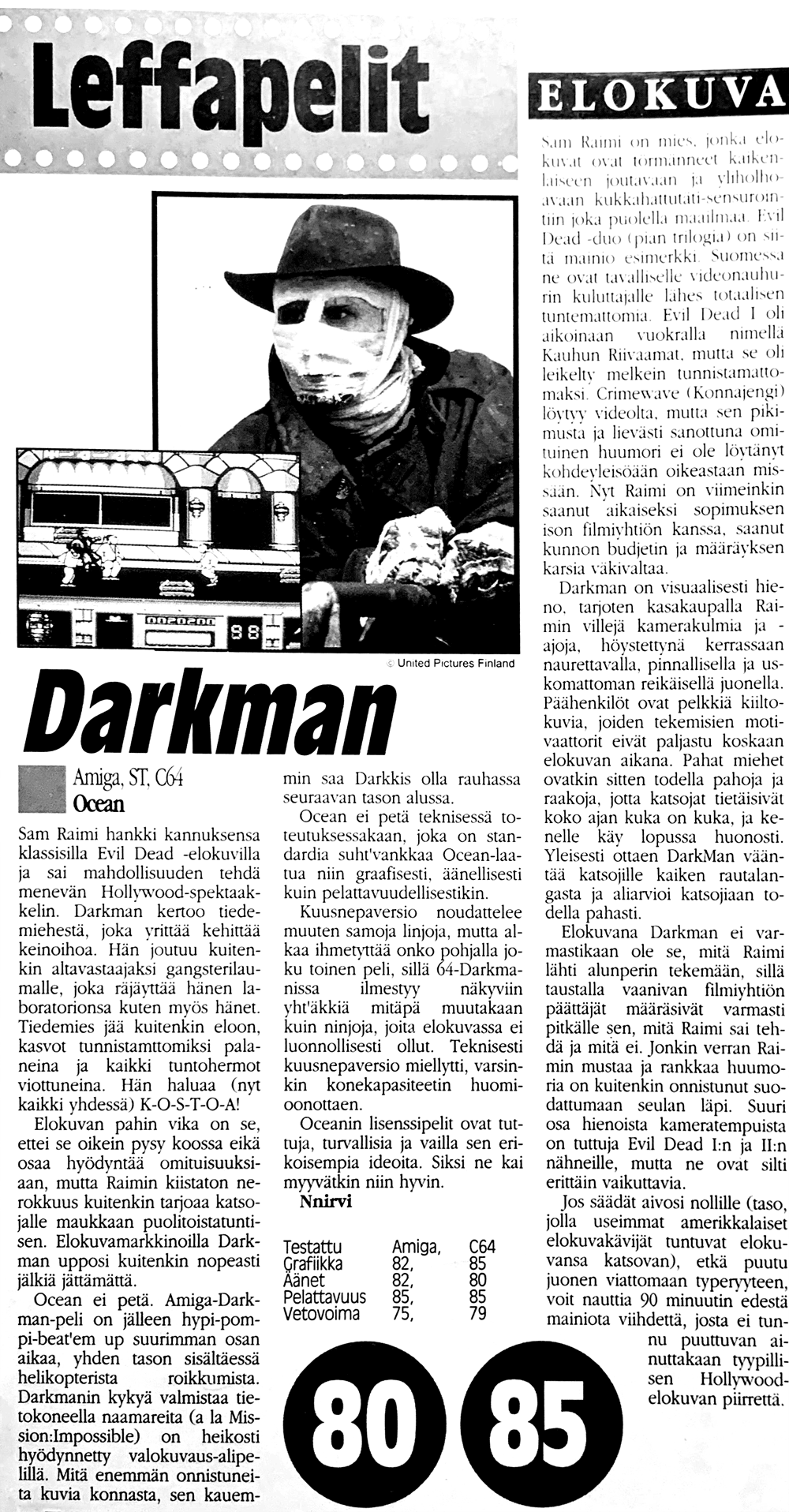
Darkman1991 SyksyPysyvä linkkiSam Raimi hankki kannuksensa klassisilla Evil Dead -elokuvilla ja sai mahdollisuuden tehdä menevän Hollywood-spektaakkelin. Darkman kertoo tiedemiehestä, joka yrittää kehittää keinoihoa. Hän joutuu kuitenkin altavastaajaksi gangsterilaumalle, joka räjäyttää hänen laboratorionsa kuten myös hänet. Tiedemies jää kuitenkin eloon, kasvot tunnistamttomiksi palaneina ja kaikki tuntohermot viottuneina. Hän haluaa (nyt kaikki yhdessä) K-O-S-T-O-A!
Elokuvan pahin vika on se, ettei se oikein pysy koossa eikä osaa hyödyntää omituisuuksiaan, mutta Raimin kiistaton nerokkuus kuitenkin tarjoaa katsojalle maukkaan puolitoistatuntisen. Elokuvamarkkinoilla Darkman upposi kuitenkin nopeasti jälkiä jättämättä.
Ocean ei petä. Amiga-Darkman-peli on jälleen hypi-pompi-beat'em up suurimman osan aikaa, yhden tason sisältäessä helikopterista roikkumista. Darkmanin kykyä valmistaa tietokoneella naamareita (a la Mission:Impossible) on heikosti hyödynnetty valokuvaus-alipelillä. Mitä enemmän onnistuneita kuvia konnasta, sen kauemmin saa Darkkis olla rauhassa seuraavan tason alussa.
Ocean ei petä teknisessä toteutuksessakaan, joka on standardia suht'vankkaa Ocean-laatua niin graafisesti, äänellisesti kuin pelattavuudellisestikin.
Kuusnepaversio noudattelee muuten samoja linjoja, mutta alkaa ihmetyttää onko pohjalla joku toinen peli, sillä 64-Darkmanissa ilmestyy näkyviin yht'äkkiä mitäpä muutakaan kuin ninjoja, joita elokuvassa ei luonnollisesti ollut. Teknisesti kuusnepaversio miellytti, varsinkin konekapasiteetin huomioonottaen.
Oceanin lisenssipelit ovat tuttuja, turvallisia ja vailla sen erikoisempia ideoita. Siksi ne kai myyvätkin niin hyvin.
Darkman1991 SyksyPermalinkThe classic Evil Dead films earned Sam Raimi a set of spurs and the chance to make a zippy Hollywood spectacular. Darkman is the story of a scientist trying to develop artificial skin. However, he ends up the underdog against a pack of gangsters, who blow up his laboratory, and him along with it. The scientist survives nonetheless, his face burned beyond recognition and every one of his nerves of touch damaged. He wants (all together now) R-E-V-E-N-G-E!
The film's worst flaw is that it never quite holds together and doesn't know how to make use of its own oddities, but Raimi's undeniable genius still serves the viewer a tasty hour and a half. At the box office, though, Darkman sank fast without leaving a trace.
Ocean doesn't let you down. The Amiga Darkman game is once again a hippety-hoppety beat'em up most of the time, with one level consisting of dangling from a helicopter. Darkman's ability to make masks on a computer (a la Mission:Impossible) has been feebly exploited in a photography sub-game. The more successful snaps of the villain you get, the longer Darkkis gets to be left in peace at the start of the next level.
Nor does Ocean let you down on the technical side, which is standard, reasonably solid Ocean quality graphically, sonically and playability-wise alike.
The Commodore 64 version otherwise follows the same lines, but you start to wonder whether there's some other game underneath, since in the 64 Darkman there suddenly appear - what else - ninjas, who naturally weren't in the film. Technically the Commodore 64 version was pleasing, especially considering the machine's capacity.
Ocean's licence games are familiar, safe and free of any particularly unusual ideas. I suppose that's why they sell so well.
David Wolf: Secret Agent
David Wolf: Secret Agent1990 SyksyPysyvä linkkiPC:tä ei ole suunniteltu rankkoja sivusuuntaan ruutua vierittäviä ampumispelejä silmälläpitäen, joten on luonnollista, että sille tulee paljon sellaisia pelejä, joita ei voida ainakaan aivan lähiaikoina rutistaa Amigan ja Atari ST:n tapaisille koneille. David Wolf: Secret Agent on yksi tälläinen peli.
Nykyisin on poikkeuksellista, jos kotoa löytyvästä PC:stä ei löydy kiintolevyä sisuksista hurisemasta. Voikin hyvällä syyllä sanoa, että koko maailmassa on käytössä todella harvoja kiintolevyttömiä PC:itä. Niinpä ohjelmistotaloilla on käytössään suuri määrä levytilaa, johon voi tunkea vaikka millaisia pelejä. Ei olekaan siis suuri ihme, kun DW:n paketin sisuksista silmille hyökkää huima läjä 360-kiloisia lerppuja. Installoinnin jälkeen kiintolevyltä löytyy lähes kaksi megatavua vähemmän tilaa. Miksi DW sitten on niin iso?
Vastaus löytyy tietokonepelien maailmassa kummittelevasta termistä elokuvapeli. Amerikkalaisen Cinemawaren aloittama muotivillitys tehdä pelejä, joita voi kutsua interaktiivisiksi elokuviksi, on nyt usuttanut muutkin kilpajuoksuun parhaimman elokuvapelin aikaansaamiseksi. Parissa tunnissa pelin läpi pelanneena voin todeta, että Dynamix on päässyt tähän mennessä lähimmäksi James Bond -tyylistä seikkailuelokuvaa, ainakin visuaalisesti. "Nautinnon" kestokin on suurinpiirtein samaa luokkaa, vaikka hinta ei.
Pelissä huippusalainen Stealth-hävittäjä on varastettu, ja jollei kaappareille makseta määräaikaan mennessä lunnasrahoja, lentää tutkalle näkymätön kone suoraan Washingtoniin ja nakkaa Valkoisen Talon puutarhaan mukavan pienen ydinjytkyn. Erittäin Bondmainen agentti Dawid Wolf saa tehtäväkseen etsiä koneen ja sen mukana sattumalta kaapatun kuvankauniin naisinsinöörin. Peli etenee riippuliidintaistelun, parin ajojahdin ja hyvin yksinkertaisen lentosimulaattoriosuuden jälkeen onnelliseen loppuun, joka on sekin kuin suoraan Bond-elokuvasta riipaistu.
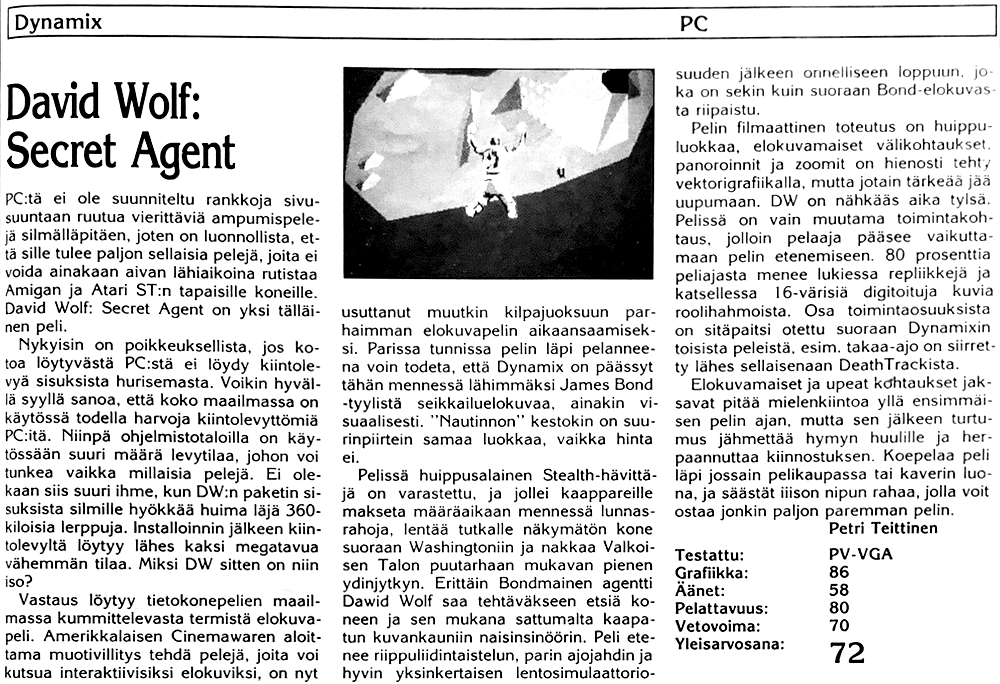
Pelin filmaattinen toteutus on huippuluokkaa, elokuvamaiset välikohtaukset, panoroinnit ja zoomit on hienosti tehty vektorigrafiikalla, mutta jotain tärkeää jää uupumaan. DW on nähkääs aika tylsä. Pelissä on vain muutama toimintakohtaus, jolloin pelaaja pääsee vaikuttamaan pelin etenemiseen. 80 prosenttia peliajasta menee lukiessa repliikkejä ja katsellessa 16-värisiä digitoituja kuvia roolihahmoista. Osa toimintaosuuksista on sitäpaitsi otettu suoraan Dynamixin toisista peleistä, esim. takaa-ajo on siirretty lähes sellaisenaan DeathTrackista.
Elokuvamaiset ja upeat kohtaukset jaksavat pitää mielenkiintoa yllä ensimmäisen pelin ajan, mutta sen jälkeen turtumus jähmettää hymyn huulille ja herpaannuttaa kiinnostuksen. Koepelaa peli läpi jossain pelikaupassa tai kaverin luona, ja säästät iiison nipun rahaa, jolla voit ostaa jonkin paljon paremman pelin.
David Wolf: Secret Agent1990 SyksyPermalinkThe PC was not designed with heavy-duty sideways-scrolling shoot-'em-ups in mind, so it's only natural that it gets plenty of the kind of games that can't be squeezed onto machines like the Amiga and the Atari ST, at least not any time soon. David Wolf: Secret Agent is one such game.
These days it's exceptional if a home PC doesn't have a hard disk whirring away in its innards. You could fairly say that there are really very few PCs without a hard disk in use anywhere in the world. So software houses have a huge amount of disk space at their disposal, into which they can cram just about any sort of game. So it's no great wonder when a whopping heap of 360K floppies leaps out at you from the innards of the DW box. After installation the hard disk has nearly two megabytes less free space. So why is DW so big?
The answer lies in a term that haunts the world of computer games: the movie game. The craze started by America's Cinemaware for making games that can be called interactive movies has now egged the others on into a race to produce the best movie game. Having played the game through in a couple of hours, I can say that Dynamix has so far come closest to a James Bond-style adventure film, at least visually. The duration of the "enjoyment" is roughly the same too, though the price isn't.
In the game a top-secret Stealth fighter has been stolen, and unless the hijackers are paid a ransom by the deadline, the radar-invisible plane will fly straight to Washington and toss a nice little nuclear wallop into the White House garden. The extremely Bond-like agent Dawid Wolf is given the job of finding the plane and the gorgeous female engineer who happened to be hijacked along with it. After a hang-glider battle, a couple of chases and a very simple flight-simulator section, the game proceeds to a happy ending, which also looks as if it was ripped straight out of a Bond film.
The game's filmic execution is top class: the cinematic cutscenes, pans and zooms are finely done in vector graphics, but something important is missing. DW is, you see, pretty boring. The game has only a handful of action scenes in which the player gets to influence how the game unfolds. 80 percent of the playing time goes on reading lines of dialogue and looking at 16-colour digitised pictures of the characters. Besides, some of the action sections have been lifted straight from Dynamix's other games; for example, the chase has been transplanted almost as is from DeathTrack.
The cinematic and gorgeous scenes manage to keep your interest up for the first game, but after that numbness freezes the smile on your lips and saps your interest. Test-play the game through at some game shop or at a friend's place, and you'll save a biiig wad of money, which you can spend on some much better game.
David's Midnight Magic
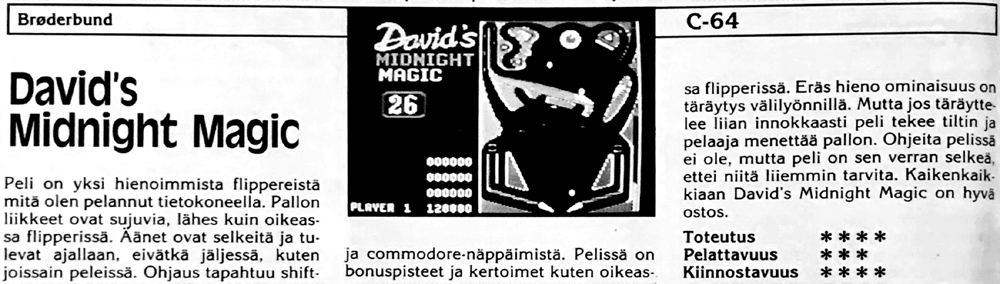
David's Midnight Magic1987Pysyvä linkkiPeli on yksi hienoimmista flippereistä mitä olen pelannut tietokoneella. Pallon liikkeet ovat sujuvia, lähes kuin oikeassa flipperissä. Äänet ovat selkeitä ja tulevat ajallaan, eivätkä jäljessä, kuten joissain peleissä. Ohjaus tapahtuu shift- ja commodore-näppäimistä. Pelissä on bonuspisteet ja kertoimet kuten oikeassa flipperissä. Eräs hieno ominaisuus on täräytys välilyönnillä. Mutta jos täräyttelee liian innokkaasti peli tekee tiltin ja pelaaja menettää pallon. Ohjeita pelissä ei ole, mutta peli on sen verran selkeä, ettei niitä liiemmin tarvita. Kaikenkaikkiaan David's Midnight Magic on hyvä ostos.
David's Midnight Magic1987PermalinkThis is one of the finest pinball games I have played on a computer. The ball moves smoothly, almost as in a real pinball machine. The sounds are clear and come on time, not lagging behind as they do in some games. Control is by the Shift and Commodore keys. The game has bonus points and multipliers just like a real pinball machine. One great feature is giving the table a thump with the space bar. But if you thump too eagerly, the game tilts and the player loses the ball. The game comes with no instructions, but it's clear enough that you don't really need them. All in all, David's Midnight Magic is a good buy.
Day of The Pharaoh
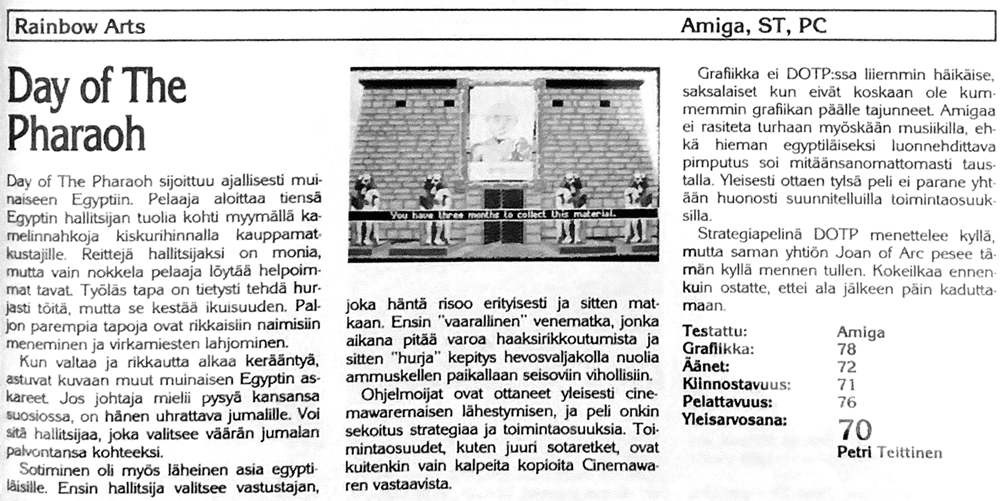
Day of The Pharaoh1990 KevätPysyvä linkkiDay of The Pharaoh sijoittuu ajallisesti muinaiseen Egyptiin. Pelaaja aloittaa tiensä Egyptin hallitsijan tuolia kohti myymällä kamelinnahkoja kiskurihinnalla kauppamatkustajille. Reittejä hallitsijaksi on monia, mutta vain nokkela pelaaja löytää helpoimmat tavat. Työläs tapa on tietysti tehdä hurjasti töitä, mutta se kestää ikuisuuden. Paljon parempia tapoja ovat rikkaisiin naimisiin meneminen ja virkamiesten lahjominen.
Kun valtaa ja rikkautta alkaa kerääntyä, astuvat kuvaan muut muinaisen Egyptin askareet. Jos johtaja mielii pysyä kansansa suosiossa, on hänen uhrattava jumalille. Voi sitä hallitsijaa, joka valitsee väärän jumalan palvontansa kohteeksi.
Sotiminen oli myös läheinen asia egyptiläisille. Ensin hallitsija valitsee vastustajan, joka häntä risoo erityisesti ja sitten matkaan. Ensin "vaarallinen" venematka, jonka aikana pitää varoa haaksirikkoutumista ja sitten "hurja" kepitys hevosvaljakolla nuolia ammuskellen paikallaan seisoviin vihollisiin.
Ohjelmoijat ovat ottaneet yleisesti cinemawaremaisen lähestymisen, ja peli onkin sekoitus strategiaa ja toimintaosuuksia. Toimintaosuudet, kuten juuri sotaretket, ovat kuitenkin vain kalpeita kopioita Cinemawaren vastaavista.
Grafiikka ei DOTP:ssa liiemmin häikäise, saksalaiset kun eivät koskaan ole kummemmin grafiikan päälle tajunneet. Amigaa ei rasiteta turhaan myöskään musiikilla, ehkä hieman egyptiläiseksi luonnehdittava pimputus soi mitäänsanomattomasti taustalla. Yleisesti ottaen tylsä peli ei parane yhtään huonosti suunnitelluilla toimintaosuuksilla.
Strategiapelinä DOTP menettelee kyllä, mutta saman yhtiön Joan of Arc pesee tämän kyllä mennen tullen. Kokeilkaa ennenkuin ostatte, ettei ala jälkeen päin kaduttamaan.
Day of The Pharaoh1990 KevätPermalinkDay of The Pharaoh is set, time-wise, in ancient Egypt. The player starts out on the road to the ruler's seat of Egypt by selling camel hides at extortionate prices to travelling merchants. There are many routes to becoming ruler, but only a clever player finds the easiest ways. The laborious way is of course to work like mad, but that takes forever. Much better ways are marrying into money and bribing officials.
Once power and wealth start piling up, the other chores of ancient Egypt enter the picture. A leader who wants to stay in favour with the people has to make sacrifices to the gods. Woe to the ruler who picks the wrong god to worship.
Warfare was also close to the Egyptians' hearts. First the ruler picks an opponent who is a particular thorn in the side, and then off we go. First a "dangerous" boat trip, during which you have to watch out for shipwreck, and then a "wild" dash in a horse-drawn chariot, firing arrows at enemies standing stock-still.
The programmers have generally taken a Cinemaware-style approach, and indeed the game is a mix of strategy and action sections. The action sections, such as the war campaigns just mentioned, are however only pale copies of their Cinemaware counterparts.
The graphics in DOTP don't exactly dazzle, seeing as the Germans have never been all that clued up about graphics. Nor is the Amiga needlessly strained with music: a plinking that might perhaps be described as a bit Egyptian tinkles away blandly in the background. A game that's dull on the whole isn't improved one bit by badly designed action sections.
As a strategy game DOTP passes muster, sure, but the same company's Joan of Arc wipes the floor with this one any day of the week. Try before you buy, so you don't end up regretting it afterwards.
Deactivators
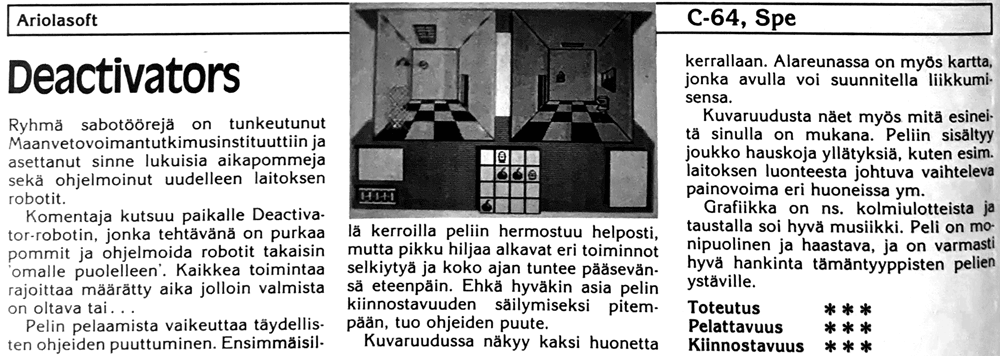
Deactivators1987Pysyvä linkkiRyhmä sabotöörejä on tunkeutunut Maanvetovoimantutkimusinstituuttiin ja asettanut sinne lukuisia aikapommeja sekä ohjelmoinut uudelleen laitoksen robotit.
Komentaja kutsuu paikalle Deactivator-robotin, jonka tehtävänä on purkaa pommit ja ohjelmoida robotit takaisin 'omalle puolelleen'. Kaikkea toimintaa rajoittaa määrätty aika jolloin valmista on oltava tai. . .
Pelin pelaamista vaikeuttaa täydellisten ohjeiden puuttuminen. Ensimmäisillä kerroilla peliin hermostuu helposti, mutta pikku hiljaa alkavat eri toiminnot selkiytyä ja koko ajan tuntee pääsevänsä eteenpäin. Ehkä hyväkin asia pelin kiinnostavuuden säilymiseksi pitempään, tuo ohjeiden puute.
Kuvaruudussa näkyy kaksi huonetta kerrallaan. Alareunassa on myös kartta, jonka avulla voi suunnitella liikkumisensa.
Kuvaruudusta näet myös mitä esineitä sinulla on mukana. Peliin sisältyy joukko hauskoja yllätyksiä, kuten esim. laitoksen luonteesta johtuva vaihteleva painovoima eri huoneissa ym.
Grafiikka on ns. kolmiulotteista ja taustalla soi hyvä musiikki. Peli on monipuolinen ja haastava, ja on varmasti hyvä hankinta tämäntyyppisten pelien ystäville.
Deactivators1987PermalinkA group of saboteurs has broken into the Earth Gravity Research Institute, planted numerous time bombs there and reprogrammed the facility's robots.
The commander calls in a Deactivator robot, whose job is to defuse the bombs and reprogram the robots back 'onto our side'. Everything you do is limited by a set time by which the job must be finished, or...
Playing the game is made harder by the lack of complete instructions. The first few times you easily get worked up with the game, but little by little the various functions start to become clear and you feel you're making progress all the time. Perhaps it's even a good thing for keeping the game interesting for longer, that lack of instructions.
The screen shows two rooms at a time. At the bottom there's also a map you can use to plan your movements.
The screen also shows you which objects you are carrying. The game holds a number of fun surprises, such as, for example, gravity that varies from room to room owing to the nature of the facility, and so on.
The graphics are so-called three-dimensional, and good music plays in the background. The game is varied and challenging, and is sure to be a good buy for fans of this type of game.
Death Wish 3
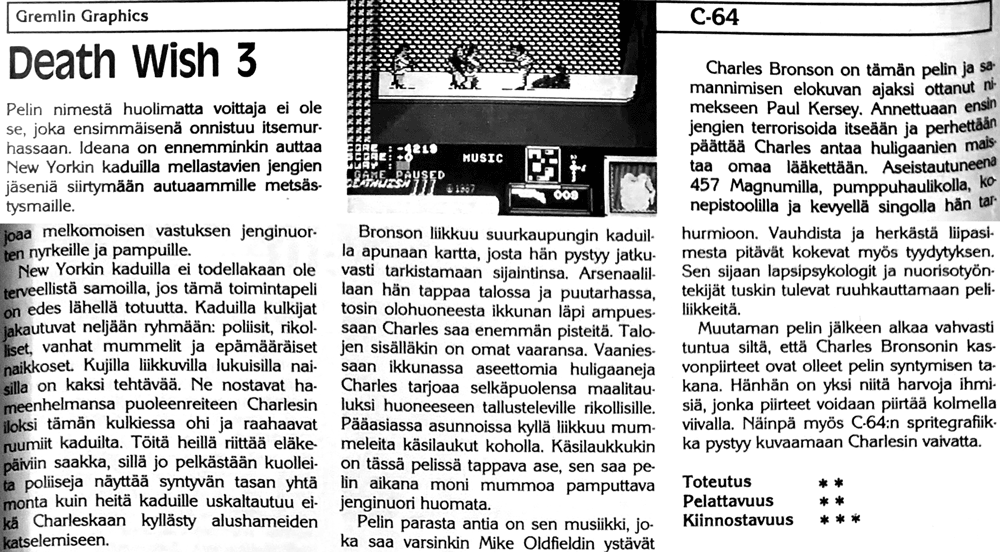
Death Wish 31987Pysyvä linkkiPelin nimestä huolimatta voittaja ei ole se, joka ensimmäisenä onnistuu itsemurhassaan. Ideana on ennemminkin auttaa New Yorkin kaduilla mellastavien jengien jäseniä siirtymään autuaammille metsästysmaille.
Charles Bronson on tämän pelin ja samannimisen elokuvan ajaksi ottanut nimekseen Paul Kersey. Annettuaan ensin jengien terrorisoida itseään ja perhettään päättää Charles antaa huligaanien maistaa omaa lääkettään. Aseistautuneena 457 Magnumilla, pumppuhaulikolla, konepistoolilla ja kevyellä singolla hän tar joaa melkomoisen vastuksen jenginuorten nyrkeille ja pampuille.
New Yorkin kaduilla ei todellakaan ole terveellistä samoilla, jos tämä toimintapeli on edes lähellä totuutta. Kaduilla kulkijat jakautuvat neljään ryhmään: poliisit, rikolliset, vanhat mummelit ja epämääräiset naikkoset. Kujilla liikkuvilla lukuisilla naisilla on kaksi tehtävää. Ne nostavat hameenhelmansa puoleenreiteen Charlesin iloksi tämän kulkiessa ohi ja raahaavat ruumiit kaduilta. Töitä heillä riittää eläkepäiviin saakka, sillä jo pelkästään kuolleita poliiseja näyttää syntyvän tasan yhtä monta kuin heitä kaduille uskaltautuu eikä Charleskaan kyllästy alushameiden katselemiseen.
Bronson liikkuu suurkaupungin kaduilla apunaan kartta, josta hän pystyy jatkuvasti tarkistamaan sijaintinsa. Arsenaalillaan hän tappaa talossa ja puutarhassa, tosin olohuoneesta ikkunan läpi ampuessaan Charles saa enemmän pisteitä. Talojen sisälläkin on omat vaaransa. Vaaniessaan ikkunassa aseettomia huligaaneja Charles tarjoaa selkäpuolensa maalitauluksi huoneeseen tallusteleville rikollisille. Pääasiassa asunnoissa kyllä liikkuu mummeleita käsilaukut koholla. Käsilaukkukin on tässä pelissä tappava ase, sen saa pelin aikana moni mummoa pamputtava jenginuori huomata.
Pelin parasta antia on sen musiikki, joka saa varsinkin Mike Oldfieldin ystävät hurmioon. Vauhdista ja herkästä liipasimesta pitävät kokevat myös tyydytyksen. Sen sijaan lapsipsykologit ja nuorisotyöntekijät tuskin tulevat ruuhkauttamaan peliliikkeitä.
Muutaman pelin jälkeen alkaa vahvasti tuntua siltä, että Charles Bronsonin kasvonpiirteet ovat olleet pelin syntymisen takana. Hänhän on yksi niitä harvoja ihmisiä, jonka piirteet voidaan piirtää kolmella viivalla. Näinpä myös C-64:n spritegrafiikka pystyy kuvaamaan Charlesin vaivatta.
Death Wish 31987PermalinkDespite the game's title, the winner is not whoever is first to succeed in killing himself. The idea is rather to help the members of the gangs rampaging through the streets of New York move on to happier hunting grounds.
For the duration of this game and the film of the same name, Charles Bronson has taken the name Paul Kersey. Having first let the gangs terrorise him and his family, Charles decides to give the hooligans a taste of their own medicine. Armed with a .475 Magnum, a pump-action shotgun, a submachine gun and a light rocket launcher, he puts up quite some resistance to the fists and clubs of the young gang members.
Roaming the streets of New York is definitely not good for your health, if this action game is anywhere near the truth. The people on the streets fall into four groups: police, criminals, little old biddies and shady floozies. The many women moving about the alleys have two jobs. They hike their skirts up to mid-thigh for Charles's delight as he walks past, and they drag the bodies off the streets. They'll have work enough to last them until retirement, since dead policemen alone seem to turn up in exactly the same numbers as dare to venture onto the streets, and Charles never tires of looking at petticoats either.
Bronson gets around the streets of the big city with the help of a map on which he can keep checking his position. With his arsenal he kills in house and garden, although Charles scores more points shooting through the window from a living room. Indoors has its own dangers too. While he lies in wait at a window for unarmed hooligans, Charles offers his back as a target to criminals padding into the room. Mostly, though, the flats are full of old biddies wandering about with their handbags raised. In this game even a handbag is a deadly weapon, as many a granny-clubbing gang youth will find out during play.
The best thing the game has to offer is its music, which will send Mike Oldfield fans in particular into raptures. Those who like speed and a hair trigger will also get their satisfaction. Child psychologists and youth workers, on the other hand, are hardly going to be causing crushes in the game shops.
After a few games you start to get a strong feeling that Charles Bronson's facial features were what lay behind the game's creation. He is, after all, one of those few people whose features can be drawn with three lines. And so even the C-64's sprite graphics can depict Charles without any trouble.
Deathknights Of Krynn
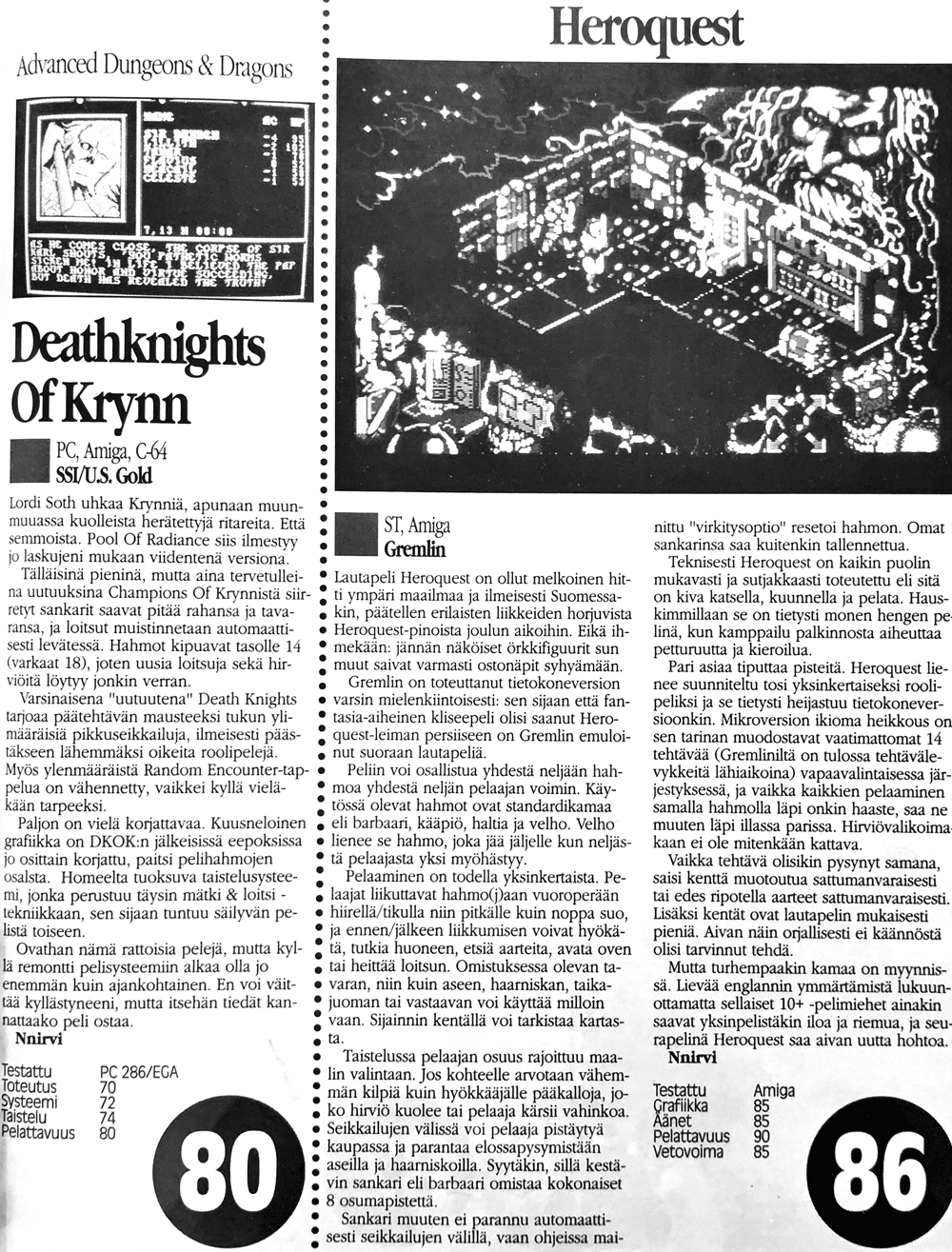
Deathknights Of Krynn1991 SyksyPysyvä linkkiLordi Soth uhkaa Krynniä, apunaan muunmuuassa kuolleista herätettyjä ritareita. Että semmoista. Pool Of Radiance siis ilmestyy jo laskujeni mukaan viidentenä versiona.
Tälläisinä pieninä, mutta aina tervetulleina uutuuksina Champions Of Krynnistä siirretyt sankarit saavat pitää rahansa ja tavaransa, ja loitsut muistinnetaan automaattisesti levätessä. Hahmot kipuavat tasolle 14 (varkaat 18), joten uusia loitsuja sekä hirviöitä löytyy jonkin verran.
Varsinaisena "uutuutena" Death Knights tarjoaa päätehtävän mausteeksi tukun ylimääräisiä pikkuseikkailuja, ilmeisesti päästäkseen lähemmäksi oikeita roolipelejä. Myös ylenmääräistä Random Encounter-tappelua on vähennetty, vaikkei kyllä vieläkään tarpeeksi.
Paljon on vielä korjattavaa. Kuusneloinen grafiikka on DKOK:n jälkeisissä eepoksissa jo osittain korjattu, paitsi pelihahmojen osalsta. Homeelta tuoksuva taistelusysteemi, jonka perustuu täysin mätki & loitsi -tekniikkaan, sen sijaan tuntuu säilyvän pelistä toiseen.
Ovathan nämä rattoisia pelejä, mutta kyllä remontti pelisysteemiin alkaa olla jo enemmän kuin ajankohtainen. En voi väittää kyllästyneeni, mutta itsehän tiedät kannattaako peli ostaa.
Deathknights Of Krynn1991 SyksyPermalinkLord Soth threatens Krynn, helped among others by knights raised from the dead. Well, how about that. So by my count Pool Of Radiance is now coming out in its fifth version already.
In the way of small but always welcome novelties, heroes transferred from Champions Of Krynn get to keep their money and gear, and spells are memorised automatically while resting. The characters climb to level 14 (thieves 18), so there's a certain amount of new spells and monsters to be found.
As its actual "novelty", Death Knights offers a batch of extra mini-adventures to spice up the main quest, apparently in order to get closer to real role-playing games. The excessive Random Encounter brawling has also been cut back, though still not enough, mind you.
There's still plenty to fix. The Commodore 64-grade graphics have already been partly fixed in the epics that came after DKOK, except where the player characters are concerned. The mouldy-smelling combat system, on the other hand, which is based entirely on the bash & cast technique, seems to live on from one game to the next.
Sure, these are jolly games, but an overhaul of the game system is getting to be more than overdue. I can't claim to be fed up, but you know yourself whether the game is worth buying.
Deathlord
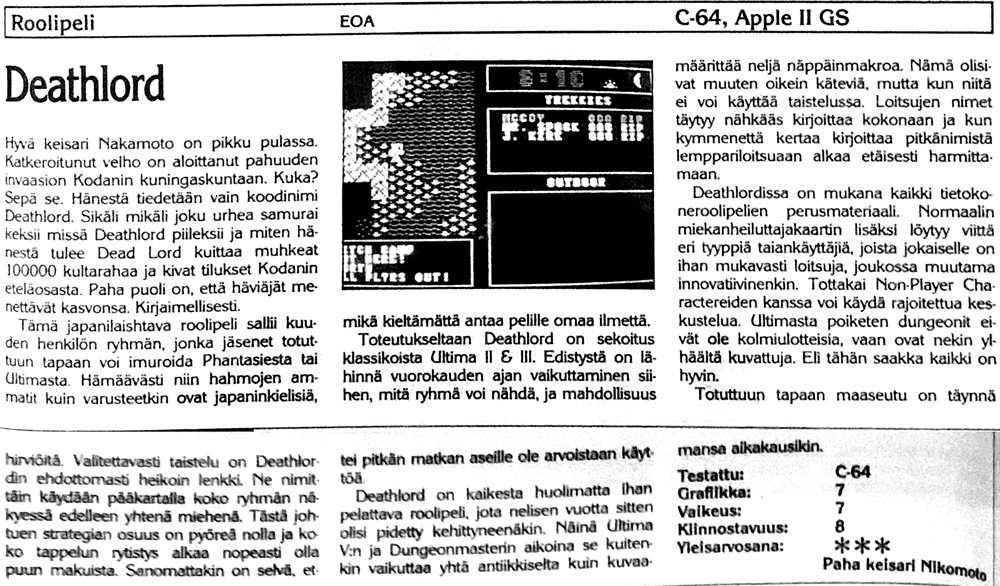
Deathlord1989 KevätPysyvä linkkiHyvä keisari Nakamoto on pikku pulassa. Katkeroitunut velho on aloittanut pahuuden invaasion Kodanin kuningaskuntaan. Kuka? Sepä se. Hänestä tiedetään vain koodinimi Deathlord. Sikäli mikäli joku urhea samurai keksii missä Deathlord piileksii ja miten hänestä tulee Dead Lord kuittaa muhkeat 100000 kultarahaa ja kivat tilukset Kodanin eteläosasta. Paha puoli on, että häviäjät menettävät kasvonsa. Kirjaimellisesti.
Tämä japanilaishtava roolipeli sallii kuuden henkilön ryhmän, jonka jäsenet totuttuun tapaan voi imuroida Phantasiesta tai Ultimasta. Hämäävästi niin hahmojen ammatit kuin varusteetkin ovat japaninkielisiä, mikä kieltämättä antaa pelille omaa ilmettä.
Toteutukseltaan Deathlord on sekoitus klassikoista Ultima II & III. Edistystä on lähinnä vuorokauden ajan vaikuttaminen siihen, mitä ryhmä voi nähdä, ja mahdollisuus määrittää neljä näppäinmakroa. Nämä olisivat muuten oikein käteviä, mutta kun niitä ei voi käyttää taistelussa. Loitsujen nimet täytyy nähkääs kirjoittaa kokonaan ja kun kymmenettä kertaa kirjoittaa pitkänimistä lemppariloitsuaan alkaa etäisesti harmittamaan.
Deathlordissa on mukana kaikki tietokoneroolipelien perusmateriaali. Normaalin miekanheiluttajakaartin lisäksi löytyy viittä eri tyyppiä taiankäyttäjiä, joista jokaiselle on ihan mukavasti loitsuja, joukossa muutama innovatiivinenkin. Tottakai Non-Player Charactereiden kanssa voi käydä rajoitettua keskustelua. Ultimasta poiketen dungeonit eivät ole kolmiulotteisia, vaan ovat nekin ylhäältä kuvattuja. Eli tähän saakka kaikki on hyvin.
Totuttuun tapaan maaseutu on täynnä hirviöitä. Valitettavasti taistelu on Deathlordin ehdottomasti heikoin lenkki. Ne nimittäin käydään pääkartalla koko ryhmän näkyessä edelleen yhtenä miehenä. Tästä johtuen strategian osuus on pyöreä nolla ja koko tappelun rytistys alkaa nopeasti olla puun makuista. Sanomattakin on selvä, ettei pitkän matkan aseille ole arvoistaan käyttöä.
Deathlord on kaikesta huolimatta ihan pelattava roolipeli, jota nelisen vuotta sitten olisi pidetty kehittyneenäkin. Näinä Ultima V:n ja Dungeonmasterin aikoina se kuitenkin vaikuttaa yhtä antiikkiselta kuin kuvaamansa aikakausikin.
Deathlord1989 KevätPermalinkGood Emperor Nakamoto is in a bit of a pickle. An embittered wizard has launched an invasion of evil on the kingdom of Kodan. Who? That's just it. Only a code name is known: Deathlord. If some brave samurai figures out where Deathlord is skulking and how to make a Dead Lord out of Deathlord, the samurai pockets a hefty 100000 gold pieces and a nice estate in southern Kodan. The catch is that the losers lose face. Literally.
This Japanese-flavoured role-playing game allows a party of six, whose members can, as usual, be vacuumed in from Phantasie or Ultima. Confusingly, both the characters' professions and their equipment are in Japanese, which admittedly gives the game a look of its own.
In its execution, Deathlord is a mix of the classics Ultima II & III. The advances are mainly that the time of day affects what the party can see, and the option to define four key macros. These would be really handy otherwise, except that you just can't use them in combat. Spell names, you see, have to be typed out in full, and by the tenth time you type out your long-named favourite spell, it starts to get faintly annoying.
Deathlord includes all the basic ingredients of computer role-playing games. On top of the usual brigade of sword-wavers there are five different types of magic-user, each with a pretty decent set of spells, a few innovative ones among them. Of course you can have limited conversations with Non-Player Characters. Unlike Ultima, the dungeons aren't three-dimensional but are shown from above as well. So up to this point, all is well.
As is customary, the countryside is full of monsters. Unfortunately, combat is by far Deathlord's weakest link. The fights, you see, are fought on the main map with the whole party still shown as one man. As a result, the strategy content is a big round zero, and the whole brawling scrum soon starts to taste like cardboard. It goes without saying that long-range weapons don't get the use they deserve.
Despite everything, Deathlord is a perfectly playable role-playing game, one that four years or so ago would even have been considered advanced. In these days of Ultima V and Dungeonmaster, however, it seems as antique as the era it depicts.
Deathtrack
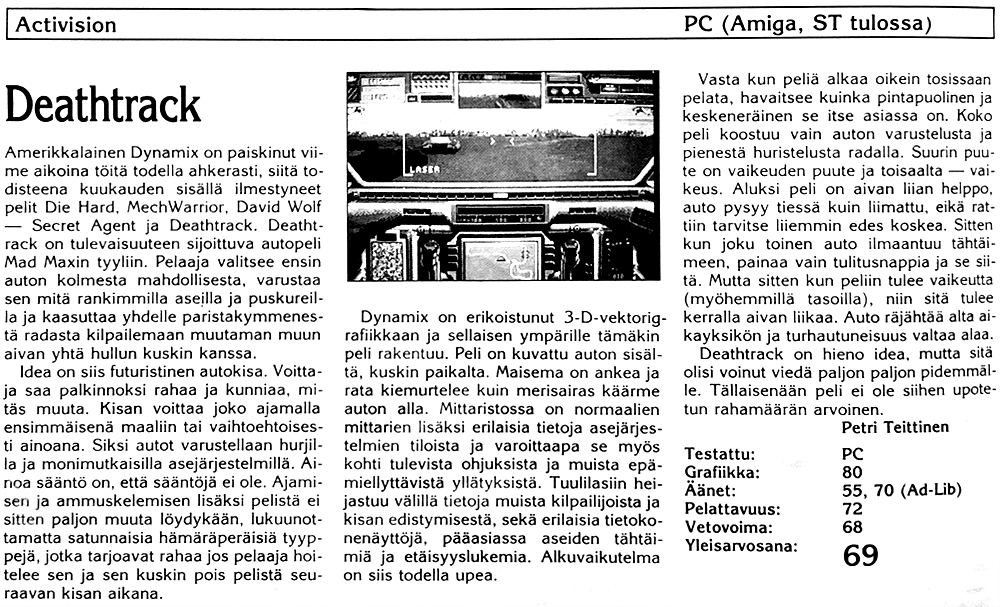
Deathtrack1990 SyksyPysyvä linkkiAmerikkalainen Dynamix on paiskinut viime aikoina töitä todella ahkerasti, siitä todisteena kuukauden sisällä ilmestyneet pelit Die Hard, MechWarrior, David Wolf - Secret Agent ja Deathtrack. Deathtrack on tulevaisuuteen sijoittuva autopeli Mad Maxin tyyliin. Pelaaja valitsee ensin auton kolmesta mahdollisesta, varustaa sen mitä rankimmilla aseilla ja puskureilla ja kaasuttaa yhdelle paristakymmenestä radasta kilpailemaan muutaman muun aivan yhtä hullun kuskin kanssa.
Idea on siis futuristinen autokisa. Voittaja saa palkinnoksi rahaa ja kunniaa, mitäs muuta. Kisan voittaa joko ajamalla ensimmäisenä maaliin tai vaihtoehtoisesti ainoana. Siksi autot varustellaan hurjilla ja monimutkaisilla asejärjestelmillä. Ainoa sääntö on, että sääntöjä ei ole. Ajamisen ja ammuskelemisen lisäksi pelistä ei sitten paljon muuta löydykään, lukuunottamatta satunnaisia hämäräperäisiä tyyppejä, jotka tarjoavat rahaa jos pelaaja hoitelee sen ja sen kuskin pois pelistä seuraavan kisan aikana.
Dynamix on erikoistunut 3-D-vektorigrafiikkaan ja sellaisen ympärille tämäkin peli rakentuu. Peli on kuvattu auton sisältä, kuskin paikalta. Maisema on ankea ja rata kiemurtelee kuin merisairas käärme auton alla. Mittaristossa on normaalien mittarien lisäksi erilaisia tietoja asejärjestelmien tiloista ja varoittaapa se myös kohti tulevista ohjuksista ja muista epämiellyttävistä yllätyksistä. Tuulilasiin heijastuu välillä tietoja muista kilpailijoista ja kisan edistymisestä, sekä erilaisia tietokonenäyttöjä, pääasiassa aseiden tähtäimiä ja etäisyyslukemia. Alkuvaikutelma on siis todella upea.
Vasta kun peliä alkaa oikein tosissaan pelata, havaitsee kuinka pintapuolinen ja keskeneräinen se itse asiassa on. Koko peli koostuu vain auton varustelusta ja pienestä huristelusta radalla. Suurin puute on vaikeuden puute ja toisaalta - vaikeus. Aluksi peli on aivan liian helppo, auto pysyy tiessä kuin liimattu, eikä rattiin tarvitse liiemmin edes koskea. Sitten kun joku toinen auto ilmaantuu tähtäimeen, painaa vain tulitusnappia ja se siitä. Mutta sitten kun peliin tulee vaikeutta (myöhemmillä tasoilla), niin sitä tulee kerralla aivan liikaa. Auto räjähtää alta aikayksikön ja turhautuneisuus valtaa alaa.
Deathtrack on hieno idea, mutta sitä olisi voinut viedä paljon paljon pidemmälle. Tällaisenään peli ei ole siihen upotetun rahamäärän arvoinen.
Deathtrack1990 SyksyPermalinkAmerica's Dynamix has been slaving away really hard lately, as witnessed by the games released within a single month: Die Hard, MechWarrior, David Wolf - Secret Agent and Deathtrack. Deathtrack is a car game set in the future, in the style of Mad Max. The player first picks a car from the three on offer, kits it out with the meanest weapons and bumpers going, and guns it onto one of twenty-odd tracks to race against a few other drivers who are every bit as crazy.
So the idea is a futuristic car race. The winner gets money and glory as a prize, what else. You win a race either by being first across the finish line or, alternatively, the only one. That's why the cars are kitted out with ferocious and complicated weapon systems. The only rule is that there are no rules. Apart from driving and shooting there isn't much else to be found in the game, except for the occasional shady characters who offer money if the player takes such-and-such a driver out of the game during the next race.
Dynamix specialises in 3-D vector graphics, and this game too is built around them. The game is viewed from inside the car, from the driver's seat. The landscape is dreary and the track writhes under the car like a seasick snake. Besides the normal gauges, the dashboard shows various information on the status of the weapon systems, and it even warns you of incoming missiles and other unpleasant surprises. Every now and then information about the other competitors and the progress of the race is projected onto the windscreen, along with various computer displays, mainly weapon sights and range readings. So the first impression is really superb.
Only when you start playing the game in earnest do you notice how superficial and unfinished it actually is. The whole game consists of nothing but kitting out the car and a bit of whizzing around the track. The biggest shortcoming is the lack of difficulty and, on the other hand - difficulty. At first the game is far too easy, the car sticks to the road as if glued, and you hardly even need to touch the steering wheel. Then when some other car appears in your sights, you just press the fire button and that's that. But then when difficulty does arrive in the game (on later levels), far too much of it arrives all at once. The car blows up in no time flat and frustration takes over.
Deathtrack is a fine idea, but it could have been taken much, much further. As it stands the game isn't worth the amount of money you'd sink into it.
Deep, The
Deep, The1989 SyksyPysyvä linkkiMeren pohjasta löytyy muutakin kuin öljyä, PCB:tä ja ydinjätettä, nimittäin sukellusveneitä, ohjussiiloja ja lisää sukellusveneitä. Ei, nyt ei ole kyse Ruotsin armeijan uusimmasta pressitiedotteesta vaan pelistä nimeltä The Deep.
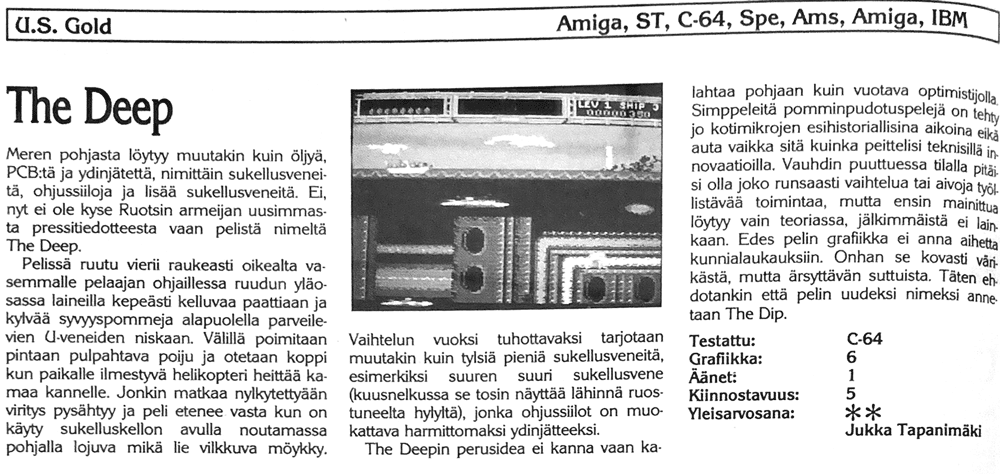
Pelissä ruutu vierii raukeasti oikealta vasemmalle pelaajan ohjaillessa ruudun yläosassa laineilla kepeästi kelluvaa paattiaan ja kylvää syvyyspommeja alapuolella parveilevien U-veneiden niskaan. Välillä poimitaan pintaan pulpahtava poiju ja otetaan koppi kun paikalle ilmestyvä helikopteri heittää kamaa kannelle. Jonkin matkaa nylkytettyään viritys pysähtyy ja peli etenee vasta kun on käyty sukelluskellon avulla noutamassa pohjalla lojuva mikä lie vilkkuva möykky.
Vaihtelun vuoksi tuhottavaksi tarjotaan muutakin kuin tylsiä pieniä sukellusveneitä, esimerkiksi suuren suuri sukellusvene (kuusnelkussa se tosin näyttää lähinnä ruostuneelta hylyltä), jonka ohjussiilot on muokattava harmittomaksi ydinjätteeksi.
The Deepin perusidea ei kanna vaan kalahtaa pohjaan kuin vuotava optimistijolla. Simppeleitä pomminpudotuspelejä on tehty jo kotimikrojen esihistoriallisina aikoina eikä auta vaikka sitä kuinka peittelisi teknisillä innovaatioilla. Vauhdin puuttuessa tilalla pitäisi olla joko runsaasti vaihtelua tai aivoja työllistävää toimintaa, mutta ensin mainittua löytyy vain teoriassa, jälkimmäistä ei lainkaan. Edes pelin grafiikka ei anna aihetta kunnialaukauksiin. Onhan se kovasti värikästä, mutta ärsyttävän suttuista. Täten ehdotankin että pelin uudeksi nimeksi annetaan The Dip.
Deep, The1989 SyksyPermalinkThere is more to be found on the seabed than oil, PCBs and nuclear waste, namely submarines, missile silos and more submarines. No, this is not the Swedish army's latest press release but a game called The Deep.
In the game the screen scrolls languidly from right to left as the player steers a boat bobbing lightly on the waves at the top of the screen and sows depth charges onto the necks of the U-boats swarming below. Every now and then you pick up a buoy that pops up to the surface, and make the catch when a helicopter turns up to throw gear onto the deck. After plodding along for a while the whole contraption grinds to a halt, and the game only moves on once you have gone down in a diving bell to fetch whatever blinking lump it is that lies on the bottom.
For variety there is more on offer for destruction than boring little submarines, for example a great big submarine (on the C-64, admittedly, it looks mostly like a rusty wreck), whose missile silos have to be turned into harmless nuclear waste.
The Deep's basic idea doesn't stay afloat but clunks to the bottom like a leaky Optimist dinghy. Simple bomb-dropping games were already being made in the prehistoric times of home micros, and it doesn't help however much you dress it up with technical innovations. With no speed, there should be either plenty of variety or brain-taxing action in its place, but the former is found only in theory and the latter not at all. Not even the game's graphics give cause for a gun salute. Sure, they're very colourful, but annoyingly smudgy. I therefore propose that the game be given the new name The Dip.
Defender of the Crown
Defender of the Crown1987Pysyvä linkkiDefender of the Crown on Cinemawaren klassinen elokuvamainen huippugrafiikkainen supersoundinen ja niin edes päin - peli, jonka Amiga-versiota on kuolattu siellä sun täällä.
Nyt tämä huipputyö on käännetty Commodore 64:lle. Tulos on erinomainen. Kuusnelkusta on tiristetty irti viimeinenkin tehonpisara.
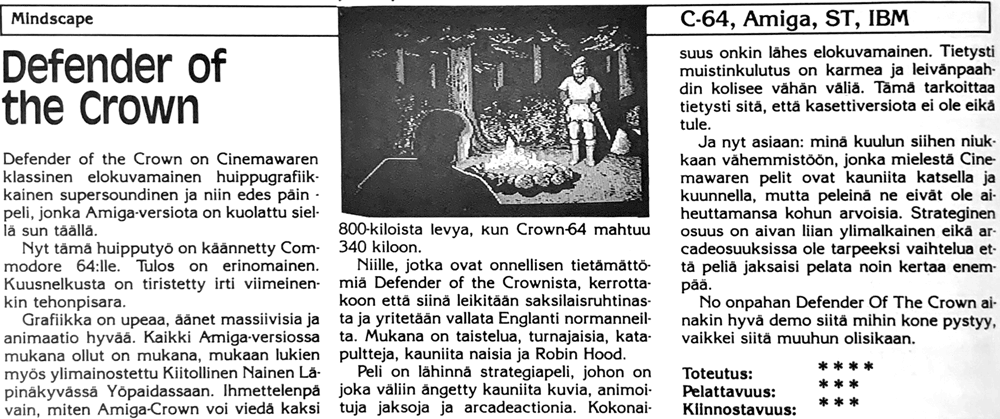
Grafiikka on upeaa, äänet massiivisia ja animaatio hyvää. Kaikki Amiga-versiossa mukana ollut on mukana, mukaan lukien myös ylimainostettu Kiitollinen Nainen Läpinäkyvässä Yöpaidassaan. Ihmettelenpä vain, miten Amiga-Crown voi viedä kaksi 800-kiloista levya, kun Crown-64 mahtuu 340 kiloon.
Niille, jotka ovat onnellisen tietämättömiä Defender of the Crownista, kerrottakoon että siinä leikitään saksilaisruhtinasta ja yritetään vallata Englanti normanneilta. Mukana on taistelua, turnajaisia, katapultteja, kauniita naisia ja Robin Hood.
Peli on lähinnä strategiapeli, johon on joka väliin ängetty kauniita kuvia, animoituja jaksoja ja arcadeactionia. Kokonaisuus onkin lähes elokuvamainen. Tietysti muistinkulutus on karmea ja leivänpaahdin kolisee vähän väliä. Tämä tarkoittaa tietysti sitä, että kasettiversiota ei ole eikä tule.
Ja nyt asiaan: minä kuulun siihen niukkaan vähemmistöön, jonka mielestä Cinemawaren pelit ovat kauniita katsella ja kuunnella, mutta peleinä ne eivät ole aiheuttamansa kohun arvoisia. Strateginen osuus on aivan liian ylimalkainen eikä arcadeosuuksissa ole tarpeeksi vaihtelua että peliä jaksaisi pelata noin kertaa enempää.
No onpahan Defender Of The Crown ainakin hyvä demo siitä mihin kone pystyy, vaikkei siitä muuhun olisikaan.
Defender of the Crown1987PermalinkDefender of the Crown is Cinemaware's classic cinematic top-notch-graphics super-sounding and so on and so forth - game, whose Amiga version has been drooled over here, there and everywhere.
Now this masterpiece has been converted to the Commodore 64. The result is excellent. Every last drop of power has been squeezed out of the C-64.
The graphics are superb, the sound massive and the animation good. Everything that was in the Amiga version is in here, including the overhyped Grateful Lady In Her See-Through Nightie. I do just wonder how the Amiga Crown can take up two 800K disks when Crown-64 fits into 340K.
For those who are blissfully ignorant of Defender of the Crown, let it be said that in it you play at being a Saxon lord and try to wrest England from the Normans. There are battles, tournaments, catapults, beautiful women and Robin Hood.
The game is basically a strategy game with pretty pictures, animated sequences and arcade action crammed into every gap. The whole thing is, indeed, almost cinematic. Naturally the memory consumption is horrendous and the toaster clunks away every few moments. This of course means that there is no cassette version, nor will there be.
And now to the point: I belong to that slender minority who think Cinemaware's games are lovely to look at and listen to, but as games they're not worth the fuss they have caused. The strategy side is far too sketchy, and there isn't enough variety in the arcade sections to make you bother playing the game more than once or so.
Well, at least Defender Of The Crown is a good demo of what the machine can do, even if it's no good for anything else.
Deflektor
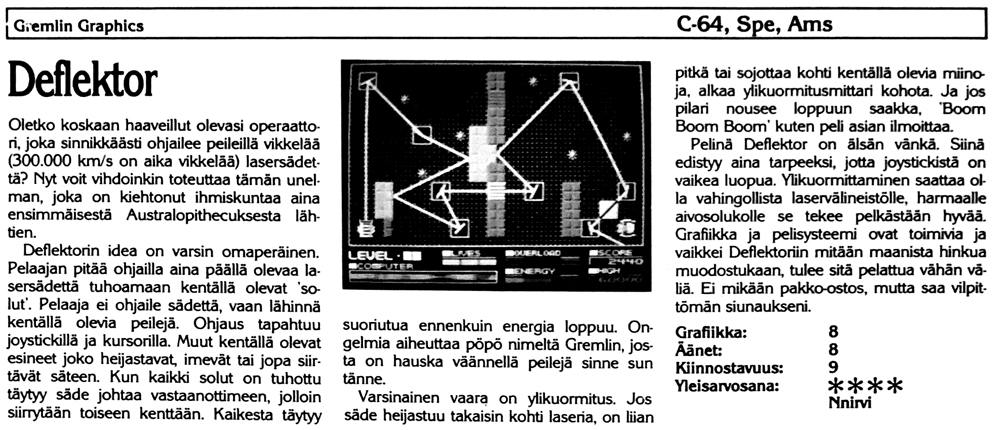
Deflektor1988Pysyvä linkkiOletko koskaan haaveillut olevasi operaattori, joka sinnikkäästi ohjailee peileillä vikkelää (300.000 km/s on aika vikkelää) lasersädettä? Nyt voit vihdoinkin toteuttaa tämän unelman, joka on kiehtonut ihmiskuntaa aina ensimmäisestä Australopithecuksesta lähtien.
Deflektorin idea on varsin omaperäinen. Pelaajan pitää ohjailla aina päällä olevaa lasersädettä tuhoamaan kentällä olevat 'solut'. Pelaaja ei ohjaile sädettä, vaan lähinnä kentällä olevia peilejä. Ohjaus tapahtuu joystickillä ja kursorilla. Muut kentällä olevat esineet joko heijastavat, imevät tai jopa siirtävät säteen. Kun kaikki solut on tuhottu täytyy säde johtaa vastaanottimeen, jolloin siirrytään toiseen kenttään. Kaikesta täytyy suoriutua ennenkuin energia loppuu. Ongelmia aiheuttaa pöpö nimeltä Gremlin, josta on hauska väännellä peilejä sinne sun tänne.
Varsinainen vaara on ylikuormitus. Jos säde heijastuu takaisin kohti laseria, on liian pitkä tai sojottaa kohti kentällä olevia miinoja, alkaa ylikuormitusmittari kohota. Ja jos pilari nousee loppuun saakka, 'Boom Boom Boom' kuten peli asian ilmoittaa.
Pelinä Deflektor on älsän vänkä. Siinä edistyy aina tarpeeksi, jotta joystickistä on vaikea luopua. Ylikuormittaminen saattaa olla vahingollista laservälineistölle, harmaalle aivosolukolle se tekee pelkästään hyvää. Grafiikka ja pelisysteemi ovat toimivia ja vaikkei Deflektoriin mitään maanista hinkua muodostukaan, tulee sitä pelattua vähän väliä. Ei mikään pakko-ostos, mutta saa vilpittömän siunaukseni.
Deflektor1988PermalinkHave you ever dreamed of being an operator who doggedly steers a nippy (300,000 km/s is pretty nippy) laser beam with mirrors? Now you can finally make this dream come true, a dream that has fascinated mankind ever since the very first Australopithecus.
Deflektor's idea is quite original. The player has to steer a laser beam that is always on so that it destroys the 'cells' on the level. The player doesn't steer the beam as such, but rather the mirrors on the level. Control is with the joystick and a cursor. The other objects on the level either reflect, absorb or even shift the beam somewhere else. When all the cells have been destroyed, the beam has to be led into the receiver, whereupon you move on to another level. All of this has to be done before the energy runs out. Trouble is caused by a little bug called Gremlin, who thinks it's fun to twist the mirrors every which way.
The real danger is overload. If the beam reflects back towards the laser, is too long or points at the mines on the level, the overload meter starts to rise. And if the bar goes all the way up, it's 'Boom Boom Boom', as the game puts it.
As a game, Deflektor is totally ace. You always make just enough progress that it's hard to let go of the joystick. Overloading may be harmful to laser equipment, but for the little grey cells it does nothing but good. The graphics and the game system work, and even though Deflektor doesn't give rise to any manic craving, you do end up playing it every so often. Not a must-buy, but it has my sincere blessing.
Deliverance - Stormlord II
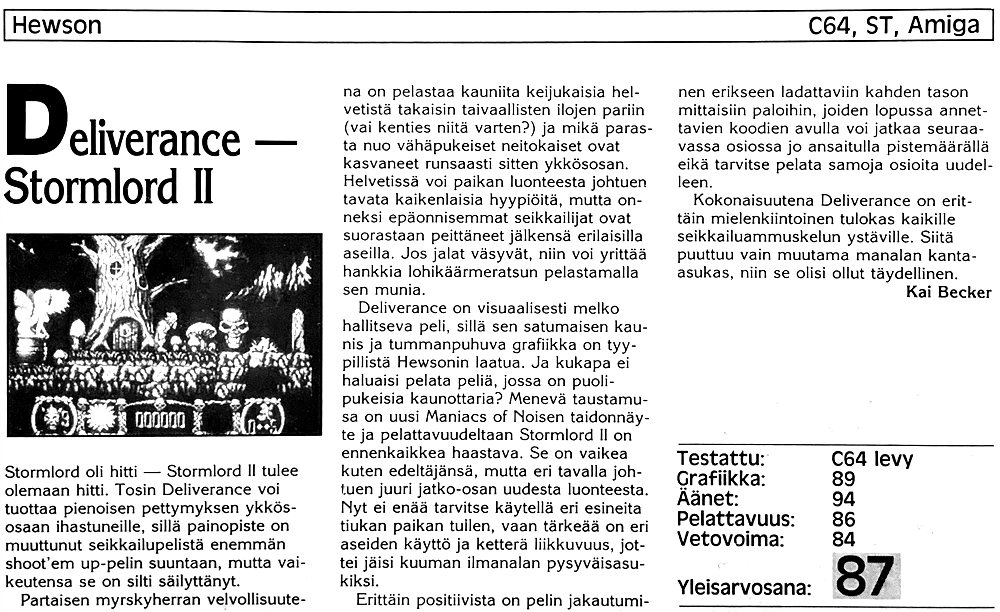
Deliverance - Stormlord II1991 KevätPysyvä linkkiStormlord oli hitti - Stormlord II tulee olemaan hitti. Tosin Deliverance voi tuottaa pienoisen pettymyksen ykkösosaan ihastuneille, sillä painopiste on muuttunut seikkailupelistä enemmän shoot'em up-pelin suuntaan, mutta vaikeutensa se on silti säilyttänyt.
Partaisen myrskyherran velvollisuutena on pelastaa kauniita keijukaisia helvetistä takaisin taivaallisten ilojen pariin (vai kenties niitä varten?) ja mikä parasta nuo vähäpukeiset neitokaiset ovat kasvaneet runsaasti sitten ykkösosan. Helvetissä voi paikan luonteesta johtuen tavata kaikenlaisia hyypiöitä, mutta onneksi epäonnisemmat seikkailijat ovat suorastaan peittäneet jälkensä erilaisilla aseilla. Jos jalat väsyvät, niin voi yrittää hankkia lohikäärmeratsun pelastamalla sen munia.
Deliverance on visuaalisesti melko hallitseva peli, sillä sen satumaisen kaunis ja tummanpuhuva grafiikka on tyypillistä Hewsonin laatua. Ja kukapa ei haluaisi pelata peliä, jossa on puolipukeisia kaunottaria? Menevä taustamusa on uusi Maniacs of Noisen taidonnäyte ja pelattavuudeltaan Stormlord II on ennenkaikkea haastava. Se on vaikea kuten edeltäjänsä, mutta eri tavalla johtuen juuri jatko-osan uudesta luonteesta. Nyt ei enää tarvitse käytellä eri esineita tiukan paikan tullen, vaan tärkeää on eri aseiden käyttö ja ketterä liikkuvuus, jottei jäisi kuuman ilmanalan pysyväisasukiksi.
Erittäin positiivista on pelin jakautuminen erikseen ladattaviin kahden tason mittaisiin paloihin, joiden lopussa annettavien koodien avulla voi jatkaa seuraavassa osiossa jo ansaitulla pistemäärällä eikä tarvitse pelata samoja osioita uudelleen.
Kokonaisuutena Deliverance on erittäin mielenkiintoinen tulokas kaikille seikkailuammuskelun ystäville. Siitä puuttuu vain muutama manalan kanta-asukas, niin se olisi ollut täydellinen.
Deliverance - Stormlord II1991 KevätPermalinkStormlord was a hit - Stormlord II is going to be a hit. Admittedly, Deliverance may come as a slight disappointment to those who loved the first part, since the emphasis has shifted from adventure game more towards shoot'em up, but it has still kept its difficulty.
The bearded storm lord's duty is to rescue beautiful fairies out of hell and back to the pleasures of heaven (or perhaps for them?), and best of all, those scantily clad maidens have grown generously since the first part. Given the nature of the place, you can meet all sorts of creeps in hell, but luckily less fortunate adventurers have practically carpeted their trail with assorted weapons. If your feet get tired, you can try to get yourself a dragon mount by rescuing its eggs.
Visually Deliverance is a fairly commanding game, since its fairytale-beautiful and brooding graphics are typical Hewson quality. And who wouldn't want to play a game with half-dressed beauties in it? The catchy background tune is a new showpiece from Maniacs of Noise, and in terms of playability Stormlord II is above all challenging. It is difficult like its predecessor, but in a different way, precisely because of the sequel's new character. Now you no longer have to use various objects when you get into a tight spot; what matters instead is using the different weapons and moving nimbly, so that you don't end up a permanent resident of the hot climate.
A very positive point is the way the game is split into separately loaded chunks two levels long, at the end of which you're given codes that let you continue into the next section with the score you've already earned, without having to play the same sections all over again.
All in all, Deliverance is a very interesting newcomer for all fans of adventure shooting. It's only missing a few of the underworld's regulars, and it would have been perfect.
Delta
Delta1987Pysyvä linkkiStavros Fasoulas, mies joka todisti että ainakin yksi suomalainen osaa vääntää bittiä muuallekin kuin pöytälaatikkoon, kasvattaa muun muassa mainettaan uutukaisellaan Deltalla. Jo Sanxion ryhmitti kuusnelkun tappopelien kärjen uudestaan eikä Delta voi olla tekemättä samaa.
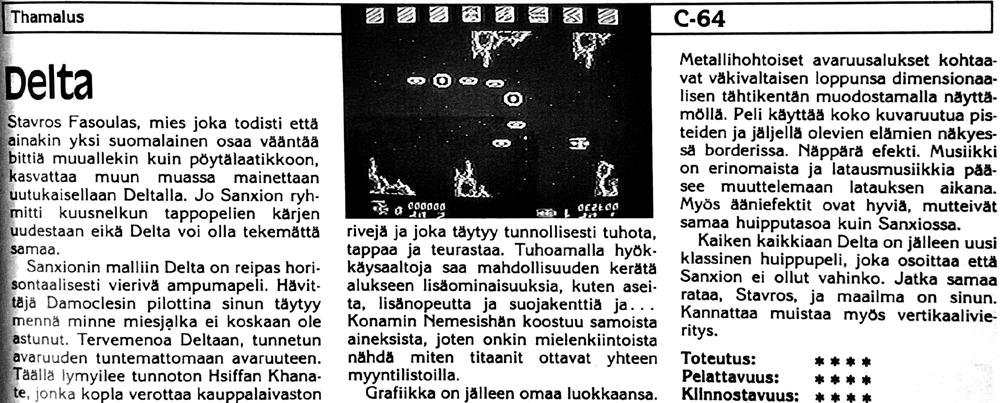
Sanxionin malliin Delta on reipas horisontaalisesti vierivä ampumapeli. Hävittäjä Damoclesin pilottina sinun täytyy mennä minne miesjalka ei koskaan ole astunut. Tervemenoa Deltaan, tunnetun avaruuden tuntemattomaan avaruuteen. Täällä lymyilee tunnoton Hsiffan Khanate, jonka kopla verottaa kauppalaivaston rivejä ja joka täytyy tunnollisesti tuhota, tappaa ja teurastaa. Tuhoamalla hyökkäysaaltoja saa mahdollisuuden kerätä alukseen lisäominaisuuksia, kuten aseita, lisänopeutta ja suojakenttiä ja... Konamin Nemesishän koostuu samoista aineksista, joten onkin mielenkiintoista nähdä miten titaanit ottavat yhteen myyntilistoilla.
Grafiikka on jälleen omaa luokkaansa. Metallihohtoiset avaruusalukset kohtaavat väkivaltaisen loppunsa dimensionaalisen tähtikentän muodostamalla näyttämöllä. Peli käyttää koko kuvaruutua pisteiden ja jäljellä olevien elämien näkyessä borderissa. Näppärä efekti. Musiikki on erinomaista ja latausmusiikkia pääsee muuttelemaan latauksen aikana. Myös ääniefektit ovat hyviä, mutteivät samaa huipputasoa kuin Sanxiossa.
Kaiken kaikkiaan Delta on jälleen uusi klassinen huippupeli, joka osoittaa että Sanxion ei ollut vahinko. Jatka samaa rataa, Stavros, ja maailma on sinun. Kannattaa muistaa myös vertikaalivieritys.
Delta1987PermalinkStavros Fasoulas, the man who proved that at least one Finn can crank out bits for somewhere other than his desk drawer, is adding to, among other things, his reputation with his brand-new Delta. Sanxion already reshuffled the top ranks of the C-64's killing games, and Delta can't help but do the same.
In the Sanxion mould, Delta is a brisk horizontally scrolling shoot-'em-up. As pilot of the fighter Damocles you must go where no man has set foot before. Bon voyage to Delta, the unknown space of known space. Here lurks the callous Hsiffan Khanate, whose crew is thinning the ranks of the merchant fleet and which must be conscientiously crushed, killed and carved up. By destroying attack waves you get the chance to collect add-ons for your ship, such as weapons, extra speed and shields and... Konami's Nemesis is made of the same ingredients, of course, so it will be interesting to see how the titans clash in the sales charts.
The graphics are once again in a class of their own. Spaceships with a metallic sheen meet their violent end on a stage formed by a dimensional starfield. The game uses the whole screen, with the score and remaining lives shown in the border. A neat effect. The music is excellent, and you get to tinker with the loading music while the game loads. The sound effects are good too, but not of the same top level as in Sanxion.
All in all, Delta is yet another new classic top game, one that shows Sanxion was no fluke. Keep on the same track, Stavros, and the world is yours. Vertical scrolling would be worth remembering too.
Demon Stalkers
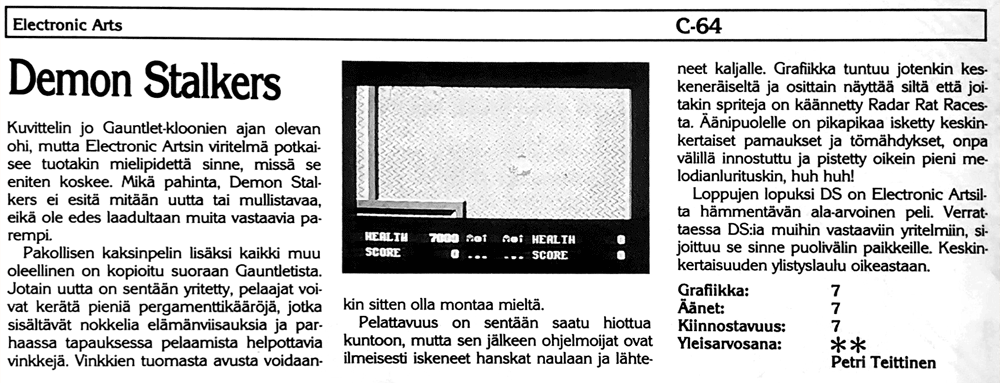
Demon Stalkers1988Pysyvä linkkiKuvittelin jo Gauntlet-kloonien ajan olevan ohi, mutta Electronic Artsin viritelmä potkaisee tuotakin mielipidettä sinne, missä se eniten koskee. Mikä pahinta, Demon Stalkers ei esitä mitään uutta tai mullistavaa, eikä ole edes laadultaan muita vastaavia parempi.
Pakollisen kaksinpelin lisäksi kaikki muu oleellinen on kopioitu suoraan Gauntletista. Jotain uutta on sentään yritetty, pelaajat voivat kerätä pieniä pergamenttikääröjä, jotka sisältävät nokkelia elämänviisauksia ja parhaassa tapauksessa pelaamista helpottavia vinkkejä. Vinkkien tuomasta avusta voidaankin sitten olla montaa mieltä.
Pelattavuus on sentään saatu hiottua kuntoon, mutta sen jälkeen ohjelmoijat ovat ilmeisesti iskeneet hanskat naulaan ja lähteneet kaljalle. Grafiikka tuntuu jotenkin keskeneräiseltä ja osittain näyttää siltä että joitakin spriteja on käännetty Radar Rat Racesta. Äänipuolelle on pikapikaa isketty keskinkertaiset pamaukset ja tömähdykset, onpa välillä innostuttu ja pistetty oikein pieni melodianlurituskin, huh huh!
Loppujen lopuksi DS on Electronic Artsilta hämmentävän ala-arvoinen peli. Verrattaessa DS:ia muihin vastaaviin yritelmiin, sijoittuu se sinne puolivälin paikkeille. Keskinkertaisuuden ylistyslaulu oikeastaan.
Demon Stalkers1988PermalinkI had already imagined the age of Gauntlet clones was over, but Electronic Arts' contraption kicks that opinion, too, right where it hurts the most. Worst of all, Demon Stalkers offers nothing new or revolutionary, and isn't even better in quality than the others like it.
Apart from the obligatory two-player mode, everything else that matters has been copied straight from Gauntlet. Something new has at least been attempted: the players can collect little parchment scrolls that contain witty pearls of wisdom about life and, at best, tips that make playing easier. How much help the tips actually bring is, then, a matter of opinion.
The playability has at least been polished into shape, but after that the programmers evidently hung up their gloves and went off for a beer. The graphics feel somehow unfinished, and in places it looks as if some of the sprites have been nicked from Radar Rat Race. On the sound side, some mediocre bangs and thuds have been slapped on in a hurry, and here and there they've even got carried away and thrown in a proper little tootle of a tune, whew!
When all's said and done, DS is a bafflingly substandard game from Electronic Arts. Compared with other similar efforts, DS lands somewhere around the middle. A hymn of praise to mediocrity, really.
Demon's Winter
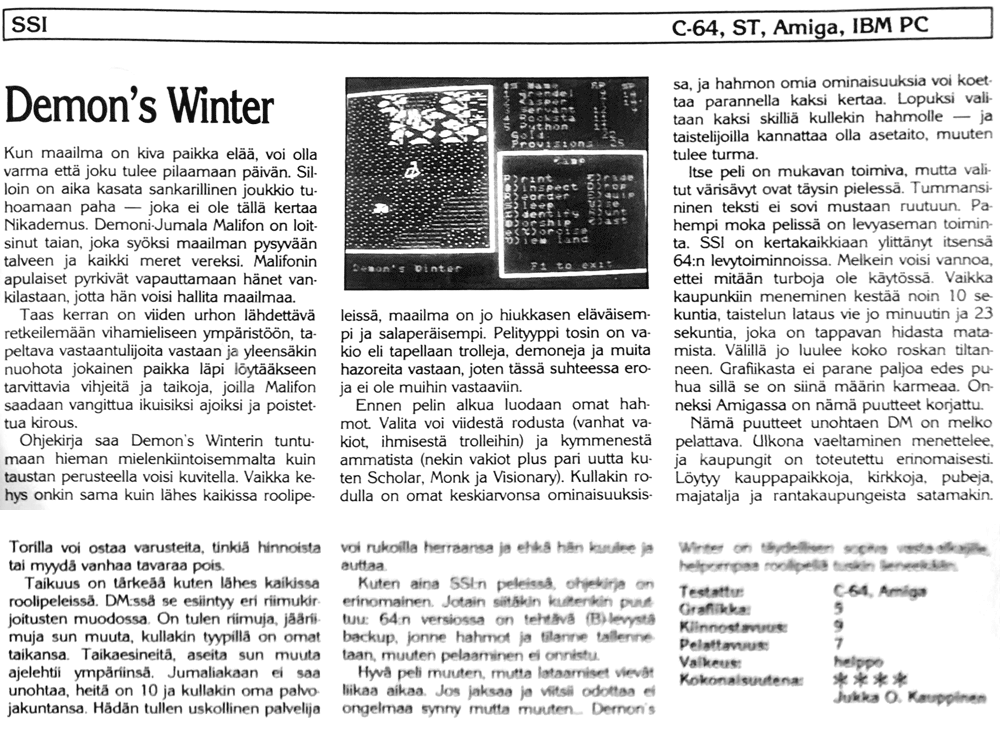
Demon's Winter1989 SyksyPysyvä linkkiKun maailma on kiva paikka elää, voi olla varma että joku tulee pilaamaan päivän. Silloin on aika kasata sankarillinen joukkio tuhoamaan paha - joka ei ole tällä kertaa Nikademus. Demoni-Jumala Malifon on loitsinut taian, joka syöksi maailman pysyvään talveen ja kaikki meret vereksi. Malifonin apulaiset pyrkivät vapauttamaan hänet vankilastaan, jotta hän voisi hallita maailmaa.
Taas kerran on viiden urhon lähdettävä retkeilemään vihamieliseen ympäristöön, tapeltava vastaantulijoita vastaan ja yleensäkin nuohota jokainen paikka läpi löytääkseen tarvittavia vihjeitä ja taikoja, joilla Malifon saadaan vangittua ikuisiksi ajoiksi ja poistettua kirous.
Ohjekirja saa Demon's Winterin tuntumaan hieman mielenkiintoisemmalta kuin taustan perusteella voisi kuvitella. Vaikka kehys onkin sama kuin lähes kaikissa roolipeleissä, maailma on jo hiukkasen eläväisempi ja salaperäisempi. Pelityyppi tosin on vakio eli tapellaan trolleja, demoneja ja muita hazoreita vastaan, joten tässä suhteessa eroja ei ole muihin vastaaviin.
Ennen pelin alkua luodaan omat hahmot. Valita voi viidestä rodusta (vanhat vakiot, ihmisestä trolleihin) ja kymmenestä ammatista (nekin vakiot plus pari uutta kuten Scholar, Monk ja Visionary). Kullakin rodulla on omat keskiarvonsa ominaisuuksissa, ja hahmon omia ominaisuuksia voi koettaa parannella kaksi kertaa. Lopuksi valitaan kaksi skilliä kullekin hahmolle - ja taistelijoilla kannattaa olla asetaito, muuten tulee turma.
Itse peli on mukavan toimiva, mutta valitut värisävyt ovat täysin pielessä. Tummansininen teksti ei sovi mustaan ruutuun. Pahempi moka pelissä on levyaseman toiminta. SSI on kertakaikkiaan ylittänyt itsensä 64:n levytoiminnoissa. Melkein voisi vannoa, ettei mitään turboja ole käytössä. Vaikka kaupunkiin meneminen kestää noin 10 sekuntia, taistelun lataus vie jo minuutin ja 23 sekuntia, joka on tappavan hidasta matamista. Välillä jo luulee koko roskan tiltanneen. Grafiikasta ei parane paljoa edes puhua sillä se on siinä määrin karmeaa. Onneksi Amigassa on nämä puutteet korjattu.
Nämä puutteet unohtaen DM on melko pelattava. Ulkona vaeltaminen menettelee, ja kaupungit on toteutettu erinomaisesti. Löytyy kauppapaikkoja, kirkkoja, pubeja, majataloja ja rantakaupungeista satamakin. Torilla voi ostaa varusteita, tinkiä hinnoista tai myydä vanhaa tavaraa pois.
Taikuus on tärkeää kuten lähes kaikissa roolipeleissä. DM:ssä se esiintyy eri riimukirjoitusten muodossa. On tulen riimuja, jääriimuja sun muuta, kullakin tyypillä on omat taikansa. Taikaesineitä, aseita sun muuta ajelehtii ympäriinsä. Jumaliakaan ei saa unohtaa, heitä on 10 ja kullakin oma palvojakuntansa. Hädän tullen uskollinen palvelija voi rukoilla herraansa ja ehkä hän kuulee ja auttaa.
Kuten aina SSI:n peleissä, ohjekirja on erinomainen. Jotain siitäkin kuitenkin puuttuu: 64:n versiossa on tehtävä (B)-levystä backup, jonne hahmot ja tilanne tallennetaan, muuten pelaaminen ei onnistu.
Hyvä peli muuten, mutta lataamiset vievät liikaa aikaa. Jos jaksaa ja viitsii odottaa ei ongelmaa synny mutta muuten... Demon's Winter on täydellisen sopiva vasta-alkajille, helpompaa roolipeliä tuskin lieneekään.
Demon's Winter1989 SyksyPermalinkWhen the world is a nice place to live, you can be sure someone will come along and spoil the day. Then it's time to put together a heroic band to destroy the evil - which this time is not Nikademus. The Demon-God Malifon has cast a spell that plunged the world into permanent winter and turned all the seas to blood. Malifon's minions are working to free their master from prison so that Malifon can rule the world.
Once again five heroes must set off trekking through a hostile environment, fight whoever they come across and generally scour every place from top to bottom to find the necessary clues and spells with which Malifon can be imprisoned for all eternity and the curse lifted.
The manual makes Demon's Winter seem a little more interesting than you might imagine from the background. Although the framework is the same as in almost every role-playing game, the world is a touch livelier and more mysterious. The game type is standard, though, meaning you fight trolls, demons and other riff-raff, so in this respect there's no difference from other games of its kind.
Before the game starts you create your own characters. You can choose from five races (the old standards, from humans to trolls) and ten professions (standards again, plus a couple of new ones such as Scholar, Monk and Visionary). Each race has its own average attribute values, and you can try to improve a character's own attributes twice. Finally two skills are chosen for each character - and fighters had better have weapon skill, or else it's curtains.
The game itself works nicely, but the chosen colour shades are completely off. Dark blue text doesn't go with a black screen. A worse blunder in the game is the disk drive handling. SSI has really outdone itself with the 64's disk routines. You could almost swear there's no turbo of any kind in use. Although going into a town takes about 10 seconds, loading a battle takes a whole minute and 23 seconds, which is a deadly slow crawl. At times you start to think the whole wretched thing has crashed. Better not even say much about the graphics, since they're that dreadful. Fortunately these shortcomings have been fixed on the Amiga.
Forgetting these shortcomings, DM is fairly playable. Wandering about outdoors is passable, and the towns have been done excellently. There are marketplaces, churches, pubs, inns and, in the coastal towns, even a harbour. At the market square you can buy equipment, haggle over prices or sell off old stuff.
Magic is important, as in nearly every role-playing game. In DM it appears in the form of different runic scripts. There are fire runes, ice runes and what have you, and each type has its own spells. Magic items, weapons and what have you are drifting about all over the place. Nor should the gods be forgotten - there are 10 of them, each with its own body of worshippers. When trouble strikes, a faithful servant can pray to their lord, and maybe the god will hear and help.
As always with SSI's games, the manual is excellent. Even it is missing something, though: in the 64 version you have to make a backup of the (B) disk, where the characters and the game situation are saved, otherwise playing is impossible.
A good game otherwise, but the loading takes too long. If you have the stamina and can be bothered to wait, there's no problem, but otherwise... Demon's Winter is perfectly suited to beginners; you'd be hard pushed to find an easier role-playing game.
Denaris
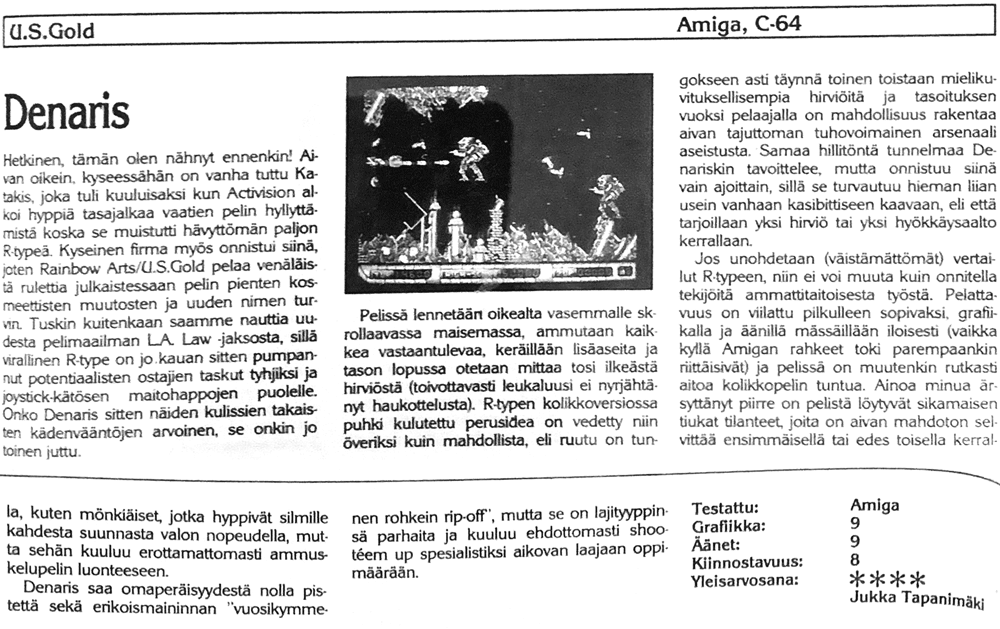
Denaris1989 SyksyPysyvä linkkiHetkinen, tämän olen nähnyt ennenkin! Aivan oikein, kyseessähän on vanha tuttu Katakis, joka tuli kuuluisaksi kun Activision alkoi hyppiä tasajalkaa vaatien pelin hyllyttämistä koska se muistutti hävyttömän paljon R-typeä. Kyseinen firma myös onnistui siinä, joten Rainbow Arts/U.S.Gold pelaa venäläistä rulettia julkaistessaan pelin pienten kosmeettisten muutosten ja uuden nimen turvin. Tuskin kuitenkaan saamme nauttia uudesta pelimaailman L.A. Law -jaksosta, sillä virallinen R-type on jo kauan sitten pumpannut potentiaalisten ostajien taskut tyhjiksi ja joystick-kätösen maitohappojen puolelle. Onko Denaris sitten näiden kulissien takaisten kädenvääntöjen arvoinen, se onkin jo toinen juttu.
Pelissä lennetään oikealta vasemmalle skrollaavassa maisemassa, ammutaan kaikkea vastaantulevaa, keräillään lisäaseita ja tason lopussa otetaan mittaa tosi ilkeästä hirviöstä (toivottavasti leukaluusi ei nyrjähtänyt haukottelusta). R-typen kolikkoversiossa puhki kulutettu perusidea on vedetty niin överiksi kuin mahdollista, eli ruutu on tungokseen asti täynnä toinen toistaan mielikuvituksellisempia hirviöitä ja tasoituksen vuoksi pelaajalla on mahdollisuus rakentaa aivan tajuttoman tuhovoimainen arsenaali aseistusta. Samaa hillitöntä tunnelmaa Denariskin tavoittelee, mutta onnistuu siinä vain ajoittain, sillä se turvautuu hieman liian usein vanhaan kasibittiseen kaavaan, eli että tarjoillaan yksi hirviö tai yksi hyökkäysaalto kerrallaan.
Jos unohdetaan (väistämättömät) vertailut R-typeen, niin ei voi muuta kuin onnitella tekijöitä ammattitaitoisesta työstä. Pelattavuus on viilattu pilkulleen sopivaksi, grafiikalla ja äänillä mässäillään iloisesti (vaikka kyllä Amigan rahkeet toki parempaankin riittäisivät) ja pelissä on muutenkin rutkasti aitoa kolikkopelin tuntua. Ainoa minua ärsyttänyt piirre on pelistä löytyvät sikamaisen tiukat tilanteet, joita on aivan mahdoton selvittää ensimmäisellä tai edes toisella kerralla, kuten mönkiäiset, jotka hyppivät silmille kahdesta suunnasta valon nopeudella, mutta sehän kuuluu erottamattomasti ammuskelupelin luonteeseen.
Denaris saa omaperäisyydestä nolla pistettä sekä erikoismaininnan "vuosikymmenen rohkein rip-off", mutta se on lajityyppinsä parhaita ja kuuluu ehdottomasti shoot'em up spesialistiksi aikovan laajaan oppimäärään.
Denaris1989 SyksyPermalinkHang on, I've seen this before! Quite right, it's none other than our old acquaintance Katakis, which became famous when Activision started jumping up and down demanding that the game be shelved because it resembled R-type so shamelessly. The company in question succeeded, too, so Rainbow Arts/U.S.Gold are playing Russian roulette by releasing the game with only a few small cosmetic changes and a new name to protect them. We're hardly likely to be treated to a new games-world episode of L.A. Law, though, since the official R-type long ago pumped potential buyers' pockets empty and their joystick paws full of lactic acid. Whether Denaris is worth all this behind-the-scenes arm-wrestling is another matter altogether.
In the game you fly through a landscape scrolling from right to left, shoot everything that comes your way, collect extra weapons, and at the end of the level square up to a really nasty monster (hopefully you didn't dislocate your jaw yawning). In the R-type coin-op the worn-to-death basic idea was taken as far over the top as possible, meaning the screen is packed to bursting with monsters each more imaginative than the last, and to balance things out the player gets to build up a mind-bogglingly destructive arsenal of weaponry. Denaris too goes for the same unbridled atmosphere, but only pulls it off now and then, since it falls back a little too often on the old 8-bit formula of serving up one monster or one attack wave at a time.
If we forget the (inevitable) comparisons with R-type, there's nothing to do but congratulate the makers on a professional job. The playability has been fine-tuned to a T, the graphics and sound are gleefully laid on thick (although the Amiga certainly has the muscle for even better) and in other respects too the game has loads of genuine coin-op feel. The only feature that annoyed me is the game's swinishly tight situations, which are utterly impossible to get through the first or even the second time, such as the crawlies that leap at your face from two directions at the speed of light, but then that's an inseparable part of the nature of a shoot-em-up.
Denaris gets zero points for originality plus a special mention as "the boldest rip-off of the decade", but it is one of the best of its genre and definitely belongs on the advanced syllabus of anyone aiming to become a shoot'em up specialist.
Desert Fox
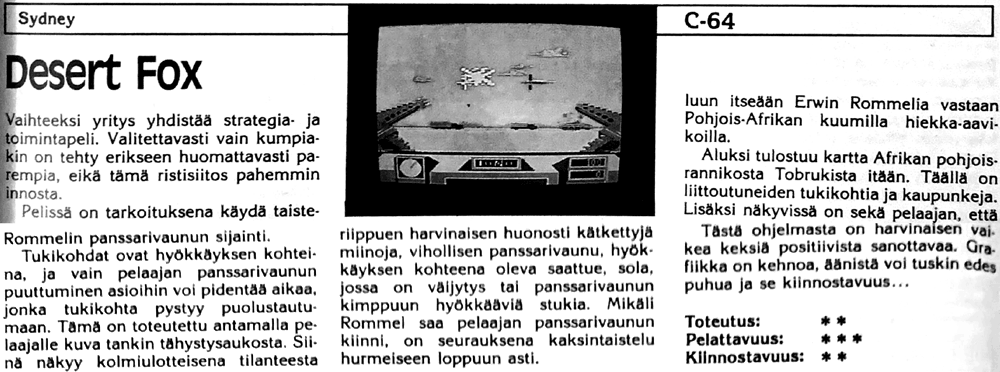
Desert Fox1987Pysyvä linkkiVaihteeksi yritys yhdistää strategia- ja toimintapeli. Valitettavasti vain kumpiakin on tehty erikseen huomattavasti parempia, eikä tämä ristisiitos pahemmin innosta.
Pelissä on tarkoituksena käydä taisteluun itseään Erwin Rommelia vastaan Pohjois-Afrikan kuumilla hiekka-aavikoilla.
Aluksi tulostuu kartta Afrikan pohjoisrannikosta Tobrukista itään. Täällä on liittoutuneiden tukikohtia ja kaupunkeja. Lisäksi näkyvissä on sekä pelaajan, että Rommelin panssarivaunun sijainti.
Tukikohdat ovat hyökkäyksen kohteina, ja vain pelaajan panssarivaunun puuttuminen asioihin voi pidentää aikaa, jonka tukikohta pystyy puolustautumaan. Tämä on toteutettu antamalla pelaajalle kuva tankin tähystysaukosta. Siinä näkyy kolmiulotteisena tilanteesta riippuen harvinaisen huonosti kätkettyjä miinoja, vihollisen panssarivaunu, hyökkäyksen kohteena oleva saattue, sola, jossa on väijytys tai panssarivaunun kimppuun hyökkääviä stukia. Mikäli Rommel saa pelaajan panssarivaunun kiinni, on seurauksena kaksintaistelu hurmeiseen loppuun asti.
Tästä ohjelmasta on harvinaisen vaikea keksiä positiivista sanottavaa. Grafiikka on kehnoa, äänistä voi tuskin edes puhua ja se kiinnostavuus...
Desert Fox1987PermalinkFor a change, here's an attempt to combine a strategy game and an action game. Unfortunately, considerably better examples of both have been made separately, and this crossbreed doesn't exactly set the pulse racing.
The aim of the game is to go into battle against none other than Erwin Rommel himself on the hot sand deserts of North Africa.
First up, a map is displayed of the North African coast from Tobruk eastwards. Here there are Allied bases and towns. Also shown are the positions of both the player's tank and Rommel's.
The bases are under attack, and only the intervention of the player's tank can extend the time a base is able to hold out. This has been done by giving the player a view through the tank's vision slit. Depending on the situation, it shows in 3D some remarkably badly hidden mines, an enemy tank, a convoy under attack, a pass with an ambush waiting in it, or Stukas going for the tank. If Rommel catches up with the player's tank, the result is a duel to the bloody end.
It is remarkably hard to come up with anything positive to say about this program. The graphics are poor, the sound is hardly even worth talking about, and as for how interesting it is...
Desolator
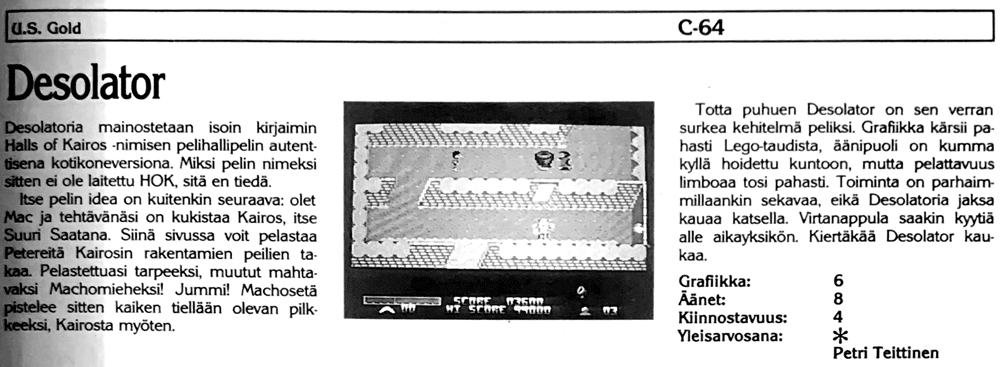
Desolator1988Pysyvä linkkiDesolatoria mainostetaan isoin kirjaimin Halls of Kairos -nimisen pelihallipelin autenttisena kotikoneversiona. Miksi pelin nimeksi sitten ei ole laitettu HOK, sitä en tiedä.
Itse pelin idea on kuitenkin seuraava: olet Mac ja tehtävänäsi on kukistaa Kairos, itse Suuri Saatana. Siinä sivussa voit pelastaa Petereitä Kairosin rakentamien peilien takaa. Pelastettuasi tarpeeksi, muutut mahtavaksi Machomieheksi! Jummi! Machosetä pistelee sitten kaiken tiellään olevan pilkkeeksi, Kairosta myöten.
Totta puhuen Desolator on sen verran surkea kehitelmä peliksi. Grafiikka kärsii pahasti Lego-taudista, äänipuoli on kumma kyllä hoidettu kuntoon, mutta pelattavuus limboaa tosi pahasti. Toiminta on parhaimmillaankin sekavaa, eikä Desolatoria jaksa kauaa katsella. Virtanappula saakin kyytiä alle aikayksikön. Kiertäkää Desolator kaukaa.
Desolator1988PermalinkDesolator is advertised in big capital letters as the authentic home computer version of an arcade game called Halls of Kairos. Why the game wasn't then named HOK, I don't know.
Anyway, the idea of the game itself is as follows: you are Mac and your task is to overthrow Kairos, the Great Satan himself. On the side, you can rescue Peters from behind the mirrors Kairos has built. Once you've rescued enough of them, you turn into the mighty Macho Man! Golly! Uncle Macho then chops everything in his path into kindling, Kairos included.
To tell the truth, Desolator is a pretty miserable contraption of a game. The graphics suffer badly from Lego disease, the sound side has, strangely enough, been sorted out, but the playability limbos really, really low. The action is muddled even at its best, and you can't stand looking at Desolator for long. So the power switch gets a workout in under one unit of time. Give Desolator a wide berth.
Destiny Knight, The
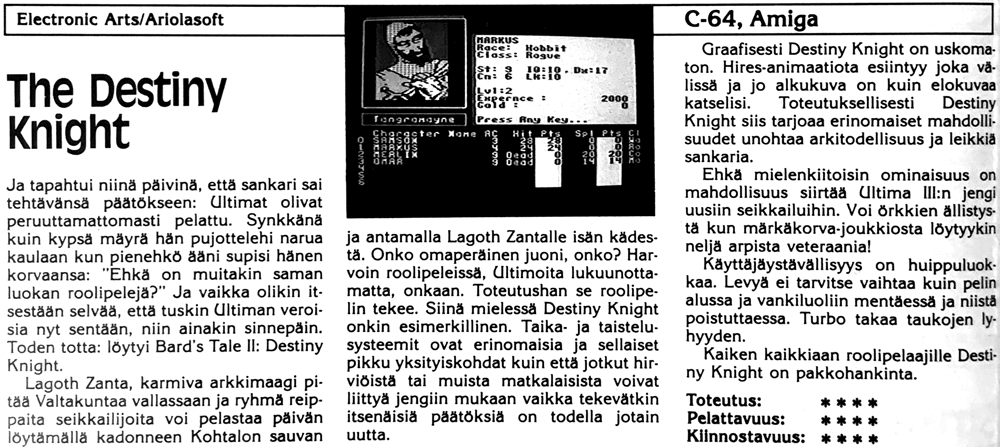
Destiny Knight, The1987Pysyvä linkkiJa tapahtui niinä päivinä, että sankari sai tehtävänsä päätökseen: Ultimat olivat peruuttamattomasti pelattu. Synkkänä kuin kypsä mäyrä hän pujottelehi narua kaulaan kun pienehkö ääni supisi hänen korvaansa: "Ehkä on muitakin saman luokan roolipelejä?" Ja vaikka olikin itsestään selvää, että tuskin Ultiman veroisia nyt sentään, niin ainakin sinnepäin. Toden totta: löytyi Bard's Tale II: Destiny Knight.
Lagoth Zanta, karmiva arkkimaagi pitää Valtakuntaa vallassaan ja ryhmä reippaita seikkailijoita voi pelastaa päivän löytämällä kadonneen Kohtalon sauvan ja antamalla Lagoth Zantalle isän kädestä. Onko omaperäinen juoni, onko? Harvoin roolipeleissä, Ultimoita lukuunottamatta, onkaan. Toteutushan se roolipelin tekee. Siinä mielessä Destiny Knight onkin esimerkillinen. Taika- ja taistelusysteemit ovat erinomaisia ja sellaiset pikku yksityiskohdat kuin että jotkut hirviöistä tai muista matkalaisista voivat liittyä jengiin mukaan vaikka tekevätkin itsenäisiä päätöksiä on todella jotain uutta.
Graafisesti Destiny Knight on uskomaton. Hires-animaatiota esiintyy joka välissä ja jo alkukuva on kuin elokuvaa katselisi. Toteutuksellisesti Destiny Knight siis tarjoaa erinomaiset mahdollisuudet unohtaa arkitodellisuus ja leikkiä sankaria.
Ehkä mielenkiitoisin ominaisuus on mahdollisuus siirtää Ultima III:n jengi uusiin seikkailuihin. Voi örkkien ällistystä kun märkäkorva-joukkiosta löytyykin neljä arpista veteraania!
Käyttäjäystävällisyys on huippuluokkaa. Levyä ei tarvitse vaihtaa kuin pelin alussa ja vankiluoliin mentäessä ja niistä poistuttaessa. Turbo takaa taukojen lyhyyden.
Kaiken kaikkiaan roolipelaajille Destiny Knight on pakkohankinta.
Destiny Knight, The1987PermalinkAnd it came to pass in those days that the hero brought his task to its end: the Ultimas were irrevocably played through. Glum as a fed-up badger, he was threading a noose about his neck when a smallish voice whispered unto his ear: "Maybe there are other role-playing games in the same class?" And though it was self-evident that there would hardly be any quite the equal of Ultima, there might at least be something close. Verily: there was found Bard's Tale II: Destiny Knight.
Lagoth Zanta, a gruesome archmage, holds the Realm in his power, and a band of plucky adventurers can save the day by finding the lost Destiny Wand and giving Lagoth Zanta a good spanking. Original plot, or what? Then again, role-playing games rarely have one, the Ultimas excepted. It's the execution that makes a role-playing game, after all. And in that respect Destiny Knight is exemplary. The magic and combat systems are excellent, and little details like some of the monsters or other travellers being able to join the gang, even though they make their own decisions, are something genuinely new.
Graphically Destiny Knight is incredible. There's hi-res animation at every turn, and even the opening picture is like watching a film. In terms of execution, then, Destiny Knight offers an excellent chance to forget everyday reality and play the hero.
Perhaps the most interesting feature is the option of transferring your Ultima III gang into new adventures. Oh, the orcs' amazement when that wet-behind-the-ears bunch turns out to include four scarred veterans!
The user-friendliness is top class. You only need to swap disks at the start of the game and when entering and leaving the dungeons. The turbo keeps the pauses short.
All in all, for role-players Destiny Knight is a must-buy.
Destroyer
Destroyer1988Pysyvä linkkiOnhan se ihan mukavaa, kun vanhoja klassikoita käännetään uusille koneille, mutta aika on kyllä pahasti ajanut Destroyerin ohitse. Ohjelman toteutuksesta tulevat lähinnä mieleen jotkut Beach Headin osat, ja kun grafiikassa ei ole hyödynnetty Amigan tarjoamia mahdollisuuksia siinä missä ohjauksessa on unohdettu hiiri lähes kokonaan, ei voi kuin ihmetellä sitä, miksi Epyx tuhlaa voimavarojaan tällaiseen ohjelmaan.
Idealtaan Destroyer on perinteinen laivastosimulaatio. Pelaaja sijoitetaan toisen maailmansodan aikaisen hävittäjän kapteeniksi tehtävänään jahdata sukellusveneitä, pinta-aluksia tai lentokoneita. Valitettavasti vain tekninen toteutus on niin karkeaa jälkeä, että minkäänlaista tunnelmaa ei pääse syntymään, tai sitten asenteisiin vaikuttavat Up Periscopen kaltaiset mestariteokset.
Destroyer1988PermalinkIt's nice enough, of course, when old classics are converted to new machines, but time has well and truly overtaken Destroyer. The program's execution mostly brings to mind certain parts of Beach Head, and when the graphics fail to exploit the possibilities the Amiga offers, just as the controls all but forget the mouse, you can only wonder why Epyx wastes its resources on a program like this.
In concept, Destroyer is a traditional naval simulation. The player is made captain of a Second World War destroyer, with the task of hunting submarines, surface ships or aircraft. Unfortunately the technical execution is such crude work that no atmosphere of any kind gets a chance to develop - or else one's attitude is coloured by masterpieces like Up Periscope.
Diablo
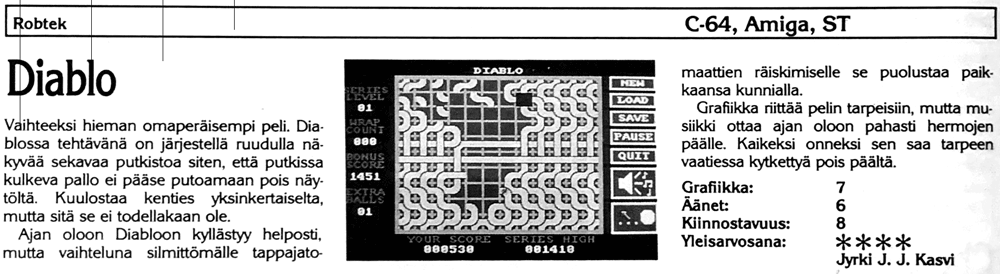
Diablo1988Pysyvä linkkiVaihteeksi hieman omaperäisempi peli. Diablossa tehtävänä on järjestellä ruudulla näkyvää sekavaa putkistoa siten, että putkissa kulkeva pallo ei pääse putoamaan pois näytöltä. Kuulostaa kenties yksinkertaiselta, mutta sitä se ei todellakaan ole.
Ajan oloon Diabloon kyllästyy helposti, mutta vaihteluna silmittömälle tappajatomaattien räiskimiselle se puolustaa paikkaansa kunnialla.
Grafiikka riittää pelin tarpeisiin, mutta musiikki ottaa ajan oloon pahasti hermojen päälle. Kaikeksi onneksi sen saa tarpeen vaatiessa kytkettyä pois päältä.
Diablo1988PermalinkFor a change, a somewhat more original game. In Diablo the task is to arrange the tangled pipework shown on screen so that the ball travelling through the pipes can't fall off the screen. Sounds simple, perhaps, but it really isn't.
In the long run you get bored of Diablo easily, but as a change from mindlessly blasting killer tomatoes it more than earns its place.
The graphics are adequate for the game's needs, but in the long run the music gets badly on your nerves. Luckily, it can be switched off when need be.
Die Hard
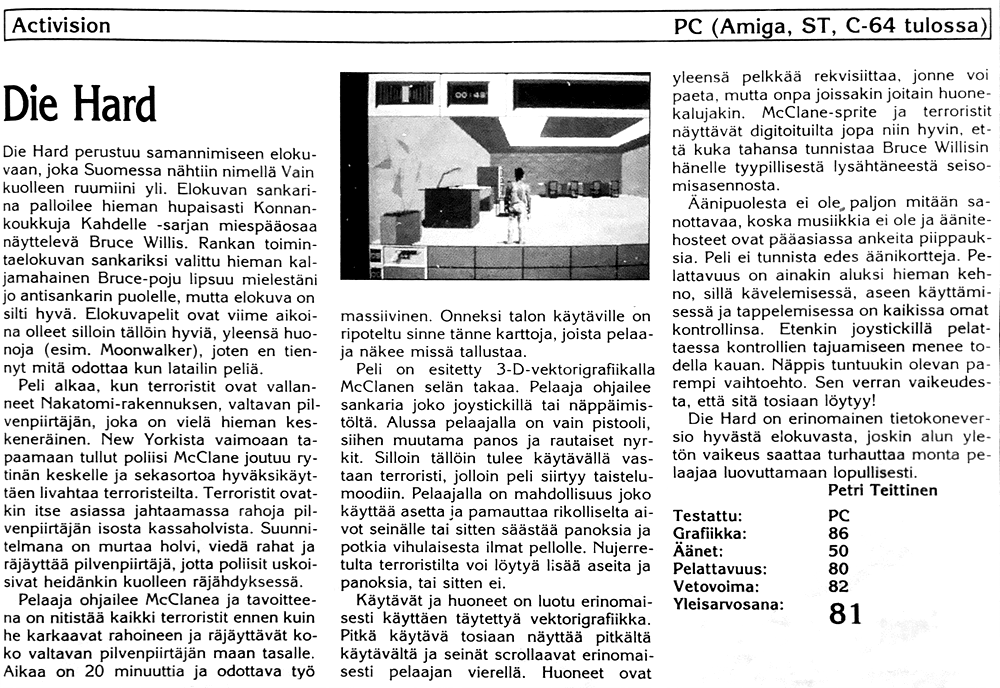
Die Hard1990 SyksyPysyvä linkkiDie Hard perustuu samannimiseen elokuvaan, joka Suomessa nähtiin nimellä Vain kuolleen ruumiini yli. Elokuvan sankarina palloilee hieman hupaisasti Konnankoukkuja Kahdelle -sarjan miespääosaa näyttelevä Bruce Willis. Rankan toimintaelokuvan sankariksi valittu hieman kaljamahainen Bruce-poju lipsuu mielestäni jo antisankarin puolelle, mutta elokuva on silti hyvä. Elokuvapelit ovat viime aikoina olleet silloin tällöin hyviä, yleensä huonoja (esim. Moonwalker), joten en tiennyt mitä odottaa kun latailin peliä.
Peli alkaa, kun terroristit ovat vallanneet Nakatomi-rakennuksen, valtavan pilvenpiirtäjän, joka on vielä hieman keskeneräinen. New Yorkista vaimoaan tapaamaan tullut poliisi McClane joutuu rytinän keskelle ja sekasortoa hyväksikäyttäen livahtaa terroristeilta. Terroristit ovatkin itse asiassa jahtaamassa rahoja pilvenpiirtäjän isosta kassaholvista. Suunnitelmana on murtaa holvi, viedä rahat ja räjäyttää pilvenpiirtäjä, jotta poliisit uskoisivat heidänkin kuolleen räjähdyksessä.
Pelaaja ohjailee McClanea ja tavoitteena on nitistää kaikki terroristit ennen kuin he karkaavat rahoineen ja räjäyttävät koko valtavan pilvenpiirtäjän maan tasalle. Aikaa on 20 minuuttia ja odottava työ massiivinen. Onneksi talon käytäville on ripoteltu sinne tänne karttoja, joista pelaaja näkee missä tallustaa.
Peli on esitetty 3-D-vektorigrafiikalla McClanen selän takaa. Pelaaja ohjailee sankaria joko joystickillä tai näppäimistöltä. Alussa pelaajalla on vain pistooli, siihen muutama panos ja rautaiset nyrkit. Silloin tällöin tulee käytävällä vastaan terroristi, jolloin peli siirtyy taistelumoodiin. Pelaajalla on mahdollisuus joko käyttää asetta ja pamauttaa rikolliselta aivot seinälle tai sitten säästää panoksia ja potkia vihulaisesta ilmat pellolle. Nujerretulta terroristilta voi löytyä lisää aseita ja panoksia, tai sitten ei.
Käytävät ja huoneet on luotu erinomaisesti käyttäen täytettyä vektorigrafiikka. Pitkä käytävä tosiaan näyttää pitkältä käytävältä ja seinät scrollaavat erinomaisesti pelaajan vierellä. Huoneet ovat yleensä pelkkää rekvisiittaa, jonne voi paeta, mutta onpa joissakin joitain huonekalujakin. McClane-sprite ja terroristit näyttävät digitoituilta jopa niin hyvin, että kuka tahansa tunnistaa Bruce Willisin hänelle tyypillisestä lysähtäneestä seisomisasennosta.
Äänipuolesta ei ole paljon mitään sanottavaa, koska musiikkia ei ole ja äänitehosteet ovat pääasiassa ankeita piippauksia. Peli ei tunnista edes äänikortteja. Pelattavuus on ainakin aluksi hieman kehno, sillä kävelemisessä, aseen käyttämisessä ja tappelemisessa on kaikissa omat kontrollinsa. Etenkin joystickillä pelattaessa kontrollien tajuamiseen menee todella kauan. Näppis tuntuukin olevan parempi vaihtoehto. Sen verran vaikeudesta, että sitä tosiaan löytyy!
Die Hard on erinomainen tietokoneversio hyvästä elokuvasta, joskin alun yletön vaikeus saattaa turhauttaa monta pelaajaa luovuttamaan lopullisesti.
Die Hard1990 SyksyPermalinkDie Hard is based on the film of the same name, which was shown in Finland under the title Vain kuolleen ruumiini yli. Bumbling about somewhat comically as the film's hero is Bruce Willis, the male lead of the Konnankoukkuja Kahdelle series. Picked as the hero of a tough action film, the slightly beer-bellied Bruce-boy in my opinion already slips over into anti-hero territory, but the film is good all the same. Movie games have lately been good now and then, usually bad (e.g. Moonwalker), so I didn't know what to expect as I loaded up the game.
The game begins when terrorists have seized the Nakatomi building, a huge skyscraper that is still slightly unfinished. Policeman McClane, who has come from New York to see his wife, ends up in the middle of the ruckus and, taking advantage of the chaos, slips away from the terrorists. The terrorists are in fact after the money in the skyscraper's big vault. The plan is to crack the vault, take the money and blow up the skyscraper, so that the police would believe they too had died in the explosion.
The player steers McClane, and the goal is to bump off all the terrorists before they run off with the money and blow the whole huge skyscraper to the ground. There are 20 minutes on the clock and the job ahead is massive. Fortunately maps have been scattered here and there in the building's corridors, from which the player can see where they are trudging.
The game is presented in 3-D vector graphics from behind McClane's back. The player controls the hero with either a joystick or the keyboard. At the start the player has only a pistol, a few rounds for it, and iron fists. Every now and then a terrorist comes at you down the corridor, at which point the game switches to combat mode. The player can either use the gun and blow the crook's brains onto the wall, or else save ammo and kick the wind clean out of the baddie. A defeated terrorist may yield more weapons and ammo, or then again may not.
The corridors and rooms have been created excellently using filled vector graphics. A long corridor really does look like a long corridor, and the walls scroll excellently alongside the player. The rooms are usually mere props that you can flee into, but some of them even have a bit of furniture. The McClane sprite and the terrorists look digitised, so well in fact that anyone would recognise Bruce Willis from his characteristic slumped stance.
There isn't much of anything to say about the sound side, because there is no music and the sound effects are mainly dismal beeps. The game doesn't even recognise sound cards. The playability is a bit poor, at least at first, since walking, using the gun and fighting each have their own controls. Especially when playing with a joystick it takes a really long time to get the hang of the controls. The keyboard does seem to be the better option. As for difficulty, suffice it to say there's certainly plenty of it!
Die Hard is an excellent computer version of a good film, although the excessive difficulty at the start may frustrate many a player into giving up for good.
DNA Warrior
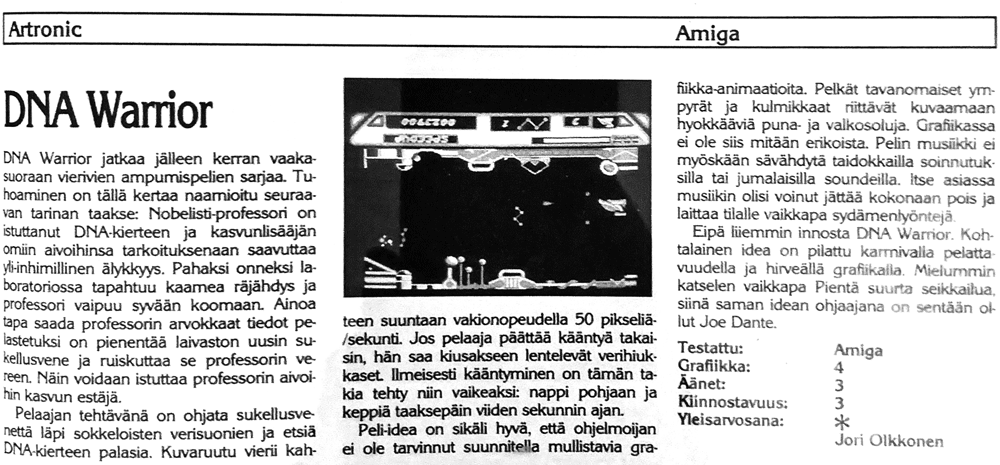
DNA Warrior1989 SyksyPysyvä linkkiDNA Warrior jatkaa jälleen kerran vaakasuoraan vierivien ampumispelien sarjaa. Tuhoaminen on tällä kertaa naamioitu seuraavan tarinan taakse: Nobelisti-professori on istuttanut DNA-kierteen ja kasvunlisääjän omiin aivoihinsa tarkoituksenaan saavuttaa yli-inhimillinen älykkyys. Pahaksi onneksi laboratoriossa tapahtuu kaamea räjähdys ja professori vaipuu syvään koomaan. Ainoa tapa saada professorin arvokkaat tiedot pelastetuksi on pienentää laivaston uusin sukellusvene ja ruiskuttaa se professorin vereen. Näin voidaan istuttaa professorin aivoihin kasvun estäjä.
Pelaajan tehtävänä on ohjata sukellusvenettä läpi sokkeloisten verisuonien ja etsiä DNA-kierteen palasia. Kuvaruutu vierii kahteen suuntaan vakionopeudella 50 pikseliä/sekunti. Jos pelaaja päättää kääntyä takaisin, hän saa kiusakseen lentelevät verihiukkaset. Ilmeisesti kääntyminen on tämän takia tehty niin vaikeaksi: nappi pohjaan ja keppiä taaksepäin viiden sekunnin ajan.
Peli-idea on sikäli hyvä, että ohjelmoijan ei ole tarvinnut suunnitella mullistavia grafiikka-animaatioita. Pelkät tavanomaiset ympyrät ja kulmikkaat riittävät kuvaamaan hyokkääviä puna- ja valkosoluja. Grafiikassa ei ole siis mitään erikoista. Pelin musiikki ei myöskään sävähdytä taidokkailla soinnutuksilla tai jumalaisilla soundeilla. Itse asiassa musiikin olisi voinut jättää kokonaan pois ja laittaa tilalle vaikkapa sydämenlyöntejä.
Eipä liiemmin innosta DNA Warrior. Kohtalainen idea on pilattu karmivalla pelattavuudella ja hirveällä grafiikalla. Mielummin katselen vaikkapa Pientä suurta seikkailua, siinä saman idean ohjaajana on sentään ollut Joe Dante.
DNA Warrior1989 SyksyPermalinkDNA Warrior once again carries on the line of horizontally scrolling shoot-em-ups. This time the destruction has been disguised behind the following story: a Nobel-laureate professor has implanted a DNA helix and a growth enhancer into their own brain with the aim of achieving superhuman intelligence. As bad luck would have it, a horrific explosion occurs in the laboratory and the professor sinks into a deep coma. The only way to rescue the professor's valuable knowledge is to shrink the navy's newest submarine and inject it into the professor's bloodstream. That way a growth inhibitor can be implanted into the professor's brain.
The player's task is to steer the submarine through the labyrinthine blood vessels and look for pieces of the DNA helix. The screen scrolls in two directions at a constant speed of 50 pixels per second. If the player decides to turn back, they get pestered by blood corpuscles flying about. Apparently that is why turning around has been made so difficult: button held down and stick pulled back for five seconds.
The game idea is good insofar as the programmer hasn't had to design any revolutionary graphic animations. Plain ordinary circles and angular shapes are enough to depict the attacking red and white blood cells. So there is nothing special about the graphics. Nor does the game's music thrill you with skilful harmonies or divine sounds. In fact the music could have been left out entirely and replaced with, say, heartbeats.
DNA Warrior doesn't exactly get me fired up. A middling idea has been ruined by dreadful playability and horrible graphics. I'd rather watch, say, Innerspace - at least that one had Joe Dante directing the same idea.
Dogfight 2187
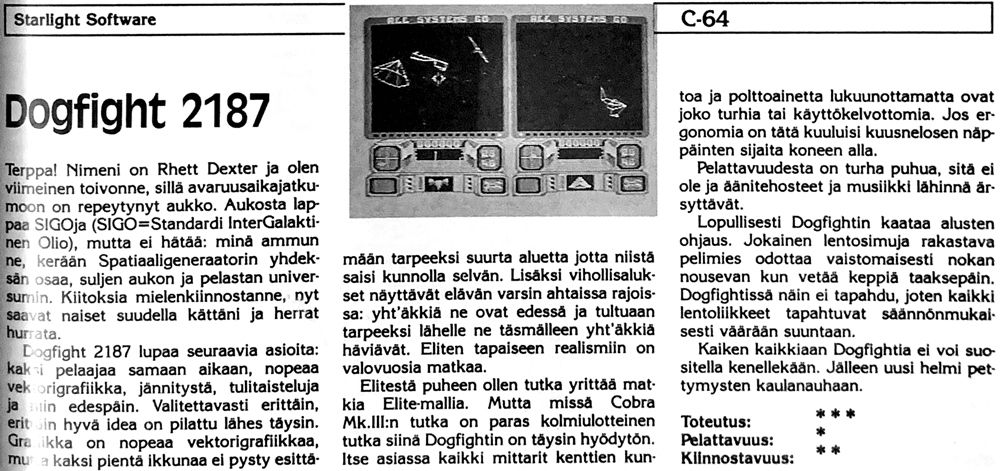
Dogfight 21871987Pysyvä linkkiTerppa! Nimeni on Rhett Dexter ja olen viimeinen toivonne, sillä avaruusaikajatkumoon on repeytynyt aukko. Aukosta lappaa SIGOja (SIGO=Standardi InterGalaktinen Olio), mutta ei hätää: minä ammun ne, kerään Spatiaaligeneraattorin yhdeksän osaa, suljen aukon ja pelastan universumin. Kiitoksia mielenkiinnostanne, nyt saavat naiset suudella kättäni ja herrat hurrata.
Dogfight 2187 lupaa seuraavia asioita: kaksi pelaajaa samaan aikaan, nopeaa vektorigrafiikkaa, jännitystä, tulitaisteluja ja niin edespäin. Valitettavasti erittäin, erittäin hyvä idea on pilattu lähes täysin. Grafiikka on nopeaa vektorigrafiikkaa, mutta kaksi pientä ikkunaa ei pysty esittämään tarpeeksi suurta aluetta jotta niistä saisi kunnolla selvän. Lisäksi vihollisalukset näyttävät elävän varsin ahtaissa rajoissa: yht'äkkiä ne ovat edessä ja tultuaan tarpeeksi lähelle ne täsmälleen yht'äkkiä häviävät. Eliten tapaiseen realismiin on valovuosia matkaa.
Elitestä puheen ollen tutka yrittää matkia Elite-mallia. Mutta missä Cobra Mk.III:n tutka on paras kolmiulotteinen tutka siinä Dogfightin on täysin hyödytön. Itse asiassa kaikki mittarit kenttien kuntoa ja polttoainetta lukuunottamatta ovat joko turhia tai käyttökelvottomia. Jos ergonomia on tätä kuuluisi kuusnelosen näppäinten sijaita koneen alla.
Pelattavuudesta on turha puhua, sitä ei ole ja äänitehosteet ja musiikki lähinnä ärsyttävät.
Lopullisesti Dogfightin kaataa alusten ohjaus. Jokainen lentosimuja rakastava pelimies odottaa vaistomaisesti nokan nousevan kun vetää keppiä taaksepäin. Dogfightissä näin ei tapahdu, joten kaikki lentoliikkeet tapahtuvat säännönmukaisesti väärään suuntaan.
Kaiken kaikkiaan Dogfightia ei voi suositella kenellekään. Jälleen uusi helmi pettymysten kaulanauhaan.
Dogfight 21871987PermalinkHowdy! My name is Rhett Dexter and I am your last hope, because a hole has been torn in the space-time continuum. SIGOs (SIGO = Standard InterGalactic Organism) are pouring out of the hole, but never fear: I'll shoot them, collect the nine parts of the Spatial Generator, close the hole and save the universe. Thank you for your interest, the ladies may now kiss my hand and the gentlemen may cheer.
Dogfight 2187 promises the following: two players at the same time, fast vector graphics, excitement, shootouts and so on. Unfortunately, a very, very good idea has been almost completely ruined. The graphics are fast vector graphics, but two small windows can't show a large enough area for you to make proper sense of them. On top of that, the enemy ships seem to live within pretty cramped limits: all of a sudden they're in front of you, and once they get close enough they vanish every bit as suddenly. Elite-style realism is light years away.
Speaking of Elite, the radar tries to copy the Elite model. But where the Cobra Mk.III's radar is the best 3D radar there is, Dogfight's is completely useless. In fact, all the gauges apart from shield status and fuel are either pointless or unusable. If this is ergonomics, then the Commodore 64's keys ought to be on the underside of the machine.
There's no point talking about playability, because there isn't any, and the sound effects and music are mostly just irritating.
What finally sinks Dogfight is the ship controls. Every gamer who loves flight sims instinctively expects the nose to come up when pulling the stick back. In Dogfight that doesn't happen, so every flight manoeuvre, as a rule, goes the wrong way.
All in all, Dogfight can't be recommended to anyone. Yet another pearl on the necklace of disappointments.
Dogs of War
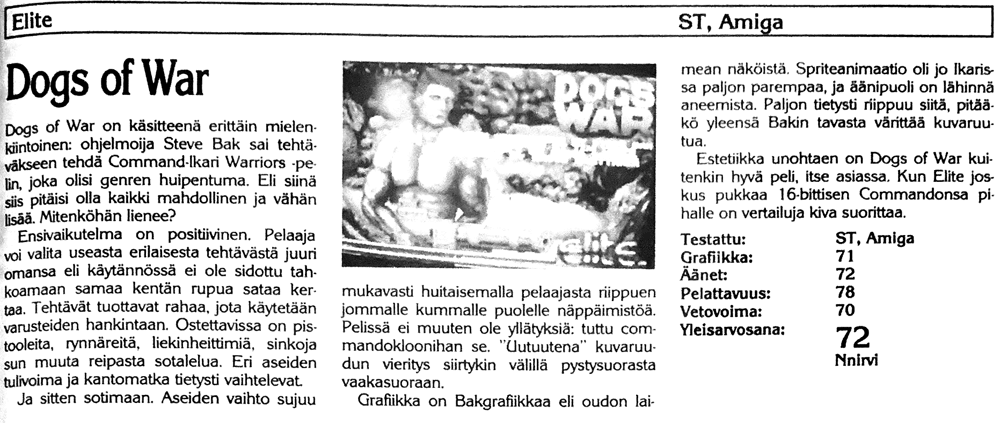
Dogs of War1990 KevätPysyvä linkkiDogs of War on käsitteenä erittäin mielenkiintoinen: ohjelmoija Steve Bak sai tehtäväkseen tehdä Command-Ikari Warriors -pelin, joka olisi genren huipentuma. Eli siinä siis pitäisi olla kaikki mahdollinen ja vähän lisää. Mitenköhän lienee?
Ensivaikutelma on positiivinen. Pelaaja voi valita useasta erilaisesta tehtävästä juuri omansa eli käytännössä ei ole sidottu tahkoamaan samaa kentän rupua sataa kertaa. Tehtävät tuottavat rahaa, jota käytetään varusteiden hankintaan. Ostettavissa on pistooleita, rynnäreitä, liekinheittimiä, sinkoja sun muuta reipasta sotalelua. Eri aseiden tulivoima ja kantomatka tietysti vaihtelevat.
Ja sitten sotimaan. Aseiden vaihto sujuu mukavasti huitaisemalla pelaajasta riippuen jommalle kummalle puolelle näppäimistöä. Pelissä ei muuten ole yllätyksiä: tuttu commandokloonihan se. "Uutuutena" kuvaruudun vieritys siirtyin välillä pystysuorasta vaakasuoraan.
Grafiikka on Bakgrafiikkaa eli oudon laimean näköistä. Spriteanimaatio oli jo Ikarissa paljon parempaa, ja äänipuoli on lähinnä aneemista. Paljon tietysti riippuu siitä, pitääkö yleensä Bakin tavasta värittää kuvaruutua.
Estetiikka unohtaen on Dogs of War kuitenkin hyvä peli, itse asiassa. Kun Elite joskus pukkaa 16-bittisen Commandonsa pihalle on vertailuja kiva suorittaa.
Dogs of War1990 KevätPermalinkAs a concept, Dogs of War is extremely interesting: programmer Steve Bak was given the job of making a Command-Ikari Warriors game that would be the culmination of the genre. So, in other words, it was supposed to have everything possible and a bit more besides. I wonder how that turned out?
The first impression is positive. The player can pick just the one they want from several different missions, so in practice you're not stuck grinding through the same crummy level a hundred times. The missions earn money, which is spent on buying equipment. Up for sale are pistols, assault rifles, flamethrowers, bazookas and all sorts of other jolly war toys. The firepower and range of the different weapons vary, of course.
And then off to war. Switching weapons goes nicely by taking a swipe at one side of the keyboard or the other, depending on which player you are. Otherwise the game holds no surprises: it's the same old commando clone, after all. As a "novelty", the screen scrolling switches now and then from vertical to horizontal.
The graphics are Bak graphics, meaning strangely washed-out looking. The sprite animation was already much better back in Ikari, and the sound side is anaemic at best. A lot depends, of course, on whether you like Bak's way of colouring the screen in general.
Aesthetics aside, though, Dogs of War is a good game, as a matter of fact. When Elite someday pushes its 16-bit Commando out the door, it'll be fun to run some comparisons.
Domination

Domination1990 SyksyPysyvä linkkiDomination on erikoislaatuinen pelityylien sekasotku. Ensisilmäyksellä se näyttää Marble Madnessin, Spindizzyn ynnä muiden abstraktien pallonvierittelypelin tapaiselta taitopeliltä, mutta itse asiassa se onkin taktinen sotapeli, jossa päämääränä on vastustajan päämajan tuhoaminen. Kummallakin pelaajalla on puolen tusinaa droidia, joista yhtä voi ohjata, muut määrätään valmiiksi ohjelmoituihin kuvioihin, kuten hyökkäykseen, puolustukseen tai lepoon.
Paperilla idea näyttää loistavalta, mutta jotain on pahasti pielessä. Pitkän peli-istunnon aikana seuloin läpi useita kenttiä, voitin muutamia eriä, päivittelin droideja lisävarusteilla ja muutenkin vietin teoriassa hauskoja hetkiä, mutta rehellisesti sanottuna ei ollut yhtään hauskaa, itse asiassa olin pitkästyä hengiltä. Jostain syystä idea ei toimi käytännössä.
Pitkällisen analysoinnin jälkeen olen päätynyt siihen, että syynä täytyy olla pelin joka rakosesta pilkistävä amatöörimäisyys. Ällöttävän töhryisen grafiikan voi antaa anteeksi, varsinkin kun pelikenttä sentään vierii hyväksyttävän sujuvasti joka suuntaan, mutta kaikki muu onkin enemmän tai vähemmän hämärästi toteutettua. Kun droidit kerran ampuvat haukotuttavan rennossa tempossa, niin voisi sentään näyttää ruudulla, milloin ase on valmis uuteen kutiin. Voisivat tietokoneen droidit helpoimmallakin tasolla käyttäytyä edes näennäisen järkevästi, sen sijaan että loikkisivat reunojen yli tyhjyyteen. Olisi mukavampaa, jos ansaitsemansa välineet voisi jaella droideille rauhassa, eikä älyttömän aikarajan stressaamana. Ja sitä rataa, melkein kaikesta löytyy jotain pientä valitettavaa.
Hyvä idea huonosti toteutettuna on yhtä kuin keskinkertainen peli.
Domination1990 SyksyPermalinkDomination is a peculiar hodgepodge of game styles. At first glance it looks like a skill game along the lines of Marble Madness, Spindizzy and other abstract ball-rolling games, but in fact it's a tactical war game in which the aim is to destroy the opponent's headquarters. Each player has half a dozen droids, one of which you can control, while the others are assigned to preprogrammed patterns such as attack, defence or rest.
On paper the idea looks brilliant, but something is badly wrong. During a long gaming session I sifted through several levels, won a few rounds, upgraded droids with extra equipment and generally spent some theoretically fun moments, but to be honest it wasn't any fun at all; in fact I nearly bored myself to death. For some reason the idea doesn't work in practice.
After lengthy analysis I've come to the conclusion that the reason must be the amateurishness peeking out of every crack in the game. The disgustingly smeary graphics can be forgiven, especially since the playfield at least scrolls acceptably smoothly in every direction, but everything else is more or less dodgily implemented. Since the droids fire at such a yawn-inducingly relaxed tempo, the screen could at least show when the gun is ready for another round. Surely the computer's droids could, even on the easiest level, behave at least seemingly sensibly, instead of leaping over the edges into the void. It would be nicer if you could hand out the equipment you've earned to your droids in peace, rather than stressed out by an absurd time limit. And so on and so forth: there's some little thing to complain about in almost everything.
A good idea badly executed equals a mediocre game.
Dominator
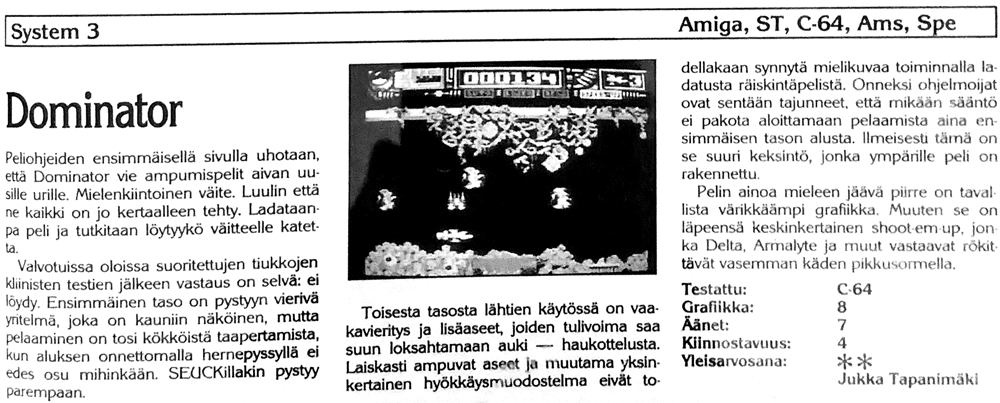
Dominator1989 SyksyPysyvä linkkiPeliohjeiden ensimmäisellä sivulla uhotaan, että Dominator vie ampumispelit aivan uusille urille. Mielenkiintoinen väite. Luulin että ne kaikki on jo kertaalleen tehty. Ladataanpa peli ja tutkitaan löytyykö väitteelle katetta.
Valvotuissa oloissa suoritettujen tiukkojen kliinisten testien jälkeen vastaus on selvä: ei löydy. Ensimmäinen taso on pystyyn vierivä yritelmä, joka on kauniin näköinen, mutta pelaaminen on tosi kökköistä taapertamista, kun aluksen onnettomalla hernepyssyllä ei edes osu mihinkään. SEUCKillakin pystyy parempaan.
Toisesta tasosta lähtien käytössä on vaakavieritys ja lisäaseet, joiden tulivoima saa suun loksahtamaan auki - haukottelusta. Laiskasti ampuvat aseet ja muutama yksinkertainen hyökkäysmuodostelma eivät todellakaan synnytä mielikuvaa toiminnalla ladatusta räiskintäpelistä. Onneksi ohjelmoijat ovat sentään tajunneet, että mikään sääntö ei pakota aloittamaan pelaamista aina ensimmäisen tason alusta. Ilmeisesti tämä on se suuri keksintö, jonka ympärille peli on rakennettu.
Pelin ainoa mieleen jäävä piirre on tavallista värikkäämpi grafiikka. Muuten se on läpeensä keskinkertainen shoot-em-up, jonka Delta, Armalyte ja muut vastaavat rökittävät vasemman käden pikkusormella.
Dominator1989 SyksyPermalinkThe first page of the game instructions boasts that Dominator takes shoot-em-ups down whole new paths. An interesting claim. I thought they'd all been trodden once already. Let's load up the game and see whether the claim has anything to back it up.
After rigorous clinical tests carried out under controlled conditions, the answer is clear: it doesn't. The first level is a vertically scrolling effort that looks pretty, but playing it is a really clunky toddle, since the ship's pitiful peashooter doesn't even hit anything. You could do better even with SEUCK.
From the second level on there's horizontal scrolling and extra weapons whose firepower makes your jaw drop - from yawning. Lazily firing weapons and a handful of simple attack formations really don't conjure up the image of a blaster loaded with action. Luckily the programmers have at least realised that no rule forces you to always start playing from the beginning of the first level. Apparently this is the great invention around which the game has been built.
The game's only memorable feature is its more-colourful-than-usual graphics. Otherwise it's a thoroughly mediocre shoot-em-up that Delta, Armalyte and their ilk can thrash with one hand tied behind their back.
Donald Duck's Playground
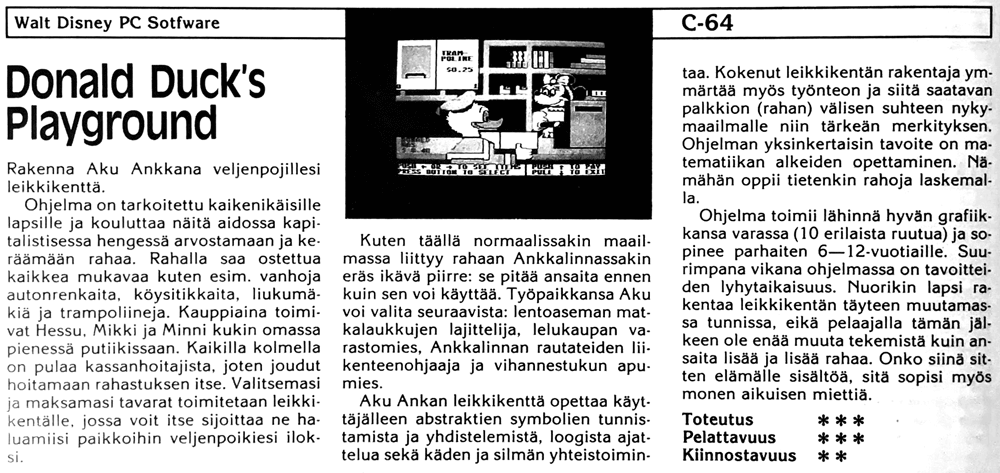
Donald Duck's Playground1987Pysyvä linkkiRakenna Aku Ankkana veljenpojillesi leikkikenttä.
Ohjelma on tarkoitettu kaikenikäisille lapsille ja kouluttaa näitä aidossa kapitalistisessa hengessä arvostamaan ja keräämään rahaa. Rahalla saa ostettua kaikkea mukavaa kuten esim. vanhoja autonrenkaita, köysitikkaita, liukumäkiä ja trampoliineja. Kauppiaina toimivat Hessu, Mikki ja Minni kukin omassa pienessä putiikissaan. Kaikilla kolmella on pulaa kassanhoitajista, joten joudut hoitamaan rahastuksen itse. Valitsemasi ja maksamasi tavarat toimitetaan leikkikentälle, jossa voit itse sijoittaa ne haluamiisi paikkoihin veljenpoikiesi iloksi.
Kuten täällä normaalissakin maailmassa liittyy rahaan Ankkalinnassakin eräs ikävä piirre: se pitää ansaita ennenkuin sen voi käyttää. Työpaikkansa Aku voi valita seuraavista: lentoaseman matkalaukkujen lajittelija, lelukaupan varastomies, Ankkalinnan rautateiden liikenteenohjaaja ja vihannestukun apumies.
Aku Ankan leikkikenttä opettaa käyttäjälleen abstraktien symbolien tunnistamista ja yhdistelemistä, loogista ajattelua sekä käden ja silmän yhteistoimintaa. Kokenut leikkikentän rakentaja ymmärtää myös työnteon ja siitä saatavan palkkion (rahan) välisen suhteen nykymaailmalle niin tärkeän merkityksen. Ohjelman yksinkertaisin tavoite on matematiikan alkeiden opettaminen. Nämähän oppii tietenkin rahoja laskemalla.
Ohjelma toimii lähinnä hyvän grafiikkansa varassa (10 erilaista ruutua) ja sopinee parhaiten 6-12-vuotiaille. Suurimpana vikana ohjelmassa on tavoitteiden lyhytaikaisuus. Nuorikin lapsi rakentaa leikkikentän täyteen muutamassa tunnissa, eikä pelaajalla tämän jälkeen ole enää muuta tekemistä kuin ansaita lisää ja lisää rahaa. Onko siinä sitten elämälle sisältöä, sitä sopisi myös monen aikuisen miettiä.
Donald Duck's Playground1987PermalinkAs Donald Duck, build a playground for your nephews.
The program is meant for children of all ages and trains them, in the true capitalist spirit, to value and collect money. Money buys you all sorts of nice things, such as old car tyres, rope ladders, slides and trampolines. The shopkeepers are Goofy, Mickey and Minnie, each in their own little boutique. All three are short of cashiers, so you have to take the money yourself. The goods you pick and pay for are delivered to the playground, where you can place them wherever you like, to the delight of your nephews.
Just as here in the normal world, money in Duckburg comes with one unpleasant feature: you have to earn it before you can spend it. Donald can choose his job from the following: airport suitcase sorter, toy shop stockroom man, Duckburg railway traffic controller and vegetable wholesaler's helper.
Donald Duck's Playground teaches its user to recognise and combine abstract symbols, logical thinking and hand-eye coordination. The seasoned playground builder also comes to understand the significance, so vital in today's world, of the relationship between work and the reward (money) it earns. The program's simplest aim is to teach the basics of mathematics. Which, of course, you learn by counting money.
The program gets by mainly on its good graphics (10 different screens) and is probably best suited to 6-12-year-olds. The program's biggest flaw is how short-lived its goals are. Even a young child fills the playground up in a few hours, and after that the player has nothing left to do but earn more and more money. Whether that gives life any meaning is something many a grown-up might do well to ponder too.
Double Dragon II
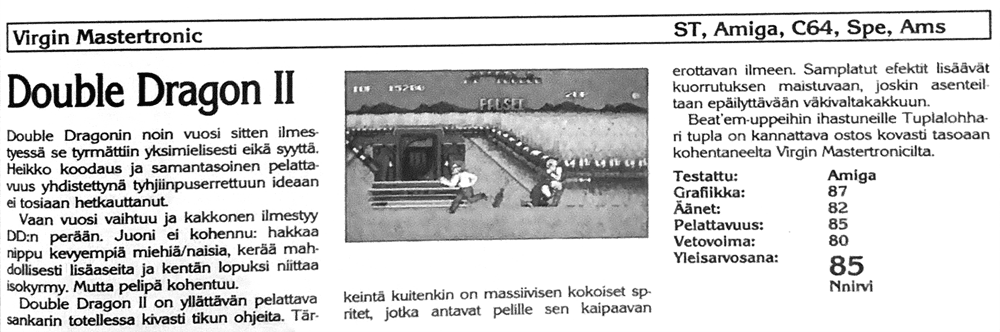
Double Dragon II1990 KevätPysyvä linkkiDouble Dragonin noin vuosi sitten ilmestyessä se tyrmättiin yksimielisesti eikä syyttä. Heikko koodaus ja samantasoinen pelattavuus yhdistettynä tyhjiinpuserrettuun ideaan ei tosiaan hetkauttanut.
Vaan vuosi vaihtuu ja kakkonen ilmestyy DD:n perään. Juoni ei kohennu: hakkaa nippu kevyempiä miehiä/naisia, kerää mahdollisesti lisäaseita ja kentän lopuksi niittaa isokyrmy. Mutta pelipä kohentuu.
Double Dragon II on yllättävän pelattava sankarin totellessa kivasti tikun ohjeita. Tärkeintä kuitenkin on massiivisen kokoiset spritet, jotka antavat pelille sen kaipaavan erottavan ilmeen. Samplatut efektit lisäävät kuorrutuksen maistuvaan, joskin asenteiltaan epäilyttävään väkivaltakakkuun.
Beat'em-uppeihin ihastuneille Tuplalohhari tupla on kannattava ostos kovasti tasoaan kohentaneelta Virgin Mastertronicilta.
Double Dragon II1990 KevätPermalinkWhen Double Dragon came out about a year ago it was unanimously panned, and not without reason. Weak coding and playability to match, combined with an idea squeezed completely dry, really didn't move anyone.
But the year turns and the sequel follows hot on DD's heels. The plot doesn't improve: beat up a bunch of lightweight men/women, maybe pick up some extra weapons, and at the end of the level flatten the big bruiser. But the game, now - that does improve.
Double Dragon II is surprisingly playable, with the hero nicely obeying the stick's commands. Most important of all, though, are the massive sprites, which give the game the distinctive look it needed. The sampled effects add the icing to a tasty, if attitudinally dubious, cake of violence.
For those smitten with beat'em-ups, Double Draggie Double is a worthwhile purchase from Virgin Mastertronic, who have raised their standards a great deal.
Double Dribble
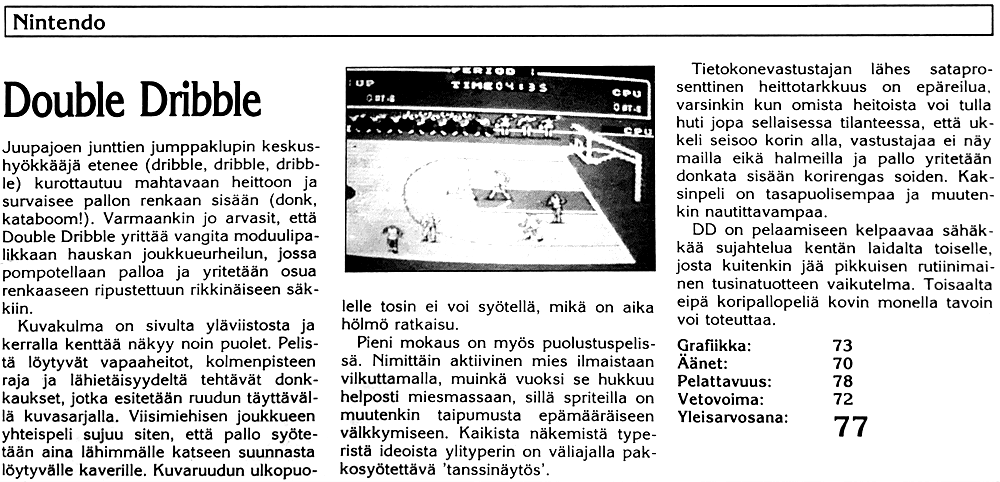
Double Dribble1990 SyksyPysyvä linkkiJuupajoen junttien jumppaklupin keskushyökkääjä etenee (dribble, dribble, dribble) kurottautuu mahtavaan heittoon ja survaisee pallon renkaan sisään (donk, kataboom!). Varmaankin jo arvasit, että Double Dribble yrittää vangita moduulipalikkaan hauskan joukkueurheilun, jossa pompotellaan palloa ja yritetään osua renkaaseen ripustettuun rikkinäiseen säkkiin.
Kuvakulma on sivulta yläviistosta ja kerralla kenttää näkyy noin puolet. Pelistä löytyvät vapaaheitot, kolmenpisteen raja ja lähietäisyydeltä tehtävät donkkaukset, jotka esitetään ruudun täyttävällä kuvasarjalla. Viisimiehisen joukkueen yhteispeli sujuu siten, että pallo syötetään aina lähimmälle katseen suunnasta löytyvälle kaverille. Kuvaruudun ulkopuolelle tosin ei voi syötellä, mikä on aika hölmö ratkaisu.
Pieni mokaus on myös puolustuspelissä. Nimittäin aktiivinen mies ilmaistaan vilkuttamalla, muinkä vuoksi se hukkuu helposti miesmassaan, sillä spriteilla on muutenkin taipumusta epämääräiseen välkkymiseen. Kaikista näkemistä typeristä ideoista ylityperin on väliajalla pakkosyötettävä 'tanssinäytös'.
Tietokonevastustajan lähes sataprosenttinen heittotarkkuus on epäreilua, varsinkin kun omista heitoista voi tulla huti jopa sellaisessa tilanteessa, että ukkeli seisoo korin alla, vastustajaa ei näy mailla eikä halmeilla ja pallo yritetään donkata sisään korirengas soiden. Kaksinpeli on tasapuolisempaa ja muutenkin nautittavampaa.
DD on pelaamiseen kelpaavaa sähäkkää sujahtelua kentän laidalta toiselle, josta kuitenkin jää pikkuisen rutiinimainen tusinatuotteen vaikutelma. Toisaalta eipä koripallopeliä kovin monella tavoin voi toteuttaa.
Double Dribble1990 SyksyPermalinkThe centre forward of the Juupajoki Hicks' Gym Club advances (dribble, dribble, dribble), stretches for a mighty shot and rams the ball through the hoop (donk, kataboom!). You've probably guessed by now that Double Dribble tries to capture on a cartridge that fun team sport where you bounce a ball about and try to hit a torn sack hung from a hoop.
The view is from the side and diagonally above, and about half the court is visible at a time. The game has free throws, the three-point line and close-range dunks, which are shown as a full-screen animation sequence. Teamwork in the five-man team works so that the ball is always passed to the nearest teammate in the direction you're facing. You can't pass off-screen, though, which is a pretty daft decision.
There's a small slip-up in the defensive game too. The thing is, the active man is indicated by flashing, which is why it easily gets lost in the crowd of players, since the sprites have a tendency to flicker vaguely as it is. Of all the stupid ideas I've seen, the stupidest of the lot is the 'dance show' that gets force-fed to you at half-time.
The computer opponent's almost hundred-percent shooting accuracy is unfair, especially as your own shots can miss even in a situation where your little guy is standing under the basket, there's neither hide nor hair of an opponent, and the ball is being dunked in with the rim ringing. Two-player mode is fairer and more enjoyable anyway.
DD is playable, zippy whizzing from one side of the court to the other, which nevertheless leaves a slightly routine, dime-a-dozen impression. Then again, there aren't all that many ways you can do a basketball game.
Dr. Doom's Revenge
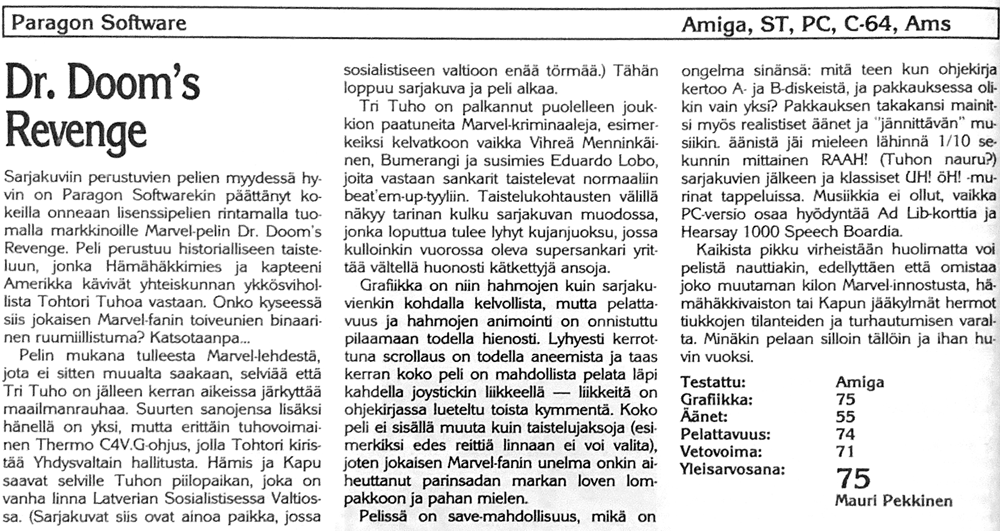
Dr. Doom's Revenge1990 KevätPysyvä linkkiSarjakuviin perustuvien pelien myydessä hyvin on Paragon Softwarekin päättänyt kokeilla onneaan lisenssipelien rintamalla tuomalla markkinoille Marvel-pelin Dr. Doom's Revenge. Peli perustuu historialliseen taisteluun, jonka Hämähäkkimies ja kapteeni Amerikka kävivät yhteiskunnan ykkösvihollista Tohtori Tuhoa vastaan. Onko kyseessä siis jokaisen Marvel-fanin toiveunien binaarinen ruumiillistuma? Katsotaanpa...
Pelin mukana tulleesta Marvel-lehdestä, jota ei sitten muualta saakaan, selviää että Tri Tuho on jälleen kerran aikeissa järkyttää maailmanrauhaa. Suurten sanojensa lisäksi hänellä on yksi, mutta erittäin tuhovoimainen Thermo C4V.G-ohjus, jolla Tohtori kiristää Yhdysvaltain hallitusta. Hämis ja Kapu saavat selville Tuhon piilopaikan, joka on vanha linna Latverian Sosialistisessa Valtiossa. (Sarjakuvat siis ovat ainoa paikka, jossa sosialistiseen valtioon enää törmää.) Tähän loppuu sarjakuva ja peli alkaa.
Tri Tuho on palkannut puolelleen joukkion paatuneita Marvel-kriminaaleja, esimerkeiksi kelvatkoon vaikka Vihreä Menninkäinen, Bumerangi ja susimies Eduardo Lobo, joita vastaan sankarit taistelevat normaaliin beat'em-up-tyyliin. Taistelukohtausten välillä näkyy tarinan kulku sarjakuvan muodossa, jonka loputtua tulee lyhyt kujanjuoksu, jossa kulloinkin vuorossa oleva supersankari yrittää vältellä huonosti kätkettyjä ansoja.
Grafiikka on niin hahmojen kuin sarjakuvienkin kohdalla kelvollista, mutta pelattavuus ja hahmojen animointi on onnistuttu pilaamaan todella hienosti. Lyhyesti kerrottuna scrollaus on todella aneemista ja taas kerran koko peli on mahdollista pelata läpi kahdella joystickin liikkeellä - liikkeitä on ohjekirjassa lueteltu toista kymmentä. Koko peli ei sisällä muuta kuin taistelujaksoja (esimerkiksi edes reittiä linnaan ei voi valita), joten jokaisen Marvel-fanin unelma onkin aiheuttanut parinsadan markan loven lompakkoon ja pahan mielen.
Pelissä on save-mahdollisuus, mikä on ongelma sinänsä: mitä teen kun ohjekirja kertoo A- ja B-diskeistä, ja pakkauksessa olikin vain yksi? Pakkauksen takakansi mainitsi myös realistiset äänet ja "jännittävän" musiikin. äänistä jäi mieleen lähinnä 1/10 sekunnin mittainen RAAH! (Tuhon nauru?) sarjakuvien jälkeen ja klassiset UH! öH! -murinat tappeluissa. Musiikkia ei ollut, vaikka PC-versio osaa hyödyntää Ad Lib-korttia ja Hearsay 1000 Speech Boardia.
Kaikista pikku virheistään huolimatta voi pelistä nauttiakin, edellyttäen että omistaa joko muutaman kilon Marvel-innostusta, hämähäkkivaiston tai Kapun jääkylmät hermot tiukkojen tilanteiden ja turhautumisen varalta. Minäkin pelaan silloin tällöin ja ihan huvin vuoksi.
Dr. Doom's Revenge1990 KevätPermalinkWith games based on comics selling well, Paragon Software too has decided to try its luck on the licensed-game front by bringing out a Marvel game, Dr. Doom's Revenge. The game is based on the historic battle that Spider-Man and Captain America fought against society's public enemy number one, Doctor Doom. So is this the binary embodiment of every Marvel fan's wildest dreams? Let's have a look...
The Marvel comic that comes with the game, which you can't get anywhere else, reveals that Dr. Doom is once again about to shake world peace. Besides his big words he has one, but extremely destructive, Thermo C4V.G missile, with which the Doctor is blackmailing the United States government. Spidey and Cap find out Doom's hideout, which is an old castle in the Socialist State of Latveria. (So comics are the only place where you still run into a socialist state.) This is where the comic ends and the game begins.
Dr. Doom has hired a gang of hardened Marvel criminals to his side - the Green Goblin, Boomerang and the werewolf Eduardo Lobo will do as examples - whom the heroes fight in normal beat'em-up style. Between the fight scenes the story unfolds in comic-strip form, and when that's over comes a short gauntlet in which whichever superhero's turn it is tries to dodge badly hidden traps.
The graphics are passable, for the characters and the comic strips alike, but they've managed to ruin the playability and the character animation really splendidly. To put it briefly, the scrolling is truly anaemic, and once again the whole game can be played through with two joystick moves - the manual lists more than ten. The whole game contains nothing but fight sequences (you can't even choose your route to the castle, for example), so every Marvel fan's dream has turned out to mean a couple-of-hundred-mark dent in the wallet and a bad mood.
The game has a save option, which is a problem in itself: what do I do when the manual talks about an A disk and a B disk, and there turned out to be only one in the box? The back of the box also mentioned realistic sound and "exciting" music. Of the sounds, what mostly stuck in my mind was a RAAH! lasting a tenth of a second (Doom's laugh?) after the comic strips and the classic UH! ÖH! grunts in the fights. There was no music, even though the PC version can make use of the Ad Lib card and the Hearsay 1000 Speech Board.
Despite all its little flaws the game can actually be enjoyed, provided you possess either a few kilos of Marvel enthusiasm, a spider-sense, or Cap's ice-cold nerves to cope with tight spots and frustration. I play it now and then myself, just for fun.
Dragon Wars
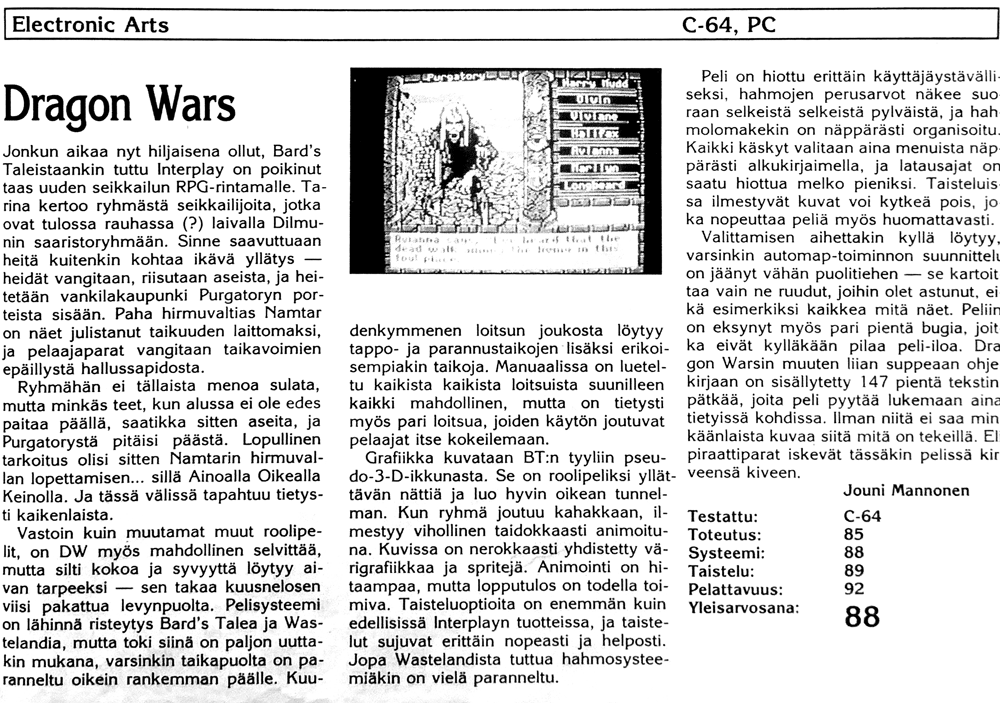
Dragon Wars1990 SyksyPysyvä linkkiJonkun aikaa nyt hiljaisena ollut, Bard's Taleistaankin tuttu Interplay on poikinut taas uuden seikkailun RPG-rintamalle. Tarina kertoo ryhmästä seikkailijoita, jotka ovat tulossa rauhassa (?) laivalla Dilmunin saaristoryhmään. Sinne saavuttuaan heitä kuitenkin kohtaa ikävä yllätys - heidät vangitaan, riisutaan aseista, ja heitetään vankilakaupunki Purgatoryn porteista sisään. Paha hirmuvaltias Namtar on näet julistanut taikuuden laittomaksi, ja pelaajaparat vangitaan taikavoimien epäillystä hallussapidosta.
Ryhmähän ei tällaista menoa sulata, mutta minkäs teet, kun alussa ei ole edes paitaa päällä, saatikka sitten aseita, ja Purgatorystä pitäisi päästä. Lopullinen tarkoitus olisi sitten Namtarin hirmuvallan lopettamisen... sillä Ainoalla Oikealla Keinolla. Ja tässä välissä tapahtuu tietysti kaikenlaista.
Vastoin kuin muutamat muut roolipelit, on DW myös mahdollinen selvittää, mutta silti kokoa ja syvyyttä löytyy aivan tarpeeksi - sen takaa kuusnelosen viisi pakattua levynpuolta. Pelisysteemi on lähinnä risteytys Bard's Talea ja Wastelandia, mutta toki siinä on paljon uuttakin mukana, varsinkin taikapuolta on paranneltu oikein rankemman päälle. Kuudenkymmenen loitsun joukosta löytyy tappo- ja parannustaikojen lisäksi erikoisempiakin taikoja. Manuaalissa on lueteltu kaikista kaikista loitsuista suunilleen kaikki mahdollinen, mutta on tietysti myös pari loitsua, joiden käytön joutuvat pelaajat itse kokeilemaan.
Grafiikka kuvataan BT:n tyyliin pseudo-3-D-ikkunasta. Se on roolipeliksi yllättävän nättiä ja luo hyvin oikean tunnelman. Kun ryhmä joutuu kahakkaan, ilmestyy vihollinen taidokkaasti animoituna. Kuvissa on nerokkaasti yhdistetty värigrafiikkaa ja spritejä. Animointi on hitaampaa, mutta lopputulos on todella toimiva. Taisteluoptioita on enemmän kuin edellisissä Interplayn tuotteissa, ja taistelut sujuvat erittäin nopeasti ja helposti. Jopa Wastelandista tuttua hahmosysteemiäkin on vielä paranneltu.
Peli on hiottu erittäin käyttäjäystävälliseksi, hahmojen perusarvot näkee suoraan selkeistä selkeistä pylväistä, ja hahmolomakekin on näppärästi organisoitu. Kaikki käskyt valitaan aina menuista näppärästi alkukirjaimella, ja latausajat on saatu hiottua melko pieniksi. Taisteluissa ilmestyvät kuvat voi kytkeä pois, joka nopeuttaa peliä myös huomattavasti.
Valittamisen aihettakin kyllä löytyy, varsinkin automap-toiminnon suunnittelu on jäänyt vähän puolitiehen - se kartoittaa vain ne ruudut, joihin olet astunut, eikä esimerkiksi kaikkea mitä näet. Peliin on eksynyt myös pari pientä bugia, joitka eivät kylläkään pilaa peli-iloa. Dragon Warsin muuten liian suppeaan ohjekirjaan on sisällytetty 147 pientä tekstinpätkää, joita peli pyytää lukemaan aina tietyissä kohdissa. Ilman niitä ei saa minkäänlaista kuvaa siitä mitä on tekeillä. Eli piraattiparat iskevät tässäkin pelissä kirveensä kiveen.
Dragon Wars1990 SyksyPermalinkInterplay, quiet for some time now and familiar from its Bard's Tales among other things, has spawned yet another adventure on the RPG front. The story concerns a group of adventurers arriving in peace (?) by ship at the island group of Dilmun. Once there, however, they get a nasty surprise - they are captured, disarmed and thrown in through the gates of the prison city of Purgatory. The evil tyrant Namtar, you see, has declared magic illegal, and the poor players are locked up on suspicion of possessing magical powers.
Naturally the group won't swallow this kind of carry-on, but what can you do when at the start you haven't even got a shirt on your back, let alone weapons, and you're supposed to get out of Purgatory. The ultimate aim would then be to put an end to Namtar's tyranny... by the One Right Way. And in between, of course, all sorts of things happen.
Unlike a few other role-playing games, DW can actually be finished, yet there is still more than enough size and depth - five packed disk sides on the Commodore 64 guarantee that. The game system is basically a cross between Bard's Tale and Wasteland, but of course there's plenty that's new in it too; the magic side in particular has been beefed up in a serious way. Among the sixty spells there are, besides killing and healing spells, some rather more unusual ones as well. The manual lists just about everything there is to know about all the spells, but of course there are also a couple of spells whose use the players will have to find out by experimenting for themselves.
The graphics are shown BT-style through a pseudo-3-D window. For a role-playing game they're surprisingly pretty and do a fine job of creating just the right atmosphere. When the group gets into a skirmish, the enemy appears, skilfully animated. The pictures ingeniously combine colour graphics and sprites. The animation is slower, but the end result really works. There are more combat options than in Interplay's previous products, and fights go very quickly and easily. Even the character system familiar from Wasteland has been improved still further.
The game has been polished to be extremely user-friendly: you can read the characters' basic stats straight off clear bar graphs, and the character sheet is neatly organised too. All commands are always handily picked from menus by their initial letter, and the loading times have been trimmed down to fairly little. The pictures that appear during combat can be switched off, which also speeds the game up considerably.
There's certainly something to complain about as well; the design of the automap function in particular has been left a bit half-done - it only maps the squares you've actually stepped on, and not, for example, everything you can see. A couple of small bugs have also strayed into the game, though they don't spoil the fun of playing. Dragon Wars' otherwise far too skimpy manual contains 147 short snippets of text that the game asks you to read at certain points. Without them you get no idea whatsoever of what's going on. So the poor pirates will hit a brick wall with this game too.
Dragon's Breath

Dragon's Breath1990 SyksyPysyvä linkkiKeskellä Anrean kaunista valtakuntaa sijaitsee mahtava Kääpiövuori joka aikojen alusta saakka on ollut pahan pesäpaikka. Muuten kaikki olisi hyvin, mutta legendan mukaan Kääpiölinnan valtaistuinsalista on mahdollista löytää kuolemattomuuden salaisuus. Ei tässäkään vielä mitään, mutta kun Kääpiölinnaan pääsemiseksi täytyy kerätä ympäri maata ripotellut Talismanin palaset, jotka sijaitsevat todennäköisimmin juuri vihollisen mailla, niin sotahan siitä syntyy. Mikä voisikaan olla kunnon lohikäärmettä parempi ase? Dragon's Breathin idea on hiukka tavanomainen, mutta peli sitävastoin ei.
Dragon's Breathia voi pelata yhdestä kolmeen pelaajaa samanaikaisesti. Jos valitsee kaikki hahmot koneen ohjaamiksi, voi katsella peliä tekemättä mitään, mutta parempi vaihtoehto on odottaa jonkin aikaa alkuruudussa, jolloin näkee (ainakin ohjeitten mukaan) varsinaisen demon.
Hahmon valinnan ja salasanavarmistuksen jälkeen päästäänkin itse peliin käsiksi. Ensimmäisessä ruudussa näkyvät kaikkien kolmen pelaajan kuvat, sekä tilanteentallennus, -lataus ja quit -ikonit sekä tiimalasin kuva. Valitsemalla jonkin hahmoista tulee näkyviin kuva kyseisen henkilön linnasta maustettuna asiallisella taustamusiikilla ja läjällä uusia ikoneja. Tästä ruudusta käsin pelaaja voi antaa taistelukäskyjä, tarkastaa lohikäärmeidensä kunnon, hauduttaa lohikäärmeenmunia, tarkastaa kirjanpitonsa, taikoa, ostaa taikakaluja tai poistua ensimmäiseen valikkoon.
Klikkaamalla palloa saa kuvan Anreasta ylhäältäpäin katsottuna. Näkymää voi suurentaa haluamastaan kohdasta karttamaiseen muotoon, jolloin näkee kaikkien kylien nimet, asukasluvun ja myös tahtoessaan suurennetun kuvan. Halutessaan voi määrätä lohikäärmeen joko terroristi-iskulle tai valloittamaan jonkun kylän. Tästä ruudusta pääsee koko pelin ainoaan toimintamuotoiseen osaan lähettämällä louharinsa harjoitustehtävälle.
Valitsemalla päävalikosta lohikäärmeen silmän voi tarkastaa kaikkien kahdeksan lohikäärmeensä taisteluissa tulleet vauriot sekä ominaisuudet, kuten älykkyyden, näkökyvyn, sun muuta. Seuraavasta ikonista saa uuden valikon, jossa pelaaja asettaa haluamansa määrän munia haudutuskoneeseen ja säätää keittoajan. Mitä lyhyempi keittoaika, sen nopeammin lohikäärme kuoriutuu, mutta siitä tulee heikompi. Pidemmällä keittoajalla syntyy vastaavasti voimakkaampi ötökkä.
Naksauttamalla hiirellä päävalikossa kirjaa tulee näkyviin jälleen uusi ruutu. Kirjoista voi tarkistaa kirjanpitonsa, laskut, rahavarat sekä muut verotukseen liittyvät asiat, lukea uusimmat uutiset sekä urkkia omien taikaliemiensä lukumäärä. Jos sotkut pääsevät loppumaan, niitä voi ostaa lisää linnan ulkopuolella olevalta kauppiaalta. DB:ssä on myös taikajärjestelmä, joka on vaikea selittää mutta helppo tajuta. Taikaliemi sekoitetaan sotkemalla laboratorion hyllyltä eri aineita omituisen koneiston läpi putkiston päässä olevaan kuppiin. Matkalla aineita voi sekoittaa, leikata, muussata, lämmittää sekä jäähdyttää. Kaikki toimenpiteet vaikuttavat lopputulokseen, joka voi olla jopa koko laitteiston romuttuminen.
Kun jokainen pelaaja on tehnyt siirtonsa, siirrytään enimmäiseen ruutuun, jossa valitaan tiimalasi-optio. Tämän jälkeen otetaan mukava asento tuolissa ja katsellaan, mitä viimeisen kuukauden aikana on tapahtunut. Ruudusta näkee lohikäärmeiden hyökkäykset kyliin, munien mahdollisen kuoriutumisen sekä kylien tarjoamat palkkiot.
DB on toteutettu lähes kokonaan ikoniohjauksella, mikä onkin paras mahdollinen vaihtoehto tämäntyyliseen peliin. Pelaaminen on helppoa ja joustavaa, joskin runsaat lataamiset levykkeeltä tahmauttavat pelin kulkua. Lisämuistinkaan käyttö ei tunnu asiaa pahemmin auttavan.Musiikki on hiukan kuivahkoa, mutta sitä kuitenkin ennemmin kuuntelee kuin kääntää äänet pois päältä. Grafiikasta voi sanoa sen verran, että se on erittäin toimivaa ja hyvälaatuista, sellaista jota katselee mielellään.
Yksinkertaisuudestaan huolimatta DB on peli, joka antaa peli-iloa henkilöstä riippuen parista tunnista moneen viikkoon. Liekkejä, lentämistä, lohikäärmeitä, taikuutta, hyvää grafiikkaa ja keskinkertaisen pelin sisältää Dragon's Breath. Siis kaikkea kaikille mutta yhdelle ei paljoakaan.
Dragon's Breath1990 SyksyPermalinkIn the middle of the beautiful kingdom of Anrea stands the mighty Dwarf Mountain, which since the dawn of time has been a nest of evil. Otherwise all would be well, but according to legend the secret of immortality can be found in the throne room of Dwarf Castle. Nothing much in that either, but when getting into Dwarf Castle means collecting the pieces of the Talisman scattered around the land, which most likely lie right on enemy territory, then war is bound to break out. And what could be a better weapon than a good dragon? The idea of Dragon's Breath is a tad conventional, but the game itself, on the other hand, is not.
Dragon's Breath can be played by one to three players at the same time. If you make all the characters computer-controlled, you can watch the game without doing anything, but a better option is to wait a while on the title screen, whereupon you get to see (according to the instructions, at least) a proper demo.
After choosing your character and getting past the password check, you finally get your hands on the game itself. The first screen shows pictures of all three players, along with save-game, load-game and quit icons and a picture of an hourglass. Selecting one of the characters brings up a picture of that person's castle, seasoned with suitable background music and a pile of new icons. From this screen the player can give battle orders, check the condition of their dragons, incubate dragon eggs, check their accounts, cast spells, buy magic items or exit to the first menu.
Clicking on the globe gives you a view of Anrea from above. You can zoom in on any spot you like into a map-like view, where you can see the names of all the villages, their populations and, if you want, an enlarged picture as well. If you so wish, you can send a dragon either on a terrorist strike or to conquer some village. From this screen you also get into the only action-style part of the whole game, by sending your drake off on a training mission.
Selecting the dragon's eye from the main menu lets you check the damage all eight of your dragons have taken in battle, as well as their attributes, such as intelligence, eyesight and whatnot. The next icon brings up a new menu, in which the player puts as many eggs as they like into the incubating machine and sets the boiling time. The shorter the boiling time, the sooner the dragon hatches, but the weaker it turns out. A longer boiling time, correspondingly, produces a stronger critter.
Clicking the book in the main menu with the mouse brings up yet another new screen. In the books you can check your accounts, bills, funds and other tax-related matters, read the latest news and snoop out how many magic potions you have. If your concoctions run out, you can buy more from a merchant outside the castle. DB also has a magic system that is hard to explain but easy to grasp. A potion is mixed by sloshing various substances from the laboratory shelf through a weird contraption into a cup at the end of the piping. Along the way the ingredients can be mixed, cut, mashed, heated and cooled. Every step affects the end result, which may even be the whole apparatus getting wrecked.
Once every player has made their moves, you go to the first screen, where you choose the hourglass option. After that you settle comfortably into your chair and watch what has happened over the past month. The screen shows the dragons' attacks on villages, any eggs that may have hatched and the rewards offered by the villages.
DB is controlled almost entirely with icons, which is indeed the best possible option for a game of this style. Playing is easy and flexible, although the frequent loading from disk gums up the flow of the game. Even using extra memory doesn't seem to help matters much. The music is a bit on the dry side, but you'd still rather listen to it than turn the sound off. As for the graphics, suffice it to say that they're highly functional and of good quality, the sort you enjoy looking at.
Despite its simplicity, DB is a game that gives anything from a couple of hours to many weeks of fun, depending on the person. Flames, flying, dragons, magic, good graphics and a middling game - that's what Dragon's Breath contains. So, something for everyone, but not much for any one person.
Dragon's Lair
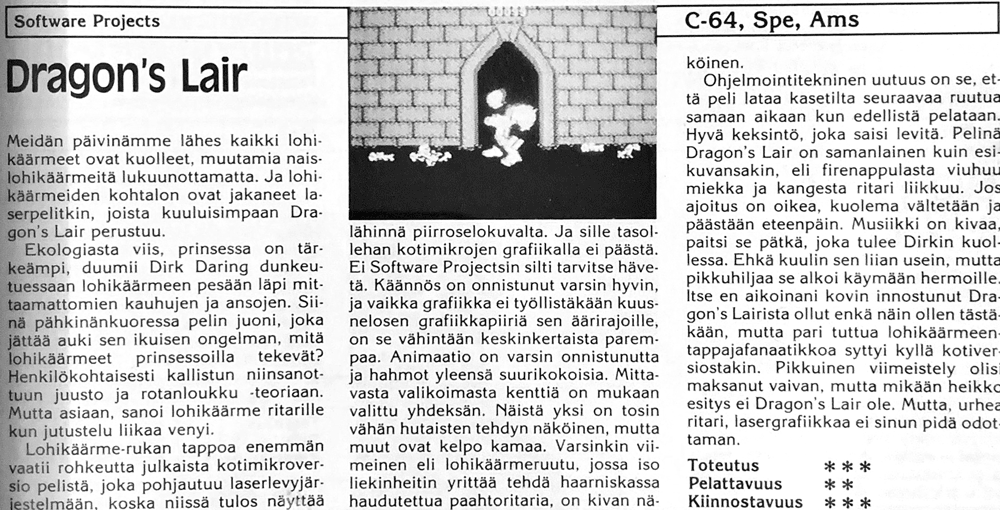
Dragon's Lair1987Pysyvä linkkiMeidän päivinämme lähes kaikki lohikäärmeet ovat kuolleet, muutamia naislohikäärmeitä lukuunottamatta. Ja lohikäärmeiden kohtalon ovat jakaneet laserpelitkin, joista kuuluisimpaan Dragon's Lair perustuu.
Ekologiasta viis, prinsessa on tärkeämpi, duumii Dirk Daring dunkeutuessaan lohikäärmeen pesään läpi mittaamattomien kauhujen ja ansojen. Siinä pähkinänkuoressa pelin juoni, joka jättää auki sen ikuisen ongelman, mitä lohikäärmeet prinsessoilla tekevät? Henkilökohtaisesti kallistun niinsanottuun juusto ja rotanloukku -teoriaan. Mutta asiaan, sanoi lohikäärme ritarille kun jutustelu liikaa venyi.
Lohikäärme-rukan tappoa enemmän vaatii rohkeutta julkaista kotimikroversio pelistä, joka pohjautuu laserlevyjärjestelmään, koska niissä tulos näyttää lähinnä piirroselokuvalta. Ja sille tasolehan kotimikrojen grafiikalla ei päästä. Ei Software Projectsin silti tarvitse hävetä. Käännös on onnistunut varsin hyvin, ja vaikka grafiikka ei työllistäkään kuusnelosen grafiikkapiiriä sen äärirajoille, on se vähintään keskinkertaista parempaa. Animaatio on varsin onnistunutta ja hahmot yleensä suurikokoisia. Mittavasta valikoimasta kenttiä on mukaan valittu yhdeksän. Näistä yksi on tosin vähän hutaisten tehdyn näköinen, mutta muut ovat kelpo kamaa. Varsinkin viimeinen eli lohikäärmeruutu, jossa iso liekinheitin yrittää tehdä haarniskassa haudutettua paahtoritaria, on kivan näköinen.
Ohjelmointitekninen uutuus on se, että peli lataa kasetilta seuraavaa ruutua samaan aikaan kun edellistä pelataan. Hyvä keksintö, joka saisi levitä. Pelinä Dragon's Lair on samanlainen kuin esikuvansakin, eli firenappulasta viuhuu miekka ja kangesta ritari liikkuu. Jos ajoitus on oikea, kuolema vältetään ja päästään eteenpäin. Musiikki on kivaa, paitsi se pätkä, joka tulee Dirkin kuollessa. Ehkä kuulin sen liian usein, mutta pikkuhiljaa se alkoi käymään hermoille. Itse en aikoinani kovin innostunut Dragon's Lairista ollut enkä näin ollen tästäkään, mutta pari tuttua lohikäärmeentappajafanaatikkoa syttyi kyllä kotiversiostakin. Pikkuinen viimeistely olisi maksanut vaivan, mutta mikään heikko esitys ei Dragon's Lair ole. Mutta, urhea ritari, lasergrafiikkaa ei sinun pidä odottaman.
Dragon's Lair1987PermalinkIn our day nearly all dragons are dead, apart from a few she-dragons. And the dragons' fate has also been shared by the laserdisc games, the most famous of which Dragon's Lair is based on.
Ecology be damned, the princess matters more, declares Dirk Daring as he delves into the dragon's den through untold horrors and traps. That, in a nutshell, is the plot of the game, and it leaves open that eternal question: what do dragons do with princesses? Personally I lean towards the so-called cheese-and-mousetrap theory. But down to business, as the dragon said to the knight when the small talk dragged on too long.
It takes more courage than killing some poor dragon to put out a home computer version of a game built on a laserdisc system, because on those the result looks more or less like an animated cartoon. And home computer graphics simply can't reach that level. Still, Software Projects has nothing to be ashamed of. The conversion has come off rather well, and even if the graphics don't push the Commodore 64's graphics chip to its absolute limits, they're at least better than average. The animation is very well done and the characters are mostly large. From the extensive selection of levels, nine have been picked for this. One of them, admittedly, looks a bit slapdash, but the rest are decent stuff. The last one in particular, the dragon screen, where a big flamethrower tries to turn you into roast knight braised in its own armour, looks nice.
The technical novelty in the programming is that the game loads the next screen from tape while you're playing the previous one. A good invention that deserves to catch on. As a game, Dragon's Lair is just like its original: the fire button swishes the sword and the joystick moves the knight. If the timing is right, death is avoided and you get further. The music is nice, except for the snippet that plays when Dirk dies. Maybe I heard it too often, but little by little it started getting on my nerves. I was never all that keen on Dragon's Lair back in the day, and so I'm not on this one either, but a couple of dragon-slaying fanatics I know certainly caught fire over the home version too. A little polish would have been worth the trouble, but Dragon's Lair is by no means a weak effort. But, brave knight, thou shalt not expect laser graphics.
Dragon's Lair
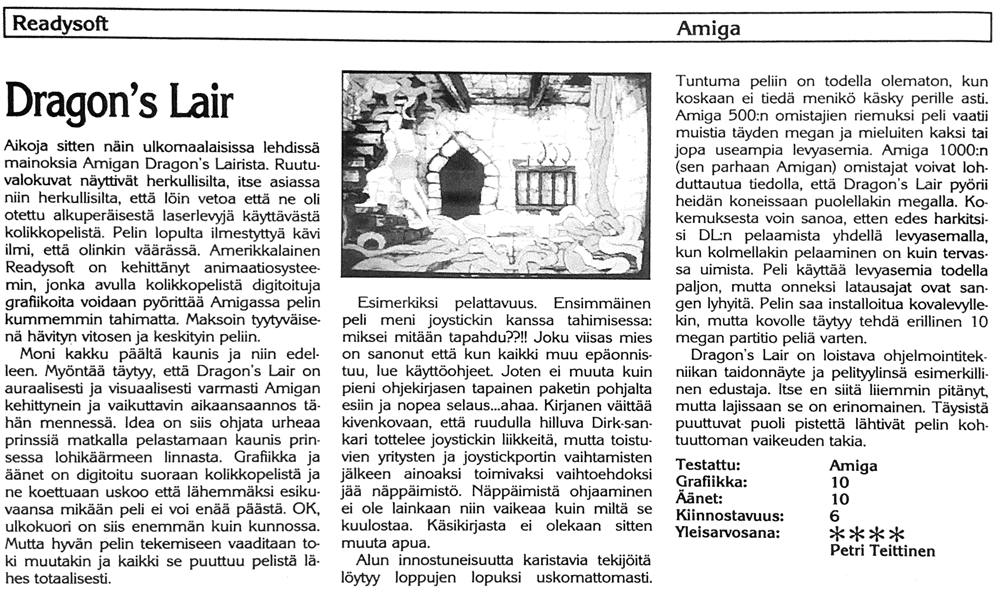
Dragon's Lair1989 SyksyPysyvä linkkiAikoja sitten näin ulkomaalaisissa lehdissä mainoksia Amigan Dragon's Lairista. Ruutuvalokuvat näyttivät herkullisilta, itse asiassa niin herkullisilta, että löin vetoa että ne oli otettu alkuperäisestä laserlevyjä käyttävästä kolikkopelistä. Pelin lopulta ilmestyttyä kävi ilmi, että olinkin väärässä. Amerikkalainen Readysoft on kehittänyt animaatiosysteemin, jonka avulla kolikkopelistä digitoituja grafiikoita voidaan pyörittää Amigassa pelin kummemmin tahimatta. Maksoin tyytyväisenä hävityn vitosen ja keskityin peliin.
Moni kakku päältä kaunis ja niin edelleen. Myöntää täytyy, että Dragon's Lair on auraalisesti ja visuaalisesti varmasti Amigan kehittynein ja vaikuttavin aikaansaannos tähän mennessä. Idea on siis ohjata urheaa prinssiä matkalla pelastamaan kaunis prinsessa lohikäärmeen linnasta. Grafiikka ja äänet on digitoitu suoraan kolikkopelistä ja ne koettuaan uskoo että lähemmäksi esikuvaansa mikään peli ei voi enää päästä. OK, ulkokuori on siis enemmän kuin kunnossa. Mutta hyvän pelin tekemiseen vaaditaan toki muutakin ja kaikki se puuttuu pelistä lähes totaalisesti.
Esimerkiksi pelattavuus. Ensimmäinen peli meni joystickin kanssa tahimisessa: miksei mitään tapahdu??!! Joku viisas mies on sanonut että kun kaikki muu epäonnistuu, lue käyttöohjeet. Joten ei muuta kuin pieni ohjekirjasen tapainen paketin pohjalta esiin ja nopea selaus...ahaa. Kirjanen väittää kivenkovaan, että ruudulla hilluva Dirk-sankari tottelee joystickin liikkeitä, mutta toistuvien yritysten ja joystickportin vaihtamisten jälkeen ainoaksi toimivaksi vaihtoehdoksi jää näppäimistö. Näppäimistä ohjaaminen ei ole lainkaan niin vaikeaa kuin miltä se kuulostaa. Käsikirjasta ei olekaan sitten muuta apua.
Alun innostuneisuutta karistavia tekijöitä löytyy loppujen lopuksi uskomattomasti.
Tuntuma peliin on todella olematon, kun koskaan ei tiedä menikö käsky perille asti. Amiga 500:n omistajien riemuksi peli vaatii muistia täyden megan ja mieluiten kaksi tai jopa useampia levyasemia. Amiga 1000:n (sen parhaan Amigan) omistajat voivat lohduttautua tiedolla, että Dragon's Lair pyörii heidän koneissaan puolellakin megalla. Kokemuksesta voin sanoa, etten edes harkitsisi DL:n pelaamista yhdellä levyasemalla, kun kolmellakin pelaaminen on kuin tervassa uimista. Peli käyttää levyasemia todella paljon, mutta onneksi latausajat ovat sangen lyhyitä. Pelin saa installoitua kovalevyllekin, mutta kovolle täytyy tehdä erillinen 10 megan partitio peliä varten.
Dragon's Lair on loistava ohjelmointitekniikan taidonnäyte ja pelityylinsä esimerkillinen edustaja. Itse en siitä liiemmin pitänyt, mutta lajissaan se on erinomainen. Täysistä puuttuvat puoli pistettä lähtivät pelin kohtuuttoman vaikeuden takia.
Dragon's Lair1989 SyksyPermalinkAges ago I saw adverts for the Amiga Dragon's Lair in foreign magazines. The screenshots looked delicious, so delicious in fact that I bet they had been taken from the original laserdisc coin-op. When the game finally came out, it turned out I'd been wrong. The American Readysoft has developed an animation system that lets graphics digitised from the coin-op run on the Amiga without the game bogging down to speak of. Satisfied, I paid up the fiver I'd lost and concentrated on the game.
All that glitters is not gold, and so on. It has to be admitted that Dragon's Lair is, aurally and visually, surely the most advanced and impressive achievement on the Amiga so far. So the idea is to guide a brave prince on a journey to rescue a beautiful princess from a dragon's castle. The graphics and sound have been digitised straight from the coin-op, and once you've experienced them you believe that no game can ever get any closer to its original. OK, so the outer shell is more than fine. But making a good game takes more than that, of course, and all of that is almost totally missing from this game.
Take playability, for example. The whole first game was spent fumbling with the joystick: why isn't anything happening??!! Some wise man once said that when all else fails, read the instructions. So there's nothing for it but to dig the little booklet-type thing out from the bottom of the box and have a quick leaf through...aha. The booklet swears blind that our hero Dirk, cavorting about on the screen, obeys the joystick's movements, but after repeated attempts and switching joystick ports, the only option left that works is the keyboard. Steering with the keys isn't nearly as hard as it sounds. Beyond that, the manual is no help at all.
In the end, there turns out to be an unbelievable number of things that shake off your initial enthusiasm.
The feel of the game is truly non-existent, since you never know whether a command made it all the way through. To the delight of Amiga 500 owners, the game needs a full meg of memory and preferably two or even more disk drives. Owners of the Amiga 1000 (the best Amiga there is) can console themselves with the knowledge that Dragon's Lair runs on their machines with just half a meg. I can say from experience that I wouldn't even consider playing DL with one disk drive, when even with three, playing it is like wading through treacle. The game uses the disk drives a great deal, but luckily the loading times are fairly short. The game can even be installed on a hard disk, but you have to make a separate 10 meg partition on the hard drive for it.
Dragon's Lair is a brilliant showcase of programming technique and an exemplary representative of its game style. I didn't much care for it myself, but within its genre it is excellent. The half point short of full marks was lost because of the game's unreasonable difficulty.
Dragonflight
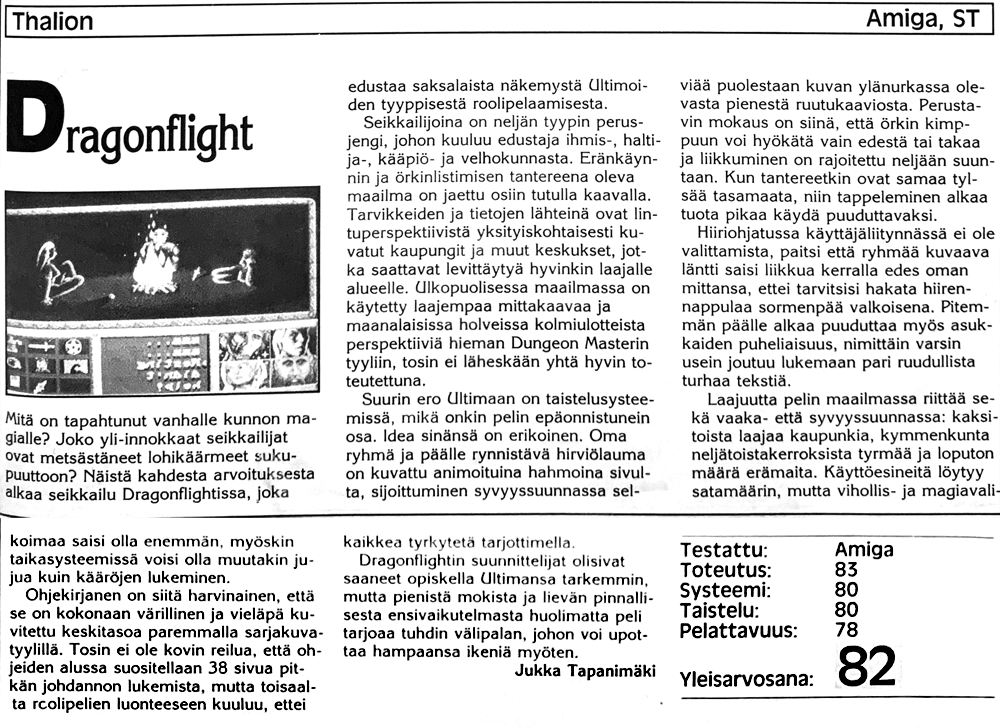
Dragonflight1991 KevätPysyvä linkkiMitä on tapahtunut vanhalle kunnon magialle? Joko yli-innokkaat seikkailijat ovat metsästäneet lohikäärmeet sukupuuttoon? Näistä kahdesta arvoituksesta alkaa seikkailu Dragonflightissa, joka edustaa saksalaista näkemystä Ultimoiden tyyppisestä roolipelaamisesta.
Seikkailijoina on neljän tyypin perusjengi, johon kuuluu edustaja ihmis-, haltija-, kääpiö- ja velhokunnasta. Eränkäynnin ja örkinlistimisen tantereena oleva maailma on jaettu osiin tutulla kaavalla. Tarvikkeiden ja tietojen lähteinä ovat lintuperspektiivistä yksityiskohtaisesti kuvatut kaupungit ja muut keskukset, jotka saattavat levittäytyä hyvinkin laajalle alueelle. Ulkopuolisessa maailmassa on käytetty laajempaa mittakaavaa ja maanalaisissa holveissa kolmiulotteista perspektiiviä hieman Dungeon Masterin tyyliin, tosin ei läheskään yhtä hyvin toteutettuna.
Suurin ero Ultimaan on taistelusysteemissä, mikä onkin pelin epäonnistunein osa. Idea sinänsä on erikoinen. Oma ryhmä ja päälle rynnistävä hirviölauma on kuvattu animoituina hahmoina sivulta, sijoittuminen syvyyssuunnassa selviää puolestaan kuvan ylänurkassa olevasta pienestä ruutukaaviosta. Perustavin mokaus on siinä, että örkin kimppuun voi hyökätä vain edestä tai takaa ja liikkuminen on rajoitettu neljään suuntaan. Kun tantereetkin ovat samaa tylsää tasamaata, niin tappeleminen alkaa tuota pikaa käydä puuduttavaksi.
Hiiriohjatussa käyttäjäliitynnässä ei ole valittamista, paitsi että ryhmää kuvaava läntti saisi liikkua kerralla edes oman mittansa, ettei tarvitsisi hakata hiirennappulaa sormenpää valkoisena. Pitemmän päälle alkaa puuduttaa myös asukkaiden puheliaisuus, nimittäin varsin usein joutuu lukemaan pari ruudullista turhaa tekstiä.
Laajuutta pelin maailmassa riittää sekä vaaka- että syvyyssuunnassa: kaksitoista laajaa kaupunkia, kymmenkunta neljätoistakerroksista tyrmää ja loputon määrä erämaita. Käyttöesineitä löytyy satamäärin, mutta vihollis- ja magiavalikoimaa saisi olla enemmän, myöskin taikasysteemissä voisi olla muutakin jujua kuin kääröjen lukeminen.
Ohjekirjanen on siitä harvinainen, että se on kokonaan värillinen ja vieläpä kuvitettu keskitasoa paremmalla sarjakuvatyylillä. Tosin ei ole kovin reilua, että ohjeiden alussa suositellaan 38 sivua pitkän johdannon lukemista, mutta toisaalta rcolipelien luonteeseen kuuluu, ettei kaikkea tyrkytetä tarjottimella.
Dragonflightin suunnittelijat olisivat saaneet opiskella Ultimansa tarkemmin, mutta pienistä mokista ja lievän pinnallisesta ensivaikutelmasta huolimatta peli tarjoaa tuhdin välipalan, johon voi upottaa hampaansa ikeniä myöten.
Dragonflight1991 KevätPermalinkWhat has happened to good old magic? Have over-eager adventurers already hunted the dragons to extinction? These two riddles are where the adventure begins in Dragonflight, which represents the German take on role-playing in the style of the Ultimas.
The adventurers are the basic four-man gang, with one representative each from the ranks of humans, elves, dwarves and wizards. The world, the arena for wilderness trekking and orc-whacking, is divided into parts along familiar lines. Supplies and information come from towns and other centres, shown in detail from a bird's-eye view, which can sprawl over a pretty large area. The outside world uses a larger scale, and the underground vaults a three-dimensional perspective somewhat in the style of Dungeon Master, although nowhere near as well done.
The biggest difference from Ultima is in the combat system, which is in fact the least successful part of the game. The idea in itself is an unusual one. Your own party and the monster horde charging at it are shown from the side as animated figures, while positioning in depth is shown by a small grid diagram in the top corner of the screen. The most fundamental blunder is that you can only attack an orc from the front or from behind, and movement is restricted to four directions. Since the battlefields are all the same dull flat ground too, fighting pretty soon starts to get numbing.
There's nothing to complain about in the mouse-driven interface, except that the blob representing the party could at least move its own length at a time, so you wouldn't have to hammer the mouse button until your fingertip goes white. In the long run the talkativeness of the inhabitants also starts to wear you down, since quite often you have to read a couple of screenfuls of pointless text.
The game world has plenty of scope both horizontally and in depth: twelve large cities, a dozen or so fourteen-level dungeons and an endless amount of wilderness. There are hundreds of usable items, but the selection of enemies and magic could be bigger, and the magic system could also have some other trick to it besides reading scrolls.
The manual is unusual in that it's entirely in colour and, what's more, illustrated in a better-than-average comic-strip style. Admittedly, it's not very fair that the start of the instructions recommends reading a 38-page introduction, but on the other hand it's in the nature of role-playing games that not everything is served up on a platter.
Dragonflight's designers could have studied their Ultima more closely, but despite the small blunders and a slightly superficial first impression, the game offers a hearty snack you can sink your teeth into right up to the gums.
Drakkhen
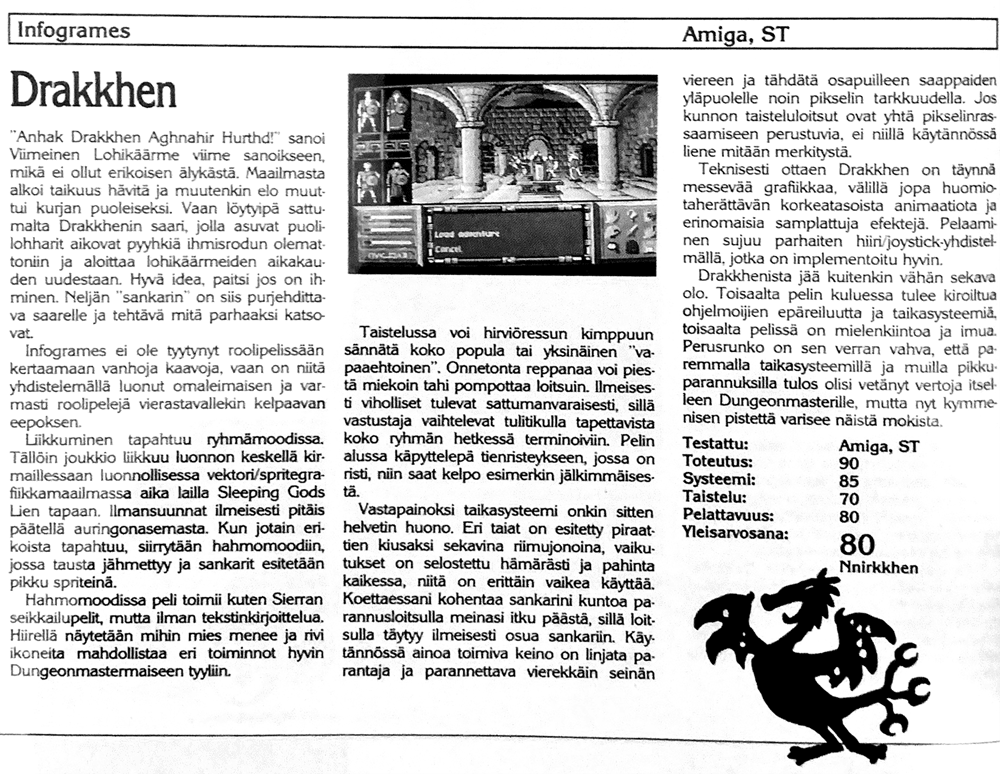
Drakkhen1990 KevätPysyvä linkki"Anhak Drakkhen Aghnahir Hurthd!" sanoi Viimeinen Lohikäärme viime sanoikseen, mikä ei ollut erikoisen älykästä. Maailmasta alkoi taikuus hävitä ja muutenkin elo muuttui kurjan puoleiseksi. Vaan löytyipä sattumalta Drakkhenin saari, jolla asuvat puolilohharit aikovat pyyhkiä ihmisrodun olemattomiin ja aloittaa lohikäärmeiden aikakauden uudestaan. Hyvä idea, paitsi jos on ihminen. Neljän "sankarin" on siis purjehdittava saarelle ja tehtävä mitä parhaaksi katsovat.
Infogrames ei ole tyytynyt roolipelissään kertaamaan vanhoja kaavoja, vaan on niitä yhdistelemällä luonut omaleimaisen ja varmasti roolipelejä vierastavallekin kelpaavan eepoksen.
Liikkuminen tapahtuu ryhmämoodissa. Tällöin joukkio liikkuu luonnon keskellä kirmaillessaan luonnollisessa vektori/spritegrafiikkamaailmassa aika lailla Sleeping Gods Lien tapaan. Ilmansuunnat ilmeisesti pitäis päätellä auringonasemasta. Kun jotain erikoista tapahtuu, siirrytään hahmomoodiin, jossa tausta jähmettyy ja sankarit esitetään pikku spriteinä.
Hahmomoodissa peli toimii kuten Sierran seikkailupelit, mutta ilman tekstinkirjoittelua. Hiirellä näytetään mihin mies menee ja rivi ikoneita mahdollistaa eri toiminnot hyvin Dungeonmastermaiseen tyyliin.
Taistelussa voi hirviöressun kimppuun sännätä koko popula tai yksinäinen "vapaaehtoinen". Onnetonta reppanaa voi piestä miekoin tahi pompottaa loitsuin. Ilmeisesti viholliset tulevat sattumanvaraisesti, sillä vastustaja vaihtelevat tulitikulla tapettavista koko ryhmän hetkessä terminoiviin. Pelin alussa käpyttelepä tienristeykseen, jossa on risti, niin saat kelpo esimerkin jälkimmäisestä.
Vastapainoksi taikasysteemi onkin sitten helvetin huono. Eri taiat on esitetty piraattien kiusaksi sekavina riimujonoina, vaikutukset on selostettu hämärästi ja pahinta kaikessa, niitä on erittäin vaikea käyttää. Koettaessani kohentaa sankarini kuntoa parannusloitsulla meinasi itku päästä, sillä loitsulla täytyy ilmeisesti osua sankariin. Käytännössä ainoa toimiva keino on linjata parantaja ja parannettava vierekkäin seinän viereen ja tähdätä osapuilleen saappaiden yläpuolelle noin pikselin tarkkuudella. Jos kunnon taisteluloitsut ovat yhtä pikselinrassaamiseen perustuvia, ei niillä käytännössä liene mitään merkitystä.
Teknisesti ottaen Drakkhen on täynnä messevää grafiikkaa, välillä jopa huomiotaherättävän korkeatasoista animaatiota ja erinomaisia samplattuja efektejä. Pelaaminen sujuu parhaiten hiiri/joystick-yhdistelmällä, jotka on implementoitu hyvin.
Drakkhenista jää kuitenkin vähän sekava olo. Toisaalta pelin kuluessa tulee kiroiltua ohjelmoijien epäreiluutta ja taikasysteemiä, toisaalta pelissä on mielenkiintoa ja imua. Perusrunko on sen verran vahva, että paremmalla taikasysteemillä ja muilla pikkuparannuksilla tulos olisi vetänyt vertoja itselleen Dungeonmasterille, mutta nyt kymmenisen pistettä varisee näistä mokista.
Drakkhen1990 KevätPermalink"Anhak Drakkhen Aghnahir Hurthd!" said the Last Dragon as its last words, which wasn't especially clever. Magic began to vanish from the world, and life in general turned on the miserable side. But then, as luck would have it, the island of Drakkhen turned up, and the half-draggies living there plan to wipe the human race out of existence and start the age of dragons all over again. A good idea, unless you happen to be human. So four "heroes" have to sail to the island and do whatever they see fit.
Infogrames hasn't settled for rehashing the old formulas in its role-playing game; instead, by combining them, it has created a distinctive epic that will surely suit even those who shy away from role-playing games.
Getting around happens in party mode. In it the troupe moves through the great outdoors, frolicking about in a natural vector/sprite graphics world pretty much the way it's done in Sleeping Gods Lie. Apparently you're supposed to work out the points of the compass from the position of the sun. When something out of the ordinary happens, you switch to character mode, where the background freezes and the heroes are shown as little sprites.
In character mode the game works like Sierra's adventure games, but without the typing. You point with the mouse where the man should go, and a row of icons provides the various actions in a very Dungeonmaster-like style.
In combat the poor monster can be set upon by the whole mob or by a lone "volunteer". The unfortunate wretch can be thrashed with swords or bounced about with spells. Apparently the enemies turn up at random, since the opponents range from ones you could kill with a matchstick to ones that terminate the whole party in an instant. At the start of the game, toddle along to the crossroads with the cross, and you'll get a fine example of the latter.
To balance things out, the magic system is then bloody awful. To spite the pirates, the various spells are presented as confusing strings of runes, their effects are explained vaguely and, worst of all, they're extremely hard to use. When I tried to improve my hero's condition with a healing spell I nearly burst into tears, because apparently you have to actually hit the hero with the spell. In practice the only method that works is to line up the healer and the patient side by side against a wall and aim roughly above the boots with an accuracy of about one pixel. If the proper combat spells are just as dependent on pixel-fiddling, they're probably of no practical use whatsoever.
Technically speaking, Drakkhen is full of lavish graphics, at times even strikingly high-quality animation, and excellent sampled effects. Playing works best with a mouse/joystick combination, both of which have been implemented well.
Drakkhen leaves a somewhat muddled feeling all the same. On the one hand, as the game goes on you find yourself cursing the programmers' unfairness and the magic system; on the other, the game has interest and pull. The basic framework is strong enough that with a better magic system and other small improvements the result would have measured up to Dungeonmaster itself, but as it is, ten or so points fall away because of these blunders.
Dream Warrior
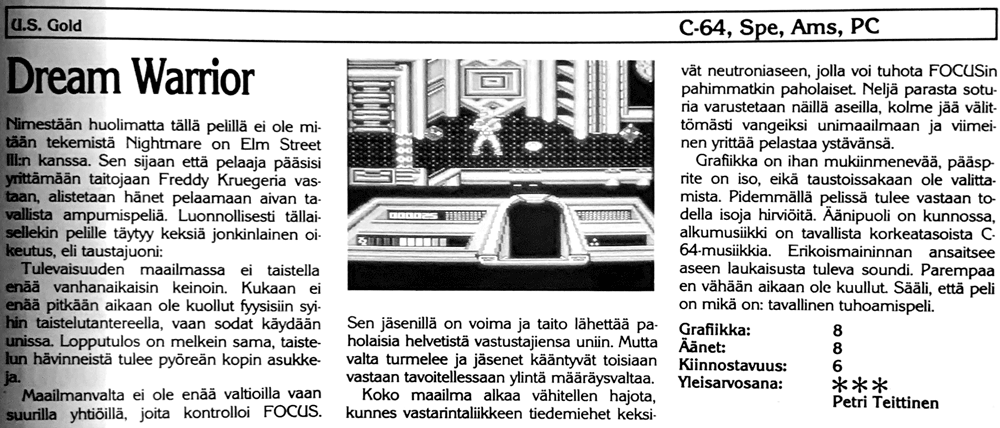
Dream Warrior1988Pysyvä linkkiNimestään huolimatta tällä pelillä ei ole mitään tekemistä Nightmare on Elm Street III:n kanssa. Sen sijaan että pelaaja pääsisi yrittämään taitojaan Freddy Kruegeria vastaan, alistetaan hänet pelaamaan aivan tavallista ampumispeliä. Luonnollisesti tällaisellekin pelille täytyy keksiä jonkinlainen oikeutus, eli taustajuoni:
Tulevaisuuden maailmassa ei taistella enää vanhanaikaisin keinoin. Kukaan ei enää pitkään aikaan ole kuollut fyysisiin syihin taistelutantereella, vaan sodat käydään unissa. Lopputulos on melkein sama, taistelun hävinneistä tulee pyöreän kopin asukkeja.
Maailmanvalta ei ole enää valtioilla vaan suurilla yhtiöillä, joita kontrolloi FOCUS. Sen jäsenillä on voima ja taito lähettää paholaisia helvetistä vastustajiensa uniin. Mutta valta turmelee ja jäsenet kääntyvät toisiaan vastaan tavoitellessaan ylintä määräysvaltaa.
Koko maailma alkaa vähitellen hajota, kunnes vastarintaliikkeen tiedemiehet keksivät neutroniaseen, jolla voi tuhota FOCUSin pahimmatkin paholaiset. Neljä parasta soturia varustetaan näillä aseilla, kolme jää välittömästi vangeiksi unimaailmaan ja viimeinen yrittää pelastaa ystävänsä.
Grafiikka on ihan mukiinmenevää, pääsprite on iso, eikä taustoissakaan ole valittamista. Pidemmällä pelissä tulee vastaan todella isoja hirviöitä. Äänipuoli on kunnossa, alkumusiikki on tavallista korkeatasoista C-64-musiikkia. Erikoismaininnan ansaitsee aseen laukaisusta tuleva soundi. Parempaa en vähään aikaan ole kuullut. Sääli, että peli on mikä on: tavallinen tuhoamispeli.
Dream Warrior1988PermalinkDespite its name, this game has nothing to do with Nightmare on Elm Street III. Instead of getting to try their skills against Freddy Krueger, the player is subjected to playing a perfectly ordinary shooting game. Naturally even a game like this needs some kind of justification invented for it, that is, a background plot:
In the world of the future, battles are no longer fought by old-fashioned means. Nobody has died of physical causes on the battlefield for a long time now; instead, wars are fought in dreams. The end result is almost the same: the losers of a battle become tenants of a padded cell.
World power no longer belongs to nations but to big corporations, which are controlled by FOCUS. Its members have the power and the skill to send devils from hell into their opponents' dreams. But power corrupts, and the members turn against one another in their pursuit of supreme control.
The whole world gradually begins to fall apart, until the scientists of the resistance movement invent a neutron weapon that can destroy even FOCUS's worst devils. The four best warriors are equipped with these weapons; three are immediately taken prisoner in the dream world, and the last one tries to rescue their friends.
The graphics are quite passable, the main sprite is big, and there's nothing to complain about in the backgrounds either. Further into the game you run into really big monsters. The sound side is in order; the title music is the usual high-quality C-64 music. The sound the weapon makes when fired deserves a special mention. I haven't heard a better one in a good while. A pity the game is what it is: an ordinary blast-'em-up.
Driller
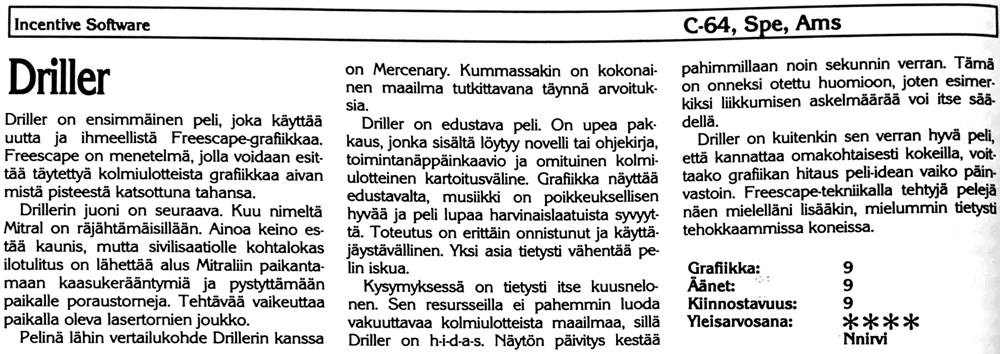
Driller1988Pysyvä linkkiDriller on ensimmäinen peli, joka käyttää uutta ja ihmeellistä Freescape-grafiikkaa. Freescape on menetelmä, jolla voidaan esittää täytettyä kolmiulotteista grafiikkaa aivan mistä pisteestä katsottuna tahansa.
Drillerin juoni on seuraava. Kuu nimeltä Mitral on räjähtämäisillään. Ainoa keino estää kaunis, mutta sivilisaatiolle kohtalokas ilotulitus on lähettää alus Mitraliin paikantamaan kaasukerääntymiä ja pystyttämään paikalle poraustorneja. Tehtävää vaikeuttaa paikalla oleva lasertornien joukko.
Pelinä lähin vertailukohde Drillerin kanssa on Mercenary. Kummassakin on kokonainen maailma tutkittavana täynnä arvoituksia.
Driller on edustava peli. On upea pakkaus, jonka sisältä löytyy novelli tai ohjekirja, toimintanäppäinkaavio ja omituinen kolmiulotteinen kartoitusväline. Grafiikka näyttää edustavalta, musiikki on poikkeuksellisen hyvää ja peli lupaa harvinaislaatuista syvyyttä. Toteutus on erittäin onnistunut ja käyttäjäystävällinen. Yksi asia tietysti vähentää pelin iskua.
Kysymyksessä on tietysti itse kuusnelonen. Sen resursseilla ei pahemmin luoda vakuuttavaa kolmiulotteista maailmaa, sillä Driller on h-i-d-a-s. Näytön päivitys kestää pahimmillaan noin sekunnin verran. Tämä on onneksi otettu huomioon, joten esimerkiksi liikkumisen askelmäärää voi itse säädellä.
Driller on kuitenkin sen verran hyvä peli, että kannattaa omakohtaisesti kokeilla, voittaako grafiikan hitaus peli-idean vaiko päinvastoin. Freescape-tekniikalla tehtyjä pelejä näen mielelläni lisääkin, mielummin tietysti tehokkaammissa koneissa.
Driller1988PermalinkDriller is the first game to use the new and wondrous Freescape graphics. Freescape is a method for displaying filled three-dimensional graphics seen from absolutely any viewpoint whatsoever.
Driller's plot is as follows. A moon called Mitral is about to explode. The only way to prevent a firework display that is beautiful, but fatal to civilisation, is to send a ship to Mitral to locate gas pockets and set up drilling rigs on the spot. The task is made harder by a host of laser towers stationed there.
As a game, the closest point of comparison for Driller is Mercenary. Both have a whole world to explore, full of puzzles.
Driller is a classy game. There's a splendid package, inside which you'll find a novella or instruction manual, a function key chart and a peculiar three-dimensional mapping device. The graphics look classy, the music is exceptionally good, and the game promises depth of a rare kind. The execution is highly successful and user-friendly. One thing, of course, takes some of the punch out of the game.
That thing is, of course, the Commodore 64 itself. Its resources aren't really up to creating a convincing three-dimensional world, because Driller is s-l-o-w. At worst, a screen update takes about a second. Luckily this has been taken into account, so you can, for example, set the step size of your movement yourself.
Still, Driller is a good enough game that it's worth trying out for yourself whether the slowness of the graphics beats the game idea or the other way round. I'd gladly see more games made with the Freescape technique - preferably, of course, on more powerful machines.
Druid
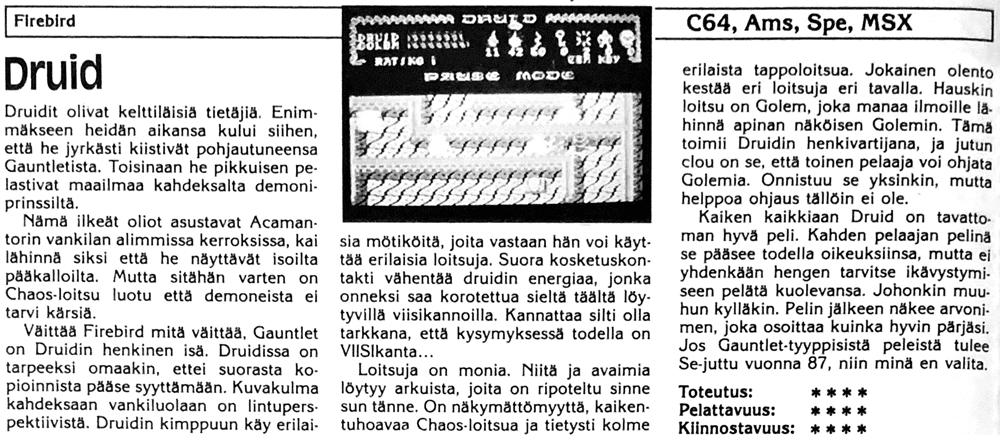
Druid1987Pysyvä linkkiDruidit olivat kelttiläisiä tietäjiä. Enimmäkseen heidän aikansa kului siihen, että he jyrkästi kiistivät pohjautuneensa Gauntletista. Toisinaan he pikkuisen pelastivat maailmaa kahdeksalta demoniprinssiltä.
Nämä ilkeät oliot asustavat Acamantorin vankilan alimmissa kerroksissa, kai lähinnä siksi että he näyttävät isoilta pääkalloilta. Mutta sitähän varten on Chaos-loitsu luotu että demoneista ei tarvi kärsiä.
Väittää Firebird mitä väittää, Gauntlet on Druidin henkinen isä. Druidissa on tarpeeksi omaakin, ettei suorasta kopioinnista pääse syyttämään. Kuvakulma kahdeksaan vankiluolaan on lintuperspektiivistä. Druidin kimppuun käy erilaisia mötiköitä, joita vastaan hän voi käyttää erilaisia loitsuja. Suora kosketuskontakti vähentää druidin energiaa, jonka onneksi saa korotettua sieltä täältä löytyvillä viisikannoilla. Kannattaa silti olla tarkkana, että kysymyksessä todella on VIISIkanta...
Loitsuja on monia. Niitä ja avaimia löytyy arkuista, joita on ripoteltu sinne sun tänne. On näkymättömyyttä, kaikentuhoavaa Chaos-loitsua ja tietysti kolme erilaista tappoloitsua. Jokainen olento kestää eri loitsuja eri tavalla. Hauskin loitsu on Golem, joka manaa ilmoille lähinnä apinan näköisen Golemin. Tämä toimii Druidin henkivartijana, ja jutun clou on se, että toinen pelaaja voi ohjata Golemia. Onnistuu se yksinkin, mutta helppoa ohjaus tällöin ei ole.
Kaiken kaikkiaan Druid on tavattoman hyvä peli. Kahden pelaajan pelinä se pääsee todella oikeuksiinsa, mutta ei yhdenkään hengen tarvitse ikävystymiseen pelätä kuolevansa. Johonkin muuhun kylläkin. Pelin jälkeen näkee arvonimen, joka osoittaa kuinka hyvin pärjäsi. Jos Gauntlet-tyyppisistä peleistä tulee Se-juttu vuonna 87, niin minä en valita.
Druid1987PermalinkDruids were Celtic sages. Most of their time was spent flatly denying that they were based on Gauntlet. Now and then they did a spot of saving the world from eight demon princes.
These nasty creatures dwell on the lowest levels of Acamantor's prison, presumably mostly because they look like big skulls. But that's exactly what the Chaos spell was created for, so that you don't have to put up with demons.
Firebird can claim whatever it likes, Gauntlet is Druid's spiritual father. Druid has enough of its own that it can't be accused of straight copying. The eight dungeons are viewed from a bird's-eye perspective. The druid is set upon by all manner of blobby critters, and he can use various spells against them. Direct physical contact drains the druid's energy, which luckily can be topped up with pentagrams found here and there. Still, you'd better watch out that it really is a PENTAgram...
There are many spells. They, and keys, are found in chests that have been scattered here, there and everywhere. There's invisibility, the all-destroying Chaos spell and of course three different killing spells. Each creature stands up to different spells in different ways. The most fun spell is Golem, which conjures up a Golem that looks more or less like an ape. It acts as the Druid's bodyguard, and the real kicker is that a second player can control the Golem. You can manage it on your own too, but then the controls aren't easy.
All in all, Druid is an extraordinarily good game. As a two-player game it really comes into its own, but a lone player needn't fear dying of boredom either. Of something else, yes. After the game you're shown a title that indicates how well you did. If Gauntlet-type games become The Thing in '87, I won't be complaining.
Druid II
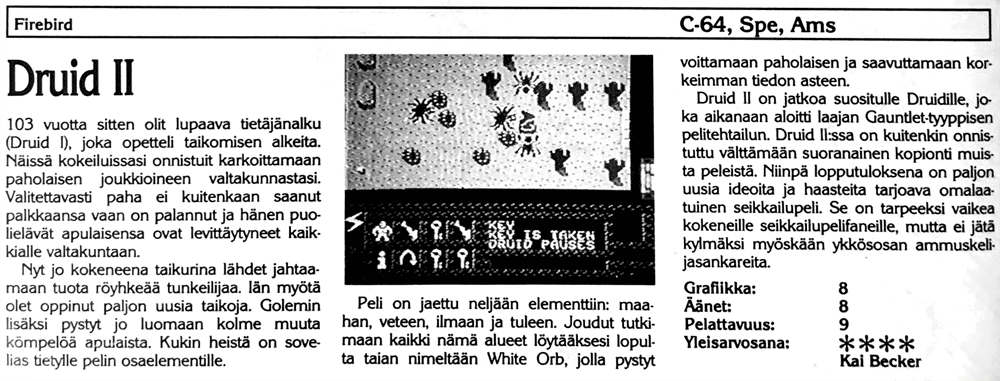
Druid II1988Pysyvä linkki103 vuotta sitten olit lupaava tietäjänalku (Druid I), joka opetteli taikomisen alkeita. Näissä kokeiluissasi onnistuit karkoittamaan paholaisen joukkioineen valtakunnastasi. Valitettavasti paha ei kuitenkaan saanut palkkaansa vaan on palannut ja hänen puolielävät apulaisensa ovat levittäytyneet kaikkialle valtakuntaan.
Nyt jo kokeneena taikurina lähdet jahtaamaan tuota röyhkeää tunkeilijaa. Iän myötä olet oppinut paljon uusia taikoja. Golemin lisäksi pystyt jo luomaan kolme muuta kömpelöä apulaista. Kukin heistä on sovelias tietylle pelin osaelementille.
Peli on jaettu neljään elementtiin: maahan, veteen, ilmaan ja tuleen. Joudut tutkimaan kaikki nämä alueet löytääksesi lopulta taian nimeltään White Orb, jolla pystyt voittamaan paholaisen ja saavuttamaan korkeimman tiedon asteen.
Druid II on jatkoa suositulle Druidille, joka aikanaan aloitti laajan Gauntlet-tyyppisen pelitehtailun. Druid II:ssa on kuitenkin onnistuttu välttämään suoranainen kopionti muista peleistä. Niinpä lopputuloksena on paljon uusia ideoita ja haasteita tarjoava omalaatuinen seikkailupeli. Se on tarpeeksi vaikea kokeneille seikkailupelifaneille, mutta ei jätä kylmäksi myöskään ykkösosan ammuskelijasankareita.
Druid II1988Permalink103 years ago you were a promising wizard-in-the-making (Druid I), learning the basics of spellcasting. In these experiments of yours you managed to banish the Devil and his gang from your kingdom. Unfortunately, evil did not get its just deserts after all: it has returned, and its half-living minions have spread all over the kingdom.
Now an experienced magician, you set out to hunt down that insolent intruder. With age you have learned lots of new spells. Besides the Golem, you can now create three other clumsy helpers. Each of them is suited to a particular element of the game.
The game is divided into four elements: earth, water, air and fire. You have to explore all these areas in order finally to find a spell called White Orb, with which you can defeat the Devil and attain the highest degree of knowledge.
Druid II is the sequel to the popular Druid, which in its day kicked off a large-scale churning-out of Gauntlet-type games. Druid II, however, has managed to avoid outright copying of other games. So the end result is a distinctive adventure game offering lots of new ideas and challenges. It is hard enough for experienced adventure game fans, but it won't leave the trigger-happy heroes of the first part cold either.
Ducktales: The Quest for Gold
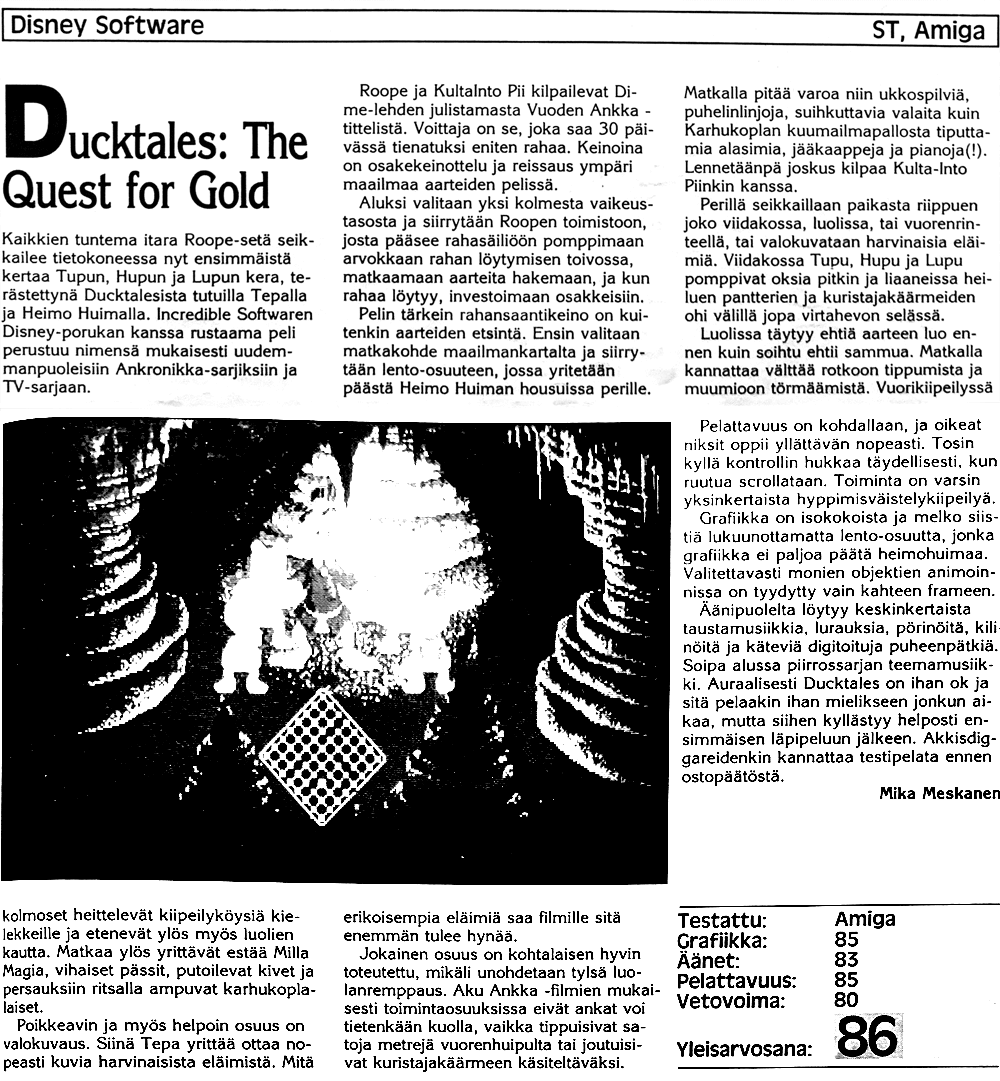
Ducktales: The Quest for Gold1991 KevätPysyvä linkkiKaikkien tuntema itara Roope-setä seikkailee tietokoneessa nyt ensimmäistä kertaa Tupun, Hupun ja Lupun kera, terästettynä Ducktalesista tutuilla Tepalla ja Heimo Huimalla. Incredible Softwaren Disney-porukan kanssa rustaama peli perustuu nimensä mukaisesti uudemmanpuoleisiin Ankronikka-sarjiksiin ja TV-sarjaan.
Roope ja KultaInto Pii kilpailevat Dime-lehden julistamasta Vuoden Ankka -tittelistä. Voittaja on se, joka saa 30 päivässä tienatuksi eniten rahaa. Keinoina on osakekeinottelu ja reissaus ympäri maailmaa aarteiden pelissä.
Aluksi valitaan yksi kolmesta vaikeustasosta ja siirrytään Roopen toimistoon, josta pääsee rahasäiliöön pomppimaan arvokkaan rahan löytymisen toivossa, matkaamaan aarteita hakemaan, ja kun rahaa löytyy, investoimaan osakkeisiin.
Pelin tärkein rahansaantikeino on kuitenkin aarteiden etsintä. Ensin valitaan matkakohde maailmankartalta ja siirrytään lento-osuuteen, jossa yritetään päästä Heimo Huiman housuissa perille.
Matkalla pitää varoa niin ukkospilviä, puhelinlinjoja, suihkuttavia valaita kuin Karhukoplan kuumailmapallosta tiputtamia alasimia, jääkaappeja ja pianoja(!). Lennetäänpä joskus kilpaa Kulta-Into Piinkin kanssa.
Perillä seikkaillaan paikasta riippuen joko viidakossa, luolissa, tai vuorenrinteellä, tai valokuvataan harvinaisia eläimiä. Viidakossa Tupu, Hupu ja Lupu pomppivat oksia pitkin ja liaaneissa heiluen pantterien ja kuristajakäärmeiden ohi välillä jopa virtahevon selässä.
Luolissa täytyy ehtiä aarteen luo ennen kuin soihtu ehtii sammua. Matkalla kannattaa välttää rotkoon tippumista ja muumioon törmäämistä. Vuorikiipeilyssä kolmoset heittelevät kiipeilyköysiä kielekkeille ja etenevät ylös myös luolien kautta. Matkaa ylös yrittävät estää Milla Magia, vihaiset pässit, putoilevat kivet ja persauksiin ritsalla ampuvat karhukoplalaiset.
Poikkeavin ja myös helpoin osuus on valokuvaus. Siinä Tepa yrittää ottaa nopeasti kuvia harvinaisista eläimistä. Mitä erikoisempia eläimiä saa filmille sitä enemmän tulee hynää.
Jokainen osuus on kohtalaisen hyvin toteutettu, mikäli unohdetaan tylsä luolanremppaus. Aku Ankka -filmien mukaisesti toimintaosuuksissa eivät ankat voi tietenkään kuolla, vaikka tippuisivat satoja metrejä vuorenhuipulta tai joutuisivat kuristajakäärmeen käsiteltäväksi.
Pelattavuus on kohdallaan, ja oikeat niksit oppii yllättävän nopeasti. Tosin kyllä kontrollin hukkaa täydellisesti, kun ruutua scrollataan. Toiminta on varsin yksinkertaista hyppimisväistelykiipeilyä.
Grafiikka on isokokoista ja melko siistiä lukuunottamatta lento-osuutta, jonka grafiikka ei paljoa päätä heimohuimaa. Valitettavasti monien objektien animoinnissa on tyydytty vain kahteen frameen.
Äänipuolelta löytyy keskinkertaista taustamusiikkia, lurauksia, pörinöitä, kilinöitä ja käteviä digitoituja puheenpätkiä. Soipa alussa piirrossarjan teemamusiikki. Auraalisesti Ducktales on ihan ok ja sitä pelaakin ihan mielikseen jonkun aikaa, mutta siihen kyllästyy helposti ensimmäisen läpipeluun jälkeen. Akkisdiggareidenkin kannattaa testipelata ennen ostopäätöstä.
Ducktales: The Quest for Gold1991 KevätPermalinkStingy old Uncle Scrooge, known to everybody, is now adventuring on the computer for the first time along with Huey, Dewey and Louie, spiked with Webby and Launchpad McQuack, familiar from Ducktales. The game, knocked together by Incredible Software with the Disney crowd, is based, as its name says, on the newer Ducktales comics and the TV series.
Scrooge and Flintheart Glomgold are competing for the Duck of the Year title announced by Dime magazine. The winner is whoever manages to earn the most money in 30 days. The means are stock speculation and globetrotting in pursuit of treasure.
First you pick one of three difficulty levels and move to Scrooge's office, from where you can go into the money bin to bounce around in the hope of finding a valuable coin, travel off to fetch treasures, and, once there's money to be had, invest in shares.
The game's most important way of getting money, however, is treasure hunting. First you choose a destination on the world map and move on to the flying section, where you try to get there in Launchpad McQuack's shoes.
On the way you have to watch out for thunderclouds, telephone lines and spouting whales, as well as the anvils, fridges and pianos(!) the Beagle Boys drop from their hot-air balloon. Sometimes you even race against Flintheart Glomgold.
Once there, depending on the location, you adventure either in the jungle, in caves or on a mountainside, or photograph rare animals. In the jungle Huey, Dewey and Louie bounce along branches and swing on lianas past panthers and constrictor snakes, at times even riding on a hippo's back.
In the caves you have to reach the treasure before the torch goes out. On the way it's wise to avoid falling into a chasm or bumping into a mummy. In the mountain climbing the triplets throw climbing ropes up onto ledges and also make their way upwards through caves. Trying to stop the climb are Magica De Spell, angry rams, falling rocks and Beagle Boys firing slingshots at your backside.
The most unusual and also the easiest section is the photography. In it, Webby tries to snap quick pictures of rare animals. The more exotic the animals you get on film, the more dough rolls in.
Each section is fairly well done, if we forget the boring cave-slogging. In keeping with the Donald Duck cartoons, the ducks of course can't die in the action sections, even if they fall hundreds of metres from a mountaintop or end up being worked over by a constrictor.
The playability is spot on, and you pick up the right tricks surprisingly quickly. Mind you, you do lose control completely when the screen scrolls. The action is fairly simple jump-dodge-climbing.
The graphics are large and fairly neat, apart from the flying section, whose graphics hardly make your head spin. Unfortunately, the animation of many objects has made do with just two frames.
On the sound side there's mediocre background music, warbles, buzzes, jingles and handy snippets of digitised speech. The cartoon series' theme tune even plays at the start. Aurally Ducktales is perfectly OK, and you'll happily play it for a while, but it easily gets boring after the first time through. Even Donald Duck diehards should try it out before deciding to buy.
Duel, The: Test Drive II + Supercars Datadisk & Scenery Datadisk

Duel, The: Test Drive II + Supercars Datadisk & Scenery Datadisk1989 SyksyPysyvä linkkiTest Drive löytyy vieläkin jokaisen hyvinvarustetun mikroliikkeen pelihyllyltä. Peli on yksinkertainen ja teknisesti kehittymätön, joten mikä siinä viehättää? En tiedä, mutta ilmeisesti Distinctive Software tietää, sillä pojat ovat nyt saaneet aikaiseksi jatko-osan Test Drivelle. Uskallanpa povata sille jopa suurempaa menestystä kuin edeltäjälleen.
Kaikkia kiinnostavat asiat, joita ei voi saada. Ohjelmoijat pitivät tämän mielessään ja siksipä pelaajalla TD II:ssa onkin valittavana yli 300 kilometrin tuntinopeuteen kykenevät tiennielijät Porsche 959 ja Ferrari F40.
Auton valinnan jälkeen valitaan kisatyyppi. Kelloa vastaan ajettaessa yritetään vain ajaa lähdöstä maaliin kuluttaen mahdollisimman vähän aikaa, mutta enemmän hupia (ja pisteitä, jos tähtää tulosluetteloon) antaa kisa tietokoneen ohjaamaa autoa vastaan. Tässä tapauksessa pitää myös tietokoneelle valita auto kahdesta mahdollisesta. Pelin perimmäisenä tavoitteena on selvitä hengissä tien loppuun asti.
Viimeinen valinta ennen ratin taakse hyppäämistä on vaikeustason säätö. Neljällä ensimmäisellä tasolla tietokone hoitaa vaihteiden käytön, joten pelaajan tehtävänä on painaa kaasua ja jarrua ja pitää auto tiellä. Lopuilla tasoilla vaihteita joutuu räpeltämään itse. Mitä lähemmäs todellista ammattilaista vaikeustasossa mennään, sitä kovempaa tietokoneen ohjaama auto ajaa. Muita vaikeustason säätelemiä seikkoja ovat poliisin nopeus, vastaantulevien autojen määrä, pisteytys sekä realismi. Helpoimmilla tasoilla tiukatkin mutkat voi päästää melkein urut auki, eivätkä renkaat edes vingu. Mutta valitsepa vaikeampi taso, ja liikennemerkkeihin pitää alkaa kiinnittää huomiota.
Teillä kulkee myös poliiseja. Pelaajan autossa on vakiovarusteena tutkanpaljastin, joka alkaa sirkuttaa tutkan läheisyydessä. Poliiseihin voi suhtautua kahdella tavalla (ainakin tässä pelissä, ei välttämättä oikeassa elämässä): voi hiljentää liikennerajoituksen määräämään nopeuteen tai painaa lämän tiskiin ja jättää pollarit jälkeen. Jälkimmäinen vaihtoehto on huomattavasti vaikeampi, mutta säästyypä sakoilta ja saa rutkasti pisteitä, jos onnistuu. Epäonnistuminen johtaa sakkoihin tai auton moottorin siirtymiseen pari metriä taaksepäin (kuskin syliin itseasiassa).
Huomattavin parannus esikoiseen verrattuna TD II:ssa on vaihtuva ja monipuolinen maisema ja tiestö. Autojen erilaiset ajo-ominaisuudet erottuvat myös huomattavasti selvemmin. Erikseen ostettavat datadisketit sisältävät lisäksi lisää autoja ja uusia teitä. Tällä hetkellä saatavana on Supercars, joka sisältää Test Drive I:n päivitetyt autot. Ensisilmäyksellä autot näyttävät prikulleen samoilta kuin I:ssä, mutta lähemmin tarkasteltaessa eroja löytyy ajo-ominaisuuksissa, tehoissa ja huippunopeuksissa. Toinen myynnissä oleva datakorppu on California Challenge, joka sisältää seitsemän tienpätkää Californiasta. Datadiskien käyttö on lievästi sanoen tuskallista yhdellä levyasemalla, kiusallista kahdella ja silkkaa iloa kolmella levyasemalla. Ohjelmaan on kaukonäköisesti sisällytetty mahdollisuus tehdä pelidisketti datadiskeistä, jonka jälkeen raivostuttavaa disketinvatkaamista ei enää tarvita (kovin paljoa).
Sekavasta käsikirjasta ei ole liiemmin apua, sitäkin vähemmän kieltä taitamattomille. Onneksi käsikirjassa ei ole mitään tähdellistä mitä yhdellä koepelillä ei itse saisi selville. Grafiikka valitettavasti on TD I:n luokkaa, kuten ääniefektitkin. Alkumusiikki on sentään aluksi ihan mukiinmenevä, mutta pidemmän päälle raivostuttava. Kuitenkin: jos pidit TD I:stä, pidät tästäkin, ja todennäköisesti vieläkin enemmän.
Duel, The: Test Drive II + Supercars Datadisk & Scenery Datadisk1989 SyksyPermalinkTest Drive can still be found on the games shelf of every well-stocked computer shop. The game is simple and technically unsophisticated, so what is its appeal? I don't know, but apparently Distinctive Software does, since the lads have now managed to come up with a sequel to Test Drive. I'll even venture to predict greater success for it than for its predecessor.
Everyone is interested in the things they can't have. The programmers kept this in mind, and that is why in TD II the player gets to choose between two road-devourers capable of over 300 kilometres an hour, the Porsche 959 and the Ferrari F40.
After choosing the car you choose the type of race. When driving against the clock you simply try to get from the start to the finish in as little time as possible, but more fun (and more points, if you're aiming for the high score table) comes from racing a computer-driven car. In this case you also have to choose a car for the computer from the two available. The ultimate goal of the game is to make it to the end of the road alive.
The last choice before jumping behind the wheel is setting the difficulty level. On the first four levels the computer handles the gear changes, so the player's job is to work the accelerator and the brake and keep the car on the road. On the remaining levels you have to fiddle with the gears yourself. The closer the difficulty level gets to a real professional, the faster the computer-driven car goes. Other things governed by the difficulty level are the speed of the police, the amount of oncoming traffic, the scoring and the realism. On the easiest levels you can take even tight bends almost flat out, and the tyres don't even squeal. But pick a harder level, and you have to start paying attention to the road signs.
There are also police on the roads. The player's car comes with a radar detector as standard, which starts chirping when there is a radar nearby. There are two ways to deal with the police (at least in this game, not necessarily in real life): you can slow down to the speed the limit dictates, or put your foot to the floor and leave the coppers behind. The latter option is considerably harder, but you do save on fines and rake in the points if you pull it off. Failure leads to fines or to the car's engine moving a couple of metres backwards (into the driver's lap, in fact).
The most notable improvement in TD II compared with the firstborn is the changing and varied scenery and road network. The cars' different handling characteristics also stand out much more clearly. On top of that, separately sold data disks contain more cars and new roads. Currently available is Supercars, which contains the updated cars from Test Drive I. At first glance the cars look exactly the same as in I, but on closer inspection there are differences in handling, power and top speeds. The other data floppy on sale is California Challenge, which contains seven stretches of road from California. Using the data disks is, to put it mildly, agonising with one disk drive, awkward with two and sheer joy with three disk drives. The program farsightedly includes the option of making a game disk from the data disks, after which the infuriating disk-juggling is no longer needed (very much).
The muddled manual is not much help, even less so for those who don't know the language. Luckily the manual contains nothing essential that you couldn't find out for yourself with one trial game. The graphics are unfortunately in TD I's class, as are the sound effects. The title music is at least quite passable at first, but infuriating in the long run. Still: if you liked TD I, you'll like this one too, and probably even more.
Dungeonmaster
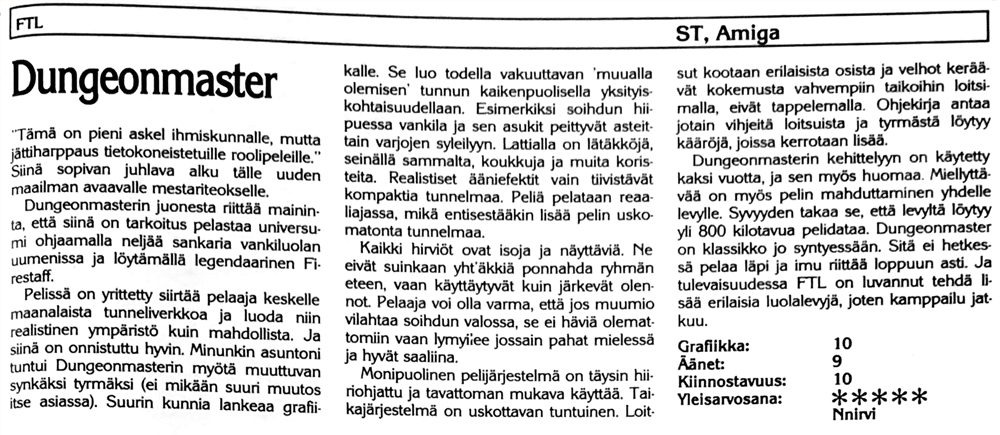
Dungeonmaster1988Pysyvä linkki"Tämä on pieni askel ihmiskunnalle, mutta jättiharppaus tietokoneistetuille roolipeleille." Siinä sopivan juhlava alku tälle uuden maailman avaavalle mestariteokselle.
Dungeonmasterin juonesta riittää maininta, että siinä on tarkoitus pelastaa universumi ohjaamalla neljää sankaria vankiluolan uumenissa ja löytämällä legendaarinen Firestaff.
Pelissä on yritetty siirtää pelaaja keskelle maanalaista tunneliverkkoa ja luoda niin realistinen ympäristö kuin mahdollista. Ja siinä on onnistuttu hyvin. Minunkin asuntoni tuntui Dungeonmasterin myötä muuttuvan synkäksi tyrmäksi (ei mikään suuri muutos itse asiassa). Suurin kunnia lankeaa grafiikalle. Se luo todella vakuuttavan 'muualla olemisen' tunnun kaikenpuolisella yksityiskohtaisuudellaan. Esimerkiksi soihdun hiipuessa vankila ja sen asukit peittyvät asteittain varjojen syleilyyn. Lattialla on lätäkköjä, seinällä sammalta, koukkuja ja muita koristeita. Realistiset ääniefektit vain tiivistävät kompaktia tunnelmaa. Peliä pelataan reaaliajassa, mikä entisestääkin lisää pelin uskomatonta tunnelmaa.
Kaikki hirviöt ovat isoja ja näyttäviä. Ne eivät suinkaan yht'äkkiä ponnahda ryhmän eteen, vaan käyttäytyvät kuin järkevät olennot. Pelaaja voi olla varma, että jos muumio vilahtaa soihdun valossa, se ei häviä olemattomiin vaan lymyilee jossain pahat mielessä ja hyvät saaliina.
Monipuolinen pelijärjestelmä on täysin hiiriohjattu ja tavattoman mukava käyttää. Taikajärjestelmä on uskottavan tuntuinen. Loitsut kootaan erilaisista osista ja velhot keräävät kokemusta vahvempiin taikoihin loitsimalla, eivät tappelemalla. Ohjekirja antaa jotain vihjeitä loitsuista ja tyrmästä löytyy kääröjä, joissa kerrotaan lisää.
Dungeonmasterin kehittelyyn on käytetty kaksi vuotta, ja sen myös huomaa. Miellyttävää on myös pelin mahduttaminen yhdelle levylle. Syvyyden takaa se, että levyltä löytyy yli 800 kilotavua pelidataa. Dungeonmaster on klassikko jo syntyessään. Sitä ei hetkessä pelaa läpi ja imu riittää loppuun asti. Ja tulevaisuudessa FTL on luvannut tehdä lisää erilaisia luolalevyjä, joten kamppailu jatkuu.
Dungeonmaster1988Permalink"This is one small step for mankind, but a giant leap for computerised role-playing games." Now there's a suitably solemn opening for this masterpiece that opens up a whole new world.
As for Dungeonmaster's plot, suffice it to say that the aim is to save the universe by guiding four heroes through the depths of a dungeon and finding the legendary Firestaff.
The game tries to put the player in the middle of an underground network of tunnels and to create as realistic an environment as possible. And it succeeds well. With Dungeonmaster, even my own flat seemed to turn into a gloomy dungeon (not much of a change, actually). The greatest credit goes to the graphics. With their all-round attention to detail they create a truly convincing sense of 'being somewhere else'. For example, as a torch burns low, the dungeon and its inhabitants are gradually wrapped in the embrace of the shadows. There are puddles on the floor, and moss, hooks and other decorations on the walls. The realistic sound effects only make the tight atmosphere even tighter. The game is played in real time, which adds even further to its incredible atmosphere.
All the monsters are big and impressive. They by no means just pop up out of nowhere in front of the party; they behave like rational beings. The player can be sure that if a mummy flits past in the torchlight, it doesn't vanish into thin air but lurks somewhere with evil on its mind and the good guys as its prey.
The versatile game system is entirely mouse-driven and remarkably pleasant to use. The magic system feels believable. Spells are assembled from different components, and wizards gain the experience for stronger magic by casting spells, not by fighting. The manual gives some hints about spells, and there are scrolls in the dungeon that tell you more.
Dungeonmaster was two years in development, and it shows. Another pleasing thing is that the game fits on a single disk. Its depth is guaranteed by the fact that the disk holds over 800 kilobytes of game data. Dungeonmaster is a classic from the moment it was born. You won't play it through in a flash, and the pull lasts right to the end. And FTL has promised to make more, different dungeon disks in the future, so the struggle continues.
Dynamite Dan
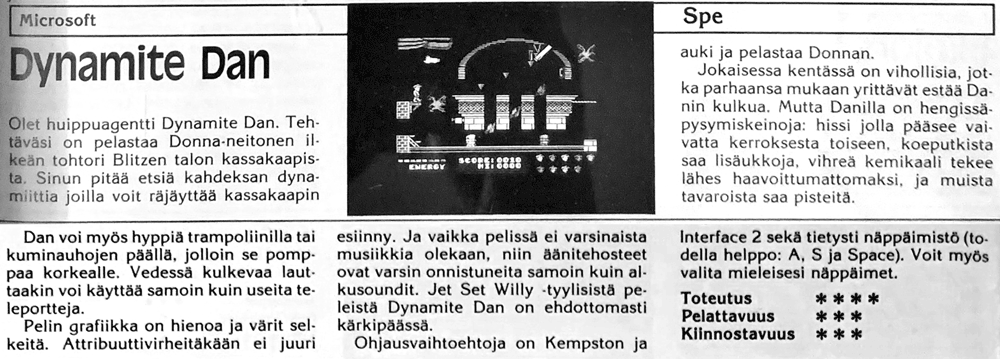
Dynamite Dan1987Pysyvä linkkiOlet huippuagentti Dynamite Dan. Tehtäväsi on pelastaa Donna-neitonen ilkeän tohtori Blitzen talon kassakaapista. Sinun pitää etsiä kahdeksan dynamiittia joilla voit räjäyttää kassakaapin auki ja pelastaa Donnan.
Jokaisessa kentässä on vihollisia, jotka parhaansa mukaan yrittävät estää Danin kulkua. Mutta Danilla on hengissäpysymiskeinoja: hissi jolla pääsee vaivatta kerroksesta toiseen, koeputkista saa lisäukkoja, vihreä kemikaali tekee lähes haavoittumattomaksi, ja muista tavaroista saa pisteitä. Dan voi myös hyppiä trampoliinilla tai kuminauhojen päällä, jolloin se pomppaa korkealle. Vedessä kulkevaa lauttaakin voi käyttää samoin kuin useita teleportteja.
Pelin grafiikka on hienoa ja värit selkeitä. Attribuuttivirheitäkään ei juuri esiinny. Ja vaikka pelissä ei varsinaista musiikkia olekaan, niin äänitehosteet ovat varsin onnistuneita samoin kuin alkusoundit. Jet Set Willy -tyylisistä peleistä Dynamite Dan on ehdottomasti kärkipäässä.
Ohjausvaihtoehtoja on Kempston ja Interface 2 sekä tietysti näppäimistö (todella helppo: A, S ja Space). Voit myös valita mieleisesi näppäimet.
Dynamite Dan1987PermalinkYou are top agent Dynamite Dan. Your mission is to rescue the maiden Donna from the safe in the evil Doctor Blitzen's house. You have to find eight sticks of dynamite with which you can blow the safe open and rescue Donna.
Every level has enemies who do their best to block Dan's way. But Dan has ways of staying alive: a lift that takes you effortlessly from one floor to another, test tubes that give you extra men, a green chemical that makes you almost invulnerable, and other items that give you points. Dan can also jump on a trampoline or on rubber bands, which bounces him up high. The raft on the water can be used too, as can several teleports.
The game's graphics are great and the colours clear. There's hardly any attribute clash either. And even though the game has no actual music as such, the sound effects are very well done, as are the intro sounds. Among Jet Set Willy-style games, Dynamite Dan is definitely right up near the top.
The control options are Kempston and Interface 2, plus of course the keyboard (really easy: A, S and Space). You can also pick your own keys.
Dynamite Dux
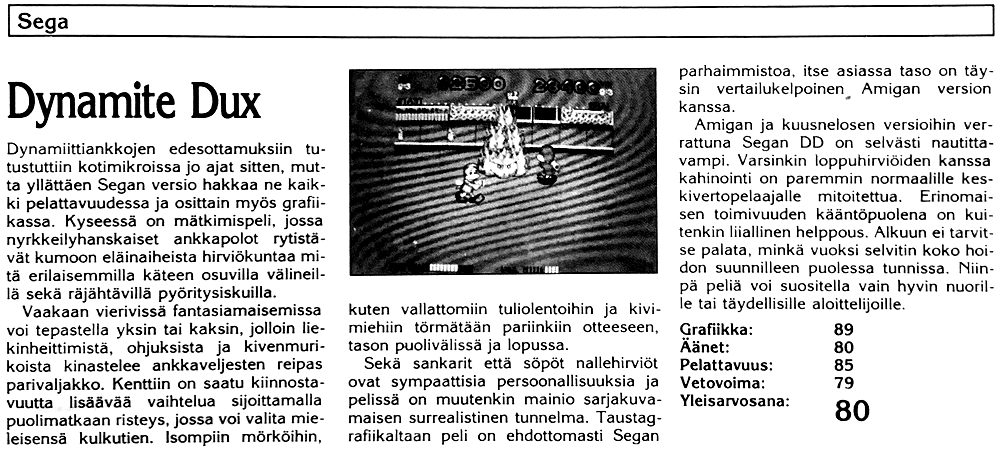
Dynamite Dux1990 SyksyPysyvä linkkiDynamiittiankkojen edesottamuksiin tutustuttiin kotimikroissa jo ajat sitten, mutta yllättäen Segan versio hakkaa ne kaikki pelattavuudessa ja osittain myös grafiikassa. Kyseessä on mätkimispeli, jossa nyrkkeilyhanskaiset ankkapolot rytistävät kumoon eläinaiheista hirviökuntaa mitä erilaisemmilla käteen osuvilla välineillä sekä räjähtävillä pyöritysiskuilla.
Vaakaan vierivissä fantasiamaisemissa voi tepastella yksin tai kaksin, jolloin liekinheittimistä, ohjuksista ja kivenmurikoista kinastelee ankkaveljesten reipas parivaljakko. Kenttiin on saatu kiinnostavuutta lisäävää vaihtelua sijoittamalla puolimatkaan risteys, jossa voi valita mieleisensä kulkutien. Isompiin mörköihin, kuten vallattomiin tuliolentoihin ja kivimiehiin törmätään pariinkiin otteeseen, tason puolivälissä ja lopussa.
Sekä sankarit että söpöt nallehirviöt ovat sympaattisia persoonallisuuksia ja pelissä on muutenkin mainio sarjakuvamaisen surrealistinen tunnelma. Taustagrafiikaltaan peli on ehdottomasti Segan parhaimmistoa, itse asiassa taso on täysin vertailukelpoinen Amigan version kanssa.
Amigan ja kuusnelosen versioihin verrattuna Segan DD on selvästi nautittavampi. Varsinkin loppuhirviöiden kanssa kahinointi on paremmin normaalille keskivertopelaajalle mitoitettua. Erinomaisen toimivuuden kääntöpuolena on kuitenkin liiallinen helppous. Alkuun ei tarvitse palata, minkä vuoksi selvitin koko hoidon suunnilleen puolessa tunnissa. Niinpä peliä voi suositella vain hyvin nuorille tai täydellisille aloittelijoille.
Dynamite Dux1990 SyksyPermalinkWe got acquainted with the antics of the dynamite ducks on home computers ages ago, but surprisingly the Sega version beats them all on playability and partly on graphics too. It's a beat-'em-up in which the poor boxing-gloved ducks knock flat a whole menagerie of animal-themed monsters with all manner of implements that come to hand, plus explosive spinning punches.
You can waddle through the horizontally scrolling fantasy landscapes alone or in pairs, in which case a plucky duo of duck brothers squabbles over the flamethrowers, missiles and lumps of rock. The levels have been given interest-boosting variety by placing a fork halfway along, where you can choose whichever route you fancy. You run into the bigger bogeymen, such as unruly fire creatures and stone men, on a couple of occasions, halfway through the level and at the end.
Both the heroes and the cute teddy-bear monsters are likeable characters, and the game has a splendidly cartoonish, surreal atmosphere all round. For background graphics the game is definitely among the best on the Sega; in fact the standard is fully comparable with the Amiga version.
Compared with the Amiga and Commodore 64 versions, the Sega DD is clearly more enjoyable. The scuffles with the end-of-level monsters in particular are better pitched at the normal average player. The flip side of it working so excellently, however, is that it's far too easy. You never have to go back to the start, which is why I polished off the whole caboodle in about half an hour. So the game can only be recommended to the very young or to complete beginners.
Dynamite Dux
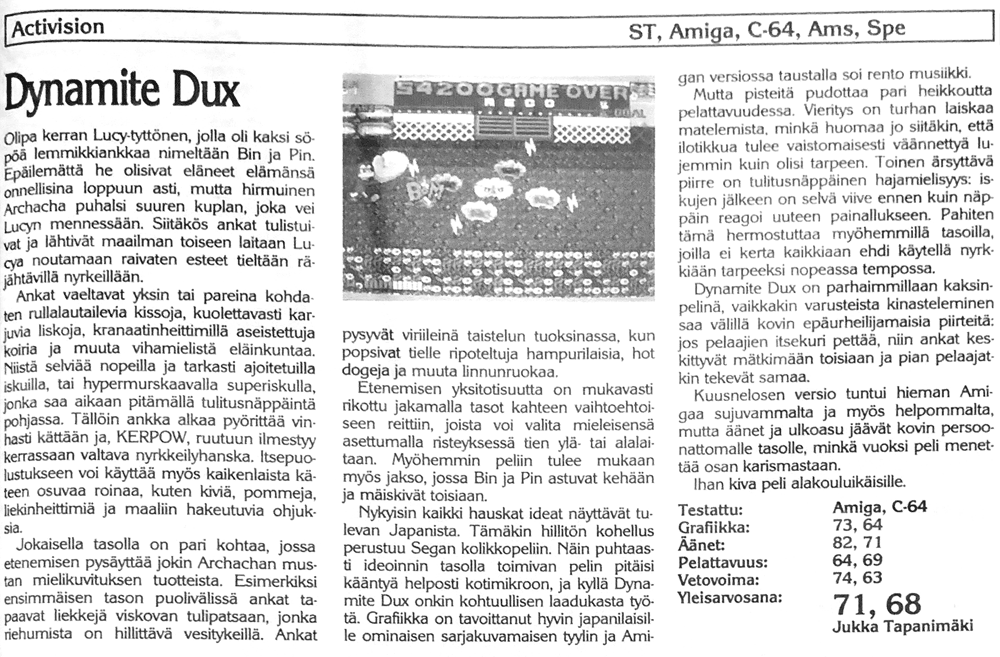
Dynamite Dux1990 KevätPysyvä linkkiOlipa kerran Lucy-tyttönen, jolla oli kaksi söpöä lemmikkiankkaa nimeltään Bin ja Pin. Epäilemättä he olisivat eläneet elämänsä onnellisina loppuun asti, mutta hirmuinen Archacha puhalsi suuren kuplan, joka vei Lucyn mennessään. Siitäkös ankat tulistuivat ja lähtivät maailman toiseen laitaan Lucya noutamaan raivaten esteet tieltään räjähtävillä nyrkeillään.
Ankat vaeltavat yksin tai pareina kohdaten rullalautailevia kissoja, kuolettavasti karjuvia liskoja, kranaatinheittimillä aseistettuja koiria ja muuta vihamielistä eläinkuntaa. Niistä selviää nopeilla ja tarkasti ajoitetuilla iskuilla, tai hypermurskaavalla superiskulla, jonka saa aikaan pitämällä tulitusnäppäintä pohjassa. Tällöin ankka alkaa pyörittää vinhasti kättään ja, KERPOW, ruutuun ilmestyy kerrassaan valtava nyrkkeilyhanska. Itsepuolustukseen voi käyttää myös kaikenlaista käteen osuvaa roinaa, kuten kiviä, pommeja, liekinheittimiä ja maaliin hakeutuvia ohjuksia.
Jokaisella tasolla on pari kohtaa, jossa etenemisen pysäyttää jokin Archachan mustan mielikuvituksen tuotteista. Esimerkiksi ensimmäisen tason puolivälissä ankat tapaavat liekkejä viskovan tulipatsaan, jonka riehumista on hillittävä vesitykeillä. Ankat pysyvät viriileinä taistelun tuoksinassa, kun popsivat tielle ripoteltuja hampurilaisia, hot dogeja ja muuta linnunruokaa.
Etenemisen yksitotisuutta on mukavasti rikottu jakamalla tasot kahteen vaihtoehtoiseen reittiin, joista voi valita mieleisensä asettumalla risteyksessä tien ylä- tai alalaitaan. Myöhemmin peliin tulee mukaan myös jakso, jossa Bin ja Pin astuvat kehään ja mäiskivät toisiaan.
Nykyisin kaikki hauskat ideat näyttävät tulevan Japanista. Tämäkin hillitön kohellus perustuu Segan kolikkopeliin. Näin puhtaasti ideoinnin tasolla toimivan pelin pitäisi kääntyä helposti kotimikroon, ja kyllä Dynamite Dux onkin kohtuullisen laadukasta työtä. Grafiikka on tavoittanut hyvin japanilaisille ominaisen sarjakuvamaisen tyylin ja Amigan versiossa taustalla soi rento musiikki.
Mutta pisteitä pudottaa pari heikkoutta pelattavuudessa. Vieritys on turhan laiskaa matelemista, minkä huomaa jo siitäkin, että ilotikkua tulee vaistomaisesti väännettyä lujemmin kuin olisi tarpeen. Toinen ärsyttävä piirre on tulitusnäppäinen hajamielisyys: iskujen jälkeen on selvä viive ennen kuin näppäin reagoi uuteen painallukseen. Pahiten tämä hermostuttaa myöhemmillä tasoilla, joilla ei kerta kaikkiaan ehdi käytellä nyrkkiään tarpeeksi nopeassa tempossa.
Dynamite Dux on parhaimmillaan kaksinpelinä, vaikkakin varusteista kinasteleminen saa välillä kovin epäurheilijamaisia piirteitä: jos pelaajien itsekuri pettää, niin ankat keskittyvät mätkimään toisiaan ja pian pelaajatkin tekevät samaa.
Kuusnelosen versio tuntui hieman Amigaa sujuvammalta ja myös helpommalta, mutta äänet ja ulkoasu jäävät kovin persoonattomalle tasolle, minkä vuoksi peli menettää osan karismastaan.
Ihan kiva peli alakouluikäisille.
Dynamite Dux1990 KevätPermalinkOnce upon a time there was a little girl called Lucy, who had two cute pet ducks named Bin and Pin. No doubt they would have lived happily ever after, but the dreadful Archacha blew a big bubble that carried Lucy away. Well, didn't that make the ducks see red, and off they set to the far side of the world to fetch Lucy back, clearing obstacles from their path with their exploding fists.
The ducks roam alone or in pairs, running into skateboarding cats, lethally roaring lizards, dogs armed with mortars and other hostile fauna. You get past them with quick, precisely timed punches, or with a hyper-crushing super punch, which you pull off by holding the fire button down. The duck then starts whirling its arm like mad and, KERPOW, an absolutely enormous boxing glove appears on the screen. For self-defence you can also use all sorts of junk that comes to hand, such as rocks, bombs, flamethrowers and homing missiles.
Every level has a couple of spots where your progress is halted by one of the products of Archacha's black imagination. Halfway through the first level, for example, the ducks meet a flame-flinging fire statue whose rampage has to be curbed with water cannons. The ducks stay virile in the heat of battle by gobbling up the hamburgers, hot dogs and other bird food scattered along the way.
The monotony of plodding onwards has been nicely broken up by splitting the levels into two alternative routes, and you can choose whichever you like by positioning yourself at the top or bottom edge of the road at the fork. Later on the game also brings in a section where Bin and Pin step into the ring and whack each other.
These days all the fun ideas seem to come from Japan. This unbridled slapstick is based on a Sega coin-op too. A game that works so purely on the level of ideas ought to convert easily to a home micro, and Dynamite Dux is indeed reasonably high-quality work. The graphics have nicely captured the cartoony style so typical of the Japanese, and in the Amiga version relaxed music plays in the background.
But a couple of weaknesses in the playability knock points off. The scrolling is a needlessly lazy crawl, which you can tell from the very fact that you instinctively find yourself wrenching the joystick harder than you need to. The other irritating feature is the fire button's absent-mindedness: after a punch there's a clear delay before the button responds to a new press. This grates most on the later levels, where you simply don't have time to swing your fist at a fast enough tempo.
Dynamite Dux is at its best as a two-player game, although squabbling over the gear sometimes takes on a very unsporting character: if the players' self-discipline fails, the ducks concentrate on bashing each other and soon the players are doing the same.
The Commodore 64 version felt a little smoother than the Amiga one, and easier too, but the sound and looks stay at a very characterless level, which is why the game loses some of its charisma.
A perfectly nice game for primary-school kids.
Dynasty Wars
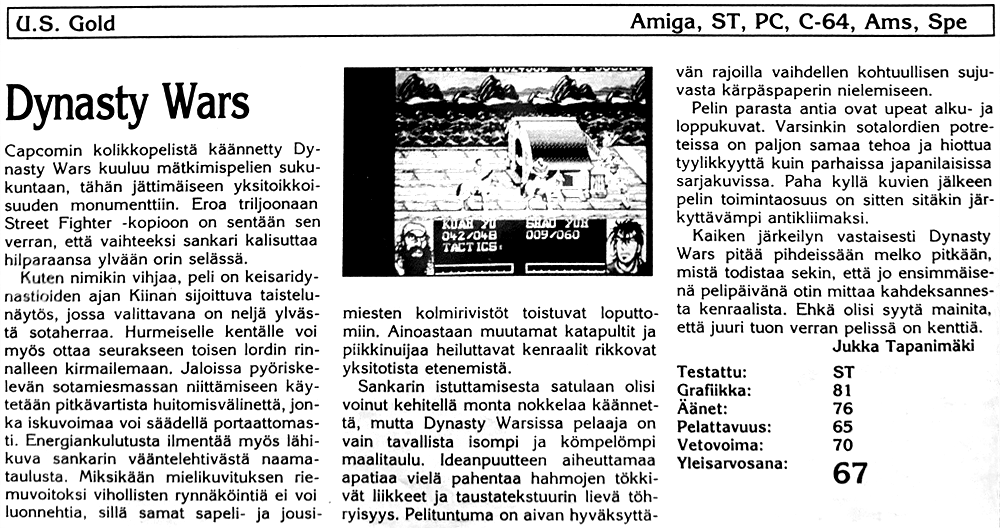
Dynasty Wars1990 SyksyPysyvä linkkiCapcomin kolikkopelistä käännetty Dynasty Wars kuuluu mätkimispelien sukukuntaan, tähän jättimäiseen yksitoikkoisuuden monumenttiin. Eroa triljoonaan Street Fighter -kopioon on sentään sen verran, että vaihteeksi sankari kalisuttaa hilparaansa ylvään orin selässä.
Kuten nimikin vihjaa, peli on keisaridynastioiden ajan Kiinan sijoittuva taistelunäytös, jossa valittavana on neljä ylvästä sotaherraa. Hurmeiselle kentälle voi myös ottaa seurakseen toisen lordin rinnalleen kirmailemaan. Jaloissa pyöriskelevän sotamiesmassan niittämiseen käytetään pitkävartista huitomisvälinettä, jonka iskuvoimaa voi säädellä portaattomasti. Energiankulutusta ilmentää myös lähikuva sankarin vääntelehtivästä naamataulusta. Miksikään mielikuvituksen riemuvoitoksi vihollisten rynnäköintiä ei voi luonnehtia, sillä samat sapeli- ja jousimiesten kolmirivistöt toistuvat loputtomiin. Ainoastaan muutamat katapultit ja piikkinuijaa heiluttavat kenraalit rikkovat yksitotista etenemistä.
Sankarin istuttamisesta satulaan olisi voinut kehitellä monta nokkelaa käännettä, mutta Dynasty Warsissa pelaaja on vain tavallista isompi ja kömpelömpi maalitaulu. Ideanpuutteen aiheuttamaa apatiaa vielä pahentaa hahmojen tökkivät liikkeet ja taustatekstuurin lievä töhryisyys. Pelituntuma on aivan hyväksyttävän rajoilla vaihdellen kohtuullisen sujuvasta kärpäspaperin nielemiseen.
Pelin parasta antia ovat upeat alku- ja loppukuvat. Varsinkin sotalordien potreteissa on paljon samaa tehoa ja hiottua tyylikkyyttä kuin parhaissa japanilaisissa sarjakuvissa. Paha kyllä kuvien jälkeen pelin toimintaosuus on sitten sitäkin järkyttävämpi antikliimaksi.
Kaiken järkeilyn vastaisesti Dynasty Wars pitää pihdeissään melko pitkään, mistä todistaa sekin, että jo ensimmäisenä pelipäivänä otin mittaa kahdeksannesta kenraalista. Ehkä olisi syytä mainita, että juuri tuon verran pelissä on kenttiä.
Dynasty Wars1990 SyksyPermalinkConverted from Capcom's coin-op, Dynasty Wars belongs to the beat-'em-up clan, that gigantic monument to monotony. It does at least differ from the trillion Street Fighter copies in that, for a change, the hero rattles his halberd from the back of a proud stallion.
As the name suggests, the game is a battle spectacle set in China in the age of the imperial dynasties, with four proud warlords to choose from. You can also take a second lord along to frolic at your side on the gory field. The mass of foot soldiers milling about at your feet is mown down with a long-handled swatting implement whose striking power can be adjusted steplessly. Energy use is also shown by a close-up of the hero's contorting mug. The enemy charges can hardly be called a triumph of the imagination, since the same three-deep ranks of sabre- and bowmen repeat endlessly. Only a few catapults and spiked-club-swinging generals break up the monotonous advance.
Putting the hero in the saddle could have been worked up into many a clever twist, but in Dynasty Wars the player is just a bigger and clumsier target than usual. The apathy brought on by the lack of ideas is made worse still by the characters' jerky movements and the slight smudginess of the background textures. The feel of the game sits right on the borderline of acceptable, varying from reasonably smooth to swallowing flypaper.
The best the game has to offer is the superb opening and ending pictures. The warlords' portraits in particular have much of the same punch and polished style as the best Japanese comics. Sadly, after the pictures the action part of the game is all the more shocking an anticlimax.
Against all reason, Dynasty Wars keeps you in its grip for quite a while, as witnessed by the fact that on my very first day of play I was already taking on the eighth general. Perhaps I ought to mention that that is exactly how many levels the game has.