Interphase
Pelit was a Finnish-language (bi)annual book series published from 1987 to 1991 containing gaming-related articles, tips and most importantly game reviews. Here you can find all the reviews from the books. The reviews were originally written in Finnish; the English versions are translations of the Finnish originals. Maininta tekijänoikeuksista
 1987
1987 1988
1988 1989 Kevät
 1989 Syksy
 1990 Kevät
 1990 Syksy
 1991 Kevät
 1991 Syksy
Interphase
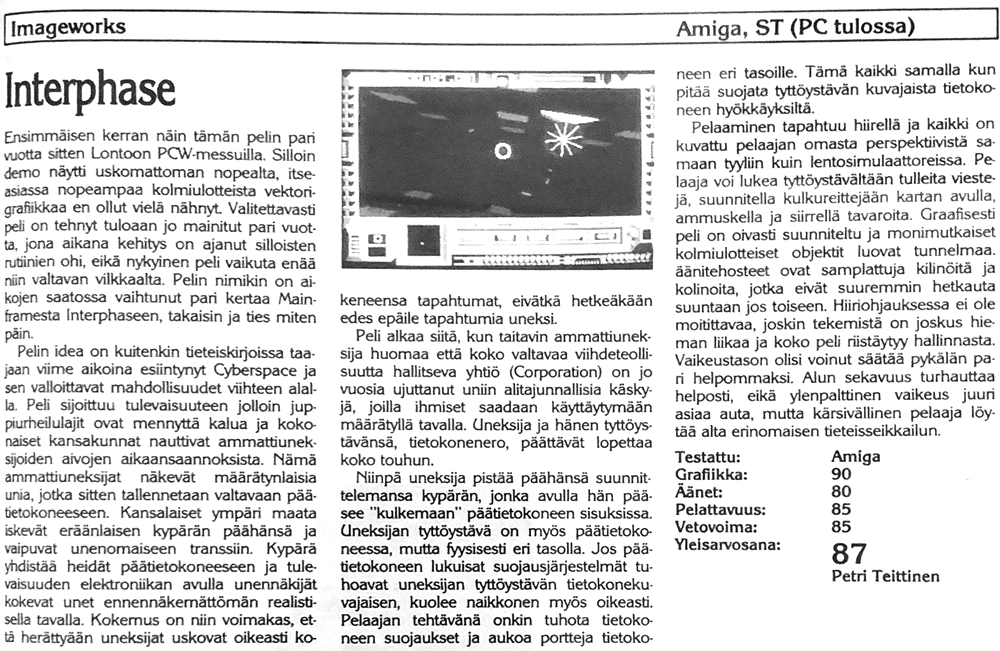
Interphase1990 KevätPysyvä linkkiEnsimmäisen kerran näin tämän pelin pari vuotta sitten Lontoon PCW-messuilla. Silloin demo näytti uskomattoman nopealta, itseasiassa nopeampaa kolmiulotteista vektorigrafiikkaa en ollut vielä nähnyt. Valitettavasti peli on tehnyt tuloaan jo mainitut pari vuotta, jona aikana kehitys on ajanut silloisten rutiinien ohi, eikä nykyinen peli vaikuta enää niin valtavan vilkkaalta. Pelin nimikin on aikojen saatossa vaihtunut pari kertaa Mainframesta Interphaseen, takaisin ja ties miten päin.
Pelin idea on kuitenkin tieteiskirjoissa taajaan viime aikoina esiintynyt Cyberspace ja sen valloittavat mahdollisuudet viihteen alalla. Peli sijoittuu tulevaisuuteen jolloin juppiurheilulajit ovat mennyttä kalua ja kokonaiset kansakunnat nauttivat ammattiuneksijoiden aivojen aikaansaannoksista. Nämä ammattiuneksijat näkevät määrätynlaisia unia, jotka sitten tallennetaan valtavaan päätietokoneeseen. Kansalaiset ympäri maata iskevät eräänlaisen kypärän päähänsä ja vaipuvat unenomaiseen transsiin. Kypärä yhdistää heidät päätietokoneeseen ja tulevaisuuden elektroniikan avulla unennäkijät kokevat unet ennennäkemättömän realistisella tavalla. Kokemus on niin voimakas, että herättyään uneksijat uskovat oikeasti kokeneensa tapahtumat, eivätkä hetkeäkään edes epäile tapahtumia uneksi.
Peli alkaa siitä, kun taitavin ammattiuneksija huomaa että koko valtavaa viihdeteollisuutta hallitseva yhtiö (Corporation) on jo vuosia ujuttanut uniin alitajunnallisia käskyjä, joilla ihmiset saadaan käyttäytymään määrätyllä tavalla. Uneksija ja hänen tyttöystävänsä, tietokonenero, päättävät lopettaa koko touhun.
Niinpä uneksija pistää päähänsä suunnittelemansa kypärän, jonka avulla hän pääsee "kulkemaan" päätietokoneen sisuksissa. Uneksijan tyttöystävä on myös päätietokoneessa, mutta fyysisesti eri tasolla. Jos päätietokoneen lukuisat suojausjärjestelmät tuhoavat uneksijan tyttöystävän tietokonekuvajaisen, kuolee naikkonen myös oikeasti. Pelaajan tehtävänä onkin tuhota tietokoneen suojaukset ja aukoa portteja tietokoneen eri tasoille. Tämä kaikki samalla kun pitää suojata tyttöystävän kuvajaista tietokoneen hyökkäyksiltä.
Pelaaminen tapahtuu hiirellä ja kaikki on kuvattu pelaajan omasta perspektiivistä samaan tyyliin kuin lentosimulaattoreissa. Pelaaja voi lukea tyttöystävältään tulleita viestejä, suunnitella kulkureittejään kartan avulla, ammuskella ja siirrellä tavaroita. Graafisesti peli on oivasti suunniteltu ja monimutkaiset kolmiulotteiset objektit luovat tunnelmaa. äänitehosteet ovat samplattuja kilinöitä ja kolinoita, jotka eivät suuremmin hetkauta suuntaan jos toiseen. Hiiriohjauksessa ei ole moitittavaa, joskin tekemistä on joskus hieman liikaa ja koko peli riistäytyy hallinnasta. Vaikeustason olisi voinut säätää pykälän pari helpommaksi. Alun sekavuus turhauttaa helposti, eikä ylenpalttinen vaikeus juuri asiaa auta, mutta kärsivällinen pelaaja löytää alta erinomaisen tieteisseikkailun.
Interphase1990 KevätPermalinkI first saw this game a couple of years ago at the PCW show in London. Back then the demo looked incredibly fast; in fact, I had never yet seen faster three-dimensional vector graphics. Unfortunately the game has been on its way for that same couple of years, during which time progress has overtaken the routines of the day, and the current game no longer seems quite so tremendously nippy. Even the game's name has changed a couple of times over the ages, from Mainframe to Interphase, back again and who knows which way round.
The game's idea, however, is Cyberspace, which has been cropping up frequently in science fiction books lately, and its captivating possibilities in the field of entertainment. The game is set in a future where yuppie sports are old hat and entire nations enjoy what the brains of professional dreamers turn out. These professional dreamers dream particular kinds of dreams, which are then stored in a huge mainframe computer. Citizens all over the country slap a kind of helmet on their heads and sink into a dreamlike trance. The helmet connects them to the mainframe, and thanks to the electronics of the future, the dreamers experience the dreams in an unprecedentedly realistic way. The experience is so powerful that on waking, the dreamers believe they really lived through the events, and never for a moment even suspect them of being a dream.
The game begins when the most skilled professional dreamer notices that the company controlling the whole vast entertainment industry (the Corporation) has for years been slipping subliminal commands into the dreams to make people behave in a certain way. The dreamer and his girlfriend, a computer genius, decide to put a stop to the whole business.
So the dreamer puts on a helmet of his own design, which lets him "travel" around the innards of the mainframe. The dreamer's girlfriend is inside the mainframe too, but physically on a different level. If the mainframe's numerous security systems destroy the girlfriend's computer image, the lass dies for real as well. The player's task, then, is to destroy the computer's defences and open up gates to the computer's various levels. All this while also protecting the girlfriend's image from the computer's attacks.
The game is played with the mouse, and everything is shown from the player's own perspective, in the same style as in flight simulators. The player can read messages from his girlfriend, plan his routes with the help of a map, blast away and move objects around. Graphically the game is splendidly designed, and the complex three-dimensional objects create atmosphere. The sound effects are sampled clinks and clunks that don't much sway you one way or the other. There's nothing to fault in the mouse control, although sometimes there's a bit too much to do and the whole game runs away from you. The difficulty level could have been set a notch or two easier. The confusion at the start easily frustrates, and the excessive difficulty hardly helps matters, but the patient player will find an excellent science fiction adventure underneath.