1133 reviews from "Pelit"-books
Pelit was a Finnish-language (bi)annual book series published from 1987 to 1991 containing gaming-related articles, tips and most importantly game reviews. Here you can find all the reviews from the books. The reviews were originally written in Finnish; the English versions are translations of the Finnish originals. Maininta tekijänoikeuksista
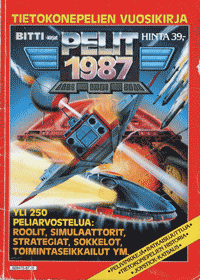 1987
1987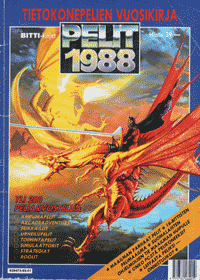 1988
1988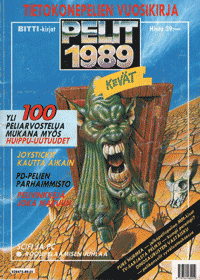 1989 Kevät
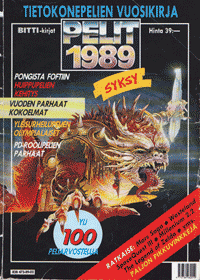 1989 Syksy
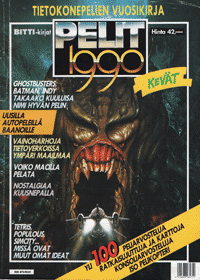 1990 Kevät
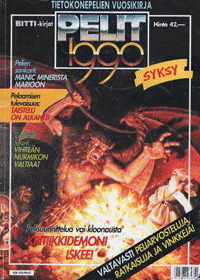 1990 Syksy
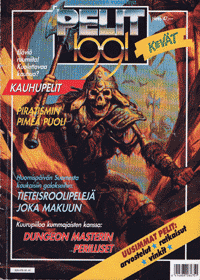 1991 Kevät
 1991 Syksy
Kampfgruppe
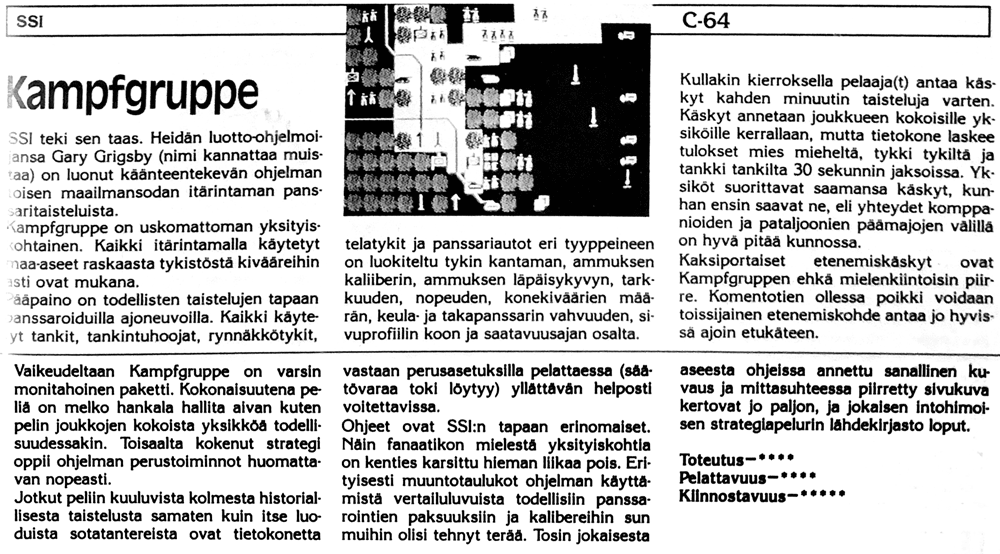
Kampfgruppe1987Pysyvä linkkiSSI teki sen taas. Heidän luotto-ohjelmoijansa Gary Grigsby (nimi kannattaa muistaa) on luonut käänteentekevän ohjelman toisen maailmansodan itärintaman panssaritaisteluista.
Kampfgruppe on uskomattoman yksityiskohtainen. Kaikki itärintamalla käytetyt maa-aseet raskaasta tykistöstä kivääreihin asti ovat mukana.
Pääpaino on todellisten taistelujen tapaan panssaroiduilla ajoneuvoilla. Kaikki käytetyt tankit, tankintuhoojat, rynnäkkötykit, telatykit ja panssariautot eri tyyppeineen on luokiteltu tykin kantaman, ammuksen kaliiberin, ammuksen läpäisykyvyn, tarkkuuden, nopeuden, konekiväärien määrän, keula- ja takapanssarin vahvuuden, sivuprofiilin koon ja saatavuusajan osalta.
Kullakin kierroksella pelaaja(t) antaa käskyt kahden minuutin taisteluja varten. Käskyt annetaan joukkueen kokoisille yksiköille kerrallaan, mutta tietokone laskee tulokset mies mieheltä, tykki tykiltä ja tankki tankilta 30 sekunnin jaksoissa. Yksiköt suorittavat saamansa käskyt, kunhan ensin saavat ne, eli yhteydet komppanioiden ja pataljoonien päämajojen välillä on hyvä pitää kunnossa.
Kaksiportaiset etenemiskäskyt ovat Kampfgruppen ehkä mielenkiintoisin piirre. Komentotien ollessa poikki voidaan toissijainen etenemiskohde antaa jo hyvissä ajoin etukäteen. Vaikeudeltaan Kampfgruppe on varsin monitahoinen paketti. Kokonaisuutena peliä on melko hankala hallita aivan kuten pelin joukkojen kokoista yksikköä todellisuudessakin. Toisaalta kokenut strategi oppii ohjelman perustoiminnot huomattavan nopeasti.
Jotkut peliin kuuluvista kolmesta historiallisesta taistelusta samaten kuin itse luoduista sotatantereista ovat tietokonetta vastaan perusasetuksilla pelattaessa (säätövaraa toki löytyy) yllättävän helposti voitettavissa.
Ohjeet ovat SSI:n tapaan erinomaiset. Näin fanaatikon mielestä yksityiskohtia on kenties karsittu hieman liikaa pois. Erityisesti muuntotaulukot ohjelman käyttämistä vertailuluvuista todellisiin panssarointien paksuuksiin ja kalibereihin sun muihin olisi tehnyt terää. Tosin jokaisesta aseesta ohjeissa annettu sanallinen kuvaus ja mittasuhteessa piirretty sivukuva kertovat jo paljon, ja jokaisen intohimoisen strategiapelurin lähdekirjasto loput.
Kampfgruppe1987PermalinkSSI has done it again. Their trusty programmer Gary Grigsby (a name worth remembering) has created a groundbreaking program about the armoured battles on the Eastern Front of the Second World War.
Kampfgruppe is incredibly detailed. Every ground weapon used on the Eastern Front, from heavy artillery right down to rifles, is included.
As in the real battles, the main emphasis is on armoured vehicles. All the tanks, tank destroyers, assault guns, self-propelled guns and armoured cars that were used, in all their different variants, have been rated for gun range, shell calibre, shell penetration, accuracy, speed, number of machine guns, front and rear armour strength, size of side profile and period of availability.
Each turn, the player(s) give orders for two minutes of combat. Orders are given to one platoon-sized unit at a time, but the computer calculates the results man by man, gun by gun and tank by tank in 30-second segments. Units carry out the orders they receive, provided they receive them in the first place - so it pays to keep communications between the company and battalion headquarters in good order.
The two-stage movement orders are perhaps Kampfgruppe's most interesting feature. For when the chain of command is cut, a secondary objective can be assigned well ahead of time. In terms of difficulty, Kampfgruppe is quite a multifaceted package. As a whole the game is fairly hard to control, just as a unit the size of the game's forces would be in reality. On the other hand, an experienced strategist will learn the program's basic functions remarkably quickly.
Some of the three historical battles included with the game, as well as self-made battlefields, are surprisingly easy to win when played against the computer on the default settings (though there is certainly room for adjustment).
As is SSI's habit, the manual is excellent. For a fanatic like me, perhaps a bit too much detail has been trimmed out. In particular, conversion tables from the comparative ratings the program uses to actual armour thicknesses, calibres and whatnot would have hit the spot. Then again, the written description of each weapon in the manual and the side view drawn to scale already tell you a lot, and every passionate strategy gamer's reference library tells the rest.
Keef The Thief

Keef The Thief1990 KevätPysyvä linkkiTämä peli ei voi olla huono, ajattelin, kun huomasin että ohjelmoijaryhmän nimi on The Naughty Dog (Tuhma Koira). Ja olinkin aivan oikeassa. Keef The Thief on nokkelasti viritetty versio Bard's Tale -tyylisestä roolipelistä, eikä jätä kylmäksi karaistuneintakaan pelaajaa.
Keef-varas on ammattinsa takia (varas mikä varas) karkotettu jo vaikka kuinka monesta kaupungista. Pelaaja astuu Keefin kenkiin, kun hän saapuu jälleen uuteen kaupunkiin, joka on täynnä mahdollisuuksia uskaltavalle nuorelle miehelle. Tavoitteena on jumalkuninkuus, ei sen enempää eikä vähempää.
Ne, jotka ovat jo aikaisemmin tutustuneet tietokoneistettuun roolipelaamiseen, ovat KTT:ssä kuin kotonaan. Roolipeleille tyypilliset käskyt loistavat valikosta vastaan kuin toivottaen vanhan ystävän tervetulleeksi takaisin. Jotkut käskyt suorittavat temppunsa heti, kun taas toiset avaavat alavalikon, josta löytyy lisää käskyjä. Jotkut käskyt tuovat esiin mitä monituisempia laatikoita ja mittareita, joista käy hetkessä ilmi sankarin ruumiillinen ja henkinen tila.
Se, missä KTT eroaa monista muista roolipeleistä, on sen loppuun asti viety viimeistely ja älykäs taistelusysteemi. Viimeistelystä kielivät nokkelasti viimeistellyt valikot, jotka oppii kuka tahansa hetkessä. KTT:tä on suorastaan ilo pelata!
Taistelusysteemi onkin sitten yksinkertaisuudessaan nerokas. Peli käyttää Line-Of-Sight-systeemiä, joka suomeksi tarkoittaa sitä, että voit huitoa miekalla tai nuijalla vain sitä vastustajaa, jonka näet. Jos haluat nuijia takanasi väijyvää vihollista, täytyy sinun ensin kääntyä kohti vihulaista.
Systeemi esittää parhaat puolensa siinä vaiheessa kun nuolet alkavat viuhua ilmatilan läpi. Jos suojaudut nurkan taakse vastustajat eivät voi osua muttet sinäkään. Siis virität jousen ja nuolen valmiiksi, odotat että vastustaja ampuu nuolensa ja salamannopeasti käännyt kulman taakse. Hyvällä onnella vastustajasi on tyhmyyksissään jäänyt seisoskelemaan kadulle ja hyvin tähdätty nuoli päättää hänen päivänsä.
Seikkailupeleissä ei grafiikka ole koskaan ollut kovin tärkeä (esimerkiksi Ultimat), eikä KTT olekaan visuaalisesti mikään mestariteos. Grafiikka ajaa kuitenkin asiansa paremmin kuin hyvin. Taustalla soi miellyttävä musiikkikappale, jolla tuntuu olevan pituuttakin tarpeeksi, ettei siihen hetkessä kyllästy. Hiiriohjaus pitäisi tehdä vakioksi kaikkiin tällaisiin peleihin, on se sen verran kätevä.
Keef The Thief on suorastaan erinomainen esitys uudelta ohjelmoijaryhmältä. Jäänkin vesi kielellä odottelemaan remmin seuraavaa peliä.
Keef The Thief1990 KevätPermalinkThis game can't be bad, I thought, when I noticed that the programming team's name is The Naughty Dog. And I was absolutely right. Keef The Thief is a cleverly tuned version of a Bard's Tale-style role-playing game, and it won't leave even the most hardened player cold.
Because of his profession (a thief is a thief), Keef the thief has already been banished from who knows how many towns. The player steps into Keef's shoes as he arrives in yet another new town, full of opportunities for a daring young man. The goal is god-kingship, no more and no less.
Those who have already made the acquaintance of computerised role-playing will feel right at home in KTT. The commands typical of role-playing games beam out at you from the menu as if welcoming an old friend back. Some commands perform their trick at once, while others open a submenu with more commands in it. Some commands bring up all manner of boxes and gauges that show at a glance the hero's physical and mental state.
Where KTT differs from many other role-playing games is in its polish, carried right through to the end, and its intelligent combat system. The polish shows in the cleverly polished menus, which anyone can learn in no time. KTT is a downright joy to play!
The combat system, for its part, is ingenious in its simplicity. The game uses a Line-Of-Sight system, which in plain English means that you can only swing your sword or club at an opponent you can see. If you want to club an enemy lurking behind you, you first have to turn to face the villain.
The system shows its best side once the arrows start whizzing through the air. If you take cover behind a corner, your opponents can't hit you, but neither can you hit them. So you ready your bow and arrow, wait for the opponent to loose his arrow, and at lightning speed turn round the corner. With luck, your opponent has foolishly stayed standing about in the street, and a well-aimed arrow ends his days.
Graphics have never been very important in adventure games (the Ultimas, for example), and KTT is no visual masterpiece either. Still, the graphics do their job more than well. A pleasant piece of music plays in the background, and it seems to be long enough that you don't tire of it in a moment. Mouse control should be made standard in all games like this, it's that handy.
Keef The Thief is a downright excellent showing from a new programming team. I'll be waiting for the gang's next game with my mouth watering.
Kelly X
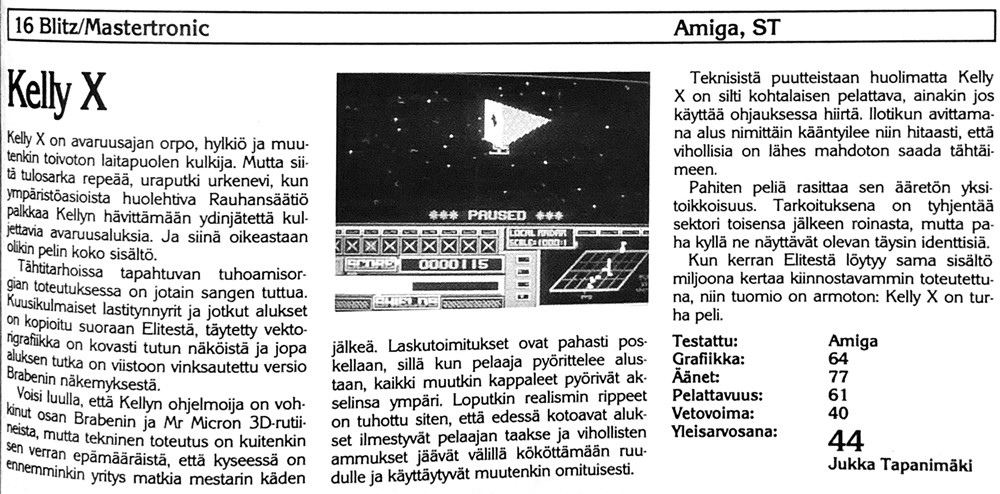
Kelly X1990 KevätPysyvä linkkiKelly X on avaruusajan orpo, hylkiö ja muutenkin toivoton laitapuolen kulkija. Mutta siitä tulosarka repeää, uraputki urkenevi, kun ympäristöasioista huolehtiva Rauhansäätiö palkkaa Kellyn hävittämään ydinjätettä kuljettavia avaruusaluksia. Ja siinä oikeastaan olikin pelin koko sisältö.
Tähtitarhoissa tapahtuvan tuhoamisorgian toteutuksessa on jotain sangen tuttua. Kuusikulmaiset lastitynnyrit ja jotkut alukset on kopioitu suoraan Elitestä, täytetty vektorigrafiikka on kovasti tutun näköistä ja jopa aluksen tutka on viistoon vinksautettu versio Brabenin näkemyksestä.
Voisi luulla, että Kellyn ohjelmoija on vohkinut osan Brabenin ja Mr Micron 3D-rutiineista, mutta tekninen toteutus on kuitenkin sen verran epämääräistä, että kyseessä on ennemminkin yritys matkia mestarin käden jälkeä. Laskutoimitukset ovat pahasti poskellaan, sillä kun pelaaja pyörittelee alustaan, kaikki muutkin kappaleet pyörivät akselinsa ympäri. Loputkin realismin rippeet on tuhottu siten, että edessä kotoavat alukset ilmestyvät pelaajan taakse ja vihollisten ammukset jäävät välillä kököttämään ruudulle ja käyttäytyvät muutenkin omituisesti.
Teknisistä puutteistaan huolimatta Kelly X on silti kohtalaisen pelattava, ainakin jos käyttää ohjauksessa hiirtä. Ilotikun avittamana alus nimittäin kääntyilee niin hitaasti, että vihollisia on lähes mahdoton saada tähtäimeen.
Pahiten peliä rasittaa sen ääretön yksitoikkoisuus. Tarkoituksena on tyhjentää sektori toisensa jälkeen roinasta, mutta paha kyllä ne näyttävät olevan täysin identtisiä.
Kun kerran Elitestä löytyy sama sisältö miljoona kertaa kiinnostavammin toteutettuna, niin tuomio on armoton: Kelly X on turha peli.
Kelly X1990 KevätPermalinkKelly X is a space-age orphan, an outcast and an all-round hopeless down-and-out. But lo, the earnings burst forth and the career path doth unfurl when the Peace Foundation, which looks after environmental matters, hires Kelly to wipe out spaceships carrying nuclear waste. And that, really, was the game's entire content.
There's something rather familiar about the execution of this orgy of destruction out in the starry heavens. The hexagonal cargo barrels and some of the ships have been copied straight from Elite, the filled vector graphics look awfully familiar, and even the ship's radar is a version of Braben's vision knocked askew at a slant.
You might think that Kelly's programmer has nicked some of Braben's and Mr Micro's 3D routines, but the technical implementation is so dodgy that it's more a case of an attempt to imitate the master's handiwork. The calculations are badly out of whack, for when the player rotates his craft, all the other objects spin around their own axes too. The last shreds of realism are destroyed by ships that vanish in front of you turning up behind the player, and enemy shots sometimes get left squatting on the screen and behave oddly in other ways too.
Despite its technical shortcomings, Kelly X is still fairly playable, at least if you use the mouse for control. With the joystick's help, you see, the ship turns so slowly that it's almost impossible to get enemies in your sights.
What weighs the game down most is its endless monotony. The idea is to clear sector after sector of junk, but unfortunately they seem to be completely identical.
Since Elite offers the same content done a million times more interestingly, the verdict is merciless: Kelly X is a pointless game.
Kennedy Approach
Kennedy Approach1989 SyksyPysyvä linkkiOletko haaveillut lennonjohtajan urasta? Siinä tapauksessa Kennedy Approach tarjoaa oivan mahdollisuuden kurkistaa ammatin stressaavaan arkeen ilman että pieni töppäily vaarantaisi tuhansien matkustajien hengen.
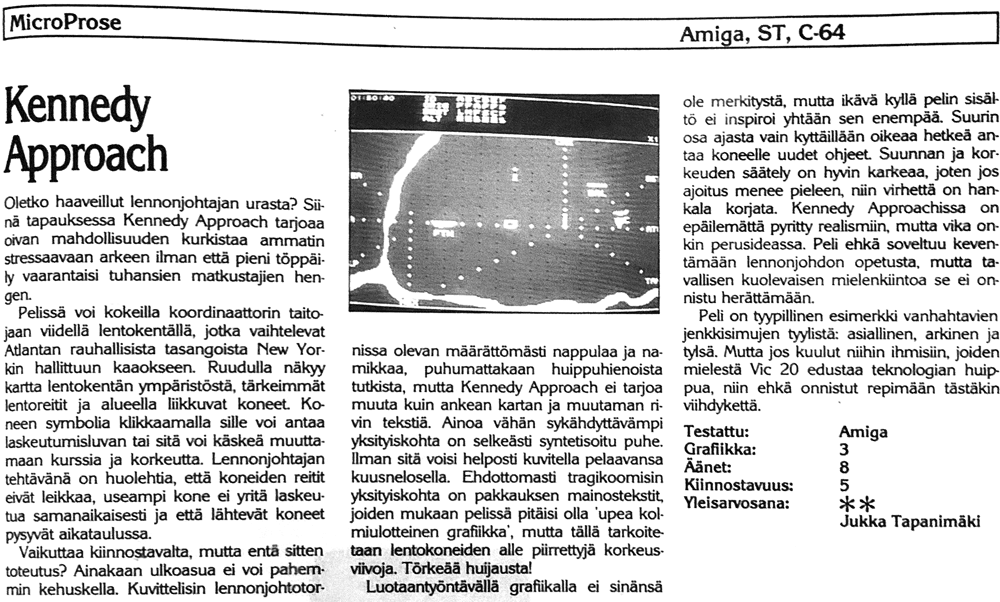
Pelissä voi kokeilla koordinaattorin taitojaan viidellä lentokentällä, jotka vaihtelevat Atlantan rauhallisista tasangoista New Yorkin hallittuun kaaokseen. Ruudulla näkyy kartta lentokentän ympäristöstä, tärkeimmät lentoreitit ja alueella liikkuvat koneet. Koneen symbolia klikkaamalla sille voi antaa laskeutumisluvan tai sitä voi käskeä muuttamaan kurssia ja korkeutta. Lennonjohtajan tehtävänä on huolehtia, että koneiden reitit eivät leikkaa, useampi kone ei yritä laskeutua samanaikaisesti ja että lähtevät koneet pysyvät aikataulussa.
Vaikuttaa kiinnostavalta, mutta entä sitten toteutus? Ainakaan ulkoasua ei voi pahemmin kehuskella. Kuvittelisin lennonjohtotornissa olevan määrättömästi nappulaa ja namikkaa, puhumattakaan huippuhienoista tutkista, mutta Kennedy Approach ei tarjoa muuta kuin ankean kartan ja muutaman rivin tekstiä. Ainoa vähän sykähdyttävämpi yksityiskohta on selkeästi syntetisoitu puhe. Ilman sitä voisi helposti kuvitella pelaavansa kuusnelosella. Ehdottomasti tragikoomisin yksityiskohta on pakkauksen mainostekstit, joiden mukaan pelissä pitäisi olla 'upea kolmiulotteinen grafiikka', mutta tällä tarkoitetaan lentokoneiden alle piirrettyjä korkeusviivoja. Törkeää huijausta!
Luotaantyöntävällä grafiikalla ei sinänsä ole merkitystä, mutta ikävä kyllä pelin sisältö ei inspiroi yhtään sen enempää. Suurin osa ajasta vain kyttäillään oikeaa hetkeä antaa koneelle uudet ohjeet. Suunnan ja korkeuden säätely on hyvin karkeaa, joten jos ajoitus menee pieleen, niin virhettä on hankala korjata. Kennedy Approachissa on epäilemättä pyritty realismiin, mutta vika onkin perusideassa. Peli ehkä soveltuu keventämään lennonjohdon opetusta, mutta tavallisen kuolevaisen mielenkiintoa se ei onnistu herättämään.
Peli on tyypillinen esimerkki vanhahtavien jenkkisimujen tyylistä: asiallinen, arkinen ja tylsä. Mutta jos kuulut niihin ihmisiin, joiden mielestä Vic 20 edustaa teknologian huippua, niin ehkä onnistut repimään tästäkin viihdykettä.
Kennedy Approach1989 SyksyPermalinkHave you dreamt of a career as an air traffic controller? In that case Kennedy Approach offers a fine chance to peek into the stressful daily grind of the profession without a small slip-up endangering the lives of thousands of passengers.
In the game you can try out your skills as a coordinator at five airports, ranging from the peaceful plains of Atlanta to the controlled chaos of New York. The screen shows a map of the airport's surroundings, the most important flight routes and the aircraft moving in the area. By clicking on a plane's symbol you can give it clearance to land, or order it to change course and altitude. The controller's job is to make sure that the planes' routes don't cross, that no two planes try to land at the same time, and that departing planes stay on schedule.
Sounds interesting, but what about the execution? The presentation, at least, is nothing much to boast about. I'd imagine a control tower to be full of countless knobs and buttons, not to mention ultra-fancy radars, but Kennedy Approach offers nothing more than a dreary map and a few lines of text. The only slightly more thrilling detail is the clear synthesised speech. Without it you could easily imagine you were playing on a C-64. By far the most tragicomic detail is the blurb on the packaging, according to which the game is supposed to have 'stunning three-dimensional graphics', but what this means is altitude lines drawn under the aircraft. A blatant swindle!
The off-putting graphics don't matter as such, but unfortunately the game's content isn't one bit more inspiring. Most of the time you just lurk, waiting for the right moment to give a plane new instructions. Adjusting heading and altitude is very coarse, so if your timing goes wrong, the mistake is hard to correct. Kennedy Approach has no doubt aimed at realism, but the fault lies in the basic idea. The game might be suitable for lightening up air traffic control training, but it doesn't manage to arouse the interest of an ordinary mortal.
The game is a typical example of the style of old-fashioned Yank sims: matter-of-fact, mundane and boring. But if you're one of those people who think the Vic 20 represents the pinnacle of technology, maybe you'll manage to wring some entertainment even out of this.
Kick Off 2
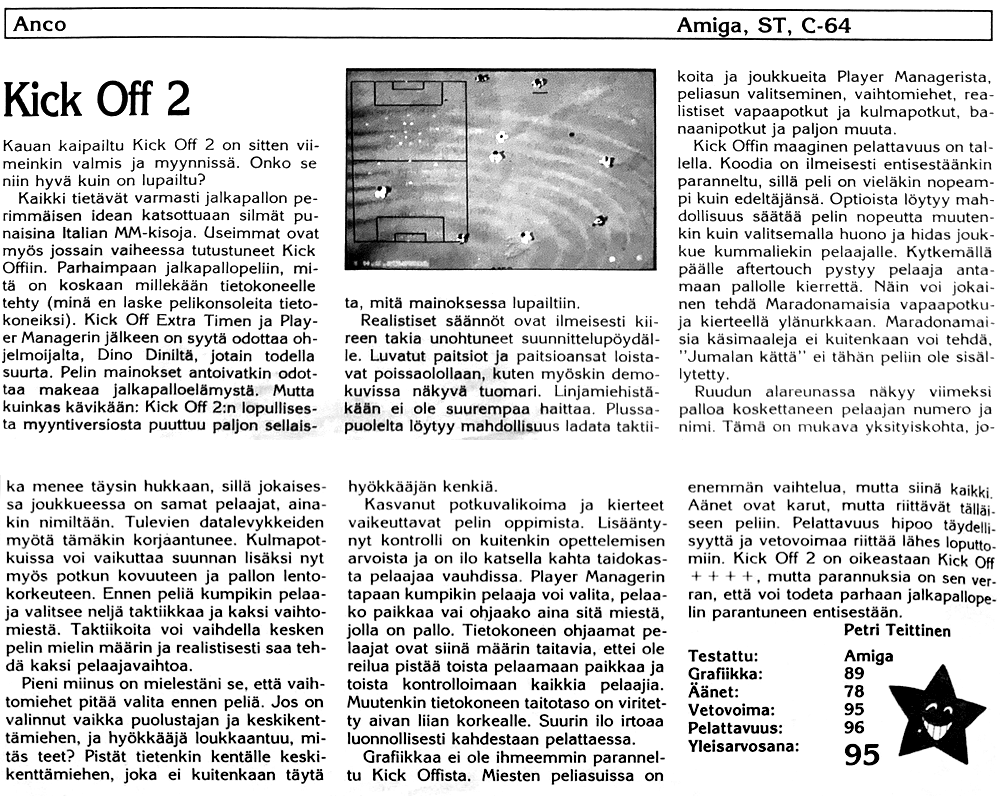
Kick Off 21990 SyksyPysyvä linkkiKauan kaipailtu Kick Off 2 on sitten viimeinkin valmis ja myynnissä. Onko se niin hyvä kuin on lupailtu?
Kaikki tietävät varmasti jalkapallon perimmäisen idean katsottuaan silmät punaisina Italian MM-kisoja. Useimmat ovat myös jossain vaiheessa tutustuneet Kick Offiin. Parhaimpaan jalkapallopeliin, mitä on koskaan millekään tietokoneelle tehty (minä en laske pelikonsoleita tietokoneiksi). Kick Off Extra Timen ja Player Managerin jälkeen on syytä odottaa ohjelmoijalta, Dino Diniltä, jotain todella suurta. Pelin mainokset antoivatkin odottaa makeaa jalkapalloelämystä. Mutta kuinkas kävikään: Kick Off 2:n lopullisesta myyntiversiosta puuttuu paljon sellaista, mitä mainoksessa lupailtiin.
Realistiset säännöt ovat ilmeisesti kiireen takia unohtuneet suunnittelupöydälle. Luvatut paitsiot ja paitsioansat loistavat poissaolollaan, kuten myöskin demokuvissa näkyvä tuomari. Linjamiehistäkään ei ole suurempaa haittaa. Plussapuolelta löytyy mahdollisuus ladata taktiikoita ja joukkueita Player Managerista, peliasun valitseminen, vaihtomiehet, realistiset vapaapotkut ja kulmapotkut, banaanipotkut ja paljon muuta.
Kick Offin maaginen pelattavuus on tallella. Koodia on ilmeisesti entisestäänkin paranneltu, sillä peli on vieläkin nopeampi kuin edeltäjänsä. Optioista löytyy mahdollisuus säätää pelin nopeutta muutenkin kuin valitsemalla huono ja hidas joukkue kummaliekin pelaajalle. Kytkemällä päälle aftertouch pystyy pelaaja antamaan pallolle kierrettä. Näin voi jokainen tehdä Maradonamaisia vapaapotkuja kierteellä ylänurkkaan. Maradonamaisia käsimaaleja ei kuitenkaan voi tehdä, "Jumalan kättä" ei tähän peliin ole sisällytetty.
Ruudun alareunassa näkyy viimeksi palloa koskettaneen pelaajan numero ja nimi. Tämä on mukava yksityiskohta, joka menee täysin hukkaan, sillä jokaisessa joukkueessa on samat pelaajat, ainakin nimiltään. Tulevien datalevykkeiden myötä tämäkin korjaantunee. Kulmapotkuissa voi vaikuttaa suunnan lisäksi nyt myös potkun kovuuteen ja pallon lentokorkeuteen. Ennen peliä kumpikin pelaaja valitsee neljä taktiikkaa ja kaksi vaihtomiestä. Taktiikoita voi vaihdella kesken pelin mielin määrin ja realistisesti saa tehdä kaksi pelaajavaihtoa.
Pieni miinus on mielestäni se, että vaihtomiehet pitää valita ennen peliä. Jos on valinnut vaikka puolustajan ja keskikenttämiehen, ja hyökkääjä loukkaantuu, mitäs teet? Pistät tietenkin kentälle keskikenttämiehen, joka ei kuitenkaan täytä hyökkääjän kenkiä.
Kasvanut potkuvalikoima ja kierteet vaikeuttavat pelin oppimista. Lisääntynyt kontrolli on kuitenkin opettelemisen arvoista ja on ilo katsella kahta taidokasta pelaajaa vauhdissa. Player Managerin tapaan kumpikin pelaaja voi valita, pelaako paikkaa vai ohjaako aina sitä miestä, jolla on pallo. Tietokoneen ohjaamat pelaajat ovat siinä määrin taitavia, ettei ole reilua pistää toista pelaamaan paikkaa ja toista kontrolloimaan kaikkia pelaajia. Muutenkin tietokoneen taitotaso on viritetty aivan liian korkealle. Suurin ilo irtoaa luonnollisesti kahdestaan pelattaessa.
Grafiikkaa ei ole ihmeemmin parannettu Kick Offista. Miesten peliasuissa on enemmän vaihtelua, mutta siinä kaikki. Äänet ovat karut, mutta riittävät tälläiseen peliin. Pelattavuus hipoo täydellisyyttä ja vetovoimaa riittää lähes loputtomiin. Kick Off 2 on oikeastaan Kick Off + + + +, mutta parannuksia on sen verran, että voi todeta parhaan jalkapallopelin parantuneen entisestään.
Kick Off 21990 SyksyPermalinkSo the long-awaited Kick Off 2 is finally finished and on sale. Is it as good as has been promised?
Everyone surely knows the basic idea of football, having watched the World Cup in Italy till their eyes went red. Most people have also at some point got to know Kick Off. The best football game ever made for any computer whatsoever (I don't count games consoles as computers). After Kick Off Extra Time and Player Manager, there's good reason to expect something really big from the programmer, Dino Dini. And indeed the game's adverts led us to expect a sweet football experience. But lo and behold: the final retail version of Kick Off 2 is missing a lot of what the advert promised.
The realistic rules have apparently been forgotten on the drawing board in the rush. The promised offsides and offside traps are conspicuous by their absence, as is the referee seen in the demo pictures. Nor are the linesmen much of a nuisance either. On the plus side you'll find the option to load tactics and teams from Player Manager, a choice of kit, substitutes, realistic free kicks and corners, banana kicks and lots more.
Kick Off's magical playability is intact. The code has apparently been improved even further, as the game is even faster than its predecessor. In the options there's a way to adjust the speed of the game other than by picking a bad, slow team for both players. By switching on aftertouch the player can put spin on the ball. That way anyone can take Maradona-style free kicks, curled into the top corner. Maradona-style handball goals can't be scored, however: the "Hand of God" has not been included in this game.
The bottom of the screen shows the number and name of the player who last touched the ball. This is a nice detail that goes completely to waste, since every team has the same players, by name at least. This will presumably be put right with the upcoming data disks. On corners you can now influence not just the direction but also the power of the kick and how high the ball flies. Before the match each player picks four tactics and two substitutes. Tactics can be switched mid-match as much as you like, and, realistically, you're allowed two substitutions.
A small minus, in my opinion, is that the substitutes have to be chosen before the match. If you've picked, say, a defender and a midfielder, and a striker gets injured, what do you do then? You put the midfielder on, of course, but he doesn't fill the striker's shoes.
The bigger range of kicks and the spin make the game harder to learn. The added control is worth the learning, though, and it's a joy to watch two skilled players in full flow. As in Player Manager, each player can choose whether to play a position or always control the man who has the ball. The computer-controlled players are so skilful that it isn't fair to have one person playing a position and the other controlling all the players. In general, too, the computer's skill level has been tuned far too high. Naturally, the most fun is to be had when two play together.
The graphics haven't been improved to speak of since Kick Off. There's more variety in the men's kits, but that's all. The sound is sparse, but adequate for this kind of game. The playability borders on perfection and the appeal goes on almost forever. Kick Off 2 is really Kick Off + + + +, but there are enough improvements to say that the best football game has got even better.
Kick Off Extra Time
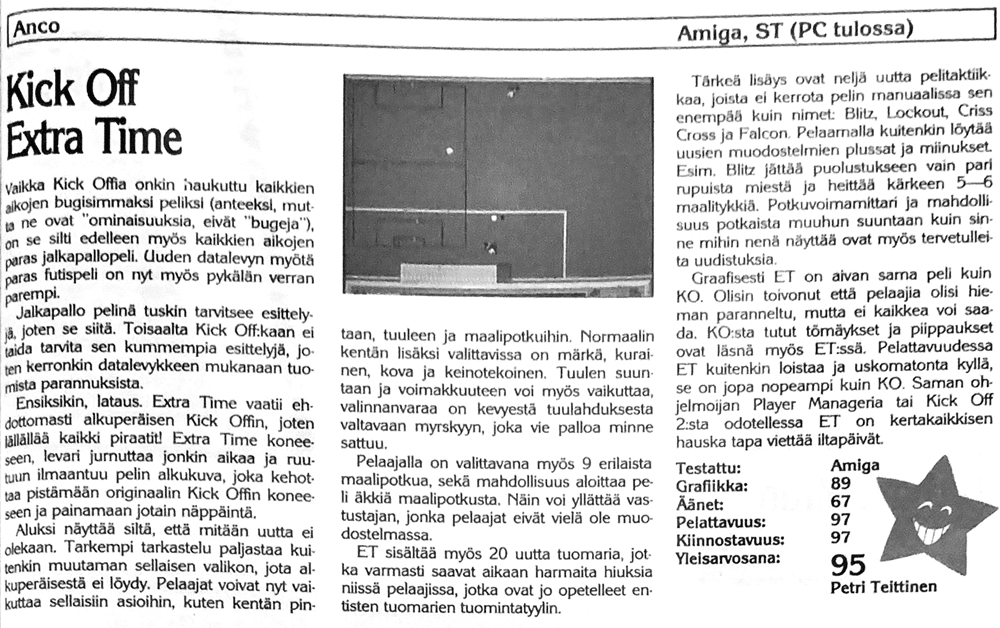
Kick Off Extra Time1990 KevätPysyvä linkkiVaikka Kick Offia onkin haukuttu kaikkien aikojen bugisimmaksi peliksi (anteeksi, mutta ne ovat "ominaisuuksia, eivät "bugeja"), on se silti edelleen myös kaikkien aikojen paras jalkapallopeli. Uuden datalevyn myötä paras futispeli on nyt myös pykälän verran parempi.
Jalkapallo pelinä tuskin tarvitsee esittelyä, joten se siitä. Toisaalta Kick Off:kaan ei taida tarvita sen kummempia esittelyjä, joten kerronkin datalevykkeen mukanaan tuomista parannuksista.
Ensiksikin, lataus. Extra Time vaatii ehdottomasti alkuperäisen Kick Offin, joten lällällää kaikki piraatit! Extra Time koneeseen, levari jurnuttaa jonkin aikaa ja ruutuun ilmaantuu pelin alkukuva, joka kehottaa pistämään originaalin Kick Offin koneeseen ja painamaan jotain näppäintä.
Aluksi näyttää siltä, että mitään uutta ei olekaan. Tarkempi tarkastelu paljastaa kuitenkin muutaman sellaisen valikon, jota alkuperäisestä ei löydy. Pelaajat voivat nyt vaikuttaa sellaisiin asioihin, kuten kentän pintaan, tuuleen ja maalipotkuihin. Normaalin kentän lisäksi valittavissa on märkä, kurainen, kova ja keinotekoinen. Tuulen suuntaan ja voimakkuuteen voi myös vaikuttaa, valinnanvaraa on kevyestä tuulahduksesta valtavaan myrskyyn, joka vie palloa minne sattuu.
Pelaajalla on valittavana myös 9 erilaista maalipotkua, sekä mahdollisuus aloittaa peli äkkiä maalipotkusta. Näin voi yllättää vastustajan, jonka pelaajat eivät vielä ole muodostelmassa.
ET sisältää myös 20 uutta tuomaria, jotka varmasti saavat aikaan harmaita hiuksia niissä pelaajissa, jotka ovat jo opetelleet entisten tuomarien tuomintatyylin.
Tärkeä lisäys ovat neljä uutta pelitaktiikkaa, joista ei kerrota pelin manuaalissa sen enempää kuin nimet: Blitz, Lockout, Criss Cross ja Falcon. Pelaamalla kuitenkin löytää uusien muodostelmien plussat ja miinukset. Esim. Blitz jättää puolustukseen vain pari rupuista miestä ja heittää kärkeen 5-6 maalitykkiä. Potkuvoimamittari ja mahdollisuus potkaista muuhun suuntaan kuin sinne mihin nenä näyttää ovat myös tervetulleita uudistuksia.
Graafisesti ET on aivan sama peli kuin KO. Olisin toivonut että pelaajia olisi hieman paranneltu, mutta ei kaikkea voi saada. KO:sta tutut tömäykset ja piippaukset ovat läsnä myös ET:ssä. Pelattavuudessa ET kuitenkin loistaa ja uskomatonta kyllä, se on jopa nopeampi kuin KO. Saman ohjelmoijan Player Manageria tai Kick Off 2:sta odotellessa ET on kertakaikkisen hauska tapa viettää iltapäivät.
Kick Off Extra Time1990 KevätPermalinkAlthough Kick Off has been slammed as the buggiest game of all time (sorry, but they're "features", not "bugs"), it is still also the best football game of all time. With the new data disk, the best footy game is now a notch better too.
Football as a game hardly needs an introduction, so that's that. Then again, Kick Off doesn't really need much of an introduction either, so I'll tell you about the improvements the data disk brings with it.
First of all, loading. Extra Time absolutely requires the original Kick Off, so nyah nyah nyah, all you pirates! Extra Time into the machine, the drive grinds away for a while and the title screen appears, telling you to put the original Kick Off in the machine and press a key.
At first it looks as if there's nothing new at all. A closer look, however, reveals a few menus not found in the original. Players can now influence such things as the pitch surface, the wind and goal kicks. Besides the normal pitch you can choose wet, muddy, hard and artificial. You can also adjust the wind's direction and strength, with a choice ranging from a light breeze to a huge storm that carries the ball wherever it pleases.
The player also has 9 different goal kicks to choose from, as well as the option of restarting play quickly with a goal kick. That way you can catch out an opponent whose players aren't yet in formation.
ET also includes 20 new referees, who are sure to give grey hairs to those players who have already learned the refereeing style of the old referees.
An important addition is the four new tactics, about which the manual tells you nothing more than their names: Blitz, Lockout, Criss Cross and Falcon. By playing, though, you find out the pluses and minuses of the new formations. For instance, Blitz leaves just a couple of measly men in defence and throws 5-6 goal machines up front. A kick-power meter and the ability to kick in some direction other than where your nose is pointing are also welcome innovations.
Graphically ET is exactly the same game as KO. I'd have liked the players to be improved a bit, but you can't have everything. The thuds and beeps familiar from KO are present in ET too. In playability, though, ET shines, and unbelievably enough it's even faster than KO. While waiting for the same programmer's Player Manager or Kick Off 2, ET is a downright fun way to spend your afternoons.
Kid Gloves
Kid Gloves1990 SyksyPysyvä linkkiRinnakkaistodellisuuksiin on monenlaisia porttikäytäviä, mutta eipä uskoisi, että sellainen löytyy myös isosetä Indiana Stallonen vanhoista nyrkkeilyhanskoista.
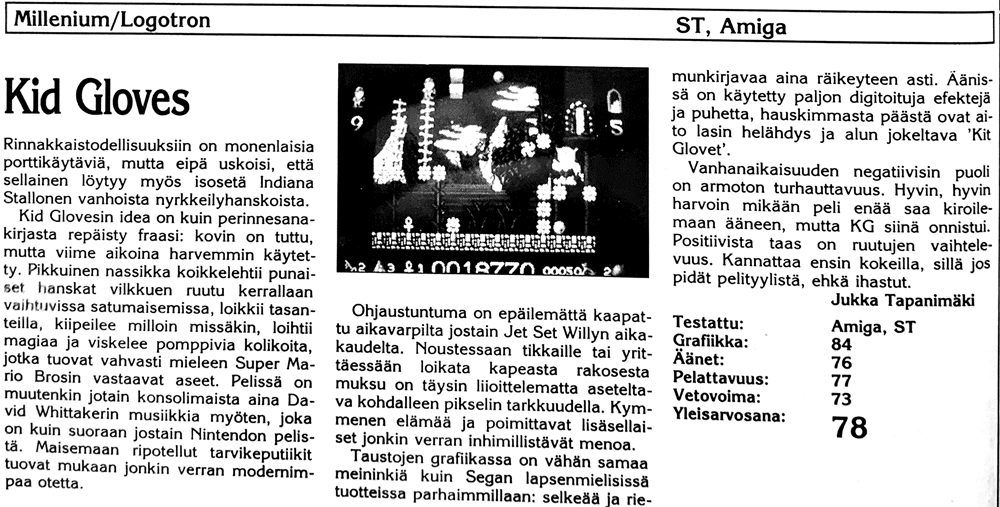
Kid Glovesin idea on kuin perinnesanakirjasta repäisty fraasi: kovin on tuttu, mutta viime aikoina harvemmin käytetty. Pikkuinen nassikka koikkelehtii punaiset hanskat vilkkuen ruutu kerrallaan vaihtuvissa satumaisemissa, loikkii tasanteilla, kiipeilee milloin missäkin, loihtii magiaa ja viskelee pomppivia kolikoita, jotka tuovat vahvasti mieleen Super Mario Brosin vastaavat aseet. Pelissä on muutenkin jotain konsolimaista aina David Whittakerin musiikkia myöten, joka on kuin suoraan jostain Nintendon pelistä. Maisemaan ripotellut tarvikeputiikit tuovat mukaan jonkin verran modernimpaa otetta.
Ohjaustuntuma on epäilemättä kaapattu aikavarpilta jostain Jet Set Willyn aikakaudelta. Noustessaan tikkaille tai yrittäessään loikata kapeasta rakosesta muksu on täysin liioittelematta aseteltava kohdalleen pikselin tarkkuudella. Kymmenen elämää ja poimittavat lisäsellaiset jonkin verran inhimillistävät menoa.
Taustojen grafiikassa on vähän samaa meininkiä kuin Segan lapsenmielisissä tuotteissa parhaimmillaan: selkeää ja riemunkirjavaa aina räikeyteen asti. Äänissä on käytetty paljon digitoituja efektejä ja puhetta, hauskimmasta päästä ovat aito lasin helähdys ja alun jokeltava 'Kit Glovet'.
Vanhanaikaisuuden negatiivisin puoli on armoton turhauttavuus. Hyvin, hyvin harvoin mikään peli enää saa kiroilemaan ääneen, mutta KG siinä onnistui. Positiivista taas on ruutujen vaihtelevuus. Kannattaa ensin kokeilla, sillä jos pidät pelityylistä, ehkä ihastut.
Kid Gloves1990 SyksyPermalinkThere are all sorts of gateways into parallel realities, but who would have thought that one could also be found in great-uncle Indiana Stallone's old boxing gloves.
The idea of Kid Gloves is like a phrase torn from a dictionary of traditional sayings: very familiar, but less often used of late. A tiny tyke totters through fairytale landscapes that change one screen at a time, red gloves flashing, leaping across ledges, clambering about here, there and everywhere, conjuring magic and chucking bouncing coins, which strongly call to mind the equivalent weapons in Super Mario Bros. There's something console-like about the game in other ways too, right down to David Whittaker's music, which sounds as if it came straight out of some Nintendo game. The supply shops sprinkled about the landscape bring in a somewhat more modern touch.
The control feel has no doubt been snatched through a time warp from somewhere back in the Jet Set Willy era. When climbing ladders or trying to leap through a narrow gap, the kid has to be lined up - without the slightest exaggeration - with pixel precision. Ten lives and extra ones to pick up make the going somewhat more humane.
The background graphics have a bit of the same feel as Sega's childlike products at their best: clear and joyously multicoloured, right up to the point of garishness. The sound makes heavy use of digitised effects and speech; among the funniest are a genuine tinkle of glass and the babbling 'Kit Glovet' at the start.
The most negative side of old-fashionedness is merciless frustration. Very, very rarely does any game make me curse out loud these days, but KG managed it. What is positive, on the other hand, is the variety of the screens. Worth trying first, because if you like this style of game, you may well fall for it.
Killing Game Show, The
Killing Game Show, The1991 KevätPysyvä linkkiEi ole hääppöistä rikollisen elämä. KGS-kanava hauskuttaa katsojia heittämällä heitä taisteluareenalle, kunhan ressukalta on ensin riisuttu ylimääräinen lihaskudos, alavartalo ynnä muu epäolennainen ja tilalle hitsattu niin paljon metallia, että lopputulos muistuttaa enemmän ED-209:ää kuin ihmistä.
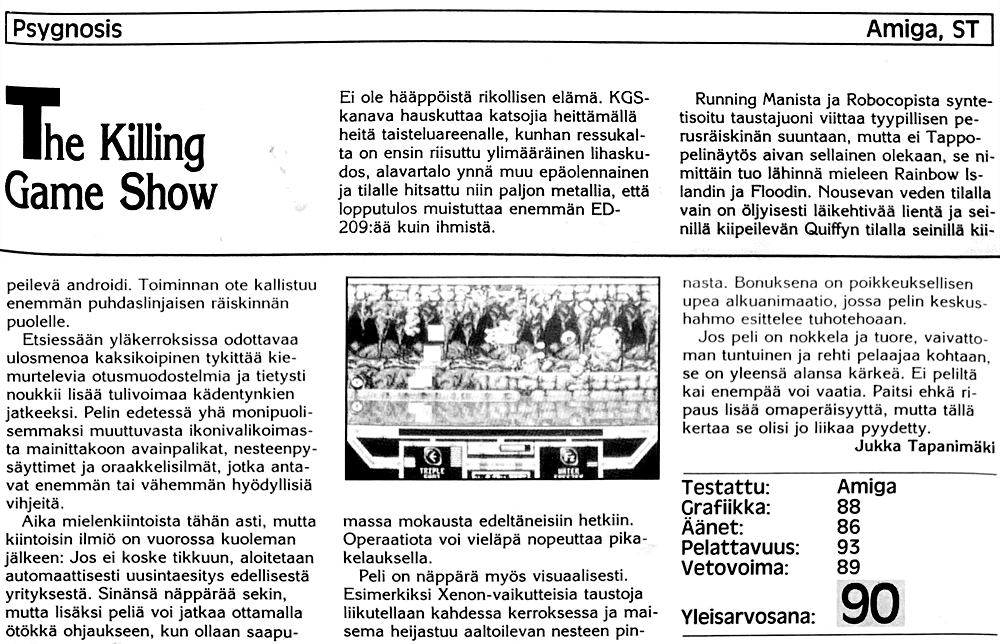
Running Manista ja Robocopista syntetisoitu taustajuoni viittaa tyypillisen perusräiskinän suuntaan, mutta ei Tappopelinäytös aivan sellainen olekaan, se nimittäin tuo lähinnä mieleen Rainbow Islandin ja Floodin. Nousevan veden tilalla vain on öljyisesti läikehtivää lientä ja seinillä kiipeilevän Quiffyn tilalla seinillä kiipeilevä androidi. Toiminnan ote kallistuu enemmän puhdaslinjaisen räiskinnän puolelle.
Etsiessään yläkerroksissa odottavaa ulosmenoa kaksikoipinen tykittää kiemurtelevia otusmuodostelmia ja tietysti noukkii lisää tulivoimaa kädentynkien jatkeeksi. Pelin edetessä yhä monipuolisemmaksi muuttuvasta ikonivalikoimasta mainittakoon avainpalikat, nesteenpysäyttimet ja oraakkelisilmät, jotka antavat enemmän tai vähemmän hyödyllisiä vihjeitä.
Aika mielenkiintoista tähän asti, mutta kiintoisin ilmiö on vuorossa kuoleman jälkeen: Jos ei koske tikkuun, aloitetaan automaattisesti uusintaesitys edellisestä yrityksestä. Sinänsä näppärää sekin, mutta lisäksi peliä voi jatkaa ottamalla ötökkä ohjaukseen, kun ollaan saapumassa mokausta edeltäneisiin hetkiin. Operaatiota voi vieläpä nopeuttaa pikakelauksella.
Peli on näppärä myös visuaalisesti. Esimerkiksi Xenon-vaikutteisia taustoja liikutellaan kahdessa kerroksessa ja maisema heijastuu aaltoilevan nesteen pinnasta. Bonuksena on poikkeuksellisen upea alkuanimaatio, jossa pelin keskushahmo esittelee tuhotehoaan.
Jos peli on nokkela ja tuore, vaivattoman tuntuinen ja rehti pelaajaa kohtaan, se on yleensä alansa kärkeä. Ei peliltä kai enempää voi vaatia. Paitsi ehkä ripaus lisää omaperäisyyttä, mutta tällä kertaa se olisi jo liikaa pyydetty.
Killing Game Show, The1991 KevätPermalinkA criminal's life is nothing to write home about. The KGS channel keeps its viewers amused by throwing the crooks into a combat arena, once the poor wretch has first been stripped of surplus muscle tissue, lower body and other such non-essentials, and had so much metal welded on in their place that the end result looks more like ED-209 than a human being.
The background plot, synthesised from Running Man and Robocop, points towards a typical basic shoot-'em-up, but the Killing Game Show isn't quite that after all, because what it mostly brings to mind is Rainbow Island and Flood. It's just that instead of rising water there's oily, sloshing broth, and instead of a wall-climbing Quiffy a wall-climbing android. The action, though, leans more towards pure-bred blasting.
While hunting for the exit waiting on the upper floors, our biped blasts away at wriggling creature formations and naturally picks up extra firepower to bolt onto its arm stumps. From the selection of icons, which grows ever more varied as the game goes on, let me mention the key blocks, the liquid stoppers and the oracle eyes, which dispense more or less useful hints.
Pretty interesting so far, but the most intriguing phenomenon comes after death: if you don't touch the joystick, a rerun of your previous attempt starts automatically. Neat enough in itself, but on top of that you can carry on playing by taking over the critter as the rerun reaches the moments just before your blunder. You can even speed the operation up with fast-forward.
The game is slick visually too. For instance, the Xenon-influenced backgrounds move in two layers, and the scenery is reflected in the surface of the rippling liquid. As a bonus there's an exceptionally stunning intro animation in which the game's central character shows off its destructive power.
If a game is clever and fresh, feels effortless and plays fair with the player, it's usually at the top of its field. I don't suppose you can ask any more of a game than that. Except perhaps a pinch more originality, but this time that would be asking too much.
Kinetik
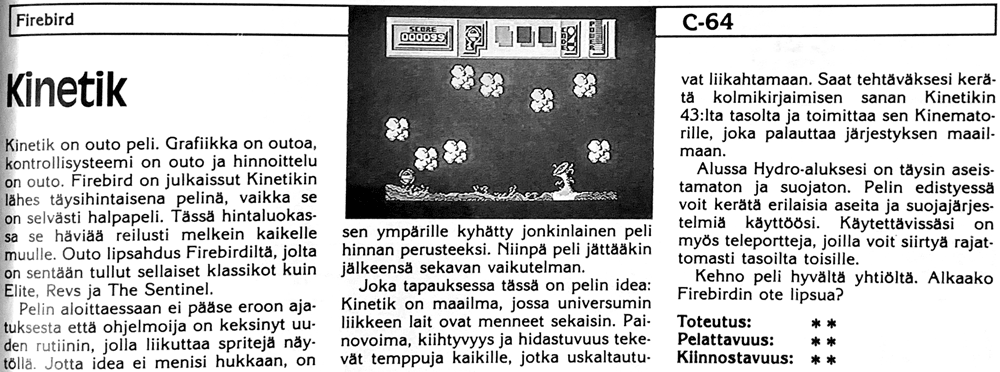
Kinetik1987Pysyvä linkkiKinetik on outo peli. Grafiikka on outoa, kontrollisysteemi on outo ja hinnoittelu on outo. Firebird on julkaissut Kinetikin lähes täysihintaisena pelinä, vaikka se on selvästi halpapeli. Tässä hintaluokassa se häviää reilusti melkein kaikelle muulle. Outo lipsahdus Firebirdiltä, jolta on sentään tullut sellaiset klassikot kuin Elite, Revs ja The Sentinel.
Pelin aloittaessaan ei pääse eroon ajatuksesta että ohjelmoija on keksinyt uuden rutiinin, jolla liikuttaa spritejä näytöllä. Jotta idea ei menisi hukkaan, on sen ympärille kyhätty jonkinlainen peli hinnan perusteeksi. Niinpä peli jättääkin jälkeensä sekavan vaikutelman.
Joka tapauksessa tässä on pelin idea: Kinetik on maailma, jossa universumin liikkeen lait ovat menneet sekaisin. Painovoima, kiihtyvyys ja hidastuvuus tekevät temppuja kaikille, jotka uskaltautuvat liikahtamaan. Saat tehtäväksesi kerätä kolmikirjaimisen sanan Kinetikin 43:lta tasolta ja toimittaa sen Kinematorille, joka palauttaa järjestyksen maailmaan.
Alussa Hydro-aluksesi on täysin aseistamaton ja suojaton. Pelin edistyessä voit kerätä erilaisia aseita ja suojajärjestelmiä käyttöösi. Käytettävissäsi on myös teleportteja, joilla voit siirtyä rajattomasti tasoilta toisille.
Kehno peli hyvältä yhtiöltä. Alkaako Firebirdin ote lipsua?
Kinetik1987PermalinkKinetik is a strange game. The graphics are strange, the control system is strange and the pricing is strange. Firebird has released Kinetik as a nearly full-price game, even though it's clearly a budget game. In this price bracket it loses out badly to almost everything else. A strange slip from Firebird, which after all has given us such classics as Elite, Revs and The Sentinel.
When you start the game, you can't shake the thought that the programmer came up with a new routine for moving sprites around the screen. So that the idea wouldn't go to waste, some sort of game has been cobbled together around it to justify the price. And so the game leaves behind a muddled impression.
Anyway, here's the idea of the game: Kinetik is a world where the universe's laws of motion have gone haywire. Gravity, acceleration and deceleration play tricks on anyone who dares to so much as stir. Your task is to collect a three-letter word from Kinetik's 43 levels and deliver it to the Kinemator, which will restore order to the world.
At the start your Hydro craft is completely unarmed and unprotected. As the game progresses you can collect various weapons and shield systems for your use. You also have teleports at your disposal, which let you move from level to level without limit.
A poor game from a good company. Is Firebird's grip starting to slip?
King's Bounty
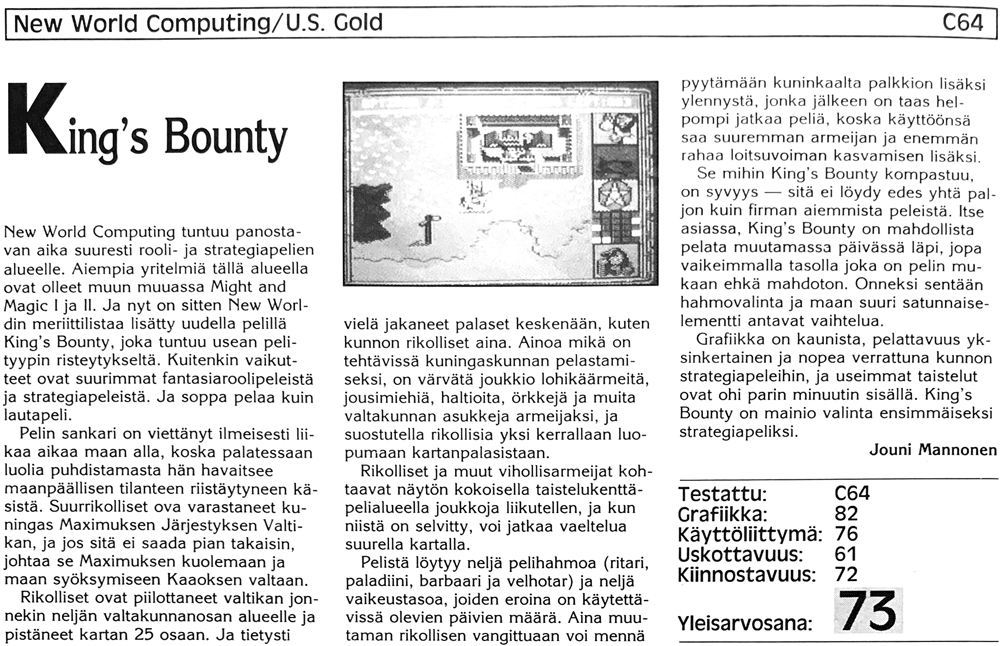
King's Bounty1991 KevätPysyvä linkkiNew World Computing tuntuu panostavan aika suuresti rooli- ja strategiapelien alueelle. Aiempia yritelmiä tällä alueella ovat olleet muun muuassa Might and Magic I ja II. Ja nyt on sitten New Worldin meriittilistaa lisätty uudella pelillä King's Bounty, joka tuntuu usean pelityypin risteytykseltä. Kuitenkin vaikutteet ovat suurimmat fantasiaroolipeleistä ja strategiapeleistä. Ja soppa pelaa kuin lautapeli.
Pelin sankari on viettänyt ilmeisesti liikaa aikaa maan alla, koska palatessaan luolia puhdistamasta hän havaitsee maanpäällisen tilanteen riistäytyneen käsistä. Suurrikolliset ova varastaneet kuningas Maximuksen Järjestyksen Valtikan, ja jos sitä ei saada pian takaisin, johtaa se Maximuksen kuolemaan ja maan syöksymiseen Kaaoksen valtaan.
Rikolliset ovat piilottaneet valtikan jonnekin neljän valtakunnanosan alueelle ja pistäneet kartan 25 osaan. Ja tietysti vielä jakaneet palaset keskenään, kuten kunnon rikolliset aina. Ainoa mikä on tehtävissä kuningaskunnan pelastamiseksi, on värvätä joukkio lohikäärmeitä, jousimiehiä, haltioita, örkkejä ja muita valtakunnan asukkeja armeijaksi, ja suostutella rikollisia yksi kerrallaan luopumaan kartanpalasistaan.
Rikolliset ja muut vihollisarmeijat kohtaavat näytön kokoisella taistelukenttäpelialueella joukkoja liikutellen, ja kun niistä on selvitty, voi jatkaa vaeltelua suurella kartalla.
Pelistä löytyy neljä pelihahmoa (ritari, paladiini, barbaari ja velhotar) ja neljä vaikeustasoa, joiden eroina on käytettävissä olevien päivien määrä. Aina muutaman rikollisen vangittuaan voi mennä pyytämään kuninkaalta palkkion lisäksi ylennystä, jonka jälkeen on taas helpompi jatkaa peliä, koska käyttöönsä saa suuremman armeijan ja enemmän rahaa loitsuvoiman kasvamisen lisäksi.
Se mihin King's Bounty kompastuu, on syvyys - sitä ei löydy edes yhtä paljon kuin firman aiemmista peleistä. Itse asiassa, King's Bounty on mahdollista pelata muutamassa päivässä läpi, jopa vaikeimmalla tasolla joka on pelin mukaan ehkä mahdoton. Onneksi sentään hahmovalinta ja maan suuri satunnaiselementti antavat vaihtelua.
Grafiikka on kaunista, pelattavuus yksinkertainen ja nopea verrattuna kunnon strategiapeleihin, ja useimmat taistelut ovat ohi parin minuutin sisällä. King's Bounty on mainio valinta ensimmäiseksi strategiapeliksi.
King's Bounty1991 KevätPermalinkNew World Computing seem to be putting quite a lot of effort into the field of role-playing and strategy games. Their earlier efforts in this field have included Might and Magic I and II, among others. And now New World's list of merits has been extended with a new game, King's Bounty, which feels like a cross between several game types. Still, the biggest influences come from fantasy role-playing games and strategy games. And the whole concoction plays like a board game.
The game's hero has evidently spent too much time underground, because on returning from clearing out the caves he finds that the situation above ground has got out of hand. Master criminals have stolen King Maximus's Sceptre of Order, and if it isn't recovered soon, it will lead to Maximus's death and the land plunging into the grip of Chaos.
The criminals have hidden the sceptre somewhere within the four parts of the realm and cut the map into 25 pieces. And of course they've also shared out the pieces among themselves, as proper criminals always do. The only thing to be done to save the kingdom is to recruit a band of dragons, archers, elves, orcs and other inhabitants of the realm into an army, and persuade the criminals one at a time to give up their map pieces.
You face the criminals and other enemy armies on a screen-sized battlefield play area, moving your troops about, and once you've dealt with them you can carry on wandering around the big map.
The game has four characters (knight, paladin, barbarian and sorceress) and four difficulty levels, which differ in the number of days available. Every time you've captured a few criminals you can go and ask the king for a promotion in addition to your reward, after which it's easier again to carry on with the game, since you get a bigger army and more money on top of your spell power growing.
Where King's Bounty stumbles is depth - there isn't even as much of it as in the company's earlier games. In fact, it's possible to play King's Bounty through in a few days, even on the hardest level, which according to the game is perhaps impossible. Luckily the choice of character and the land's large random element do at least provide some variety.
The graphics are beautiful, the gameplay simple and fast compared with proper strategy games, and most battles are over within a couple of minutes. King's Bounty is a fine choice for a first strategy game.
Klax
Klax1990 SyksyPysyvä linkkiKlox Klax Klox Klax Pahus! Aaaaieee Krump! Tömp! Klap klap klap. Tetriksen, Welltriksen, Blockoutin,...,Coloriksen joukkoon ponnahtaa jälleen uusi palikkavariaatio.
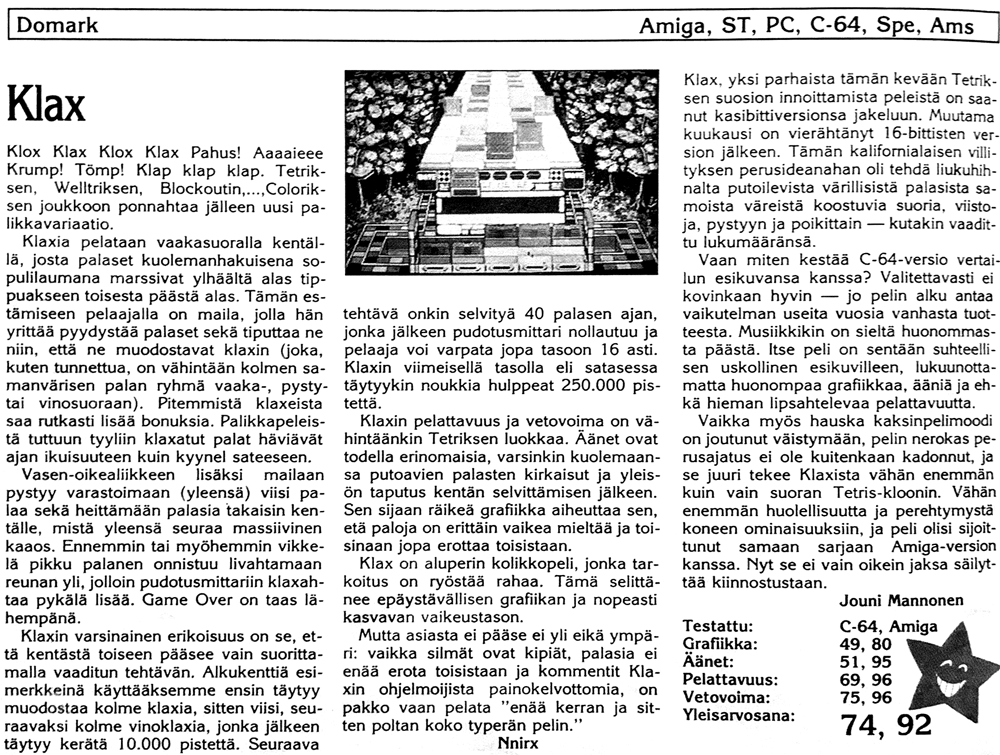
Klaxia pelataan vaakasuoralla kentällä, josta palaset kuolemanhakuisena sopulilaumana marssivat ylhäältä alas tippuakseen toisesta päästä alas. Tämän estämiseen pelaajalla on maila, jolla hän yrittää pyydystää palaset sekä tiputtaa ne niin, että ne muodostavat klaxin (joka, kuten tunnettua, on vähintään kolmen samanvärisen palan ryhmä vaaka-, pysty- tai vinosuoraan). Pitemmistä klaxeista saa rutkasti lisää bonuksia. Palikkapeleistä tuttuun tyyliin klaxatut palat häviävät ajan ikuisuuteen kuin kyynel sateeseen.
Vasen-oikealiikkeen lisäksi mailaan pystyy varastoimaan (yleensä) viisi palaa sekä heittämään palasia takaisin kentälle, mistä yleensä seuraa massiivinen kaaos. Ennemmin tai myöhemmin vikkelä pikku palanen onnistuu livahtamaan reunan yli, jolloin pudotusmittariin klaxahtaa pykälä lisää. Game Over on taas lähempänä.
Klaxin varsinainen erikoisuus on se, että kentästä toiseen pääsee vain suorittamalla vaaditun tehtävän. Alkukenttiä esimerkkeinä käyttääksemme ensin täytyy muodostaa kolme klaxia, sitten viisi, seuraavaksi kolme vinoklaxia, jonka jälkeen täytyy kerätä 10.000 pistettä. Seuraava tehtävä onkin selvityä 40 palasen ajan, jonka jälkeen pudotusmittari nollautuu ja pelaaja voi varpata jopa tasoon 16 asti. Klaxin viimeisellä tasolla eli satasessa täytyykin noukkia hulppeat 250.000 pistettä.
Klaxin pelattavuus ja vetovoima on vähintäänkin Tetriksen luokkaa. Äänet ovat todella erinomaisia, varsinkin kuolemaansa putoavien palasten kirkaisut ja yleisön taputus kentän selvittämisen jälkeen. Sen sijaan räikeä grafiikka aiheuttaa sen, etä paloja on erittäin vaikea mieltää ja toisinaan jopa erottaa toisistaan.
Klax on aluperin kolikkopeli, jonka tarkoitus on ryöstää rahaa. Tämä selittänee epäystävällisen grafiikan ja nopeasti kasvavan vaikeustason.
Mutta asiasta ei pääse ei yli eikä ympäri: vaikka silmät ovat kipiät, palasia ei enää erota toisistaan ja kommentit Klaxin ohjelmoijista painokelvottomia, on pakko vaan pelata "enää kerran ja sitten poltan koko typerän pelin."
Klax, yksi parhaista tämän kevään Tetriksen suosion innoittamista peleistä on saanut kasibittiversionsa jakeluun. Muutama kuukausi on vierähtänyt 16-bittisten version jälkeen. Tämän kalifornialaisen villityksen perusideanahan oli tehdä liukuhihnalta putoilevista värillisistä palasista samoista väreistä koostuvia suoria, viistoja, pystyyn ja poikittain - kutakin vaadittu lukumääränsä.
Vaan miten kestää C-64-versio vertailun esikuvansa kanssa? Valitettavasti ei kovinkaan hyvin - jo pelin alku antaa vaikutelman useita vuosia vanhasta tuotteesta. Musiikkikin on sieltä huonommasta päästä. Itse peli on sentään suhteellisen uskollinen esikuvilleen, lukuunottamatta huonompaa grafiikkaa, ääniä ja ehkä hieman lipsahtelevaa pelattavuutta.
Vaikka myös hauska kaksinpelimoodi on joutunut väistymään, pelin nerokas perusajatus ei ole kuitenkaan kadonnut, ja se juuri tekee Klaxista vähän enemmän kuin vain suoran Tetris-kloonin. Vähän enemmän huolellisuutta ja perehtymystä koneen ominaisuuksiin, ja peli olisi sijoittunut samaan sarjaan Amiga-version kanssa. Nyt se ei vain oikein jaksa säilyttää kiinnostustaan.
Klax1990 SyksyPermalinkKlox Klax Klox Klax Drat! Aaaaieee Krump! Thump! Klap klap klap. Yet another block variation pops up to join the ranks of Tetris, Welltris, Blockout,...,Coloris.
Klax is played on a horizontal playfield, down which the pieces march from top to bottom like a death-seeking pack of lemmings, only to tumble off the far end. To stop this the player has a paddle, with which he tries to catch the pieces and drop them so that they form a klax (which, as everyone knows, is a group of at least three pieces of the same colour in a horizontal, vertical or diagonal line). Longer klaxes earn you heaps more bonuses. In the style familiar from block games, klaxed pieces vanish into the eternity of time like tears in rain.
Besides moving left and right, the paddle can hold (usually) five pieces and throw pieces back onto the playfield, which usually results in massive chaos. Sooner or later a nimble little piece manages to slip over the edge, whereupon another notch klaxes up on the drop meter. Game Over is that much closer again.
Klax's real speciality is that you can only get from one level to the next by completing the required task. To take the early levels as examples: first you have to make three klaxes, then five, next three diagonal klaxes, after which you have to collect 10,000 points. The next task is to survive for 40 pieces, after which the drop meter resets and the player can warp as far as level 16. On Klax's final level, i.e. level one hundred, you have to scoop up a whopping 250,000 points.
Klax's playability and appeal are at least in the Tetris class. The sound is truly excellent, especially the shrieks of pieces falling to their deaths and the crowd's applause after you clear a level. The garish graphics, on the other hand, mean that the pieces are very hard to take in, and at times even to tell apart.
Klax is originally a coin-op whose purpose is to rob you of your money. That probably explains the unfriendly graphics and the rapidly rising difficulty.
But there's no getting over it or round it: even though your eyes are sore, you can no longer tell the pieces apart and your comments about Klax's programmers are unprintable, you simply have to play "just once more and then I'll burn the whole stupid game."
Klax, one of this spring's best games inspired by the popularity of Tetris, has now had its 8-bit version released. A few months have rolled by since the 16-bit versions. The basic idea of this Californian craze was, after all, to make the coloured pieces dropping off a conveyor belt into lines of the same colour, straight, diagonal, upright and crosswise - the required number of each.
But how does the C-64 version hold up in comparison with its model? Not very well, unfortunately - even the start of the game gives the impression of a product several years old. The music, too, is from the weaker end of the scale. The game itself is at least relatively faithful to its models, apart from the poorer graphics, sound and perhaps slightly slippery playability.
Although the fun two-player mode has also had to make way, the game's ingenious basic idea hasn't vanished, and that is just what makes Klax a bit more than a straight Tetris clone. A little more care and familiarity with the machine's capabilities, and the game would have ended up in the same league as the Amiga version. As it is, it just can't quite hold your interest.
Knight Games
Knight Games1987Pysyvä linkkiJos kaikkien pelaamiesi karatetaistelujen jälkeen haluaisitkin iskeä vastustajaasi kirveellä tai miekalla ainaisen potkimisen sijasta, kannattaa hankkia Knight Games. Pelissä on kaikkiaan kahdeksan eri lajia, joista kuutta voi pelata joko toista pelaajaa tai tietokonetta vastaan.
Kaksi ammuntalajia suoritetaan yksin, kumpikin vuorollaan. Pelin alussa voit valita haluamasi lajin, ja kone lataa sen muistiin. Sen jälkeen valitset yksin- tai kaksinpelin sekä vaikeustason.
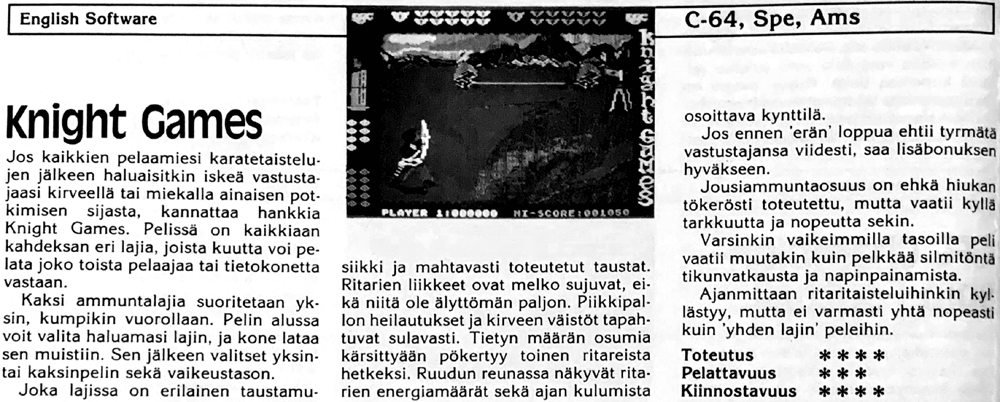
Joka lajissa on erilainen taustamusiikki ja mahtavasti toteutetut taustat. Ritarien liikkeet ovat melko sujuvat, eikä niitä ole älyttömän paljon. Piikkipallon heilautukset ja kirveen väistöt tapahtuvat sulavasti. Tietyn määrän osumia kärsittyään pökertyy toinen ritareista hetkeksi. Ruudun reunassa näkyvät ritarien energiamäärät sekä ajan kulumista osoittava kynttilä.
Jos ennen 'erän' loppua ehtii tyrmätä vastustajansa viidesti, saa lisäbonuksen hyväkseen.
Jousiammuntaosuus on ehkä hiukan tökerösti toteutettu, mutta vaatii kyllä tarkkuutta ja nopeutta sekin.
Varsinkin vaikeimmilla tasoilla peli vaatii muutakin kuin pelkkää silmitöntä tikunvatkausta ja napinpainamista.
Ajanmittaan ritaritaisteluihinkin kyllästyy, mutta ei varmasti yhtä nopeasti kuin 'yhden lajin' peleihin.
Knight Games1987PermalinkIf, after all the karate fights you've played, you'd rather strike your opponent with an axe or a sword instead of the endless kicking, Knight Games is worth getting. The game has eight different events in all, six of which can be played against either another player or the computer.
The two shooting events are done solo, each player taking a turn. At the start of the game you can pick the event you want, and the computer loads it into memory. After that you choose a one- or two-player game and the difficulty level.
Every event has its own background music and superbly done backdrops. The knights' moves are fairly smooth, and there isn't a ridiculous number of them. Swinging the morning star and ducking the axe are handled fluidly. After taking a certain number of hits, one of the knights is knocked dizzy for a moment. The edge of the screen shows the knights' energy levels and a candle marking the passing of time.
If you manage to knock out your opponent five times before the 'round' is over, you get an extra bonus to your credit.
The archery section is perhaps a bit clumsily done, but it too certainly demands accuracy and speed.
Especially on the hardest levels, the game demands more than just mindless joystick-waggling and button-pressing.
In the long run you get fed up even with knightly combat, but certainly not as quickly as with 'single-event' games.
Knightmare
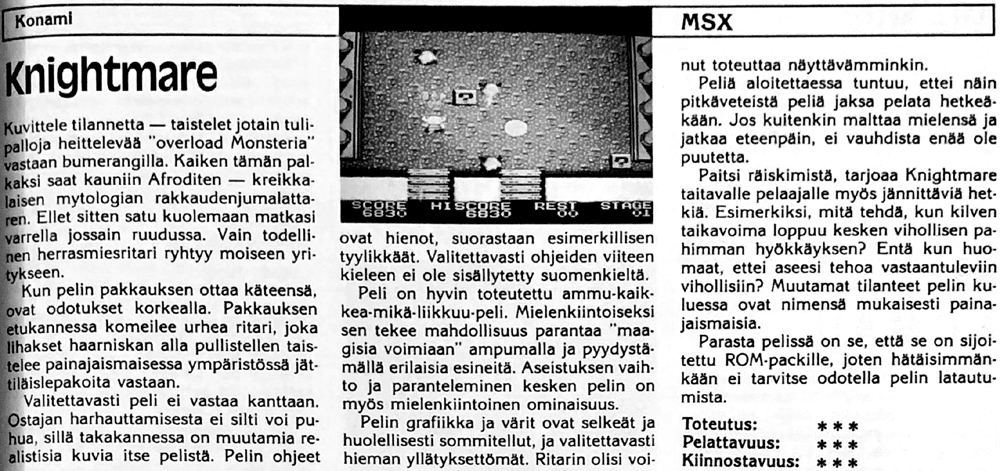
Knightmare1987Pysyvä linkkiKuvittele tilannetta - taistelet jotain tulipalloja heittelevää "overload Monsteria" vastaan bumerangilla. Kaiken tämän palkaksi saat kauniin Afroditen - kreikkalaisen mytologian rakkaudenjumalattaren. Ellet sitten satu kuolemaan matkasi varrella jossain ruudussa. Vain todellinen herrasmiesritari ryhtyy moiseen yritykseen.
Kun pelin pakkauksen ottaa käteensä, ovat odotukset korkealla. Pakkauksen etukannessa komeilee urhea ritari, joka lihakset haarniskan alla pullistellen taistelee painajaismaisessa ympäristössä jättiläislepakoita vastaan.
Valitettavasti peli ei vastaa kanttaan. Ostajan harhauttamisesta ei silti voi puhua, sillä takakannessa on muutamia realistisia kuvia itse pelistä. Pelin ohjeet ovat hienot, suorastaan esimerkillisen tyylikkäät. Valitettavasti ohjeiden viiteen kieleen ei ole sisällytetty suomenkieltä.
Peli on hyvin toteutettu ammu-kaikkea-mikä-liikkuu-peli. Mielenkiintoiseksi sen tekee mahdollisuus parantaa "maagisia voimiaan" ampumalla ja pyydystämällä erilaisia esineitä. Aseistuksen vaihto ja paranteleminen kesken pelin on myös mielenkiintoinen ominaisuus.
Pelin grafiikka ja värit ovat selkeät ja huolellisesti sommitellut, ja valitettavasti hieman yllätyksettömät. Ritarin olisi voinut toteuttaa näyttävämminkin.
Peliä aloitettaessa tuntuu, ettei näin pitkäveteistä peliä jaksa pelata hetkeäkään. Jos kuitenkin malttaa mielensä ja jatkaa eteenpäin, ei vauhdista enää ole puutetta.
Paitsi räiskimistä, tarjoaa Knightmare taitavalle pelaajalle myös jännittäviä hetkiä. Esimerkiksi, mitä tehdä, kun kilven taikavoima loppuu kesken vihollisen pahimman hyökkäyksen? Entä kun huomaat, ettei aseesi tehoa vastaantuleviin vihollisiin? Muutamat tilanteet pelin kuluessa ovat nimensä mukaisesti painajaismaisia.
Parasta pelissä on se, että se on sijoitettu ROM-packille, joten hätäisimmänkään ei tarvitse odotella pelin latautumista.
Knightmare1987PermalinkPicture the situation - you're fighting some fireball-flinging "overlord Monster" with a boomerang. As the reward for all this you get the beautiful Aphrodite - the goddess of love of Greek mythology. Unless, that is, you happen to die on some screen or other along the way. Only a true gentleman knight would embark on such an undertaking.
When you pick up the game's box, your expectations are high. Gracing the front cover is a valiant knight who, muscles bulging beneath the armour, battles giant bats in a nightmarish landscape.
Unfortunately the game doesn't live up to its cover. Still, you can't really call it misleading the buyer, since the back cover has a few realistic pictures of the game itself. The instructions are fine, downright exemplary in their stylishness. Unfortunately, Finnish hasn't been included among the instructions' five languages.
The game is a well-made shoot-everything-that-moves game. What makes it interesting is the chance to improve your "magic powers" by shooting and catching various objects. Switching and upgrading your weaponry in mid-game is also an interesting feature.
The game's graphics and colours are clear and carefully composed, and, unfortunately, a little short on surprises. The knight could have been done more spectacularly.
When you start playing, it feels as though you couldn't bear to play such a tedious game for even a moment. But if you keep your patience and press on, there's no longer any shortage of pace.
Besides the blasting, Knightmare also offers the skilled player some tense moments. For example, what do you do when your shield's magic power runs out in the middle of the enemy's worst attack? Or when you notice that your weapon has no effect on the enemies coming at you? A few situations over the course of the game are, true to its name, nightmarish.
The best thing about the game is that it comes on a ROM pack, so not even the most impatient player has to sit waiting for it to load.
Knights of the Crystallion
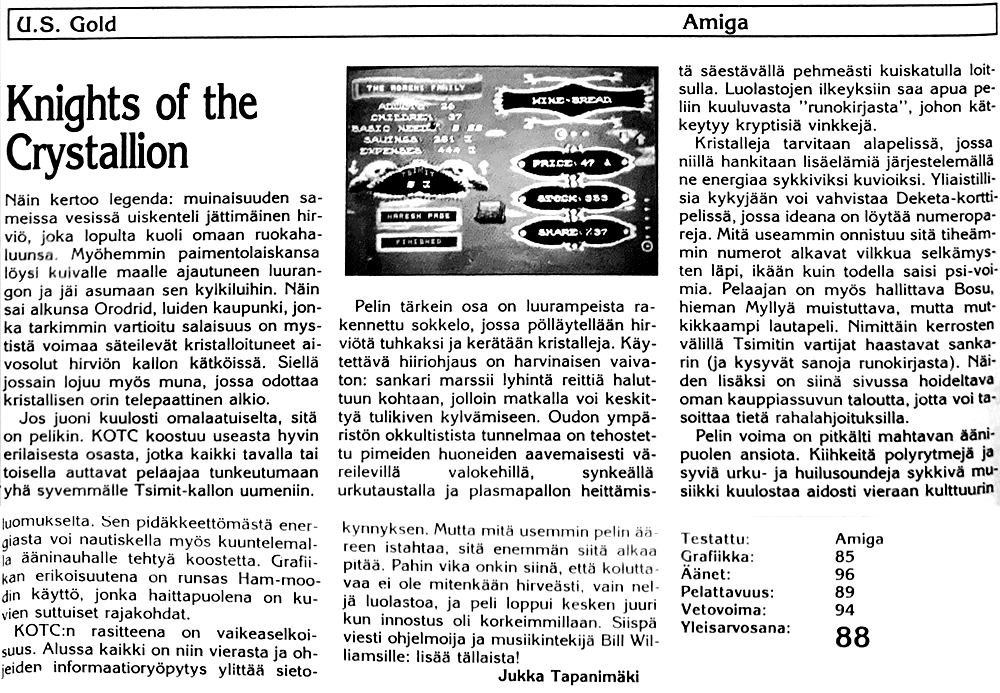
Knights of the Crystallion1990 SyksyPysyvä linkkiNäin kertoo legenda: muinaisuuden sameissa vesissä uiskenteli jättimäinen hirviö, joka lopulta kuoli omaan ruokahaluunsa. Myöhemmin paimentolaiskansa löysi kuivalle maalle ajautuneen luurangon ja jäi asumaan sen kylkiluihin. Näin sai alkunsa Orodrid, luiden kaupunki, jonka tarkimmin vartioitu salaisuus on mystistä voimaa säteilevät kristalloituneet aivosolut hirviön kallon kätköissä. Siellä jossain lojuu myös muna, jossa odottaa kristallisen orin telepaattinen alkio.
Jos juoni kuulosti omalaatuiselta, sitä on pelikin. KOTC koostuu useasta hyvin erilaisesta osasta, jotka kaikki tavalla tai toisella auttavat pelaajaa tunkeutumaan yhä syvemmälle Tsimit-kallon uumeniin.
Pelin tärkein osa on luurampeista rakennettu sokkelo, jossa pölläytellään hirviötä tuhkaksi ja kerätään kristalleja. Käytettävä hiiriohjaus on harvinaisen vaivaton: sankari marssii lyhintä reittiä haluttuun kohtaan, jolloin matkalla voi keskittyä tulikiven kylvämiseen. Oudon ympäristön okkultistista tunnelmaa on tehostettu pimeiden huoneiden aavemaisesti väreilevillä valokehillä, synkeällä urkutaustalla ja plasmapallon heittämistä säestävällä pehmeästi kuiskatulla loitsulla. Luolastojen ilkeyksiin saa apua peliin kuuluvasta "runokirjasta", johon kätkeytyy kryptisiä vinkkejä.
Kristalleja tarvitaan alapelissä, jossa niillä hankitaan lisäelämiä järjestelemällä ne energiaa sykkiviksi kuvioiksi. Yliaistillisia kykyjään voi vahvistaa Deketa-korttipelissä, jossa ideana on löytää numeropareja. Mitä useammin onnistuu sitä tiheämmin numerot alkavat vilkkua selkämysten läpi, ikään kuin todella saisi psi-voimia. Pelaajan on myös hallittava Bosu, hieman Myllyä muistuttava, mutta mutkikkaampi lautapeli. Nimittäin kerrosten välillä Tsimitin vartijat haastavat sankarin (ja kysyvät sanoja runokirjasta). Näiden lisäksi on siinä sivussa hoideltava oman kauppiassuvun taloutta, jotta voi tasoittaa tietä rahalahjoituksilla.
Pelin voima on pitkälti mahtavan äänipuolen ansiota. Kiihkeitä polyrytmejä ja syviä urku- ja huilusoundeja sykkivä musiikki kuulostaa aidosti vieraan kulttuurin luomukselta. Sen pidäkkeettömästä energiasta voi nautiskella myös kuuntelemalla ääninauhalle tehtyä koostetta. Grafiikan erikoisuutena on runsas Ham-moodin käyttö, jonka haittapuolena on kuvien suttuiset rajakohdat.
KOTC:n rasitteena on vaikeaselkoisuus. Alussa kaikki on niin vierasta ja ohjeiden informaatioryöpytys ylittää sietokynnyksen. Mutta mitä usemmin pelin ääreen istahtaa, sitä enemmän siitä alkaa pitää. Pahin vika onkin siinä, että koluttavaa ei ole mitenkään hirveästi, vain neljä luolastoa, ja peli loppui kesken juuri kun innostus oli korkeimmillaan. Siispä viesti ohjelmoija ja musiikintekijä Bill Williamsille: lisää tällaista!
Knights of the Crystallion1990 SyksyPermalinkThus says the legend: in the murky waters of antiquity there swam a gigantic monster, which in the end died of its own appetite. Later a nomadic people found the skeleton washed up on dry land and settled down to live in its ribs. Thus was born Orodrid, the city of bones, whose most closely guarded secret is the crystallised brain cells, radiating mystical power, hidden deep in the monster's skull. Somewhere in there also lies an egg, in which the telepathic embryo of a crystal stallion waits.
If the plot sounded peculiar, so is the game. KOTC consists of several very different parts, all of which in one way or another help the player to push ever deeper into the bowels of the Tsimit skull.
The most important part of the game is a maze built of bone ramps, where you puff monsters into ashes and collect crystals. The mouse control is unusually effortless: the hero marches by the shortest route to wherever you point, which leaves you free to concentrate on sowing brimstone along the way. The occult atmosphere of the strange surroundings has been heightened with ghostly shimmering halos of light in the dark rooms, a gloomy organ backing and a softly whispered incantation that accompanies the hurling of a plasma ball. For help against the nastiness of the dungeons there is the "poetry book" that comes with the game, in which cryptic hints are hidden.
The crystals are needed in a subgame, where you earn extra lives with them by arranging them into patterns that pulse with energy. You can strengthen your extrasensory abilities in the Deketa card game, where the idea is to find pairs of numbers. The more often you succeed, the more often the numbers start to flicker through the backs of the cards, as if you really were gaining psi powers. The player must also master Bosu, a board game a bit like Nine Men's Morris, but more convoluted. For between the levels, the guardians of Tsimit challenge the hero (and ask for words from the poetry book). On top of all this, you also have to look after the finances of your own merchant family on the side, so that you can smooth the way with cash donations.
The game's power owes a great deal to its magnificent sound. The music, throbbing with frenzied polyrhythms and deep organ and flute tones, sounds genuinely like the creation of an alien culture. You can also savour its unbridled energy by listening to the compilation recorded on audio cassette. A special feature of the graphics is the lavish use of Ham mode, the downside of which is smeary edges where the pictures' colours meet.
KOTC's burden is how hard it is to make sense of. At first everything is so alien, and the barrage of information in the instructions is more than anyone can stand. But the more often you sit down at the game, the more you start to like it. The worst flaw, in fact, is that there isn't a terrible lot to explore, just four dungeons, and the game ran out just when my enthusiasm was at its peak. So, a message to programmer and musician Bill Williams: more of this sort of thing!
Knights of the Sky
Knights of the Sky1991 SyksyPysyvä linkkiVakoilevatko pelitalot toisiaan vai mikä niitä riivaa? Ensin kaikki tekivät tankkipelejä ja nyt ensimmäiseen maailmansotaan sijoittuvia lentosimuja. Lyhyen ajan sisällä niitä on ilmestynyt neljä: Wings, Blue Max, Red Baron ja Knights of the Sky.
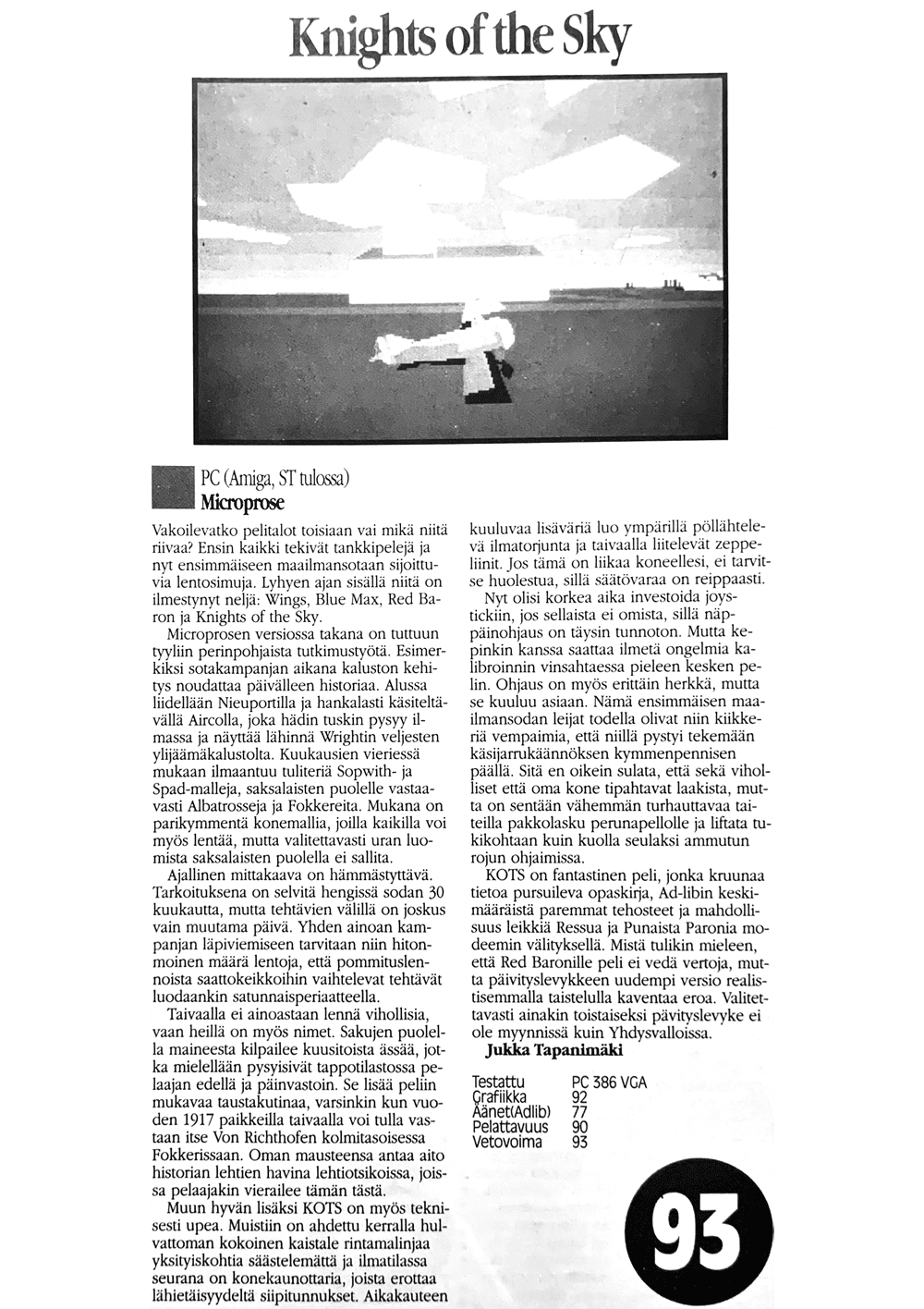
Microprosen versiossa takana on tuttuun tyyliin perinpohjaista tutkimustyötä. Esimerkiksi sotakampanjan aikana kaluston kehitys noudattaa päivälleen historiaa. Alussa liidellään Nieuportilla ja hankalasti käsiteltävällä Aircolla, joka hädin tuskin pysyy ilmassa ja näyttää lähinnä Wrightin veljesten ylijäämäkalustolta. Kuukausien vieriessä mukaan ilmaantuu tuliteriä Sopwith- ja Spad-malleja, saksalaisten puolelle vastaavasti Albatrosseja ja Fokkereita. Mukana on parikymmentä konemallia, joilla kaikilla voi myös lentää, mutta valitettavasti uran luomista saksalaisten puolella ei sallita.
Ajallinen mittakaava on hämmästyttävä. Tarkoituksena on selvitä hengissä sodan 30 kuukautta, mutta tehtävien välillä on joskus vain muutama päivä. Yhden ainoan kampanjan läpiviemiseen tarvitaan niin hitonmoinen määrä lentoja, että pommituslennoista saattokeikkoihin vaihtelevat tehtävät luodaankin satunnaisperiaatteella.
Taivaalla ei ainoastaan lennä vihollisia, vaan heillä on myös nimet. Sakujen puolella maineesta kilpailee kuusitoista ässää, jotka mielellään pysyisivät tappotilastossa pelaajan edellä ja päinvastoin. Se lisää peliin mukavaa taustakutinaa, varsinkin kun vuoden 1917 paikkeilla taivaalla voi tulla vastaan itse Von Richthofen kolmitasoisessa Fokkerissaan. Oman mausteensa antaa aito historian lehtien havina lehtiotsikoissa, joissa pelaajakin vierailee tämän tästä.
Muun hyvän lisäksi KOTS on myös teknisesti upea. Muistiin on ahdettu kerralla hulvattoman kokoinen kaistale rintamalinjaa yksityiskohtia säästelemättä ja ilmatilassa seurana on konekaunottaria, joista erottaa lähietäisyydeltä siipitunnukset. Aikakauteen kuuluvaa lisäväriä luo ympärillä pöllähtelevä ilmatorjunta ja taivaalla liitelevät zeppeliinit. Jos tämä on liikaa koneellesi, ei tarvitse huolestua, sillä säätövaraa on reippaasti.
Nyt olisi korkea aika investoida joystickiin, jos sellaista ei omista, sillä näppäinohjaus on täysin tunnoton. Mutta kepinkin kanssa saattaa ilmetä ongelmia kalibroinnin vinsahtaessa pieleen kesken pelin. Ohjaus on myös erittäin herkkä, mutta se kuuluu asiaan. Nämä ensimmäisen maailmansodan leijat todella olivat niin kiikkeriä vempaimia, että niillä pystyi tekemään käsijarrukäännöksen kymmenpennisen päällä. Sitä en oikein sulata, että sekä viholliset että oma kone tipahtavat laakista, mutta on sentään vähemmän turhauttavaa taiteilla pakkolasku perunapellolle ja liftata tukikohtaan kuin kuolla seulaksi ammutun rojun ohjaimissa.
KOTS on fantastinen peli, jonka kruunaa tietoa pursuileva opaskirja, Ad-libin keskimääräistä paremmat tehosteet ja mahdollisuus leikkiä Ressua ja Punaista Paronia modeemin välityksellä. Mistä tulikin mieleen, että Red Baronille peli ei vedä vertoja, mutta päivityslevykkeen uudempi versio realistisemmalla taistelulla kaventaa eroa. Valitettavasti ainakin toistaiseksi päivityslevyke ei ole myynnissä kuin Yhdysvalloissa. Ehdin jo luulla Microprosen Knights Of The Skyta ylittämättömäksi Ensimmäisen Maailmansodan lentosimuksi, kun sain eteeni Red Baronin. Alkuoletuksena oli Blue Maxin tasoinen "ihan kiva peli", mutta pakkauksesta paljastuikin mestariteos, joka pyyhkii jalkansa muihin WWI-peleihin.
Ettäkö millä eväillä? Ensiksikin Red Baronissa on 28 konemallia, mikä on kahdeksan enemmän kuin KOTS:ssa. Toiseksi Red Baronissa voi vapaasti rellestää myös sakujen puolella tekemässä Verisestä Huhtikuusta nimensä veroista. Ja kolmanneksi Red Baronissa ei lennetä yksin vaan muodostelmissa, joihin voi kuulua neljä konetta.
Koirankoppiin ja mielikuvitukseen ei tarvitse tyytyä, sillä pelialueena on viiteen osaan jaettu autenttinen sotatanner Lontoon, Pariisin ja Saksan rajaamassa kolmiossa. Tapahtumien etenemistavassa Red Baron ja KOTS ovat hyvin lähellä toisiaan. Kummassakin kalusto vaihtuu ajan kuluessa, pelaaja siirtyy joukko-osastosta toiseen, länsirintamalta kuuluu uutta ja silloin tällöin vastapuolen ässä lähettää henkilökohtaisen haasteen. Epäilyt pelitalojen välisestä vakoilusta vahvistuivat jälleen.
Suurin ero pelissä on taivaalla harjoitettava tiivis yhteistoiminta. Aluksi roikutaan siipimiehenä muiden mukana, mutta ylennysten myötä saadaan yhä usemmin ryhmä johdettavaksi. Muut koneet sivät ole suinkaan koristeena, vaan joskus ärsyttävänkin tehokkaita. Saksalaisten puolella uraa luova voi saada pestin jopa itsensä Punaisen Paronin laivueeseen.
Blue Maxin ylijäykkiin ja KOTS:n yliherkkiin Ressuntappajiin verrattuna koneissa on tukevampi tuntuma ja kaksintaistelut ovat juuri sellaisia kuin pitääkin: pitkiä ja piinallisia ajojahteja adrenaliinin kohistessa suonissa. Filosofointia realismin ja pelattavuuden suhteesta ei tarvita, koska säätövaraa on reilusti. Ylimääräistä jännitystä saa lisäämällä esimerkiksi epävakaiset sääolot, auringon häikäisyn, moottorin jäätymisen talvella ja expert-tasolla siivetkin saattavat lerpahtaa kovakouraisessa käsittelyssä.
Mukana on samantapainen nauhoitustoiminto kuin Their Finest Hourissa sillä erotuksella, että lennon voi tallentaa alusta loppuun. Nauhoitusta katsellessa voi tietysti vapaasti kierrellä, vaihdella ja väännellä kuvakulmaa. Ikimuistoisista lennoistaan voi myös editoida näyttäviä minielokuvia. Voisi luetella sivun mitalta hienovaraisempia oivalluksia, kuten että näyttö häilähtelee verenpunaisena haavoittumisen jälkeen, maisema hämärtyy auringon mentyä pilveen, konekiväärin panosvyö nykähtelee laukausten tahdissa, ja niin poispäin.
Jenkkipelien suuntaus näyttää olevan se, että ne tehdään VGA:lle ja EGA:ta tuetaan jos viitsitään. Ainakin tämä versio käytti ainoastaan VGA-grafiikkaa. Ulkoasu onkin kauttaaltaan herkistävän kaunis, varsinkin koneiden linjojen ikuistamisessa on heittäydytty vallan yltiöpäiseksi. Vai mitä sanotte siitä, että läheltä erottaa pyörien kumit. Se alkaa olla liikaa jopa 386-koneelle. Grafiikkaa on tosin yksinkertaistettu siten, että taistelun aikana suurin osa maastosta jätetään piirtämättä.
Kun soppaan vielä lisätään Ad-libin jytisevän realistiset äänitehosteet, niin luulin jo näkeväni päiväunta. Esimerkiksi moottorissa on konetyypistä riippuva, kierrosluvun mukaan aidosti muuttuva ääni ja luotisateen kirvoittamat metalliset kalahdukset kuulostavat niin ilkeiltä, että ruumiinosat alkavat irtoilla silkasta myötäelämisestä. Erilliset selkääntaputtelut ansaitsee mainio opaskirja, josta runsaan tiedon ohella löytyy muun muassa värikuvia eri konemalleista.
Jos Knights Of The Sky on fantastinen, niin Red Baron on, tuota - ylisanat uhkaavat loppua - Wing Commander sijoitettuna Ensimmäiseen Maailmansotaan. Eiköhän siinä ollut tarpeeksi ylistystä.
Knights of the Sky1991 SyksyPermalinkAre the software houses spying on each other, or what's got into them? First everyone was making tank games and now it's flight sims set in the First World War. Four of them have appeared within a short space of time: Wings, Blue Max, Red Baron and Knights of the Sky.
In the familiar style, Microprose's version has thorough research behind it. During the war campaign, for example, the development of the aircraft follows history to the day. At the start you're gliding about in a Nieuport and the awkward-handling Airco, which barely stays in the air and looks mostly like the Wright brothers' surplus stock. As the months roll by, brand-new Sopwith and Spad models turn up, and on the German side, correspondingly, Albatrosses and Fokkers. There are around twenty aircraft types, all of which you can also fly, but unfortunately you're not allowed to build a career on the German side.
The time scale is astonishing. The aim is to survive the war's 30 months, but sometimes there are only a few days between missions. Getting through one single campaign takes such a hell of a lot of sorties that the missions, ranging from bombing runs to escort jobs, are generated at random.
Not only are there enemies flying about in the sky, they have names too. On the Jerry side sixteen aces compete for fame, and they would dearly like to stay ahead of the player in the kill tally, and vice versa. That adds a nice background tingle to the game, especially since around 1917 you may run into Von Richthofen himself in his Fokker triplane. A spice all of its own comes from the authentic rustle of history's pages in the newspaper headlines, where the player also makes an appearance every now and then.
On top of all its other good points, KOTS is also technically superb. A ridiculously big strip of the front line has been crammed into memory in one go without skimping on detail, and in the airspace you're kept company by aircraft beauties whose wing markings you can make out at close range. Extra period colour comes from the anti-aircraft fire puffing all around and the zeppelins gliding across the sky. If this is too much for your machine, there's no need to worry, since there's plenty of room for adjustment.
Now would be high time to invest in a joystick if you don't own one, as the keyboard control is completely numb. But even with a stick you may run into trouble when the calibration goes skew-whiff mid-game. The controls are also extremely sensitive, but that's how it should be. These First World War kites really were such wobbly contraptions that you could do a handbrake turn on a sixpence in them. What I can't quite swallow is that both the enemies and your own plane go down from a single hit, but at least it's less frustrating to coax a forced landing onto a potato field and hitch a lift back to base than to die at the controls of a heap of junk shot as full of holes as a sieve.
KOTS is a fantastic game, crowned by a manual bursting with information, better-than-average Ad-lib effects and the chance to play Snoopy and the Red Baron over a modem. Which reminds me that the game can't hold a candle to Red Baron, but the newer version on the update disk, with more realistic combat, narrows the gap. Unfortunately, for the time being at least, the update disk is only on sale in the United States. I had already come to think of Microprose's Knights Of The Sky as the unbeatable First World War flight sim when Red Baron landed in front of me. My starting assumption was a "quite a nice game" on the level of Blue Max, but out of the box came a masterpiece that wipes its feet on the other WWI games.
And what's it got going for it, you ask? Firstly, Red Baron has 28 aircraft types, which is eight more than KOTS. Secondly, in Red Baron you're free to run riot on the Jerry side too, making Bloody April live up to its name. And thirdly, in Red Baron you don't fly alone but in formations of up to four aircraft.
You don't have to make do with a doghouse and your imagination, since the play area is an authentic battlefield divided into five sectors, in the triangle bounded by London, Paris and Germany. In the way events unfold, Red Baron and KOTS are very close to each other. In both, the aircraft change as time goes by, the player moves from one unit to another, all is not quiet on the Western Front, and every now and then an enemy ace sends a personal challenge. My suspicions of spying between the software houses were confirmed once again.
The biggest difference in the game is the close teamwork practised in the sky. At first you tag along with the others as a wingman, but with promotions you get a flight to lead more and more often. The other planes are by no means just there for decoration; at times they're even annoyingly effective. Someone building a career on the German side can even land a post in the squadron of the Red Baron himself.
Compared with Blue Max's over-stiff and KOTS's over-sensitive Snoopy-killers, the planes have a more solid feel, and the dogfights are just as they should be: long, agonising chases with adrenaline roaring through your veins. No philosophising about the balance between realism and playability is needed, because there's plenty of room for adjustment. You can add extra excitement by switching on, for instance, unstable weather, sun glare and engine icing in winter, and at expert level even the wings may flop off under rough handling.
There's a recording feature similar to the one in Their Finest Hour, with the difference that you can record a flight from start to finish. While watching the recording you can of course freely roam about, switch and twist the camera angle. You can also edit your unforgettable flights into spectacular mini-movies. One could list a page's worth of subtler touches, such as the screen flickering blood-red after you're wounded, the landscape dimming when the sun goes behind a cloud, the machine gun's ammunition belt jerking in time with the shots, and so on.
The trend with Yank games seems to be that they're made for VGA and EGA gets supported if anyone can be bothered. This version at least used VGA graphics only. The look is tear-jerkingly beautiful throughout, and in immortalising the lines of the aircraft in particular they've gone completely overboard. Or what do you say to being able to make out the rubber on the wheels up close? That's starting to be too much even for a 386 machine. The graphics have been simplified, though, in that most of the terrain is left undrawn during combat.
When you then add to the soup the Ad-lib's thunderingly realistic sound effects, I thought I must be daydreaming. The engine, for example, has a sound that depends on the aircraft type and genuinely changes with the revs, and the metallic clanks set off by a hail of bullets sound so nasty that your body parts start coming loose out of sheer empathy. A separate pat on the back is due to the splendid manual, which besides plenty of information contains, among other things, colour pictures of the different aircraft types.
If Knights Of The Sky is fantastic, then Red Baron is, um - I'm running out of superlatives here - Wing Commander set in the First World War. I reckon that's enough praise.
Kong Strikes Back
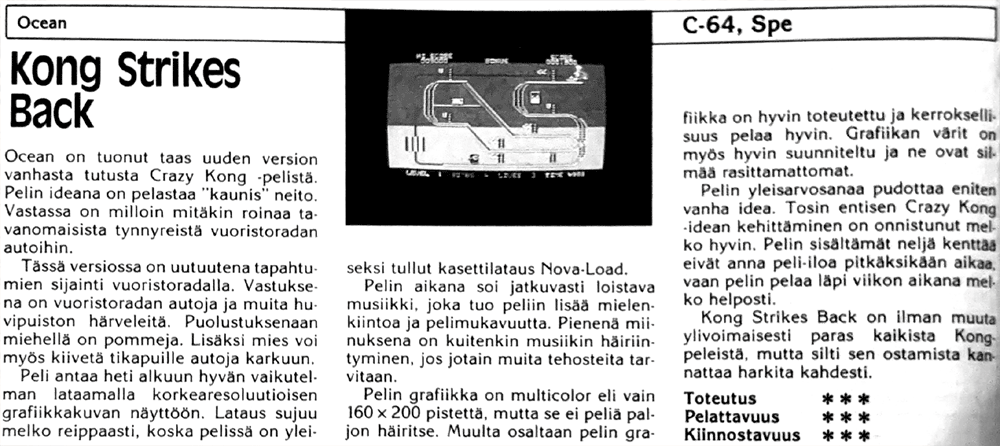
Kong Strikes Back1987Pysyvä linkkiOcean on tuonut taas uuden version vanhasta tutusta Crazy Kong -pelistä. Pelin ideana on pelastaa "kaunis" neito. Vastassa on milloin mitäkin roinaa tavanomaisista tynnyreistä vuoristoradan autoihin.
Tässä versiossa on uutuutena tapahtumien sijainti vuoristoradalla. Vastuksena on vuoristoradan autoja ja muita huvipuiston härveleitä. Puolustuksenaan miehellä on pommeja. Lisäksi mies voi myös kiivetä tikapuille autoja karkuun.
Peli antaa heti alkuun hyvän vaikutelman lataamalla korkearesoluutioisen grafiikkakuvan näyttöön. Lataus sujuu melko reippaasti, koska pelissä on yleiseksi tullut kasettilataus Nova-Load.
Pelin aikana soi jatkuvasti loistava musiikki, joka tuo peliin lisää mielenkiintoa ja pelimukavuutta. Pienenä miinuksena on kuitenkin musiikin häiriintyminen, jos jotain muita tehosteita tarvitaan.
Pelin grafiikka on multicolor eli vain 160 x 200 pistettä, mutta se ei peliä paljon häiritse. Muulta osaltaan pelin grafiikka on hyvin toteutettu ja kerroksellisuus pelaa hyvin. Grafiikan värit on myös hyvin suunniteltu ja ne ovat silmää rasittamattomat.
Pelin yleisarvosanaa pudottaa eniten vanha idea. Tosin entisen Crazy Kong -idean kehittäminen on onnistunut melko hyvin. Pelin sisältämät neljä kenttää eivät anna peli-iloa pitkäksikään aikaa, vaan pelin pelaa läpi viikon aikana melko helposti.
Kong Strikes Back on ilman muuta ylivoimaisesti paras kaikista Kong-peleistä, mutta silti sen ostamista kannattaa harkita kahdesti.
Kong Strikes Back1987PermalinkOcean has once again brought out a new version of that good old familiar game, Crazy Kong. The idea of the game is to rescue a "beautiful" maiden. Up against you is one lot of junk after another, from the usual barrels to roller-coaster cars.
What's new in this version is that the action takes place on a roller coaster. The opposition is made up of roller-coaster cars and other amusement-park contraptions. For self-defence the man has bombs. On top of that, the man can also climb up ladders to get away from the cars.
The game makes a good impression right from the start by loading a high-resolution picture onto the screen. Loading goes along fairly briskly, because the game uses the now widespread cassette loader Nova-Load.
Excellent music plays non-stop throughout the game, bringing extra interest and playing comfort to it. A small minus, though, is that the music gets disrupted whenever any other effects are needed.
The game's graphics are multicolour, meaning only 160 x 200 pixels, but that doesn't hurt the game much. Otherwise the graphics are well done and the layering works nicely. The colours of the graphics are also well designed and easy on the eyes.
What drags the overall rating down most is the old idea. Admittedly, the old Crazy Kong idea has been developed further fairly successfully. The four levels in the game won't keep the fun going for very long; you'll play the game through fairly easily within a week.
Kong Strikes Back is without question by far the best of all the Kong games, but you should still think twice before buying it.
Koronis Rift
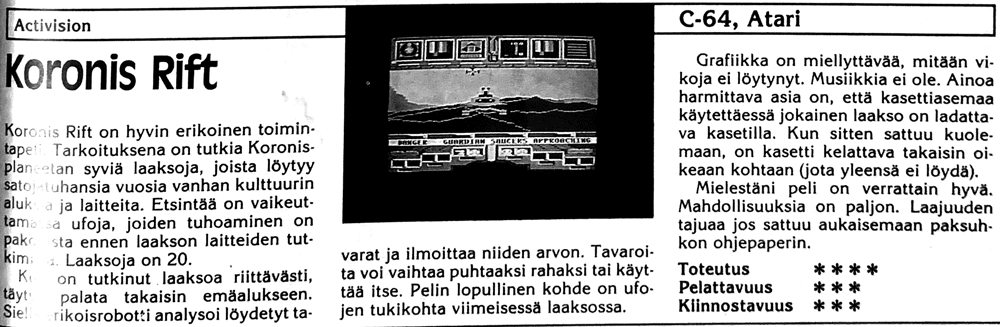
Koronis Rift1987Pysyvä linkkiKoronis Rift on hyvin erikoinen toimintapeli. Tarkoituksena on tutkia Koronis-planeetan syviä laaksoja, joista löytyy satojatuhansia vuosia vanhan kulttuurin aluksia ja laitteita. Etsintää on vaikeuttamassa ufoja, joiden tuhoaminen on pakollista ennen laakson laitteiden tutkimista. Laaksoja on 20.
Kun on tutkinut laaksoa riittävästi, täytyy palata takaisin emäalukseen. Siellä erikoisrobotti analysoi löydetyt tavarat ja ilmoittaa niiden arvon. Tavaroita voi vaihtaa puhtaaksi rahaksi tai käyttää itse. Pelin lopullinen kohde on ufojen tukikohta viimeisessä laaksossa.
Grafiikka on miellyttävää, mitään vikoja ei löytynyt. Musiikkia ei ole. Ainoa harmittava asia on, että kasettiasemaa käytettäessä jokainen laakso on ladattava kasetilla. Kun sitten sattuu kuolemaan, on kasetti kelattava takaisin oikeaan kohtaan (jota yleensä ei löydä).
Mielestäni peli on verrattain hyvä. Mahdollisuuksia on paljon. Laajuuden tajuaa jos sattuu aukaisemaan paksuhkon ohjepaperin.
Koronis Rift1987PermalinkKoronis Rift is a very unusual action game. The aim is to explore the deep valleys of the planet Koronis, where you'll find ships and equipment left by a civilisation hundreds of thousands of years old. Making the search harder are UFOs, which have to be destroyed before you can examine a valley's equipment. There are 20 valleys.
Once you've explored a valley enough, you have to go back to the mothership. There a special robot analyses the items you've found and tells you what they're worth. You can trade the items for cold hard cash or use them yourself. The game's ultimate target is the UFOs' base in the last valley.
The graphics are pleasant; no flaws turned up. There's no music. The only annoying thing is that when you're using a cassette drive, every valley has to be loaded from tape. Then when you happen to die, you have to rewind the tape back to the right spot (which you usually can't find).
In my opinion the game is comparatively good. There are lots of possibilities. You grasp the scale of it if you happen to open the rather thick instruction booklet.
Krakout
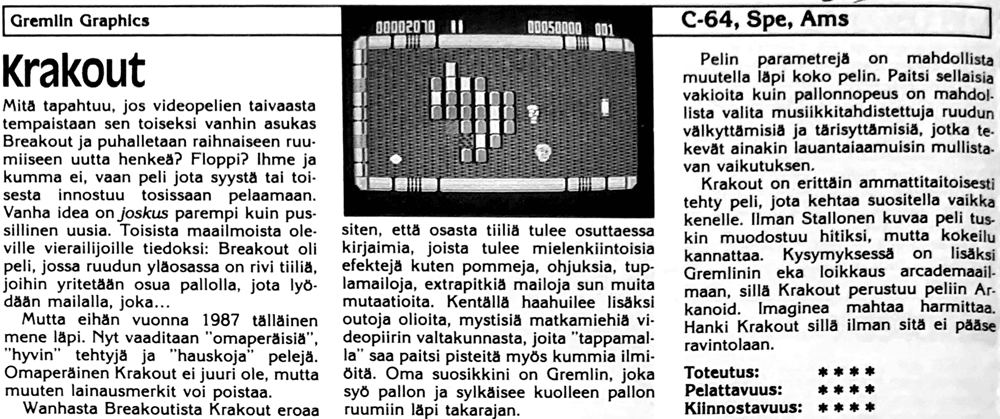
Krakout1987Pysyvä linkkiMitä tapahtuu, jos videopelien taivaasta tempaistaan sen toiseksi vanhin asukas Breakout ja puhalletaan raihnaiseen ruumiiseen uutta henkeä? Floppi? Ihme ja kumma ei, vaan peli jota syystä tai toisesta innostuu tosissaan pelaamaan. Vanha idea on joskus parempi kuin pussillinen uusia. Toisista maailmoista oleville vierailijoille tiedoksi: Breakout oli peli, jossa ruudun yläosassa on rivi tiiliä, joihin yritetään osua pallolla, jota lyödään mailalla, joka...
Mutta eihän vuonna 1987 tälläinen mene läpi. Nyt vaaditaan "omaperäisiä", "hyvin" tehtyjä ja "hauskoja" pelejä. Omaperäinen Krakout ei juuri ole, mutta muuten lainausmerkit voi poistaa.
Wanhasta Breakoutista Krakout eroaa siten, että osasta tiiliä tulee osuttaessa kirjaimia, joista tulee mielenkiintoisia efektejä kuten pommeja, ohjuksia, tuplamailoja, extrapitkiä mailoja sun muita mutaatioita. Kentällä haahuilee lisäksi outoja olioita, mystisiä matkamiehiä videopiirin valtakunnasta, joita "tappamalla" saa paitsi pisteitä myös kummia ilmiöitä. Oma suosikkini on Gremlin, joka syö pallon ja sylkäisee kuolleen pallon ruumiin läpi takarajan.
Pelin parametrejä on mahdollista muutella läpi koko pelin. Paitsi sellaisia vakioita kuin pallonnopeus on mahdollista valita musiikkitahdistettuja ruudun välkyttämisiä ja tärisyttämisiä, jotka tekevät ainakin lauantaiaamuisin mullistavan vaikutuksen.
Krakout on erittäin ammattitaitoisesti tehty peli, jota kehtaa suositella vaikka kenelle. Ilman Stallonen kuvaa peli tuskin muodostuu hitiksi, mutta kokeilu kannattaa. Kysymyksessä on lisäksi Gremlinin eka loikkaus arcademaailmaan, sillä Krakout perustuu peliin Arkanoid. Imaginea mahtaa harmittaa. Hanki Krakout sillä ilman sitä ei pääse ravintolaan.
Krakout1987PermalinkWhat happens if you snatch Breakout, the second-oldest resident of video-game heaven, back out of it and breathe new life into its decrepit body? A flop? Wonder of wonders, no - it's a game that for one reason or another you get seriously keen on playing. An old idea is sometimes better than a bagful of new ones. For the information of visitors from other worlds: Breakout was a game where there's a row of bricks at the top of the screen, which you try to hit with a ball, which is struck with a bat, which...
But of course that sort of thing won't wash in 1987. These days the demand is for "original", "well"-made and "fun" games. Krakout isn't exactly original, but otherwise the quotation marks can go.
Krakout differs from ye olde Breakout in that some of the bricks drop letters when hit, and these produce interesting effects such as bombs, missiles, double bats, extra-long bats and all sorts of other mutations. On top of that, strange creatures drift about the playfield, mystical wayfarers from the realm of the video chip, and "killing" them earns you not only points but also weird phenomena. My own favourite is the Gremlin, which eats the ball and spits the dead ball's body out past the back line.
The game's parameters can be tweaked throughout the whole game. Besides such basics as ball speed, you can choose screen flashing and shaking synchronised to the music, which, on Saturday mornings at least, have an earth-shaking effect.
Krakout is a very professionally made game that you can recommend to just about anyone without blushing. Without a picture of Stallone on it the game is unlikely to become a hit, but it's worth a try. What's more, this is Gremlin's first leap into the arcade world, since Krakout is based on the game Arkanoid. That must be irking Imagine. Get Krakout, because without it you won't get into the restaurant.
Kristal, The
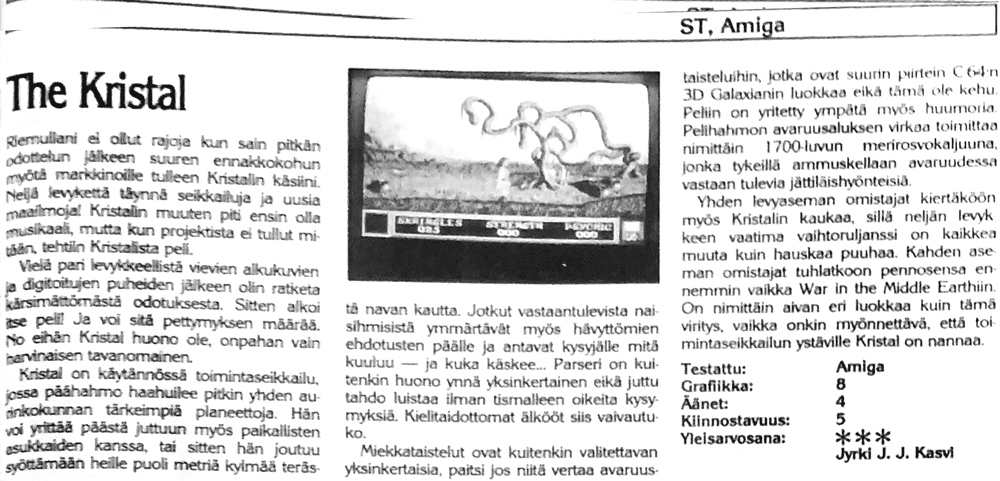
Kristal, The1989 SyksyPysyvä linkkiRiemulleni ei ollut rajoja kun sain pitkän odottelun jälkeen suuren ennakkokohun myötä markkinoille tulleen Kristalin käsiini. Neljä levykettä täynnä seikkailuja ja uusia maailmoja! Kristalin muuten piti ensin olla musikaali, mutta kun projektista ei tullut mitään, tehtiin Kristalista peli.
Vielä pari levykkeellistä vievien alkukuvien ja digitoitujen puheiden jälkeen olin ratketa kärsimättömästä odotuksesta. Sitten alkoi itse peli! Ja voi sitä pettymyksen määrää. No eihän Kristal huono ole, onpahan vain harvinaisen tavanomainen.
Kristal on käytännössä toimintaseikkailu, jossa päähahmo haahuilee pitkin yhden aurinkokunnan tärkeimpiä planeettoja. Hän voi yrittää päästä juttuun myös paikallisten asukkaiden kanssa, tai sitten hän joutuu syöttämään heille puoli metriä kylmää terästä navan kautta. Jotkut vastaantulevista naisihmisistä ymmärtävät myös hävyttömien ehdotusten päälle ja antavat kysyjälle mitä kuuluu - ja kuka käskee... Parseri on kuitenkin huono ynnä yksinkertainen eikä juttu tahdo luistaa ilman tismalleen oikeita kysymyksiä. Kielitaidottomat älkööt siis vaivautuko.
Miekkataistelut ovat kuitenkin valitettavan yksinkertaisia, paitsi jos niitä vertaa avaruustaisteluihin, jotka ovat suurin piirtein C 64:n 3D Galaxianin luokkaa eikä tämä ole kehu. Peliin on yritetty ympätä myös huumoria. Pelihahmon avaruusaluksen virkaa toimittaa nimittäin 1700-luvun merirosvokaljuuna, jonka tykeillä ammuskellaan avaruudessa vastaan tulevia jättiläishyönteisiä.
Yhden levyaseman omistajat kiertäköön myös Kristalin kaukaa, sillä neljän levykkeen vaatima vaihtoruljanssi on kaikkea muuta kuin hauskaa puuhaa. Kahden aseman omistajat tuhlatkoon pennosensa ennemmin vaikka War in the Middle Earthiin. On nimittäin aivan eri luokkaa kuin tämä viritys, vaikka onkin myönnettävä, että toimintaseikkailun ystäville Kristal on nannaa.
Kristal, The1989 SyksyPermalinkMy joy knew no bounds when, after a long wait, I got my hands on Kristal, which hit the market amid a great deal of advance hype. Four disks full of adventures and new worlds! Kristal, by the way, was first supposed to be a musical, but when nothing came of the project, Kristal was made into a game.
After intro pictures and digitised speech taking up another couple of disks' worth, I was about to burst at the seams with impatient anticipation. Then the game itself began! And oh, the sheer amount of disappointment. Well, Kristal isn't bad, it's just remarkably ordinary.
Kristal is in practice an action adventure in which the main character wanders about the most important planets of one solar system. The hero can also try to strike up a conversation with the local inhabitants, or else ends up having to feed them half a metre of cold steel through the navel. Some of the womenfolk you run into also get the drift of indecent proposals and give the asker what's coming - and whose fault is that... The parser, however, is poor plus simplistic, and the conversation won't really flow without exactly the right questions. So let those without language skills not bother.
The sword fights, however, are regrettably simple, except when compared with the space battles, which are roughly in the class of the C 64's 3D Galaxian, and that is no compliment. Someone has also tried to cram some humour into the game. The role of the character's spaceship is played, you see, by an 18th-century pirate galleon, whose cannons are used to blast away at the giant insects met in space.
Let owners of a single disk drive also give Kristal a wide berth, since the swapping rigmarole demanded by four disks is anything but fun. Let owners of two drives rather squander their pennies on, say, War in the Middle Earth. It is in a whole different league from this contraption, although it has to be admitted that for fans of action adventure Kristal is yum-yum.
Krypton Egg
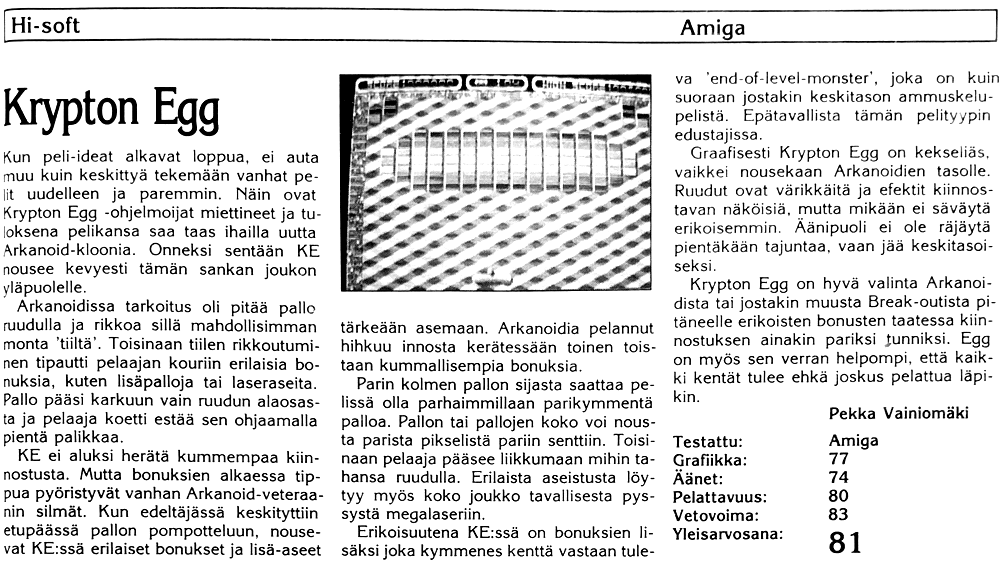
Krypton Egg1990 SyksyPysyvä linkkiKun peli-ideat alkavat loppua, ei auta muu kuin keskittyä tekemään vanhat pelit uudelleen ja paremmin. Näin ovat Krypton Egg -ohjelmoijat miettineet ja tuloksena pelikansa saa taas ihailla uutta Arkanoid-kloonia. Onneksi sentään KE nousee kevyesti tämän sankan joukon yläpuolelle.
Arkanoidissa tarkoitus oli pitää pallo ruudulla ja rikkoa sillä mahdollisimman monta 'tiiltä'. Toisinaan tiilen rikkoutuminen tipautti pelaajan kouriin erilaisia bonuksia, kuten lisäpalloja tai laseraseita. Pallo pääsi karkuun vain ruudun alaosasta ja pelaaja koetti estää sen ohjaamalla pientä palikkaa.
KE ei aluksi herätä kummempaa kiinnostusta. Mutta bonuksien alkaessa tippua pyöristyvät vanhan Arkanoid-veteraanin silmät. Kun edeltäjässä keskityttiin etupäässä pallon pompotteluun, nousevat KE:ssä erilaiset bonukset ja lisä-aseet tärkeään asemaan. Arkanoidia pelannut hihkuu innosta kerätessään toinen toistaan kummallisempia bonuksia.
Parin kolmen pallon sijasta saattaa pelissä olla parhaimmillaan parikymmentä palloa. Pallon tai pallojen koko voi nousta parista pikselistä pariin senttiin. Toisinaan pelaaja pääsee liikkumaan mihin tahansa ruudulla. Erilaista aseistusta löytyy myös koko joukko tavallisesta pyssystä megalaseriin.
Erikoisuutena KE:ssä on bonuksien lisäksi joka kymmenes kenttä vastaan tuleva 'end-of-level-monster', joka on kuin suoraan jostakin keskitason ammuskelupelistä. Epätavallista tämän pelityypin edustajissa.
Graafisesti Krypton Egg on kekseliäs, vaikkei nousekaan Arkanoidien tasolle. Ruudut ovat värikkäitä ja efektit kiinnostavan näköisiä, mutta mikään ei säväytä erikoisemmin. Äänipuoli ei ole räjäytä pientäkään tajuntaa, vaan jää keskitasoiseksi.
Krypton Egg on hyvä valinta Arkanoidista tai jostakin muusta Break-outista pitäneelle erikoisten bonusten taatessa kiinnostuksen ainakin pariksi tunniksi. Egg on myös sen verran helpompi, että kaikki kentät tulee ehkä joskus pelattua läpikin.
Krypton Egg1990 SyksyPermalinkWhen game ideas start running out, there's nothing for it but to concentrate on making the old games again, and better. So the Krypton Egg programmers have reasoned, and as a result the gaming public once again gets to admire a new Arkanoid clone. Luckily KE at least rises easily above this dense throng.
In Arkanoid the aim was to keep the ball on the screen and break as many 'bricks' as possible with it. Now and then a breaking brick dropped various bonuses into the player's hands, such as extra balls or laser weapons. The ball could only escape through the bottom of the screen, and the player tried to stop it by steering a little block.
At first KE doesn't arouse any particular interest. But when the bonuses start dropping, the old Arkanoid veteran's eyes grow round. Whereas its predecessor was mainly about bouncing the ball around, in KE the various bonuses and extra weapons rise to an important position. Anyone who has played Arkanoid will whoop with excitement while collecting bonuses each stranger than the last.
Instead of two or three balls, at best there can be twenty or so balls in play. The size of the ball or balls can grow from a couple of pixels to a couple of centimetres. Sometimes the player gets to move anywhere on the screen. There's also a whole host of different weaponry, from an ordinary gun to a megalaser.
Besides the bonuses, a special feature of KE is the 'end-of-level-monster' you run into every tenth level, which looks like something straight out of a middling shoot-'em-up. Unusual among representatives of this game type.
Graphically Krypton Egg is inventive, although it doesn't rise to the level of the Arkanoids. The screens are colourful and the effects interesting-looking, but nothing gives you any particular thrill. The sound doesn't blow even the smallest of minds, but stays middling.
Krypton Egg is a good choice for anyone who liked Arkanoid or some other Break-out, with the unusual bonuses guaranteeing your interest for at least a couple of hours. Egg is also enough easier that you might even get through all the levels some day.
Kult
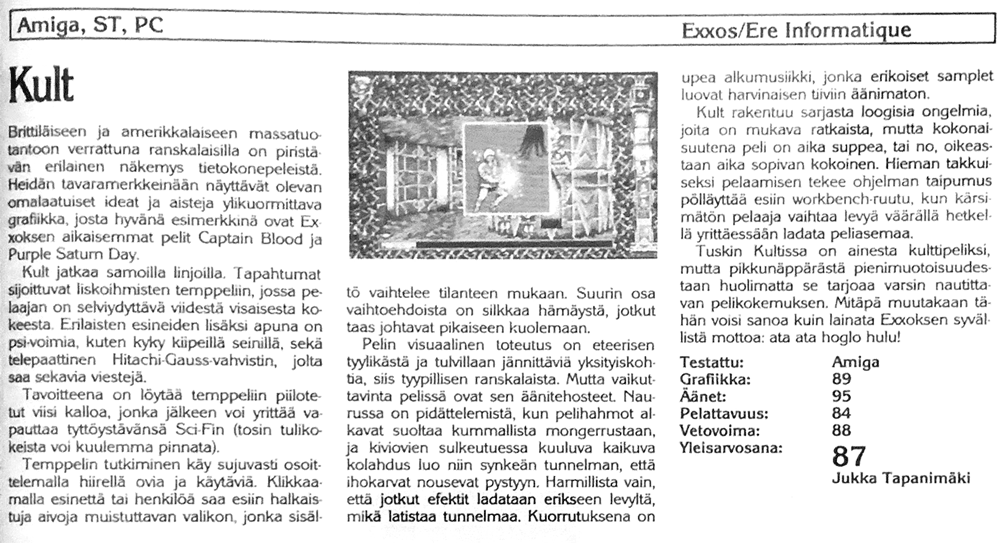
Kult1990 KevätPysyvä linkkiBrittiläiseen ja amerikkalaiseen massatuotantoon verrattuna ranskalaisilla on piristävän erilainen näkemys tietokonepeleistä. Heidän tavaramerkkeinään näyttävät olevan omalaatuiset ideat ja aisteja ylikuormittava grafiikka, josta hyvänä esimerkkinä ovat Exxoksen aikaisemmat pelit Captain Blood ja Purple Saturn Day.
Kult jatkaa samoilla linjoilla. Tapahtumat sijoittuvat liskoihmisten temppeliin, jossa pelaajan on selviydyttävä viidestä visaisesta kokeesta. Erilaisten esineiden lisäksi apuna on psi-voimia, kuten kyky kiipeillä seinillä, sekä telepaattinen Hitachi-Gauss-vahvistin, jolta saa sekavia viestejä.
Tavoitteena on löytää temppeliin piilotetut viisi kalloa, jonka jälkeen voi yrittää vapauttaa tyttöystävänsä Sci-Fin (tosin tulikokeista voi kuulemma pinnata).
Temppelin tutkiminen käy sujuvasti osoittelemalla hiirellä ovia ja käytäviä. Klikkaamalla esinettä tai henkilöä saa esiin halkaistuja aivoja muistuttavan valikon, jonka sisältö vaihtelee tilanteen mukaan. Suurin osa vaihtoehdoista on silkkaa hämäystä, jotkut taas johtavat pikaiseen kuolemaan.
Pelin visuaalinen toteutus on eeterisen tyylikästä ja tulvillaan jännittäviä yksityiskohtia, siis tyypillisen ranskalaista. Mutta vaikuttavinta pelissä ovat sen äänitehosteet. Naurussa on pidättelemistä, kun pelihahmot alkavat suoltaa kummallista mongerrustaan, ja kiviovien sulkeutuessa kuuluva kaikuva kolahdus luo niin synkeän tunnelman, että ihokarvat nousevat pystyyn. Harmillista vain, että jotkut efektit ladataan erikseen levyltä, mikä latistaa tunnelmaa. Kuorrutuksena on upea alkumusiikki, jonka erikoiset samplet luovat harvinaisen tiiviin äänimaton.
Kult rakentuu sarjasta loogisia ongelmia, joita on mukava ratkaista, mutta kokonaisuutena peli on aika suppea, tai no, oikeastaan aika sopivan kokoinen. Hieman takkuiseksi pelaamisen tekee ohjelman taipumus pölläyttää esiin workbench-ruutu, kun kärsimätön pelaaja vaihtaa levyä väärällä hetkellä yrittäessään ladata peliasemaa.
Tuskin Kultissa on ainesta kulttipeliksi, mutta pikkunäppärästä pienimuotoisuudestaan huolimatta se tarjoaa varsin nautittavan pelikokemuksen. Mitäpä muutakaan tähän voisi sanoa kuin lainata Exxoksen syvällistä mottoa: ata ata hoglo hulu!
Kult1990 KevätPermalinkCompared with British and American mass production, the French have a refreshingly different view of computer games. Their trademarks seem to be idiosyncratic ideas and graphics that overload the senses, good examples of which are Exxos's earlier games Captain Blood and Purple Saturn Day.
Kult carries on along the same lines. The action takes place in a temple of the lizard people, where the player has to survive five tricky ordeals. Besides various objects, you get help from psi powers, such as the ability to climb walls, plus a telepathic Hitachi-Gauss amplifier that sends you muddled messages.
The goal is to find the five skulls hidden in the temple, after which you can try to free your girlfriend Sci-Fi (though rumour has it you can bunk off the trials by fire).
Exploring the temple goes smoothly by pointing at doors and corridors with the mouse. Clicking on an object or a person brings up a menu resembling a split brain, whose contents vary with the situation. Most of the options are pure red herrings, while others lead to a swift death.
The game's visuals are ethereally stylish and brimming with intriguing details, which is to say typically French. But the most impressive thing about the game is its sound effects. It's hard to keep from laughing when the characters start churning out their weird gibberish, and the echoing thud of the stone doors closing creates such a gloomy atmosphere that the hairs on the back of your neck stand up. It's just a pity that some of the effects are loaded separately from disk, which deflates the atmosphere. The icing on the cake is the superb title music, whose unusual samples weave an uncommonly dense carpet of sound.
Kult is built from a series of logical problems that are nice to solve, but as a whole the game is rather limited, or well, actually just about the right size. What makes playing a bit rough going is the program's tendency to puff the workbench screen into view when an impatient player swaps disks at the wrong moment while trying to load a saved game.
Kult hardly has the makings of a cult game, but despite being a nifty little small-scale affair, it offers a thoroughly enjoyable gaming experience. What else could one say here but quote Exxos's profound motto: ata ata hoglo hulu!
Kultakuume
Kultakuume1987Pysyvä linkki"Kaikki ei ole kultaa, mikä kiiltää", sanoo vanha kansanviisastelu. Niinpä on paras jättää omat kullanhimosta kiiltelevät silmät rauhaan ja keskittyä pelaamaan ensimmäistä suomalaista seikkailupeliä, Kultakuumetta.
Joudut saapastelemaan Jenkkeihin suuren kultaryntäyksen aikaan, vuoteen 1848, jolloin miehet olivat puuta ja luodit lyijyä.
Nalkuttava vaimosi ajaa sinut ja veljesi Johnin hommiin. Perheen talous on pahasti pielessä, mutta onneksi jossain päin Yhdysvaltoja on mahdollisuus rikastua. Niinpä lähdet matkaan. Paha kyllä, et aluksi oikein tiedä, minne mennä, joten lienee parasta tutustua kotikaupunkiin kunnolla. Matkaan päästyäsi tulet vielä tutustumaan Lännen lakiin ja saluunoissa työskenteleviin portsareihin. . .
Quillillä ja Illustratorilla tehdyn Kultakuumeen parsesi eli se ohjelman osa, joka ottaa käskyt vastaan, on todella yksinkertainen: se hyväksyy vain sanan tai kahden mittaisia komentoja. Onneksi se hyväksyy lyhenteitäkin, kuten ilmansuunnat ja katso-komennon. Parserin luonteen takia siltä on helppo urkkia, mitä sanoja pelissä on käytettävissä ja mitkä niistä ovat tärkeitä. Tämä helpottaa peliä huomattavasti.
Grafiikkaa löytyy noin joka kolmannesta ruudusta. Mitään da Vincin kädenjälkeä eivät kuvat ole, mutta ne täyttävät mainiosti tarkoituksensa. Tosin kuvien tekoon kuluva aika joskus hermostuttaa. Paremman annin ohjelma tarjoaa humoristisilla huomautuksilla ja tietyillä viitteillä todelliseen elämään. Vaikka peli aluksi tuntuu yksinkertaiselta, muuttuu se kohtuullisen hankalaksi, mitä pidemmälle siinä pääsee. Kun vielä ottaa huomioon hinnan ja sen, että tämä adventure pakottaa ajattelemaan asiat suomeksi, on Kultakuume (varsinkin aloittelijalle) ihan hyvä ostos.
Kultakuume1987Permalink"All that glitters is not gold," says the old folk wisecrack. So you'd best leave your own eyes, glittering with lust for gold, well alone and concentrate on playing the first Finnish adventure game, Kultakuume.
You have to go tramping off to the States at the time of the great gold rush, to the year 1848, when men were wood and bullets were lead.
Your nagging wife chases you and your brother John off to work. The family finances are in a bad way, but luckily somewhere in the United States there's a chance to strike it rich. So off you go. Trouble is, at first you don't really know where to go, so it's probably best to get to know your home town properly. Once you're on your way, you'll also get to know the Law of the West and the bouncers working in the saloons. . .
Kultakuume was made with Quill and Illustrator, and its parser, that is, the part of the program that receives your commands, is really simple: it only accepts commands one or two words long. Luckily it accepts abbreviations too, such as for the compass directions and the look command. Because of the nature of the parser, it's easy to worm out of it which words are available in the game and which of them matter. This makes the game considerably easier.
Graphics turn up on roughly every third screen. The pictures are hardly the handiwork of da Vinci, but they serve their purpose admirably. Admittedly, the time it takes to draw the pictures sometimes gets on your nerves. The program serves up better fare in its humorous remarks and certain references to real life. Although the game seems simple at first, it gets reasonably tricky the further you get into it. When you also take into account the price and the fact that this adventure makes you think things through in Finnish, Kultakuume is (especially for a beginner) a perfectly decent buy.