SimCity Phenomena
Pelit was a Finnish-language (bi)annual book series published from 1987 to 1991 containing gaming-related articles, tips and most importantly game reviews. Here you can find all the reviews from the books. The reviews were originally written in Finnish; the English versions are translations of the Finnish originals. Maininta tekijänoikeuksista
 1987
1987 1988
1988 1989 Kevät
 1989 Syksy
 1990 Kevät
 1990 Syksy
 1991 Kevät
 1991 Syksy
SimCity Phenomena
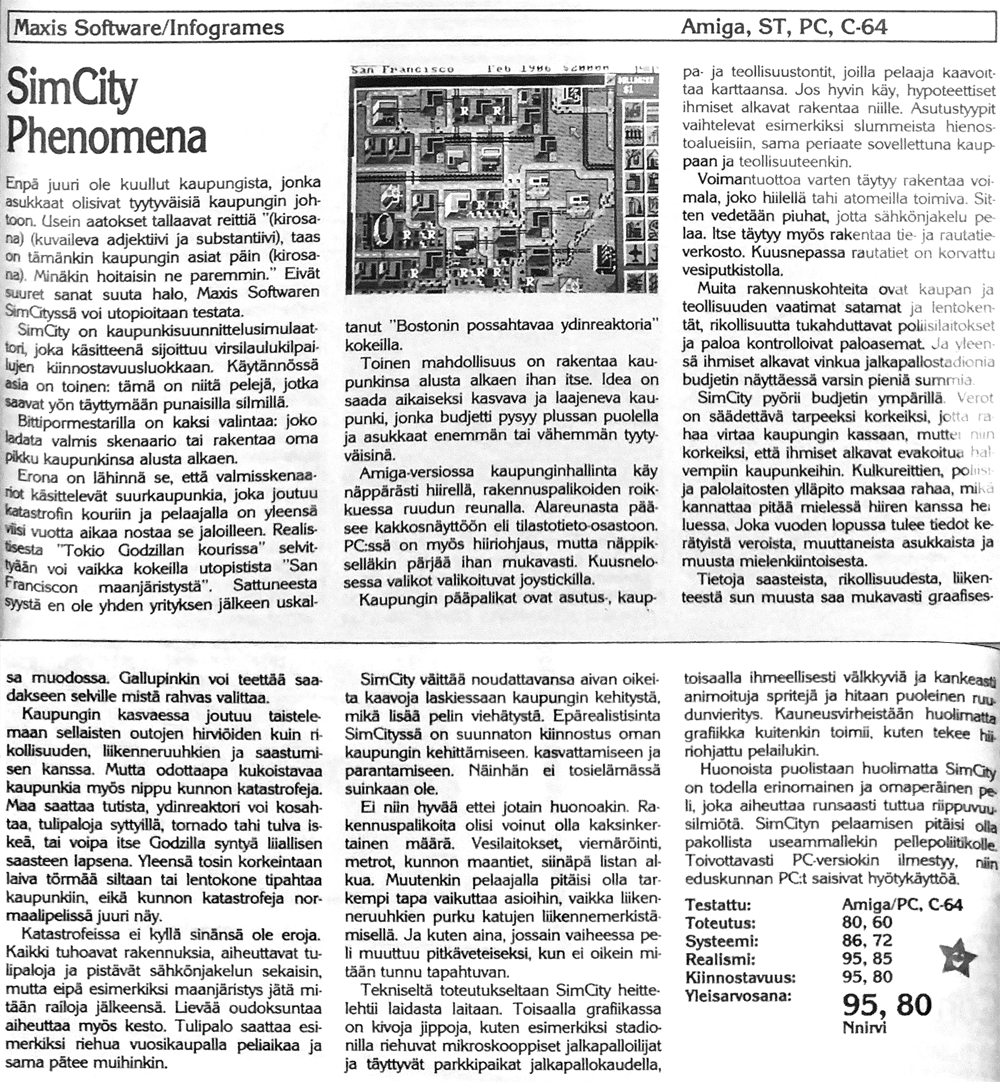
SimCity Phenomena1990 KevätPysyvä linkkiEnpä juuri ole kuullut kaupungista, jonka asukkaat olisivat tyytyväisiä kaupungin johtoon. Usein aatokset tallaavat reittiä "(kirosana) (kuvaileva adjektiivi ja substantiivi), taas on tämänkin kaupungin asiat päin (kirosana). Minäkin hoitaisin ne paremmin." Eivät suuret sanat suuta halo, Maxis Softwaren SimCityssä voi utopioitaan testata.
SimCity on kaupunkisuunnittelusimulaattori, joka käsitteenä sijoittuu virsilaulukilpailujen kiinnostavuusluokkaan. Käytännössä asia on toinen: tämä on niitä pelejä, jotka saavat yön täyttymään punaisilla silmillä.
Bittipormestarilla on kaksi valintaa: joko ladata valmis skenaario tai rakentaa oma pikku kaupunkinsa alusta alkaen.
Erona on lähinnä se, että valmisskenaariot käsittelevät suurkaupunkia, joka joutuu katastrofin kouriin ja pelaajalla on yleensä viisi vuotta aikaa nostaa se jaloilleen. Realistisesta "Tokio Godzillan kourissa" selvittyään voi vaikka kokeilla utopistista "San Franciscon maanjäristystä". Sattuneesta syystä en ole yhden yrityksen jälkeen uskaltanut "Bostonin possahtavaa ydinreaktoria" kokeilla.
Toinen mahdollisuus on rakentaa kaupunkinsa alusta alkaen ihan itse. Idea on saada aikaiseksi kasvava ja laajeneva kaupunki, jonka budjetti pysyy plussan puolella ja asukkaat enemmän tai vähemmän tyytyväisinä.
Amiga-versiossa kaupunginhallinta käy näppärästi hiirellä, rakennuspalikoiden roikkuessa ruudun reunalla. Alareunasta pääsee kakkosnäyttöön eli tilastotieto-osastoon. PC:ssä on myös hiiriohjaus, mutta näppikselläkin pärjää ihan mukavasti. Kuusnelosessa valikot valikoituvat joystickillä.
Kaupungin pääpalikat ovat asutus-, kauppa- ja teollisuustontit, joilla pelaaja kaavoittaa karttaansa. Jos hyvin käy, hypoteettiset ihmiset alkavat rakentaa niille. Asutustyypit vaihtelevat esimerkiksi slummeista hienostoalueisiin, sama periaate sovellettuna kauppaan ja teollisuuteenkin.
Voimantuottoa varten täytyy rakentaa voimala, joko hiilellä tahi atomeilla toimiva. Sitten vedetään piuhat, jotta sähkönjakelu pelaa. Itse täytyy myös rakentaa tie- ja rautatieverkosto. Kuusnepassa rautatiet on korvattu vesiputkistolla.
Muita rakennuskohteita ovat kaupan ja teollisuuden vaatimat satamat ja lentokentät, rikollisuutta tukahduttavat poliisilaitokset ja paloa kontrolloivat paloasemat. Ja yleensä ihmiset alkavat vinkua jalkapallostadionia budjetin näyttäessä varsin pieniä summia.
SimCity pyörii budjetin ympärillä. Verot on säädettävä tarpeeksi korkeiksi, jotta rahaa virtaa kaupungin kassaan, muttei niin korkeiksi, että ihmiset alkavat evakoitua halvempiin kaupunkeihin. Kulkureittien, poliisi- ja palolaitosten ylläpito maksaa rahaa, mikä kannattaa pitää mielessä hiiren kanssa heiluessa. Joka vuoden lopussa tulee tiedot kerätyistä veroista, muuttaneista asukkaista ja muusta mielenkiintoisesta.
Tietoja saasteista, rikollisuudesta, liikenteestä sun muusta saa mukavasti graafisessa muodossa. Gallupinkin voi teettää saadakseen selville mistä rahvas valittaa.
Kaupungin kasvaessa joutuu taistelemaan sellaisten outojen hirviöiden kuin rikollisuuden, liikenneruuhkien ja saastumisen kanssa. Mutta odottaapa kukoistavaa kaupunkia myös nippu kunnon katastrofeja. Maa saattaa tutista, ydinreaktori voi kosahtaa, tulipaloja syttyillä, tornado tahi tulva iskeä, tai voipa itse Godzilla syntyä liiallisen saasteen lapsena. Yleensä tosin korkeintaan laiva törmää siltaan tai lentokone tipahtaa kaupunkiin, eikä kunnon katastrofeja normaalipelissä juuri näy.
Katastrofeissa ei kyllä sinänsä ole eroja. Kaikki tuhoavat rakennuksia, aiheuttavat tulipaloja ja pistävät sähkönjakelun sekaisin, mutta eipä esimerkiksi maanjäristys jätä mitään railoja jälkeensä. Lievää oudoksuntaa aiheuttaa myös kesto. Tulipalo saattaa esimerkiksi riehua vuosikaupalla peliaikaa ja sama pätee muihinkin.
SimCity väittää noudattavansa aivan oikeita kaavoja laskiessaan kaupungin kehitystä, mikä lisää pelin viehätystä. Epärealistisinta SimCityssä on suunnaton kiinnostus oman kaupungin kehittämiseen. kasvattamiseen ja parantamiseen. Näinhän ei tosielämässä suinkaan ole.
Ei niin hyvää ettei jotain huonoakin. Rakennuspalikoita olisi voinut olla kaksinkertainen määrä. Vesilaitokset, viemäröinti, metrot, kunnon maantiet, siinäpä listan alkua. Muutenkin pelaajalla pitäisi olla tarkempi tapa vaikuttaa asioihin, vaikka liikenneruuhkien purku katujen liikennemerkistämisellä. Ja kuten aina, jossain vaiheessa peli muuttuu pitkäveteiseksi, kun ei oikein mitään tunnu tapahtuvan.
Tekniseltä toteutukseltaan SimCity heittelehtii laidasta laitaan. Toisaalla grafiikassa on kivoja jippoja, kuten esimerkiksi stadionilla riehuvat mikroskooppiset jalkapalloilijat ja täyttyvät parkkipaikat jalkapallokaudella, toisaalla ihmeellisesti välkkyviä ja kankeasti animoituja spritejä ja hitaan puoleinen ruudunvieritys. Kauneusvirheistään huolimatta grafiikka kuitenkin toimii, kuten tekee hiiriohjattu pelailukin.
Huonoista puolistaan huolimatta SimCity on todella erinomainen ja omaperäinen peli, joka aiheuttaa runsaasti tuttua riippuvuusilmiötä. SimCityn pelaamisen pitäisi olla pakollista useammallekin pellepoliitikolle. Toivottavasti PC-versiokin ilmestyy, niin eduskunnan PC:t saisivat hyötykäyttöä.
SimCity Phenomena1990 KevätPermalinkI have hardly ever heard of a city whose residents were satisfied with the people running it. Thoughts often tread the path of "(swear word) (descriptive adjective and noun), the affairs of this city too have gone to (swear word) again. Even I could run them better." Talk is cheap, but in Maxis Software's SimCity you can put your utopias to the test.
SimCity is a town-planning simulator, which as a concept falls into the same excitement bracket as hymn-singing contests. In practice it's another matter: this is one of those games that fill the night with red eyes.
The bit-mayor has two choices: either load a ready-made scenario or build their own little city from scratch.
The difference is mainly that the ready-made scenarios deal with a big city that has fallen into the clutches of a disaster, and the player usually has five years to get it back on its feet. Having survived the realistic "Tokyo in the clutches of Godzilla", you might try, say, the utopian "San Francisco earthquake". For reasons I'd rather not go into, after one attempt I haven't dared try "Boston's nuclear reactor going pop".
The other option is to build your city from scratch all by yourself. The idea is to bring about a growing, expanding city whose budget stays in the black and whose residents stay more or less content.
In the Amiga version, running the city is handily done with the mouse, with the building blocks hanging at the edge of the screen. The bottom edge takes you to the second screen, i.e. the statistics department. The PC also has mouse control, but you get along quite nicely with the keyboard too. On the C-64 the menus get selected with the joystick.
The city's main building blocks are residential, commercial and industrial plots, with which the player zones the map. If all goes well, hypothetical people start building on them. Housing types range from, say, slums to posh neighbourhoods, with the same principle applied to commerce and industry as well.
For power generation you have to build a power station, running either on coal or on atoms. Then you run the cables so the power distribution works. You also have to build the road and rail network yourself. On the C-64 the railways have been replaced with water pipes.
Other things to build are the seaports and airports that commerce and industry demand, police stations to stamp out crime and fire stations to keep fires under control. And people usually start whining for a football stadium just when the budget is showing rather small sums.
SimCity revolves around the budget. Taxes have to be set high enough for money to flow into the city coffers, but not so high that people start evacuating to cheaper cities. Maintaining the transport routes and the police and fire departments costs money, which is worth bearing in mind while you're waving the mouse about. At the end of each year you get the figures on taxes collected, residents who have moved and other matters of interest.
Information on pollution, crime, traffic and whatnot is nicely available in graphical form. You can even commission a Gallup poll to find out what the hoi polloi are grumbling about.
As the city grows, you have to battle such strange monsters as crime, traffic jams and pollution. But a thriving city also has a whole bunch of proper disasters in store for it. The earth may tremble, the nuclear reactor may go kablooey, fires may break out here and there, a tornado or else a flood may strike, or Godzilla himself may even be born as the child of excessive pollution. Usually, though, the worst that happens is a ship crashing into a bridge or a plane dropping onto the city, and proper disasters are hardly ever seen in a normal game.
As such, there isn't much difference between the disasters. They all destroy buildings, start fires and mess up the power distribution, but an earthquake, for one, doesn't leave any cracks in the ground behind it. Their duration also causes mild puzzlement. A fire, for example, can rage for years of game time, and the same goes for the others.
SimCity claims to use genuine, real formulas when calculating the city's development, which adds to the game's charm. The most unrealistic thing about SimCity is the enormous interest in developing, growing and improving one's own city. That's by no means how it is in real life.
No rose without a thorn. There could have been twice as many building blocks. Waterworks, sewers, metros, proper highways - there's the start of the list. More generally, the player should have a more precise way of influencing things, say by breaking up traffic jams with road signs on the streets. And as always, at some point the game turns tedious when nothing much seems to be happening.
In its technical execution SimCity lurches from one extreme to the other. On the one hand the graphics have nice little tricks, such as microscopic footballers romping about the stadium and car parks filling up during the football season; on the other, strangely flickering, stiffly animated sprites and slowish scrolling. Despite its blemishes, though, the graphics work, as does the mouse-controlled play.
Bad points notwithstanding, SimCity is a truly excellent and original game that brings on a hefty dose of the familiar addiction phenomenon. Playing SimCity ought to be compulsory for many a clown politician. Hopefully a PC version will come out too, so the PCs in Parliament would get some useful work to do.