War In Middle Earth
Pelit was a Finnish-language (bi)annual book series published from 1987 to 1991 containing gaming-related articles, tips and most importantly game reviews. Here you can find all the reviews from the books. The reviews were originally written in Finnish; the English versions are translations of the Finnish originals. Maininta tekijänoikeuksista
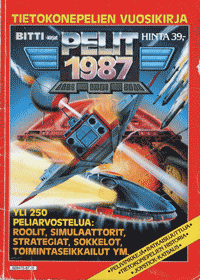 1987
1987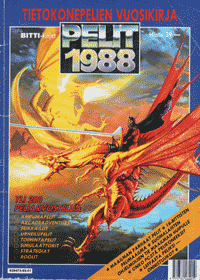 1988
1988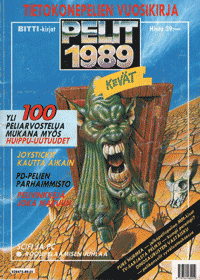 1989 Kevät
 1989 Syksy
 1990 Kevät
 1990 Syksy
 1991 Kevät
 1991 Syksy
War In Middle Earth
War In Middle Earth1989 SyksyPysyvä linkkiYksi sormus antaa hallitsijalleen absoluuttisen vallan eikä se ole vihkisormus. Kysymyksessä on tietysti Sormusten Sormus ja Taru Sormusten Herrasta, J.R.R. Tolkienin kuolematon klassikko.
Melbourne House on julkaissut aiemmin jo parikin J.R.R. Tolkienin maailmaa käsittelevää peliä, The Hobbit ja Lord of the Rings. Kummatkin olivat tekstiseikkailuita, tällä kertaa vuorossa on tutustuminen Sormusten Sodan strategisiin yksityiskohtiin. Ja mikapä siinä, parempaa aihetta peliin tuskin löytää edes Tuomiovuoren uumenista. Kuusnelosversion taustalla on Mike Singletonin johtama tiimi, jolta ajattoman klassikon luomisen luulisi luonnistuvan.
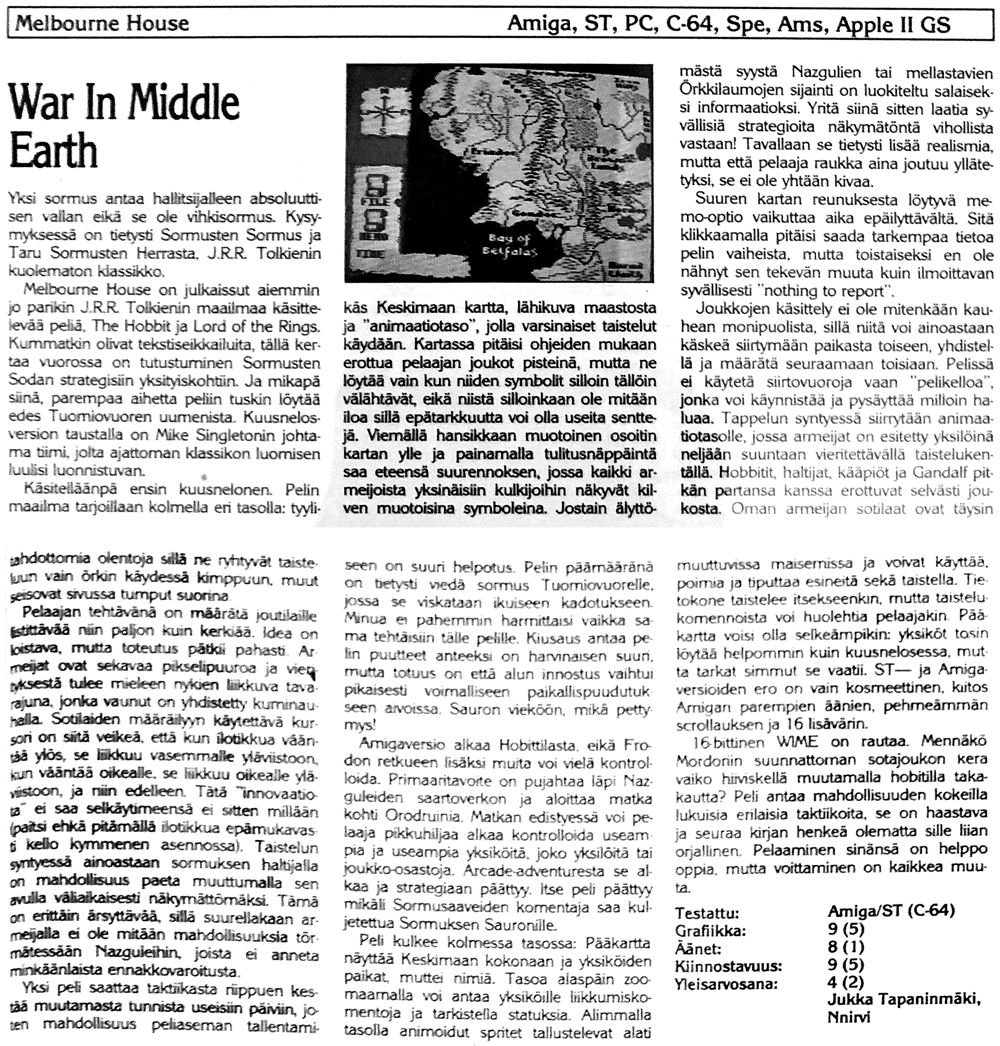
Käsitelläänpä ensin kuusnelonen. Pelin maailma tarjoillaan kolmella eri tasolla: tyylikäs Keskimaan kartta, lähikuva maastosta ja "animaatiotaso", jolla varsinaiset taistelut käydään. Kartassa pitäisi ohjeiden mukaan erottua pelaajan joukot pisteinä, mutta ne löytää vain kun niiden symbolit silloin tällöin välähtävät, eikä niistä silloinkaan ole mitään iloa sillä epätarkkuutta voi olla useita senttejä. Viemällä hansikkaan muotoinen osoitin kartan ylle ja painamalla tulitusnäppäintä saa eteensä suurennoksen, jossa kaikki armeijoista yksinäisiin kulkijoihin näkyvät kilven muotoisina symboleina. Jostain älyttömästä syystä Nazgulien tai mellastavien Örkkilaumojen sijainti on luokiteltu salaiseksi informaatioksi. Yritä siinä sitten laatia syvällisiä strategioita näkymätöntä vihollista vastaan! Tavallaan se tietysti lisää realismia, mutta että pelaaja raukka aina joutuu yllätetyksi, se ei ole yhtään kivaa.
Suuren kartan reunuksesta löytyvä memo-optio vaikuttaa aika epäilyttävältä. Sitä klikkaamalla pitäisi saada tarkempaa tietoa pelin vaiheista, mutta toistaiseksi en ole nähnyt sen tekevän muuta kuin ilmoittavan syvällisesti "nothing to report".
Joukkojen käsittely ei ole mitenkään kauhean monipuolista, sillä niitä voi ainoastaan käskeä siirtymään paikasta toiseen, yhdistellä ja määrätä seuraamaan toisiaan. Pelissä ei käytetä siirtovuoroja vaan "pelikelloa", jonka voi käynnistää ja pysäyttää milloin haluaa. Tappelun syntyessä siirrytään animaatiotasolle, jossa armeijat on esitetty yksilöinä neljään suuntaan vieritettävällä taistelukentällä. Hobbitit, haltijat, kääpiöt ja Gandalf pitkän partansa kanssa erottuvat selvästi joukosta. Oman armeijan sotilaat ovat täysin mahdottomia olentoja sillä ne ryhtyvät taisteluun vain örkin käydessä kimppuun, muut seisovat sivussa tumput suorina.
Pelaajan tehtävänä on määrätä joutilaille listittävää niin paljon kuin kerkiää. Idea on loistava, mutta toteutus pätkii pahasti. Armeijat ovat sekavaa pikselipuuroa ja vierityksestä tulee mieleen nykien liikkuva tavarajuna, jonka vaunut on yhdistetty kuminauhalla. Sotilaiden määräilyyn käytettävä kursori on siitä veikeä, että kun ilotikkua vääntää ylös, se liikkuu vasemmalle yläviistoon, kun vääntää oikealle, se liikkuu oikealle yläviistoon, ja niin edelleen. Tätä "innovaatiota" ei saa selkäytimeensä ei sitten millään (paitsi ehkä pitämällä ilotikkua epämukavasti kello kymmenen asennossa). Taistelun syntyessä ainoastaan sormuksen haltijalla on mahdollisuus paeta muuttumalla sen avulla väliaikaisesti näkymättömäksi. Tämä on erittäin ärsyttävää, sillä suurellakaan armeijalla ei ole mitään mahdollisuuksia törmätessään Nazguleihin, joista ei anneta minkäänlaista ennakkovaroitusta.
Yksi peli saattaa taktiikasta riippuen kestää muutamasta tunnista useisiin päiviin, joten mahdollisuus peliaseman tallentamiseen on suuri helpotus. Pelin päämääränä on tietysti viedä sormus Tuomiovuorelle, jossa se viskataan ikuiseen kadotukseen. Minua ei pahemmin harmittaisi vaikka sama tehtäisiin tälle pelille. Kiusaus antaa pelin puutteet anteeksi on harvinaisen suuri, mutta totuus on että alun innostus vaihtui pikaisesti voimalliseen paikallispuudutukseen aivoissa. Sauron vieköön, mikä pettymys!
Amigaversio alkaa Hobittilasta, eikä Frodon retkueen lisäksi muita voi vielä kontrolloida. Primaaritavoite on pujahtaa läpi Nazguleiden saartoverkon ja aloittaa matka kohti Orodruinia. Matkan edistyessä voi pelaaja pikkuhiljaa alkaa kontrolloida useampia ja useampia yksiköitä, joko yksilöitä tai joukko-osastoja. Arcade-adventuresta se alkaa ja strategiaan päättyy. Itse peli päättyy mikäli Sormusaaveiden komentaja saa kuljetettua Sormuksen Sauronille.
Peli kulkee kolmessa tasossa: Pääkartta näyttää Keskimaan kokonaan ja yksiköiden paikat, muttei nimiä. Tasoa alaspäin zoomaamalla voi antaa yksiköille liikkumiskomentoja ja tarkistella statuksia. Alimmalla tasolla animoidut spritet tallustelevat alati muuttuvissa maisemissa ja voivat käyttää, poimia ja tiputtaa esineitä sekä taistella. Tietokone taistelee itsekseenkin, mutta taistelukomennoista voi huolehtia pelaajakin. Pääkartta voisi olla selkeämpikin: yksiköt tosin löytää helpommin kuin kuusnelosessa, mutta tarkat simmut se vaatii. ST- ja Amigaversioiden ero on vain kosmeettinen, kiitos Amigan parempien äänien, pehmeämmän scrollauksen ja 16 lisävärin.
16-bittinen WIME on rautaa. Mennäkö Mordoriin suunnattoman sotajoukon kera vaiko hiiviskellä muutamalla hobitilla takakautta? Peli antaa mahdollisuuden kokeilla lukuisia erilaisia taktiikoita, se on haastava ja seuraa kirjan henkeä olematta sille liian orjallinen. Pelaaminen sinänsä on helppo oppia, mutta voittaminen on kaikkea muuta.
War In Middle Earth1989 SyksyPermalinkOne ring gives its master absolute power, and it isn't a wedding ring. We are talking, of course, about the One Ring and The Lord of the Rings, J.R.R. Tolkien's immortal classic.
Melbourne House has already released a couple of games set in J.R.R. Tolkien's world, The Hobbit and Lord of the Rings. Both were text adventures; this time it's the turn of the strategic ins and outs of the War of the Ring. And why not - you'd hardly find a better subject for a game even in the depths of Mount Doom. The C-64 version is the work of a team led by Mike Singleton, who you'd think could knock out a timeless classic without breaking a sweat.
Let's deal with the C-64 first. The game world is served up on three different levels: a stylish map of Middle-earth, a close-up of the terrain and an "animation level" where the actual battles are fought. According to the instructions the player's forces should stand out on the map as dots, but you can only find them when their symbols flash every now and then, and even then they're no use at all, since they can be off by an inch or two. Moving the glove-shaped pointer over the map and pressing fire brings up an enlargement in which everything from armies to lone wanderers shows up as shield-shaped symbols. For some idiotic reason the whereabouts of the Nazgul and the rampaging Orc hordes have been classified as secret information. Just try drawing up profound strategies against an invisible enemy! In a way it adds realism, of course, but the poor player always getting caught by surprise is no fun at all.
The memo option in the border of the big map looks rather suspect. Clicking it is supposed to give you more detailed information on how the game is going, but so far I haven't seen it do anything except profoundly announce "nothing to report".
Troop handling isn't terribly versatile, since all you can do is order units to move from one place to another, merge them and tell them to follow one another. The game doesn't use turns but a "game clock" that you can start and stop whenever you like. When a fight breaks out you switch to the animation level, where the armies are shown as individuals on a battlefield that scrolls in four directions. Hobbits, elves, dwarves and Gandalf with his long beard stand out clearly from the crowd. The soldiers of your own army are utterly impossible creatures, since they only join the fight when an orc goes for them; the rest stand on the sidelines twiddling their thumbs.
The player's job is to line up as much for the loafers to bump off as there's time for. The idea is brilliant, but the execution stutters badly. The armies are a muddled pixel porridge, and the scrolling brings to mind a jerking freight train whose wagons are coupled together with rubber bands. The cursor used for bossing the soldiers around has the charming quirk that when you push the joystick up it moves diagonally up and to the left, when you push it right it moves diagonally up and to the right, and so on. There's no way on earth to get this "innovation" into your spinal cord (except perhaps by holding the joystick awkwardly tilted to ten o'clock). When a battle breaks out, only the bearer of the ring has a chance to escape, by using it to turn temporarily invisible. This is extremely annoying, since even a large army stands no chance at all when it runs into the Nazgul, and you get no advance warning of them whatsoever.
Depending on your tactics, a single game can last anything from a few hours to several days, so being able to save your position is a great relief. The aim of the game is of course to take the ring to Mount Doom, where it gets hurled into eternal perdition. I wouldn't be too upset if the same were done to this game. The temptation to forgive the game its shortcomings is unusually strong, but the truth is that my initial enthusiasm soon gave way to a powerful local anaesthetic of the brain. Sauron take it, what a disappointment!
The Amiga version starts in Hobbiton, and apart from Frodo's company you can't control anyone else yet. The primary objective is to slip through the Nazgul cordon and set off on the journey towards Orodruin. As the journey progresses, the player can gradually start controlling more and more units, either individuals or detachments. It starts out as an arcade adventure and ends up as strategy. The game itself ends if the commander of the Ringwraiths manages to deliver the Ring to Sauron.
The game runs on three levels: the main map shows the whole of Middle-earth and where the units are, but not their names. Zooming down a level lets you give the units movement orders and check their status. On the lowest level animated sprites trudge through ever-changing landscapes and can use, pick up and drop objects as well as fight. The computer will fight on its own, too, but the player can also take charge of the combat commands. The main map could be clearer: admittedly the units are easier to find than on the C-64, but it still takes a sharp pair of peepers. The difference between the ST and Amiga versions is purely cosmetic, thanks to the Amiga's better sound, smoother scrolling and 16 extra colours.
The 16-bit WIME is ace. Do you march into Mordor with a vast host, or sneak in the back way with a few hobbits? The game lets you try out any number of different tactics; it's challenging and follows the spirit of the book without being too slavish about it. Playing as such is easy to learn, but winning is anything but.