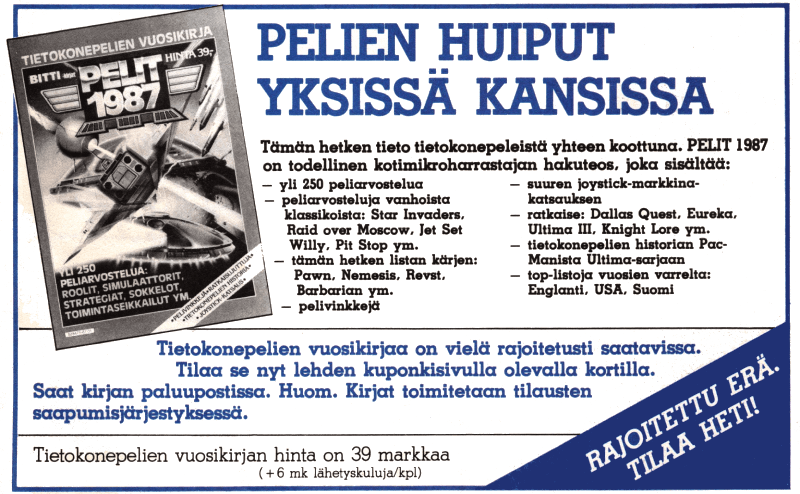
1133 reviews from "Pelit"-books
Pelit was a Finnish-language (bi)annual book series published from 1987 to 1991 containing gaming-related articles, tips and most importantly game reviews. Here you can find all the reviews from the books. The reviews were originally written in Finnish; the English versions are translations of the Finnish originals. Maininta tekijänoikeuksista
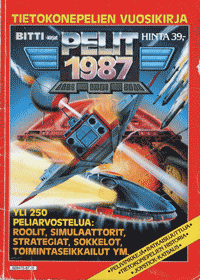 1987
1987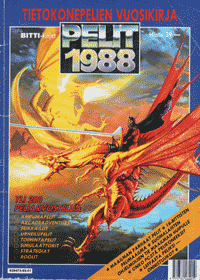 1988
1988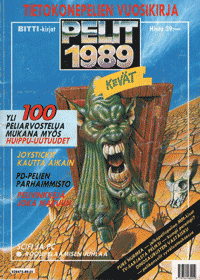 1989 Kevät
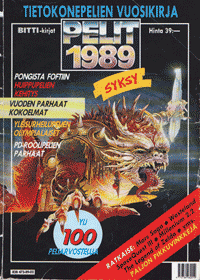 1989 Syksy
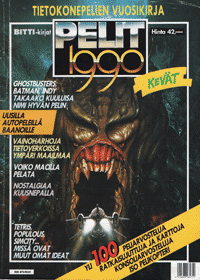 1990 Kevät
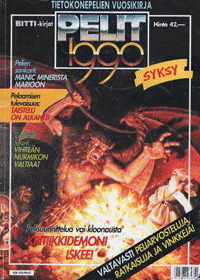 1990 Syksy
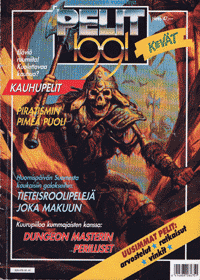 1991 Kevät
 1991 Syksy
Wanderer
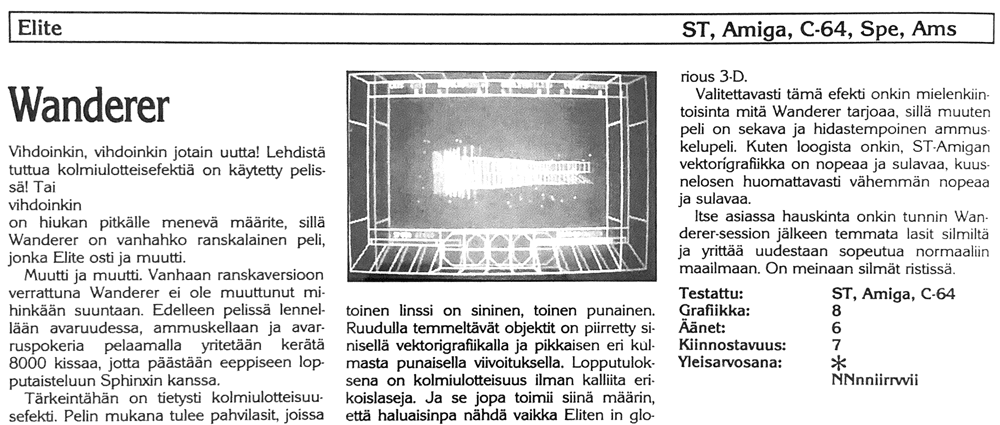
Wanderer1989 SyksyPysyvä linkkiVihdoinkin, vihdoinkin jotain uutta! Lehdistä tuttua kolmiulotteisefektiä on käytetty pelissä! Tai vihdoinkin on hiukan pitkälle menevä määrite, sillä Wanderer on vanhahko ranskalainen peli, jonka Elite osti ja muutti.
Muutti ja muutti. Vanhaan ranskaversioon verrattuna Wanderer ei ole muuttunut mihinkään suuntaan. Edelleen pelissä lennellään avaruudessa, ammuskellaan ja avaruspokeria pelaamalla yritetään kerätä 8000 kissaa, jotta päästään eeppiseen lopputaisteluun Sphinxin kanssa.
Tärkeintähän on tietysti kolmiulotteisuusefekti. Pelin mukana tulee pahvilasit, joissa toinen linssi on sininen, toinen punainen. Ruudulla temmeltävät objektit on piirretty sinisellä vektorigrafiikalla ja pikkaisen eri kulmasta punaisella viivoituksella. Lopputuloksena on kolmiulotteisuus ilman kalliita erikoislaseja. Ja se jopa toimii siinä määrin, että haluaisinpa nähdä vaikka Eliten in glorious 3-D.
Valitettavasti tämä efekti onkin mielenkiintoisinta mitä Wanderer tarjoaa, sillä muuten peli on sekava ja hidastempoinen ammuskelupeli. Kuten loogista onkin, ST-Amigan vektorigrafiikka on nopeaa ja sulavaa, kuusnelosen huomattavasti vähemmän nopeaa ja sulavaa.
Itse asiassa hauskinta onkin tunnin Wanderer-session jälkeen temmata lasit silmiltä ja yrittää uudestaan sopeutua normaaliin maailmaan. On meinaan silmät ristissä.
Wanderer1989 SyksyPermalinkAt last, at last something new! The three-dimensional effect familiar from magazines has been used in a game! Or rather, "at last" is putting it a bit strongly, since Wanderer is an oldish French game that Elite bought and changed.
Changed, if you can call it that. Compared with the old French version, Wanderer hasn't changed in any direction whatsoever. You still flit about in space, shoot things up and try to collect 8000 cats by playing space poker, so that you get to the epic final battle with the Sphinx.
The main thing, of course, is the 3-D effect. The game comes with cardboard glasses with one lens blue and the other red. The objects romping about the screen are drawn in blue vector graphics and, from a very slightly different angle, in red lines. The end result is three-dimensionality without expensive special glasses. And it even works, so much so that I'd love to see, say, Elite in glorious 3-D.
Unfortunately this effect turns out to be the most interesting thing Wanderer has to offer, since otherwise the game is a muddled and slow-paced shoot-em-up. As is only logical, the ST-Amiga vector graphics are fast and smooth, the C-64's considerably less fast and smooth.
In fact, the most fun part is tearing the glasses off your eyes after an hour-long Wanderer session and trying to readjust to the normal world. Your eyes end up well and truly crossed, let me tell you.
Wanted
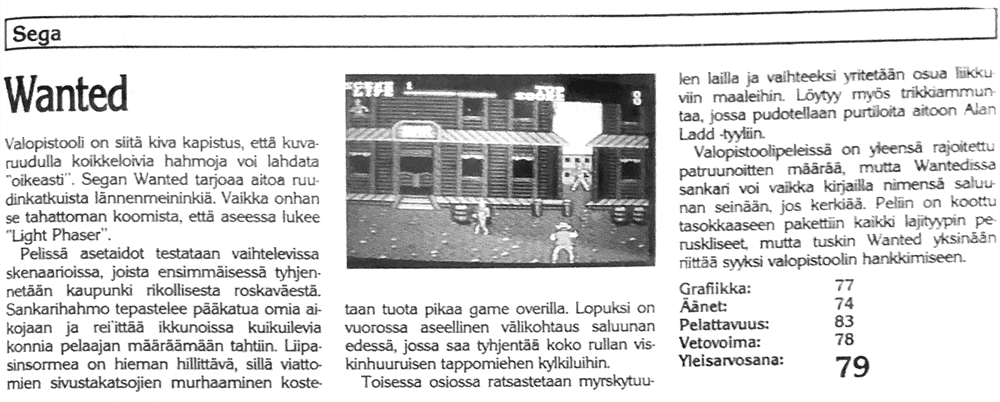
Wanted1990 KevätPysyvä linkkiValopistooli on siitä kiva kapistus, että kuvaruudulla koikkeloivia hahmoja voi lahdata "oikeasti". Segan Wanted tarjoaa aitoa ruudinkatkuista lännenmeininkiä. Vaikka onhan se tahattoman koomista, että aseessa lukee "Light Phaser".
Pelissä asetaidot testataan vaihtelevissa skenaarioissa, joista ensimmäisessä tyhjennetään kaupunki rikollisesta roskaväestä. Sankarihahmo tepastelee pääkatua omia aikojaan ja rei'ittää ikkunoissa kuikuilevia konnia pelaajan määräämään tahtiin. Liipasinsormea on hieman hillittävä, sillä viattomien sivustakatsojien murhaaminen kostetaan tuota pikaa game overilla. Lopuksi on vuorossa aseellinen välikohtaus saluunan edessä, jossa saa tyhjentää koko rullan viskinhuuruisen tappomiehen kylkiluihin.
Toisessa osiossa ratsastetaan myrskytuulen lailla ja vaihteeksi yritetään osua liikkuviin maaleihin. Löytyy myös trikkiammuntaa, jossa pudotellaan purtiloita aitoon Alan Ladd -tyyliin.
Valopistoolipeleissä on yleensä rajoitettu patruunoitten määrää, mutta Wantedissa sankari voi vaikka kirjailla nimensä saluunan seinään, jos kerkiää. Peliin on koottu tasokkaaseen pakettiin kaikki lajityypin peruskliseet, mutta tuskin Wanted yksinään riittää syyksi valopistoolin hankkimiseen.
Wanted1990 KevätPermalinkThe nice thing about a light gun is that you can slaughter the characters cavorting about on the screen "for real". Sega's Wanted offers genuine gunsmoke-reeking Wild West action. Although it is unintentionally comic that the gun has "Light Phaser" written on it.
In the game your shooting skills are tested in varied scenarios, the first of which has you clearing the town of criminal riff-raff. The hero character toddles down the main street all on its own and perforates the villains peeking out of the windows at whatever pace the player sets. The trigger finger needs to be reined in a little, since murdering innocent bystanders is swiftly avenged with a game over. Finally it's time for an armed incident in front of the saloon, where you get to empty the whole cylinder into the ribs of a whisky-soaked killer.
In the second section you ride like the wind and, for a change, try to hit moving targets. There's also trick shooting, where you knock down little tubs in true Alan Ladd style.
Light gun games usually limit the number of rounds, but in Wanted the hero can even embroider a signature on the saloon wall, if there's time. The game packs all the basic clichés of the genre into a quality package, but Wanted on its own is hardly reason enough to go out and get a light gun.
War In Middle Earth
War In Middle Earth1989 SyksyPysyvä linkkiYksi sormus antaa hallitsijalleen absoluuttisen vallan eikä se ole vihkisormus. Kysymyksessä on tietysti Sormusten Sormus ja Taru Sormusten Herrasta, J.R.R. Tolkienin kuolematon klassikko.
Melbourne House on julkaissut aiemmin jo parikin J.R.R. Tolkienin maailmaa käsittelevää peliä, The Hobbit ja Lord of the Rings. Kummatkin olivat tekstiseikkailuita, tällä kertaa vuorossa on tutustuminen Sormusten Sodan strategisiin yksityiskohtiin. Ja mikapä siinä, parempaa aihetta peliin tuskin löytää edes Tuomiovuoren uumenista. Kuusnelosversion taustalla on Mike Singletonin johtama tiimi, jolta ajattoman klassikon luomisen luulisi luonnistuvan.
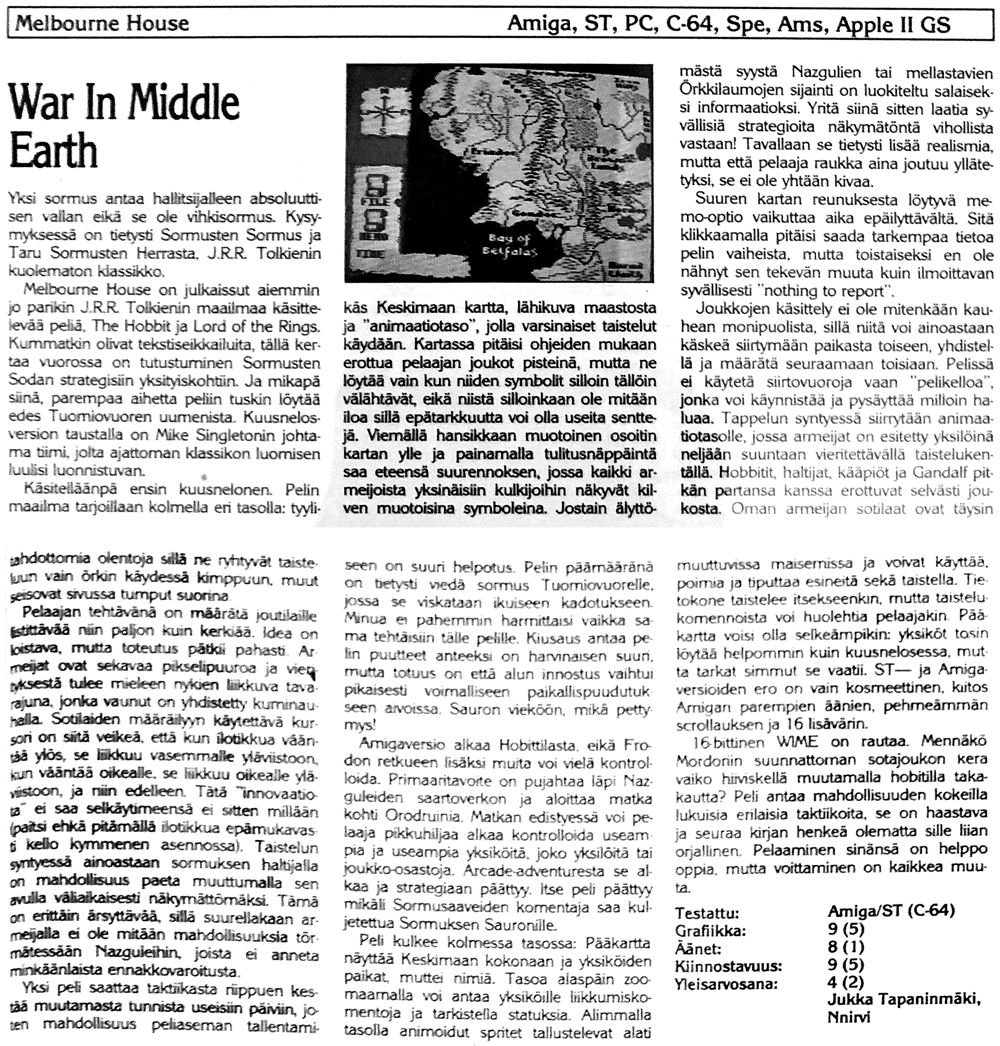
Käsitelläänpä ensin kuusnelonen. Pelin maailma tarjoillaan kolmella eri tasolla: tyylikäs Keskimaan kartta, lähikuva maastosta ja "animaatiotaso", jolla varsinaiset taistelut käydään. Kartassa pitäisi ohjeiden mukaan erottua pelaajan joukot pisteinä, mutta ne löytää vain kun niiden symbolit silloin tällöin välähtävät, eikä niistä silloinkaan ole mitään iloa sillä epätarkkuutta voi olla useita senttejä. Viemällä hansikkaan muotoinen osoitin kartan ylle ja painamalla tulitusnäppäintä saa eteensä suurennoksen, jossa kaikki armeijoista yksinäisiin kulkijoihin näkyvät kilven muotoisina symboleina. Jostain älyttömästä syystä Nazgulien tai mellastavien Örkkilaumojen sijainti on luokiteltu salaiseksi informaatioksi. Yritä siinä sitten laatia syvällisiä strategioita näkymätöntä vihollista vastaan! Tavallaan se tietysti lisää realismia, mutta että pelaaja raukka aina joutuu yllätetyksi, se ei ole yhtään kivaa.
Suuren kartan reunuksesta löytyvä memo-optio vaikuttaa aika epäilyttävältä. Sitä klikkaamalla pitäisi saada tarkempaa tietoa pelin vaiheista, mutta toistaiseksi en ole nähnyt sen tekevän muuta kuin ilmoittavan syvällisesti "nothing to report".
Joukkojen käsittely ei ole mitenkään kauhean monipuolista, sillä niitä voi ainoastaan käskeä siirtymään paikasta toiseen, yhdistellä ja määrätä seuraamaan toisiaan. Pelissä ei käytetä siirtovuoroja vaan "pelikelloa", jonka voi käynnistää ja pysäyttää milloin haluaa. Tappelun syntyessä siirrytään animaatiotasolle, jossa armeijat on esitetty yksilöinä neljään suuntaan vieritettävällä taistelukentällä. Hobbitit, haltijat, kääpiöt ja Gandalf pitkän partansa kanssa erottuvat selvästi joukosta. Oman armeijan sotilaat ovat täysin mahdottomia olentoja sillä ne ryhtyvät taisteluun vain örkin käydessä kimppuun, muut seisovat sivussa tumput suorina.
Pelaajan tehtävänä on määrätä joutilaille listittävää niin paljon kuin kerkiää. Idea on loistava, mutta toteutus pätkii pahasti. Armeijat ovat sekavaa pikselipuuroa ja vierityksestä tulee mieleen nykien liikkuva tavarajuna, jonka vaunut on yhdistetty kuminauhalla. Sotilaiden määräilyyn käytettävä kursori on siitä veikeä, että kun ilotikkua vääntää ylös, se liikkuu vasemmalle yläviistoon, kun vääntää oikealle, se liikkuu oikealle yläviistoon, ja niin edelleen. Tätä "innovaatiota" ei saa selkäytimeensä ei sitten millään (paitsi ehkä pitämällä ilotikkua epämukavasti kello kymmenen asennossa). Taistelun syntyessä ainoastaan sormuksen haltijalla on mahdollisuus paeta muuttumalla sen avulla väliaikaisesti näkymättömäksi. Tämä on erittäin ärsyttävää, sillä suurellakaan armeijalla ei ole mitään mahdollisuuksia törmätessään Nazguleihin, joista ei anneta minkäänlaista ennakkovaroitusta.
Yksi peli saattaa taktiikasta riippuen kestää muutamasta tunnista useisiin päiviin, joten mahdollisuus peliaseman tallentamiseen on suuri helpotus. Pelin päämääränä on tietysti viedä sormus Tuomiovuorelle, jossa se viskataan ikuiseen kadotukseen. Minua ei pahemmin harmittaisi vaikka sama tehtäisiin tälle pelille. Kiusaus antaa pelin puutteet anteeksi on harvinaisen suuri, mutta totuus on että alun innostus vaihtui pikaisesti voimalliseen paikallispuudutukseen aivoissa. Sauron vieköön, mikä pettymys!
Amigaversio alkaa Hobittilasta, eikä Frodon retkueen lisäksi muita voi vielä kontrolloida. Primaaritavoite on pujahtaa läpi Nazguleiden saartoverkon ja aloittaa matka kohti Orodruinia. Matkan edistyessä voi pelaaja pikkuhiljaa alkaa kontrolloida useampia ja useampia yksiköitä, joko yksilöitä tai joukko-osastoja. Arcade-adventuresta se alkaa ja strategiaan päättyy. Itse peli päättyy mikäli Sormusaaveiden komentaja saa kuljetettua Sormuksen Sauronille.
Peli kulkee kolmessa tasossa: Pääkartta näyttää Keskimaan kokonaan ja yksiköiden paikat, muttei nimiä. Tasoa alaspäin zoomaamalla voi antaa yksiköille liikkumiskomentoja ja tarkistella statuksia. Alimmalla tasolla animoidut spritet tallustelevat alati muuttuvissa maisemissa ja voivat käyttää, poimia ja tiputtaa esineitä sekä taistella. Tietokone taistelee itsekseenkin, mutta taistelukomennoista voi huolehtia pelaajakin. Pääkartta voisi olla selkeämpikin: yksiköt tosin löytää helpommin kuin kuusnelosessa, mutta tarkat simmut se vaatii. ST- ja Amigaversioiden ero on vain kosmeettinen, kiitos Amigan parempien äänien, pehmeämmän scrollauksen ja 16 lisävärin.
16-bittinen WIME on rautaa. Mennäkö Mordoriin suunnattoman sotajoukon kera vaiko hiiviskellä muutamalla hobitilla takakautta? Peli antaa mahdollisuuden kokeilla lukuisia erilaisia taktiikoita, se on haastava ja seuraa kirjan henkeä olematta sille liian orjallinen. Pelaaminen sinänsä on helppo oppia, mutta voittaminen on kaikkea muuta.
War In Middle Earth1989 SyksyPermalinkOne ring gives its master absolute power, and it isn't a wedding ring. We are talking, of course, about the One Ring and The Lord of the Rings, J.R.R. Tolkien's immortal classic.
Melbourne House has already released a couple of games set in J.R.R. Tolkien's world, The Hobbit and Lord of the Rings. Both were text adventures; this time it's the turn of the strategic ins and outs of the War of the Ring. And why not - you'd hardly find a better subject for a game even in the depths of Mount Doom. The C-64 version is the work of a team led by Mike Singleton, who you'd think could knock out a timeless classic without breaking a sweat.
Let's deal with the C-64 first. The game world is served up on three different levels: a stylish map of Middle-earth, a close-up of the terrain and an "animation level" where the actual battles are fought. According to the instructions the player's forces should stand out on the map as dots, but you can only find them when their symbols flash every now and then, and even then they're no use at all, since they can be off by an inch or two. Moving the glove-shaped pointer over the map and pressing fire brings up an enlargement in which everything from armies to lone wanderers shows up as shield-shaped symbols. For some idiotic reason the whereabouts of the Nazgul and the rampaging Orc hordes have been classified as secret information. Just try drawing up profound strategies against an invisible enemy! In a way it adds realism, of course, but the poor player always getting caught by surprise is no fun at all.
The memo option in the border of the big map looks rather suspect. Clicking it is supposed to give you more detailed information on how the game is going, but so far I haven't seen it do anything except profoundly announce "nothing to report".
Troop handling isn't terribly versatile, since all you can do is order units to move from one place to another, merge them and tell them to follow one another. The game doesn't use turns but a "game clock" that you can start and stop whenever you like. When a fight breaks out you switch to the animation level, where the armies are shown as individuals on a battlefield that scrolls in four directions. Hobbits, elves, dwarves and Gandalf with his long beard stand out clearly from the crowd. The soldiers of your own army are utterly impossible creatures, since they only join the fight when an orc goes for them; the rest stand on the sidelines twiddling their thumbs.
The player's job is to line up as much for the loafers to bump off as there's time for. The idea is brilliant, but the execution stutters badly. The armies are a muddled pixel porridge, and the scrolling brings to mind a jerking freight train whose wagons are coupled together with rubber bands. The cursor used for bossing the soldiers around has the charming quirk that when you push the joystick up it moves diagonally up and to the left, when you push it right it moves diagonally up and to the right, and so on. There's no way on earth to get this "innovation" into your spinal cord (except perhaps by holding the joystick awkwardly tilted to ten o'clock). When a battle breaks out, only the bearer of the ring has a chance to escape, by using it to turn temporarily invisible. This is extremely annoying, since even a large army stands no chance at all when it runs into the Nazgul, and you get no advance warning of them whatsoever.
Depending on your tactics, a single game can last anything from a few hours to several days, so being able to save your position is a great relief. The aim of the game is of course to take the ring to Mount Doom, where it gets hurled into eternal perdition. I wouldn't be too upset if the same were done to this game. The temptation to forgive the game its shortcomings is unusually strong, but the truth is that my initial enthusiasm soon gave way to a powerful local anaesthetic of the brain. Sauron take it, what a disappointment!
The Amiga version starts in Hobbiton, and apart from Frodo's company you can't control anyone else yet. The primary objective is to slip through the Nazgul cordon and set off on the journey towards Orodruin. As the journey progresses, the player can gradually start controlling more and more units, either individuals or detachments. It starts out as an arcade adventure and ends up as strategy. The game itself ends if the commander of the Ringwraiths manages to deliver the Ring to Sauron.
The game runs on three levels: the main map shows the whole of Middle-earth and where the units are, but not their names. Zooming down a level lets you give the units movement orders and check their status. On the lowest level animated sprites trudge through ever-changing landscapes and can use, pick up and drop objects as well as fight. The computer will fight on its own, too, but the player can also take charge of the combat commands. The main map could be clearer: admittedly the units are easier to find than on the C-64, but it still takes a sharp pair of peepers. The difference between the ST and Amiga versions is purely cosmetic, thanks to the Amiga's better sound, smoother scrolling and 16 extra colours.
The 16-bit WIME is ace. Do you march into Mordor with a vast host, or sneak in the back way with a few hobbits? The game lets you try out any number of different tactics; it's challenging and follows the spirit of the book without being too slavish about it. Playing as such is easy to learn, but winning is anything but.
War in the South Pacific
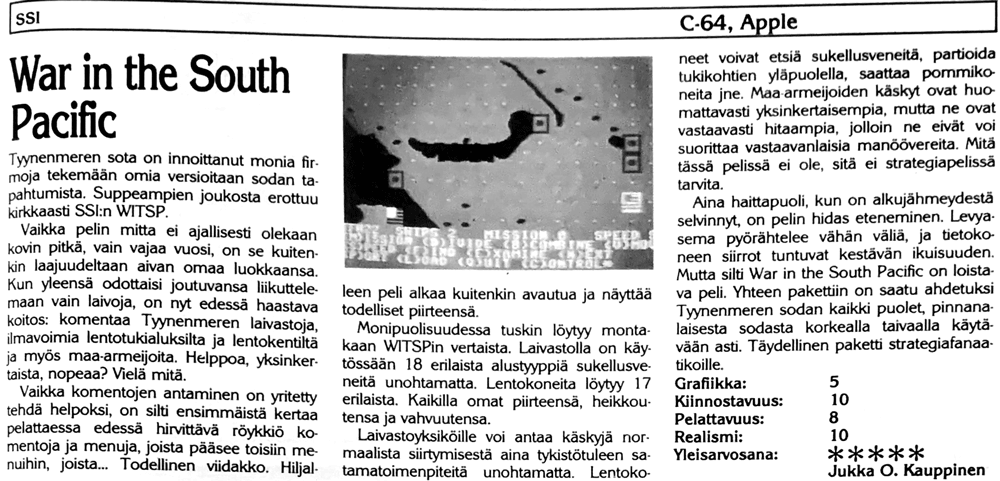
War in the South Pacific1988Pysyvä linkkiTyynenmeren sota on innoittanut monia firmoja tekemään omia versioitaan sodan tapahtumista. Suppeampien joukosta erottuu kirkkaasti SSI:n WITSP.
Vaikka pelin mitta ei ajallisesti olekaan kovin pitkä, vain vajaa vuosi, on se kuitenkin laajuudeltaan aivan omaa luokkaansa. Kun yleensä odottaisi joutuvansa liikuttelemaan vain laivoja, on nyt edessä haastava koitos: komentaa Tyynenmeren laivastoja, ilmavoimia lentotukialuksilta ja lentokentiltä ja myös maa-armeijoita. Helppoa, yksinkertaista, nopeaa? Vielä mitä.
Vaikka komentojen antaminen on yritetty tehdä helpoksi, on silti ensimmäistä kertaa pelattaessa edessä hirvittävä röykkiö komentoja ja menuja, joista pääsee toisiin menuihin, joista... Todellinen viidakko. Hiljalleen peli alkaa kuitenkin avautua ja näyttää todelliset piirteensä.
Monipuolisuudessa tuskin löytyy montakaan WITSPin vertaista. Laivastolla on käytössään 18 erilaista alustyyppiä sukellusveneitä unohtamatta. Lentokoneita löytyy 17 erilaista. Kaikilla omat piirteensä, heikkoutensa ja vahvuutensa.
Laivastoyksiköille voi antaa käskyjä normaalista siirtymisestä aina tykistötuleen satamatoimenpiteitä unohtamatta. Lentokoneet voivat etsiä sukellusveneitä, partioida tukikohtien yläpuolella, saattaa pommikoneita jne. Maa-armeijoiden käskyt ovat huomattavasti yksinkertaisempia, mutta ne ovat vastaavasti hitaampia, jolloin ne eivät voi suorittaa vastaavanlaisia manöövereita. Mitä tässä pelissä ei ole, sitä ei strategiapelissä tarvita.
Aina haittapuoli, kun on alkujähmeydestä selvinnyt, on pelin hidas eteneminen. Levyasema pyörähtelee vähän väliä, ja tietokoneen siirrot tuntuvat kestävän ikuisuuden. Mutta silti War in the South Pacific on loistava peli. Yhteen pakettiin on saatu ahdetuksi Tyynenmeren sodan kaikki puolet, pinnanalaisesta sodasta korkealla taivaalla käytävään asti. Täydellinen paketti strategiafanaatikoille.
War in the South Pacific1988PermalinkThe Pacific War has inspired many companies to make their own versions of the events of the war. SSI's WITSP stands out clearly from the narrower-scoped ones.
Although the game doesn't cover a very long stretch of time, just under a year, in scope it is in a class of its own. Where you'd normally expect to be pushing only ships around, here you face a challenging ordeal: commanding the Pacific fleets, the air forces flying from carriers and airfields, and the ground armies as well. Easy, simple, quick? Not a chance.
Although an effort has been made to make giving orders easy, the first time you play you're still faced with a horrendous heap of commands and menus that lead to other menus, which lead to... A real jungle. Gradually, though, the game starts to open up and reveal its true character.
For sheer variety you'll hardly find many games to match WITSP. The navy has 18 different vessel types at its disposal, not forgetting submarines. There are 17 different aircraft. Each with its own characteristics, weaknesses and strengths.
Naval units can be given orders ranging from ordinary movement all the way to artillery fire, not forgetting harbour operations. Aircraft can hunt for submarines, patrol above bases, escort bombers and so on. The orders for ground armies are considerably simpler, but then the armies are correspondingly slower, so they can't carry out the same kind of manoeuvres. Whatever this game doesn't have, a strategy game doesn't need.
The only drawback, once you've shaken off the initial stiffness, is the game's slow pace. The disk drive spins up every little while, and the computer's moves seem to take an eternity. But even so, War in the South Pacific is a brilliant game. Every side of the Pacific War has been crammed into a single package, from the war beneath the waves to the one fought high in the sky. The complete package for strategy fanatics.
Wargame Construction Set
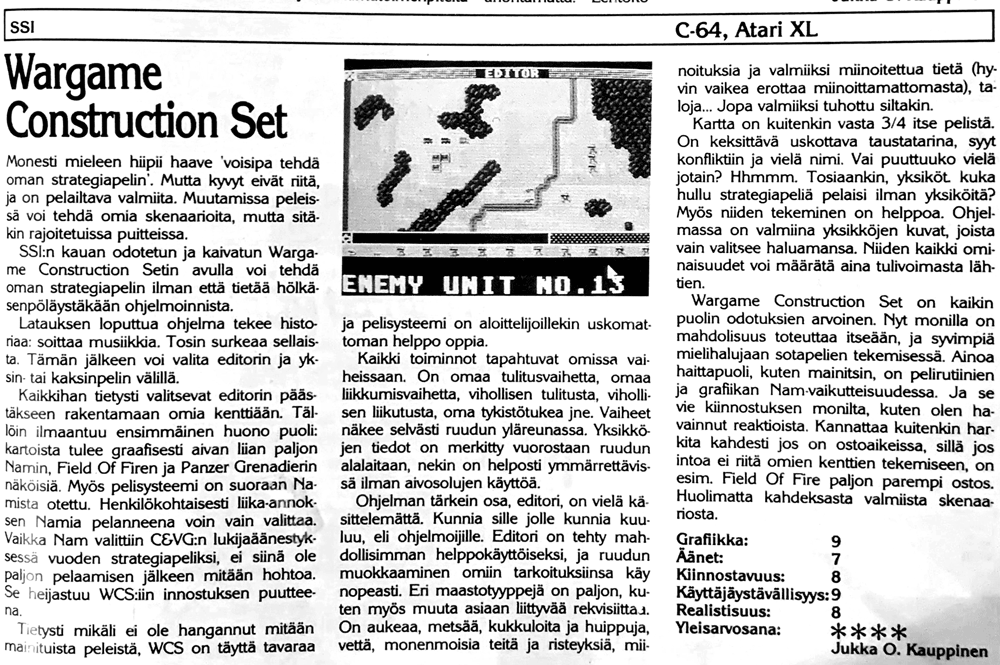
Wargame Construction Set1988Pysyvä linkkiMonesti mieleen hiipii haave 'voisipa tehdä oman strategiapelin'. Mutta kyvyt eivät riitä, ja on pelailtava valmiita. Muutamissa peleissä voi tehdä omia skenaarioita, mutta sitäkin rajoitetuissa puitteissa.
SSI:n kauan odotetun ja kaivatun Wargame Construction Setin avulla voi tehdä oman strategiapelin ilman että tietää hölkäsenpöläystäkään ohjelmoinnista.
Latauksen loputtua ohjelma tekee historiaa: soittaa musiikkia. Tosin surkeaa sellaista. Tämän jälkeen voi valita editorin ja yksin- tai kaksinpelin välillä.
Kaikkihan tietysti valitsevat editorin päästäkseen rakentamaan omia kenttiään. Tällöin ilmaantuu ensimmäinen huono puoli: kartoista tulee graafisesti aivan liian paljon Namin, Field Of Firen ja Panzer Grenadierin näköisiä. Myös pelisysteemi on suoraan Namista otettu. Henkilökohtaisesti liika-annoksen Namia pelanneena voin vain valittaa. Vaikka Nam valittiin C&VG:n lukijaäänestyksessä vuoden strategiapeliksi, ei siinä ole paljon pelaamisen jälkeen mitään hohtoa. Se heijastuu WCS:iin innostuksen puutteena.
Tietysti mikäli ei ole hangannut mitään mainituista peleistä, WCS on täyttä tavaraa ja pelisysteemi on aloittelijoillekin uskomattoman helppo oppia.
Kaikki toiminnot tapahtuvat omissa vaiheissaan. On omaa tulitusvaihetta, omaa liikkumisvaihetta, vihollisen tulitusta, vihollisen liikutusta, oma tykistötukea jne. Vaiheet näkee selvästi ruudun yläreunassa. Yksikköjen tiedot on merkitty vuorostaan ruudun alalaitaan, nekin on helposti ymmärrettävissä ilman aivosolujen käyttöä.
Ohjelman tärkein osa, editori, on vielä käsittelemättä. Kunnia sille jolle kunnia kuuluu, eli ohjelmoijille. Editori on tehty mahdollisimman helppokäyttöiseksi, ja ruudun muokkaaminen omiin tarkoituksiinsa käy nopeasti. Eri maastotyyppejä on paljon, kuten myös muuta asiaan liittyvää rekvisiittaa. On aukeaa, metsää, kukkuloita ja huippuja, vettä, monenmoisia teitä ja risteyksiä, miinoituksia ja valmiiksi miinoitettua tietä (hyvin vaikea erottaa miinoittamattomasta), taloja... Jopa valmiiksi tuhottu siltakin.
Kartta on kuitenkin vasta 3/4 itse pelistä. On keksittävä uskottava taustatarina, syyt konfliktiin ja vielä nimi. Vai puuttuuko vielä jotain? Hhmmm. Tosiaankin, yksiköt. kuka hullu strategiapeliä pelaisi ilman yksiköitä? Myös niiden tekeminen on helppoa. Ohjelmassa on valmiina yksikköjen kuvat, joista vain valitsee haluamansa. Niiden kaikki ominaisuudet voi määrätä aina tulivoimasta lähtien.
Wargame Construction Set on kaikin puolin odotuksien arvoinen. Nyt monilla on mahdolisuus toteuttaa itseään, ja syvimpiä mielihalujaan sotapelien tekemisessä. Ainoa haittapuoli, kuten mainitsin, on pelirutiinien ja grafiikan Nam-vaikutteisuudessa. Ja se vie kiinnostuksen monilta, kuten olen havainnut reaktioista. Kannattaa kuitenkin harkita kahdesti jos on ostoaikeissa, sillä jos intoa ei riitä omien kenttien tekemiseen, on esim. Field Of Fire paljon parempi ostos. Huolimatta kahdeksasta valmiista skenaariosta.
Wargame Construction Set1988PermalinkOften a dream creeps into your mind: 'if only I could make my own strategy game'. But the skills just aren't there, and you have to make do with playing ready-made ones. A few games let you make your own scenarios, but even that only within limited bounds.
With SSI's long-awaited and much-longed-for Wargame Construction Set you can make your own strategy game without knowing diddly-squat about programming.
Once loading finishes, the program makes history: it plays music. Pretty dismal music, admittedly. After that you can choose between the editor and a one- or two-player game.
Naturally everybody picks the editor so they can get down to building their own battlefields. That's when the first bad point shows up: graphically the maps end up looking far too much like Nam, Field Of Fire and Panzer Grenadier. The game system, too, is lifted straight out of Nam. Having personally played an overdose of Nam, all I can do is moan. Even though Nam was voted strategy game of the year in the C&VG readers' poll, once you've played it a lot there's no shine left in it at all. That carries over to WCS as a lack of enthusiasm.
Of course, if you haven't flogged any of the games mentioned to death, WCS is top stuff and the game system is incredibly easy to learn, even for beginners.
Everything happens in its own phase. There's your own fire phase, your own movement phase, enemy fire, enemy movement, your own artillery support and so on. The phases are clearly shown at the top of the screen. The unit details, in turn, are marked along the bottom edge of the screen, and they too can easily be understood without using any brain cells.
The most important part of the program, the editor, is yet to be covered. Credit where credit is due, namely to the programmers. The editor has been made as easy to use as possible, and shaping the screen to your own purposes is quick work. There are lots of different terrain types, and plenty of other relevant props as well. There's open ground, forest, hills and peaks, water, all sorts of roads and junctions, minefields and ready-mined road (very hard to tell apart from the unmined kind), houses... Even a ready-destroyed bridge.
The map, however, is only 3/4 of the game itself. You have to come up with a believable backstory, the reasons for the conflict, and a name as well. Or is something still missing? Hhmmm. Why yes, the units. What lunatic would play a strategy game without units? Making them is easy too. The program comes with ready-made unit pictures, and you simply pick the ones you want. You can set all their attributes, from firepower on down.
Wargame Construction Set lives up to expectations in every respect. Now plenty of people have the chance to express themselves, and indulge their deepest desires, in making war games. The only drawback, as I mentioned, lies in how heavily the game routines and graphics are influenced by Nam. And that kills the interest for many, as I've noticed from people's reactions. Still, if you're thinking of buying it, think twice, because if you don't have the enthusiasm to make your own battlefields, then Field Of Fire, for example, is a much better buy. The eight ready-made scenarios notwithstanding.
Warhead
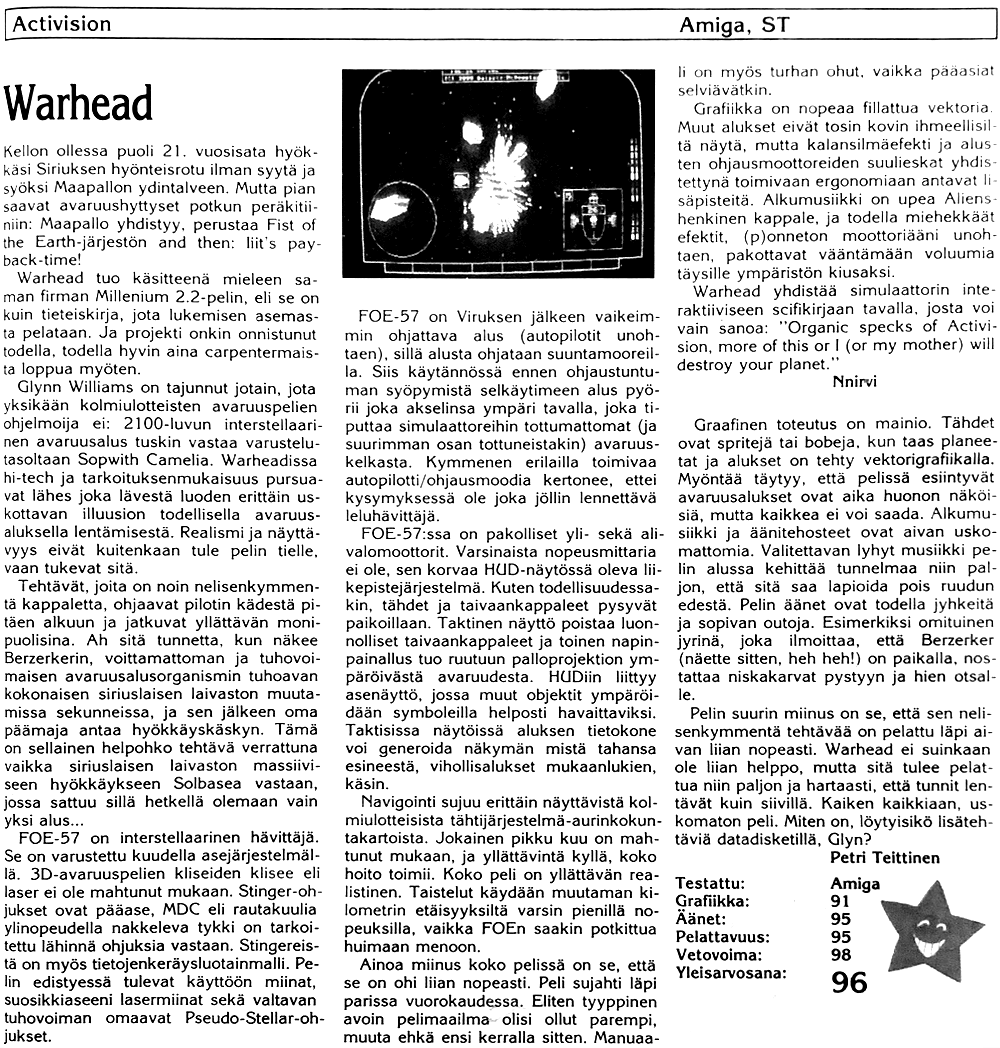
Warhead1990 SyksyPysyvä linkkiKellon ollessa puoli 21. vuosisata hyökkäsi Siriuksen hyönteisrotu ilman syytä ja syöksi Maapallon ydintalveen. Mutta pian saavat avaruushyttyset potkun peräkitiiniin: Maapallo yhdistyy, perustaa Fist of the Earth-järjestön and then: Iiit's payback-time!
Warhead tuo käsitteenä mieleen saman firman Millenium 2.2-pelin, eli se on kuin tieteiskirja, jota lukemisen asemasta pelataan. Ja projekti onkin onnistunut todella, todella hyvin aina carpentermaista loppua myöten.
Glynn Williams on tajunnut jotain, jota yksikään kolmiulotteisten avaruuspelien ohjelmoija ei: 2100-luvun interstellaarinen avaruusalus tuskin vastaa varustelutasoltaan Sopwith Camelia. Warheadissa hi-tech ja tarkoituksenmukaisuus pursuavat lähes joka lävestä luoden erittäin uskottavan illuusion todellisella avaruusaluksella lentämisestä. Realismi ja näyttävyys eivät kuitenkaan tule pelin tielle, vaan tukevat sitä.
Tehtävät, joita on noin nelisenkymmentä kappaletta, ohjaavat pilotin kädestä pitäen alkuun ja jatkuvat yllättävän monipuolisina. Ah sitä tunnetta, kun näkee Berzerkerin, voittamattoman ja tuhovoimaisen avaruusalusorganismin tuhoavan kokonaisen siriuslaisen laivaston muutamissa sekunneissa, ja sen jälkeen oma päämaja antaa hyökkäyskäskyn. Tämä on sellainen helpohko tehtävä verrattuna vaikka siriuslaisen laivaston massiiviseen hyökkäykseen Solbasea vastaan, jossa sattuu sillä hetkellä olemaan vain yksi alus...
FOE-57 on interstellaarinen hävittäjä. Se on varustettu kuudella asejärjestelmällä. 3D-avaruuspelien kliseiden klisee eli laser ei ole mahtunut mukaan. Stinger-ohjukset ovat pääase, MDC eli rautakuulia ylinopeudella nakkeleva tykki on tarkoitettu lähinnä ohjuksia vastaan. Stingereistä on myös tietojenkeräysluotainmalli. Pelin edistyessä tulevat käyttöön miinat, suosikkiaseeni lasermiinat sekä valtavan tuhovoiman omaavat Pseudo-Stellar-ohjukset.
FOE-57 on Viruksen jälkeen vaikeimmin ohjattava alus (autopilotit unohtaen), sillä alusta ohjataan suuntamooreilla. Siis käytännössä ennen ohjaustuntuman syöpymistä selkäytimeen alus pyörii joka akselinsa ympäri tavalla, joka tiputtaa simulaattoreihin tottumattomat (ja suurimman osan tottuneistakin) avaruuskelkasta. Kymmenen erilailla toimivaa autopilotti/ohjausmoodia kertonee, ettei kysymyksessä ole joka jöllin lennettävä leluhävittäjä.
FOE-57:ssa on pakolliset yli- sekä alivalomoottorit. Varsinaista nopeusmittaria ei ole, sen korvaa HUD-näytössä oleva liikepistejärjestelmä. Kuten todellisuudessakin, tähdet ja taivaankappaleet pysyvät paikoillaan. Taktinen näyttö poistaa luonnolliset taivaankappaleet ja toinen napinpainallus tuo ruutuun palloprojektion ympäröivästä avaruudesta. HUDiin liittyy asenäyttö, jossa muut objektit ympäröidään symboleilla helposti havaittaviksi. Taktisissa näytöissä aluksen tietokone voi generoida näkymän mistä tahansa esineestä, vihollisalukset mukaanlukien, käsin.
Navigointi sujuu erittäin näyttävistä kolmiulotteisista tähtijärjestelmä-aurinkokuntakartoista. Jokainen pikku kuu on mahtunut mukaan, ja yllättävintä kyllä, koko hoito toimii. Koko peli on yllättävän realistinen. Taistelut käydään muutaman kilometrin etäisyyksiltä varsin pienillä nopeuksilla, vaikka FOEn saakin potkittua huimaan menoon.
Ainoa miinus koko pelissä on se, että se on ohi liian nopeasti. Peli sujahti läpi parissa vuorokaudessa. Eliten tyyppinen avoin pelimaailma olisi ollut parempi, muuta ehkä ensi kerralla sitten. Manuaali on myös turhan ohut, vaikka pääasiat selviävätkin.
Grafiikka on nopeaa fillattua vektoria. Muut alukset eivät tosin kovin ihmeellisiltä näytä, mutta kalansilmäefekti ja alusten ohjausmoottoreiden suulieskat yhdistettynä toimivaan ergonomiaan antavat lisäpisteitä. Alkumusiikki on upea Aliens-henkinen kappale, ja todella miehekkäät efektit, (p)onneton moottoriääni unohtaen, pakottavat vääntämään voluumia täysille ympäristön kiusaksi.
Warhead yhdistää simulaattorin interaktiiviseen scifikirjaan tavalla, josta voi vain sanoa: "Organic specks of Activision, more of this or I (or my mother) will destroy your planet."
Graafinen toteutus on mainio. Tähdet ovat spritejä tai bobeja, kun taas planeetat ja alukset on tehty vektorigrafiikalla. Myöntää täytyy, että pelissä esiintyvät avaruusalukset ovat aika huonon näköisiä, mutta kaikkea ei voi saada. Alkumusiikki ja äänitehosteet ovat aivan uskomattomia. Valitettavan lyhyt musiikki pelin alussa kehittää tunnelmaa niin paljon, että sitä saa lapioida pois ruudun edestä. Pelin äänet ovat todella jyhkeitä ja sopivan outoja. Esimerkiksi omituinen jyrinä, joka ilmoittaa, että Berzerker (näette sitten, heh heh!) on paikalla, nostattaa niskakarvat pystyyn ja hien otsalle.
Pelin suurin miinus on se, että sen nelisenkymmentä tehtävää on pelattu läpi aivan liian nopeasti. Warhead ei suinkaan ole liian helppo, mutta sitä tulee pelattua niin paljon ja hartaasti, että tunnit lentävät kuin siivillä. Kaiken kaikkiaan, uskomaton peli. Miten on, löytyisikö lisätehtäviä datadisketillä, Glyn?
Warhead1990 SyksyPermalinkWhen the clock stood at half-way through the 21st century, the insect race of Sirius attacked without cause and plunged Earth into nuclear winter. But soon the space mosquitoes get a kick in the rear chitin: Earth unites, founds the Fist of the Earth organisation and then: Iiit's payback-time!
As a concept, Warhead brings to mind the same company's Millenium 2.2, i.e. it is like a science fiction book that you play instead of reading. And the project has indeed come off really, really well, right down to the Carpenter-esque ending.
Glynn Williams has grasped something that not a single programmer of three-dimensional space games has: an interstellar spaceship of the 2100s is hardly going to be equipped to the level of a Sopwith Camel. In Warhead, hi-tech and purposefulness ooze out of just about every orifice, creating a highly convincing illusion of flying a real spaceship. Realism and flashiness don't get in the way of the game, though - they support it.
The missions, of which there are about forty, lead the pilot by the hand to get started and carry on with surprising variety. Ah, that feeling when you see the Berzerker, an invincible and devastating spaceship-organism, destroy an entire Sirian fleet in a few seconds, and then your own HQ gives the order to attack. That one is a fairly easy mission compared with, say, the Sirian fleet's massive attack on Solbase, where there happens to be just one ship at that moment...
The FOE-57 is an interstellar fighter. It is equipped with six weapon systems. The cliché of clichés of 3D space games, i.e. the laser, didn't make the cut. Stinger missiles are the main weapon; the MDC, a cannon that chucks iron balls well over the speed limit, is meant mainly for use against missiles. There's also a data-gathering probe model of the Stinger. As the game progresses you get mines, my favourite weapon the laser mines, and the Pseudo-Stellar missiles with their enormous destructive power.
After Virus, the FOE-57 is the hardest ship to control (autopilots aside), since it is steered with attitude motors. So in practice, until the feel of the controls has burned itself into your spinal cord, the ship spins around every one of its axes in a way that throws anyone unused to simulators (and most of those who are used to them) clean off the space sled. Ten differently working autopilot/control modes should tell you this is no toy fighter that any old yokel can fly.
The FOE-57 has the obligatory faster-than-light and sub-light engines. There's no actual speedometer; it is replaced by a motion-dot system on the HUD display. As in reality, the stars and celestial bodies stay put. The tactical display removes the natural celestial bodies, and another press of a button brings up a spherical projection of the surrounding space. Linked to the HUD is a weapons display in which other objects are surrounded by symbols to make them easy to spot. In the tactical displays the ship's computer can generate a view from the point of view of any object, enemy ships included.
Navigation is done from highly impressive three-dimensional star-system/solar-system maps. Every little moon has made it in, and most surprisingly of all, the whole shebang works. The whole game is surprisingly realistic. Battles are fought at ranges of a few kilometres at fairly low speeds, although you can kick the FOE up to a dizzying pace.
The only minus in the whole game is that it's over too quickly. I zipped through the game in a couple of days. An Elite-style open game world would have been better, but maybe next time, then. The manual is also needlessly thin, although the main points do come across.
The graphics are fast filled vectors. The other ships don't look all that amazing, admittedly, but the fisheye effect and the exhaust flames of the ships' steering motors, combined with the functional ergonomics, earn extra points. The title music is a superb Aliens-flavoured piece, and the really manly effects, the limp and sorry engine noise aside, force you to crank the volume all the way up to the annoyance of everyone around you.
Warhead combines a simulator with an interactive sci-fi book in a way about which one can only say: "Organic specks of Activision, more of this or I (or my mother) will destroy your planet."
The graphical execution is splendid. The stars are sprites or bobs, while the planets and ships are done with vector graphics. I have to admit the spaceships appearing in the game are pretty poor-looking, but you can't have everything. The title music and the sound effects are absolutely incredible. The regrettably short music at the start of the game builds up so much atmosphere that you have to shovel it away from in front of the screen. The game's sounds are really hefty and suitably weird. For example, the strange rumble announcing that the Berzerker (you'll see, heh heh!) is present makes the hairs on the back of your neck stand up and brings sweat to your brow.
The game's biggest minus is that its forty-odd missions get played through far too quickly. Warhead is by no means too easy, but you end up playing it so much and so devotedly that the hours fly by as if on wings. All in all, an incredible game. What do you say - any chance of more missions on a data disk, Glyn?
Warlords
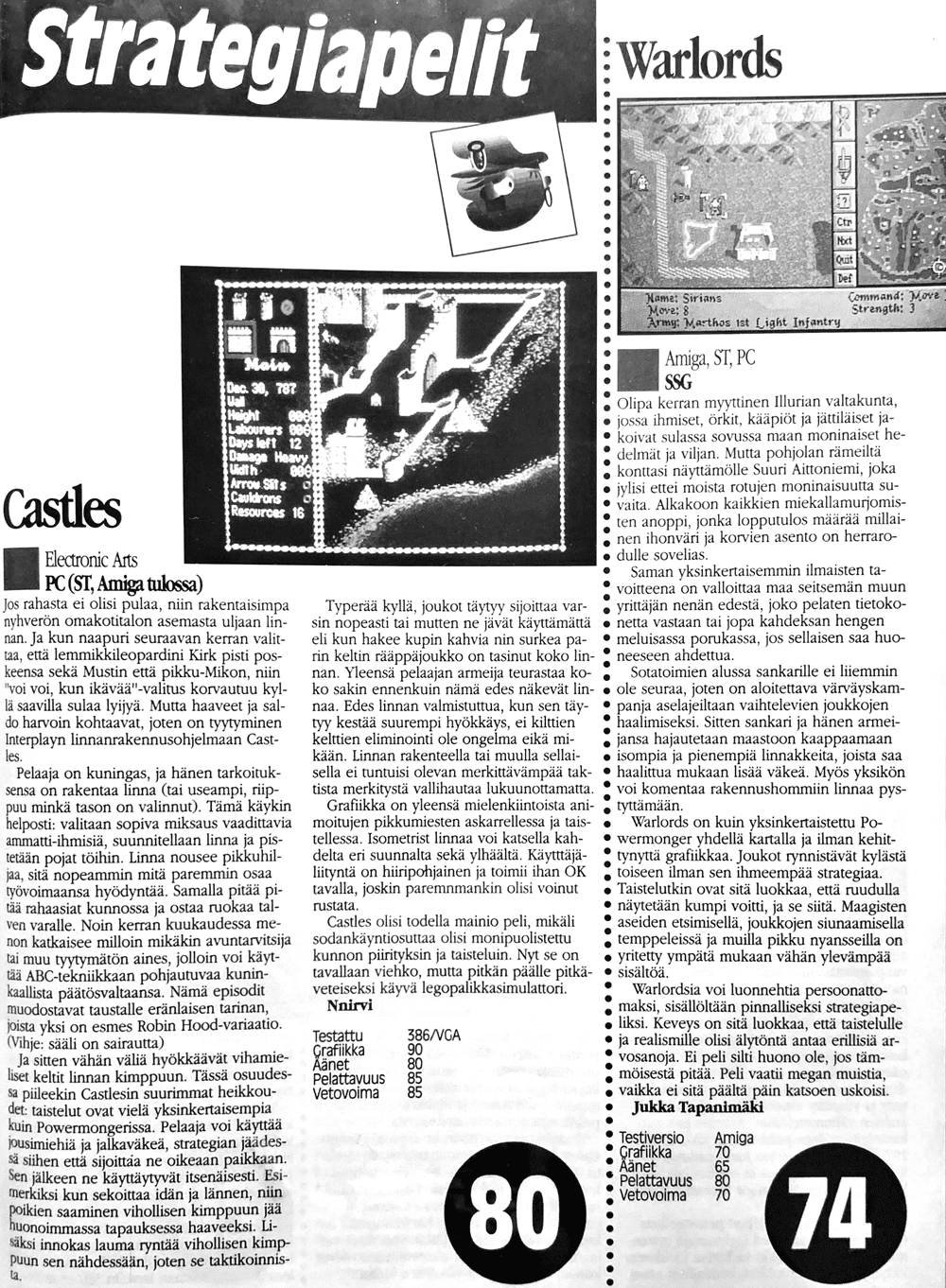
Warlords1991 SyksyPysyvä linkkiOlipa kerran myyttinen Illurian valtakunta, jossa ihmiset, örkit, kääpiöt ja jättiläiset jakoivat sulassa sovussa maan moninaiset hedelmät ja viljan. Mutta pohjolan rämeiltä konttasi näyttämölle Suuri Aittoniemi, joka jylisi ettei moista rotujen moninaisuutta suvaita. Alkakoon kaikkien miekallamurjomisten anoppi, jonka lopputulos määrää millainen ihonväri ja korvien asento on herrarodulle sovelias.
Saman yksinkertaisemmin ilmaisten tavoitteena on valloittaa maa seitsemän muun yrittäjän nenän edestä, joko pelaten tietokonetta vastaan tai jopa kahdeksan hengen meluisassa porukassa, jos sellaisen saa huoneeseen ahdettua.
Sotatoimien alussa sankarille ei liiemmin ole seuraa, joten on aloitettava värväyskampanja aselajeiltaan vaihtelevien joukkojen haalimiseksi. Sitten sankari ja hänen armeijansa hajautetaan maastoon kaappaamaan isompia ja pienempiä linnakkeita, joista saa haalittua mukaan lisää väkeä. Myös yksikön voi komentaa rakennushommiin linnaa pystyttämään.
Warlords on kuin yksinkertaistettu Powermonger yhdellä kartalla ja ilman kehittynyttä grafiikkaa. Joukot rynnistävät kylästä toiseen ilman sen ihmeempää strategiaa. Taistelutkin ovat sitä luokkaa, että ruudulla näytetään kumpi voitti, ja se siitä. Maagisten aseiden etsimisellä, joukkojen siunaamisella temppeleissä ja muilla pikku nyansseilla on yritetty ympätä mukaan vähän ylevämpää sisältöä.
Warlordsia voi luonnehtia persoonattomaksi, sisällöltään pinnalliseksi strategiapeliksi. Keveys on sitä luokkaa, että taistelulle ja realismille olisi älytöntä antaa erillisiä arvosanoja. Ei peli silti huono ole, jos tämmöisestä pitää. Peli vaatii megan muistia, vaikka ei sitä päältä päin katsoen uskoisi.
Warlords1991 SyksyPermalinkOnce upon a time there was the mythical kingdom of Illuria, where humans, orcs, dwarves and giants shared the land's manifold fruits and grain in perfect harmony. But from the bogs of the north the Great Aittoniemi came crawling onto the stage, thundering that such a diversity of races would not be tolerated. Let the mother-in-law of all sword-bashings begin, and let its outcome decide which skin colour and which angle of the ears befit the master race.
Putting the same thing more simply, the aim is to conquer the land from under the noses of seven other hopefuls, either playing against the computer or in a noisy crowd of as many as eight people, if you can cram that many into one room.
At the start of hostilities the hero doesn't have much company to speak of, so a recruiting campaign has to be launched to scrape together troops of assorted arms. Then the hero and the army are scattered across the terrain to capture bigger and smaller strongholds, from which yet more people can be rounded up. A unit can also be ordered onto building duty to put up a castle.
Warlords is like a simplified Powermonger on a single map and without the sophisticated graphics. The troops charge from one village to the next without any strategy worth mentioning. Even the battles are the sort where the screen shows who won, and that's that. Hunting for magic weapons, having troops blessed at temples and other little nuances are an attempt to graft in some slightly loftier content.
Warlords can be described as a faceless strategy game with shallow content. It is so lightweight that it would be daft to give combat and realism separate ratings. Still, the game isn't bad, if you like this sort of thing. The game needs a meg of memory, though you'd never believe it to look at it.
Warship
Warship1988Pysyvä linkkiSSI:n uusi strategiapeli liittyy toisen maailmansodan meritaisteluihin Japanin ja Liittoutuneiden välillä. Hyviä strategiapelejä ei ole koskaan liikaa, eikä merisotaa simuloivia kuin muutama, joten Warship on kannatettava tulokas.
Warshipiä voi pelata yksin kummalla puolella tahansa, kahdella pelaajalla tai antaa tietokoneen esittää demoa. Valittavana on neljä historiallista skenariota, mutta pelissä on mahdollisuus tehdä myös omia.
Kuten tavallista kaikki käskyt annetaan näppäimiltä. Laivoille voi antaa käskyjä joko divisioonittain, tai laiva kerrallaan. Pelaaja voi itse määrätä laivojen divisioonat, joka on hyödyllinen mahdollisuus, etenkin kun taistelussa jokin alus on vaurioitunut vakavasti. Sen divisioonannumero kannattaa tietysti vaihtaa, ja antaa käskyt erikseen.
Käskynjaon jälkeen siirrytään toimintaan. Aluksi laivat tulittavat toisiaan tykeillä aikansa koneen näyttäessä kohteen, ja tämän jälkeen alukset liikkuvat. Mikäli alukset ovat ampuneet torpedoita on vuorossa torpedojen liikuttaminen ja osumat. O:ta painamalla pääsee kaskynjakoon, kun kaikki toiminnot on käyty läpi.
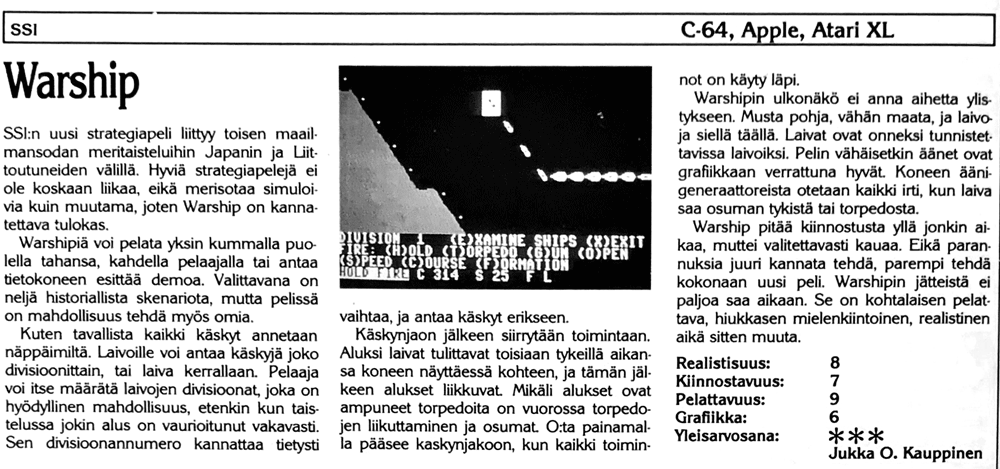
Warshipin ulkonäkö ei anna aihetta ylistykseen. Musta pohja, vähän maata, ja laivoja siellä täällä. Laivat ovat onneksi tunnistettavissa laivoiksi. Pelin vähäisetkin äänet ovat grafiikkaan verrattuna hyvät. Koneen äänigeneraattoreista otetaan kaikki irti, kun laiva saa osuman tykistä tai torpedosta.
Warship pitää kiinnostusta yllä jonkin aikaa, muttei valitettavasti kauaa. Eikä parannuksia juuri kannata tehdä, parempi tehdä kokonaan uusi peli. Warshipin jätteistä ei paljoa saa aikaan. Se on kohtalaisen pelattava, hiukkasen mielenkiintoinen, realistinen aikä sitten muuta.
Warship1988PermalinkSSI's new strategy game deals with the Second World War naval battles between Japan and the Allies. You can never have too many good strategy games, and there are only a handful that simulate naval warfare, so Warship is a newcomer worth backing.
You can play Warship solo on either side, with two players, or let the computer put on a demo. There are four historical scenarios to choose from, but the game also lets you make your own.
As usual, all orders are given from the keyboard. Ships can be given orders either by division or one ship at a time. The player can assign the ships' divisions personally, which is a useful option, especially when a ship has been badly damaged in battle. Naturally it's worth changing that ship's division number and giving it its orders separately.
After the orders have been handed out, it's on to the action. First the ships blaze away at each other with their guns for a while, with the computer showing the target, and after that the ships move. If the ships have fired torpedoes, next comes torpedo movement and the hits. Once everything has been gone through, pressing O takes you to issuing orders.
Warship's looks give no cause for praise. A black background, a bit of land, and ships here and there. Luckily the ships are recognisable as ships. Even the game's scant sounds are good compared to the graphics. The machine's sound generators are pushed for all they're worth when a ship takes a hit from a gun or a torpedo.
Warship holds your interest for a while, but sadly not for long. And there's not much point in making improvements to it; better to make a whole new game. Not much can be made out of Warship's scraps. It's reasonably playable, a tiny bit interesting, realistic, and nothing more than that.
Way of the Exploding Fist II, The
Way of the Exploding Fist II, The1987Pysyvä linkkiYmpäri maailmaa kaikki karatepelien ohjelmoijat jolleivät sentään ripusta itseään mustan vyön jatkoksi niin ainakin repivät pyjamansa nähdessään Fist II:n. Fist II todennäköisesti niittää kilpailevat karatepelit kumoon nopeammin kuin ne ehtivät sanoa "Bruce Lee".
Karatepelien suurin vika on tähän saakka ollut se, että vaikka ne kaksinpeleinä ovat hillittömän hauskoja, väsyy niihin vaihtelun puutteessa yksinpelinä hyvin nopeasti. Fist II sen sijaan on lähinnä karate-elokuva, jossa on tarkoitus palauttaa pyhät kirjoituskääröt temppeleihinsä ja vapauttaa Kaukoitä pahan sotaherran ikeestä. Ja joka välissä tietysti nyrkit ja jalat viuhuvat.
Vastaan tulee paitsi ihmisvastustajia niin myös jättiläiskäärmeitä, kromosomirottia sekä muuta luonnon pikkuväkeä. Erilaiset taistelumaastot asettavat rajoituksia liikkeille vaatien kokonaisvaltaisempaa taistelutaitoa kuin jalkakamppia, mikä kuulemma oli Fist I:ssä High Score -taulukon avain.
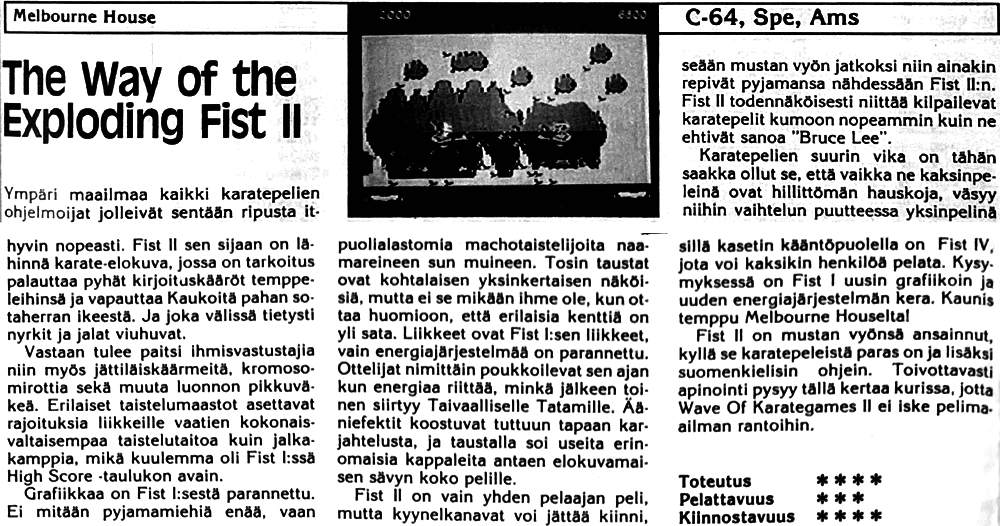
Grafiikkaa on Fist I:sestä parannettu. Ei mitään pyjamamiehiä enää, vaan puolialastomia machotaistelijoita naamareineen sun muineen. Tosin taustat ovat kohtalaisen yksinkertaisen näköisiä, mutta ei se mikään ihme ole, kun ottaa huomioon, että erilaisia kenttiä on yli sata. Liikkeet ovat Fist I:sen liikkeet, vain energiajärjestelmää on parannettu. Ottelijat nimittäin poukkoilevat sen ajan kun energiaa riittää, minkä jälkeen toinen siirtyy Taivaalliselle Tatamille. Ääniefektit koostuvat tuttuun tapaan karjahtelusta, ja taustalla soi useita erinomaisia kappaleita antaen elokuvamaisen sävyn koko pelille.
Fist II on vain yhden pelaajan peli, mutta kyynelkanavat voi jättää kiinni, sillä kasetin kääntöpuolella on Fist IV, jota voi kaksikin henkilöä pelata. Kysymyksessä on Fist I uusin grafiikoin ja uuden energiajärjestelmän kera. Kaunis temppu Melbourne Houselta!
Fist II on mustan vyönsä ansainnut, kyllä se karatepeleistä paras on ja lisäksi suomenkielisin ohjein. Toivottavasti apinointi pysyy tällä kertaa kurissa, jotta Wave Of Karategames II ei iske pelimaailman rantoihin.
Way of the Exploding Fist II, The1987PermalinkAll around the world, every programmer of karate games, if they don't actually string themselves up on the end of their black belt, will at least rend their pyjamas on seeing Fist II. Fist II will probably mow down the competing karate games faster than they can say "Bruce Lee".
The biggest flaw of karate games so far has been that although they are outrageously fun as two-player games, playing alone you get tired of them very quickly for lack of variety. Fist II, on the other hand, is more of a karate film, in which the aim is to return the sacred scrolls to their temples and free the Far East from the yoke of an evil warlord. And at every turn, naturally, fists and feet go flying.
You come up against not only human opponents but also giant snakes, chromosome rats and other of nature's little folk. The varied battlegrounds put limits on your moves, demanding a more all-round fighting skill than the leg sweep, which reportedly was the key to the High Score table in Fist I.
The graphics have been improved over Fist I. No more pyjama men; instead we get half-naked macho fighters with masks and whatnot. The backgrounds do look fairly simple, admittedly, but that is no wonder considering there are over a hundred different screens. The moves are Fist I's moves; only the energy system has been improved. You see, the fighters bounce around for as long as their energy holds out, after which one of them passes on to the Heavenly Tatami. As usual, the sound effects consist of bellowing, and several excellent tunes play in the background, giving the whole game a cinematic feel.
Fist II is a one-player game only, but you can keep your tear ducts shut, because on the flip side of the cassette there is Fist IV, which two people can play. It is Fist I with new graphics and the new energy system. A neat trick from Melbourne House!
Fist II has earned its black belt; it really is the best of the karate games, and it comes with instructions in Finnish too. Let's hope the aping stays in check this time, so that Wave Of Karategames II doesn't come crashing onto the shores of the gaming world.
Way of the Exploding Fist, The
Way of the Exploding Fist, The1987Pysyvä linkkiPeliä voidaan pelata yksin- ja kaksinpelinä. Siinä on myös demo jossa tietokone pelaa itseään vastaan. Yksinpelin ideana on, kuten arvata saattaa, kehittyminen aloittelijasta kymmenen danin karatetaituriksi. Jokaista dania kohti käydään kaksieräinen taistelu tietokoneen karatekaa vastaan. Tuomarina toimii taustalla istuva vanha sensei. Perille menneistä iskuista ja potkuista karateka palkitaan paitsi pisteillä myös yin- ja yangkuvioilla, jotka yhdessä muodostavat pallon. Erän voittaa se, joka saa kokoon kaksi palloa.
Pelissä on myös aikarajoitus, ja jäljellä olevista sekunneista saa bonuspisteitä. Mikäli kumpikaan taistelija ei saa pallokiintiöitään täyteen, määrää tuomari voittajan. Peli loppuu kun tietokoneen karateka voittaa yhdenkin erän.
Liikkeet eivät lopu kesken
Tässä nopeutta vaativassa pelissä on erittäin laaja liikevalikoima. Vastustajan yrittäessä nujertaa sinut lentopotkulla voit vetäytyä nopeaan suojaukseen ja yllättää hänet kierrepotkulla. Kun lasketaan iskut, potkut, suojaukset ja hypyt on pelissä yhteensä kahdeksantoista eri liikettä. Voiko kukaan muistaa niin montaa? Ohjaus on kuitenkin aivan luonnollinen ja oikeat liikkeet tulevat refleksinomaisesti. Alussa voi olla vaikeaa valita iskeäkö vai potkia, mutta pienellä harjoituksella sen oppii.
Hyvä peli ei olisi hyvä ilman musiikkia ja äänitehosteita. Exploding Fistissä on neljä musiikinpätkää. Demossa sekä yksin- ja kaksinpelissä on jokaisessa oma melodiansa. Lisäksi saa kirjoittaa nimensä top-5-listalle itämaisen musiikin tahdissa. Pelin tunnelma rakentuu paljolti hyvän musiikin varaan.
Iskuja ja potkuja edeltää hurja karjaisu. Osuman ääni kuulostaa niin aidolta, että rupeaa tunnustelemaan omia luitaan. Osuman saanut lennähtää taaksepäin ja iskeytyy maahan mahtavalla jysäyksellä. Myös puvut suhisevat ottelijan liikkuessa.
Peli saattaa vaikuttaa väkivaltaiselta, mutta tuskinpa kukaan lähtee tämän inspiroimana kadulla läiskimään ihmisiä.
Pelissä on suojaus aivan yhtä tärkeää kuin hyökkäys ja päämäärä ei ole vastustajan hoiteleminen pois päiviltä vaan oma kehittyminen karatessa. Tarkemmin kun ajattelee, niin melkein jokaisessa muussa pelissä on jonkinlainen tappaminen tai tuhoaminen keskeisenä päämääränä.
Yli 700 sprite-kuviota
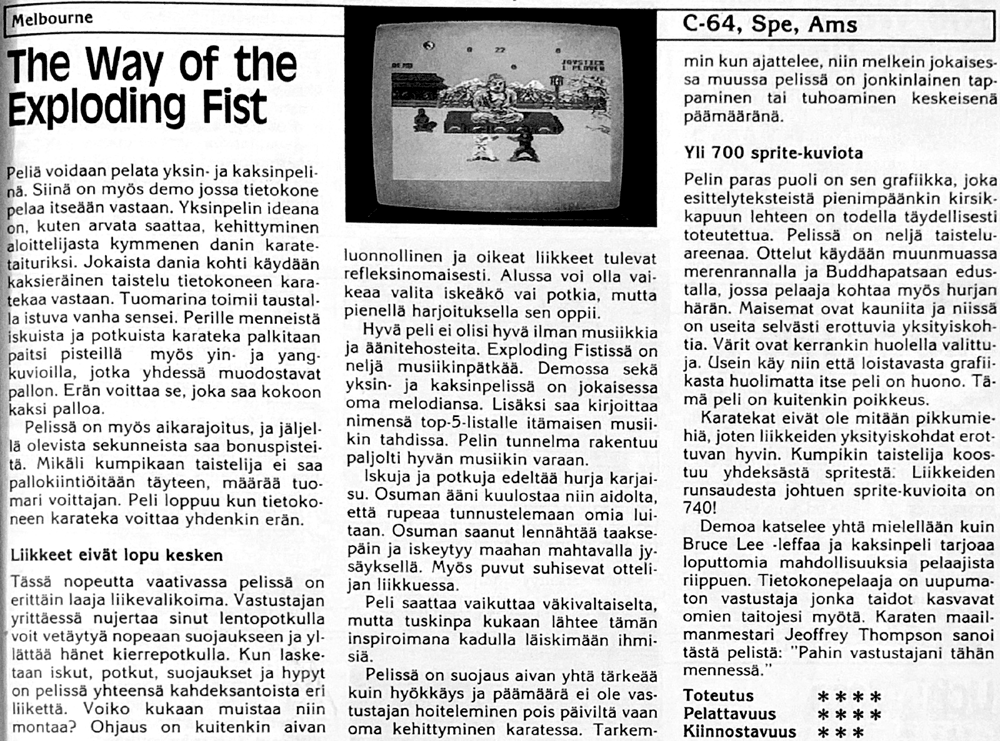
Pelin paras puoli on sen grafiikka, joka esittelyteksteistä pienimpäänkin kirsikkapuun lehteen on todella täydellisesti toteutettua. Pelissä on neljä taisteluareenaa. Ottelut käydään muunmuassa merenrannalla ja Buddhapatsaan edustalla, jossa pelaaja kohtaa myös hurjan härän. Maisemat ovat kauniita ja niissä on useita selvästi erottuvia yksityiskohtia. Värit ovat kerrankin huolella valittuja. Usein käy niin että loistavasta grafiikasta huolimatta itse peli on huono. Tämä peli on kuitenkin poikkeus.
Karatekat eivät ole mitään pikkumiehiä, joten liikkeiden yksityiskohdat erottuvan hyvin. Kumpikin taistelija koostuu yhdeksästä spritestä. Liikkeiden runsaudesta johtuen sprite-kuvioita on 740!
Demoa katselee yhtä mielellään kuin Bruce Lee -leffaa ja kaksinpeli tarjoaa loputtomia mahdollisuuksia pelaajista riippuen. Tietokonepelaaja on uupumaton vastustaja jonka taidot kasvavat omien taitojesi myötä. Karaten maailmanmestari Jeoffrey Thompson sanoi tästä pelistä: "Pahin vastustajani tähän mennessä."
Way of the Exploding Fist, The1987PermalinkThe game can be played by one or two players. There is also a demo in which the computer plays against itself. The idea of the one-player game is, as you might guess, to progress from beginner to tenth-dan karate master. For each dan you fight a two-round bout against the computer's karateka. The referee is an old sensei sitting in the background. For punches and kicks that land, the karateka is rewarded not only with points but also with yin and yang symbols, which together form a ball. The round goes to whoever collects two balls.
There is also a time limit, and you get bonus points for the seconds left over. If neither fighter fills the quota of balls, the referee decides the winner. The game ends as soon as the computer's karateka wins a single round.
No running out of moves
This game, which demands speed, has a very wide range of moves. When your opponent tries to floor you with a flying kick, you can drop into a quick block and surprise him with a roundhouse kick. Counting punches, kicks, blocks and jumps, the game has eighteen different moves in all. Can anyone remember that many? The controls are perfectly natural, though, and the right moves come as if by reflex. At first it may be hard to choose whether to punch or kick, but with a little practice you get the hang of it.
A good game wouldn't be good without music and sound effects. Exploding Fist has four snatches of music. The demo, the one-player game and the two-player game each have a tune of their own. On top of that, you get to enter your name on the top-5 list to the strains of oriental music. The game's atmosphere rests largely on its good music.
Punches and kicks are preceded by a ferocious yell. The sound of a hit is so realistic that you find yourself feeling your own bones. The one who has been hit flies backwards and slams into the ground with a mighty thud. Even the suits swish as the fighters move.
The game may seem violent, but hardly anyone is going to be inspired by it to go out slapping people around in the street.
In this game defence is every bit as important as attack, and the goal is not to do away with your opponent but to develop your own karate. Come to think of it, almost every other game has some kind of killing or destruction as its central goal.
Over 700 sprite patterns
The game's best side is its graphics, which are executed truly to perfection, from the intro texts down to the smallest cherry-tree leaf. There are four fighting arenas. Bouts are fought on a seashore and in front of a Buddha statue, among other places, and there the player also comes up against a ferocious bull. The scenery is beautiful and has plenty of clearly visible detail. For once the colours have been chosen with care. It often happens that despite brilliant graphics the game itself is poor. This game, however, is an exception.
The karatekas are no little stick men, so the details of the moves show up well. Each fighter is made up of nine sprites. Because of the sheer number of moves, there are 740 sprite patterns!
You'll watch the demo as happily as a Bruce Lee flick, and the two-player game offers endless possibilities depending on the players. The computer player is a tireless opponent whose skills grow along with your own. Karate world champion Jeoffrey Thompson said of this game: "My toughest opponent so far."
Way of The Little Dragon, The
Way of The Little Dragon, The1988Pysyvä linkkiKuulen jotain avaruusmölinää...Eteeni tulee kuva galaksista. Avaruuspeli?!!!!....Ei vaan Parsecin karatepeli: The Way of The Little Dragon.
Latauskuvassa näkyy jokin itämaiselta vaikuttava heppu lennossa ja jalka potkuun ojennettuna. Olisiko itse Bruce Lee?
Itse pelissä on tarkoituksena tuhota vastustaja karaten jalolla taidolla. Liikkeitä on kierähdyspotkusta lyöntiin ja siltä väliltä. Ensimmäinen, vai sanoisinko neljä ensimmäistä taulua ovat helppoja, mutta kiinnostus loppunee, kun huomaat neljännen taulun läpipäästyäsi tulleesi viidenteen tauluun, eli tauluun josta aloitit mäiskinnän.
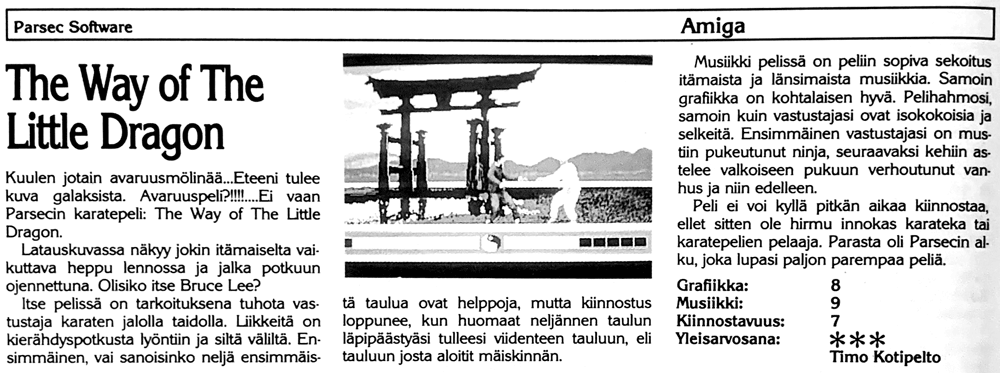
Musiikki pelissä on peliin sopiva sekoitus itämaista ja länsimaista musiikkia. Samoin grafiikka on kohtalaisen hyvä. Pelihahmosi, samoin kuin vastustajasi ovat isokokoisia ja selkeitä. Ensimmäinen vastustajasi on mustiin pukeutunut ninja, seuraavaksi kehiin astelee valkoiseen pukuun verhoutunut vanhus ja niin edelleen.
Peli ei voi kyllä pitkän aikaa kiinnostaa, ellet sitten ole hirmu innokas karateka tai karatepelien pelaaja. Parasta oli Parsecin alku, joka lupasi paljon parempaa peliä.
Way of The Little Dragon, The1988PermalinkI hear some kind of space racket...A picture of a galaxy appears before me. A space game?!!!!....Nope, Parsec's karate game: The Way of The Little Dragon.
The loading screen shows some oriental-looking dude in mid-flight, leg stretched out in a kick. Could it be Bruce Lee himself?
In the game itself the idea is to destroy your opponent through the noble art of karate. The moves run from a rolling kick to a punch and everything in between. The first, or should I say the first four screens are easy, but your interest will probably run out when, having got through the fourth screen, you find you've reached the fifth screen, i.e. the screen where you started all the thumping.
The music in the game is a mix of oriental and Western music that suits the game. The graphics are likewise fairly good. Your character and your opponents alike are big and clear. Your first opponent is a ninja dressed in black, next into the ring steps an old-timer draped in a white outfit, and so on.
The game really can't hold your interest for long, unless you happen to be a terribly keen karateka or karate game player. The best part was Parsec's intro, which promised a much better game.
Way of the Tiger, The

Way of the Tiger, The1987Pysyvä linkkiTiikerin tie on hyvägrafiikkainen itämaisia taistelutapoja harjoittava peli, jossa olet koulutettavana tehokkaaksi Ninjaksi.
Kokeesi sisältää kolme erilaista taistelua:
Karatessa sinun on potkuin ja lyönnein voitettava neljä vastustajaasi, kukin kahdesti.
Seivästaistelussa tehtävänäsi on selvitä joen yli tukkia pitkin päihittäen samalla vastustajasi.
Miekkataistelussa sinun on silvottava vihollisesi hengiltä.
Grafiikaltaan peli on todella hyvä. Pelihahmot ja taustat ovat hienoja ja scrollaus tapahtuu siististi. Musiikiltaan peli ei ole mitään huippuluokkaa,
Ninjan tilanteen saa selville ruudun alaosassa olevista 'mittareista', jotka kertovat miehesi kestävyyden ja voiman.
Pelin kiinnostavuutta saattaa jonkin verran laskea sen helppous. Loppuun pääseminen ei ole mitenkään ylivoimaisen vaikeaa, pikemminkin ehkä hiukan liian helppoa.
Way of the Tiger, The1987PermalinkThe Way of the Tiger is a nicely graphicked game of practising oriental fighting styles, in which you are being trained to become an effective Ninja.
Your test consists of three different fights:
In the karate you must use kicks and punches to beat your four opponents, each of them twice.
In the pole fight your task is to make it across the river along the logs, beating your opponents as you go.
In the sword fight you must hack your enemies to death.
Graphically the game is really good. The characters and backgrounds are great and the scrolling is smooth. Musically the game is nothing top-class.
You can keep track of the Ninja's condition with the 'gauges' at the bottom of the screen, which show your man's stamina and strength.
The game's interest may be dented somewhat by how easy it is. Getting to the end is by no means overwhelmingly difficult - if anything, perhaps a little too easy.
Wayne Gretzky Hockey
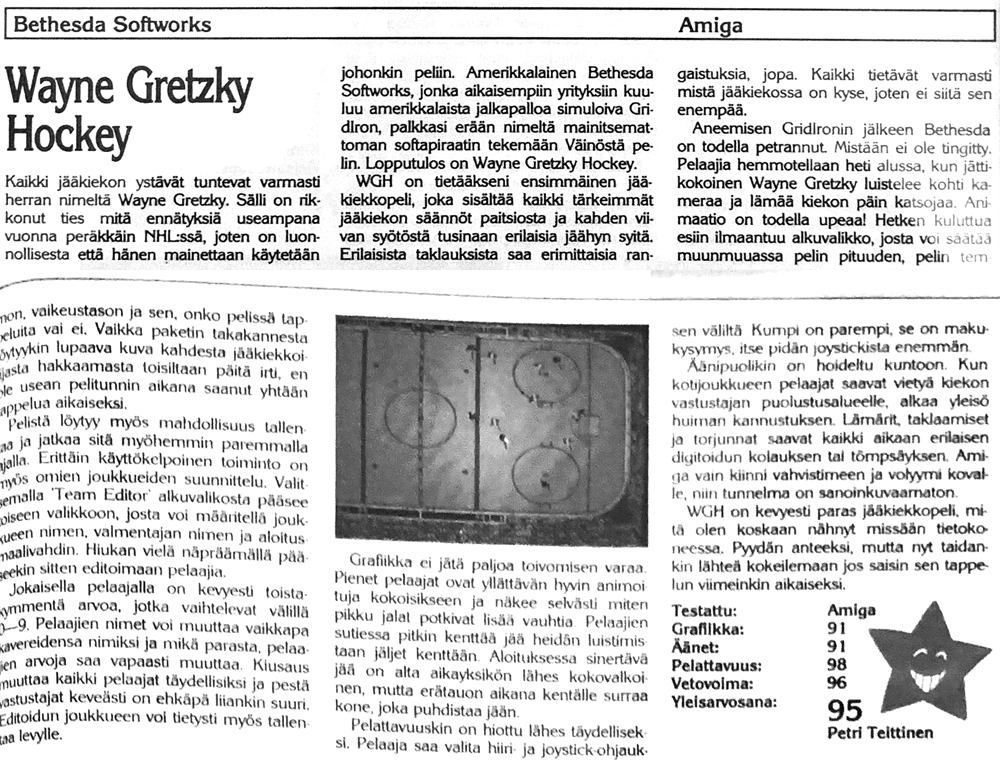
Wayne Gretzky Hockey1990 KevätPysyvä linkkiKaikki jääkiekon ystävät tuntevat varmasti herran nimeltä Wayne Gretzky. Sälli on rikkonut ties mitä ennätyksiä useampana vuonna peräkkäin NHL:ssä, joten on luonnollisesta että hänen mainettaan käytetään johonkin peliin. Amerikkalainen Bethesda Softworks, jonka aikaisempiin yrityksiin kuuluu amerikkalaista jalkapalloa simuloiva GridIron, palkkasi erään nimeltä mainitsemattoman softapiraatin tekemään Väinöstä pelin. Lopputulos on Wayne Gretzky Hockey.
WGH on tietääkseni ensimmäinen jääkiekkopeli, joka sisältää kaikki tärkeimmät jääkiekon säännöt paitsiosta ja kahden viivan syötöstä tusinaan erilaisia jäähyn syitä. Erilaisista taklauksista saa erimittaisia rangaistuksia, jopa. Kaikki tietävät varmasti mistä jääkiekossa on kyse, joten ei siitä sen enempää.
Aneemisen GridIronin jälkeen Bethesda on todella petrannut. Mistään ei ole tingitty. Pelaajia hemmotellaan heti alussa, kun jättikokoinen Wayne Gretzky luistelee kohti kameraa ja lämää kiekon päin katsojaa. Animaatio on todella upeaa! Hetken kuluttua esiin ilmaantuu alkuvalikko, josta voi säätää muunmuuassa pelin pituuden, pelin temmon, vaikeustason ja sen, onko pelissä tappeluita vai ei. Vaikka paketin takakannesta löytyykin lupaava kuva kahdesta jääkiekkoilijasta hakkaamasta toisiltaan päitä irti, en ole usean pelitunnin aikana saanut yhtään tappelua aikaiseksi.
Pelistä löytyy myös mahdollisuus tallentaa ja jatkaa sitä myöhemmin paremmalla ajalla. Erittäin käyttökelpoinen toiminto on myös omien joukkueiden suunnittelu. Valitsemalla 'Team Editor' alkuvalikosta pääsee toiseen valikkoon, josta voi määritellä joukkueen nimen, valmentajan nimen ja aloitusmaalivahdin. Hiukan vielä näpräämällä pääseekin sitten editoimaan pelaajia.
Jokaisella pelaajalla on kevyesti toistakymmentä arvoa, jotka vaihtelevat välillä 0-9. Pelaajien nimet voi muuttaa vaikkapa kavereidensa nimiksi ja mikä parasta, pelaajien arvoja saa vapaasti muuttaa. Kiusaus muuttaa kaikki pelaajat täydellisiksi ja pestä vastustajat keveästi on ehkäpä liiankin suuri. Editoidun joukkueen voi tietysti myös tallentaa levylle.
Grafiikka ei jätä paljoa toivomisen varaa. Pienet pelaajat ovat yllättävän hyvin animoituja kokoisikseen ja näkee selvästi miten pikku jalat potkivat lisää vauhtia. Pelaajien sutiessa pitkin kenttää jää heidän luistimistaan jäljet kenttään. Aloituksessa sinertävä jää on alta aikayksikön lähes kokovalkoinen, mutta erätauon aikana kentälle surraa kone, joka puhdistaa jään.
Pelattavuuskin on hiottu lähes täydelliseksi. Pelaaja saa valita hiiri- ja joystick-ohjauksen väliltä. Kumpi on parempi, se on makukysymys, itse pidän joystickista enemmän.
Äänipuolikin on hoideltu kuntoon. Kun kotijoukkueen pelaajat saavat vietyä kiekon vastustajan puolustusalueelle, alkaa yleisö huiman kannustuksen. Lämärit, taklaamiset ja torjunnat saavat kaikki aikaan erilaisen digitoidun kolauksen tai tömpsäyksen. Amiga vain kiinni vahvistimeen ja volyymi kovalle, niin tunnelma on sanoinkuvaamaton.
WGH on kevyesti paras jääkiekkopeli, mitä olen koskaan nähnyt missään tietokoneessa. Pyydän anteeksi, mutta nyt taidankin lähteä kokeilemaan jos saisin sen tappelun viimeinkin aikaiseksi.
Wayne Gretzky Hockey1990 KevätPermalinkAll ice hockey fans are sure to know a gentleman by the name of Wayne Gretzky. The guy has broken who knows how many records several years running in the NHL, so it's only natural for that fame to be put to use in some game. The American company Bethesda Softworks, whose earlier efforts include the American football simulation GridIron, hired a certain software pirate who shall remain nameless to make a game out of Väinö. The end result is Wayne Gretzky Hockey.
WGH is, as far as I know, the first ice hockey game to contain all the most important rules of hockey, from offside and the two-line pass to a dozen different reasons for a penalty. Different kinds of checks get you penalties of different lengths, even. Everyone surely knows what ice hockey is about, so no more on that.
After the anaemic GridIron, Bethesda has really raised its game. No corners have been cut. Players get pampered right from the start, when a giant-sized Wayne Gretzky skates towards the camera and slaps the puck straight at the viewer. The animation is really superb! After a moment the start menu appears, where you can adjust, among other things, the length of the game, the game tempo, the difficulty level and whether or not there are fights in the game. Although the back of the box has a promising picture of two hockey players knocking each other's heads off, in several hours of play I haven't managed to get a single fight going.
The game also offers the option of saving and carrying on later, when you have more time. Another very handy feature is designing your own teams. Choosing 'Team Editor' from the start menu takes you to another menu, where you can set the team's name, the coach's name and the starting goalie. With a little more fiddling you then get to edit the players.
Each player has easily more than ten ratings, ranging from 0 to 9. You can change the players' names to, say, your friends' names, and best of all, you are free to change the players' ratings. The temptation to make all the players perfect and wipe the floor with the opposition without breaking a sweat is perhaps all too strong. An edited team can of course also be saved to disk.
The graphics leave little to be desired. The tiny players are surprisingly well animated for their size, and you can clearly see the little legs kicking for extra speed. As the players scoot around the rink, their skates leave tracks on the ice. The bluish ice at the opening faceoff is almost entirely white in no time at all, but during the intermission a machine buzzes onto the rink and cleans the ice.
The playability has also been honed to near perfection. The player can choose between mouse and joystick control. Which is better is a matter of taste; I myself prefer the joystick.
The sound side has been sorted out as well. When the home team's players get the puck into the opponent's defensive zone, the crowd starts up a wild cheer. Slapshots, checks and saves all produce a different digitised clunk or thump. Just hook the Amiga up to an amplifier and turn the volume up, and the atmosphere is beyond words.
WGH is easily the best ice hockey game I have ever seen on any computer. You'll have to excuse me, but I think I'll go now and see if I can finally get that fight going.
Wec Le Mans 24
Wec Le Mans 241989 KevätPysyvä linkkiMe kaikki muistanemme onnettoman kuusnelosversion Outrunista. No, aika kuluu ja tekniikka kehittyy. Konamin Wec Le Mans on kolikkopelinä ehkä jopa maailman suosituin, ja kuvaa nimensä mukaisesti Le Mansin 34 tunnin kisoja. Mukana on niin päivä- kuin yöosuuksiakin Outrunin kevyesti pesevillä grafiikoilla. Rata vaihtuu kolmen aikarajoitteisen kierroksen jälkeen.
Yllätys yllätys, kuusnelosen Wec Le Mans on niin helvetin huono, että tekisi mieli itkeä. Yritin ihan haasteen vuoksi löytää jotain positiivista, mutta jouduin antautumaan.
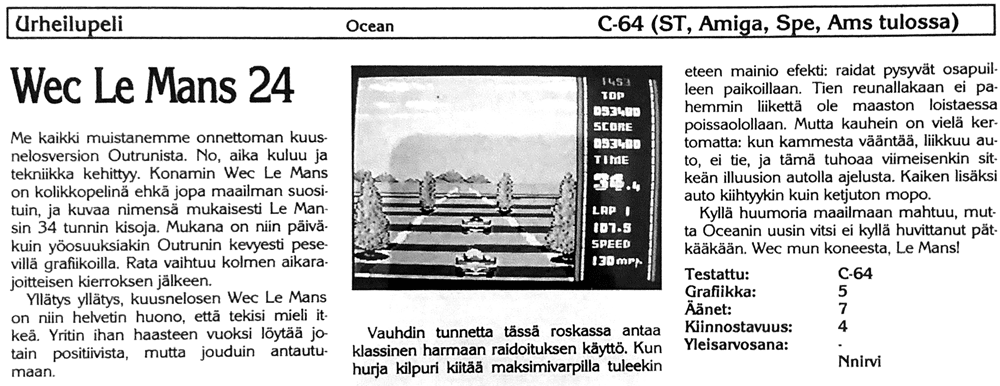
Vauhdin tunnetta tässä roskassa antaa klassinen harmaan raidoituksen käyttö. Kun hurja kilpuri kiitää maksimivarpilla tuleekin eteen mainio efekti: raidat pysyvät osapuilleen paikoillaan. Tien reunallakaan ei pahemmin liikettä ole maaston loistaessa poissaolollaan. Mutta kauhein on vielä kertomatta: kun kammesta vääntää, liikkuu auto, ei tie, ja tämä tuhoaa viimeisenkin sitkeän illuusion autolla ajelusta. Kaiken lisäksi auto kiihtyykin kuin ketjuton mopo.
Kyllä huumoria maailmaan mahtuu, mutta Oceanin uusin vitsi ei kyllä huvittanut pätkääkään. Wec mun koneesta, Le Mans!
Wec Le Mans 241989 KevätPermalinkI dare say we all remember the wretched Commodore 64 version of Outrun. Well, time passes and technology advances. As a coin-op, Konami's Wec Le Mans is perhaps even the most popular in the world, and, true to its name, it depicts the 24-hour race at Le Mans. There are both day and night stretches, with graphics that beat Outrun's hands down. The track changes after three time-limited laps.
Surprise, surprise: the C-64 Wec Le Mans is so damn awful it makes you want to cry. Just for the challenge of it I tried to find something positive, but I had to surrender.
The sense of speed in this garbage comes from the classic use of grey stripes. When the fearsome racer streaks along at maximum warp, you are treated to a splendid effect: the stripes stay more or less where they are. There's not much movement at the roadside either, the scenery being conspicuous by its absence. But the worst is yet to be told: when you wrench the joystick, it's the car that moves, not the road, and that destroys the last stubborn illusion of driving a car. On top of it all, the car accelerates like a moped with no chain.
There's room for humour in the world, sure, but Ocean's latest joke didn't amuse me one bit. Wec out of my machine, Le Mans!
Weird Dreams
Weird Dreams1990 KevätPysyvä linkkiNäin tämän pelin yli kaksi vuotta Englannissa PCW-messuilla, kun innostunut graafikko esitteli peliä Rainbirdin osastolla. Peli näytti ainakin minun mielestäni aivan valmiilta. Kummastuttaakin miksi pelin ilmestyminen myyntiin on kestänyt näin kauan.
Weird Dreams asettaa pelaajan leikkauspöydälle. Potilaana. Nukutusaine alkaa vaikuttaa ja pelaaja vaipuu uneen, josta ei ehkä ole paluuta. Kaikkihan me tiedämme, mitä sanotaan unessa kuolemisesta (vertaa Painajainen Elm Streetillä osat 1-5). Pelaajalla on 5 elämää ja joka kerta kun hahmo kuolee jonkin unen luoman kummajaisen seurauksena, on hän yhden pykälän lähempänä kuolemista leikkauspöydälle.
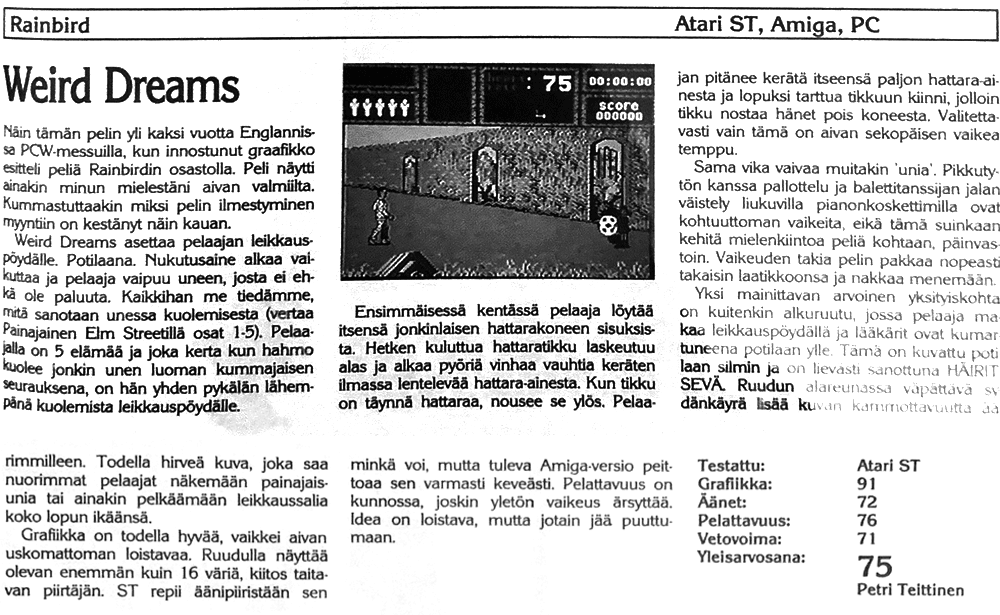
Ensimmäisessä kentässä pelaaja löytää itsensä jonkinlaisen hattarakoneen sisuksista. Hetken kuluttua hattaratikku laskeutuu alas ja alkaa pyöriä vinhaa vauhtia keräten ilmassa lentelevää hattara-ainesta. Kun tikku on täynnä hattaraa, nousee se ylös. Pelaajan pitänee kerätä itseensä paljon hattara-ainesta ja lopuksi tarttua tikkuun kiinni, jolloin tikku nostaa hänet pois koneesta. Valitettavasti vain tämä on aivan sekopäisen vaikea temppu.
Sama vika vaivaa muitakin 'unia'. Pikkutytön kanssa pallottelu ja balettitanssijan jalan väistely liukuvilla pianonkoskettimilla ovat kohtuuttoman vaikeita, eikä tämä suinkaan kehitä mielenkiintoa peliä kohtaan, päinvastoin. Vaikeuden takia pelin pakkaa nopeasti takaisin laatikkoonsa ja nakkaa menemään.
Yksi mainittavan arvoinen yksityiskohta on kuitenkin alkuruutu, jossa pelaaja makaa leikkauspöydällä ja lääkärit ovat kumartuneena potilaan ylle. Tämä on kuvattu potilaan silmin ja on lievästi sanottuna HÄIRITSEVÄ. Ruudun alareunassa väpättävä sydänkäyrä lisää kuvan kammottavuutta äärimmilleen. Todella hirveä kuva, joka saa nuorimmat pelaajat näkemään painajaisunia tai ainakin pelkäämään leikkaussalia koko lopun ikäänsä.
Grafiikka on todella hyvää, vaikkei aivan uskomattoman loistavaa. Ruudulla näyttää olevan enemmän kuin 16 väriä, kiitos taitavan piirtäjän. ST repii äänipiiristään sen minkä voi, mutta tuleva Amiga-versio peittoaa sen varmasti keveästi. Pelattavuus on kunnossa, joskin yletön vaikeus ärsyttää. Idea on loistava, mutta jotain jää puuttumaan.
Weird Dreams1990 KevätPermalinkI saw this game over two years ago at the PCW Show in England, when an enthusiastic graphic artist was demonstrating it on Rainbird's stand. To my mind at least, the game looked completely finished. Which makes me wonder why it has taken so long for the game to reach the shops.
Weird Dreams puts the player on the operating table. As the patient. The anaesthetic starts to take effect and the player sinks into a sleep from which there may be no return. We all know what they say about dying in your dreams (compare A Nightmare on Elm Street, parts 1-5). The player has 5 lives, and every time the character dies at the hands of some freak conjured up by the dream, the player is one notch closer to dying on the operating table.
In the first level the player finds themselves in the innards of some kind of candyfloss machine. After a moment a candyfloss stick comes down and starts spinning at a furious rate, gathering the candyfloss stuff flying about in the air. When the stick is full of candyfloss, it rises back up. The player presumably has to gather lots of candyfloss stuff onto themselves and finally grab hold of the stick, which then lifts them out of the machine. Unfortunately, this is a crazily difficult trick.
The same fault afflicts the other 'dreams' as well. Playing ball with a little girl and dodging a ballet dancer's foot on sliding piano keys are unreasonably difficult, and this by no means builds up any interest in the game - quite the reverse. Because of the difficulty, you soon pack the game back into its box and chuck it aside.
One detail worth mentioning, however, is the opening screen, where the player lies on the operating table and the doctors are bent over the patient. This is shown through the patient's eyes and is, to put it mildly, DISTURBING. The heart trace blipping at the bottom of the screen pushes the creepiness of the picture to the extreme. A truly horrible picture, which will give the youngest players nightmares or at least leave them afraid of operating theatres for the rest of their lives.
The graphics are really good, though not quite unbelievably brilliant. There seem to be more than 16 colours on screen, thanks to a skilled artist. The ST wrings what it can out of its sound chip, but the upcoming Amiga version will surely beat it with ease. The playability is fine, although the excessive difficulty grates. The idea is brilliant, but something is left missing.
Welltris
Welltris1990 SyksyPysyvä linkkiMainetta ja kunniaa saavuttanut Tetris on nyt saanut kakkososan. Tällä kertaa katse suunnataan kaivon pohjalle ja asemoidaan palikoita kolmiulotteisesti. Valitettavasti Mirrorsoft on puoli vuotta myöhässä.
Neuvostoliittolaisen ATK-suunnittelijan Tetris myi tuhansia ja taas tuhansia kappaleita viime vuonna ja se käännettiin lähes jokaiselle koneelle. Markkinavoimat sanelivat miehelle käskyn kakkososan tekemisestä. Jostain syystä Welltrisin tuleminen kesti aivan liian kauan, sillä ennen sitä myyntiin ehti jo Block Out, joka perustuu aivan samaan ideaan. Kumpikohan plagioi toista?
Ruutu on jaettu suurinpiirtein kahtia, oikealla puolella on jokin kiva kuva, ja vasemmalla pelialue. Nimensä mukaisesti (Well=kaivo) palikoita tippuu nyt nelikulmaiseen kaivoon. Palikoista pitää kääntelemällä muodostaa tasaisia pintoja. Kun pinta on kokonainen, häviää se pois ja sen päällä olevat tasot tipahtavat yhden pykälän alaspäin. Jos tasot saavuttavat kaivon suun, on peli ohi. Idea on siis identtinen Tetriksen kanssa, mutta kolmiulotteisesti.
Welltrisissä palikat valuvat hitaasti kaivon reunaa pitkin lituskoina lättyinä. Näppäimistöltä asemoidaan palikat paikalleen, eikä joystickillä tai hiirellä tätä peliä olisi voinut toteuttaakaan. Kaikessa yksinkertaisuudessaan pelissä on jotain kummaa viehätystä, vaikka se ei vangitsekaan pelaajaansa aivan samalla tavalla kuin Tetris. Tällaisessa pelissä ei grafiikan laatu merkitse oikeastaan yhtään mitään, mutta ulkonäköä on koristeltu erilaisilla kuvilla.
Jokaisella vaikeustasolla on myös oma musiikkinsa, mutta mielestäni amerikkalaiset eivät osaa tehdä musiikkia. Eivät tietokoneella tai muutenkaan. Näppispelattavuus sopii peliin kuin nyrkki silmään. Vetovoimaa löytyy lähes Tetriksen verran.
Vaikka Welltris onkin aivan mukiinmenevä peli, suosittelen silti tämän tyylistä peliä etsivälle Block Outia, joka on yksinkertaisesti parempi.
Welltris1990 SyksyPermalinkTetris, which won fame and glory, has now got a sequel. This time you turn your gaze to the bottom of a well and position blocks in three dimensions. Unfortunately Mirrorsoft is half a year late.
The Soviet computer designer's Tetris sold thousands upon thousands of copies last year, and it was converted for nearly every machine. Market forces dictated to the man that he should make a sequel. For some reason Welltris took far too long to arrive, since before it Block Out, which is based on exactly the same idea, had already made it into the shops. Which one plagiarised the other, I wonder?
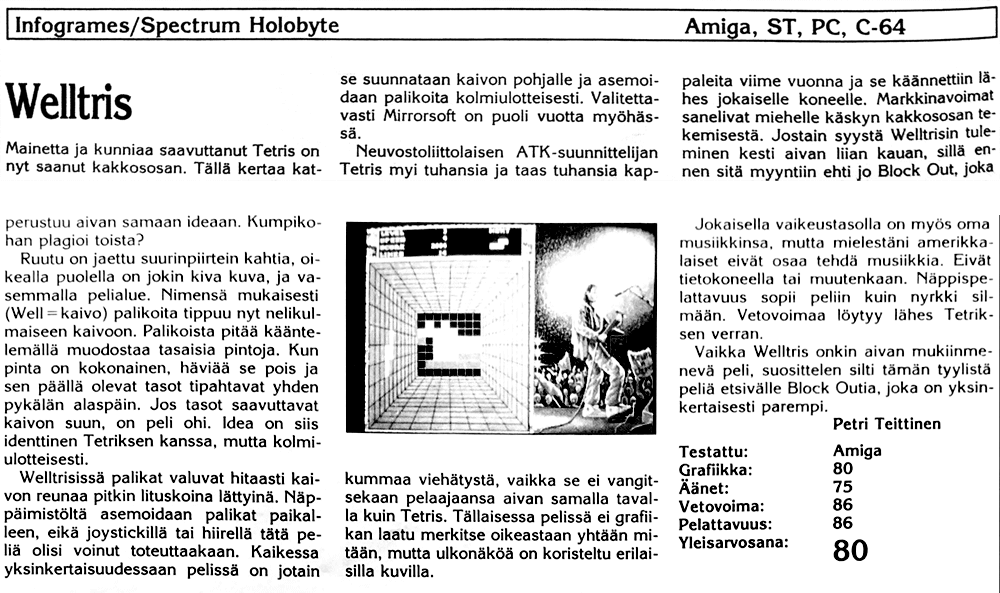
The screen is split roughly in two: on the right side there's some nice picture, and on the left the play area. True to its name (Well as in a well), blocks now drop into a four-sided well. By turning the blocks you have to form even surfaces. When a surface is complete, it disappears and the layers on top of it drop down one notch. If the layers reach the mouth of the well, the game is over. So the idea is identical to Tetris, but in three dimensions.
In Welltris the blocks slowly ooze down the side of the well as flattened pancakes. You position the blocks from the keyboard, and this game couldn't have been done with a joystick or a mouse anyway. In all its simplicity the game has a strange sort of charm, even if it doesn't hold its player captive in quite the same way as Tetris. In a game like this the quality of the graphics doesn't really mean a thing, but the look has been dressed up with various pictures.
Each difficulty level also has its own music, but in my opinion Americans can't make music. Not on a computer, nor otherwise. The keyboard playability fits the game like a glove. There's almost as much appeal as in Tetris.
Although Welltris is a perfectly decent game, to anyone looking for a game of this style I'd still recommend Block Out, which is simply better.
West Bank
West Bank1987Pysyvä linkkiWest Bank on idealtaan yksinkertainen mutta silti erittäin kiinnostava peli. Hoitelet West Bankia ja koetat kerätä pankkiisi talletuksia asiakkailta. Rosvot kuuluvat kuvaan mukaan ja ne sinun tulisi eliminoida ampumalla.
Edessäsi on kolme ovea, jotka aukeavat vuorotellen tai yhtä aikaa sattumanvaraisesti. Jos ovesta tulee asiakas, et tee mitään ja saat kassaan rahaa. Jos ovesta astuukin konna, sinun on ammuttava hänet heti kun hän vetää aseensa esiin. Joillakin roistoilla ase on valmiina kädessä heidän rynnätessään sisään, ja heidät voit päästää päiviltä saman tien.
Vaikeampia ovat viekkaat rosvot, jotka vetävät aseensa yhtäkkiä koettaen yllättää sinut. Jos ammut miehen ennen kuin hän yrittää vetää aseensa, menetät yhden kolmesta elämästäsi. Samoin käy tietysti, jos roisto ehtii ampua sinut.
Välillä pankissasi vierailee Bowiekääpiö, jolta sinun on ammuttava neljä hattua päästä saadaksesi niiden alla olevat rahat. Valitettavasti kujeilevalla kääpiöllä onkin joskus pommi viimeisen hattunsa alla. Jos silloin hätäilet niin jysähtää.
Saatuasi rahat kolmesta ovesta tulleilta asiakkailta siirryt seuraaviin oviin, joita on yhteensä 12. Kaikki selvitettyäsi pääset kaksintaisteluun kolmea konnaa vastaan. Mikäli selviät heistä ylimaallisen nopeasti saat palkkioksi yhden lisäelämän.
Pelin grafiikka, erityisesti eri henkilöhahmot, ovat hienosti tehdyt. Erilaiset ilmeet ja liikkeet ovat tilanteisiin sopivia. Taustalla soi kunnon renkutus taukoamatta, mutta se sopii tunnelmaan aivan hyvin. Ammuskeluun tarvitset joko joystickin tai näppäimistön, ja paukuttelu sujuu varmasti paljon tarkemmin ja nopeammin kuin oikealla kuudestilaukeavalla!
West Bank on varsin kiinnostava reaktionopeutta vaativa peli tavanomaiseen räiskimiseen jo kyllästyneille.
West Bank1987PermalinkWest Bank is simple in concept but still a very interesting game. You run West Bank and try to collect deposits from customers into your bank. Robbers are part of the picture, and you're supposed to eliminate them by shooting.
In front of you are three doors, which open at random either one at a time or all at once. If a customer comes through the door, you do nothing and money goes into the till. But if a villain steps through the door, you have to shoot him the moment he draws his gun. Some crooks already have a gun in hand as they burst in, and those you can dispatch straight away.
Trickier are the sly robbers, who suddenly whip out their guns trying to catch you by surprise. If you shoot a man before he tries to draw his gun, you lose one of your three lives. The same happens, of course, if the crook manages to shoot you.
Every now and then your bank is visited by a Bowie dwarf, whose four hats you have to shoot off his head to get the money underneath them. Unfortunately the prankish dwarf sometimes has a bomb under his last hat instead. If you get hasty then, it goes bang.
Once you've collected the money from the customers at the three doors, you move on to the next doors, of which there are 12 in all. After clearing them all you get to face three villains in a duel. If you deal with them unearthly fast, you're rewarded with an extra life.
The game's graphics, especially the various characters, are finely done. The different expressions and movements suit each situation. A proper ditty plays nonstop in the background, but it fits the mood just fine. For the shooting you need either a joystick or the keyboard, and the blasting is sure to go a lot more accurately and faster than with a real six-shooter!
West Bank is a rather interesting game demanding quick reactions, for those already fed up with the usual blasting.
Western Games
Western Games1988Pysyvä linkkiPelin nimi lupaa paljon: ainakin paljon ammuskelua. Pelissä saakin ammuskella kaljatuoppeja viattomien poikien kädestä, syljeksiä puremiasi sikarin paloja sylkykuppiin, lypsää lehmää ja vääntää kättä kilpaa joko kaveriasi vastaan tai sitten tietokoneen valitsemaa heppua vastaan.
Peli on huumorilla toteutettu. Sen huomaa baarissa olevasta porukasta, joka on aitoa lännen kansaa, koko ajan pilke silmäkulmassa ja konnuudet mielessä. Pelin musiikillinen puoli ei nyt kovin merkittävä ole, tosin taustalle on digitoitu pätkä baarin melua, joka kyllä antaa jonkinlaisen säväyksen. Samoin ammuskelun ääni on aidontuntuista.
Grafiikaltaan peli on aika hyvä, värejä on käytetty kivasti, tosin tarkkuustila on alin mahdollinen. Pelissä on käytetty paljon animaation tapaisia kohtauksia, yhdessä ruudussa on yli kaksikymmentä liikkuvaa kohtaa, paljonkohan spritejä?
Kenelle sitten Western-Games? Peliä voi suositella kaikille, jotka pitävät villin lännen touhuista ja eriskummallisista urheilumuodoista. Idea pelissä on hyvä, mutta toteutuksesta voidaan olla montaa mieltä. Useimmat lajeista kestävät liian pitkään, tai ovat muuten vain puuduttavia. Mutta John Waynen muistoa ei voi pilata yhdellä keskitason pelillä.
Western Games1988PermalinkThe game's name promises a lot: a lot of shooting, at any rate. And sure enough, in the game you get to shoot beer mugs out of the hands of innocent boys, spit the bits of cigar you've bitten off into a spittoon, milk a cow and arm-wrestle, competing either against your mate or against some bloke picked by the computer.
The game has been made with a sense of humour. You can tell from the crowd in the saloon, who are genuine Western folk, with a twinkle in their eye the whole time and villainy on their minds. The musical side of the game isn't really anything to write home about, though a snippet of saloon noise has been digitised into the background, and that does give it a certain frisson. The gunfire sounds authentic too.
Graphically the game is pretty good, the colours have been used nicely, though the resolution is the lowest possible. The game uses lots of animation-like scenes; one screen has over twenty moving bits, I wonder how many sprites that is?
So who is Western-Games for, then? The game can be recommended to anyone who enjoys Wild West goings-on and bizarre forms of sport. The idea of the game is good, but opinions may differ on how it has been carried out. Most of the events go on for too long, or are otherwise just mind-numbing. But the memory of John Wayne can't be ruined by one middling game.
Where Time Stood Still
Where Time Stood Still1989 KevätPysyvä linkki"Räks ja poks!", sanoi lentokone laskeutuessaan keskelle Tiibetin vuoriryhmää. Kun Lentäjä, Sankaritar, edellisen Poikaystävä ja Lihava Liikemies, sankarittaren isä, olivat karistaneet lentokoneen kappaleet vaatteistaan keksivät he jonkin olevan vialla. Hirmuliskot ovat tiettävästi kuolleet sukupuuttoon, ja apinamiehetkin on yleensä piilotettu kapakoiden narikoihin. Ah, sivistys sivistys, sinne on päästävä!
Kiitettävä valikoima vaarallisia tilanteita odottaakin seikkailijoita ennen kuin ensimmäinen McDonalds näkyy. Pelaaja ohjaa nelihenkisen joukon yhtä jäsentä muiden seuratessa johtajaa. Jos muuten hiljaa pysyvä aika jättää hänestä, siirtyy seuraava ohjaimiin. Mikäli ryhmän muut jäsenet joko kyllästyvät pomon toimettomuuteen tai eksyvät, alkavat he itsenäisesti hakeutua sivistykseen. Esineitä käsitellään spacella esiin tulevasta valikosta, mutta mikään kätevä teksti ei kerro mitä toisinaan abstraktit pikseliröykkiö ovat esittävinään.
WTSS on omassa lajissaan erinomainen isometrinen seikkailupeli, jonka suurin vika on se, ettei se yritä tuoda genreen mitään uutta. Liian usein tallustellaan pitkin autioita maisemia ilman sen erikoisempaa tehtävää, ja silloin aika todella seisoo hiljaa. Jonkun verran rassaa myös tarve löytää ruokaa ja juomaa retkueelle, kun menustakin puuttuu optio lyödä lihoiksi ryhmän turhia jäseniä Andien malliin.
Onnistunut ratkaisu WTSS:ssa on luopuminen kirjavista väreistä ja pelialueen soinnuttaminen harmaan eri sävyihin. Yhdistettynä hyvään animaatioon tulos näyttää ST:ssä mustavalkoiselta matka-TV:ltä (plus miinus pientä liioittelua). Spectrumissa värisävyt rajoittuvat kahteen, mutta muuten pelit ovat identtiset.
Tämäntyyppisiä pelejä ei pahemmin ST-Amigassa ole ollut, joten sikäli WTSS on tervetullut, varsinkin kun se on siitä parhaimmasta päästä. Megakoneiden jykevämmän potkun voisi kuitenkin hyödyntää muutenkin kuin koreammalla grafiikalla, mutta samapa tuo.
Where Time Stood Still1989 KevätPermalink"Crack and bang!" said the plane as it landed in the middle of a Tibetan mountain range. Once the Pilot, the Heroine, her Boyfriend and the Fat Businessman, the heroine's father, had brushed the bits of aeroplane off their clothes, they realised something was wrong. Dinosaurs, as far as anyone knows, are extinct, and ape-men are usually kept hidden away in pub cloakrooms. Ah, civilisation, civilisation, that's where we have to get to!
A commendable selection of dangerous situations awaits the adventurers before the first McDonalds comes into sight. The player controls one member of the four-strong party while the others follow the leader. Should time, which otherwise keeps quite still, run out on him, the next one takes over the controls. If the other members of the group either get fed up with the boss's idleness or get lost, they start making their own way to civilisation. Objects are handled from a menu brought up with the space bar, but no handy text tells you what the sometimes abstract heaps of pixels are supposed to represent.
WTSS is an excellent isometric adventure game of its kind, and its biggest flaw is that it doesn't try to bring anything new to the genre. All too often you trudge across deserted landscapes with nothing in particular to do, and then time really does stand still. It also grates somewhat that you have to find food and drink for the whole expedition, when the menu doesn't even have an option to butcher the useless members of the party for meat, the way they did in the Andes.
One successful choice in WTSS is ditching garish colours and toning the playing area in different shades of grey. Combined with good animation, the result on the ST looks like a black-and-white portable TV (give or take a little exaggeration). On the Spectrum the shades are limited to two, but otherwise the games are identical.
There haven't been many games of this type on the ST and Amiga, so in that respect WTSS is welcome, especially as it's among the best of the bunch. Still, the mega-machines' beefier kick could be put to use for something other than prettier graphics, but never mind.
Whirligig
Whirligig1989 KevätPysyvä linkkiTeknofobian uhrien painajainen on totta: koneet ovat orjuttaneet ihmiskunnan. Maailmankaikkeus koostuu neljästä miljardista kentästä, joiden yhteisnimi on Eigen-avaruus. Tämän vaatimattoman määrän keskelle on kätketty viisi Täydellistä avaruutta, joissa ihmiskunnan vapaustaistelijan täytyy vierailla. Onneksi kohdekenttien numerot on annettu. Jokaisesta kentästä johtaa pois ainakin yksi, yleensä useampi avaruusportti, jotka toimivat risteysasemina.
Hävittäjä on aseistettu lämpöhakuisilla ohjuksilla ja chaffilla. Ohjukset ovat harvinaisen tyhmiä, sillä jos muuta sopivaa maalia ei löydy, lukittuvat ne pelaajan alukseen ja pof - jälleen yksi kymmenestä elämästä katoaa ajan ikuisuuteen kuin kyynel sateeseen.
Ohjus-, chaff- ja polttoainevarastoja voi täydentää siellä täällä sijaitsevilla tankkausasemilla. Kyllä kelpaa täydellä masulla terminoida vihollisaluksia ja installaatioita sekä välillä tarkkailla varastoja koreasta instrumenttipaneelista.
Whirligigin grafiikka on oikein näyttävää. Kaikki objektit on varjostettu valonlähteen mukaan ja liikkuvat pehmeästi. Vika on lähinnä siinä, että ne ovat liian suuria, joten törmääminen viholliseen on hyvin yleinen tapa päättää päivänsä. Pelaaminen on leppoisaa: kun kone laskee uutta kenttää voi vaikka kiehauttaa kahvit ja katsoa pari hyvää elokuvaa.
Jos Viruksessa oli eksoottinen ohjaustapa niin Whirligig pääsee samaan. Aluksen kuljettaminen sinne minne haluaa vaatii pitkällistä harjoittelua eikä siltikään ole helppoa.
Whirligig on sinänsä ihan mukava peli, mutta siitä tuntuu puuttuvan jotain. Kun graafisen koreuden kuorii pois paljastuu alta varsin yksinkertainen, mutta loppujen lopuksi epätyydyttävä ammuskelupeli. Itse asiassa aika tylsä. Ja niitähän riittää muutenkin.
Whirligig1989 KevätPermalinkThe technophobe's nightmare has come true: the machines have enslaved mankind. The universe consists of four billion levels, collectively known as Eigen space. Hidden in the middle of this modest number are five Perfect spaces, which humanity's freedom fighter must visit. Luckily, you are given the numbers of the target levels. Leading out of every level is at least one space gate, usually several, and these act as junctions.
The fighter is armed with heat-seeking missiles and chaff. The missiles are exceptionally stupid: if they can't find any other suitable target, they lock on to the player's ship and poof - yet another of your ten lives is lost into the eternity of time, like a tear in rain.
Missile, chaff and fuel supplies can be topped up at refuelling stations dotted here and there. Ah, this is the life: terminating enemy ships and installations on a full tummy, and now and then checking your supplies on the pretty instrument panel.
Whirligig's graphics are really impressive. All the objects are shaded according to the light source, and they move smoothly. The main flaw is that they're too big, so crashing into an enemy is a very common way to end your days. Playing is a leisurely business: while the computer calculates a new level, you can put the coffee on and watch a couple of good films.
If Virus had an exotic control method, Whirligig is right up there with it. Getting the ship to go where you want takes long practice, and even then it isn't easy.
Whirligig is a perfectly nice game as such, but something seems to be missing. Peel away the graphical finery and what's revealed underneath is a fairly simple but ultimately unsatisfying shoot-'em-up. Pretty boring, in fact. And there are plenty of those around already.
Who framed Roger Rabbit
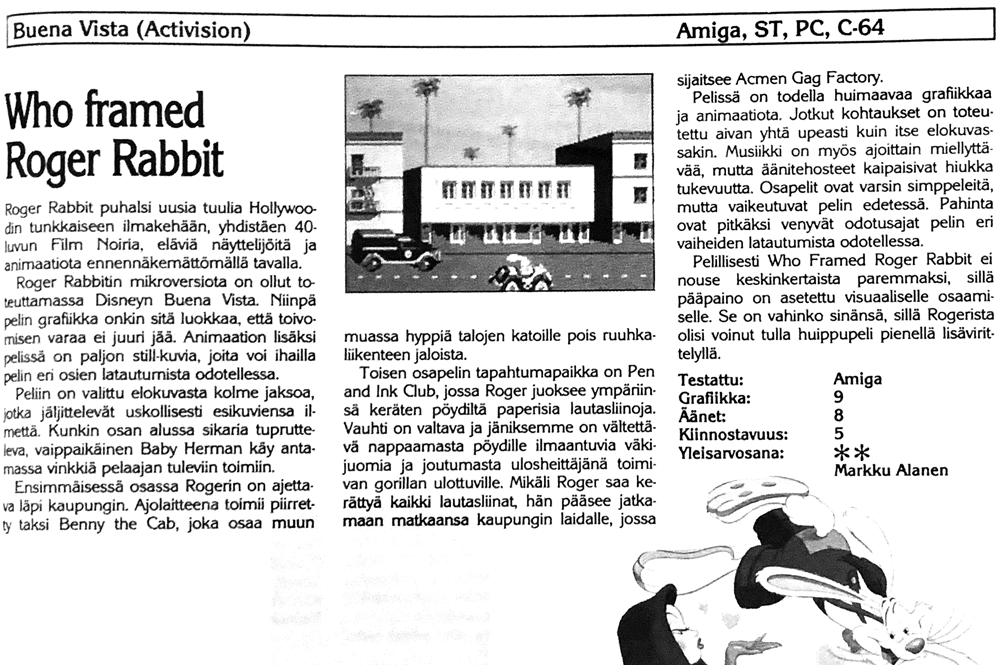
Who framed Roger Rabbit1989 SyksyPysyvä linkkiRoger Rabbit puhalsi uusia tuulia Hollywoodin tunkkaiseen ilmakehään, yhdistäen 40-luvun Film Noiria, eläviä näyttelijöitä ja animaatiota ennennäkemättömällä tavalla.
Roger Rabbitin mikroversiota on ollut toteuttamassa Disneyn Buena Vista. Niinpä pelin grafiikka onkin sitä luokkaa, että toivomisen varaa ei juuri jää. Animaation lisäksi pelissä on paljon still-kuvia, joita voi ihailla pelin eri osien latautumista odotellessa.
Peliin on valittu elokuvasta kolme jaksoa, jotka jäljittelevät uskollisesti esikuviensa ilmettä. Kunkin osan alussa sikaria tuprutteleva, vaippaikäinen Baby Herman käy antamassa vinkkiä pelaajan tuleviin toimiin.
Ensimmäisessä osassa Rogerin on ajettava läpi kaupungin. Ajolaitteena toimii piirretty taksi Benny the Cab, joka osaa muun muassa hyppiä talojen katoille pois ruuhkaliikenteen jaloista.
Toisen osapelin tapahtumapaikka on Pen and Ink Club, jossa Roger juoksee ympäriinsä keräten pöydiltä paperisia lautasliinoja. Vauhti on valtava ja jäniksemme on vältettävä nappaamasta pöydille ilmaantuvia väkijuomia ja joutumasta ulosheittäjänä toimivan gorillan ulottuville. Mikäli Roger saa kerättyä kaikki lautasliinat, hän pääsee jatkamaan matkaansa kaupungin laidalle, jossa sijaitsee Acmen Gag Factory.
Pelissä on todella huimaavaa grafiikkaa ja animaatiota. Jotkut kohtaukset on toteutettu aivan yhtä upeasti kuin itse elokuvassakin. Musiikki on myös ajoittain miellyttävää, mutta äänitehosteet kaipaisivat hiukka tukevuutta. Osapelit ovat varsin simppeleitä, mutta vaikeutuvat pelin edetessä. Pahinta ovat pitkäksi venyvät odotusajat pelin eri vaiheiden latautumista odotellessa.
Pelillisesti Who Framed Roger Rabbit ei nouse keskinkertaista paremmaksi, sillä pääpaino on asetettu visuaaliselle osaamiselle. Se on vahinko sinänsä, sillä Rogerista olisi voinut tulla huippupeli pienellä lisäviritelyllä.
Who framed Roger Rabbit1989 SyksyPermalinkRoger Rabbit blew fresh winds into Hollywood's stuffy atmosphere, combining 40s Film Noir, live actors and animation in a way never seen before.
The micro version of Roger Rabbit was put together by Disney's Buena Vista. So the game's graphics are of a class that leaves hardly anything to wish for. On top of the animation, the game has plenty of still pictures to admire while you wait for the various parts of the game to load.
Three sequences from the film have been picked for the game, and they faithfully copy the look of their originals. At the start of each part, the cigar-puffing Baby Herman, still in nappies, pops in to give the player a tip about what to do next.
In the first part Roger has to drive through the city. His ride is the cartoon taxi Benny the Cab, which can, among other things, jump up onto the rooftops, out of the way of the rush-hour traffic.
The second sub-game takes place at the Pen and Ink Club, where Roger runs around collecting paper napkins from the tables. The pace is tremendous, and our rabbit has to avoid grabbing the booze that pops up on the tables and getting within reach of the gorilla working as the bouncer. If Roger manages to collect all the napkins, he gets to continue his journey to the edge of town, where Acme's Gag Factory is located.
The game has truly dizzying graphics and animation. Some scenes have been done every bit as splendidly as in the film itself. The music is pleasant at times too, but the sound effects could use a bit more beef. The sub-games are fairly simple, but they get harder as the game goes on. Worst of all are the long, drawn-out waits while the various stages of the game load.
Gameplay-wise Who Framed Roger Rabbit doesn't rise above mediocre, since the main emphasis has been put on visual craft. That is a shame, really, since with a little more tuning Roger could have become a top game.
Wicked
Wicked1989 SyksyPysyvä linkkiOnpa kiva nähdä Activisionin löytäneen juurensa. Viimeaikaisten vaihtelevatasositen arcadekäännösten jälkeen ilmestyi nasta Millenium ja nyt tulee Wicked.
Wickedissä taistellaan läpi eläinradan tähtikuvioiden Pahan vartijoita vastaan pikku Hyvänä Aurinkona. Taistelukentällä on "portteja", joista leviää kasvustoja ympäristöön. Kasvuston tarkoitus on peittää Pahan portit ja tämä tapahtuu ampumalla Pahaa kasvustoa, joka muuttuu punaiseksi ja samalla Hyvän kasvualustaksi. Päivisin Hyvän portit tuottavat itiöitä, joista kasvaa uusia portteja ja öisin Pahan portit tekevät samaa. Kasvatusta haittaa Pahan vartija, jonka saa ammuttua vain päivisin, öisin örkki emuloi Teräsmiestä.
Haitallisia tai hyödyllisiä lisäominaisuuksia saa kentän keskeltä ilmestyvistä Tarot-korteista. Vaikutus ilmeisesti perustuu siihen, onko Hyvä vai Paha johdolla. Koko ikuisuutta ei yhteen kenttään voi tuhrata, sillä mikäli Paha ei nujerru aikarajan puitteissa, täyttää pahaitiöiden sankka joukko koko ruudun.
Itse peli on ihan kivan näköinen, vaikkeivat spritet ulkonäöllään tai animoinnillaan juuri säväytäkään. Sen sijaan alussa esiintyvä kaikkinäkevä silmä verikyyneleineen on hieno, kuten myös ruudun yli valuva veri Game Overin iskiessä. Ja veren jälkeen ilmestyy hauta, jonka tyynen pinnan rikkoo maan alta tuleva käsi.
Amiga- ja ST-versiot ovat graafisesti identtisiä, Amigan kuitenkin nokittaessa vahvasti tunnelmallisella musiikillaan. Wicked on oiva ja originelli peli, jonka pahin vika on samankaltaisuus kentästä toiseen. Suositellaan siitä huolimatta.
Wicked1989 SyksyPermalinkHow nice to see Activision has found its roots. After its recent arcade conversions of varying quality came the nifty Millenium, and now here comes Wicked.
In Wicked you fight your way through the constellations of the zodiac as a little Good Sun, against the guardians of Evil. On the battlefield there are "gates" from which growths spread into the surroundings. The point of the growth is to cover the gates of Evil, and this is done by shooting the Evil growth, which turns red and at the same time becomes a breeding ground for Good. By day the gates of Good produce spores that grow into new gates, and by night the gates of Evil do the same. The growing is hampered by the guardian of Evil, which can only be shot during the day; at night the orc emulates Superman.
Harmful or helpful extras come from Tarot cards that appear in the middle of the level. Their effect apparently depends on whether Good or Evil is in the lead. You can't fritter away a whole eternity on one level, because if Evil isn't crushed within the time limit, a dense swarm of evil spores fills the entire screen.
The game itself looks quite nice, even if the sprites hardly give you a thrill with their looks or their animation. The all-seeing eye with its tears of blood at the start, on the other hand, is superb, as is the blood trickling down the screen when Game Over strikes. And after the blood a grave appears, its calm surface broken by a hand reaching up from under the ground.
The Amiga and ST versions are graphically identical, though the Amiga pulls ahead with its intensely atmospheric music. Wicked is a fine and original game whose worst fault is its sameness from one level to the next. Recommended all the same.
Willow
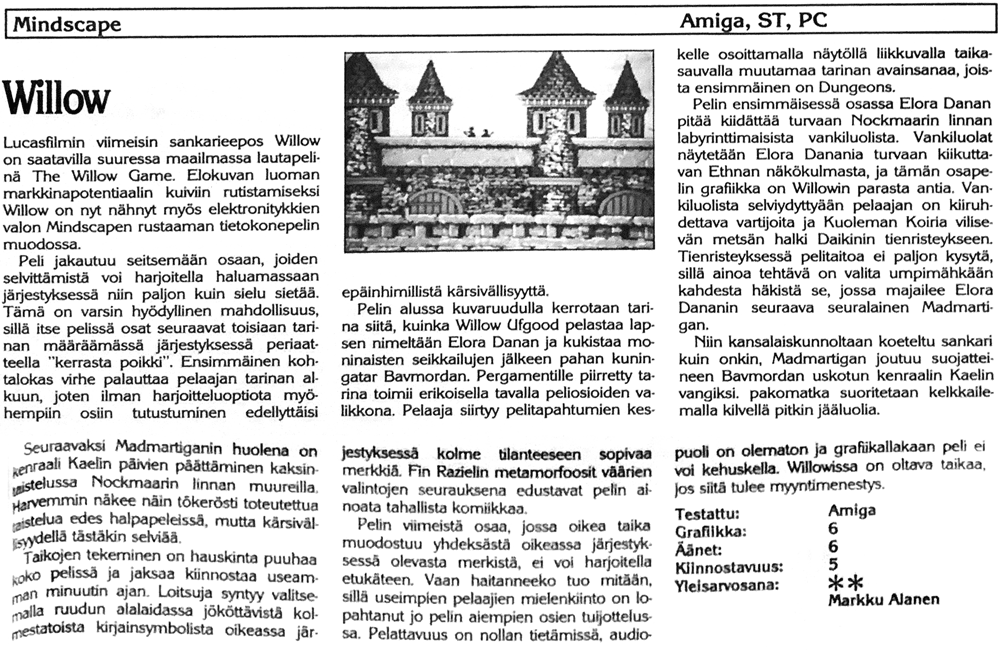
Willow1989 SyksyPysyvä linkkiLucasfilmin viimeisin sankarieepos Willow on saatavilla suuressa maailmassa lautapelinä The Willow Game. Elokuvan luoman markkinapotentiaalin kuiviin rutistamiseksi Willow on nyt nähnyt myös elektronitykkien valon Mindscapen rustaaman tietokonepelin muodossa.
Peli jakautuu seitsemään osaan, joiden selvittämistä voi harjoitella haluamassaan järjestyksessä niin paljon kuin sielu sietää. Tämä on varsin hyödyllinen mahdollisuus, sillä itse pelissä osat seuraavat toisiaan tarinan määräämässä järjestyksessä periaatteella "kerrasta poikki". Ensimmäinen kohtalokas virhe palauttaa pelaajan tarinan alkuun, joten ilman harjoitteluoptiota myöhempiin osiin tutustuminen edellyttäisi epäinhimillistä kärsivällisyyttä.
Pelin alussa kuvaruudulla kerrotaan tarina siitä, kuinka Willow Ufgood pelastaa lapsen nimeltään Elora Danan ja kukistaa moninaisten seikkailujen jälkeen pahan kuningatar Bavmordan. Pergamentille piirretty tarina toimii erikoisella tavalla peliosioiden valikkona. Pelaaja siirtyy pelitapahtumien keskelle osoittamalla näytöllä liikkuvalla taikasauvalla muutamaa tarinan avainsanaa, joista ensimmäinen on Dungeons.
Pelin ensimmäisessä osassa Elora Danan pitää kiidättää turvaan Nockmaarin linnan labyrinttimaisista vankiluolista. Vankiluolat näytetään Elora Danania turvaan kiikuttavan Ethnan näkökulmasta, ja tämän osapelin grafiikka on Willowin parasta antia. Vankiluolista selviydyttyään pelaajan on kiiruhdettava vartijoita ja Kuoleman Koiria vilisevän metsän halki Daikinin tienristeykseen. Tienristeyksessä pelitaitoa ei paljon kysytä, sillä ainoa tehtävä on valita umpimähkään kahdesta häkistä se, jossa majailee Elora Dananin seuraava seuralainen Madmartigan.
Niin kansalaiskunnoltaan koeteltu sankari kuin onkin, Madmartigan joutuu suojatteineen Bavmordan uskotun kenraalin Kaelin vangiksi. pakomatka suoritetaan kelkkailemalla kilvellä pitkin jääluolia. Seuraavaksi Madmartiganin huolena on kenraali Kaelin päivien päättäminen kaksintaistelussa Nockmaarin linnan muureilla. Harvemmin näkee näin tökerösti toteutettua taistelua edes halpapeleissä, mutta kärsivällisyydellä tästäkin selviää.
Taikojen tekeminen on hauskinta puuhaa koko pelissä ja jaksaa kiinnostaa useamman minuutin ajan. Loitsuja syntyy valitsemalla ruudun alalaidassa jököttävistä kolmestatoista kirjainsymbolista oikeassa järjestyksessä kolme tilanteeseen sopivaa merkkiä. Fin Razielin metamorfoosit väärien valintojen seurauksena edustavat pelin ainoata tahallista komiikkaa.
Pelin viimeistä osaa, jossa oikea taika muodostuu yhdeksästä oikeassa järjestyksessä olevasta merkistä, ei voi harjoitella etukäteen. Vaan haitanneeko tuo mitään, sillä useimpien pelaajien mielenkiinto on lopahtanut jo pelin aiempien osien tuijottelussa. Pelattavuus on nollan tietämissä, audiopuoli on olematon ja grafiikallakaan peli ei voi kehuskella. Willowissa on oltava taikaa, jos siitä tulee myyntimenestys.
Willow1989 SyksyPermalinkLucasfilm's latest heroic epic Willow is available out in the wide world as a board game, The Willow Game. To squeeze the market potential created by the film bone dry, Willow has now also seen the light of the electron guns, in the form of a computer game whipped up by Mindscape.
The game is split into seven parts, which you can practise getting through in any order you like, as much as your soul can stand. This is a very handy option, since in the game proper the parts follow each other in the order the story dictates, on a "one slip and you're done" basis. The first fatal mistake sends the player back to the start of the story, so without the practice option getting acquainted with the later parts would take inhuman patience.
At the start of the game the screen tells the story of how Willow Ufgood saves a child named Elora Danan and, after manifold adventures, overthrows the evil queen Bavmorda. The story, drawn on parchment, doubles in a peculiar way as the menu for the game sections. The player is moved into the thick of the action by pointing, with a magic wand that moves around the screen, at a few key words in the story, the first of which is Dungeons.
In the first part of the game Elora Danan must be whisked to safety from the labyrinthine dungeons of Nockmaar castle. The dungeons are shown from the point of view of Ethna, who is carrying Elora Danan to safety, and the graphics in this sub-game are the best Willow has to offer. Having made it out of the dungeons, the player has to hurry through a forest swarming with guards and Death Dogs to the Daikini crossroads. At the crossroads not much gaming skill is called for, since the only task is to pick, completely at random, which of two cages houses Elora Danan's next companion, Madmartigan.
Hero of thoroughly tested civic fitness though he may be, Madmartigan ends up, along with his charges, a prisoner of Bavmorda's trusted general Kael. The escape is made by sledding on a shield through ice caves. Next, Madmartigan's worry is putting an end to general Kael's days in a duel on the walls of Nockmaar castle. You rarely see such clumsily done combat even in budget games, but with patience you'll get through this too.
Casting spells is the most fun thing to do in the whole game, and it manages to hold your interest for several minutes on end. Spells are created by picking, in the right order, three symbols suited to the situation from the thirteen letter symbols squatting at the bottom of the screen. Fin Raziel's metamorphoses as a result of wrong choices represent the game's only intentional comedy.
The last part of the game, where the correct spell is made up of nine symbols in the right order, can't be practised beforehand. Not that that is likely to bother anyone, since most players' interest will already have fizzled out while staring at the earlier parts of the game. Playability is somewhere around zero, the audio side is nonexistent and the game has nothing to boast about in the graphics department either. There will have to be magic in Willow if it is to become a sales success.
Wing Commander
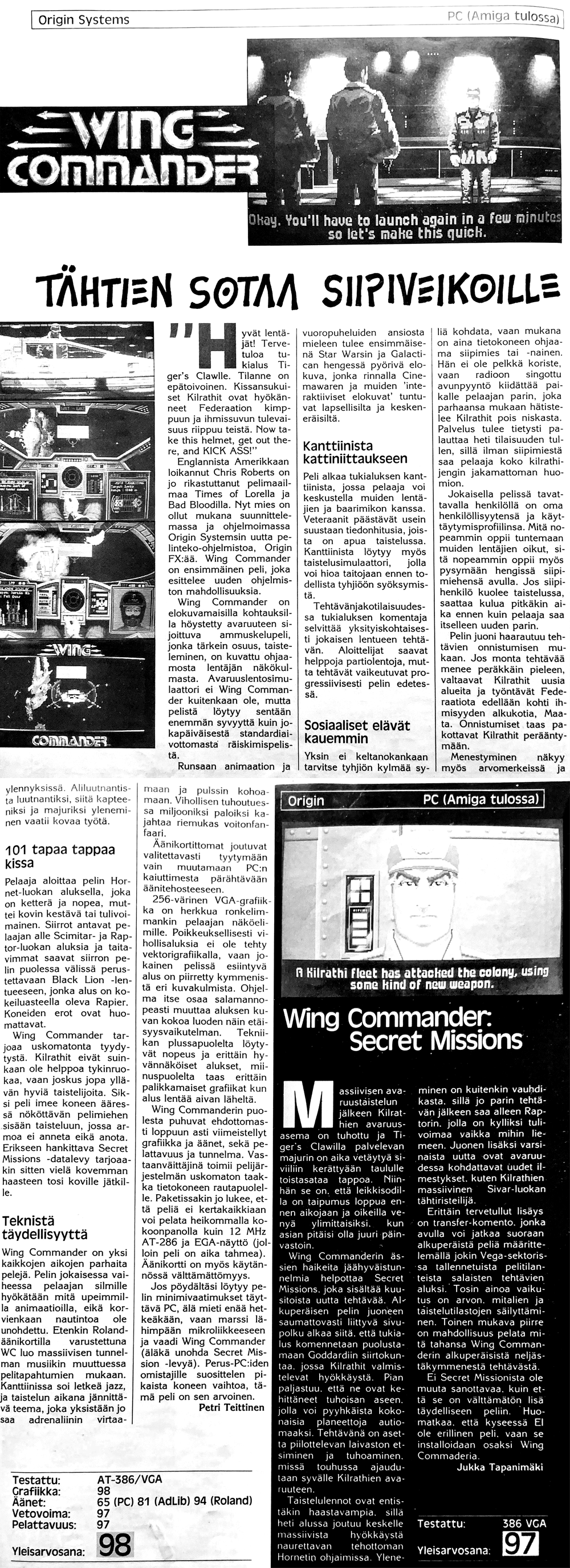
Wing Commander1991 KevätPysyvä linkki"Hyvät lentäjät! Tervetuloa tukialus Tiger's Clawlle. Tilanne on epätoivoinen. Kissansukuiset Kilrathit ovat hyökänneet Federaation kimppuun ja ihmissuvun tulevaisuus riippuu teistä. Now take this helmet, get out there, and KICK ASS!"
Englannista Amerikkaan loikannut Chris Roberts on jo rikastuttanut pelimaailmaa Times of Lorella ja Bad Bloodilla. Nyt mies on ollut mukana suunnittelemassa ja ohjelmoimassa Origin Systemsin uutta pelinteko-ohjelmistoa, Origin FX:ää. Wing Commander on ensimmäinen peli, joka esittelee uuden ohjelmiston mahdollisuuksia.
Wing Commander on elokuvamaisilla kohtauksilla höystetty avaruuteen sijoittuva ammuskelupeli, jonka tärkein osuus, taisteleminen, on kuvattu ohjaamosta lentäjän näkökulmasta. Avaruuslentosimulaattori ei Wing Commander kuitenkaan ole, mutta pelistä löytyy sentään enemmän syvyyttä kuin jokapäiväisestä standardiaivottomasta räiskimispelistä.
Runsaan animaation ja vuoropuheluiden ansiosta mieleen tulee ensimmäisenä Star Warsin ja Galactican hengessä pyörivä elokuva, jonka rinnalla Cinemawaren ja muiden 'interaktiiviset elokuvat' tuntuvat lapsellisilta ja keskeneräisiltä.
Kanttiinista kattiniittaukseen
Peli alkaa tukialuksen kanttiinista, jossa pelaaja voi keskustella muiden lentäjien ja baarimikon kanssa. Veteraanit päästävät usein suustaan tiedonhitusia, joista on apua taistelussa. Kanttiinista löytyy myös taistelusimulaattori, jolla voi hioa taitojaan ennen todellista tyhjiöön syöksymistä.
Tehtävänjakotilaisuudessa tukialuksen komentaja selvittää yksityiskohtaisesti jokaisen lentueen tehtävän. Aloittelijat saavat helppoja partiolentoja, mutta tehtävät vaikeutuvat progressiivisesti pelin edetessä.
Sosiaaliset elävät kauemmin
Yksin ei keltanokankaan tarvitse tyhjiön kylmää syliä kohdata, vaan mukana on aina tietokoneen ohjaama siipimies tai -nainen. Hän ei ole pelkkä koriste, vaan radioon singottu avunpyyntö kiidättää paikalle pelaajan parin, joka parhaansa mukaan hätistelee Kilrathit pois niskasta. Palvelus tulee tietysti palauttaa heti tilaisuuden tullen, sillä ilman siipimiestä saa pelaaja koko kilrathijengin jakamattoman huomion.
Jokaisella pelissä tavattavalla henkilöllä on oma henkilöllisyytensä ja käyttäytymisprofiilinsa. Mitä nopeammin oppii tuntemaan muiden lentäjien oikut, sitä nopeammin oppii myös pysymään hengissä siipimiehensä avulla. Jos siipihenkilö kuolee taistelussa, saattaa kulua pitkäkin aika ennen kuin pelaaja saa itselleen uuden parin.
Pelin juoni haarautuu tehtävien onnistumisen mukaan. Jos monta tehtävää menee peräkkäin pieleen, valtaavat Kilrathit uusia alueita ja työntävät Federaatiota edellään kohti ihmisyyden alkukotia, Maata. Onnistumiset taas pakottavat Kilrathit perääntymään.
Menestyminen näkyy myös arvomerkeissä ja ylennyksissä. Aliluutnantista luutnantiksi, siitä kapteeniksi ja majuriksi yleneminen vaatii kovaa työtä.
101 tapaa tappaa kissa
Pelaaja aloittaa pelin Hornet-luokan aluksella, joka on ketterä ja nopea, muttei kovin kestävä tai tulivoimainen. Siirrot antavat pelaajan alle Scimitar- ja Raptor-luokan aluksia ja taitavimmat saavat siirron pelin puolessa välissä perustettavaan Black Lion -lentueeseen, jonka alus on kokeiluasteella oleva Rapier. Koneiden erot ovat huomattavat.
Wing Commander tarjoaa uskomatonta tyydytystä. Kilrathit eivät suinkaan ole helppoa tykinruokaa, vaan joskus jopa yllävän hyviä taistelijoita. Siksi peli imee koneen ääressä nököttävän pelimiehen sisään taisteluun, jossa armoa ei anneta eikä anota. Erikseen hankittava Secret Missions -datalevy tarjoaakin sitten vielä kovemman haasteen tosi koville jätkille.
Teknistä täydellisyyttä
Wing Commander on yksi kaikkojen aikojen parhaita pelejä. Pelin jokaisessa vaiheessa pelaajan silmille hyökätään mitä upeimmilla animaatioilla, eikä korvienkaan nautintoa ole unohdettu. Etenkin Roland-äänikortilla varustettuna WC luo massiivisen tunnelman musiikin muuttuessa pelitapahtumien mukaan. Kanttiinissa soi letkeä jazz, ja taistelun aikana jännittävä teema, joka yksistään jo saa adrenaliinin virtaamaan ja pulssin kohoamaan. Vihollisen tuhoutuessa miljooniksi paloiksi kajahtaa riemukas voitonfanfaari.
Äänikortittomat joutuvat valitettavasti tyytymään vain muutamaan PC:n kaiuttimesta pärähtävään äänitehosteeseen.
256-värinen VGA-grafiikka on herkkua ronkelimmankin pelaajan näköelimille. Poikkeuksellisesti vihollisaluksia ei ole tehty vektorigrafiikalla, vaan jokainen pelissä esiintyvä alus on piirretty kymmenistä eri kuvakulmista. Ohjelma itse osaa salamannopeasti muuttaa aluksen kuvan kokoa luoden näin etäisyysvaikutelman. Tekniikan plussapuolelta löytyvät nopeus ja erittäin hyvännäköiset alukset, miinuspuolelta taas erittäin palikkamaiset grafiikat kun alus lentää aivan läheltä.
Wing Commanderin puolesta puhuvat ehdottomasti loppuun asti viimeistellyt grafiikka ja äänet, sekä pelattavuus ja tunnelma. Vastaanväittäjinä toimii pelijärjestelmän uskomaton taakka tietokoneen rautapuolelle. Paketissakin jo lukee, että peliä ei kertakaikkiaan voi pelata heikommalla kokoonpanolla kuin 12 MHz AT-286 ja EGA-näyttö (jolloin peli on aika tahmea). Äänikortti on myös käytännössä välttämättömyys.
Jos pöydältäsi löytyy pelin minimivaatimukset täyttävä PC, älä mieti enää hetkeäkään, vaan marssi lähimpään mikroliikkeeseen ja vaadi Wing Commander (äläkä unohda Secret Mission -levyä). Perus-PC:iden omistajille suosittelen pikaista koneen vaihtoa, tämä peli on sen arvoinen.
Wing Commander1991 KevätPermalink"Pilots! Welcome aboard the carrier Tiger's Claw. The situation is desperate. The feline Kilrathi have attacked the Federation and the future of the human race depends on you. Now take this helmet, get out there, and KICK ASS!"
Chris Roberts, who defected from England to America, has already enriched the gaming world with Times of Lore and Bad Blood. Now the man has been involved in designing and programming Origin Systems' new game-making software, Origin FX. Wing Commander is the first game to show off what the new software can do.
Wing Commander is a space-set shoot-'em-up spiced up with cinematic scenes, whose most important part, the fighting, is shown from the cockpit from the pilot's point of view. Wing Commander isn't a space flight simulator, though, but there's still more depth to it than to your everyday standard-issue brainless blaster.
Thanks to the abundant animation and dialogue, the first thing that comes to mind is a film rolling along in the spirit of Star Wars and Galactica, next to which the 'interactive movies' of Cinemaware and the rest feel childish and half-finished.
From canteen to cat-culling
The game begins in the carrier's canteen, where the player can chat with the other pilots and the bartender. The veterans often let slip scraps of information that come in handy in combat. The canteen also has a combat simulator for honing your skills before the real plunge into the vacuum.
At the briefing, the carrier's commander explains each squadron's mission in detail. Beginners get easy patrol flights, but the missions get progressively harder as the game goes on.
The sociable live longer
Not even a greenhorn has to face the cold embrace of the vacuum alone: there's always a computer-controlled wingman or -woman along. This partner is no mere decoration, either: a call for help flung over the radio sends them racing to the scene to do their best to shoo the Kilrathi off the player's neck. The favour must of course be returned at the first opportunity, since without a wingman the player gets the undivided attention of the whole kilrathi gang.
Every character you meet in the game has their own identity and behaviour profile. The sooner you get to know the other pilots' quirks, the sooner you also learn to stay alive with your wingman's help. If your wingperson dies in combat, it can be quite a long time before the player gets a new partner.
The plot branches according to how the missions go. If lots of missions go wrong in a row, the Kilrathi seize new territory and push the Federation back before them towards humanity's original home, Earth. Successes, on the other hand, force the Kilrathi to retreat.
Success also shows in rank insignia and promotions. Rising from second lieutenant to lieutenant, from there to captain and major, takes hard work.
101 ways to kill a cat
The player starts the game in a Hornet-class ship, which is agile and fast but not very tough or heavily armed. Transfers put Scimitar- and Raptor-class ships under the player, and the most skilled get transferred to the Black Lion squadron, formed halfway through the game, whose ship is the experimental Rapier. The differences between the craft are considerable.
Wing Commander offers incredible satisfaction. The Kilrathi are by no means easy cannon fodder; sometimes they're even surprisingly good fighters. That's why the game sucks the gamer perched at the computer right into a battle where no quarter is given or asked. And the separately sold Secret Missions data disk then offers an even tougher challenge for the really hard guys.
Technical perfection
Wing Commander is one of the best games of all time. At every stage of the game the player's eyes are assaulted with the most gorgeous animations, and the pleasure of the ears hasn't been forgotten either. Especially when equipped with a Roland sound card, WC creates a massive atmosphere, with the music changing to match events in the game. Laid-back jazz plays in the canteen, and during combat an exciting theme that on its own gets the adrenaline flowing and the pulse racing. When an enemy is blown into a million pieces, a jubilant victory fanfare rings out.
Those without a sound card will unfortunately have to make do with just a few sound effects blurting out of the PC speaker.
The 256-colour VGA graphics are a treat for the visual organs of even the fussiest player. Unusually, the enemy ships aren't done with vector graphics; instead, every ship in the game has been drawn from dozens of different angles. The program itself can resize the ship's image at lightning speed, creating an impression of distance. On the plus side of the technique are speed and extremely good-looking ships; on the minus side, extremely blocky graphics when a ship flies really close.
Speaking in Wing Commander's favour are, without question, the graphics and sound, polished to the very end, plus the playability and atmosphere. Arguing against is the incredible burden the game system puts on the hardware side of the computer. It says right on the box that the game simply cannot be played on anything weaker than a 12 MHz AT-286 with an EGA display (and even then the game is pretty sluggish). A sound card is also practically a necessity.
If there's a PC on your desk that meets the game's minimum requirements, don't think about it for another second: march to your nearest computer shop and demand Wing Commander (and don't forget the Secret Mission disk). To owners of basic PCs I recommend a swift change of machine; this game is worth it.
Wing Commander
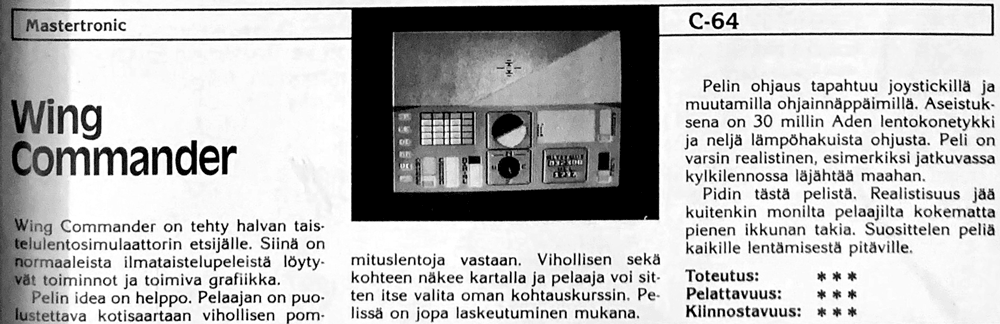
Wing Commander1987Pysyvä linkkiWing Commander on tehty halvan taistelulentosimulaattorin etsijälle. Siinä on normaaleista ilmataistelupeleistä löytyvät toiminnot ja toimiva grafiikka.
Pelin idea on helppo. Pelaajan on puolustettava kotisaartaan vihollisen pommituslentoja vastaan. Vihollisen sekä kohteen näkee kartalla ja pelaaja voi sitten itse valita oman kohtauskurssin. Pelissä on jopa laskeutuminen mukana.
Pelin ohjaus tapahtuu joystickillä ja muutamilla ohjainnäppäimillä. Aseistuksena on 30 millin Aden lentokonetykki ja neljä lämpöhakuista ohjusta. Peli on varsin realistinen, esimerkiksi jatkuvassa kylkilennossa läjähtää maahan.
Pidin tästä pelistä. Realistisuus jää kuitenkin monilta pelaajilta kokematta pienen ikkunan takia. Suosittelen peliä kaikille lentämisestä pitäville.
Wing Commander1987PermalinkWing Commander is made for anyone looking for a cheap combat flight simulator. It has the functions found in normal air combat games and graphics that do the job.
The idea of the game is simple. The player has to defend their home island against enemy bombing raids. Both the enemy and the target can be seen on a map, and the player can then pick their own intercept course. The game even includes landing.
The game is controlled with a joystick and a few control keys. The armament is a 30 mm Aden aircraft cannon and four heat-seeking missiles. The game is quite realistic: for example, if you keep flying on your side you go splat into the ground.
I liked this game. Many players, however, will miss out on the realism because of the small window. I recommend the game to everyone who likes flying.
Wing Commander - Secret Missions 2: Crusade
Wing Commander - Secret Missions 2: Crusade1991 SyksyPysyvä linkkiIskutukialus TCS Tiger's Clawn juuri ja juuri selviydyttyä operaatio Thor's Hammerista (edellinen Secret Missions) on päämaja antanut alukselle diplomaattitehtävän. Sen tulee saattaa muutama laivalastillinen poliitikkoja konfederaation uusimpien liittolaisten vieraiksi vahvistamaan sopimuksia, samalla olisi kovia kokeneen miehistönkin tarkoitus päästä muutaman päivän rantalomalle.
Ikävä kyllä kilrathien soturikultin joka vuosi eri paikassa pidettävä seremonia sattuu juuri kyseisten liittolaisten planeetalle. Pitkin rintamaa kilrathien laivastot vetäytyvät ja suuntaavat planeetalle. Juhlan edellytyksenä tietysti on, ettei paikalla ole vääräuskoisia, ja kun näiden liittolaisten teknologia on vielä siellä kivikauden tienoilla siirtyy rantaloma hamaan tulevaisuuteen.
Origin on ylittänyt itsensä. Crusade on muutakin kuin "vain" 16 uutta tehtävää. Kilrathi-pilottien tekoälyä on parannettu huimasti, ja varsinkin keisarin Drakhai-eliittikaartin aluksista saa uskomattoman kovan vastuksen.
Kilrathit ovat saaneet kaksi uutta alustyyppiä: Snakeir-luokan lentotukialuksia ja Hhriss-luokan hävittäjiä, jotka tuntuvat yhtä ketteriltä kuin Salthit, mutta on aseistettu neljällä massdriver-tykillä lasereiden ja neutronitykkien lisäksi, ja joilla tuntuu olevan panssareita vaikka muille jakaa. Lisäksi vanha kunnon savikiekko Dralthi on saanut paremmat suojat ja varustettu massdrivereillä. Myöskin ohjusten tehoa on parannettu ja yksikin sellainen riittää pyyhkäisemään suojat jopa Raptorista. Toinen voi jo koitua kohtaloksi. Tämän lisäksi viholliset ovat oppineet väistelemään ja varsinkin Drakhai-soturien lentämiin Hhriss-hävittäjiin tuntuu aluksi olevan mahdotonta osua tykeillä tai ohjuksilla.
Pelin alkuvaiheissa ryhmä Kilrathi-loikkareita lahjoittaa konfederaation käyttöön parikymmentä Dralthi Mk2:sta, ja sellaisella pelaajakin pääsee lentämään muutaman tehtävän. Tämä on varsin mielenkiintoista, sillä niillä on mahdollista hiipiä vastaantulevien Kilrathi-alusten taakse ja tuhota yksi ennen kuin muut huomaavat, että jokin on vialla.
Messissä tutuksi tullutta porukkaa kaatuu taisteluissa kuin heinää pelaajan voimatta mitenkään vaikuttaa asiaan. Mutta onneksi Tiger's Clawn sisaralukselta lähetetään pari hyyppää täydennysmiehistöksi.
Transfer-ohjelma toimii tietysti tässäkin ja omat pudotustilastoni nousevat jo sinne viiden sadan pintaan (häpeä Richthofen). Jos pelaaja kunnostautuu oikein viimeisen päälle antaa päällikkö lupauksen ylentää hänet kalifiksi kalifin paikalle, eli aluksen hävittäjälentueen komentajaksi eversti Halcyonin tilalle, joka saa ylennyksen taktiikkaosastoon.
Mitäpä tässä muuta, Pakko-ostos, mutta senhän Wing Commander -veteraanit tietävät muutenkin.
Wing Commander - Secret Missions 2: Crusade1991 SyksyPermalinkWith the strike carrier TCS Tiger's Claw having only just scraped through Operation Thor's Hammer (the previous Secret Missions), headquarters has given the ship a diplomatic assignment. It is to escort a few shiploads of politicians on a visit to the Confederation's newest allies to ratify treaties, and at the same time the crew, who have been through the mill, are supposed to get a few days' shore leave.
Unfortunately the Kilrathi warrior cult's ceremony, held in a different place every year, happens to fall on precisely those allies' planet. All along the front the Kilrathi fleets pull back and head for the planet. A precondition for the celebration is of course that no infidels be present, and since these allies' technology is still somewhere around the Stone Age, the shore leave gets postponed to the distant future.
Origin has outdone itself. Crusade is more than "just" 16 new missions. The AI of the Kilrathi pilots has been improved enormously, and the ships of the Emperor's Drakhai elite guard in particular put up unbelievably tough opposition.
The Kilrathi have got two new ship types: Snakeir-class carriers and Hhriss-class fighters, which feel as nimble as Salthis but are armed with four massdriver cannons on top of lasers and neutron guns, and which seem to have armour to spare. In addition, that good old clay pigeon the Dralthi has been given better shields and fitted with massdrivers. Missiles have been made more powerful too, and just one is enough to sweep the shields off even a Raptor. A second one may well prove fatal. On top of this the enemies have learned to take evasive action, and the Hhriss fighters flown by the Drakhai warriors in particular seem at first impossible to hit with guns or missiles.
Early in the game a group of Kilrathi defectors hands over a score or so Dralthi Mk2s to the Confederation, and the player too gets to fly a few missions in one. This is rather interesting, since in them you can sneak up behind oncoming Kilrathi ships and destroy one before the others notice that something is wrong.
Faces you've come to know in the mess drop like flies in battle, and there is nothing whatsoever the player can do about it. But luckily a couple of chaps are sent over from the Tiger's Claw's sister ship as replacement crew.
The Transfer program works here too, of course, and my own kill stats are already up around the five hundred mark (shame on you, Richthofen). If the player really distinguishes themselves to the utmost, the commander promises to make them Caliph instead of the Caliph, that is, commander of the ship's fighter wing in place of Colonel Halcyon, who gets promoted to the tactical department.
What more is there to say: a Must-Buy, but Wing Commander veterans know that anyway.
Wing Commander II: Vengeance of the Kilrathi
Wing Commander II: Vengeance of the Kilrathi1991 SyksyPysyvä linkkiTCS Tiger's Claw lähestyy kilrathien komentokeskusta, kun tyhjästä ilmestyy kolme tunnistamatonta alusta, jotka laukaisevat ohjusparven ennen kuin Tiger's Clawlla ehtii ensimmäinenkään purkka pudota. Tiger's Clawn kolme peliä kestänyt ura päättyy valtaisaan tulipalloon.
Ja niin olisi päättynyt minunkin, jollen olisi ollut partiolennolla. Valitettavasti toimintahäiriön vuoksi alukseni kamera ei tallentanut ihmehävittäjiä, ja minua pidetään syyllisenä Tiger's Clawn tuhoon. Eli kuten amiraali Tolwyn asian ilmaisi: "Stealth-hävittäjiä, aasi! Eroanomuksestanne puuttuu vain allekirjoitus, ja suosittelen että se sinne ilmestyy, KAPTEENI Nirvi!"
En suostu, ja saan siirron lähinnä rannikkovartiostoa vastaavaan instanssiin, jossa vaarallisin avaruudessa lentävä esine on vetyatomi. Seuraavat kymmenen vuotta kuluvat paperiliitinketjuja rakennellessa ja satunnaisilla partiolennoilla, kunnes eräällä kerralla tutkassa näkyy jotain muutakin kuin asteroidin rippeitä.
Wing Commander II on hylännyt ykkösen haarautuvan linjan ja tyytyy täysin lineaariseen juoneen. Tämä näkyy muun muassa siinä, että jos tehtävästä ei selviä hengissä, saa joko yrittää uudestaan tai heittää pyyhkeen kehään. Vastapainoksi pelaaja saakin pääosan mielenkiintoisessa tieteiselokuvassa. Pikku hiljaa jännitys kiristyy, pinna kiristyy ja tahti kiristyy.
Muutosten tuulet
Varsinainen animaationpätkien väliin jäävä peli ei ole pahemmin muuttanut luonnettaan. Pieniä parannuksia on tehty tutkaan, ja yksinkertaisena mutta tervetulleena oivalluksena ohjuksen LOCK-valo välähtelee sitä tiuhemmin mitä lähempänä ohjus on. Siitä on suurempi apu kuin uskoisi. Muutama alus on varustettu ITS-järjestelmällä eli tietokone näyttää mihin pitää ampua, jotta kissoilta lähtee kaikki yhdeksän henkeä. Myös vetosäde Sabressa ja Broadswordissa on uutuus.
Siipimiehetkin ovat oppineet lentämään ja isot alukset osaavat jo puolustautua. Vastapainoksi kilrathit on varustettu dynaamisella älykkyydellä, eli mitä paremmin sinä lennät sen paremmin lentävät kilrathit. Näin väittää valmistaja, käytännössä en kyllä huomannut mitään.
Suurin muutos on Replay-mahdollisuus, eli vihdoinkin voi ihailla itseään taistelun tuoksinassa ja hyödyntää erilaiset kuvakulmat. Sääli sinänsä, että suorituksia ei saa tallennettua ja muutenkin replay on aika alkeellinen verrattuna mihin tahansa muuhun sen tarjoavaan peliin.
Siinä missä Secret Missions I & II oli ilmiselvästi tarkoitettu kokeneille Wing Commander -veteraaneille, kakkosessa pärjää uusikin pilottikokelas tehtävien pikku hiljaa vaikeutuessa. Muutama tehtävä tosin antaa ässäpilotillekin kevyen hikisilauksen. Veteraanit saavat luonnollisesti vanhan hahmonsa tappotiliään kasvattamaan.
Uudet lelut
Kun kymmenen vuotta kerran on kulunut, niin kalustokin on uusittu. Konfederaation uusia aluksia ovat muun muassa partiohävittäjä P-64C Ferret, sen raskaampi versio F-54C Epee, vanha tuttu keskiraskas F-44G Rapier, taka-ampumolla varustettu raskas F-57A Sabre ja raskas pommittaja A-17D Broadsword. Jälkimmäinen poikkeaa vinhasti tutuista leijoista: ei thrusteria, mutta hyppymoottorit ja kolme ampumoa. Broadsword on hidas ja kankea, mutta äärimmäisen kestävä ja sillä on massiivinen tulivoima.
Isoihin aluksiin kuulvuvat Gilgamesh-luokan hävittäjä, Waterloo-luokan risteilijä, Confederation-luokan lentotukialus (emoaluksesi TCS Concordia) sekä Free Trader- ja Clydesdale -luokan kuljetusalukset.
Uusia aseita sen sijaan ei ole kuin torpedo, jonka massiivista tuhovoimaa ei voi käyttää kuin isoja aluksia vastaan, mikäli selviää hengissä niin kauan, että ne lukittuvat.
Kilrathit ovat myös uusineet kalustonsa täysin. Löytyy kevyt hävittäjä Sartha, keskiraskas Drakhri, raskaat taka-ampumolla varustetut Jalkehi ja Grikath. Ja rikkana rokassa varsinainen riesa: stealth-hävittäjät, jotka ovat näkyvissä vain ampuessaan. Isoja aluksia edustavat korvetti Kamekh, hävittäjä Ralatha, risteilijä Fraltha sekä kuljetusalus Dorkathi.
Wow!
Graafisesti ei WC II edeltäjästään juuri eroa muuten kuin animaatiopätkien määrässä. Origin on hylännyt kaikki itkut ja rukoukset kiintolevytilan säästämisestä ja peli sisältää runsaasti kertakäyttöisiä animaationpätkiä. Tyylikkäät laukaisu- ja telakointianimaatiot tietysti vaihtuvat sen mukaan mistä pilotti kulloinkin sattuu operoimaan.
Perus-Wing Commander II sisältää rutkasti uutta, tilanteen mukaan vaihtelevaa musiikkia, mutta mikä tärkeintä se myös puhuu, valitettavasti vain alkudemon verran (puhetta saa vain Soundblasterilla). WC Speech Packilla sitten siipimiesten ja kilrathien kommentitkin tulevat kaiuttimista, kuten myös alkudemon loput puheet ja pari välidemoa. Mikäli raha ja laitekapasiteetti riittää, kannattaa myös Speech Pack hankkia.
TINSTAFL-periaate
Heinleinin kuuluista laki:"There is no such thing as free lunch" (Ei ole olemassa ilmaista lounasta.) pitää erikoisen hyvin paikkansa, sillä WC II viis veisaa kevyemmän tason PC-koneista. Maksimaaliseen tyydytykseen vaaditaan laitekokoonpanoksi DOS 5.0:lla varustettu nopsa 386/486, josta VGA-näytön lisäksi löytyy Rolandin äänikortti musiikkia ja efektejä varten ja Soundblaster-äänikortti puhetta varten. Kiintolevy menettää 15 megatavua tilastaan tai puhepaketin kanssa hulppeat 21 megaa. Tämän jälkeen kateudesta vihreitä naapurinpoikia tosin saakin kottikärryillä dumpata takapihan kompostiin.
Minimikokoonpano vaatii vähintäänkin tavallista vauhdikkaamman 286:n, mutta siitäkin on syytä löytyä pari megaa ylimääräistä muistia.
Wing Commander II: The Vengeance Of Kilrathi on kuin orava. Se nappaa pelaajaa kiinni, puree hampaansa yhteen eikä suostu päästämään irti ennen kuin kilrathien Enigma-sketorin päämaja on paloina. Mikäli rahkeet kestävät, ei Wing Commander II:n ostolta ole mitään perusteltua syytä välttyä. Ensimmäisen lisätehtäväpaketinkin pitäisi tulla jo tämän vuoden puolella.
Pakolla itseni rutkuttamiseen pakottaen saan kuitenkin todettua, että kohtalainenkin pilotti saa pelin läpi muutamassa päivässä eikä WC2 pelillisesti ole mikän jättiloikka eteenpäin ykkösestä.
Wing Commander II: Vengeance of the Kilrathi1991 SyksyPermalinkTCS Tiger's Claw is approaching the Kilrathi command centre when out of nowhere three unidentified ships appear and launch a swarm of missiles before anyone aboard the Tiger's Claw has had time to so much as drop their gum. The Tiger's Claw's career, three games long, ends in a massive fireball.
And so would mine have, had I not been out on patrol. Unfortunately, owing to a malfunction my ship's camera didn't record the wonder fighters, and I am held to blame for the destruction of the Tiger's Claw. Or as Admiral Tolwyn put it: "Stealth fighters, you ass! Your letter of resignation lacks only a signature, and I suggest it appears there, CAPTAIN Nirvi!"
I refuse, and get a transfer to an outfit roughly equivalent to the coast guard, where the most dangerous object flying in space is a hydrogen atom. The next ten years go by building paper-clip chains and flying the odd patrol, until one time something besides scraps of asteroid shows up on the radar.
Wing Commander II has abandoned the first game's branching storyline and settles for a completely linear plot. Among other things this shows in that if you don't come out of a mission alive, you can either try again or throw in the towel. In return, though, the player gets the lead role in an interesting science fiction film. Little by little the suspense tightens, the nerves tighten and the pace tightens.
Winds of Change
The actual game, the bit left in between the animation sequences, hasn't much changed its nature. Small improvements have been made to the radar, and in a simple but welcome stroke of insight the missile LOCK light flashes faster the closer the missile is. It helps more than you'd think. A few ships are fitted with the ITS system, meaning the computer shows where you have to shoot to make the cats lose all nine lives. The tractor beam in the Sabre and the Broadsword is also new.
Even the wingmen have learned to fly, and the big ships now know how to defend themselves. To balance that, the Kilrathi have been equipped with dynamic intelligence, meaning the better you fly, the better the Kilrathi fly. So the manufacturer claims; in practice I can't say I noticed anything.
The biggest change is the Replay option, so at long last you can admire yourself in the heat of battle and make use of the various camera angles. A pity, though, that you can't save your performances, and in general the replay is pretty primitive compared with any other game that offers one.
Whereas Secret Missions I & II were blatantly aimed at seasoned Wing Commander veterans, in the sequel even a brand-new pilot cadet will cope, as the missions get harder bit by bit. A few missions will, mind you, give even an ace pilot a light glaze of sweat. Veterans naturally get to bring along their old character to pad its kill tally.
New Toys
Since ten years have gone by, the hardware has been renewed as well. The Confederation's new ships include the P-64C Ferret patrol fighter, its heavier version the F-54C Epee, the old familiar medium F-44G Rapier, the heavy F-57A Sabre with its rear turret and the A-17D Broadsword heavy bomber. The last of these is wildly different from the familiar kites: no thruster, but jump engines and three turrets. The Broadsword is slow and stiff, but extremely durable and it packs massive firepower.
The big ships include the Gilgamesh-class destroyer, the Waterloo-class cruiser, the Confederation-class carrier (your mother ship, TCS Concordia) and the Free Trader and Clydesdale class transports.
New weapons, on the other hand, there are none apart from the torpedo, whose massive destructive power can only be used against big ships, provided you survive long enough for the torpedoes to lock on.
The Kilrathi have also completely renewed their hardware. There's the light fighter Sartha, the medium Drakhri, and the heavy Jalkehi and Grikath with rear turrets. And the fly in the ointment, a real pest: stealth fighters, which are visible only while they fire. The big ships are represented by the corvette Kamekh, the destroyer Ralatha, the cruiser Fraltha and the transport Dorkathi.
Wow!
Graphically WC II hardly differs from its predecessor except in the number of animation sequences. Origin has dismissed all the wailing and pleading about saving hard disk space, and the game contains a wealth of single-use animation sequences. The stylish launch and docking animations naturally change depending on where the pilot happens to be operating from at the time.
The basic Wing Commander II contains heaps of new music that changes with the situation, but most importantly it also talks, sadly only for the length of the intro demo (speech only with a Soundblaster). With the WC Speech Pack the wingmen's and the Kilrathi's comments also come out of the speakers, as do the rest of the intro demo's speech and a couple of cutscenes. If your money and your hardware can stretch that far, the Speech Pack is worth getting too.
The TINSTAFL principle
Heinlein's famous law: "There is no such thing as free lunch" (in other words, there's no free lunch) holds especially true, since WC II doesn't give a hoot about lower-end PCs. For maximum satisfaction the required configuration is a nippy 386/486 with DOS 5.0, which besides a VGA display also has a Roland sound card for music and effects and a Soundblaster sound card for speech. The hard disk loses 15 megabytes of its space, or with the speech pack a whopping 21 megs. After that, though, you do get to wheelbarrow the neighbours' boys, green with envy, out to the compost heap in the backyard.
The minimum configuration calls for at least a faster-than-average 286, and even that had better have a couple of megs of extra memory.
Wing Commander II: The Vengeance Of Kilrathi is like a squirrel. It grabs hold of the player, clamps its teeth shut and refuses to let go until the Kilrathi headquarters in the Enigma sector lies in pieces. If your finances can take it, there is no sound reason to pass up buying Wing Commander II. The first additional mission pack should be out before the end of this year.
Forcibly forcing myself to grumble, I nevertheless manage to point out that even a middling pilot will get through the game in a few days, and gameplay-wise WC2 is no giant leap forward from the first game.
Wing Commander: Secret Missions
Wing Commander: Secret Missions1991 KevätPysyvä linkkiMassiivisen avaruustaistelun jälkeen Kilrathien avaruusasema on tuhottu ja Tiger's Clawilla palvelevan majurin on aika vetäytyä siviiliin kerättyään taululle toistasataa tappoa. Niinhän se on, että leikkisodilla on taipumus loppua ennen aikojaan ja oikeilla venyä ylimittaisiksi, kun asian pitäisi olla juuri päinvastoin.
Wing Commanderin ässien haikeita jäähyväistunnelmia helpottaa Secret Missions, joka sisältää kuusitoista uutta tehtävää. Alkuperäisen pelin juoneen saumattovasti liittyvä sivupolku alkaa siitä, että tukialus komennetaan puolustamaan Goddardiin siirtokuntaa, jossa Kilrathit valmistelevat hyökkäystä. Pian paljastuu, että ne ovat kehittäneet tuhoisan aseen, jolla voi pyyhkäista kokonaisia planeettoja autiomaaksi. Tehtävänä on asetta piilottelevan laivaston etsiminen ja tuhoaminen, missä touhussa ajaudutaan syvälle Kilrathien avaruuteen.
Taistelulennot ovat entistäkin haastavampia, sillä heti alussa joutuu keskelle massiivista hyökkäystä naurettavan tehottoman Hornetin ohjaimissa. Yleneminen on kuitenkin vauhdikasta, sillä jo parin tehtävän jälkeen saa alleen Raptorin, jolla on kylliksi tulivoimaa vaikka mihin liemeen. Juonen lisäksi varsinaista uutta ovat avaruudessa kohdattavat uudet ilmestykset, kuten Kilrathien massiivinen Sivar-luokan tähtiristeilijä.
Erittäin tervetullut lisäys on transfer-komento, jonka avulla voi jatkaa suoraan alkuperäistä peliä määrittelemällä jokin Vega-sektorissa tallennetuista pelitilanteista salaisten tehtävien aluksi. Tosin ainoa vaikutus on arvon, mitalien ja taistelutilastojen säilyttäminen. Toinen mukava piirre on mahdollisuus pelata mitä tahansa Wing Commanderin alkuperäisistä neljästäkymmenestä tehtävästä.
Ei Secret Missionista ole muuta sanottavaa, kuin että se on välttämätön lisä täydelliseen peliin. Huomatkaa, että kyseessä EI ole erillinen peli, vaan se installoidaan osaksi Wing Commaderia.
Wing Commander: Secret Missions1991 KevätPermalinkAfter a massive space battle the Kilrathi space station has been destroyed, and it's time for the major serving on the Tiger's Claw to retire to civvy street, having chalked up well over a hundred kills on the board. That's just how it goes: play wars tend to end before their time and real ones to drag on far too long, when it ought to be exactly the other way round.
The wistful farewell mood of Wing Commander's aces is eased by Secret Missions, which contains sixteen new missions. The side path, which ties seamlessly into the plot of the original game, starts with the carrier being ordered to defend the Goddard colony, where the Kilrathi are preparing an attack. It soon turns out that they have developed a devastating weapon that can sweep entire planets into wasteland. The task is to find and destroy the fleet that is hiding the weapon, a business that takes you deep into Kilrathi space.
The combat sorties are even more challenging than before, since right at the start you're thrown into the middle of a massive attack at the controls of a ridiculously feeble Hornet. Promotion comes fast, though, since after just a couple of missions you get a Raptor, which has enough firepower for whatever pickle you land in. Besides the plot, the genuinely new things are the new apparitions you meet in space, such as the Kilrathi's massive Sivar-class star cruiser.
A very welcome addition is the transfer command, which lets you carry straight on from the original game by designating one of the games saved in the Vega sector as the start of the secret missions. Admittedly the only effect is that your rank, medals and combat statistics are kept. Another nice feature is the option to play any of Wing Commander's original forty missions.
There's nothing more to say about Secret Mission than that it's an essential addition to a perfect game. Note that this is NOT a separate game; it gets installed as part of Wing Commader.
Wings
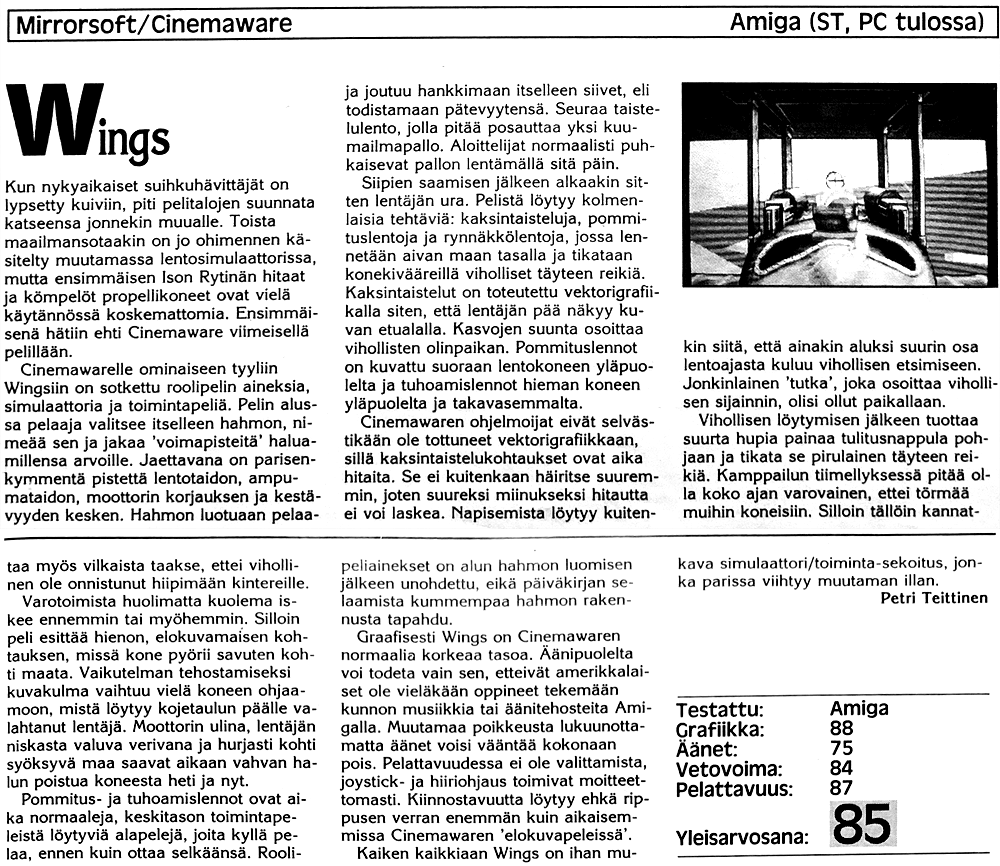
Wings1991 KevätPysyvä linkkiKun nykyaikaiset suihkuhävittäjät on lypsetty kuiviin, piti pelitalojen suunnata katseensa jonnekin muualle. Toista maailmansotaakin on jo ohimennen käsitelty muutamassa lentosimulaattorissa, mutta ensimmäisen Ison Rytinän hitaat ja kömpelöt propellikoneet ovat vielä käytännössä koskemattomia. Ensimmäisenä hätiin ehti Cinemaware viimeisellä pelillään.
Cinemawarelle ominaiseen tyyliin Wingsiin on sotkettu roolipelin aineksia, simulaattoria ja toimintapeliä. Pelin alussa pelaaja valitsee itselleen hahmon, nimeää sen ja jakaa 'voimapisteitä' haluamillensa arvoille. Jaettavana on parisenkymmentä pistettä lentotaidon, ampumataidon, moottorin korjauksen ja kestävyyden kesken. Hahmon luotuaan pelaaja joutuu hankkimaan itselleen siivet, eli todistamaan pätevyytensä. Seuraa taistelulento, jolla pitää posauttaa yksi kuumailmapallo. Aloittelijat normaalisti puhkaisevat pallon lentämällä sitä päin.
Siipien saamisen jälkeen alkaakin sitten lentäjän ura. Pelistä löytyy kolmenlaisia tehtäviä: kaksintaisteluja, pommituslentoja ja rynnäkkölentoja, jossa lennetään aivan maan tasalla ja tikataan konekivääreillä viholliset täyteen reikiä. Kaksintaistelut on toteutettu vektorigrafiikalla siten, että lentäjän pää näkyy kuvan etualalla. Kasvojen suunta osoittaa vihollisten olinpaikan. Pommituslennot on kuvattu suoraan lentokoneen yläpuolelta ja tuhoamislennot hieman koneen yläpuolelta ja takavasemmalta.
Cinemawaren ohjelmoijat eivät selvästikään ole tottuneet vektorigrafiikkaan, sillä kaksintaistelukohtaukset ovat aika hitaita. Se ei kuitenkaan häiritse suuremmin, joten suureksi miinukseksi hitautta ei voi laskea. Napisemista löytyy kuitenkin siitä, että ainakin aluksi suurin osa lentoajasta kuluu vihollisen etsimiseen. Jonkinlainen 'tutka', joka osoittaa vihollisen sijainnin, olisi ollut paikallaan.
Vihollisen löytymisen jälkeen tuottaa suurta hupia painaa tulitusnappula pohjaan ja tikata se pirulainen täyteen reikiä. Kamppailun tiimellyksessä pitää olla koko ajan varovainen, ettei törmää muihin koneisiin. Silloin tällöin kannattaa myös vilkaista taakse, ettei vihollinen ole onnistunut hiipimään kintereille.
Varotoimista huolimatta kuolema iskee ennemmin tai myöhemmin. Silloin peli esittää hienon, elokuvamaisen kohtauksen, missä kone pyörii savuten kohti maata. Vaikutelman tehostamiseksi kuvakulma vaihtuu vielä koneen ohjaamoon, mistä löytyy kojetaulun päälle valahtanut lentäjä. Moottorin ulina, lentäjän niskasta valuva verivana ja hurjasti kohti syöksyvä maa saavat aikaan vahvan halun poistua koneesta heti ja nyt.
Pommitus- ja tuhoamislennot ovat aika normaaleja, keskitason toimintapeleistä löytyviä alapelejä, joita kyllä pelaa, ennen kuin ottaa selkäänsä. Roolipeliainekset on alun hahmon luomisen jälkeen unohdettu, eikä päiväkirjan selaamista kummempaa hahmon rakennusta tapahdu.
Graafisesti Wings on Cinemawaren normaalia korkeaa tasoa. Äänipuolelta voi todeta vain sen, etteivät amerikkalaiset ole vieläkään oppineet tekemään kunnon musiikkia tai äänitehosteita Amigalla. Muutamaa poikkeusta lukuunottamatta äänet voisi vääntää kokonaan pois. Pelattavuudessa ei ole valittamista, joystick- ja hiiriohjaus toimivat moitteettomasti. Kiinnostavuutta löytyy ehkä rippusen verran enemmän kuin aikaisemmissa Cinemawaren 'elokuvapeleissä'.
Kaiken kaikkiaan Wings on ihan mukava simulaattori/toiminta-sekoitus, jonka parissa viihtyy muutaman illan.
Wings1991 KevätPermalinkOnce modern jet fighters had been milked dry, the software houses had to turn their gaze elsewhere. The Second World War has already been covered in passing in a few flight simulators, but the slow, clumsy propeller planes of the first Big Rumble are still practically untouched. First to the rescue is Cinemaware with its latest game.
In typical Cinemaware style, Wings throws role-playing elements, simulator and action game into the mix. At the start of the game the player picks a character, names it and hands out 'power points' to whichever attributes they like. There are twenty-odd points to share between flying skill, gunnery, engine repair and stamina. Having created the character, the player has to earn their wings, that is, prove their competence. Then comes a combat flight on which you have to pop a single hot-air balloon. Beginners normally burst the balloon by flying straight into it.
With your wings earned, the pilot's career then gets under way. The game has three kinds of mission: dogfights, bombing runs and ground-attack runs, in which you fly right down at ground level and stitch the enemy full of holes with your machine guns. The dogfights are done in vector graphics, with the pilot's head visible in the foreground of the picture. The way the face is turned shows where the enemies are. The bombing runs are shown from directly above the plane, and the strafing runs from slightly above and behind the plane, off to the left.
Cinemaware's programmers are clearly not used to vector graphics, since the dogfight sequences are rather slow. It doesn't bother you much, though, so the slowness can't be counted as a big minus. What does give cause for grumbling is that, at least at first, most of your flying time goes on looking for the enemy. Some kind of 'radar' showing the enemy's position would have been in order.
Once you've found the enemy, it's great fun to hold the fire button down and stitch the blighter full of holes. In the thick of the fight you have to be careful the whole time not to collide with other planes. Every now and then it's also worth glancing behind you, in case the enemy has managed to sneak up on your tail.
Despite all precautions, death strikes sooner or later. The game then shows a fine, cinematic sequence in which the plane spins smoking towards the ground. To heighten the effect, the view then switches to the cockpit, where you find the pilot slumped over the instrument panel. The howl of the engine, the trickle of blood running down the pilot's neck and the ground rushing wildly up towards you create a strong urge to get out of the plane right here and now.
The bombing and strafing runs are fairly ordinary sub-games of the kind found in middling action games; you'll play them all right, since they beat a poke in the eye with a sharp stick. The role-playing elements are forgotten after the initial character creation, and there's no character building to speak of beyond leafing through a diary.
Graphically Wings is up to Cinemaware's usual high standard. On the sound side, all one can say is that the Americans still haven't learned to make decent music or sound effects on the Amiga. With a few exceptions, you might as well switch the sound off altogether. There's no complaining about the playability; the joystick and mouse controls work flawlessly. There's perhaps a smidgen more to hold your interest than in Cinemaware's earlier 'movie games'.
All in all, Wings is a perfectly pleasant simulator/action mix that will keep you entertained for a few evenings.
Wings of Death
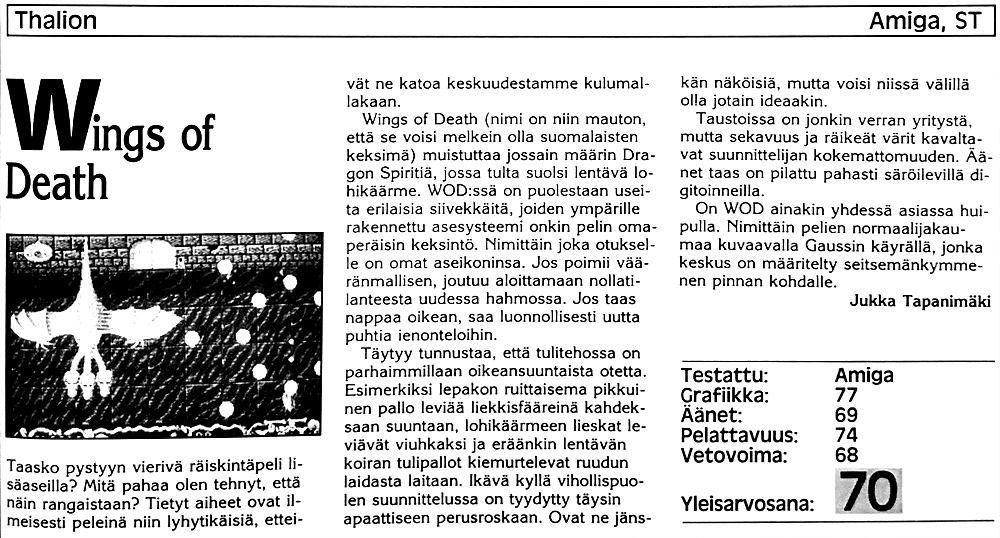
Wings of Death1991 KevätPysyvä linkkiTaasko pystyyn vierivä räiskintäpeli lisäaseilla? Mitä pahaa olen tehnyt, että näin rangaistaan? Tietyt aiheet ovat ilmeisesti peleinä niin lyhytikäisiä, etteivät ne katoa keskuudestamme kulumallakaan.
Wings of Death (nimi on niin mauton, että se voisi melkein olla suomalaisten keksimä) muistuttaa jossain määrin Dragon Spiritiä, jossa tulta suolsi lentävä lohikäärme. WOD:ssä on puolestaan useita erilaisia siivekkäitä, joiden ympärille rakennettu asesysteemi onkin pelin omaperäisin keksintö. Nimittäin joka otukselle on omat aseikoninsa. Jos poimii vääränmallisen, joutuu aloittamaan nollatilanteesta uudessa hahmossa. Jos taas nappaa oikean, saa luonnollisesti uutta puhtia ienonteloihin.
Täytyy tunnustaa, että tulitehossa on parhaimmillaan oikeansuuntaista otetta. Esimerkiksi lepakon ruittaisema pikkuinen pallo leviää liekkisfääreinä kahdeksaan suuntaan, lohikäärmeen lieskat leviävät viuhkaksi ja eräänkin lentävän koiran tulipallot kiemurtelevat ruudun laidasta laitaan. Ikävä kyllä vihollispuolen suunnittelussa on tyydytty täysin apaattiseen perusroskaan. Ovat ne jänskän näköisiä, mutta voisi niissä välillä olla jotain ideaakin.
Taustoissa on jonkin verran yritystä, mutta sekavuus ja räikeät värit kavaltavat suunnittelijan kokemattomuuden. Äänet taas on pilattu pahasti säröilevillä digitoinneilla.
On WOD ainakin yhdessä asiassa huipulla. Nimittäin pelien normaalijakaumaa kuvaavalla Gaussin käyrällä, jonka keskus on määritelty seitsemänkymmenen pinnan kohdalle.
Wings of Death1991 KevätPermalinkAnother vertically scrolling shoot-'em-up with extra weapons? What wrong have I done to be punished like this? Certain subjects are apparently so short-lived as games that they won't vanish from our midst even by wearing out.
Wings of Death (the name is so tasteless it could almost have been thought up by Finns) is somewhat reminiscent of Dragon Spirit, where the fire was spewed by a flying dragon. WOD, on the other hand, has several different winged creatures, and the weapon system built around them is the game's most original invention. You see, each critter has its own weapon icons. If you pick up the wrong sort, you have to start from scratch in a new form. If you grab the right one, you naturally get fresh oomph into your gum cavities.
I have to admit that at its best the firepower has the right sort of grip. For example, the little ball the bat squirts out spreads as spheres of flame in eight directions, the dragon's flames fan out, and the fireballs of one particular flying dog wriggle from one edge of the screen to the other. Unfortunately, the enemy side's design has settled for completely apathetic standard junk. They do look kind of neat, but now and then there could be some idea to them, too.
There's some effort in the backgrounds, but the messiness and garish colours betray the designer's inexperience. The sound, for its part, has been badly ruined by crackling, distorted digitisations.
WOD is at the top in at least one thing, though. Namely on the Gauss curve that describes the normal distribution of games, whose centre has been fixed at the seventy-point mark.
Wings of Fury
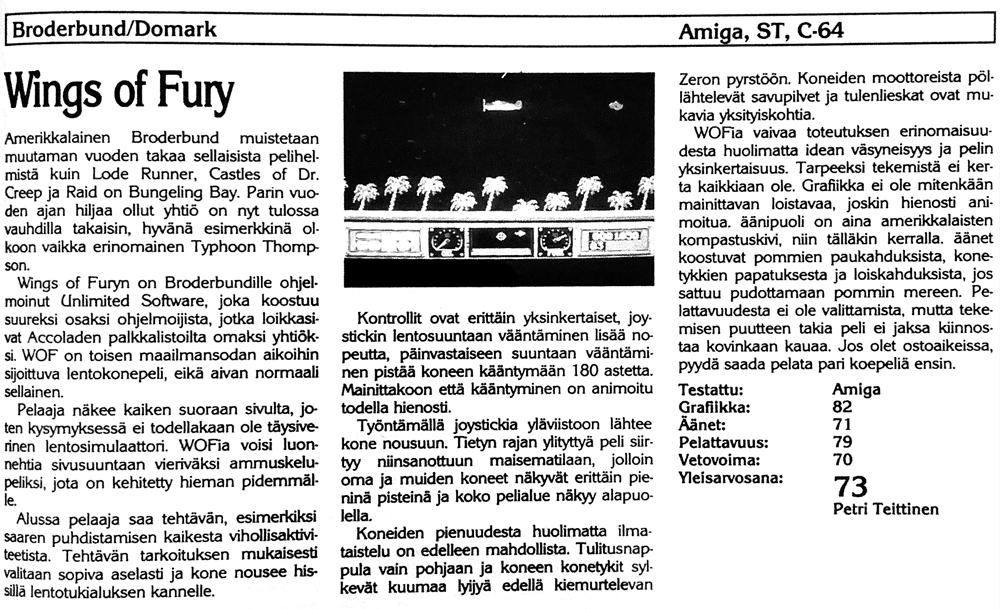
Wings of Fury1990 KevätPysyvä linkkiAmerikkalainen Broderbund muistetaan muutaman vuoden takaa sellaisista pelihelmistä kuin Lode Runner, Castles of Dr. Creep ja Raid on Bungeling Bay. Parin vuoden ajan hiljaa ollut yhtiö on nyt tulossa vauhdilla takaisin, hyvänä esimerkkinä olkoon vaikka erinomainen Typhoon Thompson.
Wings of Furyn on Broderbundille ohjelmoinut Unlimited Software, joka koostuu suureksi osaksi ohjelmoijista, jotka loikkasivat Accoladen palkkalistoilta omaksi yhtiöksi. WOF on toisen maailmansodan aikoihin sijoittuva lentokonepeli, eikä aivan normaali sellainen.
Pelaaja näkee kaiken suoraan sivulta, joten kysymyksessä ei todellakaan ole täysiverinen lentosimulaattori. WOFia voisi luonnehtia sivusuuntaan vieriväksi ammuskelupeliksi, jota on kehitetty hieman pidemmälle.
Alussa pelaaja saa tehtävän, esimerkiksi saaren puhdistamisen kaikesta vihollisaktiviteetista. Tehtävän tarkoituksen mukaisesti valitaan sopiva aselasti ja kone nousee hissillä lentotukialuksen kannelle.
Kontrollit ovat erittäin yksinkertaiset, joystickin lentosuuntaan vääntäminen lisää nopeutta, päinvastaiseen suuntaan vääntäminen pistää koneen kääntymään 180 astetta. Mainittakoon että kääntyminen on animoitu todella hienosti.
Työntämällä joystickia yläviistoon lähtee kone nousuun. Tietyn rajan ylityttyä peli siirtyy niinsanottuun maisematilaan, jolloin oma ja muiden koneet näkyvät erittäin pieninä pisteinä ja koko pelialue näkyy alapuolella.
Koneiden pienuudesta huolimatta ilmataistelu on edelleen mahdollista. Tulitusnappula vain pohjaan ja koneen konetykit sylkevät kuumaa lyijyä edellä kiemurtelevan Zeron pyrstöön. Koneiden moottoreista pöllähtelevät savupilvet ja tulenlieskat ovat mukavia yksityiskohtia.
WOFia vaivaa toteutuksen erinomaisuudesta huolimatta idean väsyneisyys ja pelin yksinkertaisuus. Tarpeeksi tekemistä ei kerta kaikkiaan ole. Grafiikka ei ole mitenkään mainittavan loistavaa, joskin hienosti animoitua. äänipuoli on aina amerikkalaisten kompastuskivi, niin tälläkin kerralla. äänet koostuvat pommien paukahduksista, konetykkien papatuksesta ja loiskahduksista, jos sattuu pudottamaan pommin mereen. Pelattavuudesta ei ole valittamista, mutta tekemisen puutteen takia peli ei jaksa kiinnostaa kovinkaan kauaa. Jos olet ostoaikeissa, pyydä saada pelata pari koepeliä ensin.
Wings of Fury1990 KevätPermalinkThe American Broderbund is remembered from a few years back for such gaming gems as Lode Runner, Castles of Dr. Creep and Raid on Bungeling Bay. After keeping quiet for a couple of years the company is now coming back at full speed; let the excellent Typhoon Thompson serve as a good example.
Wings of Fury was programmed for Broderbund by Unlimited Software, which is made up largely of programmers who defected from Accolade's payroll to set up a company of their own. WOF is an aeroplane game set around the time of the Second World War, and not an entirely normal one at that.
The player sees everything straight from the side, so this is definitely not a full-blooded flight simulator. WOF could be described as a sideways-scrolling shoot-'em-up that has been developed a little further.
At the start the player is given a mission, for example clearing an island of all enemy activity. A weapons load suited to the purpose of the mission is chosen, and the plane rides a lift up onto the deck of the aircraft carrier.
The controls are extremely simple: pushing the joystick in the direction of flight increases speed, and pushing it the opposite way makes the plane turn 180 degrees. Let it be mentioned that the turn is animated really beautifully.
Pushing the joystick diagonally upwards sends the plane into a climb. Once a certain limit is passed, the game switches to what is known as landscape mode, where your own plane and the others show up as very small dots and the whole play area is visible down below.
Despite how small the planes are, air combat is still possible. Just jam the fire button down and the plane's cannons spit hot lead into the tail of the Zero wriggling along ahead. The puffs of smoke and tongues of flame belching from the planes' engines are nice details.
For all the excellence of its execution, WOF is dogged by a tired idea and the simplicity of the game. There just isn't enough to do, full stop. The graphics are nothing remarkably brilliant, although they are beautifully animated. The sound side is always the Americans' stumbling block, and so it is this time too. The sounds consist of bombs going bang, cannons going rat-a-tat and splashes if you happen to drop a bomb into the sea. There's nothing to complain about in the playability, but because of the lack of things to do the game can't hold your interest for very long. If you're thinking of buying, ask to play a couple of trial games first.
Wings Of War
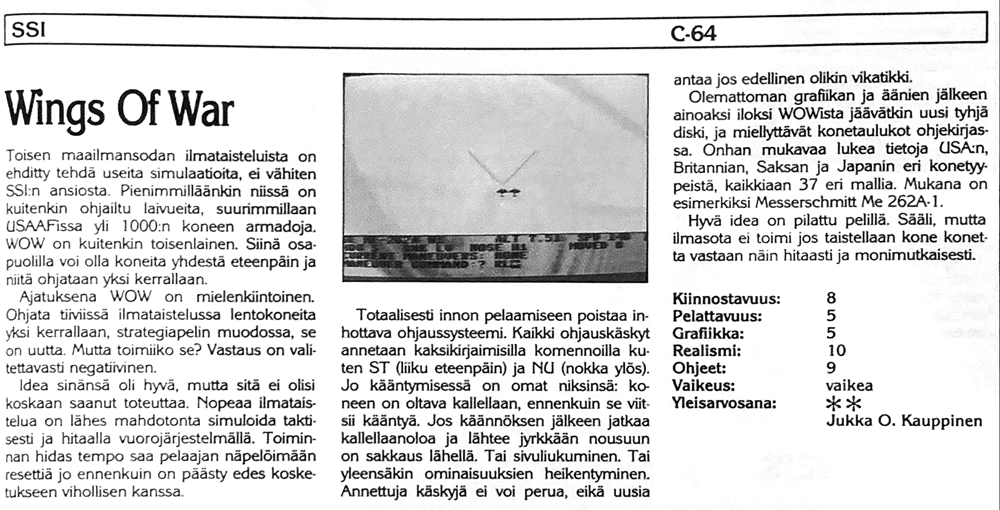
Wings Of War1989 SyksyPysyvä linkkiToisen maailmansodan ilmataisteluista on ehditty tehdä useita simulaatioita, ei vähiten SSI:n ansiosta. Pienimmilläänkin niissä on kuitenkin ohjailtu laivueita, suurimmillaan USAAFissa yli 1000:n koneen armadoja. WOW on kuitenkin toisenlainen. Siinä osapuolilla voi olla koneita yhdestä eteenpäin ja niitä ohjataan yksi kerrallaan.
Ajatuksena WOW on mielenkiintoinen. Ohjata tiiviissä ilmataistelussa lentokoneita yksi kerrallaan, strategiapelin muodossa, se on uutta. Mutta toimiiko se? Vastaus on valitettavasti negatiivinen.
Idea sinänsä oli hyvä, mutta sitä ei olisi koskaan saanut toteuttaa. Nopeaa ilmataistelua on lähes mahdotonta simuloida taktisesti ja hitaalla vuorojärjestelmällä. Toiminnan hidas tempo saa pelaajan näpelöimään resettiä jo ennenkuin on päästy edes kosketukseen vihollisen kanssa.
Totaalisesti innon pelaamiseen poistaa inhottava ohjaussysteemi. Kaikki ohjauskäskyt annetaan kaksikirjaimisilla komennoilla kuten ST (liiku eteenpäin) ja NU (nokka ylös). Jo kääntymisessä on omat niksinsä: koneen on oltava kallellaan, ennenkuin se viitsii kääntyä. Jos käännöksen jälkeen jatkaa kallellaanoloa ja lähtee jyrkkään nousuun on sakkaus lähellä. Tai sivuliukuminen. Tai yleensäkin ominaisuuksien heikentyminen. Annettuja käskyjä ei voi perua, eikä uusia antaa jos edellinen olikin vikatikki.
Olemattoman grafiikan ja äänien jälkeen ainoaksi iloksi WOWista jäävätkin uusi tyhjä diski, ja miellyttävät konetaulukot ohjekirjassa. Onhan mukavaa lukea tietoja USA:n, Britannian, Saksan ja Japanin eri konetyypeistä, kaikkiaan 37 eri mallia. Mukana on esimerkiksi Messerschmitt Me 262A-1.
Hyvä idea on pilattu pelillä. Sääli, mutta ilmasota ei toimi jos taistellaan kone konetta vastaan näin hitaasti ja monimutkaisesti.
Wings Of War1989 SyksyPermalinkSeveral simulations of Second World War air battles have been made already, not least thanks to SSI. Even at their smallest, though, they have had you commanding squadrons, and at their biggest, in USAAF, armadas of over 1000 planes. WOW, however, is different. In it the sides can have anything from one plane upwards, and they are controlled one at a time.
As a concept WOW is interesting. Controlling aircraft one at a time in close air combat, in the form of a strategy game - that's something new. But does it work? The answer, unfortunately, is negative.
The idea as such was good, but it should never have been implemented. Fast air combat is next to impossible to simulate tactically and with a slow turn system. The slow tempo of the action has the player fiddling with the reset button before they have even made contact with the enemy.
What totally kills any enthusiasm for playing is the horrid control system. All control orders are given as two-letter commands such as ST (move forward) and NU (nose up). Even turning has its own tricks: the plane has to be banked before it can be bothered to turn. If after the turn you keep up the banking business and go into a steep climb, a stall is not far off. Or a sideslip. Or a general deterioration in performance. Orders once given can't be cancelled, nor can new ones be given if the previous one turned out to be a blunder.
After the nonexistent graphics and sound, the only joys left from WOW are a fresh blank disk and the pleasant aircraft tables in the manual. It is nice, after all, to read up on the various aircraft types of the USA, Britain, Germany and Japan, 37 different models in all. Included, for example, is the Messerschmitt Me 262A-1.
A good idea has been ruined by the game. A pity, but air war doesn't work when you fight plane against plane this slowly and this intricately.
Winter Games
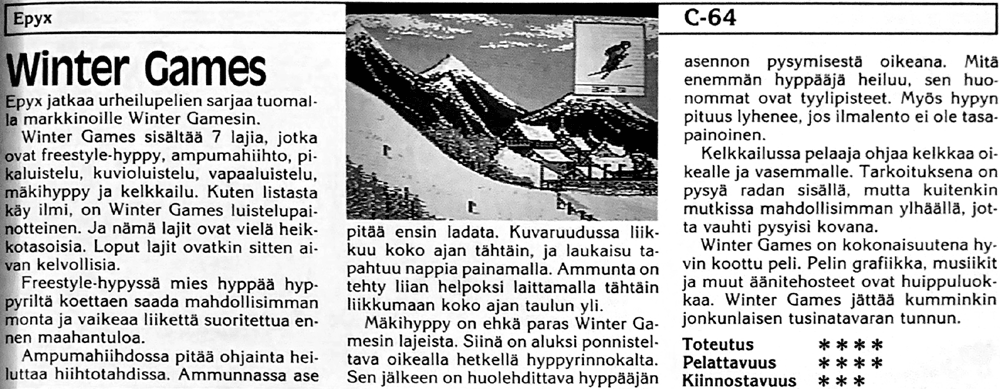
Winter Games1987Pysyvä linkkiEpyx jatkaa urheilupelien sarjaa tuomalla markkinoille Winter Gamesin.
Winter Games sisältää 7 lajia, jotka ovat freestyle-hyppy, ampumahiihto, pikaluistelu, kuvioluistelu, vapaaluistelu, mäkihyppy ja kelkkailu. Kuten listasta käy ilmi, on Winter Games luistelupainotteinen. Ja nämä lajit ovat vielä heikkotasoisia. Loput lajit ovatkin sitten aivan kelvollisia.
Freestyle-hypyssä mies hyppää hyppyriltä koettaen saada mahdollisimman monta ja vaikeaa liikettä suoritettua ennen maahantuloa.
Ampumahiihdossa pitää ohjainta heiluttaa hiihtotahdissa. Ammunnassa ase pitää ensin ladata. Kuvaruudussa liikkuu koko ajan tähtäin, ja laukaisu tapahtuu nappia painamalla. Ammunta on tehty liian helpoksi laittamalla tähtäin liikkumaan koko ajan taulun yli.
Mäkihyppy on ehkä paras Winter Gamesin lajeista. Siinä on aluksi ponnisteltava oikealla hetkellä hyppyrinnokalta. Sen jälkeen on huolehdittava hyppääjän asennon pysymisestä oikeana. Mitä enemmän hyppääjä heiluu, sen huonommat ovat tyylipisteet. Myös hypyn pituus lyhenee, jos ilmalento ei ole tasapainoinen.
Kelkkailussa pelaaja ohjaa kelkkaa oikealle ja vasemmalle. Tarkoituksena on pysyä radan sisällä, mutta kuitenkin mutkissa mahdollisimman ylhäällä, jotta vauhti pysyisi kovana.
Winter Games on kokonaisuutena hyvin koottu peli. Pelin grafiikka, musiikit ja muut äänitehosteet ovat huippuluokkaa. Winter Games jättää kumminkin jonkunlaisen tusinatavaran tunnun.
Winter Games1987PermalinkEpyx continues its series of sports games by bringing Winter Games to the market.
Winter Games contains 7 events: freestyle jumping, biathlon, speed skating, figure skating, free skating, ski jumping and bobsledding. As the list makes clear, Winter Games is heavy on skating. And to top it off, those are the weak events. The rest of the events, then, are perfectly decent.
In the freestyle jump a man leaps off a ramp, trying to get as many moves done as possible, and as difficult ones as possible, before he lands.
In the biathlon you have to waggle the joystick in time with the skiing. For the shooting, the rifle has to be loaded first. A sight moves around the screen the whole time, and you fire by pressing the button. The shooting has been made too easy by having the sight keep moving across the target the whole time.
Ski jumping is perhaps the best of Winter Games' events. First you have to push off from the lip of the jump at the right moment. After that you have to make sure the jumper holds the correct position. The more the jumper wobbles, the worse the style points. The jump also gets shorter if the flight isn't balanced.
In the bobsled the player steers the sled right and left. The idea is to stay inside the track, but still ride as high as possible in the bends so that the speed stays up.
As a whole, Winter Games is a well put together game. The graphics, the music and the other sound effects are top class. Even so, Winter Games leaves a sort of run-of-the-mill feeling.
Winter Olympics '88
Winter Olympics '881988Pysyvä linkkiliiihanaa. Taas urheilupeli.
Pof. Tällä kertaa ovat lajeina mäkihyppy, laskettelu, ampumahiihto, pujottelu ja kelkkailu. Ei näitä samoja lajeja ollakaan pelattu jo vaikka miten monessa pelissä aikaisemmin. Miksei joku, jos aivan välttämättä haluaa tehdä talviurheilupelin, voi ottaa joitain uusia lajeja? Kuten tupakan sytyttäminen jäisessä viimassa tulitikulla ilman kintaita, jäätyneen oluen sulattaminen, avantouinti, hangessa kieriminen, liukastelu jäällä tms.
Jos lajit olisivat hyvin toteutettuja, olisi jotain ehkä vielä pelastettu. Mutta ei: jotain klikkaa, ja pahasti sittenkin. Mäkihyppyyn on kylläkin otettu uusi näkökulma tornin huipulta hyppääjän takaa, mutta alastullessa on jotain pahasti vialla. Realistisuutta, realistisuutta... En usko, että kukaan hyppääjä saa niin suurta nopeutta aikaan, että voi liitäessään ilman halki laskeutua vain puolisen metriä sadan metrin matkalla... Tai että missään olisi niin vaakasuorassa olevaa laskeutumisalustaa.
Ampumahiihdossa lähes sama. Mikä yllättävintä, se on identtinen kopio Winter Gamesin ampumahiihdosta. Vain huononnettu. Realistisuutta. Eikö alamäkeen tultaessa pitäisi päästä kovempaa kuin ylämäkeen, vai?
Slalom. Realistisuutta. Vaikka paukauttaa täysillä sivulaitaan, ei tapahdu mitään. Laskija vain oikenee laskemaan suoraan alaspäin. Eikä edes lippuihin voi törmätä. Laskettelussa on jo sentään jotain tuntua, ja se onkin ainoa laji, jossa ei mikään pahemmin ota lanttuun.
Toiseksi parasta pelissä on ylivoimaisesti grafiikka, joka onkin lähes huippuluokkaa. Kiitoksen arvoisia ovat myös musiikit, jotka ovat joka lajissa erilaiset. Laskettelussa on jo todella hyvä musiikki, joka onkin sitten pelin parasta antia. Mutta tämän yhden kappaleen takia ei tätä toki ostaa kannata.
Surkeaa, surkeaa. Miksi, miksi joku tekee tälläistä? Hyviä pelejä on vähän, kohtalaisia useampia. Mutta tämä. Ei! Kun lataamisetkin ovat niin hirvittävän pitkiä kuin ovat, ei käteen jää muuta kuin pahoja muistoja ja heikosti nukutut yöt. Koska tahansa saattaa iskeä painajainen, jossa sinut on pakotettu pelaamaan WO 88:ia. Ja kaikki lajit pelattuaan ei edes voi aloittaa alusta, vaan koko roska on ladattava alusta alkaen uudelleen. Vaikka kuka sellaista tekisikään? Suuri Taivaallinen Cracker minua suojelkoon tälläisilta peleiltä hamassa tulevaisuudessa. Amen.
Winter Olympics '881988PermalinkLoooovely. Another sports game.
Pfft. This time the events are ski jumping, downhill, biathlon, slalom and bobsleigh. It's not as if these very same events have already been played in who knows how many games before. Why can't somebody who absolutely has to make a winter sports game pick some new events? Like lighting a cigarette with a match in an icy gale without mittens, thawing frozen beer, swimming in a hole in the ice, rolling in the snowdrifts, slipping and sliding on the ice, or whatever.
If the events were well done, something might still have been salvaged. But no: something's out of whack, and badly at that. The ski jump does take a new viewpoint, from the top of the tower behind the jumper, but something is badly wrong with the way down. Realism, realism... I don't believe any jumper can build up so much speed that, gliding through the air, they drop only half a metre or so over a hundred metres... Or that there's a landing slope anywhere that horizontal.
Pretty much the same with the biathlon. Most surprising of all, it's an identical copy of the biathlon in Winter Games. Only made worse. Realism. Shouldn't you go faster downhill than uphill, or what?
Slalom. Realism. Even if you slam full tilt into the side edge, nothing happens. The skier just straightens up and heads straight downhill. And you can't even crash into the flags. The downhill at least has some feel to it, and it's the only event where nothing really does your head in.
By far the second-best thing in the game is the graphics, which are close to top class. The music also deserves praise, being different in every event. The downhill has really good music, which is in fact the best thing the game has to offer. But of course it's not worth buying this just for that one tune.
Wretched, wretched. Why, oh why does anybody make something like this? Good games are few, decent ones rather more numerous. But this. No! When the loading times are as horrendously long as they are on top of everything, all you're left with is bad memories and badly slept nights. At any moment a nightmare may strike in which you've been forced to play WO 88. And once you've played all the events you can't even start over; the whole lot of junk has to be loaded again from the very beginning. Not that anybody would ever do such a thing, would they? May the Great Heavenly Cracker protect me from games like this for evermore. Amen.
Wizard Warz
Wizard Warz1989 KevätPysyvä linkkiMuistanpa, kun nuorna miesnä jokainen kylän tenava haaveili mestarivelhon ammatista. Vain uraputken pimeä puoli eli taistelu entisten huippuvelhojen kanssa piti kyläsepän tuoreissa kisälleissä. Vuosisadat ovat vierineet, velhous on poissa muodista ja nähtävästi ainoa mahdollisuus muistella vanhoja on Wizard Warz.
Velhojen Sota jakautuu kolmeen osaan, jotka erilaisista tavoitteistaan huolimatta ovat samaa roskaa erilaisissa kansissa. Ensimmäisessä osassa tapetaan hirviöitä, joiden jälkeensä jättämät tavarat täytyy palauttaa oikeisiin kaupunkeihin. Toisessa osassa tapetaan hirviöitä, jotta saadaan vaadittavat tavarat kolmanteen erään. Siinä niitataan seitsemän muuta velhoa apureineen. Erilaisia hirviöitä on kolmisenkymmentä ja arsenaali koostuu massiivisesti yhdeksästä erilaisesta loitsusta. Näistä järeät neljä saa valita.
Velho liikkuu pienessä ympyränmuotoisessa ruudunosassa, joka näyttää enemmän tai vähemmän ympäröivää maastoa, pelaajan voimien mukaan. Maastolla ei, vettä lukuunottamatta, ole vaikutusta liikkumiseen. Kun velho sitten joskus kohtaa jonkun hirviön, siirtyy taistelu erilliselle areenalle Archonin tyyliin. Ja sitten velhot mätkivät toisiaan erilaisilla loitsuilla. Nähtävästi jotkut loitsut vaikuttavat paremmin toisiin hirviöihin kuin toiset.
Wizard Warz on ainakin toteutukseltaan omaperäinen peli, mutta mitähän se yrittää esittää? Pelaaminen on yhtä jännittävää kuin Sound Of Musicin katselu ilman valoja. "Peli joka vie fantasiaroolipelin askeleen pitemmälle." Verrattuna mihin? Pac-Maniin? Ehdinkin jo huolestua kun Go! julkaisi pari hyvää peliä, mutta nyt on taas palattu tutuille teille.
Wizard Warz1989 KevätPermalinkAh, I remember back when I was a young lad, every brat in the village dreamed of becoming a master wizard. Only the dark side of the career ladder, namely battling the old top wizards, kept them as fresh apprentices to the village smith. Centuries have rolled by, wizardry has gone out of fashion, and apparently the only chance to reminisce about the old days is Wizard Warz.
The Wizards' War is divided into three parts which, despite their different objectives, are the same rubbish between different covers. In the first part you kill monsters, and the items they leave behind have to be returned to the right towns. In the second part you kill monsters to get the items required for the third round. In that one you nail seven other wizards and their sidekicks. There are some thirty different monsters, and the arsenal consists of a massive nine different spells. Of these you get to pick a hefty four.
The wizard moves around in a small circular section of the screen, which shows more or less of the surrounding terrain depending on the player's powers. Apart from water, the terrain has no effect on movement. When the wizard then eventually meets some monster, the fight moves to a separate arena, Archon style. And then the wizards whack each other with various spells. Apparently some spells work better on some monsters than others.
Wizard Warz is original at least in its execution, but what on earth is it trying to be? Playing it is as exciting as watching Sound Of Music in the dark. "A game that takes the fantasy role-playing game one step further." Compared to what? Pac-Man? I had already started to worry when Go! released a couple of good games, but now they're back on familiar ground.
Wizard's Crown
Wizard's Crown1988Pysyvä linkki500 vuotta sitten taikurien veljeskunta hallitsi tätä maata viisaasti ja oikeamielisesti. Arghanin kaupungista, jossa he asuivat, löytyi koko maailman suurin kauneus ja viisaus. Arghaniin oli myös sijoitettu Hallitsijan Kruunu, joka oli oppimisen, kaiken menneisyyden, nykyisyyden ja tulevaisuuden lähde. Mutta Tarmon, Ukkosen Taikuri, otti Kruunun. Syttyi sota taikurien välillä. Taikuus kutsui hirviöitä maan päälle ja suuret tulet tuhosivat Arghanin. Mutta Kruunu on vielä jäljellä. Sinun on haettava se takaisin.
Tehtävä ei ole helppo. Seikkailu tapahtuu kahdeksan hengen ryhmällä, johon kuuluu kunnon roolipelien tapaan sotureita, taikureita, pappeja jne. Pelissä on mukana vakioryhmä, mutta luonnollisesti on mahdollista koota itse omat henkilönsä.
Tietysti tämänkaltaisessa 'roolipelissä' on taisteltava monenmoisia hirvityksiä vastaan. Taistelemiseen löytyy kaksi vaihtoehtoa: voi antaa tietokoneen hoitaa koko homman, jolloin taisto on ohi kymmenessä sekunnissa. Tai voi suorittaa taistelun itse, jolloin se kestää 5-30 minuuttia. Pakostakin näiden välillä on joitain eroja, muutenhan kukaan ei käyttäisi pidempää taistelumuotoa. Tietokone ei taistelua hoitaessaan käytä taikaesineitä eikä niiden sisältämiä taikoja.
Entäpä pelialue? Se on vähintäänkin laaja. Kerrallaan kone lataa yhden karttaruudullisen, jonka koko on kolmisen kuvaruudullista. Ja ladattavia ruutuja on ainakin kahdeksan. Siellä täällä on 'dungeoneja', joita voi mennä tutkiskelemaan. Pelin alkuvaiheessa kannattaa kuitenkin nuohota kaupunkia edestakaisin, ja puhdistaa se rosvoista palkkion toivossa.
Poikkeuksellisesti kartta täyttää WC:ssa koko ruudun. Kun henkilöiden status otetaan esille, kartta saa väistyä. Eli tekijät eivät ole sallineet mitään kompromisseja. Joko kartta tai koko ruudun täyttävä teksti. Ei mitään sekamuotoja, kuten Phantasien eri osissa.
Kaikki toiminnot suoritetaan näppäimistöllä. Minkäänmuunlainen vaihtoehto ei voisi tulla kysymykseenkään. Joystikin ja näppäinten sekamuoto vain hidastaisi pelaamista.
Itse liikuttelussa ei tarvita monia näppäimiä, mutta dungeoneissa ja itse hoidetussa taistelussa sen sijaan melko useita. Ohjelma on siinä mielessä avulias, että se ilmoittaa, mitä toimintoja kukin henkilö voi tehdä kussakin tilanteessa.
Pelin graafiset ominaisuudet ovat suorastaan tyrmäävät. Karuihin Ultimoihin verrattuna WC:n grafiikat ovat todellakin huippuluokkaa. Dungeoneissa olisi kuitenkin hieman parantamisen varaa. Ääniä pelissä ei käytännöllisesti katsoen ole. Taistelussa kuuluu joitakin vähäisiä ääniä.
WC kuuluu roolipelien kärkeen, ja oma mielipiteeni on että se kuuluu C-64:n pelien parhaimmistoon, ellei ole paras. Ja jos olisi valittava Ultimoiden ja WC:n välillä jälkimmäinen voittaisi.
Wizard's Crown1988Permalink500 years ago a brotherhood of wizards ruled this land wisely and justly. The city of Arghan, where they lived, held the greatest beauty and wisdom in the whole world. In Arghan, too, was kept the Ruler's Crown, the source of learning and of all that is past, present and future. But Tarmon, the Wizard of Thunder, took the Crown. War broke out among the wizards. Sorcery summoned monsters onto the earth, and great fires destroyed Arghan. But the Crown still remains. You must bring it back.
The task is not an easy one. The adventure is undertaken by a party of eight, which, as befits a proper role-playing game, includes warriors, wizards, priests and so on. The game comes with a ready-made party, but naturally you can also put together your own characters.
Of course, in a 'role-playing game' of this kind you have to fight all manner of horrors. There are two options for combat: you can let the computer handle the whole business, in which case the fight is over in ten seconds. Or you can conduct the battle yourself, in which case it takes 5-30 minutes. Inevitably there are some differences between the two, or else nobody would use the longer form of combat. When the computer handles the combat, it doesn't use magic items or the spells they contain.
And what about the playing area? It's extensive, to say the least. The machine loads one map section at a time, each about three screens' worth in size. And there are at least eight sections to load. Here and there are 'dungeons' that you can go and poke around in. Early in the game, though, it pays to comb the town back and forth and clear it of bandits in the hope of a reward.
Unusually, in WC the map fills the whole screen. When you bring up the characters' status, the map has to make way. So the makers have allowed no compromises whatsoever. Either the map or text filling the whole screen. No hybrids, as in the various instalments of Phantasie.
All actions are carried out from the keyboard. No other kind of option could even come into question. A mix of joystick and keys would only slow down play.
Moving around as such doesn't take many keys, but in the dungeons and in combat you run yourself it takes quite a few. The program is helpful in the sense that it tells you which actions each character can perform in each situation.
The game's graphical qualities are downright knockout. Compared to the spartan Ultimas, WC's graphics really are top class. The dungeons could still do with a little improvement, though. There's practically no sound in the game. In combat you hear a few meagre sounds.
WC is among the very top role-playing games, and my own opinion is that it's one of the best games on the C-64, if not the best. And if I had to choose between the Ultimas and WC, the latter would win.
Wizards & Warriors

Wizards & Warriors1990 SyksyPysyvä linkkiKonsoliuskoon kääntynyt brittiläinen Rare jatkaa tasaisen tasokkaita peliesityksiään. Uskomattomia määriä pelattavuutta pikkuisesta kenkälaatikosta nyhtävä tiimi esittelee tällä kertaa haarniskapukuisen Kuros-ritarin, jonka leipätyönä on neitokaisten pelastamista.
Tuiman taiston näyttämönä on laajoja, kaikkiin suuntiin vieritettäviä pelikenttiä: metsiä, onttoja puunrunkoja, maanalaisia luolia ja lopussa odottava rönsyilevä linnake. Omaperäisyydestä peli ansaitsee pyöreät nolla pistettä. Voimallinen miekalla sohiminen, huikeat loikat tasanteelta toiselle, lisävarusteiden keräily, arkkujen availu ynnä muu synnyttävät vahvan elämyksen ennen eletystä, mutta toteutuksessa on mainion pirteä ote ja pelattavuus on hyvä esimerkki Nintendomaisesta vaivattomuudesta parhaimmillaan.
Pelin brittiläisyys paistaa läpi siinä, että vihollismörköjen määrä ja agressiivisuus on ylimitoitettu, niitä kun tuppaa silmille joka lävestä. Täytyisi olla melkoinen velho pelatakseen W&W läpi ilman että sankari jatkuvasti tuupertuisi. Vaikeutta on tasapainoitettu sillä, että peliä saa aina jatkaa viimeiseltä tasolta ilman minkäänlaisia bonuksien menetyksiä. Niinpä tarvitaan vain yksi keskittynyt peli-istunto ja paha Malkil-velho on kohdannut voittajansa. Peli on kuitenkin niin laaja ja sen verran vetävää viihdettä, että sen pelaa mielellään läpi useampaan otteeseen.
Wizards & Warriors1990 SyksyPermalinkRare, the British outfit that has converted to the console faith, carries on with its consistently high-class game offerings. The team that wrings unbelievable amounts of playability out of a tiny little shoebox this time presents Kuros, an armour-clad knight whose day job is rescuing damsels.
The stage for this grim battle is a set of vast playfields that scroll in every direction: forests, hollow tree trunks, underground caves and, waiting at the end, a sprawling fortress. For originality the game earns a nice round zero points. Mighty sword-jabbing, breathtaking leaps from ledge to ledge, collecting extra equipment, opening chests and so on give you a strong feeling of having lived through it all before, but the execution has a splendidly lively touch and the playability is a fine example of Nintendo-style effortlessness at its best.
The game's Britishness shines through in the way the number and aggressiveness of the enemy bogeymen has been overdone, what with them shoving into your face out of every hole. You'd have to be quite a wizard to play W&W through without the hero constantly keeling over. The difficulty has been balanced by letting you always continue from the last level without losing any bonuses whatsoever. So all it takes is one focused gaming session and the evil wizard Malkil has met his match. Still, the game is so big and such compelling entertainment that you'll happily play it through more than once.
Wizball
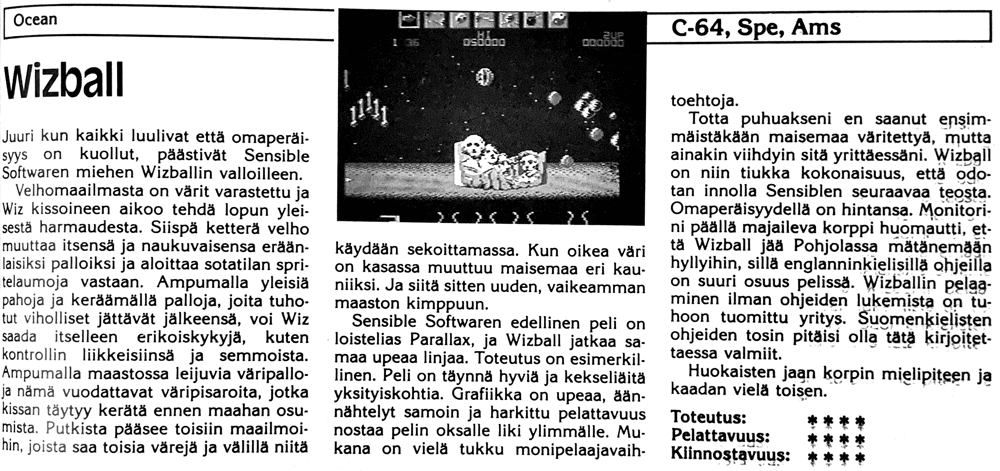
Wizball1987Pysyvä linkkiJuuri kun kaikki luulivat että omaperäisyys on kuollut, päästivät Sensible Softwaren miehen Wizballin valloilleen.
Velhomaailmasta on värit varastettu ja Wiz kissoineen aikoo tehdä lopun yleisestä harmaudesta. Siispä ketterä velho muuttaa itsensä ja naukuvaisensa eräänlaisiksi palloiksi ja aloittaa sotatilan spritelaumoja vastaan. Ampumalla yleisiä pahoja ja keräämällä palloja, joita tuhotut viholliset jättävät jälkeensä, voi Wiz saada itselleen erikoiskykyjä, kuten kontrollin liikkeisiinsä ja semmoista. Ampumalla maastossa leijuvia väripalloja nämä vuodattavat väripisaroita, jotka kissan täytyy kerätä ennen maahan osumista. Putkista pääsee toisiin maailmoihin, joista saa toisia värejä ja välillä niitä käydään sekoittamassa. Kun oikea väri on kasassa muuttuu maisemaa eri kauniiksi. Ja siitä sitten uuden, vaikeamman maaston kimppuun.
Sensible Softwaren edellinen peli on loistelias Parallax, ja Wizball jatkaa samaa upeaa linjaa. Toteutus on esimerkillinen. Peli on täynnä hyviä ja kekseliäitä yksityiskohtia. Grafiikka on upeaa, äännähtelyt samoin ja harkittu pelattavuus nostaa pelin oksalle liki ylimmälle. Mukana on vielä tukku monipelaajavaihtoehtoja.
Totta puhuakseni en saanut ensimmäistäkään maisemaa väritettyä, mutta ainakin viihdyin sitä yrittäessäni. Wizball on niin tiukka kokonaisuus, että odotan innolla Sensiblen seuraavaa teosta. Omaperäisyydellä on hintansa. Monitorini päällä majaileva korppi huomautti, että Wizball jää Pohjolassa mätänemään hyllyihin, sillä englanninkielisillä ohjeilla on suuri osuus pelissä. Wizballin pelaaminen ilman ohjeiden lukemista on tuhoon tuomittu yritys. Suomenkielisten ohjeiden tosin pitäisi olla tätä kirjoitettaessa valmiit.
Huokaisten jaan korpin mielipiteen ja kaadan vielä toisen.
Wizball1987PermalinkJust when everyone thought originality was dead, the Sensible Software men let Wizball loose.
The colours have been stolen from the wizard world, and Wiz and his cat intend to put an end to the general greyness. So the nimble wizard turns himself and his meowing companion into balls of a sort and declares war on hordes of sprites. By shooting the assorted baddies and collecting the balls that destroyed enemies leave behind, Wiz can gain special abilities, such as control over his movements and stuff like that. Shoot the colour balls floating over the landscape and they shed drops of colour, which the cat has to catch before they hit the ground. Pipes take you to other worlds, where you get other colours, and every now and then you pop off to mix them. When the right colour has been gathered, the scenery turns seriously pretty. And from there it's on to lay into a new, harder landscape.
Sensible Software's previous game is the resplendent Parallax, and Wizball carries on along the same superb line. The execution is exemplary. The game is full of good, inventive details. The graphics are superb, so are the bleeps and blips, and the well-considered playability lifts the game onto very nearly the topmost branch. There's a whole bunch of multiplayer options on top of that.
To tell the truth, I didn't manage to colour in a single landscape, but at least I had fun trying. Wizball is such a tight package that I'm eagerly awaiting Sensible's next work. Originality has its price. The raven lodging on top of my monitor pointed out that Wizball will be left to rot on the shelves up here in the North, since the English instructions play a big part in the game. Playing Wizball without reading the instructions is an attempt doomed to failure. Mind you, the Finnish-language instructions should be finished as I write this.
With a sigh, I share the raven's opinion and pour another.
Wolfman!
Wolfman!1988Pysyvä linkkiCRL on tullut jo kuuluisaksi uusista seikkailupeleistään, joille on Englannissa lyöty ikärajat. Kauhuaiheisiin perustuvat pelit kuulemma saavat ihon kananlihalle digitoituine grafiikkakuvineen ja ahdistavine teksteineen. Aiheina on ollut jo Frankenstein ja Viiltäjä-Jack, ja CRL:n uusimman kauhuseikkailussa Wolfmanissa joudutaan tekemisiin ihmissuden kanssa. Hrrr!
Pelin alussa heräät kotoasi kädet, kasvot ja vaatteet veressä. Mieltäsi vaivaava painajainen osoittautuu todeksi, kun sinulle selviää, että olet ihmissutena tappanut nuoren tytön. Lähdet epätoivoiselle pakomatkalle löytääksesi parannuksen kiroukseen. Matkalla kohtaat neito Nardian, jonka avustuksella sinun on vaivalloisen matkan jälkeen mahdollisuus purkaa kirous, jos selviätte elävinä tarpeeksi pitkään. Pelin kuluessa uhkaavat monet vaarat, joista vähäisin ei ole sankarissa itsessään piilevä peto.
Peli on kokonsa takia kasetilla kolmessa eri osassa, jotka pelataan peräkkäin läpi. Suuren osan muistitilasta vievät digitoidut grafiikkakuvat, joten itse peli ei ole kovinkaan laaja. Paikkoja on melko vähän ja niiden kuvaukset rajoittuvat pelissä etenemisen kannalta tärkeisiin asioihin. Niinpä peli on vaikeusasteeltaan melko matala ja eteneminen kohti ratkaisua loogista. Paikka paikoin peli onnistuu luomaan varsin kammottavaa tunnelmaa ja digitoidut grafiikkakuvat raadelluista päistä auttavat tässä suhteessa asiaa kummasti. Näppärä yksityiskohta on se, että päähenkilön muuttuessa ihmissudeksi myös tekstin väri muuttuu valkoisesta mustaksi.
Peli ei ymmärrä parserin heikkouden takia kovinkaan monia sanoja, joten mitään Infocomin tai Magnetic Scrollsin tasoa on turha odottaa. Peli ei tyydytä vaativia seikkailupelifanejä. Ääniä ei tietystikään ole lainkaan.
Parasta tai pahinta pelissä on tunnelma, joka on kuin Yöjutuista reväisty. Onko se sitten sairasta, pelottavaa vai naurettavaa, on makukysymys. Pienimmille peliä ei voi suositella, mutta harvalla alle kuusitoistavuotiaalla riittää muutenkaan kielitaitoa ja kiinnostusta pelata tekstipelejä, joten sensurointia tuskin tarvitaan. Oikean fiiliksen tavoittamiseksi heitä kasetti nauhuriin täydenkuun aikaan ja pimennä valot.
Wolfman!1988PermalinkCRL has already become famous for its new adventure games, which have been slapped with age limits in England. These horror-themed games are said to give you goosebumps with their digitised pictures and harrowing text. The subjects so far have been Frankenstein and Jack the Ripper, and in CRL's latest horror adventure, Wolfman, you have to deal with a werewolf. Brrr!
At the start of the game you wake up at home with your hands, face and clothes covered in blood. The nightmare preying on your mind turns out to be true when you realise that, as a werewolf, you have killed a young girl. You set off on a desperate flight to find a cure for the curse. Along the way you meet the maiden Nardia, with whose help you have a chance, after an arduous journey, to lift the curse - if the two of you stay alive long enough. As the game goes on, many dangers threaten, not the least of which is the beast lurking within the hero himself.
Because of its size, the game comes on cassette in three separate parts, which are played through one after the other. A large share of the memory is eaten up by the digitised pictures, so the game itself isn't particularly big. There are rather few locations, and their descriptions are limited to the things that matter for getting on in the game. So the difficulty level is fairly low and progress towards the solution is logical. In places the game manages to create a really gruesome atmosphere, and the digitised pictures of mangled heads do wonders for it in that respect. A neat detail is that when the main character turns into a werewolf, the colour of the text changes too, from white to black.
Because of its weak parser, the game doesn't understand very many words, so there's no point expecting anything on the level of Infocom or Magnetic Scrolls. The game won't satisfy demanding adventure fans. There's no sound at all, naturally.
The best or the worst thing about the game is the atmosphere, which is like something torn straight out of Yöjutut. Whether that's sick, scary or laughable is a matter of taste. The game can't be recommended for the littlest ones, but few under-sixteens have the language skills or the interest to play text games anyway, so censorship is hardly needed. For the proper feeling, stick the cassette in the tape deck when the moon is full and kill the lights.
WolfPack
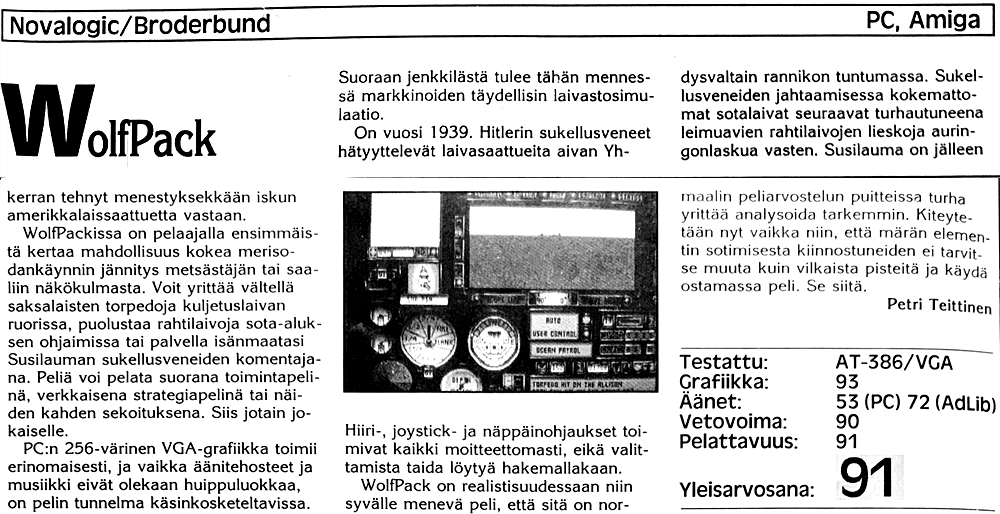
WolfPack1991 KevätPysyvä linkkiSuoraan jenkkilästä tulee tähän mennessä markkinoiden täydellisin laivastosimulaatio.
On vuosi 1939. Hitlerin sukellusveneet hätyyttelevät laivasaattueita aivan Yhdysvaltain rannikon tuntumassa. Sukellusveneiden jahtaamisessa kokemattomat sotalaivat seuraavat turhautuneena leimuavien rahtilaivojen lieskoja auringonlaskua vasten. Susilauma on jälleen kerran tehnyt menestyksekkään iskun amerikkalaissaattuetta vastaan.
WolfPackissa on pelaajalla ensimmäistä kertaa mahdollisuus kokea merisodankäynnin jännitys metsästäjän tai saaliin näkökulmasta. Voit yrittää vältellä saksalaisten torpedoja kuljetuslaivan ruorissa, puolustaa rahtilaivoja sota-aluksen ohjaimissa tai palvella isänmaatasi Susilauman sukellusveneiden komentajana. Peliä voi pelata suorana toimintapelinä, verkkaisena strategiapelinä tai näiden kahden sekoituksena. Siis jotain jokaiselle.
PC:n 256-värinen VGA-grafiikka toimii erinomaisesti, ja vaikka äänitehosteet ja musiikki eivät olekaan huippuluokkaa, on pelin tunnelma käsinkosketeltavissa.
Hiiri-, joystick- ja näppäinohjaukset toimivat kaikki moitteettomasti, eikä valittamista taida löytyä hakemallakaan.
WolfPack on realistisuudessaan niin syvälle menevä peli, että sitä on normaalin peliarvostelun puitteissa turha yrittää analysoida tarkemmin. Kiteytetään nyt vaikka niin, että märän elementin sotimisesta kiinnostuneiden ei tarvitse muuta kuin vilkaista pisteitä ja käydä ostamassa peli. Se siitä.
WolfPack1991 KevätPermalinkStraight from Yankeeland comes the most complete naval simulation on the market to date.
The year is 1939. Hitler's U-boats are harassing convoys right off the coast of the United States. Warships with no experience of hunting submarines watch in frustration as the flames of blazing freighters leap against the sunset. The Wolf Pack has once again struck successfully against an American convoy.
In WolfPack the player gets, for the first time, the chance to experience the thrill of naval warfare from the point of view of either the hunter or the prey. You can try to dodge German torpedoes at the helm of a transport ship, defend the freighters at the controls of a warship, or serve your fatherland as commander of the Wolf Pack's U-boats. The game can be played as a straight action game, as a leisurely strategy game or as a mix of the two. Something for everyone, then.
The PC's 256-colour VGA graphics work superbly, and although the sound effects and music aren't top-class, the game's atmosphere is palpable.
Mouse, joystick and keyboard controls all work flawlessly, and you'd be hard pressed to find anything to complain about even if you went looking.
WolfPack goes so deep in its realism that there's no point trying to analyse it in any more detail within the confines of a normal game review. Let's just boil it down like this: anyone interested in warfare on the wet element need do nothing more than glance at the scores and go and buy the game. Enough said.
Wonder Boy III: The Dragon's Trap
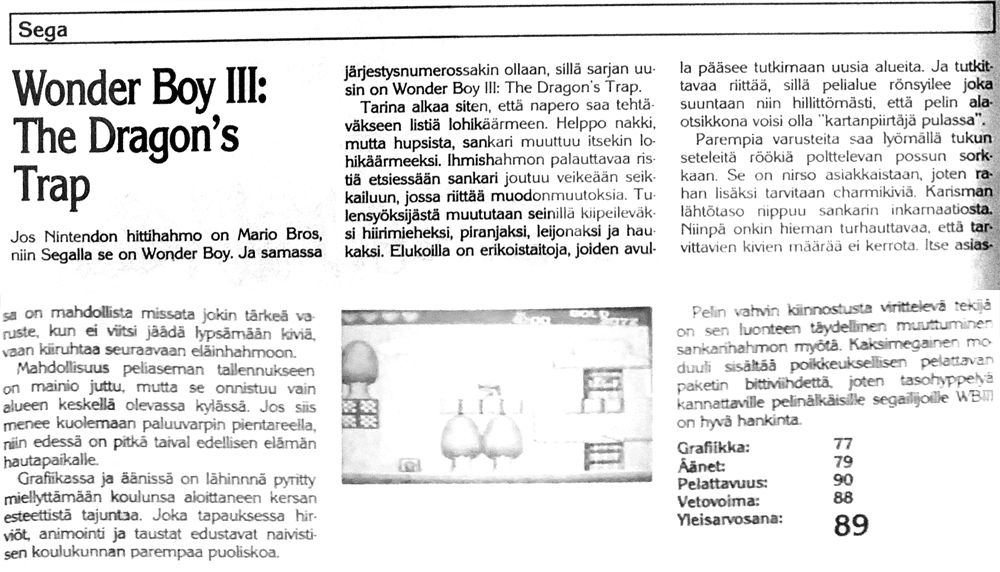
Wonder Boy III: The Dragon's Trap1990 KevätPysyvä linkkiJos Nintendon hittihahmo on Mario Bros, niin Segalla se on Wonder Boy. Ja samassa järjestysnumerossakin ollaan, sillä sarjan uusin on Wonder Boy III: The Dragon's Trap.
Tarina alkaa siten, että napero saa tehtäväkseen listiä lohikäärmeen. Helppo nakki, mutta hupsista, sankari muuttuu itsekin lohikäärmeeksi. Ihmishahmon palauttavaa ristiä etsiessään sankari joutuu veikeään seikkailuun, jossa riittää muodonmuutoksia. Tulensyöksijästä muututaan seinillä kiipeileväksi hiirimieheksi, piranjaksi, leijonaksi ja haukaksi. Elukoilla on erikoistaitoja, joiden avulla pääsee tutkimaan uusia alueita. Ja tutkittavaa riittää, sillä pelialue rönsyilee joka suuntaan niin hillittömästi, että pelin alaotsikkona voisi olla "kartanpiirtäjä pulassa".
Parempia varusteita saa lyömällä tukun seteleitä röökiä polttelevan possun sorkkaan. Se on nirso asiakkaistaan, joten rahan lisäksi tarvitaan charmikiviä. Karisman lähtötaso riippuu sankarin inkarnaatiosta. Niinpä onkin hieman turhauttavaa, että tarvittavien kivien määrää ei kerrota. Itse asiassa on mahdollista missata jokin tärkeä varuste, kun ei viitsi jäädä lypsämään kiviä, vaan kiiruhtaa seuraavaan eläinhahmoon.
Mahdollisuus peliaseman tallennukseen on mainio juttu, mutta se onnistuu vain alueen keskellä olevassa kylässä. Jos siis menee kuolemaan paluuvarpin pientareella, niin edessä on pitkä taival edellisen elämän hautapaikalle.
Grafiikassa ja äänissä on lähinnnä pyritty miellyttämään koulunsa aloittaneen kersan esteettistä tajuntaa. Joka tapauksessa hirviöt, animointi ja taustat edustavat naivistisen koulukunnan parempaa puoliskoa.
Pelin vahvin kiinnostusta virittelevä tekijä on sen luonteen täydellinen muuttuminen sankarihahmon myötä. Kaksimegainen moduuli sisältää poikkeuksellisen pelattavan paketin bittiviihdettä, joten tasohyppelyä kannattaville pelinälkäisille segailijoille WBIII on hyvä hankinta.
Wonder Boy III: The Dragon's Trap1990 KevätPermalinkIf Nintendo's hit character is Mario Bros, then Sega's is Wonder Boy. And they're even up to the same number, since the latest in the series is Wonder Boy III: The Dragon's Trap.
The story begins with the little tyke being given the job of bumping off a dragon. Piece of cake, but whoopsie-daisy, the hero turns into a dragon himself. While hunting for the cross that will give back his human shape, the hero is swept into a jolly adventure with no shortage of transformations. From fire-breather he goes on to become a wall-climbing mouse-man, a piranha, a lion and a hawk. The critters have special skills that let you get into new areas to explore. And there is plenty to explore, since the play area sprawls in every direction so uncontrollably that the game could be subtitled "cartographer in trouble".
Better gear is got by slapping a wad of banknotes into the trotter of a piggy puffing away on a ciggie. It's picky about its customers, so besides money you also need charm stones. The starting level of charisma depends on the hero's incarnation. So it's a bit frustrating that you aren't told how many stones are needed. In fact it's possible to miss some important piece of gear if you can't be bothered to stay behind milking stones and rush on to the next animal form instead.
The option to save your game position is a splendid thing, but it can only be done in the village in the middle of the area. So if you go and die right on the verge of the return warp, you've got a long trek ahead to the burial place of your previous life.
The graphics and sound have mainly aimed at pleasing the aesthetic sense of a kid who has just started school. In any case, the monsters, animation and backgrounds represent the better half of the naivist school.
The game's strongest hook for keeping your interest up is the way its whole character changes completely along with the hero's form. The two-meg cartridge holds an exceptionally playable package of bit entertainment, so for game-hungry Sega-ers who go in for platform-hopping, WBIII is a good buy.
World Championship Boxing Manager
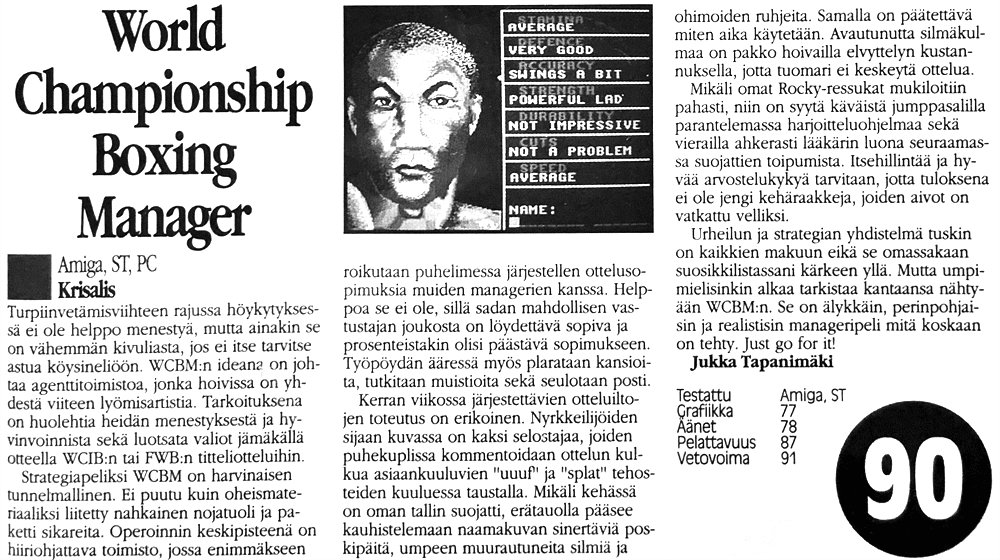
World Championship Boxing Manager1991 SyksyPysyvä linkkiTurpiinvetämisviihteen rajussa höykytyksessä ei ole helppo menestyä, mutta ainakin se on vähemmän kivuliasta, jos ei itse tarvitse astua köysineliöön. WCBM:n ideana on johtaa agenttitoimistoa, jonka hoivissa on yhdestä viiteen lyömisartistia. Tarkoituksena on huolehtia heidän menestyksestä ja hyvinvoinnista sekä luotsata valiot jämäkällä otteella WCIB:n tai FWB:n titteliotteluihin.
Strategiapeliksi WCBM on harvinaisen tunnelmallinen. Ei puutu kuin oheismateriaaliksi liitetty nahkainen nojatuoli ja paketti sikareita. Operoinnin keskipisteenä on hiiriohjattava toimisto, jossa enimmäkseen roikutaan puhelimessa järjestellen ottelusopimuksia muiden managerien kanssa. Helppoa se ei ole, sillä sadan mahdollisen vastustajan joukosta on löydettävä sopiva ja prosenteistakin olisi päästävä sopimukseen. Työpöydän ääressä myös plarataan kansioita, tutkitaan muistioita sekä seulotaan posti.
Kerran viikossa järjestettävien otteluiltojen toteutus on erikoinen. Nyrkkeilijöiden sijaan kuvassa on kaksi selostajaa, joiden puhekuplissa kommentoidaan ottelun kulkua asiaankuuluvien "uuuf" ja "splat" tehosteiden kuuluessa taustalla. Mikäli kehässä on oman tallin suojatti, erätauolla pääsee kauhistelemaan naamakuvan sinertäviä poskipäitä, umpeen muurautuneita silmiä ja ohimoiden ruhjeita. Samalla on päätettävä miten aika käytetään. Avautunutta silmäkulmaa on pakko hoivailla elvyttelyn kustannuksella, jotta tuomari ei keskeytä ottelua.
Mikäli omat Rocky-ressukat mukiloitiin pahasti, niin on syytä käväistä jumppasalilla parantelemassa harjoitteluohjelmaa sekä vierailla ahkerasti lääkärin luona seuraamassa suojattien toipumista. Itsehillintää ja hyvää arvostelukykyä tarvitaan, jotta tuloksena ei ole jengi kehäraakkeja, joiden aivot on vatkattu velliksi.
Urheilun ja strategian yhdistelmä tuskin on kaikkien makuun eikä se omassakaan suosikkilistassani kärkeen yllä. Mutta umpimielisinkin alkaa tarkistaa kantaansa nähtyään WCBM:n. Se on älykkäin, perinpohjaisin ja realistisin manageripeli mitä koskaan on tehty. Just go for it!
World Championship Boxing Manager1991 SyksyPermalinkIt isn't easy to succeed amid the brutal pummelling of the snout-bashing entertainment business, but at least it's less painful if you don't have to step into the roped square yourself. The idea of WCBM is to run an agency with anywhere from one to five punching artists in its care. The aim is to look after their success and well-being and to steer the prize specimens with a firm hand into WCIB or FWB title fights.
For a strategy game, WCBM is unusually atmospheric. The only things missing are a leather armchair and a box of cigars thrown in as extras. The hub of operations is a mouse-controlled office where you mostly hang on the phone setting up fight contracts with other managers. That isn't easy, since you have to find a suitable opponent among a hundred possible ones and agree on the percentages as well. At the desk you also leaf through files, study memos and sift through the post.
The fight nights, held once a week, are presented in an unusual way. Instead of the boxers the picture shows two commentators, whose speech bubbles comment on how the fight is going while the appropriate "uuuf" and "splat" effects sound in the background. If a protege from your own stable is in the ring, between rounds you get to recoil in horror at the bluish cheekbones, the eyes mortared shut and the bruised temples on the face portrait. At the same time you have to decide how to use the break. A cut eye has to be nursed at the expense of recuperation, so that the referee doesn't stop the fight.
If your own poor little Rockys took a bad beating, it's a good idea to pop into the gym to improve the training programme, and to visit the doctor diligently to keep track of your proteges' recovery. Self-control and good judgement are needed so that you don't end up with a gang of ring wrecks whose brains have been whisked into gruel.
A combination of sport and strategy is hardly to everyone's taste, and it doesn't make the top of my own list of favourites either. But even the most narrow-minded will start reconsidering their position once they've seen WCBM. It is the most intelligent, most thorough and most realistic manager game ever made. Just go for it!
World Championship Soccer
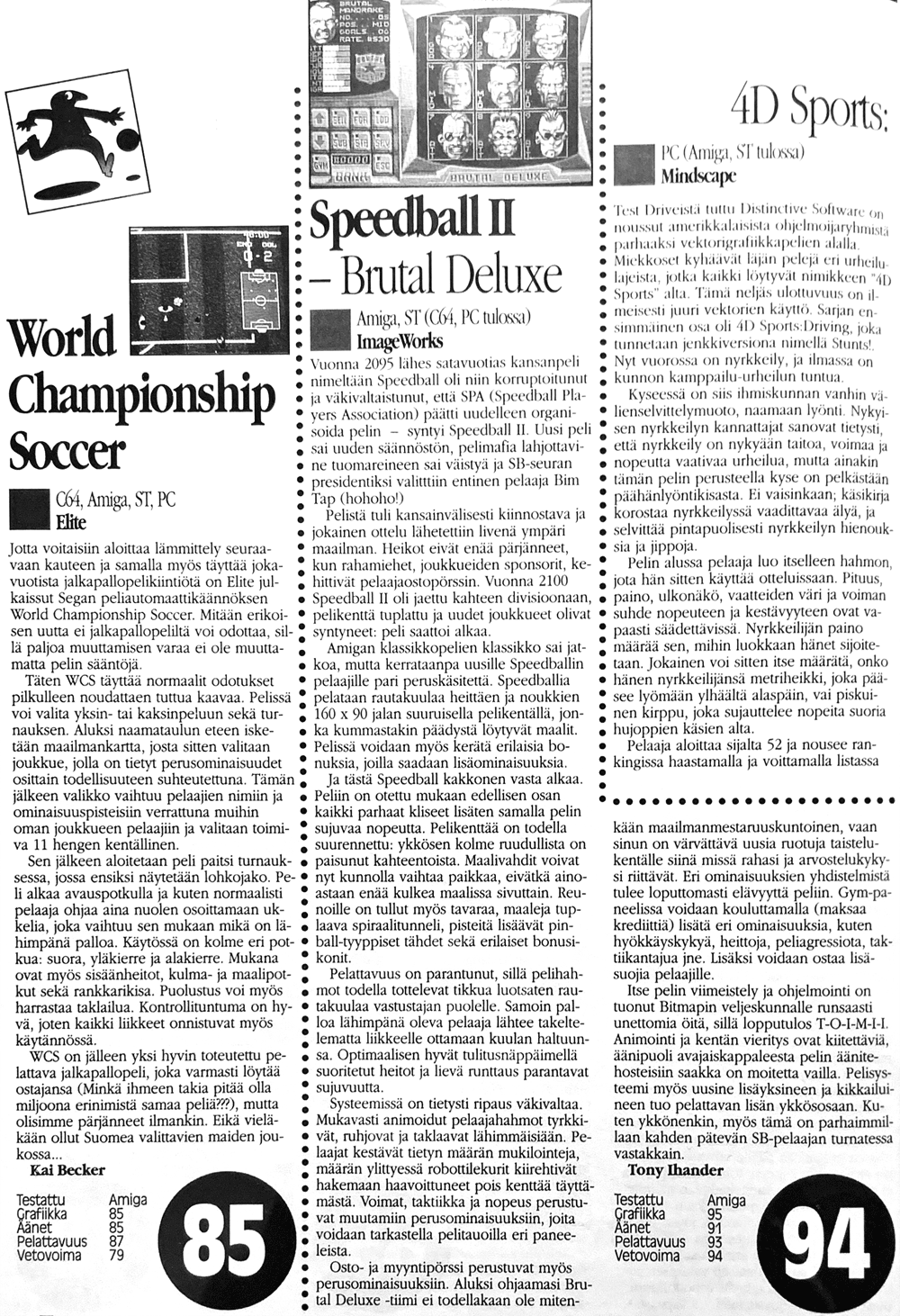
World Championship Soccer1991 SyksyPysyvä linkkiJotta voitaisiin aloittaa lämmittely seuraavaan kauteen ja samalla myös täyttää jokavuotista jalkapallopelikiintiötä on Elite julkaissut Segan peliautomaattikäännöksen World Championship Soccer. Mitään erikoisen uutta ei jalkapallopeliltä voi odottaa, sillä paljoa muuttamisen varaa ei ole muuttamatta pelin sääntöjä.
Täten WCS täyttää normaalit odotukset pilkulleen noudattaen tuttua kaavaa. Pelissä voi valita yksin- tai kaksinpeluun sekä turnauksen. Aluksi naamataulun eteen isketään maailmankartta, josta sitten valitaan joukkue, jolla on tietyt perusominaisuudet osittain todellisuuteen suhteutettuna. Tämän jälkeen valikko vaihtuu pelaajien nimiin ja ominaisuuspisteisiin verrattuna muihin oman joukkueen pelaajiin ja valitaan toimiva 11 hengen kentällinen.
Sen jälkeen aloitetaan peli paitsi turnauksessa, jossa ensiksi näytetään lohkojako. Peli alkaa avauspotkulla ja kuten normaalisti pelaaja ohjaa aina nuolen osoittamaan ukkelia, joka vaihtuu sen mukaan mikä on lähimpänä palloa. Käytössä on kolme eri potkua: suora, yläkierre ja alakierre. Mukana ovat myös sisäänheitot, kulma- ja maalipotkut sekä rankkarikisa. Puolustus voi myös harrastaa taklailua. Kontrollituntuma on hyvä, joten kaikki liikkeet onnistuvat myös käytännössä.
WCS on jälleen yksi hyvin toteutettu pelattava jalkapallopeli, joka varmasti löytää ostajansa (Minkä ihmeen takia pitää olla miljoona erinimistä samaa peliä???), mutta olisimme pärjänneet ilmankin. Eikä vieläkään ollut Suomea valittavien maiden joukossa...
World Championship Soccer1991 SyksyPermalinkSo that the warm-up for next season can get going, and to fill the annual football game quota at the same time, Elite has released its conversion of Sega's arcade game World Championship Soccer. You can't expect anything especially new from a football game, since there isn't much room left for changes without changing the rules of the game itself.
Accordingly WCS meets the usual expectations to the letter, following the familiar formula. In the game you can choose one- or two-player mode, as well as a tournament. First a world map gets slapped in front of your mug, from which you then pick a team that has certain basic attributes partly scaled to reality. After this the menu switches to the players' names and their attribute points compared with the other players in your own team, and you pick a working eleven-strong line-up.
After that the match gets under way, except in the tournament, where the group draw is shown first. The match starts with a kick-off and, as usual, the player always controls the little fellow the arrow is pointing at, which changes to whoever is closest to the ball. There are three different kicks available: straight, topspin and backspin. Throw-ins, corner and goal kicks and a penalty shoot-out are all there too. The defence can also indulge in a spot of tackling. The control feel is good, so all the moves actually come off in practice as well.
WCS is yet another well-made, playable football game that is sure to find its buyers (Why on earth do there have to be a million versions of the same game under different names???), but we'd have managed without it. And still no Finland among the countries on offer...
World Class Leaderboard Famous Courses of World Volume 1
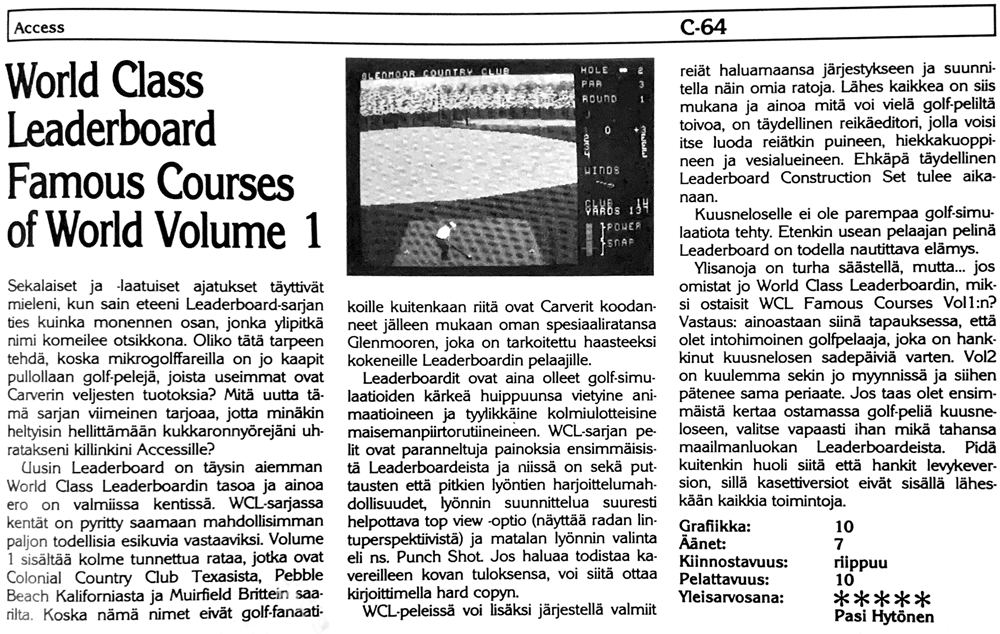
World Class Leaderboard Famous Courses of World Volume 11988Pysyvä linkkiSekalaiset ja -laatuiset ajatukset täyttivät mieleni, kun sain eteeni Leaderboard-sarjan ties kuinka monennen osan, jonka ylipitkä nimi komeilee otsikkona. Oliko tätä tarpeen tehdä, koska mikrogolffareilla on jo kaapit pullollaan golf-pelejä, joista useimmat ovat Carverin veljesten tuotoksia? Mitä uutta tämä sarjan viimeinen tarjoaa, jotta minäkin heltyisin hellittämään kukkaronnyörejäni uhratakseni killinkini Accessille?
Uusin Leaderboard on täysin aiemman World Class Leaderboardin tasoa ja ainoa ero on valmiissa kentissä. WCL-sarjassa kentät on pyritty saamaan mahdollisimman paljon todellisia esikuvia vastaaviksi. Volume 1 sisältää kolme tunnettua rataa, jotka ovat Colonial Country Club Texasista, Pebble Beach Kaliforniasta ja Muirfield Brittein saarilta. Koska nämä nimet eivät golf-fanaatikoille kuitenkaan riitä ovat Carverit koodanneet jälleen mukaan oman spesiaaliratansa Glenmooren, joka on tarkoitettu haasteeksi kokeneille Leaderboardin pelaajille.
Leaderboardit ovat aina olleet golf-simulaatioiden kärkeä huippuunsa vietyine animaatioineen ja tyylikkäine kolmiulotteisine maisemanpiirtorutiineineen. WCL-sarjan pelit ovat paranneltuja painoksia ensimmäisistä Leaderboardeista ja niissä on sekä puttausten että pitkien lyöntien harjoittelumahdollisuudet, lyönnin suunnittelua suuresti helpottava top view -optio (näyttää radan lintuperspektiivistä) ja matalan lyönnin valinta eli ns. Punch Shot. Jos haluaa todistaa kavereilleen kovan tuloksensa, voi siitä ottaa kirjoittimella hard copyn.
WCL-peleissä voi lisäksi järjestellä valmiit reiät haluamaansa järjestykseen ja suunnitella näin omia ratoja. Lähes kaikkea on siis mukana ja ainoa mitä voi vielä golf-peliltä toivoa, on täydellinen reikäeditori, jolla voisi itse luoda reiätkin puineen, hiekkakuoppineen ja vesialueineen. Ehkäpä täydellinen Leaderboard Construction Set tulee aikanaan.
Kuusneloselle ei ole parempaa golf-simulaatiota tehty. Etenkin usean pelaajan pelinä Leaderboard on todella nautittava elämys.
Ylisanoja on turha säästellä, mutta... jos omistat jo World Class Leaderboardin, miksi ostaisit WCL Famous Courses Vol1:n? Vastaus: ainoastaan siinä tapauksessa, että olet intohimoinen golfpelaaja, joka on hankkinut kuusnelosen sadepäiviä varten. Vol2 on kuulemma sekin jo myynnissä ja siihen pätenee sama periaate. Jos taas olet ensimmäistä kertaa ostamassa golf-peliä kuusneloseen, valitse vapaasti ihan mikä tahansa maailmanluokan Leaderboardeista. Pidä kuitenkin huoli siitä että hankit levykeversion, sillä kasettiversiot eivät sisällä läheskään kaikkia toimintoja.
World Class Leaderboard Famous Courses of World Volume 11988PermalinkMixed and motley thoughts filled my mind when I was handed the umpteenth instalment of the Leaderboard series, whose overlong name sits proudly up there as the headline. Was this really necessary, when micro-golfers already have cupboards bursting with golf games, most of them the handiwork of the Carver brothers? What does this latest in the series offer that's new, so that even I might soften up enough to slacken my purse strings and sacrifice my shillings to Access?
The newest Leaderboard is fully up to the standard of the earlier World Class Leaderboard, and the only difference is in the ready-made courses. In the WCL series the aim has been to make the courses match their real-life models as closely as possible. Volume 1 contains three famous courses: Colonial Country Club from Texas, Pebble Beach from California and Muirfield from the British Isles. Since these names still aren't enough for golf fanatics, the Carvers have once again coded in a special course of their own, Glenmoore, which is meant as a challenge for experienced Leaderboard players.
The Leaderboards have always been at the very top of golf simulations, with their animation taken to the limit and their stylish three-dimensional landscape-drawing routines. The games in the WCL series are improved editions of the first Leaderboards, and they include practice options for both putting and long shots, a top view option that makes planning your shots much easier (it shows the course from a bird's-eye view), and a low-shot option, the so-called Punch Shot. If you want to prove your hot score to your mates, you can run off a hard copy of it on the printer.
In the WCL games you can also put the ready-made holes in whatever order you like and so design your own courses. So nearly everything is in there, and the only thing left to wish for from a golf game is a complete hole editor that would let you create the holes themselves too, with their trees, bunkers and water hazards. Maybe a complete Leaderboard Construction Set will come along in due course.
No better golf simulation has been made for the Commodore 64. Especially as a multiplayer game, Leaderboard is a truly enjoyable experience.
There's no point holding back on the superlatives, but... if you already own World Class Leaderboard, why would you buy WCL Famous Courses Vol1? Answer: only if you're a passionate golfer who has got a Commodore 64 for rainy days. Vol2 is reportedly already on sale too, and the same principle presumably applies to it. If, on the other hand, you're buying a golf game for the Commodore 64 for the first time, feel free to pick absolutely any of the world-class Leaderboards. Do make sure, though, that you get the disk version, because the cassette versions don't have anywhere near all the features.
World Tour Golf
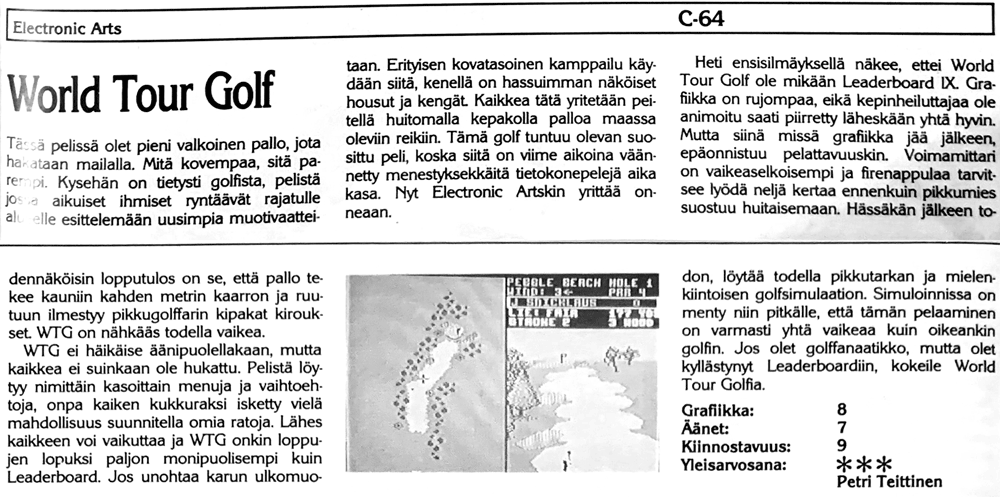
World Tour Golf1988Pysyvä linkkiTässä pelissä olet pieni valkoinen pallo, jota hakataan mailalla. Mitä kovempaa, sitä parempi. Kysehän on tietysti golfista, pelistä jossa aikuiset ihmiset ryntäävät rajatulle alueelle esittelemään uusimpia muotivaatteitaan. Erityisen kovatasoinen kamppailu käydään siitä, kenellä on hassuimman näköiset housut ja kengät. Kaikkea tätä yritetään peitellä huitomalla kepakolla palloa maassa oleviin reikiin. Tämä golf tuntuu olevan suosittu peli, koska siitä on viime aikoina väännetty menestyksekkäitä tietokonepelejä aika kasa. Nyt Electronic Artskin yrittää onneaan.
Heti ensisilmäyksellä näkee, ettei World Tour Golf ole mikään Leaderboard IX. Grafiikka on rujompaa, eikä kepinheiluttajaa ole animoitu saati piirretty läheskään yhtä hyvin. Mutta siinä missä grafiikka jää jälkeen, epäonnistuu pelattavuuskin. Voimamittari on vaikeaselkoisempi ja firenappulaa tarvitsee lyödä neljä kertaa ennenkuin pikkumies suostuu huitaisemaan. Hässäkän jälkeen todennäköisin lopputulos on se, että pallo tekee kauniin kahden metrin kaarron ja ruutuun ilmestyy pikkugolffarin kipakat kiroukset. WTG on nähkääs todella vaikea.
WTG ei häikäise äänipuolellakaan, mutta kaikkea ei suinkaan ole hukattu. Pelistä löytyy nimittäin kasoittain menuja ja vaihtoehtoja, onpa kaiken kukkuraksi isketty vielä mahdollisuus suunnitella omia ratoja. Lähes kaikkeen voi vaikuttaa ja WTG onkin loppujen lopuksi paljon monipuolisempi kuin Leaderboard. Jos unohtaa karun ulkomuodon, löytää todella pikkutarkan ja mielenkiintoisen golfsimulaation. Simuloinnissa on menty niin pitkälle, että tämän pelaaminen on varmasti yhtä vaikeaa kuin oikeankin golfin. Jos olet golffanaatikko, mutta olet kyllästynyt Leaderboardiin, kokeile World Tour Golfia.
World Tour Golf1988PermalinkIn this game you are a small white ball that gets whacked with a club. The harder, the better. It's golf, of course - the game where grown adults rush onto a marked-off area to show off their latest fashion outfits. An especially fierce contest is waged over who has the silliest-looking trousers and shoes. They try to disguise all this by swatting at a ball with a stick, aiming for holes in the ground. This golf thing seems to be a popular game, since quite a heap of successful computer games have been cranked out of it lately. Now Electronic Arts is trying its luck too.
At the very first glance you can see that World Tour Golf is no Leaderboard IX. The graphics are cruder, and the stick-waggler hasn't been animated, let alone drawn, anywhere near as well. But where the graphics fall behind, the playability fails as well. The power meter is harder to make sense of, and you have to hit the fire button four times before the little man deigns to take a swipe. After all that palaver, the most likely outcome is that the ball makes a lovely two-metre arc and the little golfer's snappy swearing appears on the screen. WTG is really difficult, you see.
WTG doesn't dazzle on the sound front either, but all is by no means lost. The thing is, the game has menus and options by the heap, and to top it all they've even thrown in the option to design your own courses. You can influence almost everything, and in the end WTG is actually far more versatile than Leaderboard. If you can overlook its spartan looks, you'll find a really meticulous and interesting golf simulation. The simulation has been taken so far that playing this is surely every bit as hard as real golf. If you're a golf fanatic but you're fed up with Leaderboard, give World Tour Golf a try.
Wrath Of The Demon
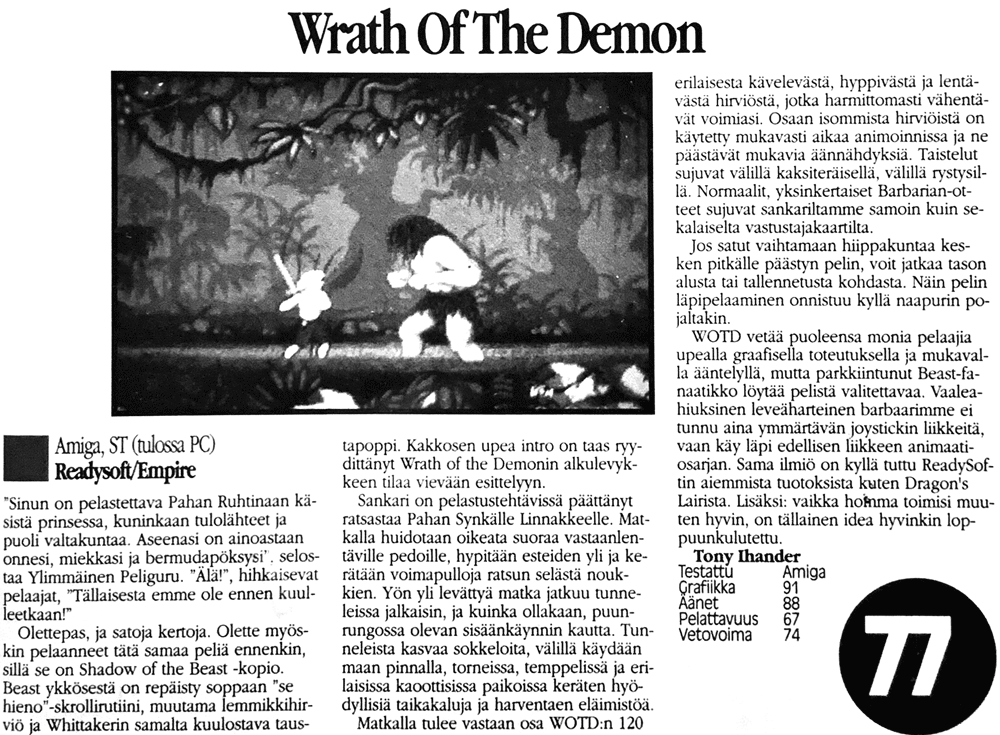
Wrath Of The Demon1991 SyksyPysyvä linkki"Sinun on pelastettava Pahan Ruhtinaan käsistä prinsessa, kuninkaan tulolähteet ja puoli valtakuntaa. Aseenasi on ainoastaan onnesi, miekkasi ja bermudapöksysi". selostaa Ylimmäinen Peliguru. "Älä!", hihkaisevat pelaajat, "Tällaisesta emme ole ennen kuulleetkaan!"
Olettepas, ja satoja kertoja. Olette myöskin pelaanneet tätä samaa peliä ennenkin, sillä se on Shadow of the Beast -kopio. Beast ykkösestä on repäisty soppaan "se hieno"-skrollirutiini, muutama lemmikkihirviö ja Whittakerin samalta kuulostava taustapoppi. Kakkosen upea intro on taas ryydittänyt Wrath of the Demonin alkulevykkeen tilaa vievään esittelyyn.
Sankari on pelastustehtävissä päättänyt ratsastaa Pahan Synkälle Linnakkeelle. Matkalla huidotaan oikeata suoraa vastaanlentäville pedoille, hypitään esteiden yli ja kerätään voimapulloja ratsun selästä noukkien. Yön yli levättyä matka jatkuu tunneleissa jalkaisin, ja kuinka ollakaan, puunrungossa olevan sisäänkäynnin kautta. Tunneleista kasvaa sokkeloita, välillä käydään maan pinnalla, torneissa, temppelissä ja erilaisissa kaoottisissa paikoissa keräten hyödyllisiä taikakaluja ja harventaen eläimistöä.
Matkalla tulee vastaan osa WOTD:n 120 erilaisesta kävelevästä, hyppivästä ja lentävästä hirviöstä, jotka harmittomasti vähentävät voimiasi. Osaan isommista hirviöistä on käytetty mukavasti aikaa animoinnissa ja ne päästävät mukavia äännähdyksiä. Taistelut sujuvat välillä kaksiteräisellä, välillä rystysillä. Normaalit, yksinkertaiset Barbarian-otteet sujuvat sankariltamme samoin kuin sekalaiselta vastustajakaartilta.
Jos satut vaihtamaan hiippakuntaa kesken pitkälle päästyn pelin, voit jatkaa tason alusta tai tallennetusta kohdasta. Näin pelin läpipelaaminen onnistuu kyllä naapurin pojaltakin.
WOTD vetää puoleensa monia pelaajia upealla graafisella toteutuksella ja mukavalla ääntelyllä, mutta parkkiintunut Beast-fanaatikko löytää pelistä valitettavaa. Vaaleahiuksinen leveäharteinen barbaarimme ei tunnu aina ymmärtävän joystickin liikkeitä, vaan käy läpi edellisen liikkeen animaatiosarjan. Sama ilmiö on kyllä tuttu ReadySoftin aiemmista tuotoksista kuten Dragon's Lairista. Lisäksi: vaikka homma toimisi muuten hyvin, on tällainen idea hyvinkin loppuunkulutettu.
Wrath Of The Demon1991 SyksyPermalink"You must rescue the princess, the king's sources of income and half the kingdom from the clutches of the Prince of Evil. Your only weapons are your luck, your sword and your Bermuda shorts," explains the Supreme Game Guru. "You don't say!" the players whoop, "We've never heard of anything like this before!"
Oh yes you have, hundreds of times. You've also played this very same game before, because it's a Shadow of the Beast copy. From Beast one, "that fancy" scroll routine, a few pet monsters and background pop that sounds just like Whittaker's have been ripped out and tossed into the soup. The second game's superb intro, for its part, has gone to season the space-hogging introduction on Wrath of the Demon's first disk.
On this rescue mission the hero has decided to ride to the Dark Fortress of Evil. On the way you throw straight rights at the beasts flying at you, jump over obstacles and collect power potions, picking them up from horseback. After a night's rest the journey continues on foot through tunnels, entered, wouldn't you know it, through an opening in a tree trunk. The tunnels grow into mazes, and every so often you visit the surface, towers, a temple and various chaotic places, collecting useful magic items and thinning out the wildlife.
Along the way you run into some of WOTD's 120 different walking, hopping and flying monsters, which harmlessly sap your strength. On some of the bigger monsters a nice amount of time has been spent on the animation, and they let out nice little grunts. The fighting is done sometimes with the double-edged blade, sometimes with the knuckles. The normal, simple Barbarian moves come as easily to our hero as to the motley crew of opponents.
If you happen to go to meet your maker partway through a game you've got far into, you can carry on from the start of the level or from a saved point. That way even the kid next door will manage to play the game through.
WOTD will win over many players with its gorgeous graphics and nice sound effects, but the hardened Beast fanatic will find things to complain about. Our fair-haired, broad-shouldered barbarian doesn't always seem to understand the joystick's movements, and plays out the animation sequence of the previous move instead. Admittedly the same phenomenon is familiar from ReadySoft's earlier output, such as Dragon's Lair. Besides: even if the thing otherwise worked well, an idea like this is well and truly worn out.
Wreck, The
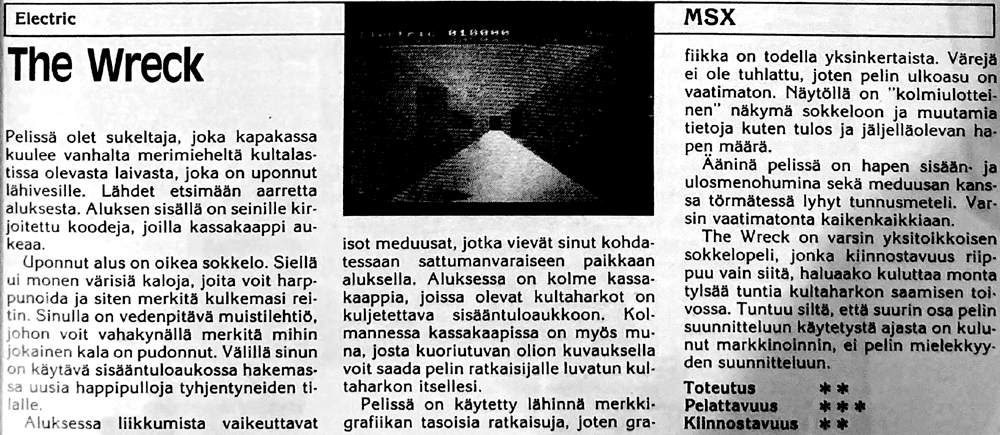
Wreck, The1987Pysyvä linkkiPelissä olet sukeltaja, joka kapakassa kuulee vanhalta merimieheltä kultalastissa olevasta laivasta, joka on uponnut lähivesille. Lähdet etsimään aarretta aluksesta. Aluksen sisällä on seinille kirjoitettu koodeja, joilla kassakaappi aukeaa.
Uponnut alus on oikea sokkelo. Siellä ui monen värisiä kaloja, joita voit harppunoida ja siten merkitä kulkemasi reitin. Sinulla on vedenpitävä muistilehtiö, johon voit vahakynällä merkitä mihin jokainen kala on pudonnut. Välillä sinun on käytävä sisääntuloaukossa hakemassa uusia happipulloja tyhjentyneiden tilalle.
Aluksessa liikkumista vaikeuttavat isot meduusat, jotka vievät sinut kohdatessaan sattumanvaraiseen paikkaan aluksella. Aluksessa on kolme kassakaappia, joissa olevat kultaharkot on kuljetettava sisääntuloaukkoon. Kolmannessa kassakaapissa on myös muna, josta kuoriutuvan olion kuvauksella voit saada pelin ratkaisijalle luvatun kultaharkon itsellesi.
Pelissä on käytetty lähinnä merkkigrafiikan tasoisia ratkaisuja, joten grafiikka on todella yksinkertaista. Värejä ei ole tuhlattu, joten pelin ulkoasu on vaatimaton. Näytöllä on "kolmiulotteinen" näkymä sokkeloon ja muutamia tietoja kuten tulos ja jäljelläolevan hapen määrä.
Ääninä pelissä on hapen sisään- ja ulosmenohumina sekä meduusan kanssa törmätessä lyhyt tunnusmeteli. Varsin vaatimatonta kaikenkaikkiaan.
The Wreck on varsin yksitoikkoisen sokkelopeli, jonka kiinnostavuus riippuu vain siitä, haluaako kuluttaa monta tylsää tuntia kultaharkon saamisen toivossa. Tuntuu siltä, että suurin osa pelin suunnitteluun käytetystä ajasta on kulunut markkinoinnin, ei pelin mielekkyyden suunnitteluun.
Wreck, The1987PermalinkIn the game you are a diver who, in a tavern, hears from an old sailor about a ship carrying a cargo of gold that has sunk in nearby waters. You set off to search the wreck for the treasure. Inside the ship, codes that open the safe have been written on the walls.
The sunken ship is a real maze. Fish of many colours swim about in it, and you can harpoon them and so mark the route you have taken. You have a waterproof notepad on which you can use a wax crayon to note where each fish has fallen. Every now and then you have to go back to the entrance to pick up fresh oxygen tanks to replace the empty ones.
Getting around the ship is made harder by big jellyfish which, when you run into them, carry you off to a random spot on the ship. There are three safes on board, and the gold bars in them must be carried to the entrance. The third safe also holds an egg, and by describing the creature that hatches from it you can win for yourself the gold bar promised to whoever solves the game.
The game mostly makes do with solutions on the level of character graphics, so the graphics are really simple. Colours have not been squandered, so the game looks modest. The screen shows a "three-dimensional" view into the maze plus a few bits of information such as the score and the amount of oxygen left.
For sound, the game has the whoosh of oxygen going in and out, plus a short signature racket when you collide with a jellyfish. Pretty modest all in all.
The Wreck is a rather monotonous maze game whose interest depends solely on whether you want to spend many dull hours in the hope of getting a gold bar. It feels as though most of the time spent designing the game went into planning the marketing, not into making the game worthwhile.
WWF Wrestling
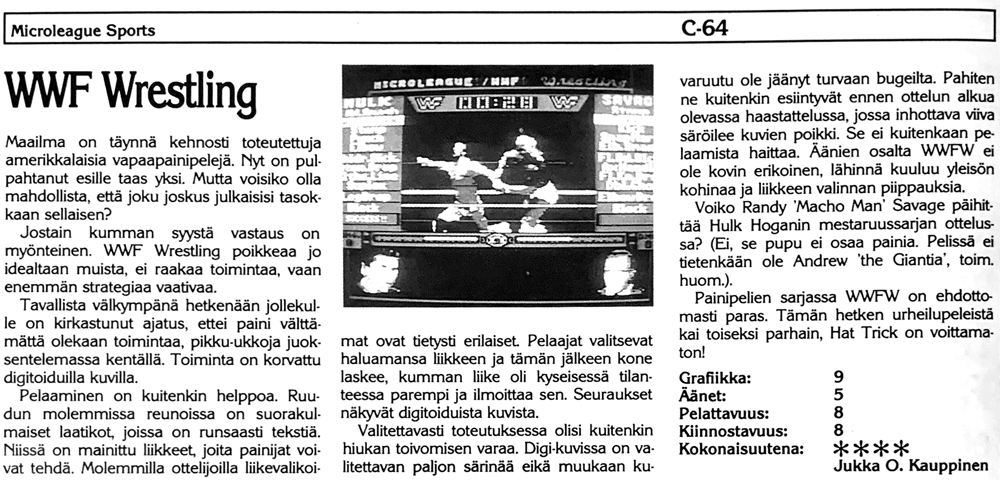
WWF Wrestling1988Pysyvä linkkiMaailma on täynnä kehnosti toteutettuja amerikkalaisia vapaapainipelejä. Nyt on pulpahtanut esille taas yksi. Mutta voisiko olla mahdollista, että joku joskus julkaisisi tasokkaan sellaisen?
Jostain kumman syystä vastaus on myönteinen. WWF Wrestling poikkeaa jo idealtaan muista, ei raakaa toimintaa, vaan enemmän strategiaa vaativaa.
Tavallista välkympänä hetkenään jollekulle on kirkastunut ajatus, ettei paini välttämättä olekaan toimintaa, pikku-ukkoja juoksentelemassa kentällä. Toiminta on korvattu digitoiduilla kuvilla.
Pelaaminen on kuitenkin helppoa. Ruudun molemmissa reunoissa on suorakulmaiset laatikot, joissa on runsaasti tekstiä. Niissä on mainittu liikkeet, joita painijat voivat tehdä. Molemmilla ottelijoilla liikevalikoimat ovat tietysti erilaiset. Pelaajat valitsevat haluamansa liikkeen ja tämän jälkeen kone laskee, kumman liike oli kyseisessä tilanteessa parempi ja ilmoittaa sen. Seuraukset näkyvät digitoiduista kuvista.
Valitettavasti toteutuksessa olisi kuitenkin hiukan toivomisen varaa. Digi-kuvissa on valitettavan paljon särinää eikä muukaan kuvaruutu ole jäänyt turvaan bugeilta. Pahiten ne kuitenkin esiintyvät ennen ottelun alkua olevassa haastattelussa, jossa inhottava viiva säröilee kuvien poikki. Se ei kuitenkaan pelaamista haittaa. Äänien osalta WWFW ei ole kovin erikoinen, lähinnä kuuluu yleisön kohinaa ja liikkeen valinnan piippauksia.
Voiko Randy 'Macho Man' Savage päihittää Hulk Hoganin mestaruussarjan ottelussa? (Ei, se pupu ei osaa painia. Pelissä ei tietenkään ole Andrew 'the Giantia', toim. huom.).
Painipelien sarjassa WWFW on ehdottomasti paras. Tämän hetken urheilupeleistä kai toiseksi parhain, Hat Trick on voittamaton!
WWF Wrestling1988PermalinkThe world is full of badly made American pro wrestling games. Now yet another one has popped up. But could it be possible that someone, some day, might release a decent one?
For some odd reason the answer is yes. WWF Wrestling differs from the others in its very concept: not raw action, but something that calls for more strategy.
In a brighter-than-usual moment it has dawned on somebody that wrestling doesn't necessarily have to be action, little men running around the field. The action has been replaced with digitised pictures.
Playing it is easy, though. On both edges of the screen there are rectangular boxes with plenty of text in them. They list the moves the wrestlers can make. The two fighters naturally have different repertoires of moves. The players choose the move they want, after which the computer works out whose move was better in that particular situation and announces it. The consequences can be seen in the digitised pictures.
Unfortunately, though, the execution leaves a little to be desired. The digi-pictures have an unfortunate amount of fuzz in them, and the rest of the screen hasn't been spared from bugs either. They're at their worst, though, in the interview before the start of the match, where a nasty line crackles across the pictures. That doesn't get in the way of playing, though. As far as sound goes WWFW is nothing special; mostly you hear the hiss of the crowd and the beeps of selecting a move.
Can Randy 'Macho Man' Savage beat Hulk Hogan in a championship bout? (No, that bunny can't wrestle. Of course the game doesn't have Andrew 'the Giant', Ed.).
In the wrestling game division WWFW is definitely the best. Of the current sports games probably the second best, Hat Trick is unbeatable!