Red Lightning
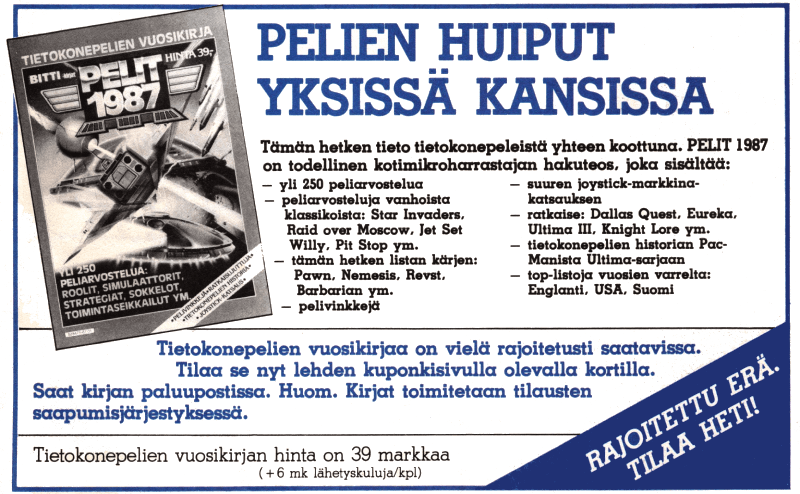
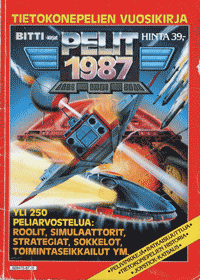
Pelit was a Finnish-language (bi)annual book series published from 1987 to 1991 containing gaming-related articles, tips and most importantly game reviews. Here you can find all the reviews from the books. The reviews were originally written in Finnish; the English versions are translations of the Finnish originals. Maininta tekijänoikeuksista
 1987
1987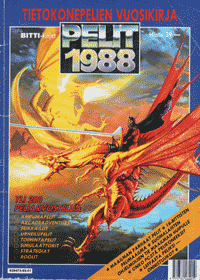 1988
1988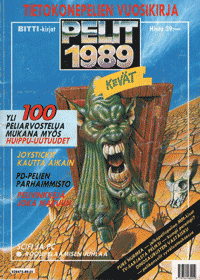 1989 Kevät
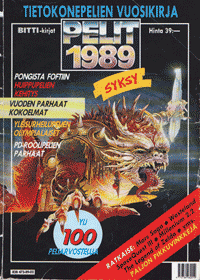 1989 Syksy
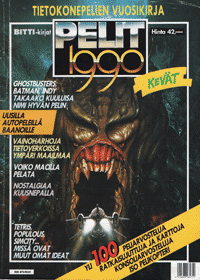 1990 Kevät
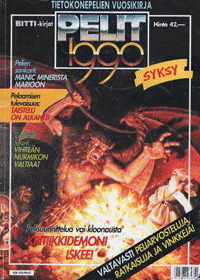 1990 Syksy
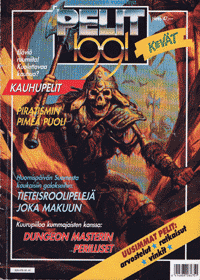 1991 Kevät
 1991 Syksy
Red Lightning
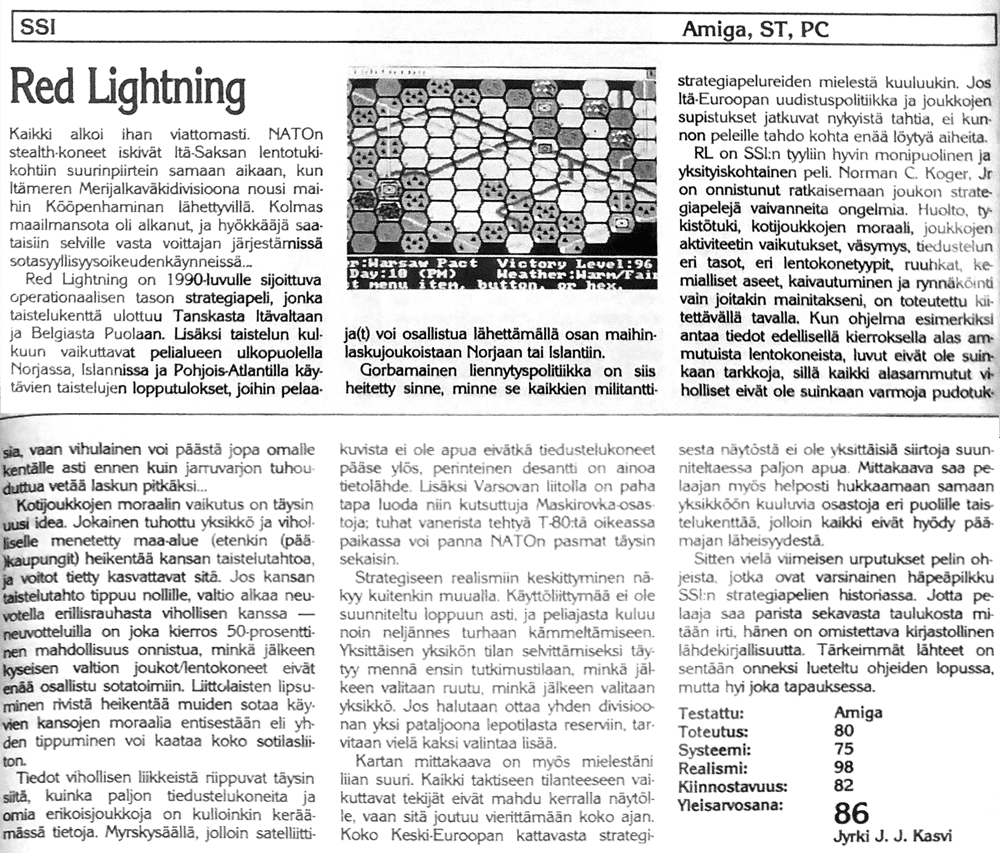
Red Lightning1990 KevätPysyvä linkkiKaikki alkoi ihan viattomasti. NATOn stealth-koneet iskivät Itä-Saksan lentotukikohtiin suurinpiirtein samaan aikaan, kun Itämeren Merijalkaväkidivisioona nousi maihin Kööpenhaminan lähettyvillä. Kolmas maailmansota oli alkanut, ja hyökkääjä saataisiin selville vasta voittajan järjestämissä sotasyyllisyysoikeudenkäynneissä...
Red Lightning on 1990-luvulle sijoittuva operationaalisen tason strategiapeli, jonka taistelukenttä ulottuu Tanskasta Itävaltaan ja Belgiasta Puolaan. Lisäksi taistelun kulkuun vaikuttavat pelialueen ulkopuolella Norjassa, Islannissa ja Pohjois-Atlantilla käytävien taistelujen lopputulokset, joihin pelaaja(t) voi osallistua lähettämällä osan maihinlaskujoukoistaan Norjaan tai Islantiin.
Gorbamainen liennytyspolitiikka on siis heitetty sinne, minne se kaikkien militanttistrategiapelureiden mielestä kuuluukin. Jos Itä-Euroopan uudistuspolitiikka ja joukkojen supistukset jatkuvat nykyistä tahtia, ei kunnon peleille tahdo kohta enää löytyä aiheita.
RL on SSI:n tyyliin hyvin monipuolinen ja yksityiskohtainen peli. Norman C. Koger, Jr on onnistunut ratkaisemaan joukon strategiapelejä vaivanneita ongelmia. Huolto, tykistötuki, kotijoukkojen moraali, joukkojen aktiviteetin vaikutukset, väsymys, tiedustelun eri tasot, eri lentokonetyypit, ruuhkat, kemialliset aseet, kaivautuminen ja rynnäköinti vain joitakin mainitakseni, on toteutettu kiitettävällä tavalla. Kun ohjelma esimerkiksi antaa tiedot edellisellä kierroksella alas ammutuista lentokoneista, luvut eivät ole suinkaan tarkkoja, sillä kaikki alasammutut viholliset eivät ole suinkaan varmoja pudotuksia, vaan vihulainen voi päästä jopa omalle kentälle asti ennen kuin jarruvarjon tuhouduttua vetää laskun pitkäksi...
Kotijoukkojen moraalin vaikutus on täysin uusi idea. Jokainen tuhottu yksikkö ja viholliselle menetetty maa-alue (etenkin (pää)kaupungit) heikentää kansan taistelutahtoa, ja voitot tietty kasvattavat sitä. Jos kansan taistelutahto tippuu nollille, valtio alkaa neuvotella erillisrauhasta vihollisen kanssa - neuvotteluilla on joka kierros 50-prosenttinen mahdollisuus onnistua, minkä jälkeen kyseisen valtion joukot/lentokoneet eivät enää osallistu sotatoimiin. Liittolaisten lipsuminen rivistä heikentää muiden sotaa käyvien kansojen moraalia entisestään eli yhden tippuminen voi kaataa koko sotilasliiton.
Tiedot vihollisen liikkeistä riippuvat täysin siitä, kuinka paljon tiedustelukoneita ja omia erikoisjoukkoja on kulloinkin keräämässä tietoja. Myrskysäällä, jolloin satelliittikuvista ei ole apua eivätkä tiedustelukoneet pääse ylös, perinteinen desantti on ainoa tietolähde. Lisäksi Varsovan liitolla on paha tapa luoda niin kutsuttuja Maskirovka-osastoja; tuhat vanerista tehtyä T-80:tä oikeassa paikassa voi panna NATOn pasmat täysin sekaisin.
Strategiseen realismiin keskittyminen näkyy kuitenkin muualla. Käyttöliittymää ei ole suunniteltu loppuun asti, ja peliajasta kuluu noin neljännes turhaan kämmeltämiseen. Yksittäisen yksikön tilan selvittämiseksi täytyy mennä ensin tutkimustilaan, minkä jälkeen valitaan ruutu, minkä jälkeen valitaan yksikkö. Jos halutaan ottaa yhden divisioonan yksi pataljoona lepotilasta reserviin, tarvitaan vielä kaksi valintaa lisää.
Kartan mittakaava on myös mielestäni liian suuri. Kaikki taktiseen tilanteeseen vaikuttavat tekijät eivät mahdu kerralla näytölle, vaan sitä joutuu vierittämään koko ajan. Koko Keski-Euroopan kattavasta strategisesta näytöstä ei ole yksittäisiä siirtoja suunniteltaessa paljon apua. Mittakaava saa pelaajan myös helposti hukkaamaan samaan yksikköön kuuluvia osastoja eri puolille taistelukenttää, jolloin kaikki eivät hyödy päämajan läheisyydestä.
Sitten vielä viimeisen urputukset pelin ohjeista, jotka ovat varsinainen häpeäpilkku SSI:n strategiapelien historiassa. Jotta pelaaja saa parista sekavasta taulukosta mitään irti, hänen on omistettava kirjastollinen lähdekirjallisuutta. Tärkeimmät lähteet on sentään onneksi lueteltu ohjeiden lopussa, mutta hyi joka tapauksessa.
Red Lightning1990 KevätPermalinkIt all started quite innocently. NATO's stealth planes struck East German air bases at roughly the same time as the Baltic Marine Infantry Division landed near Copenhagen. World War Three had begun, and who the aggressor was would only be established at the war guilt trials organised by the victor...
Red Lightning is an operational-level strategy game set in the 1990s, with a battlefield that stretches from Denmark to Austria and from Belgium to Poland. In addition, the course of the fighting is affected by the outcomes of battles fought outside the play area in Norway, Iceland and the North Atlantic, in which the player(s) can take part by sending some of their landing forces to Norway or Iceland.
So Gorba-style détente has been thrown where, in the opinion of all militant strategy gamers, it belongs. If the reform policies in Eastern Europe and the troop reductions carry on at the current pace, there will soon hardly be any subjects left for decent games.
RL is, in true SSI style, a very versatile and detailed game. Norman C. Koger, Jr has managed to solve a whole bunch of problems that have plagued strategy games. Supply, artillery support, home front morale, the effects of unit activity, fatigue, the different levels of intelligence, the different aircraft types, traffic jams, chemical weapons, digging in and assaulting, just to mention a few, have been implemented commendably. When the program, for example, reports the aircraft shot down in the previous turn, the figures are by no means accurate, since by no means all the enemies shot down are confirmed kills; the foe may even make it all the way back to its own airfield before its drag chute is destroyed and it overshoots the landing...
The effect of home front morale is a completely new idea. Every unit destroyed and every piece of territory lost to the enemy (especially (capital) cities) weakens the nation's will to fight, and victories naturally boost it. If the nation's will to fight drops to zero, the state starts negotiating a separate peace with the enemy - the negotiations have a 50 percent chance of success each turn, after which that state's troops/aircraft no longer take part in the fighting. Allies slipping out of line weakens the morale of the other warring nations even further, meaning that one dropping out can bring down the whole military alliance.
Information on enemy movements depends entirely on how many reconnaissance planes and your own special forces are out gathering information at any given time. In stormy weather, when satellite pictures are no help and the recon planes can't get up, the traditional desant paratrooper is the only source of information. On top of that, the Warsaw Pact has a nasty habit of creating so-called Maskirovka detachments; a thousand T-80s made of plywood in the right place can throw NATO's plans into complete disarray.
The focus on strategic realism does show elsewhere, though. The user interface hasn't been thought through to the end, and about a quarter of the playing time goes on pointless fumbling. To find out the status of a single unit you first have to go into examine mode, after which you pick a square, after which you pick the unit. If you want to move one battalion of one division from rest to reserve, you need two more selections on top of that.
The scale of the map is also, in my opinion, too large. Not all the factors affecting the tactical situation fit on the screen at once, so you have to keep scrolling it all the time. The strategic display covering the whole of Central Europe isn't much help when planning individual moves. The scale also easily makes the player lose detachments belonging to the same unit to different parts of the battlefield, in which case not all of them benefit from being close to HQ.
And then finally the last gripes, about the game's instructions, which are a real blot on the history of SSI's strategy games. In order to get anything at all out of a couple of muddled tables, the player needs to own a library's worth of reference literature. Luckily the most important sources are at least listed at the end of the manual, but yuck all the same.