Xiphos
Pelit was a Finnish-language (bi)annual book series published from 1987 to 1991 containing gaming-related articles, tips and most importantly game reviews. Here you can find all the reviews from the books. The reviews were originally written in Finnish; the English versions are translations of the Finnish originals. Maininta tekijänoikeuksista
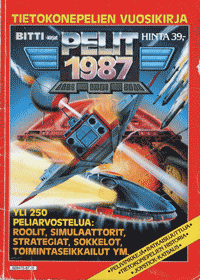 1987
1987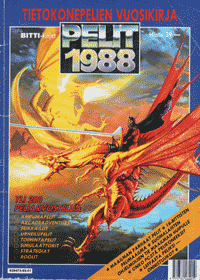 1988
1988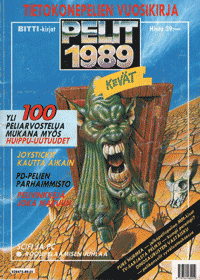 1989 Kevät
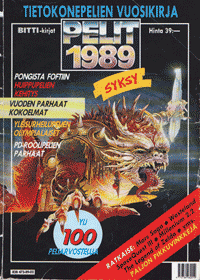 1989 Syksy
 1990 Kevät
 1990 Syksy
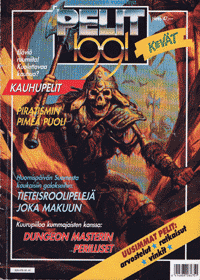 1991 Kevät
 1991 Syksy
Xiphos
Xiphos1991 KevätPysyvä linkkiXiphos-sivilisaation suuruudenaika päättyi äkisti, kun johtava superäly päätti vetäytyä eläkkeelle ja piiloutui jonnekin sisimmän universumin uumeniin. Xiphokset nimittäin olivat rakentaneet kuusi sisäkkäistä maailmankaikkeutta, jotka ovat toisiinsa yhteydessä porttien kautta. Sivilisaation degeneroituneena jäänteenä ovat kaksi ryhmittymää, Pio ja Qon, jotka taistelevat verisesti jäljelle jääneiden avaruusasemien hallinnasta.
Lievästä omituisuudestaan huolimatta Xiphoksen kehystarina tarjoaa rungon kiehtovalle avaruusseikkailulle. Pelaaja on sodan ulkopuolinen seikkailija, jonka tehtävänä on tuhota seonnut Xiphos-superäly. Universumin omituisen rakenteen vuoksi tärkein omaisuus on energia, vai pitäisikö sanoa potentiaalienergia, sillä sitä menettää liikkuessaan portin suuntaan ja palatessaan takaisinpäin sitä saa takaisin.
Energian hankkimiseksi on puolestaan saatava rahaa, mikä onnistuu tuhoamalla joko Piojen ja Qonien aluksia. Tuhoamalla tasapuolisesti kumpiakin onnistuu lähinnä hankkimaan porttikiellon useimmille asemille. Energiasta ja muista myytävistä tuotteista ei koskaan kannata maksaa pyydettyä summaa, sillä kaupankäynnissä on nokkelasti mukana tinkiminen. Myös informaatiota on tarjolla, kunhan ehtisi lukea älyttömän nopeasti vilahtavat tekstit, jotka näytetään vain kerran.
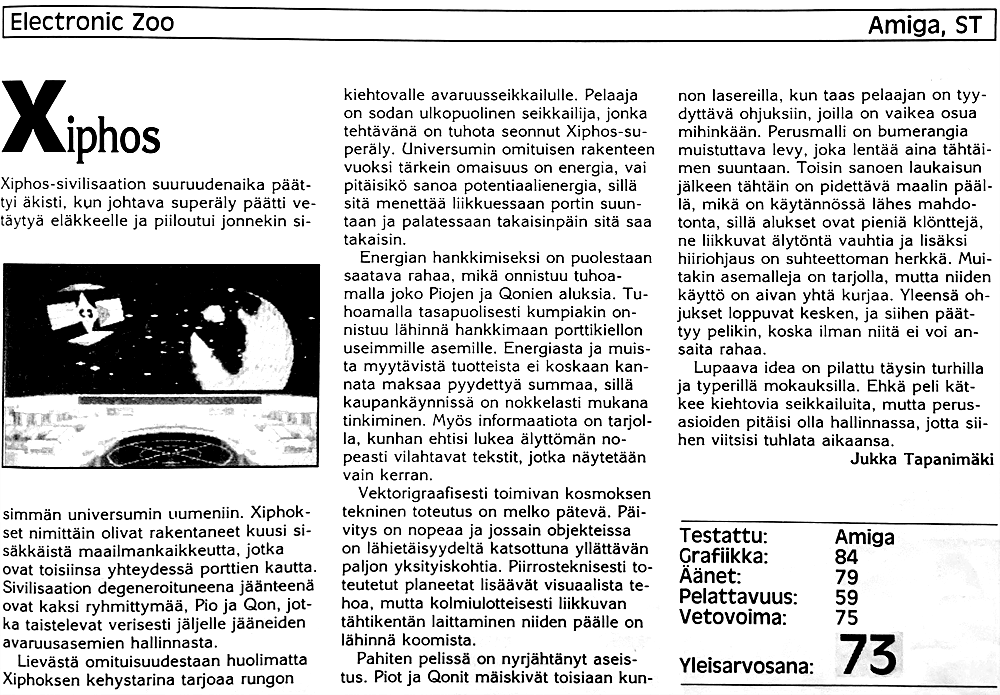
Vektorigraafisesti toimivan kosmoksen tekninen toteutus on melko pätevä. Päivitys on nopeaa ja jossain objekteissa on lähietäisyydeltä katsottuna yllättävän paljon yksityiskohtia. Piirrosteknisesti toteutetut planeetat lisäävät visuaalista tehoa, mutta kolmiulotteisesti liikkuvan tähtikentän laittaminen niiden päälle on lähinnä koomista.
Pahiten pelissä on nyrjähtänyt aseistus. Piot ja Qonit mäiskivät toisiaan kunnon lasereilla, kun taas pelaajan on tyydyttävä ohjuksiin, joilla on vaikea osua mihinkään. Perusmalli on bumerangia muistuttava levy, joka lentää aina tähtäimen suuntaan. Toisin sanoen laukaisun jälkeen tähtäin on pidettävä maalin päällä, mikä on käytännössä lähes mahdotonta, sillä alukset ovat pieniä klönttejä, ne liikkuvat älytöntä vauhtia ja lisäksi hiiriohjaus on suhteettoman herkkä. Muitakin asemalleja on tarjolla, mutta niiden käyttö on aivan yhtä kurjaa. Yleensä ohjukset loppuvat kesken, ja siihen päättyy pelikin, koska ilman niitä ei voi ansaita rahaa.
Lupaava idea on pilattu täysin turhilla ja typerillä mokauksilla. Ehkä peli kätkee kiehtovia seikkailuita, mutta perusasioiden pitäisi olla hallinnassa, jotta siihen viitsisi tuhlata aikaansa.
Xiphos1991 KevätPermalinkThe Xiphos civilisation's age of greatness came to an abrupt end when its leading superintelligence decided to retire and hid itself away somewhere in the depths of the innermost universe. The Xiphos, you see, had built six universes nested one inside another, connected to each other by gates. All that is left of the civilisation, as a degenerate remnant, are two factions, Pio and Qon, who are fighting bloodily for control of the remaining space stations.
Slightly odd though it is, Xiphos's background story provides the framework for a fascinating space adventure. The player is an adventurer standing outside the war, whose task is to destroy the unhinged Xiphos superintelligence. Because of the universe's peculiar structure, your most important asset is energy - or should that be potential energy, since you lose it moving towards a gate and get it back when you travel back the other way.
To get energy, in turn, you need money, which you earn by destroying either Pio or Qon ships. Destroying both sides even-handedly mostly just gets you barred from most of the stations. It never pays to hand over the asking price for energy or the other goods on sale, since the trading cleverly includes haggling. Information is on offer too, if only you could read the texts, which flash past insanely fast and are shown only once.
The technical execution of the vector-graphics cosmos is fairly competent. The screen updates quickly, and some objects have a surprising amount of detail when viewed up close. The drawn planets add visual punch, but putting a star field moving in three dimensions on top of them is mostly just comical.
Where the game has gone most badly out of joint is the weaponry. The Pios and Qons batter each other with proper lasers, while the player has to make do with missiles that can hardly hit anything. The basic model is a boomerang-like disc that always flies in the direction of the sights. In other words, after launch you have to keep the sights on the target, which is next to impossible in practice, since the ships are tiny blobs, they move at a ridiculous speed, and on top of that the mouse control is disproportionately sensitive. Other weapon models are on offer, but using them is every bit as miserable. Usually you run out of missiles, and that is the end of the game too, since without them you can't earn money.
A promising idea has been ruined by completely needless and stupid blunders. Perhaps the game hides fascinating adventures, but the basics ought to be under control before anyone could be bothered to waste their time on it.