Heart of China
Pelit was a Finnish-language (bi)annual book series published from 1987 to 1991 containing gaming-related articles, tips and most importantly game reviews. Here you can find all the reviews from the books. The reviews were originally written in Finnish; the English versions are translations of the Finnish originals. Maininta tekijänoikeuksista
 1987
1987 1988
1988 1989 Kevät
 1989 Syksy
 1990 Kevät
 1990 Syksy
 1991 Kevät
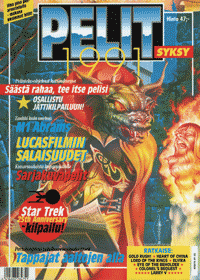 1991 Syksy
Heart of China
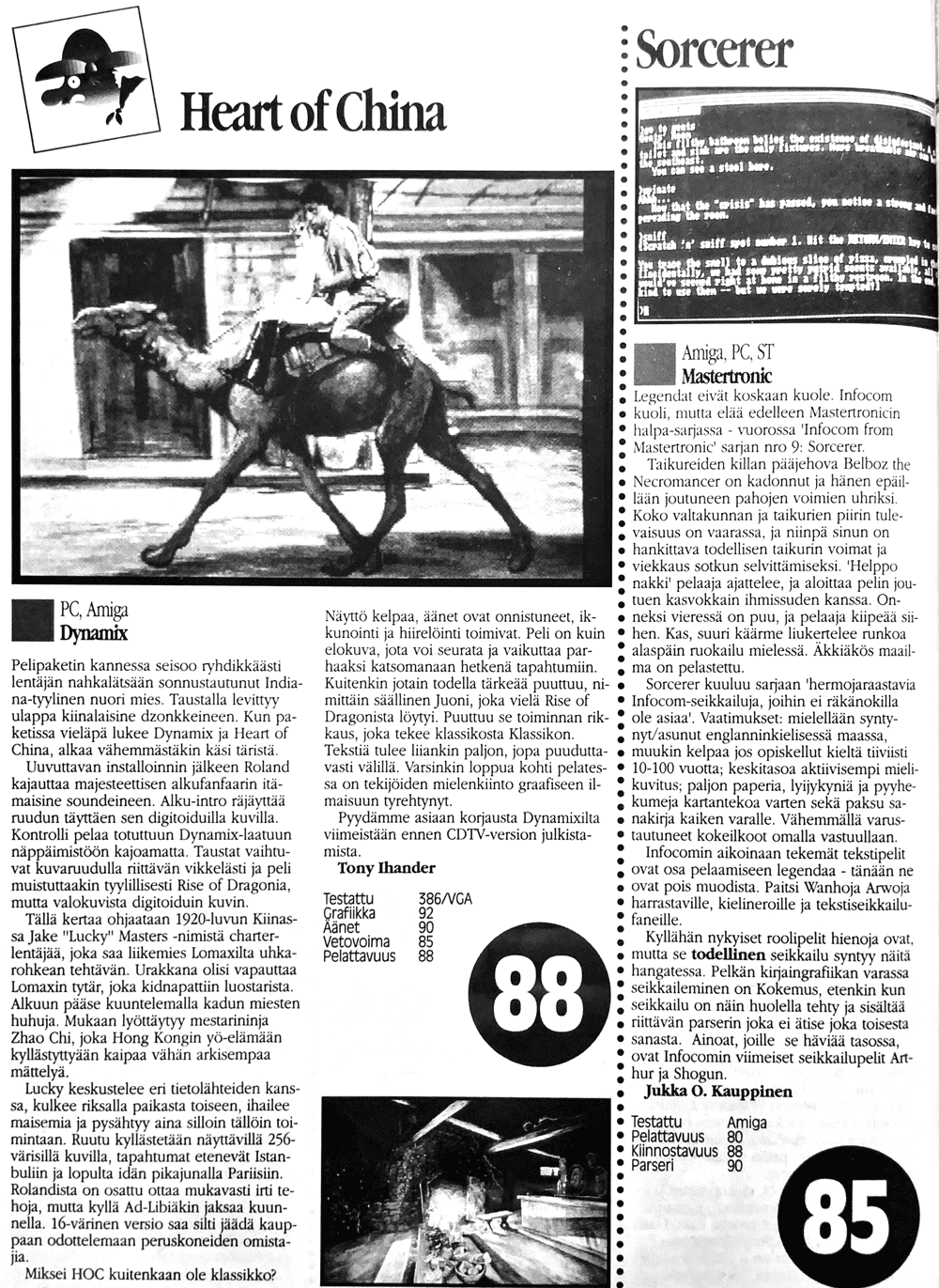
Heart of China1991 SyksyPysyvä linkkiPelipaketin kannessa seisoo ryhdikkäästi lentäjän nahkalätsään sonnustautunut Indiana-tyylinen nuori mies. Taustalla levittyy ulappa kiinalaisine dzonkkeineen. Kun paketissa vieläpä lukee Dynamix ja Heart of China, alkaa vähemmästäkin käsi täristä.
Uuvuttavan installoinnin jälkeen Roland kajauttaa majesteettisen alkufanfaarin itämaisine soundeineen. Alku-intro räjäyttää ruudun täyttäen sen digitoiduilla kuvilla. Kontrolli pelaa totuttuun Dynamix-laatuun näppäimistöön kajoamatta. Taustat vaihtuvat kuvaruudulla riittävän vikkelästi ja peli muistuttaakin tyylillisesti Rise of Dragonia, mutta valokuvista digitoiduin kuvin.
Tällä kertaa ohjaataan 1920-luvun Kiinassa Jake "Lucky" Masters -nimistä charterlentäjää, joka saa liikemies Lomaxilta uhkarohkean tehtävän. Urakkana olisi vapauttaa Lomaxin tytär, joka kidnapattiin luostarista. Alkuun pääse kuuntelemalla kadun miesten huhuja. Mukaan lyöttäytyy mestarininja Zhao Chi, joka Hong Kongin yö-elämään kyllästyttyään kaipaa vähän arkisempaa mättelyä.
Lucky keskustelee eri tietolähteiden kanssa, kulkee riksalla paikasta toiseen, ihailee maisemia ja pysähtyy aina silloin tällöin toimintaan. Ruutu kyllästetään näyttävillä 256-värisillä kuvilla, tapahtumat etenevät Istanbuliin ja lopulta idän pikajunalla Pariisiin. Rolandista on osattu ottaa mukavasti irti tehoja, mutta kyllä Ad-Libiäkin jaksaa kuunnella. 16-värinen versio saa silti jäädä kauppaan odottelemaan peruskoneiden omistajia.
Miksei HOC kuitenkaan ole klassikko? Näyttö kelpaa, äänet ovat onnistuneet, ikkunointi ja hiirelöinti toimivat. Peli on kuin elokuva, jota voi seurata ja vaikuttaa parhaaksi katsomanaan hetkenä tapahtumiin. Kuitenkin jotain todella tärkeää puuttuu, nimittäin säällinen Juoni, joka vielä Rise of Dragonista löytyi. Puuttuu se toiminnan rikkaus, joka tekee klassikosta Klassikon. Tekstiä tulee liiankin paljon, jopa puuduttavasti välillä. Varsinkin loppua kohti pelatessa on tekijöiden mielenkiinto graafiseen ilmaisuun tyrehtynyt.
Pyydämme asiaan korjausta Dynamixilta viimeistään ennen CDTV-version julkistamista.
Heart of China1991 SyksyPermalinkOn the front of the box stands, ramrod straight, an Indiana-style young man decked out in an aviator's leather cap. Behind him stretches the open sea with its Chinese junks. When the box says Dynamix and Heart of China on top of that, it would take a lot less to set your hands trembling.
After an exhausting installation, the Roland blasts out a majestic opening fanfare full of oriental sounds. The intro explodes across the screen, filling it with digitised pictures. The controls perform to the usual Dynamix standard without your laying a finger on the keyboard. The backgrounds change on screen quickly enough, and stylistically the game does resemble Rise of Dragon, only with pictures digitised from photographs.
This time, in 1920s China, you control a charter pilot by the name of Jake "Lucky" Masters, who is handed a daredevil assignment by the businessman Lomax. The job would be to free Lomax's daughter, who was kidnapped from a monastery. You get started by listening to the rumours going round among the men in the street. Tagging along is the master ninja Zhao Chi, who, having grown bored with Hong Kong nightlife, is hankering after some more down-to-earth brawling.
Lucky talks with various sources of information, gets from place to place by rickshaw, admires the scenery and every now and then stops for some action. The screen is saturated with spectacular 256-colour pictures, and events move on to Istanbul and finally, aboard the Orient Express, to Paris. They've managed to wring plenty of power out of the Roland, but the Ad-Lib is perfectly bearable to listen to as well. The 16-colour version, though, can stay in the shop waiting for owners of basic machines.
So why isn't HOC a classic? The display is fine, the sounds are a success, the windowing and the mousing work. The game is like a film that you can follow, stepping in to influence events whenever you see fit. And yet something really important is missing, namely a decent Plot, which Rise of Dragon still had. Missing is that richness of action which turns a classic into a Classic. There's all too much text, at times to the point of numbness. Especially as you play towards the end, the makers' interest in graphical expression has run dry.
We ask Dynamix to put this right before the CDTV version is released, at the latest.