Phobia
Pelit was a Finnish-language (bi)annual book series published from 1987 to 1991 containing gaming-related articles, tips and most importantly game reviews. Here you can find all the reviews from the books. The reviews were originally written in Finnish; the English versions are translations of the Finnish originals. Maininta tekijänoikeuksista
 1987
1987 1988
1988 1989 Kevät
 1989 Syksy
 1990 Kevät
 1990 Syksy
 1991 Kevät
 1991 Syksy
Phobia
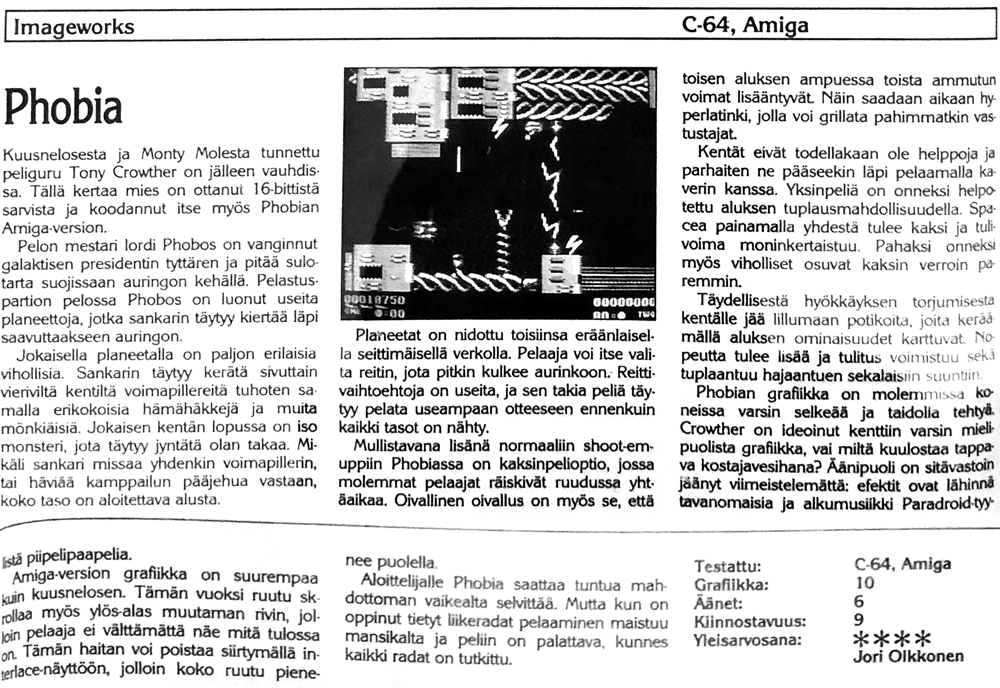
Phobia1989 SyksyPysyvä linkkiKuusnelosesta ja Monty Molesta tunnettu peliguru Tony Crowther on jälleen vauhdissa. Tällä kertaa mies on ottanut 16-bittistä sarvista ja koodannut itse myös Phobian Amiga-version.
Pelon mestari lordi Phobos on vanginnut galaktisen presidentin tyttären ja pitää sulotarta suojissaan auringon kehällä. Pelastuspartion pelossa Phobos on luonut useita planeettoja, jotka sankarin täytyy kiertää läpi saavuttaakseen auringon.
Jokaisella planeetalla on paljon erilaisia vihollisia. Sankarin täytyy kerätä sivuttain vieriviltä kentiltä voimapillereitä tuhoten samalla erikokoisia hämähäkkejä ja muita mönkiäisiä. Jokaisen kentän lopussa on iso monsteri, jota täytyy jyntätä olan takaa. Mikäli sankari missaa yhdenkin voimapillerin, tai häviää kamppailun pääjehua vastaan, koko taso on aloitettava alusta.
Planeetat on nidottu toisiinsa eräänlaisella seittimäisellä verkolla. Pelaaja voi itse valita reitin, jota pitkin kulkee aurinkoon. Reittivaihtoehtoja on useita, ja sen takia peliä täytyy pelata useampaan otteeseen ennenkuin kaikki tasot on nähty.
Mullistavana lisänä normaaliin shoot-em-uppiin Phobiassa on kaksinpelioptio, jossa molemmat pelaajat räiskivät ruudussa yhtäaikaa. Oivallinen oivallus on myös se, että toisen aluksen ampuessa toista ammutun voimat lisääntyvät. Näin saadaan aikaan hyperlatinki, jolla voi grillata pahimmatkin vastustajat.
Kentät eivät todellakaan ole helppoja ja parhaiten ne pääseekin läpi pelaamalla kaverin kanssa. Yksinpeliä on onneksi helpotettu aluksen tuplausmahdollisuudella. Spacea painamalla yhdestä tulee kaksi ja tulivoima moninkertaistuu. Pahaksi onneksi myös viholliset osuvat kaksin verroin paremmin.
Täydellisestä hyökkäyksen torjumisesta kentälle jää lillumaan potikoita, joita keräämällä aluksen ominaisuudet karttuvat. Nopeutta tulee lisää ja tulitus voimistuu sekä tuplaantuu hajaantuen sekalaisiin suuntiin.
Phobian grafiikka on molemmissa koneissa varsin selkeää ja taidolla tehtyä. Crowther on ideoinut kenttiin varsin mielipuolista grafiikka, vai miltä kuulostaa tappava kostajavesihana? Äänipuoli on sitävastoin jäänyt viimeistelemättä: efektit ovat lähinnä tavanomaisia ja alkumusiikki Paradroid-tyy listä piipelipaapelia.
Amiga-version grafiikka on suurempaa kuin kuusnelosen. Tämän vuoksi ruutu skrollaa myös ylös-alas muutaman rivin, jolloin pelaaja ei välttämättä näe mitä tulossa on. Tämän haitan voi poistaa siirtymällä interlace-näyttöön, jolloin koko ruutu pienenee puolella.
Aloittelijalle Phobia saattaa tuntua mahdottoman vaikealta selvittää. Mutta kun on oppinut tietyt liikeradat pelaaminen maistuu mansikalta ja peliin on palattava, kunnes kaikki radat on tutkittu.
Phobia1989 SyksyPermalinkGame guru Tony Crowther, known from the C-64 and Monty Mole, is on a roll again. This time the man has taken the 16-bit bull by the horns and coded the Amiga version of Phobia personally as well.
The master of fear, Lord Phobos, has captured the daughter of the galactic president and keeps the fair maiden in his clutches on the rim of the sun. Fearing a rescue party, Phobos has created a number of planets that the hero has to work through to reach the sun.
Every planet has lots of different enemies. The hero has to collect power pills from the sideways-scrolling levels while destroying spiders of all sizes and other creepy-crawlies. At the end of each level there's a big monster that has to be pounded for all you're worth. If the hero misses even a single power pill, or loses the fight against the head honcho, the whole level has to be started over.
The planets are bound to one another by a kind of cobweb-like network. The player can choose the route to take to the sun. There are several alternative routes, and because of that the game has to be played a number of times before all the levels have been seen.
As a revolutionary addition to the normal shoot-em-up, Phobia has a two-player option in which both players blast away on screen at the same time. Another brilliant brainwave is that when one ship shoots the other, the one being shot gets more powerful. This produces a hyper-charge that can grill even the nastiest opponents.
The levels are certainly not easy, and the best way to get through them is to play with a mate. Luckily, solo play has been made easier with the option of doubling your ship. Press space and one becomes two and your firepower multiplies. As bad luck would have it, the enemies also hit twice as well.
Wiping out an attack wave completely leaves pods bobbing about on the level, and collecting them builds up your ship's abilities. You get more speed, and your fire grows stronger and doubles, spraying out in all sorts of directions.
Phobia's graphics are very clear and skilfully done on both machines. Crowther has dreamed up some pretty deranged graphics for the levels, or how does a deadly avenger water tap sound to you? The sound side, on the other hand, has been left unpolished: the effects are mostly run-of-the-mill and the title music is Paradroid-style bleepety-bloopety.
The Amiga version's graphics are bigger than the C-64's. Because of this the screen also scrolls up and down by a few lines, so the player can't necessarily see what's coming. You can get rid of this drawback by switching to the interlace display, which shrinks the whole screen by half.
To a beginner, Phobia may seem impossibly hard to crack. But once you've learned certain flight paths, playing tastes as sweet as strawberries and you have to keep coming back to the game until all the paths have been explored.