Manchester United
Pelit was a Finnish-language (bi)annual book series published from 1987 to 1991 containing gaming-related articles, tips and most importantly game reviews. Here you can find all the reviews from the books. The reviews were originally written in Finnish; the English versions are translations of the Finnish originals. Maininta tekijänoikeuksista
 1987
1987 1988
1988 1989 Kevät
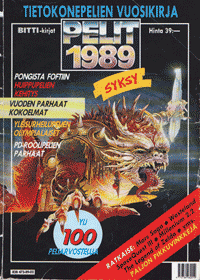 1989 Syksy
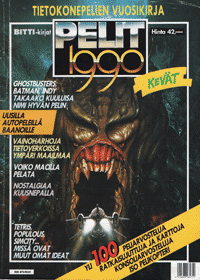 1990 Kevät
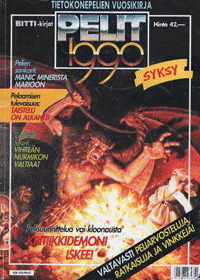 1990 Syksy
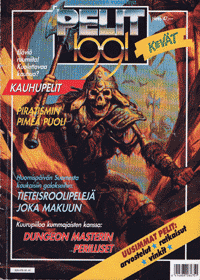 1991 Kevät
 1991 Syksy
Manchester United
Manchester United1990 SyksyPysyvä linkkiOi ei! Infernaalinen Teque on jälleen tehnyt jalkapallopelin. Edellinen räpellys, Peter Beardsley's International Soccer, oli kertakaikkinen pohjanoteeraus. Viidakkorummut paukuttivat kuitenkin maailmalta, että peliä on kehuttu kovastikin. Odotukseni kohosivat huomattavasti ja latasinkin diskin koneeseen nopeammin kuin kukaan osaa sanoa AmiganWorkbenchonerinastakäyttäjäliityntä.
MU on sekoitus normaalia International Soccer -tyylistä futispeliä ja Football Managermaista valmentajasimulaatiota. Optioista voi heti pelin alussa valita, haluaako pelata pelkästään toimintaosuudet vai "täydellistä valmentajasimulaatiota". Simupelissäkin voi epäonnekseen joutua potkimaan palloa, jos typeryyksissään tölväisee vaikka välilyöntiä tai joystickin nappulaa pelin aikana. Sanoin epäonnekseen siksi, että peliosuus ei edelleenkään ole Tequen vahvimpia puolia.
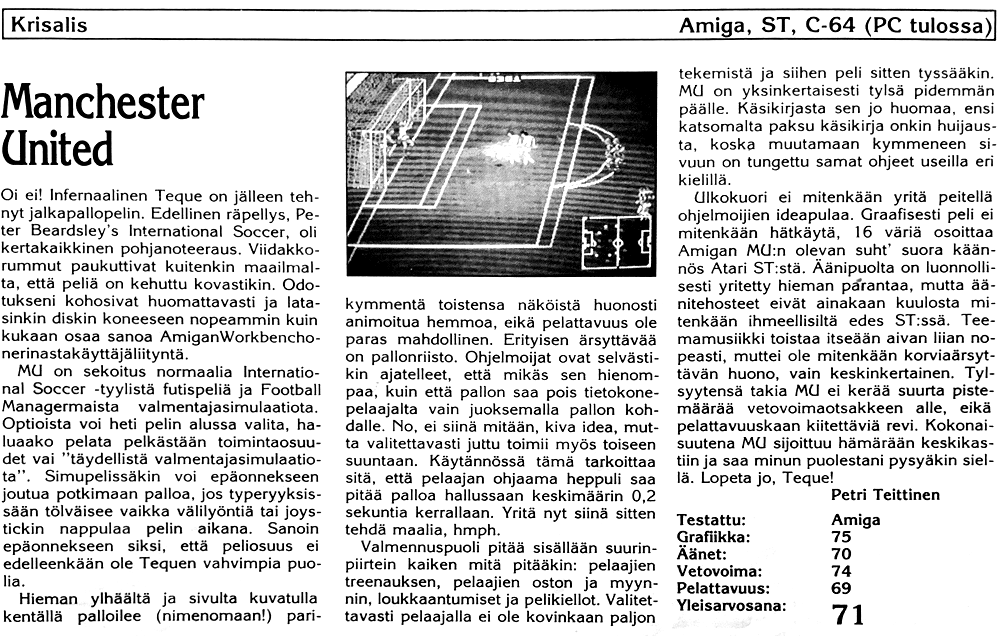
Hieman ylhäältä ja sivulta kuvatulla kentällä palloilee (nimenomaan!) parikymmentä toistensa näköistä huonosti animoitua hemmoa, eikä pelattavuus ole paras mahdollinen. Erityisen ärsyttävää on pallonriisto. Ohjelmoijat ovat selvästikin ajatelleet, että mikäs sen hienompaa, kuin että pallon saa pois tietokonepelaajalta vain juoksemalla pallon kohdalle. No, ei siinä mitään, kiva idea, mutta valitettavasti juttu toimii myös toiseen suuntaan. Käytännössä tämä tarkoittaa sitä, että pelaajan ohjaama heppuli saa pitää palloa hallussaan keskimäärin 0,2 sekuntia kerrallaan. Yritä nyt siinä sitten tehdä maalia, hmph.
Valmennuspuoli pitää sisällään suurinpiirtein kaiken mitä pitääkin: pelaajien treenauksen, pelaajien oston ja myynnin, loukkaantumiset ja pelikiellot. Valitettavasti pelaajalla ei ole kovinkaan paljon tekemistä ja siihen peli sitten tyssääkin. MU on yksinkertaisesti tylsä pidemmän päälle. Käsikirjasta sen jo huomaa, ensi katsomalta paksu käsikirja onkin huijausta, koska muutamaan kymmeneen sivuun on tungettu samat ohjeet useilla eri kielillä.
Ulkokuori ei mitenkään yritä peitellä ohjelmoijien ideapulaa. Graafisesti peli ei mitenkään hätkäytä, 16 väriä osoittaa Amigan MU:n olevan suht' suora käännös Atari ST:stä. Äänipuolta on luonnollisesti yritetty hieman parantaa, mutta äänitehosteet eivät ainakaan kuulosta mitenkään ihmeellisiltä edes ST:ssä. Teemamusiikki toistaa itseään aivan liian nopeasti, muttei ole mitenkään korviaärsyttävän huono, vain keskinkertainen. Tylsyytensä takia MU ei kerää suurta pistemäärää vetovoimaotsakkeen alle, eikä pelattavuuskaan kiitettäviä revi. Kokonaisuutena MU sijoittuu hämärään keskikastiin ja saa minun puolestani pysyäkin siellä. Lopeta jo, Teque!
Manchester United1990 SyksyPermalinkOh no! The infernal Teque has made a football game again. The previous botch-up, Peter Beardsley's International Soccer, was an all-time low, full stop. Still, the jungle drums were pounding out word from abroad that the game had been praised pretty highly. My expectations rose considerably, and I loaded the disk into the machine faster than anyone can say AmigasWorkbenchisasplendiduserinterface.
MU is a mixture of a normal International Soccer-style footie game and a Football Manager-like manager simulation. Right at the start you can choose from the options whether you want to play just the action parts or the "complete manager simulation". Even in the sim game you can, to your misfortune, end up kicking the ball about if in your foolishness you happen to jab, say, the space bar or the joystick button during the game. I said to your misfortune because the playing part still isn't one of Teque's strong points.
On a pitch viewed slightly from above and from the side, twenty-odd identical-looking, badly animated blokes are kicking about (precisely!), and the playability isn't the best possible. Especially irritating is the tackling. The programmers have clearly thought: what could be finer than being able to take the ball off a computer player just by running onto the ball? Well, nothing wrong with that, nice idea, but unfortunately the thing works in the other direction too. In practice this means that the chap you control gets to keep the ball for an average of 0.2 seconds at a time. Just try scoring a goal like that, hmph.
The management side contains roughly everything it should: training players, buying and selling players, injuries and suspensions. Unfortunately the player doesn't have all that much to do, and that's where the game grinds to a halt. MU is simply boring in the long run. You can tell as much from the manual already: the manual, thick at first glance, is actually a con, because a few dozen pages have been crammed with the same instructions in several different languages.
The outer shell makes no attempt whatsoever to hide the programmers' shortage of ideas. Graphically the game doesn't startle in any way; the 16 colours show the Amiga MU to be a fairly straight conversion from the Atari ST. Naturally there has been some attempt to improve the sound a little, but the sound effects certainly wouldn't sound anything special even on the ST. The theme music repeats itself far too quickly, but it isn't ear-grindingly bad in any way, just mediocre. Because of its dullness MU doesn't rack up a big score under the appeal heading, and the playability doesn't snatch any top marks either. Overall, MU settles into the murky middle tier, and as far as I'm concerned it can stay there. Give it a rest, Teque!