Run The Gauntlet
Pelit was a Finnish-language (bi)annual book series published from 1987 to 1991 containing gaming-related articles, tips and most importantly game reviews. Here you can find all the reviews from the books. The reviews were originally written in Finnish; the English versions are translations of the Finnish originals. Maininta tekijänoikeuksista
 1987
1987 1988
1988 1989 Kevät
 1989 Syksy
 1990 Kevät
 1990 Syksy
 1991 Kevät
 1991 Syksy
Run The Gauntlet
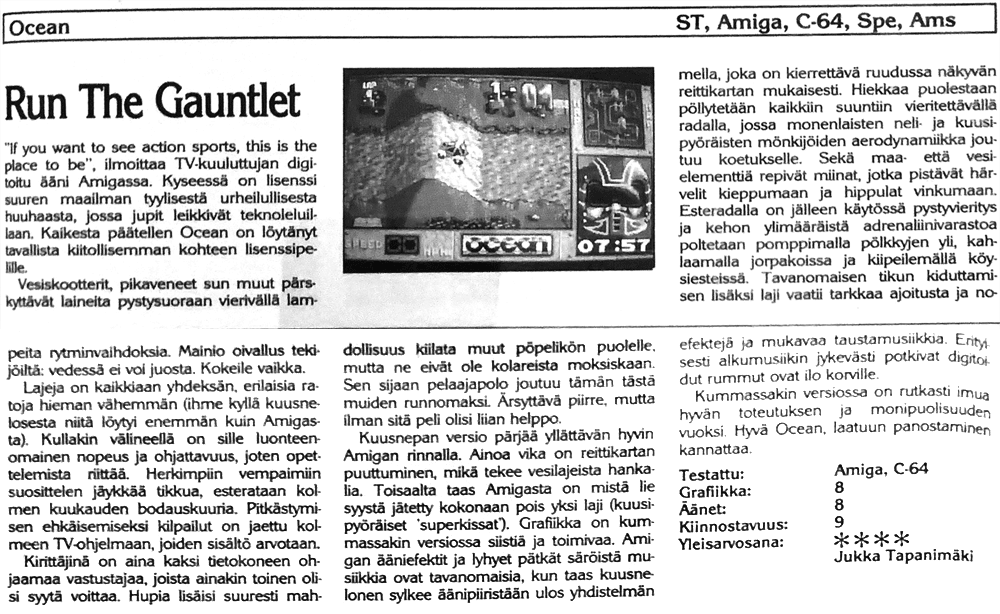
Run The Gauntlet1989 SyksyPysyvä linkki"If you want to see action sports, this is the place to be", ilmoittaa TV-kuuluttujan digitoitu ääni Amigassa. Kyseessä on lisenssi suuren maailman tyylisestä urheilullisesta huuhaasta, jossa jupit leikkivät teknoleluillaan. Kaikesta päätellen Ocean on löytänyt tavallista kiitollisemman kohteen lisenssipelille.
Vesiskootterit, pikaveneet sun muut pärskyttävät laineita pystysuoraan vierivällä lammella, joka on kierrettävä ruudussa näkyvän reittikartan mukaisesti. Hiekkaa puolestaan pöllytetään kaikkiin suuntiin vieritettävällä radalla, jossa monenlaisten neli- ja kuusipyöräisten mönkijöiden aerodynamiikka joutuu koetukselle. Sekä maa- että vesielementtiä repivät miinat, jotka pistävät härvelit kieppumaan ja hippulat vinkumaan. Esteradalla on jälleen käytössä pystyvieritys ja kehon ylimääräistä adrenaliinivarastoa poltetaan pomppimalla pölkkyjen yli, kahlaamalla jorpakoissa ja kiipeilemällä köysiesteissä. Tavanomaisen tikun kiduttamisen lisäksi laji vaatii tarkkaa ajoitusta ja nopeita rytminvaihdoksia. Mainio oivallus tekijöiltä: vedessä ei voi juosta. Kokeile vaikka.
Lajeja on kaikkiaan yhdeksän, erilaisia ratoja hieman vähemmän (ihme kyllä kuusnelosesta niitä löytyi enemmän kuin Amigasta). Kullakin välineellä on sille luonteenomainen nopeus ja ohjattavuus, joten opettelemista riittää. Herkimpiin vempaimiin suosittelen jäykkää tikkua, esterataan kolmen kuukauden bodauskuuria. Pitkästymisen ehkäisemiseksi kilpailut on jaettu kolmeen TV-ohjelmaan, joiden sisältö arvotaan.
Kirittäjinä on aina kaksi tietokoneen ohjaamaa vastustajaa, joista ainakin toinen olisi syytä voittaa. Hupia lisäisi suuresti mahdollisuus kiilata muut pöpelikön puolelle, mutta ne eivät ole kolareista moksiskaan. Sen sijaan pelaajapolo joutuu tämän tästä muiden runnomaksi. Ärsyttävä piirre, mutta ilman sitä peli olisi liian helppo.
Kuusnepan versio pärjää yllättävän hyvin Amigan rinnalla. Ainoa vika on reittikartan puuttuminen, mikä tekee vesilajeista hankalia. Toisaalta taas Amigasta on mistä lie syystä jätetty kokonaan pois yksi laji (kuusipyöräiset 'superkissat'). Grafiikka on kummassakin versiossa siistiä ja toimivaa. Amigan ääniefektit ja lyhyet pätkät säröistä musiikkia ovat tavanomaisia, kun taas kuusnelonen sylkee äänipiiristään ulos yhdistelmän efektejä ja mukavaa taustamusiikkia. Erityisesti alkumusiikin jykevästi potkivat digitoidut rummut ovat ilo korville.
Kummassakin versiossa on rutkasti imua hyvän toteutuksen ja monipuolisuuden vuoksi. Hyvä Ocean, laatuun panostaminen kannattaa.
Run The Gauntlet1989 SyksyPermalink"If you want to see action sports, this is the place to be", announces the digitised voice of the TV presenter on the Amiga. This is a licence of that big-league style of sporting hokum in which yuppies play with their techno-toys. By all indications, Ocean has found a more rewarding subject than usual for a licensed game.
Jet skis, speedboats and whatnot churn up the waves on a vertically scrolling pond, which has to be lapped following the route map shown on screen. Sand, meanwhile, gets kicked up on a track that scrolls in every direction, where the aerodynamics of all manner of four- and six-wheeled buggies are put to the test. Both the land and the water elements are torn up by mines, which send the contraptions spinning and hurtling off hell for leather. The obstacle course again uses vertical scrolling, and the body's surplus stock of adrenaline is burned off by hopping over logs, wading through mudholes and clambering over rope obstacles. On top of the usual joystick torture, the event demands precise timing and quick changes of rhythm. A splendid insight from the makers: you can't run in water. Go on, try it.
There are nine events in all, and slightly fewer different courses (strangely enough, the C-64 turned out to have more of them than the Amiga). Each vehicle has its own characteristic speed and handling, so there's plenty to learn. For the most twitchy gizmos I recommend a stiff joystick, and for the obstacle course a three-month bodybuilding regime. To stave off boredom, the contests are divided into three TV programmes, whose content is drawn at random.
Pacing you there are always two computer-controlled opponents, at least one of whom you'd better beat. It would add hugely to the fun if you could run the others off into the undergrowth, but they don't bat an eyelid at collisions. The poor player, on the other hand, gets battered by the others every now and then. An irritating feature, but without it the game would be too easy.
The C-64 version holds up surprisingly well next to the Amiga. Its only flaw is the missing route map, which makes the water events awkward. Then again, for whatever reason the Amiga has had one event left out entirely (the six-wheeled 'supercats'). The graphics are neat and functional in both versions. The Amiga's sound effects and short snatches of crackly music are run-of-the-mill, whereas the C-64 spits out of its sound chip a combination of effects and pleasant background music. The sturdily kicking digitised drums of the title music in particular are a joy to the ears.
Both versions have oodles of pull thanks to their good execution and variety. Well done Ocean, investing in quality pays off.