Test Drive III: The Passion
Pelit was a Finnish-language (bi)annual book series published from 1987 to 1991 containing gaming-related articles, tips and most importantly game reviews. Here you can find all the reviews from the books. The reviews were originally written in Finnish; the English versions are translations of the Finnish originals. Maininta tekijänoikeuksista
 1987
1987 1988
1988 1989 Kevät
 1989 Syksy
 1990 Kevät
 1990 Syksy
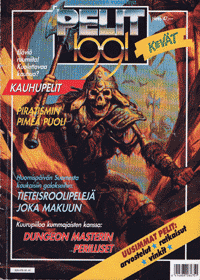 1991 Kevät
 1991 Syksy
Test Drive III: The Passion
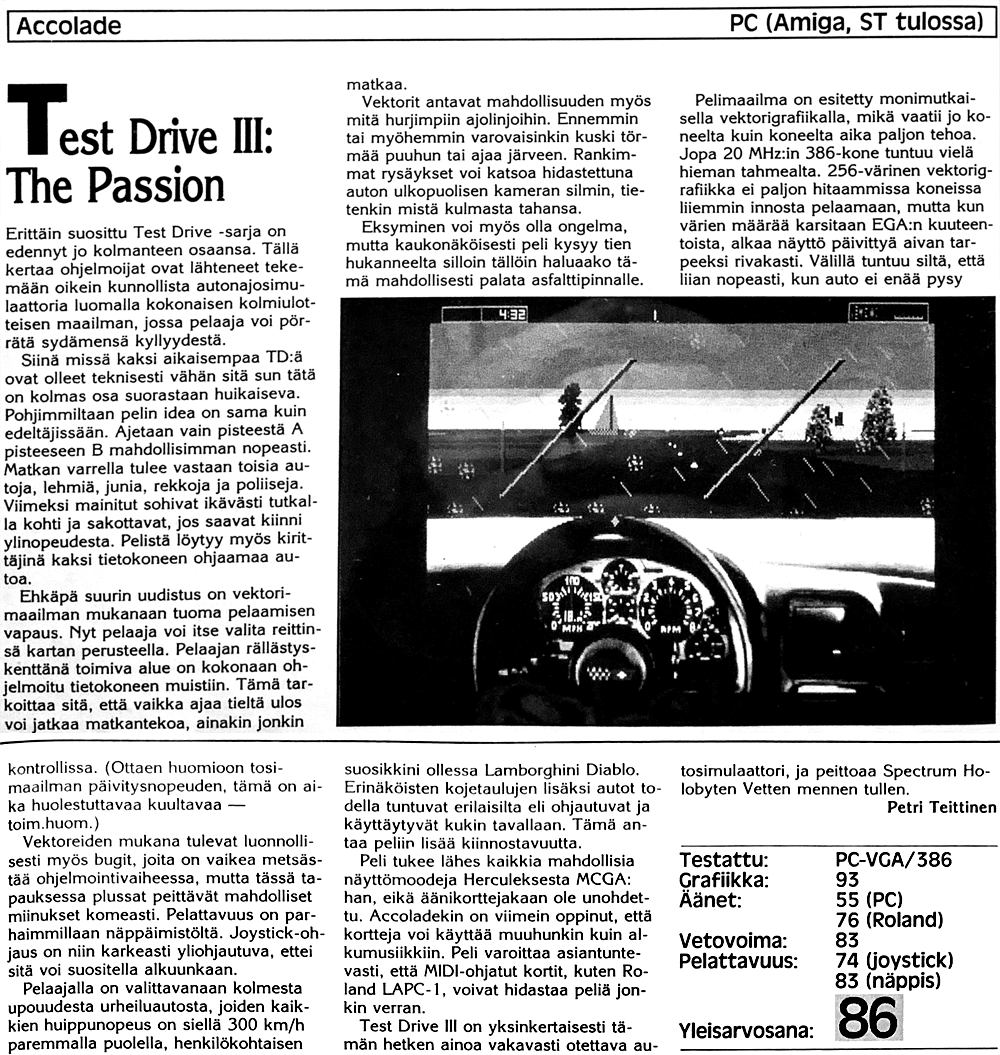
Test Drive III: The Passion1991 KevätPysyvä linkkiErittäin suosittu Test Drive -sarja on edennyt jo kolmanteen osaansa. Tällä kertaa ohjelmoijat ovat lähteneet tekemään oikein kunnollista autonajosimulaattoria luomalla kokonaisen kolmiulotteisen maailman, jossa pelaaja voi pörrätä sydämensä kyllyydestä.
Siinä missä kaksi aikaisempaa TD:ä ovat olleet teknisesti vähän sitä sun tätä on kolmas osa suorastaan huikaiseva. Pohjimmiltaan pelin idea on sama kuin edeltäjissään. Ajetaan vain pisteestä A pisteeseen B mahdollisimman nopeasti. Matkan varrella tulee vastaan toisia autoja, lehmiä, junia, rekkoja ja poliiseja. Viimeksi mainitut sohivat ikävästi tutkalla kohti ja sakottavat, jos saavat kiinni ylinopeudesta. Pelistä löytyy myös kirittäjinä kaksi tietokoneen ohjaamaa autoa.
Ehkäpä suurin uudistus on vektorimaailman mukanaan tuoma pelaamisen vapaus. Nyt pelaaja voi itse valita reittinsä kartan perusteella. Pelaajan rällästyskenttänä toimiva alue on kokonaan ohjelmoitu tietokoneen muistiin. Tämä tarkoittaa sitä, että vaikka ajaa tieltä ulos voi jatkaa matkantekoa, ainakin jonkin matkaa.
Vektorit antavat mahdollisuuden myös mitä hurjimpiin ajolinjoihin. Ennemmin tai myöhemmin varovaisinkin kuski törmää puuhun tai ajaa järveen. Rankimmat rysäykset voi katsoa hidastettuna auton ulkopuolisen kameran silmin, tietenkin mistä kulmasta tahansa.
Eksyminen voi myös olla ongelma, mutta kaukonäköisesti peli kysyy tien hukanneelta silloin tällöin haluaako tämä mahdollisesti palata asfalttipinnalle.
Pelimaailma on esitetty monimutkaisella vektorigrafiikalla, mikä vaatii jo koneelta kuin koneelta aika paljon tehoa. Jopa 20 MHz:in 386-kone tuntuu vielä hieman tahmealta. 256-värinen vektorigrafiikka ei paljon hitaammissa koneissa liiemmin innosta pelaamaan, mutta kun värien määrää karsitaan EGA:n kuuteentoista, alkaa näyttö päivittyä aivan tarpeeksi rivakasti. Välillä tuntuu siltä, että liian nopeasti, kun auto ei enää pysy kontrollissa. (Ottaen huomioon tosimaailman päivitysnopeuden, tämä on aika huolestuttavaa kuultavaa - toim.huom.)
Vektoreiden mukana tulevat luonnollisesti myös bugit, joita on vaikea metsästää ohjelmointivaiheessa, mutta tässä tapauksessa plussat peittävät mahdolliset miinukset komeasti. Pelattavuus on parhaimmillaan näppäimistöltä. Joystick-ohjaus on niin karkeasti yliohjautuva, ettei sitä voi suositella alkuunkaan.
Pelaajalla on valittavanaan kolmesta upouudesta urheiluautosta, joiden kaikkien huippunopeus on siellä 300 km/h paremmalla puolella, henkilökohtaisen suosikkini ollessa Lamborghini Diablo. Erinäköisten kojetaulujen lisäksi autot todella tuntuvat erilaisilta eli ohjautuvat ja käyttäytyvät kukin tavallaan. Tämä antaa peliin lisää kiinnostavuutta.
Peli tukee lähes kaikkia mahdollisia näyttömoodeja Herculeksesta MCGA:han, eikä äänikorttejakaan ole unohdettu. Accoladekin on viimein oppinut, että kortteja voi käyttää muuhunkin kuin alkumusiikkiin. Peli varoittaa asiantuntevasti, että MIDI-ohjatut kortit, kuten Roland LAPC-1, voivat hidastaa peliä jonkin verran.
Test Drive III on yksinkertaisesti tämän hetken ainoa vakavasti otettava autosimulaattori, ja peittoaa Spectrum Holobyten Vetten mennen tullen.
Test Drive III: The Passion1991 KevätPermalinkThe hugely popular Test Drive series has already reached its third instalment. This time the programmers have set out to make a really proper driving simulator by creating an entire three-dimensional world where the player can buzz around to their heart's content.
Whereas the two earlier TDs were technically a bit so-so, the third part is downright dazzling. At heart the game's idea is the same as in its predecessors. You just drive from point A to point B as fast as possible. Along the way you run into other cars, cows, trains, trucks and police. The last of these nastily poke their radar at you and hand out fines if they catch you speeding. The game also has two computer-controlled cars to push the pace.
Perhaps the biggest innovation is the freedom of play that the vector world brings with it. Now the player can choose their own route from the map. The whole area serving as the player's tearing-about ground is programmed into the computer's memory. This means that even if you drive off the road you can carry on travelling, for a while at least.
The vectors also make possible the wildest of driving lines. Sooner or later even the most careful driver slams into a tree or drives into a lake. The hardest smash-ups can be watched in slow motion through the eyes of a camera outside the car, from any angle you like, of course.
Getting lost can also be a problem, but with admirable foresight the game every now and then asks anyone who has mislaid the road whether they might perhaps care to return to the tarmac.
The game world is presented in complex vector graphics, which demands quite a lot of power from any machine whatsoever. Even a 20 MHz 386 still feels a bit sluggish. On much slower machines the 256-colour vector graphics don't exactly make you eager to play, but when the number of colours is cut down to EGA's sixteen, the screen starts updating quite briskly enough. At times it feels like too fast, when the car no longer stays under control. (Considering the refresh rate of the real world, this is rather worrying to hear - ed.)
Along with vectors naturally come bugs, which are hard to hunt down at the programming stage, but in this case the pluses handsomely cover any minuses there may be. Playability is at its best from the keyboard. The joystick control oversteers so crudely that it can't be recommended at all.
The player has a choice of three brand-new sports cars, all with top speeds somewhere on the right side of 300 km/h, my personal favourite being the Lamborghini Diablo. Besides having different-looking dashboards, the cars really do feel different, meaning each one steers and behaves in its own way. This makes the game all the more interesting.
The game supports almost every display mode imaginable, from Hercules to MCGA, and sound cards haven't been forgotten either. Even Accolade has finally learned that the cards can be used for something other than the title music. The game knowledgeably warns that MIDI-driven cards such as the Roland LAPC-1 may slow the game down somewhat.
Test Drive III is simply the only driving simulator around at the moment that deserves to be taken seriously, and it beats Spectrum Holobyte's Vette hands down.