Railroad Tycoon
Pelit was a Finnish-language (bi)annual book series published from 1987 to 1991 containing gaming-related articles, tips and most importantly game reviews. Here you can find all the reviews from the books. The reviews were originally written in Finnish; the English versions are translations of the Finnish originals. Maininta tekijänoikeuksista
 1987
1987 1988
1988 1989 Kevät
 1989 Syksy
 1990 Kevät
 1990 Syksy
 1991 Kevät
 1991 Syksy
Railroad Tycoon
Railroad Tycoon1990 SyksyPysyvä linkkiLeikitkö lapsena leikkijunilla? Oletko aina halunnut olla junankuljettaja? MicroProse, simulaattorien kuningas, on tehnyt sopivan pelin sinulle. Tosin Railroad Tycoon ei pelkästään pistä sinua soittamaan junan pilliä, vaan lastaa harteillesi kaiken rautatieyhtiön johtamiseen kuuluvan.
Vaikeusasteen ja pelialueen valitsemisen jälkeen pelaajalle annetaan 1.000.000 rahayksikköä, joilla pitää rahoittaa uusi rautatie. Pelaaja voi rakentaa Amerikan itä- tai länsirannikolla, Englannissa tai Euroopassa. Amerikassa peli alkaa 1800-luvun puolestavälistä, Englannissa 1800-luvun alkupuolelta ja Euroopassa 1900-alusta.
Ensin pitäisi löytää kaksi isoa kaupunkia tarpeeksi läheltä toisiaan. Sitten tutkitaan kaupunkien välistä maaperää ja suunnitellaan halvin mahdollinen reitti kaupunkien väliin. Tässä pitää ottaa huomioon, että matkustajat maksavat sitä enemmän, mitä nopeammin he pääsevät kaupungista toiseen. Kaikki mutkat ja nousut hidastavat junan matkantekoa ja kiristävät matkustajien hermoja. Rahti, kuten teräs ja hiili, ei välitä, vaikka matka kestäisi tuplasti.
Kun reitti on valittu, rakennetaan kaupunkeihin asemat ja aletaan tehdä rataa asemien väliin. Aseman rakennuspaikka kannattaa valita tarkoin, siten voi säästää jopa 100.000 rahayksikköä. Jokaisella asemalla on kokonsa mukainen vaikutusalue. Tällä alueella olevat ihmiset ja yhtiöt käyttävät rautatien palveluja hyväkseen. Tavoite on saada mahdollisimman paljon väkeä mahdollisimman pienen aseman vaikutusalueelle.
Kun rata on valmis, pitää ostaa juna. Vuodesta riippuen tarjolla on halvoista ja hitaista nopeisiin ja kalliisiin juniin. Matkustajia kyyditettäessä nopeus on tärkeintä. Lastia kuljetettaessa ei tärkeää ole vauhti vaan voima, sillä rahdista menee vakiomaksu. Tehoton juna voi hidastua melkein pysähdyksiin asti pienessäkin mäessä, jos sillä on iso lasti terästä, kun taas vahva juna vääntää saman mäen tasaisella nopeudella.
Kassan täytyttyä sopivasti on aika rakentaa lisää rautatietä seuraavaan kaupunkiin ja pian täytyy ostaa toinen juna. Ja kolmas. Ja neljäs. Kun junia on monta, alkaa aikataulujen ja reittivalintojen tärkeys korostua. Ei myöskään ole mitään järkeä kuljettaa toiseen suuntaan tyhjää junaa. Niinpä kannattaa tutkia, minkälaista rahtia pääteasemalta on tulossa takaisinpäin ja vaihtaa junan vaunut uudelle rahdille sopivaksi. Vaunujenkin vaihto maksaa tietysti.
Jonkin ajan kuluttua rautatie pyörii melkein itsekseen aivan hyvin, pieniä muutoksia täytyy tehdä aika ajoin, mutta muuten rahaa tulee ihan mukavasti. Railroad Tycoonissa pelaaja ei voi koskaan huokaista ja vain katsella asemalta toiselle puuskuttavia junia. Pitää huolehtia, että kilpailijat eivät pääse ostamaan osake-enemmistöä rautatiestä. Osakekeinottelu on nopea, mutta vaikea tapa ansaita rahaa. Kilpailevat rautatiet voivat myös sumputtaa pelaajan pienelle alueelle, toisen radan yli kun omaa rataa ei voi vetää.
Siinä oli vasta pieni ripaus Railroad Tycoonista. Mainittakoon, että pelaajan täytyy koordinoida raaka-aineiden kuljetukset siten, että niistä voidaan toisella paikkakunnalla valmistaa jotain. Silloin peli alkaa mennä todella vaikeaksi, mutta samalla myös entistä mielenkiintoisemmaksi.
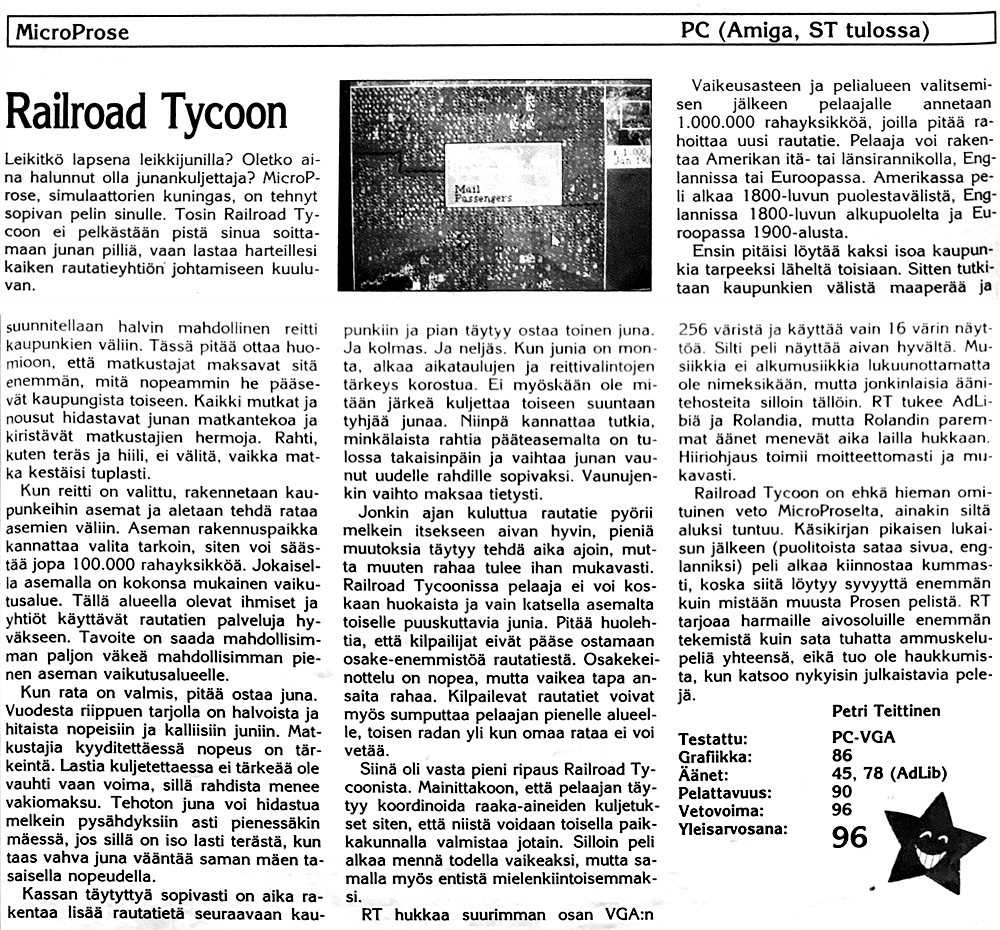
RT hukkaa suurimman osan VGA:n 256 väristä ja käyttää vain 16 värin näyttöä. Silti peli näyttää aivan hyvältä. Musiikkia ei alkumusiikkia lukuunottamatta ole nimeksikään, mutta jonkinlaisia äänitehosteita silloin tällöin. RT tukee AdLibiä ja Rolandia, mutta Rolandin paremmat äänet menevät aika lailla hukkaan. Hiiriohjaus toimii moitteettomasti ja mukavasti.
Railroad Tycoon on ehkä hieman omituinen veto MicroProselta, ainakin siltä aluksi tuntuu. Käsikirjan pikaisen lukaisun jälkeen (puolitoista sataa sivua, englanniksi) peli alkaa kiinnostaa kummasti, koska siitä löytyy syvyyttä enemmän kuin mistään muusta Prosen pelistä. RT tarjoaa harmaille aivosoluille enemmän tekemistä kuin sata tuhatta ammuskelupeliä yhteensä, eikä tuo ole haukkumista, kun katsoo nykyisin julkaistavia pelejä.
Railroad Tycoon1990 SyksyPermalinkDid you play with toy trains as a child? Have you always wanted to be a train driver? MicroProse, the king of simulators, has made just the game for you. Mind you, Railroad Tycoon doesn't just have you blowing the train whistle; it loads onto your shoulders everything that goes with running a railway company.
After choosing the difficulty level and the play area, the player is given 1,000,000 units of money, with which to finance a new railway. The player can build on the east or west coast of America, in England or in Europe. In America the game starts in the mid-1800s, in England in the early 1800s and in Europe at the beginning of the 1900s.
First you need to find two big cities close enough to each other. Then you survey the terrain between the cities and plan the cheapest possible route between them. Here you have to bear in mind that the faster passengers get from one city to the other, the more they pay. Every bend and climb slows the train down and frays the passengers' nerves. Freight, such as steel and coal, doesn't care even if the journey takes twice as long.
Once the route is chosen, you build stations in the cities and start laying track between them. It pays to choose the station site carefully; that way you can save as much as 100,000 units of money. Every station has a catchment area in keeping with its size. The people and companies within this area make use of the railway's services. The goal is to get as many people as possible into the catchment area of as small a station as possible.
When the track is finished, you have to buy a train. Depending on the year, what's on offer ranges from cheap, slow trains to fast, expensive ones. When ferrying passengers, speed is what matters most. When hauling cargo, what counts isn't speed but power, since freight pays a flat rate. An underpowered train can slow almost to a standstill on even a small hill if it's carrying a big load of steel, whereas a strong train hauls its way up the same hill at a steady speed.
Once the coffers have filled up nicely, it's time to build more railway to the next city, and soon you'll have to buy a second train. And a third. And a fourth. When you have lots of trains, schedules and route choices start to matter more and more. Nor is there any sense in running a train empty in one direction. So it's worth checking what kind of freight is coming back the other way from the terminus and swapping the train's cars to suit the new cargo. Changing the cars costs money too, of course.
After a while the railway runs pretty well almost by itself; small changes have to be made from time to time, but otherwise the money rolls in quite nicely. In Railroad Tycoon, though, the player can never just breathe a sigh of relief and watch the trains puffing from one station to the next. You have to make sure your rivals don't get to buy a majority stake in your railway. Stock speculation is a fast but difficult way to make money. Rival railways can also box the player into a small area, since you can't lay your own track across someone else's line.
That was just a small taste of Railroad Tycoon. Let it be mentioned that the player has to coordinate the transport of raw materials so that something can be manufactured from them in another town. That's when the game starts getting really difficult, but at the same time even more interesting.
RT wastes most of VGA's 256 colours and uses only a 16-colour display. Even so, the game looks quite good. Apart from the title music there's no music to speak of, but there are some sort of sound effects now and then. RT supports AdLib and Roland, but the Roland's better sounds go pretty much to waste. The mouse control works flawlessly and comfortably.
Railroad Tycoon is perhaps a slightly odd move from MicroProse, or at least that's how it feels at first. After a quick skim through the manual (a hundred and fifty pages, in English) the game becomes strangely gripping, because it has more depth than any other Prose game. RT gives the grey cells more to do than a hundred thousand shoot-'em-ups put together, and that's no put-down, considering the games being released these days.