Little Computer People
Pelit was a Finnish-language (bi)annual book series published from 1987 to 1991 containing gaming-related articles, tips and most importantly game reviews. Here you can find all the reviews from the books. The reviews were originally written in Finnish; the English versions are translations of the Finnish originals. Maininta tekijänoikeuksista
 1987
1987 1988
1988 1989 Kevät
 1989 Syksy
 1990 Kevät
 1990 Syksy
 1991 Kevät
 1991 Syksy
Little Computer People
Little Computer People1987Pysyvä linkkiLähes jokainen elossa oleva ihminen on kuullut puhuttavan mikroprosessoreista. Sanotaan, että prosessorit ohjaavat tietokoneita, mutta onko kukaan koskaan miettinyt, miten prosessorit tämän tekevät. Kyllä, asiaa on tutkittu vuosikausia ja ensimmäiset varmat tulokset on juuri päästetty julkisuuteen. Jokaisessa tietokoneessa on vähintään yksi pieni tietokoneihminen, joka pitää huolen laitteen toiminnasta.
Kuulostaa uskomattomalta, mutta Activision todistaa väitteensä. Se on nimittäin tuonut markkinoille ohjelman, jolla pienet tietokoneihmiset eli pti:t saadaan näkyviin.
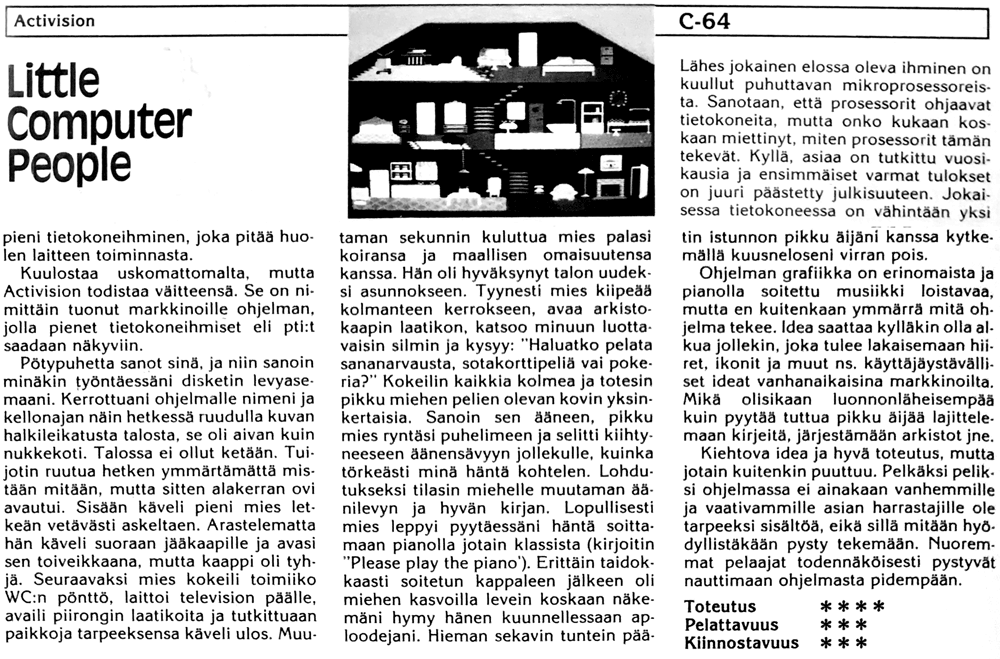
Pötypuhetta sanot sinä, ja niin sanoin minäkin työntäessäni disketin levyasemaani. Kerrottuani ohjelmalle nimeni ja kellonajan näin hetkessä ruudulla kuvan halkileikatusta talosta, se oli aivan kuin nukkekoti. Talossa ei ollut ketään. Tuijotin ruutua hetken ymmärtämättä mistään mitään, mutta sitten alakerran ovi avautui. Sisään käveli pieni mies letkeän vetävästi askeltaen. Arastelematta hän käveli suoraan jääkaapille ja avasi sen toiveikkaana, mutta kaappi oli tyhjä. Seuraavaksi mies kokeili toimiiko WC:n pönttö, laittoi television päälle, availi piirongin laatikoita ja tutkittuaan paikkoja tarpeeksensa käveli ulos. Muutaman sekunnin kuluttua mies palasi koiransa ja maallisen omaisuutensa kanssa. Hän oli hyväksynyt talon uudeksi asunnokseen. Tyynesti mies kiipeää kolmanteen kerrokseen, avaa arkistokaapin laatikon, katsoo minuun luottavaisin silmin ja kysyy: "Haluatko pelata sananarvausta, sotakorttipeliä vai pokeria?" Kokeilin kaikkia kolmea ja totesin pikku miehen pelien olevan kovin yksinkertaisia. Sanoin sen ääneen, pikku mies ryntäsi puhelimeen ja selitti kiihtyneeseen äänensävyyn jollekulle, kuinka törkeästi minä häntä kohtelen. Lohdutukseksi tilasin miehelle muutaman äänilevyn ja hyvän kirjan. Lopullisesti mies leppyi pyytäessäni häntä soittamaan pianolla jotain klassista (kirjoitin "Please play the piano'). Erittäin taidokkaasti soitetun kappaleen jälkeen oli miehen kasvoilla levein koskaan näkemäni hymy hänen kuunnellessaan aploodejani. Hieman sekavin tuntein päätin istunnon pikku äijäni kanssa kytkemällä kuusneloseni virran pois.
Ohjelman grafiikka on erinomaista ja pianolla soitettu musiikki loistavaa, mutta en kuitenkaan ymmärrä mitä ohjelma tekee. Idea saattaa kylläkin olla alkua jollekin, joka tulee lakaisemaan hiiret, ikonit ja muut ns. käyttäjäystävälliset ideat vanhanaikaisina markkinoilta. Mikä olisikaan luonnonläheisempää kuin pyytää tuttua pikku äijää lajittelemaan kirjeitä, järjestämään arkistot jne.
Kiehtova idea ja hyvä toteutus, mutta jotain kuitenkin puuttuu. Pelkäksi peliksi ohjelmassa ei ainakaan vanhemmille ja vaativammille asian harrastajille ole tarpeeksi sisältöä, eikä sillä mitään hyödyllistäkään pysty tekemään. Nuoremmat pelaajat todennäköisesti pystyvät nauttimaan ohjelmasta pidempään.
Little Computer People1987PermalinkAlmost every living person has heard talk of microprocessors. People say that processors control computers, but has anyone ever stopped to think how the processors actually do it? Yes, the matter has been researched for years, and the first conclusive results have just been made public. Inside every computer there is at least one little computer person who keeps the machine running.
It sounds incredible, but Activision proves the claim. It has put a program on the market that makes the little computer people, or LCPs, visible.
Poppycock, you say, and that's what I said too as I shoved the disk into my drive. Once I had told the program my name and the time, a moment later I was looking at a cross-section of a house on the screen; it was just like a dolls' house. There was nobody in the house. I stared at the screen for a while without understanding a thing, but then the downstairs door opened. In walked a little man with a loose, easy swagger. Without a trace of shyness he went straight to the fridge and opened it hopefully, but it was empty. Next the man checked whether the toilet worked, switched on the television, opened the drawers of the chest one after another and, having inspected the premises to his satisfaction, walked out. A few seconds later he was back with his dog and all his worldly goods. He had accepted the house as his new home. Calmly the man climbs to the third floor, opens a filing cabinet drawer, looks at me with trusting eyes and asks: "Would you like to play a word-guessing game, War or poker?" I tried all three and found the little man's games awfully simple. I said so out loud, and the little man rushed to the phone and explained to someone in an agitated voice how outrageously I was treating him. To console him I ordered him a few records and a good book. He was finally mollified when I asked him to play something classical on the piano (I typed "Please play the piano"). After a very skilfully played piece, the man's face wore the widest smile I have ever seen as he listened to my applause. With somewhat mixed feelings I ended the session with my little guy by switching off my Commodore 64.
The program's graphics are excellent and the piano music brilliant, but I still don't understand what the program actually does. Then again, the idea may well be the start of something that will sweep mice, icons and other so-called user-friendly ideas off the market as old-fashioned. What could be more natural than asking a familiar little guy to sort your letters, put the files in order and so on?
A fascinating idea and a good execution, but something is still missing. As a game pure and simple it doesn't have enough content, at least not for older and more demanding hobbyists, and you can't do anything useful with it either. Younger players will probably be able to enjoy it for longer.