TRAZ
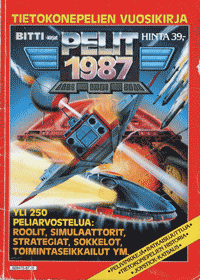
Pelit was a Finnish-language (bi)annual book series published from 1987 to 1991 containing gaming-related articles, tips and most importantly game reviews. Here you can find all the reviews from the books. The reviews were originally written in Finnish; the English versions are translations of the Finnish originals. Maininta tekijänoikeuksista
 1987
1987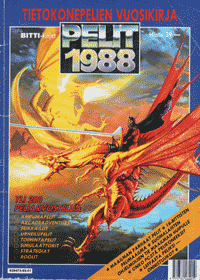 1988
1988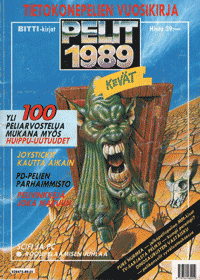 1989 Kevät
 1989 Syksy
 1990 Kevät
 1990 Syksy
 1991 Kevät
 1991 Syksy
TRAZ
TRAZ1988Pysyvä linkki'Mihin on kadonnut omaperäisyys?' kysyin Suurelta Gurulta. 'Poikani, kaikki olevainen luotiin jo aikojen alussa. Niinpä kaikki uusi perustuukin vanhaan, eikä mitään uutta olekaan olemassa', vastasi Guru. 'Se tekee sitten 39,95. Visa tai pankkikortti kelpaa.'
Kysymys omaperäisyydestä juontui ideaplagioinnin ahdistamaan mieleeni, kun näin Traz-nimisen pelin kannet kuvaruutukuvineen, jotka selvästi osoittivat kyseessä olevan klassisen Breakoutin uudelleenlämmittelyn. 'Eivätkö Krakout ja Arkanoid ja Arkanoid II riittäneet?' utelin vielä Gurulta, mutta Hän oli jo rahastamassa seuraavaa asiakasta. Siispä työnsin kasetin asemaan, suljin luukun, painoin maagista shift+runstop-näppäinyhdistelmää ja päätin etsiä totuutta itse.
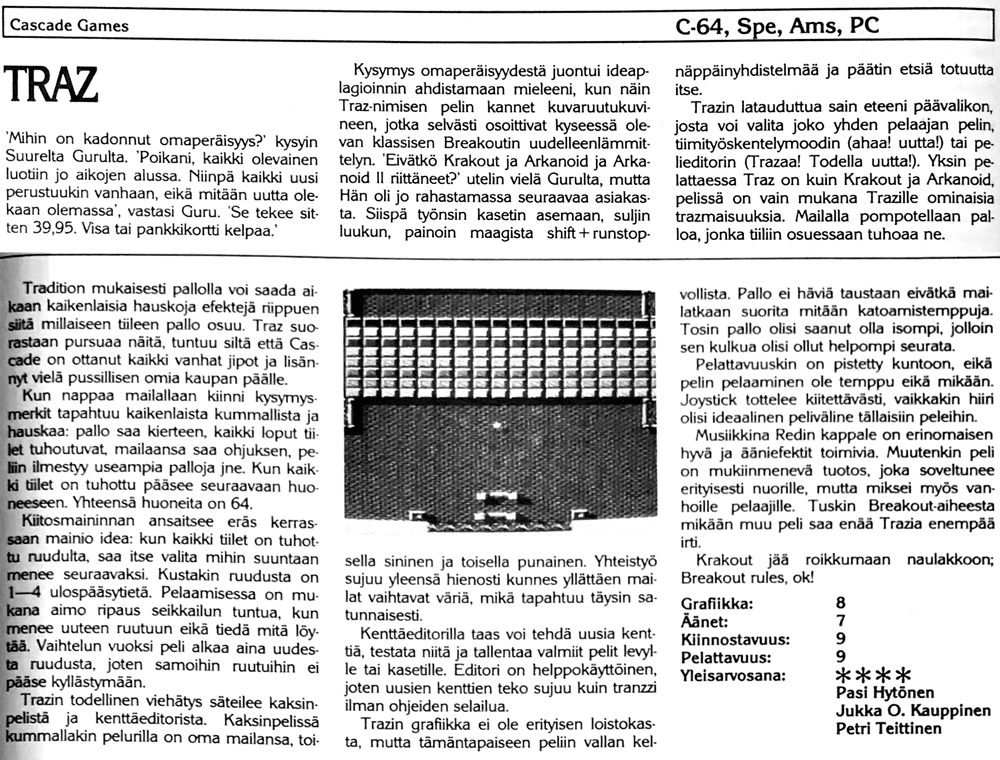
Trazin latauduttua sain eteeni päävalikon, josta voi valita joko yhden pelaajan pelin, tiimityöskentelymoodin (ahaa! uutta!) tai pelieditorin (Trazaa! Todella uutta!). Yksin pelattaessa Traz on kuin Krakout ja Arkanoid, pelissä on vain mukana Trazille ominaisia trazmaisuuksia. Mailalla pompotellaan palloa, jonka tiiliin osuessaan tuhoaa ne. Tradition mukaisesti pallolla voi saada aikaan kaikenlaisia hauskoja efektejä riippuen siitä millaiseen tiileen pallo osuu. Traz suorastaan pursuaa näitä, tuntuu siltä että Cascade on ottanut kaikki vanhat jipot ja lisännyt vielä pussillisen omia kaupan päälle.
Kun nappaa mailallaan kiinni kysymysmerkit tapahtuu kaikenlaista kummallista ja hauskaa: pallo saa kierteen, kaikki loput tiilet tuhoutuvat, mailaansa saa ohjuksen, peliin ilmestyy useampia palloja jne. Kun kaikki tiilet on tuhottu pääsee seuraavaan huoneeseen. Yhteensä huoneita on 64.
Kiitosmaininnan ansaitsee eräs kerrassaan mainio idea: kun kaikki tiilet on tuhottu ruudulta, saa itse valita mihin suuntaan menee seuraavaksi. Kustakin ruudusta on 1-4 ulospääsytietä. Pelaamisessa on mukana aimo ripaus seikkailun tuntua, kun menee uuteen ruutuun eikä tiedä mitä löytää. Vaihtelun vuoksi peli alkaa aina uudesta ruudusta, joten samoihin ruutuihin ei pääse kyllästymään.
Trazin todellinen viehätys säteilee kaksinpelistä ja kenttäeditorista. Kaksinpelissä kummallakin pelurilla on oma mailansa, toisella sininen ja toisella punainen. Yhteistyö sujuu yleensä hienosti kunnes yllättäen mailat vaihtavat väriä, mikä tapahtuu täysin satunnaisesti.
Kenttäeditorilla taas voi tehdä uusia kenttiä, testata niitä ja tallentaa valmiit pelit levylle tai kasetille. Editori on helppokäyttöinen, joten uusien kenttien teko sujuu kuin tranzzi ilman ohjeiden selailua.
Trazin grafiikka ei ole erityisen loistokasta, mutta tämäntapaiseen peliin vallan kelvollista. Pallo ei häviä taustaan eivätkä mailatkaan suorita mitään katoamistemppuja. Tosin pallo olisi saanut olla isompi, jolloin sen kulkua olisi ollut helpompi seurata.
Pelattavuuskin on pistetty kuntoon, eikä pelin pelaaminen ole temppu eikä mikään. Joystick tottelee kiitettävästi, vaikkakin hiiri olisi ideaalinen peliväline tällaisiin peleihin.
Musiikkina Redin kappale on erinomaisen hyvä ja ääniefektit toimivia. Muutenkin peli on mukiinmenevä tuotos, joka soveltunee erityisesti nuorille, mutta miksei myös vanhoille pelaajille. Tuskin Breakout-aiheesta mikään muu peli saa enää Trazia enempää irti.
Krakout jää roikkumaan naulakkoon; Breakout rules, ok!
TRAZ1988Permalink'Where has originality gone?' I asked the Great Guru. 'My son, all that is was created at the beginning of time. And so everything new is based on the old, and nothing new exists at all,' answered the Guru. 'That'll be 39.95, then. Visa or bank card accepted.'
The question of originality arose in my mind, harried as it is by the plagiarism of ideas, when I saw the cover of a game called Traz, complete with screenshots that clearly showed this was a warmed-up rehash of the classic Breakout. 'Weren't Krakout and Arkanoid and Arkanoid II enough?' I pressed the Guru further, but He was already busy fleecing the next customer. So I pushed the cassette into the drive, closed the lid, pressed the magic shift+runstop key combination and decided to seek the truth myself.
Once Traz had loaded I was greeted by the main menu, from which you can choose either a one-player game, a teamwork mode (aha! new!) or a game editor (Trazaa! Really new!). Played solo, Traz is like Krakout and Arkanoid, only with the Trazzy touches characteristic of Traz thrown in. You bounce a ball about with a bat, and when the ball hits the bricks it destroys them. In keeping with tradition, the ball can set off all sorts of fun effects depending on what kind of brick it hits. Traz positively overflows with these; it feels as if Cascade has taken all the old tricks and thrown in a bagful of its own into the bargain.
When you catch the question marks with your bat, all sorts of strange and fun things happen: the ball gets spin, all the remaining bricks are destroyed, your bat gets a missile, several balls appear in the game, etc. When all the bricks have been destroyed you get to the next room. There are 64 rooms in all.
One downright splendid idea deserves an honourable mention: when all the bricks on a screen have been destroyed, you get to choose for yourself which direction to go next. Each screen has 1-4 exits. The playing has a generous dash of adventure to it, as you go into a new screen not knowing what you'll find. For variety's sake the game always starts on a different screen, so you never get the chance to grow tired of the same screens.
Traz's real charm radiates from the two-player game and the level editor. In the two-player game each player has their own bat, one blue and the other red. The cooperation usually goes splendidly until the bats suddenly swap colours, which happens completely at random.
With the level editor, on the other hand, you can make new levels, test them and save the finished games to disk or cassette. The editor is easy to use, so making new levels goes like a dream without any leafing through the instructions.
Traz's graphics are not especially splendid, but perfectly passable for a game of this kind. The ball doesn't vanish into the background, and the bats don't perform any disappearing acts either. Admittedly the ball could have been bigger, which would have made its path easier to follow.
The playability has been sorted out too, and playing the game is no trick at all. The joystick obeys admirably, although a mouse would be the ideal controller for games like this.
As for music, Red's tune is exceedingly good and the sound effects do the job. In other respects too the game is a decent effort, likely to suit young players in particular, but why not old ones as well. Hardly any other game is going to squeeze more out of the Breakout theme than Traz.
Krakout can stay hanging on its peg; Breakout rules, ok!