Tower of Babel
Pelit was a Finnish-language (bi)annual book series published from 1987 to 1991 containing gaming-related articles, tips and most importantly game reviews. Here you can find all the reviews from the books. The reviews were originally written in Finnish; the English versions are translations of the Finnish originals. Maininta tekijänoikeuksista
 1987
1987 1988
1988 1989 Kevät
 1989 Syksy
 1990 Kevät
 1990 Syksy
 1991 Kevät
 1991 Syksy
Tower of Babel
Tower of Babel1990 SyksyPysyvä linkkiJos olet miettinyt, mitä Tau Cetin suunnittelija Pete Cooke on oikein tehnyt viime aikoina, tässä vastaus: muun muassa Tower of Babelia. Baabelin tornihan on se taivaita hipova rakennelma, jonka ihmiset rakensivat voidakseen jutustella Luojansa kanssa. Ikävä kyllä yhteys ei oikein pelannut, mutta sen sijaan torni kiinnosti kovasti Zantorilaista tähtiristeilijää: mikä mainio viestiasema! Korvaukseksi yhteistyöstä ihmiset saivat kuulla kaikkea jännää elämän ja kaikkeuden olemuksesta, mutta kateelliset fanaatikot alkoivat sabotoida projektia.
Väkisin väännetty juoni ei peliin oikein istu, sillä lähinnä kyse on Sentinelin tapaisesta ajatteluelintä kihelmöittävästä ongelmapelistä, joka on putkahtanut pelikoneeseen jostain Platonin ideamaailmaan isketystä madonreiästä.
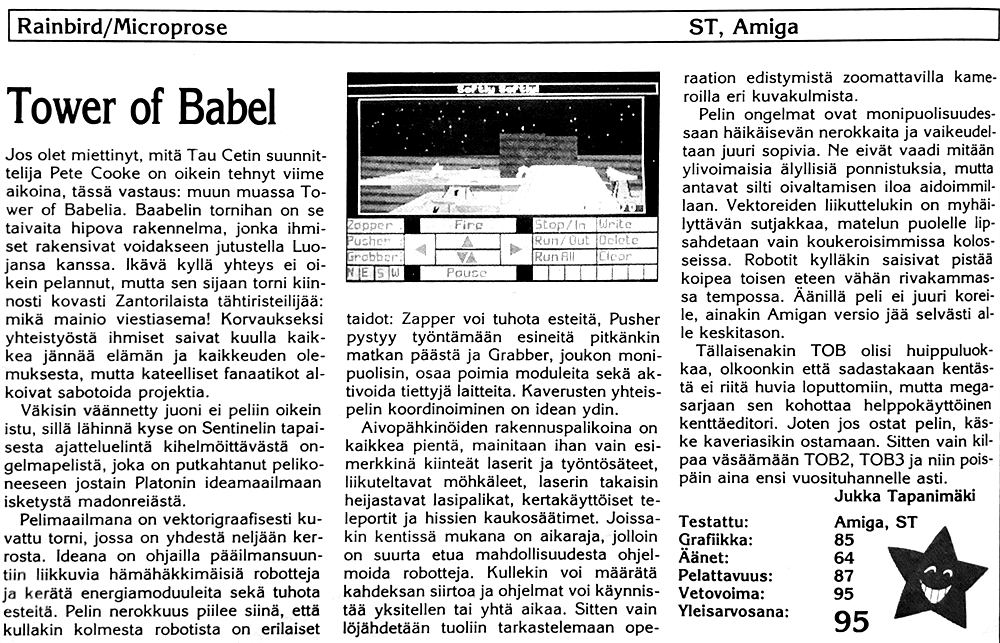
Pelimaailmana on vektorigraafisesti kuvattu torni, jossa on yhdestä neljään kerrosta. Ideana on ohjailla pääilmansuuntiin liikkuvia hämähäkkimäisiä robotteja ja kerätä energiamoduuleita sekä tuhota esteitä. Pelin nerokkuus piilee siinä, että kullakin kolmesta robotista on erilaiset taidot: Zapper voi tuhota esteitä, Pusher pystyy työntämään esineitä pitkänkin matkan päästä ja Grabber, joukon monipuolisin, osaa poimia moduleita sekä aktivoida tiettyjä laitteita. Kaverusten yhteispelin koordinoiminen on idean ydin.
Aivopähkinöiden rakennuspalikoina on kaikkea pientä, mainitaan ihan vain esimerkkinä kiinteät laserit ja työntösäteet, liikuteltavat möhkäleet, laserin takaisin heijastavat lasipalikat, kertakäyttöiset teleportit ja hissien kaukosäätimet. Joissakin kentissä mukana on aikaraja, jolloin on suurta etua mahdollisuudesta ohjelmoida robotteja. Kullekin voi määrätä kahdeksan siirtoa ja ohjelmat voi käynnistää yksitellen tai yhtä aikaa. Sitten vain löjähdetään tuoliin tarkastelemaan operaation edistymistä zoomattavilla kameroilla eri kuvakulmista.
Pelin ongelmat ovat monipuolisuudessaan häikäisevän nerokkaita ja vaikeudeltaan juuri sopivia. Ne eivät vaadi mitään ylivoimaisia älyllisiä ponnistuksia, mutta antavat silti oivaltamisen iloa aidoimmillaan. Vektoreiden liikuttelukin on myhäilyttävän sutjakkaa, matelun puolelle lipsahdetaan vain koukeroisimmissa kolosseissa. Robotit kylläkin saisivat pistää koipea toisen eteen vähän rivakammassa tempossa. Äänillä peli ei juuri koreile, ainakin Amigan versio jää selvästi alle keskitason.
Tällaisenakin TOB olisi huippuluokkaa, olkoonkin että sadastakaan kentästä ei riitä huvia loputtomiin, mutta megasarjaan sen kohottaa helppokäyttöinen kenttäeditori. Joten jos ostat pelin, käske kaveriasikin ostamaan. Sitten vain kilpaa väsäämään TOB2, TOB3 ja niin poispäin aina ensi vuosituhannelle asti.
Tower of Babel1990 SyksyPermalinkIf you've been wondering what Tau Ceti designer Pete Cooke has been up to lately, here's the answer: Tower of Babel, among other things. The Tower of Babel, as you'll know, is that heaven-grazing edifice people built so they could have a chat with their Creator. Sadly the line never really worked, but the tower did catch the keen interest of a Zantorian star cruiser: what a splendid relay station! In return for their cooperation the humans got to hear all sorts of exciting stuff about the nature of life and the universe, but jealous fanatics started sabotaging the project.
The shoehorned plot doesn't really suit the game, since what we have here is mostly a Sentinel-style puzzle game that sets the old thinking organ tingling, one that has popped into your games machine through some wormhole punched into Plato's world of ideas.
The game world is a tower drawn in vector graphics, with anywhere from one to four floors. The idea is to steer spider-like robots that move along the main compass directions, collecting energy modules and destroying obstacles. The genius of the game lies in the fact that each of the three robots has different skills: the Zapper can destroy obstacles, the Pusher can push objects even from a long way off, and the Grabber, the most versatile of the bunch, can pick up modules and activate certain devices. Coordinating the teamwork of the three pals is the heart of the idea.
The building blocks of the brainteasers include all sorts of little things; to mention just a few examples, fixed lasers and pusher beams, movable blocks, glass blocks that reflect lasers back, single-use teleporters and remote controls for lifts. Some levels have a time limit, and then the ability to program the robots is a big advantage. Each one can be given eight moves, and the programs can be started one at a time or all at once. Then you just flop back in your chair and watch the operation progress through zoomable cameras from different angles.
The game's puzzles are dazzlingly ingenious in their variety and just right in difficulty. They don't demand any superhuman feats of intellect, but they still deliver the joy of the eureka moment at its purest. Even the shifting of the vectors is grin-inducingly slick; only in the most convoluted colossi does it slip into a crawl. The robots could stand to put one pin in front of the other at a somewhat snappier pace, mind you. The game doesn't exactly show off in the sound department; the Amiga version at least falls clearly below average.
Even as it stands TOB would be top class, granted that not even a hundred levels will keep you amused forever, but what lifts it into the mega league is the easy-to-use level editor. So if you buy the game, tell your mate to buy it too. Then the two of you can race to knock together TOB2, TOB3 and so on, all the way into the next millennium.