Carrier Command
Pelit was a Finnish-language (bi)annual book series published from 1987 to 1991 containing gaming-related articles, tips and most importantly game reviews. Here you can find all the reviews from the books. The reviews were originally written in Finnish; the English versions are translations of the Finnish originals. Maininta tekijänoikeuksista
 1987
1987 1988
1988 1989 Kevät
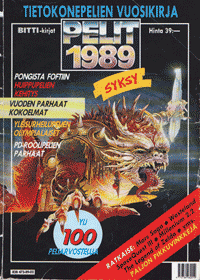 1989 Syksy
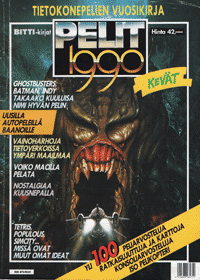 1990 Kevät
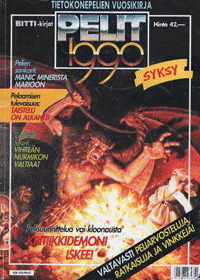 1990 Syksy
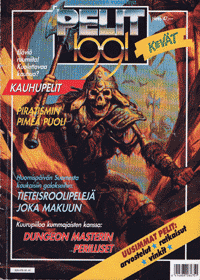 1991 Kevät
 1991 Syksy
Carrier Command
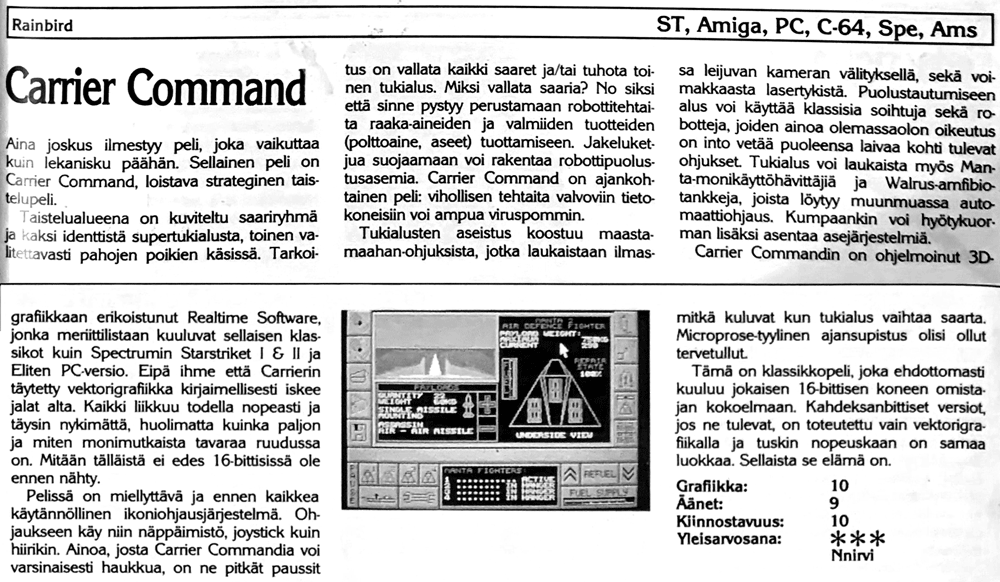
Carrier Command1988Pysyvä linkkiAina joskus ilmestyy peli, joka vaikuttaa kuin lekanisku päähän. Sellainen peli on Carrier Command, loistava strateginen taistelupeli.
Taistelualueena on kuviteltu saariryhmä ja kaksi identtistä supertukialusta, toinen valitettavasti pahojen poikien käsissä. Tarkoitus on vallata kaikki saaret ja/tai tuhota toinen tukialus. Miksi vallata saaria? No siksi että sinne pystyy perustamaan robottitehtaita raaka-aineiden ja valmiiden tuotteiden (polttoaine, aseet) tuottamiseen. Jakeluketjua suojaamaan voi rakentaa robottipuolustusasemia. Carrier Command on ajankohtainen peli: vihollisen tehtaita valvoviin tietokoneisiin voi ampua viruspommin.
Tukialusten aseistus koostuu maasta-maahan-ohjuksista, jotka laukaistaan ilmassa leijuvan kameran välityksellä, sekä voimakkaasta lasertykistä. Puolustautumiseen alus voi käyttää klassisia soihtuja sekä robotteja, joiden ainoa olemassaolon oikeutus on into vetää puoleensa laivaa kohti tulevat ohjukset. Tukialus voi laukaista myös Manta-monikäyttöhävittäjiä ja Walrus-amfibiotankkeja, joista löytyy muunmuassa automaattiohjaus. Kumpaankin voi hyötykuorman lisäksi asentaa asejärjestelmiä.
Carrier Commandin on ohjelmoinut 3Dgrafiikkaan erikoistunut Realtime Software, jonka meriittilistaan kuuluvat sellaisen klassikot kuin Spectrumin Starstriket I & II ja Eliten PC-versio. Eipä ihme että Carrierin täytetty vektorigrafiikka kirjaimellisesti iskee jalat alta. Kaikki liikkuu todella nopeasti ja täysin nykimättä, huolimatta kuinka paljon ja miten monimutkaista tavaraa ruudussa on. Mitään tälläistä ei edes 16-bittisissä ole ennen nähty.
Pelissä on miellyttävä ja ennen kaikkea käytännöllinen ikoniohjausjärjestelmä. Ohjaukseen käy niin näppäimistö, joystick kuin hiirikin. Ainoa, josta Carrier Commandia voi varsinaisesti haukkua, on ne pitkät paussit mitkä kuluvat kun tukialus vaihtaa saarta. Microprose-tyylinen ajansupistus olisi ollut tervetullut.
Tämä on klassikkopeli, joka ehdottomasti kuuluu jokaisen 16-bittisen koneen omistajan kokoelmaan. Kahdeksanbittiset versiot, jos ne tulevat, on toteutettu vain vektorigrafiikalla ja tuskin nopeuskaan on samaa luokkaa. Sellaista se elämä on.
Carrier Command1988PermalinkEvery now and then a game comes out that hits you like a sledgehammer to the head. Carrier Command, a brilliant strategic combat game, is one such game.
The battleground is a fictional group of islands and two identical super-carriers, one of them unfortunately in the hands of the bad guys. The aim is to capture all the islands and/or destroy the other carrier. Why capture islands? Well, because you can set up robot factories there to produce raw materials and finished goods (fuel, weapons). To protect the supply chain you can build robot defence stations. Carrier Command is a topical game: you can fire a virus bomb into the computers that run the enemy's factories.
The carriers' armament consists of surface-to-surface missiles, launched via a camera hovering in the air, and a powerful laser cannon. For defence the ship can use classic flares and robots whose sole justification for existence is an eagerness to draw in the missiles heading for the ship. The carrier can also launch Manta multi-role fighters and Walrus amphibious tanks, which feature an autopilot, among other things. Both can be fitted with weapon systems as well as a payload.
Carrier Command was programmed by 3D graphics specialists Realtime Software, whose track record includes such classics as Starstrike I & II on the Spectrum and the PC version of Elite. No wonder, then, that Carrier's filled vector graphics literally knock you off your feet. Everything moves really fast and completely without jerking, no matter how much stuff there is on screen or how complex it is. Nothing like this has been seen before, not even on the 16-bitters.
The game has a pleasant and above all practical icon control system. You can control it with the keyboard, a joystick or a mouse alike. The only thing you can really slate Carrier Command for is the long pauses that go by while the carrier moves from one island to another. Microprose-style time compression would have been welcome.
This is a classic game that absolutely belongs in the collection of every 16-bit machine owner. The eight-bit versions, if they come out, will be done with plain vector graphics only, and the speed is hardly going to be in the same league either. That's life.