Bad Company
Pelit was a Finnish-language (bi)annual book series published from 1987 to 1991 containing gaming-related articles, tips and most importantly game reviews. Here you can find all the reviews from the books. The reviews were originally written in Finnish; the English versions are translations of the Finnish originals. Maininta tekijänoikeuksista
 1987
1987 1988
1988 1989 Kevät
 1989 Syksy
 1990 Kevät
 1990 Syksy
 1991 Kevät
 1991 Syksy
Bad Company
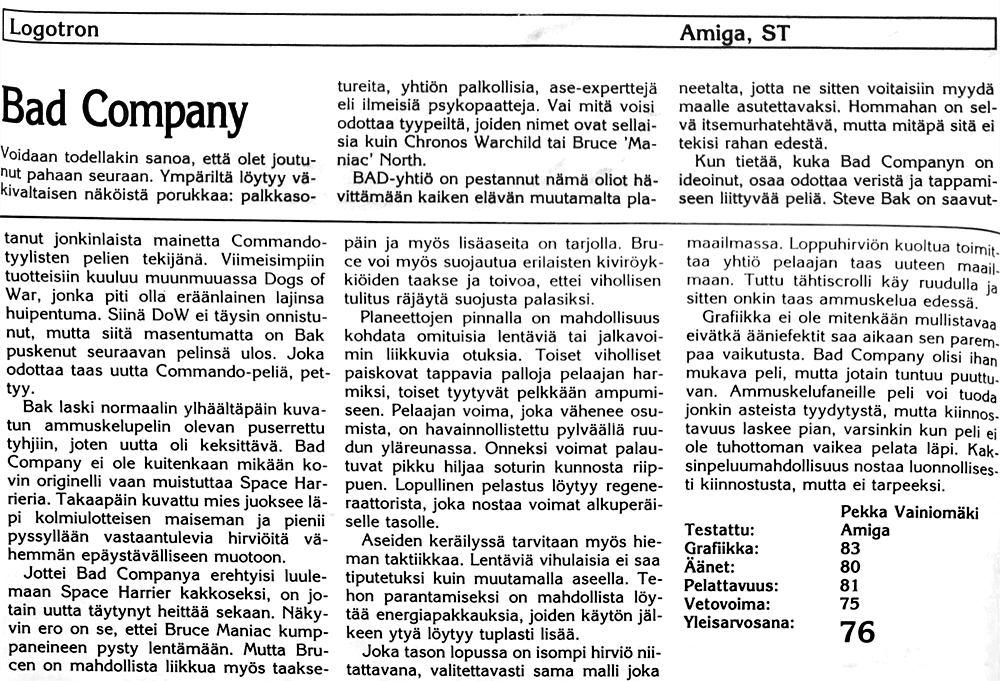
Bad Company1990 SyksyPysyvä linkkiVoidaan todellakin sanoa, että olet joutunut pahaan seuraan. Ympäriltä löytyy väkivaltaisen näköistä porukkaa: palkkasotureita, yhtiön palkollisia, ase-experttejä eli ilmeisiä psykopaatteja. Vai mitä voisi odottaa tyypeiltä, joiden nimet ovat sellaisia kuin Chronos Warchild tai Bruce 'Maniac' North.
BAD-yhtiö on pestannut nämä oliot hävittämään kaiken elävän muutamalta planeetalta, jotta ne sitten voitaisiin myydä maalle asutettavaksi. Hommahan on selvä itsemurhatehtävä, mutta mitäpä sitä ei tekisi rahan edestä.
Kun tietää, kuka Bad Companyn on ideoinut, osaa odottaa veristä ja tappamiseen liittyvää peliä. Steve Bak on saavuttanut jonkinlaista mainetta Commandotyylisten pelien tekijänä. Viimeisimpiin tuotteisiin kuuluu muunmuuassa Dogs of War, jonka piti olla eräänlainen lajinsa huipentuma. Siinä DoW ei täysin onnistunut, mutta siitä masentumatta on Bak puskenut seuraavan pelinsä ulos. Joka odottaa taas uutta Commando-peliä, pettyy.
Bak laski normaalin ylhäältäpäin kuvatun ammuskelupelin olevan puserrettu tyhjiin, joten uutta oli keksittävä. Bad Company ei ole kuitenkaan mikään kovin originelli vaan muistuttaa Space Harrieria. Takaapäin kuvattu mies juoksee läpi kolmiulotteisen maiseman ja pienii pyssyllään vastaantulevia hirviöitä vähemmän epäystävälliseen muotoon.
Jottei Bad Companya erehtyisi luulemaan Space Harrier kakkoseksi, on jotain uutta täytynyt heittää sekaan. Näkyvin ero on se, ettei Bruce Maniac kumppaneineen pysty lentämään. Mutta Brucen on mahdollista liikkua myös taaksepäin ja myös lisäaseita on tarjolla. Bruce voi myös suojautua erilaisten kiviröykkiöiden taakse ja toivoa, ettei vihollisen tulitus räjäytä suojusta palasiksi.
Planeettojen pinnalla on mahdollisuus kohdata omituisia lentäviä tai jalkavoimin liikkuvia otuksia. Toiset viholliset paiskovat tappavia palloja pelaajan harmiksi, toiset tyytyvät pelkkään ampumiseen. Pelaajan voima, joka vähenee osumista, on havainnollistettu pylväällä ruudun yläreunassa. Onneksi voimat palautuvat pikku hiljaa soturin kunnosta riippuen. Lopullinen pelastus löytyy regeneraattorista, joka nostaa voimat alkuperäiselle tasolle.
Aseiden keräilyssä tarvitaan myös hieman taktiikkaa. Lentäviä vihulaisia ei saa tiputetuksi kuin muutamalla aseella. Tehon parantamiseksi on mahdollista löytää energiapakkauksia, joiden käytön jälkeen ytyä löytyy tuplasti lisää.
Joka tason lopussa on isompi hirviö niitattavana, valitettavasti sama malli joka maailmassa. Loppuhirviön kuoltua toimittaa yhtiö pelaajan taas uuteen maailmaan. Tuttu tähtiscrolli käy ruudulla ja sitten onkin taas ammuskelua edessä.
Grafiikka ei ole mitenkään mullistavaa eivätkä ääniefektit saa aikaan sen parempaa vaikutusta. Bad Company olisi ihan mukava peli, mutta jotain tuntuu puuttuvan. Ammuskelufaneille peli voi tuoda jonkin asteista tyydytystä, mutta kiinnostavuus laskee pian, varsinkin kun peli ei ole tuhottoman vaikea pelata läpi. Kaksinpeluumahdollisuus nostaa luonnollisesti kiinnostusta, mutta ei tarpeeksi.
Bad Company1990 SyksyPermalinkIt can truly be said that you've fallen into bad company. All around you there's a violent-looking bunch: mercenaries, company hirelings, weapons experts, in other words obvious psychopaths. Or what else could you expect from guys with names like Chronos Warchild or Bruce 'Maniac' North.
The BAD company has hired these creatures to wipe out every living thing on a few planets, so that the planets can then be sold off to Earth for settlement. The job is obviously a suicide mission, but what wouldn't you do for money.
When you know who dreamed up Bad Company, you know to expect a bloody game that's all about killing. Steve Bak has earned a certain reputation as a maker of Commando-style games. His latest products include, among others, Dogs of War, which was supposed to be a kind of culmination of its genre. At that DoW didn't entirely succeed, but undaunted, Bak has pushed his next game out the door. Anyone expecting yet another Commando game will be disappointed.
Bak reckoned the ordinary top-down shoot-'em-up had been squeezed dry, so something new had to be invented. Bad Company isn't all that original, though; it resembles Space Harrier. A man seen from behind runs through a three-dimensional landscape, whittling the oncoming monsters down with his gun into a less unfriendly shape.
So that nobody mistakes Bad Company for Space Harrier 2, something new has had to be thrown into the mix. The most visible difference is that Bruce Maniac and his pals can't fly. But Bruce can also move backwards, and extra weapons are on offer too. Bruce can also take cover behind various heaps of rock and hope the enemy fire doesn't blast the cover to pieces.
On the planets' surfaces you may run into strange creatures that fly or get about on foot. Some enemies hurl deadly balls to the player's annoyance, others settle for plain shooting. The player's strength, which drops with every hit, is shown as a bar at the top of the screen. Fortunately your strength slowly comes back, depending on the soldier's condition. The ultimate salvation is a regenerator, which raises your strength back to its original level.
Collecting weapons also calls for a bit of tactics. The flying baddies can only be brought down with a few of the weapons. To boost your firepower you can find energy packs, and once you've used one you've got twice the oomph.
At the end of every level there's a bigger monster to nail, unfortunately the same model in every world. Once the end monster is dead, the company ships the player off to a new world again. The familiar star scroll whizzes across the screen, and then it's more shooting ahead.
The graphics are in no way revolutionary, and the sound effects don't make any better an impression. Bad Company would be quite a nice game, but something seems to be missing. Shoot-'em-up fans may get some degree of satisfaction out of it, but interest soon drops, especially as the game isn't terribly hard to play through. The two-player option naturally raises interest, but not enough.