Grand Prix Simulator
Pelit was a Finnish-language (bi)annual book series published from 1987 to 1991 containing gaming-related articles, tips and most importantly game reviews. Here you can find all the reviews from the books. The reviews were originally written in Finnish; the English versions are translations of the Finnish originals. Maininta tekijänoikeuksista
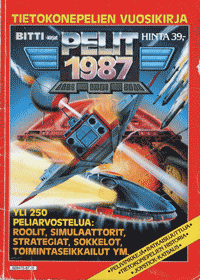 1987
1987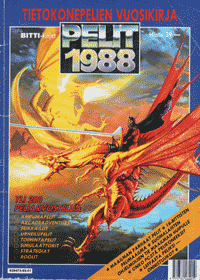 1988
1988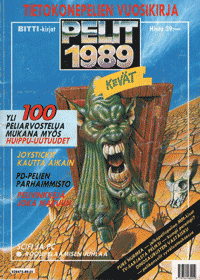 1989 Kevät
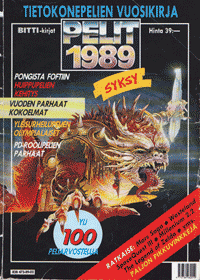 1989 Syksy
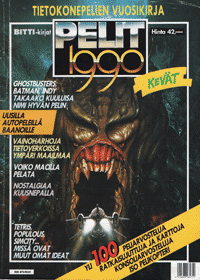 1990 Kevät
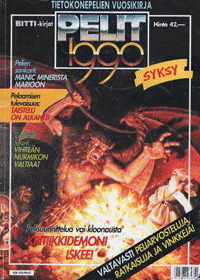 1990 Syksy
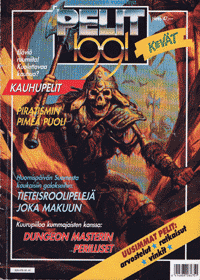 1991 Kevät
 1991 Syksy
Grand Prix Simulator
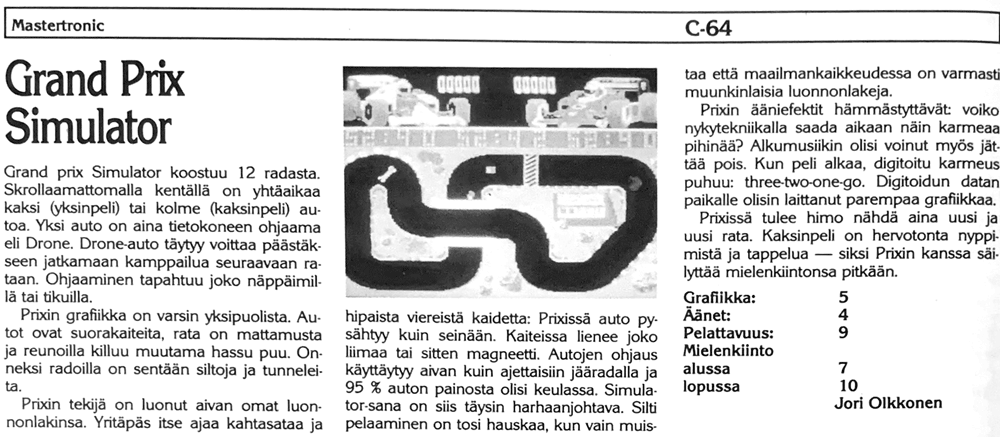
Grand Prix Simulator1988Pysyvä linkkiGrand prix Simulator koostuu 12 radasta. Skrollaamattomalla kentällä on yhtäaikaa kaksi (yksinpeli) tai kolme (kaksinpeli) autoa. Yksi auto on aina tietokoneen ohjaama eli Drone. Drone-auto täytyy voittaa päästäkseen jatkamaan kamppailua seuraavaan rataan. Ohjaaminen tapahtuu joko näppäimillä tai tikuilla.
Prixin grafiikka on varsin yksipuolista. Autot ovat suorakaiteita, rata on mattamusta ja reunoilla killuu muutama hassu puu. Onneksi radoilla on sentään siltoja ja tunneleita.
Prixin tekijä on luonut aivan omat luonnonlakinsa. Yritäpäs itse ajaa kahtasataa ja hipaista viereistä kaidetta: Prixissä auto pysähtyy kuin seinään. Kaiteissa lienee joko liimaa tai sitten magneetti. Autojen ohjaus käyttäytyy aivan kuin ajettaisiin jääradalla ja 95 % auton painosta olisi keulassa. Simulator-sana on siis täysin harhaanjohtava. Silti pelaaminen on tosi hauskaa, kun vain muistaa että maailmankaikkeudessa on varmasti muunkinlaisia luonnonlakeja.
Prixin ääniefektit hämmästyttävät: voiko nykytekniikalla saada aikaan näin karmeaa pihinää? Alkumusiikin olisi voinut myös jättää pois. Kun peli alkaa, digitoitu karmeus puhuu: three-two-one-go. Digitoidun datan paikalle olisin laittanut parempaa grafiikkaa.
Prixissä tulee himo nähdä aina uusi ja uusi rata. Kaksinpeli on hervotonta nyppimistä ja tappelua - siksi Prixin kanssa säilyttää mielenkiintonsa pitkään.
Grand Prix Simulator1988PermalinkGrand Prix Simulator consists of 12 tracks. The non-scrolling playfield holds two cars at a time (one-player game) or three (two-player game). One car is always controlled by the computer - the Drone. You have to beat the Drone car to get to carry on the fight on the next track. Steering is done either with the keys or with joysticks.
Prix's graphics are pretty monotonous. The cars are rectangles, the track is matt black and a few measly trees dangle about at the edges. Luckily the tracks do at least have bridges and tunnels.
Prix's author has created his very own laws of nature. Just try doing two hundred yourself and grazing the barrier beside you: in Prix the car stops dead, as if it had hit a brick wall. The barriers must have either glue or a magnet in them. The cars steer exactly as if you were driving on an ice track with 95% of the car's weight in the nose. So the word Simulator is completely misleading. Even so, playing it is really good fun, as long as you remember that the universe surely has other kinds of natural laws too.
Prix's sound effects are astonishing: can modern technology really produce a hiss this dreadful? The title music could have been left out as well. When the game starts, a digitised atrocity speaks: three-two-one-go. In place of the digitised data I'd have put in better graphics.
Prix leaves you itching to see one new track after another. The two-player game is uproarious niggling and brawling - which is why Prix holds your interest for a long time.