Battlefield Germany
Pelit was a Finnish-language (bi)annual book series published from 1987 to 1991 containing gaming-related articles, tips and most importantly game reviews. Here you can find all the reviews from the books. The reviews were originally written in Finnish; the English versions are translations of the Finnish originals. Maininta tekijänoikeuksista
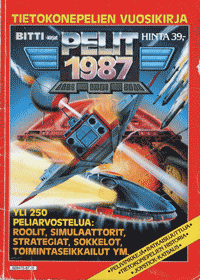 1987
1987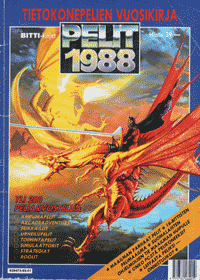 1988
1988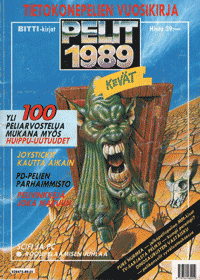 1989 Kevät
 1989 Syksy
 1990 Kevät
 1990 Syksy
 1991 Kevät
 1991 Syksy
Battlefield Germany
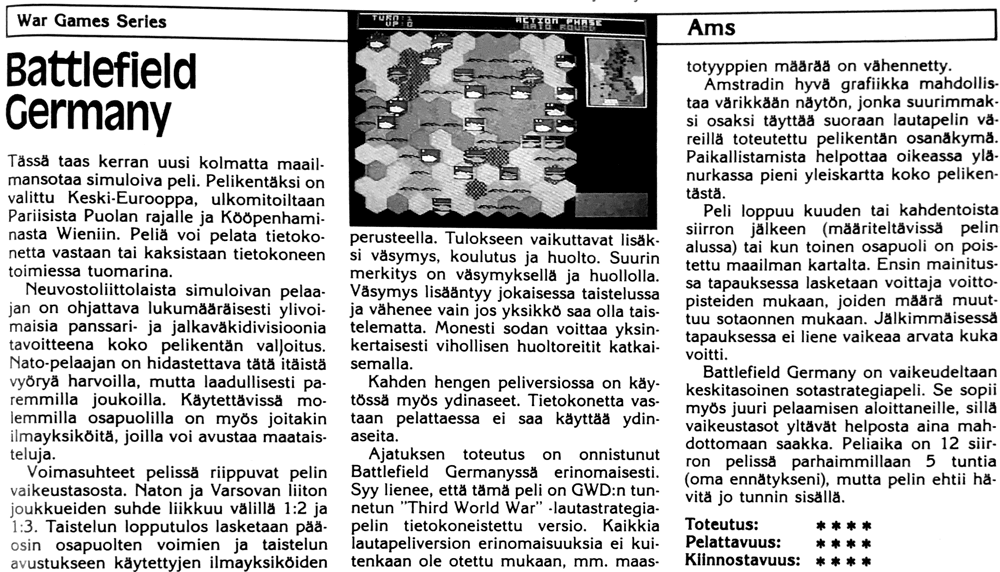
Battlefield Germany1987Pysyvä linkkiTässä taas kerran uusi kolmatta maailmansotaa simuloiva peli. Pelikentäksi on valittu Keski-Eurooppa, ulkomitoiltaan Pariisista Puolan rajalle ja Kööpenhaminasta Wieniin. Peliä voi pelata tietokonetta vastaan tai kaksistaan tietokoneen toimiessa tuomarina.
Neuvostoliittolaista simuloivan pelaajan on ohjattava lukumääräisesti ylivoimaisia panssari- ja jalkaväkidivisioonia tavoitteena koko pelikentän valloitus. Nato-pelaajan on hidastettava tätä itäistä vyöryä harvoilla, mutta laadullisesti paremmilla joukoilla. Käytettävissä molemmilla osapuolilla on myös joitakin ilmayksiköitä, joilla voi avustaa maataisteluja.
Voimasuhteet pelissä riippuvat pelin vaikeustasosta. Naton ja Varsovan liiton joukkueiden suhde liikkuu välillä 1:2 ja 1:3. Taistelun lopputulos lasketaan pääosin osapuolten voimien ja taistelun avustukseen käytettyjen ilmayksiköiden perusteella. Tulokseen vaikuttavat lisäksi väsymys, koulutus ja huolto. Suurin merkitys on väsymyksellä ja huollolla. Väsymys lisääntyy jokaisessa taistelussa ja vähenee vain jos yksikkö saa olla taistelematta. Monesti sodan voittaa yksinkertaisesti vihollisen huoltoreitit katkaisemalla.
Kahden hengen peliversiossa on käytössä myös ydinaseet. Tietokonetta vastaan pelattaessa ei saa käyttää ydinaseita.
Ajatuksen toteutus on onnistunut Battlefield Germanyssä erinomaisesti. Syy lienee, että tämä peli on GWD:n tunnetun "Third World War" -lautastrategiapelin tietokoneistettu versio. Kaikkia lautapeliversion erinomaisuuksia ei kuitenkaan ole otettu mukaan, mm. maastotyyppien määrää on vähennetty.
Amstradin hyvä grafiikka mahdollistaa värikkään näytön, jonka suurimmaksi osaksi täyttää suoraan lautapelin väreillä toteutettu pelikentän osanäkymä. Paikallistamista helpottaa oikeassa ylänurkassa pieni yleiskartta koko pelikentästä.
Peli loppuu kuuden tai kahdentoista siirron jälkeen (määriteltävissä pelin alussa) tai kun toinen osapuoli on poistettu maailman kartalta. Ensin mainitussa tapauksessa lasketaan voittaja voittopisteiden mukaan, joiden määrä muuttuu sotaonnen mukaan. Jälkimmäisessä tapauksessa ei liene vaikeaa arvata kuka voitti.
Battlefield Germany on vaikeudeltaan keskitasoinen sotastrategiapeli. Se sopii myös juuri pelaamisen aloittaneille, sillä vaikeustasot yltävät helposta aina mahdottomaan saakka. Peliaika on 12 siirron pelissä parhaimmillaan 5 tuntia (oma ennätykseni), mutta pelin ehtii hävitä jo tunnin sisällä.
Battlefield Germany1987PermalinkHere, once again, is a new game simulating the Third World War. The playing field chosen is Central Europe, its outer limits running from Paris to the Polish border and from Copenhagen to Vienna. The game can be played against the computer or by two players with the computer acting as referee.
The player simulating the Soviets must command numerically superior armoured and infantry divisions, the aim being to conquer the whole playing field. The NATO player has to slow down this onslaught from the east with few but qualitatively superior troops. Both sides also have some air units at their disposal, which can be used to support the ground battles.
The balance of forces in the game depends on the difficulty level. The ratio of NATO to Warsaw Pact forces ranges between 1:2 and 1:3. The outcome of a battle is calculated mainly on the basis of the two sides' strengths and the air units used to support the battle. The result is also affected by fatigue, training and supply. Fatigue and supply matter most. Fatigue increases with every battle and only decreases if the unit is allowed to stay out of combat. Often the war can be won simply by cutting the enemy's supply lines.
In the two-player version nuclear weapons are available too. When playing against the computer, you are not allowed to use nuclear weapons.
The idea has been carried out excellently in Battlefield Germany. The reason is probably that this game is a computerised version of GDW's well-known "Third World War" strategy board game. Not all the fine points of the board game version have been brought over, though; for instance, the number of terrain types has been reduced.
The Amstrad's good graphics make for a colourful display, most of which is filled by a partial view of the playing field done straight in the colours of the board game. Finding your bearings is made easier by a small overview map of the whole playing field in the top right-hand corner.
The game ends after six or twelve turns (set at the start of the game) or when one side has been wiped off the map of the world. In the former case the winner is determined by victory points, the number of which changes with the fortunes of war. In the latter case it probably isn't hard to guess who won.
Battlefield Germany is a war strategy game of medium difficulty. It also suits those who have only just taken up gaming, since the difficulty levels range all the way from easy to impossible. A 12-turn game lasts 5 hours at the most (my own record), but you can manage to lose the game within an hour.