Murder!
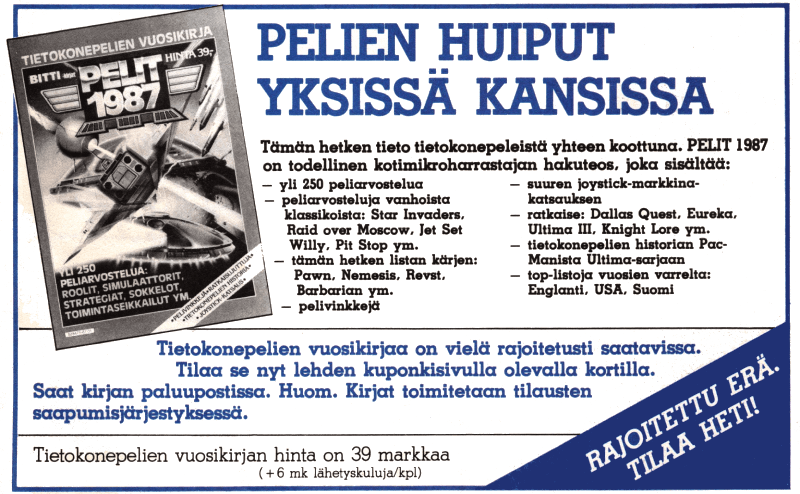
Pelit was a Finnish-language (bi)annual book series published from 1987 to 1991 containing gaming-related articles, tips and most importantly game reviews. Here you can find all the reviews from the books. The reviews were originally written in Finnish; the English versions are translations of the Finnish originals. Maininta tekijänoikeuksista
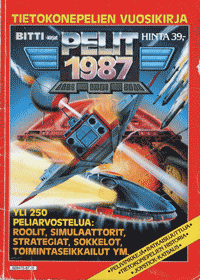 1987
1987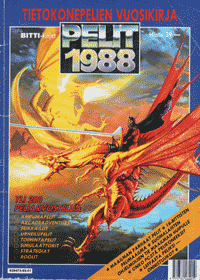 1988
1988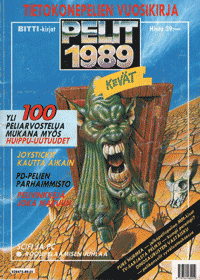 1989 Kevät
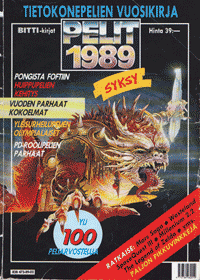 1989 Syksy
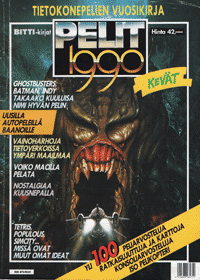 1990 Kevät
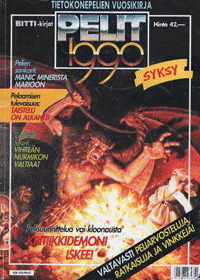 1990 Syksy
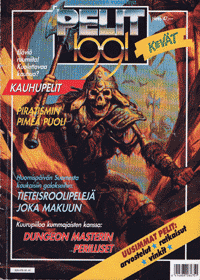 1991 Kevät
 1991 Syksy
Murder!
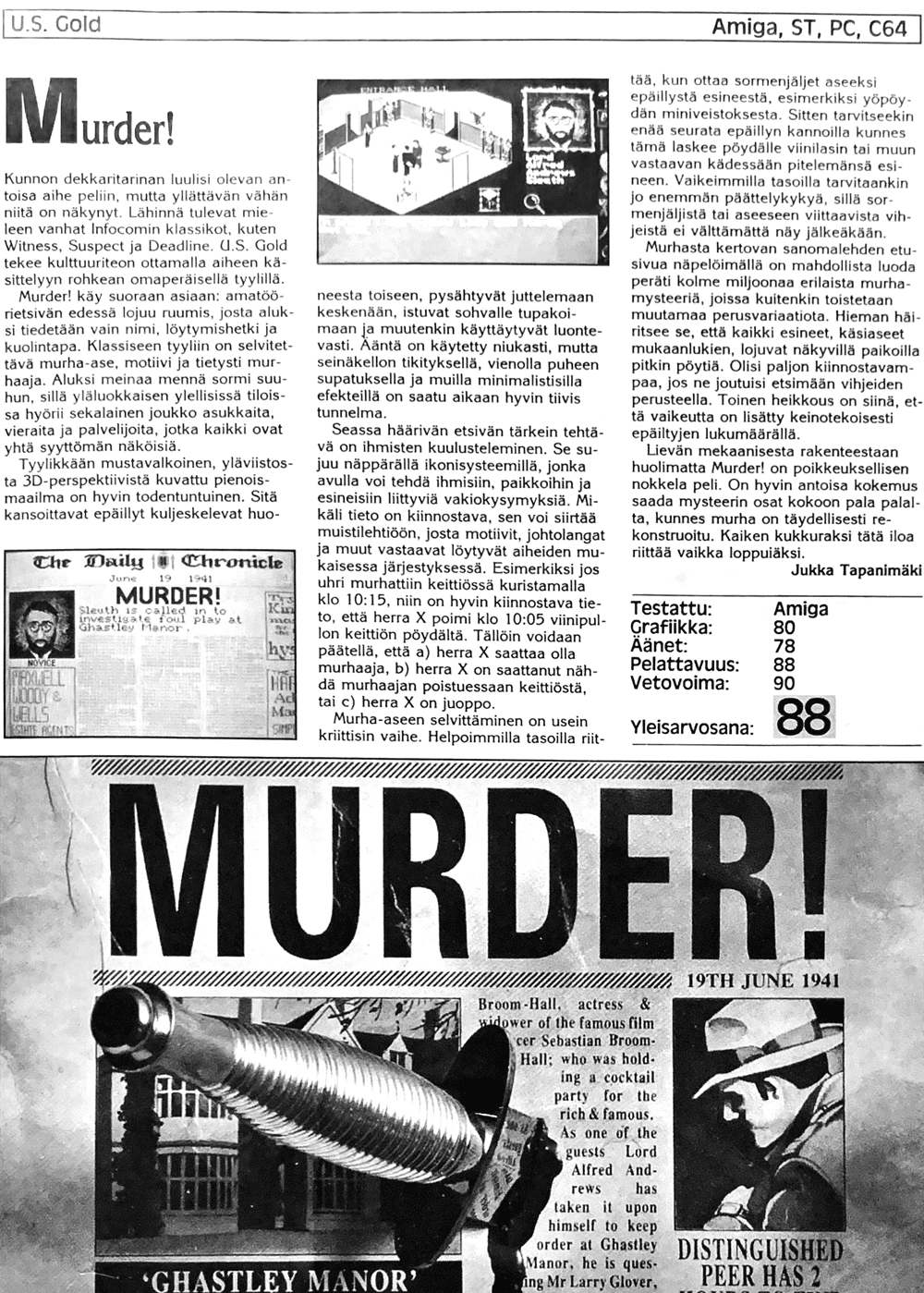
Murder!1991 KevätPysyvä linkkiKunnon dekkaritarinan luulisi olevan antoisa aihe peliin, mutta yllättävän vähän niitä on näkynyt. Lähinnä tulevat mieleen vanhat Infocomin klassikot, kuten Witness, Suspect ja Deadline. U.S. Gold tekee kulttuuriteon ottamalla aiheen käsittelyyn rohkean omaperäisellä tyylillä.
Murder! käy suoraan asiaan: amatöörietsivän edessä lojuu ruumis, josta aluksi tiedetään vain nimi, löytymishetki ja kuolintapa. Klassiseen tyyliin on selvitettävä murha-ase, motiivi ja tietysti murhaaja. Aluksi meinaa mennä sormi suuhun, sillä yläluokkaisen ylellisissä tiloissa hyörii sekalainen joukko asukkaita, vieraita ja palvelijoita, jotka kaikki ovat yhtä syyttömän näköisiä.
Tyylikkään mustavalkoinen, yläviistosta 3D-perspektiivistä kuvattu pienoismaailma on hyvin todentuntuinen. Sitä kansoittavat epäillyt kuljeskelevat huoneesta toiseen, pysähtyvät juttelemaan keskenään, istuvat sohvalle tupakoimaan ja muutenkin käyttäytyvät luontevasti. Ääntä on käytetty niukasti, mutta seinäkellon tikityksellä, vienolla puheen supatuksella ja muilla minimalistisilla efekteillä on saatu aikaan hyvin tiivis tunnelma.
Seassa häärivän etsivän tärkein tehtävä on ihmisten kuulusteleminen. Se sujuu näppärällä ikonisysteemillä, jonka avulla voi tehdä ihmisiin, paikkoihin ja esineisiin liittyviä vakiokysymyksiä. Mikäli tieto on kiinnostava, sen voi siirtää muistilehtiöön, josta motiivit, johtolangat ja muut vastaavat löytyvät aiheiden mukaisessa järjestyksessä. Esimerkiksi jos uhri murhattiin keittiössä kuristamalla klo 10:15, niin on hyvin kiinnostava tieto, että herra X poimi klo 10:05 viinipullon keittiön pöydältä. Tällöin voidaan päätellä, että a) herra X saattaa olla murhaaja, b) herra X on saattanut nähdä murhaajan poistuessaan keittiöstä, tai c) herra X on juoppo.
Murha-aseen selvittäminen on usein kriittisin vaihe. Helpoimmilla tasoilla riittää, kun ottaa sormenjäljet aseeksi epäillystä esineestä, esimerkiksi yöpöydän miniveistoksesta. Sitten tarvitseekin enää seurata epäillyn kannoilla kunnes tämä laskee pöydälle viinilasin tai muun vastaavan kädessään pitelemänsä esineen. Vaikeimmilla tasoilla tarvitaankin jo enemmän päättelykykyä, sillä sormenjäljistä tai aseeseen viittaavista vihjeistä ei välttämättä näy jälkeäkään.
Murhasta kertovan sanomalehden etusivua näpelöimällä on mahdollista luoda peräti kolme miljoonaa erilaista murhamysteeriä, joissa kuitenkin toistetaan muutamaa perusvariaatiota. Hieman häiritsee se, että kaikki esineet, käsiaseet mukaanlukien, lojuvat näkyvillä paikoilla pitkin pöytiä. Olisi paljon kiinnostavampaa, jos ne joutuisi etsimään vihjeiden perusteella. Toinen heikkous on siinä, että vaikeutta on lisätty keinotekoisesti epäiltyjen lukumäärällä.
Lievän mekaanisesta rakenteestaan huolimatta Murder! on poikkeuksellisen nokkela peli. On hyvin antoisa kokemus saada mysteerin osat kokoon pala palalta, kunnes murha on täydellisesti rekonstruoitu. Kaiken kukkuraksi tätä iloa riittää vaikka loppuiäksi.
Murder!1991 KevätPermalinkYou'd think a proper detective story would be a rewarding subject for a game, but surprisingly few of them have turned up. The ones that mainly spring to mind are the old Infocom classics, such as Witness, Suspect and Deadline. U.S. Gold does its bit for culture by tackling the subject in a boldly original style.
Murder! gets straight down to business: in front of the amateur detective lies a body, about which at first only the name, the time it was found and the manner of death are known. In classic style, you have to work out the murder weapon, the motive and, of course, the murderer. At first you're liable to be left completely at a loss, because the upper-class luxury of the premises is teeming with a motley bunch of residents, guests and servants, all of whom look equally innocent.
The stylishly black-and-white miniature world, shown in 3D perspective from diagonally above, feels very true to life. The suspects who populate it wander from room to room, stop to chat with each other, sit down on the sofa for a smoke and generally behave naturally. Sound has been used sparingly, but the ticking of the wall clock, the faint whisper of speech and other minimalist effects create a very dense atmosphere.
The main task of the detective bustling about among them is questioning people. This is done with a handy icon system that lets you ask standard questions about people, places and objects. If a piece of information is interesting, it can be transferred to the notebook, where motives, clues and the like are filed by subject. For example, if the victim was strangled in the kitchen at 10:15, then it is a very interesting fact that Mr X picked up a bottle of wine from the kitchen table at 10:05. From this we can deduce that a) Mr X may be the murderer, b) Mr X may have seen the murderer as he was leaving the kitchen, or c) Mr X is a drunk.
Figuring out the murder weapon is often the most critical stage. On the easiest levels it's enough to take fingerprints from the object suspected of being the weapon, for example the miniature sculpture on the bedside table. Then all you need to do is follow hot on the suspect's heels until they put down a wine glass or some similar object they've been holding. On the hardest levels you need a good deal more deductive power, since there may not be a trace of fingerprints, or of clues pointing to the weapon.
By fiddling with the front page of the newspaper reporting the murder, it's possible to create no fewer than three million different murder mysteries, though they do repeat a handful of basic variations. It's a little annoying that all the objects, handguns included, lie about in plain view all over the tables. It would be much more interesting if you had to hunt for them on the strength of clues. Another weakness is that the difficulty has been increased artificially through the number of suspects.
Despite its slightly mechanical structure, Murder! is an exceptionally clever game. It's a very rewarding experience to piece the mystery together bit by bit until the murder has been perfectly reconstructed. To top it all, there's enough of this joy to last you the rest of your life.