Medieval Lords
Pelit was a Finnish-language (bi)annual book series published from 1987 to 1991 containing gaming-related articles, tips and most importantly game reviews. Here you can find all the reviews from the books. The reviews were originally written in Finnish; the English versions are translations of the Finnish originals. Maininta tekijänoikeuksista
 1987
1987 1988
1988 1989 Kevät
 1989 Syksy
 1990 Kevät
 1990 Syksy
 1991 Kevät
 1991 Syksy
Medieval Lords
Medieval Lords1991 SyksyPysyvä linkkiOletko koskaan tahtonut olla keskiaikainen linnanherra, ryöstää ja polttaa, ruoskia orjia ja rakentaa linnoja? Kukapa ei olisi...
SSI:n tuore simulaatio Medieval Lords mahdollistaa lähes kaiken, mitä voisit toivoa keskiaikaan sijoittuvalta strategiapeliltä. Ohjelman on suunnitellut historian professori, Martin Campion, joka on syyllinen myöskin vanhan, upean Rails Westin synnystä. MLordsissa pääseekin riehumaan täysin sydämin: kerettiläisiä, hunnien hyökkäyksiä, valtakuntien nousuja ja romahduksia, kapinoita, diplomatiaa, sotia, ryöstöretkiä ja valloituksia, Paavin nuolemista, ristiretkiä ja oman valtakunnan huolehtimista.
Hallitsijaksi asti pelissä ei sentään nousta, vaan pelaaja astuu Lordin eli kuninkaan tms. neuvonantajan pallille. Neuvonantaja onkin varsin pitkäikäinen, kun Lordit kuolevat vanhuuteen, pelaaja porskuttaa eteenpäin. Voikin kelata läpi puolet keskiaikaa, vuodesta 1028 vuoteen 1530, ja pidemmällekin ja jotta peli ei kävisi liian yksioikoiseksi, on mahdollista vaihtaa valtakuntaa Lordin kuollessa. Vaikka pelaaja käytännössä veteleekin naruja, Lordi jakaa määräykset.
Kyvyt eli karisma, johtamistaito, sotaisuus ja hallitsemistaito saattavat vaihdella radikaalisti sukupolvesta toiseen, hyvän kuninkaan poika saattaakin olla mielipuoli. Hyvältä hallitsijalta onnistuu lähestulkoon mikä vain, milloin vain. Rupuinen vallanperijä taasen voi saada valtakunnan hajoamaan muutamassa vuosikymmenessä.
Tietokone on kunnioitettava vastustaja se voi ohjata jopa kuutta neuvonantajaa, yksittäisten Lordien lisäksi. Mikä parasta, jopa KYMMENEN pelaajaa voi ryhtyä neuvonantajiksi, jolloin parhaimmillaan on mahdollista pitää todelliset Medieval Lords -orgiat kuudellatoista pelaajalla. Jokainen tahtoo valloituksia, valtakunnan on laajennuttava maanpiirin käsittäväksi. Ei se ole noin helppoa, ei ei.
Suuri armeija on välttämätön valloituksiin, mistäs palkat? Kansa saattaa kapinoida, lojaalisuus laskea tai ties mitä, eikä siihen ehdi puuttua sodan aikana. Puhumattakaan aateliston päähän pinttymistä. Testipelissäni suuri Turkin valtakunta hajosi rahaongelmiin, hallitsija piti liian suurta armeijaa ja menot kasvoivat yli tulojen. Kansalaisten kuuliaisuus laski ja lopulta kapinat alkoivat. Pikkuvaltioita syntyi ympäri valtakuntaa, naapurit julistivat sotia ja Turkki oli raunio vain. Omakin valtakunta on huollettava. Kaupunkilaiset ja aatelisto on pidettävä tyytyväisenä, tai ainakin kurissa. Kerettiläiset on kitkettävä pois, ennen kuin he saavat jalansijan tai Paavi puuttuu asiaan. Valtiontalous on pidettävä tuottavana, ja jos kassaan kertyy liikaa rahaa Lordi voi ottaa leijonanosan omiin projekteihinsa.
Aikaa ei koskaan riitä tehdä haluamansa, joten hyvän neuvonantajan paras ominaisuus on taito tehdä kompromisseja. Jos pelatessa seuraa kaikkien valtioiden kaikki toimet, voi varata peliinsä aikaa seuraavat kuukaudet optio lienee masokisteille. Pienemmällä tietotulvalla peli kulkee paremmin, vaikka välilyöntiä saakin hakata reippaasti. Järkevintä kuitenkin on tarkkailla vain itseään koskevat tapahtumat.
Pelisysteemi tuo heti mieleen Colonial Conquestin ja Storm Across Europen. Alueet on jaettu samaan tyyliin, eikä itse pelaaminenkaan suuresti niistä eroa kaikki toiminta tapahtuu yhdessä vaiheessa (3 6 toimintapistettä), ja sitten vain seurataan mitä muualla tapahtuu. Erittäin helppoa systeemiä voi vain kehua.
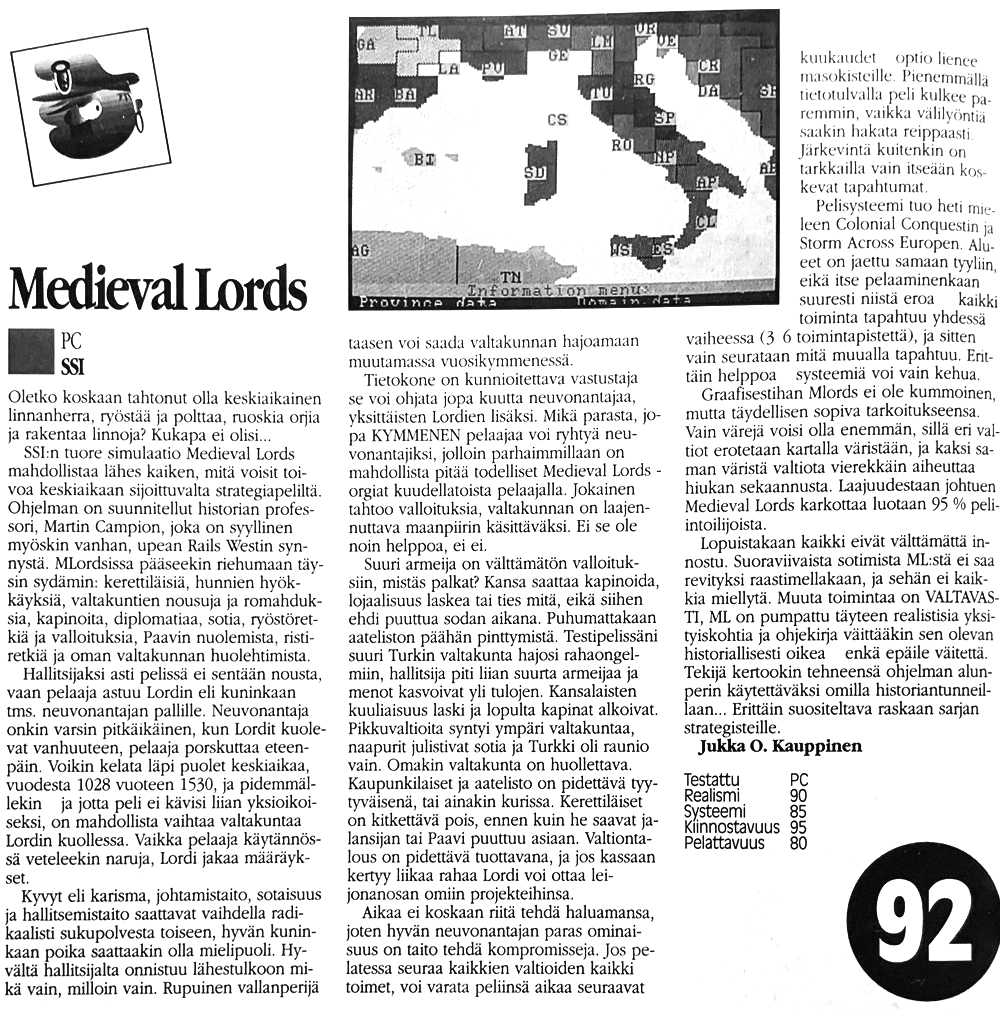
Graafisestihan Mlords ei ole kummoinen, mutta täydellisen sopiva tarkoitukseensa. Vain värejä voisi olla enemmän, sillä eri valtiot erotetaan kartalla väristään, ja kaksi saman väristä valtiota vierekkäin aiheuttaa hiukan sekaannusta. Laajuudestaan johtuen Medieval Lords karkottaa luotaan 95 % peli-intoilijoista.
Lopuistakaan kaikki eivät välttämättä innostu. Suoraviivaista sotimista ML:stä ei saa revityksi raastimellakaan, ja sehän ei kaikkia miellytä. Muuta toimintaa on VALTAVASTI, ML on pumpattu täyteen realistisia yksityiskohtia ja ohjekirja väittääkin sen olevan historiallisesti oikea enkä epäile väitettä. Tekijä kertookin tehneensä ohjelman alunperin käytettäväksi omilla historiantunneillaan... Erittäin suositeltava raskaan sarjan strategisteille.
Medieval Lords1991 SyksyPermalinkHave you ever wanted to be a medieval lord of the castle, to pillage and burn, whip slaves and build castles? Who hasn't...
SSI's fresh simulation Medieval Lords makes possible almost everything you could wish for from a strategy game set in the Middle Ages. The program was designed by a history professor, Martin Campion, who is also guilty of bringing the grand old Rails West into the world. In MLords you really do get to run riot to your heart's content: heretics, Hun invasions, the rise and fall of kingdoms, rebellions, diplomacy, wars, raids and conquests, sucking up to the Pope, crusades and looking after your own kingdom.
You don't quite get to rise all the way to ruler in the game; instead the player takes the stool of adviser to the Lord, that is, the king or suchlike. The adviser is indeed remarkably long-lived: as the Lords die of old age, the player just keeps chugging along. You can reel through half the Middle Ages, from 1028 to 1530, and further still - and so that the game doesn't get too one-track, you can switch kingdoms when your Lord dies. Although in practice the player is the one pulling the strings, it's the Lord who hands out the orders.
The abilities, that is, charisma, leadership, belligerence and administrative skill, can vary radically from one generation to the next; a good king's son may well turn out to be a madman. A good ruler can pull off almost anything, any time. A lousy heir, on the other hand, can make the kingdom fall apart within a few decades.
The computer is a respectable opponent - it can control as many as six advisers, on top of the individual Lords. Best of all, as many as TEN players can take up the role of adviser, so at best you can hold a genuine sixteen-player Medieval Lords orgy. Everyone wants conquests; the kingdom must expand to encompass the whole wide world. It's not that easy, no no.
A big army is essential for conquest - so where's the pay coming from? The people may rebel, loyalty may fall or who knows what, and there's no time to deal with it in wartime. Not to mention the fixed ideas the nobility get stuck in their heads. In my test game the great kingdom of Turkey fell apart over money troubles: the ruler kept too big an army and spending outgrew income. The citizens' obedience declined and in the end the revolts began. Petty states sprang up all over the kingdom, the neighbours declared wars and Turkey was nothing but a ruin. Your own kingdom needs looking after too. The townsfolk and the nobility have to be kept content, or at least in line. Heretics have to be rooted out before they gain a foothold or the Pope steps in. The state economy must be kept profitable, and if too much money piles up in the treasury, the Lord may take the lion's share for their own projects.
There's never enough time to do everything you want, so the best quality in a good adviser is the ability to compromise. If you follow every action of every state while playing, you can book the next few months for your game - that option is presumably for masochists. With a smaller flood of information the game moves along better, although you do have to hammer the space bar briskly. The most sensible thing, though, is to keep watch only on the events that concern you.
The game system immediately brings to mind Colonial Conquest and Storm Across Europe. The territories are divided up in the same style, and the playing itself doesn't differ much from them either - all the action takes place in a single phase (3-6 action points), and then you just watch what happens elsewhere. An extremely easy system - one can only praise it.
Graphically Mlords is nothing to write home about, of course, but it's perfectly suited to its purpose. Only there could be more colours, since the different states are told apart on the map by their colour, and two states of the same colour side by side cause a little confusion. Owing to its sheer scope, Medieval Lords will drive off 95% of gaming enthusiasts.
Not all of the rest will necessarily get excited either. You couldn't tear any straightforward warfare out of ML even with a cheese grater, and that, of course, isn't to everyone's liking. There's a HUGE amount of other activity: ML has been pumped full of realistic detail, and the manual even claims it's historically accurate - and I don't doubt the claim. Indeed, the designer says they originally made the program for use in their own history lessons... Highly recommended for heavyweight strategists.