Pinball Magic
Pelit was a Finnish-language (bi)annual book series published from 1987 to 1991 containing gaming-related articles, tips and most importantly game reviews. Here you can find all the reviews from the books. The reviews were originally written in Finnish; the English versions are translations of the Finnish originals. Maininta tekijänoikeuksista
 1987
1987 1988
1988 1989 Kevät
 1989 Syksy
 1990 Kevät
 1990 Syksy
 1991 Kevät
 1991 Syksy
Pinball Magic
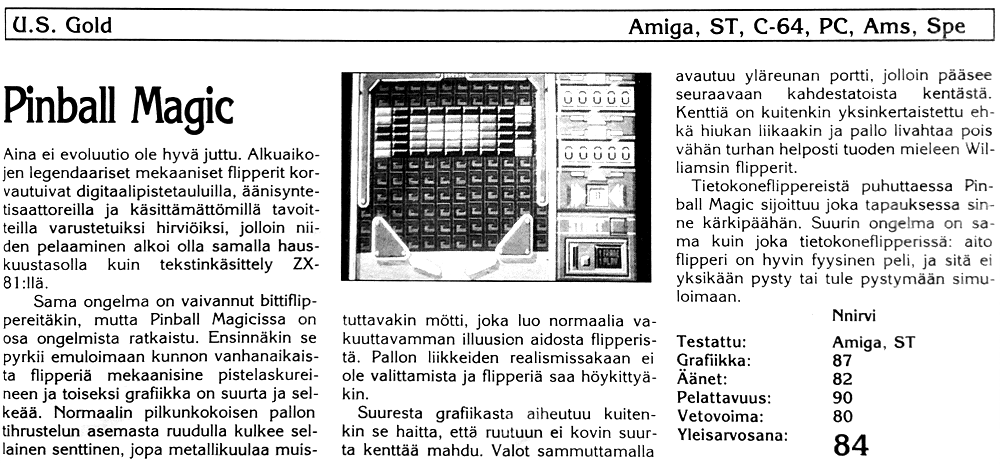
Pinball Magic1990 SyksyPysyvä linkkiAina ei evoluutio ole hyvä juttu. Alkuaikojen legendaariset mekaaniset flipperit korvautuivat digitaalipistetauluilla, äänisyntetisaattoreilla ja käsittämättömillä tavoitteilla varustetuiksi hirviöiksi, jolloin niiden pelaaminen alkoi olla samalla hauskuustasolla kuin tekstinkäsittely ZX-81:llä.
Sama ongelma on vaivannut bittiflippereitäkin, mutta Pinball Magicissa on osa ongelmista ratkaistu. Ensinnäkin se pyrkii emuloimaan kunnon vanhanaikaista flipperiä mekaanisine pistelaskureineen ja toiseksi grafiikka on suurta ja selkeää. Normaalin pilkunkokoisen pallon tihrustelun asemasta ruudulla kulkee sellainen senttinen, jopa metallikuulaa muistuttavakin mötti, joka luo normaalia vakuuttavamman illuusion aidosta flipperistä. Pallon liikkeiden realismissakaan ei ole valittamista ja flipperiä saa höykittyäkin.
Suuresta grafiikasta aiheutuu kuitenkin se haitta, että ruutuun ei kovin suurta kenttää mahdu. Valot sammuttamalla avautuu yläreunan portti, jolloin pääsee seuraavaan kahdestatoista kentästä. Kenttiä on kuitenkin yksinkertaistettu ehkä hiukan liikaakin ja pallo livahtaa pois vähän turhan helposti tuoden mieleen Williamsin flipperit.
Tietokoneflippereistä puhuttaessa Pinball Magic sijoittuu joka tapauksessa sinne kärkipäähän. Suurin ongelma on sama kuin joka tietokoneflipperissä: aito flipperi on hyvin fyysinen peli, ja sitä ei yksikään pysty tai tule pystymään simuloimaan.
Pinball Magic1990 SyksyPermalinkEvolution isn't always a good thing. The legendary mechanical pinball machines of the early days gave way to monsters equipped with digital scoreboards, sound synthesisers and incomprehensible objectives, whereupon playing them started to be about as much fun as word processing on a ZX-81.
The same problem has plagued bit-pinballs too, but Pinball Magic has solved some of the problems. Firstly, it tries to emulate a proper old-fashioned pinball machine with mechanical score counters, and secondly the graphics are big and clear. Instead of squinting at the usual comma-sized ball, what rolls around the screen is a centimetre-wide lump that even resembles a metal ball, which creates a more convincing illusion of a real pinball machine than usual. There's nothing to complain about in the realism of the ball's movement either, and you can even give the table a good thumping.
The big graphics do have one drawback, though: not a very big table fits on the screen. Turning off the lights opens the gate at the top, taking you on to the next of the twelve tables. The tables have perhaps been simplified a little too much, however, and the ball slips away rather too easily, which brings Williams' pinball machines to mind.
When it comes to computer pinball, Pinball Magic ranks up there at the top end in any case. The biggest problem is the same as with every computer pinball: real pinball is a very physical game, and not a single one of them can simulate that, or ever will.