Powermonger
Pelit was a Finnish-language (bi)annual book series published from 1987 to 1991 containing gaming-related articles, tips and most importantly game reviews. Here you can find all the reviews from the books. The reviews were originally written in Finnish; the English versions are translations of the Finnish originals. Maininta tekijänoikeuksista
 1987
1987 1988
1988 1989 Kevät
 1989 Syksy
 1990 Kevät
 1990 Syksy
 1991 Kevät
 1991 Syksy
Powermonger
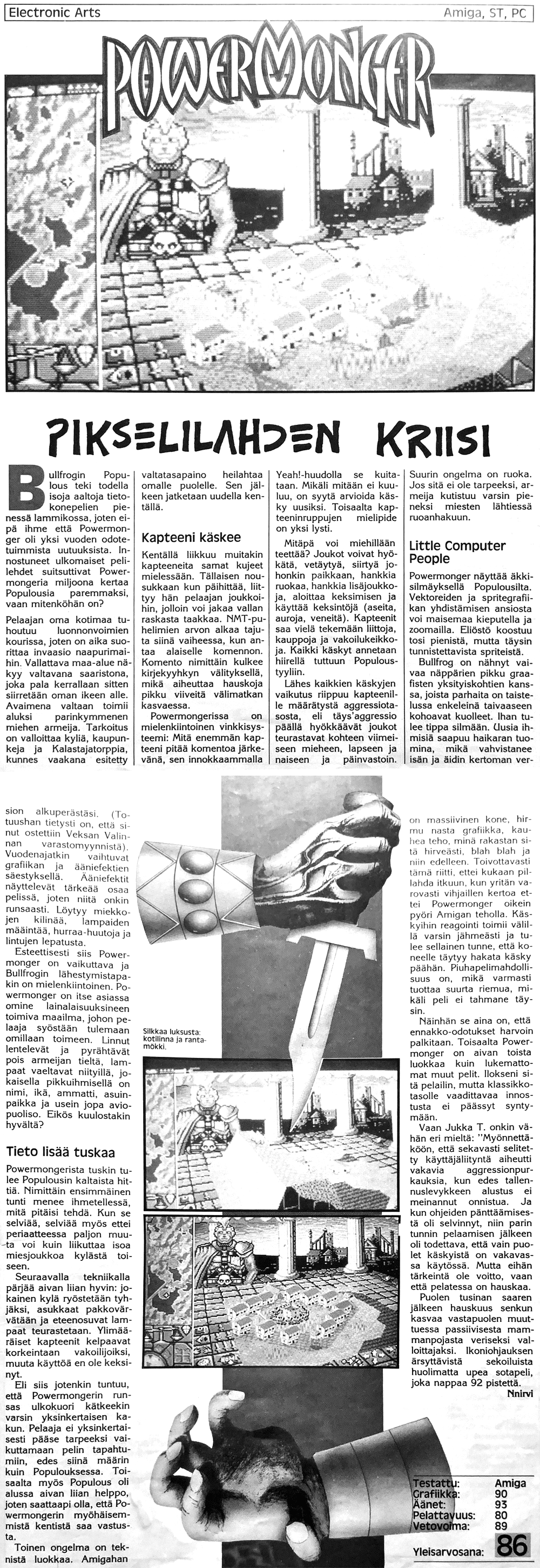
Powermonger1991 KevätPysyvä linkkiBullfrogin Populous teki todella isoja aaltoja tietokonepelien pienessä lammikossa, joten eipä ihme että Powermonger oli yksi vuoden odotetuimmista uutuuksista. Innostuneet ulkomaiset pelilehdet suitsuttivat Powermongeria miljoona kertaa Populousia paremmaksi, vaan mitenköhän on?
Pelaajan oma kotimaa tuhoutuu luonnonvoimien kourissa, joten on aika suorittaa invaasio naapurimaihin. Vallattava maa-alue näkyy valtavana saaristona, joka pala kerrallaan sitten siirretään oman ikeen alle. Avaimena valtaan toimii aluksi parinkymmenen miehen armeija. Tarkoitus on valloittaa kyliä, kaupunkeja ja Kalastajatorppia, kunnes vaakana esitetty valtatasapaino heilahtaa omalle puolelle. Sen jälkeen jatketaan uudella kentällä.
Kapteeni käskee
Kentällä liikkuu muitakin kapteeneita samat kujeet mielessään. Tällaisen nousukkaan kun päihittää, liittyy hän pelaajan joukkoihin, jolloin voi jakaa vallan raskasta taakkaa. NMT-puhelimien arvon alkaa tajuta siinä vaiheessa, kun antaa alaiselle komennon. Komento nimittäin kulkee kirjekyyhkyn välityksellä, mikä aiheuttaa hauskoja pikku viiveitä välimatkan kasvaessa.
Powermongerissa on mielenkiintoinen vinkkisysteemi: Mitä enemmän kapteeni pitää komentoa järkevänä, sen innokkaammalla Yeah!-huudolla se kuitataan. Mikäli mitään ei kuulu, on syytä arvioida käsky uusiksi. Toisaalta kapteeninruppujen mielipide on yksi lysti.
Mitäpä voi miehillään teettää? Joukot voivat hyökätä, vetäytyä, siirtyä johonkin paikkaan, hankkia ruokaa, hankkia lisäjoukkoja, aloittaa keksimisen ja käyttää keksintöjä (aseita, auroja, veneitä). Kapteenit saa vielä tekemään liittoja, kauppoja ja vakoilukeikkoja. Kaikki käskyt annetaan hiirellä tuttuun Populous-tyyliin.
Lähes kaikkien käskyjen vaikutus riippuu kapteenille määrätystä aggressiotasosta, eli täys'aggressio päällä hyökkäävät joukot teurastavat kohteen viimeiseen mieheen, lapseen ja naiseen ja päinvastoin.
Suurin ongelma on ruoka. Jos sitä ei ole tarpeeksi, armeija kutistuu varsin pieneksi miesten lähtiessä ruoanhakuun.
Little Computer People
Powermonger näyttää äkkisilmäyksellä Populousilta. Vektoreiden ja spritegrafiikan yhdistämisen ansiosta voi maisemaa kieputella ja zoomailla. Eliöstö koostuu tosi pienistä, mutta täysin tunnistettavista spriteistä.
Bullfrog on nähnyt vaivaa näppärien pikku graafisten yksityiskohtien kanssa, joista parhaita on taistelussa enkeleinä taivaaseen kohoavat kuolleet. Ihan tulee tippa silmään. Uusia ihmisiä saapuu haikaran tuomina, mikä vahvistanee isän ja äidin kertoman version alkuperästäsi. (Totuushan tietysti on, että sinut ostettiin Veksan Valinnan varastomyynnistä). Vuodenajatkin vaihtuvat grafiikan ja ääniefektien säestyksellä. Ääniefektit näyttelevät tärkeää osaa pelissä, joten niitä onkin runsaasti. Löytyy miekkojen kilinää, lampaiden määintää, hurraa-huutoja ja lintujen lepatusta.
Esteettisesti siis Powermonger on vaikuttava ja Bullfrogin lähestymistapakin on mielenkiintoinen. Powermonger on itse asiassa omine lainalaisuuksineen toimiva maailma, johon pelaaja syöstään tulemaan omillaan toimeen. Linnut lentelevät ja pyrähtävät pois armeijan tieltä, lampaat vaeltavat niityillä, jokaisella pikkuihmisellä on nimi, ikä, ammatti, asuinpaikka ja usein jopa aviopuoliso. Eikös kuulostakin hyvältä?
Tieto lisää tuskaa
Powermongerista tuskin tulee Populousin kaltaista hittiä. Nimittäin ensimmäinen tunti menee ihmetellessä, mitä pitäisi tehdä. Kun se selviää, selviää myös ettei periaatteessa paljon muuta voi kuin liikuttaa isoa miesjoukkoa kylästä toiseen.
Seuraavalla tekniikalla pärjää aivan liian hyvin: jokainen kylä ryöstetään tyhjäksi, asukkaat pakkovärvätään ja eteenosuvat lampaat teurastetaan. Ylimääräiset kapteenit kelpaavat korkeintaan vakoilijoiksi, muuta käyttöä en ole keksinyt.
Eli siis jotenkin tuntuu, että Powermongerin runsas ulkokuori kätkeekin varsin yksinkertaisen kakun. Pelaaja ei yksinkertaisesti pääse tarpeeksi vaikuttamaan pelin tapahtumiin, edes siinä määrin kuin Populouksessa. Toisaalta myös Populous oli alussa aivan liian helppo, joten saattaapi olla, että Powermongerin myöhäisemmistä kentistä saa vastusta.
Toinen ongelma on teknistä luokkaa. Amigahan on massiivinen kone, hirmu nasta grafiikka, kauhea teho, minä rakastan sitä hirveästi, blah blah ja niin edelleen. Toivottavasti tämä riitti, ettei kukaan pillahda itkuun, kun yritän varovasti vihjaillen kertoa ettei Powermonger oikein pyöri Amigan teholla. Käskyihin reagointi toimii välillä varsin jähmeästi ja tulee sellainen tunne, että koneelle täytyy hakata käsky päähän. Piuhapelimahdollisuus on, mikä varmasti tuottaa suurta riemua, mikäli peli ei tahmane täysin.
Näinhän se aina on, että ennakko-odotukset harvoin palkitaan. Toisaalta Powermonger on aivan toista luokkaa kuin lukemattomat muut pelit. Ilokseni sitä pelailin, mutta klassikkotasolle vaadittavaa innostusta ei päässyt syntymään.
Vaan Jukka T. onkin vähän eri mieltä: "Myönnettäköön, että sekavasti selitetty käyttäjäliityntä aiheutti vakavia aggressionpurkauksia, kun edes tallennuslevykkeen alustus ei meinannut onnistua. Ja kun ohjeiden pänttäämisestä oli selvinnyt, niin parin tunnin pelaamisen jälkeen oli todettava, että vain puolet käskyistä on vakavassa käytössä. Mutta eihän tärkeintä ole voitto, vaan että pelatessa on hauskaa.
Puolen tusinan saaren jälkeen hauskuus senkun kasvaa vastapuolen muuttuessa passiivisesta mammanpojasta veriseksi valloittajaksi. Ikoniohjauksen ärsyttävistä sekoiluista huolimatta upea sotapeli, joka nappaa 92 pistettä.
Powermonger1991 KevätPermalinkBullfrog's Populous made really big waves in the small pond of computer games, so it's no wonder Powermonger was one of the most eagerly awaited new releases of the year. Excited foreign games magazines gushed that Powermonger was a million times better than Populous, but is that really so, I wonder?
The player's own homeland is being destroyed in the grip of the forces of nature, so it's time to carry out an invasion of the neighbouring lands. The territory to be conquered appears as a vast archipelago, which is then brought under your own yoke one piece at a time. The key to power at first is an army of twenty-odd men. The aim is to conquer villages, towns and Kalastajatorppas until the balance of power, shown as a pair of scales, swings to your side. After that you carry on with a new level.
The Captain Commands
There are other captains moving about the level too, with the same tricks in mind. Beat one of these upstarts and they join the player's forces, so you can share the heavy burden of power. You start to appreciate the value of NMT mobile phones the moment you give an order to a subordinate. The order, you see, travels by carrier pigeon, which causes amusing little delays as the distance grows.
Powermonger has an interesting hint system: the more sensible the captain thinks an order is, the more enthusiastic the "Yeah!" shout it is acknowledged with. If nothing is heard, it's time to reconsider the order. Then again, the opinion of those tinpot captains doesn't matter one jot.
So what can you have your men do? The troops can attack, retreat, move to some place, gather food, get more troops, start inventing and use inventions (weapons, ploughs, boats). You can also get the captains to make alliances, deals and spying trips. All orders are given with the mouse in the familiar Populous style.
The effect of almost every order depends on the aggression level assigned to the captain, so troops attacking with full-on aggression switched on slaughter the target to the last man, child and woman, and vice versa.
The biggest problem is food. If there isn't enough of it, the army shrinks to quite a small size as the men go off foraging.
Little Computer People
At first glance Powermonger looks like Populous. Thanks to combining vectors and sprite graphics, you can spin the landscape around and zoom in and out. The living things are made up of really tiny but fully recognisable sprites.
Bullfrog has taken trouble over nifty little graphical details, the best of which are the dead rising to heaven as angels in battle. It really brings a tear to your eye. New people arrive delivered by the stork, which presumably confirms the version of your origins that your mum and dad told you. (The truth, of course, is that you were bought at the Veksan Valinta warehouse sale). The seasons change too, accompanied by graphics and sound effects. Sound effects play an important part in the game, so there are plenty of them. There's the clang of swords, the bleating of sheep, hurrah-shouts and the fluttering of birds.
Aesthetically, then, Powermonger is impressive, and Bullfrog's approach is interesting too. Powermonger is in fact a world that works by its own laws, into which the player is flung to fend for themselves. Birds flit about and flutter out of the army's way, sheep wander the meadows, and every little person has a name, an age, a profession, a place of residence and often even a spouse. Doesn't that sound good?
Knowledge Increases Sorrow
Powermonger is hardly going to be a hit like Populous. You see, the first hour goes on wondering what you're supposed to do. Once that becomes clear, it also becomes clear that in principle you can't do much else than move a big bunch of men from one village to the next.
The following technique works far too well: every village is plundered bare, the inhabitants are press-ganged and any sheep in your way are slaughtered. Surplus captains are good for spies at most; I haven't come up with any other use for them.
So, somehow it feels as if Powermonger's lavish outer crust is hiding a rather simple cake. The player simply doesn't get enough influence over what happens in the game, not even to the extent of Populous. Then again, Populous was far too easy at first as well, so it might just be that Powermonger's later levels put up a fight.
The second problem is of a technical nature. The Amiga is, of course, a massive machine, awfully nifty graphics, tremendous power, I love it terribly, blah blah and so on. Hopefully that was enough to keep anyone from bursting into tears when I try, with careful hints, to tell you that Powermonger doesn't quite run on the Amiga's horsepower. Responses to orders are at times pretty sluggish, and you get the feeling you have to hammer the order into the machine's head. There's a link-up play option, which will surely bring great joy, provided the game doesn't get completely bogged down.
That's always the way: advance expectations are rarely rewarded. On the other hand, Powermonger is in a whole different class from countless other games. I enjoyed playing it, but the enthusiasm needed for classic status never got going.
But Jukka T. is of a somewhat different opinion: "Admittedly, the confusingly explained user interface caused serious outbursts of aggression, when even formatting a save disk barely wanted to work. And once I'd survived cramming the manual, after a couple of hours of play I had to admit that only half the orders get any serious use. But winning isn't the most important thing, having fun while you play is.
"After half a dozen islands the fun just keeps growing as the opposition turns from a passive mummy's boy into a bloody conqueror. Despite the irritating muddles of the icon controls, a superb war game that grabs 92 points."