Quest for the Time Bird, The
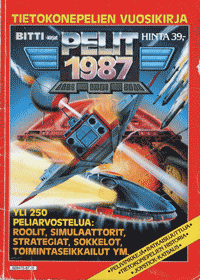
Pelit was a Finnish-language (bi)annual book series published from 1987 to 1991 containing gaming-related articles, tips and most importantly game reviews. Here you can find all the reviews from the books. The reviews were originally written in Finnish; the English versions are translations of the Finnish originals. Maininta tekijänoikeuksista
 1987
1987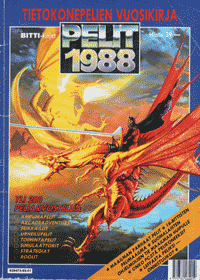 1988
1988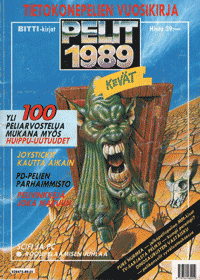 1989 Kevät
 1989 Syksy
 1990 Kevät
 1990 Syksy
 1991 Kevät
 1991 Syksy
Quest for the Time Bird, The
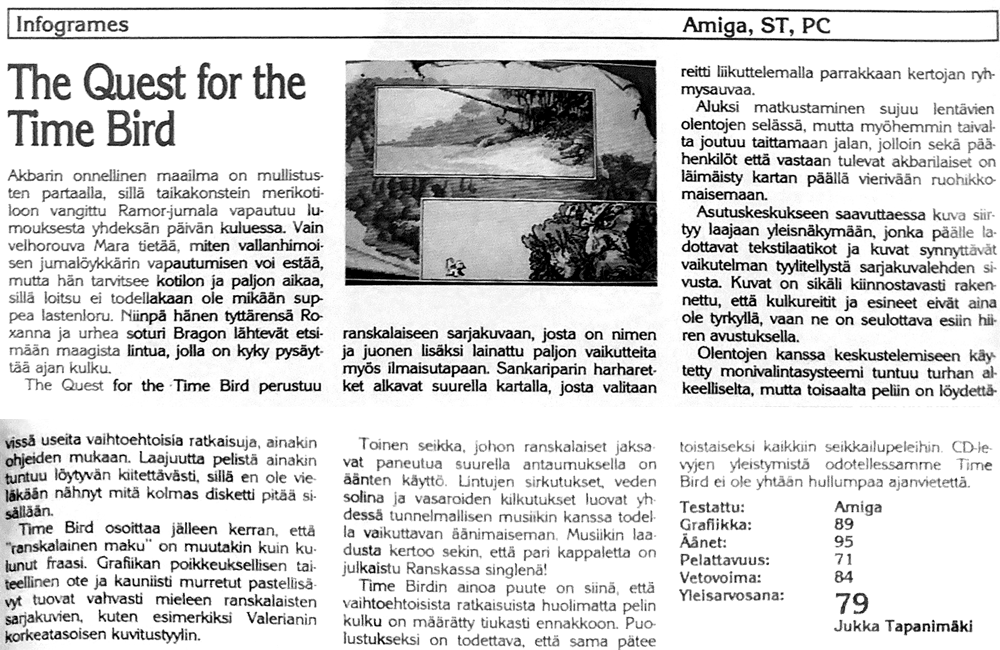
Quest for the Time Bird, The1990 KevätPysyvä linkkiAkbarin onnellinen maailma on mullistusten partaalla, sillä taikakonstein merikotiloon vangittu Ramor-jumala vapautuu lumouksesta yhdeksän päivän kuluessa. Vain velhorouva Mara tietää, miten vallanhimoisen jumalöykkärin vapautumisen voi estää, mutta hän tarvitsee kotilon ja paljon aikaa, sillä loitsu ei todellakaan ole mikään suppea lastenloru. Niinpä hänen tyttärensä Roxanna ja urhea soturi Bragon lähtevät etsimään maagista lintua, jolla on kyky pysäyttää ajan kulku.
The Quest for the Time Bird perustuu ranskalaiseen sarjakuvaan, josta on nimen ja juonen lisäksi lainattu paljon vaikutteita myös ilmaisutapaan. Sankariparin harharetket alkavat suurella kartalla, josta valitaan reitti liikuttelemalla parrakkaan kertojan ryhmysauvaa.
Aluksi matkustaminen sujuu lentävien olentojen selässä, mutta myöhemmin taivalta joutuu taittamaan jalan, jolloin sekä päähenkilöt että vastaan tulevat akbarilaiset on läimäisty kartan päällä vierivään ruohikkomaisemaan.
Asutuskeskukseen saavuttaessa kuva siirtyy laajaan yleisnäkymään, jonka päälle ladottavat tekstilaatikot ja kuvat synnyttävät vaikutelman tyylitellystä sarjakuvalehden sivusta. Kuvat on sikäli kiinnostavasti rakennettu, että kulkureitit ja esineet eivät aina ole tyrkyllä, vaan ne on seulottava esiin hiiren avustuksella.
Olentojen kanssa keskustelemiseen käytetty monivalintasysteemi tuntuu turhan alkeelliselta, mutta toisaalta peliin on löydettävissä useita vaihtoehtoisia ratkaisuja, ainakin ohjeiden mukaan. Laajuutta pelistä ainakin tuntuu löytyvän kiitettävästi, sillä en ole vieläkään nähnyt mitä kolmas disketti pitää sisällään.
Time Bird osoittaa jälleen kerran, että "ranskalainen maku" on muutakin kuin kulunut fraasi. Grafiikan poikkeuksellisen taiteellinen ote ja kauniisti murretut pastellisävyt tuovat vahvasti mieleen ranskalaisten sarjakuvien, kuten esimerkiksi Valerianin korkeatasoisen kuvitustyylin.
Toinen seikka, johon ranskalaiset jaksavat paneutua suurella antaumuksella on äänten käyttö. Lintujen sirkutukset, veden solina ja vasaroiden kilkutukset luovat yhdessä tunnelmallisen musiikin kanssa todella vaikuttavan äänimaiseman. Musiikin laadusta kertoo sekin, että pari kappaletta on julkaistu Ranskassa singlenä!
Time Birdin ainoa puute on siinä, että vaihtoehtoisista ratkaisuista huolimatta pelin kulku on määrätty tiukasti ennakkoon. Puolustukseksi on todettava, että sama pätee toistaiseksi kaikkiin seikkailupeleihin. CD-levyjen yleistymistä odotellessamme Time Bird ei ole yhtään hullumpaa ajanvietettä.
Quest for the Time Bird, The1990 KevätPermalinkThe happy world of Akbar is on the brink of upheaval, for the god Ramor, imprisoned in a sea conch by magic arts, will break free of the spell within nine days. Only the sorceress Mara knows how to stop the power-hungry thug of a god from getting loose, but she needs the conch and plenty of time, since the spell is certainly no short nursery rhyme. And so her daughter Roxanna and the brave warrior Bragon set out in search of a magical bird that has the power to stop the passage of time.
The Quest for the Time Bird is based on a French comic, from which, besides the name and the plot, a good deal of influence has been borrowed for the mode of expression too. The hero pair's wanderings begin on a large map, where the route is chosen by moving the gnarled staff of a bearded narrator.
At first you travel on the backs of flying creatures, but later the road has to be covered on foot, at which point both the protagonists and the Akbarians they meet have been slapped onto a grassy landscape that scrolls over the map.
On arriving at a settlement, the picture switches to a wide overview, with text boxes and pictures laid on top of it to create the impression of a stylised comic-book page. The pictures are interestingly built in that exits and objects aren't always shoved in your face; they have to be sifted out with the help of the mouse.
The multiple-choice system used for conversing with the creatures feels needlessly primitive, but on the other hand the game has several alternative solutions to be found, according to the instructions at least. The game certainly seems to have commendable scope, since I still haven't seen what the third disk holds.
Time Bird proves once again that "French flavour" is more than a worn-out phrase. The exceptionally artistic touch of the graphics and the beautifully muted pastel shades strongly call to mind the high-class illustration style of French comics, Valerian for example.
Another thing the French never tire of throwing themselves into with great devotion is the use of sound. Birds twittering, water babbling and hammers clinking, together with the atmospheric music, create a truly impressive soundscape. The quality of the music is also shown by the fact that a couple of the tracks have been released as a single in France!
Time Bird's only shortcoming is that, despite the alternative solutions, the course of the game is rigidly predetermined. In its defence, it must be said that the same holds, for now, for all adventure games. While we wait for CDs to catch on, Time Bird is not half bad as a way to pass the time.