Chaos Strikes Back
Pelit was a Finnish-language (bi)annual book series published from 1987 to 1991 containing gaming-related articles, tips and most importantly game reviews. Here you can find all the reviews from the books. The reviews were originally written in Finnish; the English versions are translations of the Finnish originals. Maininta tekijänoikeuksista
 1987
1987 1988
1988 1989 Kevät
 1989 Syksy
 1990 Kevät
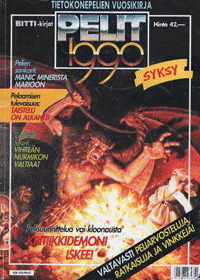 1990 Syksy
 1991 Kevät
 1991 Syksy
Chaos Strikes Back
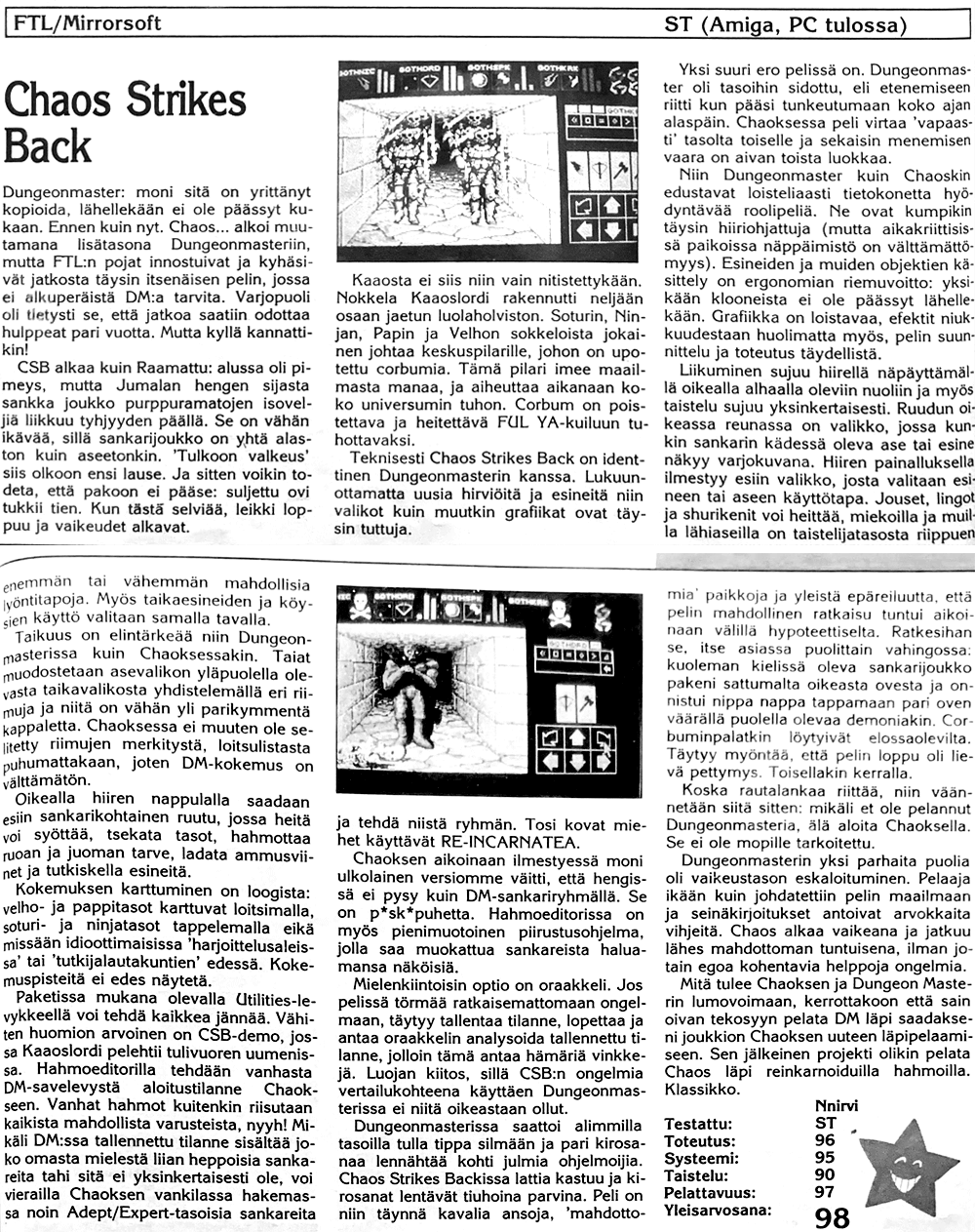
Chaos Strikes Back1990 SyksyPysyvä linkkiDungeonmaster: moni sitä on yrittänyt kopioida, lähellekään ei ole päässyt kukaan. Ennen kuin nyt. Chaos... alkoi muutamana lisätasona Dungeonmasteriin, mutta FTL:n pojat innostuivat ja kyhäsivät jatkosta täysin itsenäisen pelin, jossa ei alkuperäistä DM:a tarvita. Varjopuoli oli tietysti se, että jatkoa saatiin odottaa hulppeat pari vuotta. Mutta kyllä kannattikin!
CSB alkaa kuin Raamattu: alussa oli pimeys, mutta Jumalan hengen sijasta sankka joukko purppuramatojen isoveljiä liikkuu tyhjyyden päällä. Se on vähän ikävää, sillä sankarijoukko on yhtä alaston kuin aseetonkin. 'Tulkoon valkeus' siis olkoon ensi lause. Ja sitten voikin todeta, että pakoon ei pääse: suljettu ovi tukkii tien. Kun tästä selviää, leikki loppuu ja vaikeudet alkavat.
Kaaosta ei siis niin vain nitistettykään. Nokkela Kaaoslordi rakennutti neljään osaan jaetun luolaholviston. Soturin, Ninjan, Papin ja Velhon sokkeloista jokainen johtaa keskuspilarille, johon on upotettu corbumia. Tämä pilari imee maailmasta manaa, ja aiheuttaa aikanaan koko universumin tuhon. Corbum on poistettava ja heitettävä FUL YA-kuiluun tuhottavaksi.
Teknisesti Chaos Strikes Back on identtinen Dungeonmasterin kanssa. Lukuunottamatta uusia hirviöitä ja esineitä niin valikot kuin muutkin grafiikat ovat täysin tuttuja.
Yksi suuri ero pelissä on. Dungeonmaster oli tasoihin sidottu, eli etenemiseen riitti kun pääsi tunkeutumaan koko ajan alaspäin. Chaoksessa peli virtaa 'vapaasti' tasolta toiselle ja sekaisin menemisen vaara on aivan toista luokkaa.
Niin Dungeonmaster kuin Chaoskin edustavat loisteliaasti tietokonetta hyödyntävää roolipeliä. Ne ovat kumpikin täysin hiiriohjattuja (mutta aikakriittisissä paikoissa näppäimistö on välttämättömyys). Esineiden ja muiden objektien käsittely on ergonomian riemuvoitto: yksikään klooneista ei ole päässyt lähellekään. Grafiikka on loistavaa, efektit niukkuudestaan huolimatta myös, pelin suunnittelu ja toteutus täydellistä.
Liikuminen sujuu hiirellä näpäyttämällä oikealla alhaalla oleviin nuoliin ja myös taistelu sujuu yksinkertaisesti. Ruudun oikeassa reunassa on valikko, jossa kunkin sankarin kädessä oleva ase tai esine näkyy varjokuvana. Hiiren painalluksella ilmestyy esiin valikko, josta valitaan esineen tai aseen käyttötapa. Jouset, lingot ja shurikenit voi heittää, miekoilla ja muilla lähiaseilla on taistelijatasosta riippuen enemmän tai vähemmän mahdollisia lyöntitapoja. Myös taikaesineiden ja köysien käyttö valitaan samalla tavalla.
Taikuus on elintärkeää niin Dungeonmasterissa kuin Chaoksessakin. Taiat muodostetaan asevalikon yläpuolella olevasta taikavalikosta yhdistelemällä eri riimuja ja niitä on vähän yli parikymmentä kappaletta. Chaoksessa ei muuten ole selitetty riimujen merkitystä, loitsulistasta puhumattakaan, joten DM-kokemus on välttämätön.
Oikealla hiiren nappulalla saadaan esiin sankarikohtainen ruutu, jossa heitä voi syöttää, tsekata tasot, hahmottaa ruoan ja juoman tarve, ladata ammusviinet ja tutkiskella esineitä.
Kokemuksen karttuminen on loogista: velho- ja pappitasot karttuvat loitsimalla, soturi- ja ninjatasot tappelemalla eikä missään idioottimaisissa 'harjoittelusaleissa' tai 'tutkijalautakuntien' edessä. Kokemuspisteitä ei edes näytetä.
Paketissa mukana olevalla Utilities-levykkeellä voi tehdä kaikkea jännää. Vähiten huomion arvoinen on CSB-demo, jossa Kaaoslordi pelehtii tulivuoren uumenissa. Hahmoeditorilla tehdään vanhasta DM-savelevystä aloitustilanne Chaokseen. Vanhat hahmot kuitenkin riisutaan kaikista mahdollista varusteista, nyyh! Mikäli DM:ssa tallennettu tilanne sisältää joko omasta mielestä liian heppoisia sankareita tahi sitä ei yksinkertaisesti ole, voi vierailla Chaoksen vankilassa hakemassa noin Adept/Expert-tasoisia sankareita ja tehdä niistä ryhmän. Tosi kovat miehet käyttävät RE-INCARNATEA.
Chaoksen aikoinaan ilmestyessä moni ulkolainen versiomme väitti, että hengissä ei pysy kuin DM-sankariryhmällä. Se on p*sk*puhetta. Hahmoeditorissa on myös pienimuotoinen piirustusohjelma, jolla saa muokattua sankareista haluamansa näköisiä.
Mielenkiintoisin optio on oraakkeli. Jos pelissä törmää ratkaisemattomaan ongelmaan, täytyy tallentaa tilanne, lopettaa ja antaa oraakkelin analysoida tallennettu tilanne, jolloin tämä antaa hämäriä vinkkejä. Luojan kiitos, sillä CSB:n ongelmia vertailukohteena käyttäen Dungeonmasterissa ei niitä oikeastaan ollut.
Dungeonmasterissa saattoi alimmilla tasoilla tulla tippa silmään ja pari kirosanaa lennähtää kohti julmia ohjelmoijia. Chaos Strikes Backissa lattia kastuu ja kirosanat lentävät tiuhoina parvina. Peli on niin täynnä kavalia ansoja, 'mahdottomia' paikkoja ja yleistä epäreiluutta, että pelin mahdollinen ratkaisu tuntui aikoinaan välillä hypoteettiselta. Ratkesihan se, itse asiassa puolittain vahingossa: kuoleman kielissä oleva sankarijoukko pakeni sattumalta oikeasta ovesta ja onnistui nippa nappa tappamaan pari oven väärällä puolella olevaa demoniakin. Corbuminpalatkin löytyivät elossaolevilta. Täytyy myöntää, että pelin loppu oli lievä pettymys. Toisellakin kerralla.
Koska rautalankaa riittää, niin väännetään siitä sitten: mikäli et ole pelannut Dungeonmasteria, älä aloita Chaoksella. Se ei ole mopille tarkoitettu.
Dungeonmasterin yksi parhaita puolia oli vaikeustason eskaloituminen. Pelaaja ikään kuin johdatettiin pelin maailmaan ja seinäkirjoitukset antoivat arvokkaita vihjeitä. Chaos alkaa vaikeana ja jatkuu lähes mahdottoman tuntuisena, ilman jotain egoa kohentavia helppoja ongelmia.
Mitä tulee Chaoksen ja Dungeon Masterin lumovoimaan, kerrottakoon että sain oivan tekosyyn pelata DM läpi saadakseni joukkion Chaoksen uuteen läpipelaamiseen. Sen jälkeinen projekti olikin pelata Chaos läpi reinkarnoiduilla hahmoilla. Klassikko.
Chaos Strikes Back1990 SyksyPermalinkDungeonmaster: many have tried to copy it, nobody has come anywhere close. Until now. Chaos... started out as a few extra levels for Dungeonmaster, but the FTL boys got carried away and cobbled the sequel together into a completely standalone game that doesn't need the original DM. The downside, of course, was that we got to wait a whopping couple of years for the sequel. But boy, was it worth it!
CSB begins like the Bible: in the beginning there was darkness, but instead of the Spirit of God, a dense crowd of the purple worms' big brothers moves upon the void. That's a bit unfortunate, since the band of heroes is as naked as it is unarmed. So let 'Let there be light' be your opening line. And then you realise that there's no getting away: a closed door blocks the way. Once you get through this, the fun and games are over and the difficulties begin.
So Chaos wasn't that easily squashed after all. The crafty Chaos Lord had a dungeon vault built, divided into four parts. Each of the mazes of the Fighter, the Ninja, the Priest and the Wizard leads to a central pillar in which corbum has been embedded. This pillar sucks mana out of the world and will in time bring about the destruction of the entire universe. The corbum has to be removed and thrown into the FUL YA pit to be destroyed.
Technically, Chaos Strikes Back is identical to Dungeonmaster. Apart from the new monsters and items, the menus and the rest of the graphics alike are completely familiar.
There is one big difference in the game. Dungeonmaster was tied to its levels, meaning that to make progress it was enough to keep burrowing your way further down. In Chaos the game flows 'freely' from one level to another, and the risk of losing your bearings is in a whole other league.
Dungeonmaster and Chaos alike are splendid examples of the role-playing game that makes real use of the computer. Both are entirely mouse-controlled (although in time-critical spots the keyboard is a necessity). The handling of items and other objects is a triumph of ergonomics: not one of the clones has come anywhere near it. The graphics are brilliant, the effects too despite their sparseness, the game's design and execution perfect.
Moving is done by clicking the mouse on the arrows at the bottom right, and fighting is simple too. At the right-hand edge of the screen there's a menu in which the weapon or item each hero holds in their hand appears as a silhouette. A click of the mouse brings up a menu from which you choose how to use the item or weapon. Bows, slings and shuriken can be thrown; swords and other close-combat weapons have more or fewer possible ways of striking depending on fighter level. The use of magic items and ropes is chosen the same way as well.
Magic is vital in Dungeonmaster and Chaos alike. Spells are formed by combining different runes in the magic menu above the weapon menu, and there are a little over twenty of them. Chaos, by the way, doesn't explain what the runes mean, let alone provide a spell list, so DM experience is essential.
The right mouse button brings up a screen for the individual hero, where you can feed them, check their levels, gauge their need for food and drink, load their quivers and examine items.
Gaining experience is logical: wizard and priest levels build up through casting spells, fighter and ninja levels through fighting, and not in some idiotic 'training halls' or in front of 'boards of examiners'. Experience points aren't even displayed.
The Utilities disk that comes in the package lets you do all sorts of neat things. The least noteworthy is the CSB demo, in which the Chaos Lord frolics in the bowels of a volcano. The character editor turns an old DM save disk into a starting setup for Chaos. The old characters are, however, stripped of every last piece of equipment, sob! If your DM saved game either contains heroes you consider too feeble, or else you simply don't have one, you can visit the prison in Chaos to fetch heroes of roughly Adept/Expert level and make a party of them. Real hard men use RE-INCARNATE.
When Chaos first came out, many of our foreign counterparts claimed that you could only stay alive with a DM party of heroes. That's b*llsh*t. The character editor also includes a small paint program with which you can make the heroes look however you like.
The most interesting option is the oracle. If you run into an unsolvable problem in the game, you have to save, quit and let the oracle analyse the saved game, whereupon it gives you murky hints. Thank God for that, because measured against the problems in CSB, Dungeonmaster didn't really have any.
In Dungeonmaster, on the lowest levels, a tear might come to your eye and a couple of swear words might go flying at the cruel programmers. In Chaos Strikes Back the floor gets wet and the swear words fly in dense flocks. The game is so full of treacherous traps, 'impossible' places and general unfairness that back when it came out, solving it at times seemed purely hypothetical. It did get solved, actually half by accident: a party of heroes at death's door happened to flee through the right door and just barely managed to kill a couple of demons on the wrong side of it too. And the corbum pieces were found on the survivors as well. I have to admit that the ending was a mild disappointment. The second time round too.
Since there's no shortage of crayons, let's draw you a picture: if you haven't played Dungeonmaster, don't start with Chaos. It is not meant for rookies.
One of Dungeonmaster's best features was the escalating difficulty. The player was, as it were, guided into the game's world, and the writings on the walls gave valuable hints. Chaos starts out hard and carries on feeling nearly impossible, without any easy, ego-boosting problems.
As for the allure of Chaos and Dungeon Master, let it be said that I got a fine excuse to play DM through in order to get a party together for a fresh run through Chaos. The project after that, naturally, was to play Chaos through with reincarnated characters. A classic.