Conflict: Middle East
Pelit was a Finnish-language (bi)annual book series published from 1987 to 1991 containing gaming-related articles, tips and most importantly game reviews. Here you can find all the reviews from the books. The reviews were originally written in Finnish; the English versions are translations of the Finnish originals. Maininta tekijänoikeuksista
 1987
1987 1988
1988 1989 Kevät
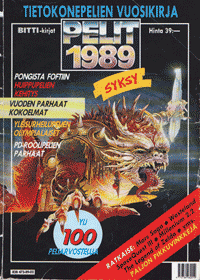 1989 Syksy
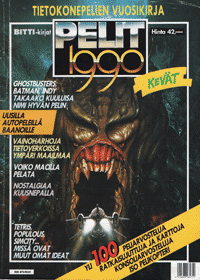 1990 Kevät
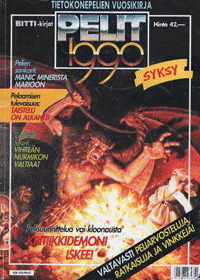 1990 Syksy
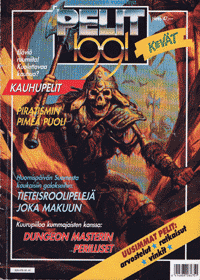 1991 Kevät
 1991 Syksy
Conflict: Middle East
Conflict: Middle East1991 SyksyPysyvä linkkiSota vyöryy aavikolle, Israelin kansa taistelee olemassaolostaan... Käyskennelläänkö aurinkoisilla kibbutseilla vielä huomenna vai paimentavatko arabit kameleitaan raunioilla?
SSI tarjoaa strategiafaneille todella herkullisen jatko-osan: Red Lightning oli upea ja ennen näkemätön mutta valitettavan heikosti toteutettu muutamalta osaltaan. Nyt näemme ihmeen: kommentit on otettu todesta ja mahtava pelisysteemi on täydellistetty ja ympätty uuteen sotaan, Israelin ja arabien välinmittelöihin. Arabien panssarikameleita pääsee puhkomaan joko sodassa 1973 tai hypoteettisessa kamppailussa 1990. Rauhankonferensseista ei ole kuultukaan, ja kuka niitä kaipaisikaan jos sota vain sujuu hyvin?
Norm Koger Jr. on tehnyt perusteellista työtä uudistaessaan Red Lightningin systeemiä. Edelleenkin kaikki vaikuttaa kaikkeen: väsymys, huolto, ruuhkat, kemialliset aseet ja niin edelleen. Mutta lista ei pääty tähän: uutuuksia ovat muun muuassa rynnäkkökopteriyksiköt, joukkojen siirto yksiköstä toiseen (vain Israel) ja heikkojen yksikköjen poistaminen muonavahvuudesta.
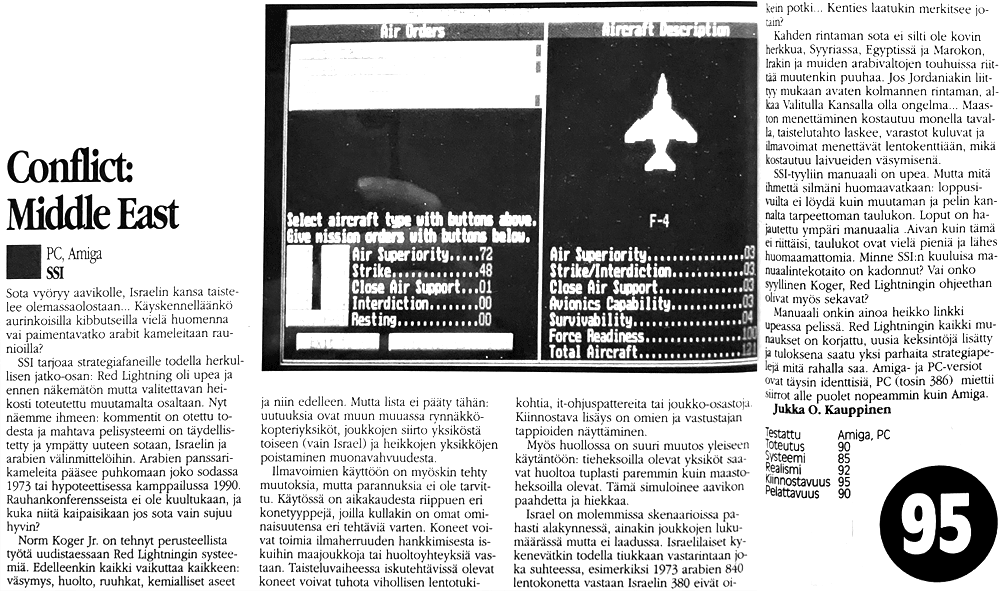
Ilmavoimien käyttöön on myöskin tehty muutoksia, mutta parannuksia ei ole tarvittu. Käytössä on aikakaudesta riippuen eri konetyyppejä, joilla kullakin on omat ominaisuutensa eri tehtäviä varten. Koneet voivat toimia ilmaherruuden hankkimisesta iskuihin maajoukkoja tai huoltoyhteyksiä vastaan. Taisteluvaiheessa iskutehtävissä olevat koneet voivat tuhota vihollisen lentotukikohtia, it-ohjuspattereita tai joukko-osastoja. Kiinnostava lisäys on omien ja vastustajan tappioiden näyttäminen.
Myös huollossa on suuri muutos yleiseen käytäntöön: tieheksoilla olevat yksiköt saavat huoltoa tuplasti paremmin kuin maastoheksoilla olevat. Tämä simuloinee aavikon paahdetta ja hiekkaa.
Israel on molemmissa skenaarioissa pahasti alakynnessä, ainakin joukkojen lukumäärässä mutta ei laadussa. Israelilaiset kykenevätkin todella tiukkaan vastarintaan joka suhteessa, esimerkiksi 1973 arabien 840 lentokonetta vastaan Israelin 380 eivät oikein potki... Kenties laatukin merkitsee jotain?
Kahden rintaman sota ei silti ole kovin herkkua, Syyriassa, Egyptissä ja Marokon, Irakin ja muiden arabivaltojen touhuissa riittää muutenkin puuhaa. Jos Jordaniakin liittyy mukaan avaten kolmannen rintaman, alkaa Valitulla Kansalla olla ongelma... Maaston menettäminen kostautuu monella tavalla, taistelutahto laskee, varastot kuluvat ja ilmavoimat menettävät lentokenttiään, mikä kostautuu laivueiden väsymisenä.
SSI-tyyliin manuaali on upea. Mutta mitä ihmettä silmäni huomaavatkaan: loppusivuilta ei löydä kuin muutaman ja pelin kannalta tarpeettoman taulukon. Loput on hajautettu ympäri manuaalia .Aivan kuin tämä ei riittäisi, taulukot ovat vielä pieniä ja lähes huomaamattomia. Minne SSI:n kuuluisa manuaalintekotaito on kadonnut? Vai onko syyllinen Koger, Red Lightningin ohjeethan olivat myös sekavat?
Manuaali onkin ainoa heikko linkki upeassa pelissä. Red Lightningin kaikki munaukset on korjattu, uusia keksintöjä lisätty ja tuloksena saatu yksi parhaita strategiapelejä mitä rahalla saa. Amiga- ja PC-versiot ovat täysin identtisiä, PC (tosin 386) miettii siirrot alle puolet nopeammin kuin Amiga.
Conflict: Middle East1991 SyksyPermalinkWar rolls across the desert, the people of Israel are fighting for their existence... Will people still be strolling about the sunny kibbutzim tomorrow, or will the Arabs be herding their camels among the ruins?
SSI serves strategy fans a truly delicious sequel: Red Lightning was superb and unprecedented but regrettably poorly executed in a few respects. Now we witness a miracle: the feedback has been taken seriously, and the mighty game system has been perfected and grafted onto a new war, the showdowns between Israel and the Arabs. You get to puncture Arab armoured camels either in the war of 1973 or in a hypothetical clash in 1990. Peace conferences are unheard of, and who would miss them anyway, as long as the war is going well?
Norm Koger Jr. has done a thorough job revamping Red Lightning's system. Everything still affects everything: fatigue, supply, traffic jams, chemical weapons and so on. But the list doesn't end there: the new features include, among other things, attack helicopter units, transferring troops from one unit to another (Israel only) and striking weak units off the ration roll.
Changes have also been made to the use of the air force, but no improvements were needed. Depending on the era, different aircraft types are available, each with its own characteristics for different missions. The planes can do anything from winning air superiority to strikes against ground troops or supply lines. In the combat phase, planes on strike missions can destroy enemy air bases, anti-aircraft missile batteries or troop formations. An interesting addition is the display of your own and the enemy's losses.
Supply, too, marks a big change from common practice: units on road hexes get supplied twice as well as those on off-road hexes. This presumably simulates the scorching heat and sand of the desert.
In both scenarios Israel is at a severe disadvantage, at least in numbers of troops, though not in quality. The Israelis are indeed capable of really stubborn resistance in every respect; for example, in 1973 the Arabs' 840 aircraft against Israel's 380 don't really cut it... Perhaps quality counts for something too?
Even so, a two-front war is not much of a treat; Syria and Egypt, plus the antics of Morocco, Iraq and the other Arab states, keep you busy enough as it is. If Jordan joins in too, opening a third front, the Chosen People start to have a problem... Losing ground comes back to bite you in many ways: fighting spirit drops, stockpiles dwindle and the air force loses its airfields, which comes back to bite you as squadron fatigue.
In true SSI style, the manual is superb. But what on earth do my eyes behold: the back pages hold only a handful of tables, and ones that are unnecessary for the game at that. The rest are scattered all over the manual. As if that weren't enough, the tables are small and almost unnoticeable to boot. Where has SSI's famous manual-making skill vanished to? Or is Koger the culprit, seeing as Red Lightning's instructions were muddled too?
The manual, then, is the only weak link in a superb game. All of Red Lightning's cock-ups have been fixed, new inventions added, and the result is one of the best strategy games money can buy. The Amiga and PC versions are completely identical; the PC (a 386, admittedly) thinks over its moves in less than half the time the Amiga takes.