Dragonflight
Pelit was a Finnish-language (bi)annual book series published from 1987 to 1991 containing gaming-related articles, tips and most importantly game reviews. Here you can find all the reviews from the books. The reviews were originally written in Finnish; the English versions are translations of the Finnish originals. Maininta tekijänoikeuksista
 1987
1987 1988
1988 1989 Kevät
 1989 Syksy
 1990 Kevät
 1990 Syksy
 1991 Kevät
 1991 Syksy
Dragonflight
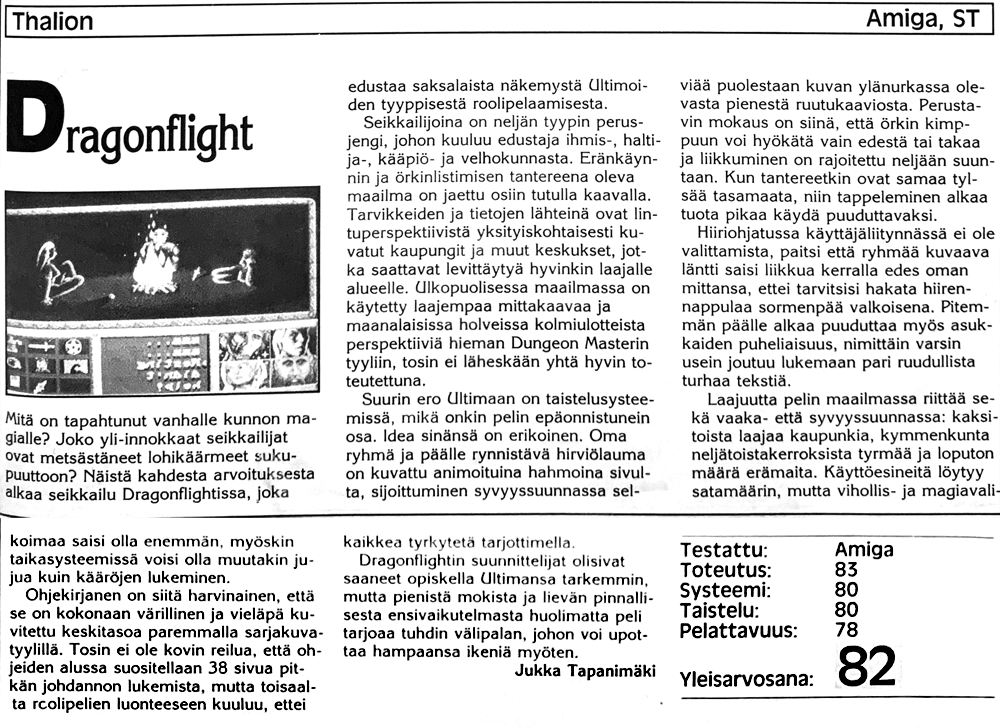
Dragonflight1991 KevätPysyvä linkkiMitä on tapahtunut vanhalle kunnon magialle? Joko yli-innokkaat seikkailijat ovat metsästäneet lohikäärmeet sukupuuttoon? Näistä kahdesta arvoituksesta alkaa seikkailu Dragonflightissa, joka edustaa saksalaista näkemystä Ultimoiden tyyppisestä roolipelaamisesta.
Seikkailijoina on neljän tyypin perusjengi, johon kuuluu edustaja ihmis-, haltija-, kääpiö- ja velhokunnasta. Eränkäynnin ja örkinlistimisen tantereena oleva maailma on jaettu osiin tutulla kaavalla. Tarvikkeiden ja tietojen lähteinä ovat lintuperspektiivistä yksityiskohtaisesti kuvatut kaupungit ja muut keskukset, jotka saattavat levittäytyä hyvinkin laajalle alueelle. Ulkopuolisessa maailmassa on käytetty laajempaa mittakaavaa ja maanalaisissa holveissa kolmiulotteista perspektiiviä hieman Dungeon Masterin tyyliin, tosin ei läheskään yhtä hyvin toteutettuna.
Suurin ero Ultimaan on taistelusysteemissä, mikä onkin pelin epäonnistunein osa. Idea sinänsä on erikoinen. Oma ryhmä ja päälle rynnistävä hirviölauma on kuvattu animoituina hahmoina sivulta, sijoittuminen syvyyssuunnassa selviää puolestaan kuvan ylänurkassa olevasta pienestä ruutukaaviosta. Perustavin mokaus on siinä, että örkin kimppuun voi hyökätä vain edestä tai takaa ja liikkuminen on rajoitettu neljään suuntaan. Kun tantereetkin ovat samaa tylsää tasamaata, niin tappeleminen alkaa tuota pikaa käydä puuduttavaksi.
Hiiriohjatussa käyttäjäliitynnässä ei ole valittamista, paitsi että ryhmää kuvaava läntti saisi liikkua kerralla edes oman mittansa, ettei tarvitsisi hakata hiirennappulaa sormenpää valkoisena. Pitemmän päälle alkaa puuduttaa myös asukkaiden puheliaisuus, nimittäin varsin usein joutuu lukemaan pari ruudullista turhaa tekstiä.
Laajuutta pelin maailmassa riittää sekä vaaka- että syvyyssuunnassa: kaksitoista laajaa kaupunkia, kymmenkunta neljätoistakerroksista tyrmää ja loputon määrä erämaita. Käyttöesineitä löytyy satamäärin, mutta vihollis- ja magiavalikoimaa saisi olla enemmän, myöskin taikasysteemissä voisi olla muutakin jujua kuin kääröjen lukeminen.
Ohjekirjanen on siitä harvinainen, että se on kokonaan värillinen ja vieläpä kuvitettu keskitasoa paremmalla sarjakuvatyylillä. Tosin ei ole kovin reilua, että ohjeiden alussa suositellaan 38 sivua pitkän johdannon lukemista, mutta toisaalta rcolipelien luonteeseen kuuluu, ettei kaikkea tyrkytetä tarjottimella.
Dragonflightin suunnittelijat olisivat saaneet opiskella Ultimansa tarkemmin, mutta pienistä mokista ja lievän pinnallisesta ensivaikutelmasta huolimatta peli tarjoaa tuhdin välipalan, johon voi upottaa hampaansa ikeniä myöten.
Dragonflight1991 KevätPermalinkWhat has happened to good old magic? Have over-eager adventurers already hunted the dragons to extinction? These two riddles are where the adventure begins in Dragonflight, which represents the German take on role-playing in the style of the Ultimas.
The adventurers are the basic four-man gang, with one representative each from the ranks of humans, elves, dwarves and wizards. The world, the arena for wilderness trekking and orc-whacking, is divided into parts along familiar lines. Supplies and information come from towns and other centres, shown in detail from a bird's-eye view, which can sprawl over a pretty large area. The outside world uses a larger scale, and the underground vaults a three-dimensional perspective somewhat in the style of Dungeon Master, although nowhere near as well done.
The biggest difference from Ultima is in the combat system, which is in fact the least successful part of the game. The idea in itself is an unusual one. Your own party and the monster horde charging at it are shown from the side as animated figures, while positioning in depth is shown by a small grid diagram in the top corner of the screen. The most fundamental blunder is that you can only attack an orc from the front or from behind, and movement is restricted to four directions. Since the battlefields are all the same dull flat ground too, fighting pretty soon starts to get numbing.
There's nothing to complain about in the mouse-driven interface, except that the blob representing the party could at least move its own length at a time, so you wouldn't have to hammer the mouse button until your fingertip goes white. In the long run the talkativeness of the inhabitants also starts to wear you down, since quite often you have to read a couple of screenfuls of pointless text.
The game world has plenty of scope both horizontally and in depth: twelve large cities, a dozen or so fourteen-level dungeons and an endless amount of wilderness. There are hundreds of usable items, but the selection of enemies and magic could be bigger, and the magic system could also have some other trick to it besides reading scrolls.
The manual is unusual in that it's entirely in colour and, what's more, illustrated in a better-than-average comic-strip style. Admittedly, it's not very fair that the start of the instructions recommends reading a 38-page introduction, but on the other hand it's in the nature of role-playing games that not everything is served up on a platter.
Dragonflight's designers could have studied their Ultima more closely, but despite the small blunders and a slightly superficial first impression, the game offers a hearty snack you can sink your teeth into right up to the gums.