Lord of the Rings
Pelit was a Finnish-language (bi)annual book series published from 1987 to 1991 containing gaming-related articles, tips and most importantly game reviews. Here you can find all the reviews from the books. The reviews were originally written in Finnish; the English versions are translations of the Finnish originals. Maininta tekijänoikeuksista
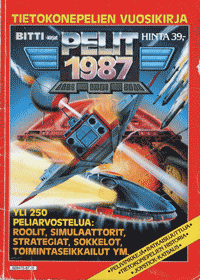 1987
1987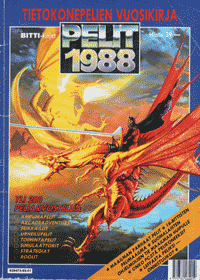 1988
1988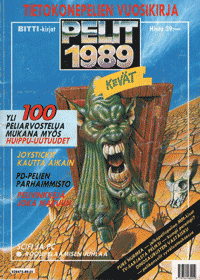 1989 Kevät
 1989 Syksy
 1990 Kevät
 1990 Syksy
 1991 Kevät
 1991 Syksy
Lord of the Rings
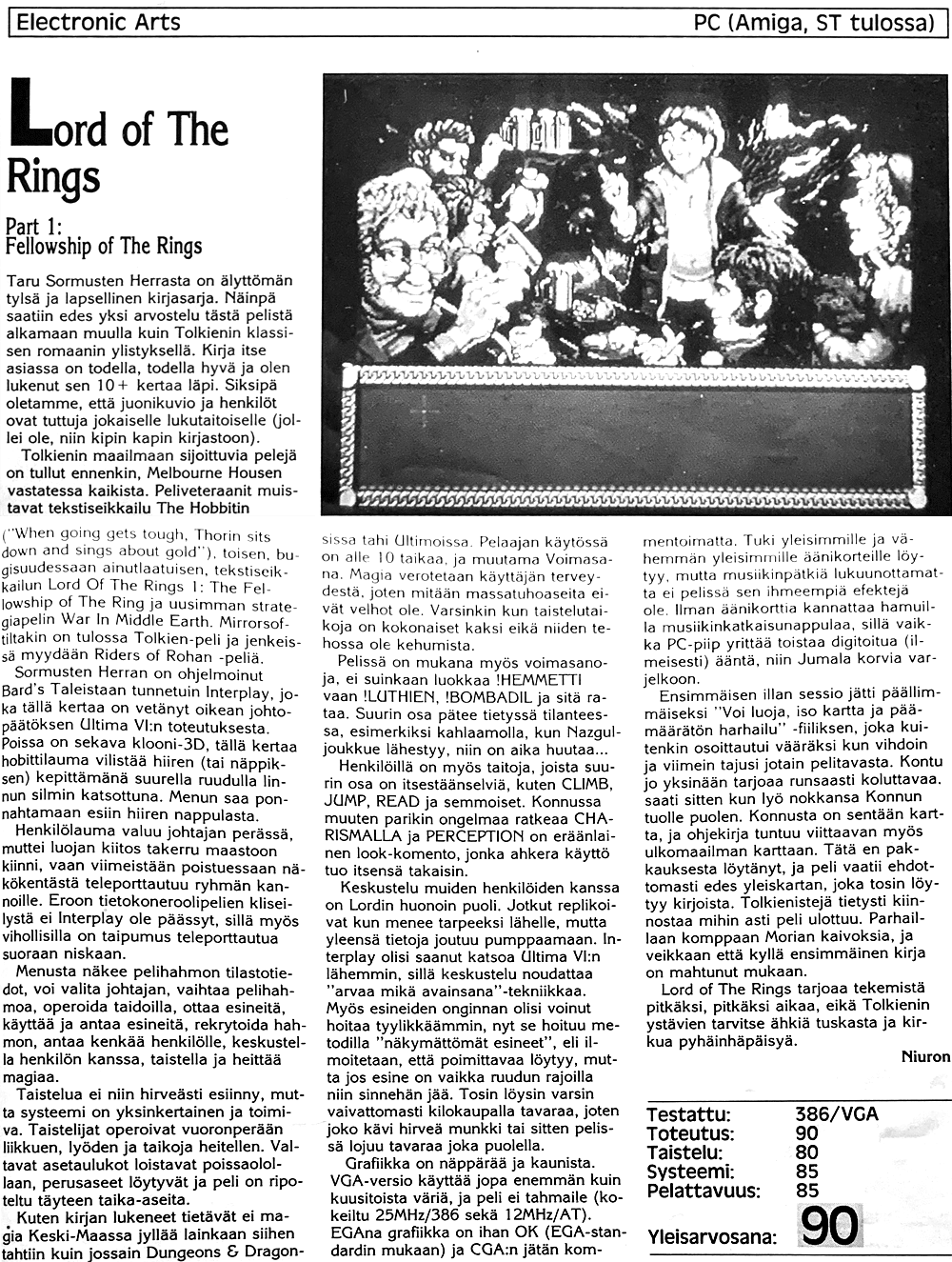
Lord of the Rings1991 KevätPysyvä linkkiTaru Sormusten Herrasta on älyttömän tylsä ja lapsellinen kirjasarja. Näinpä saatiin edes yksi arvostelu tästä pelistä alkamaan muulla kuin Tolkienin klassisen romaanin ylistyksellä. Kirja itse asiassa on todella, todella hyvä ja olen lukenut sen 10+ kertaa läpi. Siksipä oletamme, että juonikuvio ja henkilöt ovat tuttuja jokaiselle lukutaitoiselle (jollei ole, niin kipin kapin kirjastoon).
Tolkienin maailmaan sijoittuvia pelejä on tullut ennenkin, Melbourne Housen vastatessa kaikista. Peliveteraanit muistavat tekstiseikkailu The Hobbitin ("When going gets tough, Thorin sits down and sings about gold"), toisen, bugisuudessaan ainutlaatuisen, tekstiseikkailun Lord Of The Rings 1: The Fellowship of The Ring ja uusimman strategiapelin War In Middle Earth. Mirrorsoftiltakin on tulossa Tolkien-peli ja jenkeissä myydään Riders of Rohan -peliä.
Sormusten Herran on ohjelmoinut Bard's Taleistaan tunnetuin Interplay, joka tällä kertaa on vetänyt oikean johtopäätöksen Ultima VI:n toteutuksesta. Poissa on sekava klooni-3D, tällä kertaa hobittilauma vilistää hiiren (tai näppiksen) kepittämänä suurella ruudulla linnun silmin katsottuna. Menun saa ponnahtamaan esiin hiiren nappulasta.
Henkilölauma valuu johtajan perässä, muttei luojan kiitos takerru maastoon kiinni, vaan viimeistään poistuessaan näkökentästä teleporttautuu ryhmän kannoille. Eroon tietokoneroolipelien kliseilystä ei Interplay ole päässyt, sillä myös vihollisilla on taipumus teleporttautua suoraan niskaan.
Menusta näkee pelihahmon tilastotiedot, voi valita johtajan, vaihtaa pelihahmoa, operoida taidoilla, ottaa esineitä, käyttää ja antaa esineitä, rekrytoida hahmon, antaa kenkää henkilölle, keskustella henkilön kanssa, taistella ja heittää magiaa.
Taistelua ei niin hirveästi esiinny, mutta systeemi on yksinkertainen ja toimiva. Taistelijat operoivat vuoronperään liikkuen, lyöden ja taikoja heitellen. Valtavat asetaulukot loistavat poissaolollaan, perusaseet löytyvät ja peli on ripoteltu täyteen taika-aseita.
Kuten kirjan lukeneet tietävät ei magia Keski-Maassa jyllää lainkaan siihen tahtiin kuin jossain Dungeons & Dragonsissa tahi Ultimoissa. Pelaajan käytössä on alle 10 taikaa, ja muutama Voimasana. Magia verotetaan käyttäjän terveydestä, joten mitään massatuhoaseita eivät velhot ole. Varsinkin kun taistelutaikoja on kokonaiset kaksi eikä niiden tehossa ole kehumista.
Pelissä on mukana myös voimasanoja, ei suinkaan luokkaa !HEMMETTI vaan !LUTHIEN, !BOMBADIL ja sitä rataa. Suurin osa pätee tietyssä tilanteessa, esimerkiksi kahlaamolla, kun Nazgul-joukkue lähestyy, niin on aika huutaa...
Henkilöillä on myös taitoja, joista suurin osa on itsestäänselviä, kuten CLIMB, JUMP, READ ja semmoiset. Konnussa muuten parikin ongelmaa ratkeaa CHARISMALLA ja PERCEPTION on eräänlainen look-komento, jonka ahkera käyttö tuo itsensä takaisin.
Keskustelu muiden henkilöiden kanssa on Lordin huonoin puoli. Jotkut replikoivat kun menee tarpeeksi lähelle, mutta yleensä tietoja joutuu pumppaamaan. Interplay olisi saanut katsoa Ultima VI:n lähemmin, sillä keskustelu noudattaa "arvaa mikä avainsana"-tekniikkaa. Myös esineiden onginnan olisi voinut hoitaa tyylikkäämmin, nyt se hoituu metodilla "näkymättömät esineet", eli ilmoitetaan, että poimittavaa löytyy, mutta jos esine on vaikka ruudun rajoilla niin sinnehän jää. Tosin löysin varsin vaivattomasti kilokaupalla tavaraa, joten joko kävi hirveä munkki tai sitten pelissä lojuu tavaraa joka puolella.
Grafiikka on näppärää ja kaunista. VGA-versio käyttää jopa enemmän kuin kuusitoista väriä, ja peli ei tahmaile (kokeiltu 25MHz/386 sekä 12MHz/AT). EGAna grafiikka on ihan OK (EGA-standardin mukaan) ja CGA:n jätän kommentoimatta. Tuki yleisimmille ja vähemmän yleisimmille äänikorteille löytyy, mutta musiikinpätkiä lukuunottamatta ei pelissä sen ihmeempiä efektejä ole. Ilman äänikorttia kannattaa hamuilla musiikinkatkaisunappulaa, sillä vaikka PC-piip yrittää toistaa digitoitua (ilmeisesti) ääntä, niin Jumala korvia varjelkoon.
Ensimmäisen illan sessio jätti päällimmäiseksi "Voi luoja, iso kartta ja päämäärätön harhailu" -fiiliksen, joka kuitenkin osoittautui vääräksi kun vihdoin ja viimein tajusi jotain pelitavasta. Kontu jo yksinään tarjoaa runsaasti koluttavaa. saati sitten kun lyö nokkansa Konnun tuolle puolen. Konnusta on sentään kartta, ja ohjekirja tuntuu viittaavan myös ulkomaailman karttaan. Tätä en pakkauksesta löytänyt, ja peli vaatii ehdottomasti edes yleiskartan, joka tosin löytyy kirjoista. Tolkienistejä tietysti kiinnostaa mihin asti peli ulottuu. Parhaillaan komppaan Morian kaivoksia, ja veikkaan että kyllä ensimmäinen kirja on mahtunut mukaan.
Lord of The Rings tarjoaa tekemistä pitkäksi, pitkäksi aikaa, eikä Tolkienin ystävien tarvitse ähkiä tuskasta ja kirkua pyhäinhäpäisyä.
Lord of the Rings1991 KevätPermalinkThe Lord of the Rings is an insanely boring and childish book series. There - that gets at least one review of this game started with something other than praise for Tolkien's classic novel. The book is actually really, really good, and I've read it through 10+ times. Which is why we'll assume that the plot and the characters are familiar to everyone who can read (if not, then off to the library, chop-chop).
Games set in Tolkien's world have come out before, with Melbourne House responsible for all of them. Gaming veterans will remember the text adventure The Hobbit ("When going gets tough, Thorin sits down and sings about gold"), a second text adventure, unique in its bugginess, Lord Of The Rings 1: The Fellowship of The Ring, and the latest, the strategy game War In Middle Earth. Mirrorsoft has a Tolkien game on the way too, and over in the States they're selling a game called Riders of Rohan.
Lord of The Rings has been programmed by Interplay, best known for its Bard's Tales, who this time have drawn the right conclusion from the way Ultima VI was done. Gone is the messy clone-3D; this time the hobbit horde scurries about a large screen, seen from a bird's-eye view and herded along by the mouse (or the keyboard). The menu pops up at the click of a mouse button.
The gaggle of characters trickles along behind the leader, but thank God it doesn't get stuck on the scenery; at the latest when they drop out of sight, they teleport right onto the party's heels. Interplay hasn't managed to shake off the clichés of computer role-playing games, though, since the enemies also have a tendency to teleport right on top of you.
From the menu you can see a character's stats, choose the leader, switch characters, operate with skills, pick up items, use and give items, recruit a character, give someone the boot, talk to someone, fight and sling magic.
There isn't an awful lot of fighting, but the system is simple and it works. The combatants take turns moving, hitting and slinging spells. Huge weapon tables are conspicuous by their absence; the basic weapons are there, and the game is sprinkled full of magic weapons.
As those who've read the book know, magic in Middle-earth doesn't run riot anywhere near the way it does in some Dungeons & Dragons or the Ultimas. The player has fewer than 10 spells at their disposal, plus a few Words of Power. Magic is taxed from the caster's health, so wizards are no weapons of mass destruction. Especially since there are a whole two combat spells, and their power is nothing to write home about.
The game also features words of power - not, mind you, of the !DAMMIT variety, but !LUTHIEN, !BOMBADIL and so on. Most of them apply in one particular situation; for example, at the ford, when the Nazgul squad is closing in, it's time to shout...
The characters also have skills, most of which are self-explanatory, like CLIMB, JUMP, READ and suchlike. In the Shire, by the way, a couple of problems get solved with CHARISMA, and PERCEPTION is a kind of look command that pays for itself if you use it diligently.
Talking with other characters is the weakest side of Lord. Some of them pipe up when you get close enough, but usually you have to pump them for information. Interplay could have taken a closer look at Ultima VI, since conversation follows the "guess the keyword" technique. Fishing for items could have been handled more stylishly too; as it is, it's done with the "invisible items" method, i.e. you're told there's something to pick up, but if the item happens to be, say, at the edge of the screen, then there it stays. Mind you, I found stuff by the kilo with very little effort, so either I had a hell of a fluke or the game has stuff lying around all over the place.
The graphics are neat and pretty. The VGA version even uses more than sixteen colours, and the game doesn't bog down (tried on a 25MHz/386 and a 12MHz/AT). In EGA the graphics are perfectly OK (by EGA standards), and CGA I'll leave without comment. There's support for the most common and the less common sound cards, but apart from snippets of music there are no special effects to speak of in the game. Without a sound card you'd better grope for the music-off button, because although the PC beep tries to reproduce (apparently) digitised sound, God preserve your ears.
The first evening's session left me mostly with an "Oh God, a big map and aimless wandering" feeling, which turned out to be wrong, though, once I finally, at long last, grasped something about how the game is played. The Shire alone offers plenty to scour, never mind once you poke your nose out beyond the Shire. There is at least a map of the Shire, and the manual seems to refer to a map of the outside world as well. That one I didn't find in the box, and the game absolutely needs at least an overview map, although one can be found in the books. Tolkienists will naturally want to know how far the game goes. Right now I'm stomping around the Mines of Moria, and my bet is that yes, the whole first book has fit in.
Lord of The Rings offers plenty to do for a long, long time, and Tolkien's fans needn't groan in agony and scream sacrilege.