Warhead
Pelit was a Finnish-language (bi)annual book series published from 1987 to 1991 containing gaming-related articles, tips and most importantly game reviews. Here you can find all the reviews from the books. The reviews were originally written in Finnish; the English versions are translations of the Finnish originals. Maininta tekijänoikeuksista
 1987
1987 1988
1988 1989 Kevät
 1989 Syksy
 1990 Kevät
 1990 Syksy
 1991 Kevät
 1991 Syksy
Warhead
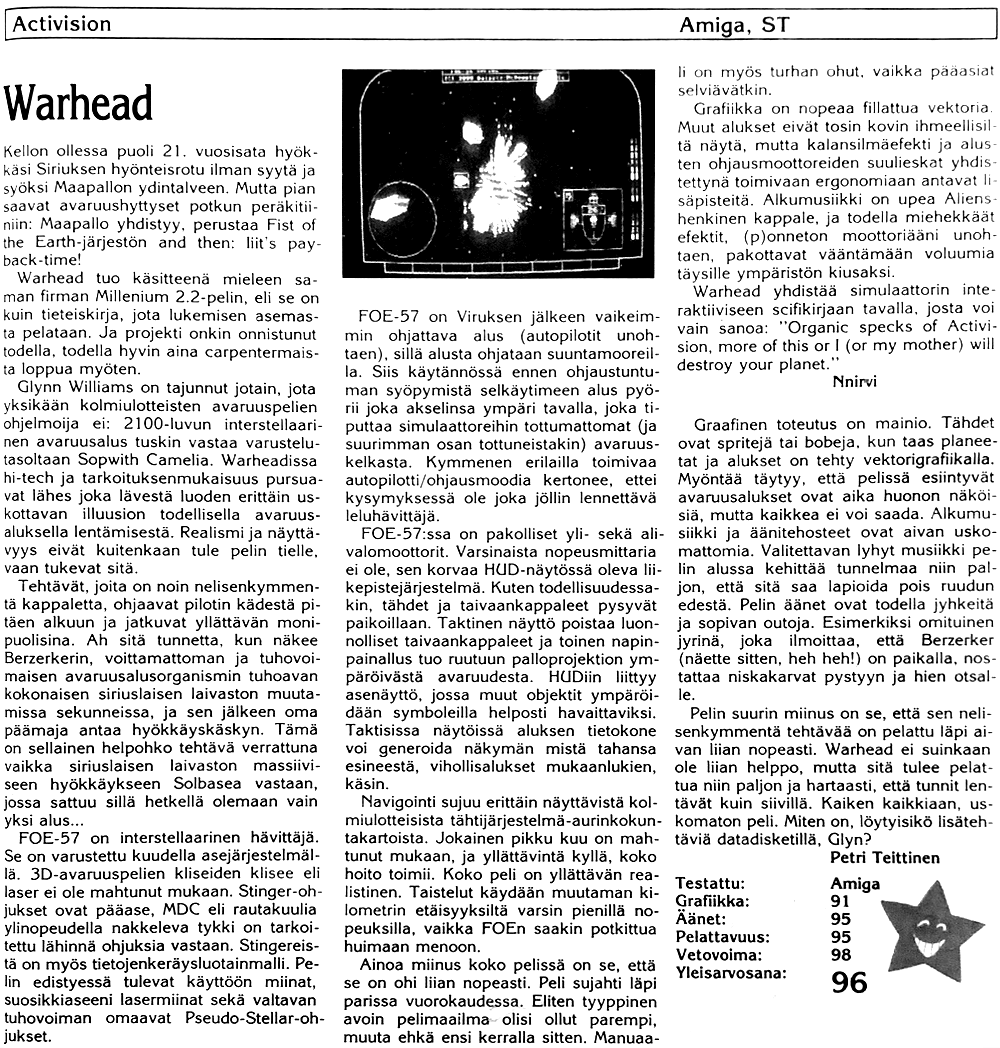
Warhead1990 SyksyPysyvä linkkiKellon ollessa puoli 21. vuosisata hyökkäsi Siriuksen hyönteisrotu ilman syytä ja syöksi Maapallon ydintalveen. Mutta pian saavat avaruushyttyset potkun peräkitiiniin: Maapallo yhdistyy, perustaa Fist of the Earth-järjestön and then: Iiit's payback-time!
Warhead tuo käsitteenä mieleen saman firman Millenium 2.2-pelin, eli se on kuin tieteiskirja, jota lukemisen asemasta pelataan. Ja projekti onkin onnistunut todella, todella hyvin aina carpentermaista loppua myöten.
Glynn Williams on tajunnut jotain, jota yksikään kolmiulotteisten avaruuspelien ohjelmoija ei: 2100-luvun interstellaarinen avaruusalus tuskin vastaa varustelutasoltaan Sopwith Camelia. Warheadissa hi-tech ja tarkoituksenmukaisuus pursuavat lähes joka lävestä luoden erittäin uskottavan illuusion todellisella avaruusaluksella lentämisestä. Realismi ja näyttävyys eivät kuitenkaan tule pelin tielle, vaan tukevat sitä.
Tehtävät, joita on noin nelisenkymmentä kappaletta, ohjaavat pilotin kädestä pitäen alkuun ja jatkuvat yllättävän monipuolisina. Ah sitä tunnetta, kun näkee Berzerkerin, voittamattoman ja tuhovoimaisen avaruusalusorganismin tuhoavan kokonaisen siriuslaisen laivaston muutamissa sekunneissa, ja sen jälkeen oma päämaja antaa hyökkäyskäskyn. Tämä on sellainen helpohko tehtävä verrattuna vaikka siriuslaisen laivaston massiiviseen hyökkäykseen Solbasea vastaan, jossa sattuu sillä hetkellä olemaan vain yksi alus...
FOE-57 on interstellaarinen hävittäjä. Se on varustettu kuudella asejärjestelmällä. 3D-avaruuspelien kliseiden klisee eli laser ei ole mahtunut mukaan. Stinger-ohjukset ovat pääase, MDC eli rautakuulia ylinopeudella nakkeleva tykki on tarkoitettu lähinnä ohjuksia vastaan. Stingereistä on myös tietojenkeräysluotainmalli. Pelin edistyessä tulevat käyttöön miinat, suosikkiaseeni lasermiinat sekä valtavan tuhovoiman omaavat Pseudo-Stellar-ohjukset.
FOE-57 on Viruksen jälkeen vaikeimmin ohjattava alus (autopilotit unohtaen), sillä alusta ohjataan suuntamooreilla. Siis käytännössä ennen ohjaustuntuman syöpymistä selkäytimeen alus pyörii joka akselinsa ympäri tavalla, joka tiputtaa simulaattoreihin tottumattomat (ja suurimman osan tottuneistakin) avaruuskelkasta. Kymmenen erilailla toimivaa autopilotti/ohjausmoodia kertonee, ettei kysymyksessä ole joka jöllin lennettävä leluhävittäjä.
FOE-57:ssa on pakolliset yli- sekä alivalomoottorit. Varsinaista nopeusmittaria ei ole, sen korvaa HUD-näytössä oleva liikepistejärjestelmä. Kuten todellisuudessakin, tähdet ja taivaankappaleet pysyvät paikoillaan. Taktinen näyttö poistaa luonnolliset taivaankappaleet ja toinen napinpainallus tuo ruutuun palloprojektion ympäröivästä avaruudesta. HUDiin liittyy asenäyttö, jossa muut objektit ympäröidään symboleilla helposti havaittaviksi. Taktisissa näytöissä aluksen tietokone voi generoida näkymän mistä tahansa esineestä, vihollisalukset mukaanlukien, käsin.
Navigointi sujuu erittäin näyttävistä kolmiulotteisista tähtijärjestelmä-aurinkokuntakartoista. Jokainen pikku kuu on mahtunut mukaan, ja yllättävintä kyllä, koko hoito toimii. Koko peli on yllättävän realistinen. Taistelut käydään muutaman kilometrin etäisyyksiltä varsin pienillä nopeuksilla, vaikka FOEn saakin potkittua huimaan menoon.
Ainoa miinus koko pelissä on se, että se on ohi liian nopeasti. Peli sujahti läpi parissa vuorokaudessa. Eliten tyyppinen avoin pelimaailma olisi ollut parempi, muuta ehkä ensi kerralla sitten. Manuaali on myös turhan ohut, vaikka pääasiat selviävätkin.
Grafiikka on nopeaa fillattua vektoria. Muut alukset eivät tosin kovin ihmeellisiltä näytä, mutta kalansilmäefekti ja alusten ohjausmoottoreiden suulieskat yhdistettynä toimivaan ergonomiaan antavat lisäpisteitä. Alkumusiikki on upea Aliens-henkinen kappale, ja todella miehekkäät efektit, (p)onneton moottoriääni unohtaen, pakottavat vääntämään voluumia täysille ympäristön kiusaksi.
Warhead yhdistää simulaattorin interaktiiviseen scifikirjaan tavalla, josta voi vain sanoa: "Organic specks of Activision, more of this or I (or my mother) will destroy your planet."
Graafinen toteutus on mainio. Tähdet ovat spritejä tai bobeja, kun taas planeetat ja alukset on tehty vektorigrafiikalla. Myöntää täytyy, että pelissä esiintyvät avaruusalukset ovat aika huonon näköisiä, mutta kaikkea ei voi saada. Alkumusiikki ja äänitehosteet ovat aivan uskomattomia. Valitettavan lyhyt musiikki pelin alussa kehittää tunnelmaa niin paljon, että sitä saa lapioida pois ruudun edestä. Pelin äänet ovat todella jyhkeitä ja sopivan outoja. Esimerkiksi omituinen jyrinä, joka ilmoittaa, että Berzerker (näette sitten, heh heh!) on paikalla, nostattaa niskakarvat pystyyn ja hien otsalle.
Pelin suurin miinus on se, että sen nelisenkymmentä tehtävää on pelattu läpi aivan liian nopeasti. Warhead ei suinkaan ole liian helppo, mutta sitä tulee pelattua niin paljon ja hartaasti, että tunnit lentävät kuin siivillä. Kaiken kaikkiaan, uskomaton peli. Miten on, löytyisikö lisätehtäviä datadisketillä, Glyn?
Warhead1990 SyksyPermalinkWhen the clock stood at half-way through the 21st century, the insect race of Sirius attacked without cause and plunged Earth into nuclear winter. But soon the space mosquitoes get a kick in the rear chitin: Earth unites, founds the Fist of the Earth organisation and then: Iiit's payback-time!
As a concept, Warhead brings to mind the same company's Millenium 2.2, i.e. it is like a science fiction book that you play instead of reading. And the project has indeed come off really, really well, right down to the Carpenter-esque ending.
Glynn Williams has grasped something that not a single programmer of three-dimensional space games has: an interstellar spaceship of the 2100s is hardly going to be equipped to the level of a Sopwith Camel. In Warhead, hi-tech and purposefulness ooze out of just about every orifice, creating a highly convincing illusion of flying a real spaceship. Realism and flashiness don't get in the way of the game, though - they support it.
The missions, of which there are about forty, lead the pilot by the hand to get started and carry on with surprising variety. Ah, that feeling when you see the Berzerker, an invincible and devastating spaceship-organism, destroy an entire Sirian fleet in a few seconds, and then your own HQ gives the order to attack. That one is a fairly easy mission compared with, say, the Sirian fleet's massive attack on Solbase, where there happens to be just one ship at that moment...
The FOE-57 is an interstellar fighter. It is equipped with six weapon systems. The cliché of clichés of 3D space games, i.e. the laser, didn't make the cut. Stinger missiles are the main weapon; the MDC, a cannon that chucks iron balls well over the speed limit, is meant mainly for use against missiles. There's also a data-gathering probe model of the Stinger. As the game progresses you get mines, my favourite weapon the laser mines, and the Pseudo-Stellar missiles with their enormous destructive power.
After Virus, the FOE-57 is the hardest ship to control (autopilots aside), since it is steered with attitude motors. So in practice, until the feel of the controls has burned itself into your spinal cord, the ship spins around every one of its axes in a way that throws anyone unused to simulators (and most of those who are used to them) clean off the space sled. Ten differently working autopilot/control modes should tell you this is no toy fighter that any old yokel can fly.
The FOE-57 has the obligatory faster-than-light and sub-light engines. There's no actual speedometer; it is replaced by a motion-dot system on the HUD display. As in reality, the stars and celestial bodies stay put. The tactical display removes the natural celestial bodies, and another press of a button brings up a spherical projection of the surrounding space. Linked to the HUD is a weapons display in which other objects are surrounded by symbols to make them easy to spot. In the tactical displays the ship's computer can generate a view from the point of view of any object, enemy ships included.
Navigation is done from highly impressive three-dimensional star-system/solar-system maps. Every little moon has made it in, and most surprisingly of all, the whole shebang works. The whole game is surprisingly realistic. Battles are fought at ranges of a few kilometres at fairly low speeds, although you can kick the FOE up to a dizzying pace.
The only minus in the whole game is that it's over too quickly. I zipped through the game in a couple of days. An Elite-style open game world would have been better, but maybe next time, then. The manual is also needlessly thin, although the main points do come across.
The graphics are fast filled vectors. The other ships don't look all that amazing, admittedly, but the fisheye effect and the exhaust flames of the ships' steering motors, combined with the functional ergonomics, earn extra points. The title music is a superb Aliens-flavoured piece, and the really manly effects, the limp and sorry engine noise aside, force you to crank the volume all the way up to the annoyance of everyone around you.
Warhead combines a simulator with an interactive sci-fi book in a way about which one can only say: "Organic specks of Activision, more of this or I (or my mother) will destroy your planet."
The graphical execution is splendid. The stars are sprites or bobs, while the planets and ships are done with vector graphics. I have to admit the spaceships appearing in the game are pretty poor-looking, but you can't have everything. The title music and the sound effects are absolutely incredible. The regrettably short music at the start of the game builds up so much atmosphere that you have to shovel it away from in front of the screen. The game's sounds are really hefty and suitably weird. For example, the strange rumble announcing that the Berzerker (you'll see, heh heh!) is present makes the hairs on the back of your neck stand up and brings sweat to your brow.
The game's biggest minus is that its forty-odd missions get played through far too quickly. Warhead is by no means too easy, but you end up playing it so much and so devotedly that the hours fly by as if on wings. All in all, an incredible game. What do you say - any chance of more missions on a data disk, Glyn?